EP0942018B1 - Copolymeres d'ester (meth)acrylique et procede de production de ces derniers - Google Patents
Copolymeres d'ester (meth)acrylique et procede de production de ces derniers Download PDFInfo
- Publication number
- EP0942018B1 EP0942018B1 EP97946160A EP97946160A EP0942018B1 EP 0942018 B1 EP0942018 B1 EP 0942018B1 EP 97946160 A EP97946160 A EP 97946160A EP 97946160 A EP97946160 A EP 97946160A EP 0942018 B1 EP0942018 B1 EP 0942018B1
- Authority
- EP
- European Patent Office
- Prior art keywords
- group
- carbons
- meth
- acrylic ester
- optionally substituted
- Prior art date
- Legal status (The legal status is an assumption and is not a legal conclusion. Google has not performed a legal analysis and makes no representation as to the accuracy of the status listed.)
- Expired - Lifetime
Links
Classifications
-
- C—CHEMISTRY; METALLURGY
- C08—ORGANIC MACROMOLECULAR COMPOUNDS; THEIR PREPARATION OR CHEMICAL WORKING-UP; COMPOSITIONS BASED THEREON
- C08F—MACROMOLECULAR COMPOUNDS OBTAINED BY REACTIONS ONLY INVOLVING CARBON-TO-CARBON UNSATURATED BONDS
- C08F297/00—Macromolecular compounds obtained by successively polymerising different monomer systems using a catalyst of the ionic or coordination type without deactivating the intermediate polymer
- C08F297/02—Macromolecular compounds obtained by successively polymerising different monomer systems using a catalyst of the ionic or coordination type without deactivating the intermediate polymer using a catalyst of the anionic type
- C08F297/026—Macromolecular compounds obtained by successively polymerising different monomer systems using a catalyst of the ionic or coordination type without deactivating the intermediate polymer using a catalyst of the anionic type polymerising acrylic acid, methacrylic acid or derivatives thereof
-
- C—CHEMISTRY; METALLURGY
- C08—ORGANIC MACROMOLECULAR COMPOUNDS; THEIR PREPARATION OR CHEMICAL WORKING-UP; COMPOSITIONS BASED THEREON
- C08F—MACROMOLECULAR COMPOUNDS OBTAINED BY REACTIONS ONLY INVOLVING CARBON-TO-CARBON UNSATURATED BONDS
- C08F220/00—Copolymers of compounds having one or more unsaturated aliphatic radicals, each having only one carbon-to-carbon double bond, and only one being terminated by only one carboxyl radical or a salt, anhydride ester, amide, imide or nitrile thereof
- C08F220/02—Monocarboxylic acids having less than ten carbon atoms; Derivatives thereof
- C08F220/04—Acids; Metal salts or ammonium salts thereof
-
- C—CHEMISTRY; METALLURGY
- C08—ORGANIC MACROMOLECULAR COMPOUNDS; THEIR PREPARATION OR CHEMICAL WORKING-UP; COMPOSITIONS BASED THEREON
- C08F—MACROMOLECULAR COMPOUNDS OBTAINED BY REACTIONS ONLY INVOLVING CARBON-TO-CARBON UNSATURATED BONDS
- C08F220/00—Copolymers of compounds having one or more unsaturated aliphatic radicals, each having only one carbon-to-carbon double bond, and only one being terminated by only one carboxyl radical or a salt, anhydride ester, amide, imide or nitrile thereof
- C08F220/02—Monocarboxylic acids having less than ten carbon atoms; Derivatives thereof
- C08F220/10—Esters
- C08F220/12—Esters of monohydric alcohols or phenols
-
- C—CHEMISTRY; METALLURGY
- C08—ORGANIC MACROMOLECULAR COMPOUNDS; THEIR PREPARATION OR CHEMICAL WORKING-UP; COMPOSITIONS BASED THEREON
- C08F—MACROMOLECULAR COMPOUNDS OBTAINED BY REACTIONS ONLY INVOLVING CARBON-TO-CARBON UNSATURATED BONDS
- C08F220/00—Copolymers of compounds having one or more unsaturated aliphatic radicals, each having only one carbon-to-carbon double bond, and only one being terminated by only one carboxyl radical or a salt, anhydride ester, amide, imide or nitrile thereof
- C08F220/02—Monocarboxylic acids having less than ten carbon atoms; Derivatives thereof
- C08F220/10—Esters
- C08F220/12—Esters of monohydric alcohols or phenols
- C08F220/16—Esters of monohydric alcohols or phenols of phenols or of alcohols containing two or more carbon atoms
- C08F220/18—Esters of monohydric alcohols or phenols of phenols or of alcohols containing two or more carbon atoms with acrylic or methacrylic acids
- C08F220/1804—C4-(meth)acrylate, e.g. butyl (meth)acrylate, isobutyl (meth)acrylate or tert-butyl (meth)acrylate
-
- C—CHEMISTRY; METALLURGY
- C08—ORGANIC MACROMOLECULAR COMPOUNDS; THEIR PREPARATION OR CHEMICAL WORKING-UP; COMPOSITIONS BASED THEREON
- C08F—MACROMOLECULAR COMPOUNDS OBTAINED BY REACTIONS ONLY INVOLVING CARBON-TO-CARBON UNSATURATED BONDS
- C08F220/00—Copolymers of compounds having one or more unsaturated aliphatic radicals, each having only one carbon-to-carbon double bond, and only one being terminated by only one carboxyl radical or a salt, anhydride ester, amide, imide or nitrile thereof
- C08F220/02—Monocarboxylic acids having less than ten carbon atoms; Derivatives thereof
- C08F220/10—Esters
- C08F220/12—Esters of monohydric alcohols or phenols
- C08F220/16—Esters of monohydric alcohols or phenols of phenols or of alcohols containing two or more carbon atoms
- C08F220/18—Esters of monohydric alcohols or phenols of phenols or of alcohols containing two or more carbon atoms with acrylic or methacrylic acids
- C08F220/1811—C10or C11-(Meth)acrylate, e.g. isodecyl (meth)acrylate, isobornyl (meth)acrylate or 2-naphthyl (meth)acrylate
-
- C—CHEMISTRY; METALLURGY
- C08—ORGANIC MACROMOLECULAR COMPOUNDS; THEIR PREPARATION OR CHEMICAL WORKING-UP; COMPOSITIONS BASED THEREON
- C08F—MACROMOLECULAR COMPOUNDS OBTAINED BY REACTIONS ONLY INVOLVING CARBON-TO-CARBON UNSATURATED BONDS
- C08F220/00—Copolymers of compounds having one or more unsaturated aliphatic radicals, each having only one carbon-to-carbon double bond, and only one being terminated by only one carboxyl radical or a salt, anhydride ester, amide, imide or nitrile thereof
- C08F220/02—Monocarboxylic acids having less than ten carbon atoms; Derivatives thereof
- C08F220/10—Esters
- C08F220/12—Esters of monohydric alcohols or phenols
- C08F220/16—Esters of monohydric alcohols or phenols of phenols or of alcohols containing two or more carbon atoms
- C08F220/18—Esters of monohydric alcohols or phenols of phenols or of alcohols containing two or more carbon atoms with acrylic or methacrylic acids
- C08F220/1806—C6-(meth)acrylate, e.g. (cyclo)hexyl (meth)acrylate or phenyl (meth)acrylate
Definitions
- the present invention relates to narrow polydispersity (meth)acrylic ester copolymers, and, in more detail, to narrow polydispersity (meth) acrylic ester copolymers having a number-average molecular weight of 1,000 to 50,000, a ratio of weight-average molecular weight (Mw) to number-average molecular weight (Mn), Mw/Mn, of 1.00 to 1.40, and an essential skeleton having at least one segment with a controlled structure comprising (meth)acrylic ester units each having an organic group containing a bulky alicyclic group, and to processes for producing the same.
- the copolymers of this invention will meet expectations for use as materials for ArF excimer laser resists.
- LSI integration has become denser every year. Along with it, there has been demand for finer patterns. Photolithography by light exposure is used for fine processing.
- a promising candidate for next-generation technologies is excimer lithography using a KrF excimer laser for 256 Mb DRAM which needs 0.25 ⁇ m rule or an ArF excimer laser for 1Gb DRAM which needs 0.15 ⁇ m rule.
- a base resin to be highly transparent as a single-layer resist and excellent in dry etching resistance is essential for a material for ArF excimer laser resists.
- (Meth)acrylic ester copolymers that have an essential skeleton having at least one segment with a controlled structure comprising (meth)acrylic ester units each having an organic group containing a bulky alicyclic group have attracted attention.
- base resins for resists should be copolymers produced with 2 to 4 components including other (meth)acrylic esters and/or (meth)acrylic acid, in order to improve adhesion with a substrate and control alkali solubility, in addition to the aforementioned transparency and dry etching resistance.
- the inventors of the present invention have made intensive investigation to achieve the object mentioned above, and have found that a (meth)acrylic ester copolymer that has a unimodal narrow molecular weight distribution and an essential skeleton having at least one segment with a controlled structure comprising (meth)acrylic ester units each having an organic group containing a bulky alicyclic group can be produced by living anion polymerization.
- This invention has been thus completed.
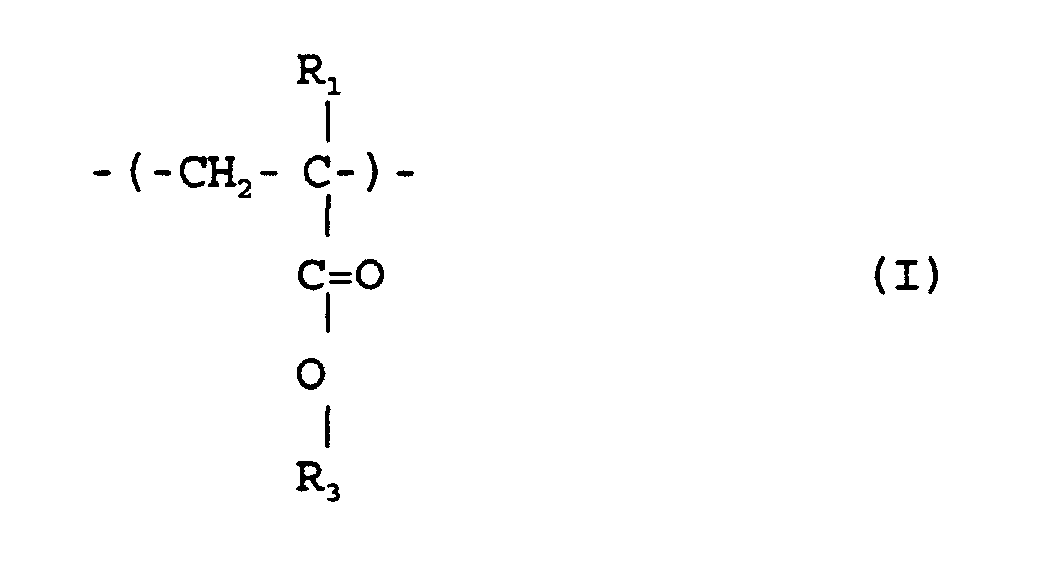
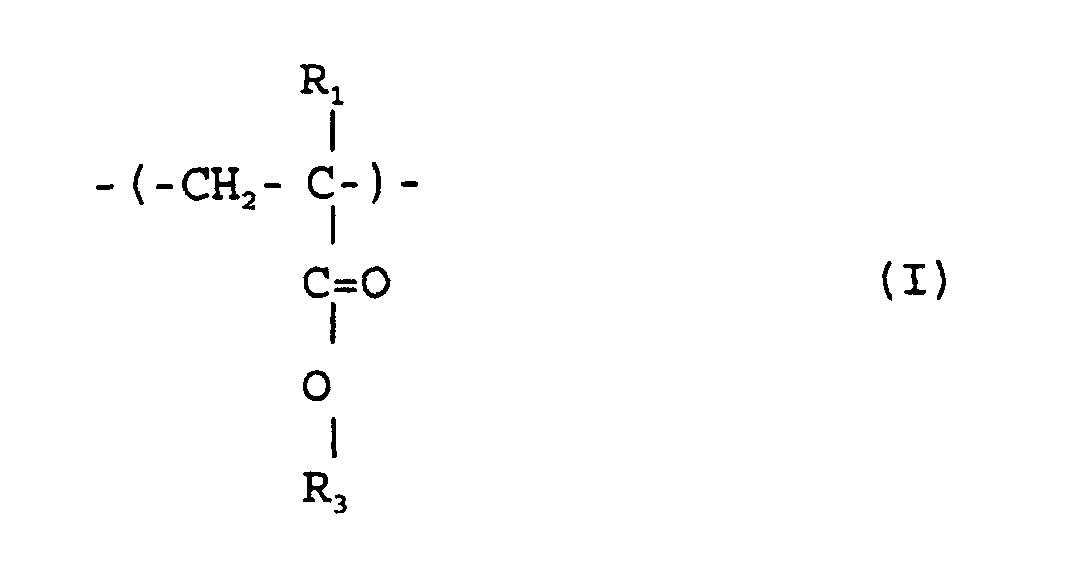
- the present invention is directed to a narrow polydispersity (meth) acrylic ester copolymer which comprises structural units represented by Formulae (I) and (II) where R 1 and R 2 are each independently hydrogen or methyl; R 3 is an optionally substituted alicyclic group having 7 to 15 carbons or an alkyl group having the said alicyclic group; and R 4 is hydrogen, an optionally substituted alkyl group having 1 to 12 carbons, an optionally substituted alicyclic or heterocyclic group having 3 to 6 carbons or a substituted silyl group having an alkyl and/or aryl group of 1 to 8 carbons, and which has a number-average molecular weight of 1,000 to 50,000, a ratio of weight-average molecular weight (Mw) to number-average molecular weight (Mn), Mw/Mn, of 1.00 to 1.40, and a ratio of the repeating structural units represented by Formula (I) to those of Formula (II) of 1/9 to 9/1.
- the said copolymer is represented as follows, if it does not have a (meth)acrylic acid segment:
- a narrow polydispersity (meth)acrylic ester copolymer which comprises structural units represented by Formulae (I) and (II') where R 1 and R 2 are each independently hydrogen or methyl; R 3 is an optionally substituted alicyclic group having 7 to 15 carbons or an alkyl group having the said alicyclic group; and R 4' is an optionally substituted alkyl group having 1 to 12 carbons, an optionally substituted alicyclic or heterocyclic group having 3 to 6 carbons or a substituted silyl group having an alkyl and/or aryl group of 1 to 8 carbons, and which has a number-average molecular weight of 1,000 to 50,000, a ratio of weight-average molecular weight (Mw) to number-average molecular weight (Mn), Mw/Mn, of 1.00 to 1.40, and a ratio of the repeating structural units represented by Formula (I) to those of Formula (II') of 1/9 to 9/1.
- R 1 and R 2 are each independently hydrogen
- the said copolymer is represented as follows, if it has a (meth)acrylic acid segment as an essential skeleton:
- a narrow polydispersity (meth)acrylic ester copolymer which comprises structural units represented by Formulae (I), (II) and (III) where R 1 , R 2 and R 5 are each independently hydrogen or methyl; R 3 is an optionally substituted alicyclic group having 7 to 15 carbons or an alkyl group having the said alicyclic group; and R 4 is hydrogen, an optionally substituted alkyl group having 1 to 12 carbons, an optionally substituted alicyclic or heterocyclic group having 3 to 6 carbons or a substituted silyl group having an alkyl and/or aryl group of 1 to 8 carbons, and which has a number-average molecular weight of 1,000 to 50,000, a ratio of weight-average molecular weight (Mw) to number-average molecular weight (Mn), Mw/Mn, of 1.00 to 1.40, and a ratio of the repeating structural units of Formula (I) to the total of those of Formulae (II) and (III) of 1/9 to 9
- the present invention is also directed to a process for producing the said narrow polydispersity (meth)acrylic ester copolymers by living anion polymerization.
- a process for producing a narrow polydispersity (meth)acrylic ester copolymer in which a (meth)acrylic ester of Formula (IV) (where R 1 is hydrogen or methyl and R 3 is an optionally substituted alicyclic group having 7 to 15 carbons or an alkyl group having the said alicyclic group) is copolymerized with a (meth)acrylic ester of Formula (V) (where R 2 is each independently hydrogen or methyl and R 4' is an optionally substituted alkyl group having 1 to 12 carbons, an optionally substituted alicyclic or heterocyclic group having 3 to 6 carbons or a substituted silyl group having an alkyl and/or aryl group of 1 to 8 carbons) by anion polymerization using an alkali metal or organic alkali metal as an initiator.
- a (meth)acrylic ester of Formula (IV) where R 1 is hydrogen or methyl and R 3 is an optionally substituted alicyclic group having 7 to 15 carbons
- a process for producing a narrow polydispersity (meth)acrylic ester copolymer in which a (meth)acrylic ester of Formula (IV) (where R 1 is hydrogen or methyl and R 3 is an optionally substituted alicyclic group having 7 to 15 carbons or an alkyl group having the said alicyclic group) is copolymerized with a (meth)acrylic ester of Formula (V) (where R 2 is hydrogen or methyl and R 4' is an optionally substituted alkyl group having 1 to 12 carbons, an optionally substituted alicyclic or heterocyclic group having 3 to 6 carbons or a substituted silyl group having an alkyl and/or aryl group of 1 to 8 carbons) by anion polymerization using an alkali metal or organic alkali metal as an initiator, followed by the hydrolysis of part or the whole of R 4' . with acidic and/or alkaline reagents to introduce a (meth)acrylic acid skeleton into the copo
- Examples of (meth)acrylic esters of Formula (IV) in this invention include 1-adamantyl acrylate, 1-adamantyl methacrylate, 2-methyl-2-adamantyl acrylate, 2-methyl-2-adamantyl methacrylate, 1-methyleneadamantyl acrylate, 1-methyleneadamantyl methacrylate, 1-ethyleneadamantyl acrylate, 1-ethyleneadamantyl methacrylate, 3,7-dimethyl-1-adamantyl acrylate, 3,7-dimethyl-1-adamantyl methacrylate, isobornyl acrylate, isobornyl methacrylate, tricyclodecanyl acrylate, tricyclodecanyl methacrylate, norbornane acrylate, norbornane methacrylate, menthyl acrylate and menthyl methacrylate. These compounds are used alone or a mixture of two or more.
- examples of (meth)acrylic esters of Formula (V), when they have an alkyl group of 1 to 12 carbons, include methyl acrylate, methyl methacrylate, ethyl acrylate, ethyl methacrylate, n-propyl acrylate, n-propyl methacrylate, isopropyl acrylate, isopropyl methacrylate, n-butyl acrylate, n-butyl methacrylate, t-butyl acrylate, t-butyl methacrylate, 2-ethylhexyl acrylate, 2-ethylhexyl methacrylate, isodecyl acrylate, isodecyl methacrylate, isooctyl acrylate, isooctyl methacrylate, lauryl acrylate and lauryl methacrylate; examples of (meth)acrylic esters having an alicyclic or heterocycl
- a process for producing the copolymers of the present invention is by reacting the aforementioned (meth)acrylic esters of Formulae (IV) and (V) by anion polymerization using an alkali metal or organic alkali metal as an initiator.
- an alkali metal or organic alkali metal as an initiator.
- a copolymer with a controlled structure and narrow molecular-weight distribution is obtained when polymerization is carried out in organic solvents in the atmosphere of inert gas, such as nitrogen or argon, at a temperature between -100° C and 50° C, preferably between -70° C and 0° C.
- alkali metals for initiators are lithium, sodium, potassium and cesium.
- Alkyl, allyl and aryl compounds of the alkali metals mentioned above can be used as organic alkali metals. Examples of these compounds include ethyl lithium, n-butyl lithium, s-butyl lithium, t-butyl lithium, ethyl sodium, lithium biphenyl, lithium naphthalene, lithium triphenyl, sodium biphenyl, sodium naphthalene, sodium triphenyl, 1,1-diphenylhexyl lithium and 1,1-diphenyl-3-methylpentyl lithium.
- Organic solvents used in this invention are those commonly used in anion polymerization, including aliphatic hydrocarbons such as n-hexane and n-heptane; alicyclic hydrocarbons such as cyclohexane and cyclopentane; aromatic hydrocarbons such as benzene and toluene; ethers such as diethyl ether, tetrahydrofuran and dioxane; and anisole and hexamethylphosphoramide. These are used alone or as a mixture of two or more.
- a random copolymer in which each component is statistically distributed over a copolymer chain, partial block copolymer or complete block copolymer is synthesized, depending on how to add the aforementioned (meth)acrylic esters.
- a random copolymer is produced by adding a mixture of compounds of the aforementioned Formulae (IV) and (V) to a reaction system for polymerization.
- a partial block copolymer is produced in a process that one of the compounds is all polymerized, followed by adding a mixture of the other compounds to continue polymerization, or part of one of the compounds is polymerized beforehand and a mixture of both compounds is added to continue polymerization.
- a complete block polymer is produced by adding compounds of the aforementioned Formulae (IV) and (V) one by one to a reaction system for polymerization.
- narrow polydispersity (meth)acrylic ester copolymers that have any number-average molecular weight in the range between 1,000 and 50,000, a ratio of weight-average molecular weight (Mw) to number-average molecular weight (Mn), Mw/Mn, of 1.00 to 1.40, more preferably 1.00 to 1.30, and a ratio of repeating structural units of Formula (I) to those of Formula (II) of 1/9 to 9/1 can be produced.
- a (meth)acrylic acid segment is introduced into a chain of a copolymer produced according to the aforementioned process, by hydrolysis in an organic solvent or a mixture of organic solvents including alcohols such as methanol and ethanol, ketones such as acetone and methyl ethyl ketone, cellosolves such as ethyl cellosolve and halogenated hydrocarbons such as carbon tetrachloride, in addition to the solvents exemplified in the polymerization reactions mentioned above, at a temperature between room temperature and 150° C, with a catalyst of an acidic reagent such as hydrochloric acid, hydrogen chloride gas, sulfuric acid, hydrobromic acid, 1,1,1-trifluoroacetic acid and p-toluenesulfonic acid or an alkaline reagent such as sodium hydroxide, ammonium hydroxide and tetramethyl ammonium hydroxide.
- an organic solvent or a mixture of organic solvents including alcohols such as
- m stands for the total number of the repeating units of the (meth)acrylic ester segment of Formula (I)
- n is the total number of the repeating units of the (meth)acrylic ester segment of Formula (II')
- p is the total number of the repeating units of the (meth)acrylic ester segment of Formula (III).
- s-butyl lithium was added into 1000 g of tetrahydrofuran (hereinafter abbreviated as THF).
- THF tetrahydrofuran
- 0.5 mol of 1-adamantyl methacrylate (synthesized from 1-adamantanol and methacrylic chloride and purified by distillation) was dropped over 30 minutes in stirring while keeping the temperature at -60° C. The reaction continued for another hour. The reaction completion was confirmed by gas chromatography (hereinafter abbreviated as GC). Then, 0.5 mol of t-butyl methacrylate was dropped over 30 minutes. The reaction continued for another hour. The reaction completion was confirmed by GC.
- GC gas chromatography
- AIBN azobisisobutyronitrile
- the reaction solution was poured into a large amount of methanol.
- the polymer deposited was filtrated, washed and dried at 60° C for 5 hours to give a white powder polymer.
- the polymerization yield to the total amount of the monomers used was 91.3%.
- the reaction solution was fractionally purified twice with methanol/water and poured into a large amount of methanol.
- the polymer deposited was filtrated, washed and dried at 60° C for 5 hours to give a white powder polymer.
- the polymerization yield to the total amount of the monomers used was 82.7%.
- Non-reacted monomers and compounds with low molecular weight were removed from the reaction solution by fractional purification with methanol/water. Volatile matter was then distilled out under reduced pressure to give a polymer.
- AIBN azobisisobutylonitrile
- the reaction solution was poured into a large amount of methanol.
- the polymer deposited was filtrated, washed and dried at 60° C for 5 hours to give a white powder polymer.
- the polymerization yield to the total amount of the monomers used was 92.3%.
- the reaction solution was fractionally purified twice with methanol/water and poured into a large amount of methanol.
- the polymer deposited was filtrated, washed and dried at 60° C for 5 hours to give a white powder polymer.
- the polymerization yield to the total amount of the monomers used was 81.5%.
- the present invention provides narrow polydispersity random, block or partial block copolymers of (meth)acrylic esters, which are expected to be used as materials for ArF excimer laser resists.
- the copolymers have a unimodal narrow molecular-weight distribution and an essential skeleton having at least one segment with a controlled structure comprising (meth)acrylic ester units each having an organic group containing a bulky alicyclic group.
Landscapes
- Chemical & Material Sciences (AREA)
- Health & Medical Sciences (AREA)
- Chemical Kinetics & Catalysis (AREA)
- Medicinal Chemistry (AREA)
- Polymers & Plastics (AREA)
- Organic Chemistry (AREA)
- Inorganic Chemistry (AREA)
- Graft Or Block Polymers (AREA)
- Addition Polymer Or Copolymer, Post-Treatments, Or Chemical Modifications (AREA)
Claims (8)
- Copolymère d'ester (méth)acrylique à polydispersité restreinte qui comprend les unités structurelles représentées par les formules (I) et (II)
 où R1 et R2 sont chacun indépendamment de l'hydrogène ou un méthyle; R3 est un groupe alicyclique facultativement substitué ayant de 7 à 15 atomes de carbone ou un groupe alkyle comprenant ce groupe alicyclique; et R4 est de l'hydrogène, un groupe alkyle facultativement substitué ayant de 1 à 12 atomes de carbone un groupe alicyclique ou hétérocyclique facultativement substitué ayant de 3 à 6 atomes de carbone ou un groupe silyle substitué ayant un groupe alkyle et/ou aryle de 1 à 8 atomes de carbone, et qui a un poids moléculaire moyen en nombre de 1000 à 50000, un rapport de poids moléculaire moyen en poids (Mw) à poids moléculaire moyen en nombre (Mn), Mw/Mn, de 1,00 à 1,40, et un rapport d'unités structurelles répétées représentées par la formule (I) à celles de la formule (II) de 1/9 à 9/1.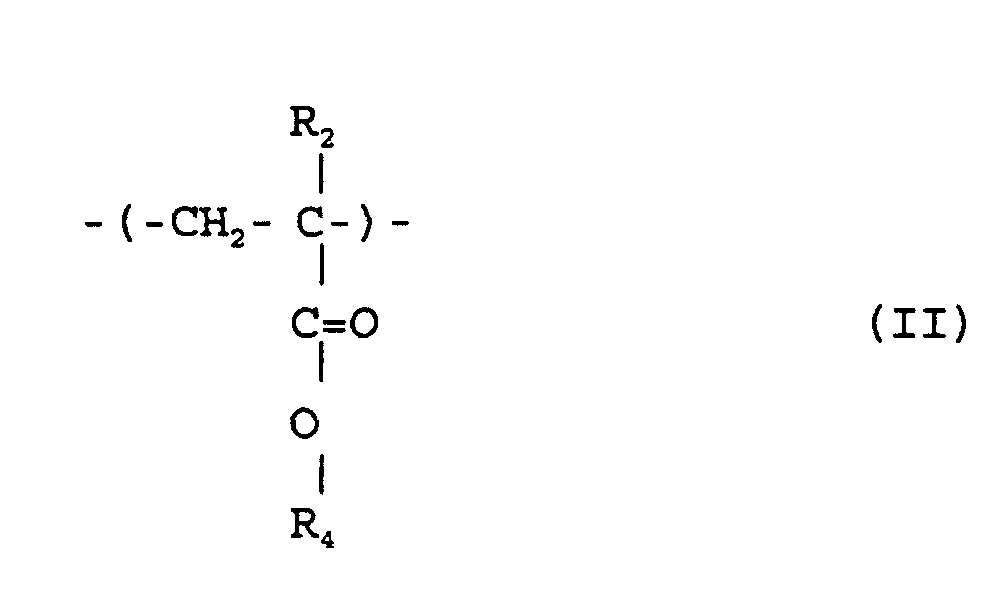
- Copolymère d'ester (méth)acrylique à polydispersité restreinte selon la revendication 1, qui comprend les unités structurelles représentées par les formules (I) et (II')
 où R1 et R2 sont chacun indépendamment de l'hydrogène ou un méthyle; R3 est un groupe alicyclique facultativement substitué ayant de 7 à 15 atomes de carbone ou un groupe alkyle comprenant ce groupe alicyclique; et R4 est un groupe alkyle facultativement substitué ayant de 1 à 12 atomes de carbone et un groupe alicyclique ou hétérocyclique facultativement substitué ayant de 3 à 6 atomes de carbone ou un groupe silyle substitué ayant un groupe alkyle et/ou aryle de 1 à 8 atomes de carbone, et qui a un poids moléculaire moyen en nombre de 1000 à 50000, un rapport de poids moléculaire moyen en poids (Mw) à poids moléculaire moyen en nombre (Mn), Mw/Mn, de 1,00 à 1,40, et un rapport d'unités structurelles répétées représentées par la formule (I) à celles de la formule (II') de 1/9 à 9/1.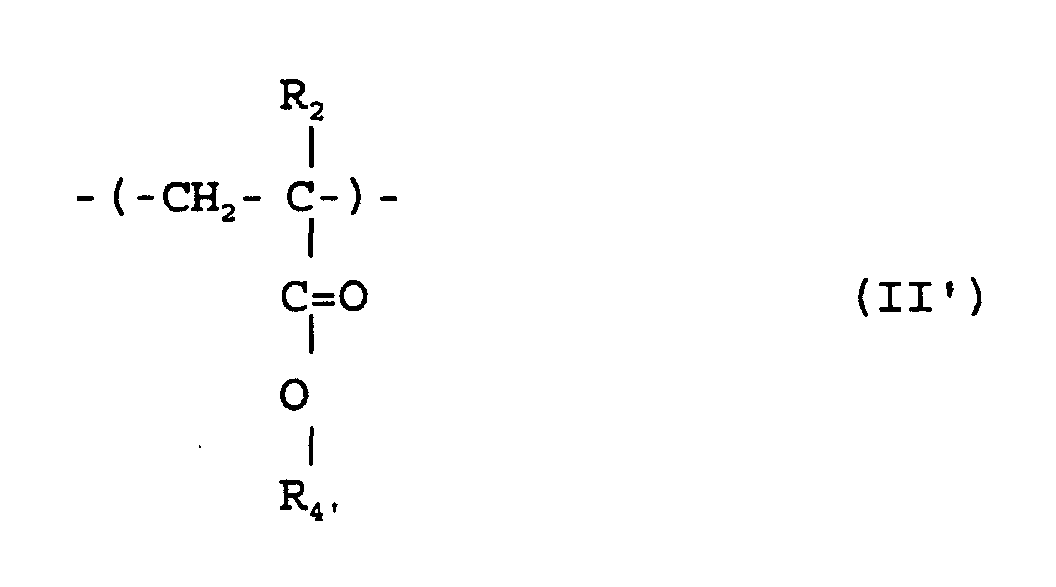
- Copolymère d'ester (méth)acrylique à polydispersité restreinte selon la revendication 1, qui comprend les unités structurelles représentées par les formules (I) et (II) et (III)
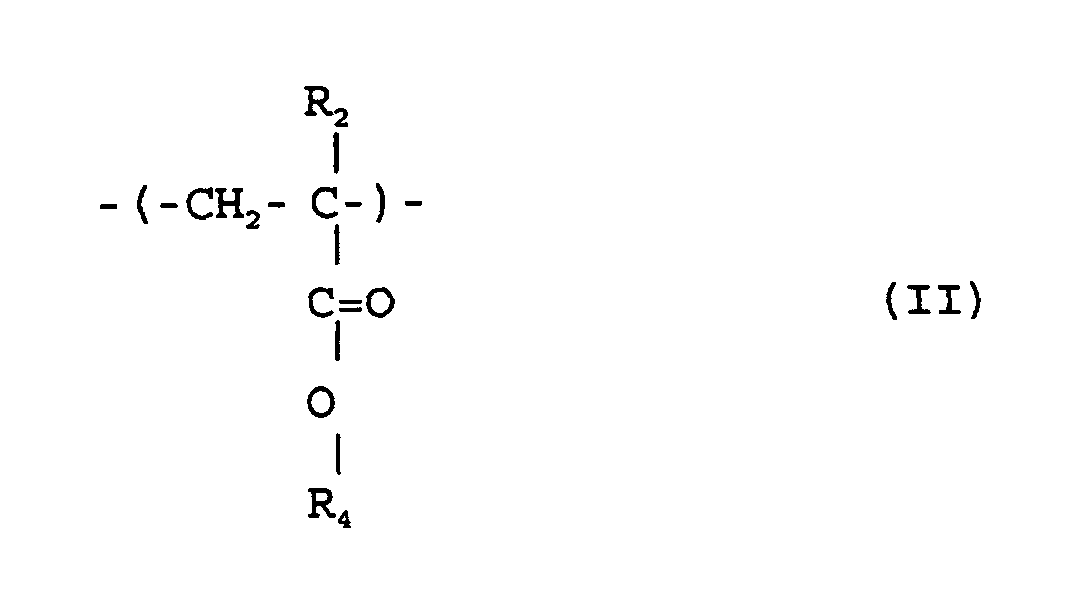 où R1 R2 et R5 sont chacun indépendamment de l'hydrogène ou un méthyle; R3 est un groupe alicyclique facultativement substitué ayant de 7 à 15 atomes de carbone ou un groupe alkyle comprenant ce groupe alicyclique; et R4 est de l'hydrogène, un groupe alkyle facultativement substitué ayant de 1 à 12 atomes de carbone, un groupe alicyclique ou hétérocyclique facultativement substitué ayant de 3 à 6 atomes de carbone ou un groupe silyle substitué ayant un groupe alkyle et/ou aryle de 1 à 8 atomes de carbone, et qui a un poids moléculaire moyen en nombre de 1000 à 50000, un rapport de poids moléculaire moyen en poids (Mw) à poids moléculaire moyen en nombre (Mn), Mw/Mn, de 1,00 à 1,40, et un rapport d'unités structurelles répétées représentées par la formule (I) au total de celles des formules (II) et (III) de 1/9 à 9/1.
- Copolymère d'ester (méth)acrylique à polydispersité restreinte selon les revendications 1 à 3, dans lequel le copolymère est un copolymère aléatoire.
- Copolymère d'ester (méth)acrylique à polydispersité restreinte selon les revendications 1 à 3, dans lequel le copolymère est un copolymère bloc.
- Copolymère d'ester (méth)acrylique à polydispersité restreinte selon les revendications 1 à 3, dans lequel le copolymère est un copolymère bloc partiel.
- Procédé de fabrication d'un copolymère d'ester (méth)acrylique à polydispersité restreinte selon la revendication 2, au cour duquel on copolymèrise un ester (méth)acrylique de la formule (IV)(où R1 est de l'hydrogène ou méthyle, R3 est un groupe alicyclique facultativement substitué et ayant de 7 à 15 atomes de carbone ou un groupe alkyle comportant ce groupe alicyclique)

avec un ester (méth)acrylique de la formule (V)(où R2 est chacun indépendamment de l'hydrogène ou méthyle, R4 est un groupe alkyle facultativement substitué ayant de 1 à 12 atomes de carbone, un groupe alicyclique ou hétérocyclique ayant de 3 à 6 atomes de carbone ou un groupe silyle substitué ayant un groupe alkyle et/ou un groupe aryle de 1 à 8 atomes de carbone),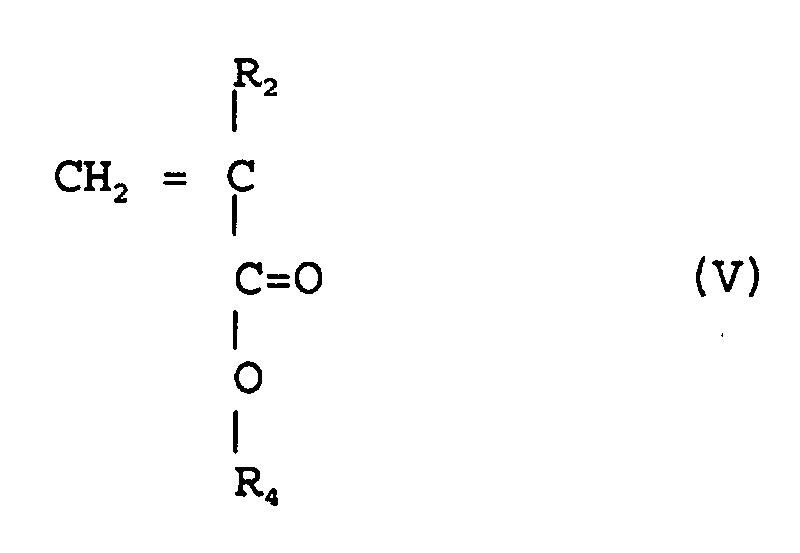
par polymérisation anionique en utilisant un métal alcalin ou un métal alcalin organique comme initiateur. - Procédé pour produire un copolymère d'ester (méth)acrylique à polydispersité restreinte selon la revendication 3, où on copolymérise un ester (méth)acrylique de la formule (IV)(où R1 est de l'hydrogène ou méthyle, R3 est un groupe alicyclique facultativement substitué ayant de 7 à 15 atomes de carbone ou un groupe alkyle comportant ce groupe alicyclique)

avec un ester (méth)acrylique de la formule (V)(où R2 est de l'hydrogène ou méthyle, R4 est un groupe alkyle facultativement substitué ayant de 1 à 12 atomes de carbone, un groupe alicyclique ou hétérocyclique facultativement substitué ayant de 3 à 6 atomes de carbone ou un groupe silyle substitué ayant un groupe alkyle et/ou un groupe aryle de 1 à 8 atomes de carbone),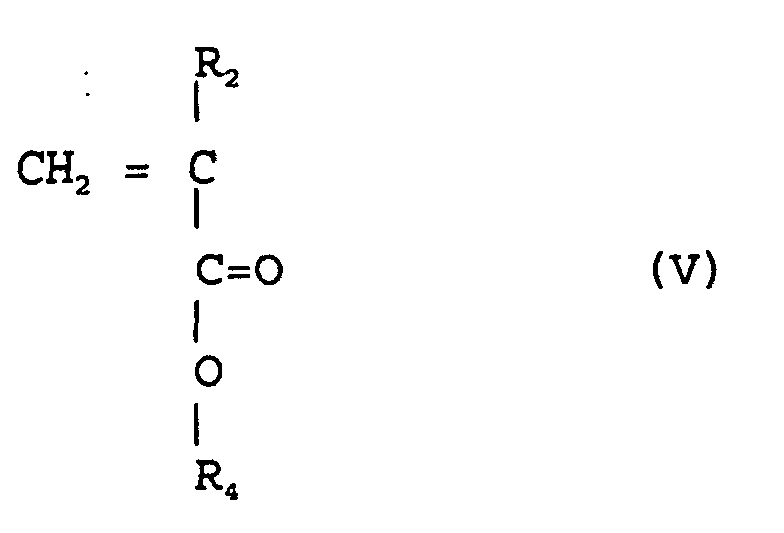
par polymérisation anionique en utilisant un métal alcalin ou un métal alcalin organique comme initiateur, suivi par l'hydrolyse d'une partie ou de la totalité de R4 avec des réactifs acides et/ou alcalins pour introduire un squelette d'acide (méth)acrylique dans la chaíne de copolymère.
Applications Claiming Priority (5)
| Application Number | Priority Date | Filing Date | Title |
|---|---|---|---|
| JP34455596 | 1996-12-09 | ||
| JP34455796 | 1996-12-09 | ||
| JP34455796 | 1996-12-09 | ||
| JP34455596 | 1996-12-09 | ||
| PCT/JP1997/004509 WO1998025977A1 (fr) | 1996-12-09 | 1997-12-09 | Copolymeres d'ester (meth)acrylique et procede de production de ces derniers |
Publications (3)
| Publication Number | Publication Date |
|---|---|
| EP0942018A1 EP0942018A1 (fr) | 1999-09-15 |
| EP0942018A4 EP0942018A4 (fr) | 2001-02-28 |
| EP0942018B1 true EP0942018B1 (fr) | 2003-03-12 |
Family
ID=26577796
Family Applications (1)
| Application Number | Title | Priority Date | Filing Date |
|---|---|---|---|
| EP97946160A Expired - Lifetime EP0942018B1 (fr) | 1996-12-09 | 1997-12-09 | Copolymeres d'ester (meth)acrylique et procede de production de ces derniers |
Country Status (4)
| Country | Link |
|---|---|
| EP (1) | EP0942018B1 (fr) |
| KR (1) | KR100331297B1 (fr) |
| DE (1) | DE69719787T2 (fr) |
| WO (1) | WO1998025977A1 (fr) |
Families Citing this family (5)
| Publication number | Priority date | Publication date | Assignee | Title |
|---|---|---|---|---|
| AU2003252749A1 (en) * | 2002-08-02 | 2004-02-23 | Kaneka Corporation | Acrylic block copolymer and thermoplastic resin composition |
| JP4731200B2 (ja) * | 2005-05-10 | 2011-07-20 | 丸善石油化学株式会社 | 半導体リソグラフィー用共重合体の製造方法 |
| JP5734726B2 (ja) * | 2011-04-28 | 2015-06-17 | 公立大学法人大阪市立大学 | (メタ)アクリル系樹脂組成物及び光学部品 |
| JP6988635B2 (ja) * | 2018-03-27 | 2022-01-05 | 三菱ケミカル株式会社 | レジスト用重合体 |
| US12037437B2 (en) * | 2021-05-28 | 2024-07-16 | The Goodyear Tire & Rubber Company | Rubber composition comprising a block-copolymer |
Family Cites Families (9)
| Publication number | Priority date | Publication date | Assignee | Title |
|---|---|---|---|---|
| JPS61176617A (ja) * | 1985-02-01 | 1986-08-08 | Mitsubishi Rayon Co Ltd | 立体規則性に優れたメタクリル酸メチル重合体 |
| JPH0670105B2 (ja) * | 1986-12-29 | 1994-09-07 | 凸版印刷株式会社 | 単分散重合体の製造方法 |
| JP2881969B2 (ja) * | 1990-06-05 | 1999-04-12 | 富士通株式会社 | 放射線感光レジストとパターン形成方法 |
| JPH04173805A (ja) * | 1990-11-07 | 1992-06-22 | Toagosei Chem Ind Co Ltd | (メタ)アクリル酸エステルのアニオン重合方法 |
| JPH05265212A (ja) * | 1992-03-17 | 1993-10-15 | Fujitsu Ltd | レジスト材料およびそれを用いるパターン形成方法 |
| JPH06256410A (ja) * | 1993-03-04 | 1994-09-13 | Toyota Motor Corp | (メタ)アクリル酸エステル用アニオン重合開始剤 |
| JPH06266099A (ja) * | 1993-03-15 | 1994-09-22 | Hitachi Ltd | パターン形成材料,パターン形成方法,及びそれを用いた機能性素子形成方法 |
| JP3353258B2 (ja) * | 1993-10-26 | 2002-12-03 | 富士通株式会社 | 遠紫外線用レジスト |
| JP3421145B2 (ja) * | 1994-10-27 | 2003-06-30 | 日立化成工業株式会社 | 感光性樹脂組成物及びこれを用いた感光性エレメント |
-
1997
- 1997-12-09 KR KR1019997005074A patent/KR100331297B1/ko not_active Expired - Lifetime
- 1997-12-09 DE DE69719787T patent/DE69719787T2/de not_active Expired - Lifetime
- 1997-12-09 WO PCT/JP1997/004509 patent/WO1998025977A1/fr not_active Ceased
- 1997-12-09 EP EP97946160A patent/EP0942018B1/fr not_active Expired - Lifetime
Also Published As
| Publication number | Publication date |
|---|---|
| KR100331297B1 (ko) | 2002-04-03 |
| KR20000057447A (ko) | 2000-09-15 |
| EP0942018A1 (fr) | 1999-09-15 |
| WO1998025977A1 (fr) | 1998-06-18 |
| DE69719787D1 (de) | 2003-04-17 |
| DE69719787T2 (de) | 2003-08-14 |
| EP0942018A4 (fr) | 2001-02-28 |
Similar Documents
| Publication | Publication Date | Title |
|---|---|---|
| US8492483B2 (en) | ABA triblock copolymer and process for producing the same | |
| JP4187815B2 (ja) | (メタ)アクリル酸エステル系共重合体及びその製造方法 | |
| US11814351B2 (en) | Bifunctional (meth)acrylate compound and polymer | |
| JP4183293B2 (ja) | (メタ)アクリル酸エステル系重合体及びその製造方法 | |
| KR100274553B1 (ko) | (메트)아크릴레이트, 중합체, 포토레지스트 조성물 및 이를 이용한 패턴 형성방법 | |
| KR100486323B1 (ko) | 화학 증폭 레지스트, 화학 증폭 레지스트용 중합체,중합체용 단량체 및 화학 증폭 레지스트층에의 패턴 전송방법 | |
| EP0517428B1 (fr) | Poly(para-t-butyloxycarbonyl-oxystyrène) et procédé pour sa préparation | |
| EP0942018A1 (fr) | Copolymeres d'ester (meth)acrylique et procede de production de ces derniers | |
| JP3711550B2 (ja) | 狭分散アルケニルフェノール系共重合体及びその製造方法 | |
| JP5770625B2 (ja) | ビニルエーテル系星型ポリマーおよびその製造方法 | |
| US6218485B1 (en) | Process for producing narrow polydispersity alkenylphenol polymer | |
| KR100653302B1 (ko) | 스티렌 유도체 | |
| JP4136886B2 (ja) | 新規な脂環式ビニルエーテル類の重合体 | |
| JP5731401B2 (ja) | ビニルエーテル系星型ポリマーの製造方法 | |
| JP4627360B2 (ja) | A−b−a型アルケニルフェノール系共重合体 | |
| US5412050A (en) | Polymer having a narrow dispersion of molecular weight and a manufacturing process thereof | |
| US4731424A (en) | Process for producing polymer compound containing alkenylsilyl group | |
| JP5193597B2 (ja) | フォトレジスト用重合性化合物、その重合体及び該重合体を含むフォトレジスト組成物 | |
| JPH0641221A (ja) | ポリ(3−メチル−4−ヒドロキシスチレン)及びその製造方法 | |
| CN116284517A (zh) | 一种分子量窄分布且高透光性phs树脂及其合成方法与应用 | |
| JP2001151719A (ja) | スチレン誘導体 | |
| JP3882871B2 (ja) | アルケニルフェノール系共重合体の製造方法 | |
| JP4139948B2 (ja) | 不飽和単量体、重合体、化学増幅レジスト組成物、および、パターン形成方法 | |
| JPH0632818A (ja) | ポリ(p−ヒドロキシスチレン)の製造方法 | |
| JPH0641222A (ja) | ポリ(m−ヒドロキシスチレン)及びその製造方法 |
Legal Events
| Date | Code | Title | Description |
|---|---|---|---|
| PUAI | Public reference made under article 153(3) epc to a published international application that has entered the european phase |
Free format text: ORIGINAL CODE: 0009012 |
|
| 17P | Request for examination filed |
Effective date: 19990608 |
|
| AK | Designated contracting states |
Kind code of ref document: A1 Designated state(s): DE FR GB |
|
| A4 | Supplementary search report drawn up and despatched |
Effective date: 20010111 |
|
| AK | Designated contracting states |
Kind code of ref document: A4 Designated state(s): DE FR GB |
|
| GRAH | Despatch of communication of intention to grant a patent |
Free format text: ORIGINAL CODE: EPIDOS IGRA |
|
| GRAH | Despatch of communication of intention to grant a patent |
Free format text: ORIGINAL CODE: EPIDOS IGRA |
|
| GRAA | (expected) grant |
Free format text: ORIGINAL CODE: 0009210 |
|
| AK | Designated contracting states |
Designated state(s): DE FR GB |
|
| REG | Reference to a national code |
Ref country code: GB Ref legal event code: FG4D |
|
| REF | Corresponds to: |
Ref document number: 69719787 Country of ref document: DE Date of ref document: 20030417 Kind code of ref document: P |
|
| ET | Fr: translation filed | ||
| PLBE | No opposition filed within time limit |
Free format text: ORIGINAL CODE: 0009261 |
|
| STAA | Information on the status of an ep patent application or granted ep patent |
Free format text: STATUS: NO OPPOSITION FILED WITHIN TIME LIMIT |
|
| 26N | No opposition filed |
Effective date: 20031215 |
|
| PGFP | Annual fee paid to national office [announced via postgrant information from national office to epo] |
Ref country code: DE Payment date: 20141211 Year of fee payment: 18 Ref country code: GB Payment date: 20141219 Year of fee payment: 18 |
|
| PGFP | Annual fee paid to national office [announced via postgrant information from national office to epo] |
Ref country code: FR Payment date: 20141219 Year of fee payment: 18 |
|
| REG | Reference to a national code |
Ref country code: DE Ref legal event code: R119 Ref document number: 69719787 Country of ref document: DE |
|
| GBPC | Gb: european patent ceased through non-payment of renewal fee |
Effective date: 20151209 |
|
| REG | Reference to a national code |
Ref country code: FR Ref legal event code: ST Effective date: 20160831 |
|
| PG25 | Lapsed in a contracting state [announced via postgrant information from national office to epo] |
Ref country code: GB Free format text: LAPSE BECAUSE OF NON-PAYMENT OF DUE FEES Effective date: 20151209 Ref country code: DE Free format text: LAPSE BECAUSE OF NON-PAYMENT OF DUE FEES Effective date: 20160701 |
|
| PG25 | Lapsed in a contracting state [announced via postgrant information from national office to epo] |
Ref country code: FR Free format text: LAPSE BECAUSE OF NON-PAYMENT OF DUE FEES Effective date: 20151231 |