EP0949314B1 - Hydrodésulfurisation d'huiles hydrocarburées - Google Patents
Hydrodésulfurisation d'huiles hydrocarburées Download PDFInfo
- Publication number
- EP0949314B1 EP0949314B1 EP99105010A EP99105010A EP0949314B1 EP 0949314 B1 EP0949314 B1 EP 0949314B1 EP 99105010 A EP99105010 A EP 99105010A EP 99105010 A EP99105010 A EP 99105010A EP 0949314 B1 EP0949314 B1 EP 0949314B1
- Authority
- EP
- European Patent Office
- Prior art keywords
- hydrodemercaptanization
- process according
- catalyst
- oil
- content
- Prior art date
- Legal status (The legal status is an assumption and is not a legal conclusion. Google has not performed a legal analysis and makes no representation as to the accuracy of the status listed.)
- Expired - Lifetime
Links
Images

Classifications
-
- B—PERFORMING OPERATIONS; TRANSPORTING
- B01—PHYSICAL OR CHEMICAL PROCESSES OR APPARATUS IN GENERAL
- B01J—CHEMICAL OR PHYSICAL PROCESSES, e.g. CATALYSIS OR COLLOID CHEMISTRY; THEIR RELEVANT APPARATUS
- B01J23/00—Catalysts comprising metals or metal oxides or hydroxides, not provided for in group B01J21/00
- B01J23/70—Catalysts comprising metals or metal oxides or hydroxides, not provided for in group B01J21/00 of the iron group metals or copper
- B01J23/76—Catalysts comprising metals or metal oxides or hydroxides, not provided for in group B01J21/00 of the iron group metals or copper combined with metals, oxides or hydroxides provided for in groups B01J23/02 - B01J23/36
- B01J23/84—Catalysts comprising metals or metal oxides or hydroxides, not provided for in group B01J21/00 of the iron group metals or copper combined with metals, oxides or hydroxides provided for in groups B01J23/02 - B01J23/36 with arsenic, antimony, bismuth, vanadium, niobium, tantalum, polonium, chromium, molybdenum, tungsten, manganese, technetium or rhenium
- B01J23/85—Chromium, molybdenum or tungsten
-
- C—CHEMISTRY; METALLURGY
- C10—PETROLEUM, GAS OR COKE INDUSTRIES; TECHNICAL GASES CONTAINING CARBON MONOXIDE; FUELS; LUBRICANTS; PEAT
- C10G—CRACKING HYDROCARBON OILS; PRODUCTION OF LIQUID HYDROCARBON MIXTURES, e.g. BY DESTRUCTIVE HYDROGENATION, OLIGOMERISATION, POLYMERISATION; RECOVERY OF HYDROCARBON OILS FROM OIL-SHALE, OIL-SAND, OR GASES; REFINING MIXTURES MAINLY CONSISTING OF HYDROCARBONS; REFORMING OF NAPHTHA; MINERAL WAXES
- C10G45/00—Refining of hydrocarbon oils using hydrogen or hydrogen-generating compounds
- C10G45/02—Refining of hydrocarbon oils using hydrogen or hydrogen-generating compounds to eliminate hetero atoms without changing the skeleton of the hydrocarbon involved and without cracking into lower boiling hydrocarbons; Hydrofinishing
- C10G45/04—Refining of hydrocarbon oils using hydrogen or hydrogen-generating compounds to eliminate hetero atoms without changing the skeleton of the hydrocarbon involved and without cracking into lower boiling hydrocarbons; Hydrofinishing characterised by the catalyst used
- C10G45/06—Refining of hydrocarbon oils using hydrogen or hydrogen-generating compounds to eliminate hetero atoms without changing the skeleton of the hydrocarbon involved and without cracking into lower boiling hydrocarbons; Hydrofinishing characterised by the catalyst used containing nickel or cobalt metal, or compounds thereof
- C10G45/08—Refining of hydrocarbon oils using hydrogen or hydrogen-generating compounds to eliminate hetero atoms without changing the skeleton of the hydrocarbon involved and without cracking into lower boiling hydrocarbons; Hydrofinishing characterised by the catalyst used containing nickel or cobalt metal, or compounds thereof in combination with chromium, molybdenum, or tungsten metals, or compounds thereof
-
- C—CHEMISTRY; METALLURGY
- C10—PETROLEUM, GAS OR COKE INDUSTRIES; TECHNICAL GASES CONTAINING CARBON MONOXIDE; FUELS; LUBRICANTS; PEAT
- C10G—CRACKING HYDROCARBON OILS; PRODUCTION OF LIQUID HYDROCARBON MIXTURES, e.g. BY DESTRUCTIVE HYDROGENATION, OLIGOMERISATION, POLYMERISATION; RECOVERY OF HYDROCARBON OILS FROM OIL-SHALE, OIL-SAND, OR GASES; REFINING MIXTURES MAINLY CONSISTING OF HYDROCARBONS; REFORMING OF NAPHTHA; MINERAL WAXES
- C10G69/00—Treatment of hydrocarbon oils by at least one hydrotreatment process and at least one other conversion process
- C10G69/02—Treatment of hydrocarbon oils by at least one hydrotreatment process and at least one other conversion process plural serial stages only
- C10G69/04—Treatment of hydrocarbon oils by at least one hydrotreatment process and at least one other conversion process plural serial stages only including at least one step of catalytic cracking in the absence of hydrogen
-
- C—CHEMISTRY; METALLURGY
- C10—PETROLEUM, GAS OR COKE INDUSTRIES; TECHNICAL GASES CONTAINING CARBON MONOXIDE; FUELS; LUBRICANTS; PEAT
- C10G—CRACKING HYDROCARBON OILS; PRODUCTION OF LIQUID HYDROCARBON MIXTURES, e.g. BY DESTRUCTIVE HYDROGENATION, OLIGOMERISATION, POLYMERISATION; RECOVERY OF HYDROCARBON OILS FROM OIL-SHALE, OIL-SAND, OR GASES; REFINING MIXTURES MAINLY CONSISTING OF HYDROCARBONS; REFORMING OF NAPHTHA; MINERAL WAXES
- C10G69/00—Treatment of hydrocarbon oils by at least one hydrotreatment process and at least one other conversion process
- C10G69/02—Treatment of hydrocarbon oils by at least one hydrotreatment process and at least one other conversion process plural serial stages only
- C10G69/06—Treatment of hydrocarbon oils by at least one hydrotreatment process and at least one other conversion process plural serial stages only including at least one step of thermal cracking in the absence of hydrogen
Definitions
- This invention relates to a conversion process of hydrocarbon oils comprising at least a hydrofining process, more particularly, the invention relates to a conversion process of hydrocarbon oils, comprising at least a hydrodemercaptaniztation process and optionally a FCC process or an atmospheric distillation process of crude oil or a thermal cracking process of heavy oil.
- Total sulfur content, mercaptan sulfur content and acid value are important indexes of middle distillates and light oil distillates.
- Part of the middle distillates and light oils, such as lamp kerosene, aviation kerosene and FCC gasoline, are qualified in total sulfur content, but not in mercaptan sulfur content and acid value.
- middle distillates or light oils such as lamp kerosene, aviation kerosene and FCC gasoline and the like, and more severe emission standard of waste gas from vehicles
- a MEROX process without presence of hydrogen is used as another deodorization process, in which a catalyst of sulfonated phthalocyanine cobalt and an activator are used to oxidize the mercaptan into sulfur dioxide, but the resultant product needs to washing, dehydrating with a salt, and then decolorizing with clay.
- the MEROX process is operated under atmosphere pressure, new pollution also occurs from waste salts and wasted clay, and the cost of the sulfonated phthalocyanine cobalt catalyst is also relatively high, furthermore, there is a severe limitation on the acid value of feedstocks in this process, so the adaptability to feedstocks is not good.
- Hydrofining is an effective measure to remove sulfur (including mercaptan) from oil distillates, but if a conventional hydrofining process is used, since it is operated at higher temperature and pressure, apparatus investment and energy consumption are all high, thus operation cost goes up.
- Table 1 a few sets of process conditions for hydrodesulfurization of aviation kerosene and kerosene fractions are listed (cf. Petroleum Processing No.6, 27 ⁇ 55, 1979, in Chinese).
- Table 1 Feed stock Catalyst Temperature °C Pressure atm..
- a qualified jet fuel can be produced by use of a conventional hydrofining catalyst from a jet fuel fraction having unqualified indexes of acidity, color and mercaptan content under reaction conditions as follows: hydrogen partial pressure 7 ⁇ 25 kg/cm 2 , reaction temperature 200 ⁇ 310°C, LHSV 1 ⁇ 8h -1 , H 2 /oil volume ratio 50 ⁇ 200 and hydrogen purity of 60 ⁇ 70%.
- the total liquid product yield is about 2% higher than that of acid-base refining while no environmental pollution from acid and base sludges occurs.
- its hydrogen partial pressure in operation is 7 ⁇ 25 kg/cm 2 , apparatus investment is higher, and since the H/oil volume ratio is also high, when a process of single-pass hydrogen is used, hydrogen consumption is relatively high, especially for a plant short of hydrogen source, thus a bigger apparatus for the circulation of hydrogen is also required.
- a hydrotreating process for treating a domestic heating raw oil, i.e. 2# straight fraction oil having a total sulfur content of less than 0.2wt% is treated under relatively low pressure.
- the process comprises that said straight feedstock oil, which contains at least 30 ppm of mercaptan sulfur, is passed through a hydrotreating catalyst under a process pressure not exceeding 10.2kg/cm 2 and a reaction temperature of 149 ⁇ 315°C, preferably 204 ⁇ 288°C, and with H/oil ratio in the range of 36 ⁇ 216 , generally 54 ⁇ 180,wherein the hydrogen consumption including liquid loss does not exceed 25 s.c.f.
- a hydrotreating process for treating a domestic heating raw oil, i.e. 2# straight fraction oil having a total sulfur content of less than 0.2wt% under relatively low pressure.
- the process comprises that said oil is passed through a hydrotreating catalyst, the total acid value of said straight feedstock oil is higher than 0.1(measured by ASTM D66C or D974), said process pressure is not higher than 10.2 kg/cm 2 , reaction temperature is 149 ⁇ 315 °C, preferably 204 ⁇ 288°C, hydrogen consumption including liquid loss is not higher than 25 s. c. f. per barrel of feedstocks; effluent oil having a total acid value of less than 0.1 is recovered.
- H/oil volume ratio is in the range of 36 ⁇ 216, generally 54 ⁇ 180.
- a hydrotreating process under relatively low pressure is disclosed, which is carried out in the first reactor under relatively low pressure.
- the process comprises that the first feedstock containing straight middle fraction oil and hydrogen is passed downward through a hydrodesulfurization catalyst which has been deactivated in the preceding hydrodesulfurization process under relatively high pressure, said preceding process is carried out in a second reactor having relatively high pressure in downflow mode by using the second feedstock under a pressure of at least 40.8 kg/cm 2 and a temperature of 343 ⁇ 427°C.
- said catalyst When said catalyst has lost permanently the necessary activity for the high-pressure hydrodesulfurization, said catalyst is removed from the second reactor and packed into the first relatively low pressure reactor for hydrotreating the first feedstock under the conditions of a pressure not higher than 10.2 kg/cm 2 and the reaction temperature in the range of 149 ⁇ 315°C, preferably 204 ⁇ 288°C.
- the H/oil volume ratio is 36 ⁇ 216, generally 54 ⁇ 180, in said first reactor.
- the reaction temperature of hydrodesulfurization is 149 ⁇ 315 °C, preferably 204 ⁇ 288°C,where as a relatively high temperature will lead to an increase in energy consumption and cost of the process.
- the reason why such a high reaction temperature of 204 ⁇ 288°C is preferred in the prior art is that the existing catalyst of prior art has not enough low-temperature activity at a temperature below 200°C, it cannot effect demercaptanization to a deeper extent and its reaction product can not meet the quality requirements.
- the hydrogenation catalysts used play an important role in the process.
- the catalyst cost is directly related to the operation cost of the whole hydrogenation process. Therefore, during the treatment of qualified or nearly qualified middle fractions which are only required to remove mercaptan and acidic substances, the catalysts used should have higher activities of hydrodemercaptanization and deacidification, at the same time the cost of the catalysts should be lower.
- the low-temperature (150 ⁇ 200°C) activity of the catalyst is of very important significance, the catalyst having higher activity at low temperature can not only reduce energy consumption in the hydrofining process, but also have an important effect on the process scheme.
- the atmospheric first side-line kerosene (hot) (that is the reaction feedstock used in the present invention) is generally at about 160 ⁇ 180°C when it is just distilled out from a distillation apparatus, if the hydrodemercaptanization of said oil product is carried out at the reaction temperature of hydrofining process below 200°C, the feedstock can be heated to the reaction temperature required only by passing through a simple heat exchanger, and steam of medium pressure (15 kg/cm 2 ) can be used as a heating medium, or even the feedstock can be fed directly into the hydrodemercaptanization apparatus without any heat exchanger to enter into the hydrodemercaptanization reaction.
- hot that is the reaction feedstock used in the present invention
- H/oil volume ratio must be maintained at a high level for the hydrodemercaptanization reaction, thus a minimum value of the H/oil volume ratio is prescribed for the hydrogenation process in prior art, for example in US 3,870,626, US 3,876,532, US 3,850,744, the prescribed minimum value of the H/oil volume ratio is 36, preferred minimum value is 54, however in practical application it is in general higher than 50.
- a single-pass hydrogen flow i.e. no circulating hydrogen for reuse
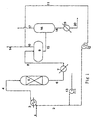
- Fig. 1 the flow scheme shown in Fig. 1 is generally used in the prior art (see “Petroleum Processing” No.6, 27 ⁇ 55,1979). That is, the feedstock is mixed via line 1 with hydrogen from line 2, then flows to a heater 3 (or a heat exchanger), the heated feedstock is fed via line 4 into a hydrogenation reactor 5 in which a hydrofining catalyst is packed. The reaction between the feedstock and hydrogen is carried out in the reactor 5 in contact with the hydrofining catalyst. Reaction product is fed via line 6 in a cooler 7 to be cooled.
- the cooled reaction product enters in a separator 9 via line 8, where unreacted hydrogen and part of hydrogen sulfide gas are separated out, then discharged via line 10, wherein the hydrogen via line 11 and circulating-hydrogen compressor 12 is mixed with hydrogen from hydrogen compressor 13 , then enters line 2.
- Hydrogen sulfide gas is discharged from line 14.
- the reaction product from which unreacted hydrogen and part of hydrogen sulfide gas have been separated flows to a stripper 16 via line 15, where the remaining hydrogen sulfide gas and part of lower hydrocarbons are stripped out off and discharged via line 17.
- the reaction product from which hydrogen sulfide gas and part of lower hydrocarbons have been stripped off then flows into a cooler 19 via line 18.
- the cooled reaction product then flows out via line 20 to obtain a qualified product.
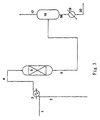
- the process with single-pass hydrogen flow shown in Fig 2 is also in use (see “Petroleum Processing " No.6, 27 ⁇ 55, 1979). That is the feedstock is mixed via line 1 with hydrogen from line 2, then flows to a heater 3, the heated feedstock is fed via line 4 into a hydrogenation reactor 5 in which a hydrofining catalyst is packed. The reaction between the feedstock and hydrogen is carried out in the reactor 5 in contact with the hydrofining catalyst. Reaction product flows to a cooler 7 via line 6 to be cooled. The cooled reaction product enters in a high -pressure separator 9 via line 8, where unreacted hydrogen and part of gaseous hydrogen sulfide are separated out, then discharged via line 10.
- reaction product from which unreacted hydrogen and part of hydrogen sulfide gas have been separated flows to a stripper 16 via line 15, where the remaining hydrogen sulfide gas and part of lower hydrocarbons are stripped off, then discharged via line 17.
- the reaction product from which hydrogen sulfide gas and past of lower hydrocarbons are stripped off flows into a cooler 19 via line 18. Cooled reaction product flows out via line 20, then a qualified product is obtained.
- the object of the present invention is to provide a hydrocarbon conversion process to overcome the above drawbacks in the prior art, wherein the process comprises at least a hydrodemercaptanization process which can be carried out at lower reaction temperature, especially at lower temperature and lower H/oil volume ratio.
- the hydrotreating catalysts of prior art have inferior activity at low-temperature, and most of them have also higher metal content and higher cost.
- the inventors of the present invention discover unexpectedly that,by introducing three active components of nickel, cobalt and molybdenum and/or tungsten onto the alumina carrier of the catalyst and adjusting the ratio of the three components, the metal content of the catalyst is decreased, while the low-temperature activity of the catalyst can be significantly increased.
- the low-temperature activity can be further improved by use of a specific method for preparation of the catalyst.
- the process of hydrocarbon conversion according to the present invention comprises at least a hydrodemercaptanization process comprising use of a feedstock having a total sulfur content not higher than 0.35wt%, mercaptan sulfur content higher than 20 ppm in contact with a hydrofining catalyst under the conditions of hydrodemercaptanization process, and recovery of a product having a decreased content of mercaptan sulfur, wherein said process conditions of hydrodemercaptanization include a H/oil volume ratio not less than 5, said hydrofining catalyst contains tungsten oxide and/or molybdenum oxide, nickel oxide and cobalt oxide supported on an alumina carrier, in which, based on the weight of the catalyst, the content of said tungsten oxide and/or molybdenum oxide is from 4wt % to less than 10wt %, the content of nickel oxide is 1 ⁇ 5wt %, the content of cobalt oxide is the 0.01 ⁇ 1wt % and the ratio of the total atom number of nickel and cobal
- the content of nickel oxide is preferably 2 ⁇ 4wt %; the content of cobalt oxide is preferably 0.02 ⁇ 0.5wt %; the content of tungsten oxide and/or molybdenum oxide is preferably 4.5 ⁇ 9wt %; and said ratio of total atom number of nickel and cobalt to total atom number of nickel, cobalt, tungsten and/or molybdenum is preferably 0.4 ⁇ 0.7.
- the catalyst used in the process according to the present invention can comprise further and preferably one promoter.
- Said promoter can be selected from one or more of the oxides of magnesium, oxides of phosphorus and fluorine-containing compounds, and the content of said promoter is 0.01 ⁇ 8wt %, preferably 0.2 ⁇ 5wt %, based on element.
- Said alumina carrier is an alumina often used as a carrier of hydrogenation catalysts, preferably ⁇ -alumina, ⁇ -alumina or mixture thereof. More preferably, the alumina carrier is ⁇ -alumina or an alumina essentially consisted of ⁇ -alumina.
- the pre-sulfurization of said hydrofining catalyst according to the invention can be carried out before use, the best way is not to do so, the catalyst in an oxidation state can be directly used to start operation.
- the catalyst used in the process according to the present invention can be prepared by co-impregnation technique, that is, the alumina carrier is impregnated with an aqueous solution containing tungsten and/or molybdenum, nickel and cobalt compounds, then calcined to obtain the catalyst.
- the preferred preparation method of the catalyst used in the process according to the invention comprises that the alumina carrier is impregnated with an aqueous solution containing molybdenum and/or tungsten compounds and a nickel compound, and an aqueous solution containing a cobalt compound, and the alumina carrier impregnated with molybdenum and/or tungsten, nickel and cobalt is calcined, wherein said impregnation process of the alumina carrier with the aqueous solution containing cobalt compound and said impregnation process of the alumina carrier with the aqueous solution containing molybdenum and/or tungsten compounds and nickel compound are carried out separately.
- Said impregnation process of the alumina carrier with the aqueous solution of the cobalt compound is carried out after the alumina carrier has been impregnated with the aqueous solution containing molybdenum and/or tungsten compound the nickel compound and calcined.
- Said calcination temperature of the alumina carrier impregnated with the aqueous solution of cobalt compound is in the range of 50 ⁇ 300°C, and said calcination time is more than 1 hour.
- the low-temperature activity of the hydrofining catalyst prepared by using said method can be further strengthened.
- the preferred preparation method of the catalyst used in the process according to the present invention comprises preferably the following specific steps:
- Said precursor of alumina can be selected from various hydrated alumina such as pseudo-boehmite, gibbsite and the like, which can be calcined to form ⁇ -alumina and/or ⁇ -alumina.
- Said precursor of alumina is preferably pseudo-boehmite or one or more hydrated alumina being consisting essentiallyof pseudo-boehmite.
- drying and calcination of the alumina carrier impregnated with the aqueous solution containing molybdenum and/or tungsten and nickel compounds are carried out under conventional conditions.
- the dry temperature may be in the range from room temperature to 200 °C
- the calcination temperature may be in the range from 400°C to 600°C
- calcination time may be more than 1 hour, preferably 2 ⁇ 5 hours.
- a conventional impregnation or saturation impregnation method can be used for said impregnation, the saturation impregnation method is preferred.
- Said molybdenum and/or tungsten compounds are selected from one or more of their water soluble compounds, preferably ammonium tungstate, ammonium metatungstate and/or ammonium molybdate.
- Said nickel compounds can be selected from its water soluble nitrate, acetate, carbonate and basic carbonate, preferably nickel nitrate and/or nickel acetate.
- Said cobalt compounds can be selected from its water-soluble nitrate, acetate, carbonate and basic carbonate, preferably cobalt nitrate and/or cobalt acetate.
- the preparation method of the hydrofining catalyst used in the process provided according to the present invention can comprise also steps of impregnation of said alumina carrier with one or more kinds of aqueous solutions containing magnesium, phosphorus and fluorine compounds, wherein said impregnation is carried out before the alumina carrier is impregnated with the aqueous solution containing molybdenum and/or tungsten compounds and nickel compound; after the impregnation, the resultant carrier is then dried and calcined.
- the conditions for drying and calcination are the same as those after impregnation with molybdenum and/or tungsten and nickel.
- the amount of said magnesium, phosphorus and fluorine compounds and their aqueous solutions used should reach such a sufficient extent that the final catalyst obtained contains 0.01 ⁇ 8 wt %, preferably 0.2 ⁇ 5wt % of magnesium, phosphor and/or fluorine, calculated as element.
- the magnesium, phosphorus and/or fluorine compounds can be selected from one or more of their water soluble compounds, wherein the magnesium compound is preferably magnesium nitrate, the fluorine compound is preferably ammonium fluoride and/or fluorohydric acid, and the phosphorous compound is preferably one or more kinds of phosphoric acid, ammonium phosphate and ammonium dihydrogen phosphate, ammonium monohydrogen phosphate.
- said process conditions for hydrodemercaptanization can be conventional process conditions of hydrodemercaptanization, for example, reaction temperature 149 ⁇ 315°C, reaction pressure 0.3 ⁇ 1.5MPa, preferably 0.3 ⁇ 0.7MPa, LHSV 0.5 ⁇ 10 h -1 , preferably 1 ⁇ 8 h -1 .
- reaction temperature is preferably 150 ⁇ 260°C, more preferably 150 ⁇ 200°C.
- the hydrodemercaptanization of feedstocks can be carried out under the condition of conventional H/oil volume ratio, i.e. a H/oil volume ratio of 36 ⁇ 216, and also can be carried out under the range of H/oil volume ratio lower than that used in the prior art, namely in the range from not less than 5 to less than 36.
- the H/oil volume ratio in the process according to the present invention is preferably 5 ⁇ 30.
- reaction pressure The lower the reaction pressure the better it is, only if said reaction pressure is able to promote the reaction feedstock flowing at an appropriate velocity forward.
- the flow scheme shown in Fig.1 can be used: the feedstock is mixed via line 1 with hydrogen from line 2, then flows to a heater (3 or heat exchanger), the heated feedstock is fed via line 4 to a hydrogenation reactor 5 in which a hydrofining catalyst is packed. The reaction between the feedstock and hydrogen in contact with the hydrofining catalyst is carried out in the reactor 5. Reaction product flows into a cooler 7 via line 6,to be cooled.
- the reaction product After cooled the reaction product enters in a separator 9 via line 8, where unreacted hydrogen and part of hydrogen sulfide gas are separated out and then discharged via line 10, wherein the hydrogen is mixed via line 11 through a hydrogen-circulating compressor 12 with hydrogen from a hydrogen compressor 13, then enters line 2, and hydrogen sulfide gas is discharged from line 14.
- the reaction product from which unreacted hydrogen and part of hydrogen sulfide gas have been separated flows via line 15 to a stripper 16, where the remaining hydrogen sulfide gas and part of lower hydrocarbons are stripped off, and then discharged via line 17.
- the reaction product from which hydrogen sulfide gas and part of lower hydrocarbons have been stripped off flows to a cooler 19 via line 18. After cooled, the reaction product flows out via line 20, then a qualified product is obtained.
- the flow scheme shown in Fig.2 is preferably used: the feedstock is mixed via line 1 with hydrogen from line 2, then flows to a heater (3 or heat exchanger), the heated feedstock is fed via line 4 into a hydrogenation reactor 5 in which a hydrofining catalyst is packed. The reaction between the feedstock and hydrogen in contact with the hydrofining catalyst is carried out in the reactor 5. Reaction product flows into a cooler 7 via line 6 to be cooled. After cooled, the reaction product enters in a separator 9 via line 8, where unreacted hydrogen and part of hydrogen sulfide gas are separated out and then discharged via line 10, .
- the reaction product from which unreacted hydrogen and part of hydrogen sulfide gas have been separated flows to a stripper 16 via line 15, where the remaining hydrogen sulfide gas and part of lower hydrocarbons are stripped off, and discharged via line 17.
- the reaction product from which hydrogen sulfide gas and part of lower hydrocarbons have been stripped off flows to a cooler 19 via line 18.
- the cooled reaction product flows out via line 20, then a qualified product is obtained.
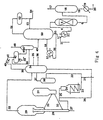
- the flow scheme shown in Fig.3 is more preferably used:
- the feedstock is mixed via line 1 with hydrogen from line 2, then flows to a heater(3 or heat exchanger), the heated feedstock is fed via line 4 into a hydrogenation reactor 5 in which a hydrofining catalyst is packed.
- the reaction between the feedstock and hydrogen in contact with the hydrofining catalyst is carried out in the reactor 5.
- Reaction product flows via line 6 directly to a stripper 16, where the unreacted hydrogen, hydrogen sulfide gas and part of lower hydrocarbons are separated out, and discharged via line 17, then the reaction product from which unreacted hydrogen sulfide gas and part of lower hydrocarbons have been stripped off flows to a cooler 19 via line 18.
- the cooled reaction product flows out via line 20, then a qualified product is obtained.
- said hydrogen may be pure hydrogen, or the hydrogen containing other inert gases; said inert gases refer to those which will not affect the hydrodemercaptanization reaction.
- Said inert gases may be, for example, nitrogen, argon, and gaseous alkane and the like.
- Said hydrogen may be fresh industrial hydrogen (with a purity of 85 ⁇ 100wt%), industrial exhaust hydrogen ( with a purity of 50 ⁇ 80%), or hydrogen discharged from synthetic ammonia unit and so on, in which the oxygen content should be not higher than 5 ppm,and hydrogen sulfide content not higher than 2wt %.
- the process according to the present invention is suitable for hydrodemercaptanization of the feedstocks having a total sulfur content not higher than 0.35wt % and mercaptan sulfur content higher than 20 ppm.
- Said feedstocks may be various distillates, preferably middle fractions or light oils, such as lamp kerosene, aviation kerosene, FCC gasoline and so on.
- the process according to the present invention has also very strong function of deacidification, which can be carried out simultaneously for the feedstocks having an acid value not less than 0.015 mg KOH/ g, so the feedstock oils are allowed to contain acidic substances.
- the hydrodemercaptanization process comprised in the process according to the present invention can exist independently .
- the feedstocks can be obtained by various existing methods, for example, kerosene from atmosphere distillation or thermal cracking, and FCC gasoline from catalytic cracking.
- the hydrodemercaptanization process said in the present invention can be used independently.
- the catalyst used in the process provided according to the present invention has good low-temperature activity, thus the process according to the invention can be carried out at lower temperature, therefore, upstream of said hydrodemercaptanization process according to the invention may comprise a process for preparing a hydrodemercaptanization feedstock, such as catalytic cracking, atmosphere distillation of crude oil, or thermal cracking of heavy oils, so that the reaction products obtained from the atmosphere distillation of crude oils, thermal cracking or catalytic cracking of heavy oils can be directly used as a feedstock oil for hydrodemercaptanization, or used only after being passed through a simple heat-exchange apparatus.
- a hydrodemercaptanization feedstock such as catalytic cracking, atmosphere distillation of crude oil, or thermal cracking of heavy oils
- Said catalytic cracking process comprises contacting a catalytic cracking feedstock with a catalytic cracking catalyst under catalytic cracking conditions, and separating said feedstock used for hydrodemercaptanization.
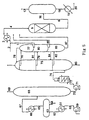
- the present invention can be performed according to the flow scheme shown in Fig. 4:
- the catalytic cracking feedstock is mixed via line 21 with a recycle oil from line 22 in the recycle retio of 0.2 ⁇ 3, then flows to a heater 24 via line 23 to be heated to 300 ⁇ 400°C.
- the heated feedstock oil is mixed via line 25 with oil slurry from fractionation tower bottom(the oil slurry from the fractionation tower bottom ammounts to about 8 ⁇ 25wt % of fresh feedstock)via line 26, and flows to a riser reactor 28 together with steam from line 27( with pressure grade in general 10 kg/cm 2 ) in an oil/steam weight ratio of 80 ⁇ 120, in the riser reactor 28 further mixed with the catalytic cracking catalyst having a temperature of 550 ⁇ 620 °C from line 32, where catalytic reaction is carried out, then the reaction product together with the catalyst enter in a settler 29, where the catalyst and reaction product are separated.
- the catalyst flows to a regenerator 31 via line 30, in the regenerator 31 the catalyst is regenerated (at a regeneration temperature 650 ⁇ 750°C), the regenerated catalyst flows to the riser reactor via line 32.
- the reaction product enters into a fractionation tower 34 via line 33 (the operation conditions of the fractionation tower are in general: operation pressure 0.06 ⁇ 0.1MPa, top temperature of the tower 110 ⁇ 130 °C, bottom temperature of the tower 360 ⁇ 380°C), in the fractionation tower 34, light diesel, heavy diesel, recycle oil, bottom oil slurry and top effluent are separated out, wherein the light diesel is discharged off via line 35, the heavy diesel is discharged off via line 36.
- the recycle oil enters in a recycle oil storage 38 via line 37 and then is mixed via line 22 with catalytic cracking feedstock from line 21, the bottom oil slurry is mixed via line 26 with heated mixture of the catalytic cracking feedstock and the recycle oil from line 25.
- the top effluent flows to a cooling system 40 via line 39, after cooled to 50 ⁇ 70°C, the top effluent enters in an oil/gas separator 42 via line 41, waste water is stored in a tank 43, then discharged via line 44.
- Naphtha and rich gas flow to a absorption tower 47 via line 45 and line 46 respectively, where the absorption is carried out in downward inverse flow mode under about 1 ⁇ 1.5 MPa and 30 ⁇ 50°C to separate out dry gas and dethanized gasoline.
- the dry gas is discharged from the top via line 48.
- the dethanized gasoline flows into a rectification tower 50 via line 49, the rectification tower 50 is operated in general under 0.5 ⁇ 1.5MPa, top temperature 50 ⁇ 60°C, bottom temperature 160 ⁇ 170°C to separate liquefied gas and bottom product.
- the liquefied gas enters into a top reflux tank 52 via line 51, part of which is refluxed to the rectification tower 50 via line 53(in a reflux ratio of generally 1 ⁇ 4), another part of the liquefied gas is discharged via line 54.
- bottom product enters into a bottom reboiler 57 via lines 55 and 56 with the provision that the height of the liquid level is 50 ⁇ 70% of that of the tower and then is refluxed to the rectification tower 50 via line 58.
- Another part of the bottom product i.e.
- FCC gasoline, feedstock oil for hydrodemercaptanization having, in general a distillation range of 39 ⁇ 210°C, total sulfur content not greater than 0.35wt %, mercaptan sulfur content higher than 20 ppm) is mixed via line 1 with the hydrogen from line 2 in a H/oil volume ratio greater than 5, preferably 5 ⁇ 30, then enters in heat exchanger 3, then the mixture of feedstock and the hydrogen, being heated (or not heated )to 149 ⁇ 315°C, preferably 150 ⁇ 260°C, more preferably 150 ⁇ 200°C, enters via line 4 in the hydrogenation reactor 5 packed with a hydrofining catalyst.
- reaction temperature of 149 ⁇ 315°C, preferably 150 ⁇ 260 °C, more preferably 150 ⁇ 200°C and reaction pressure 0.3 ⁇ 1.5MPa, preferably 0.3 ⁇ 0.7 MPa, and LHSV 0.5 ⁇ 10h -1 , preferably 1 ⁇ 8 h -1 .
- the reaction product flows directly into a stripper 16 via line 6, where the unreacted hydrogen, hydrogen sulfide gas and part of lower hydrocarbons are separated out and discharged via line 17.
- the reaction product from which unreacted hydrogen, hydrogen sulfide gas and part of lower hydrocarbons have been separated flows to a cooler 19 via line 18.
- the cooled reaction product flows out via line 20, then a qualified product is obtained.
- the catalytic cracking feedstock may be various existing catalytic cracking feedstocks, such as atmosphere residual oils, mixed oils of vacuum wax oils and vacuum residua, mixed oils of vacuum wax oils and coking wax oils and the like.
- Said catalytic cracking catalyst may be any of various catalytic cracking catalysts, preferably one which comprises zeolite, especially faujusites such as HY, USY(ultra-stable Y), REY(rare-earth Y), REUSY(rare earth ultra-stable Y ), HX, REX zeolites as active constituents.
- the carrier of the catalyst may be a full synthetic or partial synthetic catalyst carrier.
- Said atmosphere distillation process of crude oil comprises steps of distilling crude oil under conventional conditions of atmosphere pressure and separating out feedstock oil for hydrodemercaptanization.
- Said hydrodemercapanization feedstock may be, for example, an atmospheric first side-line kerosene from atmosphere distillation.
- Said thermal cracking process of heavy oils comprises steps of cracking thermally heavy oils under conventional thermal cracking conditions, and separating out the feedstock for hydrodemercaptanization.
- Said feedstock of hydrodemercaptanization may be, for example, an atmospheric first side-line kerosene from atmosphere distillation.
- Said thermal cracking feedstocks are namely heavy oils including various conventional thermal cracking feedstocks, such as atmosphere residual oils, vacuum residua, deasphalted vacuum residua and vacuum gas oils, etc.
- this invention can be performed according to the flow scheme shown in Fig 5: Crude oil is pumped via line 60 to a heat exchanger 61 a pump 59, and is heated to 50 ⁇ 100°C. The heated crude oil flows to a desalt-dewatering tank 63 via line 62. The waste water produced is stored in a waste water tank 64 and discharged. After salt and water are removed, the crude oil is fed into a heat exchanger 66 via line 65 and heated to 210 ⁇ 300°C.
- the heated crude oil enters into a pre-fractionation tower 68 (operation condition in general are: operation pressure 0.16 ⁇ 0.20 MPa, inlet temperature 250 ⁇ 270°C) via line 67, top gasoline of the pre-fractionation tower is discharged via line 69, bottom product of the pre-fractionation tower or heavy feedstock oil from thermal cracking (for thermal cracking process of a heavy oil, the desalt-dewatering process and the process of pre-fractionation mentioned above may be omitted) from line 70 enters pump 71 and is pumped via by pump 71 via line 72 to a heater 73 and in which the temperature is 360 ⁇ 380°C (for atmosphere distillation) or 400 ⁇ 510°C (for thermal cracking ).
- the heated bottom product of the pre-fractionation tower enters in an atmosphere distillation tower 75 via line 74 (operation condition in general are: operation pressure 0.16 ⁇ 0.20MPa, inlet temperature 360 ⁇ 510°C).
- operation condition in general are: operation pressure 0.16 ⁇ 0.20MPa, inlet temperature 360 ⁇ 510°C.
- the atmospheric first side-line draw oil, product of the distillation or thermal cracking product flows to an atmosphere first sideline stripper 77 via line 76 (operation conditions in general are: operation pressure 0.22 ⁇ 0.26MPA, bottom temperature 210 ⁇ 240°C), and the recycle oil of the atmospheric first side-line stripper turns back to the atmosphere distillation tower 75 via line 78.
- the atmospheric second side-line oil draw from atmosphere distillation tower enters in a atmospheric second side-line stripper 80 (operation condition in general are: operation pressure 0.22 ⁇ 0.26 MPA, bottom temperature 280 ⁇ 300°C) via line 79, the recycle oil of the atmospheric second side-line stripper turns back to the atmosphere distillation tower 75 via line 81.
- the atmospheric third side-line oil draw from atmosphere distillation tower enters into a atmospheric third side-line stripper 83 (operation conditions in general are: operation pressure 0.22 ⁇ 0.26 MPa, bottom temperature 360 ⁇ 390 °C) via line 82, the recycle oil of the atmosphere third side-line stripper turns back to the atmosphere distillation tower 75 via line 84.
- the bottom residual oil of the atmosphere distillation tower is discharged via line 85.
- the atmosphere second side-line product, i.e. light diesel, of the atmospheric second side-line stripper is discharged via line 86.
- the atmosphere third side-line product, i.e. heavy diesel, of the atmospheric third side-line stripper is discharged via line 87.
- the atmospheric first side-line kerosene (having generally a distillation range of 30 ⁇ 290°C, a total sulfur content not higher than 0.35wt %, and mercaptan sulfur content higher than 20 ppm) is mixed via line 1 with hydrogen from line 2 in a H/oil volume ratio greater than 5, preferably 5 ⁇ 30, then enters in a heat exchanger 3, then the feedstock heated (or not heated )to 149 ⁇ 315°C, preferably 150 ⁇ 260°C, more preferably 150 ⁇ 200°C enters via line 4 in a hydrogenation reactor 5 packed with a hydrofining catalyst, in which the feedstock and hydrogen in contact with the hydrofining catalyst enter into reaction under conditions of : reaction temperature 149 ⁇ 315°C, preferably 160 ⁇ 260°C, more preferably 150 ⁇ 200°C and reaction pressure 0.3 ⁇ 1.5MPa, preferably 0.3 ⁇ 0.7 MPa, and the LHSV 0.5 ⁇ 10h -1 , preferably 1 ⁇ 8 h -1 .
- the reaction product flows directly into a stripper 16 via line 6, where the unreacted hydrogen, hydrogen sulfide gas and part of lower hydrocarbons are separated out and discharged via line 17, then the reaction products from which unreacted hydrogen, hydrogen sulfide gas and part of lower hydrocarbons have been separated flows to a cooler 19 via line 18.
- the cooled reaction product flows out via line 20, then a qualified product is obtained.
- the demercaptanization of the process provided according to the present invention can be unexpectedly carried out at lower temperature (150 ⁇ 200 °C), moreover, at such a lower reaction temperature the mercaptan sulfur content of the product is relatively low.
- said demercaptanization of the process provided according to the present invention can be unexpectedly operated under conditions of lower temperature and a very low H/oil volume ratio (5 ⁇ 30), moreover, excellent result of hydrodemercaptanization has been achieved.
- the hydrodemercaptanization of aviation kerosene having a total sulfur content of 2170 ppm, mercaptan sulfur content of 128 ppm, acid value of 0.039 mg KOH/g is carried out under the condition of reaction temperature of 160 ⁇ 200°C and a H/oil volume ratio of 5 ⁇ 30, the total sulfur content, mercaptan sulfur content and acid value are decreased to less than 2000ppm, less than 20 ppm, and 0.01 mg KOH/g respectively in the product obtained, and the product meets the quality requirements for 3# aviation kerosene.
- the demercaptanization of the same feedstock is carried out under the condition of such a low reaction temperature and low H 2 /oil volume ratio, at least one of the indexes of total sulfur content, mercaptan sulfur content and acid value of the products fail to meet the quality requirements for 3# aviation kerosene.
- the demercaptanization process of a feedstock according to the present invention can be carried out at very low H/oil volume ratio, if the flow scheme shown in Fig.1 is used, the hydrogen-circulating amount can be significantly lower than that of the processes of prior art, thus a smaller compressor for circulating hydrogen can be used. If the flow scheme shown in Fig.2 is used, the circulating hydrogen system can be omitted , so the apparatus investment can be greatly reduced, since the H/oil volume ratio can be lower, even the single-pass hydrogen process can be used, the hydrogen-circulating amount can be significantly lower than that of previous processes, and a great quantity of hydrogen can be saved , compared with the single-pass hydrogen process in the prior art.
- said demercaptanization process provided according to the present invention can be carried out at lower temperature, where said hydrodemercaptanization process is used in combination with a catalytic cracking and atmosphere distillation of crude oil or thermal cracking of heavy oils operated according to the flow schemes shown in Fig.4 or Fig 5, the cooling step and apparatus required for products of catalytic cracking and atmosphere distillation of crude oil or thermal cracking of heavy oils can be not only saved but also their products can be fed directly or through a simple heat exchange unit into the demercaptanization apparatus, so that energy consumption is decreased, furthermore, the corresponding storing steps and apparatuses for storage of products can also be saved, thus apparatus investment thereof is decreased, finally the cost of qualified product can be sharply reduced.
- the pressure for said hydrodemercaptanization in the process provided according to the present invention is not higher than 1.5MPa, preferably 0.3 ⁇ 0.7MPa, under such a low reaction temperature and H/oil volume ratio, even so low pressure can be used, and apparatus investment requirement is very low, the investment cost even can be cut down to the level for a hydrogenation process without presence of hydrogen.
- the metal content of catalyst for hydrodemercaptanization used in the process according to the invention is much lower than that of the catalysts used in the prior art, but the low-temperature activity of catalyst for hydrodemercaptanization used in the process according to the invention is obviously for superior to that of the catalyst used in the prior art, this is an important advantage of the present invention.
- the hydrodemercaptanization of an aviation kerosene with a distillation range of 161 ⁇ 220°C having total sulfur content of 2170 ppm, mercaptan sulfur content of 128 ppm, acid value of 0.039 mg KOH/g is carried out under the conditions of reaction temperature of 180°C and 200°C respectively, hydrogen partial pressure of 0.7MPa, LHSV of 4.0h -1 and H/oil volume ratio of 5 ⁇ 30, the mercaptan sulfur contents of products are all less than 16 ppm, and acid values are less than 0.009 mg KOH/g, they all meet the quality requirements for 3# aviation kerosene: the mercaptan sulfur content of product be less than 20ppm, and acid value be
- the catalysts prepared by the method of post-impregnation of cobalt have much higher low-temperature activity
- the catalysts prepared by the method of post-impregnation of cobalt and comprising a promoter containing magnesium, phosphorus or fluorine at the same time show the highest low-temperature activity.
- 500g of the aluminum hydroxide powder A as used in Example 1 (with a solid content of 70 wt %, a pseudo-boehmite content of 85 wt %, available from the Shandong Aluminum Factory) and 500 g of the aluminum hydroxide powder B (with a solid content of 70 wt %, a pseudo-boehmite content of 70wt %, available from the Catalyst Factory of Changling Refinery) were mixed thoroughly, and added with a little amount of extruding aids and water, then was extruded into trilobular bars of circumscribed circle diameter of 1.6 mm, and then the resultant bars were dried at 120°C for 2 hours and calcined at 600°C for 4 hours. The resultant bars were cut into 2 ⁇ 3 mm in length to give a carrier Z 2 .
- the specific surface area and pore volume of the carrier Z 2 are shown in Table 2.
- magnesium nitrate [Mg(NO 3 ) 2 . 6H 2 O] 49.0 g of magnesium nitrate [Mg(NO 3 ) 2 . 6H 2 O] were added with deionized water to prepare a magnesium nitrate aqueous solution of 325 ml, the carrier Z 1 of 500 g was impregnated with the prepared magnesium nitrate solution, then dried at 120°C for 2 hours, calcined at 550°C for 4 hours, and a magnesium-containing carrier Z 3 was obtained.
- the promoter contents (calcualted as element) and specific surface areas and pore volumes of Z 3 ⁇ Z 5 carriers are shown in Table 2.
- the content of phosphorus, magnesium and fluorine were measured by X-ray fluorescent spectrometry.
- Table 2 Example, No. 1 2 3 4 5 Carrier, No. Z 1 Z 2 Z 3 Z 4 Z 5 Promoter type / / M g F P Promoter content, wt % 0 0 0.93 3.5 2.0 Specific surface area, m 2 /g 278 283 275 270 272 Pore volume, ml/g 0.40 0.45 0.38 0.37 0.38
- This comparative example is used to illustrate a reference catalyst and the preparation thereof.
- the catalyst C 8 comprises 3.62 wt % of nickel oxide, 8.53 wt % of tungsten oxide and has an atom ratio of nickel to nickel plus tungsten of 0.56.
- hydrofining catalyst used in the process according to the invention and the preparation thereof.
- This catalyst was prepared according to the amounts of various substances used and procedures as in Example 9, except that the alumina carrier was coimpregnated with 95 ml of a mixed aqueous solution containing nickel nitrate and cobalt nitrate and the AMT solution, then calcined at 450 °C for 4 hours, a catalyst numbered as C 9 was obtained.
- the catalyst C 9 comprised 0.16 wt % of cobalt oxide, 2.79 wt % of nickel oxide, 6.06 wt % of tungsten oxide, and 0.76 wt % of magnesium, in an atom ratio of nickel and cobalt to nickel, cobalt and tungsten of 0.60.
- the demercaptanization and deacidification of 1# aviation kerosene with a distillation range of 161 ⁇ 220°C shown in Table 4 as a feedstock were carried out with the catalysts C 1 ⁇ C 7 and C 9 respectively.
- the reactions were carried out in a 100ml hydrogenation apparatus with a loading of 50 ml catalyst under the reaction conditions of a reaction temperature 180°C, a hydrogen partial pressure 0.7Mpa, a LHSV 4.0h -1 and a H/oil volume ratio 25.
- the properties of the reaction products are shown in Table 6.
- the sulfur content was measured by the microcolumemetric method (SH/T 0253-9)
- the mercaptan content was measured by the potentiometric titration
- the acid value was analyzed by the method of SH/T 0163-92
- the chroma was measured by method GB 6540-86(the same thereinafter).
- the hydrodemercaptanization and deacidification were carried out according to the same procedures as that of Examples 14 ⁇ 21, except that the catalysts used were the reference catalyst C 8 , a catalyst commercially branded as CH-17 (available from the Catalyst Factory of the Changlin Refinery), a catalyst commercial branded as CH-18 (available from the Catalyst Factory of the Changlin Refinery), a catalyst D prepared in Example 7 of CN 1,169,337 A (which performed the highest activity in the patent application) and a deactivated catalyst CH-18 discharged from a unit of pre-hydrogenation reforming ( said pre-hydrogenation reforming process was operated at a reaction temperature of 300°C and a reaction pressure of 2 MPa ).
- the catalysts used were the reference catalyst C 8 , a catalyst commercially branded as CH-17 (available from the Catalyst Factory of the Changlin Refinery), a catalyst commercial branded as CH-18 (available from the Catalyst Factory of the Changlin Refinery),
- the catalysts CH-17, CH-18, D and the deactivated catalyst CH-18 were numbered respectively and sequentially as C 10 , C 11 , C 12 and C 13 . Their compositions, atom ratios, specific surface areas and pore volumes are shown in Table 5, and the properties of their reaction products are shown in Table 7. Table 4 Name of feedstock Aviation kerosene Aviation kerosene Aviation kerosene Aviation kerosene Feedstock No.
- the products obtained met the quality requirements for 3 # jet fuel, while the color of products were obviously improved.
- the mercaptan sulfur contents and acid values of the products were all obviously lower than those obtained by the processes using the reference catalysts.
- the reference catalysts were used, at least one of the indexes of mercaptan content, acid value and sulfur content of their products were not in conformity with the quality requirements for 3# jet fuel. (3).
- Example No. 48 50 Hydrogen source H 2 containing 0.5wt%H 2 S H 2 containing 1.5 wt % H 2 S H 2 containing 25 Vol. % N 2 R/Oil volume ratio 30 30 30 Mercaptan sulfur content of product, ppm 8 9 9 Acid value of product, mg KOH/g 0 0 0
- the following example shows the stability of the hydrodemercaptanization process according to the present invention.
- the following Example shows the stability of the hydrodemercaptanization process according to the present invention.
- the hydrodemercaptanization and deacidification were carried out with the same feedstock and procedures as Example56, except for a reaction temperature of 180°C.
- the variation of the mercaptan sulfur content and acid value of the product with reaction time are shown in Table 20. Samples were taken while reaction was carrying on at 500th, 1000th and 2000th hr for the analysis of the relevant properties. The results are shown in Table 21.
- the analysis of carbon deposit on the catalyst was carried out with the same method as Example 55, the results are shown in Table 22.
- Tables 18 to 22 show that the process provided according to the present invention has excellent stability. More unexpectedly, the stability of the demercaptanization activity of the process according to the invention is also very high under the conditions of low temperature and low H/oil volume ratio. Furthermore, it can be seen from the analysis of carbon deposit on the catalyst that the process provided according to the invention can be operated at lower temperature for a longer period of runing time.
- a vacuum wax oil from a petroleum pipeline, a hydrogenated light coking wax oil and a heavy coking wax oil were mixed to form a mixed oil comprising 80wt% of vacuum wax oil ,16.1 wt % of light coking wax oil and 3.9 wt % of heavy coking wax oil.
- the properties of said mixed oil are listed in Table 16.
- said mixed oil was mixed again with a recycle oil (having a recycle ratio of 1.47) from a catalytic cracking apparatus, then heated to 390°C, and then mixed with a bottom oil slurry from a fractionation tower ( in a amount of 10 wt % of fresh feedstock) by means of spraying with vapor steam having a 10 kg/cm 2 grade of pressure and 250°C temperature ( in a feedstock/steam weight ratio of 100).
- the mixed material was fed into a riser reactor, in which said mixed material underwent the reaction by contacting with the catalytic cracking catalyst (available from the Zhoucun Catalyst Factory, commercially branded as Orbit-300, comprising the active constituents of the rare-earth dealuminum Y and rare earth HY) from the regenerator having a temperature of 550°C, and a catalyst/oil weight ratio of 5.9 and the regeneration temperature of the catalyst was 690°C. Then the catalyst was separated from the reaction product via a settler, the separated reaction product flew into a fractionation tower from bottom (which has an operation pressure of 0.08 MPa, a top temperature of 120 °C,and a bottom temperature of 375°C).
- the catalytic cracking catalyst available from the Zhoucun Catalyst Factory, commercially branded as Orbit-300, comprising the active constituents of the rare-earth dealuminum Y and rare earth HY
- the top effluent from the fractionation tower was cooled to 60°C, and transferred to an oil-gas separator, the separated naphtha and rich gas flew into an absorption tower respectively from upper part and lower part of the absorption tower, where the rich gas was absorbed with the naphtha in reverse flow mode under the conditions of 43°C and 1.25 MPa.
- the FCC gasoline at the tower bottom was mixed with hydrogen in a H/oil volume ratio of 25, and heated to 180°C via a heat exchanger, then entered in a hydrodemercaptanization reactor packed with the catalyst C 1 .
- the reaction pressure was 0.51MPa
- LHSV was 4.0 h -1 .
- the product flew to a steam stripper, which was operated under the conditions of a top temperature of 18°C, a bottom temperature 180°C, a tower pressure of 0.5 MPa and without liquid discharged off from the top reflux tank due to full reflux, and the non-condensable gas from the stripper was emitted off.
- the bottom product was the gasoline product qualified in the mercaptan sulfur content.
- the desalted and dewatered, Arab mixed crude oil ( its properties seen in Table 16) was heated to 360°C in an atmospheric heating furnace, then entered in an atmospheric distillation tower( at an operation pressure of 0.18 MPa), the atmospheric first side-line drawn oil flew into an atmospheric first side-line stripper( at an operation pressure of 0.24 MPa, bottom temperature of 230°C), where the atmospheric first side-line aviation kerosene was cut out at 160°C with a distillation range of 145 ⁇ 252°C.
- the resultant atmospheric first side-line aviation kerosene was mixed with hydrogen in a H/oil volume ratio of 30, then heated to 180 °C via a heat exchanger, and then flew into a hydrodemercaptanization reactor packed with the catalyst C1.
- the reactor was operated under the conditions of a pressure of 0.65Mpa and a LHSV of 4.0h-1.
- the hydrogenation product flew into a steam stripper, which was operated under the conditions of a pressure of 0.58 MPa, top temperature of 37°C, bottom temperature of 220°C and the top full reflux with the top liquid and the non-condensable gas was emitted off.
- the bottom product of the tower was the qualified product.
- Table 24 The properties of the atmospheric first side-line aviation kerosene and hydrodemercaptanized aviation kerosene are shown in Table 24.
Landscapes
- Chemical & Material Sciences (AREA)
- Oil, Petroleum & Natural Gas (AREA)
- Engineering & Computer Science (AREA)
- Chemical Kinetics & Catalysis (AREA)
- Organic Chemistry (AREA)
- General Chemical & Material Sciences (AREA)
- Physics & Mathematics (AREA)
- Thermal Sciences (AREA)
- Materials Engineering (AREA)
- Production Of Liquid Hydrocarbon Mixture For Refining Petroleum (AREA)
- Catalysts (AREA)
Claims (28)
- Procédé de conversion d'huiles d'hydrocarbure comportant au moins un procédé d'hydrodémercaptanisation qui comporte provoquer un contact avec une matière première possédant une teneur total en soufre ne dépassant pas 0.35 % du poids, une teneur en sulfure de mercaptan supérieure à 20 ppm avec un catalyseur d'hydrotraitement dans des conditions du procédé d'hydrodémercaptanisation et récupérer un produit possédant une teneur diminuée en sulfure de mercaptan, où les conditions de ladite hydrodémercaptanisation impliquent un ratio de volume H/pétrole qui n'est pas inférieur à 5, une température de réaction située entre 149 et 315 °C, une pression de réaction située entre 0.3 et 1.5 MPa, et un LHSV situé entre 0.5 et 10 h.-1 et où le catalyseur d'hydrotraitement comporte un oxyde de tungstène et/ou un oxyde de molybdène, un oxyde de nickel et un oxyde de cobalt supporté par un support d'alumine, dans lequel, en se basant sur le poids du catalyseur, la teneur en ledit oxyde de tungstène et/ou oxyde de molybdène est de 4 % à moins de 10 % du poids, la teneur en oxyde de nickel est de 1 à 5 % du poids, la teneur de l'oxyde de cobalt est de 0.01 à 1 % du poids et le ratio du nombre total d'atome de nickel et de cobalt sur celui de nickel, de cobalt, de tungstène et /ou de molybdène est de 0.3 à 0.9.
- Procédé selon la revendication 1, où la teneur en oxyde de nickel dudit catalyseur d'hydrotraitement est de 2 à 4 % du poids.
- Procédé selon la revendication 1, où la teneur en oxyde de cobalt dudit catalyseur d'hydrotraitement est de 0.02 à 0.5 % du poids.
- Procédé selon la revendication 1, où la teneur en oxyde de tungstène et/ou molybdène est de 4.5 à 9% du poids.
- Procédé selon la revendication 1, où ledit ratio du nombre total d'atome de nickel et de cobalt sur celui de nickel, de cobalt, de tungstène et /ou de molybdène est de 0.4 à 0.7.
- Procédé selon n'importe laquelle des revendications 1 à 5, où ledit catalyseur d'hydrotraitement comporte en outre un promoteur sélectionné parmi le groupe consistant en les oxydes de magnésium, les oxydes de phosphore et les composés comprenant du fluor, la teneur totale du promoteur étant de 0.01 à 8 % du poids, calculé comme élément.
- Procédé selon la revendication 6, où la teneur en promoteur dudit catalyseur d'hydrotraitement est de 0.2 à 5 % du poids.
- Procédé selon la revendication 1, où ledit support d'alumine est l'alumine gamma, l'alumine eta ou un mélange des deux.
- Procédé selon la revendication 1, où ledit support d'alumine est l'alumine gamma ou une alumine qui consiste essentiellement en gamma alumine.
- Procédé selon la revendication 1, où la température de réaction de ladite hydrodémercaptanisation se situe dans la gamme de 150 à 260 ° C.
- Procédé selon la revendication 10, où la température de réaction de ladite hydrodémercaptanisation se situe dans la gamme de 150 à 200 °C.
- Procédé selon la revendication 1, où le ratio de volume H/pétrole de ladite hydrodémercaptanisation sexsitue dans la gamme de 5 à 30.
- Procédé selon la revendication 1, où l'hydrogène utilisé dans le procédé d'hydrodémercaptanisation peut être de l'hydrogène pur, peut également être un hydrogène ayant une pureté supérieure à 50 % du volume et contenant des gaz inertes, dans lequel la teneur en oxygène n'est pas supérieure à 5 ppm, la teneur en sulfure d'hydrogène n'est pas supérieure à 2 % poids, et lesdits gaz inertes sont ceux qui n'ont aucun effet sur la réaction d'hydrodémercaptanisation.
- Procédé selon la revendication 13, où lesdits gaz inertes sont de l'azote, de l'argon et/ou un alcane gazeux.
- Procédé selon la revendication 1, où la valeur acide de ladite matière première d'hydrodémercaptanisation n'est pas inférieure à 0.015mg KOH/g.
- Procédé selon la revendication 1, où ledit procédé d'hydrodémercaptanisation peut comporter en amont un procédé pour la préparation desdites matières premières d'hydrodémercaptanisation.
- Procédé selon la revendication 16, où ledit procédé pour la préparation des matières premières d'hydrodemercaptanization est un procédé de craquage catalytique qui comporte des étapes de mise en contact de la matière première de craquage catalytique avec un catalyseur de craquage catalytique dans des conditions de craquage catalytique, et la séparation de la matière première pour le procédé d'hydrodémercaptanisation.
- Procédé selon la revendication 17, où ledit catalyseur de craquage catalytique possède un Y-zéolithe comme constituant actif.
- Procédé selon la revendication 17, où ladite matière première de pétrole d'hydrodémercaptanisation est une essence de FCC.
- Procédé selon la revendication 16, où ledit procédé de préparation de ladite matière première de pétrole d'hydrodémercaptanisation est un procédé de distillation atmosphérique de pétroles bruts qui comporte la distillation des pétroles bruts dans des conditions atmosphériques conventionnelles de distillation et la séparation de la matière première de pétrole pour le procédé d'hydrodémercaptanination.
- Procédé selon la revendication 16, où ledit procédé de préparation de ladite matière première de pétrole d'hydrodémercaptanisation est un procédé de craquage thermique de pétroles lourds qui comporte le craquage les pétroles lourds dans des conditions conventionnelles de craquage thermique et la séparation de la matière première de pétrole pour le procédé d'hydrodémercaptanisation.
- Procédé selon les revendications 20 ou 21, où ladite matière première de pétrole d'hydrodémercaptanisation est un premier kérosène atmosphérique auxiliaire.
- Procédé selon la revendication 1, où la méthode de préparation dudit catalyseur d'hydrotaitement comporte les étapes d'imbiber un support d'alumine avec une solution aqueuse contenant un composé de molybdène et/ou un composé de tungstène et un composé de nickel et une solution aqueuse contenant un composé de cobalt, et calciner ledit support d'alumine sur lequel le molybdène et/ou le tungstène, le nickel et le cobalt ont été imbibés, ledit procédé d'imprégnation du support d'alumine avec ladite solution aqueuse contenant un composé de cobalt et avec ladite solution aqueuse contenant un composé de molybdène et/ou un composé de tungstène et le un composé de nickel sont effectués séparément, le procédé d'imprégnation du support d'alumine avec la solution aqueuse contenant ledit composé de cobalt étant réalisé après que le support d'alumine ait été imbibé de ladite solution contenant les composés de molybdène et/ou de tungstène et de nickel et ait été calciné, la température de calcination du support d'alumine imbibé de la solution aqueuse contenant le cobalt est de 50 à 300 ° C, et le temps de calcination est de plus de 1 heure.
- Procédé selon la revendication 23, où ladite température de calcination du support d'alumine imbibé de la solution aqueuse contenant ledit composé cobalt est de 150 à 250°C, et ledit temps de calcination est de 2 à 4 heures.
- Procédé selon la revendication 23, où les conditions de procédé de ladite hydrodémercaptanisation impliquent une température de réaction se situant dans la gamme de 149 à 315 °C, une pression de réaction se situant dans la gamme de 0.3 à 1.5 MPa, et un LHSV se situant dans la gamme de 0.5 à 10 h-1.
- Procédé selon la revendication 25, où la température de réaction de ladite hydrodémercaptanisation est de 150 à 260 ° C.
- Procédé selon la revendication 26, où la température de réaction de ladite hydrodémercaptanisation est de 150 à 200 °C.
- Procédé selon la revendication 23, où le ratio du volume de H/pétrole de ladite hydrodémercaptanisation est de 5 à 30.
Applications Claiming Priority (2)
| Application Number | Priority Date | Filing Date | Title |
|---|---|---|---|
| CN98100760 | 1998-03-20 | ||
| CN98100760 | 1998-03-20 |
Publications (3)
| Publication Number | Publication Date |
|---|---|
| EP0949314A2 EP0949314A2 (fr) | 1999-10-13 |
| EP0949314A3 EP0949314A3 (fr) | 1999-12-22 |
| EP0949314B1 true EP0949314B1 (fr) | 2006-06-14 |
Family
ID=5216227
Family Applications (1)
| Application Number | Title | Priority Date | Filing Date |
|---|---|---|---|
| EP99105010A Expired - Lifetime EP0949314B1 (fr) | 1998-03-20 | 1999-03-19 | Hydrodésulfurisation d'huiles hydrocarburées |
Country Status (8)
| Country | Link |
|---|---|
| US (1) | US6156190A (fr) |
| EP (1) | EP0949314B1 (fr) |
| JP (1) | JP3927721B2 (fr) |
| CA (1) | CA2266570C (fr) |
| DE (1) | DE69931837T2 (fr) |
| ES (1) | ES2267209T3 (fr) |
| NO (1) | NO328281B1 (fr) |
| SA (1) | SA99200475B1 (fr) |
Cited By (1)
| Publication number | Priority date | Publication date | Assignee | Title |
|---|---|---|---|---|
| RU2691761C1 (ru) * | 2019-02-11 | 2019-06-18 | Открытое акционерное общество "Славнефть-Ярославнефтеоргсинтез" (ОАО "Славнефть-ЯНОС") | Способ демеркаптанизации керосиновых фракций |
Families Citing this family (22)
| Publication number | Priority date | Publication date | Assignee | Title |
|---|---|---|---|---|
| JPH0810664Y2 (ja) | 1989-08-18 | 1996-03-29 | 三菱自動車工業株式会社 | 低温始動時のバルブ制御機構 |
| WO2001074973A1 (fr) * | 2000-03-30 | 2001-10-11 | Japan Energy Corporation | Procede d'hydrodesulfuration d'une fraction d'huile legere |
| US7097761B2 (en) * | 2000-06-27 | 2006-08-29 | Colt Engineering Corporation | Method of removing water and contaminants from crude oil containing same |
| WO2002040617A1 (fr) * | 2000-11-17 | 2002-05-23 | Jgc Corporaton | Procédé de désulfuration de fraction gazole, gazole désulfuré, et désulfurant pour fraction gazole |
| CA2455011C (fr) | 2004-01-09 | 2011-04-05 | Suncor Energy Inc. | Traitement de mousse bitumineuse par injection de vapeur en ligne |
| US20070189959A1 (en) * | 2006-02-15 | 2007-08-16 | Steven Allen Carlson | Methods of preparing separators for electrochemical cells |
| US7815603B2 (en) * | 2006-05-17 | 2010-10-19 | Alcon Research, Ltd. | Ophthalmic injection method |
| US20130056391A1 (en) * | 2010-03-17 | 2013-03-07 | Indian Oil Corporation Limited | Catalytical hydrodesulfurization of kerosene in two steps on cobalt-molybdenum catalyst and intermediate stripping |
| DE202011002149U1 (de) | 2011-01-31 | 2011-10-26 | Sartorius Stedim Biotech Gmbh | Filtrationsbehälter |
| CN102634370B (zh) * | 2011-02-10 | 2014-08-06 | 中国石油天然气股份有限公司 | 一种汽油加氢改质的方法 |
| JP2016517161A (ja) | 2013-04-29 | 2016-06-09 | マディコ インコーポレイテッド | 熱伝導率を高めたナノ多孔質複合セパレータ |
| WO2016029401A1 (fr) * | 2014-08-28 | 2016-03-03 | 中国石油大学(北京) | Catalyseur d'élimination des mercaptans pour hydrocarbures légers, un procédé de préparation associé, et des utilisations associées |
| RU2677285C1 (ru) * | 2018-09-20 | 2019-01-16 | Публичное акционерное общество "Нефтяная компания "Роснефть" (ПАО "НК "Роснефть") | Способ приготовления катализатора гидроочистки нефтяных фракций в сульфидной форме (варианты) |
| RU2691760C1 (ru) * | 2019-02-11 | 2019-06-18 | Открытое акционерное общество "Славнефть-Ярославнефтеоргсинтез" (ОАО "Славнефть-ЯНОС") | Способ демеркаптанизации керосиновых фракций |
| JP7525334B2 (ja) * | 2020-08-21 | 2024-07-30 | 出光興産株式会社 | ガソリン基材の製造方法 |
| CN114433116B (zh) * | 2020-10-19 | 2023-05-30 | 中国石油化工股份有限公司 | 一种加氢精制催化剂的制备方法 |
| EP4331033A2 (fr) | 2021-04-29 | 2024-03-06 | 24M Technologies, Inc. | Cellules électrochimiques dotées de multiples séparateurs, et leurs procédés de production |
| CN116445186B (zh) * | 2022-01-06 | 2025-03-04 | 中国石油化工股份有限公司 | 一种劣质柴油深度脱芳的方法 |
| CN115536487B (zh) * | 2022-10-12 | 2024-06-14 | 宁波巨化化工科技有限公司 | 一种高纯低碳烷烃生产工艺及设备 |
| TW202443944A (zh) | 2022-12-16 | 2024-11-01 | 美商24M科技公司 | 用於最小化及預防電化電池中形成枝晶的系統及方法 |
| CN117679911A (zh) * | 2024-01-20 | 2024-03-12 | 洛阳瑞华新能源技术发展有限公司 | 一种富气分离方法 |
| US12431545B1 (en) | 2024-03-26 | 2025-09-30 | 24M Technologies, Inc. | Systems and methods for minimizing and preventing dendrite formation in electrochemical cells |
Family Cites Families (26)
| Publication number | Priority date | Publication date | Assignee | Title |
|---|---|---|---|---|
| NL256096A (fr) * | 1959-09-21 | |||
| US3852744A (en) * | 1973-01-05 | 1974-12-03 | Singer Co | Single time shared receiver and frequency tracker for a beam-lobed doppler radar system |
| US3876532A (en) * | 1973-02-27 | 1975-04-08 | Gulf Research Development Co | Method for reducing the total acid number of a middle distillate oil |
| US3870626A (en) * | 1973-02-27 | 1975-03-11 | Gulf Research Development Co | Method for reducing the mercaptan content of a middle distillate oil |
| US4010116A (en) * | 1974-10-15 | 1977-03-01 | Filtrol Corporation | Fluid cracking catalysts |
| US4218307A (en) * | 1975-04-24 | 1980-08-19 | W. R. Grace & Co. | Hydrocarbon cracking catalyst |
| US4206085A (en) * | 1979-01-15 | 1980-06-03 | Filtrol Corporation | Balanced alumina matrix in zeolite containing catalyst |
| US4325845A (en) * | 1979-11-09 | 1982-04-20 | Filtrol Corporation | Zeolite catalysts and method of producing the same |
| US4325847A (en) * | 1980-06-19 | 1982-04-20 | Filtrol Corporation | Use of additional alumina for extra zeolite stability in FCC catalyst |
| FR2486094B1 (fr) * | 1980-07-02 | 1985-03-22 | Catalyse Soc Prod Francais | |
| US4454241A (en) * | 1982-05-24 | 1984-06-12 | Exxon Research And Engineering Co. | Phosphorus-containing catalyst |
| US4465780A (en) * | 1982-10-14 | 1984-08-14 | Exxon Research & Engineering Co. | Phosphorus-containing catalyst |
| US4504382A (en) * | 1982-10-14 | 1985-03-12 | Exxon Research And Engineering Co. | Phosphorus-containing catalyst and catalytic cracking process utilizing the same |
| US4542118A (en) * | 1984-02-02 | 1985-09-17 | W. R. Grace & Co. | Catalyst manufacture |
| US4567152A (en) * | 1984-12-13 | 1986-01-28 | Exxon Research And Engineering Co. | Co-matrixed zeolite and p/alumina |
| US4584091A (en) * | 1984-12-13 | 1986-04-22 | Exxon Research And Engineering Co. | Cracking with co-matrixed zeolite and p/alumina |
| US4657663A (en) * | 1985-04-24 | 1987-04-14 | Phillips Petroleum Company | Hydrotreating process employing a three-stage catalyst system wherein a titanium compound is employed in the second stage |
| US4839319A (en) * | 1986-07-11 | 1989-06-13 | Exxon Research And Engineering Company | Hydrocarbon cracking catalysts and processes for utilizing the same |
| CA1297861C (fr) * | 1986-07-11 | 1992-03-24 | William L. Schuette | Catalyseurs de craquage d'hydrocarbures et procede utilisant ceux-ci |
| JPS63270545A (ja) * | 1987-04-28 | 1988-11-08 | Nippon Oil Co Ltd | 炭化水素転化触媒 |
| JPS63278553A (ja) * | 1987-05-08 | 1988-11-16 | Nippon Oil Co Ltd | 炭化水素転化触媒 |
| US4839375A (en) * | 1987-07-28 | 1989-06-13 | Merrell Dow Pharmaceuticals Inc. | (Aryl or heteroaromatic methyl)-2,2'-bi-1H-imidazoles and their use as anti-hypertensive agents |
| DE3807910A1 (de) * | 1988-03-10 | 1989-09-21 | Merck Patent Gmbh | Verfahren zur herstellung von 2,3-difluorbenzolen |
| ES2051350T3 (es) * | 1988-09-06 | 1994-06-16 | Petroleo Brasileiro Sa | Catalizador para craqueo fluido que contiene caolin. |
| CA2015335A1 (fr) * | 1989-05-12 | 1990-11-12 | Terry G. Roberie | Composes catalytiques |
| US4977622A (en) * | 1989-07-25 | 1990-12-18 | Schley Marlene J | Medical garment |
-
1999
- 1999-03-19 EP EP99105010A patent/EP0949314B1/fr not_active Expired - Lifetime
- 1999-03-19 DE DE69931837T patent/DE69931837T2/de not_active Expired - Lifetime
- 1999-03-19 ES ES99105010T patent/ES2267209T3/es not_active Expired - Lifetime
- 1999-03-19 NO NO19991360A patent/NO328281B1/no not_active IP Right Cessation
- 1999-03-19 US US09/272,246 patent/US6156190A/en not_active Expired - Lifetime
- 1999-03-22 CA CA002266570A patent/CA2266570C/fr not_active Expired - Lifetime
- 1999-03-23 JP JP07872299A patent/JP3927721B2/ja not_active Expired - Lifetime
- 1999-08-17 SA SA99200475A patent/SA99200475B1/ar unknown
Cited By (1)
| Publication number | Priority date | Publication date | Assignee | Title |
|---|---|---|---|---|
| RU2691761C1 (ru) * | 2019-02-11 | 2019-06-18 | Открытое акционерное общество "Славнефть-Ярославнефтеоргсинтез" (ОАО "Славнефть-ЯНОС") | Способ демеркаптанизации керосиновых фракций |
Also Published As
| Publication number | Publication date |
|---|---|
| NO991360L (no) | 1999-09-21 |
| DE69931837D1 (de) | 2006-07-27 |
| ES2267209T3 (es) | 2007-03-01 |
| CA2266570A1 (fr) | 1999-09-20 |
| JP3927721B2 (ja) | 2007-06-13 |
| DE69931837T2 (de) | 2006-11-09 |
| EP0949314A2 (fr) | 1999-10-13 |
| NO991360D0 (no) | 1999-03-19 |
| CA2266570C (fr) | 2007-07-31 |
| NO328281B1 (no) | 2010-01-25 |
| US6156190A (en) | 2000-12-05 |
| JPH11323354A (ja) | 1999-11-26 |
| EP0949314A3 (fr) | 1999-12-22 |
| SA99200475B1 (ar) | 2006-08-21 |
Similar Documents
| Publication | Publication Date | Title |
|---|---|---|
| EP0949314A2 (fr) | Hydrodésulfurisation d'huiles hydrocarburées | |
| US4212729A (en) | Process for demetallation and desulfurization of heavy hydrocarbons | |
| KR100577134B1 (ko) | 집적된 수소첨가 및 가수소열분해 방법 | |
| US4762814A (en) | Hydrotreating catalyst and process for its preparation | |
| US4297242A (en) | Process for demetallation and desulfurization of heavy hydrocarbons | |
| US4455390A (en) | Catalyst and method for impregnating at a pH less than one | |
| US4431526A (en) | Multiple-stage hydroprocessing of hydrocarbon oil | |
| AU2001249836B2 (en) | Staged hydrotreating method for naphtha desulfurization | |
| EP0948998B1 (fr) | Catalyseur pour le hydrotraitement des distillats d'huile légère et sa préparation | |
| US4707246A (en) | Hydrotreating catalyst and process | |
| US4340466A (en) | Process for hydrotreating heavy oils containing metals | |
| US4334982A (en) | Process for the selective desulfurization of olefinic cuts | |
| CN104560156B (zh) | 一种加氢裂化方法 | |
| WO1995026388A1 (fr) | Procede d'hydrotraitement de composition d'hydrocarbure et de combustible liquide | |
| US5954944A (en) | Process for hydrocracking heavy distillate oil under middle pressure | |
| US4568450A (en) | Hydrocarbon conversion process | |
| US20060211900A1 (en) | Method of hydrotreating gas oil fraction | |
| CN104560169B (zh) | 一种从高氮原料生产重石脑油的加氢裂化方法 | |
| US4622127A (en) | Method for the hydrogenation treatment of a heavy hydrocarbon oil | |
| CN1119398C (zh) | 一种烃油的转化方法 | |
| US20030116473A1 (en) | Method for hydrodesulfurization of light oil fraction | |
| EP0034908B1 (fr) | Procédé pour l'hydrodémétallisation de courants d'hydrocarbures | |
| US4743353A (en) | Oxidation process | |
| CA2258591C (fr) | Procede d'hydrocraquage d'une huile de distillat lourde a des pressions moyennes | |
| CN1916118A (zh) | 一种汽油加氢改质的方法 |
Legal Events
| Date | Code | Title | Description |
|---|---|---|---|
| PUAI | Public reference made under article 153(3) epc to a published international application that has entered the european phase |
Free format text: ORIGINAL CODE: 0009012 |
|
| AK | Designated contracting states |
Kind code of ref document: A2 Designated state(s): DE ES FR IT |
|
| AX | Request for extension of the european patent |
Free format text: AL;LT;LV;MK;RO;SI |
|
| PUAL | Search report despatched |
Free format text: ORIGINAL CODE: 0009013 |
|
| RIC1 | Information provided on ipc code assigned before grant |
Free format text: 6C 10G 45/08 A, 6B 01J 23/85 B |
|
| AK | Designated contracting states |
Kind code of ref document: A3 Designated state(s): AT BE CH CY DE DK ES FI FR GB GR IE IT LI LU MC NL PT SE |
|
| AX | Request for extension of the european patent |
Free format text: AL;LT;LV;MK;RO;SI |
|
| RIN1 | Information on inventor provided before grant (corrected) |
Inventor name: RAN, GUOPENG Inventor name: LI, MINGFENG Inventor name: PANG, GUICI Inventor name: TAO, ZHIPING Inventor name: SHI, YAHUA Inventor name: MIN, ENZE Inventor name: ZHU, MEI Inventor name: XIA, GUOFU |
|
| 17P | Request for examination filed |
Effective date: 20000615 |
|
| AKX | Designation fees paid |
Free format text: DE ES FR IT |
|
| 17Q | First examination report despatched |
Effective date: 20030804 |
|
| GRAP | Despatch of communication of intention to grant a patent |
Free format text: ORIGINAL CODE: EPIDOSNIGR1 |
|
| GRAS | Grant fee paid |
Free format text: ORIGINAL CODE: EPIDOSNIGR3 |
|
| GRAA | (expected) grant |
Free format text: ORIGINAL CODE: 0009210 |
|
| AK | Designated contracting states |
Kind code of ref document: B1 Designated state(s): DE ES FR IT |
|
| PG25 | Lapsed in a contracting state [announced via postgrant information from national office to epo] |
Ref country code: IT Free format text: LAPSE BECAUSE OF FAILURE TO SUBMIT A TRANSLATION OF THE DESCRIPTION OR TO PAY THE FEE WITHIN THE PRESCRIBED TIME-LIMIT;WARNING: LAPSES OF ITALIAN PATENTS WITH EFFECTIVE DATE BEFORE 2007 MAY HAVE OCCURRED AT ANY TIME BEFORE 2007. THE CORRECT EFFECTIVE DATE MAY BE DIFFERENT FROM THE ONE RECORDED. Effective date: 20060614 |
|
| REF | Corresponds to: |
Ref document number: 69931837 Country of ref document: DE Date of ref document: 20060727 Kind code of ref document: P |
|
| ET | Fr: translation filed | ||
| REG | Reference to a national code |
Ref country code: ES Ref legal event code: FG2A Ref document number: 2267209 Country of ref document: ES Kind code of ref document: T3 |
|
| PLBE | No opposition filed within time limit |
Free format text: ORIGINAL CODE: 0009261 |
|
| STAA | Information on the status of an ep patent application or granted ep patent |
Free format text: STATUS: NO OPPOSITION FILED WITHIN TIME LIMIT |
|
| 26N | No opposition filed |
Effective date: 20070315 |
|
| REG | Reference to a national code |
Ref country code: FR Ref legal event code: PLFP Year of fee payment: 18 |
|
| REG | Reference to a national code |
Ref country code: FR Ref legal event code: PLFP Year of fee payment: 19 |
|
| REG | Reference to a national code |
Ref country code: FR Ref legal event code: PLFP Year of fee payment: 20 |
|
| PGFP | Annual fee paid to national office [announced via postgrant information from national office to epo] |
Ref country code: DE Payment date: 20180306 Year of fee payment: 20 |
|
| PGFP | Annual fee paid to national office [announced via postgrant information from national office to epo] |
Ref country code: IT Payment date: 20180321 Year of fee payment: 20 Ref country code: FR Payment date: 20180223 Year of fee payment: 20 |
|
| PGFP | Annual fee paid to national office [announced via postgrant information from national office to epo] |
Ref country code: ES Payment date: 20180402 Year of fee payment: 20 |
|
| REG | Reference to a national code |
Ref country code: DE Ref legal event code: R071 Ref document number: 69931837 Country of ref document: DE |
|
| REG | Reference to a national code |
Ref country code: ES Ref legal event code: FD2A Effective date: 20201202 |
|
| PG25 | Lapsed in a contracting state [announced via postgrant information from national office to epo] |
Ref country code: ES Free format text: LAPSE BECAUSE OF EXPIRATION OF PROTECTION Effective date: 20190320 |