EP0949346A1 - Procédé de fabrication d'un alliage ferritique-martensitique renforce par dispersion d'oxydes - Google Patents
Procédé de fabrication d'un alliage ferritique-martensitique renforce par dispersion d'oxydes Download PDFInfo
- Publication number
- EP0949346A1 EP0949346A1 EP99400820A EP99400820A EP0949346A1 EP 0949346 A1 EP0949346 A1 EP 0949346A1 EP 99400820 A EP99400820 A EP 99400820A EP 99400820 A EP99400820 A EP 99400820A EP 0949346 A1 EP0949346 A1 EP 0949346A1
- Authority
- EP
- European Patent Office
- Prior art keywords
- alloy
- ods
- weight
- concentration
- martensitic
- Prior art date
- Legal status (The legal status is an assumption and is not a legal conclusion. Google has not performed a legal analysis and makes no representation as to the accuracy of the status listed.)
- Granted
Links
Images

Classifications
-
- C—CHEMISTRY; METALLURGY
- C22—METALLURGY; FERROUS OR NON-FERROUS ALLOYS; TREATMENT OF ALLOYS OR NON-FERROUS METALS
- C22C—ALLOYS
- C22C38/00—Ferrous alloys, e.g. steel alloys
- C22C38/18—Ferrous alloys, e.g. steel alloys containing chromium
- C22C38/22—Ferrous alloys, e.g. steel alloys containing chromium with molybdenum or tungsten
-
- C—CHEMISTRY; METALLURGY
- C21—METALLURGY OF IRON
- C21D—MODIFYING THE PHYSICAL STRUCTURE OF FERROUS METALS; GENERAL DEVICES FOR HEAT TREATMENT OF FERROUS OR NON-FERROUS METALS OR ALLOYS; MAKING METAL MALLEABLE, e.g. BY DECARBURISATION OR TEMPERING
- C21D6/00—Heat treatment of ferrous alloys
- C21D6/002—Heat treatment of ferrous alloys containing Cr
-
- C—CHEMISTRY; METALLURGY
- C22—METALLURGY; FERROUS OR NON-FERROUS ALLOYS; TREATMENT OF ALLOYS OR NON-FERROUS METALS
- C22C—ALLOYS
- C22C33/00—Making ferrous alloys
- C22C33/02—Making ferrous alloys by powder metallurgy
- C22C33/0257—Making ferrous alloys by powder metallurgy characterised by the range of the alloying elements
- C22C33/0261—Matrix based on Fe for ODS steels
-
- C—CHEMISTRY; METALLURGY
- C22—METALLURGY; FERROUS OR NON-FERROUS ALLOYS; TREATMENT OF ALLOYS OR NON-FERROUS METALS
- C22C—ALLOYS
- C22C38/00—Ferrous alloys, e.g. steel alloys
- C22C38/18—Ferrous alloys, e.g. steel alloys containing chromium
- C22C38/40—Ferrous alloys, e.g. steel alloys containing chromium with nickel
- C22C38/44—Ferrous alloys, e.g. steel alloys containing chromium with nickel with molybdenum or tungsten
-
- G—PHYSICS
- G21—NUCLEAR PHYSICS; NUCLEAR ENGINEERING
- G21C—NUCLEAR REACTORS
- G21C3/00—Reactor fuel elements and their assemblies; Selection of substances for use as reactor fuel elements
- G21C3/02—Fuel elements
- G21C3/04—Constructional details
- G21C3/06—Casings; Jackets
- G21C3/07—Casings; Jackets characterised by their material, e.g. alloys
-
- C—CHEMISTRY; METALLURGY
- C21—METALLURGY OF IRON
- C21D—MODIFYING THE PHYSICAL STRUCTURE OF FERROUS METALS; GENERAL DEVICES FOR HEAT TREATMENT OF FERROUS OR NON-FERROUS METALS OR ALLOYS; MAKING METAL MALLEABLE, e.g. BY DECARBURISATION OR TEMPERING
- C21D2211/00—Microstructure comprising significant phases
- C21D2211/005—Ferrite
-
- Y—GENERAL TAGGING OF NEW TECHNOLOGICAL DEVELOPMENTS; GENERAL TAGGING OF CROSS-SECTIONAL TECHNOLOGIES SPANNING OVER SEVERAL SECTIONS OF THE IPC; TECHNICAL SUBJECTS COVERED BY FORMER USPC CROSS-REFERENCE ART COLLECTIONS [XRACs] AND DIGESTS
- Y02—TECHNOLOGIES OR APPLICATIONS FOR MITIGATION OR ADAPTATION AGAINST CLIMATE CHANGE
- Y02E—REDUCTION OF GREENHOUSE GAS [GHG] EMISSIONS, RELATED TO ENERGY GENERATION, TRANSMISSION OR DISTRIBUTION
- Y02E30/00—Energy generation of nuclear origin
- Y02E30/30—Nuclear fission reactors
Definitions
- the present invention relates to a method of manufacture of a ferritic or martensitic alloy improved including chromium and reinforced by dispersion of oxides, commonly called ODS alloy ("Oxide Dispersion Strenghtening "), and more particularly to a process for manufacturing a ferritic alloy or large grain ODS martensitic including chromium, which has a single-phase ferritic matrix or martensitic having an isotropic microstructure and a average grain size sufficient to guarantee mechanical resistance compatible with the use of this alloy at high temperature and / or under irradiation neutron.
- ODS alloy Oxide Dispersion Strenghtening
- ODS alloys consist of a metallic matrix having a centered cubic crystal structure. This structure is reinforced by a dispersion of oxides of type Y 2 O 3 , TiO 2 , etc. which gives it excellent mechanical and chemical properties at medium and high temperatures.
- the oxidation resistance of these alloys is due in particular to the presence of chromium. This resistance only effective when the chromium concentration is greater than 8% by weight in the alloy. However, when this concentration is greater than 12% in weight, the alloy becomes fragile.
- these alloys have, thanks to their crystal structure good resistance to swelling and creep of neutron irradiation.
- alloys can be used for example as structural materials of core components of a nuclear power plant because these components must have high mechanical resistance to temperature high, e.g. 400 to 700 ° C, be resistant to neutron radiation, be compatible with a use in sodium medium, and resistant to oxidation, etc ...
- these alloys are also useful for manufacturing items subjected to strong mechanical and thermal stresses, such as elements of thermal power plants, and elements used in the glass, gas, or aeronautics, etc ...
- ODS alloys including chromium have already been developed in the prior art. These have chromium concentrations between 13 and 20%, varying contents of Mo, W, Al and Ti, and a small amount of carbon usually less than 0.02% by weight (200 ppm). In this type of alloy, the matrix is totally ferritic whatever the heat treatment temperature.
- US Patent No. 4,075,010 describes an alloy having a composition Fe-14 Cr-1 Ti-0.3 Mo-0.25 Y 2 O 3 .
- This alloy shows a very good compromise strength / ductility in a direction parallel to the axis of shaping of the alloy.
- the grains which compose it are elongated in the direction of shaping, which results in significant anisotropy of its mechanical properties. This anisotropy leads to a too low mechanical strength in directions perpendicular to the shaping direction.
- Such alloy cannot therefore be used for example for build sheath tubes for reactors nuclear because the radial direction of these tubes is the main mechanical load direction in a reactor.
- this alloy contains a content high in chromium, which leads to its embrittlement under neutron irradiation by phase precipitation rich in this element.
- This type of alloy is generally produced by mechanosynthesis ("mechanical alloying") from its constituents in the form of elementary powders or pre-alloyed.
- mechanosynthesis is a method for introducing into the matrix metallic the fine and homogeneous distribution of oxides which gives the alloy mechanical resistance to very high heat.
- the powders thus obtained are compacted and spun at high temperature and pressure.
- This method of production produces a alloy in which the average grain size is general too small, i.e. less than 1 ⁇ m, and which has an anisotropic microstructure when the initial chemical composition of the matrix implies a ferritic structure. Under these conditions, too small average grain size leads to degradation the mechanical strength of the alloy, in particular high temperatures above 500 ° C. Moreover, the grain size anisotropy leads to a anisotropy of the mechanical properties of the alloy.
- the initial ferritic structure is in particular inevitable in nuances including more 12% chromium.
- patent application GB-A-2 219 004 describes an ODS alloy with a returned martensitic matrix having a chromium concentration of 8 to 12% by weight and concentrations of (Mo + W) and of carbon respectively between 0, 1 and 4% by weight and between 0.05 and 0.25%.
- the alloy described is reinforced by a distribution of particles of oxides of Y 2 O 3 and of TiO 2 at a concentration of 0.1 to 1% by weight.
- the application examples described in this document include a chromium concentration greater than 10% by weight and a concentration of Mo and W between 2 and 4% by weight.
- the process for preparing the alloy described comprises mechanosynthesis of the alloy in an attritor, compacting of the alloy under vacuum and hot spinning at a temperature ranging from 900 to 1200 ° C. This process is followed by a normalization treatment at a temperature ranging from 950 to 1200 ° C, and by tempering at a temperature ranging from 750 to 820 ° C.
- the object of the present invention is precisely to provide an alloy manufacturing process ferritic ODS including chromium, as well as a process for manufacturing an ODS martensitic alloy including chromium, which does not have the disadvantages mentioned above and which allow in particular control and control of the grain size of the alloy produced, in particular by controlling phase transformations successive.
- the method according to the invention for manufacturing a ODS ferritic structure alloy including chromium includes preparation of a martensitic draft ODS including chromium, and a step consisting of submit the ODS martensitic draft to at least one thermal cycle, said at least one thermal cycle including an austenitization of the blank ODS martensitic at a temperature greater than or equal at point AC3 of this alloy so as to obtain a austenite, followed by cooling of this austenite at a slow cooling rate less than or equal to the cooling rate critical for a transformation of this austenite into ferrite so as to obtain a structural alloy ferritic, said slow cooling rate critical being determined from a diagram of phase transformation of this austenite under continuous cooling.
- the alloy produced by the process of the invention is improved in particular because it presents a matrix ferritic single-phase having an isotropic microstructure and a grain size sufficient to guarantee a mechanical resistance compatible with the use of this alloy at high temperature and / or without irradiation neutron. In addition, it has ductility sufficient to be subjected to formatting even at ambient temperature.
- the ODS martensitic blank including chromium can be prepared by any process to obtain a draft in which the oxides are dispersed in a fine and homogeneous way in the metal matrix.
- the blank can be prepared from a pre-alloyed powder obtained by mechanosynthesis.
- Mechanosynthesis allows the required dispersion of oxides such as Y 2 O 3 for the preparation of an ODS alloy.
- Mechanosynthesis can be carried out in an attritor, under a neutral atmosphere, for example of argon, from a powder, obtained for example by atomization under argon of an ingot, having a composition which corresponds to that of the manufactured blank. , and adding oxides such as Y 2 O 3 .
- the powder can also be obtained by mixing pure or pre-alloyed powders available on the market.
- the ODS martensitic blank can be prepared by a conventional technique of consolidation of a pre-alloyed powder for example by hot spinning and shaping.
- the ODS martensitic blank including chromium can also comprise one or more elements chosen from the group comprising Mo, W, Ni, Mn, Si, C, O, N, Y, Ti, Ta, V, Nb and Zr.
- it can comprise one or more of the oxides commonly used to manufacture alloys reinforced by dispersion of oxides, for example Y 2 O 3 , TiO 2 , MgO, Al 2 O 3 , MgAl 2 O 4 , HfO 2 , ThO 2 and ZrO 2 .
- the function of each of these elements and oxides in the ODS martensitic blank is known to those skilled in the art, it will therefore not be described here.
- the ODS martensitic blank including chromium can for example include from about 7 to about 12% by weight of equivalent chromium in the alloy, for example from about 8 to about 11% by weight, i.e. a quantity of elements alphagenes equivalent to an amount of chromium from about 7 to about 12% by weight, for example from about 8 to about 11% by weight.
- the elements alphagenes are notably elements that allow to decrease the extent of the domain of existence of austenite. The process according to the invention can therefore apply advantageously on a type alloy 9 Cr.
- chromium can be at a concentration of about 7 to about 12% by weight, per example of about 8 to about 12% by weight, Mo can be at a concentration of about 0.3 to about 1.5% by weight, W can be at a concentration of about 0.5 at about 3% by weight, Ni can be at a concentration up to about 1% by weight, Mn can be at a concentration up to 1% by weight, Si can be at a concentration of up to about 1% by weight, C can be at a concentration of about 0.02 to about 0.2% by weight, O can be at a concentration from 0.02 to about 0.3% by weight, N can be at one concentration up to about 0.15% by weight, Y can be at a concentration of up to about 1% by weight and Ti can be at a concentration ranging up to about 1% by weight in the alloy, the rest being iron.
- this alloy can also understand Ta and Nb, each at a concentration ranging up to about 0.2% by weight, V at a concentration up to about 0.4% by weight, and Zr at a concentration up to about 0.4% by weight.
- The, at least one, thermal cycle according to the invention allows to induce in the ODS martensitic blank a transformation of martensite into austenite, then a slow transformation of austenite into ferrite with a stable grain growth at low temperatures.
- the, at least one, cycle thermal includes austenitization of the blank ODS martensitic at a temperature greater than or equal at point AC3 of this alloy so as to obtain a austenite.
- the point AC3 of such an alloy corresponds to the temperature at which the ferrite finishes transform into austenite during heating.
- this austenitization can for example be performed at a temperature of around 950 to around 1150 ° C for example at a temperature of around 1000 to 1100 ° C, for example at a temperature of around 1000 ° C and for a period of approximately 15 to 120 minutes, for example about 30 to 90 minutes, for example about 30 minutes. Less than 15 minutes often being insufficient to obtain a structure austenitic, and lasting more than 120 minutes not being necessary because the austenitic structure is often obtained earlier.
- this austenitization is followed by cooling of the austenite obtained, to a lower slow cooling speed or equal to the critical cooling rate for a transformation of this austenite into ferrite, said slow cooling rate being determined at from a phase transformation diagram of this austenite under continuous cooling.
- This phase transformation diagram, or TRC can be obtained in a conventional manner.
- the cooling rate of austenite is called “slow” in the present description in order to differentiate from the so-called “fast” speed of cooling for martensitic transformation described below in the process for manufacturing a ODS martensitic alloy according to the invention.
- This slow cooling induces a transformation of the austenitic phase which is a high phase temperature, in the ferritic phase more favorable than the grain growing martensite.
- the slow cooling rate can by example be less than or equal to 280 ° C per hour, for example for an alloy composition such as those described above. For example for at least a thermal cycle, it can be less than about 250 ° C per hour, for example less than or equal to about 100 ° C per hour, for example lower or about 20 ° C per hour. It should also be noted that the cooling rate depends not only of the composition of the alloy produced, but also of the austenitization temperature of this alloy. We will easily understand that according to the constraints of industrial manufacturing and depending on the composition of the alloy, the skilled person can adapt the austenitization temperature, and slow speeds cooling the process of the invention.
- the inventors have found that when the speed cooling rate is less than the critical speed phase transformation of austenite there is a grain size growth in the alloy. They also surprisingly found that more the lower the cooling rate, the lower the grain growth in the alloy is high.
- Very good grain growth has for example been observed by the inventors with a speed of cooling from about 5 to about 20 ° C per hour.
- a speed of slow cooling below 100 ° C per hour shows growth in grain size in the ferritic alloy manufactured such as the size grain average reaches 3 to 8 ⁇ m in this alloy.
- This cooling can be controlled, for example up to 650 ° C. for the above-mentioned compositions, that is to say up to the temperature at which the phase transformation is complete.
- the ODS martensitic blank is transformed into an ODS ferritic structure alloy with a grain size larger than the old grain of austenite.
- the thermal cycle can be repeated several times, with slow speeds of identical or different cooling, which provides additional growth in grain size of the ODS ferritic structure alloy formed during a first cycle. It can be repeated until this growth stops, that is to say up to an optimization of the grain size of the ODS alloy.
- the thermal cycle can be for example repeated two, three or four times with an alloy composition such as those previously cited, optimization being obtained at after four cycles in this example.
- the alloy ferritic manufactured according to the invention may include an average grain size of approximately 8 ⁇ m.
- the ferritic alloy manufactured according to the invention may include an average size of grain up to about 10 ⁇ m and even more.
- the process of the invention therefore makes it possible to obtain an optimized coarse-grained ferritic structure.
- the process for manufacturing an alloy with ODS ferritic structure including chromium can understand at least two thermal cycles according to the invention, said thermal cycles being separated by at least one shaping treatment of the ODS ferritic structure alloy obtained.
- the cycle according to the invention allows growth of the grain size of the alloy.
- this at minus one, thermal cycle provides ODS ferritic structure which allows, in particular by its ductility, the feasibility of the shaping treatment according to the variant of the method of the invention.
- this, at least one, thermal cycle allows, for example with an alloy having a composition such as those above, to obtain a hardness less than or equal to 240.
- the shaping treatment according to the invention may include shaping of the alloy ferritic ODS, and possibly treatment thermal holding of this alloy.
- Setting form of the ferritic alloy ODS can be for example spinning, hammering, stretching, rolling, and generally any shaping allowing for example forming sheets, tubes or other elements from this alloy at a temperature ranging for example up to 800 ° C.
- This shaping can for example be carried out by stretching or rolling to form fuel cladding tubes nuclear.
- the structural alloy ODS ferritic fabricated is sufficiently ductile to be shaped cold.
- shaping can for example be carried out at a ambient temperature.
- the shaping treatment may further include heat treatment of stress relieving of the alloy formed, at a temperature below AC1.
- This stress relieving heat treatment can be for example a classic treatment softening of an alloy. It allows in particular a relaxation of residual stresses after shape of the alloy, with no change in the structure of this one.
- the temperature AC1 is the temperature at which austenite begins to form during a heater.
- AC1 is equal to 775 ° C.
- the softening heat treatment can be performed at a temperature below about 775 ° C by example at a temperature of around 720 to about 750 ° C.
- the heat treatment of stress relieving can be carried out for a period about 15 to about 120 minutes, for example during duration of approximately 60 minutes.
- This intermediate step of shaping the ferritic alloy ODS therefore makes it possible to obtain a alloy formed, for example tube or sheet, having a ferritic structure with a grain size greater than or equal to about 1 ⁇ m, for example about 3 ⁇ m for an alloy composition such as those described above.
- this structural alloy ODS ferritic having undergone, at least one, setting form can then be subjected to at least one cycle according to the invention, to optimize the size of grain of its structure, for example up to approximately 10 ⁇ m in the previous example.
- the, at least one, shaping treatment of the ODS ferritic alloy obtained can be a cycle thermal including a slow speed of cooling, for example from about 50 to about 250 ° C per hour, and the, at least one, thermal cycle which follows the alloy shaping treatment can understand slow cooling rate even slower, for example about 20 to about 5 ° C per hour. So the, at least one, cycle which precedes the shaping of the alloy allows to form quickly a ductile ferritic alloy, and the minus one, thermal cycle following shaping allows an optimization of the grain size of the alloy.
- a blank ODS martensitic having a composition such as those mentioned above can be submitted by example of a first thermal cycle according to the invention with a slow cooling rate of approximately 100 ° C per hour to obtain a ductile alloy at ODS ferritic structure with an average size of grain about 3 ⁇ m.
- Ductile alloy can then be shaped by one or more shaping treatments including for example a cold shaping and softening treatment, typically for one hour at 720-750 ° C.
- the alloy formed can then be subjected to one or more cycles thermal with slow cooling rate about 10 ° C per hour to optimize the size of grain of this alloy, for example four cycles thermal in this example.
- This exemplary embodiment allows for example to manufacture a formed alloy having a structure coarse-grained optimized ferritic having a size about 10 ⁇ m.
- the invention also relates to a method of manufacture of an ODS martensitic alloy including chromium, said method comprising a method of manufacturing an alloy with an ODS ferritic structure according to the invention, followed by a transformation step martensitic and martensitic alloy income ODS manufactured, said transformation step martensitic comprising an austenitization of said ODS ferritic structure alloy, at a temperature greater than or equal to the AC3 point of this alloy of way to get an austenite, followed by a cooling at a rapid cooling rate greater than or equal to the cooling rate critical for a transformation of austenite into martensite, said rapid rate of cooling being determined from a diagram of phase transformation of this alloy under continuous cooling.
- This method according to the invention makes it possible to obtain, at from an alloy with an ODS ferritic structure such as that described above, an alloy with large grain ODS martensitic structure.
- the transition to an ODS ferritic structure according to the invention allows shaping of the alloy even at temperature ambient.
- the austenitization of the alloy with coarse-grained ferritic structure at a temperature greater than or equal to point AC3 can be such that that described above.
- the cooling rate critical for a transformation of austenite into martensite can be determined from a diagram TRC like the one previously described.
- This speed is said to be "rapid" in the present description for the reason stated above.
- This fast speed can for example be greater than or equal to about 700 ° C. per hour for a composition such as those previously described.
- the income can be a conventional income treatment, for example income performed at a temperature of around 750 ° C for about 1 hour. It allows a relaxation of the structure.
- This process makes it possible to manufacture an alloy ODS martensitic having an isotropic microstructure and an average grain size sufficient to guarantee mechanical resistance compatible with use of this alloy at high temperature, for example greater than 400 ° C for example between 400 and 700 ° C and / or under neutron irradiation.
- This size grain mean is equivalent to that obtained in the ODS ferritic structure by the process of present invention.
- This process therefore makes it possible for example to manufacture a alloy to constitute plant components nuclear subjected to high temperatures and / or under neutron irradiation, for example nuclear fuel cladding. But it is not limited not to the manufacture of these components, it also allows to generally manufacture any subject component in their function at high mechanical stresses and thermal, for example turbine blades in aeronautics, thermal power plant components, elements used in the glass industry, gas, etc ...
- the invention also relates to a ODS ferritic structure alloy including chromium, or with an ODS martensitic structure including chromium, can be manufactured by the process of the invention, having an average grain size greater than 1 ⁇ m, at such an alloy having an average grain size greater than 5 ⁇ m, as well as an alloy having a average grain size up to about 10 ⁇ m or more.
- this structural alloy ferritic ODS or martensitic ODS can be by example chosen from the group comprising a 9 Cr alloy, 9 Cr-Mo alloy, 9 Cr-W alloy or a 9 Cr-Mo-W alloy. Alloys of type 9 Cr-W are called "low activation alloys" because they contain elements with a radioactive decay period short. These alloys, in accordance with the present invention, are therefore particularly interesting for manufacture elements used in power plants nuclear.
- these alloys can comprise furthermore for example at least one element chosen from the group comprising Cr, Mo, W, Ni, Mn, Si, C, O, N, Y and Ti, Ta, V, Nb, Zr.
- concentration of each of these elements in the alloy can be that described previously in the method according to the invention.
- the alloy according to the invention can therefore be by useful example for making a fuel cladding nuclear, and generally components like than those described above.
- the alloys of the present invention are especially very resistant mechanically and chemically at high temperature and / or under neutron irradiation. They also have an isotropic structure with large grains and a reduced amount of chromium.
- Example 1 Preparation of ferritic-martensitic alloys and examples of Fe -9 Cr -1 Mo alloys
- the alloys produced in this example, according to the process of the invention are alloys of the type 9 Cr-1 Mo iron base thereafter named EM10, reinforced by particles of yttrium oxide.
- Each of these alloys is produced by a mechanosynthesis process.
- An ingot having the composition of the desired alloy is atomized under argon so as to obtain a pre-alloyed powder 9 Cr-1 Mo.
- This pre-alloyed powder is ground and mixed with yttrium oxide (Y 2 O 3 ) in the form of powder in an attritor under an argon atmosphere, then the resulting powder is compacted by hot spinning at a temperature of 1100 ° C. with a spinning ratio of between 15 and 30 to obtain a martensitic blank comprising reinforced chromium by the dispersion of the oxide particles.
- Y 2 O 3 yttrium oxide
- alloys are produced. The chemical composition of these alloys is shown in Table 1 below. When the alloy contains dispersed oxides such as Y 2 O 3 , these are added during mechanosynthesis when the pre-alloyed powder is ground in the attractor. These alloys are hereinafter called EM10 + Y 2 O 3 -ODS and EM10 + Y 2 O 3 + Ti-ODS. The alloy containing no oxide is hereinafter called atomized EM10.
- Table 1 below also indicates the composition of a conventional EM10 alloy, that is to say of an alloy obtained by a process other than mechanosynthesis, for example by a fusion process and the composition of an alloy of the commercially available oxide dispersion type Fe-13 Cr, hereinafter referred to as an ODS-MA957 alloy (registered trademark) from the company INCO ALLOYS (United States).
- the temperatures AC1 and AC3 of the alloy ODS-EM10 + Y 2 O 3 are included in the ranges 775-800 ° C and 815-840 ° C respectively.
- a transformation phase diagram under continuous cooling (TRC) obtained after austenitization at 1000 ° C for 30 minutes of this EM10 + Y 2 O 3 -ODS alloy made it possible to determine critical cooling rates for obtaining a product.
- Hardness values characteristic of this EM10 + Y 2 O 3 -ODS alloy of ferritic or martensitic structure obtained according to the process of the invention were measured.
- the hardness, noted below HV ( ⁇ ) is less than or equal to 244, and for the alloy of martensite structure, the hardness, noted below HV (m), is greater or equal to 460.
- the alloy produced is a alloy of ferritic structure.
- a first thermal cycle comprising an austenitization at a temperature of 1000 ° C. for 30 minutes followed by cooling at a different speed to each sample up to 650 ° C, and rapid cooling at a common speed of 3 ° C per second from 650 ° C.
- the following table 2 presents the cooling rates of each sample denoted E 1 , E 2 , E 3 and E 4 , up to 650 ° C. thermal cycle using different cooling rates after austenitization Sample Cooling rate up to 650 ° C (in ° C / h) E 1 100 E 2 20 E 3 10 E 4 6
- Figure 1 is a graph illustrating the thermal cycles of E 2 , E 3 and E 4 performed in this example.
- the line denoted ABC illustrates the austenitization of the martensitic blank, obtained by mechanosynthesis EM10 + Y 2 O 3 -ODS, by heating up to 1000 ° C. (line AB), then maintains the alloy at this temperature for 30 minutes (line BC). The latter temperature corresponding to a temperature above the AC3 point of the alloy.
- the curves E 2 , E 3 and E 4 respectively represent the cooling rates of the samples E 2 , E 3 and E 4 which are different up to 650 ° C., then identical from this temperature.
- the grain size of the samples was measured by an image analysis technique, depending on the cooling rate which characterizes them each.
- Figure 2 is a graph illustrating the effect of the cooling rate according to the invention on the grain size of the alloy produced, in particular, the curve referenced I is a graphic representation of the values in table 3 above.
- Example 3 Repetition of a Thermal Cycle According to the Invention on an ODS Ferritic Structure Alloy
- This example is carried out on an alloy EM10 + Y 2 O 3 -ODS such as that described in table 1 above.
- a thermal cycle with slow cooling is repeatedly applied to this alloy, way to measure the effect of this repetition on the grain size of the alloy.
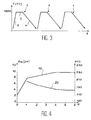
- FIG. 3 schematically illustrates this example 3, the reference 1 indicating a slow thermal cycle.
- This thermal cycle includes an austenitization which consists in heating the alloy to a temperature of 1000 ° C, indicated by reference 2, and to be maintained the alloy at this temperature for 30 minutes, indicated by reference 3; then to cool this alloy at a slow speed of 6 ° C / h, indicated by the reference 4. In this figure, this cycle is repeated 3 time.
- Measurements of the average grain size determined by an image analysis technique show that the repetition of the thermal cycle according to the invention induces additional growth of the grain of the alloy.
- measurements of the hardness of the alloy as a function of the number of thermal cycles to which it is subjected show that the hardness of the alloy decreases with the number of thermal cycles. Table 4 below groups these measures. Grain size and hardness measurements of the alloy as a function of the number of thermal cycles to which it is subjected Number of cycles N 0 1 2 3 4 5 6
- Figure 4 illustrates the results of this table.
- the curve referenced 10 represents the evolution of the average grain size of the alloy depending on the number of thermal cycles applied to this alloy
- the curve referenced 20 represents the evolution of the hardness of the alloy as a function of the number of thermal cycles applied to this alloy.
- Example 4 Obtaining an ODS Martensitic Structure According to the Invention
- An ODS martensitic structure is obtained at from an ODS ferritic structure having a size 8 ⁇ m grain, made in the previous example.
- the ferritic structure is subjected to a treatment thermal according to the invention comprising a austenitization at a temperature of around 1000 ° C for 30 minutes followed by rapid cooling to a speed greater than Vr (m), in this example at a speed of 700 ° C / h.
- the method of the invention makes it possible to obtain an alloy having a matrix with a single-phase martensitic structure with much longer slat lengths than those obtained after an austenitization of a raw spinning structure of the EM10 + Y 2 O 3 alloy. -ODS.
- the passage through a coarse ODS ferritic structure makes it possible to increase the grain size of the old austenite grain, that is to say the grain size of the high temperature phase which defines the length of slats of the martensitic phase.
- the microstructure of the alloy manufactured by the process of the invention characterized by the presence of equiaxed grains, is isotropic as well on parallel sections that perpendicular by relative to the direction of spinning of bars produced at from this alloy.
- the method of the invention therefore makes it possible to ensure the disappearance of the anisotropy present in alloys manufactured according to the prior art, and to guarantee a equivalent mechanical behavior whatever the alloy solicitation direction.
- the alloy martensitic made according to the invention has a hardness greater than or equal to 300 after austenitization and returned.
- this alloy can be used in ferritic phase or in martensitic phase returned.
- Example 4 The alloys produced in Example 4 above have been subjected to resistance to high temperature traction. These measures were performed at 650 and 750 ° C, on shaped bars having different sizes of the old grain austenitic.
- the following table 5 groups together the measures of this example.
- Rp 0.2% represents the elastic limit at 0.2% and R m represents the maximum tensile strength.
- the ODS-MA957 alloy was recrystallized, that is to say it underwent a specific heat treatment to improve its mechanical resistance when hot.
- the values of the measurements of this alloy correspond to measurements made in a direction parallel to the axis of shaping of the tubes or bars where, because of its anisotropy, the mechanical strength has maximum values obtained for the alloy ODS- MA957.
- the process claimed in this patent applies directly to the manufacture of tubes that can be used for example in fuel cladding for a reactor classic fast neutron or future generations hybrid reactors, for which a material with very high resistance to neutron irradiation in the range 400-700 ° C.
- alloys ODS martensitics claimed in this patent can withstand the high doses of radiation required neutronics, greater than 200 dpa.
- the manufacturing process according to the invention can apply to the manufacture of more structures thicker than sheaths.
- the alloy ODS martensitic claimed may be suitable in all nuclear applications requiring good mechanical properties under neutron irradiation, by example for the internal screws of a water reactor pressurized and for a highly stressed structure of a fusion reactor.
- alloys ferritic-martensitic ODS according to the invention suitable for any application requiring high mechanical resistance at high temperature especially for manufacturing a component of a power plant thermal and in the glass, gas and aeronautics.
Landscapes
- Chemical & Material Sciences (AREA)
- Engineering & Computer Science (AREA)
- Metallurgy (AREA)
- Materials Engineering (AREA)
- Mechanical Engineering (AREA)
- Organic Chemistry (AREA)
- Physics & Mathematics (AREA)
- General Engineering & Computer Science (AREA)
- Plasma & Fusion (AREA)
- High Energy & Nuclear Physics (AREA)
- Thermal Sciences (AREA)
- Crystallography & Structural Chemistry (AREA)
- Powder Metallurgy (AREA)
- Manufacture Of Alloys Or Alloy Compounds (AREA)
- Heat Treatment Of Steel (AREA)
- Compounds Of Iron (AREA)
- Colloid Chemistry (AREA)
Abstract
Description
- ils ne permettent pas d'obtenir une microstructure isotrope de l'alliage formé,
- ils ne permettent pas une maítrise et un contrôle de la taille de grain de l'alliage,
- ils conduisent à une taille de grain qui reste trop fine.
- une insuffisance de la résistance mécanique de l'alliage à haute température due à une anisotropie de sa microstructure,
- une fragilisation à haute température et/ou sous irradiation neutronique par précipitation de phases fragilisantes dans l'alliage due notamment à un excès de chrome, et
- une résistance mécanique pas toujours compatible avec une utilisation à haute température et/ou sous irradiation neutronique due notamment à une non maítrise de la taille de grain de l'alliage et à une taille de grain trop petite.
- la figure 1 est un graphique illustrant des cycles thermiques utilisant différentes vitesses de refroidissement pour induire une transformation d'une austénite en ferrite,
- la figure 2 est un graphique illustrant l'évolution de la taille moyenne de grain en fonction de la vitesse de refroidissement,
- la figure 3 est un graphique illustrant plusieurs application d'un cycle thermique avec une vitesse de refroidissement de 6°C par heure,
- la figure 4 est un graphique illustrant l'évolution de la taille moyenne des grains et de la dureté en fonction du nombre de cycles thermiques montrés sur la figure 3.
| Composition chimique d'alliages selon l'invention, d'un alliage conventionnel et d'un alliage ODS-MA957 | ||||||||||
| Matériaux | Cr | Mo | Ni | Mn | Si | C | O | N | Y | T1 |
| EM10 conventionnel | 9,0 | 1,1 | 0,6 | 0,6 | 0,4 | 0,11 | <0,004 | 0,025 | ||
| EM10 atomisé | 8,50 | 1,00 | 0,53 | 0,47 | 0,37 | 0,088 | 0,019 | 0,015 | - | - |
| EM10+Y2O3-ODS | 8,40 | 1,14 | 0,53 | 0,49 | 0,37 | 0,103 | 0,129 | 0,025 | 0,17 | - |
| EM10+Y2O3+TiO2-ODS | 8,38 | 1,13 | 0,52 | 0,50 | 0,37 | 0,122 | 0,133 | 0,024 | 0,15 | 0,23 |
| ODS-MA957 | 12,6 | 0,3 | - | - | - | 0,012 | 0,18 | - | 0,18 | 0,88 |
| cycle thermique utilisant différentes vitesses de refroidissement après austénitisation | |
| Echantillon | Vitesse de refroidissement jusqu'à 650°C (en °C/h) |
| E1 | 100 |
| E2 | 20 |
| E3 | 10 |
| E4 | 6 |
| effet de la vitesse de refroidissement selon l'invention sur la taille de grain lors de la transformation de l'austénite en ferrite ODS | ||||
| Vitesse de refroidissement Vr en °C/h | 100 | 20 | 12 | 6 |
| Taille des grains α (µm) | 3 | 4,2 | 4,9 | 8 |
| Mesures de la taille de grain et de la dureté de l'alliage en fonction du nombre de cycles thermiques auquel il est soumis | |||||||
| Nombre de cycles N | 0 | 1 | 2 | 3 | 4 | 5 | 6 |
| Taille de grain α (µm) | 2,5 | 8 | 8,5 | 9 | 10 | 10 | 10 |
| Dureté HV(α) | - | 208 | 195 | 190 | 187 | 185 | 185 |
| mesures de résistance à la traction à haute température | ||||
| Matériaux | 650°C | 750°C | ||
| Rp0,2% (MPa) | Rm (MPa) | Rp0,2% (MPa) | Rm (MPa) | |
| EM10 conventionnel sans dispersion d'oxydes | 190 | 223 | - | - |
| EM10+Y2O3-ODS taille de grain ≤1 µm | 233 | 285 | 117 | 152 |
| EM10+Y2O3-ODS selon l'invention | 305 | 331 | 188 | 205 |
| ODS-MA957 recristallisé* | 290 | 295 | 180 | 190 |
Claims (28)
- Procédé de fabrication d'un alliage à structure ferritique ODS incluant du chrome, ledit procédé comprenant une préparation d'une ébauche martensitique ODS incluant du chrome, et une étape consistant à soumettre l'ébauche martensitique ODS à au moins un cycle thermique, ledit, au moins un, cycle thermique comprenant une austénitisation de l'ébauche martensitique ODS à une température supérieure ou égale au point AC3 de cet alliage de manière à obtenir une austénite, suivie d'un refroidissement de cette austénite à une vitesse lente de refroidissement inférieure ou égale à la vitesse de refroidissement critique pour une transformation de cette austénite en ferrite de manière à obtenir un alliage à structure ferritique ODS, ladite vitesse lente de refroidissement critique étant déterminée à partir d'un diagramme de transformation de phase de cette austénite sous refroidissement continu.
- Procédé selon la revendication 1, dans lequel l'ébauche martensitique ODS incluant du chrome comprend en outre un ou plusieurs membres du groupe comprenant Y2O3, TiO2, MgO, Al2O3, MgAl2O4, HfO2, ThO2 et ZrO2
- Procédé selon la revendication 1, dans lequel l'ébauche martensitique ODS incluant du chrome comprend en outre un ou plusieurs éléments choisis dans le groupe comprenant Mo, W, Ni, Mn, Si, C, O, N, Y, Ti, Ta, V, Nb et Zr.
- Procédé selon l'une quelconque des revendications 1 à 3, dans lequel l'ébauche martensitique ODS incluant du chrome comprend d'environ 7 à environ 12% en poids en chrome équivalent dans l'alliage.
- Procédé selon la revendication 3, dans lequel Cr est à une concentration d'environ 7 à environ 12% en poids, Mo est à une concentration d'environ 0,3 à environ 1,5% en poids, W est à une concentration d'environ 0,5 à environ 3% en poids, Ni est à une concentration allant jusqu'à environ 1% en poids, Mn est à une concentration allant jusqu'à environ 1% en poids, Si est à une concentration allant jusqu'à environ 1% en poids, C est à une concentration d'environ 0,02 à environ 0,2% en poids, O est à une concentration d'environ 0,02 à environ 0,3% en poids, N est à une concentration allant jusqu'à environ 0,15% en poids, Y est à une concentration allant jusqu'à environ 1% en poids et Ti est à une concentration allant jusqu'à environ 1% en poids dans l'alliage, le reste étant du fer.
- Procédé selon l'une quelconque des revendications 1 à 5, comprenant au moins deux cycles thermiques, lesdits cycles thermiques étant séparés au moins une fois par au moins un traitement de mise en forme de l'alliage à structure ferritique ODS obtenu.
- Procédé selon la revendication 6, dans lequel le traitement de mise en forme de l'alliage à structure ferritique ODS comprend une mise en forme de l'alliage à structure ferritique suivie d'un traitement thermique de détensionnement de l'alliage mis en forme à une température inférieure à AC1.
- Procédé selon la revendication 7, dans lequel la mise en forme dudit alliage est une mise en forme à froid.
- Procédé selon la revendication 7 ou 8, dans lequel le traitement de détensionnement est un traitement thermique d'adoucissement à une température inférieure à environ 775°C.
- Procédé selon l'une quelconque des revendications 1 à 9, dans lequel la vitesse lente de refroidissement d'au moins un cycle thermique est inférieure ou égale à environ 280°C par heure.
- Procédé selon l'une quelconque des revendications 1 à 10, dans lequel la vitesse lente de refroidissement d'au moins un cycle thermique d'au moins un cycle thermique est inférieure ou égale à environ 100°C par heure.
- Procédé selon l'une quelconque des revendications 1 à 11, dans lequel la vitesse lente de refroidissement d'au moins un cycle thermique est inférieure ou égale à environ 20°C par heure.
- Procédé de fabrication d'un alliage martensitique ODS comprenant du chrome, ce procédé comprenant un procédé de fabrication d'un alliage à structure ferritique ODS selon l'une quelconque des revendications 1 à 12, suivi d'une étape de transformation martensitique, et d'un revenu de l'alliage martensitique ODS fabriqué, ladite étape de transformation martensitique comprenant une austénitisation de l'alliage à structure ferritique ODS à une température supérieure ou égale au point AC3 de cet alliage de manière à obtenir une austénite, suivie d'un refroidissement de cette austénite à une vitesse rapide de refroidissement, supérieure ou égale à la vitesse de refroidissement critique pour une transformation de l'austénite en martensite, ladite vitesse rapide de refroidissement étant déterminée à partir d'un diagramme de transformation de phase de cet alliage sous refroidissement continu
- Procédé selon la revendication 13, dans lequel la vitesse rapide de refroidissement est supérieure ou égale à environ 700°C par heure.
- Procédé selon la revendication 13 ou 14, dans lequel le revenu est réalisé à une température d'environ 750°C pendant environ 1 heure.
- Procédé selon l'une quelconque des revendications 2 à 15, dans lequel l'austénitisation est réalisée à une température d'environ 1000 à environ 1250°C pendant une durée d'environ 15 à environ 120 minutes.
- Procédé selon l'une quelconque des revendications précédentes, dans lequel l'austénitisation est réalisée à une température d'environ 1000°C pendant une durée d'environ 30 minutes.
- Procédé selon l'une quelconque des revendications précédentes, dans lequel la préparation de l'ébauche martensitique ODS comprenant du chrome est réalisée par mécanosynthèse d'une poudre pré-alliée obtenue par atomisation sous argon d'un lingot ayant une composition correspondante à celle de l'alliage fabriqué et ajout des oxydes.
- Procédé de fabrication d'une gaine de combustible nucléaire comprenant un alliage à structure ferritique ODS incluant du chrome, ledit procédé comprenant un procédé de fabrication dudit alliage selon l'une quelconque des revendications 1 à 18.
- Alliage à structure ferritique ODS comprenant du chrome, ledit alliage ayant une taille moyenne de grains supérieure à 1 µm.
- Alliage à structure martensitique ODS comprenant du chrome, ledit alliage ayant une taille moyenne de grains supérieure à 1 µm.
- Alliage selon la revendication 20 ou 21 ayant une taille moyenne de grain allant jusqu'à environ 10 µm.
- Alliage selon l'une quelconque des revendications 20 à 22, ledit alliage étant choisi à partir du groupe comprenant un alliage 9 Cr, un alliage 9 Cr-Mo, un alliage 9 Cr-W, ou un alliage 9 Cr-Mo-W.
- Alliage selon l'une quelconque des revendications 20 à 23, ledit alliage comprenant en outre au moins un élément choisi dans le groupe comprenant Cr, Mo, W, Ni, Mn, Si, C, O, N, Y, Ti, Ta, V, Nb et Zr.
- Alliage selon la revendication 24, dans lequel Cr est à une concentration d'environ 7 à environ 12% en poids, Mo est à une concentration d'environ 0,3 à environ 1,5% en poids, Ni est à une concentration allant jusqu'à environ 1% en poids, Mn est à une concentration allant jusqu'à environ 1% en poids, Si est à une concentration allant jusqu'à environ 1% en poids, C est à une concentration d'environ 0,02 à environ 0,2% en poids, O est à une concentration d'environ 0,02 à environ 0,3% en poids, N est à une concentration allant jusqu'à environ 0,15% en poids, Y est à une concentration allant jusqu'à environ 1%en poids et Ti est à une concentration allant jusqu'à environ 1% en poids dans l'alliage, le reste étant du fer.
- Gaine de combustible nucléaire constituée d'un alliage selon l'une quelconque des revendications 20 à 25.
- Elément de centrale nucléaire résistant à une radiation neutronique et à une température allant d'environ 400 à environ 700°C constitué d'un alliage selon l'une quelconque des revendications 20 à 25.
- Elément résistant à une température supérieure à environ 400°C constitué d'un alliage selon l'une quelconque des revendications 20 à 25.
Priority Applications (1)
| Application Number | Priority Date | Filing Date | Title |
|---|---|---|---|
| DK99400820T DK0949346T3 (da) | 1998-04-07 | 1999-04-02 | Fremgangsmåde til fremstilling af en oxiddispersionsforstærket ferritisk-martensitisk legering |
Applications Claiming Priority (2)
| Application Number | Priority Date | Filing Date | Title |
|---|---|---|---|
| FR9804325 | 1998-04-07 | ||
| FR9804325A FR2777020B1 (fr) | 1998-04-07 | 1998-04-07 | Procede de fabrication d'un alliage ferritique - martensitique renforce par dispersion d'oxydes |
Publications (2)
| Publication Number | Publication Date |
|---|---|
| EP0949346A1 true EP0949346A1 (fr) | 1999-10-13 |
| EP0949346B1 EP0949346B1 (fr) | 2004-06-30 |
Family
ID=9524960
Family Applications (1)
| Application Number | Title | Priority Date | Filing Date |
|---|---|---|---|
| EP99400820A Expired - Lifetime EP0949346B1 (fr) | 1998-04-07 | 1999-04-02 | Procédé de fabrication d'un alliage ferritique-martensitique renforce par dispersion d'oxydes |
Country Status (7)
| Country | Link |
|---|---|
| US (2) | US6485584B1 (fr) |
| EP (1) | EP0949346B1 (fr) |
| JP (1) | JP4395855B2 (fr) |
| AT (1) | ATE270351T1 (fr) |
| DE (1) | DE69918350T2 (fr) |
| DK (1) | DK0949346T3 (fr) |
| FR (1) | FR2777020B1 (fr) |
Cited By (4)
| Publication number | Priority date | Publication date | Assignee | Title |
|---|---|---|---|---|
| WO2004015154A1 (fr) * | 2002-08-08 | 2004-02-19 | Japan Nuclear Cycle Development Institute | Acier martensitique renforce au moyen d'oxyde disperse presentant une excellente resistance aux temperatures elevees et son procede de production |
| WO2004024968A1 (fr) * | 2002-08-08 | 2004-03-25 | Japan Nuclear Cycle Development Institute | Methode de fabrication d'acier ferritique renforce a oxyde disperse, a structure en grains grossiere presentant une remarquable resistance au fluage a haute temperature |
| EP1522601A3 (fr) * | 2003-09-30 | 2006-06-28 | Hitachi Powdered Metals Co., Ltd. | Corps fritté à base d'acier inoxydable avec une résistance à la corrosion élevée et procédé de production correspondant |
| CN102071348A (zh) * | 2010-12-18 | 2011-05-25 | 东北大学 | 一种超细晶粒纳米结构氧化物弥散强化钢的制备方法 |
Families Citing this family (31)
| Publication number | Priority date | Publication date | Assignee | Title |
|---|---|---|---|---|
| US7329381B2 (en) * | 2002-06-14 | 2008-02-12 | General Electric Company | Method for fabricating a metallic article without any melting |
| US6921510B2 (en) * | 2003-01-22 | 2005-07-26 | General Electric Company | Method for preparing an article having a dispersoid distributed in a metallic matrix |
| US7416697B2 (en) * | 2002-06-14 | 2008-08-26 | General Electric Company | Method for preparing a metallic article having an other additive constituent, without any melting |
| US20060065327A1 (en) * | 2003-02-07 | 2006-03-30 | Advance Steel Technology | Fine-grained martensitic stainless steel and method thereof |
| JP3753248B2 (ja) * | 2003-09-01 | 2006-03-08 | 核燃料サイクル開発機構 | 残留α粒を有する高温強度に優れたマルテンサイト系酸化物分散強化型鋼の製造方法 |
| US7531021B2 (en) | 2004-11-12 | 2009-05-12 | General Electric Company | Article having a dispersion of ultrafine titanium boride particles in a titanium-base matrix |
| US8357328B2 (en) * | 2009-12-14 | 2013-01-22 | General Electric Company | Methods for processing nanostructured ferritic alloys, and articles produced thereby |
| US8616851B2 (en) * | 2010-04-09 | 2013-12-31 | General Electric Company | Multi-alloy article, and method of manufacturing thereof |
| US20120107603A1 (en) * | 2010-10-29 | 2012-05-03 | General Electric Company | Article formed using nanostructured ferritic alloy |
| CN102091788B (zh) * | 2010-11-23 | 2013-07-17 | 北京科技大学 | 一种生产铁基弥散强化材料的方法 |
| KR101223155B1 (ko) | 2011-04-18 | 2013-01-17 | 한국원자력연구원 | 고온 강도 및 크리프 저항성이 향상된 산화물 분산 강화 합금 |
| KR101393323B1 (ko) * | 2012-05-10 | 2014-05-09 | 한국수력원자력 주식회사 | 레이저를 이용한 금속 소재의 산화물 분산 강화 방법 |
| CN103060591B (zh) * | 2013-01-08 | 2014-08-13 | 北京科技大学 | 一种近终成形多孔镍基ods合金的方法 |
| US20140294653A1 (en) * | 2013-03-29 | 2014-10-02 | Korea Hydro & Nuclear Power Co., Ltd | Martensitic oxide dispersion strengthened alloy with enhanced high-temperature strength and creep property, and method of manufacturing the same |
| KR101586546B1 (ko) * | 2013-03-29 | 2016-01-29 | 한국원자력연구원 | 상온 및 고온 강도가 향상된 페라이트계 산화물분산강화 합금 및 이의 제조 방법 |
| RU2515716C1 (ru) * | 2013-04-26 | 2014-05-20 | Российская Федерация, от имени которой выступает Государственная корпорация по атомной энергии "Росатом" | Малоактивируемая жаропрочная радиационностойкая сталь |
| JP6270197B2 (ja) * | 2013-06-13 | 2018-01-31 | 国立研究開発法人日本原子力研究開発機構 | 酸化物分散強化型焼き戻しマルテンサイト鋼の製造方法 |
| KR20150104348A (ko) | 2014-03-05 | 2015-09-15 | 한국원자력연구원 | 크리프 저항성이 향상된 페라이트/마르텐사이트계 산화물분산강화 강 및 이의 제조방법 |
| CN103966512B (zh) * | 2014-05-22 | 2016-05-11 | 哈尔滨工业大学 | 大尺寸梯度铝含量铁铬铝ods合金薄板材料、制备方法及应用 |
| CN103952631B (zh) * | 2014-05-22 | 2016-04-06 | 哈尔滨工业大学 | 大尺寸高铝含量铁素体ods合金薄板材料及其制备方法 |
| CN105239010B (zh) * | 2014-07-11 | 2017-05-10 | 中国科学院金属研究所 | 一种Cr‑Y‑O纳米团簇氧化物弥散强化低活化钢 |
| CN105238986B (zh) * | 2014-07-11 | 2017-06-13 | 中国科学院金属研究所 | 一种Cr‑Y‑O纳米团簇氧化物弥散强化钢的制备方法 |
| US9764384B2 (en) | 2015-04-14 | 2017-09-19 | Honeywell International Inc. | Methods of producing dispersoid hardened metallic materials |
| CN105274440B (zh) * | 2015-11-20 | 2017-09-29 | 北京科技大学 | 一种氧化物弥散强化钢的制备方法及一种马氏体钢 |
| JP6691000B2 (ja) * | 2016-06-14 | 2020-04-28 | 株式会社グローバル・ニュークリア・フュエル・ジャパン | 燃料棒および燃料集合体 |
| CN106399807A (zh) * | 2016-09-28 | 2017-02-15 | 天津大学 | 具有微纳尺度双晶粒组织的氧化物弥散强化钢制备方法 |
| CN107824771B (zh) * | 2017-11-13 | 2019-01-15 | 北京科技大学 | 一种熔炼铸造工艺制备氧化物弥散强化f/m钢的方法 |
| WO2020041726A1 (fr) * | 2018-08-24 | 2020-02-27 | Oregon State University | Modes de réalisation d'alliage qui contient un additif et leurs procédés de fabrication et d'utilisation |
| KR102225101B1 (ko) * | 2019-04-23 | 2021-03-10 | 한국원자력연구원 | 페라이트-마르텐사이트계 산화물 분산강화 강 |
| CN117123789B (zh) * | 2023-08-30 | 2025-10-10 | 中国科学院合肥物质科学研究院 | 一种耐热抗辐照超细晶粒马氏体钢的制备方法 |
| CN119843180B (zh) * | 2025-03-24 | 2025-06-06 | 中国核动力研究设计院 | 铅冷快堆包壳用氧化物弥散强化铁铬钨基铁素体马氏体合金及其制备方法 |
Citations (8)
| Publication number | Priority date | Publication date | Assignee | Title |
|---|---|---|---|---|
| US4075010A (en) * | 1976-02-05 | 1978-02-21 | The International Nickel Company, Inc. | Dispersion strengthened ferritic alloy for use in liquid-metal fast breeder reactors (LMFBRS) |
| EP0258969A2 (fr) * | 1986-07-07 | 1988-03-09 | United Kingdom Atomic Energy Authority | Aciers renforcés par une dispersion de nitrures |
| JPS63186853A (ja) * | 1986-09-29 | 1988-08-02 | Nkk Corp | 酸化物分散強化型高クロム鋼 |
| JPH01272746A (ja) * | 1988-04-25 | 1989-10-31 | Power Reactor & Nuclear Fuel Dev Corp | 延性と靭性に優れた原子炉用分散強化フェライト鋼 |
| GB2219004A (en) * | 1988-04-25 | 1989-11-29 | Doryokuro Kakunenryo | Dispersion strengthened ferritic steel |
| JPH02225648A (ja) * | 1989-02-23 | 1990-09-07 | Sumitomo Metal Ind Ltd | 高強度酸化物分散強化型フェライト鋼 |
| US4960562A (en) * | 1988-11-19 | 1990-10-02 | Doryokuro Kakunenryo Kaihatsu Jigyodan | Dispersion strengthened ferritic steel cladding tube for nuclear reactor and its production method |
| US5310431A (en) * | 1992-10-07 | 1994-05-10 | Robert F. Buck | Creep resistant, precipitation-dispersion-strengthened, martensitic stainless steel and method thereof |
Family Cites Families (4)
| Publication number | Priority date | Publication date | Assignee | Title |
|---|---|---|---|---|
| GB2181454B (en) * | 1985-10-10 | 1990-04-04 | Atomic Energy Authority Uk | Processing of high temperature alloys |
| US4732622A (en) * | 1985-10-10 | 1988-03-22 | United Kingdom Atomic Energy Authority | Processing of high temperature alloys |
| US5032190A (en) * | 1990-04-24 | 1991-07-16 | Inco Alloys International, Inc. | Sheet processing for ODS iron-base alloys |
| US5167728A (en) * | 1991-04-24 | 1992-12-01 | Inco Alloys International, Inc. | Controlled grain size for ods iron-base alloys |
-
1998
- 1998-04-07 FR FR9804325A patent/FR2777020B1/fr not_active Expired - Fee Related
-
1999
- 1999-04-02 AT AT99400820T patent/ATE270351T1/de active
- 1999-04-02 EP EP99400820A patent/EP0949346B1/fr not_active Expired - Lifetime
- 1999-04-02 DE DE69918350T patent/DE69918350T2/de not_active Expired - Lifetime
- 1999-04-02 DK DK99400820T patent/DK0949346T3/da active
- 1999-04-06 US US09/286,756 patent/US6485584B1/en not_active Expired - Lifetime
- 1999-04-07 JP JP10009099A patent/JP4395855B2/ja not_active Expired - Fee Related
-
2002
- 2002-09-25 US US10/255,229 patent/US6974506B2/en not_active Expired - Fee Related
Patent Citations (8)
| Publication number | Priority date | Publication date | Assignee | Title |
|---|---|---|---|---|
| US4075010A (en) * | 1976-02-05 | 1978-02-21 | The International Nickel Company, Inc. | Dispersion strengthened ferritic alloy for use in liquid-metal fast breeder reactors (LMFBRS) |
| EP0258969A2 (fr) * | 1986-07-07 | 1988-03-09 | United Kingdom Atomic Energy Authority | Aciers renforcés par une dispersion de nitrures |
| JPS63186853A (ja) * | 1986-09-29 | 1988-08-02 | Nkk Corp | 酸化物分散強化型高クロム鋼 |
| JPH01272746A (ja) * | 1988-04-25 | 1989-10-31 | Power Reactor & Nuclear Fuel Dev Corp | 延性と靭性に優れた原子炉用分散強化フェライト鋼 |
| GB2219004A (en) * | 1988-04-25 | 1989-11-29 | Doryokuro Kakunenryo | Dispersion strengthened ferritic steel |
| US4960562A (en) * | 1988-11-19 | 1990-10-02 | Doryokuro Kakunenryo Kaihatsu Jigyodan | Dispersion strengthened ferritic steel cladding tube for nuclear reactor and its production method |
| JPH02225648A (ja) * | 1989-02-23 | 1990-09-07 | Sumitomo Metal Ind Ltd | 高強度酸化物分散強化型フェライト鋼 |
| US5310431A (en) * | 1992-10-07 | 1994-05-10 | Robert F. Buck | Creep resistant, precipitation-dispersion-strengthened, martensitic stainless steel and method thereof |
Non-Patent Citations (3)
| Title |
|---|
| PATENT ABSTRACTS OF JAPAN vol. 012, no. 467 (C - 550) 7 December 1988 (1988-12-07) * |
| PATENT ABSTRACTS OF JAPAN vol. 014, no. 037 (C - 680) 24 January 1990 (1990-01-24) * |
| PATENT ABSTRACTS OF JAPAN vol. 014, no. 539 (C - 0782) 28 November 1990 (1990-11-28) * |
Cited By (8)
| Publication number | Priority date | Publication date | Assignee | Title |
|---|---|---|---|---|
| WO2004015154A1 (fr) * | 2002-08-08 | 2004-02-19 | Japan Nuclear Cycle Development Institute | Acier martensitique renforce au moyen d'oxyde disperse presentant une excellente resistance aux temperatures elevees et son procede de production |
| WO2004024968A1 (fr) * | 2002-08-08 | 2004-03-25 | Japan Nuclear Cycle Development Institute | Methode de fabrication d'acier ferritique renforce a oxyde disperse, a structure en grains grossiere presentant une remarquable resistance au fluage a haute temperature |
| US7037464B2 (en) | 2002-08-08 | 2006-05-02 | Japan Nuclear Cycle Development Institute | Dispersed oxide reinforced martensitic steel excellent in high temperature strength and method for production thereof |
| CN100357469C (zh) * | 2002-08-08 | 2007-12-26 | 日本核燃料循环开发机构 | 高温强度优异的马氏体系氧化物弥散强化型钢的制造方法 |
| US7361235B2 (en) | 2002-08-08 | 2008-04-22 | Japan Nuclear Cycle Development Institute | Method for producing dispersed oxide reinforced ferritic steel having coarse grain structure and being excellent in high temperature creep strength |
| EP1522601A3 (fr) * | 2003-09-30 | 2006-06-28 | Hitachi Powdered Metals Co., Ltd. | Corps fritté à base d'acier inoxydable avec une résistance à la corrosion élevée et procédé de production correspondant |
| CN102071348A (zh) * | 2010-12-18 | 2011-05-25 | 东北大学 | 一种超细晶粒纳米结构氧化物弥散强化钢的制备方法 |
| CN102071348B (zh) * | 2010-12-18 | 2012-07-25 | 东北大学 | 一种超细晶粒纳米结构氧化物弥散强化钢的制备方法 |
Also Published As
| Publication number | Publication date |
|---|---|
| DK0949346T3 (da) | 2004-11-08 |
| US6485584B1 (en) | 2002-11-26 |
| US20030116239A1 (en) | 2003-06-26 |
| ATE270351T1 (de) | 2004-07-15 |
| JP4395855B2 (ja) | 2010-01-13 |
| EP0949346B1 (fr) | 2004-06-30 |
| FR2777020B1 (fr) | 2000-05-05 |
| DE69918350T2 (de) | 2005-08-25 |
| DE69918350D1 (de) | 2004-08-05 |
| JPH11343526A (ja) | 1999-12-14 |
| FR2777020A1 (fr) | 1999-10-08 |
| US6974506B2 (en) | 2005-12-13 |
Similar Documents
| Publication | Publication Date | Title |
|---|---|---|
| EP0949346B1 (fr) | Procédé de fabrication d'un alliage ferritique-martensitique renforce par dispersion d'oxydes | |
| EP3007844B1 (fr) | Procédé de fabrication d'une pièce en alliage en titane-aluminium | |
| KR100364093B1 (ko) | 핵연료어셈블리용 튜브제조방법 및 이에 의해 얻어진 튜브 | |
| EP0802264B1 (fr) | Alliage à base de zirconium résistant au fluage et à la corrosion par l'eau et la vapeur, procédé de fabrication, et utilisation dans un réacteur nucléaire | |
| DE69620998T2 (de) | Oxidationsbeständige molybdänlegierung | |
| FR2576322A1 (fr) | Procede pour le formage d'articles a partir d'alliages de zirconium | |
| FR2852263A1 (fr) | Methode pour la preparation d'alliages metalliques nanostructures ayant un contenu nitride augmente | |
| CA1102667A (fr) | Procede permettant d'ameliorer la tenue a chaud du zirconium et de ses alliages | |
| EP0863219A1 (fr) | Aluminiure de titane utilisable à température élevée | |
| EP1153396B1 (fr) | Procede de fabrication d'elements minces en alliage a base de zirconium et plaquettes ainsi realisees | |
| FR2612944A1 (fr) | Alliages d'acier inoxydable austenitique resistant au rayonnement | |
| FR2639462A1 (fr) | Tube de gainage en acier ferritique renforce par dispersion | |
| CA2541011A1 (fr) | Procede d'elaboration d'un produit plat en alliage de zirconium, produit plat ainsi obtenu et grille de reacteur de centrale nucleaire realisee a partir de ce produit plat | |
| EP1528112B1 (fr) | Acier martensitique renforce au moyen d'oxyde disperse presentant une excellente resistance aux temperatures elevees et son procede de production | |
| CA2533172C (fr) | Procede de fabrication d'un produit plat en alliage de zirconium, produit plat ainsi obtenu et element d'un assemblage combustible pour reacteur de centrale nucleaire realise a partir de ce produit plat | |
| FR2821858A1 (fr) | Procede pour la production d'une gaine en ferro-alliage ferritique consolide avec une dispersion d'oxyde et contenant du chrome | |
| WO2000046414A1 (fr) | Alliage de zirconium et de niobium comprenant de l'erbium, procede de preparation et piece comprenant ledit alliage | |
| EP0233426A1 (fr) | Acier inoxydable austénitique utilisable en particulier comme matériau de structure de coeur ou de gainage dans les réacteurs nucléaires | |
| WO2004072317A1 (fr) | Procede de fabrication d'un demi-produit en alliage de zirconium pour l'elaboration d'un produit long et utilisation | |
| US7141209B2 (en) | Method for producing oxide dispersion strengthened ferritic steel tube | |
| FR3007040A1 (fr) | Acier martensitique trempe renforce par dispersion d'oxydes d'excellente resistance a la corrosion, tenacite et propriete mecaniques a temperature elevee, et procede de production de celui-ci | |
| EP4448822B1 (fr) | Nuance de fonte ductile a matrice ferritique renforcee | |
| FR3003875A1 (fr) | Alliage renforce par une dispersion d'oxyde martensitique ayant des proprietes ameliorees de resistance et de fluage a haute temperature, et procede de sa fabrication | |
| BE883568Q (fr) | Procede de fabrication d'un element constructif de reacteur, en alliage de zirconium | |
| WO2004072318A1 (fr) | Procede de fabrication d’un demi-produit en alliage de zirconium pour l’elaboration d’un produit plat et utilisation |
Legal Events
| Date | Code | Title | Description |
|---|---|---|---|
| PUAI | Public reference made under article 153(3) epc to a published international application that has entered the european phase |
Free format text: ORIGINAL CODE: 0009012 |
|
| AK | Designated contracting states |
Kind code of ref document: A1 Designated state(s): AT BE CH DE DK GB LI NL SE |
|
| AX | Request for extension of the european patent |
Free format text: AL;LT;LV;MK;RO;SI |
|
| 17P | Request for examination filed |
Effective date: 20000327 |
|
| AKX | Designation fees paid |
Free format text: AT BE CH DE DK GB LI NL SE |
|
| 17Q | First examination report despatched |
Effective date: 20020109 |
|
| GRAP | Despatch of communication of intention to grant a patent |
Free format text: ORIGINAL CODE: EPIDOSNIGR1 |
|
| GRAS | Grant fee paid |
Free format text: ORIGINAL CODE: EPIDOSNIGR3 |
|
| GRAA | (expected) grant |
Free format text: ORIGINAL CODE: 0009210 |
|
| AK | Designated contracting states |
Kind code of ref document: B1 Designated state(s): AT BE CH DE DK GB LI NL SE |
|
| REG | Reference to a national code |
Ref country code: GB Ref legal event code: FG4D Free format text: NOT ENGLISH Ref country code: CH Ref legal event code: EP |
|
| REF | Corresponds to: |
Ref document number: 69918350 Country of ref document: DE Date of ref document: 20040805 Kind code of ref document: P |
|
| REG | Reference to a national code |
Ref country code: SE Ref legal event code: TRGR |
|
| GBT | Gb: translation of ep patent filed (gb section 77(6)(a)/1977) |
Effective date: 20040916 |
|
| REG | Reference to a national code |
Ref country code: DK Ref legal event code: T3 |
|
| PLBE | No opposition filed within time limit |
Free format text: ORIGINAL CODE: 0009261 |
|
| STAA | Information on the status of an ep patent application or granted ep patent |
Free format text: STATUS: NO OPPOSITION FILED WITHIN TIME LIMIT |
|
| 26N | No opposition filed |
Effective date: 20050331 |
|
| PGFP | Annual fee paid to national office [announced via postgrant information from national office to epo] |
Ref country code: NL Payment date: 20160314 Year of fee payment: 18 Ref country code: DK Payment date: 20160329 Year of fee payment: 18 |
|
| PGFP | Annual fee paid to national office [announced via postgrant information from national office to epo] |
Ref country code: GB Payment date: 20160418 Year of fee payment: 18 Ref country code: CH Payment date: 20160405 Year of fee payment: 18 Ref country code: DE Payment date: 20160413 Year of fee payment: 18 |
|
| PGFP | Annual fee paid to national office [announced via postgrant information from national office to epo] |
Ref country code: SE Payment date: 20160415 Year of fee payment: 18 Ref country code: AT Payment date: 20160323 Year of fee payment: 18 Ref country code: BE Payment date: 20160421 Year of fee payment: 18 |
|
| REG | Reference to a national code |
Ref country code: DE Ref legal event code: R119 Ref document number: 69918350 Country of ref document: DE |
|
| REG | Reference to a national code |
Ref country code: DK Ref legal event code: EBP Effective date: 20170430 |
|
| REG | Reference to a national code |
Ref country code: CH Ref legal event code: PL |
|
| REG | Reference to a national code |
Ref country code: NL Ref legal event code: MM Effective date: 20170501 |
|
| REG | Reference to a national code |
Ref country code: AT Ref legal event code: MM01 Ref document number: 270351 Country of ref document: AT Kind code of ref document: T Effective date: 20170402 |
|
| GBPC | Gb: european patent ceased through non-payment of renewal fee |
Effective date: 20170402 |
|
| PG25 | Lapsed in a contracting state [announced via postgrant information from national office to epo] |
Ref country code: NL Free format text: LAPSE BECAUSE OF NON-PAYMENT OF DUE FEES Effective date: 20170501 Ref country code: DE Free format text: LAPSE BECAUSE OF NON-PAYMENT OF DUE FEES Effective date: 20171103 Ref country code: AT Free format text: LAPSE BECAUSE OF NON-PAYMENT OF DUE FEES Effective date: 20170402 |
|
| PG25 | Lapsed in a contracting state [announced via postgrant information from national office to epo] |
Ref country code: GB Free format text: LAPSE BECAUSE OF NON-PAYMENT OF DUE FEES Effective date: 20170402 Ref country code: LI Free format text: LAPSE BECAUSE OF NON-PAYMENT OF DUE FEES Effective date: 20170430 Ref country code: SE Free format text: LAPSE BECAUSE OF NON-PAYMENT OF DUE FEES Effective date: 20170403 Ref country code: CH Free format text: LAPSE BECAUSE OF NON-PAYMENT OF DUE FEES Effective date: 20170430 |
|
| REG | Reference to a national code |
Ref country code: BE Ref legal event code: MM Effective date: 20170430 |
|
| PG25 | Lapsed in a contracting state [announced via postgrant information from national office to epo] |
Ref country code: DK Free format text: LAPSE BECAUSE OF NON-PAYMENT OF DUE FEES Effective date: 20170430 |
|
| PG25 | Lapsed in a contracting state [announced via postgrant information from national office to epo] |
Ref country code: BE Free format text: LAPSE BECAUSE OF NON-PAYMENT OF DUE FEES Effective date: 20170430 |