EP0950073B1 - Polymere de silane de polyaddition de michael, a groupes terminaux - Google Patents
Polymere de silane de polyaddition de michael, a groupes terminaux Download PDFInfo
- Publication number
- EP0950073B1 EP0950073B1 EP97946788A EP97946788A EP0950073B1 EP 0950073 B1 EP0950073 B1 EP 0950073B1 EP 97946788 A EP97946788 A EP 97946788A EP 97946788 A EP97946788 A EP 97946788A EP 0950073 B1 EP0950073 B1 EP 0950073B1
- Authority
- EP
- European Patent Office
- Prior art keywords
- group
- polymer according
- terminated silane
- silane polymer
- organic compounds
- Prior art date
- Legal status (The legal status is an assumption and is not a legal conclusion. Google has not performed a legal analysis and makes no representation as to the accuracy of the status listed.)
- Expired - Lifetime
Links
Classifications
-
- C—CHEMISTRY; METALLURGY
- C08—ORGANIC MACROMOLECULAR COMPOUNDS; THEIR PREPARATION OR CHEMICAL WORKING-UP; COMPOSITIONS BASED THEREON
- C08F—MACROMOLECULAR COMPOUNDS OBTAINED BY REACTIONS ONLY INVOLVING CARBON-TO-CARBON UNSATURATED BONDS
- C08F8/00—Chemical modification by after-treatment
- C08F8/42—Introducing metal atoms or metal-containing groups
Definitions
- This invention pertains to a new type of polymer, which is produced by reacting an appropriate organic derivative of silicon with the terminal groups of linear or branched polymers that are obtained from the reaction of Michael addition of organic compounds that contain at least two active hydrogens to organic compounds that contain at least two double ethylene bonds that are activated by the presence, in the alpha position with regard to each ethylene bond, of an electronegative group.
- the terminated silane polymer that is obtained in the form of a viscous fluid that is stable under conditions of absence of moisture, for example, by simple exposure to air and without further additions of other substances at the time of use, quickly increases its viscosity until it turns into a solid product, which can be hard and tough like a resin or elastic and flexible like a rubber.
- the polyaddition reaction proceeds readily at ambient temperature or at moderate temperature, producing polymers that are predominantly characterized by a structure of the anti-Markovnikov type when the reaction is catalyzed by a base or by a Markovnikov-type structure when the reaction is catalyzed by an acid, as in the case where dithiols are added to divinyl ethers.
- the polyaddition reaction has the charactistics of a staged reaction.
- Polymers and oligomers from Michael polyaddition that are obtained with a ratio between the quantities of the monomers of other than one (r ⁇ 1) and terminate with functional groups such as amino, mercapto, activated ethylene do not have direct application in the area of coatings and sealers, but can be used only when mixed with other substances that have a functionality of greater than or equal to two and are able to react with the functional groups of the polymer or oligomer.
- the polyaddition polymers which terminate with a mercapto group and which can be reticulated by reacting with an epoxy resin, exploiting the reactivity of the nucleophilic mercapto group with regard to the oxyranic ring.
- the terminated mercapto polycondensation polymer acts as a chain extender of the epoxy resin and, if the chain is long enough, also of the flexibilizer of the resin itself.
- the reaction which is catalyzed by a tertiary amine, takes place at as low as ambient temperature.
- the object of this invention is to transform polyaddition polymers that are obtained by Michael addition, base-catalyzed, of organic compounds that have at least two active hydrogens to organic compounds that have at least two activated ethylene bonds, whereby the molecular ratio between the quantities of the monomers is other than one (r ⁇ 1), into polymers that reticulate completely and move from the fluid state to the solid state simply by being exposed to the humidity of the air and without further additions of other reactive substances, i.e., to transform them into mono-component products.
- the polyaddition polymers are terminated with activated amine, mercaptane, or ethylene groups, these polymers are made to react with organic silicon derivatives which have either a reactive functional group that is suitable for reacting with the terminal functional group of the polyaddition polymer or suitable groups that can be easily hydrolyzed and condensed.
- the terminated silane polymers that are thus obtained are stable and retain their state as viscous fluids under anhydrous conditions but, if exposed to atmospheric humidity, are transformed into solid materials owing to the reticulation that is produced by the hydrolysis and subsequent addition of the groups to the terminal silicon atom. This mechanism is known and amply described in the literature.
- usable polyaddition polymers are all those that can be obtained by Michael addition of monomers with a molecular ratio r of other than one (r ⁇ 1), whereby the choice of monomers will depend on the end use to which the polymer itself will be put, and their ratio will depend on the type of functional group and the molecular weight that are preselected.
- the mean molecular weight of the polyaddition polymer should be between the minimum that can be obtained when the ratio between the quantity of monomer in deficit and that in surplus is equal to 0.5 and a maximum of approximately 20,000. Higher molecular weights would lead to viscosities that are too high for practical use. In the presence of a solvent, the molecular weight of 20,000 may be exceeded provided that the terminal functional groups are present in such numbers that, after reaction with the appropriate functional groups of the hydrolyzable silanes, a sufficiently high percentage of terminal silane groups and thus a structure with a degree of reticulation that is usable after vulcanization by exposure to humidity are obtained.
- the Michael polyaddition polymers that are usable for this invention are characterized by the following two structures, which can be obtained with a different ratio between the monomers (diagrams 1 and 2): where:
- the polymers that are preferred for this invention are those that are derived from the polyaddition of dithiols to diacrylates or dimethacrylates; this does not rule out the use of other monomers, e.g., aliphatic diamines and bis-acrylamides.
- the molar ratio between the monomers may be any value, with the exception of a ratio equal to one, i.e., with the exception of polymers that are obtained from equimolar quantities of monomers, and is calculated as a function of the type of terminal functional group and the mean molecular weight that are preselected.
- the bis-thiolo that is preferred for this invention is: HS-R'-SH where R' is preferably a divalent alkyl radical that has from 2 to 12 carbon atoms, an aryl radical, or any other divalent radical.
- the diacrylates or dimethylacrylates are: where:
- the molecular weights of the combined -OR 3 - units vary from 50 to 15,000.
- An example of a product that belongs to this class of compounds is: Poly(ethyleneglycol)dimethacrylate, where n can vary between 1 and 400, preferably from 1 to 50.
- the polyaddition polymers which are suitable for silanation and are obtained by reacting a dithiol of the type described above (11) with a dimethacrylate or diacrylate as described above (12) will have one of the following structures, depending on the molecular ratio that is selected among the monomers (diagrams 13 and 14): with R 1 , R 2 , and R' as described above.
- polymers that are obtained from ethyleneglycol dimethacrylate and 1,2-ethanediol and
- HSCH 2 CH 2 CH 2 Si(OCH 3 ) 3 3-mercaptopropyltrimethoxy silane CH 2 C(CH 3 )COOCH 2 CH 2 CH 2 Si(OCH 3 ) 3 3-methacrylopropyltrimethoxy silane.
- silane polymers that are the subject of this invention and are obtained by reacting polyaddition polymers (13) and (14) with silanes (15) and (16) may be depicted in diagrammatic form as follows: where:
- A repeating unit of the structure of diagram (13), and R 1 , R 2 , and R 4 are as described above.
- B repeating unit of the structure of diagram (14), and R', R 4 , and R 5 are as described above.
- a catalyst Any known catalyst that ensures the hydrolysis and condensation of silanols can be used.
- examples of such compounds are the metal salts of carboxylic acids such as dibutylstannodilaurate, stannous octoate, the organic derivatives of titanium such as alkytitanates, and any other acidic or basic catalyst.
- the catalyst quantitative can vary from 0.1 to 10 parts by weight per 100 parts by weight of polymer, but larger or smaller quantitatives may also be used, depending on need.
- the polymers of this invention can also be modified with the fillers normally used in polymers.
- reinforcing fillers such as pyrogenic silica, precipitated silica, and carbon black
- non-reinforcing fillers such as, e.g., precipitated or ground calcium carbonate, magnesium carbonate, kaolin, talc, zinc iron titanium oxides, and organic and inorganic fibrous materials.
- All of the fillers which are used in the rubber industry and of which those mentioned above are only a few may be used by themselves or in a mixture, whereby each imparts a particular characteristic to the polymer.
- terminated silane polyaddition polymers can also be modified with plasticizers, which are generally used to modify the rheological and mechanical properties of the end product.
- plasticizers which are generally used to modify the rheological and mechanical properties of the end product.
- the basic requirement imposed on a plasticizer is that it be compatible with the polymer: plasticizers that are only partly compatible are expelled within a period of time that varies depending on the degree of compatibility, giving rise to separation phenomena before vulcanization and exudation phenomena after vulcanization.
- Any plasticizer that is known in the art is suitable. Let us cite, by way of example, the esters of phthalic acid, the esters of adipic acid, phosphoric esters, epoxidated soy oils, chlorinated paraffins.
- additives in a mixture with the polymers of this invention: pigments, antioxidants, UV stabilizers, additives to improve adhesion (e.g., epoxide resins or phenolic resins). Since terminated silane polymers are sensitive to humidity, the fillers and, in general, all products that are added must be dehyrated before use.
- silane terminated polyaddition polymers according to the present invention are listed below, and, for each one, a brief explanation is given relating to the proces used for their preparation.
- a silane terminated polyaddition polymer is prepared by mixing thoroughly 77.56 g (0.14 moles) of a polyoxyethylendimethacrylate, 14.07 g (0.13 moles) of 1,3-propanedithiol, 1.8 g (0.018 moles) of triethylamine as the catalyst, in a reaction vessel in the presence of a very small quantity of a defoaming agent.
- the temperature of the mixture rises very quickly to as high as 95°C. stays at the maximum temperature for a short time then decreases slowly.
- the temperature In order for all the reactive groups to react the temperature must be maintained at 75°C until the mercapto groups can no longer be detected by an analysis carried out with the usual analytical methods. The process requires a long time, about 24 hours. Thereafter 3.9 g (0.02 moles) of mercaptopropyltrimethoxysilane are added to the mixture maintained at 75°C and thoroughly mixed, again the process is continued until the double bond groups can no longer be detected by the usual analytical methods.
- the polymer is then poured into a metal container, degassed, flushed with nitrogen and stored for further compounding.
- the quantitative analysis of the terminal double bond groups confirms the expected mean numerical molecular weight (Mn) of 9.100 in accordance with the ratio of the reactant monomers.
- the 1 -H-NMR analysis of the silanated polyaddition polymer confirms the quantitative addition of the mercapto groups of the silane molecule to the terminal double bond groups of the polyaddition polymer.
- the final product therefore is a polyaddition polymer with silane terminal groups and a calculated mean numerical molecular weight (Mn) of 9.500.
- the viscosity of the silane terminated polymer is 29.000 mPa ⁇ s.
- a sample of the polymer mixed with a tertiary amine (1% in weight) acting as the hydrolysis and condensation catalyst of the methoxy groups shows no changes when stored in a dry nitrogen atmosphere, but when it is exposed to atmospheric air, it changes quickly and forms a tack-free rubber-like skin in less that 30 minutes.
- a silane terminated polyaddition polymer is prepared by mixing thoroughly 77.56 g (0.14 moles) of polyoxyethylendimethacrylate, 12.25 g (0.13 moles) of 1.2-ethandithiol and 1.7 g (0.017 moles) of triethylamine as the catalyst, in a reaction vessel in the presence of a very small quantity of a defoaming agent.
- reaction procedure time, temperature and analysis methods is the same as previously illustrated in example 1.
- the 1 -H-NMR analysis of the polymer confirms a linear structure and a mean numerical molecular weight (Mn) of 9.200.
- the viscosity of the polymer at 23° C is 27.000 mPa ⁇ s.
- a sample of the polymer mixed with a tertiary amine (1 % in weight) acting as the hydrolysis and condensation catalyst of methoxy groups shows no changes when stored in a dry nitrogen atmosphere, but when it is exposed to atmospheric air it changes quickly and forms a tack-free rubber-like in less than 30 minutes.
- a silane terminated polyaddition polymer is prepared by mixing thoroughly 77.56 g (0.14 moles) of polyoxyethylendimethacrylate, 16.25 g (0.15 moles) of 1,3-propanedithiol and 1.74 g (0.017 moles) of triethylamine as the catalyst, in a reaction vessel in the presence of a very small quantity of a defoaming agent.
- the temperature is maintained at 75° C and the reaction is continued until the double bond groups can no longer be detected by the usual analytical methods.
- the polymer is then poured into metal container, degassed, flushed with nitrogen and stored for further compounding.
- the 1 -H-NMR analysis of the polymer confirms a linear structure and a mean numerical molecular weight (Mn) of 9.900.
- the viscosity of the polymer at 23° C is 29.000 mPa ⁇ s.
- a sample of the polymer mixed with a tertiary amine (1% in weight) acting as the hydrolysis and condensation catalyst of the methoxy group shows no changes when stored is a dry nitrogen athmosphere, but when it is exposed to atmospheric air it changes quickly and forms a tack-free rubber-like skin in less than 30 minutes.
- a silane terminated polyaddition polymer is prepared by mixing thoroughly 22.16 g (0.04 moles) of polyoxyethylendimethacrylate, 3.24 g (0.03 moles) of 1,3-propanedithiol and 0.5 g (0.005 moles) of triethlyamine as the catalyst, in a reaction vessel.
- the temperature as in example 1, is maintained at 75°C until the mercapto groups can no longer be detected by the usual analysis methods.
- the 1 -H-NMR analysis of the polymer confirms a linear structure and a mean numerical molecular weight (Mn) of 2.900.
- the viscosity of the polymer at 20° C is 2.900 mPa ⁇ s
- a sample of the polymer mixed with a tertiary amine (1% in weight) acting as the hydrolysis and condensation catalyst of the methoxy group shows no changes when stored is a dry nitrogen atmosphere, but when it is exposed to atmospheric air it changes quickly and forms a tack-free, hard and flexible skin in less than 30 minutes.
- 100 parts in weight of polymer of the example n. 1 are mixed with 100 parts of calcium carbonate, 10 parts of titanium dioxide, 0.5 parts of an antioxidant and 1.0 part of a tertiary amine catalyst.
- the mixing is carried out in a planetary mixing machine in a dry nitrogen atmosphere.
- the compound, in the form of a soft and tixotropic paste is degassed and stored in metal cartridges. No change occurs as long as the compound is kept into the metal cartridges, but when, it is exposed to atmospheric air, it forms a tack-free elastic skin in less than 30 minutes and cures entirely in 24 hours.
- the cured elastic compound shows the following properties:
Landscapes
- Chemical & Material Sciences (AREA)
- General Chemical & Material Sciences (AREA)
- Health & Medical Sciences (AREA)
- Chemical Kinetics & Catalysis (AREA)
- Medicinal Chemistry (AREA)
- Polymers & Plastics (AREA)
- Organic Chemistry (AREA)
- Addition Polymer Or Copolymer, Post-Treatments, Or Chemical Modifications (AREA)
- Polyethers (AREA)
- Silicon Polymers (AREA)
- Polymers With Sulfur, Phosphorus Or Metals In The Main Chain (AREA)
Claims (11)
- Polymère à terminaisons silane, caractérisé en ce qu'il est obtenu par une réaction d'addition entre un dérivé organique de silicone ayant la structure suivante :dans laquelle a = 0, 1, 2 ; b = 0,1 et
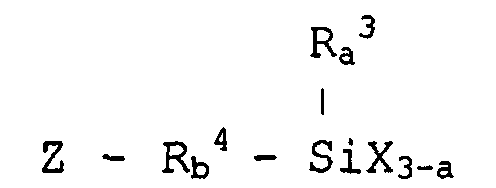 X est choisi dans le groupe constitué par les radicaux halogène, alcoxy, acyloxy, cétoxime, amine, amide et mercaptan ;R3 est un groupe hydrocarboné monovalent ;R4 est un groupe bivalent qui a une fonction de liaison choisie dans le groupe constitué par un radical hydrocarboné, un radical éther-hydrocarboné et un radical hydrocarboné aminé ;Z est choisi dans le groupe constitué par :
 et les groupes terminaux de polymères qui sont obtenus par une réaction de polyaddition de Michael entre des composés organiques qui contiennent au moins deux hydrogène actifs et des composés organiques qui ont au moins deux liaisons éthylène qui sont activées par la présence, en position alpha par rapport à chaque liaison éthylène, d'un groupe électronégatif, le rapport molaire r entre les quantités de monomères desdits composés étant différent de 1 (r≠1).
- Polymère à terminaisons silane selon la revendication 1, dans lequel les composés organiques de silicone sont choisis dans le groupe constitué par :HS-R4-Si(OCH3)3 mercaptoalkyltriméthoxy silanes,CH2=C(R5)-COO-R4-Si(OCH3)3alkyl (methacrylate)triméthoxy silanes dans lesquels :R4 est un radical alkyle divalent qui contient de 1 à 8 atomes de carbone,R5 est -H, -CH3.
- Polymère à terminaisons silane selon la revendication 2, dans lequel les composés organiques de silicone sont le 3-mercaptopropyltriméthoxy silane ou le 3-méthacryloxypropyltriméthoxy silane.
- Polymère à terminaisons silane selon la revendication 1, dans lequel les composés organiques de silicone sont choisis dans le groupe constitué par le dichlorométhylsilane, l'aminopropyltriméthoxysilane et le glycidoxypropyltriméthoxysilane.
- Polymère à terminaisons silane selon la revendication 1, dans lequel les composés organiques qui contiennent au moins deux hydrogène actifs sont choisis parmi les dithiols et les diamines.
- Polymère à terminaisons silane selon la revendication 5, dans lequel les dithiols ont la formule HS-R'-SH dans laquelle R' est un radical alkyle divalent ayant de 2 à 12 atomes de carbone, un radical aryle, ou tout autre radical divalent.
- Polymère à terminaisons silane selon la revendication 6 dans lequel le dithiol est le 1,2-éthanedithiol.
- Polymère à terminaisons silane selon la revendication 1 dans lequel les composés organiques qui ont au moins deux liaisons éthylène qui sont activées par la présence, en position alpha par rapport à chaque liaison éthylène, d'un groupe électronégatif, sont choisis parmi les diacrylates et les diméthacrylates.
- Polymère à terminaisons silane selon la revendication 8, dans lequel les diacrylates et les diméthyacrylates sont :avec :
 R est -H, -CH3et R2 est un polyéther qui consiste en unités -OR3-, dans lesquelles R3 est un groupe alkyle divalent qui a de 2 à 4 atomes de carbone, tel que le poids moléculaire de R2 varie entre 50 et 15 000.
 - Polymère à terminaisons silane selon la revendication 9 dans lequel les diméthacrylates sont un poly(éthylèneglycol)diméthacrylate ayant la formule :dans laquelle n est entre 1 et 400, de préférence entre 1 et 50.

- Polymère à terminaisons silane selon la revendication 10 dans lequel le diméthacrylate est l'éthylèneglycoldiméthacrylate.
Applications Claiming Priority (3)
| Application Number | Priority Date | Filing Date | Title |
|---|---|---|---|
| ITRM960916 | 1996-12-31 | ||
| IT96RM000916A IT1290179B1 (it) | 1996-12-31 | 1996-12-31 | Polimero di poliaddizione di michael silano terminato |
| PCT/IB1997/001588 WO1998029462A1 (fr) | 1996-12-31 | 1997-12-22 | Polymere de silane de polyaddition de michael, a groupes terminaux |
Publications (2)
| Publication Number | Publication Date |
|---|---|
| EP0950073A1 EP0950073A1 (fr) | 1999-10-20 |
| EP0950073B1 true EP0950073B1 (fr) | 2002-07-24 |
Family
ID=11404632
Family Applications (1)
| Application Number | Title | Priority Date | Filing Date |
|---|---|---|---|
| EP97946788A Expired - Lifetime EP0950073B1 (fr) | 1996-12-31 | 1997-12-22 | Polymere de silane de polyaddition de michael, a groupes terminaux |
Country Status (11)
| Country | Link |
|---|---|
| US (1) | US6221994B1 (fr) |
| EP (1) | EP0950073B1 (fr) |
| JP (1) | JP4221491B2 (fr) |
| CN (1) | CN1238387C (fr) |
| AT (1) | ATE221089T1 (fr) |
| AU (1) | AU738162C (fr) |
| DE (1) | DE69714295T2 (fr) |
| ES (1) | ES2180068T3 (fr) |
| IT (1) | IT1290179B1 (fr) |
| RU (1) | RU2197502C2 (fr) |
| WO (1) | WO1998029462A1 (fr) |
Families Citing this family (32)
| Publication number | Priority date | Publication date | Assignee | Title |
|---|---|---|---|---|
| US7153682B2 (en) * | 2000-06-05 | 2006-12-26 | Chiron Corporation | Microarrays on mirrored substrates for performing proteomic analyses |
| US7148058B2 (en) * | 2000-06-05 | 2006-12-12 | Chiron Corporation | Protein microarrays on mirrored surfaces for performing proteomic analyses |
| JP4117873B2 (ja) * | 2002-02-05 | 2008-07-16 | 東京応化工業株式会社 | ネガ型感光性樹脂組成物 |
| ITMI20020654A1 (it) | 2002-03-28 | 2003-09-29 | N P T S R L | Polimeri di poliaddizionali di michael a base di acido solfidrico silano terminati |
| EP1371689A1 (fr) * | 2002-06-14 | 2003-12-17 | Dainippon Ink And Chemicals, Inc. | Compositions de revêtement durcissables et stables au stockage |
| DE10233936A1 (de) * | 2002-07-25 | 2004-02-12 | Wacker Polymer Systems Gmbh & Co. Kg | Silan-haltige Polymerisate |
| DE10233934A1 (de) * | 2002-07-25 | 2004-02-12 | Wacker Polymer Systems Gmbh & Co. Kg | Silan-haltige Polyvinylalkohole und Polyvinylacetale |
| US8003748B2 (en) * | 2004-02-17 | 2011-08-23 | Chevron Phillips Chemical Company, Lp | Polythiourethane compositions and processes for making and using same |
| NZ549073A (en) * | 2004-02-17 | 2010-10-29 | Agrium Inc | Thiol ester compositions and processes for making and using same |
| CA2619327A1 (fr) * | 2005-08-16 | 2007-02-22 | Chevron Phillips Chemical Company Lp | Compositions de polymere epoxy durci au mercaptan et procedes de fabrication et d'utilisation de celles-ci |
| AU2006279788A1 (en) * | 2005-08-16 | 2007-02-22 | Chevron Phillips Chemical Company Lp | Polymer compositions and processes for making and using same |
| ITMI20061766A1 (it) * | 2006-09-15 | 2008-03-16 | N P T S R L | Prepolimeri silano-terminati e relativi formulati adesivo-sigillanti |
| JP5311744B2 (ja) * | 2007-01-29 | 2013-10-09 | 地方独立行政法人 大阪市立工業研究所 | 紫外線硬化性樹脂組成物、当該硬化物、およびこれらから誘導される各種物品 |
| US20080214774A1 (en) * | 2007-03-01 | 2008-09-04 | Chevron Phillips Chemical Company, Lp | Thiourethane Compositions and Processes for Making and Using Same |
| US20090124762A1 (en) * | 2007-11-08 | 2009-05-14 | Brown Chad W | Methods and systems for the selective formation of thiourethane bonds and compounds formed therefrom |
| US20090124784A1 (en) * | 2007-11-08 | 2009-05-14 | Brown Chad W | Methods and compounds for curing polythiourethane compositions |
| US7867577B2 (en) * | 2008-05-15 | 2011-01-11 | Essilor International (Compagnie Generale D'optique) | Sulfur modified silanes for the elaboration of high refractive index materials |
| WO2010013653A1 (fr) * | 2008-07-28 | 2010-02-04 | 旭硝子株式会社 | Matière adhésive, feuille adhésive sensible à la pression et leur utilisation |
| US8143370B2 (en) * | 2009-07-09 | 2012-03-27 | Prc-Desoto International, Inc. | One-part moisture curable sealant and method of making the same |
| EP2341116B1 (fr) | 2009-12-31 | 2016-11-30 | Merz+Benteli AG | Connexion en polymère comprenant une chaîne de polymère et au moins un groupe de silylé relié à une chaîne de polymère |
| EP3033361A4 (fr) * | 2013-08-12 | 2017-05-03 | Henkel IP & Holding GmbH | Compositions de polyacrylate à fonction alcoxysilane et procédés de préparation de ceux-ci |
| CN108409778B (zh) * | 2017-12-30 | 2020-11-10 | 深圳市安品有机硅材料有限公司 | 高折射率改性硅烷的制备方法及其应用 |
| WO2020119750A1 (fr) * | 2018-12-13 | 2020-06-18 | 深圳新宙邦科技股份有限公司 | Polymère, électrolyte polymère, membrane d'électrolyte polymère, solution d'électrolyte non aqueux, et batterie lithium-ion |
| CN111320753B (zh) * | 2018-12-13 | 2021-08-13 | 深圳新宙邦科技股份有限公司 | 聚合物、聚合物电解质、聚合物电解质膜、非水电解液及锂离子电池 |
| CN111326797B (zh) * | 2018-12-13 | 2021-08-13 | 深圳新宙邦科技股份有限公司 | 液态聚合物电解质、聚合物电解质膜及锂离子电池 |
| CA3134591A1 (fr) * | 2019-05-24 | 2020-12-03 | Soprema | Prepolymere a terminaison silyle et composition le comprenant |
| WO2020239593A1 (fr) * | 2019-05-24 | 2020-12-03 | Soprema | Prépolymère à terminaison silyle et composition le comprenant |
| CN112961339A (zh) * | 2021-04-17 | 2021-06-15 | 郑州大学 | 一种新型硅烷封端聚醚及其合成方法 |
| CN113248715B (zh) * | 2021-04-30 | 2022-08-02 | 郑州中原思蓝德高科股份有限公司 | 一种有机硅聚合物及其制备方法、有机硅密封胶 |
| CN113087911B (zh) * | 2021-04-30 | 2022-06-03 | 郑州中原思蓝德高科股份有限公司 | 一种有机硅聚合物及其制备方法、有机硅密封胶 |
| CN113087910B (zh) * | 2021-04-30 | 2022-10-04 | 郑州中原思蓝德高科股份有限公司 | 一种有机硅聚合物及其制备方法、有机硅密封胶 |
| CN114015037B (zh) * | 2021-11-17 | 2024-06-18 | 江西晨光新材料股份有限公司 | 一种硅烷封端聚醚的合成方法及应用 |
Family Cites Families (9)
| Publication number | Priority date | Publication date | Assignee | Title |
|---|---|---|---|---|
| US3829529A (en) * | 1971-12-30 | 1974-08-13 | Stauffer Chemical Co | Room-temperature curing organopolysiloxanes |
| US4426506A (en) * | 1982-09-16 | 1984-01-17 | Products Research & Chemical Corp. | Alpha-beta unsaturated ureide polymers, method for making same and cured elastomers produced therefrom |
| DE3629237A1 (de) * | 1986-08-28 | 1988-03-03 | Henkel Kgaa | Alkoxysilanterminierte, feuchtigkeitshaertende polyurethane sowie ihre verwendung fuer klebe- und dichtungsmassen |
| JPH0618866B2 (ja) * | 1986-12-22 | 1994-03-16 | 鐘淵化学工業株式会社 | 常温硬化性樹脂の製造法 |
| CS262332B1 (en) * | 1987-03-30 | 1989-03-14 | Miroslav Doc Ing Csc Schatz | Process for preparing vulcanizable halogen-hydrocarbon polymers |
| US4973643A (en) * | 1989-12-11 | 1990-11-27 | Siltech Inc. | Ether amine fuctional silicone polymers |
| JP2553233B2 (ja) * | 1990-08-02 | 1996-11-13 | 信越化学工業株式会社 | 室温硬化性組成物およびその硬化物 |
| JPH05125271A (ja) * | 1991-11-06 | 1993-05-21 | Sanraizu Meisei Kk | 非汚染性シーリング材組成物 |
| JPH09291135A (ja) * | 1996-04-26 | 1997-11-11 | Toyo Ink Mfg Co Ltd | 硬化剤及びそれを含む硬化性樹脂組成物 |
-
1996
- 1996-12-31 IT IT96RM000916A patent/IT1290179B1/it active IP Right Grant
-
1997
- 1997-12-22 DE DE69714295T patent/DE69714295T2/de not_active Expired - Lifetime
- 1997-12-22 WO PCT/IB1997/001588 patent/WO1998029462A1/fr not_active Ceased
- 1997-12-22 EP EP97946788A patent/EP0950073B1/fr not_active Expired - Lifetime
- 1997-12-22 RU RU99116616/04A patent/RU2197502C2/ru not_active IP Right Cessation
- 1997-12-22 AU AU51911/98A patent/AU738162C/en not_active Ceased
- 1997-12-22 US US09/331,905 patent/US6221994B1/en not_active Expired - Fee Related
- 1997-12-22 CN CN97181990.4A patent/CN1238387C/zh not_active Expired - Fee Related
- 1997-12-22 JP JP52976498A patent/JP4221491B2/ja not_active Expired - Fee Related
- 1997-12-22 AT AT97946788T patent/ATE221089T1/de active
- 1997-12-22 ES ES97946788T patent/ES2180068T3/es not_active Expired - Lifetime
Also Published As
| Publication number | Publication date |
|---|---|
| AU738162B2 (en) | 2001-09-13 |
| JP4221491B2 (ja) | 2009-02-12 |
| DE69714295T2 (de) | 2003-07-03 |
| RU2197502C2 (ru) | 2003-01-27 |
| US6221994B1 (en) | 2001-04-24 |
| JP2001507393A (ja) | 2001-06-05 |
| AU738162C (en) | 2002-06-13 |
| ES2180068T3 (es) | 2003-02-01 |
| ATE221089T1 (de) | 2002-08-15 |
| EP0950073A1 (fr) | 1999-10-20 |
| CN1248983A (zh) | 2000-03-29 |
| ITRM960916A1 (it) | 1998-07-01 |
| WO1998029462A1 (fr) | 1998-07-09 |
| IT1290179B1 (it) | 1998-10-19 |
| DE69714295D1 (de) | 2002-08-29 |
| AU5191198A (en) | 1998-07-31 |
| CN1238387C (zh) | 2006-01-25 |
Similar Documents
| Publication | Publication Date | Title |
|---|---|---|
| US6221994B1 (en) | Terminated silane Michael polyaddition polymer | |
| KR101032379B1 (ko) | 탄성 회복성이 개선된 알콕시실란 가교 중합체 | |
| JPS60215009A (ja) | Uvキユアリング処理可能なシリコ−ンゴム組成物 | |
| JPH0797519A (ja) | シリコーンシーラントの製造方法 | |
| WO2001083629A1 (fr) | Procede de collage d'une partie a coller | |
| WO2008013301A1 (fr) | Composition d'organopolysiloxane photodurcissable | |
| KR0151112B1 (ko) | 밀봉재료 | |
| JP4445584B2 (ja) | 硬化性樹脂組成物 | |
| US7563859B2 (en) | Silane terminated sulphydric acid based Michael polyaddition polymers | |
| WO2007023669A1 (fr) | Compositions de résine durcissable | |
| JPS5978220A (ja) | 室温硬化性弾性組成物 | |
| EP0336633A2 (fr) | Résines de polysiloxane MTQ, procédé pour leur préparation et composition de revêtement ou d'enrobage | |
| JPS63273625A (ja) | エポキシ樹脂組成物 | |
| US5919885A (en) | Covalently and nucleophilically self-curing systems | |
| JP2953277B2 (ja) | コーティング用常温硬化性樹脂組成物 | |
| JPS6274959A (ja) | 硬化性組成物 | |
| JP2981195B2 (ja) | 含フッ素共重合体の製造方法 | |
| JPH11349827A (ja) | 硬化性樹脂組成物 | |
| JP2926326B2 (ja) | 硬化性塗料用組成物 | |
| JPH04309519A (ja) | 硬化性組成物 | |
| JP5383088B2 (ja) | 硬化性樹脂組成物 | |
| JP3368061B2 (ja) | マスチック型硬化性組成物 | |
| JP3457064B2 (ja) | 硬化性組成物 | |
| WO1991015536A1 (fr) | Polymere d'oxypropylene contenant un groupe de silicium reactif et production de ce polymere | |
| JPS58125720A (ja) | ゴム状エラストマ−重合体の製造方法 |
Legal Events
| Date | Code | Title | Description |
|---|---|---|---|
| PUAI | Public reference made under article 153(3) epc to a published international application that has entered the european phase |
Free format text: ORIGINAL CODE: 0009012 |
|
| 17P | Request for examination filed |
Effective date: 19990705 |
|
| AK | Designated contracting states |
Kind code of ref document: A1 Designated state(s): AT BE CH DE DK ES FI FR GB GR IE IT LI LU MC NL PT SE |
|
| 17Q | First examination report despatched |
Effective date: 20000419 |
|
| RAP1 | Party data changed (applicant data changed or rights of an application transferred) |
Owner name: CHEMING S.A. |
|
| GRAG | Despatch of communication of intention to grant |
Free format text: ORIGINAL CODE: EPIDOS AGRA |
|
| GRAG | Despatch of communication of intention to grant |
Free format text: ORIGINAL CODE: EPIDOS AGRA |
|
| GRAH | Despatch of communication of intention to grant a patent |
Free format text: ORIGINAL CODE: EPIDOS IGRA |
|
| GRAH | Despatch of communication of intention to grant a patent |
Free format text: ORIGINAL CODE: EPIDOS IGRA |
|
| GRAA | (expected) grant |
Free format text: ORIGINAL CODE: 0009210 |
|
| AK | Designated contracting states |
Kind code of ref document: B1 Designated state(s): AT BE CH DE DK ES FI FR GB GR IE IT LI LU MC NL PT SE |
|
| PG25 | Lapsed in a contracting state [announced via postgrant information from national office to epo] |
Ref country code: GR Free format text: LAPSE BECAUSE OF FAILURE TO SUBMIT A TRANSLATION OF THE DESCRIPTION OR TO PAY THE FEE WITHIN THE PRESCRIBED TIME-LIMIT Effective date: 20020724 Ref country code: FI Free format text: LAPSE BECAUSE OF FAILURE TO SUBMIT A TRANSLATION OF THE DESCRIPTION OR TO PAY THE FEE WITHIN THE PRESCRIBED TIME-LIMIT Effective date: 20020724 Ref country code: AT Free format text: LAPSE BECAUSE OF FAILURE TO SUBMIT A TRANSLATION OF THE DESCRIPTION OR TO PAY THE FEE WITHIN THE PRESCRIBED TIME-LIMIT Effective date: 20020724 |
|
| REF | Corresponds to: |
Ref document number: 221089 Country of ref document: AT Date of ref document: 20020815 Kind code of ref document: T |
|
| REG | Reference to a national code |
Ref country code: GB Ref legal event code: FG4D |
|
| REG | Reference to a national code |
Ref country code: CH Ref legal event code: EP |
|
| REG | Reference to a national code |
Ref country code: IE Ref legal event code: FG4D |
|
| REF | Corresponds to: |
Ref document number: 69714295 Country of ref document: DE Date of ref document: 20020829 |
|
| PG25 | Lapsed in a contracting state [announced via postgrant information from national office to epo] |
Ref country code: SE Free format text: LAPSE BECAUSE OF FAILURE TO SUBMIT A TRANSLATION OF THE DESCRIPTION OR TO PAY THE FEE WITHIN THE PRESCRIBED TIME-LIMIT Effective date: 20021024 Ref country code: PT Free format text: LAPSE BECAUSE OF FAILURE TO SUBMIT A TRANSLATION OF THE DESCRIPTION OR TO PAY THE FEE WITHIN THE PRESCRIBED TIME-LIMIT Effective date: 20021024 Ref country code: DK Free format text: LAPSE BECAUSE OF FAILURE TO SUBMIT A TRANSLATION OF THE DESCRIPTION OR TO PAY THE FEE WITHIN THE PRESCRIBED TIME-LIMIT Effective date: 20021024 |
|
| REG | Reference to a national code |
Ref country code: CH Ref legal event code: NV Representative=s name: BRAUN & PARTNER PATENT-, MARKEN-, RECHTSANWAELTE |
|
| ET | Fr: translation filed | ||
| PG25 | Lapsed in a contracting state [announced via postgrant information from national office to epo] |
Ref country code: LU Free format text: LAPSE BECAUSE OF NON-PAYMENT OF DUE FEES Effective date: 20021222 |
|
| REG | Reference to a national code |
Ref country code: ES Ref legal event code: FG2A Ref document number: 2180068 Country of ref document: ES Kind code of ref document: T3 |
|
| PLBE | No opposition filed within time limit |
Free format text: ORIGINAL CODE: 0009261 |
|
| STAA | Information on the status of an ep patent application or granted ep patent |
Free format text: STATUS: NO OPPOSITION FILED WITHIN TIME LIMIT |
|
| PG25 | Lapsed in a contracting state [announced via postgrant information from national office to epo] |
Ref country code: MC Free format text: LAPSE BECAUSE OF NON-PAYMENT OF DUE FEES Effective date: 20030701 |
|
| 26N | No opposition filed |
Effective date: 20030425 |
|
| PG25 | Lapsed in a contracting state [announced via postgrant information from national office to epo] |
Ref country code: IT Free format text: LAPSE BECAUSE OF NON-PAYMENT OF DUE FEES Effective date: 20051222 |
|
| REG | Reference to a national code |
Ref country code: CH Ref legal event code: PUE Owner name: N.P.T. NEW POLYURETHANE TECHNOLOGIES S.R.L.; VIA EINSTEIN N. 8; MONTEVEGLIO (IT) Free format text: FORMER OWNER: CHEMING S.A. Ref country code: CH Ref legal event code: NV Representative=s name: BRAUNPAT BRAUN EDER AG |
|
| REG | Reference to a national code |
Ref country code: GB Ref legal event code: 732E |
|
| NLS | Nl: assignments of ep-patents |
Owner name: N.P.T. NEW POLYURETHANE TECHNOLOGIES S.R.L. Effective date: 20060510 |
|
| REG | Reference to a national code |
Ref country code: ES Ref legal event code: PC2A |
|
| REG | Reference to a national code |
Ref country code: FR Ref legal event code: TP |
|
| PGFP | Annual fee paid to national office [announced via postgrant information from national office to epo] |
Ref country code: GB Payment date: 20101207 Year of fee payment: 14 |
|
| PGRI | Patent reinstated in contracting state [announced from national office to epo] |
Ref country code: IT Effective date: 20110616 |
|
| PGFP | Annual fee paid to national office [announced via postgrant information from national office to epo] |
Ref country code: IE Payment date: 20111229 Year of fee payment: 15 Ref country code: CH Payment date: 20111229 Year of fee payment: 15 |
|
| PGFP | Annual fee paid to national office [announced via postgrant information from national office to epo] |
Ref country code: FR Payment date: 20120112 Year of fee payment: 15 |
|
| PGFP | Annual fee paid to national office [announced via postgrant information from national office to epo] |
Ref country code: DE Payment date: 20111230 Year of fee payment: 15 |
|
| PGFP | Annual fee paid to national office [announced via postgrant information from national office to epo] |
Ref country code: BE Payment date: 20120119 Year of fee payment: 15 Ref country code: IT Payment date: 20111229 Year of fee payment: 15 |
|
| PGFP | Annual fee paid to national office [announced via postgrant information from national office to epo] |
Ref country code: NL Payment date: 20120103 Year of fee payment: 15 |
|
| PGFP | Annual fee paid to national office [announced via postgrant information from national office to epo] |
Ref country code: ES Payment date: 20111231 Year of fee payment: 15 |
|
| BERE | Be: lapsed |
Owner name: *NEW POLYURETHANE TECHNOLOGIES S.R.L. Effective date: 20121231 |
|
| REG | Reference to a national code |
Ref country code: NL Ref legal event code: V1 Effective date: 20130701 |
|
| REG | Reference to a national code |
Ref country code: CH Ref legal event code: PL |
|
| GBPC | Gb: european patent ceased through non-payment of renewal fee |
Effective date: 20121222 |
|
| REG | Reference to a national code |
Ref country code: IE Ref legal event code: MM4A |
|
| REG | Reference to a national code |
Ref country code: FR Ref legal event code: ST Effective date: 20130830 |
|
| PG25 | Lapsed in a contracting state [announced via postgrant information from national office to epo] |
Ref country code: BE Free format text: LAPSE BECAUSE OF NON-PAYMENT OF DUE FEES Effective date: 20121231 |
|
| REG | Reference to a national code |
Ref country code: DE Ref legal event code: R119 Ref document number: 69714295 Country of ref document: DE Effective date: 20130702 |
|
| PG25 | Lapsed in a contracting state [announced via postgrant information from national office to epo] |
Ref country code: CH Free format text: LAPSE BECAUSE OF NON-PAYMENT OF DUE FEES Effective date: 20121231 Ref country code: LI Free format text: LAPSE BECAUSE OF NON-PAYMENT OF DUE FEES Effective date: 20121231 Ref country code: IE Free format text: LAPSE BECAUSE OF NON-PAYMENT OF DUE FEES Effective date: 20121222 Ref country code: NL Free format text: LAPSE BECAUSE OF NON-PAYMENT OF DUE FEES Effective date: 20130701 Ref country code: DE Free format text: LAPSE BECAUSE OF NON-PAYMENT OF DUE FEES Effective date: 20130702 |
|
| PG25 | Lapsed in a contracting state [announced via postgrant information from national office to epo] |
Ref country code: FR Free format text: LAPSE BECAUSE OF NON-PAYMENT OF DUE FEES Effective date: 20130102 Ref country code: GB Free format text: LAPSE BECAUSE OF NON-PAYMENT OF DUE FEES Effective date: 20121222 |
|
| PG25 | Lapsed in a contracting state [announced via postgrant information from national office to epo] |
Ref country code: IT Free format text: LAPSE BECAUSE OF NON-PAYMENT OF DUE FEES Effective date: 20121222 |
|
| REG | Reference to a national code |
Ref country code: ES Ref legal event code: FD2A Effective date: 20140513 |
|
| PG25 | Lapsed in a contracting state [announced via postgrant information from national office to epo] |
Ref country code: ES Free format text: LAPSE BECAUSE OF NON-PAYMENT OF DUE FEES Effective date: 20121223 |