EP0950926A2 - Schwarze magnetische Kompositteilchen für schwarze magnetische Toner und diese Teilchen enthaltende schwarze magnetische Toner - Google Patents
Schwarze magnetische Kompositteilchen für schwarze magnetische Toner und diese Teilchen enthaltende schwarze magnetische Toner Download PDFInfo
- Publication number
- EP0950926A2 EP0950926A2 EP99302984A EP99302984A EP0950926A2 EP 0950926 A2 EP0950926 A2 EP 0950926A2 EP 99302984 A EP99302984 A EP 99302984A EP 99302984 A EP99302984 A EP 99302984A EP 0950926 A2 EP0950926 A2 EP 0950926A2
- Authority
- EP
- European Patent Office
- Prior art keywords
- particles
- black magnetic
- magnetite
- toner
- composite particles
- Prior art date
- Legal status (The legal status is an assumption and is not a legal conclusion. Google has not performed a legal analysis and makes no representation as to the accuracy of the status listed.)
- Withdrawn
Links
- 230000005291 magnetic effect Effects 0.000 title claims abstract description 381
- 239000011246 composite particle Substances 0.000 title claims abstract description 256
- 239000002245 particle Substances 0.000 claims abstract description 343
- SZVJSHCCFOBDDC-UHFFFAOYSA-N iron(II,III) oxide Inorganic materials O=[Fe]O[Fe]O[Fe]=O SZVJSHCCFOBDDC-UHFFFAOYSA-N 0.000 claims abstract description 208
- 239000010419 fine particle Substances 0.000 claims abstract description 127
- -1 methyl hydrogen Chemical compound 0.000 claims abstract description 112
- 229910052782 aluminium Inorganic materials 0.000 claims abstract description 56
- 229920001296 polysiloxane Polymers 0.000 claims abstract description 54
- 239000001257 hydrogen Substances 0.000 claims abstract description 51
- 229910052739 hydrogen Inorganic materials 0.000 claims abstract description 51
- 229910052710 silicon Inorganic materials 0.000 claims abstract description 49
- 239000007771 core particle Substances 0.000 claims abstract description 39
- 239000011247 coating layer Substances 0.000 claims abstract description 19
- XLYOFNOQVPJJNP-UHFFFAOYSA-M hydroxide Chemical compound [OH-] XLYOFNOQVPJJNP-UHFFFAOYSA-M 0.000 claims abstract description 11
- 229910052719 titanium Inorganic materials 0.000 claims abstract description 10
- 229910052726 zirconium Inorganic materials 0.000 claims abstract description 10
- 229910052684 Cerium Inorganic materials 0.000 claims abstract description 7
- VYPSYNLAJGMNEJ-UHFFFAOYSA-N Silicium dioxide Chemical compound O=[Si]=O VYPSYNLAJGMNEJ-UHFFFAOYSA-N 0.000 claims description 59
- 150000004679 hydroxides Chemical class 0.000 claims description 48
- XAGFODPZIPBFFR-UHFFFAOYSA-N aluminium Chemical compound [Al] XAGFODPZIPBFFR-UHFFFAOYSA-N 0.000 claims description 41
- 229920005989 resin Polymers 0.000 claims description 40
- 239000011347 resin Substances 0.000 claims description 40
- 239000010703 silicon Substances 0.000 claims description 39
- 239000011230 binding agent Substances 0.000 claims description 36
- 239000011248 coating agent Substances 0.000 claims description 26
- 238000000576 coating method Methods 0.000 claims description 26
- 239000000377 silicon dioxide Substances 0.000 claims description 18
- 229910052681 coesite Inorganic materials 0.000 claims description 17
- 229910052906 cristobalite Inorganic materials 0.000 claims description 17
- 229910052682 stishovite Inorganic materials 0.000 claims description 17
- 229910052905 tridymite Inorganic materials 0.000 claims description 17
- 150000001875 compounds Chemical class 0.000 claims description 12
- GWEVSGVZZGPLCZ-UHFFFAOYSA-N Titan oxide Chemical compound O=[Ti]=O GWEVSGVZZGPLCZ-UHFFFAOYSA-N 0.000 claims description 9
- MCMNRKCIXSYSNV-UHFFFAOYSA-N Zirconium dioxide Chemical compound O=[Zr]=O MCMNRKCIXSYSNV-UHFFFAOYSA-N 0.000 claims description 7
- PNEYBMLMFCGWSK-UHFFFAOYSA-N aluminium oxide Inorganic materials [O-2].[O-2].[O-2].[Al+3].[Al+3] PNEYBMLMFCGWSK-UHFFFAOYSA-N 0.000 claims description 4
- CETPSERCERDGAM-UHFFFAOYSA-N ceric oxide Chemical compound O=[Ce]=O CETPSERCERDGAM-UHFFFAOYSA-N 0.000 claims description 4
- 229910000422 cerium(IV) oxide Inorganic materials 0.000 claims description 4
- 229910052593 corundum Inorganic materials 0.000 claims description 3
- 125000002496 methyl group Chemical group [H]C([H])([H])* 0.000 claims description 3
- 229910001845 yogo sapphire Inorganic materials 0.000 claims description 3
- 229910020388 SiO1/2 Inorganic materials 0.000 claims description 2
- 239000002131 composite material Substances 0.000 claims 12
- XUIMIQQOPSSXEZ-UHFFFAOYSA-N Silicon Chemical compound [Si] XUIMIQQOPSSXEZ-UHFFFAOYSA-N 0.000 description 38
- 238000000034 method Methods 0.000 description 38
- 238000004519 manufacturing process Methods 0.000 description 32
- 230000005415 magnetization Effects 0.000 description 28
- 239000000243 solution Substances 0.000 description 23
- 238000002156 mixing Methods 0.000 description 19
- 229910052814 silicon oxide Inorganic materials 0.000 description 18
- 239000002002 slurry Substances 0.000 description 17
- 239000000084 colloidal system Substances 0.000 description 15
- 238000000635 electron micrograph Methods 0.000 description 15
- 238000003756 stirring Methods 0.000 description 14
- 238000011161 development Methods 0.000 description 13
- 230000018109 developmental process Effects 0.000 description 13
- XLYOFNOQVPJJNP-UHFFFAOYSA-N water Substances O XLYOFNOQVPJJNP-UHFFFAOYSA-N 0.000 description 13
- PPBRXRYQALVLMV-UHFFFAOYSA-N Styrene Chemical compound C=CC1=CC=CC=C1 PPBRXRYQALVLMV-UHFFFAOYSA-N 0.000 description 12
- 239000000203 mixture Substances 0.000 description 12
- 238000012546 transfer Methods 0.000 description 10
- 230000000052 comparative effect Effects 0.000 description 9
- 150000003377 silicon compounds Chemical class 0.000 description 9
- 239000000725 suspension Substances 0.000 description 9
- BAUYGSIQEAFULO-UHFFFAOYSA-L iron(2+) sulfate (anhydrous) Chemical compound [Fe+2].[O-]S([O-])(=O)=O BAUYGSIQEAFULO-UHFFFAOYSA-L 0.000 description 8
- 239000010936 titanium Substances 0.000 description 8
- 239000003795 chemical substances by application Substances 0.000 description 7
- 230000000694 effects Effects 0.000 description 7
- 239000000178 monomer Substances 0.000 description 7
- 239000012266 salt solution Substances 0.000 description 7
- 238000011282 treatment Methods 0.000 description 7
- QTBSBXVTEAMEQO-UHFFFAOYSA-N Acetic acid Chemical compound CC(O)=O QTBSBXVTEAMEQO-UHFFFAOYSA-N 0.000 description 6
- 238000001035 drying Methods 0.000 description 6
- 239000007789 gas Substances 0.000 description 6
- 239000003513 alkali Substances 0.000 description 5
- QVGXLLKOCUKJST-UHFFFAOYSA-N atomic oxygen Chemical compound [O] QVGXLLKOCUKJST-UHFFFAOYSA-N 0.000 description 5
- 239000003086 colorant Substances 0.000 description 5
- 238000001914 filtration Methods 0.000 description 5
- 229910021506 iron(II) hydroxide Inorganic materials 0.000 description 5
- NCNCGGDMXMBVIA-UHFFFAOYSA-L iron(ii) hydroxide Chemical compound [OH-].[OH-].[Fe+2] NCNCGGDMXMBVIA-UHFFFAOYSA-L 0.000 description 5
- 239000006249 magnetic particle Substances 0.000 description 5
- 239000000463 material Substances 0.000 description 5
- 239000001301 oxygen Substances 0.000 description 5
- 229910052760 oxygen Inorganic materials 0.000 description 5
- 238000012360 testing method Methods 0.000 description 5
- 238000005406 washing Methods 0.000 description 5
- 238000002441 X-ray diffraction Methods 0.000 description 4
- 239000000654 additive Substances 0.000 description 4
- 239000011362 coarse particle Substances 0.000 description 4
- 230000002542 deteriorative effect Effects 0.000 description 4
- 238000009826 distribution Methods 0.000 description 4
- 230000001965 increasing effect Effects 0.000 description 4
- 229920006395 saturated elastomer Polymers 0.000 description 4
- CQEYYJKEWSMYFG-UHFFFAOYSA-N butyl acrylate Chemical compound CCCCOC(=O)C=C CQEYYJKEWSMYFG-UHFFFAOYSA-N 0.000 description 3
- 239000006229 carbon black Substances 0.000 description 3
- 229910052598 goethite Inorganic materials 0.000 description 3
- AEIXRCIKZIZYPM-UHFFFAOYSA-M hydroxy(oxo)iron Chemical compound [O][Fe]O AEIXRCIKZIZYPM-UHFFFAOYSA-M 0.000 description 3
- 230000010354 integration Effects 0.000 description 3
- XEEYBQQBJWHFJM-UHFFFAOYSA-N iron Substances [Fe] XEEYBQQBJWHFJM-UHFFFAOYSA-N 0.000 description 3
- TWNQGVIAIRXVLR-UHFFFAOYSA-N oxo(oxoalumanyloxy)alumane Chemical compound O=[Al]O[Al]=O TWNQGVIAIRXVLR-UHFFFAOYSA-N 0.000 description 3
- 239000000049 pigment Substances 0.000 description 3
- 229920000642 polymer Polymers 0.000 description 3
- 239000000843 powder Substances 0.000 description 3
- 239000000047 product Substances 0.000 description 3
- 238000010298 pulverizing process Methods 0.000 description 3
- NTHWMYGWWRZVTN-UHFFFAOYSA-N sodium silicate Chemical compound [Na+].[Na+].[O-][Si]([O-])=O NTHWMYGWWRZVTN-UHFFFAOYSA-N 0.000 description 3
- 125000000391 vinyl group Chemical group [H]C([*])=C([H])[H] 0.000 description 3
- 229920002554 vinyl polymer Polymers 0.000 description 3
- UFHFLCQGNIYNRP-UHFFFAOYSA-N Hydrogen Chemical compound [H][H] UFHFLCQGNIYNRP-UHFFFAOYSA-N 0.000 description 2
- BAPJBEWLBFYGME-UHFFFAOYSA-N Methyl acrylate Chemical compound COC(=O)C=C BAPJBEWLBFYGME-UHFFFAOYSA-N 0.000 description 2
- VVQNEPGJFQJSBK-UHFFFAOYSA-N Methyl methacrylate Chemical compound COC(=O)C(C)=C VVQNEPGJFQJSBK-UHFFFAOYSA-N 0.000 description 2
- 241000209094 Oryza Species 0.000 description 2
- 235000007164 Oryza sativa Nutrition 0.000 description 2
- 239000004743 Polypropylene Substances 0.000 description 2
- 230000002411 adverse Effects 0.000 description 2
- 229910001854 alkali hydroxide Inorganic materials 0.000 description 2
- 150000008044 alkali metal hydroxides Chemical class 0.000 description 2
- 125000005250 alkyl acrylate group Chemical group 0.000 description 2
- AZDRQVAHHNSJOQ-UHFFFAOYSA-N alumane Chemical class [AlH3] AZDRQVAHHNSJOQ-UHFFFAOYSA-N 0.000 description 2
- VSCWAEJMTAWNJL-UHFFFAOYSA-K aluminium trichloride Chemical compound Cl[Al](Cl)Cl VSCWAEJMTAWNJL-UHFFFAOYSA-K 0.000 description 2
- VXAUWWUXCIMFIM-UHFFFAOYSA-M aluminum;oxygen(2-);hydroxide Chemical compound [OH-].[O-2].[Al+3] VXAUWWUXCIMFIM-UHFFFAOYSA-M 0.000 description 2
- NZEWVJWONYBVFL-UHFFFAOYSA-N butyl prop-2-enoate;methyl 2-methylprop-2-enoate;styrene Chemical compound COC(=O)C(C)=C.C=CC1=CC=CC=C1.CCCCOC(=O)C=C NZEWVJWONYBVFL-UHFFFAOYSA-N 0.000 description 2
- 229920006026 co-polymeric resin Polymers 0.000 description 2
- 239000008119 colloidal silica Substances 0.000 description 2
- 238000005056 compaction Methods 0.000 description 2
- 229920001577 copolymer Polymers 0.000 description 2
- 238000013480 data collection Methods 0.000 description 2
- 239000000975 dye Substances 0.000 description 2
- 238000010556 emulsion polymerization method Methods 0.000 description 2
- 239000012065 filter cake Substances 0.000 description 2
- 238000010438 heat treatment Methods 0.000 description 2
- 238000001000 micrograph Methods 0.000 description 2
- 239000006082 mold release agent Substances 0.000 description 2
- UXLJRFPFKSVRHN-UHFFFAOYSA-L oxosilicon(2+) dihydroxide Chemical compound [OH-].[Si+2]=O.[OH-] UXLJRFPFKSVRHN-UHFFFAOYSA-L 0.000 description 2
- KBJSYGWKWPQOCW-UHFFFAOYSA-M oxygen(2-) zirconium(3+) hydroxide Chemical compound [OH-].[O-2].[Zr+3] KBJSYGWKWPQOCW-UHFFFAOYSA-M 0.000 description 2
- RVTZCBVAJQQJTK-UHFFFAOYSA-N oxygen(2-);zirconium(4+) Chemical compound [O-2].[O-2].[Zr+4] RVTZCBVAJQQJTK-UHFFFAOYSA-N 0.000 description 2
- 239000003973 paint Substances 0.000 description 2
- 239000003505 polymerization initiator Substances 0.000 description 2
- 229920001155 polypropylene Polymers 0.000 description 2
- 235000019353 potassium silicate Nutrition 0.000 description 2
- 235000009566 rice Nutrition 0.000 description 2
- 235000012239 silicon dioxide Nutrition 0.000 description 2
- 238000005245 sintering Methods 0.000 description 2
- 239000012798 spherical particle Substances 0.000 description 2
- 238000010558 suspension polymerization method Methods 0.000 description 2
- 229910001928 zirconium oxide Inorganic materials 0.000 description 2
- BNGXYYYYKUGPPF-UHFFFAOYSA-M (3-methylphenyl)methyl-triphenylphosphanium;chloride Chemical compound [Cl-].CC1=CC=CC(C[P+](C=2C=CC=CC=2)(C=2C=CC=CC=2)C=2C=CC=CC=2)=C1 BNGXYYYYKUGPPF-UHFFFAOYSA-M 0.000 description 1
- WURBVZBTWMNKQT-UHFFFAOYSA-N 1-(4-chlorophenoxy)-3,3-dimethyl-1-(1,2,4-triazol-1-yl)butan-2-one Chemical compound C1=NC=NN1C(C(=O)C(C)(C)C)OC1=CC=C(Cl)C=C1 WURBVZBTWMNKQT-UHFFFAOYSA-N 0.000 description 1
- SMZOUWXMTYCWNB-UHFFFAOYSA-N 2-(2-methoxy-5-methylphenyl)ethanamine Chemical compound COC1=CC=C(C)C=C1CCN SMZOUWXMTYCWNB-UHFFFAOYSA-N 0.000 description 1
- NIXOWILDQLNWCW-UHFFFAOYSA-N 2-Propenoic acid Natural products OC(=O)C=C NIXOWILDQLNWCW-UHFFFAOYSA-N 0.000 description 1
- 238000004438 BET method Methods 0.000 description 1
- OKTJSMMVPCPJKN-UHFFFAOYSA-N Carbon Chemical compound [C] OKTJSMMVPCPJKN-UHFFFAOYSA-N 0.000 description 1
- BVKZGUZCCUSVTD-UHFFFAOYSA-L Carbonate Chemical compound [O-]C([O-])=O BVKZGUZCCUSVTD-UHFFFAOYSA-L 0.000 description 1
- 239000004593 Epoxy Substances 0.000 description 1
- JIGUQPWFLRLWPJ-UHFFFAOYSA-N Ethyl acrylate Chemical compound CCOC(=O)C=C JIGUQPWFLRLWPJ-UHFFFAOYSA-N 0.000 description 1
- 229910015189 FeOx Inorganic materials 0.000 description 1
- DGAQECJNVWCQMB-PUAWFVPOSA-M Ilexoside XXIX Chemical compound C[C@@H]1CC[C@@]2(CC[C@@]3(C(=CC[C@H]4[C@]3(CC[C@@H]5[C@@]4(CC[C@@H](C5(C)C)OS(=O)(=O)[O-])C)C)[C@@H]2[C@]1(C)O)C)C(=O)O[C@H]6[C@@H]([C@H]([C@@H]([C@H](O6)CO)O)O)O.[Na+] DGAQECJNVWCQMB-PUAWFVPOSA-M 0.000 description 1
- 101100258086 Postia placenta (strain ATCC 44394 / Madison 698-R) STS-01 gene Proteins 0.000 description 1
- 101100422634 Postia placenta (strain ATCC 44394 / Madison 698-R) STS-02 gene Proteins 0.000 description 1
- 102100040160 Rabankyrin-5 Human genes 0.000 description 1
- 101710086049 Rabankyrin-5 Proteins 0.000 description 1
- 239000004115 Sodium Silicate Substances 0.000 description 1
- 238000000441 X-ray spectroscopy Methods 0.000 description 1
- PVOXCLVRHYZZEP-UHFFFAOYSA-M [OH-].[O-2].[Ti+3] Chemical compound [OH-].[O-2].[Ti+3] PVOXCLVRHYZZEP-UHFFFAOYSA-M 0.000 description 1
- HDYRYUINDGQKMC-UHFFFAOYSA-M acetyloxyaluminum;dihydrate Chemical compound O.O.CC(=O)O[Al] HDYRYUINDGQKMC-UHFFFAOYSA-M 0.000 description 1
- 238000005054 agglomeration Methods 0.000 description 1
- 230000002776 aggregation Effects 0.000 description 1
- 150000004645 aluminates Chemical class 0.000 description 1
- DIZPMCHEQGEION-UHFFFAOYSA-H aluminium sulfate (anhydrous) Chemical compound [Al+3].[Al+3].[O-]S([O-])(=O)=O.[O-]S([O-])(=O)=O.[O-]S([O-])(=O)=O DIZPMCHEQGEION-UHFFFAOYSA-H 0.000 description 1
- 229940009827 aluminum acetate Drugs 0.000 description 1
- ANBBXQWFNXMHLD-UHFFFAOYSA-N aluminum;sodium;oxygen(2-) Chemical compound [O-2].[O-2].[Na+].[Al+3] ANBBXQWFNXMHLD-UHFFFAOYSA-N 0.000 description 1
- 239000007900 aqueous suspension Substances 0.000 description 1
- 229910052799 carbon Inorganic materials 0.000 description 1
- 239000004359 castor oil Substances 0.000 description 1
- 235000019438 castor oil Nutrition 0.000 description 1
- 229910000420 cerium oxide Inorganic materials 0.000 description 1
- CAGZNTXUZUOERQ-UHFFFAOYSA-M cerium(3+);oxygen(2-);hydroxide Chemical compound [OH-].[O-2].[Ce+3] CAGZNTXUZUOERQ-UHFFFAOYSA-M 0.000 description 1
- 238000006243 chemical reaction Methods 0.000 description 1
- 239000003431 cross linking reagent Substances 0.000 description 1
- 230000007547 defect Effects 0.000 description 1
- 230000008021 deposition Effects 0.000 description 1
- 238000013461 design Methods 0.000 description 1
- 230000006866 deterioration Effects 0.000 description 1
- 239000006185 dispersion Substances 0.000 description 1
- 239000003995 emulsifying agent Substances 0.000 description 1
- 230000002708 enhancing effect Effects 0.000 description 1
- 230000007613 environmental effect Effects 0.000 description 1
- 238000011156 evaluation Methods 0.000 description 1
- RAQDACVRFCEPDA-UHFFFAOYSA-L ferrous carbonate Chemical compound [Fe+2].[O-]C([O-])=O RAQDACVRFCEPDA-UHFFFAOYSA-L 0.000 description 1
- ZEMPKEQAKRGZGQ-XOQCFJPHSA-N glycerol triricinoleate Natural products CCCCCC[C@@H](O)CC=CCCCCCCCC(=O)OC[C@@H](COC(=O)CCCCCCCC=CC[C@@H](O)CCCCCC)OC(=O)CCCCCCCC=CC[C@H](O)CCCCCC ZEMPKEQAKRGZGQ-XOQCFJPHSA-N 0.000 description 1
- 229920001519 homopolymer Polymers 0.000 description 1
- 230000006698 induction Effects 0.000 description 1
- 229910052742 iron Inorganic materials 0.000 description 1
- JEIPFZHSYJVQDO-UHFFFAOYSA-N iron(III) oxide Inorganic materials O=[Fe]O[Fe]=O JEIPFZHSYJVQDO-UHFFFAOYSA-N 0.000 description 1
- 238000004898 kneading Methods 0.000 description 1
- 239000004922 lacquer Substances 0.000 description 1
- 230000005389 magnetism Effects 0.000 description 1
- 230000003287 optical effect Effects 0.000 description 1
- 150000003961 organosilicon compounds Chemical class 0.000 description 1
- BMMGVYCKOGBVEV-UHFFFAOYSA-N oxo(oxoceriooxy)cerium Chemical compound [Ce]=O.O=[Ce]=O BMMGVYCKOGBVEV-UHFFFAOYSA-N 0.000 description 1
- 230000005298 paramagnetic effect Effects 0.000 description 1
- PNJWIWWMYCMZRO-UHFFFAOYSA-N pent‐4‐en‐2‐one Natural products CC(=O)CC=C PNJWIWWMYCMZRO-UHFFFAOYSA-N 0.000 description 1
- 229920000728 polyester Polymers 0.000 description 1
- 229920001225 polyester resin Polymers 0.000 description 1
- 230000000379 polymerizing effect Effects 0.000 description 1
- 229920002635 polyurethane Polymers 0.000 description 1
- 239000004814 polyurethane Substances 0.000 description 1
- 239000002244 precipitate Substances 0.000 description 1
- 230000001376 precipitating effect Effects 0.000 description 1
- 239000011802 pulverized particle Substances 0.000 description 1
- 239000011369 resultant mixture Substances 0.000 description 1
- 239000004576 sand Substances 0.000 description 1
- 239000011734 sodium Substances 0.000 description 1
- 229910052708 sodium Inorganic materials 0.000 description 1
- 229910001388 sodium aluminate Inorganic materials 0.000 description 1
- 235000019795 sodium metasilicate Nutrition 0.000 description 1
- 229910052911 sodium silicate Inorganic materials 0.000 description 1
- 239000007787 solid Substances 0.000 description 1
- 238000005507 spraying Methods 0.000 description 1
- 239000003381 stabilizer Substances 0.000 description 1
- 229910001220 stainless steel Inorganic materials 0.000 description 1
- 239000010935 stainless steel Substances 0.000 description 1
- 150000003440 styrenes Chemical class 0.000 description 1
- 238000004381 surface treatment Methods 0.000 description 1
- 230000002195 synergetic effect Effects 0.000 description 1
- 230000033772 system development Effects 0.000 description 1
- POWFTOSLLWLEBN-UHFFFAOYSA-N tetrasodium;silicate Chemical compound [Na+].[Na+].[Na+].[Na+].[O-][Si]([O-])([O-])[O-] POWFTOSLLWLEBN-UHFFFAOYSA-N 0.000 description 1
- 239000004408 titanium dioxide Substances 0.000 description 1
- OGIDPMRJRNCKJF-UHFFFAOYSA-N titanium oxide Inorganic materials [Ti]=O OGIDPMRJRNCKJF-UHFFFAOYSA-N 0.000 description 1
Images
Classifications
-
- G—PHYSICS
- G03—PHOTOGRAPHY; CINEMATOGRAPHY; ANALOGOUS TECHNIQUES USING WAVES OTHER THAN OPTICAL WAVES; ELECTROGRAPHY; HOLOGRAPHY
- G03G—ELECTROGRAPHY; ELECTROPHOTOGRAPHY; MAGNETOGRAPHY
- G03G9/00—Developers
- G03G9/08—Developers with toner particles
- G03G9/083—Magnetic toner particles
- G03G9/0839—Treatment of the magnetic components; Combination of the magnetic components with non-magnetic materials
-
- G—PHYSICS
- G03—PHOTOGRAPHY; CINEMATOGRAPHY; ANALOGOUS TECHNIQUES USING WAVES OTHER THAN OPTICAL WAVES; ELECTROGRAPHY; HOLOGRAPHY
- G03G—ELECTROGRAPHY; ELECTROPHOTOGRAPHY; MAGNETOGRAPHY
- G03G9/00—Developers
- G03G9/08—Developers with toner particles
- G03G9/083—Magnetic toner particles
- G03G9/0831—Chemical composition of the magnetic components
- G03G9/0833—Oxides
-
- Y—GENERAL TAGGING OF NEW TECHNOLOGICAL DEVELOPMENTS; GENERAL TAGGING OF CROSS-SECTIONAL TECHNOLOGIES SPANNING OVER SEVERAL SECTIONS OF THE IPC; TECHNICAL SUBJECTS COVERED BY FORMER USPC CROSS-REFERENCE ART COLLECTIONS [XRACs] AND DIGESTS
- Y10—TECHNICAL SUBJECTS COVERED BY FORMER USPC
- Y10T—TECHNICAL SUBJECTS COVERED BY FORMER US CLASSIFICATION
- Y10T428/00—Stock material or miscellaneous articles
- Y10T428/29—Coated or structually defined flake, particle, cell, strand, strand portion, rod, filament, macroscopic fiber or mass thereof
- Y10T428/2982—Particulate matter [e.g., sphere, flake, etc.]
- Y10T428/2991—Coated
-
- Y—GENERAL TAGGING OF NEW TECHNOLOGICAL DEVELOPMENTS; GENERAL TAGGING OF CROSS-SECTIONAL TECHNOLOGIES SPANNING OVER SEVERAL SECTIONS OF THE IPC; TECHNICAL SUBJECTS COVERED BY FORMER USPC CROSS-REFERENCE ART COLLECTIONS [XRACs] AND DIGESTS
- Y10—TECHNICAL SUBJECTS COVERED BY FORMER USPC
- Y10T—TECHNICAL SUBJECTS COVERED BY FORMER US CLASSIFICATION
- Y10T428/00—Stock material or miscellaneous articles
- Y10T428/29—Coated or structually defined flake, particle, cell, strand, strand portion, rod, filament, macroscopic fiber or mass thereof
- Y10T428/2982—Particulate matter [e.g., sphere, flake, etc.]
- Y10T428/2991—Coated
- Y10T428/2993—Silicic or refractory material containing [e.g., tungsten oxide, glass, cement, etc.]
- Y10T428/2995—Silane, siloxane or silicone coating
Definitions
- the present invention relates to black magnetic composite particles for a black magnetic toner and a black magnetic toner using the black magnetic composite particles, and more particularly, to black magnetic composite particles for a black magnetic toner which can exhibit not only an excellent flowability but also a high volume resistivity, and a black magnetic toner using such black magnetic composite particles.
- a magnetic toner comprising composite particles prepared by mixing and dispersing black magnetic particles such as magnetite particles in a binder resin, without using a carrier.
- the conventional development methods of using one- component magnetic toner have been classified into CPC development methods of using a low-resistance magnetic toner, and PPC development methods of using a high-resistance magnetic toner.
- the low-resistance magnetic toner used therefor has an electric conductivity, and is charged by the electrostatic induction due to electric charge of the latent images.
- the charge induced on the magnetic toner is lost while the magnetic toner is transported from a developing zone to a transfer zone, the low-resistance magnetic toner is unsuitable for the PPC development method of using an electrostatic transfer method.
- the insulated or high resistance magnetic toners having a volume resistivity as high as not less than 10 12 ⁇ cm.
- the insulated or high-resistance black magnetic toners are improved in flowability in order to obtain copies which are free from unevenness of developed images, and show a high definition and an excellent gradation.
- the magnetic toners for PPC development method can maintain necessary charges required for image transfer, the magnetic toners are frictionally charged even when they are present in other steps than the transfer step, where the magnetic toners are not required to be charged, e.g., in a toner bottle or on the surface of a magnetic roll, or also slightly charged by mechano-electrets during the production process of these magnetic toners.
- the magnetic toners tend to be electrostatically agglomerated, resulting in deterioration of fluidity thereof
- It is an another object of the present invention to provide a high-resistance magnetic toner for PPC development method which is improved in fluidity, can be prevented from causing non-uniformity of developed images, and has an excellent image definition and tone gradation, thereby obtaining high-quality copies by indirect copying methods.
- insulated or high-resistance black magnetic toners widely used at the present time, have been required to show a high degree of blackness and a high image density for line images and solid area images on copies.
- the insulated or high-resistance black magnetic toners can retain a charge amount required for the development of latent images, as described above. Therefore, it has also been strongly desired that the insulated or high-resistance black magnetic toners have a volume resistivity as high as not less than 10 12 ⁇ cm.
- the electrical resistance of the magnetic toner is usually 10 12 to 10 14 ⁇ cm.
- the electrical resistance of the magnetic toner lies within such a specific range, it is possible to obtain good results concerning both developability and transfer efficiency.
- the blackness and density of the black magnetic toner also largely depend upon those of the magnetite particles contained in the black magnetic toner. Accordingly, in order to obtain a black magnetic toner having an excellent blackness, the magnetite particles are usually required to be contained in the black magnetic toner in an amount of about 30 to about 50 % by weight.
- the insulated or high-resistance black magnetic toner is required to have an insulating property enough to retain a necessary charge amount thereon, especially show a volume resistivity of not less than 10 12 ⁇ cm.
- the black magnetic toner usually contains pigments such as carbon black, dyes, charge-controlling agents, etc., in addition to a binder resin and magnetic particles such as magnetite particles, resulting in reduction in charge amount of the black magnetic toner.
- toners contain not only simple polymers but also other components such as pigments (e.g., carbon black), dyes, charge-controlling agents or the like. ...
- the charge amount of toner is usually reduced by adding conductive fine particles, carbon black or Fe 3 O 4 thereto. It is suspected that the reduction in charge amount of the toner is caused by a microscopic charge-removing effect at the contact portion".
- black magnetic composite particles for black magnetic toner which have not only an excellent flowability but also a high volume resistivity.
- black magnetic toners which can satisfy such properties have not been provided.
- the SiO 2 fine particles adhered thereon tend to be fallen-off or desorbed from the surface of each magnetite particle when these magnetite particles are dispersed in a binder resin, as described in Comparative Examples hereinafter, so that the black magnetic toners cannot show a sufficient flowability.
- these magnetite particles have a volume resistivity as low as about 10 6 to about 10 7 ⁇ cm, as described in Comparative Examples hereinafter.
- the magnetite particles described in Japanese Patent Application Laid-Open (KOKAI) No. 3-43748(1991) or the like have not been improved in flowability, and the volume resistivity thereof is insufficient, i.e., about 10 7 ⁇ cm at most.
- the present inventor's earnest studies for solving the above problems it has been found that by causing fine particles comprising oxides and/or oxide hydroxides of at least one element selected from the group consisting of Si, Zr, Ti, Al and Ce, to adhere or exist on at least a part of the surface of each magnetite core particle, and then coating the surface of the fine particles adhered or existing on the surface of each magnetite particle or the surface of the fine particles adhered or existing on the surface of each magnetite particle and the exposed surface of each magnetite core particle, with methyl hydrogen polysiloxane, the obtained magnetic composite particles can show not only an excellent flowability, but also have a high volume resistivity.
- the present invention has been attained on the basis of the finding.
- black magnetic composite particles for black magnetic toner which comprise magnetite particles as core particles, fine particles which are adhered or exist on at least a part of the surface of each magnetite particle and which comprise oxides and/or oxide hydroxides of at least one element selected from the group consisting of Si, Zr, Ti, Al and Ce, and a methyl hydrogen polysiloxane coating layer formed on the fine particles or the fine particles and the exposed surface of each magnetite particle; and which have an average particle size of 0.08 to 1.0 ⁇ m.
- black magnetic composite particles for black magnetic toner comprising:
- a black magnetic toner comprising composite particles which comprise:
- a black magnetic toner comprising composite particles which comprise:
- a black magnetic toner comprising composite particles which comprise:
- a black magnetic toner comprising composite particles which comprise:
- a black magnetic toner comprising composite particles which comprise:
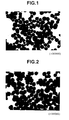
- Fig. 1 is an electron micrograph ( ⁇ 30,000) showing a particle structure of spherical magnetite particles used in Example 1.
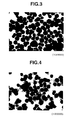
- Fig. 2 is an electron micrograph ( ⁇ 30,000) showing a particle structure of spherical magnetite particles obtained in Example 1 on the surfaces of which silicon oxide fine particles are adhered or exist.
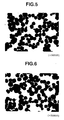
- Fig. 3 is an electron micrograph ( ⁇ 30,000) showing a particle structure of black magnetic composite particles obtained in Example 1.
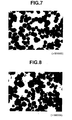
- Fig. 4 is an electron micrograph ( ⁇ 30,000) showing a particle structure of mixed particles composed of the spherical magnetite particles and the silicon oxide fine particles.
- Fig. 5 is an electron micrograph ( ⁇ 30,000) showing a particle structure of black magnetic composite particles obtained in Example 11.
- Fig. 6 is an electron micrograph (x 30,000) showing a particle structure of black magnetic composite particles obtained in Example 12.
- Fig. 7 is an electron micrograph (x 30,000) showing a particle structure of black magnetic composite particles obtained in Example 13.
- Fig. 8 is an electron micrograph (x 30,000) showing a particle structure of black magnetic composite particles obtained in Example 14.
- the magnetite particles as core particles used in the present invention are those particles represented by the general formula: FeO x ⁇ Fe 2 O 3 wherein x is more than 0 and not more than 1.
- the magnetite particles usable in the present invention there may be exemplified isotropic particles having a ratio of average maximum diameter to average minimum diameter (hereinafter referred to merely as "sphericity") of less than 2:1, such as spherical particles, octahedral particles or hexahedral particles; or anisotropic particles having a ratio of average major axis diameter to average minor axis diameter (hereinafter referred to merely as “aspect ratio”) of not less than 2, such as acicular particles, spindle-shaped particles or rice ball-like particles.
- the isotropic particles are preferred.
- spherical magnetite particles having a sphericity of 1.0:1 to 1.3:1 are more preferred.
- the upper limit of the aspect ratio of the anisotropic magnetite particles is preferably 20:1, more preferably 18:1, still more preferably 15:1.
- the aspect ratio of the anisotropic magnetite particles is more than 20:1
- the particles tend to be frequently entangled or intertwined with each other, so that it becomes difficult to uniformly adhere the oxide fine particles and/or the oxide hydroxide fine particles onto the surface of each magnetite particle, and to form a uniform coating layer composed of methyl hydrogen polysiloxane thereon.
- the magnetite particles according to the present invention have an average particle size (an average major axis diameter in the case of anisotropic particles) of usually 0.055 to 0.95 ⁇ m, preferably 0.065 to 0.75 ⁇ m, more preferably 0.065 to 0.45 ⁇ m.
- the average particle size of the magnetite particles When the average particle size of the magnetite particles is more than 0.95 ⁇ m, the obtained black magnetic composite particles become coarse, so that the tinting strength thereof is deteriorated.
- the average particle size of the magnetite particles is less than 0.055 ⁇ m, the intermolecular force between particles is increased due to the fineness thereof, so that the particles tend to be agglomerated together. As a result, it also becomes difficult to uniformly adhere the oxide fine particles and/or the oxide hydroxide fine particles onto the surface of each magnetite particle, and to form a uniform coating layer composed of methyl hydrogen polysiloxane thereon.
- the geometrical standard deviation value thereof is preferably 1.01 to 2.0, more preferably 1.01 to 1.8, still more preferably 1.01 to 1.6.
- the geometrical standard deviation value thereof is more than 2.0, coarse particles are contained therein, so that the particles are inhibited from being uniformly dispersed. As a result, it also becomes difficult to uniformly adhere the oxide fine particles and/or the oxide hydroxide fine particles onto the surface of each magnetite particle, and to form a uniform coating layer composed of methyl hydrogen polysiloxane thereon. It is industrially difficult to obtain particles having a geometrical standard deviation value of less than 1.01.
- the BET specific surface area of the magnetite particles thereof is not less than 0.5 m 2 /g.
- the magnetite particles may become coarse particles, or the sintering between the particles may be caused, so that the obtained black magnetic composite particles also may become coarse particles and tend to be deteriorated in tinting strength.
- the BET specific surface area of the magnetite particles is preferably not less than 1.0 m 2 /g, more preferably not less than 3.0 m 2 /g.
- the upper limit of the BET specific surface area of the magnetite particles is usually 70 m 2 /g.
- the upper limit of the BET specific surface area of the magnetite particles is preferably 50 m 2 /g, more preferably 30 m 2 /g.
- the fluidity index thereof is about 25 to about 43.
- the spherical particles are excellent in fluidity, for example, the fluidity index thereof is about 30 to about 43.
- the lower limit thereof is usually 16.0 when represented by L * value
- the upper limit thereof is usually 26.0, preferably 25.0 when represented by L * value.
- L * value exceeds 26.0, the lightness of the particles is increased, so that it is difficult to obtain black magnetic composite particles having a sufficient blackness.
- the volume resistivity of the magnetite particles is usually about 1.0 ⁇ 10 6 to about 5.0 ⁇ 10 7 ⁇ cm.
- the magnetic properties of the magnetite particles may be variously controlled by appropriately selecting kind and particle shape of magnetite particles used, kind of elements other than Fe contained in the magnetite particles, or the like.
- the coercive force value thereof is usually about 10 to about 350 Oe, preferably 20 to about 330 Oe;
- the saturation magnetization value in a magnetic field of 10 kOe is usually about 40 to about 100 emu/g, preferably about 50 to about 90 emu/g;
- the residual magnetization value in a magnetic field of 10 kOe is usually about 1 to about 35 emu/g, preferably about 3 to about 30 emu/g.
- the oxide fine particles and/or the oxide hydroxide fine particles existing between at least a part of the surface of each magnetite particle and the coating layer composed of methyl hydrogen polysiloxane there can be used such fine particles capable of uniformly adhering or existing onto the surface of each magnetite particle without deteriorating the blackness thereof, i.e., non-magnetic or paramagnetic fine particles which are transparent and free from being magnetically agglomerated.
- fine particles there may be exemplified fine particles composed of an oxide and/or an oxide hydroxide of at least one element selected from the group consisting of Si, Zr, Ti, Al and Ce (hereinafter referred to merely as "fine particles").
- fine particles there may be used synthesized products or commercially available colloid solutions containing fine particles.
- commercially available colloid solutions containing fine particles there may be exemplified those colloid solutions containing fine particles composed of silicon dioxide, zirconium oxide, zirconium oxide hydroxide, titanium dioxide, aluminum oxide, hydrated alumina, cerium dioxide or the like.
- the average particle size of the fine particles is usually 0.001 to 0.05 ⁇ m, preferably 0.002 to 0.045 ⁇ m.
- the average particle size of the fine particles is less than 0.001 ⁇ m, appropriate irregularities cannot be formed on the surfaces of the obtained black magnetic composite particles due to too much fineness of the fine particles, so that the flowability of the black magnetic composite particles cannot be sufficiently improved. Further, the handling property or workability of the fine particles is deteriorated.
- the average particle size of the fine particles is more than 0.05 ⁇ m, the particle size of the fine particles becomes too larger as compared to that of the magnetite particles, so that there is a tendency that the fine particles cannot be sufficiently adhered onto the surfaces of the magnetite particles.
- the ratio of the average particle size of the magnetite particles to that of the fine particles is preferably not less than 2:1, more preferably not less than 5:1.
- the upper limit thereof is preferably 100:1.
- the amount of the fine particles adhered or existing on at least a part of the surface of each magnetite particle is usually 0.5 to 50 % by weight, preferably 1.0 to 45 % by weight (calculated as SiO 2 , ZrO 2 , TiO 2 , Al 2 O 3 or CeO 2 ) based on the weight of the magnetite particles.
- the obtained black magnetic composite particles cannot show a sufficient flowability due to the lack of amount of the fine particles adhered or existing on the surface of each magnetite particle.
- the obtained black magnetic composite particles can show a sufficient flowability.
- the fine particles tend to be fallen-off or desorbed from the surfaces of the black magnetic composite particles, so that the dispersibility of the black magnetic composite particles in a binder resin is deteriorated upon the production of black magnetic toner.
- the kind of fine particles used may be appropriately selected in order to impart a good charging property to the obtained black magnetic toner. Namely, the fine particles can be charged to various negative or positive potentials according to kinds thereof.
- methyl hydrogen polysiloxane used in the present invention is represented by the following general formula: (CH 3 HSiO) n ( (CH 3 ) 3 SiO 1/2 ) 2 wherein n is 10 to 830.
- the methyl hydrogen polysiloxane has an Si-H reactive group within its molecule. Since the methyl hydrogen polysiloxane exhibits a transparency, the blackness of the magnetite particles can be prevented from being adversely affected thereby, so that the obtained black magnetic composite particles can show substantially the same blackness as that of the magnetite particles as core particles.
- the "n" in the above general formula is preferably 14 to 450, more preferably 20 to 325.
- Specific examples of the methyl hydrogen polysiloxane may include commercially available products such as TSF484 (molecular weight: about 3,500) and TSF483 (molecular weight: about 9,200) (tradenames; both produced by Toshiba Silicone Co., Ltd.), or the like.
- the coating amount of methyl hydrogen polysiloxane is preferably 0.1 to 50 % by weight, more preferably 0.2 to 40 % by weight, still more preferably 0.5 to 30 % by weight (calculated as SiO2) based on the weight of the magnetite particles on the surfaces of which the fine particles are adhered or exist.
- the coating amount of methyl hydrogen polysiloxane is less than 0.1 % by weight, the magnetite particles on the surfaces of which the fine particles are adhered or exist, cannot be sufficiently coated with the methyl hydrogen polysiloxane, so that the fine particles tend to be fallen-off or desorbed from the surfaces of the magnetite particles, thereby failing to obtain a black magnetic toner having an excellent flowability. Further, the fine particles which are not coated with methyl hydrogen polysiloxane, are exposed to the surface of the composite particle, resulting in reduction in volume resistivity of the obtained black magnetic toner.
- the particle shape and particle size of the black magnetic composite particles according to the present invention are considerably varied depending upon those of the magnetite particles as core particles.
- the black magnetic composite particles have a similar particle shape to that of the magnetite particle as core particle, and a slightly larger particle size than that of the magnetite particles as core particles.
- the obtained black magnetic composite particles according to the present invention have an average particle size in the case of the isotropic magnetite particles as core particles (average major axis diameter in case of anisotropic magnetite particles), of usually 0.06 to 1.0 ⁇ m, preferably 0.07 to 0.8 ⁇ m, more preferably 0.07 to 0.5 ⁇ m.
- the upper limit of the aspect ratio of the black magnetic composite particles according to the present invention is usually 20:1, preferably 18:1, more preferably 15:1.
- the geometrical standard deviation value of the black magnetic composite particles according to the present invention is preferably not more than 2.0, more preferably 1.01 to 1.8, still more preferably 1.01 to 1.6.
- the lower limit of the geometrical standard deviation value thereof is preferably 1.01.
- the geometrical standard deviation value thereof is more than 2.0, the tinting strength of the black magnetic composite particles is likely to be deteriorated due to the existence of coarse particles therein. It is industrially difficult to obtain such particles having a geometrical standard deviation of less than 1.01.
- the BET specific surface area of the black magnetic composite particles according to the present invention is usually not less than 0.5 m 2 /g, preferably not less than 1.0 m 2 /g, more preferably not less than 3.0 m 2 /g.
- the BET specific surface area thereof is less than 0.5 m 2 /g, the obtained black magnetic composite particles may be coarse, and the sintering between the black magnetic composite particles is caused, thereby deteriorating the tinting strength.
- the upper limit thereof is usually 100 m 2 /g.
- the black magnetic composite particles tend to be agglomerated together by the increase in intermolecular force due to the reduction in particle size, thereby deteriorating the dispersibility in a binder resin upon production of the magnetic toner.
- the upper limit is preferably 90 m 2 /g, more preferably 80 m 2 /g.
- the fluidity index thereof is preferably 47 to 70, more preferably 48 to 70, still more preferably 49 to 70.
- the fluidity index thereof is less than 47, the fluidity of the black magnetic composite particles becomes insufficient, thereby failing to improve the fluidity of the finally obtained magnetic toner. Further, in the production process of the magnetic toner, there tend to be caused defects such as clogging of hopper, etc., thereby deteriorating the handling property or workability.
- the upper limit of the blackness of the black magnetic composite particles is usually 27.0, preferably 26.0, more preferably 25.0 when represented by L * value.
- L * value thereof is more than 27.0, the lightness of the black magnetic composite particles becomes high, so that the black magnetic composite particles having a sufficient blackness cannot be obtained.
- the lower limit of the blackness thereof is usually 16.0 when represented by L * value.
- the volume resistivity of the black magnetic composite particles is usually not less than 1.0 ⁇ 10 8 ⁇ cm, preferably about 5.0 ⁇ 10 8 to about 5.0 ⁇ 10 11 ⁇ cm.
- the volume resistivity of the black magnetic composite particles is less than 1.0 ⁇ 10 8 ⁇ cm, the obtained black magnetic toner is disadvantageously deteriorated in volume resistivity.
- the dispersibility of the black magnetic composite particles is not less than 4, more preferably 5 when evaluated by the 5-rank evaluation method described in detail hereinafter.
- the coercive force value, the saturation magnetization value and the residual magnetization value thereof are substantially the same as those of the above-mentioned magnetite particles.
- the black magnetic composite particles according to the present invention at least a part of the surface of the magnetite particle as core particle may be preliminarily coated with at least one compound selected from the group consisting of hydroxides of aluminum, oxides of aluminum, hydroxides of silicon and oxides of silicon (hereinafter referred to as "coating composed of hydroxides and/or oxides of aluminum and/or silicon").
- the obtained black magnetic composite particles can show a higher dispersibility in a binder resin as compared to in the case where the magnetite particles are uncoated with hydroxides and/or oxides of aluminum and/or silicon.
- the coating amount of the hydroxides and/or oxides of aluminum and/or silicon is preferably 0.01 to 50 % by weight (calculated as Al, SiO 2 or a sum of Al and SiO 2 ) based on the weight of the magnetite particles as core particles.
- the coating amount of the hydroxides and/or oxides of aluminum and/or silicon is less than 0.01 % by weight, the effect of enhancing the dispersibility of the obtained black magnetic composite particles in a binder resin upon the production of magnetic toner cannot be obtained.
- the coating amount of the hydroxides and/or oxides of aluminum and/or silicon is more than 50 % by weight, the obtained black magnetic composite particles can exhibit a good dispersibility in a binder resin upon the production of magnetic toner.
- the use of such unnecessarily large coating amount of the hydroxides and/or oxides of aluminum and/or silicon is meaningless.
- the particle size, geometrical standard deviation, BET specific surface area, fluidity, blackness L * value, volume resistivity and magnetic properties of the black magnetic composite particles wherein at least a part of the surface of the core particle is coated with the hydroxides and/or oxides of aluminum and/or silicon according to the present invention are substantially the same as those of the black magnetic composite particles wherein the core particle is uncoated with the hydroxides and/or oxides of aluminum and/or silicon according to the present invention.
- the black magnetic toner according to the present invention comprises composite particles comprising the black magnetic composite particles and a binder resin.
- the composite particles may further contain a mold release agent, a colorant, a charge-controlling agent and other additives, if necessary.
- the composite particles according to the present invention have an average particle size of usually 3 to 15 ⁇ m, preferably 5 to 12 ⁇ m.
- the composite particles according to the present invention may further contain and/or have magnetite particles in addition to the black composite particles according to the present invention, in such an amount as not to deteriorate properties of the obtained composite particles.
- the amount of the binder resin used is usually 50 to 800 parts by weight, preferably 50 to 400 parts by weight based on 100 parts by weight of the black magnetic composite particles.
- the amount of the binder resin used is less than 50 parts by weight, a mixture of the black magnetic composite particles and the binder resin cannot be sufficiently kneaded together due to too small amount of the binder resin relative to that of the black magnetic composite particles, thereby failing to obtain good composite particles.
- the amount of the binder resin is more than 800 parts by weight, the tinting strength of the composite particles is deteriorated because the amount of the binder resin is too large relative to that of the black magnetic composite particles, thereby reducing the amount of the black magnetic composite particles which are exposed to the surface of the composite particle.
- the amount of the black magnetic composite particles used is preferably 10 to 80 % by weight, more preferably 30 to 60 % by weight based on the weight of the composite particles (1).
- the aimed black magnetic toner can also be obtained.
- the amount of the black magnetic composite particles used is usually 0.1 to 9 parts by weight, preferably 0.5 to 5 parts by weight based on 100 parts by weight of the composite particles (2).
- the amount of black magnetic composite particles used is less than 0.1 part by weight, the flowability of the obtained black magnetic toner cannot be improved.
- the amount of the black magnetic composite particles used is more than 10 parts by weight, since the effect of improving the flowability is already saturated, the use of such a large amount of the black magnetic composite particles is meaningless.
- the magnetite particles may be contained therewithin preferably 10 to 80 % by weight more preferably 30 to 65 % by weight based on the weight of the composite particles (2).
- the amount of the black magnetic composite particles contained therein is substantially the same as that used in the above-mentioned composite particles (1) and the amount of the black magnetic composite particles adhered and/or existing on the surfaces thereof is substantially the same as that used in the above-mentioned composite particles (2). Further, a part of the black magnetic composite particles may be substituted with the same amount of the magnetite particles as that used in each composite particles (1) and (2).
- binder resins there may be used vinyl-based polymers, i.e., homopolymers or copolymers of vinyl-based monomers such as styrene, alkyl acrylates and alkyl methacrylates.
- vinyl-based polymers i.e., homopolymers or copolymers of vinyl-based monomers such as styrene, alkyl acrylates and alkyl methacrylates.
- styrene monomers there may be exemplified styrene and substituted styrenes.
- alkyl acrylate monomers there may be exemplified acrylic acid, methyl acrylate, ethyl acrylate, butyl acrylate or the like.
- the above copolymers contain styrene-based components in an amount of usually 50 to 95 % by weight.
- the above-mentioned vinyl-based polymers may be used in combination with polyester-based resins, epoxy-based resins, polyurethane-based resins or the like, if necessary.
- the flowability index thereof is usually 70 to 100, preferably 75 to 100.
- the obtained black magnetic toner can show a more excellent flowability, i.e., a flowability index of 80 to 100.
- a flowability index of 80 to 100.
- the blackness of the black magnetic toner according to the present invention is usually not more than 40.0, preferably not more than 35.0, more preferably not more than 30.0 when represented by L * value. When the blackness thereof is more than 40.0, the lightness of the black magnetic toner may be increased, resulting in insufficient blackness.
- the lower limit of the blackness of the black magnetic toner is usually about 16.0 when represented by L * value.
- the black magnetic toner according to the present invention exhibits a volume resistivity of usually not less than 1.0 ⁇ 10 13 ⁇ cm, preferably not less than 1.0 ⁇ 10 14 ⁇ cm.
- the obtained black magnetic toner can show a higher volume resistivity, i.e., preferably not less than 5.0 ⁇ 10 14 ⁇ cm.
- the volume resistivity of the black magnetic toner is less than 1.0 ⁇ 10 13 ⁇ cm, the charge amount of the black magnetic toner tend to be varied according to environmental conditions upon use of the toner, so that the characteristics thereof becomes unstable.
- the volume resistivity of the black magnetic toner is preferably less than 10 17 ⁇ cm.
- the coercive force thereof is usually 10 to 350 Oe, preferably 20 to 330 Oe;
- the saturation magnetization value in a magnetic field of 10 kOe is usually 10 to 90 emu/g, preferably 20 to 85 emu/g;
- the residual magnetization in a magnetic field of 10 kOe is usually 1 to 20 emu/g, preferably 2 to 15 emu/g;
- the saturation magnetization in a magnetic field of 1 kOe is usually 7.5 to 65 emu/g, preferably 10 to 60 emu/g;
- the residual magnetization in a magnetic field of 1 kOe is usually 0.5 to 15 emu/g, preferably 1.0 to 13 emu/g.
- the black magnetic composite particles according to the present invention can be produced by the following method.
- (i) octahedral magnetite particles can be produced by passing an oxygen-containing gas through a suspension containing ferrous hydroxide colloid having a pH value of not less than 10, which is obtained by reacting an aqueous ferrous salt solution with an aqueous alkali solution having a concentration of not less than one equivalent based on Fe 2+ in the aqueous ferrous salt solution, thereby precipitating magnetite particles, and then subjecting the obtained magnetite particles to filtering, washing with water and drying (Japanese Patent Publication (KOKOKU) No.
- hexahedral magnetite particles can be produced by passing an oxygen-containing gas through a suspension containing ferrous hydroxide colloid having a pH value of 6.0 to 7.5, which is obtained by reacting an aqueous ferrous salt solution with an aqueous alkali solution having a concentration of not more than one equivalent based on Fe 2+ in the aqueous ferrous salt solution to produce magnetite core particles, further passing an oxygen-containing gas through the obtained aqueous ferrous salt reaction solution containing the magnetite core particles and the ferrous hydroxide colloid, at a pH value of 8.0 to 9.5, to precipitate magnetite particles, and then subjecting the precipitated magnetite particles to filtering, washing with water and drying (Japanese Patent Application Laid-Open (KOKAI) No.
- spherical magnetite particles can be produced by passing an oxygen-containing gas through a suspension containing ferrous hydroxide colloid having a pH value of 6.0 to 7.5, which is obtained by reacting an aqueous ferrous salt solution with an aqueous alkali solution having a concentration of not more than one equivalent based on Fe 2+ in the aqueous ferrous salt solution to produce magnetite core particles, adding alkali hydroxide in an amount of not less than equivalent based on the remaining Fe 2+ to adjust the pH value of the suspension to not less than 10, heat-oxidizing the resultant suspension to precipitate magnetite particles, and then subjecting the precipitated magnetite particles to filtering, washing with water and drying (Japanese Patent Publication (KOKOKU) No. 62-51208(1987).
- a suspension containing ferrous hydroxide colloid having a pH value of 6.0 to 7.5 which is obtained by reacting an aqueous ferrous salt solution with an aqueous alkali solution having a concentration of
- the anisotropic magnetite particles can be produced by passing an oxygen-containing gas through a suspension containing either ferrous hydroxide colloid, iron carbonate, or an iron-containing precipitate obtained by reacting an aqueous ferrous salt solution with alkali hydroxide and/or alkali carbonate, while appropriately controlling the pH value and temperature of the suspension, to produce acicular, spindle-shaped or rice ball-shaped goethite particles, subjecting the obtained goethite particles to filtering, washing with water and drying, and, if necessary, by heat-dehydrating the goethite particles in air at 400 to 800°C and then heat-reducing the dehydrated particles in a reducing gas such as hydrogen gas or the like, at 300 to 500°C.
- a reducing gas such as hydrogen gas or the like
- the adhesion or deposition of the fine particles on the surfaces of the magnetite particles may be conducted by mechanically mixing and stirring magnetite particles together with a colloid solution containing fine particles composed of an oxide or an oxide hydroxide of Si, Zr, Ti, Al or Ce, and then drying the obtained particles.
- collloid solution containing silicon oxide fine particles or silicon oxide hydroxide fine particles there may be exemplified Snowtex-XS, Snowtex-SS, S Snowtex-UP, Snowtex-20, Snowtex-30, Snowtex-40, Snowtex-C, Snowtex-N, Snowtex-O, Snowtex-S, Snowtex-20L, Snowtex-OL (tradenames, produced by Nissan Kagaku Kogyo, Co., Ltd.) or the like.
- Snowtex-XS, Snowtex-SS and Snowtex-UP are preferred.
- colloid solution containing zirconium oxide fine particles or zirconium oxide hydroxide fine particles there may be exemplified NZS-20A, NZS-30A, NZS-30B (tradenames, produced by Nissan Kagaku Kogyo, Co., Ltd.) or the like.
- colloid solution containing titanium oxide fine particles or titanium oxide hydroxide fine particles there may be exemplified STS-01, STS-02 (tradenames, produced by Ishihara Sangyo, Co., Ltd.) or the like.
- colloid solution containing aluminum oxide fine particles or aluminum oxide hydroxide fine particles there may be exemplified AS-100, AS-200, AS-520 (tradenames, produced by Nissan Kagaku Kogyo, Co., Ltd.) or the like.
- colloid solution containing cerium oxide fine particles or cerium oxide hydroxide fine particles there may be exemplified a solution of Ceria-sol (produced by Nissan Kagaku Kogyo, Co., Ltd.) or the like.
- the amount of the fine particles contained in the colloid solution added is preferably 0.5 to 50 % by weight (calculated as SiO 2 , ZrO 2 , TiO 2 , Al 2 O 3 or CeO 2 ) based on the weight of the magnetite particles.
- the amount of the fine particles added is less than 0.5 % by weight, the amount of the fine particles existing in the magnetite particles is insufficient, so that it is difficult to sufficiently enhance the flowability of the obtained black magnetic composite particles.
- the amount of the fine particles added is more than 50 % by weight, although the flowability of the obtained black magnetic composite particles can be improved sufficiently, the fine particles tend to be fallen-off or desorbed from the surfaces of the magnetite particles, so that the dispersibility of the black magnetic composite particles in binder resin is deteriorated upon production of the black magnetic toner.
- each magnetite particle In order to cause the fine particles to uniformly exist on the surface of each magnetite particle, it is preferred that aggregates of magnetite particles be previously deagglomerated by using a pulverizer.
- a pulverizer As apparatuses used for the mixing and stirring, there may be exemplified an edge runner, a Henschel mixer or the like.
- the mixing and stirring conditions such as amounts of respective particles added, linear load, stirring velocity, mixing and stirring time, etc., may be appropriately selected such that the fine particles are allowed to adhere or exist on the surface of each magnetite particle as uniformly as possible.
- the mixing and stirring time is preferably not less than 20 minutes.
- the coating treatment of the magnetite particles on the surfaces of which the fine particles are adhered or exist, or on the surfaces of which the fine particles are adhered or exist and the exposed surface of the magnetite particle, with the methyl hydrogen polysiloxane may be conducted by mechanically mixing and stirring the magnetite particles on the surfaces of which the fine particles are adhered or exist, together with the methyl hydrogen polysiloxane solution, or by mechanically mixing and stirring the magnetite particles on the surfaces of which the fine particles are adhered or exist, together with the methyl hydrogen polysiloxane while spraying the methyl hydrogen polysiloxane over the magnetite particles.
- a substantially whole amount of the methyl hydrogen polysiloxane added can be used to coat the surfaces of the magnetite particles on which the fine particles are adhered or exist, or the surfaces of which the fine particles are adhered or exist and the exposed surface of the magnetite particle.
- the mixing and stirring conditions for the coating treatment may be appropriately selected such that the magnetite particle on the surfaces of which the fine particles are adhered or exist, are coated with the methyl hydrogen polysiloxane as uniformly as possible.
- the mixing and stirring time is preferably not less than 20 minutes.
- the resultant particles are dried, thereby obtaining black magnetic composite particles.
- the magnetite particles may be optionally coated with at least one compound selected from the group consisting of hydroxides of aluminum, oxides of aluminum, hydroxides of silicon and oxides of silicon.
- the coating of the hydroxides and/or oxides of aluminum and/or silicon may be conducted by adding an aluminum compound, a silicon compound or both the compounds to a water suspension in which the magnetite particles are dispersed, followed by mixing and stirring, and further adjusting the pH value of the suspension, if required, thereby coating at least a part of the surfaces of the magnetite particles with at least one compound selected from the group consisting of hydroxides of aluminum, oxides of aluminum, hydroxides of silicon and oxides of silicon.
- the thus obtained particles coated with the hydroxides and/or oxides of aluminum and/or silicon are then filtered out, washed with water, dried and pulverized. Further, the particles coated with the hydroxides and/or oxides of aluminum and/or silicon may be subjected to post-treatments such as deaeration treatment and compaction treatment, if required.
- aluminum compounds there may be exemplified aluminum salts such as aluminum acetate, aluminum sulfate, aluminum chloride or aluminum nitrate, alkali aluminates such as sodium aluminate, or the like.
- the amount of the aluminum compound added is 0.01 to 50 % by weight (calculated as Al) based on the weight of the magnetite particles.
- the amount of the aluminum compound added is less than 0.01 % by weight, it may be difficult to sufficiently coat the surfaces of the magnetite particles with hydroxides and/or oxides of aluminum, thereby failing to achieve the improvement of the dispersibility in the binder resin upon the production of the magnetic toner.
- the amount of the aluminum compound added is more than 50 % by weight, the coating effect is saturated and, therefore, it is meaningless to add such an excess amount of the aluminum compound.
- silicon compounds there may be exemplified #3 water glass, sodium orthosilicate, sodium metasilicate, or the like.
- the amount of the silicon compound added is 0.01 to 50 % by weight (calculated as SiO 2 ) based on the weight of the magnetite particles.
- the amount of the silicon compound added is less than 0.01 % by weight, it may be difficult to sufficiently coat the surfaces of the magnetite particles with hydroxides and/or oxides of silicon, thereby failing to achieve the improvement of the dispersibility in the binder resin upon the production of the magnetic toner.
- the amount of the silicon compound added is more than 50 % by weight, the coating effect is saturated and, therefore, it is meaningless to add such an excess amount of the silicon compound.
- the total amount of the aluminum and silicon compounds added is preferably 0.01 to 50 % by weight (calculated as a sum of Al and SiO 2 ) based on the weight of the magnetite particles.
- the black magnetic toner according to the present invention which is composed of the composite particles (1) wherein the black magnetic composite particles exist therein and wherein a part of the black magnetic composite particles contained therein is exposed to the surface thereof, may be produced by a known method of first mixing and kneading a predetermined amount of a binder resin with a predetermined amount of the black magnetic composite particles, and then pulverizing the resultant mixture. More specifically, the black magnetic composite particles and the binder resin are intimately mixed together with, if necessary, a mold release agent, a colorant, a charge-controlling agent or other additives by using a mixer.
- the obtained mixture is then melted and kneaded by a heating kneader so as to render the respective components compatible with each other, thereby dispersing the black magnetic composite particles, etc., therein.
- the molten mixture is cooled and solidified to obtain a resin mixture.
- the obtained resin mixture is then pulverized and classified, thereby producing a black magnetic toner having an aimed particle size.
- the mixers there may be used a Henschel mixer, a ball mill or the like.
- the heating kneaders there may be used a roll mill, a kneader, a twin-screw extruder or the like.
- the pulverization of the mixed product may be conducted by using pulverizers such as a cutter mill, a jet mill or the like.
- the classification of the pulverized particles may be conducted by known methods such as air classification, etc., as described in Japanese Patent No. 2683142 or the like.
- the other method of producing the black magnetic toner there may be exemplified a suspension polymerization method or an emulsion polymerization method.
- the suspension polymerization method polymerizable monomers and the black magnetic composite particles are intimately mixed together with, if necessary, a colorant, a polymerization initiator, a cross-linking agent, a charge-controlling agent or the other additives and then the obtained mixture is dissolved and dispersed together so as to obtain a monomer composition.
- the obtained monomer composition is added to a water phase containing a suspension stabilizer while stirring, thereby granulating and polymerizing the composition to form magnetic toner particles having an aimed particle size.
- the monomers and the black magnetic composite particles are dispersed in water together with, if necessary, a colorant, a polymerization initiator or the like and then the obtained dispersion is polymerized while adding an emulsifier thereto, thereby producing magnetic toner particles having an aimed particle size.
- the black magnetic toner according to the present invention which are composed of the composite particles (2) on the surfaces of which the black magnetic composite particles are adhered or exist, may be produced by a known method of mixing a predetermined amount of the composite particles with a predetermined amount of the black magnetic composite particles. More specifically, the black magnetic composite particles and the composite particles are intimately mixed together by using a mixer, thereby producing an aimed black magnetic toner.
- a mixer there may be used a Henschel mixer, a ball mill or the like.
- the black magnetic toner according to the present invention which are composed of the composite particles (3) wherein the black magnetic composite particles exist therein and a part of the black magnetic composite particles contained therein is exposed to the surface thereof, and wherein the black magnetic composite particles are adhered or exist on the surface thereof, may be produced by the above-mentioned processes of the composite particles (1) and (2).
- the important point of the present invention lies in such a fact that the black magnetic composite particles which have an average particle size of 0.08 to 1.0 ⁇ m, and in which the fine particles exist between the surface of each magnetite particle or the surface of the coating layer which is formed on the surface of each magnetite particle and composed of at least one compound selected from the group consisting of hydroxides of aluminum, oxides of aluminum, hydroxides of silicon and oxides of silicon, and the methyl hydrogen polysiloxane coating layer disposed on either of the surfaces, can show not only an excellent flowability but also a high volume resistivity.
- the reason why the black magnetic composite particles according to the present invention can show an excellent flowability is considered as follows. That is, a large number of the fine particles are uniformly adhered onto the surface of each magnetite particle, thereby forming many fine irregularities thereon.
- the reason why the black magnetic composite particles according to the present invention can exhibit a high volume resistivity is considered as follows. That is, due to the fact that black magnetic composite particles having a high volume resistivity cannot be obtained in any of the cases where only the fine particles exist on the surface of each magnetite particle, where only the methyl hydrogen polysiloxane coating layer exist on the surface of each magnetite particle, where the fine particles are adhered or exist on the surface of the methyl hydrogen polysiloxane coating layer formed on the surface of each magnetite particle, and where a specific amount of the fine particles exist between the surface of each magnetite particle and the methyl hydrogen polysiloxane coating layer but the amount of methyl hydrogen polysiloxane applied is insufficient so that the fine particles are not completely covered with the methyl hydrogen polysiloxane coating layer, it is considered that there exists a synergistic effect based on the specific amount of methyl hydrogen polysiloxane and the fine particles coated with the methyl hydrogen polysiloxane.
- the black magnetic composite particles according to the present invention since the fine particles and the methyl hydrogen polysiloxane are transparent, the blackness of the magnetite particles as core particles are not adversely affected by these components. As a result, the obtained black magnetic composite particles can show substantially the same blackness as that of the magnetite particles.
- the black magnetic composite particles according to the present invention exhibit not only an excellent flowability but also a high volume resistivity, the composite particles are suitable as black magnetic composite particles for black magnetic toner capable of attaining a high image quality and a high copying speed.
- the black magnetic composite particles according to the present invention are excellent in flowability, the particles can show excellent handling property and workability and, therefore, are preferable from an industrial viewpoint.
- the black magnetic toner produced from the above black magnetic composite particles which show an excellent flowability and a high volume resistivity can also show an excellent flowability and a high volume resistivity. Accordingly, the black magnetic toner is suitable as black magnetic toner capable of attaining a high image quality and a high copying speed.
- the average particle size, the average maior axis diameter and average minor axis diameter of magnetite particles and black magnetic composite particles were respectively expressed by the average of values (measured in a predetermined direction) of about 350 particles which were sampled from a micrograph obtained by magnifying an original electron micrograph ( ⁇ 20,000) by four times in each of the longitudinal and transverse directions.
- the aspect ratio of the particles was expressed by the ratio of average major axis diameter to average minor axis diameter thereof.
- the sphericity is expressed by a ratio of maximum diameter to minimum diameter of the isotropic core particles.
- the geometrical standard deviation of particle sizes was expressed by values obtained by the following method. That is, the particle sizes (major axis diameters) were measured from the above magnified electron micrograph. The actual particle sizes (major axis diameters) and the number of the particles were calculated from the measured values. On a logarithmic normal probability paper, the particle sizes (major axis diameters) were plotted at regular intervals on the abscissa-axis and the accumulative number (under integration sieve) of particles belonging to each interval of the particle sizes (major axis diameters) were plotted by percentage on the ordinate-axis by a statistical technique.
- Geometrical standard deviation (particle size (major axis diameters) corresponding to 84.13 % under integration sieve)/ ⁇ particle size (major axis diameters) (geometrical average diameter) corresponding to 50 % under integration sieve)
- the specific surface area was expressed by the value measured by a BET method.
- the respective amounts of Si contained in oxides of silicon, hydroxides of silicon, silicon oxide fine particles, silicon oxide hydroxide fine particles and methyl hydrogen polysiloxane coated or existing on the surface of each core particle are each expressed by a value obtained by subtracting an amount of Si measured before each treatment from the amount of Si measured after the treatment.
- the respective amounts of Al contained in hydroxides of aluminum, oxides of aluminum, aluminum oxide fine particles and aluminum oxide hydroxide fine particles coated or existing on the surface of each core particle are also expressed by values obtained in the same manner as above.
- the fluidity of magnetite particles, black magnetic composite particles and black magnetic toner was expressed by a fluidity index which was a sum of indices obtained by converting on the basis of the same reference measured values of an angle of repose, a degree of compaction (%), an angle of spatula and a degree of agglomeration as particle characteristics which were measured by a powder tester (tradename, produced by Hosokawa Micron Co., Ltd.). The closer to 100 the fluidity index, the more excellent the fluidity of the particles.
- the blackness of magnetite particles, black magnetic composite particles and black magnetic toner was measured by the following method. That is, 0.5 g of sample particles and 1.5 cc of castor oil were intimately kneaded together by a Hoover's muller to form a paste. 4.5 g of clear lacquer was added to the obtained paste and was intimately kneaded to form a paint. The obtained paint was applied on a cast-coated paper by using a 6-mil applicator to produce a coating film piece (having a film thickness of about 30 ⁇ m).
- the thus obtained coating film piece was measured according to JIS Z 8729 by a multi-light source spectrographic colorimeter MSC-IS-2D (manufactured by Suga Testing Machines Manufacturing Co., Ltd.) to determine an L * value of colorimetric indices thereof.
- the blackness was expressed by the L * value measured.
- the L * value represents a lightness
- the smaller the L * value the more excellent the blackness
- the volume resistivity of the magnetite particles, the black magnetic composite particles and the black magnetic toner was measured by the following method.
- the thus obtained cylindrical test piece was exposed to an atmosphere maintained at a temperature of 25°C and a relative humidity of 60 % for 12 hours. Thereafter, the cylindrical test piece was set between stainless steel electrodes, and a voltage of 15V was applied between the electrodes using a Wheatstone bridge (TYPE2768, manufactured by Yokogawa-Hokushin Denki Co., Ltd.) to measure a resistance value R ⁇ ).
- a Wheatstone bridge TYPE2768, manufactured by Yokogawa-Hokushin Denki Co., Ltd.
- the cylindrical test piece was measured with respect to an upper surface area A (cm 2 ) and a thickness t 0 (cm) thereof. The measured values were inserted into the following formula. thereby obtaining a volume resistivity X ( ⁇ cm).
- X ( ⁇ cm) R x (A/t 0 )
- the average particle size of the black magnetic toner was measured by a laser diffraction-type particle size distribution-measuring apparatus (Model HELOSLA/KA, manufactured by Sympatec Corp.).
- the dispersibilit y in a binder resin of the black magnetic composite particles was evaluated by counting the number of undispersed agglomerated particles on a micrograph (x 200 times) obtained by photographing a sectional area of the obtained black magnetic toner particle using an optical microscope (BH-2, manufactured by Olympus Kogaku Kogyo Co., Ltd.), and classifying the results into the following five ranks.
- the 5th rank represents the most excellent dispersing condition.
- the magnetic properties of the magnetite particles and the black magnetic composite particles were measured using a vibration sample magnetometer "VSM-3S-15" (manufactured by Toei Kogyo Co., Ltd.) by applying an external magnetic field of 10 kOe thereto.
- the magnetic properties of the black magnetic toner were measured by applying external magnetic fields of 1 kOe and 10 kOe thereto.
- the obtained slurry containing the spherical magnetite particles was passed through a transverse-type sand grinder (tradename "MIGHTY MILL MHG- l.5L", manufactured by Inoue Seisakusho Co., Ltd.) five times at an axis-rotating speed of 2,000 rpm, thereby obtaining a slurry in which the spherical magnetite particles were dispersed.
- a transverse-type sand grinder tradename "MIGHTY MILL MHG- l.5L", manufactured by Inoue Seisakusho Co., Ltd.
- the particles in the obtained slurry which remained on a sieve of 325 meshes (mesh size: 44 ⁇ m) was 0 %.
- the slurry was filtered and washed with water, thereby obtaining a filter cake containing the spherical magnetite particles.
- MPUV-2 Model tradename, manufactured by Matsumoto Chuzo Tekkosho Co., Ltd.
- the obtained black particles were subjected to fluorescent X-ray analysis, so that it was confirmed that the amount of the silicon oxide fine particles adhered was 5.0 % by weight (calculated as SiO 2 ) based on the weight of the spherical magnetite particles.
- a methyl hydrogen polysiloxane TSF484 (tradename, produced by Toshiba Silicone Co., Ltd.) was added to the obtained particles for 10 minutes while operating the edge runner. Further, the mixture were continuously mixed and stirred at a linear load of 60 kg/cm for 60 minutes to coat the spherical magnetite particles on the surfaces of which the silicon oxide fine particles were adhered, with methyl hydrogen polysiloxane, thereby obtaining black magnetic composite particles in which the silicon oxide fine particles existed between the surface of each spherical magnetite particle and the methyl hydrogen polysiloxane coating layer.
- the obtained black magnetic composite particles were dried at 80°C for 180 minutes by using a drier to evaporate water, etc. which remained on the surfaces thereof.
- the resultant black magnetic composite particles had an average particle size of 0.24 ⁇ m.
- the obtained black magnetic composite particles exhibited a sphericity of 1.2:1, a geometrical standard deviation value of 1.42, a BET specific surface area value of 10.6 m 2 /g, a flowability index of 51, a blackness (L* value) of 20.8 and a volume resistivity of 1.0 ⁇ 10 10 ⁇ cm.
- the coercive force value thereof was 61 Oe; the saturation magnetization value in a magnetic field of 10 kOe was 77.2 emu/g; and the residual magnetization value in a magnetic field of 10 kOe was 7.1 emu/g.
- the amount of methyl hydrogen polysiloxane applied was 4.66 % by weight (calculated as SiO 2 ) based on the weight of the spherical magnetite particles on the surfaces of which the silicon oxide fine particles were adhered or existed.
- spherical magnetite particles and the colloidal silica solution containing the silicon oxide fine particles were mixed and stirred for 30 minutes using a powder mixer, thereby obtaining black particles.
- Fig. 4 shows an electron micrograph ( ⁇ 30,000) of the obtained black particles. As shown in Fig. 4, it was confirmed that the silicon oxide fine particles did not exist on the surfaces of the spherical magnetite particles, and the obtained black particles were mixed particles composed of the spherical magnetite particles and the silicon oxide fine particles.
- the obtained mixed particles were melt-kneaded at 140°C using a continuous-type twin-screw kneader (T-l), and the obtained kneaded material was cooled, coarsely pulverized and finely pulverized in air.
- the obtained particles were subjected to classification, thereby producing a black magnetic toner (I).
- the obtained black magnetic toner (I) had an average particle size of 9.7 ⁇ m, a dispersibility of 5th rank, a fluidity index of 73, a blackness (L* value) of 21.0, a volume resistivity of 1.2 ⁇ 10 14 ⁇ cm, a coercive force value of 60 Oe, a saturation magnetization value (in a magnetic field of 10 kOe) of 31.8 emu/g, a residual magnetization value (in a magnetic field of 10 kOe) of 4.1 emu/g, a saturation magnetization value (in a magnetic field of 1 kOe) of 23.6 emu/g, and a residual magnetization value (in a magnetic field of 1 kOe) of 3.3 emu/g.
- the obtained mixture was melt-kneaded at 140°C using a continuous-type twin-screw kneader (T-l), and the obtained kneaded material was cooled in air, coarsely pulverized and finely pulverized. Thereafter, the obtained particles were subjected to classification, thereby producing composite particles.
- T-l continuous-type twin-screw kneader
- the obtained black magnetic toner (II) had an average particle size of 10.2 ⁇ m, a flowability index of 83, a blackness (L* value) of 22.8 and a volume resistivity of 9.9 ⁇ 10 14 ⁇ cm.
- the coercive force value thereof was 58 Oe;
- the saturation magnetization value in a magnetic field of 10 kOe was 39.6 emu/g;
- the residual magnetization value in a magnetic field of 10 kOe was 6.3 emu/g;
- the saturation magnetization value in a magnetic field of 1 kOe was 26.8 emu/g; and the residual magnetization value in a magnetic field of 1 kOe was 4.1 emu/g.
- the obtained black magnetic toner (III) had an average particle size of 10.1 ⁇ m, a flowability index of 91, a blackness (L* value) of 21.6 and a volume resistivity of 1.6 ⁇ 10 15 ⁇ cm.
- the coercive force value thereof was 60 Oe;
- the saturation magnetization value in a magnetic field of 10 kOe was 41.2 emu/g;
- the residual magnetization value in a magnetic field of 10 kOe was 6.6 emu/g;
- the saturation magnetization value in a magnetic field of 1 kOe was 27.8 emu/g; and the residual magnetization value in a magnetic field of 1 kOe was 4.3 emu/g.
- Core particles 1 to 4 are Core particles 1 to 4:
- Example 2 Various magnetite particles were prepared by known methods. The same procedure as defined in Example 1 was conducted by using the thus prepared particles, thereby obtaining deagglomerated magnetite particles as core particles.
- Example 2 The same procedure as defined in Example 1 was conducted by using 20 kg of the deagglomerated octahedral magnetite particles (core particles 1) and 150 liters of water, thereby obtaining a slurry containing the octahedral magnetite particles.
- the pH value of the obtained redispersed slurry containing the octahedral magnetite particles was adjusted to 10.5, and then the concentration of the slurry was adjusted to 98 g/liter by adding water thereto.
- the pH value of the slurry was adjusted to 7.5 by adding an aqueous acetic acid solution. After further allowing the slurry to stand for 30 minutes, the slurry was subjected to filtration, washing with water, drying and pulverization, thereby obtaining the octahedral magnetite particles coated with hydroxides of aluminum and oxides of silicon.
- the octahedral magnetite particles whose surfaces were coated with hydroxides of aluminum and oxides of silicon, had an average particle size of 0.29 ⁇ m, a geometrical standard deviation of particle size distribution of 1.51, a BET specific surface area of 9.8 m 2 /g, a flowability index of 41, a blackness (L* value) of 21.4 and a volume resistivity of 1.6 ⁇ 10 7 ⁇ cm.
- the coercive force value thereof was 103 Oe; the saturation magnetization value was 86.3 emu/g; and the residual magnetization value was 12.1 emu/g.
- Example 2 The same procedure as defined in Example 1 was conducted except that kind of magnetite particles, addition or non-addition of a colloidal solution containing fine particles in the fine particle-adhesion step, kind and amount of the colloidal solution added, treating conditions of edge runner in the fine particle-adhesion step, kind and amount of methyl hydrogen polysiloxane added in the step for coating with methyl hydrogen polysiloxane and treating conditions of edge runner in the coating step, were varied, thereby obtaining black magnetic composite particles.
- the black magnetic composite particles obtained in Examples 3 to 16 were observed by an electron microscope. As a result, almost no independent fine particles were recognized. Therefore, it was confirmed that a substantially whole amount of the fine particles were adhered on or existed in the surfaces of the magnetite particles.
- Electron micrographs of the black magnetic composite particles obtained in Examples 11 to 14 are shown in Figs. 5 to 8, respectively.
- Example 13 and 14 Main production conditions and various properties of the obtained black magnetic toners are shown in Tables 13 and 14, respectively.
- Production of black magnetic toner Composite particles Black magnetic composite particles adhered kind Kind Amount blended (part by weight) Example 45 Example 17 Example 3 1.0 Example 46 Example 18 Example 4 0.5 Example 47 Example 19 Example 5 0.2 Example 48 Example 20 Example 6 2.0 Example 49 Example 21 Example 7 1.5 Example 50 Example 22 Example 8 1.0 Example 51 Example 23 Example 9 2.0 Example 52 Example 24 Example 10 1.0 Example 53 Example 25 Example 11 2.0 Example 54 Example 26 Example 12 1.0 Example 55 Example 27 Example 13 2.0 Example 56 Example 28 Example 14 1.5 Example 57 Example 29 Example 15 3.0 Example 58 Example 30 Example 16 0.8
Landscapes
- Physics & Mathematics (AREA)
- General Physics & Mathematics (AREA)
- Developing Agents For Electrophotography (AREA)
Applications Claiming Priority (2)
| Application Number | Priority Date | Filing Date | Title |
|---|---|---|---|
| JP12414798 | 1998-04-17 | ||
| JP12414798 | 1998-04-17 |
Publications (2)
| Publication Number | Publication Date |
|---|---|
| EP0950926A2 true EP0950926A2 (de) | 1999-10-20 |
| EP0950926A3 EP0950926A3 (de) | 2000-02-23 |
Family
ID=14878106
Family Applications (1)
| Application Number | Title | Priority Date | Filing Date |
|---|---|---|---|
| EP99302984A Withdrawn EP0950926A3 (de) | 1998-04-17 | 1999-04-16 | Schwarze magnetische Kompositteilchen für schwarze magnetische Toner und diese Teilchen enthaltende schwarze magnetische Toner |
Country Status (2)
| Country | Link |
|---|---|
| US (1) | US6251555B1 (de) |
| EP (1) | EP0950926A3 (de) |
Cited By (3)
| Publication number | Priority date | Publication date | Assignee | Title |
|---|---|---|---|---|
| EP1505452A3 (de) * | 2003-07-29 | 2005-09-07 | Ricoh Company, Ltd. | Toner, Tonerbehälter, Zweikomponentenentwickler und Bildherstellungsverfahren und Apparat, worin der Toner verwendet wird |
| EP2954885A1 (de) * | 2014-06-11 | 2015-12-16 | Titan Kogyo Kabushiki Kaisha | Schwarzes eisenoxid zur verwendung mit kosmetika, herstellungsverfahren dafür und kosmetische materialien damit |
| EP1468430B1 (de) | 2002-01-14 | 2016-03-16 | Siemens Healthcare Diagnostics GmbH | Siliziumhaltige magnetpartikel, verfahren zu deren herstellung und verwendung der partikel |
Families Citing this family (7)
| Publication number | Priority date | Publication date | Assignee | Title |
|---|---|---|---|---|
| US6544647B1 (en) * | 1999-07-26 | 2003-04-08 | Toda Kogyo Corporation | Non-magnetic composite particles, process for producing the same and magnetic recording medium using the same |
| US7323279B2 (en) * | 2003-07-16 | 2008-01-29 | Canon Kabushiki Kaisha | One-component magnetic toner for developing an electrostatic charge image, process cartridge, and method for recycling the process cartridge |
| US7572505B2 (en) * | 2006-04-28 | 2009-08-11 | Toda Kogyo Corporation | Black magnetic iron oxide particles having high breakdown voltage |
| US8062820B2 (en) * | 2006-05-12 | 2011-11-22 | Cabot Corporation | Toner composition and method of preparing same |
| JP4978296B2 (ja) * | 2007-04-24 | 2012-07-18 | 富士ゼロックス株式会社 | 静電荷像現像用トナーの製造方法 |
| JP5921109B2 (ja) * | 2010-08-23 | 2016-05-24 | キヤノン株式会社 | トナー |
| JP5336680B1 (ja) | 2013-06-11 | 2013-11-06 | 株式会社アフィット | 導電性粒子を含有する液体現像剤及びそれを用いた導電パターン形成方法及び導電パターン形成装置 |
Family Cites Families (10)
| Publication number | Priority date | Publication date | Assignee | Title |
|---|---|---|---|---|
| JPS5814143A (ja) | 1981-07-16 | 1983-01-26 | Matsushita Electric Ind Co Ltd | 電子写真トナ− |
| EP0498942B1 (de) | 1991-02-15 | 1997-08-20 | Mitsubishi Materials Corporation | Hydrophobes Aluminiumoxid und dieses enthaltendes Entwicklerpulver für die Elektrophotographie |
| EP0523654B1 (de) | 1991-07-16 | 1997-03-05 | Canon Kabushiki Kaisha | Toner für die Entwicklung elektrostatischer Bilder |
| EP0566790B1 (de) | 1992-04-23 | 1996-08-07 | Toda Kogyo Corp. | Magnetpulver und magnetischer Toner |
| DE69316513T2 (de) * | 1992-10-15 | 1998-06-04 | Canon Kk | Magnetischer Entwickler für die Entwicklung elektrostatischer Bilder |
| JPH06230604A (ja) | 1993-01-29 | 1994-08-19 | Toda Kogyo Corp | 磁性トナー用磁性粒子粉末 |
| US5599627A (en) | 1993-10-08 | 1997-02-04 | Toda Kogyo Corporation | Magnetic particles comprising magnetite core and process for producing the same |
| US5731120A (en) * | 1994-11-30 | 1998-03-24 | Minolta Co., Ltd. | Carrier for electrophotography with surface coated with specified co-polymer resin of organopolysiloxane with radical monomer |
| GB9609515D0 (en) | 1995-06-02 | 1996-07-10 | Coates Brothers Plc | Powder composition |
| JP3584954B2 (ja) * | 1995-06-15 | 2004-11-04 | 戸田工業株式会社 | 磁性トナー用磁性酸化鉄粒子粉末及びその製造法並びに該磁性酸化鉄粒子粉末を用いた磁性トナー |
-
1999
- 1999-04-14 US US09/291,198 patent/US6251555B1/en not_active Expired - Fee Related
- 1999-04-16 EP EP99302984A patent/EP0950926A3/de not_active Withdrawn
Cited By (5)
| Publication number | Priority date | Publication date | Assignee | Title |
|---|---|---|---|---|
| EP1468430B1 (de) | 2002-01-14 | 2016-03-16 | Siemens Healthcare Diagnostics GmbH | Siliziumhaltige magnetpartikel, verfahren zu deren herstellung und verwendung der partikel |
| EP1505452A3 (de) * | 2003-07-29 | 2005-09-07 | Ricoh Company, Ltd. | Toner, Tonerbehälter, Zweikomponentenentwickler und Bildherstellungsverfahren und Apparat, worin der Toner verwendet wird |
| EP2954885A1 (de) * | 2014-06-11 | 2015-12-16 | Titan Kogyo Kabushiki Kaisha | Schwarzes eisenoxid zur verwendung mit kosmetika, herstellungsverfahren dafür und kosmetische materialien damit |
| US10131762B2 (en) | 2014-06-11 | 2018-11-20 | Titan Kogyo Kabushiki Kaisha | Black iron oxide for use with cosmetics, production method thereof, and cosmetic materials comprising the same |
| US10344141B2 (en) | 2014-06-11 | 2019-07-09 | Titan Kogyo Kabushiki Kaisha | Black iron oxide for use with cosmetics, production method thereof, and cosmetic materials comprising the same |
Also Published As
| Publication number | Publication date |
|---|---|
| US6251555B1 (en) | 2001-06-26 |
| EP0950926A3 (de) | 2000-02-23 |
Similar Documents
| Publication | Publication Date | Title |
|---|---|---|
| US6130017A (en) | Black non-magnetic composite particles for black toner and black toner using the same | |
| CN101802721B (zh) | 磁性调色剂 | |
| EP0652490B1 (de) | Magnetische Teilchen und Verfahren zu ihrer Herstellung | |
| EP0936507A2 (de) | Schwarzes teilchenförmiges magnetisierbares Verbundmaterial und schwarzer magnetischer Toner das dieses enthält | |
| US6638675B2 (en) | Black magnetic toner | |
| US6251555B1 (en) | Black magnetic composite particles for black magnetic toner and black magnetic toner using the same | |
| EP0449326B1 (de) | Magnetischer Toner | |
| US6383637B1 (en) | Black magnetic iron oxide particles for magnetic toner and process for producing the same | |
| US6379855B1 (en) | Black magnetic toner and black magnetic composite particles therefor | |
| US6475687B2 (en) | Magnetic composite particles for black magnetic toner and black magnetic toner using the same | |
| JP2000010344A (ja) | 黒色トナ―用黒色複合非磁性粒子粉末及び該黒色複合非磁性粒子粉末を用いた黒色トナ― | |
| EP0945766B1 (de) | Schwarze nicht-magnetische zusammengesetzte Teilchen für schwarze Toner und schwarze Toner, worin sie eingesetzt werden | |
| EP1265108A1 (de) | Schwarzer Toner | |
| EP1076267A1 (de) | Schwarzer magnetischer Toner und hierzu verwendete schwarze magnetische Teilchenzusammensetzung | |
| JP3664216B2 (ja) | 黒色磁性トナー用黒色磁性粒子粉末及び該黒色磁性粒子粉末を用いた黒色磁性トナー | |
| JPH10171157A (ja) | 磁性トナー用磁性酸化鉄粒子粉末及び該磁性酸化鉄粒子粉末を用いた磁性トナー | |
| JP2000003073A (ja) | 黒色磁性トナ―用黒色複合磁性粒子粉末及び該黒色複合磁性粒子粉末を用いた黒色磁性トナ― | |
| US6562532B2 (en) | Black magnetic toner and black magnetic composite particles therefor | |
| EP1076266A1 (de) | Schwarzer Toner | |
| JPH10171158A (ja) | 球状を呈した磁性トナー用磁性酸化鉄粒子粉末及び該磁性酸化鉄粒子粉末を用いた磁性トナー | |
| JP2002080224A (ja) | 黒色磁性トナー用黒色磁性粒子粉末及び該黒色磁性粒子粉末を用いた黒色磁性トナー | |
| JP2002072545A (ja) | 静電複写磁性トナー及び静電潜像現像用キャリア | |
| US20020045700A1 (en) | Non-magnetic composite particles for black toner and black toner using the same | |
| US20020182525A1 (en) | Black toner | |
| JP2000356864A (ja) | 黒色磁性トナー用黒色複合磁性粒子粉末及び該黒色複合磁性粒子粉末を用いた黒色磁性トナー |
Legal Events
| Date | Code | Title | Description |
|---|---|---|---|
| PUAI | Public reference made under article 153(3) epc to a published international application that has entered the european phase |
Free format text: ORIGINAL CODE: 0009012 |
|
| AK | Designated contracting states |
Kind code of ref document: A2 Designated state(s): DE FR GB NL |
|
| AX | Request for extension of the european patent |
Free format text: AL;LT;LV;MK;RO;SI |
|
| PUAL | Search report despatched |
Free format text: ORIGINAL CODE: 0009013 |
|
| AK | Designated contracting states |
Kind code of ref document: A3 Designated state(s): AT BE CH CY DE DK ES FI FR GB GR IE IT LI LU MC NL PT SE |
|
| AX | Request for extension of the european patent |
Free format text: AL;LT;LV;MK;RO;SI |
|
| RIC1 | Information provided on ipc code assigned before grant |
Free format text: 7G 03G 9/083 A, 7G 03G 9/09 B |
|
| 17P | Request for examination filed |
Effective date: 20000427 |
|
| AKX | Designation fees paid |
Free format text: DE FR GB NL |
|
| RAP1 | Party data changed (applicant data changed or rights of an application transferred) |
Owner name: TODA KOGYO CORPORATION |
|
| 17Q | First examination report despatched |
Effective date: 20031215 |
|
| GRAP | Despatch of communication of intention to grant a patent |
Free format text: ORIGINAL CODE: EPIDOSNIGR1 |
|
| STAA | Information on the status of an ep patent application or granted ep patent |
Free format text: STATUS: THE APPLICATION IS DEEMED TO BE WITHDRAWN |
|
| 18D | Application deemed to be withdrawn |
Effective date: 20050722 |