EP0957599A2 - Gerät für den Empfang von digitalen Rundfunkprogrammen die Programmartidentifikationen enthalten - Google Patents
Gerät für den Empfang von digitalen Rundfunkprogrammen die Programmartidentifikationen enthalten Download PDFInfo
- Publication number
- EP0957599A2 EP0957599A2 EP99303158A EP99303158A EP0957599A2 EP 0957599 A2 EP0957599 A2 EP 0957599A2 EP 99303158 A EP99303158 A EP 99303158A EP 99303158 A EP99303158 A EP 99303158A EP 0957599 A2 EP0957599 A2 EP 0957599A2
- Authority
- EP
- European Patent Office
- Prior art keywords
- pty
- type
- service
- programs
- receiving apparatus
- Prior art date
- Legal status (The legal status is an assumption and is not a legal conclusion. Google has not performed a legal analysis and makes no representation as to the accuracy of the status listed.)
- Withdrawn
Links
- 238000000034 method Methods 0.000 description 14
- 238000010586 diagram Methods 0.000 description 6
- 230000000994 depressogenic effect Effects 0.000 description 2
- 230000007704 transition Effects 0.000 description 2
- 230000005540 biological transmission Effects 0.000 description 1
- 230000005236 sound signal Effects 0.000 description 1
Images



Classifications
-
- H—ELECTRICITY
- H04—ELECTRIC COMMUNICATION TECHNIQUE
- H04H—BROADCAST COMMUNICATION
- H04H60/00—Arrangements for broadcast applications with a direct linking to broadcast information or broadcast space-time; Broadcast-related systems
- H04H60/68—Systems specially adapted for using specific information, e.g. geographical or meteorological information
- H04H60/73—Systems specially adapted for using specific information, e.g. geographical or meteorological information using meta-information
- H04H60/74—Systems specially adapted for using specific information, e.g. geographical or meteorological information using meta-information using programme related information, e.g. title, composer or interpreter
-
- H—ELECTRICITY
- H04—ELECTRIC COMMUNICATION TECHNIQUE
- H04H—BROADCAST COMMUNICATION
- H04H40/00—Arrangements specially adapted for receiving broadcast information
- H04H40/18—Arrangements characterised by circuits or components specially adapted for receiving
-
- H—ELECTRICITY
- H04—ELECTRIC COMMUNICATION TECHNIQUE
- H04H—BROADCAST COMMUNICATION
- H04H2201/00—Aspects of broadcast communication
- H04H2201/10—Aspects of broadcast communication characterised by the type of broadcast system
- H04H2201/20—Aspects of broadcast communication characterised by the type of broadcast system digital audio broadcasting [DAB]
Definitions
- the present invention relates to a digital broadcast receiving apparatus, and more particularly to a receiving apparatus for receiving digital audio broadcasting (herein called "DAB”) which is at the practical phase in Europe.
- DAB digital audio broadcasting
- the DAB system As a system for transmitting broadcasting waves including data signals containing digital audio signals and formed into a predetermined format and receiving the broadcasting waves, the DAB system abided by the Europe Standard (Eureka 147) is available.
- Eureka 147 the Europe Standard
- one ensemble is composed of a plurality of services.
- Each service is composed of a plurality of components, such as English and German. Therefore, a user selects a certain ensemble to obtain information about a plurality of services and components. Moreover, instantaneous switching to a different service or a component is permitted.
- One of methods of using the DAB broadcast receiving apparatus for receiving the foregoing broadcast is to use PTY (Program Type) search employed by the RDS receiving apparatus as a tuning function.
- PTY Program Type
- the DAB transmits identification information indicating the type of the service as digital data together with audio information. Therefore, a required service can be selected and received.
- the conventional PTY search cannot determine whether or not the instructed PTY can be selected only after the search has been started. Therefore, if a user instructs a PTY which cannot be selected by the present ensemble, the foregoing fact cannot be detected after the search has been started by the user, that is, after the PTY search has been started.
- An object of the present invention is to solve the above-mentioned problem and to provide a digital broadcast receiving apparatus which is capable of determining whether or not a required program can be selected (whether or not there is the probability that the program can be selected) during a process which is performed by a user to set the contents of the program required to be listened.
- a digital broadcast receiving apparatus for receiving digital audio broadcast which transmits digital signals indicating program-type identification information for identifying the type of programs such that the digital signals are transmitted together with audio information of the program, the digital broadcast receiving apparatus comprising: determining means for determining the types of programs which can be selected by at least an ensemble which is being received in accordance with program-type identification information; and announcement means for announcing a result of a determination made by the determining means.
- a digital broadcast receiving apparatus having a structure according to aspect 1, further comprising: selection means for selecting a required type of programs from a plurality of types of the programs, wherein the announcement means announces a result of the determination of the type of the programs selected by the selection means.
- a digital broadcast receiving apparatus having a structure according to aspect 2, wherein audio information of the type of the programs selected by the selection means is output.
- a digital broadcast receiving apparatus for receiving digital audio broadcast which transmits digital signals indicating identification information for identifying the type of programs supported in a service
- the digital broadcast receiving apparatus comprising: determining means for determining the types of the programs supported by at least the selected service in accordance with received identification information; and announcement means for announcing a result of a determination made by the determining means.
- a digital broadcast receiving apparatus having a structure according to aspect 4, further comprising: selection means for selecting a required type of programs from a plurality of types of the programs, wherein the announcement means announces a result of the determination of the type of the programs selected by the selection means.
- Fig. 1 is a block diagram showing a DAB receiving apparatus according to an embodiment of the present invention.
- the DAB receiving apparatus incorporates a DAB receiving section 1, a DAB control unit 2, a system control unit 3, a display unit 4, a key input section 5, an amplifier 6 and a speaker unit 7.
- the DAB receiving section 1 includes an FFT (Fast Fourier Transform) section for demodulating a transmitted OFDM wave, a Viterbi decoding section for correcting an error and an audio decoder for restoring compressed audio data to original audio data. Since the above-mentioned structure is a known fact disclosed in documents, the foregoing structure is omitted from description.
- FFT Fast Fourier Transform
- the DAB control unit 2 controls the DAB receiving section 1 and reads a variety of information data items included in FIC (Fast Information Channel) which is demodulated by the DAB receiving section 1.
- Information above includes PTY information for use in the present invention, Asu (Announcement Support) information for controlling interruption and Asw (Announcement switching) information.
- the DAB control unit 2 responds to a requirement issued from the system control unit 3 to transmit required information to the system control unit 3. As described later, information above includes information about the PTY which can be selected.
- the system control unit 3 controls the overall body of the receiving apparatus. Specifically, the system control unit 3 performs a corresponding control in accordance with information supplied from the key input section 5. The corresponding control includes control of sound volume of the amplifier 6 and change of the frequency. Also information transmitted from the DAB control unit 2 is supplied to the system control unit 3. The system control unit 3 controls the display unit 4 by outputting display information to the display unit 4.
- the DAB receiving apparatus has the above-mentioned schematic structure.
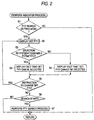
- Fig. 2 is a flow chart of the operation of the system control unit 3 which is performed in the mode for setting PTY according to the present invention. Note that the foregoing flow chart is executed when the PTY search setting mode has been instructed from the key input section 5.
- step S1 When the PTY search setting mode has been instructed from the key input section 5, determination in step S1 is made to be Yes. Initially, one of a plurality of PTY abided by the DAB broadcasting is selected so as to display the PTY on the display unit 4 as a set PTY.
- the system control unit 3 determines whether or not the set PTY which has been displayed can be selected by the ensemble which is being received (step S3). Specifically, information about the PTY of each service in the ensemble can be obtained from the FIC of the present ensemble received by the DAB control unit 2. Obtained information is supplied to the system control unit 3 through the DAB control unit 2. In accordance with supplied information, the system control unit 3 previously determines the PTY which can be selected by the ensemble which is being received, the determination being performed before execution of this flow chart. Information is used to confirm the set PTY. Note the PTY of the service (the current service) which is being received is not PTY-searched. Therefore, the foregoing PTY is not considered.
- a fact that the set PTY can be selected is displayed on the display unit 4.
- the display may be performed by flashing the set PTY which is being displayed or by turning on an indicator disposed adjacent to the set PTY which is being displayed.
- step S8 a fact that the set PTY cannot be selected is displayed on the display unit 4 in step S8.
- the display may be performed by flashing the set PTY which is being displayed or by turning on an indicator disposed adjacent to the set PTY which is being displayed.
- Another structure may be employed in which step S8 is omitted and only a case in which receipt is permitted is announced to the user by performing a displaying operation.
- the system control unit 3 determines whether or not an instruction to change the set PTY has been issued from the user. Also the foregoing instruction for the change is input through the key input section 5.
- the system control unit 3 If the instruction for the change has been supplied, the system control unit 3 returns to step S2 so as to select another PTY among the PTY abide by the DAB broadcasting. The system control unit 3 displays the other PTY on the display unit 4 as the set PTY.
- the user is able to sequentially switch the set PTY.
- whether or not selection is permitted is announced to the user by performing display in step S8. Therefore, the user is able to previously detect whether or not the required PTY can be selected if the PTY search is not actually performed.
- the PTY which can be selected by the ensemble which is being received is previously determined before the foregoing flow chart is executed.
- Another structure may be employed in which the foregoing determination is made after the set PTY has been displayed in step S2.
- step S5 the system control unit 3 determines whether or not an instruction to start the PTY search has been supplied in step S6. If the input indicating the search start has been performed by the key input section 5, the PTY search of the PTY determined in the processes in step S1 to step S5 is performed. Thus, a service having the corresponding PTY is selected so as to be output from the speaker unit 7.
- step S6 If an input indicating that the PTY search is not performed is made from the key input section 5 in step S6, the PTY search process in step 37 is not executed. Thus, the operation comes out of PTY search setting mode. Therefore, when the fact that the required PTY cannot be selected has been detected in steps S1 to S5, the user inputs a fact that the PTY search is not required through the key input section 5. Thus, the mode can be returned to a usual receiving mode.
- step S1 Also in a case in which a determination is made in step S1 that the PTY search setting mode has not been selected, the usual receiving mode is continued.
- Fig. 4 is a diagram showing transition of the state of the PTY search. An example case will now be described in which the process shown in Fig. 2 is performed in a state in which a certain service is being selected and the PTY search key has been depressed.
- step S6 When the PTY search key has been depressed, a determination made in step S6 shown in Fig. 2 is made to be Yes. Thus, the PTY search is executed. Specifically, whether or not the PTY of a service next to the present service coincides with the instructed PTY is determined in step 102a. If the PTY coincide with each other, the corresponding service is selected in step S107. In step S108 sound of the primary component is reproduced so as to be output from the speaker unit 7.
- step S102a If a determination is made in step S102a that the PTY do not coincide with each other, a similar comparison of the PTY for a next service is performed (step S012b). If the PTY coincide with each other, the corresponding service is selected in step S107 as described above. In step S108 the primary component is reproduced. When the search of the PTY displayed to be selectable in Fig. 2 is performed, the foregoing process is repeated to select and reproduce the required PTY.
- step S102n When a determination is made in step S102n that the instructed PTY is not detected after the search has been performed to the service before the last service (the service selected when the PTY search has been started) (when an instruction is issued to search the PTY shown in Fig. 2 and displayed such that the PTY cannot be selected). Since the present ensemble has not a service which can be received, change in the frequency is instructed to the DAB control unit 2 in order to search a next ensemble.
- the DAB control unit 2 receives the foregoing instruction to control the DAB receiving section 1 in order to receive the next ensemble.
- a tuning process is performed to obtain information about the next ensemble determined such that the ensemble can be received, information being obtained from the FIC of the next ensemble.
- step S104 whether or not the order of the service in the obtained next ensemble and having a leading SId (Service Identifier: Service ID) coincides with the instructed PTY is determined. If the PTY coincide with each other, the service is selected in step S107. In step S108 sound of the primary component is reproduced so as to be output from the speaker unit 7.
- Service ID Service Identifier
- step S104 determines whether the PTY do not coincide with each other. If a determination is made in step S104 that the PTY do not coincide with each other, a comparison of the PTY of a next service is performed (step S102b). If the PTY coincide with each other, the service is selected in step S107, similarly to the foregoing process. In step S108 the primary component is reproduced. If an instructed PTY is not detected (not detected in step S102n) after the search has been performed to the service before the last service (a service having a leading SId), a similar process is performed for a next ensemble.
- step S105 If a required PTY cannot be obtained after the overall receiving band has been searched, an "error" indicating the foregoing fact is displayed on the display unit 4 (step S105). Moreover, the last service (the service selected when the PTY search has been started) is selected so as to be reproduced from the speaker unit 7.
- Fig. 5 is a diagram showing a state of search which is performed in the PTY search process shown in Fig. 4.
- two ensembles (each having three services) which can be received exist in the receipt band.
- a state is illustrated in which a second component in the service 2 of the ensemble 1 is being reproduced.
- the first embodiment uses the PTY encoded to extension 17 of type 0 of the transmission format abided by the DAB.
- a second embodiment which will now be described uses Asu.
- the Asu is encoded to extension 18 of type 0.
- Asu is information included in the FIC.
- the Asu statically indicates announcement supported by the service.
- the standardized announcements include alarm and load traffic flash.
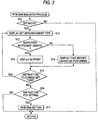
- Fig. 3 is a flow chart showing the operation of the system control unit 3 which is performed in the announcement-type setting mode according to the present invention.
- step S11 When an announcement-type setting mode has been instructed by the user by using the key input section 5, a determination in step S11 is made to be Yes. Initially, one of the announcement types abided by the DAB broadcasting is selected so as to be displayed on the display unit 4 as the set announcement type (step S12).
- the system control unit 3 determines whether or not the set announcement type is supported by the service which is being selected (step S13). Specifically, information about the announcement type which is supported in each service of the ensemble can be, as Asu information, obtained from the FIC of the present ensemble received by the DAB control unit 2. Obtained information is supplied to the system control unit 3 through the DAB control unit 2. In accordance with information above, the system control unit 3 determines whether or not the set announcement type is supported by the service which is being selected.
- a fact that the set announcement type is supported is displayed on the display unit 4 in step S14.
- the display may be performed by flashing the set announcement type which is being displayed or by turning on an indicator disposed adjacent to the set announcement type which is being displayed.
- step S18 a fact that the set announcement type cannot be received is displayed on the display unit 4 in step S18.
- the foregoing display may be performed by flashing the set announcement type which is being displayed or by turning on an indicator disposed adjacent to the set announcement type which is being displayed.
- Another structure may be employed in which step S18 is omitted and display is performed to announce a fact that the announcement type is supported to the user in only a case in which the announcement type is supported.
- the system control unit 3 determines whether or not an instruction to change the set announcement type has been issued from the user (step S15). Also the foregoing instruction for the change is input through the key input section 5.
- the system control unit 3 is returned to step S12 so as to select another announcement type abided by the DAB broadcasting so as to display the other announcement type on the display unit 4 as the set announcement type.
- the user is able to sequentially switch the set announcement type. At this time, whether or not the announcement type is supported is announced to the user in steps S14 and S18. Therefore, the user is able to detect whether or not the required announcement type is supported before the setting is determined.
- step S15 the system control unit 3 determines in step S16 whether or not the foregoing announcement type is set to the receiving apparatus. If the input indicating an instruction for the setting is not performed from the key input section 5, the announcement type selected in the processes in steps S11 to S15 is set to the receiving apparatus as the determined announcement type in step S17.
- step S17 If the input indicating the instruction for the setting is not performed from the key input section 5 in step S16, the setting process in step S17 is not performed. The operation comes out of the announcement-type setting mode. Thus, the operation is returned to the usual receiving mode. Therefore, if the user detects that the required announcement type cannot be used in the processes in steps S1 to S15, the user causes the operation to come off of the foregoing setting mode. Then, the user selects another service so as to again perform a similar process for the newly selected service. Thus, a required announcement type can be set to the receiving apparatus.
- step S11 Also in a case in which a determination is made in step S11 that the announcement-type setting mode has not been selected, the usual receiving mode is continued.
- the display unit is employed to serve as the announcement means in this embodiment, announcement using synthesized sound may be employed.
- the display shown in the flow chart shown in Figs. 2 and 3 is required to be replaced by sound output.
- the user sets one PTY or one announcement type
- the present invention is not limited to the foregoing structure.
- a plurality of announcement types may be set.
- steps S16 and S17 shown in Fig. 3 are required to be performed before step S15.
- the structure corresponding to the steps S16 and S17 shown in Fig. 3 is required to be performed before step S5.
- step S13 the service which is being selected is used as the reference.
- the present invention is not limited to the foregoing structure.
- the ensemble which is being received may be employed as the reference similarly to the first embodiment.
- another ensemble in the same network for the ensemble which is being received may be considered.
- another ensemble in the same network for the ensemble which is being received may be considered in step S3 in addition to the ensemble which is being received.
Landscapes
- Engineering & Computer Science (AREA)
- Signal Processing (AREA)
- Circuits Of Receivers In General (AREA)
Applications Claiming Priority (2)
| Application Number | Priority Date | Filing Date | Title |
|---|---|---|---|
| JP10134530A JPH11312993A (ja) | 1998-04-28 | 1998-04-28 | ディジタル放送受信機 |
| JP13453098 | 1998-04-28 |
Publications (2)
| Publication Number | Publication Date |
|---|---|
| EP0957599A2 true EP0957599A2 (de) | 1999-11-17 |
| EP0957599A3 EP0957599A3 (de) | 2001-09-12 |
Family
ID=15130482
Family Applications (1)
| Application Number | Title | Priority Date | Filing Date |
|---|---|---|---|
| EP99303158A Withdrawn EP0957599A3 (de) | 1998-04-28 | 1999-04-23 | Gerät für den Empfang von digitalen Rundfunkprogrammen die Programmartidentifikationen enthalten |
Country Status (2)
| Country | Link |
|---|---|
| EP (1) | EP0957599A3 (de) |
| JP (1) | JPH11312993A (de) |
Cited By (2)
| Publication number | Priority date | Publication date | Assignee | Title |
|---|---|---|---|---|
| EP1204231A1 (de) * | 2000-10-16 | 2002-05-08 | Nec Corporation | Rundfunksendungssuchverfahren in einem digitalen Rundfunkempfänger, und computerlesbares Speichermedium mit gespeichertem Rundfunksendungssuchprogramm |
| EP1610479A3 (de) * | 2004-06-11 | 2006-01-18 | Samsung Electronics Co., Ltd. | Verfahren und Vorrichtung zur automatischen Auswahl eines Rundfunk-Service in Abhängigkeit des physiologischen Zustandes des Benutzers |
Families Citing this family (1)
| Publication number | Priority date | Publication date | Assignee | Title |
|---|---|---|---|---|
| KR100667770B1 (ko) | 2004-11-09 | 2007-01-11 | 삼성전자주식회사 | 디지털 멀티미디어 방송 수신장치 및 그 사용자인터페이스 방법 |
Family Cites Families (6)
| Publication number | Priority date | Publication date | Assignee | Title |
|---|---|---|---|---|
| JPS6454937A (en) * | 1987-08-26 | 1989-03-02 | Sony Corp | Receiver |
| JPH07297734A (ja) * | 1994-04-27 | 1995-11-10 | Pioneer Electron Corp | 多重放送選局方法 |
| JPH08330911A (ja) * | 1995-06-01 | 1996-12-13 | Mitsubishi Electric Corp | デジタル音声放送受信機 |
| JPH10107669A (ja) * | 1996-09-30 | 1998-04-24 | Kenwood Corp | 放送受信機 |
| WO1998016020A1 (en) * | 1996-10-07 | 1998-04-16 | Sony Corporation | Receiver |
| JPH10327111A (ja) * | 1997-05-26 | 1998-12-08 | Alpine Electron Inc | Dab受信機の番組受信方法 |
-
1998
- 1998-04-28 JP JP10134530A patent/JPH11312993A/ja active Pending
-
1999
- 1999-04-23 EP EP99303158A patent/EP0957599A3/de not_active Withdrawn
Cited By (2)
| Publication number | Priority date | Publication date | Assignee | Title |
|---|---|---|---|---|
| EP1204231A1 (de) * | 2000-10-16 | 2002-05-08 | Nec Corporation | Rundfunksendungssuchverfahren in einem digitalen Rundfunkempfänger, und computerlesbares Speichermedium mit gespeichertem Rundfunksendungssuchprogramm |
| EP1610479A3 (de) * | 2004-06-11 | 2006-01-18 | Samsung Electronics Co., Ltd. | Verfahren und Vorrichtung zur automatischen Auswahl eines Rundfunk-Service in Abhängigkeit des physiologischen Zustandes des Benutzers |
Also Published As
| Publication number | Publication date |
|---|---|
| JPH11312993A (ja) | 1999-11-09 |
| EP0957599A3 (de) | 2001-09-12 |
Similar Documents
| Publication | Publication Date | Title |
|---|---|---|
| EP1536580A2 (de) | Vorrichtung und Verfahren zum Multiplexrundfunkempfang | |
| JP4048632B2 (ja) | デジタル音声放送の受信機 | |
| JP3606420B2 (ja) | 併設チューナを有するデータ多重放送受信機 | |
| JP3279379B2 (ja) | ラジオ受信機 | |
| EP0954131B1 (de) | Rundfunkempfänger mit einem Empfänger für den digitalen Tonrundfunk DAB und mit einem UKW Rundfunkempfänger mit einem RDS Dekoder | |
| EP0961431A2 (de) | Empfänger für den Empfang von digitalen Rundfunkprogrammen (DAB), mit einem Wahlschalter zur Auswahl eines Tonsignals von mehreren Signalquellen | |
| EP0954130A2 (de) | Empfänger für den Empfang von digitalen Tondrundfunkprogrammen (DAB) die Informationen über die Sprache der Sendung enthalten | |
| EP0961433A2 (de) | Empfänger für den Empfang von digitalen Rundfunkprogrammen mit einer Vorrichtung zur Auswahl eines Programms aus einer Mehrzahl von vorgespeicherten Programmen | |
| JPH11312993A (ja) | ディジタル放送受信機 | |
| JP2000224064A (ja) | デジタル音声放送の受信機 | |
| JPH11234154A (ja) | 多重放送受信機 | |
| JP2592515Y2 (ja) | Rdsチューナー | |
| JP3779802B2 (ja) | 多重放送受信機 | |
| JP3645414B2 (ja) | 多重放送受信機 | |
| JPH06268482A (ja) | Rds受信機 | |
| JP2647670B2 (ja) | 受信機 | |
| JP3578427B2 (ja) | 多重放送受信機 | |
| JPH11112450A (ja) | 多重放送受信機 | |
| JPH11261501A (ja) | ディジタル放送用受信機 | |
| JPH07111467A (ja) | 多重放送受信機 | |
| JPH10209990A (ja) | 放送受信機 | |
| JP2907293B2 (ja) | 受信装置 | |
| EP0986199A2 (de) | Empfänger für den Empfang von digitalen Rundfunkprogrammen DAB | |
| JP2000134119A (ja) | ラジオ受信機 | |
| JP2000004176A (ja) | 受信機 |
Legal Events
| Date | Code | Title | Description |
|---|---|---|---|
| PUAI | Public reference made under article 153(3) epc to a published international application that has entered the european phase |
Free format text: ORIGINAL CODE: 0009012 |
|
| AK | Designated contracting states |
Kind code of ref document: A2 Designated state(s): AT BE CH CY DE DK ES FI FR GB GR IE IT LI LU MC NL PT SE Kind code of ref document: A2 Designated state(s): DE FR GB |
|
| AX | Request for extension of the european patent |
Free format text: AL;LT;LV;MK;RO;SI |
|
| PUAL | Search report despatched |
Free format text: ORIGINAL CODE: 0009013 |
|
| AK | Designated contracting states |
Kind code of ref document: A3 Designated state(s): AT BE CH CY DE DK ES FI FR GB GR IE IT LI LU MC NL PT SE |
|
| AX | Request for extension of the european patent |
Free format text: AL;LT;LV;MK;RO;SI |
|
| 17P | Request for examination filed |
Effective date: 20020213 |
|
| AKX | Designation fees paid |
Free format text: DE FR GB |
|
| 17Q | First examination report despatched |
Effective date: 20061206 |
|
| STAA | Information on the status of an ep patent application or granted ep patent |
Free format text: STATUS: THE APPLICATION IS DEEMED TO BE WITHDRAWN |
|
| 18D | Application deemed to be withdrawn |
Effective date: 20070417 |