EP0968475B1 - Übersetzungssystem - Google Patents
Übersetzungssystem Download PDFInfo
- Publication number
- EP0968475B1 EP0968475B1 EP98925357A EP98925357A EP0968475B1 EP 0968475 B1 EP0968475 B1 EP 0968475B1 EP 98925357 A EP98925357 A EP 98925357A EP 98925357 A EP98925357 A EP 98925357A EP 0968475 B1 EP0968475 B1 EP 0968475B1
- Authority
- EP
- European Patent Office
- Prior art keywords
- meaning
- language
- database
- words
- text
- Prior art date
- Legal status (The legal status is an assumption and is not a legal conclusion. Google has not performed a legal analysis and makes no representation as to the accuracy of the status listed.)
- Expired - Lifetime
Links
Images

Classifications
-
- G—PHYSICS
- G06—COMPUTING OR CALCULATING; COUNTING
- G06F—ELECTRIC DIGITAL DATA PROCESSING
- G06F40/00—Handling natural language data
- G06F40/20—Natural language analysis
- G06F40/237—Lexical tools
- G06F40/247—Thesauruses; Synonyms
-
- G—PHYSICS
- G06—COMPUTING OR CALCULATING; COUNTING
- G06F—ELECTRIC DIGITAL DATA PROCESSING
- G06F40/00—Handling natural language data
- G06F40/20—Natural language analysis
- G06F40/205—Parsing
- G06F40/211—Syntactic parsing, e.g. based on context-free grammar [CFG] or unification grammars
-
- G—PHYSICS
- G06—COMPUTING OR CALCULATING; COUNTING
- G06F—ELECTRIC DIGITAL DATA PROCESSING
- G06F40/00—Handling natural language data
- G06F40/20—Natural language analysis
- G06F40/205—Parsing
- G06F40/221—Parsing markup language streams
-
- G—PHYSICS
- G06—COMPUTING OR CALCULATING; COUNTING
- G06F—ELECTRIC DIGITAL DATA PROCESSING
- G06F40/00—Handling natural language data
- G06F40/40—Processing or translation of natural language
- G06F40/42—Data-driven translation
- G06F40/47—Machine-assisted translation, e.g. using translation memory
-
- G—PHYSICS
- G06—COMPUTING OR CALCULATING; COUNTING
- G06F—ELECTRIC DIGITAL DATA PROCESSING
- G06F40/00—Handling natural language data
- G06F40/40—Processing or translation of natural language
- G06F40/55—Rule-based translation
-
- G—PHYSICS
- G06—COMPUTING OR CALCULATING; COUNTING
- G06F—ELECTRIC DIGITAL DATA PROCESSING
- G06F40/00—Handling natural language data
- G06F40/40—Processing or translation of natural language
- G06F40/58—Use of machine translation, e.g. for multi-lingual retrieval, for server-side translation for client devices or for real-time translation
Definitions
- the present invention relates to a computer-based translation system. More particularly, the present invention relates to a computer-based translation system in which a person having full understanding and competency in a language of an original source text to be translated provides and/or confirms the meaning of the text without requiring knowledge of any other language, so that data concerning the meaning of the original language text may be used to automatically translate the original text.
- the invention also relates to a computer-based translation system which automatically translates meaning code data representing a source text in order to obtain a translation in a particular language.
- the invention further relates to a method of translating in which meaning data concerning a source text is provided by a person familiar with the language of the source text without requiring any knowledge of another language, and then translating the meaning data into a translation destination text automatically without requiring any other understanding of the source language.
- the automated translation systems provide an aid to translators in which the source text is automatically parsed grammatically and each possible translation for each word in the sentence may be selected by the translator in order to obtain efficiently the translation text.
- the translator must be knowledgeable as to the meaning of the original language as well as the destination language in order to be competent to confirm that the passing of the source text is accurate and to select the correct translations for each word in the sentence, and thus produce an accurate translation.
- a framework for pre-editing a text in the source language to define parts of speech of the words is disclosed.
- this pre-editing no translation or determining of the meaning of the words is carried out.
- the pre-edited text can be accurately machine translated using literal translations of the pre-edited words into one of many target languages.
- International application WO 94/06086 discloses a translation system which, by means of an interactive text editor, enforces lexical and grammatical constraints on a natural language subset (a so-called constraint natural language) used by the authors of the input text. Moreover, where semantic ambiguity remains, the user is asked for disambiguation and corresponding tags are inserted into the source text to ensure the correct interpretation. The disambiguated/constrained text is translated into an intermediate language before being translated into the target text.
- a natural language subset a so-called constraint natural language
- U.S. Patent No. US-A-5 535 120 discloses a machine translation system based on the "interlingua” approach which attempts to decompile input texts of a source language into an intermediate language which represents their "meaning” or semantic content, and then convert the semantic structures into equivalent output sentences of a target language.
- U.S. Patent No. US-A-4 954 984 provides a machine translation system which requires the user to annotate an input text by grammatical information which is omitted from the source language but required in the target language.
- Data representing the exact meaning is stored in order to facilitate automated translation into one or more destination languages.
- the author of a text who wants his or her text to be readily translated into other languages may use a text editor according to the invention in order to provide the necessary meaning data in order that translation can be done automatically without requiring any further linguistic data.
- a translation system for translating an input text into a meaning code using input from a user requiring knowledge of a language of the input text in which the meaning code is to be converted by a machine transiation system to an output text in at least one different language.
- the system comprises parser means for recognizing sentences and words within the sentences of the input text.
- the parser means locates the words in a term database.
- a meaning editor means for obtaining from a meaning database a plurality of meaning descriptions in the language of the input text for each of at least some of the words having plural meanings in the term database, for receiving from the user a confirmation of which of the plurality of meaning descriptions is appropriate for each of the words, and for receiving from the user an indication of a part of speech of the words in each of the sentences.
- Meaning code generator means are also included for receiving data from the meaning editor means and for generating a meaning code corresponding to the input text.
- the meaning code comprises an identification code corresponding to a meaning for each word found in the input text and sufficient grammatical information to allow for the meaning code to be accurately machine translated in any one of the at least one different language.
- the invention also provides a method of human-assisted machine translating an input text in one language to obtain an output text in at least one different language, the method comprising the steps of:
- the meaning code data is sufficiently explicit to permit automatic translation into a plurality of languages.
- the meaning code data also includes layout information so that the automatic translation generator may produce output text respecting the same format as the input text, and in particular the automatic translation generator may scale the size of the translated text in order to generate a text object having dimensions specified in the original source text format.
- the automatic translation generator be a plug-in software module for use with existing text editors or HTML display software, otherwise known as web browsers.
- the unilingual meaning editor is configured so that when it encounters a word not found in its language database, the editor may allow the user to input a suitable synonym.
- the editor may record the unknown word and create a pointer to the closer synonym.
- the unilingual meaning editor permits the user to reconstruct the original sentence in the case that a word or group of words are not found in the language database. The reconstructed sentence may thus be a sentence more likely to be easily defined using the existing language database.
- Words which are not found in the language database may also be automatically reported by telecommunication means to the language database creator for the purposes of revision of the language database and implemented in a future release.
- the language database used may be an on-line database or may be updated at regular intervals by telecommunication means.
- a language database which requires a degree of specification by the user of meaning relevant to a particular set of languages, which set is less than a complete set of languages, in order to simplify the degree of detail required in order to ascertain the exact meaning of the input text.
- a language database for the English language may be created in order to ascertain the meaning in the English language for the purposes of producing a translation into any romance language.
- a separate English language database may be created in order to ascertain the meaning for the purposes of translating the meaning code data into Japanese, Chinese and Korean.
- the meaning editor used for ascertaining the meaning of a text for automatic translation into the oriental languages may be provided with the meaning code data from the romance languages in order to reduce the time that the user must spend in ascribing the necessary meaning to generate meaning code data which can be used for translation of the input text into oriental languages.
- the automatic translation generator according to the invention would be capable of performing a slightly less than perfect translation into one language when basing the translation on meaning code data not intended to encompass the one language.
- the invention also provides within the context of an automatic translation generator a user-controlled editor for carrying out refinements or stylistic changes to the translation text in which any potential ambiguity which may appear in the translation text may be eliminated by providing the user with some or all of the meaning code data associated with the text being revised, and preferably in the language of the translated text so that the reviser of the translated text need not have any knowledge of the source language. It is also preferred that the meaning code data include a complete specification of the original input text so that a reverse translation back into the original input language always provides an exact replica of the original text.
- a computer system such as a general-purpose personal computer is provided with software to provide specific functions as will be described hereinbelow.
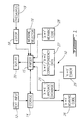
- the unilingual meaning editor 10 comprises text input means 12 such as a communications interface or any other suitable source of text data.
- a storage memory 14 is used to hold the input text as well as a temporary file for the output meaning code data.
- a grammatical parser 15 parses the sentences in the input text stored in memory 14 and displays the parsed sentences on a display 20 identifying the particular parts of speech for each of the words and identifying the most probable or simply the first meaning of each of the words in the sentence being displayed.
- Software grammar parsers per se are known in the art.
- the language database 25 provides word definition and part-of-speech data to the parser along with grammar requirements for the set of languages into which the meaning code data is intended to be translated.
- the database 25 combines the term database, which includes a list of all words and expressions in the 'A' language which are matched with a meaning in the meaning definition set, with the database of meanings which includes the corresponding identification codes used to build up the resulting meaning code.
- the parser 15 allows the user to select the appropriate meaning for each of the words or group of words appearing in the sentence using a meaning selector 16 which may be part of a graphical user interface.
- the user is also required to provide grammatical information unrelated to the original language or the meaning in the original language which, however, may be required in order to produce the translation in the languages into which the meaning code data is to be translated. For example, it may be necessary to identify the gender of a person in order to be able to translate words associated with that person correctly in another language, whereas in the original language such gender information is not required.
- an editor 18 is provided to change the original sentence in order to facilitate definition or specification of the meaning of the words contained in the sentence.
- the meaning selector 16 may be provided by software which causes a window to be displayed indicating the definitions which are possible for a given word or group of words appearing in the sentence which is provided in a main display window with the word or group of words appearing highlighted. Using the graphical user interface, the user selects the particular definition of the word or group of words which best suits the meaning in the original language. In the case that a word or group of words has an unambiguous definition in the language or the plurality of languages into which the input text is to be translated, there is no need to select one of a plurality of meanings using the meaning selector although the part of speech still needs to be confirmed.
- thesaurus means 19 offers the user a reference tool for finding an alternate word or expression having the same meaning in the language of the input text which can be substituted by the user for the orginal word or group of words is not found in the term database of database 25.
- the thesaurus means may also provide dictionary definitions of words, in addition to synonyms and antonyms.
- the meaning selector provides the option that the particular term be left untranslated since the term is to be considered to be a new term, as of yet undefined in other languages, or the term is a trade mark, etc. In such case, the meaning selector is used merely to designate the part of speech for the word or group of words.
- the source of the language database 25 could be an online source in order to ensure that the database 25 is up-to-date and complete.
- communication means e-mail, telephone or the like
- the language database compiler can then provide an update to the language database.
- the meaning database in database 25 cannot be edited by the user, but rather the inventory of meanings may only be corrected or expanded by the producer of the software.
- an editor 29 is provided to allow the user to create new terms in the term database and to link them to established meaning entries in the meaning database of database 25.
- the editor 29 can also be used to change the links between an existing term in the term database and entries in the meaning database. This allows the user to create, for example, a new entry for "flapjack” and link it to the meaning definition "(noun) thin cake cooked on a pan or griddle" previously only linked to the term "pancake”.
- the existing term "plug” meaning as a verb to connect
- the database 25 may thus be improved to best suit a user's needs over time with use by the user.
- Updates to database 25 which do not change meaning identification codes or definitions may be implemented regularly, while updates that create new meaning identification codes require corresponding updates to the Readers translating the meaning code, and thus should not be as frequent.
- editor 10 may include meaning identification codes in the meaning code 26 generated which includes the improved new meaning identification code according to a most recent version (a more accurate meaning) along with the old meaning identification code for older versions (a less accurate meaning), so that the Reader software may use the most recent meaning code it is able to recognize, while not refusing to provide a translation because of incompatible versions.
- the parser 15 sends a signal to the storage means 14 to place the meaning code data into an output file 26.
- the output file 26 may be communicated by electronic means to the person who wishes to obtain a translation of the input text.
- the meaning code data may be used within a same computer on which the translation system operates in order to be able to proceed automatically with the generation of a translation.
- the meaning code data includes information concerning the specific definitions of each word or group of words appearing in the input text as well as the grammatical attributes for each word or group of words and the relationship between the words in the input text.
- the meaning code data 26 contains additional information concerning the original words or group of words which were replaced by substitutes using editor 18 before selecting an appropriate meaning.
- the unilingual meaning editor 10 is supplemented with a memory 28 for storing meaning code data created from a previous revision of the original text for the purposes of generating the meaning code data for use with an automatic translation generator for a language or group of languages (e.g. languages 'Y') different from the language or group of languages corresponding to the language database 25 (e.g. languages 'X').
- a correspondence database 27 between the two different destination languages is thus also provided and the meaning code data 28 for the other language along with the correspondence table data 27 is provided to parser 15 in order to provide on display 20 the input text 12 already parsed and with meaning defined, inasmuch as there are common similarities between the two destination languages (e.g. between 'X' and 'Y').
- the user of the unilingual meaning editor is then required merely to specify those meanings and provide the grammatical parts of speech interpretation information which are unique to the language in database 25. Since the bulk of the grammatical and meaning selection has already been done for the previous language, the ability to generate the output meaning code for the destination language corresponding to database 25 can be done relatively quickly.
- the preferred embodiment offers interoperability between destination languages or groups of destination languages while using the unilingual meaning editor in case that the person using the unilingual meaning editor has the task of defining the meaning of the input text for many different language groups (e.g. Romance, Oriental, Indian, etc.).
- the meaning code data file 26 is part of a computer memory which is read by an interpreter 30.
- the interpreter 30 obtains from a language database 35 specific to the language into which the meaning code data is to be translated. For each word or group of words, the associated meaning code is looked up in the language database in order to obtain the correct term.
- the pall of speech information and relationship information with respect to other words in the sentence is obtained from the meaning code data in order to change the form of the word or group of words in accordance with grammatical rules included in the language database 35. For example, verbs need to be conjugated in languages which involve verb conjugation.
- Some of the grammar information may not be required in the destination language and, as such, some of the meaning code data may not be used by interpreter 30 when producing the output text in the destination language.
- the output text in the destination language is stored in a memory 32 and an editor system 33 including a display window 34 is provided to handle post automatic translation editing in the event that the person receiving the translation in the destination language wishes to make stylistic changes to the translation text.
- the editor 33 is provided not only with the text output from memory 32 but also with the appropriate information concerning the definitions of the terms in the destination language obtained from the language database 35 which correspond to the meaning codes responsible for producing the output text.
- the editor 33 may also display the grammatical relationship between the terms in the translation text in order to provide the person using editor 33 with a greater understanding of the translation text in order to make it easier to carry out corrections which still remain faithful to the original meaning of the text in the source language.
- the person operating editor 33 may have no knowledge of the original language.
- the original language text could also be produced alongside the translation text by providing interpreter 30 with access to the information contained in the original language database 25 and outputting to the editor 33 the original language text.
- the input text may include format data and this format data may be passed through the unilingual meaning editor into the meaning code data 26, in the case of a HTML text for a web browser, the input data format may include specifications as to text block position and dimensions in order that such information may be passed on to the meaning code data.
- the automatic translation generator 11 may have a module integrated with the interpreter 30 for the purposes of automatically generating an HTML output file which would resemble in layout and font style an original HTML file in the original language.
- the X language database 35 and the interpreter 30 may comprise the heart of a plug-in module to be integrated with a web browser. In this case, the meaning code data 26 would be included in the downloaded file to be viewed using a web browser.
- Catome a logical structure which is termed a Catome.
- This new term is a contraction from the descriptive phrase " CAT alogue O f ME anings" which accurately portrays the principal functions of this structure.
- the Catome comprises the term database and the meaning database.
- the preferred embodiment uses various techniques to reduce the size of the Catome - compression to reduce the size of the Catome during downloads and the use of model tables to reduce the storage space needed to hold the different forms of each noun and verb. To satisfy the requirement for speed, there are two indices that allow for direct access retrieval of information from the Catome.
- the Catome contains the following databases, tables and indices:
- the essential difference between a database and a table in the preferred embodiment is that the databases contain further properties of the basic entities within them, whereas the tables are simple two-dimensional arrays of basic entities.
- This database is the largest within the Catome. It contains all the words of the language with their associated properties. The database has ten logical sections each devoted to a specific part of speech:
- the first digit of the Word-Identifier uses the corresponding number of the logical section it belongs in. This is necessary to help in situations where the same word exists in two or more different parts of speech, a situation very common in English. For example, the verb "to keep” has a usage and meanings entirely different to the English noun "keep” (the strongest part of a castle).
- the Word-Identifier is a 6-digit number qualified by a period and a two-digit usage field i.e. 999999.99
- the two-digit usage field is highly specific to each language. Its primary use is to help the editor identify the particular way in which a modifiable part of speech (adjectives, adverbs, nouns and verbs) is being used by users as they type text in the input window of the Editor.
- Some parts of speech have properties - some specific to the language, some relevant to other languages.
- Verbs can be transitive or intransitive; nouns can be "Proper", they can have a gender, they may exist only in the singular or plural form and so on. They may exist in some but not all regional dialects of the language. The most important property however is “Meaning”. Apart from numbers (which are self-referring to meaning) all other parts of speech have a "Meaning-Identifier".
- Each word in the Word / Meaning Catome has a Meaning-Identifier associated with it. This allows us to differentiate between the different meanings that a word can have in a language.
- a word such as "fan” in English can be a verb "to fan", or a noun "a fan” which could mean either a device to move air, or a supporter of something.
- We differentiate between verbs and nouns by the first digit of the word-identifier. But for a specific word with different meanings within the same part of speech, we assign them different "Meaning-Identifiers”.
- a "fan” as a noun therefore would have two entries in a Catome - each with a different "meaning-identifier" to differentiate between the device to move air and a human person who is a supporter of something.
- Each "meaning identifier” is part of a “meaning loop” that consists of other words with the same meaning.
- Each word in the Catome is linked to a “meaning loop” through its “meaning identifier” acting as the key. But this concept is extended.
- Each "meaning loop” has additional pointers: the first to a higher “class of meaning”, the second to a lower class of meaning loop. For example, consider the word “male” being used as a noun. It points to a meaning loop that has synonyms for "male” such as “man”, “stud”, etc. That meaning loop points to a higher class meaning loop that contains words such as "being", “person” etc. It also points to a lower class of meaning that contains words such as "man”, “cob”, “boy”, “stallion” that contain “maleness” in their meanings.
- Meanings and Meaning Loops are common across all Catomes - it is the meaning that is derived from the text being typed by the user, and it is those meanings which are imbedded in the meaning code or CCML language to be interpreted by other language readers.
- the user can ensure that the meaning of their words is precise through interaction with the Editor.
- the meaning-identifier will target the correct word to use in automatic translation by a Reader for another language.
- the preferred embodiment has a database of generic sentence structures that act as a model to determine where the grammatical components of the sentence are to be found, and the relationships between them.
- the key to sentence structure is to determine which "Verb Phrase” is being used in the sentence.
- the main verb phrase in the sentence points to a set of generic sentence structures supporting that specific "verb phrase” which are then used by the Editor to identify the subject, object, subordinate clauses, adverbial phrases and so forth - the grammatical components of the sentence.
- Sentence structures are themselves classified into “positive”, “conditional”, “querying” and “imperative” sub-types. There then exist a “negative” form of each sentence type within each sub-class. (An 'imperative' sentence structure such as "Go Away! has its “negative” form of "Do not go away!)
- the sentence structures use a generic coding scheme to show where words from the different parts of speech are to be expected in the input text.
- the verb is represented as "9*.8*"; the "9*” indicates that any verb can be used, but only in its imperative usage - represented by the two-digit qualifier of usage "8*"following the period.
- the Idiom database contains a current list of such idioms, cliches and other multi-word phrases in common usage. Each is assigned an "Idiom Identifier" and also an equivalent phrase that conveys the meaning more accurately.
- the phrase "different matter” would be attached to the generated meaning code or CCML code from the Editor. If there were no equivalent idiom in another language, the reader for that language would show the translated equivalent of "different matter” rather than translate the original idiom. An equivalent idiom in another language exists if it has an "Idiom Identifier" which is the same as the that of the original idiom.
- irregular verb type arises from languages having some irregular verbs based on another unique irregular verb.
- the verb "to become” in English follows the irregular verb model for the verb "to come” as a good example.
- This index associates a word in the language with its corresponding entry in the Word / Meaning database. Used in the Editor when creating the meaning code or CCML language, this index allows for the instant look-up of words as they are typed in the Editor's input window.
- the main retrievals from the Word / Meaning database are meanings taken from the inter-lingua CCML to be translated into the appropriate words in the Reader's language. This index allows for instant direct retrieval from the Catome.
- the Catomes are held on Microsoft Access databases. They are updated and expanded by linguists. There are two other databases on the development side that the customer never sees. These are the:
- the Catome For both the Editor or Reader, the Catome provided is in "read-only" mode and cannot be changed by the user. It cannot be accessed directly by the user, it is accessed solely by Linguistic Modules to provide data to specific internal tasks within the Editor or Reader.
- the Editor can be activated as an add-on to Microsoft's Word, Internet Explorer, Outlook, Qualcast's Eudora, Netscape Communicator and Corel's WordPerfect software. In any of these settings, the Editor is activated from a windows pull-down menu.
- the first function of the Editor is to scan text typed by the Editor user, and through a dialogue of pop-up windows, ensure that the meaning of each word is identified and that each sentence is grammatically correct.
- the second main function of the Editor is to take the sentence and translate it into a proprietary CCML language or meaning code.
- the resulting CCML can be read and translated into any language supported by a compatible Reader software.
- the Editor may download the product from a web site using an Internet browser.
- the Editor is preferably "locked” against illegal copying and software piracy.
- the customers are invited to complete a secure HTML form with their credit card information and demographic data (optional). Once they send off the form from their browser, and the transaction is accepted, they receive a unique, one-time "unlock key" that will allow the installation to proceed.
- the user can always change this regional language setting through a pop-up menu at any time.
- the Editor in the preferred embodiment is activated through a pull-down window (normally "tools") in the menu bar of the text processor, Internet Browser of word processing product. Instead of typing into those products, the user is presented with an Editor Input window. The user types text in this window, a sentence at a time and ends the sentence normally with a period, exclamation mark, question mark or a colon. They are invited to press F7 if the sentence has indeed been typed completely.
- the first step involves a word-by-word translation into meaning code, i.e. the Catome-to-Catome Meaning Language or just CCML for short. Each word is compared to see if it matches a word in the Catome or term database.
- the Catome is in fact a combination of both the term database and the meaning database.
- a pop-up window appears if the Catome has several entries for that word. Listed in this window are each entry found in the Catome, its part of speech (i.e. adjective, noun, verb etc.) and a close synonym to establish the specific meaning of that entry in the Catome. The user selects the entry with the desired meaning. Once all the words have been processed, the Editor prepares the CCML equivalents for each translatable word, using the "Meaning Indicator" from the Catome as the CCML value for each selected or unambiguous word.
- the CCML sentence is scanned for Idioms (including clichés and other multi-word phrases or expressions). If there is a match between CCML words and an entry in the Idiom database within the Catome, the Catome returns an "Idiom Indicator'' - a number that uniquely identifies the idiom. This is used to replace the CCML text representing the original idiom. In addition, the Catome passes a set of words in CCML that express the real meaning of the idiom, in case the idiom identifier has no equivalent idiom in another language. This CCML text is appended to the CCML word with the "Idiom Identifier". (On translation using a Reader, if there is no equivalent idiom in the other language, this alternative CCML is used.)
- the CCML sentence is scanned to identify any CCML component that needs to have specific attributes that the Catome was unable to furnish when the original words were processed. This occurs in two situations:
- the relevant properties are added as an attribute group to the unknown word.
- Nouns used as adjectives in English It is assumed that when it finds a string of separate, contiguous nouns, the last noun is considered to be the "real" noun and those preceding to be nouns acting as adjectives. The user is asked to confirm this if the detailed "verification" option was selected at the beginning of the session. (Other languages may have different anomalies and different processing needs).
- the CCML is now scanned as a complete sentence to see if it matches one of the Sentence Structures in the Sentence Structure database within the Catome.
- the Editor identifies the main verb or main verb phrase within the CCML text and uses that to narrow its search through the database. Once identified, the Sentence Structure entry contains a coded description of the grammatical components and their positioning within that sentence type. With this coding system, the Editor can understand which CCML word(s) in the input constitute the subject, the object, the indirect object, subordinate clauses and other grammatical components in the sentence.
- the CCML sentence is tagged with attributes to group the CCML words accordingly.
- the software uses the closest matches in the Sentence Structure database.
- the user is shown a pop-up window with the original sentence reformed under each closest sentence structure, complete with any important missing words (clause openers such as "that” or "which") and any critical punctuation such as commas to mark the end of a clause.
- the user is invited to select one of these sentences or to go back and retype the sentence with some helpful hints shown.
- the completed sentence is now displayed in a new pop-up window with e;ich grammatical component color-coded.
- a key to color coding is displayed indicating which component is colored as the subject, verb phrase, object, indirect object etc.
- the main and sub-ordinate clauses are also color-coded.
- this is very simple to do as the software has matched a specific sentence structure to the original sentence and this grammatical exercise is very simple to perform. Clicking on any of the words in this window will display what part of speech the word represents, be it adjective, adverb, conjunction, noun, verb etc.).
- the invention may thus provide an impressive grammar learning tool.
- the Reader is activated as a browser plug-in by clicking on an Icon on any web page or by activating the Reader from a Windows pull-down menu on an E-mail system.
- the Reader can translate any text created using the Editor on a web page or e-mail flawlessly, automatically and perfectly into the language of the Reader and display it back on the screen.
- Compressed mode means a disk requirement of 5Mb, wheras dynamic mode can take upto 30Mb.
- the trade-off is speed - the dynamic version will have to be created every time the Reader is subsequently used if the compressed version is stored.
- the user can always change this regional language setting through a pop-up menu at any time.
- the user receives an e-mail and a pop-up menu appears informing the user that the e-mail is translatable using the Reader.
- the Reader e-mail add-on module has detected that the incoming e-mail message has a CCML component. The user is asked to select one of the following:
- the user selects to use a language reader, the user is asked in which regional language version they would like to see the translation.
- the CCML component is moved to the input buffer of the Reader and automatically translated in Steps 5-10.
- the resulting translation is shown on the screen as if it was the original message.
- the CCML component is always saved so that the message can be translated again in another language or at another time in the same language.
- the Reader function for e-mail is completed.
- the user surfs the Worldwide Web and finds a web page which has the Icon identifying CCML files displayed. If the user clicks on that icon, a pop-up menu appears informing the user that this web page is readable using the CCML Reader.
- the Reader browser plug-in module has detected that the current web page has an invisible CCML component. The user is asked to select one of the following:
- the user selects to use a language reader, the user is asked in which regional language version they would like to see the translation.
- the CCML component is moved to the input buffer of the Reader and automatically translated in Steps 5-10.
- the resulting translation is shown on the screen as if it was the original page. All HTML tags for the original language are respected and retained: this means that the translated text on the web page is formatted in exactly the same manner as that of the original language.
- the CCML to be translated is contained in the input buffer of the Reader module.
- the Reader takes each sentence in turn, translates it and places the result in the output buffer.
- the processes are described in Steps 6-10 following. Once all sentences have been translated, the contents of the output buffer are moved to the display message function of the e-mail software, or to the stored copy of the web page in the cache of the browser.
- the e-mail software is triggered to display the message, or the browser's "refresh" function is activated to redisplay the web page.
- the Reader removes any formatting HTML surrounding each individual CCML and replaces it around each translated sentence within the output buffer. This will allow the text of the translation to be formatted in an identical manner to that of the original language.
- the Sentence Structure Identifier is located and looked up in the Catome.
- An equivalent structure is passed back from the Catome that contains information as to the sequence of the grammatical components in which the CCML should be translated and ordered in the translation output.
- the CCML components are according moved around to match this specification.
- Each CCML component in the sentence is scanned for an Idiom Identifier. If found, this is passed to the Catome which returns an equivalent idiom in CCML and replaces the Idiom phrase in the original CCML. If no expression is returned, the appended "Idiom Meaning" in the original CCML is used instead to replace the idiom phrase.
- the CCML is read for each "Meaning Identifier". These are passed in turn to the Catome which returns the word to be used along with its "Word Identifier” value.
- the words are altered to "correspond", either in verb tense, gender, subject or object matching, singular and plural. This is done by taking the two-digit "meaning qualifiers" from the original CCML components plus any gender or other attributes associated with that CCML item in the original CCML. An update to the two-digit qualifier to the "Word Identifier” is created, appended and the resulting “Word Identifier” is passed to the Catome. The Catome returns the word to be used, correctly modified.
- any applicable contractions for the words or word combinations are obtained from the Catome and substituted for the uncontracted text.
- the program translates the English " I love” as “Je aime ". As French does use formal contraction, this step produces the correct answer of " J'aime " When this is done, the whole sentence is passed to the output buffer of the Reader. The translation is complete.
Landscapes
- Engineering & Computer Science (AREA)
- Theoretical Computer Science (AREA)
- Audiology, Speech & Language Pathology (AREA)
- Health & Medical Sciences (AREA)
- Computational Linguistics (AREA)
- General Health & Medical Sciences (AREA)
- Physics & Mathematics (AREA)
- General Engineering & Computer Science (AREA)
- General Physics & Mathematics (AREA)
- Artificial Intelligence (AREA)
- Multimedia (AREA)
- Machine Translation (AREA)
- Separation By Low-Temperature Treatments (AREA)
- Cyclones (AREA)
- Vehicle Body Suspensions (AREA)
Claims (22)
- Übersetzungssystem zum Übersetzen eines Eingangstextes in einer im wesentlichen zwanglosen natürlichen Sprache in einen Bedeutungscode unter Verwendung von Eingaben von einem Benutzer, die eine Kenntnis der Sprache des Eingangstextes erfordern, wobei der Bedeutungscode von einem Maschinenübersetzungssystem in einen Ausgangstext in wenigstens einer unterschiedlichen Sprache umgesetzt werden soll, wobei das System folgendes aufweist:Analysiermittel zum Erkennen von Sätzen und Wörtern innerhalb der Sätze des Eingangstextes, wobei die Analysiermittel die Wörter in einer Begriffsdatenbasis lokalisieren,Bedeutungseditormittel zum Entnehmen mehrerer Bedeutungsbeschreibungen in der Sprache des Eingangstextes aus einer Bedeutungsdatenbasis für jedes von wenigstens einigen Wörtern, die für eine gegebene Wortart in der Begriffsdatenbasis mehrere Bedeutungen aufweisen, zum Entgegennehmen einer Bestätigung von dem Benutzer, welche der mehreren Bedeutungsbeschreibungen für jedes der wenigstens einigen Wörter geeignet ist und um von dem Benutzer einen Hinweis auf eine Wortart der Wörter in jedem der Sätze entgegenzunehmen, undBedeutungscodegeneratormittel zum Empfangen von Daten von den Bedeutungseditormitteln und zum Erzeugen eines Bedeutungscodes entsprechend dem Eingangstext, wobei der Bedeutungscode einen Identifizierungscode enthält, der einer Bedeutung jedes Worts, das in dem Eingangstext gefunden wurde, entspricht und ausreichend grammatikalische Information enthält, so dass der Bedeutungscode mittels einer Maschine korrekt und automatisch in die wenigstens eine unterschiedliche Sprache übersetzt werden kann.
- System nach Anspruch 1, worin die Bedeutungseditormittel weiter Eingabemittel aufweisen, um es einem Benutzer zu erlauben, eine Eingabe in Reaktion auf wenigstens ein Wort in einem gegebenen Satz, das in der Begriffsdatenbasis nicht gefunden wurde, zu machen.
- System nach Anspruch 2, worin die Eingabemittel Mittel aufweisen, die es dem Benutzer erlauben, das wenigstens eine Wort als nicht übersetzbar zu kennzeichnen, wobei die Bedeutungscodegeneratormittel in den Bedeutungscode einen Code, der einen nicht übersetzbaren Text anzeigt, sowie einen Text einschließen, der das wenigstens eine Wort repräsentiert.
- System nach Anspruch 2, worin die Eingabemittel Mittel aufweisen, die es dem Benutzer ermöglichen, den gegebenen Satz zu editieren, wobei ein Begriff oder ein Ausdruck, der in der Begriffsdatenbasis nicht gefunden wird, durch Ändern der Satzstruktur und Ändern von Wörtern vermieden werden kann.
- System nach Anspruch 2, worin die Bedeutungseditormittel Wörterbuchmittel aufweisen und es dem Benutzer ermöglichen, wenigstens ein alternatives Wort oder einen alternativen Ausdruck, der von den Wörterbuchmitteln erhalten wurde und dem wenigstens einen Wort, das in der Begriffsdatenbasis nicht gefunden wurde, entspricht, auszuwählen, wobei der Benutzer beim Konvertieren von Wörtern, die in der Begriffsdatenbasis nicht gefunden wurden, in Worte mit einer ähnlichen Bedeutung, die in der Begriffsdatenbasis gefunden wurden, unterstützt wird.
- System nach Anspruch 5, worin die Wörterbuchmittel Mittel aufweisen, um es dem Benutzer zu ermöglichen, Inhalte der Wörterbuchmittel zu editieren.
- System nach Anspruch 5, worin der Bedeutungscode ein im wesentlichen numerischer Code ist und Text enthält, der das wenigstens eine Wort repräsentiert, das nicht in der Begriffsdatenbasis gefunden wurde, wobei der Bedeutungscode zuverlässig in die Sprache des Eingangstextes umgesetzt werden kann.
- System nach einem der Ansprüche 1 bis 6, worin der Bedeutungscode ein im wesentlichen numerischer Code ist.
- System nach Anspruch 8, worin der im wesentlichen numerische Code numerische Wort-Identifizierer aufweist, die jeweils einen Präfix, das eine Wortart kennzeichnet, einen eindeutigen Identifizierer innerhalb der gekennzeichneten Wortart, und ein Suffix aufweisen, das eine Art und Weise kennzeichnet, in der eine veränderliche Wortart verwendet wird.
- System nach Anspruch 8 oder 9, worin der Bedeutungscode Text aufweist, der die Wörter in den Sätzen des Eingangstextes repräsentiert, wobei der Bedeutungscode zuverlässig in die Sprache des Eingangstextes umgesetzt werden kann.
- System nach einem der Ansprüche 1 bis 10, worin der Eingangstext ein mit Markierungen versehenes Sprachformat aufweist und der Bedeutungscodegenerator in den Bedeutungscode mit Markierungen versehene Codes einschließt, die es ermöglichen, dass der Bedeutungscode maschinell in die wenigstens eine unterschiedliche Sprache übersetzt und in das mit Markierungen versehene Sprachformat umgesetzt wird, wobei der Bedeutungscode maschinell übersetzbar ist und unter Verwendung eines Internet-Browsers mit einem Plug-in-Programm zum Übersetzen und Umsetzen des Bedeutungscodes angezeigt werden kann.
- System nach einem der Ansprüche 1 bis 11, weiter mit:Mitteln zum Hinzufügen eines neuen Eintrags in die Begriffsdatenbasis und zum Verbinden des neuen Eintrags mit wenigstens einer Bedeutungsbeschreibung in der Bedeutungsdatenbasis, wobei eine Qualität der Begriffsdatenbasis mit der Benutzung des Systems entwickelt werden kann.
- System nach einem der Ansprüche 1 bis 12, weiter mit:Mitteln zum Editieren der Begriffsdatenbasis, um Verbindungen zwischen Eintragungen in der Begriffsdatenbasis und Bedeutungsbeschreibungen in der Bedeutungsdatenbasis zu verändern, wobei eine Qualität der Verbindungen zwischen Begriffen in der Begriffsdatenbasis und Bedeutungen in der Bedeutungsdatenbasis mit der Benutzung des Systems entwickelt werden kann.
- System nach einem der Ansprüche 1 bis 13, worin die Bedeutungseditormittel zum Entgegennehmen eines Hinweises des Benutzers auf eine Wortart der Wörter in jedem der Sätze den Benutzer auffordern, grammatikalische Information bereitzustellen, die in der Sprache des Eingangstextes nicht erforderlich ist aber beim Erstellen einer genauen Übersetzung in wenigstens eine unterschiedliche Sprache nützlich ist, wobei wenigstens zwei unterschiedlichen Sprachen vorgesehen sind.
- System nach einem der Ansprüche 1 bis 14, worin die Bedeutungseditormittel folgendes aufweisen:eine Satzstrukturdatenbasis mit Daten, die eine Anzahl allgemeiner Satzstrukturen definieren, die als Modell herangezogen werden, um zu bestimmen, wo grammatikalische Komponenten eines Satzes zu finden sind und um Beziehungen zwischen den grammatikalischen Komponenten zu bestimmen, sowieMittel zum Entgegennehmen eines Hinweises von dem Benutzer, welche Satzstruktur aus der Anzahl der allgemeinen Satzstrukturen auf wenigstens einige der Sätze zutrifft, wobei der Bedeutungscode weiter Satzstrukturdaten enthält.
- Verfahren zum vom Menschen unterstützten maschinellen Verarbeiten eines Eingangstextes in einer im wesentlichen zwanglosen natürlichen Sprache, um eine Bedeutungscodedatei für das Erzeugen eines übersetzten Ausgangstextes in wenigstens einer unterschiedlichen Sprache zu erhalten, wobei das Verfahren folgende Schritte aufweist:Definieren einer Wortart und einer Bedeutung von Wörtern in jedem Satz des Eingangstextes entsprechend der Bestätigung eines Benutzers, der einen Editor in der Sprache des Eingangstextes bedient, wobei die für jedes der Wörter definierte Bedeutung aus einer vorbestimmten Bedeutungsdatenbasis, die einen Satz von Bedeutungen und zugeordnete Bedeutungscodes enthält, abgeleitet wird, wobei wenigstens einige der Wörter in der Bedeutungsdatenbasis für dieselbe Wortart einen Satz aus mehreren Bedeutungen aufweisen,Speichern von Information in der Bedeutungscodedatei, einschließlich der in dem vorhergehenden Schritt abgeleiteten Bedeutungscodes undÜbergeben der Bedeutungscodes an eine maschinelle Übersetzungseinrichtung zum automatischen Erzeugen eines übersetzten Ausgangstextes in wenigstens einer unterschiedlichen Sprache, wobei die Übersetzungseinrichtung eine Datenbasis übersetzter Begriffe aufweist, die den Bedeutungscodes zugeordnet sind.
- Verfahren zum vom Menschen unterstützten maschinellen Verarbeiten eines Eingangstextes in einer im wesentlichen zwanglosen natürlichen Sprache, um eine Bedeutungscodedatei für das Erzeugen eines übersetzten Ausgangstextes in wenigstens einer unterschiedlichen Sprache zu erhalten, wobei das Verfahren folgende Schritte aufweist:Definieren einer Wortart und einer Bedeutung von Wörtern in jedem Satz des Eingangstextes entsprechend der Bestätigung eines Benutzers, der einen Editor in der Sprache des Eingangstextes bedient, wobei die für jedes der Wörter definierte Bedeutung aus einer vorbestimmten Bedeutungsdatenbasis, die einen Satz von Bedeutungen und zugeordnete Bedeutungscodes enthält, abgeleitet wird, wobei wenigstens einige der Wörter in der Bedeutungsdatenbasis für dieselbe Wortart einen Satz aus mehreren Bedeutungen aufweisen,Speichern von Information in der Bedeutungscodedatei, einschließlich der in dem vorhergehenden Schritt abgeleiteten Bedeutungscodes in der Bedeutungscodedatei,Bereitstellen einer maschinellen Übersetzungseinrichtung zum maschinellen Übersetzen der Bedeutungscodes in die wenigstens eine unterschiedliche Sprache, wobei die Übersetzungseinrichtung eine Datenbasis übersetzter Begriffe aufweist, die den Bedeutungscodes zugeordnet sind, undautomatisches Erzeugen des Ausgangstextes aus der Bedeütungscodedatei unter Verwendung der maschinellen Übersetzungseinrichtung.
- Verfahren nach Anspruch 16 oder 17, worin der Schritt des Speicherns eine elektronische Übertragung der Bedeutungscodedatei an einen entfernten Ort enthält, an dem die maschinelle Übersetzungseinrichtung angeordnet ist.
- Verfahren nach einem der Ansprüche 16 bis 18, worin der Schritt des Definierens das Auffordern eines Benutzers einschließt, grammatikalische Information bereitzustellen, die in der Sprache des Eingangstextes nicht erforderlich ist aber beim Erstellen einer genauen Übersetzung in wenigstens eine unterschiedliche Sprache nützlich ist, wobei wenigstens zwei unterschiedliche Sprachen vorgesehen sind.
- Verfahren nach Anspruch 16, mit den folgenden Schritten:Empfangen eines Signals, wobei das Signal Daten aus einer Bedeutungscodedatei enthält, die gemäß dem Verfahren nach den Ansprüchen 16 oder 17 erhalten wurde,Bereitstellen einer maschinellen Übersetzungseinrichtung zum maschinellen Übersetzen der Bedeutungscodedatei in wenigstens eine unterschiedliche Sprache, wobei die Übersetzungseinrichtung eine Datenbasis übersetzter Begriffe aufweist, die den Bedeutungscodes zugeordnet sind, undautomatisches Erzeugen des Ausgangstextes aus der Bedeutungscodedatei unter Verwendung der maschinellen Übersetzungseinrichtung.
- Verfahren nach einem der Ansprüche 16 bis 20, worin:der Schritt des Definierens weiter das Auswählen einer allgemeinen Satzstruktur aus einer Anzahl von allgemeinen Satzstrukturen aufweist, die als Modell herangezogen werden, um zu bestimmen, wo grammatikalische Komponenten eines Satzes zu finden sind, und um Beziehungen zwischen den grammatikalischen Komponenten anzugeben, wobei die allgemeine Satzstruktur auf wenigstens einige der Sätze anwendbar ist,wobei die Bedeutungscodedatei weiter Satzstrukturdaten enthält undwobei die maschinelle Übersetzungseinrichtung weiter eine Datenbasis mit den allgemeinen Satzstrukturen enthält undwobei auch beim Erzeugen des Ausgangstextes die Satzstrukturdaten für die Sätze verwendet werden, die die ausgewählte allgemeine Satzstruktur haben.
- Computerlesbarer Speicher zum Speichern programmierbarer Befehle, geeignet zum Durchführen aller Schritte des Verfahrens eines der Ansprüche 16 bis 21, wenn diese Befehle mittels eines Computers ausgeführt werden.
Applications Claiming Priority (3)
| Application Number | Priority Date | Filing Date | Title |
|---|---|---|---|
| US4871597P | 1997-05-28 | 1997-05-28 | |
| US48715P | 1997-05-28 | ||
| PCT/CA1998/000549 WO1998054655A1 (en) | 1997-05-28 | 1998-05-27 | Translation system |
Publications (2)
| Publication Number | Publication Date |
|---|---|
| EP0968475A1 EP0968475A1 (de) | 2000-01-05 |
| EP0968475B1 true EP0968475B1 (de) | 2001-12-19 |
Family
ID=21956061
Family Applications (1)
| Application Number | Title | Priority Date | Filing Date |
|---|---|---|---|
| EP98925357A Expired - Lifetime EP0968475B1 (de) | 1997-05-28 | 1998-05-27 | Übersetzungssystem |
Country Status (7)
| Country | Link |
|---|---|
| US (2) | US6385568B1 (de) |
| EP (1) | EP0968475B1 (de) |
| AT (1) | ATE211277T1 (de) |
| AU (1) | AU7753998A (de) |
| CA (1) | CA2286935C (de) |
| DE (1) | DE69803043T2 (de) |
| WO (1) | WO1998054655A1 (de) |
Cited By (1)
| Publication number | Priority date | Publication date | Assignee | Title |
|---|---|---|---|---|
| CN104133854A (zh) * | 2014-07-09 | 2014-11-05 | 新乡学院 | 一种MySQL多语言混合文本全文检索的实现方法 |
Families Citing this family (79)
| Publication number | Priority date | Publication date | Assignee | Title |
|---|---|---|---|---|
| EP1266313A2 (de) * | 1999-03-19 | 2002-12-18 | Trados GmbH | System zum verwalten von arbeitsabläufen |
| US20060116865A1 (en) | 1999-09-17 | 2006-06-01 | Www.Uniscape.Com | E-services translation utilizing machine translation and translation memory |
| AU2001249777A1 (en) * | 2000-03-31 | 2001-10-15 | Amikai, Inc. | Method and apparatus for providing multilingual translation over a network |
| US7437669B1 (en) * | 2000-05-23 | 2008-10-14 | International Business Machines Corporation | Method and system for dynamic creation of mixed language hypertext markup language content through machine translation |
| US6757739B1 (en) * | 2000-06-05 | 2004-06-29 | Contivo, Inc. | Method and apparatus for automatically converting the format of an electronic message |
| US7389221B1 (en) * | 2000-07-17 | 2008-06-17 | Globalenglish Corporation | System and method for interactive translation |
| US20020091509A1 (en) * | 2001-01-02 | 2002-07-11 | Yacov Zoarez | Method and system for translating text |
| US20040205674A1 (en) * | 2001-04-09 | 2004-10-14 | Delgado Maria Elena | E-mail translation system and method |
| US7130861B2 (en) * | 2001-08-16 | 2006-10-31 | Sentius International Corporation | Automated creation and delivery of database content |
| JP2003091344A (ja) * | 2001-09-19 | 2003-03-28 | Sony Corp | 情報処理装置および情報処理方法、記録媒体、データ構造、並びにプログラム |
| US20080300856A1 (en) * | 2001-09-21 | 2008-12-04 | Talkflow Systems, Llc | System and method for structuring information |
| US20030074188A1 (en) * | 2001-10-12 | 2003-04-17 | Tohgo Murata | Method and apparatus for language instruction |
| US7694325B2 (en) * | 2002-01-31 | 2010-04-06 | Innovative Electronic Designs, Llc | Information broadcasting system |
| US8077877B1 (en) * | 2002-01-31 | 2011-12-13 | Mitek Corp., Inc. | Courtesy announcement system and method of using |
| US20030236658A1 (en) * | 2002-06-24 | 2003-12-25 | Lloyd Yam | System, method and computer program product for translating information |
| US20040024598A1 (en) * | 2002-07-03 | 2004-02-05 | Amit Srivastava | Thematic segmentation of speech |
| US20040004599A1 (en) * | 2002-07-03 | 2004-01-08 | Scott Shepard | Systems and methods for facilitating playback of media |
| GB2395029A (en) * | 2002-11-06 | 2004-05-12 | Alan Wilkinson | Translation of electronically transmitted messages |
| US7536293B2 (en) * | 2003-02-24 | 2009-05-19 | Microsoft Corporation | Methods and systems for language translation |
| JP3765801B2 (ja) * | 2003-05-28 | 2006-04-12 | 沖電気工業株式会社 | 対訳表現抽出装置、対訳表現抽出方法、および対訳表現抽出プログラム |
| US8135575B1 (en) | 2003-08-21 | 2012-03-13 | Google Inc. | Cross-lingual indexing and information retrieval |
| US7524191B2 (en) * | 2003-09-02 | 2009-04-28 | Rosetta Stone Ltd. | System and method for language instruction |
| US9552354B1 (en) | 2003-09-05 | 2017-01-24 | Spoken Traslation Inc. | Method and apparatus for cross-lingual communication |
| US7539619B1 (en) * | 2003-09-05 | 2009-05-26 | Spoken Translation Ind. | Speech-enabled language translation system and method enabling interactive user supervision of translation and speech recognition accuracy |
| US7983896B2 (en) | 2004-03-05 | 2011-07-19 | SDL Language Technology | In-context exact (ICE) matching |
| US20050216251A1 (en) * | 2004-03-24 | 2005-09-29 | Dorius Kirk D | Bi-lingual language display and method |
| CA2562366A1 (en) * | 2004-04-06 | 2005-10-20 | Department Of Information Technology | A system for multiligual machine translation from english to hindi and other indian languages using pseudo-interlingua and hybridized approach |
| US20050234700A1 (en) * | 2004-04-15 | 2005-10-20 | International Business Machines Corporation | Autonomic method, system and program product for translating content |
| US20060004730A1 (en) * | 2004-07-02 | 2006-01-05 | Ning-Ping Chan | Variant standardization engine |
| US7349924B2 (en) * | 2004-11-29 | 2008-03-25 | International Business Machines Corporation | Colloquium prose interpreter for collaborative electronic communication |
| US7599828B2 (en) * | 2005-03-01 | 2009-10-06 | Microsoft Corporation | Grammatically correct contraction spelling suggestions for french |
| US8219907B2 (en) * | 2005-03-08 | 2012-07-10 | Microsoft Corporation | Resource authoring with re-usability score and suggested re-usable data |
| US20060206797A1 (en) * | 2005-03-08 | 2006-09-14 | Microsoft Corporation | Authorizing implementing application localization rules |
| JP2006277103A (ja) * | 2005-03-28 | 2006-10-12 | Fuji Xerox Co Ltd | 文書翻訳方法および文書翻訳装置 |
| US20060277189A1 (en) * | 2005-06-02 | 2006-12-07 | Microsoft Corporation | Translation of search result display elements |
| US20070219987A1 (en) * | 2005-10-14 | 2007-09-20 | Leviathan Entertainment, Llc | Self Teaching Thesaurus |
| US8321220B1 (en) * | 2005-11-30 | 2012-11-27 | At&T Intellectual Property Ii, L.P. | System and method of semi-supervised learning for spoken language understanding using semantic role labeling |
| US8041556B2 (en) * | 2005-12-01 | 2011-10-18 | International Business Machines Corporation | Chinese to english translation tool |
| US7822596B2 (en) * | 2005-12-05 | 2010-10-26 | Microsoft Corporation | Flexible display translation |
| US8521506B2 (en) | 2006-09-21 | 2013-08-27 | Sdl Plc | Computer-implemented method, computer software and apparatus for use in a translation system |
| WO2008080190A1 (en) * | 2007-01-04 | 2008-07-10 | Thinking Solutions Pty Ltd | Linguistic analysis |
| US20080262827A1 (en) * | 2007-03-26 | 2008-10-23 | Telestic Llc | Real-Time Translation Of Text, Voice And Ideograms |
| US7890493B2 (en) * | 2007-07-20 | 2011-02-15 | Google Inc. | Translating a search query into multiple languages |
| US20120101803A1 (en) * | 2007-11-14 | 2012-04-26 | Ivaylo Popov | Formalization of a natural language |
| US20090132257A1 (en) * | 2007-11-19 | 2009-05-21 | Inventec Corporation | System and method for inputting edited translation words or sentence |
| US9201870B2 (en) * | 2008-01-25 | 2015-12-01 | First Data Corporation | Method and system for providing translated dynamic web page content |
| US20090287471A1 (en) * | 2008-05-16 | 2009-11-19 | Bennett James D | Support for international search terms - translate as you search |
| US20090313005A1 (en) * | 2008-06-11 | 2009-12-17 | International Business Machines Corporation | Method for assured lingual translation of outgoing electronic communication |
| US20100049496A1 (en) * | 2008-08-22 | 2010-02-25 | Inventec Corporation | Word translation enquiry system across multiple thesauri and the method thereof |
| TWI376656B (en) * | 2008-09-11 | 2012-11-11 | Shing Lung Chen | Foreign-language learning method utilizing an original language to review corresponding foreign languages and foreign-language learning database system thereof |
| US8229971B2 (en) * | 2008-09-29 | 2012-07-24 | Efrem Meretab | System and method for dynamically configuring content-driven relationships among data elements |
| GB2468278A (en) | 2009-03-02 | 2010-09-08 | Sdl Plc | Computer assisted natural language translation outputs selectable target text associated in bilingual corpus with input target text from partial translation |
| US9262403B2 (en) * | 2009-03-02 | 2016-02-16 | Sdl Plc | Dynamic generation of auto-suggest dictionary for natural language translation |
| US10671698B2 (en) | 2009-05-26 | 2020-06-02 | Microsoft Technology Licensing, Llc | Language translation using embeddable component |
| US9405745B2 (en) * | 2009-06-01 | 2016-08-02 | Microsoft Technology Licensing, Llc | Language translation using embeddable component |
| US9626339B2 (en) | 2009-07-20 | 2017-04-18 | Mcap Research Llc | User interface with navigation controls for the display or concealment of adjacent content |
| US8204752B1 (en) | 2009-10-16 | 2012-06-19 | Cranford Michael D | Portable translation apparatus |
| US9128929B2 (en) | 2011-01-14 | 2015-09-08 | Sdl Language Technologies | Systems and methods for automatically estimating a translation time including preparation time in addition to the translation itself |
| US8527259B1 (en) * | 2011-02-28 | 2013-09-03 | Google Inc. | Contextual translation of digital content |
| US8965750B2 (en) | 2011-11-17 | 2015-02-24 | Abbyy Infopoisk Llc | Acquiring accurate machine translation |
| US9323746B2 (en) | 2011-12-06 | 2016-04-26 | At&T Intellectual Property I, L.P. | System and method for collaborative language translation |
| TWI530803B (zh) * | 2011-12-20 | 2016-04-21 | 揚明光學股份有限公司 | 電子裝置及其詞彙資訊顯示方法 |
| US9116885B2 (en) * | 2012-01-16 | 2015-08-25 | Google Inc. | Techniques for a gender weighted pinyin input method editor |
| US9424364B2 (en) * | 2012-02-14 | 2016-08-23 | Jive Software, Inc. | Integrated context-driven information search and interaction |
| US11010795B2 (en) * | 2012-03-30 | 2021-05-18 | Rewardstyle, Inc. | System and method for affiliate link generation |
| KR20140079598A (ko) * | 2012-12-17 | 2014-06-27 | 한국전자통신연구원 | 문맥 검증 장치 및 방법 |
| US9047274B2 (en) * | 2013-01-21 | 2015-06-02 | Xerox Corporation | Machine translation-driven authoring system and method |
| US20150104763A1 (en) * | 2013-10-15 | 2015-04-16 | Apollo Group, Inc. | Teaching students to recognize and correct sentence fragments |
| US9678954B1 (en) * | 2015-10-29 | 2017-06-13 | Google Inc. | Techniques for providing lexicon data for translation of a single word speech input |
| WO2017192522A1 (en) * | 2016-05-06 | 2017-11-09 | Ebay Inc. | Using meta-information in neural machine translation |
| KR102251832B1 (ko) * | 2016-06-16 | 2021-05-13 | 삼성전자주식회사 | 번역 서비스를 제공하는 전자 장치 및 방법 |
| JP7030434B2 (ja) * | 2017-07-14 | 2022-03-07 | パナソニック インテレクチュアル プロパティ コーポレーション オブ アメリカ | 翻訳方法、翻訳装置及び翻訳プログラム |
| US10635863B2 (en) | 2017-10-30 | 2020-04-28 | Sdl Inc. | Fragment recall and adaptive automated translation |
| WO2019123854A1 (ja) * | 2017-12-18 | 2019-06-27 | パナソニックIpマネジメント株式会社 | 翻訳装置、翻訳方法、及びプログラム |
| US10817676B2 (en) | 2017-12-27 | 2020-10-27 | Sdl Inc. | Intelligent routing services and systems |
| US11256867B2 (en) | 2018-10-09 | 2022-02-22 | Sdl Inc. | Systems and methods of machine learning for digital assets and message creation |
| CN109783826B (zh) * | 2019-01-15 | 2023-11-21 | 四川译讯信息科技有限公司 | 一种文档自动翻译方法 |
| US20240202439A1 (en) * | 2022-12-16 | 2024-06-20 | Zoho Corporation Private Limited | Language Morphology Based Lexical Semantics Extraction |
| CN118606277B (zh) * | 2024-06-14 | 2025-11-11 | 广州通则康威科技股份有限公司 | 一种语言文件修正方法及装置 |
Family Cites Families (20)
| Publication number | Priority date | Publication date | Assignee | Title |
|---|---|---|---|---|
| JPS5840684A (ja) * | 1981-09-04 | 1983-03-09 | Hitachi Ltd | 自然言語間の自動翻訳方式 |
| JPS61184685A (ja) * | 1985-02-12 | 1986-08-18 | Hitachi Ltd | 翻訳情報追加方法 |
| JPS6244877A (ja) * | 1985-08-22 | 1987-02-26 | Toshiba Corp | 機械翻訳装置 |
| USRE35464E (en) * | 1986-11-28 | 1997-02-25 | Sharp Kabushiki Kaisha | Apparatus and method for translating sentences containing punctuation marks |
| US4864503A (en) * | 1987-02-05 | 1989-09-05 | Toltran, Ltd. | Method of using a created international language as an intermediate pathway in translation between two national languages |
| JPS63223962A (ja) * | 1987-03-13 | 1988-09-19 | Hitachi Ltd | 翻訳装置 |
| US5005127A (en) * | 1987-10-26 | 1991-04-02 | Sharp Kabushiki Kaisha | System including means to translate only selected portions of an input sentence and means to translate selected portions according to distinct rules |
| JPH02301869A (ja) * | 1989-05-17 | 1990-12-13 | Hitachi Ltd | 自然言語処理システム保守支援方式 |
| JP2814634B2 (ja) * | 1989-12-29 | 1998-10-27 | 松下電器産業株式会社 | 機械翻訳装置 |
| US5497319A (en) * | 1990-12-31 | 1996-03-05 | Trans-Link International Corp. | Machine translation and telecommunications system |
| JP2815714B2 (ja) * | 1991-01-11 | 1998-10-27 | シャープ株式会社 | 翻訳装置 |
| US5523946A (en) * | 1992-02-11 | 1996-06-04 | Xerox Corporation | Compact encoding of multi-lingual translation dictionaries |
| JP3220560B2 (ja) * | 1992-05-26 | 2001-10-22 | シャープ株式会社 | 機械翻訳装置 |
| AU677605B2 (en) * | 1992-09-04 | 1997-05-01 | Caterpillar Inc. | Integrated authoring and translation system |
| US5675815A (en) * | 1992-11-09 | 1997-10-07 | Ricoh Company, Ltd. | Language conversion system and text creating system using such |
| JP3356536B2 (ja) * | 1994-04-13 | 2002-12-16 | 松下電器産業株式会社 | 機械翻訳装置 |
| US5587903A (en) | 1994-06-22 | 1996-12-24 | Yale; Thomas W. | Artificial intelligence language program |
| US5995920A (en) * | 1994-12-22 | 1999-11-30 | Caterpillar Inc. | Computer-based method and system for monolingual document development |
| GB2300495A (en) * | 1995-04-13 | 1996-11-06 | Canon Kk | Language processing |
| US6993471B1 (en) * | 1995-11-13 | 2006-01-31 | America Online, Inc. | Integrated multilingual browser |
-
1998
- 1998-05-27 WO PCT/CA1998/000549 patent/WO1998054655A1/en not_active Ceased
- 1998-05-27 AU AU77539/98A patent/AU7753998A/en not_active Abandoned
- 1998-05-27 EP EP98925357A patent/EP0968475B1/de not_active Expired - Lifetime
- 1998-05-27 AT AT98925357T patent/ATE211277T1/de active
- 1998-05-27 CA CA002286935A patent/CA2286935C/en not_active Expired - Fee Related
- 1998-05-27 DE DE69803043T patent/DE69803043T2/de not_active Expired - Fee Related
-
1999
- 1999-09-10 US US09/394,279 patent/US6385568B1/en not_active Expired - Fee Related
-
2002
- 2002-03-07 US US10/091,462 patent/US20020128814A1/en not_active Abandoned
Cited By (1)
| Publication number | Priority date | Publication date | Assignee | Title |
|---|---|---|---|---|
| CN104133854A (zh) * | 2014-07-09 | 2014-11-05 | 新乡学院 | 一种MySQL多语言混合文本全文检索的实现方法 |
Also Published As
| Publication number | Publication date |
|---|---|
| US20020128814A1 (en) | 2002-09-12 |
| DE69803043D1 (de) | 2002-01-31 |
| ATE211277T1 (de) | 2002-01-15 |
| US6385568B1 (en) | 2002-05-07 |
| AU7753998A (en) | 1998-12-30 |
| EP0968475A1 (de) | 2000-01-05 |
| DE69803043T2 (de) | 2002-08-14 |
| CA2286935A1 (en) | 1998-12-03 |
| WO1998054655A1 (en) | 1998-12-03 |
| CA2286935C (en) | 2001-02-27 |
Similar Documents
| Publication | Publication Date | Title |
|---|---|---|
| EP0968475B1 (de) | Übersetzungssystem | |
| US6393389B1 (en) | Using ranked translation choices to obtain sequences indicating meaning of multi-token expressions | |
| US6275789B1 (en) | Method and apparatus for performing full bidirectional translation between a source language and a linked alternative language | |
| US5490061A (en) | Improved translation system utilizing a morphological stripping process to reduce words to their root configuration to produce reduction of database size | |
| US6269189B1 (en) | Finding selected character strings in text and providing information relating to the selected character strings | |
| US6470306B1 (en) | Automated translation of annotated text based on the determination of locations for inserting annotation tokens and linked ending, end-of-sentence or language tokens | |
| US20070192085A1 (en) | Natural language processing for developing queries | |
| JPH0844719A (ja) | 辞書アクセスシステム | |
| JP2005535007A (ja) | 文書検索システム用の知識抽出のための自己学習システムの合成方法 | |
| Moreno et al. | Developing a syntactic annotation scheme and tools for a Spanish treebank | |
| Lewis | ODIN: A model for adapting and enriching legacy infrastructure | |
| US20070011160A1 (en) | Literacy automation software | |
| Sawalha | Open-source resources and standards for Arabic word structure analysis: Fine grained morphological analysis of Arabic text corpora | |
| JPH05120324A (ja) | 言語処理方式 | |
| JP2007518164A (ja) | 自動翻訳装置及びその自動翻訳装置を利用した自動翻訳方法並びにその自動翻訳装置が記録された記録媒体 | |
| Uí Dhonnchadha | Part-of-speech tagging and partial parsing for Irish using finite-state transducers and constraint grammar | |
| Saint-Joanis | A new set of linguistic resources for Ukrainian | |
| Sérasset | Recent trends of electronic dictionary research and development in europe | |
| Sarveswaran | Morphology and Syntax of the Tamil Language | |
| Bolshakov | Multifunction thesaurus for Russian word processing | |
| WO1997048058A9 (en) | Automated translation of annotated text | |
| WO1997048058A1 (en) | Automated translation of annotated text | |
| Bamman et al. | Computational linguistics and classical lexicography | |
| Kirschner et al. | APAC—An experiment in machine translation | |
| Barker | Noun modifier relationship analysis in the TANKA system |
Legal Events
| Date | Code | Title | Description |
|---|---|---|---|
| PUAI | Public reference made under article 153(3) epc to a published international application that has entered the european phase |
Free format text: ORIGINAL CODE: 0009012 |
|
| 17P | Request for examination filed |
Effective date: 19991105 |
|
| AK | Designated contracting states |
Kind code of ref document: A1 Designated state(s): AT BE CH CY DE DK ES FI FR GB GR IE IT LI LU MC NL PT SE |
|
| AX | Request for extension of the european patent |
Free format text: AL PAYMENT 19991103;LT PAYMENT 19991103;LV PAYMENT 19991103;MK PAYMENT 19991103;RO PAYMENT 19991103;SI PAYMENT 19991103 |
|
| 17Q | First examination report despatched |
Effective date: 20000113 |
|
| GRAG | Despatch of communication of intention to grant |
Free format text: ORIGINAL CODE: EPIDOS AGRA |
|
| GRAG | Despatch of communication of intention to grant |
Free format text: ORIGINAL CODE: EPIDOS AGRA |
|
| GRAG | Despatch of communication of intention to grant |
Free format text: ORIGINAL CODE: EPIDOS AGRA |
|
| GRAH | Despatch of communication of intention to grant a patent |
Free format text: ORIGINAL CODE: EPIDOS IGRA |
|
| GRAH | Despatch of communication of intention to grant a patent |
Free format text: ORIGINAL CODE: EPIDOS IGRA |
|
| GRAA | (expected) grant |
Free format text: ORIGINAL CODE: 0009210 |
|
| AK | Designated contracting states |
Kind code of ref document: B1 Designated state(s): AT BE CH CY DE DK ES FI FR GB GR IE IT LI LU MC NL PT SE |
|
| AX | Request for extension of the european patent |
Free format text: AL PAYMENT 19991103;LT PAYMENT 19991103;LV PAYMENT 19991103;MK PAYMENT 19991103;RO PAYMENT 19991103;SI PAYMENT 19991103 |
|
| PG25 | Lapsed in a contracting state [announced via postgrant information from national office to epo] |
Ref country code: NL Free format text: LAPSE BECAUSE OF FAILURE TO SUBMIT A TRANSLATION OF THE DESCRIPTION OR TO PAY THE FEE WITHIN THE PRESCRIBED TIME-LIMIT Effective date: 20011219 Ref country code: LI Free format text: LAPSE BECAUSE OF FAILURE TO SUBMIT A TRANSLATION OF THE DESCRIPTION OR TO PAY THE FEE WITHIN THE PRESCRIBED TIME-LIMIT Effective date: 20011219 Ref country code: IT Free format text: LAPSE BECAUSE OF FAILURE TO SUBMIT A TRANSLATION OF THE DESCRIPTION OR TO PAY THE FEE WITHIN THE PRESCRIBED TIME-LIMIT;WARNING: LAPSES OF ITALIAN PATENTS WITH EFFECTIVE DATE BEFORE 2007 MAY HAVE OCCURRED AT ANY TIME BEFORE 2007. THE CORRECT EFFECTIVE DATE MAY BE DIFFERENT FROM THE ONE RECORDED. Effective date: 20011219 Ref country code: GR Free format text: LAPSE BECAUSE OF FAILURE TO SUBMIT A TRANSLATION OF THE DESCRIPTION OR TO PAY THE FEE WITHIN THE PRESCRIBED TIME-LIMIT Effective date: 20011219 Ref country code: FI Free format text: LAPSE BECAUSE OF FAILURE TO SUBMIT A TRANSLATION OF THE DESCRIPTION OR TO PAY THE FEE WITHIN THE PRESCRIBED TIME-LIMIT Effective date: 20011219 Ref country code: CH Free format text: LAPSE BECAUSE OF FAILURE TO SUBMIT A TRANSLATION OF THE DESCRIPTION OR TO PAY THE FEE WITHIN THE PRESCRIBED TIME-LIMIT Effective date: 20011219 Ref country code: AT Free format text: LAPSE BECAUSE OF FAILURE TO SUBMIT A TRANSLATION OF THE DESCRIPTION OR TO PAY THE FEE WITHIN THE PRESCRIBED TIME-LIMIT Effective date: 20011219 |
|
| REF | Corresponds to: |
Ref document number: 211277 Country of ref document: AT Date of ref document: 20020115 Kind code of ref document: T |
|
| REG | Reference to a national code |
Ref country code: CH Ref legal event code: EP |
|
| REG | Reference to a national code |
Ref country code: GB Ref legal event code: IF02 |
|
| REG | Reference to a national code |
Ref country code: IE Ref legal event code: FG4D |
|
| REF | Corresponds to: |
Ref document number: 69803043 Country of ref document: DE Date of ref document: 20020131 |
|
| PG25 | Lapsed in a contracting state [announced via postgrant information from national office to epo] |
Ref country code: SE Free format text: LAPSE BECAUSE OF FAILURE TO SUBMIT A TRANSLATION OF THE DESCRIPTION OR TO PAY THE FEE WITHIN THE PRESCRIBED TIME-LIMIT Effective date: 20020319 Ref country code: PT Free format text: LAPSE BECAUSE OF FAILURE TO SUBMIT A TRANSLATION OF THE DESCRIPTION OR TO PAY THE FEE WITHIN THE PRESCRIBED TIME-LIMIT Effective date: 20020319 Ref country code: DK Free format text: LAPSE BECAUSE OF FAILURE TO SUBMIT A TRANSLATION OF THE DESCRIPTION OR TO PAY THE FEE WITHIN THE PRESCRIBED TIME-LIMIT Effective date: 20020319 |
|
| PGFP | Annual fee paid to national office [announced via postgrant information from national office to epo] |
Ref country code: GB Payment date: 20020522 Year of fee payment: 5 Ref country code: FR Payment date: 20020522 Year of fee payment: 5 |
|
| ET | Fr: translation filed | ||
| PG25 | Lapsed in a contracting state [announced via postgrant information from national office to epo] |
Ref country code: MC Free format text: LAPSE BECAUSE OF NON-PAYMENT OF DUE FEES Effective date: 20020527 Ref country code: LU Free format text: LAPSE BECAUSE OF NON-PAYMENT OF DUE FEES Effective date: 20020527 Ref country code: IE Free format text: LAPSE BECAUSE OF NON-PAYMENT OF DUE FEES Effective date: 20020527 |
|
| PGFP | Annual fee paid to national office [announced via postgrant information from national office to epo] |
Ref country code: BE Payment date: 20020529 Year of fee payment: 5 |
|
| PG25 | Lapsed in a contracting state [announced via postgrant information from national office to epo] |
Ref country code: CY Free format text: LAPSE BECAUSE OF FAILURE TO SUBMIT A TRANSLATION OF THE DESCRIPTION OR TO PAY THE FEE WITHIN THE PRESCRIBED TIME-LIMIT Effective date: 20020531 |
|
| NLV1 | Nl: lapsed or annulled due to failure to fulfill the requirements of art. 29p and 29m of the patents act | ||
| PGFP | Annual fee paid to national office [announced via postgrant information from national office to epo] |
Ref country code: DE Payment date: 20020620 Year of fee payment: 5 |
|
| PG25 | Lapsed in a contracting state [announced via postgrant information from national office to epo] |
Ref country code: ES Free format text: LAPSE BECAUSE OF FAILURE TO SUBMIT A TRANSLATION OF THE DESCRIPTION OR TO PAY THE FEE WITHIN THE PRESCRIBED TIME-LIMIT Effective date: 20020627 |
|
| REG | Reference to a national code |
Ref country code: CH Ref legal event code: PL |
|
| PLBE | No opposition filed within time limit |
Free format text: ORIGINAL CODE: 0009261 |
|
| STAA | Information on the status of an ep patent application or granted ep patent |
Free format text: STATUS: NO OPPOSITION FILED WITHIN TIME LIMIT |
|
| 26N | No opposition filed | ||
| REG | Reference to a national code |
Ref country code: IE Ref legal event code: MM4A |
|
| PG25 | Lapsed in a contracting state [announced via postgrant information from national office to epo] |
Ref country code: GB Free format text: LAPSE BECAUSE OF NON-PAYMENT OF DUE FEES Effective date: 20030527 |
|
| PG25 | Lapsed in a contracting state [announced via postgrant information from national office to epo] |
Ref country code: BE Free format text: LAPSE BECAUSE OF NON-PAYMENT OF DUE FEES Effective date: 20030531 |
|
| NLV1 | Nl: lapsed or annulled due to failure to fulfill the requirements of art. 29p and 29m of the patents act | ||
| BERE | Be: lapsed |
Owner name: *SHINAR LINGUISTIC TECHNOLOGIES INC. Effective date: 20030531 |
|
| PG25 | Lapsed in a contracting state [announced via postgrant information from national office to epo] |
Ref country code: DE Free format text: LAPSE BECAUSE OF NON-PAYMENT OF DUE FEES Effective date: 20031202 |
|
| GBPC | Gb: european patent ceased through non-payment of renewal fee |
Effective date: 20030527 |
|
| PG25 | Lapsed in a contracting state [announced via postgrant information from national office to epo] |
Ref country code: FR Free format text: LAPSE BECAUSE OF NON-PAYMENT OF DUE FEES Effective date: 20040130 |
|
| REG | Reference to a national code |
Ref country code: FR Ref legal event code: ST |