EP0983287B1 - Nouveaux derives glycosyles des ginkgolides, leur application en tant que medicaments et compositions pharmaceutiques les contenant - Google Patents
Nouveaux derives glycosyles des ginkgolides, leur application en tant que medicaments et compositions pharmaceutiques les contenant Download PDFInfo
- Publication number
- EP0983287B1 EP0983287B1 EP98925761A EP98925761A EP0983287B1 EP 0983287 B1 EP0983287 B1 EP 0983287B1 EP 98925761 A EP98925761 A EP 98925761A EP 98925761 A EP98925761 A EP 98925761A EP 0983287 B1 EP0983287 B1 EP 0983287B1
- Authority
- EP
- European Patent Office
- Prior art keywords
- radical
- ginkgolide
- glucopyranosyl
- product according
- derivatives
- Prior art date
- Legal status (The legal status is an assumption and is not a legal conclusion. Google has not performed a legal analysis and makes no representation as to the accuracy of the status listed.)
- Expired - Lifetime
Links
- 239000008194 pharmaceutical composition Substances 0.000 title claims abstract description 9
- 239000003814 drug Substances 0.000 title claims abstract description 8
- 229930184727 ginkgolide Natural products 0.000 title abstract description 22
- 229940079593 drug Drugs 0.000 title description 2
- 238000002360 preparation method Methods 0.000 claims abstract 2
- -1 glycosyl diazirine Chemical compound 0.000 claims description 69
- SQOJOAFXDQDRGF-MMQTXUMRSA-N ginkgolide-b Chemical compound O[C@H]([C@]12[C@H](C(C)(C)C)C[C@H]3OC4=O)C(=O)O[C@H]2O[C@]24[C@@]13[C@@H](O)[C@@H]1OC(=O)[C@@H](C)[C@]21O SQOJOAFXDQDRGF-MMQTXUMRSA-N 0.000 claims description 56
- SQOJOAFXDQDRGF-WJHVHIKBSA-N ginkgolide B Natural products O=C1[C@@H](C)[C@@]2(O)[C@@H]([C@H](O)[C@]34[C@@H]5OC(=O)[C@]23O[C@H]2OC(=O)[C@H](O)[C@@]42[C@H](C(C)(C)C)C5)O1 SQOJOAFXDQDRGF-WJHVHIKBSA-N 0.000 claims description 54
- FPUXKXIZEIDQKW-VKMVSBOZSA-N ginkgolide-a Chemical compound O[C@H]([C@]12[C@H](C(C)(C)C)C[C@H]3OC4=O)C(=O)O[C@H]2O[C@]24[C@@]13C[C@@H]1OC(=O)[C@@H](C)[C@]21O FPUXKXIZEIDQKW-VKMVSBOZSA-N 0.000 claims description 30
- 150000001875 compounds Chemical class 0.000 claims description 21
- FPUXKXIZEIDQKW-MFJLLLFKSA-N ginkgolide A Natural products O=C1[C@H](C)[C@@]2(O)[C@@H](O1)C[C@]13[C@@H]4OC(=O)[C@]21O[C@@H]1OC(=O)[C@H](O)[C@]31[C@@H](C(C)(C)C)C4 FPUXKXIZEIDQKW-MFJLLLFKSA-N 0.000 claims description 19
- 238000006206 glycosylation reaction Methods 0.000 claims description 17
- 238000000034 method Methods 0.000 claims description 12
- 125000002887 hydroxy group Chemical group [H]O* 0.000 claims description 10
- 238000006243 chemical reaction Methods 0.000 claims description 7
- 150000002016 disaccharides Chemical class 0.000 claims description 7
- 229910052739 hydrogen Inorganic materials 0.000 claims description 7
- GUBGYTABKSRVRQ-XLOQQCSPSA-N Alpha-Lactose Chemical compound O[C@@H]1[C@@H](O)[C@@H](O)[C@@H](CO)O[C@H]1O[C@@H]1[C@@H](CO)O[C@H](O)[C@H](O)[C@H]1O GUBGYTABKSRVRQ-XLOQQCSPSA-N 0.000 claims description 6
- SHZGCJCMOBCMKK-UHFFFAOYSA-N D-mannomethylose Natural products CC1OC(O)C(O)C(O)C1O SHZGCJCMOBCMKK-UHFFFAOYSA-N 0.000 claims description 6
- SRBFZHDQGSBBOR-IOVATXLUSA-N D-xylopyranose Chemical compound O[C@@H]1COC(O)[C@H](O)[C@H]1O SRBFZHDQGSBBOR-IOVATXLUSA-N 0.000 claims description 6
- GUBGYTABKSRVRQ-QKKXKWKRSA-N Lactose Natural products OC[C@H]1O[C@@H](O[C@H]2[C@H](O)[C@@H](O)C(O)O[C@@H]2CO)[C@H](O)[C@@H](O)[C@H]1O GUBGYTABKSRVRQ-QKKXKWKRSA-N 0.000 claims description 6
- PYMYPHUHKUWMLA-UHFFFAOYSA-N arabinose Natural products OCC(O)C(O)C(O)C=O PYMYPHUHKUWMLA-UHFFFAOYSA-N 0.000 claims description 6
- SRBFZHDQGSBBOR-UHFFFAOYSA-N beta-D-Pyranose-Lyxose Natural products OC1COC(O)C(O)C1O SRBFZHDQGSBBOR-UHFFFAOYSA-N 0.000 claims description 6
- 230000013595 glycosylation Effects 0.000 claims description 6
- 239000008101 lactose Substances 0.000 claims description 6
- WQZGKKKJIJFFOK-GASJEMHNSA-N Glucose Natural products OC[C@H]1OC(O)[C@H](O)[C@@H](O)[C@@H]1O WQZGKKKJIJFFOK-GASJEMHNSA-N 0.000 claims description 5
- 125000003545 alkoxy group Chemical group 0.000 claims description 5
- WQZGKKKJIJFFOK-VFUOTHLCSA-N beta-D-glucose Chemical compound OC[C@H]1O[C@@H](O)[C@H](O)[C@@H](O)[C@@H]1O WQZGKKKJIJFFOK-VFUOTHLCSA-N 0.000 claims description 5
- 229910052799 carbon Inorganic materials 0.000 claims description 5
- 238000010511 deprotection reaction Methods 0.000 claims description 5
- 239000008103 glucose Substances 0.000 claims description 5
- 235000000346 sugar Nutrition 0.000 claims description 5
- MSWZFWKMSRAUBD-GASJEMHNSA-N 2-amino-2-deoxy-D-galactopyranose Chemical compound N[C@H]1C(O)O[C@H](CO)[C@H](O)[C@@H]1O MSWZFWKMSRAUBD-GASJEMHNSA-N 0.000 claims description 4
- OKTJSMMVPCPJKN-UHFFFAOYSA-N Carbon Chemical compound [C] OKTJSMMVPCPJKN-UHFFFAOYSA-N 0.000 claims description 4
- OVRNDRQMDRJTHS-UHFFFAOYSA-N N-acelyl-D-glucosamine Natural products CC(=O)NC1C(O)OC(CO)C(O)C1O OVRNDRQMDRJTHS-UHFFFAOYSA-N 0.000 claims description 4
- OVRNDRQMDRJTHS-FMDGEEDCSA-N N-acetyl-beta-D-glucosamine Chemical compound CC(=O)N[C@H]1[C@H](O)O[C@H](CO)[C@@H](O)[C@@H]1O OVRNDRQMDRJTHS-FMDGEEDCSA-N 0.000 claims description 4
- MBLBDJOUHNCFQT-LXGUWJNJSA-N N-acetylglucosamine Natural products CC(=O)N[C@@H](C=O)[C@@H](O)[C@H](O)[C@H](O)CO MBLBDJOUHNCFQT-LXGUWJNJSA-N 0.000 claims description 4
- MSWZFWKMSRAUBD-UHFFFAOYSA-N beta-D-galactosamine Natural products NC1C(O)OC(CO)C(O)C1O MSWZFWKMSRAUBD-UHFFFAOYSA-N 0.000 claims description 4
- 229950006780 n-acetylglucosamine Drugs 0.000 claims description 4
- HDTRYLNUVZCQOY-UHFFFAOYSA-N α-D-glucopyranosyl-α-D-glucopyranoside Natural products OC1C(O)C(O)C(CO)OC1OC1C(O)C(O)C(O)C(CO)O1 HDTRYLNUVZCQOY-UHFFFAOYSA-N 0.000 claims description 3
- VRYALKFFQXWPIH-PBXRRBTRSA-N (3r,4s,5r)-3,4,5,6-tetrahydroxyhexanal Chemical compound OC[C@@H](O)[C@@H](O)[C@H](O)CC=O VRYALKFFQXWPIH-PBXRRBTRSA-N 0.000 claims description 3
- OWEGMIWEEQEYGQ-UHFFFAOYSA-N 100676-05-9 Natural products OC1C(O)C(O)C(CO)OC1OCC1C(O)C(O)C(O)C(OC2C(OC(O)C(O)C2O)CO)O1 OWEGMIWEEQEYGQ-UHFFFAOYSA-N 0.000 claims description 3
- MSWZFWKMSRAUBD-CBPJZXOFSA-N 2-amino-2-deoxy-D-mannopyranose Chemical compound N[C@@H]1C(O)O[C@H](CO)[C@@H](O)[C@@H]1O MSWZFWKMSRAUBD-CBPJZXOFSA-N 0.000 claims description 3
- ASJSAQIRZKANQN-CRCLSJGQSA-N 2-deoxy-D-ribose Chemical compound OC[C@@H](O)[C@@H](O)CC=O ASJSAQIRZKANQN-CRCLSJGQSA-N 0.000 claims description 3
- GUBGYTABKSRVRQ-CUHNMECISA-N D-Cellobiose Chemical compound O[C@@H]1[C@@H](O)[C@H](O)[C@@H](CO)O[C@H]1O[C@@H]1[C@@H](CO)OC(O)[C@H](O)[C@H]1O GUBGYTABKSRVRQ-CUHNMECISA-N 0.000 claims description 3
- WQZGKKKJIJFFOK-QTVWNMPRSA-N D-mannopyranose Chemical compound OC[C@H]1OC(O)[C@@H](O)[C@@H](O)[C@@H]1O WQZGKKKJIJFFOK-QTVWNMPRSA-N 0.000 claims description 3
- HMFHBZSHGGEWLO-SOOFDHNKSA-N D-ribofuranose Chemical compound OC[C@H]1OC(O)[C@H](O)[C@@H]1O HMFHBZSHGGEWLO-SOOFDHNKSA-N 0.000 claims description 3
- 229930091371 Fructose Natural products 0.000 claims description 3
- 239000005715 Fructose Substances 0.000 claims description 3
- RFSUNEUAIZKAJO-ARQDHWQXSA-N Fructose Chemical compound OC[C@H]1O[C@](O)(CO)[C@@H](O)[C@@H]1O RFSUNEUAIZKAJO-ARQDHWQXSA-N 0.000 claims description 3
- PNNNRSAQSRJVSB-SLPGGIOYSA-N Fucose Natural products C[C@H](O)[C@@H](O)[C@H](O)[C@H](O)C=O PNNNRSAQSRJVSB-SLPGGIOYSA-N 0.000 claims description 3
- SHZGCJCMOBCMKK-DHVFOXMCSA-N L-fucopyranose Chemical compound C[C@@H]1OC(O)[C@@H](O)[C@H](O)[C@@H]1O SHZGCJCMOBCMKK-DHVFOXMCSA-N 0.000 claims description 3
- SHZGCJCMOBCMKK-JFNONXLTSA-N L-rhamnopyranose Chemical compound C[C@@H]1OC(O)[C@H](O)[C@H](O)[C@H]1O SHZGCJCMOBCMKK-JFNONXLTSA-N 0.000 claims description 3
- PNNNRSAQSRJVSB-UHFFFAOYSA-N L-rhamnose Natural products CC(O)C(O)C(O)C(O)C=O PNNNRSAQSRJVSB-UHFFFAOYSA-N 0.000 claims description 3
- GUBGYTABKSRVRQ-PICCSMPSSA-N Maltose Natural products O[C@@H]1[C@@H](O)[C@H](O)[C@@H](CO)O[C@@H]1O[C@@H]1[C@@H](CO)OC(O)[C@H](O)[C@H]1O GUBGYTABKSRVRQ-PICCSMPSSA-N 0.000 claims description 3
- PYMYPHUHKUWMLA-LMVFSUKVSA-N Ribose Natural products OC[C@@H](O)[C@@H](O)[C@@H](O)C=O PYMYPHUHKUWMLA-LMVFSUKVSA-N 0.000 claims description 3
- 229930006000 Sucrose Natural products 0.000 claims description 3
- CZMRCDWAGMRECN-UGDNZRGBSA-N Sucrose Chemical compound O[C@H]1[C@H](O)[C@@H](CO)O[C@@]1(CO)O[C@@H]1[C@H](O)[C@@H](O)[C@H](O)[C@@H](CO)O1 CZMRCDWAGMRECN-UGDNZRGBSA-N 0.000 claims description 3
- HDTRYLNUVZCQOY-WSWWMNSNSA-N Trehalose Natural products O[C@@H]1[C@@H](O)[C@@H](O)[C@@H](CO)O[C@@H]1O[C@@H]1[C@H](O)[C@@H](O)[C@@H](O)[C@@H](CO)O1 HDTRYLNUVZCQOY-WSWWMNSNSA-N 0.000 claims description 3
- HDTRYLNUVZCQOY-LIZSDCNHSA-N alpha,alpha-trehalose Chemical compound O[C@@H]1[C@@H](O)[C@H](O)[C@@H](CO)O[C@@H]1O[C@@H]1[C@H](O)[C@@H](O)[C@H](O)[C@@H](CO)O1 HDTRYLNUVZCQOY-LIZSDCNHSA-N 0.000 claims description 3
- HMFHBZSHGGEWLO-UHFFFAOYSA-N alpha-D-Furanose-Ribose Natural products OCC1OC(O)C(O)C1O HMFHBZSHGGEWLO-UHFFFAOYSA-N 0.000 claims description 3
- PMMURAAUARKVCB-UHFFFAOYSA-N alpha-D-ara-dHexp Natural products OCC1OC(O)CC(O)C1O PMMURAAUARKVCB-UHFFFAOYSA-N 0.000 claims description 3
- WQZGKKKJIJFFOK-PHYPRBDBSA-N alpha-D-galactose Chemical compound OC[C@H]1O[C@H](O)[C@H](O)[C@@H](O)[C@H]1O WQZGKKKJIJFFOK-PHYPRBDBSA-N 0.000 claims description 3
- PYMYPHUHKUWMLA-WDCZJNDASA-N arabinose Chemical compound OC[C@@H](O)[C@@H](O)[C@H](O)C=O PYMYPHUHKUWMLA-WDCZJNDASA-N 0.000 claims description 3
- GUBGYTABKSRVRQ-QUYVBRFLSA-N beta-maltose Chemical compound OC[C@H]1O[C@H](O[C@H]2[C@H](O)[C@@H](O)[C@H](O)O[C@@H]2CO)[C@H](O)[C@@H](O)[C@@H]1O GUBGYTABKSRVRQ-QUYVBRFLSA-N 0.000 claims description 3
- 150000004845 diazirines Chemical class 0.000 claims description 3
- 229930182830 galactose Natural products 0.000 claims description 3
- 230000007935 neutral effect Effects 0.000 claims description 3
- 125000006239 protecting group Chemical group 0.000 claims description 3
- 208000019553 vascular disease Diseases 0.000 claims description 3
- 208000024172 Cardiovascular disease Diseases 0.000 claims description 2
- UFHFLCQGNIYNRP-UHFFFAOYSA-N Hydrogen Chemical compound [H][H] UFHFLCQGNIYNRP-UHFFFAOYSA-N 0.000 claims description 2
- GNTQICZXQYZQNE-HSUXUTPPSA-N abequose Chemical compound C[C@@H](O)[C@H](O)C[C@@H](O)C=O GNTQICZXQYZQNE-HSUXUTPPSA-N 0.000 claims description 2
- 125000001797 benzyl group Chemical group [H]C1=C([H])C([H])=C(C([H])=C1[H])C([H])([H])* 0.000 claims description 2
- 150000001721 carbon Chemical group 0.000 claims description 2
- 239000001257 hydrogen Substances 0.000 claims description 2
- OVRNDRQMDRJTHS-IYWGXSQHSA-N n-[(3r,4s,5s,6r)-2,4,5-trihydroxy-6-(hydroxymethyl)oxan-3-yl]acetamide Chemical compound CC(=O)N[C@H]1C(O)O[C@H](CO)[C@@H](O)[C@H]1O OVRNDRQMDRJTHS-IYWGXSQHSA-N 0.000 claims description 2
- 239000004480 active ingredient Substances 0.000 claims 1
- 235000013681 dietary sucrose Nutrition 0.000 claims 1
- 229960004793 sucrose Drugs 0.000 claims 1
- CSCPPACGZOOCGX-UHFFFAOYSA-N Acetone Chemical compound CC(C)=O CSCPPACGZOOCGX-UHFFFAOYSA-N 0.000 description 93
- OKKJLVBELUTLKV-UHFFFAOYSA-N Methanol Chemical compound OC OKKJLVBELUTLKV-UHFFFAOYSA-N 0.000 description 60
- WYURNTSHIVDZCO-UHFFFAOYSA-N Tetrahydrofuran Chemical compound C1CCOC1 WYURNTSHIVDZCO-UHFFFAOYSA-N 0.000 description 34
- VLKZOEOYAKHREP-UHFFFAOYSA-N n-Hexane Chemical compound CCCCCC VLKZOEOYAKHREP-UHFFFAOYSA-N 0.000 description 24
- 239000000203 mixture Substances 0.000 description 21
- 238000001704 evaporation Methods 0.000 description 17
- 230000008020 evaporation Effects 0.000 description 17
- 238000003786 synthesis reaction Methods 0.000 description 15
- 238000001914 filtration Methods 0.000 description 14
- 230000015572 biosynthetic process Effects 0.000 description 13
- 239000003480 eluent Substances 0.000 description 12
- XEKOWRVHYACXOJ-UHFFFAOYSA-N Ethyl acetate Chemical compound CCOC(C)=O XEKOWRVHYACXOJ-UHFFFAOYSA-N 0.000 description 10
- VYPSYNLAJGMNEJ-UHFFFAOYSA-N Silicium dioxide Chemical compound O=[Si]=O VYPSYNLAJGMNEJ-UHFFFAOYSA-N 0.000 description 10
- 239000000243 solution Substances 0.000 description 10
- 229960002920 sorbitol Drugs 0.000 description 8
- 229910052717 sulfur Inorganic materials 0.000 description 8
- 238000004128 high performance liquid chromatography Methods 0.000 description 7
- 239000003153 chemical reaction reagent Substances 0.000 description 5
- 230000001279 glycosylating effect Effects 0.000 description 5
- 229910052760 oxygen Inorganic materials 0.000 description 5
- 239000000377 silicon dioxide Substances 0.000 description 5
- JUJWROOIHBZHMG-UHFFFAOYSA-N Pyridine Chemical compound C1=CC=NC=C1 JUJWROOIHBZHMG-UHFFFAOYSA-N 0.000 description 4
- 238000006264 debenzylation reaction Methods 0.000 description 4
- 238000003818 flash chromatography Methods 0.000 description 4
- 238000005984 hydrogenation reaction Methods 0.000 description 4
- 229910052763 palladium Inorganic materials 0.000 description 4
- ZHKJHQBOAJQXQR-UHFFFAOYSA-N 1H-azirine Chemical compound N1C=C1 ZHKJHQBOAJQXQR-UHFFFAOYSA-N 0.000 description 3
- WFDIJRYMOXRFFG-UHFFFAOYSA-N Acetic anhydride Chemical compound CC(=O)OC(C)=O WFDIJRYMOXRFFG-UHFFFAOYSA-N 0.000 description 3
- 0 C[C@@]1C(C2)C([C@@](*)CO3)[C@@]3O[C@@]2(*[C@](CN=C)N)[C@]2(*)C1OCC2 Chemical compound C[C@@]1C(C2)C([C@@](*)CO3)[C@@]3O[C@@]2(*[C@](CN=C)N)[C@]2(*)C1OCC2 0.000 description 3
- YMWUJEATGCHHMB-UHFFFAOYSA-N Dichloromethane Chemical compound ClCCl YMWUJEATGCHHMB-UHFFFAOYSA-N 0.000 description 3
- LFQSCWFLJHTTHZ-UHFFFAOYSA-N Ethanol Chemical compound CCO LFQSCWFLJHTTHZ-UHFFFAOYSA-N 0.000 description 3
- PEDCQBHIVMGVHV-UHFFFAOYSA-N Glycerine Chemical compound OCC(O)CO PEDCQBHIVMGVHV-UHFFFAOYSA-N 0.000 description 3
- YXFVVABEGXRONW-UHFFFAOYSA-N Toluene Chemical compound CC1=CC=CC=C1 YXFVVABEGXRONW-UHFFFAOYSA-N 0.000 description 3
- 238000007796 conventional method Methods 0.000 description 3
- 238000002425 crystallisation Methods 0.000 description 3
- 230000008025 crystallization Effects 0.000 description 3
- 208000037265 diseases, disorders, signs and symptoms Diseases 0.000 description 3
- 239000007788 liquid Substances 0.000 description 3
- 239000007787 solid Substances 0.000 description 3
- 239000002904 solvent Substances 0.000 description 3
- XLYOFNOQVPJJNP-UHFFFAOYSA-N water Substances O XLYOFNOQVPJJNP-UHFFFAOYSA-N 0.000 description 3
- ICGLPKIVTVWCFT-UHFFFAOYSA-N 4-methylbenzenesulfonohydrazide Chemical compound CC1=CC=C(S(=O)(=O)NN)C=C1 ICGLPKIVTVWCFT-UHFFFAOYSA-N 0.000 description 2
- QGZKDVFQNNGYKY-UHFFFAOYSA-N Ammonia Chemical compound N QGZKDVFQNNGYKY-UHFFFAOYSA-N 0.000 description 2
- YXHKONLOYHBTNS-UHFFFAOYSA-N Diazomethane Chemical compound C=[N+]=[N-] YXHKONLOYHBTNS-UHFFFAOYSA-N 0.000 description 2
- 125000001488 beta-D-galactosyl group Chemical group C1([C@H](O)[C@@H](O)[C@@H](O)[C@H](O1)CO)* 0.000 description 2
- 239000002775 capsule Substances 0.000 description 2
- 230000006196 deacetylation Effects 0.000 description 2
- 238000003381 deacetylation reaction Methods 0.000 description 2
- 201000010099 disease Diseases 0.000 description 2
- 230000000694 effects Effects 0.000 description 2
- 229960003082 galactose Drugs 0.000 description 2
- 230000005764 inhibitory process Effects 0.000 description 2
- 239000002502 liposome Substances 0.000 description 2
- QSHDDOUJBYECFT-UHFFFAOYSA-N mercury Chemical compound [Hg] QSHDDOUJBYECFT-UHFFFAOYSA-N 0.000 description 2
- 229910052753 mercury Inorganic materials 0.000 description 2
- 239000006187 pill Substances 0.000 description 2
- UMJSCPRVCHMLSP-UHFFFAOYSA-N pyridine Natural products COC1=CC=CN=C1 UMJSCPRVCHMLSP-UHFFFAOYSA-N 0.000 description 2
- 239000012429 reaction media Substances 0.000 description 2
- 210000002784 stomach Anatomy 0.000 description 2
- 239000005720 sucrose Substances 0.000 description 2
- 150000008163 sugars Chemical class 0.000 description 2
- 238000013268 sustained release Methods 0.000 description 2
- 239000012730 sustained-release form Substances 0.000 description 2
- 239000003826 tablet Substances 0.000 description 2
- WSLDOOZREJYCGB-UHFFFAOYSA-N 1,2-Dichloroethane Chemical compound ClCCCl WSLDOOZREJYCGB-UHFFFAOYSA-N 0.000 description 1
- RYHBNJHYFVUHQT-UHFFFAOYSA-N 1,4-Dioxane Chemical compound C1COCCO1 RYHBNJHYFVUHQT-UHFFFAOYSA-N 0.000 description 1
- HVAUUPRFYPCOCA-AREMUKBSSA-N 2-O-acetyl-1-O-hexadecyl-sn-glycero-3-phosphocholine Chemical compound CCCCCCCCCCCCCCCCOC[C@@H](OC(C)=O)COP([O-])(=O)OCC[N+](C)(C)C HVAUUPRFYPCOCA-AREMUKBSSA-N 0.000 description 1
- 239000004375 Dextrin Substances 0.000 description 1
- 229920001353 Dextrin Polymers 0.000 description 1
- 102000004190 Enzymes Human genes 0.000 description 1
- 108090000790 Enzymes Proteins 0.000 description 1
- 108010010803 Gelatin Proteins 0.000 description 1
- 244000194101 Ginkgo biloba Species 0.000 description 1
- 235000008100 Ginkgo biloba Nutrition 0.000 description 1
- AMOGMTLMADGEOQ-FNZROXQESA-N Ginkgolide C Chemical compound O([C@H]1O2)C(=O)[C@H](O)C31[C@]14[C@@H](O)[C@@H]5OC(=O)[C@@H](C)[C@]5(O)[C@@]12C(=O)O[C@@H]4[C@@H](O)[C@H]3C(C)(C)C AMOGMTLMADGEOQ-FNZROXQESA-N 0.000 description 1
- 108010003541 Platelet Activating Factor Proteins 0.000 description 1
- 239000002202 Polyethylene glycol Substances 0.000 description 1
- 229920002472 Starch Polymers 0.000 description 1
- DPXJVFZANSGRMM-UHFFFAOYSA-N acetic acid;2,3,4,5,6-pentahydroxyhexanal;sodium Chemical compound [Na].CC(O)=O.OCC(O)C(O)C(O)C(O)C=O DPXJVFZANSGRMM-UHFFFAOYSA-N 0.000 description 1
- 239000002253 acid Substances 0.000 description 1
- 229910021529 ammonia Inorganic materials 0.000 description 1
- 238000004458 analytical method Methods 0.000 description 1
- 125000004429 atom Chemical group 0.000 description 1
- 230000004071 biological effect Effects 0.000 description 1
- 230000037396 body weight Effects 0.000 description 1
- 239000001506 calcium phosphate Substances 0.000 description 1
- 229910000389 calcium phosphate Inorganic materials 0.000 description 1
- 235000011010 calcium phosphates Nutrition 0.000 description 1
- 229920003123 carboxymethyl cellulose sodium Polymers 0.000 description 1
- 229940063834 carboxymethylcellulose sodium Drugs 0.000 description 1
- 239000000969 carrier Substances 0.000 description 1
- 239000001913 cellulose Substances 0.000 description 1
- 229920002678 cellulose Polymers 0.000 description 1
- 235000010980 cellulose Nutrition 0.000 description 1
- 235000019425 dextrin Nutrition 0.000 description 1
- 238000010586 diagram Methods 0.000 description 1
- 208000035475 disorder Diseases 0.000 description 1
- 238000006073 displacement reaction Methods 0.000 description 1
- 239000003937 drug carrier Substances 0.000 description 1
- 230000002526 effect on cardiovascular system Effects 0.000 description 1
- 239000000839 emulsion Substances 0.000 description 1
- 238000013265 extended release Methods 0.000 description 1
- 239000000284 extract Substances 0.000 description 1
- 238000009472 formulation Methods 0.000 description 1
- 229920000159 gelatin Polymers 0.000 description 1
- 239000008273 gelatin Substances 0.000 description 1
- 235000019322 gelatine Nutrition 0.000 description 1
- 235000011852 gelatine desserts Nutrition 0.000 description 1
- 238000007429 general method Methods 0.000 description 1
- AMOGMTLMADGEOQ-DPFZUGDXSA-N ginkgolide C Natural products O=C1[C@@H](C)[C@]2(O)[C@H]([C@H](O)[C@@]34[C@H]5[C@H](O)[C@@H](C(C)(C)C)[C@]63[C@H](O)C(=O)O[C@H]6O[C@@]24C(=O)O5)O1 AMOGMTLMADGEOQ-DPFZUGDXSA-N 0.000 description 1
- 239000003862 glucocorticoid Substances 0.000 description 1
- 150000002334 glycols Chemical class 0.000 description 1
- 125000003147 glycosyl group Chemical group 0.000 description 1
- 239000008187 granular material Substances 0.000 description 1
- 238000001802 infusion Methods 0.000 description 1
- 238000007918 intramuscular administration Methods 0.000 description 1
- 238000007912 intraperitoneal administration Methods 0.000 description 1
- 238000001990 intravenous administration Methods 0.000 description 1
- 150000002632 lipids Chemical class 0.000 description 1
- ZLNQQNXFFQJAID-UHFFFAOYSA-L magnesium carbonate Chemical compound [Mg+2].[O-]C([O-])=O ZLNQQNXFFQJAID-UHFFFAOYSA-L 0.000 description 1
- 239000001095 magnesium carbonate Substances 0.000 description 1
- 229910000021 magnesium carbonate Inorganic materials 0.000 description 1
- HQKMJHAJHXVSDF-UHFFFAOYSA-L magnesium stearate Chemical compound [Mg+2].CCCCCCCCCCCCCCCCCC([O-])=O.CCCCCCCCCCCCCCCCCC([O-])=O HQKMJHAJHXVSDF-UHFFFAOYSA-L 0.000 description 1
- 238000004519 manufacturing process Methods 0.000 description 1
- 229920000609 methyl cellulose Polymers 0.000 description 1
- 239000001923 methylcellulose Substances 0.000 description 1
- 235000010981 methylcellulose Nutrition 0.000 description 1
- 239000000693 micelle Substances 0.000 description 1
- 150000002772 monosaccharides Chemical class 0.000 description 1
- 239000010413 mother solution Substances 0.000 description 1
- 239000003960 organic solvent Substances 0.000 description 1
- 230000000144 pharmacologic effect Effects 0.000 description 1
- 238000006303 photolysis reaction Methods 0.000 description 1
- 230000015843 photosynthesis, light reaction Effects 0.000 description 1
- 229920001223 polyethylene glycol Polymers 0.000 description 1
- 229920006316 polyvinylpyrrolidine Polymers 0.000 description 1
- 239000000843 powder Substances 0.000 description 1
- 230000001012 protector Effects 0.000 description 1
- 238000001953 recrystallisation Methods 0.000 description 1
- 150000003839 salts Chemical class 0.000 description 1
- 229920006395 saturated elastomer Polymers 0.000 description 1
- 238000000926 separation method Methods 0.000 description 1
- 210000000813 small intestine Anatomy 0.000 description 1
- 239000008107 starch Substances 0.000 description 1
- 235000019698 starch Nutrition 0.000 description 1
- 238000003756 stirring Methods 0.000 description 1
- 238000007920 subcutaneous administration Methods 0.000 description 1
- 239000000126 substance Substances 0.000 description 1
- 239000000829 suppository Substances 0.000 description 1
- 239000000725 suspension Substances 0.000 description 1
- 229940037128 systemic glucocorticoids Drugs 0.000 description 1
- 239000000454 talc Substances 0.000 description 1
- 229910052623 talc Inorganic materials 0.000 description 1
- QORWJWZARLRLPR-UHFFFAOYSA-H tricalcium bis(phosphate) Chemical compound [Ca+2].[Ca+2].[Ca+2].[O-]P([O-])([O-])=O.[O-]P([O-])([O-])=O QORWJWZARLRLPR-UHFFFAOYSA-H 0.000 description 1
Classifications
-
- C—CHEMISTRY; METALLURGY
- C07—ORGANIC CHEMISTRY
- C07H—SUGARS; DERIVATIVES THEREOF; NUCLEOSIDES; NUCLEOTIDES; NUCLEIC ACIDS
- C07H17/00—Compounds containing heterocyclic radicals directly attached to hetero atoms of saccharide radicals
- C07H17/04—Heterocyclic radicals containing only oxygen as ring hetero atoms
-
- A—HUMAN NECESSITIES
- A61—MEDICAL OR VETERINARY SCIENCE; HYGIENE
- A61P—SPECIFIC THERAPEUTIC ACTIVITY OF CHEMICAL COMPOUNDS OR MEDICINAL PREPARATIONS
- A61P9/00—Drugs for disorders of the cardiovascular system
Definitions
- the present invention relates to new glycosylated derivatives of ginkgolides, as well that their application as drugs. Such derivatives can in particular be used in pharmaceutical compositions.
- ginkgolides anti-PAF activity (" Platelet Activating Factor "), inhibition of the formation of free radicals, inhibition of the release of glucocorticoids, etc.) are known (cf. in particular patent applications DE-A 35 14 054 , EP O 431 535; Amri, Ogwuegbu, Boujrad, Drieu, Papadopoulos, Endocrinology, 137 (12), 5707-5718).
- their pharmaceutical activity is limited by their low solubility in water.
- the Applicant has found that the glycosylation of these ginkgolides leads to new water-soluble products, therefore more easily usable for pharmaceutical compositions, while retaining the initial biological activity of the ginkgolides or even improving it.
- the invention relates in particular to mono-, di-, or, where appropriate, tri- or tetraglycosylated derivatives, of ginkgolides A, B, C, J or M (structures given in the diagram below; these compounds can be isolated at from extracts of Ginkgo biloba leaves - see GINKGOLIDES, Chemistry, Biology, Pharmacology and Clinical Perspectives, Edited by P. Braquet, JR Prous Science Publishers, in particular Volumes 1 (1988) and 2 (1989)).
- glycosylated derivatives of alkoxylated derivatives of ginkgolides that is to say those comprising at least one alkoxy group, linear or branched, in place of a hydroxy group (these compounds are described in French patent application FR 88.14392 ).
- the invention relates to a compound of general formula ( I ) in which W, X, Y and Z independently represent the radicals H, OH, linear or branched alkoxy or OG S , G S -OH representing a mono- or a disaccharide, or one of their derivatives or analogs, it being understood that at least one of W, X, Y or Z represents an OG S radical.
- linear or branched alkoxy radical in the present description is meant a radical alkoxy whose carbon chain, linear or branched, has 1 to 6 atoms of carbon.
- derivative or analog of mono- or disaccharides means compounds such as N-acetylglucosamine, N-acetylalosamine, galactosamine, mannoseamine, N-tosylhydrazone, etc.
- OG S will be chosen such that G S -OH belongs to the group composed of abequose, rhamnose, arabinose, ribose, xylose, 2-deoxy-ribose, glucose, galactose , mannose, 2-deoxyglucose, fructose, fucose, N-acetylglucosamine, N-acetylalosamine, galactosamine, mannosamine, sucrose, lactose, maltose, cellobiose and trehalose. Even more preferably, OG S will be chosen such that G S -OH belongs to the group composed of glucose and lactose.
- the invention therefore relates in particular to glycosylated derivatives of ginkgolides, more particularly those of ginkgolides A and B, the glycosyl groups suitable for the invention being described above.
- the invention also provides a process for obtaining the glycosylated derivatives of ginkgolides or alkoxylated ginkgolides (that is to say those resulting from a glycosylation reaction carried out on at least one of the OH groups of ginkgolides or their alkoxylated derivatives).
- This process mainly comprises a glycosylation step, which consists of a reaction of a compound of general formula ( III ) shown below, in which W ', X', Y 'and Z' independently represent an H, OH, linear or branched alkoxy or OG X radical, G X being a protective group against a hydroxy group which can preferably be eliminated in neutral or basic medium , it being understood that at least one of W ', X', Y 'and Z' represents OH, with a glycosyl diazirine of general formula ( II ) shown below, the reaction preferably taking place in THF at temperatures preferably between 20 and 60 ° C.
- a glycosylation step which consists of a reaction of a compound of general formula ( III ) shown below, in which W ', X', Y 'and Z' independently represent an H, OH, linear or branched alkoxy or OG X radical, G X being a protective group against a hydroxy group
- Compound ( II ) is a diazirine derived from a sugar G p -OH in which all the hydroxy groups except that carried by the anomeric carbon have been protected, for example by benzyl or silyl radicals, while the hydroxy group in the anomeric position and the hydrogen carried by the same carbon atom have been substituted by an azi group.
- Said method can also include one or more stages of protection and / or deprotection of hydroxy groups.
- the skilled person will use the conventional methods available (Greene, T., Protective Groups in Organic Synthesis 10-86 (John Wiley & Sons 1981)) and he will preferably choose groups protectors which can be eliminated in basic or neutral medium.
- the glycosylation reaction will generally give, in the event that an excess of glycosyldiazirine is used, a mixture of mono- and diglycosylated derivatives for the gingkolide A or a mixture of mono-, di- and triglycosylated derivatives for ginkgolide B.
- Sugars or sugar derivatives usable for the glycosylation of ginkgolides can be in particular abéquose, rhamnose, arabinose, ribose, xylose, 2-deoxy-ribose, glucose, galactose, mannose, 2-deoxyglucose, fructose, fucose, sucrose, lactose, maltose, cellobiose, trehalose N-acetylglucosamine, N-acetylallosamine, galactosamine, mannosamine, or derivatives of these compounds, in particular the corresponding diazirines, or also of N-arylsulfonylhydrazones such as N-tosylhydrazone and their salts.
- the solvents which can be used for the glycosylation reaction are 1,4-dioxane, THF, toluene, methylene chloride or 1,2-dichloroethane.
- THF 1,4-dioxane
- THF 1,4-dioxane
- toluene 1,4-dioxane
- methylene chloride 1,2-dichloroethane.
- THF 1,4-dioxane
- THF 1,4-dioxane
- toluene methylene chloride
- 1,2-dichloroethane 1,2-dichloroethane
- the reaction conditions can be thermal or photolytic conditions.
- thermal conditions we will work at temperatures preferably between 25 and 60 ° C.
- photolytic conditions we will work at low temperature, typically between -80 ° C and -60 ° C, generally with THF as solvent.
- photolysis one can for example use a high pressure mercury lamp Philips HPK-125 . Typically, irradiation will take place over a period of about an hour, or longer if necessary.
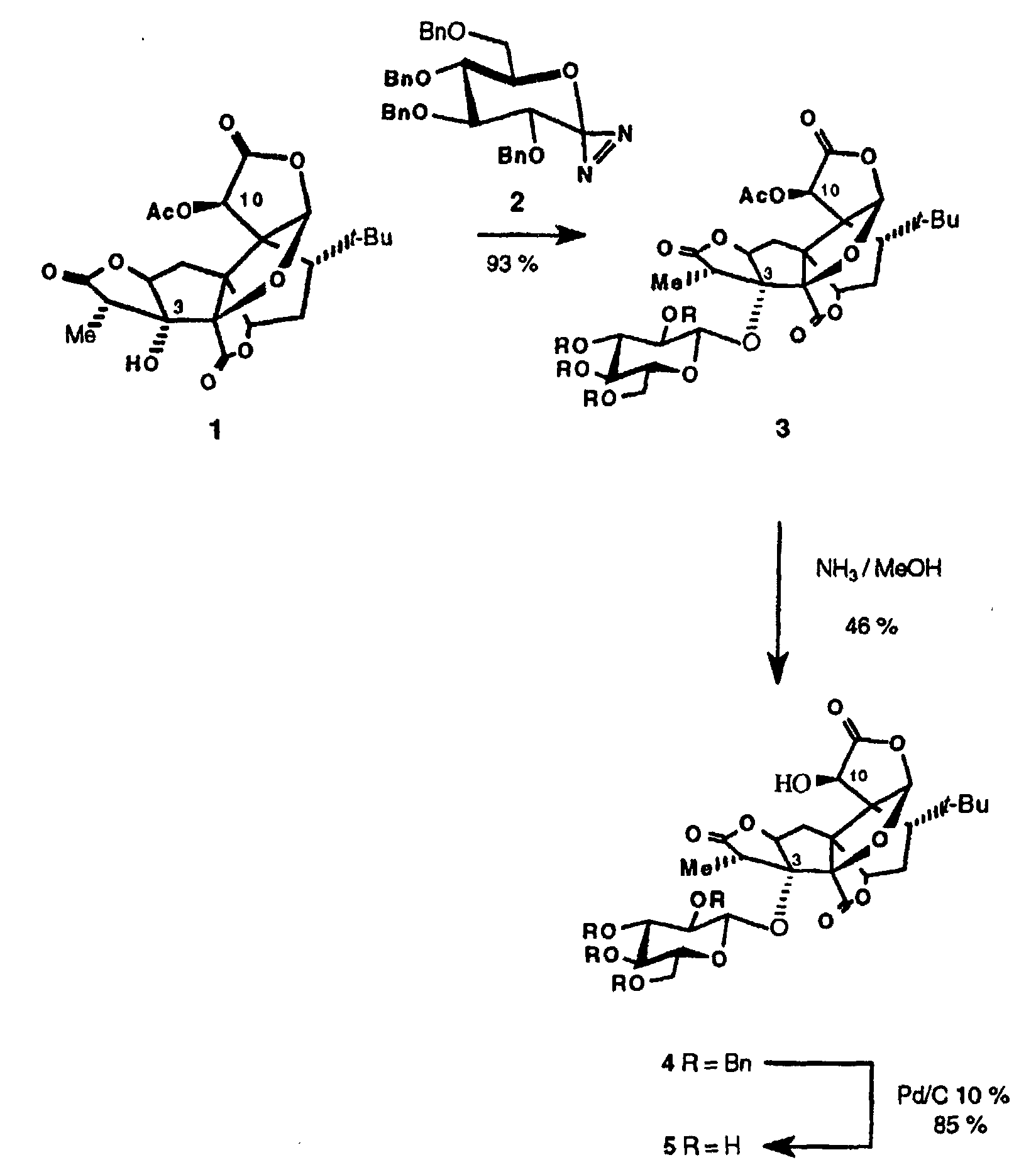
- 10-O-acetyl-ginkgolide A ( 1 ) (prepared from ginkgolide A which is reacted for 25 hours at room temperature with excess acetic anhydride in pyridine) is treated for one hour and half at 30 ° C with about 1.3 equivalent of glucosyl diazirine 2, the reaction being carried out in THF. After evaporation and crystallization, 3 is then obtained which is treated with NH 3 in MeOH to give the deacetylated product 4. The debenzylation of 4 is then carried out in a conventional manner by hydrogenation with Pd / C 10% in MeOH. 3-O- ( ⁇ -D-glucopyranosyl) ginkgolide A ( 5 ) is then obtained. Note that we could reverse the debenzylation and deacetylation steps.
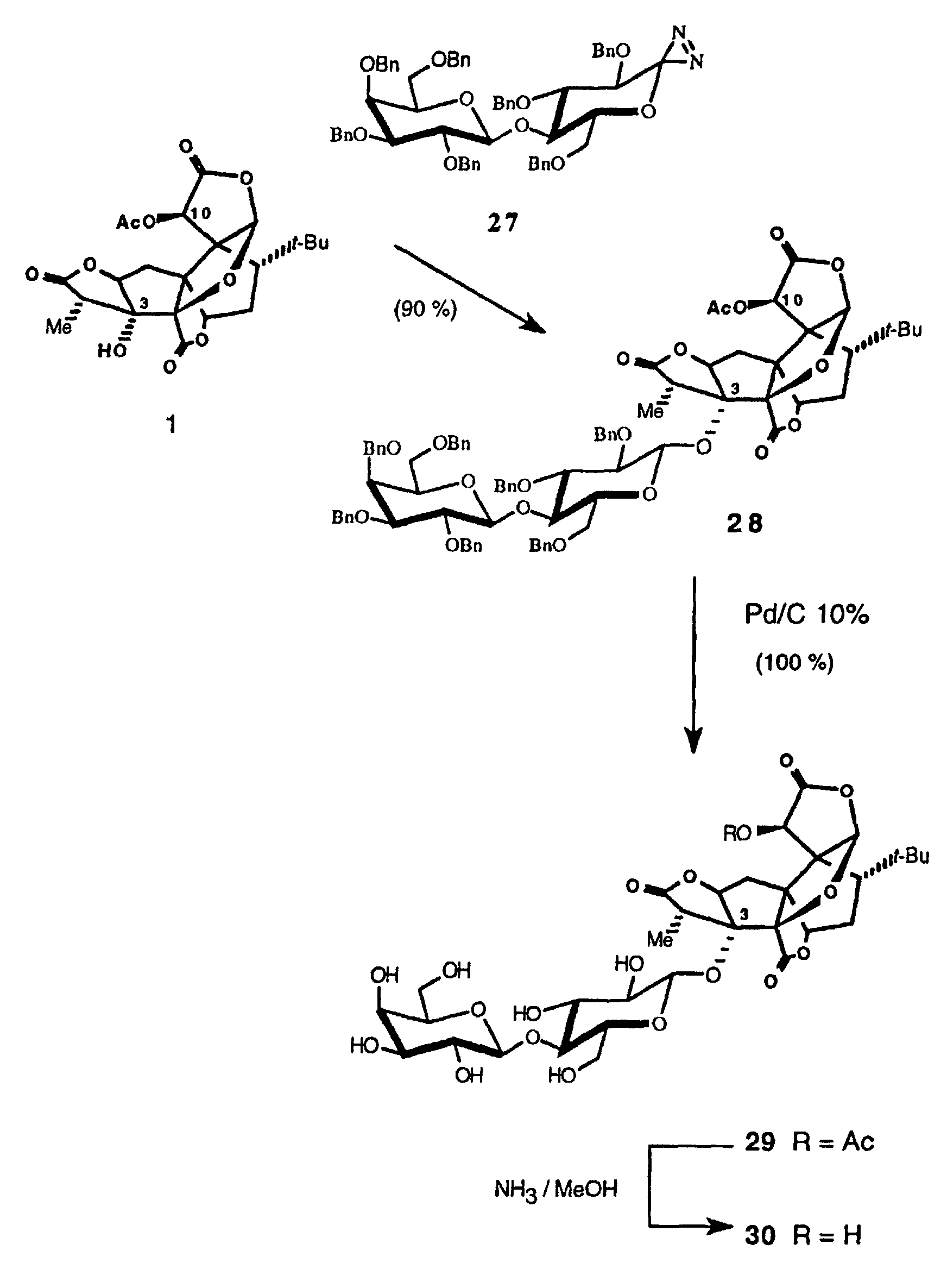
- 3-O - [(4-O- ⁇ -D-galactopyranosyl) - ⁇ -D-glucopyranosyl] ginkgolide A can be obtained by the following route:
- Ginkgolide A ( 1 ) is treated with a solution of diazirine 27 in THF for one hour. 28 is then obtained with a yield of 90%. 28 is debenzylated by hydrogenation in the presence of Pd / C 10% to give 29. Finally, 29 can be deacetylated by conventional methods (for example NH 3 / MeOH) to give 3-O - [(4-O- ⁇ - D-galactopyranosyl) - ⁇ -D-glucopyranosyl] ginkgolide A ( 30 ).
- conventional methods for example NH 3 / MeOH
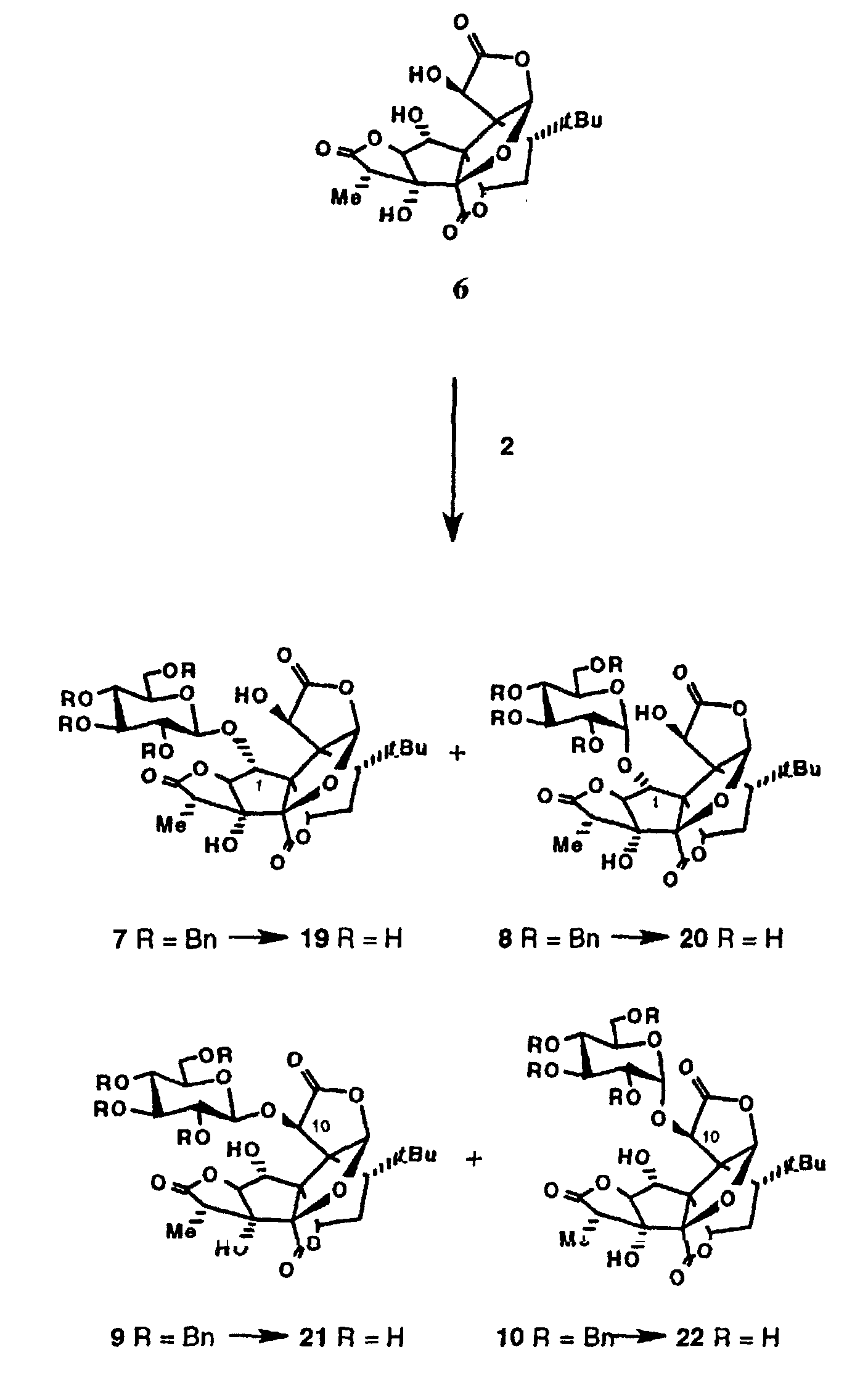
- photolytic conditions will preferably be chosen for the glycosylation reaction, using from 1 to 1.35 equivalent of glucosyl diazirine 2 approximately per equivalent of ginkgolide.
- the debenzylation of the monoglycosylated derivatives 7, 8, 9 and 10 to respectively give the compounds 19, 20, 21 and 22 is carried out as described above for the debenzylation of the compound 4.
- the monoglycosilated derivatives of ginkgolide B are obtained in the same way by starting from other glycosyldiazirines than 2, or by starting from another glycosylating reagent and by using a glycosylation reaction such as those described in the literature. The deprotection steps following the glycosylation reaction remain the same.
- the diglycosilated derivatives of ginkgolide B are obtained in the same way by starting from other glycosyldiazirines than 2 , or by starting from another glycosylating reagent and by using a glycosylation reaction such as those described in the literature. The deprotection steps following the glycosylation reaction remain the same.
- the triglucosylated derivatives of ginkgolide B ( 6 ) are obtained by reaction of 6 with at least 3.5 equivalents of glucosyl diazirine 2 in THF at 25 ° C, the addition of 2 being carried out in 2 times separated by an interval 24 hours for example. It is then left to react for approximately one day and the majority of 1,3,10-O- (2,3,4,6-tetra-O-benzyl- ⁇ -D-glucopyranosyl) ginkgolide B ( 18 ) is obtained.
- the triglycosylated derivatives of ginkgolide B are obtained in the same way by starting from other glycosyl diazirines than 2 , or by starting from another glycosylating reagent and by using a glycosylation reaction such as those described in the literature. The deprotection steps following the glycosylation reaction remain the same.
- Ginkgolide C can be glycosylated in a similar manner to that used for ginkgolides A or B. Those skilled in the art will choose the glycosyl diazirine stoichiometry or as a glycosylating reagent depending on the degree of glycosylation desired (mono- derivative, di-, tri- or tetraglycosylated).
- the methods described above can be applied to ginkgolides J and M to give glycosylated derivatives thereof, or to derivatives alkoxylated gikgolides to give the corresponding glycosylated compounds.
- the compounds according to the invention have interesting pharmacological properties and can for example be used to treat vascular disorders, and in particular cardiovascular disorders.
- the invention therefore also relates to all derivatives glycosylated ginkgolides A, B, C, J and M, or glycosylated derivatives of ginkgolides alkoxylates mentioned above as medicaments, as well as compositions pharmaceuticals comprising, as active principle, at least one of these compounds.
- the invention thus relates to pharmaceutical compositions containing a compound of the invention, in combination with a pharmaceutically acceptable carrier according to the chosen mode of administration (e.g. oral, intravenous, intraperitoneal, intramuscular, trans-dermal or subcutaneous).
- a pharmaceutically acceptable carrier e.g. oral, intravenous, intraperitoneal, intramuscular, trans-dermal or subcutaneous.
- These pharmaceutical compositions may be in solid, liquid, liposome or lipid micelle form.
- compositions according to the invention can be in solid form such as, for example, powders, pills, granules, tablets, liposomes, capsules or suppositories.
- the pill, tablet or capsule may be coated with a substance able to protect the composition of the action of stomach acid or enzymes in the subject's stomach for a period of time sufficient to allow this composition to pass undigested in the small intestine of the latter.
- the compound can also be administered according to the extended release process (e.g. a sustained release composition or infusion pump).
- Solid supports suitable may be, for example, calcium phosphate, stearate magnesium, magnesium carbonate, talc, sugars, lactose, dextrin, starch, gelatin, cellulose, methyl cellulose, carboxymethyl cellulose sodium, polyvinylpyrrolidine and wax.
- Pharmaceutical compositions containing a compound of the invention can therefore also be in the form liquid such as, for example, solutions, emulsions, suspensions or sustained release formulation.
- Suitable liquid carriers can be, for example example, water, organic solvents such as glycerol or glycols such as polyethylene glycol, as well as their mixtures, in various proportions, in the water.
- the invention further relates to the use of one of these derivatives to manufacture a medicine to treat vascular disease, especially diseases Cardiovascular.
- the dose of a compound according to the present invention varies according to the mode of administration, age and the body weight of the subject to be treated as well as the state of the latter, and it will be decided in final by the attending physician or veterinarian. Such an amount determined by the the attending physician or veterinarian is referred to herein as a "therapeutically effective amount”.
- Ginkgolide A (85 mg, 0.208 mmol) in pyridine (0.75 ml) was treated with Ac 2 O (82 ⁇ l, 0.87 mmol) and reacted for 20 hours at 25 ° C with stirring. After addition of ethanol, evaporation, and flash chromatography (eluent hexane / acetone 6: 4), 1 was obtained (88 mg, 94%).
- step 1.3 (47 mg, 0.05 mmol), mixed with Pd / C 10% (90 mg), was hydrogenated in MeOH (10 ml) for 72 hours under a pressure of 3 atm. After filtration, evaporation, and flash chromatography (eluent AcOEt / MeOH / H 2 O 8.5: 1.5: 1), 5 was obtained (25 mg, 84%).
- Example 2 Treatment of ginkgolide B (6) with 1, 2 or 3.5 equivalents of 1-azi-2,3,4,6-tetra-O-benzyl-1-deoxy-D-glucopyranose (2):
- Ginkgolide B ( 6 ) (134.0 mg, 0.31 mmol) in THF (4.0 ml) was cooled to -75 ° C, treated with a solution of 1-azi-2,3,4, 6-tetra-O-benzyl-1-deoxy-D-glucopyranose ( 2 ) (177 mg, 0.32 mmol) in THF (1.5 ml), and irradiated ( Philips HPK-125 high pressure mercury lamp) for 1 hour at -70 ° C. The mixture was then reheated to 23 ° C and evaporated.
- Ginkgolide B ( 6 ) (97.2 mg, 0.229 mmol), in THF (2.0 ml), was treated with a solution of 1-azi-2,3,4,6-tetra-O-benzyl -1-deoxy-D-glucopyranose ( 2 ) (135 mg, 0.245 mmol) in THF (1.0 ml) at 30 ° C, then, an hour later, with a second solution of 2 (119.0 mg, 0.216 mmol) in THF (0.9ml). The reaction medium is then stirred for 17 hours at 30 ° C.
- Ginkgolide B ( 6 ) (27.0 mg, 0.064 mmol) was treated with a solution of 1-azi-2,3,4,6-tetra-O-benzyl-1-deoxy-D-glucopyranose ( 2 ) (60.0 mg, 0.109 mmol) in THF (1.3 ml) at 25 ° C, then, 24 hours later, with a second solution of 2 (60.0 mg, 0.109 mmol) in THF (1, 3 ml). The reaction medium is then stirred for 20 hours at 25 ° C.
- Ginkgolide A ( 1 ) (7 mg, 15 ⁇ mol) was treated with a solution of 1-azi-2,3,6-tri-O-benzyl-4-O- [2,3,4,6-tetra -O-benzyl-D-galactopyranosyl] 1-deoxy-D-glucopyranose ( 27 ) (50 mg, 51 ⁇ mol; obtained according to methods similar to those mentioned for other glycosyl diazirines) in THF (1 ml), and stirred for 1 hour at 25 ° C. After evaporation and HPLC (eluent hexane / acetone 3: 2), 28 (20 mg, 90%) were obtained.
- HPLC eluent hexane / acetone 3: 2
Landscapes
- Chemical & Material Sciences (AREA)
- Organic Chemistry (AREA)
- Health & Medical Sciences (AREA)
- Engineering & Computer Science (AREA)
- General Health & Medical Sciences (AREA)
- Life Sciences & Earth Sciences (AREA)
- Biotechnology (AREA)
- Biochemistry (AREA)
- Molecular Biology (AREA)
- Genetics & Genomics (AREA)
- Pharmacology & Pharmacy (AREA)
- Chemical Kinetics & Catalysis (AREA)
- Heart & Thoracic Surgery (AREA)
- Animal Behavior & Ethology (AREA)
- Cardiology (AREA)
- Public Health (AREA)
- Veterinary Medicine (AREA)
- General Chemical & Material Sciences (AREA)
- Bioinformatics & Cheminformatics (AREA)
- Nuclear Medicine, Radiotherapy & Molecular Imaging (AREA)
- Medicinal Chemistry (AREA)
- Medicines Containing Plant Substances (AREA)
- Pharmaceuticals Containing Other Organic And Inorganic Compounds (AREA)
- Saccharide Compounds (AREA)
- Heterocyclic Carbon Compounds Containing A Hetero Ring Having Oxygen Or Sulfur (AREA)
Description

| Structure des ginkgolides A, B C, J et M | ||||
| Ginkgolide | W | X | Y | Z |
| A | OH | OH | H | H |
| B | OH | OH | OH | H |
| C | OH | OH | OH | OH |
| J | OH | OH | H | OH |
| M | H | OH | OH | OH |

étant entendu que l'un au moins de W, X, Y ou Z représente un radical O-GS.
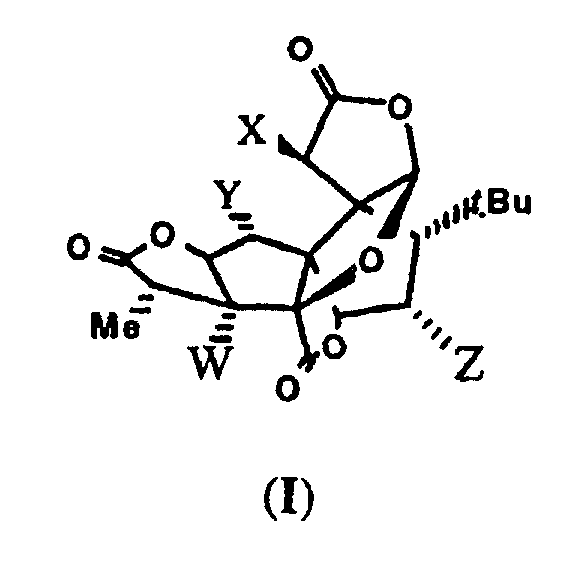
- ou bien W représente un radical OH ou O-GS, Y représente H et Z représente H ;
- ou bien W représente un radical OH ou O-GS, Y représente un radical OH ou O-GS et Z représente H ;
- ou bien W représente un radical OH ou O-GS, Y représente un radical OH ou O-GS et Z représente un radical OH ou O-GS ;
- ou bien W représente un radical OH ou O-GS, Y représente H et Z représente un radical OH ou O-GS ;
- ou bien W représente H, Y représente un radical OH ou O-GS et Z représente un radical OH ou O-GS ;
- ou bien W représente un radical OH ou O-GS, Y représente un radical alkoxy linéaire ou ramifié et Z représente H ;
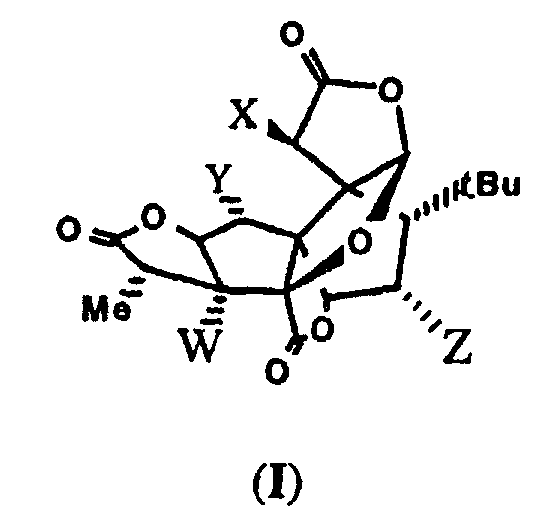
- ou bien W représente un radical OH ou O-GS, Y représente H et Z représente H ;
- ou bien W représente un radical OH ou O-GS, Y représente un radical OH ou O-GS et Z représente H ;
- ou bien W représente un radical OH ou O-GS, Y représente un radical alkoxy linéaire ou ramifié et Z représente H ;

avec une glycosyl diazirine de formule générale (II) représentée ci-dessous, la réaction s'effectuant de préférence dans du THF à des températures de préférence comprises entre 20 et 60 °C.

- 1-azi-2,3,4,6-tétra-O-benzyl-1-déoxy-D-glucopyranose ou 1-azi-1-déoxy-2,3:5,6-di-O-isopropylidène-D-mannofurannose (synthèses décrites dans Briner, K., Vasella, A., Helv. Chim. Acta, 75(2), 621-637 (1992)) ;
- 1-azi-2,3,4,6-tétra-O-benzyl-1-déoxy-D-galactopyranose (synthèse décrite dans Briner, K., Vasella, A., Helv. Chim. Acta, 73(6), 1764-1779 (1990)) ;
- 1-azi-2,3,4,6-tétra-O-benzyl-1-déoxy-D-mannopyranose (synthèse décrite dans Vasella, A., Witzig, C., Waldraff, C., Uhlmann, P., Briner, K., et al., Helv. Chim. Acta, 76(8), 2847-2875 (1993)) ;
- 2-acétamido-1,5-anhydro-1-azi-3-O-benzyl-4,6-O-benzylidène-1,2-didéoxy-D-allitol (synthèse décrite dans Vasella, A., Dhar, P., Witzig, C., Helv. Chim. Acta, 76(4), 1767-1778 (1993) et Linden, A., Vasella, A., Witzig, C., Helv. Chim. Acta, 75(5), 1572-1577 (1992)) ;
- 1,5-anhydro-1-azi-2-déoxy-3,4,6-tri-O-pivaloyl-D-glucitol (synthèse décrite dans Takahashi, Y., Vasella, A., Helv. Chim. Acta, 75(5), 1563-1571 (1992)) ;
- 1,5-anhydro-1-azi-2,3,4,6-tétra-O-pivaloyl-D-glucitol ou 2-acétamido-1,5-anhydro-1-azi-3-O-benzyl-4,6-O-benzylidène-1,2-didéoxy-D-glucitol (synthèses décrites dans Vasella, A., Witzig, C., Waldraff, C., Uhlmann, P., Briner, K., et al., Helv. Chim. Acta, 76(8), 2847-2875 (1993)) ;
- 1,5-anhydro-1-azi-2,3-di-O-benzyl-4,6-O-benzylidène-D-mannitol (synthèse décrite dans Uhlmann, P., Briner, K., et al., Helv. Chim. Acta, 76(8), 2847-2875 (1993)) ;
- 1,5-anhydro-1-azi-2,3-di-O-benzyl-4,6-O-(4-méthoxybenzylidène)-D-glucitol (synthèse décrite dans Vasella, A., Witzig, C., Waldraff, C., Uhlmann, P., Briner, K., et al., Helv. Chim. Acta, 76(8), 2847-2875 (1993)) ;
- 2-acétamido-1,5-anhydro-1-azi-3,4,6-tri-O-benzyl-2-déoxy-D-glucitol (synthèse décrite dans Vasella, A., Witzig, C., Waldraff, C., Uhlmann, P., Briner, K., et al., Helv. Chim. Acta, 76(8), 2847-2875 (1993)) ;
- 1-azi-1-déoxy-2,3:4,6-di-O-isopropylidène-D-glucopyranose (synthèse décrite dans Uhlmann, P., Harth, E., Naughton, A.B., Vasella, A., Helv. Chim. Acta, 77(8), 2335-2340 (1994)) ;
- (Z)-N'-2,3,5-tri-O-benzyl-D-(ribofuranosylidène)toluène-4-sulfonohydrazide ou (Z)-N'-2,3,5-tri-O-benzyl-D-(arabinofuranosylidène)toluène-4-sulfonohydrazide (synthèse décrite dans Mangholz, S.E., Vasella, A., Helv. Chim. Acta, 78(4), 1020-1035 (1995)) ;
- 1-azi-2,3,6-tri-O-benzyl-4-O-[2,3,4,6-tétra-O-benzyl-D-galactopyranosyl]1-déoxy-D-glucopyranose (synthèse selon Briner, K., Vasella, A., Helv. Chim. Acta, 72, 1371 (1989)).


IR (CHCl3) : 3483, 2960, 1780, 1602, 1372, 1325, 1152, 1125, 1104, 1084, 1062, 994, 940, 899.
RMN 1H (200 MHz, acétone (D6)) : 6,29 (s, H-C(10)); 6,19 (s, H-C(12)); 5,31 (s, HO-C(3)); 5,04-5,01 (m, H-C(6)); 4,92 (dd, J = 7,5 Hz, 9,1 Hz, H-C(2)); 3,15 (q, J = 7,1 Hz, H-C(14)); 3,03 (dd, J = 7,5 Hz, 14,9 Hz, H-C(1)); 2,25 (s, AcO); 2,24-1,86 (m, H-C(1), H-C(7), H'-C(7), H-C(8)); 1,29 (d, J = 7,1 Hz, Me-C(14)); 1,12 (s, tBu).
Pf 222°C
IR (CHCl3) : 3066, 3008, 2967, 2874, 1801, 1605, 1497, 1454, 1406, 1373, 1323, 1276, 1116, 1074, 997, 957, 900.
RMN 1H (300 MHz, acétone (D6)) : 7,44-7,22 (m, 20 H); 6,34 (s, H-C(10)) ; 6,21 (s, H-C(12)); 5,60 (dd, J = 8,4 Hz, 9,0 Hz, H-C(2)); 5,01 (d, J = 3,1 Hz, H-C(6)); 4,92 (d, J = 10,6 Hz), 4,82 (s), 4,77 (d, J = 10,9 Hz, 4 PhCH); 4,72 (d, J = 7,5 Hz, H-C(1')); 4,66 (d, J = 11,2 Hz), 4,65 (d, J = 11,5 Hz), 4,61 (d, J = 10,6 Hz), 4,51 (d, J = 11,8 Hz, 4 PhCH); 3,81-3,75 (m, H-C(4'), H-C(6'), H'-C(6')); 3,60 (t, J = 9,0 Hz, H-C(3')); 3,41 (dd, J = 7,5 Hz, 9,0 Hz, H-C(2')); 3,34 (dt, J = 2,2 Hz, 9,6 Hz, H-C(5')); 3,20 (q, J = 6,8 Hz, H-C(14)); 3,17 (dd, J= 7,5 Hz, 14,9 Hz, H-C(1)); 2,25 (s, AcO); 2,21-2,16 (m, 2 H); 2,01-1,89 (m, 2H); 1,43 (d, J = 6,8 Hz, Me-C(14)); 1,11 (s, tBu).
RMN 13C (100 MHz, acétone (D6)): 176,4 (s); 170,4 (s); 169,6 (s); 169,1 (s); 140,0 (s); 139,9 (s); 139,7 (2s); 129,1-128,1 (plusieurs d); 111,8 (d); 101,9 (s);
99,3 (d); 94,4 (s); 85,7 (d); 85,2 (d); 82,6 (d); 82,2 (d); 78,0 (d); 75,9 (t); 75,7 (d); 75,5 (t); 75,2 (t); 73,9 (t); 70,3 (d); 69,6 (s); 68,3 (t); 66,8 (s); 49,8 (d); 41,9 (d); 38,1 (t); 37,5 (t); 32,8 (s); 20,5 (q); 8,4 (q).
Analyse élémentaire : C 68,87 %, H 6,21 % (valeurs théoriques : C 69,12 % et H 6,21 %).
IR (CHCl3) : 3290, 3008, 2967, 2874, 1794, 1497, 1454, 1362, 1324, 1144, 1073, 1028, 995, 953, 903.
RMN 1H (300 MHz, acétone (D6)) : 7,43-7,25 (m, 20 H); 6,13 (s, H-C(12)); 5,95 (d, J = 4,4 Hz, HO-C(10)); 5,54 (t, J = 8,4 Hz, H-C(2)); 5,22 (d, J = 4,1 Hz, H-C(10)); 4,95-4,91 (m, H-C(6), Ph-CH), 4,82 (s), 4,77 (d, J = 11,2 Hz, 3 PhCH); 4,72 (d, J = 7,5 Hz, H-C(1')); 4,65 (d,J = 13,1 Hz), 4,65 (d, J = 11,5 Hz), 4,61 (d, J = 10,9 Hz), 4,52 (d, J = 11,8 Hz, 4 PhCH); 3,81-3,74 (m, H-C(4'), H-C(6'), H'-C(6')); 3,61 (t, J = 9,0 Hz, H-C(3')); 3,43-3,33 (m, H-C(2'), H-C(5')); 3,21 (q, J = 6,8 Hz, H-C(14)); 3,03 (dd, J = 7,5 Hz, 14,9 Hz, H-C(1)); 2,25 (s, AcO); 2,30-1,91 (m, 4 H); 1,43 (d, J = 6,8 Hz, Me-C(14)); 1,15 (s, tBu).
RMN 1H (300 MHz, CD3OD) : 6,07 (s, H-C(12)); 5,50 (dd, J = 8,1 Hz, 9,0 Hz, H-C(2)); 5,04 (s, H-C(10)); 4,90 (d, J = 3,4 Hz, H-C(6)); 4,50 (d, J = 7,5 Hz, H-C(1')); 3,75 (dd, J = 2,2 Hz, 12,1 Hz, H-C(6')); 3,60 (dd, J = 4,8 Hz, 12,1 Hz, H'-C(6')); 3,35-3,15 (m, 5H); 2,93 (dd, J = 7,5 Hz, 14,9 Hz, H-C(1)); 2,29-2,11 (m, 2H); 2,00-1,85 (m, 2 H); 1,33 (d, J = 6,8 Hz, Me-C(14)); 1,10 (s, tBu).
RMN 1H (500 MHz, acétone (D6)) : 7,42-7,24 (m, 20 H); 6,02 (s, H-C(12)); 5,60 (d, J = 3,7 Hz, H-C(6)); 5,50 (s, échangé par D2O, HO-C(3)); 4,98-4,96 (m, 2 H); 4,87 (d, J = 11,2 Hz, PhCH); 4,84-4,79 (m, 3 H); 4,76 (d, J = 11,3 Hz), 4,67 (d, J = 11,1 Hz), 4,66 (d, J = 12,3 Hz), 4,60 (d, J = 12,3 Hz, 4 PhCH); 3,83 (dd, J = 2,0 Hz, 11,0 Hz, H-C(6')); 3,78 (dd, J = 3,9 Hz, 11,0 Hz, H'-C(6')); 3,71 (t, J = 8,9 Hz, H-C(4')); 3,66 (t, J = 8,5 Hz, H-C(3')); 3,51 (ddd, J = 1,9 Hz, 3,9 Hz, 9,5 Hz, H-C(5')); 3,46 (t, J = 8,1 Hz, H-C(2')); 3,06 (q, J = 7,5 Hz, H-C(14)); 2,10 (ddd, J = 3,9 Hz, 13,7 Hz, 13,9 Hz, H-C(7)); 2,03 (dd, J = 4,7 Hz, 13,5 Hz, H'-C(7)); 1,93 (dd, J = 4,7 Hz, 14,0 Hz, H-C(8)); 1,29 (d, J = 7,5 Hz, Me-C(14)); 1,11 (s, t-Bu).
RMN 13C (125 MHz, acétone (D6)) : 176,5 (s); 173,9 (s); 171,7 (s); 140,1 (s); 139,9 (s); 139,8 (s); 139,8 (s); 129,3-128,4 (plusieurs d) 110,1 (d); 104,0 (d); 103,3 (s); 95,5 (d); 86,2 (s); 85,8 (d); 83,7 (d); 83,4 (d); 80,2 (d); 79,8 (d); 76,1 (t); 76,0 (d); 75,4 (2t); 74,9 (s); 74,2 (t); 70,4 (d); 70,2 (s); 69,7 (t); 50,6 (d); 42,1 (d); 37,8 (t); 33,3 (s); 10,4 (q).
RMN 1H (400 MHz, acétone (D6)) : 7,34-7,18 (20 H); 6,08 (s, H-C(12)); 5,62 (d, J = 3,5 Hz, H-C(6)); 5,36 (s , échangé par D2O, HO-C(3)); 4,93 (d, J = 11,2 Hz, PhCH), 4,87-4,81 (m, 5 H); 4,79 (d, J = 11,6 Hz), 4,60 (d, J = 12,2 Hz), 4,57 (d, J = 12,1 Hz, 3 PhCH); 4,21 (dt, J = 3,0 Hz, 10,1 Hz, H-C(5')); 3,90 (t, J = 9,4 Hz, H-C(3')); 3,70 (d, J = 3,1 Hz, 2 H-C(6')); 3,61 (dd, J = 3,7 Hz, 9,6 Hz, H-C(2')); 3,57 (dd, J = 9,1 Hz, 10,1 Hz, H-C(4')); 3,12 (q, J = 7,2 Hz, H-C(14)); 2,20 (dd, J = 5,2 Hz, 13,4 Hz, H-C(7)); 2,19-2,13 (m, H'-C(7)); 1,92 (dd, J = 5,2 Hz, 13,5 Hz, H-C(8)); 1,28 (d, J = 7,2 Hz, Me-C(14)); 1,14 (s, t-Bu).
RMN 13C (100 MHz, acétone (D6)) : 176,2 (s); 173,9 (s); 171,1 (s); 140,1 (s); 139,7 (s); 139,5 (2s); 129,2-128,2 (plusieurs d); 110,5 (d); 101,0 (s); 96,3 (d); 93,7 (d); 85,4 (s); 82,3 (d); 81,1 (d); 80,1 (d); 79,8 (d); 78,9 (d); 75,7 (2t); 73,9 (t); 73,9 (t); 73,6 (s); 72,5 (d); 70,1 (d); 69,8 (s, t); 50,0 (d); 42,5 (d); 37,6 (t); 33,1 (s); 8,8 (q).
RMN 13C (125 MHz, acétone (D6)): 176,8 (s); 171,0 (s); 170,3 (s); 139,6 (s); 139,4 (s); 139,4 (s); 139,4 (s); 129,3-127,9 (plusieurs d); 110,3 (d); 100,5 (d); 99,7 (s); 93,5 (d); 85,9 (d); 83,9 (s); 81,6 (d); 79,5 (d); 78,7 (d); 75,9 (d); 75,6 (t); 75,3 (t); 75,2 (d); 74,9 (d); 74,4 (t); 74,2 (t); 73,3 (s); 69,4 (t); 69,0 (s); 50,1 (d); 42,9 (d); 37,6 (t); 32,8 (s); 8,2 (q).
RMN 1H (400 MHz, acétone (D6)) : 7,39-7,06 (20 H); 6,25 (s, H-C(12)); 5,42 (d, J = 3,9 Hz, H-C(6)); 5,31 (s, échangé par D2O, HO-C(3)); 5,07 (d, J = 10,8 Hz), 4,83 (d, J = 10,7 Hz), 4,81 (d, J = 11,0 Hz), 4,77 (d, J = 11,2 Hz), 4,75 (d, J = 11,3 Hz), 4,62 (d, J = 10,7 Hz), 4,60 (d, J = 11,9 Hz), 4,52 (d, J = 11,9 Hz, 8 PhCH); 3,88-3,70 (m, 5 H); 3,55 (dd, J = 1,4 Hz, 10,7 Hz, H'-C(6')); 3,07 (q, J= 7,0 Hz, H-C(14)); 2,24 (dd, J = 4,3 Hz, 13,4 Hz, H-C(7)); 2,04-1,96 (m, H'-C(7)); 1,85 (dd, J = 4,1 Hz, 14,5 Hz, H-C(8)); 1,28 (d, J = 7,0 Hz, Me-C(14)); 1,18 (s, t-Bu).
RMN 13C (100 MHz, acétone (D6)) : 176,6 (s); 172,9 (s); 171,0 (s); 139,6 (s); 139,5 (s); 139,4 (s); 137,6 (s); 129,4-128,3 (plusieurs d); 110,7 (d); 99,6 (s); 96,6 (d); 93,3 (d); 83,4 (s); 81,8 (d); 80,8 (d) 79,2 (d); 77,9 (d); 76,1 (t); 75,8 (t); 75,7 (t); 74,7 (d); 74,1 (t); 73,7 (d); 73,7 (d); 72,9 (s); 69,1 (t); 69,2 (s); 49,6 (d); 42,9 (d); 38,4 (t); 33,1 (s); 8,2 (q).
RMN 1H (300 MHz, acétone (D6)) : 7,46-7,20 (m, 40 H); 6,30 (s, H-C(12)); 5,34 (d, J = 3,7 Hz, H-C(6)); 5,10 (d, J = 10,6 Hz), 4,93 (d, J = 10,6 Hz), 4,84 (d, J = 10,6 Hz), 4,81-4,50 (m, 16 PhCH); 3,89-3,71 (m, 8 H); 3,67 (t, J = 8,7 Hz, H-C(3'')); 3,55 (d, J = 10,0 Hz, H'-C(6')); 3,43-3,40 (m, H-C(5")); 3,38 (dd, J= 7,5 Hz, 8,7 Hz, H-C(2")); 3,12 (q, J = 6,8 Hz, H-C(14)); 2,22 (dd, J = 3,9 Hz, 12,9 Hz, H-C(7)); 1,98 (ddd, J = 4,0 Hz, 13,1 Hz, 14,2 Hz, H'-C(7)); 1,85 (dd, J = 3,7 Hz, 14,3 Hz, H-C(8)); 1,44 (d, J = 6,8 Hz, Me-C(14)); 1,17 (s, t-Bu).
RMN 1H (300 MHz, acétone (D6)) : 7,45-7,22 (m, 40 H); 6,13 (s, H-C(12)); 5,58 (m, H-C(6)); 4,98 (d, J = 11,2 Hz), 4.96-4,75 (m, 9 PhCH); 4,65-4,58 (m, irradiation à 5,28 → m, H-C(1), 6 PhCH); 4,48 (d, J = 11,5 Hz, PhCH); 4,21 (dt, H-C(5')); 3,98 (t, J = 9,6 Hz, H-C(3')); 3,72-3,67 (m, 5 H); 3,62 (dd, J = 3,7 Hz, 9,6 Hz, H-C(2')); 3,58 (t, J = 9,0 Hz, H-C(4')); 3,47 (t, J = 9,0 Hz, irradiation à 3,35 → d, J = 9,3 Hz, H-C(3")); 3,35 (dd, J = 7,5 Hz, 9,0 Hz, H-C(2")); 3,15 (q, J = 7,0 Hz, H-C(14)); 3,04 (dt, H-C(5'')); 2,16-2,14 (m, H-C(7)); 1,93-1,84 (m, H'-C(7)); 1,39 (d, J= 6,9 Hz, Me-C(14));1,36-1,29 (m, H-C(8)); 1,13 (s, t-Bu).
RMN 1H (300 MHz, acétone (D6)) : 7,44-7,16 (m, 40 H); 6,15 (s, H-C(12)); 5,43-5,42 (m, H-C(6)); 4,97 (d, J = 11,5 Hz), 4,90 (d, J = 10,9 Hz), 4,85 (d, J = 11,2 Hz), 4,83 (d, J = 11,2 Hz), 4,80-4,68 (m), 4,62 (d, J = 12,5 Hz), 4,61 (d, J = 12,1 Hz), 4,48 (d, J = 11,8 Hz, 16 PhCH); 3,93 (d, J = 2,2 Hz, H-C(6'), H'-C(6')); 3,83 (dd, J = 9,0 Hz, 9,7 Hz, H-C(4')); 3,74-3,63 (m, irradiation à 3,83 → m, H C(3'), 3 H); 3,55-3,46 (m, irradiation à 3,83 → m, H-C(5'), irradiation à 4,81 → m, H-C(2'), irradiation à 3,37 → m, H-C(3")); 3,37 (dd, J = 7,5 Hz, 9,0 Hz, irradiation à 4,65 → d, J = 9,0 Hz, H-C(2")); 3,25 (m, H-C(5"); 3,22 (q, J = 6,8 Hz, H-C(14)); 1,89 (dd, J = 6,5 Hz, 12,4 Hz, H-C(7)); 1,41 (d, J = 7,1 Hz, Me-C(14)); 1,09 (s, t-Bu).
RMN 1H (300 MHz, acétone (D6)) : 7,43-7,22 (m, 40 H); 6,19 (s, H-C(12)); 5,27 (d, J = 3,4 Hz, H-C(6)); 4,97 (d, J = 11,8 Hz), 4,93 (d, J = 11,8 Hz), 4,92 (d, J = 10,6 Hz), 4,87-4,73 (m), 4,68-4,48 (m, 16 PhCH); 3,99-3,94 (m, 1 H); 3,82-3,55 (m, 9 H); 3,39 (dd, J = 4,2 Hz, 7,3 Hz, irradiation à 4,80 → m, H-C(2')); 3,38 (dd, J = 6,5 Hz, 7,3 Hz, 1 H); 3,37 (dd, J = 7,8 Hz, 8,7 Hz, irradiation à 4,50 → d, J = 9,0 Hz, H-C(2")); 3,05 (q, J = 6,8 Hz, H-C(14)); 2,16-1,74 (m, 3 H); 1,41 (d, J = 6,8 Hz, Me-C(14)); 1,14 (s, tBu).
RMN 1H (500 MHz, acétone (D6)) : 7,45-7,01 (m, 60 H); 6,05 (s, H-C(12)); 5,44 (d, J = 3,6 Hz, H-C(6)); 5,26 (d, J = 10,7 Hz), 5,02 (d, J = 10,7 Hz), 4,99 (d, J = 11,1 Hz), 4,96 (d, J = 12,0 Hz), 4,95 (d, J = 10,6 Hz), 4,90 (d, J = 10,7 Hz), 4,83 (d, J = 11,4 Hz), 4,80 (d, J = 11,6 Hz), 4,78 (d, J = 11,4 Hz), 4,77 (d, J = 10,7 Hz), 4,69-4,59 (m), 4,48 (d, J = 12,6 Hz), 4,47 (d, J = 12,0 Hz), 4,45 (d, J = 11,3 Hz, 21 PhCH); 4,44 (m, H-C(3")); 4,41 (d, J = 12,1 Hz), 4,38 (d, J = 11,3 Hz), 4,31 (d, J = 12,6 Hz, 3 PhCH); 4,06 (t, J = 9,7 Hz, H-C(4')); 4,00 (t, J = 9,2 Hz, H-C(3")); 3,99 (m c, H-C(6')); 3,94 (dd, J = 4,5 Hz, 10,6 Hz, H-C(2')); 3,73-3,63 (m, H-C(3'''), H-C(5'''), H-(6'''), H'-C(6'''), H-C(5'), H-C(4''')); 3,59-3,55 (m, H-C4"), H-C(6')); 3,45 (dd, J = 7,9 Hz, 9,4 Hz, H-C(2")); 3,40 (t, J = 7,7 Hz, H-C(2''')); 3,23 (dd, J = 3,7 Hz, 10,9 Hz, H-C(6")); 3,18 (q, J = 7,8 Hz, H-C(14)); 3,14 (dd, J = 1,6 Hz, 11.0 Hz, H'-C(6")), 2,95 (m c, H-C(5")); 1,76 (dd, J = 4,1 Hz, 14,6 Hz, H-C(7)); 1,44 (d, J = 7,8 Hz, Me-C(14)); 1,33 (m, H-C(8)); 1,14 (dt, J = 4,0 Hz, 14,2 Hz, H'-C(7)); 1,04 (s, t-Bu).
RMN 1H (500 MHz, acétone (D6)) : 7,42-7,05 (m, 60 H); 6,03 (s, H-C(12)); 5,36 (d, J = 3,7 Hz, H-C(6)); 5,17 (d, J = 10,6 Hz), 5,03 (d, J = 10,9 Hz), 4,99 (d, J = 11,7 Hz), 4,93 (d, J = 11,3 Hz), 4,88 (d, J = 11,2 Hz), 4,85 (d, J = 11,0 Hz), 4,80 (d, J = 12,5 Hz), 4,78 (d, J = 11,2 Hz), 4,74 (d, J = 11,2 Hz), 4,70 (d, J = 11,0 Hz), 4,66 (d, J = 11,9 Hz), 4,62 (d, J = 10,5 Hz), 4,60 (d, J = 11,0 Hz), 4,51 (d, J = 10,5 Hz), 4,50 (d, J = 11,7 Hz), 4,49 (d, J = 10,6 Hz), 4,47 (m), 4,43 (d, J = 12,1 Hz), 4,39 (d, J = 11,2 Hz), 4,37 (d, J = 12,0 Hz, 24 PhCH); 4,19-4,13 (m, H-C(5'), H-C(4'''), H-C(3')); 3,97 (t, J = 7,8 Hz, H-C(2")); 3,87 (m, H-C(4')); 3,84 (t, J = 7,8 Hz, H-C(3")); 3,82-3,67 (m, 7 H); 3,66 (dd, J = 4,4 Hz, 9,6 Hz, H-C(2')); 3,46 (dd, J = 2,9 Hz, 10,8 Hz, 1 H); 3.40-3,38 (m, 1H); 3,36 (dd, J = 7,6 Hz, 8,9 Hz, H-C(2''')); 3,10 (q, J = 7,5 Hz, H-C(14)); 3,07 (m, 1 H); 1,94 (dt, J = 4,0 Hz, 14,1 Hz, H-C(7)); 1,75 (dd, J = 4,0 Hz, 14,4 Hz, H'-C(7)); 1,36 (dd, J = 4,1 Hz, 13,4 Hz, H-(8)); 1,30 (d, J = 7,5 Hz, Me-C(14)); 0,94 (s, t-Bu).
RMN 1H (300 MHz, acétone (D6)) : 7,50-7,09 (m, 60 H); 6,11 (s, H-C(12)); 5.66 (s, H-C(6)); 5,10 (d, J = 11,5 Hz), 4,99 (d, J = 11,2 Hz), 4,97 (d, J = 11,2 Hz), 4,88 (d, J = 11,2 Hz), 4,86 (d, J = 11,2 Hz), 4,77 (d, J = 11,2 Hz), 4,78-4,53 (m), 4,47 (d, J = 11,8 Hz), 4,43 (d, J = 11,2 Hz, 24 PhCH); 4,10 (t, J = 8,1 Hz, irradiation à 5,01 → d, J = 8,4 Hz, H-C(2")); 4,00-3,94 (m, irradiation à 3,42 → m, H-C(3'''), 1 H); 3,86-3,66 (m, irradiation à 4,10 → m, II-C(3"), 9 II), 3,58 (dd, J = 7,9 Hz, 9,2 Hz, irradiation a 5,34 → d, J = 9,0 Hz, H-C(2')); 3,57 (t, J = 9,0 Hz, 1 H); 3,46-3,39 (m, irradiation à 4,83 → m, H-C(2'''), 2 H); 3,28 (q, J = 7,2 Hz, H-C(14)); 1,91-1,85 (m, 1 H); 1,45 (d, J = 7,5 Hz, Me-C(14)); 0,98 (s, tBu).
RMN 1H (400 MHz, acétone(D6)) : 6,09 (s, H-C(12)); 5,55-5,35 (m, H-C(6)); 3,85-3,79 (m, H-C(6')); 3,66 (dd, J = 5,4 Hz, 11,6, H'-C(6')); 3,47 (t, J = 8,8 Hz, H-C(3')); 3,40-3,33 (m, H-C(4'), H-C(5')); 3,28 (dd, J = 7,8 Hz, 8,9 Hz, H-C(2')); 3,09 (q, J = 7,2 Hz, H-C(14)); 2,25-2,18 (m, H-C(7), H'-C(7)); 1,94 (dd, J = 6,5 Hz, 12,4 Hz, H-C(8)); 1,25 (d, J = 7,4 Hz, Me-C(14)); 1,26 (s, t-Bu).
RMN 13C (100 MHz, acétone (D6)) : 176,4 (s); 173,9 (s); 170,9 (s); 110,6 (d); 100,8 (s); 94,0 (d); 85,5 (s); 83,2 (d); 80,1 (d); 77,8 (2d); 75,0 (d); 73,2 (s); 71,5 (d); 70,4 (d); 69,6 (s); 62,8 (t); 50,0 (d); 42,4 (d); 37,7 (t); 33,1 (s); 31,9 (3q); 8,8 (q).
RMN 1H (300 MHz, CD3OD) : 6,00 (s, H-C(12)); 5,67 (d, J = 3,1 Hz, H-C(6)); 3,90 (ddd, J = 2,6 Hz, 3,4 Hz, 9,6 Hz, H-C(5')); 3,81 (dd, J = 2,5 Hz, 12,1 Hz, H-C(6')); 3,73 (dd, J = 3,7 Hz, 11,8 Hz, H'-C(6')); 3,61 (dd, J = 9,0 Hz, 9,9 Hz, H-C(3')); 3,47 (dd, J = 3,7 Hz, 9,9 Hz, irradiation à 5,11 → d, J = 9,7 Hz, H-C(2')); 3,44 (dd, J = 9,0 Hz, 9,9 Hz, H-C(4')); 3,07 (q, J = 7,2 Hz, H-C(14)); 2,22-2,10 (m, H-C(7), H'-C(7)); 1,89 (dd, J = 5,6 Hz, 12,5 Hz, H-C(8)); 1,24 (d, J = 7,5 Hz, Me-C(14)); 1,11 (s, t-Bu).
RMN 13C (100 MHz, CD3OD) : 178,1 (s); 175,2 (s); 173,1 (s); 110,8 (d); 103,2 (s); 94,2 (d); 85,8 (s); 81,1 (d); 80,3 (d); 74,9 (s); 74,7 (d); 74,2 (d); 73,3 (d); 71,0 (d); 70,6 (s); 70,4 (d); 61,9 (t); 50,8 (d); 42,8 (d); 37,8 (t); 33,4 (s); 29,6 (3q); 9,6 (q).
RMN 1H (500 MHz, acétone (D6)) : 6,15 (s, H-C(12)); 5,43 (d, J = 4,0 Hz, H-C(6)); 5,27 (s, échangé par D2O, HO-C(3)); 3,87-3,83 (m, H-C(6')); 3,78 (m, H'-C(6')); 3,66-3,62 (m, H-C(5')); 3,49-3,45 (m, H-C(2-)); 3,41-3,34 (m, H-C(3'), H-C(4')); 3,02 (q, J = 7,1 Hz, H-C(14)); 2,28 (dd, J = 4,3 Hz, 13,5 Hz, H-C(7)); 2,08-2,01 (m, H'-C(7)); 1,93 (dd, J = 4,3 Hz, 14,6 Hz, H-C(8)); 1,26 (d, J = 7,1 Hz, Me-C(14)); 1,21 (s, t-Bu).
RMN 13C (125 MHz, acétone (D6)) : 176,7 (s); 171,6 (s); 171,1 (s); 110,0 (d); 99,8 (s); 93,3 (d); 84,1 (s); 79,4 (d); 78,8 (d); 77,7 (d); 75,6 (d); 75,5 (d); 73,6 (s); 72,7 (d); 71,6 (d); 69,2 (s); 62,6 (t); 50,5 (d); 43,0 (d); 37,7 (t); 32,9 (s); 29,7 (3q); 8,2 (q).
RMN 1H (300 MHz, CD3OD) : 6,14 (s, H-C(12)); 5,44 (d, J = 4,0 Hz, H-C(6)); 3,79-3,73 (m, H-C(5')); 3,67-3,44 (m, 5 H); 3,06 (q, J = 7,2 Hz, H-C(14)); 2,23 (dd, J = 4,4 Hz, 13,4 Hz, H-C(7)); 2,01 (ddd, J = 4,1 Hz, 13,6 Hz, 14,3 Hz, H'-C(7)); 1,81 (dd, J = 4,3 Hz, 14,3 Hz, H-C(8)); 1,21 (d, J = 7,2 Hz, Me-C(14)); 1,12 (s, t-Bu).
RMN 13C (100 MHz, CD3OD) : 178,5 (s); 173,1 (s); 172,8 (s); 111,2 (d); 100,3 (s), 94,7 (d), 83,6 (s); 80,4 (d); 74,8 (d); 74,8 (d); 74,1 (d); 73,5 (d); 73,4 (s); 72,4 (d); 70,2 (d); 69,8 (s); 61,5 (t); 50,2 (d); 43,4 (d); 38,3 (t); 33,4 (s); 29,9 (3q); 8,1 (q).
RMN 1H (300 MHz, CD3OD) : 6,17 (s, H-C(12)); 5,50 (d, J = 4,1 Hz, H-C(6)); 3,78-3,15 (m, 12 H); 3,08 (q, J = 6,8 Hz, H-C(14)); 2,24 (dd, J = 4,4 Hz, 13,7 Hz, H-C(7)); 2,02 (ddd, J = 4,0 Hz, 13,7 Hz, 14,0 Hz, H'-C(7)); 1,80 (dd, J = 4,0 Hz, 14,3 Hz, H-C(8)); 1,31 (d, J= 6,8 Hz, Me-C(14)); 1,12 (s, t-Bu).
RMN 1H (300 MHz, CD3OD): 6,15 (s, H-C(12)); 5,52 (d, J = 4,0 Hz, H-C(6)); 3,88 (dd, J = 1,6 Hz, 12,5 Hz, 1 H); 3,75 (dd, J = 2,3 Hz, 12,5 Hz, 1 H); 3,67 (dd, J= 5,8 Hz, 12,5 Hz, 1 H); 3,61 (dd, J = 4,7 Hz, 12,2 Hz, 1 H); 3,43-3,14 (m, 8H); 3.02 (q, J = 6,8 Hz, H-C(14)); 2,27 (dd, J = 4,4 Hz, 13,4 Hz, H-C(7)); 2,03 (ddd, J = 4,4 Hz, 14,0 Hz, 14,6 Hz, H'-C(7)); 1,89 (dd, J = 4,0 Hz, 14,6 Hz, H-C(8)); 1,33 (d, J = 6,8 Hz, Me-C(14)); 1,13 (s, t-Bu).
RMN 13C (100 MHz, CD3OD): 178,9 (s); 172,7 (s); 172,1 (s); 111,8 (d); 100,5 (s); 90,0 (s); 88,1 (d); 80,3 (d); 79,2 (d); 78,6 (d); 77,9 (d); 77,8 (d); 76,6 (d); 75,5 (d); 74,6 (d); 74,0 (s); 73,5 (d); 71,3 (d); 70,9 (d); 69,6 (s); 62,6 (t); 62,3 (t); 51,2 (d); 43,9 (d); 38,0 (t); 33,2 (s); 29,7 (3q); 8,3 (q).
RMN 1H (300 MHz, CD3OD) : 6,08 (s, H-C(12)); 5,58 (d, J = 2,5 Hz, H-C(6)); 3,86 (dd, J = 2,5 Hz, 12,1 Hz, 1 H); 3,78 (dd, J = 3,3 Hz, 13,1 Hz, 1 H); 3,72 (dd, J = 5,0Hz, 12,1 Hz, 1 H); 3,59 (dd, J = 5,3 Hz, 12,1 Hz, 1 H); 3,41-3,18 (m, 8H); 3,11 (q, J = 7,2 Hz, H-C(14)); 2,24-2,10 (m, H-C(7), H'-C(7)); 1,89 (dd, J = 5,3 Hz, 13,1 Hz, H-C(8)); 1,32 (d, J = 7,2 Hz, Me-C(14)); 1,12 (s, t-Bu).
RMN 13C (100 MHz, CD3OD) : 178,5 (s); 175,1 (s); 172,0 (s); 111,4 (d); 101,4 (s); 91,3 (s); 88,9 (d); 84,5 (d); 81,0 (d); 78,5 (d); 78,0 (d); 77,9 (d); 77,8 (d); 75,2 (d); 74,6 (d); 73,4 (s); 71,2 (d); 71,1 (d); 70,4 (s); 70,0 (d); 62,4 (t); 62,3 (t); 50,6 (d); 43,6 (d); 38,0 (t); 33,4 (s); 29,6 (3q); 9,2 (q).
RMN 1H (300 MHz, CD3OD) : 6,05 (s, H-C(12)); 5,75 (d, J = 3,4 Hz, H-C(6)); 3,90-3,16 (m, 18 H); 3,08 (q, J = 7,5 Hz, H-C(14)); 2,30 (dt, J = 4,1 Hz, 14,0 Hz, H-C(7)); 2,18-2,11 (m, H'-C(7)); 1,91 (dd, J = 4,4 Hz, 14,3 Hz, H-C(8)); 1,32 (d, J = 6,8 Hz, Me-C(14)); 1,14 (s, t-Bu).
RMN 13C (100 MHz, CD3OD): 177,8 (s); 172,8 (s); 172,1 (s); 109,8 (d); 104,8 (s); 92,3 (s); 91,5 (d); 85,6 (d); 80,6 (d); 78,9 (d); 78,5 (d); 78,2 (d); 78,1 (d); 78,0 (d); 77,9 (d); 77,7 (d); 76,1 (s); 75,3 (d); 74,7 (d); 74,4 (d); 71,8 (d); 71,5 (d); 70,9 (d); 70,8 (s); 62,9 (t); 62,8 (t); 61,9 (t); 51,7 (d); 43,1 (d); 37,6 (t); 33,1 (s); 30,2 (3q); 11,9 (q).
RMN 1H (300 MHz, CD3OD) : 6,24 (s); 6,17 (d, H-C(10), H-C(12)); 5,53 (t, J = 8,4 Hz, H-C(2)); 4,98 (d, J = 3,7 Hz, H-C(6)); 4,53 (d, J = 7,5 Hz, H-C(1')); 4,36 (d, J = 7,2 Hz, H-C(1"); 3,81-3,24 (m, 12 H); 3,15 (q, J = 6,8 Hz, H-C(14); 3,03 (dd, J = 7,8 Hz, 14,6 Hz, H-C(1)); 2,26-2,21 (m, 1 H); 2,21 (s, AcO); 2,09 (ddd, J = 4,0 Hz, 13,7 Hz, 13,8 Hz, H-C(7)); 1,98-1,86 (m, 2H); 1,35 (d, J = 6,8 Hz, Me-C(14)); 1,05 (s, t-Bu).
Claims (10)
- Produit caractérisé en ce qu'il répond à la formule générale (I)dans laquelle W, X, Y et Z représentent indépendamment les radicaux H, OH, alkoxy linéaire ou ramifié ou O-GS, GS-OH représentant un mono- ou un disaccharide, ou un de leurs dérivés ou analogues,

étant entendu que l'un au moins de W, X, Y ou Z représente un radical O-GS. - Produit selon la revendication 1, caractérisé en ce que X représente un radical OH ou O-GS, GS-OH représentant un mono- ou un disaccharide, ou un de leurs dérivés ou analogues, et :étant entendu que l'un au moins de W, X, Y ou Z représente un radical O-GS.ou bien W représente un radical OH ou O-GS, Y représente H et Z représente H ;ou bien W représente un radical OH ou O-GS, Y représente un radical OH ou O-GS et Z représente H ;ou bien W représente un radical OH ou O-GS, Y représente un radical OH ou O-GS et Z représente un radical OH ou O-GS ;ou bien W représente un radical OH ou O-GS, Y représente H et Z représente un radical OH ou O-GS ;ou bien W représente H, Y représente un radical OH ou O-GS et Z représente un radical OH ou O-GS ;ou bien W représente un radical OH ou O-GS, Y représente un radical alkoxy linéaire ou ramifié et Z représente H ;
- Produit selon la revendication 1 ou 2, caractérisé en ce que X représente un radical OH ou O-GS, GS-OH représentant un mono- ou un disaccharide, ou un de leurs dérivés ou analogues, et :étant entendu que l'un au moins de W, X, Y ou Z représente un radical O-GS.ou bien W représente un radical OH ou O-GS, Y représente H et Z représente H ;ou bien W représente un radical OH ou O-GS, Y représente un radical OH ou O-GS et Z représente H ;ou bien W représente un radical OH ou O-GS, Y représente un radical alkoxy linéaire ou ramifié et Z représente H ;
- Produit selon la revendication 1, 2 ou 3, caractérisé en ce que GS est choisi de telle sorte que GS-OH appartienne au groupe composé de l'abéquose, du rhamnose, de l'arabinose, du ribose, du xylose, du 2-déoxy-ribose, du glucose, du galactose, du mannose, du 2-déoxyglucose, du fructose, du fucose, de la N-acétylglucosamine, de la N-acétylallosamine, de la galactosamine, de la mannosamine, du saccharose, du lactose, du maltose, du cellobiose et du tréhalose.
- Produit selon l'une quelconque des revendications 1 à 4, caractérisé en ce que GS est choisi de telle sorte que GS-OH appartienne au groupe composé du glucose et du lactose.
- Produit selon la revendication 1, caractérisé en ce qu'il est choisi parmi :le 3-O-(β-D-glucopyranosyl)ginkgolide A ;le 1-O-(β-D-glucopyranosyl)ginkgolide B ;le 1-O-(α-D-glucopyranosyl)ginkgolide B ;le 10-O-(β-D-glucopyranosyl)ginkgolide B ;le 10-O-(α-D-glucopyranosyl)ginkgolide B ;le 3-O-(β-D-glucopyranosyl)-10-O-(α-D-glucopyranosyl)ginkgolide B ;le 3,10-O-(β-D-glucopyranosyl)ginkgolide B ;le 1,3-O-(β-D-glucopyranosyl)ginkgolide B ;le 1,3,10-O-(β-D-glucopyranosyl)ginkgolide B ; etle 3-O-[4-O-(β-D-galactopyranosyl)-β-D-glucopyranosyl]ginkgolide A.
- A titre de médicament, un produit selon l'une quelconque des revendications 1 à 6.
- Composition pharmaceutique comprenant, à titre de principe actif, au moins un produit selon la revendication 7.
- Utilisation d'un produit selon l'une des revendications 1 à 6 pour fabriquer un médicament destiné à traiter les maladies vasculaires, en particulier les maladies cardiovasculaires.
- Procédé de préparation d'un produit selon l'une des revendications 1 à 6, caractérisé en ce qu'il comprend principalement une étape de glycosylation, laquelle consiste en une réaction d'un composé de formule générale (III) représentée ci-dessous,dans laquelle W', X', Y' et Z' représentent indépendamment un radical H, OH, alkoxy linéaire ou ramifié ou O-GX, GX étant un groupe protecteur d'un groupe hydroxy pouvant de préférence être éliminé en milieu neutre ou basique, étant entendu que l'un au moins de W', X', Y' et Z' représente OH,
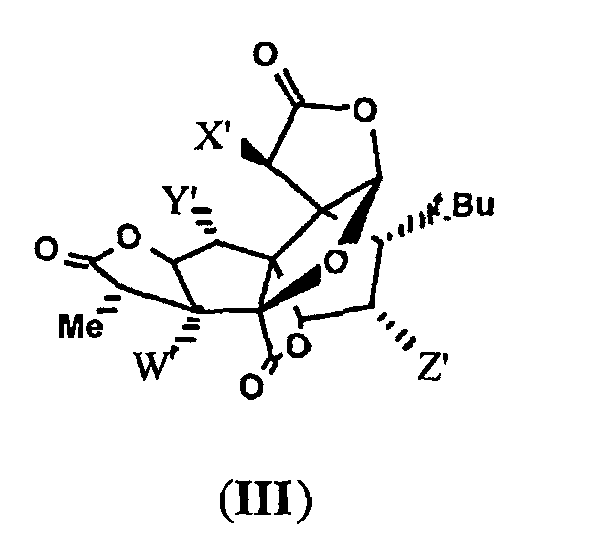
avec une glycosyl diazirine de formule générale (II) représentée ci-dessous,ledit procédé pouvant également comprendre une ou plusieurs étapes de protection et/ou déprotection de groupes hydroxy, et le composé (II) étant une diazirine dérivée d'un sucre Gp-OH dont tous les groupes hydroxy sauf celui porté par le carbone anomérique ont été protégés, par exemple par des radicaux benzyle ou silyle, le groupe hydroxy en position anomérique et l'hydrogène porté par le même atome de carbone ayant été substitués par un groupe azi.
Applications Claiming Priority (3)
| Application Number | Priority Date | Filing Date | Title |
|---|---|---|---|
| FR9706111A FR2763592B1 (fr) | 1997-05-20 | 1997-05-20 | Nouveaux derives glycosyles des ginkgolides, leur application en tant que medicaments et compositions pharmaceutiques les contenant |
| FR9706111 | 1997-05-20 | ||
| PCT/FR1998/001016 WO1998052959A1 (fr) | 1997-05-20 | 1998-05-20 | Nouveaux derives glycosyles des ginkgolides, leur application en tant que medicaments et compositions pharmaceutiques les contenant |
Publications (2)
| Publication Number | Publication Date |
|---|---|
| EP0983287A1 EP0983287A1 (fr) | 2000-03-08 |
| EP0983287B1 true EP0983287B1 (fr) | 2003-03-12 |
Family
ID=9507018
Family Applications (1)
| Application Number | Title | Priority Date | Filing Date |
|---|---|---|---|
| EP98925761A Expired - Lifetime EP0983287B1 (fr) | 1997-05-20 | 1998-05-20 | Nouveaux derives glycosyles des ginkgolides, leur application en tant que medicaments et compositions pharmaceutiques les contenant |
Country Status (12)
| Country | Link |
|---|---|
| US (1) | US6143725A (fr) |
| EP (1) | EP0983287B1 (fr) |
| JP (1) | JP2001527568A (fr) |
| KR (1) | KR20010012727A (fr) |
| CN (1) | CN1260801A (fr) |
| AT (1) | ATE234319T1 (fr) |
| AU (1) | AU7775398A (fr) |
| CA (1) | CA2289594A1 (fr) |
| DE (1) | DE69812086D1 (fr) |
| FR (1) | FR2763592B1 (fr) |
| NO (1) | NO313385B1 (fr) |
| WO (1) | WO1998052959A1 (fr) |
Families Citing this family (12)
| Publication number | Priority date | Publication date | Assignee | Title |
|---|---|---|---|---|
| WO2003006040A1 (fr) * | 2001-07-11 | 2003-01-23 | The Trustees Of Columbia University In The City Of New York | Procede d'isolation de trilactones terpenes (ginkgolides, bilobalide) a partir de feuilles et de poudres pharmaceutiques de ginkgo biloba |
| FR2827518B1 (fr) * | 2001-07-17 | 2005-07-08 | Sod Conseils Rech Applic | Utilisation d'extraits de ginkgo biloba pour preparer un medicament destine a traiter la sarcopenie |
| FR2842425B1 (fr) * | 2002-07-16 | 2005-04-08 | Sod Conseils Rech Applic | Utilisation d'extraits de ginkgo biloba pour favoriser la masse musculaire au detriment de la masse graisseuse |
| WO2003082185A2 (fr) * | 2002-03-29 | 2003-10-09 | The Trustees Of Columbia University In The City Of New York | Analogues de trilactones de terpene issus du ginkgo, composes en rapport et leur utilisation |
| US6693091B2 (en) | 2002-03-29 | 2004-02-17 | The Trustees Of Columbia University In The City Of New York | Analogs of terpene trilactones from Ginkgo biloba for bioorganic and imaging studies |
| US7429670B2 (en) * | 2003-08-27 | 2008-09-30 | The Trustees Of Columbia University In The City Of New York | Synthesis of derivatives of ginkgolide C |
| WO2005046829A2 (fr) | 2003-11-12 | 2005-05-26 | The Trustees Of Columbia University In The City Of New York | Séparation des gingolides d'avec le g.biloba |
| US20090156668A1 (en) * | 2004-03-19 | 2009-06-18 | The Trustees Of Columbia University In The City Of New York | Ginkgolide Compounds, Compositions, And Extracts, And Uses Thereof |
| US20080306145A1 (en) * | 2004-11-23 | 2008-12-11 | The Trustees Of Columbia University In The City Of New York | Preparation Of Ginkgolide And F-Seco-Ginkgolide Lactols |
| US20090221019A1 (en) * | 2005-06-22 | 2009-09-03 | Koji Nakanishi | Core-Modified Terpene Trilactones From Ginkgo Biloba Extract and Biological Evaluation Thereof |
| CN101880286B (zh) * | 2009-05-08 | 2014-11-12 | 北京美倍他药物研究有限公司 | 银杏内酯b的水溶性氨基酸酯衍生物 |
| CN110054634B (zh) * | 2019-04-24 | 2023-07-21 | 复旦大学 | 银杏内酯b衍生物及其盐,及其制备方法和用途 |
Family Cites Families (4)
| Publication number | Priority date | Publication date | Assignee | Title |
|---|---|---|---|---|
| GB8418424D0 (en) * | 1984-07-19 | 1984-08-22 | Scras | Inhibition of platelets aggregation |
| GB8725871D0 (en) * | 1987-11-04 | 1987-12-09 | Scras | Ginkgolide derivatives |
| US5002965A (en) * | 1989-05-09 | 1991-03-26 | Societe De Conseils De Recherches Et D'applications Scientifiques (S.C.R.A.S.) | Use of ginkgolides to prevent reperfusion injury in organ transplantation |
| US6030621A (en) * | 1998-03-19 | 2000-02-29 | De Long; Xie | Ginkgo biloba composition, method to prepare the same and uses thereof |
-
1997
- 1997-05-20 FR FR9706111A patent/FR2763592B1/fr not_active Expired - Fee Related
-
1998
- 1998-05-20 CN CN98806205A patent/CN1260801A/zh active Pending
- 1998-05-20 WO PCT/FR1998/001016 patent/WO1998052959A1/fr not_active Ceased
- 1998-05-20 CA CA002289594A patent/CA2289594A1/fr not_active Abandoned
- 1998-05-20 EP EP98925761A patent/EP0983287B1/fr not_active Expired - Lifetime
- 1998-05-20 AT AT98925761T patent/ATE234319T1/de not_active IP Right Cessation
- 1998-05-20 DE DE69812086T patent/DE69812086D1/de not_active Expired - Lifetime
- 1998-05-20 KR KR1019997010688A patent/KR20010012727A/ko not_active Withdrawn
- 1998-05-20 US US09/424,207 patent/US6143725A/en not_active Expired - Fee Related
- 1998-05-20 AU AU77753/98A patent/AU7775398A/en not_active Abandoned
- 1998-05-20 JP JP55005998A patent/JP2001527568A/ja active Pending
-
1999
- 1999-11-19 NO NO19995685A patent/NO313385B1/no not_active IP Right Cessation
Also Published As
| Publication number | Publication date |
|---|---|
| KR20010012727A (ko) | 2001-02-26 |
| CA2289594A1 (fr) | 1998-11-26 |
| JP2001527568A (ja) | 2001-12-25 |
| NO995685D0 (no) | 1999-11-19 |
| FR2763592A1 (fr) | 1998-11-27 |
| AU7775398A (en) | 1998-12-11 |
| CN1260801A (zh) | 2000-07-19 |
| NO995685L (no) | 1999-11-19 |
| DE69812086D1 (de) | 2003-04-17 |
| FR2763592B1 (fr) | 1999-07-16 |
| US6143725A (en) | 2000-11-07 |
| EP0983287A1 (fr) | 2000-03-08 |
| NO313385B1 (no) | 2002-09-23 |
| ATE234319T1 (de) | 2003-03-15 |
| WO1998052959A1 (fr) | 1998-11-26 |
Similar Documents
| Publication | Publication Date | Title |
|---|---|---|
| EP3090748B1 (fr) | Compositions comprénant des promédicaments d'oligonucléotides et de nucléotides | |
| EP0983287B1 (fr) | Nouveaux derives glycosyles des ginkgolides, leur application en tant que medicaments et compositions pharmaceutiques les contenant | |
| MC1992A1 (fr) | Derives de fluorocytidine | |
| EP0352301A1 (fr) | Esters de l'acide n-butyrique et leur utilisation comme medicaments | |
| US5225529A (en) | Synthetic amphiphilic glycoconjugates for neurological use | |
| MC869A1 (fr) | Furanosyl-aminopurines et médicament contenant ces substances | |
| FR2556348A1 (fr) | Retinoides, leur preparation et leurs utilisations therapeutiques, notamment pour le traitement des neoplasies, de l'acne et du psoriasis | |
| EP0310519A1 (fr) | Nouveaux esters d'acide androstane 17-carboxylique, procédé pour leur préparation et médicament les contenant | |
| FR2771639A1 (fr) | Utilisation d'extraits de ginkgo biloba pour preparer un medicament destine a faciliter le sevrage d'individus dependants de la consommation d'une substance engendrant une dependance et/ou une addiction | |
| US5441932A (en) | Sugar compounds for inhibition of the biosynthesis of sugar chains containing sialic acid | |
| HUT74610A (en) | Novel deoxy and oxygen-substituted sugar-containing 14-aminosteroid compounds, pharmaceutical compositions containing them, process for producing the same and intermediate | |
| EP2432799B1 (fr) | Derives des cycloartanones avec activite anticancereuse | |
| EP0101659B1 (fr) | Nouveaux dérivés d'amino-14 stéroides, procédé pour leur préparation, et application en thérapeutique | |
| FR2499577A1 (fr) | Nouvelles 1-(2-chloroethyl)-1-nitrosourees-3-substituees par un reste de sucre, utiles notamment comme agents antitumoraux et leur procede de preparation | |
| US4794115A (en) | Method of treating hyperlipemia | |
| EP0873347A2 (fr) | Nouveaux derives amines de 2", 3" didesoxyglycosides d'epipodophyllotoxine, leur procede de preparation, leur utilisation comme medicament et leur utilisation destinee aux traitements anticancereux | |
| EP1230252B1 (fr) | Derives de beta-d-5-thioxylose, procede de preparation et utilisation en therapeutique | |
| EP0143675B1 (fr) | Nouveaux dérivés de nitrosourée, leur procédé de préparation et compositions pharmaceutiques les contenant | |
| FR2510577A1 (fr) | Composes organiques azotes extraits de plantes et leurs derives, leur preparation et leurs utilisations therapeutiques, notamment en tant qu'agents antineoplastiques | |
| BE887456R (fr) | Procede de production de composes intermediaires pour l'obtention de la spectinomycine et de ses analogues et produits de ce procede | |
| BE835898A (fr) | Pseudotrisaccharides et leurs procedes de preparation | |
| BE882932A (fr) | La nogamycine, ses analogues, leur preparation et leur utilisation | |
| WO2001030776A1 (fr) | Nouveaux limonoïdes utiles en particulier dans le traitement du cancer et leur procede de preparation | |
| WO1999067430A2 (fr) | Substrats analytiques et agents antioxydants | |
| FR2460953A1 (fr) | Nouveau procede de preparation d'anomeres et de melanges asteriques de nouveaux analogues de spectinomycine |
Legal Events
| Date | Code | Title | Description |
|---|---|---|---|
| PUAI | Public reference made under article 153(3) epc to a published international application that has entered the european phase |
Free format text: ORIGINAL CODE: 0009012 |
|
| 17P | Request for examination filed |
Effective date: 19991220 |
|
| AK | Designated contracting states |
Kind code of ref document: A1 Designated state(s): AT BE CH DE DK ES FI FR GB GR IE IT LI LU NL PT SE |
|
| GRAG | Despatch of communication of intention to grant |
Free format text: ORIGINAL CODE: EPIDOS AGRA |
|
| 17Q | First examination report despatched |
Effective date: 20020516 |
|
| GRAG | Despatch of communication of intention to grant |
Free format text: ORIGINAL CODE: EPIDOS AGRA |
|
| GRAG | Despatch of communication of intention to grant |
Free format text: ORIGINAL CODE: EPIDOS AGRA |
|
| GRAH | Despatch of communication of intention to grant a patent |
Free format text: ORIGINAL CODE: EPIDOS IGRA |
|
| GRAH | Despatch of communication of intention to grant a patent |
Free format text: ORIGINAL CODE: EPIDOS IGRA |
|
| GRAA | (expected) grant |
Free format text: ORIGINAL CODE: 0009210 |
|
| AK | Designated contracting states |
Designated state(s): AT BE CH DE DK ES FI FR GB GR IE IT LI LU NL PT SE |
|
| PG25 | Lapsed in a contracting state [announced via postgrant information from national office to epo] |
Ref country code: NL Free format text: LAPSE BECAUSE OF FAILURE TO SUBMIT A TRANSLATION OF THE DESCRIPTION OR TO PAY THE FEE WITHIN THE PRESCRIBED TIME-LIMIT Effective date: 20030312 Ref country code: IT Free format text: LAPSE BECAUSE OF FAILURE TO SUBMIT A TRANSLATION OF THE DESCRIPTION OR TO PAY THE FEE WITHIN THE PRESCRIBED TIME-LIMIT;WARNING: LAPSES OF ITALIAN PATENTS WITH EFFECTIVE DATE BEFORE 2007 MAY HAVE OCCURRED AT ANY TIME BEFORE 2007. THE CORRECT EFFECTIVE DATE MAY BE DIFFERENT FROM THE ONE RECORDED. Effective date: 20030312 Ref country code: IE Free format text: LAPSE BECAUSE OF FAILURE TO SUBMIT A TRANSLATION OF THE DESCRIPTION OR TO PAY THE FEE WITHIN THE PRESCRIBED TIME-LIMIT Effective date: 20030312 Ref country code: GR Free format text: LAPSE BECAUSE OF FAILURE TO SUBMIT A TRANSLATION OF THE DESCRIPTION OR TO PAY THE FEE WITHIN THE PRESCRIBED TIME-LIMIT Effective date: 20030312 Ref country code: GB Free format text: LAPSE BECAUSE OF FAILURE TO SUBMIT A TRANSLATION OF THE DESCRIPTION OR TO PAY THE FEE WITHIN THE PRESCRIBED TIME-LIMIT Effective date: 20030312 Ref country code: FI Free format text: LAPSE BECAUSE OF FAILURE TO SUBMIT A TRANSLATION OF THE DESCRIPTION OR TO PAY THE FEE WITHIN THE PRESCRIBED TIME-LIMIT Effective date: 20030312 Ref country code: AT Free format text: LAPSE BECAUSE OF FAILURE TO SUBMIT A TRANSLATION OF THE DESCRIPTION OR TO PAY THE FEE WITHIN THE PRESCRIBED TIME-LIMIT Effective date: 20030312 |
|
| REG | Reference to a national code |
Ref country code: GB Ref legal event code: FG4D Free format text: NOT ENGLISH |
|
| REG | Reference to a national code |
Ref country code: CH Ref legal event code: EP |
|
| REG | Reference to a national code |
Ref country code: IE Ref legal event code: FG4D Free format text: FRENCH |
|
| REF | Corresponds to: |
Ref document number: 69812086 Country of ref document: DE Date of ref document: 20030417 Kind code of ref document: P |
|
| PG25 | Lapsed in a contracting state [announced via postgrant information from national office to epo] |
Ref country code: LU Free format text: LAPSE BECAUSE OF NON-PAYMENT OF DUE FEES Effective date: 20030520 |
|
| PG25 | Lapsed in a contracting state [announced via postgrant information from national office to epo] |
Ref country code: LI Free format text: LAPSE BECAUSE OF NON-PAYMENT OF DUE FEES Effective date: 20030531 Ref country code: CH Free format text: LAPSE BECAUSE OF NON-PAYMENT OF DUE FEES Effective date: 20030531 Ref country code: BE Free format text: LAPSE BECAUSE OF NON-PAYMENT OF DUE FEES Effective date: 20030531 |
|
| PG25 | Lapsed in a contracting state [announced via postgrant information from national office to epo] |
Ref country code: SE Free format text: LAPSE BECAUSE OF FAILURE TO SUBMIT A TRANSLATION OF THE DESCRIPTION OR TO PAY THE FEE WITHIN THE PRESCRIBED TIME-LIMIT Effective date: 20030612 Ref country code: DK Free format text: LAPSE BECAUSE OF FAILURE TO SUBMIT A TRANSLATION OF THE DESCRIPTION OR TO PAY THE FEE WITHIN THE PRESCRIBED TIME-LIMIT Effective date: 20030612 |
|
| PG25 | Lapsed in a contracting state [announced via postgrant information from national office to epo] |
Ref country code: DE Free format text: LAPSE BECAUSE OF FAILURE TO SUBMIT A TRANSLATION OF THE DESCRIPTION OR TO PAY THE FEE WITHIN THE PRESCRIBED TIME-LIMIT Effective date: 20030613 |
|
| PG25 | Lapsed in a contracting state [announced via postgrant information from national office to epo] |
Ref country code: PT Free format text: LAPSE BECAUSE OF FAILURE TO SUBMIT A TRANSLATION OF THE DESCRIPTION OR TO PAY THE FEE WITHIN THE PRESCRIBED TIME-LIMIT Effective date: 20030616 |
|
| NLV1 | Nl: lapsed or annulled due to failure to fulfill the requirements of art. 29p and 29m of the patents act | ||
| GBV | Gb: ep patent (uk) treated as always having been void in accordance with gb section 77(7)/1977 [no translation filed] |
Effective date: 20030312 |
|
| PG25 | Lapsed in a contracting state [announced via postgrant information from national office to epo] |
Ref country code: ES Free format text: LAPSE BECAUSE OF FAILURE TO SUBMIT A TRANSLATION OF THE DESCRIPTION OR TO PAY THE FEE WITHIN THE PRESCRIBED TIME-LIMIT Effective date: 20030930 |
|
| REG | Reference to a national code |
Ref country code: IE Ref legal event code: FD4D Ref document number: 0983287E Country of ref document: IE |
|
| BERE | Be: lapsed |
Owner name: SOC. DE CONSEILS DE RECHERCHES ET D'APPLICATIONS S Effective date: 20030531 |
|
| REG | Reference to a national code |
Ref country code: CH Ref legal event code: PL |
|
| PLBE | No opposition filed within time limit |
Free format text: ORIGINAL CODE: 0009261 |
|
| STAA | Information on the status of an ep patent application or granted ep patent |
Free format text: STATUS: NO OPPOSITION FILED WITHIN TIME LIMIT |
|
| PG25 | Lapsed in a contracting state [announced via postgrant information from national office to epo] |
Ref country code: FR Free format text: LAPSE BECAUSE OF NON-PAYMENT OF DUE FEES Effective date: 20040130 |
|
| REG | Reference to a national code |
Ref country code: FR Ref legal event code: ST |
|
| 26N | No opposition filed |
Effective date: 20031215 |