EP0310519A1 - Nouveaux esters d'acide androstane 17-carboxylique, procédé pour leur préparation et médicament les contenant - Google Patents
Nouveaux esters d'acide androstane 17-carboxylique, procédé pour leur préparation et médicament les contenant Download PDFInfo
- Publication number
- EP0310519A1 EP0310519A1 EP88402476A EP88402476A EP0310519A1 EP 0310519 A1 EP0310519 A1 EP 0310519A1 EP 88402476 A EP88402476 A EP 88402476A EP 88402476 A EP88402476 A EP 88402476A EP 0310519 A1 EP0310519 A1 EP 0310519A1
- Authority
- EP
- European Patent Office
- Prior art keywords
- group
- carboxylic acid
- androstane
- hydroxy
- methyl
- Prior art date
- Legal status (The legal status is an assumption and is not a legal conclusion. Google has not performed a legal analysis and makes no representation as to the accuracy of the status listed.)
- Granted
Links
- 239000003814 drug Substances 0.000 title claims description 11
- 238000002360 preparation method Methods 0.000 title claims description 5
- PBXJGQQGODZSQR-HUWVKCSISA-N (5R,8R,9S,10S,13S,14S)-10,13-dimethyl-2,3,4,5,6,7,8,9,11,12,14,15,16,17-tetradecahydro-1H-cyclopenta[a]phenanthrene-17-carboxylic acid Chemical class [C@@H]12CCC([C@@]1(C)CC[C@H]1[C@H]2CC[C@H]2CCCC[C@]12C)C(=O)O PBXJGQQGODZSQR-HUWVKCSISA-N 0.000 title abstract description 4
- 125000002496 methyl group Chemical group [H]C([H])([H])* 0.000 claims abstract description 44
- 150000002148 esters Chemical class 0.000 claims abstract description 28
- 125000002887 hydroxy group Chemical group [H]O* 0.000 claims abstract description 17
- 125000004432 carbon atom Chemical group C* 0.000 claims abstract description 15
- 125000004435 hydrogen atom Chemical group [H]* 0.000 claims abstract description 15
- 125000003668 acetyloxy group Chemical group [H]C([H])([H])C(=O)O[*] 0.000 claims abstract description 12
- 125000000217 alkyl group Chemical group 0.000 claims abstract description 11
- 125000003277 amino group Chemical group 0.000 claims abstract description 11
- 238000005859 coupling reaction Methods 0.000 claims abstract description 10
- 230000009467 reduction Effects 0.000 claims abstract description 8
- 125000000956 methoxy group Chemical group [H]C([H])([H])O* 0.000 claims abstract description 7
- 206010019280 Heart failures Diseases 0.000 claims abstract description 6
- 125000005530 alkylenedioxy group Chemical group 0.000 claims abstract description 5
- 125000003710 aryl alkyl group Chemical group 0.000 claims abstract description 4
- OKTJSMMVPCPJKN-UHFFFAOYSA-N Carbon Chemical compound [C] OKTJSMMVPCPJKN-UHFFFAOYSA-N 0.000 claims abstract description 3
- 229910052799 carbon Inorganic materials 0.000 claims abstract description 3
- 125000004029 hydroxymethyl group Chemical group [H]OC([H])([H])* 0.000 claims abstract description 3
- LFQSCWFLJHTTHZ-UHFFFAOYSA-N Ethanol Chemical compound CCO LFQSCWFLJHTTHZ-UHFFFAOYSA-N 0.000 claims description 46
- 238000000034 method Methods 0.000 claims description 26
- YXFVVABEGXRONW-UHFFFAOYSA-N Toluene Chemical compound CC1=CC=CC=C1 YXFVVABEGXRONW-UHFFFAOYSA-N 0.000 claims description 24
- 150000003431 steroids Chemical class 0.000 claims description 11
- 238000003381 deacetylation reaction Methods 0.000 claims description 8
- 229910052714 tellurium Inorganic materials 0.000 claims description 8
- PORWMNRCUJJQNO-UHFFFAOYSA-N tellurium atom Chemical compound [Te] PORWMNRCUJJQNO-UHFFFAOYSA-N 0.000 claims description 8
- PBXJGQQGODZSQR-UHFFFAOYSA-N 10,13-dimethyl-2,3,4,5,6,7,8,9,11,12,14,15,16,17-tetradecahydro-1h-cyclopenta[a]phenanthrene-17-carboxylic acid Chemical compound C1CCCC2(C)C3CCC(C)(C(CC4)C(O)=O)C4C3CCC21 PBXJGQQGODZSQR-UHFFFAOYSA-N 0.000 claims description 7
- 230000006196 deacetylation Effects 0.000 claims description 6
- RTKMFQOHBDVEBC-UHFFFAOYSA-N 3-bromo-3-buten-1-ol Chemical compound OCCC(Br)=C RTKMFQOHBDVEBC-UHFFFAOYSA-N 0.000 claims description 5
- 230000009471 action Effects 0.000 claims description 5
- 229940075610 mercuric cyanide Drugs 0.000 claims description 5
- 230000008569 process Effects 0.000 claims description 5
- 230000002829 reductive effect Effects 0.000 claims description 5
- VLGDJNDDGZTMHH-VSYUYLJXSA-N [(2r,3r,4s)-3,4-diacetyloxy-6-oxohexan-2-yl] acetate Chemical compound CC(=O)O[C@H](C)[C@@H](OC(C)=O)[C@H](CC=O)OC(C)=O VLGDJNDDGZTMHH-VSYUYLJXSA-N 0.000 claims description 4
- 125000001495 ethyl group Chemical group [H]C([H])([H])C([H])([H])* 0.000 claims description 4
- CPELXLSAUQHCOX-UHFFFAOYSA-M Bromide Chemical compound [Br-] CPELXLSAUQHCOX-UHFFFAOYSA-M 0.000 claims description 3
- 239000002253 acid Substances 0.000 claims description 3
- 238000005902 aminomethylation reaction Methods 0.000 claims description 3
- 238000004519 manufacturing process Methods 0.000 claims description 3
- DGAQECJNVWCQMB-PUAWFVPOSA-M Ilexoside XXIX Chemical compound C[C@@H]1CC[C@@]2(CC[C@@]3(C(=CC[C@H]4[C@]3(CC[C@@H]5[C@@]4(CC[C@@H](C5(C)C)OS(=O)(=O)[O-])C)C)[C@@H]2[C@]1(C)O)C)C(=O)O[C@H]6[C@@H]([C@H]([C@@H]([C@H](O6)CO)O)O)O.[Na+] DGAQECJNVWCQMB-PUAWFVPOSA-M 0.000 claims description 2
- 239000007868 Raney catalyst Substances 0.000 claims description 2
- NPXOKRUENSOPAO-UHFFFAOYSA-N Raney nickel Chemical compound [Al].[Ni] NPXOKRUENSOPAO-UHFFFAOYSA-N 0.000 claims description 2
- 229910000564 Raney nickel Inorganic materials 0.000 claims description 2
- 125000002947 alkylene group Chemical group 0.000 claims description 2
- 125000004185 ester group Chemical group 0.000 claims description 2
- 238000005984 hydrogenation reaction Methods 0.000 claims description 2
- 239000008194 pharmaceutical composition Substances 0.000 claims description 2
- 239000000546 pharmaceutical excipient Substances 0.000 claims description 2
- 229910052708 sodium Inorganic materials 0.000 claims description 2
- 239000011734 sodium Substances 0.000 claims description 2
- 125000000250 methylamino group Chemical group [H]N(*)C([H])([H])[H] 0.000 claims 1
- 230000008878 coupling Effects 0.000 abstract description 3
- 238000010168 coupling process Methods 0.000 abstract description 3
- 238000002560 therapeutic procedure Methods 0.000 abstract description 3
- OKKJLVBELUTLKV-UHFFFAOYSA-N Methanol Chemical compound OC OKKJLVBELUTLKV-UHFFFAOYSA-N 0.000 description 54
- VYPSYNLAJGMNEJ-UHFFFAOYSA-N Silicium dioxide Chemical compound O=[Si]=O VYPSYNLAJGMNEJ-UHFFFAOYSA-N 0.000 description 27
- 239000000203 mixture Substances 0.000 description 25
- YMWUJEATGCHHMB-UHFFFAOYSA-N Dichloromethane Chemical compound ClCCl YMWUJEATGCHHMB-UHFFFAOYSA-N 0.000 description 24
- XEKOWRVHYACXOJ-UHFFFAOYSA-N Ethyl acetate Chemical compound CCOC(C)=O XEKOWRVHYACXOJ-UHFFFAOYSA-N 0.000 description 22
- 238000000605 extraction Methods 0.000 description 20
- 238000004587 chromatography analysis Methods 0.000 description 17
- ZMXDDKWLCZADIW-UHFFFAOYSA-N N,N-Dimethylformamide Chemical compound CN(C)C=O ZMXDDKWLCZADIW-UHFFFAOYSA-N 0.000 description 12
- 238000002329 infrared spectrum Methods 0.000 description 12
- VLKZOEOYAKHREP-UHFFFAOYSA-N n-Hexane Chemical compound CCCCCC VLKZOEOYAKHREP-UHFFFAOYSA-N 0.000 description 12
- 239000000377 silicon dioxide Substances 0.000 description 12
- 239000002904 solvent Substances 0.000 description 12
- 239000000243 solution Substances 0.000 description 10
- WEVYAHXRMPXWCK-UHFFFAOYSA-N Acetonitrile Chemical compound CC#N WEVYAHXRMPXWCK-UHFFFAOYSA-N 0.000 description 9
- 238000002844 melting Methods 0.000 description 9
- 230000008018 melting Effects 0.000 description 9
- 238000000655 nuclear magnetic resonance spectrum Methods 0.000 description 9
- KFZMGEQAYNKOFK-UHFFFAOYSA-N Isopropanol Chemical compound CC(C)O KFZMGEQAYNKOFK-UHFFFAOYSA-N 0.000 description 8
- 230000004927 fusion Effects 0.000 description 8
- 229910000033 sodium borohydride Inorganic materials 0.000 description 8
- 239000012279 sodium borohydride Substances 0.000 description 8
- SHZGCJCMOBCMKK-UHFFFAOYSA-N D-mannomethylose Natural products CC1OC(O)C(O)C(O)C1O SHZGCJCMOBCMKK-UHFFFAOYSA-N 0.000 description 7
- LTMHDMANZUZIPE-AMTYYWEZSA-N Digoxin Natural products O([C@H]1[C@H](C)O[C@H](O[C@@H]2C[C@@H]3[C@@](C)([C@@H]4[C@H]([C@]5(O)[C@](C)([C@H](O)C4)[C@H](C4=CC(=O)OC4)CC5)CC3)CC2)C[C@@H]1O)[C@H]1O[C@H](C)[C@@H](O[C@H]2O[C@@H](C)[C@H](O)[C@@H](O)C2)[C@@H](O)C1 LTMHDMANZUZIPE-AMTYYWEZSA-N 0.000 description 7
- SHZGCJCMOBCMKK-JFNONXLTSA-N L-rhamnopyranose Chemical compound C[C@@H]1OC(O)[C@H](O)[C@H](O)[C@H]1O SHZGCJCMOBCMKK-JFNONXLTSA-N 0.000 description 7
- PNNNRSAQSRJVSB-UHFFFAOYSA-N L-rhamnose Natural products CC(O)C(O)C(O)C(O)C=O PNNNRSAQSRJVSB-UHFFFAOYSA-N 0.000 description 7
- WQDUMFSSJAZKTM-UHFFFAOYSA-N Sodium methoxide Chemical compound [Na+].[O-]C WQDUMFSSJAZKTM-UHFFFAOYSA-N 0.000 description 7
- LTMHDMANZUZIPE-PUGKRICDSA-N digoxin Chemical compound C1[C@H](O)[C@H](O)[C@@H](C)O[C@H]1O[C@@H]1[C@@H](C)O[C@@H](O[C@@H]2[C@H](O[C@@H](O[C@@H]3C[C@@H]4[C@]([C@@H]5[C@H]([C@]6(CC[C@@H]([C@@]6(C)[C@H](O)C5)C=5COC(=O)C=5)O)CC4)(C)CC3)C[C@@H]2O)C)C[C@@H]1O LTMHDMANZUZIPE-PUGKRICDSA-N 0.000 description 7
- 229960005156 digoxin Drugs 0.000 description 7
- LTMHDMANZUZIPE-UHFFFAOYSA-N digoxine Natural products C1C(O)C(O)C(C)OC1OC1C(C)OC(OC2C(OC(OC3CC4C(C5C(C6(CCC(C6(C)C(O)C5)C=5COC(=O)C=5)O)CC4)(C)CC3)CC2O)C)CC1O LTMHDMANZUZIPE-UHFFFAOYSA-N 0.000 description 7
- 239000000047 product Substances 0.000 description 7
- XKRFYHLGVUSROY-UHFFFAOYSA-N Argon Chemical compound [Ar] XKRFYHLGVUSROY-UHFFFAOYSA-N 0.000 description 6
- UHOVQNZJYSORNB-UHFFFAOYSA-N Benzene Chemical compound C1=CC=CC=C1 UHOVQNZJYSORNB-UHFFFAOYSA-N 0.000 description 6
- FAPWRFPIFSIZLT-UHFFFAOYSA-M Sodium chloride Chemical compound [Na+].[Cl-] FAPWRFPIFSIZLT-UHFFFAOYSA-M 0.000 description 6
- 239000002585 base Substances 0.000 description 6
- 238000006243 chemical reaction Methods 0.000 description 6
- 230000009090 positive inotropic effect Effects 0.000 description 6
- 238000006722 reduction reaction Methods 0.000 description 6
- 238000003756 stirring Methods 0.000 description 6
- QTBSBXVTEAMEQO-UHFFFAOYSA-N Acetic acid Chemical compound CC(O)=O QTBSBXVTEAMEQO-UHFFFAOYSA-N 0.000 description 5
- 238000002425 crystallisation Methods 0.000 description 5
- 230000008025 crystallization Effects 0.000 description 5
- 229960000648 digitoxin Drugs 0.000 description 5
- 239000003480 eluent Substances 0.000 description 5
- 239000011541 reaction mixture Substances 0.000 description 5
- 229920006395 saturated elastomer Polymers 0.000 description 5
- 238000004809 thin layer chromatography Methods 0.000 description 5
- XLYOFNOQVPJJNP-UHFFFAOYSA-N water Substances O XLYOFNOQVPJJNP-UHFFFAOYSA-N 0.000 description 5
- -1 3-methyl-3-propyl amino group Chemical group 0.000 description 4
- QTBSBXVTEAMEQO-UHFFFAOYSA-M Acetate Chemical compound CC([O-])=O QTBSBXVTEAMEQO-UHFFFAOYSA-M 0.000 description 4
- IJGRMHOSHXDMSA-UHFFFAOYSA-N Atomic nitrogen Chemical compound N#N IJGRMHOSHXDMSA-UHFFFAOYSA-N 0.000 description 4
- HEDRZPFGACZZDS-UHFFFAOYSA-N Chloroform Chemical compound ClC(Cl)Cl HEDRZPFGACZZDS-UHFFFAOYSA-N 0.000 description 4
- ZAFNJMIOTHYJRJ-UHFFFAOYSA-N Diisopropyl ether Chemical compound CC(C)OC(C)C ZAFNJMIOTHYJRJ-UHFFFAOYSA-N 0.000 description 4
- UIIMBOGNXHQVGW-UHFFFAOYSA-M Sodium bicarbonate Chemical compound [Na+].OC([O-])=O UIIMBOGNXHQVGW-UHFFFAOYSA-M 0.000 description 4
- 206010003119 arrhythmia Diseases 0.000 description 4
- 230000006793 arrhythmia Effects 0.000 description 4
- 230000003177 cardiotonic effect Effects 0.000 description 4
- 150000002402 hexoses Chemical class 0.000 description 4
- 229910052739 hydrogen Inorganic materials 0.000 description 4
- 230000000297 inotrophic effect Effects 0.000 description 4
- JOXIMZWYDAKGHI-UHFFFAOYSA-N toluene-4-sulfonic acid Chemical compound CC1=CC=C(S(O)(=O)=O)C=C1 JOXIMZWYDAKGHI-UHFFFAOYSA-N 0.000 description 4
- 238000005406 washing Methods 0.000 description 4
- QZLYKIGBANMMBK-UGCZWRCOSA-N 5α-Androstane Chemical compound C([C@@H]1CC2)CCC[C@]1(C)[C@@H]1[C@@H]2[C@@H]2CCC[C@@]2(C)CC1 QZLYKIGBANMMBK-UGCZWRCOSA-N 0.000 description 3
- CSCPPACGZOOCGX-UHFFFAOYSA-N Acetone Chemical compound CC(C)=O CSCPPACGZOOCGX-UHFFFAOYSA-N 0.000 description 3
- 0 CCC1C(*)(CCC2C)C2(C2*C2)C(*)CC1C(C)(CC1)*(C)CC1OC1[U]C(*)C(*)C(C)C1C Chemical compound CCC1C(*)(CCC2C)C2(C2*C2)C(*)CC1C(C)(CC1)*(C)CC1OC1[U]C(*)C(*)C(C)C1C 0.000 description 3
- WSFSSNUMVMOOMR-UHFFFAOYSA-N Formaldehyde Chemical compound O=C WSFSSNUMVMOOMR-UHFFFAOYSA-N 0.000 description 3
- 229910017974 NH40H Inorganic materials 0.000 description 3
- 239000007864 aqueous solution Substances 0.000 description 3
- 229910052786 argon Inorganic materials 0.000 description 3
- 150000001738 cardenolides Chemical class 0.000 description 3
- 239000000496 cardiotonic agent Substances 0.000 description 3
- 239000003153 chemical reaction reagent Substances 0.000 description 3
- 239000013078 crystal Substances 0.000 description 3
- 229930182470 glycoside Natural products 0.000 description 3
- 150000002338 glycosides Chemical class 0.000 description 3
- 238000010438 heat treatment Methods 0.000 description 3
- 238000001802 infusion Methods 0.000 description 3
- 150000002576 ketones Chemical class 0.000 description 3
- LNOPIUAQISRISI-UHFFFAOYSA-N n'-hydroxy-2-propan-2-ylsulfonylethanimidamide Chemical compound CC(C)S(=O)(=O)CC(N)=NO LNOPIUAQISRISI-UHFFFAOYSA-N 0.000 description 3
- 229910052757 nitrogen Inorganic materials 0.000 description 3
- 230000000144 pharmacologic effect Effects 0.000 description 3
- 230000002441 reversible effect Effects 0.000 description 3
- 239000011780 sodium chloride Substances 0.000 description 3
- 239000000725 suspension Substances 0.000 description 3
- QJMYXHKGEGNLED-UHFFFAOYSA-N 5-(2-hydroxyethylamino)-1h-pyrimidine-2,4-dione Chemical compound OCCNC1=CNC(=O)NC1=O QJMYXHKGEGNLED-UHFFFAOYSA-N 0.000 description 2
- JWMFYGXQPXQEEM-NUNROCCHSA-N 5β-pregnane Chemical compound C([C@H]1CC2)CCC[C@]1(C)[C@@H]1[C@@H]2[C@@H]2CC[C@H](CC)[C@@]2(C)CC1 JWMFYGXQPXQEEM-NUNROCCHSA-N 0.000 description 2
- 241000282472 Canis lupus familiaris Species 0.000 description 2
- 241000700199 Cavia porcellus Species 0.000 description 2
- IAZDPXIOMUYVGZ-UHFFFAOYSA-N Dimethylsulphoxide Chemical compound CS(C)=O IAZDPXIOMUYVGZ-UHFFFAOYSA-N 0.000 description 2
- WQZGKKKJIJFFOK-GASJEMHNSA-N Glucose Natural products OC[C@H]1OC(O)[C@H](O)[C@@H](O)[C@@H]1O WQZGKKKJIJFFOK-GASJEMHNSA-N 0.000 description 2
- CDBYLPFSWZWCQE-UHFFFAOYSA-L Sodium Carbonate Chemical compound [Na+].[Na+].[O-]C([O-])=O CDBYLPFSWZWCQE-UHFFFAOYSA-L 0.000 description 2
- HEDRZPFGACZZDS-MICDWDOJSA-N Trichloro(2H)methane Chemical compound [2H]C(Cl)(Cl)Cl HEDRZPFGACZZDS-MICDWDOJSA-N 0.000 description 2
- DTQVDTLACAAQTR-UHFFFAOYSA-N Trifluoroacetic acid Chemical compound OC(=O)C(F)(F)F DTQVDTLACAAQTR-UHFFFAOYSA-N 0.000 description 2
- 229960000583 acetic acid Drugs 0.000 description 2
- 230000021736 acetylation Effects 0.000 description 2
- 238000006640 acetylation reaction Methods 0.000 description 2
- 230000004913 activation Effects 0.000 description 2
- 150000001412 amines Chemical class 0.000 description 2
- 239000008346 aqueous phase Substances 0.000 description 2
- 230000000747 cardiac effect Effects 0.000 description 2
- 230000008602 contraction Effects 0.000 description 2
- 238000001816 cooling Methods 0.000 description 2
- 230000000694 effects Effects 0.000 description 2
- WDCDAAMJNUHOIY-UHFFFAOYSA-N ethyl acetate;2-propan-2-yloxypropane Chemical compound CCOC(C)=O.CC(C)OC(C)C WDCDAAMJNUHOIY-UHFFFAOYSA-N 0.000 description 2
- 238000001704 evaporation Methods 0.000 description 2
- 230000008020 evaporation Effects 0.000 description 2
- 239000000706 filtrate Substances 0.000 description 2
- 239000008103 glucose Substances 0.000 description 2
- 210000005246 left atrium Anatomy 0.000 description 2
- KWGKDLIKAYFUFQ-UHFFFAOYSA-M lithium chloride Chemical compound [Li+].[Cl-] KWGKDLIKAYFUFQ-UHFFFAOYSA-M 0.000 description 2
- 238000005259 measurement Methods 0.000 description 2
- 150000002772 monosaccharides Chemical class 0.000 description 2
- 238000006386 neutralization reaction Methods 0.000 description 2
- CTSLXHKWHWQRSH-UHFFFAOYSA-N oxalyl chloride Chemical compound ClC(=O)C(Cl)=O CTSLXHKWHWQRSH-UHFFFAOYSA-N 0.000 description 2
- 239000012429 reaction media Substances 0.000 description 2
- 238000001953 recrystallisation Methods 0.000 description 2
- 229910000030 sodium bicarbonate Inorganic materials 0.000 description 2
- 235000017557 sodium bicarbonate Nutrition 0.000 description 2
- BEOOHQFXGBMRKU-UHFFFAOYSA-N sodium cyanoborohydride Chemical compound [Na+].[B-]C#N BEOOHQFXGBMRKU-UHFFFAOYSA-N 0.000 description 2
- 239000007858 starting material Substances 0.000 description 2
- 125000001424 substituent group Chemical group 0.000 description 2
- 230000001225 therapeutic effect Effects 0.000 description 2
- 231100000816 toxic dose Toxicity 0.000 description 2
- FDWRIIDFYSUTDP-KVTDHHQDSA-N (2r,4r,5s,6r)-6-methyloxane-2,4,5-triol Chemical compound C[C@H]1O[C@@H](O)C[C@@H](O)[C@@H]1O FDWRIIDFYSUTDP-KVTDHHQDSA-N 0.000 description 1
- ZWVMLYRJXORSEP-LURJTMIESA-N (2s)-hexane-1,2,6-triol Chemical compound OCCCC[C@H](O)CO ZWVMLYRJXORSEP-LURJTMIESA-N 0.000 description 1
- PBXJGQQGODZSQR-WQBJWTDHSA-N (5s,8r,9s,10s,13s,14s,17s)-10,13-dimethyl-2,3,4,5,6,7,8,9,11,12,14,15,16,17-tetradecahydro-1h-cyclopenta[a]phenanthrene-17-carboxylic acid Chemical compound C1CCC[C@]2(C)[C@H]3CC[C@](C)([C@H](CC4)C(O)=O)[C@@H]4[C@@H]3CC[C@@H]21 PBXJGQQGODZSQR-WQBJWTDHSA-N 0.000 description 1
- FDWRIIDFYSUTDP-UHFFFAOYSA-N 102850-49-7 Natural products CC1OC(O)CC(O)C1O FDWRIIDFYSUTDP-UHFFFAOYSA-N 0.000 description 1
- HEWZVZIVELJPQZ-UHFFFAOYSA-N 2,2-dimethoxypropane Chemical compound COC(C)(C)OC HEWZVZIVELJPQZ-UHFFFAOYSA-N 0.000 description 1
- LBLYYCQCTBFVLH-UHFFFAOYSA-N 2-Methylbenzenesulfonic acid Chemical compound CC1=CC=CC=C1S(O)(=O)=O LBLYYCQCTBFVLH-UHFFFAOYSA-N 0.000 description 1
- 125000000022 2-aminoethyl group Chemical group [H]C([*])([H])C([H])([H])N([H])[H] 0.000 description 1
- 125000000094 2-phenylethyl group Chemical group [H]C1=C([H])C([H])=C(C([H])=C1[H])C([H])([H])C([H])([H])* 0.000 description 1
- WDYVUKGVKRZQNM-UHFFFAOYSA-N 6-phosphonohexylphosphonic acid Chemical compound OP(O)(=O)CCCCCCP(O)(O)=O WDYVUKGVKRZQNM-UHFFFAOYSA-N 0.000 description 1
- 208000023275 Autoimmune disease Diseases 0.000 description 1
- WKBOTKDWSSQWDR-UHFFFAOYSA-N Bromine atom Chemical compound [Br] WKBOTKDWSSQWDR-UHFFFAOYSA-N 0.000 description 1
- 206010048610 Cardiotoxicity Diseases 0.000 description 1
- JWFRNGYBHLBCMB-UHFFFAOYSA-N D-Canaytose Natural products CC(O)C(O)C(O)CC=O JWFRNGYBHLBCMB-UHFFFAOYSA-N 0.000 description 1
- 241000208011 Digitalis Species 0.000 description 1
- 229930091371 Fructose Natural products 0.000 description 1
- 239000005715 Fructose Substances 0.000 description 1
- RFSUNEUAIZKAJO-ARQDHWQXSA-N Fructose Chemical compound OC[C@H]1O[C@](O)(CO)[C@@H](O)[C@@H]1O RFSUNEUAIZKAJO-ARQDHWQXSA-N 0.000 description 1
- VEXZGXHMUGYJMC-UHFFFAOYSA-N Hydrochloric acid Chemical compound Cl VEXZGXHMUGYJMC-UHFFFAOYSA-N 0.000 description 1
- 239000003810 Jones reagent Substances 0.000 description 1
- FYYHWMGAXLPEAU-UHFFFAOYSA-N Magnesium Chemical compound [Mg] FYYHWMGAXLPEAU-UHFFFAOYSA-N 0.000 description 1
- 239000004480 active ingredient Substances 0.000 description 1
- 229910052783 alkali metal Inorganic materials 0.000 description 1
- 150000001340 alkali metals Chemical class 0.000 description 1
- 125000005907 alkyl ester group Chemical group 0.000 description 1
- WQZGKKKJIJFFOK-PHYPRBDBSA-N alpha-D-galactose Chemical compound OC[C@H]1O[C@H](O)[C@H](O)[C@@H](O)[C@H]1O WQZGKKKJIJFFOK-PHYPRBDBSA-N 0.000 description 1
- 150000001441 androstanes Chemical class 0.000 description 1
- PYMYPHUHKUWMLA-WDCZJNDASA-N arabinose Chemical compound OC[C@@H](O)[C@@H](O)[C@H](O)C=O PYMYPHUHKUWMLA-WDCZJNDASA-N 0.000 description 1
- PYMYPHUHKUWMLA-UHFFFAOYSA-N arabinose Natural products OCC(O)C(O)C(O)C=O PYMYPHUHKUWMLA-UHFFFAOYSA-N 0.000 description 1
- 239000012300 argon atmosphere Substances 0.000 description 1
- 239000012298 atmosphere Substances 0.000 description 1
- 230000002238 attenuated effect Effects 0.000 description 1
- 125000000852 azido group Chemical group *N=[N+]=[N-] 0.000 description 1
- 238000006480 benzoylation reaction Methods 0.000 description 1
- 125000001797 benzyl group Chemical group [H]C1=C([H])C([H])=C(C([H])=C1[H])C([H])([H])* 0.000 description 1
- SRBFZHDQGSBBOR-UHFFFAOYSA-N beta-D-Pyranose-Lyxose Natural products OC1COC(O)C(O)C1O SRBFZHDQGSBBOR-UHFFFAOYSA-N 0.000 description 1
- WQZGKKKJIJFFOK-VFUOTHLCSA-N beta-D-glucose Chemical compound OC[C@H]1O[C@@H](O)[C@H](O)[C@@H](O)[C@@H]1O WQZGKKKJIJFFOK-VFUOTHLCSA-N 0.000 description 1
- 230000036772 blood pressure Effects 0.000 description 1
- GDTBXPJZTBHREO-UHFFFAOYSA-N bromine Substances BrBr GDTBXPJZTBHREO-UHFFFAOYSA-N 0.000 description 1
- 229910052794 bromium Inorganic materials 0.000 description 1
- 244000309464 bull Species 0.000 description 1
- 125000000484 butyl group Chemical group [H]C([*])([H])C([H])([H])C([H])([H])C([H])([H])[H] 0.000 description 1
- 239000002775 capsule Substances 0.000 description 1
- 229940097217 cardiac glycoside Drugs 0.000 description 1
- 239000002368 cardiac glycoside Substances 0.000 description 1
- 231100000259 cardiotoxicity Toxicity 0.000 description 1
- 230000007681 cardiovascular toxicity Effects 0.000 description 1
- 230000007541 cellular toxicity Effects 0.000 description 1
- 238000004440 column chromatography Methods 0.000 description 1
- 230000000052 comparative effect Effects 0.000 description 1
- 150000001875 compounds Chemical class 0.000 description 1
- 235000009508 confectionery Nutrition 0.000 description 1
- 230000001595 contractor effect Effects 0.000 description 1
- 230000007812 deficiency Effects 0.000 description 1
- 238000010511 deprotection reaction Methods 0.000 description 1
- 208000037265 diseases, disorders, signs and symptoms Diseases 0.000 description 1
- 208000035475 disorder Diseases 0.000 description 1
- 229940079593 drug Drugs 0.000 description 1
- 229930182830 galactose Natural products 0.000 description 1
- 239000012362 glacial acetic acid Substances 0.000 description 1
- 230000010247 heart contraction Effects 0.000 description 1
- 230000000004 hemodynamic effect Effects 0.000 description 1
- 230000001024 immunotherapeutic effect Effects 0.000 description 1
- 238000001727 in vivo Methods 0.000 description 1
- 229940102223 injectable solution Drugs 0.000 description 1
- 230000036450 inotropism Effects 0.000 description 1
- 238000001990 intravenous administration Methods 0.000 description 1
- 125000001449 isopropyl group Chemical group [H]C([H])([H])C([H])(*)C([H])([H])[H] 0.000 description 1
- 125000000686 lactone group Chemical group 0.000 description 1
- 231100000636 lethal dose Toxicity 0.000 description 1
- 230000000670 limiting effect Effects 0.000 description 1
- 210000004698 lymphocyte Anatomy 0.000 description 1
- 239000011777 magnesium Substances 0.000 description 1
- 229910052749 magnesium Inorganic materials 0.000 description 1
- 125000001160 methoxycarbonyl group Chemical group [H]C([H])([H])OC(*)=O 0.000 description 1
- 230000007935 neutral effect Effects 0.000 description 1
- 239000012299 nitrogen atmosphere Substances 0.000 description 1
- 238000006053 organic reaction Methods 0.000 description 1
- 238000007254 oxidation reaction Methods 0.000 description 1
- 230000021962 pH elevation Effects 0.000 description 1
- WEXRUCMBJFQVBZ-UHFFFAOYSA-N pentobarbital Chemical compound CCCC(C)C1(CC)C(=O)NC(=O)NC1=O WEXRUCMBJFQVBZ-UHFFFAOYSA-N 0.000 description 1
- 229960001412 pentobarbital Drugs 0.000 description 1
- 239000012071 phase Substances 0.000 description 1
- 125000001997 phenyl group Chemical group [H]C1=C([H])C([H])=C(*)C([H])=C1[H] 0.000 description 1
- 239000000843 powder Substances 0.000 description 1
- 150000003128 pregnanes Chemical class 0.000 description 1
- 230000002035 prolonged effect Effects 0.000 description 1
- WGYKZJWCGVVSQN-UHFFFAOYSA-N propylamine Chemical group CCCN WGYKZJWCGVVSQN-UHFFFAOYSA-N 0.000 description 1
- 125000006239 protecting group Chemical group 0.000 description 1
- 238000000746 purification Methods 0.000 description 1
- 238000010992 reflux Methods 0.000 description 1
- 230000033764 rhythmic process Effects 0.000 description 1
- 238000007127 saponification reaction Methods 0.000 description 1
- 239000012047 saturated solution Substances 0.000 description 1
- 238000009738 saturating Methods 0.000 description 1
- 229910000029 sodium carbonate Inorganic materials 0.000 description 1
- QDRKDTQENPPHOJ-UHFFFAOYSA-N sodium ethoxide Chemical compound [Na+].CC[O-] QDRKDTQENPPHOJ-UHFFFAOYSA-N 0.000 description 1
- 239000007787 solid Substances 0.000 description 1
- 229930003352 steroid alkaloid Natural products 0.000 description 1
- 229930002534 steroid glycoside Natural products 0.000 description 1
- 150000008143 steroidal glycosides Chemical class 0.000 description 1
- XSOKHXFFCGXDJZ-UHFFFAOYSA-N telluride(2-) Chemical compound [Te-2] XSOKHXFFCGXDJZ-UHFFFAOYSA-N 0.000 description 1
- 125000003944 tolyl group Chemical group 0.000 description 1
- 231100000419 toxicity Toxicity 0.000 description 1
- 230000001988 toxicity Effects 0.000 description 1
- 230000001131 transforming effect Effects 0.000 description 1
Classifications
-
- C—CHEMISTRY; METALLURGY
- C07—ORGANIC CHEMISTRY
- C07J—STEROIDS
- C07J41/00—Normal steroids containing one or more nitrogen atoms not belonging to a hetero ring
-
- C—CHEMISTRY; METALLURGY
- C07—ORGANIC CHEMISTRY
- C07J—STEROIDS
- C07J41/00—Normal steroids containing one or more nitrogen atoms not belonging to a hetero ring
- C07J41/0005—Normal steroids containing one or more nitrogen atoms not belonging to a hetero ring the nitrogen atom being directly linked to the cyclopenta(a)hydro phenanthrene skeleton
-
- A—HUMAN NECESSITIES
- A61—MEDICAL OR VETERINARY SCIENCE; HYGIENE
- A61K—PREPARATIONS FOR MEDICAL, DENTAL OR TOILETRY PURPOSES
- A61K31/00—Medicinal preparations containing organic active ingredients
- A61K31/56—Compounds containing cyclopenta[a]hydrophenanthrene ring systems; Derivatives thereof, e.g. steroids
- A61K31/565—Compounds containing cyclopenta[a]hydrophenanthrene ring systems; Derivatives thereof, e.g. steroids not substituted in position 17 beta by a carbon atom, e.g. estrane, estradiol
-
- A—HUMAN NECESSITIES
- A61—MEDICAL OR VETERINARY SCIENCE; HYGIENE
- A61P—SPECIFIC THERAPEUTIC ACTIVITY OF CHEMICAL COMPOUNDS OR MEDICINAL PREPARATIONS
- A61P9/00—Drugs for disorders of the cardiovascular system
- A61P9/04—Inotropic agents, i.e. stimulants of cardiac contraction; Drugs for heart failure
Definitions
- New 17-carboxylic acid estrostane esters process for their preparation, and medicament containing them
- the present invention relates to new steroid derivatives, and more particularly to new 17-carboxylic acid estrostane esters substituted in position 3 with a sugar residue, a process for their preparation, their use for the manufacture of medicaments, as well as the medicaments containing them.
- Patent FR 2,464,270 describes compounds of the amino-14 steroid type, and in particular hydroxylated derivatives of amino-14 androstane and amino-14 nor-21 pregnane. Also known are steroid steroid alkaloids of the pregnane and androstane series substituted in position 14 by an amino group, and for example the amino-14p pregnanedioi-3p, 20a is described by A. Astier et al. Bull. Soc. Chim. n ° 9-10 p.1581-1582 (1976); other amino-14 ⁇ pregnanes and amino-14 ⁇ androstanes are also described by A. Astier et al. Tetrahedron vol.34 p.1481-1486 (1978). However, these documents do not describe any pharmacological property or any possible therapeutic application of these derivatives.
- Patent DD 138,983 describes derivatives of cardenolides, characterized by the presence of a lactone group in position 17, and comprising an amino group in position 14.
- Amino derivatives of steroids useful in therapy are also known, and for example French patents 2,494,697 and 2,494,698 describe amino-3 (5a) pregnanediol-17 ⁇ , 20, amino-3 (5a) nor-19 pregnanol-20, and amino derivatives, presented as having immunotherapeutic properties allowing their application as medicaments for the treatment of autoimmune diseases resulting from a deficiency in certain lymphocytes.
- the present invention therefore relates to new esters of androstane 17-carboxylic acid substituted in position 3 by a sugar residue having cardiotonic properties.
- the invention also relates to a process for the preparation of androstane 17-carboxylic acid esters substituted in position 3 with a sugar residue, from an ester of 14-azido etianic acid.
- the invention also relates to the application of the 17-carboxylic acid esters substituted in position 3 with a sugar residue as cardiotonic drugs for the treatment of heart failure, the pharmaceutical compositions containing as active ingredient one to the other. less of the new esters of androstane 17-carboxylic acid substituted in position 3 by a sugar residue as well as the use of these derivatives for the manufacture of medicaments which can be used therapeutically as cardiotonic agents for the treatment of heart failure.
- the new 17-carboxylic acid estrostane esters substituted in position 3 with a sugar residue in accordance with the present invention can be represented by the following general formula (I): wherein R 1 represents a lower alkyl group having 1 to 4 carbon atoms, an alkyl group 2-4 carbon atoms substituted by an amino group, or an aralkyl group of 6-12 carbon atoms, R 2 and R 3 , identical or different, represent a hydrogen atom or a lower alkyl group having 1 to 4 carbon atoms, R 4 represents a hydrogen atom, a hydroxy group, or an acetoxy group, R 5 represents a hydroxy or acetoxy group, or R 4 and R 5 together represent a divalent alkylenedioxy group, R 6 represents a group hydroxy, a methoxy group or an acetoxy group, R 7 represents a methyl group or a hydroxy-methyl group, R 8 represents a hydrogen atom, a hydroxy group or an acetoxy group, and
- the steroid nucleus can be saturated as shown in formula (la) below, or have a double bond at 4-5 or at 5-6, thus constituting a derivative of type androstene-4 or -5 shown in formulas (Ib) and (Ic) below.
- the lower alkyl group represented by R 1 can be a methyl, ethyl, isopropyl, butyl group, etc., and preferably a methyl or ethyl group.
- the above lower alkyl group may be substituted by an amino group to form, for example, a 2-amino ethyl or 3-amino propyl, or di- (or mono-) 3-methyl-3-propyl amino group.
- R 1 represents an aralkyl group, this group may for example be a phenyl group, a benzyl group, a tolyl group, or a phenethyl group.
- R 2 and Rs which may be the same or different, preferably represent a hydrogen atom or a methyl group.
- this group can comprise a linear or branched alkylene part containing 1 to 4 carbon atoms, and constitute for example a methylenedioxy group, an ethylenedioxy group, or an isopropylidenedioxy group.
- R 8 preferably represents a hydrogen atom or a hydroxy group.
- the new 17-carboxylic acid estrostane esters according to the present invention have in their molecule several asymmetric carbon atoms and can therefore exist in several stereoisomeric forms.
- the invention naturally relates to the new derivatives represented by the general formula (I) above in the form of separate isomers or as a mixture of two or more isomers.
- the amino group in position 14, the ester group in position 17 and the remainder sweetened in position 3 can have the configuration a or ⁇ , but they preferably have the configuration p. He was indeed observed that the pharmacological activity of the derivatives of general formula (I) was generally greater when at least one of these three substituents, and preferably the amino group in position 14, have the ⁇ configuration, and more particularly when the three substituents have the ⁇ configuration.
- the hydrogen atom in position 5 of the steroid nucleus can have one or the other of the configurations a and ⁇ , but it preferably has the configuration ⁇ .
- the invention preferably relates to ⁇ -L-rhamnopyranosyloxy-3 ⁇ amino-14p methyl etianate, ⁇ -L -rhamnopyranosyloxy-3 ⁇ methylamino-14 ⁇ methyl etianate, and a-L-rhamnopyranosyloxy-3p amino-14 ⁇ methyl etin-4 ate.
- the derivatives of general formula (I) in accordance with the present invention can be prepared from an ester of 3-hydroxy 14-azido androstane 17-carboxylic acid, represented by the general formula (II) below: in which Ri, R 8 and Z have the same meaning as in general formula (1), which is reacted with an activated sugar derivative by coupling reaction, to form a 3-pyranosyloxy 14- acid ester azido androstane 17-carboxylic of general formula (III) below: in which R 4 'represents a hydrogen atom or an acetoxy group, R' 7 represents a methyl group or a group -CH 2 0Ac, R 1 , R 8 and Z have the same meaning as in the general formula (I) , which is reduced to derivative of general formula (I), then an aminomethylation is carried out if necessary.
- R 4 'represents a hydrogen atom or an acetoxy group R' 7 represents a methyl group or a group -CH
- the 3-hydroxy 14-azido androstane 17-carboxylic acid ester of general formula (II) used as starting material can be easily obtained from acetoxy-3 azido-14 methyl etianate described in patent FR 2,464,270, by a usual deacetylation reaction, for example by the action of an alkali metal alcoholate such as sodium methanolate, in a suitable solvent.
- the sugar derivative, used in the coupling reaction with the 3-hydroxy 14-azido androstane 17-carboxylic acid ester is an activated derivative. Activation can be carried out for example by transforming the sugar into a halogenated or acetylated derivative.
- the halogenated derivative is preferably a bromide, for example rhamnosyl bromide which is made to act in the presence of mercuric cyanide.
- activation by acetylation it is possible, for example, to use a tri-O-acetyl digitoxose which is reacted with the 3-hydroxy 14-azido androstane 17-carboxylic acid ester in the presence of acid. sulfonic toluene.
- the activated sugar can be a monosaccharide such as a hexose, a deoxy-2 hexose, a deoxy-6 hexose, a dideoxy-2,6 hexose, etc.
- the monosaccharide can be chosen from rhamnose, glucose, arabinose, digitoxose, fructose, galactose; one can use for example a rhamnopyrannose, a hexopyrannose, deoxy-6 glucose, dideoxy-4,6 glycopyrannose, etc.
- a rhamnose, and more particularly a rhamnopyrannose is preferably used. It is of course possible to use the various existing anomers, and preferably the forms a-L and P-D.
- the hydroxyl functions of the sugar are previously protected in the usual way before carrying out the coupling reaction, for example by acetylation or by benzoylation.
- a sugar protection technique which can be used in the present invention is described for example by E. Fisher et al. Chem. Ber. 53, p.2362 (1920).
- the activated sugar derivative thus protected may for example be tri-O-acetyl-2,3,4 bromo-1 rhamnose which is reacted in the presence of mercuric cyanide, or tri-O-acetyl digitoxose in the presence of toluene sulfonic acid; in this second case, a mixture of isomeric glycosides is obtained which can be separated by chromatography after deacetylation.
- R 8 represents a hydroxyl group, this group is also preferably previously protected by the same techniques.
- the protective groups of the sugar derivatives can then be removed by the usual techniques, after coupling with the ester of azido-14 etianic acid, if desired. Deprotection can be carried out by example by heating in a basic medium.
- the reduction of the 3-pyranosyloxy-azido-14 etianate of general formula (III) is carried out by hydrogenation reaction in the presence of Raney nickel, preceded if necessary by deacetylation.
- a solution is prepared containing 20g of 3-hydroxy-azido-14p methyl etianate and 37.6g of tri-O-acetyl-2,3,4 bromo-1 rhamnose in 1.5 liters of acetonitrile distilled extemporaneously on P 2 0 sec . 26.7 g of mercuric cyanide are added, and the mixture is stirred at ambient temperature for approximately one hour.
- reaction medium is then poured into 650 ml of a saturated solution of sodium hydrogencarbonate. This solution is stirred for 50 min, then added with 500 ml of toluene; the aqueous phase is extracted three times with toluene, washed with water, then with water saturated with sodium chloride.
- the 3-hydroxy-azido-14 ⁇ methyl etianate used as starting material is obtained from the corresponding acetoxylated derivative, by heating in the presence of sodium methanolate, extraction and crystallization from hexane.
- the reaction mixture is then stirred in air for 30 minutes, filtered through celite, rinsed with absolute ethanol, and concentrated to dryness.
- the white solid obtained is taken up in 330 ml of ethyl acetate, then an acid-base extraction is carried out (extraction with 50/0 sulfamic acid, washing with ethyl acetate, alkalization, stirring for one hour, extraction with methylene chloride, then washing with water), from which 14.3 g of bases are obtained in the form of a white powder (gross yield: 75%).
- Example 2 0.16 g of the derivative obtained as indicated in Example 1 is dissolved in 3.5 ml of acetonitrile, 0.03 ml of formaldehyde in 35% aqueous solution is added, and 22 mg of sodium borocyanohydride. The reaction is allowed to develop for 15 minutes.
- Example 1 The procedure is as indicated in Example 1 starting from hydroxy-3p azido-14 ⁇ methyl etianate but replacing the tri-O-acetyl-2,3,4 bromo-1 rhamnose by di-O-acetyl-2 , 3-methoxy-4 bromo-1 rhamnose in 1.5 liters of distilled acetonitrile.
- reaction mixture is stirred for one hour at -40 ° C, then the reaction is stopped by adding 0.6 ml of N, N-dii s opropylethylamine.
- the medium is allowed to return to ambient temperature and the solvent is evaporated under vacuum, to obtain the (deoxy-6 'O-isopropylidene-2', 3' ⁇ -L-lyxohexopyranulos-4'-yloxy) -3 ⁇ azido-14 ⁇ etian -5 ⁇ , 17 ⁇ (H) -methylate.
- the derivative thus obtained is reduced by a mixture of sodium borohydride (26 mg), pulverized tellurium (37 mg) and absolute ethanol (2 ml) according to the method described in Example 1, leaving the reaction to take place for one night.
- reaction medium is kept under stirring for 21 hours, then the reaction is stopped by maintaining 15 minutes in the open air to destroy the excess of reagent.
- the main basic fraction is purified by chromatography on a column of 5.7 g of silica under 500 mB of pressure, eluting with a CH 2 Cl 2 / EtOH / NH 4 OH (94.5 / 5/05) mixture.
- the reduction is carried out according to the technique described in Example 1, by the mixture of sodium borohydride, pulverized tellurium and ethanol.
- Example 8 The procedure is as indicated in Example 8 and the ⁇ -D-digitoxoside, isomer of the a-D-digitoxoside of Example 8, is separated by chromatography.
- the ⁇ -D-digitoxoside thus obtained is reduced according to the technique of Example 8 by the mixture of sodium borohydride, pulverized telluride and ethanol).
- a coupling of tri-O-acetyl digitoxoside and of 3-hydroxy-azido-14 ⁇ methyl etianate is carried out according to the technique described in Example 8, then a saponification is carried out with sodium methylate, and chromatography on a column of pressurized silica according to the usual technique.
- the ketone obtained is brominated as indicated above by pouring dropwise 1.5 g of bromine in solution in 36 ml of dimethylformamide in a 75 ml solution of dimethylformamide containing 2.2 g of ketone, in the presence of 0.07g of TsOH. The addition takes 30 minutes.
- the derivatives according to the invention have in particular a very significant positive inotropic effect, clearly superior to that of digoxin, a well-known reference drug for the treatment of heart failure. In addition, their activity is more stable and their cardiac toxicity is lower.
- the derivative of Example 1 according to the present invention develops a very significant maximum positive inotropic effect (130% at the concentration of 10 -5 M), while the inotropic effect of digoxin, in the same conditions, is much lower (70% at a concentration of 10- 6 M).
- the positive inotropic effect of the derivative according to the invention is stable for approximately 60 minutes, while digoxin rapidly induces a negative inotropism. This phenomenon indicates a lower cellular toxicity for the derivative of the invention by comparison with digoxin.
- the well-known contracting effect of digitalis, and in particular digoxin is clearly lower in the case of the derivatives of the invention.
- the positive inotropic effect of the derivatives according to the present invention described in examples 1 to 11 above is indicated in the table below.
- the inotropic effect is expressed in percentage increase in the force of contraction of the left atrium stimulated guinea pig, concentration of 5.10 6 M.
- a - reversible arrhythmia dose / effective dose B - toxic dose / effective dose
- C-lethal dose / effective dose The dose of reversible arrhythmia is the dose at which a spontaneously reversible arrhythmia appears; the toxic dose is the dose at which the arrhythmia is continuous; the lethal dose is the dose causing death (zero blood pressure and cardiac output); the effective dose is the dose at which a 30% increase in the cardiac contraction force is observed compared to the control level.
- esters of androstane 17-carboxylic acid according to the present invention can be used as active principles of medicaments, which can be administered in the usual forms, the active principle being diluted in a suitably chosen pharmaceutically acceptable excipient, for example in the form tablet, capsule, or injectable solution.
- the doses administered are comparable to those of the known cardiotonic drugs derived from cardenolides, and are determined by the doctor in the usual manner depending on the mode of administration and the condition of the patient.
Landscapes
- Health & Medical Sciences (AREA)
- Chemical & Material Sciences (AREA)
- Organic Chemistry (AREA)
- General Health & Medical Sciences (AREA)
- Pharmacology & Pharmacy (AREA)
- Life Sciences & Earth Sciences (AREA)
- Veterinary Medicine (AREA)
- Public Health (AREA)
- Engineering & Computer Science (AREA)
- Medicinal Chemistry (AREA)
- Animal Behavior & Ethology (AREA)
- Cardiology (AREA)
- Bioinformatics & Cheminformatics (AREA)
- Nuclear Medicine, Radiotherapy & Molecular Imaging (AREA)
- Heart & Thoracic Surgery (AREA)
- General Chemical & Material Sciences (AREA)
- Chemical Kinetics & Catalysis (AREA)
- Hospice & Palliative Care (AREA)
- Epidemiology (AREA)
- Steroid Compounds (AREA)
- Pharmaceuticals Containing Other Organic And Inorganic Compounds (AREA)
- Saccharide Compounds (AREA)
- Organic Low-Molecular-Weight Compounds And Preparation Thereof (AREA)
- Cephalosporin Compounds (AREA)
- Photoreceptors In Electrophotography (AREA)
Abstract

Description
- La présente invention concerne de nouveaux dérivés de stéroïdes, et plus particulièrement de nouveaux esters d'acide androstane 17-carboxylique substitués en position 3 par un reste sucré, un procédé pour leur préparation, leur utilisation pour la fabrication de médicaments, ainsi que les médicaments les contenant.
- Le brevet FR 2.464.270 décrit des composés du type amino-14 stéroïdes, et notamment des dérivés hydroxylés de i'amino-14 androstane et de l'amino-14 nor-21 pregnane. On connait également des alcaloïdes stéroïdes stérôidiques de la série du pregnane et de l'androstane substitués en position 14 par un groupe amino, et par exemple l'amino-14p pregnanedioi-3p,20a est décrit par A. Astier et al. Bull. Soc. Chim. n°9-10 p.1581-1582 (1976); d'autres amino-14β pregnanes et amino-14β androstanes sont également décrits par A. Astier et al. Tetrahedron vol.34 p.1481-1486 (1978). Toutefois, ces documents ne décrivent aucune propriété pharmacologique ni aucune application thérapeutique possible de ces dérivés.
- Les brevets FR 2.531.964 et 2.547.586 décrivent des dérivés du pregnanol-20, du nor-21 pregnanol-20, du pregnanediol-12,20 et du nor-21 pregnanediol-12,20, comportant un groupe amino en position 14 et un reste sucré en position 3. Ces dérivés présentent des propriétés inotropes positives permettant d'envisager leur utilisation comme principes actifs de médicaments pour le traitement de l'insuffisance cardiaque.
- Le brevet DD 138.983 décrit des dérivés de cardénolides, caractérisés par la présence d'un groupe lactone en position 17, et comportant un groupe amino en position 14.
- On connait par ailleurs des dérivés aminés de stéroïdes utiles en thérapeutique, et par exemple les brevets français 2.494.697 et 2.494.698 décrivent des amino-3 (5a) pregnanediol-17α, 20, des amino-3 (5a) nor-19 pregnanol-20, et des dérivés aminés, présentés comme possédant des propriétés immunothérapeutiques permettant leur application à titre de médicaments pour le traitement des maladies autoimmunes résultant d'une déficience en certains lymphocytes.
- Les travaux réalisés par la demanderesse ont montré de manière inattendue que certains esters d'acide androstane 17-carboxylique comportant une fonction ester d'alkyle en position 17 et un reste sucré en position 3, présentent un pouvoir cardiotonique nettement plus élevé et plus stable que celui des produits connus de structure dérivée des stéroïdes ou des cardénolides, tandis que les effets secondaires cardiaques sont atténués.
- La présente invention a donc pour objet de nouveaux esters d'acide androstane 17-carboxylique substitués en position 3 par un reste sucré présentant des propriétés cardiotoniques.
- L'invention a également pour objet un procédé de préparation des esters d'acide androstane 17-carboxylique substitués en position 3 par un reste sucré, à partir d'un ester d'acide azido-14 étianique.
- L'invention concerne également l'application des esters d'acide androstane 17-carboxylique substitués en position 3 par un reste sucré à titre de médicaments cardiotoniques pour le traitement de l'insuffisance cardiaque, les compositions pharmaceutiques renfermant comme principe actif l'un au moins des nouveaux esters d'acide androstane 17-carboxylique substitués en position 3 par un reste sucré ainsi que l'utilisation de ces dérivés pour la fabrication de médicaments utilisables en thérapeutique comme agents cardiotoniques pour le traitement de l'insuffisance cardiaque.
- Les nouveaux esters d'acide androstane 17-carboxylique substitués en position 3 par un reste sucré conformes à la présente invention peuvent être représentés par la formule générale (I) suivante:

- Dans la formule générale (I) ci-dessus, le noyau stéroïde peut être saturé comme le montre la formule (la) ci-dessous, ou comporter une double liaison en 4-5 ou en 5-6, constituant ainsi un dérivé de type androstène-4 ou -5 représenté sur les formules (Ib) et (Ic) ci-dessous.


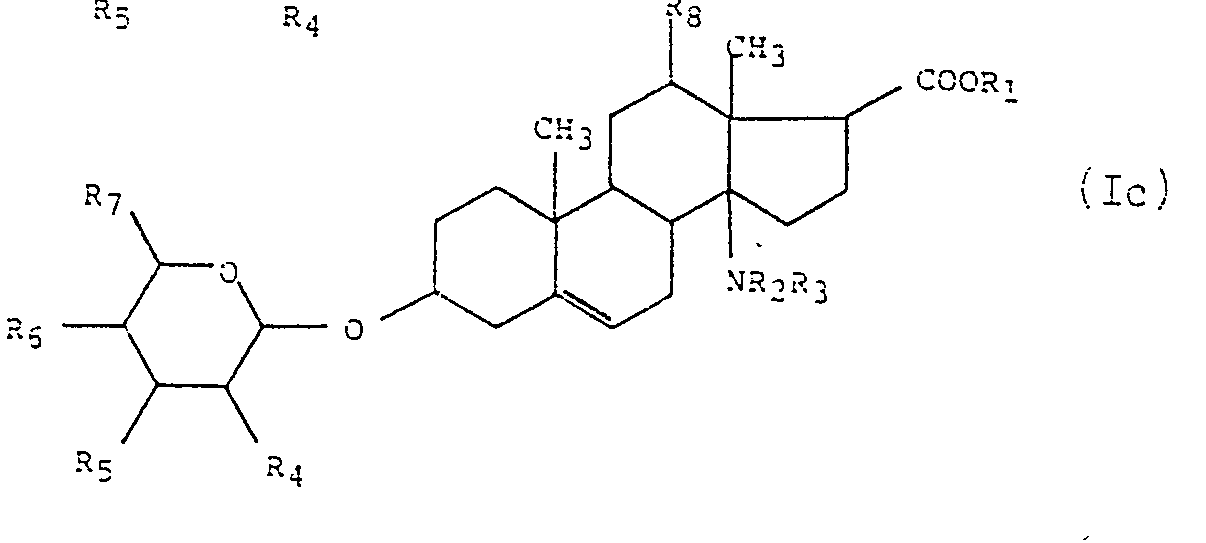
- Dans ce qui suit, l'expression "formule générale (I)" désigne globalement les trois variantes (la), (Ib) et (Ic), sauf indication contraire.
- Dans la formule générale (I) ci-dessus, le groupe alkyle inférieur représenté par Ri peut être un groupe méthyle, éthyle, isopropyle, butyle, etc, et de préférence un groupe méthyle ou éthyle. Le groupe alkyle inférieur ci-dessus peut être substitué par un groupe amino pour former par exemple un groupe amino-2 éthyle ou amino-3 propyle, ou di-(ou mono-) miéthÿlamino-3 propyle. Lorsque Ri représente un groupe aralkyle, ce groupe peut être par exemple un groupe phényle, un groupe benzyle, un groupe tolyle, ou un groupe phénéthyle. R2 et Rs, qui peuvent être identiques ou différents représentent de préférence un atome d'hydrogène ou un groupe méthyle. Lorsque R4 et R5 se combinent pour former un groupe divalent alkylènedioxy, ce groupe peut comporter une partie alkylène linéaire ou ramifiée contenant 1 à 4 atomes de carbone, et constituer par exemple un groupe méthylènedioxy, un groupe éthylènedioxy, ou un groupe isopropylidènedioxy. R8 représente de préférence un atome d'hydrogène ou un groupe hydroxy.
- Les nouveaux esters d'acide androstane 17-carboxylique conformes à la présente invention comportent dans leur molécule plusieurs atomes de carbone asymétriques et peuvent donc exister sous plusieurs formes stéréoisomères. L'invention concerne bien entendu les nouveaux dérivés représentés par la formule générale (I) ci-dessus sous formes d'isomères séparés ou en mélange de deux ou plusieurs isomères.
- Plus particulièrement, le groupe amino en position 14, le groupe ester en position 17 et le reste sucré en position 3, peuvent avoir la configuration a ou β, mais ils ont de préférence la configuration p. Il a été en effet constaté que l'activité pharmacologique des dérivés de formule générale (I) était généralement supérieure lorsque l'un au moins de ces trois substituants, et de préférence le groupe amino en position 14, ont la configuration β, et plus particulièrement lorsque les trois substituants ont la configuration β.
- L'atome d'hydrogène en position 5 du noyau stéroïde peut avoir l'une ou l'autre des configurations a et β, mais il a de préférence la configuration β.
- Parmi les nouveaux esters d'acide androstane 17-carboxylique représentés par la formule générale (I) ci-dessus, l'invention concerne de préférence l'α-L-rhamnopyranosyloxy-3β amino-14p étianate de méthyle, l'α-L-rhamnopyranosyloxy-3β méthylamino-14β étianate de méthyle, et l'a-L-rhamnopyranosyloxy-3p amino-14β etièn-4 ate de méthyle.
- Comme indiqué ci-dessus, les dérives de formule générale (I) conformes à la présente invention peuvent être préparés à partir d'un ester d'acide 3-hydroxy 14-azido androstane 17-carboxylique, représenté par la formule générale (II) ci-dessous:


- Les dérivés de formule générale (I) dans laquelle R2 et R3 représentent tous deux un atome d'hydrogène, comportant donc un groupe amino en position 14, peuvent être transformés en dérivés comportant un group mono- ou di-alkylamino par réaction d'aminométhylation suivant les techniques usuelles.
- L'ester d'acide 3-hydroxy 14-azido androstane 17-carboxylique de formule générale (II) utilisé comme produit de départ peut être aisément obtenu à partir de l'acétoxy-3 azido-14 étianate de méthyle décrit dans le brevet FR 2.464.270, par une réaction de désacétylation usuelle, par exemple par action d'un alcoolate de métal alcalin tel que le méthanolate de sodium, dans un solvant approprié.
- L'ester d'acide 3-hydroxy 14-azido androstane 17-carboxylique de formule générale (II) comportant une double liaison en 4-5 ou en 5-6 (Z est =C- ou C =) peut être aisément préparé à partir de l'ester correspondant comportant un noyau stéroïde saturé, par les techniques usuelles de formation d'une double liaison, par exemple comme décrit par J. Fried et J.A. Edwards Organic Reaction in Steroid Chemistry Van Nostrand Rheinhold Co. (1971) et dans les exemples ci-après.
- Le dérivé de sucre, utilisé dans la réaction de couplage avec l'ester d'acide 3-hydroxy 14-azido androstane 17-carboxylique, est un dérivé activé. L'activation peut être réalisée par exemple en transformant le sucre en un dérivé halogéné ou acétylé. Le dérivé halogéné est de préférence un bromure, par exemple le bromure de rhamnosyle que l'on fait agir en présence de cyanure mercurique. Dans le cas d'une activation par acétylation, on peut utiliser par exemple un tri-O-acétyl digitoxose que l'on fait réagir avec l'ester d'acide 3-hydroxy 14-azido androstane 17-carboxylique en présence d'acide toluène sulfonique.
- D'une manière générale, le sucre activé, et protégé comme indiqué ci-dessous, peut être un monosaccharide tel qu'un hexose, un désoxy-2 hexose, un desoxy-6 hexose, un didésoxy-2,6 hexose, etc. Plus particulièrement, le monosaccharide peut être choisi parmi un rhamnose, un glucose, un arabinose, un digitoxose, un fructose, un galactose; on peut utiliser par exemple un rhamnopyrannose, un hexopyrannose, le désoxy-6 glucose, le didésoxy-4,6 glycopyrannose, etc. On utilise de préférence un rhamnose, et plus particulièrement un rhamnopyrannose. On peut bien entendu utiliser les divers anomères existants, et de préférence les formes a-L et P-D.
- Les fonctions hydroxyle du sucre sont préalablement protégées de manière usuelle avant de réaliser la réaction de couplage, par exemple par acétylation ou par benzoylation. Une technique de protection des sucres utilisable dans la présente invention est décrite par exemple par E. Fisher et al. Chem. Ber. 53, p.2362 (1920). Le dérivé activé de sucre ainsi protégé peut être par exemple le tri-O-acétyl-2,3,4 bromo-1 rhamnose que l'on fait réagir en présence de cyanure mercurique, ou le tri-O-acétyl digitoxose en présence d'acide toluène sulfonique; dans ce deuxième cas, on obtient un mélange de glycosides isomères que l'on peut séparer par chromatographie après désacétylation. Lorsque R8 représente un groupe hydroxyle, ce groupe est également de préférence préalablement protégé par les mêmes techniques.
- Les groupements protecteurs des dérivés sucrés peuvent être ensuite éliminés par les techniques usuelles, après le couplage avec l'ester d'acide azido-14 étianique, si on le désire. La déprotection peut s'effectuer par elemple par chaufage en milieu basique.
- Comme indiqué ci-dessus, après la réaction de couplage avec le dérivé sucré, on effectue une réduction pour obtenir le dérivé de formule générale (1). La réduction du pyranosyloxy-3 azido-14 étianate de méthyle de formule générale (III) est réalisée par action du borohydrure de sodium en présence de tellure dans un alcool, suivie si nécessaire d'une désacétylation.
- Suivant une variante, la réduction du pyranosyloxy-3 azido-14 étianate de méthyle de formule générale (III) est réalisée par réaction d'hydrogénation en présence de nickel Raney, précédée si nécessaire d'une désacétylation.
- Les exemples suivants illustrent l'invention plus en détail sans en limiter la portée.
- On prépare une solution contenant 20g d'hydroxy-3p azido-14p étianate de méthyle et 37,6g de tri-O-acétyl-2,3,4 bromo-1 rhamnose dans 1,5 litre d'acétonitrile distillé extemporanément sur P20s. On ajoute 26,7g de cyanure mercurique, et on agite à température ambiante pendant environ une heure.
- Le milieu réactionnel est ensuite versé dabs 650ml d'une solution saturée d'hydrogénocarbonate de sodium. Cette solution est agitée pendant 50 min, puis additionnée de 500ml de toluène; la phase aqueuse est extraite trois fois au toluène, lavée à l'eau, puis à l'eau saturée de chlorure de sodium.
- Les phases toluéniques sont réunies, séchées, concentrées à sec; après recristallisation dans le méthanol, on obtient ainsi 26,2g (rendement 76%) de cristaux blancs de (tri-O-acétyl α-L-rhamnopyranosyloxy)-3β azido-14β étianate de méthyle.
- L'hydroxy-3p azido-14β étianate de méthyle utilisé comme produit de départ est obtenu à partir du dérivé acétoxylé correspondant, par chauffage en présence de méthanolate de sodium, extraction et cristallisation dans l'hexane.
- Dans un ballon d'un litre, on porte à reflux pendant environ 6 heures sous argon, un mélange de 8,7g de borohydrure de sodium et de 12,3g de tellure pulvérisé, dans 313ml d'éthanol absolu distillé extemporanément sur magnésium et dégazé à l'azote.
- Après refroidissement à température ambiante, on ajoute progressivement, sous atmosphère inerte, 25g de (tri-0-acétyl α-L-rhamnopyranosyloxy)-3β azido-14β étianate de méthyle obtenu comme indiqué ci-dessus, et on maintient sous agitation à température ambiante pendant 20 heures environ.
- Le mélange réactionnel est ensuite agité à l'air pendent 30 minutes, filtré sur célite, rincé à l'éthanol absolu, et concentré à sec. Le solide blanc obtenu est repris par 330ml d'acétate d'éthyle, puis on effectue une extraction acide-base (extraction par l'acide sulfamique à 50/0, lavage par l'acétate d'éthyle, alcalinisation agitation pendant une heure, extraction au chlorure de méthylène, puis lavage à l'eau), d'où l'on on obtient 14,3g de bases sous forme de poudre blanche (rendement brut: 75%).
- Le produit obtenu, purifié par chromatographie sur silice Merck (solvant: CH2C12/MeOH/NH40H 85/15/1,5 Rf=0,32) puis recristallisation dans l'éthanol, est l'α-L-rhamnopyranosyloxy-3β amino-14β étianate de méthyle.
- Point de fusion: F = 253/254°C (solvant EtOH/H20)
- Spectre IR (Nujol):v = 3370, 3320, 1735, 1605 cm-1
- Spectre de RMN: (CDCI3 + CD30D 3,5/1)
- 8 = 0,91 (s, Me-19) 0,93 (s, Me-18) 1,27 (d, Me-6', J5'-6'=6Hz) 3,68 (s, -COOCH3) 4,80 (H-1') ppm.
- On dissout 0,16g du dérivé obtenu comme indiqué dans l'exemple 1 dans 3,5ml d'acétonitrile, on ajoute 0,03ml de formaldéhyde en solution aqueuse à 35%, et 22mg de borocyanohydrure de sodium. On laisse la réaction se développer pendant 15 minutes.
- Après neutralisation par l'acide acétique et évaporation du solvant, reprise par de la potasse 2N et extraction des bases, on obtient 155mg de produit de méthylation que l'on sépare par chromatographie sur colonne de silice.
- Chromatographie CCM: Rf = 0,3
- Eluant: CH2CI2/MeOH/NH40H (80/20/2)
- Spectre IR (Nujol): v = 3700-2300 (max. 3360), 1725, 1695 cm-1.
- Ce dérivé est formé simultanément avec celui de l'exemple 2 ci-dessus. Il est isolé par chromatographie sur colonne et cristallisation dans l'éthanol.
- Chromatographie CCM: Rf = 0,4
- Eluant: CH2CI2/MeOH/NH40H (85/15/1,5)
- Spectre IR (Nujol) v = 3620-2500 (max. 3550, 3380), 2780, 1735, 1705 cm-1.
- On fait réagir 0,3g du dérivé obtenu comme indiqué dans l'exemple 1 dans 3,5ml d'éthanol contenant un équivalent d'éthanolate de sodium préparé extemporanément.
- On laisse réagir pendant 24 heures. Après extraction et lavage suivant la même technique que dans l'exemple 1, puis trituration dans l'éther isopropylique et cristallisation dans l'éther éthylique, on obtient 0,2g de produit pur constitué par l'α-L-rhamnopyranosyloxy-3β amino-14β étianate de méthyle. Chromatographie CCM: Rf = 0,25
- Eluant: CH2CI2/MeOH/NH40H (85/15/15)
- Spectre IR (Nujol) v= 3250-3600, 1730, 1700, 1660, 1515, 1040cm-1.
- On procède comme indiqué dans l'exemple 1 à partir d'hydroxy-3p azido-14β étianate de méthyle mais en remplaçant le tri-O-acétyl-2,3,4 bromo-1 rhamnose par le di-O-acétyl-2,3 méthoxy-4 bromo-1 rhamnose dans 1,5 litre d'acétonitrile distillé.
- On obtient ainsi le (O-méthyl-4' α-L-rhamnopyranosyloxy)-3β azido-14p étian-5p,17a(H)-ate de méthyle, dont on place 70 mg en suspension dans 1,5ml de mélange constitué par 40mg de tellure, 28mg de borocyanohydrure de sodium et 1,5ml d'éthanol absolu. Le mélange réactionnel est maintenu sous agitation à température ambiante pendant 21 heures environ sous atmosphère d'argon.
- L'excès de réactif est détruit par agitation pendant 15 minutes à l'air libre, puis le mélange réactionnel est filtré sur célite en rinçant par un mélange de chlorure de méthylène et d'éthanol. Après évaporation du filtrat à sec, extraction par le toluène, lavage à l'acide sulfamique en solution aqueuse à 2%, alcalinisation et extraction au chlorure de méthylène, on obtient 57mg de base (rendement 85%).
- On effectue une purification par chromatographie sur colonne de silice sous pression en utilisant comme éluant le mélange CH2CI2/EtOH/N40H (89/1/9/0,9). Après cristallisation dans l'isopropanol, on obtient 47mg d' (O-méthyl-4' α-L-rhamnopyranosyloxy)-3β amino-14p étian-5p,17a(H)-ate de méthyle (rendement 71%). Point de fusion: F = 106-108°C (solvant isopropanol)
- Spectre IR (Nujol) v = 3700-3100 (max. 3360), 1725, 1600, 1195, 1170, 1110, 1045, cm-1
- Spectre de RMN (CDCl3/CD3OD)
- 8 = 0,90 (s, Me 19), 0,94 (s, Me 18), 1,26 (d, J=6, Me 6'), 2,51 (m, H 17) 3,02 (t,J=9,5, H 4'), 3,54 (s, C-OMe), 3,65 (s, COOMe), 3,4 à 4,1 (m, H 2', 3' 5' et H 3), 4,75 (s, H 1') ppm.
- En opérant sous atmosphère d'azote, on ajoute 1,8g de (tri-O-acétyl α-L- rhamnopyranosyloxy)-3p azido-14β étianate de méthyle, obtenu comme indiqué dans l'exemple 1, à 8,4ml de méthylate de sodium 1N. on ajoute ensuite 2,5ml de méthanol et on laisse réagir pendant environ 1 heure à température ambiante. Après neutralisation par l'acide acétique glacial, et extraction par le chlorure de méthylène, on obtient 1,4g d'α-L-rhamnopyranosyloxy-3β azido-14β étianate de méthyle. On en prélève 0,5g que l'on dissout dans 4ml de diméthylformamide, puis on ajoute 5ml de diméthoxy-2,2 propane et 15ml d'acide tosylique. On laisse réagir pendant 2 heures à température ambiante, et après évaporation du solvant et extraction au toluène, on obtient 0,4g (rendement brut 96%) de (O-isopropylidène-2',3' α-L-rhamnopyranosyloxy)-3β azido-14p étian-5β,17α(H) ate de méthyle.
- Le dérivé ainsi obtenu est purifié par chromatographie sur colonne de silice sous pression, en éluant par le mélange CH2CI2/EtOH (98/2) (Rf = 0,65).
- Spectre IR (Nujol)v = 3650-3250 (max. 3470),2110, 1740 cm-1.
- A une solution refroidie à -60°C de 0,1ml de chlorure d'oxalyle dans 2,1ml de chlorure de méthylène, on ajoute 0,1 ml de diméthylsulfoxyde sec. On maintient sous agitation pendant 5 minutes à -60° C, puis pendant 5 minutes à -40°C, et on ajoute goutte à goutte 100mg d'(O-isopropylidène-2',3' α-L-rhamnopyranosyloxy)-3β azido-14β étian-5β,17α(H)-ate de méthyle obtenu comme indiqué ci-dessus, dissous dans 0,7ml de chlorure de méthylène.
- Le mélange réactionnel est maintenu sous agitation pendant une heure à -40°C, puis on arrête la réaction en ajoutant 0,6ml de N,N-diisopropyléthylamine.
- On laisse le milieu revenir à température ambiante et on évapore le solvant sous vide, pour obtenir le (désoxy-6' O-isopropylidene-2',3'α-L-lyxohexopyranulos-4'-yloxy)-3β azido-14β étian-5β,17α(H)-ate de méthyle.
- A une solution refroidie à 0°C de 100mg du dérivé obtenu comme indiqué ci-dessus, et de 66mg de CeCl3 7H20 dans 0,5ml de méthanol, on ajoute 6,7g de borohydrure de sodium. On obtient ainsi une supension que l'on maintient sous agitation à température ambiante pendant une heure. Après extraction au chlorure de méthylène et lavage à l'eau saturée de chlorure de sodium, le résidu est purifié par chromatographie sur colonne de silice sous pression en éluant par le mélange CH2CI2/EtOH (98/2) (Rf = 0,46).
- Le (désoxy-6' O-isopropylidène-2',3' α-L-tallo-hexopyranosyloxy)-3β azido-14p étian-5p,17a(H)-ate de méthyle ainsi obtenu (70mg), est hydrolysé en solution dans 1,4ml de chloroforme par 0,16ml d'acide trifluoroacétique en présence d'environ 1% d'eau. Après extraction par le chloroforme, on obtient 70mg de résidu sec cristallisable dans le méthanol, constitué par le (désoxy-6' α-L-tallohexopyraosyloxy)-3β azido-14β étian-5p,17a(H)-ate de méthyle.
- On réduit le dérivé ainsi obtenu par un mélange de borohydrure de sodium (26mg), de tellure pulvérisé (37mg) et d'éthanol absolu (2ml) suivant la méthode décrite dans l'exemple 1, en laissant la réaction s'effectuer pendant une nuit.
- Après filtration, rinçage, extraction, comme indiqué dans l'example 1, on obtient le (désoxy-6' α-L-tallo-hexopyranosyloxy)-3β amino-14β étian-5p,17a(H)-ate de méthyle (isomère du dérivé de l'exemple 1). Point de fusion: F = 210°C (solvant isopropanol)
- Spectre IR (Nujol): v = 3600-3050 (3480, 3370, 3100) 1725, 1600, 1105, 1100, 1050, 1025, 975 cm-1 Spectre de RMN: (CDCI3/CD30D 4/1)
- δ = 0,92 (s, Me-19) 0,94 (s, Me-18) 1,25 (d, J=6, Me 6') 2,55 (m, H 17), 3,67 (s, OCH3), 4,08 (s, H 1') 7,44 (CHCl3) ppm
- A 5,4ml d'éthanol absolu désoxygéné par de l'argon, on ajoute 150mg de tellure pulvérisé et 103mg de borohydrure de sodium. On chauffe pendant environ 2 heures à reflux de l'ethanol, sous argon. Après refroidissement à température ambiante, on ajoute 270mg d'(O-isopropylidène-2',3' a-L-rhamnopyranosylo- xy)-3p azido-14p étian-5p,17a(H) ate de méthyle obtenu comme indiqué dans l'exemple 6, en solution dans 2ml d'éthanol absolu désoxygéné.
- Le milieu réactionnel est maintenu sous agitation pendant 21 heures, puis la réaction est arrêtée en maintenant 15 minutes à l'air libre pour détruire l'excès de réactif.
- On filtre sur colonne de célite en éluant par le mélange CH2/Ci2/EtOH (9/1), puis on évapore le filtrat à sec. Le résidu est repris par du toluène puis on extrait les bases à l'acide sulfamique en solution aqueuse à 2%. Après alcalinisation par le carbonate de sodium et extraction par le chlorure de méthylène, on obtient 189mg de base et 42mg de neutre.
- En saturant les phase aqueuses par du chlorure de sodium, on extrait à nouveau 26mg de produit très polaire également présent dans le premier extrait basique.
- La fraction basique principale est purifiée par chromatographie sur colonne de 5,7g de silice sous 500mB de pression, an éluant par le mélange CH2Cl2/EtOH/NH4OH (94,5/5/05).
- On obtient ainsi 150mg de (O-isopropylidène-2',3', α-L-rhamnopyranosyloxy)-3β amino-14β étian-5β,17α(H)-ate de méthyle rendement 58%) sous forme de cristaux incolures solubles dans l'ether isopropylique.
- Point de fusion: F = 179°C (solvant éther isopropylique)
- Spectre IR (Nujol): v = 3700-3050 (max. 3350, 3300, 3170) 1735, 1600, 1170, 1075, 1555 cm-1
- Spectre de RMN: (CDCl3)
- 8 = 0,91 (s, Me-19) 0,94 (s, Me-18) 1,25 (d, J=6, Me 6') 1,36 et 1,51 (2s, CH3-C-CH3) 2,51 (m, H 17), 3,64 (s, OCH3), 3,2 à 4,2 (m, H 2', 3', 4', 5', H 3) 4,99 (s, H 1') ppm.
- On maintient sous agitation, pendant 2 heures, à température ambiante, une solution de 1,6g d'hydroxy-3p azido-14β étianate de méthyle et de 2,3g de tri-O-acétyl digitoxose en présence de 1,9g d'acide p-toluène sulfonique sec, dans 24ml de benzène.
- Après addition d'une solution aqueuse saturés de bicarbonate de sodium, et extraction par le benzène, on obtient un résidu qui est purifié par chromatographie sur colonne de silice sous pression, en éluant par le mélange AcOEt/hexane (25/75). On obtient ainsi un mélange de glycosides acétylés, que l'on soumet à une réaction de désacétylation par 5,3ml de méthylate de sodium. Les produits sont ensuite séparés par chromatographie sur colonne.
- L'a-D-digitoxoside séparé (CCM: éluant CH2CI2MeOH 95/5, Rf = 0,57) est utilisé tel quel dans l'étape de réduction suivante.
- La réduction s'effectue suivant la technique décrite dans l'exemple 1, par le mélange de borohydrure de sodium, de tellure pulvérisé et d'éthanol.
- Après extraction comme indiqué dans l'exemple 1, et chromatographie sur colonne de silice sous pression, en éluant par le mélange CHCI3/EtOH/NH40H (94,5/5/0,5), et cristallisation dans le mélange acétate d'éthyle - éther isopropylique, on obtient des cristaux d'O-(didésoxy-2',6' α-D-ribo-hexopyranosyloxy)-3β amino-14p étian-5p-ate de méthyle.
- Point de fusion: F = 178-182°C (solvant acétate d'éthyle -éther isopropylique)
- Spectre IR (Nujol): v = 3520, 3470, 1730 cm-1
- Spectre de RMN: (CDCI3/CD30D 4/1))
- 8 = 0,94(s, Me-18 et Me-19) 1,31 (d, J=6, Me 6') 2,52 (m, H-17), 3,11 (dd, J3'4,=3, J4'5'=10, H-4') 3,66 (s, OCH3), 3,95 (H-3, H-3') 4,95 (s, H 1') 7,37 (CHCl3) ppm.
- On procède comme indiqué dans l'exemple 8 et on sépare le β-D-digitoxoside, isomère de l'a-D-digitoxoside de l'exemple 8, par chromatographie.
- Le β-D-digitoxoside ainsi obtenu est réduit suivant la technique de l'exemple 8 par le mélange de borohydrure de sodium, de tellure pulvérisé et d'éthanol).
- Après extraction des bases comme indiqué dans l'exemple 1, chromatographie sur colonne de silice sous pression en éluant par le mélange CHCI3/EtOH/NH40H (92,3/7/0,7), et cristallisation dans le mélange acétate d'éthyle - éther isopropylique, on obtient le O-(didésoxy-2',6'β-D-ribo-hexopyranosyloxy)-3β amino-14β étian-5p-ate de méthyle.
- Point de fusion: F = 162-167°C (solvent acétate d'éthyle -éther isopropylique)
- Spectre IR (Nujol): v = 3600-3040 (3350), 1725, 1595, 1070cm-1
- Spectre de RMN: (CDCl3/CD3OD 4/1))
- δ = 0,95 et 0,96 2(s, Me-18 et Me-19) 1,27 (D, J =6, Me 6') 2,54 (m, H-17), 3,21 (dd, J3'4'=3, J4'5'= 10, H-4') 3,70 (s, OCH3), 4,05 (H-3, H-3') 4,90 (dd, J1'2'a=10, J1'2'e=2, H 1') 7,52 (CHCl3) ppm.
- On effectue un couplage de tri-O-acétyl digitoxoside et d'hydroxy-3p azido-14β étianate de méthyle suivant la technique décrite dans l'exemple 8, puis on effectue une saponification par le méthylate de sodium, et une chromatographie sur colonne de silice sous pression suivant la technique usuelle.
- On obtient ainsi le O-(didésoxy-2',6'β-D-arabinohexopyranosyloxy)-3β azido-14β étian-5β,17α(H) ate de méthyle, sur lequel on effectue une réaction de réduction par la technique indiquée ci-dessus.
- Après extraction et chromatographie sur colonne de silice sous pression, en éluant par le mélange CH2CI2/EtOH/NH40H (89/10/1), on obtient le O-(didésoxy-2'6'β-D-arabino-hexopyranosyloxy)-3β arnino-14β étian-5p,17a(H)-ate de méthyle.
- Point de fusion: F = 210°C (solvant: isopropanol - éther isopropylique)
- Spectre IR (film CHCl3): v = 3700-3100 (3360, 3220), 1700, 1625, 1215 cm-1
- Spectre de RMN: (CDCI3/CD30D 4/1))
- δ = 0,93 2(s, Me-19), 1,01 (s, Me-18) 1,29 (d, J=6, Me 6'), 3,72 (s, OCH3), 4,03 (H-3) 4,56 (dd, J=9, H-1') 7,35 (CHCI3) ppm.
- On procède comme dans l'exemple 10, mais en utilisant comme intermédiaire le O-(didésoxy-2'6' β-D-arabinohexo-pyranosyloxy)-3β azido-14β étian-5β,17α(H) ate de méthyle, isomère β-D du glycoside a-D de l'exemple 10, isolé par chromatographie à partir du même mélange réactionnel.
- La réduction dans les mêmes conditions que dans l'exemple 10 fournit, après chromatographie sur colonne de silice sous pression, en éluant par le mélange CH2CI2/EtOH/NH40H (89/10/1), et cristallisation dans le mélange CH2Cl2/EtOH, des cristaux de O-(didésoxy-2',6' α-D-arabino-hexopyranosyloxy)-3β amino-14β étian-5β,17α(H)-ate de méthyle.
- Point de fusion: F = 270°C (solvant: chlorure de méthylène -isopropanol)
- Spectre IR (Nujol): v = 3500-3150 (3350, 3270), 1730,1605cm-1
- On traite 5g d'hydroxy-3p azido-14β étianate de méthyle par 5 ml de réactif de Jones dans 100ml d'acétone. Le réactif est ajouté goutte à goutte dans la solution refroidie sur bain de glace. on laisse la réaction d'oxydation s'effectuer pendant 20 minutes, et, après extraction, on obtient 5g de cétone qui cirstallise dans l'acétate d'éthyle (F = 189-191°C).
- On effectue une bromation de la cétone obtenue comme indiqué ci-dessus en coulant goutte à goutte 1,5g de brome en solution dans 36ml de diméthylformamide dans une solution de 75ml de diméthylformamide contenant 2,2g de cétone, en présence de 0,07g de TsOH. L'addition s'effectue en 30 minutes. On laisse reposer 6 heures à température ambiante, et après extraction on obtient un mélange de deux isomères que l'on sépare par chromatographie sur colonne de silice (acétate d'éthyle/hexane 22/78) pour procurer 1,5g d'oxo-3 bromo-4β azido-14β étian-5β-ate de méthyle (fraction la plus polaire) et 0,5g d'oxo-3 bromo-2p azido-14β étian-5p-ate de méthyle (fraction la moins polaire).
- On fait réagir 0,8 d'oxo-3 bromo-4β azido-14β étian-5p-ate de méthyle dans 20ml de diméthylformamide avec 0,7g de chlorure de lithium, en chauffant pendant 2 heures à 110°C sous azote. Après extraction et chromatographie sur silice (acétate d'éthyle/hexane 28/72) on obtient 0,5g d'oxo-3 azido-14β étièn-4-ate de méthyle (chromatographie sur couche mince: acétate d'éthyle/hexane 1/1, Rf = 0,3)
- La cétone obtenue comme indiquée ci-dessus est réduite en faisant agir 0,5g de CeCI3 puis 50mg de NaBH4 sur 0,5g de cétone dans 10ml de méthanol. On acidifie par de l'acide chlorhydrique N (pH 6), et on extrait par l'acétate d'éthyle pour obtenir 0,5g d'hydroxy-3β azido-14β étièn-4-ate de méthyle.
- Chromatographie sur couche mince: CH2CI2/MeOH 97/3, Rf = 0,35)
- Spectre IR (Nujol) v = 3000-3600 (3520, 3340) 2100, 1715, 1665, 1285, 1205, 1180 cm-1.
- L'hydroxy-3p azido-14β étièn-4-ate de méthyle ainsi obtenu, analogue du produit de départ de l'exemple 1 comportant une double liaison en position 4, est traité comme dans l'exemple 1 par le tri-O-acétyl-2,3,4 bromo-1 rhamnose et le cyanure mercurique pour former le (tri-O-acétyl α-L-rhamnopyranosyloxy)-3β azido-14β étièn-4-ate de méthyle.
- On effectue une désacétylation du (tri-O-acétyl α-L-rhamnopyranosyloxy)-3β azido-14β étianate de méthyle par action du méthanolate de sodium dans le méthanol à température ambiante, puis neutralisation par l'acide chlorhydrique dilué et extraction par CH2CI2.
- Le dérivé azido-14 ci-dessus est réduit en dérivé amino-14 correspondant par action du borohydrure de sodium en présence de tellure pulvérisé, dans l'éthanol absolu, suivant le même procédé que dans l'exemple 1.
- Après chromatographie sur silice (CH2CI2/MeOH/NH40H 85/12/06) on obtient l'a-L-rhamnopyranosyloxy-3p amino-14p étianate de méthyle recherché qui cristallise dans l'éthanol absolu.
- Point de fusion: F = 240-246°C.
- Spectre de RMN (CDCl3 + CD304 4/1)
- δ = 1,02 (s, Me-18 + Me-19), 1,26 (d, J= 6, Me-6'), 2,6 (m, H-17)
- 3,69 (s, MeO), 4,86 (s, H-1'), 5,26 (s, H-4) ppm
- On traite 37mg de l'ester de l'exemple 12 en présence de 20mg de Pt02 selon la réaction d'Adams. On agite le mélange en suspension dans 6ml d'acétate d'éthyle et 0,6ml d'acide acétique pendant 48 heures.
- Après traitement d'extraction selon la technique usuelle, à partir de la fraction basique, on obtient 28mg de produit que l'on purifie par cristallisation dans l'éther isopropylique pour obtenir 16mg de a-rhamnopyranosy- loxy-3p amino-14p étian-5a-ate de méthyle.
- Point de fusion: F = 206° C
- Spectre de RMN (CHCI3/MeOH 3/1)
- δ = 0,80-0,98 (s, Me-18 + Me-19), 1,26 (d, J=6, Me-6'), 2,6 (m, H-17) 3,71 (s, OMe), 4,85 (s, H-1') ppm.
- Les études pharmacologiques et cliniques effectuées sur les nouveaux esters d'acide androstane 17-carboxylique selon la présente invention ont montré qu'ils possèdent d'intéressantes propriétés permettant leur application à titre de principes actifs de médicaments utilisables en thérapeutique humaine et vétérinaire.
- Les dérivés suivant l'invention présentent en particulier un effet inotrope positif très important, nettement supérieur à celui de la digoxine, médicament de référence bien connu pour le traitement des insuffisances cardiaque. De plus, leur activité est plus stable et leur toxicité cardiaque est plus faible.
- L'activité inotrope, qui démontre le pouvoir cardiotonique, a été vérifiée sur l'oreillette gauche stimulée de cobaye, par mesure de la force de contraction, suivant la technique décrite par J. Ghysel-Burton et al. "Brit. J. Pharmacol." 1979, 66, 2, 175-184.
- A titre d'exemple, le dérivé de l'exemple 1 suivant la présente invention développe un effet inotrope positif maximum très important (130% à la concentration de 10-5M), tandis que l'effet inotrope de la digoxine, dans les mêmes conditions, est nettement inférieur (70% à la concentration de 10-6M). De plus, l'effet inotrope positif du dérivé conforme à l'invention est stable pendant environ 60 minutes, tandis que la digoxine induit rapidement un inotropisme négatif. Ce phénomène indique une toxicité cellulaire moindre pour le dérive de l'invention par comparaison avec la digoxine. De même, l'effet contracturant bien connu des digitaliques, et notamment de la digoxine (cf. Handbook of cardiac glycosides, Ed. K, Greef), est nettement inférieur dans le cas des dérivés de l'invention.
- L'effet inotrope positif des dérives conformes à la présente invention décrits dans les exemples 1 à 11 ci-dessus est indiqué dans le tableau ci-dessous. L'effet inotrope est exprimé en pourcentage d'augmentation de la force de contraction de l'oreillette gauche stimulée de cobaye, à la concentration de 5.10-6M.

- L'effet inotrope positif chez le chien anesthésié au pentobarbital sodique (essais in vivo) est confirmé par la mesure des paramètres hémodynamiques, selon la méthode décrite par R.E. Patterson et al. "Cardiology" 1972, 57, 277-294. On constate que le produit de l'exemple 1, après perfusion par voie intraveineuse de 3 à 4.10-9mole par kg.min pendant 20 minutes, est d'environ 20 à 400/o. Si la perfusion est prolongée pendant plusieurs heures à la vitesse de 2,2.10-8mole par kg.min, l'activité cardiotonique se développe et se maintient à environ 60-70%. Dans le cas de la digoxine, pour un effet inotrope comparable, lorsque la perfusion est maintenue, des troubles du rythme cardiaque apparaissent dès la deuxième heure, puis la mort dès la troisième heure.
- Des essais comparatifs ont été effectués sur 10 chiens pour les indices thérapeutiques suivants: A - dose d'arythmie réversible / dose efficace; B - dose toxique / dose efficace; C-dose léthale / dose efficace. La dose d'arythmie réversible est la dose à laquelle apparaît une arythmie spontanément réversible; la dose toxique est la dose à laquelle l'arythmie est continue ; la dose léthale est la dose provoquant la mort (pression sanguine et débit cardiaque nuls) ; la dose efficace est la dose à laquelle on observe une augmentation de 30% de la force de contraction cardique par rapport au niveau témoin.
- Les résultats sont indiqués au tableau ci-desous.

- Ces résultats montrent que les dérivés suivant la présente invention possèdent une efficacité supérieure à celle de la digoxine avec une mondre toxicité.
- Les esters d'acide androstane 17-carboxylique suivant la présente invention peuvent être utilisés comme principes actifs de médicaments, que l'on peut administrer sous les formes usuelles, le principe actif étant dilué dans un excipient pharmaceutiquement acceptable convenablement choisi, par exemple sous forme de comprimé, gélule, ou soluté injectable.
- Les doses administrées sont comparables à celles des médicaments cardiotoniques connus dérivés des cardénolides, et sont déterminées par le médecin de manière usuelle en fonction du mode d'administration et de l'état du patient.
Claims (14)

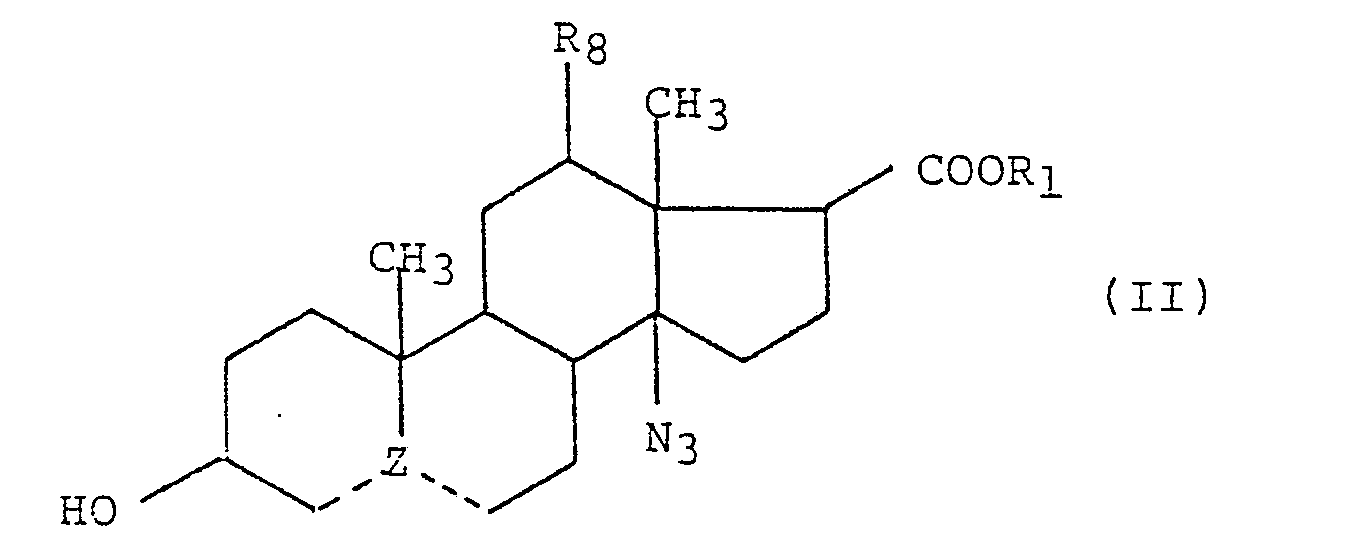
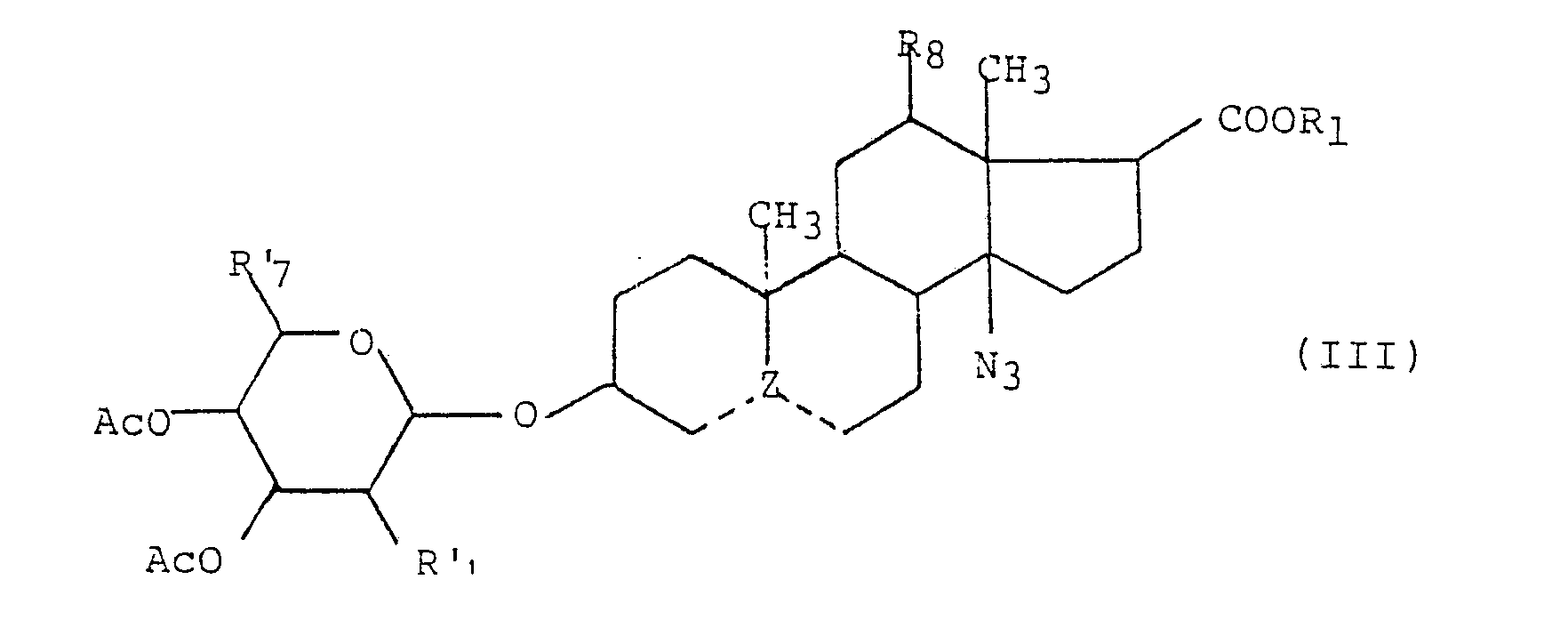
Priority Applications (1)
| Application Number | Priority Date | Filing Date | Title |
|---|---|---|---|
| AT88402476T ATE79630T1 (de) | 1987-10-02 | 1988-09-30 | Androstan-17-carbonsaeureester, verfahren zu ihrer herstellung und arzneimittel, die sie enthalten. |
Applications Claiming Priority (2)
| Application Number | Priority Date | Filing Date | Title |
|---|---|---|---|
| FR8713658 | 1987-10-02 | ||
| FR8713658A FR2621316B1 (fr) | 1987-10-02 | 1987-10-02 | Nouveaux esters d'acide androstane 17-carboxylique, procede pour leur preparation, et medicament les contenant |
Publications (2)
| Publication Number | Publication Date |
|---|---|
| EP0310519A1 true EP0310519A1 (fr) | 1989-04-05 |
| EP0310519B1 EP0310519B1 (fr) | 1992-08-19 |
Family
ID=9355472
Family Applications (1)
| Application Number | Title | Priority Date | Filing Date |
|---|---|---|---|
| EP88402476A Expired - Lifetime EP0310519B1 (fr) | 1987-10-02 | 1988-09-30 | Nouveaux esters d'acide androstane 17-carboxylique, procédé pour leur préparation et médicament les contenant |
Country Status (22)
| Country | Link |
|---|---|
| US (1) | US4885280A (fr) |
| EP (1) | EP0310519B1 (fr) |
| JP (1) | JP2783560B2 (fr) |
| KR (1) | KR970002642B1 (fr) |
| AT (1) | ATE79630T1 (fr) |
| AU (1) | AU607100B2 (fr) |
| CA (1) | CA1306248C (fr) |
| DE (1) | DE3873870T2 (fr) |
| DK (1) | DK165595C (fr) |
| EG (1) | EG19114A (fr) |
| ES (1) | ES2052761T3 (fr) |
| FI (1) | FI89055C (fr) |
| FR (1) | FR2621316B1 (fr) |
| GR (1) | GR3005968T3 (fr) |
| HK (1) | HK60297A (fr) |
| IE (1) | IE61941B1 (fr) |
| IL (1) | IL87894A (fr) |
| MY (1) | MY103635A (fr) |
| NO (1) | NO173011C (fr) |
| NZ (1) | NZ226433A (fr) |
| PT (1) | PT88648B (fr) |
| ZA (1) | ZA887396B (fr) |
Cited By (3)
| Publication number | Priority date | Publication date | Assignee | Title |
|---|---|---|---|---|
| WO1993005790A1 (fr) * | 1991-09-27 | 1993-04-01 | Procter & Gamble Pharmaceuticals, Inc. | Emploi de 14-aminosteroides dans la fabrication d'un medicament destine a ralentir la vitesse de progression d'alterations structurelles myocardiques caracteristique de l'insuffisance cardiaque congestive |
| WO1995008558A1 (fr) * | 1993-09-24 | 1995-03-30 | The Procter & Gamble Company | Nouveaux composes 14-aminosteroides contenant du sucre a substitution oxygene et desoxy |
| WO1995008557A1 (fr) * | 1993-09-24 | 1995-03-30 | The Procter & Gamble Company | Nouveaux composes 14-aminosteroides contenant un oligosaccharide, et nouveaux procedes de traitement chimique a l'aide des nouveaux aminosteroides diastereoselectifs |
Families Citing this family (14)
| Publication number | Priority date | Publication date | Assignee | Title |
|---|---|---|---|---|
| US5209926A (en) * | 1990-06-12 | 1993-05-11 | Insite Vision Incorporated | Aminosteroids for ophthalmic use |
| US5124154A (en) * | 1990-06-12 | 1992-06-23 | Insite Vision Incorporated | Aminosteroids for ophthalmic use |
| US5256408A (en) * | 1990-06-12 | 1993-10-26 | Insite Vision Incorporated | Aminosteroids for ophthalmic use |
| US5252319A (en) * | 1990-06-12 | 1993-10-12 | Insite Vision Incorporated | Aminosteroids for ophthalmic use |
| CZ331094A3 (en) * | 1992-06-26 | 1995-09-13 | Pfizer | Steroidal glycosides and their use for treating hypercholesterolemia and atherosclerosis |
| AU700131B2 (en) * | 1993-09-24 | 1998-12-24 | Procter & Gamble Company, The | Novel deoxy and oxygen-substituted sugar-containing 14-aminosteroid compounds |
| US5922703A (en) * | 1993-09-24 | 1999-07-13 | The Procter & Gamble Company | Urethane-containing aminosteroid compounds |
| BR9709835A (pt) * | 1996-06-17 | 1999-08-10 | Procter & Gamble | Compostos 14-aminoesteróides contendo açúcar substituído com deóxi e oxigênio para uso como um antiarrítmico |
| ATE473759T1 (de) | 1998-05-22 | 2010-07-15 | Univ Leland Stanford Junior | Bifunktionelle moleküle sowie darauf basierende therapien. |
| CN102379684B (zh) | 2005-04-28 | 2014-11-19 | 普罗透斯数字保健公司 | 药物信息系统 |
| US9062126B2 (en) | 2005-09-16 | 2015-06-23 | Raptor Pharmaceuticals Inc. | Compositions comprising receptor-associated protein (RAP) variants specific for CR-containing proteins and uses thereof |
| EP2398500B1 (fr) | 2009-02-20 | 2019-03-13 | 2-BBB Medicines B.V. | Sustème d'administration de médicament à base de glutathionne |
| ES2942923T3 (es) | 2009-05-06 | 2023-06-07 | Laboratory Skin Care Inc | Composiciones de administración dérmica que comprenden complejos de agente activo-partículas de fosfato de calcio y métodos de uso de las mismas |
| GB201112402D0 (en) | 2011-07-19 | 2011-08-31 | British American Tobacco Co | Cellulose acetate compositions |
Citations (2)
| Publication number | Priority date | Publication date | Assignee | Title |
|---|---|---|---|---|
| EP0024983A2 (fr) * | 1979-08-31 | 1981-03-11 | Etablissements Nativelle S.A. | Dérivés d'amino-14 stéroides et procédé pour leur préparation |
| EP0101659A2 (fr) * | 1982-08-20 | 1984-02-29 | Etablissements Nativelle S.A. | Nouveaux dérivés d'amino-14 stéroides, procédé pour leur préparation, et application en thérapeutique |
Family Cites Families (3)
| Publication number | Priority date | Publication date | Assignee | Title |
|---|---|---|---|---|
| US3449381A (en) * | 1962-06-12 | 1969-06-10 | Syntex Corp | 19-oxo- and 19-lower alkyl-19-oxoandrostane derivatives |
| US3634409A (en) * | 1966-04-26 | 1972-01-11 | Syntex Corp | 3beta-tetrahydrofuran-2'-yloxy-delta**4-steroids of the androstane and estrane series |
| ES524796A0 (es) * | 1982-08-20 | 1984-05-01 | Nativelle Sa Ets | Procedimiento de preparacion de nuevos derivos de amino-14 esteroides |
-
1987
- 1987-10-02 FR FR8713658A patent/FR2621316B1/fr not_active Expired - Fee Related
-
1988
- 1988-09-29 CA CA000578812A patent/CA1306248C/fr not_active Expired - Lifetime
- 1988-09-30 ES ES88402476T patent/ES2052761T3/es not_active Expired - Lifetime
- 1988-09-30 IL IL8789488A patent/IL87894A/en not_active IP Right Cessation
- 1988-09-30 DK DK549388A patent/DK165595C/da not_active IP Right Cessation
- 1988-09-30 PT PT88648A patent/PT88648B/pt not_active IP Right Cessation
- 1988-09-30 AT AT88402476T patent/ATE79630T1/de not_active IP Right Cessation
- 1988-09-30 EP EP88402476A patent/EP0310519B1/fr not_active Expired - Lifetime
- 1988-09-30 US US07/252,240 patent/US4885280A/en not_active Expired - Fee Related
- 1988-09-30 NO NO884344A patent/NO173011C/no not_active IP Right Cessation
- 1988-09-30 DE DE8888402476T patent/DE3873870T2/de not_active Expired - Fee Related
- 1988-09-30 FI FI884511A patent/FI89055C/fi not_active IP Right Cessation
- 1988-10-02 EG EG50588A patent/EG19114A/fr active
- 1988-10-03 AU AU22935/88A patent/AU607100B2/en not_active Ceased
- 1988-10-03 IE IE299188A patent/IE61941B1/en not_active IP Right Cessation
- 1988-10-03 ZA ZA887396A patent/ZA887396B/xx unknown
- 1988-10-03 NZ NZ226433A patent/NZ226433A/en unknown
- 1988-10-03 JP JP63249708A patent/JP2783560B2/ja not_active Expired - Lifetime
- 1988-10-04 KR KR1019880012904A patent/KR970002642B1/ko not_active Expired - Fee Related
- 1988-11-07 MY MYPI88001276A patent/MY103635A/en unknown
-
1992
- 1992-10-12 GR GR920402291T patent/GR3005968T3/el unknown
-
1997
- 1997-05-08 HK HK60297A patent/HK60297A/xx not_active IP Right Cessation
Patent Citations (2)
| Publication number | Priority date | Publication date | Assignee | Title |
|---|---|---|---|---|
| EP0024983A2 (fr) * | 1979-08-31 | 1981-03-11 | Etablissements Nativelle S.A. | Dérivés d'amino-14 stéroides et procédé pour leur préparation |
| EP0101659A2 (fr) * | 1982-08-20 | 1984-02-29 | Etablissements Nativelle S.A. | Nouveaux dérivés d'amino-14 stéroides, procédé pour leur préparation, et application en thérapeutique |
Cited By (4)
| Publication number | Priority date | Publication date | Assignee | Title |
|---|---|---|---|---|
| WO1993005790A1 (fr) * | 1991-09-27 | 1993-04-01 | Procter & Gamble Pharmaceuticals, Inc. | Emploi de 14-aminosteroides dans la fabrication d'un medicament destine a ralentir la vitesse de progression d'alterations structurelles myocardiques caracteristique de l'insuffisance cardiaque congestive |
| WO1995008558A1 (fr) * | 1993-09-24 | 1995-03-30 | The Procter & Gamble Company | Nouveaux composes 14-aminosteroides contenant du sucre a substitution oxygene et desoxy |
| WO1995008557A1 (fr) * | 1993-09-24 | 1995-03-30 | The Procter & Gamble Company | Nouveaux composes 14-aminosteroides contenant un oligosaccharide, et nouveaux procedes de traitement chimique a l'aide des nouveaux aminosteroides diastereoselectifs |
| EP0863149A1 (fr) * | 1993-09-24 | 1998-09-09 | The Procter & Gamble Company | Procédé pour introduire des groupes amino dans la position 14 d'un stéroide |
Also Published As
Similar Documents
| Publication | Publication Date | Title |
|---|---|---|
| EP0310519B1 (fr) | Nouveaux esters d'acide androstane 17-carboxylique, procédé pour leur préparation et médicament les contenant | |
| FR2666585A1 (fr) | Nouveaux pregnadiene-1,4 dione-3,20 acetal-16-17 esters-21, procede pour leur fabrication, compositions, et methodes pour le traitement des etats inflammatoires. | |
| CH637409A5 (fr) | Steroides, leur preparation et composition therapeutique les contenant. | |
| EP0101659B1 (fr) | Nouveaux dérivés d'amino-14 stéroides, procédé pour leur préparation, et application en thérapeutique | |
| BE1000407A4 (fr) | Anthracycline glycosides a activite antitumorale, leur preparation, les composes intermediaires de cette preparation, et compositions et utilisation de ces substances. | |
| MC1934A1 (fr) | Derives de pyrimidine | |
| EP0101383B1 (fr) | Dérivés d'amino-14 stéroides, application en thérapeutique, et procédé de préparation | |
| CA1094569A (fr) | Procede de preparation de nouvelles lactones derivees du cyclopentanol | |
| EP0012641B1 (fr) | Dérivés 2-substitués du 19-nor-pregn-4-ène-3,20-dione, procédé pour leur préparation et compositions pharmaceutiques les renfermant | |
| US4560703A (en) | Clavulone derivatives, process for preparing the same, and use of said compounds | |
| WO2008056059A2 (fr) | Derives de 4-azasteroles, leurs procedes de synthese et leur utilisation a titre de medicament | |
| FR2510577A1 (fr) | Composes organiques azotes extraits de plantes et leurs derives, leur preparation et leurs utilisations therapeutiques, notamment en tant qu'agents antineoplastiques | |
| FR2487359A1 (fr) | 11a-amino-androstanes, leur preparation et compositions en contenant | |
| FR2531964A1 (fr) | Derives d'amino-14 steroides, procede de preparation, et application en therapeutique | |
| JP2640239B2 (ja) | プロトスタ−13(17)エン−3,16−ジオン化合物 | |
| FR2600254A1 (fr) | Derives methylenes des androstene-4 diones-3, 17, leur procede de preparation, et leur application comme medicaments | |
| EP0032889B1 (fr) | Nouveaux dérivés du type diméthyl-1,10 oxayohimbane et médicaments les contenant | |
| BE873380A (fr) | Nouveaux derives de prostaglandine, leur procede de preparation et leur application en therapeutique | |
| FR2547586A1 (fr) | Derives d'amino-14 steroides, procede de preparation et application en therapeutique | |
| BE889639A (fr) | 11-alpha-amino-androstanes, leur preparation et compositions en contenant | |
| FR2548191A1 (fr) | Amino-14 steroides, application en therapeutique et procede de preparation | |
| FR2617165A1 (fr) | Derives du dimethyl-2, 2 chromannol-3 | |
| BE568230A (fr) | ||
| CH498867A (fr) | Procédé de préparation de dérivés stéroïdes insaturés substitués par un atome d'oxygène endocyclique | |
| JPH10316700A (ja) | D−ホモ−17−オキサ−1,3,5(10)−エストラトリエン誘導体 |
Legal Events
| Date | Code | Title | Description |
|---|---|---|---|
| PUAI | Public reference made under article 153(3) epc to a published international application that has entered the european phase |
Free format text: ORIGINAL CODE: 0009012 |
|
| AK | Designated contracting states |
Kind code of ref document: A1 Designated state(s): AT BE CH DE ES FR GB GR IT LI LU NL SE |
|
| 17P | Request for examination filed |
Effective date: 19890923 |
|
| 17Q | First examination report despatched |
Effective date: 19910325 |
|
| GRAA | (expected) grant |
Free format text: ORIGINAL CODE: 0009210 |
|
| AK | Designated contracting states |
Kind code of ref document: B1 Designated state(s): AT BE CH DE ES FR GB GR IT LI LU NL SE |
|
| REF | Corresponds to: |
Ref document number: 79630 Country of ref document: AT Date of ref document: 19920915 Kind code of ref document: T |
|
| REF | Corresponds to: |
Ref document number: 3873870 Country of ref document: DE Date of ref document: 19920924 |
|
| ITF | It: translation for a ep patent filed | ||
| GBT | Gb: translation of ep patent filed (gb section 77(6)(a)/1977) | ||
| REG | Reference to a national code |
Ref country code: GR Ref legal event code: FG4A Free format text: 3005968 |
|
| PLBE | No opposition filed within time limit |
Free format text: ORIGINAL CODE: 0009261 |
|
| STAA | Information on the status of an ep patent application or granted ep patent |
Free format text: STATUS: NO OPPOSITION FILED WITHIN TIME LIMIT |
|
| 26N | No opposition filed | ||
| EPTA | Lu: last paid annual fee | ||
| REG | Reference to a national code |
Ref country code: FR Ref legal event code: CD |
|
| REG | Reference to a national code |
Ref country code: ES Ref legal event code: FG2A Ref document number: 2052761 Country of ref document: ES Kind code of ref document: T3 |
|
| EAL | Se: european patent in force in sweden |
Ref document number: 88402476.1 |
|
| PGFP | Annual fee paid to national office [announced via postgrant information from national office to epo] |
Ref country code: NL Payment date: 20000620 Year of fee payment: 13 |
|
| PGFP | Annual fee paid to national office [announced via postgrant information from national office to epo] |
Ref country code: GR Payment date: 20000726 Year of fee payment: 13 |
|
| PGFP | Annual fee paid to national office [announced via postgrant information from national office to epo] |
Ref country code: LU Payment date: 20000803 Year of fee payment: 13 |
|
| PGFP | Annual fee paid to national office [announced via postgrant information from national office to epo] |
Ref country code: GB Payment date: 20000807 Year of fee payment: 13 Ref country code: AT Payment date: 20000807 Year of fee payment: 13 |
|
| PGFP | Annual fee paid to national office [announced via postgrant information from national office to epo] |
Ref country code: SE Payment date: 20000901 Year of fee payment: 13 |
|
| PGFP | Annual fee paid to national office [announced via postgrant information from national office to epo] |
Ref country code: FR Payment date: 20000905 Year of fee payment: 13 |
|
| PGFP | Annual fee paid to national office [announced via postgrant information from national office to epo] |
Ref country code: ES Payment date: 20000926 Year of fee payment: 13 |
|
| PGFP | Annual fee paid to national office [announced via postgrant information from national office to epo] |
Ref country code: DE Payment date: 20000928 Year of fee payment: 13 |
|
| PGFP | Annual fee paid to national office [announced via postgrant information from national office to epo] |
Ref country code: BE Payment date: 20001010 Year of fee payment: 13 |
|
| PGFP | Annual fee paid to national office [announced via postgrant information from national office to epo] |
Ref country code: CH Payment date: 20001013 Year of fee payment: 13 |
|
| PG25 | Lapsed in a contracting state [announced via postgrant information from national office to epo] |
Ref country code: LU Free format text: LAPSE BECAUSE OF NON-PAYMENT OF DUE FEES Effective date: 20010930 Ref country code: LI Free format text: LAPSE BECAUSE OF NON-PAYMENT OF DUE FEES Effective date: 20010930 Ref country code: GR Free format text: LAPSE BECAUSE OF NON-PAYMENT OF DUE FEES Effective date: 20010930 Ref country code: GB Free format text: LAPSE BECAUSE OF NON-PAYMENT OF DUE FEES Effective date: 20010930 Ref country code: CH Free format text: LAPSE BECAUSE OF NON-PAYMENT OF DUE FEES Effective date: 20010930 Ref country code: BE Free format text: LAPSE BECAUSE OF NON-PAYMENT OF DUE FEES Effective date: 20010930 Ref country code: AT Free format text: LAPSE BECAUSE OF NON-PAYMENT OF DUE FEES Effective date: 20010930 |
|
| PG25 | Lapsed in a contracting state [announced via postgrant information from national office to epo] |
Ref country code: SE Free format text: LAPSE BECAUSE OF NON-PAYMENT OF DUE FEES Effective date: 20011001 Ref country code: ES Free format text: LAPSE BECAUSE OF NON-PAYMENT OF DUE FEES Effective date: 20011001 |
|
| REG | Reference to a national code |
Ref country code: GB Ref legal event code: IF02 |
|
| BERE | Be: lapsed |
Owner name: LABORATOIRE NATIVELLE S.A. Effective date: 20010930 |
|
| PG25 | Lapsed in a contracting state [announced via postgrant information from national office to epo] |
Ref country code: NL Free format text: LAPSE BECAUSE OF NON-PAYMENT OF DUE FEES Effective date: 20020401 |
|
| PG25 | Lapsed in a contracting state [announced via postgrant information from national office to epo] |
Ref country code: DE Free format text: LAPSE BECAUSE OF NON-PAYMENT OF DUE FEES Effective date: 20020501 |
|
| REG | Reference to a national code |
Ref country code: CH Ref legal event code: PL |
|
| GBPC | Gb: european patent ceased through non-payment of renewal fee |
Effective date: 20010930 |
|
| PG25 | Lapsed in a contracting state [announced via postgrant information from national office to epo] |
Ref country code: FR Free format text: LAPSE BECAUSE OF NON-PAYMENT OF DUE FEES Effective date: 20020531 |
|
| NLV4 | Nl: lapsed or anulled due to non-payment of the annual fee |
Effective date: 20020401 |
|
| EUG | Se: european patent has lapsed |
Ref document number: 88402476.1 |
|
| REG | Reference to a national code |
Ref country code: FR Ref legal event code: ST |
|
| NLV4 | Nl: lapsed or anulled due to non-payment of the annual fee |
Effective date: 20020401 |
|
| REG | Reference to a national code |
Ref country code: ES Ref legal event code: FD2A Effective date: 20021011 |
|
| PG25 | Lapsed in a contracting state [announced via postgrant information from national office to epo] |
Ref country code: IT Free format text: LAPSE BECAUSE OF NON-PAYMENT OF DUE FEES;WARNING: LAPSES OF ITALIAN PATENTS WITH EFFECTIVE DATE BEFORE 2007 MAY HAVE OCCURRED AT ANY TIME BEFORE 2007. THE CORRECT EFFECTIVE DATE MAY BE DIFFERENT FROM THE ONE RECORDED. Effective date: 20050930 |