EP0989985B1 - Kondensierte, polycyclische 2-aminopyrimidinderivate als proteinkinasehemmer - Google Patents
Kondensierte, polycyclische 2-aminopyrimidinderivate als proteinkinasehemmer Download PDFInfo
- Publication number
- EP0989985B1 EP0989985B1 EP98930896A EP98930896A EP0989985B1 EP 0989985 B1 EP0989985 B1 EP 0989985B1 EP 98930896 A EP98930896 A EP 98930896A EP 98930896 A EP98930896 A EP 98930896A EP 0989985 B1 EP0989985 B1 EP 0989985B1
- Authority
- EP
- European Patent Office
- Prior art keywords
- group
- alk
- optionally substituted
- groups
- atom
- Prior art date
- Legal status (The legal status is an assumption and is not a legal conclusion. Google has not performed a legal analysis and makes no representation as to the accuracy of the status listed.)
- Expired - Lifetime
Links
Classifications
-
- C—CHEMISTRY; METALLURGY
- C07—ORGANIC CHEMISTRY
- C07D—HETEROCYCLIC COMPOUNDS
- C07D401/00—Heterocyclic compounds containing two or more hetero rings, having nitrogen atoms as the only ring hetero atoms, at least one ring being a six-membered ring with only one nitrogen atom
- C07D401/02—Heterocyclic compounds containing two or more hetero rings, having nitrogen atoms as the only ring hetero atoms, at least one ring being a six-membered ring with only one nitrogen atom containing two hetero rings
- C07D401/04—Heterocyclic compounds containing two or more hetero rings, having nitrogen atoms as the only ring hetero atoms, at least one ring being a six-membered ring with only one nitrogen atom containing two hetero rings directly linked by a ring-member-to-ring-member bond
-
- A—HUMAN NECESSITIES
- A61—MEDICAL OR VETERINARY SCIENCE; HYGIENE
- A61P—SPECIFIC THERAPEUTIC ACTIVITY OF CHEMICAL COMPOUNDS OR MEDICINAL PREPARATIONS
- A61P1/00—Drugs for disorders of the alimentary tract or the digestive system
-
- A—HUMAN NECESSITIES
- A61—MEDICAL OR VETERINARY SCIENCE; HYGIENE
- A61P—SPECIFIC THERAPEUTIC ACTIVITY OF CHEMICAL COMPOUNDS OR MEDICINAL PREPARATIONS
- A61P11/00—Drugs for disorders of the respiratory system
- A61P11/06—Antiasthmatics
-
- A—HUMAN NECESSITIES
- A61—MEDICAL OR VETERINARY SCIENCE; HYGIENE
- A61P—SPECIFIC THERAPEUTIC ACTIVITY OF CHEMICAL COMPOUNDS OR MEDICINAL PREPARATIONS
- A61P17/00—Drugs for dermatological disorders
- A61P17/06—Antipsoriatics
-
- A—HUMAN NECESSITIES
- A61—MEDICAL OR VETERINARY SCIENCE; HYGIENE
- A61P—SPECIFIC THERAPEUTIC ACTIVITY OF CHEMICAL COMPOUNDS OR MEDICINAL PREPARATIONS
- A61P19/00—Drugs for skeletal disorders
- A61P19/08—Drugs for skeletal disorders for bone diseases, e.g. rachitism, Paget's disease
- A61P19/10—Drugs for skeletal disorders for bone diseases, e.g. rachitism, Paget's disease for osteoporosis
-
- A—HUMAN NECESSITIES
- A61—MEDICAL OR VETERINARY SCIENCE; HYGIENE
- A61P—SPECIFIC THERAPEUTIC ACTIVITY OF CHEMICAL COMPOUNDS OR MEDICINAL PREPARATIONS
- A61P25/00—Drugs for disorders of the nervous system
-
- A—HUMAN NECESSITIES
- A61—MEDICAL OR VETERINARY SCIENCE; HYGIENE
- A61P—SPECIFIC THERAPEUTIC ACTIVITY OF CHEMICAL COMPOUNDS OR MEDICINAL PREPARATIONS
- A61P29/00—Non-central analgesic, antipyretic or antiinflammatory agents, e.g. antirheumatic agents; Non-steroidal antiinflammatory drugs [NSAID]
-
- A—HUMAN NECESSITIES
- A61—MEDICAL OR VETERINARY SCIENCE; HYGIENE
- A61P—SPECIFIC THERAPEUTIC ACTIVITY OF CHEMICAL COMPOUNDS OR MEDICINAL PREPARATIONS
- A61P35/00—Antineoplastic agents
-
- A—HUMAN NECESSITIES
- A61—MEDICAL OR VETERINARY SCIENCE; HYGIENE
- A61P—SPECIFIC THERAPEUTIC ACTIVITY OF CHEMICAL COMPOUNDS OR MEDICINAL PREPARATIONS
- A61P37/00—Drugs for immunological or allergic disorders
- A61P37/02—Immunomodulators
-
- A—HUMAN NECESSITIES
- A61—MEDICAL OR VETERINARY SCIENCE; HYGIENE
- A61P—SPECIFIC THERAPEUTIC ACTIVITY OF CHEMICAL COMPOUNDS OR MEDICINAL PREPARATIONS
- A61P37/00—Drugs for immunological or allergic disorders
- A61P37/02—Immunomodulators
- A61P37/06—Immunosuppressants, e.g. drugs for graft rejection
-
- A—HUMAN NECESSITIES
- A61—MEDICAL OR VETERINARY SCIENCE; HYGIENE
- A61P—SPECIFIC THERAPEUTIC ACTIVITY OF CHEMICAL COMPOUNDS OR MEDICINAL PREPARATIONS
- A61P43/00—Drugs for specific purposes, not provided for in groups A61P1/00-A61P41/00
-
- A—HUMAN NECESSITIES
- A61—MEDICAL OR VETERINARY SCIENCE; HYGIENE
- A61P—SPECIFIC THERAPEUTIC ACTIVITY OF CHEMICAL COMPOUNDS OR MEDICINAL PREPARATIONS
- A61P9/00—Drugs for disorders of the cardiovascular system
-
- C—CHEMISTRY; METALLURGY
- C07—ORGANIC CHEMISTRY
- C07D—HETEROCYCLIC COMPOUNDS
- C07D239/00—Heterocyclic compounds containing 1,3-diazine or hydrogenated 1,3-diazine rings
- C07D239/70—Heterocyclic compounds containing 1,3-diazine or hydrogenated 1,3-diazine rings condensed with carbocyclic rings or ring systems
-
- C—CHEMISTRY; METALLURGY
- C07—ORGANIC CHEMISTRY
- C07D—HETEROCYCLIC COMPOUNDS
- C07D495/00—Heterocyclic compounds containing in the condensed system at least one hetero ring having sulfur atoms as the only ring hetero atoms
- C07D495/02—Heterocyclic compounds containing in the condensed system at least one hetero ring having sulfur atoms as the only ring hetero atoms in which the condensed system contains two hetero rings
- C07D495/04—Ortho-condensed systems
Definitions
- This invention relates to a series of fused polycyclic 2-aminopyrimidines, to processes for their preparation, to pharmaceutical compositions containing them, and to their use in medicine.
- Protein kinases participate in the signalling events which control the activation, growth and differentiation of cells in response to extracellular mediators and to changes in the environment. In general, these kinases fall into two groups; those which preferentially phosphorylate serine and/or threonine residues and those which preferentially phosphorylate tyrosine residues [Hanks, S K, Hunter T, FASEB. J. 9 , 576-596 (1995)].
- the serine/threonine kinases include for example, protein kinase C isoforms [Newton A C, J. Biol. Chem.
- tyrosine kinases include membrane-spanning growth factor receptors such as the epidermal growth factor receptor [Iwashita S and Kobayashi M. Cellular Signalling 4 , 123-132 (1992)], and cytosolic non-receptor kinases such as ZAP-70 and csk kinases [Chan C et al Ann. Rev. Immunol. 12 , 555-592 (1994)].
- a particular group of non-receptor tyrosine kinases are a group known as the src family which includes p56 lck and p59 fyn [Kefelas P et al International Journal of Biochemistry and Cell Biology 27 , 551-563 (1995)].
- L 1 and/or L 2 is present as a linker atom or group each may be the same or different and may be for example an -O- or -S- atom or a -C(O)-, -C(S)-, -S(O)-, -S(O) 2 -, -N(R 4 )- [where R 4 is a hydrogen atom or a C 1-6 alkyl, e.g.
- alkylene chain represented by Alk when the alkylene chain represented by Alk is present it may be an optionally substituted C 1-10 aliphatic chain, for example an optionally substituted straight or branched chain C 1-6 alkylene, e.g. C 1-3 alkylene, C 2-6 alkenylene, e.g. C 2-4 alkenylene, or C 2-6 alkynylene, e.g. C 2-4 alkynylene chain.
- Each of said chains may be optionally interrupted by one or two heteroatoms or heteroatom-containing groups represented by L 3 [where L 3 is an atom or group as just described for L 1 ], to form an optionally substituted Alk heteroaliphatic chain.
- Particular examples of aliphatic chains represented by Alk include optionally substituted -CH 2 -, -CH 2 CH 2 -, -(CH 2 ) 2 CH 2 -, -CH(CH 3 )CH 2 -, -(CH 2 ) 3 CH 2 -, -CH(CH 3 )CH 2 CH 2 -, -CH 2 CH(CH 3 )CH 2 -, -C(CH 3 ) 2 CH 2 -(CH 2 ) 4 CH 2 -, -(CH 2 ) 5 CH 2 -, -CHCH-, -CHCHCH 2 -, -CH 2 CHCH 2 --CHCH(CH 2 ) 2 -, -CH 2 CHCHCH 2 -, -(CH 2 ) 2 CHCH 2 , -CC-, -CCCH 2 -, -CH 2 CC-, -CC(CH 2 ) 2 -, -CH 2 CCCH 2 -, or -(CH 2 ) 2 CC- groups
- the optional substituents which may be present on these aliphatic and/or heteroaliphatic chains include one, two, three or more substituents selected from halogen atoms, e.g. fluorine, chlorine, bromine or iodine atoms, or hydroxyl, C 1-6 alkoxy, e.g. methoxy or ethoxy, thiol, C 1-6 alkylthio e.g. methylthio or ethylthio, -SC(NH)NH 2 , -CH 2 C(NH)NH 2 , amino or substituted amino groups.
- halogen atoms e.g. fluorine, chlorine, bromine or iodine atoms
- hydroxyl C 1-6 alkoxy, e.g. methoxy or ethoxy, thiol, C 1-6 alkylthio e.g. methylthio or ethylthio, -SC(NH)NH 2 , -CH 2 C
- Substituted amino groups include for example groups of formulae -NR 5 R 6 where R 5 is an optionally substituted C 1-6 alkyl, C 2-6 alkenyl or C 2-6 alkynyl group optionally interrupted by one or two heteroatoms or heteroatom-containing groups represented by L 3 (where L 3 is an atom or group as described above) and R 6 is a hydrogen atom or is a group as just defined for R 5 .
- R 3 is present in compounds of formula (1) as an optionally substituted cycloaliphatic group it may be an optionally substituted C 3-10 cycloaliphatic group.
- Particular examples include optionally substituted C 3-10 cycloalkyl, e.g. C 3-7 cycloalkyl or C 3-10 cycloalkenyl e.g. C 3-7 cycloalkenyl groups.
- Heterocycloaliphatic groups represented by R 3 include the cycloaliphatic groups just described for R 3 but with each group additionally containing one, two, three or four heteroatoms or heteroatom-containing groups represented by L 4 , where L 4 is an atom or group as described above for L 1 .
- R 3 cycloaliphatic and heterocycloaliphatic groups include optionally substituted cyclopropyl, cyclobutyl, cyclopentyl, cyclohexyl, cycloheptyl, 2-cyclobuten-1-yl, 2-cyclopenten-1-yl, 3-cyclopenten-1-yl, 2,4-cyclopentadien-1-yl, 3,5,-cyclohexadien-1-yl, pyrroline, e.g. 2- or 3-pyrrolinyl, pyrrolidinyl, dioxolanyl, e.g. 1,3-dioxolanyl, imidazolinyl, e.g.
- 2-imidazolinyl imidazolidinyl, pyrazolinyl, e.g. 2-pyrazolinyl, pyrazolidinyl, pyranyl, e.g. 2- or 4-pyranyl, piperidinyl, 1,4-dioxanyl, morpholinyl, 1,4-dithianyl, thiomorpholinyl, piperazinyl, homopiperazinyl, 1,3,5-trithianyl, oxazinyl, e.g.
- R 3 cycloaliphatic and heterocycloaliphatic groups include those optional substituents described above for Alk when it is an aliphatic chain.
- the heterocycloaliphatic groups may be attached to the remainder of the molecule of formula (1) through any appropriate ring carbon or heteroatom.
- Aryl groups represented by the group Ar in compounds of formula (1) include for example mono- or bicyclic C 6-12 optionally substituted aromatic groups, for example optionally substituted phenyl, 1- or 2-naphthyl, or indenyl groups.
- Heteroaryl groups represented by Ar include for example C 1-9 optionally substituted heteroaromatic groups containing for example one, two, three or four heteroatoms selected from oxygen, sulphur or nitrogen atoms.
- the heteroaromatic groups may be for example monocyclic or bicyclic heteroaromatic groups.
- Monocyclic heteroaromatic groups include for example five- or six-membered heteroaromatic groups containing one, two, three or four heteroatoms selected from oxygen, sulphur or nitrogen atoms.
- Bicyclic heteroaromatic groups include for example nine- to thirteen-membered heteroaromatic groups containing one, two or more heteroatoms selected from oxygen, sulphur or nitrogen atoms.
- the aryl or heteroaryl groups represented by Ar may be attached to the group R 1 and the -NH- group of the remainder of the molecule of formula (1) through any available ring carbon or heteroatom as appropriate.
- heteroaromatic groups represented by Ar include optionally substituted pyrrolyl, furyl, thienyl, imidazolyl, N-methylimidazolyl, N-ethyl-imidazolyl, oxazolyl, isoxazolyl, thiazolyl, isothiazolyl, pyrazolyl, 1,2,3-triazolyl, 1,2,4-triazolyl, 1,2,3-oxadiazolyl, 1,2,4-oxadiazolyl, 1,2,5-oxadiazolyl, 1,3,4-oxadiazolyl, 1,3,4-thiadiazole, pyridyl, pyrimidinyl, pyridazinyl, pyrazinyl, 1,3,5-triazinyl, 1,2,4-triazinyl, 1,2,3-triazinyl, benzofuryl, isobenzofuryl, benzothienyl, benzotriazolyl, isobenzothiothi
- Optional substituents present on the aryl or heteroaryl groups represented by Ar include one, two, three or more groups, each represented by the group R 7 .
- the substituent R 7 may be selected from an atom or group R 8 or -Alk 1 (R 8 ) n , where R 8 is a halogen atom, or an amino (-NH 2 ), substituted amino, nitro, cyano, hydroxyl (-OH), substituted hydroxyl, formyl, carboxyl (-CO 2 H), esterified carboxyl, thiol (-SH), substituted thiol, -COR 9 [where R 9 is an -Alk 1 (R 8 ) n , aryl or heteroaryl group], -CSR 9 , -SO 3 H, -SO 2 R 9 -SO 2 NH 2 , -SO 2 NHR 9 , SO 2 N[R 9 ] 2 , -CONH 2 , -CSNH 2 , -CONHR 9
- n n is an integer 1, 2 or 3, it is to be understood that the substituent or substituents R 8 may be present on any suitable carbon atom in -Alk 1 . Where more than one R 8 substituent is present these may be the same or different and may be present on the same or different atom in -Alk 1 . Clearly, when n is zero and no substituent R 8 is present the alkylene, alkenylene or alkynylene chain represented by Alk 1 becomes an alkyl, alkenyl or alkynyl group.
- R 8 is a substituted amino group it may be for example a group -NHR 9 [where R 9 is as defined above] or a group -N[R 9 ] 2 wherein each R 9 group is the same or different.
- R 8 is a halogen atom it may be for example a fluorine, chlorine, bromine, or iodine atom.
- R 8 is a substituted hydroxyl or substituted thiol group it may be for example -OR 9 , -SR 9 or -SC(NH 2 +)NH 2 group respectively.
- Esterified carboxyl groups represented by the group R 8 include groups of formula -CO 2 Alk 2 wherein Alk 2 is a straight or branched, optionally substituted C 1-8 alkyl group such as a methyl, ethyl, n-propyl, i-propyl, n-butyl, i-butyl, s-butyl or t-butyl group; a C 6-12 arylC 1-8 alkyl group such as an optionally substituted benzyl, phenylethyl, phenylpropyl, 1-naphthylmethyl or 2-naphthylmethyl group; a C 6-12 aryl group such as an optionally substituted phenyl, 1-naphthyl or 2-naphthyl group; a C 6-12 aryloxyC 1-8 alkyl group such as an optionally substituted phenyloxymethyl, phenyloxyethyl, 1-naph
- Alk 1 When Alk 1 is present in or as a substituent R 7 it may be for example a methylene, ethylene, n-propylene, i-propylene, n-butylene, i-butylene, s-butylene, t-butylene, ethenylene, 2-propenylene, 2-butenylene, 3-butenylene, ethynylene, 2-propynylene, 2-butynylene or 3-butynylene chain, optionally interrupred by one, two, or three -O- or -S-, atoms or -S(O)-, -S(O) 2 - or -N(R 10 )- groups.
- Aryl or heteroaryl groups represented by the groups R 8 or R 9 include mono- or bicyclic optionally substituted C 6-12 aromatic or C 1-9 heteroaromatic groups as described above for the group Ar.
- the aromatic and heteroaromatic groups may be attached to the remainder of the compound of formula (1) by any carbon or hetero e.g. nitrogen atom as appropriate.
- Particularly useful atoms or groups represented by R 7 include fluorine, chlorine, bromine or iodine atoms, or C 1-6 alkyl, e.g. methyl or ethyl, C 1-6 alkylamino, e.g. methylamino or ethylamino, C 1-6 hydroxyalkyl, e.g. hydroxymethyl or hydroxyethyl, C 1-6 alkylthiol e.g. methylthiol or ethylthiol, C 1-6 alkoxy, e.g. methoxy or ethoxy, C 5-7 cycloalkoxy, e.g.
- cyclopentyloxy haloC 1-6 alkyl, e.g. trifluoromethyl, C 1-6 alkylamino, e.g. methylamino or ethylamino, amino (-NH 2 ), aminoC 1-6 alkyl, e.g. aminomethyl or aminoethyl, C 1-6 dialkylamino, e.g. dimethylamino or diethylamino, imido, such as phthalimido or naphthalimido, e.g.
- methylsulphonyl aminosulphonyl (-SO 2 NH 2 ), C 1-6 alkylaminosulphonyl, e.g. methylaminosulphonyl or ethylaminosulphonyl, C 1-6 dialkylaminosulphonyl, e.g. dimethylaminosulphonyl or diethylaminosulphonyl, phenylaminosulphonyl, carboxamido (-CONH 2 ), C 1-6 alkylaminocarbonyl, e.g. methylaminocarbonyl or ethylaminocarbonyl, C 1-6 dialkylaminocarbonyl, e.g.
- sulphonylamino (-NHSO 2 H), C 1-6 alkylsulphonylamino, e.g. methylsulphonylamino or ethylsulphonylamino, C 1-6 dialkylsulphonylamino, e.g. dimethylsulphonylamino or diethylsulphonylamino, optionally substituted phenylsulphonylamino, e.g.
- phenylsulphonylamino such as 2-nitrophenylsulphonylamino, aminosulphonylamino (-NHSO 2 NH 2 ), C 1-6 alkylamino-sulphonylamino, e.g. methylaminosulphonylamino or ethylaminosulphonylamino, C 1-6 dialkylaminosulphonylamino, e.g. dimethylaminosulphonylamino or diethylaminosulphonylamino, phenylaminosulphonylamino, C 1-6 alkanoylamino, e.g.
- acetylamino C 1-6 alkanoylaminoC 1-6 alkyl, e.g. acetylaminomethyl, C 1-6 alkoxycarbonylamino, e.g. methoxycarbonylamino, ethoxycarbonylamino or t-butoxycarbonylamino or optionally substituted benzyloxy groups.
- two R 7 substituents may be linked together to form a cyclic group such as a cyclic ether, e.g. a C 1-6 alkylenedioxy group such as methylenedioxy or ethylenedioxy.
- a cyclic ether e.g. a C 1-6 alkylenedioxy group such as methylenedioxy or ethylenedioxy.
- Linker groups represented by the group Z in compounds of formula (1) include groups of formula -(Alk 3 ) r (L 5 ) s (L 6 ) t (Alk 4 ) u - where Alk 3 and Alk 4 which may be the same or different is each an optionally substituted straight or branched C 1-6 alkylene, C 2-6 alkenylene or C 2-6 alkynylene chain, optionally interrupted by one or more heteroatoms or heteroatom-containing groups, L 5 and L 6 is each an -O- or -S- atom or a -S(O)-, -S(O) 2 -, -N(R 10 )-, -C(O)-, -C(S)-, -C(NR 10 )-, -CON(R 10 )-, -CSN(R 10 )-, -N(R 10 )SO-, -N(R 10 )SO 2 -, -N(R 10 )SO 2 N
- heteroatoms which may interrupt the Alk 3 or Alk 4 chains include for example -O- or -S- atoms.
- Particular heteroatom-containing groups which may interrupt Alk 3 or Alk 4 include oxygen-, sulphur- or nitrogen-containing groups such as -S(O)-, -S(O) 2 , or -N(R 10 )- groups.
- Optional substituents which may be present on Alk 3 or Alk 4 chains include halogen atoms such as chlorine, fluorine, bromine or iodine atoms and C 1-3 alkyl groups such as methyl or ethyl groups.
- linker groups Z include optionally substituted -CH 2 -, -(CH 2 ) 2 -, or -(CH 2 ) 3 - groups, especially -CH 2 -CH(CH 3 )-, -CH(CH 3 )CH 2 -, -CH 2 C(CH 3 ) 2 - or -C(CH 3 ) 2 CH 2 - groups, -CH 2 S-, -SCH 2 , -CH 2 O- or -OCH 2 - groups.
- aromatic group When A together with X and Y in compounds of formula (1) forms an optionally substituted monocyclic or bicyclic aromatic group [i.e. when X and Y is each a carbon atom] the aromatic group may be an optionally substituted monocyclic or bicyclic C 6-12 aromatic group such as an optionally substituted phenyl, 1- or 2- naphthyl or indenyl group.
- the heteroaromatic group may be an optionally substituted monocyclic or bicyclic C 1-9 heteroaromatic group containing for example one, two, three or four heteroatoms selected from oxygen, sulphur or nitrogen atoms.
- Monocyclic heteroaromatic groups include for example five- or six-membered heteroaromatic groups containing one, two, three or four heteroatoms selected from oxygen, sulphur or nitrogen atoms.
- Bicyclic heteroaromatic groups include for example nine- to thirteen-membered heteroaromatic groups containing one, two or more heteroatoms selected from oxygen, sulphur or nitrogen atoms.
- heteroaromatic groups represented by A, X and Y together include optionally substituted pyrrolyl, furyl, thienyl, imidazolyl, N-methylimidazolyl, N-ethyl-imidazolyl, oxazolyl, isoxazolyl, thiazolyl, isothiazolyl, pyrazolyl, 1,2,3-triazolyl, 1,2,4-triazolyl, 1,2,3-oxadiazolyl, 1,2,4-oxadiazolyl, 1,2,5-oxadiazolyl, 1,3,4-oxadiazolyl, 1,3,4-thiadiazole, pyridyl, pyrimidinyl, pyridazinyl, pyrazinyl, 1,3,5-triazinyl, 1,2,4-triazinyl, 1,2,3-triazinyl, benzofuryl, isobenzofuryl, benzothienyl, benzotriazoly
- Optional substitutents which may be present on aromatic or heteroaromatic groups represented by A, X and Y together include one, two, three or more substituents selected from fluorine, chlorine, bromine or iodine atoms, or C 1-6 alkyl, e.g. methyl or ethyl, C 1-6 alkylamino, e.g. methylamino or ethylamino, C 1-6 hydroxyalkyl, e.g. hydroxymethyl or hydroxyethyl, C 1-6 -alkylthiol e.g. methylthiol or ethylthiol, C 1-6 alkoxy, e.g.
- haloC 1-6 alkyl e.g. trifluoromethyl, haloC 1-6 alkoxy, e.g. difluoromethoxy, C 1-6 -alkylamino, e.g. methylamino or ethylamino, amino (-NH 2 ), aminoC 1-6 -alkyl, e.g. aminomethyl or aminoethyl, C 1-6 dialkylamino, e.g. dimethylamino or diethylamino, aminoC 1-6 alkoxy, e.g. aminoethoxy, C 1-6 -alkylaminoC 1-6 alkoxy, e.g.
- methylsulphonylamino or ethylsulphonylamino C 1-6 dialkylsulphonylamino, e.g. dimethylsulphonylamino or diethylsulphonylamino, optionally substituted phenylsulphonylamino, e.g. 2-, 3- or 4- substituted phenylsulphonylamino such as 2-nitrophenylsulphonylamino, aminosulphonylamino (-NHSO 2 NH 2 ), C 1-6 alkylaminosulphonylamino, e.g.
- methylaminosulphonylamino or ethylaminosulphonylamino C 1-6 dialkyl-aminosulphonylamino, e.g. dimethylaminosulphonylamino or diethylaminosulphonylamino, phenylaminosulphonylamino, C 1-6 alkanoylamino, e.g. acetylamino, C 1-6 alkanoylaminoC 1-6 alkyl, e.g. acetylaminomethyl, or C 1-6 alkoxycarbonyl-amino, e.g. methoxycarbonylamino, ethoxycarbonylamino or t-butoxycarbonylamino groups.
- C 1-6 dialkyl-aminosulphonylamino e.g. dimethylaminosulphonylamino or diethylaminosulphonylamino
- phenylaminosulphonylamino C 1-6 alkanoy
- two of these substituents may be linked together to form a cyclic group such as a cyclic ether, e.g. a C 1-6 alkylenedioxy group such as a methylenedioxy or ethylenedioxy group.
- a cyclic group such as a cyclic ether, e.g. a C 1-6 alkylenedioxy group such as a methylenedioxy or ethylenedioxy group.
- Suitable salts include pharmaceutically acceptable salts, for example acid addition salts derived from inorganic or organic acids, and salts derived from inorganic and organic bases.
- Acid addition salts include hydrochlorides, hydrobromides, hydroiodides, alkylsulphonates, e.g. methanesulphonates, ethanesulphonates, or isethionates, arylsulphonates, e.g. p-toluenesulphonates, besylates or napsylates, phosphates, sulphates, hydrogen sulphates, acetates, trifluoroacetates, propionates, citrates, maleates, fumarates, malonates, succinates, lactates, oxalates, tartrates and benzoates.
- Salts derived from inorganic or organic bases include alkali metal salts such as sodium or potassium salts, alkaline earth metal salts such as magnesium or calcium salts, and organic amine salts such as morpholine, piperidine, dimethylamine or diethylamine salts.
- Particularly useful salts of compounds according to the invention include pharmaceutically acceptable salts, especially acid addition pharmaceutically acceptable salts.
- Ar is an optionally substituted aromatic group.
- Particularly useful compounds of this type are those wherein Ar is an optionally substituted phenyl group.
- Ar may be in particular a phenyl group or a phenyl group substituted by one or two R 7 groups as defined herein.
- a together with X and Y is preferably an optionally substituted phenyl group, the optional substituents being those previously generally and particularly described above in relation to aromatic or heteroaromatic groups represented by A, X and Y together.
- a together with X and Y is preferably a phenyl or monosubstituted phenyl group in which the substituent is one of those just mentioned. Particularly useful substituents of these types include methoxy groups.
- Z in compounds of formula (1) is preferably an optionally substituted -(CH 2 ) 2 group.
- groups of this type include -(CH 2 ) 2 -, -CH 2 CH(CH 3 )- or -CH 2 C(CH 3 ) 2 - groups..
- Z in general compounds of formula (1) in which Z is -CH 2 C(CH 3 ) 2 - are particularly useful.
- the group R 1 is preferably a group -L 1 R 2 where L 1 is a covalent bond or an oxygen atom.
- R 2 in general is preferably an (Alk) m R 3 group in which Alk, m and R 3 are as defined for formula (1).
- Alk when present is preferably a C 1-6 alkylene chain, especially an ethylene chain.
- R 3 is preferably present in R 2 as a heterocycloaliphatic group of the type generally described above, and especially is an optionally substituted C 3-7 cycloalkyl group containing one or two heteroatoms.
- Particularly important groups of these types include C 4 heterocycloalkyl groups, particularly optionally substituted pyrrolidinyl, morpholinyl or piperazinyl groups, especially where these are attached to the remainder of the molecule through their nitrogen atoms.
- Optionally substituted pyrrolidinyl or piperazinyl groups are especially useful.
- Particularly useful compounds according to the invention include:
- Compounds according to the invention are potent and selective inhibitors of protein kinases, especially those of the src family, as demonstrated by their inhibition of enzymes, such as p56 lck and p59 fyn .
- the ability of the compounds to act in this way may be simply determined by the tests described in the Examples hereinafter.
- the compounds according to the invention are thus of particular use in the prophylaxis and treatment of diseases in which inappropriate protein tyrosine kinase action plays a role, for example in autoimmune diseases such as rheumatoid arthritis, multiple sclerosis, and systemic lupus erythematosus, in transplant rejection, in graft v host disease, in hyperproliferative disorders such as tumours, psoriasis, in pannus formation in rheumatoid arthritis, restenosis following angioplasty and atherosclerosis, in osteoporosis and in diseases in which cells receive proinflammatory signals such as asthma, inflammatory bowel disease and pancreatitis.
- autoimmune diseases such as rheumatoid arthritis, multiple sclerosis, and systemic lupus erythematosus
- transplant rejection in transplant rejection
- graft v host disease in hyperproliferative disorders
- tumours psoriasis
- the compounds according to the invention may be administered as pharmaceutical compositions, and according to a further aspect of the invention we provide a pharmaceutical composition which comprises a compound of formula (1) together with one or more pharmaceutically acceptable carriers, excipients or diluents.
- compositions according to the invention may take a form suitable for oral, buccal, parenteral, nasal, topical or rectal administration, or a form suitable for administration by inhalation or insufflation.
- the pharmaceutical compositions may take the form of, for example, tablets, lozenges or capsules prepared by conventional means with pharmaceutically acceptable excipients such as binding agents (e.g. pregelatinised maize starch, polyvinylpyrrolidone or hydroxypropyl methylcellulose); fillers (e.g. lactose, microcrystalline cellulose or calcium hydrogen phosphate); lubricants (e.g. magnesium stearate, talc or silica); disintegrants (e.g. potato starch or sodium glycollate); or wetting agents (e.g. sodium lauryl sulphate).
- binding agents e.g. pregelatinised maize starch, polyvinylpyrrolidone or hydroxypropyl methylcellulose
- fillers e.g. lactose, microcrystalline cellulose or calcium hydrogen phosphate
- lubricants e.g. magnesium stearate, talc or silica
- disintegrants e.g. potato starch or sodium glycollate
- Liquid preparations for oral administration may take the form of, for example, solutions, syrups or suspensions, or they may be presented as a dry product for constitution with water or other suitable vehicle before use.
- Such liquid preparations may be prepared by conventional means with pharmaceutically acceptable additives such as suspending agents, emulsifying agents, non-aqueous vehicles and preservatives.
- the preparations may also contain buffer salts, flavouring, colouring and sweetening agents as appropriate.
- Preparations for oral administration may be suitably formulated to give controlled release of the active compound.
- compositions may take the form of tablets or lozenges formulated in conventional manner.
- the compounds for formula (1) may be formulated for parenteral administration by injection e.g. by bolus injection or infusion.
- Formulations for injection may be presented in unit dosage form, e.g. in glass ampoule or multi dose containers, e.g. glass vials.
- the compositions for injection may take such forms as suspensions, solutions or emulsions in oily or aqueous vehicles, and may contain formulatory agents such as suspending, stabilising, preserving and/or dispersing agents.
- the active ingredient may be in powder form for constitution with a suitable vehicle, e.g. sterile pyrogen-free water, before use.
- the compounds of formula (1) may also be formulated as a depot preparation. Such long acting formulations may be administered by implantation or by intramuscular injection.
- the compounds for use according to the present invention are conveniently delivered in the form of an aerosol spray presentation for pressurised packs or a nebuliser, with the use of suitable propellant, e.g. dichlorodifluoromethane, trichlorofluoromethane, dichlorotetrafluoroethane, carbon dioxide or other suitable gas or mixture of gases.
- suitable propellant e.g. dichlorodifluoromethane, trichlorofluoromethane, dichlorotetrafluoroethane, carbon dioxide or other suitable gas or mixture of gases.
- compositions may, if desired, be presented in a pack or dispenser device which may contain one or more unit dosage forms containing the active ingredient.
- the pack or dispensing device may be accompanied by instructions for administration.
- daily dosages may range from around 100ng/kg to 100mg/kg e.g. around 0.01mg/kg to 40mg/kg body weight for oral or buccal administration, from around 10ng/kg to 50mg/kg body weight for parenteral administration and around 0.05mg to around 1000mg e.g. around 0.5mg to around 1000mg for nasal administration or administration by inhalation or insufflation.
- the compounds of the invention may be prepared by a number of processes as generally described below and more specifically in the Examples hereinafter.
- the symbols R 1 , Ar, X, Y, Z and A when used in the formulae depicted are to be understood to represent those groups described above in relation to formula (1) unless otherwise indicated.
- reactive functional groups for example hydroxy, amino, thio or carboxy groups, where these are desired in the final product, to avoid their unwanted participation in the reactions.
- Conventional protecting groups may be used in accordance with standard practice [see, for example, Green, T. W. in "Protective Groups in Organic Synthesis", John Wiley and Sons, 1991].
- deprotection may be the final step in the synthesis of a compound of formula (1) and the processes according to the invention described hereinafter are to be understood to extend to such removal of protecting groups.
- a compound of formula (1) may be prepared by reaction of a guanidine of formula (2): or a salt thereof with an enaminone of formula (3): where R 11 and R 12 , which may be the same or different is each a C 1-6 alkyl group.
- the reaction may be performed in a solvent, for example a protic solvent such as an alcohol, e.g. ethanol, methoxyethanol or propanol, optionally in the presence of a base e.g. an alkali metal base, such as sodium hydroxide or potassium carbonate, at an elevated temperature, e.g. the reflux temperature.
- a protic solvent such as an alcohol, e.g. ethanol, methoxyethanol or propanol
- a base e.g. an alkali metal base, such as sodium hydroxide or potassium carbonate
- Salts of the compounds of formula (2) include acid salts such as inorganic acid salts e.g. hydrochlorides or nitrates.
- Intermediate guanidines of formula (2) may be prepared by reaction of the corresponding amine R 1 ArNH 2 with cyanamide at an elevated temperature.
- the reaction may be performed in a solvent such as ethanol at an elevated temperature, e.g. up to the reflux temperature.
- a salt of a guanidine of formula (2) the reaction may be performed in the presence of a concentrated acid, e.g. hydrochloric or nitric acid.
- the amines R 1 ArNH 2 are either known compounds or may be obtained by conventional procedures, for example by hydrogenation of the corresponding nitro derivatives using for example hydrogen in the presence of a metal catalyst in a suitable solvent, for example as more particularly described in the interconversion reactions discussed below.
- the derivatives R 1 ArNO 2 for this particular reaction are either known compounds or may be prepared from known nitro derivatives using for example alkylation and other standard substitution reactions as described in the interconversion reactions hereinafter.
- Intermediate enaminones of formula (3) are either known compounds or may be prepared by reaction of a ketone of formula (4): with an acetal (R 11 )(R 12 )NCH(OCH 3 ) 2 at an elevated temperature.
- the starting materials for this reaction are either known compounds of may be prepared by methods analogous to those used for the preparation of the known compounds.
- a compound of formula (1) wherein R 1 is a group -L 1 AlkR 3 where L 1 is a linker atom or group may be prepared by alkylation of an intermediate of formula (5): with a compound R 3 AIkL where L is a leaving atom or group.
- Particular leaving atoms or groups represented by L include for example halogen atoms, e.g. bromine, iodine or chlorine atoms, and sulphonyloxy groups, e.g. alkylsulphonyloxy groups, such as trifluoromethylsulphonyloxy, and arylsulphonyloxy groups, such as p-toluene-sulphonyloxy.
- halogen atoms e.g. bromine, iodine or chlorine atoms
- sulphonyloxy groups e.g. alkylsulphonyloxy groups, such as trifluoromethylsulphonyloxy
- arylsulphonyloxy groups such as p-toluene-sulphonyloxy.
- the alkylation reaction may be carried out in the presence of a base, e.g. an inorganic base such as a carbonate, e.g. caesium or potassium carbonate, an alkoxide, e.g. potassium t-butoxide, or a hydride, e.g. sodium hydride, in a dipolar aprotic solvent such as an amide, e.g. a substituted amide such as a dimethylformamide or an ether, e.g. a cyclic ether such as tetrahydrofuran, at around 0°C to around 100°C.
- a base e.g. an inorganic base such as a carbonate, e.g. caesium or potassium carbonate, an alkoxide, e.g. potassium t-butoxide, or a hydride, e.g. sodium hydride
- a dipolar aprotic solvent such as an amide, e.g. a
- Intermediates of formula (5) may be prepared by reaction of an amine L 1 ArNH 2 with a compound of formula (6): where Hal is a halogen atom such as a chlorine atom.
- the reaction may be performed at an elevated temperature, for example the reflux temperature, where necessary in the presence of a solvent, for example a ketone such as acetone, an alcohol such as ethanol or 2-ethoxyethanol or an aromatic hydrocarbon such as toluene, optionally in the presence of a base, for example an organic amine such as triethylamine or pyridine, or an acid, for example an inorganic acid such as hydrochloric acid.
- a solvent for example a ketone such as acetone
- an alcohol such as ethanol or 2-ethoxyethanol
- an aromatic hydrocarbon such as toluene
- a base for example an organic amine such as triethylamine or pyridine
- an acid for example an inorganic acid such as hydrochloric acid.
- the intermediates of formula (6) may be prepared by heating the corresponding ketones of formula (7): with a phosphorous oxyhalide in a solvent such as dimethylformamide at an elevated temperature such as the reflux temperature.
- Ketones of formula (7) may be obtained from the corresponding amines of formula (8): by reaction with a nitrite, e.g. sodium nitrite in an aqueous acidic solution followed by treatment with a base, for example an inorganic base such as sodium hydroxide.
- a nitrite e.g. sodium nitrite in an aqueous acidic solution
- a base for example an inorganic base such as sodium hydroxide.
- Amines of formula (8) may be prepared by reaction of an enaminone of formula (3) with guanidine or a salt thereof using the reaction conditions described above for the preparation of compounds of formula (1) from compounds of formula (3).
- a compound of formula (1) may be prepared by displacement of the halogen atom in a compound of formula (6) with a compound of formula R 1 ArNH 2 using the reagents and conditions described above for the preparation of intermediates of formula (5).
- the compounds of formula R 1 ArNH 2 are either known or may be obtained by conventional procedures, for example by hydrogenation of the corresponding nitro derivatives using for example hyrogen in the presence of a metal catalyst for example as more particularly described in the interconversion reactions and Examples described below.
- the nitro derivatives are etiher readily available or may be obtained by manipulation of known nitro derivatives using for example alkylation and other standard substitution reactions described below and in the Examples.
- a compound according to the invention in which R 1 is a -L 1 AlkR 3 group and R 3 is a heterocyclic amino group attached to the remainder of the molecule through its nitrogen atom may be prepared by treating a coresponding compound in which R 1 is a -L 1 AlkL group [where L is a leaving atom or group as described previously], with an amine R 3a NH [where R 3a N is an optionally substituted heterocycloaliphatic group R 3 containing at least one nitrogen atom].
- the reaction may be carried out in a solvent, for example an amide such as dimethylformamide, optionally in the presence of a base, for example an organic amine such as pyridine, at an elevated temperature such as the reflux temperature.
- a solvent for example an amide such as dimethylformamide
- a base for example an organic amine such as pyridine
- the polycyclic starting material for use in this reaction may be obtained by utilising any of the methods described herein, for example by alkylation of an intermediate of formula (5) with a compound AlkL or a precursor thereto.
- Compounds of formula (1) may also be prepared by interconversion of other compounds of formula (1) and it is to be understood that the invention extends to such interconversion processes.
- standard substitution approaches employing for example alkylation, arylation, acylation, thioacylation, sulphonylation, formylation or coupling reactions may be used to add new substitutents to and/or extend existing substituents in compounds of formula (1).
- existing substituents in compounds of formula (1) may be modified by for example oxidation, reduction or cleavage reactions to yield other compounds of formula (1).
- alkylation or arylation of a compound of formula (1) for example to introduce a group -Alk 1 (R 8 ) n or R 8 where R 8 is an aryl group may be achieved by reaction of the compound with a reagent (R 8 ) n Alk 1 L or R 8 L, where L is a leaving group as described above.
- the alkylation or arylation reaction may be carried out as described previously in relation to the alkylation of intermediates of formula (5).
- a compound of formula (1) may be acylated or thioacylated, for example to introduce a group -C(O)R 9 or -C(S)R 9 .
- the reaction may be performed for example with an acyl or thioacyl halide or anhydride in the presence of a base, such as an organic amine e.g. triethylamine or pyridine in a solvent such as an aromatic or halogenated hydrocarbon, e.g. toluene, optionally in the presence of a catalyst, e.g. dimethylaminopyridine dichloromethane at for example ambient up to the reflux temperature, or by reaction with a thioester in an inert solvent such as tetrahydrofuran at a low temperature such as around 0°C.
- a base such as an organic amine e.g. triethylamine or pyridine
- a solvent such as an aromatic or halogenated hydrocarbon, e.g.
- Compounds of formula (1) may be prepared in another general interconversion reaction by sulphonylation, for example by reaction of the compound with a reagent R 9 S(O)L or R 9 SO 2 L where L is a leaving group as described above in the presence of a base, for example an inorganic base such as sodium hydride in a solvent such as an amide, e.g. a substituted amide such as dimethylformamide at for example ambient temperature.
- the reaction may in particular be performed with compounds of formula (1) in which Ar and/or X, Y and A together possesses a primary or secondary amino group.
- compounds of formula (1) may be prepared from other compounds of formula (1) by modification of existing functional groups in the latter.
- ester groups -CO 2 Alk 2 in compounds of formula (1) may be converted to the corresponding acid [-CO 2 H] by acid- or base-catalysed hydrolysis depending on the nature of the group Alk 2 .
- Acid- or base-catalysed hydrolysis may be achieved for example by treatment with an organic or inorganic acid, e.g. trifluoroacetic acid in an aqueous solvent or a mineral acid such as hydrochloric acid in a solvent such as dioxan or an alkali metal hydroxide, e.g. lithium hydroxide in an aqueous alcohol, e.g. aqueous methanol.
- -OR 9 [where R 9 represents an alkyl group such as methyl group] groups in compounds of formula (1) may be cleaved to the corresponding alcohol -OH by reaction with boron tribromide in a solvent such as a halogenated hydrocarbon, e.g. dichloromethane at a low temperature, e.g. around -78°C.
- a solvent such as a halogenated hydrocarbon, e.g. dichloromethane at a low temperature, e.g. around -78°C.
- alcohol -OH groups in compounds of formula (1) may be converted to a corresponding -OR 9 group by coupling with a reagent R 9 OH in a solvent such as tetrahydrofuran in the presence of a phosphine, e.g. triphenylphosphine and an activator such as diethyl-, diisopropyl-, or dimethylazodicarboxylate.
- a phosphine e.g. triphenylphosphine and an activator such as diethyl-, diisopropyl-, or dimethylazodicarboxylate.
- Aminosulphonylamino [-NHSO 2 NH 2 ] groups in compounds of formula (1) may be obtained, in another example, by reaction of a corresponding amine [-NH 2 ] with sulphamide in the presence of an organic base such as pyridine at an elevated temperature, e.g. the reflux temperature.
- amine (-NH 2 ) groups may be alkylated using a reductive alkylation process employing an aldehyde and a borohydride, for example sodium triacetoxyborohyride or sodium cyanoborohydride, in a solvent such as a halogenated hydrocarbon, e.g. dichloromethane, a ketone such as acetone, or an alcohol, e.g. ethanol, where necessary in the presence of an acid such as acetic acid at around ambient temperature.
- a halogenated hydrocarbon e.g. dichloromethane
- ketone such as acetone
- alcohol e.g. ethanol
- amine [-NH 2 ] groups in compounds of formula (1) may be obtained by hydrolysis from a corresponding imide by reaction with hydrazine in a solvent such as an alcohol, e.g. ethanol at ambient temperature.
- a nitro [-NO 2 ] group may be reduced to an amine [-NH 2 ], for example by catalytic hydrogenation using for example hydrogen in the presence of a metal catalyst, for example palladium on a support such as carbon in a solvent such as an ether, e.g. tetrahydrofuran or an alcohol e.g. methanol, or by chemical reduction using for example a metal, e.g. tin or iron, in the presence of an acid such as hydrochloric acid.
- a metal catalyst for example palladium on a support such as carbon in a solvent such as an ether, e.g. tetrahydrofuran or an alcohol e.g. methanol
- an acid such as hydrochloric acid
- amide [-CONHR 9 ] groups in compounds of formula (1) may be obtained by coupling a corresponding acid [-CO 2 H] or an active derivative thereof, e.g. an acid anhydride, ester, imide or halide, with an amine R 9 NH 2 .
- the reaction may also be used to obtain compounds of formula (1) in which R 1 is a -COR 3 group [where R 3 is an optionally substituted heterocycloaliphatic group containing at least one nitrogen atom connected to the group -CO-] by reaction of the corresponding acid in which R 1 is -CO 2 H or an active derivative thereof and an amine R 3a NH as described above.
- the coupling reaction may be performed using standard conditions for reactions of this type.
- the reaction may be carried out in a solvent, for example an inert organic solvent such as an amide, e.g. a substituted amide such as dimethylformamide, at a low temperature, e.g. -30°C to ambient temperature, optionally in the presence of a base, e.g. an organic base such as a cyclic amine, e.g. N-methylmorpholine, and where necessary in the presence of a condensing agent, for example a diimide such as 1-(3-dimethylaminopropyl)-3-ethylcarbodiimide, advantageously in the presence of a catalyst such as a N-hydroxytriazole, e.g. 1-hydroxybenzotriazole.
- a solvent for example an inert organic solvent such as an amide, e.g. a substituted amide such as dimethylformamide, at a low temperature, e.g. -30°C to ambient temperature, optionally in the presence of a base, e.
- Aromatic halogen substituents in compounds of the invention may be subjected to halogen-metal exchange with a base, for example a lithium base such as n-butyl or t-butyl lithium, optionally at a low temperature, e.g. around -78°C, in a solvent such as tetrahydrofuran and then quenched with an electrophile to introduce a desired substituent.
- a base for example, a lithium base such as n-butyl or t-butyl lithium, optionally at a low temperature, e.g. around -78°C, in a solvent such as tetrahydrofuran and then quenched with an electrophile to introduce a desired substituent.
- a formyl group may be introduced by using dimethylformamide as the electrophile;
- a thiomethyl group may be introduced by using dimethyldisulphide as the electrophile.
- sulphur atoms in compounds of the invention may be oxidised to the corresponding sulphoxide using an oxidising agent such as a peroxy acid, e.g. 3-chloroperoxybenzoic acid, in an inert solvent such as a halogenated hydrocarbon, e.g. dichloromethane, at around ambient temperature.
- an oxidising agent such as a peroxy acid, e.g. 3-chloroperoxybenzoic acid
- an inert solvent such as a halogenated hydrocarbon, e.g. dichloromethane
- compounds of the invention may be prepared by aromatisation of a corresponding hydroaromatic compound.
- a hydrogen acceptor for example a quinone such as 2,3-dichloro-5,6-dicyano-1,4-benzoquinone in a solvent such as an ether, e.g. a cyclic ether such as dioxane
- a compound of the invention containing a substituent R 7 in which R 7 is an aryl or heteroaryl group may be prepared by coupling a corresponding compound in which the R 7 substituent is a halogen atom such as a bromine atom, with a boronic acid Ar 1 B(OH) 2 [in which Ar 1 is an aryl or heteroaryl group as defined above for Ar] in the presence of a complex metal catalyst.
- Suitable catalysts include heavy metal catalysts, for example palladium catalysts such as tetrakis(triphenylphosphine) palladium.
- the reaction may be performed in an inert organic solvent, for example an ether such as dimethoxyethane, in the presence of a base, e.g. an alkali carbonate such as sodium carbonate, at an elevated temperature, e.g. the reflux temperature.
- a base e.g. an alkali carbonate such as sodium carbonate
- N-oxides of compounds of formula (1) may be prepared for example by oxidation of the corresponding nitrogen base using an oxidising agent such as hydrogen peroxide in the presence of an acid such as acetic acid, at an elevated temperature, for example around 70°C to 80°C, or alternatively by reaction with a peracid such as peracetic acid in a solvent, e.g. dichloromethane, at ambient temperature.
- an oxidising agent such as hydrogen peroxide in the presence of an acid such as acetic acid
- an elevated temperature for example around 70°C to 80°C
- a peracid such as peracetic acid in a solvent, e.g. dichloromethane
- N-(3-hydroxyphenyl)-9-methoxybenzo[h]-5,6-dihydroquinazoline-2-amine used as starting material was prepared by heating a solution of 2-chloro-9-methoxybenzo[h]-5,6-dihydroquinazoline (0.3g, 1.22mmol) and 3-aminophenol (0.15g, 1.34mmol) in ethoxyethanol (3ml) at 130° under a nitrogen atmosphere for 7h. The reaction was concentrated under reduced pressure and the residue was triturated with water and ethyl acetate to give the desired compound as a beige solid (256mg) m.p.
- the 2-chloro-9-methoxybenzo[h]-5,6-dihydroquinazoline was prepared by heating 9-methoxybenzo[h]-5,6-dihydro-1(H)-quinazolin-2-one (28.8g) in phosphorous oxychloride (250ml) and DMF(10ml) at reflux for 16h. The reaction was concentrated under reduced pressure and the black residue poured into ice-water (600g) and solid sodium bicarbonate added to pH 7.5. The resulting solution was extracted with dichloro-methane (x3), and the organic phase was dried (MgSO 4 ) and concentrated under reduced pressure.
- the residue was subjected to column chromatorgaphy (silica-ethyl acetate) to give the desired compound as a yellow solid (26.7g) m.p. 138°.
- the quinazolin-2-one was prepared by suspending 9-methoxybenzo[h]-5,6-dihydroquinazoline-2-amine (30.0g, 132mmol) in water (400ml) and adding concentrated sulphuric acid (330ml) dropwise. Sodium nitrite (24.7g, 358mmol) in water (300ml) was then added dropwise with stirring and a yellow precipitate formed over 2h.
- the 9-methoxybenzo[h]-5,6-dihydroquinazoline-2-amine was prepared by adding powdered sodium hydroxide (6.24g, 156mmol) to a solution of guanidine carbonate (14.05g, 78mmol) and 3,4-dihydro-2-dimethylaminomethylene-7-methoxy-1(2H)-naphthalenone (30.0g, 130mmol) in isopropanol (200ml). The resulting mixture was heated at reflux for 2h and on cooling the precipitate was collected and washed with water and diethyl ether, to give the desired compound as a beige solid, (45.6g) m.p. 188°.
- N-(4-hydroxyphenyl)-9-methoxybenzo[h]-5,6-dihydroquinazoline-2-amine used as starting material was prepared in a similar manner to the analogous compound of Example 1, from 2-chloro-9-methoxybenzo[h]-5,6-dihydroquinazoline (300mg, 1.22mmol) and 4-aminophenol (146mg, 1.34mmol) to give the desired material as a red-brown solid (333mg) m.p. 270°.
- the quinazoline-2-amine used as starting material was prepared in a similar manner to the analogous compound of Example 1 from 2-chloro-9-methoxybenzo[h]-5,6-dihydroquinazoline (0.5g, 2.0mmol) and 4-amino-2-chloro-6-methylphenol (0.32g, 2.0mmol) to give the desired product as a yellow powder (270mg) m.p. 264-266°.
- the quinazoline-2-amine used as starting material was prepared in a similar manner to the analogous compound of Example 1, from 2-chloro-9-methoxybenzo[h]-5,6-dihydroquinazoline (1.0g, 4.06mmol) and 5-amino-2-methoxyphenol (0.57g, 4.06 mmol) to give the desired product (954mg) as an orange solid, m.p. 251°.
- the quinazoline-2-amine used as starting material was prepared in a similar manner to the analogous compound of Example 1, from 2-chloro-9-methoxybenzo[h]-5,6-dihydroquinazoline (1.0g, 4.06mmol) and 4-amino-2-methoxyphenol (565mg, 4.06mmol) to give the desired product (1.01g) as a dark yellow solid m.p. 258°.
- 1-[2-(4-amino-2,6-dimethylphenoxy)ethyl]pyrrolidine was prepared by treating a degassed stirring solution of 1-[2-(2,6-dimethyl-4-nitrophenoxy)ethyl]pyrrolidine (824mg, 3.12mmol) in ethanol (8ml) with ammonium formate (590mg, 9.36mmol) and 10% palladium on charcoal (100mg) for 8h. The mixture was filtered through Celite® and evaporated. The residue was subjected to column chromatography (2-6% methanol-dichloromethane) to afford the desired product (489mg) as a pale yellow oil.
- the quinazoline-2-amine used as starting material was prepared in a similar manner to the analogous compound of Example 1, from 2-chlo ro-9-methoxybenzo[h]-5,6-dihydroquinazoline (1.03g, 4.20mmol) and 2,6-dimethyl-4-aminophenol (0.63g, 4.60mmol) to give the desired product (0.91g) as a red brown solid. m.p. >250°.
- the 1-[2-(4-amino-2,6-dimethoxyphenoxy)ethyl]pyrrolidine used as starting material was prepared by treating a solution of 1-[2-(4-nitro-2,6-dimethoxyphenoxy)ethyl]pyrrolidine (230mg, 0.78mmol) in ethanol (5ml) with ammonium formate (196mg, 3.1mmol) and 10% palladium on charcoal for 7h. The reaction was filtered through Celite® and concentrated under reduced pressure. The residue was triturated with ether and hexane to give the desired product as an off-white solid (225mg) m.p. 59-61°.
- N- ⁇ 3,5-dimethoxy-4-[2-(4-toluenesulphonyl)oxyethoxy]phenyl ⁇ -9-methoxybenxo[h]-5,6-dihydroquinazoiine-2-amine used as starting material was prepared by treating a solution of N-[3,5-dimethoxy-4-(2-hydroxyethoxy)phenyl]-9-methoxybenzo[h]-5,6-dihydroquinazoline-2-amine (320mg 0.76mmol) in dichloromethane (5ml) with 4-toluenesulphonyl chloride (158mg, 0.83mmol) at ambient temperature.
- the alcohol used as starting material was obtained from 2-(4-amino-2,6-dimethoxyphenoxy)ethanol (320mg, 1.5mmol) and 2-chloro-9-methoxybenzo[h]-5,6-dihydroquinazoline (406mg, 1.65mmol) to give the desired compound as a yellow solid (331mg).
- the aniline used as starting material was obtained from 2-(4-nitro-2,6-dimethoxyphenoxy)ethanol (156mg, 0.64mmol), ammonium formate (300mg, 4.8mml) and 10% palladium on carbon (40mg) to give the desired product as a pale pink solid (90mg) m.p. 80-82°.
- 2-(4-Nitro-2,6-dimethoxyphenoxy)ethanol was obtained by the treatment of a solution of potassium 4-nitro-2,6-dimethylphenoxide (300mg, 1.27mmol) in DMF (5ml) with bromoethanol (0.2ml, 2.80mmol) at 130° for 36h. The reaction was concentrated in vacuo and the residue subjected to column chromatography [silica gel-ethyl acetate] to give the desired compound as a yellow solid (156mg) m.p. 98-100°.
- the quinazoline-2-amine used as starting material was prepared from 2-chloro-9-methoxybenzo[h]-5,6-dihydroquinazoline (0.5g, 2.03mmol) and 2,6-dichloro-4-aminophenol (0.4g, 2.23mmol) to give the desired product (7.87mg) as a brown powder m.p. 215-216°.
- Powdered sodium hydroxide (92mg, 2.29mmol) was added to a solution of 3,5-dimethyl-4-(2-morpholinoethoxy)phenylguanidinium dinitrate (400mg, 1.04mmol) and 3,4-dihydro-2-(dimethylaminomethylene)-7-methoxy-4-thia-1(2H)-naphthalenone (258mg, 1.04mmol) in propan-2-ol (5ml) and the mixture heated at reflux for 6h. On cooling to room temperature, the resultant precipitate was collected by filtration and washed with diethyl ether to give the title compound as a beige solid (116mg) m.p. 127-129°.
- the guanidine starting material was prepared by heating a mixture of 4-[2-(4-amino-2,6-dimethylphenoxy)ethyl]morpholine (1.5g, 6.0mmol), cyanamide (403mg, 9.6mmol), dissolved in water (1ml) and concentrated nitric acid (0.79ml, 12.0mmol) in ethanol (7ml), at reflux for 3h. The reaction was concentrated under reduced pressure and the resulting residue triturated with methanol-diethyl ether at 0° to give the desired product as a grey-beige solid (2.0g), m.p. 145°.
- nitrobenzene starting material was prepared from 2,6-dimethyl-4-nitrophenol (4.0g 23.95mmol), 4-(2-chloroethyl)morpholine hydrochloride (6.68g, 35.93mmol) and caesium carbonate (23.46g, 72mmol) to give the desired product as a beige solid (6.6g), m.p. 74-76°.
- the quinazoline-2-amine used as starting material in the above process was prepared by treating a solution of 6,6-dimethyl-N-(3-hydroxyphenyl)-9-methoxybenzo[h]-5,6-dihydroquinazoline-2-amine hydrochloride (1.32g, 3.44mmol) in dry DMF (25ml) with K 2 CO 3 (1.90g) and ethylene carbonate (450mg) at 100° for 18h. After this time the solvent was removed under reduced pressure and the residue partitioned between CH 2 Cl 2 (100ml) and H 2 O (80ml).
- the phenol used as starting material was prepared from 3-aminophenol (797mg, 7.3mmol) and 2-chloro-6,6-dimethyl-9-methoxybenzo[h]-5,6-dihydroquinazoline (2.0g, 7.3mmol) in a manner analogous to the corresponding material of Example 1 to give the desired material (1.65g) as a yellow solid m.p. 217-223°.
- 2-Chloro-6,6-dimethyl-9-methoxybenzo[h]-5,6-dihydroquinazoline was prepared in a similar manner to the analogous starting material of Example 1, from 6,6-dimethyl-9-methoxybenzo[h]-5,6-dihydro-1(H)-quinazolin-2-one and phosphorous oxychloride as a yellow solid m.p. 138°.
- 6,6-Methyl-9-methoxybenzo[h]-5,6-dihydro-1(H)-quinazolin-2-one was prepared as a buff solid m.p. >300° (decomp).
- N -[3,5-Dichloro-4-(2-hydroxyethoxy)phenyl]-6,6-dimethyl-9-methoxybenzo[h]-5,6-dihydroquinazoline-2-amine was prepared from N(3,5-dichloro-4-hydroxyphenyl)-6,6-dimethyl-9-methoxybenzo[h]-5,6-dihydroquinazoline-2-amine (1.50g, 5.97mmol) ethylene carbonate (450mg) and potassium carbonate (1.82g, 13.2mmol), as for the analogous starting material of Example 16, to give a pale grey solid (800mg) m.p. 134-137°.
- N -(3,5-Dichloro-4-hydroxyphenyl)-6,6-dimethyl-9-methoxybenzo[h]-5,6-dihydroquinazoline-2-amine was prepared from 2-chloro-6,6-dimethyl-9-methoxybenzo[h]-5,6-dihydroquinazoline (2.0g, 7.28mmol) and 2,6-dichloro-4-aminophenol (1.43g, 8.01 mmol) as a yellow-brown solid (2.59g) m.p. >250°.
- 6,6-Dimethyl- N -[3-(2-hydroxyethyl)phenyl]-9-methoxybenzo[h]-5,6-dihydroquinazoline-2-amine was prepared from 2-chloro-6,6-dimethyl-9-methoxybenzo[h]-5,6-dihydroquinazoline (2.0g, 7.2mmol) and 3-aminophenethyl alcohol (986mg, 7.2mmol) to give a yellow solid m.p. 202°.
- N-3,4-Dimethoxy-5-hydroxyphenyl-6,6-dimethylbenzo[h]-5,6-dihydroquinazoline-2-amine was prepared from 3,4-dimethoxy-5-hydroxyphenylguanidium nitrate (1.48g, 5.4mmol), 3,4-dihydro-4,4-dimethyl-2-dimethylaminomethylene-1(2H)-naphthalenone (1.24g, 5.4mmol) and sodium hydroxide (324mg, 8.1mmol) to give the desired compound (1.2g) as a yellow solid m.p. 166°.
- 6,6-Dimethyl-N-(3-hydroxy-5-trifluoromethylphenyl)-9-methoxybenzo[h]-5,6-dihydroquinazoline-2-amine was prepared from 2-chloro-6,6-dimethyl-9-methoxybenzo[h]-5,6-dihydroquinazoline (2.0g, 7.3mmol) and 3-amino-5-trifluoromethylphenol (1.3g, 7.3mmol) to give a yellow solid (1.99g) m.p. 178°.
- the aniline used in the above process was prepared by treating a solution of 4-nitro-N-[(2-pyrrolidin-1-yl)ethyl]benzenesulphonamide (1.54g, 5.15 mmol) in ethanol (60ml) with tin (II) chloride at reflux temperature for 3h. On cooling 2M NaOH was added to the reaction to give pH 11, and the resulting white precipitate was extracted with ethyl acetate. The organic washings were dried (MgSO 4 ) and concentrated under reduced pressure to give the desired product as a light brown oil.
- the sulphonamide was prepared by treating a solution of 4-nitrobenzenesulphonyl chloride (2.0g, 9.0mmol) in dichloromethane (25ml) with 1-(2-aminoethyl)pyrrolidine (1.03g, 9.0mmol) and triethylamine (1.42ml, 10mmol) at room temperature for 12h.
- N-(3-Carboxyphenyl)-6,6-dimethyl-9-methoxybenzo[h]-5,6-dihydroquinazoline-2-amine hydrochloride was prepared from 2-chloro-6,6-dimethyl-9-methoxybenzo[h]-5,6-dihydroquinazoline and 3-aminobenzoic acid to give the title compound as a yellow solid, m.p. >300°.
- N-[3,4-Dimethoxy-5-(2-hydroxyethoxy)phenyl]-6,6,9-trimethylbenzo[h]-5,6-dihydroquinazoline-2-amine was prepared from N-(3,4-dimethoxy-5-hydroxyphenyl)-6,6,9-trimethylbenzo[h]-5,6-dihydroquinazoline-2-amine (390mg, 0.99mmol), ethylene carbonate (132mg, 1.5mmol) and potassium carbonate (138mg, 1.0mmol) to give a yellow solid (273mg) m.p. 112°.
- the phenol starting material was prepared from 3,4-dihydro-4,4,7-trimethyl-2-dimethylaminomethylene-1-(2H)naphthalenone (0.42g, 1.82mmol) and 3,4-dimethoxy-5-hydroxyphenylguanidinium nitrate (0.5g, 1.82mmol) heated at reflux in 2-ethoxyethanol (10ml) in the presence of potassium carbonate (280mg, 2.0mmol). The solvent was removed under reduced pressure and the residue partitioned between ethyl acetate and water. The organic phase was dried (MgSO 4 ), concentrated under reduced pressure and purified by column chromatography [silica gel; 40% ethyl acetate/hexane] to give the desired material as a yellow solid.
- 9-Bromo-6,6-dimethyl-N-(4-hydroxyethylphenyl)benzo[h]-5,6-dihydroquinazoline-2-amine was prepared from 7-bromo-3,4-dihydro-4,4-dimethyl-2-dimethylaminomethylene-1(2H)naphthalenone (9.24g, 30mmol) 4-hydroxyethylphenylguanidinium nitrate (8.71g, 36.0mmol) and sodium hydroxide (1.58g, 39.6mmol) to give the desired compound as a yellow solid m.p. 151°.
- Example 24 To a solution of the compound of Example 24 (491mg, 1.0mmol) in dimethoxyethane (15ml) at ambient temperature was added tetrakis(triphenylphosphine) palladium (O) (130mg, 0.1mmol). After 5 min. 2.0M Na 2 CO 3 (1.1ml) was added, followed by 2-furylboronic acid (116mg, 1.1mmol) and the mixture was then heated at reflux for 12h. On cooling the reaction was partitioned between ethyl acetate (80ml) and water (20ml).
- the alcohol used as starting material in the above process was prepared in a similar manner to the compound of Example 22 from 9-carboxy-6,6-dimethyl-N-[4-(2-hydroxyethylphenyl)]benzo[h]-5,6-dihydroquinazoline-2-amine (1.0g, 2.57 mmol), EDC (543mg, 2.83mmol), dimethylamine hydrochloride (1.05g, 12.85mmol), N-methylmorpholine (2.3ml, 20.6mmol) and HOBt (385mg, 2.83mmol) to give the desired material (890mg) as a yellow solid m.p. °.
- the carboxylic acid used in the above process was prepared by treatment of 6,6-dimethyl-N-[4-(2-hydroxyethylphenyl)]-9-methoxycarbonyl benzo[h]-5,6-dihydroquinazoline-2-amine (1.05g) with lithium hydroxide monohydrate (240mg, 5.74mmol) in THF (24ml) and water (6ml) at reflux temperature for 12h. On cooling the reaction was diluted with 2M hydrochloric acid (10ml) and the resulting precipitate collected and dried to give the desired material (833mg) as a yellow powder.
- ester described above was prepared by treatment of 9-bromo-6,6-dimethyl-N-(4-hydroxyethylphenyl)benzo[h]-5,6-dihydroquinazoline-2-amine (Example 24) (1.54g, 3.63mmol) dissolved in methanol (5ml) and DMF (10ml) saturated with carbon monoxide, with palladium (II) acetate (41mg, 0.18mmol), 1,3-bis(diphenylphosphino)propane (75mg, 0.18mmol) and triethylamine (1.01ml, 7.26mmol) at 70° under an atmosphere of carbon monoxide.
- the starting material in the above process was prepared from 2-chloro-6,6-dimethylbenzo[h]-5,6-dihydroquinazoline (750mg, 2.73mmol) and 3-aminobenzyl alcohol (337mg, 2.73mmol) to give the desired product (815mg) as a yellow solid m.p. 175-177°.
- the chloropyrimidine used as starting material was prepared in a similar manner to the analogous starting material of Example 1, from 6,6-dimethyl-9-nitrobenzo[h]-5,6-dihydro-1(H)-quinazoline-2-one trifluoroacetate and phosphorous oxychloride as a yellow solid.
- ⁇ H (d 6 DMSO) 8.86 (1H, s), 8.75 (1H, s), 8.37 (1H, d, J 8.5Hz), 7.83 (1H, d, J 8.5Hz), 2.95 (2H, s) and 1.31 (6H, s).
- the quinazoline-2-one was prepared by treating 6,6-dimethyl-9-nitrobenzo[h]-5,6-dihydroquinazoline-2-amine (5.0g, 18.1mmol) in trifluoroacetic acid (100ml) and water (20ml) with sodium nitrite solution (3.73g in 80ml of water) in a dropwise manner at room temperature. After 1h a yellow precipitate was formed. This was collected and dried to give the quinazoline-2-one trifluoroacetate (4.01g) as a yellow solid m.p. °.
- 6,6-Dimethyl-9-nitrobenzo[h]-5,6-dihydroquinazoline-2-amine was prepared from 3,4-dihydro-2-dimethylaminomethylene-7-nitro-1(2H)-naphthalenone (11.0g, 40.1mmol) guanidine hydrochloride (3.92g, 41mmol) and sodium hydroxide (1.64g, 41mmol) as a yellow solid (12.01g) m.p. 270°.
- the starting material for the above process was prepared by treating 9-amino-N- ⁇ 4-[3(S)-(1- t -butoxycarbonyl)pyrrolidinyloxy]phenyl ⁇ -6,6-dimethylbenzo[h]-5,6-dihydroquinazoline-2-amine (450mg, 0.89mmol) in toluene (30ml) with acetic anhydride (0.4ml, 4.2mmol), pyridine (0.5ml) and dimethylaminopyridine (10mg) at reflux temperature for 1.5h.
- the quinazoline used above was prepared from N- ⁇ 4-[3(S)-(1-tert-butoxycarbonyl)pyrrolidinyloxy]phenyl ⁇ -6,6-dimethyl-9-nitrobenzo[h]-5,6-dihydroquinazoline-2-amine (850mg), 10% palladium on carbon (200mg) and ammonium formate (2.0g) as a yellow solid (450mg).
- the above starting material was prepared by suspending the compound of Example 28 (0.7g, 1.62mmol) in dichloromethane (50ml) and treating with di-tert-butyl dicarbonate (354mg, 1.62mmol) and triethylamine (226 ⁇ l, 1.6mmol) at ambient temperature for 2h. The reaction was washed with saturated NaHCO 3 , then the organic phase was dried (MgSO 4 ) and concentrated under reduced pressure to give the desired product (862mg) as a yellow solid.
- Enzymes for the assays were either obtained commercially or purified from known natural or recombinant sources using conventional methods.
- the tyrosine kinase activity of p56 lck was determined using a RR-src peptide (RRLIEDNEYTARG) and [ ⁇ - 33 P]ATP as substrates. Quantitation of the 33 P-phosphorylated peptide formed by the action of p56 lck was achieved using an adaption of the method of Geissler et al (J. Biol. Chem. (1990) 265 , 22255-22261).
- the dpm obtained being directly proportional to the amount of 33 P-RR-src produced by p56 lck , were used to determine the IC 50 for each compound.
- the IC 50 was defined as the concentration of compound required to reduce the production of 33 P-RR-src by 50%.
- compounds according to the invention have IC 50 values of around 100nM or less.
- the selectivity of compounds according to the invention can be determined in an assay utilising a serine/threonine kinase:
- PKC protein kinase C
Landscapes
- Health & Medical Sciences (AREA)
- Chemical & Material Sciences (AREA)
- Organic Chemistry (AREA)
- Veterinary Medicine (AREA)
- Life Sciences & Earth Sciences (AREA)
- Public Health (AREA)
- Chemical Kinetics & Catalysis (AREA)
- General Chemical & Material Sciences (AREA)
- Medicinal Chemistry (AREA)
- Nuclear Medicine, Radiotherapy & Molecular Imaging (AREA)
- General Health & Medical Sciences (AREA)
- Pharmacology & Pharmacy (AREA)
- Animal Behavior & Ethology (AREA)
- Bioinformatics & Cheminformatics (AREA)
- Engineering & Computer Science (AREA)
- Immunology (AREA)
- Rheumatology (AREA)
- Physical Education & Sports Medicine (AREA)
- Orthopedic Medicine & Surgery (AREA)
- Pulmonology (AREA)
- Neurology (AREA)
- Biomedical Technology (AREA)
- Transplantation (AREA)
- Neurosurgery (AREA)
- Pain & Pain Management (AREA)
- Dermatology (AREA)
- Heart & Thoracic Surgery (AREA)
- Cardiology (AREA)
- Pharmaceuticals Containing Other Organic And Inorganic Compounds (AREA)
- Heterocyclic Carbon Compounds Containing A Hetero Ring Having Oxygen Or Sulfur (AREA)
- Organic Low-Molecular-Weight Compounds And Preparation Thereof (AREA)
- Plural Heterocyclic Compounds (AREA)
Claims (11)
- Verbindung der Formel (I)worin
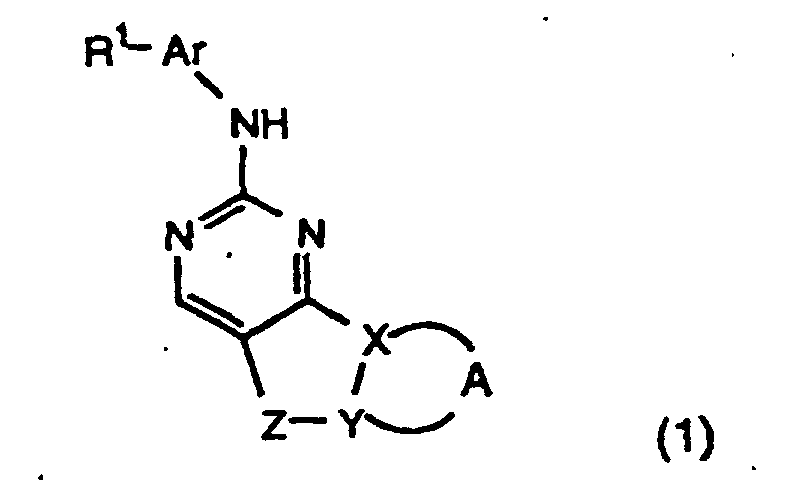 worinR1 eine Gruppe -L1R2 ist, worin L1 eine kovalente Bindung oder ein Verbindungsatom oder -gruppe ist und R2 eine Gruppe -(Alk)mL2R3 ist, worin Alk eine gegebenenfalls substituierte aliphatische oder heteroaliphatische Kette ist, m Null oder die ganze Zahl 1 ist, L2 eine kovalente Bindung oder ein Verbindungsatom oder -gruppe ist und R3 eine gegebenenfalls substituierte cycloaliphatische oder heterocycloaliphatische Gruppe ist, mit der Maßgabe, daß, wennm Null ist, L2 eine kovalente Bindung ist,Ar eine Aryl- oder Heteroarylgruppe ist,X ein Kohlenstoff- oder ein Stickstoffatom ist,Y ein Kohlenstoff- oder ein Stickstoffatom ist,Z eine Verbindungsgruppe ist,A zusammen mit X und Y eine gegebenenfalls substituierte monocyclische oder bicyclische aromatische oder heteroaromatische Gruppe bildet, und die Salze, Solvate, Hydrate und N-Oxide davon,
wenn L1 und/oder L2 als ein Verbindungsatom oder -gruppe vorlieg(t/en), jedes gleich oder verschieden sein kann und aus -O-, -S-, -C(O)-, -C(S)-, -S(O)-, -S(O)2, -N(R4)- [worin R4 ein Wasserstoffatom oder eine C1-6-Alkylgruppe ist], -CON(R4)-, -OC(O)N(R4)-, -CSN(R4)-, -N(R4)CO-, -N(R4)C(O)O-, -N(R4)CS-, -SON(R4)-, -SO2N(R4)-, -N(R4)SO2-, -N(R4)CON(R4)-, -N(R4)CSN(R4)-, -N(R4)SON(R4)- und -N(R4)SO2N(R4)-Gruppen ausgewählt ist,
wenn die durch Alk dargestellte Alkylenkette vorliegt, ist sie eine gegebenenfalls substituierte aliphatische C1-10-Kette, gegebenfalls durch ein oder zwei Heteroatome oder durch Heteroatom-enthaltende Gruppen, welche durch L3 [worin L3 ein Atom oder eine Gruppe wie für L1 definiert ist] dargestellt sind, unterbrochen, um eine gegebenenfalls substituierte heteroaliphatische Kette Alk zu bilden; die optionalen Substituenten, welche in diesen aliphatischen und/oder heteroaliphatischen Ketten vorliegen können, beinhalten einen, zwei, drei oder mehrere Substituenten, ausgewählt aus Halogenatomen, Hydroxyl, C1-6-Alkoxy, Thiol, C1-6-Alkylthio, -SC(NH)NH2, -CH2C(NH)NH2, Amino- und substituierte Aminogruppen; substituierte Aminogruppen beinhalten Gruppen der Formeln -NR5R6, worin R5 eine gegebenenfalls substituierte C1-6-Alkyl-, C2-6-Alkenyl- oder C2-6-Alkinylgruppe ist, gegebenenfalls durch ein oder zwei Heteroatome oder durch Heteroatomenthaltende Gruppen, welche durch L3 [worin L3 ein Atom oder eine Gruppe wie vorstehend definiert ist] dargestellt sind, unterbrochen, und R6 ein Wasserstoffatom oder eine Gruppe, wie für R5 definiert, ist,
wenn R3 als eine gegebenenfalls substituierte cycloaliphatische Gruppe vorliegt, ist er eine gegebenenfalls substituierte cycloaliphatische C3-10-Gruppe; wenn R3 als eine gegebenenfalls substituierte heterocycloaliphatische Gruppe vorliegt, ist er aus cycloaliphatischen Gruppen, wie vorstehend für R3 definiert, ausgewählt, aber wobei jede Gruppe zusätzlich ein, zwei, drei oder vier Heteroatome oder Heteroatom-enthaltende Gruppen enthält, welche durch L4 dargestellt sind, worin L4 ein Atom oder eine Gruppe, wie vorstehend für L1 definiert, ist; optionale Substituenten, die in den cycloaliphatischen und heterocycloaliphatischen Gruppen R3 vorliegen können, beinhalten die vorstehend für Alk, wenn es eine aliphatische Kette ist, definierten optionalen Substituenten,
durch die Gruppe Ar dargestellte Arylgruppen sind aus mono- und bicyclischen, gegebenenfalls substituierten aromatischen C6-12-Gruppen ausgewählt; durch Ar dargestellte Heteroarylgruppen sind aus mono- und bicyclischen, gegebenenfalls substituierten heteroaromatischen C1-9-Gruppen ausgewählt, die ein, zwei, drei oder vier Heteroatome, ausgewählt aus Sauerstoff-, Schwefel- und Stickstoffatomen, enthalten; optionale Substituenten, die in den durch Ar dargestellten Aryl- oder Heteroarylgruppen vorliegen, beinhalten eine, zwei, drei oder mehrere Gruppen, wobei jede durch die Gruppe R7 dargestellt ist, wenn zwei oder mehrere Gruppen R7 vorliegen, können sie gleich oder verschieden sein, wobei R7 aus einem Atom oder einer Gruppe R8 oder -Alk1(R8)n ausgewählt ist, worin R8 ein Halogenatom, Amino (-NH2), substituiertes Amino, Nitro, Cyano, Hydroxyl (-OH), substituiertes Hydroxyl, Formyl, Carboxyl (-CO2H), verestertes Carboxyl, Thiol (-SH), substituiertes Thiol, -COR9 [worin R9 eine -Alk1(R8)n-, Aryl- oder Heteroarylgruppe ist], -CSR9, -SO3H, -SO2R9, -SO2NH2, -SO2NHR9, SO2N[R9]2, -CONH2, -CSNH2, -CONHR9, -CSNHR9, -CON[R9]2, -CSN[R9]2, -NHSO2H, -NHSO2R9, -N[SO2R9]2, -NHSO2NH2, -NHSO2NHR9, -NHSO2N[R9]2, -NHCOR9, -NHCSR9, -NHC(O)OR9, eine Aryl- oder Heteroarylgruppe ist; Alk1 ist eine gerad- oder verzweigtkettige C1-6-Alkylen-, C2-6-Alkenylen- oder C2-6-Alkinylenkette, gegebenenfalls durch ein, zwei oder drei -O- oder -S-Atome oder -S(O)p- [worin p eine ganze Zahl 1 oder 2 ist] oder -N(R10)-Gruppen [worin R10 ein Wasserstoffatom oder C1-6-Alkyl ist] unterbrochen, und n Null oder eine ganze Zahl von 1, 2 oder 3 ist, wobei, wenn mehr als ein Substituent R8 vorliegt, diese gleich oder verschieden sein können und am gleichen oder unterschiedlichen Atomen in -Alk1 vorliegen können; wenn R8 eine substituierte Aminogruppe ist, ist er eine Gruppe -NHR9 [worin R9 wie vorstehend definiert ist] oder eine Gruppe -N[R9]2, worin jede Gruppe R9 gleich oder verschieden sein kann; wenn R8 eine substituierte Hydroxyl- oder substituerte Thiolgruppe ist, ist er eine -OR9-, -SR9- bzw. -SC(NH2+)NH2-Gruppe; wenn R8 eine veresterte Carboxylgruppe ist, ist er aus -CO2Alk2 ausgewählt, worin Alk2 eine gerad- oder verzweigtkettige, gegebenenfalls substituierte C1-8--Alkylgruppe, eine C6-12-Aryl-C1-8-Alkylgruppe, eine C6-12-Arylgruppe, eine C6-12-Aryloxy-C1-8-Alkylgruppe, eine gegebenenfalls substituierte C1-8-Alkanoyloxy-C1-8-Alkylgruppe und eine C6-12-Aroyloxy-C1-8-Alkylgruppe ist; optionale Substituenten, die in der Gruppe Alk2 vorliegen, beinhalten die vorstehend beschriebenen Substituenten R8; wenn R8 oder R9 eine Aryl- oder Heteroarylgruppe ist, ist er aus mono- oder bicyclischen, gegebenenfalls substituierten aromatischen C6-12- oder heteroaromatischen C1-9-Gruppen, wie vorstehend für die Gruppe Ar definert, ausgewählt, gegebenenfalls können zwei Substituenten R7 miteinander verbunden sein, um eine cyclische Gruppe zu bilden;
durch die Gruppe Z dargestellte Verbindungsgruppen sind aus Gruppen der Formel -(Alk3)r(L5)s(L6)t(Alk4)u- ausgewählt, worin Alk3 und Alk4, die gleich oder verschieden sein können, jeweils eine gegebenenfalls gerad- oder verzweigtkettige C1-6-Alkylen-, C2-6-Alkenylen- oder C2-6-Alkinylenkette ist, gegebenenfalls durch ein oder mehrere Heteroatome oder Heteroatom-enthaltende Gruppen unterbrochen, L5 und L6 jeweils ein -O- oder -S-Atom oder eine -S(O)-, -S(O)2-, -N(R10)-, -C(O)-, -C(S)-, -C(NR10)-, -CON(R10)-, -CSN(R10)-, -N(R10)SO-, -N(R10)SO2-, -N(R10)SO2N(R10)-, -N(R10)SON(R10) oder -N(R10)CON(R10)-Gruppe sind und r, s, t und u, die gleich oder verschieden sein können, jeweils Null oder die ganze Zahl 1 sind, mit der Maßgabe, daß, wenn eines von r, s, t oder u Null ist, mindestens eines der Verbleibenden die ganze Zahl 1 ist; die Heteroatome, welche die Ketten Alk3 oder Alk4 unterbrechen können, sind -O- oder -S-Atome, und die Heteroatom-enthaltenden Gruppen, welche die Ketten Alk 3 oder Alk4 unterbrechen können, sind Sauerstoff, Schwefel oder Stickstoff enthaltende Gruppen; optionale Substituenten, die in den Ketten Alk3 oder Alk4 vorliegen können, beinhalten Halogenatome und C1-6-Alkylgruppen;
wenn A zusammen mit X und Y eine gegebenenfalls substituierte monocyclische oder bicyclische aromatische Gruppe bildet [d.h. wenn X und Y jeweils ein Kohlenstoffatom sind], ist die aromatische Gruppe eine gegebenenfalls substituierte monocyclische oder bicyclische aromatische C6-12-Gruppe; wenn A zusammen mit X und Y eine gegebenenfalls substituierte monocyclische oder bicyclische heteroaromatische Gruppe bildet [d.h. wenn X und Y jeweils ein Kohlenstoff- oder Stickstoffatom sind], ist die heteroaromatische Gruppe eine gegebenenfalls substituierte monocyclische oder bicyclische heteroaromatische C1-9-Gruppe, die ein, zwei, drei oder vier Heteroatome, ausgewählt aus Sauerstoff-, Schwefel- oder Stickstoffatomen, enthält; optionale Substituenten, die in durch A, X und Y zusammen dargestellten aromatischen und heteroaromatischen Gruppen vorliegen, beinhalten einen, zwei, drei oder mehrere Substituenten, ausgewählt aus Fluor-, Chlor-, Brom- oder lodatomen, C1-6-Alkyl-, C1-6-Alkylamino-, C1-6-Hydroxyalkyl-, C1-6-Alkylthiol-, C1-6-Alkoxy-, Halogen-C1-6-Alkyl-, Halogen-C1-6-Alkoxy-, C1-6-Alkylamino-, Amino (-NH2)-, Amino-C1-6-Alkyl-, C1-6-Dialkylamino-, Amino-C1-6-Alkoxy-, C1-6-Alkylamino-C1-6-Alkoxy-, C1-6-Dialkylamino-C1-6-Alkoxy-, Phenyl-, Furyl-, Nitro-, Cyano-, Hydroxyl (-OH)-, Formyl (HC(O)-)-, Carboxyl (-CO2H)-, -CO2Alk1 [worin Alk1 wie vorstehend definert ist]-, C1-6-Alkanoyl-, Thiol (-SH)-, Thio-C1-6-Alkyl-, -SC(NH2+)NH2-, Sulfonyl (-SO3H)-, C1-6-Alkylsulfonyl-, Aminosulfonyl (-SO2NH2)-, C1-6-Alkylaminosulfonyl-, C1-6-Dialkylaminosulfonyl-, Phenylaminosulfonyl-, Carboxamido (CONH2)-, C1-6-Alkylaminocarbonyl-, C1-6-Dialkylaminocarbonyl-, Sulfonylamino (-NHSO2H)-, C1-6-Alkylsulfonylamino-, C1-6-Dialkylsulfonylamino-, gegebenenfalls substituierte Phenylsulfonylamino-, Aminosulfonylamino (-NHSO2NH2)-, C1-6-Alkylaminosulfonylamino-, C1-6-Dialkylaminosulfonylamino-, Phenylaminosulfonylamino-, C1-6-Alkanoylamino-, C1-6-Alkanoylamino-C1-6-Alkyl- und C1-6-Alkoxycarbonylaminogruppen, gegebenenfalls können zwei dieser Substituenten miteinander verbunden sein, um eine cyclische Gruppe zu bilden. - Verbindung nach Anspruch 1, wobei A zusammen mit X und Y eine gegebenenfalls substituierte Phenylgruppe bildet.
- Verbindung nach Anspruch 1 oder Anspruch 2, wobei Ar eine gegebenenfalls substituierte Phenylgruppe ist.
- Verbindung nach einem der Ansprüche 1 bis 3, wobei die Verbindungsgruppe Z eine gegebenenfalls substituierte -(CH2)2-Kette ist.
- Verbindung nach Anspruch 4, wobei Z eine -CH2C(CH3)2-Kette ist.
- Verbindung nach einem der vorhergehenden Ansprüche, wobei R1 eine Gruppe L1R2 ist, worin L1eine kovalente Bindung oder ein Sauerstoffatom ist und R2 eine Gruppe -(Alk)mR3 ist, worin Alk eine gegebenenfalls substituierte aliphatische oder heteroaliphatische Kette ist, m Null oder die ganze Zahl 1 ist und R3 eine gegebenenfalls substituierte cycloaliphatische oder heterocycloaliphatische Gruppe ist.
- Verbindung nach Anspruch 6, wobei Alk eine C1-6-Alkylenkette ist.
- Verbindung nach Anspruch 6 oder Anspruch 7, wobei R3 eine gegebenenfalls substituierte C3-7-Cycloalkylgruppe ist, die ein oder zwei Heteroatome enthält.
- Verbindung nach Anspruch 8, wobei R3 eine gegebenenfalls substituierte Pyrrolidinyl-, Morpholinyl- oder Piperazinylgruppe ist.
- Verbindung, dieund die Salze, Solvate und Hydrate davon ist.6,6-Dimethyl-9-methoxy-N-[3-(2-pyrrolidinoethoxy)phenyl]benzo[h]-5,6-dihydrochinazolin-2-aminhydrochlorid,6,6-Dimethyl-9-methoxy-N-[4-(4-methylpiperazin-1-yl)phenyl]benzo[h]-5,6-dihydrochinazolin-2-amin
- Pharmazeutische Zusammensetzung, umfassend eine Verbindung der Formel (1)und die Salze, Solvate, Hydrate und N-Oxide davon, zusammen mit einem oder mehrereren pharmazeutisch verträglichen Trägem, Arzneimittelträgern oder Verdünnungsmitteln, worin R1, Ar, X, Y, Z und A wie in Anspruch 1 festgelegt sind.

Applications Claiming Priority (3)
| Application Number | Priority Date | Filing Date | Title |
|---|---|---|---|
| GBGB9713087.6A GB9713087D0 (en) | 1997-06-20 | 1997-06-20 | Chemical compounds |
| GB9713087 | 1997-06-20 | ||
| PCT/GB1998/001795 WO1998058926A1 (en) | 1997-06-20 | 1998-06-19 | Fused polycyclic 2-aminopyrimidine derivatives as protein kinase inhibitors |
Publications (2)
| Publication Number | Publication Date |
|---|---|
| EP0989985A1 EP0989985A1 (de) | 2000-04-05 |
| EP0989985B1 true EP0989985B1 (de) | 2003-11-05 |
Family
ID=10814690
Family Applications (1)
| Application Number | Title | Priority Date | Filing Date |
|---|---|---|---|
| EP98930896A Expired - Lifetime EP0989985B1 (de) | 1997-06-20 | 1998-06-19 | Kondensierte, polycyclische 2-aminopyrimidinderivate als proteinkinasehemmer |
Country Status (8)
| Country | Link |
|---|---|
| US (1) | US6133257A (de) |
| EP (1) | EP0989985B1 (de) |
| JP (1) | JP2002504926A (de) |
| AT (1) | ATE253572T1 (de) |
| AU (1) | AU8117798A (de) |
| DE (1) | DE69819499T2 (de) |
| GB (1) | GB9713087D0 (de) |
| WO (1) | WO1998058926A1 (de) |
Families Citing this family (20)
| Publication number | Priority date | Publication date | Assignee | Title |
|---|---|---|---|---|
| US6245774B1 (en) | 1994-06-21 | 2001-06-12 | Celltech Therapeutics Limited | Tri-substituted phenyl or pyridine derivatives |
| KR100874791B1 (ko) | 2001-05-29 | 2008-12-18 | 바이엘 쉐링 파마 악티엔게젤샤프트 | Cdk-억제 피리미딘, 그의 제조방법 및 약제로서의 용도 |
| FR2828488B1 (fr) * | 2001-08-08 | 2005-06-10 | Oreal | Composition pour la teinture de fibres keratiniques contenant une paraphenylenediamine substituee par un radical diazacycloheptane |
| CA2517291C (en) | 2003-03-19 | 2012-05-08 | Exelixis, Inc. | Ortho-substituted aryl and heteroaryl tie-2 modulators and methods of use |
| PT1636236E (pt) | 2003-05-22 | 2013-12-16 | Nerviano Medical Sciences Srl | Derivados de pirazol-quinazolina, processo para sua preparação e sua utilização como inibidores de cinase |
| CN1897950A (zh) * | 2003-10-14 | 2007-01-17 | 惠氏公司 | 稠合芳基和杂芳基衍生物及其使用方法 |
| US7772232B2 (en) * | 2004-04-15 | 2010-08-10 | Bristol-Myers Squibb Company | Quinazolinyl compounds as inhibitors of potassium channel function |
| CL2007003244A1 (es) | 2006-11-16 | 2008-04-04 | Millennium Pharm Inc | Compuestos derivados de pirimido[5,4-d][2]benzazepina; composicion farmaceutica que comprende a dicho compuesto; y uso del compuesto para el tratamiento del cancer. |
| PT2125822E (pt) | 2006-12-21 | 2015-01-30 | Nerviano Medical Sciences Srl | Derivados de pirazol-quinazolina substituídos, processo para sua preparação e seu uso como inibidores da quinase |
| US7998952B2 (en) * | 2008-12-05 | 2011-08-16 | Millennium Pharmaceuticals, Inc. | Thiolactams and uses thereof |
| RU2535032C2 (ru) | 2008-12-22 | 2014-12-10 | Милленниум Фармасьютикалз, Инк. | Сочетание ингибиторов аврора киназы и анти-cd 20 антител |
| TWI461410B (zh) | 2008-12-30 | 2014-11-21 | Arqule Inc | 經取代之5,6-二氫-6-苯基苯並〔f〕異喹啉-2-胺化合物類 |
| JO3635B1 (ar) | 2009-05-18 | 2020-08-27 | Millennium Pharm Inc | مركبات صيدلانية صلبة وطرق لانتاجها |
| CA2788774A1 (en) | 2010-02-19 | 2011-08-25 | Millennium Pharmaceuticals, Inc. | Crystalline forms of sodium 4-{[9-chloro-7-(2-fluoro-6-methoxyphenyl)-5h-pyrimido[5,4-d][2]benzazepin-2-yl]amino}-2-methoxybenzoate |
| EP2614065B1 (de) | 2010-12-17 | 2017-04-19 | Nerviano Medical Sciences S.r.l. | Substituierte pyrazolochinazolinederivate als kinasehemmer |
| US20130303519A1 (en) | 2012-03-20 | 2013-11-14 | Millennium Pharmaceuticals, Inc. | Methods of treating cancer using aurora kinase inhibitors |
| WO2014153509A1 (en) | 2013-03-22 | 2014-09-25 | Millennium Pharmaceuticals, Inc. | Combination of catalytic mtorc 1/2 inhibitors and selective inhibitors of aurora a kinase |
| JP2018524292A (ja) | 2015-07-21 | 2018-08-30 | ミレニアム ファーマシューティカルズ, インコーポレイテッドMillennium Pharmaceuticals, Inc. | オーロラキナーゼインヒビターと化学療法剤の投与 |
| SG11201804601TA (en) * | 2015-12-17 | 2018-07-30 | Arqule Inc | Methods for preparing substituted 5,6-dihydro-6-phenylbenzo[f]isoquinolin-2-amine |
| EA036295B1 (ru) * | 2015-12-17 | 2020-10-22 | Аркьюл, Инк. | Твердые формы замещенных 5,6-дигидро-6-фенилбензо[f]изохинолин-2-аминовых соединений |
Family Cites Families (89)
| Publication number | Priority date | Publication date | Assignee | Title |
|---|---|---|---|---|
| FR1285932A (fr) * | 1960-12-26 | 1962-03-02 | Nord Aviation | Charge creuse |
| US3947467A (en) * | 1973-08-02 | 1976-03-30 | Eli Lilly And Company | 3-(5-Nitro-2-imidazolyl) pyrazoles |
| FR2257272B1 (de) * | 1974-01-15 | 1978-08-25 | Pharmascience Labo | |
| US4193926A (en) * | 1974-03-20 | 1980-03-18 | Schering Aktiengesellschaft | 4-(Polyalkoxy phenyl)-2-pyrrolidones |
| DE2413935A1 (de) * | 1974-03-20 | 1975-10-16 | Schering Ag | 4-(polyalkoxy-phenyl)-2-pyrrolidone |
| DE2541855A1 (de) * | 1975-09-18 | 1977-03-31 | Schering Ag | 4-(polyalkoxy-phenyl)-2-pyrrolidone ii |
| FR2313422A2 (fr) * | 1975-06-02 | 1976-12-31 | Labaz | Nouveaux stabilisants des polymeres et copolymeres du chlorure de vinyle |
| SU888821A3 (ru) * | 1976-12-03 | 1981-12-07 | Шеринг Аг (Инофирма) | Способ получени 5-(замещенный фенил)-оксазолидинонов или их серусодержащих аналогов |
| EP0006298B1 (de) * | 1978-06-15 | 1982-03-31 | Imperial Chemical Industries Plc | Entzündungshemmende 1-Phenyl-2-aminoäthanol-Derivate, Verfahren zu ihrer Herstellung und sie enthaltende pharmazeutische Zusammensetzungen zur örtlichen Anwendung |
| JPS5683483A (en) * | 1979-12-13 | 1981-07-08 | Santen Pharmaceut Co Ltd | Thiazolidine compound |
| JPS56139455A (en) * | 1980-04-02 | 1981-10-30 | Santen Pharmaceut Co Ltd | Sulfur-containing acylaminoacid |
| DE3374313D1 (de) * | 1982-12-23 | 1987-12-10 | Smith Kline French Lab | Aminopyrimidinone derivatives as histamine h1-antagonists |
| IT1161221B (it) * | 1983-04-21 | 1987-03-18 | Ripharm Srl | Composto per il trattamento della psoriasi |
| DE3581570D1 (de) * | 1984-06-25 | 1991-03-07 | Ciba Geigy Ag | Pyrimidinderivate wirksam als schaedlingsbekaempfungsmittel. |
| IT1176983B (it) * | 1984-10-16 | 1987-08-26 | Zambon Spa | Dipeptidi ad attivita' farmacologica |
| US4876252A (en) * | 1986-01-13 | 1989-10-24 | American Cyanamid Company | 4,5,6-substituted-N-(substituted-phenyl)-2-pyrimidinamines |
| DE3751742T3 (de) * | 1986-01-13 | 2002-11-21 | American Cyanamid Co., Wayne | 4,5,6-Substituierte 2-Pyrimidinamine |
| US4788195A (en) * | 1986-01-13 | 1988-11-29 | American Cyanamid Company | 4,5,6-substituted-N-(substituted-phenyl)-2-pyrimidinamines |
| US5128358A (en) * | 1988-01-19 | 1992-07-07 | Pfizer Inc. | Aryl substituted nitrogen heterocyclic antidepressants |
| WO1987006576A1 (en) * | 1986-04-29 | 1987-11-05 | Pfizer Inc. | Calcium independent camp phosphodiesterase inhibitor antidepressant |
| US4792561A (en) * | 1986-05-29 | 1988-12-20 | Syntex (U.S.A.) Inc. | Carbostyril derivatives as combined thromboxane synthetase and cyclic-AMP phosphodiesterase inhibitors |
| US4921862A (en) * | 1986-05-29 | 1990-05-01 | Syntex (U.S.A.) Inc. | Carbostyril derivatives as combined thromboxane synthetase and cyclic-amp phosphodiesterase inhibitors |
| US4762843A (en) * | 1986-09-15 | 1988-08-09 | Warner-Lambert Company | Hetero [f] fused carbocyclic pyridines as dopaminergic agents |
| CN1030415A (zh) * | 1987-02-20 | 1989-01-18 | 山之内制药株式会社 | 饱和的杂环碳酰胺衍生物和它的制备方法 |
| US4971959A (en) * | 1987-04-14 | 1990-11-20 | Warner-Lambert Company | Trisubstituted phenyl analogs having activity for congestive heart failure |
| US5274002A (en) * | 1987-04-14 | 1993-12-28 | Warner-Lambert Company | Trisubstituted phenyl analogs having activity for congestive heart failure |
| DE3882821D1 (de) * | 1987-06-11 | 1993-09-09 | Ciba Geigy Ag | Mikrobizide. |
| US4966622A (en) * | 1988-04-12 | 1990-10-30 | Ciba-Geigy Corporation | N-phenyl-N-pyrimidin-2-ylureas |
| US4897396A (en) * | 1988-06-03 | 1990-01-30 | Ciba-Geigy Corporation | 2-phenylamino pyrimidine derivatives and their uses as microbicides |
| DK0469013T3 (da) * | 1989-04-17 | 1995-10-02 | Byk Gulden Lomberg Chem Fab | Hidtil ukendte arylpyridaziner, fremstilling deraf, anvendelse deraf og lægemidler indeholdende disse |
| US5164372A (en) * | 1989-04-28 | 1992-11-17 | Fujisawa Pharmaceutical Company, Ltd. | Peptide compounds having substance p antagonism, processes for preparation thereof and pharmaceutical composition comprising the same |
| JPH0377923A (ja) * | 1989-08-18 | 1991-04-03 | Sekisui Chem Co Ltd | 有機非線形光学材料 |
| JPH075572B2 (ja) * | 1989-08-18 | 1995-01-25 | 積水化学工業株式会社 | 2―[2―(2―ヒドロキシフェニル)ビニルピラジンおよびその製造法 |
| DE4003919A1 (de) * | 1990-02-09 | 1991-08-14 | Basf Ag | Heteroarylalkene, verfahren und zwischenprodukte zu ihrer herstellung und ihre verwendung |
| GB9007762D0 (en) * | 1990-04-05 | 1990-06-06 | Beecham Group Plc | Novel compounds |
| WO1991016892A1 (en) * | 1990-04-27 | 1991-11-14 | Rorer International (Holdings), Inc. | Styryl compounds which inhibit egf receptor protein tyrosine kinase |
| US5393788A (en) * | 1990-07-10 | 1995-02-28 | Smithkline Beecham Corporation | Phenylalkyl oxamides |
| US5124455A (en) * | 1990-08-08 | 1992-06-23 | American Home Products Corporation | Oxime-carbamates and oxime-carbonates as bronchodilators and anti-inflammatory agents |
| NZ239946A (en) * | 1990-09-28 | 1994-09-27 | Smith Kline French Lab | 3-(tetrazol-5-yl)-6-(substituted phenyl)pyridine derivatives and medicaments |
| JPH06501941A (ja) * | 1990-10-16 | 1994-03-03 | ビイク グルデン ロンベルク ヒエーミツシエ フアブリーク ゲゼルシヤフト ミツト ベシユレンクテル ハフツング | アリールピリダジノン |
| AU9030691A (en) * | 1990-11-06 | 1992-05-26 | Smithkline Beecham Corporation | Imidazolidinone compounds |
| GB9027055D0 (en) * | 1990-12-13 | 1991-02-06 | Sandoz Ltd | Organic compounds |
| IE71647B1 (en) * | 1991-01-28 | 1997-02-26 | Rhone Poulenc Rorer Ltd | Benzamide derivatives |
| US5698711A (en) * | 1991-01-28 | 1997-12-16 | Rhone-Poulenc Rorer Limited | Compounds containing phenyl linked to aryl or heteroaryl by an aliphatic- or heteroatom-containing linking group |
| US5449676A (en) * | 1991-04-26 | 1995-09-12 | Byk Gulden Lomberg Chemische Fabrik Gmbh | Pyridazines |
| US5191084A (en) * | 1991-05-01 | 1993-03-02 | American Home Products Corporation | Phenyl pyrazolidinones as bronchodilators and anti-inflammatory agents |
| PT100441A (pt) * | 1991-05-02 | 1993-09-30 | Smithkline Beecham Corp | Pirrolidinonas, seu processo de preparacao, composicoes farmaceuticas que as contem e uso |
| EP0540165A1 (de) * | 1991-10-03 | 1993-05-05 | Zeneca Limited | Alkonsäurederivate |
| CA2080554A1 (en) * | 1991-10-15 | 1993-04-16 | Mitsubishi Chemical Corporation | Styrene derivatives |
| DE4136921A1 (de) * | 1991-11-11 | 1993-05-13 | Knoll Ag | Verfahren zur trennung von 5-methyl-tetrahydrofolsaeure |
| US5326898A (en) * | 1992-02-11 | 1994-07-05 | Allergan, Inc. | Substituted phenylethenyl compounds having retinoid-like biological activity |
| WO1993019748A1 (en) * | 1992-04-02 | 1993-10-14 | Smithkline Beecham Corporation | Compounds useful for treating inflammatory diseases and for inhibiting production of tumor necrosis factor |
| US5521184A (en) * | 1992-04-03 | 1996-05-28 | Ciba-Geigy Corporation | Pyrimidine derivatives and processes for the preparation thereof |
| TW225528B (de) * | 1992-04-03 | 1994-06-21 | Ciba Geigy Ag | |
| GB9212693D0 (en) * | 1992-06-15 | 1992-07-29 | Celltech Ltd | Chemical compounds |
| GB9212673D0 (en) * | 1992-06-15 | 1992-07-29 | Celltech Ltd | Chemical compounds |
| CZ14795A3 (en) * | 1992-07-28 | 1996-07-17 | Rhone Poulenc Rorer Ltd | Benzene derivative containing phenyl group bound to aryl or heteroaryl fraction through an aliphatic or hetero atom containing group, process of its preparation and pharmaceutical composition containing thereof |
| GB9222253D0 (en) * | 1992-10-23 | 1992-12-09 | Celltech Ltd | Chemical compounds |
| AU673569B2 (en) * | 1992-12-02 | 1996-11-14 | Pfizer Inc. | Catechol diethers as selective PDE-IV inhibitors |
| KR100190730B1 (ko) * | 1992-12-17 | 1999-06-01 | 디. 제이. 우드, 스피겔 알렌 제이 | 부신피질 호르몬 유리인자(crf) 길항물질로서 치환된 피라졸 |
| TW263495B (de) * | 1992-12-23 | 1995-11-21 | Celltech Ltd | |
| US5622977A (en) * | 1992-12-23 | 1997-04-22 | Celltech Therapeutics Limited | Tri-substituted (aryl or heteroaryl) derivatives and pharmaceutical compositions containing the same |
| GB9226830D0 (en) * | 1992-12-23 | 1993-02-17 | Celltech Ltd | Chemical compounds |
| FR2700167B1 (fr) * | 1993-01-07 | 1995-02-03 | Rhone Poulenc Rorer Sa | Dérivés de pyrrolidine et thiazolidine, leur préparation et les médicaments les contenant. |
| FR2700168B1 (fr) * | 1993-01-07 | 1995-02-03 | Rhone Poulenc Rorer Sa | Dérivés de thiazolidine, leur préparation et les médicaments les contenant. |
| GB9304919D0 (en) * | 1993-03-10 | 1993-04-28 | Celltech Ltd | Chemical compounds |
| GB9304920D0 (en) * | 1993-03-10 | 1993-04-28 | Celltech Ltd | Chemical compounds |
| GB9315595D0 (en) * | 1993-07-28 | 1993-09-08 | Res Inst Medicine Chem | New compounds |
| US5543520A (en) * | 1993-10-01 | 1996-08-06 | Ciba-Geigy Corporation | Pyrimidine derivatives |
| KR100330553B1 (ko) * | 1993-10-01 | 2002-11-27 | 노파르티스 아게 | 약물학적활성피리딘유도체및그의제조방법 |
| JPH08503971A (ja) * | 1993-10-01 | 1996-04-30 | チバ−ガイギー アクチェンゲゼルシャフト | ピリミジンアミン誘導体及びその調製のための方法 |
| WO1995009851A1 (en) * | 1993-10-01 | 1995-04-13 | Ciba-Geigy Ag | Pharmacologically active pyrimidineamine derivatives and processes for the preparation thereof |
| ATE154932T1 (de) * | 1993-11-26 | 1997-07-15 | Pfizer | Isoxazolinverbindungen als entzündungshemmende mittel |
| GB9326699D0 (en) * | 1993-12-22 | 1994-03-02 | Celltech Ltd | Chemical compounds |
| GB9326173D0 (en) * | 1993-12-22 | 1994-02-23 | Celltech Ltd | Chemical compounds and process |
| DE69433594T2 (de) * | 1993-12-22 | 2004-08-05 | Celltech R&D Ltd., Slough | Trisubstituierte phenyl-derivate, verfahren zu deren herstellung und deren verwendung als phosphodiesterase (typ iv) hemmstoffe |
| US5691376A (en) * | 1994-02-17 | 1997-11-25 | American Home Products Corporation | Substituted biphenyl derivatives |
| US5786354A (en) * | 1994-06-21 | 1998-07-28 | Celltech Therapeutics, Limited | Tri-substituted phenyl derivatives and processes for their preparation |
| GB9412571D0 (en) * | 1994-06-22 | 1994-08-10 | Celltech Ltd | Chemical compounds |
| GB9412573D0 (en) * | 1994-06-22 | 1994-08-10 | Celltech Ltd | Chemical compounds |
| GB9412672D0 (en) * | 1994-06-23 | 1994-08-10 | Celltech Ltd | Chemical compounds |
| GB2301363B (en) * | 1994-12-23 | 1998-12-30 | Celltech Therapeutics Ltd | Human phosphodiesterase type ivc and its production and use |
| US5593997A (en) * | 1995-05-23 | 1997-01-14 | Pfizer Inc. | 4-aminopyrazolo(3-,4-D)pyrimidine and 4-aminopyrazolo-(3,4-D)pyridine tyrosine kinase inhibitors |
| BR9610823A (pt) * | 1995-10-02 | 1999-07-13 | Hoffmann La Roche | Derivados de pirimidina como antagonistas do receptor |
| GB9526243D0 (en) * | 1995-12-21 | 1996-02-21 | Celltech Therapeutics Ltd | Chemical compounds |
| GB9526245D0 (en) * | 1995-12-21 | 1996-02-21 | Celltech Therapeutics Ltd | Chemical compounds |
| GB9526246D0 (en) * | 1995-12-21 | 1996-02-21 | Celltech Therapeutics Ltd | Chemical compounds |
| GB9608435D0 (en) * | 1996-04-24 | 1996-06-26 | Celltech Therapeutics Ltd | Chemical compounds |
| GB9625184D0 (en) * | 1996-12-04 | 1997-01-22 | Celltech Therapeutics Ltd | Chemical compounds |
-
1997
- 1997-06-20 GB GBGB9713087.6A patent/GB9713087D0/en active Pending
-
1998
- 1998-06-18 US US09/099,171 patent/US6133257A/en not_active Expired - Fee Related
- 1998-06-19 EP EP98930896A patent/EP0989985B1/de not_active Expired - Lifetime
- 1998-06-19 AU AU81177/98A patent/AU8117798A/en not_active Abandoned
- 1998-06-19 DE DE69819499T patent/DE69819499T2/de not_active Expired - Fee Related
- 1998-06-19 JP JP50399099A patent/JP2002504926A/ja active Pending
- 1998-06-19 WO PCT/GB1998/001795 patent/WO1998058926A1/en not_active Ceased
- 1998-06-19 AT AT98930896T patent/ATE253572T1/de not_active IP Right Cessation
Also Published As
| Publication number | Publication date |
|---|---|
| GB9713087D0 (en) | 1997-08-27 |
| US6133257A (en) | 2000-10-17 |
| EP0989985A1 (de) | 2000-04-05 |
| AU8117798A (en) | 1999-01-04 |
| JP2002504926A (ja) | 2002-02-12 |
| WO1998058926A1 (en) | 1998-12-30 |
| ATE253572T1 (de) | 2003-11-15 |
| DE69819499T2 (de) | 2004-09-02 |
| DE69819499D1 (de) | 2003-12-11 |
Similar Documents
| Publication | Publication Date | Title |
|---|---|---|
| EP0989985B1 (de) | Kondensierte, polycyclische 2-aminopyrimidinderivate als proteinkinasehemmer | |
| US6599908B1 (en) | Fused polycyclic 2-aminopyrimidine derivatives | |
| US6600037B1 (en) | 4,5-disubstituted-2-aminopyrimidines | |
| US5922741A (en) | 5-aminopyrazoles useful as tyrosine kinase inhibitors | |
| EP0862560B1 (de) | Substituierte 2-anilino-pyrimidines verwendbar als protein kinase inhibitoren | |
| US7176215B2 (en) | Bicyclic oxopyridine and oxopyrimidine derivatives | |
| EP0934304B1 (de) | 2-pyrimidinamin derivaten und verfahrens zu deren herstellung | |
| US6093716A (en) | Substituted 2-pyrimidineamines and processes for their preparation | |
| US6579983B1 (en) | 5-cyano-2-aminopyrimidine derivatives | |
| US6337335B1 (en) | Substituted 2-anilinopyrimidines useful as protein kinase inhibitors | |
| HRP960465A2 (en) | Heterocyclic compounds | |
| US7323464B2 (en) | Pyridine and pyrimidine derivatives | |
| AU2004249498B2 (en) | Thienopyridone derivatives as kinase inhibitors | |
| US7012076B2 (en) | Bicyclic amine derivatives as inhibitors of class 1 receptor tyrosine kinases | |
| WO2002087587A2 (en) | 4-aminosulfonylquinazolines and -quinolines as tyrosine kinase inhibitors | |
| US6403608B1 (en) | 3-Substituted isoquinolin-1-yl derivatives |
Legal Events
| Date | Code | Title | Description |
|---|---|---|---|
| PUAI | Public reference made under article 153(3) epc to a published international application that has entered the european phase |
Free format text: ORIGINAL CODE: 0009012 |
|
| 17P | Request for examination filed |
Effective date: 19991221 |
|
| AK | Designated contracting states |
Kind code of ref document: A1 Designated state(s): AT BE CH CY DE DK ES FI FR GB GR IE IT LI LU MC NL PT SE |
|
| 17Q | First examination report despatched |
Effective date: 20020125 |
|
| GRAH | Despatch of communication of intention to grant a patent |
Free format text: ORIGINAL CODE: EPIDOS IGRA |
|
| GRAS | Grant fee paid |
Free format text: ORIGINAL CODE: EPIDOSNIGR3 |
|
| GRAA | (expected) grant |
Free format text: ORIGINAL CODE: 0009210 |
|
| AK | Designated contracting states |
Kind code of ref document: B1 Designated state(s): AT BE CH CY DE DK ES FI FR GB GR IE IT LI LU MC NL PT SE |
|
| PG25 | Lapsed in a contracting state [announced via postgrant information from national office to epo] |
Ref country code: NL Free format text: LAPSE BECAUSE OF FAILURE TO SUBMIT A TRANSLATION OF THE DESCRIPTION OR TO PAY THE FEE WITHIN THE PRESCRIBED TIME-LIMIT Effective date: 20031105 Ref country code: LI Free format text: LAPSE BECAUSE OF FAILURE TO SUBMIT A TRANSLATION OF THE DESCRIPTION OR TO PAY THE FEE WITHIN THE PRESCRIBED TIME-LIMIT Effective date: 20031105 Ref country code: IT Free format text: LAPSE BECAUSE OF FAILURE TO SUBMIT A TRANSLATION OF THE DESCRIPTION OR TO PAY THE FEE WITHIN THE PRESCRIBED TIME-LIMIT;WARNING: LAPSES OF ITALIAN PATENTS WITH EFFECTIVE DATE BEFORE 2007 MAY HAVE OCCURRED AT ANY TIME BEFORE 2007. THE CORRECT EFFECTIVE DATE MAY BE DIFFERENT FROM THE ONE RECORDED. Effective date: 20031105 Ref country code: FI Free format text: LAPSE BECAUSE OF FAILURE TO SUBMIT A TRANSLATION OF THE DESCRIPTION OR TO PAY THE FEE WITHIN THE PRESCRIBED TIME-LIMIT Effective date: 20031105 Ref country code: CY Free format text: LAPSE BECAUSE OF FAILURE TO SUBMIT A TRANSLATION OF THE DESCRIPTION OR TO PAY THE FEE WITHIN THE PRESCRIBED TIME-LIMIT Effective date: 20031105 Ref country code: CH Free format text: LAPSE BECAUSE OF FAILURE TO SUBMIT A TRANSLATION OF THE DESCRIPTION OR TO PAY THE FEE WITHIN THE PRESCRIBED TIME-LIMIT Effective date: 20031105 Ref country code: BE Free format text: LAPSE BECAUSE OF FAILURE TO SUBMIT A TRANSLATION OF THE DESCRIPTION OR TO PAY THE FEE WITHIN THE PRESCRIBED TIME-LIMIT Effective date: 20031105 Ref country code: AT Free format text: LAPSE BECAUSE OF FAILURE TO SUBMIT A TRANSLATION OF THE DESCRIPTION OR TO PAY THE FEE WITHIN THE PRESCRIBED TIME-LIMIT Effective date: 20031105 |
|
| REG | Reference to a national code |
Ref country code: GB Ref legal event code: FG4D |
|
| REG | Reference to a national code |
Ref country code: CH Ref legal event code: EP |
|
| REF | Corresponds to: |
Ref document number: 69819499 Country of ref document: DE Date of ref document: 20031211 Kind code of ref document: P |
|
| REG | Reference to a national code |
Ref country code: IE Ref legal event code: FG4D |
|
| PG25 | Lapsed in a contracting state [announced via postgrant information from national office to epo] |
Ref country code: SE Free format text: LAPSE BECAUSE OF FAILURE TO SUBMIT A TRANSLATION OF THE DESCRIPTION OR TO PAY THE FEE WITHIN THE PRESCRIBED TIME-LIMIT Effective date: 20040205 Ref country code: GR Free format text: LAPSE BECAUSE OF FAILURE TO SUBMIT A TRANSLATION OF THE DESCRIPTION OR TO PAY THE FEE WITHIN THE PRESCRIBED TIME-LIMIT Effective date: 20040205 Ref country code: DK Free format text: LAPSE BECAUSE OF FAILURE TO SUBMIT A TRANSLATION OF THE DESCRIPTION OR TO PAY THE FEE WITHIN THE PRESCRIBED TIME-LIMIT Effective date: 20040205 |
|
| PG25 | Lapsed in a contracting state [announced via postgrant information from national office to epo] |
Ref country code: ES Free format text: LAPSE BECAUSE OF FAILURE TO SUBMIT A TRANSLATION OF THE DESCRIPTION OR TO PAY THE FEE WITHIN THE PRESCRIBED TIME-LIMIT Effective date: 20040216 |
|
| NLV1 | Nl: lapsed or annulled due to failure to fulfill the requirements of art. 29p and 29m of the patents act | ||
| REG | Reference to a national code |
Ref country code: CH Ref legal event code: PL |
|
| PGFP | Annual fee paid to national office [announced via postgrant information from national office to epo] |
Ref country code: FR Payment date: 20040608 Year of fee payment: 7 |
|
| PGFP | Annual fee paid to national office [announced via postgrant information from national office to epo] |
Ref country code: GB Payment date: 20040616 Year of fee payment: 7 |
|
| PG25 | Lapsed in a contracting state [announced via postgrant information from national office to epo] |
Ref country code: LU Free format text: LAPSE BECAUSE OF NON-PAYMENT OF DUE FEES Effective date: 20040619 |
|
| PG25 | Lapsed in a contracting state [announced via postgrant information from national office to epo] |
Ref country code: IE Free format text: LAPSE BECAUSE OF NON-PAYMENT OF DUE FEES Effective date: 20040621 |
|
| PG25 | Lapsed in a contracting state [announced via postgrant information from national office to epo] |
Ref country code: MC Free format text: LAPSE BECAUSE OF NON-PAYMENT OF DUE FEES Effective date: 20040630 |
|
| PGFP | Annual fee paid to national office [announced via postgrant information from national office to epo] |
Ref country code: DE Payment date: 20040701 Year of fee payment: 7 |
|
| ET | Fr: translation filed | ||
| PLBE | No opposition filed within time limit |
Free format text: ORIGINAL CODE: 0009261 |
|
| STAA | Information on the status of an ep patent application or granted ep patent |
Free format text: STATUS: NO OPPOSITION FILED WITHIN TIME LIMIT |
|
| 26N | No opposition filed |
Effective date: 20040806 |
|
| REG | Reference to a national code |
Ref country code: IE Ref legal event code: MM4A |
|
| PG25 | Lapsed in a contracting state [announced via postgrant information from national office to epo] |
Ref country code: GB Free format text: LAPSE BECAUSE OF NON-PAYMENT OF DUE FEES Effective date: 20050619 |
|
| PG25 | Lapsed in a contracting state [announced via postgrant information from national office to epo] |
Ref country code: DE Free format text: LAPSE BECAUSE OF NON-PAYMENT OF DUE FEES Effective date: 20060103 |
|
| PG25 | Lapsed in a contracting state [announced via postgrant information from national office to epo] |
Ref country code: FR Free format text: LAPSE BECAUSE OF NON-PAYMENT OF DUE FEES Effective date: 20060228 |
|
| GBPC | Gb: european patent ceased through non-payment of renewal fee |
Effective date: 20050619 |
|
| REG | Reference to a national code |
Ref country code: FR Ref legal event code: ST Effective date: 20060228 |
|
| PG25 | Lapsed in a contracting state [announced via postgrant information from national office to epo] |
Ref country code: PT Free format text: LAPSE BECAUSE OF NON-PAYMENT OF DUE FEES Effective date: 20040405 |