EP0993041A2 - Wärmereduzierende Silikonfettzusammensetzung und diese verwendender Halbleiter - Google Patents
Wärmereduzierende Silikonfettzusammensetzung und diese verwendender Halbleiter Download PDFInfo
- Publication number
- EP0993041A2 EP0993041A2 EP99307721A EP99307721A EP0993041A2 EP 0993041 A2 EP0993041 A2 EP 0993041A2 EP 99307721 A EP99307721 A EP 99307721A EP 99307721 A EP99307721 A EP 99307721A EP 0993041 A2 EP0993041 A2 EP 0993041A2
- Authority
- EP
- European Patent Office
- Prior art keywords
- heat
- grease composition
- aluminum nitride
- powder
- silicone grease
- Prior art date
- Legal status (The legal status is an assumption and is not a legal conclusion. Google has not performed a legal analysis and makes no representation as to the accuracy of the status listed.)
- Granted
Links
Images
Classifications
-
- C—CHEMISTRY; METALLURGY
- C10—PETROLEUM, GAS OR COKE INDUSTRIES; TECHNICAL GASES CONTAINING CARBON MONOXIDE; FUELS; LUBRICANTS; PEAT
- C10M—LUBRICATING COMPOSITIONS; USE OF CHEMICAL SUBSTANCES EITHER ALONE OR AS LUBRICATING INGREDIENTS IN A LUBRICATING COMPOSITION
- C10M111/00—Lubrication compositions characterised by the base-material being a mixture of two or more compounds covered by more than one of the main groups C10M101/00 - C10M109/00, each of these compounds being essential
- C10M111/04—Lubrication compositions characterised by the base-material being a mixture of two or more compounds covered by more than one of the main groups C10M101/00 - C10M109/00, each of these compounds being essential at least one of them being a macromolecular organic compound
-
- H—ELECTRICITY
- H10—SEMICONDUCTOR DEVICES; ELECTRIC SOLID-STATE DEVICES NOT OTHERWISE PROVIDED FOR
- H10W—GENERIC PACKAGES, INTERCONNECTIONS, CONNECTORS OR OTHER CONSTRUCTIONAL DETAILS OF DEVICES COVERED BY CLASS H10
- H10W40/00—Arrangements for thermal protection or thermal control
- H10W40/20—Arrangements for cooling
- H10W40/25—Arrangements for cooling characterised by their materials
- H10W40/251—Organics
-
- C—CHEMISTRY; METALLURGY
- C10—PETROLEUM, GAS OR COKE INDUSTRIES; TECHNICAL GASES CONTAINING CARBON MONOXIDE; FUELS; LUBRICANTS; PEAT
- C10M—LUBRICATING COMPOSITIONS; USE OF CHEMICAL SUBSTANCES EITHER ALONE OR AS LUBRICATING INGREDIENTS IN A LUBRICATING COMPOSITION
- C10M2201/00—Inorganic compounds or elements as ingredients in lubricant compositions
- C10M2201/06—Metal compounds
- C10M2201/061—Carbides; Hydrides; Nitrides
- C10M2201/0613—Carbides; Hydrides; Nitrides used as base material
-
- C—CHEMISTRY; METALLURGY
- C10—PETROLEUM, GAS OR COKE INDUSTRIES; TECHNICAL GASES CONTAINING CARBON MONOXIDE; FUELS; LUBRICANTS; PEAT
- C10M—LUBRICATING COMPOSITIONS; USE OF CHEMICAL SUBSTANCES EITHER ALONE OR AS LUBRICATING INGREDIENTS IN A LUBRICATING COMPOSITION
- C10M2201/00—Inorganic compounds or elements as ingredients in lubricant compositions
- C10M2201/06—Metal compounds
- C10M2201/062—Oxides; Hydroxides; Carbonates or bicarbonates
- C10M2201/0623—Oxides; Hydroxides; Carbonates or bicarbonates used as base material
-
- C—CHEMISTRY; METALLURGY
- C10—PETROLEUM, GAS OR COKE INDUSTRIES; TECHNICAL GASES CONTAINING CARBON MONOXIDE; FUELS; LUBRICANTS; PEAT
- C10M—LUBRICATING COMPOSITIONS; USE OF CHEMICAL SUBSTANCES EITHER ALONE OR AS LUBRICATING INGREDIENTS IN A LUBRICATING COMPOSITION
- C10M2229/00—Organic macromolecular compounds containing atoms of elements not provided for in groups C10M2205/00, C10M2209/00, C10M2213/00, C10M2217/00, C10M2221/00 or C10M2225/00 as ingredients in lubricant compositions
- C10M2229/04—Siloxanes with specific structure
- C10M2229/041—Siloxanes with specific structure containing aliphatic substituents
- C10M2229/0415—Siloxanes with specific structure containing aliphatic substituents used as base material
-
- C—CHEMISTRY; METALLURGY
- C10—PETROLEUM, GAS OR COKE INDUSTRIES; TECHNICAL GASES CONTAINING CARBON MONOXIDE; FUELS; LUBRICANTS; PEAT
- C10M—LUBRICATING COMPOSITIONS; USE OF CHEMICAL SUBSTANCES EITHER ALONE OR AS LUBRICATING INGREDIENTS IN A LUBRICATING COMPOSITION
- C10M2229/00—Organic macromolecular compounds containing atoms of elements not provided for in groups C10M2205/00, C10M2209/00, C10M2213/00, C10M2217/00, C10M2221/00 or C10M2225/00 as ingredients in lubricant compositions
- C10M2229/04—Siloxanes with specific structure
- C10M2229/047—Siloxanes with specific structure containing alkylene oxide groups
- C10M2229/0475—Siloxanes with specific structure containing alkylene oxide groups used as base material
-
- C—CHEMISTRY; METALLURGY
- C10—PETROLEUM, GAS OR COKE INDUSTRIES; TECHNICAL GASES CONTAINING CARBON MONOXIDE; FUELS; LUBRICANTS; PEAT
- C10M—LUBRICATING COMPOSITIONS; USE OF CHEMICAL SUBSTANCES EITHER ALONE OR AS LUBRICATING INGREDIENTS IN A LUBRICATING COMPOSITION
- C10M2229/00—Organic macromolecular compounds containing atoms of elements not provided for in groups C10M2205/00, C10M2209/00, C10M2213/00, C10M2217/00, C10M2221/00 or C10M2225/00 as ingredients in lubricant compositions
- C10M2229/04—Siloxanes with specific structure
- C10M2229/05—Siloxanes with specific structure containing atoms other than silicon, hydrogen, oxygen or carbon
- C10M2229/052—Siloxanes with specific structure containing atoms other than silicon, hydrogen, oxygen or carbon containing nitrogen
- C10M2229/0525—Siloxanes with specific structure containing atoms other than silicon, hydrogen, oxygen or carbon containing nitrogen used as base material
-
- C—CHEMISTRY; METALLURGY
- C10—PETROLEUM, GAS OR COKE INDUSTRIES; TECHNICAL GASES CONTAINING CARBON MONOXIDE; FUELS; LUBRICANTS; PEAT
- C10N—INDEXING SCHEME ASSOCIATED WITH SUBCLASS C10M RELATING TO LUBRICATING COMPOSITIONS
- C10N2020/00—Specified physical or chemical properties or characteristics, i.e. function, of component of lubricating compositions
- C10N2020/01—Physico-chemical properties
- C10N2020/055—Particles related characteristics
- C10N2020/06—Particles of special shape or size
-
- C—CHEMISTRY; METALLURGY
- C10—PETROLEUM, GAS OR COKE INDUSTRIES; TECHNICAL GASES CONTAINING CARBON MONOXIDE; FUELS; LUBRICANTS; PEAT
- C10N—INDEXING SCHEME ASSOCIATED WITH SUBCLASS C10M RELATING TO LUBRICATING COMPOSITIONS
- C10N2040/00—Specified use or application for which the lubricating composition is intended
- C10N2040/14—Electric or magnetic purposes
-
- C—CHEMISTRY; METALLURGY
- C10—PETROLEUM, GAS OR COKE INDUSTRIES; TECHNICAL GASES CONTAINING CARBON MONOXIDE; FUELS; LUBRICANTS; PEAT
- C10N—INDEXING SCHEME ASSOCIATED WITH SUBCLASS C10M RELATING TO LUBRICATING COMPOSITIONS
- C10N2050/00—Form in which the lubricant is applied to the material being lubricated
- C10N2050/10—Form in which the lubricant is applied to the material being lubricated semi-solid; greasy
-
- H—ELECTRICITY
- H10—SEMICONDUCTOR DEVICES; ELECTRIC SOLID-STATE DEVICES NOT OTHERWISE PROVIDED FOR
- H10W—GENERIC PACKAGES, INTERCONNECTIONS, CONNECTORS OR OTHER CONSTRUCTIONAL DETAILS OF DEVICES COVERED BY CLASS H10
- H10W90/00—Package configurations
- H10W90/701—Package configurations characterised by the relative positions of pads or connectors relative to package parts
- H10W90/731—Package configurations characterised by the relative positions of pads or connectors relative to package parts of die-attach connectors
- H10W90/736—Package configurations characterised by the relative positions of pads or connectors relative to package parts of die-attach connectors between a chip and a stacked lead frame, conducting package substrate or heat sink
Definitions
- the present invention relates to a heat-reducing silicone grease composition and, more particularly, to a thermally conductive grease composition well suited for heat reduction of electronic parts. Further, the invention relates to a semiconductor device that is provided with a heat-reducing silicone grease composition to enable efficient removal of the heat generated from electronic parts and prevent the semiconductor performance from deteriorating or being damaged by a temperature rise due to heat generation.
- CPU central processing unit
- the heat-reducing grease has the advantage of making it possible to close up the gaps between the packaged IC unit and the heat dissipater by applying pressure thereto even when they have rough surfaces.
- the heat-reducing grease containing zinc oxide powder, boron nitride (having a hexagonal crystal structure: h-BN) powder or the like as a main component has been proposed.
- a mineral itself has low thermal conductivity.
- the thermal conductivity of zinc oxide is about 20 W/mk and that of boron nitride (h-BN) is about 60 W/mk. Therefore, the foregoing grease is unsatisfactory in heat-reducing properties.
- the grease containing aluminum nitride having high thermal conductivity of about 320 W/mk as a main component has so far been proposed (e.g., in Japanese Tokkai Sho 52-125506).
- the aluminum nitride can ensure satisfactory heat-reducing properties in the grease, it has also the disadvantage of hardness. More specifically, when the grease is applied to a packaged IC unit, such as CPU, having a bare surface, cases are often met with that the aluminum nitride in the grease damages the silicon surface of the packaged IC unit because of its high Mohs's hardness of 7-9 to mar the characteristics of the packaged IC unit.
- a first object of the invention is to provide a high-efficiency silicone grease composition for heat reduction, which has high thermal conductivity and does not damage the silicon surface of a packaged IC unit, such as CPU.
- a second object of the invention is to provide a semiconductor device wherein the heat-reducing silicone grease according to the present invention is laid between a packaged IC unit and a heat dissipater.
- a heat-reducing silicone grease composition comprising a mixture of (A) 50-95 weight % of aluminum nitride powder having an average particle size of 0.5-10 ⁇ m and containing no particles 100 ⁇ m or greater in size, (B) 5-50 weight % of liquid silicone having a viscosity of 50-500,000 cs at 25°C and (C) 0-30 weight % of at least one powder selected from the group consisting of zinc oxide, alumina, boron nitride and silicon carbide powders.
- the other object is achieved with a semiconductor device to which the foregoing silicone grease composition is applied.
- the present heat-reducing silicone grease composition is free of aluminum nitride particles the sizes of which are not smaller than 100 ⁇ m, there is no fear of damaging the packaged IC unit surface. Further, the present grease composition has excellent extensibility and high thermal conductivity, so that the present semiconductor device can acquire very good heat-dissipating properties. Therefore, the reliability of electronic parts as a whole can be improved by incorporating semiconductor devices according to the invention in the electronic parts.
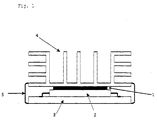
- Fig. 1 is a longitudinal section of one example of a semiconductor device according to the present invention.
- the figure 1 denotes a heat-reducing silicone grease composition
- the figure 2 denotes a packaged IC unit, such as a central processing unit (CPU)
- the figure 3 denotes a printed wiring substrate
- the figure 4 denotes a heat dissipater
- the figure 5 denotes a clamp.
- the aluminum nitride powder as Component (A) of the present composition is a nitride constituted of Group III and Group V elements, which generally has a hexagonal or wurtzite-type crystal structure and a white or grayish white appearance.
- the particle shape of the powder is amorphous or spherical depending on the preparation method adopted.
- aluminum nitride powders can be used in the invention as far as they each have the average particle size in the range of 0.5 to 10 ⁇ m, it is favorable for preparation of homogeneous grease composition that the average particle size of the powder be in the range of 1 to 5 ⁇ m, particularly 2 to 4 ⁇ m.
- These values of the average particle size are those determined with a laser diffraction particle size measuring apparatus, Granulometer 850 (made by Cilas Alcatel Inc.).
- the present aluminum nitride powder is required to be free of particles the sizes of which are not smaller than 100 ⁇ m.
- Such coarse particles can be removed from the aluminum nitride powder by carrying out a screening operation or using an airflow classifier.
- the particle-size measurement in the invention is made with a laser diffraction particle size measuring apparatus, Granulometer 850 (made by Cilas Alcatel Inc.).
- the present aluminum nitride powder prefferably has a specific surface area of 0.1-100 m 2 /g.
- the aluminum nitride powder having its specific surface area in the range of 1-10 m 2 /g, particularly 2-5 m 2 /g. These values of the specific surface area are those determined according to JIS K1150.
- the suitable proportion of the present aluminum nitride powder is from 50 to 95 weight %, preferably from 60 to 90 weight %.
- the aluminum nitride powders usable as raw material can be prepared, e.g., by a direct nitriding method wherein a metallic aluminum powder is reacted directly with nitrogen or ammonia, an alumina reducing method wherein a mixed powder of alumina and carbon is heated in an atmosphere of nitrogen or ammonia to effect the reduction and the nitriding at the same time, a method of reacting an aluminum vapor directly with nitrogen, or a method of thermally decomposing AlCl 3 ⁇ NH 3 .
- aluminum nitride powders have characteristics depending on the preparation methods thereof with respect to, e.g., the chemical composition (impurities), the particle shape and the particle size distribution
- the aluminum nitride powder used in the invention may be prepared by any of the preparation methods as mentioned above, and it may be a mixture of powders prepared by different methods.
- these aluminum nitride powders may be rendered hydrophobic by undergoing treatment with organosilanes, organosilazanes, organopolysiloxanes or fluorine-containing organic compounds.
- aluminum nitride is very hard, and the Mohs' hardness thereof is in the range of 7-9. Any aluminum nitride can be used in the invention so long as the Mohs' hardness thereof is in the foregoing range. In particular, the use of aluminum nitride powders having Mohs' hardness of 8-9 is advantageous to the invention.
- the thermal conductivity of aluminum nitride is 320 W/mk in theory, but the actually measure value thereof is lower than the theoretical value, specifically 250 W/mK or below, because the aluminum nitride powder prepared in practice is more or less contaminated with impurities and contains voids and bubbles.
- the aluminum nitride powder used in the invention it is desirable to have a thermal conductivity of at least 60 W/mk, particularly at least 100 W/mk, at room temperature. When the aluminum nitride powder used has thermal conductivity lower than 60 W/mk, it cannot provide the resulting grease with high thermal conductivity as aimed at by the invention.
- Examples of aluminum nitride usable in the invention include US, UF and UM, trade names, produced by Toyo Aluminum Co., Ltd.; XUS-55548, trade name, produced by Dow Chemical Co., Ltd.; H-grade and F-grade, trade names, produced by K.K. Tokuyama; FA and ES-10, trade names, produced by Nippon Light Metal Co., Ltd.; and A-100WR, A-100 and AG-SD, trade names, produced by Advanced Refractory Technologies Inc.
- the liquid silicones usable as a base oil in the invention can be selected properly from known silicones which are in a liquid state at room temperature, such as organopolysiloxanes, organopolysilalkylenes, organopolysilanes and copolymers thereof.
- organopolysiloxanes especially those represented by formula R a SiO (4-a)/2 , are preferred as the liquid silicone used in the invention from the viewpoint of ensuring heat resistance, stability and electric insulation for the resulting composition.
- R represents a substituted or unsubstituted univalent hydrocarbon group containing 1 to 30 carbon atoms, an amino group-containing organic group, a polyether-containing organic group or an epoxy group-containing organic group.
- the suffix "a” in the foregoing formula is a number ranging from 1.8 to 2.2, preferably 1.9 to 2.1.
- the organopolysiloxanes used in the invention are required to have their viscosity in the range of 50 to 500,000 cs at 25°C. This is because, when the organopolysiloxanes having viscosity lower than 50 cs at 25°C are contained in a grease composition, the composition shows a tendency to oil bleeding; while the grease composition containing organopolysiloxanes having viscosity higher than 500, 000 cs at 25°C is poor in extensibility. In particular, it is advantageous to use organopolysiloxanes having their viscosity in the range of 100 to 100,000 cs at 25°C.
- the suitable proportion of these organopolysiloxanes in the present grease composition is from 5 to 50 weight %, preferably from 7 to 30 weight %. This is because, when the organopolysiloxanes are used in a proportion lower than 5 weight %, the composition obtained cannot take a state of grease and has poor extensibility; while when they are used in a proportion higher than 50 weight % the composition obtained has insufficient thermal conductivity. Additionally, the viscosity measurement in the invention was made according to JIS K2283.
- organopolysiloxanes examples include dimethylpolysiloxane, diethylpolysiloxane, methylphenylpolysiloxane, dimethylsiloxane-diphenylsiloxane copolymers, and alkyl-modified methylpolysiloxanes.
- the homopolymers prepared from dimethylsiloxane, an alkyl-methylsiloxane, methylphenylsiloxane or diphenylsiloxane, and copolymers prepared from two or more of these siloxanes, the molecular chain ends of which are blocked with trimethylsilyl or dimethylhydrosilyl groups, are preferred over the others.
- organopolysiloxanes represented by the following formula (I) are used to advantage:
- each of R 1 groups represents a group selected from unsubstituted or substituted univalent hydrocarbon groups containing 1 to 30 carbon atoms, including alkyl groups (e.g., methyl, ethyl, propyl, butyl, amyl and octyl groups), alkenyl groups (e.g., vinyl and allyl groups), aryl groups (e.g., phenyl and tolyl groups) and groups formed by substituting halogen atom(s), cyano group(s) or/and hydroxyl group(s) for a part or all of the hydrogen atoms attached to carbon atoms present in the above-recited groups (e.g., chloromethyl, 3,3,3-trifluoropropyl, cyanopropyl, phenol, hindered phenol groups).
- alkyl groups e.g., methyl, ethyl, propyl, butyl, amyl and octyl groups
- R 2 groups represent univalent organic groups, which may be the same as or different from one another.
- R 3 groups also represent univalent organic groups, which may be the same as or different from one another. More specifically, each of these groups is a group selected from the univalent hydrocarbon groups recited above as examples of R 1 , amino group-containing organic groups, polyether group-containing organic groups, or epoxy group-containing organic groups.
- Each of R 4 groups is a hydrogen atom, a group selected from the univalent hydrocarbon groups recited as examples of R 1 and the univalent organic groups recited as examples of R 2 and R 3 , or a hydroxyl group.
- the suffix "1" in formula (I) is a positive integer to enable the organopolysiloxane to have a viscosity of from 50 to 500,000 cs at 25°C.
- the organopolysiloxanes used in the invention are organopolysiloxanes having the molecular chain ends blocked by trimethylsilyl groups.
- the groups contained therein as R 1 , R 2 and R 3 groups are alkyl groups such as methyl and ethyl groups, aryl' groups such as phenyl and tolyl groups, or/and groups formed by substituting hydroxyl group(s) for a part of hydrogen atoms attached to the carbon atoms of alkyl or aryl groups. Of these groups, methyl group, phenyl group and alkyl groups containing 6 to 14 carbon atoms are preferred in particular.
- a dimethylpolysiloxane oil can be produced by a method comprising steps of subjecting a low molecular cyclosiloxane, such as octamethylcyclotetrasiloxane or decamethylcyclopentasiloxane, in the presence of an acidic catalyst (e.g., sulfuric acid, chlorosulfonic acid, nitric acid, phosphoric acid, activated clay, acid clay, trifluoroacetic acid) or an alkaline catalyst (e.g., potassium hydroxide, sodium hydroxide, rubidium hydroxide, cesium hydroxide, potassium oxide, potassium acettate, calcium silanolate) and polymerizing the reaction product.
- an acidic catalyst e.g., sulfuric acid, chlorosulfonic acid, nitric acid, phosphoric acid, activated clay, acid clay, trifluoroacetic acid
- an alkaline catalyst e.g., potassium hydroxide, sodium hydroxide, rub
- the control of polymerization degree can be effected by adding a low molecular siloxane having an end-blocking group, such as hexamethyldisiloxane, octamethyltrisiloxane or decamethyl-tetrasiloxane, at an appropriate point in polymerization.
- a low molecular siloxane having an end-blocking group such as hexamethyldisiloxane, octamethyltrisiloxane or decamethyl-tetrasiloxane
- the amino group-containing organopolysiloxane can be produced by the dealcoholizing condensation reaction between an organopolysiloxane containing at least one silanol group and an amino group-containing alkoxysilane
- the epoxy or polyether group-containing organopolysiloxane can be produced by the addition reaction of a compound having both an epoxy or polyether group and an unsaturated group, such as vinyl group, with an organohydrogenpolysiloxane having at least one silicon-attached hydrogen atom in the presence of a platinum catalyst.
- the surface of at least one inorganic powder used as Component (C), which is selected from the group consisting of zinc oxide, alumina, boron nitride and silicon carbide powders, may be rendered hydrophobic by treatment with an organosilane, organosilazane, organopolysiloxane or organic fluorine-containing compound, if desired.
- the inorganic powder as Component (C) is used in a proportion greater than 30 weight %, the resulting composition comes to have poor extensibility. Therefore, the suitable proportion of inorganic powder used as Component (C) is 0-30 weight %, preferably 0-20 weight %.
- the zinc oxide powder used in the invention is a white powder having a hexagonal or Wurtzite crystal structure, which is generally called Zinc White.
- a zinc oxide powder can be produced using known methods.
- One of the known methods is an indirect method wherein the zinc vapor produced generally by heating metallic zinc to 1,000°C is oxidized with hot air.
- another of them is a direct method wherein the zinc oxide obtained by roasting zinc ore is reduced with coal and the zinc vapor produced thereby is oxidized with hot air, or wherein the slag obtained by leaching zinc ore with sulfuric acid is mixed with coke and then heated in an electric furnace to vaporize the zinc, and the zinc vapor produced thereby is oxidized with hot air.
- the zinc oxide produced is cooled by passing through an air condenser equipped with a blower, and fractionated according to particle size.
- the zinc oxide powders produced according to those methods are defined in Japanese Industrial Standards, JIS K1410 and JIS K5102, and American Standards, ASTM-D79.
- any of the zinc oxide powders produced by the foregoing methods can be used alone in the invention. Also, the powders produced by different methods may be used as a mixture.
- the zinc oxide powder is used not only as a vulcanization accelerator for rubber but also in the fields of coating colors, ceramics, enameled ware, glass, ferrite, cosmetics and medicines. Further, it is also known to use a zinc oxide powder as a thermal conductivity providing filler in thermally conductive grease [Japanese Tokkai Sho 51-55870, Sho 54-116055, Sho 55-45770, Sho 56-28264, Sho 61-157587, Hei 2-212556 (U.S. Patent 5,221,339), Hei 3-162493 (U.S. Patent 5,100,568) and Hei 4-202496].
- the average particle size of a zinc oxide powder usable in the invention is in a wide range of 0.2 to 5 ⁇ m.
- a zinc oxide powder having its average particle size in the range of 0.3 to 4 ⁇ m, particularly 0.3 to 3 ⁇ m.
- the hardness on the other hand, it is desirable for the zinc oxide powder used to have Mohs' hardness of from 4 to 5.
- the alumina powder usable as a thermal conductivity providing filler in the invention is a powder of aluminum oxide represented by chemical formula Al 2 O 3 , with examples including aluminum oxide powders generally referred to as "alumina”, “ ⁇ -alumina”, “single crystal corundum fines” and “spherical alumina” respectively depending on their production methods.
- alumina In general the industrial manufacturing of alumina is carried out using the so-called Bayer method, wherein bauxite as a raw material is treated with hot sodium hydroxide.
- the crystals of aluminum hydroxide, Al(OH) 3 are once formed, and then burned at a high temperature by means of, e.g., a rotary kiln to be converted into alumina. Since alumina has excellent thermal, mechanical and physical-and-chemical characteristics, it has various uses, e.g., as a refractory material, abrasives, a raw material for porcelain, a white filling pigment and catalyst.
- the generally used alumina powder is an a -alumina powder having a crystal structure belonging to a hexagonal system or hexagonal rhombohedral lattice, and it is a white powder in appearance.
- the ⁇ -alumina powder has an apparent average particle size of the order of 20-80 ⁇ m, and each particle is constituted of primary crystals of alumina having a size of the order of 0.5-20 ⁇ m. And it is possible to produce the ⁇ -alumina powder in various grades depending on the intended use thereof. In a case where the ⁇ -alumina powder is incorporated in a silicone grease, the shape and size thereof have delicate effects on the characteristics of the resulting grease, including the homogeneity and the consistency.
- the apparent average particle size of alumina powder usable in the invention is in the wide range of 20-80 ⁇ m. From the viewpoint of dispersibility in liquid silicone, however, it is desirable that the alumina powder used in the invention have its apparent average particle size in the range of 30 to 50 ⁇ m, particularly 30 to 40 ⁇ m.
- the hardness of powder although the alumina is generally very hard and has Mohs' hardness of from 8 to 9, it is permissible in the invention to use a powder having such a range of Mohs' hardness.
- the boron nitride powder usable in the invention can be produced by heating boric acid or a borate together with a nitrogen compound, such as a nitrogen-containing organic compound or ammonia.
- the product obtained therein is a boron nitride powder having a hexagonal crystal structure similar to that of graphite, or a hexagonal network laminate.
- the boron nitride having a crystal structure of hexagonal system has excellent characteristics such that it can retain high lubricity even in a high temperature range, has high thermal conductivity as well as high electrical insulating capacity, and further is chemically stable and hardly wetted with fused metal or glass. Therefore, the boron nitride is used as an insulating filler having high thermal conductivity, a solid lubricant, a filler for resin modification and so on.
- the hexagonal boron nitride powder as mentioned above is white in appearance, and has an average particle size of 1 to 10 ⁇ m.
- any boron nitride powder can be used so far as the average particle size thereof is in a wide range of 1 to 10 ⁇ m.
- the average particle size of the boron nitride powder used in the invention be in the range of 1 to 5 ⁇ m.
- the boron nitride powder having a crystal structure of hexagonal system is generally soft. It is advantageous to the invention to use a boron nitride powder having Mohs' hardness of from 1 to 3, particularly around 2.
- Silicon carbide powder is generally prepared by pulverizing high-purity ⁇ -SiC ingot produced from silica and coke as main row materials by means of an electric resistance furnace (Acheson furnace), and subjecting the pulverized matter to decarburizing, iron-removing and sieving steps in succession.
- This production method can provide silicon carbide powders various in particle size distribution depending on the intended uses.
- ultra fine silicon carbide powder can also be prepared as follows: After producing a silicon carbide powder having a moderate size distribution by the foregoing method, the powder is thoroughly ground into fine particles of submicron order in size, sieved, and then purified by a chemical treatment.
- the particle size and the particle size distribution of silicon carbide are determined using the methods defined in JIS R6001, JIS R6002 and JIS R6124.
- the average particle size of silicon carbide powder used in the invention though may be in the wide range of 0.4-10 ⁇ m, is desirably in the range of 0.4 to 5 ⁇ m from the viewpoints of achieving good dispersibility in liquid silicone and preventing the oil separation.
- the silicon carbide powder is bluish black in appearance, has a crystal structure of trigonal prism, and is generally hard. As to the hardness, the silicon carbide powder having its Mohs' hardness in the range of 8-9 can be used in the invention.
- the aforementioned Components (A) to (C) are mixed together by means of a mixing machine, e.g., TRIMIX, TWINMIX or PLANETARY MIXER (trade names, made by INOUE MFG., INC.), ULTRA MIXER (trade name, made by MIZUHO INDUSTRIAL CO., LTD.) or HIVISDISPERMIX (trade name, made by TOKUSHU KIKA KOGYO CO., LTD.).
- the mixing system may be heated to a temperature of 50-150°C, if desired.
- Examples of a kneader usable for such an operation include a three-rod roll kneader, a colloid mill and a sand grinder. Of these kneaders, a three-rod roll kneader is used to advantage.
- the present heat-reducing grease composition prepared in the manner as mentioned above can be used in the same ways for the same purposes as conventional thermally conductive grease compositions.
- the present semiconductor device is constituted of an IC unit packaged on a printed wiring substrate, a heat dissipater provided on the packaged IC unit surface by pressure welding and the present heat-reducing silicone grease composition that comprises Components (A) to (C) and is inserted between the packaged IC unit and the heat dissipater.
- the present semiconductor device can achieve a remarkable improvement in performance over conventional ones.
- the application of the present embodiments to CPU for host computer use, personal computer use or word processor use which suffers a temperature rise to a level of 170°C, enables the generated heat to be steadily diffused and dissipated and thereby can prevent the CPU from declining in performance or being damaged or broken by accumulated heat.
- a silicone grease composition (in the proportion of 0.2 g on a plane measuring 2cm ⁇ 2cm in size) is laid between the surface of a packaged IC unit 2 and a heat dissipater 4 (heat sink).
- the heat sink as a heat dissipater is made of aluminum, and has a structure provided with fins for the purpose of increasing the surface area to improve the heat dissipation efficiency. Further, the heat dissipater 4 and the printed wiring substrate 3 are pressed to each other by being fastened and fixed with clamps 5.
- each grease prepared is measured at 25°C with a quick thermal conductivity meter, QTM-500 (trade name, made by KYOTO ELECTRONICS MFG. CO., LTD.), and the consistency thereof was measured at 25°C according to the testing method defined in JIS K-2220.
- QTM-500 trade name, made by KYOTO ELECTRONICS MFG. CO., LTD.
- Silicone grease composition samples according to the invention were each prepared by weighing Components (A) to (C) in their respective amounts set forth in Table 1, mixing them for 20 minutes at room temperature by means of a planetary mixer having a volume of 5 liter, and then subjecting the resulting mixture to a kneading operation with a three-rod roll kneader three times. Each silicone grease thus prepared was examined for consistency and thermal conductivity, and further the surface condition of the CPU after undergoing the cycle test was observed. The results obtained are shown in Table 1. Additionally, the ingredients A-1, A-2, B-1, B-2, C-1 and C-2 set forth in Table 1 are as follows:
- silicone grease composition samples for comparison were each prepared by weighing Components (A) to (C) in their respective amounts set forth in Table 2, mixing them for 20 minutes at room temperature by means of a planetary mixer having a volume of 5 liter, and then subjecting the resulting mixture to a kneading operation with a three-rod roll kneader three times.
- each of the samples prepared was examined for consistency and thermal conductivity, and further the surface condition of the CPU was observed after the cycle test. The results obtained are shown in Table 2.
- ingredients A-1, B-1, B-2, C-1 and C-2 set forth in Table 2 are the same ones as in Table 1 respectively, and the ingredient A-3 is an aluminum nitride powder being amorphous in crystal shape, having an average particle size of 3.6 ⁇ m and a specific surface area of 3.0 m 2 /g and containing 5 volume % of coarse particles having sizes of 100 ⁇ m and above.
Landscapes
- Chemical & Material Sciences (AREA)
- Chemical Kinetics & Catalysis (AREA)
- General Chemical & Material Sciences (AREA)
- Oil, Petroleum & Natural Gas (AREA)
- Organic Chemistry (AREA)
- Lubricants (AREA)
- Ceramic Products (AREA)
- Compositions Of Macromolecular Compounds (AREA)
- Cooling Or The Like Of Semiconductors Or Solid State Devices (AREA)
Applications Claiming Priority (3)
| Application Number | Priority Date | Filing Date | Title |
|---|---|---|---|
| JP28119698 | 1998-10-02 | ||
| JP10281196A JP2000109373A (ja) | 1998-10-02 | 1998-10-02 | 放熱用シリコーングリース組成物及びそれを使用した半導体装置 |
| US09/409,902 US6174841B1 (en) | 1998-10-02 | 1999-10-01 | Heat-reducing silicone grease composition and semiconductor device using the same |
Publications (3)
| Publication Number | Publication Date |
|---|---|
| EP0993041A2 true EP0993041A2 (de) | 2000-04-12 |
| EP0993041A3 EP0993041A3 (de) | 2003-05-28 |
| EP0993041B1 EP0993041B1 (de) | 2011-03-16 |
Family
ID=26554090
Family Applications (1)
| Application Number | Title | Priority Date | Filing Date |
|---|---|---|---|
| EP99307721A Expired - Lifetime EP0993041B1 (de) | 1998-10-02 | 1999-09-30 | Wärmereduzierende Silikonfettzusammensetzung und diese verwendender Halbleiter |
Country Status (3)
| Country | Link |
|---|---|
| US (1) | US6174841B1 (de) |
| EP (1) | EP0993041B1 (de) |
| JP (1) | JP2000109373A (de) |
Cited By (7)
| Publication number | Priority date | Publication date | Assignee | Title |
|---|---|---|---|---|
| WO2005047378A3 (en) * | 2003-11-05 | 2005-06-23 | Dow Corning | Thermally conductive grease and methods and devices in which said grease is used |
| EP1356477A4 (de) * | 2001-01-30 | 2005-10-12 | Honeywell Int Inc | Nachgiebige und vernetzbare thermische grenzflächenmaterialien |
| US7404853B2 (en) | 2005-08-03 | 2008-07-29 | 3M Innovative Properties Company | Thermally conductive grease |
| EP1609838A3 (de) * | 2004-06-23 | 2010-09-29 | Delphi Technologies, Inc. | Thermisch dämpfendes Leitmaterial und Verfahren zu dessen Herstellung |
| EP3109300A4 (de) * | 2014-02-18 | 2017-10-25 | Kyodo Yushi Co., Ltd. | Silikonfettzusammensetzung |
| CN113632220A (zh) * | 2019-04-01 | 2021-11-09 | 信越化学工业株式会社 | 导热性有机硅组合物、其制备方法及半导体装置 |
| CN116694081A (zh) * | 2023-06-30 | 2023-09-05 | 苏州泰吉诺新材料科技有限公司 | 一种高导热无溶剂导热硅脂及其制备方法 |
Families Citing this family (45)
| Publication number | Priority date | Publication date | Assignee | Title |
|---|---|---|---|---|
| JP3504882B2 (ja) * | 1999-05-24 | 2004-03-08 | 富士高分子工業株式会社 | 熱伝導性・電気絶縁性シリコーン組成物及びこれを用いたシリコーン成形物 |
| US6610635B2 (en) * | 2000-09-14 | 2003-08-26 | Aos Thermal Compounds | Dry thermal interface material |
| US6475962B1 (en) | 2000-09-14 | 2002-11-05 | Aos Thermal Compounds, Llc | Dry thermal grease |
| JP4603700B2 (ja) | 2001-01-04 | 2010-12-22 | 株式会社日立製作所 | 高熱伝導グリース組成物及びそれを用いた冷却装置 |
| EP1383169B1 (de) | 2001-04-23 | 2014-06-04 | Shin-Etsu Chemical Co., Ltd. | Wärmeabstrahlglied |
| JP4130091B2 (ja) * | 2002-04-10 | 2008-08-06 | 信越化学工業株式会社 | 放熱用シリコーングリース組成物 |
| TWM245730U (en) * | 2003-03-19 | 2004-10-01 | Power Mate Technology Co Ltd | Heat dissipating coating layer of object under heat dissipation |
| JP3891969B2 (ja) * | 2003-08-06 | 2007-03-14 | 電気化学工業株式会社 | 熱伝導性グリース |
| JP2005064291A (ja) * | 2003-08-14 | 2005-03-10 | Nissan Motor Co Ltd | 絶縁シートおよびこの絶縁シートを用いた半導体装置組立体 |
| TWI385246B (zh) * | 2004-05-21 | 2013-02-11 | 信越化學工業股份有限公司 | 聚矽氧烷潤滑油組成物 |
| JP2005330426A (ja) * | 2004-05-21 | 2005-12-02 | Shin Etsu Chem Co Ltd | 放熱用シリコーングリース組成物 |
| JP4687887B2 (ja) * | 2004-10-14 | 2011-05-25 | 信越化学工業株式会社 | 熱伝導性シリコーングリース組成物 |
| KR101164438B1 (ko) * | 2004-12-16 | 2012-07-13 | 다우 코닝 코포레이션 | 아미드 치환된 실리콘, 이의 제조방법 및 이의 용도 |
| US20060266475A1 (en) * | 2005-05-24 | 2006-11-30 | American Standard Circuits, Inc. | Thermally conductive interface |
| JP4880268B2 (ja) * | 2005-09-07 | 2012-02-22 | 電気化学工業株式会社 | 無機粉末およびその用途 |
| EP1983568B1 (de) | 2006-01-26 | 2014-07-16 | Momentive Performance Materials Japan LLC | Wärmeableitglied und halbleiteranordnung damit |
| US20070178255A1 (en) * | 2006-01-31 | 2007-08-02 | Farrow Timothy S | Apparatus, system, and method for thermal conduction interfacing |
| US7527873B2 (en) * | 2006-02-08 | 2009-05-05 | American Standard Circuits | Thermally and electrically conductive interface |
| CN101050356A (zh) * | 2006-04-05 | 2007-10-10 | 富准精密工业(深圳)有限公司 | 导热聚硅氧烷组合物及使用该组合物的电子元件组合 |
| TW200833752A (en) * | 2006-10-23 | 2008-08-16 | Lord Corp | Highly filled polymer materials |
| JP5197631B2 (ja) * | 2007-02-20 | 2013-05-15 | ダウ コーニング コーポレーション | 水素結合性ポリオルガノシロキサンベースの充填材処理剤 |
| JP2008274036A (ja) | 2007-04-26 | 2008-11-13 | Shin Etsu Chem Co Ltd | 放熱用シリコーングリース組成物 |
| US20090143522A1 (en) * | 2007-12-04 | 2009-06-04 | Sea-Fue Wang | Thermally Conductive Silicone Composition |
| US8106119B2 (en) * | 2007-12-04 | 2012-01-31 | Sea-Fue Wang | Thermally conductive silicone composition |
| EP2408860B1 (de) | 2009-03-16 | 2020-03-18 | Dow Silicones Corporation | Wärmeleitfähiges schmierfett sowie dieses fett verwendende verfahren und vorrichtungen |
| JP5540937B2 (ja) * | 2009-07-03 | 2014-07-02 | 信越化学工業株式会社 | 高熱伝導性熱定着ロール又は高熱伝導性熱定着ベルト用シリコーンゴム組成物並びに定着ロール及び定着ベルト |
| JP2011021069A (ja) * | 2009-07-14 | 2011-02-03 | Sakai Chem Ind Co Ltd | 放熱性フィラー組成物、樹脂組成物、放熱性グリース及び放熱性塗料組成物 |
| US8546476B2 (en) | 2009-07-14 | 2013-10-01 | Sakai Chemical Industry Co., Ltd. | Exoergic filler composition, resin composition, exoergic grease and exoergic coating composition |
| JP5373545B2 (ja) * | 2009-10-20 | 2013-12-18 | 信越化学工業株式会社 | 放熱用熱伝導性シリコーングリース組成物及びその使用方法 |
| JP2011140566A (ja) * | 2010-01-07 | 2011-07-21 | Dow Corning Toray Co Ltd | 熱伝導性シリコーングリース組成物 |
| JP5614909B2 (ja) * | 2012-03-02 | 2014-10-29 | 富士高分子工業株式会社 | パテ状伝熱材及びその製造方法 |
| US20140080951A1 (en) | 2012-09-19 | 2014-03-20 | Chandrashekar Raman | Thermally conductive plastic compositions, extrusion apparatus and methods for making thermally conductive plastics |
| US9434870B2 (en) | 2012-09-19 | 2016-09-06 | Momentive Performance Materials Inc. | Thermally conductive plastic compositions, extrusion apparatus and methods for making thermally conductive plastics |
| US20160040040A1 (en) * | 2014-08-11 | 2016-02-11 | Applied Materials, Inc. | Slurry for Selective Chemical Mechanical Polishing of Copper |
| JP6879690B2 (ja) | 2016-08-05 | 2021-06-02 | スリーエム イノベイティブ プロパティズ カンパニー | 放熱用樹脂組成物、その硬化物、及びこれらの使用方法 |
| CN107765795A (zh) | 2017-11-08 | 2018-03-06 | 北京图森未来科技有限公司 | 一种计算机服务器 |
| CN107885295A (zh) * | 2017-11-08 | 2018-04-06 | 北京图森未来科技有限公司 | 一种散热系统 |
| CN111315825B (zh) * | 2017-11-09 | 2021-12-14 | 信越化学工业株式会社 | 导热性硅脂组合物 |
| KR102319263B1 (ko) * | 2017-11-30 | 2021-10-29 | 주식회사 엘지화학 | 방열 유체 조성물, 이의 제조방법, 이를 포함하는 전지 모듈 및 배터리 팩 |
| US12043704B2 (en) * | 2018-01-19 | 2024-07-23 | Wacker Chemie Ag | Alkyl silicone resin as additive for hyrophobising fibre cement |
| JP7220812B2 (ja) * | 2020-10-28 | 2023-02-10 | ダウ シリコーンズ コーポレーション | トリアルコキシ官能性分岐状シロキサン組成物 |
| JP7606439B2 (ja) * | 2021-10-19 | 2024-12-25 | 信越化学工業株式会社 | 熱伝導性シリコーン組成物 |
| EP4276151B1 (de) * | 2021-12-23 | 2025-12-31 | Resonac Corporation | Wärmeleitende zusammensetzung und härtungsprodukt davon |
| CN116731689B (zh) * | 2023-08-14 | 2023-10-27 | 南方电网调峰调频(广东)储能科技有限公司 | 电子元器件的基于硅油的浸没式冷却液 |
| JP2025092146A (ja) * | 2023-12-08 | 2025-06-19 | 信越化学工業株式会社 | 熱伝導性付加硬化型シリコーン組成物、及び熱伝導性付加硬化型シリコーン組成物の製造方法 |
Family Cites Families (10)
| Publication number | Priority date | Publication date | Assignee | Title |
|---|---|---|---|---|
| US3671429A (en) * | 1969-09-25 | 1972-06-20 | Gen Electric | Grease-like silicone compound |
| US4265775A (en) * | 1979-08-16 | 1981-05-05 | International Business Machines Corporation | Non-bleeding thixotropic thermally conductive material |
| JPH0619027B2 (ja) * | 1989-02-13 | 1994-03-16 | 信越化学工業株式会社 | 熱伝導性シリコーンオイルコンパウンド |
| JP2580348B2 (ja) * | 1989-11-20 | 1997-02-12 | 信越化学工業 株式会社 | 放熱用グリ―ス組成物 |
| JP3541390B2 (ja) * | 1991-02-22 | 2004-07-07 | 東レ・ダウコーニング・シリコーン株式会社 | グリース状シリコーン組成物およびその製造方法 |
| JP3256587B2 (ja) * | 1992-02-21 | 2002-02-12 | 株式会社東芝 | 高熱伝導性放熱体およびその製造方法 |
| JP3458196B2 (ja) * | 1994-03-16 | 2003-10-20 | 東洋アルミニウム株式会社 | 高熱伝導性樹脂組成物 |
| DE69709978T2 (de) * | 1996-04-30 | 2002-11-21 | Denki Kagaku Kogyo K.K., Tokio/Tokyo | Wärmeableitende Abstandhalter für elektronische Einrichtungen |
| JP3142800B2 (ja) * | 1996-08-09 | 2001-03-07 | 信越化学工業株式会社 | 熱伝導性シリコーン組成物、熱伝導性材料及び熱伝導性シリコーングリース |
| WO1998049255A1 (en) * | 1997-04-16 | 1998-11-05 | The University Of Connecticut | Silicon greases and methods for their production |
-
1998
- 1998-10-02 JP JP10281196A patent/JP2000109373A/ja active Pending
-
1999
- 1999-09-30 EP EP99307721A patent/EP0993041B1/de not_active Expired - Lifetime
- 1999-10-01 US US09/409,902 patent/US6174841B1/en not_active Expired - Lifetime
Cited By (11)
| Publication number | Priority date | Publication date | Assignee | Title |
|---|---|---|---|---|
| EP1356477A4 (de) * | 2001-01-30 | 2005-10-12 | Honeywell Int Inc | Nachgiebige und vernetzbare thermische grenzflächenmaterialien |
| WO2005047378A3 (en) * | 2003-11-05 | 2005-06-23 | Dow Corning | Thermally conductive grease and methods and devices in which said grease is used |
| EP1609838A3 (de) * | 2004-06-23 | 2010-09-29 | Delphi Technologies, Inc. | Thermisch dämpfendes Leitmaterial und Verfahren zu dessen Herstellung |
| US7404853B2 (en) | 2005-08-03 | 2008-07-29 | 3M Innovative Properties Company | Thermally conductive grease |
| US7643298B2 (en) | 2005-08-03 | 2010-01-05 | 3M Innovative Properties Company | Thermally conductive grease |
| EP3109300A4 (de) * | 2014-02-18 | 2017-10-25 | Kyodo Yushi Co., Ltd. | Silikonfettzusammensetzung |
| CN113632220A (zh) * | 2019-04-01 | 2021-11-09 | 信越化学工业株式会社 | 导热性有机硅组合物、其制备方法及半导体装置 |
| EP3951859A4 (de) * | 2019-04-01 | 2023-04-05 | Shin-Etsu Chemical Co., Ltd. | Wärmeleitende silikonzusammensetzung, verfahren zur herstellung davon und halbleiterbauelement |
| US12180368B2 (en) | 2019-04-01 | 2024-12-31 | Shin-Etsu Chemical Co., Ltd. | Thermal-conductive silicone composition, production method therefor, and semiconductor device |
| CN113632220B (zh) * | 2019-04-01 | 2025-10-10 | 信越化学工业株式会社 | 导热性有机硅组合物、其制备方法及半导体装置 |
| CN116694081A (zh) * | 2023-06-30 | 2023-09-05 | 苏州泰吉诺新材料科技有限公司 | 一种高导热无溶剂导热硅脂及其制备方法 |
Also Published As
| Publication number | Publication date |
|---|---|
| JP2000109373A (ja) | 2000-04-18 |
| EP0993041B1 (de) | 2011-03-16 |
| EP0993041A3 (de) | 2003-05-28 |
| US6174841B1 (en) | 2001-01-16 |
Similar Documents
| Publication | Publication Date | Title |
|---|---|---|
| EP0993041B1 (de) | Wärmereduzierende Silikonfettzusammensetzung und diese verwendender Halbleiter | |
| EP0896031B1 (de) | Wärmeleitende Siliconzusammensetzung | |
| JP2938429B1 (ja) | 熱伝導性シリコーン組成物 | |
| US6114429A (en) | Thermally conductive silicone composition | |
| JP3142800B2 (ja) | 熱伝導性シリコーン組成物、熱伝導性材料及び熱伝導性シリコーングリース | |
| JP3948642B2 (ja) | 熱伝導性グリース組成物及びそれを使用した半導体装置 | |
| US6136758A (en) | Aluminum nitride powder and thermally conductive grease composition using the same | |
| EP2257616B1 (de) | Wärmeleitfähige silikonfettzusammensetzung | |
| JP2938428B1 (ja) | 熱伝導性グリース組成物 | |
| JP2930298B1 (ja) | 熱伝導性グリース組成物 | |
| JP5729882B2 (ja) | 熱伝導性シリコーングリース組成物 | |
| JP5843364B2 (ja) | 熱伝導性組成物 | |
| WO2020261958A1 (ja) | 高熱伝導性シリコーン組成物及びその硬化物 | |
| JP2022060340A (ja) | 熱伝導性シリコーン組成物 | |
| JP2023099513A (ja) | 新規な低オイルブリードサーマルギャップパッド材料 | |
| EP4606862A1 (de) | Härtbare organopolysiloxanzusammensetzung und halbleiterbauelement | |
| JPWO2006043334A1 (ja) | 放熱用シリコーン組成物 | |
| WO2022049902A1 (ja) | 熱伝導性シリコーン放熱材料 | |
| KR20250044317A (ko) | 열전도성 실리콘 조성물 및 그의 제조 방법 | |
| EP4467611A1 (de) | Wärmeleitfähige silikonzusammensetzung und halbleiterbauelement | |
| KR20030080250A (ko) | 그리스상 실리콘 조성물 | |
| JP7289023B1 (ja) | 熱伝導性組成物、熱伝導性グリース及び熱伝導性シート | |
| WO2020241054A1 (ja) | 熱伝導性シリコーン組成物、半導体装置及びその製造方法 | |
| JP2007161806A (ja) | 熱伝導性シリコーンゴム組成物 | |
| WO2024004242A1 (ja) | 熱伝導性組成物、熱伝導性グリース及び熱伝導性シート |
Legal Events
| Date | Code | Title | Description |
|---|---|---|---|
| PUAI | Public reference made under article 153(3) epc to a published international application that has entered the european phase |
Free format text: ORIGINAL CODE: 0009012 |
|
| AK | Designated contracting states |
Kind code of ref document: A2 Designated state(s): AT BE CH CY DE DK ES FI FR GB GR IE IT LI LU MC NL PT SE |
|
| AX | Request for extension of the european patent |
Free format text: AL;LT;LV;MK;RO;SI |
|
| PUAL | Search report despatched |
Free format text: ORIGINAL CODE: 0009013 |
|
| AK | Designated contracting states |
Designated state(s): AT BE CH CY DE DK ES FI FR GB GR IE IT LI LU MC NL PT SE |
|
| AX | Request for extension of the european patent |
Extension state: AL LT LV MK RO SI |
|
| 17P | Request for examination filed |
Effective date: 20031013 |
|
| AKX | Designation fees paid |
Designated state(s): DE FR GB |
|
| 17Q | First examination report despatched |
Effective date: 20050509 |
|
| GRAP | Despatch of communication of intention to grant a patent |
Free format text: ORIGINAL CODE: EPIDOSNIGR1 |
|
| GRAS | Grant fee paid |
Free format text: ORIGINAL CODE: EPIDOSNIGR3 |
|
| GRAA | (expected) grant |
Free format text: ORIGINAL CODE: 0009210 |
|
| AK | Designated contracting states |
Kind code of ref document: B1 Designated state(s): DE FR GB |
|
| REG | Reference to a national code |
Ref country code: GB Ref legal event code: FG4D |
|
| REF | Corresponds to: |
Ref document number: 69943278 Country of ref document: DE Date of ref document: 20110428 Kind code of ref document: P |
|
| REG | Reference to a national code |
Ref country code: DE Ref legal event code: R096 Ref document number: 69943278 Country of ref document: DE Effective date: 20110428 |
|
| PGFP | Annual fee paid to national office [announced via postgrant information from national office to epo] |
Ref country code: FR Payment date: 20110922 Year of fee payment: 13 Ref country code: GB Payment date: 20110928 Year of fee payment: 13 |
|
| PLBE | No opposition filed within time limit |
Free format text: ORIGINAL CODE: 0009261 |
|
| STAA | Information on the status of an ep patent application or granted ep patent |
Free format text: STATUS: NO OPPOSITION FILED WITHIN TIME LIMIT |
|
| 26N | No opposition filed |
Effective date: 20111219 |
|
| REG | Reference to a national code |
Ref country code: DE Ref legal event code: R097 Ref document number: 69943278 Country of ref document: DE Effective date: 20111219 |
|
| GBPC | Gb: european patent ceased through non-payment of renewal fee |
Effective date: 20120930 |
|
| REG | Reference to a national code |
Ref country code: FR Ref legal event code: ST Effective date: 20130531 |
|
| PG25 | Lapsed in a contracting state [announced via postgrant information from national office to epo] |
Ref country code: GB Free format text: LAPSE BECAUSE OF NON-PAYMENT OF DUE FEES Effective date: 20120930 |
|
| PG25 | Lapsed in a contracting state [announced via postgrant information from national office to epo] |
Ref country code: FR Free format text: LAPSE BECAUSE OF NON-PAYMENT OF DUE FEES Effective date: 20121001 |
|
| PGFP | Annual fee paid to national office [announced via postgrant information from national office to epo] |
Ref country code: DE Payment date: 20150922 Year of fee payment: 17 |
|
| REG | Reference to a national code |
Ref country code: DE Ref legal event code: R119 Ref document number: 69943278 Country of ref document: DE |
|
| PG25 | Lapsed in a contracting state [announced via postgrant information from national office to epo] |
Ref country code: DE Free format text: LAPSE BECAUSE OF NON-PAYMENT OF DUE FEES Effective date: 20170401 |