EP0994876B1 - Quaternäre ammoniumverbindungen als tachykinin antagonisten - Google Patents
Quaternäre ammoniumverbindungen als tachykinin antagonisten Download PDFInfo
- Publication number
- EP0994876B1 EP0994876B1 EP98932148A EP98932148A EP0994876B1 EP 0994876 B1 EP0994876 B1 EP 0994876B1 EP 98932148 A EP98932148 A EP 98932148A EP 98932148 A EP98932148 A EP 98932148A EP 0994876 B1 EP0994876 B1 EP 0994876B1
- Authority
- EP
- European Patent Office
- Prior art keywords
- phenyl
- compound
- dichlorophenyl
- formula
- preparation
- Prior art date
- Legal status (The legal status is an assumption and is not a legal conclusion. Google has not performed a legal analysis and makes no representation as to the accuracy of the status listed.)
- Expired - Lifetime
Links
- 0 *C1(CC2)CCN2CC1 Chemical compound *C1(CC2)CCN2CC1 0.000 description 7
- UNGZDVSRDCXXNU-UHFFFAOYSA-N O=CC(CCOC1OCCCC1)c(cc1)cc(Cl)c1Cl Chemical compound O=CC(CCOC1OCCCC1)c(cc1)cc(Cl)c1Cl UNGZDVSRDCXXNU-UHFFFAOYSA-N 0.000 description 2
- OSJSCVZFFGVJBC-UHFFFAOYSA-N C=CCC(C=O)c(cc1Cl)ccc1Cl Chemical compound C=CCC(C=O)c(cc1Cl)ccc1Cl OSJSCVZFFGVJBC-UHFFFAOYSA-N 0.000 description 1
- WXVZYZNZRCAPET-UHFFFAOYSA-N C=CCC(CO)c(cc1Cl)ccc1Cl Chemical compound C=CCC(CO)c(cc1Cl)ccc1Cl WXVZYZNZRCAPET-UHFFFAOYSA-N 0.000 description 1
- FAKLCUKHKPFRID-UHFFFAOYSA-N C=[O]CC(CC1OCCO1)c(cc1Cl)ccc1Cl Chemical compound C=[O]CC(CC1OCCO1)c(cc1Cl)ccc1Cl FAKLCUKHKPFRID-UHFFFAOYSA-N 0.000 description 1
- MMEQBDJXMAUMTP-UHFFFAOYSA-N CS(OCC(CC1OCCO1)c(cc1Cl)ccc1Cl)(=O)=O Chemical compound CS(OCC(CC1OCCO1)c(cc1Cl)ccc1Cl)(=O)=O MMEQBDJXMAUMTP-UHFFFAOYSA-N 0.000 description 1
- QTCJNZIMSCIMCN-LJQANCHMSA-N CS(OCC[C@H](C[n]1c(C(c2c(CCCC3)c3ccc2)=O)ncc1)c(cc1Cl)ccc1Cl)(=O)=O Chemical compound CS(OCC[C@H](C[n]1c(C(c2c(CCCC3)c3ccc2)=O)ncc1)c(cc1Cl)ccc1Cl)(=O)=O QTCJNZIMSCIMCN-LJQANCHMSA-N 0.000 description 1
- RHEIPAYMRGHXLU-UHFFFAOYSA-N Cc1cc(C)cc(C(c2ncc[n]2CC(CC[N+](CC2)(CC3)C=CC23c2ccccc2)c2ccc(C3CCC3)c(C3CCC3)c2)=O)c1 Chemical compound Cc1cc(C)cc(C(c2ncc[n]2CC(CC[N+](CC2)(CC3)C=CC23c2ccccc2)c2ccc(C3CCC3)c(C3CCC3)c2)=O)c1 RHEIPAYMRGHXLU-UHFFFAOYSA-N 0.000 description 1
- QKSKKRXPQXKKIJ-UHFFFAOYSA-N N#CC(CCOC1OCCCC1)c(cc1Cl)ccc1Cl Chemical compound N#CC(CCOC1OCCCC1)c(cc1Cl)ccc1Cl QKSKKRXPQXKKIJ-UHFFFAOYSA-N 0.000 description 1
- GEKWIKWENXANFY-UHFFFAOYSA-N OCC(CCOC1OCCCC1)c(cc1)cc(Cl)c1Cl Chemical compound OCC(CCOC1OCCCC1)c(cc1)cc(Cl)c1Cl GEKWIKWENXANFY-UHFFFAOYSA-N 0.000 description 1
- MBWFDZJEDSGJKX-GOSISDBHSA-N OCC[C@H](C[n]1c(C(c2c(CCCC3)c3ccc2)=O)ncc1)c(cc1Cl)ccc1Cl Chemical compound OCC[C@H](C[n]1c(C(c2c(CCCC3)c3ccc2)=O)ncc1)c(cc1Cl)ccc1Cl MBWFDZJEDSGJKX-GOSISDBHSA-N 0.000 description 1
Classifications
-
- C—CHEMISTRY; METALLURGY
- C07—ORGANIC CHEMISTRY
- C07D—HETEROCYCLIC COMPOUNDS
- C07D233/00—Heterocyclic compounds containing 1,3-diazole or hydrogenated 1,3-diazole rings, not condensed with other rings
- C07D233/54—Heterocyclic compounds containing 1,3-diazole or hydrogenated 1,3-diazole rings, not condensed with other rings having two double bonds between ring members or between ring members and non-ring members
- C07D233/64—Heterocyclic compounds containing 1,3-diazole or hydrogenated 1,3-diazole rings, not condensed with other rings having two double bonds between ring members or between ring members and non-ring members with substituted hydrocarbon radicals attached to ring carbon atoms, e.g. histidine
-
- A—HUMAN NECESSITIES
- A61—MEDICAL OR VETERINARY SCIENCE; HYGIENE
- A61P—SPECIFIC THERAPEUTIC ACTIVITY OF CHEMICAL COMPOUNDS OR MEDICINAL PREPARATIONS
- A61P1/00—Drugs for disorders of the alimentary tract or the digestive system
-
- A—HUMAN NECESSITIES
- A61—MEDICAL OR VETERINARY SCIENCE; HYGIENE
- A61P—SPECIFIC THERAPEUTIC ACTIVITY OF CHEMICAL COMPOUNDS OR MEDICINAL PREPARATIONS
- A61P1/00—Drugs for disorders of the alimentary tract or the digestive system
- A61P1/04—Drugs for disorders of the alimentary tract or the digestive system for ulcers, gastritis or reflux esophagitis, e.g. antacids, inhibitors of acid secretion, mucosal protectants
-
- A—HUMAN NECESSITIES
- A61—MEDICAL OR VETERINARY SCIENCE; HYGIENE
- A61P—SPECIFIC THERAPEUTIC ACTIVITY OF CHEMICAL COMPOUNDS OR MEDICINAL PREPARATIONS
- A61P1/00—Drugs for disorders of the alimentary tract or the digestive system
- A61P1/06—Anti-spasmodics, e.g. drugs for colics, esophagic dyskinesia
-
- A—HUMAN NECESSITIES
- A61—MEDICAL OR VETERINARY SCIENCE; HYGIENE
- A61P—SPECIFIC THERAPEUTIC ACTIVITY OF CHEMICAL COMPOUNDS OR MEDICINAL PREPARATIONS
- A61P1/00—Drugs for disorders of the alimentary tract or the digestive system
- A61P1/08—Drugs for disorders of the alimentary tract or the digestive system for nausea, cinetosis or vertigo; Antiemetics
-
- A—HUMAN NECESSITIES
- A61—MEDICAL OR VETERINARY SCIENCE; HYGIENE
- A61P—SPECIFIC THERAPEUTIC ACTIVITY OF CHEMICAL COMPOUNDS OR MEDICINAL PREPARATIONS
- A61P11/00—Drugs for disorders of the respiratory system
-
- A—HUMAN NECESSITIES
- A61—MEDICAL OR VETERINARY SCIENCE; HYGIENE
- A61P—SPECIFIC THERAPEUTIC ACTIVITY OF CHEMICAL COMPOUNDS OR MEDICINAL PREPARATIONS
- A61P11/00—Drugs for disorders of the respiratory system
- A61P11/06—Antiasthmatics
-
- A—HUMAN NECESSITIES
- A61—MEDICAL OR VETERINARY SCIENCE; HYGIENE
- A61P—SPECIFIC THERAPEUTIC ACTIVITY OF CHEMICAL COMPOUNDS OR MEDICINAL PREPARATIONS
- A61P13/00—Drugs for disorders of the urinary system
-
- A—HUMAN NECESSITIES
- A61—MEDICAL OR VETERINARY SCIENCE; HYGIENE
- A61P—SPECIFIC THERAPEUTIC ACTIVITY OF CHEMICAL COMPOUNDS OR MEDICINAL PREPARATIONS
- A61P13/00—Drugs for disorders of the urinary system
- A61P13/10—Drugs for disorders of the urinary system of the bladder
-
- A—HUMAN NECESSITIES
- A61—MEDICAL OR VETERINARY SCIENCE; HYGIENE
- A61P—SPECIFIC THERAPEUTIC ACTIVITY OF CHEMICAL COMPOUNDS OR MEDICINAL PREPARATIONS
- A61P15/00—Drugs for genital or sexual disorders; Contraceptives
-
- A—HUMAN NECESSITIES
- A61—MEDICAL OR VETERINARY SCIENCE; HYGIENE
- A61P—SPECIFIC THERAPEUTIC ACTIVITY OF CHEMICAL COMPOUNDS OR MEDICINAL PREPARATIONS
- A61P15/00—Drugs for genital or sexual disorders; Contraceptives
- A61P15/10—Drugs for genital or sexual disorders; Contraceptives for impotence
-
- A—HUMAN NECESSITIES
- A61—MEDICAL OR VETERINARY SCIENCE; HYGIENE
- A61P—SPECIFIC THERAPEUTIC ACTIVITY OF CHEMICAL COMPOUNDS OR MEDICINAL PREPARATIONS
- A61P17/00—Drugs for dermatological disorders
-
- A—HUMAN NECESSITIES
- A61—MEDICAL OR VETERINARY SCIENCE; HYGIENE
- A61P—SPECIFIC THERAPEUTIC ACTIVITY OF CHEMICAL COMPOUNDS OR MEDICINAL PREPARATIONS
- A61P17/00—Drugs for dermatological disorders
- A61P17/04—Antipruritics
-
- A—HUMAN NECESSITIES
- A61—MEDICAL OR VETERINARY SCIENCE; HYGIENE
- A61P—SPECIFIC THERAPEUTIC ACTIVITY OF CHEMICAL COMPOUNDS OR MEDICINAL PREPARATIONS
- A61P17/00—Drugs for dermatological disorders
- A61P17/06—Antipsoriatics
-
- A—HUMAN NECESSITIES
- A61—MEDICAL OR VETERINARY SCIENCE; HYGIENE
- A61P—SPECIFIC THERAPEUTIC ACTIVITY OF CHEMICAL COMPOUNDS OR MEDICINAL PREPARATIONS
- A61P19/00—Drugs for skeletal disorders
-
- A—HUMAN NECESSITIES
- A61—MEDICAL OR VETERINARY SCIENCE; HYGIENE
- A61P—SPECIFIC THERAPEUTIC ACTIVITY OF CHEMICAL COMPOUNDS OR MEDICINAL PREPARATIONS
- A61P19/00—Drugs for skeletal disorders
- A61P19/02—Drugs for skeletal disorders for joint disorders, e.g. arthritis, arthrosis
-
- A—HUMAN NECESSITIES
- A61—MEDICAL OR VETERINARY SCIENCE; HYGIENE
- A61P—SPECIFIC THERAPEUTIC ACTIVITY OF CHEMICAL COMPOUNDS OR MEDICINAL PREPARATIONS
- A61P25/00—Drugs for disorders of the nervous system
-
- A—HUMAN NECESSITIES
- A61—MEDICAL OR VETERINARY SCIENCE; HYGIENE
- A61P—SPECIFIC THERAPEUTIC ACTIVITY OF CHEMICAL COMPOUNDS OR MEDICINAL PREPARATIONS
- A61P25/00—Drugs for disorders of the nervous system
- A61P25/06—Antimigraine agents
-
- A—HUMAN NECESSITIES
- A61—MEDICAL OR VETERINARY SCIENCE; HYGIENE
- A61P—SPECIFIC THERAPEUTIC ACTIVITY OF CHEMICAL COMPOUNDS OR MEDICINAL PREPARATIONS
- A61P25/00—Drugs for disorders of the nervous system
- A61P25/18—Antipsychotics, i.e. neuroleptics; Drugs for mania or schizophrenia
-
- A—HUMAN NECESSITIES
- A61—MEDICAL OR VETERINARY SCIENCE; HYGIENE
- A61P—SPECIFIC THERAPEUTIC ACTIVITY OF CHEMICAL COMPOUNDS OR MEDICINAL PREPARATIONS
- A61P25/00—Drugs for disorders of the nervous system
- A61P25/24—Antidepressants
-
- A—HUMAN NECESSITIES
- A61—MEDICAL OR VETERINARY SCIENCE; HYGIENE
- A61P—SPECIFIC THERAPEUTIC ACTIVITY OF CHEMICAL COMPOUNDS OR MEDICINAL PREPARATIONS
- A61P25/00—Drugs for disorders of the nervous system
- A61P25/28—Drugs for disorders of the nervous system for treating neurodegenerative disorders of the central nervous system, e.g. nootropic agents, cognition enhancers, drugs for treating Alzheimer's disease or other forms of dementia
-
- A—HUMAN NECESSITIES
- A61—MEDICAL OR VETERINARY SCIENCE; HYGIENE
- A61P—SPECIFIC THERAPEUTIC ACTIVITY OF CHEMICAL COMPOUNDS OR MEDICINAL PREPARATIONS
- A61P27/00—Drugs for disorders of the senses
- A61P27/02—Ophthalmic agents
-
- A—HUMAN NECESSITIES
- A61—MEDICAL OR VETERINARY SCIENCE; HYGIENE
- A61P—SPECIFIC THERAPEUTIC ACTIVITY OF CHEMICAL COMPOUNDS OR MEDICINAL PREPARATIONS
- A61P29/00—Non-central analgesic, antipyretic or antiinflammatory agents, e.g. antirheumatic agents; Non-steroidal antiinflammatory drugs [NSAID]
-
- A—HUMAN NECESSITIES
- A61—MEDICAL OR VETERINARY SCIENCE; HYGIENE
- A61P—SPECIFIC THERAPEUTIC ACTIVITY OF CHEMICAL COMPOUNDS OR MEDICINAL PREPARATIONS
- A61P31/00—Antiinfectives, i.e. antibiotics, antiseptics, chemotherapeutics
-
- A—HUMAN NECESSITIES
- A61—MEDICAL OR VETERINARY SCIENCE; HYGIENE
- A61P—SPECIFIC THERAPEUTIC ACTIVITY OF CHEMICAL COMPOUNDS OR MEDICINAL PREPARATIONS
- A61P31/00—Antiinfectives, i.e. antibiotics, antiseptics, chemotherapeutics
- A61P31/12—Antivirals
- A61P31/14—Antivirals for RNA viruses
- A61P31/16—Antivirals for RNA viruses for influenza or rhinoviruses
-
- A—HUMAN NECESSITIES
- A61—MEDICAL OR VETERINARY SCIENCE; HYGIENE
- A61P—SPECIFIC THERAPEUTIC ACTIVITY OF CHEMICAL COMPOUNDS OR MEDICINAL PREPARATIONS
- A61P35/00—Antineoplastic agents
-
- A—HUMAN NECESSITIES
- A61—MEDICAL OR VETERINARY SCIENCE; HYGIENE
- A61P—SPECIFIC THERAPEUTIC ACTIVITY OF CHEMICAL COMPOUNDS OR MEDICINAL PREPARATIONS
- A61P37/00—Drugs for immunological or allergic disorders
-
- A—HUMAN NECESSITIES
- A61—MEDICAL OR VETERINARY SCIENCE; HYGIENE
- A61P—SPECIFIC THERAPEUTIC ACTIVITY OF CHEMICAL COMPOUNDS OR MEDICINAL PREPARATIONS
- A61P43/00—Drugs for specific purposes, not provided for in groups A61P1/00-A61P41/00
-
- A—HUMAN NECESSITIES
- A61—MEDICAL OR VETERINARY SCIENCE; HYGIENE
- A61P—SPECIFIC THERAPEUTIC ACTIVITY OF CHEMICAL COMPOUNDS OR MEDICINAL PREPARATIONS
- A61P9/00—Drugs for disorders of the cardiovascular system
- A61P9/10—Drugs for disorders of the cardiovascular system for treating ischaemic or atherosclerotic diseases, e.g. antianginal drugs, coronary vasodilators, drugs for myocardial infarction, retinopathy, cerebrovascula insufficiency, renal arteriosclerosis
-
- C—CHEMISTRY; METALLURGY
- C07—ORGANIC CHEMISTRY
- C07D—HETEROCYCLIC COMPOUNDS
- C07D231/00—Heterocyclic compounds containing 1,2-diazole or hydrogenated 1,2-diazole rings
- C07D231/02—Heterocyclic compounds containing 1,2-diazole or hydrogenated 1,2-diazole rings not condensed with other rings
- C07D231/10—Heterocyclic compounds containing 1,2-diazole or hydrogenated 1,2-diazole rings not condensed with other rings having two or three double bonds between ring members or between ring members and non-ring members
- C07D231/12—Heterocyclic compounds containing 1,2-diazole or hydrogenated 1,2-diazole rings not condensed with other rings having two or three double bonds between ring members or between ring members and non-ring members with only hydrogen atoms, hydrocarbon or substituted hydrocarbon radicals, directly attached to ring carbon atoms
-
- C—CHEMISTRY; METALLURGY
- C07—ORGANIC CHEMISTRY
- C07D—HETEROCYCLIC COMPOUNDS
- C07D233/00—Heterocyclic compounds containing 1,3-diazole or hydrogenated 1,3-diazole rings, not condensed with other rings
- C07D233/54—Heterocyclic compounds containing 1,3-diazole or hydrogenated 1,3-diazole rings, not condensed with other rings having two double bonds between ring members or between ring members and non-ring members
- C07D233/56—Heterocyclic compounds containing 1,3-diazole or hydrogenated 1,3-diazole rings, not condensed with other rings having two double bonds between ring members or between ring members and non-ring members with only hydrogen atoms or radicals containing only hydrogen and carbon atoms, attached to ring carbon atoms
-
- C—CHEMISTRY; METALLURGY
- C07—ORGANIC CHEMISTRY
- C07D—HETEROCYCLIC COMPOUNDS
- C07D249/00—Heterocyclic compounds containing five-membered rings having three nitrogen atoms as the only ring hetero atoms
- C07D249/02—Heterocyclic compounds containing five-membered rings having three nitrogen atoms as the only ring hetero atoms not condensed with other rings
- C07D249/08—1,2,4-Triazoles; Hydrogenated 1,2,4-triazoles
-
- C—CHEMISTRY; METALLURGY
- C07—ORGANIC CHEMISTRY
- C07D—HETEROCYCLIC COMPOUNDS
- C07D405/00—Heterocyclic compounds containing both one or more hetero rings having oxygen atoms as the only ring hetero atoms, and one or more rings having nitrogen as the only ring hetero atom
- C07D405/02—Heterocyclic compounds containing both one or more hetero rings having oxygen atoms as the only ring hetero atoms, and one or more rings having nitrogen as the only ring hetero atom containing two hetero rings
- C07D405/06—Heterocyclic compounds containing both one or more hetero rings having oxygen atoms as the only ring hetero atoms, and one or more rings having nitrogen as the only ring hetero atom containing two hetero rings linked by a carbon chain containing only aliphatic carbon atoms
-
- C—CHEMISTRY; METALLURGY
- C07—ORGANIC CHEMISTRY
- C07D—HETEROCYCLIC COMPOUNDS
- C07D405/00—Heterocyclic compounds containing both one or more hetero rings having oxygen atoms as the only ring hetero atoms, and one or more rings having nitrogen as the only ring hetero atom
- C07D405/02—Heterocyclic compounds containing both one or more hetero rings having oxygen atoms as the only ring hetero atoms, and one or more rings having nitrogen as the only ring hetero atom containing two hetero rings
- C07D405/12—Heterocyclic compounds containing both one or more hetero rings having oxygen atoms as the only ring hetero atoms, and one or more rings having nitrogen as the only ring hetero atom containing two hetero rings linked by a chain containing hetero atoms as chain links
-
- C—CHEMISTRY; METALLURGY
- C07—ORGANIC CHEMISTRY
- C07D—HETEROCYCLIC COMPOUNDS
- C07D405/00—Heterocyclic compounds containing both one or more hetero rings having oxygen atoms as the only ring hetero atoms, and one or more rings having nitrogen as the only ring hetero atom
- C07D405/14—Heterocyclic compounds containing both one or more hetero rings having oxygen atoms as the only ring hetero atoms, and one or more rings having nitrogen as the only ring hetero atom containing three or more hetero rings
-
- C—CHEMISTRY; METALLURGY
- C07—ORGANIC CHEMISTRY
- C07D—HETEROCYCLIC COMPOUNDS
- C07D453/00—Heterocyclic compounds containing quinuclidine or iso-quinuclidine ring systems, e.g. quinine alkaloids
- C07D453/02—Heterocyclic compounds containing quinuclidine or iso-quinuclidine ring systems, e.g. quinine alkaloids containing not further condensed quinuclidine ring systems
Definitions
- This invention relates to quaternary ammonium compounds. More particularly, this invention relates to 1-(2-acylimidazol-1-ylalkyl)quinuclidinium salts and to processes for the preparation of, intermediates used in the preparation of, compositions containing and the uses of, such salts.
- the present compounds are antagonists of tachykinins, including NKA (neurokinin A), NKB (neurokinin B) and Substance P, acting at the human neurokinin-1(NK 1 ), neurokinin-2 (NK 2 ) and neurokinin-3 (NK 3 ) receptors.
- NKA neurokinin A
- NKB neurokinin B
- Substance P acting at the human neurokinin-1(NK 1 ), neurokinin-2 (NK 2 ) and neurokinin-3 (NK 3 ) receptors.
- NK 1 and NK 2 receptor antagonists are particularly useful as dual NK 1 and NK 2 receptor antagonists and can therefore be used for treating an inflammatory disease such as arthritis, psoriasis, asthma or inflammatory bowel disease, a central nervous system (CNS) disorder such as anxiety, depression, dementia or psychosis, a gastro-intestinal (GI) disorder such as functional bowel disease, irritable bowel syndrome, gastro-oesophageal reflux, faecal incontinence, colitis or Crohn's disease, a disease caused by Helicobacter pylori or another urease-positive Gram negative bacteria, a urogenital tract disorder such as incontinence, impotence, hyperreflexia or cystitis, a pulmonary disorder such as chronic obstructive airways disease, an allergy such as eczema, contact dermatitis, atopic dermatitis, urticaria, eczematoid dermatitis or rhinitis, a hypersensitivity
- EP-A-680962 and EP-A-0739891 disclose heterocyclic compounds which are non-peptide antagonists of NKA and that are useful for the treatment of diseases such as asthma.
- EP-A-0591040 discloses quaternary compounds with tachykinin antagonist activity.
- R is phenyl, C 3 -C 7 cycloalkyl or heteroaryl, each of which being optionally benzo- or C 3 -C 7 cycloalkyl-fused and optionally substituted, including in the benzo- or C 3 -C 7 cycloalkyl-fused portion, by from 1 to 3 substituents each independently selected from C 1 -C 4 alkyl, fluoro(C 1 -C 4 )alkyl, C 1 -C 4 alkoxy, fluoro(C 1 -C 4 )alkoxy, phenoxy, C 2 -C 4 alkanoyl, halo, C 1 -C 4 alkoxycarbonyl, C 3 -C 7 cycloalkyl, -S(O) m (C 1 -C 4 alkyl), cyano, -NR 2 R 3 , -S(O) m NR 2 R 3 , -NR 4 (C 1 -
- halo means fluoro, chloro, bromo or iodo and alkyl and alkoxy groups having three or more carbon atoms, alkanoyl groups having four carbon atoms and alkylene groups having two or more carbon atoms (except where stated) may be unbranched- or branched-chain.
- Z A is a pharmaceutically acceptable anion such as chloride, bromide, nitrate, methanesulphonate, para-toluenesulphonate, benzenesulphonate, hydrogen sulphate or sulphate.
- Z A is chloride or methanesulphonate.
- Z A is methanesulphonate.
- a compound of the formula (I) contains one or more asymmetric carbon atoms and therefore exists in two or more stereoisomeric forms.
- the present invention includes the individual stereoisomers of the compounds of the formula (I) and mixtures thereof.
- Separation of diastereoisomers may be achieved by conventional techniques, e.g. by fractional crystallisation, chromatography or H.P.L.C. of a stereoisomeric mixture of a compound of the formula (I) or a suitable salt or derivative thereof.
- An individual enantiomer of a compound of the formula (I) may also be prepared from a corresponding optically pure intermediate or by resolution, such as by H.P.L.C. of the corresponding racemate using a suitable chiral support or by fractional crystallisation of the diastereoisomeric salts formed by reaction of the corresponding racemate with a suitable optically active acid.
- R is phenyl which is optionally benzo- or C 3 -C 7 cycloalkyl-fused and optionally substituted, including in the benzo- or C 3 -C 7 cycloalkyl-fused portion, by 1, 2 or 3 substituents each independently selected from C 1 -C 4 alkyl, fluoro(C 1 -C 4 )alkyl, C 1 -C 4 alkoxy, fluoro(C 1 -C 4 )alkoxy, phenoxy and halo, or R is 2,3-dihydrobenzo[b]furanyl.
- R is phenyl which is optionally benzo- or C 3 -C 7 cycloalkyl-fused and optionally substituted, including in the benzo- or C 3 -C 7 cycloalkyl-fused portion, by 1, 2 or 3 substituents each independently selected from methyl, ethyl, trifluoromethyl, methoxy, isopropoxy, trifluoromethoxy, phenoxy, fluoro and chloro, or R is 2,3-dihydrobenzo[b]furanyl.
- R is phenyl, naphthyl or tetrahydronaphthyl, each of which being optionally substituted by 1, 2 or 3 substituents each independently selected from methyl, ethyl, trifluoromethyl, methoxy, isopropoxy, trifluoromethoxy, phenoxy, fluoro and chloro, or R is 2,3-dihydrobenzo[b]furanyl.
- R is phenyl, 3,5-dimethylphenyl, 2,3-dimethylphenyl, 2-trifluoromethoxyphenyl, 2-methoxy-3-methylphenyl, 2,3-dihydrobenzo[b]furan-7-yl, naphth-2-yl, 4-fluoro-3-trifluoromethylphenyl, 1,2,3,4-tetrahydronaphth-5-yl, 1,2,3,4-tetrahydronaphth-6-yl, 5-chloro-2-methoxyphenyl, 2-methoxyphenyl, 2-trifluoromethylphenyl, 2-isopropoxyphenyl, 2-ethylphenyl, 2-phenoxyphenyl or 3,5-bis(trifluoromethyl)phenyl.
- R is 2,3-dimethylphenyl, naphth-2-yl, 1,2,3,4-tetrahydronaphth-5-yl or 2-methoxyphenyl.
- R 1 is H.
- W is a direct link or methylene.
- W is a direct link.
- X is 1,2-ethylene.
- Y is phenyl, naphthyl or cyclohexyl, each of which being optionally substituted by 1, 2 or 3 C 1 -C 4 alkyl substituents.
- Y is phenyl, 3,5-dimethylphenyl, cyclohexyl or naphth-2-yl.
- Y is phenyl
- Ar is phenyl optionally substituted by 1, 2 or 3 halo substituents.
- Ar is phenyl substituted by 1 or 2 chloro substituents.
- Ar is 3,4-dichlorophenyl.
- Preferred examples of compounds of the formula (I) are compounds of the formula: wherein
- Particularly preferred examples of the compounds of the formula (I) are 4-phenyl-1 -(3(S)-[3,4-dichlorophenyl]-4-[2-(1,2,3,4-tetrahydro-5-naphthoyl)-imidazol-1-yl]butyl)quinuclidinium methanesulphonate and 4-phenyl-1-(3(R)-[3,4-dichlorophenyl]-4-[2-(1,2,3,4-tetrahydro-5-naphthoyl)imidazol-1-yl]butyl)quinuclidinium methanesulphonate.
- All the compounds of the formula (I) can be prepared by reaction of a compound of the formula: wherein R, R 1 , Ar, W and X are as previously defined for a compound of the formula (I), Z is a suitable leaving group capable of forming a pharmaceutically acceptable anion (Z A ) and Z 1 is a suitable leaving group, with a compound of the formula: wherein Y is as previously defined for a compound of the formula (I), said process being followed by either (a), where Z 1 is a suitable leaving group, exchange for a pharmaceutically acceptable anion (Z A ), or (b), optionally, where Z A is a pharmaceutically acceptable anion, exchange for another pharmaceutically acceptable anion.
- Z are C 1 -C 4 alkanesulphonyloxy, benzenesulphonyloxy, para-toluenesulphonyloxy, chloro, bromo and iodo.
- Z 1 is trifluoromethanesulphonyloxy.
- the leaving group in the compound of the formula (II) forms a pharmaceutically acceptable anion (Z/Z A ), e.g. methanesulphonyloxy/ methanesulphonate, and therefore anion exchange at the end of the process is unnecessary.
- Z/Z A pharmaceutically acceptable anion
- reaction of the compounds (II) and (III) is generally carried out in a suitable solvent, e.g. acetonitrile, at elevated temperatures, preferably at the reflux temperature thereof.
- a suitable solvent e.g. acetonitrile
- the starting materials of the formula (II) can be prepared as shown in Scheme 1. wherein R, R 1 , Ar, W, X, Z and Z 1 are as previously defined for a compound of the formula (II) and L and L 1 are suitable leaving groups, e.g. chloro, bromo, iodo, methanesulphonyloxy, trifluoromethanesulphonyloxy, benzenesulphonyloxy and para-toluenesulphonyloxy.
- R, R 1 , Ar, W, X, Z and Z 1 are as previously defined for a compound of the formula (II) and L and L 1 are suitable leaving groups, e.g. chloro, bromo, iodo, methanesulphonyloxy, trifluoromethanesulphonyloxy, benzenesulphonyloxy and para-toluenesulphonyloxy.
- a compound of the formula (XV) can be converted to a compound of the formula (II) using conventional conditions.
- an alcohol of the formula (XV) can be converted to a compound of the formula (II) where Z is methanesulphonyloxy by treatment with methanesulphonyl chloride, triethylamine and dichloromethane
- a compound of the formula (II) wherein Z 1 is trifluoromethanesulphonyloxy may be prepared by treating an alcohol of the formula (XV) with trifluoromethanesulphonic anhydride, optionally in the presence of a suitable acid acceptor, and in a suitable solvent, e.g. dichloromethane.
- the compounds of the formula (XII) can also be prepared as shown in Scheme 2: wherein R 1 and Ar are as previously defined for a compound of the formula (XII) and L 2 and L 3 are suitable leaving groups, e.g. as previously defined for L and L 1 .
- the compounds of the formula (XV) can also be prepared as shown in Scheme 3: wherein R, R 1 , Ar, W and X are as previously defined for a compound of the formula (XV), L 4 and L 5 are suitable leaving groups, e.g. as defined for L and L 1 , and P is a suitable protecting group.
- P protecting groups together with methods for their removal can be found in the publication "Protective Groups in Organic Synthesis", T.W. Greene and P.G.M. Wuts, Second Edition, Wiley-Interscience.
- a preferred example of P is tetrahydropyran-2-yl that can be removed using Amberlyst 15 (trade mark) ion exchange resin or methanol saturated with hydrogen chloride gas.
- the compounds of the formula (XXXI) can also be prepared by reacting a compound of the formula (XXIX) with a compound of the formula: wherein R and W are as previously defined for a compound of the formula (XXXI), optionally in the presence of an additional acid acceptor, e.g. potassium carbonate.
- an additional acid acceptor e.g. potassium carbonate.
- the compounds of the formula (III) can be prepared by a similar method to that described in Chem.Ber., 108 , 3475 (1975).
- the compounds of the formula (III) where Y is cyclohexyl optionally substituted as previously defined for the definition of Y for a compound of the formula (I) can be prepared by catalytic hydrogenation of a compound of the formula: wherein Y is phenyl optionally substituted as previously defined for the above definition of Y.
- the reduction can be carried out under a hydrogen atmosphere using a suitable catalyst, e.g. rhodium-on-alumina, and in a suitable solvent, e.g. acetic acid.
- the compounds of the formula (IIIA) may be prepared by similar methods to those described in Chem.Ber., 108, 3475 (1975) and J.Org.Chem., 22, 1484 (1957).
- the affinity of the compounds of the formula (I) for the human NK 1 receptor can be determined in vitro by determining their ability to inhibit [ 3 H]-Substance P binding to membranes prepared from the human IM9 cell line expressing the human NK 1 receptor using a modification of the method described in McLean, S. et al, J. Pharm.Exp.Ther., 267, 472-9 (1993) in which whole cells were used.
- the affinity of the compounds of formula (I) for the human NK 2 receptor can be determined in vitro by determining their ability to compete with [ 3 H]-NKA (neurokinin A) for binding to membranes prepared from Chinese hamster ovary cells expressing the cloned human NK 2 receptor.
- [ 3 H]-NKA neurokinin A
- washed Chinese hamster ovary cell membranes are prepared as described for the previous method where IM9 cells are used instead.
- the membranes are incubated (90 min, 25°C) with [ 3 H]-NKA and with a range of concentrations of the test compound. Non-specific binding is determined in the presence of 10 ⁇ M NKA.
- the NK 1 receptor antagonist activity of the compounds of the formula (I) can be determined in vitro by testing their ability to antagonise the contractile effects of Substance P in de-epithelialised guinea pig tracheal strips.
- Tissues can be prepared from guinea pigs (350-600g) which are killed by stunning and exsanguination.
- the excised trachea is cleared of connective tissue and opened longitudinally, opposite the trachealis muscle band.
- the epithelial layer can then be removed by rubbing the inner surface of the trachea with a cotton bud.
- Strips of approximately 4 cartilage bands wide are cut and mounted under 1g tension in organ baths containing Krebs solution (composition: NaCI 118mM, KCI 4.6mM, NaHCO 3 25mM, KH 2 PO 4 1.4mM, MgSO 4 1.2mM, CaCl 2 2.5mM, glucose 11mM) at 37°C and gassed with 95% O 2 /5% CO 2 .
- the potential action of Substance P on the NK 2 receptor population found in this tissue can be prevented by the inclusion of the selective NK 2 receptor antagonist ⁇ SR-48,968 (1 ⁇ M) in the Krebs buffer solution. Additionally, indomethacin (3 ⁇ M) is added to remove the influence of endogenous prostanoids.
- Tension changes of the tissue in response to cumulative addition of the agonist Substance P are recorded isometrically.
- the potency of the compounds of the formula (I) can be assessed by the magnitude of shift induced in the Substance P dose response curve, using standard Schild analysis, following 30 minutes incubation of the compound with the tissue.
- the de-epithelialised guinea pig trachea strip preparation may also be used to evaluate the NK 2 receptor antagonist activity of the compounds of the formula (I) in vitro by using the selective NK 2 receptor agonist [ ⁇ -Ala 8 ]NKA (4-10) as the contractile agent.
- strips are prepared and mounted in organ baths as described above, using Krebs solution of the following composition: NaCI 118mM, KCI 4.6mM, NaHCO 3 25mM, KH 2 PO 4 1.4mM, MgSO 4 1.2mM, CaCl 2 2.5mM, glucose 11mM, indomethacin 3 ⁇ M.
- the potency of the compounds may be assessed by the magnitude of the shift induced in the [ ⁇ -Ala 8 ]NKA (4-10) dose response curve, using standard Schild analysis, following 30 minutes incubation of the compound with the tissue.
- the compounds of the formula (I) can be tested for NK 3 receptor antagonist activity, in vitro , by testing their ability to antagonise the contractile effects of the selective NK 3 receptor agonist senktide in the guinea-pig ileum using the method of Maggi et al , Br.J.Pharmacol., 101, 996-1000 (1990).
- the compounds of the formula (I) can be administered alone, but will generally be administered in admixture with a pharmaceutical carrier selected with regard to the intended route of administration and standard pharmaceutical practice.
- they can be administered orally or sublingually in the form of tablets containing such excipients as starch or lactose, or in capsules or ovules either alone or in admixture with excipients, or in the form of elixirs, solutions or suspensions containing flavouring or colouring agents.
- excipients as starch or lactose
- capsules or ovules either alone or in admixture with excipients, or in the form of elixirs, solutions or suspensions containing flavouring or colouring agents.
- a sterile aqueous solution which may contain other substances, for example, enough salts or glucose to make the solution isotonic with blood.
- the daily dosage level of the compounds of the formula (I) will be from 0.01 to 20mg/kg (in single or divided doses).
- tablets or capsules of the compounds will contain from 1mg to 1.0g of active compound for administration singly or two or more at a time, as appropriate.
- the physician in any event will determine the actual dosage which will be most suitable for an individual patient and it will vary with the age, weight and response of the particular patient.
- the above dosages are exemplary of the average case. There can, of course, be individual instances where higher or lower dosage ranges are merited and such are within the scope of this invention.
- the compounds of formula (I) can also be administered intranasally or by inhalation and are conveniently delivered in the form of a dry powder inhaler or an aerosol spray presentation from a pressurised container or a nebuliser with the use of a suitable propellant, e.g. dichlorodifluoromethane, trichlorofluoromethane, dichlorotetrafluoroethane, a hydrofluoroalkane such as 1,1,1,2-tetrafluoroethane (HFA 134A [trade mark]) or 1,1,1,2,3,3,3-heptafluoropropane (HFA 227EA [trade mark]), carbon dioxide or other suitable gas.
- a suitable propellant e.g. dichlorodifluoromethane, trichlorofluoromethane, dichlorotetrafluoroethane, a hydrofluoroalkane such as 1,1,1,2-tetrafluoroethane (HFA
- the dosage unit may be determined by providing a valve to deliver a metered amount.
- the pressurised container or nebuliser may contain a solution or suspension of the active compound, e.g. using a mixture of ethanol and the propellant as the solvent, which may additionally contain a lubricant, e.g. sorbitan trioleate.
- a lubricant e.g. sorbitan trioleate.
- Capsules and cartridges (made, for example, from gelatin) for use in an inhaler or insufflator may be formulated to contain a powder mix of a compound of the formula (I) and a suitable powder base such as lactose or starch.
- Aerosol formulations are preferably arranged so that each metered dose or "puff" of aerosol contains from 20 ⁇ g to 1000 ⁇ g of a compound of formula (I) for delivery to the patient.
- the overall daily dose with an aerosol will be in the range of from 20 ⁇ g to 20mg which may be administered in a single dose or, more usually, in divided doses throughout the day.
- the compounds of the formula (I) can be administered in the form of a suppository or pessary, or they may be applied topically in the form of a lotion, solution, cream, ointment or dusting powder.
- they can be incorporated into a cream consisting of an aqueous emulsion of polyethylene glycols or liquid paraffin, or they can be incorporated, at a concentration of from 1 to 10% by weight, into an ointment consisting of a white wax or white soft paraffin base together with such stabilisers and preservatives as may be required.
- the compounds of the formula (I) may also be transdermally administered by the use of a skin patch.
- reference to treatment includes curative, palliative or prophylactic treatment.
- This compound was prepared in an analogous fashion to Example 18 using 1-methanesulphonyloxy-3(R)-(3,4-dichlorophenyl)-4-[2-(1,2,3,4-tetrahydro-5-naphthoyl)imidazol-1-yl]butane (see Preparation 106) and 4-phenylquinuclidine (0.36g) (see J. Org. Chem., 22 , 1484 (1957)) as the starting materials.
- N-Benzylpiperidin-4-one 25g
- ethyl cyanoacetate 16.4g
- glacial acetic acid 6ml
- ammonium acetate 2.54g
- the mixture was cooled, a further amount of toluene (100ml) added and the solution washed sequentially with water (100ml) and brine (100ml) at which point a red oily product precipitated.
- the phases were separated and the oily product dissolved in dichloromethane.
- the toluene and dichloromethane solutions were combined and the solvents removed under reduced pressure to give a residue.
- 2-Bromonaphthalene (26g) was dissolved in anhydrous diethyl ether (100ml) and 1/5 of this solution added to a vigourously stirred mixture of magnesium turnings (3.3g) and 2-3 iodine crystals under a nitrogen atmosphere.
- Gentle heating was applied to initiate formation of the Grignard reagent since it proved difficult to maintain spontaneous refluxing.
- the remainder of the 2-bromonaphthalene solution was added in 4 portions, allowing the refluxing to subside after each addition, and the mixture finally heated under reflux for 1 hour after which time two dark organic phases had formed.
- Ethyl 2-(1-benzyl-4-(2-naphthyl)piperidin-4-yl)ethanoate (see Preparation 4) was dissolved in anhydrous diethyl ether (100ml), cooled in an ice-bath and lithium aluminium hydride (0.57g) added, portionwise. The mixture was stirred at room temperature for 30 minutes, water (0.8ml) was then carefully added followed by 2N aqueous sodium hydroxide solution (0.8ml) and further water (1.6ml). The mixture was stirred for 20 minutes and the resulting granular precipitate removed by filtration.
- 1,3-Dimethyl-5-bromobenzene (15.6g) was dissolved in anhydrous diethyl ether (60ml) and added to a vigorously stirred mixture of magnesium turnings (2.2g) and 2-3 iodine crystals under a nitrogen atmosphere. Gentle heating was applied to initiate formation of the Grignard reagent and once the spontaneous refluxing had subsided the mixture was heated under reflux for a further 30 minutes. The mixture was cooled in an ice-bath and a solution of ethyl 2-(1-benzylpiperidin-4-ylidene)-2-cyanoacetate (8.0g) (see Preparation 2) in anhydrous tetrahydrofuran (80ml) added over 20 minutes.
- a solution of potassium hydroxide (3.4g) in water (20ml) was added to a solution of ethyl 2-cyano-2-(1-benzyl-4-(3,5-dimethylphenyl)piperidin-4-yl)ethanoate (4.7g) (see Preparation 8) in ethanol (24ml) and the mixture microwaved at 345kPa (100psi)/100% power for 2.5 hours.
- the solvent was removed under reduced pressure and the residue azeotroped with toluene to remove any residual water.
- the residue was dissolved in ethanol (100ml), cooled in an ice-bath and the solution saturated with hydrogen chloride gas.
- Methanesulphonyl chloride (5.5g) was added over 10 minutes to an ice-cooled solution of 2-(3,4-dichlorophenyl)-3-(1,3-dioxolan-2-yl)propan-1-ol (12g) (see Preparation 15) and triethylamine (5.7g) in dichloromethane (100ml). The mixture was stirred for 30 minutes before further addition of dichloromethane (50ml). The solution was then washed sequentially with water (3x 50ml) and brine (50ml) before drying over anhydrous sodium sulphate.
- 3,4-Dichlorophenylacetonitrile 80g was dissolved in anhydrous tetrahydrofuran (800ml) under a nitrogen atmosphere, cooled to -70°C, and lithium di-isopropylamide (320ml of a 1.5M solution in cyclohexane) added. The mixture was stirred at -70°C for 30 minutes, allyl bromide (63g) added over 15 minutes and the mixture stirred for a further 30 minutes. 2N Aqueous hydrochloric acid solution (600ml) was then added and the mixture extracted twice with diethyl ether. The organic extracts were combined and the solvent removed under reduced pressure.
- the hydrochloride salt was prepared by dissolving the free base in dichloromethane, treating the solution with hydrogen chloride gas and removal of the solvent under reduced pressure to give 4-(3,4-dichlorophenyl)-5-(imidazol-1-yl)pent-1-ene hydrochloride as a foam.
- Methanesulphonyl chloride (2.4ml) was added dropwise to an ice-cooled solution of 2-(3,4-dichlorophenyl)-4-(tetrahydropyran-2-yloxy)butan-1-ol (8.13g) (see Preparation 28) and triethylamine (5.32ml) in dichloromethane (100ml) under a nitrogen atmosphere. The mixture was stirred for 10 minutes at 0°C and then 90 minutes at room temperature before being washed twice with water. The organic phase was separated, dried over anhydrous sodium sulphate and the solvent removed under reduced pressure to give the crude product.
- 3,5-Dimethylbenzoyl chloride (1.33g) was added dropwise to a suspension of 3-(3,4-dichlorophenyl)-4-(imidazol-1-yl)butan-1-ol (0.75g) (see Preparation 19) and triethylamine (1.1g) in anhydrous acetonitrile (15ml) and the solution stirred at room temperature for 120 hours. The mixture was then mixed with water (30ml) and dichloromethane (50ml), the organic phase separated and washed sequentially with water and brine.
- N,N,N',N'-Tetramethylethylenediamine 38ml was dissolved in hexane (300ml), cooled in an ice-bath and n-butyllithium (100ml of a 2.5M solution in hexane) added. The mixture was stirred at 0°C for 15 minutes before adding 2,3-dihydrobenzo[b]furan (30g) dropwise over 30 minutes. The mixture was allowed to warm to room temperature over 30 minutes, stirred at room temperature for a further 4 hours, poured onto an excess of solid carbon dioxide and left to stand for 3 days by which time the solvent had evaporated off.
- 1,2,3,4-Tetrahydro-6-naphthaldehyde (2.0g) was suspended in 0.5M aqueous sodium hydroxide solution (125ml), stirred vigorously and a 70% w/w solution of tertiary butyl hydroperoxide in water (10.3ml) added. The mixture was heated at about 70°C for 4 hours and then left to stand at room temperature for 3 days. A further quantity of a 70% w/w solution of tertiary butyl hydroperoxide in water (10ml) was added and the mixture heated at about 70°C for a further 24 hours. The mixture was cooled, diethyl ether (100ml) added and the phases separated.
- the aqueous phase was acidified to pH 1 with 2N aqueous hydrochloric acid solution and extracted with diethyl ether (2x 100ml).
- the organic phases were combined, dried over anhydrous sodium sulphate and the solvent removed under reduced pressure to give a residue which was chromatographed on silica gel eluting with a solvent gradient of 1:1 changing to 1:0, by volume, diethyl ether : pentane to give 1,2,3,4-tetrahydro-6-naphthoic acid (0.62 g) as a white solid.
- 1 H-NMR (CDCl 3 ): ⁇ 7.78-7.86 (2H, m), 7.14 (1H, d), 2.78-2.87 (4H, br. s), 1.79-1.88 (4H, br. s) ppm.
- 2,3-Dihydrobenzo[b]furan-7-oic acid (3g) (see Preparation 32) was suspended in anhydrous dichloromethane (30ml) and oxalyl chloride (3.5g) added, followed by addition of dimethylformamide (3 drops). The mixture was stirred at room temperature for 2.5 hours, the solvent then removed under reduced pressure, the resulting residue dissolved in dichloromethane and the solvent removed under reduced pressure. The residue was again dissolved in dichloromethane and the solvent removed under reduced pressure to give 2,3-dihydrobenzo[b]furan-7-oyl chloride as a pink solid (3.3g).
- This compound was prepared by an analogous method to that used in Preparation 35 using 1,2,3,4-tetrahydro-5-naphthoic acid (see Preparation 33) as the starting material.
- This compound was prepared by an analogous method to that used in Preparation 35 using 1,2,3,4-tetrahydro-6-naphthoic acid (see Preparation 34) as the starting material.
- Imidazole (20g) was dissolved in tetrahydrofuran (700ml) under a nitrogen atmosphere, cooled to -70°C and n-butyllithium (117.5ml of a 2.5M solution in hexane) added dropwise, over 15 minutes. The mixture was allowed to warm to -20°C and stirred at-20°C for 30 minutes before the dropwise addition of chloromethyl ethyl ether (30.5g). The mixture was allowed to warm to room temperature and stirred for a further hour. The solvent was removed under reduced pressure to give a residue which was triturated with dichloromethane and filtered through a short pad of Arbacel (trade mark) filter aid.
- 1-Ethoxymethyl-2-phenylacetylimidazole (8.23g) (see Preparation 64) was dissolved in ethanol (200ml), 2N aqueous hydrochloric acid solution (200ml) added and the resulting suspension heated under reflux for 30 minutes. A further quantity of ethanol (50ml) was added to dissolve the remaining suspended material and the mixture heated under reflux for a further 6 hours before being left to stand at room temperature overnight. The organic solvent was removed under reduced pressure and the resulting aqueous suspension basified to pH 9 by addition of a saturated aqueous sodium hydrogen carbonate solution. The mixture was then extracted (three times) with dichloromethane.
- Methanesulphonyl chloride (3.55g) was added dropwise to an ice-cooled solution of 4(S)-(3,4-dichlorophenyl)-5-hydroxypent-1-ene (6.0g) (see Preparation 91) and triethylamine (3.48g) in dichloromethane (100ml) and the mixture stirred at room temperature for 1 hour. The solvent was then removed under reduced pressure and the residue partitioned between diethyl ether and water. The two phases were separated and the aqueous layer further extracted with diethyl ether.
- 1,2,3,4-Tetrahydro-5-naphthoyl chloride (1.70g) (see Preparation 36) was added dropwise to a suspension of 3(S)-(3,4-dichlorophenyl)-4-(imidazol-1-yl)butan-1-ol (0.90g) (see Preparation 99) and triethylamine (1.45g) in anhydrous acetonitrile (15ml) and the solution stirred at room temperature for 4 days. The solvent was then removed under reduced pressure to give a residue which was partitioned between ethyl acetate and saturated aqueous sodium hydrogen carbonate solution. The phases were separated and the aqueous phase further extracted with ethyl acetate.
- This compound was prepared by an analogous method to that used to prepare the compound of Preparation 103 using 3(R)-(3,4-dichlorophenyl)-4-[2-(1,2,3,4-tetrahydro-5-naphthoyl)imidazol-1-yl]butyl 1,2,3,4-tetrahydro-5-naphthoate (see Preparation 102) as the starting material.
- This compound was prepared by an analogous method to that used to prepare the compound of Preparation 105 using 3(R)-(3,4-dichlorophenyl)-4-[2-(1,2,3,4-tetrahydro-5-naphthoyl)imidazol-1-yl]butan-1-ol (see Preparation 104) as the starting material.
- NK1 Binding (IC 50 ) NK2 Binding (IC 50 )
- IC 50 NK1 Binding
- IC 50 NK2 Binding
- Example 2 0.6 nM 4 nM
- Example 5 8 nM 11 nM
- Example 6 9 nM 96 nM
- Example 18 123 nM 3 nM
- Example 19 2 nM 24 nM
Landscapes
- Health & Medical Sciences (AREA)
- Organic Chemistry (AREA)
- Chemical & Material Sciences (AREA)
- Life Sciences & Earth Sciences (AREA)
- Medicinal Chemistry (AREA)
- General Chemical & Material Sciences (AREA)
- Nuclear Medicine, Radiotherapy & Molecular Imaging (AREA)
- Chemical Kinetics & Catalysis (AREA)
- Pharmacology & Pharmacy (AREA)
- Animal Behavior & Ethology (AREA)
- General Health & Medical Sciences (AREA)
- Public Health (AREA)
- Veterinary Medicine (AREA)
- Engineering & Computer Science (AREA)
- Bioinformatics & Cheminformatics (AREA)
- Neurology (AREA)
- Neurosurgery (AREA)
- Biomedical Technology (AREA)
- Pulmonology (AREA)
- Dermatology (AREA)
- Virology (AREA)
- Urology & Nephrology (AREA)
- Pain & Pain Management (AREA)
- Psychiatry (AREA)
- Communicable Diseases (AREA)
- Immunology (AREA)
- Oncology (AREA)
- Reproductive Health (AREA)
- Physical Education & Sports Medicine (AREA)
- Endocrinology (AREA)
- Hospice & Palliative Care (AREA)
- Rheumatology (AREA)
- Ophthalmology & Optometry (AREA)
- Gynecology & Obstetrics (AREA)
- Heart & Thoracic Surgery (AREA)
- Orthopedic Medicine & Surgery (AREA)
- Cardiology (AREA)
- Vascular Medicine (AREA)
- Otolaryngology (AREA)
- Molecular Biology (AREA)
Claims (30)
- Verbindung der Formel:worin R Phenyl, C3-C7-Cycloalkyl oder Heteroaryl bedeutet, die jeweils optional benzo- oder C3-C7-Cycloalkylkondensiert sind und optional einschließlich im benzooder C3-C7-Cycloalkyl-ankondensierten Teil mit 1 bis 3 Substituenten substituiert sind, die jeweils unabhängig voneinander aus C1-C4-Alkyl, Fluor(C1-C4)alkyl, C1-C4-Alkoxy, Fluor(C1-C4)alkoxy, Phenoxy, C2-C4-Alkanoyl, Halogen, C1-C4-Alkoxycarbonyl, C3-C7-Cycloalkyl, - S(O)m(C1-C4-Alkyl), Cyano, -NR2R3, -S(O)mNR2R3, -NR4(C1-C4-Alkanoyl) und -CONR2R3 ausgewählt sind, oder R 2,3-Dihydrobenzo[b]furanyl oder Chromanyl bedeutet;

R1 H oder C1-C6-Alkyl bedeutet;
R2 und R3 entweder jeweils unabhängig voneinander aus H und C1-C6-Alkyl ausgewählt sind, oder, wenn sie zusammengenommen werden, für C4-C6-Alkylen stehen;
R4 H oder C1-C6-Alkyl bedeutet;
W eine direkte Bindung, Methylen oder Ethylen bedeutet;
X unverzweigtes C2-C4-Alkylen bedeutet;
Y Phenyl, Naphthyl, Benzyl, Pyridyl, Thienyl oder C3-C7-Cycloalkyl bedeutet, die jeweils optional mit 1 bis 3 Substituenten substituiert sind, die jeweils unabhängig voneinander aus C1-C4-Alkyl, Fluor(C1-C4)alkyl, C1-C4-Alkoxy, Fluor (C1-C4)alkoxy, Halogen und Cyano ausgewählt sind;
Ar Phenyl, Naphthyl, Benzyl, Thienyl, Benzo[b]thienyl oder Indolyl bedeutet, die jeweils optional mit 1 bis 3 Substituenten substituiert sind, die jeweils unabhängig voneinander aus C1-C4-Alkyl, Fluor(C1-C4)alkyl, C1-C4-Alkoxy, Fluor(C1-C4)alkoxy, Halogen und Cyano ausgewählt sind, oder Ar 1,3-Benzodioxolan-4- oder -5-yl oder 1,4-Benzodioxan-5-'oder -6-yl bedeutet;
m 0, 1 oder 2 bedeutet;
ZA ein pharmazeutisch akzeptables Anion bedeutet;
und das bei der Definition von R verwendete "Heteroaryl" Thienyl oder eine Heteroarylgruppe eines 5- oder 6-gliedrigen Rings, die entweder 1 bis 4 Stickstoffheteroatome oder 1 oder 2 Stickstoffheteroatome und 1 Sauerstoff- oder Schwefelheteroatom enthält, bedeutet,
mit dem Vorbehalt, dass, wenn W eine direkte Bindung ist und R optional kondensiertes und optional substituiertes Heteroaryl ist, das Heteroaryl durch ein Ringkohlenstoffatom an die Carbonylgruppe gebunden ist. - Verbindung nach Anspruch 1, wobei R Phenyl bedeutet, das optional benzo- oder C3-C7-Cycloalkyl-kondensiert ist und optional einschließlich im benzo- oder C3-C7-Cycloalkyl-ankondensierten Teil mit 1, 2 oder 3 Substituenten substituiert ist, die jeweils unabhängig voneinander aus C1-C4-Alkyl, Fluor (C1-C4) alkyl, C1-C4-Alkoxy, Fluor(C1-C4)alkoxy, Phenoxy, und Halogen ausgewählt sind, oder R 2,3-Dihydrobenzo[b]furanyl bedeutet.
- Verbindung nach Anspruch 1 oder 2, wobei R Phenyl bedeutet, das optional benzo- oder C3-C7-Cycloalkyl-kondensiert ist und optional einschließlich im benzooder C3-C7-Cycloalkyl-ankondensierten Teil mit 1, 2 oder 3 Substituenten substituiert ist, die jeweils unabhängig voneinander aus Methyl, Ethyl, Trifluormethyl, Methoxy, Isopropoxy, Trifluormethoxy, Phenoxy, Fluor und Chlor ausgewählt sind, oder R 2,3-Dihydrobenzo[b]furanyl bedeutet.
- Verbindung nach Anspruch 1, 2 oder 3, wobei R Phenyl, Naphthyl oder Tetrahydronaphthyl bedeutet, die jeweils optional mit 1, 2 oder 3 Substituenten substituiert sind, die jeweils unabhängig voneinander aus Methyl, Ethyl, Trifluormethyl, Methoxy, Isopropoxy; Trifluormethoxy, Phenoxy, Fluor und Chlor ausgewählt sind, oder R 2,3-Dihydrobenzo[b]furanyl bedeutet.
- Verbindung nach einem der Ansprüche 1 bis 4, wobei R Phenyl, 3,5-Dimethylphenyl, 2,3-Dimethylphenyl, 2-Trifluormethoxyphenyl, 2-Methoxy-3-methylphenyl, 2,3-Dihydrobenzo[b]furan-7-yl, Naphth-2-yl, 4-Fluor-3-trifluormethylphenyl, 1,2,3,4-Tetrahydronaphth-5-yl, 1,2,3,4-Tetrahydronaphth-6-yl, 5-Chlor-2-methoxyphenyl, 2-Methoxyphenyl, 2-Trifluormethylphenyl; 2-Isopropoxyphenyl, 2-Ethylphenyl, 2-Phenoxyphenyl oder 3,5-Bis(trifluormethyl)phenyl bedeutet.
- Verbindung nach einem der Ansprüche 1 bis 5, wobei R 2,3-Dimethylphenyl, Naphth-2-yl, 1,2,3,4-Tetrahydronaphth-5-yl oder 2-Methoxyphenyl bedeutet.
- Verbindung nach einem der Ansprüche 1 bis 6, wobei R1 H bedeutet.
- Verbindung nach einem der Ansprüche 1 bis 7, wobei W eine direkte Bindung oder Methylen bedeutet.
- Verbindung nach einem der Ansprüche 1 bis 8, wobei W eine direkte Bindung bedeutet.
- Verbindung nach einem der Ansprüche 1 bis 9, wobei X 1,2-Ethylen bedeutet.
- Verbindung nach einem der Ansprüche 1 bis 10, wobei Y Phenyl, Naphthyl oder Cyclohexyl bedeutet, die jeweils optional mit 1, 2 oder 3 C1-C4-Alkylsubstituenten substituiert sind.
- Verbindung nach einem der Ansprüche 1 bis 11, wobei Y Phenyl, 3,5-Dimethylphenyl, Cyclohexyl oder Naphth-2-yl bedeutet.
- Verbindung nach einem der Ansprüche 1 bis 12, wobei Y Phenyl bedeutet.
- Verbindung nach einem der Ansprüche 1 bis 13, wobei Ar Phenyl bedeutet, das optional mit 1, 2 oder 3 Halogensubstituenten substituiert ist.
- Verbindung nach einem der Ansprüche 1 bis 14, wobei Ar Phenyl bedeutet, das mit 1 oder 2 Chlorsubstituenten substituiert ist.
- Verbindung nach einem der Ansprüche 1 bis 15, wobei Ar 3,4-Dichlorphenyl bedeutet.
- Verbindung nach einem der Ansprüche 1 bis 16, wobei ZA Chlorid, Bromid, Nitrat, Methansulfonat, p-Toluolsulfonat, Benzolsulfonat, Hydrogensulfat oder Sulfat bedeutet.
- Verbindung nach einem der Ansprüche 1 bis 17, wobei ZA Chlorid oder Methansulfonat bedeutet.
- Verbindung nach einem der Ansprüche 1 bis 18, wobei ZA Methansulfonat bedeutet.
- Verbindung nach Anspruch 1, wobei R1 H bedeutet, Xoder wobei ZA ein alternatives pharmazeutisch akzeptables Anion im Hinblick auf eine derselben ist.-CH2CH2- bedeutet und Ar 3,4-Dichlorphenyl bedeutet, und wobeiR-W- 3,5-Dimethylphenyl bedeutet, Y Phenyl bedeutet und ZA CH3SO3 - bedeutet;R-W- 2,3-Dimethylphenyl bedeutet, Y Phenyl bedeutet und ZA CH3SO3 - bedeutet;R-W- 2-Trifluormethoxyphenyl bedeutet, Y Phenyl bedeutet und ZA CH3SO3 - bedeutet;R-W- 2-Methoxy-3-methylphenyl bedeutet, Y Phenyl bedeutet und ZA CH3SO3 - bedeutet;R-W- 2,3-Dihydrobenzo[b]furan-7-yl bedeutet, Y Phenyl bedeutet und ZA CH3SO3 - bedeutet;R-W- Naphth-2-yl bedeutet, Y Phenyl bedeutet und ZA CH3SO3 - bedeutet;R-W- 4-Fluor-3-trifluormethylphenyl bedeutet, Y Phenyl bedeutet und ZA CH3SO3 - bedeutet;R-W- 1,2,3,4-Tetrahydronaphth-5-yl bedeutet, Y Phenyl bedeutet und ZA CH3SO3 - bedeutet;R-W- 1,2,3,4-Tetrahydronaphth-6-yl bedeutet, Y Phenyl bedeutet und ZA CH3SO3 - bedeutet;R-W- 5-Chlor-2-methoxyphenyl bedeutet, Y Phenyl bedeutet und ZA CH3SO3 - bedeutet;R-W- 2-Methoxyphenyl bedeutet, Y Phenyl bedeutet und ZA CH3SO3 - bedeutet;R-W- 2-Trifluormethylphenyl bedeutet, Y Phenyl bedeutet und ZA CH3SO3 - bedeutet;R-W- 2-Isopropoxyphenyl bedeutet, Y Phenyl bedeutet und ZA CH3SO3 - bedeutet;R-W- 2-Ethylphenyl bedeutet, Y Phenyl bedeutet und ZA CH3SO3 - bedeutet;R-W- 2-Phenoxyphenyl bedeutet, Y Phenyl bedeutet und ZA CH3SO3 - bedeutet;R-W- Benzyl bedeutet, Y Phenyl bedeutet und ZA CH3SO3 - bedeutet;R-W- 3,5-Bis(trifluormethyl)phenyl bedeutet, Y Phenyl bedeutet und ZA Cl- bedeutet;R-W- 2-Methoxyphenyl bedeutet, Y Cyclohexyl bedeutet und ZA CH3SO3 - bedeutet;R-W- 4-Fluor-3-trifluormethylphenyl bedeutet, Y Cyclohexyl bedeutet und ZA CH3SO3 - bedeutet;R-W- 2-Methoxyphenyl bedeutet, Y 3,5-Dimethylphenyl bedeutet und ZA CH3SO3 - bedeutet; oderR-W- 2-Methoxyphenyl bedeutet, Y Naphth-2-yl bedeutet und ZA CH3SO3 - bedeutet;
- Verbindung nach Anspruch 1, nämlich 4-Phenyl-1-(3(S)-[3,4-dichlorphenyl]-4-[2-(1,2,3,4-tetrahydro-5-naphthoyl)imidazol-1-yl]butyl)chinuclidiniummethansulfonat oder 4-Phenyl-1-(3 (R)-[3,4-dichlorphenyl]-4-[2-(1,2,3,4-tetrahydro-5-naphthoyl)imidazol-1-yl]butyl)chinuclidiniummethansulfonat.
- Verfahren zur Herstellung einer Verbindung der Formel (I) nach Anspruch 1, worin R, R1, W, X, Y, Ar und ZA wie in Anspruch 1 definiert sind, das die Umsetzung einer Verbindung der Formelworin R, R1, Ar, W und X wie im vorhergehenden für eine Verbindung der Formel (I) in diesem Anspruch definiert sind, Z C1-C4-Alkansulfonyloxy, Benzolsulfonyloxy, p-Toluolsulfonyloxy, Chlor, Brom oder Iod bedeutet und Z1 Trifluormethansulfonyloxy bedeutet, mit einer Verbindung der Formel:
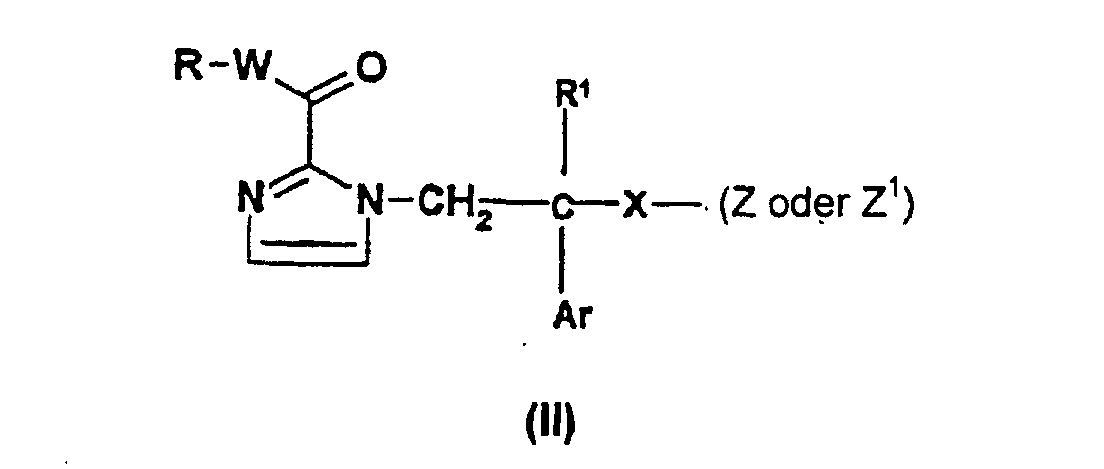 worin Y wie im vorhergehenden für eine Verbindung der Formel (I) definiert ist, umfasst, wobei auf das Verfahren entweder (a), wenn Z1 eine Abgangsgruppe ist, ein Austausch gegen ein pharmazeutisch akzeptables Anion (ZA) oder (b) optional, wenn ZA ein pharmazeutisch akzeptables Anion ist, ein Austausch gegen ein anderes pharmazeutisch akzeptables Anion folgt.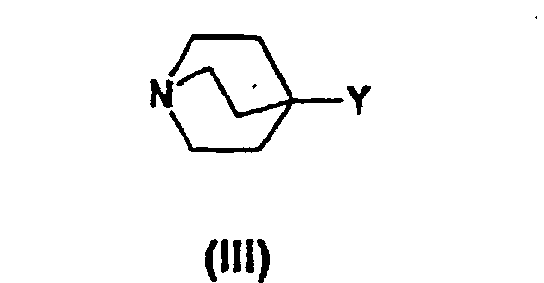
- Verfahren nach Anspruch 22, wobei Z C1-C4-Alkansulfonyloxy, Benzolsulfonyloxy, p-Toluolsulfonyloxy, Chlor, Brom oder Iod bedeutet, und Z1 Trifluormethansulfonyloxy bedeutet.
- Verfahren nach Anspruch 22, wobei Z Methansulfonyloxy bedeutet und ZA Methansulfonat bedeutet.
- Pharmazeutische Zusammensetzung, die eine Verbindung der Formel (I) nach einem der Ansprüche 1 bis 21 zusammen mit einem pharmazeutisch akzeptablen Verdünnungsmittel oder Träger umfasst.
- Verbindung der Formel (I) oder eine pharmazeutisch akzeptable Zusammensetzung derselben nach einem der Ansprüche 1 bis 21 bzw. 25 zur Verwendung als Medikament.
- Verwendung einer Verbindung der Formel (I) oder einer pharmazeutisch akzeptablen Zusammensetzung derselben nach einem der Ansprüche 1 bis 21 bzw. 25 zur Herstellung eines Medikaments zur Behandlung einer Erkrankung durch Hervorrufen einer Antagonistenwirkung an einem Tachykininrezeptor oder an einer Kombination von Tachykininrezeptoren.
- Verwendung nach Anspruch 27, wobei die Antagonistenwirkung an den humanen NK1- und NK2-Tachykininrezeptoren erfolgt.
- Verwendung nach Anspruch 27 oder 28, wobei die Erkrankung eine entzündliche Erkrankung, wie Arthritis, Psoriasis, Asthma oder eine entzündliche Darmerkrankung, eine Erkrankung des Zentralnervensystems (ZNS), wie Angst, Depression, Demenz oder Psychose, eine gastrointestinale (GI) Erkrankung, wie eine funktionelle Darmerkrankung, Reizdarmsyndrom, gastroösophageale Refluxkrankheit, Darminkontinenz, Kolitis oder Morbus Crohn, eine durch Helicobacter pylori oder andere ureasepositive gramnegative Bakterien verursachte Erkrankung, eine Erkrankung des Urogenitaltrakts, wie Inkontinenz, Hyperreflexie oder Zystitis, eine Lungenerkrankung, wie chronisch-obstruktive Atemwegserkrankung, eine Allergie, wie ein Ekzem, Kontaktdermatitis,. atopische Dermatitis oder Rhinitis, eine Überempfindlichkeitserkrankung, beispielsweise gegenüber giftigem Efeu, eine periphere Neuropathie, wie Diabetesneuropathie, Neuralgie, Kausalgie, schmerzhafte Neuropathie, eine Verbrennung, Herpes-Neuralgie oder Post-Herpes-Neuralgie, Erbrechen, Husten, Migräne oder akuter oder chronischer Schmerz ist.
- Verbindung der Formel:
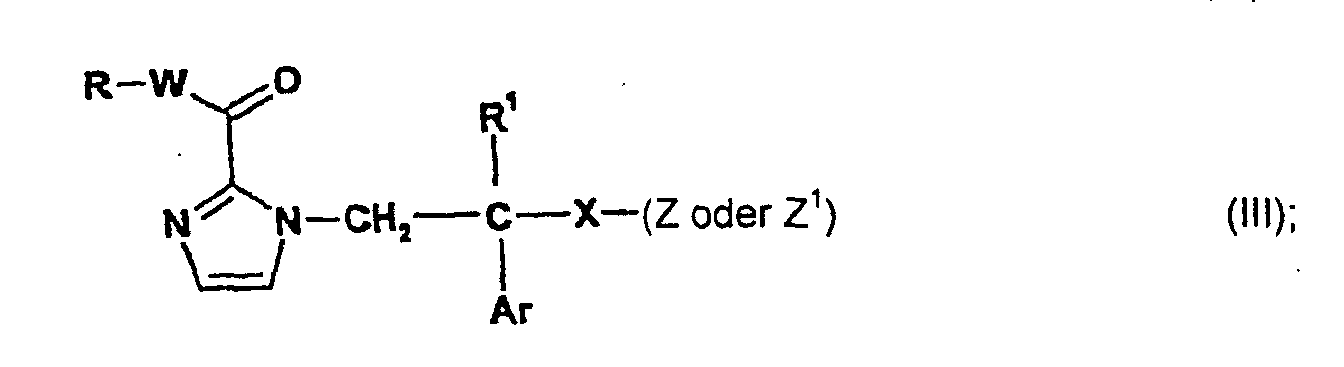

 worin R, R1, W, X und Ar wie in Anspruch 1 definiert sind, Z C1-C4-Alkansulfonyloxy, Benzolsulfonyloxy, p-Toluolsulfonyloxy, Chlor, Brom oder Iod bedeutet, Z1 Trifluormethansulfonyloxy bedeutet und P Tetrahydropyran-2-yl bedeutet.
Priority Applications (1)
| Application Number | Priority Date | Filing Date | Title |
|---|---|---|---|
| SI9830692T SI0994876T1 (en) | 1997-06-18 | 1998-06-05 | Quaternary ammonium compounds as tachykinin antagonists |
Applications Claiming Priority (3)
| Application Number | Priority Date | Filing Date | Title |
|---|---|---|---|
| GB9712882 | 1997-06-18 | ||
| GBGB9712882.1A GB9712882D0 (en) | 1997-06-18 | 1997-06-18 | Quaternary ammonium compounds |
| PCT/EP1998/003500 WO1998057972A1 (en) | 1997-06-18 | 1998-06-05 | Quaternary ammonium compounds as tachykinin antagonists |
Publications (2)
| Publication Number | Publication Date |
|---|---|
| EP0994876A1 EP0994876A1 (de) | 2000-04-26 |
| EP0994876B1 true EP0994876B1 (de) | 2004-09-08 |
Family
ID=10814535
Family Applications (1)
| Application Number | Title | Priority Date | Filing Date |
|---|---|---|---|
| EP98932148A Expired - Lifetime EP0994876B1 (de) | 1997-06-18 | 1998-06-05 | Quaternäre ammoniumverbindungen als tachykinin antagonisten |
Country Status (43)
Families Citing this family (8)
| Publication number | Priority date | Publication date | Assignee | Title |
|---|---|---|---|---|
| AU742250B2 (en) * | 1997-12-26 | 2001-12-20 | Astellas Pharma Inc. | Sustained release medicinal compositions |
| JP4546589B2 (ja) * | 1998-04-23 | 2010-09-15 | 武田薬品工業株式会社 | ナフタレン誘導体 |
| ATE367811T1 (de) * | 2000-06-12 | 2007-08-15 | Univ Rochester | Methode zur behandlung von hitzewallungen, durch verwendung eines tachikinin-rezeptor antagonisten |
| AU2002230665A1 (en) * | 2000-12-06 | 2002-06-18 | Sepracor, Inc. | 4,4-disubstituted piperidines for use as dopamine, serotonin and norepinephrine ligands |
| US20060205724A1 (en) * | 2002-05-29 | 2006-09-14 | The Regents Of The University Of California | Antagonizing nk-1 receptors inhibits consumption of substances of abuse |
| WO2004091597A2 (en) * | 2003-04-15 | 2004-10-28 | Pharmacia & Upjohn Company Llc | Method of treating irritable bowel syndrome (ibs) |
| AU2005243153A1 (en) * | 2004-05-07 | 2005-11-24 | Janssen Pharmaceutica N.V. | Scalable synthesis of imidazole derivatives |
| JP2010516731A (ja) | 2007-01-24 | 2010-05-20 | グラクソ グループ リミテッド | 2−メトキシ−5−(5−トリフルオロメチル−テトラゾール−1−イル)−ベンジル]−(2s−フェニル−ピペリジン−3s−イル)−アミンを含む医薬組成物 |
Family Cites Families (3)
| Publication number | Priority date | Publication date | Assignee | Title |
|---|---|---|---|---|
| US3991201A (en) | 1974-06-27 | 1976-11-09 | Janssen Pharmaceutica N.V. | 1-(β-Aryl-β-R-ethyl)imidazoles as antimicrobial agents |
| US5583134A (en) * | 1992-09-30 | 1996-12-10 | Sanofi | 1-azoniabicyclo[2.2.2] octanes and pharmaceutical compositions in which they are present |
| FR2696178B1 (fr) * | 1992-09-30 | 1994-12-30 | Sanofi Elf | Amides basiques quaternaires, procédé pour leur préparation et compositions pharmaceutiques en contenant. |
-
1997
- 1997-06-18 GB GBGB9712882.1A patent/GB9712882D0/en active Pending
-
1998
- 1998-05-06 UA UA99126551A patent/UA62966C2/uk unknown
- 1998-05-19 TW TW087107720A patent/TW479055B/zh not_active IP Right Cessation
- 1998-06-04 PA PA19988452501A patent/PA8452501A1/es unknown
- 1998-06-04 HN HN1998000087A patent/HN1998000087A/es unknown
- 1998-06-05 ID IDW991633A patent/ID23410A/id unknown
- 1998-06-05 CA CA002291975A patent/CA2291975C/en not_active Expired - Fee Related
- 1998-06-05 WO PCT/EP1998/003500 patent/WO1998057972A1/en not_active Ceased
- 1998-06-05 SK SK1744-99A patent/SK283346B6/sk unknown
- 1998-06-05 EP EP98932148A patent/EP0994876B1/de not_active Expired - Lifetime
- 1998-06-05 HU HU0003962A patent/HUP0003962A3/hu unknown
- 1998-06-05 PT PT98932148T patent/PT994876E/pt unknown
- 1998-06-05 SI SI9830692T patent/SI0994876T1/xx unknown
- 1998-06-05 IL IL15562198A patent/IL155621A0/xx not_active IP Right Cessation
- 1998-06-05 US US09/380,370 patent/US6207678B1/en not_active Expired - Fee Related
- 1998-06-05 EA EA199900986A patent/EA002424B1/ru not_active IP Right Cessation
- 1998-06-05 JP JP50368799A patent/JP3280993B2/ja not_active Expired - Fee Related
- 1998-06-05 CN CNB988063425A patent/CN1199971C/zh not_active Expired - Fee Related
- 1998-06-05 AT AT98932148T patent/ATE275564T1/de not_active IP Right Cessation
- 1998-06-05 IL IL13307998A patent/IL133079A/en not_active IP Right Cessation
- 1998-06-05 NZ NZ501286A patent/NZ501286A/xx unknown
- 1998-06-05 TR TR1999/03135T patent/TR199903135T2/xx unknown
- 1998-06-05 YU YU64699A patent/YU64699A/sh unknown
- 1998-06-05 BR BR9810619-8A patent/BR9810619A/pt not_active Application Discontinuation
- 1998-06-05 KR KR1019997011931A patent/KR100345389B1/ko not_active Expired - Fee Related
- 1998-06-05 DE DE69826129T patent/DE69826129T2/de not_active Expired - Fee Related
- 1998-06-05 AU AU82153/98A patent/AU726027B2/en not_active Ceased
- 1998-06-05 PL PL98337713A patent/PL189557B1/pl not_active IP Right Cessation
- 1998-06-05 ES ES98932148T patent/ES2227856T3/es not_active Expired - Lifetime
- 1998-06-08 PE PE1998000468A patent/PE80099A1/es not_active Application Discontinuation
- 1998-06-11 AP APAP/P/1998/001262A patent/AP947A/en active
- 1998-06-15 UY UY25045A patent/UY25045A1/es unknown
- 1998-06-16 MY MYPI98002689A patent/MY136376A/en unknown
- 1998-06-16 AR ARP980102853A patent/AR012249A1/es active IP Right Grant
- 1998-06-17 TN TNTNSN98089A patent/TNSN98089A1/fr unknown
- 1998-06-17 DZ DZ980134A patent/DZ2524A1/xx active
- 1998-06-17 MA MA25118A patent/MA26509A1/fr unknown
- 1998-06-17 ZA ZA9805239A patent/ZA985239B/xx unknown
- 1998-06-18 HR HR980337A patent/HRP980337B1/xx not_active IP Right Cessation
- 1998-06-18 CO CO98034807A patent/CO4940478A1/es unknown
-
1999
- 1999-11-23 IS IS5269A patent/IS5269A/is unknown
- 1999-11-23 BG BG103919A patent/BG63341B1/bg unknown
- 1999-11-25 NO NO995782A patent/NO995782L/no not_active Application Discontinuation
- 1999-12-15 OA OA9900281A patent/OA11235A/en unknown
-
2000
- 2000-12-11 US US09/734,266 patent/US6380396B1/en not_active Expired - Fee Related
Also Published As
Similar Documents
| Publication | Publication Date | Title |
|---|---|---|
| AU689303B2 (en) | (Azetidin-1-ylalkyl)lactams as tachykinin antagonists | |
| EP0824098B1 (de) | 4-Hydroxypiperidinderivate | |
| WO1997019942A1 (en) | 5-azabicyclo(3.1.0)hexylalkyl-2-piperidones and -glutarimides as neurokinin receptor antagonists | |
| MXPA97005387A (en) | Derivatives of the 4-hidroxi-piperid | |
| US20040132710A1 (en) | Lactams as tachkinin antagonists | |
| US6380396B1 (en) | Quaternary ammonium compounds | |
| US5981529A (en) | Substituted indolylpropyl-piperazine derivatives as 5-HT1D α agonists | |
| US6518282B1 (en) | 4-Arylpiperidine derivatives for the treatment of pruritus | |
| WO1998007722A1 (en) | Quaternary ammonium compounds as tachykinin antagonist | |
| US20030004340A1 (en) | New 4-arylpiperidine derivatives for the treatment of pruritus | |
| CZ453499A3 (cs) | Kvarterní amonné sloučeniny jako antagonisty tachykininu | |
| MXPA99012096A (en) | Quaternary ammonium compounds as tachykinin antagonists | |
| WO1997017338A1 (en) | Substituted 1-indolylpropyl-4-benzylpiperazine derivatives | |
| EP0844996A1 (de) | Substituierte 1-indolypropyl-4-phenethylpiperazin derivative | |
| JPH06306025A (ja) | ジアリールアルカン誘導体 | |
| HK1028029A (en) | Quaternary ammonium compounds as tachykinin antagonists | |
| JPH07179337A (ja) | アルキルーフェノキシアルキルアミン誘導体を有効成分とする抗血栓剤 | |
| MXPA99005176A (en) | Piperidones as tachykinin antagonists |
Legal Events
| Date | Code | Title | Description |
|---|---|---|---|
| PUAI | Public reference made under article 153(3) epc to a published international application that has entered the european phase |
Free format text: ORIGINAL CODE: 0009012 |
|
| 17P | Request for examination filed |
Effective date: 19991123 |
|
| AK | Designated contracting states |
Kind code of ref document: A1 Designated state(s): AT BE CH CY DE DK ES FI FR GB GR IE IT LI LU NL PT SE |
|
| AX | Request for extension of the european patent |
Free format text: AL PAYMENT 19991123;LT PAYMENT 19991123;LV PAYMENT 19991123;MK PAYMENT 19991123;RO PAYMENT 19991123;SI PAYMENT 19991123 |
|
| 17Q | First examination report despatched |
Effective date: 20010529 |
|
| GRAP | Despatch of communication of intention to grant a patent |
Free format text: ORIGINAL CODE: EPIDOSNIGR1 |
|
| GRAS | Grant fee paid |
Free format text: ORIGINAL CODE: EPIDOSNIGR3 |
|
| GRAA | (expected) grant |
Free format text: ORIGINAL CODE: 0009210 |
|
| AK | Designated contracting states |
Kind code of ref document: B1 Designated state(s): AT BE CH CY DE DK ES FI FR GB GR IE IT LI LU NL PT SE |
|
| AX | Request for extension of the european patent |
Extension state: AL LT LV MK RO SI |
|
| REG | Reference to a national code |
Ref country code: GB Ref legal event code: FG4D |
|
| PGFP | Annual fee paid to national office [announced via postgrant information from national office to epo] |
Ref country code: FR Payment date: 20040910 Year of fee payment: 8 |
|
| REG | Reference to a national code |
Ref country code: CH Ref legal event code: EP |
|
| REG | Reference to a national code |
Ref country code: IE Ref legal event code: FG4D |
|
| REF | Corresponds to: |
Ref document number: 69826129 Country of ref document: DE Date of ref document: 20041014 Kind code of ref document: P |
|
| RAP2 | Party data changed (patent owner data changed or rights of a patent transferred) |
Owner name: PFIZER INC. Owner name: PFIZER LIMITED |
|
| REG | Reference to a national code |
Ref country code: SE Ref legal event code: TRGR |
|
| PGFP | Annual fee paid to national office [announced via postgrant information from national office to epo] |
Ref country code: BE Payment date: 20041209 Year of fee payment: 8 |
|
| REG | Reference to a national code |
Ref country code: DK Ref legal event code: T3 |
|
| REG | Reference to a national code |
Ref country code: GR Ref legal event code: EP Ref document number: 20040403983 Country of ref document: GR |
|
| NLT2 | Nl: modifications (of names), taken from the european patent patent bulletin |
Owner name: PFIZER INC. |
|
| PGFP | Annual fee paid to national office [announced via postgrant information from national office to epo] |
Ref country code: PT Payment date: 20050120 Year of fee payment: 8 |
|
| REG | Reference to a national code |
Ref country code: PT Ref legal event code: SC4A Effective date: 20041109 |
|
| PGFP | Annual fee paid to national office [announced via postgrant information from national office to epo] |
Ref country code: GR Payment date: 20050324 Year of fee payment: 8 |
|
| ET | Fr: translation filed | ||
| REG | Reference to a national code |
Ref country code: ES Ref legal event code: FG2A Ref document number: 2227856 Country of ref document: ES Kind code of ref document: T3 |
|
| PGFP | Annual fee paid to national office [announced via postgrant information from national office to epo] |
Ref country code: IE Payment date: 20050414 Year of fee payment: 8 |
|
| PGFP | Annual fee paid to national office [announced via postgrant information from national office to epo] |
Ref country code: GB Payment date: 20050425 Year of fee payment: 8 |
|
| PGFP | Annual fee paid to national office [announced via postgrant information from national office to epo] |
Ref country code: AT Payment date: 20050506 Year of fee payment: 8 |
|
| PGFP | Annual fee paid to national office [announced via postgrant information from national office to epo] |
Ref country code: DK Payment date: 20050510 Year of fee payment: 8 |
|
| PGFP | Annual fee paid to national office [announced via postgrant information from national office to epo] |
Ref country code: CH Payment date: 20050513 Year of fee payment: 8 |
|
| PGFP | Annual fee paid to national office [announced via postgrant information from national office to epo] |
Ref country code: NL Payment date: 20050518 Year of fee payment: 8 |
|
| PGFP | Annual fee paid to national office [announced via postgrant information from national office to epo] |
Ref country code: CY Payment date: 20050519 Year of fee payment: 8 |
|
| PGFP | Annual fee paid to national office [announced via postgrant information from national office to epo] |
Ref country code: ES Payment date: 20050601 Year of fee payment: 8 |
|
| PGFP | Annual fee paid to national office [announced via postgrant information from national office to epo] |
Ref country code: LU Payment date: 20050603 Year of fee payment: 8 Ref country code: SE Payment date: 20050603 Year of fee payment: 8 |
|
| PGFP | Annual fee paid to national office [announced via postgrant information from national office to epo] |
Ref country code: FI Payment date: 20050608 Year of fee payment: 8 |
|
| PGFP | Annual fee paid to national office [announced via postgrant information from national office to epo] |
Ref country code: DE Payment date: 20050630 Year of fee payment: 8 |
|
| PLBE | No opposition filed within time limit |
Free format text: ORIGINAL CODE: 0009261 |
|
| STAA | Information on the status of an ep patent application or granted ep patent |
Free format text: STATUS: NO OPPOSITION FILED WITHIN TIME LIMIT |
|
| REG | Reference to a national code |
Ref country code: GB Ref legal event code: ERR Free format text: NOTIFICATION HAS NOW BEEN RECEIVED FROM THE EUROPEAN PATENT OFFICE THAT ONLY THE FIRST APPLICANT/PROPRIETOR WAS GB DESIGNATED. THE DETAILS OF THE SECOND APPLICANT/PROPRIETOR HAVE THEREFORE BEEN DELETED FROM THE REGISTER. THIS CORRECTION WAS PUBLISHED IN THE EUROPEAN PATENT BULLETIN 04/46 DATED 20041110. |
|
| 26N | No opposition filed |
Effective date: 20050609 |
|
| PG25 | Lapsed in a contracting state [announced via postgrant information from national office to epo] |
Ref country code: IE Free format text: LAPSE BECAUSE OF NON-PAYMENT OF DUE FEES Effective date: 20060605 Ref country code: GB Free format text: LAPSE BECAUSE OF NON-PAYMENT OF DUE FEES Effective date: 20060605 Ref country code: FI Free format text: LAPSE BECAUSE OF NON-PAYMENT OF DUE FEES Effective date: 20060605 Ref country code: CY Free format text: LAPSE BECAUSE OF NON-PAYMENT OF DUE FEES Effective date: 20060605 Ref country code: AT Free format text: LAPSE BECAUSE OF NON-PAYMENT OF DUE FEES Effective date: 20060605 |
|
| PG25 | Lapsed in a contracting state [announced via postgrant information from national office to epo] |
Ref country code: SE Free format text: LAPSE BECAUSE OF NON-PAYMENT OF DUE FEES Effective date: 20060606 Ref country code: ES Free format text: LAPSE BECAUSE OF NON-PAYMENT OF DUE FEES Effective date: 20060606 |
|
| PG25 | Lapsed in a contracting state [announced via postgrant information from national office to epo] |
Ref country code: LI Free format text: LAPSE BECAUSE OF NON-PAYMENT OF DUE FEES Effective date: 20060630 Ref country code: DK Free format text: LAPSE BECAUSE OF NON-PAYMENT OF DUE FEES Effective date: 20060630 Ref country code: CH Free format text: LAPSE BECAUSE OF NON-PAYMENT OF DUE FEES Effective date: 20060630 Ref country code: BE Free format text: LAPSE BECAUSE OF NON-PAYMENT OF DUE FEES Effective date: 20060630 |
|
| PGFP | Annual fee paid to national office [announced via postgrant information from national office to epo] |
Ref country code: IT Payment date: 20060630 Year of fee payment: 9 |
|
| PG25 | Lapsed in a contracting state [announced via postgrant information from national office to epo] |
Ref country code: PT Free format text: LAPSE BECAUSE OF NON-PAYMENT OF DUE FEES Effective date: 20061205 |
|
| PG25 | Lapsed in a contracting state [announced via postgrant information from national office to epo] |
Ref country code: NL Free format text: LAPSE BECAUSE OF NON-PAYMENT OF DUE FEES Effective date: 20070101 |
|
| PG25 | Lapsed in a contracting state [announced via postgrant information from national office to epo] |
Ref country code: DE Free format text: LAPSE BECAUSE OF NON-PAYMENT OF DUE FEES Effective date: 20070103 |
|
| LTLA | Lt: lapse of european patent or patent extension |
Effective date: 20060605 |
|
| REG | Reference to a national code |
Ref country code: DK Ref legal event code: EBP |
|
| REG | Reference to a national code |
Ref country code: PT Ref legal event code: MM4A Free format text: LAPSE DUE TO NON-PAYMENT OF FEES Effective date: 20061205 |
|
| REG | Reference to a national code |
Ref country code: CH Ref legal event code: PL |
|
| EUG | Se: european patent has lapsed | ||
| GBPC | Gb: european patent ceased through non-payment of renewal fee |
Effective date: 20060605 |
|
| NLV4 | Nl: lapsed or anulled due to non-payment of the annual fee |
Effective date: 20070101 |
|
| REG | Reference to a national code |
Ref country code: IE Ref legal event code: MM4A |
|
| REG | Reference to a national code |
Ref country code: FR Ref legal event code: ST Effective date: 20070228 |
|
| REG | Reference to a national code |
Ref country code: SI Ref legal event code: KO00 Effective date: 20070205 |
|
| REG | Reference to a national code |
Ref country code: ES Ref legal event code: FD2A Effective date: 20060606 |
|
| BERE | Be: lapsed |
Owner name: *PFIZER INC. Effective date: 20060630 |
|
| PG25 | Lapsed in a contracting state [announced via postgrant information from national office to epo] |
Ref country code: FR Free format text: LAPSE BECAUSE OF NON-PAYMENT OF DUE FEES Effective date: 20060630 |
|
| PG25 | Lapsed in a contracting state [announced via postgrant information from national office to epo] |
Ref country code: LU Free format text: LAPSE BECAUSE OF NON-PAYMENT OF DUE FEES Effective date: 20060605 |
|
| PG25 | Lapsed in a contracting state [announced via postgrant information from national office to epo] |
Ref country code: GR Free format text: LAPSE BECAUSE OF NON-PAYMENT OF DUE FEES Effective date: 20070104 |
|
| PG25 | Lapsed in a contracting state [announced via postgrant information from national office to epo] |
Ref country code: IT Free format text: LAPSE BECAUSE OF NON-PAYMENT OF DUE FEES Effective date: 20070605 |