EP1000108B1 - Preparation de polyimides aqueux - Google Patents
Preparation de polyimides aqueux Download PDFInfo
- Publication number
- EP1000108B1 EP1000108B1 EP98923920A EP98923920A EP1000108B1 EP 1000108 B1 EP1000108 B1 EP 1000108B1 EP 98923920 A EP98923920 A EP 98923920A EP 98923920 A EP98923920 A EP 98923920A EP 1000108 B1 EP1000108 B1 EP 1000108B1
- Authority
- EP
- European Patent Office
- Prior art keywords
- optionally substituted
- process according
- bis
- dianhydride
- reaction medium
- Prior art date
- Legal status (The legal status is an assumption and is not a legal conclusion. Google has not performed a legal analysis and makes no representation as to the accuracy of the status listed.)
- Expired - Lifetime
Links
- 0 CN(C(CC/*=C/C1)=O)C1=O Chemical compound CN(C(CC/*=C/C1)=O)C1=O 0.000 description 7
- WHRYLXXHLFPFNZ-UHFFFAOYSA-N CN(C(C1C2C3C=CC1C3)=O)C2=O Chemical compound CN(C(C1C2C3C=CC1C3)=O)C2=O WHRYLXXHLFPFNZ-UHFFFAOYSA-N 0.000 description 2
- SEEYREPSKCQBBF-UHFFFAOYSA-N CN(C(C=C1)=O)C1=O Chemical compound CN(C(C=C1)=O)C1=O SEEYREPSKCQBBF-UHFFFAOYSA-N 0.000 description 2
- QSWFISOPXPJUCT-UHFFFAOYSA-N CN(C(CC1=C)=O)C1=O Chemical compound CN(C(CC1=C)=O)C1=O QSWFISOPXPJUCT-UHFFFAOYSA-N 0.000 description 1
- AEUZEOXUCWXNML-FPLPWBNLSA-N CN(C(c1c2cc(/C=C\c3ccccc3)cc1)=O)C2=O Chemical compound CN(C(c1c2cc(/C=C\c3ccccc3)cc1)=O)C2=O AEUZEOXUCWXNML-FPLPWBNLSA-N 0.000 description 1
- AFRBZOCMPSIOEE-ZHACJKMWSA-N CN(C(c1cccc(/C=C/c2ccccc2)c11)=O)C1=O Chemical compound CN(C(c1cccc(/C=C/c2ccccc2)c11)=O)C1=O AFRBZOCMPSIOEE-ZHACJKMWSA-N 0.000 description 1
- KALDMDFBBQPWTH-ZHACJKMWSA-N CN(C(c1cccc(/C=C/c2ccccc2)c11)O)C1=O Chemical compound CN(C(c1cccc(/C=C/c2ccccc2)c11)O)C1=O KALDMDFBBQPWTH-ZHACJKMWSA-N 0.000 description 1
- WKDTXPNKTCHIKO-UHFFFAOYSA-N CN(C(c1cccc(C#Cc2ccccc2)c11)=O)C1=O Chemical compound CN(C(c1cccc(C#Cc2ccccc2)c11)=O)C1=O WKDTXPNKTCHIKO-UHFFFAOYSA-N 0.000 description 1
Classifications
-
- C—CHEMISTRY; METALLURGY
- C08—ORGANIC MACROMOLECULAR COMPOUNDS; THEIR PREPARATION OR CHEMICAL WORKING-UP; COMPOSITIONS BASED THEREON
- C08G—MACROMOLECULAR COMPOUNDS OBTAINED OTHERWISE THAN BY REACTIONS ONLY INVOLVING UNSATURATED CARBON-TO-CARBON BONDS
- C08G73/00—Macromolecular compounds obtained by reactions forming a linkage containing nitrogen with or without oxygen or carbon in the main chain of the macromolecule, not provided for in groups C08G12/00 - C08G71/00
- C08G73/06—Polycondensates having nitrogen-containing heterocyclic rings in the main chain of the macromolecule
- C08G73/10—Polyimides; Polyester-imides; Polyamide-imides; Polyamide acids or similar polyimide precursors
- C08G73/1003—Preparatory processes
- C08G73/1007—Preparatory processes from tetracarboxylic acids or derivatives and diamines
- C08G73/101—Preparatory processes from tetracarboxylic acids or derivatives and diamines containing chain terminating or branching agents
-
- C—CHEMISTRY; METALLURGY
- C08—ORGANIC MACROMOLECULAR COMPOUNDS; THEIR PREPARATION OR CHEMICAL WORKING-UP; COMPOSITIONS BASED THEREON
- C08G—MACROMOLECULAR COMPOUNDS OBTAINED OTHERWISE THAN BY REACTIONS ONLY INVOLVING UNSATURATED CARBON-TO-CARBON BONDS
- C08G73/00—Macromolecular compounds obtained by reactions forming a linkage containing nitrogen with or without oxygen or carbon in the main chain of the macromolecule, not provided for in groups C08G12/00 - C08G71/00
- C08G73/06—Polycondensates having nitrogen-containing heterocyclic rings in the main chain of the macromolecule
- C08G73/10—Polyimides; Polyester-imides; Polyamide-imides; Polyamide acids or similar polyimide precursors
- C08G73/1003—Preparatory processes
- C08G73/1007—Preparatory processes from tetracarboxylic acids or derivatives and diamines
-
- Y—GENERAL TAGGING OF NEW TECHNOLOGICAL DEVELOPMENTS; GENERAL TAGGING OF CROSS-SECTIONAL TECHNOLOGIES SPANNING OVER SEVERAL SECTIONS OF THE IPC; TECHNICAL SUBJECTS COVERED BY FORMER USPC CROSS-REFERENCE ART COLLECTIONS [XRACs] AND DIGESTS
- Y10—TECHNICAL SUBJECTS COVERED BY FORMER USPC
- Y10T—TECHNICAL SUBJECTS COVERED BY FORMER US CLASSIFICATION
- Y10T428/00—Stock material or miscellaneous articles
- Y10T428/29—Coated or structually defined flake, particle, cell, strand, strand portion, rod, filament, macroscopic fiber or mass thereof
- Y10T428/2913—Rod, strand, filament or fiber
- Y10T428/2933—Coated or with bond, impregnation or core
- Y10T428/2964—Artificial fiber or filament
- Y10T428/2967—Synthetic resin or polymer
- Y10T428/2969—Polyamide, polyimide or polyester
-
- Y—GENERAL TAGGING OF NEW TECHNOLOGICAL DEVELOPMENTS; GENERAL TAGGING OF CROSS-SECTIONAL TECHNOLOGIES SPANNING OVER SEVERAL SECTIONS OF THE IPC; TECHNICAL SUBJECTS COVERED BY FORMER USPC CROSS-REFERENCE ART COLLECTIONS [XRACs] AND DIGESTS
- Y10—TECHNICAL SUBJECTS COVERED BY FORMER USPC
- Y10T—TECHNICAL SUBJECTS COVERED BY FORMER US CLASSIFICATION
- Y10T428/00—Stock material or miscellaneous articles
- Y10T428/29—Coated or structually defined flake, particle, cell, strand, strand portion, rod, filament, macroscopic fiber or mass thereof
- Y10T428/2913—Rod, strand, filament or fiber
- Y10T428/2933—Coated or with bond, impregnation or core
- Y10T428/2971—Impregnation
Definitions
- This invention is concerned with a process for the preparation of polyimide derivatives in water and with polymers, particularly high-temperature-resistant polymers, made therefrom.
- Polyimides are synthetic organic resins characterised by repeating imide linkages in the polymer chain which may or may not be end-capped with polymerisable or inert (i.e. non-polymerisable) chemical groups. They are available in both linear and cross-linked forms and are noted for their excellent thermal, mechanical and dielectric properties, such as high glass transition temperature, high thermal decomposition temperature, and high mechanical strength. In addition to their use as matrices for fibre reinforced composites, they may be used as precured films and fibres, curable enamels, laminating resins, adhesives, and for forming molded articles.
- the standard method for the synthesis of polyimides involves reacting aromatic diamines with purified dianhydrides and optionally functionalised monoanhydrides in dry and highly purified polar solvents at room temperature. The resulting amic acids are then either heated to above 180°C or chemically cyclodehydrated to complete the cyclisation and form the imide ring structure.
- the solvents chosen for these reactions have typically been those which would dissolve at least one of the reactants and preferably both the anhydrides and the diamines. It is also typically preferred that the solvent should maintain the resulting poly(amic acid) or poly(amic ester) in solution. Since the amines and anhydrides used for these applications are generally highly aromatic and often have limited solubility, the solvents that are chosen usually include N,N-dimethylformamide, N,N-dimethylacetamide, m-cresol, dimethylsulfoxide, N-methyl pyrrolidine, tetramethylurea, and the like.
- solvents can be used alone or in combination with other solvents such as benzene, benzonitrile, dioxane, xylene, toluene and cyclohexane (see, for example, U.S. Patent No 5,138,028).
- diaminobisimides are prepared in water upon heating to between 120°C and 204°C (J.H. Hodgkin et al in Australian Patent 647,537).
- this example is only of the formation of a monomeric diaminobisimide with only two imide formation steps, and the insolubility of the resulting product is an advantage in this case as it is required that further reaction be prevented.
- polyimides as opposed to monomeric mono- or diimides of low molecular weight, may also be formed in water. This is particularly true given that the insolubility of the reagents in water mean that many complex imide formation reactions must occur in products which are insoluble and in an environment which should in theory promote the reverse process.
- polyimides in particular oligomeric polyimides, may be formed from amines and carboxylic acids or anhydrides, in water.
- tetracarboxylic acid refers to an organic compound having at least 5 four carboxylic acid groups, two pairs of which are capable of forming cyclic imide functionalities.
- the term also refers to and includes salts of such tetracarboxylic acids.
- An imide functionality refers to two acyl groups attached to the same nitrogen.
- suitable tetracarboxylic acids include those of formula (I): where R 1 is selected from optionally substituted alkyl, optionally substituted aryl and optionally substituted bridged or bonded di- or poly-aryl.
- dianhydride refers to an organic compound having at least two anhydride groups.
- suitable dianhydrides include those of formula II: where R 1 is as defined above.
- partially hydrolysed dianhydride refers to a dianhydride as defined above in which one of the anhydride groups has undergone hydrolysis.
- the term also refers to organic compounds having an anhydride group and two carboxylic acid groups capable of condensing to form an anhydride group, as well as salts of such carboxylic acid groups.
- the medium for the reaction is water, optionally together with minor amounts of cosolvents, such as water miscible alcohols, glycols, or ethers etc., e.g. ethanol, dioxane, tetrahydrofuran, oligoethylene oxides and ethylene glycol ethers.
- the reaction medium may also contain other additives such as inorganic acids, inorganic bases, salts of inorganic cations and surfactants.
- the amount of cosolvents and other additives should not exceed 20%.
- the reaction medium contains less than 10% by weight cosolvents and other additives, more preferably less than 5% by weight cosolvents and other additives, and most preferably the reaction medium is substantially free of cosolvents and other additives.
- reaction medium which allows the growing oligomeric polyimide product to remain in solution at the reaction temperature and pressure to a greater extent. It is also to be understood that the reaction medium of the heating step need not be derived from the reaction medium of the mixing step, although both reaction mediums should comprise greater than 80% water.
- aryl refers to aromatic carbocyclic, aromatic heterocyclic and pseudo aromatic moieties, preferably containing between 5 and 20 ring atoms.
- the moieties may be mono or polycyclic.
- suitable aryl moieties include those derived from benzene, naphthalene, anthracene, phenanthracene, carbazole indene, pyrene, pyridine, pyrazine, indole, isoquinoline, naphthyridine, xanthene, acridine, phenanthroline, phenazine and the like, each of which may be optionally substituted.
- pseudoaromatic refers to a ring system which is not strictly aromatic, but which is stabilized by means of delocalisation of the ⁇ electrons and behaves in a similar manner to aromatic rings.
- pseudo aromatic moieties include furan, thiophene, pyrrol and the like.
- bridged or bonded di- or poly-aryl refers to two or more aryl groups joined by a bond or a bridging group. Examples of such groups include biphenyl, phenoxybenzene, diphenylketone, sulphonyldiphenyl and the like.
- bridging group refers to a divalent group connecting two aryl groups.
- suitable bridging groups include -CO-, -CO 2 -, -CONH-, -SO 2 -, -SO-, -O-, -S-, -S-S-, -(CH 2 ) m - where m is 1 to 4, -CH(OH)-, -C(CF 3 ) 2 , -C(CH 3 ) 2 -, -PR(O)- or -PO 3 R-.
- p is 1 to 25, or where q is 1 to 10, or a group of the formula -(X) n L(Y) o - where L is an optionally substituted aryl group, X and Y are independently selected from O, S, -CH 2 -, -SO 2 - and -CO-, and n and or are independently 0 or 1, where each R is independently selected from optionally substituted alkyl or optionally substituted aryl.
- diamine refers to an organic compound having at least two primary amine groups.
- suitable diamines include those of formula III: H 2 N-R 2 -NH 2 where R 2 is selected from optionally substituted alkylene, optionally substituted siloxane, optionally substituted arylene and optionally substituted bridged or bonded di- or polyaryl.
- R 2 groups include wherein R 5 , R 6 and R 7 are independently selected from divalent bridging groups such as wherein R 8 and R 9 are independently alkyl or aryl, R 10 is R 8 or H, q is 1 to 10, and p is 1 to 25.
- Preferred diamines include: meta-phenylene diamine; 2,2-bis(4-aminophenyl) propane; 4,4'-diamino diphenyl methane; 4,4'-diamino diphenyl sulfide; 4,4'-diamino diphenyl sulfone; 3,3'-diamino-diphenyl sulfone; 4,4'-oxydianiline; bis-(4-aminophenyl) diethylsilane; bis-(4-aminophenyl) diphenylsilane; 3,3'-dichlorobenzidine; 3,3'-dimethoxy benzidine; bis-(4-5 aminophenyl) ethyl phosphine oxide; bis-(4-aminophenyl) phenyl phosphine oxide; bis-(4-aminophenyl)-n-butylamine; bis-(4-aminophenyl)
- a given R 1 or R 2 group may contain a mixture of bridging groups.
- oligomeric polyimide refers to a polymer containing repeating imide functionalities.
- examples of the types of oligomeric polyimides which can be prepared in accordance with the present invention include those of formula IV: wherein R 1 and R 2 are as defined above, n is greater than 1, and A and B may be the same or different and represent suitable end groups.
- Suitable end groups include -NH 2 , where R 3 is a monovalent organic radical, or an imidic structure: where R 4 is a divalent organic radical.
- Suitable monovalent organic radicals include optionally substituted alkyl, optionally substituted alkenyl, optionally substituted alkynyl, optionally substituted aryl, optionally bridged or bonded di or polyaryl, optionally substituted alkoxy, optionally substituted alkenyloxy, and optionally substituted alkynyloxy.
- Suitable divalent organic radicals include optionally substituted alkynyl, optionally substituted alkenylene, optionally substituted arylene and optionally substituted bridged or bonded di or polyaryl.
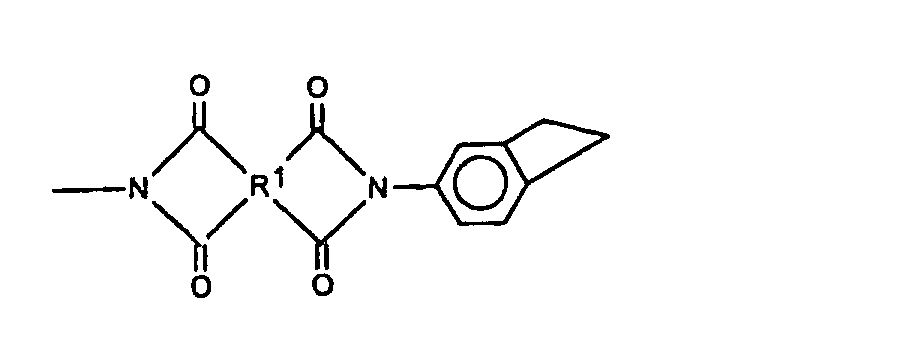
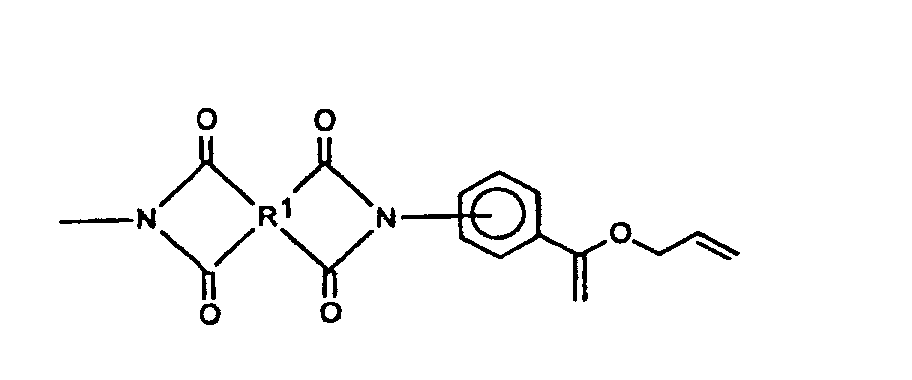
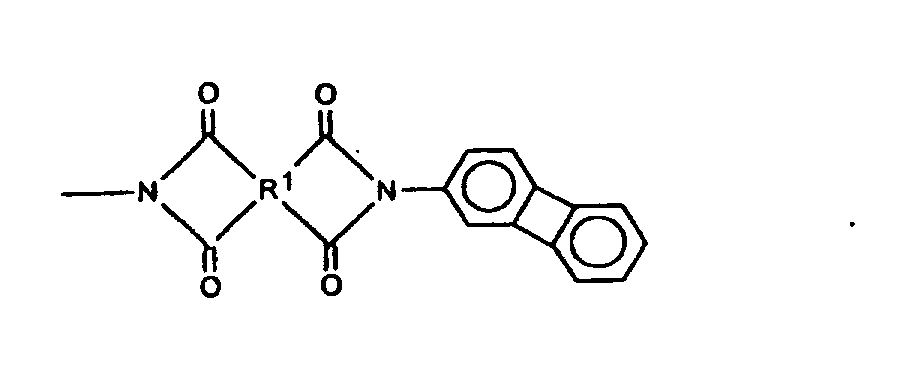
- Suitable imidic structures include:
- R 5 is the same or different and is selected from optionally substituted C 1 -C 6 alkyl, optionally substituted C 2 -C 6 alkene, optionally substituted C 2 -C 6 alkyne, C 1 -C 6 alkoxy, optionally substituted aryl or aryloxy and p is 0, 1 or 2.
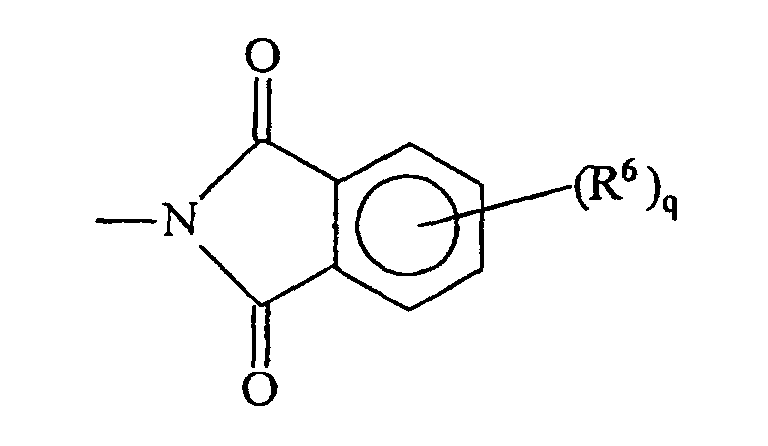
- R 5 is as defined above, G is O, S, -SO 2 -, -SO, -CO-, -S-S-, or optionally substituted methylene, and q is 0, 1, 2, 3 or 4; where q is as defined above and R 6 is the same or different and is selected from optionally substituted C 1 -C 6 alkyl, optionally substituted C 2 -C 6 alkene, optionally substituted C 2 -C 6 alkyne, C 1 -C 6 alkoxy, optionally substituted aryl or aryloxy, optionally substituted bridged or bonded di or polyaryl; and
- Polyimides with amine end groups may be obtained by reacting the tetracarboxylic acid or dianhydride with an excess of diamine.
- the amine end functionalities may be "capped” by reaction with an appropriate capping compound so as to obtain end groups such as those described above.
- These capping compounds will generally contain a diacid or anhydride functionality capable of reacting with the amine to form an imide linkage.
- These capping compounds may be added to the mixture during the mixing stage or the heating stage, or may be added after formation of the amine terminated polyimide is complete.
- Polyimides with terminal acid or anhydride functionalities may be found by reacting the diamine with an excess of tetracarboxylic acid or anhydride. These functionalities may be capped by reaction with appropriate amines to obtain end groups such as those described above. The amine may be added during the mixing or reaction stages or may be added after formation of the acid/anhydride-terminal polyimide is complete.
- optionally substituted means that a group may or may not be further substituted with one or more groups selected from alkyl, alkenyl, alkynyl, aryl, halo, haloalkyl, haloalkenyl, haloalkynyl, haloaryl, hydroxy, alkoxy, alkenyloxy, aryloxy, benzyloxy, haloalkoxy, haloalkenyloxy, haloaryloxy, isocyano, cyano, formyl, carboxyl, nitro, nitroalkyl, nitroalkenyl, nitroalkynyl, nitroaryl, nitroheterocyclyl, amino, alkylamino, dialkylamino, alkenylamino, alkynylamino, arylamino, diarylamino, benzylamino, imino, alkylimine, alkenylimine, alkynylimino,
- alkyl used either alone or in compound words such as “alkylene”, “alkenyloxyalkyl”, “alkylthio”, “alkylamino” and “diaIkylamino” denotes straight chain, branched or cyclic alkyl, preferably C 1-20 alkyl or cycloalkyl.
- straight chain and branched alkyl examples include methyl, ethyl, propyl, isopropyl, butyl, isobutyl, sec-butyl, tert-butyl, amyl, isoamyl, sec-amyl, 1,2-dimethylpropyl, 1,1-dimethyl-propyl, hexyl, 4-methylpentyl, 1-methylpentyl, 2-methylpentyl, 3-methylpentyl, 1,1-dimethylbutyl, 2,2-dimethylbutyl, 3,3-dimethylbutyl, 1,2-dimethylbutyl, 1,3-dimethylbutyl, 1,2,2,-trimethylpropyl, 1,1,2-trimethylpropyl, heptyl, 5-methoxyhexyl, 1-methylhexyl, 2,2-dimethylpentyl, 3,3-dimethylpentyl, 4,4-dimethylpentyl, 1,2-dimethylpentyl
- cyclic alkyl examples include mono- or polycyclic alkyl groups such as cyclopropyl, cyclobutyl, cyclopentyl, cyclohexyl, cycloheptyl, cyclooctyl, cyclononyl, cyclodecyl and the like.
- alkoxy denotes straight chain or branched alkoxy, preferably C 1-20 alkoxy. Examples of alkoxy include methoxy, ethoxy, n-propoxy, isopropoxy and the different butoxy isomers.
- alkenyl denotes groups formed from straight chain, branched or cyclic alkenes including ethylenically mono-, di- or poly-unsaturated alkyl or cycloalkyl groups as previously defined, preferably C 2-20 alkenyl.
- alkenyl examples include vinyl, allyl, 1-methylvinyl, butenyl, iso-butenyl, 3-methyl-2-butenyl, 1-pentenyl, cyclopentenyl, 1-methylcyclopentenyl, 1-hexenyl, 3-hexenyl, cyclohexenyl, 1-heptenyl, 3-heptenyl, 1-octenyl, cyclooctenyl, 1-nonenyl, 2-nonenyl, 3-nonenyl, 1-decenyl, 3-decenyl, 1,3-butadienyl, 1-4,pentadienyl, 1,3-cyclopentadienyl, 1,3-hexadienyl, 1,4-hexadienyl, 1,3-cyclohexadienyl, 1,4-cyclohexadienyl, 1,3-cycloheptadienyl, 1,3,5-cycloheptatrieny
- alkynyl denotes groups formed from straight chain, branched or cyclic alkyne including alkyl and cycloalkyl groups as previously defined which contain a triple bond, preferably C 2-20 alkynyl.
- alkynyl include ethynyl, 2,3-propynyl and 2,3- or 3,4-butynyl.
- acyl either alone or in compound words such as “acyloxy”, “acylthio", “acylamino” or “diacylamino” denotes carbamoyl, aliphatic acyl group and acyl group containing an aromatic ring, which is referred to as aromatic acyl, or an acyl group containing a heterocyclic ring which is referred to as heterocyclic acyl.
- the acyl group has 1 to 20 carbon atoms.
- acyl examples include carbamoyl; straight chain or branched alkanoyl such as formyl, acetyl, propanoyl, butanoyl, 2-methylpropanoyl, pentanoyl, 2,2-dimethylpropanoyl, hexanoyl, heptanoyl, octanoyl, nonanoyl, decanoyl, undecanoyl, dodecanoyl, tridecanoyl, tetradecanoyl, pentadecanoyl, hexadecanoyl, heptadecanoyl, octadecanoyl, nonadecanoyl and icosanoyl; alkoxycarbonyl such as methoxycarbonyl, ethoxycarbonyl, t-butoxycarbonyl, t-pentyloxycarbonyl and heptyloxycarbonyl; cycloalkyl
- phenylacetyl phenylpropanoyl, phenylbutanoyl, phenylisobutylyl, phenylpentanoyl and phenylhexanoyl
- naphthylalkanoyl e.g. naphthylacetyl, naphthylpropanoyl and naphthylbutanoyl
- aralkenoyl such as phenylalkenoyl (e.g.
- phenylpropenoyl, phenylbutenoyl, phenylmethacryloyl, phenylpentenoyl and phenylhexenoyl and naphthylalkenoyl e.g. naphthylpropenoyl, naphthylbutenoyl and naphthylpentenoyl
- aralkoxycarbonyl such as phenylalkoxycarbonyl
- benzyloxycarbonyl aryloxycarbonyl such as phenoxycarbonyl and napthyloxycarbonyl; aryloxyalkanoyl such as phenoxyacetyl and phenoxypropionyl; arylcarbamoyl such as phenylcarbamoyl; arylthiocarbamoyl such as phenylthiocarbamoyl; arylglyoxyloyl such as phenylglyoxyloyl and naphthylglyoxyloyl; arylsulfonyl such as phenylsulfonyl and napthylsulfonyl; heterocycliccarbonyl; heterocyclicalkanoyl such as thienylacetyl, thienylpropanoyl, thienylbutanoyl, thienylpentanoyl, thienylhexanoyl, thiazolylace
- heterocyclic refers to aromatic, pseudo-aromatic and non-aromatic rings or ring systems which contain one or more heteroatoms selected from N, S, O and P and which may be optionally substituted.
- the rings or ring systems have 3 to 20 carbon atoms.
- the rings or ring systems may be selected from those described above in relation to the definition of "aryl”.
- oligomeric polyimides relies on the formation in water of an initial complex between one or more aromatic diamines and one or more polycarboxylic acids and/or polycarboxylic acid dianhydrides and/or the reaction products of these with water.
- This complex may be formed and isolated in a separate step prior to use for polyimide formation, or formed in situ as part of a one-pot process.
- the reactants may be mixed together with the water at any suitable temperature. Hydrolysis and solubilization of anhydride component is aided by higher temperature, and accordingly it is preferable to heat the water to greater than 60°C, more preferably greater than 75°C, and most preferably to boiling temperature, during mixing. In a preferred embodiment the mixture is heated under reflux to assist in mixing. In an alternative embodiment the reactants can be added to a pressurized reactor and heated at temperatures above the normal boiling point of water, so mixing and reacting to form the polyimide occurs in the same vessel.
- aqueous reaction medium it is preferable to dissolve/hydrolyze the acid/anhydride component in the aqueous reaction medium before adding the amine component.
- This may be carried out at temperatures in the range of from 20 to 100°C.
- a suspension or solution of a diamine or a mixture of diamines in water, optionally with additives to up to 20% by weight is separately prepared.
- This suspension or solution preferably at temperatures ranging from 20 to 100°C, is then added to the carboxylic acid or anhydride component mixture in water.
- the solid intermediate product which results can then either be isolated, eg.by filtration or reacted further in the suspension or slurry in which it is formed.
- the final cyclisation of this intermediate product to produce a polyimide oligomer may be carried out by heating, preferably between 100°C and 250°C, more preferably between 120 to 200°C, a solution or slurry of the intermediate product as formed in water, or a solution or slurry of the dry or moist, filtered solid intermediate in water, optionally under pressure, and also optionally under nitrogen, preferably at pressures in the range of from 30 to 200 psi.
- the time required to form the polyimide will depend on the nature of the reactants, and the temperature and pressure at which the reaction is conducted. The time required under the conditions employed can be readily determined by a person skilled in the art.
- the formation of the polyimide will generally be characterized by the formation of a coloured solid which is insoluble in the aqueous reaction medium.
- the functionalised imide oligomers produced by means of the process this invention can be polymerised thermally with or without an appropriate catalyst and with or without a co-reactant.
- a curable composition which may be prepared containing imide oligomers prepared in the manner described above, optionally with other monomers or oligomers which undergo polymerisation by thermal or catalytic means.
- the curable compositions prepared according to the present invention are particularly useful in the manufacture of fibre-reinforced composite materials.
- the curable compositions prepared according to the invention may be applied to reinforcing fibres, especially carbon fibres, either from solution (preferably in a lower aliphatic ketone or halogenated solvent), from a hot melt, or by powder coating.
- the present invention provides a method for preparing an impregnated fibre reinforced material (commonly known as a "prepreg") characterised in that the fibre reinforcements are impregnated with a curable composition defined above.
- the impregnated fibre materials can be laid down by any suitable method known in the art for making composite materials such as, for example, vacuum bagging or a caul plate or an appropriate cool.
- the impregnated fibre reinforced materials are suitable for use in the production of advanced composite materials.
- the resulting composite article may be cured by conventional methods.
- the present invention provides a method for preparing a composite material comprising a fibrous material in a matrix of a cured resin composition in accordance with the invention defined above.
- the compounds of the invention can be used in an appropriate resin formulation for resin transfer molding or for the manufacture of sheet molded material.
- Another envisaged application is in pultrusion or in the formation of films, used for example in gas separation processes.
- the reduced viscosity of the product after drying at 220°C/0.1 mm Hg for 20 minutes was 0.210 (1 % solution in m-cresol at 30°C).
- a transition at approx. 373°C was observed using differential scanning calorimetry (DSC) on heating a seated sample at a rate of 10°C/minute.
- the reduced viscosity of the product after drying at 220°C/0.1 mm Hg for 20 minutes was 0.555 (1% solution in m-cresol at 30°C).
- a transition at approx. 365°C was observed using differential scanning calorimetry (DSC) on heating a sealed pan containing sample at a rate of 10°C/minute.
- the reduced viscosity of the product after drying at 220°C/0.1 mm Hg for 20 minutes was 3.379 (1% solution in m-cresol at 30°C).
- the yield was 3.32 g (80%).
- a transition at approx. 365°C was observed using differential scanning calorimetry (DSC) on heating a sealed pan containing sample at a rate of 10°C/minute.
- the reduced viscosity of the product after drying at 220°C/0.1 mm Hg for 20 minutes was 0.549 (1% solution in m-cresol at 30°C).
- the reduced viscosity of the product after drying at 220° C/0.1 mm Hg for 20 minutes was 0.264 (1% solution in m-cresol at 30°C).
- the yield was 3.189 g (92.5%).
- a transition at approx. 427°C was observed using differential scanning calorimetry (DSC) on heating a sealed pan containing sample at a rate of 10°C/minute.
- the filter cake was then transferred across to a PTFE lined pressure vessel. To this was added 50 ml of water, to produce a fine slurry. After flushing with nitrogen, the vessel was then heated to 135°C for 60 minutes. The temperature was then raised to 180°C for 3 hrs, reaching 160 psi, and the mixture was then allowed to cool overnight. The resulting yellow solid was ground and washed thoroughly with water.
- the reduced viscosity of the product after drying at 220° C/0.1 mm Hg for 20 minutes was 0.287 (1 % solution in m-cresol at 30°C).
- the yield was 3.97 g (92%).
- a transition at approx. 389°C was observed using differential scanning calorimetry (DSC) on heating a sealed pan containing sample at a rate of 10°C/minute.
- the product mixture from the reaction of the anhydrides with water was then transferred to a PTFE lined pressure vessel under a stream of argon. To this was then added the amine mixture, also under a stream of argon. An immediate fine grey-white precipitate formed.
- the round-bottomed flask was then rinsed with 4 mls of water, which was also placed in the pressure vessel. After flushing the pressure vessel with argon, it was then heated with stirring to 135°C for 60 minutes and then to 180°C for a further 2 hrs. After cooling overnight, the resulting non-uniform yellow solid was ground and washed thoroughly with boiling water, methanol and acetone.
- the reduced viscosity of the product after drying at 220°C/0.1 mm Hg for 20 minutes was 0.239 (1% solution in m-cresol at 30°C).
- the yield was 2.865 g (83.1 %).
- a transition at approx. 426°C was observed using differential scanning calorimetry (DSC) on heating a sealed pan containing sample at a rate of 10°C/minute.
- the reduced viscosity of the product after drying at 220° C/0.1 mm Hg for 20 minutes was 0.234 (1 % solution in m-cresol at 30°C).
- the yield was 3.271 g (94.9%).
- a transition at approx. 396°C was observed using differential scanning calorimetry (DSC) on heating a sealed pan containing sample at a rate of 10°C/minute.
- the resulting product consisting of fine solids suspended in a brown solution, was then added to the hot aqueous mixture derived from the anhydrides.
- An immediate fine grey-white precipitate formed, with a brownish residue at the base of the reaction flask.
- the flask was shaken vigorously while hot to mix the reactants together.
- the residue on cooling had the look and feel of beige chewing gum.
- the entire reaction mixture, including the aqueous solution was then transferred to a PTFE lined pressure vessel, and the round-bottomed flask rinsed with 25 mls water, which was also transferred to a pressure vessel.
- the number average molecular weight (M n ) was 3832
- the weight-average molecular weight (M w ) was 8278, as determined by GPC in THF using polystyrene references for calibration.
- the yield was 3.351 g (97.1%).
- a transition at approx. 389°C was observed using differential scanning calorimetry (DSC) on heating a sealed pan containing sample at a rate of 10°C/minute.
- Example 13 Synthesis of high molecular weight polyimide (UltemTM dianhydride/m-phenylene diamine polyimide) in water
- the suspension of the solid in distilled water (100ml) was transferred into a glass lined 600 mL Parr reactor, with a small amount of water (approx. 10 mls) being used to wash in the residue.
- a positive pressure of nitrogen (10-15psig,) was applied to the reactor.
- the reactor was heated to 135°C for 1 hour with stirring.
- the temperature was then raised to 180°C for a further 2 hours, again with stirring, the pressure at this stage being 150-160 psig.
- the reaction is allowed to cool slowly to room temperature.
- the solid is collected in a sintered funnel and washed with distilled water.
- the solid was reduced to small particle size in a coffee grinder, stirred with boiling water and filtered. It was washed further with methanol, acetone and dichloromethane. After drying overnight at 125°C under vacuum, the imide is dried at 220°C/0. 1 mm Hg. Yield (14g, 80 %).
- Example 14 Water synthesis of NASA material PETI-5.
- the method was identical to the procedure or example 13 except that the reactants were: s-BPDA (14.71g), PEPA (2.45g), 3,4'-ODA (9.35g) and 1,3-bis(3-diaminophenoxy)benzene (2.41g).
- the yield was 21.5g (79%) of a yellowish powder.
- DMTA a slightly lower Tg of 255 cf 262°C was observed.
- the reduced viscosity was 0.28 (1% in m-cresol at 30°C).
- Example 15 Large scale reactive acetyleno-end capped oligo-imide synthesis (2Kg) in water
- the stored precipitate in water was homogenized with a SilversonTM stirrer for 30 min. A nitrogen blanket was used over the solution during this treatment. After this treatment the suspension had a fluffy white "malted milk type" appearance and was transferred into the pressure reactor, with a small amount of degassed water. After carrying out several cycles of evacuation/flushing with nitrogen gas to ensure the removal of oxygen from the system, nitrogen was applied to the reactor so that there was a positive pressure of nitrogen of 10-15psig. The reactor was heated to 135°C for 1 hour with stirring. The temperature was then raised to 180°C for a further 3 hours, again with stirring. The pressure by this stage was of the order of 150psi. The steam tables predict a pressure of 146psi absolute. It is important that stirring is maintained throughout the reaction.
- the reduced viscosity was 0.399 (1% cresol) cf. 0.423 for NMP synthesized material (1% in cresol).
- the Tg on curing was 260°C cf. 260°C.
- the total volatiles after heating at 200°C for 1 h at 0.8mmHg were 0.17%, and the free amine was ⁇ 0.01%.
- Example 16 Water synthesis of a Methylnadimide end-capped oligomer
- Ultem dianhydride (25.73g) and methylnadic anhydride (methyl norbornene-2,3-dicarboxylic anhydride, 2.97g) were placed in a 500ml flask with degassed distilled H 2 O (100ml). The mixture was refluxed with stirring for 1 h under a flow of nitrogen. 2,4,6-Trimethyl-1,3-diamino-benzene (8.05g) was added slowly to the mixture with rapid stirring. Then the procedure described in example 13 was followed. The yield was 30.0g (90%) of an off-white powder.
- the 1 H nmr spectrum was similar to a reference material made by conventional means in cresol, excepting that the functionality was higher in the water method.
- Example 17 Water synthesis of 3,6-Endoxo-1,2,3,6-tetrahydrophthalimido end capped oligoimide
- the method was identical to the procedure of example 16 except that the reactants were: Ultem dianhydride (25.73g) and 3,6-endoxo-1,2,3,6-tetrahydrophthalic anhydride.
- Example 7 The solid yellow product of Example 7 was ground to a powder and placed in an aluminium mould. This mould was then heated to 320°C over 30 minutes, maintained at this temperature for 1 hour, then heated to 380°C for three hours. A dark-brown solid plaque was produced. A transition at 273°C was observed using differential scanning calorimetry (DSC) on heating a sealed pan containing sample at a rate of 10°C/minute.
- DSC differential scanning calorimetry
- a solid compound produced using the method of Example 9 was ground and dried completely by heating under a vacuum of ⁇ 1mm for 30 min at 220° C.
- the powder was dissolved in CH 2 Cl 2 (15g/50ml) and painted onto SP Systems RC200P plain weave carbon fibre cloth at an application rate of 1.1g of resin per g of cloth. After drying in an a warm air flow for 60 min, the prepreg was heated for 2 min at 110°C. The prepreg was dry and boardy but could be laid up into 5 ply laminates.
- the five-ply coupon was cured in the hot press by first heating for 1h at 340°C, followed by 3h at 360°C.
Landscapes
- Chemical & Material Sciences (AREA)
- Health & Medical Sciences (AREA)
- Chemical Kinetics & Catalysis (AREA)
- Medicinal Chemistry (AREA)
- Polymers & Plastics (AREA)
- Organic Chemistry (AREA)
- Macromolecular Compounds Obtained By Forming Nitrogen-Containing Linkages In General (AREA)
- Polymers With Sulfur, Phosphorus Or Metals In The Main Chain (AREA)
- Compositions Of Macromolecular Compounds (AREA)
Claims (36)
- Procédé pour la préparation d'un polyimide oligomère comprenant :le mélange d'un acide tétracarboxylique, d'un dianhydride, d'un dianhydride partiellement hydrolysé ou d'un mélange de ceux-ci avec une diamine dans un milieu réactionnel comprenant plus de 80 % en poids d'eau; caractérisé en ce que le rapport du nombre de moles de groupes NH2 sur le nombre de moles de C=O provenant des acides carboxyliques ou des anhydrides dans la totalité du mélange est d'environ 1/2 ; etle chauffage du mélange dans ledit milieu réactionnel, à une température au dessus de 100°C, pendant un temps suffisant, pour former ledit polyimide oligomère.
- Procédé selon la revendication 1, caractérisé en ce que l'acide tétracarboxylique, le dianhydride ou le dianhydride partiellement hydrolysé sont choisis parmi les acides tétracarboxyliques de formule (I), et les dianhydride de formule (II), ou les dianhydrides partiellement hydrolysés de formule (II), ou leurs mélanges :
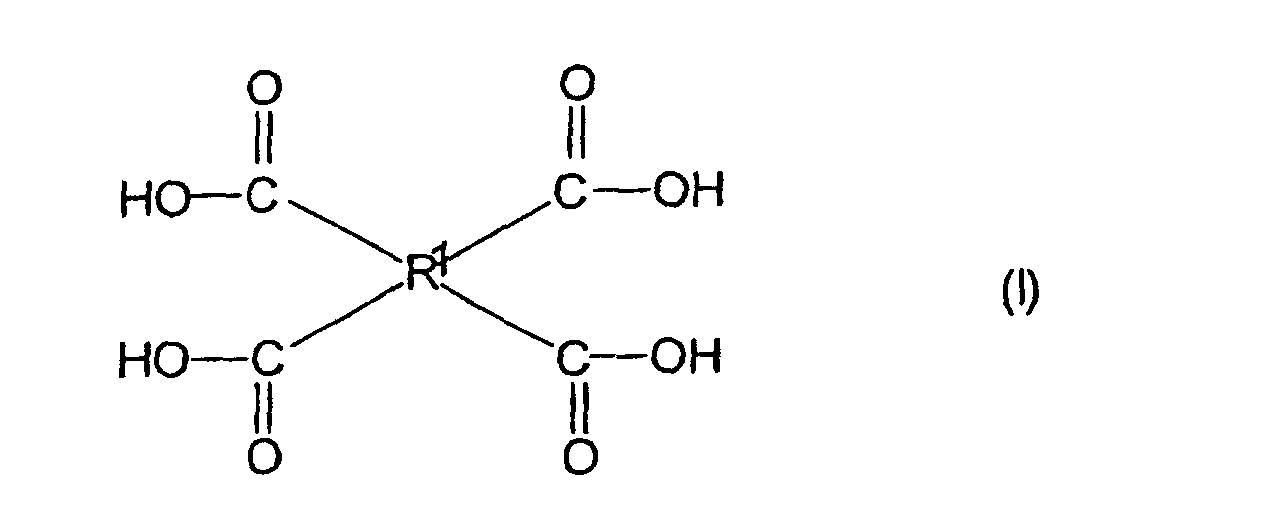 où R' est choisi parmi un alkyle éventuellement substitué, un aryle éventuellement substitué et un di ou poly-aryle ponté ou lié éventuellement substitué.

- Procédé selon la revendication 2, caractérisé en ce que R1 est un groupe aryle éventuellement substitué contenant entre 5 et 20 dans le cycle.
- Procédé selon la revendication 3, caractérisé en ce que le groupe aryle est dérivé du benzène, du naphtalène, de l'anthracène, du phénanthracène, du carbazole, de l'indène, du pyrène, de la pyridine, de la pyrazine, de l'indole, de l'isoquinoline, de la naphtyridine, du xanthène, de l'acridine, de la phénanthroline, de la phénazine; dont chacun peut être éventuellement substitué.
- Procédé selon la revendication 2, caractérisé en ce que R1 est un groupe di ou poly-aryle ponté ou lié éventuellement substitué.
- Procédé selon la revendication 5, caractérisé en ce que R1 représente deux groupes aryle éventuellement substitués reliés par un groupe pontant, le groupe pontant étant choisi parmioù p est 1 à 25 ,
 où q est de 1 à 10, ou un groupe de formule -(X)nL(Y)o où L est un groupe aryle éventuellement substitué, X et Y sont choisis de façon indépendante parmi O, S, -CH2-, -SO2- et -CO- et n et o sont indépendamment 0 ou 1, où chaque R est choisi de façon indépendante parmi un groupe alkyle éventuellement substitué ou aryle éventuellement substitué.
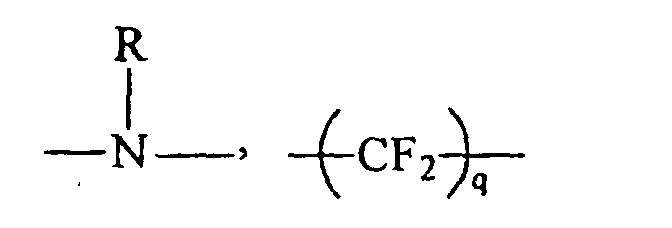
- Procédé selon la revendication 6, caractérisé en ce que R1 est choisi parmi le biphényle, le phénoxybenzène, la diphénylcétone et le sulfonyldiphényle.
- Procédé selon la revendication 1 ou la revendication 2 , caractérisé en ce que la diamine est un composé de formule III
- Procédé selon la revendication 8, caractérisé en ce que R2 est un groupe arylène éventuellement substitué contenant entre 5 et 20 atomes dans le cycle.
- Procédé selon la revendication 9, caractérisé en ce le groupe arylène est dérivé du benzène, du naphtalène, de l'anthracène, du phénanthracène, du carbazole, de l'indène, du pyrène, de la pyridine, de la pyrazine, de l'indole, de l'isoquinoline, de la naphtyridine, du xanthène, de l'acridine, de la phénanthroline, de la phénazine, dont chacun peut être éventuellement substitué.
- Procédé selon la revendication 8, caractérisé en ce que R2 est un groupe arylène choisi parmi

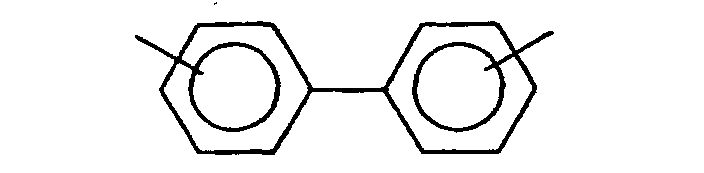
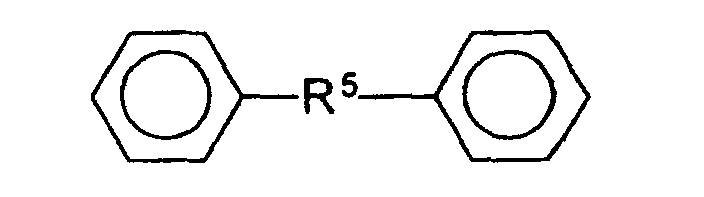
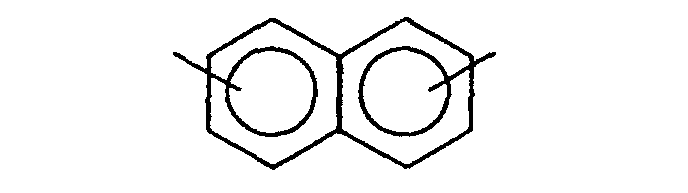
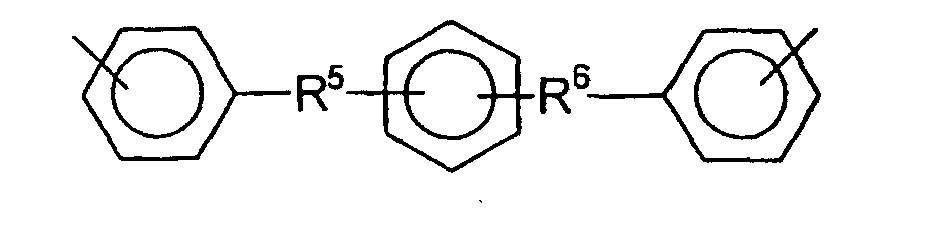 où R5, R6 et R7 sont des groupes pontants

- Procédé selon la revendication 11, caractérisé en ce que le groupe pontant est choisi parmioù m est 1 à 4,
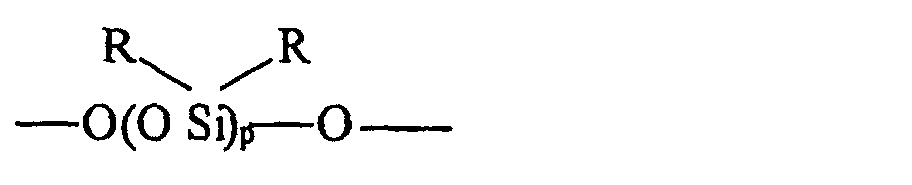 où p est 1 à 25

où q est de 1 à 10, ou un groupe de formule -(X)nL(Y)o où L est un groupe aryle éventuellement substitué, X et Y sont choisis de façon indépendante parmi O, S, -CH2-, -SO2- et -CO- et n et o sont indépendamment 0 ou 1, où chaque R est choisi de façon indépendante parmi un groupe alkyle éventuellement substitué ou aryle éventuellement substitué. - Procédé selon la revendication 1, caractérisé en ce que la diamine est choisie parmi la méta-phénylène diamine ; le 2,2-bis(4-aminophényl) propane ; le 4,4'-diamino diphényl méthane, le 4,4'-diamino diphényl sulfure ; la 4,4'-diamino diphényl sulfone ; la 3,3'diamino diphényl sulfone ; la 4,4'-oxydianiline ; le bis-(4-aminophényl) diéthylsilane ; le bis-(4-aminophényl) diphénylsilane ; la 3,3'-dichlorobenzidine ; la 3,3'-diméthoxy benzidine ; l'oxyde de bis-(4-aminophényl) éthyl phosphine ; l'oxyde de bis-(4-aminophényl) phényl phosphine ; la bis-(4-aminophényl)-n-butylamine ; la bis-(4-aminophényl) méthylamine ; le 1,5-diamino naphtalène ; le 3,3-diméthyl-4,4'diaminobiphényle ; le N-(3-aminophényl)-4-aminobenzamide ; le 4-aminophényl-3-aminobenzoate ; la bisaniline M-(4,4'-[1,3-phénylène bis(1-méthyléthylidène)]-bis(benzènamine) ; la bisaniline P (4,4'-[1,4-phénylène bis(1-méthyléthylidène))-bis(benzènamine) ; la 3,3'-diaminobenzophénone ; le 2,2-bis(3-amino-4-méthylphényl)hexafluoro propane ; le 4,4'-bis(4-aminophénoxy)biphényle ; et leurs mélanges.
- Procédé selon la revendication 1 ou la revendication 2, caractérisé en ce que le milieu réactionnel contient moins de 10 % en poids de cosolvants et d'additifs.
- Procédé selon la revendication 3, caractérisé en ce que le milieu réactionnel contient moins de 5 % en poids de cosolvants et d'additifs.
- Procédé selon la revendication 3, caractérisé en ce que le milieu réactionnel est substantiellement sans cosolvants et additifs.
- Procédé selon la revendication 1 ou la revendication 2, caractérisé en ce que les extrémités respectives du polyimide oligomère sont coiffées par réaction avec un composé de coiffage approprié.
- Procédé selon la revendication 17, caractérisé en ce que le composé de coiffage est ajouté au mélange pendant l'étape de mélange.
- Procédé selon la revendication 17, caractérisé en ce que le composé de coiffage est ajouté au mélange pendant l'étape de chauffage.
- Procédé selon la revendication 17, caractérisé en ce que le composé de coiffage est ajouté après formation du polyimide.
- Procédé selon la revendication 1 ou la revendication 2, caractérisé en ce que le polyimide oligomère est de formule IV :dans laquelle R1 et R2 sont tels que définis ci-dessus, n est supérieur à 1, et A et B peuvent être identiques ou différents et représentent
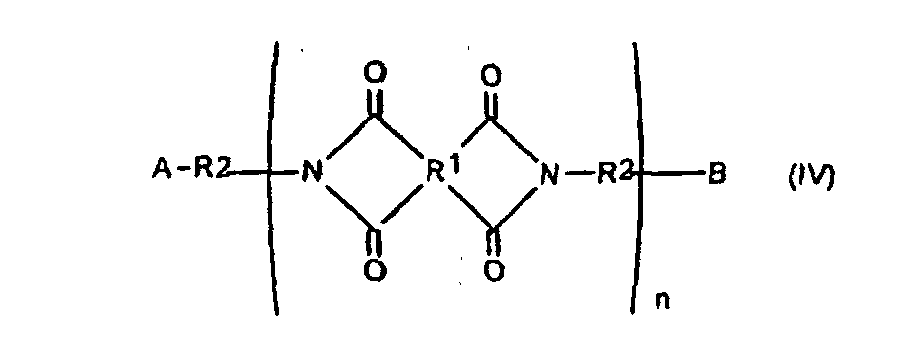
 où R3 est un radical organique monovalent, ou une structure imide :
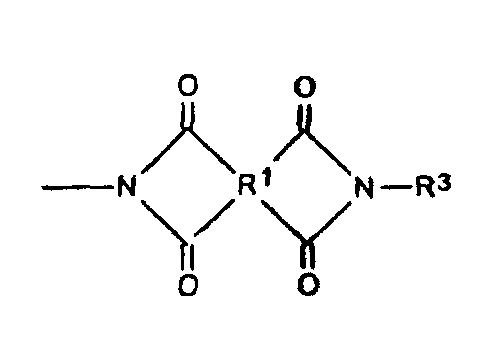 où R4 est un radical organique divalent.
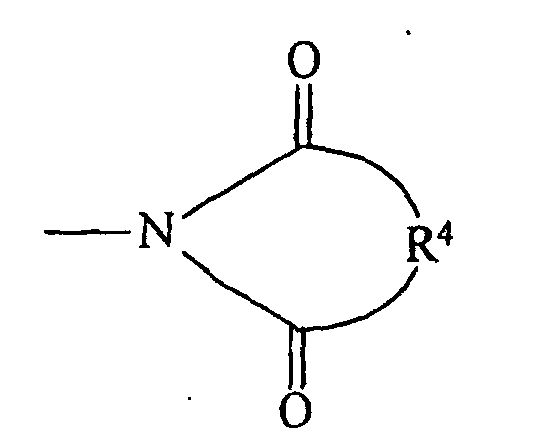
- Procédé selon la revendication 21, caractérisé en ce que R3 est choisi parmi un alkyle éventuellement substitué, un alcényle éventuellement substitué, un alcynyle éventuellement substitué, un aryle éventuellement substitué, un di ou polyaryle ponté ou lié éventuellement substitué, un alkoxy éventuellement substitué, un alcényloxy éventuellement substitué et un alcynyloxy éventuellement substitué.
- Procédé selon la revendication 22, caractérisé en ce que A et B sont choisis de façon indépendante parmi

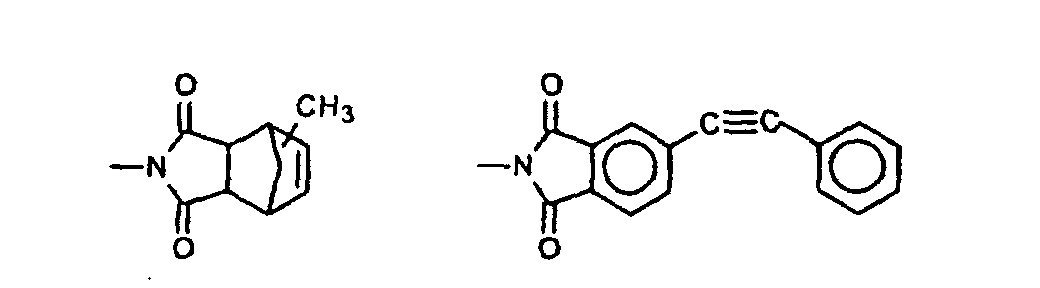

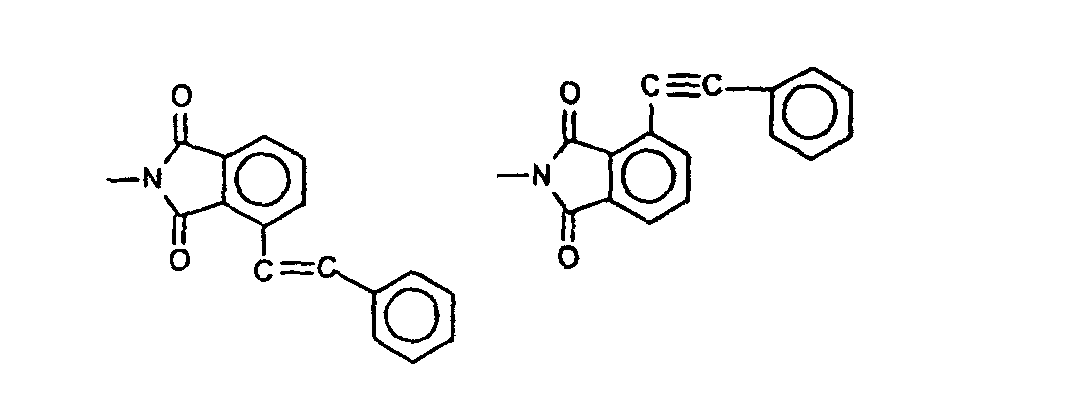
- Procédé selon la revendication 21, caractérisé en ce que A et B sont choisis de façon indépendante parmioù chaque R5 est identique ou différent et est choisi parmi un alkyle en C1-C6 éventuellement substitué, un alcényle en C2-C6 éventuellement substitué, un alcynyle en C2-C6 éventuellement substitué, un alcoxy en C1-C6 éventuellement substitué, un aryle ou un aryloxy éventuellement substitué et p est 0, 1 ou 2 ;
 où R5 est défini comme ci-dessus, G est O, S, -SO2-, -SO, -CO, S-S, ou éventuellement un méthylène substitué, et q est 0, 1, 2, 3 ou 4 ;
 où q est défini comme ci-dessus et R6 est le même ou est différent et est choisi parmi un alkyle en C1-C6 éventuellement substitué, un alcényle en C2-C6 éventuellement substitué, un alcynyle en C2-C6 éventuellement substitué, un alcoxy en C1-C6 éventuellement substitué, un aryle ou un aryloxy éventuellement substitué, un di ou polyaryle ponté ou lié éventuellement substitué ;
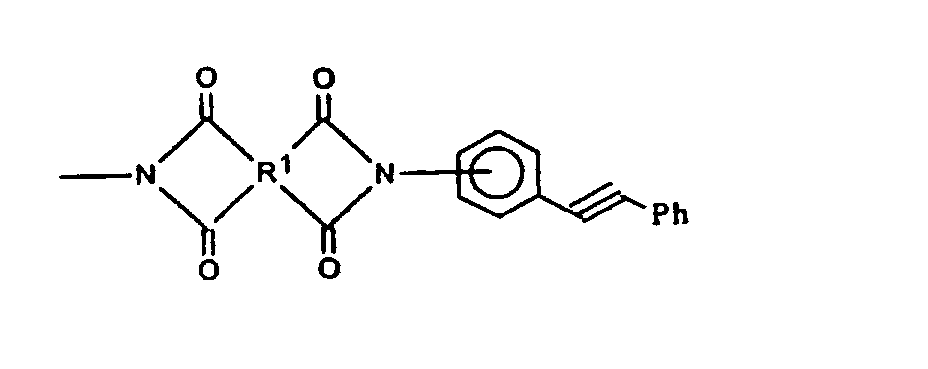
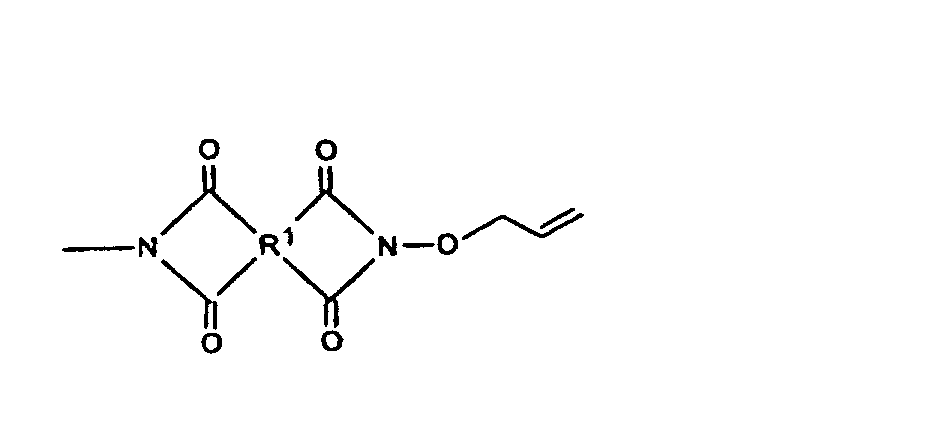
 et

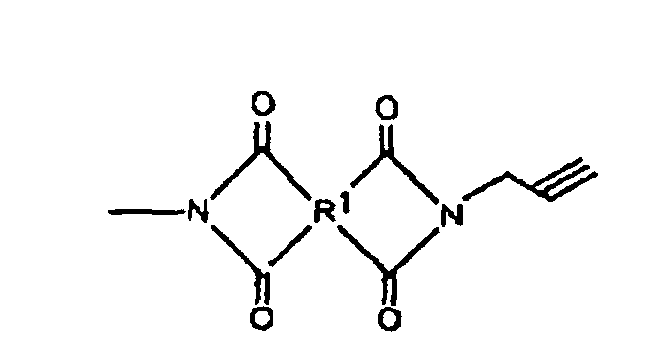
- Procédé selon la revendication 21, caractérisé en ce que R4 est choisi parmi un alcynyle éventuellement substitué, un alcénylène éventuellement substitué, un arylène éventuellement substitué et un di ou polyaryle ponté ou lié éventuellement substitué.
- Procédé selon la revendication 1 ou la revendication 2 , caractérisé en ce que l'étape de mélange est effectuée à la pression atmosphérique au point d'ébullition du milieu réactionnel.
- Procédé selon la revendication 1 ou la revendication 2, caractérisé en ce que l'étape de mélange est poursuivie jusqu'à la formation d'un produit intermédiaire insoluble.
- Procédé selon la revendication 27, caractérisé en ce que le produit intermédiaire est chauffé, sous pression, dans le milieu réactionnel dans lequel il s'est formé, pour former le polyimide oligomère.
- Procédé selon la revendication 1 ou la revendication 2 , caractérisé en ce que l'acide tétracarboxylique, le dianhydride, le dianhydride partiellement hydrolysé ou leur mélange est ajouté au moins en partie au milieu réactionnel avant l'addition de la diamine.
- Procédé selon la revendication 29, caractérisé en ce qu'une suspension ou une solution de diamine est préparée séparément dans une partie du milieu réactionnel avant addition dans le mélange des composants acide tétracarboxylique, dianhydride, dianhydride partiellement hydrolysé et du reste du milieu réactionnel.
- Procédé selon la revendication 17, caractérisé en ce que le composé de coiffage est l'anhydride de l'acide 4-(phényléthynyl)-1,2-benzène dicarboxylique.
- Procédé selon la revendication 1 ou la revendication 2, caractérisé en ce que le dianhydride est le dianhydride 2,2-bis[3,4-dicarboxy phénoxy)phényl]propane.
- Procédé selon la revendication 1 ou la revendication 2, caractérisé en ce que l'étape de mélange comprend le fait de mélanger, dans le milieu réactionnel l'anhydride biphényle symétrique, l'anhydride de l'acide 4-(phényléthynyl)-1,2-benzène dicarboxylique, la 3-(4-aminophénoxy) benzènamine et le 1,3-bis(3-diaminophénoxy) benzène.
- Procédé selon la revendication 1 ou la revendication 2, caractérisé en ce que l'étape de mélange comprend le fait de mélanger dans le milieu réactionnel, l'anhydride biphényle symétrique, l'anhydride 4,4'-oxydiphtalique et l'anhydride de l'acide 4-(phényléthynyl)-1,2-benzène dicarboxylique, et de traiter à l'ébullition pour produire un premier produit intermédiaire, et
ajout d'un mélange de deux amines 1,3-bis(4-aminophénoxy) benzène (TPE-R) et la 4-(4-amino phénoxyl) benzamine (4,4'-ODA), éventuellement ensemble dans le milieu réactionnel suivant et mélange pour produire un second produit intermédiaire. - Procédé de fabrication d'un matériau renforcé par des fibres imprégnées qui comprend :(i) la préparation d'un polyimide oligomère selon le procédé revendiqué dans l'une quelconque des revendications 1 à 34, et(ii) l'application d'une composition durcissable, comprenant le polyimide oligomère, éventuellement en combinaison avec d'autres monomères ou oligomères, qui subit une polymérisation par un moyen thermique ou catalytique, sur des fibres renforçatrices à partir d'une solution, d'un thermofusible ou par revêtement par une poudre.
- Procédé de fabrication d'un matériau composite comprenant un matériau fibreux et une matrice d'une composition de résine durcie qui comprend :(i) la préparation d'un polyimide oligomère selon le procédé revendiqué dans l'une quelconque des revendications 1 à 34, et(ii) l'imprégnation des renforcements en fibres avec une composition durcissable comprenant le polyimide oligomère, éventuellement en combinaison avec d'autres monomères ou oligomères, qui subit une polymérisation par un moyen thermique ou catalytique.
Applications Claiming Priority (3)
| Application Number | Priority Date | Filing Date | Title |
|---|---|---|---|
| AUPO830697 | 1997-07-30 | ||
| AUPO8306A AUPO830697A0 (en) | 1997-07-30 | 1997-07-30 | Aqueous polyimide process |
| PCT/AU1998/000402 WO1999006470A1 (fr) | 1997-07-30 | 1998-05-29 | Procede de preparation a l'eau des polyimides |
Publications (3)
| Publication Number | Publication Date |
|---|---|
| EP1000108A1 EP1000108A1 (fr) | 2000-05-17 |
| EP1000108A4 EP1000108A4 (fr) | 2000-10-11 |
| EP1000108B1 true EP1000108B1 (fr) | 2005-01-05 |
Family
ID=3802595
Family Applications (1)
| Application Number | Title | Priority Date | Filing Date |
|---|---|---|---|
| EP98923920A Expired - Lifetime EP1000108B1 (fr) | 1997-07-30 | 1998-05-29 | Preparation de polyimides aqueux |
Country Status (8)
| Country | Link |
|---|---|
| US (1) | US6333391B1 (fr) |
| EP (1) | EP1000108B1 (fr) |
| JP (1) | JP4050458B2 (fr) |
| AT (1) | ATE286520T1 (fr) |
| AU (1) | AUPO830697A0 (fr) |
| DE (1) | DE69828510T2 (fr) |
| ES (1) | ES2236905T3 (fr) |
| WO (1) | WO1999006470A1 (fr) |
Families Citing this family (27)
| Publication number | Priority date | Publication date | Assignee | Title |
|---|---|---|---|---|
| US6636596B1 (en) * | 1999-09-24 | 2003-10-21 | Worldcom, Inc. | Method of and system for providing intelligent network control services in IP telephony |
| US7388953B2 (en) * | 1999-09-24 | 2008-06-17 | Verizon Business Global Llc | Method and system for providing intelligent network control services in IP telephony |
| US6841652B2 (en) | 2001-05-17 | 2005-01-11 | The United States Of America As Represented By The Administrator Of The National Aeronautics And Space Administration | Space environmentally durable polyimides and copolyimides |
| US6852826B2 (en) * | 2001-12-21 | 2005-02-08 | Kanera Corporation | Manufacturing method of polyamic acid, and polyamic acid solution |
| US6753365B2 (en) | 2002-02-19 | 2004-06-22 | General Electric Company | Polyetherimide composition, method, and article |
| US6713597B2 (en) | 2002-03-19 | 2004-03-30 | General Electric Company | Preparation of polyimide polymers |
| US7071282B2 (en) * | 2003-06-03 | 2006-07-04 | General Electric Company | Benzimidazole diamine-based polyetherimide compositions and methods for making them |
| JP2008504225A (ja) * | 2004-02-17 | 2008-02-14 | ジョンソン,トーマス,イー. | 大環状化合物を形成するための方法、組成物および装置 |
| JP2005314601A (ja) * | 2004-04-30 | 2005-11-10 | Toyobo Co Ltd | 共重合ポリエステルならびに共重合ポリエステルの製造方法 |
| US20070195682A1 (en) | 2006-02-21 | 2007-08-23 | Duerig Urs T | Method for high density data storage and imaging |
| US8102753B2 (en) * | 2006-02-21 | 2012-01-24 | International Business Machines Corporation | Method for forming deformed regions in a resin layer |
| US20080076903A1 (en) * | 2006-08-31 | 2008-03-27 | Duerig Urs T | Data storage medium and method for high density data storage |
| US8754186B2 (en) * | 2006-12-26 | 2014-06-17 | Kaneka Corporation | Polyimide precursor composition, use thereof and production method thereof |
| WO2009145065A1 (fr) * | 2008-05-20 | 2009-12-03 | 株式会社カネカ | Nouvelle composition de précurseur de polyimide, son utilisation et son procédé de fabrication |
| JP5097025B2 (ja) * | 2008-06-19 | 2012-12-12 | 株式会社カネカ | 新規なポリイミド前駆体組成物及びその利用 |
| JP2010006868A (ja) * | 2008-06-24 | 2010-01-14 | Kaneka Corp | 新規な硬化膜及びその利用 |
| CN102143989B (zh) * | 2008-09-03 | 2013-03-13 | 株式会社钟化 | 使用2-苯基-4,4’-二氨基二苯基醚类的可溶性末端改性酰亚胺低聚物、清漆、其固化物、及其酰亚胺预浸料、以及耐热性优异的纤维增强层合板 |
| US9182331B2 (en) | 2012-08-31 | 2015-11-10 | The Boeing Company | Measurement of solid, aerosol, vapor, liquid and gaseous concentration and particle size |
| US10501579B2 (en) | 2015-02-20 | 2019-12-10 | Sabic Global Technologies B.V. | Poly(amic acid) synthesis and conversion to high molecular weight polyimide |
| KR102109931B1 (ko) * | 2017-07-21 | 2020-05-12 | 한국과학기술연구원 | 포스포러스계 디아민 화합물, 이로부터 형성된 폴리아믹산과 폴리이미드 및 폴리이미드를 포함한 폴리이미드 필름 |
| KR102198357B1 (ko) * | 2018-12-17 | 2021-01-04 | 연세대학교 원주산학협력단 | 폴리이미드의 제조방법 |
| AT522304B1 (de) * | 2019-03-15 | 2023-11-15 | Univ Wien Tech | Verfahren zur Herstellung von Polyimiden |
| US20230090327A1 (en) * | 2020-01-09 | 2023-03-23 | ExxonMobil Technology and Engineering Company | Methods for preparing mixed polyamides, polyimides and polyamideimides via hydrothermal polymerization |
| EP4259705A1 (fr) | 2020-12-11 | 2023-10-18 | Aspen Aerogels Inc. | Co-catalyseur d'eau pour procédé de polyimide |
| CN112694614B (zh) * | 2020-12-29 | 2023-01-24 | 浙江清和新材料科技有限公司 | 一种水相合成聚酰亚胺的方法 |
| KR20240095156A (ko) | 2021-11-02 | 2024-06-25 | 도레이 카부시키가이샤 | 폴리이미드의 제조 방법, 폴리이미드, 폴리이미드 수지 조성물 및 그 경화물 |
| CN115678413B (zh) * | 2022-09-14 | 2023-08-04 | 徐州卧牛山新型防水材料有限公司 | 一种双组分聚氨酯防水涂料及其制备方法 |
Family Cites Families (16)
| Publication number | Priority date | Publication date | Assignee | Title |
|---|---|---|---|---|
| ATE22518T1 (de) * | 1980-09-15 | 1986-10-15 | Ciba Geigy Ag | Verwendung von flexiblem basismaterial zur herstellung von gedruckten schaltungen. |
| US4496711A (en) * | 1981-07-24 | 1985-01-29 | Hughes Aircraft Company | Process for preparing isoimide containing oligomers |
| US4495342A (en) * | 1981-07-24 | 1985-01-22 | Hughes Aircraft Company | Isoimide containing oligomers |
| US5104967A (en) * | 1987-09-03 | 1992-04-14 | The Boeing Company | Amideimide oligomers and blends |
| US5116935A (en) * | 1987-05-04 | 1992-05-26 | The Boeing Company | Polyimide oligomers and blends and method of curing |
| JPS60108464A (ja) | 1983-11-17 | 1985-06-13 | Ube Ind Ltd | 芳香族ポリイミド溶液組成物 |
| JP2827198B2 (ja) * | 1987-01-12 | 1998-11-18 | 日立化成工業株式会社 | 粒子状ポリイミドの製造法 |
| FR2650828B1 (fr) * | 1989-08-08 | 1991-10-31 | Etu Mat Organ Technol Ava Cent | Compositions de precurseurs de polyimides et leurs applications |
| US5202411A (en) * | 1990-04-06 | 1993-04-13 | W. R. Grace & Co.-Conn. | Tri-component polyimide composition and preparation thereof |
| JPH0423879A (ja) | 1990-05-18 | 1992-01-28 | Ube Ind Ltd | 耐熱性イミド接着剤 |
| US5147966A (en) * | 1990-07-31 | 1992-09-15 | The United States Of America As Represented By The Administrator Of The National Aeronautics And Space Administration | Polyimide molding powder, coating, adhesive and matrix resin |
| NZ240089A (en) * | 1990-10-03 | 1993-04-28 | Commw Scient Ind Res Org | Diaminobisimide compounds and compositions comprising such compounds for curing epoxy resins |
| AU647537B2 (en) * | 1990-10-03 | 1994-03-24 | Commonwealth Scientific And Industrial Research Organisation | Epoxy resins based on diaminobisimide compounds |
| US5264588A (en) * | 1992-09-17 | 1993-11-23 | Occidental Chemical Corporation | Process for preparing chloro-N-phenylphthalimide |
| JPH083445A (ja) * | 1994-06-27 | 1996-01-09 | Toray Ind Inc | 水溶性ポリイミド前駆体、ポリイミド前駆体水溶液、およびその製造方法 |
| JPH08333450A (ja) * | 1995-06-06 | 1996-12-17 | Mitsui Toatsu Chem Inc | ポリイミドの製造方法 |
-
1997
- 1997-07-30 AU AUPO8306A patent/AUPO830697A0/en not_active Abandoned
-
1998
- 1998-05-29 WO PCT/AU1998/000402 patent/WO1999006470A1/fr not_active Ceased
- 1998-05-29 ES ES98923920T patent/ES2236905T3/es not_active Expired - Lifetime
- 1998-05-29 AT AT98923920T patent/ATE286520T1/de not_active IP Right Cessation
- 1998-05-29 DE DE69828510T patent/DE69828510T2/de not_active Expired - Fee Related
- 1998-05-29 JP JP2000505221A patent/JP4050458B2/ja not_active Expired - Fee Related
- 1998-05-29 US US09/463,610 patent/US6333391B1/en not_active Expired - Lifetime
- 1998-05-29 EP EP98923920A patent/EP1000108B1/fr not_active Expired - Lifetime
Also Published As
| Publication number | Publication date |
|---|---|
| EP1000108A1 (fr) | 2000-05-17 |
| ATE286520T1 (de) | 2005-01-15 |
| WO1999006470A1 (fr) | 1999-02-11 |
| JP4050458B2 (ja) | 2008-02-20 |
| JP2001512162A (ja) | 2001-08-21 |
| DE69828510D1 (de) | 2005-02-10 |
| DE69828510T2 (de) | 2006-01-05 |
| ES2236905T3 (es) | 2005-07-16 |
| AUPO830697A0 (en) | 1997-08-21 |
| US6333391B1 (en) | 2001-12-25 |
| EP1000108A4 (fr) | 2000-10-11 |
Similar Documents
| Publication | Publication Date | Title |
|---|---|---|
| US6333391B1 (en) | Aqueous polyimide process | |
| DE69634359T2 (de) | Imidoligomere und cooligomere mit phenylethynylen seitengruppen und deren polymere | |
| EP2333004B1 (fr) | Oligomère imide soluble modifié à son extrémité utilisant un éther 2-phényl-4,4'-diaminodiphényle, vernis, produit durci de celui-ci, pré-imprégné imide de celui-ci, et stratifié renforcé par des fibres ayant une excellente résistance à la chaleur | |
| US10047246B2 (en) | Varnish including 2-phenyl-4,4′-diaminodiphenyl ether, imide resin composition having excellent moldability, cured resin molded article having excellent breaking elongation, prepreg thereof, imide prepreg thereof, and fiber-reinforced material thereof having high heat resistance and excellent mechanical strength | |
| EP1514888A1 (fr) | résines polyimides pouvant être utilisées pour des moulages par des résines de transfert et d'infusion de résine | |
| PT1516119E (pt) | Processo para a montagem/desmontagem de componentes de uma central de energia eólica | |
| US6350817B1 (en) | Phenylethynyl containing reactive additives | |
| US10815390B2 (en) | Polyimide resin composition and varnish produced from terminal-modified imide oligomer prepared using 2-phenyl-4,4′-diaminodiphenyl ether and thermoplastic aromatic polyimide prepared using oxydiphthalic acid, polyimide resin composition molded article and prepreg having excellent heat resistance and mechanical characteristic, and fiber-reinforced composite material thereof | |
| EP0672044A1 (fr) | Bisnadimides | |
| JPH01167316A (ja) | 新規ビスマレイミド誘導体 | |
| JPH0218418A (ja) | 新規ポリ無水物 | |
| US4173700A (en) | Bis (difluoromaleimide) capped propolymers and polymers | |
| JP2003526704A (ja) | 圧入、トランスファー成形用高能力樹脂組成物とその製造法 | |
| JP2017201027A (ja) | 2−フェニル−4,4’−ジアミノジフェニルエーテル類を用いた末端変性イミドオリゴマーとオキシジフタル酸類を用いた芳香族熱可塑性ポリイミドにより作製されたポリイミド樹脂組成物、およびワニス、および耐熱性や機械的特性に優れたポリイミド樹脂組成物成形体、およびプリプレグ、およびその繊維強化複合材料 | |
| US4876358A (en) | Oxyethylene bismaleimide derivatives | |
| JPH041742B2 (fr) | ||
| Xiong et al. | Synthesis of a new siloxane‐containing alicyclic dianhydride and the derived polyimides with improved solubility and hydrophobicity | |
| AU736213B2 (en) | Aqueous polyimide process | |
| WO2020072639A1 (fr) | Nouveau procédé d'obtention d'oligomère d'acide amide pour le moulage de composites de polyimide | |
| US5708127A (en) | Polymerizable monomeric reactants (PMR) type resins | |
| JP2844878B2 (ja) | エーテル基を有するマレイミド樹脂の製造方法 | |
| WO2019226641A1 (fr) | Vernis de polyimide présentant une résistance élevée à la chaleur et une excellente résistance mécanique | |
| KR20170097089A (ko) | 방향족 폴리이미드의 생성 방법 | |
| Dao et al. | PMR type polyimides by aqueous cyclization methods—chemistry | |
| CN117186402A (zh) | 乙炔基苯胺封端的异酰亚胺材料及制备方法 |
Legal Events
| Date | Code | Title | Description |
|---|---|---|---|
| PUAI | Public reference made under article 153(3) epc to a published international application that has entered the european phase |
Free format text: ORIGINAL CODE: 0009012 |
|
| 17P | Request for examination filed |
Effective date: 20000216 |
|
| AK | Designated contracting states |
Kind code of ref document: A1 Designated state(s): AT BE CH CY DE DK ES FI FR GB GR IE IT LI LU MC NL PT SE |
|
| A4 | Supplementary search report drawn up and despatched |
Effective date: 20000824 |
|
| AK | Designated contracting states |
Kind code of ref document: A4 Designated state(s): AT BE CH CY DE DK ES FI FR GB GR IE IT LI LU MC NL PT SE |
|
| 17Q | First examination report despatched |
Effective date: 20010306 |
|
| GRAP | Despatch of communication of intention to grant a patent |
Free format text: ORIGINAL CODE: EPIDOSNIGR1 |
|
| GRAS | Grant fee paid |
Free format text: ORIGINAL CODE: EPIDOSNIGR3 |
|
| GRAA | (expected) grant |
Free format text: ORIGINAL CODE: 0009210 |
|
| AK | Designated contracting states |
Kind code of ref document: B1 Designated state(s): AT BE CH CY DE DK ES FI FR GB GR IE IT LI LU MC NL PT SE |
|
| PG25 | Lapsed in a contracting state [announced via postgrant information from national office to epo] |
Ref country code: NL Free format text: LAPSE BECAUSE OF FAILURE TO SUBMIT A TRANSLATION OF THE DESCRIPTION OR TO PAY THE FEE WITHIN THE PRESCRIBED TIME-LIMIT Effective date: 20050105 Ref country code: LI Free format text: LAPSE BECAUSE OF FAILURE TO SUBMIT A TRANSLATION OF THE DESCRIPTION OR TO PAY THE FEE WITHIN THE PRESCRIBED TIME-LIMIT Effective date: 20050105 Ref country code: FI Free format text: LAPSE BECAUSE OF FAILURE TO SUBMIT A TRANSLATION OF THE DESCRIPTION OR TO PAY THE FEE WITHIN THE PRESCRIBED TIME-LIMIT Effective date: 20050105 Ref country code: CH Free format text: LAPSE BECAUSE OF FAILURE TO SUBMIT A TRANSLATION OF THE DESCRIPTION OR TO PAY THE FEE WITHIN THE PRESCRIBED TIME-LIMIT Effective date: 20050105 Ref country code: BE Free format text: LAPSE BECAUSE OF FAILURE TO SUBMIT A TRANSLATION OF THE DESCRIPTION OR TO PAY THE FEE WITHIN THE PRESCRIBED TIME-LIMIT Effective date: 20050105 Ref country code: AT Free format text: LAPSE BECAUSE OF FAILURE TO SUBMIT A TRANSLATION OF THE DESCRIPTION OR TO PAY THE FEE WITHIN THE PRESCRIBED TIME-LIMIT Effective date: 20050105 |
|
| REG | Reference to a national code |
Ref country code: GB Ref legal event code: FG4D |
|
| REG | Reference to a national code |
Ref country code: CH Ref legal event code: EP |
|
| REG | Reference to a national code |
Ref country code: IE Ref legal event code: FG4D |
|
| REF | Corresponds to: |
Ref document number: 69828510 Country of ref document: DE Date of ref document: 20050210 Kind code of ref document: P |
|
| PG25 | Lapsed in a contracting state [announced via postgrant information from national office to epo] |
Ref country code: SE Free format text: LAPSE BECAUSE OF FAILURE TO SUBMIT A TRANSLATION OF THE DESCRIPTION OR TO PAY THE FEE WITHIN THE PRESCRIBED TIME-LIMIT Effective date: 20050405 Ref country code: GR Free format text: LAPSE BECAUSE OF FAILURE TO SUBMIT A TRANSLATION OF THE DESCRIPTION OR TO PAY THE FEE WITHIN THE PRESCRIBED TIME-LIMIT Effective date: 20050405 Ref country code: DK Free format text: LAPSE BECAUSE OF FAILURE TO SUBMIT A TRANSLATION OF THE DESCRIPTION OR TO PAY THE FEE WITHIN THE PRESCRIBED TIME-LIMIT Effective date: 20050405 |
|
| PG25 | Lapsed in a contracting state [announced via postgrant information from national office to epo] |
Ref country code: LU Free format text: LAPSE BECAUSE OF NON-PAYMENT OF DUE FEES Effective date: 20050529 Ref country code: CY Free format text: LAPSE BECAUSE OF FAILURE TO SUBMIT A TRANSLATION OF THE DESCRIPTION OR TO PAY THE FEE WITHIN THE PRESCRIBED TIME-LIMIT Effective date: 20050529 |
|
| PG25 | Lapsed in a contracting state [announced via postgrant information from national office to epo] |
Ref country code: IE Free format text: LAPSE BECAUSE OF NON-PAYMENT OF DUE FEES Effective date: 20050530 |
|
| PG25 | Lapsed in a contracting state [announced via postgrant information from national office to epo] |
Ref country code: MC Free format text: LAPSE BECAUSE OF NON-PAYMENT OF DUE FEES Effective date: 20050531 |
|
| NLV1 | Nl: lapsed or annulled due to failure to fulfill the requirements of art. 29p and 29m of the patents act | ||
| REG | Reference to a national code |
Ref country code: CH Ref legal event code: PL |
|
| REG | Reference to a national code |
Ref country code: ES Ref legal event code: FG2A Ref document number: 2236905 Country of ref document: ES Kind code of ref document: T3 |
|
| PLBE | No opposition filed within time limit |
Free format text: ORIGINAL CODE: 0009261 |
|
| STAA | Information on the status of an ep patent application or granted ep patent |
Free format text: STATUS: NO OPPOSITION FILED WITHIN TIME LIMIT |
|
| 26N | No opposition filed |
Effective date: 20051006 |
|
| ET | Fr: translation filed | ||
| REG | Reference to a national code |
Ref country code: GB Ref legal event code: FG4D |
|
| REG | Reference to a national code |
Ref country code: IE Ref legal event code: MM4A |
|
| PG25 | Lapsed in a contracting state [announced via postgrant information from national office to epo] |
Ref country code: PT Free format text: LAPSE BECAUSE OF NON-PAYMENT OF DUE FEES Effective date: 20050605 |
|
| PGFP | Annual fee paid to national office [announced via postgrant information from national office to epo] |
Ref country code: ES Payment date: 20080619 Year of fee payment: 11 |
|
| PGFP | Annual fee paid to national office [announced via postgrant information from national office to epo] |
Ref country code: IT Payment date: 20080526 Year of fee payment: 11 |
|
| PGFP | Annual fee paid to national office [announced via postgrant information from national office to epo] |
Ref country code: FR Payment date: 20090515 Year of fee payment: 12 Ref country code: DE Payment date: 20090527 Year of fee payment: 12 |
|
| PGFP | Annual fee paid to national office [announced via postgrant information from national office to epo] |
Ref country code: GB Payment date: 20090527 Year of fee payment: 12 |
|
| REG | Reference to a national code |
Ref country code: ES Ref legal event code: FD2A Effective date: 20090530 |
|
| PG25 | Lapsed in a contracting state [announced via postgrant information from national office to epo] |
Ref country code: ES Free format text: LAPSE BECAUSE OF NON-PAYMENT OF DUE FEES Effective date: 20090530 |
|
| GBPC | Gb: european patent ceased through non-payment of renewal fee |
Effective date: 20100529 |
|
| REG | Reference to a national code |
Ref country code: FR Ref legal event code: ST Effective date: 20110131 |
|
| PG25 | Lapsed in a contracting state [announced via postgrant information from national office to epo] |
Ref country code: IT Free format text: LAPSE BECAUSE OF NON-PAYMENT OF DUE FEES Effective date: 20090529 |
|
| PG25 | Lapsed in a contracting state [announced via postgrant information from national office to epo] |
Ref country code: DE Free format text: LAPSE BECAUSE OF NON-PAYMENT OF DUE FEES Effective date: 20101201 |
|
| PG25 | Lapsed in a contracting state [announced via postgrant information from national office to epo] |
Ref country code: FR Free format text: LAPSE BECAUSE OF NON-PAYMENT OF DUE FEES Effective date: 20100531 |
|
| PG25 | Lapsed in a contracting state [announced via postgrant information from national office to epo] |
Ref country code: GB Free format text: LAPSE BECAUSE OF NON-PAYMENT OF DUE FEES Effective date: 20100529 |