EP1036052B1 - Procede et reacteur pour la fabrication du norbornene - Google Patents
Procede et reacteur pour la fabrication du norbornene Download PDFInfo
- Publication number
- EP1036052B1 EP1036052B1 EP98955716A EP98955716A EP1036052B1 EP 1036052 B1 EP1036052 B1 EP 1036052B1 EP 98955716 A EP98955716 A EP 98955716A EP 98955716 A EP98955716 A EP 98955716A EP 1036052 B1 EP1036052 B1 EP 1036052B1
- Authority
- EP
- European Patent Office
- Prior art keywords
- ethylene
- dcpd
- reaction
- norbornene
- reactor
- Prior art date
- Legal status (The legal status is an assumption and is not a legal conclusion. Google has not performed a legal analysis and makes no representation as to the accuracy of the status listed.)
- Expired - Lifetime
Links
Images


Classifications
-
- C—CHEMISTRY; METALLURGY
- C07—ORGANIC CHEMISTRY
- C07C—ACYCLIC OR CARBOCYCLIC COMPOUNDS
- C07C13/00—Cyclic hydrocarbons containing rings other than, or in addition to, six-membered aromatic rings
- C07C13/28—Polycyclic hydrocarbons or acyclic hydrocarbon derivatives thereof
- C07C13/32—Polycyclic hydrocarbons or acyclic hydrocarbon derivatives thereof with condensed rings
- C07C13/39—Polycyclic hydrocarbons or acyclic hydrocarbon derivatives thereof with condensed rings with a bicyclo ring system containing seven carbon atoms
- C07C13/42—Polycyclic hydrocarbons or acyclic hydrocarbon derivatives thereof with condensed rings with a bicyclo ring system containing seven carbon atoms with a bicycloheptene ring structure
-
- B—PERFORMING OPERATIONS; TRANSPORTING
- B01—PHYSICAL OR CHEMICAL PROCESSES OR APPARATUS IN GENERAL
- B01J—CHEMICAL OR PHYSICAL PROCESSES, e.g. CATALYSIS OR COLLOID CHEMISTRY; THEIR RELEVANT APPARATUS
- B01J19/00—Chemical, physical or physico-chemical processes in general; Their relevant apparatus
- B01J19/24—Stationary reactors without moving elements inside
- B01J19/2405—Stationary reactors without moving elements inside provoking a turbulent flow of the reactants, such as in cyclones, or having a high Reynolds-number
-
- B—PERFORMING OPERATIONS; TRANSPORTING
- B01—PHYSICAL OR CHEMICAL PROCESSES OR APPARATUS IN GENERAL
- B01J—CHEMICAL OR PHYSICAL PROCESSES, e.g. CATALYSIS OR COLLOID CHEMISTRY; THEIR RELEVANT APPARATUS
- B01J19/00—Chemical, physical or physico-chemical processes in general; Their relevant apparatus
- B01J19/26—Nozzle-type reactors, i.e. the distribution of the initial reactants within the reactor is effected by their introduction or injection through nozzles
-
- B—PERFORMING OPERATIONS; TRANSPORTING
- B01—PHYSICAL OR CHEMICAL PROCESSES OR APPARATUS IN GENERAL
- B01J—CHEMICAL OR PHYSICAL PROCESSES, e.g. CATALYSIS OR COLLOID CHEMISTRY; THEIR RELEVANT APPARATUS
- B01J3/00—Processes of utilising sub-atmospheric or super-atmospheric pressure to effect chemical or physical change of matter; Apparatus therefor
- B01J3/008—Processes carried out under supercritical conditions
-
- C—CHEMISTRY; METALLURGY
- C07—ORGANIC CHEMISTRY
- C07C—ACYCLIC OR CARBOCYCLIC COMPOUNDS
- C07C2/00—Preparation of hydrocarbons from hydrocarbons containing a smaller number of carbon atoms
- C07C2/02—Preparation of hydrocarbons from hydrocarbons containing a smaller number of carbon atoms by addition between unsaturated hydrocarbons
- C07C2/50—Diels-Alder conversion
-
- C—CHEMISTRY; METALLURGY
- C07—ORGANIC CHEMISTRY
- C07C—ACYCLIC OR CARBOCYCLIC COMPOUNDS
- C07C4/00—Preparation of hydrocarbons from hydrocarbons containing a larger number of carbon atoms
- C07C4/22—Preparation of hydrocarbons from hydrocarbons containing a larger number of carbon atoms by depolymerisation to the original monomer, e.g. dicyclopentadiene to cyclopentadiene
-
- B—PERFORMING OPERATIONS; TRANSPORTING
- B01—PHYSICAL OR CHEMICAL PROCESSES OR APPARATUS IN GENERAL
- B01J—CHEMICAL OR PHYSICAL PROCESSES, e.g. CATALYSIS OR COLLOID CHEMISTRY; THEIR RELEVANT APPARATUS
- B01J2219/00—Chemical, physical or physico-chemical processes in general; Their relevant apparatus
- B01J2219/00049—Controlling or regulating processes
- B01J2219/00051—Controlling the temperature
- B01J2219/00074—Controlling the temperature by indirect heating or cooling employing heat exchange fluids
- B01J2219/00087—Controlling the temperature by indirect heating or cooling employing heat exchange fluids with heat exchange elements outside the reactor
- B01J2219/00103—Controlling the temperature by indirect heating or cooling employing heat exchange fluids with heat exchange elements outside the reactor in a heat exchanger separate from the reactor
-
- B—PERFORMING OPERATIONS; TRANSPORTING
- B01—PHYSICAL OR CHEMICAL PROCESSES OR APPARATUS IN GENERAL
- B01J—CHEMICAL OR PHYSICAL PROCESSES, e.g. CATALYSIS OR COLLOID CHEMISTRY; THEIR RELEVANT APPARATUS
- B01J2219/00—Chemical, physical or physico-chemical processes in general; Their relevant apparatus
- B01J2219/00049—Controlling or regulating processes
- B01J2219/00051—Controlling the temperature
- B01J2219/00074—Controlling the temperature by indirect heating or cooling employing heat exchange fluids
- B01J2219/00119—Heat exchange inside a feeding nozzle or nozzle reactor
-
- B—PERFORMING OPERATIONS; TRANSPORTING
- B01—PHYSICAL OR CHEMICAL PROCESSES OR APPARATUS IN GENERAL
- B01J—CHEMICAL OR PHYSICAL PROCESSES, e.g. CATALYSIS OR COLLOID CHEMISTRY; THEIR RELEVANT APPARATUS
- B01J2219/00—Chemical, physical or physico-chemical processes in general; Their relevant apparatus
- B01J2219/00049—Controlling or regulating processes
- B01J2219/00051—Controlling the temperature
- B01J2219/00159—Controlling the temperature controlling multiple zones along the direction of flow, e.g. pre-heating and after-cooling
-
- B—PERFORMING OPERATIONS; TRANSPORTING
- B01—PHYSICAL OR CHEMICAL PROCESSES OR APPARATUS IN GENERAL
- B01J—CHEMICAL OR PHYSICAL PROCESSES, e.g. CATALYSIS OR COLLOID CHEMISTRY; THEIR RELEVANT APPARATUS
- B01J2219/00—Chemical, physical or physico-chemical processes in general; Their relevant apparatus
- B01J2219/00049—Controlling or regulating processes
- B01J2219/00245—Avoiding undesirable reactions or side-effects
- B01J2219/00259—Preventing runaway of the chemical reaction
- B01J2219/00263—Preventing explosion of the chemical mixture
-
- C—CHEMISTRY; METALLURGY
- C07—ORGANIC CHEMISTRY
- C07C—ACYCLIC OR CARBOCYCLIC COMPOUNDS
- C07C2601/00—Systems containing only non-condensed rings
- C07C2601/06—Systems containing only non-condensed rings with a five-membered ring
- C07C2601/10—Systems containing only non-condensed rings with a five-membered ring the ring being unsaturated
-
- C—CHEMISTRY; METALLURGY
- C07—ORGANIC CHEMISTRY
- C07C—ACYCLIC OR CARBOCYCLIC COMPOUNDS
- C07C2602/00—Systems containing two condensed rings
- C07C2602/36—Systems containing two condensed rings the rings having more than two atoms in common
- C07C2602/42—Systems containing two condensed rings the rings having more than two atoms in common the bicyclo ring system containing seven carbon atoms
-
- Y—GENERAL TAGGING OF NEW TECHNOLOGICAL DEVELOPMENTS; GENERAL TAGGING OF CROSS-SECTIONAL TECHNOLOGIES SPANNING OVER SEVERAL SECTIONS OF THE IPC; TECHNICAL SUBJECTS COVERED BY FORMER USPC CROSS-REFERENCE ART COLLECTIONS [XRACs] AND DIGESTS
- Y02—TECHNOLOGIES OR APPLICATIONS FOR MITIGATION OR ADAPTATION AGAINST CLIMATE CHANGE
- Y02P—CLIMATE CHANGE MITIGATION TECHNOLOGIES IN THE PRODUCTION OR PROCESSING OF GOODS
- Y02P20/00—Technologies relating to chemical industry
- Y02P20/50—Improvements relating to the production of bulk chemicals
- Y02P20/54—Improvements relating to the production of bulk chemicals using solvents, e.g. supercritical solvents or ionic liquids
Definitions
- the present invention relates to a method and a reactor for the production of norbornene (1,2,2-bicyclo [2,2,1] heptene-2) from dicyclopentadiene (DCPD) and ethylene.
- US Patent US-A-2,340,908 describes the reaction of the DCPD and ethylene at a temperature of about 200 ° C, under a pressure of 50 to around 100 bars (5 to 10 MPa).
- the patents DD-140 874 and DE-203 313 describe a continuous process for the production of norbornene by reaction of DCPD and / or CPD and ethylene in reaction conditions under which not only the reagents but still the desired norbornene are obtained in gas phase, process by which 1 mole of DCPD with 2-50 moles of ethylene and reacted at 250-340 ° C, under a pressure of 2-20 MPa, excess ethylene being brought before the reaction zone under the pressure of reaction at a temperature below 190 ° C through DCPD liquid, then reacting to give norbornene in the reaction zone, norbornene being removed in the form gas at the head of the reaction zone; according to DD-140 874, liquid, high boiling compounds are removed below the reaction zone at temperatures of 150-220 ° C in an amount of less than 3% by weight, compared to the DCPD introduced into the system reaction, their composition being regulated so as to contain less than 1% by weight of norbornene; according to DE-203 313, boiling point liquid compounds high are
- German patent DD-144 257 relates to a reactor for the synthesis of norbornene from DCPD and ethylene, the reaction space being halved tubes arranged concentrically in an annular space, in which predominantly takes place the cleavage of the DCPD, and into an internal space, in which takes place so predominantly the synthesis of norbornene.
- German patent DD-215 078 relates to a process for the continuous production of pure norbornene under reaction conditions whereby not only the CPD and ethylene reagents but also the norbornene are kept in the gas phase; we react 1 mole of CPD with 1 to 25 moles of ethylene, at 523-613 K, and under a pressure of 2-20 MPa; a concentrate of DCPD, which contains up to 20% of CPD codimers with the methylcyclopentadiene, piperylene, isoprene and butadiene, is mixed with ethylene in a zone of mixing, with a residence time of 10 to 30 minutes, at 433-473 K; the high boiling compounds formed in the mixing area are removed at the bottom end; in a reaction zone following the zone of mixing, the transformation into norbornene takes place, and the reaction products are removed at the head of the zone reactive; in a two-stage distillation area which follows, the reaction products are separated from such that methylnorbornene, methyltetrahydroindenes
- the object of the present invention is therefore to to propose means making it possible to carry out industrially norbornene synthesis under safe conditions satisfactory.
- CPD monomer
- Diels Alder reaction The proportion of the two products present depends on the temperature and pressure conditions.
- the monomerization reaction is endothermic.
- the norbornene synthesis reaction is a Diels Alder reaction between CPD (diene) and ethylene (dienophile).
- the reaction conditions are such that other condensation reactions are brought into play. This is how dimethano-octahydronaphthalene (DMON) is formed.
- DMON dimethano-octahydronaphthalene
- TCPD tricyclopentadiene
- the synthesis of norbornene is produced by two successive reactions endothermic (monomerization of DCPD in CPD) then exothermic.
- endothermic monomerization of DCPD in CPD
- exothermic it is necessary to have partially monomerized dicyclopentadiene to cyclopentadiene, to obtain stable functioning of the reaction.
- the theory is that we use as much as possible the endothermic reaction to control the exotherm overall. Partial monomerization of DCPD in CPD under pressure makes it possible to obtain a reagent which gives priming direct reaction.
- Partial monomerization of dicyclopentadiene in cyclopentadiene is carried out in an exchanger.
- the thermodynamics shows us that under the conditions of pressure (150 bar) (15 MPa) and temperature (175 ° C), the balance is shifted towards the formation of cyclopentadiene.
- the temperature was chosen so that limit the fouling of the exchanger and other reactions secondary.
- preheating the dicyclopentadiene is an important point of safety intrinsic to the installation.
- the rise in temperature of DCPD is separated from the reaction zone (residence time longer and higher temperature) which limits the risks of drift towards decomposition reactions.
- Preheating the DCPD is convenient carried out in an exchanger, and the actual reaction, in a reactor comprising a device allowing a homogeneous and rapid mixing of reagents, to avoid local heating, eliminating the risks explosion.
- the homogeneous and rapid mixing device reagents is advantageously a device using injecting supercritical ethylene to disperse the DCPD, avoiding any stagnation of liquid DCPD in the reaction conditions.
- the reagents arrive in the reactor from below, DCPD or DCPD-CPD being injected by a first tube disposed axially extending over part of the height of the reactor, and ethylene being injected through a second tube surrounding the first, coaxial, in the annular area between the two tubes.
- the present invention also relates to a reactor for the production of norbornene from dicyclopentadiene and ethylene, which has a reagent injection device arranged so that ethylene in the supercritical state disperses the DCPD or the DCPD-CPD liquid mixture under the reaction conditions.
- the aforementioned injection device consists of two coaxial tubes for the arrival of reagents through the bottom reactor, said tubes extending axially over part of the height of said reactor, the DCPD or the DCPD-CPD arriving through the central tube and ethylene through space ring between the two tubes, the upper part of the system constituting an area of intense mixing of the reagents, and the lower part, a turbulent norbornene flow zone crude product, which is discharged through the bottom of the reactor.
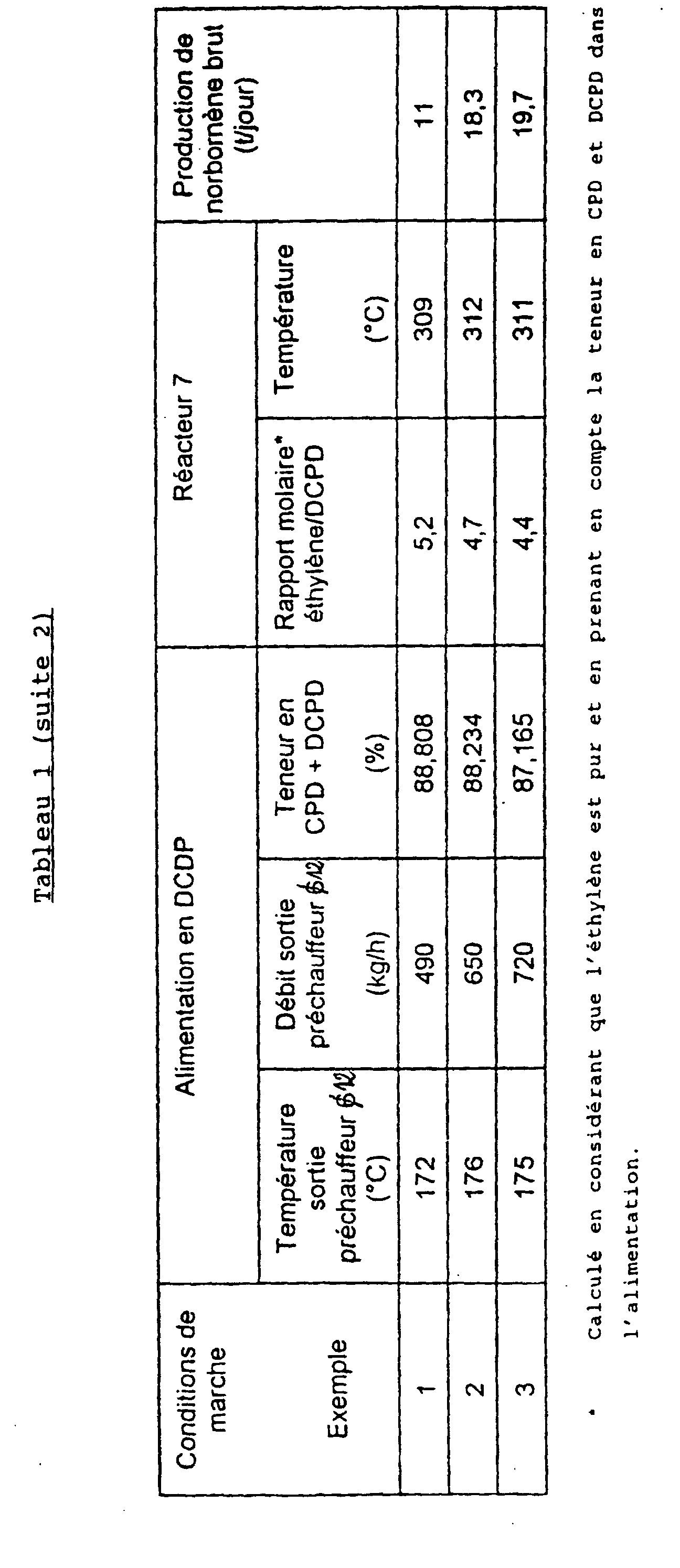
- the DCPD Before entering reactor 7, the DCPD is subjected to preheating in the exchanger 12 in the conditions for partially monomerizing it in CPD.
- the ethylene arriving via the pipe 8 is pressurized in the compressor 9, purged in the capacity 10 by the drain pipe 11, and mounted in temperature in exchanger 12. It enters the reactor 7 at reaction pressure.
- the mixture leaving at foot 20 of the degassing 16 is relaxed and is addressed to a degassing 21 in which it is degassed again.
- the ethylene, leaving at the top 22 of the balloon 21, is sent to a washing installation 23, in which it is washed by the DCPD.
- Ethylene, leaving at the top 24 of the installation 23, pressurized by a compressor 25 is addressed to a capacity 26, from where it is purged in 27, then it is addressed by line 28 in line 8 upstream of compressor 9.
- the crude norbornene exiting at foot 29 of the degassing is pressurized by pump 30, then routed by line 31 in a storage tank 32, from where it can be pumped (at 33) to be used for distillation.
- Reactor 7 is a cylindrical reactor, with an axis vertical. Reagents arrive from the bottom and penetrate in a system of two coaxial tubes 34,35 which extend along the longitudinal axis of reactor 7 over a little more half the height of the latter.
- the internal tube 34 is received in a base 36 fixed against the bottom of reactor 7 and having an orifice central office in communication with DCPD finish line 2.
- the outer tube 35 is received in the part center of an annular base 37 fixed against the bottom of the reactor 7, and in communication with the finish line 8 ethylene, which opens laterally into the opening central unit 37.
- a third annular base 38 comprising a central opening crossed by the system of tubes 34, 35, is fixed by its periphery to the periphery of the base 37 being separated from it by a space annular 39.
- Raw norbornene is evacuated through space left free between the internal border of the base 38 and the tube 35 in the annular space 39, and exits through a opening 40 made in the base 37, opposite to the entry of ethylene and in communication with the pipe output 13.
- Ethylene arrives at the supercritical state in the reactor 7, through the space between tubes 34 and 35, and the DCPD, in the liquid state in the tube 34 and being partially monomerized.
- the speed of ethylene increases thanks to the shape of the nozzle.
- the right mixture of reagents is obtained by the acceleration of ethylene at the level of shrinkage, which causes the dispersion of DCPD.
- This dispersion is improved by the monomerization of the residual DCPD which generates of supercritical CPD.
- the DCPD actually comes in the form a jet that does not hit the top of the reactor.
Landscapes
- Chemical & Material Sciences (AREA)
- Organic Chemistry (AREA)
- Chemical Kinetics & Catalysis (AREA)
- Engineering & Computer Science (AREA)
- General Chemical & Material Sciences (AREA)
- Oil, Petroleum & Natural Gas (AREA)
- Organic Low-Molecular-Weight Compounds And Preparation Thereof (AREA)
- Polyoxymethylene Polymers And Polymers With Carbon-To-Carbon Bonds (AREA)
- Physical Or Chemical Processes And Apparatus (AREA)
Description


- un diène cyclique à forte tension de cycle, ce qui est parfaitement le cas du CPD ;
- un diénophile activé par un groupement électroattracteur, ce qui n'est pas le cas de l'éthylène.
- 250°C, formation d'oligomères du DCPD (ΔH = - 66 Kcal/mol) ;
- 340°C, transformation des oligomères en polymères (ΔH = - 80 Kcal/mol) ;
- 440°C, décomposition des polymères conduisant à la production de quantités importantes de gaz (ΔH = -90Kcal/mol).


- la monomérisation partielle du DCPD ; et
- l'obtention d'un mélange parfaitement contrôlé entre le (D)CPD et l'éthylène.
- à une température de 140°C à 240°C ; et
- sous une pression de 20 à 300 bars (2 à 30 MPa)abs., avant de le faire réagir avec l'éthylène
- avec un rapport molaire éthylène/DCPD de 1 à 20, en particulier de 2 à 10 ;
- à une température de 200°C à 320°C ;
- sous une pression de 20 à 300 bars (2 à 30 MPa) abs. ; et
- avec un temps de séjour de 1 à 10 minutes, en particulier de 1,5 à 3 minutes.
- on place l'éthylène dans les conditions de température et de pression de la zone réactionnelle avant de l'introduire dans celle-ci ;
- le norbornène brut sortant de la zone réactionnelle est refroidi et soumis à au moins un dégazage permettant d'éliminer, en tête, de l'éthylène, et d'obtenir, en pied, du norbornène purifié ; et
- l'éthylène issu du dégazage est lavé à contre-courant par le flux entrant de DCPD, avant d'être recyclé dans le flux entrant d'éthylène.
- la Figure 1 est un schéma général de l'installation ;
- la Figure 2 est une vue partielle en coupe axiale longitudinale du réacteur de synthèse ; et
- la Figure 3 est une vue en coupe transversale selon III-III de la Figure 2.

Claims (10)
- Procédé de fabrication du norbomène à partir du dicyclopentadiène (DCPD) et de l'éthylène, caractérisé par le fait que l'on soumet le DCPD à une monomérisation partielle en CPD par préchauffage:avant de le faire réagir avec l'éthylèneà une température de 140°C à 240°C ; etsous une pression de 2 à 30 MPa (20 à 300 bars abs.),avec un rapport molaire éthylène/DCPD de 1 à 20 ;à une température de 200°C à 320°C ;sous une pression de 2 à 30 MPa (20 à 300 bars abs) ; etavec un temps de séjour de 1 à 10 minutes.
- Procédé selon la revendication 1, caractérisé par le fait que l'on conduit la réaction avec un rapport molaire éthylène/DCPD de 2 à 10.
- Procédé selon l'une des revendications 1 et 2, caractérisé par le fait que l'on conduit la réaction avec l'éthylène avec un temps de séjour de 1,5 à 3 minutes.
- Procédé selon l'une des revendications 1 à 3, caractérisé par le fait que l'on conduit le préchauffage préalable du DCPD dans un échangeur.
- Procédé selon l'une des revendications 1 à 4, caractérisé par le fait que l'on conduit la réaction dans un réacteur comportant un dispositif permettant un mélange homogène et rapide des réactifs.
- Procédé selon la revendication 5 dans lequel le dispositif permettant un mélange homogène et rapide des réactifs utilise l'injection de l'éthylène à l'état supercritique pour disperser le DCPD liquide dans les conditions de la réaction.
- Procédé selon l'une des revendications 1 à 6, caractérisé par le fait que l'on place l'éthylène dans les conditions de température et de pression de la zone réactionnelle avant de l'introduire dans celle-ci.
- Procédé selon l'une des revendications 1 à 7, caractérisé par le fait que le norbomène brut sortant de la zone réactionnelle est refroidi et soumis à au moins un dégazage permettant d'éliminer, en tête, de l'éthylène, et d'obtenir, en pied, du norbomène purifié.
- Procédé selon la revendication 8, caractérisé par le fait que l'éthylène issu du dégazage est lavé à contre-courant par le flux entrant de DCPD, avant d'être recyclé dans le flux entrant d'éthylène.
- Réacteur pour la fabrication du norbornène à partir du dicyclopentadiène et de l'éthylène, caractérisé par le fait qu'il comporte un dispositif d'injection des réactifs agencé pour que l'éthylène à l'état supercritique disperse le DCPD ou le mélange DCPD-CPD liquide dans les conditions de la réaction, ledit dispositif d'injection consistant en deux tubes coaxiaux (34 et 35) d'arrivée des réactifs par le fond du réacteur (7), lesdits tubes s'étendant axialement sur une partie de la hauteur dudit réacteur (7), le DCPD ou le DCPD-CPD arrivant par le tube central (34) et l'éthylène par l'espace annulaire entre les deux tubes (34 et 35), la partie haute du système constituant une zone de mélange intense des réactifs et la partie basse, une zone à écoulement turbulent du norbomène brut produit, lequel est évacué par le fond du réacteur (7).
Applications Claiming Priority (3)
| Application Number | Priority Date | Filing Date | Title |
|---|---|---|---|
| FR9715160 | 1997-12-02 | ||
| FR9715160A FR2771735B1 (fr) | 1997-12-02 | 1997-12-02 | Procede et reacteur pour la fabrication du norbornene |
| PCT/FR1998/002494 WO1999028278A1 (fr) | 1997-12-02 | 1998-11-23 | Procede et reacteur pour la fabrication du norbornene |
Publications (2)
| Publication Number | Publication Date |
|---|---|
| EP1036052A1 EP1036052A1 (fr) | 2000-09-20 |
| EP1036052B1 true EP1036052B1 (fr) | 2003-08-20 |
Family
ID=9514053
Family Applications (1)
| Application Number | Title | Priority Date | Filing Date |
|---|---|---|---|
| EP98955716A Expired - Lifetime EP1036052B1 (fr) | 1997-12-02 | 1998-11-23 | Procede et reacteur pour la fabrication du norbornene |
Country Status (11)
| Country | Link |
|---|---|
| US (1) | US6479719B1 (fr) |
| EP (1) | EP1036052B1 (fr) |
| JP (1) | JP2001524537A (fr) |
| KR (2) | KR20010015862A (fr) |
| CN (1) | CN1211327C (fr) |
| AT (1) | ATE247614T1 (fr) |
| AU (1) | AU1245699A (fr) |
| CA (1) | CA2312816A1 (fr) |
| DE (1) | DE69817394T2 (fr) |
| FR (1) | FR2771735B1 (fr) |
| WO (1) | WO1999028278A1 (fr) |
Families Citing this family (13)
| Publication number | Priority date | Publication date | Assignee | Title |
|---|---|---|---|---|
| US6045588A (en) | 1997-04-29 | 2000-04-04 | Whirlpool Corporation | Non-aqueous washing apparatus and method |
| JP2002205961A (ja) * | 2001-01-12 | 2002-07-23 | Nippon Petrochem Co Ltd | ディールス・アルダー反応生成物の製造方法 |
| US7739891B2 (en) | 2003-10-31 | 2010-06-22 | Whirlpool Corporation | Fabric laundering apparatus adapted for using a select rinse fluid |
| WO2005106105A1 (fr) | 2004-04-29 | 2005-11-10 | Unilever N.V. | Procede de nettoyage a sec |
| CN1308305C (zh) * | 2005-04-21 | 2007-04-04 | 浙江工业大学 | 合成酰亚胺基取代的桥环化合物的方法 |
| US7966684B2 (en) | 2005-05-23 | 2011-06-28 | Whirlpool Corporation | Methods and apparatus to accelerate the drying of aqueous working fluids |
| JP5027544B2 (ja) * | 2007-03-30 | 2012-09-19 | 三井化学株式会社 | テトラシクロドデセンの製造方法 |
| JP5344808B2 (ja) * | 2007-11-16 | 2013-11-20 | 三井化学株式会社 | 環状オレフィンの製造方法 |
| CN102249839A (zh) * | 2011-05-17 | 2011-11-23 | 浙江大学 | 在环管反应器中制备降冰片烯的方法 |
| CN103664470A (zh) * | 2012-09-26 | 2014-03-26 | 中国石油化工股份有限公司 | 一种制备降冰片烯的方法 |
| CN104692993B (zh) * | 2015-02-13 | 2017-06-06 | 浙江大学 | 通过微通道反应器合成降冰片烯的方法 |
| AR120155A1 (es) * | 2019-10-04 | 2022-02-02 | Braskem Sa | Copolímeros de polietileno y sus productos y procedimientos |
| KR20230134523A (ko) | 2021-01-19 | 2023-09-21 | 브라스켐 에세.아. | 폴리에틸렌 공중합체 및 삼원중합체 핫 멜트 접착제조성물, 물품 및 이의 제조 방법 |
Family Cites Families (4)
| Publication number | Priority date | Publication date | Assignee | Title |
|---|---|---|---|---|
| FR1135934A (fr) * | 1954-08-31 | 1957-05-06 | Bataafsche Petroleum | Procédé de préparation de monocyclopentadiène par dépolymérisation de dicyclopentadiène |
| GB855003A (en) * | 1958-09-09 | 1960-11-23 | Exxon Research Engineering Co | Manufacture of norbornylene |
| US3007977A (en) * | 1958-09-09 | 1961-11-07 | Exxon Research Engineering Co | Manufacture of norbornylene |
| US4022591A (en) * | 1974-08-28 | 1977-05-10 | Shell Internationale Research Maatschappij B.V. | Coal gasification apparatus |
-
1997
- 1997-12-02 FR FR9715160A patent/FR2771735B1/fr not_active Expired - Fee Related
-
1998
- 1998-11-23 WO PCT/FR1998/002494 patent/WO1999028278A1/fr not_active Ceased
- 1998-11-23 EP EP98955716A patent/EP1036052B1/fr not_active Expired - Lifetime
- 1998-11-23 JP JP2000523181A patent/JP2001524537A/ja not_active Abandoned
- 1998-11-23 CA CA002312816A patent/CA2312816A1/fr not_active Abandoned
- 1998-11-23 AT AT98955716T patent/ATE247614T1/de not_active IP Right Cessation
- 1998-11-23 CN CNB988134276A patent/CN1211327C/zh not_active Expired - Fee Related
- 1998-11-23 AU AU12456/99A patent/AU1245699A/en not_active Abandoned
- 1998-11-23 US US09/555,642 patent/US6479719B1/en not_active Expired - Fee Related
- 1998-11-23 DE DE69817394T patent/DE69817394T2/de not_active Expired - Fee Related
- 1998-11-23 KR KR1020007006056A patent/KR20010015862A/ko not_active Ceased
- 1998-11-23 KR KR10-2000-7006014A patent/KR100471091B1/ko not_active Expired - Fee Related
Also Published As
| Publication number | Publication date |
|---|---|
| CN1211327C (zh) | 2005-07-20 |
| EP1036052A1 (fr) | 2000-09-20 |
| FR2771735B1 (fr) | 2000-03-03 |
| DE69817394D1 (de) | 2003-09-25 |
| JP2001524537A (ja) | 2001-12-04 |
| CN1284052A (zh) | 2001-02-14 |
| ATE247614T1 (de) | 2003-09-15 |
| DE69817394T2 (de) | 2004-07-01 |
| CA2312816A1 (fr) | 1999-06-10 |
| FR2771735A1 (fr) | 1999-06-04 |
| KR100471091B1 (ko) | 2005-03-07 |
| KR20010032725A (ko) | 2001-04-25 |
| US6479719B1 (en) | 2002-11-12 |
| AU1245699A (en) | 1999-06-16 |
| WO1999028278A1 (fr) | 1999-06-10 |
| KR20010015862A (ko) | 2001-02-26 |
Similar Documents
| Publication | Publication Date | Title |
|---|---|---|
| EP1036052B1 (fr) | Procede et reacteur pour la fabrication du norbornene | |
| FR2723585A1 (fr) | Procede de preparation de composes du type polyisocyanates aromatiques en phase gazeuse. | |
| JP6816162B2 (ja) | プレノール及びプレナールをイソプレノールから生成する方法 | |
| US20150165414A1 (en) | Methods and reactors for producing acetylene | |
| CA2094486C (fr) | Procede de preparation du chlorure de vinyle par ultrapyrolyse du 1,2 dichloroethane | |
| US20020064741A1 (en) | Premixing burner block for partial oxidation processes | |
| EP0273836A2 (fr) | Polyisocyanates à groupement isocyanurique purs et procédé d'obtention de ces polyisocyanates | |
| US9145297B2 (en) | Method for producing acetylene and synthesis gas | |
| CN102249839A (zh) | 在环管反应器中制备降冰片烯的方法 | |
| CN104744202B (zh) | 一进多出变压型管式反应器合成乙烯基降冰片烯的方法 | |
| EP0679709B1 (fr) | Procédé de conversion du gaz naturel en hydrocarbures | |
| EP0011553A1 (fr) | Procédé de fabrication de nitroparaffines par nitration de l'éthane en phase gazeuse | |
| FR2460975A1 (fr) | Mousses liquides de resines polyesters non saturees renforcees et leur procede de fabrication | |
| US20150165411A1 (en) | Methods and reactors for producing acetylene | |
| US20240182664A1 (en) | Method For The Depolymerization Of Polycaprolactam Processing Waste To Form Caprolactam | |
| FR2488247A1 (fr) | Procede pour preparer un cotrimere de cyclopentadiene et de methylcyclopentadiene, procede pour preparer un combustible a haute densite par hydrogenation de ce cotrimere et composition de combustible a haute densite | |
| US10059640B2 (en) | Apparatus and process for the preparation of acetylene and synthesis gas | |
| US6465703B1 (en) | Process for the continuous preparation of tetracyclododecens | |
| FR2517321A1 (fr) | Procede pour preparer des olefines a partir d'huile de petrole lourd | |
| BE1000720A5 (fr) | Procede de preparation du 5-ethylidene-bicyclo-(2,2,1)-heptene-(2) et du 5-methylene-6-methyl-bicyclo-(2,2,1)-heptene-(2). | |
| BE574666A (fr) | ||
| FR2711649A1 (fr) | Procédé d'obtention d'hydrocarbures insaturés, en particulier de chlorure de vinyle. | |
| WO1993016021A1 (fr) | Procede de transformation de gaz naturel en produit d'interet, notamment l'acetylene, et dispositif pour mettre en ×uvre ledit procede | |
| CH401027A (fr) | Procédé de préparation d'isoprène | |
| BE562639A (fr) |
Legal Events
| Date | Code | Title | Description |
|---|---|---|---|
| PUAI | Public reference made under article 153(3) epc to a published international application that has entered the european phase |
Free format text: ORIGINAL CODE: 0009012 |
|
| 17P | Request for examination filed |
Effective date: 20000524 |
|
| AK | Designated contracting states |
Kind code of ref document: A1 Designated state(s): AT BE CH DE DK ES FI FR GB GR IE IT LI LU NL PT SE |
|
| 17Q | First examination report despatched |
Effective date: 20011016 |
|
| GRAH | Despatch of communication of intention to grant a patent |
Free format text: ORIGINAL CODE: EPIDOS IGRA |
|
| GRAH | Despatch of communication of intention to grant a patent |
Free format text: ORIGINAL CODE: EPIDOS IGRA |
|
| GRAA | (expected) grant |
Free format text: ORIGINAL CODE: 0009210 |
|
| AK | Designated contracting states |
Designated state(s): AT BE CH DE DK ES FI FR GB GR IE IT LI LU NL PT SE |
|
| PG25 | Lapsed in a contracting state [announced via postgrant information from national office to epo] |
Ref country code: NL Free format text: LAPSE BECAUSE OF FAILURE TO SUBMIT A TRANSLATION OF THE DESCRIPTION OR TO PAY THE FEE WITHIN THE PRESCRIBED TIME-LIMIT Effective date: 20030820 Ref country code: IT Free format text: LAPSE BECAUSE OF FAILURE TO SUBMIT A TRANSLATION OF THE DESCRIPTION OR TO PAY THE FEE WITHIN THE PRESCRIBED TIME-LIMIT;WARNING: LAPSES OF ITALIAN PATENTS WITH EFFECTIVE DATE BEFORE 2007 MAY HAVE OCCURRED AT ANY TIME BEFORE 2007. THE CORRECT EFFECTIVE DATE MAY BE DIFFERENT FROM THE ONE RECORDED. Effective date: 20030820 Ref country code: IE Free format text: LAPSE BECAUSE OF FAILURE TO SUBMIT A TRANSLATION OF THE DESCRIPTION OR TO PAY THE FEE WITHIN THE PRESCRIBED TIME-LIMIT Effective date: 20030820 Ref country code: GB Free format text: LAPSE BECAUSE OF FAILURE TO SUBMIT A TRANSLATION OF THE DESCRIPTION OR TO PAY THE FEE WITHIN THE PRESCRIBED TIME-LIMIT Effective date: 20030820 Ref country code: FI Free format text: LAPSE BECAUSE OF FAILURE TO SUBMIT A TRANSLATION OF THE DESCRIPTION OR TO PAY THE FEE WITHIN THE PRESCRIBED TIME-LIMIT Effective date: 20030820 Ref country code: AT Free format text: LAPSE BECAUSE OF FAILURE TO SUBMIT A TRANSLATION OF THE DESCRIPTION OR TO PAY THE FEE WITHIN THE PRESCRIBED TIME-LIMIT Effective date: 20030820 |
|
| REG | Reference to a national code |
Ref country code: GB Ref legal event code: FG4D Free format text: NOT ENGLISH |
|
| REG | Reference to a national code |
Ref country code: CH Ref legal event code: EP |
|
| REG | Reference to a national code |
Ref country code: IE Ref legal event code: FG4D Free format text: FRENCH |
|
| REF | Corresponds to: |
Ref document number: 69817394 Country of ref document: DE Date of ref document: 20030925 Kind code of ref document: P |
|
| PG25 | Lapsed in a contracting state [announced via postgrant information from national office to epo] |
Ref country code: SE Free format text: LAPSE BECAUSE OF FAILURE TO SUBMIT A TRANSLATION OF THE DESCRIPTION OR TO PAY THE FEE WITHIN THE PRESCRIBED TIME-LIMIT Effective date: 20031120 Ref country code: GR Free format text: LAPSE BECAUSE OF FAILURE TO SUBMIT A TRANSLATION OF THE DESCRIPTION OR TO PAY THE FEE WITHIN THE PRESCRIBED TIME-LIMIT Effective date: 20031120 Ref country code: DK Free format text: LAPSE BECAUSE OF FAILURE TO SUBMIT A TRANSLATION OF THE DESCRIPTION OR TO PAY THE FEE WITHIN THE PRESCRIBED TIME-LIMIT Effective date: 20031120 |
|
| PG25 | Lapsed in a contracting state [announced via postgrant information from national office to epo] |
Ref country code: LU Free format text: LAPSE BECAUSE OF NON-PAYMENT OF DUE FEES Effective date: 20031123 |
|
| PG25 | Lapsed in a contracting state [announced via postgrant information from national office to epo] |
Ref country code: LI Free format text: LAPSE BECAUSE OF NON-PAYMENT OF DUE FEES Effective date: 20031130 Ref country code: CH Free format text: LAPSE BECAUSE OF NON-PAYMENT OF DUE FEES Effective date: 20031130 |
|
| PG25 | Lapsed in a contracting state [announced via postgrant information from national office to epo] |
Ref country code: ES Free format text: LAPSE BECAUSE OF FAILURE TO SUBMIT A TRANSLATION OF THE DESCRIPTION OR TO PAY THE FEE WITHIN THE PRESCRIBED TIME-LIMIT Effective date: 20031201 |
|
| PG25 | Lapsed in a contracting state [announced via postgrant information from national office to epo] |
Ref country code: PT Free format text: LAPSE BECAUSE OF FAILURE TO SUBMIT A TRANSLATION OF THE DESCRIPTION OR TO PAY THE FEE WITHIN THE PRESCRIBED TIME-LIMIT Effective date: 20040120 |
|
| NLV1 | Nl: lapsed or annulled due to failure to fulfill the requirements of art. 29p and 29m of the patents act | ||
| GBV | Gb: ep patent (uk) treated as always having been void in accordance with gb section 77(7)/1977 [no translation filed] |
Effective date: 20030820 |
|
| REG | Reference to a national code |
Ref country code: IE Ref legal event code: FD4D |
|
| PLBE | No opposition filed within time limit |
Free format text: ORIGINAL CODE: 0009261 |
|
| STAA | Information on the status of an ep patent application or granted ep patent |
Free format text: STATUS: NO OPPOSITION FILED WITHIN TIME LIMIT |
|
| REG | Reference to a national code |
Ref country code: CH Ref legal event code: PL |
|
| 26N | No opposition filed |
Effective date: 20040524 |
|
| PGFP | Annual fee paid to national office [announced via postgrant information from national office to epo] |
Ref country code: DE Payment date: 20061123 Year of fee payment: 9 |
|
| PGFP | Annual fee paid to national office [announced via postgrant information from national office to epo] |
Ref country code: FR Payment date: 20061127 Year of fee payment: 9 |
|
| PGFP | Annual fee paid to national office [announced via postgrant information from national office to epo] |
Ref country code: BE Payment date: 20070126 Year of fee payment: 9 |
|
| BERE | Be: lapsed |
Owner name: *ATOFINA Effective date: 20071130 |
|
| PG25 | Lapsed in a contracting state [announced via postgrant information from national office to epo] |
Ref country code: BE Free format text: LAPSE BECAUSE OF NON-PAYMENT OF DUE FEES Effective date: 20071130 |
|
| PG25 | Lapsed in a contracting state [announced via postgrant information from national office to epo] |
Ref country code: DE Free format text: LAPSE BECAUSE OF NON-PAYMENT OF DUE FEES Effective date: 20080603 |
|
| REG | Reference to a national code |
Ref country code: FR Ref legal event code: ST Effective date: 20080930 |
|
| PG25 | Lapsed in a contracting state [announced via postgrant information from national office to epo] |
Ref country code: FR Free format text: LAPSE BECAUSE OF NON-PAYMENT OF DUE FEES Effective date: 20071130 |