EP1051888B1 - Lösung und verfahren zum vorbehandeln von kupferoberflächen - Google Patents
Lösung und verfahren zum vorbehandeln von kupferoberflächen Download PDFInfo
- Publication number
- EP1051888B1 EP1051888B1 EP99908756A EP99908756A EP1051888B1 EP 1051888 B1 EP1051888 B1 EP 1051888B1 EP 99908756 A EP99908756 A EP 99908756A EP 99908756 A EP99908756 A EP 99908756A EP 1051888 B1 EP1051888 B1 EP 1051888B1
- Authority
- EP
- European Patent Office
- Prior art keywords
- alkyl
- phenyl
- solution according
- substituted
- acids
- Prior art date
- Legal status (The legal status is an assumption and is not a legal conclusion. Google has not performed a legal analysis and makes no representation as to the accuracy of the status listed.)
- Expired - Lifetime
Links
- 0 *c1nnn[n]1 Chemical compound *c1nnn[n]1 0.000 description 1
Classifications
-
- C—CHEMISTRY; METALLURGY
- C23—COATING METALLIC MATERIAL; COATING MATERIAL WITH METALLIC MATERIAL; CHEMICAL SURFACE TREATMENT; DIFFUSION TREATMENT OF METALLIC MATERIAL; COATING BY VACUUM EVAPORATION, BY SPUTTERING, BY ION IMPLANTATION OR BY CHEMICAL VAPOUR DEPOSITION, IN GENERAL; INHIBITING CORROSION OF METALLIC MATERIAL OR INCRUSTATION IN GENERAL
- C23F—NON-MECHANICAL REMOVAL OF METALLIC MATERIAL FROM SURFACE; INHIBITING CORROSION OF METALLIC MATERIAL OR INCRUSTATION IN GENERAL; MULTI-STEP PROCESSES FOR SURFACE TREATMENT OF METALLIC MATERIAL INVOLVING AT LEAST ONE PROCESS PROVIDED FOR IN CLASS C23 AND AT LEAST ONE PROCESS COVERED BY SUBCLASS C21D OR C22F OR CLASS C25
- C23F1/00—Etching metallic material by chemical means
- C23F1/10—Etching compositions
- C23F1/14—Aqueous compositions
- C23F1/16—Acidic compositions
- C23F1/18—Acidic compositions for etching copper or alloys thereof
-
- C—CHEMISTRY; METALLURGY
- C23—COATING METALLIC MATERIAL; COATING MATERIAL WITH METALLIC MATERIAL; CHEMICAL SURFACE TREATMENT; DIFFUSION TREATMENT OF METALLIC MATERIAL; COATING BY VACUUM EVAPORATION, BY SPUTTERING, BY ION IMPLANTATION OR BY CHEMICAL VAPOUR DEPOSITION, IN GENERAL; INHIBITING CORROSION OF METALLIC MATERIAL OR INCRUSTATION IN GENERAL
- C23C—COATING METALLIC MATERIAL; COATING MATERIAL WITH METALLIC MATERIAL; SURFACE TREATMENT OF METALLIC MATERIAL BY DIFFUSION INTO THE SURFACE, BY CHEMICAL CONVERSION OR SUBSTITUTION; COATING BY VACUUM EVAPORATION, BY SPUTTERING, BY ION IMPLANTATION OR BY CHEMICAL VAPOUR DEPOSITION, IN GENERAL
- C23C22/00—Chemical surface treatment of metallic material by reaction of the surface with a reactive liquid, leaving reaction products of surface material in the coating, e.g. conversion coatings, passivation of metals
- C23C22/05—Chemical surface treatment of metallic material by reaction of the surface with a reactive liquid, leaving reaction products of surface material in the coating, e.g. conversion coatings, passivation of metals using aqueous solutions
- C23C22/06—Chemical surface treatment of metallic material by reaction of the surface with a reactive liquid, leaving reaction products of surface material in the coating, e.g. conversion coatings, passivation of metals using aqueous solutions using aqueous acidic solutions with pH less than 6
- C23C22/48—Chemical surface treatment of metallic material by reaction of the surface with a reactive liquid, leaving reaction products of surface material in the coating, e.g. conversion coatings, passivation of metals using aqueous solutions using aqueous acidic solutions with pH less than 6 not containing phosphates, hexavalent chromium compounds, fluorides or complex fluorides, molybdates, tungstates, vanadates or oxalates
- C23C22/52—Treatment of copper or alloys based thereon
-
- C—CHEMISTRY; METALLURGY
- C23—COATING METALLIC MATERIAL; COATING MATERIAL WITH METALLIC MATERIAL; CHEMICAL SURFACE TREATMENT; DIFFUSION TREATMENT OF METALLIC MATERIAL; COATING BY VACUUM EVAPORATION, BY SPUTTERING, BY ION IMPLANTATION OR BY CHEMICAL VAPOUR DEPOSITION, IN GENERAL; INHIBITING CORROSION OF METALLIC MATERIAL OR INCRUSTATION IN GENERAL
- C23C—COATING METALLIC MATERIAL; COATING MATERIAL WITH METALLIC MATERIAL; SURFACE TREATMENT OF METALLIC MATERIAL BY DIFFUSION INTO THE SURFACE, BY CHEMICAL CONVERSION OR SUBSTITUTION; COATING BY VACUUM EVAPORATION, BY SPUTTERING, BY ION IMPLANTATION OR BY CHEMICAL VAPOUR DEPOSITION, IN GENERAL
- C23C22/00—Chemical surface treatment of metallic material by reaction of the surface with a reactive liquid, leaving reaction products of surface material in the coating, e.g. conversion coatings, passivation of metals
- C23C22/82—After-treatment
- C23C22/83—Chemical after-treatment
-
- H—ELECTRICITY
- H05—ELECTRIC TECHNIQUES NOT OTHERWISE PROVIDED FOR
- H05K—PRINTED CIRCUITS; CASINGS OR CONSTRUCTIONAL DETAILS OF ELECTRIC APPARATUS; MANUFACTURE OF ASSEMBLAGES OF ELECTRICAL COMPONENTS
- H05K3/00—Apparatus or processes for manufacturing printed circuits
- H05K3/38—Improvement of the adhesion between the insulating substrate and the metal
- H05K3/382—Improvement of the adhesion between the insulating substrate and the metal by special treatment of the metal
- H05K3/383—Improvement of the adhesion between the insulating substrate and the metal by special treatment of the metal by microetching
-
- H—ELECTRICITY
- H05—ELECTRIC TECHNIQUES NOT OTHERWISE PROVIDED FOR
- H05K—PRINTED CIRCUITS; CASINGS OR CONSTRUCTIONAL DETAILS OF ELECTRIC APPARATUS; MANUFACTURE OF ASSEMBLAGES OF ELECTRICAL COMPONENTS
- H05K3/00—Apparatus or processes for manufacturing printed circuits
- H05K3/38—Improvement of the adhesion between the insulating substrate and the metal
- H05K3/389—Improvement of the adhesion between the insulating substrate and the metal by the use of a coupling agent, e.g. silane
-
- H—ELECTRICITY
- H05—ELECTRIC TECHNIQUES NOT OTHERWISE PROVIDED FOR
- H05K—PRINTED CIRCUITS; CASINGS OR CONSTRUCTIONAL DETAILS OF ELECTRIC APPARATUS; MANUFACTURE OF ASSEMBLAGES OF ELECTRICAL COMPONENTS
- H05K2203/00—Indexing scheme relating to apparatus or processes for manufacturing printed circuits covered by H05K3/00
- H05K2203/07—Treatments involving liquids, e.g. plating, rinsing
- H05K2203/0779—Treatments involving liquids, e.g. plating, rinsing characterised by the specific liquids involved
- H05K2203/0786—Using an aqueous solution, e.g. for cleaning or during drilling of holes
- H05K2203/0796—Oxidant in aqueous solution, e.g. permanganate
-
- H—ELECTRICITY
- H05—ELECTRIC TECHNIQUES NOT OTHERWISE PROVIDED FOR
- H05K—PRINTED CIRCUITS; CASINGS OR CONSTRUCTIONAL DETAILS OF ELECTRIC APPARATUS; MANUFACTURE OF ASSEMBLAGES OF ELECTRICAL COMPONENTS
- H05K2203/00—Indexing scheme relating to apparatus or processes for manufacturing printed circuits covered by H05K3/00
- H05K2203/12—Using specific substances
- H05K2203/122—Organic non-polymeric compounds, e.g. oil, wax or thiol
- H05K2203/124—Heterocyclic organic compounds, e.g. azole, furan
-
- H—ELECTRICITY
- H05—ELECTRIC TECHNIQUES NOT OTHERWISE PROVIDED FOR
- H05K—PRINTED CIRCUITS; CASINGS OR CONSTRUCTIONAL DETAILS OF ELECTRIC APPARATUS; MANUFACTURE OF ASSEMBLAGES OF ELECTRICAL COMPONENTS
- H05K3/00—Apparatus or processes for manufacturing printed circuits
- H05K3/46—Manufacturing multilayer circuits
- H05K3/4611—Manufacturing multilayer circuits by laminating two or more circuit boards
Definitions
- the invention relates to a solution and a method for pretreating Copper surfaces for the subsequent formation of an adhesive bond between the pretreated copper surfaces and plastic substrates.
- the solution is preferably used to pretreat copper layers PCB inner layers for the purpose of subsequent formation of an adhesive Bond between the PCB inner layers and PCB synthetic resin inner layers as well as for the pretreatment of copper layers Printed circuit boards for the adhesive connection of the copper layers with plastic existing resist.
- micro-etching solutions for example sulfuric acid solutions of hydrogen peroxide or sodium peroxodisulfate.
- the one usually used for pretreatment before lamination processes The method is to form an oxide layer on the copper surfaces.
- This process known as the black or brown oxide process very aggressive reaction conditions set for oxide formation.
- a disadvantage The method consists in that the adhesive strength to the synthetic resin layer Oxide layer only poor resistance to acid, in particular hydrochloric acid, treatment solutions, so that they are used in subsequent processes attacked for metallizing the through holes in printed circuit boards and the adhesive bond with the formation of delaminations on the attacked Places is lifted again (pink ring phenomenon: more visible from the outside Attack of the black oxide layer in the immediate vicinity of a hole in Printed circuit boards due to discoloration of the originally black oxide layer in which the pink copper layer of the inner layer is recognizable as an annular defect becomes; wedge void phenomenon: in one through a treated hole in printed circuit boards made cross-section recognizable defect in the form of a gap between an inner copper layer and the adjacent circuit board resin by attacking acid treatment solutions on the black oxide layer).
- Another way to impart adhesion is to use the copper surfaces with an aqueous or alcoholic solution of an azole compound to treat.
- an aqueous or alcoholic solution of an azole compound to treat.
- Such a method is for example from WO 96/19097 A1 known.
- the copper surfaces are treated with a solution in the 0.1 to 20 wt .-% hydrogen peroxide, an inorganic acid, for example Sulfuric acid, an organic corrosion inhibitor, for example benzotriazole, and a wetting agent are included. Due to the caustic effect of hydrogen peroxide the copper surfaces are etched, so that micro-rough surfaces arise.
- Etching solutions are also known from US Pat. No. 4,917,758, but for thinning of copper lamination on the circuit board materials.
- In these Solutions are also hydrogen peroxide, sulfuric acid and a Nitrogen-containing compound, preferably aminobenzoic acid, aminotetrazole or phenylurea.
- the one known from WO-A-96 19097 Solution contains hydrogen peroxide, at least one acid, a triazole or tetrazole and optionally a sulfonic acid as a stabilizer.
- the present invention is therefore based on the problem, the disadvantages to avoid the prior art and in particular a pretreatment solution and to provide a method of making an adhesive bond from copper surfaces to plastic surfaces.
- the procedure should be simple, safe to use and cheap. It is also important that a material connection can also be obtained by treatment with the solution, those in follow-up processes in the manufacture of printed circuit boards, for example in the metallization of through holes in the circuit board material, not leads to problems (pink ring, wedge void formation).
- the pretreatment solution should preferably therefore for use in the circuit board manufacturing process be applicable.
- Adhesion-promoting compounds should be selected which preferably sulfuric acid, solution have sufficient solubility.
- the copper surfaces are used to carry out the method according to the invention brought into contact with the solution.
- the problem underlying the invention is in particular solved by the possible uses of the solution according to claims 19 and 20 solved.
- the aforementioned solution is preferably used for pretreatment of printed circuit board inner layers having copper layers to form a adhesive bond between the PCB inner layers and synthetic resin layers and for the pretreatment of printed circuit boards with copper layers to form an adhesive bond between the copper layers and from Resists existing plastics.
- Formamidine sulfinic acid is preferably used as an adhesion-promoting compound in the Solution included.
- Aromatic sulfinic acids which can preferably be benzenesulfinic acid, Toluenesulfinic acids, chlorobenzenesulfinic acids, nitrobenzenesulfinic acids and Carboxybenzenesulfinic acids are used.
- Preferred adhesion-promoting heterocyclic compounds can also be Thiophenes, thiazoles, isothiazoles, thiadiazoles and thiatriazoles are used.
- Particularly preferred thiophenes are aminothiophene carboxylic acids Esters and amides.
- 3-aminothiophene-2-carboxylic acid methyl ester can be used advantageously.
- Particularly suitable thiazoles are aminothiazoles and substituted aminothiazoles.
- Preferred thiadiazoles are also adhesion-promoting compounds from the group consisting of aminothiadiazoles and substituted aminothiadiazoles.
- sulfonium salts are trimethylsulfonium, Triphenylsulfonium, methionine alkylsulfonium and methionine benzylsulfonium salts used as adhesion-promoting compounds.
- five-membered heterocyclic compounds that do not Containing sulfur, selenium or tellurium in the heterocycle can be monocyclic and polycyclic condensed ring systems can be used.
- the compound can be a fused benzene, naphthalene or Contain pyrimidine ring.
- Benzotriazole, methylbenzotriazole, ethylbenzotriazole are particularly preferred and dimethylbenzotriazole.
- 5-aminotetrazole and 5-phenyltetrazole be used.
- benzimidazole be used.
- 5-aminotetrazole, 5-phenyltetrazole, benzotriazole, methylbenzotriazole and ethylbenzotriazole are especially because of their good solubility in the pretreatment solution and because of the easy availability preferred connections.
- Preferred combinations are benzotriazole, methylbenzotriazole, ethylbenzotriazole, 5-aminotetrazole and 5-phenyltetrazole as nitrogen-containing heterocyclic Compounds with aminothiophene carboxylic acids, their esters and Amides, aminothiazoles and substituted aminothiazoles as heterocyclic Links.
- the method according to the invention is an extremely simple pretreatment of copper surfaces for the subsequent adhesive bond with Plastics safe. Essentially, only one process step is required namely the treatment of the copper surfaces with the invention Solution for the subsequent formation of a bond with organic substrates.
- the adhesive strength does not decrease even after a long time. Are the mediators Compounds not contained in the solution, can not come close to that high bond strength of the composite can be achieved.
- the advantageous effect of the solution according to the invention was surprising because also a sole use of the adhesion-promoting compounds in the Pretreatment solution does not give the desired high long-term adhesive strength.
- the copper surfaces become discolored when both solution components are used and lead to the desired properties.
- the copper surfaces are usually the first cleaned. All conventional cleaning solutions can be used for this become.
- Wetting agents and optionally complexing agents are usually used, for example, aqueous solutions containing triethanolamine.
- pre-immersion solution which is one of the five-part heterocyclic compounds (component c.) dissolved in water contains, preferably in a concentration of 0.1 to 10 g / l, particularly preferably from 0.5 to 2 g / l.
- the surfaces are then in the invention without further rinsing Solution dealt with.
- the copper surfaces discolor Formation of an adhesion-promoting layer of pink in a brown tone, each depending on the type of combination of nitrogen-containing, five-membered heterocyclic and adhesion promoting compounds.
- the solution can be used to stabilize hydrogen peroxide against decay additional further compounds, for example p-phenolsulfonic acid, and as Water and organic solvents, such as alcohols, contain, for example, the solubility of the constituents contained therein, especially the nitrogen-containing, five-membered heterocyclic compounds and the adhesion-promoting connections.
- additional further compounds for example p-phenolsulfonic acid
- Water and organic solvents, such as alcohols contain, for example, the solubility of the constituents contained therein, especially the nitrogen-containing, five-membered heterocyclic compounds and the adhesion-promoting connections.
- inorganic and organic compounds in the solution may be included, for example copper sulfate and wetting agents.
- the treatment is preferably carried out at a temperature of 20 to 60 ° C carried out.
- the treatment time is preferably 10 to 600 seconds. ever higher the temperature is set. the faster the solution works. Therefore can, if necessary, also choose significantly shorter treatment times become. From a practical point of view, however, one is preferred chosen medium temperature, for example from 35 to 45 ° C to the reaction to be able to control better. Average treatment times are 20 to 90 seconds.
- certain incompatibilities may result in certain Components of the solution at elevated temperature, for example because of increased temperature of poorly soluble wetting agents, which result in the need maintain an upper temperature limit.
- the preferred concentration ranges in the solution are: Sulfuric acid, conc. 10 to 250 g / l Hydrogen peroxide, 30% by weight 1 to 100 g / l five-membered nitrogen-containing heterocyclic compounds 0.5 to 50 g / l adhesion-promoting compounds: sulfinic, selenic or partial uric acid 0.05 to 10 g / l adhesion-promoting heterocyclic compound 0.05 to 20 g / l Sulfonium, selenonium or telluronium salts 0.01 to 10 g / l
- the optimal concentration of the aforementioned bath components depends on the Type of nitrogen-containing heterocyclic compounds used and the adhesion-promoting connections.
- the copper surfaces rinsed again, preferably with warm, deionized water. Then they are dried, for example with hot air.
- the copper surfaces can be rinsed with dilute acid are treated, preferably with 10 wt .-% hydrochloric acid or 10 wt .-% Sulfuric acid. Treatment times are from 5 seconds to 300 seconds expedient. After the acid treatment, the copper surfaces rinsed again. preferably with deionized water.
- the ready-to-use treatment solution shortly before the procedure is carried out to be set.
- hydrogen peroxide with a sulfuric acid Solution of the nitrogen-containing, heterocyclic and the adhesion promoter Compounds are mixed or just before use one already prepared solution can be supplemented by the desired concentrations of the individual components.
- the treatment of the workpieces having the copper surfaces can be carried out in usual diving systems.
- continuous systems use where the plates in a horizontal transport path guided through the system and in contact with the treatment solutions brought by passing the plates through a fluid bed, the squishy chatter arranged at the beginning and end of the treatment line is jammed, and / or by inserting the plates through suitable nozzles, for example spray or surge nozzles, with the treatment liquid be brought into contact.
- suitable nozzles for example spray or surge nozzles
- An aqueous solution was prepared by mixing the following components: Sulfuric acid, 96% by weight 50 m Hydrogen peroxide, 30% by weight in water 60 m benzotriazole 10 g formamidinesulfinic 0.5 g Make up to 1 l with deionized water.
- the solution was heated to 40 ° C, and a copper foil (PCB quality, about 25 ⁇ m thick) was immersed in the solution for 60 sec. After treatment the film was rinsed with warm deionized water and then dried. The copper foil was brown in color.
- the copper foil was then laminated to a prepreg (epoxy resin foil (FR4 resin) reinforced with glass fiber network, type 2125 MT, thickness 0.1 ⁇ m, from Dielektra, DE) by the copper and the prepreg foil at a temperature of 175 ° C. were pressed together at a pressure of 2.5 ⁇ 10 6 Pa ( ⁇ 25 bar).
- FR4 resin epoxy resin foil reinforced with glass fiber network, type 2125 MT, thickness 0.1 ⁇ m, from Dielektra, DE
- the peel strength of the copper foil on the prepreg foil was measured. It peel strength values of 9.9 to 10.6 N / cm were determined.
- Example 1 was repeated in each case with a solution which always had the following constituents: Sulfuric acid, 96% by weight 50 ml Hydrogen peroxide, 30% by weight in water 60 ml and in addition the other components listed in Table 1 (heterocyclic S-, Se- and Te-free compound and adhesion-promoting compound).
- the mixtures prepared were made up to 1 liter with deionized water.
- the copper foil treated according to Example 2 had a reddish color.
- the copper foils treated according to Examples 3 to 10 had a brown one Hue on.
- the peel strength was measured in each case as in Example 1. It the peel strength values given in Table 1 were obtained.
- a copper foil was treated as in Example 4, but the copper foil was 10% by weight for 20 seconds before lamination at room temperature Treated hydrochloric acid and then rinsed with deionized water.
- Example 1 was repeated, but with a solution in which none of the adhesion promoters Connections was included.
Landscapes
- Chemical & Material Sciences (AREA)
- Engineering & Computer Science (AREA)
- Metallurgy (AREA)
- Chemical Kinetics & Catalysis (AREA)
- Materials Engineering (AREA)
- Mechanical Engineering (AREA)
- General Chemical & Material Sciences (AREA)
- Organic Chemistry (AREA)
- Manufacturing & Machinery (AREA)
- Microelectronics & Electronic Packaging (AREA)
- Manufacturing Of Printed Wiring (AREA)
- Adhesives Or Adhesive Processes (AREA)
- Chemical Treatment Of Metals (AREA)
- ing And Chemical Polishing (AREA)
- Production Of Multi-Layered Print Wiring Board (AREA)
Description


- mit R4, R5 und R6 =
- Wasserstoff, Alkyl, substituiertes Alkyl, Phenyl, substituiertes Phenyl oder R7-(CO)- mit R7 = Wasserstoff, Alkyl, substituiertes Alkyl, Phenyl oder substituiertes Phenyl, wobei R4, R5 und R6 gleich oder unterschiedlich sein können,

- mit R8, R9, R10, R11 =
- Wasserstoff, Alkyl, substituiertes Alkyl, Phenyl, substituiertes Phenyl, Halogen, Amino, Alkylamino, Dialkylamino, Hydroxy. Alkoxy, Carboxy, Carboxyalkyl, Alkoxycarbonyl, Aminocarbonyl. R12-CONH- mit R12 = Wasserstoff, Alkyl, substituiertes Alkyl, Phenyl oder substituiertes Phenyl, wobei R8, R9, R10 und R11 gleich oder unterschiedlich und Teil von an den Thiophenring kondensierten homo- oder heterocyclischen Ringen sein können.

- mit R13, R14, R15 =
- Wasserstoff, Alkyl, substituiertes Alkyl, Phenyl, substituiertes Phenyl, Halogen, Amino, Alkylamino, Dialkylamino, Hydroxy, Alkoxy, Carboxy, Carboxyalkyl, Alkoxycarbonyl, Aminocarbonyl, R16-CONH- mit R16 = Wasserstoff, Alkyl, substituiertes Alkyl, Phenyl oder substituiertes Phenyl, wobei R13, R14 und R15 gleich oder unterschiedlich und Teil eines an den Thiazolring kondensierten homo- oder heterocyclischen Ringes sein können.

- mit R17, R18 =
- Wasserstoff, Alkyl, substituiertes Alkyl, Amino, Phenyl, substituiertes Phenyl, Carboxyalkyl, wobei R17 und R18 gleich oder unterschiedlich und Teil eines an den Triazolring kondensierten homo- oder heterocyclischen Ringes sein können.

- mit R19 =
- Wasserstoff, Alkyl, substituiertes Alkyl, Halogenalkyl, Amino, Phenyl, substituiertes Phenyl, Benzyl, Carboxy, Carboxyalkyl, Alkoxycarbonyl, Aminocarbonyl, R20-CONH mit R20 = Wasserstoff, Alkyl, substituiertes Alkyl, Phenyl oder substituiertes Phenyl.
| Schwefelsäure, konz. | 10 bis 250 g/l |
| Wasserstoffperoxid, 30 Gew.-% | 1 bis 100 g/l |
| fünfgliedrige Stickstoff enthaltende heterocyclische Verbindungen | 0,5 bis 50 g/l |
| haftvermittelnde Verbindungen: Sulfin-, Selenin- oder Teilurinsäure | 0,05 bis 10 g/l |
| haftvermittelnde heterocyclische Verbindung | 0,05 bis 20 g/l |
| Sulfonium-, Selenonium- oder Telluroniumsalze | 0,01 bis 10 g/l |
| Schwefelsäure, 96 Gew.-% | 50 m |
| Wasserstoffperoxid, 30 Gew.-% in Wasser | 60 m |
| Benzotriazol | 10 g |
| Formamidinsulfinsäure | 0,5 g |
| Auffüllen mit deionisiertem Wasser auf 1 I. |
| Schwefelsäure, 96 Gew.-% | 50 ml |
| Wasserstoffperoxid, 30 Gew.-% in Wasser | 60 ml |

Claims (20)
- Lösung zum Vorbehandeln von Kupferoberflächen zum nachfolgenden Bilden eines haftfesten Verbundes zwischen den Kupferoberflächen und Kunststoffsubstraten, enthaltenda. Wasserstoffperoxid,b. mindestens eine Säure undc. mindestens eine Stickstoff enthaltende, fünfgliedrige heterocyclische Verbindung, die kein Schwefel-, Selen- oder Telluratom im Heterocyclus enthält,
dadurch gekennzeichnet, daßd. zusätzlich mindestens eine haftvermittelnde Verbindung aus der Gruppe, bestehend aus Sulfinsäuren, Seleninsäuren, Tellurinsäuren, heterocyclischen Verbindungen, die mindestens ein Schwefel-, Selen- und/oder Telluratom im Heterocyclus enthalten, sowie Sulfonium-, Selenonium- und Telluroniumsalzen, enthalten ist, wobei die Sulfonium-, Selenonium- und Telluroniumsalze Verbindungen mit der allgemeinen Formel I sindwobei A = S, Se oder Te, mit der Maßgabe, daß die für Komponente b. ausgewählte Säure nicht mit den für Komponente d. ausgewählten Sulfin-, Selenin- oder Tellurinsäuren identisch ist.R1, R2 und R3 = Alkyl, substituiertes Alkyl, Alkenyl, Phenyl, substituiertes Phenyl, Benzyl, Cycloalkyl, substituiertes Cycloalkyl. wobei R1, R2 und R3 gleich oder unterschiedlich sind, undX- = Anion einer anorganischen oder organischen Säure oder Hydroxid,
 - Lösung nach Anspruch 1, dadurch gekennzeichnet, daß Sulfinsäuren aus der Gruppe, bestehend aus aromatischen Sulfinsäuren und Verbindungen mit der chemischen Formel II
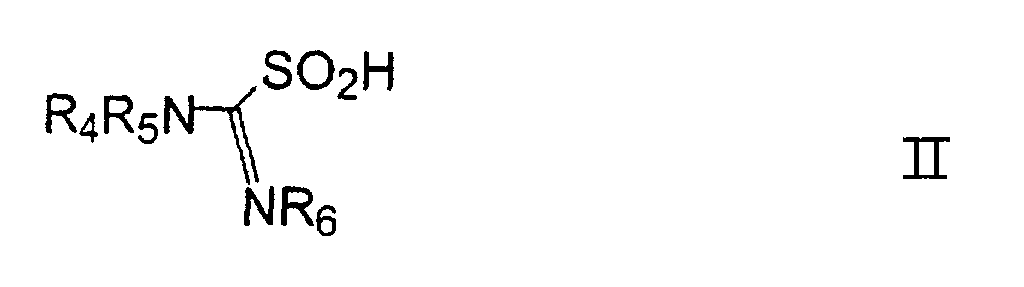
- mit R4, R5 und R6 =
- Wasserstoff, Alkyl, substituiertes Alkyl, Phenyl, substituiertes Phenyl, R7-(CO)- mit R7 = Wasserstoff, Alkyl, substituiertes Alkyl, Phenyl oder substituiertes Phenyl, wobei R4, R5 und R6 gleich oder unterschiedlich sind,
- Lösung nach einem der vorstehenden Ansprüche, dadurch gekennzeichnet, daß Formamidinsulfinsäure als haftvermittelnde Verbindung enthalten ist.
- Lösung nach einem der Ansprüche 1 und 2, dadurch gekennzeichnet, daß aromatische Sulfinsäuren aus der Gruppe, bestehend aus Benzolsulfinsäure, Toluolsulfinsäuren, Chlorbenzolsulfinsäuren, Nitrobenzolsulfinsäuren und Carboxybenzolsulfinsäuren, enthalten sind.
- Lösung nach einem der vorstehenden Ansprüche, dadurch gekennzeichnet, daß mindestens eine haftvermittelnde heterocyclische Verbindung aus der Gruppe, bestehend aus Thiophenen, Thiazolen, Isothiazolen, Thiadiazolen und Thiatriazolen, enthalten ist.
- Lösung nach Anspruch 5, dadurch gekennzeichnet, daß mindestens ein Thiophen aus der Gruppe, bestehend aus Verbindungen mit der chemischen Formel III enthalten ist

- mit R8, R9, R10, R11 =
- Wasserstoff, Alkyl, substituiertes Alkyl, Phenyl, substituiertes Phenyl, Halogen, Amino, Alkylamino, Dialkylamino, Hydroxy, Alkoxy, Carboxy, Carboxyalkyl, Alkoxycarbonyl, Aminocarbonyl, R12-CONH- mit R12 = Wasserstoff, Alkyl, substituiertes Alkyl, Phenyl oder substituiertes Phenyl, wobei R8, R9, R10 und R11 gleich oder unterschiedlich und Teil von an den Thiophenring kondensierten homo- oder heterocyclischen Ringen sein können.
- Lösung nach einem der Ansprüche 5 und 6, dadurch gekennzeichnet, daß mindestens ein Thiophen aus der Gruppe, bestehend aus Aminothiophencarbonsäuren, deren Estern und deren Amiden, enthalten ist.
- Lösung nach einem der Ansprüche 5 bis 7, dadurch gekennzeichnet, daß mindestens ein Thiazol aus der Gruppe, bestehend aus Verbindungen mit der chemischen Formel IV enthalten ist
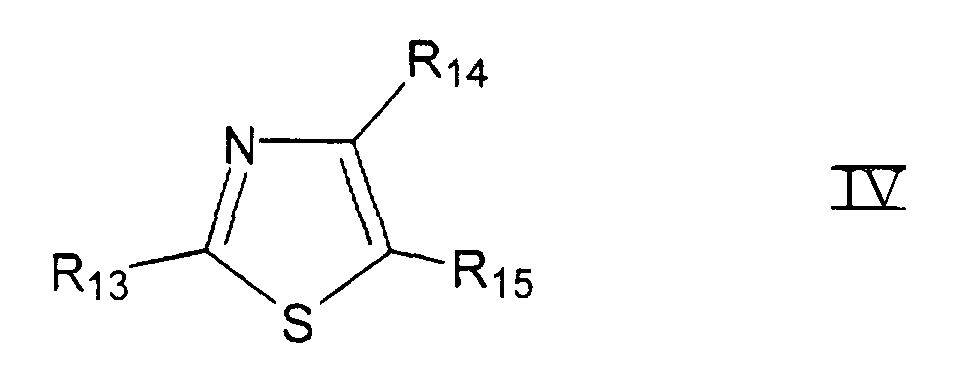
- mit R13, R14, R15 =
- Wasserstoff, Alkyl, substituiertes Alkyl, Phenyl, substituiertes Phenyl, Halogen, Amino, Alkylamino, Dialkylamino, Hydroxy, Alkoxy, Carboxy, Carboxyalkyl, Alkoxycarbonyl, Aminocarbonyl, R16-CONH- mit R16 = Wasserstoff, Alkyl, substituiertes Alkyl, Phenyl oder substituiertes Phenyl, wobei R13, R14 und R15 gleich oder unterschiedlich und Teil eines an den Thiazolring kondensierten homo- oder heterocyclischen Ringes sein können.
- Lösung nach einem der Ansprüche 5 bis 8, dadurch gekennzeichnet, daß mindestens ein Thiazol aus der Gruppe, bestehend aus Aminothiazolen und substituierten Aminothiazolen, enthalten ist.
- Lösung nach einem der Ansprüche 5 bis 9, dadurch gekennzeichnet, daß mindestens ein Thiadiazol aus der Gruppe, bestehend aus Aminothiadiazolen und substituierten Aminothiadiazolen, enthalten ist.
- Lösung nach einem der vorstehenden Ansprüche, dadurch gekennzeichnet, daß mindestens ein Sulfoniumsalz aus der Gruppe, bestehend aus Trimethylsulfoniumsalzen, Triphenylsulfoniumsalzen, Methioninalkylsulfoniumsalzen und Methioninbenzylsulfoniumsalzen, enthalten ist.
- Lösung nach einem der vorstehenden Ansprüche, dadurch gekennzeichnet, daß mindestens eine Stickstoff enthaltende, fünfgliedrige heterocyclische Verbindung aus der Gruppe, bestehend aus Triazolen, Tetrazolen, Imidazolen, Pyrazolen und Purinen, enthalten ist.
- Lösung nach Anspruch 12, dadurch gekennzeichnet, daß mindestens ein Triazol mit der chemischen Formel Va enthalten ist

- mit R17, R18 =
- Wasserstoff, Alkyl, substituiertes Alkyl, Amino, Phenyl, substituiertes Phenyl, Carboxyalkyl, wobei R17 und R18 gleich oder unterschiedlich und Teil eines an den Triazolring kondensierten homo- oder heterocyclischen Ringes sein können.
- Lösung nach einem der Ansprüche 12 und 13, dadurch gekennzeichnet, daß mindestens ein Triazol aus der Gruppe, bestehend aus Benzotriazol, Methylbenzotriazol, Ethylbenzotriazol und Dimethylbenzotriazol, enthalten ist.
- Lösung nach einem der Ansprüche 12 bis 14, dadurch gekennzeichnet, daß mindestens ein Tetrazol mit der chemischen Formel Vb enthalten ist

- mit R19 =
- Wasserstoff, Alkyl, substituiertes Alkyl, Halogenalkyl, Amino, Phenyl, substituiertes Phenyl, Benzyl, Carboxy, Carboxyalkyl, Alkoxycarbonyl, Aminocarbonyl oder R20-CONH mit R20 = Wasserstoff, Alkyl, substituiertes Alkyl, Phenyl oder substituiertes Phenyl.
- Lösung nach einem der Ansprüche 12 bis 15, dadurch gekennzeichnet, daß mindestens ein Tetrazol aus der Gruppe, bestehend aus 5-Aminotetrazol und 5-Phenyltetrazol, enthalten ist.
- Lösung nach einem der vorstehenden Ansprüche, dadurch gekennzeichnet, daß für Komponente b. in der Lösung Schwefelsäure als Säure enthalten ist.
- Verfahren zum Vorbehandeln von Kupferoberflächen zum nachfolgenden Bilden eines haftfesten Verbundes der Kupferoberflächen mit Kunststoffsubstraten, bei dem die Kupferoberflächen mit der Lösung nach einem der Ansprüche 1 bis 17 in Kontakt gebracht werden.
- Verwendung der Lösung nach einem der Ansprüche 1 bis 17 zum Vorbehandeln von Kupferschichten aufweisenden Leiterplatteninnenlagen zum Bilden eines haftfesten Verbundes zwischen den Leiterplatteninnenlagen und Kunstharzlagen.
- Verwendung der Lösung nach einem der Ansprüche 1 bis 17 zum Vorbehandeln von Kupferschichten aufweisenden Leiterplatten zum Bilden eines haftfesten Verbundes zwischen den Kupferschichten und aus Kunststoffen bestehenden Resisten.
Applications Claiming Priority (5)
| Application Number | Priority Date | Filing Date | Title |
|---|---|---|---|
| DE19806190 | 1998-02-03 | ||
| DE19806190 | 1998-02-03 | ||
| DE19830038 | 1998-06-26 | ||
| DE19830038A DE19830038C2 (de) | 1998-02-03 | 1998-06-26 | Lösung und Verfahren zum Vorbehandeln von Kupferoberflächen |
| PCT/DE1999/000243 WO1999040764A1 (de) | 1998-02-03 | 1999-01-25 | Lösung und verfahren zum vorbehandeln von kupferoberflächen |
Publications (2)
| Publication Number | Publication Date |
|---|---|
| EP1051888A1 EP1051888A1 (de) | 2000-11-15 |
| EP1051888B1 true EP1051888B1 (de) | 2002-03-27 |
Family
ID=26043882
Family Applications (1)
| Application Number | Title | Priority Date | Filing Date |
|---|---|---|---|
| EP99908756A Expired - Lifetime EP1051888B1 (de) | 1998-02-03 | 1999-01-25 | Lösung und verfahren zum vorbehandeln von kupferoberflächen |
Country Status (8)
| Country | Link |
|---|---|
| US (1) | US6562149B1 (de) |
| EP (1) | EP1051888B1 (de) |
| JP (1) | JP4644365B2 (de) |
| AT (1) | ATE215299T1 (de) |
| CA (1) | CA2318784A1 (de) |
| ES (1) | ES2175954T3 (de) |
| TW (1) | TW460622B (de) |
| WO (1) | WO1999040764A1 (de) |
Cited By (1)
| Publication number | Priority date | Publication date | Assignee | Title |
|---|---|---|---|---|
| EP2240005A1 (de) | 2009-04-09 | 2010-10-13 | ATOTECH Deutschland GmbH | Verfahren zur Herstellung einer Schaltungsträgerschicht und Anwendung dieses Verfahrens zur Herstellung eines Schaltungsträgers |
Families Citing this family (19)
| Publication number | Priority date | Publication date | Assignee | Title |
|---|---|---|---|---|
| US6117250A (en) * | 1999-02-25 | 2000-09-12 | Morton International Inc. | Thiazole and thiocarbamide based chemicals for use with oxidative etchant solutions |
| US7351353B1 (en) | 2000-01-07 | 2008-04-01 | Electrochemicals, Inc. | Method for roughening copper surfaces for bonding to substrates |
| DE10034022C2 (de) * | 2000-07-07 | 2003-05-08 | Atotech Deutschland Gmbh | Saure Behandlungsflüssigkeit und deren Verwendung sowie Verfahren zum Behandeln von Kupferoberflächen |
| DE10066028C2 (de) * | 2000-07-07 | 2003-04-24 | Atotech Deutschland Gmbh | Kupfersubstrat mit aufgerauhten Oberflächen |
| US6506314B1 (en) * | 2000-07-27 | 2003-01-14 | Atotech Deutschland Gmbh | Adhesion of polymeric materials to metal surfaces |
| US6716281B2 (en) | 2002-05-10 | 2004-04-06 | Electrochemicals, Inc. | Composition and method for preparing chemically-resistant roughened copper surfaces for bonding to substrates |
| US6969638B2 (en) * | 2003-06-27 | 2005-11-29 | Texas Instruments Incorporated | Low cost substrate for an integrated circuit device with bondpads free of plated gold |
| US7232478B2 (en) * | 2003-07-14 | 2007-06-19 | Enthone Inc. | Adhesion promotion in printed circuit boards |
| US20050067378A1 (en) * | 2003-09-30 | 2005-03-31 | Harry Fuerhaupter | Method for micro-roughening treatment of copper and mixed-metal circuitry |
| US7078809B2 (en) * | 2003-12-31 | 2006-07-18 | Dynacraft Industries Sdn. Bhd. | Chemical leadframe roughening process and resulting leadframe and integrated circuit package |
| WO2006110279A1 (en) * | 2005-04-08 | 2006-10-19 | Sachem, Inc. | Selective wet etching of metal nitrides |
| ATE445031T1 (de) | 2006-02-17 | 2009-10-15 | Atotech Deutschland Gmbh | Zusammensetzung und verfahren zur behandlung der oberflächen von kupferlegierungen, um die haftfähigkeit zwischen der metalloberfläche und dem gebundenen polymerischen material zu verbessern |
| JP5620365B2 (ja) † | 2008-03-21 | 2014-11-05 | エンソン インコーポレイテッド | 多官能分子システムを用いた積層体への金属の接着促進 |
| US8512504B2 (en) * | 2009-05-06 | 2013-08-20 | Steven A. Castaldi | Process for improving adhesion of polymeric materials to metal surfaces |
| CN102822390B (zh) * | 2010-05-26 | 2014-11-26 | 安美特德国有限公司 | 用于铜和铜合金微蚀刻的组合物和方法 |
| EP2453041B1 (de) | 2010-11-10 | 2014-02-12 | Atotech Deutschland GmbH | Lösung und Verfahren für die Vorbehandlung von Kupferoberflächen mit einer N-alkoxylierten haftungsfördernden Verbindung |
| US9338896B2 (en) * | 2012-07-25 | 2016-05-10 | Enthone, Inc. | Adhesion promotion in printed circuit boards |
| CN109851539A (zh) * | 2017-11-30 | 2019-06-07 | 罗门哈斯电子材料有限责任公司 | 盐和包含其的光致抗蚀剂 |
| EP4279634A1 (de) * | 2022-05-17 | 2023-11-22 | Atotech Deutschland GmbH & Co. KG | Verfahren zum nanoätzen von kupfer- und kupferlegierungsoberflächen |
Family Cites Families (17)
| Publication number | Priority date | Publication date | Assignee | Title |
|---|---|---|---|---|
| US3645772A (en) | 1970-06-30 | 1972-02-29 | Du Pont | Process for improving bonding of a photoresist to copper |
| JPS5221460B1 (de) | 1971-04-26 | 1977-06-10 | ||
| BE791457A (fr) | 1971-11-18 | 1973-05-16 | Du Pont | Solutions acides stabilisees d'eau oxygenee |
| SE400575B (sv) | 1974-12-13 | 1978-04-03 | Nordnero Ab | Bad for betning av koppar och dess legeringar |
| US4140646A (en) | 1977-11-08 | 1979-02-20 | Dart Industries Inc. | Dissolution of metals with a selenium catalyzed H2 O2 -H2 SO4 etchant containing t-butyl hydroperoxide |
| US4158593A (en) | 1977-11-08 | 1979-06-19 | Dart Industries Inc. | Dissolution of metals utilizing a H2 O2 -sulfuric acid solution catalyzed with selenium compounds |
| US4373744A (en) | 1980-01-23 | 1983-02-15 | Lucas Industries Limited | Suspension control system for a road vehicle |
| US4784785A (en) * | 1987-12-29 | 1988-11-15 | Macdermid, Incorporated | Copper etchant compositions |
| EP0342669B1 (de) | 1988-05-20 | 1995-08-23 | Mitsubishi Gas Chemical Company, Inc. | Verfahren zur Herstellung eines mit einer dünnen Kupferfolie kaschierten Substrats für Schaltungsplatten |
| US4915781A (en) * | 1988-07-27 | 1990-04-10 | E. I. Du Pont De Nemours And Company | Stabilized hydrogen peroxide compositions |
| JP3332047B2 (ja) * | 1993-07-22 | 2002-10-07 | 三菱瓦斯化学株式会社 | 内層銅箔の処理方法 |
| JP3880636B2 (ja) | 1994-01-10 | 2007-02-14 | 味の素株式会社 | 発酵法によるl−グルタミン酸の製造法 |
| JP2781954B2 (ja) * | 1994-03-04 | 1998-07-30 | メック株式会社 | 銅および銅合金の表面処理剤 |
| JPH0897559A (ja) * | 1994-09-26 | 1996-04-12 | Okuno Chem Ind Co Ltd | 多層プリント配線板の内層用回路板の銅箔処理方法、及び該内層用回路板の銅箔処理液 |
| JPH0897599A (ja) | 1994-09-28 | 1996-04-12 | Fuji Xerox Co Ltd | 混成集積回路基板端子の保持治具 |
| GB9425090D0 (en) * | 1994-12-12 | 1995-02-08 | Alpha Metals Ltd | Copper coating |
| JPH11140669A (ja) * | 1997-11-04 | 1999-05-25 | Ebara Densan Ltd | エッチング液 |
-
1999
- 1999-01-20 TW TW088100842A patent/TW460622B/zh not_active IP Right Cessation
- 1999-01-25 ES ES99908756T patent/ES2175954T3/es not_active Expired - Lifetime
- 1999-01-25 AT AT99908756T patent/ATE215299T1/de active
- 1999-01-25 JP JP2000531042A patent/JP4644365B2/ja not_active Expired - Lifetime
- 1999-01-25 WO PCT/DE1999/000243 patent/WO1999040764A1/de not_active Ceased
- 1999-01-25 CA CA002318784A patent/CA2318784A1/en not_active Abandoned
- 1999-01-25 US US09/601,494 patent/US6562149B1/en not_active Expired - Lifetime
- 1999-01-25 EP EP99908756A patent/EP1051888B1/de not_active Expired - Lifetime
Cited By (2)
| Publication number | Priority date | Publication date | Assignee | Title |
|---|---|---|---|---|
| EP2240005A1 (de) | 2009-04-09 | 2010-10-13 | ATOTECH Deutschland GmbH | Verfahren zur Herstellung einer Schaltungsträgerschicht und Anwendung dieses Verfahrens zur Herstellung eines Schaltungsträgers |
| WO2010115774A1 (en) | 2009-04-09 | 2010-10-14 | Atotech Deutschland Gmbh | A method of manufacturing a circuit carrier layer and a use of said method for manufacturing a circuit carrier |
Also Published As
| Publication number | Publication date |
|---|---|
| CA2318784A1 (en) | 1999-08-12 |
| JP4644365B2 (ja) | 2011-03-02 |
| TW460622B (en) | 2001-10-21 |
| WO1999040764A1 (de) | 1999-08-12 |
| ES2175954T3 (es) | 2002-11-16 |
| JP2002503040A (ja) | 2002-01-29 |
| ATE215299T1 (de) | 2002-04-15 |
| HK1030717A1 (en) | 2001-05-11 |
| US6562149B1 (en) | 2003-05-13 |
| EP1051888A1 (de) | 2000-11-15 |
Similar Documents
| Publication | Publication Date | Title |
|---|---|---|
| EP1051888B1 (de) | Lösung und verfahren zum vorbehandeln von kupferoberflächen | |
| DE69518166T2 (de) | Beschichten von kupfer | |
| DE10165046B4 (de) | Verfahren zum Herstellen einer Schaltungsplatte unter Anwendung einer Zusammensetzung zum Mikroätzen | |
| DE3212410C2 (de) | ||
| DE10066028C2 (de) | Kupfersubstrat mit aufgerauhten Oberflächen | |
| DE10313517B4 (de) | Lösung zum Ätzen von Kupfer, Verfahren zum Vorbehandeln einer Schicht aus Kupfer sowie Anwendung des Verfahrens | |
| DE2610470C3 (de) | Verfahren zur stromlosen Abscheidung von Kupferschichten | |
| DE60122509T2 (de) | Verfahren zur verbesserung der adhäsion von polymerischen materialien an metalloberflächen | |
| DE19926117A1 (de) | Flüssiges Ätzmittel und Verfahren zum Aufrauhen von Kupferoberflächen | |
| EP1055355B1 (de) | Verfahren zum vorbehandeln von kupferoberflächen | |
| DE4202337A1 (de) | Verfahren zur durchkontaktierung von zweilagigen leiterplatten und multilayern | |
| DE10039684A1 (de) | Ätzlösung für Nickel oder Nickellegierungen | |
| DE69937624T3 (de) | Verfahren zur Behandlung von Metalloberflächen | |
| DE60100834T2 (de) | Zusammensetzung für die Leiterplattenherstellung | |
| DE10302596A1 (de) | Behandlung von Metalloberflächen mit einer modifizierten Oxidaustauschmasse | |
| DE69314070T2 (de) | Verfahren zur Entfernung Zinn oder Zinn-Bleilegierungen von Kupferoberflächen | |
| DE19830038C2 (de) | Lösung und Verfahren zum Vorbehandeln von Kupferoberflächen | |
| DE60030691T2 (de) | Verfahren zur Verbesserung der Adhäsion von Polymermaterialien an Metalloberflächen | |
| DE10034022C2 (de) | Saure Behandlungsflüssigkeit und deren Verwendung sowie Verfahren zum Behandeln von Kupferoberflächen | |
| DE69302104T2 (de) | Verfahren zur Verbesserung der Adhäsion zwischen verschiedenen Schichten in der Herstellung laminierter Leiterplatten und Zusammensetzungen zur Durchführung des Verfahrens | |
| DE69906301T2 (de) | Nachbehandlung von kupfer auf gedruckten schaltungsplatten | |
| DE102009031015A1 (de) | Klebstoffschicht bildende Flüssigkeit | |
| EP0619333B1 (de) | Verfahren zum Beschichten von Metallen | |
| DE60105166T2 (de) | Säureätzlösung und verfahren zur behandlung von kupfer | |
| DE2800851A1 (de) | Aetzmittel und dessen verwendung zum aetzen von metall |
Legal Events
| Date | Code | Title | Description |
|---|---|---|---|
| PUAI | Public reference made under article 153(3) epc to a published international application that has entered the european phase |
Free format text: ORIGINAL CODE: 0009012 |
|
| 17P | Request for examination filed |
Effective date: 20000621 |
|
| AK | Designated contracting states |
Kind code of ref document: A1 Designated state(s): AT DE ES FI FR GB IT NL SE |
|
| GRAG | Despatch of communication of intention to grant |
Free format text: ORIGINAL CODE: EPIDOS AGRA |
|
| 17Q | First examination report despatched |
Effective date: 20010427 |
|
| GRAG | Despatch of communication of intention to grant |
Free format text: ORIGINAL CODE: EPIDOS AGRA |
|
| GRAH | Despatch of communication of intention to grant a patent |
Free format text: ORIGINAL CODE: EPIDOS IGRA |
|
| GRAH | Despatch of communication of intention to grant a patent |
Free format text: ORIGINAL CODE: EPIDOS IGRA |
|
| REG | Reference to a national code |
Ref country code: GB Ref legal event code: IF02 |
|
| GRAA | (expected) grant |
Free format text: ORIGINAL CODE: 0009210 |
|
| AK | Designated contracting states |
Kind code of ref document: B1 Designated state(s): AT DE ES FI FR GB IT NL SE |
|
| REF | Corresponds to: |
Ref document number: 215299 Country of ref document: AT Date of ref document: 20020415 Kind code of ref document: T |
|
| REF | Corresponds to: |
Ref document number: 59901062 Country of ref document: DE Date of ref document: 20020502 |
|
| GBT | Gb: translation of ep patent filed (gb section 77(6)(a)/1977) |
Effective date: 20020628 |
|
| ET | Fr: translation filed | ||
| REG | Reference to a national code |
Ref country code: ES Ref legal event code: FG2A Ref document number: 2175954 Country of ref document: ES Kind code of ref document: T3 |
|
| PLBE | No opposition filed within time limit |
Free format text: ORIGINAL CODE: 0009261 |
|
| STAA | Information on the status of an ep patent application or granted ep patent |
Free format text: STATUS: NO OPPOSITION FILED WITHIN TIME LIMIT |
|
| 26N | No opposition filed |
Effective date: 20021230 |
|
| PG25 | Lapsed in a contracting state [announced via postgrant information from national office to epo] |
Ref country code: IT Free format text: LAPSE BECAUSE OF NON-PAYMENT OF DUE FEES Effective date: 20050125 |
|
| PGFP | Annual fee paid to national office [announced via postgrant information from national office to epo] |
Ref country code: SE Payment date: 20091223 Year of fee payment: 12 |
|
| PGRI | Patent reinstated in contracting state [announced from national office to epo] |
Ref country code: IT Effective date: 20091201 |
|
| PGFP | Annual fee paid to national office [announced via postgrant information from national office to epo] |
Ref country code: FI Payment date: 20100115 Year of fee payment: 12 |
|
| PGFP | Annual fee paid to national office [announced via postgrant information from national office to epo] |
Ref country code: NL Payment date: 20100118 Year of fee payment: 12 |
|
| REG | Reference to a national code |
Ref country code: NL Ref legal event code: V1 Effective date: 20110801 |
|
| REG | Reference to a national code |
Ref country code: SE Ref legal event code: EUG |
|
| PG25 | Lapsed in a contracting state [announced via postgrant information from national office to epo] |
Ref country code: FI Free format text: LAPSE BECAUSE OF NON-PAYMENT OF DUE FEES Effective date: 20110125 |
|
| PG25 | Lapsed in a contracting state [announced via postgrant information from national office to epo] |
Ref country code: NL Free format text: LAPSE BECAUSE OF NON-PAYMENT OF DUE FEES Effective date: 20110801 |
|
| PG25 | Lapsed in a contracting state [announced via postgrant information from national office to epo] |
Ref country code: SE Free format text: LAPSE BECAUSE OF NON-PAYMENT OF DUE FEES Effective date: 20110126 |
|
| PGFP | Annual fee paid to national office [announced via postgrant information from national office to epo] |
Ref country code: ES Payment date: 20150128 Year of fee payment: 17 |
|
| PGFP | Annual fee paid to national office [announced via postgrant information from national office to epo] |
Ref country code: GB Payment date: 20150121 Year of fee payment: 17 |
|
| REG | Reference to a national code |
Ref country code: FR Ref legal event code: PLFP Year of fee payment: 18 |
|
| GBPC | Gb: european patent ceased through non-payment of renewal fee |
Effective date: 20160125 |
|
| PG25 | Lapsed in a contracting state [announced via postgrant information from national office to epo] |
Ref country code: GB Free format text: LAPSE BECAUSE OF NON-PAYMENT OF DUE FEES Effective date: 20160125 |
|
| REG | Reference to a national code |
Ref country code: FR Ref legal event code: PLFP Year of fee payment: 19 |
|
| REG | Reference to a national code |
Ref country code: ES Ref legal event code: FD2A Effective date: 20170227 |
|
| PG25 | Lapsed in a contracting state [announced via postgrant information from national office to epo] |
Ref country code: ES Free format text: LAPSE BECAUSE OF NON-PAYMENT OF DUE FEES Effective date: 20160126 |
|
| REG | Reference to a national code |
Ref country code: FR Ref legal event code: PLFP Year of fee payment: 20 |
|
| PGFP | Annual fee paid to national office [announced via postgrant information from national office to epo] |
Ref country code: DE Payment date: 20180122 Year of fee payment: 20 |
|
| PGFP | Annual fee paid to national office [announced via postgrant information from national office to epo] |
Ref country code: IT Payment date: 20180129 Year of fee payment: 20 Ref country code: AT Payment date: 20180122 Year of fee payment: 20 Ref country code: FR Payment date: 20180119 Year of fee payment: 20 |
|
| REG | Reference to a national code |
Ref country code: DE Ref legal event code: R071 Ref document number: 59901062 Country of ref document: DE |
|
| REG | Reference to a national code |
Ref country code: AT Ref legal event code: MK07 Ref document number: 215299 Country of ref document: AT Kind code of ref document: T Effective date: 20190125 |