EP1053728B1 - Druckempfindliches klebeband zur befestigung auf der haut und grundmaterial zu seiner benutzung - Google Patents
Druckempfindliches klebeband zur befestigung auf der haut und grundmaterial zu seiner benutzung Download PDFInfo
- Publication number
- EP1053728B1 EP1053728B1 EP99959686A EP99959686A EP1053728B1 EP 1053728 B1 EP1053728 B1 EP 1053728B1 EP 99959686 A EP99959686 A EP 99959686A EP 99959686 A EP99959686 A EP 99959686A EP 1053728 B1 EP1053728 B1 EP 1053728B1
- Authority
- EP
- European Patent Office
- Prior art keywords
- sensitive adhesive
- pressure sensitive
- adhesive tape
- skin
- film
- Prior art date
- Legal status (The legal status is an assumption and is not a legal conclusion. Google has not performed a legal analysis and makes no representation as to the accuracy of the status listed.)
- Expired - Lifetime
Links
Images

Classifications
-
- A—HUMAN NECESSITIES
- A61—MEDICAL OR VETERINARY SCIENCE; HYGIENE
- A61L—METHODS OR APPARATUS FOR STERILISING MATERIALS OR OBJECTS IN GENERAL; DISINFECTION, STERILISATION OR DEODORISATION OF AIR; CHEMICAL ASPECTS OF BANDAGES, DRESSINGS, ABSORBENT PADS OR SURGICAL ARTICLES; MATERIALS FOR BANDAGES, DRESSINGS, ABSORBENT PADS OR SURGICAL ARTICLES
- A61L15/00—Chemical aspects of, or use of materials for, bandages, dressings or absorbent pads
- A61L15/16—Bandages, dressings or absorbent pads for physiological fluids such as urine or blood, e.g. sanitary towels, tampons
- A61L15/42—Use of materials characterised by their function or physical properties
- A61L15/58—Adhesives
-
- C—CHEMISTRY; METALLURGY
- C09—DYES; PAINTS; POLISHES; NATURAL RESINS; ADHESIVES; COMPOSITIONS NOT OTHERWISE PROVIDED FOR; APPLICATIONS OF MATERIALS NOT OTHERWISE PROVIDED FOR
- C09J—ADHESIVES; NON-MECHANICAL ASPECTS OF ADHESIVE PROCESSES IN GENERAL; ADHESIVE PROCESSES NOT PROVIDED FOR ELSEWHERE; USE OF MATERIALS AS ADHESIVES
- C09J133/00—Adhesives based on homopolymers or copolymers of compounds having one or more unsaturated aliphatic radicals, each having only one carbon-to-carbon double bond, and at least one being terminated by only one carboxyl radical, or of salts, anhydrides, esters, amides, imides, or nitriles thereof; Adhesives based on derivatives of such polymers
- C09J133/04—Homopolymers or copolymers of esters
- C09J133/06—Homopolymers or copolymers of esters of esters containing only carbon, hydrogen and oxygen, the oxygen atom being present only as part of the carboxyl radical
- C09J133/062—Copolymers with monomers not covered by C09J133/06
-
- C—CHEMISTRY; METALLURGY
- C09—DYES; PAINTS; POLISHES; NATURAL RESINS; ADHESIVES; COMPOSITIONS NOT OTHERWISE PROVIDED FOR; APPLICATIONS OF MATERIALS NOT OTHERWISE PROVIDED FOR
- C09J—ADHESIVES; NON-MECHANICAL ASPECTS OF ADHESIVE PROCESSES IN GENERAL; ADHESIVE PROCESSES NOT PROVIDED FOR ELSEWHERE; USE OF MATERIALS AS ADHESIVES
- C09J7/00—Adhesives in the form of films or foils
- C09J7/20—Adhesives in the form of films or foils characterised by their carriers
- C09J7/22—Plastics; Metallised plastics
- C09J7/26—Porous or cellular plastics
-
- C—CHEMISTRY; METALLURGY
- C09—DYES; PAINTS; POLISHES; NATURAL RESINS; ADHESIVES; COMPOSITIONS NOT OTHERWISE PROVIDED FOR; APPLICATIONS OF MATERIALS NOT OTHERWISE PROVIDED FOR
- C09J—ADHESIVES; NON-MECHANICAL ASPECTS OF ADHESIVE PROCESSES IN GENERAL; ADHESIVE PROCESSES NOT PROVIDED FOR ELSEWHERE; USE OF MATERIALS AS ADHESIVES
- C09J2301/00—Additional features of adhesives in the form of films or foils
- C09J2301/30—Additional features of adhesives in the form of films or foils characterized by the chemical, physicochemical or physical properties of the adhesive or the carrier
- C09J2301/308—Additional features of adhesives in the form of films or foils characterized by the chemical, physicochemical or physical properties of the adhesive or the carrier the adhesive tape or sheet losing adhesive strength when being stretched, e.g. stretch adhesive
-
- C—CHEMISTRY; METALLURGY
- C09—DYES; PAINTS; POLISHES; NATURAL RESINS; ADHESIVES; COMPOSITIONS NOT OTHERWISE PROVIDED FOR; APPLICATIONS OF MATERIALS NOT OTHERWISE PROVIDED FOR
- C09J—ADHESIVES; NON-MECHANICAL ASPECTS OF ADHESIVE PROCESSES IN GENERAL; ADHESIVE PROCESSES NOT PROVIDED FOR ELSEWHERE; USE OF MATERIALS AS ADHESIVES
- C09J2423/00—Presence of polyolefin
- C09J2423/006—Presence of polyolefin in the substrate
-
- C—CHEMISTRY; METALLURGY
- C09—DYES; PAINTS; POLISHES; NATURAL RESINS; ADHESIVES; COMPOSITIONS NOT OTHERWISE PROVIDED FOR; APPLICATIONS OF MATERIALS NOT OTHERWISE PROVIDED FOR
- C09J—ADHESIVES; NON-MECHANICAL ASPECTS OF ADHESIVE PROCESSES IN GENERAL; ADHESIVE PROCESSES NOT PROVIDED FOR ELSEWHERE; USE OF MATERIALS AS ADHESIVES
- C09J2433/00—Presence of (meth)acrylic polymer
Definitions
- the present invention relates to a pressure sensitive adhesive tape for skin, and more particularly a pressure sensitive adhesive tape for skin, which has stable tackiness upon sweating or during sticking for a long period of time and scarcely causes pain, corneum separation and skin irritation upon its peeling.
- the present invention also relates to a low-irritative pressure sensitive adhesive tape for skin, which has excellent conformability to skin and moisture permeability and stable adhesive strength and is lightened in pain, corneum separation and skin irritation upon its peeling.
- the present invention further relates to a base material suitable for use in such a low-irritative pressure sensitive adhesive tape for skin.
- the pressure sensitive adhesive tapes for skin according to the present invention are particularly suitable for use as medical pressure sensitive adhesive tapes for protection of the affected skin parts and operated sites, percutaneous absorption of drugs, etc.
- a pressure sensitive adhesive tape for skin generally has a structure that a pressure sensitive adhesive layer optionally containing a drug is formed on one side of a flexible base material.
- Such a pressure sensitive adhesive tape for skin is required to (1) have good conformability to skin that permits conforming to the shape and movement of a skin surface applied, (2) prevent moisture by sweating from remaining therein so as to have excellent moisture permeability, (3) give neither pain nor separation of horny layer upon its peeling, (4) be able to retain tackiness to skin over a long period of time, and (5) cause none of dermal diseases such as rash, itch and erythema.
- a polyethylene film, ethylene-methyl methacrylate copolymer (EMMA) film, polyvinyl chloride film, polyurethane film, polyester elastomer film, polyvinyl alcohol film, microporous polyolefin film, nonwoven polyurethane fabric, nonwoven polyester elastomer fabric or the like is used as a base material used in a pressure sensitive adhesive tape for skin.
- EMMA ethylene-methyl methacrylate copolymer
- films themselves such as the polyethylene film, EMMA film and polyvinyl chloride film do not have moisture permeability, and so holes are made therein by a perforator to impart the moisture permeability.
- a perforator to impart the moisture permeability.
- such a film involves a problem that satisfactory moisture permeability is not given because the rate of holes bored by the perforation is at most several percent, and moreover a distance between individual holes is great and a portion, in which no hole is bored, has no moisture permeability.
- the polyurethane film, polyester elastomer film, polyvinyl alcohol film, nonwoven polyurethane fabric, nonwoven polyester elastomer fabric, etc. involve a problem that they are too flexible in addition to their high prices.
- a pressure sensitive adhesive tape for skin, the base material of which is too flexible wrinkles upon its application to a skin surface, and so its handling is difficult.
- the moisture permeability of the polyurethane film and polyvinyl alcohol film is markedly deteriorated when their thickness is increased to about 40 ⁇ m, and they scarcely exhibit the moisture permeability when their thickness reaches 60 ⁇ m or greater.
- microporous polyolefin films are known to have excellent moisture permeability as demonstrated by their water-vapor transmission rate of at least 2,500 g/m 2 ⁇ 24 h, and they have good conformability to skin and are relatively cheap. Although many of the conventional microporous polyolefin films have an air permeability of 500 sec/100 cc or higher and are also small in film thickness and are hence suitable for use in paper diapers and sanitary products, however, they have been not satisfactory for base materials of pressure sensitive adhesive tapes for skin.
- a pressure sensitive adhesive tape for skin is hard to be steamed up, scarcely causes corneum separation and exhibits stable adhesive strength, it desirably has a water-vapor transmission rate of generally 500 g/m 2 ⁇ 24 h or higher, preferably 700 g/m 2 ⁇ 24 h or higher.
- a water-vapor transmission rate of generally 500 g/m 2 ⁇ 24 h or higher, preferably 700 g/m 2 ⁇ 24 h or higher.
- Another object of the present invention is to provide a pressure sensitive adhesive tape for skin, in which the conformability to skin, moisture permeability and tackiness to skin thereof are all within proper ranges, these characteristics are balanced with one another at a high level, tackiness upon sweating or during sticking for a long period of time is stabilized, and pain, corneum separation and skin irritation upon its peeling are lightened to a great extent.
- a further object of the present invention is to provide a microporous film substrate suitable for use as a base material of such a pressure sensitive adhesive tape for skin having excellent various characteristics.
- a pressure sensitive adhesive tape which comprises a base material such as a film or nonwoven fabric high in moisture permeability and flexible, and a pressure sensitive adhesive layer formed from an acrylic pressure sensitive adhesive, rubber pressure sensitive adhesive, silicone pressure sensitive adhesive, vinyl ether pressure sensitive adhesive or the like on the base material, and has conformability to a stretchable film, water-vapor transmission rate and adhesive strength within respective specified ranges, has moderate conformability to skin, moisture permeability and tackiness to skin and is suitable for use as a pressure sensitive adhesive tape for skin.
- the pressure sensitive adhesive tape for skin has stable tackiness upon sweating or during sticking for a long period of time and scarcely causes pain, corneum separation and skin irritation upon its peeling.
- a microporous film formed from a resin composition comprising a polyolefin resin and an inorganic filler and having such selected characteristics that the thickness is 40 to 22 ⁇ m, the average pore size is 0.05 to 10 ⁇ m, the air permeability is 10 to 400 sec/100cc, the water-vapor transmission rate is 1,000 to 20,000 g/m 2 .24h, and stresses at 15% elongation in the machine direction and transverse direction are both 0.5 to 15 N/15mm is suitable for use as a base material of a pressure sensitive adhesive tape for skin.
- a pressure sensitive adhesive tape for skin having such excellent various characteristics as described above is provided by using this microporous film as a base material.
- the present invention has been led to completion on the basis of these findings.
- a pressure sensitive adhesive tape for skin comprising a stretchable base material having good moisture permeability and a pressure sensitive adhesive layer formed on at least one side of the base material, wherein the stretchable base material is a microporous film formed from a resin composition comprising a polyolefin resin and an inorganic filler, and having the following characteristics:
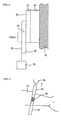
- Fig. 1 illustrates a measuring method of the conformability of a pressure sensitive adhesive tape to a stretchable film.
- Fig. 2 illustrates a measuring method of the shear deformation of a pressure sensitive adhesive.
- Fig 3. illustrates a measuring method of the conformability of a pressure sensitive adhesive tape to skin.
- a base material used in the pressure sensitive adhesive tape for skin may be mentioned films or nonwoven fabrics high in moisture permeability and good in stretchability.
- the stress of the base material at 15% elongation can be used as an objective index to the stretchability thereof.
- the stresses at 15% elongation in the machine direction (MD) and transverse direction (MD) of the base material used in the present invention are both generally at most 15 N/15 mm, preferably at most 12 N/15 mm, more preferably at most 10 N/15 mm.
- the lower limit of the stress at 15% elongation of the base material is generally 0.5 N/15 mm, preferably 0.7 N/15 mm, more preferably 1 N/15 mm.
- the stress at 15% elongation of the base material is a value measured as a stress as determined by elongating a specimen 15 mm in width and 150 mm in length by 15% at a crosshead interval of 100 mm and a crosshead speed of 300 mm/min by means of an Instron tensile tester in an atmosphere at a temperature of 23°C ⁇ 2°C and a relative humidity of 65 ⁇ 5% in accordance with JIS K 7115.
- the moisture permeability of the base material according to the present invention can be objectively evaluated by its water-vapor transmission rate as measured under conditions B (temperature: 40°C; relative humidity: 90%) of JIS Z 0208.
- the water-vapor transmission rate of the base material used in the present invention is generally higher than 500 g/m 2 ⁇ 24 h, preferably at least 700 g/m 2 ⁇ 24 h, more preferably at least 1,000 g/m 2 ⁇ 24 h.
- a pressure sensitive adhesive tape which makes it difficult to cause skin irritation by effectively evaporating moisture generated by sweating during its sticking can be obtained.
- good results can be yielded in many cases.
- the thickness of the base material is generally 40 to 200 ⁇ m, preferably 45 to 150 ⁇ m, more preferably 50 to 100 ⁇ m. If the thickness is too thin, the base material is too flexible, resulting in a pressure sensitive adhesive tape for skin which is hard to handle. If the thickness is too great, the flexibility of the base material is impaired, resulting in a pressure sensitive adhesive tape for skin deteriorated in conformability to skin.
- the stretchable base materials having good moisture permeability are the air-permeable polyolefin films are preferred. More specifically, a microporous film formed from a resin composition comprising a polyolefin resin and an inorganic filler as the base material is used for a low-irritative pressure sensitive adhesive tape for skin.
- a process for forming the microporous film is mentioned a process in which the resin composition is used to form an unstretched film, and the film is then uniaxially or biaxially stretched into a stretched film.
- polystyrene resin examples may be mentioned low density polyethylene, medium density polyethylene, high density polyethylene, linear low density polyethylene, very low density polyethylene, polypropylene, ethylene-propylene copolymers, ethylene-vinyl acetate copolymer and ionomer resins.
- the polyolefin resins include ethylene- ⁇ -olefin copolymers.
- Examples of the ⁇ -olefin include 1-butene, 3-methyl-1-butene, 4-methyl-1-pentene, 1-hexene, 1-octene and 1-decene.
- polyolefin resins may be either those obtained by using an ordinary Ziegler-Natta catalyst or those obtained by using a single site catalyst such as a metallocene catalyst or constraint geometry catalyst.
- the density of the polyolefin resin is generally about 0.89 to 0.97 g/cm 3
- the melt index (MI) thereof is generally about 0.1 to 50 g/10 min.
- the inorganic filler may be mentioned calcium carbonate, calcium oxide, aluminum oxide (alumina), titanium oxide, silica, clay, talc and aluminum sulfate. These inorganic fillers may be used either singly or in any combination thereof.
- the form of the inorganic filler may be optional, but it is preferably in a form such as a spheres, granule or indeterminate form.
- the average particle diameter of the inorganic filler is generally about 0.07 to 15 ⁇ m, preferably about 0.1 to 9 ⁇ m. When the average particle diameter falls within this range, the stretchability of the resulting microporous film becomes good, and the average pore size, air permeability, water-vapor transmission rate and the like of the film are easy to be controlled within the respective desired ranges.
- the mixing proportion of the inorganic filler is generally about 50 to 250 parts by weight, preferably about 80 to 200 parts by weight per 100 parts by weight of the polyolefin resin.
- the mixing proportion of the inorganic filler falls within this range, the various characteristics of the resulting microporous film can be controlled within the respect desired ranges.
- the resin composition comprising the polyolefin resin and the inorganic filler may contain additives such as dispersing agents, heat stabilizers, ultraviolet absorbents, lubricants, pigments and antistatic agents as needed.
- Dispersing agents such as higher fatty acids having 10 to 22 carbon atoms, such as oleic acid, lauric acid, myristic acid, palmitic acid, stearic acid, linolic acid, linolenic acid and recinolic acid; and fatty acid esters (for example, purified castor oil) of a higher fatty acid having 10 to 22 carbon atoms with an aliphatic alcohol having 1 to 12 carbon atoms are particularly preferred because the stretchability, air permeability and soft feeling of the resulting microporous film can be enhanced, and the hand thereof can be made good.
- the dispersing agents may be used either singly or in any combination thereof.
- the dispersing agents are added in a proportion of generally 0.5 to 25 parts by weight, preferably 1 to
- the resin composition is melt formed into an unstretched film (sheet) by means of T-die method, inflation method, or the like, and the film is then uniaxially or biaxially stretched into a stretched film.
- the unstretched film may be simultaneously biaxially stretched. No particular limitation is imposed on the stretching method.
- Uniaxial stretching includes roll stretching and oven stretching in a flat form, stretching in a tubular form, etc.
- biaxial stretching includes tenter stretching in a flat form, inflation stretching and mandrel stretching in a tubular form, etc.
- the draw ratio is generally 1.2 to 6 times, preferably 1.5 to 5 times, more preferably 2 to 3 times in at least one axial direction.
- the stretched film may be heat treated under tension to heat set the film. Stretching temperature and other stretching conditions such as heat treating conditions may be suitably selected in accordance with the stretching conditions for ordinary polyolefin resins. By conducting the stretching, a microporous structure is formed in the resultant stretched film due to interfacial separation between the polyolefin resin and the inorganic filler, and the like.
- the kind of the polyolefin resin, the kind and mixing proportion of the filler, the kinds and amounts of the additives such as the dispersing agent to be added, stretching conditions such as draw ratio, etc. are suitably controlled, thereby forming a microporous film having the following characteristics:
- the thickness of the microporous film according to the present invention is 40 to 200 ⁇ m, preferably 45 to 150 ⁇ m, more preferably 50 to 100 ⁇ m. If the thickness is too thin, the microporous film is too flexible, resulting in a pressure sensitive adhesive tape for skin which is hard to handle. If the thickness is too great, the flexibility of the microporous film is impaired, resulting in a pressure sensitive adhesive tape for skin deteriorated in conformability to skin.
- the average pore size of the microporous film according to the present invention is 0.02 to 10 ⁇ m, preferably 0.05 to 6 ⁇ m, more preferably 0.1 to 5 ⁇ m.
- the average pore size can be determined by taking a photograph of the microporous film through a scanning electron microscope, observing this photograph to measure the length of each pore, and calculating out an average value thereof.
- the pore size is variedly distributed within a range of generally 0.01 to 20 ⁇ m. However, in many cases, it is at most 10 ⁇ m, thereby providing a microporous film with a great number of fine pores formed therein. If the average pore size is too small, the air permeability and water-vapor transmission rate of the microporous film are lowered. If the average pore size is too great, the flexibility of the microporous film is deteriorated.
- the air permeability of the microporous film according to the present invention is 10 to 400 sec/100 cc, preferably 10 to 300 sec/100 cc, more preferably 30 to 280 sec/100 cc, particularly preferably 50 to 270 sec/100 cc.
- the air permeability can be determined in accordance with the testing method for air permeability (temperature: 23°C, relative humidity: 65%) prescribed in JIS P 8117.
- the air permeability means the time required until air (100 cc) under a fixed pressure passes through a film surface of a fixed area (645 mm 2 ), and a smaller value thereof indicates that the air permeability of a film is better.
- the air permeability of the microporous film is too high, only a pressure sensitive adhesive tape having a markedly low water-vapor transmission rate can be provided when such a microporous film is used as a base material for the pressure sensitive adhesive tape to apply a pressure sensitive adhesive to the surface thereof even when the water-vapor transmission rate thereof is high. If the air permeability thereof is too low, the flexibility thereof is easy to be impaired, and a pressure sensitive adhesive applied thereto is easy to penetrate into pores. When the air permeability of the microporous film falls within the above-described range, the water-vapor transmission rate of the resulting pressure sensitive adhesive tape can be controlled to at least 700 g/m 2 ⁇ 24 h that is desirable for application to skin.
- the water-vapor transmission rate of the microporous film according to the present invention is 1,000 to 20,000 g/m 2 ⁇ 24 h, preferably 2,500 to 15,000 g/m 2 ⁇ 24 h, more preferably 3,000 to 10,000 g/m 2 ⁇ 24 h. If the water-vapor transmission rate of the microporous film according to the present invention is too low, the water-vapor transmission rate of the resulting pressure sensitive adhesive tape is lowered. If the water-vapor transmission rate is too high, the microporous film becomes brittle.
- the stresses at 15% elongation (may also be referred to as tensile stresses at 15% elongation) in the machine direction (MD) and transverse direction (TD) of the microporous film according to the present invention are both 0.5 to 15 N/15 mm, preferably 0.7 to 12 N/15 mm, more preferably 1 to 10 N/15 mm.
- the flexibility of the microporous film can be objectively evaluated by measuring the stress at 15% elongation of the microporous film. When the stress at 15% elongation of the microporous film falls within the above range, a pressure sensitive adhesive tape easy to conform to the movement of a skin surface applied can be obtained. If the stress is too low, the microporous film becomes too flexible and unsuitable for use as a base material for a pressure sensitive adhesive tape for skin. If the stress is too high, the flexibility of the microporous film is lowered.
- the pressure sensitive adhesive used in the pressure sensitive adhesive tapes according to the present invention is preferable such that is hard to separate corneocytes from a skin surface when the pressure sensitive adhesive tape is peeled therefrom and to damage the skin surface.
- As an index to a pressure sensitive adhesive having such adhesive properties can be used the adhesive strength to bakelite of a pressure sensitive adhesive tape produced with the pressure sensitive adhesive.
- the adhesive strength to bakelite of the pressure sensitive adhesive used in the present invention is at most 1.5 N/15 mm, preferably at most 1.4 N/15 mm.
- the lower limit of the adhesive strength to bakelite is generally 0.6 N/15 mm, preferably 0.8 N/15 mm.
- the adhesive strength to bakelite as used herein is a value obtained by measuring the adhesive strength of a pressure sensitive adhesive 15 mm in width to a bakelite panel in accordance with the 180 degree peeling method prescribed JIS Z 0237.
- the pressure sensitive adhesive used in the present invention is preferably excellent in moisture permeability so as to provide a pressure sensitive adhesive tape having a water-vapor transmission rate of at least 500 g/m 2 ⁇ 24 h, preferably at least 700 g/m 2 ⁇ 24 h, more preferably at least 1,000 g/m 2 ⁇ 24 h when a pressure sensitive adhesive layer is formed on the above-described base material.
- the upper limit of the water-vapor transmission rate of the pressure sensitive adhesive tape is generally about 5,000 g/m 2 ⁇ 24 h. Any water-vapor transmission rate of the pressure sensitive adhesive tape too low forms the cause of the retention of mixture by sweating, separation of horny layer upon peeling, dermal diseases such as rash, itch and erythema, etc.
- the upper limit of the water-vapor transmission rate of the pressure sensitive adhesive tape is controlled by the air permeability and water-vapor transmission rate of the base material, the kind of the pressure sensitive adhesive tape, etc.
- the pressure sensitive adhesive used in the present invention is preferred such a pressure sensitive adhesive that the shear deformation (mm/12 x 20 mm 2 ⁇ 2 N ⁇ 30 min) of the pressure sensitive adhesive is within a range of 0.15 to 1.20 mm from the viewpoint of the lightening of skin irritation. More specifically, as the pressure sensitive adhesive, is preferred that which is hard to impair the movement of a skin surface applied like the base material, from the viewpoint of providing a low-irritative pressure sensitive adhesive tape for skin.
- Such adhesive property of the pressure sensitive adhesive can be evaluated by the shear deformation of the pressure sensitive adhesive to the surface of a nonstretchable hard film [for example, a polyethylene terephthalate (PET) film coated with a primer] subjected to a primer treatment.
- a nonstretchable hard film for example, a polyethylene terephthalate (PET) film coated with a primer
- the shear deformation of the pressure sensitive adhesive tape as used in the present invention is preferably 0.17 to 1.0 mm, more preferably 0.20 to 0.50 mm. If the shear deformation of the pressure sensitive adhesive of the pressure sensitive adhesive tape is too small, skin irritation becomes great. If the shear deformation of the pressure sensitive adhesive is too great, the retention of the pressure sensitive adhesive on a skin surface and the like are easy to occur.
- the pressure sensitive adhesive used in the pressure sensitive adhesive tapes according to the present invention are acrylic pressure sensitive adhesives more specifically, acrylic pressure sensitive adhesives which are copolymers of (1) 50 to 97.5 wt.%, preferably 70 to 95 wt.% of an alkyl (meth)acrylate having an alkyl group having 4 to 12 carbon atoms, (2) 2 to 49.5 wt.%, preferably 4 to 29 wt.% of an alkoxypolyalkylene glycol (meth)acrylate, and (3) 0.5 to 15 wt.%, preferably 1 to 10 wt.% of a hydroxyl group- or carboxyl group-containing monomer.
- the copolymers may be those obtained by copolymerizing a still further copolymerizable vinyl monomer within a range of about 0 to 30 wt.%.
- alkyl (meth)acrylate having an alkyl group having 4 to 12 carbon atoms may be mentioned n-butyl acrylate, isobutyl acrylate, t-butyl acrylate, 2-ethylhexyl acrylate, n-octyl acrylate, isooctyl acrylate, isononyl acrylate, decyl acrylate, dodecyl acrylate, n-butyl methacrylate, isobutyl methacrylate, t-butyl methacrylate, 2-ethylhexyl methacrylate, n-octyl methacrylate, isooctyl methacrylate, isononyl methacrylate, decyl methacrylate and dodecyl methacrylate.
- 2-ethylhexyl acrylate, n-octyl acrylate, isooctyl acrylate and isononyl acrylate are preferred.
- These alkyl (meth)acrylates may be used either singly or in any combination thereof.
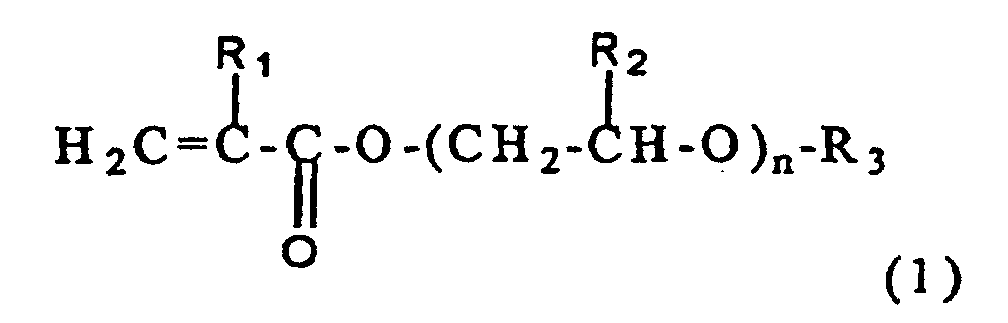
- the alkoxypolyalkylene glycol (meth)acrylate is a (meth)acrylic ester represented by the following formula (1): wherein R 1 and R 2 are independently a hydrogen atom or a methyl group, R 3 is an alkyl group having 1 to 20 carbon atoms, and n is an integer of 2 to 12.
- hydroxyalkyl (meth)acrylates may be mentioned hydroxyalkyl (meth)acrylates and carboxyalkyl (meth)acrylates.
- these monomers include 2-hydroxyethyl acrylate, 2-carboxyethyl acrylate, 2-hydroxypropyl acrylate, 2-carboxypropyl acrylate, 3-hydroxypropyl acrylate, 3-carboxypropyl acrylate, 4-hydroxybutyl acrylate, 4-carboxybutyl acrylate, 2-hydroxyethyl methacrylate, 2-carboxyethyl methacrylate, 2-hydroxypropyl methacrylate, 2-carboxypropyl methacrylate, 3-hydroxypropyl methacrylate, 3-carboxypropyl methacrylate, 4-hydroxybutyl methacrylate and 4-carboxybutyl methacrylate.
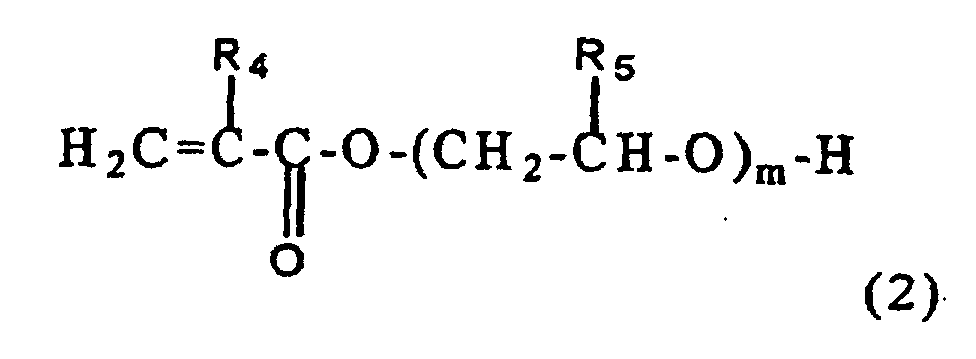
- hydroxyl group-containing (meth)acrylic esters represented by the formula (2): wherein R 4 and R 5 are independently a hydrogen atom or a methyl group, and m is an integer of 2 to 12, such as polyethylene glycol (meth)acrylates and polypropylene glycol (meth)acrylates.
- carboxyl group-containing monomer may be mentioned carboxyl group-containing (meth)acrylic esters represented by the formula (3): wherein R 6 is a hydrogen atom or a methyl group, and X is a divalent organic group having at least 2 carbon atoms and may contain a heteroatom such as an oxygen, nitrogen or sulfur atom.
- the number of carbon atoms in X is preferably 2 to 50, more preferably 2 to 30.
- the heteroatom is an oxygen atom in many cases.
- X may be mentioned linear or branched alkylene groups having at least two carbon atoms, -R 7 -OCO-R 8 - (wherein R 7 and R 8 are alkylene groups) and -R 9 -OCO-R 10 -OCO-R 11 - (wherein R 9 , R 10 and R 11 are alkylene groups).
- carboxyl group-containing (meth)acrylic esters represented by the formula (3) include 2-carboxyethyl acrylate, 2-acryloyloxyethyl-succinic acid and ⁇ -carboxypolycaprolactone acrylate.
- alkyl (meth)acrylates such as methyl acrylate, ethyl acrylate, isopropyl acrylate, methyl methacrylate, ethyl methacrylate, isopropyl methacrylate, tridecyl acrylate and tridecyl methacrylate; carboxyl group-containing monomers such as acrylic acid, methacrylic acid, maleic acid, maleic anhydride and itaconic acid; (meth)acrylamides and derivatives thereof such as acrylamide, methacrylamide and N-methylolacrylamide; epoxy group-containing monomer such as glycidyl acrylate and glycidyl methacrylate; vinyl esters such as vinyl acetate; unsaturated nitriles such as acrylonitrile and methacrylonitrile; and vinyl aromatic compounds such as styrene.
- alkyl (meth)acrylates such as methyl acrylate, ethyl acrylate, isopropyl
- percutaneously absorbable drugs examples include drugs for angina pectoris, corticosteroids, analgesic-antiphlogestic drugs, hypnotic analgesics, anti-inflammatory drugs, antiallergic drugs, antihistaminics, coronary vasodilators, antibacterial drugs, humectants, vitamins, antitussives, anesthetic drugs, antitumor drugs and perfume bases. These drugs are added in affective amounts as needed.
- the pressure sensitive adhesive tapes for skin according to the present invention can be produced by applying a pressure sensitive adhesive to at least one side of a stretchable base material having good moisture permeability in accordance with a method known per se in the art.
- the pressure sensitive adhesive may be applied to a separator to transfer it to the base material.
- it is only necessary to apply a solution with a base polymer and optional additive ingredients uniformly dissolved or dispersed in an organic solvent to the base material or separator and dry it.
- the thickness of the pressure sensitive adhesive layer is generally 20 to 60 ⁇ m, preferably 30 to 50 ⁇ m.
- the pressure sensitive adhesive tapes for skin according to the present invention have the following various characteristics:
- a pressure sensitive adhesive tape sample is stuck on a stretchable film to measure a stress of the pressure sensitive adhesive tape sample when the stretchable film is elongated by 15% at a rate of 100 mm/min by means of an Instron tensile tester.
- the measured value of the stress is the conformability of the pressure sensitive adhesive tape to the stretchable film.
- the measured value of the stress is divided by the stress at 15% elongation of the stretchable film to calculate out a quotient. The quotient must be 4.2 times or lower.
- a polyurethane film (thickness: 27 ⁇ m) the stress at 15% elongation of which is 0.84 N/15 mm was used as the stretchable film because the polyurethane film is similar to the condition of the skin of a human body.
- the conformability of the pressure sensitive adhesive tape to skin can be objectively evaluated by this value (quotient).
- the conformability of the pressure sensitive adhesive tape according to the present invention to skin can be determined by actually applying it to the skin of a human body. However, since the skin of the human body varies with the individual, such conformability to the stretchable film is used as an objective index.
- the pressure sensitive adhesive tapes according to the present invention are desirably such that
- the pressure sensitive adhesive tapes for skin according to the present invention have such various characteristics, they have features that the conformability to skin is good, the retention of moisture during its sticking is little, the tackiness upon sweating or during sticking for a long period of time is good, and pain, corneum separation and skin irritation upon peeling are little. Accordingly, the pressure sensitive adhesive tapes for skin according to the present invention can be used with the object of skin protection such as protection of the affected skin parts and operated sites, percutaneous absorption of drugs, etc.
- the forms of pores include various forms such as ellipse, rhombus, rectangle and polygon.
- the length means a length of the longest diameter or diagonal line.
- the measuring temperature is ordinary temperature (18 to 27°C).
- a stress load (sample width: 15 mm; crosshead interval: 100 mm; crosshead speed: 300 mm/min) at the time a sample was elongated by 15% by means of a tensile tester in accordance with JIS K 7115 was measured. The measurement was conducted in an atmosphere at a temperature of 23 ⁇ 2°C and a relative humidity of 65 ⁇ 5%.
- a polyurethane film 1 (thickness: 27 ⁇ m) the stress at 15% elongation of which was 0.84 N/15 mm was cut into a size of 18 mm x 150 mm and fixed by chucks 3 and 4 of an Instron tensile tester in such a manner that a crosshead interval is 100 mm.
- This stress was regarded as the conformability of the pressure sensitive adhesive tape to the stretchable film to compare it with the stress of the polyurethane film at 15% elongation.
- the measurement was conducted in an atmosphere at a temperature of 23°C and a relative humidity of 65%.
- each pressure sensitive adhesive tape 15 mm in width to a bakelite panel was measured in accordance with the 180 degree peeling method prescribed JIS Z 0237. The measurement was conducted in an atmosphere at a temperature of 23 ⁇ 2°C and a relative humidity of 65 ⁇ 5%.
- the water-vapor transmission rate of each pressure sensitive adhesive tape was measured under the conditions B (temperature: 40°C; relative humidity: 90%) of JIS Z 0208.
- the shear deformation of a pressure sensitive adhesive means a shear deformation of the pressure sensitive adhesive as measured in a state that the surface of a nonstretchable hard film such as PET #36 was subjected to a primer treatment (for example, polyester resin "Vylon 30SS", product of Toyobo Co., Ltd.; applied in a thickness of about 3 ⁇ m) to remove the interfacial slip of the pressure sensitive adhesive of a pressure sensitive adhesive tape (with an adherend).
- a primer treatment for example, polyester resin "Vylon 30SS", product of Toyobo Co., Ltd.; applied in a thickness of about 3 ⁇ m
- bakelite (or glass plate) 22 was fixed to a vertical surface of a support 21, and a PTE film 23 subjected to a primer treatment was bonded to the surface thereof with the primer treated surface 24 out.
- a pressure sensitive adhesive tape 25 was stuck at the side of the pressure sensitive adhesive layer 26 on the primer treated surface 24.
- a cut 27 was made in the pressure sensitive adhesive tape into a state that an area of 12 x 20 mm 2 of the pressure sensitive adhesive layer was stuck on the primer treated surface.
- nonstretchable films 32, 33 in the form of a strip 15 mm in width were stuck at an interval of 20 mm on inner lower arms of 6 adult men, an end of one nonstretchable film 32 was fixed, and an end of the other nonstretchable film 33 was connected to a strain gauge 34 (digital force gauge).
- a pressure sensitive adhesive tape 35 of 15 mm x 18 mm was stuck each at an interval of 1 mm between the two nonstretchable films to evaluate the stress at 15% elongation of the adhesive tape as an index to the conformability to skin in comparison with the viscoelasticity of the skin.
- the measurement was conducted in an atmosphere at a temperature of 23 ⁇ 2°C and a relative humidity of 65 ⁇ 5%.
- Each pressure sensitive adhesive tape 25 mm in diameter was stuck on inner lower arms of 10 adult men.
- the adhesive tape was peeled after 24 hours from the sticking to evaluate skin irritation after 1 hour from the peeling in accordance with the Japanese standard.
- the Japanese standard is a standard prescribed by the Japanese patch test research group. More specifically, weights of 0, 0.5, 1, 2, 3 and 4 points were given to the following standard, -, ⁇ , +, ++, +++ and ++++, respectively, to multiply an average value of the evaluation results of the respective subjects by 100 to express the value thereof as an skin irritation index.
- This pressure sensitive adhesive solution was applied to a separator the surface of which had been subjected to a silicone treatment, so as to give a dry coating thickness of 38 ⁇ m, and dried at 120°C for 3 minutes. Thereafter, a microporous polyolefin film having a thickness of 80 ⁇ m was laminated as a base material on the surface of the pressure sensitive adhesive layer, and aging was conducted at 50°C for a week to produce a pressure sensitive adhesive tape for skin.
- a pressure sensitive adhesive tape for skin was produced in the same manner as in Example 1 except that the hydroxyl group-containing monomer among the monomer components of the pressure sensitive adhesive was changed to ethylene glycol methacrylate.
- This pressure sensitive adhesive solution was applied to a separator the surface of which had been subjected to a silicone treatment, so as to give a dry coating thickness of 38 ⁇ m, and dried at 120°C for 3 minutes. Thereafter, an EMMA (ethylene-methyl methacrylate copolymer) film having a thickness of 100 ⁇ m was laminated as a base material on the surface of the pressure sensitive adhesive layer, and aging was conducted at 50°C for a week to produce a pressure sensitive adhesive tape for skin.
- EMMA ethylene-methyl methacrylate copolymer
- This pressure sensitive adhesive solution was applied to a separator the surface of which had been subjected to a silicone treatment, so as to give a dry coating thickness of 38 ⁇ m, and dried at 120°C for 3 minutes. Thereafter, a nonwoven rayon fabric having a thickness of 100 ⁇ m was laminated as a base material on the surface of the pressure sensitive adhesive layer, and aging was conducted at 40°C for a week to produce a pressure sensitive adhesive tape for skin.
- This pressure sensitive adhesive solution was applied to a separator the surface of which had been subjected to a silicone treatment, so as to give a dry coating thickness of 38 ⁇ m, and dried at 120°C for 3 minutes. Thereafter, a polyethylene film having a thickness of 120 ⁇ m was laminated as a base material on the surface of the pressure sensitive adhesive layer, and aging was conducted at 40°C for a week to produce a pressure sensitive adhesive tape for skin.
- the unstretched sheet was reheated, biaxially stretched each at a draw ratio of about 3 times in both directions of MD and TD at a stretching temperature of 85°C by a tenter stretching process and cooled by a cooling roll to obtain a biaxially stretched film (Base Material A) having a thickness of 53 ⁇ m.
- the biaxially stretched film was subjected to a corona discharge treatment at one surface thereof and laminated on the surface of the pressure sensitive adhesive layer applied to the separator, and aging was conducted at 50°C for a week to produce a pressure sensitive adhesive tape for skin.
- a pressure sensitive adhesive tape for skin was produced in the same manner as in Example 3 except that this pressure sensitive adhesive solution was used.
- a pressure sensitive adhesive tape for skin was produced in the same manner as in Example 3 except that this pressure sensitive adhesive solution was used.
- a pressure sensitive adhesive tape for skin was produced in the same manner as in Example 3 except that this pressure sensitive adhesive solution was used.
- a pressure sensitive adhesive tape for skin was produced in the same manner as in Example 8 except that Porum PN70 (Base Material a; product of Tokuyama Co., Ltd.) which is a microporous polyolefin film formed from a resin composition containing polyethylene and an inorganic filler was used as a base material.
- Porum PN70 Base Material a; product of Tokuyama Co., Ltd.
- Porum PN70 which is a microporous polyolefin film formed from a resin composition containing polyethylene and an inorganic filler was used as a base material.
- a pressure sensitive adhesive tape for skin was produced in the same manner as in Comparative Example 4 except that Porum PH70 (Base Material b; product of Tokuyama Co., Ltd.) which is a microporous polyolefin film formed from a resin composition containing polyethylene and an inorganic filler was used as a base material.
- Porum PH70 Base Material b; product of Tokuyama Co., Ltd.
- a pressure sensitive adhesive tape for skin was produced in the same manner as in Comparative Example 4 except that NF Sheet NG100 (Base Material c; product of Tokuyama Co., Ltd.) which is a microporous polyolefin film formed from a resin composition containing polypropylene and an inorganic filler was used as a base material.
- NF Sheet NG100 Base Material c; product of Tokuyama Co., Ltd.
- a pressure sensitive adhesive tape for skin was produced in the same manner as in Example 5 except that this pressure sensitive adhesive solution was used.
- a pressure sensitive adhesive tape for skin was produced in the same manner as in Example 5 except that this pressure sensitive adhesive solution was used.
- pressure sensitive adhesive tapes for skin which have stable tackiness upon sweating or during sticking for a long period of time and scarcely causes pain, corneum separation and skin irritation upon its peeling.
- the conformability to skin, moisture permeability and tackiness to skin are all within respective moderate ranges, these characteristics are balanced with one another at a high level, the tackiness upon sweating or during sticking for a long period of time is made stable, and moreover the pain, corneum separation and skin irritation upon its peeling are lightened to a great extent.
- base materials suitable for use in the pressure sensitive adhesive tapes for skin having such excellent various characteristics.
- the pressure sensitive adhesive tapes for skin according to the present invention are suitable for uses such as protection of the affected skin parts and operated sites, and percutaneous absorption of drugs.
Landscapes
- Chemical & Material Sciences (AREA)
- Health & Medical Sciences (AREA)
- Organic Chemistry (AREA)
- Epidemiology (AREA)
- Engineering & Computer Science (AREA)
- Materials Engineering (AREA)
- Hematology (AREA)
- Life Sciences & Earth Sciences (AREA)
- Animal Behavior & Ethology (AREA)
- General Health & Medical Sciences (AREA)
- Public Health (AREA)
- Veterinary Medicine (AREA)
- Materials For Medical Uses (AREA)
- Adhesive Tapes (AREA)
- Laminated Bodies (AREA)
Claims (7)
- Haftklebeband für Haut, umfassend ein streckbares Unterlagematerial mit guter Feuchtigkeitsdurchlässigkeit und eine Haftkleberschicht, die auf mindestens einer Seite des Unterlagematerials gebildet ist, wobei das streckbare Unterlagematerial eine mikroporöse Folie ist, die aus einer Harzzusammensetzung umfassend ein Polyolefinharz und einen anorganischen Füllstoff gebildet ist und die folgenden Merkmale aufweist:(1) die Dicke ist 40 bis 200 µm;(2) die mittlere Porengröße ist 0,02 bis 10 µm;(3) die Luftdurchlässigkeit ist 10 bis 400 sec/100cc;(4) die Wasserdampf-Durchlassrate ist 1 000 bis 20 000 g/m2.24h; und(5) die Spannungen bei 15% Dehnung in der Maschinenrichtung und in der Querrichtung sind beide 0,5 bis 15N/15 mm, wobei der Haftkleber ein Acryl-Haftkleber ist, der ein Copolymer ist umfassend:(i) 50 bis 97,5 Gew.-% eines Alkyl(meth)acrylats mit einer Alkylgruppe mit 4 bis 12 Kohlenstoffatomen,(ii) 2 bis 49,5 Gew.-% eines Alkoxypolyalkylenglycol(meth)acrylats der Formel (1):wobei R1 und R2 unabhängig voneinander ein Wasserstoffatom oder eine Methylgruppe sind, R3 eine Alkylgruppe mit 1 bis 20 Kohlenstoffatomen ist und n eine ganze Zahl von 2 bis 12 ist, und
 (iii) 0,5 bis 15 Gew.-% eines Hydroxylgruppen oder Carboxylgruppen enthaltenden Monomers, und wobei das Klebeband die folgenden Merkmale hat:(a) das Formanpassungsvermögen an eine streckbare Folie, die eine Polyurethanfolie mit einer Dicke von 27 µm ist und bei 15% Dehnung eine Spannung von 0,84 N/15mm aufweist, ist höchstens 4,2 mal so hoch wie die Spannung der streckbaren Folie bei 15% Dehnung;(b) die Wasserdampf-Durchlassrate ist mindestens 500 g/m2.24h; und(c) die Haftfestigkeit auf Bakelit ist höchstens 1,5 N/15 mm.
 - Haftklebeband für Haut gemäß Anspruch 1, das die folgenden Merkmale hat:(a) das Formanpassungsvermögen an eine Streckfolie ist 2,4 bis 4,2 mal so hoch wie die Spannung der streckbaren Folie bei 15% Dehnung;(b) die Wasserdampf-Durchlassrate ist 700 bis 5 000 g/m2.24h; und(c) die Haftfestigkeit auf Bakelit ist 0,6 bis 1,5 N/15 mm.
- Haftklebeband für Haut gemäß Anspruch 1 oder 2, wobei (d) die Scherdeformation (mm/12 x 20 mm2.2 N.30 min) des Haftklebers 0,15 bis 1,20 mm beträgt.
- Haftklebeband für Haut gemäß Anspruch 1, wobei das Hydroxylgruppen enthaltende Monomer ein Hydroxyalkyl(meth)acrylat ist.
- Haftklebeband für Haut gemäß Anspruch 1, wobei das Carboxylgruppen enthaltende Monomer ein Carboxyalkyl(meth)acrylat ist.
- Haftklebeband für Haut gemäß Anspruch 1, wobei das Hydroxylgruppen enthaltende Monomer ein eine Hydroxylgruppe enthaltender (Meth)acrylsäureester der Formel (2) ist:wobei R4 und R5 unabhängig voneinander ein Wasserstoffatom oder eine Methylgruppe sind und m eine ganze Zahl von 2 bis 12 ist.
- Haftklebeband für Haut gemäß Anspruch 6, wobei das Carboxylgruppen enthaltende Monomer ein eine Carboxylgruppe enthaltender (Meth)acrylsäureester der Formel (3) ist:wobei R6 ein Wasserstoffatom oder eine Methylgruppe ist und X eine zweiwertige organische Gruppe mit mindestens 2 Kohlenstoffatomen ist, die ein Heteroatom wie ein Sauerstoff-, Stickstoff oder Schwefelatom enthalten kann.

Applications Claiming Priority (5)
| Application Number | Priority Date | Filing Date | Title |
|---|---|---|---|
| JP34282498 | 1998-12-02 | ||
| JP10342824A JP2000166966A (ja) | 1998-12-02 | 1998-12-02 | 皮膚貼付用粘着テープ |
| JP35155898A JP3961138B2 (ja) | 1998-12-10 | 1998-12-10 | 皮膚貼付用粘着テープ |
| JP35155898 | 1998-12-10 | ||
| PCT/JP1999/006773 WO2000032144A1 (en) | 1998-12-02 | 1999-12-02 | Pressure-sensitive adhesive tape for pasting on skin and base material for use therein |
Publications (3)
| Publication Number | Publication Date |
|---|---|
| EP1053728A1 EP1053728A1 (de) | 2000-11-22 |
| EP1053728A4 EP1053728A4 (de) | 2002-07-24 |
| EP1053728B1 true EP1053728B1 (de) | 2004-04-14 |
Family
ID=26577371
Family Applications (1)
| Application Number | Title | Priority Date | Filing Date |
|---|---|---|---|
| EP99959686A Expired - Lifetime EP1053728B1 (de) | 1998-12-02 | 1999-12-02 | Druckempfindliches klebeband zur befestigung auf der haut und grundmaterial zu seiner benutzung |
Country Status (4)
| Country | Link |
|---|---|
| US (1) | US6262330B1 (de) |
| EP (1) | EP1053728B1 (de) |
| DE (1) | DE69916424T2 (de) |
| WO (1) | WO2000032144A1 (de) |
Families Citing this family (30)
| Publication number | Priority date | Publication date | Assignee | Title |
|---|---|---|---|---|
| JP4463399B2 (ja) * | 2000-08-23 | 2010-05-19 | 日東電工株式会社 | 医療用粘着テープ若しくはシート、並びに救急絆創膏 |
| US20030069482A1 (en) * | 2001-10-09 | 2003-04-10 | Workman Jerome James | Sampling article for determining quantitative and qualitative drug transfer to skin |
| US7017577B2 (en) | 2002-01-18 | 2006-03-28 | Matich Ronald D | Face mask with seal and neutralizer |
| US20070050883A1 (en) * | 2002-01-18 | 2007-03-08 | Matich Ronald D | Face mask with seal and neutralizer |
| USD481457S1 (en) | 2002-02-02 | 2003-10-28 | Deljuan Calvin | Device to remove surgical prep solution |
| US20030191667A1 (en) * | 2002-04-09 | 2003-10-09 | Fitzgerald David | System and user interface supporting use of rules for processing healthcare and other claim data |
| US7797172B2 (en) * | 2002-04-16 | 2010-09-14 | Siemens Medical Solutions Usa, Inc. | Healthcare financial data and clinical information processing system |
| US20040078228A1 (en) * | 2002-05-31 | 2004-04-22 | Fitzgerald David | System for monitoring healthcare patient encounter related information |
| US6613857B1 (en) | 2002-07-26 | 2003-09-02 | Avery Dennison Corporation | UV-crosslinked, pressure-sensitive adhesives |
| JP4476593B2 (ja) * | 2003-10-16 | 2010-06-09 | 日東電工株式会社 | 医療用粘着性抗菌シート |
| US11206894B2 (en) | 2004-04-02 | 2021-12-28 | Applied Biokinetics Llc | Anatomical support method using elongate strap support |
| US11690746B2 (en) | 2004-04-02 | 2023-07-04 | Applied Biokinetics Llc | Pre-cut adhesive supports for anatomical support, pain reduction, or therapeutic treatment |
| DE102004027557A1 (de) * | 2004-06-04 | 2005-12-22 | Tesa Ag | Verwendung eines einseitig selbstklebend ausgerüsteten Klebebands als Entlüftungsband mit einer Luftdurchlässigkeit von größer 30 cm3/(cm2*s) |
| DE102007004511A1 (de) * | 2007-01-19 | 2008-07-31 | Forschungsinstitut für Leder und Kunststoffbahnen gGmbH | Offenporige mikroporöse Folie, Verfahren zu deren Herstellung und Verwendung |
| US9721315B2 (en) | 2007-07-13 | 2017-08-01 | Cerner Innovation, Inc. | Claim processing validation system |
| WO2009041121A1 (ja) * | 2007-09-28 | 2009-04-02 | Yugen Kaisha Kazki Reiko | 化粧補助貼付材及び該貼付材を用いた化粧方法 |
| US8563799B2 (en) * | 2008-02-25 | 2013-10-22 | Teikoku Seiyaku Co., Ltd. | Wound-covering hydrogel material |
| US8235929B2 (en) * | 2008-07-15 | 2012-08-07 | Griffin Santea B | Method of treating pruritis |
| ES2676296T3 (es) | 2009-09-11 | 2018-07-18 | Breathe Safely Inc. | Máscara facial pasiva de filtrado desechable con junta dentro de junta y junta con puente opcional |
| JP5820469B2 (ja) | 2010-04-30 | 2015-11-24 | テイコク ファーマ ユーエスエー インコーポレーテッド | プロピニルアミノインダンの経皮組成物 |
| US8956302B2 (en) * | 2010-07-19 | 2015-02-17 | Susan L. Pollyea | Triple layer protective liner for use with blood pressure cuff |
| CN103476404B (zh) | 2011-03-24 | 2017-09-29 | 帝国制药美国公司 | 包含活性剂层和活性剂转化层的透皮组合物 |
| JP6126090B2 (ja) * | 2011-07-12 | 2017-05-10 | スリーエム イノベイティブ プロパティズ カンパニー | 傷あて材アセンブリ |
| WO2013070526A1 (en) | 2011-11-09 | 2013-05-16 | Teikoku Pharma Usa, Inc. | Methods for the treatment of skin neoplasms |
| AU2013338243B2 (en) | 2012-11-02 | 2016-09-29 | Teikoku Seiyaku Co., Ltd. | Propynylaminoindan transdermal compositions |
| US9603747B2 (en) * | 2012-11-13 | 2017-03-28 | Zodiac Coating | Adhesive tape made of silicone intended for medical applications |
| CN104491911B (zh) * | 2014-12-03 | 2016-08-24 | 南京斯瑞奇医疗用品有限公司 | 一种医用硅胶胶带及其制备方法 |
| US10646676B1 (en) | 2015-10-21 | 2020-05-12 | Breathe Safely, Inc. | CPAP living seal |
| CN105885741A (zh) * | 2016-05-17 | 2016-08-24 | 上海巍盛化工科技有限公司 | 一种医用压敏胶及医用敷料 |
| WO2022109596A1 (en) * | 2020-11-23 | 2022-05-27 | Henkel IP & Holding GmbH | Wearable patches and devices |
Family Cites Families (21)
| Publication number | Priority date | Publication date | Assignee | Title |
|---|---|---|---|---|
| JP2696543B2 (ja) * | 1988-01-13 | 1998-01-14 | 日東電工株式会社 | 外用材 |
| JPH0490756A (ja) * | 1990-08-03 | 1992-03-24 | Terumo Corp | 接着性ドレッシング |
| JPH0565224A (ja) | 1991-09-09 | 1993-03-19 | Nitto Denko Corp | ゲル材およびこれを用いた治療用ゲル製剤 |
| JP3055991B2 (ja) | 1991-11-12 | 2000-06-26 | 日東電工株式会社 | 外用医薬製剤 |
| FR2687516A1 (fr) | 1992-02-19 | 1993-08-20 | Philips Composants | Circuit differentiel a haute linearite. |
| JP3098095B2 (ja) | 1992-04-03 | 2000-10-10 | 積水化学工業株式会社 | 透湿性支持体を用いた貼付剤 |
| JP3240184B2 (ja) | 1992-07-01 | 2001-12-17 | 日東電工株式会社 | 吸湿性貼付剤 |
| JPH0613821U (ja) * | 1992-07-27 | 1994-02-22 | 積水化学工業株式会社 | 医療用テープ |
| CA2123645C (en) | 1993-05-17 | 2002-03-26 | Kazuhiro Higashio | Medical adhesive tape and tape preparation |
| JPH06343685A (ja) | 1993-06-08 | 1994-12-20 | Nitto Denko Corp | 外用粘着テープおよびテープ製剤 |
| JPH07138152A (ja) | 1993-11-15 | 1995-05-30 | Nitto Denko Corp | 医療用貼付剤および貼付製剤 |
| JPH07157423A (ja) | 1993-12-06 | 1995-06-20 | Sekisui Chem Co Ltd | 経皮吸収貼付剤 |
| CA2116081C (en) * | 1993-12-17 | 2005-07-26 | Ann Louise Mccormack | Breathable, cloth-like film/nonwoven composite |
| JPH07206710A (ja) | 1994-01-21 | 1995-08-08 | Nitto Denko Corp | 経皮投薬用テープ製剤 |
| JP3717952B2 (ja) * | 1994-04-01 | 2005-11-16 | ミネソタ マイニング アンド マニュファクチャリング カンパニー | 医療用粘着剤及びこれを有する医療用ドレッシング材 |
| JPH08117268A (ja) | 1994-10-21 | 1996-05-14 | Nichiban Co Ltd | 皮膚長期固定用粘着シ−ト及び固定方法 |
| JPH09154933A (ja) | 1995-12-12 | 1997-06-17 | Nitto Denko Corp | 医療用粘着テ−プ及び救急絆創膏 |
| US5945210A (en) * | 1995-12-13 | 1999-08-31 | Mitsui Chemicals, Inc. | Porous film and preparation process thereof |
| JP3248427B2 (ja) | 1996-06-14 | 2002-01-21 | 日本鋼管株式会社 | スラブトング |
| AU5529298A (en) * | 1996-12-27 | 1998-07-31 | Kimberly-Clark Worldwide, Inc. | Breathable laminate of nonwoven and elastomeric film including metallocene catalyzed polyethylene elastomer and method for making the same |
| JPH10275340A (ja) | 1997-03-26 | 1998-10-13 | Victor Co Of Japan Ltd | フォーカス制御装置 |
-
1999
- 1999-12-02 US US09/601,429 patent/US6262330B1/en not_active Expired - Fee Related
- 1999-12-02 WO PCT/JP1999/006773 patent/WO2000032144A1/ja not_active Ceased
- 1999-12-02 DE DE69916424T patent/DE69916424T2/de not_active Expired - Fee Related
- 1999-12-02 EP EP99959686A patent/EP1053728B1/de not_active Expired - Lifetime
Also Published As
| Publication number | Publication date |
|---|---|
| DE69916424T2 (de) | 2005-05-19 |
| WO2000032144A1 (en) | 2000-06-08 |
| US6262330B1 (en) | 2001-07-17 |
| DE69916424D1 (de) | 2004-05-19 |
| EP1053728A1 (de) | 2000-11-22 |
| EP1053728A4 (de) | 2002-07-24 |
Similar Documents
| Publication | Publication Date | Title |
|---|---|---|
| US6262330B1 (en) | Pressure sensitive adhesive tape for skin and base material therefor | |
| US6297421B1 (en) | Medical pressure sensitive adhesive tape | |
| EP0934042B1 (de) | Feuchtigkeitsregelnder klebeverband | |
| EP0700277B1 (de) | Wegwerfwindel | |
| US5648166A (en) | Pressure-sensitive adhesives and tape articles | |
| EP0779325B1 (de) | Poröser Film und Verfahren zu seiner Herstellung | |
| JP2000516113A (ja) | 高い水蒸気透過性と接着力を有する薬用感圧接着剤及びその接着剤を用いた硬膏 | |
| US20050169975A1 (en) | Film base material for adhesive skin patch and adhesive skin patch | |
| WO1995026759A1 (en) | Medical pressure-sensitive adhesive and medical dressing material provided with the same | |
| EP0969882B1 (de) | Substrate für heftpflaster | |
| EP0459059A2 (de) | Abreissbare, druckempfindliches medizinisches Klebeband mit kontinuierlichem Film | |
| JP2584866B2 (ja) | 外用貼付材 | |
| BRPI0709355A2 (pt) | fitas adesivas medicinais | |
| US6653427B2 (en) | Hydrophilic polymers, pressure sensitive adhesives and coatings | |
| JPH0228978B2 (de) | ||
| EP3919031A1 (de) | Hautpflastermaterial | |
| KR20050019013A (ko) | 점착 시이트 및 그의 제조방법 | |
| JP3961138B2 (ja) | 皮膚貼付用粘着テープ | |
| EP3919032A1 (de) | Hautpflastermaterial | |
| JP2003305079A (ja) | 粘着テープ | |
| JPH11349476A (ja) | 医療用貼付材 | |
| JP7592687B2 (ja) | 医療用貼付材 | |
| JP2002363069A (ja) | 貼付製剤 | |
| JPH09206369A (ja) | 皮膚貼付材および救急絆創膏 | |
| JPH021284A (ja) | 外用材 |
Legal Events
| Date | Code | Title | Description |
|---|---|---|---|
| PUAI | Public reference made under article 153(3) epc to a published international application that has entered the european phase |
Free format text: ORIGINAL CODE: 0009012 |
|
| 17P | Request for examination filed |
Effective date: 20000821 |
|
| AK | Designated contracting states |
Kind code of ref document: A1 Designated state(s): AT BE CH CY DE DK ES FI FR GB GR IE IT LI LU MC NL PT SE |
|
| A4 | Supplementary search report drawn up and despatched |
Effective date: 20020606 |
|
| AK | Designated contracting states |
Kind code of ref document: A4 Designated state(s): DE FR GB IT |
|
| 17Q | First examination report despatched |
Effective date: 20021129 |
|
| GRAP | Despatch of communication of intention to grant a patent |
Free format text: ORIGINAL CODE: EPIDOSNIGR1 |
|
| GRAS | Grant fee paid |
Free format text: ORIGINAL CODE: EPIDOSNIGR3 |
|
| GRAA | (expected) grant |
Free format text: ORIGINAL CODE: 0009210 |
|
| AK | Designated contracting states |
Kind code of ref document: B1 Designated state(s): DE FR GB IT |
|
| PG25 | Lapsed in a contracting state [announced via postgrant information from national office to epo] |
Ref country code: IT Free format text: LAPSE BECAUSE OF FAILURE TO SUBMIT A TRANSLATION OF THE DESCRIPTION OR TO PAY THE FEE WITHIN THE PRESCRIBED TIME-LIMIT;WARNING: LAPSES OF ITALIAN PATENTS WITH EFFECTIVE DATE BEFORE 2007 MAY HAVE OCCURRED AT ANY TIME BEFORE 2007. THE CORRECT EFFECTIVE DATE MAY BE DIFFERENT FROM THE ONE RECORDED. Effective date: 20040414 Ref country code: FR Free format text: LAPSE BECAUSE OF FAILURE TO SUBMIT A TRANSLATION OF THE DESCRIPTION OR TO PAY THE FEE WITHIN THE PRESCRIBED TIME-LIMIT Effective date: 20040414 |
|
| REG | Reference to a national code |
Ref country code: GB Ref legal event code: FG4D |
|
| REF | Corresponds to: |
Ref document number: 69916424 Country of ref document: DE Date of ref document: 20040519 Kind code of ref document: P |
|
| PLBE | No opposition filed within time limit |
Free format text: ORIGINAL CODE: 0009261 |
|
| STAA | Information on the status of an ep patent application or granted ep patent |
Free format text: STATUS: NO OPPOSITION FILED WITHIN TIME LIMIT |
|
| EN | Fr: translation not filed | ||
| 26N | No opposition filed |
Effective date: 20050117 |
|
| PGFP | Annual fee paid to national office [announced via postgrant information from national office to epo] |
Ref country code: GB Payment date: 20061129 Year of fee payment: 8 |
|
| PGFP | Annual fee paid to national office [announced via postgrant information from national office to epo] |
Ref country code: DE Payment date: 20061130 Year of fee payment: 8 |
|
| GBPC | Gb: european patent ceased through non-payment of renewal fee |
Effective date: 20071202 |
|
| PG25 | Lapsed in a contracting state [announced via postgrant information from national office to epo] |
Ref country code: DE Free format text: LAPSE BECAUSE OF NON-PAYMENT OF DUE FEES Effective date: 20080701 |
|
| PG25 | Lapsed in a contracting state [announced via postgrant information from national office to epo] |
Ref country code: GB Free format text: LAPSE BECAUSE OF NON-PAYMENT OF DUE FEES Effective date: 20071202 |