EP1057782A1 - PROCEDE DE PREPARATION DE Si EXTREMEMENT PUR, ET EQUIPEMENT POUR LA MISE EN OEUVRE DE CE PROCEDE - Google Patents
PROCEDE DE PREPARATION DE Si EXTREMEMENT PUR, ET EQUIPEMENT POUR LA MISE EN OEUVRE DE CE PROCEDE Download PDFInfo
- Publication number
- EP1057782A1 EP1057782A1 EP98961611A EP98961611A EP1057782A1 EP 1057782 A1 EP1057782 A1 EP 1057782A1 EP 98961611 A EP98961611 A EP 98961611A EP 98961611 A EP98961611 A EP 98961611A EP 1057782 A1 EP1057782 A1 EP 1057782A1
- Authority
- EP
- European Patent Office
- Prior art keywords
- sio
- solid
- gas
- high purity
- temperature
- Prior art date
- Legal status (The legal status is an assumption and is not a legal conclusion. Google has not performed a legal analysis and makes no representation as to the accuracy of the status listed.)
- Granted
Links
Images


Classifications
-
- C—CHEMISTRY; METALLURGY
- C01—INORGANIC CHEMISTRY
- C01B—NON-METALLIC ELEMENTS; COMPOUNDS THEREOF; METALLOIDS OR COMPOUNDS THEREOF NOT COVERED BY SUBCLASS C01C
- C01B33/00—Silicon; Compounds thereof
- C01B33/02—Silicon
- C01B33/037—Purification
- C01B33/039—Purification by conversion of the silicon into a compound, optional purification of the compound, and reconversion into silicon
-
- B—PERFORMING OPERATIONS; TRANSPORTING
- B01—PHYSICAL OR CHEMICAL PROCESSES OR APPARATUS IN GENERAL
- B01J—CHEMICAL OR PHYSICAL PROCESSES, e.g. CATALYSIS OR COLLOID CHEMISTRY; THEIR RELEVANT APPARATUS
- B01J12/00—Chemical processes in general for reacting gaseous media with gaseous media; Apparatus specially adapted therefor
- B01J12/02—Chemical processes in general for reacting gaseous media with gaseous media; Apparatus specially adapted therefor for obtaining at least one reaction product which, at normal temperature, is in the solid state
-
- B—PERFORMING OPERATIONS; TRANSPORTING
- B01—PHYSICAL OR CHEMICAL PROCESSES OR APPARATUS IN GENERAL
- B01J—CHEMICAL OR PHYSICAL PROCESSES, e.g. CATALYSIS OR COLLOID CHEMISTRY; THEIR RELEVANT APPARATUS
- B01J19/00—Chemical, physical or physico-chemical processes in general; Their relevant apparatus
- B01J19/0006—Controlling or regulating processes
- B01J19/0013—Controlling the temperature of the process
-
- B—PERFORMING OPERATIONS; TRANSPORTING
- B01—PHYSICAL OR CHEMICAL PROCESSES OR APPARATUS IN GENERAL
- B01J—CHEMICAL OR PHYSICAL PROCESSES, e.g. CATALYSIS OR COLLOID CHEMISTRY; THEIR RELEVANT APPARATUS
- B01J7/00—Apparatus for generating gases
-
- C—CHEMISTRY; METALLURGY
- C01—INORGANIC CHEMISTRY
- C01B—NON-METALLIC ELEMENTS; COMPOUNDS THEREOF; METALLOIDS OR COMPOUNDS THEREOF NOT COVERED BY SUBCLASS C01C
- C01B33/00—Silicon; Compounds thereof
- C01B33/02—Silicon
- C01B33/021—Preparation
-
- C—CHEMISTRY; METALLURGY
- C01—INORGANIC CHEMISTRY
- C01B—NON-METALLIC ELEMENTS; COMPOUNDS THEREOF; METALLOIDS OR COMPOUNDS THEREOF NOT COVERED BY SUBCLASS C01C
- C01B33/00—Silicon; Compounds thereof
- C01B33/02—Silicon
- C01B33/021—Preparation
- C01B33/027—Preparation by decomposition or reduction of gaseous or vaporised silicon compounds other than silica or silica-containing material
-
- C—CHEMISTRY; METALLURGY
- C01—INORGANIC CHEMISTRY
- C01B—NON-METALLIC ELEMENTS; COMPOUNDS THEREOF; METALLOIDS OR COMPOUNDS THEREOF NOT COVERED BY SUBCLASS C01C
- C01B33/00—Silicon; Compounds thereof
- C01B33/02—Silicon
- C01B33/037—Purification
-
- B—PERFORMING OPERATIONS; TRANSPORTING
- B01—PHYSICAL OR CHEMICAL PROCESSES OR APPARATUS IN GENERAL
- B01J—CHEMICAL OR PHYSICAL PROCESSES, e.g. CATALYSIS OR COLLOID CHEMISTRY; THEIR RELEVANT APPARATUS
- B01J2219/00—Chemical, physical or physico-chemical processes in general; Their relevant apparatus
- B01J2219/00049—Controlling or regulating processes
- B01J2219/00051—Controlling the temperature
- B01J2219/00074—Controlling the temperature by indirect heating or cooling employing heat exchange fluids
- B01J2219/00087—Controlling the temperature by indirect heating or cooling employing heat exchange fluids with heat exchange elements outside the reactor
-
- B—PERFORMING OPERATIONS; TRANSPORTING
- B01—PHYSICAL OR CHEMICAL PROCESSES OR APPARATUS IN GENERAL
- B01J—CHEMICAL OR PHYSICAL PROCESSES, e.g. CATALYSIS OR COLLOID CHEMISTRY; THEIR RELEVANT APPARATUS
- B01J2219/00—Chemical, physical or physico-chemical processes in general; Their relevant apparatus
- B01J2219/00049—Controlling or regulating processes
- B01J2219/00051—Controlling the temperature
- B01J2219/00139—Controlling the temperature using electromagnetic heating
- B01J2219/00141—Microwaves
-
- B—PERFORMING OPERATIONS; TRANSPORTING
- B01—PHYSICAL OR CHEMICAL PROCESSES OR APPARATUS IN GENERAL
- B01J—CHEMICAL OR PHYSICAL PROCESSES, e.g. CATALYSIS OR COLLOID CHEMISTRY; THEIR RELEVANT APPARATUS
- B01J2219/00—Chemical, physical or physico-chemical processes in general; Their relevant apparatus
- B01J2219/00049—Controlling or regulating processes
- B01J2219/00051—Controlling the temperature
- B01J2219/00159—Controlling the temperature controlling multiple zones along the direction of flow, e.g. pre-heating and after-cooling
-
- B—PERFORMING OPERATIONS; TRANSPORTING
- B01—PHYSICAL OR CHEMICAL PROCESSES OR APPARATUS IN GENERAL
- B01J—CHEMICAL OR PHYSICAL PROCESSES, e.g. CATALYSIS OR COLLOID CHEMISTRY; THEIR RELEVANT APPARATUS
- B01J2219/00—Chemical, physical or physico-chemical processes in general; Their relevant apparatus
- B01J2219/00049—Controlling or regulating processes
- B01J2219/00164—Controlling or regulating processes controlling the flow
-
- B—PERFORMING OPERATIONS; TRANSPORTING
- B01—PHYSICAL OR CHEMICAL PROCESSES OR APPARATUS IN GENERAL
- B01J—CHEMICAL OR PHYSICAL PROCESSES, e.g. CATALYSIS OR COLLOID CHEMISTRY; THEIR RELEVANT APPARATUS
- B01J2219/00—Chemical, physical or physico-chemical processes in general; Their relevant apparatus
- B01J2219/00049—Controlling or regulating processes
- B01J2219/00184—Controlling or regulating processes controlling the weight of reactants in the reactor vessel
Definitions
- the present invention relates to a production process and apparatus for economical and efficient production of high purity silicon, for example, Si with a purity of 99.999% or higher. Si of such purity can be utilized as Si for solar batteries.
- Solidifying purification may be mentioned as a general process for metal purification.
- Si heat-melted Si is cooled to solidification during which time the impurity elements other than Si are concentrated and condensed in the last solidified portion, and this portion is removed to obtain the purified Si.
- This process is based on the fact that most impurity elements have a small segregation coefficient for Si, but since the segregation coefficient of boron or phosphorus is close to 1 they are therefore difficult to remove by this process; in practice, therefore, it is difficult to achieve a purification of 99.999% or higher from Si with a purity of about 99% that is easily obtained by solidifying purification alone.
- a common production process for high purity Si is a process widely employed in industry known as the Siemens process, whereby high purity Si is obtained by utilizing chlorides of Si; however, it is mainly suited for semiconductor related purposes, and while the purity achieved is above 99.999999% which is much better than the 99.999% required for solar battery Si, the production cost is high rendering it unsuitable for solar battery production.
- SiO can only take the form of a solid or a gas with a pressure below the saturation vapor pressure, and in general, reaction with a reducing agent for reduction of solid or vapor SiO to obtain Si does not proceed very readily.
- the following process has been proposed as a solution.
- Japanese Unexamined Patent Publication SHO No. 62-123009 describes a process in which silicon tetrachloride, trichlorosilane, silane and a silicon alcoholate are heat decomposed or flame heat decomposed to produce a fine particle aggregate of silicon monoxide and/or silicon dioxide, and the fine particle aggregate is reduced in a reducing atmosphere at 200°C or above to produce silicon.
- the size of the fine particles forming the fine particle aggregate is given as 10-100 nm, but since such fine particles are very highly reactive, they were thought to be susceptible to reduction.
- silicon tetrachloride, trichlorosilane, silane and silicon alcoholate products are industrially produced and the resulting SiO fine particle aggregates are expected to be of high purity, so that reduction thereof gives high purity Si.
- silicon tetrachloride, trichlorosilane, silane and silicon alcoholate are costly, and therefore the final resulting Si is also costly.
- the first problem in U.S. Patent No. 3,010,797 is that a large amount of hydrogen is necessary for hydrogen reduction of the SiO vapor obtained from the silicon and silica, while 90.5% of the total amount of Si contained in the SiO was obtained according to Example 1 of U.S. Patent No. 3,010,797, the hydrogen required for this was 6 times the stoichiometric amount.
- hydrogen is required at 20 times the stoichiometric amount in order to obtain 86.5% of the total Si in the SiO.
- the high purification process is a process in which the higher vapor pressure of SiO compared to most other impurities is utilized for concentration of the SiO.
- impurities with a higher vapor pressure than SiO, and these impurities are impossible to remove.
- phosphorus is an impurity that must be thoroughly removed, but phosphorus and phosphorus oxides have a vapor pressure which is the same or higher than SiO, and there is absolutely no removal effect by the method disclosed in U.S. Patent No. 3,010,797, whereby instead of being removed the impurity concentration increases.
- the concentration of impurities with a lower vapor pressure than SiO is reduced, they evaporate in a portion corresponding to the vapor pressure so that it is impossible to completely eliminate them from the SiO solid.
- the low vapor pressure impurities are generally deposited at a higher temperature than SiO, and removal of these high temperature deposits has not been considered in the prior art.
- Japanese Unexamined Patent Publication HEI No. 5-171412 describes a process whereby SiO is recovered on a recovery plate held at 1000°C to produce a low-splash SiO vapor deposition material. While Japanese Unexamined Patent Publication HEI No. 5-171412 does not deal with the purity, there is a problem in that the impurities that are deposited at a temperature higher than the temperature of the recovery plate are also deposited with the SiO solid, such that these impurities cannot be removed. Similarly, Japanese Examined Patent Publication SHO No.
- 40-22050 describes a process whereby SiO vapor is condensed in a vapor deposition tube kept at 450-950°C to facilitate stripping but, as in the case of Japanese Unexamined Patent Publication HEI No. 5-171412, the impurities that are deposited at a temperature higher than the temperature of the vapor deposition are also deposited with the SiO solid and therefore cannot be removed.
- this allows an amount reduction of boron which has been impossible to remove by solidifying purification with common metal purification processes.
- the invention achieves these objects by providing
- SiO gas consists of SiO molecules, and since the properties of this molecule are well known and any SiO solid can usually be easily gasified at high temperature without passing through a liquid phase, it has been used as a vapor deposition material.
- SiO solid when SiO solid is heated to high temperature as a solid without gasification, there occurs a disproportionation reaction, i.e. a reaction in which the SiO solid decomposes to Si and SiO 2 solid, and the produced Si can be separated. It was also found that when proportion of SiO 2 solid produced with respect to the Si is controlled to a certain value, the impurities in the SiO solid are concentrated in the SiO 2 solid so that the resulting Si is of higher purity than the SiO. This is because the impurities in the SiO are generally in the form of oxides, and oxides are more stable in SiO 2 solid than in Si.
- the crucial point is to cause disproportionation reaction of SiO solid to produce a fixed amount of SiO 2 solid with Si, so that the impurities concentrate in the SiO 2 solid to increase the purity of the Si produced.
- This allows a reduction in the amount of impurities, and particularly a reduction in the amount of boron and the like that have been difficult to remove from Si by solidifying purification which is commonly used for metal purification.
- the melting point of high purity SiO 2 is about 1730°C
- the melting point generally varies as the impurities are concentrated in the SiO 2 .
- the disproportionation reaction may be carried out in a temperature range in which the SiO 2 is solid.
- SiO solid is used as a vapor deposition material that vaporizes at about 1250°C, and much research has been conducted on rapid vaporization of SiO solid; however, heat treatment of SiO solid at high temperature while suppressing the degree of vaporization has not been considered.
- Si obtained by disproportionation reaction of SiO solid under specific conditions is of higher purity than the original SiO solid.
- the ratio of Si and SiO 2 produced is at a certain proportion the Si has a higher purity than the SiO solid starting material, and this knowledge is highly useful for industry.
- the disproportionation reaction of SiO solid referred to here is a reaction in which SiO solid as a homogeneous solid with an Si:O ratio of about 1:1 undergoes a reaction inside the solid, separating into two phases, Si and SiO 2 . That is, it is a reaction in which the homogeneous solid becomes naturally disproportionate due to its own nature, and it is a very peculiar reaction. Most metal oxides upon heating will not naturally decompose into the metal and a high valency metal oxide. While the reason for the disproportionation reaction in SiO solid is unknown, the disproportionation reaction starts from about 1000°C upon temperature increase.
- the elemental distribution in the region of about 0.1 ⁇ m can be measured by various electron spectroscopic analysis methods, and analysis of micro region of the SiO solid gives an Si:O ratio of 1:1.
- Si and SiO 2 crystal grains larger than a few ⁇ m appear and electron spectroscopic analysis reveals Si and SiO 2 regions in roughly equal area proportions. These crystal grains easily exceed a few dozen ⁇ m in size, and further change can be fully observed with an optical microscope. That is, the SiO solid can be seen in one homogeneous phase with an optical microscope, but when the disproportionation reaction occurs, two phases of different brightnesses corresponding to Si and SiO 2 can be seen.
- This disproportionation reaction differs from a reduction reaction in that absolutely no reducing agent such as carbon, hydrogen, carbon monoxide or the like is required, and the Si can be produced in any atmosphere. Since SiO 2 is produced in an equimolar amount with Si in the disproportionation reaction, the maximum yield of Si obtained from the SiO solid does not exceed 32 wt% of the SiO solid.
- the SiO solid referred to throughout the present specification is composed substantially of elemental Si and elemental O with the Si atoms and O atoms in a ratio of approximately 1:1, and it is a substantially homogeneous solid in terms of composition and structure. More specifically, the elemental distribution in the range of about 0.1 ⁇ m can be measured by analysis involving electron spectroscopy, whereby the SiO solid is found to have an Si:O ratio varying from 1:1 by no more than about 2-3%, upon analysis of any micro region. In other words, the SiO solid referred to throughout this specification is a solid with an Si:O ratio of 1.00:1.03 to 1.03:1.00 for any micro region of 0.1 ⁇ m.
- SiO solid exists in a form exhibiting an amorphous pattern, in a form with a strong diffraction peak attributed to a regular crystal structure, and in other various forms, when subjected to X-ray diffraction measurement for example, and therefore the structure of SiO solid is not completely determinate.
- the thermodynamic data, etc. have therefore been unreliable, and this is believed to be one of the reasons for which SiO solid itself had not been utilized for chemical reactions.
- SiO gas consists of SiO molecules and its properties are well known, and since gas can easily be obtained from any SiO solid at high temperature without passing through a liquid phase, it has been used as a vapor deposition material.
- the purity of SiO solid used as the starting material for the present invention is, of course, preferably has as high a purity as possible.
- the invention can be carried out with SiO solid of 99.9% purity or higher, but preferably with a purity of 99.99% or higher, and more preferably with a purity of 99.999% or higher.
- the reason that SiO solid with a purity of 99.9% or higher is preferred is that using SiO solid with a lower purity and more impurities will not allow sufficient concentration of impurities in the SiO 2 solid by the disproportionation reaction, or even if it occurs, the purity of the Si produced will not be sufficiently high.
- the SiO solid is preferably in the form of particles (powder) with a mean particle size of 1 ⁇ m to 5 mm.
- a mean particle size of 1 ⁇ m or greater is preferred because the surface of the SiO solid is usually oxidized to SiO 2 , and when the mean particle size is smaller than 1 ⁇ m the surface SiO 2 inhibits disproportionation reaction of the SiO solid, thus notably reducing the amount of Si produced.
- the form of the SiO solid should be particles with a small specific surface area, and for example, a size of about 10 ⁇ m to 100 mm must be used to prevent gasification of the SiO solid.
- the form of the SiO solid may be selected within a rather wide range, and strictly speaking the overall selection should be made based on the reaction vessel, reaction temperature, reaction time, etc.
- the heat treatment may be carried out at high temperature while keeping vaporizing gasification of the SiO solid to an absolute minimum, and for this purpose it is desirable to prevent the vaporizing gasified SiO gas from escaping from the SiO solid, and to set the pressure of the SiO gas around the SiO solid to saturation vapor pressure, thereby suppressing vaporization of SiO solid by the SiO gas at saturation vapor pressure.
- the heat treatment temperature according to the invention is below 1730°C, 1730°C being the melting point of SiO such that SiO will not be liquid at below 1730°C; this allows only the presence of SiO solid and SiO gas.
- the SiO solid is placed in a sealable vessel, and after evacuation with a vacuum pump, the vessel is sealed and the entire vessel is heated to 1000-1730°C so that only SiO solid and SiO gas will be present in the vessel.
- the SiO solid that will be gasified is in an amount corresponding at most to SiO gas of a few dozen Torr, while the remaining SiO solid is not gasified.
- the SiO solid is densely packed in the vessel the amount corresponding to SiO gas at a few dozen Torr can be essentially ignored compared to the SiO that is still solid.
- the remaining volume of SiO gas can be reduced to under 1% of the SiO solid by simply loading the SiO solid to 10% of the vessel volume, while if the SiO solid is loaded to 50% of the vessel volume the remaining volume of the SiO gas can be reduced to under 0.1% of the SiO solid, and if the SiO solid is loaded to 90% of the vessel volume the remaining volume of the SiO gas can be reduced to under 0.01% of the SiO solid; the amount of SiO gas can therefore be adequately ignored.
- the SiO gas is only present at below a few dozen Torr in the high temperature reaction vessel, but the presence of other gases will increase the pressure at high temperature.
- a gas other than SiO is introduced into the vessel with the SiO solid and the temperature is raised while gradually releasing out the gas from a pressure adjusting valve mounted on the vessel to constantly maintain approximately atmospheric pressure in the vessel, and the vessel is sealed when a given temperature is reached, the load on the high temperature vessel will be almost totally eliminated.
- the gas released during the temperature increase also naturally contains SiO gas, and the portion that has leaked out results in a lower yield
- merely adding the SiO solid to 10% of the vessel volume can reduce the leaking SiO gas to under 1% of the SiO solid
- adding the SiO solid to 50% of the vessel volume can reduce the leaking SiO gas to under 0.1% of the SiO solid
- adding the SiO solid to 90% of the vessel volume can reduce the leaking SiO gas to under 0.01% of the SiO solid, so that the amount may be ignored. If another gas is present the gasification of the SiO solid occurs later, in an amount that can be substantially ignored with respect to the initially added SiO solid, such that it constitutes no problem.
- a “closed system” according to the present invention is a system employing the aforementioned sealed vessel, or a system with means allowing release of gas during temperature increase or inflow of gas during temperature decrease in order to adjust the pressure of the sealed container, such as a pressure adjusting valve, a pinhole or the like.
- pressure adjusting valves that operate at high temperatures of 1500°C, for example, are not very highly reliable, and it is common to maintain the vessel interior at atmospheric pressure while circulating the gas in the high temperature vessel. In such cases, there is no problem if the amount of circulating gas is minimal so that the amount of SiO gas released is also minimal. That is, if the SiO solid is added to 10% of the vessel volume and the total amount of gas circulated during the reaction is twice the vessel volume, the leaking SiO gas will be less than about 2% of the SiO solid, whereas if the SiO solid is added to 50% of the vessel volume and the total amount of gas circulated during the reaction is 10 times the vessel volume, the leaking SiO gas will be less than about 2% of the SiO solid.
- the total amount of gas circulating during the reaction is 20 times the volume of the SiO solid. Also, if the SiO solid is added to 90% of the vessel volume and the total amount of gas circulated during the reaction is 10 times the vessel volume, the leaking SiO gas will be less than about 1.2% of the SiO solid, and there will be substantially no reduction in yield.
- the heat treatment temperature for the reaction producing Si from SiO solid must be at least 1000°C and may be below 1730°C, with between 1150°C and 1650°C being preferred, and between the Si melting point of 1412°C and 1550°C being most preferred.
- the entire reaction product may be washed with hydrofluoric acid after completion of the heat treatment and cooling, whereby the silicon oxide solid consisting mainly of SiO solid and SiO 2 solid dissolves in the hydrofluoric acid while almost none of the Si dissolves.
- the silicon oxide solid consisting mainly of SiO solid and SiO 2 solid dissolves in the hydrofluoric acid while almost none of the Si dissolves.
- the temperature is 1000°C or above, numerous Si particles with a size of about 1 mm will remain as residue after washing with hydrofluoric acid, and these can be separated out by filtration.
- the purity of the Si is higher than that of the SiO solid starting material, and for example, it is possible to obtain Si with a purity of 99.9999% from SiO solid with a purity of 99.999%.
- the reason is that the impurities are concentrated in the SiO 2 solid produced by the disproportionation reaction so that the Si is of higher purity.
- the heat treatment temperature must be no higher than 1730°C as the melting point of SiO solid.
- a more preferred heat treatment temperature range is from 1150°C to 1650°C.
- the production rate of Si considerably increases with a heat treatment temperature of higher than about 1150°C and, for example, when kept at that temperature for over about an hour the theoretical production of Si is about 80% or greater. If the heat treatment temperature is no higher than 1650°C, the amount of gasification of SiO is rather low, and a reduction-in-yield due to gasfication of SiO can be no more than 10% in heat treatment for one hour even when the heat treatment vessel is a gas circulation type.
- the most preferred heat treatment temperature is at or above the Si melting point of 1412°C, and no higher than 1550°C.
- the theoretical amount of Si is produced even with a short heat treatment time, and the produced Si naturally separates from the SiO solid starting material and the SiO 2 solid by-product of the disproportionation reaction. This is attributed to the fact that molten Si has poor wettability for SiO solid and the SiO 2 solid by-product and the molten Si is therefore discharged from them, and aggregates to give a smaller surface area.
- the entire reaction product is examined upon cooling after heat treatment, there is seen production of numerous pure Si masses that are rounded with a size of about 1 cm.
- the Si masses produced contain absolutely no SiO solid starting material or SiO 2 solid by-product, and the surfaces of the Si masses have a metallic luster with no substances other than Si adhering to the surfaces. Consequently, the produced Si can be easily separated by collecting these Si masses.
- the heat treatment temperature prefferably be no higher than 1550°C, since gasification of the SiO solid is minimal and the aforementioned reduction in Si yield can be kept to under about 5% without any special considerations for the atmosphere or reaction vessel form.
- a high purity ceramic or for reinforcement of the mechanical strength with another material, high purity quartz, or silicon carbide-coated carbon or the like, may be used at up to 1730°C.
- it is preferably no higher than 1650°C in order to avoid contamination from the reaction vessel material, since almost no contamination occurs within this temperature range.
- It is more preferably no higher than 1550°C, since high purity quartz has sufficient strength as a material for reaction vessels within this temperature range, and the design of the reaction vessel may therefore be simpler.
- a short holding time for heat treatment of the SiO solid at the prescribed high temperature is sufficient, and for example, about 10 minutes is adequate.
- treatment of a large amount of SiO solid requires a holding time sufficient to bring the entire amount of SiO solid to the prescribed temperature and, for example, with approximately 1 kg a holding time of about one hour will allow more complete heat treatment.
- the temperature elevating rate to the prescribed heat treatment temperature is not particularly restricted, and it may be about 5-100°C/min which can be easily accomplished in a common heating furnace.
- the temperature pattern for heat treatment of the SiO solid will now be explained.
- the Si yield is sometimes improved by heating for a prescribed time at a temperature below the melting point of Si and then raising the temperature to above 1412°C.
- the Si yield is improved by about a few percent if a temperature of 1200°C is held for about 10 minutes.
- the following explanation concerns the relationship between the atmosphere for the heat treatment of the SiO solid, the molar ratio of the Si and SiO 2 solid finally produced by the disproportionation reaction of SiO solid, and the purity of the Si that is produced.
- the first explanation will concern cases where no gas is supplied or an inert gas such as argon, helium or a mixture thereof is introduced or circulated through the system.
- the SiO solid has an Si:O ratio of approximately 1:1, and therefore in a condition with no supply of gas or in an inert atmosphere, only the disproportionation reaction of the SiO solid will proceed and x should be approximately 1.
- the SiO solid is either oxidized or reduced so that x may shift from 1. For example, when high purity quartz is used for the reaction vessel the SiO solid is slightly oxidized, resulting in a value for x that is slightly larger than 1.
- x is preferably as small and as close to 1 as possible, in which case the preferred range is about 1.2 ⁇ x.
- the SiO solid is slightly reduced, and x is smaller than 1 as a result.
- x is much smaller than 1 the impurities in the SiO solid concentrate in the SiO 2 solid by-product thus reducing the effect of increased purity of the Si produced, and therefore x is preferably as large and as close to 1 as possible, with the preferred range being about x ⁇ 0.8.
- x will vary considerably depending on the heat treatment temperature, the heat treatment time and the form of the SiO solid, and the heat treatment temperature and heat treatment time must be selected according to the reaction vessel material and form of the SiO solid such that approximately 1.5 ⁇ x ⁇ 0.5, and preferably 1.2 ⁇ x ⁇ 0.8.
- an oxidizing atmosphere when the impurities contained in the SiO solid are in the form of simple metals, an oxidizing atmosphere facilitates concentration of the impurities into the SiO 2 solid by-product, so that the obtained Si may be of higher purity.
- simple metals in an oxidizing atmosphere are oxidized to their metal oxides, which more readily concentrate in the SiO 2 solid by-product than the simple metals.
- simple boron or simple aluminum in SiO solid is oxidized to boron oxide or aluminum oxide in an oxidizing atmosphere, and the oxides more readily concentrate in the SiO 2 solid by-product, thus lowering the concentration of boron and aluminum in the produced Si.
- Si can also be purified by solidifying purification which is the common purification process for metals
- the segregation coefficient of boron is close to 1 which renders its removal difficult by this process, while aluminum can only be reduced to one a few hundredth (1/a few 100s).
- these simple metals are included in the SiO solid, it is highly useful to accomplish the heat treatment in an oxidizing atmosphere for their maximum removal from the produced Si.
- the following explanation will concern cases where a reducing gas is introduced or circulated through the system as the heat treatment atmosphere for the SiO solid.
- the reducing gas used may be hydrogen, or if the temperature is no higher than about 1600°C, it may be hydrogen monoxide or hydrogen carbide gas. At higher temperatures above about 1600°C, carbon monoxide and hydrogen carbide gas react with the SiO solid producing SiC and lowering the yield of Si, but at lower temperatures the production of SiC is substantially negligible.
- the SiO solid in the disproportionation reaction not only decomposes to Si and SiO 2 solid, but a portion of the SiO solid is reduced to Si. With such production of Si by reduction, impurities in the SiO solid concentrate in the Si, as mentioned above.
- the SiO solid starting material is reduced thus slightly promoting the Si-producing reaction, and therefore 1 ⁇ x.
- the degree of reduction varies considerably depending on the heat treatment temperature, the heat treatment time, the form of the SiO solid starting material, etc., and at least x ⁇ 0.5 must be satisfied so that the impurities will concentrate in the SiO 2 solid produced by the disproportionation reaction of the SiO solid, for a high purity of the produced Si.
- x In order to achieve an adequate effect of high purification of Si by the disproportionation reaction, it is preferred for x ⁇ 0.8.
- x can be brought to approach 1 by a smaller total amount of reducing gas residing in the reaction vessel during the heat treatment, but it is often difficult to predict the level of the x value beforehand, and in practice a preliminary reaction is conducted to select the appropriate conditions for the x value.
- SiO is difficult to reduce, as was explained above under "Background Art", and therefore only a portion of the SiO solid is reduced even with introduction of the reducing gas, such as hydrogen, in the stoichiometric amount theoretically required to reduce the entire amount of SiO solid to Si.
- x will definitely approach 1; for example, if only half of the stoichiometric amount is introduced, the condition x ⁇ 0.5 can be reliably achieved.
- a mixed gas of an inert gas and an oxidizing gas or a mixed gas of an inert gas and a reducing gas, and these may be used with a fixed total volume of the oxidizing gas and the reducing gas, with adjustment of the pressure and flow rate.
- the gas of the atmosphere described above is of high purity, and in particular the gas preferably contains no metal impurities or the like, or if it contains such impurities they must be in an amount that does not reduce the purity of the produced Si to below 99.999%, for example.
- the pressure of the atmosphere is not particularly restricted, but when the high temperature heat treatment vessel is a gas circulation type, the pressure is preferably raised to suppress gasification of the SiO solid and improve the Si yield. In most cases, however, a pressure of about 1 atmosphere is preferred from the standpoint of the apparatus construction.
- the method for separation of the produced Si involves separation by natural dissolving out of the Si at above the Si melting point of 1412°C.
- absolutely no SiO solid starting material or SiO 2 solid by-product is included in the produced Si, it is possible to easily separate the produced Si by collecting the Si masses after cooling.
- the SiO solid starting material is in powder form
- the SiO solid and the SiO 2 solid by-product after completion of the high temperature heat treatment are in the form of very brittle powdered aggregates
- the SiO solid starting material is in the massive form
- the SiO solid and the SiO 2 solid by-product after completion of the high temperature heat treatment are in the form of very brittle porous masses.
- the produced Si masses are dense, hard masses. Gentle pulverization of the entire reaction product can therefore produce fine powder from the components other than the produced Si masses, thus allowing easy separation of the produced Si by sifting.
- Another method is one in which upon completion of the heat treatment the entire reaction product is washed with hydrofluoric acid, for example. Since the silicon oxide solid consisting mainly of SiO solid and SiO 2 solid dissolves in the hydrofluoric acid while almost none of the Si dissolves, the residue remaining after washing the entire product with hydrofluoric acid can be filtered and collected to obtain Si alone.
- hydrofluoric acid for example. Since the silicon oxide solid consisting mainly of SiO solid and SiO 2 solid dissolves in the hydrofluoric acid while almost none of the Si dissolves, the residue remaining after washing the entire product with hydrofluoric acid can be filtered and collected to obtain Si alone.
- the resulting Si was found to be of better purity than the SiO solid starting material. This is the result of concentration of the impurities in the SiO 2 solid by-product, and for example, when the SiO solid contains aluminum at 1 ppm and boron at 1 ppm, the aluminum concentration in the produced Si is reduced to about 0.05 ppm and the boron concentration to about 0.1 ppm.
- Utilizing this disproportionation reaction can achieve higher purity by a factor of 10 or more, and as pointed out above, it is highly useful since it allows reduction of boron whose removal by solidifying purification has been difficult.
- the high purity Si obtained by the process described above can be even further purified by solidifying purification, which is a common purification process used for metals. That is, as the heated and dissolved Si cools to hardness, the Si may be further purified by a process in which the impurity elements other than Si are concentrated and condensed in the finally solidifying portion. This is based on the fact that most impurity elements have a small segregation coefficient in Si. In this solidifying purification, boron and phosphorus have a segregation coefficient of approximately 1 and their removal is difficult by this process, but aluminum with a small segregation coefficient can be reduced to one a few hundredth (one divided by a few hundreds) while the other metals with smaller segregation coefficients can be reduced to below 1/1000.
- solidifying purification boron and phosphorus have a segregation coefficient of approximately 1 and their removal is difficult by this process, but aluminum with a small segregation coefficient can be reduced to one a few hundredth (one divided by a few hundreds) while
- Si is usually heated to melting and then cooled and solidified as an ingot, and sliced for use, and therefore if the solidification is carried out in a controlled manner so that the solidification occurs gradually and unidirectionally for effective solidifying purification, it can be easily incorporated into the ingot production process. If the amount of boron or phosphorus in the Si is sufficiently small, solidifying purification of Si with a purity of 99.9999%, for example, can give a purity of 99.99999%.
- SiO has a very high vapor pressure despite its high deposition temperature. This is believed to be closely connected with the fact that SiO gasifies directly from solid to gas without passing through a liquid phase, i.e., it sublimates.
- SiO 2 and an appropriate reducing agent such as C are combined in a molar ratio of 1:1, for example, and upon reaction at 1000°C or higher, preferably between 1250°C and about 2000°C, gas is produced.
- the components of the gas are mainly SiO and CO produced by reaction of the C and SiO 2 , accompanied naturally by production of gas of various impurity elements or impurity element oxides contained in the starting material.
- the gas of the impurity elements can be separated utilizing the difference in gasification and deposition properties compared with SiO gas.
- boron oxide has a lower vapor pressure and vaporization rate than SiO gas, while boron has an even lower vapor pressure and vaporization rate than boron oxide, so that the amount included in the gas is lower than in the SiO gas.
- the vapor pressure and vaporization of iron and iron oxide are also small, and therefore only small amounts are included in the gas.
- substances with a deposition temperature of about the same level as SiO generally have a lower vapor pressure and vaporization rate than SiO, their amounts in the gas produced are smaller than in the starting material, and they are therefore separated from the SiO gas in the vaporization step.
- Impurities such as aluminum oxide are deposited at a higher temperature than SiO, and they can therefore be deposited and separated by situating the impurity removal section, held at a higher temperature than the deposition temperature of SiO solid, between the heated region of the starting material comprising C and SiO 2 and the SiO solid deposition region.
- phosphorus and phosphorus oxides which have a low boiling point and a high vapor pressure become gases with SiO, and cannot be separated from the SiO gas.
- SiO solid is deposited from the gas in the region set to the deposition temperature of SiO, which is higher than 300°C, while the remaining gas components that are not deposited at that temperature are deposited in a lower temperature section or are discharged, thus allowing their separation from the SiO solid.
- the amount of phosphorus in the original starting material is small, for example no greater than 1 ppm (weight), it is possible to obtain SiO solid containing no phosphorus without using the above-mentioned method (deposition of SiO at above 300°C).
- the atmosphere used for reaction of a starting material composed mainly of C and SiO 2 to generate SiO and CO gas may be simply under reduced pressure, for example, about 10 -5 Torr to 100 Torr.
- an inert gas such as argon or helium.
- the starting material used to generate the SiO gas may also be a combination of another reducing agent and SiO 2 , and for example, a reaction of Si and SiO 2 may be employed, or a reaction between ferrosilicon and SiO 2 . In these cases no CO is generated and primarily SiO alone is generated, but the conditions for generation of SiO are the same as when C and SiO 2 are used. It is of course desirable to generate high temperature gas containing more SiO, and therefore other starting materials may be selected.
- the process for high temperature heat treatment of high purity SiO solid from the above starting materials to obtain high purity Si is the same as the process described above, and for example, from SiO solid with a purity of 99.9999% it is possible to obtain Si with a purity of 99.99999%.
- the obtained high purity Si may be further highly purified by solidifying purification, i.e., using the difference in segregation coefficients.
- a starting material 10 composed mainly of a reducing agent such as C and SiO 2 is heated with a heater 2 to a high temperature of, for example, 1500°C, and the SiO-containing gas 3 generated by the starting material reaction is fed to an SiO solid depositing section 5.
- a pipe 4 is used with a graduated temperature zone that gradually lowers the temperature of the SiO solid depositing section 5 from the starting material reaction temperature of 1500°C to room temperature, as shown in the temperature distribution graph on the SiO solid deposition section 5 in the drawing, and when SiO-containing gas 3 is passed through the SiO solid deposition section having this temperature distribution, the SiO is converted to SiO solid 7a on the deposition plate of the region 7 from, for example, 950°C to about 1000°C, although this depends on the flow rate of the gas, while the other impurities are deposited at different regions 6, 8.
- the SiO solid contains no elemental phosphorus.
- the aluminum oxides, etc. 6a are deposited at the high temperature section 6 near 1500-1450°C, so that the SiO solid contains no elemental aluminum.
- the gas 9 is that which passes through the SiO solid deposition section 5.
- the SiO deposition temperature varies depending on the flow rate of the generated gas which is determined by such factors as the starting material heating temperature and the reaction vessel form, and also on the presence or absence of inert gases other than the generated gas; in this process, however, even when these conditions change so that the SiO deposition temperature is different for each operation, the changes act equally on the other impurities and therefore the SiO and the other impurities can be reliably removed.
- a graduated temperature apparatus such as described above has excellent flexibility for use, but the temperature distribution of the SiO solid deposition section 5 does not necessarily need to be linearly graduated, since it is only necessary for the high temperature deposition section 6, the SiO solid deposition section 7 and the low temperature deposition section 8 to be at their respective prescribed temperatures.
- the low temperature deposition section 8 may also be omitted.
- SiO solid with sufficiently high purity can be obtained.
- the obtained SiO solid can be obtained at a purity of 99.9999% or greater even when the purity of the Si and SiO 2 starting material is, for example, 95-99%.
- the SiO solid deposition temperature is usually not lower than about 300°C.
- the pipe through which the SiO and other gas generated by the starting material reaction passes may be gradually lowered by temperature graduation from the starting material reaction temperature to about 300°C, allowing exhaust from the rear of the pipe that has thereby fallen to low temperature.
- Fig. 2 is an overall schematic illustration of an apparatus mainly comprising a heating reactor 1 that generates gas containing an abundant amount of SiO, an SiO-containing gas cooler 5 that deposits SiO solid from the gas as it cools, and a thermal decomposer 11 that heats the SiO solid to between 1000°C and 1730°C to produce high purity Si.
- the heating reactor in Fig. 2 comprises a heating mechanism that heats the starting material to generate SiO, and a reaction vessel, and the interior of the reaction vessel may be under reduced pressure through the SiO-containing gas cooler.
- the SiO-containing gas cooler has a temperature control mechanism allowing the temperature to be lowered unidirectionally from the SiO-containing gas introduction end toward the discharge end.
- the temperature of the region 7 where the SiO solid is deposited is preferably kept to 300°C or higher for its discharge and removal without deposition of the low temperature deposits that generally have a high vapor pressure, and the SiO-containing gas cooler is preferably provided with a pressure reduction mechanism (not shown).
- the SiO solid 7a deposited from the region 7 of the SiO-containing gas cooler 5 is transported to the thermal decomposer 11 to produce high purity Si.
- the SiO-containing gas is preferably cooled rapidly in the SiO-containing gas cooler, as this makes it possible to obtain the SiO solid in particle form (powder form).
- Fig. 3 shows an apparatus having a construction whereby the SiO-containing gas is rapidly cooled by adiabatic expansion.
- the starting materials of C, SiO 2 , etc. are heated and reacted in a heating reactor 1 and the generated SiO-containing gas 3 is removed by deposition of the high temperature-depositing impurities at a high temperature impurity deposition plate 6, after which the SiO-containing gas 3 is sprayed into an adiabatic expansion vessel 12 for adiabatic expansion whereby it is rapidly cooled at under about 1000°C, thus depositing the rapidly cooled SiO in particle form.
- the SiO particles deposited at the adiabatic expansion vessel 12 can be easily recovered as SiO particles 14 by a high temperature cyclone 13 or the like.
- a high temperature bag filter or another type of powder separating apparatus may also be used instead of the high temperature cyclone 13 to recover the SiO particles.
- the gas 15 remaining after deposition of the SiO is separated and removed from the SiO particles 14 by suction with a vacuum pump or the like.
- Fig. 4 shows an apparatus with a construction whereby cooling gas is introduced for rapid cooling.
- a low temperature inert gas or reducing gas or mixed gas thereof 16 is introduced into the SiO-containing gas 3 generated by the heating reaction of the starting material of C, SiO 2 , etc. in the heating reactor 1 to accomplish cooling, thereby depositing the SiO solid 14 in powder form from the SiO-containing gas 3.
- the powdered SiO solid 14 produced is recovered by a powder recovery apparatus (for example, shown as a high temperature bag filter 17, where 18 is a filter), and the remaining gas 15 is exhausted out.
- a powder recovery apparatus for example, shown as a high temperature bag filter 17, where 18 is a filter
- a high temperature impurity deposition plate 6 kept at a higher temperature than the depositing temperature of the SiO solid, in the air generating section and the gas cooling section up to deposition of the SiO solid.
- An alternative to introducing cooling gas 16 before the high temperature impurity deposition plate 6 shown in Fig. 4 is to accomplish rapid cooling by introducing the cooling air 16 after depositing the high temperature-depositing impurities at the high temperature impurity deposition plate 6 (not shown).
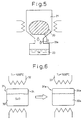
- Fig. 5 shows an apparatus in which the Si produced upon heating of the SiO solid for production of high purity Si is separated and recovered in molten form from the SiO solid and/or SiO 2 .
- the heat treatment vessel for heat treatment of the SiO solid preferably has a construction allowing heating up to the melting point of Si, since the Si produced in the heat treatment vessel will be in molten form and aggregation and growth will be mutually promoted.
- the material used for the heat treatment vessel may be high purity quartz, high purity ceramic, a carbon surface coated with silicon carbide, or the like. A carbon surface coated with silicon carbide may be obtained by heating carbon to about 1610°C while contacting it with SiO gas.
- Providing means for drawing out the molten Si (23a), such as a mesh 22, at the lower end of the heat treatment vessel 21 heating the SiO solid 20 such as shown in Fig. 5 will allow easy separation and recovery of the produced Si (23).
- a plurality of heat treatment apparatuses are preferably provided for heating of the SiO solid, with a first heat treatment apparatus 31 that heats the SiO solid 30 in the heating vessel 34 with a heater 32 to a temperature below the melting point of Si, such as 1200°C, and a second heat treatment apparatus 31a that heats the SiO solid 30a in the heating vessel 34a with a heater 33 to a temperature above the melting point of Si, such as 1500°C, and capable of transporting the SiO solid in the heating vessel 34 heated by the first heat treatment apparatus 31 to the heating vessel 34a of the second heat treatment apparatus 31a, thus allowing the temperature to be easily varied between them and consequently allowing the amount of Si product to be increased.
- each heating vessel 34 housing the SiO solid in the first heat treatment apparatus 31 may be transported to the second heat treatment vessel 31a, instead of removing the SiO solid from the heating vessel 34 of the first heat treatment apparatus 31 and transporting it into the heating vessel 34a of the second heat treatment apparatus 31a, as explained above.
- the heating vessel 34 and the heating vessel 34a may be a single integrated vessel, with the SiO solid transported internally.
- This example is an instance of producing high purity Si by heating solid SiO in a closed reaction system.
- a 20 g portion of 99.999% purity SiO solid powder with a particle size of about 0.1 mm was vacuum encapsulated at room temperature in a high purity quartz spherical vessel with an outer diameter of 40 mm and a thickness of 5 mm, and the quartz sphere was subjected to infrared heating to 1500°C at a temperature elevating rate of 80°C/min, and then held at 1500°C for 60 minutes.
- reaction residue other than the Si masses was a highly brittle porous solid, and elemental analysis revealed it to consist of approximately 99% SiO 2 and approximately 1% SiO solid, and in terms of impurities other than Si and O, the purity was about 99.998%.
- the SiO solid starting material contained aluminum at 1 ppm, boron at 1 ppm and phosphorus at 0.1 ppm, while the Si product contained aluminum at 0.05 ppm, boron at 0.1 ppm and phosphorus at 0.1 ppm.
- the reaction residue other than the Si masses contained aluminum at 1.45 ppm, boron at 1.42 ppm and phosphorus at 0.1 ppm.
- This example represents an instance where solid SiO was first held for at least 10 minutes at 1000°C or higher and below the melting point of Si (1412°C), and was then heat treated at a temperature above the melting point of Si.
- Example 1 was repeated, with the only difference from Example 1 being the temperature elevating pattern: the temperature was raised to 1200°C at a rate of 80°C/min, then held at 1200°C for 10 minutes, then raised to 1500°C at a rate of 80°C/min and finally held at 1500°C for 60 minutes.
- This example represents an instance where solid SiO was first held for less than 10 minutes at 1000°C or higher and below the melting point of Si (1412°C), and was then heat treated at a temperature above the melting point of Si.
- Example 1 was repeated, with the only difference from Example 1 being the temperature elevating pattern: the temperature was raised to 1200°C at a rate of 80°C/min, then held at 1200°C for 4 minutes, then raised to 1500°C at a rate of 80°C/min and finally held at 1500°C for 60 minutes.
- This example represents an instance where solid SiO was heated in a vessel with a pressure adjusting pinhole as one type of closed system.
- a 20 g portion of 99.999% purity massive SiO solid with a particle size of about 0.1 mm was placed in a high purity quartz spherical vessel with an outer diameter of 40 mm and a thickness of 5 mm and having a pinhole with a diameter of 30 ⁇ m, and the weight of the entire quartz sphere was measured to be 63.0414 g.
- the quartz sphere was placed in an atmosphere-controllable infrared heating furnace chamber, and the entire chamber was evacuated to the 10 -6 Torr level with an oil rotary pump and a diffusion pump, after which argon with a purity of 99.9999% was introduced to 1 atmosphere.
- the evacuation and argon introduction operation was repeated for a total of 3 times, and the quartz sphere interior and chamber interior were brought to 1 atmosphere argon. Argon was then circulated at 1 L/min while maintaining 1 atmosphere argon in the chamber. Under these conditions, the entire quartz sphere was subjected to infrared heating to 1500°C at a temperature elevating rate of 80°C/min, and then held at 1500°C for 60 minutes.
- the quartz sphere was examined and found to have absolutely no expansion or other deformity, and this suggested that the expanding argon had exited through the pinhole of the quartz sphere during temperature increase and the argon had entered through the pinhole of the quartz sphere during temperature decrease, thus keeping the internal pressure of the quartz sphere at the same 1 atmosphere as the outside of the quartz sphere during heating.
- the weight of the entire quartz sphere after cooling was 62.7126 g, which was a weight decrease of 0.3288 g. This is attributed to leaking of SiO gas from the pinhole of the quartz sphere, resulting in a loss of about 1.6% of the SiO solid.
- reaction residue other than the Si masses was a highly brittle porous solid, and elemental analysis revealed it to consist of approximately 99% SiO 2 and approximately 1% SiO solid, and in terms of impurities other than Si and O, the purity was about 99.998%.
- the SiO solid starting material contained aluminum at 1 ppm, boron at 1 ppm and phosphorus at 0.1 ppm, while the Si product contained aluminum at 0.05 ppm, boron at 0.1 ppm and phosphorus at 0.08 ppm.
- the reaction residue other than the Si masses contained aluminum at 1.46 ppm, boron at 1.44 ppm and phosphorus at 0.11 ppm.
- This example represents an instance where solid SiO was heated while circulating an inert gas.
- a 20 g portion of 99.999% purity massive SiO solid with a size of about 10 mm was placed in a high purity quartz tube with a diameter of 20 mm and while circulating argon with a purity of 99.9999% at 0.003 L/min and 1 atmosphere, it was subjected to infrared heating to 1500°C at a temperature elevating rate of 80°C/min, and then held at 1500°C for 60 minutes.
- the weight of the contents of the quartz tube was measured to be 19.5126 g, which was a weight reduction of 0.4874 g. This is attributed to discharge of SiO gas with the argon, resulting in a loss of about 2.4% of the SiO solid.
- the SiO solid starting material contained aluminum at 1 ppm, boron at 1 ppm and phosphorus at 0.1 ppm, while the Si product contained aluminum at 0.05 ppm, boron at 0.1 ppm and phosphorus at 0.07 ppm.
- the reaction residue other than the Si masses contained aluminum at 1.46 ppm, boron at 1.44 ppm and phosphorus at 0.12 ppm.
- This comparative example represents an instance where solid SiO was heated at below 1000°C.
- the SiO solid was heat treated under the same conditions as Example 5 except that the holding temperature was 950°C, and the weight of the contents after cooling was measured to be still 20 g, showing no weight decrease.
- the reaction product remaining in the quartz tube showed no change from before heat treatment, and washing with hydrofluoric acid dissolved the entire amount, indicating no production of Si.
- Example 5 was repeated, but the SiO solid was heat treated with the holding temperature at 1050°C. The weight of the contents after cooling was measured to be still 20 g, showing no weight decrease.
- the SiO solid starting material contained aluminum at 1 ppm, boron at 1 ppm and phosphorus at 0.1 ppm, while the Si product contained aluminum at 0.05 ppm, boron at 0.1 ppm and phosphorus at 0.07 ppm.
- a 20 g portion of 99.999% purity massive SiO solid with a size of about 10 mm was placed in a high purity silicon carbide tube with a diameter of 20 mm and, while circulating argon with a purity of 99.9999% at 0.003 L/min and 1 atmosphere, it was heated with an induction heated carbon tube to 1700°C at a temperature elevating rate of 80°C/min, and then held at 1700°C for 60 minutes. After cooling, the weight of the contents of the silicon carbide tube was measured to be 19.3586 g, which was a weight reduction of 0.6414 g. This is attributed to discharge of SiO gas with the argon, resulting in a loss of about 3.2% of the SiO solid.
- the SiO solid starting material contained aluminum at 1 ppm, boron at 1 ppm and phosphorus at 0.1 ppm, while the Si product contained aluminum at 0.05 ppm, boron at 0.1 ppm and phosphorus at 0.05 ppm.
- the reaction residue other than the Si masses contained aluminum at 1.65 ppm, boron at 1.63 ppm and phosphorus at 0.15 ppm.
- This comparative example demonstrates that when solid SiO is heated at above 1730°C, the amount of Si produced is small, and the purity of the Si that is obtained is not improved over the purity of the solid SiO starting material.
- the SiO solid was heat treated under the same conditions as Example 7 except that the holding temperature was 1770°C, and after cooling, the weight of the contents of the silicon carbide tube was measured to be 16.0411 g, which was a weight reduction of 3.9589 g. This is attributed to discharge of SiO gas with the argon, resulting in a loss of about 19.8% of the SiO solid.
- the reaction product remaining in the silicon carbide tube revealed glassy masses, and washing with hydrofluoric acid left a minute residue, which when filtered and collected was measured to be a total of 2.2 g and by elemental analysis was identified as Si with a purity of 99.999%.
- the SiO solid starting material contained aluminum at 1 ppm, boron at 1 ppm and phosphorus at 0.1 ppm, while these impurities were detected in the same amounts in the Si product.
- This example represents an instance where solid SiO was heat treated while circulating an oxidizing gas.
- a 20 g portion of 99.999% purity massive SiO solid with a size of about 10 mm was placed in a high purity quartz tube with a diameter of 20 mm and while circulating nitrogen with a purity of 99.9999% and oxygen with a purity of 99.9999% as a gas mixture in a proportion of 4:1 at 0.003 L/min and 1 atmosphere, it was subjected to infrared heating to 1500°C at a temperature elevating rate of 80°C/min, and then held at 1500°C for 60 minutes.
- the weight of the contents of the quartz tube was measured to be 19.8814 g, which was a weight reduction of 0.1186 g. This is attributed to discharge and loss of the SiO gas with the mixed gas despite increase in the SiO solid by partial oxidation.
- the SiO solid starting material contained aluminum at 1 ppm, boron at 1 ppm and phosphorus at 0.1 ppm, while the Si product contained aluminum at 0.04 ppm, boron at 0.08 ppm and phosphorus at 0.06 ppm.
- the reaction residue other than the Si masses contained aluminum at 1.40 ppm, boron at 1.39 ppm and phosphorus at 0.12 ppm.
- This reference example represents an instance where in the molar ratio of Si and SiO 2 , 1:x, x is larger than about 1.5.
- a 20 g portion of 99.999% purity SiO powder with a mean particle size of 1 ⁇ m was placed in a high purity quartz tube with a diameter of 20 mm, and while circulating nitrogen with a purity of 99.9999% and oxygen with a purity of 99.9999% as a gas mixture in a proportion of 4:1 at 2 L/min and 1 atmosphere, it was subjected to infrared heating to 1500°C at a temperature elevating rate of 80°0/min, and then held at 1500°C for 60 minutes.
- the weight of the contents of the quartz tube was measured to be 21.2626 g, which was a weight increase of 1.2626 g. This is attributed to increase in the SiO solid by partial oxidation, despite discharge of a portion of the SiO gas with the mixed gas.
- the SiO solid starting material contained aluminum at 1 ppm, boron at 1 ppm and phosphorus at 0.1 ppm, while the Si product contained aluminum at 0.03 ppm, boron at 0.06 ppm and phosphorus at 0.05 ppm.
- the reaction residue other than the Si masses contained aluminum at 1.21 ppm, boron at 1.20 ppm and phosphorus at 0.11 ppm.
- Reference Example 1 demonstrates that when x is greater than 1.5 in the Si:SiO 2 molar ratio of 1:x, the amount of Si produced is lower.
- This example represents an instance where solid SiO was heat treated while circulating a reducing gas.
- a 20 g portion of 99.999% purity massive SiO solid with a size of about 10 mm was placed in a high purity quartz tube with a diameter of 20 mm and while circulating hydrogen with a purity of 99.9999% at 0.003 L/min and 1 atmosphere, it was subjected to infrared heating to 1500°C at a temperature elevating rate of 80°C/min, and then held at 1500°C for 60 minutes. After cooling, the weight of the contents of the quartz tube was measured to be 19.5124 g, which was a weight reduction of 0.4876 g. This is attributed to discharge of the SiO gas with the hydrogen as well as slight reduction of the SiO solid by hydrogen, but it was essentially insignificant compared to Example 3 where argon was circulated.
- the SiO solid starting material contained aluminum at 1 ppm, boron at 1 ppm and phosphorus at 0.1 ppm, while the Si product contained aluminum at 0.06 ppm, boron at 0.12 ppm and phosphorus at 0.09 ppm.
- the reaction residue other than the Si masses contained aluminum at 1.43 ppm, boron at 1.41 ppm and phosphorus at 0.11 ppm.
- This reference example represents an instance where in the molar ratio of Si and SiO 2 , 1:x, x is smaller than about 0.5.
- a 2 g portion of 99.999% purity SiO powder with a mean particle size of 1 ⁇ m was placed in a high purity quartz tube with a diameter of 80 mm, and while circulating hydrogen with a purity of 99.9999% at 300 L/min and 1 atmosphere, it was subjected to infrared heating to 1500°C at a temperature elevating rate of 80°C/min, and then held at 1500°C for 60 minutes. After cooling, the weight of the contents of the guartz tube was measured to be 1.7398 g, which was a weight decrease of 0.2602 g. This is attributed to discharge of SiO gas with the hydrogen, as well as reduction by the SiO solid.
- the SiO solid starting material contained aluminum at 1 ppm, boron at 1 ppm and phosphorus at 0.1 ppm, while the Si product contained aluminum at 1.31 ppm, boron at 1.32 ppm and phosphorus at 0.15 ppm.
- the reaction residue other than the Si masses contained aluminum at 1.25 ppm, boron at 1.23 ppm and phosphorus at 0.09 ppm.
- this reference example demonstrates that when x is smaller than 0.5 in the Si:SiO 2 molar ratio of 1:x, a problem occurs in that the impurities concentrate in the Si product.
- This example demonstrates that when using an apparatus with a plate for high temperature impurity removal from low purity C and low purity silicon and a solid SiO recovery quartz plate kept at 950°C, it is possible to obtain solid SiO with a purity of at least 100,000 times greater than the starting material and it is highly effective for removal of phosphorus and boron.
- a mixture of 20 g of 98% purity C granulated to a particle size of about 1 mm and 100 g of 97% purity silicon with a mean particle size of about 0.2 mm was placed in a quartz reaction vessel and heated to 1450°C for 40 minutes with infrared rays under reduced pressure with an oil rotary pump.
- the generated gas was passed through a curved tube whereby the temperature was gradually lowered from 1450°C to 1020°C in order to remove the high temperature-depositing impurities, and then after blowing onto a high temperature impurity removal plate kept at 1020 °C, it was blown onto a solid SiO recovery quartz plate kept at 950°C and the rear end thereof was evacuated with the oil rotary pump through a gas cooling pipe.
- the solid SiO recovery quartz plate had adhesion of approximately 71 g of a reddish brown glassy solid, and elemental analysis thereof identified it as SiO solid with a purity of 99.9999% or greater.
- the C in the starting material included boron at about 40 ppm, phosphorus at about 50 ppm, aluminum at about 35 ppm and iron at about 70 ppm, while the silicon included boron at about 30 ppm, phosphorus at about 25 ppm, aluminum at about 150 ppm and iron at about 60 ppm; iron and phosphorus were not detected in the deposited SiO solid, but boron and aluminum were detected at 0.08 ppm and 0.1 ppm, respectively.
- the gas cooling pipe had deposition of about 0.05 g of impurities other than elemental Si, and phosphorus was only detected at a location from 200-100°C in the gas cooling pipe. A total of a few grams of white residue remained in the quartz vessel.
- This example demonstrates that when using an apparatus with a graduated temperature cooling section, it is possible to obtain solid SiO with a purity of at least 100,000 times greater than the starting material from low purity carbon and low purity silicon, it is highly effective for removal of phosphorus and boron, and it is possible to obtain SiO solid in powder form by cooling.
- a mixture of 20 g of 98% purity C granulated to a particle size of about 1 mm and 100 g of 97% purity silicon with a mean particle size of about 0.2 mm was placed in a quartz reaction vessel and heated to 1450°C for 30 minutes with infrared rays while circulating high purity argon at 10 L/min.
- the generated gas was passed through a 150 cm-long quartz tube whereby the temperature was gradually lowered from 1450°C to room temperature, and then exhausted out.
- the region of the quartz tube that had been heated to 1050-1000°C was found to have deposition of about 70 g of an ochre-colored powder, and elemental analysis thereof identified it as SiO solid with a purity of 99.9999% or greater.
- the C in the starting material included boron at about 40 ppm, phosphorus at about 50 ppm, aluminum at about 35 ppm and iron at about 70 ppm, while the silicon included boron at about 30 ppm, phosphorus at about 25 ppm, aluminum at about 150 ppm and iron at about 60 ppm; iron and phosphorus were not detected in the deposited SiO solid, but boron and aluminum were detected at 0.07 ppm and 0.08 ppm, respectively. A total of a few grams of white residue remained in the quartz vessel.
- the section at higher than 1050°C had about 0.5 g of adhesion and the section at lower than 1000°C had a few grams of adhesion; no elemental Si was detected therein by elemental analysis, and phosphorus was detected only at the location from 250-150°C.
- the present invention may be employed to produce high purity Si simply and inexpensively. It provides a process allowing inexpensive production of Si with a purity of about 99.999% or higher that can be used for solar batteries.
- constituent elemental metals such as the SiO utilized for the invention, and here the obtained Si can be rendered to higher purity than the SiO solid starting material.
- the invention is also a very effective process against impurities such as phosphorus and boron that are difficult to remove by solidifying production utilizing segregation coefficients, and it allows removal of virtually all impurities by vapor pressure differences and temperature gradients of the deposition sections.
Landscapes
- Chemical & Material Sciences (AREA)
- Organic Chemistry (AREA)
- Inorganic Chemistry (AREA)
- Chemical Kinetics & Catalysis (AREA)
- Silicon Compounds (AREA)
Applications Claiming Priority (5)
| Application Number | Priority Date | Filing Date | Title |
|---|---|---|---|
| JP35765697 | 1997-12-25 | ||
| JP35765697 | 1997-12-25 | ||
| JP7612198 | 1998-03-24 | ||
| JP7612198 | 1998-03-24 | ||
| PCT/JP1998/005968 WO1999033749A1 (fr) | 1997-12-25 | 1998-12-25 | PROCEDE DE PREPARATION DE Si EXTREMEMENT PUR, ET EQUIPEMENT POUR LA MISE EN OEUVRE DE CE PROCEDE |
Publications (3)
| Publication Number | Publication Date |
|---|---|
| EP1057782A1 true EP1057782A1 (fr) | 2000-12-06 |
| EP1057782A4 EP1057782A4 (fr) | 2004-03-24 |
| EP1057782B1 EP1057782B1 (fr) | 2004-12-15 |
Family
ID=26417274
Family Applications (1)
| Application Number | Title | Priority Date | Filing Date |
|---|---|---|---|
| EP98961611A Expired - Lifetime EP1057782B1 (fr) | 1997-12-25 | 1998-12-25 | PROCEDE DE PREPARATION DE Si EXTREMEMENT PUR, ET EQUIPEMENT POUR LA MISE EN OEUVRE DE CE PROCEDE |
Country Status (11)
| Country | Link |
|---|---|
| US (1) | US6395249B1 (fr) |
| EP (1) | EP1057782B1 (fr) |
| JP (1) | JP3735253B2 (fr) |
| CN (1) | CN1207192C (fr) |
| AU (1) | AU738233C (fr) |
| BR (1) | BR9814468A (fr) |
| CA (1) | CA2316180C (fr) |
| DE (1) | DE69828201T2 (fr) |
| ES (1) | ES2234170T3 (fr) |
| NO (1) | NO330157B1 (fr) |
| WO (1) | WO1999033749A1 (fr) |
Cited By (3)
| Publication number | Priority date | Publication date | Assignee | Title |
|---|---|---|---|---|
| WO2004009493A1 (fr) * | 2002-07-23 | 2004-01-29 | Nippon Steel Corporation | Procede de production de silicium |
| EP2796409A4 (fr) * | 2011-12-21 | 2015-09-23 | Bridgestone Corp | Procédé et appareil destinés à la production de microparticules de silicium |
| EP2607311A4 (fr) * | 2010-08-19 | 2016-06-15 | Bridgestone Corp | Méthode de production de microparticules de silicium |
Families Citing this family (40)
| Publication number | Priority date | Publication date | Assignee | Title |
|---|---|---|---|---|
| JP4511926B2 (ja) * | 2002-06-18 | 2010-07-28 | チバ ホールディング インコーポレーテッド | ケイ素/酸化ケイ素の面平行な構造 |
| RU2237015C2 (ru) * | 2002-07-22 | 2004-09-27 | Общество с ограниченной ответственностью "Компания ЭнергоРегионСервис" | Способ получения диоксида кремния из отходов ферросплавного производства |
| NO333319B1 (no) * | 2003-12-29 | 2013-05-06 | Elkem As | Silisiummateriale for fremstilling av solceller |
| JP2005206440A (ja) * | 2004-01-26 | 2005-08-04 | Nippon Steel Corp | 高純度シリコン製造方法 |
| JP2005206441A (ja) * | 2004-01-26 | 2005-08-04 | Nippon Steel Corp | 高純度Si製造用原材料及びその製造方法 |
| JP4672264B2 (ja) * | 2004-01-29 | 2011-04-20 | 新日鉄マテリアルズ株式会社 | SiOの精製方法及び得られたSiOを用いる高純度シリコンの製造方法 |
| JP2005220002A (ja) * | 2004-02-09 | 2005-08-18 | Nippon Steel Corp | SiOの精製装置、かかる精製装置を用いるSiOの精製方法及び得られたSiOを用いる高純度シリコンの製造方法 |
| JP4731818B2 (ja) * | 2004-02-10 | 2011-07-27 | 新日鉄マテリアルズ株式会社 | 高純度SiO固体の製造方法及び製造装置 |
| JP2005225729A (ja) * | 2004-02-13 | 2005-08-25 | Nippon Steel Corp | SiOの精製装置、かかる装置を用いるSiOの精製方法及び高純度シリコンの製造方法 |
| DE102004010055A1 (de) * | 2004-03-02 | 2005-09-22 | Degussa Ag | Verfahren zur Herstellung von Silicium |
| CN100486000C (zh) * | 2004-07-29 | 2009-05-06 | 株式会社大阪钛技术 | 二次电池用SiO粉末及其制造方法 |
| JP4674349B2 (ja) * | 2004-10-19 | 2011-04-20 | 独立行政法人物質・材料研究機構 | 結晶性珪素マイクロチューブ及びその製造方法 |
| JP4980603B2 (ja) * | 2005-10-19 | 2012-07-18 | 株式会社ブリヂストン | ケイ素微粒子の製造方法 |
| US7955583B2 (en) | 2006-08-31 | 2011-06-07 | Mitsubishi Materials Corporation | Metallic silicon and method for manufacturing the same |
| JP5218934B2 (ja) * | 2006-08-31 | 2013-06-26 | 三菱マテリアル株式会社 | 金属シリコンとその製造方法 |
| DE102006056482B4 (de) * | 2006-11-30 | 2010-07-15 | Sunicon Ag | Vorrichtung und Verfahren zum Aufbereiten von Nichteisenmetallen |
| CN103351000A (zh) * | 2007-04-25 | 2013-10-16 | 卡甘·塞兰 | 通过大表面积气-固界面及液相再生沉积高纯硅 |
| JP5311930B2 (ja) * | 2007-08-29 | 2013-10-09 | 住友化学株式会社 | シリコンの製造方法 |
| CN101122047B (zh) * | 2007-09-14 | 2011-02-16 | 李绍光 | 一种太阳能电池用多晶硅制造方法 |
| JP5022848B2 (ja) * | 2007-09-26 | 2012-09-12 | 新日鉄マテリアルズ株式会社 | SiO粉体の製造方法及び製造装置 |
| US8167981B2 (en) * | 2009-04-21 | 2012-05-01 | Spx Corporation | Vacuum filter assembly |
| CN101787562A (zh) * | 2010-02-10 | 2010-07-28 | 李绍光 | 一种联体式真空高温歧化反应装置 |
| CN102671581B (zh) * | 2011-05-11 | 2014-08-20 | 储晞 | 生产颗粒材料的方法和反应器 |
| CN102249243B (zh) * | 2011-06-08 | 2012-12-26 | 大连理工大学 | 一种冶金法去除工业硅中杂质硼的方法 |
| CN102323136B (zh) * | 2011-08-02 | 2013-07-10 | 重庆密奥仪器有限公司 | 检测高纯硅成分分析用的挥硅实验装置 |
| CN102491335A (zh) * | 2011-11-30 | 2012-06-13 | 奇瑞汽车股份有限公司 | 一种纳米硅颗粒的制备方法及含有该纳米硅颗粒的负极材料及锂离子电池 |
| US9114989B2 (en) * | 2011-12-07 | 2015-08-25 | Praxair Technology, Inc. | Inert gas recovery and recycle for silicon crystal growth pulling process |
| CN102583387B (zh) * | 2012-02-03 | 2014-04-02 | 厦门大学 | 一种采用二次合金法提纯多晶硅的方法 |
| CN102530949A (zh) * | 2012-03-02 | 2012-07-04 | 李绍光 | 一种电磁悬浮液固分离方法和装置 |
| WO2014157154A1 (fr) * | 2013-03-29 | 2014-10-02 | 信越化学工業株式会社 | Procédé et appareil de production d'oxyde de silicium |
| CN103626184B (zh) * | 2013-07-31 | 2016-02-24 | 浙江精功新材料技术有限公司 | 一种高纯液体多晶硅的制备方法 |
| CN103395836B (zh) * | 2013-08-15 | 2015-01-07 | 蚌埠中恒新材料科技有限责任公司 | 用电弧炉熔制锆英砂时生成一氧化硅的收集装置 |
| US11434138B2 (en) | 2017-10-27 | 2022-09-06 | Kevin Allan Dooley Inc. | System and method for manufacturing high purity silicon |
| CN109796017A (zh) * | 2019-04-03 | 2019-05-24 | 昆明理工大学 | 一种高纯纳米一氧化硅的制备方法 |
| CN114026714B (zh) | 2019-05-20 | 2024-11-19 | 纳诺格拉夫公司 | 包含低缺陷乱层碳的阳极活性材料 |
| CN111056556A (zh) * | 2019-12-26 | 2020-04-24 | 黄冈师范学院 | 一种以二氧化硅和氢气为原料制备多晶硅的方法 |
| CN113213483B (zh) * | 2021-04-14 | 2022-07-19 | 三峡大学 | 一种用于锂离子电池负极材料的非晶硅粉制备方法 |
| CN113501527B (zh) * | 2021-09-06 | 2021-11-16 | 北京壹金新能源科技有限公司 | 一种制备一氧化硅的方法 |
| US20230102190A1 (en) * | 2021-09-29 | 2023-03-30 | GM Global Technology Operations LLC | Negative electroactive materials and methods of forming the same |
| CN115196642B (zh) * | 2022-07-04 | 2023-09-26 | 柯瑞林 | 一种二氧化硅的提纯方法 |
Family Cites Families (18)
| Publication number | Priority date | Publication date | Assignee | Title |
|---|---|---|---|---|
| US875285A (en) | 1905-06-10 | 1907-12-31 | Geo Westinghouse | Method of making silicon. |
| BE527032A (fr) * | 1953-03-19 | |||
| US3010797A (en) | 1957-07-26 | 1961-11-28 | Robert S Aries | High purity elemental silicon |
| BE759122A (fr) | 1969-11-19 | 1971-05-18 | Union Carbide Corp | Procede et charge de production de silicium au four a arc electrique par reduction carbothermique de silice |
| JPS531762B2 (fr) | 1973-01-13 | 1978-01-21 | ||
| JPS5950601B2 (ja) | 1982-07-05 | 1984-12-10 | 文雄 堀 | アモルフアス状SiOの超微粉とその製造方法ならびに製造装置 |
| JPS6227313A (ja) | 1985-07-26 | 1987-02-05 | Nippon Kasei Kk | スルフアミドの精製方法 |
| JPS6227318A (ja) * | 1985-07-29 | 1987-02-05 | Kawasaki Steel Corp | Sio微粉末の製造方法およびその装置 |
| JPH0694365B2 (ja) | 1985-11-22 | 1994-11-24 | 日本電信電話株式会社 | ケイ素の製造方法および製造装置 |
| US4981668A (en) * | 1986-04-29 | 1991-01-01 | Dow Corning Corporation | Silicon carbide as a raw material for silicon production |
| US4702902A (en) * | 1986-04-29 | 1987-10-27 | Dow Corning Corporation | Handling of by-product gases from a silicon furnace |
| JPS6379717A (ja) * | 1986-09-24 | 1988-04-09 | Kawasaki Steel Corp | 金属珪素の製造方法およびその装置 |
| JPS63103815A (ja) | 1986-10-17 | 1988-05-09 | Kawasaki Steel Corp | SiO微粉末等の連続製造装置 |
| JPS63103814A (ja) | 1986-10-17 | 1988-05-09 | Kawasaki Steel Corp | SiO微粉末の製造装置 |
| US5009703A (en) * | 1990-08-13 | 1991-04-23 | Dow Corning Corporation | Silicon smelting process in direct current furnace |
| JP3263104B2 (ja) * | 1991-11-27 | 2002-03-04 | 川崎製鉄株式会社 | 金属シリコンの精製方法 |
| JPH05171412A (ja) | 1991-12-18 | 1993-07-09 | Mitsubishi Heavy Ind Ltd | 一酸化ケイ素蒸着用材料の製造方法 |
| JPH0717704A (ja) * | 1993-06-24 | 1995-01-20 | Kawasaki Steel Corp | 電子ビーム溶解によるシリコンの精錬方法 |
-
1998
- 1998-12-25 CN CN98813207.9A patent/CN1207192C/zh not_active Expired - Fee Related
- 1998-12-25 DE DE69828201T patent/DE69828201T2/de not_active Expired - Lifetime
- 1998-12-25 AU AU16911/99A patent/AU738233C/en not_active Ceased
- 1998-12-25 JP JP2000526444A patent/JP3735253B2/ja not_active Expired - Fee Related
- 1998-12-25 ES ES98961611T patent/ES2234170T3/es not_active Expired - Lifetime
- 1998-12-25 WO PCT/JP1998/005968 patent/WO1999033749A1/fr not_active Ceased
- 1998-12-25 US US09/582,383 patent/US6395249B1/en not_active Expired - Fee Related
- 1998-12-25 EP EP98961611A patent/EP1057782B1/fr not_active Expired - Lifetime
- 1998-12-25 CA CA002316180A patent/CA2316180C/fr not_active Expired - Fee Related
- 1998-12-25 BR BR9814468-5A patent/BR9814468A/pt not_active IP Right Cessation
-
2000
- 2000-06-23 NO NO20003316A patent/NO330157B1/no not_active IP Right Cessation
Cited By (4)
| Publication number | Priority date | Publication date | Assignee | Title |
|---|---|---|---|---|
| WO2004009493A1 (fr) * | 2002-07-23 | 2004-01-29 | Nippon Steel Corporation | Procede de production de silicium |
| US7455822B2 (en) | 2002-07-23 | 2008-11-25 | Nippon Steel Corporation | Method for production of silicon |
| EP2607311A4 (fr) * | 2010-08-19 | 2016-06-15 | Bridgestone Corp | Méthode de production de microparticules de silicium |
| EP2796409A4 (fr) * | 2011-12-21 | 2015-09-23 | Bridgestone Corp | Procédé et appareil destinés à la production de microparticules de silicium |
Also Published As
| Publication number | Publication date |
|---|---|
| NO20003316D0 (no) | 2000-06-23 |
| NO330157B1 (no) | 2011-02-28 |
| NO20003316L (no) | 2000-08-14 |
| ES2234170T3 (es) | 2005-06-16 |
| DE69828201D1 (de) | 2005-01-20 |
| CN1207192C (zh) | 2005-06-22 |
| CA2316180A1 (fr) | 1999-07-08 |
| AU738233C (en) | 2002-10-24 |
| BR9814468A (pt) | 2000-10-10 |
| US6395249B1 (en) | 2002-05-28 |
| EP1057782B1 (fr) | 2004-12-15 |
| AU1691199A (en) | 1999-07-19 |
| DE69828201T2 (de) | 2005-12-15 |
| CN1284046A (zh) | 2001-02-14 |
| JP3735253B2 (ja) | 2006-01-18 |
| AU738233B2 (en) | 2001-09-13 |
| WO1999033749A1 (fr) | 1999-07-08 |
| CA2316180C (fr) | 2004-04-20 |
| EP1057782A4 (fr) | 2004-03-24 |
Similar Documents
| Publication | Publication Date | Title |
|---|---|---|
| EP1057782B1 (fr) | PROCEDE DE PREPARATION DE Si EXTREMEMENT PUR, ET EQUIPEMENT POUR LA MISE EN OEUVRE DE CE PROCEDE | |
| JPWO1999033749A1 (ja) | 高純度Siの製造方法および装置 | |
| JP4800540B2 (ja) | 312相材料の製造方法及びその焼結方法 | |
| JP5476637B2 (ja) | ゲッターによる多結晶グループiiiの金属窒化物および作製方法 | |
| US20110085960A1 (en) | Method of manufacturing high-surface-area silicon | |
| US9388509B2 (en) | Method for synthesizing ultrahigh-purity silicon carbide | |
| CN101379227A (zh) | 晶体组合物、装置及其制备方法 | |
| WO2015012954A1 (fr) | Procédé pour synthétiser du carbure de silicium de ultrahaute pureté | |
| JPWO1999014405A1 (ja) | 炭化珪素単結晶を製造する方法および装置 | |
| JP2011219286A (ja) | シリコン及び炭化珪素の製造方法及び製造装置 | |
| NO894770L (no) | Fremgangsmaate ved fremstilling av aluminiumnitrid. | |
| JPS6111886B2 (fr) | ||
| JPH0352402B2 (fr) | ||
| JP2721678B2 (ja) | β−炭化珪素成形体及びその製造法 | |
| Gadzyra et al. | Mechanism for the formation of a solid solution of carbon in silicon carbide | |
| JPS5930645B2 (ja) | 高純度α型窒化珪素の製造法 | |
| JPS5820799A (ja) | 炭化珪素ウイスカ−の製造法 | |
| US4869892A (en) | Methods of making fine particulate aluminum nitride | |
| RU2799378C1 (ru) | Способ получения порошка карбида кремния | |
| JPS6168310A (ja) | シリコン切粉を原料とする高純度窒化けい素の製造方法 | |
| JP3482480B2 (ja) | 耐酸化性に優れた黒鉛−炭化珪素複合体及びその製造方法 | |
| JPH0891832A (ja) | 高純度フッ化アルミニウム及びその製造方法 | |
| JPH02289457A (ja) | セラミック粉末の炭素含量を減ずる方法 | |
| JPH0465002B2 (fr) | ||
| JPS6111885B2 (fr) |
Legal Events
| Date | Code | Title | Description |
|---|---|---|---|
| PUAI | Public reference made under article 153(3) epc to a published international application that has entered the european phase |
Free format text: ORIGINAL CODE: 0009012 |
|
| 17P | Request for examination filed |
Effective date: 20000724 |
|
| AK | Designated contracting states |
Kind code of ref document: A1 Designated state(s): DE ES FR GB IT NL |
|
| A4 | Supplementary search report drawn up and despatched |
Effective date: 20040205 |
|
| GRAP | Despatch of communication of intention to grant a patent |
Free format text: ORIGINAL CODE: EPIDOSNIGR1 |
|
| GRAS | Grant fee paid |
Free format text: ORIGINAL CODE: EPIDOSNIGR3 |
|
| GRAA | (expected) grant |
Free format text: ORIGINAL CODE: 0009210 |
|
| AK | Designated contracting states |
Kind code of ref document: B1 Designated state(s): DE ES FR GB IT NL |
|
| REG | Reference to a national code |
Ref country code: GB Ref legal event code: FG4D |
|
| REF | Corresponds to: |
Ref document number: 69828201 Country of ref document: DE Date of ref document: 20050120 Kind code of ref document: P |
|
| REG | Reference to a national code |
Ref country code: ES Ref legal event code: FG2A Ref document number: 2234170 Country of ref document: ES Kind code of ref document: T3 |
|
| PLBE | No opposition filed within time limit |
Free format text: ORIGINAL CODE: 0009261 |
|
| STAA | Information on the status of an ep patent application or granted ep patent |
Free format text: STATUS: NO OPPOSITION FILED WITHIN TIME LIMIT |
|
| 26N | No opposition filed |
Effective date: 20050916 |
|
| ET | Fr: translation filed | ||
| PGFP | Annual fee paid to national office [announced via postgrant information from national office to epo] |
Ref country code: NL Payment date: 20081215 Year of fee payment: 11 |
|
| PGFP | Annual fee paid to national office [announced via postgrant information from national office to epo] |
Ref country code: IT Payment date: 20081223 Year of fee payment: 11 |
|
| PGFP | Annual fee paid to national office [announced via postgrant information from national office to epo] |
Ref country code: FR Payment date: 20081212 Year of fee payment: 11 Ref country code: ES Payment date: 20090113 Year of fee payment: 11 |
|
| PGFP | Annual fee paid to national office [announced via postgrant information from national office to epo] |
Ref country code: GB Payment date: 20081224 Year of fee payment: 11 |
|
| REG | Reference to a national code |
Ref country code: NL Ref legal event code: V1 Effective date: 20100701 |
|
| GBPC | Gb: european patent ceased through non-payment of renewal fee |
Effective date: 20091225 |
|
| REG | Reference to a national code |
Ref country code: FR Ref legal event code: ST Effective date: 20100831 |
|
| PG25 | Lapsed in a contracting state [announced via postgrant information from national office to epo] |
Ref country code: NL Free format text: LAPSE BECAUSE OF NON-PAYMENT OF DUE FEES Effective date: 20100701 Ref country code: FR Free format text: LAPSE BECAUSE OF NON-PAYMENT OF DUE FEES Effective date: 20091231 |
|
| PG25 | Lapsed in a contracting state [announced via postgrant information from national office to epo] |
Ref country code: GB Free format text: LAPSE BECAUSE OF NON-PAYMENT OF DUE FEES Effective date: 20091225 |
|
| REG | Reference to a national code |
Ref country code: ES Ref legal event code: FD2A Effective date: 20110323 |
|
| PG25 | Lapsed in a contracting state [announced via postgrant information from national office to epo] |
Ref country code: IT Free format text: LAPSE BECAUSE OF NON-PAYMENT OF DUE FEES Effective date: 20091225 |
|
| PG25 | Lapsed in a contracting state [announced via postgrant information from national office to epo] |
Ref country code: ES Free format text: LAPSE BECAUSE OF NON-PAYMENT OF DUE FEES Effective date: 20110310 |
|
| PG25 | Lapsed in a contracting state [announced via postgrant information from national office to epo] |
Ref country code: ES Free format text: LAPSE BECAUSE OF NON-PAYMENT OF DUE FEES Effective date: 20091226 |
|
| REG | Reference to a national code |
Ref country code: DE Ref legal event code: R082 Ref document number: 69828201 Country of ref document: DE Representative=s name: VOSSIUS & PARTNER PATENTANWAELTE RECHTSANWAELT, DE Effective date: 20130227 Ref country code: DE Ref legal event code: R082 Ref document number: 69828201 Country of ref document: DE Representative=s name: VOSSIUS & PARTNER, DE Effective date: 20130227 Ref country code: DE Ref legal event code: R081 Ref document number: 69828201 Country of ref document: DE Owner name: NIPPON STEEL & SUMITOMO METAL CORPORATION, JP Free format text: FORMER OWNER: NIPPON STEEL CORP., TOKIO/TOKYO, JP Effective date: 20130227 |
|
| PGFP | Annual fee paid to national office [announced via postgrant information from national office to epo] |
Ref country code: DE Payment date: 20121219 Year of fee payment: 15 |
|
| REG | Reference to a national code |
Ref country code: DE Ref legal event code: R119 Ref document number: 69828201 Country of ref document: DE |
|
| REG | Reference to a national code |
Ref country code: DE Ref legal event code: R119 Ref document number: 69828201 Country of ref document: DE Effective date: 20140701 |
|
| PG25 | Lapsed in a contracting state [announced via postgrant information from national office to epo] |
Ref country code: DE Free format text: LAPSE BECAUSE OF NON-PAYMENT OF DUE FEES Effective date: 20140701 |