EP1065314A1 - Verfahren zur Herstellung von Papierprodukten - Google Patents
Verfahren zur Herstellung von Papierprodukten Download PDFInfo
- Publication number
- EP1065314A1 EP1065314A1 EP00401639A EP00401639A EP1065314A1 EP 1065314 A1 EP1065314 A1 EP 1065314A1 EP 00401639 A EP00401639 A EP 00401639A EP 00401639 A EP00401639 A EP 00401639A EP 1065314 A1 EP1065314 A1 EP 1065314A1
- Authority
- EP
- European Patent Office
- Prior art keywords
- broken
- pulp
- pulper
- carbon dioxide
- treatment
- Prior art date
- Legal status (The legal status is an assumption and is not a legal conclusion. Google has not performed a legal analysis and makes no representation as to the accuracy of the status listed.)
- Granted
Links
- 238000000034 method Methods 0.000 title claims abstract description 66
- 230000008569 process Effects 0.000 title claims abstract description 47
- CURLTUGMZLYLDI-UHFFFAOYSA-N Carbon dioxide Chemical compound O=C=O CURLTUGMZLYLDI-UHFFFAOYSA-N 0.000 claims abstract description 99
- XLYOFNOQVPJJNP-UHFFFAOYSA-N water Substances O XLYOFNOQVPJJNP-UHFFFAOYSA-N 0.000 claims abstract description 68
- 238000011282 treatment Methods 0.000 claims abstract description 66
- 229910002092 carbon dioxide Inorganic materials 0.000 claims abstract description 51
- 239000001569 carbon dioxide Substances 0.000 claims abstract description 42
- 238000010790 dilution Methods 0.000 claims abstract description 39
- 239000012895 dilution Substances 0.000 claims abstract description 39
- 238000002156 mixing Methods 0.000 claims abstract description 32
- 230000020477 pH reduction Effects 0.000 claims abstract description 11
- 238000002360 preparation method Methods 0.000 claims abstract description 9
- 230000000295 complement effect Effects 0.000 claims abstract description 8
- 229920002678 cellulose Polymers 0.000 claims abstract description 6
- 239000001913 cellulose Substances 0.000 claims abstract description 6
- 239000007788 liquid Substances 0.000 claims abstract description 6
- 239000000835 fiber Substances 0.000 claims description 33
- 239000000203 mixture Substances 0.000 claims description 16
- 238000000746 purification Methods 0.000 claims description 13
- 238000004519 manufacturing process Methods 0.000 claims description 12
- 239000003643 water by type Substances 0.000 claims description 9
- 239000000243 solution Substances 0.000 claims description 7
- OKTJSMMVPCPJKN-UHFFFAOYSA-N Carbon Chemical compound [C] OKTJSMMVPCPJKN-UHFFFAOYSA-N 0.000 claims description 3
- 229910052799 carbon Inorganic materials 0.000 claims description 3
- 238000003756 stirring Methods 0.000 claims description 3
- 238000007865 diluting Methods 0.000 claims 1
- 238000002347 injection Methods 0.000 abstract description 13
- 239000007924 injection Substances 0.000 abstract description 13
- 239000000725 suspension Substances 0.000 abstract description 11
- 239000000463 material Substances 0.000 abstract description 7
- 229920001131 Pulp (paper) Polymers 0.000 abstract description 2
- 238000004140 cleaning Methods 0.000 abstract 3
- 239000000123 paper Substances 0.000 description 66
- 239000000047 product Substances 0.000 description 20
- QAOWNCQODCNURD-UHFFFAOYSA-N Sulfuric acid Chemical compound OS(O)(=O)=O QAOWNCQODCNURD-UHFFFAOYSA-N 0.000 description 10
- 239000002253 acid Substances 0.000 description 8
- 235000015927 pasta Nutrition 0.000 description 8
- 230000015572 biosynthetic process Effects 0.000 description 6
- 239000000126 substance Substances 0.000 description 6
- 230000008901 benefit Effects 0.000 description 5
- 239000010893 paper waste Substances 0.000 description 5
- 239000002699 waste material Substances 0.000 description 5
- 241000447437 Gerreidae Species 0.000 description 4
- 239000011248 coating agent Substances 0.000 description 4
- 238000000576 coating method Methods 0.000 description 4
- 238000010586 diagram Methods 0.000 description 4
- -1 mechanical Substances 0.000 description 4
- 238000007670 refining Methods 0.000 description 4
- 150000003467 sulfuric acid derivatives Chemical class 0.000 description 4
- CDBYLPFSWZWCQE-UHFFFAOYSA-L Sodium Carbonate Chemical compound [Na+].[Na+].[O-]C([O-])=O CDBYLPFSWZWCQE-UHFFFAOYSA-L 0.000 description 3
- HEMHJVSKTPXQMS-UHFFFAOYSA-M Sodium hydroxide Chemical compound [OH-].[Na+] HEMHJVSKTPXQMS-UHFFFAOYSA-M 0.000 description 3
- 230000002378 acidificating effect Effects 0.000 description 3
- 239000008135 aqueous vehicle Substances 0.000 description 3
- 230000033228 biological regulation Effects 0.000 description 3
- 239000000356 contaminant Substances 0.000 description 3
- 230000007797 corrosion Effects 0.000 description 3
- 238000005260 corrosion Methods 0.000 description 3
- 238000011084 recovery Methods 0.000 description 3
- 230000006641 stabilisation Effects 0.000 description 3
- 238000011105 stabilization Methods 0.000 description 3
- 238000001665 trituration Methods 0.000 description 3
- 229920003043 Cellulose fiber Polymers 0.000 description 2
- 229920002472 Starch Polymers 0.000 description 2
- 230000009471 action Effects 0.000 description 2
- 238000013019 agitation Methods 0.000 description 2
- 239000011111 cardboard Substances 0.000 description 2
- 239000013043 chemical agent Substances 0.000 description 2
- 230000007423 decrease Effects 0.000 description 2
- 239000002761 deinking Substances 0.000 description 2
- 238000000151 deposition Methods 0.000 description 2
- 239000006185 dispersion Substances 0.000 description 2
- 238000010494 dissociation reaction Methods 0.000 description 2
- 230000005593 dissociations Effects 0.000 description 2
- 238000001035 drying Methods 0.000 description 2
- 239000002657 fibrous material Substances 0.000 description 2
- 239000000945 filler Substances 0.000 description 2
- 238000013467 fragmentation Methods 0.000 description 2
- 238000006062 fragmentation reaction Methods 0.000 description 2
- 238000009499 grossing Methods 0.000 description 2
- 230000006872 improvement Effects 0.000 description 2
- 239000008188 pellet Substances 0.000 description 2
- 238000005453 pelletization Methods 0.000 description 2
- 238000011403 purification operation Methods 0.000 description 2
- 238000004064 recycling Methods 0.000 description 2
- 230000009467 reduction Effects 0.000 description 2
- 230000029219 regulation of pH Effects 0.000 description 2
- 235000019698 starch Nutrition 0.000 description 2
- 239000003981 vehicle Substances 0.000 description 2
- 239000002023 wood Substances 0.000 description 2
- BVKZGUZCCUSVTD-UHFFFAOYSA-M Bicarbonate Chemical compound OC([O-])=O BVKZGUZCCUSVTD-UHFFFAOYSA-M 0.000 description 1
- 229910001018 Cast iron Inorganic materials 0.000 description 1
- QAOWNCQODCNURD-UHFFFAOYSA-L Sulfate Chemical compound [O-]S([O-])(=O)=O QAOWNCQODCNURD-UHFFFAOYSA-L 0.000 description 1
- 239000000654 additive Substances 0.000 description 1
- 239000000853 adhesive Substances 0.000 description 1
- 230000001070 adhesive effect Effects 0.000 description 1
- 150000008044 alkali metal hydroxides Chemical class 0.000 description 1
- AZDRQVAHHNSJOQ-UHFFFAOYSA-N alumane Chemical class [AlH3] AZDRQVAHHNSJOQ-UHFFFAOYSA-N 0.000 description 1
- 239000004411 aluminium Substances 0.000 description 1
- 229910052782 aluminium Inorganic materials 0.000 description 1
- XAGFODPZIPBFFR-UHFFFAOYSA-N aluminium Chemical compound [Al] XAGFODPZIPBFFR-UHFFFAOYSA-N 0.000 description 1
- 238000004458 analytical method Methods 0.000 description 1
- 238000004061 bleaching Methods 0.000 description 1
- 239000007767 bonding agent Substances 0.000 description 1
- 238000003490 calendering Methods 0.000 description 1
- 239000007795 chemical reaction product Substances 0.000 description 1
- 239000003795 chemical substances by application Substances 0.000 description 1
- 230000008021 deposition Effects 0.000 description 1
- 238000004090 dissolution Methods 0.000 description 1
- 239000000975 dye Substances 0.000 description 1
- 230000000694 effects Effects 0.000 description 1
- 230000008030 elimination Effects 0.000 description 1
- 238000003379 elimination reaction Methods 0.000 description 1
- 238000005516 engineering process Methods 0.000 description 1
- 238000001704 evaporation Methods 0.000 description 1
- 230000008020 evaporation Effects 0.000 description 1
- 239000012467 final product Substances 0.000 description 1
- 239000012634 fragment Substances 0.000 description 1
- 239000013505 freshwater Substances 0.000 description 1
- 239000007789 gas Substances 0.000 description 1
- 230000005484 gravity Effects 0.000 description 1
- 229910052739 hydrogen Inorganic materials 0.000 description 1
- 239000001257 hydrogen Substances 0.000 description 1
- 125000002887 hydroxy group Chemical group [H]O* 0.000 description 1
- 239000012535 impurity Substances 0.000 description 1
- 238000010348 incorporation Methods 0.000 description 1
- 238000011221 initial treatment Methods 0.000 description 1
- 230000014759 maintenance of location Effects 0.000 description 1
- 238000006386 neutralization reaction Methods 0.000 description 1
- 239000011087 paperboard Substances 0.000 description 1
- 239000002245 particle Substances 0.000 description 1
- 230000035515 penetration Effects 0.000 description 1
- 239000000049 pigment Substances 0.000 description 1
- 238000007639 printing Methods 0.000 description 1
- 230000000750 progressive effect Effects 0.000 description 1
- 238000004537 pulping Methods 0.000 description 1
- 239000002994 raw material Substances 0.000 description 1
- 230000009257 reactivity Effects 0.000 description 1
- 239000011347 resin Substances 0.000 description 1
- 229920005989 resin Polymers 0.000 description 1
- 235000015067 sauces Nutrition 0.000 description 1
- 238000000926 separation method Methods 0.000 description 1
- 230000035939 shock Effects 0.000 description 1
- 239000007787 solid Substances 0.000 description 1
- 239000008107 starch Substances 0.000 description 1
- 230000003068 static effect Effects 0.000 description 1
- 238000003860 storage Methods 0.000 description 1
- 238000006467 substitution reaction Methods 0.000 description 1
- 229910021653 sulphate ion Inorganic materials 0.000 description 1
- 230000003746 surface roughness Effects 0.000 description 1
- 238000004381 surface treatment Methods 0.000 description 1
- 230000008719 thickening Effects 0.000 description 1
- 238000011144 upstream manufacturing Methods 0.000 description 1
- 238000005406 washing Methods 0.000 description 1
- 235000014101 wine Nutrition 0.000 description 1
- 238000004383 yellowing Methods 0.000 description 1
Images


Classifications
-
- D—TEXTILES; PAPER
- D21—PAPER-MAKING; PRODUCTION OF CELLULOSE
- D21H—PULP COMPOSITIONS; PREPARATION THEREOF NOT COVERED BY SUBCLASSES D21C OR D21D; IMPREGNATING OR COATING OF PAPER; TREATMENT OF FINISHED PAPER NOT COVERED BY CLASS B31 OR SUBCLASS D21G; PAPER NOT OTHERWISE PROVIDED FOR
- D21H11/00—Pulp or paper, comprising cellulose or lignocellulose fibres of natural origin only
- D21H11/14—Secondary fibres
-
- D—TEXTILES; PAPER
- D21—PAPER-MAKING; PRODUCTION OF CELLULOSE
- D21H—PULP COMPOSITIONS; PREPARATION THEREOF NOT COVERED BY SUBCLASSES D21C OR D21D; IMPREGNATING OR COATING OF PAPER; TREATMENT OF FINISHED PAPER NOT COVERED BY CLASS B31 OR SUBCLASS D21G; PAPER NOT OTHERWISE PROVIDED FOR
- D21H17/00—Non-fibrous material added to the pulp, characterised by its constitution; Paper-impregnating material characterised by its constitution
- D21H17/63—Inorganic compounds
- D21H17/65—Acid compounds
-
- D—TEXTILES; PAPER
- D21—PAPER-MAKING; PRODUCTION OF CELLULOSE
- D21H—PULP COMPOSITIONS; PREPARATION THEREOF NOT COVERED BY SUBCLASSES D21C OR D21D; IMPREGNATING OR COATING OF PAPER; TREATMENT OF FINISHED PAPER NOT COVERED BY CLASS B31 OR SUBCLASS D21G; PAPER NOT OTHERWISE PROVIDED FOR
- D21H23/00—Processes or apparatus for adding material to the pulp or to the paper
- D21H23/02—Processes or apparatus for adding material to the pulp or to the paper characterised by the manner in which substances are added
- D21H23/04—Addition to the pulp; After-treatment of added substances in the pulp
- D21H23/06—Controlling the addition
- D21H23/14—Controlling the addition by selecting point of addition or time of contact between components
Definitions
- the present invention relates to an improvement to the methods of manufacture of paper products with a view to incorporating waste into these products stationers requiring basic treatment, including broken ones.
- the papermaking process consists of two successive, distinct parts.
- the first part is the preparation of the pulp; in this part, we makes pulp from various fibrous materials containing cellulose (wood and / or annual plants) using chemical agents and / or actions mechanical.
- the second part is making paper.
- paper actually designates a paper product, it can be for example, and not restrictive, paper for graphic use, wrapping paper, household paper, miscellaneous special papers, as well as cardboard and the like. Both terms will indifferently used in the rest of the text.
- the starting product of this papermaking is pulp, that is, a suspension of fibers in the water.
- the fibers In order to obtain the paper, the fibers must be dispersed in water and then worked to obtain the desired paper characteristics for the final product, in particular, they must be refined, tangled, dried. During drying, the fibers have the property to adhere naturally to each other. We can also fix on fibers various non-fibrous materials, such as fillers, dyes, starches and other auxiliary products.
- This incorporation can be done by adding to the fibrous mat or by deposition on the surface of the sheet of paper; its purpose is to confer on the end product with specific properties specific to its use.
- the present invention relates to the second part of the manufacture of the paper, i.e. the process of obtaining the paper product from the pulp to paper.
- the paper pulp is obtained from various fibrous cellulosic materials.
- this dough When it is obtained from raw materials (wood, plants various) this dough is commonly called “virgin dough", it can be of the type chemical, mechanical, chemical mechanical, chemical thermal ... or other, in depending on the nature of the plants and the mechanical or chemical means used work for its obtaining. It has characteristics linked to its process manufacturing (pH, presence of additives ).
- Virgin pulp may have been made in the factory (integrated factory), it then takes the form of a suspension essentially consisting of cellulosic fibers in water, at a concentration of the order of 4 to 30% by weight.
- the first papermaking operation will be then put the cellulose fibers in suspension in water. This operation, called disintegration, aims to obtain individual fibers, it is facilitated by the affinity of the fiber for water, affinity due to the numerous OH groups of cellulose.
- the pulp used for papermaking can also be a pulp recycled, i.e. pulp from the recycling of old paper, old papers undergoing treatment schematically comprising all or part (in depending on the use for which the recycled pulp is intended) of the pulping steps, coarse purification, deinking, bleaching and other treatments complementary ...
- the pulp used in the production of paper comes from very mostly from either of these two origins, or a mixture of pasta of these two origins can include different virgin pasta of nature various and different recycled pasta of various kinds.
- the term new paste, used by the applicant in the rest of the text, means a mixture of pasta including 0-100% virgin pasta and 0-100% pasta recycled.
- the method according to the invention as will be described later applies broadly to the different papermaking processes in which the pulp passes through a so-called "short circuit" before entering the paper machine.
- a first part concerns the treatment of the dough, it is mainly carried out in the short circuit or primary circuit in which the dough from the mixing vat is found diluted and purified before entering the paper machine.
- the second part of the process is the formation of the leaf, it is made in the paper machine.
- the paste from the short circuit is injected into the paper machine at the machine head.
- the dough previously refined in a refiner 1 is introduced into a mixing tank 2 in which are introduced, in 3, different additional materials including broken, dough manufacturing aids including starch, bonding agents and fillers.
- the dough prepared in the mixing tank 2 is then introduced via 4 in the dough castle 5 where it is stored before being introduced into the circuit called short or primary dough preparation circuit.
- aqueous paste dilution vehicle essential elements of what is conventionally called in the field the short circuit for processing the dough, circuit in which the dough previously prepared and possibly stored in the pulp castle is both purified and diluted properly before introduction into the paper machine 10.
- Said aqueous vehicle is in particular formed from white water, recovery water from the machine paper 10 and from the drainage of the pulp in the wet section 11 of said machine 10 which typically represent at least 80% and preferably at minus 90% of said vehicle; the balance being made up in particular of process and / or fresh water.
- the terms water white, white water and aqueous vehicle will be used indifferently for designate the aqueous vehicle previously described.
- the head element 11 of the paper machine 10 also called cash box head, delivers an identical fibrous suspension jet across its width.
- the sheet of paper is then formed by depositing the fibers on a canvas; free water is evacuated through the canvas by gravity and possibly using vacuum pumps.
- This water from the drainage of the dough constitutes what is calls the white waters, mentioned above, and is used in particular in dilution operations of the dough during its circulation in the circuit short previously defined.
- This so-called white water contains various fine and varied elements. She contains, in particular, a small proportion of cellulosic fibers which have no were fixed on the sheet during its formation.
- the sheet previously formed in said headbox enters section 12 of the paper machine, said section presses where the leaf is wrung out to a dryness of around 40%.
- This section of the paper machine consisting of the headbox and the section of the presses constitutes the wet part of the paper machine.
- the sheet of paper then enters the dryer section 13 of the paper machine where the remaining water is removed by evaporation to reach a dryness greater than 90%, preferably of the order of 95% or more.
- the roughness of the sheet surface is then eventually found corrected in the following sections of the machine.
- the surface roughness of the sheet can be corrected according to the needs by smoothing or calendering, generally achieved by crushing the sheet between cast iron rollers.
- sections 13 and 14 show the sections intended for carrying out the coating and finishing of the sheet.
- the coating operation is not necessarily performed on the paper machine itself. It may be carried out outside the machine after smoothing the product leaving the paper machine.
- Rewetting the paper with stirring is generally sufficient to separate the fibers during recycling.
- This operation called “defibration” or “crushing” is preferably carried out in a low pulper (5%) or medium (15%) concentration and poses no standard problem for untreated papers (newsprint, for example).
- Figure 2 shows, in more detail, an example of operation made on broken pieces before their reintroduction into the dough. It is given as non-limiting illustration.
- the treatment of broken parts consists in a prior treatment with soda as well as in various other treatments which are detailed with reference to Figure 2.
- the broken ones are then introduced according to the treatment they underwent, either directly in the mixing tank 2, either in the mixing tank after having undergone an operation Complementary refining in the refiner 1.
- the suspension is then diluted by a new introduction of white water through line 20, so as to bring its concentration to a value of the order of 8%.
- the fiber suspension is again diluted by a new introduction of white water through line 24 to bring it to a concentration generally of the order of 3 to 4% before introducing it either into the mixing tank 2, either in refiner 1 to undergo an operation additional refining before introduction into the mixing tank 2.
- the dough from the broken pieces thus obtained having undergone, or not, all or part of the purification and / or de-tableting treatments is mixed with new to new dough in a mixing vat. Before being added to the dough new, it is diluted to bring its concentration to a value close to that of the new dough in which it is incorporated, for example a value of around 3%.
- the present invention relates specifically to methods production of paper products in which part of the cellulose pulp used comes from the recovery of paper waste such as broken or assimilated, resulting from the process implemented, or from another type process stationer.
- the present invention provides a solution to all of the problems linked to traditional acidification processes for broken wines, especially those exposed previously, and proposes to regulate the pH at the level of the treatment of broken by introduction of carbon dioxide at at least one point of said broken circuit.
- Patent application EP 0 911 443 describes a process for treating broken pieces of the discontinuous type in which the broken pieces undergo a basic treatment at high temperature in a pulper, then are acidified in one step and diluted in said pulper before being reincorporated. in a papermaking process. It does not provide any solution to the problem which arises for a person skilled in the art who wishes to carry out a fine, flexible pH regulation, adapted to the constraints of the different stages of the treatment of broken products, easy to implement, both during treatments in continuous broken only discontinuously, and whatever the temperature in the pulper 15. In addition, this addition of carbon dioxide at the level of the pulp in the pulper affects the precision of the regulation. It is to these problems also that the method according to the invention provides solutions.
- the preferred variant of the invention which consists in injecting quantities carbon dioxide directly in the white water of the process used for the dilution of the paste resulting from the preliminary treatment of the broken allows obtain all the advantages listed above with, in addition, increased efficiency, simplicity and flexibility of implementation also increased, which constitutes an additional advantage of the present invention over the art anterior. It allows in particular, from different points of introduction of white water in the circuit, jointly ensuring a consistency of dough and a pH that is best suited for each stage of processing broken pieces, and this so for continuous treatments than for discontinuous treatments, whatever or the temperature in the pulper 15.
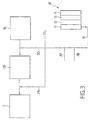
- FIGS. 1 and 2 relate to examples of production of paper products according to art earlier as well as with reference to FIG. 3 which gives a particular example, but not limiting of a preferred embodiment of the invention.
- the first step in dealing with broken items is trituration of these broken, preferably in the presence of white water from different process steps and in an alkaline medium at a pH generally between 8.5 and 13. This trituration step is carried out in what is conventionally called a pulper to broken 15.
- the dough from this pulper has broken preferably has a concentration of around 15%.
- This dough should therefore be diluted to bring it to a suitable concentration, generally 3 at 4% in the mixing tank 2 where the cellulosic paste intended to enter is prepared in the short circuit of the cellulosic pulp preparation process.
- the mixture dough from broken pieces and new dough used in the process preferably, but not necessarily at this stage of the process.
- the pulp from the broken pulper 15 must therefore be diluted.
- this dilution is carried out by introducing white water from the proceeded in at least one step.
- This dilution is often carried out in two steps as shown in Figure 2. A greater number of steps dilution can be envisaged without departing from the process of the invention.
- Proposed in the case of a high temperature treatment discontinuously, broken in a pulper with broken, acidification with carbon dioxide as described this invention is carried out in the pulper at the end of the middle crushing step alkaline. Carried out under these conditions, it does not however allow a mixture satisfactory carbon dioxide in the medium to be treated. It turns out consumes time and carbon dioxide for a poor result. Of more, limited to batch processing of broken pieces, it does not provide satisfactory solution to the problem posed.
- the invention therefore proposes to advantageously replace the modes acidification of the prior art by the introduction of carbon dioxide into the minus one point in the broken circuit after leaving the pulper at broken 15, and this, so as to regulate the pH of the dough during the successive stages of the treatment of broken pieces, until bringing it to a desired pH in the vat of mixture, preferably close to that of the new dough contained in said vat where the said paste will be introduced at the end of the processing of the broken pieces.
- This pH is generally between 5.5 and 8.5.
- said second step comprises at least two stages of dilution by white water.
- the dioxide of carbon is injected into the white water used to dilute the paste obtained broken ones.
- the white waters used to dilute the dough after the broken include white water recovered from the machine paper and possibly white waters of other origins, especially waters white from the preparation of the dough and / or clarified water from different stages of the process.
- the introduction of carbon dioxide is carried out at at least two points in the broken circuit, partly at the outlet of the pulper to broken and partly at the end of treatment of broken.
- the introduction of carbon dioxide can be carried out at any point between the outlet of the pulp for basic processing of broken products and the step of mixing the pulp resulting from broken products with the rest of the cellulose pulp, it is particularly advantageous to carry out this injection of carbon dioxide into the dilution water of the pulp from the broken ones.
- the introduction of carbon dioxide into a relatively concentrated suspension of fibers requires the use of a specific material of the porous candle type or static mixer intended to obtain the dispersion and dissolving gaseous CO 2 within this dispersion of fibers.
- the recommended injection of carbon dioxide directly into the white water used to dilute the paste and, because of the very low solid content of the white water, can be done without using specific injection equipment.
- the second stage of processing broken pieces includes at least one step of de-pastillage and / or at least one step additional purification of the pulp from the treatment carried out in the pulper 15.
- the carbon dioxide is introduced in at least two points, at a first point so as to obtain a suitable intermediate pH during stages of de-pastillage 22 and / or of purification 21, 23 of said paste and in a second point located after said steps and before the end of the broken circuit of so as to have a pH of the diluted pulp resulting from the treatment of broken pieces substantially compatible with the pH maintained in the mixing tank 2.
- the pH of the diluted paste resulting from the treatment of broken pieces is between 5.5 and 8.5.
- the pH intermediate of the dough during the de-pelletizing step 22 and / or during the steps treatment 21.23 is between 7.5 and 9, and preferably between 8 and 8.5.
- carbon dioxide is advantageously introduced by through a first supply of dilution water after leaving the pulper broken so as to obtain a pH between 7.5 and 9, and preferably 8 and 8.5 at the complementary de-pastillage device for said dough, and by via a second dilution water inlet located between the outlet of this device and the end of the broken circuit so as to have a diluted dough pH resulting from the treatment of broken pieces substantially equal to the pH maintained in the vat of mixing the pulp from the broken with the rest of the cellulosic pulp.
- Carbon dioxide can take many forms. It can be essentially in gaseous form. It can be basically under liquid form. It can be partially in gaseous form and partially in liquid form.
- broken pieces from the processing stage in the press section 11 from the paper machine are recovered and introduced into the broken pulper 15 where they are treated in an alkaline medium in the presence of white water from different process steps.
- this broken pulper 15 the broken pieces from the section of presses 11 and possibly waste of other origins but also requiring treatment in an alkaline medium at a pH between 9 and 13, in the presence of white water from the process.
- We thus prepare in this pulper to broken a paste generally having a concentration of cellulosic fibers of the order of 15% by weight.
- This paste then undergoes a first dilution by white water from the process in which we have previously introduced carbon dioxide to bring said paste to a pH generally of the order of 8 to 8.5, then this dough thus diluted is subjected to different stages of complementary treatments shown schematically by block 26.
- These additional steps may include, in particular, steps such as described with reference to FIG. 2 of primary treatment 21, de-pastillage 22 and of finer purification 23, the cascade of complementary treatments depending on made of the state of the pulp from the broken pieces after the treatment in the broken pulper and the degree of purity sought.
- the dough thus treated is then subjected to a second dilution by white water from the process containing carbon dioxide.
- This white water is introduced into the circuit through line 24.
- the CO 2 is advantageously introduced upstream of the point of separation of the supply of white water intended to carry out the two dilution stages, which makes it possible to proceed with only one CO 2 injection.
- the supply of white water intended for the dilution of the paste obtained of the preliminary treatment of broken parts includes in the case shown in Figure 3 on the one hand, white water from the first stage of preparation of the paper in the headbox 11 of the paper machine. This water is introduced by line 18. It also contains other water from other stages of the process introduced respectively by pipes 27 and 28. These are, by example, other white waters from the thickening step of the dough during washing to remove the various impurities and which leads to the recovery of diluted water.
- the dough is brought to a pH on the order of that which one seeks to impose in the mixing vat, by for example a pH of 8.0 and a degree of dilution generally of the order of 3 to 4%, dilution which is also that which is carried out in the mixing tank 2.
- the broken ones are of the REH type (wet strength) (it was not carried out during the tests reported here to injections of dioxide of carbon in white waters).
- the processing of the broken presents, at the level of the de-pastillage stage, a loop circuit in which the broken parts are pumped in tank 25 and reinjected between 21 and 22 until the finished product is obtained satisfactory; they are then evacuated to 2 in accordance with FIG. 2.
- Test # 3 is a good compromise between industrial use and good dissolution yield.
Landscapes
- Chemical & Material Sciences (AREA)
- Inorganic Chemistry (AREA)
- Paper (AREA)
- Making Paper Articles (AREA)
Applications Claiming Priority (2)
| Application Number | Priority Date | Filing Date | Title |
|---|---|---|---|
| FR9908482 | 1999-07-01 | ||
| FR9908482A FR2795753B1 (fr) | 1999-07-01 | 1999-07-01 | Perfectionnement aux procedes de fabrication de produits papetiers en vue de l'incorporation dans lesdits produits de dechets papetiers necessitant un traitement basique |
Publications (2)
| Publication Number | Publication Date |
|---|---|
| EP1065314A1 true EP1065314A1 (de) | 2001-01-03 |
| EP1065314B1 EP1065314B1 (de) | 2007-06-06 |
Family
ID=9547588
Family Applications (1)
| Application Number | Title | Priority Date | Filing Date |
|---|---|---|---|
| EP00401639A Revoked EP1065314B1 (de) | 1999-07-01 | 2000-06-09 | Verfahren zur Herstellung von Papierprodukten |
Country Status (8)
| Country | Link |
|---|---|
| EP (1) | EP1065314B1 (de) |
| AT (1) | ATE364107T1 (de) |
| BR (1) | BR0002954A (de) |
| CA (1) | CA2311279A1 (de) |
| DE (1) | DE60035084T2 (de) |
| ES (1) | ES2286991T3 (de) |
| FR (1) | FR2795753B1 (de) |
| PT (1) | PT1065314E (de) |
Citations (3)
| Publication number | Priority date | Publication date | Assignee | Title |
|---|---|---|---|---|
| EP0281273A1 (de) * | 1987-02-27 | 1988-09-07 | The BOC Group, Inc. | Zellstoff |
| EP0884416A2 (de) * | 1997-06-10 | 1998-12-16 | Praxair Technology, Inc. | Verfahren zur Herstellung von Papier mittels Kohlendioxids |
| EP0911443A1 (de) * | 1997-10-24 | 1999-04-28 | Praxair Technology, Inc. | Verfahren zum Einstellen der Alkanilität einer Zellstoffsuspension in einem Ausschusspulper |
-
1999
- 1999-07-01 FR FR9908482A patent/FR2795753B1/fr not_active Expired - Fee Related
-
2000
- 2000-06-09 DE DE60035084T patent/DE60035084T2/de not_active Expired - Lifetime
- 2000-06-09 EP EP00401639A patent/EP1065314B1/de not_active Revoked
- 2000-06-09 ES ES00401639T patent/ES2286991T3/es not_active Expired - Lifetime
- 2000-06-09 AT AT00401639T patent/ATE364107T1/de active
- 2000-06-09 PT PT00401639T patent/PT1065314E/pt unknown
- 2000-06-09 CA CA002311279A patent/CA2311279A1/fr not_active Abandoned
- 2000-06-30 BR BR0002954-8A patent/BR0002954A/pt not_active Application Discontinuation
Patent Citations (3)
| Publication number | Priority date | Publication date | Assignee | Title |
|---|---|---|---|---|
| EP0281273A1 (de) * | 1987-02-27 | 1988-09-07 | The BOC Group, Inc. | Zellstoff |
| EP0884416A2 (de) * | 1997-06-10 | 1998-12-16 | Praxair Technology, Inc. | Verfahren zur Herstellung von Papier mittels Kohlendioxids |
| EP0911443A1 (de) * | 1997-10-24 | 1999-04-28 | Praxair Technology, Inc. | Verfahren zum Einstellen der Alkanilität einer Zellstoffsuspension in einem Ausschusspulper |
Also Published As
| Publication number | Publication date |
|---|---|
| ATE364107T1 (de) | 2007-06-15 |
| DE60035084D1 (de) | 2007-07-19 |
| ES2286991T3 (es) | 2007-12-16 |
| BR0002954A (pt) | 2001-04-03 |
| PT1065314E (pt) | 2007-08-06 |
| FR2795753B1 (fr) | 2001-09-14 |
| FR2795753A1 (fr) | 2001-01-05 |
| EP1065314B1 (de) | 2007-06-06 |
| CA2311279A1 (fr) | 2001-01-01 |
| DE60035084T2 (de) | 2008-01-31 |
Similar Documents
| Publication | Publication Date | Title |
|---|---|---|
| FI63607B (fi) | Foerfarande foer framstaellning av cellulosamassor i utbytesomraodet 65-95 % | |
| JP2023517688A (ja) | ポリコットン混合物の分離 | |
| EP0284526A1 (de) | Verfahren und Anlage zur Wiedergewinnung von bedruckten Altpapieren | |
| FR2641010A1 (de) | ||
| CA2044466C (fr) | Procede pour desencrer les papiers imprimes | |
| FR2831565A1 (fr) | Nouvelle pate a papier mecanique blanchie et son procede de fabrication | |
| SK283771B6 (sk) | Kyslíková delignifikácia odpadových celulózovo-papierenských výrobkov | |
| CN101389808B (zh) | 用于制造机械纸浆和纸张产品的方法 | |
| CA2739694C (fr) | Procede de fabrication de pate a papier | |
| CN113882181B (zh) | 一种Lyocell纤维竹浆粕及其制备方法 | |
| EP1065314B1 (de) | Verfahren zur Herstellung von Papierprodukten | |
| EP0351330B1 (de) | Verfahren zur Herstellung von gebleichten chemithermomechanischen Zellstoffen | |
| EP0293309B1 (de) | Verfahren zur Herstellung von chemithermomechanischen Zellstoffen | |
| JP2024522313A (ja) | 非木材原料を処理するためのプロセス | |
| CN116971197A (zh) | 一种湿强解离剂及其使用方法 | |
| FR2836938A1 (fr) | Perfectionnement aux procedes de fabrication de produits papetiers par amelioration du comportement physico-chimique de la pate a papier | |
| US20020148581A1 (en) | Processes for paper manufacture, useful for incorporating paper waste requiring a basic treatment into paper products | |
| Liu et al. | The Use of Mg (OH) 2 in the Final Peroxide Bleaching Stage of Wheat Straw Pulp. | |
| FR2480321A1 (fr) | Procede de fabrication de pulpe mecanique de cellulose exempte de resine | |
| EP0451031B1 (de) | Verfahren zur Behandlung der zum Verdünnen von Zellstoff bestimmten rückgewonnenen Abwässern | |
| EP1931826B1 (de) | Papiersystem zur minderung von abscheidungen und verstopfungen auf einer maschine bei der papier- und kartonherstellung | |
| Ghorbel et al. | New insights on the ozone reactive flotation: fundamental study using virgin fibers to model recovered cellulosic fibers | |
| SU265020A1 (ru) | Способ отбеливания сб1рой целлюлозной массы | |
| CN120700723A (zh) | 一种竹纤维造纸浆料制备方法 | |
| FR2514382A1 (fr) | Procede et installation pour le blanchiment de tissus cellulosiques de fabrication chimique |
Legal Events
| Date | Code | Title | Description |
|---|---|---|---|
| PUAI | Public reference made under article 153(3) epc to a published international application that has entered the european phase |
Free format text: ORIGINAL CODE: 0009012 |
|
| AK | Designated contracting states |
Kind code of ref document: A1 Designated state(s): AT BE CH CY DE DK ES FI FR GB GR IE IT LI LU MC NL PT SE |
|
| AX | Request for extension of the european patent |
Free format text: AL;LT;LV;MK;RO;SI |
|
| 17P | Request for examination filed |
Effective date: 20010703 |
|
| AKX | Designation fees paid |
Free format text: AT BE CH CY DE DK ES FI FR GB GR IE IT LI LU MC NL PT SE |
|
| RAP1 | Party data changed (applicant data changed or rights of an application transferred) |
Owner name: L'AIR LIQUIDE, S.A. AE DIRECTOIRE ET CONSEIL DE SU |
|
| GRAP | Despatch of communication of intention to grant a patent |
Free format text: ORIGINAL CODE: EPIDOSNIGR1 |
|
| RAP1 | Party data changed (applicant data changed or rights of an application transferred) |
Owner name: L'AIR LIQUIDE, SOCIETE ANONYME POUR L'ETUDE ET L'E |
|
| GRAS | Grant fee paid |
Free format text: ORIGINAL CODE: EPIDOSNIGR3 |
|
| GRAA | (expected) grant |
Free format text: ORIGINAL CODE: 0009210 |
|
| AK | Designated contracting states |
Kind code of ref document: B1 Designated state(s): AT BE CH CY DE DK ES FI FR GB GR IE IT LI LU MC NL PT SE |
|
| REG | Reference to a national code |
Ref country code: GB Ref legal event code: FG4D Free format text: NOT ENGLISH |
|
| RAP2 | Party data changed (patent owner data changed or rights of a patent transferred) |
Owner name: L'AIR LIQUIDE, SOCIETE ANONYME POUR L'ETUDE ET L'E |
|
| REG | Reference to a national code |
Ref country code: CH Ref legal event code: EP |
|
| REG | Reference to a national code |
Ref country code: IE Ref legal event code: FG4D Free format text: LANGUAGE OF EP DOCUMENT: FRENCH |
|
| REF | Corresponds to: |
Ref document number: 60035084 Country of ref document: DE Date of ref document: 20070719 Kind code of ref document: P |
|
| REG | Reference to a national code |
Ref country code: PT Ref legal event code: SC4A Free format text: AVAILABILITY OF NATIONAL TRANSLATION Effective date: 20070725 |
|
| NLT2 | Nl: modifications (of names), taken from the european patent patent bulletin |
Owner name: L'AIR LIQUIDE, SOCIETE ANONYME POUR L'ETUDE Effective date: 20070627 |
|
| GBT | Gb: translation of ep patent filed (gb section 77(6)(a)/1977) |
Effective date: 20070815 |
|
| REG | Reference to a national code |
Ref country code: SE Ref legal event code: TRGR |
|
| NLV1 | Nl: lapsed or annulled due to failure to fulfill the requirements of art. 29p and 29m of the patents act | ||
| REG | Reference to a national code |
Ref country code: ES Ref legal event code: FG2A Ref document number: 2286991 Country of ref document: ES Kind code of ref document: T3 |
|
| REG | Reference to a national code |
Ref country code: IE Ref legal event code: FD4D |
|
| PG25 | Lapsed in a contracting state [announced via postgrant information from national office to epo] |
Ref country code: MC Free format text: LAPSE BECAUSE OF NON-PAYMENT OF DUE FEES Effective date: 20070630 Ref country code: IE Free format text: LAPSE BECAUSE OF FAILURE TO SUBMIT A TRANSLATION OF THE DESCRIPTION OR TO PAY THE FEE WITHIN THE PRESCRIBED TIME-LIMIT Effective date: 20070606 Ref country code: NL Free format text: LAPSE BECAUSE OF FAILURE TO SUBMIT A TRANSLATION OF THE DESCRIPTION OR TO PAY THE FEE WITHIN THE PRESCRIBED TIME-LIMIT Effective date: 20070606 |
|
| PLBI | Opposition filed |
Free format text: ORIGINAL CODE: 0009260 |
|
| PLAX | Notice of opposition and request to file observation + time limit sent |
Free format text: ORIGINAL CODE: EPIDOSNOBS2 |
|
| 26 | Opposition filed |
Opponent name: LINDE AKTIENGESELLSCHAFT Effective date: 20080306 |
|
| PG25 | Lapsed in a contracting state [announced via postgrant information from national office to epo] |
Ref country code: GR Free format text: LAPSE BECAUSE OF FAILURE TO SUBMIT A TRANSLATION OF THE DESCRIPTION OR TO PAY THE FEE WITHIN THE PRESCRIBED TIME-LIMIT Effective date: 20070907 Ref country code: DK Free format text: LAPSE BECAUSE OF FAILURE TO SUBMIT A TRANSLATION OF THE DESCRIPTION OR TO PAY THE FEE WITHIN THE PRESCRIBED TIME-LIMIT Effective date: 20070606 |
|
| PLAF | Information modified related to communication of a notice of opposition and request to file observations + time limit |
Free format text: ORIGINAL CODE: EPIDOSCOBS2 |
|
| PLBB | Reply of patent proprietor to notice(s) of opposition received |
Free format text: ORIGINAL CODE: EPIDOSNOBS3 |
|
| PG25 | Lapsed in a contracting state [announced via postgrant information from national office to epo] |
Ref country code: CY Free format text: LAPSE BECAUSE OF FAILURE TO SUBMIT A TRANSLATION OF THE DESCRIPTION OR TO PAY THE FEE WITHIN THE PRESCRIBED TIME-LIMIT Effective date: 20070606 |
|
| PG25 | Lapsed in a contracting state [announced via postgrant information from national office to epo] |
Ref country code: LU Free format text: LAPSE BECAUSE OF NON-PAYMENT OF DUE FEES Effective date: 20070609 |
|
| PGFP | Annual fee paid to national office [announced via postgrant information from national office to epo] |
Ref country code: FI Payment date: 20100615 Year of fee payment: 11 Ref country code: ES Payment date: 20100623 Year of fee payment: 11 Ref country code: PT Payment date: 20100604 Year of fee payment: 11 Ref country code: FR Payment date: 20100706 Year of fee payment: 11 |
|
| PGFP | Annual fee paid to national office [announced via postgrant information from national office to epo] |
Ref country code: IT Payment date: 20100626 Year of fee payment: 11 Ref country code: AT Payment date: 20100614 Year of fee payment: 11 |
|
| PGFP | Annual fee paid to national office [announced via postgrant information from national office to epo] |
Ref country code: CH Payment date: 20100623 Year of fee payment: 11 Ref country code: BE Payment date: 20100611 Year of fee payment: 11 |
|
| PGFP | Annual fee paid to national office [announced via postgrant information from national office to epo] |
Ref country code: SE Payment date: 20100614 Year of fee payment: 11 Ref country code: GB Payment date: 20100618 Year of fee payment: 11 Ref country code: DE Payment date: 20100625 Year of fee payment: 11 |
|
| RDAF | Communication despatched that patent is revoked |
Free format text: ORIGINAL CODE: EPIDOSNREV1 |
|
| REG | Reference to a national code |
Ref country code: DE Ref legal event code: R064 Ref document number: 60035084 Country of ref document: DE Ref country code: DE Ref legal event code: R103 Ref document number: 60035084 Country of ref document: DE |
|
| RDAG | Patent revoked |
Free format text: ORIGINAL CODE: 0009271 |
|
| STAA | Information on the status of an ep patent application or granted ep patent |
Free format text: STATUS: PATENT REVOKED |
|
| REG | Reference to a national code |
Ref country code: PT Ref legal event code: MP4A Effective date: 20110809 |
|
| REG | Reference to a national code |
Ref country code: CH Ref legal event code: PL |
|
| 27W | Patent revoked |
Effective date: 20110411 |
|
| GBPR | Gb: patent revoked under art. 102 of the ep convention designating the uk as contracting state |
Effective date: 20110411 |
|
| REG | Reference to a national code |
Ref country code: DE Ref legal event code: R107 Ref document number: 60035084 Country of ref document: DE Effective date: 20111020 |
|
| REG | Reference to a national code |
Ref country code: SE Ref legal event code: ECNC |
|
| PG25 | Lapsed in a contracting state [announced via postgrant information from national office to epo] |
Ref country code: CH Free format text: LAPSE BECAUSE OF THE APPLICANT RENOUNCES Effective date: 20070606 Ref country code: LI Free format text: LAPSE BECAUSE OF THE APPLICANT RENOUNCES Effective date: 20070606 |