EP1085531A2 - Matériau magnétiquement dur interstitiel comprenant plusieurs éléments et procédé de préparation de poudre magnétique et aimant à partir de ceci - Google Patents
Matériau magnétiquement dur interstitiel comprenant plusieurs éléments et procédé de préparation de poudre magnétique et aimant à partir de ceci Download PDFInfo
- Publication number
- EP1085531A2 EP1085531A2 EP00109118A EP00109118A EP1085531A2 EP 1085531 A2 EP1085531 A2 EP 1085531A2 EP 00109118 A EP00109118 A EP 00109118A EP 00109118 A EP00109118 A EP 00109118A EP 1085531 A2 EP1085531 A2 EP 1085531A2
- Authority
- EP
- European Patent Office
- Prior art keywords
- rare earth
- hours
- magnetic powder
- powder
- magnetic
- Prior art date
- Legal status (The legal status is an assumption and is not a legal conclusion. Google has not performed a legal analysis and makes no representation as to the accuracy of the status listed.)
- Granted
Links
Images



Classifications
-
- H—ELECTRICITY
- H01—ELECTRIC ELEMENTS
- H01F—MAGNETS; INDUCTANCES; TRANSFORMERS; SELECTION OF MATERIALS FOR THEIR MAGNETIC PROPERTIES
- H01F1/00—Magnets or magnetic bodies characterised by the magnetic materials therefor; Selection of materials for their magnetic properties
- H01F1/01—Magnets or magnetic bodies characterised by the magnetic materials therefor; Selection of materials for their magnetic properties of inorganic materials
- H01F1/03—Magnets or magnetic bodies characterised by the magnetic materials therefor; Selection of materials for their magnetic properties of inorganic materials characterised by their coercivity
- H01F1/032—Magnets or magnetic bodies characterised by the magnetic materials therefor; Selection of materials for their magnetic properties of inorganic materials characterised by their coercivity of hard-magnetic materials
- H01F1/04—Magnets or magnetic bodies characterised by the magnetic materials therefor; Selection of materials for their magnetic properties of inorganic materials characterised by their coercivity of hard-magnetic materials metals or alloys
- H01F1/047—Alloys characterised by their composition
- H01F1/053—Alloys characterised by their composition containing rare earth metals
- H01F1/055—Alloys characterised by their composition containing rare earth metals and magnetic transition metals, e.g. SmCo5
- H01F1/059—Alloys characterised by their composition containing rare earth metals and magnetic transition metals, e.g. SmCo5 and Va elements, e.g. Sm2Fe17N2
-
- H—ELECTRICITY
- H01—ELECTRIC ELEMENTS
- H01F—MAGNETS; INDUCTANCES; TRANSFORMERS; SELECTION OF MATERIALS FOR THEIR MAGNETIC PROPERTIES
- H01F1/00—Magnets or magnetic bodies characterised by the magnetic materials therefor; Selection of materials for their magnetic properties
- H01F1/01—Magnets or magnetic bodies characterised by the magnetic materials therefor; Selection of materials for their magnetic properties of inorganic materials
- H01F1/03—Magnets or magnetic bodies characterised by the magnetic materials therefor; Selection of materials for their magnetic properties of inorganic materials characterised by their coercivity
- H01F1/032—Magnets or magnetic bodies characterised by the magnetic materials therefor; Selection of materials for their magnetic properties of inorganic materials characterised by their coercivity of hard-magnetic materials
- H01F1/04—Magnets or magnetic bodies characterised by the magnetic materials therefor; Selection of materials for their magnetic properties of inorganic materials characterised by their coercivity of hard-magnetic materials metals or alloys
- H01F1/047—Alloys characterised by their composition
- H01F1/053—Alloys characterised by their composition containing rare earth metals
- H01F1/055—Alloys characterised by their composition containing rare earth metals and magnetic transition metals, e.g. SmCo5
-
- H—ELECTRICITY
- H01—ELECTRIC ELEMENTS
- H01F—MAGNETS; INDUCTANCES; TRANSFORMERS; SELECTION OF MATERIALS FOR THEIR MAGNETIC PROPERTIES
- H01F1/00—Magnets or magnetic bodies characterised by the magnetic materials therefor; Selection of materials for their magnetic properties
- H01F1/01—Magnets or magnetic bodies characterised by the magnetic materials therefor; Selection of materials for their magnetic properties of inorganic materials
- H01F1/03—Magnets or magnetic bodies characterised by the magnetic materials therefor; Selection of materials for their magnetic properties of inorganic materials characterised by their coercivity
- H01F1/032—Magnets or magnetic bodies characterised by the magnetic materials therefor; Selection of materials for their magnetic properties of inorganic materials characterised by their coercivity of hard-magnetic materials
- H01F1/04—Magnets or magnetic bodies characterised by the magnetic materials therefor; Selection of materials for their magnetic properties of inorganic materials characterised by their coercivity of hard-magnetic materials metals or alloys
- H01F1/047—Alloys characterised by their composition
- H01F1/053—Alloys characterised by their composition containing rare earth metals
- H01F1/055—Alloys characterised by their composition containing rare earth metals and magnetic transition metals, e.g. SmCo5
- H01F1/058—Alloys characterised by their composition containing rare earth metals and magnetic transition metals, e.g. SmCo5 and IVa elements, e.g. Gd2Fe14C
-
- B—PERFORMING OPERATIONS; TRANSPORTING
- B22—CASTING; POWDER METALLURGY
- B22F—WORKING METALLIC POWDER; MANUFACTURE OF ARTICLES FROM METALLIC POWDER; MAKING METALLIC POWDER; APPARATUS OR DEVICES SPECIALLY ADAPTED FOR METALLIC POWDER
- B22F9/00—Making metallic powder or suspensions thereof
- B22F9/02—Making metallic powder or suspensions thereof using physical processes
- B22F9/04—Making metallic powder or suspensions thereof using physical processes starting from solid material, e.g. by crushing, grinding or milling
- B22F2009/041—Making metallic powder or suspensions thereof using physical processes starting from solid material, e.g. by crushing, grinding or milling by mechanical alloying, e.g. blending, milling
-
- B—PERFORMING OPERATIONS; TRANSPORTING
- B22—CASTING; POWDER METALLURGY
- B22F—WORKING METALLIC POWDER; MANUFACTURE OF ARTICLES FROM METALLIC POWDER; MAKING METALLIC POWDER; APPARATUS OR DEVICES SPECIALLY ADAPTED FOR METALLIC POWDER
- B22F2998/00—Supplementary information concerning processes or compositions relating to powder metallurgy
- B22F2998/10—Processes characterised by the sequence of their steps
Definitions
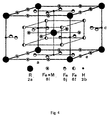
- the present invention relates to a multielement rare earth-iron interstitial hard magnetic material having a ThMn 12 type crystal structure.
- the present invention further relates to processes for producing isotropic and anisotropic magnetic powder, and for producing isotropic and anisotropic magnet.
- the rare earth-iron based material used for producing hard magnet is Nd 2 Fe 14 B, in which the process used for producing Nd 2 Fe 14 B type bonded magnet is melt spinning or HDDR technique.
- the magnetic powder obtained by using these processes is generally isotropic, with the maximum energy product of 60-110KJ/m 3 (8-13 MGOe). It is an anisotropic magnetic powder having a high magnetic energy product that is sought to be developed.
- the Nd 2 Fe 14 B type magnet has a low Curie temperature, and is insufficient in anti-oxidation capacity. Furthermore, since spin reorientation occurs at the temperature around 130K, and easy magnetization direction deviates from C axis, the permanent magnetic properties vanish at low temperatures. Iriyama Kyohiko et al. and J.
- R 2 Fe 17 N x based rare earth-iron-nitrogen permanent magnetic material (Iriyama Kyohiko et al., JP (31) 285741, 88; Iriyama Kyohiko et al., CN 89101552).
- R 2 Fe 17 N x easy magnetization axis appears only when R is Sm. Consequently, in the preparation of high performance magnet, the rare earth utilized is mainly Sm that is more costly than Nd or Pr.
- R Fe 1- ⁇ M ⁇ 12 type intermetallic compound
- R is a rare earth element
- M is Ti, V, Mo, Nb, Ga, W, Si, Al, or Mn
- ⁇ is from 0.08 to 0.27.
- the method comprises smelting a master alloy with the above composition, heat treating under nitrogen atmosphere at 350°C to 600°C, to form a R(Fe 1- ⁇ M ⁇ ) 12 N x interstitial type nitride, such as NdTiFe 11 N x .
- R(Fe 1- ⁇ M ⁇ ) 12 N x particularly Nd(Fe 1- ⁇ M ⁇ ) 12 N x , has intrinsic magnetic properties comparable to that of Nd 2 Fe 14 B, which can be used, besides Nd 2 Fe 14 B, as a rare earth permanent-magnetic material based on Nd instead of Sm.
- amorphous non-crystal magnetic material is formed by utilizing a high energy ball-mill mechanical alloying method, and a magnetic powder having a coercivity of 160-640 KA/m (2-8 kOe) is obtained by controlling the crystallization temperature.
- the magnetic powder thus obtained is isotropic, with very low remanence (Br), which is 0.3-0.4 T (3-4 KG), and very low maximum magnetic energy product ((BH) max ), which is 8-16 KJ/m 3 (1-2 MGOe). This does not meet the requirement of practical application.
- the parameters used to denote the performance of a permanent magnetic material include remanence Br, coercivity iHc and bHc, and maximum magnetic energy product (BH) max .
- the maximum magnetic energy product is an overall indication of permanent magnetism, which represents the overall performance of magnet.
- Ms saturation magnetization intensity
- Tc Curie temperature
- Ha anisotropy field of magnetic moment
- the permanent magnetic material of the present invention has high remanence, high coercivity and high magnetic energy product.
- the composition of the 1:12 type nitride master alloy is modified based on the result obtained in the study of the magnetic domain structure and the magnetization reversal mechanism of 1:12 type nitride. It is expanded to a multielement alloy, which is featured in that an easily pulverizable alloy with better single-phase property can be produced. This is fundamental for producing high performance magnets.
- the process of the present invention the activity of alloy is enhanced, the temperature of gas-solid phase reaction is lowered, and complete nitrogenation is ensured. Thereby the magnetism of the material is greatly enhanced, the content of rare earth metal is lowered, and the need to dope with expensive metals such as cobalt is eliminated.
- an anisotropic magnetic powder and a magnet having high remanence, high coercivity, and high magnetic energy product can be produced.
- a multielement rare earth-iron interstitial permanent magnetic material represent by the following formula: (R 1- ⁇ R' ⁇ ) x (Mo 1- ⁇ M ⁇ ) y Fe 100-x-y-z I z
- R is a light rare earth element selected from the group consisting of Pr, Nd, Pr-Nd concentrated material and mixtures of Pr and Nd of any composition
- R' is a heavy rare earth element selected from the group consisting of Gd, Tb, Dy, Ho, Er, Y and a mixture of thereof
- ⁇ is from 0.01 to 0.14
- x is an atomic percent from 4 to 15
- M is an element of IIIA, IVA, IVB, VB, VIB and VIIB families in the periodic table selected from the group consisting of B, Ti, V, Cr, Mn, W, Si, Al, Ga, Nb, Ta, Sr, Zr, and mixtures of thereof
- ⁇ is from 0.01 to 0.98
- y is an atomic percent from 3 to 20
- Examples of the permanent magnetic material represented by formula (R 1- ⁇ R' ⁇ ) x (Mo 1- ⁇ M ⁇ ) y Fe 100-x-y-z I z include:
- the light rare earth used in the present invention is preferably Pr, Nd, a mixture of Pr and Nd, or a Pr-Nd concentrated material.
- Pr and Nd have strong easy axial magnetocrystalline anisotropy, which generate high coercivity.
- the light rare earth element, Pr and Nd couple ferromagnetically with Fe, thereby having high saturation magnetization intensity, which is fundamental for producing materials having high remanence and high magnetic energy product. It was found that, for the purpose of producing high performance magnet, it is essential to include a suitable amount of at least a heavy rare earth element such as Gd, Tb, Dy, Ho, Er or the like in the alloy. Only in this way, high performance and high temperature stability of the magnet thus produced can be ensured.
- the atomic percent x is preferably from 6 to 10.
- the process for producing the magnet of the present invention includes the following steps:
- the 1-10 ⁇ m magnetic powders are directly mixed with a polymer or rubber. Then a bonded magnet is formed through injection molding in a magnetic field. Alternatively, it is mixed with a low-melting-point metal, such as Zn, Sn and the like, or an alloy thereof, then pulverized into a powder with the particle size of 1-10 ⁇ m, oriented in a magnetic field, press molded, and an anisotropic sintered magnet is obtained upon sintering.
- a low-melting-point metal such as Zn, Sn and the like, or an alloy thereof
- step (2) and (3) are not needed.
- the process of the invention is featured in that C enters an interstitial site through direct melting, instead of through gas-solid reaction.
- the magnetic powders of carbide according to the present invention have the advantages of good temperature stability.
- a high performance magnet can be produced through other methods by utilizing the multielement alloy of the present invention.
- these methods include mechanical alloying, which comprises the steps of: when I is N, (1) the metallic powders of R, R', Fe, Mo, M and the like are subjected to high energy milling in argon atmosphere for 2-4 hours with the composition of (R 1- ⁇ R' ⁇ ) x (Mo 1- ⁇ M ⁇ ) y Fe 100-x-y to obtain the resulted amorphous metal powders; (2) carrying out crystallization treatment in argon atmosphere at 700-950 °C, and keeping at this temperature for 0.5-2 hours; (3) carrying out gas-solid reaction in the atmosphere of interstitial atom, for example, carrying out nitrogen treatment at 400-600°C for 2-4 hours, then a high performance magnetic powder is obtained.
- step (1) is performed by preparing a corresponding powder according to formula (R 1 - ⁇ R' ⁇ ) x (Mo 1- ⁇ M ⁇ ) y Fe 100-x-y C z , conducting high energy milling in argon atmosphere for 2-4 hours, thus, a amorphous powder is formed; step (2) is performed as mentioned above, and step (3) is omitted; finally, a high performance magnetic powder is formed.
- melt spinning method comprise the steps of: when I is N, (1) melting an alloy with the composition of (R 1- ⁇ R' ⁇ ) x (Mo 1- ⁇ M ⁇ ) y Fe 100-x-y ; (2) cooling in vacuum at the rate of 30-50 m/second; (3) carrying out crystallization treatment in argon atmosphere at 700-950 °C, and keeping at this temperature for 0.5-2 hours; (4) carrying out gas-solid reaction in the atmosphere of interstitial atom, for example, carrying out nitrogen treatment at 400-600°C for 2-4 hours, then a high performance magnetic powder is obtained.
- step (1) is performed by melting an alloy according to formula (R 1- ⁇ R' ⁇ ) x (Mo 1- ⁇ M ⁇ ) y Fe 100-x-y C z ; steps (2) and (3) are performed as mentioned above, and step (4) is omitted; finally, a high performance magnetic powder is formed.
- evacuated dehydrogenation treatment at 500-600°C may be performed after hydrogenation treatment.
- compressed, injected and extruded bonded magnet can be produced by adding a thermosetting binder, or a calendered bonded magnet can be produced by adding a thermoplastic binder.
- compressed and injected anisotropic bonded magnets can be produced by taking form in a magnetic field.
- mixing the magnetic powder of the present invention and a ferrite magnetic powder can produce a unique composite magnet. Since the particle size of them are comparable, a uniform calendered, injected or compressed bonded magnet can be produced.
- the magnetic powder of the present invention has high remanence while ferrite has a positive temperature coefficient of coercivity, thus it is available to produce composite magnets with high magnetic performance and good thermal stability at a low cost.
- the binders used in the present invention includes polyolefin polymers, such as polyethylene, polypropylene, polyvinyl chloride, nylon and the like; polyester polymers, such as polyether, polyurethane, polycarbonate and the like; aromatic polyester resins, such as epoxy resin, phenolic resin, pollopas and the like; natural or synthetic rubbers, such as natural rubber, butadiene rubber, duprene rubber, silicon rubber and the like.
- An alloy was melted in a vacuum induction furnace with the composition of 7.2at% Nd, 0.5at%Dy, 80.8at% Fe, 11at% Mo and 0.5at% B, followed by a treatment in hydrogen at 250°C for 2 hours. Then, thermal treatment at 550°C in nitrogen atmosphere of 1 atmospheric pressure was carried out, and it was kept at this temperature for 2 hours.
- a 1:12 type nitride is obtained through gas-solid phase reaction, with the composition of 6.3at% Nd, 0.4at% Dy, 75.5at% Fe, 10.2at% Mo, 0.5at% B and 7.1at% N.
- the nitride is pulverized by using a jet mill or ball mill into a powder having the particle size of 2-5 ⁇ m.
- Nitride magnetic powders with various nitrogen contents were obtained, which have permanent magnetic performance as shown in Table 2.
- the permanent magnetic performance of Nd 7.2 Dy 0.5 Fe 80.8 Mo 11 B 0.5 N z Temperature and time of nitrogenation Nitrogen content Z Br(T) i H c (KA ⁇ m -1 ) (BH) max (KJ ⁇ m -3 ) Not subject to nitrogenation 0.0 0.3 0.8 0.2 400°C,3 hrs 3.0 0.6 40 4.0 500°C,1 hrs 5.0 0.9 240 64 550°C,2 hrs 7.1 1.08 640 184 550°C,4 hrs 10.3 1.10 720 188 550°C,8 hrs 14.2 1.15 680 192 650°C,4 hrs 20.0 1.00 160 32
- Example 1 The process of Example 1 was carried out, except that the master alloy was melted with the composition of 7.3at% Pr, 0.4at% Dy, 80.8at% Fe, 11at% Mo, and 0.5at% Nb.
- the 1:12 nitride magnetic powder thus obtained having the performance as shown in Table 3.
- Example 2 The process of Example 2 was carried out, except that the master alloy was melted with the composition of 7.7at% (Pr 1- ⁇ Dy ⁇ ), 80.1at% Fe, 10.6at% Mo, and 1.1at% Nb, nitride magnetic powders of (Pr 1- ⁇ Dy ⁇ ) 6.8 (Mo 0.9 Nb 0.1 ) 10 Fe 72.9 N 10.3 with various ⁇ values were obtained.
- the permanent magnetic performance at room temperature are shown in Table 5 below.
- Example 1 The process of Example 1 was carried out, except that the master alloy was melted with the composition of 7.2at% Nd, 0.5at% Tb, 80.8at% Fe, 11.0at% Mo, and 0.5at% Ti. Then hydrogen treatment was carried out at 200°C for 4 hours. Thereafter, thermal treatment at 500°C in nitrogen atmosphere of 5 atmospheric pressure was carried out, and it was kept at this temperature for 10 hours. A 1:12 nitride magnetic powder with the composition of 6.3at% Nd, 0.4at% Tb, 69.9at% Fe, 9.5at% Mo, 0.4at% Ti and 13.5at% N was obtained. The performance was shown in Table 6.
- Example 4 The process of Example 4 was carried out, except that the alloy was melted with the composition of 7.7at% (Nd 1- ⁇ Tb ⁇ ), 9.2at% Mo, 2.3at% Ti, and 80.8at% Fe, magnetic powders of (Nd 1- ⁇ Tb ⁇ ) 6.7 Fe 69.9 Mo 7.6 Ti 1.9 N 13.5 were obtained.
- the permanent magnetic performance at room temperature are shown in Table 8 below.
- Example 1 The process of Example 1 was carried out in this example, except that Pr-Nd concentrated material was used as light rare earth metal, and the alloy was melted with the composition of 2at% Pr, 6.5at% Nd, 0.5at% Dy, 79.5at% Fe, 10.5at% Mo and 1.0at% V. A magnetic powder of Pr 1.9 Nd 6.0 Dy 0.5 Fe 73 Mo 9.7 V 0.9 N 8.0 with the following permanent magnetic performance were obtained. Temperature B r (T) i H c (KA ⁇ m -1 ) b H c (KA ⁇ m -1 ) (BH) max (KJ ⁇ m -3 ) T c (K) Room temperature 1.05 464 400 160 720 1.5K 1.23 1680 920 290
- Example 8 The process of Example 8 was carried out, except that the temperature and the time of nitrogenation varied. Nitride magnetic powders with various nitrogen contents were obtained, which have permanent magnetic performance as shown in Table 13. The permanent magnetic performance of Nd 8.0 Tb 0.5 Fe 79.0 Mo 1.0 V 10.5 N z Temperature and time of nitrogenation Nitrogen content Z Br(T) i H c (KA ⁇ m -1 ) (BH) max (KJ ⁇ m -3 ) Not subject to nitrogenation 0.0 0.3 1 0.1 300°C,2 hrs 5.0 0.9 120 40 400°C, 1 hrs 10.1 1.0 240 128 400°C,5 hrs 16.2 1.2 520 202 450°C, 5 hrs 20.0 1.0 80 48
- Example 1 The process of Example 1 was carried out, except that the alloy was melted with the composition of 7.2at% Nd, 0.5at% Gd, 80.8at% Fe, 11.5at% (Mo 1- ⁇ Ta ⁇ ), and the gas-solid phase reaction was carried out under nitrogen atmosphere of 8 atmospheric pressure. Magnetic powders of Nd 6.6 Gd 0.5 Fe 74.4 (Mo 1- ⁇ Ta ⁇ ) 11.1 N 7.7 were obtained. The permanent magnetic performance at room temperature are shown in Table 14 below.
- Example 1 The process of Example 1 was carried out, except that the master alloy was melted with the composition of 6.6at% Nd, 0.5at% Gd, 74.4at% Fe, 10.0at% Mo and 0.8at% Ta. Gas-solid reaction was allowed to proceed in fluorine atmosphere of 1 atmospheric pressure at 300°C, and it was kept at this temperature for 2 hours.
- the fluoride magnetic powder thus obtained has the performance as shown in Table 17.
- Nitride, fluoride or carbide interstitial alloys were obtained by using the process of Example 11 or 12. Their intrinsic performances are shown in Table 18 below. The alloy composition and the intrinsic performance of the nitride, fluoride, and carbide obtained in the present invention (the compositions are given in atomic percent) No.
- Alloy Composition Tc(K) ⁇ s(emu/g) H A (KA ⁇ m -1 ) 1.5K 300K 1.5K 300K 1 6.7-Nd, 0.5-Er, 7.0-Mo, 6.3-Si, 76.7-Fe, 9.0-N 760 142.4 136.4 8800 8000 2 6.7-Pr, 0.5-Dy, 10.5-Mo, 0.5-Mn, 75.3-Fe, 5.5-N 650 141.7 120.9 13600 8800 3 6.2-Nd, 0.7-Dy, 9.3-Mo, 1.0-V, 74.0-Fe, 8.6-N 710 147.5 142.8 10400 8200 4 5.9-Nd, 1.4-Ho, 6.8-Ti, 0.5-Mo, 67.6-Fe, 17.8-N 790 157.5 144.0 10400 8400 5 6.7-Pr-Nd concentrated material, 0.3-Dy, 8.0-W, 1.0-Mo, 81.3-Fe,
- Example 1 The process of Example 1 was carried out, except that in the process of preparation of sample A hydrogenation treatment was not conducted, instead nitrogenation treatment was directly carried out. Magnetic powders of sample A and sample B with the composition of (Nd 0.9 Dy 0.1 ) 1 Mo 0.9 Ti 0.1 Fe 11 N x were obtained. The permanent magnetism is shown in Table 20 below. The permanent magnetism of (Nd 0.9 Dy 0.1 ) 1 Mo 0.9 Ti 0.1 Fe 11 N x with or without hydrogenation treatment Sample B r (T) i H c (KA ⁇ m -1 ) (BH) max (KJ ⁇ m -3 ) A 0.95 384 120 B 1.08 440 172
- Magnetic powders were produced by using mechanical alloying method. Specifically, metal powders with the composition of (Nd 0.9 Dy 0.1 ) 8 (Mo 0.8 Nb 0.2 ) 12 Fe 80 was prepared, and the product was treated with high-energy ball milling for 4 hours. Then, crystallization treatment was carried out in argon at 700°C, and was kept at this temperature for 1 hour. Thereafter, nitrogen treatment was carried out for 2 hours at 600°C. Finally, a high performance magnetic powder A was obtained.
- Example 1 The process of Example 1 was carried out, and the 1:12 nitride magnetic powder thus obtained was mixed with 3wt% rubber resin as a binder. Then the mixture was oriented in a magnetic field of 15 kOe at a pressure of 8.0 t/cm 2 . Thereafter, it was solidified at 200 °C .
- a composite magnet was produced by mixing the magnetic powder of the present invention and a ferrite (barium ferrite or strontium ferrite) magnetic powder.
- the composite magnet comprises 80% of the ferrite magnetic powder and 20% of the magnetic powder of the present invention, which keep the cost relatively low.
- the performance and the coercivity temperature coefficient of the composite magnet are as follows (Table 23): Magnet B r (T) i H c (KA ⁇ m -1 ) b H c (KA ⁇ m -1 ) (BH) max (KJ ⁇ m -3 ) ⁇ iHc(%/ °C) Ferrite 0.34 192 136 160 +0.2
- the material of the present invention and the bonded magnet prepared by using the such materials have some advantages compared to Nd-Fe-B or Sm-Fe-N magnets. Firstly, it is more easier to produce an anisotropic magnetic powder with high magnetic energy product, which has prominent permanent magnetism not only at ambient temperatures, but also at low temperatures.
- the remanence Br is greater than 1.2T (12 KG)
- the coercivity iHc is greater than 240 KA ⁇ m -1 (30 KOe)
- the maximum magnetic energy product is up to 320 KJ ⁇ m -3 (40 MGOe) at a temperature of 4.2 K.
- the high performance magnet according to the present invention has the advantage of low cost, because it comprises of relatively low content of rare earth elements, and the rare earth metals are selected from inexpensive rare earth metals, such as Pr, Nd or Pr-Nd concentrated material, meanwhile no expensive metals such as cobalt are included.
Landscapes
- Chemical & Material Sciences (AREA)
- Crystallography & Structural Chemistry (AREA)
- Inorganic Chemistry (AREA)
- Engineering & Computer Science (AREA)
- Power Engineering (AREA)
- Hard Magnetic Materials (AREA)
- Powder Metallurgy (AREA)
- Compositions Of Macromolecular Compounds (AREA)
- Manufacture Of Metal Powder And Suspensions Thereof (AREA)
- Manufacturing Cores, Coils, And Magnets (AREA)
Applications Claiming Priority (4)
| Application Number | Priority Date | Filing Date | Title |
|---|---|---|---|
| CN99119076 | 1999-09-14 | ||
| CN99119076 | 1999-09-14 | ||
| CN00102967 | 2000-03-10 | ||
| CNB001029673A CN1142560C (zh) | 1999-09-14 | 2000-03-10 | 多元间隙型永磁材料及其磁粉、磁体的制造工艺 |
Publications (3)
| Publication Number | Publication Date |
|---|---|
| EP1085531A2 true EP1085531A2 (fr) | 2001-03-21 |
| EP1085531A3 EP1085531A3 (fr) | 2001-08-29 |
| EP1085531B1 EP1085531B1 (fr) | 2007-10-03 |
Family
ID=25739220
Family Applications (1)
| Application Number | Title | Priority Date | Filing Date |
|---|---|---|---|
| EP00109118A Expired - Lifetime EP1085531B1 (fr) | 1999-09-14 | 2000-05-05 | Matériau magnétiquement dur interstitiel comprenant plusieurs éléments et procédé de préparation de poudre magnétique et aimant à partir de ceci |
Country Status (6)
| Country | Link |
|---|---|
| US (1) | US6419759B1 (fr) |
| EP (1) | EP1085531B1 (fr) |
| JP (1) | JP3741597B2 (fr) |
| CN (1) | CN1142560C (fr) |
| AT (1) | ATE374996T1 (fr) |
| DE (1) | DE60036586T2 (fr) |
Cited By (3)
| Publication number | Priority date | Publication date | Assignee | Title |
|---|---|---|---|---|
| WO2003003386A1 (fr) | 2001-06-29 | 2003-01-09 | Sumitomo Special Metals Co., Ltd. | Poudre magnetique de terres rare a base de r-t-b-c et aimant lie |
| US7364628B2 (en) | 2001-04-24 | 2008-04-29 | Asahi Kasei Kabushiki Kaisha | Solid material for magnet |
| JP2012146789A (ja) * | 2011-01-11 | 2012-08-02 | Hitachi Ltd | 希土類磁石 |
Families Citing this family (33)
| Publication number | Priority date | Publication date | Assignee | Title |
|---|---|---|---|---|
| JP4873516B2 (ja) * | 2001-04-27 | 2012-02-08 | 旭化成ケミカルズ株式会社 | 磁石用固形材料及びその製造方法 |
| US7465363B2 (en) * | 2003-01-28 | 2008-12-16 | Tdk Corporation | Hard magnetic composition, permanent magnet powder, method for permanent magnet powder, and bonded magnet |
| JP2005076044A (ja) * | 2003-08-28 | 2005-03-24 | Tdk Corp | 硬質磁性組成物の製造方法 |
| JP2005171302A (ja) * | 2003-12-09 | 2005-06-30 | Tdk Corp | 硬質磁性組成物 |
| JP2005264279A (ja) * | 2004-03-22 | 2005-09-29 | Tdk Corp | 硬質磁性組成物 |
| JP2005272984A (ja) * | 2004-03-26 | 2005-10-06 | Tdk Corp | 永久磁石粉末、永久磁石粉末の製造方法及びボンド磁石 |
| CN100437842C (zh) * | 2006-09-19 | 2008-11-26 | 北京大学 | 一种制备压延各向异性磁粉和磁体的方法 |
| US9324485B2 (en) * | 2008-02-29 | 2016-04-26 | Daido Steel Co., Ltd. | Material for anisotropic magnet and method of manufacturing the same |
| JP5094791B2 (ja) * | 2009-06-30 | 2012-12-12 | 株式会社日立製作所 | 希土類磁石 |
| EP2460609B1 (fr) | 2009-07-31 | 2019-06-12 | Hitachi Metals, Ltd. | Procédé de récupération d'une poudre d'alliage de matière première pour aimant de terres rares pulverisé avec de l'hydrogène |
| JP5130270B2 (ja) * | 2009-09-30 | 2013-01-30 | 株式会社日立製作所 | 磁性材料及びそれを用いたモータ |
| JP5055345B2 (ja) * | 2009-11-30 | 2012-10-24 | 株式会社日立製作所 | 強磁性化合物磁石 |
| JP2013055076A (ja) * | 2009-12-04 | 2013-03-21 | Hitachi Ltd | 軽希土類磁石及び磁気デバイス |
| JP5247754B2 (ja) * | 2010-03-30 | 2013-07-24 | 株式会社日立製作所 | 磁性材料及びその磁性材料を用いたモータ |
| JP2012039017A (ja) * | 2010-08-11 | 2012-02-23 | Hitachi Ltd | 磁石材料,磁石成形品及び回転機 |
| CN102211199B (zh) * | 2011-06-10 | 2013-01-23 | 北京大学 | 一种破碎稀土-铁型合金的方法 |
| CN103531321B (zh) * | 2012-07-02 | 2017-04-12 | 有研稀土新材料股份有限公司 | 稀土永磁粉、粘结磁体,以及应用该粘结磁体的器件 |
| US20150206631A1 (en) * | 2012-08-03 | 2015-07-23 | Board Of Regents, The University Of Texas System | Anisotropic Bonded Magnets |
| CN104064300B (zh) * | 2014-06-26 | 2017-04-19 | 中山市天狮磁材科技有限公司 | 一种新型磁性材料 |
| DE102014215399A1 (de) * | 2014-08-05 | 2016-02-11 | Hochschule Aalen | Magnetische Materialien, ihre Verwendung, Verfahren zu deren Herstellung und elektrische Maschine enthaltend ein magnetisches Material |
| CN104599833B (zh) * | 2015-01-16 | 2017-07-04 | 浙江和也健康科技有限公司 | 一种高韧性的稀土柔性磁条及其生产方法 |
| US10062482B2 (en) | 2015-08-25 | 2018-08-28 | GM Global Technology Operations LLC | Rapid consolidation method for preparing bulk metastable iron-rich materials |
| EP3291250B1 (fr) | 2016-08-24 | 2021-05-26 | Kabushiki Kaisha Toshiba | Matériau magnétique, aimant permanent, machine tournante électrique et véhicule |
| US10490325B2 (en) | 2016-08-24 | 2019-11-26 | Kabushiki Kaisha Toshiba | Magnetic material, permanent magnet, rotary electrical machine, and vehicle |
| CN107785139A (zh) | 2016-08-24 | 2018-03-09 | 株式会社东芝 | 磁铁材料、永久磁铁、旋转电机及车辆 |
| CN106384660A (zh) * | 2016-10-25 | 2017-02-08 | 广东省稀有金属研究所 | 一种烧结钕铁硼磁体表面扩散层的制备方法 |
| CN106747392B (zh) * | 2017-03-03 | 2019-12-06 | 中国地质大学(北京) | 一种Ho/Co复合掺杂Ni-Zn铁氧体陶瓷的制备方法 |
| JP6541132B2 (ja) * | 2017-08-22 | 2019-07-10 | トヨタ自動車株式会社 | 磁性化合物及びその製造方法並びに磁性紛体 |
| JP7278731B2 (ja) * | 2018-08-30 | 2023-05-22 | 株式会社東芝 | 磁石材料、永久磁石、回転電機、及び車両 |
| CN108831659B (zh) * | 2018-09-10 | 2020-08-25 | 重庆科技学院 | 一种制备纳米钕铁氮永磁粉末的方法及纳米永磁粉 |
| CN114628096A (zh) * | 2020-12-10 | 2022-06-14 | 宁夏君磁新材料科技有限公司 | 一种轻稀土基过渡族磁性材料 |
| CN114220647B (zh) * | 2021-12-22 | 2024-02-23 | 合肥领远新材料科技有限公司 | 磁条及其制备方法和应用 |
| CN116275064B (zh) * | 2022-12-09 | 2026-04-03 | 江西大有科技有限公司 | 一种铁基非晶粉体制备方法、铁基非晶粉体及应用 |
Family Cites Families (12)
| Publication number | Priority date | Publication date | Assignee | Title |
|---|---|---|---|---|
| US5186766A (en) | 1988-09-14 | 1993-02-16 | Asahi Kasei Kogyo Kabushiki Kaisha | Magnetic materials containing rare earth element iron nitrogen and hydrogen |
| EP0369097B1 (fr) | 1988-11-14 | 1994-06-15 | Asahi Kasei Kogyo Kabushiki Kaisha | Matériaux magnétiques contenant des éléments en terres rares, du fer, du nitrogène et de l'hydrogène |
| DE4133214C2 (de) * | 1990-10-05 | 1996-11-07 | Hitachi Metals Ltd | Aus Eisen-Seltenerdmetall-Legierung bestehendes Dauermagnetmaterial |
| JPH04209504A (ja) * | 1990-12-03 | 1992-07-30 | Hitachi Metals Ltd | 希土類永久磁石 |
| DE69200130T2 (de) * | 1991-03-27 | 1994-09-22 | Toshiba Kawasaki Kk | Magnetisches Material. |
| JPH0669010A (ja) * | 1992-08-19 | 1994-03-11 | Sumitomo Special Metals Co Ltd | R−t−m−n系ボンド磁石の製造方法 |
| JP3455557B2 (ja) * | 1993-02-10 | 2003-10-14 | 株式会社東芝 | 磁性材料 |
| US5403407A (en) | 1993-04-08 | 1995-04-04 | University Of Delaware | Permanent magnets made from iron alloys |
| JPH0774011A (ja) * | 1993-09-02 | 1995-03-17 | Sumitomo Special Metals Co Ltd | 永久磁石粉末の製造方法 |
| JPH0774010A (ja) * | 1993-09-02 | 1995-03-17 | Sumitomo Special Metals Co Ltd | 永久磁石粉末の製造方法 |
| US5454998A (en) * | 1994-02-04 | 1995-10-03 | Ybm Technologies, Inc. | Method for producing permanent magnet |
| JP3171558B2 (ja) * | 1995-06-30 | 2001-05-28 | 株式会社東芝 | 磁性材料およびボンド磁石 |
-
2000
- 2000-03-10 CN CNB001029673A patent/CN1142560C/zh not_active Expired - Fee Related
- 2000-05-05 AT AT00109118T patent/ATE374996T1/de not_active IP Right Cessation
- 2000-05-05 EP EP00109118A patent/EP1085531B1/fr not_active Expired - Lifetime
- 2000-05-05 DE DE60036586T patent/DE60036586T2/de not_active Expired - Lifetime
- 2000-06-14 US US09/593,595 patent/US6419759B1/en not_active Expired - Lifetime
- 2000-07-27 JP JP2000226783A patent/JP3741597B2/ja not_active Expired - Fee Related
Cited By (4)
| Publication number | Priority date | Publication date | Assignee | Title |
|---|---|---|---|---|
| US7364628B2 (en) | 2001-04-24 | 2008-04-29 | Asahi Kasei Kabushiki Kaisha | Solid material for magnet |
| WO2003003386A1 (fr) | 2001-06-29 | 2003-01-09 | Sumitomo Special Metals Co., Ltd. | Poudre magnetique de terres rare a base de r-t-b-c et aimant lie |
| EP1411532A4 (fr) * | 2001-06-29 | 2008-10-29 | Hitachi Metals Ltd | Poudre magnetique de terres rare a base de r-t-b-c et aimant lie |
| JP2012146789A (ja) * | 2011-01-11 | 2012-08-02 | Hitachi Ltd | 希土類磁石 |
Also Published As
| Publication number | Publication date |
|---|---|
| EP1085531B1 (fr) | 2007-10-03 |
| JP3741597B2 (ja) | 2006-02-01 |
| CN1142560C (zh) | 2004-03-17 |
| EP1085531A3 (fr) | 2001-08-29 |
| CN1288239A (zh) | 2001-03-21 |
| US6419759B1 (en) | 2002-07-16 |
| DE60036586D1 (de) | 2007-11-15 |
| JP2001093713A (ja) | 2001-04-06 |
| ATE374996T1 (de) | 2007-10-15 |
| DE60036586T2 (de) | 2008-06-26 |
Similar Documents
| Publication | Publication Date | Title |
|---|---|---|
| EP1085531B1 (fr) | Matériau magnétiquement dur interstitiel comprenant plusieurs éléments et procédé de préparation de poudre magnétique et aimant à partir de ceci | |
| Nakayama et al. | Nd Fe B anisotropic magnet powders produced by the HDDR process | |
| Rong et al. | Nanocrystalline and nanocomposite permanent magnets by melt spinning technique | |
| Schultz et al. | Permanent magnets by mechanical alloying | |
| JP6503483B2 (ja) | 高熱安定性の希土類永久磁石材料、その製造方法及びそれを含む磁石 | |
| KR910001065B1 (ko) | 열 안정성이 우수한 영구 자석 | |
| US6413327B1 (en) | Nitride type, rare earth magnet materials and bonded magnets formed therefrom | |
| JPH0521218A (ja) | 希土類永久磁石の製造方法 | |
| JP2001189206A (ja) | 永久磁石 | |
| JP3317646B2 (ja) | 磁石の製造方法 | |
| CN108695033B (zh) | R-t-b系烧结磁铁 | |
| JP3121824B2 (ja) | 焼結永久磁石 | |
| US20020000262A1 (en) | Exchange spring magnet powder and a method of producing the same | |
| IE76721B1 (en) | Rare-earth based magnetic materials production process and use | |
| Kuhrt | Processing of permanent magnet materials based on rare earth-transition metal intermetallics | |
| JPH06207203A (ja) | 希土類永久磁石の製造方法 | |
| JP3118740B2 (ja) | 希土類磁石材料および希土類ボンド磁石 | |
| WO2017191790A1 (fr) | Aimant permanent aux terres rares et son procédé de fabrication | |
| JPH06207204A (ja) | 希土類永久磁石の製造方法 | |
| US20150110662A1 (en) | Boron doped manganese antimonide as a useful permanent magnet material | |
| JP2739860B2 (ja) | 磁性材料、それから成る磁石及びそれらの製造方法 | |
| Jurczyk et al. | Nd2 (Fe, Co, M) 14B-type magnet powders produced by the HDDR process | |
| JPH044386B2 (fr) | ||
| JPH044385B2 (fr) | ||
| JPH05205921A (ja) | 磁石材料粉の製造方法とそれからなるボンド磁石の製造方法 |
Legal Events
| Date | Code | Title | Description |
|---|---|---|---|
| PUAI | Public reference made under article 153(3) epc to a published international application that has entered the european phase |
Free format text: ORIGINAL CODE: 0009012 |
|
| 17P | Request for examination filed |
Effective date: 20000714 |
|
| AK | Designated contracting states |
Kind code of ref document: A2 Designated state(s): AT BE CH CY DE DK ES FI FR GB GR IE IT LI LU MC NL PT SE |
|
| AX | Request for extension of the european patent |
Free format text: AL;LT;LV;MK;RO;SI |
|
| PUAL | Search report despatched |
Free format text: ORIGINAL CODE: 0009013 |
|
| AK | Designated contracting states |
Kind code of ref document: A3 Designated state(s): AT BE CH CY DE DK ES FI FR GB GR IE IT LI LU MC NL PT SE |
|
| AX | Request for extension of the european patent |
Free format text: AL;LT;LV;MK;RO;SI |
|
| AKX | Designation fees paid |
Free format text: AT BE CH CY DE DK ES FI FR GB GR IE IT LI LU MC NL PT SE |
|
| 17Q | First examination report despatched |
Effective date: 20031106 |
|
| GRAP | Despatch of communication of intention to grant a patent |
Free format text: ORIGINAL CODE: EPIDOSNIGR1 |
|
| GRAS | Grant fee paid |
Free format text: ORIGINAL CODE: EPIDOSNIGR3 |
|
| GRAA | (expected) grant |
Free format text: ORIGINAL CODE: 0009210 |
|
| AK | Designated contracting states |
Kind code of ref document: B1 Designated state(s): AT BE CH CY DE DK ES FI FR GB GR IE IT LI LU MC NL PT SE |
|
| REG | Reference to a national code |
Ref country code: GB Ref legal event code: FG4D |
|
| REG | Reference to a national code |
Ref country code: CH Ref legal event code: EP |
|
| REG | Reference to a national code |
Ref country code: IE Ref legal event code: FG4D |
|
| REF | Corresponds to: |
Ref document number: 60036586 Country of ref document: DE Date of ref document: 20071115 Kind code of ref document: P |
|
| NLV1 | Nl: lapsed or annulled due to failure to fulfill the requirements of art. 29p and 29m of the patents act | ||
| REG | Reference to a national code |
Ref country code: CH Ref legal event code: PL |
|
| PG25 | Lapsed in a contracting state [announced via postgrant information from national office to epo] |
Ref country code: ES Free format text: LAPSE BECAUSE OF FAILURE TO SUBMIT A TRANSLATION OF THE DESCRIPTION OR TO PAY THE FEE WITHIN THE PRESCRIBED TIME-LIMIT Effective date: 20080114 Ref country code: SE Free format text: LAPSE BECAUSE OF FAILURE TO SUBMIT A TRANSLATION OF THE DESCRIPTION OR TO PAY THE FEE WITHIN THE PRESCRIBED TIME-LIMIT Effective date: 20080103 Ref country code: NL Free format text: LAPSE BECAUSE OF FAILURE TO SUBMIT A TRANSLATION OF THE DESCRIPTION OR TO PAY THE FEE WITHIN THE PRESCRIBED TIME-LIMIT Effective date: 20071003 Ref country code: LI Free format text: LAPSE BECAUSE OF FAILURE TO SUBMIT A TRANSLATION OF THE DESCRIPTION OR TO PAY THE FEE WITHIN THE PRESCRIBED TIME-LIMIT Effective date: 20071003 Ref country code: CH Free format text: LAPSE BECAUSE OF FAILURE TO SUBMIT A TRANSLATION OF THE DESCRIPTION OR TO PAY THE FEE WITHIN THE PRESCRIBED TIME-LIMIT Effective date: 20071003 |
|
| PG25 | Lapsed in a contracting state [announced via postgrant information from national office to epo] |
Ref country code: PT Free format text: LAPSE BECAUSE OF FAILURE TO SUBMIT A TRANSLATION OF THE DESCRIPTION OR TO PAY THE FEE WITHIN THE PRESCRIBED TIME-LIMIT Effective date: 20080303 |
|
| ET | Fr: translation filed | ||
| PG25 | Lapsed in a contracting state [announced via postgrant information from national office to epo] |
Ref country code: AT Free format text: LAPSE BECAUSE OF FAILURE TO SUBMIT A TRANSLATION OF THE DESCRIPTION OR TO PAY THE FEE WITHIN THE PRESCRIBED TIME-LIMIT Effective date: 20071003 |
|
| PG25 | Lapsed in a contracting state [announced via postgrant information from national office to epo] |
Ref country code: DK Free format text: LAPSE BECAUSE OF FAILURE TO SUBMIT A TRANSLATION OF THE DESCRIPTION OR TO PAY THE FEE WITHIN THE PRESCRIBED TIME-LIMIT Effective date: 20071003 |
|
| PLBE | No opposition filed within time limit |
Free format text: ORIGINAL CODE: 0009261 |
|
| STAA | Information on the status of an ep patent application or granted ep patent |
Free format text: STATUS: NO OPPOSITION FILED WITHIN TIME LIMIT |
|
| PG25 | Lapsed in a contracting state [announced via postgrant information from national office to epo] |
Ref country code: BE Free format text: LAPSE BECAUSE OF FAILURE TO SUBMIT A TRANSLATION OF THE DESCRIPTION OR TO PAY THE FEE WITHIN THE PRESCRIBED TIME-LIMIT Effective date: 20071003 |
|
| 26N | No opposition filed |
Effective date: 20080704 |
|
| PG25 | Lapsed in a contracting state [announced via postgrant information from national office to epo] |
Ref country code: MC Free format text: LAPSE BECAUSE OF NON-PAYMENT OF DUE FEES Effective date: 20080531 |
|
| GBPC | Gb: european patent ceased through non-payment of renewal fee |
Effective date: 20080505 |
|
| PG25 | Lapsed in a contracting state [announced via postgrant information from national office to epo] |
Ref country code: GR Free format text: LAPSE BECAUSE OF FAILURE TO SUBMIT A TRANSLATION OF THE DESCRIPTION OR TO PAY THE FEE WITHIN THE PRESCRIBED TIME-LIMIT Effective date: 20080104 |
|
| PG25 | Lapsed in a contracting state [announced via postgrant information from national office to epo] |
Ref country code: IE Free format text: LAPSE BECAUSE OF NON-PAYMENT OF DUE FEES Effective date: 20080505 |
|
| PG25 | Lapsed in a contracting state [announced via postgrant information from national office to epo] |
Ref country code: GB Free format text: LAPSE BECAUSE OF NON-PAYMENT OF DUE FEES Effective date: 20080505 |
|
| PG25 | Lapsed in a contracting state [announced via postgrant information from national office to epo] |
Ref country code: CY Free format text: LAPSE BECAUSE OF FAILURE TO SUBMIT A TRANSLATION OF THE DESCRIPTION OR TO PAY THE FEE WITHIN THE PRESCRIBED TIME-LIMIT Effective date: 20071003 |
|
| PG25 | Lapsed in a contracting state [announced via postgrant information from national office to epo] |
Ref country code: FI Free format text: LAPSE BECAUSE OF FAILURE TO SUBMIT A TRANSLATION OF THE DESCRIPTION OR TO PAY THE FEE WITHIN THE PRESCRIBED TIME-LIMIT Effective date: 20071003 |
|
| PG25 | Lapsed in a contracting state [announced via postgrant information from national office to epo] |
Ref country code: LU Free format text: LAPSE BECAUSE OF NON-PAYMENT OF DUE FEES Effective date: 20080505 |
|
| PG25 | Lapsed in a contracting state [announced via postgrant information from national office to epo] |
Ref country code: IT Free format text: LAPSE BECAUSE OF NON-PAYMENT OF DUE FEES Effective date: 20080531 |
|
| REG | Reference to a national code |
Ref country code: FR Ref legal event code: PLFP Year of fee payment: 17 |
|
| REG | Reference to a national code |
Ref country code: FR Ref legal event code: PLFP Year of fee payment: 18 |
|
| PGFP | Annual fee paid to national office [announced via postgrant information from national office to epo] |
Ref country code: FR Payment date: 20170531 Year of fee payment: 18 |
|
| PGFP | Annual fee paid to national office [announced via postgrant information from national office to epo] |
Ref country code: DE Payment date: 20170705 Year of fee payment: 18 |
|
| REG | Reference to a national code |
Ref country code: DE Ref legal event code: R119 Ref document number: 60036586 Country of ref document: DE |
|
| PG25 | Lapsed in a contracting state [announced via postgrant information from national office to epo] |
Ref country code: FR Free format text: LAPSE BECAUSE OF NON-PAYMENT OF DUE FEES Effective date: 20180531 Ref country code: DE Free format text: LAPSE BECAUSE OF NON-PAYMENT OF DUE FEES Effective date: 20181201 |