EP1100452B2 - Kosmetische oder dermatologische w/o-emulsionen, welche nichtionische tenside enthalten und sich durch einen gehalt an siliconemulgatoren auszeichnen - Google Patents
Kosmetische oder dermatologische w/o-emulsionen, welche nichtionische tenside enthalten und sich durch einen gehalt an siliconemulgatoren auszeichnen Download PDFInfo
- Publication number
- EP1100452B2 EP1100452B2 EP99934693A EP99934693A EP1100452B2 EP 1100452 B2 EP1100452 B2 EP 1100452B2 EP 99934693 A EP99934693 A EP 99934693A EP 99934693 A EP99934693 A EP 99934693A EP 1100452 B2 EP1100452 B2 EP 1100452B2
- Authority
- EP
- European Patent Office
- Prior art keywords
- hydroxy
- bis
- triazine
- phenyl
- methoxyphenyl
- Prior art date
- Legal status (The legal status is an assumption and is not a legal conclusion. Google has not performed a legal analysis and makes no representation as to the accuracy of the status listed.)
- Expired - Lifetime
Links
- 239000002537 cosmetic Substances 0.000 title claims abstract description 44
- 239000002736 nonionic surfactant Substances 0.000 title claims abstract description 12
- 239000003995 emulsifying agent Substances 0.000 title claims abstract description 11
- 229920001296 polysiloxane Polymers 0.000 title claims abstract description 10
- XLYOFNOQVPJJNP-UHFFFAOYSA-N water Substances O XLYOFNOQVPJJNP-UHFFFAOYSA-N 0.000 title claims abstract description 7
- 239000000839 emulsion Substances 0.000 title abstract description 4
- 239000000126 substance Substances 0.000 claims abstract description 69
- 239000007787 solid Substances 0.000 claims abstract description 27
- 239000004904 UV filter Substances 0.000 claims description 43
- -1 Fe2O3) Chemical compound 0.000 claims description 41
- 239000000203 mixture Substances 0.000 claims description 31
- 125000001997 phenyl group Chemical group [H]C1=C([H])C([H])=C(*)C([H])=C1[H] 0.000 claims description 26
- 239000007983 Tris buffer Substances 0.000 claims description 14
- 125000004432 carbon atom Chemical group C* 0.000 claims description 12
- 150000003839 salts Chemical class 0.000 claims description 10
- 239000007762 w/o emulsion Substances 0.000 claims description 10
- XEEYBQQBJWHFJM-UHFFFAOYSA-N Iron Chemical compound [Fe] XEEYBQQBJWHFJM-UHFFFAOYSA-N 0.000 claims description 5
- 239000001023 inorganic pigment Substances 0.000 claims description 5
- 229910052708 sodium Inorganic materials 0.000 claims description 5
- 239000011734 sodium Substances 0.000 claims description 5
- 239000002184 metal Substances 0.000 claims description 4
- 229910052751 metal Inorganic materials 0.000 claims description 4
- OIQXFRANQVWXJF-QBFSEMIESA-N (2z)-2-benzylidene-4,7,7-trimethylbicyclo[2.2.1]heptan-3-one Chemical compound CC1(C)C2CCC1(C)C(=O)\C2=C/C1=CC=CC=C1 OIQXFRANQVWXJF-QBFSEMIESA-N 0.000 claims description 3
- XUIMIQQOPSSXEZ-UHFFFAOYSA-N Silicon Chemical compound [Si] XUIMIQQOPSSXEZ-UHFFFAOYSA-N 0.000 claims description 3
- HCHKCACWOHOZIP-UHFFFAOYSA-N Zinc Chemical compound [Zn] HCHKCACWOHOZIP-UHFFFAOYSA-N 0.000 claims description 3
- QCWXUUIWCKQGHC-UHFFFAOYSA-N Zirconium Chemical compound [Zr] QCWXUUIWCKQGHC-UHFFFAOYSA-N 0.000 claims description 3
- 229910052782 aluminium Inorganic materials 0.000 claims description 3
- 125000002490 anilino group Chemical group [H]N(*)C1=C([H])C([H])=C([H])C([H])=C1[H] 0.000 claims description 3
- 229960004697 enzacamene Drugs 0.000 claims description 3
- 229910044991 metal oxide Inorganic materials 0.000 claims description 3
- 150000004706 metal oxides Chemical class 0.000 claims description 3
- 229910052710 silicon Inorganic materials 0.000 claims description 3
- 239000010703 silicon Substances 0.000 claims description 3
- 239000011701 zinc Substances 0.000 claims description 3
- 229910052725 zinc Inorganic materials 0.000 claims description 3
- 229910052726 zirconium Inorganic materials 0.000 claims description 3
- 229910052684 Cerium Inorganic materials 0.000 claims description 2
- DGAQECJNVWCQMB-PUAWFVPOSA-M Ilexoside XXIX Chemical compound C[C@@H]1CC[C@@]2(CC[C@@]3(C(=CC[C@H]4[C@]3(CC[C@@H]5[C@@]4(CC[C@@H](C5(C)C)OS(=O)(=O)[O-])C)C)[C@@H]2[C@]1(C)O)C)C(=O)O[C@H]6[C@@H]([C@H]([C@@H]([C@H](O6)CO)O)O)O.[Na+] DGAQECJNVWCQMB-PUAWFVPOSA-M 0.000 claims description 2
- PWHULOQIROXLJO-UHFFFAOYSA-N Manganese Chemical compound [Mn] PWHULOQIROXLJO-UHFFFAOYSA-N 0.000 claims description 2
- ZLMJMSJWJFRBEC-UHFFFAOYSA-N Potassium Chemical compound [K] ZLMJMSJWJFRBEC-UHFFFAOYSA-N 0.000 claims description 2
- RTAQQCXQSZGOHL-UHFFFAOYSA-N Titanium Chemical compound [Ti] RTAQQCXQSZGOHL-UHFFFAOYSA-N 0.000 claims description 2
- XAGFODPZIPBFFR-UHFFFAOYSA-N aluminium Chemical compound [Al] XAGFODPZIPBFFR-UHFFFAOYSA-N 0.000 claims description 2
- GWXLDORMOJMVQZ-UHFFFAOYSA-N cerium Chemical compound [Ce] GWXLDORMOJMVQZ-UHFFFAOYSA-N 0.000 claims description 2
- 229910052742 iron Inorganic materials 0.000 claims description 2
- 229910052748 manganese Inorganic materials 0.000 claims description 2
- 239000011572 manganese Substances 0.000 claims description 2
- 150000002736 metal compounds Chemical class 0.000 claims description 2
- 150000002739 metals Chemical class 0.000 claims description 2
- 229910052700 potassium Inorganic materials 0.000 claims description 2
- 239000011591 potassium Substances 0.000 claims description 2
- 239000010936 titanium Substances 0.000 claims description 2
- 229910052719 titanium Inorganic materials 0.000 claims description 2
- ZMANZCXQSJIPKH-UHFFFAOYSA-N Triethylamine Chemical class CCN(CC)CC ZMANZCXQSJIPKH-UHFFFAOYSA-N 0.000 claims 1
- PNEYBMLMFCGWSK-UHFFFAOYSA-N aluminium oxide Inorganic materials [O-2].[O-2].[O-2].[Al+3].[Al+3] PNEYBMLMFCGWSK-UHFFFAOYSA-N 0.000 claims 1
- 229910000421 cerium(III) oxide Inorganic materials 0.000 claims 1
- 229910052593 corundum Inorganic materials 0.000 claims 1
- JEIPFZHSYJVQDO-UHFFFAOYSA-N iron(III) oxide Inorganic materials O=[Fe]O[Fe]=O JEIPFZHSYJVQDO-UHFFFAOYSA-N 0.000 claims 1
- 159000000000 sodium salts Chemical class 0.000 claims 1
- 229910001845 yogo sapphire Inorganic materials 0.000 claims 1
- 238000001914 filtration Methods 0.000 abstract 1
- 238000002360 preparation method Methods 0.000 description 63
- 230000000475 sunscreen effect Effects 0.000 description 25
- 239000000516 sunscreening agent Substances 0.000 description 25
- 238000009472 formulation Methods 0.000 description 19
- 239000003921 oil Substances 0.000 description 19
- 235000019198 oils Nutrition 0.000 description 19
- PEDCQBHIVMGVHV-UHFFFAOYSA-N Glycerine Chemical compound OCC(O)CO PEDCQBHIVMGVHV-UHFFFAOYSA-N 0.000 description 15
- 150000003254 radicals Chemical class 0.000 description 15
- 229910002012 Aerosil® Inorganic materials 0.000 description 12
- LFQSCWFLJHTTHZ-UHFFFAOYSA-N Ethanol Chemical compound CCO LFQSCWFLJHTTHZ-UHFFFAOYSA-N 0.000 description 12
- KFZMGEQAYNKOFK-UHFFFAOYSA-N Isopropanol Chemical compound CC(C)O KFZMGEQAYNKOFK-UHFFFAOYSA-N 0.000 description 12
- 239000000049 pigment Substances 0.000 description 11
- DNIAPMSPPWPWGF-UHFFFAOYSA-N Propylene glycol Chemical compound CC(O)CO DNIAPMSPPWPWGF-UHFFFAOYSA-N 0.000 description 10
- 239000012071 phase Substances 0.000 description 10
- 230000037072 sun protection Effects 0.000 description 10
- 150000002148 esters Chemical class 0.000 description 9
- 239000003963 antioxidant agent Substances 0.000 description 8
- 235000006708 antioxidants Nutrition 0.000 description 8
- 125000002496 methyl group Chemical group [H]C([H])([H])* 0.000 description 8
- 150000001298 alcohols Chemical class 0.000 description 7
- 125000000217 alkyl group Chemical group 0.000 description 7
- 229920002545 silicone oil Polymers 0.000 description 7
- 125000004178 (C1-C4) alkyl group Chemical group 0.000 description 6
- MYMOFIZGZYHOMD-UHFFFAOYSA-N Dioxygen Chemical compound O=O MYMOFIZGZYHOMD-UHFFFAOYSA-N 0.000 description 6
- XLOMVQKBTHCTTD-UHFFFAOYSA-N Zinc monoxide Chemical compound [Zn]=O XLOMVQKBTHCTTD-UHFFFAOYSA-N 0.000 description 6
- 235000011187 glycerol Nutrition 0.000 description 6
- LYCAIKOWRPUZTN-UHFFFAOYSA-N Ethylene glycol Chemical compound OCCO LYCAIKOWRPUZTN-UHFFFAOYSA-N 0.000 description 5
- 229910010413 TiO 2 Inorganic materials 0.000 description 5
- 239000002253 acid Substances 0.000 description 5
- 238000006243 chemical reaction Methods 0.000 description 5
- 235000013870 dimethyl polysiloxane Nutrition 0.000 description 5
- DLAHAXOYRFRPFQ-UHFFFAOYSA-N dodecyl benzoate Chemical compound CCCCCCCCCCCCOC(=O)C1=CC=CC=C1 DLAHAXOYRFRPFQ-UHFFFAOYSA-N 0.000 description 5
- 125000004435 hydrogen atom Chemical group [H]* 0.000 description 5
- 230000002209 hydrophobic effect Effects 0.000 description 5
- 238000010348 incorporation Methods 0.000 description 5
- 150000002632 lipids Chemical class 0.000 description 5
- 229920000435 poly(dimethylsiloxane) Polymers 0.000 description 5
- 230000004224 protection Effects 0.000 description 5
- 229920006395 saturated elastomer Polymers 0.000 description 5
- 239000004094 surface-active agent Substances 0.000 description 5
- 239000001993 wax Substances 0.000 description 5
- WAYINTBTZWQNSN-UHFFFAOYSA-N 11-methyldodecyl 3,5,5-trimethylhexanoate Chemical compound CC(C)CCCCCCCCCCOC(=O)CC(C)CC(C)(C)C WAYINTBTZWQNSN-UHFFFAOYSA-N 0.000 description 4
- NPSJHQMIVNJLNN-UHFFFAOYSA-N 2-ethylhexyl 4-nitrobenzoate Chemical compound CCCCC(CC)COC(=O)C1=CC=C([N+]([O-])=O)C=C1 NPSJHQMIVNJLNN-UHFFFAOYSA-N 0.000 description 4
- 239000004808 2-ethylhexylester Substances 0.000 description 4
- WSSJONWNBBTCMG-UHFFFAOYSA-N 2-hydroxybenzoic acid (3,3,5-trimethylcyclohexyl) ester Chemical compound C1C(C)(C)CC(C)CC1OC(=O)C1=CC=CC=C1O WSSJONWNBBTCMG-UHFFFAOYSA-N 0.000 description 4
- NGJJZCPADSICRI-UHFFFAOYSA-N 4-[[4,6-bis(4-carboxyanilino)-1,3,5-triazin-2-yl]amino]benzoic acid Chemical compound C1=CC(C(=O)O)=CC=C1N=C(NC(=NC=1C=CC(=CC=1)C(O)=O)N1)NC1=NC1=CC=C(C(O)=O)C=C1 NGJJZCPADSICRI-UHFFFAOYSA-N 0.000 description 4
- 0 CCC(C)(CC)C1CC*CC1 Chemical compound CCC(C)(CC)C1CC*CC1 0.000 description 4
- XMSXQFUHVRWGNA-UHFFFAOYSA-N Decamethylcyclopentasiloxane Chemical compound C[Si]1(C)O[Si](C)(C)O[Si](C)(C)O[Si](C)(C)O[Si](C)(C)O1 XMSXQFUHVRWGNA-UHFFFAOYSA-N 0.000 description 4
- FMRHJJZUHUTGKE-UHFFFAOYSA-N Ethylhexyl salicylate Chemical compound CCCCC(CC)COC(=O)C1=CC=CC=C1O FMRHJJZUHUTGKE-UHFFFAOYSA-N 0.000 description 4
- VYPSYNLAJGMNEJ-UHFFFAOYSA-N Silicium dioxide Chemical compound O=[Si]=O VYPSYNLAJGMNEJ-UHFFFAOYSA-N 0.000 description 4
- 150000007513 acids Chemical class 0.000 description 4
- 239000013543 active substance Substances 0.000 description 4
- 150000001875 compounds Chemical class 0.000 description 4
- 229940086555 cyclomethicone Drugs 0.000 description 4
- 235000014113 dietary fatty acids Nutrition 0.000 description 4
- 239000004205 dimethyl polysiloxane Substances 0.000 description 4
- 125000001495 ethyl group Chemical group [H]C([H])([H])C([H])([H])* 0.000 description 4
- 239000000194 fatty acid Substances 0.000 description 4
- 229930195729 fatty acid Natural products 0.000 description 4
- 239000010410 layer Substances 0.000 description 4
- QAOJADINKLMTRR-UHFFFAOYSA-N octan-3-yl 16-methylheptadecanoate Chemical compound CCCCCC(CC)OC(=O)CCCCCCCCCCCCCCC(C)C QAOJADINKLMTRR-UHFFFAOYSA-N 0.000 description 4
- 229920000058 polyacrylate Polymers 0.000 description 4
- 229920000642 polymer Polymers 0.000 description 4
- 235000013772 propylene glycol Nutrition 0.000 description 4
- 230000005855 radiation Effects 0.000 description 4
- 238000001953 recrystallisation Methods 0.000 description 4
- LIVNPJMFVYWSIS-UHFFFAOYSA-N silicon monoxide Inorganic materials [Si-]#[O+] LIVNPJMFVYWSIS-UHFFFAOYSA-N 0.000 description 4
- RTZKZFJDLAIYFH-UHFFFAOYSA-N Diethyl ether Chemical compound CCOCC RTZKZFJDLAIYFH-UHFFFAOYSA-N 0.000 description 3
- 206010015150 Erythema Diseases 0.000 description 3
- CQOVPNPJLQNMDC-UHFFFAOYSA-N N-beta-alanyl-L-histidine Natural products NCCC(=O)NC(C(O)=O)CC1=CN=CN1 CQOVPNPJLQNMDC-UHFFFAOYSA-N 0.000 description 3
- 229910018557 Si O Inorganic materials 0.000 description 3
- 238000010521 absorption reaction Methods 0.000 description 3
- FQUNFJULCYSSOP-UHFFFAOYSA-N bisoctrizole Chemical group N1=C2C=CC=CC2=NN1C1=CC(C(C)(C)CC(C)(C)C)=CC(CC=2C(=C(C=C(C=2)C(C)(C)CC(C)(C)C)N2N=C3C=CC=CC3=N2)O)=C1O FQUNFJULCYSSOP-UHFFFAOYSA-N 0.000 description 3
- KRKNYBCHXYNGOX-UHFFFAOYSA-N citric acid Chemical compound OC(=O)CC(O)(C(O)=O)CC(O)=O KRKNYBCHXYNGOX-UHFFFAOYSA-N 0.000 description 3
- 231100000321 erythema Toxicity 0.000 description 3
- 150000002170 ethers Chemical class 0.000 description 3
- 229930195733 hydrocarbon Natural products 0.000 description 3
- 238000000034 method Methods 0.000 description 3
- WWZKQHOCKIZLMA-UHFFFAOYSA-N octanoic acid Chemical compound CCCCCCCC(O)=O WWZKQHOCKIZLMA-UHFFFAOYSA-N 0.000 description 3
- 238000006552 photochemical reaction Methods 0.000 description 3
- 230000003711 photoprotective effect Effects 0.000 description 3
- 108090000765 processed proteins & peptides Proteins 0.000 description 3
- 102000004196 processed proteins & peptides Human genes 0.000 description 3
- 239000000047 product Substances 0.000 description 3
- 239000000243 solution Substances 0.000 description 3
- PRAKJMSDJKAYCZ-UHFFFAOYSA-N squalane Chemical compound CC(C)CCCC(C)CCCC(C)CCCCC(C)CCCC(C)CCCC(C)C PRAKJMSDJKAYCZ-UHFFFAOYSA-N 0.000 description 3
- 239000011787 zinc oxide Substances 0.000 description 3
- HEOCBCNFKCOKBX-RELGSGGGSA-N (1s,2e,4r)-4,7,7-trimethyl-2-[(4-methylphenyl)methylidene]bicyclo[2.2.1]heptan-3-one Chemical compound C1=CC(C)=CC=C1\C=C/1C(=O)[C@]2(C)CC[C@H]\1C2(C)C HEOCBCNFKCOKBX-RELGSGGGSA-N 0.000 description 2
- GVJHHUAWPYXKBD-UHFFFAOYSA-N (±)-α-Tocopherol Chemical compound OC1=C(C)C(C)=C2OC(CCCC(C)CCCC(C)CCCC(C)C)(C)CCC2=C1C GVJHHUAWPYXKBD-UHFFFAOYSA-N 0.000 description 2
- DURPTKYDGMDSBL-UHFFFAOYSA-N 1-butoxybutane Chemical compound CCCCOCCCC DURPTKYDGMDSBL-UHFFFAOYSA-N 0.000 description 2
- LALVCWMSKLEQMK-UHFFFAOYSA-N 1-phenyl-3-(4-propan-2-ylphenyl)propane-1,3-dione Chemical compound C1=CC(C(C)C)=CC=C1C(=O)CC(=O)C1=CC=CC=C1 LALVCWMSKLEQMK-UHFFFAOYSA-N 0.000 description 2
- FPIPGXGPPPQFEQ-UHFFFAOYSA-N 13-cis retinol Natural products OCC=C(C)C=CC=C(C)C=CC1=C(C)CCCC1(C)C FPIPGXGPPPQFEQ-UHFFFAOYSA-N 0.000 description 2
- LEEDMQGKBNGPDN-UHFFFAOYSA-N 2-methylnonadecane Chemical compound CCCCCCCCCCCCCCCCCC(C)C LEEDMQGKBNGPDN-UHFFFAOYSA-N 0.000 description 2
- CIWBSHSKHKDKBQ-JLAZNSOCSA-N Ascorbic acid Chemical compound OC[C@H](O)[C@H]1OC(=O)C(O)=C1O CIWBSHSKHKDKBQ-JLAZNSOCSA-N 0.000 description 2
- BPYKTIZUTYGOLE-IFADSCNNSA-N Bilirubin Chemical compound N1C(=O)C(C)=C(C=C)\C1=C\C1=C(C)C(CCC(O)=O)=C(CC2=C(C(C)=C(\C=C/3C(=C(C=C)C(=O)N\3)C)N2)CCC(O)=O)N1 BPYKTIZUTYGOLE-IFADSCNNSA-N 0.000 description 2
- JMGZEFIQIZZSBH-UHFFFAOYSA-N Bioquercetin Natural products CC1OC(OCC(O)C2OC(OC3=C(Oc4cc(O)cc(O)c4C3=O)c5ccc(O)c(O)c5)C(O)C2O)C(O)C(O)C1O JMGZEFIQIZZSBH-UHFFFAOYSA-N 0.000 description 2
- OKTJSMMVPCPJKN-UHFFFAOYSA-N Carbon Chemical compound [C] OKTJSMMVPCPJKN-UHFFFAOYSA-N 0.000 description 2
- 108010087806 Carnosine Proteins 0.000 description 2
- GHVNFZFCNZKVNT-UHFFFAOYSA-N Decanoic acid Natural products CCCCCCCCCC(O)=O GHVNFZFCNZKVNT-UHFFFAOYSA-N 0.000 description 2
- DHMQDGOQFOQNFH-UHFFFAOYSA-N Glycine Chemical compound NCC(O)=O DHMQDGOQFOQNFH-UHFFFAOYSA-N 0.000 description 2
- UFHFLCQGNIYNRP-UHFFFAOYSA-N Hydrogen Chemical compound [H][H] UFHFLCQGNIYNRP-UHFFFAOYSA-N 0.000 description 2
- YBGZDTIWKVFICR-JLHYYAGUSA-N Octyl 4-methoxycinnamic acid Chemical compound CCCCC(CC)COC(=O)\C=C\C1=CC=C(OC)C=C1 YBGZDTIWKVFICR-JLHYYAGUSA-N 0.000 description 2
- CBENFWSGALASAD-UHFFFAOYSA-N Ozone Chemical compound [O-][O+]=O CBENFWSGALASAD-UHFFFAOYSA-N 0.000 description 2
- VYGQUTWHTHXGQB-FFHKNEKCSA-N Retinol Palmitate Chemical compound CCCCCCCCCCCCCCCC(=O)OC\C=C(/C)\C=C\C=C(/C)\C=C\C1=C(C)CCCC1(C)C VYGQUTWHTHXGQB-FFHKNEKCSA-N 0.000 description 2
- 229920002125 Sokalan® Polymers 0.000 description 2
- GWEVSGVZZGPLCZ-UHFFFAOYSA-N Titan oxide Chemical compound O=[Ti]=O GWEVSGVZZGPLCZ-UHFFFAOYSA-N 0.000 description 2
- 230000006750 UV protection Effects 0.000 description 2
- 230000037338 UVA radiation Effects 0.000 description 2
- FPIPGXGPPPQFEQ-BOOMUCAASA-N Vitamin A Natural products OC/C=C(/C)\C=C\C=C(\C)/C=C/C1=C(C)CCCC1(C)C FPIPGXGPPPQFEQ-BOOMUCAASA-N 0.000 description 2
- 229910052783 alkali metal Inorganic materials 0.000 description 2
- 150000001340 alkali metals Chemical group 0.000 description 2
- ANVAOWXLWRTKGA-XHGAXZNDSA-N all-trans-alpha-carotene Chemical compound CC=1CCCC(C)(C)C=1/C=C/C(/C)=C/C=C/C(/C)=C/C=C/C=C(C)C=CC=C(C)C=CC1C(C)=CCCC1(C)C ANVAOWXLWRTKGA-XHGAXZNDSA-N 0.000 description 2
- FPIPGXGPPPQFEQ-OVSJKPMPSA-N all-trans-retinol Chemical compound OC\C=C(/C)\C=C\C=C(/C)\C=C\C1=C(C)CCCC1(C)C FPIPGXGPPPQFEQ-OVSJKPMPSA-N 0.000 description 2
- QGZKDVFQNNGYKY-UHFFFAOYSA-O ammonium group Chemical group [NH4+] QGZKDVFQNNGYKY-UHFFFAOYSA-O 0.000 description 2
- 239000002280 amphoteric surfactant Substances 0.000 description 2
- 230000003078 antioxidant effect Effects 0.000 description 2
- 239000008346 aqueous phase Substances 0.000 description 2
- 150000005840 aryl radicals Chemical class 0.000 description 2
- SRSXLGNVWSONIS-UHFFFAOYSA-N benzenesulfonic acid Chemical compound OS(=O)(=O)C1=CC=CC=C1 SRSXLGNVWSONIS-UHFFFAOYSA-N 0.000 description 2
- 229940092714 benzenesulfonic acid Drugs 0.000 description 2
- WPYMKLBDIGXBTP-UHFFFAOYSA-N benzoic acid Chemical compound OC(=O)C1=CC=CC=C1 WPYMKLBDIGXBTP-UHFFFAOYSA-N 0.000 description 2
- CQOVPNPJLQNMDC-ZETCQYMHSA-N carnosine Chemical compound [NH3+]CCC(=O)N[C@H](C([O-])=O)CC1=CNC=N1 CQOVPNPJLQNMDC-ZETCQYMHSA-N 0.000 description 2
- 150000001746 carotenes Chemical class 0.000 description 2
- 235000005473 carotenes Nutrition 0.000 description 2
- 239000007795 chemical reaction product Substances 0.000 description 2
- 239000000470 constituent Substances 0.000 description 2
- 230000000254 damaging effect Effects 0.000 description 2
- 230000001627 detrimental effect Effects 0.000 description 2
- NZZIMKJIVMHWJC-UHFFFAOYSA-N dibenzoylmethane Chemical class C=1C=CC=CC=1C(=O)CC(=O)C1=CC=CC=C1 NZZIMKJIVMHWJC-UHFFFAOYSA-N 0.000 description 2
- 229940008099 dimethicone Drugs 0.000 description 2
- 230000000694 effects Effects 0.000 description 2
- UVCJGUGAGLDPAA-UHFFFAOYSA-N ensulizole Chemical compound N1C2=CC(S(=O)(=O)O)=CC=C2N=C1C1=CC=CC=C1 UVCJGUGAGLDPAA-UHFFFAOYSA-N 0.000 description 2
- 239000003925 fat Substances 0.000 description 2
- 235000019197 fats Nutrition 0.000 description 2
- 150000004665 fatty acids Chemical class 0.000 description 2
- OVBPIULPVIDEAO-LBPRGKRZSA-N folic acid Chemical compound C=1N=C2NC(N)=NC(=O)C2=NC=1CNC1=CC=C(C(=O)N[C@@H](CCC(O)=O)C(O)=O)C=C1 OVBPIULPVIDEAO-LBPRGKRZSA-N 0.000 description 2
- RWSXRVCMGQZWBV-WDSKDSINSA-N glutathione Chemical compound OC(=O)[C@@H](N)CCC(=O)N[C@@H](CS)C(=O)NCC(O)=O RWSXRVCMGQZWBV-WDSKDSINSA-N 0.000 description 2
- 150000004676 glycans Chemical class 0.000 description 2
- 238000010438 heat treatment Methods 0.000 description 2
- IPCSVZSSVZVIGE-UHFFFAOYSA-N hexadecanoic acid Chemical compound CCCCCCCCCCCCCCCC(O)=O IPCSVZSSVZVIGE-UHFFFAOYSA-N 0.000 description 2
- 229960004881 homosalate Drugs 0.000 description 2
- 150000002430 hydrocarbons Chemical class 0.000 description 2
- 239000001257 hydrogen Substances 0.000 description 2
- 229910052739 hydrogen Inorganic materials 0.000 description 2
- 239000001866 hydroxypropyl methyl cellulose Substances 0.000 description 2
- UFVKGYZPFZQRLF-UHFFFAOYSA-N hydroxypropyl methyl cellulose Chemical compound OC1C(O)C(OC)OC(CO)C1OC1C(O)C(O)C(OC2C(C(O)C(OC3C(C(O)C(O)C(CO)O3)O)C(CO)O2)O)C(CO)O1 UFVKGYZPFZQRLF-UHFFFAOYSA-N 0.000 description 2
- 229920003088 hydroxypropyl methyl cellulose Polymers 0.000 description 2
- 235000010979 hydroxypropyl methyl cellulose Nutrition 0.000 description 2
- 239000004615 ingredient Substances 0.000 description 2
- JVTAAEKCZFNVCJ-UHFFFAOYSA-N lactic acid Chemical compound CC(O)C(O)=O JVTAAEKCZFNVCJ-UHFFFAOYSA-N 0.000 description 2
- 239000004611 light stabiliser Substances 0.000 description 2
- 230000003020 moisturizing effect Effects 0.000 description 2
- 239000002777 nucleoside Substances 0.000 description 2
- 125000003835 nucleoside group Chemical group 0.000 description 2
- 239000002773 nucleotide Substances 0.000 description 2
- 125000003729 nucleotide group Chemical group 0.000 description 2
- AXIUTKTZNZMMSI-UHFFFAOYSA-N octan-3-yl 2-cyano-3,3-diphenylprop-2-enoate Chemical compound C=1C=CC=CC=1C(=C(C#N)C(=O)OC(CC)CCCCC)C1=CC=CC=C1 AXIUTKTZNZMMSI-UHFFFAOYSA-N 0.000 description 2
- 125000004430 oxygen atom Chemical group O* 0.000 description 2
- 229920005862 polyol Polymers 0.000 description 2
- 150000003077 polyols Chemical class 0.000 description 2
- 229920001282 polysaccharide Polymers 0.000 description 2
- 239000005017 polysaccharide Substances 0.000 description 2
- 230000009257 reactivity Effects 0.000 description 2
- NPCOQXAVBJJZBQ-UHFFFAOYSA-N reduced coenzyme Q9 Natural products COC1=C(O)C(C)=C(CC=C(C)CCC=C(C)CCC=C(C)CCC=C(C)CCC=C(C)CCC=C(C)CCC=C(C)CCC=C(C)CCC=C(C)C)C(O)=C1OC NPCOQXAVBJJZBQ-UHFFFAOYSA-N 0.000 description 2
- YGSDEFSMJLZEOE-UHFFFAOYSA-N salicylic acid Chemical compound OC(=O)C1=CC=CC=C1O YGSDEFSMJLZEOE-UHFFFAOYSA-N 0.000 description 2
- 229940058287 salicylic acid derivative anticestodals Drugs 0.000 description 2
- 150000003872 salicylic acid derivatives Chemical class 0.000 description 2
- 125000000999 tert-butyl group Chemical group [H]C([H])([H])C(*)(C([H])([H])[H])C([H])([H])[H] 0.000 description 2
- 239000002562 thickening agent Substances 0.000 description 2
- 150000003918 triazines Chemical class 0.000 description 2
- 235000019155 vitamin A Nutrition 0.000 description 2
- 239000011719 vitamin A Substances 0.000 description 2
- 229940045997 vitamin a Drugs 0.000 description 2
- 150000003722 vitamin derivatives Chemical class 0.000 description 2
- OIQXFRANQVWXJF-LIQNAMIISA-N (1s,2z,4r)-2-benzylidene-4,7,7-trimethylbicyclo[2.2.1]heptan-3-one Chemical compound O=C([C@]1(C)CC[C@H]2C1(C)C)\C2=C/C1=CC=CC=C1 OIQXFRANQVWXJF-LIQNAMIISA-N 0.000 description 1
- KIUKXJAPPMFGSW-DNGZLQJQSA-N (2S,3S,4S,5R,6R)-6-[(2S,3R,4R,5S,6R)-3-Acetamido-2-[(2S,3S,4R,5R,6R)-6-[(2R,3R,4R,5S,6R)-3-acetamido-2,5-dihydroxy-6-(hydroxymethyl)oxan-4-yl]oxy-2-carboxy-4,5-dihydroxyoxan-3-yl]oxy-5-hydroxy-6-(hydroxymethyl)oxan-4-yl]oxy-3,4,5-trihydroxyoxane-2-carboxylic acid Chemical compound CC(=O)N[C@H]1[C@H](O)O[C@H](CO)[C@@H](O)[C@@H]1O[C@H]1[C@H](O)[C@@H](O)[C@H](O[C@H]2[C@@H]([C@@H](O[C@H]3[C@@H]([C@@H](O)[C@H](O)[C@H](O3)C(O)=O)O)[C@H](O)[C@@H](CO)O2)NC(C)=O)[C@@H](C(O)=O)O1 KIUKXJAPPMFGSW-DNGZLQJQSA-N 0.000 description 1
- DBSABEYSGXPBTA-RXSVEWSESA-N (2r)-2-[(1s)-1,2-dihydroxyethyl]-3,4-dihydroxy-2h-furan-5-one;phosphoric acid Chemical compound OP(O)(O)=O.OC[C@H](O)[C@H]1OC(=O)C(O)=C1O DBSABEYSGXPBTA-RXSVEWSESA-N 0.000 description 1
- PDHSAQOQVUXZGQ-JKSUJKDBSA-N (2r,3s)-2-(3,4-dihydroxyphenyl)-3-methoxy-3,4-dihydro-2h-chromene-5,7-diol Chemical compound C1([C@H]2OC3=CC(O)=CC(O)=C3C[C@@H]2OC)=CC=C(O)C(O)=C1 PDHSAQOQVUXZGQ-JKSUJKDBSA-N 0.000 description 1
- HSINOMROUCMIEA-FGVHQWLLSA-N (2s,4r)-4-[(3r,5s,6r,7r,8s,9s,10s,13r,14s,17r)-6-ethyl-3,7-dihydroxy-10,13-dimethyl-2,3,4,5,6,7,8,9,11,12,14,15,16,17-tetradecahydro-1h-cyclopenta[a]phenanthren-17-yl]-2-methylpentanoic acid Chemical compound C([C@@]12C)C[C@@H](O)C[C@H]1[C@@H](CC)[C@@H](O)[C@@H]1[C@@H]2CC[C@]2(C)[C@@H]([C@H](C)C[C@H](C)C(O)=O)CC[C@H]21 HSINOMROUCMIEA-FGVHQWLLSA-N 0.000 description 1
- AALXZHPCKJILAZ-UHFFFAOYSA-N (4-propan-2-ylphenyl)methyl 2-hydroxybenzoate Chemical compound C1=CC(C(C)C)=CC=C1COC(=O)C1=CC=CC=C1O AALXZHPCKJILAZ-UHFFFAOYSA-N 0.000 description 1
- YYGNTYWPHWGJRM-UHFFFAOYSA-N (6E,10E,14E,18E)-2,6,10,15,19,23-hexamethyltetracosa-2,6,10,14,18,22-hexaene Chemical compound CC(C)=CCCC(C)=CCCC(C)=CCCC=C(C)CCC=C(C)CCC=C(C)C YYGNTYWPHWGJRM-UHFFFAOYSA-N 0.000 description 1
- OYHQOLUKZRVURQ-NTGFUMLPSA-N (9Z,12Z)-9,10,12,13-tetratritiooctadeca-9,12-dienoic acid Chemical compound C(CCCCCCC\C(=C(/C\C(=C(/CCCCC)\[3H])\[3H])\[3H])\[3H])(=O)O OYHQOLUKZRVURQ-NTGFUMLPSA-N 0.000 description 1
- WRIDQFICGBMAFQ-UHFFFAOYSA-N (E)-8-Octadecenoic acid Natural products CCCCCCCCCC=CCCCCCCC(O)=O WRIDQFICGBMAFQ-UHFFFAOYSA-N 0.000 description 1
- KSEBMYQBYZTDHS-HWKANZROSA-M (E)-Ferulic acid Natural products COC1=CC(\C=C\C([O-])=O)=CC=C1O KSEBMYQBYZTDHS-HWKANZROSA-M 0.000 description 1
- DNIAPMSPPWPWGF-GSVOUGTGSA-N (R)-(-)-Propylene glycol Chemical compound C[C@@H](O)CO DNIAPMSPPWPWGF-GSVOUGTGSA-N 0.000 description 1
- IZFHEQBZOYJLPK-SSDOTTSWSA-N (R)-dihydrolipoic acid Chemical compound OC(=O)CCCC[C@@H](S)CCS IZFHEQBZOYJLPK-SSDOTTSWSA-N 0.000 description 1
- BJEPYKJPYRNKOW-REOHCLBHSA-N (S)-malic acid Chemical compound OC(=O)[C@@H](O)CC(O)=O BJEPYKJPYRNKOW-REOHCLBHSA-N 0.000 description 1
- WBYWAXJHAXSJNI-VOTSOKGWSA-M .beta-Phenylacrylic acid Natural products [O-]C(=O)\C=C\C1=CC=CC=C1 WBYWAXJHAXSJNI-VOTSOKGWSA-M 0.000 description 1
- NKJOXAZJBOMXID-UHFFFAOYSA-N 1,1'-Oxybisoctane Chemical compound CCCCCCCCOCCCCCCCC NKJOXAZJBOMXID-UHFFFAOYSA-N 0.000 description 1
- JIHQDMXYYFUGFV-UHFFFAOYSA-N 1,3,5-triazine Chemical class C1=NC=NC=N1 JIHQDMXYYFUGFV-UHFFFAOYSA-N 0.000 description 1
- SBASXUCJHJRPEV-UHFFFAOYSA-N 2-(2-methoxyethoxy)ethanol Chemical group COCCOCCO SBASXUCJHJRPEV-UHFFFAOYSA-N 0.000 description 1
- FLPJVCMIKUWSDR-UHFFFAOYSA-N 2-(4-formylphenoxy)acetamide Chemical compound NC(=O)COC1=CC=C(C=O)C=C1 FLPJVCMIKUWSDR-UHFFFAOYSA-N 0.000 description 1
- UFXVNSSPBAMMNK-UHFFFAOYSA-N 2-[[4,6-bis(2-carboxyanilino)-1,3,5-triazin-2-yl]amino]benzoic acid Chemical compound OC(=O)C1=CC=CC=C1NC1=NC(NC=2C(=CC=CC=2)C(O)=O)=NC(NC=2C(=CC=CC=2)C(O)=O)=N1 UFXVNSSPBAMMNK-UHFFFAOYSA-N 0.000 description 1
- RJFAYQIBOAGBLC-UHFFFAOYSA-N 2-amino-4-methylselanyl-butanoic acid Chemical compound C[Se]CCC(N)C(O)=O RJFAYQIBOAGBLC-UHFFFAOYSA-N 0.000 description 1
- LWLRMRFJCCMNML-UHFFFAOYSA-N 2-ethylhexyl dodecanoate Chemical compound CCCCCCCCCCCC(=O)OCC(CC)CCCC LWLRMRFJCCMNML-UHFFFAOYSA-N 0.000 description 1
- SFAAOBGYWOUHLU-UHFFFAOYSA-N 2-ethylhexyl hexadecanoate Chemical compound CCCCCCCCCCCCCCCC(=O)OCC(CC)CCCC SFAAOBGYWOUHLU-UHFFFAOYSA-N 0.000 description 1
- MWKPHOIHTLQZIY-UHFFFAOYSA-N 2-hexyldecyl octadecanoate Chemical compound CCCCCCCCCCCCCCCCCC(=O)OCC(CCCCCC)CCCCCCCC MWKPHOIHTLQZIY-UHFFFAOYSA-N 0.000 description 1
- LEACJMVNYZDSKR-UHFFFAOYSA-N 2-octyldodecan-1-ol Chemical compound CCCCCCCCCCC(CO)CCCCCCCC LEACJMVNYZDSKR-UHFFFAOYSA-N 0.000 description 1
- RUDXBXPTJPNTSO-UHFFFAOYSA-N 2-octyldodecyl hexadecanoate Chemical compound CCCCCCCCCCCCCCCC(=O)OCC(CCCCCCCC)CCCCCCCCCC RUDXBXPTJPNTSO-UHFFFAOYSA-N 0.000 description 1
- DWYHDSLIWMUSOO-UHFFFAOYSA-N 2-phenyl-1h-benzimidazole Chemical compound C1=CC=CC=C1C1=NC2=CC=CC=C2N1 DWYHDSLIWMUSOO-UHFFFAOYSA-N 0.000 description 1
- LQJBNNIYVWPHFW-UHFFFAOYSA-N 20:1omega9c fatty acid Natural products CCCCCCCCCCC=CCCCCCCCC(O)=O LQJBNNIYVWPHFW-UHFFFAOYSA-N 0.000 description 1
- ODJQKYXPKWQWNK-UHFFFAOYSA-N 3,3'-Thiobispropanoic acid Chemical compound OC(=O)CCSCCC(O)=O ODJQKYXPKWQWNK-UHFFFAOYSA-N 0.000 description 1
- UIVPNOBLHXUKDX-UHFFFAOYSA-N 3,5,5-trimethylhexyl 3,5,5-trimethylhexanoate Chemical compound CC(C)(C)CC(C)CCOC(=O)CC(C)CC(C)(C)C UIVPNOBLHXUKDX-UHFFFAOYSA-N 0.000 description 1
- CWVRJTMFETXNAD-FWCWNIRPSA-N 3-O-Caffeoylquinic acid Natural products O[C@H]1[C@@H](O)C[C@@](O)(C(O)=O)C[C@H]1OC(=O)\C=C\C1=CC=C(O)C(O)=C1 CWVRJTMFETXNAD-FWCWNIRPSA-N 0.000 description 1
- AGNTUZCMJBTHOG-UHFFFAOYSA-N 3-[3-(2,3-dihydroxypropoxy)-2-hydroxypropoxy]propane-1,2-diol Chemical class OCC(O)COCC(O)COCC(O)CO AGNTUZCMJBTHOG-UHFFFAOYSA-N 0.000 description 1
- QJZYHAIUNVAGQP-UHFFFAOYSA-N 3-nitrobicyclo[2.2.1]hept-5-ene-2,3-dicarboxylic acid Chemical compound C1C2C=CC1C(C(=O)O)C2(C(O)=O)[N+]([O-])=O QJZYHAIUNVAGQP-UHFFFAOYSA-N 0.000 description 1
- GWXXFGWOWOJEEX-UHFFFAOYSA-N 4,4,4-trihydroxy-1-phenylbutan-1-one Chemical compound OC(CCC(=O)C1=CC=CC=C1)(O)O GWXXFGWOWOJEEX-UHFFFAOYSA-N 0.000 description 1
- ALYNCZNDIQEVRV-PZFLKRBQSA-N 4-amino-3,5-ditritiobenzoic acid Chemical compound [3H]c1cc(cc([3H])c1N)C(O)=O ALYNCZNDIQEVRV-PZFLKRBQSA-N 0.000 description 1
- HIQIXEFWDLTDED-UHFFFAOYSA-N 4-hydroxy-1-piperidin-4-ylpyrrolidin-2-one Chemical compound O=C1CC(O)CN1C1CCNCC1 HIQIXEFWDLTDED-UHFFFAOYSA-N 0.000 description 1
- SJIDAAGFCNIAJP-UHFFFAOYSA-N 6-methylheptyl octadecanoate Chemical compound CCCCCCCCCCCCCCCCCC(=O)OCCCCCC(C)C SJIDAAGFCNIAJP-UHFFFAOYSA-N 0.000 description 1
- XUVVLJKRLAXOKZ-UHFFFAOYSA-N 7-methyloctyl octadecanoate Chemical compound CCCCCCCCCCCCCCCCCC(=O)OCCCCCCC(C)C XUVVLJKRLAXOKZ-UHFFFAOYSA-N 0.000 description 1
- QSBYPNXLFMSGKH-UHFFFAOYSA-N 9-Heptadecensaeure Natural products CCCCCCCC=CCCCCCCCC(O)=O QSBYPNXLFMSGKH-UHFFFAOYSA-N 0.000 description 1
- 229910002014 Aerosil® 130 Inorganic materials 0.000 description 1
- 229910002015 Aerosil® 150 Inorganic materials 0.000 description 1
- 229910002016 Aerosil® 200 Inorganic materials 0.000 description 1
- 229910002018 Aerosil® 300 Inorganic materials 0.000 description 1
- 229910002019 Aerosil® 380 Inorganic materials 0.000 description 1
- 229910002020 Aerosil® OX 50 Inorganic materials 0.000 description 1
- 229910018072 Al 2 O 3 Inorganic materials 0.000 description 1
- 235000019489 Almond oil Nutrition 0.000 description 1
- 108010085443 Anserine Proteins 0.000 description 1
- XHVAWZZCDCWGBK-WYRLRVFGSA-M Aurothioglucose Chemical compound OC[C@H]1O[C@H](S[Au])[C@H](O)[C@@H](O)[C@@H]1O XHVAWZZCDCWGBK-WYRLRVFGSA-M 0.000 description 1
- 239000005711 Benzoic acid Substances 0.000 description 1
- GWZYPXHJIZCRAJ-UHFFFAOYSA-N Biliverdin Natural products CC1=C(C=C)C(=C/C2=NC(=Cc3[nH]c(C=C/4NC(=O)C(=C4C)C=C)c(C)c3CCC(=O)O)C(=C2C)CCC(=O)O)NC1=O GWZYPXHJIZCRAJ-UHFFFAOYSA-N 0.000 description 1
- RCNSAJSGRJSBKK-NSQVQWHSSA-N Biliverdin IX Chemical compound N1C(=O)C(C)=C(C=C)\C1=C\C1=C(C)C(CCC(O)=O)=C(\C=C/2C(=C(C)C(=C/C=3C(=C(C=C)C(=O)N=3)C)/N\2)CCC(O)=O)N1 RCNSAJSGRJSBKK-NSQVQWHSSA-N 0.000 description 1
- NLZUEZXRPGMBCV-UHFFFAOYSA-N Butylhydroxytoluene Chemical compound CC1=CC(C(C)(C)C)=C(O)C(C(C)(C)C)=C1 NLZUEZXRPGMBCV-UHFFFAOYSA-N 0.000 description 1
- PZIRUHCJZBGLDY-UHFFFAOYSA-N Caffeoylquinic acid Natural products CC(CCC(=O)C(C)C1C(=O)CC2C3CC(O)C4CC(O)CCC4(C)C3CCC12C)C(=O)O PZIRUHCJZBGLDY-UHFFFAOYSA-N 0.000 description 1
- 239000005632 Capric acid (CAS 334-48-5) Substances 0.000 description 1
- 239000005635 Caprylic acid (CAS 124-07-2) Substances 0.000 description 1
- 239000004215 Carbon black (E152) Substances 0.000 description 1
- QRYRORQUOLYVBU-VBKZILBWSA-N Carnosic acid Natural products CC([C@@H]1CC2)(C)CCC[C@]1(C(O)=O)C1=C2C=C(C(C)C)C(O)=C1O QRYRORQUOLYVBU-VBKZILBWSA-N 0.000 description 1
- WBYWAXJHAXSJNI-SREVYHEPSA-N Cinnamic acid Chemical compound OC(=O)\C=C/C1=CC=CC=C1 WBYWAXJHAXSJNI-SREVYHEPSA-N 0.000 description 1
- ACTIUHUUMQJHFO-UHFFFAOYSA-N Coenzym Q10 Natural products COC1=C(OC)C(=O)C(CC=C(C)CCC=C(C)CCC=C(C)CCC=C(C)CCC=C(C)CCC=C(C)CCC=C(C)CCC=C(C)CCC=C(C)CCC=C(C)C)=C(C)C1=O ACTIUHUUMQJHFO-UHFFFAOYSA-N 0.000 description 1
- LAAPRQODJPXAHC-UHFFFAOYSA-N Coniferyl benzoate Natural products C1=C(O)C(OC)=CC(C=CCOC(=O)C=2C=CC=CC=2)=C1 LAAPRQODJPXAHC-UHFFFAOYSA-N 0.000 description 1
- ZAKOWWREFLAJOT-CEFNRUSXSA-N D-alpha-tocopherylacetate Chemical compound CC(=O)OC1=C(C)C(C)=C2O[C@@](CCC[C@H](C)CCC[C@H](C)CCCC(C)C)(C)CCC2=C1C ZAKOWWREFLAJOT-CEFNRUSXSA-N 0.000 description 1
- LEVWYRKDKASIDU-QWWZWVQMSA-N D-cystine Chemical compound OC(=O)[C@H](N)CSSC[C@@H](N)C(O)=O LEVWYRKDKASIDU-QWWZWVQMSA-N 0.000 description 1
- ZZZCUOFIHGPKAK-UHFFFAOYSA-N D-erythro-ascorbic acid Natural products OCC1OC(=O)C(O)=C1O ZZZCUOFIHGPKAK-UHFFFAOYSA-N 0.000 description 1
- FBPFZTCFMRRESA-JGWLITMVSA-N D-glucitol Chemical compound OC[C@H](O)[C@@H](O)[C@H](O)[C@H](O)CO FBPFZTCFMRRESA-JGWLITMVSA-N 0.000 description 1
- WQZGKKKJIJFFOK-QTVWNMPRSA-N D-mannopyranose Chemical compound OC[C@H]1OC(O)[C@@H](O)[C@@H](O)[C@@H]1O WQZGKKKJIJFFOK-QTVWNMPRSA-N 0.000 description 1
- GHKOFFNLGXMVNJ-UHFFFAOYSA-N Didodecyl thiobispropanoate Chemical compound CCCCCCCCCCCCOC(=O)CCSCCC(=O)OCCCCCCCCCCCC GHKOFFNLGXMVNJ-UHFFFAOYSA-N 0.000 description 1
- 239000003508 Dilauryl thiodipropionate Substances 0.000 description 1
- 239000002656 Distearyl thiodipropionate Substances 0.000 description 1
- KCXVZYZYPLLWCC-UHFFFAOYSA-N EDTA Chemical compound OC(=O)CN(CC(O)=O)CCN(CC(O)=O)CC(O)=O KCXVZYZYPLLWCC-UHFFFAOYSA-N 0.000 description 1
- 108010024636 Glutathione Proteins 0.000 description 1
- 239000004471 Glycine Substances 0.000 description 1
- CMBYOWLFQAFZCP-UHFFFAOYSA-N Hexyl dodecanoate Chemical compound CCCCCCCCCCCC(=O)OCCCCCC CMBYOWLFQAFZCP-UHFFFAOYSA-N 0.000 description 1
- IMQLKJBTEOYOSI-GPIVLXJGSA-N Inositol-hexakisphosphate Chemical compound OP(O)(=O)O[C@H]1[C@H](OP(O)(O)=O)[C@@H](OP(O)(O)=O)[C@H](OP(O)(O)=O)[C@H](OP(O)(O)=O)[C@@H]1OP(O)(O)=O IMQLKJBTEOYOSI-GPIVLXJGSA-N 0.000 description 1
- XUJNEKJLAYXESH-REOHCLBHSA-N L-Cysteine Chemical compound SC[C@H](N)C(O)=O XUJNEKJLAYXESH-REOHCLBHSA-N 0.000 description 1
- SLRNWACWRVGMKD-UHFFFAOYSA-N L-anserine Natural products CN1C=NC(CC(NC(=O)CCN)C(O)=O)=C1 SLRNWACWRVGMKD-UHFFFAOYSA-N 0.000 description 1
- QAQJMLQRFWZOBN-LAUBAEHRSA-N L-ascorbyl-6-palmitate Chemical compound CCCCCCCCCCCCCCCC(=O)OC[C@H](O)[C@H]1OC(=O)C(O)=C1O QAQJMLQRFWZOBN-LAUBAEHRSA-N 0.000 description 1
- 239000011786 L-ascorbyl-6-palmitate Substances 0.000 description 1
- HNDVDQJCIGZPNO-YFKPBYRVSA-N L-histidine Chemical compound OC(=O)[C@@H](N)CC1=CN=CN1 HNDVDQJCIGZPNO-YFKPBYRVSA-N 0.000 description 1
- QIVBCDIJIAJPQS-VIFPVBQESA-N L-tryptophane Chemical compound C1=CC=C2C(C[C@H](N)C(O)=O)=CNC2=C1 QIVBCDIJIAJPQS-VIFPVBQESA-N 0.000 description 1
- OUYCCCASQSFEME-QMMMGPOBSA-N L-tyrosine Chemical compound OC(=O)[C@@H](N)CC1=CC=C(O)C=C1 OUYCCCASQSFEME-QMMMGPOBSA-N 0.000 description 1
- 102000010445 Lactoferrin Human genes 0.000 description 1
- 108010063045 Lactoferrin Proteins 0.000 description 1
- UPYKUZBSLRQECL-UKMVMLAPSA-N Lycopene Natural products CC(=C/C=C/C=C(C)/C=C/C=C(C)/C=C/C1C(=C)CCCC1(C)C)C=CC=C(/C)C=CC2C(=C)CCCC2(C)C UPYKUZBSLRQECL-UKMVMLAPSA-N 0.000 description 1
- JEVVKJMRZMXFBT-XWDZUXABSA-N Lycophyll Natural products OC/C(=C/CC/C(=C\C=C\C(=C/C=C/C(=C\C=C\C=C(/C=C/C=C(\C=C\C=C(/CC/C=C(/CO)\C)\C)/C)\C)/C)\C)/C)/C JEVVKJMRZMXFBT-XWDZUXABSA-N 0.000 description 1
- OVBPIULPVIDEAO-UHFFFAOYSA-N N-Pteroyl-L-glutaminsaeure Natural products C=1N=C2NC(N)=NC(=O)C2=NC=1CNC1=CC=C(C(=O)NC(CCC(O)=O)C(O)=O)C=C1 OVBPIULPVIDEAO-UHFFFAOYSA-N 0.000 description 1
- 125000003047 N-acetyl group Chemical group 0.000 description 1
- CWVRJTMFETXNAD-KLZCAUPSSA-N Neochlorogenin-saeure Natural products O[C@H]1C[C@@](O)(C[C@@H](OC(=O)C=Cc2ccc(O)c(O)c2)[C@@H]1O)C(=O)O CWVRJTMFETXNAD-KLZCAUPSSA-N 0.000 description 1
- 239000005642 Oleic acid Substances 0.000 description 1
- ZQPPMHVWECSIRJ-UHFFFAOYSA-N Oleic acid Natural products CCCCCCCCC=CCCCCCCCC(O)=O ZQPPMHVWECSIRJ-UHFFFAOYSA-N 0.000 description 1
- 235000019482 Palm oil Nutrition 0.000 description 1
- 235000021314 Palmitic acid Nutrition 0.000 description 1
- 239000005662 Paraffin oil Substances 0.000 description 1
- 235000019483 Peanut oil Nutrition 0.000 description 1
- IMQLKJBTEOYOSI-UHFFFAOYSA-N Phytic acid Natural products OP(O)(=O)OC1C(OP(O)(O)=O)C(OP(O)(O)=O)C(OP(O)(O)=O)C(OP(O)(O)=O)C1OP(O)(O)=O IMQLKJBTEOYOSI-UHFFFAOYSA-N 0.000 description 1
- 239000004721 Polyphenylene oxide Substances 0.000 description 1
- 241000210053 Potentilla elegans Species 0.000 description 1
- KNAHARQHSZJURB-UHFFFAOYSA-N Propylthiouracile Chemical compound CCCC1=CC(=O)NC(=S)N1 KNAHARQHSZJURB-UHFFFAOYSA-N 0.000 description 1
- 235000019484 Rapeseed oil Nutrition 0.000 description 1
- VYGQUTWHTHXGQB-UHFFFAOYSA-N Retinol hexadecanoate Natural products CCCCCCCCCCCCCCCC(=O)OCC=C(C)C=CC=C(C)C=CC1=C(C)CCCC1(C)C VYGQUTWHTHXGQB-UHFFFAOYSA-N 0.000 description 1
- ARCJQKUWGAZPFX-KBPBESRZSA-N S-trans-stilbene oxide Chemical compound C1([C@H]2[C@@H](O2)C=2C=CC=CC=2)=CC=CC=C1 ARCJQKUWGAZPFX-KBPBESRZSA-N 0.000 description 1
- BUGBHKTXTAQXES-UHFFFAOYSA-N Selenium Chemical compound [Se] BUGBHKTXTAQXES-UHFFFAOYSA-N 0.000 description 1
- 229910004298 SiO 2 Inorganic materials 0.000 description 1
- 206010042496 Sunburn Diseases 0.000 description 1
- 235000019486 Sunflower oil Nutrition 0.000 description 1
- BHEOSNUKNHRBNM-UHFFFAOYSA-N Tetramethylsqualene Natural products CC(=C)C(C)CCC(=C)C(C)CCC(C)=CCCC=C(C)CCC(C)C(=C)CCC(C)C(C)=C BHEOSNUKNHRBNM-UHFFFAOYSA-N 0.000 description 1
- 239000003490 Thiodipropionic acid Substances 0.000 description 1
- 102000002933 Thioredoxin Human genes 0.000 description 1
- QIVBCDIJIAJPQS-UHFFFAOYSA-N Tryptophan Natural products C1=CC=C2C(CC(N)C(O)=O)=CNC2=C1 QIVBCDIJIAJPQS-UHFFFAOYSA-N 0.000 description 1
- LEHOTFFKMJEONL-UHFFFAOYSA-N Uric Acid Chemical compound N1C(=O)NC(=O)C2=C1NC(=O)N2 LEHOTFFKMJEONL-UHFFFAOYSA-N 0.000 description 1
- TVWHNULVHGKJHS-UHFFFAOYSA-N Uric acid Natural products N1C(=O)NC(=O)C2NC(=O)NC21 TVWHNULVHGKJHS-UHFFFAOYSA-N 0.000 description 1
- 229930003268 Vitamin C Natural products 0.000 description 1
- 229930003427 Vitamin E Natural products 0.000 description 1
- 238000002441 X-ray diffraction Methods 0.000 description 1
- BZUVPTAFNJMPEZ-CLFAGFIQSA-N [(z)-docos-13-enyl] (z)-docos-13-enoate Chemical compound CCCCCCCC\C=C/CCCCCCCCCCCCOC(=O)CCCCCCCCCCC\C=C/CCCCCCCC BZUVPTAFNJMPEZ-CLFAGFIQSA-N 0.000 description 1
- TXZRBCSUYLEATA-GALHSAGASA-N [(z)-docos-13-enyl] (z)-octadec-9-enoate Chemical compound CCCCCCCC\C=C/CCCCCCCCCCCCOC(=O)CCCCCCC\C=C/CCCCCCCC TXZRBCSUYLEATA-GALHSAGASA-N 0.000 description 1
- SZAMSYKZCSDVBH-CLFAGFIQSA-N [(z)-octadec-9-enyl] (z)-docos-13-enoate Chemical compound CCCCCCCC\C=C/CCCCCCCCCCCC(=O)OCCCCCCCC\C=C/CCCCCCCC SZAMSYKZCSDVBH-CLFAGFIQSA-N 0.000 description 1
- 239000002671 adjuvant Substances 0.000 description 1
- 230000032683 aging Effects 0.000 description 1
- 125000003545 alkoxy group Chemical group 0.000 description 1
- OENHQHLEOONYIE-UKMVMLAPSA-N all-trans beta-carotene Natural products CC=1CCCC(C)(C)C=1/C=C/C(/C)=C/C=C/C(/C)=C/C=C/C=C(C)C=CC=C(C)C=CC1=C(C)CCCC1(C)C OENHQHLEOONYIE-UKMVMLAPSA-N 0.000 description 1
- 150000004347 all-trans-retinol derivatives Chemical class 0.000 description 1
- 239000008168 almond oil Substances 0.000 description 1
- 229940061720 alpha hydroxy acid Drugs 0.000 description 1
- 150000001280 alpha hydroxy acids Chemical class 0.000 description 1
- 239000011795 alpha-carotene Substances 0.000 description 1
- 235000003903 alpha-carotene Nutrition 0.000 description 1
- ANVAOWXLWRTKGA-HLLMEWEMSA-N alpha-carotene Natural products C(=C\C=C\C=C(/C=C/C=C(\C=C\C=1C(C)(C)CCCC=1C)/C)\C)(\C=C\C=C(/C=C/[C@H]1C(C)=CCCC1(C)C)\C)/C ANVAOWXLWRTKGA-HLLMEWEMSA-N 0.000 description 1
- BJEPYKJPYRNKOW-UHFFFAOYSA-N alpha-hydroxysuccinic acid Natural products OC(=O)C(O)CC(O)=O BJEPYKJPYRNKOW-UHFFFAOYSA-N 0.000 description 1
- 229940024606 amino acid Drugs 0.000 description 1
- 235000001014 amino acid Nutrition 0.000 description 1
- 150000001413 amino acids Chemical class 0.000 description 1
- 239000003945 anionic surfactant Substances 0.000 description 1
- MYYIAHXIVFADCU-QMMMGPOBSA-N anserine Chemical compound CN1C=NC=C1C[C@H](NC(=O)CC[NH3+])C([O-])=O MYYIAHXIVFADCU-QMMMGPOBSA-N 0.000 description 1
- 230000000844 anti-bacterial effect Effects 0.000 description 1
- 239000012736 aqueous medium Substances 0.000 description 1
- BTFJIXJJCSYFAL-UHFFFAOYSA-N arachidyl alcohol Natural products CCCCCCCCCCCCCCCCCCCCO BTFJIXJJCSYFAL-UHFFFAOYSA-N 0.000 description 1
- 235000010385 ascorbyl palmitate Nutrition 0.000 description 1
- 229940071097 ascorbyl phosphate Drugs 0.000 description 1
- 239000012298 atmosphere Substances 0.000 description 1
- 229960001799 aurothioglucose Drugs 0.000 description 1
- 239000003899 bactericide agent Substances 0.000 description 1
- 235000010233 benzoic acid Nutrition 0.000 description 1
- 150000001558 benzoic acid derivatives Chemical class 0.000 description 1
- RWCCWEUUXYIKHB-UHFFFAOYSA-N benzophenone Chemical compound C=1C=CC=CC=1C(=O)C1=CC=CC=C1 RWCCWEUUXYIKHB-UHFFFAOYSA-N 0.000 description 1
- 239000012965 benzophenone Substances 0.000 description 1
- 235000013734 beta-carotene Nutrition 0.000 description 1
- 239000011648 beta-carotene Substances 0.000 description 1
- TUPZEYHYWIEDIH-WAIFQNFQSA-N beta-carotene Natural products CC(=C/C=C/C=C(C)/C=C/C=C(C)/C=C/C1=C(C)CCCC1(C)C)C=CC=C(/C)C=CC2=CCCCC2(C)C TUPZEYHYWIEDIH-WAIFQNFQSA-N 0.000 description 1
- 229960002747 betacarotene Drugs 0.000 description 1
- 210000000941 bile Anatomy 0.000 description 1
- 239000003613 bile acid Substances 0.000 description 1
- QBUVFDKTZJNUPP-UHFFFAOYSA-N biliverdin-IXalpha Natural products N1C(=O)C(C)=C(C=C)C1=CC1=C(C)C(CCC(O)=O)=C(C=C2C(=C(C)C(C=C3C(=C(C=C)C(=O)N3)C)=N2)CCC(O)=O)N1 QBUVFDKTZJNUPP-UHFFFAOYSA-N 0.000 description 1
- 230000008033 biological extinction Effects 0.000 description 1
- 125000000484 butyl group Chemical group [H]C([*])([H])C([H])([H])C([H])([H])C([H])([H])[H] 0.000 description 1
- ULBTUVJTXULMLP-UHFFFAOYSA-N butyl octadecanoate Chemical compound CCCCCCCCCCCCCCCCCC(=O)OCCCC ULBTUVJTXULMLP-UHFFFAOYSA-N 0.000 description 1
- CZBZUDVBLSSABA-UHFFFAOYSA-N butylated hydroxyanisole Chemical compound COC1=CC=C(O)C(C(C)(C)C)=C1.COC1=CC=C(O)C=C1C(C)(C)C CZBZUDVBLSSABA-UHFFFAOYSA-N 0.000 description 1
- 229940044199 carnosine Drugs 0.000 description 1
- 235000021466 carotenoid Nutrition 0.000 description 1
- 150000001747 carotenoids Chemical class 0.000 description 1
- 239000004359 castor oil Substances 0.000 description 1
- 235000019438 castor oil Nutrition 0.000 description 1
- 239000003093 cationic surfactant Substances 0.000 description 1
- 229940085262 cetyl dimethicone Drugs 0.000 description 1
- 229940074979 cetyl palmitate Drugs 0.000 description 1
- 239000002738 chelating agent Substances 0.000 description 1
- 229940074393 chlorogenic acid Drugs 0.000 description 1
- CWVRJTMFETXNAD-JUHZACGLSA-N chlorogenic acid Chemical compound O[C@@H]1[C@H](O)C[C@@](O)(C(O)=O)C[C@H]1OC(=O)\C=C\C1=CC=C(O)C(O)=C1 CWVRJTMFETXNAD-JUHZACGLSA-N 0.000 description 1
- 235000001368 chlorogenic acid Nutrition 0.000 description 1
- FFQSDFBBSXGVKF-KHSQJDLVSA-N chlorogenic acid Natural products O[C@@H]1C[C@](O)(C[C@@H](CC(=O)C=Cc2ccc(O)c(O)c2)[C@@H]1O)C(=O)O FFQSDFBBSXGVKF-KHSQJDLVSA-N 0.000 description 1
- HVYWMOMLDIMFJA-DPAQBDIFSA-N cholesterol group Chemical group [C@@H]1(CC[C@H]2[C@@H]3CC=C4C[C@@H](O)CC[C@]4(C)[C@H]3CC[C@]12C)[C@H](C)CCCC(C)C HVYWMOMLDIMFJA-DPAQBDIFSA-N 0.000 description 1
- 235000013985 cinnamic acid Nutrition 0.000 description 1
- 229930016911 cinnamic acid Natural products 0.000 description 1
- BMRSEYFENKXDIS-KLZCAUPSSA-N cis-3-O-p-coumaroylquinic acid Natural products O[C@H]1C[C@@](O)(C[C@@H](OC(=O)C=Cc2ccc(O)cc2)[C@@H]1O)C(=O)O BMRSEYFENKXDIS-KLZCAUPSSA-N 0.000 description 1
- 235000015165 citric acid Nutrition 0.000 description 1
- 229940071160 cocoate Drugs 0.000 description 1
- 239000003240 coconut oil Substances 0.000 description 1
- 235000019864 coconut oil Nutrition 0.000 description 1
- 235000017471 coenzyme Q10 Nutrition 0.000 description 1
- ACTIUHUUMQJHFO-UPTCCGCDSA-N coenzyme Q10 Chemical compound COC1=C(OC)C(=O)C(C\C=C(/C)CC\C=C(/C)CC\C=C(/C)CC\C=C(/C)CC\C=C(/C)CC\C=C(/C)CC\C=C(/C)CC\C=C(/C)CC\C=C(/C)CCC=C(C)C)=C(C)C1=O ACTIUHUUMQJHFO-UPTCCGCDSA-N 0.000 description 1
- 238000004040 coloring Methods 0.000 description 1
- LAAPRQODJPXAHC-AATRIKPKSA-N coniferyl benzoate Chemical compound C1=C(O)C(OC)=CC(\C=C\COC(=O)C=2C=CC=CC=2)=C1 LAAPRQODJPXAHC-AATRIKPKSA-N 0.000 description 1
- 210000002808 connective tissue Anatomy 0.000 description 1
- 239000013078 crystal Substances 0.000 description 1
- 125000004122 cyclic group Chemical group 0.000 description 1
- 125000000753 cycloalkyl group Chemical group 0.000 description 1
- OOTFVKOQINZBBF-UHFFFAOYSA-N cystamine Chemical compound CCSSCCN OOTFVKOQINZBBF-UHFFFAOYSA-N 0.000 description 1
- 229940099500 cystamine Drugs 0.000 description 1
- 229960002433 cysteine Drugs 0.000 description 1
- XUJNEKJLAYXESH-UHFFFAOYSA-N cysteine Natural products SCC(N)C(O)=O XUJNEKJLAYXESH-UHFFFAOYSA-N 0.000 description 1
- 235000018417 cysteine Nutrition 0.000 description 1
- 229960003067 cystine Drugs 0.000 description 1
- ZAKOWWREFLAJOT-UHFFFAOYSA-N d-alpha-Tocopheryl acetate Natural products CC(=O)OC1=C(C)C(C)=C2OC(CCCC(C)CCCC(C)CCCC(C)C)(C)CCC2=C1C ZAKOWWREFLAJOT-UHFFFAOYSA-N 0.000 description 1
- SASYSVUEVMOWPL-NXVVXOECSA-N decyl oleate Chemical compound CCCCCCCCCCOC(=O)CCCCCCC\C=C/CCCCCCCC SASYSVUEVMOWPL-NXVVXOECSA-N 0.000 description 1
- 150000001983 dialkylethers Chemical class 0.000 description 1
- 235000019304 dilauryl thiodipropionate Nutrition 0.000 description 1
- 150000002009 diols Chemical class 0.000 description 1
- 238000004090 dissolution Methods 0.000 description 1
- PWWSSIYVTQUJQQ-UHFFFAOYSA-N distearyl thiodipropionate Chemical compound CCCCCCCCCCCCCCCCCCOC(=O)CCSCCC(=O)OCCCCCCCCCCCCCCCCCC PWWSSIYVTQUJQQ-UHFFFAOYSA-N 0.000 description 1
- 235000019305 distearyl thiodipropionate Nutrition 0.000 description 1
- 125000003438 dodecyl group Chemical group [H]C([H])([H])C([H])([H])C([H])([H])C([H])([H])C([H])([H])C([H])([H])C([H])([H])C([H])([H])C([H])([H])C([H])([H])C([H])([H])C([H])([H])* 0.000 description 1
- ANXXYABAFAQBOT-UHFFFAOYSA-N dodecyl-methyl-bis(trimethylsilyloxy)silane Chemical compound CCCCCCCCCCCC[Si](C)(O[Si](C)(C)C)O[Si](C)(C)C ANXXYABAFAQBOT-UHFFFAOYSA-N 0.000 description 1
- 239000000975 dye Substances 0.000 description 1
- 239000003792 electrolyte Substances 0.000 description 1
- 238000004945 emulsification Methods 0.000 description 1
- 239000010696 ester oil Substances 0.000 description 1
- 229940068171 ethyl hexyl salicylate Drugs 0.000 description 1
- DEFVIWRASFVYLL-UHFFFAOYSA-N ethylene glycol bis(2-aminoethyl)tetraacetic acid Chemical compound OC(=O)CN(CC(O)=O)CCOCCOCCN(CC(O)=O)CC(O)=O DEFVIWRASFVYLL-UHFFFAOYSA-N 0.000 description 1
- 230000005281 excited state Effects 0.000 description 1
- 238000002474 experimental method Methods 0.000 description 1
- 239000000284 extract Substances 0.000 description 1
- 150000002191 fatty alcohols Chemical class 0.000 description 1
- 230000002349 favourable effect Effects 0.000 description 1
- KSEBMYQBYZTDHS-HWKANZROSA-N ferulic acid Chemical compound COC1=CC(\C=C\C(O)=O)=CC=C1O KSEBMYQBYZTDHS-HWKANZROSA-N 0.000 description 1
- 235000001785 ferulic acid Nutrition 0.000 description 1
- 229940114124 ferulic acid Drugs 0.000 description 1
- KSEBMYQBYZTDHS-UHFFFAOYSA-N ferulic acid Natural products COC1=CC(C=CC(O)=O)=CC=C1O KSEBMYQBYZTDHS-UHFFFAOYSA-N 0.000 description 1
- 239000000835 fiber Substances 0.000 description 1
- 239000006260 foam Substances 0.000 description 1
- 239000004872 foam stabilizing agent Substances 0.000 description 1
- 238000005187 foaming Methods 0.000 description 1
- 229960000304 folic acid Drugs 0.000 description 1
- 235000019152 folic acid Nutrition 0.000 description 1
- 239000011724 folic acid Substances 0.000 description 1
- 125000000524 functional group Chemical group 0.000 description 1
- VZCCETWTMQHEPK-UHFFFAOYSA-N gamma-Linolensaeure Natural products CCCCCC=CCC=CCC=CCCCCC(O)=O VZCCETWTMQHEPK-UHFFFAOYSA-N 0.000 description 1
- VZCCETWTMQHEPK-QNEBEIHSSA-N gamma-linolenic acid Chemical compound CCCCC\C=C/C\C=C/C\C=C/CCCCC(O)=O VZCCETWTMQHEPK-QNEBEIHSSA-N 0.000 description 1
- 235000020664 gamma-linolenic acid Nutrition 0.000 description 1
- WIGCFUFOHFEKBI-UHFFFAOYSA-N gamma-tocopherol Natural products CC(C)CCCC(C)CCCC(C)CCCC1CCC2C(C)C(O)C(C)C(C)C2O1 WIGCFUFOHFEKBI-UHFFFAOYSA-N 0.000 description 1
- 229960002733 gamolenic acid Drugs 0.000 description 1
- 229960003180 glutathione Drugs 0.000 description 1
- ZEMPKEQAKRGZGQ-XOQCFJPHSA-N glycerol triricinoleate Natural products CCCCCC[C@@H](O)CC=CCCCCCCCC(=O)OC[C@@H](COC(=O)CCCCCCCC=CC[C@@H](O)CCCCCC)OC(=O)CCCCCCCC=CC[C@H](O)CCCCCC ZEMPKEQAKRGZGQ-XOQCFJPHSA-N 0.000 description 1
- 125000005908 glyceryl ester group Chemical group 0.000 description 1
- 125000003147 glycosyl group Chemical group 0.000 description 1
- 230000005283 ground state Effects 0.000 description 1
- 150000004820 halides Chemical class 0.000 description 1
- PXDJXZJSCPSGGI-UHFFFAOYSA-N hexadecanoic acid hexadecyl ester Natural products CCCCCCCCCCCCCCCCOC(=O)CCCCCCCCCCCCCCC PXDJXZJSCPSGGI-UHFFFAOYSA-N 0.000 description 1
- HTDJPCNNEPUOOQ-UHFFFAOYSA-N hexamethylcyclotrisiloxane Chemical compound C[Si]1(C)O[Si](C)(C)O[Si](C)(C)O1 HTDJPCNNEPUOOQ-UHFFFAOYSA-N 0.000 description 1
- HNDVDQJCIGZPNO-UHFFFAOYSA-N histidine Natural products OC(=O)C(N)CC1=CN=CN1 HNDVDQJCIGZPNO-UHFFFAOYSA-N 0.000 description 1
- 239000004021 humic acid Substances 0.000 description 1
- 229920002674 hyaluronan Polymers 0.000 description 1
- 229960003160 hyaluronic acid Drugs 0.000 description 1
- 230000005661 hydrophobic surface Effects 0.000 description 1
- 125000002887 hydroxy group Chemical group [H]O* 0.000 description 1
- 150000002460 imidazoles Chemical class 0.000 description 1
- 239000003112 inhibitor Substances 0.000 description 1
- 230000003993 interaction Effects 0.000 description 1
- 239000002563 ionic surfactant Substances 0.000 description 1
- 150000002500 ions Chemical class 0.000 description 1
- 229940078546 isoeicosane Drugs 0.000 description 1
- 229940100554 isononyl isononanoate Drugs 0.000 description 1
- QXJSBBXBKPUZAA-UHFFFAOYSA-N isooleic acid Natural products CCCCCCCC=CCCCCCCCCC(O)=O QXJSBBXBKPUZAA-UHFFFAOYSA-N 0.000 description 1
- XUGNVMKQXJXZCD-UHFFFAOYSA-N isopropyl palmitate Chemical compound CCCCCCCCCCCCCCCC(=O)OC(C)C XUGNVMKQXJXZCD-UHFFFAOYSA-N 0.000 description 1
- 229940089456 isopropyl stearate Drugs 0.000 description 1
- 229940119170 jojoba wax Drugs 0.000 description 1
- CSSYQJWUGATIHM-IKGCZBKSSA-N l-phenylalanyl-l-lysyl-l-cysteinyl-l-arginyl-l-arginyl-l-tryptophyl-l-glutaminyl-l-tryptophyl-l-arginyl-l-methionyl-l-lysyl-l-lysyl-l-leucylglycyl-l-alanyl-l-prolyl-l-seryl-l-isoleucyl-l-threonyl-l-cysteinyl-l-valyl-l-arginyl-l-arginyl-l-alanyl-l-phenylal Chemical compound C([C@H](N)C(=O)N[C@@H](CCCCN)C(=O)N[C@@H](CS)C(=O)N[C@@H](CCCNC(N)=N)C(=O)N[C@@H](CCCNC(N)=N)C(=O)N[C@@H](CC=1C2=CC=CC=C2NC=1)C(=O)N[C@@H](CCC(N)=O)C(=O)N[C@@H](CC=1C2=CC=CC=C2NC=1)C(=O)N[C@@H](CCCNC(N)=N)C(=O)N[C@@H](CCSC)C(=O)N[C@@H](CCCCN)C(=O)N[C@@H](CCCCN)C(=O)N[C@@H](CC(C)C)C(=O)NCC(=O)N[C@@H](C)C(=O)N1CCC[C@H]1C(=O)N[C@@H](CO)C(=O)N[C@@H]([C@@H](C)CC)C(=O)N[C@@H]([C@@H](C)O)C(=O)N[C@@H](CS)C(=O)N[C@@H](C(C)C)C(=O)N[C@@H](CCCNC(N)=N)C(=O)N[C@@H](CCCNC(N)=N)C(=O)N[C@@H](C)C(=O)N[C@@H](CC=1C=CC=CC=1)C(O)=O)C1=CC=CC=C1 CSSYQJWUGATIHM-IKGCZBKSSA-N 0.000 description 1
- 235000014655 lactic acid Nutrition 0.000 description 1
- 239000004310 lactic acid Substances 0.000 description 1
- 229940078795 lactoferrin Drugs 0.000 description 1
- 235000021242 lactoferrin Nutrition 0.000 description 1
- 230000031700 light absorption Effects 0.000 description 1
- 235000019136 lipoic acid Nutrition 0.000 description 1
- AGBQKNBQESQNJD-UHFFFAOYSA-N lipoic acid Chemical compound OC(=O)CCCCC1CCSS1 AGBQKNBQESQNJD-UHFFFAOYSA-N 0.000 description 1
- 235000012661 lycopene Nutrition 0.000 description 1
- 229960004999 lycopene Drugs 0.000 description 1
- 239000001751 lycopene Substances 0.000 description 1
- OAIJSZIZWZSQBC-GYZMGTAESA-N lycopene Chemical compound CC(C)=CCC\C(C)=C\C=C\C(\C)=C\C=C\C(\C)=C\C=C\C=C(/C)\C=C\C=C(/C)\C=C\C=C(/C)CCC=C(C)C OAIJSZIZWZSQBC-GYZMGTAESA-N 0.000 description 1
- 239000001630 malic acid Substances 0.000 description 1
- 235000011090 malic acid Nutrition 0.000 description 1
- HCZKYJDFEPMADG-TXEJJXNPSA-N masoprocol Chemical compound C([C@H](C)[C@H](C)CC=1C=C(O)C(O)=CC=1)C1=CC=C(O)C(O)=C1 HCZKYJDFEPMADG-TXEJJXNPSA-N 0.000 description 1
- 230000004060 metabolic process Effects 0.000 description 1
- WBYWAXJHAXSJNI-UHFFFAOYSA-N methyl p-hydroxycinnamate Natural products OC(=O)C=CC1=CC=CC=C1 WBYWAXJHAXSJNI-UHFFFAOYSA-N 0.000 description 1
- 239000002480 mineral oil Substances 0.000 description 1
- 239000012184 mineral wax Substances 0.000 description 1
- WQEPLUUGTLDZJY-UHFFFAOYSA-N n-Pentadecanoic acid Natural products CCCCCCCCCCCCCCC(O)=O WQEPLUUGTLDZJY-UHFFFAOYSA-N 0.000 description 1
- JXTPJDDICSTXJX-UHFFFAOYSA-N n-Triacontane Natural products CCCCCCCCCCCCCCCCCCCCCCCCCCCCCC JXTPJDDICSTXJX-UHFFFAOYSA-N 0.000 description 1
- 125000000740 n-pentyl group Chemical group [H]C([H])([H])C([H])([H])C([H])([H])C([H])([H])C([H])([H])* 0.000 description 1
- FBUKVWPVBMHYJY-UHFFFAOYSA-N nonanoic acid Chemical compound CCCCCCCCC(O)=O FBUKVWPVBMHYJY-UHFFFAOYSA-N 0.000 description 1
- 239000007764 o/w emulsion Substances 0.000 description 1
- HMMGMWAXVFQUOA-UHFFFAOYSA-N octamethylcyclotetrasiloxane Chemical compound C[Si]1(C)O[Si](C)(C)O[Si](C)(C)O[Si](C)(C)O1 HMMGMWAXVFQUOA-UHFFFAOYSA-N 0.000 description 1
- 229960002446 octanoic acid Drugs 0.000 description 1
- 229960001679 octinoxate Drugs 0.000 description 1
- 229960003921 octisalate Drugs 0.000 description 1
- FMJSMJQBSVNSBF-UHFFFAOYSA-N octocrylene Chemical group C=1C=CC=CC=1C(=C(C#N)C(=O)OCC(CC)CCCC)C1=CC=CC=C1 FMJSMJQBSVNSBF-UHFFFAOYSA-N 0.000 description 1
- 229960000601 octocrylene Drugs 0.000 description 1
- ZQPPMHVWECSIRJ-KTKRTIGZSA-N oleic acid Chemical compound CCCCCCCC\C=C/CCCCCCCC(O)=O ZQPPMHVWECSIRJ-KTKRTIGZSA-N 0.000 description 1
- 235000021313 oleic acid Nutrition 0.000 description 1
- BARWIPMJPCRCTP-UHFFFAOYSA-N oleic acid oleyl ester Natural products CCCCCCCCC=CCCCCCCCCOC(=O)CCCCCCCC=CCCCCCCCC BARWIPMJPCRCTP-UHFFFAOYSA-N 0.000 description 1
- 229940120511 oleyl erucate Drugs 0.000 description 1
- 125000001117 oleyl group Chemical group [H]C([*])([H])C([H])([H])C([H])([H])C([H])([H])C([H])([H])C([H])([H])C([H])([H])C([H])([H])/C([H])=C([H])\C([H])([H])C([H])([H])C([H])([H])C([H])([H])C([H])([H])C([H])([H])C([H])([H])C([H])([H])[H] 0.000 description 1
- BARWIPMJPCRCTP-CLFAGFIQSA-N oleyl oleate Chemical compound CCCCCCCC\C=C/CCCCCCCCOC(=O)CCCCCCC\C=C/CCCCCCCC BARWIPMJPCRCTP-CLFAGFIQSA-N 0.000 description 1
- 239000004006 olive oil Substances 0.000 description 1
- 235000008390 olive oil Nutrition 0.000 description 1
- 239000003960 organic solvent Substances 0.000 description 1
- 125000005375 organosiloxane group Chemical group 0.000 description 1
- 150000002924 oxiranes Chemical class 0.000 description 1
- 229910052760 oxygen Inorganic materials 0.000 description 1
- 239000001301 oxygen Substances 0.000 description 1
- 239000003346 palm kernel oil Substances 0.000 description 1
- 235000019865 palm kernel oil Nutrition 0.000 description 1
- 239000002540 palm oil Substances 0.000 description 1
- 229940098695 palmitic acid Drugs 0.000 description 1
- 125000001312 palmitoyl group Chemical group O=C([*])C([H])([H])C([H])([H])C([H])([H])C([H])([H])C([H])([H])C([H])([H])C([H])([H])C([H])([H])C([H])([H])C([H])([H])C([H])([H])C([H])([H])C([H])([H])C([H])([H])C([H])([H])[H] 0.000 description 1
- FJKROLUGYXJWQN-UHFFFAOYSA-N papa-hydroxy-benzoic acid Natural products OC(=O)C1=CC=C(O)C=C1 FJKROLUGYXJWQN-UHFFFAOYSA-N 0.000 description 1
- 239000002245 particle Substances 0.000 description 1
- 239000000312 peanut oil Substances 0.000 description 1
- 239000002304 perfume Substances 0.000 description 1
- 231100000760 phototoxic Toxicity 0.000 description 1
- 239000000467 phytic acid Substances 0.000 description 1
- 229940068041 phytic acid Drugs 0.000 description 1
- 235000002949 phytic acid Nutrition 0.000 description 1
- 229920003216 poly(methylphenylsiloxane) Polymers 0.000 description 1
- 229920000570 polyether Polymers 0.000 description 1
- 239000003755 preservative agent Substances 0.000 description 1
- PZQSQRCNMZGWFT-QXMHVHEDSA-N propan-2-yl (z)-octadec-9-enoate Chemical compound CCCCCCCC\C=C/CCCCCCCC(=O)OC(C)C PZQSQRCNMZGWFT-QXMHVHEDSA-N 0.000 description 1
- ZPWFUIUNWDIYCJ-UHFFFAOYSA-N propan-2-yl octadecanoate Chemical compound CCCCCCCCCCCCCCCCCC(=O)OC(C)C ZPWFUIUNWDIYCJ-UHFFFAOYSA-N 0.000 description 1
- 125000001436 propyl group Chemical group [H]C([*])([H])C([H])([H])C([H])([H])[H] 0.000 description 1
- 229960002662 propylthiouracil Drugs 0.000 description 1
- 239000002516 radical scavenger Substances 0.000 description 1
- 229940108325 retinyl palmitate Drugs 0.000 description 1
- 235000019172 retinyl palmitate Nutrition 0.000 description 1
- 239000011769 retinyl palmitate Substances 0.000 description 1
- IKGXIBQEEMLURG-BKUODXTLSA-N rutin Chemical compound O[C@H]1[C@H](O)[C@@H](O)[C@H](C)O[C@@H]1OC[C@H]1[C@H](O)[C@@H](O)[C@H](O)[C@@H](OC=2C(C3=C(O)C=C(O)C=C3OC=2C=2C=C(O)C(O)=CC=2)=O)O1 IKGXIBQEEMLURG-BKUODXTLSA-N 0.000 description 1
- 229960004555 rutoside Drugs 0.000 description 1
- 229960004889 salicylic acid Drugs 0.000 description 1
- 229910052711 selenium Inorganic materials 0.000 description 1
- 239000011669 selenium Substances 0.000 description 1
- 239000000377 silicon dioxide Substances 0.000 description 1
- 235000012239 silicon dioxide Nutrition 0.000 description 1
- 229910052814 silicon oxide Inorganic materials 0.000 description 1
- 235000002639 sodium chloride Nutrition 0.000 description 1
- 238000005063 solubilization Methods 0.000 description 1
- 230000007928 solubilization Effects 0.000 description 1
- 239000002904 solvent Substances 0.000 description 1
- 239000003549 soybean oil Substances 0.000 description 1
- 235000012424 soybean oil Nutrition 0.000 description 1
- 229940032094 squalane Drugs 0.000 description 1
- 229940031439 squalene Drugs 0.000 description 1
- TUHBEKDERLKLEC-UHFFFAOYSA-N squalene Natural products CC(=CCCC(=CCCC(=CCCC=C(/C)CCC=C(/C)CC=C(C)C)C)C)C TUHBEKDERLKLEC-UHFFFAOYSA-N 0.000 description 1
- ARCJQKUWGAZPFX-UHFFFAOYSA-N stilbene oxide Chemical compound O1C(C=2C=CC=CC=2)C1C1=CC=CC=C1 ARCJQKUWGAZPFX-UHFFFAOYSA-N 0.000 description 1
- 235000021286 stilbenes Nutrition 0.000 description 1
- 150000001629 stilbenes Chemical class 0.000 description 1
- 235000000346 sugar Nutrition 0.000 description 1
- 150000008163 sugars Chemical class 0.000 description 1
- 125000005555 sulfoximide group Chemical group 0.000 description 1
- CXVGEDCSTKKODG-UHFFFAOYSA-N sulisobenzone Chemical compound C1=C(S(O)(=O)=O)C(OC)=CC(O)=C1C(=O)C1=CC=CC=C1 CXVGEDCSTKKODG-UHFFFAOYSA-N 0.000 description 1
- 239000002600 sunflower oil Substances 0.000 description 1
- 239000002344 surface layer Substances 0.000 description 1
- 238000004381 surface treatment Methods 0.000 description 1
- 229960002663 thioctic acid Drugs 0.000 description 1
- 235000019303 thiodipropionic acid Nutrition 0.000 description 1
- 150000003573 thiols Chemical class 0.000 description 1
- 229940094937 thioredoxin Drugs 0.000 description 1
- 108060008226 thioredoxin Proteins 0.000 description 1
- 239000004408 titanium dioxide Substances 0.000 description 1
- 229930003799 tocopherol Natural products 0.000 description 1
- 239000011732 tocopherol Substances 0.000 description 1
- 229940042585 tocopherol acetate Drugs 0.000 description 1
- 125000002640 tocopherol group Chemical class 0.000 description 1
- 235000019149 tocopherols Nutrition 0.000 description 1
- QURCVMIEKCOAJU-UHFFFAOYSA-N trans-isoferulic acid Natural products COC1=CC=C(C=CC(O)=O)C=C1O QURCVMIEKCOAJU-UHFFFAOYSA-N 0.000 description 1
- ZCIHMQAPACOQHT-ZGMPDRQDSA-N trans-isorenieratene Natural products CC(=C/C=C/C=C(C)/C=C/C=C(C)/C=C/c1c(C)ccc(C)c1C)C=CC=C(/C)C=Cc2c(C)ccc(C)c2C ZCIHMQAPACOQHT-ZGMPDRQDSA-N 0.000 description 1
- LOIYMIARKYCTBW-OWOJBTEDSA-N trans-urocanic acid Chemical compound OC(=O)\C=C\C1=CNC=N1 LOIYMIARKYCTBW-OWOJBTEDSA-N 0.000 description 1
- LOIYMIARKYCTBW-UHFFFAOYSA-N trans-urocanic acid Natural products OC(=O)C=CC1=CNC=N1 LOIYMIARKYCTBW-UHFFFAOYSA-N 0.000 description 1
- 150000003626 triacylglycerols Chemical class 0.000 description 1
- UFTFJSFQGQCHQW-UHFFFAOYSA-N triformin Chemical compound O=COCC(OC=O)COC=O UFTFJSFQGQCHQW-UHFFFAOYSA-N 0.000 description 1
- OUYCCCASQSFEME-UHFFFAOYSA-N tyrosine Natural products OC(=O)C(N)CC1=CC=C(O)C=C1 OUYCCCASQSFEME-UHFFFAOYSA-N 0.000 description 1
- 229940040064 ubiquinol Drugs 0.000 description 1
- QNTNKSLOFHEFPK-UPTCCGCDSA-N ubiquinol-10 Chemical compound COC1=C(O)C(C)=C(C\C=C(/C)CC\C=C(/C)CC\C=C(/C)CC\C=C(/C)CC\C=C(/C)CC\C=C(/C)CC\C=C(/C)CC\C=C(/C)CC\C=C(/C)CCC=C(C)C)C(O)=C1OC QNTNKSLOFHEFPK-UPTCCGCDSA-N 0.000 description 1
- 229940035936 ubiquinone Drugs 0.000 description 1
- 238000009281 ultraviolet germicidal irradiation Methods 0.000 description 1
- 235000021122 unsaturated fatty acids Nutrition 0.000 description 1
- 150000004670 unsaturated fatty acids Chemical class 0.000 description 1
- 229940116269 uric acid Drugs 0.000 description 1
- 235000019154 vitamin C Nutrition 0.000 description 1
- 239000011718 vitamin C Substances 0.000 description 1
- 235000019165 vitamin E Nutrition 0.000 description 1
- 229940046009 vitamin E Drugs 0.000 description 1
- 239000011709 vitamin E Substances 0.000 description 1
- 238000009736 wetting Methods 0.000 description 1
- 239000000230 xanthan gum Substances 0.000 description 1
- 229920001285 xanthan gum Polymers 0.000 description 1
- 229940082509 xanthan gum Drugs 0.000 description 1
- 235000010493 xanthan gum Nutrition 0.000 description 1
- OENHQHLEOONYIE-JLTXGRSLSA-N β-Carotene Chemical compound CC=1CCCC(C)(C)C=1\C=C\C(\C)=C\C=C\C(\C)=C\C=C\C=C(/C)\C=C\C=C(/C)\C=C\C1=C(C)CCCC1(C)C OENHQHLEOONYIE-JLTXGRSLSA-N 0.000 description 1
Classifications
-
- A—HUMAN NECESSITIES
- A61—MEDICAL OR VETERINARY SCIENCE; HYGIENE
- A61K—PREPARATIONS FOR MEDICAL, DENTAL OR TOILETRY PURPOSES
- A61K8/00—Cosmetics or similar toiletry preparations
- A61K8/18—Cosmetics or similar toiletry preparations characterised by the composition
- A61K8/72—Cosmetics or similar toiletry preparations characterised by the composition containing organic macromolecular compounds
- A61K8/84—Cosmetics or similar toiletry preparations characterised by the composition containing organic macromolecular compounds obtained by reactions otherwise than those involving only carbon-carbon unsaturated bonds
- A61K8/89—Polysiloxanes
- A61K8/891—Polysiloxanes saturated, e.g. dimethicone, phenyl trimethicone, C24-C28 methicone or stearyl dimethicone
- A61K8/894—Polysiloxanes saturated, e.g. dimethicone, phenyl trimethicone, C24-C28 methicone or stearyl dimethicone modified by a polyoxyalkylene group, e.g. cetyl dimethicone copolyol
-
- A—HUMAN NECESSITIES
- A61—MEDICAL OR VETERINARY SCIENCE; HYGIENE
- A61K—PREPARATIONS FOR MEDICAL, DENTAL OR TOILETRY PURPOSES
- A61K8/00—Cosmetics or similar toiletry preparations
- A61K8/02—Cosmetics or similar toiletry preparations characterised by special physical form
- A61K8/04—Dispersions; Emulsions
- A61K8/06—Emulsions
-
- A—HUMAN NECESSITIES
- A61—MEDICAL OR VETERINARY SCIENCE; HYGIENE
- A61K—PREPARATIONS FOR MEDICAL, DENTAL OR TOILETRY PURPOSES
- A61K8/00—Cosmetics or similar toiletry preparations
- A61K8/02—Cosmetics or similar toiletry preparations characterised by special physical form
- A61K8/04—Dispersions; Emulsions
- A61K8/06—Emulsions
- A61K8/064—Water-in-oil emulsions, e.g. Water-in-silicone emulsions
-
- A—HUMAN NECESSITIES
- A61—MEDICAL OR VETERINARY SCIENCE; HYGIENE
- A61K—PREPARATIONS FOR MEDICAL, DENTAL OR TOILETRY PURPOSES
- A61K8/00—Cosmetics or similar toiletry preparations
- A61K8/18—Cosmetics or similar toiletry preparations characterised by the composition
- A61K8/30—Cosmetics or similar toiletry preparations characterised by the composition containing organic compounds
- A61K8/33—Cosmetics or similar toiletry preparations characterised by the composition containing organic compounds containing oxygen
- A61K8/35—Ketones, e.g. benzophenone
-
- A—HUMAN NECESSITIES
- A61—MEDICAL OR VETERINARY SCIENCE; HYGIENE
- A61K—PREPARATIONS FOR MEDICAL, DENTAL OR TOILETRY PURPOSES
- A61K8/00—Cosmetics or similar toiletry preparations
- A61K8/18—Cosmetics or similar toiletry preparations characterised by the composition
- A61K8/30—Cosmetics or similar toiletry preparations characterised by the composition containing organic compounds
- A61K8/49—Cosmetics or similar toiletry preparations characterised by the composition containing organic compounds containing heterocyclic compounds
- A61K8/494—Cosmetics or similar toiletry preparations characterised by the composition containing organic compounds containing heterocyclic compounds with more than one nitrogen as the only hetero atom
- A61K8/4946—Imidazoles or their condensed derivatives, e.g. benzimidazoles
-
- A—HUMAN NECESSITIES
- A61—MEDICAL OR VETERINARY SCIENCE; HYGIENE
- A61K—PREPARATIONS FOR MEDICAL, DENTAL OR TOILETRY PURPOSES
- A61K8/00—Cosmetics or similar toiletry preparations
- A61K8/18—Cosmetics or similar toiletry preparations characterised by the composition
- A61K8/30—Cosmetics or similar toiletry preparations characterised by the composition containing organic compounds
- A61K8/49—Cosmetics or similar toiletry preparations characterised by the composition containing organic compounds containing heterocyclic compounds
- A61K8/494—Cosmetics or similar toiletry preparations characterised by the composition containing organic compounds containing heterocyclic compounds with more than one nitrogen as the only hetero atom
- A61K8/496—Triazoles or their condensed derivatives, e.g. benzotriazoles
-
- A—HUMAN NECESSITIES
- A61—MEDICAL OR VETERINARY SCIENCE; HYGIENE
- A61K—PREPARATIONS FOR MEDICAL, DENTAL OR TOILETRY PURPOSES
- A61K8/00—Cosmetics or similar toiletry preparations
- A61K8/18—Cosmetics or similar toiletry preparations characterised by the composition
- A61K8/30—Cosmetics or similar toiletry preparations characterised by the composition containing organic compounds
- A61K8/49—Cosmetics or similar toiletry preparations characterised by the composition containing organic compounds containing heterocyclic compounds
- A61K8/494—Cosmetics or similar toiletry preparations characterised by the composition containing organic compounds containing heterocyclic compounds with more than one nitrogen as the only hetero atom
- A61K8/4966—Triazines or their condensed derivatives
-
- A—HUMAN NECESSITIES
- A61—MEDICAL OR VETERINARY SCIENCE; HYGIENE
- A61K—PREPARATIONS FOR MEDICAL, DENTAL OR TOILETRY PURPOSES
- A61K8/00—Cosmetics or similar toiletry preparations
- A61K8/18—Cosmetics or similar toiletry preparations characterised by the composition
- A61K8/30—Cosmetics or similar toiletry preparations characterised by the composition containing organic compounds
- A61K8/60—Sugars; Derivatives thereof
- A61K8/602—Glycosides, e.g. rutin
-
- A—HUMAN NECESSITIES
- A61—MEDICAL OR VETERINARY SCIENCE; HYGIENE
- A61Q—SPECIFIC USE OF COSMETICS OR SIMILAR TOILETRY PREPARATIONS
- A61Q17/00—Barrier preparations; Preparations brought into direct contact with the skin for affording protection against external influences, e.g. sunlight, X-rays or other harmful rays, corrosive materials, bacteria or insect stings
- A61Q17/04—Topical preparations for affording protection against sunlight or other radiation; Topical sun tanning preparations
Definitions
- the present invention relates to sunscreen formulations, in particular cosmetic and dermatological sunscreens.
- UVC range rays with a wavelength less than 290 nm
- UVB range rays in the range between 290 nm and 320 nm, the so-called UVB range, cause erythema simple sunburn or even more or less severe burns.
- UVA radiation has been shown to cause damage to the connective tissue elastic and collagenous fibers, prematurely aging the skin, and to be the cause of many phototoxic and photoallergic reactions.
- the damaging influence of UVB radiation can be amplified by UVA radiation.
- the UV radiation can also lead to photochemical reactions, in which case the photochemical reaction products intervene in the skin metabolism.
- photochemical reaction products are free-radical compounds, for example hydroxy radicals.
- Undefined free radical photoproducts that form in the skin itself may show uncontrolled sequelae due to their high reactivity.
- singlet oxygen a non-radical excited state of the oxygen molecule can occur on UV irradiation, as well as short-lived epoxides and many others.
- Singlet oxygen for example, is distinguished from the normally present triplet oxygen (radical ground state) by increased reactivity. However, there are also excited, reactive (radical) triplet states of the oxygen molecule.
- antioxidants and / or radical scavengers may additionally be incorporated into the cosmetic or dermatological formulations.
- the light absorption behavior of sunscreen filter substances is very well known and documented, especially since in most industrialized countries there are positive lists for the use of such substances, which apply quite strict standards to the documentation.
- the extinction values can at most provide a guide, because interactions with ingredients of the skin or the surface of the skin itself can lead to uncertainties. It is usually difficult to estimate in advance how uniformly and in which layer thickness the filter substance is distributed in and on the horny layer of the skin.
- the consumer expects, on the one hand, not least because of the public discussion about the so-called "ozone hole", on the one hand reliable information from the manufacturer on the SPF, and on the other a tendency of the consumer to higher and higher sun protection factors.
- Cosmetic or dermatological UV filter substances are usually present in dissolved form in sunscreen formulations. According to formulations of the prior art, it was considerably more difficult to use such substances as solids so homogeneously distributed in the corresponding formulations that, without a considerable loss of effectiveness, reasonably satisfactory products were obtainable.
- sunscreen filter substances are dibenzoylmethane derivatives, for example 5-isopropyldibenzoylmethane (CAS No. 63250-25-9), which is characterized by its structure and is sold by Merck under the trade mark Eusolex® 8020, and 4- (tert-butyl) -4'-methoxydibenzoylmethane (CAS No. 70356-09-1), which is characterized by the structure and sold by Givaudan under the trademark Parsol® 1789.
- their use concentration is limited, especially in combination with other solids present as solids. It therefore prepares certain formulation-technical difficulties to achieve higher sun protection factors.
- Another advantageous sunscreen filter substance is the 4-methylbenzylidene camphor which is characterized by the structure and sold by Merck under the brand Eusoiex®6300.
- 4-Methylbenzylidencampher is an extremely advantageous, present under normal conditions as a solid sunscreen filter substance and is characterized by good UV filter properties.
- their use concentration is also limited. Therefore, it also prepares certain formulation-technical difficulties to achieve higher sun protection factors.
- Benzylidencampherderivate are advantageous sunscreen filter substances, such as the Benzylidencampher, which is characterized by the structure and sold by the company Induchem under the brand name Unisol® S22.
- Benzylidencampher which is characterized by the structure and sold by the company Induchem under the brand name Unisol® S22.
- their use concentration is also limited. Therefore, it also prepares certain formulation-technical difficulties to achieve higher sun protection factors.
- UV filter is the 4,4 ', 4 "- (1,3,5-triazine-2,4,6-triyltriimino) tris-benzoic acid tris (2-ethylhexyl ester), synonymous: 2,4 , 6-tris [anilino (p-carbo-2'-ethyl-1'-hexyloxy)] - 1,3,5-triazine.
- This UVB filter substance is sold by BASF Aktiengesellschaft under the trade name UVINUL® T 150 and is characterized by good UV absorption properties.
- different UV filter substances have been described by different authors as the structural motif exhibit.
- EP-A-775 698 describes bis-resorcinyl triazine derivatives whose chemical structure is represented by the generic formula is reproduced, wherein R 1 , R 2 and A 1 represent a variety of organic radicals.
- Advantageous bis-resorcinyl triazine derivatives are, for example, the following compounds: wherein R 3 represents a hydrogen atom or a branched or unbranched alkyl group having 1 to 10 carbon atoms, in particular 2,4-bis - ⁇ [4- (2-ethyl-hexyloxy) -2-hydroxy] -phenyl ⁇ -6- (4 -methoxyphenyl) -1,3,5-triazine, which is characterized by the following structure:
- Dioctylbutylamidotriazon its chemical structure by the formula is reproduced.
- UV filter is 2,2'-methylene-bis- (6- (2H-benzotriazol-2-yl) -4- (1,1,3,3-tetramethylbutyl) -phenol), which is characterized by the chemical structural formula is marked. Nevertheless, even with this substance, certain formulation-related disadvantages arise when using high amounts, because this substance is sparingly soluble. It is therefore difficult to achieve high SPF using this substance.
- Surfactants are amphiphilic substances that can dissolve organic, nonpolar substances in water. Due to their specific molecular structure with at least one hydrophilic and one hydrophobic part of the molecule, they provide for a lowering of the surface tension of the water, the wetting of the skin, the facilitation of dirt removal and dissolution, a gentle rinsing and, as desired, for foam regulation.
- nonionic surfactants has some advantages in the solution or solubilization of poorly soluble UV filters and in the incorporation of particulate UV filters (titanium dioxide, zinc oxide or in undissolved or dispersed form of existing organic UV-Fiftersubstanzen).
- particulate UV filters titanium dioxide, zinc oxide or in undissolved or dispersed form of existing organic UV-Fiftersubstanzen.
- Non-ionic surfactants are polyether chains. Nonionic surfactants do not form ions in an aqueous medium.
- an object of the invention to remedy the evils of the prior art.
- an object was to provide preparations in the form of W / O emulsions which are capable of tolerating a content of surfactants.
- a special task was also to provide improved sunscreen preparations in the form of W / O emulsions,
- the silicone emulsifiers can advantageously be selected from the group of surface-active substances from the group of alkyl methicone copolyols and / or alkyl dimethicone copolyols
- cetyl dimethicone copolyol which is sold by Th.Goldschmidt AG under the trade name ABIL® EM 90.
- a further example of surface-active substances to be used particularly advantageously in the context of the present invention is the cyclomethicone dimethicone copolyol, which is sold by Th.Goldschmidt AG under the trade name ABIL® EM 97.
- the emulsifier lauryl methicone copolyol which has been sold under the trade name Dow Corning® 5200 Formulation Aid by the company Dow Corning Ltd. has proved particularly advantageous. is available.
- the total amount of silicone emulsifiers used according to the invention in the cosmetic or dermatological preparations according to the invention is advantageously selected from the range from 0.1-10.0% by weight, preferably 0.5-6.0% by weight, based on the total weight of the preparations.
- the nonionic surfactant (s) are selected from the group of alkylglucosides which are represented by the structural formula wherein R is a branched or unbranched alkyl radical having 4 to 24 carbon atoms, and wherein DP ⁇ means a mean Glucosyl michsgrad of up to 2, in particular a mean Glucosyl michsgrad less than 1.5 means.
- alkylglucosides are, in particular, such as laurylglucosides, decylglycosides, octylglucosides and cocoglycosides.
- the total amount of the ionic and / or amphoteric surfactants used according to the invention in the finished cosmetic or dermatological preparations is advantageously from the range of 0.001-50% by weight, preferably 0.1-10.0% by weight, in particular 0.5 5.0% by weight, based on the total weight of the preparations.
- the application of the teaching of the invention would lead to an increase in the sun protection factor, if at least one of the UV filters in the sunscreen preparations according to the present invention from the group of Dibenzoylmethanderivate is selected, for example, 5-Isopropyldibenzoylmethan, 4- (tert .-butyl) -4'-methoxydibenzoylmethane.
- the use of the teaching of the present invention would result in an increase in the SPF if at least one of the UV filters in the photoprotective compositions according to the present invention is selected from the group of benzylidene camphor derivatives, for example 4-methylbenzylidene camphor, benzylidene camphor.
- the preparations according to the present invention would lead to an increase in the sun protection factor if at least one of the UV filters in the sunscreen preparations according to the present invention, the 2,2'-methylene-bis- (6- (2H- benzotriazol-2-yl) -4- (1,1,3,3-tetramethylbutyl) phenol).
- the application of the teaching according to the invention would lead to a particularly homogeneous distribution of the UV filter substances present under normal conditions as solids if at least one of the UV filters in the sunscreen preparations according to the present invention is selected from the group of the oligomeric or polymeric UV Filters, in particular those oligomeric or polymeric UV filter substances with periodically repeating Si-O groups are advantageously selected from the group of UV filter substances which are described in EP-A-392 883, WO 92/20690 and WO 93 / 04665 UV filter substances are described.
- Y represents the chromophores responsible for the UV absorption.
- the radicals R and R represent alkyl radicals having 1-10 carbon atoms or phenyl radicals.
- the chromophore radicals Y are particularly advantageously selected from the group wherein R 1 , R 2 independently represent branched or unbranched alkyl groups of 1-10 carbon atoms, and wherein R 3 , R 4 , R 5 independently represent hydrogen or branched or unbranched alkyl groups of 1-10 carbon atoms and p is a number of 1 - 10 represents.
- Q 'and / or Q can independently of one another represent: H, hydroxy groups, branched or unbranched alkyl groups of 1-10 carbon atoms, branched or unbranched alkoxy groups with 1-10 carbon atoms.
- Y is selected from the group wherein R 1 and R 2 independently represent methyl or ethyl.
- Preferred polymer filters used according to the invention are substances in which Y is the group wherein R and R "represent methyl groups and in which R 1 and / or R 2 represent ethyl and / or methyl groups and in which the stoichiometric ratio of Si-O units carrying chromophore groups Y to Si-O Units which do not carry chromophore groups Y are in the range from 1:20 to 1:10, in particular about 1:15.
- the total amount of UV filter substances present as solid under normal conditions in the cosmetic or dermatological preparations according to the invention is advantageously from the range of 0.1-10.0% by weight, preferably 0.5-6.0% by weight. % selected, based on the total weight of the preparations.
- UV filter substances used according to the invention which are present under normal conditions as solids, at any given time to the mixture on which the emulsions are based.
- UV filter substances used according to the invention are preferred as solids under normal conditions with heating in the oil phase, particularly advantageously in a nonpolar oil component or a mixture of nonpolar oil components.
- inorganic pigments based on metal oxides and / or other sparingly soluble or insoluble in water metal compounds in particular the oxides of titanium (TiO 2 ), zinc (ZnO), iron (eg Fe 2 O 3 , zirconium (ZrO 2 ), silicon (SiO 2 ), manganese (eg MnO), aluminum (Al 2 O 3 ), cerium (eg Ce 2 O 3 ), mixed oxides of the corresponding metals and mixtures of such oxides these are pigments based on TiO 2 .
- Such inorganic pigments are advantageously present in hydrophobic form according to the invention, that is to say that they are surface-treated to repel water.
- This surface treatment may consist in providing the pigments with a thin hydrophobic layer according to methods known per se.
- n and m are stoichiometric parameters to be used as desired, R and R 'are the desired organic radicals.
- R and R ' are the desired organic radicals.
- Advantageous TiO 2 pigments are available, for example, under the trade names T 805 from Degussa.
- Preparations according to the invention may also contain X-ray-amorphous oxide pigments.
- X-ray amorphous oxide pigments are metal oxides or semimetal oxides which show no or no recognizable crystal structure in X-ray diffraction experiments. Often, such pigments are obtainable by flame reaction, for example, by reacting a metal or semimetal halide with hydrogen and air (or pure oxygen) in a flame.
- X-ray amorphous oxide pigments which are often used in cosmetic or dermatological galenics are the silicon oxides of the Aerosil® type (CAS No. 7631-86-9.) Aerosils®, available from the company DEGUSSA, have a small particle size (eg between 5 and 40 In the context of the present invention, X-ray amorphous silica pigments are particularly advantageous, and among these, those of the Aerosil® type are particularly preferred.
- Aerosil® grades include Aerosil® OX50, Aerosil® 130, Aerosil® 150, Aerosil® 200, Aerosil® 300, Aerosil® 380, Aerosil® MOX 80, Aerosil® MOX 170, Aerosil® COK 84, Aerosil® R 202 , Aerosil® R 805, Aerosil® R 812, Aerosil® R 972, Aerosil® R 974, Aerosil® R976.
- cosmetic or dermatological sunscreen preparations comprise from 0.1 to 20% by weight, advantageously from 0.5 to 10% by weight, very particularly preferably from 1 to 5% by weight, of X-ray amorphous oxide pigments.
- the total amount of inorganic pigments, in particular hydrophobic inorganic micropigments, in the finished cosmetic or dermatological preparations is advantageously from the range from 0.1 to 30% by weight, preferably from 0.1 to 10.0, in particular from 0.5 to 6.0 % By weight, based on the total weight of the preparations.
- the cosmetic and / or dermatological sunscreen formulations according to the invention can be composed as usual and serve for cosmetic and / or dermatological sunscreen, furthermore for the treatment, care and cleansing of the skin and / or the hair and as a make-up product in decorative cosmetics.
- the cosmetic and dermatological preparations according to the invention are applied to the skin and / or the hair in a sufficient amount in the manner customary for cosmetics.
- cosmetic and dermatological preparations which are in the form of a sunscreen.
- these may additionally comprise at least one further UVA filter and / or at least one further UVB filter and / or at least one inorganic pigment, preferably an inorganic micropigment.
- the cosmetic and dermatological preparations according to the invention may comprise cosmetic adjuvants such as are conventionally used in such preparations, e.g. Preservatives, bactericides, perfumes, foaming inhibitors, dyes, pigments having a coloring effect, thickeners, moisturizing and / or moisturizing substances, fats, oils, waxes or other common ingredients of a cosmetic or dermatological formulation such as alcohols, polyols, Polymers, foam stabilizers, electrolytes, organic solvents or silicone derivatives.
- cosmetic adjuvants such as are conventionally used in such preparations, e.g. Preservatives, bactericides, perfumes, foaming inhibitors, dyes, pigments having a coloring effect, thickeners, moisturizing and / or moisturizing substances, fats, oils, waxes or other common ingredients of a cosmetic or dermatological formulation such as alcohols, polyols, Polymers, foam stabilizers, electrolytes, organic solvents or silicone derivatives.
- antioxidants An additional content of antioxidants is generally preferred. According to the invention, all antioxidants which are suitable or customary for cosmetic and / or dermatological applications can be used as favorable antioxidants.
- the antioxidants are selected from the group consisting of amino acids (eg glycine, histidine, tyrosine, tryptophan) and their derivatives, imidazoles (eg urocanic acid) and their derivatives, peptides such as D, L-carnosine, D-camosine, L-carnosine and their derivatives (eg anserine), carotenoids, carotenes (eg ⁇ -carotene, ⁇ -carotene, lycopene) and their derivatives, chlorogenic acid and its derivatives, lipoic acid and its derivatives (eg dihydrolipoic acid), aurothioglucose, propylthiouracil and other thiols (eg thioredoxin, Glutathione, cysteine, cystine, cystamine and their glycosyl, N-acetyl, methyl, ethyl, propyl, amyl, butyl and lauryl, palmitol,
- the amount of the aforementioned antioxidants (one or more compounds) in the preparations is preferably 0.001 to 30 wt .-%, particularly preferably 0.05 to 20 wt .-%, in particular 1-10 wt .-%, based on the total weight of Preparation.
- vitamin E and / or its derivatives are the antioxidant (s), it is advantageous to use their respective ones Select concentrations in the range of 0.001-10% by weight, based on the total weight of the formulation.
- vitamin A or vitamin A derivatives, or carotenes or derivatives thereof are the antioxidant (s), it is advantageous if their respective concentrations are within the range of 0.001-10% by weight, based on the total weight of the formulation, of to choose.
- the oil phase of the emulsions, oleogels or hydrodispersions or lipodispersions in the context of the present invention is advantageously selected from the group of esters of saturated and / or unsaturated, branched and / or unbranched alkanecarboxylic acids having a chain length of 3 to 30 carbon atoms and saturated and / or or unsaturated, branched and / or unbranched alcohols having a chain length of 3 to 30 carbon atoms, from the group of esters of aromatic carboxylic acids and saturated and / or unsaturated, branched and / or unbranched alcohols having a chain length of 3 to 30 carbon atoms.
- ester oils can then be advantageously selected from the group isopropyl myristate, isopropyl palmitate, isopropyl stearate, isopropyl oleate, n-butyl stearate, n-hexyl laurate, n-decyl oleate, isooctyl stearate, isononyl stearate, isononyl isononanoate, 2-ethylhexyl palmitate, 2-ethylhexyl laurate, 2-hexyldecyl stearate, 2 Octyldodecyl palmitate, oleyl oleate, oleyl erucate, erucyl oleate, erucyl erucate and synthetic, semi-synthetic and natural mixtures of such esters, eg Jojoba oil.
- the oil phase can advantageously be chosen from the group of branched and unbranched hydrocarbons and waxes, the silicone oils, the dialkyl ethers, the group of saturated or unsaturated, branched or unbranched alcohols, and the fatty acid triglycerides, in particular the triglycerol esters of saturated and / or unsaturated, branched and / or unbranched alkanecarboxylic acids of a chain length of 8 to 24, in particular 12 to 18 carbon atoms.
- the fatty acid triglycerides can be advantageously selected from the group of synthetic, semi-synthetic and natural oils, e.g. Olive oil, sunflower oil, soybean oil, peanut oil, rapeseed oil, almond oil, palm oil, coconut oil, palm kernel oil, and the like.
- any mixtures of such oil and wax components are also advantageous to use in the context of the present invention. It may also be advantageous, if appropriate, to use waxes, for example cetyl palmitate, as the sole lipid component of the oil phase.
- the oil phase is selected from the group consisting of 2-ethylhexyl isostearate, octyldodecanol, isotridecyl isononanoate, isoeicosane, 2-ethylhexyl cocoate, C 12-15 alkyl benzoate, caprylic capric acid triglyceride, dicaprylyl ether.
- Particularly advantageous are mixtures of C 12-15 -alkyl benzoate and 2-ethylhexyl isostearate, mixtures of C 12-15 -alkyl benzoate and isotridecyl isononanoate and mixtures of C 12-15 -alkyl benzoate, 2-ethylhexyl isostearate and isotridecyl isononanoate.
- hydrocarbons paraffin oil, squalane and squalene are to be used advantageously in the context of the present invention.
- the oil phase may further comprise a content of cyclic or linear silicone oils or consist entirely of such oils, although it is preferred to use an additional content of other oil phase components in addition to the silicone oil or silicone oils.
- cyclomethicone octamethylcyclotetrasiloxane
- silicone oils are also advantageous for the purposes of the present invention, for example hexamethylcyclotrisiloxane, polydimethylsiloxane, poly (methylphenylsiloxane).
- mixtures of cyclomethicone and isotridecyl isononanoate, cyclomethicone and 2-ethylhexyl isostearate are particularly advantageous.
- the total amount of 4- (2-oxo-3-bomylidenemethyl) benzenesulfonic acid or its salts in the finished cosmetic or dermatological preparations advantageously from the range of 0.1 to 10.0 wt. -%, preferably 0.5 to 6.0 wt .-% selected, based on the total weight of the preparations.
- the total amount of 2-methyl-5- (2-oxo-3-bomylidenemethyl) benzenesulfonic acid or its salts in the finished cosmetic or dermatological preparations, if the presence of this substance is desired, is advantageously from the range of 0.1-- 10.0% by weight, preferably 0.5-6.0% by weight, based on the total weight of the preparations.
- the total amount of benzene-1,4-di (2-oxo-3-bomylidenemethyl-10-sulfonic acid or its salts in the finished cosmetic or dermatological preparations, if the presence of this substance is desired, is advantageously in the range of 0.1 10.0% by weight, preferably 0.5-6.0% by weight, based on the total weight of the preparations.
- the total amount of 4,4 ', 4 "- (1,3,5-triazine-2,4,6-triyltriimino) -tris-benzoic acid tris (2-ethylhexyl ester) in the finished cosmetic or dermatological preparations is, if the Presence of this substance is desired, advantageously selected from the range of 0.1 to 10.0 wt .-%, preferably 0.5 to 6.0 wt .-%, based on the total weight of the preparations.
- the total amount of 4- (tert-butyl) -4'-methoxydibenzoylmethane in the finished cosmetic or dermatological preparations, if the presence of this substance is desired, is advantageously in the range of 0.1-10.0% by weight, preferably 0.5 to 6.0 wt .-%, based on the total weight of the preparations.
- the total amount of 4-Methylbenzylidencampher in the finished cosmetic or dermatological preparations advantageously from the range of 0.1 to 10.0 wt .-%, preferably 0.5 to 6.0 wt. -% chosen, based on the total weight of the preparations.
- the total amount of 2-ethylhexyl-p-methoxy cinnamate in the finished cosmetic or dermatological preparations, if the presence of this substance is desired, is advantageously from the range of 0.1-15.0% by weight, preferably 0.5 - 7.5 wt .-% selected, based on the total weight of the preparations.
- Yet another additional light stabilizer filter substance which can advantageously be used according to the invention is ethylhexyl 2-cyano-3,3-diphenylacrylate (octocrylene), which is obtainable from BASF under the name UVINUL® N 539 and has the following structure:
- the total amount of ethylhexyl 2-cyano-3,3-diphenylacrylate in the finished cosmetic or dermatological preparations, if the presence of this substance is desired, is advantageously from the range of 0.1-15.0% by weight, preferably 0 , 5 - 10.0 wt .-%, based on the total weight of the preparations.
- the total amount of one or more salicylic acid derivatives in the finished cosmetic or dermatological preparations is advantageously selected from the range of 0.1-15.0% by weight, preferably 0.5-8.0% by weight, based on the total weight the preparations.
- ethylhexyl salicylate it is advantageous to choose its total amount from the range of 0.1-5.0 wt%, preferably 0.5-2.5 wt%.
- homomenthyl salicylate it is advantageous to choose its total amount from the range of 0.1-10.0% by weight, preferably 0.5-5.0% by weight.
- BEMPT stands for 2,4-bis - ⁇ [4- (2-ethyl-hexyloxy) -2-hydroxy] -phenyl ⁇ -6- (4-methoxyphenyl) -1,3,5-triazine.
Landscapes
- Health & Medical Sciences (AREA)
- Life Sciences & Earth Sciences (AREA)
- Public Health (AREA)
- Veterinary Medicine (AREA)
- Animal Behavior & Ethology (AREA)
- General Health & Medical Sciences (AREA)
- Epidemiology (AREA)
- Birds (AREA)
- Chemical & Material Sciences (AREA)
- Dispersion Chemistry (AREA)
- Emergency Medicine (AREA)
- Oil, Petroleum & Natural Gas (AREA)
- Dermatology (AREA)
- Cosmetics (AREA)
Abstract
Description
- Die vorliegende Erfindung betrifft Lichtschutzformulierungen, insbesondere kosmetische und dermatologische Lichtschutzmittel.
- Die schädigende Wirkung des ultravioletten Teils der Sonnenstrahlung auf die Haut ist allgemein bekannt. Während Strahlen mit einer Wellenlänge, die kleiner als 290 nm ist (der sogenannte UVC-Bereich), von der Ozonschicht in der Erdatmosphäre absorbiert werden, verursachen Strahlen im Bereich zwischen 290 nm und 320 nm, dem sogenannten UVB-Bereich, ein Erythem, einen einfachen Sonnenbrand oder sogar mehr oder weniger starke Verbrennungen.
- Als ein Maximum der Erythemwirksamkeit des Sonnenlichtes wird der engere Bereich um 308 nm angegeben.
- Zum Schutz gegen UVB-Strahlung sind zahlreiche Verbindungen bekannt, bei denen es sich um Derivate des 3-Benzylidencamphers, der 4-Aminobenzoesäure, der Zimtsäure, der Salicylsäure, des Benzophenons sowie auch des 2-Phenylbenzimidazols handelt.
- Auch für den Bereich zwischen etwa 320 nm und etwa 400 nm, den sogenannten UVA-Bereich, ist es wichtig, Filtersubstanzen zur Verfügung zu haben, da auch dessen Strahlen Schäden hervorrufen können. So ist erwiesen, daß UVA-Strahlung zu einer Schädigung der elastischen und kollagenen Fasern des Bindegewebes führt, was die Haut vorzeitig altern läßt, und daß sie als Ursache zahlreicher phototoxischer und photoallergischer Reaktionen zu sehen ist. Der schädigende Einfluß der UVB-Strahlung kann durch UVA-Strahlung verstärkt werden.
- Zum Schutz gegen die Strahlen des UVA-Bereichs werden daher gewisse Derivate des Dibenzoylmethans verwendet, deren Photostabilität (Int. J. Cosm. Science 10, 53 (1988)) nicht in ausreichendem Maße gegeben ist.
- Die UV-Strahlung kann aber auch zu photochemischen Reaktionen führen, wobei dann die photochemischen Reaktionsprodukte in den Hautmetabolismus eingreifen. Vorwiegend handelt es sich bei solchen photochemischen Reaktionsprodukten um radikalische Verbindungen, beispielsweise Hydroxyradikale. Auch undefinierte radikalische Photoprodukte, welche in der Haut selbst entstehen, können aufgrund ihrer hohen Reaktivität unkontrollierte Folgereaktionen an den Tag legen. Aber auch Singulettsauerstoff, ein nichtradikalischer angeregter Zustand des Sauerstoffmoleküls kann bei UV-Bestrahlung auftreten, ebenso kurzlebige Epoxide und viele Andere. Singulettsauerstoff beispielsweise zeichnet sich gegenüber dem normalerweise vorliegenden Triplettsauerstoff (radikalischer Grundzustand) durch gesteigerte Reaktivität aus. Allerdings existieren auch angeregte, reaktive (radikalische) Triplettzustände des Sauerstoffmoleküls.
- Um diesen Reaktionen vorzubeugen, können den kosmetischen bzw. dermatologischen Formulierungen zusätzlich Antioxidantien und/oder Radikalfänger einverleibt werden.
- Im allgemeinen ist das Lichtabsorptionsverhalten von Lichtschutzfiltersubstanzen sehr gut bekannt und dokumentiert, zumal in den meisten Industrieländern Positivlisten für den Einsatz solcher Substanzen existieren, welche recht strenge Maßstäbe an die Dokumentation anlegen. Für die Dosierung der Substanzen in den fertigen Formulierungen können die Extinktionswerte allenfalls eine Orientierungshilfe bieten, denn durch Wechselwirkungen mit Inhaltsstoffen der Haut oder der Hautoberfläche selbst können Unwägbarkeiten auftreten. Femer ist in der Regel schwierig vorab abzuschätzen, wie gleichmäßig und in welcher Schichtdicke die Filtersubstanz in und auf der Hornschicht der Haut verteilt ist.
- Der Lichtschutzfaktor (LSF, oft auch, dem englischen Sprachgebrauch angepaßt, SPF genannt) gibt an, um wieviel länger die mit dem Lichtschutzmittel geschützte Haut bestrahlt werden kann, bis die gleiche Erythemreaktion auftritt wie bei der ungeschützten Haut (also zehnmal solange gegenüber ungeschützter Haut bei LSF = 10).
- Jedenfalls erwartet der Verbraucher zum einen - nicht zuletzt wegen der ins Licht der Öffentlichkeit gerückten Diskussion über das sogenannte "Ozonloch" zum einen zuverlässige Angaben des Herstellers zum Lichtschutzfaktor, zum anderen geht eine Tendenz des Verbrauchers zu höheren und hohen Lichtschutzfaktoren.
- Kosmetische oder dermatologische UV-Filtersubstanzen liegen in Lichtschutzformulierungen üblicherweise in gelöster Form vor. Gemäß Formulierungen des Standes der Technik war es erheblich erschwert, solche Substanzen als Festkörper derart homogen verteilt in den entsprechenden Formulierungen einzusetzen, daß, ohne einen erheblichen Wirksamkeitsverlust einigermaßen befriedigende Produkte erhältlich waren.
- Da Lichtschutzfiltersubstanzen in der Regel kostspielig sind, und da manche Lichtschutzfiltersubstanzen zudem schwierig in höheren Konzentrationen in kosmetische oder dermatologische Zubereitungen einzuarbeiten sind, war es Aufgabe der Erfindung, auf einfache und preiswerte Weise zu Zubereitungen zu gelangen, welche bei ungewöhnlich niedrigen Konzentrationen an herkömmlichen Lichtschutzfiltersubstanzen dennoch akzeptable oder sogar hohe LSF-Werte erreichen.
- Bekannte und vorteilhafte Lichtschutzfiltersubstanzen sind Dibenzoylmethanderivate, beispielsweise 5-lsopropyldibenzoylmethan (CAS-Nr. 63250-25-9), welches sich durch die Struktur


- Eine weitere vorteilhafte Lichtschutzfiltersubstanz ist der 4-Methylbenzylidencampher, welcher sich durch die Struktur

- Auch andere Benzylidencampherderivate sind vorteilhafte Lichtschutzfiltersubstanzen, z.B. der Benzylidencampher, welcher sich durch die Struktur

- Ein weiterer vorteilhafter UV-Filter ist der 4,4',4"-(1,3,5-Triazin-2,4,6-triyltriimino)-tris-benzoësäure-tris (2-ethylhexylester), synonym: 2,4,6-Tris-[anilino-(p-carbo-2'-ethyl-1'-hexyloxy)]-1,3,5-triazin.

- Diese UVB-Filtersubstanz wird von der BASF Aktiengesellschaft unter der Warenbezeichnung UVINUL® T 150 vertrieben und zeichnet sich durch gute UV-Absorptionseigenschaften aus. Zwischenzeitlich wurden von verschiedenen Autoren andere UV-Filtersubstanzen beschrieben, welche das Strukturmotiv

- Der Hauptnachteil des 4,4',4"-(1,3,5-Triazin-2,4,6-triyltriimino)-tris-benzoësäure-tris(2-ethylhexylesters) ist seine schlechte Löslichkeit in Lipiden. Bekannte Lösungsmittel für diesen UVB-Filter können maximal ca. 15 Gew.-% dieses Filters lösen, entsprechend etwa 1 - 1,5 Gew.-% gelöster, und damit aktiver, UV-Filtersubstanz. Es bereitet daher auch hier gewisse formulierungstechnische Schwierigkeiten, höhere Lichtschutzfaktoren zu erzielen.
- Auch andere als Festkörper vorliegende UV-Filtersubstanzen, deren Einarbeitung in kosmetische oder dermatologische Lichtschutzformulierungen zumindest gewisse Probleme aufweist, sind bekannt. So werden in der EP-A-570 838 s-Triazinderivate beschrieben, deren chemische Struktur durch die generische Formel

- R
- einen verzweigten oder unverzweigten C1-C18-Alkylrest, einen C5-C12-Cycloalkylrest, gegebenenfalls substituiert mit einer oder mehreren C1-C4-Alkylgruppen, darstellt,
- X
- ein Sauerstoffatom oder eine NH-Gruppe darstellt,
- R1
- einen verzweigten oder unverzweigten C1-C18-Alkylrest, einen C5-C12-Cycoalkylrest, gegebenenfalls substituiert mit einer oder mehreren C1-C4- Alkylgruppen, oder ein Wasserstoffatom, ein Alkalimetallatom, eine Ammoniumgruppe oder eine Gruppe der Formel

A einen verzweigten oder unverzweigten C1-C18-Alkylrest, einen C5-C12-Cycloalkyl- oder Arylrest darstellt, gegebenenfalls substituiert mit einer oder mehreren C1-C4- Alkylgruppen,
R3 ein Wasserstoffatom oder eine Methylgruppe darstellt,
n eine Zahl von 1 bis 10 darstellt, - R2
- einen verzweigten oder unverzweigten C1-C18-Alkylrest, einen C5-C12-Cycloalkylrest, gegebenenfalls substituiert mit einer oder mehreren C1-C4- Alkylgruppen, darstellt, wenn X die NH-Gruppe darstellt, und einen verzweigten oder unverzweigten C1-C18-Alkylrest, einen C5-C12-Cycloalkylrest, gegebenenfalls substituiert mit einer oder mehreren C1-C4- Alkylgruppen, oder ein Wasserstoffatom, ein Alkalimetallatom, eine Ammoniumgruppe oder eine Gruppe der Formel

A einen verzweigten oder unverzweigten C1-C18-Alkylrest, einen C5-C12-Cycloalkyl- oder Arylrest darstellt, gegebenenfalls substituiert mit einer oder mehreren C1-C4- Alkylgruppen,
R3 ein Wasserstoffatom oder eine Methylgruppe darstellt,
n eine Zahl von 1 bis 10 darstellt, - Selbst wenn grundsätzlich ein gewisser UV-Schutz bei gegebener begrenzter Löslichkeit, (und damit nach herkömmlichen Maßstäben: schlechter Einarbeitbarkeit in eine kosmetische oder dermatologische Zubereitung) erreicht werden kann, kann ein anderes Problem auftreten, die Rekristallisation. Diese tritt gerade bei schlecht löslichen Substanzen vergleichsweise schnell ein, sei es durch Temperaturschwankungen oder andere Einflüsse hervorgerufen. Unkontrollierte Rekristallisation eines wesentlichen Zubereitungsbestandteiles wie eines UV-Filters hat aber äußerst nachteilige Einwirkungen auf die Eigenschaften der gegebenen Zubereitung und, nicht zuletzt, auf den angestrebten Lichtschutz.
- Auch andere UV-Filtersubstanzen, deren Einarbeitung in kosmetische oder dermatologische Lichtschutzformulierungen zumindest gewisse Probleme aufweist, sind bekannt. So werden in der EP-A-775 698 Bis-Resorcinyltriazinderivate beschrieben, deren chemische Struktur durch die generische Formel
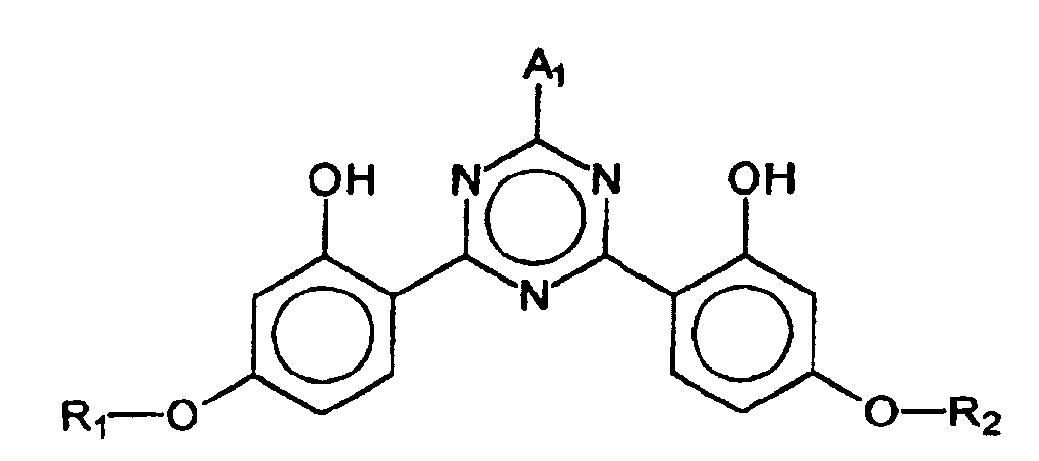
- Vorteilhafte Bis-Resorcinyltriazinderivate sind beispielsweise folgende Verbindungen:

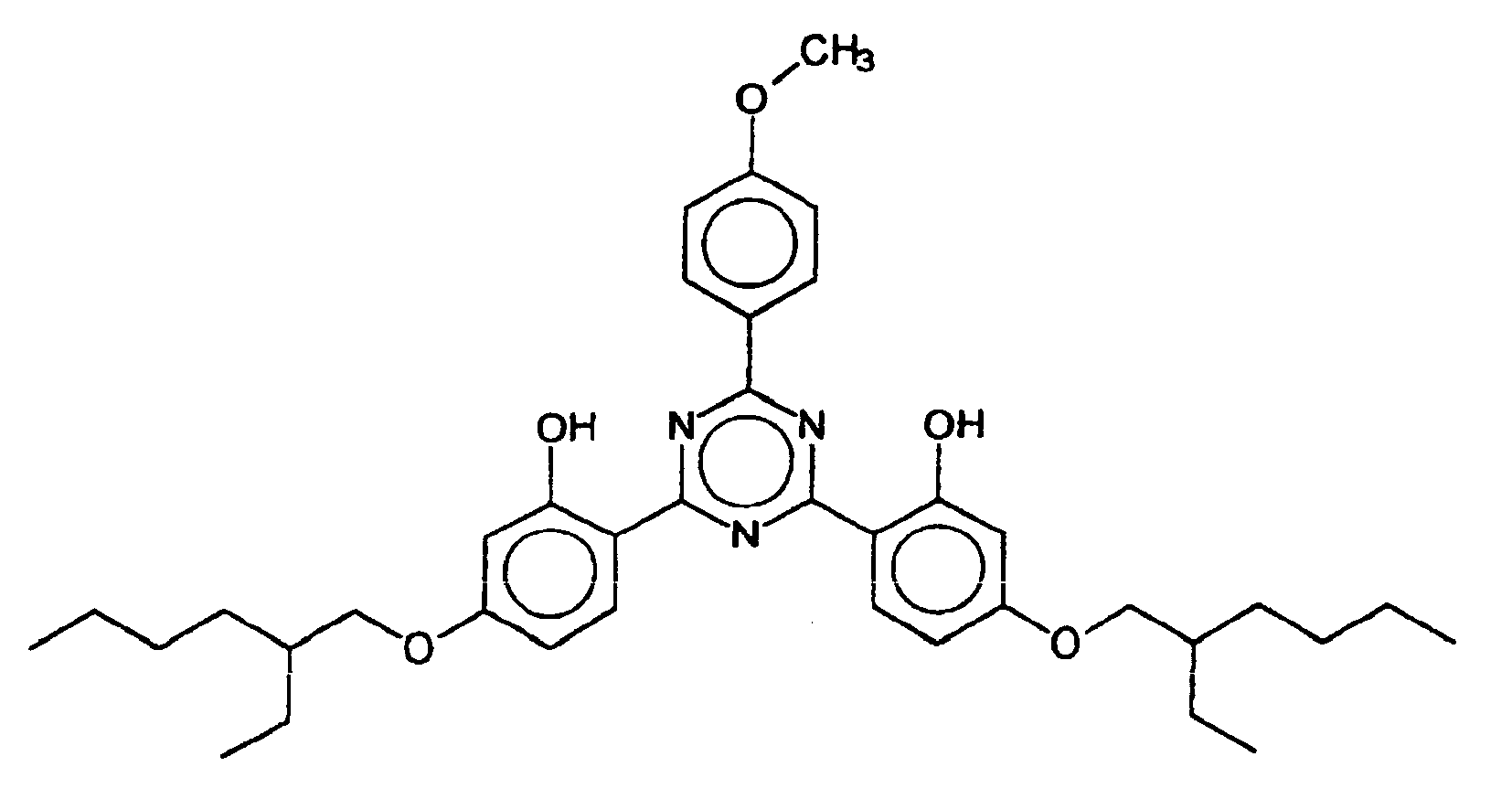
- Ferner vorteilhaft ist das 2,4-Bis-{[4-(3-sulfonato)-2-hydroxy-propyloxy)-2-hydroxy]-phenyl}-6-(4-methoxyphenyl)-1,3,5-triazin Natriumsalz, welches durch folgende Struktur gekennzeichnet ist:

- Ferner vorteilhaft ist das 2,4-Bis-{[4-(3-(2-Propyloxy)-2-hydroxy-propyloxy)-2-hydroxy]-phenyl}-6-(4-methoxyphenyl)-1,3,5-triazin, welches durch folgende Struktur gekennzeichnet ist:

- Ferner vorteilhaft ist das 2,4-Bis-{[4-(2-ethyl-hexyloxy)-2-hydroxy]-phenyl}-6-[4-(2-methoxyethyl-carboxyl)-phenylamino]-1,3,5-triazin, welches durch folgende Struktur gekennzeichnet ist:

- Ferner vorteilhaft ist das 2,4-Bis-{[4-(3-(2-propyloxy)-2-hydroxy-propyloxy)-2-hydroxy]-phenyl}-6-[4-(2-ethyl-carboxyl)-phenylamino]-1,3,5-triazin, welches durch folgende Struktur gekennzeichnet ist:
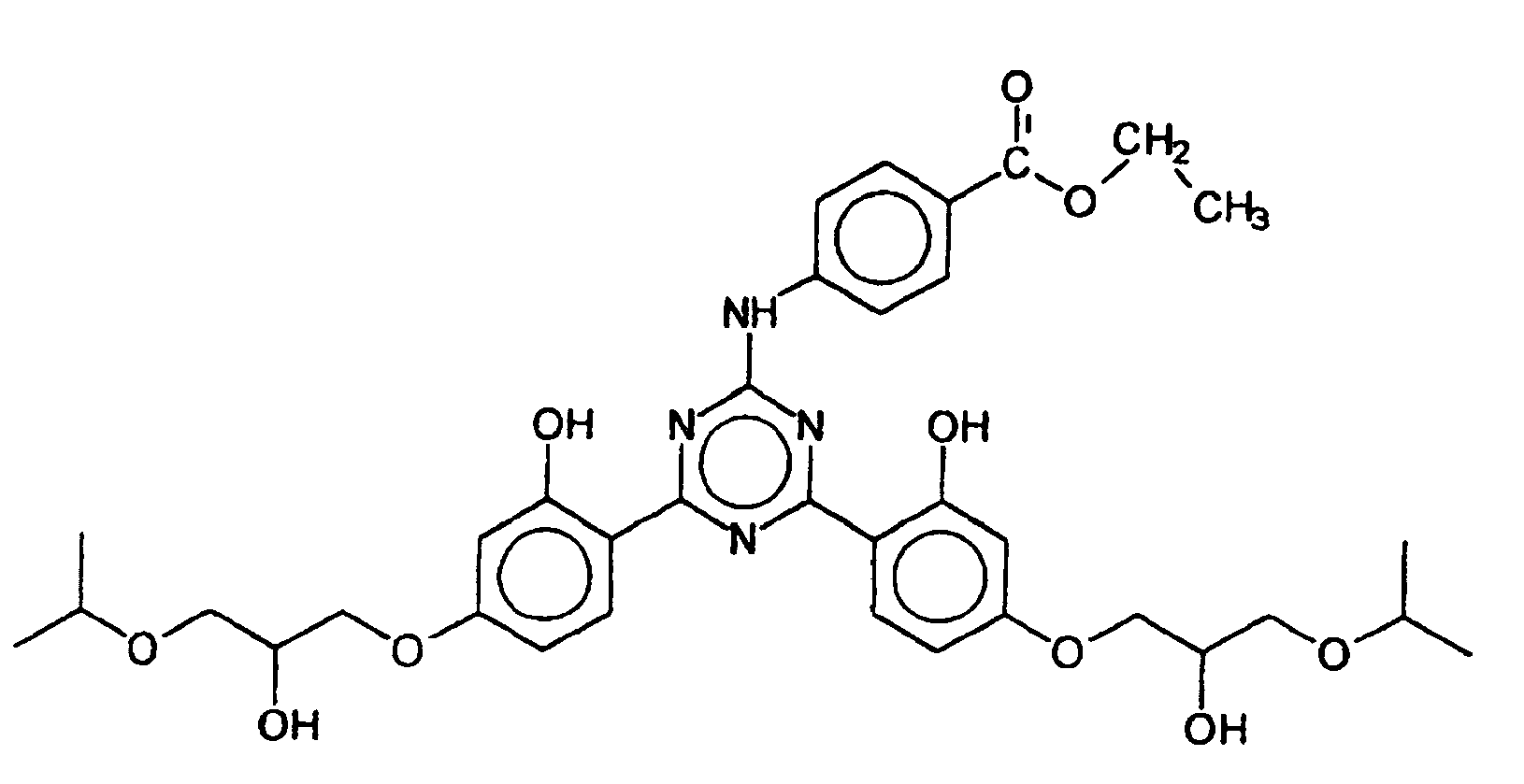
- Ferner vorteilhaft ist das 2,4-Bis-{[4-(2-ethyl-hexyloxy)-2-hydroxy]-phenyl]-6-(1-methyl-pyrrol-2-yl)-1,3,5-triazin, welches durch folgende Struktur gekennzeichnet ist:
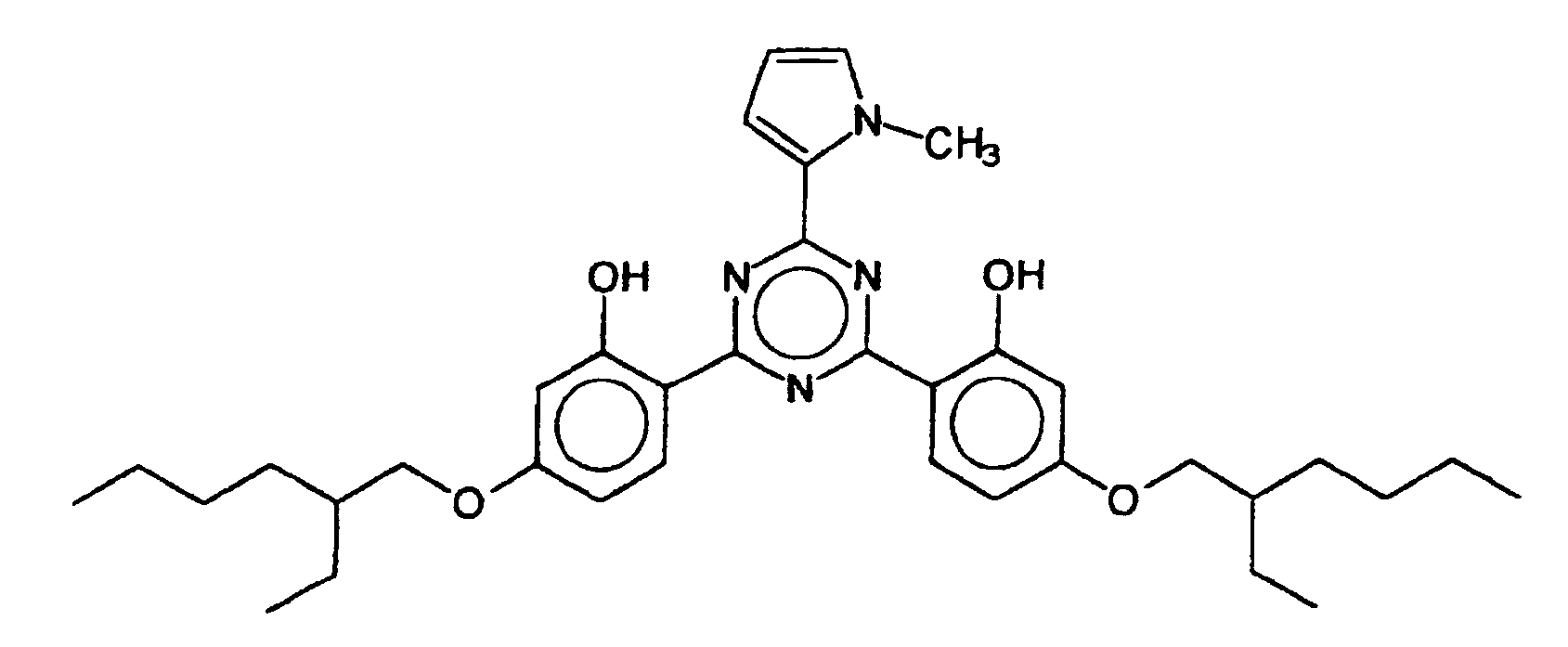
- Ferner vorteilhaft ist das 2,4-Bis-{[4-tris(trimethylsiloxy-silylpropyloxy)-2-hydroxy]-phenyl}-6-(4-methoxyphenyl)-1,3,5-triazin, welches durch folgende Struktur gekennzeichnet ist:
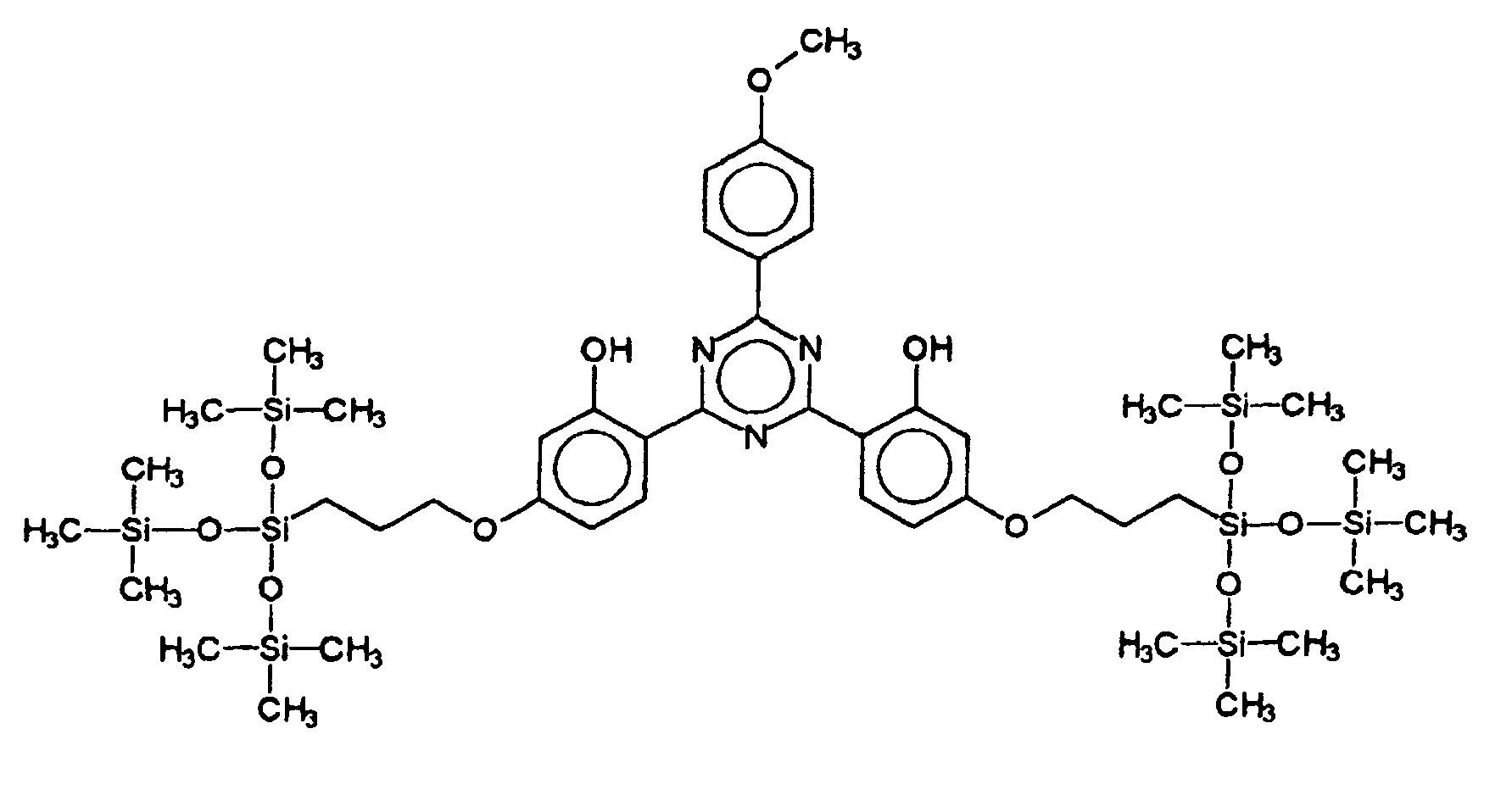
- Ferner vorteilhaft ist das 2,4-Bis-{[4-(2"-methylpropenyloxy)-2-hydroxy]-phenyl}-6-(4-methoxyphenyl)-1,3,5-triazin, welches durch folgende Struktur gekennzeichnet ist:
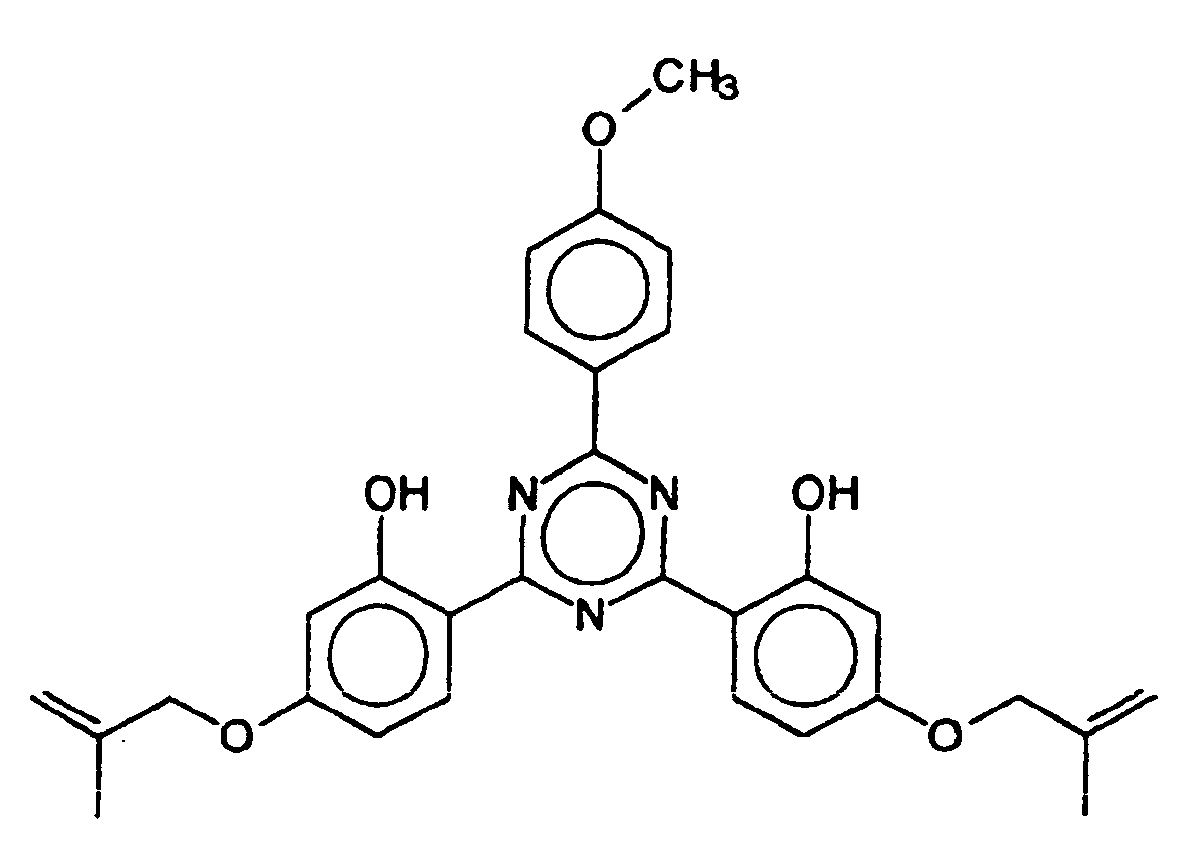
- Ferner vorteilhaft ist das 2,4-Bis-{[4-(1',1',1',3',5',5',5'-Heptamethylsiloxy-2"-methyl-propyloxy)-2-hydroxy]-phenyl}-6-(4-methoxyphenyl)-1,3,5-triazin, welches durch folgende Struktur gekennzeichnet ist:

- Selbst wenn grundsätzlich ein gewisser UV-Schutz bei gegebener begrenzter Löslichkeit, (und damit nach herkömmlichen Maßstäben: schlechter Einarbeitbarkeit in eine kosmetische oder dermatologische Zubereitung) mit Bis-Resorcinyltriazinderivaten erreicht werden kann, kann ein anderes Problem auftreten, die Rekristallisation. Diese tritt gerade bei schlecht löslichen Substanzen vergleichsweise schnell ein, sei es durch Temperaturschwankungen oder andere Einflüsse hervorgerufen. Unkontrollierte Rekristallisation eines wesentlichen Zubereitungsbestandteiles wie eines UV-Filters hat aber äußerst nachteilige Einwirkungen auf die Eigenschaften der gegebenen Zubereitung und, nicht zuletzt, auf den angestrebten Lichtschutz.
- Ferner vorteilhaft ist das Dioctylbutylamidotriazon, dessen chemische Struktur durch die Formel

- Noch ein weiterer vorteilhafter UV-Filter ist das 2,2'-Methylen-bis-(6-(2H-benzotriazol-2-yl)-4-(1,1,3,3-tetramethylbutyl)-phenol), welches durch die chemische Strukturformel

- Auch andere als Festkörper vorliegende - oftmals schwerlösliche - UV-Filtersubstanzen sind bekannt, beispielsweise 2-Phenylbenzimidazol-5-sulfonsäure bzw. ihre Salze, insbesondere das Natrium-, das Kalium und das TEA-Salz, beispielsweise erhältlich unter der Bezeichnung Eusolex® 232 der Merck AG, welches sich durch folgende Strukturformel auszeichnet:

- Die teilweise vorstehend genannten Verbindungen, welche als Lichtschutzmittel für kosmetische und dermatologische Lichtschutzformulierungen eingesetzt werden, zeichnen sich, wie gesagt, an sich durch gute Lichtschutzwirkung aus. Sie haben jedoch den Nachteil, daß es bisweilen schwierig ist, sie in befriedigender Weise solchen Formulierungen einzuverleiben.
- In den Schriften EP-A-392 883, WO 92/20690 und WO 93/04665 werden vorteilhafte UV-Fiftersubstanzen beschrieben, welche sich dadurch auszeichnen, daß chromophore Gruppen mit guten UV-Absorptionseigenschaften an ein Grundgerüst gebunden sind, welches als Organosiloxan charakterisiert werden kann.
- Tenside sind amphiphile Stoffe, die organische, unpolare Substanzen in Wasser lösen können. Sie sorgen, bedingt durch ihren spezifischen Molekülaufbau mit mindestens einem hydrophilen und einem hydrophoben Molekülteil, für eine Herabsetzung der Oberflächenspannung des Wassers, die Benetzung der Haut, die Erleichterung der Schmutzentfemung und -lösung, ein leichtes Abspülen und -je nach Wunsch- für Schaumregulierung.
- Der Einsatz an nichtionischen Tensiden hat einesteils Vorteile bei der Lösung oder Solubilisierung schwerlöslicher UV-Filter und bei der Einarbeitung partikulärer UV-Filter (Titandioxid, Zinkoxid oder auch in ungelöster oder dispergierter Form vorliegender organischer UV-Fiftersubstanzen). Während aber Zubereitungen mit äußerer wäßriger Phase, also beispielsweise O/W-Emulsionen, durchaus stabil sind, bereitet die Formulierung von Zubereitungen mit äußerer Ölphase, also von W/O-Emulsionen, große Schwierigkeiten, da die Öberflächenaktivität der Tenside den durch die W/O-Emulgatoren gebildeten Grenzflächenfilm dramatisch stört.
- Bei den hydrophilen Anteilen eines Tensidmoleküls handelt es sich meist um polare funktionelle Gruppen, während die hydrophoben Teile in der Regel unpolare Kohlenwasserstoffreste darstellen. Tenside werden im allgemeinen nach Art und Ladung des hydrophilen Molekülteils klassifiziert. Hierbei können vier Gruppen unterschieden werden:
- anionische Tenside,
- kationische Tenside,
- amphotere Tenside und
- nichtionische Tenside.
- Typisch für nicht-ionische Tenside sind Polyether-Ketten. Nicht-ionische Tenside bilden in wäßrigem Medium keine lonen.
- Es war also eine Aufgabe der Erfindung den Übelständen des Standes der Technik abzuhelfen. Insbesondere war eine Aufgabe, Zubereitungen in Form von W/O-Emulsionen zur Verfügung zu stellen, welche einen Gehalt an Tensiden zu tolerieren imstande sind. Eine besondere Aufgabe war es ferner, verbesserte Lichtschutzzubereitungen in Form von W/O-Emulsionen zur Verfügung zu stellen,
- Es war indes überraschend, und darin besteht die Lösung dieser Aufgaben, daß kosmetische oder dermatologische W/O-Emulsionen, welche nichtionische Tenside enthalten und sich durch einen Gehalt an Siliconemulgatoren auszeichnen, die Nachteile des Standes der Technik beseitigen.
- Es war insbesondere überraschend, und darin besteht die Lösung dieser Aufgaben, daß kosmetische oder dermatologische W/O-Emulsionen, welche nichtionische Tenside und unter Normalbedingungen als Festkörper vorliegende UV-Filtersubstanzen enthalten und sich durch einen Gehalt an Siliconemulgatoren auszeichnen, besonders vorteilhafte Eigenschaften aufweisen.
- Erfindungsgemäß können die Siliconemulgatoren vorteilhaft aus der Gruppe grenzflächenaktive Substanzen aus der Gruppe der Alkylmethiconcopolyole und/oder Alkyl-Dimethiconcopolyole gewählt werden
- Ein Beispiel für besonders vorteilhaft im Sinne der vorliegenden Erfindung zu verwendende grenzflächenaktiven Substanzen ist das Cetyl Dimethiconcopolyol, welches von der Gesellschaft Th.Goldschmidt AG unter der Warenbezeichnung ABIL® EM 90 verkauft wird.
- Ein weiteres Beispiel für besonders vorteilhaft im Sinne der vorliegenden Erfindung zu verwendende grenzflächenaktiven Substanzen ist das Cyclomethicon Dimethiconcopolyol, welches von der Gesellschaft Th.Goldschmidt AG unter der Warenbezeichnung ABIL® EM 97 verkauft wird.
- Weiterhin hat sich als ganz besonders vorteilhaft der Emulgator Laurylmethiconcopolyol herausgestellt, welcher unter der Warenbezeichnung Dow Corning® 5200 Formulation Aid von der Gesellschaft Dow Corning Ltd. erhältlich ist.
- Die Gesamtmenge an erfindungsgemäß verwendeten Siliconemulgatoren in den erfindungsgemäßen kosmetischen oder dermatologischen Zubereitungen wird vorteilhaft aus dem Bereich von 0,1 - 10,0 Gew.-%, bevorzugt 0,5 - 6,0 Gew.-% gewählt, bezogen auf das Gesamtgewicht der Zubereitungen.
- Das oder die nichtionischen Tenside werden gewählt aus der Gruppe der Alkylglucoside, welche sich durch die Strukturformel


- Von den Alkylglucosiden bevorzugt sind insbesondere wie Laurylglucoside, Decylglycoside, Octylglucoside und Cocoglycoside.
- Die Gesamtmenge an den erfindungsgemäß verwendeten ionischen und/oder amphoteren Tensiden in den fertigen kosmetischen oder dermatologischen Zubereitungen wird vorteilhaft aus dem Bereich von 0,001 - 50 Gew.-%, bevorzugt 0,1- 10,0 Gew.-%, insbesondere 0,5 - 5,0 Gew.-% gewählt, bezogen auf das Gesamtgewicht der Zubereitungen.
- Es war überraschend und für den Fachmann nicht vorauszusehen, daß die Anwendung der erfindungsgemäßen Lehre zur Erhöhung der Stabilität der zugrundeliegenden W/O-Emulsionen führen würde.
- Es war ferner überraschend und für den Fachmann nicht vorauszusehen, daß, wenn die erfindungsgemäßen Zubereitungen als Lichtschutzzubereitungen ausgestaltet werden sollen, die Anwendung der erfindungsgemäßen Lehre zur Erhöhung des Lichtschutzfaktors kosmetischer oder dermatologischer Zubereitungen, welche mindestens eine unter Normalbedingungen als Festkörper vorliegende UV-Filtersubstanz enthalten, führen würde.
- Insbesondere war ferner erstaunlich, daß die Anwendung der erfindungsgemäßen Lehre zu einer Steigerung des Lichtschutzfaktors führen würden, wenn wenigstens einer der UV-Filter in den Lichtschutzzubereitungen gemäß der vorliegenden Erfindung aus der Gruppe der Dibenzoylmethanderivate gewählt wird, beispielsweise 5-Isopropyldibenzoylmethan, 4-(tert.-Butyl)-4'-methoxydibenzoylmethan.
- Insbesondere war ferner erstaunlich, daß die Anwendung der erfindungsgemäßen Lehre zu einer Steigerung des Lichtschutzfaktors führen würden, wenn wenigstens einer der UV-Filter in den Lichtschutzzubereitungen gemäß der vorliegenden Erfindung aus der Gruppe der Benzylidencampherderivate gewählt wird, beispielsweise 4-Methylbenzylidencampher, Benzylidencampher.
- Insbesondere war ferner erstaunlich, daß die Anwendung der erfindungsgemäßen Lehre zu einer Steigerung des Lichtschutzfaktors führen würden, wenn wenigstens einer der UV-Filter in den Lichtschutzzubereitungen gemäß der vorliegenden Erfindung aus der Gruppe der Triazinderivate gewählt wird, insbesondere gewählt aus der Gruppe
- 4,4',4"-(1,3,5-Triazin-2,4,6-triyltriimino)-tris-benzoesäure-tris(2-ethylhexylester)
- 2,4-Bis-{[4-(2-Ethyl-hexyloxy)-2-hydroxy]-phenyl}-6-(4-methoxyphenyl)-1,3,5-triazin,
- 2,4-Bis-{[4-(3-suflonato)-2-hydroxy-propyloxy)-2-hydroxy]-phenyl}-6-(4-methoxyphenyl)-1,3,5-triazin Natriumsalz,
- 2,4-Bis-{[4-(3-(2-Propyloxy)-2-hydroxy-propyloxy)-2-hydroxy]-phenyl}-6-(4-methoxyphenyl)-1,3,5-triazin,
- 2,4-Bis-{[4-(2-ethyl-hexyloxy)-2-hydroxy]-phenyl}-6-[4-(2-methoxyethyl-carboxyl)-phenylamino]-1,3,5-triazin,
- 2,4-Bis-{[4-(3-(2-propyloxy)-2-hydroxy-propyloxy)-2-hydroxy]-phenyl}-6-[4-(2-ethylcarboxyl)-phenylamino]-1,3,5-triazin,
- 2,4-Bis-{[4-(2-ethyl-hexyloxy)-2-hydroxy]-phenyl}-6-(1-methyl-pyrrol-2-yl)-1,3,5-triazin,
- 2,4-Bis-{[4-tris(trimethylsiloxy-silylpropyloxy)-2-hydroxy]-phenyl}-6-(4-methoxyphenyl)-1,3,5-triazin,
- 2,4-Bis-{[4-(2"-methylpropenyloxy)-2-hydroxy]-phenyl}-6-(4-methoxyphenyl)-1,3,5-triazin,
- 2,4-Bis-{[4-(1',1',1',3',5',5',5'-Heptamethylsiloxy-2"-methyl-propyloxy)-2-hydroxy]-phenyl}-6-(4-methoxyphenyl)-1,3,5-triazin,
- Dioctylbutylamidotriazon.
- Ferner war erstaunlich, daß die Zubereitungen im Sinne der vorliegenden Erfindung zu einer Steigerung des Lichtschutzfaktors führen würden, wenn wenigstens einer der UV-Filter in den Lichtschutzzubereitungen gemäß der vorliegenden Erfindung das 2,2'-Methylen-bis-(6-(2H-benzotriazol-2-yl)-4-(1,1,3,3-tetramethylbutyl)-phenol) ist.
- Ferner war erstaunlich, daß die Anwendung der erfindungsgemäßen Lehre zu einer besonders homogenen Verteilung der unter Normalbedingungen als Festkörper vorliegenden UV-Filtersubstanzen führen würden, wenn wenigstens eine dieser als Festkörper vorliegenden UV-Filtersubstanzen in den Lichtschutzzubereitungen gemäß der vorliegenden Erfindung aus der Gruppe der Triazinderivate gewählt wird, insbesondere gewählt aus der Gruppe.
- 4,4',4"-(1,3,5-Triazin-2,4,6-triyltriimino)-tris-benzoesäure-tris(2-ethyihexylester)
- 2,4-Bis-{[4-(2-Ethyl-hexyloxy)-2-hydroxy]-phenyl}-6-(4-methoxyphenyl)-1,3,5-triazin,
- 2,4-Bis-{[4-(3-sulfonato)-2-hydroxy-propyloxy)-2-hydroxy]-phenyl}-6-(4-methoxyphenyl)-1,3,5-triazin Natriumsalz,
- 2,4-Bis-{[4-(3-(2-Propyloxy)-2-hydroxy-propyloxy)-2-hydroxy]-phenyl}-6-(4-methoxyphenyl)-1,3,5-triazin,
- 2,4-Bis-{[4-(2-ethyl-hexyloxy)-2-hydroxy]-phenyl}-6-[4-(2-methoxyethyl-carboxyl)-phenylamino]-1,3,5-triazin,
- 2,4-Bis-{[4-(3-(2-propyloxy)-2-hydroxy-propyloxy)-2-hydroxy]-phenyl}-6-[4-(2-ethylcarboxyl)-phenylamino]-1,3,5-triazin,
- 2,4-Bis-{[4-(2-ethyl-hexyloxy)-2-hydroxy]-phenyl}-6-(1-methyl-pyrrol-2-yl)-1,3,5-triazin,
- 2,4-Bis-{[4-tris(trimethylsiloxy-silylpropyloxy)-2-hydroxy]-phenyl}-6-(4-methoxyphenyl)-1,3,5-triazin,
- 2,4-Bis-{[4-(2"-methylpropenyloxy)-2-hydroxy]-phenyl}-6-(4-methoxyphenyl)-1,3,5-triazin,
- 2,4-Bis-{[4-(1',1',1',3',5',5',5'-Heptamethylsiloxy-2"-methyl-propyloxy)-2-hydroxy]-phenyl}-6-(4-methoxyphenyl)-1,3,5-triazin.
- Weiterhin war erstaunlich, daß die Anwendung dererfindungsgemäßen Lehre zu einer besonders homogenen Verteilung der unter Normalbedingungen als Festkörper vorliegenden UV-Filtersubstanzen führen würden, wenn wenigstens einer der UV-Filter in den Lichtschutzzubereitungen gemäß der vorliegenden Erfindung das 2,2'-Methylen-bis-(6-(2H-benzotriazol-2-yl)-4-(1,1,3,3-tetramethylbutyl)-phenol) ist.
- Weiterhin war erstaunlich, daß die Anwendung dererfindungsgemäßen Lehre zu einer besonders homogenen Verteilung der unter Normalbedingungen als Festkörper vorliegenden UV-Filtersubstanzen führen würden, wenn wenigstens einer der UV-Filter in den Lichtschutzzubereitungen gemäß der vorliegenden Erfindung gewählt wird aus der Gruppe der oligomeren oder polymeren UV-Filter, insbesondere solcher oligomeren oder polymeren UV-Filtersubstanzen mit periodisch sich wiederholenden Si-O- Gruppen vorteilhaft aus der Gruppe der UV-Filtersubstanzen gewählt werden, die in den Schriften EP-A-392 883, WO 92/20690 und WO 93/04665 UV-Filtersubstanzen beschrieben werden.
- Grob schematisch können diese oligomeren oder polymeren UV-Filtersubstanzen, die im folgenden der Einfachheit halber auch "Polymerfilter" genannt werden sollen, durch folgende allgemeine Strukturen beschrieben werden:


- Dabei repräsentieren die Reste R und R" allgemeine organische Reste, die Reste X, X' und repräsentieren entweder ebenfalls organische Reste wie R und R" oder aber Reste wie Y, was weiter unten erläutert wird, r kann Werte von 0 - 100 annehmen, s kann Werte von 0 - 20 annehmen, wobei mindestens einer der Rest e X, X' einen Rest Y bedeutet, wenn s = 0. t kann Werte von 0-10 annehmen, v kann Werte von 1-10 annehmen, wobei die Summe aus v und t größer oder gleich 3 ist.
- Y stellt die für die UV-Absorption verantwortlichen Chromophore dar. Insbesondere repräsentieren die Reste R und R" Alkylreste mit 1 - 10 Kohlenstoffatomen bzw. Phenylreste. Die Chromophorreste Y werden insbesondere vorteilhaft gewählt aus der Gruppe

- Ganz besonders vorteilhaft wird Y gewählt aus der Gruppe


- Bevorzugter erfindungsgemäß verwendeter Polymerfilter sind Substanzen, in welchen Y die Gruppe
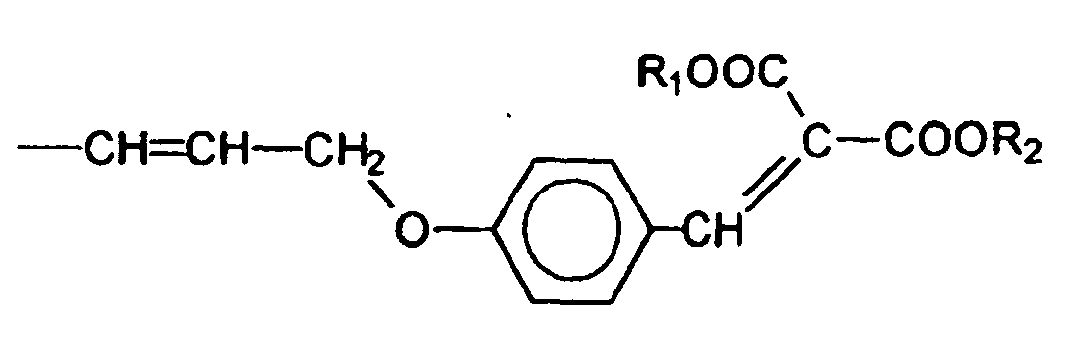
- Besonders vorteilhafte Ausführungsformen der vorliegenden Erfindung werden auch erhalten, wenn als Y gewählt wird der Rest
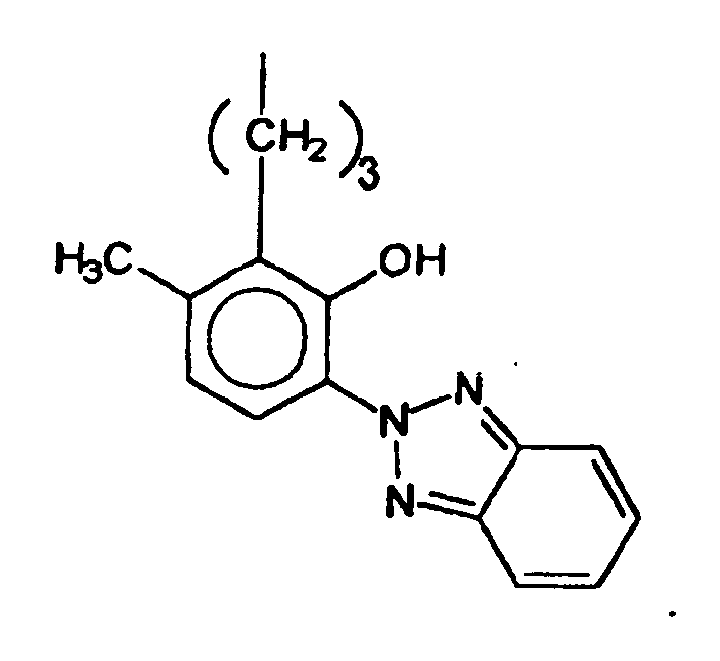
- Die Gesamtmenge an erfindungsgemäß verwendeten, unter Normalbedingungen als Festkörper vorliegenden UV-Filtersubstanzen in den erfindungsgemäßen kosmetischen oder dermatologischen Zubereitungen wird vorteilhaft aus dem Bereich von 0,1 - 10,0 Gew.-%, bevorzugt 0,5 - 6,0 Gew.-% gewählt, bezogen auf das Gesamtgewicht der Zubereitungen.
- Grundsätzlich ist zwar möglich und vorteilhaft, die erfindungsgemäß verwendeten, unter Normalbedingungen als Festkörper vorliegenden UV-Filtersubstanzen zu jedem beliebigen Zeitpunkt dem den Emulsionen zugrundeliegenden Gemisch zuzugeben. Es wird allerdings erfindungsgemäß bevorzugt, die erfindungsgemäß verwendeten, unter Normalbedingungen als Festkörper vorliegenden UV-Fittersubstanzen vor einem eventuell erwünschten Emulgierungsvorgang in der Ölphase, gegebenenfalls unter Erwärmen, zu dispergieren und weitere übliche Verarbeitungsschritte nachzuschalten.
- Es ist bevorzugt, die erfindungsgemäß verwendeten unter Normalbedingungen als Festkörper vorliegenden UV-Filtersubstanzen unter Erwärmen in der Ölphase, insbesondere vorteilhaft in einer unpolaren Ölkomponente bzw. einem Gemisch aus unpolaren Ölkomponenten, zu dispergieren.
- Es ist dabei bevorzugt, zunächst die Löslichkeit der erfindungsgemäßverwendeten unter Normalbedingungen als Festkörper vorliegenden UV-Filtersubstanzen in der Gesamtheit der Ölkomponenten zu bestimmen, wobei es von Vorteil ist, solche Ölkomponenten auszuwählen, in denen die erfindungsgemäß verwendeten unter Normalbedingungen als Festkörpervorliegenden UV-Filtersubstanzen zu höchstens 5 Gew.-% Iöslich sind. Diese Vorauswahl zu treffen, übersteigt nicht das allgemeine Wissen des Fachmannes.
- Als unter Normalbedingungen als Festkörper vorliegende UV-Filtersubstanz werden auch angesehen: anorganische Pigmente auf Basis von Metalloxiden und/oder anderen in Wasser schwerlöslichen oder unlöslichen Metallverbindungen, insbesondere derOxide des Titans (TiO2), Zinks (ZnO), Eisens (z.B. Fe2O3, Zirkoniums (ZrO2), Siliciums (SiO2), Mangans (z.B. MnO), Aluminiums (Al2O3), Cers (z.B. Ce2O3), Mischoxiden der entsprechenden Metalle sowie Abmischungen aus solchen Oxiden. Besonders bevorzugt handelt es sich um Pigmente auf der Basis von TiO2.
- Solche anorganischen Pigmente liegen erfindungsgemäß vorteilhaft in hydrophober Form vor, d.h., daß sie oberflächlich wasserabweisend behandelt sind. Diese Oberflächenbehandlung kann darin bestehen, daß die Pigmente nach an sich bekannten Verfahren mit einer dünnen hydrophoben Schicht versehen werden.
- Eines solcher Verfahren besteht beispielsweise darin, daß die hydrophobe Oberflächenschicht nach einer Reaktion gemäß
n TiO2 + m (RO)3Si-R' -> n TiO2 (oberfl.)
erzeugt wird. n und m sind dabei nach Belieben einzusetzende stöchiometrische Parameter, R und R' die gewünschten organischen Reste. Beispielsweise in Analogie zu DE-OS 33 14 742 dargestellte hydrophobisierte Pigmente sind von Vorteil. - Vorteilhafte TiO2-Pigmente sind beispielsweise unter den Handelsbezeichnungen T 805 von der Firma Degussa erhältlich.
- Zubereitungen gemäß der Erfindung können auch röntgenamporphe Oxidpigmente enthalten. Röntgenamorphe Oxidpigmente sind Metalloxide oder Halbmetalloxide, welche bei Röntgenbeugungsexperimenten keine oder keine erkenntliche Kristallstruktur erkennen lassen. Oftmals sind solche Pigmente erhältlich durch Flammenreaktion, beispielsweise dadurch, daß ein Metall- oder Halbmetallhalogenid mit Wasserstoff und Luft (oder reinem Sauerstoff) in einer Flamme umgesetzt wird.
- Bekannte und in der kosmetischen oder dermatologischen Galenik oftmals verwendete röntgenamorphe Oxidpigmente sind die Siliciumoxide des Typs Aerosil® (CAS-Nr. 7631-86-9. Aerosile®, erhältlich von der Gesellschaft DEGUSSA, zeichnen sich durch geringe Partikelgröße (z.B. zwischen 5 und 40 nm) aus, wobei die Partikel als kugelförmige Teilchen sehr einheitlicher Abmessung anzusehen sind. Makroskopisch sind Aerosile® als lockere, weiße Pulver erkenntlich. Im Sinne der vorliegenden Erfindung sind röntgenamorphe Siliciumdioxidpigmente besonders vorteilhaft, und unter diesen gerade solche des Aerosil® -Typs bevorzugt.
- Vorteilhafte Aerosil®-Typen sind beispielsweise Aerosil® OX50, Aerosil® 130, Aerosil® 150, Aerosil® 200, Aerosil® 300, Aerosil® 380, Aerosil® MOX 80, Aerosil® MOX 170, Aerosil® COK 84, Aerosil® R 202, Aerosil® R 805, Aerosil® R 812, Aerosil® R 972, Aerosil® R 974, Aerosil® R976.
- Erfindungsgemäß enthalten kosmetische oder dermatologische Lichtschutzzubereitungen 0,1 bis 20 Gew.-%, vorteilhaft 0,5 bis 10 Gew.%, ganz besonders bevorzugt 1 bis 5 Gew.-% röntgenamorphe Oxidpigmente.
- Die Gesamtmenge an anorganischen Pigmenten, insbesondere hydrophoben anorganischen Mikropigmenten in den fertigen kosmetischen oder dermatologischen Zubereitungen wird vorteilhaft aus dem Bereich von 0,1 - 30 Gew.-%, bevorzugt 0,1 - 10,0, insbesondere 0,5 - 6,0 Gew.-% gewählt, bezogen auf das Gesamtgewicht der Zubereitungen.
- Die erfindungsgemäßen kosmetischen und/oder dermatologischen Lichtschutzformulierungen können wie üblich zusammengesetzt sein und dem kosmetischen und/oder dermatologischen Lichtschutz, ferner zur Behandlung, der Pflege und der Reinigung der Haut und/oder der Haare und als Schminkprodukt in derdekorativen Kosmetik dienen.
- Zur Anwendung werden die erfindungsgemäßen kosmetischen und dermatologischen Zubereitungen in der für Kosmetika üblichen Weise auf die Haut und/oder die Haare in ausreichender Menge aufgebracht.
- Besonders bevorzugt sind solche kosmetischen und dermatologischen Zubereitungen, die in der Form eines Sonnenschutzmittels vorliegen. Vorteilhaft können diese zusätzlich mindestens einen weiteren UVA-Filter und/oder mindestens einen weiteren UVB-Filter und/oder mindestens ein anorganisches Pigment, bevorzugt ein anorganisches Mikropigment, enthalten.
- Die erfindungsgemäßen kosmetischen und dermatologischen Zubereitungen können kosmetische Hilfsstoffe enthalten, wie sie üblicherweise in solchen Zubereitungen verwendet werden, z.B. Konservierungsmittel, Bakterizide, Parfüme, Substanzen zum Verhindern des Schäumens, Farbstoffe, Pigmente, die eine färbende Wirkung haben, Verdickungsmittel, anfeuchtende und/oder feuchthaltende Substanzen, Fette, Öle, Wachse oder andere übliche Bestandteile einer kosmetischen oder dermatologischen Formulierung wie Alkohole, Polyole, Polymere, Schaumstabilisatoren, Elektrolyte, organische Lösungsmittel oder Silikonderivate.
- Ein zusätzlicher Gehalt an Antioxidantien ist im allgemeinen bevorzugt. Erfindungsgemäß können als günstige Antioxidantien alle für kosmetische und/oder dermatologische Anwendungen geeigneten oder gebräuchlichen Antioxidantien verwendet werden.
- Vorteilhaft werden die Antioxidantien gewählt aus der Gruppe bestehend aus Aminosäuren (z.B. Glycin, Histidin, Tyrosin, Tryptophan) und deren Derivate, imidazole (z.B. Urocaninsäure) und deren Derivate, Peptide wie D, L-Carnosin, D-Camosin, L-Carnosin und deren Derivate (z.B. Anserin), Carotinoide, Carotine (z.B. α-Carotin, β-Carotin, Lycopin) und deren Derivate, Chlorogensäure und deren Derivate, Liponsäure und deren Derivate (z.B. Dihydroliponsäure), Aurothioglucose, Propylthiouracil und andere Thiole (z.B. Thioredoxin, Glutathion, Cystein, Cystin, Cystamin und deren Glycosyl-, N-Acetyl-, Methyl-, Ethyl-, Propyl-, Amyl-, Butyl- und Lauryl-, Palmitoyl-, Oleyl-, γ-Linoleyl-, Cholesteryl- und Glycerylester) sowie deren Salze, Dilaurylthiodipropionat, Distearylthiodipropionat, Thiodipropionsäure und deren Derivate (Ester, Ether, Peptide, Lipide, Nukleotide, Nukleoside und Salze) sowie Sulfoximinverbindungen (z.B. Buthioninsulfoximine, Homocysteinsulfoximin, Buthioninsulfone, Penta-, Hexa-, Heptathioninsulfoximin) in sehr geringen verträglichen Dosierungen (z.B. pmol bis µmol/kg), ferner (Metall)-Chelatoren (z.B. α-Hydroxyfettsäuren, Palmitinsäure, Phytinsäure, Lactoferrin), α-Hydroxysäuren (z.B. Citronensäure, Milchsäure, Apfelsäure), Huminsäure, Gallensäure, Gallenextrakte, Bilirubin, Biliverdin, EDTA, EGTA und deren Derivate, ungesättigte Fettsäuren und deren Derivate (z.B. γ-Linolensäure, Linolsäure, Ölsäure), Folsäure und deren Derivate, Ubichinon und Ubichinol und deren Derivate, Vitamin C und Derivate (z.B. Ascorbylpalmitat, Mg-Ascorbylphosphat, Ascorbylacetat), Tocopherole und Derivate (z.B. Vitamin-E-acetat), Vitamin A und Derivate (Vitamin-A-palmitat) sowie Koniferylbenzoat des Benzoeharzes, Rutinsäure und deren Derivate, α-Glycosylrutin, Ferulasäure, Furfurylidenglucitol, Carnosin, Butylhydroxytoluol, Butylhydroxyanisol, Nordihydroguajakharzsäure, Nordihydroguajaretsäure, Trihydroxybutyrophenon, Harnsäure und deren Derivate, Mannose und deren Derivate, Zink und dessen Derivate (z.B. ZnO, ZnSO4) Selen und dessen Derivate (z.B. Selenmethionin), Stilbene und deren Derivate (z.B. Stilbenoxid, Trans-Stilbenoxid) und die erfindungsgemäß geeigneten Derivate (Salze, Ester, Ether, Zucker, Nukleotide, Nukleoside, Peptide und Lipide) dieser genannten Wirkstoffe.
- Die Menge der vorgenannten Antioxidantien (eine oder mehrere Verbindungen) in den Zubereitungen beträgt vorzugsweise 0,001 bis 30 Gew.-%, besonders bevorzugt 0,05 - 20 Gew.-%, insbesondere 1 - 10 Gew.-%, bezogen auf das Gesamtgewicht der Zubereitung.
- Sofern Vitamin E und/oder dessen Derivate das oder die Antioxidantien darstellen, ist vorteilhaft, deren jeweilige Konzentrationen aus dem Bereich von 0,001 - 10 Gew.%, bezogen auf das Gesamtgewicht der Formulierung, zu wählen.
- Sofern Vitamin A, bzw. Vitamin-A-Derivate, bzw. Carotine bzw. deren Derivate das oder die Antioxidantien darstellen, ist vorteilhaft, deren jeweilige Konzentrationen aus dem Bereich von 0,001 - 10 Gew.-%, bezogen auf das Gesamtgewicht der Formulierung, zu wählen.
- Die Lipidphase kann vorteilhaft gewählt werden aus folgender Substanzgruppe:
- Mineralöle, Mineralwachse
- Öle, wie Triglyceride der Caprin- oder der Caprylsäure, ferner natürliche Öle wie z.B. Rizinusöl;
- Fette, Wachse und andere natürliche und synthetische Fettkörper, vorzugsweise Ester von Fettsäuren mit Alkoholen niedriger C-Zahl, z.B. mit Isopropanol, Propylenglykol oder Glycerin, oder Ester von Fettalkoholen mit Alkansäuren niedriger C-Zahl oder mit Fettsäuren;
- Alkylbenzoate;
- Silikonöle wie Dimethylpolysiloxane, Diethylpolysiloxane, Diphenylpolysiloxane sowie Mischformen daraus.
- Die Ölphase der Emulsionen, Oleogele bzw. Hydrodispersionen oder Lipodispersionen im Sinne der vorliegenden Erfindung wird vorteilhaft gewählt aus der Gruppe der Ester aus gesättigten und/oder ungesättigten, verzweigten und/oder unverzweigten Alkancarbonsäuren einer Kettenlänge von 3 bis 30 C-Atomen und gesättigten und/oder ungesättigten, verzweigten und/oder unverzweigten Alkoholen einer Kettenlänge von 3 bis 30 C-Atomen, aus der Gruppe der Ester aus aromatischen Carbonsäuren und gesättigten und/oder ungesättigten, verzweigten und/oder unverzweigten Alkoholen einer Kettenlänge von 3 bis 30 C-Atomen. Solche Esteröle können dann vorteilhaft gewählt werden aus der Gruppe Isopropylmyristat, Isopropylpalmitat, Isopropylstearat, Isopropyloleat, n-Butylstearat, n-Hexyllaurat, n-Decyloleat, Isooctylstearat, Isononylstearat, Isononylisononanoat, 2-Ethylhexylpalmitat, 2-Ethylhexyllaurat, 2-Hexyldecylstearat, 2-Octyldodecylpalmitat, Oleyloleat, Oleylerucat, Erucyloleat, Erucylerucat sowie synthetische, halbsynthetische und natürliche Gemische solcher Ester, z.B. Jojobaöl.
- Femer kann die Ölphase vorteilhaft gewählt werden aus der Gruppe der verzweigten und unverzweigten Kohlenwasserstoffe und -wachse, der Silkonöle, der Dialkylether, der Gruppe der gesättigten oder ungesättigten, verzweigten oder unverzweigten Alkohole, sowie der Fettsäuretriglyceride, namentlich der Triglycerinester gesättigter und/oder ungesättigter, verzweigter und/oder unverzweigter Alkancarbonsäuren einer Kettenlänge von 8 bis 24, insbesondere 12 - 18 C-Atomen. Die Fettsäuretriglyceride können beispielsweise vorteilhaft gewählt werden aus der Gruppe der synthetischen, halbsynthetischen und natürlichen Öle, z.B. Olivenöl, Sonnenblumenöl, Sojaöl, Erdnußöl, Rapsöl, Mandelöl, Palmöl, Kokosöl, Palmkernöl und dergleichen mehr.
- Auch beliebige Abmischungen solcher Öl- und Wachskomponenten sind vorteilhaft im Sinne der vorliegenden Erfindung einzusetzen. Es kann auch gegebenenfalls vorteilhaft sein, Wachse, beispielsweise Cetylpalmitat, als alleinige Lipidkomponente der Ölphase einzusetzen.
- Vorteilhaft wird die Ölphase gewählt aus der Gruppe 2-Ethylhexylisostearat, Octyldodecanol, Isotridecylisononanoat, Isoeicosan, 2-Ethylhexylcocoat, C12-15-Alkylbenzoat, Capryl-Caprinsäure-triglycerid, Dicaprylylether.
- Besonders vorteilhaft sind Mischungen aus C12-15-Alkylbenzoat und 2-Ethylhexylisostearat, Mischungen aus C12-15-Alkylbenzoat und Isotridecylisononanoat sowie Mischungen aus C12-15-Alkylbenzoat, 2-Ethylhexylisostearat und Isotridecylisononanoat.
- Von den Kohlenwasserstoffen sind Paraffinöl, Squalan und Squalen vorteilhaft im Sinne der vorliegenden Erfindung zu verwenden.
- Vorteilhaft kann die Ölphase ferner einen Gehalt an cyclischen oder linearen Silikonölen aufweisen oder vollständig aus solchen Ölen bestehen, wobei allerdings bevorzugt wird, außer dem Silikonöl oder den Silikonölen einen zusätzlichen Gehalt an anderen Ölphasenkomponenten zu verwenden.
- Vorteilhaft wird Cyclomethicon (Octamethylcyclotetrasiloxan) als erfindungsgemäß zu verwendendes Silikonöl eingesetzt. Aber auch andere Silikonöle sind vorteilhaft im Sinne der vorliegenden Erfindung zu verwenden, beispielsweise Hexamethylcyclotrisiloxan, Polydimethylsiloxan, Poly(methylphenylsiloxan).
- Besonders vorteilhaft sind ferner Mischungen aus Cyclomethicon und Isotridecylisononanoat, aus Cyclomethicon und 2-Ethylhexylisostearat.
- Die wäßrige Phase der erfindungsgemäßen Zubereitungen enthält gegebenenfalls vorteilhaft
- Alkohole, Diole oder Polyole niedriger C-Zahl, sowie deren Ether, vorzugsweise Ethanol, Isopropanol, Propylenglykol, Glycerin, Ethylenglykol, Ethylenglykolmonoethyl- oder -monobutylether, Propylenglykolmonomethyl, -monoethyl- oder -monobutylether, Diethylenglykolmonomethyl- oder -monoethylether und analoge Produkte, ferner Alkohole niedriger C-Zahl, z.B. Ethanol, Isopropanol, 1,2-Propandiol, Glycerin sowie insbesondere ein oder mehrere Verdickungsmittel, welches oder welche vorteilhaft gewählt werden können aus der Gruppe Siliciumdioxid, Aluminiumsilikate, Polysaccharide bzw. deren Derivate, z.B. Hyaluronsäure, Xanthangummi, Hydroxypropylmethylcellulose, besonders vorteilhaft aus der Gruppe der Polyacrylate, bevorzugt ein Polyacrylat aus der Gruppe der sogenannten Carbopole, beispielsweise Carbopole der Typen 980, 981, 1382, 2984, 5984, jeweils einzeln oder in Kombination.
- Die Gesamtmenge an 2-Phenylbenzimidazol-5-sulfonsäure bzw. deren Salzen in den fertigen kosmetischen oder dermatologischen Zubereitungen wird, falls die Gegenwart dieser Substanz erwünscht ist, vorteilhaft aus dem Bereich von 0,1 - 10,0 Gew.-%, bevorzugt 0,5 - 6,0 Gew.-% gewählt, bezogen auf das Gesamtgewicht der Zubereitungen.
- Die Gesamtmenge an 2-Hydroxy-4-methoxybenzophenon-5-sulfonsäurebzw. deren Salzen in den fertigen kosmetischen oder dermatologischen Zubereitungen wird, falls die Gegenwart dieser Substanz erwünscht ist, vorteilhaft aus dem Bereich von 0,1 - 10,0 Gew.-%, bevorzugt 0,5 - 6,0 Gew.-% gewählt, bezogen auf das Gesamtgewicht der Zubereitungen.
- Die Gesamtmenge an 4-(2-Oxo-3-bornylidenmethyl)benzolsulfonsäure bzw. deren Salzen in den fertigen kosmetischen oder dermatologischen Zubereitungen wird, falls die Gegenwart dieser Substanz erwünscht ist, vorteilhaft aus dem Bereich von 0,1 - 10,0 Gew.-%, bevorzugt 0,5 - 6,0 Gew.-% gewählt, bezogen auf das Gesamtgewicht der Zubereitungen.
- Die Gesamtmenge an 2-Methyl-5-(2-oxo-3-bornylidenmethyl)benzolsulfonsäur bzw. deren Salzen in den fertigen kosmetischen oder dermatologischen Zubereitungen wird, falls die Gegenwart dieser Substanz erwünscht ist, vorteilhaft aus dem Bereich von 0,1-- 10,0 Gew.-%, bevorzugt 0,5 - 6,0 Gew.-% gewählt, bezogen auf das Gesamtgewicht der Zubereitungen.
- Die Gesamtmenge an Benzol-1,4-di(2-oxo-3-bornylidenmethyl-10-Sulfonsäurebzw. deren Salzen in den fertigen kosmetischen oder dermatologischen Zubereitungen wird, falls die Gegenwart dieser Substanz erwünscht ist, vorteilhaft aus dem Bereich von 0,1 - 10,0 Gew.-%, bevorzugt 0,5 - 6,0 Gew.-% gewählt, bezogen auf das Gesamtgewicht der Zubereitungen.
- Die Gesamtmenge an 4,4',4"-(1,3,5-Triazin-2,4,6-triyltriimino)-tris-benzoesäure-tris(2-ethylhexylester) in den fertigen kosmetischen oder dermatologischen Zubereitungen wird, falls die Gegenwart dieser Substanz erwünscht ist, vorteilhaft aus dem Bereich von 0,1 - 10,0 Gew.-%, bevorzugt 0,5 - 6,0 Gew.-% gewählt, bezogen auf das Gesamtgewicht der Zubereitungen.
- Die Gesamtmenge an 4-(tert.-Butyl)-4'-methoxydibenzoylmethan in den fertigen kosmetischen oder dermatologischen Zubereitungen wird, falls die Gegenwart dieser Substanz erwünscht ist, vorteilhaft aus dem Bereich von 0,1 - 10,0 Gew.-%, bevorzugt 0,5 - 6,0 Gew.-% gewählt, bezogen auf das Gesamtgewicht der Zubereitungen.
- Die Gesamtmenge an 4-Methylbenzylidencampher in den fertigen kosmetischen oder dermatologischen Zubereitungen wird, falls die Gegenwart dieser Substanz erwünscht ist, vorteilhaft aus dem Bereich von 0,1 - 10,0 Gew.-%, bevorzugt 0,5 - 6,0 Gew.-% gewählt, bezogen auf das Gesamtgewicht der Zubereitungen.
- Die Gesamtmenge an 2-Ethylhexyl-p-methoxy-cinnamat in den fertigen kosmetischen oder dermatologischen Zubereitungen wird, falls die Gegenwart dieser Substanz erwünscht ist, vorteilhaft aus dem Bereich von 0,1 - 15,0 Gew.-%, bevorzugt 0,5 - 7,5 Gew.-% gewählt, bezogen auf das Gesamtgewicht der Zubereitungen.
- Noch eine weiterere erfindungsgemäß vorteilhaft zu verwendende zusätzliche Lichtschutzfiltersubstanz ist das Ethylhexyl-2-cyano-3,3-diphenylacrylat (Octocrylen), welches von BASF unter der Bezeichnung UVINUL® N 539 erhältlich ist und sich durch folgende Struktur auszeichnet:

- Die Gesamtmenge an Ethylhexyl-2-cyano-3,3-diphenylacrylat in den fertigen kosmetischen oder dermatologischen Zubereitungen wird, falls die Gegenwart dieser Substanz erwünscht ist, vorteilhaft aus dem Bereich von 0,1 - 15,0 Gew.-%, bevorzugt 0,5 - 10,0 Gew.-% gewählt, bezogen auf das Gesamtgewicht der Zubereitungen.
- Ferner kann gegebenenfalls von Vorteil sein, erfindungsgemäß weiteren UVA- und/oder UVB-Filtern in kosmetische oder dermatologisch Zubereitungen einzuarbeiten, beispielsweise bestimmten Salicylsäurederivaten wie 4-Isopropylbenzylsalicylat, 2-Ethylhexylsalicylat (=Octylsalicylat), Homomenthylsalicylat.
- Die Gesamtmenge an einem oder mehreren Salicylsäurederivaten in den fertigen kosmetischen oder dermatologischen Zubereitungen wird vorteilhaft aus dem Bereich von 0,1-15,0 Gew.-%, bevorzugt 0,5 - 8,0 Gew.-% gewählt, bezogen auf das Gesamtgewicht der Zubereitungen. Wenn Ethylhexylsalicylat gewählt wird, ist es von Vorteil, dessen Gesamtmenge aus dem Bereich von 0,1 - 5,0 Gew.-%, bevorzugt 0,5 - 2,5 Gew.-% zu wählen. Wenn Homomenthylsalicylat gewählt wird, ist es von Vorteil, dessen Gesamtmenge aus dem Bereich von 0,1 - 10,0 Gew.-%, bevorzugt 0,5 - 5,0 Gew.-% zu wählen.
- Der LSF kosmetischer oder dermatologischer Zubereitungen, enthaltend beliebige der vorab geschilderten UV-Filtersubstanzen, sei es als Einzelsubstanzen oder in beliebigen Gemischen untereinander, wobei die Gesamtmenge solcher Filtersubstanzen z.B. 0,1 Gew.-% bis 30 Gew.-%, vorzugsweise 0,5 bis 10 Gew.-%, insbesondere 1 bis 6 Gew.-% beträgt, bezogen auf das Gesamtgewicht der Zubereitungen, wird erfindungsgemäß durch die Verwendung von Polymerfiltern erheblich gesteigert.
- Die nachfolgenden Beispiele sollen die vorliegende Erfindung verdeutlichen. Alle Mengenangaben, Anteile und Prozentanteile sind, soweit nicht anders angegeben, auf das Gewicht und die Gesamtmenge bzw. auf das Gesamtgewicht der Zubereitungen bezogen.
- Die Abkürzung BEMPT steht für 2,4-Bis-{[4-(2-Ethyl-hexyloxy)-2-hydroxy]-phenyl}-6-(4-methoxyphenyl)-1,3,5-triazin.


Claims (4)
- Kosmetische oder dermatologische W/O-Emulsionen, welche nichtionische Tenside und unter Normalbedingungen als Festkörper vorliegende UV-Filtersubstanzen enthalten und sich durch einen Gehalt an Siliconemulgatoren auszeichnen, wobei der Siliconemulgatoroder die Siliconemulgatoren aus der Gruppe der Alkylmethiconcopolyole und/oder Alkyl-Dimethiconcopolyole gewählt werden und das nichtionische Tensid oder die nichtionischen Tenside gewählt aus der Gruppe der Alkylglucoside, welche sich durch die Strukturformel


- W/O-Emulsionen nach Anspruch 1, dadurch gekennzeichnet, daß die unter Normalbedingungen als Festkörper vorliegenden organischen UV-Filterkomponenten gewählt werden aus der Gruppe- 4,4',4"-(1,3,5-Triazin-2,4,6-triyltriimino)-tris-benzoesäure-tris(2-ethylhexylester)- 2,4-Bis-{[4-(2-Ethyl-hexyloxy)-2-hydroxy]-phenyl}-6-(4-methoxyphenyl)-1,3,5-triazin,- 2,4-Bis-{[4-(3-suifonato)-2-hydroxy-propyloxy)-2-hydroxy]-phenyl}-6-(4-methoxyphenyl)-1,3,5-triazin Natriumsalz,- 2,4-Bis-{[4-(3-(2-Propyloxy)-2-hydroxy-propyloxy)-2-hydroxy]-phenyl}-6-(4-methoxyphenyl)-1,3,5-triazin,- 2,4-Bis-{[4-(2-ethyl-hexyloxy)-2-hydroxy]-phenyl}-6-[4-(2-methoxyethyl-carboxyl)-phenylamino]-1,3,5-triazin,- 2,4-Bis-{[4-(3-(2-propyloxy)-2-hydroxy-propyloxy)-2-hydroxy]-phenyl}-6-[4-(2-ethyl-carboxyl)-phenylamino]-1,3,5-triazin,- 2,4-Bis-{[4-(2-ethy)-hexyloxy)-2-hydroxy]-phenyl}-6-(1-methyl-pyrrol-2-yl)-1,3,5-triazin,- 2,4-Bis-{[4-tris(trimethylsiloxy-silylpropyloxy)-2-hydroxy]-phenyl}-6-(4-methoxyphenyl)-1,3,5-triazin,- 2,4-Bis-{[4-(2"-methylpropenyloxy)-2-hydroxy]-phenyl}-6-(4-methoxyphenyl)-1,3,5-triazin,- 2,4-Bis-{[4-(1',1', 1',3',5',5',5'-Heptamethylsiloxy-2"-methyl-propyloxy)-2-hydroxy]-phenyl}-6-(4-methoxyphenyl)-1,3,5-triazin,- 2-Phenylbenzimidazol-5-sulfonsäure bzw. deren Salze, insbesondere das Natrium-, das Kalium und das TEA-Salz,- 2,2'-Methylen-bis-(6-(2H-benzotriazol-2-yl)-4-(1,1,3,3-tetramethylbutyl)-phenol)- 5-Isopropyldibenzoylmethan, 4-(tert.-Butyl)-4'-methoxydibenzoylmethan,- 4-Methylbenzylidencampher, Benzylidencampher.
- W/O-Emulsionen nach Anspruch 1, dadurch gekennzeichnet, daß die unter Normalbedingungen als Festkörper vorliegenden organischen UV-Filterkomponenteri gewählt werden aus der Gruppe der oligomeren oder polymeren UV-Flltersubstanzen mit periodisch sich wiederholenden Si-O- Gruppen.
- W/O-Emulsionen nach Anspruch 1, dadurch gekennzeichnet, daß die unter Normalbedingungen als Festkörper vorliegenden UV-Filterkomponenten gewählt werden aus der Gruppe der anorganischen Pigmente auf Basis von Metalloxiden und/oder anderen in Wasser schwerlöslichen oder unlöslichen Metallverbindungen, insbesondere der Oxide des Titans (TiO2), Zinks (ZnO), Eisens (z.B. Fe2O3, Zirkoniums (ZrO2), Siliciums (SiO2), Mangans (z.B. MnO), Aluminiums (Al2O3), Cers (z.B. Ce2O3), Mischoxiden der entsprechenden Metalle sowie Abmischungen aus solchen Oxiden.
Applications Claiming Priority (3)
| Application Number | Priority Date | Filing Date | Title |
|---|---|---|---|
| DE19833634 | 1998-07-25 | ||
| DE19833634A DE19833634A1 (de) | 1998-07-25 | 1998-07-25 | Kosmetische oder dermatologische W/O-Emulsionen, welche nichtionische Tenside enthalten und sich durch einen Gehalt an Siliconemulatoren auszeichnen |
| PCT/EP1999/004971 WO2000006113A1 (de) | 1998-07-25 | 1999-07-14 | Kosmetische oder dermatologische w/o-emulsionen, welche nichtionische tenside enthalten und sich durch einen gehalt an siliconemulgatoren auszeichnen |
Publications (3)
| Publication Number | Publication Date |
|---|---|
| EP1100452A1 EP1100452A1 (de) | 2001-05-23 |
| EP1100452B1 EP1100452B1 (de) | 2003-10-15 |
| EP1100452B2 true EP1100452B2 (de) | 2006-12-13 |
Family
ID=7875371
Family Applications (1)
| Application Number | Title | Priority Date | Filing Date |
|---|---|---|---|
| EP99934693A Expired - Lifetime EP1100452B2 (de) | 1998-07-25 | 1999-07-14 | Kosmetische oder dermatologische w/o-emulsionen, welche nichtionische tenside enthalten und sich durch einen gehalt an siliconemulgatoren auszeichnen |
Country Status (5)
| Country | Link |
|---|---|
| EP (1) | EP1100452B2 (de) |
| JP (1) | JP2003528027A (de) |
| DE (2) | DE19833634A1 (de) |
| ES (1) | ES2207958T3 (de) |
| WO (1) | WO2000006113A1 (de) |
Families Citing this family (12)
| Publication number | Priority date | Publication date | Assignee | Title |
|---|---|---|---|---|
| EP1280505B1 (de) * | 2000-05-12 | 2007-05-02 | Ciba SC Holding AG | Photostabilisierung von dibenzoylmethan-derivaten |
| WO2002017873A1 (en) * | 2000-08-29 | 2002-03-07 | Ciba Specialty Chemicals Holding Inc. | Sunscreen compositions containing a dibenzoylmethane derivative and a triazine derivative |
| WO2002017872A1 (en) * | 2000-08-29 | 2002-03-07 | Ciba Specialty Chemicals Holding Inc. | Sunscreen compositions containing titanium dioxide and triazine derivatives |
| DE10100409A1 (de) * | 2001-01-08 | 2002-07-11 | Beiersdorf Ag | Kosmetische und dermatologische Lichtschutzformulierungen mit einem Gehalt an Benzotriazolderivaten und oberflächenaktiven Saccharoseestern |
| DE10100411A1 (de) * | 2001-01-08 | 2002-07-11 | Beiersdorf Ag | Kosmetische und dermatologische Lichtschutzformulierungen mit einem Gehalt an unsymmetrisch substituierten Triazinderivaten und oberflächenaktiven Saccharoseestern |
| DE10210337A1 (de) * | 2002-03-08 | 2003-09-25 | Beiersdorf Ag | Lippenpflegeprodukte mit UV-Schutz |
| DE10236064A1 (de) * | 2002-08-07 | 2004-02-19 | Beiersdorf Ag | Schäumende Sonnenschutzzubereitungen |
| DE10307467A1 (de) * | 2003-02-21 | 2004-09-02 | Beiersdorf Ag | Kosmetische und dermatologische Emulsionen |
| JP4566135B2 (ja) * | 2005-06-01 | 2010-10-20 | 株式会社資生堂 | 油中水型皮膚外用組成物 |
| DE102013213170A1 (de) * | 2013-07-04 | 2015-01-08 | Beiersdorf Ag | Octocrylenfreies, geruchsstabiles Sonnenschutzmittel |
| BR112019007256B1 (pt) * | 2016-10-11 | 2022-07-19 | Dsm Ip Assets B.V | Composição cosmética compreendendo pelo menos um micropigmento inorgânico e um c8- 10 alquil poliglicosídeo |
| WO2021035386A1 (en) * | 2019-08-23 | 2021-03-04 | Beiersdorf Daily Chemical (Wuhan) Co. Ltd. | Sunscreen composition without cyclomethicones |
Citations (1)
| Publication number | Priority date | Publication date | Assignee | Title |
|---|---|---|---|---|
| EP0709080A1 (de) † | 1994-10-14 | 1996-05-01 | Givaudan-Roure (International) S.A. | Lichtstabile kosmetische Sonnenschutzmittel |
Family Cites Families (11)
| Publication number | Priority date | Publication date | Assignee | Title |
|---|---|---|---|---|
| GB9204388D0 (en) * | 1992-02-29 | 1992-04-15 | Tioxide Specialties Ltd | Water-in-oil emulsions |
| FR2696931B1 (fr) * | 1992-10-21 | 1994-12-30 | Oreal | Emulsions eau dans l'huile à phase continue fluorohydrocarbonée et utilisation de certains tensioactifs siliconés pour leur préparation. |
| DE4320871C2 (de) * | 1993-06-24 | 1995-05-04 | Beiersdorf Ag | Kosmetische und dermatologische Zubereitungen mit einem Gehalt an delta-Aminolävulinsäure |
| GB9422099D0 (en) * | 1994-11-02 | 1994-12-21 | Procter & Gamble | Cosmetic composition |
| JPH09151108A (ja) * | 1995-11-30 | 1997-06-10 | Kose Corp | 油中水型乳化化粧料 |
| JPH09301822A (ja) * | 1996-05-10 | 1997-11-25 | Sunstar Inc | 油中水型乳化化粧料 |
| DE19632044A1 (de) * | 1996-08-08 | 1997-02-20 | Henkel Kgaa | Sonnenschutzmittel |
| DE19632043A1 (de) * | 1996-08-08 | 1998-02-12 | Henkel Kgaa | Sonnenschutzmittel |
| FR2759583B1 (fr) * | 1997-02-17 | 1999-12-10 | Oreal | Composition antisolaire contenant un organopolysiloxane elastomerique solide |
| DE19715842B4 (de) * | 1997-04-16 | 2006-03-16 | Beiersdorf Ag | Kosmetische und dermatologische Lichtschutzformulierungen mit einem Gehalt an Triazinderivaten und grenzflächenaktiven Substanzen sowie deren Verwendung |
| DE19735899A1 (de) * | 1997-08-19 | 1999-02-25 | Beiersdorf Ag | Wirkstoffkombinationen aus einer oder mehreren grenzflächenaktiven Substanzen und oligomeren oder polymeren UV-Filtersubstanzen mit periodisch sich wiederholenden Si-0-Gruppen |
-
1998
- 1998-07-25 DE DE19833634A patent/DE19833634A1/de not_active Withdrawn
-
1999
- 1999-07-14 EP EP99934693A patent/EP1100452B2/de not_active Expired - Lifetime
- 1999-07-14 DE DE59907382T patent/DE59907382D1/de not_active Expired - Lifetime
- 1999-07-14 ES ES99934693T patent/ES2207958T3/es not_active Expired - Lifetime
- 1999-07-14 WO PCT/EP1999/004971 patent/WO2000006113A1/de not_active Ceased
- 1999-07-14 JP JP2000561970A patent/JP2003528027A/ja active Pending
Patent Citations (1)
| Publication number | Priority date | Publication date | Assignee | Title |
|---|---|---|---|---|
| EP0709080A1 (de) † | 1994-10-14 | 1996-05-01 | Givaudan-Roure (International) S.A. | Lichtstabile kosmetische Sonnenschutzmittel |
Also Published As
| Publication number | Publication date |
|---|---|
| JP2003528027A (ja) | 2003-09-24 |
| WO2000006113A1 (de) | 2000-02-10 |
| EP1100452B1 (de) | 2003-10-15 |
| ES2207958T3 (es) | 2004-06-01 |
| EP1100452A1 (de) | 2001-05-23 |
| DE19833634A1 (de) | 2000-02-03 |
| DE59907382D1 (de) | 2003-11-20 |
Similar Documents
| Publication | Publication Date | Title |
|---|---|---|
| EP1034778B1 (de) | Verwendung von Octocrylen zur Solubilisierung von 2,4-Bis- [4-(2-Ethyl-hexyloxy)-2-hydroxy]-phenyl -6-(4-methoxyphenyl)-1,3,5-triazin in kosmetischen oder dermatologischen Lichtschutzmitteln | |
| EP1100452B1 (de) | Kosmetische oder dermatologische w/o-emulsionen, welche nichtionische tenside enthalten und sich durch einen gehalt an siliconemulgatoren auszeichnen | |
| DE19841797A1 (de) | Kosmetische und dermatologische W/O-Emulsionen, welche nichtionische Tenside enthalten und sich durch einen Gehalt an oberflächenaktiven Substanzen auszeichnen | |
| DE19754037B4 (de) | Verwendung von Polysacchariden zur Verbesserung der Lichtschutzwirkung kosmetischer oder dermatologischer Lichtschutzmittel | |
| EP1582201B1 (de) | Verwendung von unsymmetrisch substituierten Triazinderivaten zur Erzielung oder Erhöhung der Löslichkeit von symmetrisch substituierten Triazinderivaten in Ölkomponenten | |
| DE19841798A1 (de) | Kosmetische oder dermatologische W/O-Emulsionen, welche ionische und/oder amphotere Tenside enthalten und sich durch einen Gehalt an oberflächenaktiven Substanzen auszeichnen | |
| EP0904770B1 (de) | Verwendung von röntgenamorphen Oxiden zur Verstärkung des Lichtschutzfaktors und/oder der UV-A-Schutzleistung kosmetischer oder dermatologischer Lichtschutzmittel | |
| EP0887068B1 (de) | Verwendung von Bienenwachs zur Verstärkung des Lichtschutzfaktors kosmetischer oder dermatologischer Lichtschutzmittel | |
| EP0976391A1 (de) | Kosmetische oder dermatologische W/O-Emulsionen, welche ionische und/oder amphotere Tenside enthalten und sich durch einen Gehalt an Siliconemulgatoren auszeichnen | |
| DE19703471A1 (de) | Kosmetische und dermatologische Lichtschutzformulierungen mit einem Gehalt an Triazinderivaten und Butylenglycoldiestern | |
| EP0887069B1 (de) | Verwendung von synthetischem Bienenwachs zur Verstärkung des Lichtschutzfaktors kosmetischer oder dermatologischer Lichtschutzmittel | |
| DE19723732B4 (de) | Kosmetische und dermatologische Lichtschutzformulierungen mit einem Gehalt an Triazinderivaten und Monocacylestern des Isosorbids und ihre Verwendung | |
| EP0897715A2 (de) | Kosmetische oder dermatologische Lichtschutzmittel, welche als Festkörper vorliegende UV-Filtersubstanzen und polymere UV-Filtersubstanzen auf Siliconbasis enthalten | |
| EP0897716B1 (de) | Wirkstoffkombinationen aus einer oder mehreren grenzflächenaktiven Substanzen und oligomeren oder polymeren UV-Filtersubstanzen mit periodisch sich wiederholenden Si-O-Gruppen | |
| DE19735900A1 (de) | Kosmetische oder dermatologische Lichtschutzmittel, welche gelöste Triazinderivate und polymere UV-Filtersubstanzen auf Siliconbasis enthalten | |
| DE19751221A1 (de) | Verwendung von C¶1¶¶8¶¶-¶¶3¶¶8¶-Alkylhydroxystaroylstearat zur Verstärkung des Lichtschutzfaktors kosmetischer oder dermatologischer Lichtschutzmittel | |
| DE19715842A1 (de) | Kosmetische und dermatologische Lichtschutzformulierungen mit einem Gehalt an Triazinderivaten und grenzflächenaktiven Substanzen | |
| EP1076552B1 (de) | Kosmetische und dermatologische lichtschutzformulierungen mit einem gehalt an triazinderivaten und einem oder mehreren estern unverzweigtkettiger carbonsäuren und verzweigtkettiger alkohole | |
| DE102004009154A1 (de) | Kosmetische und dermatologische Lichtschutzformulierungen mit einem Gehalt an 2-(4`-Diethylamino-2`-hydoxybenzoyl)-benzoesäurehexylester und Triheptylin | |
| DE19735055A1 (de) | Verwendung von röntgenamorphen Oxiden zur Verstärkung des Lichtschutzfaktors kosmetischer oder dermatologischer Lichtschutzmittel | |
| DE19830461A1 (de) | Verwendung von Eisen-Titan-Mischoxiden zur Verstärkung der Lichtschutzleistung kosmetischer oder dermatologischer Lichtschutzmittel | |
| EP1166759A2 (de) | Verwendung von Lecithinen zur Verstärkung des Lichtschutzfaktors und/oder der UVA-Schutzleistung kosmetischer oder dermatologischer Lichtschutzmittel | |
| EP0895775A1 (de) | Lichtschutzbereitungen mit einem Gehalt an anorganischen Pigmenten, welche oberflächlich mit UV-Filtersubstanzen beschichtet sind | |
| DE19739344A1 (de) | Kosmetische und dermatologische Lichtschutzformulierungen mit einem Gehalt an Triazinderivaten und Dialkylmaleaten | |
| DE19710854A1 (de) | Verwendung von Benzophenonen und deren Derivaten gegen die UV-induzierte Zersetzung von Dibenzoylmethan und dessen Derivaten |
Legal Events
| Date | Code | Title | Description |
|---|---|---|---|
| PUAI | Public reference made under article 153(3) epc to a published international application that has entered the european phase |
Free format text: ORIGINAL CODE: 0009012 |
|
| 17P | Request for examination filed |
Effective date: 20001222 |
|
| AK | Designated contracting states |
Kind code of ref document: A1 Designated state(s): AT BE CH CY DE DK ES FI FR GB GR IE IT LI LU MC NL PT SE |
|
| 17Q | First examination report despatched |
Effective date: 20020307 |
|
| GRAH | Despatch of communication of intention to grant a patent |
Free format text: ORIGINAL CODE: EPIDOS IGRA |
|
| GRAS | Grant fee paid |
Free format text: ORIGINAL CODE: EPIDOSNIGR3 |
|
| GRAA | (expected) grant |
Free format text: ORIGINAL CODE: 0009210 |
|
| AK | Designated contracting states |
Kind code of ref document: B1 Designated state(s): DE ES FR GB IT SE |
|
| REG | Reference to a national code |
Ref country code: GB Ref legal event code: FG4D Free format text: NOT ENGLISH |
|
| REG | Reference to a national code |
Ref country code: IE Ref legal event code: FG4D Free format text: GERMAN |
|
| REF | Corresponds to: |
Ref document number: 59907382 Country of ref document: DE Date of ref document: 20031120 Kind code of ref document: P |
|
| GBT | Gb: translation of ep patent filed (gb section 77(6)(a)/1977) |
Effective date: 20031222 |
|
| REG | Reference to a national code |
Ref country code: SE Ref legal event code: TRGR |
|
| REG | Reference to a national code |
Ref country code: ES Ref legal event code: FG2A Ref document number: 2207958 Country of ref document: ES Kind code of ref document: T3 |
|
| REG | Reference to a national code |
Ref country code: IE Ref legal event code: FD4D |
|
| ET | Fr: translation filed | ||
| PLBI | Opposition filed |
Free format text: ORIGINAL CODE: 0009260 |
|
| PLBQ | Unpublished change to opponent data |
Free format text: ORIGINAL CODE: EPIDOS OPPO |
|
| PLAX | Notice of opposition and request to file observation + time limit sent |
Free format text: ORIGINAL CODE: EPIDOSNOBS2 |
|
| 26 | Opposition filed |
Opponent name: STADA ARZNEIMITTEL AG Effective date: 20040714 |
|
| PLAX | Notice of opposition and request to file observation + time limit sent |
Free format text: ORIGINAL CODE: EPIDOSNOBS2 |
|
| PLBB | Reply of patent proprietor to notice(s) of opposition received |
Free format text: ORIGINAL CODE: EPIDOSNOBS3 |
|
| PGFP | Annual fee paid to national office [announced via postgrant information from national office to epo] |
Ref country code: ES Payment date: 20050720 Year of fee payment: 7 |
|
| PUAH | Patent maintained in amended form |
Free format text: ORIGINAL CODE: 0009272 |
|
| STAA | Information on the status of an ep patent application or granted ep patent |
Free format text: STATUS: PATENT MAINTAINED AS AMENDED |
|
| RIC2 | Information provided on ipc code assigned after grant |
Ipc: A61Q 17/04 20060101ALI20061017BHEP Ipc: A61K 8/898 20060101ALI20061017BHEP Ipc: A61K 8/60 20060101ALI20061017BHEP Ipc: A61K 8/49 20060101ALI20061017BHEP Ipc: A61K 8/35 20060101ALI20061017BHEP Ipc: A61K 8/06 20060101AFI20061017BHEP |
|
| 27A | Patent maintained in amended form |
Effective date: 20061213 |
|
| AK | Designated contracting states |
Kind code of ref document: B2 Designated state(s): DE ES FR GB IT SE |
|
| GBTA | Gb: translation of amended ep patent filed (gb section 77(6)(b)/1977) | ||
| PG25 | Lapsed in a contracting state [announced via postgrant information from national office to epo] |
Ref country code: ES Free format text: LAPSE BECAUSE OF FAILURE TO SUBMIT A TRANSLATION OF THE DESCRIPTION OR TO PAY THE FEE WITHIN THE PRESCRIBED TIME-LIMIT Effective date: 20070324 |
|
| ET3 | Fr: translation filed ** decision concerning opposition | ||
| PGFP | Annual fee paid to national office [announced via postgrant information from national office to epo] |
Ref country code: SE Payment date: 20060713 Year of fee payment: 8 |
|
| PGFP | Annual fee paid to national office [announced via postgrant information from national office to epo] |
Ref country code: IT Payment date: 20080724 Year of fee payment: 10 |
|
| PG25 | Lapsed in a contracting state [announced via postgrant information from national office to epo] |
Ref country code: SE Free format text: LAPSE BECAUSE OF NON-PAYMENT OF DUE FEES Effective date: 20070424 |
|
| PG25 | Lapsed in a contracting state [announced via postgrant information from national office to epo] |
Ref country code: IT Free format text: LAPSE BECAUSE OF NON-PAYMENT OF DUE FEES Effective date: 20090714 |
|
| REG | Reference to a national code |
Ref country code: FR Ref legal event code: PLFP Year of fee payment: 18 |
|
| REG | Reference to a national code |
Ref country code: FR Ref legal event code: PLFP Year of fee payment: 19 |
|
| REG | Reference to a national code |
Ref country code: FR Ref legal event code: PLFP Year of fee payment: 20 |
|
| PGFP | Annual fee paid to national office [announced via postgrant information from national office to epo] |
Ref country code: FR Payment date: 20180725 Year of fee payment: 20 Ref country code: DE Payment date: 20180731 Year of fee payment: 20 |
|
| PGFP | Annual fee paid to national office [announced via postgrant information from national office to epo] |
Ref country code: GB Payment date: 20180719 Year of fee payment: 20 |
|
| REG | Reference to a national code |
Ref country code: DE Ref legal event code: R071 Ref document number: 59907382 Country of ref document: DE |
|
| REG | Reference to a national code |
Ref country code: GB Ref legal event code: PE20 Expiry date: 20190713 |
|
| PG25 | Lapsed in a contracting state [announced via postgrant information from national office to epo] |
Ref country code: GB Free format text: LAPSE BECAUSE OF EXPIRATION OF PROTECTION Effective date: 20190713 |