EP1103923B1 - Procédé pour commander automatiquement des articles de consommation et dispositif pour la mise en oeuvre du procédé - Google Patents
Procédé pour commander automatiquement des articles de consommation et dispositif pour la mise en oeuvre du procédé Download PDFInfo
- Publication number
- EP1103923B1 EP1103923B1 EP00250399.3A EP00250399A EP1103923B1 EP 1103923 B1 EP1103923 B1 EP 1103923B1 EP 00250399 A EP00250399 A EP 00250399A EP 1103923 B1 EP1103923 B1 EP 1103923B1
- Authority
- EP
- European Patent Office
- Prior art keywords
- order
- cartridge
- ribbon
- consumable
- ink cartridge
- Prior art date
- Legal status (The legal status is an assumption and is not a legal conclusion. Google has not performed a legal analysis and makes no representation as to the accuracy of the status listed.)
- Expired - Lifetime
Links
- 238000000034 method Methods 0.000 title claims description 33
- 230000015654 memory Effects 0.000 claims description 18
- 238000004891 communication Methods 0.000 claims description 12
- 238000012795 verification Methods 0.000 claims description 9
- 230000001960 triggered effect Effects 0.000 claims description 7
- 230000005540 biological transmission Effects 0.000 claims description 5
- 238000011156 evaluation Methods 0.000 claims description 4
- 238000012790 confirmation Methods 0.000 claims description 3
- 230000006870 function Effects 0.000 claims description 3
- 238000012544 monitoring process Methods 0.000 claims description 3
- 238000004220 aggregation Methods 0.000 claims 2
- 230000002776 aggregation Effects 0.000 claims 2
- 238000013208 measuring procedure Methods 0.000 claims 1
- 230000008859 change Effects 0.000 description 9
- 238000010586 diagram Methods 0.000 description 6
- 238000012545 processing Methods 0.000 description 6
- 238000012546 transfer Methods 0.000 description 6
- 230000008901 benefit Effects 0.000 description 5
- 239000000463 material Substances 0.000 description 5
- 238000007639 printing Methods 0.000 description 5
- 238000013459 approach Methods 0.000 description 4
- 238000012384 transportation and delivery Methods 0.000 description 4
- 238000001514 detection method Methods 0.000 description 3
- 239000007787 solid Substances 0.000 description 3
- WHXSMMKQMYFTQS-UHFFFAOYSA-N Lithium Chemical compound [Li] WHXSMMKQMYFTQS-UHFFFAOYSA-N 0.000 description 2
- 238000013478 data encryption standard Methods 0.000 description 2
- 229910052744 lithium Inorganic materials 0.000 description 2
- 230000002093 peripheral effect Effects 0.000 description 2
- 241000408529 Libra Species 0.000 description 1
- 239000000853 adhesive Substances 0.000 description 1
- 230000003466 anti-cipated effect Effects 0.000 description 1
- 230000000712 assembly Effects 0.000 description 1
- 238000000429 assembly Methods 0.000 description 1
- 238000004364 calculation method Methods 0.000 description 1
- 230000007547 defect Effects 0.000 description 1
- 238000011161 development Methods 0.000 description 1
- 230000018109 developmental process Effects 0.000 description 1
- 238000005516 engineering process Methods 0.000 description 1
- 238000007641 inkjet printing Methods 0.000 description 1
- 238000003780 insertion Methods 0.000 description 1
- 230000037431 insertion Effects 0.000 description 1
- 238000002372 labelling Methods 0.000 description 1
- 239000007788 liquid Substances 0.000 description 1
- 230000014759 maintenance of location Effects 0.000 description 1
- 239000003550 marker Substances 0.000 description 1
- 238000003032 molecular docking Methods 0.000 description 1
- 230000003287 optical effect Effects 0.000 description 1
- 238000004806 packaging method and process Methods 0.000 description 1
- 230000000704 physical effect Effects 0.000 description 1
- 230000037452 priming Effects 0.000 description 1
- 230000008569 process Effects 0.000 description 1
- 230000011664 signaling Effects 0.000 description 1
- 239000000126 substance Substances 0.000 description 1
- 238000010023 transfer printing Methods 0.000 description 1
- 238000011144 upstream manufacturing Methods 0.000 description 1
- 238000005303 weighing Methods 0.000 description 1
Images


Classifications
-
- G—PHYSICS
- G07—CHECKING-DEVICES
- G07B—TICKET-ISSUING APPARATUS; FARE-REGISTERING APPARATUS; FRANKING APPARATUS
- G07B17/00—Franking apparatus
- G07B17/00016—Relations between apparatus, e.g. franking machine at customer or apparatus at post office, in a franking system
- G07B17/0008—Communication details outside or between apparatus
- G07B2017/00153—Communication details outside or between apparatus for sending information
- G07B2017/00169—Communication details outside or between apparatus for sending information from a franking apparatus, e.g. for verifying accounting
-
- G—PHYSICS
- G07—CHECKING-DEVICES
- G07B—TICKET-ISSUING APPARATUS; FARE-REGISTERING APPARATUS; FRANKING APPARATUS
- G07B17/00—Franking apparatus
- G07B17/00185—Details internally of apparatus in a franking system, e.g. franking machine at customer or apparatus at post office
- G07B17/00193—Constructional details of apparatus in a franking system
- G07B2017/0025—Storage of, e.g. ribbon
-
- G—PHYSICS
- G07—CHECKING-DEVICES
- G07B—TICKET-ISSUING APPARATUS; FARE-REGISTERING APPARATUS; FRANKING APPARATUS
- G07B17/00—Franking apparatus
- G07B17/00185—Details internally of apparatus in a franking system, e.g. franking machine at customer or apparatus at post office
- G07B17/00314—Communication within apparatus, personal computer [PC] system, or server, e.g. between printhead and central unit in a franking machine
- G07B2017/00322—Communication between components/modules/parts, e.g. printer, printhead, keyboard, conveyor or central unit
-
- G—PHYSICS
- G07—CHECKING-DEVICES
- G07B—TICKET-ISSUING APPARATUS; FARE-REGISTERING APPARATUS; FRANKING APPARATUS
- G07B17/00—Franking apparatus
- G07B17/00459—Details relating to mailpieces in a franking system
- G07B17/00508—Printing or attaching on mailpieces
- G07B2017/00516—Details of printing apparatus
- G07B2017/00524—Printheads
- G07B2017/00532—Inkjet
Definitions
- the invention relates to a method for the automatic ordering of consumables for a franking machine according to the preamble of claim 1 and an arrangement for carrying out the method according to the preamble of claim 18.
- the solution below is applicable to the renewal of consumables of franking machines. It does not matter whether they are ink cartridges for ink jet printing units, thermal transfer ribbon cassettes, self-adhesive franking strips or other consumables.
- Postage meter machines have been known since the twenties and are still being perfected to this day.
- the printing principle has changed from original purely mechanical solutions with printing drum to electronic solutions with thermal transfer or inkjet printhead.
- microprocessors and electronic credit stores were used.
- special security measures have been developed that prevent unauthorized manipulation to the detriment of the manufacturer or User or the mail carrier to prevent or detect.
- the franking machine also consumes printing ink and wears the parts associated with the printing technology, it is in the interest of the user and the mail carrier, if high-quality own material of the manufacturer is consumed.
- piracy products when so-called piracy products are used, this has an impact on the life and print quality of the machine. Piracy products are used because of the lower price and may be easier to procure than the original materials through a dealer.
- Dealers of franking machines are often made responsible for deliveries to the customer and the customer thinks it is a defect of the manufacturer if the deliveries do not arrive on time or are too expensive.
- the customer often does not plan his delivery requirements properly and then threatens the shutdown of his mail processing, because of lack of ink.
- the result is urgent assistance requests to manufacturers for consumables, some of which must be delivered by courier. Remedy could be a direct distribution of consumables to the customer, which requires a timely request.
- the object of the invention is to develop a method for automatically ordering ink tank cassettes or ink ribbon cassettes in franking machines, which largely minimizes the use of improper consumables and is inexpensive and inexpensive for the customer. For different consumables a timely signaling of approaching the replacement should take place.
- An arrangement for carrying out the method should have means that automatically trigger an order for consumables from the responsible manufacturer.
- the approach of a consumption end is detected before a consumable is changed.
- the consumed size may be a time, physical, monetary, or book size or number of items.
- a combination of different consumption quantities for a more accurate evaluation can be taken into account in order to trigger an order routine.
- For indirect detection of consumption nearing for example, before changing a (ink tank / ribbon) cassette of a postage meter, is used to evaluate a predetermined count for the impressions before or after sensors detect a low ink level / residual value.
- the order number can be constructed in several parts and includes an order code and / or an identification number for the consumable. It is anticipated that the manufacturer will aggregate the consumable with a generated order code and / or identification number by attaching both or the latter to a consumable item for sale, or by attaching it or by similar means. This also includes a marking of the consumable with this order code and / or with the identification number, which can be done in very different ways depending on the physical condition of the consumable.
- the device may have a chip card read / write unit for the semi-automatic entry or a scanner for the automatic entry of the order code and / or the identification number.
- the device After reaching a threshold value for a consumable before changing a consumable and after establishing a communication link to the remote data center, the device automatically generates and transmits an encrypted order message. If one and the same user can be assigned to the device, then the serial number of the device serves as the identification code.
- the order message includes the serial number of the device, the order code aggregated with the consumable and an identification number.
- the latter includes a number indicating the type of consumable and the one ordered Amount of consumable identifying number, if necessary, a check digit.
- the identification code serial number of the device
- the corresponding consumables are determined on the basis of the order message and the order is triggered by a shipping department.
- an authenticity of the order in the data center can be checked by the operation Compare, if there is a match of the order code with a reference order code, which is assigned in the database of the serial number of the device and thus indirectly to the purchaser.
- Another order routine which allows the order of the same consumables in larger numbers, requires in addition to the notification of an identification code also a message of a purchase order number.
- the latter contains a figure for the quantity corresponding to the number of ordered consumables.
- the identification code can again be the serial number of the device.
- a search in a database for one of the serial number of the device associated consumables can provide the type of consumable material here.
- the communication connection also serves to notify the device after verifying the authenticity of the order. It is possible to change the operation of the device if the verification has revealed a non-authenticity of the order.
- FIG. 1 The perspective view of a franking machine 1 of the type T1000 is shown in FIG FIG. 1 shown from the front left.
- the franking machine 1 has an internal modem and, for example, can be connected to a data center 100 via a first data connection 14 for the purpose of credit recharge, which has a database 130.
- a chip card 10 serves, for example, for setting the postage meter machine to a cost center, under which the billing is to be made.
- the franking machine 1 has a cassette compartment 7, which must be opened for insertion of a thermal transfer ribbon cassette 9.
- a display text is generated by the microprocessor and on the display of a user interface 4, a warning appears before removing a cassette supplied by the manufacturer 9 and the continued operation of the franking machine 1 with another cartridge, because the removed cassette 9 can not be used.
- a marker is stamped as a bar code at the beginning of the ribbon. After inserting the new ribbon cassette in the postage meter, a detection of this mark is automatically carried out by means of an - not shown - optical scanner to the control unit of the postage meter to transmit the data content of the marking, as already described in EP 730 974 A2 is already known.
- an order is made after a comparison of a consumption variable with a threshold value.
- the microprocessor operates an indirect or direct measuring method, which is adapted to the type of consumable and supplies the consumption size.
- the threshold value can be preprogrammed by the manufacturer, by keyboard can be entered or loaded via chip card or modem from a remote data center.
- a second variant after a comparison, first a generation of a message to the customer and a user input, which is to be evaluated for confirmation, that an order is to be triggered.
- the order is triggered after a message is generated and transmitted to the data center.
- the message can be encrypted to exclude an unauthorized order.
- a customer can also be given the opportunity, by means of the user interface, to change the number of consumables to be ordered. It is also envisaged that the number of consumables to be ordered can be changed to zero or at least one key is pressed to suppress the automatic order.
- Part of the message is an order number and the serial number of the device, i. E. the security module (PSD) of the meter or franking machine.
- PSD security module
- the PSD Postal Security Device
- the PSD Postal Security Device
- Each of the requesting devices uses an automatic routine, which preferably uses the serial number of the device as the identification code.
- the latter allows a franking machine to determine its location and thus provides the destination address for sending the order.
- a consumables service has been installed at the data center, which verifies the authenticity of the order based on an identification of the ordering party or inquiring user and an evaluation of the order number in the data center.
- the serial number of the device is assigned to a customer in a database of the data center.
- the order numbers for various consumables are listed in a list which is stored non-volatile in a memory of the device.
- the aforementioned list can also be loaded by means of a smart card or by modem from a remote data center. It is a significant logistical advantage to be able to order different consumables, regardless of their type, with the same procedure, without the need for a service staff.
- the order number can be constructed in several parts.
- a first part consists of an order code which is only allocated to a certain group of consumables which can be reordered for the device and also provides proof that the order has been automatically initiated by the device itself without any intervention by a person.
- An identification number forms a second part and identifies the type of consumable.
- An optional third part contains the quantity and an optional fourth part a check digit to check the order for errors.
- the order number together with other data form the aforementioned notice.
- the consumable manufacturer generates an order code associated with a particular group of consumables and an identification number for the type of consumable.
- an order code for an ink tank cartridge is wrong if the serial number belongs to a thermal transfer printing apparatus because, of course, the ink tank cartridge does not belong to a group of consumables for thermal transfer printers.
- the assignment of the order code to a certain group of consumables is stored in a database in the form of a record with reference order code together with the serial number of the device. For the reference order code, this order code is in a predetermined relationship.
- An identification number forms a second part of the order number and identifies the type of consumable.
- the authenticity can be checked using the order code. This does not exclude that in one variant the authenticity is determined based on other data.
- At least part of the order message can additionally be transmitted encrypted and used for authenticity checking. The advantage of the verification in the data center is that there of course no manipulation can be made.
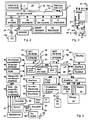
- FIG. 2 a block diagram is explained which refers to the - in the Fig.1 shown franking machine 1 or any other Device applies.
- a device has a microcomputer ⁇ P 19 for controlling a keyboard and a display with controller having user interfaces 4, a modem 13 and a printer 17 and / or other actuators, not shown, which via an input / output interface 18 to the microcomputer uP 19 are connected.
- a scanner 15 is connected to the input / output interface 18 or a comparable means for inputting at least parts of an order number to the consumable.
- other sensors such as an encoder 90 and a letter sensor 91 are connected in a known manner.
- At least one detector 16 is connected to the input / output interface 18 for the reliable detection of the removal or replacement of the consumable material.
- a certain Meßver-drive for a consumption size can be determined by the means 90, 91 and / or 16 from the microcomputer uP 19, whether the determination of the consumption can be continued or terminated or start over.
- a sensor may directly or indirectly permit the presence of consumables to be determined by a physical action principle, the consumable being a solid body.
- the consumable is an ink ribbon for a postage meter FIG. 1
- a postage computer balance 2 can be connected via a cable 24 for data connection.
- a further data connection 14 is used to connect the modem 13 to the data center 100.
- the scanner 15 can be omitted if the order number is input by means of user interface 4 and transmitted via the modem 13 and the data connection 14 to the data center 100.
- the postage computer scale 2 has a weighing plate 21, a display 23 and a keyboard 25 for inputting shipping information about a letter 33 to be transported. If the further data connection 24 exists between the devices of a system, it can be transmitted from a device, for example from the postage computer. Libra 2 of a franking system not only the weight, the postage value and other data to the franking machine 1 but also sent via the modem of the franking machine 1 a message to the remote data center 100 For example, what rate PROM is used for the postage value calculation. The latter is located within a memory card 22 which can be inserted in the postage computer scale 2. The data center 100 may distinguish based on data stored in a database 110 whether an authorized or unauthorized postage fee table is being used.
- the solution according to the invention can also be applied to franking machines of a different type.
- the consumable material is an ink tank head with integrated ink tank or a cartridge.
- Such a disposable print head is, for example, the Siemens type DHP50.
- the FIG. 3 shows a circuit diagram of a detector that detects the removal or change of the consumable even when the device is turned off and not supplied with system voltage U s .
- the detector has a commercial lithium battery BAT, which supplies a memory with a memory retention voltage of about 3V.
- a first switch S1 is operated when removing or changing the consumable. For example, a mechanical contact is opened, which interrupts the power supply of the memory by the lithium battery BAT.
- This voltage supply is detected and causes the closing of a second switch S2, which is preferably realized as a CMOS circuit.
- the RESET input of the memory is thereby connected to ground (L level), which leads to the safe clearing of the memory contents of the memory.
- the memory may be formed as SRAM, which can be equipped by the microcomputer 19 via the interface 18 by means of a - not shown - shift register with a code and can be queried for the presence of the code.
- the consumable is an ink tank filled with ink.
- This solution also requires the presence of a modem and a sensor that detects the approach of changing or using a new consumable.
- the postage meter machine has a sensor and a control unit with a processor which is programmed to generate a message after the aforementioned recognition and to display it and possibly to evaluate a user input in connection with the order, which is an encrypted order message is transmitted via modem to the data center.
- the consumable is in a non-solid state.
- the consumable is a particular liquid for a letter humidifier and closer.
- the latter can be part of an automatic mailer for letters.
- at least one container is present, which is a solid body and can be provided with a marking.
- a chip is used in which the code word is stored.
- the codeword By establishing a connection, for example via electrical contacts or wireless, the codeword can be read out by scanner when installing the new consumable.
- an automatic feeder 3 with integrated separating device is arranged upstream of the franking machine 1.
- a press-on strap 35 can be folded up and then presses on a post-stack from which the letters are separated by means of take-off rollers 32.
- Under a hood 34 are more parts of the separating device.
- One Brief abuts a guide plate 31 and is moved downstream to the guide plate 11 of the postage meter 1, where the "franking" printing process takes place.
- a further moved franked letter is applied to a guide plate 81 of a closing module 8.
- a closing roller pair 82 ensures the closing of not yet completely closed envelope and for ejection via an insert 5 in the storage box 6.
- the structure of the franking machine of the type JetMail® is for example in the not previously published German patent application DE 199 00 686.5-27 described in detail under the title: Arrangement for closing envelopes.
- a chip card disk / reader unit 70 and an on / off switch 71 are arranged in the guide plate 11 of the franking machine 1. After switching on, a chip card 10 can be used in conjunction with the user interface 43, 45 for simplified setting of the franking machine.
- the user interface 43, 45 is located on the meter 12 of the franking machine 1.
- German utility model DE 298 21 903 U1 An international user interface has been explained in more detail.
- a - not shown - microprocessor of the franking machine 1 monitors the level of a - in the FIG. 5 Ink tank 95 shown by means of an ink end sensor 92.
- the latter can according to the German patent 196 13 944 C1 with two electrodes in contact.
- the microprocessor generates a display text for display in the display 43: THE INK PRESET IS ALMOST USED. PLEASE REPLACE THE TINTANT TANK AS SOON! RESERVE IN PRINT: 200.
- the franking machine 1 can now continue to be operated with the reserve ink quantity.
- the microprocessor realizes in its memory space a backward counter, preset by the end of ink signal to the number 200 and with each further franking by one is decremented.
- the number 200 results empirically from empirical values for a balance of possible impressions and a safety factor.
- the number indicating the remainder can be displayed before the next franking.
- the microprocessor After each further franking, the microprocessor generates a status line which indicates the number of remaining prints and issues the message at the end: THE INK ADVANTAGE IS REPLIED. PLEASE CHANGE THE TINTANCE TANK.
- the used ink tank 95 can be removed and inserted into a plastic bag, which catches any leaking ink residues.
- a new ink tank can be removed from the packaging to verify that the color of the ink is correct. For this purpose, a hole coding on the back of the ink tank can be used. At the same time, the new code word can be read.
- the ink tank is inserted into lateral guide rails (not shown) of the ink tank compartment and pushed in until it noticeably engages. If the ink tank is not inserted correctly, the microprocessor generates the message: THE TINTED TANK IS MISSING!
- a user-settable threshold is reached which triggers an automatic consumable order. For this a connection with the data center of the manufacturer is made.
- Today, modern franking machines are all equipped with a modem to connect to the data center of the To communicate with the manufacturer. This is normally used to load a credit amount from the data center if the corresponding storage has been franked.
- the transmission of the order message requires an additional communication routine.
- Data backup measures already known in the case of remote loading of the franking machine are used to prevent the codewords from being able to be read on the transmission link. It is therefore advantageous to encrypt the order message with a DES (Data Encryption Standard) or with another known encryption algorithm which is also used for data backup in the remote loading of the franking machine, for example with a credit.
- DES Data Encryption Standard
- the data center receives the order message for a consumable 95 together with a serial number of the franking machine 1 or its security module.
- a serial number of the franking machine 1 or its security module In the group of stored reference order code is searched for the appropriate code. If the latter is found, the order of the consumables is considered authentic.
- FIG. 6 3 is a block diagram of a JetMail® type postage meter having a processor 46 having a processor 46 to a base including an integrated balance 20, a rate PROM 22, a modem 53, and such a detector 96 that controls the switching Use of a new ink tank cartridge 95 detects.
- the rate PROM 22 may alternatively be implemented in the dashed memory module 51, 52 within the meter.
- the direct measuring method may be replaced by the detector 96 by an indirect measuring method which utilizes the existing sensors 92 and 97.
- the microprocessor 46 is programmed to display the number of impressions remaining each time the instrument is turned on and / or consumed. After a consumption of the ink, a predetermined remainder of ink is detected by means of the electrodes 93, 94 and the sensor 92 and communicated via the modules SAS 59, sensor / actuator control interface ASIC 58 to the microprocessor 46, which then generates a display. There remains a predetermined remainder of ink for approximately 200 impressions is sufficient if the conductivity between the contacts 93, 94 falls below a predetermined threshold.
- Switching the franking machine 1 off / on via the switch 71 can be detected via the sensor 97, which is likewise connected to the SAS 59. Turning off at the time while the postage meter has only the remainder of the ink may indicate an impending change. By comparing the counted impressions with a threshold value or by counting backwards from a predetermined number, a number of the remaining impressions before the ink end at which the automatic ordering is triggered can be determined. It is contemplated that the microprocessor 46 is programmed to evaluate a predetermined count for the remaining impressions when sensors 97 and 92 detect a power-on and an ink level.
- the microprocessor 46, sensor 92, and electrodes 93, 94 on the ink tank cartridge 95 are provided for detecting the approach of changing the ink tank cartridge 95. Due to an identifier of the consumable, its order number, which is indicative of a particular ink, may be entered.
- a security module 60 developed by the applicant serves as the first charging module and has a hardware accounting unit 63 and a battery-powered nonvolatile memory 61 in which a credit can be loaded by modem 53.
- An OTP (One Time Programmable) processor 66 executes security routines both during the credit debit, as well as to secure the register data with a MAC (Message Authentication Code).
- the advantage of the security module is that the verification of the reliability and approval of the franking and franking machine according to the invention, which is carried out by the mail carrier, then only for the relevant processor system 60 and the connected printer module 55-57 is required.
- a second processing module forms the smart card 10 in conjunction with the smart card write / read unit 70.
- the microprocessor 46 and the first memory devices 41, 42 then form a third processing module and the microprocessor 46 and the second memory devices 51, 52 (dashed) then form a fourth processing module etc.
- a third processing module and the microprocessor 46 and the second memory devices 51, 52 (dashed) then form a fourth processing module etc.
- the microprocessor 46 with the associated memories 41, 42 is programmed to count the impressions associated with detecting a proximity of the ink tank cartridge change, and to use it as a postage calculator and for pressure control.
- the abort module 60 is used to bill and calculate encryption keys at least for communication with the data center for the purpose of credit recharge. Due to this division of tasks, the bill module 60 has been further developed into the security module. All processing modules 41, 42 and 51, 52, security module 60, microprocessor 46, interface assemblies 44, 54 and 55, a main memory pixel RAM 47, clock / date module 48, cliche memory EEPROM 49, program memory ROM 50 and an ASIC with the sensor / actuator control interface 58 are connected to a meter internal BUS 40 of the controller. By means of the keyboard 45, an input is made to the ports of the microprocessor 46 for the corresponding control of the franking machine 1. Via the interface module 44, a generated screen image can reach the display 43.
- the display has an integrated controller for support.
- the sensor / actuator control interface 58 is further - not explained here - sensors and actuators of the base, an encoder 90 for the letter movement and at least one letter sensor 91 and the interface 54 at least the modem 53 electrically to the meter 12 of Franking machine 1 connected. Both interface circuits 54 and 58 can also be implemented in a user circuit ASIC. Further details are the EP 716 398 A2 removable, bearing the title: franking machine internal interface circuit and method for tamper-proof print data control. For the control of the other components in the base and in the periphery, further embodiments are the EP 875 864 A2 removable, bearing the title: Arrangement for communication between stations of a mailing machine.
- the remote data center 100 is in the FIG. 6 Not shown.
- the data center 100 may be remote from a credit recharge teleporting data center TDC but is communicatively connected to the latter.
- Another advantage of the method is the ability to obtain information about the consumption at the customer.
- data center 100 will automatically generate a confirmation of this order after the ordering of the consumable and send it to the device.
- Its microprocessor is programmed with a notification via modem to generate a message and display 43.
- the notification of the customer can also be done in a known manner by postcard.
- routine for the automatic ordering of consumables can be switched on or off. This can be done by invoking a polling routine by initializing the device, which turns on or off the auto-ordering function according to the input.
- the auto-ordering feature can be turned on or off remotely from the data center.
Landscapes
- Physics & Mathematics (AREA)
- General Physics & Mathematics (AREA)
- Accessory Devices And Overall Control Thereof (AREA)
- Devices For Checking Fares Or Tickets At Control Points (AREA)
- Management, Administration, Business Operations System, And Electronic Commerce (AREA)
Claims (28)
- Procédé pour commander automatiquement des cartouches-réservoirs d'encre (95) ou des cassettes à ruban encreur (9) pour une affranchisseuse (1) avec génération et transmission automatiques d'un message de commande, comportant les étapes suivantes :- surveillance et évaluation d'un nombre d'impressions en regard de l'atteinte d'une valeur de seuil avant la fin d'utilisabilité d'une cassette à ruban encreur (9) ou d'une cartouche-réservoir d'encre (95), une évaluation d'un état de compteur prédéterminé du nombre des impressions ayant lieu pour la détection indirecte de l'approche du remplacement de la cassette à ruban encreur (9) ou de la cartouche-réservoir d'encre (95), avant ou après que des capteurs détectent une valeur résiduelle faible du ruban encreur de la cassette à ruban encreur ou un niveau d'encre faible de la cartouche-réservoir d'encre,- établissement d'une liaison de communication entre l'affranchisseuse (1) et un centre de données éloigné (100) et génération et transmission automatiques d'un message de commande crypté comportant un code d'identification,- identification de l'auteur de la commande dans le centre de données (100) à l'aide du code d'identification de l'affranchisseuse,- déclenchement de la commande de cassettes à ruban encreur ou de cartouches-réservoirs d'encre par le centre de données (100) auprès d'un service d'expédition pour le compte de l'auteur de la commande identifié.
- Procédé selon la revendication 1, caractérisé en ce, que la commande soit déclenchée avec un numéro de commande, composé de plusieurs parties et intégrant un code de commande et/ou un numéro d'identification pour divers articles de consommations, à savoir des cassettes à ruban encreur ou des cartouches-réservoirs d'encre.
- Procédé selon la revendication 2, caractérisé en ce, qu'une agrégation de l'article de consommation, à savoir la cassette à ruban encreur ou la cartouche-réservoir d'encre, ait lieu chez le fabriquant avec un code de commande généré et/ou avec un numéro d'identification, en ajoutant, en fixant ou en affectant de manière fixe par des mesures comparables les deux ou ce dernier à un article de consommation destiné à la vente, à savoir une cassette à ruban encreur ou une cartouche-réservoir d'encre.
- Procédé selon les revendications 2 à 3, caractérisé en ce, que le numéro de commande soit marqué de différentes manières sur l'article de consommation, à savoir une cassette à ruban encreur ou une cartouche-réservoir d'encre, en fonction de l'état physique de l'article de consommation, à savoir une cassette à ruban encreur ou une cartouche-réservoir d'encre.
- Procédé selon la revendication 1, caractérisé en ce, que soit effectuée, après l'identification de l'auteur de la commande, une recherche dans une base de données, dans laquelle un article de consommation correspondant, à savoir une cassette à ruban encreur ou une cartouche-réservoir d'encre, soit affecté à chaque auteur potentiel de commande, de sorte qu'une routine de commande n'autorise que la commande d'un article de consommation prédéfini, à savoir une cassette à ruban encreur ou une cartouche-réservoir d'encre, et que la routine de commande soit déclenchée avec un numéro de commande, qui est structuré en plusieurs parties et qui intègre un numéro d'identification pour la quantité de l'article de consommation, à savoir une cassette à ruban encreur ou une cartouche-réservoir d'encre.
- Procédé selon la revendication 2, caractérisé en ce, que le numéro de commande soit un composant du message de commande, qui contient un numéro de série de l'affranchisseuse.
- Procédé selon la revendication 6, caractérisé en ce, que le numéro de commande contienne un nombre qui caractérise le type de l'article de consommation, à savoir de la cassette à ruban encreur ou de la cartouche-réservoir d'encre.
- Procédé selon la revendication 6, caractérisé en ce, que le numéro de commande contienne un nombre qui caractérise la quantité commandée de l'article de consommation, à savoir de la cassette à ruban encreur ou de la cartouche-réservoir d'encre.
- Procédé selon la revendication 6, caractérisé en ce, que le message de commande inclut un chiffre de contrôle.
- Procédé selon la revendication 6, caractérisé en ce, que le message de commande soit envoyé sous forme cryptée et que l'affranchisseuse réceptionne une information après la vérification de l'authenticité de la commande dans le centre de données.
- Procédé selon l'une des revendications 3 à 6, caractérisé par les étapes suivantes :- agrégation de l'article de consommation, à savoir une cassette à ruban encreur ou une cartouche-réservoir d'encre, avec le code de commande généré et/ou à distance de l'affranchisseuse avec un numéro d'identification,- mémorisation d'une affectation sous forme d'un ensemble de données avec un numéro de commande de l'article de consommation, à savoir une cassette à ruban encreur ou une cartouche-réservoir d'encre, l'ensemble étant affecté dans le centre de données à un numéro de série de l'affranchisseuse, le numéro de commande incluant un code de commande de référence généré et/ou un numéro d'identification, et dont le message de commande inclut un numéro de série affecté à l'affranchisseuse ainsi que le numéro de commande agrégé avec l'article de consommation, à savoir une cassette à ruban encreur ou une cartouche-réservoir d'encre,- réception du message de commande crypté transmis et son décryptage dans le centre de données ainsi que- vérification dans le centre de données de l'authenticité de la commande à l'aide du numéro de série et à l'aide d'au moins de parties du numéro de commande avant le déclenchement de la commande.
- Procédé selon la revendication 1, caractérisé en ce, qu'en cas de commande d'un article de consommation, à savoir une cassette à ruban encreur ou une cartouche-réservoir d'encre, le centre de données (100) envoie automatiquement une confirmation de cette commande à l'affranchisseuse.
- Procédé selon la revendication 1, caractérisé en ce, qu'en cas de commande d'un article de consommation, à savoir une cassette à ruban encreur ou une cartouche-réservoir d'encre, le centre de données (100) génère et envoie automatiquement une facture adressée à l'auteur de la commande.
- Procédé selon la revendication 1, caractérisé en ce, qu'en cas de commande d'un article de consommation, à savoir une cassette à ruban encreur ou une cartouche-réservoir d'encre, le centre de données (100) déclenche automatiquement un prélèvement correspondant au prix de l'article de consommation commandé du compte de l'auteur de la commande.
- Procédé selon la revendication 1, caractérisé en ce, que la routine destinée à la commande automatique d'articles de consommation, à savoir des cassettes à ruban encreur ou des cartouches-réservoirs d'encre, puisse être activée ou désactivée.
- Procédé selon la revendication 15, caractérisé en ce, que soit appelée par initialisation de l'affranchisseuse une routine d'interrogation, qui active ou désactive selon l'entrée la fonction destinée à la commande automatique d'articles de consommation, à savoir des cassettes à ruban encreur ou des cartouches-réservoirs d'encre.
- Procédé selon la revendication 15, caractérisé en ce, que la fonction destinée à la commande automatique d'articles de consommation, à savoir des cassettes à ruban encreur ou des cartouches-réservoirs d'encre, puisse être activée ou désactivée à distance par le centre de données.
- Dispositif pour la mise en oeuvre du procédé selon la revendication 1, avec une unité de commande d'une affranchisseuse qui fonctionne avec une cartouche-réservoir d'encre (95) ou une cassette à ruban encreur (9), caractérisé en ce, que l'unité de commande (19 ou 12) de l'affranchisseuse soit équipée de moyens d'enregistrement (41, 42), de capteurs (91, 92) pour détecter et relever une valeur résiduelle faible de ruban encreur de la cassette à ruban encreur ou un niveau d'encre faible de la cartouche-réservoir d'encre, qu'elle soit connectée avec des moyens d'établissement d'une liaison de communication à un centre de données éloigné et qu'un microprocesseur de l'unité de commande soit programmé :- pour la surveillance et l'évaluation d'un nombre d'impressions en regard de l'atteinte d'une valeur de seuil avant la fin d'utilisabilité d'une cassette à ruban encreur (9) ou d'une cartouche-réservoir d'encre (95),- pour reconnaître l'approche du remplacement de la cassette à ruban encreur (9) ou de la cartouche-réservoir d'encre (95), par l'évaluation d'un état de compteur prédéfini pour le nombre d'impressions, avant ou après que des capteurs (91, 92) aient détecté une valeur résiduelle faible de ruban encreur ou un niveau d'encre faible,- pour afficher un message sur écran et pour générer un message de commande crypté après la reconnaissance précitée,- pour établir une liaison de communication à un centre de données (100) éloigné, pour la transmission du message de commande crypté destiné à faire livrer une cassette à ruban encreur ou une cartouche-réservoir d'encre.
- Dispositif selon la revendication 18, caractérisé en ce, que l'affranchisseuse soit équipée de moyens (15, 70) pour reconnaître l'article de consommation, à savoir une cassette à ruban encreur ou une cartouche-réservoir d'encre (9, 95), pour reconnaître le remplacement d'un article de consommation, à savoir une cassette à ruban encreur ou une cartouche-réservoir d'encre, et dont le microprocesseur (46) ou le micro-ordinateur (19) exécute à la suite d'un remplacement un processus de mesure indirecte ou directe qui est adapté au type d'article de consommation, à savoir une cassette à ruban encreur ou une cartouche-réservoir d'encre, et qui fournit le nombre des impressions.
- Dispositif selon la revendication 18, caractérisé en ce, que le microprocesseur (46) ou le micro-ordinateur (19) soit programmé pour exécuter une comparaison d'un nombre d'impressions avec une valeur de seuil, qui peut être entrée avec un clavier ou avec une carte à puce ou qui peut être chargée à distance via un modem d'un centre de données éloigné.
- Dispositif selon l'une des revendications précitées 18 à 20, caractérisé en ce, que le microprocesseur (46) ou le micro-ordinateur (19) soit programmé pour générer un message crypté et pour le transmettre à un centre de données ainsi que pour évaluer une information après la vérification de l'authenticité de la commande dans le centre de données.
- Dispositif selon l'une des revendications précitées 18 à 21, caractérisé en ce, que des moyens d'entrée (4, 45) soient prévus et que le microprocesseur (46) ou le micro-ordinateur (19) soit programmé, pour évaluer une entrée d'utilisateur afin de générer un message pour confirmer qu'une commande doit être déclenchée.
- Dispositif selon la revendication 22, caractérisé en ce, que le microprocesseur (46) ou le micro-ordinateur (19) soit programmé pour évaluer une entrée d'utilisateur, qui modifie la quantité de l'article de consommation à commander, à savoir une cassette à ruban encreur ou une cartouche-réservoir d'encre.
- Dispositif selon la revendication 22, caractérisé en ce, que la quantité de l'article de consommation, à savoir une cassette à ruban encreur ou une cartouche-réservoir d'encre, puisse être modifiée sur zéro ou que soit au moins prévu une touche pour bloquer la commande automatique.
- Dispositif selon les revendications 18 à 24, caractérisé en ce, que le microprocesseur (46) soit connecté avec les mémoires (41, 42) correspondantes ou que soit prévu un micro-ordinateur (19) et que ledit microprocesseur ou micro-ordinateur soit programmé pour les impressions restantes en relation avec une identification de la cartouche-réservoir d'encre (95) ou de la cassette à ruban encreur (9).
- Dispositif selon la revendication 25, caractérisé en ce, que le microprocesseur (46) soit programmé pour que soit affiché le nombre des impressions restantes après chaque activation de l'affranchisseuse et/ou remplacement de l'article de consommation, à savoir une cassette à ruban encreur ou une cartouche-réservoir d'encre.
- Dispositif selon la revendication 18, caractérisé en ce, que le microprocesseur soit programmé pour modifier le fonctionnement de l'affranchisseuse, si la vérification de l'authenticité de la commande qui a été effectuée révèle une non-authenticité.
- Dispositif selon la revendication 27, caractérisé en ce, que le microprocesseur soit programmé pour la réception d'une information après la vérification de l'authenticité de la commande dans le centre de données et pour générer un message ainsi que pour l'afficher sur un écran (42) en cas de réception d'une telle information.
Applications Claiming Priority (2)
| Application Number | Priority Date | Filing Date | Title |
|---|---|---|---|
| DE19958949A DE19958949A1 (de) | 1999-11-26 | 1999-11-26 | Verfahren zum automatischen Bestellen von Verbrauchsmaterial und Anordnung zur Durchführung des Verfahrens |
| DE19958949 | 1999-11-26 |
Publications (3)
| Publication Number | Publication Date |
|---|---|
| EP1103923A2 EP1103923A2 (fr) | 2001-05-30 |
| EP1103923A3 EP1103923A3 (fr) | 2001-08-16 |
| EP1103923B1 true EP1103923B1 (fr) | 2015-09-23 |
Family
ID=7931707
Family Applications (1)
| Application Number | Title | Priority Date | Filing Date |
|---|---|---|---|
| EP00250399.3A Expired - Lifetime EP1103923B1 (fr) | 1999-11-26 | 2000-11-24 | Procédé pour commander automatiquement des articles de consommation et dispositif pour la mise en oeuvre du procédé |
Country Status (3)
| Country | Link |
|---|---|
| US (1) | US7254563B1 (fr) |
| EP (1) | EP1103923B1 (fr) |
| DE (1) | DE19958949A1 (fr) |
Families Citing this family (11)
| Publication number | Priority date | Publication date | Assignee | Title |
|---|---|---|---|---|
| JP2002300308A (ja) * | 2001-03-30 | 2002-10-11 | Ricoh Co Ltd | 顧客支援システム、オフィスシステム、顧客支援センター、サプライセンター及び顧客支援方法 |
| FR2834364B1 (fr) * | 2001-12-28 | 2004-07-09 | Neopost Ind | Systeme de garantie d'impression d'une empreinte postale |
| US20070136214A1 (en) * | 2005-10-03 | 2007-06-14 | Fetneh Eskandari | Method for managing consumable material |
| US7677717B2 (en) * | 2005-12-23 | 2010-03-16 | Xerox Corporation | Drum maintenance system for an imaging device and method and system for maintaining an imaging device |
| FR2905501A1 (fr) * | 2006-08-31 | 2008-03-07 | Neopost Technologies Sa | Machine a affranchir pour ligne d'insertion d'enveloppes a haute cadence |
| US10853819B2 (en) | 2011-04-14 | 2020-12-01 | Elwha Llc | Cost-effective resource apportionment technologies suitable for facilitating therapies |
| US10445846B2 (en) | 2011-04-14 | 2019-10-15 | Elwha Llc | Cost-effective resource apportionment technologies suitable for facilitating therapies |
| JP6736848B2 (ja) * | 2014-09-08 | 2020-08-05 | 株式会社リコー | 情報配信システム、情報配信装置、及び情報配信方法 |
| JP7424209B2 (ja) * | 2020-05-25 | 2024-01-30 | ブラザー工業株式会社 | サーバ、プリンタ、サーバのためのコンピュータプログラム、及び、プリンタのためのコンピュータプログラム |
| JP7673581B2 (ja) * | 2021-08-20 | 2025-05-09 | ブラザー工業株式会社 | プリンタシステム、サーバのためのコンピュータプログラム、サーバ、及び、サーバによって実行される方法 |
| WO2023069775A1 (fr) * | 2021-10-22 | 2023-04-27 | Sapiyen Llc (Dba Protosthetics) | Gestion centralisée et fabrication décentralisée de dispositifs médicaux personnalisés |
Citations (2)
| Publication number | Priority date | Publication date | Assignee | Title |
|---|---|---|---|---|
| EP0730974A2 (fr) * | 1995-03-07 | 1996-09-11 | Francotyp-Postalia Aktiengesellschaft & Co. | Dispositif et cartouche à ruban encreur pour l'impression par transfert thermique |
| EP0749840A2 (fr) * | 1995-06-19 | 1996-12-27 | Canon Kabushiki Kaisha | Appareil d'impression et appareil fac-similé l'utilisant |
Family Cites Families (15)
| Publication number | Priority date | Publication date | Assignee | Title |
|---|---|---|---|---|
| US4441197A (en) * | 1981-12-28 | 1984-04-03 | Pitney Bowes Inc. | Value printing device warning function for replacing an inking member |
| US4812965A (en) | 1985-08-06 | 1989-03-14 | Pitney Bowes Inc. | Remote postage meter insepction system |
| US4831554A (en) * | 1986-04-10 | 1989-05-16 | Pitney Bowes Inc. | Postage meter message printing system |
| US4812992A (en) | 1986-04-10 | 1989-03-14 | Pitney Bowes Inc. | Postage meter communication system |
| JPH0232665A (ja) * | 1988-07-21 | 1990-02-02 | Konica Corp | 自動資材発注装置 |
| US5193065A (en) | 1990-12-03 | 1993-03-09 | Caterpillar Inc. | System for requistioning and distributing material in a manufacturing environment |
| US5305199A (en) | 1992-10-28 | 1994-04-19 | Xerox Corporation | Consumable supplies monitoring/ordering system for reprographic equipment |
| US5414494A (en) | 1993-12-06 | 1995-05-09 | Xerox Corporation | Automatic call to selected remote operators in response to predetermined machine conditions |
| DE4445053C2 (de) | 1994-12-07 | 2003-04-10 | Francotyp Postalia Ag | Frankiermaschineninterne Schnittstellenschaltung |
| US6113208A (en) | 1996-05-22 | 2000-09-05 | Hewlett-Packard Company | Replaceable cartridge for a printer including resident memory with stored message triggering data |
| US6116715A (en) | 1996-08-23 | 2000-09-12 | Pitney Bowes Inc. | Device and method for sensing low ink level in an ink cartridge of a postage meter |
| DE19711997A1 (de) | 1997-03-13 | 1998-09-17 | Francotyp Postalia Gmbh | Anordnung zur Kommunikation zwischen einer Basisstation und weiteren Stationen einer Postbearbeitungsmaschine und zu deren Notabschaltung |
| US5970475A (en) * | 1997-10-10 | 1999-10-19 | Intelisys Electronic Commerce, Llc | Electronic procurement system and method for trading partners |
| DE29821903U1 (de) | 1998-12-03 | 1999-05-06 | Francotyp-Postalia AG & Co., 16547 Birkenwerder | Anordnung zur Eingabe und Anzeige von Benutzerinformationen auf einem Display |
| FR2793443B1 (fr) | 1999-05-11 | 2001-06-08 | Sagem | Machine de bureau a approvisionnement automatique en produit consommable |
-
1999
- 1999-11-26 DE DE19958949A patent/DE19958949A1/de not_active Withdrawn
-
2000
- 2000-01-11 US US09/481,477 patent/US7254563B1/en not_active Expired - Lifetime
- 2000-11-24 EP EP00250399.3A patent/EP1103923B1/fr not_active Expired - Lifetime
Patent Citations (2)
| Publication number | Priority date | Publication date | Assignee | Title |
|---|---|---|---|---|
| EP0730974A2 (fr) * | 1995-03-07 | 1996-09-11 | Francotyp-Postalia Aktiengesellschaft & Co. | Dispositif et cartouche à ruban encreur pour l'impression par transfert thermique |
| EP0749840A2 (fr) * | 1995-06-19 | 1996-12-27 | Canon Kabushiki Kaisha | Appareil d'impression et appareil fac-similé l'utilisant |
Also Published As
| Publication number | Publication date |
|---|---|
| EP1103923A3 (fr) | 2001-08-16 |
| US7254563B1 (en) | 2007-08-07 |
| EP1103923A2 (fr) | 2001-05-30 |
| DE19958949A1 (de) | 2001-06-07 |
Similar Documents
| Publication | Publication Date | Title |
|---|---|---|
| EP1103924B1 (fr) | Procédé de protection d'un dispositif contre son fonctionnement avec des articles de consommation non autorisés et dispositif pour la mise en oeuvre du procédé | |
| DE19958948B4 (de) | Verfahren zur Bestimmung der Anzahl von mit einer Tintenrestmenge ausführbaren Drucken und Vorrichtung zur Durchführung des Verfahrens | |
| DE69737782T2 (de) | Von einem elektronischen Frankiermaschinensystem trennbarer Drucker und Abrechnungsanordnung mit Trennung der Information über Zeichen und Abrechnung | |
| EP0969421B1 (fr) | Procédé pour l'amélioration de la sécurité des machines à affranchir | |
| DE3626580C2 (de) | System und Verfahren zur Ferninspektion einer Frankiermaschine | |
| DE69015443T2 (de) | Verarbeitung von Poststücken. | |
| DE69534122T2 (de) | Frankiermaschine | |
| EP1064153B1 (fr) | Imprimante a jet d'encre pour l'impression de marchandises | |
| DE68926034T2 (de) | Frankiermaschine | |
| DE3613008A1 (de) | Portogebuehren- und versandinformations-aufbringungssystem | |
| EP1035517B1 (fr) | Procédé de protection d'un module de sécurité et ensemble pour mettre en oeuvre ledit procédé | |
| DE69735322T2 (de) | System zum Installieren und zur Standortbewegung einer Frankiermaschine | |
| EP1035516B1 (fr) | Système pour un module de sécurité | |
| EP0566225B1 (fr) | Procédé de saisie de données dans une machine d'affranchissement et ensemble pour traiter le courrier et pour produire une image d'affranchissement à chaque fois à l'office de traitement de courrier | |
| EP1103923A2 (fr) | Procédé pour commander automatiquement des articles de consommation et dispositif pour la mise en oeuvre du procédé | |
| EP1035518B1 (fr) | Ensemble de protection d'un module de sécurité | |
| EP0866427B1 (fr) | Système de traitement de courrier avec une station de base de machine commandée par un ordinateur individuel | |
| DE19958946B4 (de) | Verfahren zum Piraterieschutz eines Gerätes | |
| DE19757653C2 (de) | Verfahren und postalisches Gerät mit einer Chipkarten-Schreib/Leseeinheit zum Nachladen von Änderungsdaten per Chipkarte | |
| EP1037172B1 (fr) | Procédé pour l'installation automatique de machines à affranchir et dispositif pour sa mise en oeuvre | |
| DE102004014427A1 (de) | Verfahren für ein servergesteuertes Sicherheitsmanagement von erbringbaren Dienstleistungen und Anordnung zur Bereitstellung von Daten nach einem Sicherheitsmanagement für ein Frankiersystem | |
| DE69534129T2 (de) | Frankiermaschine und Frankiermaschinensystem | |
| DE69616389T2 (de) | Frankiermaschine und Verfahren zum Identifizieren der Frankiermaschine | |
| US20060012626A1 (en) | Postage meter system having a controlled level of ink |
Legal Events
| Date | Code | Title | Description |
|---|---|---|---|
| PUAI | Public reference made under article 153(3) epc to a published international application that has entered the european phase |
Free format text: ORIGINAL CODE: 0009012 |
|
| AK | Designated contracting states |
Kind code of ref document: A2 Designated state(s): CH DE FR GB IT LI |
|
| AX | Request for extension of the european patent |
Free format text: AL;LT;LV;MK;RO;SI |
|
| PUAL | Search report despatched |
Free format text: ORIGINAL CODE: 0009013 |
|
| AK | Designated contracting states |
Kind code of ref document: A3 Designated state(s): AT BE CH CY DE DK ES FI FR GB GR IE IT LI LU MC NL PT SE TR |
|
| AX | Request for extension of the european patent |
Free format text: AL;LT;LV;MK;RO;SI |
|
| RIC1 | Information provided on ipc code assigned before grant |
Free format text: 7G 07B 17/00 A, 7G 03G 15/00 B |
|
| 17P | Request for examination filed |
Effective date: 20020118 |
|
| AKX | Designation fees paid |
Free format text: CH DE FR GB IT LI |
|
| RAP1 | Party data changed (applicant data changed or rights of an application transferred) |
Owner name: FRANCOTYP-POSTALIA AG & CO. KG |
|
| RAP1 | Party data changed (applicant data changed or rights of an application transferred) |
Owner name: FRANCOTYP-POSTALIA GMBH |
|
| 17Q | First examination report despatched |
Effective date: 20060821 |
|
| RAP1 | Party data changed (applicant data changed or rights of an application transferred) |
Owner name: FRANCOTYP-POSTALIA GMBH |
|
| GRAP | Despatch of communication of intention to grant a patent |
Free format text: ORIGINAL CODE: EPIDOSNIGR1 |
|
| INTG | Intention to grant announced |
Effective date: 20150623 |
|
| GRAS | Grant fee paid |
Free format text: ORIGINAL CODE: EPIDOSNIGR3 |
|
| GRAA | (expected) grant |
Free format text: ORIGINAL CODE: 0009210 |
|
| AK | Designated contracting states |
Kind code of ref document: B1 Designated state(s): CH DE FR GB IT LI |
|
| REG | Reference to a national code |
Ref country code: GB Ref legal event code: FG4D Free format text: NOT ENGLISH |
|
| REG | Reference to a national code |
Ref country code: CH Ref legal event code: EP |
|
| REG | Reference to a national code |
Ref country code: DE Ref legal event code: R096 Ref document number: 50016422 Country of ref document: DE |
|
| REG | Reference to a national code |
Ref country code: FR Ref legal event code: PLFP Year of fee payment: 16 |
|
| REG | Reference to a national code |
Ref country code: DE Ref legal event code: R097 Ref document number: 50016422 Country of ref document: DE |
|
| PLBE | No opposition filed within time limit |
Free format text: ORIGINAL CODE: 0009261 |
|
| STAA | Information on the status of an ep patent application or granted ep patent |
Free format text: STATUS: NO OPPOSITION FILED WITHIN TIME LIMIT |
|
| 26N | No opposition filed |
Effective date: 20160624 |
|
| REG | Reference to a national code |
Ref country code: FR Ref legal event code: PLFP Year of fee payment: 17 |
|
| REG | Reference to a national code |
Ref country code: FR Ref legal event code: PLFP Year of fee payment: 18 |
|
| PGFP | Annual fee paid to national office [announced via postgrant information from national office to epo] |
Ref country code: DE Payment date: 20181017 Year of fee payment: 19 |
|
| PGFP | Annual fee paid to national office [announced via postgrant information from national office to epo] |
Ref country code: GB Payment date: 20181120 Year of fee payment: 19 Ref country code: CH Payment date: 20181120 Year of fee payment: 19 Ref country code: FR Payment date: 20181121 Year of fee payment: 19 Ref country code: IT Payment date: 20181126 Year of fee payment: 19 |
|
| REG | Reference to a national code |
Ref country code: DE Ref legal event code: R119 Ref document number: 50016422 Country of ref document: DE |
|
| REG | Reference to a national code |
Ref country code: CH Ref legal event code: PL |
|
| PG25 | Lapsed in a contracting state [announced via postgrant information from national office to epo] |
Ref country code: LI Free format text: LAPSE BECAUSE OF NON-PAYMENT OF DUE FEES Effective date: 20191130 Ref country code: CH Free format text: LAPSE BECAUSE OF NON-PAYMENT OF DUE FEES Effective date: 20191130 |
|
| GBPC | Gb: european patent ceased through non-payment of renewal fee |
Effective date: 20191124 |
|
| PG25 | Lapsed in a contracting state [announced via postgrant information from national office to epo] |
Ref country code: FR Free format text: LAPSE BECAUSE OF NON-PAYMENT OF DUE FEES Effective date: 20191130 Ref country code: DE Free format text: LAPSE BECAUSE OF NON-PAYMENT OF DUE FEES Effective date: 20200603 Ref country code: GB Free format text: LAPSE BECAUSE OF NON-PAYMENT OF DUE FEES Effective date: 20191124 Ref country code: IT Free format text: LAPSE BECAUSE OF NON-PAYMENT OF DUE FEES Effective date: 20191124 |