EP1107969B1 - Sammlungen von verbindungen - Google Patents
Sammlungen von verbindungen Download PDFInfo
- Publication number
- EP1107969B1 EP1107969B1 EP99941765A EP99941765A EP1107969B1 EP 1107969 B1 EP1107969 B1 EP 1107969B1 EP 99941765 A EP99941765 A EP 99941765A EP 99941765 A EP99941765 A EP 99941765A EP 1107969 B1 EP1107969 B1 EP 1107969B1
- Authority
- EP
- European Patent Office
- Prior art keywords
- resin
- dmf
- fmoc
- solution
- mmol
- Prior art date
- Legal status (The legal status is an assumption and is not a legal conclusion. Google has not performed a legal analysis and makes no representation as to the accuracy of the status listed.)
- Expired - Lifetime
Links
- 150000001875 compounds Chemical class 0.000 title claims abstract description 145
- -1 nitro, amino Chemical group 0.000 claims abstract description 73
- 239000007787 solid Substances 0.000 claims abstract description 30
- 125000005647 linker group Chemical group 0.000 claims abstract description 16
- 229910052717 sulfur Inorganic materials 0.000 claims abstract description 13
- 229910052760 oxygen Inorganic materials 0.000 claims abstract description 12
- 125000001475 halogen functional group Chemical group 0.000 claims abstract description 8
- QJGQUHMNIGDVPM-UHFFFAOYSA-N nitrogen group Chemical group [N] QJGQUHMNIGDVPM-UHFFFAOYSA-N 0.000 claims abstract description 7
- 125000003178 carboxy group Chemical group [H]OC(*)=O 0.000 claims abstract description 6
- 229910002091 carbon monoxide Inorganic materials 0.000 claims abstract description 5
- 150000001413 amino acids Chemical class 0.000 claims description 23
- 125000000217 alkyl group Chemical group 0.000 claims description 18
- 125000004432 carbon atom Chemical group C* 0.000 claims description 18
- 125000000539 amino acid group Chemical group 0.000 claims description 14
- 229910052757 nitrogen Inorganic materials 0.000 claims description 14
- 125000003118 aryl group Chemical group 0.000 claims description 11
- 125000000449 nitro group Chemical group [O-][N+](*)=O 0.000 claims description 10
- 125000003545 alkoxy group Chemical group 0.000 claims description 8
- 125000005843 halogen group Chemical group 0.000 claims description 6
- 125000004433 nitrogen atom Chemical group N* 0.000 claims description 5
- KXDHJXZQYSOELW-UHFFFAOYSA-N Carbamic acid Chemical group NC(O)=O KXDHJXZQYSOELW-UHFFFAOYSA-N 0.000 claims description 4
- 125000003710 aryl alkyl group Chemical group 0.000 claims description 4
- 125000006242 amine protecting group Chemical group 0.000 claims description 3
- CREMABGTGYGIQB-UHFFFAOYSA-N carbon carbon Chemical compound C.C CREMABGTGYGIQB-UHFFFAOYSA-N 0.000 claims description 3
- 239000011203 carbon fibre reinforced carbon Substances 0.000 claims description 3
- YMWUJEATGCHHMB-UHFFFAOYSA-N Dichloromethane Chemical compound ClCCl YMWUJEATGCHHMB-UHFFFAOYSA-N 0.000 description 472
- OKKJLVBELUTLKV-UHFFFAOYSA-N Methanol Chemical compound OC OKKJLVBELUTLKV-UHFFFAOYSA-N 0.000 description 372
- 229920005989 resin Polymers 0.000 description 290
- 239000011347 resin Substances 0.000 description 290
- 239000000243 solution Substances 0.000 description 233
- NQRYJNQNLNOLGT-UHFFFAOYSA-N Piperidine Chemical compound C1CCNCC1 NQRYJNQNLNOLGT-UHFFFAOYSA-N 0.000 description 134
- HEDRZPFGACZZDS-MICDWDOJSA-N Trichloro(2H)methane Chemical compound [2H]C(Cl)(Cl)Cl HEDRZPFGACZZDS-MICDWDOJSA-N 0.000 description 98
- 238000005859 coupling reaction Methods 0.000 description 89
- JGFZNNIVVJXRND-UHFFFAOYSA-N N,N-Diisopropylethylamine (DIPEA) Chemical compound CCN(C(C)C)C(C)C JGFZNNIVVJXRND-UHFFFAOYSA-N 0.000 description 82
- 230000008878 coupling Effects 0.000 description 80
- 238000010168 coupling process Methods 0.000 description 80
- CSCPPACGZOOCGX-WFGJKAKNSA-N acetone d6 Chemical compound [2H]C([2H])([2H])C(=O)C([2H])([2H])[2H] CSCPPACGZOOCGX-WFGJKAKNSA-N 0.000 description 74
- XEKOWRVHYACXOJ-UHFFFAOYSA-N Ethyl acetate Chemical compound CCOC(C)=O XEKOWRVHYACXOJ-UHFFFAOYSA-N 0.000 description 73
- 238000000034 method Methods 0.000 description 72
- DHMQDGOQFOQNFH-UHFFFAOYSA-N Glycine Chemical compound NCC(O)=O DHMQDGOQFOQNFH-UHFFFAOYSA-N 0.000 description 69
- 238000005160 1H NMR spectroscopy Methods 0.000 description 62
- 238000001644 13C nuclear magnetic resonance spectroscopy Methods 0.000 description 60
- 230000015572 biosynthetic process Effects 0.000 description 57
- 238000003786 synthesis reaction Methods 0.000 description 56
- IAZDPXIOMUYVGZ-UHFFFAOYSA-N Dimethylsulphoxide Chemical compound CS(C)=O IAZDPXIOMUYVGZ-UHFFFAOYSA-N 0.000 description 51
- 238000010511 deprotection reaction Methods 0.000 description 49
- 238000006243 chemical reaction Methods 0.000 description 47
- WFDIJRYMOXRFFG-UHFFFAOYSA-N Acetic anhydride Chemical compound CC(=O)OC(C)=O WFDIJRYMOXRFFG-UHFFFAOYSA-N 0.000 description 44
- CSNNHWWHGAXBCP-UHFFFAOYSA-L Magnesium sulfate Chemical compound [Mg+2].[O-][S+2]([O-])([O-])[O-] CSNNHWWHGAXBCP-UHFFFAOYSA-L 0.000 description 44
- XMYQHJDBLRZMLW-UHFFFAOYSA-N methanolamine Chemical compound NCO XMYQHJDBLRZMLW-UHFFFAOYSA-N 0.000 description 44
- 125000003088 (fluoren-9-ylmethoxy)carbonyl group Chemical group 0.000 description 39
- XLYOFNOQVPJJNP-UHFFFAOYSA-N water Chemical compound O XLYOFNOQVPJJNP-UHFFFAOYSA-N 0.000 description 39
- LFQSCWFLJHTTHZ-UHFFFAOYSA-N Ethanol Chemical compound CCO LFQSCWFLJHTTHZ-UHFFFAOYSA-N 0.000 description 36
- JUJWROOIHBZHMG-UHFFFAOYSA-N Pyridine Chemical compound C1=CC=NC=C1 JUJWROOIHBZHMG-UHFFFAOYSA-N 0.000 description 36
- 229940024606 amino acid Drugs 0.000 description 36
- 239000004471 Glycine Substances 0.000 description 35
- ROHFNLRQFUQHCH-YFKPBYRVSA-N L-leucine Chemical compound CC(C)C[C@H](N)C(O)=O ROHFNLRQFUQHCH-YFKPBYRVSA-N 0.000 description 33
- 239000002904 solvent Substances 0.000 description 32
- 239000002253 acid Substances 0.000 description 30
- ROHFNLRQFUQHCH-UHFFFAOYSA-N Leucine Natural products CC(C)CC(N)C(O)=O ROHFNLRQFUQHCH-UHFFFAOYSA-N 0.000 description 29
- 239000011324 bead Substances 0.000 description 29
- 239000012317 TBTU Substances 0.000 description 28
- CLZISMQKJZCZDN-UHFFFAOYSA-N [benzotriazol-1-yloxy(dimethylamino)methylidene]-dimethylazanium Chemical compound C1=CC=C2N(OC(N(C)C)=[N+](C)C)N=NC2=C1 CLZISMQKJZCZDN-UHFFFAOYSA-N 0.000 description 28
- RTZKZFJDLAIYFH-UHFFFAOYSA-N Diethyl ether Chemical compound CCOCC RTZKZFJDLAIYFH-UHFFFAOYSA-N 0.000 description 27
- 235000019439 ethyl acetate Nutrition 0.000 description 27
- 238000003756 stirring Methods 0.000 description 26
- 150000001412 amines Chemical class 0.000 description 25
- 239000000203 mixture Substances 0.000 description 25
- 239000003153 chemical reaction reagent Substances 0.000 description 24
- UDSAIICHUKSCKT-UHFFFAOYSA-N bromophenol blue Chemical compound C1=C(Br)C(O)=C(Br)C=C1C1(C=2C=C(Br)C(O)=C(Br)C=2)C2=CC=CC=C2S(=O)(=O)O1 UDSAIICHUKSCKT-UHFFFAOYSA-N 0.000 description 23
- COLNVLDHVKWLRT-QMMMGPOBSA-N L-phenylalanine Chemical compound OC(=O)[C@@H](N)CC1=CC=CC=C1 COLNVLDHVKWLRT-QMMMGPOBSA-N 0.000 description 22
- 229910052943 magnesium sulfate Inorganic materials 0.000 description 22
- DTQVDTLACAAQTR-UHFFFAOYSA-N trifluoroacetic acid Substances OC(=O)C(F)(F)F DTQVDTLACAAQTR-UHFFFAOYSA-N 0.000 description 22
- 238000001914 filtration Methods 0.000 description 21
- COLNVLDHVKWLRT-UHFFFAOYSA-N phenylalanine Natural products OC(=O)C(N)CC1=CC=CC=C1 COLNVLDHVKWLRT-UHFFFAOYSA-N 0.000 description 21
- 230000021736 acetylation Effects 0.000 description 20
- 238000006640 acetylation reaction Methods 0.000 description 20
- 150000001414 amino alcohols Chemical class 0.000 description 20
- 239000011541 reaction mixture Substances 0.000 description 20
- NDKDFTQNXLHCGO-UHFFFAOYSA-N 2-(9h-fluoren-9-ylmethoxycarbonylamino)acetic acid Chemical compound C1=CC=C2C(COC(=O)NCC(=O)O)C3=CC=CC=C3C2=C1 NDKDFTQNXLHCGO-UHFFFAOYSA-N 0.000 description 18
- 238000011068 loading method Methods 0.000 description 18
- IJGRMHOSHXDMSA-UHFFFAOYSA-N nitrogen Substances N#N IJGRMHOSHXDMSA-UHFFFAOYSA-N 0.000 description 18
- 108090000765 processed proteins & peptides Proteins 0.000 description 18
- UMJSCPRVCHMLSP-UHFFFAOYSA-N pyridine Natural products COC1=CC=CN=C1 UMJSCPRVCHMLSP-UHFFFAOYSA-N 0.000 description 18
- 108091034117 Oligonucleotide Proteins 0.000 description 17
- ZMANZCXQSJIPKH-UHFFFAOYSA-N Triethylamine Chemical compound CCN(CC)CC ZMANZCXQSJIPKH-UHFFFAOYSA-N 0.000 description 17
- 239000012267 brine Substances 0.000 description 17
- 238000003818 flash chromatography Methods 0.000 description 17
- NPZTUJOABDZTLV-UHFFFAOYSA-N hydroxybenzotriazole Substances O=C1C=CC=C2NNN=C12 NPZTUJOABDZTLV-UHFFFAOYSA-N 0.000 description 17
- HPALAKNZSZLMCH-UHFFFAOYSA-M sodium;chloride;hydrate Chemical compound O.[Na+].[Cl-] HPALAKNZSZLMCH-UHFFFAOYSA-M 0.000 description 17
- HEDRZPFGACZZDS-UHFFFAOYSA-N Chloroform Chemical compound ClC(Cl)Cl HEDRZPFGACZZDS-UHFFFAOYSA-N 0.000 description 16
- 230000027455 binding Effects 0.000 description 16
- 238000001035 drying Methods 0.000 description 16
- 235000019341 magnesium sulphate Nutrition 0.000 description 16
- 238000012216 screening Methods 0.000 description 16
- 108020004414 DNA Proteins 0.000 description 15
- 239000012528 membrane Substances 0.000 description 15
- VYPSYNLAJGMNEJ-UHFFFAOYSA-N Silicium dioxide Chemical compound O=[Si]=O VYPSYNLAJGMNEJ-UHFFFAOYSA-N 0.000 description 14
- CTSLXHKWHWQRSH-UHFFFAOYSA-N oxalyl chloride Chemical compound ClC(=O)C(Cl)=O CTSLXHKWHWQRSH-UHFFFAOYSA-N 0.000 description 14
- 239000000725 suspension Substances 0.000 description 14
- 238000005406 washing Methods 0.000 description 14
- VEXZGXHMUGYJMC-UHFFFAOYSA-N Hydrochloric acid Chemical compound Cl VEXZGXHMUGYJMC-UHFFFAOYSA-N 0.000 description 13
- 239000003921 oil Substances 0.000 description 13
- 235000019198 oils Nutrition 0.000 description 13
- 239000000047 product Substances 0.000 description 13
- 125000001424 substituent group Chemical group 0.000 description 13
- NFHFRUOZVGFOOS-UHFFFAOYSA-N palladium;triphenylphosphane Chemical compound [Pd].C1=CC=CC=C1P(C=1C=CC=CC=1)C1=CC=CC=C1.C1=CC=CC=C1P(C=1C=CC=CC=1)C1=CC=CC=C1.C1=CC=CC=C1P(C=1C=CC=CC=1)C1=CC=CC=C1.C1=CC=CC=C1P(C=1C=CC=CC=1)C1=CC=CC=C1 NFHFRUOZVGFOOS-UHFFFAOYSA-N 0.000 description 12
- CPWDNWKYQHIVKQ-UHFFFAOYSA-N 4-(2-carboxyethoxy)-5-methoxy-2-nitrobenzoic acid;prop-1-ene Chemical compound CC=C.COC1=CC(C(O)=O)=C([N+]([O-])=O)C=C1OCCC(O)=O CPWDNWKYQHIVKQ-UHFFFAOYSA-N 0.000 description 11
- XVMSFILGAMDHEY-UHFFFAOYSA-N 6-(4-aminophenyl)sulfonylpyridin-3-amine Chemical compound C1=CC(N)=CC=C1S(=O)(=O)C1=CC=C(N)C=N1 XVMSFILGAMDHEY-UHFFFAOYSA-N 0.000 description 11
- 0 CC(C)C(C)(C)*C(C)(C)*(**C(C1)[C@]1c(c(*)c1*)c(*)c(N=CC(CC23)N4[C@]2(*)C3N)c1C4=*)C(C)(C)*C(C)(C)C(C)(C)* Chemical compound CC(C)C(C)(C)*C(C)(C)*(**C(C1)[C@]1c(c(*)c1*)c(*)c(N=CC(CC23)N4[C@]2(*)C3N)c1C4=*)C(C)(C)*C(C)(C)C(C)(C)* 0.000 description 11
- 238000003776 cleavage reaction Methods 0.000 description 11
- 230000007017 scission Effects 0.000 description 11
- SLAMLWHELXOEJZ-UHFFFAOYSA-N 2-nitrobenzoic acid Chemical compound OC(=O)C1=CC=CC=C1[N+]([O-])=O SLAMLWHELXOEJZ-UHFFFAOYSA-N 0.000 description 10
- KXDHJXZQYSOELW-UHFFFAOYSA-M Carbamate Chemical compound NC([O-])=O KXDHJXZQYSOELW-UHFFFAOYSA-M 0.000 description 10
- 239000003242 anti bacterial agent Substances 0.000 description 10
- 229940088710 antibiotic agent Drugs 0.000 description 10
- 238000007429 general method Methods 0.000 description 10
- 238000002360 preparation method Methods 0.000 description 10
- 125000004213 tert-butoxy group Chemical group [H]C([H])([H])C(O*)(C([H])([H])[H])C([H])([H])[H] 0.000 description 10
- GWYDGEWYBMSAGB-UHFFFAOYSA-N 4-(2-carboxyethoxy)-5-methoxy-2-nitrobenzoic acid Chemical compound COC1=CC(C(O)=O)=C([N+]([O-])=O)C=C1OCCC(O)=O GWYDGEWYBMSAGB-UHFFFAOYSA-N 0.000 description 9
- 239000004472 Lysine Substances 0.000 description 9
- 239000006260 foam Substances 0.000 description 9
- 239000012074 organic phase Substances 0.000 description 9
- 125000006239 protecting group Chemical group 0.000 description 9
- ZGYICYBLPGRURT-UHFFFAOYSA-N tri(propan-2-yl)silicon Chemical compound CC(C)[Si](C(C)C)C(C)C ZGYICYBLPGRURT-UHFFFAOYSA-N 0.000 description 9
- 238000000134 MTT assay Methods 0.000 description 8
- 231100000002 MTT assay Toxicity 0.000 description 8
- SJRJJKPEHAURKC-UHFFFAOYSA-N N-Methylmorpholine Chemical compound CN1CCOCC1 SJRJJKPEHAURKC-UHFFFAOYSA-N 0.000 description 8
- FZFAMSAMCHXGEF-UHFFFAOYSA-N chloro formate Chemical compound ClOC=O FZFAMSAMCHXGEF-UHFFFAOYSA-N 0.000 description 8
- 238000002330 electrospray ionisation mass spectrometry Methods 0.000 description 8
- 230000003647 oxidation Effects 0.000 description 8
- 238000007254 oxidation reaction Methods 0.000 description 8
- 230000008569 process Effects 0.000 description 8
- 238000004809 thin layer chromatography Methods 0.000 description 8
- SJVFAHZPLIXNDH-QFIPXVFZSA-N (2s)-2-(9h-fluoren-9-ylmethoxycarbonylamino)-3-phenylpropanoic acid Chemical compound C([C@@H](C(=O)O)NC(=O)OCC1C2=CC=CC=C2C2=CC=CC=C21)C1=CC=CC=C1 SJVFAHZPLIXNDH-QFIPXVFZSA-N 0.000 description 7
- CBPJQFCAFFNICX-IBGZPJMESA-N (2s)-2-(9h-fluoren-9-ylmethoxycarbonylamino)-4-methylpentanoic acid Chemical compound C1=CC=C2C(COC(=O)N[C@@H](CC(C)C)C(O)=O)C3=CC=CC=C3C2=C1 CBPJQFCAFFNICX-IBGZPJMESA-N 0.000 description 7
- BDNKZNFMNDZQMI-UHFFFAOYSA-N 1,3-diisopropylcarbodiimide Chemical compound CC(C)N=C=NC(C)C BDNKZNFMNDZQMI-UHFFFAOYSA-N 0.000 description 7
- BGRWYRAHAFMIBJ-UHFFFAOYSA-N diisopropylcarbodiimide Natural products CC(C)NC(=O)NC(C)C BGRWYRAHAFMIBJ-UHFFFAOYSA-N 0.000 description 7
- 150000002148 esters Chemical class 0.000 description 7
- 230000003993 interaction Effects 0.000 description 7
- 125000000956 methoxy group Chemical group [H]C([H])([H])O* 0.000 description 7
- HZAXFHJVJLSVMW-UHFFFAOYSA-N 2-Aminoethan-1-ol Chemical compound NCCO HZAXFHJVJLSVMW-UHFFFAOYSA-N 0.000 description 6
- 125000003903 2-propenyl group Chemical group [H]C([*])([H])C([H])=C([H])[H] 0.000 description 6
- WEVYAHXRMPXWCK-UHFFFAOYSA-N Acetonitrile Chemical compound CC#N WEVYAHXRMPXWCK-UHFFFAOYSA-N 0.000 description 6
- XBDQKXXYIPTUBI-UHFFFAOYSA-N Propionic acid Chemical compound CCC(O)=O XBDQKXXYIPTUBI-UHFFFAOYSA-N 0.000 description 6
- YXFVVABEGXRONW-UHFFFAOYSA-N Toluene Chemical compound CC1=CC=CC=C1 YXFVVABEGXRONW-UHFFFAOYSA-N 0.000 description 6
- JLCPHMBAVCMARE-UHFFFAOYSA-N [3-[[3-[[3-[[3-[[3-[[3-[[3-[[3-[[3-[[3-[[3-[[5-(2-amino-6-oxo-1H-purin-9-yl)-3-[[3-[[3-[[3-[[3-[[3-[[5-(2-amino-6-oxo-1H-purin-9-yl)-3-[[5-(2-amino-6-oxo-1H-purin-9-yl)-3-hydroxyoxolan-2-yl]methoxy-hydroxyphosphoryl]oxyoxolan-2-yl]methoxy-hydroxyphosphoryl]oxy-5-(5-methyl-2,4-dioxopyrimidin-1-yl)oxolan-2-yl]methoxy-hydroxyphosphoryl]oxy-5-(6-aminopurin-9-yl)oxolan-2-yl]methoxy-hydroxyphosphoryl]oxy-5-(6-aminopurin-9-yl)oxolan-2-yl]methoxy-hydroxyphosphoryl]oxy-5-(6-aminopurin-9-yl)oxolan-2-yl]methoxy-hydroxyphosphoryl]oxy-5-(6-aminopurin-9-yl)oxolan-2-yl]methoxy-hydroxyphosphoryl]oxyoxolan-2-yl]methoxy-hydroxyphosphoryl]oxy-5-(5-methyl-2,4-dioxopyrimidin-1-yl)oxolan-2-yl]methoxy-hydroxyphosphoryl]oxy-5-(4-amino-2-oxopyrimidin-1-yl)oxolan-2-yl]methoxy-hydroxyphosphoryl]oxy-5-(5-methyl-2,4-dioxopyrimidin-1-yl)oxolan-2-yl]methoxy-hydroxyphosphoryl]oxy-5-(5-methyl-2,4-dioxopyrimidin-1-yl)oxolan-2-yl]methoxy-hydroxyphosphoryl]oxy-5-(6-aminopurin-9-yl)oxolan-2-yl]methoxy-hydroxyphosphoryl]oxy-5-(6-aminopurin-9-yl)oxolan-2-yl]methoxy-hydroxyphosphoryl]oxy-5-(4-amino-2-oxopyrimidin-1-yl)oxolan-2-yl]methoxy-hydroxyphosphoryl]oxy-5-(4-amino-2-oxopyrimidin-1-yl)oxolan-2-yl]methoxy-hydroxyphosphoryl]oxy-5-(4-amino-2-oxopyrimidin-1-yl)oxolan-2-yl]methoxy-hydroxyphosphoryl]oxy-5-(6-aminopurin-9-yl)oxolan-2-yl]methoxy-hydroxyphosphoryl]oxy-5-(4-amino-2-oxopyrimidin-1-yl)oxolan-2-yl]methyl [5-(6-aminopurin-9-yl)-2-(hydroxymethyl)oxolan-3-yl] hydrogen phosphate Polymers Cc1cn(C2CC(OP(O)(=O)OCC3OC(CC3OP(O)(=O)OCC3OC(CC3O)n3cnc4c3nc(N)[nH]c4=O)n3cnc4c3nc(N)[nH]c4=O)C(COP(O)(=O)OC3CC(OC3COP(O)(=O)OC3CC(OC3COP(O)(=O)OC3CC(OC3COP(O)(=O)OC3CC(OC3COP(O)(=O)OC3CC(OC3COP(O)(=O)OC3CC(OC3COP(O)(=O)OC3CC(OC3COP(O)(=O)OC3CC(OC3COP(O)(=O)OC3CC(OC3COP(O)(=O)OC3CC(OC3COP(O)(=O)OC3CC(OC3COP(O)(=O)OC3CC(OC3COP(O)(=O)OC3CC(OC3COP(O)(=O)OC3CC(OC3COP(O)(=O)OC3CC(OC3COP(O)(=O)OC3CC(OC3COP(O)(=O)OC3CC(OC3CO)n3cnc4c(N)ncnc34)n3ccc(N)nc3=O)n3cnc4c(N)ncnc34)n3ccc(N)nc3=O)n3ccc(N)nc3=O)n3ccc(N)nc3=O)n3cnc4c(N)ncnc34)n3cnc4c(N)ncnc34)n3cc(C)c(=O)[nH]c3=O)n3cc(C)c(=O)[nH]c3=O)n3ccc(N)nc3=O)n3cc(C)c(=O)[nH]c3=O)n3cnc4c3nc(N)[nH]c4=O)n3cnc4c(N)ncnc34)n3cnc4c(N)ncnc34)n3cnc4c(N)ncnc34)n3cnc4c(N)ncnc34)O2)c(=O)[nH]c1=O JLCPHMBAVCMARE-UHFFFAOYSA-N 0.000 description 6
- 150000001299 aldehydes Chemical class 0.000 description 6
- 229920003180 amino resin Polymers 0.000 description 6
- MVPPADPHJFYWMZ-UHFFFAOYSA-N chlorobenzene Chemical compound ClC1=CC=CC=C1 MVPPADPHJFYWMZ-UHFFFAOYSA-N 0.000 description 6
- 231100000135 cytotoxicity Toxicity 0.000 description 6
- 238000001704 evaporation Methods 0.000 description 6
- 230000008020 evaporation Effects 0.000 description 6
- 238000004992 fast atom bombardment mass spectroscopy Methods 0.000 description 6
- XKUKSGPZAADMRA-UHFFFAOYSA-N glycyl-glycyl-glycine Chemical compound NCC(=O)NCC(=O)NCC(O)=O XKUKSGPZAADMRA-UHFFFAOYSA-N 0.000 description 6
- BWHMMNNQKKPAPP-UHFFFAOYSA-L potassium carbonate Chemical compound [K+].[K+].[O-]C([O-])=O BWHMMNNQKKPAPP-UHFFFAOYSA-L 0.000 description 6
- 102000004169 proteins and genes Human genes 0.000 description 6
- 108090000623 proteins and genes Proteins 0.000 description 6
- YUOCYTRGANSSRY-UHFFFAOYSA-N pyrrolo[2,3-i][1,2]benzodiazepine Chemical class C1=CN=NC2=C3C=CN=C3C=CC2=C1 YUOCYTRGANSSRY-UHFFFAOYSA-N 0.000 description 6
- 239000000741 silica gel Substances 0.000 description 6
- 229910002027 silica gel Inorganic materials 0.000 description 6
- 238000010186 staining Methods 0.000 description 6
- 239000006228 supernatant Substances 0.000 description 6
- UMRUUWFGLGNQLI-QFIPXVFZSA-N (2s)-2-(9h-fluoren-9-ylmethoxycarbonylamino)-6-[(2-methylpropan-2-yl)oxycarbonylamino]hexanoic acid Chemical compound C1=CC=C2C(COC(=O)N[C@@H](CCCCNC(=O)OC(C)(C)C)C(O)=O)C3=CC=CC=C3C2=C1 UMRUUWFGLGNQLI-QFIPXVFZSA-N 0.000 description 5
- IZKGGDFLLNVXNZ-KRWDZBQOSA-N (2s)-5-amino-2-(9h-fluoren-9-ylmethoxycarbonylamino)-5-oxopentanoic acid Chemical compound C1=CC=C2C(COC(=O)N[C@@H](CCC(=O)N)C(O)=O)C3=CC=CC=C3C2=C1 IZKGGDFLLNVXNZ-KRWDZBQOSA-N 0.000 description 5
- JDDWRLPTKIOUOF-UHFFFAOYSA-N 9h-fluoren-9-ylmethyl n-[[4-[2-[bis(4-methylphenyl)methylamino]-2-oxoethoxy]phenyl]-(2,4-dimethoxyphenyl)methyl]carbamate Chemical compound COC1=CC(OC)=CC=C1C(C=1C=CC(OCC(=O)NC(C=2C=CC(C)=CC=2)C=2C=CC(C)=CC=2)=CC=1)NC(=O)OCC1C2=CC=CC=C2C2=CC=CC=C21 JDDWRLPTKIOUOF-UHFFFAOYSA-N 0.000 description 5
- GRYLNZFGIOXLOG-UHFFFAOYSA-N Nitric acid Chemical compound O[N+]([O-])=O GRYLNZFGIOXLOG-UHFFFAOYSA-N 0.000 description 5
- UIIMBOGNXHQVGW-UHFFFAOYSA-M Sodium bicarbonate Chemical class [Na+].OC([O-])=O UIIMBOGNXHQVGW-UHFFFAOYSA-M 0.000 description 5
- 125000003275 alpha amino acid group Chemical group 0.000 description 5
- 125000004103 aminoalkyl group Chemical group 0.000 description 5
- 239000001913 cellulose Substances 0.000 description 5
- 229920002678 cellulose Polymers 0.000 description 5
- 230000003013 cytotoxicity Effects 0.000 description 5
- 239000000543 intermediate Substances 0.000 description 5
- 238000002372 labelling Methods 0.000 description 5
- 230000004048 modification Effects 0.000 description 5
- 238000012986 modification Methods 0.000 description 5
- 239000012299 nitrogen atmosphere Substances 0.000 description 5
- 125000000636 p-nitrophenyl group Chemical group [H]C1=C([H])C(=C([H])C([H])=C1*)[N+]([O-])=O 0.000 description 5
- 239000003208 petroleum Substances 0.000 description 5
- 125000002924 primary amino group Chemical group [H]N([H])* 0.000 description 5
- 102000004196 processed proteins & peptides Human genes 0.000 description 5
- 238000010992 reflux Methods 0.000 description 5
- 238000012360 testing method Methods 0.000 description 5
- 239000004474 valine Substances 0.000 description 5
- GVIXTVCDNCXXSH-AWEZNQCLSA-N (2s)-2-amino-5-[[amino-[(2,2,4,6,7-pentamethyl-3h-1-benzofuran-5-yl)sulfonylamino]methylidene]amino]pentanoic acid Chemical compound OC(=O)[C@@H](N)CCCN=C(N)NS(=O)(=O)C1=C(C)C(C)=C2OC(C)(C)CC2=C1C GVIXTVCDNCXXSH-AWEZNQCLSA-N 0.000 description 4
- VVQIIIAZJXTLRE-QMMMGPOBSA-N (2s)-2-amino-6-[(2-methylpropan-2-yl)oxycarbonylamino]hexanoic acid Chemical compound CC(C)(C)OC(=O)NCCCC[C@H](N)C(O)=O VVQIIIAZJXTLRE-QMMMGPOBSA-N 0.000 description 4
- LJCZNYWLQZZIOS-UHFFFAOYSA-N 2,2,2-trichlorethoxycarbonyl chloride Chemical compound ClC(=O)OCC(Cl)(Cl)Cl LJCZNYWLQZZIOS-UHFFFAOYSA-N 0.000 description 4
- BVKZGUZCCUSVTD-UHFFFAOYSA-L Carbonate Chemical compound [O-]C([O-])=O BVKZGUZCCUSVTD-UHFFFAOYSA-L 0.000 description 4
- WSFSSNUMVMOOMR-UHFFFAOYSA-N Formaldehyde Chemical compound O=C WSFSSNUMVMOOMR-UHFFFAOYSA-N 0.000 description 4
- DCXYFEDJOCDNAF-REOHCLBHSA-N L-asparagine Chemical compound OC(=O)[C@@H](N)CC(N)=O DCXYFEDJOCDNAF-REOHCLBHSA-N 0.000 description 4
- AGPKZVBTJJNPAG-WHFBIAKZSA-N L-isoleucine Chemical compound CC[C@H](C)[C@H](N)C(O)=O AGPKZVBTJJNPAG-WHFBIAKZSA-N 0.000 description 4
- LFTLOKWAGJYHHR-UHFFFAOYSA-N N-methylmorpholine N-oxide Chemical compound CN1(=O)CCOCC1 LFTLOKWAGJYHHR-UHFFFAOYSA-N 0.000 description 4
- KDLHZDBZIXYQEI-UHFFFAOYSA-N Palladium Chemical compound [Pd] KDLHZDBZIXYQEI-UHFFFAOYSA-N 0.000 description 4
- CDBYLPFSWZWCQE-UHFFFAOYSA-L Sodium Carbonate Chemical compound [Na+].[Na+].[O-]C([O-])=O CDBYLPFSWZWCQE-UHFFFAOYSA-L 0.000 description 4
- PMZURENOXWZQFD-UHFFFAOYSA-L Sodium Sulfate Chemical compound [Na+].[Na+].[O-]S([O-])(=O)=O PMZURENOXWZQFD-UHFFFAOYSA-L 0.000 description 4
- 238000006859 Swern oxidation reaction Methods 0.000 description 4
- DHKHKXVYLBGOIT-UHFFFAOYSA-N acetaldehyde Diethyl Acetal Natural products CCOC(C)OCC DHKHKXVYLBGOIT-UHFFFAOYSA-N 0.000 description 4
- 150000001241 acetals Chemical class 0.000 description 4
- XXROGKLTLUQVRX-UHFFFAOYSA-N allyl alcohol Chemical compound OCC=C XXROGKLTLUQVRX-UHFFFAOYSA-N 0.000 description 4
- 150000001408 amides Chemical class 0.000 description 4
- 239000007864 aqueous solution Substances 0.000 description 4
- 239000000460 chlorine Substances 0.000 description 4
- 239000012043 crude product Substances 0.000 description 4
- 238000009826 distribution Methods 0.000 description 4
- 239000011521 glass Substances 0.000 description 4
- 238000011534 incubation Methods 0.000 description 4
- 239000007788 liquid Substances 0.000 description 4
- 238000001819 mass spectrum Methods 0.000 description 4
- 125000002496 methyl group Chemical group [H]C([H])([H])* 0.000 description 4
- BVWTXUYLKBHMOX-UHFFFAOYSA-N methyl vanillate Chemical compound COC(=O)C1=CC=C(O)C(OC)=C1 BVWTXUYLKBHMOX-UHFFFAOYSA-N 0.000 description 4
- 238000002156 mixing Methods 0.000 description 4
- 150000002828 nitro derivatives Chemical class 0.000 description 4
- 230000003287 optical effect Effects 0.000 description 4
- 239000008188 pellet Substances 0.000 description 4
- PARWUHTVGZSQPD-UHFFFAOYSA-N phenylsilane Chemical compound [SiH3]C1=CC=CC=C1 PARWUHTVGZSQPD-UHFFFAOYSA-N 0.000 description 4
- 239000002953 phosphate buffered saline Substances 0.000 description 4
- 238000011176 pooling Methods 0.000 description 4
- 238000000746 purification Methods 0.000 description 4
- GUFUWKKDHIABBW-UHFFFAOYSA-N pyrrolidin-1-ylmethanol Chemical compound OCN1CCCC1 GUFUWKKDHIABBW-UHFFFAOYSA-N 0.000 description 4
- 230000009467 reduction Effects 0.000 description 4
- 238000007363 ring formation reaction Methods 0.000 description 4
- 238000002390 rotary evaporation Methods 0.000 description 4
- 150000003555 thioacetals Chemical class 0.000 description 4
- SWZCTMTWRHEBIN-QFIPXVFZSA-N (2s)-2-(9h-fluoren-9-ylmethoxycarbonylamino)-3-(4-hydroxyphenyl)propanoic acid Chemical compound C([C@@H](C(=O)O)NC(=O)OCC1C2=CC=CC=C2C2=CC=CC=C21)C1=CC=C(O)C=C1 SWZCTMTWRHEBIN-QFIPXVFZSA-N 0.000 description 3
- JAUKCFULLJFBFN-VWLOTQADSA-N (2s)-2-(9h-fluoren-9-ylmethoxycarbonylamino)-3-[4-[(2-methylpropan-2-yl)oxy]phenyl]propanoic acid Chemical compound C1=CC(OC(C)(C)C)=CC=C1C[C@@H](C(O)=O)NC(=O)OCC1C2=CC=CC=C2C2=CC=CC=C21 JAUKCFULLJFBFN-VWLOTQADSA-N 0.000 description 3
- KUNFMZSTKSLIEY-GRHHLOCNSA-N (2s)-2-azanyl-3-phenyl-propanoic acid Chemical compound OC(=O)[C@@H](N)CC1=CC=CC=C1.OC(=O)[C@@H](N)CC1=CC=CC=C1 KUNFMZSTKSLIEY-GRHHLOCNSA-N 0.000 description 3
- HNICLNKVURBTKV-NDEPHWFRSA-N (2s)-5-[[amino-[(2,2,4,6,7-pentamethyl-3h-1-benzofuran-5-yl)sulfonylamino]methylidene]amino]-2-(9h-fluoren-9-ylmethoxycarbonylamino)pentanoic acid Chemical compound C12=CC=CC=C2C2=CC=CC=C2C1COC(=O)N[C@H](C(O)=O)CCCN=C(N)NS(=O)(=O)C1=C(C)C(C)=C2OC(C)(C)CC2=C1C HNICLNKVURBTKV-NDEPHWFRSA-N 0.000 description 3
- NGNBDVOYPDDBFK-UHFFFAOYSA-N 2-[2,4-di(pentan-2-yl)phenoxy]acetyl chloride Chemical compound CCCC(C)C1=CC=C(OCC(Cl)=O)C(C(C)CCC)=C1 NGNBDVOYPDDBFK-UHFFFAOYSA-N 0.000 description 3
- DQSIXGDDUJJEQH-QRPNPIFTSA-N 2-aminoacetic acid;(2s)-2-amino-3-phenylpropanoic acid Chemical compound NCC(O)=O.OC(=O)[C@@H](N)CC1=CC=CC=C1 DQSIXGDDUJJEQH-QRPNPIFTSA-N 0.000 description 3
- 125000000022 2-aminoethyl group Chemical group [H]C([*])([H])C([H])([H])N([H])[H] 0.000 description 3
- FZTIWOBQQYPTCJ-UHFFFAOYSA-N 4-[4-(4-carboxyphenyl)phenyl]benzoic acid Chemical compound C1=CC(C(=O)O)=CC=C1C1=CC=C(C=2C=CC(=CC=2)C(O)=O)C=C1 FZTIWOBQQYPTCJ-UHFFFAOYSA-N 0.000 description 3
- QTBSBXVTEAMEQO-UHFFFAOYSA-N Acetic acid Chemical compound CC(O)=O QTBSBXVTEAMEQO-UHFFFAOYSA-N 0.000 description 3
- CSCPPACGZOOCGX-UHFFFAOYSA-N Acetone Chemical compound CC(C)=O CSCPPACGZOOCGX-UHFFFAOYSA-N 0.000 description 3
- 229920000936 Agarose Polymers 0.000 description 3
- UHOVQNZJYSORNB-UHFFFAOYSA-N Benzene Chemical compound C1=CC=CC=C1 UHOVQNZJYSORNB-UHFFFAOYSA-N 0.000 description 3
- VEXZGXHMUGYJMC-UHFFFAOYSA-M Chloride anion Chemical compound [Cl-] VEXZGXHMUGYJMC-UHFFFAOYSA-M 0.000 description 3
- PEDCQBHIVMGVHV-UHFFFAOYSA-N Glycerine Chemical compound OCC(O)CO PEDCQBHIVMGVHV-UHFFFAOYSA-N 0.000 description 3
- 239000002841 Lewis acid Substances 0.000 description 3
- 238000005481 NMR spectroscopy Methods 0.000 description 3
- 108091028043 Nucleic acid sequence Proteins 0.000 description 3
- KWYUFKZDYYNOTN-UHFFFAOYSA-M Potassium hydroxide Chemical compound [OH-].[K+] KWYUFKZDYYNOTN-UHFFFAOYSA-M 0.000 description 3
- HEMHJVSKTPXQMS-UHFFFAOYSA-M Sodium hydroxide Chemical compound [OH-].[Na+] HEMHJVSKTPXQMS-UHFFFAOYSA-M 0.000 description 3
- ATJFFYVFTNAWJD-UHFFFAOYSA-N Tin Chemical class [Sn] ATJFFYVFTNAWJD-UHFFFAOYSA-N 0.000 description 3
- 229910021626 Tin(II) chloride Inorganic materials 0.000 description 3
- 239000007984 Tris EDTA buffer Substances 0.000 description 3
- KZSNJWFQEVHDMF-UHFFFAOYSA-N Valine Natural products CC(C)C(N)C(O)=O KZSNJWFQEVHDMF-UHFFFAOYSA-N 0.000 description 3
- 125000001931 aliphatic group Chemical group 0.000 description 3
- 125000005907 alkyl ester group Chemical group 0.000 description 3
- 125000003277 amino group Chemical group 0.000 description 3
- 230000004071 biological effect Effects 0.000 description 3
- 239000003795 chemical substances by application Substances 0.000 description 3
- 238000012505 colouration Methods 0.000 description 3
- 229910001873 dinitrogen Inorganic materials 0.000 description 3
- 230000000694 effects Effects 0.000 description 3
- 108010067216 glycyl-glycyl-glycine Proteins 0.000 description 3
- 125000005842 heteroatom Chemical group 0.000 description 3
- 230000007062 hydrolysis Effects 0.000 description 3
- 238000006460 hydrolysis reaction Methods 0.000 description 3
- 150000007517 lewis acids Chemical class 0.000 description 3
- 239000003446 ligand Substances 0.000 description 3
- 230000001404 mediated effect Effects 0.000 description 3
- DUWWHGPELOTTOE-UHFFFAOYSA-N n-(5-chloro-2,4-dimethoxyphenyl)-3-oxobutanamide Chemical compound COC1=CC(OC)=C(NC(=O)CC(C)=O)C=C1Cl DUWWHGPELOTTOE-UHFFFAOYSA-N 0.000 description 3
- VLKZOEOYAKHREP-UHFFFAOYSA-N n-Hexane Chemical compound CCCCCC VLKZOEOYAKHREP-UHFFFAOYSA-N 0.000 description 3
- VIKNJXKGJWUCNN-XGXHKTLJSA-N norethisterone Chemical compound O=C1CC[C@@H]2[C@H]3CC[C@](C)([C@](CC4)(O)C#C)[C@@H]4[C@@H]3CCC2=C1 VIKNJXKGJWUCNN-XGXHKTLJSA-N 0.000 description 3
- 108020004707 nucleic acids Proteins 0.000 description 3
- 102000039446 nucleic acids Human genes 0.000 description 3
- 150000007523 nucleic acids Chemical class 0.000 description 3
- 238000006303 photolysis reaction Methods 0.000 description 3
- 230000015843 photosynthesis, light reaction Effects 0.000 description 3
- 229920005990 polystyrene resin Polymers 0.000 description 3
- 229910000027 potassium carbonate Inorganic materials 0.000 description 3
- 239000002244 precipitate Substances 0.000 description 3
- 235000019260 propionic acid Nutrition 0.000 description 3
- 239000002002 slurry Substances 0.000 description 3
- 230000002269 spontaneous effect Effects 0.000 description 3
- 239000007858 starting material Substances 0.000 description 3
- 239000000126 substance Substances 0.000 description 3
- AXZWODMDQAVCJE-UHFFFAOYSA-L tin(II) chloride (anhydrous) Chemical compound [Cl-].[Cl-].[Sn+2] AXZWODMDQAVCJE-UHFFFAOYSA-L 0.000 description 3
- ZBZJXHCVGLJWFG-UHFFFAOYSA-N trichloromethyl(.) Chemical compound Cl[C](Cl)Cl ZBZJXHCVGLJWFG-UHFFFAOYSA-N 0.000 description 3
- REITVGIIZHFVGU-IBGZPJMESA-N (2s)-2-(9h-fluoren-9-ylmethoxycarbonylamino)-3-[(2-methylpropan-2-yl)oxy]propanoic acid Chemical compound C1=CC=C2C(COC(=O)N[C@@H](COC(C)(C)C)C(O)=O)C3=CC=CC=C3C2=C1 REITVGIIZHFVGU-IBGZPJMESA-N 0.000 description 2
- JZTKZVJMSCONAK-INIZCTEOSA-N (2s)-2-(9h-fluoren-9-ylmethoxycarbonylamino)-3-hydroxypropanoic acid Chemical compound C1=CC=C2C(COC(=O)N[C@@H](CO)C(O)=O)C3=CC=CC=C3C2=C1 JZTKZVJMSCONAK-INIZCTEOSA-N 0.000 description 2
- UGNIYGNGCNXHTR-SFHVURJKSA-N (2s)-2-(9h-fluoren-9-ylmethoxycarbonylamino)-3-methylbutanoic acid Chemical compound C1=CC=C2C(COC(=O)N[C@@H](C(C)C)C(O)=O)C3=CC=CC=C3C2=C1 UGNIYGNGCNXHTR-SFHVURJKSA-N 0.000 description 2
- BUBGAUHBELNDEW-SFHVURJKSA-N (2s)-2-(9h-fluoren-9-ylmethoxycarbonylamino)-4-methylsulfanylbutanoic acid Chemical compound C1=CC=C2C(COC(=O)N[C@@H](CCSC)C(O)=O)C3=CC=CC=C3C2=C1 BUBGAUHBELNDEW-SFHVURJKSA-N 0.000 description 2
- OIOAKXPMBIZAHL-LURJTMIESA-N (2s)-2-azaniumyl-5-[(2-methylpropan-2-yl)oxy]-5-oxopentanoate Chemical compound CC(C)(C)OC(=O)CC[C@H](N)C(O)=O OIOAKXPMBIZAHL-LURJTMIESA-N 0.000 description 2
- NHJVRSWLHSJWIN-UHFFFAOYSA-N 2,4,6-trinitrobenzenesulfonic acid Chemical compound OS(=O)(=O)C1=C([N+]([O-])=O)C=C([N+]([O-])=O)C=C1[N+]([O-])=O NHJVRSWLHSJWIN-UHFFFAOYSA-N 0.000 description 2
- BGXNGARHYXNGPK-UHFFFAOYSA-N 2-[1-[(4-methoxyphenyl)methylsulfanyl]cyclohexyl]acetic acid Chemical compound C1=CC(OC)=CC=C1CSC1(CC(O)=O)CCCCC1 BGXNGARHYXNGPK-UHFFFAOYSA-N 0.000 description 2
- BWWHTIHDQBHTHP-UHFFFAOYSA-N 2-nitrobenzoyl chloride Chemical compound [O-][N+](=O)C1=CC=CC=C1C(Cl)=O BWWHTIHDQBHTHP-UHFFFAOYSA-N 0.000 description 2
- XRFWKHVQMACVTA-UHFFFAOYSA-N Allyl propionate Chemical compound CCC(=O)OCC=C XRFWKHVQMACVTA-UHFFFAOYSA-N 0.000 description 2
- VTYYLEPIZMXCLO-UHFFFAOYSA-L Calcium carbonate Chemical compound [Ca+2].[O-]C([O-])=O VTYYLEPIZMXCLO-UHFFFAOYSA-L 0.000 description 2
- 239000004971 Cross linker Substances 0.000 description 2
- 102000053602 DNA Human genes 0.000 description 2
- 238000002965 ELISA Methods 0.000 description 2
- OAKJQQAXSVQMHS-UHFFFAOYSA-N Hydrazine Chemical compound NN OAKJQQAXSVQMHS-UHFFFAOYSA-N 0.000 description 2
- KDXKERNSBIXSRK-UHFFFAOYSA-N Lysine Natural products NCCCCC(N)C(O)=O KDXKERNSBIXSRK-UHFFFAOYSA-N 0.000 description 2
- BAVYZALUXZFZLV-UHFFFAOYSA-N Methylamine Chemical compound NC BAVYZALUXZFZLV-UHFFFAOYSA-N 0.000 description 2
- YNAVUWVOSKDBBP-UHFFFAOYSA-N Morpholine Chemical compound C1COCCN1 YNAVUWVOSKDBBP-UHFFFAOYSA-N 0.000 description 2
- 101100109871 Neurospora crassa (strain ATCC 24698 / 74-OR23-1A / CBS 708.71 / DSM 1257 / FGSC 987) aro-8 gene Proteins 0.000 description 2
- 235000019502 Orange oil Nutrition 0.000 description 2
- 108010067902 Peptide Library Proteins 0.000 description 2
- 108010043958 Peptoids Proteins 0.000 description 2
- 239000004793 Polystyrene Substances 0.000 description 2
- QQONPFPTGQHPMA-UHFFFAOYSA-N Propene Chemical compound CC=C QQONPFPTGQHPMA-UHFFFAOYSA-N 0.000 description 2
- DKGAVHZHDRPRBM-UHFFFAOYSA-N Tert-Butanol Chemical compound CC(C)(C)O DKGAVHZHDRPRBM-UHFFFAOYSA-N 0.000 description 2
- 239000004473 Threonine Substances 0.000 description 2
- SORGEQQSQGNZFI-UHFFFAOYSA-N [azido(phenoxy)phosphoryl]oxybenzene Chemical compound C=1C=CC=CC=1OP(=O)(N=[N+]=[N-])OC1=CC=CC=C1 SORGEQQSQGNZFI-UHFFFAOYSA-N 0.000 description 2
- 230000010933 acylation Effects 0.000 description 2
- 238000005917 acylation reaction Methods 0.000 description 2
- 230000000259 anti-tumor effect Effects 0.000 description 2
- 238000013459 approach Methods 0.000 description 2
- 239000008346 aqueous phase Substances 0.000 description 2
- 238000003491 array Methods 0.000 description 2
- 229960001230 asparagine Drugs 0.000 description 2
- 238000003556 assay Methods 0.000 description 2
- 239000012298 atmosphere Substances 0.000 description 2
- 230000015556 catabolic process Effects 0.000 description 2
- 239000003054 catalyst Substances 0.000 description 2
- WBLIXGSTEMXDSM-UHFFFAOYSA-N chloromethane Chemical compound Cl[CH2] WBLIXGSTEMXDSM-UHFFFAOYSA-N 0.000 description 2
- 238000006731 degradation reaction Methods 0.000 description 2
- LOKCTEFSRHRXRJ-UHFFFAOYSA-I dipotassium trisodium dihydrogen phosphate hydrogen phosphate dichloride Chemical compound P(=O)(O)(O)[O-].[K+].P(=O)(O)([O-])[O-].[Na+].[Na+].[Cl-].[K+].[Cl-].[Na+] LOKCTEFSRHRXRJ-UHFFFAOYSA-I 0.000 description 2
- 238000006073 displacement reaction Methods 0.000 description 2
- 231100000673 dose–response relationship Toxicity 0.000 description 2
- 238000006266 etherification reaction Methods 0.000 description 2
- 125000001301 ethoxy group Chemical group [H]C([H])([H])C([H])([H])O* 0.000 description 2
- 125000001495 ethyl group Chemical group [H]C([H])([H])C([H])([H])* 0.000 description 2
- 125000000816 ethylene group Chemical group [H]C([H])([*:1])C([H])([H])[*:2] 0.000 description 2
- 239000000706 filtrate Substances 0.000 description 2
- IRXSLJNXXZKURP-UHFFFAOYSA-N fluorenylmethyloxycarbonyl chloride Chemical compound C1=CC=C2C(COC(=O)Cl)C3=CC=CC=C3C2=C1 IRXSLJNXXZKURP-UHFFFAOYSA-N 0.000 description 2
- GNBHRKFJIUUOQI-UHFFFAOYSA-N fluorescein Chemical compound O1C(=O)C2=CC=CC=C2C21C1=CC=C(O)C=C1OC1=CC(O)=CC=C21 GNBHRKFJIUUOQI-UHFFFAOYSA-N 0.000 description 2
- 238000002866 fluorescence resonance energy transfer Methods 0.000 description 2
- 125000002887 hydroxy group Chemical group [H]O* 0.000 description 2
- 150000002466 imines Chemical class 0.000 description 2
- 238000000338 in vitro Methods 0.000 description 2
- 230000001678 irradiating effect Effects 0.000 description 2
- 229960000310 isoleucine Drugs 0.000 description 2
- 150000002576 ketones Chemical class 0.000 description 2
- 239000010410 layer Substances 0.000 description 2
- 239000000463 material Substances 0.000 description 2
- 238000002844 melting Methods 0.000 description 2
- 230000008018 melting Effects 0.000 description 2
- GDOPTJXRTPNYNR-UHFFFAOYSA-N methyl-cyclopentane Natural products CC1CCCC1 GDOPTJXRTPNYNR-UHFFFAOYSA-N 0.000 description 2
- 125000000896 monocarboxylic acid group Chemical group 0.000 description 2
- IDBIFFKSXLYUOT-UHFFFAOYSA-N netropsin Chemical compound C1=C(C(=O)NCCC(N)=N)N(C)C=C1NC(=O)C1=CC(NC(=O)CN=C(N)N)=CN1C IDBIFFKSXLYUOT-UHFFFAOYSA-N 0.000 description 2
- 238000006396 nitration reaction Methods 0.000 description 2
- 229910017604 nitric acid Inorganic materials 0.000 description 2
- 239000010502 orange oil Substances 0.000 description 2
- 229910052763 palladium Inorganic materials 0.000 description 2
- 125000001997 phenyl group Chemical group [H]C1=C([H])C([H])=C(*)C([H])=C1[H] 0.000 description 2
- 229920002223 polystyrene Polymers 0.000 description 2
- 239000002243 precursor Substances 0.000 description 2
- CAEWJEXPFKNBQL-UHFFFAOYSA-N prop-2-enyl carbonochloridate Chemical compound ClC(=O)OCC=C CAEWJEXPFKNBQL-UHFFFAOYSA-N 0.000 description 2
- 230000004850 protein–protein interaction Effects 0.000 description 2
- 125000000168 pyrrolyl group Chemical group 0.000 description 2
- 102000005962 receptors Human genes 0.000 description 2
- 108020003175 receptors Proteins 0.000 description 2
- 238000004007 reversed phase HPLC Methods 0.000 description 2
- PYWVYCXTNDRMGF-UHFFFAOYSA-N rhodamine B Chemical compound [Cl-].C=12C=CC(=[N+](CC)CC)C=C2OC2=CC(N(CC)CC)=CC=C2C=1C1=CC=CC=C1C(O)=O PYWVYCXTNDRMGF-UHFFFAOYSA-N 0.000 description 2
- 238000006798 ring closing metathesis reaction Methods 0.000 description 2
- 229910000030 sodium bicarbonate Inorganic materials 0.000 description 2
- 235000017557 sodium bicarbonate Nutrition 0.000 description 2
- 229910000029 sodium carbonate Inorganic materials 0.000 description 2
- 229910052938 sodium sulfate Inorganic materials 0.000 description 2
- 235000011152 sodium sulphate Nutrition 0.000 description 2
- 238000001228 spectrum Methods 0.000 description 2
- 235000011150 stannous chloride Nutrition 0.000 description 2
- 239000011550 stock solution Substances 0.000 description 2
- HPGGPRDJHPYFRM-UHFFFAOYSA-J tin(iv) chloride Chemical compound Cl[Sn](Cl)(Cl)Cl HPGGPRDJHPYFRM-UHFFFAOYSA-J 0.000 description 2
- 239000013638 trimer Substances 0.000 description 2
- RIOQSEWOXXDEQQ-UHFFFAOYSA-N triphenylphosphine Chemical compound C1=CC=CC=C1P(C=1C=CC=CC=1)C1=CC=CC=C1 RIOQSEWOXXDEQQ-UHFFFAOYSA-N 0.000 description 2
- UCPYLLCMEDAXFR-UHFFFAOYSA-N triphosgene Chemical compound ClC(Cl)(Cl)OC(=O)OC(Cl)(Cl)Cl UCPYLLCMEDAXFR-UHFFFAOYSA-N 0.000 description 2
- 238000003828 vacuum filtration Methods 0.000 description 2
- 125000000391 vinyl group Chemical group [H]C([*])=C([H])[H] 0.000 description 2
- HKRARRDDNQDLOY-UHFFFAOYSA-N (2,3,4,5,6-pentafluorophenyl) 3-(9h-fluoren-9-ylmethoxycarbonylamino)propanoate Chemical compound FC1=C(F)C(F)=C(F)C(F)=C1OC(=O)CCNC(=O)OCC1C2=CC=CC=C2C2=CC=CC=C21 HKRARRDDNQDLOY-UHFFFAOYSA-N 0.000 description 1
- ZPGDWQNBZYOZTI-SFHVURJKSA-N (2s)-1-(9h-fluoren-9-ylmethoxycarbonyl)pyrrolidine-2-carboxylic acid Chemical compound OC(=O)[C@@H]1CCCN1C(=O)OCC1C2=CC=CC=C2C2=CC=CC=C21 ZPGDWQNBZYOZTI-SFHVURJKSA-N 0.000 description 1
- XXMYDXUIZKNHDT-QNGWXLTQSA-N (2s)-2-(9h-fluoren-9-ylmethoxycarbonylamino)-3-(1-tritylimidazol-4-yl)propanoic acid Chemical compound C([C@@H](C(=O)O)NC(=O)OCC1C2=CC=CC=C2C2=CC=CC=C21)C(N=C1)=CN1C(C=1C=CC=CC=1)(C=1C=CC=CC=1)C1=CC=CC=C1 XXMYDXUIZKNHDT-QNGWXLTQSA-N 0.000 description 1
- MGHMWKZOLAAOTD-DEOSSOPVSA-N (2s)-2-(9h-fluoren-9-ylmethoxycarbonylamino)-3-(1h-indol-3-yl)propanoic acid Chemical compound C12=CC=CC=C2C2=CC=CC=C2C1COC(=O)N[C@H](C(=O)O)CC1=CNC2=CC=CC=C12 MGHMWKZOLAAOTD-DEOSSOPVSA-N 0.000 description 1
- ADOHASQZJSJZBT-SANMLTNESA-N (2s)-2-(9h-fluoren-9-ylmethoxycarbonylamino)-3-[1-[(2-methylpropan-2-yl)oxycarbonyl]indol-3-yl]propanoic acid Chemical compound C12=CC=CC=C2N(C(=O)OC(C)(C)C)C=C1C[C@@H](C(O)=O)NC(=O)OCC1C2=CC=CC=C2C2=CC=CC=C21 ADOHASQZJSJZBT-SANMLTNESA-N 0.000 description 1
- KSDTXRUIZMTBNV-INIZCTEOSA-N (2s)-2-(9h-fluoren-9-ylmethoxycarbonylamino)butanedioic acid Chemical compound C1=CC=C2C(COC(=O)N[C@@H](CC(=O)O)C(O)=O)C3=CC=CC=C3C2=C1 KSDTXRUIZMTBNV-INIZCTEOSA-N 0.000 description 1
- QWXZOFZKSQXPDC-NSHDSACASA-N (2s)-2-(9h-fluoren-9-ylmethoxycarbonylamino)propanoic acid Chemical compound C1=CC=C2C(COC(=O)N[C@@H](C)C(O)=O)C3=CC=CC=C3C2=C1 QWXZOFZKSQXPDC-NSHDSACASA-N 0.000 description 1
- CRMGITHMNVPUPY-IENPIDJESA-N (2s)-2-[ethoxy(ethylsulfanyl)methyl]pyrrolidine Chemical compound CCOC(SCC)[C@@H]1CCCN1 CRMGITHMNVPUPY-IENPIDJESA-N 0.000 description 1
- YUGBZNJSGOBFOV-INIZCTEOSA-N (2s)-4-amino-2-(9h-fluoren-9-ylmethoxycarbonylamino)-4-oxobutanoic acid Chemical compound C1=CC=C2C(COC(=O)N[C@@H](CC(=O)N)C(O)=O)C3=CC=CC=C3C2=C1 YUGBZNJSGOBFOV-INIZCTEOSA-N 0.000 description 1
- YRKFMPDOFHQWPI-IBGZPJMESA-N (2s)-6-azaniumyl-2-(9h-fluoren-9-ylmethoxycarbonylamino)hexanoate Chemical compound C1=CC=C2C(COC(=O)N[C@@H](CCCCN)C(O)=O)C3=CC=CC=C3C2=C1 YRKFMPDOFHQWPI-IBGZPJMESA-N 0.000 description 1
- LZOLWEQBVPVDPR-VLIAUNLRSA-N (2s,3r)-2-(9h-fluoren-9-ylmethoxycarbonylamino)-3-[(2-methylpropan-2-yl)oxy]butanoic acid Chemical compound C1=CC=C2C(COC(=O)N[C@@H]([C@H](OC(C)(C)C)C)C(O)=O)C3=CC=CC=C3C2=C1 LZOLWEQBVPVDPR-VLIAUNLRSA-N 0.000 description 1
- QXVFEIPAZSXRGM-DJJJIMSYSA-N (2s,3s)-2-(9h-fluoren-9-ylmethoxycarbonylamino)-3-methylpentanoic acid Chemical compound C1=CC=C2C(COC(=O)N[C@@H]([C@@H](C)CC)C(O)=O)C3=CC=CC=C3C2=C1 QXVFEIPAZSXRGM-DJJJIMSYSA-N 0.000 description 1
- IWZSHWBGHQBIML-ZGGLMWTQSA-N (3S,8S,10R,13S,14S,17S)-17-isoquinolin-7-yl-N,N,10,13-tetramethyl-2,3,4,7,8,9,11,12,14,15,16,17-dodecahydro-1H-cyclopenta[a]phenanthren-3-amine Chemical compound CN(C)[C@H]1CC[C@]2(C)C3CC[C@@]4(C)[C@@H](CC[C@@H]4c4ccc5ccncc5c4)[C@@H]3CC=C2C1 IWZSHWBGHQBIML-ZGGLMWTQSA-N 0.000 description 1
- RWWPKIOWBQFXEE-UHFFFAOYSA-N (4,5-dimethoxy-2-nitrophenyl)methyl carbonochloridate Chemical compound COC1=CC(COC(Cl)=O)=C([N+]([O-])=O)C=C1OC RWWPKIOWBQFXEE-UHFFFAOYSA-N 0.000 description 1
- NXLNNXIXOYSCMB-UHFFFAOYSA-N (4-nitrophenyl) carbonochloridate Chemical compound [O-][N+](=O)C1=CC=C(OC(Cl)=O)C=C1 NXLNNXIXOYSCMB-UHFFFAOYSA-N 0.000 description 1
- MHSGOABISYIYKP-UHFFFAOYSA-N (4-nitrophenyl)methyl carbonochloridate Chemical compound [O-][N+](=O)C1=CC=C(COC(Cl)=O)C=C1 MHSGOABISYIYKP-UHFFFAOYSA-N 0.000 description 1
- ORKKMGRINLTBPC-FQEVSTJZSA-N (4s)-4-(9h-fluoren-9-ylmethoxycarbonylamino)-5-oxo-5-prop-2-enoxypentanoic acid Chemical compound C1=CC=C2C(COC(=O)N[C@@H](CCC(=O)O)C(=O)OCC=C)C3=CC=CC=C3C2=C1 ORKKMGRINLTBPC-FQEVSTJZSA-N 0.000 description 1
- GYUDGZRJHSDPLH-KJQCOJPZSA-N (6as,8e)-8-ethylidene-7,9-dihydro-6ah-pyrrolo[2,1-c][1,4]benzodiazepin-11-one Chemical compound C1=NC2=CC=CC=C2C(=O)N2CC(=C/C)/C[C@H]21 GYUDGZRJHSDPLH-KJQCOJPZSA-N 0.000 description 1
- DIPVWSTVQDONTF-NUAZBEIESA-N (8E)-2-[(2S,3R,4R,5R,6S)-3,4-dihydroxy-6-methyl-5-(methylamino)oxan-2-yl]oxy-6-methoxy-8-propylidene-6,6a,7,9-tetrahydro-5H-pyrrolo[2,1-c][1,4]benzodiazepin-11-one Chemical compound CC\C=C1/CC2C(Nc3ccc(O[C@@H]4O[C@@H](C)[C@H](NC)[C@@H](O)[C@H]4O)cc3C(=O)N2C1)OC DIPVWSTVQDONTF-NUAZBEIESA-N 0.000 description 1
- JEZZKSQFJNWDCY-NSIKDUERSA-N (8z)-2-[3,4-dihydroxy-4,6-dimethyl-5-(methylamino)oxan-2-yl]oxy-8-propylidene-7,9-dihydro-6ah-pyrrolo[2,1-c][1,4]benzodiazepin-11-one Chemical compound C1=C2C(=O)N3CC(=C/CC)\CC3C=NC2=CC=C1OC1OC(C)C(NC)C(C)(O)C1O JEZZKSQFJNWDCY-NSIKDUERSA-N 0.000 description 1
- UQVNRKBFAXNOGA-OHLDGCSVSA-N (Z)-tomaymycin Chemical compound CO[C@H]1NC2=CC(O)=C(OC)C=C2C(=O)N2C\C(=C/C)C[C@@H]12 UQVNRKBFAXNOGA-OHLDGCSVSA-N 0.000 description 1
- VMOHRPRQENZZPX-GQCTYLIASA-N (e)-3-(4,6-dihydroxy-3-methyl-11-oxo-5,6,6a,9-tetrahydropyrrolo[2,1-c][1,4]benzodiazepin-8-yl)-n-methylprop-2-enamide Chemical compound OC1NC2=C(O)C(C)=CC=C2C(=O)N2CC(/C=C/C(=O)NC)=CC21 VMOHRPRQENZZPX-GQCTYLIASA-N 0.000 description 1
- OQMYRVPMCIOFHL-GCOHUWJYSA-N (e)-3-[(6r)-6-hydroxy-4-methoxy-11-oxo-5,6,6a,7-tetrahydropyrrolo[2,1-c][1,4]benzodiazepin-8-yl]-n,n-dimethylprop-2-enamide Chemical compound N1[C@H](O)C2CC(\C=C\C(=O)N(C)C)=CN2C(=O)C2=C1C(OC)=CC=C2 OQMYRVPMCIOFHL-GCOHUWJYSA-N 0.000 description 1
- 108091032973 (ribonucleotides)n+m Proteins 0.000 description 1
- ZILSBZLQGRBMOR-UHFFFAOYSA-N 1,3-benzodioxol-5-ylmethanamine Chemical compound NCC1=CC=C2OCOC2=C1 ZILSBZLQGRBMOR-UHFFFAOYSA-N 0.000 description 1
- AGRIQBHIKABLPJ-UHFFFAOYSA-N 1-Pyrrolidinecarboxaldehyde Chemical compound O=CN1CCCC1 AGRIQBHIKABLPJ-UHFFFAOYSA-N 0.000 description 1
- WZZBNLYBHUDSHF-DHLKQENFSA-N 1-[(3s,4s)-4-[8-(2-chloro-4-pyrimidin-2-yloxyphenyl)-7-fluoro-2-methylimidazo[4,5-c]quinolin-1-yl]-3-fluoropiperidin-1-yl]-2-hydroxyethanone Chemical compound CC1=NC2=CN=C3C=C(F)C(C=4C(=CC(OC=5N=CC=CN=5)=CC=4)Cl)=CC3=C2N1[C@H]1CCN(C(=O)CO)C[C@@H]1F WZZBNLYBHUDSHF-DHLKQENFSA-N 0.000 description 1
- AZUYLZMQTIKGSC-UHFFFAOYSA-N 1-[6-[4-(5-chloro-6-methyl-1H-indazol-4-yl)-5-methyl-3-(1-methylindazol-5-yl)pyrazol-1-yl]-2-azaspiro[3.3]heptan-2-yl]prop-2-en-1-one Chemical compound ClC=1C(=C2C=NNC2=CC=1C)C=1C(=NN(C=1C)C1CC2(CN(C2)C(C=C)=O)C1)C=1C=C2C=NN(C2=CC=1)C AZUYLZMQTIKGSC-UHFFFAOYSA-N 0.000 description 1
- VWCUMTCXBIRRSG-UHFFFAOYSA-N 1-[chloro(diphenyl)methyl]-2-methoxybenzene Chemical compound COC1=CC=CC=C1C(Cl)(C=1C=CC=CC=1)C1=CC=CC=C1 VWCUMTCXBIRRSG-UHFFFAOYSA-N 0.000 description 1
- JFLSOKIMYBSASW-UHFFFAOYSA-N 1-chloro-2-[chloro(diphenyl)methyl]benzene Chemical compound ClC1=CC=CC=C1C(Cl)(C=1C=CC=CC=1)C1=CC=CC=C1 JFLSOKIMYBSASW-UHFFFAOYSA-N 0.000 description 1
- MCTWTZJPVLRJOU-UHFFFAOYSA-N 1-methyl-1H-imidazole Chemical compound CN1C=CN=C1 MCTWTZJPVLRJOU-UHFFFAOYSA-N 0.000 description 1
- PQMRRAQXKWFYQN-UHFFFAOYSA-N 1-phenyl-2-sulfanylideneimidazolidin-4-one Chemical compound S=C1NC(=O)CN1C1=CC=CC=C1 PQMRRAQXKWFYQN-UHFFFAOYSA-N 0.000 description 1
- IREMDSFQZGQXDX-UHFFFAOYSA-N 2-amino-1,7-dihydropurin-6-one 7H-purine Chemical compound C1=NC=C2NC=NC2=N1.C1=NC=C2NC=NC2=N1.O=C1NC(N)=NC2=C1NC=N2 IREMDSFQZGQXDX-UHFFFAOYSA-N 0.000 description 1
- JUIKUQOUMZUFQT-UHFFFAOYSA-N 2-bromoacetamide Chemical compound NC(=O)CBr JUIKUQOUMZUFQT-UHFFFAOYSA-N 0.000 description 1
- INCAQIRDTKGRNM-UHFFFAOYSA-N 2-cyclopropyl-1h-indole Chemical compound C1CC1C1=CC2=CC=CC=C2N1 INCAQIRDTKGRNM-UHFFFAOYSA-N 0.000 description 1
- ASUDFOJKTJLAIK-UHFFFAOYSA-N 2-methoxyethanamine Chemical compound COCCN ASUDFOJKTJLAIK-UHFFFAOYSA-N 0.000 description 1
- YOETUEMZNOLGDB-UHFFFAOYSA-N 2-methylpropyl carbonochloridate Chemical compound CC(C)COC(Cl)=O YOETUEMZNOLGDB-UHFFFAOYSA-N 0.000 description 1
- 125000006325 2-propenyl amino group Chemical group [H]C([H])=C([H])C([H])([H])N([H])* 0.000 description 1
- ZNGINKJHQQQORD-UHFFFAOYSA-N 2-trimethylsilylethanol Chemical compound C[Si](C)(C)CCO ZNGINKJHQQQORD-UHFFFAOYSA-N 0.000 description 1
- UUKWKUSGGZNXGA-UHFFFAOYSA-N 3,5-dinitrobenzamide Chemical compound NC(=O)C1=CC([N+]([O-])=O)=CC([N+]([O-])=O)=C1 UUKWKUSGGZNXGA-UHFFFAOYSA-N 0.000 description 1
- FXMOIYLVKOALHC-UHFFFAOYSA-N 3,9-dihydroxy-2-methoxy-6a,7,8,9-tetrahydropyrrolo[2,1-c][1,4]benzodiazepin-11-one Chemical class N1=CC2CCC(O)N2C(=O)C2=C1C=C(O)C(OC)=C2 FXMOIYLVKOALHC-UHFFFAOYSA-N 0.000 description 1
- AZKSAVLVSZKNRD-UHFFFAOYSA-M 3-(4,5-dimethylthiazol-2-yl)-2,5-diphenyltetrazolium bromide Chemical compound [Br-].S1C(C)=C(C)N=C1[N+]1=NC(C=2C=CC=CC=2)=NN1C1=CC=CC=C1 AZKSAVLVSZKNRD-UHFFFAOYSA-M 0.000 description 1
- LINBWYYLPWJQHE-UHFFFAOYSA-N 3-(9h-fluoren-9-ylmethoxycarbonylamino)propanoic acid Chemical compound C1=CC=C2C(COC(=O)NCCC(=O)O)C3=CC=CC=C3C2=C1 LINBWYYLPWJQHE-UHFFFAOYSA-N 0.000 description 1
- ZSPTYLOMNJNZNG-UHFFFAOYSA-N 3-Buten-1-ol Chemical compound OCCC=C ZSPTYLOMNJNZNG-UHFFFAOYSA-N 0.000 description 1
- SUISZCALMBHJQX-UHFFFAOYSA-N 3-bromobenzaldehyde Chemical compound BrC1=CC=CC(C=O)=C1 SUISZCALMBHJQX-UHFFFAOYSA-N 0.000 description 1
- DUIJUTBRRZCWRD-UHFFFAOYSA-N 4-[4-(1-hydroxyethyl)-2-methoxy-5-nitrophenoxy]butanoic acid Chemical compound COC1=CC(C(C)O)=C([N+]([O-])=O)C=C1OCCCC(O)=O DUIJUTBRRZCWRD-UHFFFAOYSA-N 0.000 description 1
- LQVMZVKOVPITOO-UHFFFAOYSA-N 9h-fluoren-1-ylmethyl carbonochloridate Chemical compound C1C2=CC=CC=C2C2=C1C(COC(=O)Cl)=CC=C2 LQVMZVKOVPITOO-UHFFFAOYSA-N 0.000 description 1
- 108020003591 B-Form DNA Proteins 0.000 description 1
- 208000032791 BCR-ABL1 positive chronic myelogenous leukemia Diseases 0.000 description 1
- 238000006587 Boger reaction Methods 0.000 description 1
- RDRBIXSNGAYLPT-UHFFFAOYSA-N CC1=CC=C(COC2=CC3=C(C=C2)C(NC(=O)OCC2C4=C(C=CC=C4)C4=C2C=CC=C4)C2=C(O3)C=CC=C2)C=C1 Chemical compound CC1=CC=C(COC2=CC3=C(C=C2)C(NC(=O)OCC2C4=C(C=CC=C4)C4=C2C=CC=C4)C2=C(O3)C=CC=C2)C=C1 RDRBIXSNGAYLPT-UHFFFAOYSA-N 0.000 description 1
- OKTJSMMVPCPJKN-UHFFFAOYSA-N Carbon Chemical compound [C] OKTJSMMVPCPJKN-UHFFFAOYSA-N 0.000 description 1
- 229930184471 Chicamycin Natural products 0.000 description 1
- 241001227713 Chiron Species 0.000 description 1
- ZAMOUSCENKQFHK-UHFFFAOYSA-N Chlorine atom Chemical compound [Cl] ZAMOUSCENKQFHK-UHFFFAOYSA-N 0.000 description 1
- 208000010833 Chronic myeloid leukaemia Diseases 0.000 description 1
- 239000004128 Copper(II) sulphate Substances 0.000 description 1
- 238000006969 Curtius rearrangement reaction Methods 0.000 description 1
- 238000012287 DNA Binding Assay Methods 0.000 description 1
- 230000004568 DNA-binding Effects 0.000 description 1
- XTHFKEDIFFGKHM-UHFFFAOYSA-N Dimethoxyethane Chemical compound COCCOC XTHFKEDIFFGKHM-UHFFFAOYSA-N 0.000 description 1
- LCGLNKUTAGEVQW-UHFFFAOYSA-N Dimethyl ether Chemical compound COC LCGLNKUTAGEVQW-UHFFFAOYSA-N 0.000 description 1
- KCXVZYZYPLLWCC-UHFFFAOYSA-N EDTA Chemical compound OC(=O)CN(CC(O)=O)CCN(CC(O)=O)CC(O)=O KCXVZYZYPLLWCC-UHFFFAOYSA-N 0.000 description 1
- 238000005863 Friedel-Crafts acylation reaction Methods 0.000 description 1
- 229910004373 HOAc Inorganic materials 0.000 description 1
- 101000882584 Homo sapiens Estrogen receptor Proteins 0.000 description 1
- 108010001336 Horseradish Peroxidase Proteins 0.000 description 1
- PMMYEEVYMWASQN-DMTCNVIQSA-N Hydroxyproline Chemical compound O[C@H]1CN[C@H](C(O)=O)C1 PMMYEEVYMWASQN-DMTCNVIQSA-N 0.000 description 1
- DGAQECJNVWCQMB-PUAWFVPOSA-M Ilexoside XXIX Chemical compound C[C@@H]1CC[C@@]2(CC[C@@]3(C(=CC[C@H]4[C@]3(CC[C@@H]5[C@@]4(CC[C@@H](C5(C)C)OS(=O)(=O)[O-])C)C)[C@@H]2[C@]1(C)O)C)C(=O)O[C@H]6[C@@H]([C@H]([C@@H]([C@H](O6)CO)O)O)O.[Na+] DGAQECJNVWCQMB-PUAWFVPOSA-M 0.000 description 1
- UGQMRVRMYYASKQ-KQYNXXCUSA-N Inosine Chemical group O[C@@H]1[C@H](O)[C@@H](CO)O[C@H]1N1C2=NC=NC(O)=C2N=C1 UGQMRVRMYYASKQ-KQYNXXCUSA-N 0.000 description 1
- 102100025306 Integrin alpha-IIb Human genes 0.000 description 1
- 101710149643 Integrin alpha-IIb Proteins 0.000 description 1
- 150000008575 L-amino acids Chemical class 0.000 description 1
- KZSNJWFQEVHDMF-BYPYZUCNSA-N L-valine Chemical group CC(C)[C@H](N)C(O)=O KZSNJWFQEVHDMF-BYPYZUCNSA-N 0.000 description 1
- 229930184247 Mazethramycin Natural products 0.000 description 1
- 208000033761 Myelogenous Chronic BCR-ABL Positive Leukemia Diseases 0.000 description 1
- 238000007126 N-alkylation reaction Methods 0.000 description 1
- 108010042309 Netropsin Proteins 0.000 description 1
- JCXJVPUVTGWSNB-UHFFFAOYSA-N Nitrogen dioxide Chemical compound O=[N]=O JCXJVPUVTGWSNB-UHFFFAOYSA-N 0.000 description 1
- 102000007399 Nuclear hormone receptor Human genes 0.000 description 1
- 108020005497 Nuclear hormone receptor Proteins 0.000 description 1
- 230000006179 O-acylation Effects 0.000 description 1
- 229910019142 PO4 Inorganic materials 0.000 description 1
- 239000002202 Polyethylene glycol Substances 0.000 description 1
- 108010021757 Polynucleotide 5'-Hydroxyl-Kinase Proteins 0.000 description 1
- 102000008422 Polynucleotide 5'-hydroxyl-kinase Human genes 0.000 description 1
- 239000004743 Polypropylene Substances 0.000 description 1
- 229930187104 Porothramycin Natural products 0.000 description 1
- GYUDGZRJHSDPLH-UHFFFAOYSA-N Prothracarcin Natural products C1=NC2=CC=CC=C2C(=O)N2CC(=CC)CC21 GYUDGZRJHSDPLH-UHFFFAOYSA-N 0.000 description 1
- 239000007868 Raney catalyst Substances 0.000 description 1
- NPXOKRUENSOPAO-UHFFFAOYSA-N Raney nickel Chemical compound [Al].[Ni] NPXOKRUENSOPAO-UHFFFAOYSA-N 0.000 description 1
- 229910000564 Raney nickel Inorganic materials 0.000 description 1
- 108091027981 Response element Proteins 0.000 description 1
- 229910008051 Si-OH Inorganic materials 0.000 description 1
- JEZZKSQFJNWDCY-UHFFFAOYSA-N Sibanomicin Natural products C1=C2C(=O)N3CC(=CCC)CC3C=NC2=CC=C1OC1OC(C)C(NC)C(C)(O)C1O JEZZKSQFJNWDCY-UHFFFAOYSA-N 0.000 description 1
- 229910006358 Si—OH Inorganic materials 0.000 description 1
- 102000004853 Transcription Factor DP1 Human genes 0.000 description 1
- 108090001097 Transcription Factor DP1 Proteins 0.000 description 1
- 108091023040 Transcription factor Proteins 0.000 description 1
- 102000040945 Transcription factor Human genes 0.000 description 1
- 239000007983 Tris buffer Substances 0.000 description 1
- VGQOVCHZGQWAOI-UHFFFAOYSA-N UNPD55612 Natural products N1C(O)C2CC(C=CC(N)=O)=CN2C(=O)C2=CC=C(C)C(O)=C12 VGQOVCHZGQWAOI-UHFFFAOYSA-N 0.000 description 1
- 239000003875 Wang resin Substances 0.000 description 1
- SSMFXCDUJJPFBJ-UWJYBYFXSA-N abbeymycin Chemical compound CO[C@@H]1NC2=CC=CC=C2C(=O)N2C[C@@H](O)C[C@@H]12 SSMFXCDUJJPFBJ-UWJYBYFXSA-N 0.000 description 1
- DBJUEJCZPKMDPA-UHFFFAOYSA-N acetic acid;zinc Chemical compound [Zn].CC(O)=O DBJUEJCZPKMDPA-UHFFFAOYSA-N 0.000 description 1
- BLAKAEFIFWAFGH-UHFFFAOYSA-N acetyl acetate;pyridine Chemical compound C1=CC=NC=C1.CC(=O)OC(C)=O BLAKAEFIFWAFGH-UHFFFAOYSA-N 0.000 description 1
- 239000003929 acidic solution Substances 0.000 description 1
- 239000011543 agarose gel Substances 0.000 description 1
- 125000003342 alkenyl group Chemical group 0.000 description 1
- 230000002152 alkylating effect Effects 0.000 description 1
- 230000029936 alkylation Effects 0.000 description 1
- 238000005804 alkylation reaction Methods 0.000 description 1
- BHELZAPQIKSEDF-UHFFFAOYSA-N allyl bromide Chemical compound BrCC=C BHELZAPQIKSEDF-UHFFFAOYSA-N 0.000 description 1
- PNEYBMLMFCGWSK-UHFFFAOYSA-N aluminium oxide Inorganic materials [O-2].[O-2].[O-2].[Al+3].[Al+3] PNEYBMLMFCGWSK-UHFFFAOYSA-N 0.000 description 1
- 150000003862 amino acid derivatives Chemical class 0.000 description 1
- 238000004458 analytical method Methods 0.000 description 1
- VGQOVCHZGQWAOI-HYUHUPJXSA-N anthramycin Chemical compound N1[C@@H](O)[C@@H]2CC(\C=C\C(N)=O)=CN2C(=O)C2=CC=C(C)C(O)=C12 VGQOVCHZGQWAOI-HYUHUPJXSA-N 0.000 description 1
- 239000011260 aqueous acid Substances 0.000 description 1
- AGEZXYOZHKGVCM-UHFFFAOYSA-N benzyl bromide Chemical compound BrCC1=CC=CC=C1 AGEZXYOZHKGVCM-UHFFFAOYSA-N 0.000 description 1
- 125000001584 benzyloxycarbonyl group Chemical group C(=O)(OCC1=CC=CC=C1)* 0.000 description 1
- UCMIRNVEIXFBKS-UHFFFAOYSA-N beta-alanine Chemical class NCCC(O)=O UCMIRNVEIXFBKS-UHFFFAOYSA-N 0.000 description 1
- 230000003115 biocidal effect Effects 0.000 description 1
- 238000009835 boiling Methods 0.000 description 1
- 125000005998 bromoethyl group Chemical group 0.000 description 1
- 125000000484 butyl group Chemical group [H]C([*])([H])C([H])([H])C([H])([H])C([H])([H])[H] 0.000 description 1
- 229910000019 calcium carbonate Inorganic materials 0.000 description 1
- 229910052799 carbon Inorganic materials 0.000 description 1
- VZGDMQKNWNREIO-UHFFFAOYSA-N carbon tetrachloride Substances ClC(Cl)(Cl)Cl VZGDMQKNWNREIO-UHFFFAOYSA-N 0.000 description 1
- 238000001460 carbon-13 nuclear magnetic resonance spectrum Methods 0.000 description 1
- BVKZGUZCCUSVTD-UHFFFAOYSA-N carbonic acid Chemical class OC(O)=O BVKZGUZCCUSVTD-UHFFFAOYSA-N 0.000 description 1
- 125000002915 carbonyl group Chemical group [*:2]C([*:1])=O 0.000 description 1
- 230000003197 catalytic effect Effects 0.000 description 1
- 235000019994 cava Nutrition 0.000 description 1
- 239000006285 cell suspension Substances 0.000 description 1
- 238000001311 chemical methods and process Methods 0.000 description 1
- 229910052801 chlorine Inorganic materials 0.000 description 1
- 230000001684 chronic effect Effects 0.000 description 1
- 229940125782 compound 2 Drugs 0.000 description 1
- 229940126214 compound 3 Drugs 0.000 description 1
- 238000009833 condensation Methods 0.000 description 1
- 230000005494 condensation Effects 0.000 description 1
- 238000010276 construction Methods 0.000 description 1
- 239000000356 contaminant Substances 0.000 description 1
- ARUVKPQLZAKDPS-UHFFFAOYSA-L copper(II) sulfate Chemical compound [Cu+2].[O-][S+2]([O-])([O-])[O-] ARUVKPQLZAKDPS-UHFFFAOYSA-L 0.000 description 1
- DOBRDRYODQBAMW-UHFFFAOYSA-N copper(i) cyanide Chemical compound [Cu+].N#[C-] DOBRDRYODQBAMW-UHFFFAOYSA-N 0.000 description 1
- 229910052593 corundum Inorganic materials 0.000 description 1
- 239000006184 cosolvent Substances 0.000 description 1
- 239000006071 cream Substances 0.000 description 1
- 239000013058 crude material Substances 0.000 description 1
- 125000004093 cyano group Chemical group *C#N 0.000 description 1
- 125000004122 cyclic group Chemical group 0.000 description 1
- 238000007257 deesterification reaction Methods 0.000 description 1
- 238000001212 derivatisation Methods 0.000 description 1
- 239000002274 desiccant Substances 0.000 description 1
- NKLCNNUWBJBICK-UHFFFAOYSA-N dess–martin periodinane Chemical compound C1=CC=C2I(OC(=O)C)(OC(C)=O)(OC(C)=O)OC(=O)C2=C1 NKLCNNUWBJBICK-UHFFFAOYSA-N 0.000 description 1
- SPWVRYZQLGQKGK-UHFFFAOYSA-N dichloromethane;hexane Chemical compound ClCCl.CCCCCC SPWVRYZQLGQKGK-UHFFFAOYSA-N 0.000 description 1
- LWJYMKDMGMOTSB-UHFFFAOYSA-L dichlorotin;hydrate Chemical compound O.Cl[Sn]Cl LWJYMKDMGMOTSB-UHFFFAOYSA-L 0.000 description 1
- IJKVHSBPTUYDLN-UHFFFAOYSA-N dihydroxy(oxo)silane Chemical compound O[Si](O)=O IJKVHSBPTUYDLN-UHFFFAOYSA-N 0.000 description 1
- 238000007865 diluting Methods 0.000 description 1
- 238000004821 distillation Methods 0.000 description 1
- PMMYEEVYMWASQN-UHFFFAOYSA-N dl-hydroxyproline Natural products OC1C[NH2+]C(C([O-])=O)C1 PMMYEEVYMWASQN-UHFFFAOYSA-N 0.000 description 1
- 229940079593 drug Drugs 0.000 description 1
- 239000003814 drug Substances 0.000 description 1
- 239000003480 eluent Substances 0.000 description 1
- 238000010828 elution Methods 0.000 description 1
- 238000005516 engineering process Methods 0.000 description 1
- 230000002255 enzymatic effect Effects 0.000 description 1
- 125000004185 ester group Chemical group 0.000 description 1
- 238000010931 ester hydrolysis Methods 0.000 description 1
- 230000032050 esterification Effects 0.000 description 1
- 238000005886 esterification reaction Methods 0.000 description 1
- 229940011871 estrogen Drugs 0.000 description 1
- 239000000262 estrogen Substances 0.000 description 1
- WBJINCZRORDGAQ-UHFFFAOYSA-N ethyl formate Chemical compound CCOC=O WBJINCZRORDGAQ-UHFFFAOYSA-N 0.000 description 1
- 238000011156 evaluation Methods 0.000 description 1
- 238000002474 experimental method Methods 0.000 description 1
- 239000000284 extract Substances 0.000 description 1
- 239000012065 filter cake Substances 0.000 description 1
- 239000012530 fluid Substances 0.000 description 1
- FGIVSGPRGVABAB-UHFFFAOYSA-N fluoren-9-ylmethyl hydrogen carbonate Chemical compound C1=CC=C2C(COC(=O)O)C3=CC=CC=C3C2=C1 FGIVSGPRGVABAB-UHFFFAOYSA-N 0.000 description 1
- 239000003269 fluorescent indicator Substances 0.000 description 1
- 125000000524 functional group Chemical group 0.000 description 1
- 239000000499 gel Substances 0.000 description 1
- 239000003365 glass fiber Substances 0.000 description 1
- 125000003630 glycyl group Chemical group [H]N([H])C([H])([H])C(*)=O 0.000 description 1
- 239000010439 graphite Substances 0.000 description 1
- 229910002804 graphite Inorganic materials 0.000 description 1
- JEGUKCSWCFPDGT-UHFFFAOYSA-N h2o hydrate Chemical compound O.O JEGUKCSWCFPDGT-UHFFFAOYSA-N 0.000 description 1
- 229910052736 halogen Inorganic materials 0.000 description 1
- 150000002367 halogens Chemical group 0.000 description 1
- XLYOFNOQVPJJNP-ZSJDYOACSA-N heavy water Substances [2H]O[2H] XLYOFNOQVPJJNP-ZSJDYOACSA-N 0.000 description 1
- 125000000623 heterocyclic group Chemical group 0.000 description 1
- 229940088597 hormone Drugs 0.000 description 1
- 239000005556 hormone Substances 0.000 description 1
- 229910052739 hydrogen Inorganic materials 0.000 description 1
- 239000001257 hydrogen Substances 0.000 description 1
- 125000004435 hydrogen atom Chemical class [H]* 0.000 description 1
- 238000005984 hydrogenation reaction Methods 0.000 description 1
- 238000009830 intercalation Methods 0.000 description 1
- 230000002687 intercalation Effects 0.000 description 1
- 230000026045 iodination Effects 0.000 description 1
- 238000006192 iodination reaction Methods 0.000 description 1
- 238000005304 joining Methods 0.000 description 1
- 208000032839 leukemia Diseases 0.000 description 1
- 239000007791 liquid phase Substances 0.000 description 1
- 229920002521 macromolecule Polymers 0.000 description 1
- 238000004519 manufacturing process Methods 0.000 description 1
- 239000003550 marker Substances 0.000 description 1
- 239000011159 matrix material Substances 0.000 description 1
- 230000007246 mechanism Effects 0.000 description 1
- QSHDDOUJBYECFT-UHFFFAOYSA-N mercury Chemical compound [Hg] QSHDDOUJBYECFT-UHFFFAOYSA-N 0.000 description 1
- 229910052753 mercury Inorganic materials 0.000 description 1
- 239000002808 molecular sieve Substances 0.000 description 1
- 238000012544 monitoring process Methods 0.000 description 1
- PJUIMOJAAPLTRJ-UHFFFAOYSA-N monothioglycerol Chemical compound OCC(O)CS PJUIMOJAAPLTRJ-UHFFFAOYSA-N 0.000 description 1
- VMGAPWLDMVPYIA-HIDZBRGKSA-N n'-amino-n-iminomethanimidamide Chemical compound N\N=C\N=N VMGAPWLDMVPYIA-HIDZBRGKSA-N 0.000 description 1
- UPBAOYRENQEPJO-UHFFFAOYSA-N n-[5-[[5-[(3-amino-3-iminopropyl)carbamoyl]-1-methylpyrrol-3-yl]carbamoyl]-1-methylpyrrol-3-yl]-4-formamido-1-methylpyrrole-2-carboxamide Chemical compound CN1C=C(NC=O)C=C1C(=O)NC1=CN(C)C(C(=O)NC2=CN(C)C(C(=O)NCCC(N)=N)=C2)=C1 UPBAOYRENQEPJO-UHFFFAOYSA-N 0.000 description 1
- HBEDNENASUYMPO-LJQANCHMSA-N n-hydroxy-4-[[(2r)-3-oxo-2-(thiophen-2-ylmethyl)-2,4-dihydroquinoxalin-1-yl]methyl]benzamide Chemical compound C1=CC(C(=O)NO)=CC=C1CN1C2=CC=CC=C2NC(=O)[C@H]1CC1=CC=CS1 HBEDNENASUYMPO-LJQANCHMSA-N 0.000 description 1
- 229930014626 natural product Natural products 0.000 description 1
- 229930188317 neothramycin Natural products 0.000 description 1
- 238000010534 nucleophilic substitution reaction Methods 0.000 description 1
- 238000006772 olefination reaction Methods 0.000 description 1
- 239000012044 organic layer Substances 0.000 description 1
- 239000003960 organic solvent Substances 0.000 description 1
- XSXHWVKGUXMUQE-UHFFFAOYSA-N osmium dioxide Inorganic materials O=[Os]=O XSXHWVKGUXMUQE-UHFFFAOYSA-N 0.000 description 1
- KJIFKLIQANRMOU-UHFFFAOYSA-N oxidanium;4-methylbenzenesulfonate Chemical compound O.CC1=CC=C(S(O)(=O)=O)C=C1 KJIFKLIQANRMOU-UHFFFAOYSA-N 0.000 description 1
- 230000001590 oxidative effect Effects 0.000 description 1
- 238000010647 peptide synthesis reaction Methods 0.000 description 1
- 238000003359 percent control normalization Methods 0.000 description 1
- 239000012071 phase Substances 0.000 description 1
- UYWQUFXKFGHYNT-UHFFFAOYSA-N phenylmethyl ester of formic acid Natural products O=COCC1=CC=CC=C1 UYWQUFXKFGHYNT-UHFFFAOYSA-N 0.000 description 1
- NBIIXXVUZAFLBC-UHFFFAOYSA-K phosphate Chemical compound [O-]P([O-])([O-])=O NBIIXXVUZAFLBC-UHFFFAOYSA-K 0.000 description 1
- 239000010452 phosphate Substances 0.000 description 1
- UEZVMMHDMIWARA-UHFFFAOYSA-M phosphonate Chemical compound [O-]P(=O)=O UEZVMMHDMIWARA-UHFFFAOYSA-M 0.000 description 1
- 229920002401 polyacrylamide Polymers 0.000 description 1
- 229920001223 polyethylene glycol Polymers 0.000 description 1
- 229920001155 polypropylene Polymers 0.000 description 1
- 230000002028 premature Effects 0.000 description 1
- 150000003138 primary alcohols Chemical class 0.000 description 1
- 238000012545 processing Methods 0.000 description 1
- 230000001737 promoting effect Effects 0.000 description 1
- 125000001436 propyl group Chemical group [H]C([*])([H])C([H])([H])C([H])([H])[H] 0.000 description 1
- YQUVCSBJEUQKSH-UHFFFAOYSA-N protochatechuic acid Natural products OC(=O)C1=CC=C(O)C(O)=C1 YQUVCSBJEUQKSH-UHFFFAOYSA-N 0.000 description 1
- 238000000425 proton nuclear magnetic resonance spectrum Methods 0.000 description 1
- 238000010791 quenching Methods 0.000 description 1
- 230000000171 quenching effect Effects 0.000 description 1
- 150000003254 radicals Chemical class 0.000 description 1
- 230000002285 radioactive effect Effects 0.000 description 1
- 238000000163 radioactive labelling Methods 0.000 description 1
- BOLDJAUMGUJJKM-LSDHHAIUSA-N renifolin D Natural products CC(=C)[C@@H]1Cc2c(O)c(O)ccc2[C@H]1CC(=O)c3ccc(O)cc3O BOLDJAUMGUJJKM-LSDHHAIUSA-N 0.000 description 1
- 238000011160 research Methods 0.000 description 1
- 230000000717 retained effect Effects 0.000 description 1
- 150000003839 salts Chemical class 0.000 description 1
- 229920006395 saturated elastomer Polymers 0.000 description 1
- 238000007423 screening assay Methods 0.000 description 1
- 238000000926 separation method Methods 0.000 description 1
- 238000012163 sequencing technique Methods 0.000 description 1
- RAGFPHFDFVNLCG-INYQBOQCSA-N sibiromycin Chemical compound O[C@@H]1[C@@](O)(C)[C@@H](NC)[C@H](C)O[C@H]1OC(C(=C1O)C)=CC(C2=O)=C1N[C@H](O)[C@H]1N2C=C(\C=C\C)C1 RAGFPHFDFVNLCG-INYQBOQCSA-N 0.000 description 1
- RAGFPHFDFVNLCG-UHFFFAOYSA-N sibiromycin Natural products OC1C(O)(C)C(NC)C(C)OC1OC(C(=C1O)C)=CC(C2=O)=C1NC(O)C1N2C=C(C=CC)C1 RAGFPHFDFVNLCG-UHFFFAOYSA-N 0.000 description 1
- 238000007086 side reaction Methods 0.000 description 1
- 238000010898 silica gel chromatography Methods 0.000 description 1
- 239000000377 silicon dioxide Substances 0.000 description 1
- 235000012239 silicon dioxide Nutrition 0.000 description 1
- 238000010512 small scale reaction Methods 0.000 description 1
- 239000011734 sodium Substances 0.000 description 1
- 229910052708 sodium Inorganic materials 0.000 description 1
- URGAHOPLAPQHLN-UHFFFAOYSA-N sodium aluminosilicate Chemical compound [Na+].[Al+3].[O-][Si]([O-])=O.[O-][Si]([O-])=O URGAHOPLAPQHLN-UHFFFAOYSA-N 0.000 description 1
- WBHQBSYUUJJSRZ-UHFFFAOYSA-M sodium bisulfate Chemical compound [Na+].OS([O-])(=O)=O WBHQBSYUUJJSRZ-UHFFFAOYSA-M 0.000 description 1
- 229910000342 sodium bisulfate Inorganic materials 0.000 description 1
- 239000012279 sodium borohydride Substances 0.000 description 1
- 229910000033 sodium borohydride Inorganic materials 0.000 description 1
- 108010042747 stallimycin Proteins 0.000 description 1
- 239000012258 stirred mixture Substances 0.000 description 1
- 239000000758 substrate Substances 0.000 description 1
- UDYFLDICVHJSOY-UHFFFAOYSA-N sulfur trioxide pyridine complex Chemical compound O=S(=O)=O.C1=CC=NC=C1 UDYFLDICVHJSOY-UHFFFAOYSA-N 0.000 description 1
- 230000002194 synthesizing effect Effects 0.000 description 1
- 238000010189 synthetic method Methods 0.000 description 1
- AMAZPKIIXVYKEX-UHFFFAOYSA-N tert-butyl 2-amino-2-hydroxybutanoate Chemical compound CCC(N)(O)C(=O)OC(C)(C)C AMAZPKIIXVYKEX-UHFFFAOYSA-N 0.000 description 1
- CZDYPVPMEAXLPK-UHFFFAOYSA-N tetramethylsilane Chemical compound C[Si](C)(C)C CZDYPVPMEAXLPK-UHFFFAOYSA-N 0.000 description 1
- OSBSFAARYOCBHB-UHFFFAOYSA-N tetrapropylammonium Chemical compound CCC[N+](CCC)(CCC)CCC OSBSFAARYOCBHB-UHFFFAOYSA-N 0.000 description 1
- 125000003831 tetrazolyl group Chemical group 0.000 description 1
- 125000001382 thioacetal group Chemical group 0.000 description 1
- 229940035024 thioglycerol Drugs 0.000 description 1
- DBGVGMSCBYYSLD-UHFFFAOYSA-N tributylstannane Chemical compound CCCC[SnH](CCCC)CCCC DBGVGMSCBYYSLD-UHFFFAOYSA-N 0.000 description 1
- JBWKIWSBJXDJDT-UHFFFAOYSA-N triphenylmethyl chloride Chemical compound C=1C=CC=CC=1C(C=1C=CC=CC=1)(Cl)C1=CC=CC=C1 JBWKIWSBJXDJDT-UHFFFAOYSA-N 0.000 description 1
- FIQMHBFVRAXMOP-UHFFFAOYSA-N triphenylphosphane oxide Chemical compound C=1C=CC=CC=1P(C=1C=CC=CC=1)(=O)C1=CC=CC=C1 FIQMHBFVRAXMOP-UHFFFAOYSA-N 0.000 description 1
- WKOLLVMJNQIZCI-UHFFFAOYSA-N vanillic acid Chemical compound COC1=CC(C(O)=O)=CC=C1O WKOLLVMJNQIZCI-UHFFFAOYSA-N 0.000 description 1
- TUUBOHWZSQXCSW-UHFFFAOYSA-N vanillic acid Natural products COC1=CC(O)=CC(C(O)=O)=C1 TUUBOHWZSQXCSW-UHFFFAOYSA-N 0.000 description 1
- 229910001845 yogo sapphire Inorganic materials 0.000 description 1
Images


Classifications
-
- C—CHEMISTRY; METALLURGY
- C07—ORGANIC CHEMISTRY
- C07D—HETEROCYCLIC COMPOUNDS
- C07D487/00—Heterocyclic compounds containing nitrogen atoms as the only ring hetero atoms in the condensed system, not provided for by groups C07D451/00 - C07D477/00
- C07D487/02—Heterocyclic compounds containing nitrogen atoms as the only ring hetero atoms in the condensed system, not provided for by groups C07D451/00 - C07D477/00 in which the condensed system contains two hetero rings
- C07D487/04—Ortho-condensed systems
-
- A—HUMAN NECESSITIES
- A61—MEDICAL OR VETERINARY SCIENCE; HYGIENE
- A61P—SPECIFIC THERAPEUTIC ACTIVITY OF CHEMICAL COMPOUNDS OR MEDICINAL PREPARATIONS
- A61P31/00—Antiinfectives, i.e. antibiotics, antiseptics, chemotherapeutics
- A61P31/04—Antibacterial agents
-
- A—HUMAN NECESSITIES
- A61—MEDICAL OR VETERINARY SCIENCE; HYGIENE
- A61P—SPECIFIC THERAPEUTIC ACTIVITY OF CHEMICAL COMPOUNDS OR MEDICINAL PREPARATIONS
- A61P31/00—Antiinfectives, i.e. antibiotics, antiseptics, chemotherapeutics
- A61P31/12—Antivirals
-
- A—HUMAN NECESSITIES
- A61—MEDICAL OR VETERINARY SCIENCE; HYGIENE
- A61P—SPECIFIC THERAPEUTIC ACTIVITY OF CHEMICAL COMPOUNDS OR MEDICINAL PREPARATIONS
- A61P33/00—Antiparasitic agents
-
- A—HUMAN NECESSITIES
- A61—MEDICAL OR VETERINARY SCIENCE; HYGIENE
- A61P—SPECIFIC THERAPEUTIC ACTIVITY OF CHEMICAL COMPOUNDS OR MEDICINAL PREPARATIONS
- A61P35/00—Antineoplastic agents
-
- Y—GENERAL TAGGING OF NEW TECHNOLOGICAL DEVELOPMENTS; GENERAL TAGGING OF CROSS-SECTIONAL TECHNOLOGIES SPANNING OVER SEVERAL SECTIONS OF THE IPC; TECHNICAL SUBJECTS COVERED BY FORMER USPC CROSS-REFERENCE ART COLLECTIONS [XRACs] AND DIGESTS
- Y02—TECHNOLOGIES OR APPLICATIONS FOR MITIGATION OR ADAPTATION AGAINST CLIMATE CHANGE
- Y02P—CLIMATE CHANGE MITIGATION TECHNOLOGIES IN THE PRODUCTION OR PROCESSING OF GOODS
- Y02P20/00—Technologies relating to chemical industry
- Y02P20/50—Improvements relating to the production of bulk chemicals
- Y02P20/55—Design of synthesis routes, e.g. reducing the use of auxiliary or protecting groups
Definitions
- This invention relates to collections of pyrrolobenzodiazepines, and to methods of synthesizing these compounds on solid supports.
- Compounds having biological activity can be identified by screening collections of compounds (i.e. libraries of compounds) produced through synthetic chemical techniques. Such screening methods include methods wherein the library comprises a plurality of compounds synthesized at specific locations on the surface of a solid support where a receptor is appropriately labelled to identify binding to the compound, e.g., fluorescent or radioactive labels. Correlation of the labelled receptor bound to the support with its location on the support identifies the binding compound ( US 5,143,854 ).
- the screening of a multiplicity of compounds in the library is typically the ability to identify the structures of the compounds which have a requisite biological activity.
- the compounds in the library are typically formed on solid supports. Usually each such compound is covalently attached to the support via a cleavable or non-cleavable linking arm.
- the libraries of compounds can be screened either on the solid support or as cleaved products to identify compounds having good biological activity.
- a large number of both synthetic and naturally occurring low molecular weight ligands are known that interact with DNA via a number of different mechanisms, including covalent or noncovalent interaction in the minor or major grooves, intercalation between base pairs or other types of nonspecific interactions.
- PBDs pyrrolobenzodiazepines
- PBDs have the ability to recognise and bond to specific sequences of DNA; the most preferred sequence is PuGPu (Purine-Guanine-Purine).
- PuGPu Purine-Guanine-Purine
- sibanomicin (DC-102)( Hara et al., 1988 J. Antibiotics, 41, 702-704 ; Itoh et al., 1988 J. Antibiotics, 41, 1281-1284 ), sibiromycin ( Leber et al., 1988 J. Am. Chem. Soc., 110, 2992-2993 ) and tomamycin ( Arima et al., 1972 J. Antibiotics, 25, 437-444 ).
- PBDs are of the general structure:
- a first aspect of the present invention relates to compounds of formula ( I ): wherein:
- R is an aryl group, and contains a hetero atom
- R is a heterocyclic group.
- the hetero atom may be located anywhere in the alkyl chain, e.g. -O-C 2 H 5 , -CH 2 -S-CH 3 , or may form part of, or be, a functional group, e.g. carbonyl, hydroxy.
- R and HY groups are preferably independently selected from a lower alkyl group having 1 to 10 carbon atoms, or an aralkyl group, of up to 12 carbon atoms, or an aryl group, of up to 12 carbon atoms, optionally substituted by one or more halo, hydroxy, amino, or nitro groups. It is more preferred that R and HY groups are independently selected from lower alkyl groups having 1 to 10 carbon atoms optionally substituted by one or more halo, hydroxy, amino, or nitro groups. It is particularly preferred that R or HY are unsubstituted straight or branched chain alkyl groups, having 1 to 10, preferably 1 to 6, and more preferably 1 to 4, carbon atoms, e.g. methyl, ethyl, propyl, butyl.
- R 6 , R 7 , and R 9 may preferably be independently selected from R groups with the following structural characteristics:
- 'electron sink' means a moiety covalently attached to a compound which is capable of reducing electron density in other parts of the compound.
- electron sinks include cyano, carbonyl and ester groups.
- 'nitrogen protecting group' (or 'amine protecting group') has the meaning usual in synthetic chemistry, particularly synthetic peptide chemistry. It means any group which may be covalently bound to the nitrogen atom of the pyrrolobenzodiazepine (or amine) grouping, and permits reactions to be carried out upon the molecule containing this grouping without its removal. Nevertheless, it is able to be removed from the nitrogen atom without affecting the remainder of the molecule.
- Suitable nitrogen protecting groups for the present invention include Fmoc (9-fluorenylmethoxycarbonyl), Nvoc (6-nitroveratryloxycarbonyl), Teoc (2-trimethylsilylethyloxycarbonyl), Troc (2,2,2-trichloroethyloxycarbonyl), Boc (t-butyloxycarbonyl), CBZ (benzyloxycarbonyl), Alloc (allyloxycarbonyl), and Psec (2(-phenylsulphonyl)ethyloxycarbonyl).
- Other suitable groups are described in Protective Groups in Organic Synthesis, T Green and P Wuts, published by Wiley, 1991 , which is incorporated herein by reference. It is preferred that the nitrogen protecting group has a carbamate functionality where it binds to the nitrogen atom at the 10 position of the PBD ring structure.
- R 7 is preferably an electron donating group.
- 'Electron donating group' means a moiety covalently attached to a compound which is capable of increasing electron density in other parts of the molecule.
- electron donating groups useful in the present invention include alkyl, amine, hydroxyl, alkoxy and the like.
- Q is preferably O, and R 11 is preferably H.
- R 6 and R 9 are preferably H, and R 7 is preferably an alkoxy group, and more preferably methoxy or ethoxy. It is further preferred that if there is a double bond in the C ring, it is between C2 and C3. In this case, R 2 and R 3 are preferably H.
- -Y-A- is preferably an alkoxy chain, preferably an ethoxy chain.
- a second aspect of the present invention relates to a collection of compounds all of which are represented by formula II : wherein Y, A, R 7 , R 2 , R 3 , R 6 , and R 9 are as defined in the first aspect of the invention; X' is CO, NH, S or O; T is an amino acid residue; and n is a positive integer, where if n is greater than 1, each T may be different.
- X' is either CO or NH.
- n may preferably be from 1 to 16, and more preferably from 3 to 14.
- a third aspect of the present invention relates to a collection of compounds all of which are represented by formula III : wherein X ' , Y, A, R 1 , R 2 , R 3 , R 6 , R 9 , and T are as defined in the second aspect of the invention; n is zero or a positive integer; L is a linking group, or less preferably a single bond; and O is a solid support, where if n is greater than 1, each T may be different.
- a fourth aspect of the present invention relates to a collection of compounds all of which are represented by formula IV : wherein X', Y, A, R 7 , R 2 , R 3 , R 6 , R 9 , T, n, L and O are as defined in the third aspect of the invention, and R 10 , R 11 , and Q are as defined in the first aspect of the invention.
- a fifth aspect of the present invention relates to a collection of compounds all of which are represented by formula VI : wherein O, L, X', Y, A, R 2 , R 3 , R 6 , R 7 , R 9 and T are as defined in the second aspect of the invention; n and m are positive integers, or one of them may be zero; T' is an amino acid residue, where, each T' may be different if m is greater than 1; T" is an amino acid residue which provides a site for the attachment of X'; and p is a positive integer, where if p is greater than 1, for each repeating unit, the meaning of X ' , Y, A, R 2 , R 3 , R 6 , R 7 , R 9 , T, T', T" and the values of n and m are independently selected.
- the site on T" may be NH, and if X' is NH, S or O, then the site on T" may be CO.
- the collection of compounds are all of formula ( VIa ) : wherein O, L, X', Y, A, R 2 R 3 , R 6 , R 7 , R 9 , T, T" are as defined above.
- a sixth aspect of the present invention relates to a collection of compounds all of which are represented by formula VII : wherein O, L, X', Y, A, R 2 , R 3 , R 6 , R 7 , R 9 , T, T', T', n, m and p are as defined in the fifth aspect and Q, R 10 , and R 11 , are as defined in the first aspect of the invention, where if p is greater than 1, for each repeating unit the meanings of X', Y, A, R 2 , R 3 , R 6 , R 7 , R 9 , T, T', T", Q, R 10 , R 11 and the values of n and m are independently selected.
- a seventh aspect of the present invention relates to a collection of compounds all of which are represented by formula VIII : wherein X', Y, A, R 2 , R 3 , R 6 , R 7 , R 9 , T, T', T", n, m and p are as defined in the fifth aspect of the invention, where if p is greater than 1, for each repeating unit the meanings of X', Y, A, R 2 , R 3 , R 6 , R 7 , R 9 , T, T', T" and values of n and m are independently selected.
- An eighth aspect of the present invention relates to a collection of compounds all of which are represented by formula IX : wherein X', Y, A, R 2 , R 3 , R 6 , R 7 , R 9 , Q, R 10 , R 11 , T, T', T", n, m and p are as defined in the sixth aspect of the invention, where if p is greater than 1, for each repeating unit the meanings of X', Y, A, R 7 , R 2 , R 3 , R 6 , R 9 , T, T', T",Q, R 10 , R 11 and values of n and m are independently selected.
- a ninth aspect of the present invention relates to a collection of compounds all of which are represented by formula X : wherein O, L, X', Y, A, R 2 , R 3 , R 6 , R 7 , R 9 , T, T', T", n, m and p are as defined in the fifth aspect of the invention, and X", Y', A', R' 2 , R' 3 , R' 6 , R' 7 and R' 9 are selected from the same possibilities as X', Y, A, R 2 , R 3 , R 6 , R 7 and R 9 respectively, and where if p is greater than 1, for each repeating unit the meaning of X', Y, A, R 2 , R 3 , R 6 , R 7 , R 9 , T, T', T" and the values of n and m may be independently selected.
- a tenth aspect of the present invention relates to a collection of compounds all of which are represented by formula XI : wherein O, L, X', Y, A, R 2 , R 3 , R 6 , R 7 , R 9 , X", Y', A', R' 2 , R' 3 , R' 6 , R' 7 , R' 9 , T, T', T", n, m and p are as defined in the ninth aspect of the invention, Q, R 10 , and R 11 , are as defined in the first aspect of the invention, and Q', R' 10 , R' 11 , have the same definitions as Q, R 10 , R 11 , respectively, and where if p is greater than 1, for each repeating unit the meanings of X', Y, A, R 2 , R 3 , R 6 , R 7 , R 9 , T, T', T", Q, R 10 , R 11 and the values of n and m are independently selected
- An eleventh aspect of the present invention relates to a collection of compounds all of which are represented by formula XII : wherein X', Y, A, R 7 , R 2 , R 3 , R 6 , R 9 , X", Y', A', R' 7 , R' 2 , R' 3 , R' 6, R' 9 , T, T', T", n, m and p are as defined in the ninth aspect of the invention, and where if p is greater than 1, for each repeating unit the meanings of X', Y, A, R 2 , R 3 , R 6 , R 7 , R 9 , T, T', and T" and the values of n and m may be independently selected.
- a twelfth aspect of the present invention relates to a collection of compounds all of which are represented by formula XIII : wherein X', Y, A, R 2 , R 3 , R 6 , R 7 , R 9 , Q, R 10 , R 11 , X", Y', A', R' 2 , R' 3 , R' 6 , R' 7 , R' 9 , Q', R' 10 , R' 11 T, T', T", n, m and p are as defined in the tenth aspect of the invention, and where if p is greater than 1, for each repeating unit the meanings of X', Y, A, R 2 , R 3 , R 6 , R 7 , R 9 , T, T', T", Q, R 10 , R 11 and the values of n and m may be independently selected.
- a thirteenth aspect of the present invention relates to a collection of compounds all of which are represented by formula XIV : wherein O, L, X', Y, A, R 2 , R 3 , R 6 , R 7 , R 9 , T, T', T", n, m and p are as defined in the fifth aspect of the invention, and T"' and q are selected from the same possibilities as T and n respectively, and where if p is greater than 1, for each repeating unit the meaning of T, T', T", T"' and the values of n, m and q may be independently selected.
- a fourteenth aspect of the present invention relates to a collection of compounds all of which are represented by formula XV : wherein O, L, X', Y, A, R 7 , R 3 , R 6 , R 7 , R 9 , T, T', T", T"', n, m, p and q are as defined in the thirteenth aspect of the invention, Q, R 10 , and R 11 , are as defined in the first aspect of the invention, and where if p is greater than 1, for each repeating unit the meanings of T, T', T",T"' and the values of n, m and q may be independently selected.
- a fifteenth aspect of the present invention relates to a collection of compounds all which are represented by of formula XVI : wherein X', Y, A, R 7 , R 2 , R 3 , R 6 , R 9 , T, T', T", T"', n, m, p and q are as defined in the thirteenth aspect of the invention, and where if p is greater than 1, the meanings of T, T', T", T"' and values of n, m and q may be independently selected.
- a sixteenth aspect of the present invention relates to a collection of compounds all of which are represented by formula XVII : wherein X', Y, A, R 2 , R 3 , R 6 , R 7 , R 9 , Q, R 10 , R 11 , T, T', T", T"', n, m, p and q are as defined in the thirteenth aspect of the invention, and where if p is greater than 1, for each repeating unit the meanings of T, T', T", T"' and the values of n, m and q may be independently selected.
- solid support' refers to a material having a rigid or semi-rigid surface which contains or can be derivatized to contain reactive functionalities which can serve for covalently linking a compound to the surface thereof.
- materials are well known in the art and include, by way of example, silicon dioxide supports containing reactive Si-OH groups, polyacrylamide supports, polystyrene supports, polyethyleneglycol supports, and the like.
- Such supports will preferably take the form of small beads, pins/crowns, laminar surfaces, pellets, disks. Other conventional forms may also be used.
- linking groups suitable for the present application is one which provide in the structure: at least one covalent bond which can be readily broken by specific chemical reactions (or by light or changes in pH) thereby providing for liberation of compounds free from the solid support.
- the methods employed to break the covalent bond are selected so as to be specific for the desired bond breakage thereby preventing unintended reactions from occurring elsewhere on the complex.
- the linking group is selected relative to the synthesis of the compounds to be formed on the solid support so as to prevent premature cleavage of this compound from the solid support as well as to limit interference by any of the procedures employed during compound synthesis on the support.
- Examples of resins incorporating linking groups are set out in the table below, which also indicates the groups that can be immobilised thereon, along with the suggested cleavage methods for the linking group. Such resins are commercially available (e.g. from NovaBiochem).
- the table also indicates which of the linker groups are suitable for compounds where the N10 position is not protected, i.e. where the cleavage methods would not affect an N10-C11 imine bond.
- the most preferred linking group is the Rink linker, which is cleavable by TFA.
- the N-protected PBDs can then be deprotected using photolysis.
- the linking groups of choice are those which are photolabile.
- linking group is a simple functionality provided on the solid support, e.g. amine, and in this case the linking group may not be readily cleavable.
- This type of linking group is useful in the synthesis of large split and mix libraries which will be subjected to on-bead screening (see below), where cleavage is unnecessary.
- Such resins are commercially available from a large number of companies including NovaBiochem, Advanced ChemTech and Rapp Polymere. These resins include amino-Tentagel, and amino methylated polystyrene resin.
- the group T is an amino acid residue. Chains may be synthesised by means of amine-protected amino acids. Fmoc protected amino-acids are available from a number of sources, such as Sigma and Nova Biochem. Both natural and unnatural amino acids can be used, e.g. D- and L-amino acids and heterocyclic amino acids. In particular, heterocyclic amino acids of the type found in the construction of netropsin and distamycin are of interest because of their DNA-recognition properties.
- a type of amino-acid residue of particular relevance to the present invention is one based on the pyrrolobenzodiazepine structures; these are of general formulae XVIIIa and XVIIIb : wherein R 3 , R 6 , R 7 , R 9 , R 10 , R 11 , Q, A and Y are as defined in the first aspect of the invention, and A' and Y' are independently selected from the possible groups for A and Y respectively.
- a further type of particularly relevant amino-acid residue is one based on a cyclopropyl indole ("a CPI unit").
- CPI unit a cyclopropyl indole
- Such units are known to interact covalently with the minor groove of DNA, being specific for AT.
- P y is preferably NH-Prot, O-Prot, S-Prot and P x is preferably halogen or OSO 2 R. It is further preferred that the -CO,- substituent is in the 2 or 3 position of the benzene ring or the 2 position of the pyrrole ring. P 2 and P 7 are preferably H.
- the synthesis starts with a Wadsworth-Norner-Emmons condensation of 3-bromo-benzaldehyde with the Sargent phosphonate which predominantly provides the E-isomer, which in turn undergoes acid-catalyzed deprotection and Friedel-Crafts acylation. This generates the functionalised precursor, which is followed by 5-exo-trig aryl radical-alkene cyclization.
- Reagents and conditions a: NaH, Sargent phosphate; b; TFA; c: 1) Ac 2 O-KOAc; 2) K 2 CO 3 ; 3) BnBr, K 2 CO 3 ; d: CuCN; e: 1) LiOh; 2) DPPA, t-BuOH; f: NIS; g: allyl Br, NaH; h: Bu 3 SnH, TEMPO; i: Zn-HOAc; j: Ph 3 P-CCl 4 ; k: NaOH.
- Aromatic nucleophilic substitution, ester hydrolysis and Curtius rearrangements effected by treatment with DPPA are followed by regioselective C4 iodination and N-alkylation with allyl bromide.
- the aryl radical-alkene cyclization by means of TEMPO as radical trap, as described in Boger synthesis of CBI provides the tricyclic system that, after conversion to the primary chloride and base-catalized hydrolysis of the cyano group, gives the desired combinatorial unit.
- the present invention relates to libraries, or collections, of compounds all of which are represented by a single one of the formulae I to IV, and VI to XVII.
- the diversity of the compounds in a library may reflect the presence of compounds differing in the identities of one or more of the substituent groups and/or in the identities of the combinatorial units T (when present).
- the number of members in the library depends on the number of variants, and the number of possibilities for each variant. For example, if it is the combinatorial units which are varied, and there are 3 combinatorial units, with 3 possibilities for each unit the library will have 27 compounds. 4 combinatorial units and 5 possibilities for each unit gives a library of 625 compounds. If for instance there is a chain of 5 combinatorial units with 17 possibilities for each unit, the total number of members in the library would be 1.4 million.
- a library may therefore comprise more than 1 000, 5 000, 10 000, 100 000 or a million compounds, which may be arranged as described below.
- the individual compounds are preferably in discrete volumes of solvents, e.g. in tubes or wells.
- the individual compounds are preferably bound at discrete locations, e.g. on respective pins/crowns or beads.
- the library of compounds may be provided on a plate which is of a suitable size for the library, or may be on a number of plates of a standard size, e.g. 96 well plates.
- each well on a plate contains a number of related compounds from the library, e.g. from 10 to 100.
- a number of related compounds from the library e.g. from 10 to 100.
- One possibility for this type of grouping of compounds is where only a subset of the combinatorial units, or substituents, are known and the remainder are randomised; this arrangement is useful in iterative screening processes (see below).
- the library may be presented in other forms that are well-known.
- a further aspect of the present invention is a method of preparing a diverse collection, or library of compounds as discussed above. If the diversity of the library is in the combinatorial units, then the library may be synthesised by the stepwise addition of protected combinatorial units to a PBD core, each step being interposed by a deprotection step. Such a method is exemplified later. Libraries of this type can be prepared by the method known as "split and mix" which is described in Furka, A; Sebestyen, F; Asgedom, M and Dibo, G; General Method of Rapid Synthesis of Multicomponent Peptide Mixtures; International Journal of Peptide and Protein Research; 1991, 37, 487-193 , which is incorporated herein by reference. If the diversity of the library is in the substituent groups, the library may be synthesised by carrying out the same synthetic methods on a variety of starting materials or key intermediates, which already possess the necessary substituent patterns.
- the present invention also relates to a method of screening the compounds of formula II, III, VI, VIII, X, XII, XIV and XVI to discover biologically active compounds.
- the screening can be to assess the binding interaction with nucleic acids, e.g. DNA or RNA, or proteins, or to assess the affect of the compounds against protein-protein or nucleic acid-protein interactions, e.g. transcription factor DP-1 with E2F-1, or estrogen response element (ERE) with human estrogen receptor (a 66 kd protein which functions as hormone-activated transcription factor, the sequence of which is published in the art and is generally available).
- the screening can be carried out by bringing the target macromolecules into contact with individual compounds or the arrays or libraries described above, and selecting those compounds, or wells with mixtures of compounds, which show the strongest effect.
- This effect may simply be the cytotoxicity of the compounds in question against cells or the binding of the compounds to nucleic acids.
- the effect may be the disruption of the interaction studied.
- the binding of the compounds to nucleic acids may be assessed by labelling oligomers which contain a target sequence, and measuring the amount of labelled oligomers that bind to the compounds tested.
- the labelling may either be radiolabelling, or alternatively be labels detectable under visible or ultra-violet light. If this latter form of screening is carried out on compounds bound to solid supports which are in separate locations, the screening for results can be carried out visually under a microscope.
- a similar technique is described in detail in " DNA-Binding ligands from peptide libraries containing unnatural amino acids", Lescrinier et al., Chem Eur J, 1998, 425-433 . These techniques are particularly suited to a one-step screening of a complete library of compounds, especially a large library made by the "split and mix" method described above.
- Protein-protein interactions can be measured in a number of ways, e.g. FRET (fluorescence resonance energy transfer) which involves labelling one of the proteins with a fluorescent donor moiety and the other with an acceptor which is capable of absorbing the emission from the donor; the fluorescence signal of the donor will be altered depending on the interaction between the two proteins.
- FRET fluorescence resonance energy transfer
- Another method of measuring protein-protein interactions is by enzymatic labelling, using, for example, horseradish peroxidase.
- the screening process may undergo several iterations by selecting the most active compounds, or group of compounds, tested in each iteration; this is particular useful when testing arrays of wells which include mixtures of related compounds. Furthermore, if the wells contain compounds for which only a subset of the combinatorial units, or substituents, are known, but the rest are randomised, subsequent iterations can be carried out by synthesising compounds possessing the selected known (and successful) combinatorial unit, or substituent, pattern, but with further specified combinatorial units, or substituents, replacing the previously randomised combinatorial units, or substituents, adjacent the already known pattern; the remaining combinatorial units, or substituents, are randomised as in the previous iteration. This iterative method enables the identification of active members of large libraries without the need to isolate every member of the library.
- a key step in a preferred route to compounds of formula I is a cyclisation process to produce the B-ring, involving generation of an aldehyde (or functional equivalent thereof) at what will be the 11-position, and attack thereon by the pro-10-nitrogen:
- D represents XY, or a masked form thereof.
- the "masked aldehyde" -CPQ may be an acetal or thioacetal, in which case the cyclisation involves unmasking.
- the masked aldehyde may be an aldehyde precursor, such as an alcohol -CHOH, in which case the reaction involves oxidation, e.g. by means of TPAP or DMSO (Swern oxidation).
- the masked aldehyde compound can be produced by condensing a corresponding 2-substituted pyrrolidine with a 2-nitrobenzoic acid:
- the nitro group can then be reduced to -NH 2 and protected by reaction with a suitable agent, e.g. a chloroformate, which provides the removable nitrogen protecting group in the compound of formula I .
- a suitable agent e.g. a chloroformate
- R 11 is other than hydrogen
- the compound of formula I may be prepared by direct etherification of the alcohol Ia .
- a catalyst usually an acidic solution HCI, and sometimes a Lewis Acid such as Al 2 O 3
- TPAP tetrapropylammonium perruthenate
- NMO N-methylmorpholine N-oxide
- the uncyclized alcohol B may be prepared by the addition of a nitrogen protecting reagent of formula D , which is preferably a chloroformate or acid chloride, to a solution of the amino alcohol C , generally in solution, generally in the presence of a base such as pyridine (preferably 2 equivalents) at a moderate temperature (e.g. at 0°C). Under these conditions little or no O-acylation is usually observed.
- a nitrogen protecting reagent of formula D which is preferably a chloroformate or acid chloride
- the key amino alcohol C may be prepared by reduction of the corresponding nitro compound E , by choosing a method which will leave the rest of the molecule intact.
- Exposure of E to hydrazine/Raney nickel avoids the production of tin salts and may result in a higher yield of C , although this method is less compatible with the range of possible C and A-ring substituents. For instance, if there is C-ring unsaturation (either in the ring itself, or in R 2 or R 3 ), this technique may be unsuitable.
- the nitro compound of formula E may be prepared by coupling the appropriate o-nitrobenzoyl chloride to a compound of formula F , e.g. in the presence of K 2 CO 3 at -25°C under a N 2 atmosphere.
- Compounds of formula F can be readily prepared, for example by olefination of the ketone derived from L-trans-4-hydroxy proline.
- the ketone intermediate can also be exploited by conversion to the enol triflate for use in palladium mediated coupling reactions.
- the o-nitrobenzoyl chloride is synthesised from the o-nitrobenzoic acid (or, after hnydrolysis, the alkyl ester) of formula G , which itself is prepared from the vanillic acid (or alkyl ester) derivative H .
- Many of these are commercially available and some are disclosed in Althuis, T. H. and Hess, H. J., J. Medicinal Chem, 20(1), 146-266 (1977) .
- the thioacetal intermediates may be prepared as shown in scheme 2: the thioacetal protected C-ring [prepared via a literature method: Langley, D.R. & Thurston, D.E., J. Organic Chemistry, 52, 91-97 (1987 )] is coupled to the o-nitrobenzoic acid (or, after hydrolysis, the alkyl ester) G using a literature procedure.
- the resulting nitro compound cannot be reduced by hydrogenation, because of the thioacetal group, so the tin (II) chloride method is used to afford the amine.
- This is then N-protected, e.g., by reaction with a chloroformate or acid chloride, such as p-nitrobenzylchloroformate.
- Acetal-containing C-rings can be used as an alternative in this type of route with deprotection involving other methods including the use of Lewis Acid conditions.
- the derivatisation of the A-ring is shown as being complete before the compounds are attached to the solid support. This is preferred if the substituents are groups such as alkoxy or nitro. On the other hand, substituent groups such as alkyl or alkenyl could be added to the A-ring after the coupling of the compound to the solid support. This may be achieved by R 6 , R 7 , or R 9 being easily replaceable groups, such as halogen atoms.
- HRMS Accurate molecular masses
- PFK perfluorokerosene
- FAB mass spectra were obtained from a glycerol/thioglycerol/trifluoroacetic acid (1:1:0.1) matrix with a source temperature of 180°C.
- Optical rotations at the Na-D line were obtained at ambient temperature using an ADP 220 Automatic Polarimeter (Bellingham & Stanley).
- Flash chromatography was performed using Aldrich flash chromatography "Silica Gel-60" (E. Merck, 230-400 mesh).
- Thin-layer chromatography (TLC) was performed using GF 254 silica gel (with fluorescent indicator) on glass plates.
- the compounds with an acid-terminating side chain, 7a-c were prepared by palladium-mediated deesterification of the appropriate allyl esters.
- the esters were in turn prepared by Swern oxidation (oxidation of the primary alcohol to an aldehyde which provokes spontaneous B-ring closure) of the Nvoc, Fmoc and Teoc protected amino alcohols.
- the carbamate-protected amino alcohols were prepared by treating the common amino alcohol intermediate 4 with the appropriate chloroformate in the presence of pyridine.
- the amino alcohol was obtained by reduction of the nitro compound 3 , which in turn was assembled by coupling pyrrolidine methanol to the o -nitrobenzoic acid 2 .
- Compound 2 was prepared by selective esterification of the diacid 1 at the aliphatic acid. Finally, the diacid was obtained by simultaneous nitration and oxidation of the known hydroxypropyloxy vanillic acid derivative 0 .
- the Troc-protected compound 7d was prepared by an alternative synthetic strategy involving the use of acetals.
- the ring closed allyl ester 6d was prepared by unmasking the acetal protected aldehyde in the presence of the Troc protected amine.
- the Troc protected amine was obtained through exposure of the free amine 9 to Troc-C1 in the presence of pyridine. Reduction with tin chloride furnished the amine 9 from the nitro acetal 8 , which in turn was obtained by coupling 2 to the appropriate acetal-protected prolinal.
- the alcohol 0 (50 g, 0.22 mol) was added portionwise over 1 hour to nitric acid (70%, 400 ml) cooled to 0°C. Once addition was complete, the solution was stirred at 0°C for 1 hour, then allowed to warm to RT. The semisolid formed was collected by filtration and washed with a minimum of ice/water. The resulting pale yellow solid was redissolved in EtOAc, the solution dried (MgSO 4 ) and then concentrated to afford the diacid 1 (31 g, 49%).
- Oxalyl chloride (2.7 ml, 31.0 mmol) was added dropwise to a suspension of the nitro acid 2 (9 g, 28.0 mmol) and DMF (0.05 ml) in CH 2 Cl 2 , (150 ml), followed by stirring at room temperature for 16 hours The resulting solution was added dropwise to a stirred solution of pyrrolidine methanol (3 ml, 31.0 mmol) and triethylamine (8.5 ml, 61.0 mmol) in CH 2 Cl 2 (80 ml) at -20°c (liquid N 2 /acetone) followed by stirring at room temperature for 16 hours under N 2 .
- MS(EI) M/Z (relative intensity): 378 (M + , 60), 278(100), 266(5), 252(9), 238(3), 220(4), 206(6), 194(4), 178(3), 166(40), 150(5), 137(20), 123(4), 113(4), 107(4), 100(8), 94 (12), 84(9).
- HRMS calcd. for C 19 H 26 O 6 N 2 378.424, found 378.1760.
- MS(FAB) M/Z (relative intensity): 618 (M + +1(3)), 473(2), 439(1), 405(1), 378(3), 304(7), 278(16), 196(100), 166(28), 151(15), 102(27), 70(9).
- Tetrakis(triphenylphosphine) palladium 0.583 g, 0.504 mmol
- morpholine 4.4 ml, 50.4 mmol
- THF tetrakis(triphenylphosphine) palladium
- morpholine 4.4 ml, 50.4 mmol
- the resulting oil was redissolved in CH 2 Cl 2 , and the solution washed with HCl (1.0 N) (3 x 25 ml), H 2 O (3 x 25 ml) and brine (3 x 10 ml), dried over magnesium sulphate and then evaporated in vacuo to give an orange foam.
- IR reflectance: ⁇ 2939, 2252, 1712, 1599, 1522, 1459, 1277, 1221, 1137, 1105, 1066, MS (FAB) M/Z (relative intensity): 576 (M + +1, 15), 514(3), 381(3), 363(3), 336(3), 319(9), 303(2), 293(3), 289(2), 279(4), 266(6), 264(14), 253(3), 245(4), 238(10), 215(4), 206(4), 196(100), 192(16), 180(23), 166(32), 151(18), 136(10), 123(7), 117(14), 93(28), 73(15), 70(20).
- 9-Fluorenylmethyl chloroformate (5.65 g, 0.022 mol) was added portionwise to a stirred solution of the amino alcohol 4 (7.5 g, 0.02 mol) and Na 2 CO 3 (5.26 g, 0.05 mol) in a mixture of THF (150 ml) and water H 2 O (150 ml) at 0°C.
- the reaction mixture was allowed to return to room temperature, stirred for a further 2 h, and then extracted with EtOAc (3 x 50 ml).
- the combined organic phase was washed with H 2 O (3 x 50 ml) and brine (3 x 25 ml), dried over magnesium sulphate and evaporated in vacuo to give a dark red oil.
- Phenylsilane (2.5 ml, 0.02 mol) and tetrakis (triphenylphosphine) palladium(0.232 g, 0.2 mmol) were added to a solution of the FMOC carbinolamine 6b (6 g, 0.01 mol) in CH 2 Cl 2 (80 ml) followed by stirring at room temperature for 16 hours.
- the reaction was quenched with H 2 O (50 ml) and extracted with CH 2 Cl 2 (3 x 30 ml).
- the combined organic phase was washed with water (3 x 30 ml), brine (3 x 25 ml), dried over magnesium sulphate and evaporated in vacuo to give a dark brown foam.
- Tetrakis(triphenylphosphine)palladium(0) (190 mg, 0.165 mmol) was added to a solution of the Teoc-protected carbinolamine 6c (1.72 g, 3.30 mmol) in ethanol (50 mL), and the mixture heated at reflux for 60 minutes after which time TLC (AcOH/MeOH/chloroform, 1:10:100) indicated that reaction was complete. The reaction mixture was allowed to cool and was then filtered through Celite.
- the compound 19 was prepared by removal of Fmoc from 18 under standard conditions (piperidine/DMF).
- the Fmoc carbamate was obtained via Swern oxidation of the alcohol 17, which resulted in spontaneous closure of the pyrrolobenzodiazepine B-ring.
- a number of other oxidation methods should also prove effective in promoting the oxidation/cyclization reaction, for example, the Dess Martin reagent, the TPAP/NMO system or Pyridine Sulphur trioxide in DMSO.
- the alcohol 17 was furnished by treatment of the amino alcohol 16 with Nvoc-C1 in the presence of pyridine.
- this is a general procedure applicable to any chloroformate, the choice limited only by compatibility with the PBD and Fmoc cleavage conditions.
- the amine group can also be protected with numerous other carbamate protecting groups, the most useful in this instance being Alloc, Teoc and Noc due to their compatibility with Fmoc cleavage conditions.
- Fmoc itself could be employed for N-10 protection in which case it would obviously be necessary to employ a different protecting group for the aliphatic nitrogen (see below).
- the amino alcohol was prepared by tin chloride reduction of the nitro alcohol, which in turn was prepared by coupling pyrrolidine methanol to the o-nitrobenzoic acid 14 under standard conditions.
- the o-nitrobenzoic acid was prepared by Fmoc protection of the amino acid 13. Again, it would be possible to substitute Fmoc with a number of other protecting groups for example Boc, Alloc, Noc etc. due to their compatibility with the N10 Nvoc group.
- the amino acid 13 was prepared by hydrolysis of the ester 12, which in turn was obtained by simultaneous nitration and deprotection of the Boc protected amine 11, which was obtained by a Mitsunobu etherification of methyl vanillate with Boc aminopropanol.
- the Boc-protected amine 11 (10 g) was added portionwise to cold nitric acid (30 ml, 70%, ice bath), the reaction mixture was allowed warm to room temperature and stir overnight. The reaction mixture was poured onto crushed ice (100 g) and the resulting aqueous solution reduced to half its original volume by rotary evaporation under reduced pressure. The resulting precipitate was collected by vacuum filtration and recrystallised from absolute ethanol to afford the product as a yellow crystalline solid 12 (8.9 g, 87 %).
- Fluorenylmethyl chloroformate (0.78 g, 3 mmol) was added portionwise to the aqueous solution from the previous reaction which had been diluted with THF (50 ml) and aqueous sodium carbonate (2.15 g, 50 ml water). The reaction mixture was then allowed to stir overnight. Excess organic solvent was removed by rotary evaporation under reduced pressure from the reaction mixture, the residual aqueous solution was then washed with ethyl acetate (3 x 20 ml) (to remove excess Fmoc-Cl). The aqueous phase was acidified with conc. HCl and extracted with ethyl acetate (2 x 50 ml).
- the Fmoc protected amine 18 (0.5 g, 0.64 mmol) was added to a solution of piperidine (1 g, 11.7 mmol) in dichloromethane (10 ml). After 2 hours TLC revealed the continued presence of starting material DMF was added as a co-solvent and reaction proceeded to completion over the next 30 minutes. The reaction mixture was diluted with ethyl acetate (50 ml), washed with water (25 ml), brine (25 ml) and dried over magnesium sulphate. Removal of excess solvent afforded a yellow crystalline product which was recrystallised from ethyl acetate and petroleum ether 40-60 (0.123 g, 34% yield).
- Fmoc-aminoethyl photolinker NovaSyn TG resin 20 (0.35 g, 0.23 mmol/g loading) was placed in a peptide vessel, fitted with a sinter. After the addition of 20% piperidine in DMF (3 ml), the vessel was shaken for 3 hours. The deprotected resin 21 was then separated by filtration and rinsed with NMP (3 ml), MeOH (3 ml) and CH 2 Cl 2 (3 ml). The whole procedure was repeated twice before drying the resin in vacuo .
- Triglycine resin 27 (0.12 g, 0.235 mmol/g loading) was placed in a peptide synthesis vessel fitted with a sinter. DMF (3 ml) was added and the vessel was shaken for 30 min. A solution of the Fmoc-PBD acid 7b (0.15 g, 0.28 mmol), TBTU (0.09 g, 0.28 mmol) and DIPEA (50 ⁇ l, 0.28 mmol) in DMF (3 ml) was added, and shaking continued for 20 hours. Bromophenol blue indicator (30 ⁇ l) was added to monitor the progress of the reaction. The coupled resin 28b was collected by filtration and rinsed with DMF (5 ml), NMP (5 ml) and CH 2 Cl 2 (5 ml). The whole procedure was repeated twice before drying the resin in vacuo.
- Triglycine resin 27 (0.16 g, 0.235 mmol/g loading) was placed in a peptide vessel fitted with a sinter. DMF (3 ml) was added and the vessel shaken for 30 min. A solution of the Nvoc-PBD acid 7a (0.22 g, 0.38 mmol), TBTU (0.12 g, 0.38 mmol) and DIPEA (65 ⁇ l, 0.38 mmol) in DMF (3 ml) was added, and shaking continued for 20 hours. Bromophenol blue indicator (30 ⁇ l) was added to monitor the progress of the reaction. Resin 28a was collected by filtration and rinsed with DMF (5 ml), NMP (5 ml) and CH 2 Cl 2 (5 ml). The whole procedure was repeated twice before drying the resin in vacuo .
- a suspension of beads bearing the Nvoc-PBD in DMF was simultaneously N10-deprotected and cleaved from the resin by irradiating at 365 nm for 2 hours (Spectrolinker XL 1000 UV Crosslinker, Spectronics Corporation) to afford a 1 mmol stock solution of 30 which was used directly in the MTT assay (Example 3b).
- the MTT assay was used to evaluate the cytoxicity of the previously prepared PBD-Triglycine (compound 30), from Example 3a.
- the assay found the IC 50 to be 0.59 ⁇ M.
- Fmoc-aminoethyl photolinker NovaSyn TG resin 20 (1.35 g, 0.23 mmol/g loading) was weighed into 27 Alltech tubes in 50 mg portions. Piperidine (20%) in DMF (0.5 ml) was added to each tube, and the tubes were then placed onto an orbital shaker for 3 hours. The deprotected resin 21 was collected by filtration using a Supelco Vacuum Manifold and rinsed with DMF (2 ml) and CH 2 Cl 2 (2 ml). The whole procedure was repeated twice before drying the resin in vacuo .
- the coupled resin 31 was collected by filtration and rinsed with DMF (5 ml), CH 2 Cl 2 (5 ml) and EtOH (5 ml). The whole procedure was repeated twice before drying the resin in vacuo. The coupling efficiency was monitored by the addition of a few drops of 10% DIPEA/DMF and 1% TNBS/DMF. The resin remained colourless when coupling was complete.
- a suspension of beads bearing the deprotected resin 38 were cleaved from the resin by irradiating at 365 nm for 2 hours (Spectrolinker XL 1000 UV Crosslinker, Spectronics Corporation) to afford a 1 mmol stock solution which was used directly in the MTT assay (Example 4b).
- a 27-member library was prepared on Chiron Technology crowns from Fmoc-protected Glycine, Leucine and Phenylalanine building blocks, and an NVOC-protected PBD unit using the Multipin TM Synthesis Kit and the same general reaction scheme as exemplified in Example 4(a).
- N-Fmoc-Glycine (128.4 mg, 0.43 mmol), DIC (55 mg, 0.43 mmol) and HOBt (70 mg, 0.52 mmol) in DMF (2160 ⁇ L) was agitated for 20 min, and aliquots (200 ⁇ L) were added to the first nine wells (H1-H9) of a deep 98-well microtitre plate.
- Similar solutions of active esters were prepared from N-Fmoc Leucine (152.7 mg) and N-Fmoc-Phenylalanine (167.4 mg), and aliquots (200 ⁇ L) were dispensed into wells H10-G6 and G7-F3, respectively (see Table 1 below).
- Table 1 Distribution of N-Fmoc-protected Amino Acids into Wells H1 to F3.
- H G F 1 Glycine Leucine Phenylalanine 2 Glycine Leucine Phenylalanine 3 Glycine Leucine Phenylalanine 4 Glycine Leucine 5 Glycine Leucine 6 Glycine Leucine 7 Glycine Phenylalanine 8 Glycine Phenylalanine 9 Glycine Phenylalanine 10 Leucine Phenylalanine 11 Leucine Phenylalanine 12 Leucine Phenylalanine
- Each well was doped with a small amount of bromophenol blue indicator (25 ⁇ L of 6.6 mg in 10 mL of DMF) and the crown array immersed in the wells.
- the crowns (previously colourless) instantly turned blue indicating the presence of free amines.
- the block/deep well plate assembly was agitated on a shaker for 18 hours after which time all of the crowns became virtually colourless indicating that the coupling reactions had gone to completion.
- the crown array was then removed from the microtitre plate, excess coupling reagent allowed to drain, and the crown array washed once with DMF (50 mL, five min) and twice with methanol (100 mL, 2 min). Finally, the crown array was allowed to air dry for 20 min.
- the crown array was inverted and placed in a vessel containing a solution of piperidine (20%) in DMF (50 mL, anhydrous) on a shaker (Heidolph, Titramax 100). After 30 min, the block was removed from the container and excess piperidine/DMF allowed to drain away. The block was then inverted, placed in a vessel containing fresh DMF (50 mL) and the whole assembly agitated for 5 min. Finally, the crowns were washed twice for 2 minutes with methanol before allowing to air-dry for 20 min.
- the deprotected crown array was immersed in a deep well microtitre plate charged with freshly prepared solutions of the activated esters of N-Fmoc-Glycine, N-Fmoc-Leucine and Fmoc-Phenylalanine according to the pattern shown in Table 2 below.
- the block/deep well plate assembly was agitated on an orbital shaker for 18 hours after which time all of the crowns had become virtually colourless indicating that the coupling reactions had gone to completion.
- the crown array was then removed from the microtitre plate, excess coupling reagent allowed to drain, and the crown array washed once with DMF (50 mL, five min) and twice with methanol (100 mL, 2 min).
- the crown array was inverted and placed in a container charged with a solution of piperidine (20%) in DMF (50 mL, anhydrous) on a shaker (Heidolph, Titramax 100). After 30 min, the block was removed from the container and excess piperidine/DMF allowed to drain away. The block was then inverted, placed in a vessel containing fresh DMF (50 mL) and the whole assembly agitated for 5 min. Finally, the crowns were washed twice for 2 minutes with methanol before allowing to air-dry for 20 min.
- the deprotected crown array was immersed in a deep well microtitre plate charged with freshly prepared solutions of the activated esters of N-Fmoc-Glycine, N-Fmoc-Leucine and Fmoc-Phenylalanine according to the pattern shown in Table 3 below.
- the block/deep well plate assembly was agitated on an orbital shaker for 18 hours after which time all of the crowns had become virtually colourless indicating that the coupling reactions had gone to completion.
- the crown array was then removed from the microtitre plate, excess coupling reagent allowed to drain, and the crown array washed once with DMF (50 mL, five min) and twice with methanol (100 mL, 2 min).
- the crown array was inverted and placed in a vessel containing a solution of piperidine (20%) in DMF (50 mL, anhydrous) on a shaker (Heidolph, Titramax 100). After 30 min, the block was removed from the container and excess piperidine/DMF allowed to drain away. The block was then inverted, placed in a vessel containing fresh DMF (50 mL) and the whole assembly agitated for 5 min. Finally, the crowns were washed twice for 2 minutes with methanol before allowing to air-dry for 20 min.
- Nvoc-PBD acid (745 mg, 1.29 mmol), DIC (16 mg, 1.29 mmol) and HOBt (209 mg, 1.55 mmol) in DMF (6.48 ml) was agitated for 20 minutes and then dispensed into all twenty-seven wells.
- the block/deep well microtitre plate assembly was agitated on a shaker for 48 hours.
- the crown array was then removed from the microtitre plate, excess coupling reagent allowed to drain, and the crown array washed once with DMF (50 mL, five min) and twice with methanol (100 mL, 2 min). Finally, the crown array was allowed to air dry for 20 min.
- the crowns Prior to cleavage, the crowns were washed successively with DMF, toluene, methanol and dichloromethane to remove any noncovalent contaminants.
- the crown array was then immersed in twenty-seven racked (but individual) 1 mL polypropylene tubes each containing TFA/H 2 O (300 ⁇ L, 95:5, v/v), and the block/rack assembly was agitated on an orbital shaker for 2 hours at room temperature. Excess TFA was removed by parallel evaporation under nitrogen (supplied by a glass manifold with 8 outlets) followed by final drying in vacuo over 48 hours to afford the free N10-Nvoc-Protected PBD-tripeptides.
- Example 3(b) The same assay method as Example 3(b) was used.
- Cells at a density of 5 x 10 4 cells/mL were continuously incubated with each member of the 27-mer library at a final concentration of 0.3 ⁇ M (6.6 ⁇ moles/tube/ml).
- Aliquots of each of the compounds of the 27-member library were either left without UVA (365nm) exposure or were exposed to UVA (365nm) for 2h prior to their addition to the cell suspension.
- the cells were transferred to 96-well microtitre plates, 10 4 cells per well, 8 wells per sample. Plates were incubated at 37°C in a humidified atmosphere containing 5% CO 2 .
- Double-stranded oligonucleotides (10pmol/ ⁇ L) were 5'-end labelled with [ 32 P]-ATP using T4 polynucleotide kinase and incubated for 30 minutes at 37°C.
- the labelled oligonucleotides were purified through a mini-prep Biorad TM spin column containing P6 Bio-gel TM (40-90 ⁇ m).
- the beads were allowed to swell in DMF for approximately 1h prior to the binding experiment. Labelled double-stranded oligonucleotides were incubated with the beads to which compound was attached for 24h at 37°C. After 24h incubation the samples were resuspended in TE buffer (10mM tris, 1mM EDTA), spun and supernatant removed 3 to 4 times. On the final wash the pellet was resuspended in 1mL of EcoScint (Nat. Diagnostics, UK) scintillation fluid and counted on a Wallac 1400 scintillation counter.
- Oligonucleotide 1 ( PuGPu ) 5'- ACA CCT A IA GA T IAA ITC TI-3' 3'- TIT IIA TCT CTA CTT CAI AC-5'
- Oligonucleotide 2 ( PyGPy ) 5'- ACA CCT A IT GT T IAA ITC TI-3' 3'- TIT IIA TCA CAA CTT CAI AC-5'
- Oligonucleotide 3 PuIPu ) 5'- ACA CCT AI A IA T IAA ITC TI-3' 3'- TIT IIA TCT CTA CTT CAI AC-5'
- Oligonucleotide 1 contains the AGA sequence (highlighted in bold) which is the most preferred binding site for a PBD.
- Oligonucleotide 2 contains the TGT sequence which is the least preferred binding site for a PBD.
- Oligonucleotide 3 contains the AIA sequence, to which a PBD should not bind owing to the lack of an NH, group on the inosine moiety.
- Compound JGB-285 is N10-protected and should not bond covalently to DNA:
- Compound JGB-286 is a free C10-N11 imine moiety and is able to interact with DNA: Table 5: Binding of compounds JGB-285 and JGB-286 to Oligonucleotide 1 (counts corrected for background) Compounds Counts per minute (CPM) JGB-285 0 JGB-286 50,394 Table 6: Binding of JGB-286 to double-stranded oligonucleotides 1, 2, and 3 (counts corrected for background) Double-stranded oligonucleotide Counts per minute (CPM) - 59.7 1 50,394 2 3,321 3 1,820
- Aminomethylated polystyrene resin 39 (5 g, 1.1 mmol/g loading) was suspended in DCE : CH 2 Cl 2 (2:1, 102 ml) and dispensed equally into 289 Irori TM microkans. The resin was filtered and the kans were placed in a flask with DMF (70 ml) and shaken for 30 min.
- the kans were combined and sorted, using the Irori TM software into 17 flasks. Each flask contained a solution of an Fmoc-amino acid (0.97 mmol), TBTU (312 mg, 0.97 mmol) and DIPEA (170 ml, 0.97 mmol) in DMF (10 ml).
- the kans were placed in a flask with DMF (70 ml) and shaken for 30 min.
- a solution of Fmoc-PBD acid 7b (Example 1/b) (9.2 g, 16.5 mmol), TBTU (5.3 g, 16.5 mmol) and DIPEA (2.9 ml, 16.5 mmol) in DMF (100 ml) was added to the kans and shaking continued for 20 hours.
- Resin 46 was filtered and rinsed with DMF (3 x 10 ml), CH 2 Cl 2 (3 x 10 ml), MeOH (3 x 10 ml), Et 2 O (3 x 10 ml) and dried in vacuo.
- the resulting library was screened against a double stranded DNA sequence to determine which members of the library bound most strongly to the DNA test sequence.
- each library member was placed in a well of a 96 well plate and incubated with 5pmol/ ⁇ l annealed fluoroscein labelled double stranded DNA for 24 hours at 37°C. After 24 hours of incubation, each well was washed 4 times with TE buffer and the beads resuspended in 50 mL of TE or PBS.
- Resin 50 was suspended in CH 2 Cl 2 (250 ⁇ l) and shaken for 30 min. An ice cold solution of allyl chloroformate (100 ⁇ l, 0.88 mmol) and 4-methylmorpholine (90 mg, 0.88 mmol) in CH 2 Cl 2 (1.7 ml) was equally dispensed to each tube and shaken for 16 hours. Resin 51 was filtered and washed with CH 2 Cl 2 (3 x 2 ml), MeOH (3 x 2 ml), further CH 3 Cl 2 (3 x 2 ml) and dried in vacuo.
- Resin 52 was suspended in DMF (250 ml) and shaken for 30 min.
- the combined resin 56 was suspended in DCE : CH 2 Cl 2 (2:1, 68 ml) in a round bottom flask, fitted with a sinter and was aspirated with nitrogen gas to ensure thorough mixing.
- the resin was re-dispensed into the 17 Alltech tubes, filtered and DMF (250 ⁇ l) was added to each tube, followed by shaking for 30 minutes.
- the resin 61 was suspended in CH 2 Cl 2 (250 ⁇ l) and the tubes were shaken for 30 min.
- a solution of phenylsilane (876 ⁇ l, 7.1 mmol) in CH 2 Cl 2 (1.7 ml) was equally dispensed into each tube and the tubes were shaken for 10 min.
- a solution of tetrakis(triphenylphosphine)palladium (34 mg, 0.03 mmol) in CH 2 Cl 2 (1.7 ml) was equally dispensed into each tube and the tubes were shaken for a further 10 min.
- Resin 65 was filtered and rinsed with CH 2 Cl 2 (3 x 2 ml), MeOH (3 x 2 ml), further CH 2 Cl 2 (3 x 2 ml) and dried in vacuo. This procedure was repeated once.
- the sublibrary was mixed with the DNA sequence (5 pmol/mL) and incubated at 37°C for 24 hours with occasional mixing. After 24 hours, the sublibrary was washed 4 times with TE buffer pH 7.6 or PBS.
- agarose gel slides were prepared as follows. - 500 mL of 0.25% sea plaque agarose was layered onto a clean transparent slide and allowed to cool and set. The incubated beads were then mixed with another - 500 mL of 0.25% sea plaque agarose solution and layered onto the precoated slides, and allow to cool and set.
- the reddest beads were identifed by eye under a dissecting light microscope, and then retrieved by adding - 1 mL of water to dried agarose slide to enable their removal using a p10 gilson pipette with a fine tip. The removed beads were then placed into a 1 mL Eppendorf PCR tube ready for identification.
- Pulsed liquid-phase N-terminal sequencing was performed using an Applied Biosystems (ABI)477A automatic protein sequencer.
- the selected labelled beads were loaded onto a glass fibre disc which had previously been pre-cycled once.
- the disc was placed in the sequencer and pre-cycled once, then six cycles of Edman degradation were performed ( Edman, P and Begg, G (1967) Eur. J. Biochem. 1, 80 ).
- the released phenylthiohydantoin (PTH-) amino acid derivatives were identified by reversed-phase HPLC analysis.
- Aminomethylated polystyrene resin VHL 65 (3 g, 1.3 mmol/g loading) was suspended in DCE : CH 2 Cl 2 (2:1, 102 ml) and dispensed equally into 17 Alltech tubes (8 ml volume). The resin was filtered and DMF (1.5 ml) was added to each tube and shaken for 30 min.
- Coupling conditions ( ⁇ 66) - same as Example 8, but using a solution of an Fmoc-amino acid (0.69 mmol) in DMF (250 ⁇ l) in each tube.
- Fmoc-amino acids as example 8
- the amounts of TBTU and DIPEA were increased in proportion to the amount of Fmoc-amino acid and were in 34ml of DMF.
- Acetylation conditions same as Example 8, but using 1.5 ml of CH 2 Cl 2 containing the AC 2 O pyridine.
- the cycle was repeated a further four times, until a library of 5-mer peptides had been synthesised.
- Fmoc-aminoethyl photolinker NovaSyn TG resin 20 (30 mg, 0.23 mmol/g loading) was weighed into 17 Alltech tubes (4 ml volume) and a solution of 20% piperidine in DMF (250 ml) was added to each tube, which were shaken for 16 hours. Resin 21 was filtered and rinsed with DMF (3 x 2 ml), CH 2 Cl 2 (3 x 2 ml), MeOH (3 x 2 ml) and dried in vacuo. DMF (250 ⁇ l) was added to each tube and the tubes were shaken for 30 min.
- Coupling Conditions Same as Example 8, but using solution of an Fmoc-amino acid (0.021 mmol) in DMF (150 ⁇ l) in each tube.
- the amounts of TBTU and DIPEA were increased in proportion to the amount of Fmoc-amino acid, and were in 1.7 ml DMF.
- Resin 83 was suspended in DMF (250 ⁇ l) and shaken for 30 min. A solution of Fmoc-glycine (105 mg, 0.35 mmol) in DMF (1.7 ml) and a solution of TBTU (112 mg, 0.35 mmol) and DIPEA (68 ⁇ l, 0.35 mmol) in DMF (1.7 ml) were dispensed equally to the tubes and shaking continued for 20 hours. Resin was filtered and rinsed with DMF (3 x 2 ml), CH 2 Cl 2 (3 x 2 ml), MeOH (3 x 2 ml) and dried in vacuo.
- Resin 85 was suspended in DMF (250 ⁇ l) and shaken for 30 min. A solution of Fmoc-PBD acid 7b (196 mg, 0.35 mmol) in DMF (1.7 ml) and a solution of TBTU (112 mg, 0.35 mmol) and DIPEA (68 ⁇ l, 0.35 mmol) in DMF (1.7 ml) were dispensed equally to the tubes and shaking continued for 20 hours. Resin 86 was filtered and rinsed with DMF (3 x 2 ml), CH 2 Cl 2 (3 x 2 ml), MeOH (3 x 2 ml) and dried in vacuo.
- Aminomethylated resin 88 (30 mg, 0.97 mmol/g loading) was weighed into 17 Alltech tubes (4 ml volume). DMF (250 ⁇ l) was added to each tube and the tubes were shaken for 30 min.
- Aminomethylated resin 88 (510 mg, 0.97 mmol/g loading) was weighed into a round bottom flask, fitted with a sinter. DMF (20 ml) was added and the vessel was shaken for 30 min.
- Resin 105 was filtered and rinsed with CH 2 Cl 2 (3 x 10 ml), MeOH (3 x 10 ml), Et 2 O (2 x 10 ml) and dried in vacuo.
- Resin 105 was suspended in CH 2 Cl 2 (5 ml) and shaken for 30 min. An ice cold solution of allyl chloroformate (157 ⁇ l, 1.48 mmol) and 4-methylmorpholine (150 mg, 1.48 mmol) in CH 2 Cl 2 (10 ml) was added and the vessel was shaken for 16 hours. Resin 106 was filtered and rinsed with CH 2 Cl 2 (3 x 10 ml), MeOH (3 x 10 ml), Et 2 O (2 x 10 ml) and dried in vacuo.
- Resin 107 was suspended in DMF (20 ml) and shaken for 30 min. A solution of Fmoc-glycine (441 mg, 1.48 mmol) in DMF (10 ml) and a solution of TBTU (480 mg, 1.48 mmol) and DIPEA (260 ⁇ l, 1.48 mmol) in DMF (10 ml) were added to the vessel and shaking continued for 20 hours. Resin 108 was filtered and rinsed with DMF (3 x 10 ml), CH 2 Cl 2 (3 x 10 ml), MeOH (3 x 10 ml), Et 2 O (2 x 10 ml) and dried in vacuo .
- Coupling Conditions Same as Example 8 but using a solution of an Fmoc-amino acid (0.087 mmol) in DMF (250 ⁇ l) in each tube.
- Resin 118 was suspended in CH 2 Cl, (250 ⁇ l) and the tubes were shaken for 30 min. A solution of phenylsilane (1.5 ml, 11.9 mmol) in CH 2 Cl 2 (3.4 ml) was dispensed equally into each tube and shaken for 10 min.
- Resin 120 was suspended in DMF (250 ⁇ l) and shaken for 30 min. A solution of Fmoc-PBD acid 7b (1.66 g, 2 x 1.48 mmol) in DMF (3.4 ml) and a solution of TBTU (960 mg, 2 x 1.48 mmol) and DIPEA (520 ⁇ l, 2 x 1.48 mmol) in DMF (3.4 ml) were equally dispensed to the tubes and shaking continued for 20 hours. Resin 121 was filtered and rinsed with DMF (3 x 2 ml), CH 2 Cl 2 (3 x 2 ml), MeOH (3 x 2 ml) and dried in vacuo.
- the TentaGel amine resin 169 (3.0 g, 0.8 mmol) in the form of beads was allowed to swell for 2 hours in dry DMF (12 mL) and shaken gently in a siliconised randomisation round bottom flask, equipped with a sintered glass filter tube. The suspension was filtered by suction from below. The beads were washed twice with dry DMF as follows: DMF (20 mL) was added from the top of the vessel (to wash down any resin adhering to the sides of the vessel), nitrogen gas was gently bubbled from below through the sintered glass for 2 minutes, and excess DMF was removed by suction.
- the reaction flask was capped tightly and allowed to shake gently for 1 hour at room temperature and excess coupling reagent was removed by suction. The coupling procedure was repeated once, from from the addition of coupling reagent to ensure complete reaction.
- the resulting resin 171 was washed 6 times with DMF (4 x 20 mL), DCM (1 x 20 mL) and MeOH (1 x 20 mL), on each occasion the resin was shaken for 2 minutes and then filtered. The washing cycle was then repeated and the resin was dried in vacuo.
- the resin in the randomisation flask, was suspended in a mixture of Ac 2 O/pyridine/DMF (0.2:0.3:0.5, 10 mL) and allowed to shake for 2 hours. The supernatant was removed by suction, the beads were washed with DCM (1 x 10 mL), MeOH (1 x 10 mL) and again with DCM (1 x 10 mL). The washing cycle was then repeated and the resin was dried in vacuo.
- the Fmoc protecting groups were removed by treating the resin with 50% piperidine in DMF (10.7 mL) whilst being shaken. After 10 minutes, the supernatant was removed by suction and fresh 50% piperidine in DMF (10.7 mL) was added and shaking continued. After another 10 minutes, the beads were washed 6 times with DMF (4 x 20 mL), DCM (1 x 20 mL) and MeOH (1 x 20 mL), on each occasion the resin was shaken for 2 minutes and then filtered. The washing cycle was then repeated and the resin was dried in vacuo.
- the beads were suspended in an isopycnic mixture of DCE/DMF (2:1, 32 mL) and nitrogen gas was gently bubbled from below. Equal aliquots (470 ⁇ L) of the suspension were added in sequence to each of the 17 Alltech tubes, previously marked with a letter corresponding to a specific amino acid. This was repeated 4 times. The beads remaining in the randomisation flask were resuspended in the isopycnic mixture (32 mL) and the distribution process was then repeated twice.
- the resin was washed with dry DMF (1.18 mL) which was added from the top in order to wash down any resin adhering to the side of the Alltech tubes.
- the tubes were allowed to shake for 2 minutes and excess DMF was removed by suction on a vacuum manifold.
- Alltech tubes were capped tightly and allowed to shake gently for 1 hour at room temperature. After this time, excess coupling reagent was removed by suction on a vacuum manifold. The coupling procedure was repeated once to ensure complete reaction.
- the resin was washed 6 times with DMF (4 x 2 mL), DCM (1 x 2 mL), MeOH (1 x 2 mL), on each occasion the resin was shaken for 2 minutes and then filtered on a vacuum manifold. The washing cycle was then repeated and the resin was dried in vacuo.
- the resin in each Alltech tube was suspended in a mixture of AC 2 O/pyridine/DMF (0.2:0.3:0.5, 460 ⁇ L) and allowed to shake for 2 hours. The supernatant was removed by suction on a vacuum manifold and the beads were washed 3 times with DCM (1 x 2 mL), MeOH (1 x 2 mL) and again with DCM (1 x 2 mL), on each occasion the resin was shaken for 2 minutes and then filtered on a vacuum manifold. The washing cycle was then repeated and the resin was dried in vacuo.
- the Fmoc protecting groups were removed by treating the resin with 50% piperidine in DMF (0.62 mL) over 10 minutes on a shaker. The supernatant was removed and fresh 50% piperidine in DMF (620 ⁇ L) was added. After another 10 minutes, the beads were washed 3 times with DMF (4 x 2 mL), DCM (1 x 2 mL) and MeOH (1 x 2 mL), on each occasion the resin was shaken for 2 minutes and then filtered on a vacuum manifold. The washing cycle was then repeated and the resin was dried in vacuo.
- the coupling protocol was repeated 4 more times to generate a pentapeptide library 172 .
- the resin was not recombined so as to obtain 17 sublibraries, in which the identity of the N-terminus amino acid was known.
- the peptide resin 172 (45.6 mmol) in each of the Alltech tubes was washed with DCM (2 x 2 mL); on each occasion the resin was shaken for 2 minutes and then filtered on a vacuum manifold. The resin was then dried in vacuo.
- the peptide resin (45.6 ⁇ mol) in each Alltech tubes was allowed to swell in dry DMF (0.8 mL) shaken gently for 2 hours and then filtered using the vacuum manifold.
- the beads were washed twice with dry DMF as follows: DMF (1.18 mL) was added from the top followed by gentle shaking for 2 minutes and excess DMF was removed by filtration on a vacuum manifold.
- reaction tube was capped tightly and allowed to shake gently for 16 hours at room temperature. Excess reagents were removed by filtration on a vacuum manifold.
- the beads were washed 4 times with DMF (4 x 2 mL), DCM (1 x 2 mL) and MeOH (1 x 2 mL), on each occasion the resin 174 was shaken for 2 minutes and then filtered on a vacuum manifold. The washing cycle was then repeated and the resin was dried in vacuo.
- the Boc and t Bu protecting groups were removed by treating the PBD-peptide resin 174 (45.6 ⁇ mol) in each Alltech tubes with a solution of TFA/triisopropylsilane/DCM (48:2:50, 800 ⁇ L). The reaction tubes were allowed to shake for 30 minutes and excess reagents were removed by filtration on a vacuum manifold. The procedure was repeated once and the beads were washed 3 times with DCM (1 x 2 mL), MeOH (1 x 2 mL) and again with DCM (1 x 2 mL), on each occasion the resin was shaken for 2 minutes and then filtered on a vacuum manifold. The washing cycle was then repeated and the resin was dried in vacuo .
- the resin was washed with DCM (5 x 2 mL) on each occasion the resin was shaken for 30 seconds and then filtered on a vacuum manifold.
- Alloc protecting groups were removed by treating the resin (45.6 ⁇ mol) with a solution of phenylsilane (PhSiH 3 ,130 ⁇ L, 0.118 g, 1.09 mmol) in DCM (300 ⁇ L) and the resin was stirred manually. A solution of Pd(PPh 3 ) 4 (5.3 mg, 4.56 ⁇ mol) in DCM (500 ⁇ L) was added, and the Alltech tubes were shaken mechanically for 10 min. Excess reagents were removed by filtration on a vacuum manifold and the process was repeated once.
- the peptide resin was washed with DCM (8 x 2 mL), on each occasion the resin was shaken for 30 seconds and then filtered on a vacuum manifold. The washing cycle was repeated and the resin was dried in vacuo .
- the Fmoc groups were removed by treating the resin (45.6 ⁇ mol) with 50% piperidine/DMF (800 ⁇ L) during 2 hours on a shaker. The supernatant was removed by filtration on a vacuum manifold.
- the beads 175 were washed 6 times with DMF (4 x 2 mL), DCM (1 x 2 mL) and MeOH (1 x 2 mL), on each occasion the resin was shaken for 2 minutes and then filtered on a vacuum manifold. The washing cycle was repeated twice and the resin was dried and stored in vacuo.
- Example 14 Cellulose Paper as a Laminar Support
- the membrane was washed with DMF (5 x 50 mL for 3 minutes) and MeOH (2 x 50 mL, for 3 minutes) and dried.
- Fmoc- ⁇ -Alanine-OPfp solution 0.3M Fmoc- ⁇ Ala-OPfp in DMSO, 1 mL was coupled to the pre-defined positions on the membrane. After 15 minutes, the coupling was repeated once again.
- the membrane was then acetylated (2 minutes, face-down, in acetic anhydride solution A, 20mL [2% acetic anhydride in DMF], followed by 30 minutes, face-up in acetic anhydride solution B, 50 mL [2% acetic anhydride, 1% DIPEA in DMF], with shaking. After washing with DMF (3 x 50 mL for 3 minutes), the membrane was treated with piperidine solution for 20 minutes (20% piperidine in DMF, 50 mL),washed with DMF (5 x 50 mL for 3 minutes) and MeOH (2 x 50 mL for 3 minutes).
- the membrane was stained with bromophenol blue solution (0.01% w/v bromophenol blue in methanol, 50 mL), washed with methanol for 3 minutes and dried.
- the membrane was washed with DMF (5 x 50 mL) for 3 minutes, followed by methanol (2 x 50 mL) and dried.
- the Fmoc-protecting group was cleaved by treating the membrane with piperidine solution (20% in DMF, 20 mL) for 20 minutes.
- the membrane was then washed with DMF (5 x 50 mL) for 3 minutes and MeOH (2 x 50 mL) for 3 minutes, stained with bromophenol blue solution (50 mL), washed with MeOH (50mL) for 3 minutes and dried.
- the general method for modification and attachment of the Fmoc-PBD 7b was employed.
- the Nvoc-PBD ( 7a ) was coupled as a 0.3 M solution for 30 minutes and repeated (4 x) until the bromophenol blue stain was discharged.
- the membrane was washed and dried as previously described.
- the membrane was incubated for several hours in a solution of DMSO containing 1% ethanolamine at a wavelength of 365 nm. After washing with DMF (3 x 50 mL) for 3 minutes and MeOH (2 x 50 mL) for 3 minutes, the membrane was allowed to dry.
- a single crown was immersed in the piperidine solution (20% in DMF, 1 mL) for 20 minutes with shaking. After rinsing with DMF (3 x 1 mL), and DCM (3 x 1 mL), the crown was rinsed in MeOH (1 x 1 mL) and allowed to air-dry.
- the general method for modification and attachment of the Fmoc-PBD 7b was employed.
- the Nvoc-PBD 7a was coupled as a 0.62M solution overnight.
- Rink amide-handle O-series polystyrene crowns 124 were placed into two multipin blocks, arranged in a 8 x 12 format.
- the crowns were immersed in the piperidine solution (20% in DMF, 50 mL) for 20 minutes, with shaking. After rinsing with DMF (3 x 50 mL) and DCM (3 x 50 mL), the crowns were immersed in a solution of bromophenol blue (0.01% w/v bromophenol blue in methanol, 50 mL), until equal staining was achieved and the deprotected crowns 125 were then rinsed in MeOH and dried.
- DMF x 50 mL
- DCM 3 x 50 mL
- Coupling Reagent (used for all couplings in example 16)
- the crowns 126 were immersed in piperidine solution (20% in DMF, 50 mL) for 20 minutes, with shaking. After rinsing with DMF (3 x 50 mL) and DCM (3 x 50 mL), the deprotected crowns 127 were immersed in a solution of bromophenol blue (0.01% w/v bromophenol blue in methanol, 50 mL), until equal staining was achieved and then rinsed in MeOH and dried.
- bromophenol blue 0.01% w/v bromophenol blue in methanol, 50 mL
- Fmoc-PBD 7b (2.346g in 42 ml NHP) and the coupling reagents detailed above (in NMP, 200 mL) were dispensed into the deep-well microtiter plates. Couplings were monitored by the loss of the bromophenol blue staining on the crowns 132 and repeated until complete colour loss had occurred. The crowns were then washed in DMF (3 x 50 mL), DCM (3 x 50 mL) and allowed to air dry.
- the crowns 132 were immersed in piperidine solution (20% in DMF, 50 mL) for 20 minutes, with shaking. After rinsing with DMF (3 x 50 mL) and DCM (3 x 50 mL), the crowns 133 were allowed to air dry.
- Fmoc-rink amide resin 200 (50 mg, loading 0.63 mmol/g) was suspended in DCM:DMF (1:1, 1 mL) and shaken for 2 minutes. The resulting solution was removed under vacuum and the resin resuspended in DMF (1 mL) and shaken for 5 minutes.
- the DMF was drained from the resin and the Fmoc-group was removed by treatment with piperidine solution (20% in DMF, 1 mL) for 20 minutes. Excess piperidine solution was removed by suction and the deprotected resin 201 was washed with DMF and DCM and allowed to dry.
- the solution was drained and the coupled resin 202 washed with DMF and DCM.
- the resin was resuspended in DMF/DCM (DCM) (1 mL) and split into two portions.
- DCM DMF/DCM
- the solutions were removed from both tubes and the resin in the first tube was washed with DCM, methanol and dried under vacuum overnight.
- the resin 202 in the second tube was suspended in piperidine solution (20% in DMF, 0.5 mL) and shaken for 20 minutes. Excess piperidine solution was drained and the deprotected resin 203 washed with DMF, DCM and methanol, and dried under vacuum overnight.
- the general method for modification and attachment of the Fmoc-PBD 7b was employed.
- the Nvoc-PBD 7a was coupled as a 0.25M solution in DMF.
- Aminoethyl photolinker AM resin 210 (50 mg, 0.21 mmol/g) was placed into two Alltech tubes. The resin was suspended in NMP (2 mL) and swelled for 2 hours.
- the deprotected resin 211 was suspended in piperidine solution (20% in DMF, 0.5 mL) and shaken for 20 minutes. Excess solvent was drained and the resin washed with DMF, DCM and NMP.
- the coupled resin 212 was washed with DCM (5 x 1mL), methanol (5 x 1 mL) and NMP (5 x 1 mL). The coupling reaction was repeated 3 times. The resin in the first tube was then washed with DCM (3 x 1 mL), methanol (3 x 1 mL) and water (3 x 1 mL) and dried in vacuo overnight.
- the Fmoc-PBD resin 212 in the second Alltech tube was re-suspended in piperidine solution (20% in DMF, 1 mL) and shaken for 20 minutes. After draining, the deprotected resin 213 was washed with NMP (3 x 1 mL), DCM (3 x 1 mL), methanol (3 x 1 mL) and finally water (3 x 1 mL) and dried in vacuo overnight.
- the solution was drained and the resin washed with DMF and DCM.
- the coupling was repeated a second time and the coupled resin 221 washed as before.
- the resin in the first tube was washed further with methanol and dried in vacuo, overnight.
- the resin 221 in the second tube was suspended in piperidine solution (20% in DMF, 0.5 mL) and shaken for 20 minutes. This solution was drained and the deprotected resin 222 washed with DMF, DCM and methanol, and dried under vacuum overnight.
- the general method for modification and attachment of the Fmoc-PBD 7b was employed.
- the Nvoc-PBD 7a was coupled as a 0.085M solution.
- the resin was incubated for several hours in a solution of DMSO containing 1% ethanolamine at a wavelength of 365 nm. After washing with DMF (3 x 50 mL) for 3 minutes and MeOH (2 x 50 mL) for 3 minutes, the membrane was allowed to dry.
- Fmoc-Rink amide resin 134 (53.43 mg, loading 0.63 mmol/g, 3.37 x 10 -5 mol) was suspended in DCM:DMF (1:1, 1 mL) and shaken for 2 minutes. Excess solvent was removed by suction, the resin resuspended in DMF (1 mL) and shaken for 5 minutes.
- Fmoc aminoalkyl carbonate M.Wt No of moles Mass required/ 4x excess mg 1 Fmoc-Lys(Boc) c 619 1.35 x 10 -4 83.6 2 Fmoc-Phe c 539 1.35 x 10 -4 72.8 3 Fmoc-Ser ( t Bu) c 535 1.35 x 10 -4 72.2 4 Fmoc-Gly c 448 1.35 x 10 -4 60.5 5 Fmoc-Tyr( t Bu) c 610 1.35 x 10 -4 82.4 6 Fmoc-Ile c 504 1.35 x 10 -4 68.0 7 Fmoc-Tyr( t Bu) c 610 1.35 x 10 -4 82.4
- Fmoc-protected PBD (7b) (75.3mg), HOBt (36.3mg) and diisopropylcarbodiimide (21.5ml) were dissolved in NMP (300ml) and added to the free amino resin 148 .
- NMP 300ml
- the slurry was shaken for 24 hours, drained and washed with NMP, DCM and dried overnight, under vacuum to give PBD resin 149 . This was deprotected as above to give unprotected PBD resin 150.
- the resins ( 149 and 150 ) were treated with a solution of 95% TFA :2.5% water :2.5% triisopropylsilane (1 mL) at RT for 2 hours.
- the resins were removed by filtration, washed with a small amount of TFA and DCM.
- the solvent was removed in vacuo and the residue dissolved in acetonitrile : water 1:2 and lyophilised twice.
- N-Fmoc-protected amino acid 10 mmol
- dimethoxyethane dimethoxyethane were stirred under nitrogen, in an ice/salt bath.
- N-methylmorpholine (1.11 mL, 10 mmol)
- isobutylchloroformate (1.36 mL, 10 mmol) was added to the solution.
- the precipitated product was filtered and washed with a small amount of water followed by hexane.
- the solid was redissolved in ethyl acetate, dried using MgSO 4 and the solvent removed in vacuo.
- the mixture was diluted with DCM (100 mL) and washed with 1.0 M sodium bisulfate (3 x 75 mL) and 1.0 M sodium bicarbonate (10 x 100 mL).
- the organic layer was dried, using MgSO 4 and the solvent removed in vacuo.
- the crude product was purified using silica gel chromatography (9:1 DCM:hexane DCM). The data for the amino alkyl nitrophenyl carbonate is shown in Appendix 2.
- Rink amide MBHA resin 151 (8.67 g, loading 0.54 mMol/g) was suspended in a solution of DCM/DMF (3:1) and distributed between 289 Irori MicroKan reactors containing RF tags.
- the Kans were immersed in a solution of DCM/DMF (1:1, 300mL) and shaken vigorously for 1 min. The solvent was removed under vacuum and the Kans were re-immersed in DMF and shaken vigorously for 10 minutes.
- the DMF was drained and the Fmoc-group was removed by adding piperidine solution (20% in DMF, 300 mL) to the Kans followed by shaking for 5 minutes and draining. Additional piperidine solution was added (20% in DMF) and the Kans were shaken for 1 hour.
- the Kans with deprotected resin 152 were drained and washed with DMF (6 x 300 mL) and DCM (3 x 300 mL).
- the Fmoc-protecting group was removed by adding piperidine solution to the Kans (20% in DMF, 300mL) followed by shaking for 1 hour.
- the Kans with deprotected resin 154 were drained and washed with DMF (3 x 300 mL) and DCM (3 x 300 mL).
- the Kans with the resin 154 were sorted using their Rf tags into 17 flasks containing solutions of the appropriate 4-nitrophenyl Fmoc- amino alkyl carbonate (8.262 x 10 -4 mol), HOBt (223 mg, 1.6524 x 10 -3 mol) and DIPEA (71.4 mL, 4.131 x 10 -4 mol) in NMP (15 mL).
- the Kans were agitated four 4 hours, drained and washed with NMP (3 x 100 mL) and DCM (3 x 100 mL), and then contained coupled resin 155 ).
- the 289 Kans with coupled resin 155 were pooled in one flask and the Fmoc-protecting group was removed by treatment with piperidine solution (20% in DMF, 300 mL) for 1 hour.
- the Kans with deprotected resin 156 were drained and washed with DMF (3 x 300 mL) and DCM (3 x 300 mL).
- the Kans with resin 156 were sorted via their Rf tags into 17 flasks containing solutions of the appropriate 4-nitrophenyl Fmoc-amino alkyl carbonate (8.262 x 10 -4 mol), HOBt (223mg, 1.6524 x 10 -3 mol) and DIPEA (71.4ml, 4.131 x 10 -4 mol) in NMP (15mL).
- the resin in the Kans was allowed to couple for 4 hours to from coupled resin 157 . After draining, the Kans were washed with NMP (3 x 100mL) and DCM (3 x 100mL).
- Rink amide MBHA resin 151 (810mg, loading 0.54mMol/g) was suspended in a solution of DCM/DMF (3: 1, 5.4mL) and distributed between 27 Irori MicroKan reactors containing RF tags.
- the Kans were immersed in a solution of DCM/DMF (1:1, 50mL) and shaken vigorously for 1 min. This solution was removed under vacuum and the Kans were re-immersed in DMF and shaken vigorously for 10 minutes.
- the DMF was drained and the Fmoc-group of resin 151 was removed by adding piperidine solution (20% in DMF, 50mL) to the Kans. This was shaken for 5 minutes and drained. Further piperidine solution was added (20% in DMF, 50mL) and the Kans shaken for 1 hour. The Kans with deprotected resin 152 were drained and washed with DMF (6 x 50mL).
- the 27 Kans were sorted via their RF tags into 3 flasks.
- the first set were suspended in aq. methylamine solution (40% w/v, 20mL), the second set in piperonylamine solution (2M in DMSO, 20mL) and the third set in 2-methoxyethylamine (2M in DMSO, 20mL). These were shaken vigorously for 4 hours and then drained.
- the Kans with amino-coupled resin 162 were washed with DMSO (2 x 20mL) and DMF (1x 20ml).
- resin 166 which is a library of 27 resins with all combinations of 3 values for R 1 , R 2 and R 3 ).
- the 27 Kans with the peptoid bearing resin 166 were re-combined and a solution of the Fmoc-PBD (7b) (976.3mg, 1.75mmol, 4 x excess), HOBt (236.4mg, 1.75mmol) and diisopropylcarbodiimide (22.08 mg, 1.75mmol) in DMF (20 mL) added. This was stirred vigorously for 24 hours and drained.
- the Kans with the Fmoc-PBD coupled resin 167 were washed with DMF (3x 50mL) and DCM (3 x 50mL).
- the Fmoc-protecting group was removed from the PBD resin 167 by adding piperidine solution (20% in DMF, 50mL) to the Kans. This was shaken for 5 minutes and drained. Further piperidine solution was added (20% in DMF, 50mL) and the Kans shaken for 1 hour. The Kans with the deprotected resin 168 were drained and washed with DMF (3 x 50mL), DCM (3 x 50mL), methanol (2 x 50mL) and dried overnight under vacuum.
Landscapes
- Health & Medical Sciences (AREA)
- Organic Chemistry (AREA)
- Chemical & Material Sciences (AREA)
- Life Sciences & Earth Sciences (AREA)
- Veterinary Medicine (AREA)
- General Health & Medical Sciences (AREA)
- Public Health (AREA)
- Medicinal Chemistry (AREA)
- Nuclear Medicine, Radiotherapy & Molecular Imaging (AREA)
- Pharmacology & Pharmacy (AREA)
- Chemical Kinetics & Catalysis (AREA)
- Animal Behavior & Ethology (AREA)
- General Chemical & Material Sciences (AREA)
- Communicable Diseases (AREA)
- Oncology (AREA)
- Virology (AREA)
- Tropical Medicine & Parasitology (AREA)
- Pharmaceuticals Containing Other Organic And Inorganic Compounds (AREA)
- Peptides Or Proteins (AREA)
- Nitrogen Condensed Heterocyclic Rings (AREA)
- Medicines That Contain Protein Lipid Enzymes And Other Medicines (AREA)
- Steroid Compounds (AREA)
- Use Of Switch Circuits For Exchanges And Methods Of Control Of Multiplex Exchanges (AREA)
- Communication Control (AREA)
- Time-Division Multiplex Systems (AREA)
Claims (26)
- Sammlung von Verbindungen, die alle dargestellt sind durch entweder:(1) Formel II:
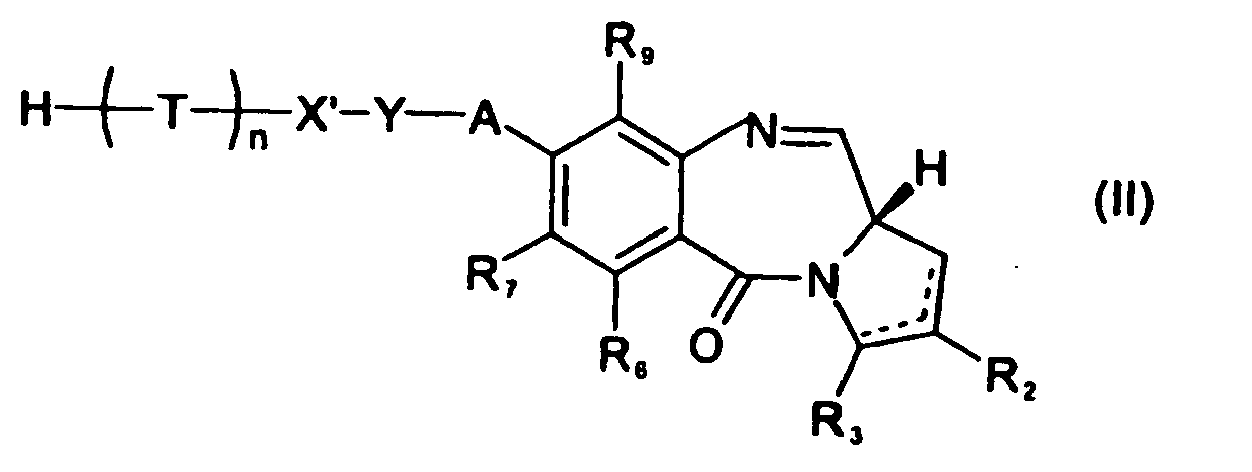 A O, S, NH oder eine Einfachbindung ist;R2 und R3 unabhängig voneinander ausgewählt sind aus: H, R, OH, OR, =O, =CH-R, =CH2, CH2-CO2R, CH2-CO2H, CH2-SO2R, O-SO2R, CO2R, COR, CN, und gegebenenfalls liegt eine Doppelbindung zwischen C1 und C2 oder C2 und C3 vor;R6, R7 und R9 unabhängig voneinander aus H, R, OH, OR, Halogen, Nitro, Amino, Me3Sn ausgewählt sind;worin R eine Alkylgruppe mit 1 bis 10 Kohlenstoffatomen oder eine Aralkylgruppe mit bis zu 12 Kohlenstoffatomen, wovon die Alkylgruppe gegebenenfalls eine oder mehrere Kohlenstoff-Kohlenstoff-Doppelbindungen oder -Dreifachbindungen enthält, die Teil eines konjugierten Systems bilden können, oder eine Arylgruppe mit bis zu 12 Kohlenstoffatomen ist; und gegebenenfalls mit einem oder mehreren Halogen-, Hydroxy-, Amino- oder Nitrogruppen substituiert ist;
Y eine zweiwertige Gruppe ist, sodass HY = R ist;
X' CO, NH, S oder O ist;
T ein Aminosäurerest; und
n eine positive ganze Zahl ist;(2) Formel VIII:
n und m positive ganze Zahlen sind oder eines davon gegebenenfalls Null ist;
T' ein Aminosäurerest ist, worin jedes T' unterschiedlich sein kann, wenn m größer als 1 ist;
T" ein Aminosäurerest ist, der eine Bindungsstelle für X' bereitstellt; und
p eine positive ganze Zahl ist, worin, wenn p größer als 1 ist, die Bedeutung von X', Y, A, R2, R3, R6, R7, R9, T, T', T" für jede Grundeinheit und die Werte von n und m unabhängig voneinander gewählt sind;(3) Formel XII:
X", Y', A', R'7, R'2, R'3, R'6, R'9 aus den gleichen Möglichkeiten wie X', Y, A, R7, R2, R3, R6 bzw. R9 gewählt sind, worin, wenn p größer als 1 ist, die Bedeutung von X', Y, A, R2, R3, R6, R7, R9, T, T' und T" für jede Grundeinheit und die Werte von n und m unabhängig voneinander gewählt sein können; oder(4) Formel XVI:
T"' und q aus den gleichen Möglichkeiten wie T bzw. n ausgewählt sind, worin, wenn p größer als 1 ist, die Bedeutung von T, T', T", T"' für jede Grundeinheit und die Werte von n, m und q unabhängig voneinander gewählt sein können. - Sammlung von Verbindungen nach Anspruch 1, worin R und HY unabhängig voneinander aus Niederalkylgruppen mit 1 bis 10 Kohlenstoffatomen aufgewählt sind, die gegebenenfalls mit einem oder mehreren Halogen-, Hydroxy-, Amino- oder Nitrogruppen substituiert sind.
- Sammlung von Verbindungen nach Anspruch 2, worin R oder HY unabhängig voneinander aus unsubstituierten, unverzweigten oder verzweigten Alkylgruppen mit 1 bis 10 Kohlenstoffatomen ausgewählt sind.
- Sammlung von Verbindungen nach einem der vorangegangenen Ansprüche, worin R7 aus einer oder mehrerer der Formeln II, VIII, XII und XVI eine elektronenspendende Gruppe ist.
- Sammlung von Verbindungen nach einem der vorangegangenen Ansprüche, worin R6 und R9 aus einer oder mehrerer der Formeln II, VIII, XII und XVI H sind.
- Sammlung von Verbindungen nach Anspruch 4, worin R7 aus einer oder mehrerer der Formeln II, VIII, XII und XVI eine Alkoxygruppe ist.
- Sammlung von Verbindungen nach einem der vorangegangenen Ansprüche, worin R2 und R3 aus einer oder mehrerer der Formeln II, VIII, XII und XVI H sind.
- Sammlung von Verbindungen nach einem der vorangegangenen Ansprüche, worin keine Doppelbindung zwischen C2 und C3 in einer oder mehreren der Formeln II, VIII, XII und XVI vorliegt.
- Sammlung von Verbindungen nach einem der vorangegangenen Ansprüche, worin -Y-A- aus einer oder mehreren der Formeln II, VIII, XII und XVI eine Alkoxykette ist.
- Sammlung von Verbindungen nach einem der vorangegangenen Ansprüche, worin X' aus einer oder mehreren der Formeln II, VIII, XII und XVI entweder CO oder NH ist.
- Sammlung von Verbindungen nach einem der vorangegangenen Ansprüche, worin n in Formel II 1 bis 16 ist.
- Sammlung von Verbindungen, die alle dargestellt sind durch entweder:(1) Formel III:
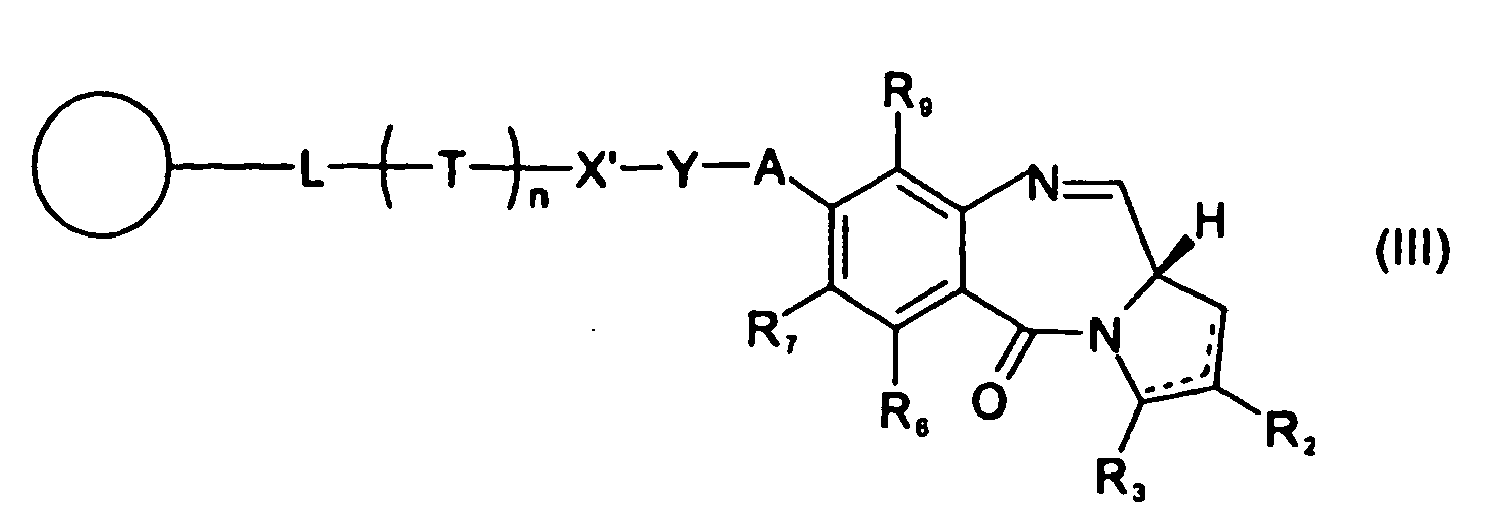 X', Y, A, R7, R2, R3, R6, R9, T und n wie nach einem der Ansprüche 1 bis 11 definiert sind;L eine Bindungsgruppe oder eine Einfachbindung ist; undO ein fester Träger ist;(2) Formel VI:

n und m positive ganze Zahlen sind oder eines davon gegebenenfalls Null ist;
T' ein Aminosäurerest ist, worin jedes T' unterschiedlich sein kann, wenn m größer als 1 ist;
T" ein Aminosäurerest ist, der eine Bindungsstelle für X' bereitstellt; und
p eine positive ganze Zahl ist, worin, wenn p größer als 1 ist, die Bedeutung von X', Y, A, R2, R3, R6, R7, R9, T, T', T" für jede Grundeinheit und die Werte von n und m unabhängig voneinander gewählt sind;(3) Formel X:
X", Y', A', R'2, R'3, R'6, R'7 und R'9 aus den gleichen Möglichkeiten wie X', Y, A, R2, R3, R6, R7 bzw. R9 gewählt sind, worin, wenn p größer als 1 ist, die Bedeutung von X', Y, A, R2, R3, R6, R7, R9, T, T' und T" für jede Grundeinheit und die Werte von n und m unabhängig voneinander gewählt sein können; oder(4) Formel XIV: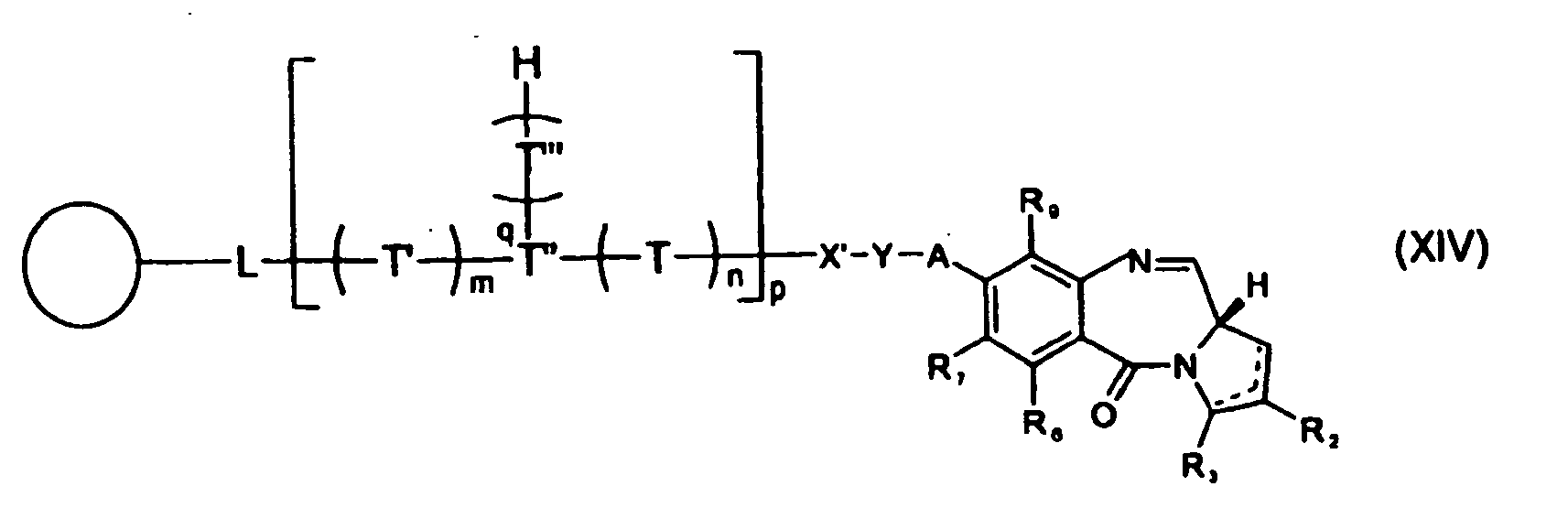
T'" und q aus den gleichen Möglichkeiten wie T bzw. n ausgewählt sind, worin, wenn p größer als 1 ist, die Bedeutung von T, T', T", T'" für jede Grundeinheit und die Werte von n, m und q unabhängig voneinander gewählt sein können. - Sammlung von Verbindungen, die alle dargestellt sind durch entweder:(1) Formel IV:

R11 entweder H oder R ist;
Q S, O oder NH ist; und
R10 eine Stickstoffschutzgruppe ist;(2) Formel VII :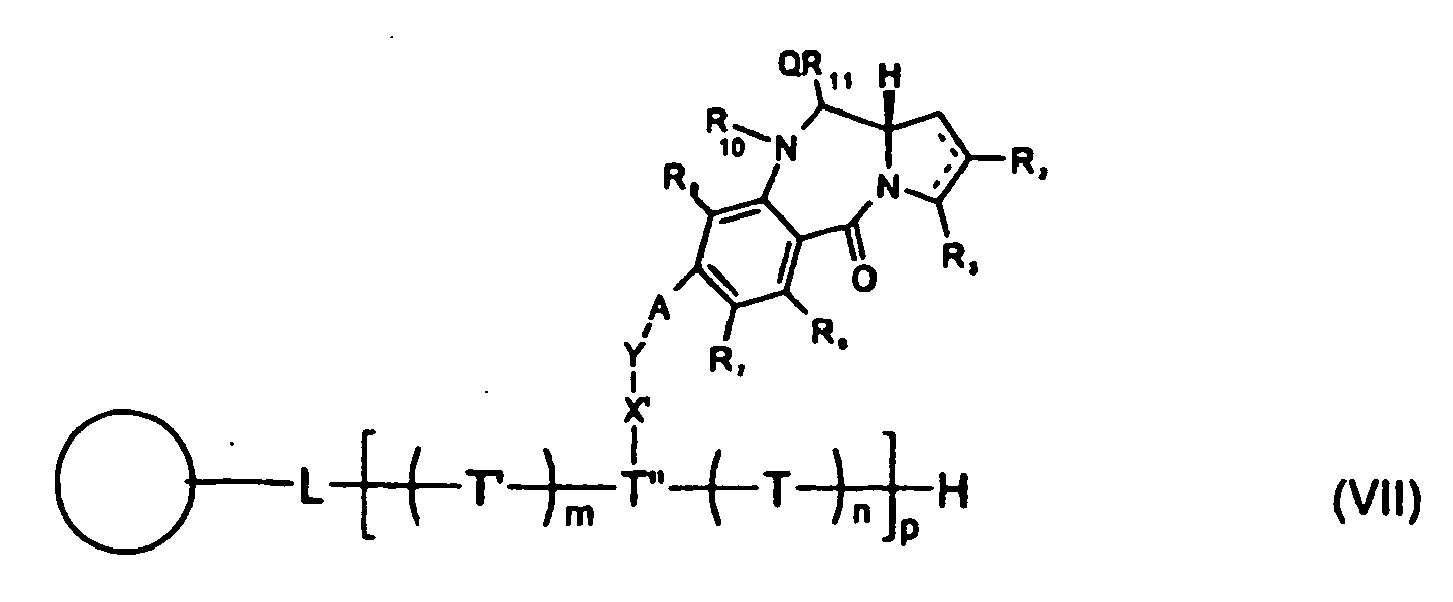
Q, R10 und R11 wie oben definiert sind, worin, wenn p größer als 1 ist, die Bedeutung von X', Y, A, R2, R3, R6, R7, R9, T, T', T", Q, R10, R11 für jede Grundeinheit und die Werte von n und m unabhängig voneinander gewählt sind;(3) Formel XI:
Q, R10 und R11 wie oben definiert sind; und
Q', R'10 und R'11 die gleichen Definitionen wie Q, R10, bzw. R11 aufweisen, worin, wenn p größer als 1 ist, die Bedeutung von X', Y, A, R2, R3, R6, R7, R9, T, T', T", Q, R10, R11 für jede Grundeinheit und die Werte von n und m unabhängig voneinander gewählt sind;(4) eine Verbindung der Formel XV:
Q, R10, R11 wie oben definiert sind, worin, wenn p größer als 1 ist, die Bedeutung von T, T', T", T"' für jede Grundeinheit und die Werte von n, m und q unabhängig voneinander gewählt sein können. - Sammlung von Verbindungen nach Anspruch 13, worin R10 aus einer oder mehreren der Formeln IV, VII, XI und XV eine Carbamatfunktionalität aufweist, wodurch an Position 10 der PBD-Ringstruktur eine Bindung an das Stickstoffatom erfolgt.
- Sammlung von Verbindungen nach Anspruch 13 oder Anspruch 14, worin Q aus einer oder mehreren der Formeln IV, VII, XI und XY O ist und/oder R11 H ist.
- Verbindung der Formel I:

A O, S, NH oder eine Einfachbindung ist;
R2 und R3 unabhängig voneinander ausgewählt sind aus: H, R, OH, OR, =O, =CH-R, =CH2, CH2-CO2R, CH2-CO2H, CH2-SO2R, O-SO2R, CO2R, COR, CN, und gegebenenfalls liegt eine Doppelbindung zwischen C1 und C2 oder C2 und C3 vor;
R6, R7 und R9 unabhängig voneinander aus H, R, OH, OR, Halogen, Nitro, Amino, Me3Sn ausgewählt sind;
R11 entweder H oder R ist;
Q S, O oder NH ist;
R10 eine Stickstoffschutzgruppe ist;
worin R eine Alkylgruppe mit 1 bis 10 Kohlenstoffatomen oder eine Aralkylgruppe mit bis zu 12 Kohlenstoffatomen, wovon die Alkylgruppe gegebenenfalls eine oder mehrere Kohlenstoff-Kohlenstoff-Doppelbindungen oder -Dreifachbindungen enthält, die Teil eines konjugierten Systems bilden können, oder eine Arylgruppe mit bis zu 12 Kohlenstoffatomen ist; und gegebenenfalls mit einem oder mehreren Halogen-, Hydroxy-, Amino- oder Nitrogruppen substituiert ist; und
Y eine zweiwertige Gruppe ist, sodass HY = R ist; - Verbindung nach Anspruch 16, worin R und HY unabhängig voneinander aus Niederalkylgruppen mit 1 bis 10 Kohlenstoffatomen ausgewählt sind, die gegebenenfalls mit einem oder mehreren Halogen-, Hydroxy-, Amino- oder Nitrogruppen substituiert sind.
- Verbindung nach Anspruch 17, worin R oder HY unabhängig voneinander aus unsubstituierten, unverzweigten oder verzweigten Alkylgruppen mit 1 bis 10 Kohlenstoffatomen ausgewählt sind.
- Verbindung nach einem der Ansprüche 16 bis 18, worin R10 eine Carbamatfunktionalität aufweist, wodurch an Position 10 der PBD-Ringstruktur eine Bindung an das Stickstoffatom erfolgt.
- Verbindung nach einem der Ansprüche 16 bis 19, worin R7 eine elektronenspendende Gruppe ist.
- Verbindung nach einem der Ansprüche 16 bis 20, worin Q O ist und/oder R11 H ist.
- Verbindung nach einem der Ansprüche 16 bis 21, worin R6 und R9 H sind.
- Verbindung nach Anspruch 22, worin R7 eine Alkoxygruppe ist.
- Verbindung nach einem der Ansprüche 16 bis 23, worin R2 und R3 H sind.
- Verbindung nach einem der Ansprüche 16 bis 24, worin keine Doppelbindung zwischen C2 und C3 vorliegt.
- Verbindung nach einem der Ansprüche 19 bis 25, worin -Y-A- eine Alkoxykette ist.
Applications Claiming Priority (3)
| Application Number | Priority Date | Filing Date | Title |
|---|---|---|---|
| GB9818730 | 1998-08-27 | ||
| GBGB9818730.5A GB9818730D0 (en) | 1998-08-27 | 1998-08-27 | Collections of compounds |
| PCT/GB1999/002836 WO2000012506A2 (en) | 1998-08-27 | 1999-08-27 | Collections of compounds |
Related Child Applications (1)
| Application Number | Title | Priority Date | Filing Date |
|---|---|---|---|
| EP06013320 Division | 2006-06-28 |
Publications (2)
| Publication Number | Publication Date |
|---|---|
| EP1107969A2 EP1107969A2 (de) | 2001-06-20 |
| EP1107969B1 true EP1107969B1 (de) | 2008-01-16 |
Family
ID=10837952
Family Applications (1)
| Application Number | Title | Priority Date | Filing Date |
|---|---|---|---|
| EP99941765A Expired - Lifetime EP1107969B1 (de) | 1998-08-27 | 1999-08-27 | Sammlungen von verbindungen |
Country Status (10)
| Country | Link |
|---|---|
| US (2) | US6608192B1 (de) |
| EP (1) | EP1107969B1 (de) |
| JP (1) | JP4689826B2 (de) |
| AT (1) | ATE384063T1 (de) |
| AU (1) | AU763214B2 (de) |
| CA (1) | CA2341434C (de) |
| DE (1) | DE69938003T2 (de) |
| GB (1) | GB9818730D0 (de) |
| NZ (1) | NZ510490A (de) |
| WO (1) | WO2000012506A2 (de) |
Cited By (3)
| Publication number | Priority date | Publication date | Assignee | Title |
|---|---|---|---|---|
| EP3774838B1 (de) * | 2018-04-10 | 2022-08-10 | Sanofi-Aventis Deutschland GmbH | Lixisenatidsynthese mit verkappung |
| RU2782772C2 (ru) * | 2018-04-10 | 2022-11-02 | Санофи-Авентис Дойчланд Гмбх | Синтез ликсисенатида с кэппированием |
| US11560402B2 (en) | 2018-04-10 | 2023-01-24 | Sanofi-Aventis Deutschland Gmbh | Method for cleavage of solid phase-bound peptides from the solid phase |
Families Citing this family (91)
| Publication number | Priority date | Publication date | Assignee | Title |
|---|---|---|---|---|
| ES2260570T3 (es) * | 1998-08-27 | 2006-11-01 | Spirogen Limited | Pirrolobenziodiazepinas dimericas. |
| GB9818732D0 (en) * | 1998-08-27 | 1998-10-21 | Univ Portsmouth | Collection of compounds |
| GB9818730D0 (en) | 1998-08-27 | 1998-10-21 | Univ Portsmouth | Collections of compounds |
| GB9818731D0 (en) * | 1998-08-27 | 1998-10-21 | Univ Portsmouth | Compounds |
| US6909006B1 (en) | 1999-08-27 | 2005-06-21 | Spirogen Limited | Cyclopropylindole derivatives |
| GB0226593D0 (en) * | 2002-11-14 | 2002-12-24 | Consultants Ltd | Compounds |
| ZA200507752B (en) | 2003-03-28 | 2007-01-31 | Threshold Pharmaceuticals Inc | Compositions and methods for treating cancer |
| GB0321295D0 (en) | 2003-09-11 | 2003-10-15 | Spirogen Ltd | Synthesis of protected pyrrolobenzodiazepines |
| GB0404574D0 (en) * | 2004-03-01 | 2004-04-07 | Spirogen Ltd | Amino acids |
| ES2398975T3 (es) * | 2004-03-01 | 2013-03-25 | Spirogen Sàrl | Derivados de 11-hidroxi-5H-pirrolo[2,1-c][1,4]benzodiazepin-5-ona como intermedios clave para la preparación de pirrolobenzodiazepinas sustituidas en C2 |
| GB0404577D0 (en) | 2004-03-01 | 2004-04-07 | Spirogen Ltd | Pyrrolobenzodiazepines |
| EP1723152B1 (de) * | 2004-03-09 | 2015-02-11 | Spirogen Sàrl | Pyrrolobenzodiazepine |
| GB0410725D0 (en) * | 2004-05-13 | 2004-06-16 | Spirogen Ltd | Pyrrolobenzodiazepine therapeutic agents |
| ES2338696T3 (es) | 2005-04-21 | 2010-05-11 | Spirogen Limited | Pirrolobenzodiazepinas. |
| DE602006006199D1 (de) * | 2005-10-05 | 2009-05-20 | Spirogen Ltd | 4-ä4-(5-oxo-2,3,5,11a-tetrahydro-5h-pyrrolo ä2, 1-cüä1,4übenzodiazepin-8-yloxy)-butyrylaminoü-1h-pyrrol-2-carbonsäurealkylesterderivate und verwandte verbindung zur behandlung einer proliferativen erkrankung |
| GB0619325D0 (en) * | 2006-09-30 | 2006-11-08 | Univ Strathclyde | New compounds |
| GB0813432D0 (en) | 2008-07-22 | 2008-08-27 | Spirogen Ltd | Pyrrolobenzodiazepines |
| GB0819095D0 (en) | 2008-10-17 | 2008-11-26 | Spirogen Ltd | Pyrrolobenzodiazepines |
| MX368648B (es) | 2010-04-15 | 2019-10-09 | Seattle Genetics Inc | Pirrolobenzodiazepinas usadas para tratar enfermedades proliferativas. |
| CN103068405A (zh) | 2010-04-15 | 2013-04-24 | 西雅图基因公司 | 靶向吡咯并苯并二氮杂卓结合物 |
| GB201006340D0 (en) | 2010-04-15 | 2010-06-02 | Spirogen Ltd | Synthesis method and intermediates |
| US9399641B2 (en) | 2011-09-20 | 2016-07-26 | Medimmune Limited | Pyrrolobenzodiazepines as unsymmetrical dimeric PBD compounds for inclusion in targeted conjugates |
| CA2850264C (en) | 2011-10-14 | 2019-11-05 | Medimmune Limited | Pyrrolobenzodiazepines |
| JP6166728B2 (ja) | 2011-10-14 | 2017-07-19 | メドイミューン・リミテッドMedImmune Limited | ピロロベンゾジアゼピンの製造に有用な合成方法及び中間体 |
| AU2012322934B2 (en) | 2011-10-14 | 2016-09-08 | Medimmune Limited | Pyrrolobenzodiazepines |
| CA2850375C (en) | 2011-10-14 | 2019-07-02 | Seattle Genetics, Inc. | Pyrrolobenzodiazepines and targeted conjugates |
| CA2850373C (en) | 2011-10-14 | 2019-07-16 | Seattle Genetics, Inc. | Pyrrolobenzodiazepines and targeted conjugates |
| IN2014MN02092A (de) | 2012-04-30 | 2015-09-04 | Spirogen Sarl | |
| IN2014MN02175A (de) | 2012-04-30 | 2015-08-28 | Ucl Business Plc | |
| PT2906253T (pt) | 2012-10-12 | 2018-11-05 | Medimmune Ltd | Conjugados de anticorpo anti-psma de pirrolobenzodiazepina |
| BR112015008238A2 (pt) | 2012-10-12 | 2017-11-28 | Adc Therapeutics Sarl | conjugados de pirrolbenzodiazepina-anticorpo anti-cd22 |
| KR101995620B1 (ko) | 2012-10-12 | 2019-07-03 | 에이디씨 테라퓨틱스 에스에이 | 피롤로벤조디아제핀-항체 컨주게이트 |
| WO2014057114A1 (en) | 2012-10-12 | 2014-04-17 | Adc Therapeutics Sàrl | Pyrrolobenzodiazepine-anti-psma antibody conjugates |
| EP2906249B1 (de) | 2012-10-12 | 2018-06-27 | MedImmune Limited | Synthese und zwischenprodukte pyrrolobenzodiazepinderivaten zur konjugation |
| PT2906248T (pt) | 2012-10-12 | 2019-03-04 | Medimmune Ltd | Pirrolobenzodiazepinas e conjugados das mesmas |
| EP2906297B1 (de) | 2012-10-12 | 2017-12-06 | ADC Therapeutics SA | Pyrrolobenzodiazepin-antikörper-konjugate |
| DK2839860T3 (da) | 2012-10-12 | 2019-06-17 | Medimmune Ltd | Pyrrolobenzodiazepiner og konjugater deraf |
| DK2906298T3 (en) | 2012-10-12 | 2018-12-17 | Adc Therapeutics Sa | Pyrrolobenzodiazepine-antibody conjugates |
| US10131682B2 (en) | 2012-11-24 | 2018-11-20 | Hangzhou Dac Biotech Co., Ltd. | Hydrophilic linkers and their uses for conjugation of drugs to a cell binding molecules |
| AU2013366493B2 (en) | 2012-12-21 | 2017-08-24 | Medimmune Limited | Pyrrolobenzodiazepines and conjugates thereof |
| US9567340B2 (en) | 2012-12-21 | 2017-02-14 | Medimmune Limited | Unsymmetrical pyrrolobenzodiazepines-dimers for use in the treatment of proliferative and autoimmune diseases |
| KR102066318B1 (ko) | 2013-03-13 | 2020-01-14 | 메디뮨 리미티드 | 피롤로벤조디아제핀 및 그의 컨쥬게이트 |
| MX363787B (es) | 2013-03-13 | 2019-04-03 | Medimmune Ltd | Pirrolobenzodiazepinas y conjugados de los mismos. |
| WO2015038984A2 (en) | 2013-09-12 | 2015-03-19 | Halozyme, Inc. | Modified anti-epidermal growth factor receptor antibodies and methods of use thereof |
| WO2015052534A1 (en) | 2013-10-11 | 2015-04-16 | Spirogen Sàrl | Pyrrolobenzodiazepine-antibody conjugates |
| US10010624B2 (en) | 2013-10-11 | 2018-07-03 | Medimmune Limited | Pyrrolobenzodiazepine-antibody conjugates |
| WO2015052535A1 (en) | 2013-10-11 | 2015-04-16 | Spirogen Sàrl | Pyrrolobenzodiazepine-antibody conjugates |
| GB201317982D0 (en) | 2013-10-11 | 2013-11-27 | Spirogen Sarl | Pyrrolobenzodiazepines and conjugates thereof |
| GB201317981D0 (en) | 2013-10-11 | 2013-11-27 | Spirogen Sarl | Pyrrolobenzodiazepines and conjugates thereof |
| JP6417421B2 (ja) | 2014-02-28 | 2018-11-07 | ハンジョウ ディーエーシー バイオテック シーオー.,エルティディ.Hangzhou Dac Biotech Co.,Ltd. | 荷電連結体及び共役体のためのその使用 |
| GB201416112D0 (en) | 2014-09-12 | 2014-10-29 | Medimmune Ltd | Pyrrolobenzodiazepines and conjugates thereof |
| CN107148285B (zh) | 2014-11-25 | 2022-01-04 | Adc治疗股份有限公司 | 吡咯并苯并二氮杂䓬-抗体缀合物 |
| GB201506411D0 (en) | 2015-04-15 | 2015-05-27 | Bergenbio As | Humanized anti-axl antibodies |
| GB201506402D0 (en) | 2015-04-15 | 2015-05-27 | Berkel Patricius H C Van And Howard Philip W | Site-specific antibody-drug conjugates |
| EP3307749A4 (de) | 2015-06-15 | 2019-06-19 | Hangzhou Dac Biotech Co., Ltd | Hydrophile linker für konjugation |
| CA2991973C (en) | 2015-07-12 | 2021-12-07 | Suzhou M-Conj Biotech Co., Ltd. | Bridge linkers for conjugation of a cell-binding molecule |
| US9839687B2 (en) | 2015-07-15 | 2017-12-12 | Suzhou M-Conj Biotech Co., Ltd. | Acetylenedicarboxyl linkers and their uses in specific conjugation of a cell-binding molecule |
| GB201601431D0 (en) | 2016-01-26 | 2016-03-09 | Medimmune Ltd | Pyrrolobenzodiazepines |
| GB201602356D0 (en) | 2016-02-10 | 2016-03-23 | Medimmune Ltd | Pyrrolobenzodiazepine Conjugates |
| GB201602359D0 (en) | 2016-02-10 | 2016-03-23 | Medimmune Ltd | Pyrrolobenzodiazepine Conjugates |
| WO2017161206A1 (en) | 2016-03-16 | 2017-09-21 | Halozyme, Inc. | Conjugates containing conditionally active antibodies or antigen-binding fragments thereof, and methods of use |
| KR102775461B1 (ko) | 2016-04-01 | 2025-02-28 | 어비디티 바이오사이언시스 인크. | 핵산-폴리펩타이드 조성물 및 이의 용도 |
| GB201607478D0 (en) | 2016-04-29 | 2016-06-15 | Medimmune Ltd | Pyrrolobenzodiazepine Conjugates |
| WO2017201132A2 (en) | 2016-05-18 | 2017-11-23 | Mersana Therapeutics, Inc. | Pyrrolobenzodiazepines and conjugates thereof |
| US10526294B2 (en) | 2016-06-24 | 2020-01-07 | Mersana Therapeutics, Inc. | Pyrrolobenzodiazepines and conjugates thereof |
| GB201617466D0 (en) | 2016-10-14 | 2016-11-30 | Medimmune Ltd | Pyrrolobenzodiazepine conjugates |
| KR20220147719A (ko) | 2016-11-14 | 2022-11-03 | 항저우 디에이씨 바이오테크 씨오, 엘티디 | 결합 링커, 그러한 결합 링커를 함유하는 세포 결합 분자-약물 결합체, 링커를 갖는 그러한 결합체의 제조 및 사용 |
| RS61795B1 (sr) | 2017-02-08 | 2021-06-30 | Adc Therapeutics Sa | Konjugati pirolobenzodiazepin antitela |
| GB201702031D0 (en) | 2017-02-08 | 2017-03-22 | Medlmmune Ltd | Pyrrolobenzodiazepine-antibody conjugates |
| SMT202200490T1 (it) | 2017-04-18 | 2023-01-13 | Medimmune Ltd | Coniugati di pirrolobenzodiazepina |
| WO2018193102A1 (en) | 2017-04-20 | 2018-10-25 | Adc Therapeutics Sa | Combination therapy with an anti-axl antibody-drug conjugate |
| KR102442736B1 (ko) | 2017-06-14 | 2022-09-16 | 에이디씨 테라퓨틱스 에스에이 | 항-cd19 adc의 투여를 위한 투약량 체제 |
| CN111201030B (zh) | 2017-07-25 | 2024-11-01 | 真和制药有限公司 | 通过阻断tim-3和其配体的相互作用治疗癌症 |
| SI3668874T1 (sl) | 2017-08-18 | 2022-04-29 | Medimmune Limited | Pirolobenzodiazepinski konjugati |
| CA3177215C (en) | 2017-09-29 | 2026-06-09 | Daiichi Sankyo Company, Limited | Antibody-pyrrolobenzodiazepine derivative conjugate |
| US11638760B2 (en) | 2017-11-27 | 2023-05-02 | Mersana Therapeutics, Inc. | Pyrrolobenzodiazepine antibody conjugates |
| EP3724225A1 (de) | 2017-12-15 | 2020-10-21 | Juno Therapeutics, Inc. | Anti-cct5-bindende moleküle und verfahren zur verwendung davon |
| GB201803342D0 (en) | 2018-03-01 | 2018-04-18 | Medimmune Ltd | Methods |
| GB201806022D0 (en) | 2018-04-12 | 2018-05-30 | Medimmune Ltd | Pyrrolobenzodiazepines and conjugates thereof |
| CN113302207B (zh) | 2018-11-16 | 2025-05-13 | 维尔托索宾科公司 | Cd38和icam1抗体及其用途 |
| IL312067B2 (en) | 2018-12-21 | 2025-08-01 | Avidity Biosciences Inc | Anti-transferrin receptor antibodies and uses thereof |
| KR20210124308A (ko) | 2019-01-30 | 2021-10-14 | 트루바인딩 아이엔씨. | 항-gal3 항체 및 이의 용도 |
| CN113631560B (zh) | 2019-03-15 | 2025-02-18 | 麦迪穆有限责任公司 | 氮杂环丁烷并苯并二氮杂䓬二聚体和用于治疗癌症的包含它们的缀合物 |
| CN115279789A (zh) | 2019-12-06 | 2022-11-01 | 真和制药有限公司 | 破坏gal3和胰岛素受体或整联蛋白的相互作用的抗体及其使用方法 |
| TW202144572A (zh) | 2020-03-19 | 2021-12-01 | 美商亞維代堤生物科學公司 | 治療臉肩胛肱骨肌肉失養症之組合物及方法 |
| KR102927945B1 (ko) | 2020-03-27 | 2026-02-23 | 어비디티 바이오사이언시스 인크. | 근이영양증의 치료용 조성물 및 방법 |
| MX2022014786A (es) | 2020-05-26 | 2023-01-16 | Truebinding Inc | Metodos para tratar enfermedades inflamatorias mediante el bloqueo de galectina-3. |
| JP2024526764A (ja) | 2021-07-13 | 2024-07-19 | トゥルーバインディング,インコーポレイテッド | タンパク質凝集を防止する方法 |
| EP4401792A4 (de) | 2021-09-16 | 2025-12-03 | Avidity Biosciences Inc | Zusammensetzungen und verfahren zur behandlung von fazioskapulohumeraler muskeldystrophie |
| CN117980327A (zh) | 2021-11-03 | 2024-05-03 | 杭州多禧生物科技有限公司 | 抗体的特异性偶联 |
| US20230279120A1 (en) | 2021-11-09 | 2023-09-07 | Truebinding, Inc. | Methods of treating or inhibiting cardiovascular diseases |
Family Cites Families (50)
| Publication number | Priority date | Publication date | Assignee | Title |
|---|---|---|---|---|
| US3523941A (en) * | 1967-03-06 | 1970-08-11 | Hoffmann La Roche | Benzodiazepine compounds and process for their preparation |
| US3524849A (en) | 1967-10-27 | 1970-08-18 | Hoffmann La Roche | Process for the preparation of pyrrolo-benzodiazepine acrylamides and intermediates useful therein |
| IL33558A (en) | 1968-12-30 | 1973-10-25 | Fujisawa Pharmaceutical Co | Antibiotic pyrrolo-benzodiazepine compound,its derivatives and processes for their production |
| DE1965304A1 (de) | 1968-12-30 | 1970-07-23 | Fujisawa Pharmaceutical Co | Benzdiazepinon-Verbindungen und Verfahren zu ihrer Herstellung |
| JPS6053033B2 (ja) | 1976-12-28 | 1985-11-22 | 財団法人微生物化学研究会 | 新制癌抗生物質マゼスラマイシン及びその製造方法 |
| JPS585916B2 (ja) | 1977-12-27 | 1983-02-02 | 株式会社ミドリ十字 | 新規ベンゾジアゼピン系化合物 |
| JPS5615289A (en) | 1979-07-17 | 1981-02-14 | Green Cross Corp:The | Novel benzodiazepinnbased compound 3 |
| JPS57131791A (en) | 1980-12-31 | 1982-08-14 | Fujisawa Pharmaceut Co Ltd | Benzodiazepine derivative and its preparation |
| JPS58180487A (ja) | 1982-04-16 | 1983-10-21 | Kyowa Hakko Kogyo Co Ltd | 抗生物質dc−81およびその製造法 |
| FR2586683B1 (fr) | 1985-08-29 | 1988-07-01 | Centre Nat Rech Scient | Nouveaux derives de neothramycine, leur procede de preparation et leur application en tant que medicaments |
| GB8607679D0 (en) | 1986-03-27 | 1986-04-30 | Winter G P | Recombinant dna product |
| AU617304B2 (en) | 1986-12-19 | 1991-11-28 | Pharmacia & Upjohn Company | Novel cc-1065 analogs |
| GB8705477D0 (en) | 1987-03-09 | 1987-04-15 | Carlton Med Prod | Drug delivery systems |
| US5229490A (en) * | 1987-05-06 | 1993-07-20 | The Rockefeller University | Multiple antigen peptide system |
| GB8809616D0 (en) | 1988-04-22 | 1988-05-25 | Cancer Res Campaign Tech | Further improvements relating to drug delivery systems |
| US5143854A (en) * | 1989-06-07 | 1992-09-01 | Affymax Technologies N.V. | Large scale photolithographic solid phase synthesis of polypeptides and receptor binding screening thereof |
| AU648313B2 (en) | 1990-04-25 | 1994-04-21 | Pharmacia & Upjohn Company | Novel CC-1065 analogs |
| FR2676230B1 (fr) | 1991-05-07 | 1993-08-27 | Centre Nat Rech Scient | Nouveaux derives de pyrrolo [1,4]-benzodiazepines, leur procede de preparation et medicaments les contenant. |
| JP4115514B2 (ja) | 1991-10-23 | 2008-07-09 | キャンサー・リサーチ・キヤンペーン・テクノロジー・リミテツド | Cb 1954およびその類似体を細胞障害性の形態に還元するための細菌のニトロリダクターゼ |
| GB9205051D0 (en) * | 1992-03-09 | 1992-04-22 | Cancer Res Campaign Tech | Pyrrolobenzodiazepine derivatives,their preparation,and compositions containing them |
| US5288514A (en) | 1992-09-14 | 1994-02-22 | The Regents Of The University Of California | Solid phase and combinatorial synthesis of benzodiazepine compounds on a solid support |
| FR2696176B1 (fr) * | 1992-09-28 | 1994-11-10 | Synthelabo | Dérivés de pipéridine, leur préparation et leur application en thérapeutique. |
| US5502068A (en) | 1995-01-31 | 1996-03-26 | Synphar Laboratories, Inc. | Cyclopropylpyrroloindole-oligopeptide anticancer agents |
| EP0850238A4 (de) * | 1995-06-29 | 1998-10-07 | Pharmacopeia Inc | Kombinatorische bibliothek von 1,4-benzodiazepin-2,5-dionen |
| GB9516943D0 (en) | 1995-08-18 | 1995-10-18 | Cancer Soc Auckland Div Nz Inc | Novel cyclopropylindoles and their secoprecursors,and their use as prodrugs |
| ATE310725T1 (de) | 1996-09-12 | 2005-12-15 | Auckland Uniservices Ltd | Kondensierte n-acylindole als antitumormittel |
| JPH1087666A (ja) | 1996-09-18 | 1998-04-07 | Kyorin Pharmaceut Co Ltd | デュオカルマイシンsa及びその誘導体の製造中間体と製造方法 |
| IL136489A0 (en) | 1997-12-08 | 2001-06-14 | Scripps Research Inst | Synthesis of cc-1065/duocarmycin analogs |
| WO1999046244A1 (en) | 1998-03-12 | 1999-09-16 | Novo Nordisk A/S | Modulators of protein tyrosine phosphatases (ptpases) |
| ES2260570T3 (es) | 1998-08-27 | 2006-11-01 | Spirogen Limited | Pirrolobenziodiazepinas dimericas. |
| GB9818730D0 (en) | 1998-08-27 | 1998-10-21 | Univ Portsmouth | Collections of compounds |
| GB9818731D0 (en) * | 1998-08-27 | 1998-10-21 | Univ Portsmouth | Compounds |
| GB9818732D0 (en) | 1998-08-27 | 1998-10-21 | Univ Portsmouth | Collection of compounds |
| GB9909612D0 (en) | 1999-04-26 | 1999-06-23 | Cancer Res Campaign Tech | N-protected amines and their use as prodrugs |
| US6909006B1 (en) * | 1999-08-27 | 2005-06-21 | Spirogen Limited | Cyclopropylindole derivatives |
| US6660856B2 (en) * | 2002-03-08 | 2003-12-09 | Kaohsiung Medical University | Synthesis of pyrrolo[2,1-c][1,4]benzodiazepine analogues |
| US7135288B2 (en) * | 2002-09-27 | 2006-11-14 | Ut-Battelle, Llc | Combinatorial synthesis of ceramic materials |
| US20040138269A1 (en) * | 2002-10-11 | 2004-07-15 | Sugen, Inc. | Substituted pyrroles as kinase inhibitors |
| GB0226593D0 (en) | 2002-11-14 | 2002-12-24 | Consultants Ltd | Compounds |
| GB0321295D0 (en) | 2003-09-11 | 2003-10-15 | Spirogen Ltd | Synthesis of protected pyrrolobenzodiazepines |
| AU2004284075A1 (en) | 2003-10-22 | 2005-05-06 | Government Of The United States Of America, Represented By The Secretary, Department Of Health And Human Services | Pyrrolobenzodiazepine derivatives, compositions comprising the same and methods related thereto |
| GB0416511D0 (en) | 2003-10-22 | 2004-08-25 | Spirogen Ltd | Pyrrolobenzodiazepines |
| GB0404574D0 (en) * | 2004-03-01 | 2004-04-07 | Spirogen Ltd | Amino acids |
| GB0404577D0 (en) | 2004-03-01 | 2004-04-07 | Spirogen Ltd | Pyrrolobenzodiazepines |
| ES2398975T3 (es) | 2004-03-01 | 2013-03-25 | Spirogen Sàrl | Derivados de 11-hidroxi-5H-pirrolo[2,1-c][1,4]benzodiazepin-5-ona como intermedios clave para la preparación de pirrolobenzodiazepinas sustituidas en C2 |
| GB0404578D0 (en) | 2004-03-01 | 2004-04-07 | Spirogen Ltd | Pyrrolobenzodiazepines |
| EP1723152B1 (de) * | 2004-03-09 | 2015-02-11 | Spirogen Sàrl | Pyrrolobenzodiazepine |
| GB0410725D0 (en) * | 2004-05-13 | 2004-06-16 | Spirogen Ltd | Pyrrolobenzodiazepine therapeutic agents |
| ES2338696T3 (es) * | 2005-04-21 | 2010-05-11 | Spirogen Limited | Pirrolobenzodiazepinas. |
| DE602006006199D1 (de) * | 2005-10-05 | 2009-05-20 | Spirogen Ltd | 4-ä4-(5-oxo-2,3,5,11a-tetrahydro-5h-pyrrolo ä2, 1-cüä1,4übenzodiazepin-8-yloxy)-butyrylaminoü-1h-pyrrol-2-carbonsäurealkylesterderivate und verwandte verbindung zur behandlung einer proliferativen erkrankung |
-
1998
- 1998-08-27 GB GBGB9818730.5A patent/GB9818730D0/en not_active Ceased
-
1999
- 1999-08-27 CA CA002341434A patent/CA2341434C/en not_active Expired - Lifetime
- 1999-08-27 WO PCT/GB1999/002836 patent/WO2000012506A2/en not_active Ceased
- 1999-08-27 NZ NZ510490A patent/NZ510490A/en not_active IP Right Cessation
- 1999-08-27 AU AU55260/99A patent/AU763214B2/en not_active Expired
- 1999-08-27 AT AT99941765T patent/ATE384063T1/de not_active IP Right Cessation
- 1999-08-27 DE DE69938003T patent/DE69938003T2/de not_active Expired - Lifetime
- 1999-08-27 US US09/763,768 patent/US6608192B1/en not_active Expired - Lifetime
- 1999-08-27 JP JP2000571052A patent/JP4689826B2/ja not_active Expired - Lifetime
- 1999-08-27 EP EP99941765A patent/EP1107969B1/de not_active Expired - Lifetime
-
2003
- 2003-06-24 US US10/602,521 patent/US7704924B2/en not_active Expired - Lifetime
Cited By (3)
| Publication number | Priority date | Publication date | Assignee | Title |
|---|---|---|---|---|
| EP3774838B1 (de) * | 2018-04-10 | 2022-08-10 | Sanofi-Aventis Deutschland GmbH | Lixisenatidsynthese mit verkappung |
| RU2782772C2 (ru) * | 2018-04-10 | 2022-11-02 | Санофи-Авентис Дойчланд Гмбх | Синтез ликсисенатида с кэппированием |
| US11560402B2 (en) | 2018-04-10 | 2023-01-24 | Sanofi-Aventis Deutschland Gmbh | Method for cleavage of solid phase-bound peptides from the solid phase |
Also Published As
| Publication number | Publication date |
|---|---|
| ATE384063T1 (de) | 2008-02-15 |
| US20040092736A1 (en) | 2004-05-13 |
| EP1107969A2 (de) | 2001-06-20 |
| WO2000012506A2 (en) | 2000-03-09 |
| JP2002525283A (ja) | 2002-08-13 |
| AU5526099A (en) | 2000-03-21 |
| JP4689826B2 (ja) | 2011-05-25 |
| US6608192B1 (en) | 2003-08-19 |
| NZ510490A (en) | 2003-10-31 |
| DE69938003T2 (de) | 2009-01-15 |
| CA2341434A1 (en) | 2000-03-09 |
| CA2341434C (en) | 2009-10-27 |
| US7704924B2 (en) | 2010-04-27 |
| DE69938003D1 (de) | 2008-03-06 |
| WO2000012506A3 (en) | 2000-06-29 |
| AU763214B2 (en) | 2003-07-17 |
| GB9818730D0 (en) | 1998-10-21 |
Similar Documents
| Publication | Publication Date | Title |
|---|---|---|
| US6608192B1 (en) | Collections of compounds | |
| AU764464B2 (en) | Collections of compounds | |
| US6909006B1 (en) | Cyclopropylindole derivatives | |
| Breinbauer et al. | Natural product guided compound library development | |
| KR101081685B1 (ko) | 디아조 바이사이클릭 smac 모사체 및 그의 용도 | |
| CA2187792A1 (en) | Complex combinatorial chemical libraries encoded with tags | |
| EP0980373A1 (de) | Substanzen mit umgekehrter diehung und dazu beziehende verfahren | |
| JP2000512979A (ja) | 自己デコンボリューション法によるコンビナトリアルライブラリー | |
| Virgilio et al. | Synthesis and evaluation of a library of peptidomimetics based upon the β-turn | |
| US20220213138A1 (en) | Cyclic compounds and methods of making and using | |
| US20040235053A1 (en) | Preparation and application of encoded bead aggregates in combinatorial chemistry | |
| US20040235054A1 (en) | Novel encoding method for "one-bead one-compound" combinatorial libraries | |
| EP4232578A1 (de) | Selbstgereinigte nukleinsäurecodierte bibliotheken | |
| Ručilová et al. | Synthesis of Disubstituted Pyrazino‐Oxazine Derivatives with Controlled Stereochemistry | |
| EP0880503A1 (de) | Balanol analoge | |
| Boutard et al. | Pyrrolo [3, 2-e][1, 4] diazepin-2-one synthesis: a head-to-head comparison of soluble versus insoluble supports | |
| Lattmann et al. | Combinatorial Solid Phase Synthesis of Multiply Substituted 1, 4-Benzodiazepines and Affinity Studies on the CCK 2 Receptor (Part 1) | |
| US20060252093A1 (en) | Heterocyclic organic molecules through intramolecular formation of n-acyliminium ions | |
| US6861523B2 (en) | 1,3,5- trisubstituted-1,3,5-triazine-2,4,6-trione compounds and libraries | |
| Zajdel et al. | The influence of an ethylene spacer on the 5-HT1A and 5-HT2A receptor affinity of arylpiperazine derivatives of amides with N-acylated amino acids and 3-differently substituted pyrrolidine-2, 5-diones | |
| Splandesci et al. | Ugi 5-center-4-component reaction of α-Amino Aldehydes/Deprotection/Cyclization sequence leading to substituted 2-oxopiperazine derivatives | |
| Maity | Synthesis of biologically active multicyclic frameworks via [3+ 2] cycloaddition and studies toward the total synthesis of palau'amide |
Legal Events
| Date | Code | Title | Description |
|---|---|---|---|
| PUAI | Public reference made under article 153(3) epc to a published international application that has entered the european phase |
Free format text: ORIGINAL CODE: 0009012 |
|
| 17P | Request for examination filed |
Effective date: 20010316 |
|
| AK | Designated contracting states |
Kind code of ref document: A2 Designated state(s): AT BE CH CY DE DK ES FI FR GB GR IE IT LI LU MC NL PT SE |
|
| AX | Request for extension of the european patent |
Free format text: AL;LT;LV;MK;RO;SI |
|
| 17Q | First examination report despatched |
Effective date: 20011129 |
|
| APAF | Appeal reference modified |
Free format text: ORIGINAL CODE: EPIDOSCREFNE |
|
| APBT | Appeal procedure closed |
Free format text: ORIGINAL CODE: EPIDOSNNOA9E |
|
| 17Q | First examination report despatched |
Effective date: 20011129 |
|
| GRAP | Despatch of communication of intention to grant a patent |
Free format text: ORIGINAL CODE: EPIDOSNIGR1 |
|
| RIN1 | Information on inventor provided before grant (corrected) |
Inventor name: HOWARD, PHILIP, WILSONUNIVERSITY OF PORTSMOUTH Inventor name: THURSTON, DAVID, EDWINCANCER RESEARCH CAMPAIGN |
|
| GRAS | Grant fee paid |
Free format text: ORIGINAL CODE: EPIDOSNIGR3 |
|
| GRAA | (expected) grant |
Free format text: ORIGINAL CODE: 0009210 |
|
| AK | Designated contracting states |
Kind code of ref document: B1 Designated state(s): AT BE CH CY DE DK ES FI FR GB GR IE IT LI LU MC NL PT SE |
|
| REG | Reference to a national code |
Ref country code: GB Ref legal event code: FG4D |
|
| REG | Reference to a national code |
Ref country code: CH Ref legal event code: EP |
|
| REG | Reference to a national code |
Ref country code: IE Ref legal event code: FG4D |
|
| REF | Corresponds to: |
Ref document number: 69938003 Country of ref document: DE Date of ref document: 20080306 Kind code of ref document: P |
|
| PG25 | Lapsed in a contracting state [announced via postgrant information from national office to epo] |
Ref country code: LI Free format text: LAPSE BECAUSE OF FAILURE TO SUBMIT A TRANSLATION OF THE DESCRIPTION OR TO PAY THE FEE WITHIN THE PRESCRIBED TIME-LIMIT Effective date: 20080116 Ref country code: FI Free format text: LAPSE BECAUSE OF FAILURE TO SUBMIT A TRANSLATION OF THE DESCRIPTION OR TO PAY THE FEE WITHIN THE PRESCRIBED TIME-LIMIT Effective date: 20080116 Ref country code: ES Free format text: LAPSE BECAUSE OF FAILURE TO SUBMIT A TRANSLATION OF THE DESCRIPTION OR TO PAY THE FEE WITHIN THE PRESCRIBED TIME-LIMIT Effective date: 20080427 Ref country code: CH Free format text: LAPSE BECAUSE OF FAILURE TO SUBMIT A TRANSLATION OF THE DESCRIPTION OR TO PAY THE FEE WITHIN THE PRESCRIBED TIME-LIMIT Effective date: 20080116 |
|
| REG | Reference to a national code |
Ref country code: CH Ref legal event code: PL |
|
| ET | Fr: translation filed | ||
| PG25 | Lapsed in a contracting state [announced via postgrant information from national office to epo] |
Ref country code: AT Free format text: LAPSE BECAUSE OF FAILURE TO SUBMIT A TRANSLATION OF THE DESCRIPTION OR TO PAY THE FEE WITHIN THE PRESCRIBED TIME-LIMIT Effective date: 20080116 |
|
| PG25 | Lapsed in a contracting state [announced via postgrant information from national office to epo] |
Ref country code: BE Free format text: LAPSE BECAUSE OF FAILURE TO SUBMIT A TRANSLATION OF THE DESCRIPTION OR TO PAY THE FEE WITHIN THE PRESCRIBED TIME-LIMIT Effective date: 20080116 Ref country code: PT Free format text: LAPSE BECAUSE OF FAILURE TO SUBMIT A TRANSLATION OF THE DESCRIPTION OR TO PAY THE FEE WITHIN THE PRESCRIBED TIME-LIMIT Effective date: 20080616 |
|
| PG25 | Lapsed in a contracting state [announced via postgrant information from national office to epo] |
Ref country code: SE Free format text: LAPSE BECAUSE OF FAILURE TO SUBMIT A TRANSLATION OF THE DESCRIPTION OR TO PAY THE FEE WITHIN THE PRESCRIBED TIME-LIMIT Effective date: 20080416 Ref country code: DK Free format text: LAPSE BECAUSE OF FAILURE TO SUBMIT A TRANSLATION OF THE DESCRIPTION OR TO PAY THE FEE WITHIN THE PRESCRIBED TIME-LIMIT Effective date: 20080116 |
|
| PLBE | No opposition filed within time limit |
Free format text: ORIGINAL CODE: 0009261 |
|
| STAA | Information on the status of an ep patent application or granted ep patent |
Free format text: STATUS: NO OPPOSITION FILED WITHIN TIME LIMIT |
|
| 26N | No opposition filed |
Effective date: 20081017 |
|
| PG25 | Lapsed in a contracting state [announced via postgrant information from national office to epo] |
Ref country code: MC Free format text: LAPSE BECAUSE OF NON-PAYMENT OF DUE FEES Effective date: 20080831 |
|
| PG25 | Lapsed in a contracting state [announced via postgrant information from national office to epo] |
Ref country code: IE Free format text: LAPSE BECAUSE OF NON-PAYMENT OF DUE FEES Effective date: 20080827 Ref country code: CY Free format text: LAPSE BECAUSE OF FAILURE TO SUBMIT A TRANSLATION OF THE DESCRIPTION OR TO PAY THE FEE WITHIN THE PRESCRIBED TIME-LIMIT Effective date: 20080116 |
|
| PG25 | Lapsed in a contracting state [announced via postgrant information from national office to epo] |
Ref country code: LU Free format text: LAPSE BECAUSE OF NON-PAYMENT OF DUE FEES Effective date: 20080827 |
|
| PG25 | Lapsed in a contracting state [announced via postgrant information from national office to epo] |
Ref country code: GR Free format text: LAPSE BECAUSE OF FAILURE TO SUBMIT A TRANSLATION OF THE DESCRIPTION OR TO PAY THE FEE WITHIN THE PRESCRIBED TIME-LIMIT Effective date: 20080417 |
|
| REG | Reference to a national code |
Ref country code: GB Ref legal event code: 732E Free format text: REGISTERED BETWEEN 20130314 AND 20130320 |
|
| REG | Reference to a national code |
Ref country code: DE Ref legal event code: R082 Ref document number: 69938003 Country of ref document: DE Representative=s name: LEINWEBER & ZIMMERMANN, DE Effective date: 20130218 Ref country code: DE Ref legal event code: R081 Ref document number: 69938003 Country of ref document: DE Owner name: MEDIMMUNE LTD., GB Free format text: FORMER OWNER: SPIROGEN LTD., RYDE, ISLE OF WIGHT, GB Effective date: 20130218 Ref country code: DE Ref legal event code: R081 Ref document number: 69938003 Country of ref document: DE Owner name: SPIROGEN SARL, CH Free format text: FORMER OWNER: SPIROGEN LTD., RYDE, ISLE OF WIGHT, GB Effective date: 20130218 Ref country code: DE Ref legal event code: R081 Ref document number: 69938003 Country of ref document: DE Owner name: SPIROGEN SARL, CH Free format text: FORMER OWNER: SPIROGEN LTD., RYDE, GB Effective date: 20130218 |
|
| REG | Reference to a national code |
Ref country code: GB Ref legal event code: 732E Free format text: REGISTERED BETWEEN 20130321 AND 20130327 |
|
| REG | Reference to a national code |
Ref country code: FR Ref legal event code: TP Owner name: SPIROGEN SARL, CH Effective date: 20130402 |
|
| REG | Reference to a national code |
Ref country code: NL Ref legal event code: SD Effective date: 20130625 |
|
| REG | Reference to a national code |
Ref country code: FR Ref legal event code: PLFP Year of fee payment: 17 |
|
| REG | Reference to a national code |
Ref country code: GB Ref legal event code: 732E Free format text: REGISTERED BETWEEN 20150827 AND 20150902 |
|
| REG | Reference to a national code |
Ref country code: DE Ref legal event code: R082 Ref document number: 69938003 Country of ref document: DE Representative=s name: LEINWEBER & ZIMMERMANN, DE Ref country code: DE Ref legal event code: R081 Ref document number: 69938003 Country of ref document: DE Owner name: MEDIMMUNE LTD., GB Free format text: FORMER OWNER: SPIROGEN SARL, ST-LEGIER-LA CHIESAZ, CH |
|
| REG | Reference to a national code |
Ref country code: FR Ref legal event code: TP Owner name: MEDIMMUNE LIMITED, GB Effective date: 20160114 Ref country code: FR Ref legal event code: CA Effective date: 20160114 |
|
| REG | Reference to a national code |
Ref country code: NL Ref legal event code: PD Owner name: MEDIMMUNE LLIMITED; GB Free format text: DETAILS ASSIGNMENT: VERANDERING VAN EIGENAAR(S), OVERDRACHT; FORMER OWNER NAME: SPIROGEN SARL Effective date: 20160108 |
|
| REG | Reference to a national code |
Ref country code: FR Ref legal event code: PLFP Year of fee payment: 18 |
|
| REG | Reference to a national code |
Ref country code: FR Ref legal event code: PLFP Year of fee payment: 19 |
|
| REG | Reference to a national code |
Ref country code: FR Ref legal event code: PLFP Year of fee payment: 20 |
|
| PGFP | Annual fee paid to national office [announced via postgrant information from national office to epo] |
Ref country code: IT Payment date: 20180827 Year of fee payment: 20 Ref country code: FR Payment date: 20180824 Year of fee payment: 20 Ref country code: DE Payment date: 20180829 Year of fee payment: 20 Ref country code: NL Payment date: 20180824 Year of fee payment: 20 |
|
| PGFP | Annual fee paid to national office [announced via postgrant information from national office to epo] |
Ref country code: GB Payment date: 20180820 Year of fee payment: 20 |
|
| REG | Reference to a national code |
Ref country code: DE Ref legal event code: R071 Ref document number: 69938003 Country of ref document: DE |
|
| REG | Reference to a national code |
Ref country code: NL Ref legal event code: MK Effective date: 20190826 |
|
| REG | Reference to a national code |
Ref country code: GB Ref legal event code: PE20 Expiry date: 20190826 |
|
| PG25 | Lapsed in a contracting state [announced via postgrant information from national office to epo] |
Ref country code: GB Free format text: LAPSE BECAUSE OF EXPIRATION OF PROTECTION Effective date: 20190826 |