EP1124157A2 - Lichtempfindliches Silberhalogenidmaterial, das ein Mittel für gerbende Entwicklung enthält - Google Patents
Lichtempfindliches Silberhalogenidmaterial, das ein Mittel für gerbende Entwicklung enthält Download PDFInfo
- Publication number
- EP1124157A2 EP1124157A2 EP01102148A EP01102148A EP1124157A2 EP 1124157 A2 EP1124157 A2 EP 1124157A2 EP 01102148 A EP01102148 A EP 01102148A EP 01102148 A EP01102148 A EP 01102148A EP 1124157 A2 EP1124157 A2 EP 1124157A2
- Authority
- EP
- European Patent Office
- Prior art keywords
- group
- carbon atoms
- silver halide
- aliphatic
- aromatic
- Prior art date
- Legal status (The legal status is an assumption and is not a legal conclusion. Google has not performed a legal analysis and makes no representation as to the accuracy of the status listed.)
- Withdrawn
Links
- -1 Silver halide Chemical class 0.000 title claims abstract description 253
- 229910052709 silver Inorganic materials 0.000 title claims abstract description 220
- 239000004332 silver Substances 0.000 title claims abstract description 220
- 239000003795 chemical substances by application Substances 0.000 title claims abstract description 140
- 239000000463 material Substances 0.000 title claims abstract description 128
- 108010010803 Gelatin Proteins 0.000 claims abstract description 153
- 239000008273 gelatin Substances 0.000 claims abstract description 153
- 229920000159 gelatin Polymers 0.000 claims abstract description 153
- 235000019322 gelatine Nutrition 0.000 claims abstract description 153
- 235000011852 gelatine desserts Nutrition 0.000 claims abstract description 153
- 239000000839 emulsion Substances 0.000 claims abstract description 125
- 125000001931 aliphatic group Chemical group 0.000 claims abstract description 103
- 125000004432 carbon atom Chemical group C* 0.000 claims abstract description 97
- 125000003118 aryl group Chemical group 0.000 claims abstract description 90
- WQGWDDDVZFFDIG-UHFFFAOYSA-N pyrogallol Chemical group OC1=CC=CC(O)=C1O WQGWDDDVZFFDIG-UHFFFAOYSA-N 0.000 claims abstract description 75
- YCIMNLLNPGFGHC-UHFFFAOYSA-N catechol Chemical compound OC1=CC=CC=C1O YCIMNLLNPGFGHC-UHFFFAOYSA-N 0.000 claims abstract description 59
- 125000001424 substituent group Chemical group 0.000 claims abstract description 34
- 125000005647 linker group Chemical group 0.000 claims abstract description 31
- 229920000642 polymer Polymers 0.000 claims abstract description 25
- 238000000034 method Methods 0.000 claims description 46
- 125000000623 heterocyclic group Chemical group 0.000 claims description 45
- 125000002252 acyl group Chemical group 0.000 claims description 24
- 125000004423 acyloxy group Chemical group 0.000 claims description 23
- 125000003917 carbamoyl group Chemical group [H]N([H])C(*)=O 0.000 claims description 22
- 125000005740 oxycarbonyl group Chemical group [*:1]OC([*:2])=O 0.000 claims description 22
- 125000002887 hydroxy group Chemical group [H]O* 0.000 claims description 17
- 238000002360 preparation method Methods 0.000 claims description 17
- 239000003513 alkali Substances 0.000 claims description 12
- 125000001997 phenyl group Chemical group [H]C1=C([H])C([H])=C(*)C([H])=C1[H] 0.000 claims description 10
- 230000003647 oxidation Effects 0.000 claims description 9
- 238000007254 oxidation reaction Methods 0.000 claims description 9
- 239000001257 hydrogen Substances 0.000 claims description 2
- 229910052739 hydrogen Inorganic materials 0.000 claims description 2
- 125000004435 hydrogen atom Chemical group [H]* 0.000 claims description 2
- 125000002496 methyl group Chemical group [H]C([H])([H])* 0.000 claims description 2
- 239000010410 layer Substances 0.000 description 142
- 239000000243 solution Substances 0.000 description 108
- XLYOFNOQVPJJNP-UHFFFAOYSA-N water Substances O XLYOFNOQVPJJNP-UHFFFAOYSA-N 0.000 description 60
- 229910052782 aluminium Inorganic materials 0.000 description 48
- XAGFODPZIPBFFR-UHFFFAOYSA-N aluminium Chemical compound [Al] XAGFODPZIPBFFR-UHFFFAOYSA-N 0.000 description 48
- 239000007864 aqueous solution Substances 0.000 description 45
- OKKJLVBELUTLKV-UHFFFAOYSA-N Methanol Chemical compound OC OKKJLVBELUTLKV-UHFFFAOYSA-N 0.000 description 36
- 238000011282 treatment Methods 0.000 description 34
- KRKNYBCHXYNGOX-UHFFFAOYSA-N citric acid Chemical compound OC(=O)CC(O)(C(O)=O)CC(O)=O KRKNYBCHXYNGOX-UHFFFAOYSA-N 0.000 description 33
- 239000011248 coating agent Substances 0.000 description 33
- 238000000576 coating method Methods 0.000 description 33
- 230000015572 biosynthetic process Effects 0.000 description 30
- 229920001577 copolymer Polymers 0.000 description 28
- NLKNQRATVPKPDG-UHFFFAOYSA-M potassium iodide Chemical compound [K+].[I-] NLKNQRATVPKPDG-UHFFFAOYSA-M 0.000 description 21
- 235000010724 Wisteria floribunda Nutrition 0.000 description 20
- 229940079877 pyrogallol Drugs 0.000 description 19
- 239000000654 additive Substances 0.000 description 16
- 239000000975 dye Substances 0.000 description 16
- 239000002253 acid Substances 0.000 description 15
- BWHMMNNQKKPAPP-UHFFFAOYSA-L potassium carbonate Chemical compound [K+].[K+].[O-]C([O-])=O BWHMMNNQKKPAPP-UHFFFAOYSA-L 0.000 description 14
- 229920005989 resin Polymers 0.000 description 14
- 239000011347 resin Substances 0.000 description 14
- 230000000996 additive effect Effects 0.000 description 13
- 150000001875 compounds Chemical class 0.000 description 13
- HEMHJVSKTPXQMS-UHFFFAOYSA-M Sodium hydroxide Chemical compound [OH-].[Na+] HEMHJVSKTPXQMS-UHFFFAOYSA-M 0.000 description 12
- QAOWNCQODCNURD-UHFFFAOYSA-N Sulfuric acid Chemical compound OS(O)(=O)=O QAOWNCQODCNURD-UHFFFAOYSA-N 0.000 description 12
- 125000005843 halogen group Chemical group 0.000 description 12
- 239000000203 mixture Substances 0.000 description 12
- 229910052724 xenon Inorganic materials 0.000 description 12
- FHNFHKCVQCLJFQ-UHFFFAOYSA-N xenon atom Chemical compound [Xe] FHNFHKCVQCLJFQ-UHFFFAOYSA-N 0.000 description 12
- ZVNPWFOVUDMGRP-UHFFFAOYSA-N 4-methylaminophenol sulfate Chemical compound OS(O)(=O)=O.CNC1=CC=C(O)C=C1.CNC1=CC=C(O)C=C1 ZVNPWFOVUDMGRP-UHFFFAOYSA-N 0.000 description 11
- 239000000126 substance Substances 0.000 description 11
- QIGBRXMKCJKVMJ-UHFFFAOYSA-N Hydroquinone Chemical compound OC1=CC=C(O)C=C1 QIGBRXMKCJKVMJ-UHFFFAOYSA-N 0.000 description 10
- 230000001235 sensitizing effect Effects 0.000 description 10
- SQGYOTSLMSWVJD-UHFFFAOYSA-N silver(1+) nitrate Chemical compound [Ag+].[O-]N(=O)=O SQGYOTSLMSWVJD-UHFFFAOYSA-N 0.000 description 10
- ISWSIDIOOBJBQZ-UHFFFAOYSA-N Phenol Chemical compound OC1=CC=CC=C1 ISWSIDIOOBJBQZ-UHFFFAOYSA-N 0.000 description 8
- BQCADISMDOOEFD-UHFFFAOYSA-N Silver Chemical compound [Ag] BQCADISMDOOEFD-UHFFFAOYSA-N 0.000 description 8
- 125000000217 alkyl group Chemical group 0.000 description 8
- 229920001477 hydrophilic polymer Polymers 0.000 description 8
- 150000003839 salts Chemical class 0.000 description 8
- 238000007743 anodising Methods 0.000 description 7
- 125000004122 cyclic group Chemical group 0.000 description 7
- 229910000027 potassium carbonate Inorganic materials 0.000 description 7
- 230000003595 spectral effect Effects 0.000 description 7
- UHOVQNZJYSORNB-UHFFFAOYSA-N Benzene Chemical compound C1=CC=CC=C1 UHOVQNZJYSORNB-UHFFFAOYSA-N 0.000 description 6
- NBIIXXVUZAFLBC-UHFFFAOYSA-N Phosphoric acid Chemical compound OP(O)(O)=O NBIIXXVUZAFLBC-UHFFFAOYSA-N 0.000 description 6
- 239000004372 Polyvinyl alcohol Substances 0.000 description 6
- KWYUFKZDYYNOTN-UHFFFAOYSA-M Potassium hydroxide Chemical compound [OH-].[K+] KWYUFKZDYYNOTN-UHFFFAOYSA-M 0.000 description 6
- 238000006243 chemical reaction Methods 0.000 description 6
- 230000000694 effects Effects 0.000 description 6
- 239000002245 particle Substances 0.000 description 6
- 229920002451 polyvinyl alcohol Polymers 0.000 description 6
- IOLCXVTUBQKXJR-UHFFFAOYSA-M potassium bromide Chemical compound [K+].[Br-] IOLCXVTUBQKXJR-UHFFFAOYSA-M 0.000 description 6
- XEEYBQQBJWHFJM-UHFFFAOYSA-N Iron Chemical compound [Fe] XEEYBQQBJWHFJM-UHFFFAOYSA-N 0.000 description 5
- 206010070834 Sensitisation Diseases 0.000 description 5
- VYPSYNLAJGMNEJ-UHFFFAOYSA-N Silicium dioxide Chemical compound O=[Si]=O VYPSYNLAJGMNEJ-UHFFFAOYSA-N 0.000 description 5
- 229910052736 halogen Inorganic materials 0.000 description 5
- 150000002367 halogens Chemical class 0.000 description 5
- 239000006224 matting agent Substances 0.000 description 5
- 230000008313 sensitization Effects 0.000 description 5
- 229910001961 silver nitrate Inorganic materials 0.000 description 5
- 239000004094 surface-active agent Substances 0.000 description 5
- IJGRMHOSHXDMSA-UHFFFAOYSA-N Atomic nitrogen Chemical compound N#N IJGRMHOSHXDMSA-UHFFFAOYSA-N 0.000 description 4
- GRYLNZFGIOXLOG-UHFFFAOYSA-N Nitric acid Chemical compound O[N+]([O-])=O GRYLNZFGIOXLOG-UHFFFAOYSA-N 0.000 description 4
- MUBZPKHOEPUJKR-UHFFFAOYSA-N Oxalic acid Chemical compound OC(=O)C(O)=O MUBZPKHOEPUJKR-UHFFFAOYSA-N 0.000 description 4
- CDBYLPFSWZWCQE-UHFFFAOYSA-L Sodium Carbonate Chemical compound [Na+].[Na+].[O-]C([O-])=O CDBYLPFSWZWCQE-UHFFFAOYSA-L 0.000 description 4
- 125000003545 alkoxy group Chemical group 0.000 description 4
- 125000003277 amino group Chemical group 0.000 description 4
- 125000003710 aryl alkyl group Chemical group 0.000 description 4
- 239000010419 fine particle Substances 0.000 description 4
- 229910052741 iridium Inorganic materials 0.000 description 4
- 150000002504 iridium compounds Chemical class 0.000 description 4
- 229910052751 metal Inorganic materials 0.000 description 4
- 239000002184 metal Substances 0.000 description 4
- 229910017604 nitric acid Inorganic materials 0.000 description 4
- 235000011007 phosphoric acid Nutrition 0.000 description 4
- 229920003023 plastic Polymers 0.000 description 4
- 239000004033 plastic Substances 0.000 description 4
- 239000011241 protective layer Substances 0.000 description 4
- 229910052703 rhodium Inorganic materials 0.000 description 4
- 239000010948 rhodium Substances 0.000 description 4
- 150000003284 rhodium compounds Chemical class 0.000 description 4
- ZUNKMNLKJXRCDM-UHFFFAOYSA-N silver bromoiodide Chemical compound [Ag].IBr ZUNKMNLKJXRCDM-UHFFFAOYSA-N 0.000 description 4
- 239000002904 solvent Substances 0.000 description 4
- 229910052717 sulfur Inorganic materials 0.000 description 4
- JKFYKCYQEWQPTM-UHFFFAOYSA-N 2-azaniumyl-2-(4-fluorophenyl)acetate Chemical compound OC(=O)C(N)C1=CC=C(F)C=C1 JKFYKCYQEWQPTM-UHFFFAOYSA-N 0.000 description 3
- RSWGJHLUYNHPMX-UHFFFAOYSA-N Abietic-Saeure Natural products C12CCC(C(C)C)=CC2=CCC2C1(C)CCCC2(C)C(O)=O RSWGJHLUYNHPMX-UHFFFAOYSA-N 0.000 description 3
- XEKOWRVHYACXOJ-UHFFFAOYSA-N Ethyl acetate Chemical compound CCOC(C)=O XEKOWRVHYACXOJ-UHFFFAOYSA-N 0.000 description 3
- WMFOQBRAJBCJND-UHFFFAOYSA-M Lithium hydroxide Chemical compound [Li+].[OH-] WMFOQBRAJBCJND-UHFFFAOYSA-M 0.000 description 3
- 239000004677 Nylon Substances 0.000 description 3
- KHPCPRHQVVSZAH-HUOMCSJISA-N Rosin Natural products O(C/C=C/c1ccccc1)[C@H]1[C@H](O)[C@@H](O)[C@@H](O)[C@@H](CO)O1 KHPCPRHQVVSZAH-HUOMCSJISA-N 0.000 description 3
- 229910021612 Silver iodide Inorganic materials 0.000 description 3
- 239000004115 Sodium Silicate Substances 0.000 description 3
- 229910000147 aluminium phosphate Inorganic materials 0.000 description 3
- 229910052799 carbon Inorganic materials 0.000 description 3
- 239000013078 crystal Substances 0.000 description 3
- 239000006185 dispersion Substances 0.000 description 3
- 239000008151 electrolyte solution Substances 0.000 description 3
- 238000005530 etching Methods 0.000 description 3
- 238000010438 heat treatment Methods 0.000 description 3
- GKOZUEZYRPOHIO-UHFFFAOYSA-N iridium atom Chemical compound [Ir] GKOZUEZYRPOHIO-UHFFFAOYSA-N 0.000 description 3
- 229910052742 iron Inorganic materials 0.000 description 3
- 229920001778 nylon Polymers 0.000 description 3
- 125000002924 primary amino group Chemical group [H]N([H])* 0.000 description 3
- 229940045105 silver iodide Drugs 0.000 description 3
- NTHWMYGWWRZVTN-UHFFFAOYSA-N sodium silicate Chemical compound [Na+].[Na+].[O-][Si]([O-])=O NTHWMYGWWRZVTN-UHFFFAOYSA-N 0.000 description 3
- 229910052911 sodium silicate Inorganic materials 0.000 description 3
- 239000003381 stabilizer Substances 0.000 description 3
- 150000003568 thioethers Chemical class 0.000 description 3
- KHPCPRHQVVSZAH-UHFFFAOYSA-N trans-cinnamyl beta-D-glucopyranoside Natural products OC1C(O)C(O)C(CO)OC1OCC=CC1=CC=CC=C1 KHPCPRHQVVSZAH-UHFFFAOYSA-N 0.000 description 3
- JYEUMXHLPRZUAT-UHFFFAOYSA-N 1,2,3-triazine Chemical group C1=CN=NN=C1 JYEUMXHLPRZUAT-UHFFFAOYSA-N 0.000 description 2
- AZQWKYJCGOJGHM-UHFFFAOYSA-N 1,4-benzoquinone Chemical compound O=C1C=CC(=O)C=C1 AZQWKYJCGOJGHM-UHFFFAOYSA-N 0.000 description 2
- 125000002373 5 membered heterocyclic group Chemical group 0.000 description 2
- 125000004070 6 membered heterocyclic group Chemical group 0.000 description 2
- 125000005330 8 membered heterocyclic group Chemical group 0.000 description 2
- QGZKDVFQNNGYKY-UHFFFAOYSA-N Ammonia Chemical compound N QGZKDVFQNNGYKY-UHFFFAOYSA-N 0.000 description 2
- OKTJSMMVPCPJKN-UHFFFAOYSA-N Carbon Chemical compound [C] OKTJSMMVPCPJKN-UHFFFAOYSA-N 0.000 description 2
- ZAMOUSCENKQFHK-UHFFFAOYSA-N Chlorine atom Chemical compound [Cl] ZAMOUSCENKQFHK-UHFFFAOYSA-N 0.000 description 2
- RYGMFSIKBFXOCR-UHFFFAOYSA-N Copper Chemical compound [Cu] RYGMFSIKBFXOCR-UHFFFAOYSA-N 0.000 description 2
- MYMOFIZGZYHOMD-UHFFFAOYSA-N Dioxygen Chemical compound O=O MYMOFIZGZYHOMD-UHFFFAOYSA-N 0.000 description 2
- KRHYYFGTRYWZRS-UHFFFAOYSA-N Fluorane Chemical compound F KRHYYFGTRYWZRS-UHFFFAOYSA-N 0.000 description 2
- YLQBMQCUIZJEEH-UHFFFAOYSA-N Furan Chemical group C=1C=COC=1 YLQBMQCUIZJEEH-UHFFFAOYSA-N 0.000 description 2
- DHMQDGOQFOQNFH-UHFFFAOYSA-N Glycine Chemical compound NCC(O)=O DHMQDGOQFOQNFH-UHFFFAOYSA-N 0.000 description 2
- VEXZGXHMUGYJMC-UHFFFAOYSA-N Hydrochloric acid Chemical compound Cl VEXZGXHMUGYJMC-UHFFFAOYSA-N 0.000 description 2
- YNAVUWVOSKDBBP-UHFFFAOYSA-N Morpholine Chemical group C1COCCN1 YNAVUWVOSKDBBP-UHFFFAOYSA-N 0.000 description 2
- KDLHZDBZIXYQEI-UHFFFAOYSA-N Palladium Chemical compound [Pd] KDLHZDBZIXYQEI-UHFFFAOYSA-N 0.000 description 2
- 239000004793 Polystyrene Substances 0.000 description 2
- JUJWROOIHBZHMG-UHFFFAOYSA-N Pyridine Chemical group C1=CC=NC=C1 JUJWROOIHBZHMG-UHFFFAOYSA-N 0.000 description 2
- RWRDLPDLKQPQOW-UHFFFAOYSA-N Pyrrolidine Chemical group C1CCNC1 RWRDLPDLKQPQOW-UHFFFAOYSA-N 0.000 description 2
- UIIMBOGNXHQVGW-UHFFFAOYSA-M Sodium bicarbonate Chemical compound [Na+].OC([O-])=O UIIMBOGNXHQVGW-UHFFFAOYSA-M 0.000 description 2
- 229920002472 Starch Polymers 0.000 description 2
- PPBRXRYQALVLMV-UHFFFAOYSA-N Styrene Chemical compound C=CC1=CC=CC=C1 PPBRXRYQALVLMV-UHFFFAOYSA-N 0.000 description 2
- NINIDFKCEFEMDL-UHFFFAOYSA-N Sulfur Chemical compound [S] NINIDFKCEFEMDL-UHFFFAOYSA-N 0.000 description 2
- WYURNTSHIVDZCO-UHFFFAOYSA-N Tetrahydrofuran Chemical group C1CCOC1 WYURNTSHIVDZCO-UHFFFAOYSA-N 0.000 description 2
- DHXVGJBLRPWPCS-UHFFFAOYSA-N Tetrahydropyran Chemical group C1CCOCC1 DHXVGJBLRPWPCS-UHFFFAOYSA-N 0.000 description 2
- FZWLAAWBMGSTSO-UHFFFAOYSA-N Thiazole Chemical group C1=CSC=N1 FZWLAAWBMGSTSO-UHFFFAOYSA-N 0.000 description 2
- YTPLMLYBLZKORZ-UHFFFAOYSA-N Thiophene Chemical group C=1C=CSC=1 YTPLMLYBLZKORZ-UHFFFAOYSA-N 0.000 description 2
- HCHKCACWOHOZIP-UHFFFAOYSA-N Zinc Chemical compound [Zn] HCHKCACWOHOZIP-UHFFFAOYSA-N 0.000 description 2
- VYGUBTIWNBFFMQ-UHFFFAOYSA-N [N+](#[C-])N1C(=O)NC=2NC(=O)NC2C1=O Chemical group [N+](#[C-])N1C(=O)NC=2NC(=O)NC2C1=O VYGUBTIWNBFFMQ-UHFFFAOYSA-N 0.000 description 2
- 150000007513 acids Chemical class 0.000 description 2
- 150000001412 amines Chemical class 0.000 description 2
- 235000001014 amino acid Nutrition 0.000 description 2
- 239000010407 anodic oxide Substances 0.000 description 2
- XKRFYHLGVUSROY-UHFFFAOYSA-N argon Substances [Ar] XKRFYHLGVUSROY-UHFFFAOYSA-N 0.000 description 2
- 229910052786 argon Inorganic materials 0.000 description 2
- 239000011230 binding agent Substances 0.000 description 2
- 230000001680 brushing effect Effects 0.000 description 2
- UIZLQMLDSWKZGC-UHFFFAOYSA-N cadmium helium Chemical compound [He].[Cd] UIZLQMLDSWKZGC-UHFFFAOYSA-N 0.000 description 2
- 239000000460 chlorine Substances 0.000 description 2
- 229910052801 chlorine Inorganic materials 0.000 description 2
- KRVSOGSZCMJSLX-UHFFFAOYSA-L chromic acid Substances O[Cr](O)(=O)=O KRVSOGSZCMJSLX-UHFFFAOYSA-L 0.000 description 2
- 238000007796 conventional method Methods 0.000 description 2
- 229910052802 copper Inorganic materials 0.000 description 2
- 239000010949 copper Substances 0.000 description 2
- 125000000532 dioxanyl group Chemical group 0.000 description 2
- 230000006870 function Effects 0.000 description 2
- AWJWCTOOIBYHON-UHFFFAOYSA-N furo[3,4-b]pyrazine-5,7-dione Chemical compound C1=CN=C2C(=O)OC(=O)C2=N1 AWJWCTOOIBYHON-UHFFFAOYSA-N 0.000 description 2
- CPBQJMYROZQQJC-UHFFFAOYSA-N helium neon Chemical compound [He].[Ne] CPBQJMYROZQQJC-UHFFFAOYSA-N 0.000 description 2
- 125000005842 heteroatom Chemical group 0.000 description 2
- 230000002209 hydrophobic effect Effects 0.000 description 2
- 230000001788 irregular Effects 0.000 description 2
- HCZKYJDFEPMADG-TXEJJXNPSA-N masoprocol Chemical compound C([C@H](C)[C@H](C)CC=1C=C(O)C(O)=CC=1)C1=CC=C(O)C(O)=C1 HCZKYJDFEPMADG-TXEJJXNPSA-N 0.000 description 2
- DZVCFNFOPIZQKX-LTHRDKTGSA-M merocyanine Chemical compound [Na+].O=C1N(CCCC)C(=O)N(CCCC)C(=O)C1=C\C=C\C=C/1N(CCCS([O-])(=O)=O)C2=CC=CC=C2O\1 DZVCFNFOPIZQKX-LTHRDKTGSA-M 0.000 description 2
- 239000000178 monomer Substances 0.000 description 2
- LNOPIUAQISRISI-UHFFFAOYSA-N n'-hydroxy-2-propan-2-ylsulfonylethanimidamide Chemical compound CC(C)S(=O)(=O)CC(N)=NO LNOPIUAQISRISI-UHFFFAOYSA-N 0.000 description 2
- 125000001624 naphthyl group Chemical group 0.000 description 2
- 229910052757 nitrogen Inorganic materials 0.000 description 2
- 125000002971 oxazolyl group Chemical group 0.000 description 2
- 229910052760 oxygen Inorganic materials 0.000 description 2
- 239000001301 oxygen Substances 0.000 description 2
- 239000005011 phenolic resin Substances 0.000 description 2
- 150000002989 phenols Chemical class 0.000 description 2
- 125000004193 piperazinyl group Chemical group 0.000 description 2
- 125000003386 piperidinyl group Chemical group 0.000 description 2
- 239000002985 plastic film Substances 0.000 description 2
- 229920006255 plastic film Polymers 0.000 description 2
- BASFCYQUMIYNBI-UHFFFAOYSA-N platinum Chemical compound [Pt] BASFCYQUMIYNBI-UHFFFAOYSA-N 0.000 description 2
- 229920000139 polyethylene terephthalate Polymers 0.000 description 2
- 239000005020 polyethylene terephthalate Substances 0.000 description 2
- 229920006254 polymer film Polymers 0.000 description 2
- 229920002223 polystyrene Polymers 0.000 description 2
- 235000019422 polyvinyl alcohol Nutrition 0.000 description 2
- 125000006239 protecting group Chemical group 0.000 description 2
- 125000003373 pyrazinyl group Chemical group 0.000 description 2
- MHOVAHRLVXNVSD-UHFFFAOYSA-N rhodium atom Chemical compound [Rh] MHOVAHRLVXNVSD-UHFFFAOYSA-N 0.000 description 2
- SONJTKJMTWTJCT-UHFFFAOYSA-K rhodium(iii) chloride Chemical compound [Cl-].[Cl-].[Cl-].[Rh+3] SONJTKJMTWTJCT-UHFFFAOYSA-K 0.000 description 2
- 230000005070 ripening Effects 0.000 description 2
- 239000004065 semiconductor Substances 0.000 description 2
- 230000035945 sensitivity Effects 0.000 description 2
- 239000000377 silicon dioxide Substances 0.000 description 2
- ADZWSOLPGZMUMY-UHFFFAOYSA-M silver bromide Chemical compound [Ag]Br ADZWSOLPGZMUMY-UHFFFAOYSA-M 0.000 description 2
- 229910000029 sodium carbonate Inorganic materials 0.000 description 2
- 239000001488 sodium phosphate Substances 0.000 description 2
- 229910000162 sodium phosphate Inorganic materials 0.000 description 2
- 239000007787 solid Substances 0.000 description 2
- 239000008107 starch Substances 0.000 description 2
- 235000019698 starch Nutrition 0.000 description 2
- 239000011593 sulfur Substances 0.000 description 2
- 125000004434 sulfur atom Chemical group 0.000 description 2
- RAOIDOHSFRTOEL-UHFFFAOYSA-N tetrahydrothiophene Chemical group C1CCSC1 RAOIDOHSFRTOEL-UHFFFAOYSA-N 0.000 description 2
- ANRHNWWPFJCPAZ-UHFFFAOYSA-M thionine Chemical compound [Cl-].C1=CC(N)=CC2=[S+]C3=CC(N)=CC=C3N=C21 ANRHNWWPFJCPAZ-UHFFFAOYSA-M 0.000 description 2
- LWIHDJKSTIGBAC-UHFFFAOYSA-K tripotassium phosphate Chemical compound [K+].[K+].[K+].[O-]P([O-])([O-])=O LWIHDJKSTIGBAC-UHFFFAOYSA-K 0.000 description 2
- RYFMWSXOAZQYPI-UHFFFAOYSA-K trisodium phosphate Chemical compound [Na+].[Na+].[Na+].[O-]P([O-])([O-])=O RYFMWSXOAZQYPI-UHFFFAOYSA-K 0.000 description 2
- 229910052725 zinc Inorganic materials 0.000 description 2
- 239000011701 zinc Substances 0.000 description 2
- MTCFGRXMJLQNBG-REOHCLBHSA-N (2S)-2-Amino-3-hydroxypropansäure Chemical compound OC[C@H](N)C(O)=O MTCFGRXMJLQNBG-REOHCLBHSA-N 0.000 description 1
- JHPBZFOKBAGZBL-UHFFFAOYSA-N (3-hydroxy-2,2,4-trimethylpentyl) 2-methylprop-2-enoate Chemical compound CC(C)C(O)C(C)(C)COC(=O)C(C)=C JHPBZFOKBAGZBL-UHFFFAOYSA-N 0.000 description 1
- BNGXYYYYKUGPPF-UHFFFAOYSA-M (3-methylphenyl)methyl-triphenylphosphanium;chloride Chemical compound [Cl-].CC1=CC=CC(C[P+](C=2C=CC=CC=2)(C=2C=CC=CC=2)C=2C=CC=CC=2)=C1 BNGXYYYYKUGPPF-UHFFFAOYSA-M 0.000 description 1
- LLCOQBODWBFTDD-UHFFFAOYSA-N 1h-triazol-1-ium-4-thiolate Chemical class SC1=CNN=N1 LLCOQBODWBFTDD-UHFFFAOYSA-N 0.000 description 1
- FZKCAHQKNJXICB-UHFFFAOYSA-N 2,1-benzoxazole Chemical compound C1=CC=CC2=CON=C21 FZKCAHQKNJXICB-UHFFFAOYSA-N 0.000 description 1
- VPMMJSPGZSFEAH-UHFFFAOYSA-N 2,4-diaminophenol;hydrochloride Chemical compound [Cl-].NC1=CC=C(O)C([NH3+])=C1 VPMMJSPGZSFEAH-UHFFFAOYSA-N 0.000 description 1
- SMZOUWXMTYCWNB-UHFFFAOYSA-N 2-(2-methoxy-5-methylphenyl)ethanamine Chemical compound COC1=CC=C(C)C=C1CCN SMZOUWXMTYCWNB-UHFFFAOYSA-N 0.000 description 1
- HZAXFHJVJLSVMW-UHFFFAOYSA-N 2-Aminoethan-1-ol Chemical compound NCCO HZAXFHJVJLSVMW-UHFFFAOYSA-N 0.000 description 1
- NIXOWILDQLNWCW-UHFFFAOYSA-N 2-Propenoic acid Natural products OC(=O)C=C NIXOWILDQLNWCW-UHFFFAOYSA-N 0.000 description 1
- CDAWCLOXVUBKRW-UHFFFAOYSA-N 2-aminophenol Chemical compound NC1=CC=CC=C1O CDAWCLOXVUBKRW-UHFFFAOYSA-N 0.000 description 1
- PYSRRFNXTXNWCD-UHFFFAOYSA-N 3-(2-phenylethenyl)furan-2,5-dione Chemical compound O=C1OC(=O)C(C=CC=2C=CC=CC=2)=C1 PYSRRFNXTXNWCD-UHFFFAOYSA-N 0.000 description 1
- 244000215068 Acacia senegal Species 0.000 description 1
- HRPVXLWXLXDGHG-UHFFFAOYSA-N Acrylamide Chemical compound NC(=O)C=C HRPVXLWXLXDGHG-UHFFFAOYSA-N 0.000 description 1
- NLHHRLWOUZZQLW-UHFFFAOYSA-N Acrylonitrile Chemical compound C=CC#N NLHHRLWOUZZQLW-UHFFFAOYSA-N 0.000 description 1
- 229910000838 Al alloy Inorganic materials 0.000 description 1
- 102000009027 Albumins Human genes 0.000 description 1
- 108010088751 Albumins Proteins 0.000 description 1
- ATRRKUHOCOJYRX-UHFFFAOYSA-N Ammonium bicarbonate Chemical compound [NH4+].OC([O-])=O ATRRKUHOCOJYRX-UHFFFAOYSA-N 0.000 description 1
- 229920002284 Cellulose triacetate Polymers 0.000 description 1
- VEXZGXHMUGYJMC-UHFFFAOYSA-M Chloride anion Chemical compound [Cl-] VEXZGXHMUGYJMC-UHFFFAOYSA-M 0.000 description 1
- LEVWYRKDKASIDU-QWWZWVQMSA-N D-cystine Chemical compound OC(=O)[C@H](N)CSSC[C@@H](N)C(O)=O LEVWYRKDKASIDU-QWWZWVQMSA-N 0.000 description 1
- KCXVZYZYPLLWCC-UHFFFAOYSA-N EDTA Chemical compound OC(=O)CN(CC(O)=O)CCN(CC(O)=O)CC(O)=O KCXVZYZYPLLWCC-UHFFFAOYSA-N 0.000 description 1
- LFQSCWFLJHTTHZ-UHFFFAOYSA-N Ethanol Chemical group CCO LFQSCWFLJHTTHZ-UHFFFAOYSA-N 0.000 description 1
- 239000001856 Ethyl cellulose Substances 0.000 description 1
- YCKRFDGAMUMZLT-UHFFFAOYSA-N Fluorine atom Chemical compound [F] YCKRFDGAMUMZLT-UHFFFAOYSA-N 0.000 description 1
- VZCYOOQTPOCHFL-OWOJBTEDSA-N Fumaric acid Chemical class OC(=O)\C=C\C(O)=O VZCYOOQTPOCHFL-OWOJBTEDSA-N 0.000 description 1
- WHUUTDBJXJRKMK-UHFFFAOYSA-N Glutamic acid Natural products OC(=O)C(N)CCC(O)=O WHUUTDBJXJRKMK-UHFFFAOYSA-N 0.000 description 1
- 229920000084 Gum arabic Polymers 0.000 description 1
- 229920000663 Hydroxyethyl cellulose Polymers 0.000 description 1
- 239000004354 Hydroxyethyl cellulose Substances 0.000 description 1
- LJCWONGJFPCTTL-ZETCQYMHSA-N L-4-hydroxyphenylglycine Chemical compound OC(=O)[C@@H](N)C1=CC=C(O)C=C1 LJCWONGJFPCTTL-ZETCQYMHSA-N 0.000 description 1
- XUJNEKJLAYXESH-REOHCLBHSA-N L-Cysteine Chemical compound SC[C@H](N)C(O)=O XUJNEKJLAYXESH-REOHCLBHSA-N 0.000 description 1
- QNAYBMKLOCPYGJ-REOHCLBHSA-N L-alanine Chemical compound C[C@H](N)C(O)=O QNAYBMKLOCPYGJ-REOHCLBHSA-N 0.000 description 1
- CKLJMWTZIZZHCS-REOHCLBHSA-N L-aspartic acid Chemical compound OC(=O)[C@@H](N)CC(O)=O CKLJMWTZIZZHCS-REOHCLBHSA-N 0.000 description 1
- WHUUTDBJXJRKMK-VKHMYHEASA-N L-glutamic acid Chemical compound OC(=O)[C@@H](N)CCC(O)=O WHUUTDBJXJRKMK-VKHMYHEASA-N 0.000 description 1
- COLNVLDHVKWLRT-QMMMGPOBSA-N L-phenylalanine Chemical compound OC(=O)[C@@H](N)CC1=CC=CC=C1 COLNVLDHVKWLRT-QMMMGPOBSA-N 0.000 description 1
- AYFVYJQAPQTCCC-GBXIJSLDSA-N L-threonine Chemical compound C[C@@H](O)[C@H](N)C(O)=O AYFVYJQAPQTCCC-GBXIJSLDSA-N 0.000 description 1
- 239000004472 Lysine Substances 0.000 description 1
- KDXKERNSBIXSRK-UHFFFAOYSA-N Lysine Natural products NCCCCC(N)C(O)=O KDXKERNSBIXSRK-UHFFFAOYSA-N 0.000 description 1
- PEEHTFAAVSWFBL-UHFFFAOYSA-N Maleimide Chemical compound O=C1NC(=O)C=C1 PEEHTFAAVSWFBL-UHFFFAOYSA-N 0.000 description 1
- CERQOIWHTDAKMF-UHFFFAOYSA-N Methacrylic acid Chemical compound CC(=C)C(O)=O CERQOIWHTDAKMF-UHFFFAOYSA-N 0.000 description 1
- HSHXDCVZWHOWCS-UHFFFAOYSA-N N'-hexadecylthiophene-2-carbohydrazide Chemical compound CCCCCCCCCCCCCCCCNNC(=O)c1cccs1 HSHXDCVZWHOWCS-UHFFFAOYSA-N 0.000 description 1
- FSVCELGFZIQNCK-UHFFFAOYSA-N N,N-bis(2-hydroxyethyl)glycine Chemical compound OCCN(CCO)CC(O)=O FSVCELGFZIQNCK-UHFFFAOYSA-N 0.000 description 1
- JYXGIOKAKDAARW-UHFFFAOYSA-N N-(2-hydroxyethyl)iminodiacetic acid Chemical compound OCCN(CC(O)=O)CC(O)=O JYXGIOKAKDAARW-UHFFFAOYSA-N 0.000 description 1
- KKCBUQHMOMHUOY-UHFFFAOYSA-N Na2O Inorganic materials [O-2].[Na+].[Na+] KKCBUQHMOMHUOY-UHFFFAOYSA-N 0.000 description 1
- BPQQTUXANYXVAA-UHFFFAOYSA-N Orthosilicate Chemical compound [O-][Si]([O-])([O-])[O-] BPQQTUXANYXVAA-UHFFFAOYSA-N 0.000 description 1
- 229910019142 PO4 Inorganic materials 0.000 description 1
- 244000046052 Phaseolus vulgaris Species 0.000 description 1
- 235000010627 Phaseolus vulgaris Nutrition 0.000 description 1
- 229920003171 Poly (ethylene oxide) Polymers 0.000 description 1
- 239000004952 Polyamide Substances 0.000 description 1
- 239000004698 Polyethylene Substances 0.000 description 1
- 239000002202 Polyethylene glycol Substances 0.000 description 1
- 239000004642 Polyimide Substances 0.000 description 1
- 239000004743 Polypropylene Substances 0.000 description 1
- 229910021604 Rhodium(III) chloride Inorganic materials 0.000 description 1
- BUGBHKTXTAQXES-UHFFFAOYSA-N Selenium Chemical compound [Se] BUGBHKTXTAQXES-UHFFFAOYSA-N 0.000 description 1
- MTCFGRXMJLQNBG-UHFFFAOYSA-N Serine Natural products OCC(N)C(O)=O MTCFGRXMJLQNBG-UHFFFAOYSA-N 0.000 description 1
- 229910021607 Silver chloride Inorganic materials 0.000 description 1
- 229920002125 Sokalan® Polymers 0.000 description 1
- 229920000147 Styrene maleic anhydride Polymers 0.000 description 1
- YSMRWXYRXBRSND-UHFFFAOYSA-N TOTP Chemical compound CC1=CC=CC=C1OP(=O)(OC=1C(=CC=CC=1)C)OC1=CC=CC=C1C YSMRWXYRXBRSND-UHFFFAOYSA-N 0.000 description 1
- BGNXCDMCOKJUMV-UHFFFAOYSA-N Tert-Butylhydroquinone Chemical compound CC(C)(C)C1=CC(O)=CC=C1O BGNXCDMCOKJUMV-UHFFFAOYSA-N 0.000 description 1
- AYFVYJQAPQTCCC-UHFFFAOYSA-N Threonine Natural products CC(O)C(N)C(O)=O AYFVYJQAPQTCCC-UHFFFAOYSA-N 0.000 description 1
- 239000004473 Threonine Substances 0.000 description 1
- GSEJCLTVZPLZKY-UHFFFAOYSA-N Triethanolamine Chemical compound OCCN(CCO)CCO GSEJCLTVZPLZKY-UHFFFAOYSA-N 0.000 description 1
- NNLVGZFZQQXQNW-ADJNRHBOSA-N [(2r,3r,4s,5r,6s)-4,5-diacetyloxy-3-[(2s,3r,4s,5r,6r)-3,4,5-triacetyloxy-6-(acetyloxymethyl)oxan-2-yl]oxy-6-[(2r,3r,4s,5r,6s)-4,5,6-triacetyloxy-2-(acetyloxymethyl)oxan-3-yl]oxyoxan-2-yl]methyl acetate Chemical compound O([C@@H]1O[C@@H]([C@H]([C@H](OC(C)=O)[C@H]1OC(C)=O)O[C@H]1[C@@H]([C@@H](OC(C)=O)[C@H](OC(C)=O)[C@@H](COC(C)=O)O1)OC(C)=O)COC(=O)C)[C@@H]1[C@@H](COC(C)=O)O[C@@H](OC(C)=O)[C@H](OC(C)=O)[C@H]1OC(C)=O NNLVGZFZQQXQNW-ADJNRHBOSA-N 0.000 description 1
- SJOOOZPMQAWAOP-UHFFFAOYSA-N [Ag].BrCl Chemical compound [Ag].BrCl SJOOOZPMQAWAOP-UHFFFAOYSA-N 0.000 description 1
- XCFIVNQHHFZRNR-UHFFFAOYSA-N [Ag].Cl[IH]Br Chemical compound [Ag].Cl[IH]Br XCFIVNQHHFZRNR-UHFFFAOYSA-N 0.000 description 1
- HOLVRJRSWZOAJU-UHFFFAOYSA-N [Ag].ICl Chemical compound [Ag].ICl HOLVRJRSWZOAJU-UHFFFAOYSA-N 0.000 description 1
- XEIPQVVAVOUIOP-UHFFFAOYSA-N [Au]=S Chemical compound [Au]=S XEIPQVVAVOUIOP-UHFFFAOYSA-N 0.000 description 1
- 230000032900 absorption of visible light Effects 0.000 description 1
- 239000000205 acacia gum Substances 0.000 description 1
- 235000010489 acacia gum Nutrition 0.000 description 1
- 238000010306 acid treatment Methods 0.000 description 1
- 230000002378 acidificating effect Effects 0.000 description 1
- 235000004279 alanine Nutrition 0.000 description 1
- 229910052910 alkali metal silicate Inorganic materials 0.000 description 1
- 229910052784 alkaline earth metal Inorganic materials 0.000 description 1
- 229920000180 alkyd Polymers 0.000 description 1
- ANBBXQWFNXMHLD-UHFFFAOYSA-N aluminum;sodium;oxygen(2-) Chemical compound [O-2].[O-2].[Na+].[Al+3] ANBBXQWFNXMHLD-UHFFFAOYSA-N 0.000 description 1
- 150000001413 amino acids Chemical class 0.000 description 1
- 229910021529 ammonia Inorganic materials 0.000 description 1
- 239000001099 ammonium carbonate Substances 0.000 description 1
- 235000012501 ammonium carbonate Nutrition 0.000 description 1
- 150000003863 ammonium salts Chemical class 0.000 description 1
- 125000000129 anionic group Chemical group 0.000 description 1
- 239000007900 aqueous suspension Substances 0.000 description 1
- 235000003704 aspartic acid Nutrition 0.000 description 1
- 150000003851 azoles Chemical class 0.000 description 1
- SRSXLGNVWSONIS-UHFFFAOYSA-N benzenesulfonic acid Chemical compound OS(=O)(=O)C1=CC=CC=C1 SRSXLGNVWSONIS-UHFFFAOYSA-N 0.000 description 1
- 229940092714 benzenesulfonic acid Drugs 0.000 description 1
- OQFSQFPPLPISGP-UHFFFAOYSA-N beta-carboxyaspartic acid Natural products OC(=O)C(N)C(C(O)=O)C(O)=O OQFSQFPPLPISGP-UHFFFAOYSA-N 0.000 description 1
- YKOQAAJBYBTSBS-UHFFFAOYSA-N biphenyl-2,3-diol Chemical compound OC1=CC=CC(C=2C=CC=CC=2)=C1O YKOQAAJBYBTSBS-UHFFFAOYSA-N 0.000 description 1
- 229910052797 bismuth Inorganic materials 0.000 description 1
- JCXGWMGPZLAOME-UHFFFAOYSA-N bismuth atom Chemical compound [Bi] JCXGWMGPZLAOME-UHFFFAOYSA-N 0.000 description 1
- 229910052793 cadmium Inorganic materials 0.000 description 1
- BDOSMKKIYDKNTQ-UHFFFAOYSA-N cadmium atom Chemical compound [Cd] BDOSMKKIYDKNTQ-UHFFFAOYSA-N 0.000 description 1
- 150000001721 carbon Chemical group 0.000 description 1
- 239000005018 casein Substances 0.000 description 1
- BECPQYXYKAMYBN-UHFFFAOYSA-N casein, tech. Chemical compound NCCCCC(C(O)=O)N=C(O)C(CC(O)=O)N=C(O)C(CCC(O)=N)N=C(O)C(CC(C)C)N=C(O)C(CCC(O)=O)N=C(O)C(CC(O)=O)N=C(O)C(CCC(O)=O)N=C(O)C(C(C)O)N=C(O)C(CCC(O)=N)N=C(O)C(CCC(O)=N)N=C(O)C(CCC(O)=N)N=C(O)C(CCC(O)=O)N=C(O)C(CCC(O)=O)N=C(O)C(COP(O)(O)=O)N=C(O)C(CCC(O)=N)N=C(O)C(N)CC1=CC=CC=C1 BECPQYXYKAMYBN-UHFFFAOYSA-N 0.000 description 1
- 235000021240 caseins Nutrition 0.000 description 1
- 125000002091 cationic group Chemical group 0.000 description 1
- 239000001913 cellulose Substances 0.000 description 1
- 229920002678 cellulose Polymers 0.000 description 1
- 229910052798 chalcogen Inorganic materials 0.000 description 1
- 150000001787 chalcogens Chemical class 0.000 description 1
- 229910052681 coesite Inorganic materials 0.000 description 1
- 230000021615 conjugation Effects 0.000 description 1
- 229910052906 cristobalite Inorganic materials 0.000 description 1
- 238000004132 cross linking Methods 0.000 description 1
- 150000003950 cyclic amides Chemical class 0.000 description 1
- QSAWQNUELGIYBC-UHFFFAOYSA-N cyclohexane-1,2-dicarboxylic acid Chemical compound OC(=O)C1CCCCC1C(O)=O QSAWQNUELGIYBC-UHFFFAOYSA-N 0.000 description 1
- HCAJEUSONLESMK-UHFFFAOYSA-N cyclohexylsulfamic acid Chemical compound OS(=O)(=O)NC1CCCCC1 HCAJEUSONLESMK-UHFFFAOYSA-N 0.000 description 1
- 235000018417 cysteine Nutrition 0.000 description 1
- XUJNEKJLAYXESH-UHFFFAOYSA-N cysteine Natural products SCC(N)C(O)=O XUJNEKJLAYXESH-UHFFFAOYSA-N 0.000 description 1
- 229960003067 cystine Drugs 0.000 description 1
- ZBCBWPMODOFKDW-UHFFFAOYSA-N diethanolamine Chemical compound OCCNCCO ZBCBWPMODOFKDW-UHFFFAOYSA-N 0.000 description 1
- 229940043237 diethanolamine Drugs 0.000 description 1
- 238000005868 electrolysis reaction Methods 0.000 description 1
- 239000003822 epoxy resin Substances 0.000 description 1
- HCZKYJDFEPMADG-UHFFFAOYSA-N erythro-nordihydroguaiaretic acid Natural products C=1C=C(O)C(O)=CC=1CC(C)C(C)CC1=CC=C(O)C(O)=C1 HCZKYJDFEPMADG-UHFFFAOYSA-N 0.000 description 1
- 229920001249 ethyl cellulose Polymers 0.000 description 1
- 235000019325 ethyl cellulose Nutrition 0.000 description 1
- DEFVIWRASFVYLL-UHFFFAOYSA-N ethylene glycol bis(2-aminoethyl)tetraacetic acid Chemical compound OC(=O)CN(CC(O)=O)CCOCCOCCN(CC(O)=O)CC(O)=O DEFVIWRASFVYLL-UHFFFAOYSA-N 0.000 description 1
- IFQUWYZCAGRUJN-UHFFFAOYSA-N ethylenediaminediacetic acid Chemical compound OC(=O)CNCCNCC(O)=O IFQUWYZCAGRUJN-UHFFFAOYSA-N 0.000 description 1
- 125000002534 ethynyl group Chemical group [H]C#C* 0.000 description 1
- 229910052731 fluorine Inorganic materials 0.000 description 1
- 239000011737 fluorine Substances 0.000 description 1
- 125000001153 fluoro group Chemical group F* 0.000 description 1
- 238000005558 fluorometry Methods 0.000 description 1
- 235000013922 glutamic acid Nutrition 0.000 description 1
- 239000004220 glutamic acid Substances 0.000 description 1
- 229960002449 glycine Drugs 0.000 description 1
- 235000013905 glycine and its sodium salt Nutrition 0.000 description 1
- 150000002334 glycols Chemical class 0.000 description 1
- PCHJSUWPFVWCPO-UHFFFAOYSA-N gold Chemical compound [Au] PCHJSUWPFVWCPO-UHFFFAOYSA-N 0.000 description 1
- 229910052737 gold Inorganic materials 0.000 description 1
- 239000010931 gold Substances 0.000 description 1
- 150000004820 halides Chemical class 0.000 description 1
- 229920001519 homopolymer Polymers 0.000 description 1
- 230000005660 hydrophilic surface Effects 0.000 description 1
- 235000019447 hydroxyethyl cellulose Nutrition 0.000 description 1
- 239000001866 hydroxypropyl methyl cellulose Substances 0.000 description 1
- 229920003088 hydroxypropyl methyl cellulose Polymers 0.000 description 1
- 235000010979 hydroxypropyl methyl cellulose Nutrition 0.000 description 1
- NBZBKCUXIYYUSX-UHFFFAOYSA-N iminodiacetic acid Chemical compound OC(=O)CNCC(O)=O NBZBKCUXIYYUSX-UHFFFAOYSA-N 0.000 description 1
- 150000002576 ketones Chemical class 0.000 description 1
- 229910000464 lead oxide Inorganic materials 0.000 description 1
- 239000007788 liquid Substances 0.000 description 1
- 229910001386 lithium phosphate Inorganic materials 0.000 description 1
- 150000002689 maleic acids Chemical class 0.000 description 1
- FPYJFEHAWHCUMM-UHFFFAOYSA-N maleic anhydride Chemical compound O=C1OC(=O)C=C1 FPYJFEHAWHCUMM-UHFFFAOYSA-N 0.000 description 1
- 229960003951 masoprocol Drugs 0.000 description 1
- QSHDDOUJBYECFT-UHFFFAOYSA-N mercury Chemical compound [Hg] QSHDDOUJBYECFT-UHFFFAOYSA-N 0.000 description 1
- 229910052753 mercury Inorganic materials 0.000 description 1
- FQPSGWSUVKBHSU-UHFFFAOYSA-N methacrylamide Chemical compound CC(=C)C(N)=O FQPSGWSUVKBHSU-UHFFFAOYSA-N 0.000 description 1
- 229920005615 natural polymer Polymers 0.000 description 1
- MGFYIUFZLHCRTH-UHFFFAOYSA-N nitrilotriacetic acid Chemical compound OC(=O)CN(CC(O)=O)CC(O)=O MGFYIUFZLHCRTH-UHFFFAOYSA-N 0.000 description 1
- 229910000510 noble metal Inorganic materials 0.000 description 1
- 239000003960 organic solvent Substances 0.000 description 1
- 235000006408 oxalic acid Nutrition 0.000 description 1
- YEXPOXQUZXUXJW-UHFFFAOYSA-N oxolead Chemical compound [Pb]=O YEXPOXQUZXUXJW-UHFFFAOYSA-N 0.000 description 1
- 229910052763 palladium Inorganic materials 0.000 description 1
- 230000000149 penetrating effect Effects 0.000 description 1
- COLNVLDHVKWLRT-UHFFFAOYSA-N phenylalanine Natural products OC(=O)C(N)CC1=CC=CC=C1 COLNVLDHVKWLRT-UHFFFAOYSA-N 0.000 description 1
- 239000010452 phosphate Substances 0.000 description 1
- NBIIXXVUZAFLBC-UHFFFAOYSA-K phosphate Chemical compound [O-]P([O-])([O-])=O NBIIXXVUZAFLBC-UHFFFAOYSA-K 0.000 description 1
- 150000003016 phosphoric acids Chemical class 0.000 description 1
- 229910052697 platinum Inorganic materials 0.000 description 1
- 229920002401 polyacrylamide Polymers 0.000 description 1
- 229920000058 polyacrylate Polymers 0.000 description 1
- 239000004584 polyacrylic acid Substances 0.000 description 1
- 229920002647 polyamide Polymers 0.000 description 1
- 229920000515 polycarbonate Polymers 0.000 description 1
- 239000004417 polycarbonate Substances 0.000 description 1
- 229920000647 polyepoxide Polymers 0.000 description 1
- 229920000728 polyester Polymers 0.000 description 1
- 229920000573 polyethylene Polymers 0.000 description 1
- 229920001223 polyethylene glycol Polymers 0.000 description 1
- 229920001721 polyimide Polymers 0.000 description 1
- 238000006116 polymerization reaction Methods 0.000 description 1
- 229920001155 polypropylene Polymers 0.000 description 1
- 229920002689 polyvinyl acetate Polymers 0.000 description 1
- 239000011118 polyvinyl acetate Substances 0.000 description 1
- 239000004800 polyvinyl chloride Substances 0.000 description 1
- 229920000915 polyvinyl chloride Polymers 0.000 description 1
- 229920000036 polyvinylpyrrolidone Polymers 0.000 description 1
- 239000001267 polyvinylpyrrolidone Substances 0.000 description 1
- 235000013855 polyvinylpyrrolidone Nutrition 0.000 description 1
- XAEFZNCEHLXOMS-UHFFFAOYSA-M potassium benzoate Chemical compound [K+].[O-]C(=O)C1=CC=CC=C1 XAEFZNCEHLXOMS-UHFFFAOYSA-M 0.000 description 1
- 235000011181 potassium carbonates Nutrition 0.000 description 1
- 229910000160 potassium phosphate Inorganic materials 0.000 description 1
- 235000011009 potassium phosphates Nutrition 0.000 description 1
- 235000018102 proteins Nutrition 0.000 description 1
- 108090000623 proteins and genes Proteins 0.000 description 1
- 102000004169 proteins and genes Human genes 0.000 description 1
- 239000008262 pumice Substances 0.000 description 1
- 150000003232 pyrogallols Chemical class 0.000 description 1
- 239000001397 quillaja saponaria molina bark Substances 0.000 description 1
- 238000010526 radical polymerization reaction Methods 0.000 description 1
- 238000007788 roughening Methods 0.000 description 1
- 229930182490 saponin Natural products 0.000 description 1
- 150000007949 saponins Chemical class 0.000 description 1
- 229910052711 selenium Inorganic materials 0.000 description 1
- 239000011669 selenium Substances 0.000 description 1
- 235000012239 silicon dioxide Nutrition 0.000 description 1
- 229920002050 silicone resin Polymers 0.000 description 1
- HKZLPVFGJNLROG-UHFFFAOYSA-M silver monochloride Chemical group [Cl-].[Ag+] HKZLPVFGJNLROG-UHFFFAOYSA-M 0.000 description 1
- DILDNVWLJWRKFK-UHFFFAOYSA-M silver;sulfanide Chemical class [SH-].[Ag+] DILDNVWLJWRKFK-UHFFFAOYSA-M 0.000 description 1
- 229910001388 sodium aluminate Inorganic materials 0.000 description 1
- 229910000030 sodium bicarbonate Inorganic materials 0.000 description 1
- 235000017557 sodium bicarbonate Nutrition 0.000 description 1
- 235000017550 sodium carbonate Nutrition 0.000 description 1
- 235000019795 sodium metasilicate Nutrition 0.000 description 1
- 159000000000 sodium salts Chemical class 0.000 description 1
- AKHNMLFCWUSKQB-UHFFFAOYSA-L sodium thiosulfate Chemical compound [Na+].[Na+].[O-]S([O-])(=O)=S AKHNMLFCWUSKQB-UHFFFAOYSA-L 0.000 description 1
- 235000019345 sodium thiosulphate Nutrition 0.000 description 1
- GGCZERPQGJTIQP-UHFFFAOYSA-N sodium;9,10-dioxoanthracene-2-sulfonic acid Chemical compound [Na+].C1=CC=C2C(=O)C3=CC(S(=O)(=O)O)=CC=C3C(=O)C2=C1 GGCZERPQGJTIQP-UHFFFAOYSA-N 0.000 description 1
- 229910052682 stishovite Inorganic materials 0.000 description 1
- 239000004575 stone Substances 0.000 description 1
- 150000003440 styrenes Chemical class 0.000 description 1
- 125000005504 styryl group Chemical group 0.000 description 1
- IIACRCGMVDHOTQ-UHFFFAOYSA-N sulfamic acid Chemical compound NS(O)(=O)=O IIACRCGMVDHOTQ-UHFFFAOYSA-N 0.000 description 1
- 229940124530 sulfonamide Drugs 0.000 description 1
- 150000003456 sulfonamides Chemical class 0.000 description 1
- 229920001059 synthetic polymer Polymers 0.000 description 1
- 229920003002 synthetic resin Polymers 0.000 description 1
- 239000000057 synthetic resin Substances 0.000 description 1
- 229910052714 tellurium Inorganic materials 0.000 description 1
- PORWMNRCUJJQNO-UHFFFAOYSA-N tellurium atom Chemical compound [Te] PORWMNRCUJJQNO-UHFFFAOYSA-N 0.000 description 1
- ILMRJRBKQSSXGY-UHFFFAOYSA-N tert-butyl(dimethyl)silicon Chemical group C[Si](C)C(C)(C)C ILMRJRBKQSSXGY-UHFFFAOYSA-N 0.000 description 1
- 229910052716 thallium Inorganic materials 0.000 description 1
- BKVIYDNLLOSFOA-UHFFFAOYSA-N thallium Chemical compound [Tl] BKVIYDNLLOSFOA-UHFFFAOYSA-N 0.000 description 1
- 150000003573 thiols Chemical class 0.000 description 1
- 230000001988 toxicity Effects 0.000 description 1
- 231100000419 toxicity Toxicity 0.000 description 1
- 229910052905 tridymite Inorganic materials 0.000 description 1
- TWQULNDIKKJZPH-UHFFFAOYSA-K trilithium;phosphate Chemical compound [Li+].[Li+].[Li+].[O-]P([O-])([O-])=O TWQULNDIKKJZPH-UHFFFAOYSA-K 0.000 description 1
- 125000000026 trimethylsilyl group Chemical group [H]C([H])([H])[Si]([*])(C([H])([H])[H])C([H])([H])[H] 0.000 description 1
- 229960004418 trolamine Drugs 0.000 description 1
- WFKWXMTUELFFGS-UHFFFAOYSA-N tungsten Chemical compound [W] WFKWXMTUELFFGS-UHFFFAOYSA-N 0.000 description 1
- 229910052721 tungsten Inorganic materials 0.000 description 1
- 239000010937 tungsten Substances 0.000 description 1
- 229920001567 vinyl ester resin Polymers 0.000 description 1
Images



Classifications
-
- G—PHYSICS
- G03—PHOTOGRAPHY; CINEMATOGRAPHY; ANALOGOUS TECHNIQUES USING WAVES OTHER THAN OPTICAL WAVES; ELECTROGRAPHY; HOLOGRAPHY
- G03C—PHOTOSENSITIVE MATERIALS FOR PHOTOGRAPHIC PURPOSES; PHOTOGRAPHIC PROCESSES, e.g. CINE, X-RAY, COLOUR, STEREO-PHOTOGRAPHIC PROCESSES; AUXILIARY PROCESSES IN PHOTOGRAPHY
- G03C5/00—Photographic processes or agents therefor; Regeneration of such processing agents
- G03C5/26—Processes using silver-salt-containing photosensitive materials or agents therefor
- G03C5/29—Development processes or agents therefor
- G03C5/315—Tanning development
-
- G—PHYSICS
- G03—PHOTOGRAPHY; CINEMATOGRAPHY; ANALOGOUS TECHNIQUES USING WAVES OTHER THAN OPTICAL WAVES; ELECTROGRAPHY; HOLOGRAPHY
- G03C—PHOTOSENSITIVE MATERIALS FOR PHOTOGRAPHIC PURPOSES; PHOTOGRAPHIC PROCESSES, e.g. CINE, X-RAY, COLOUR, STEREO-PHOTOGRAPHIC PROCESSES; AUXILIARY PROCESSES IN PHOTOGRAPHY
- G03C1/00—Photosensitive materials
- G03C1/005—Silver halide emulsions; Preparation thereof; Physical treatment thereof; Incorporation of additives therein
- G03C1/06—Silver halide emulsions; Preparation thereof; Physical treatment thereof; Incorporation of additives therein with non-macromolecular additives
- G03C1/42—Developers or their precursors
Definitions
- the present invention relates to a silver halide light-sensitive material containing a tanning developing agent.
- the invention also relates to a tanning developing solution and a lithographic printing plate.
- Tanning development has been well known in the field of a silver halide photography.
- T.H. James The Theory of the Photographic Process, 4th edition, pages 326 to 327 describes the tanning development in detail.
- a silver halide light-sensitive material is developed with a phenol type developing agent, such as pyrogallol, hydroquinone or catechol
- gelatin of a silver halide emulsion layer is hardened within an exposed area of the emulsion. This phenomenon is referred to as a tanning effect, which is caused by an oxidation product of the phenol type developing agent.
- Tanning effect gives soft gradation to a silver halide photographic image. Since the hardened gelatin within the exposed area prevents a developing solution from further penetrating into a silver halide emulsion layer, the development is inhibited within the exposed area.
- the tanning effect can also be used to form a relief image. After gelatin is hardened within the exposed area, unhardened gelatin in the unexposed area can be removed form the layer to form a relief image of hardened gelatin.
- the relief image of hardened gelatin can be used as a lithographic printing plate. If the relief image of hardened gelatin is formed on a hydrophilic support (such as an aluminum plate), the area of the support surface (where unhardened gelatin was removed) works as hydrophilic area. On the other hand, the area where the relief is formed works as oleophilic area. Dampening water is attached on the hydrophilic area, and oily ink is attached on oleophilic area in the lithographic printing process.
- Japanese Patent Provisional Publication Nos. 53(1978)-135702, 54(1979)-49202, 54(1979)-152502, 55(1980)-12625, 4(1992)-324866 and 5(1993)-289228 describe a lithographic printing process using a relief image of hardened gelatin as a printing plate.
- the lithographic printing plate of hardened gelatin relief image has an advantage that silver halide works as a highly sensitive photosensor.
- the lithographic printing plate has another advantage that the plates can be can be prepared by a simple process compared with other conventional printing plates.
- the area of the support surface works as hydrophilic area
- the area where the relief is formed works as oleophilic area.
- the hardened gelatin is relatively oleophilic as compared with the support surface, the gelatin itself is not strongly oleophilic.
- the hardened gelatin is often referred to as a hydrophilic substance.
- the hardened gelatin sometimes absorbs dampening water in the lithographic printing process. The hardened gelatin swells or is softened (or weakened) with the dampening water.
- Japanese Patent Publication Nos. 53(1978)-135702, 54(1979)-49202, 54(1979)-152502, 55(1980)-12625, 4(1992)-324866 and 5(1993)-289228 propose that the hardened gelatin be subjected to treatments (a heat treatment, a light irradiation treatment, a chemical treatment) after forming the relief image to improve the ink affinity and the printing durability.
- treatments a heat treatment, a light irradiation treatment, a chemical treatment
- the heat treatment often lowers the adhesion between the hardened gelatin and the support.
- the light irradiation treatment needs a strong light-irradiating apparatus.
- the chemical substances used in the chemical treatment have toxicity and hardly give satisfying effects.
- An object of the present invention is to form highly oleophilic and highly durable hardened gelatin by using a new tanning developing agent.
- the first embodiment of the present invention provides a silver halide light-sensitive material comprising a support and a silver halide gelatin emulsion layer, wherein the silver halide gelatin emulsion layer or an optionally provided hydrophilic layer contains a tanning developing agent having a molecular structure in which two to six benzenediol or benzenetriol rings are connected with a linking group.
- the first embodiment also provides a tanning developing solution consisting of an aqueous alkali solution of a tanning developing agent having a molecular structure in which two to six benzenediol or benzenetriol rings are connected with a linking group.
- the first embodiment further provides a process for preparation of a lithographic printing plate comprising the steps in order of: imagewise exposing to light a silver halide light-sensitive material comprising a hydrophilic support and a silver halide gelatin emulsion layer, subjecting the silver halide light-sensitive material to tanning development to harden gelatin within an exposed area by using a tanning developing agent having a molecular structure in which two to six benzenediol or benzenetriol rings are connected with a linking group; and removing unhardened gelatin within unexposed area from the silver halide gelatin emulsion layer to form a relief image of the hardened gelatin on the hydrophilic support.
- the first embodiment furthermore provides a lithographic printing pallet comprising a relief image of a hardened gelatin on a hydrophilic support, wherein the gelatin is hardened by an oxidation product of a tanning developing agent having a molecular structure in which two to six benzenediol or benzenetriol rings are connected with a linking group.
- the second embodiment of the invention provides a silver halide light-sensitive material comprises a support and a silver halide gelatin emulsion layer, wherein the silver halide gelatin emulsion layer or an optionally provided hydrophilic layer contains a tanning developing agent consisting of a polymer having side chains containing benzenediol or benzenetriol rings.
- the second embodiment also provides a tanning developing solution consisting of an aqueous alkali solution of a tanning developing agent consisting of a polymer having side chains containing benzenediol or benzenetriol rings
- the second embodiment further provides a process for preparation of a lithographic printing plate comprising the steps in order of: imagewise exposing to light a silver halide light-sensitive material comprising a support and a silver halide gelatin emulsion layer, subjecting the silver halide light-sensitive material to tanning development to harden gelatin within an exposed area by using a tanning developing agent consisting of a polymer having side chains containing benzenediol or benzenetriol rings; and removing unhardened gelatin within unexposed area from the silver halide gelatin emulsion layer to form a relief image of the hardened gelatin on the hydrophilic support.
- a tanning developing agent consisting of a polymer having side chains containing benzenediol or benzenetriol rings
- the second embodiment furthermore provides a lithographic printing pallet comprising a relief image of a hardened gelatin on a hydrophilic support, wherein the gelatin is hardened by an oxidation product of a tanning developing agent consisting of a polymer having side chains containing benzenediol or benzenetriol rings.
- the third embodiment of the invention provides a process for preparation of a lithographic printing plate comprising the steps in order of: imagewise exposing to light a silver halide light-sensitive material comprising a support and a silver halide gelatin emulsion layer, subjecting the silver halide light-sensitive material to tanning development to harden gelatin within an exposed area by using a phenol compound represented by the formula (II); and removing unhardened gelatin within unexposed area from the silver halide gelatin emulsion layer to form a relief image of the hardened gelatin on the hydrophilic support: in which p is 1 or 2; and R is an aliphatic group having 5 to 40 carbon atoms, an aromatic group having 7 to 40 carbon atoms, an aliphatic acyl group having 5 to 40 carbon atoms, an aromatic acyl group having 7 to 40 carbon atoms, an aliphatic oxycarbonyl group having 5 to 40 carbon atoms, an aromatic oxycarbonyl group having 7 to 40 carbon
- the third embodiment also provides a lithographic printing pallet comprising a relief image of a hardened gelatin on a hydrophilic support, wherein the gelatin is hardened by a phenol compound represented by the formula (II).
- the present inventors have searched and developed an improved tanning developing agent in place of adding a post-treatment proposed in the prior art references. As a result, the inventors have succeeded in preparing a highly oleophilic and highly durable hardened gelatin with a new tanning developing agent.
- the first embodiment of the present invention uses a compound having a molecular structure in which two to six benzenediol or benzenetriol rings are connected with a linking group.
- the second embodiment of the invention uses a polymer having side chains containing benzenediol or benzenetriol rings.
- the third embodiment uses a compound consisting of a benzenediol or benzenetriol ring having an aliphatic substituent group having 5 to 40 carbon atoms or an aromatic substituent group having 7 to 40 carbon atoms.
- the benzenediol or benzenetriol ring corresponds to a conventional tanning developing agent (e.g., pyrogallol, hydroquinone or catechol).
- the prepared hardened gelatin is oleophilic and durable enough to be used as a lithographic printing plate.
- the lithographic printing plate of hardened gelatin relief image has an advantage that silver halide is used as a highly sensitive photosensor.
- the printing plate has another advantage that the plate can be prepared by a simple process.
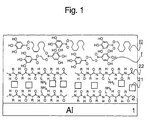
- Fig. 1 is a sectional view schematically illustrating a silver halide light-sensitive material (according to a combination of the first and third embodiments).
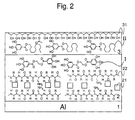
- Fig. 2 is a sectional view schematically illustrating another silver halide light-sensitive material.
- Fig. 3 is a sectional view schematically illustrating a further silver halide light-sensitive material.
- Fig. 4 is a sectional view schematically illustrating a furthermore silver halide light-sensitive material.
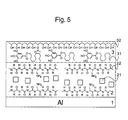
- Fig. 5 is a sectional view schematically illustrating a silver halide light-sensitive material used in the present invention (according to the third embodiment).
- Fig. 6 is a sectional view schematically illustrating a step of imagewise exposing to light a silver halide light-sensitive material.
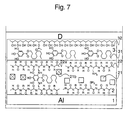
- Fig. 7 is a sectional view schematically illustrating a step of tanning development.
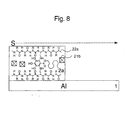
- Fig. 8 is a sectional view schematically illustrating a step of removing unhardened gelatin.
- a tanning developing agent used in the first embodiment of the present invention is a compound having a molecular structure in which two to six benzenediol or benzenetriol rings are connected with a linking group.
- the benzenediol or benzenetriol rings are connected to the linking group preferably as monovalent groups (i.e., dihydroxyphenyl or trihydroxyphenyl, respectively).
- the benzenediol or benzenetriol rings are connected to the linking group more preferably as 3,4-dihydroxyphenyl or 3,4,5-trihydroxyphenyl, respectively.
- the benzenediol or benzenetriol rings may have a substituent group (e.g., an alkyl group, an alkoxy group, an aralkyl group) other than hydroxyl.
- a substituent group e.g., an alkyl group, an alkoxy group, an aralkyl group
- the benzenediol or benzenetriol rings preferably have no substituent group other than hydroxyl.
- the compound has preferably two, three or four, more preferably two or three, and most preferably two benzenediol or benzenetriol rings.
- the linking group is preferably a divalent to hexavalent group selected from the group consisting of a divalent to hexavalent aliphatic group, a divalent to hexavalent aromatic group, a divalent to hexavalent heterocyclic group, -O-, -S-, -CO-, -NH-, -N ⁇ , -SO 2 -, -SO- and a combination thereof.
- the linking group is more preferably a divalent to tetravalent group selected from the group consisting of a divalent to tetravalent aliphatic group, a divalent to tetravalent aromatic group, a divalent to tetravalent heterocyclic group, -O-, -CO-, -NH-, -N ⁇ , -SO 2 - and a combination thereof.
- the linking group is further preferably a divalent to tetravalent combined group of at least two of a divalent to tetravalent aliphatic group, a divalent to tetravalent aromatic group, a divalent to tetravalent heterocyclic group, -O-, -CO-, -NH-, -N ⁇ and -SO 2 -.
- the linking group is most preferably a divalent to tetravalent combined group of at least three of them.
- a preferred tanning developing agent is represented by the formula (I).
- L is a n-valent linking group selected from the group consisting of a divalent to hexavalent aliphatic group, a divalent to hexavalent aromatic group, a divalent to hexavalent heterocyclic group, -O-, -S-, -CO-, -NH-, -N ⁇ , -SO 2 -, -SO- and a combination thereof.
- the aliphatic group, the aromatic group and the heterocyclic group can have substituent groups.
- the aliphatic group has preferably 1 to 60, more preferably 1 to 30, further preferably 1 to 20, and most preferably 1 to 10 carbon atoms.
- the aliphatic group can be unsaturated (can have a double or triple bond).
- the aliphatic group can have a cyclic or branched structure.
- the aromatic group preferably comprises a benzene or naphthalene ring, and more preferably comprises a benzene ring.
- the heterocyclic group preferably comprises a 3 to 10 membered heterocyclic ring, more preferably comprises a 4 to 8 membered heterocyclic ring, and most preferably comprises a 5 or 6 membered heterocyclic ring.
- the heterocyclic ring preferably has a nitrogen, oxygen or sulfur atom as a hetero-atom.
- the heterocyclic ring can be condensed with an aliphatic ring, an aromatic ring or another heterocyclic ring.
- the heterocyclic ring can also be spiro-united with an aliphatic ring or another heterocyclic ring.
- heterocyclic rings examples include pyrrolidine ring, piperidine ring, piperazine ring, morpholine ring, tetrahydrofuran ring, tetrahydropyran ring, tetrahydrothiophene ring, dioxane ring, oxazole ring, thiazole ring, pyridine ring, pyrazine ring, triazine ring, furan ring, thiophene ring and isocyanuric ring.
- substituent groups of the aliphatic group, the aromatic group and the heterocyclic group include hydroxyl, a halogen atom (e.g., chlorine), cyano, amino, a substituted amino group, a heterocyclic group, an acyl group and an acyloxy group.
- the substituent group of the substituted amino group is preferably an alkyl group or an aryl group.
- the aromatic group and the heterocyclic group can have an alkyl group as the substituent group.
- L is preferably a divalent to tetravalent group selected from the group consisting of a divalent to tetravalent aliphatic group, a divalent to tetravalent aromatic group, a divalent to tetravalent heterocyclic group, -O-, -CO-, -NH-, -N ⁇ , -SO 2 - and a combination thereof.
- L is more preferably a divalent to tetravalent combined group of at least two of a divalent to tetravalent aliphatic group, a divalent to tetravalent aromatic group, a divalent to tetravalent heterocyclic group, -O-, -CO-, -NH-, -N ⁇ and -SO 2 -.
- L is most preferably a divalent to tetravalent combined group of at least three of them.
- linking groups (L) examples include
- the benzene ring may have a substituent group (e.g., an alkyl group, an alkoxy group, an aralkyl group) other than hydroxyl.
- a substituent group e.g., an alkyl group, an alkoxy group, an aralkyl group
- the benzene ring preferably has no substituent group other than hydroxyl.
- m 2 or 3.
- n is an integer of 2 to 6, preferably is an integer of 2 to 4, more preferably is 2 or 3, and most preferably is 2.
- tanning developing agents represented by the formula (I) are shown below.
- the tanning developing agent represented by the formula (I) can be synthesized according to a known method (for example, a method described in Biophysical Journal Vol. 71, 1966, pages 3261 to 3277).
- a tanning developing agent used in the second embodiment of the present invention is a polymer having side chains containing benzenediol or benzenetriol rings.
- the benzenediol or benzenetriol rings are connected to the end of the side chain preferably as monovalent groups (i.e., dihydroxyphenyl or trihydroxyphenyl, respectively).
- the benzenediol or benzenetriol rings are connected to the end of the side chain more preferably as 3,4-dihydroxyphenyl or 3,4,5-trihydroxyphenyl, respectively.
- the benzenediol or benzenetriol rings may have a substituent group (e.g., an alkyl group, an alkoxy group, an aralkyl group, amino) other than hydroxyl.
- a substituent group e.g., an alkyl group, an alkoxy group, an aralkyl group, amino
- the benzenediol or benzenetriol rings preferably have no substituent group other than hydroxyl.
- the benzenediol or benzenetriol rings are preferably connected to the main chain of the polymer by a linking group.
- the linking group is preferably a divalent group selected from the group consisting of a divalent aliphatic group, a divalent aromatic group, a divalent heterocyclic group, -O-, -S-, -CO-, -NH-, -SO 2 -, -SO- and a combination thereof.
- the linking group is more preferably a divalent group selected from the group consisting of a divalent aliphatic group, a divalent aromatic group, a divalent heterocyclic group, -O-, -CO-, -NH-, -SO 2 - and a combination thereof.
- the linking group is further preferably a divalent combined group of at least two of a divalent aliphatic group, a divalent aromatic group, a divalent heterocyclic group, -O-, -CO-, -NH- and -SO 2 -.
- the linking group is most preferably a divalent combined group of at least three of them.
- a preferred repeating unit of the polymer is represented by the formula (III).
- L is a single bond or a divalent linking group selected from the group consisting of a divalent aliphatic group, a divalent aromatic group, a divalent heterocyclic group, -O-, -S-, -CO-, -NH-, -SO 2 -, -SO- and a combination thereof.
- the aliphatic group, the aromatic group and the heterocyclic group can have a substituent group.
- the aliphatic group has preferably 1 to 60, more preferably 1 to 30, further preferably 1 to 20, and most preferably 1 to 10 carbon atoms.
- the aliphatic group can be unsaturated (can have a double or triple bond).
- the aliphatic group can have a cyclic or branched structure.
- the aromatic group preferably comprises a benzene or naphthalene ring, and more preferably comprises a benzene ring.
- the heterocyclic group preferably comprises a 3 to 10 membered heterocyclic ring, more preferably comprises a 4 to 8 membered heterocyclic ring, and most preferably comprises a 5 or 6 membered heterocyclic ring.
- the heterocyclic ring preferably has a nitrogen, oxygen or sulfur atom as a hetero-atom.
- the heterocyclic ring can be condensed with an aliphatic ring, an aromatic ring or another heterocyclic ring.
- the heterocyclic ring can also be spiro-united with an aliphatic ring or another heterocyclic ring.
- heterocyclic rings examples include pyrrolidine ring, piperidine ring, piperazine ring, morpholine ring, tetrahydrofuran ring, tetrahydropyran ring, tetrahydrothiophene ring, dioxane ring, oxazole ring, thiazole ring, pyridine ring, pyrazine ring, triazine ring, furan ring, thiophene ring and isocyanuric ring.
- substituent groups of the aliphatic group, the aromatic group and the heterocyclic group include hydroxyl, a halogen atom (e.g., chlorine), cyano, amino, a substituted amino group, a heterocyclic group, an acyl group and an acyloxy group.
- the substituent group of the substituted amino group is preferably an alkyl group or an aryl group.
- the aromatic group and the heterocyclic group can have an alkyl group as the substituent group.
- L is preferably a single bond or a divalent group selected from the group consisting of a divalent aliphatic group, a divalent aromatic group, a divalent heterocyclic group, -O-, -CO-, -NH-, -SO 2 - and a combination thereof.
- L is more preferably a divalent combined group of at least two of a divalent aliphatic group, a divalent aromatic group, a divalent heterocyclic group, -O-, -CO-, -NH- and -SO 2 -.
- L is most preferably a divalent combined group of at least three of them.
- the left side is attached to the main chain, and the right side is attached to the benzene ring.
- AL means a divalent aliphatic group
- AR means a divalent aromatic group.
- the benzene ring can have a substituent group (e.g., an alkyl group, an alkoxy group, an aralkyl group) other than hydroxyl.
- a substituent group e.g., an alkyl group, an alkoxy group, an aralkyl group
- the benzene ring preferably has no substituent group other than hydroxyl.
- R is hydrogen or methyl
- n 2 or 3.
- a homopolymer consisting of a repeating unit represented by the formula (III) can be used as the tanning developing agent.
- a copolymer comprising two or more repeating units represented by the formula (III) can also be used as the tanning developing agent.
- a copolymer comprising a repeating unit represented by the formula (III) and another repeating unit can be used as the tanning developing agent.
- repeating units are preferably derived from ethylenically unsaturated monomers, such as an acrylic acid, methacrylic acid, an acrylic ester, a methacrylic ester, an acrylamide, a methacrylamide, a vinyl ester, styrene, a styrene derivative, an acrylonitrile, maleic anhydride and a maleimide.
- the other repeating units preferably have 20 or less carbon atom.
- the other repeating units can have a cross-linked structure.
- the copolymer comprises the repeating unit represented by the formula (III) preferably in the range of 5 to 99 mole %, and more preferably in the range of 10 to 90 mole %.
- the ratio of the repeating unit means mole %.
- the polymer has a weight average molecular weight preferably in the range of 1,000 to 100,000, and more preferably in the range of 3,000 to 30,000.
- the polymer can be synthesized according to a radical polymerization reaction by referring to a known method.
- the reaction can be conducted by protecting hydroxyl with an appropriate protective group (such as t-butyldimethylsilyl, trimethylsilyl). After the reaction, the protective group can be removed from hydroxyl to obtain the tanning developing agent.
- benzenediol or benzenetriol rings can be introduced into a polymer having a reactive group such as hydroxyl or amino by a polymer reaction to obtain the tanning developing agent.
- a tanning developing agent used in the third embodiment of the present invention is a phenol compound represented by the formula (II).
- p is 1 or 2.
- the two hydroxyl groups are preferably arranged at o-positions (catechol derivatives) or p-positions (hydroquinone derivatives).
- the three hydroxyl groups are preferably attached to the neighboring three carbon atoms of the benzene ring (pyrogallol derivatives).
- R is an aliphatic group having 5 to 40 carbon atoms, an aromatic group having 7 to 40 carbon atoms, an aliphatic acyl group having 5 to 40 carbon atoms, an aromatic acyl group having 7 to 40 carbon atoms, an aliphatic oxycarbonyl group having 5 to 40 carbon atoms, an aromatic oxycarbonyl group having 7 to 40 carbon atoms, an aliphatic acyloxy group having 5 to 40 carbon atoms, an aromatic acyloxy group having 7 to 40 carbon atoms, an aliphatic carbamoyl group having 5 to 40 carbon atoms or an aromatic carbamoyl group having 7 to 40 carbon atoms.
- the aliphatic group has preferably 6 to 35, more preferably 7 to 30, further preferably 9 to 25, and most preferably 11 to 22 carbon atoms.
- the aliphatic group can be unsaturated (can have a double or triple bond).
- the aliphatic group can have a cyclic or branched structure.
- the aliphatic group can have a substituent group (e.g., a halogen atom, an aromatic group).
- the aromatic group has preferably 7 to 35, more preferably 8 to 30, further preferably 9 to 25, and most preferably 10 to 22 carbon atoms.
- the aromatic group can have a substituent group (e.g., a halogen atom, an aliphatic group).
- the aliphatic acyl group has preferably 6 to 35, more preferably 7 to 30, further preferably 9 to 25, and most preferably 11 to 22 carbon atoms.
- the aliphatic acyl group can be unsaturated (can have a double or triple bond).
- the aliphatic acyl group can have a cyclic or branched structure.
- the aliphatic acyl group can have a substituent group (e.g., a halogen atom, an aromatic group).
- the aromatic acyl group has preferably 7 to 35, more preferably 8 to 30, further preferably 9 to 25, and most preferably 10 to 22 carbon atoms.
- the aromatic acyl group can have a substituent group (e.g., a halogen atom, an aliphatic group).
- the aliphatic oxycarbonyl group has preferably 6 to 35, more preferably 7 to 30, further preferably 9 to 25, and most preferably 11 to 22 carbon atoms.
- the aliphatic oxycarbonyl group can be unsaturated (can have a double or triple bond).
- the aliphatic oxycarbonyl group can have a cyclic or branched structure.
- the aliphatic oxycarbonyl group can have a substituent group (e.g., a halogen atom, an aromatic group).
- the aromatic oxycarbonyl group has preferably 7 to 35, more preferably 8 to 30, further preferably 9 to 25, and most preferably 10 to 22 carbon atoms.
- the aromatic oxycarbonyl group can have a substituent group (e.g., a halogen atom, an aliphatic group).
- the aliphatic acyloxy group has preferably 6 to 35, more preferably 7 to 30, further preferably 9 to 25, and most preferably 11 to 22 carbon atoms.
- the aliphatic acyloxy group can be unsaturated (can have a double or triple bond).
- the aliphatic acyloxy group can have a cyclic or branched structure.
- the aliphatic acyloxy group can have a substituent group (e.g., a halogen atom, an aromatic group).
- the aromatic acyloxy group has preferably 7 to 35, more preferably 8 to 30, further preferably 9 to 25, and most preferably 10 to 22 carbon atoms.
- the aromatic acyloxy group-can have a substituent group (e.g., a halogen atom, an aliphatic group).
- the aliphatic carbamoyl group has preferably 6 to 35, more preferably 7 to 30, further preferably 9 to 25, and most preferably 11 to 22 carbon atoms.
- the aliphatic carbamoyl group can be unsaturated (can have a double or triple bond).
- the aliphatic carbamoyl group can have a cyclic or branched structure.
- the aliphatic carbamoyl group can have a substituent group (e.g., a halogen atom, an aromatic group).
- the aromatic carbamoyl group has preferably 7 to 35, more preferably 8 to 30, further preferably 9 to 25, and most preferably 10 to 22 carbon atoms.
- the aromatic carbamoyl group can have a substituent group (e.g., a halogen atom, an aliphatic group).
- the phenol compound is more preferably a catechol, hydroquinone or pyrogallol derivative represented by the formula (IIa), (IIb), (IIc) or (IId).
- R is an aliphatic group having 5 to 40 carbon atoms, an aromatic group having 7 to 40 carbon atoms, an aliphatic acyl group having 5 to 40 carbon atoms, an aromatic acyl group having 7 to 40 carbon atoms, an aliphatic oxycarbonyl group having 5 to 40 carbon atoms, an aromatic oxycarbonyl group having 7 to 40 carbon atoms, an aliphatic acyloxy group having 5 to 40 carbon atoms, an aromatic acyloxy group having 7 to 40 carbon atoms, an aliphatic carbamoyl group having 5 to 40 carbon atoms or an aromatic carbamoyl group having 7 to 40 carbon atoms.
- the definitions and examples of the groups are the same as R in the formula (II).
- Two or more tanning developing agents can be used in combination.
- the tanning developing agent of the first embodiment can be used in combination with the tanning developing agent of the second embodiment (preferably a polymer comprising a repeating unit represented by the formula (III)).
- the tanning developing agent of the first embodiment preferably a compound represented by the formula (I)
- the tanning developing agent of the second embodiment preferably a polymer comprising a repeating unit represented by the formula (III)
- the molar ratio of embodiment (first:third) is preferably in the range of 1:99 to 99:1, more preferably in the range 2:98 to 98:2, further preferably in the range of 5:95 to 95:5, and most preferably in the range of 10:90 to 90:10.
- the tanning developing agent of the first, second or third embodiment can be used in combination with a known tanning developing agent (e.g., hydroquinone, t-butylhydroquinone, catechol, phenylcatechol, pyrogallol, nordihydroguaiaretic acid, 3,3,3',3'-tetramethyl-5,6,5',6'-tetrahydroxyspiro-bis-indane).
- a known tanning developing agent e.g., hydroquinone, t-butylhydroquinone, catechol, phenylcatechol, pyrogallol, nordihydroguaiaretic acid, 3,3,3',3'-tetramethyl-5,6,5',6'-tetrahydroxyspiro-bis-indane.
- the amount of the agent of the present invention is preferably in the range of 50 to 95 wt.%, more preferably in the range of 60 to 90 wt.%, and most preferably 70 to 85 wt.% based on the total amount of the tanning developing agents.
- the tanning developing agent can be used in combination with another (supplementary) developing agent.
- the supplementary developing agents include amidol, metol and aminophenol. Metol is particularly preferred.
- the amount of the supplementary developing agent is preferably in the range of 5 to 200 mole % based on the amount of the tanning developing agent.
- the tanning developing agent is incorporated into a silver halide light-sensitive material or added to a tanning developing solution.
- the tanning developing agent is preferably incorporated into a silver halide light-sensitive material.
- the agent is dissolved, emulsified or dispersed in a coating solution for a silver halide gelatin emulsion layer or an optionally provided hydrophilic layer.
- the tanning developing agent (except for a polymer of the second embodiment) is usually dissolved in the coating solution for a silver halide gelatin emulsion layer or a hydrophilic layer.
- the agent is added into the silver halide gelatin emulsion layer in an amount of preferably 0.01 to 1 mol/mol Ag, more preferably 0.03 to 1 mol/mol Ag.
- the agent is dissolved, emulsified or dispersed in the developing solution.
- the agent is added into the solution in an amount of preferably 10 -5 to 10 -1 mol/l.
- the agent of the third embodiment is preferably added to the uppermost layer (the most remote layer from the support) of the silver halide light-sensitive material.
- the layer containing the agent of the first embodiment is preferably different from the layer containing the agent of the third embodiment.
- Fig. 1 is a sectional view schematically illustrating a silver halide light-sensitive material (according to a combination of the first and third embodiments).
- the silver halide light-sensitive material shown in Fig. 1 comprises a hydrophilic support (1) and a silver halide gelatin emulsion layer (2).
- the silver halide gelatin emulsion layer (2) contains silver halide grains (21), gelatin (22), the tanning developing agent of the first embodiment (I) and the tanning developing agent of the third embodiment (II).
- Fig. 2 is a sectional view schematically illustrating another silver halide light-sensitive material.
- the silver halide light-sensitive material shown in Fig. 2 comprises a hydrophilic support (1), a silver halide gelatin emulsion layer (2) and a hydrophilic layer (3) in this order.
- the silver halide gelatin emulsion layer (2) comprises silver halide grains (21), gelatin (22) and the tanning developing agent of the first embodiment (I).
- the hydrophilic layer (3) contains a hydrophilic polymer (31) and the tanning developing agent of the third embodiment (II).
- Fig. 3 is a sectional view schematically illustrating a further silver halide light-sensitive material.
- the silver halide light-sensitive material shown in Fig. 3 comprises a hydrophilic support (1), a first hydrophilic layer (4), a silver halide gelatin emulsion layer (2) and a second hydrophilic layer (5) in this order.
- the first hydrophilic layer (4) contains gelatin (41) and the tanning developing agent of the first embodiment (I).
- the silver halide gelatin emulsion layer (2) comprises silver halide grains (21) and gelatin (22).
- the second hydrophilic layer (5) contains a hydrophilic polymer (51) and the tanning developing agent of the third embodiment (II).
- Fig. 4 is a sectional view schematically illustrating a furthermore silver halide light-sensitive material.
- the silver halide light-sensitive material shown in Fig. 4 comprises a hydrophilic support (1), a silver halide gelatin emulsion layer (2), a first hydrophilic layer (4) and a second hydrophilic layer (5) in this order.
- the silver halide gelatin emulsion layer (2) comprises silver halide grains (21) and gelatin (22).
- the first hydrophilic layer (4) contains gelatin (41) and the tanning developing agent of the first embodiment (I).
- the second hydrophilic layer (5) contains a hydrophilic polymer (51) and the tanning developing agent of the third embodiment (II).
- the support can be made of a paper, a synthetic paper, a paper laminated with a synthetic resin (e.g., polyethylene, polypropylene, polystyrene), a plastic (e.g., polyethylene terephthalate, polycarbonate, polyimide, Nylon, cellulose triacetate) film, a metal (e.g., aluminum, aluminum alloy, zinc, iron, copper) plate or a paper or plastic film laminated with the metal. Further, the metal can be evaporated onto the paper or plastic film to form the support.
- a synthetic resin e.g., polyethylene, polypropylene, polystyrene
- a plastic e.g., polyethylene terephthalate, polycarbonate, polyimide, Nylon, cellulose triacetate
- a metal e.g., aluminum, aluminum alloy, zinc, iron, copper
- the metal can be evaporated onto the paper or plastic film to form the support.
- the support is preferably made of aluminum, plastic, paper or synthetic paper.
- a complex sheet can also be used as the support.
- an aluminum sheet can be laminated on the polyethylene terephthalate film.
- An aluminum or plastic support is preferred, and an aluminum support is particularly preferred.
- the lithographic plate usually has a hydrophilic support.
- a hydrophobic material such as plastic can also be used to prepare the hydrophilic support by forming a hydrophilic undercoating layer.
- the aluminum support is described below in more detail.
- the aluminum support can be subjected to a graining treatment to form a rough surface or to a hydrophilic treatment to form a hydrophilic surface.
- the treatment for the rough surface can be conducted by an electrochemical graining treatment and/or a mechanical graining treatment.
- a current passes through an aluminum plate in an electrolytic solution of hydrochloric acid or nitric acid.
- the mechanical graining treatment includes a wire brushing method, a ball graining method and a brash graining method.
- the wire brushing method the surface of aluminum plate is scratched with a metal wire.
- the ball graining method the surface of aluminum plate is grained with graining balls and a graining agent.
- the brash graining method the surface is grained with a Nylon brash and a graining agent.
- the grained aluminum plate is then chemically etched with an alkali or an acid.
- An alkali etching method is industrially advantageous.
- the alkali agents include sodium carbonate, sodium aluminate, sodium metasilicate, sodium phosphate, sodium hydroxide, potassium hydroxide and lithium hydroxide.
- the alkali solution preferably has a concentration in the range of 1 to 50 wt.%.
- the temperature of the alkali treatment is preferably in the range of 20 to 100°C.
- the treatment conditions are preferably so adjusted that the amount of the dissolved aluminum may be in the range of 5 to 20 g/m 2 .
- the aluminum plate is usually washed with an acid to remove smut from the surface after the alkali etching treatment.
- the acids include nitric acid, sulfuric acid, phosphoric acid, chromic acid, hydrofluoric acid and borofluoric acid.
- the smut removing treatment can also be conducted according to a conventional method after the electrochemical graining treatment.
- an aluminum plate can be treated with 15 to 65 wt.% sulfuric acid at a temperature of 50 to 90°C.
- the surface treated aluminum plate can be subjected to an anodizing treatment or a chemical treatment.
- the anodizing treatment can be conducted according to a conventional method.
- a direct or alternative current passes through an aluminum plate in a solution of an acid to form an anodic oxide layer on the surface of the plate.
- the acids include sulfuric acid, phosphoric acid, chromic acid, oxalic acid, sulfamic acid and benzenesulfonic acid.
- the conditions of the anodizing treatment depend on the contents of the electrolytic solution.
- the concentration of the electrolytic solution is preferably in the range of 1 to 80 wt.%
- the temperature of the solution is preferably in the range of 5 to 70°C
- the current density is preferably in the range of 0.5 to 60 A/dm 2
- the voltage is preferably in the range of 1 to 100 v
- the time for the electrolysis is preferably in the range of 10 to 100 seconds.
- the anodizing treatment is preferably conducted in sulfuric acid at a high current density.
- Phosphoric acid is also preferably used for the anodizing treatment.
- the aluminum plate can be treated with an alkali metal silicate.
- the aluminum plate can be immersed in an aqueous solution of sodium silicate.
- An undercoating layer can be provided on the aluminum support to improve the adhesion between the support and the hardening layer or to improve a printing character.
- An undercoating layer can be provided on not only the above-mentioned aluminum support, but also a support having a hydrophobic (or not sufficiently hydrophilic) surface (e.g., a polymer film).
- the components of the undercoating layer include a polymer (e.g., gelatin, casein, polyvinyl alcohol, ethyl cellulose, phenol resin, styrene-maleic anhydride resin, polyacrylic acid), an amine (e.g., monoethanol amine, diethanol amine, triethanol amine, tripropanol amine) and a salt thereof (e.g., chloride, oxalate, phosphate), an monoaminomonocarboxylic acid (e.g., aminoacetic acid, alanine), an oxyamino acid (e.g., serine, threonine, dihydroxyethylglycine), a sulfur-containing amino acid (e.g., cysteine, cystine), a monoaminodicarboxylic acid (e.g., aspartic acid, glutamic acid), a diaminomonocarboxylic acid (e.g., lysine), an aromatic amino acid (
- hydrophilic fine particles e.g., silica particles
- hydrophilic fine particles are preferably added to a hydrophilic undercoating layer in place of the graining treatment of an aluminum support.
- the silver halide emulsion layer generally contains gelatin as a binder.
- the gelatin is hardened by tanning development to form a relief image.
- Tanning development can be also applied to a hydrophilic polymer having an amido bond or a primary amino group such as polyacrylamide and a protein other than gelatin.
- the tanning development is usually applied to gelatin.
- Other hydrophilic polymers e.g., polyvinyl pyrrolidone, starch, albumin, polyvinyl alcohol, gum arabic, hydroxyethyl cellulose
- the coating amount of silver halide is preferably in the range of 0.01 to 5 g/m 2 , more preferably in the range of 0.03 to 1 g/m 2 , and most preferably in the range of 0.05 to 0.3 g/m 2 , in terms of silver amount.
- the silver halide emulsion layer preferably has a thickness in the range of 0.07 to 13 ⁇ m, and more preferably in the range of 0.2 to 5 ⁇ m.
- Silver halide is silver chloride, silver bromide, silver iodide, silver chlorobromide, silver chloroiodide, silver iodobromide or silver chloroiodobromide in the form of grains.
- the crystal forms of silver halide grains preferably are cubic or tetradecahedron. Irregular forms and mixed forms as well as the above mentioned regular forms can be used in the silver halide emulsions. Examples of the irregular forms include a potato-like form, a spherical form and a tabular form.
- the tabular form usually has an aspect ratio (diameter per thickness) of 5 or more.
- the silver halide grains may be extremely small grains having a grain diameter (diameter of projected area) of less than 0.01 ⁇ m.
- the grains may also be relatively large grains having a diameter of about 10 ⁇ m.
- a monodispersed emulsion is preferred to a polydispersed emulsion. The monodispersed emulsion is described in U.S. Patent Nos. 3,574,628, 3,655,394 and British Patent No. 1,413,748.
- the individual grains have a homogeneous halogen composition or a heterogeneous halogen composition.
- the composition varies from the outer surface portion to the inside portion.
- the grains may have a multi-layered structure.
- the silver halide grains may be conjugated with other silver halide grains having different halogen composition through epitaxial conjugation.
- the grains may be conjugated with compounds other than the silver halide such as silver rhodanate and lead oxide.
- salts can be added to the silver halide grains.
- the substances include copper, thallium, lead, bismuth, cadmium, zinc, chalcogens (e.g., sulfur, selenium, tellurium), gold, and noble metals of group VIII (e.g., rhodium, iridium, iron, platinum, palladium).
- the salts are added to the emulsion during the grain formation or after the grain formation according to a conventional process. The conventional process is described in U.S. Patent Nos.
- the silver halide grains can be doped with iridium ion by adding an aqueous solution of an iridium compound into a silver halide emulsion.
- water-soluble iridium compounds include hexachloroiridic(III) salts and hexachloroiridic(IV) salts.
- the silver halide grains can also be doped with rhodium ion by adding an aqueous solution of a rhodium compound into a silver halide emulsion.
- water-soluble rhodium compounds include rhodium ammonium chloride, rhodium trichloride and rhodium chloride.
- the iridium compound or the rhodium compound can be dissolved in a halide solution for forming silver halide grains.
- the aqueous solution of the iridium compound or the rhodium compound can be used before or after the grain formation. Further, the solution can be added to the emulsion between the grain formation and a chemical sensitization. The solution is preferably added at the stage of the grain formation.
- the iridium or rhodium ion is preferably used in an amount of 10 -8 to 10 -3 mol, and more preferably in an amount of 10 -7 to 10 -5 mol based on 1 mol of silver halide.
- Two or more kinds of silver halide grains that differ in halogen composition, crystal habit, grain size, or other features can be used in combination.
- the silver halide is preferably used in the form of an emulsion.
- the silver halide emulsion can be prepared by known processes, which are described in Research Disclosure (RD), No. 17643, pages 22 to 23 (December 1978), (Emulsion preparation and types); and Research Disclosure, No. 18716, page 648, (November 1979).
- the silver halide emulsion is generally subjected to a chemical sensitization after a physical ripening.
- the silver halide grains preferably have a low fogging value.
- additives can be used in the ripening or sensitizing steps.
- the additives are described in Research Disclosure, No. 17,643 and No. 18,716.
- the chemical sensitizer is described in No. 17,643 (page 23) and No. 18,716 (page 648, right column).
- Other additives are also described in Research Disclosure.
- a sensitivity-increasing agent is described in No. 18,716 (page 648, right column).
- An anti-fogging agent and a stabilizer are described in No. 17,643 (pages 24 to 25) and No. 18,716 (page 649, right column), respectively.
- the silver halide emulsion is usually subjected to a spectral sensitization.
- Various spectral sensitizing dyes are known in a conventional silver halide photography. Examples of the sensitizing dyes include cyanine dyes, merocyanine dyes, complex merocyanine dyes, holopolar cyanine dyes, hemicyanine dyes, styryl dyes and hemioxonol dyes.
- the spectral sensitizing dyes can be used to adjust the spectral sensitivity of the light-sensitive material to wavelength of two or more light sources such as various laser beams (e.g., semiconductor laser, helium neon laser, argon ion laser, helium cadmium laser, YAG laser) and a light emission diode.
- various laser beams e.g., semiconductor laser, helium neon laser, argon ion laser, helium cadmium laser, YAG laser
- two or more sensitizing dyes are used for silver halide grains in a light-sensitive layer so that a light-sensitive material can be exposed to two or more light sources.
- a supersensitizer can be added to the emulsion in addition to the sensitizing dye.
- the supersensitizer itself has neither a spectral sensitization effect nor an absorption of visible light, but shows a supersensitizing effect on the sensitizing dye.
- Fine particles of oleophilic resin can be added into the silver halide emulsion layer to make the relief image more oleophilic.
- the oleophilic resin particles also improve mechanical strength of the relief image.
- the oleophilic resin examples include polyester, polyamide, phenol-aldehyde resin, polyvinyl chloride, epoxy resin. silicone resin, alkylphenol resin, ketone resin, alkyd resin, polystyrene, polyacrylate, rosin modified maleic acid resin, rosin modified fumaric acid resin, polyvinyl acetate, hydroxypropylmethyl cellulose, rosin modified phenol resin and hexahydrophthalate.
- a light-sensitive resin photo-polymerizable polymer, photo-crosslinkable polymer
- Two or more oleophilic resins can be used in combination.
- the fine particles of oleophilic resin preferably have a mean diameter of 0.01 to 5 ⁇ m. There is no particular restriction on the shape of the particles.
- the light-sensitive material can contain an antifogging agent, a silver development accelerator or a stabilizer.
- these compounds include mercapto compounds (described in Japanese Patent Provisional Publication No. 59(1984)-111636), azoles or azaindenes (described in Research Disclosure No. 17643 (1978), pages 24 to 25), nitrogen-containing carboxylic acids or phosphoric acids (described in Japanese Patent Provisional Publication No. 59(1984)-168442), cyclic amides (described in Japanese Patent Provisional Publication No. 61(1986)-151841), thioethers (described in Japanese Patent Provisional Publication No. 62(1987)-151842), polyethylene glycol derivatives (described in Japanese Patent Provisional Publication No.
- An aromatic (a carbon or heterocyclic ring) mercapto compound (described in Japanese Patent Provisional Publication No. 6(1994)-313967) can also be used as an antifogging agent or a silver development accelerator.
- An aromatic heterocyclic mercapto compound, particularly a mercapto triazole derivative is preferred.
- the mercapto compound can be used in the form of a mercapto silver (silver salt).
- These compounds are used in an amount of 10 -7 to 1 mol based on 1 mol of the silver halide.
- Nonionic, anionic, cationic or fluoro surface active agents can be used.
- Japanese Patent Provisional Publication No 2(1990)-195356 describes these surface active agents. Sorbitans, polyoxyethylenes and fluorine-containing surface active agents are particularly preferred.
- a layer optionally provided in the silver halide light-sensitive material also preferably contains a hydrophilic polymer, more preferably gelatin, as a binder.
- the tanning developing agent can be added into the optional hydrophilic layer.
- a back layer or an overcoating layer may be provided, and a matting agent can be added to the back layer or the overcoating layer to prevent adhesion between two light-sensitive materials when the materials are superposed.
- Inorganic or organic solid particles dispersible in the hydrophilic polymer can be used as the matting agent.
- the matting agents include oxides (e.g., silicon dioxide), alkaline earth metal salts, natural polymers (e.g., starch, cellulose) and synthetic polymers.
- the average particle size of the matting agent is preferably in the range of 0.5 to 50 ⁇ m.
- the amount of the matting agent is preferably in the range of 0.1 to 1 g/m 2 .
- a protective layer may be provided on the silver halide emulsion layer, and the above-mentioned fine particles of oleophilic resin may be added into the protective layer.
- the protective layer containing the resin particles has a thickness of preferably 0.01 to 5 ⁇ m, more preferably 0.2 to 2 ⁇ m.
- the protective layer contains some voids among the particles so that the developing agent can penetrate the layer.
- antifogging agent silver development accelerator, stabilizer or surface active agent can be added into the optional layers.
- Fig. 5 is a sectional view schematically illustrating a silver halide light-sensitive material used in the present invention (according to the third embodiment).
- the silver halide light-sensitive material shown in Fig. 5 comprises a hydrophilic support (1) and a silver halide gelatin emulsion layer (2) and a hydrophilic layer (3) in this order.
- the silver halide gelatin emulsion layer (2) contains silver halide grains (21) and gelatin (22).
- the hydrophilic layer (3) contains a tanning developing agent (31) and a hydrophilic polymer (32).
- the silver halide light-sensitive material is imagewise exposed to light.
- the wavelength of the light corresponds to the spectral sensitivity of silver halide.
- the wavelength is usually within the visible, near ultraviolet or near infrared regions.
- a X-ray or an electron bean is also usable as the light.
- Examples of the light sources include a tungsten lamp, a halogen lamp, a xenon lamp, a xenon flash lamp, a mercury lamp, a carbon arc lamp, various laser means (e.g., semiconductor laser, helium neon laser, argon ion laser, helium cadmium laser, YAG laser), light emitting diode and cathode-ray tube.
- various laser means e.g., semiconductor laser, helium neon laser, argon ion laser, helium cadmium laser, YAG laser
- the amount of the exposure is usually in the range of 0.001 to 1,000 ⁇ J/cm 2 , and preferably in the range of 0.01 to 100 ⁇ J/cm 2 .
- the light-sensitive material can be exposed to light through the support if the support is transparent.
- Fig. 6 is a sectional view schematically illustrating a step of imagewise exposing to light a silver halide light-sensitive material.
- the silver halide light-sensitive material is exposed to light (L).
- a latent image of silver halide (21a) is formed in silver halide grains within the exposed are.
- the silver halide grains (21) are not changed within the unexposed area.
- the silver halide light-sensitive material is subjected to tanning development with a developing solution, in which the tanning developing agent can be added.
- the developing solution is generally alkali, and preferably has a PH value of not less than 9.
- alkali compounds usable for adjusting the pH include sodium hydroxide, potassium hydroxide, sodium phosphate, potassium phosphate, lithium phosphate, sodium carbonate, potassium carbonate, ammonium carbonate, sodium hydrogencarbonate and ammonia.
- the solvent of the developing solution is preferably water, and if needed an organic solvent may be mixed with water.
- the temperature of the solution is in the range of preferably 5 to 40°C, more preferably 20 to 35°C.
- the time for developing is in the range of preferably 10 seconds to 10 minutes, more preferably 20 seconds to 3 minutes.
- the light-sensitive material may be treated with a liquid containing a mercapto compound after the development, to make the imaged area more oleophilic (in the manner described in Japanese Patent Provisional Publication No. 4(1992)-324866). Acid treatment or fixing treatment may be also performed.
- Fig. 7 is a sectional view schematically illustrating a step of tanning development.
- the exposed silver halide light-sensitive material is immersed in a tanning developing solution (D).
- the latent image of silver halide within the exposed area is developed to form a silver image (21b).
- the oxidation product of the tanning developing agent (quinone) is formed by the developing reaction.
- the oxidation product causes a cross-linking reaction of gelatin (22a) within the exposed area.
- gelatin (22) is not changed within the unexposed area.
- the silver halide light-sensitive material is immersed into a solvent (such as a hot water) and the surface is rubbed to remove unhardened gelatin in the unexposed area, and thereby a relief image made of hardened gelatin is formed.
- a solvent such as a hot water
- the temperature of the hot water is preferably in the range of 40 to 70°C.
- the surface can be rubbed with a sponge and brush.
- the formed relief image is dried, and then used as a lithographic printing plate.
- Post-treatments such as heating treatment, light-irradiating treatment and chemical treatment can be conducted.
- Fig. 8 is a sectional view schematically illustrating a step of removing unhardened gelatin.
- the developed silver halide is treated with a solvent (S).
- the hydrophilic layer and silver halide gelatin emulsion layer is dissolved in the solvent (S) and removed from the light-sensitive material.
- the silver halide gelatin emulsion layer within the exposed area (2a) remains on the hydrophilic support (1) to form a relief image, since the layer (2a) contains a cross-linked gelatin (22a).
- the relief image can be used as a lithographic printing plate.
- the lithographic printing plate comprises a relief image of a hardened gelatin on a hydrophilic support.
- the gelatin is hardened by an oxidation product of a tanning developing agent.
- a surface of an aluminum plate (according to JIS-A-1050) having 0.24 mm thickness was ground with a nylon brush and an aqueous suspension of pumice stone of 400 mesh. The plate was well washed with water. The aluminum plate was then immersed for etching in 10 wt.% aqueous solution of sodium hydroxide at 70°C for 60 seconds. The plate was washed with running water, neutralized with 20 wt.% aqueous solution of nitric acid, and washed with water.
- the obtained aluminum plate was subjected to an electrolytic surface-roughening treatment in 1 wt.% aqueous solution of nitric acid containing 0.5% aluminum nitrate in an anodically electric amount of 160 coulomb/dm 2 using pulse-wave alternating-corrugated current under such conditions as an anodic voltage of 12.7 V and a cathodically electric amount ratio to an anodically electric amount of 0.9.
- the center line average height (Ra) of the aluminum plate was 0.6 ⁇ m.
- the aluminum plate was immersed in 1 wt.% aqueous solution of sodium hydroxide at 40°C for 30 seconds, and further immersed in 30 wt.% sulfuric acid at 55°C for 1 minute.
- the plate was then subjected to anodizing treatment in 20 wt.% aqueous solution of sulfuric acid at a current density of 2 A/dm 2 to form an anodic oxide layer having the thickness of 2.5 g/dm 2 .
- the plate was washed with water and dried to obtain an aluminum support.
- the thus-prepared support was immersed in 2.5 wt.% aqueous solution (pH: 11.2) of sodium silicate No. 3 (SiO 2 : 28-30 wt.%, Na 2 O: 9-10 wt.%, Fe: not more than 0.02 wt.%) at 70°C for 13 seconds, and washed with water.
- the amount of silicate was measured by X-ray fluorometry to find 10 mg/m 2 .
- Gelatin, potassium bromide and water were placed in a vessel and heated to 55°C. With the temperature kept at 55°C, the following thioether compound (2.0 ⁇ 10 -3 mol based on the total amount of silver nitrate) was added to the vessel.
- an aqueous solution of silver nitrate and an aqueous solution of potassium bromide containing a rhodium ammonium chloride (the molar ratio of rhodium to the total amount of potassium iodide and silver nitrate was 4 ⁇ 10 -8 mol) were added to the vessel, according to a pAg controlled double jet method, with the pAg in the reaction vessel kept at 9.2 to prepare a silver iodobromide emulsion.
- an aqueous solution of silver nitrate and a potassium bromide solution containing hexachloroiridate(III) salt (the molar ratio of iridium to silver was 1 ⁇ 10 -7 mol) was twice added to the emulsion at 55°C and pAg 8.9 according to a double jet method to obtain a core/shell type silver iodobromide emulsion having the following composition.
- the grains in the obtained emulsion were monodispersed. In the emulsion, 98% of the grains had a grain size within the range of the average grain size ⁇ 40%.
- the pH and the pAg were adjusted at 6.2 and 8.7, respectively.
- the emulsion was further subjected to gold-sulfur sensitization with sodium thiosulfate and chloroauric acid to prepare an aqueous emulsion of silver halide.
- the following coating solution was prepared, applied and dried on the aluminum support to form a silver halide gelatin emulsion layer having the dry thickness of 1.2 ⁇ m.
- a silver halide light-sensitive material was prepared.
- Coating solution for silver halide emulsion layer The above-prepared silver halide emulsion 5 g 10 Wt.% aqueous solution of gelatin 25 g 10 Wt.% methanol solution of the tanning developing agent (I-2) 3.4 g Water 20 g
- a tanning developing solution comprising the following components was prepared and used at 25°C.
- Tanning developing solution Metol 3 g Citric acid 1 g Potassium carbonate 200 g Potassium iodide 1 g Water 1,000 g
- the silver halide light-sensitive material closely contacted with a control wedge (Fuji Photo Film Co., Ltd.) was imagewise exposed to light of 670 nm through a sharp cut interference filter.
- the light source was a xenon flush lump.
- the light emission time was 10 -4 second.
- the exposure (energy on the surface) was 2 ⁇ J per cm 2 .
- the exposed material was immersed in the tanning developing solution for 30 seconds.
- the material was washed with running water at 45°C for 15 seconds, the surface of the material was gently rubbed with a sponge to remove the silver halide emulsion layer in unexposed area. The material was then dried to form on the aluminum support a relief image having even thickness. The thus-formed relief image was used as a lithographic printing plate.
- the printing plate was installed in an offset press (RYOBI 3200CCD, Ryobi Ltd.) and printing was performed to estimate the durability of the plate.
- the printing plate was durable enough to print 10,000 or more sheets.
- Example 1 The procedure of Example 1 was repeated except that each of the tanning developing agents (I-6), (I-10), (I-14), (I-19), (I-22), (I-30) and (I-36) was used in the same amount in place of the agent (I-2), to prepare and evaluate a lithographic printing plate.
- the results are set forth in Table 1.
- Example 1 Light-sensitive material Tanning developing agent Ink affinity Durability Example 1 (I-2) A 10,000+ Example 2 (I-6) A 10,000+ Example 3 (I-10) A 10,000+ Example 4 (I-14) A 10,000+ Example 5 (I-19) A 10,000+ Example 6 (I-22) A 10,000+ Example 7 (I-30) A 10,000+ Example 8 (I-36) A 10,000+ Comp. Ex. 1 Catechol B 2,000 (Remarks) A: Sufficient B: Insufficient 10,000+: Durable enough after printing 10,000 or more sheets 2,000: Insufficient density after printing 2,000 sheets
- the following coating solution was prepared, applied and dried on the aluminum support used in Example 1, to form a silver halide gelatin emulsion layer having the dry thickness of 1.2 ⁇ m.
- a silver halide light-sensitive material was prepared.
- Coating solution for silver halide emulsion layer The silver halide emulsion used in Example 1 5 g 10 Wt.% aqueous solution of gelatin 25 g Water 20 g
- Tanning developing solutions A and B comprising the following components were prepared. The solutions were mixed at 25°C just before the development process.
- Tanning developing solution A The tanning developing agent (I-22) 3 g Metol 3 g Citric acid 1 g Water 500 g
- Tanning developing solution B Potassium carbonate 200 g Potassium iodide 1 g Water 500 g
- the silver halide light-sensitive material closely contacted with a control wedge (Fuji Photo Film Co., Ltd.) was imagewise exposed to light of 670 nm through a sharp cut interference filter.
- the light source was a xenon flush lump.
- the light emission time was 10 -4 second.
- the exposure (energy on the surface) was 2 ⁇ J per cm 2 .
- the exposed material was immersed in the tanning developing solution for 30 seconds.
- the material was washed with running water at 45°C for 15 seconds, the surface of the material was gently rubbed with a sponge to remove the silver halide emulsion layer in unexposed area. The material was then dried to form on the aluminum support a relief image having even thickness. The thus-formed relief image was used as a lithographic printing plate.
- the printing plate was installed in an offset press (RYOBI 3200CCD, Ryobi Ltd.) and printing was performed to estimate the durability of the plate.
- the printing plate was durable enough to print 10,000 or more sheets.
- Example 9 The procedure of Example 9 was repeated except that each of the tanning developing agents (I-7), (I-12), (I-18), (I-24), (I-31), (I-35) and (I-37) was used in the same amount in place of the agent (I-22), to prepare and evaluate a lithographic printing plate.
- the results are set forth in Table 2.
- Example 9 The procedure of Example 9 was repeated except that catechol was used in the same amount in place of the agent (I-22), to prepare and evaluate a lithographic printing plate.
- the results are set forth in Table 2.
- Tanning developing solution Tanning developing agent Ink affinity Durability
- Example 9 A 10,000+ Example 10 (I-7) A 10,000+ Example 11 (I-12) A 10,000+ Example 12 (I-18) A 10,000+ Example 13 (I-24) A 10,000+ Example 14 (I-31) A 10,000+ Example 15 (I-35) A 10,000+ Example 16 (I-37) A 10,000+ Comp. Ex. 2 Catechol B 2,500 (Remarks) A: Sufficient B: Insufficient 10,000+: Durable enough after printing 10,000 or more sheets 2,500: Insufficient density after printing 2,500 sheets
- composition (1) was mixed with the following composition (2) at 40°C, and the mixture was well stirred to prepare a tanning developing agent dispersion.
- Composition (1) The following copolymer (CP1) 2.5 g Tricresyl phosphate 1.8 g Ethyl acetate 2.5 g Water 500 g Composition (2) Gelatin 2.5 g Water 38 g 6 Wt.% aqueous solution of saponin 2.5 g
- Example 2 The following coating solution was prepared, applied and dried on the aluminum support used in Example 1 to form a silver halide gelatin emulsion layer having the dry thickness of 1.2 ⁇ m. Thus, a silver halide light-sensitive material was prepared.
- Coating solution for silver halide emulsion layer The silver halide emulsion used in Example 1 5 g 10 Wt.% aqueous solution of gelatin 25 g The above-prepared tanning developing agent dispersion 6 g Water 20 g
- the silver halide light-sensitive material closely contacted with a control wedge (Fuji Photo Film Co., Ltd.) was imagewise exposed to light of 670 nm through a sharp cut interference filter.
- the light source was a xenon flush lump.
- the light emission time was 10 -4 second.
- the exposure-(energy on the surface) was 2 ⁇ J per cm 2 .
- the exposed material was immersed in the tanning developing solution used in Example 1 for 30 seconds.
- the material was washed with running water at 45°C for 15 seconds, the surface of the material was gently rubbed with a sponge to remove the silver halide emulsion layer in unexposed area. The material was then dried to form on the aluminum support a relief image having even thickness. The thus-formed relief image was used as a lithographic printing plate.
- the printing plate was installed in an offset press (RYOBI 3200CCD, Ryobi Ltd.) and printing was performed to estimate the durability of the plate.
- the printing plate was durable enough to print 10,000 or more sheets.
- Example 17 The procedure of Example 17 was repeated except that each of the following copolymers (CP2), (CP3), (CP4), (CP5), (CP6), (CP7) and (CP8) was used in the same amount in place of the copolymer (CP1), to prepare and evaluate a lithographic printing plate.
- the results are set forth in Table 3.
- Example 17 The procedure of Example 17 was repeated except that catechol was used in the same amount in place of the copolymer (CP1), to prepare and evaluate a lithographic printing plate.
- the results are set forth in Table 3.
- Light-sensitive material Tanning developing agent Ink affinity Durability Example 17 (CP1) A 10,000+ Example 18 (CP2) A 10,000+ Example 19 (CP3) A 10,000+ Example 20 (CP4) A 10,000+ Example 21 (CP5) A 10,000+ Example 22 (CP6) A 10,000+ Example 23 (CP7) A 10,000+ Example 24 (CP8) A 10,000+ Comp. Ex. 3 Catechol B 500 (Remarks) A: Sufficient B: Insufficient 10,000+: Durable enough after printing 10,000 or more sheets 500: Insufficient density after printing 2,500 sheets
- Tanning developing solutions A and B comprising the following components were prepared. The solutions were mixed at 25°C just before the development process.
- Tanning developing solution A The following copolymer (CP9) 3 g Metol 3 g Citric acid 1 g Water 500 g
- Tanning developing solution B Potassium carbonate 200 g Potassium iodide 1 g Water 500 g
- the silver halide light-sensitive material closely contacted with a control wedge (Fuji Photo Film Co., Ltd.) was imagewise exposed to light of 670 nm through a sharp cut interference filter.
- the light source was a xenon flush lump.
- the light emission time was 10 -4 second.
- the exposure (energy on the surface) was 2 ⁇ J per cm 2 .
- the exposed material was immersed in the tanning developing solution for 30 seconds.
- the material was washed with running water at 45°C for 15 seconds, the surface of the material was gently rubbed with a sponge to remove the silver halide emulsion layer in unexposed area. The material was then dried to form on the aluminum support a relief image having even thickness. The thus-formed relief image was used as a lithographic printing plate.
- the printing plate was installed in an offset press (RYOBI 3200CCD, Ryobi Ltd.) and printing was performed to estimate the durability of the plate.
- the printing plate was durable enough to print 10,000 or more sheets.
- Example 25 The procedure of Example 25 was repeated except that each of the following copolymers (CP10), (CP11), (CP12), (CP13), (CP14), (CP15) and (CP16) was used in the same amount in place of the copolymer (CP9), to prepare and evaluate a lithographic printing plate.
- the results are set forth in Table 4.
- Example 25 The procedure of Example 25 was repeated except that pyrogallol was used in the same amount in place of the copolymer (CP9), to prepare and evaluate a lithographic printing plate.
- the results are set forth in Table 4.
- Tanning developing solution Tanning developing agent Ink affinity Durability Example 25 (CP9) A 10,000+ Example 26 (CP10) A 10,000+ Example 27 (CP11) A 10,000+ Example 28 (CP12) A 10,000+ Example 29 (CP13) A 10,000+ Example 30 (CP14) A 10,000+ Example 31 (CP15) A 10,000+ Example 32 (CP16) A 10,000+ Comp. Ex. 4 Pyrogallol B 500 (Remarks) A: Sufficient B: Insufficient 10,000+: Durable enough after printing 10,000 or more sheets 500: Insufficient density after printing 500 sheets
- Example 2 The following coating solution was prepared, applied and dried on the aluminum support used in Example 1 to form a silver halide gelatin emulsion layer having the dry thickness of 1.2 ⁇ m.
- Coating solution for silver halide emulsion layer The silver halide emulsion used in Example 1 5 g 10 Wt.% aqueous solution of gelatin 25 g Water 20 g
- Coating solution for hydrophilic layer 10 Wt.% aqueous solution of polyvinyl alcohol (PVA-405, Kuraray Co., Ltd.) 12.5 g Methanol 30 g Water 4 g Tanning developing agent (II-2) 0.6 g
- Tanning developing solutions A and B comprising the following components were prepared. The solutions were mixed at 25°C just before the development process. Tanning developing solution A Pyrogallol 3 g Metol 3 g Citric acid 1 g Water 500 g Tanning developing solution B Potassium carbonate 200 g Potassium iodide 1 g Water 500 g
- the silver halide light-sensitive material closely contacted with a control wedge (Fuji Photo Film Co., Ltd.) was imagewise exposed to light of 670 nm through a sharp cut interference filter.
- the light source was a xenon flush lump.
- the light emission time was 10 -4 second.
- the exposure (energy on the surface) was 2 ⁇ J per cm 2 .
- the exposed material was immersed in the tanning developing solution for 30 seconds.
- the material was washed with running water at 45°C for 15 seconds, the surface of the material was gently rubbed with a sponge to remove the silver halide emulsion layer in unexposed area. The material was then dried to form on the aluminum support a relief image having even thickness. The thus-formed relief image was used as a lithographic printing plate.
- the printing plate was installed in an offset press (RYOBI 3200CCD, Ryobi Ltd.) and printing was performed to estimate the durability of the plate.
- the printing plate was durable enough to print 10,000 or more sheets.
- Example 33 The procedure of Example 33 was repeated except that each of the tanning developing agents (II-4), (II-5), (II-11), (II-20), (II-27), (II-43), (II-73), (II-92) and (II-115) was used in the same amount in place of the agent (II-2), to prepare and evaluate a lithographic printing plate.
- the results are set forth in Table 5.
- Example 33 The procedure of Example 33 was repeated except that the agent (II-2) was not used (wherein only pyrogallol in the tanning developing solution A functions as the tanning developing agent), to prepare and evaluate a lithographic printing plate.
- the results are set forth in Table 5.
- Light-sensitive material Agent in hydrophilic layer Ink affinity Durability Example 33 (II-2) A 10,000+ Example 34 (II-4) A 10,000+ Example 35 (II-50) A 10,000+ Example 36 (II-11) A 10,000+ Example 37 (II-20) A 10,000+ Example 38 (II-27) A 10,000+ Example 39 (II-43) A 10,000+ Example 40 (II-73) A 10,000+ Example 41 (II-92) A 10,000+ Example 42 (II-115) A 10,000+ Comp. Ex. 5 None B 50 (Remarks) A: Sufficient B: Insufficient 10,000+: Durable enough after printing 10,000 or more sheets 50: Insufficient density after printing 50 sheets
- Example 2 The following coating solution was prepared, applied and dried on the aluminum support used in Example 1 to form a silver halide gelatin emulsion layer having the dry thickness of 1.2 ⁇ m. Thus, a silver halide light-sensitive material was prepared.
- Coating solution for silver halide emulsion layer The silver halide emulsion used in Example 1 5 g 10 Wt.% aqueous solution of gelatin 25 g Water 20 g
- Tanning developing solutions C and D comprising the following components were prepared. The solutions were mixed at 25°C just before the development process.
- Tanning developing solution C 5 Wt.% aqueous solution of the tanning developing agent (II-1) 20 g Pyrogallol 3 g Metol 3 g Citric acid 1 g Water 500 g
- Tanning developing solution D Potassium carbonate 200 g Potassium iodide 1 g Water 500 g
- the silver halide light-sensitive material closely contacted with a control wedge (Fuji Photo Film Co., Ltd.) was imagewise exposed to light of 670 nm through a sharp cut interference filter.
- the light source was a xenon flush lump.
- the light emission time was 10 -4 second.
- the exposure (energy on the surface) was 2 ⁇ J per cm 2 .
- the exposed material was immersed in the tanning developing solution for 30 seconds.
- the material was washed with running water at 45°C for 15 seconds, the surface of the material was gently rubbed with a sponge to remove the silver halide emulsion layer in unexposed area. The material was then dried to form on the aluminum support a relief image having even thickness. The thus-formed relief image was used as a lithographic printing plate.
- the printing plate was installed in an offset press (RYOBI 3200CCD, Ryobi Ltd.) and printing was performed to estimate the durability of the plate.
- the printing plate was durable enough to print 10,000 or more sheets.
- Example 43 The procedure of Example 43 was repeated except that each of the tanning developing agents (II-2), (II-19), (II-35), (II-49), (II-59), (II-68) and (II-124) was used in the same amount in place of the agent (II-1), to prepare and evaluate a lithographic printing plate.
- the results are set forth in Table 6.
- Example 43 The procedure of Example 43 was repeated except that the agent (II-1) was not used (wherein only pyrogallol in the tanning developing solution C functions as the tanning developing agent), to prepare and evaluate a lithographic printing plate.
- the results are set forth in Table 6.
- the following coating solution was prepared, applied and dried on the aluminum support used in Example 1 to form a silver halide gelatin emulsion layer having the dry thickness of 1.5 ⁇ m.
- a silver halide light-sensitive material was prepared.
- Coating solution for silver halide emulsion layer The silver halide emulsion used in Example 1 5 g 10 Wt.% aqueous solution of gelatin 24 g 20 Wt.% DMF solution of the tanning developing agent (I-11) 2.3 g 10 Wt.% methanol solution of the tanning developing agent (II-2) 5.8 g Metol 0.14 g 10 Wt.% aqueous solution of citric acid 1 g 1 Wt.% aqueous solution of the following additive A 0.4 g 0.5 Wt.% methanol solution of the following additive B 1 g Water 34 g
- a tanning developing solution comprising the following components was prepared.
- Tanning developing solution Potassium carbonate 200 g Potassium iodide 1 g Water 1,000 g
- the silver halide light-sensitive material closely contacted with a control wedge (Fuji Photo Film Co., Ltd.) was imagewise exposed to light of 670 nm through a sharp cut interference filter.
- the light source was a xenon flush lump.
- the light emission time was 10 -4 second.
- the exposure (energy on the surface) was 2 ⁇ J per cm 2 .
- the exposed material was immersed in the tanning developing solution for 30 seconds.
- the material was washed with running water at 45°C for 15 seconds, the surface of the material was gently rubbed with a sponge to remove the silver halide emulsion layer in unexposed area. The material was then dried to form on the aluminum support a relief image having even thickness. The thus-formed relief image was used as a lithographic printing plate.
- the printing plate was installed in an offset press (RYOBI 3200CCD, Ryobi Ltd.) and printing was performed to estimate the durability of the plate.
- the printing plate was durable enough to print 15,000 or more sheets.
- the following coating solution was prepared, applied and dried on the aluminum support used in Example 1 to form a silver halide gelatin emulsion layer having the dry thickness of 1.5 ⁇ m.
- Coating solution for silver halide emulsion layer The silver halide emulsion used in Example 1 5 g 10 Wt.% aqueous solution of gelatin 24 g 20 Wt.% DMF solution of the tanning developing agent (I-11) 3.1 g Metol 0.14 g 10 Wt.% aqueous solution of citric acid 1 g 1 Wt.% aqueous solution of the additive A used in Example 51 0.4 g 0.5 Wt.% methanol solution of the additive B used in Example 51 1 g Water 34 g
- the following coating solution was prepared, applied and dried on the silver halide gelatin emulsion layer to form a hydrophilic layer having the dry thickness of 0.3 ⁇ m.
- a silver halide light-sensitive material was prepared.
- Coating solution for hydrophilic layer 10 Wt.% aqueous solution of polyvinyl alcohol (PVA- 405, Kuraray Co., Ltd.) 12.5 g 1 Wt.% aqueous solution of the additive A used in Example 51 0.7 g Methanol 30 g Water 4 g Tanning developing agent (II-2) 0.6 g
- the silver halide light-sensitive material closely contacted with a control wedge (Fuji Photo Film Co., Ltd.) was imagewise exposed to light of 670 nm through a sharp cut interference filter.
- the light source was a xenon flush lump.
- the light emission time was 10 -4 second.
- the exposure (energy on the surface) was 2 ⁇ J per cm 2 .
- the exposed material was immersed in the tanning developing solution used in Example 51 for 30 seconds.
- the material was washed with running water at 45°C for 15 seconds, the surface of the material was gently rubbed with a sponge to remove the silver halide emulsion layer in unexposed area. The material was then dried to form on the aluminum support a relief image having even thickness. The thus-formed relief image was used as a lithographic printing plate.
- the printing plate was installed in an offset press (RYOBI 3200CCD, Ryobi Ltd.) and printing was performed to estimate the durability of the plate.
- the printing plate was durable enough to print 15,000 or more sheets.
- Example 52 The procedure of Example 52 was repeated except that each of the tanning developing agents set forth in Table 7 was used in the same amount in place of the agents (I-11) in the emulsion layer and (II-2) in the hydrophilic layer, to prepare and evaluate a lithographic printing plate.
- the results are set forth in Table 7.
- Example 1 The following coating solution was prepared, applied and dried on the aluminum support used in Example 1 to form a silver halide gelatin emulsion layer having the dry thickness of 1.2 ⁇ m.
- Coating solution for silver halide emulsion layer The silver halide emulsion used in Example 1 12 g 10 Wt.% aqueous solution of gelatin 40 g 10 Wt.% aqueous solution of citric acid 2.5 g Metol 0.3 g 1 Wt.% aqueous solution of the additive A used in Example 51 0.8 g 0.5 Wt.% methanol solution of the additive B used in Example 51 2 g Water 60 g
- first hydrophilic layer having the dry thickness of 1.0 ⁇ m.
- Coating solution for first hydrophilic layer 10 Wt.% aqueous solution of gelatin 50 g 20 Wt.% DMF solution of the tanning developing agent (I-23) 10 g 10 Wt.% aqueous solution of citric acid 1 g 1 Wt.% aqueous solution of the additive A used in Example 51 1 g Water 50 g
- the following coating solution was prepared, applied and dried on the first hydrophilic layer to form a second hydrophilic layer having the dry thickness of 0.3 ⁇ m.
- a silver halide light-sensitive material was prepared.
- Coating solution for second hydrophilic layer 10 Wt.% aqueous solution of polyvinyl alcohol (PVA-405, Kuraray Co., Ltd.) 12.5 g 1 Wt.% aqueous solution of the additive A used in Example 51 0.7 g Methanol 30 g Water 4 g Tanning developing agent (II-91) 0.6 g
- the silver halide light-sensitive material closely contacted with a control wedge (Fuji Photo Film Co., Ltd.) was imagewise exposed to light of 670 nm through a sharp cut interference filter.
- the light source was a xenon flush lump.
- the light emission time was 10 -4 second.
- the exposure (energy on the surface) was 2 ⁇ J per cm 2 .
- the exposed material was immersed in the tanning developing solution used in Example 51 for 30 seconds.
- the material was washed with running water at 45°C for 15 seconds, the surface of the material was gently rubbed with a sponge to remove the silver halide emulsion layer in unexposed area. The material was then dried to form on the aluminum support a relief image having even thickness. The thus-formed relief image was used as a lithographic printing plate.
- the printing plate was installed in an offset press (RYOBI 3200CCD, Ryobi Ltd.) and printing was performed to estimate the durability of the plate.
- the printing plate was durable enough to print 15,000 or more sheets.
- first hydrophilic layer having the dry thickness of 1.0 ⁇ m.
- Coating solution for first hydrophilic layer 10 Wt.% aqueous solution of gelatin 50 g 20 Wt.% DMF solution of the tanning developing agent (I-19) 10 g 10 Wt.% aqueous solution of citric acid 1 g 1 Wt.% aqueous solution of the additive A used in Example 51 0.8 g Water 50 g
- the following coating solution was prepared, applied and dried on the first hydrophilic layer to form a silver halide gelatin emulsion layer having the dry thickness of 1.2 ⁇ m.
- Coating solution for silver halide emulsion layer The silver halide emulsion used in Example 1 12 g 10 Wt.% aqueous solution of gelatin 40 g 10 Wt.% aqueous solution of citric acid 2.5 g Metol 0.3 g 1 Wt.% aqueous solution of the additive A used in Example 51 1 g 0.5 Wt.% methanol solution of the additive B used in Example 51 2 g Water 60 g
- the following coating solution was prepared, applied and dried on the silver halide gelatin emulsion layer to form a second hydrophilic layer having the dry thickness of 0.3 ⁇ m.
- a silver halide light-sensitive material was prepared.
- Coating solution for second hydrophilic layer 10 Wt.% aqueous solution of polyvinyl alcohol (PVA-405, Kuraray Co., Ltd.) 12.5 g 1 Wt.% aqueous solution of the additive A used in Example 51 0.7 g Methanol 30 g Water 4 g Tanning developing agent (II-91) 0.6 g
- the silver halide light-sensitive material closely contacted with a control wedge (Fuji Photo Film Co., Ltd.) was imagewise exposed to light of 670 nm through a sharp cut interference filter.
- the light source was a xenon flush lump.
- the light emission time was 10 -4 second.
- the exposure (energy on the surface) was 2 ⁇ J per cm 2 .
- the exposed material was immersed in the tanning developing solution used in Example 51 for 30 seconds.
- the material was washed with running water at 45°C for 15 seconds, the surface of the material was gently rubbed with a sponge to remove the silver halide emulsion layer in unexposed area. The material was then dried to form on the aluminum support a relief image having even thickness. The thus-formed relief image was used as a lithographic printing plate.
- the printing plate was installed in an offset press (RYOBI 3200CCD, Ryobi Ltd.) and printing was performed to estimate the durability of the plate.
- the printing plate was durable enough to print 15,000 or more sheets.
Landscapes
- Physics & Mathematics (AREA)
- Chemical & Material Sciences (AREA)
- General Physics & Mathematics (AREA)
- Spectroscopy & Molecular Physics (AREA)
- Chemical Kinetics & Catalysis (AREA)
- Engineering & Computer Science (AREA)
- Materials Engineering (AREA)
- Photosensitive Polymer And Photoresist Processing (AREA)
- Materials For Photolithography (AREA)
Applications Claiming Priority (8)
| Application Number | Priority Date | Filing Date | Title |
|---|---|---|---|
| JP2000024438 | 2000-02-01 | ||
| JP2000024437 | 2000-02-01 | ||
| JP2000024437A JP2001215711A (ja) | 2000-02-01 | 2000-02-01 | タンニング現像薬、ハロゲン化銀感光材料、タンニング現像液およびレリーフ画像形成方法 |
| JP2000024438A JP2001215732A (ja) | 2000-02-01 | 2000-02-01 | タンニング現像薬、ハロゲン化銀感光材料、タンニング現像液およびレリーフ画像形成方法 |
| JP2000125204 | 2000-04-26 | ||
| JP2000125204A JP2001305739A (ja) | 2000-04-26 | 2000-04-26 | 平版印刷版の製版方法および平版印刷版 |
| JP2000183174A JP2002006437A (ja) | 2000-06-19 | 2000-06-19 | ハロゲン化銀感光材料、感光性平版印刷原版およびレリーフ画像形成方法 |
| JP2000183174 | 2000-06-19 |
Publications (2)
| Publication Number | Publication Date |
|---|---|
| EP1124157A2 true EP1124157A2 (de) | 2001-08-16 |
| EP1124157A3 EP1124157A3 (de) | 2003-08-13 |
Family
ID=27480988
Family Applications (1)
| Application Number | Title | Priority Date | Filing Date |
|---|---|---|---|
| EP01102148A Withdrawn EP1124157A3 (de) | 2000-02-01 | 2001-02-01 | Lichtempfindliches Silberhalogenidmaterial, das ein Mittel für gerbende Entwicklung enthält |
Country Status (2)
| Country | Link |
|---|---|
| US (1) | US6479198B2 (de) |
| EP (1) | EP1124157A3 (de) |
Cited By (6)
| Publication number | Priority date | Publication date | Assignee | Title |
|---|---|---|---|---|
| CN102920687A (zh) * | 2012-09-18 | 2013-02-13 | 厦门大学 | 1-(3,4,5-三羟基)苯基-1-烷酮在制备预防或治疗黑色素瘤药物中的应用 |
| US8759327B2 (en) * | 2007-04-16 | 2014-06-24 | The Regents Of The University Of Michigan | Plasminogen activator inhibitor-1 inhibitors and methods of use thereof to modulate lipid metabolism |
| US9120744B2 (en) | 2007-04-16 | 2015-09-01 | The Regents Of The University Of Michigan | Plasminogen activator inhibitor-1 inhibitors and methods of use thereof to modulate lipid metabolism |
| US9718760B2 (en) | 2012-10-31 | 2017-08-01 | The Regents Of The University Of Michigan | Plasminogen activator inhibitor-1 inhibitors and methods of use thereof |
| US11426368B2 (en) | 2017-07-27 | 2022-08-30 | The Regents Of The University Of Michigan | Plasminogen activator inhibitor-1 (PAI-1) inhibitor and method of use |
| CN117229147A (zh) * | 2023-09-08 | 2023-12-15 | 中国药科大学 | 一类3,4-二羟基苯甲酸酯化合物及其制备方法与用途 |
Families Citing this family (5)
| Publication number | Priority date | Publication date | Assignee | Title |
|---|---|---|---|---|
| GB0617024D0 (en) * | 2006-08-30 | 2006-10-11 | Unilever Plc | Hair treatment compositions incorporating hair substantive polymers |
| EP2428503B1 (de) * | 2010-09-10 | 2014-12-10 | Justus-Liebig-Universität Gießen | Synthese von tripodalen Catecholderivaten mit einem flexiblen Grundgerüst zur Funktionalisierung von Oberflächen |
| US11286231B2 (en) * | 2016-10-26 | 2022-03-29 | Wake Forest University Health Sciences | Hydrogen-bonding compounds, compositions comprising the same, and methods of preparing and using the same |
| US11629329B2 (en) | 2017-10-11 | 2023-04-18 | Wake Forest University Health Sciences | Bioink compositions and methods of preparing and using the same |
| JP7406339B2 (ja) * | 2018-10-22 | 2023-12-27 | 住友化学株式会社 | 樹脂、レジスト組成物及びレジストパターンの製造方法 |
Family Cites Families (26)
| Publication number | Priority date | Publication date | Assignee | Title |
|---|---|---|---|---|
| BE519219A (de) * | 1952-04-15 | |||
| BE529274A (de) * | 1953-06-03 | |||
| BE546665A (de) * | 1955-04-05 | |||
| US2856283A (en) * | 1956-05-07 | 1958-10-14 | Eastman Kodak Co | Photographic emulsion |
| US3022166A (en) * | 1957-03-28 | 1962-02-20 | Polaroid Corp | Photographic products, processes and compositions |
| US3022167A (en) * | 1957-03-28 | 1962-02-20 | Polaroid Corp | Photographic products, processes and compositions |
| BE570596A (de) * | 1957-08-26 | |||
| US3124564A (en) * | 1962-01-08 | 1964-03-10 | Peptide synthesis with acylamino acids- | |
| US3972719A (en) * | 1971-02-15 | 1976-08-03 | Agfa-Gevaert N.V. | Photographic developer compositions |
| US3707370A (en) * | 1971-04-19 | 1972-12-26 | Polaroid Corp | Color diffusion transfer film units comprising a layer which contains a synthetic polymer-benzenoid silver halide developing agent complex and process for their use |
| JPS52154627A (en) * | 1976-06-18 | 1977-12-22 | Fuji Photo Film Co Ltd | Silver halide light sensitive material |
| JPS53135702A (en) | 1977-05-02 | 1978-11-27 | Fuji Photo Film Co Ltd | Method of forming printing original plate |
| JPS5449202A (en) | 1977-09-26 | 1979-04-18 | Fuji Photo Film Co Ltd | Material for photosensitive printing plate and method of making same plate |
| JPS54152502A (en) | 1978-05-19 | 1979-11-30 | Fuji Photo Film Co Ltd | Photosensitive printing plate material and method of making printing plate from said material |
| JPS6015262B2 (ja) | 1979-02-26 | 1985-04-18 | 富士写真フイルム株式会社 | ハロゲン化銀写真感光材料 |
| JPS6015263B2 (ja) * | 1979-03-13 | 1985-04-18 | 富士写真フイルム株式会社 | ハロゲン化銀写真感光材料 |
| JPS55126250A (en) | 1979-03-20 | 1980-09-29 | Fuji Photo Film Co Ltd | Photosensitive lithographic printing plate material and manufacture of lithographic printing plate using this |
| JPS5625729A (en) | 1979-08-07 | 1981-03-12 | Fuji Photo Film Co Ltd | Silver halide photographic material |
| JPS56106420A (en) | 1980-01-29 | 1981-08-24 | Fujitsu Ltd | Expanding circuit of pulse width |
| US4481286A (en) * | 1982-10-29 | 1984-11-06 | Polaroid Corporation | Ligands and photographic process |
| US5026634A (en) * | 1988-07-21 | 1991-06-25 | Fuji Photo Film Co., Ltd. | Color light-sensitive material |
| EP0458194B1 (de) | 1990-05-17 | 1996-10-09 | Fuji Photo Film Co., Ltd. | Photographisches Silberhalogenidmaterial |
| JPH04324866A (ja) | 1991-04-25 | 1992-11-13 | Mitsubishi Paper Mills Ltd | 平版印刷版の製版方法 |
| GB9119518D0 (en) | 1991-09-12 | 1991-10-23 | Minnesota Mining & Mfg | Silver halide imaging materials |
| GB2264180B (en) | 1992-02-13 | 1996-03-27 | Du Pont | Improvements in or relating to printing plates |
| JPH08184935A (ja) * | 1995-01-06 | 1996-07-16 | Fuji Photo Film Co Ltd | ハロゲン化銀写真感光材料 |
-
2001
- 2001-02-01 EP EP01102148A patent/EP1124157A3/de not_active Withdrawn
- 2001-02-01 US US09/774,589 patent/US6479198B2/en not_active Expired - Fee Related
Cited By (10)
| Publication number | Priority date | Publication date | Assignee | Title |
|---|---|---|---|---|
| US8759327B2 (en) * | 2007-04-16 | 2014-06-24 | The Regents Of The University Of Michigan | Plasminogen activator inhibitor-1 inhibitors and methods of use thereof to modulate lipid metabolism |
| US9096501B2 (en) | 2007-04-16 | 2015-08-04 | The Regents Of The University Of Michigan | Plasminogen activator inhibitor-1 inhibitors and methods of use thereof to modulate lipid metabolism |
| US9120744B2 (en) | 2007-04-16 | 2015-09-01 | The Regents Of The University Of Michigan | Plasminogen activator inhibitor-1 inhibitors and methods of use thereof to modulate lipid metabolism |
| US9527878B2 (en) | 2007-04-16 | 2016-12-27 | The Regents Of The University Of Michigan | Plasminogen activator inhibitor-1 inhibitors and methods of use thereof to modulate lipid metabolism |
| CN102920687A (zh) * | 2012-09-18 | 2013-02-13 | 厦门大学 | 1-(3,4,5-三羟基)苯基-1-烷酮在制备预防或治疗黑色素瘤药物中的应用 |
| CN102920687B (zh) * | 2012-09-18 | 2014-11-05 | 厦门大学 | 1-(3,4,5-三羟基)苯基-1-烷酮在制备预防或治疗黑色素瘤药物中的应用 |
| US9718760B2 (en) | 2012-10-31 | 2017-08-01 | The Regents Of The University Of Michigan | Plasminogen activator inhibitor-1 inhibitors and methods of use thereof |
| US11426368B2 (en) | 2017-07-27 | 2022-08-30 | The Regents Of The University Of Michigan | Plasminogen activator inhibitor-1 (PAI-1) inhibitor and method of use |
| US12390427B2 (en) | 2017-07-27 | 2025-08-19 | Eastern Michigan University | Plasminogen activator inhibitor-1 (PAI-1) inhibitor and method of use |
| CN117229147A (zh) * | 2023-09-08 | 2023-12-15 | 中国药科大学 | 一类3,4-二羟基苯甲酸酯化合物及其制备方法与用途 |
Also Published As
| Publication number | Publication date |
|---|---|
| US6479198B2 (en) | 2002-11-12 |
| US20010051314A1 (en) | 2001-12-13 |
| EP1124157A3 (de) | 2003-08-13 |
Similar Documents
| Publication | Publication Date | Title |
|---|---|---|
| US6479198B2 (en) | Silver halide light-sensitive material containing tanning developing agent | |
| US6132925A (en) | Silver halide light-sensitive material comprising support, hardening layer and light-sensitive layer | |
| US5882838A (en) | Silver halide light-sensitive material comprising support, hardening layer and light-sensitive layer | |
| JP2001215711A (ja) | タンニング現像薬、ハロゲン化銀感光材料、タンニング現像液およびレリーフ画像形成方法 | |
| JP2001215732A (ja) | タンニング現像薬、ハロゲン化銀感光材料、タンニング現像液およびレリーフ画像形成方法 | |
| US6013408A (en) | Silver halide light-sensitive material comprising support, hardening layer and light-sensitive layer | |
| EP0617330A1 (de) | Diffusionsübertragungs-Druckplatte | |
| US6136495A (en) | Silver halide light-sensitive material comprising support, hardening layer and light-sensitive layer | |
| JPS62157025A (ja) | 核生成現像制御剤を含む写真組成物 | |
| US6156475A (en) | Image forming process using silver halide, reducing agent and polymerizable compound | |
| JPH07181681A (ja) | 拡散転写版の現像プロセス | |
| JP2002006437A (ja) | ハロゲン化銀感光材料、感光性平版印刷原版およびレリーフ画像形成方法 | |
| JPH02198442A (ja) | ハロゲン化銀写真感光材料 | |
| US5998086A (en) | Silver halide light-sensitive material comprising support, hardening layer and light-sensitive layer | |
| JP2002062664A (ja) | タンニング現像薬、レリーフ画像形成方法および平版印刷版 | |
| CA2016495A1 (en) | Speed and contrast promoted silver halide doped emulsions | |
| JP2001281860A (ja) | 平版製版材料および平版製版方法 | |
| JP2831798B2 (ja) | 走査型露光用平版印刷版 | |
| JP2001215712A (ja) | 銀塩拡散転写法平版印刷用感光材料 | |
| JP2001201858A (ja) | 銀塩拡散転写法平版印刷用感光材料 | |
| JPH04258950A (ja) | セーフライト性に優れた感光材料 | |
| JPH10142726A (ja) | ハロゲン化銀写真感光材料とその処理方法及び有機銀塩写真感光材料 | |
| JPH11202494A (ja) | 平版印刷版 | |
| JPH0444739B2 (de) | ||
| JPH07295226A (ja) | 写真植字用途における使用に適した写真材料を得る方法 |
Legal Events
| Date | Code | Title | Description |
|---|---|---|---|
| PUAI | Public reference made under article 153(3) epc to a published international application that has entered the european phase |
Free format text: ORIGINAL CODE: 0009012 |
|
| AK | Designated contracting states |
Kind code of ref document: A2 Designated state(s): AT BE CH CY DE DK ES FI FR GB GR IE IT LI LU MC NL PT SE TR |
|
| AX | Request for extension of the european patent |
Free format text: AL;LT;LV;MK;RO;SI |
|
| PUAL | Search report despatched |
Free format text: ORIGINAL CODE: 0009013 |
|
| AK | Designated contracting states |
Designated state(s): AT BE CH CY DE DK ES FI FR GB GR IE IT LI LU MC NL PT SE TR |
|
| AX | Request for extension of the european patent |
Extension state: AL LT LV MK RO SI |
|
| 17P | Request for examination filed |
Effective date: 20031008 |
|
| AKX | Designation fees paid |
Designated state(s): DE GB |
|
| STAA | Information on the status of an ep patent application or granted ep patent |
Free format text: STATUS: THE APPLICATION IS DEEMED TO BE WITHDRAWN |
|
| 18D | Application deemed to be withdrawn |
Effective date: 20060527 |