EP1124345A2 - Générateur de codes d'étalement, dispositif de communication CDMA et procédé de génération de codes d'étalement - Google Patents
Générateur de codes d'étalement, dispositif de communication CDMA et procédé de génération de codes d'étalement Download PDFInfo
- Publication number
- EP1124345A2 EP1124345A2 EP01102779A EP01102779A EP1124345A2 EP 1124345 A2 EP1124345 A2 EP 1124345A2 EP 01102779 A EP01102779 A EP 01102779A EP 01102779 A EP01102779 A EP 01102779A EP 1124345 A2 EP1124345 A2 EP 1124345A2
- Authority
- EP
- European Patent Office
- Prior art keywords
- code
- generating
- diffusion
- list
- scrambling
- Prior art date
- Legal status (The legal status is an assumption and is not a legal conclusion. Google has not performed a legal analysis and makes no representation as to the accuracy of the status listed.)
- Withdrawn
Links
Images






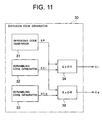
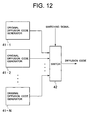
Classifications
-
- H—ELECTRICITY
- H04—ELECTRIC COMMUNICATION TECHNIQUE
- H04J—MULTIPLEX COMMUNICATION
- H04J13/00—Code division multiplex systems
- H04J13/16—Code allocation
- H04J13/18—Allocation of orthogonal codes
-
- H—ELECTRICITY
- H04—ELECTRIC COMMUNICATION TECHNIQUE
- H04J—MULTIPLEX COMMUNICATION
- H04J13/00—Code division multiplex systems
- H04J13/10—Code generation
- H04J13/12—Generation of orthogonal codes
Definitions
- the present invention relates to a diffusion code generator, a CDMA communication apparatus using the diffusion code generator and a method of generating a diffusion code used therefor, in particular to generation of a diffusion code in a CDMA (Code Division Multiple Access) communication apparatus.
- CDMA Code Division Multiple Access
- a code is used to allow multiple communication in order to distinguish and divide the communication channels, which is different from a frequency in a FDMA (Frequency Division Multiple Access) system and time in TDMA (Time Division Multiple Access) system.
- FDMA Frequency Division Multiple Access
- TDMA Time Division Multiple Access
- CDMA communication One of the major advantages of CDMA communication is high concealability. A factor responsible for being capable of maintaining such high concealability is highly related to length of cyclicity of a diffusion code.
- spreading code generator 31 is used in order to maintain orthogonality for each rate cycle of data to be diffused (information data) and usually has approximately 4 to 1024 cycles.
- spreading code generator 31 a Walsh code and a hierarchical orthogonal code and so on are used.
- Scrambling code generators 32 and 33 are mainly used to render power flux density on a frequency axis average or more concealable, whereby a code such as M (Maximum) length code, namely one having a cycle of 2 30 or so is usually used.
- a code such as M (Maximum) length code, namely one having a cycle of 2 30 or so is usually used.
- 34 and 35 indicate Exclusive OR (ExOR) circuits.
- the same base station uses a diffusion code unique to each individual communication channel or each individual terminal and a scrambling code is usually shared. In this case, even though CDMA communication is highly concealable, interception and eavesdropping thereof become possible if the above two types of code can be identified.
- Japanese Patent Laid-Open No. 11-145933 discloses a method whereby, in spread spectrum communication represented by the above CDMA communication, the type of applicable diffusion code list is cyclically or irregularly changed between spread spectrum communication apparatuses during the communication period when sending and receiving a transmitting signal itself in a diffused manner using a diffusion code in order to render the communication more concealable.
- this method provides a plurality (N pieces) of original diffusion code generators 41-1 to 41-N for generating different types of diffusion code list, and switches diffusion codes from these original diffusion code generators 41-1 to 41-N in response to a switching signal by selection switch 42.
- the above CDMA communication includes the WCDMA (Wideband Code Division Multiple Access) method being considered by 3GPP (3rd Generation Partnership Project).
- WCDMA Wideband Code Division Multiple Access
- the 3GPP-specification structure of an uplink transport channel to a physical channel is as shown in FIG. 3, and the 3GPP-specification structure of a downlink transport channel to a physical channel is as shown in FIG. 4.
- processing is performed by a procedure as shown in FIG. 5 (processes S1 to S11) in a 3GPP-specification uplink for DPCH, and processing is performed by a procedure as shown in FIG. 6 (processes S21 to S32) in a 3GPP-specification downlink for DPCH.
- a diffusion modulation using a diffusion code is performed in units of data comprising each individual slot shown in FIG. 3.
- CDMA communication is a system of high concealability, interception and eavesdropping thereof become possible if the diffusion code and scramble code can be identified.
- CDMA communication of high concealability is highly likely to be intercepted and eavesdropped if a fixed diffusion code list is used during communication.
- an object of the present invention is to solve the above-mentioned problems and provide a diffusion code generator capable of rendering interception and eavesdropping of communication difficult without influencing any communication quality and send data, a CDMA communication apparatus using it and a method of generating a diffusion code used therefor.
- a diffusion code generator includes: means for generating a spreading code that generates a code list of high orthogonality; means for generating a scrambling code that generates a code list of a long cycle; and computing means for performing a logical operation of the code lists generated in the above described means for generating a diffusion code and the above described means for generating a scrambling code respectively, and has timer means for changing during communication the type of code list generated in either the above described means for generating a spreading code or the above described means for generating a scrambling code.
- the other diffusion code generator includes: means for generating a spreading code that generates a code list of high orthogonality; means for generating a scrambling code that generates a code list of a long cycle; and computing means for performing a logical operation of the code lists generated in the above described means for generating a spreading code and the above described means for generating a scrambling code respectively, and it has timermeans that changes during communication the type of code list generated in either the above described means for generating a spreading code or the above described means for generating a scrambling code, based on an L1 synchronizing cycle determined by a CRC (Cyclic Redundancy Check code) check.
- CRC Cyclic Redundancy Check code
- Another diffusion code generator includes: means for generating a spreading code that generates a code list of high orthogonality; means for generating a scrambling code that generates a code list of a long cycle; and computing means for performing a logical operation of the code lists generated in the above described means for generating a spreading code and the above described means for generating a scrambling code respectively, and has timer means for changing the type of code list generated in either the above described means for generating a spreading code or the above described means for generating a scrambling code, based on a degradation trigger of a signal/noise ratio used for controlling transmission power at least.
- a CDMA communication apparatus is one for performing communication between a base station and a plurality of terminals by using a diffusion code generated by a diffusion code generator, wherein the above described diffusion code generator includes: means for generating a spreading code that generates a code list of high orthogonality; means for generating a scrambling code that generates a code list of a long cycle; computing means for performing a logical operation of the code lists generated in the above described means for generating a spreading code and the above described means for generating a scrambling code respectively; and timer means changing during communication the type of code list generated in either the above described means for generating a spreading code or the above described means for generating a scrambling code.
- the other CDMA communication apparatus is one for performing communication between a base station and a plurality of terminals by using a diffusion code generated by a diffusion code generator, wherein the above described diffusion code generator includes: means for generating a spreading code that generates a code list of high orthogonality; means for generating a scrambling code that generates a code list of a long cycle; computing means for performing a logical operation of the code lists generated in the above described means for generating a diffusion code and the above described means for generating a scrambling code respectively; and timer means for changing during communication the type of code list generated in either the above described means for generating a spreading code or the above described means for generating a scrambling code, based on an L1 synchronizing cycle determined by a CRC (Cyclic Redundancy Check code) check.
- CRC Cyclic Redundancy Check code
- Another CDMA communication apparatus is one for performing communication between a base station and a plurality of terminals by using a diffusion code generated by a diffusion code generator, wherein the above described diffusion code generator includes: means for generating a spreading code that generates a code list of high orthogonality; means for generating a scrambling code that generates a code list of a long cycle; computing means for performing a logical operation of the code lists generated in the above described means for generating a spreading code and the above described means for generating a scrambling code respectively; and timer means for changing the type of code list generated in either the above described means for generating a spreading code or the above described means for generating a scrambling code, based on a degradation trigger of a signal/noise ratio used for controlling transmission power at least.
- the above described diffusion code generator includes: means for generating a spreading code that generates a code list of high orthogonality; means for generating a scrambling code that generates a code list of a long cycle; computing means for
- a first method of generating a diffusion code according to the present invention is one of a diffusion code generator, including: means for generating a spreading code that generates a code list of high orthogonality; means for generating a scrambling code that generates a code list of a long cycle; and computing means for performing a logical operation of the code lists generated in the above described means for generating a spreading code and the above described means for generating a scrambling code respectively, wherein the type of code list generated in either the above described means for generating a spreading code or the above described means for generating a scrambling code is changed during communication.
- a second method of generating a diffusion code according to the present invention is one of a diffusion code generator, including: means for generating a spreading code that generates a code list of high orthogonality; means for generating a scrambling code that generates a code list of a long cycle; and computing means for performing a logical operation of the code lists generated in the above described means for generating a spreading code and the above described means for generating a scrambling code respectively, wherein the type of code list generated in either the above described means for generating a spreading code or the above described means for generating a scrambling code is changed during communication, based on an L1 synchronizing cycle determined by a CRC (Cyclic Redundancy Check code) check.
- CRC Cyclic Redundancy Check code
- a third method of generating a diffusion code according to the present invention is one of a diffusion code generator, including: means for generating a spreading code that generates a code list of high orthogonality; means for generating a scrambling code that generates a code list of a long cycle; and computing means for performing a logical operation of the code lists generated in the above described means for generating a spreading code and the above described means for generating a scrambling code respectively, wherein the type of code list generated in either the above described means for generating a spreading code or the above described means for generating a scrambling code is changed, based on a degradation trigger of a signal/noise ratio used for controlling transmission power at least.
- a fourth method of generating a diffusion code according to the present invention is one of a CDMA communication apparatus for performing communication between a base station and a plurality of terminals by using a diffusion code generated by a diffusion code generator, wherein the above described diffusion code generator changes during communication the type of code list generated in either means for generating a spreading code that generates a code list of high orthogonality or means for generating a scrambling code that generates a code list of a long cycle.
- a fifth method of generating a diffusion code is one of a CDMA communication apparatus for performing communication between a base station and a plurality of terminals by using a spreading code generated by a diffusion code generator, wherein said diffusion code generator changes during communication the type of code list generated in either means for generating a diffusion code that generates a code list of high orthogonality or means for generating a scrambling code that generates a code list of a long cycle, based on an L1 synchronizing cycle determined by a CRC (Cyclic Redundancy Check code) check.
- CRC Cyclic Redundancy Check code
- a sixth method of generating a diffusion code according to the present invention is one of a CDMA communication apparatus for performing communication between a base station and a plurality of terminals by using a diffusion code generated by a diffusion code generator, wherein the above described diffusion code generator changes the type of code list generated in either means for generating a spreading code that generates a code list of high orthogonality or means for generating a scrambling code that generates a code list of a long cycle, based on a degradation trigger of a signal/noise ratio used for controlling transmission power at least.
- a CDMA communication apparatus of the present invention is intended to implement higher concealability by changing a spreading code or a scrambling code during communication based on a degradation trigger such as TTI (Transmission Time Interval: L1 synchronizing cycle) or SIR (Signal/Interval Ratio).
- a degradation trigger such as TTI (Transmission Time Interval: L1 synchronizing cycle) or SIR (Signal/Interval Ratio).
- CDMA communication One of the major advantages of CDMA communication is high concealability.
- a factor responsible for being capable of maintaining such high concealability is highly related to length of cyclicity of a diffusion code.
- the present invention periodically changes a diffusion code during communication in order to have further concealability.
- a spreading code generator or a scrambling code generator is used for generation of such a diffusion code.
- a spreading code generator is used to maintain orthogonality for each rate cycle of data to be diffused (information data) and usually has approximately 4 to 1024 cycles, and a Walsh code and a hierarchical orthogonal code and so on are used.
- a scrambling code generator is mainly used to render power flux density on a frequency axis average or more concealable, whereby a code such as M length code, namely one having a cycle of 2 30 or so is usually used.
- the same base station uses a spreading code unique to each individual communication channel or each individual terminal and a scrambling code is usually shared. Although it is a system of high concealability, interception and eavesdropping of communication become possible if the above two types of code can be identified.
- the present invention changes the above spreading code or scrambling code during communication based on TTI (Transmission Time Interval: LI syhcnronization cycle) of an L1 synchronization OK/NG determined by a CRC (Cyclic Redundancy Check code) check and a degradation trigger such as SIR (Signal/Interval Ratio) used for controlling transmission power and so on.
- TTI Transmission Time Interval: LI syhcnronization cycle
- CRC Cyclic Redundancy Check code
- SIR Synchrometic Redundancy Check code
- FIG. 1 is a block diagram showing a configuration of a diffusion code generator according to an embodiment of the present invention.
- a diffusion code generator 10 is a circuit for generating a diffusion code in a CDMA communication system, comprising a spreading code generator 1, scrambling code generators 2, 3, Exclusive OR (ExOR) circuits 4, 5 and a timer 6.
- a CDMA communication system allows multiple communication by using a code in order to distinguish and divide the communication channels, which is different from a frequency in a FDMA system and time in TDMA system.
- the spreading code generator 1 is used to maintain orthogonality for each rate cycle of data to be diffused (information data) and usually has approximately 4 to 1024 cycles, and a Walsh code and a hierarchical orthogonal code and so on are used.
- Receivers on the base station side and on the terminal side which are not illustrated are implementing separation from other communication channel signals by means of auto-correlation or cross-correlation ownedby these codes respectively. Also, this code does not change as long as communication with the same base station is maintained, unless a specific code is allocated and a base station or a sector of the destination changes due to a handover or the like.
- Scrambling code generators 2, 3 are mainly used to render power flux density on a frequency axis average ormore concealable, whereby a code such as M length code, namely one having a cycle of 2 30 or so is usually used. This scrambling code maintains high concealability because of the length of its cycle.
- the base stations which are not illustrated have a unique code list, and a terminal can know the number and state of surrounding base stations from it and decoding information.
- a spreading code is represented as SP
- a scrambling code for in-phase components and a scrambling code for orthogonal components are represented as Sci and SCq respectively
- diffusion code for in-phase components Ci and diffusion code for orthogonal components Cq can be represented as follows respectively.
- This transmitting signal can demodulate respective information data by multiplying a complex conjugate of a diffusion code at a receiving division on the base station side or on the terminal side. More specifically, it will be represented as follows.
- T1 Transmission Time Interval: L1 synchronizing cycle
- scrambling code generators 2, 3 generate M length code Sci, SCq of relatively long cyclicity respectively.
- Diffusion codes for in-phase components and orthogonal components are computed by ExOR circuits 4, 5 respectively, and diffusion code for in-phase components Ci and diffusion code for orthogonal components Cq are generated.
- the timer 6 changes currently set orthogonal code list SP to another different type in a TTI cycle instructed by an upper layer that is not illustrated.
- code list SP As a specific number or the like is usually given to code list SP to be used, it may be changed by being notified of a new number in communication with a base station or by deciding the number system, cycle and order to be changed in advance.
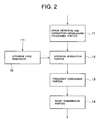
- FIG. 2 is a block diagram showing a configuration of a transmission division of a CDMA communication apparatus according to an embodiment of the present invention.
- a transmission division of a CDMA communication apparatus according to an embodiment of the present invention comprises a diffusion code generator 10, an error detection and correction/interleaving processing division 11, a diffusion modulation division 12, a frequency conversion division 13 and a radio transmission division 14.
- a diffusion code generation division 10 generates a different diffusion code list in a TTI cycle instructed by an upper layer and gives it to a diffusion modulation division 12.
- Error detection and correction/interleaving processing division 11 performs error detection, correction and interleaving processing to each individual transport block.
- the diffusion modulation division 12 performs diffusion modulation of a signal to which error detection and correction/interleaving processing was conducted at error detection and correction/interleaving processing division 11 by using a diffusion code (such as a PN code) given from diffusion code generation division 10, and gives it to the frequency conversion division 13.
- the frequency conversion division 13 converts a frequency of an output signal from the diffusion modulation division 12 up to a radio frequency band (RF band) .
- An RF signal thus obtained is given from the radio transmission division 14 to a transmitting and receiving antenna via an antenna transmitting and receiving division that is not illustrated, and then is radiated into space.
- the diffusion modulation division 12 is given a diffusion code list of a type to be determined at that point in time from the diffusion code generation division 10, and in the diffusion modulation division 12, this diffusion code is used to perform diffusion modulation. As in conventional cases, a signal outputted from the diffusion modulation division 12 undergoes processes such as frequency conversion and transmission power control (power amplification) and then is radiated into space.
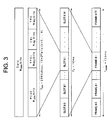
- FIG. 3 shows a structure of a transport channel to a physical channel of a 3GPP-specification uplink.
- Each slot comprises Pilot (Pilot) (N pilot bits), and TFCI (Transport Format Combination Indicator) (N TFCI bits), and FBI (Feed-Back Information) (N FBI bits), and TPC (Transmission Power Control) (N TPC bits), or Data (Data) (N data bits).
- Pilot Pilot
- TFCI Transport Format Combination Indicator
- FBI Feed-Back Information
- TPC Transmission Power Control
- FIG. 4 shows a structure of a transport channel to a physical channel of a 3GPP-specification downlink.
- Each slot comprises TFCI (N TFCI bits) (DPCCH), and Data1 (Data1) (N data1 bits) (DPDCH), and TPC (N TPC bits) (DPCCH), and Data2 (Data2) (N data2 bits) (DPDCH), and Pilot (Pilot) (N pilot bits) (DPCCH).
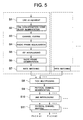
- FIG. 5 is a flowchart showing a processing flow in a 3GPP-specification uplink for DPCH
- FIG. 6 is a flowchart showing a processing flow in a 3GPP-specification downlink for DPCH.
- a CRC Cyclic Redundancy Check code
- S1 CRC attachment
- Inprocess S2 (TrBkconcatenation/Codeblocksegmentation), a pieces (1 ⁇ a ⁇ N) of transport block with a CRC added are concatenated. Normally, concatenation units are implemented for each individual transport channel. Segmentation is implemented in the case where the concatenated code blocks' number of bits Xi exceeds a certain value z . Ci, the number to be divided is an integral part of a value of a solution to Xi/z plus 1. As the number of bits in any divided unit block is the same, a filler bit (all "0") is inserted into the last unit block for adjustment.
- Error correction is performed in process S3 (Channel coding) , and interleaving is performed at every TTI (Transmission Time Interval: L1 synchronizing cycle) in process S5 (1st interleaving).
- rate matching (repetition or puncturing) is performed considering required quality of each individual transport channel so as not to exceed the total number of bits that can be mapped to physical channels for each individual transport channel.
- a transport channel is divided in units of 10ms that is a radio frame in process S8 (TrCH Multiplexing), and it is implemented in the case of transmitting by a plurality of physical channels in process S9 (Physical channel segmentation).
- Interleaving in a radio frame (10ms) is implemented in process S10 (2nd interleaving) , and mapping to a physical channel is performed in process S11 (Physical channel mapping).
- process S10 Physical channel mapping
- description of process S4 (Radio frame equalization) and process S6 (Radio frame segmentation) is omitted since they are not directly related to this technology.
- Processing in a downlink for DPCH is the processing in the above-mentioned uplink for DPCH performed in reverse, that is in order of S21 to S32, and process S28 (Insertion of DTX indication with fixed positions) is added thereto.
- OK/NG of L1 synchronization is determined by a CRC check.
- a CRC bit is added to data bits of N pieces of radio frame integrated by an appropriate rule, which is checked so as to implement it (see FIG. 3).
- Time for the above N ⁇ frame period (for instance, 10ms, 20ms, 40ms, 80ms and so on) is called TTI, and hardware processing can be simplified by switching a diffusion code with reference to it.
- TTI is different depending on a used application (voice or data communication, etc.), and it is specified by an upper layer. This TTI is inputted to timer 6 so as to make this time the timing for switching.
- FIG. 7 is a block diagram showing a configuration of a diffusion code generator according to the other embodiment of the present invention.
- the diffusion code generator 15 has the same configuration as that of the diffusion code generator 10 according to an embodiment of the present invention shown in FIG. 1 except that scrambling code for in-phase components SCi and scrambling code for orthogonal components SCq generated in scrambling code generators 2, 3 by timer 6 are to be changed based on a TTI cycle, where the same components have the same codes.
- operation of the same components is the same as that in an embodiment of the present invention.
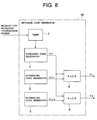
- FIG. 8 is a block diagram showing a configuration of a diffusion code generator according to another embodiment of the present invention.
- the diffusion code generator 16 has the same configuration as that of the diffusion code generator 10 according to an embodiment of the present invention shown in FIG. 1 except that timer 7 is provided to change spreading code SP based on a degradation trigger of SIR (Signal/Interval Ratio), where the same components have the same codes.
- SIR Signal/Interval Ratio
- operation of the same components is the same as that in an embodiment of the present invention.
- a CDMA communication apparatus constantly measures and/or estimates SIR during communication to use it for transmission power control and so on.
- a terminal is constructed so that, if this SIR is degraded, a request for increased transmission power is made to a base station from each individual slot.
- another embodiment of the present invention has the timer 7 input a request for increased transmission power to a base station, and instructs the spreading code generator 1 to change spreading code SP when it occurs N times successively so that higher concealability is provided without requiring redundant hardware and processing.
- FIG. 9 is a block diagram showing a configuration of a transmission division of a CDMA communication apparatus according to another embodiment of the present invention.
- a transmission division of a CDMA communication apparatus comprises the error detection and correction/interleaving processing division 11, the diffusion modulation division 12, the frequency conversion division 13, the radio transmission division 14, the diffusion code generator 16 and an SIR measurement/estimation division 17.
- description of the error detection and correction/interleaving processing division 11, diffusion modulation division 12, frequency conversion division 13 and radio transmission division 14 is omitted since they perform operation as mentioned above.
- the SIR measurement/estimation division 17 constantly measures and/or estimates SIR during communication, and if this SIR is degraded, it sends a request for increased transmission power to a base station that is not illustrated, where the request for increased transmission power is used for controlling transmission power and so on.
- the diffusion code generator 16 has the above-mentioned configuration, and if a request for increased transmission power from the SIR measurement/estimation division 17 is inputted, and when occurring N times successively, it instructs the diffusion code generator 1 to change diffusion code SP so that higher concealability can be provided without requiring redundant hardware and processing.
- the timer 6 can also perform switching based on a TTI cycle by using a request for increased transmission power from the SIR measurement/estimation division 17 as a trigger.
- FIG. 10 is a block diagram showing a configuration of a diffusion code generator according to a further embodiment of the present invention.
- a diffusion code generator 18 has the same configuration as that of the diffusion code generator 16 according to another embodiment of the present invention shown in FIG. 8 except that scrambling code for in-phase components SCi and scrambling code for orthogonal components SCq generated in the scrambling code generators 2, 3 by the timer 7 are to be changed based on a degradation trigger of SIR, where the same components have the same codes.
- operation of the same components is the same as that in another embodiment of the present invention.
- the method of generating a diffusion code of the present invention changes, during communication, the type of code list generated in either means for generating a spreading code that generates a code list of high orthogonality or means for generating a scrambling code that generates a code list of a long cycle based on an L1 synchronizing cycle determined by a CRC check, having the effect of consequently rendering interception and eavesdropping of communication difficult, without influencing communication quality and transmission data.
- the method of generating a diffusion code of the present invention changes, during communication, the type of code list generated in either means for generating a spreading code that generates a code list ofhighorthogonalityormeans for generating a scrambling code that generates a code list of a long cycle based on a degradation trigger of a signal/noise ratio used for controlling transmission power at least, having the effect of consequently rendering interception and eavesdropping of communication difficult, without influencing communication quality and transmission data.
Landscapes
- Engineering & Computer Science (AREA)
- Computer Networks & Wireless Communication (AREA)
- Signal Processing (AREA)
- Mobile Radio Communication Systems (AREA)
Applications Claiming Priority (2)
| Application Number | Priority Date | Filing Date | Title |
|---|---|---|---|
| JP2000031343A JP2001223670A (ja) | 2000-02-09 | 2000-02-09 | 拡散符号生成器及びそれを用いるcdma通信装置並びにそれらに用いる拡散符号生成方法 |
| JP2000031343 | 2000-02-09 |
Publications (2)
| Publication Number | Publication Date |
|---|---|
| EP1124345A2 true EP1124345A2 (fr) | 2001-08-16 |
| EP1124345A3 EP1124345A3 (fr) | 2003-12-10 |
Family
ID=18556110
Family Applications (1)
| Application Number | Title | Priority Date | Filing Date |
|---|---|---|---|
| EP20010102779 Withdrawn EP1124345A3 (fr) | 2000-02-09 | 2001-02-08 | Générateur de codes d'étalement, dispositif de communication CDMA et procédé de génération de codes d'étalement |
Country Status (6)
| Country | Link |
|---|---|
| US (1) | US6917643B2 (fr) |
| EP (1) | EP1124345A3 (fr) |
| JP (1) | JP2001223670A (fr) |
| CN (1) | CN1263244C (fr) |
| AU (1) | AU779617B2 (fr) |
| HK (1) | HK1039000B (fr) |
Cited By (4)
| Publication number | Priority date | Publication date | Assignee | Title |
|---|---|---|---|---|
| EP1435142A4 (fr) * | 2001-10-11 | 2006-09-20 | Interdigital Tech Corp | Systeme et procede pour utiliser une capacite non utilisee dans le champ de donnees d'un paquet special |
| WO2008020969A3 (fr) * | 2006-08-10 | 2008-04-03 | Lucent Technologies Inc | Procédé consistant à changer le code de brouillage d'une station de base pour des télécommunications sans fil |
| US7519104B2 (en) | 2003-02-28 | 2009-04-14 | Mstar Semiconductor, Inc. | Application of spreading codes to signals |
| EP2153545A4 (fr) * | 2007-05-02 | 2010-10-27 | Korea Electronics Telecomm | Procédé et appareil pour transmettre un signal |
Families Citing this family (15)
| Publication number | Priority date | Publication date | Assignee | Title |
|---|---|---|---|---|
| GB2369006B (en) * | 2000-11-10 | 2004-04-07 | Nokia Mobile Phones Ltd | Mapping of internet protocol based data |
| KR100403743B1 (ko) * | 2001-04-14 | 2003-10-30 | 삼성전자주식회사 | 이동통신시스템에서 프레임 동기 획득 장치 및 방법 |
| US7012911B2 (en) * | 2001-05-31 | 2006-03-14 | Qualcomm Inc. | Method and apparatus for W-CDMA modulation |
| JP4493335B2 (ja) | 2001-08-31 | 2010-06-30 | 富士通株式会社 | Cdma通信システムにおける受信装置及び受信方法 |
| US6950670B2 (en) * | 2001-10-31 | 2005-09-27 | At&T Corp. | Wireless network having joint power and data rate adaptation |
| CN100590991C (zh) * | 2002-01-30 | 2010-02-17 | Lg电子株式会社 | 利用可变时隙长度扰频分组数据的方法及其设备 |
| JP2006501724A (ja) * | 2002-09-27 | 2006-01-12 | アイビキュイティ・デジタル・コーポレイション | デジタル音声放送システムにおける信号ビットのインターリービング方法及び装置 |
| KR20060073596A (ko) * | 2003-08-13 | 2006-06-28 | 코닌클리즈케 필립스 일렉트로닉스 엔.브이. | 송신 시스템에서 디지털 데이터 스트림을 암호화하는방법과 장치, 디지털 데이터 스트림 디코딩 방법과 장치 및송신 시스템 |
| US7461313B2 (en) * | 2003-12-30 | 2008-12-02 | Qualcomm Incorporated | Test pattern generation |
| EP2063544A1 (fr) | 2006-10-06 | 2009-05-27 | Panasonic Corporation | Appareil et procédé de communication sans fil |
| FR2918828B1 (fr) * | 2007-07-13 | 2009-09-18 | Wavecom Sa | Procede de detection du brouillage d'un reseau de radiocommunication, produit programme d'ordinateur, moyen de stockage et circuit correspondants |
| US7853857B2 (en) * | 2007-09-14 | 2010-12-14 | Motorola Mobility, Inc. | Multi-layer cyclic redundancy check code in wireless communication system |
| CN102447519A (zh) * | 2010-09-28 | 2012-05-09 | 韩国电子通信研究院 | 数字多媒体广播的发送方法及装置 |
| EP3609269A1 (fr) * | 2014-03-21 | 2020-02-12 | Telefonaktiebolaget LM Ericsson (publ) | Procédé et dispositif de commutation d'un intervalle de temps de transmission |
| CN108282246B (zh) * | 2017-01-05 | 2023-09-01 | 华为技术有限公司 | 信息处理的方法、设备和通信系统 |
Family Cites Families (20)
| Publication number | Priority date | Publication date | Assignee | Title |
|---|---|---|---|---|
| JP2967520B2 (ja) | 1989-05-10 | 1999-10-25 | 防衛庁技術研究本部長 | 最大周期列信号発生回路 |
| US5105436A (en) * | 1989-07-20 | 1992-04-14 | Clarion Co., Ltd. | Spread spectrum receiver |
| JPH03120125A (ja) | 1989-10-03 | 1991-05-22 | Minolta Camera Co Ltd | 原稿給紙装置 |
| JPH05110538A (ja) | 1991-10-15 | 1993-04-30 | Mitsubishi Electric Corp | スペクトル拡散通信装置 |
| US5550809A (en) | 1992-04-10 | 1996-08-27 | Ericsson Ge Mobile Communications, Inc. | Multiple access coding using bent sequences for mobile radio communications |
| JPH0758668A (ja) | 1993-08-17 | 1995-03-03 | Canon Inc | スペクトラム拡散通信装置および無線付画像データ処理装置 |
| JPH0786984A (ja) | 1993-09-13 | 1995-03-31 | Kokusai Electric Co Ltd | スペクトル拡散通信における擬似雑音符号発生器 |
| US5544156A (en) * | 1994-04-29 | 1996-08-06 | Telefonaktiebolaget Lm Ericsson | Direct sequence CDMA coherent uplink detector |
| US5559788A (en) * | 1994-12-29 | 1996-09-24 | Unisys Corporation | Multiple channel quadrature communication system and method |
| JPH08251076A (ja) * | 1995-03-10 | 1996-09-27 | N T T Ido Tsushinmo Kk | 通信方法 |
| JPH1022989A (ja) | 1996-07-08 | 1998-01-23 | Toyo Commun Equip Co Ltd | フレーム同期回路 |
| US6108369A (en) | 1997-07-11 | 2000-08-22 | Telefonaktiebolaget Lm Ericsson | Channelization code allocation for radio communication systems |
| JP3655059B2 (ja) * | 1997-07-24 | 2005-06-02 | クラリオン株式会社 | スペクトル拡散通信システム |
| JPH11145933A (ja) | 1997-11-12 | 1999-05-28 | Oki Electric Ind Co Ltd | スペクトラム拡散通信方式及び装置 |
| KR100269593B1 (ko) | 1997-12-02 | 2000-10-16 | 정선종 | 다중 채널을 위한 직교 복소 확산 방법 및 그 장치 |
| JP2878265B1 (ja) * | 1998-03-16 | 1999-04-05 | 三菱電機株式会社 | 符号割当装置並びにその方法 |
| US5956641A (en) | 1998-03-30 | 1999-09-21 | Motorola, Inc. | System and method for facilitating a handoff of at least one mobile unit in a telecommunication system |
| JP2000059264A (ja) | 1998-08-04 | 2000-02-25 | Murata Mach Ltd | スペクトラム拡散通信装置 |
| JP2000216700A (ja) * | 1999-01-20 | 2000-08-04 | Nec Corp | Cdma受信装置およびcdma受信方法、並びに記録媒体 |
| JP2001326589A (ja) | 2000-05-16 | 2001-11-22 | Nec Corp | 拡散符号発生装置および拡散符号発生方法 |
-
2000
- 2000-02-09 JP JP2000031343A patent/JP2001223670A/ja active Pending
-
2001
- 2001-02-01 US US09/775,531 patent/US6917643B2/en not_active Expired - Fee Related
- 2001-02-05 AU AU18286/01A patent/AU779617B2/en not_active Ceased
- 2001-02-08 EP EP20010102779 patent/EP1124345A3/fr not_active Withdrawn
- 2001-02-09 CN CNB011113812A patent/CN1263244C/zh not_active Expired - Fee Related
-
2002
- 2002-01-22 HK HK02100503.8A patent/HK1039000B/zh not_active IP Right Cessation
Cited By (7)
| Publication number | Priority date | Publication date | Assignee | Title |
|---|---|---|---|---|
| EP1435142A4 (fr) * | 2001-10-11 | 2006-09-20 | Interdigital Tech Corp | Systeme et procede pour utiliser une capacite non utilisee dans le champ de donnees d'un paquet special |
| US7519104B2 (en) | 2003-02-28 | 2009-04-14 | Mstar Semiconductor, Inc. | Application of spreading codes to signals |
| WO2008020969A3 (fr) * | 2006-08-10 | 2008-04-03 | Lucent Technologies Inc | Procédé consistant à changer le code de brouillage d'une station de base pour des télécommunications sans fil |
| EP2153545A4 (fr) * | 2007-05-02 | 2010-10-27 | Korea Electronics Telecomm | Procédé et appareil pour transmettre un signal |
| US9143256B2 (en) | 2007-05-02 | 2015-09-22 | Electronics And Telecommunications Research Institute | Method and apparatus for transmitting signal |
| US9143257B2 (en) | 2007-05-02 | 2015-09-22 | Electronics And Telecommunications Research Institute | Method and apparatus for transmitting signal |
| US9894595B2 (en) | 2007-05-02 | 2018-02-13 | Electronics And Telecommunications Research Institute | Method and apparatus for transmitting signal |
Also Published As
| Publication number | Publication date |
|---|---|
| HK1039000A1 (en) | 2002-04-04 |
| CN1263244C (zh) | 2006-07-05 |
| AU1828601A (en) | 2001-08-16 |
| CN1308431A (zh) | 2001-08-15 |
| EP1124345A3 (fr) | 2003-12-10 |
| JP2001223670A (ja) | 2001-08-17 |
| AU779617B2 (en) | 2005-02-03 |
| US6917643B2 (en) | 2005-07-12 |
| HK1039000B (zh) | 2006-12-29 |
| US20010014113A1 (en) | 2001-08-16 |
Similar Documents
| Publication | Publication Date | Title |
|---|---|---|
| US6917643B2 (en) | Diffusion code generator, CDMA communication apparatus using the same, and diffusion code generating method used therefor | |
| US6768728B1 (en) | Device and method for exchanging frame messages of different lengths in CDMA communication system | |
| EP2293480B1 (fr) | Procédé et appareil pour des communications en mode compressé dans une interface radio | |
| EP0901722B1 (fr) | Unite d'abonne pour systeme de transmission sans fil amdc | |
| AU716705B2 (en) | Subscriber unit for a CDMA wireless communication system | |
| KR100899961B1 (ko) | 고속 패킷 데이터 송신을 음성/데이터 송신과멀티플렉싱하는 방법 및 장치 | |
| US7336733B2 (en) | Radio base station apparatus, decoding apparatus used therefor which uses TFCI decoding characteristics, and decoding method therefor | |
| JP2004514320A (ja) | 非同期移動通信システムにおけるダウンリンク共有チャネルに使用される送信形式結合指示器の伝送装置及び方法 | |
| KR20020027247A (ko) | 이동통신시스템에서의 하향 공유 채널의 전력 제어를 위한통신 수행 장치 및 방법 | |
| EP1418688A2 (fr) | Appareil et procédé de transmission de bits TFCI pour un mode partagé "dur" dans un système de communication mobile AMCR | |
| Lee et al. | Scrambling techniques for CDMA communications | |
| KR100317256B1 (ko) | 최적의 파일럿 심볼을 이용한 프레임 동기 방법 | |
| JPWO2005093981A1 (ja) | Cdma用通信装置 | |
| AU2009251132A1 (en) | Method and apparatus for multiplexing high-speed packet data transmission with voice/data transmission |
Legal Events
| Date | Code | Title | Description |
|---|---|---|---|
| PUAI | Public reference made under article 153(3) epc to a published international application that has entered the european phase |
Free format text: ORIGINAL CODE: 0009012 |
|
| AK | Designated contracting states |
Kind code of ref document: A2 Designated state(s): AT BE CH CY DE DK ES FI FR GB GR IE IT LI LU MC NL PT SE TR |
|
| AX | Request for extension of the european patent |
Free format text: AL;LT;LV;MK;RO;SI |
|
| PUAL | Search report despatched |
Free format text: ORIGINAL CODE: 0009013 |
|
| AK | Designated contracting states |
Kind code of ref document: A3 Designated state(s): AT BE CH CY DE DK ES FI FR GB GR IE IT LI LU MC NL PT SE TR |
|
| AX | Request for extension of the european patent |
Extension state: AL LT LV MK RO SI |
|
| 17P | Request for examination filed |
Effective date: 20031104 |
|
| AKX | Designation fees paid |
Designated state(s): DE FR GB |
|
| 17Q | First examination report despatched |
Effective date: 20050121 |
|
| STAA | Information on the status of an ep patent application or granted ep patent |
Free format text: STATUS: THE APPLICATION IS DEEMED TO BE WITHDRAWN |
|
| 18D | Application deemed to be withdrawn |
Effective date: 20100901 |