EP1126720A2 - Méthode du traitement de tampons horodatés lors de l'enregistrement/la lecture - Google Patents
Méthode du traitement de tampons horodatés lors de l'enregistrement/la lecture Download PDFInfo
- Publication number
- EP1126720A2 EP1126720A2 EP01301363A EP01301363A EP1126720A2 EP 1126720 A2 EP1126720 A2 EP 1126720A2 EP 01301363 A EP01301363 A EP 01301363A EP 01301363 A EP01301363 A EP 01301363A EP 1126720 A2 EP1126720 A2 EP 1126720A2
- Authority
- EP
- European Patent Office
- Prior art keywords
- time
- data packets
- data
- series
- cycle time
- Prior art date
- Legal status (The legal status is an assumption and is not a legal conclusion. Google has not performed a legal analysis and makes no representation as to the accuracy of the status listed.)
- Withdrawn
Links
Images

Classifications
-
- H—ELECTRICITY
- H04—ELECTRIC COMMUNICATION TECHNIQUE
- H04N—PICTORIAL COMMUNICATION, e.g. TELEVISION
- H04N5/00—Details of television systems
- H04N5/76—Television signal recording
-
- H—ELECTRICITY
- H04—ELECTRIC COMMUNICATION TECHNIQUE
- H04N—PICTORIAL COMMUNICATION, e.g. TELEVISION
- H04N5/00—Details of television systems
- H04N5/76—Television signal recording
- H04N5/78—Television signal recording using magnetic recording
- H04N5/781—Television signal recording using magnetic recording on disks or drums
-
- H—ELECTRICITY
- H04—ELECTRIC COMMUNICATION TECHNIQUE
- H04L—TRANSMISSION OF DIGITAL INFORMATION, e.g. TELEGRAPHIC COMMUNICATION
- H04L12/00—Data switching networks
- H04L12/66—Arrangements for connecting between networks having differing types of switching systems, e.g. gateways
-
- H—ELECTRICITY
- H04—ELECTRIC COMMUNICATION TECHNIQUE
- H04N—PICTORIAL COMMUNICATION, e.g. TELEVISION
- H04N21/00—Selective content distribution, e.g. interactive television or video on demand [VOD]
- H04N21/20—Servers specifically adapted for the distribution of content, e.g. VOD servers; Operations thereof
- H04N21/23—Processing of content or additional data; Elementary server operations; Server middleware
- H04N21/236—Assembling of a multiplex stream, e.g. transport stream, by combining a video stream with other content or additional data, e.g. inserting a URL [Uniform Resource Locator] into a video stream, multiplexing software data into a video stream; Remultiplexing of multiplex streams; Insertion of stuffing bits into the multiplex stream, e.g. to obtain a constant bit-rate; Assembling of a packetised elementary stream
- H04N21/23608—Remultiplexing multiplex streams, e.g. involving modifying time stamps or remapping the packet identifiers
-
- H—ELECTRICITY
- H04—ELECTRIC COMMUNICATION TECHNIQUE
- H04N—PICTORIAL COMMUNICATION, e.g. TELEVISION
- H04N21/00—Selective content distribution, e.g. interactive television or video on demand [VOD]
- H04N21/40—Client devices specifically adapted for the reception of or interaction with content, e.g. set-top-box [STB]; Operations thereof
- H04N21/43—Processing of content or additional data, e.g. demultiplexing additional data from a digital video stream; Elementary client operations, e.g. monitoring of home network or synchronising decoder's clock; Client middleware
- H04N21/4302—Content synchronisation processes, e.g. decoder synchronisation
- H04N21/4307—Synchronising the rendering of multiple content streams or additional data on devices, e.g. synchronisation of audio on a mobile phone with the video output on the TV screen
- H04N21/43072—Synchronising the rendering of multiple content streams or additional data on devices, e.g. synchronisation of audio on a mobile phone with the video output on the TV screen of multiple content streams on the same device
-
- H—ELECTRICITY
- H04—ELECTRIC COMMUNICATION TECHNIQUE
- H04N—PICTORIAL COMMUNICATION, e.g. TELEVISION
- H04N21/00—Selective content distribution, e.g. interactive television or video on demand [VOD]
- H04N21/40—Client devices specifically adapted for the reception of or interaction with content, e.g. set-top-box [STB]; Operations thereof
- H04N21/43—Processing of content or additional data, e.g. demultiplexing additional data from a digital video stream; Elementary client operations, e.g. monitoring of home network or synchronising decoder's clock; Client middleware
- H04N21/434—Disassembling of a multiplex stream, e.g. demultiplexing audio and video streams, extraction of additional data from a video stream; Remultiplexing of multiplex streams; Extraction or processing of SI; Disassembling of packetised elementary stream
- H04N21/4344—Remultiplexing of multiplex streams, e.g. by modifying time stamps or remapping the packet identifiers
-
- H—ELECTRICITY
- H04—ELECTRIC COMMUNICATION TECHNIQUE
- H04N—PICTORIAL COMMUNICATION, e.g. TELEVISION
- H04N21/00—Selective content distribution, e.g. interactive television or video on demand [VOD]
- H04N21/40—Client devices specifically adapted for the reception of or interaction with content, e.g. set-top-box [STB]; Operations thereof
- H04N21/43—Processing of content or additional data, e.g. demultiplexing additional data from a digital video stream; Elementary client operations, e.g. monitoring of home network or synchronising decoder's clock; Client middleware
- H04N21/436—Interfacing a local distribution network, e.g. communicating with another STB or one or more peripheral devices inside the home
- H04N21/4363—Adapting the video stream to a specific local network, e.g. a Bluetooth® network
- H04N21/43632—Adapting the video stream to a specific local network, e.g. a Bluetooth® network involving a wired protocol, e.g. IEEE 1394
-
- H—ELECTRICITY
- H04—ELECTRIC COMMUNICATION TECHNIQUE
- H04N—PICTORIAL COMMUNICATION, e.g. TELEVISION
- H04N7/00—Television systems
- H04N7/24—Systems for the transmission of television signals using pulse code modulation
- H04N7/52—Systems for transmission of a pulse code modulated video signal with one or more other pulse code modulated signals, e.g. an audio signal or a synchronizing signal
Definitions
- the present invention relates to a method of processing data packets and to a video apparatus.
- isochronous signals other than DV-format for example, MPEG stream signals
- playback apparatuses had not been provided with any method for ensuring appropriate data arrival time.
- Embodiments of the present invention relate to a method of processing data packets transmitted over a serial bus, for example, an IEEE 1394 bus, and to a video recording/playback apparatus incorporating the method.
- a serial bus for example, an IEEE 1394 bus
- Embodiments of the present invention provide a method of ensuring appropriate data arrival time in the transmission of isochronous signals such as MPEG stream signals, and a video recording apparatus and a video playback apparatus incorporating the method.
- a relative value is taken between a requested time of arrival and a cycle time at the time of reception, and the requested time of arrival is replaced with the relative value.
- the relative value is added to a cycle time at the time of transmission, so that a requested time of arrival for playback is obtained.
- the present invention allows both DV-format signals and non-DV-format isochronous signals such as MPEG stream signals to be recorded on an intermediate storage medium not based on DV-format, and to be played back appropriately while readily ensuring the requested time of arrival for playback operations.
- a method of processing data packets including the steps of receiving a series of data packets transmitted over a serial bus; with respect to the series of data packets, taking the difference between a requested time of arrival written in a header portion and the cycle time at the time of reception, thereby deriving a relative value between the requested time of arrival and the cycle time; and replacing the requested time of arrival with the relative value.
- a video recording apparatus incorporating the method.
- a dummy packet is generated in a range in which data is absent, and all the stream packets including the dummy packet are recorded so that the relative value between the requested time of arrival and the cycle time is obtained.
- the difference-taking step and the replacing step are skipped when the series of data packets is directed to a storage medium in which data storage is based on the cycle time, and are performed when the series of data packets is directed to a storage medium in which data storage is not based on the cycle time.
- the method is compatible with a plurality of data types including a series of data packets in which a header portion is given to each of the data packets, and a series of data packets in which a header portion is given only to the data packet at the beginning thereof.
- a method of processing data packets including the steps of, with respect to a series of data packets, taking the sum of a relative value, written in a header portion, between a requested time of arrival and a cycle time at the time of reception, and a cycle time at the time of transmission; replacing the relative value with the sum; and transmitting the series of packets over a serial bus.
- a video playback apparatus incorporating the method.
- the sum-taking step and the replacing step are skipped when the series of data packets are fed from a storage medium in which data storage is based on the cycle time, and are performed when the series of data packets are fed from a storage medium in which data storage is not based on the cycle time.
- the present invention provides a method and an apparatus in which both DV-format and non-DV-format data packets are transmitted and received over a serial bus while being ensured of appropriate data arrival time, regardless of whether or not an intermediate storage medium is used.
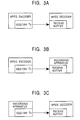
- Fig. 3A shows a data transfer model in which data is transferred from an MPEG encoder to an MPEG decoder
- Fig. 3B shows a data transfer model in which data is transferred from an MPEG encoder to a recording apparatus
- Fig. 3C shows a data transfer model in which data is transferred from a recording apparatus to an MPEG decoder.
- the receiving node i.e., the MPEG decoder or the recording apparatus
- the receive buffer may not be able to absorb the deviation.
- each packet output from the transmitting node is given a header including an SPH field.
- the SPH value indicates the time at which the packet should be received by the receiving node, which will be referred to as requested time of arrival in the following description.
- packet streams are time-multiplexed for transmission. Therefore, the functionality of the transmitting node alone does not guarantee the time of arrival requested by the receiving node. Accordingly, the receiving node need to perform processing for ensuring that data is transferred in appropriate timing.
- the transmitting node calculating the time needed for transfer of the data to obtain the SPH value, and the SPH value is included in the packet and transmitted together with the data.
- the received packets are temporarily stored in a receive buffer. Then, the SPH value at the beginning of each of the packets is read, and is compared against the cycle time of the data. When the SPH value and the cycle time match, the data is transferred from the receive buffer to the receiving node.
- the system as described above suffices to transmit data over an IEEE 1394 bus from an MPEG encoder directly to an MPEG decoder as shown in FIG. 3A.
- the cycle time differs between when the data is recorded on the storage medium and when the data is read from the storage medium. Therefore, if the data recorded on the storage medium is output to an IEEE 1394 bus without any processing, the cycle time and the SPH value do not match in the MPEG decoder, causing an overflow of the receive buffer.
- a difference between the SPH value and the cycle time value is taken, and is stored as a new, relative SPH value of the packet. Furthermore, when the data is transmitted onto an IEEE 1394 bus from the storage medium, the relative SPH value of the packet is added to the cycle time at the time of transmission to obtain a new SPH value which replaces the relative value.
- the recorded signals are played back with reference to the cycle time at the time of playback. Accordingly, regardless of the length of time for which the data is stored in the storage medium, the difference between the cycle time and the SPH value remains the same for recording and for playback, thus ensuring appropriate operation of the video apparatus.
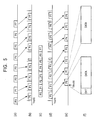
- FIG. 4 shows the arrangement of an original data to be transmitted, and (b) shows the arrangement of the data on the bus during transmission.
- the positions of the data on the bus is defined by time positions separated by cycle time Tcy(0), Tcy(1), etc.
- the data is stored on the storage medium, such as a hard disk, in an arrangement as shown in (c).
- the data read from the storage medium is arranged in time positions separated by cycle time Tcy(0), Tcy(1), etc., as shown in (d).
- the data packets P0, P1, etc. are received at the requested time of arrival Tdec(0), Tdec(1), etc.
- the cycle time Tcy(0) be 12,300 and Tcy(1) be 12,400, and Tdec(0) and Tdec(1), the requested time of arrival of packets P0 and P1 stored in the packets, be 12,600 and 12,680.
- the cycle time Tcy(0) for the packet P0 23,000 and the cycle time Tcy(1) for the packet P1 be 23,100
- a processing similar to that in the first embodiment is performed on DV-format stream packets.
- DV-format packets include an SYT field indicating requested time of arrival only in the packet at the beginning, the other packets not being given any parameter indicating the requested time of arrival.
- SYT field indicates requested time of arrival only in the packet at the beginning
- the other packets not being given any parameter indicating the requested time of arrival.
- Fig. 5 shows a timing diagram wherein the cycle time of the first packet of a frame is indicated by Tcy(0) and the requested time of arrival of that packet is indicated by Tdec(0).
- Tcy(0) the cycle time of the first packet of a frame
- Tdec(0) the requested time of arrival of that packet
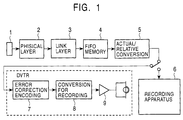
- Data read from the FIFO memory 4 is transferred via a requested time of arrival actual/relative conversion circuit 5, to a DVTR (Digital Video Tape Recorder) or to a recording apparatus 6, such as a hard disk drive, which uses a storage medium in which data storage is not based on the cycle time.
- a DVTR Digital Video Tape Recorder
- a recording apparatus 6 such as a hard disk drive
- the actual/relative conversion circuit 5 When the output of the FIFO memory 4 is transferred to the DVTR, the actual/relative conversion circuit 5 does not operate; thus; the data bypasses the actual/relative conversion circuit 5 and is forwarded to the DVTR.
- the data is processed in the DVTR in accordance with methods known to those skilled in the art.
- the actual/relative conversion circuit 5 operates so as to calculate the relative value between the cycle time and the requested time of arrival. The result is included in the header portion (SPH or SYT) of the data packet and is sent to the recording apparatus 6.
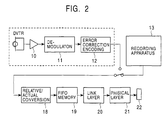
- Fig. 2 shows a block diagram of a playback system, in which the source of video signal is selected to be either a DVTR or a recording apparatus such as a hard disk drive.
- FIFO memory 19 when an FIFO memory 19 receives data from a DVTR, a requested time of arrival relative/actual conversion circuit 18 does not operate; thus the data bypasses the relative/actual conversion circuit 18 and is forwarded to the FIFO memory 19.
- the FIFO memory 19 receives data from a recording apparatus 13 such as a hard disk drive
- the relative/actual conversion circuit operates so as to obtain a requested time of arrival based on the cycle time at that moment and a relative value stored in the header of the data packet.
- the obtained value, together with the data is forwarded to the FIFO memory 19.
- the data stored in the FIFO memory 19 is output via a link layer 20, a physical layer 21, and a cable 22 to an IEEE bus in a manner reverse to that in the recording process.
- the data packets P0, P1, P", etc. transmitted over an IEEE 1394 bus is arrange in a series of time positions as shown in (b) of Fig. 4.
- the time positions are maintained throughout from recording to playback.
- the time positions are recorded in the SPH field of the headers of the packets P0, P1, P2, etc. in terms of relative value.
- the time positions of the packets are obtained based on the relative value and the cycle time at that moment.
- Figs. 1 and 2 are the same as conventional systems compatible with DV-format and IEEE 1394 bus except for the components designated by 5, 6, 13, and 18. Therefore, the video recording apparatus and the video playback apparatus operates equivalently as conventional systems when the actual/relative conversion circuit 5 and the relative/actual conversion circuit 18 are externally disabled. Obviously, when the conversion circuits are enabled, recording and playback are allowed using a storage medium in which storage is not based on cycle time.
Landscapes
- Engineering & Computer Science (AREA)
- Signal Processing (AREA)
- Multimedia (AREA)
- Computer Networks & Wireless Communication (AREA)
- Signal Processing For Digital Recording And Reproducing (AREA)
- Television Signal Processing For Recording (AREA)
- Synchronisation In Digital Transmission Systems (AREA)
- Compression Or Coding Systems Of Tv Signals (AREA)
- Time-Division Multiplex Systems (AREA)
Applications Claiming Priority (2)
| Application Number | Priority Date | Filing Date | Title |
|---|---|---|---|
| JP2000039956A JP2001231036A (ja) | 2000-02-17 | 2000-02-17 | データ・パケット処理方法 |
| JP2000039956 | 2000-02-17 |
Publications (2)
| Publication Number | Publication Date |
|---|---|
| EP1126720A2 true EP1126720A2 (fr) | 2001-08-22 |
| EP1126720A3 EP1126720A3 (fr) | 2008-07-16 |
Family
ID=18563437
Family Applications (1)
| Application Number | Title | Priority Date | Filing Date |
|---|---|---|---|
| EP20010301363 Withdrawn EP1126720A3 (fr) | 2000-02-17 | 2001-02-16 | Méthode du traitement de tampons horodatés lors de l'enregistrement/la lecture |
Country Status (5)
| Country | Link |
|---|---|
| US (1) | US7065291B2 (fr) |
| EP (1) | EP1126720A3 (fr) |
| JP (1) | JP2001231036A (fr) |
| KR (1) | KR100799010B1 (fr) |
| TW (1) | TW529273B (fr) |
Families Citing this family (2)
| Publication number | Priority date | Publication date | Assignee | Title |
|---|---|---|---|---|
| JP2006115315A (ja) * | 2004-10-15 | 2006-04-27 | Fujitsu Ltd | データ転送方法及びデータ転送装置 |
| US8565519B2 (en) | 2007-02-09 | 2013-10-22 | Qualcomm Incorporated | Programmable pattern-based unpacking and packing of data channel information |
Family Cites Families (6)
| Publication number | Priority date | Publication date | Assignee | Title |
|---|---|---|---|---|
| WO1996001540A2 (fr) * | 1994-07-05 | 1996-01-18 | Philips Electronics N.V. | Systeme de traitement de signaux |
| JP3149328B2 (ja) * | 1995-01-09 | 2001-03-26 | 松下電器産業株式会社 | 送信装置と受信装置 |
| ATE196031T1 (de) * | 1995-03-28 | 2000-09-15 | Koninkl Philips Electronics Nv | Aufzeichnung und wiedergabe eines informationssignals mit in dessem seriellen datenstrom unregelmässig als zeitfunktion auftretenden paketen |
| US6069902A (en) * | 1995-06-14 | 2000-05-30 | Matsushita Electric Industrial Co., Ltd. | Broadcast receiver, transmission control unit and recording/reproducing apparatus |
| JP3228708B2 (ja) * | 1998-04-03 | 2001-11-12 | パイオニア株式会社 | 伝送システムにおける受信インターフェース装置 |
| JPH11317748A (ja) * | 1998-05-07 | 1999-11-16 | Pioneer Electron Corp | 伝送システムにおける送信インターフェース装置 |
-
2000
- 2000-02-17 JP JP2000039956A patent/JP2001231036A/ja not_active Abandoned
-
2001
- 2001-02-07 TW TW90102628A patent/TW529273B/zh not_active IP Right Cessation
- 2001-02-15 US US09/784,630 patent/US7065291B2/en not_active Expired - Fee Related
- 2001-02-16 EP EP20010301363 patent/EP1126720A3/fr not_active Withdrawn
- 2001-02-17 KR KR20010007979A patent/KR100799010B1/ko not_active Expired - Fee Related
Also Published As
| Publication number | Publication date |
|---|---|
| JP2001231036A (ja) | 2001-08-24 |
| US7065291B2 (en) | 2006-06-20 |
| TW529273B (en) | 2003-04-21 |
| EP1126720A3 (fr) | 2008-07-16 |
| US20010026680A1 (en) | 2001-10-04 |
| KR20010082728A (ko) | 2001-08-30 |
| KR100799010B1 (ko) | 2008-01-28 |
Similar Documents
| Publication | Publication Date | Title |
|---|---|---|
| EP0703713B1 (fr) | Dispositif pour la réception de paquets | |
| US6211800B1 (en) | Data decoding system and method, transfer device and method, and receiving device and method | |
| US6801544B1 (en) | Method of converting a packetized stream of information signals into a stream of information signals with time stamps and vice versa | |
| US8285113B2 (en) | Method for generating additional information for guaranteeing seamless playback between data streams, recording medium storing the information, and recording, editing and/or playback apparatus using the same | |
| JP3149328B2 (ja) | 送信装置と受信装置 | |
| WO1996034477A1 (fr) | Emetteur de donnees, recepteur de donnees et organe de commande de transmission de donnees | |
| KR19980033031A (ko) | 전송장치 및 방법과 수신장치 및 방법 | |
| US6088366A (en) | Device and method for converting a data transfer rate in communication of digital audio and video data | |
| JP2004104728A (ja) | データ編集可能なビデオカメラ、データ編集、記録プログラム、データ記録装置および記録媒体 | |
| JP3834825B2 (ja) | データ処理システム | |
| JP3558983B2 (ja) | デジタル放送の記録再生装置 | |
| US7039293B1 (en) | Method and electronic equipment for transmitting data to other electronic equipment on a network | |
| US6735223B1 (en) | Method of controlling offset of time stamp and apparatus for transmitting packet using the same | |
| EP0873019B1 (fr) | Dispositif et procédé pour transmettre des données numériques audio et vidéo | |
| US7065291B2 (en) | Method of processing data packets, and video recording/playback apparatus incorporating the method | |
| JPH1173729A (ja) | 記録再生装置 | |
| JP3852725B2 (ja) | データ処理装置及びデータ処理方法並びに再生装置及び再生方法 | |
| JP3263625B2 (ja) | デジタルビデオレコーダ | |
| JP2000041011A (ja) | 情報出力装置および方法、並びに提供媒体 | |
| JP3578156B2 (ja) | パケット受信装置 | |
| JP4577617B2 (ja) | 記録再生装置 | |
| JP2007080353A (ja) | データ通信装置 | |
| JPH0936866A (ja) | データ伝送システムおよびデータ伝送方法 | |
| JP2000228063A (ja) | デジタルデータ記録再生装置 | |
| JPH11331774A (ja) | 画像情報記録再生装置および方法、並びに提供媒体 |
Legal Events
| Date | Code | Title | Description |
|---|---|---|---|
| PUAI | Public reference made under article 153(3) epc to a published international application that has entered the european phase |
Free format text: ORIGINAL CODE: 0009012 |
|
| AK | Designated contracting states |
Kind code of ref document: A2 Designated state(s): AT BE CH CY DE DK ES FI FR GB GR IE IT LI LU MC NL PT SE TR |
|
| AX | Request for extension of the european patent |
Free format text: AL;LT;LV;MK;RO;SI |
|
| PUAL | Search report despatched |
Free format text: ORIGINAL CODE: 0009013 |
|
| AK | Designated contracting states |
Kind code of ref document: A3 Designated state(s): AT BE CH CY DE DK ES FI FR GB GR IE IT LI LU MC NL PT SE TR |
|
| AX | Request for extension of the european patent |
Extension state: AL LT LV MK RO SI |
|
| RIC1 | Information provided on ipc code assigned before grant |
Ipc: H04N 5/765 20060101ALI20080606BHEP Ipc: H04N 7/24 20060101AFI20010613BHEP |
|
| 17P | Request for examination filed |
Effective date: 20080710 |
|
| AKX | Designation fees paid |
Designated state(s): DE FR GB |
|
| STAA | Information on the status of an ep patent application or granted ep patent |
Free format text: STATUS: THE APPLICATION HAS BEEN WITHDRAWN |
|
| 18W | Application withdrawn |
Effective date: 20090903 |