EP1127647A2 - Charge de particules pour liquides d'usinage pour machines à électroérosion, son procédé de fabrication, son utilisation et liquide d'usinage contenant une telle charge - Google Patents
Charge de particules pour liquides d'usinage pour machines à électroérosion, son procédé de fabrication, son utilisation et liquide d'usinage contenant une telle charge Download PDFInfo
- Publication number
- EP1127647A2 EP1127647A2 EP01102285A EP01102285A EP1127647A2 EP 1127647 A2 EP1127647 A2 EP 1127647A2 EP 01102285 A EP01102285 A EP 01102285A EP 01102285 A EP01102285 A EP 01102285A EP 1127647 A2 EP1127647 A2 EP 1127647A2
- Authority
- EP
- European Patent Office
- Prior art keywords
- machining
- microfibers
- carbon
- gaps
- charge
- Prior art date
- Legal status (The legal status is an assumption and is not a legal conclusion. Google has not performed a legal analysis and makes no representation as to the accuracy of the status listed.)
- Granted
Links
Images
Classifications
-
- B—PERFORMING OPERATIONS; TRANSPORTING
- B23—MACHINE TOOLS; METAL-WORKING NOT OTHERWISE PROVIDED FOR
- B23H—WORKING OF METAL BY THE ACTION OF A HIGH CONCENTRATION OF ELECTRIC CURRENT ON A WORKPIECE USING AN ELECTRODE WHICH TAKES THE PLACE OF A TOOL; SUCH WORKING COMBINED WITH OTHER FORMS OF WORKING OF METAL
- B23H1/00—Electrical discharge machining, i.e. removing metal with a series of rapidly recurring electrical discharges between an electrode and a workpiece in the presence of a fluid dielectric
- B23H1/08—Working media
Definitions
- the present invention relates to a particle charge for liquids machining for EDM machines consisting of a dispersion of this charge of particles in a dielectric liquid.
- the known particle charges however have a considerable inhomogeneity of the particle size of the particles whose dimensions vary greatly within a given load type.
- machining performance of these loads then fluctuates strongly and do not allow precise control of the machining parameters of the EDM machine, such as discharge initiation time electroerosives, etc.
- the particle size is highly variable, the number of particles in the gap can vary greatly, even more or less obstruct the latter, in particular in electroerosive finishing machining and of semi-finishing.
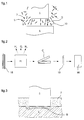
- FIG. 3 illustrates the machining of a workpiece electrode 6 by a tool electrode 5 separated by a working space or gap G filled with a liquid machining 7 comprising a conventional particle charge contained in a dielectric liquid.
- the load could for example be that described in the Patent CH 670 785 consisting of lamellae or flakes of all sizes.
- the most large orient themselves preferentially around the angles and ends of the tool electrode in the vicinity of which the electric field is more important.
- the alignment of the slats in this field gives rise to unwanted overcrowding on the workpiece electrode. These overcrowding are all the more pronounced as the lamellae involved are long.
- the object of the invention is to remedy these drawbacks and to allow machining with high, consistent and predictable performance, even in semi-finishing and finishing machining while ensuring high precision machining. It is characterized for this purpose by the fact that said load is composed of carbon microfibers with a spectrum of lengths predetermined and having a given diameter.
- microfibers are microfibers sectioned. These characteristics ensure machining performance particularly high, constant and controlled and very regular machining without excessively undesired of the workpiece electrode opposite the angles, points and roughness of the tool electrode.
- the carbon microfibers have a length predetermined chosen between 1 and 100 micrometers, preferably between 5 and 20 micrometers, the diameter of the microfibers being between 0.2 and 8 micrometers.
- microfibers having a constant length or statistically controlled allow to obtain a load with optimal characteristics and constants for a given machining. Carbon lends itself particularly well to production of cut microfibers.
- These carbon microfibers are advantageously fibers of polyacrylonitrile pyrolyzed and sectioned. We thus obtain a large consistency in the diameter of the microfibers because the polyacrylonitrile fibers originals have a substantially constant diameter.
- the microfibers are carbon microtubes with closed or open ends.
- the invention also relates to a method for manufacturing a particle charge for machining liquids for EDM machines and characterized for this purpose in that carbon fibers are prepared from polyacrylonitrile fibers by thermal pyrolysis treatment intended to expel the oxygen, hydrogen and nitrogen atoms, the fibers being reduced in size to obtain carbon microfibers having a predetermined length spectrum.
- a preferred embodiment method is characterized in that said predetermined length spectrum of the microfibers is a function of the width of the machining gaps provided for electro-erosion, this range being comprised between 1/10 and 1 time the planned machining gaps, preferably between 1/6 and 1 ⁇ 2 times the gaps of machining preferably provided between 1 ⁇ 4 and 1 ⁇ 2 times the gaps of machining provided.
- microfibers of a perfectly length adapted to the width of the machining gap so that a given number of cut microfibers can occupy the gap between the tool electrode and the workpiece electrode. This helps to control and optimize wear, dimensions, deformation, speed and surface finish of the machining operations.
- the invention also relates to a use of a charge of particles for EDM machining liquids constituted by a dispersion of this charge in a dielectric liquid and it is characterized for this purpose by the fact that one chooses for the machining liquid a load composed of carbon microfibers whose lengths spectrum is a function of the machining gaps provided between a tool electrode and a workpiece electrode and in that the lengths of spectrum is between 1/10 and 1 times the expected machining gaps, preferably between 1/6 and 1 ⁇ 2 times the gaps of machining provided, and preferably between 1 ⁇ 4 and 1 ⁇ 2 times the gaps of machining provided.
- the invention also relates to a machining liquid and is characterized for this purpose by the fact that the concentration of carbon microfibers in the working liquid is between 0.25 and 4 gr / l, preferably between 1 and 2.5 gr / l.
- Figure 1 shows a view through the machining area of a EDM.
- Figure 2 illustrates a diagram of a manufacturing facility for cut carbon microfibers used in the present invention.
- Figure 3 illustrates a view through the machining area with a machining fluid with known charge.
- a tool electrode 5 is separated from a electrode-piece 6 by a machining interval or gap G.
- the two electrodes 5 and 6 are surrounded by a machining liquid 7 comprising a dielectric liquid 8 and a charge 9 of particles continues in this liquid.
- This load is composed of 10 carbon microfibers cut to a predetermined length l with a diameter e and between 0.2 and 8 micrometers.
- the length l of these microfiber sections can be chosen depending on the speed and the machining gap applied.
- the lower and upper limits of the lengths l of the microfibers are between 1 and 100 micrometers, and are most frequently between 5 and 20 micrometers. In fact, use is made of carbon microfibers in pieces having a length of between 1/10 and 1 time the intended machining gap of.
- this length is between 1/6 and 1 ⁇ 2 times the gap of expected machining and is preferably between 1 ⁇ 4 and 1 ⁇ 2 times the gap of expected machining.
- a given load can have either carbon microfibers sectioned of a single constant length l, microfibers of lengths predetermined, but statistically controlled.
- carbon microfibers thus have a spectrum of lengths controlled, for example with Gaussian distribution with a reduced standard deviation, such than a tenth of the average length of microfibers.
- This spectrum could also have more than one maximum and a distribution other than Gaussian, for example asymmetrical.
- carbon microfibers can also be of unique size and geometry.
- dielectric liquid 8 all products can be used conventional, such as water, preferably deionized, hydrocarbons or mixtures of hydrocarbons, mineral oils or silicone oils, polyalcohols, etc.
- Various additives, anti-corrosion agents, surfactants, soaps, emulsifiers can also be added depending on the machining application.
- the concentration of cross-cut carbon microfibers in the liquid machining is advantageously between 0.25 and 4 gr / l, preferably between 1 and 2.5 gr / l.
- This load of microfibers can be present before it is mixed with the dielectric liquid in the form of a powder or also in the form of a charge premixed either liquid with more or less viscosity or pasty with a high concentration of microfibers.
- This liquid or pasty premix allows easy handling of microfibers without this having a pronounced stinging effect. Any pyrolitic risk is further avoided.
- the dosage and suspension of microfibers in the machining fluids are facilitated.
- the cut carbon microfibers 10 can be obtained according to the following manufacturing process.
- fibers are used of polyacrylonitrile 15 (fig. 2). These organic fibers are aligned and stretched parallel to their axis and subjected to a heat treatment between 300 ° C and 550 ° C in an oven H with inert atmosphere. Oxygen, hydrogen atoms and nitrogen are then expelled. Above 500 ° C pyrolysis occurs.
- the fiber final after cooling has a diameter of 4 to 8 micrometers, the most often between 5 to 7 micrometers. It has a carbon composition and a amorphous structure, slightly oriented parallel to the axis of the fiber.
- This carbon fiber is then cut by means of a cut C to a predetermined length either constant or statistically controlled to give a charge or powder with optimal characteristics for a given type of machining.
- cutting device C preferably either a laser device or an electrical or mechanical device.
- the charge thus obtained is packaged 16 as a powder or premix liquid or pasty.
- This charge with cross-sectioned carbon microfibers thus obtained is mixed in the user with the dielectric liquid in concentrations predetermined.
- Cut microfibers are subjected to an electric shock applied between the workpiece electrode and the tool electrode of a EDM by sinking or by wire orientation under the influence of the field electric product similar to that of liquid crystals. They thus reduce the dielectric distance, shortening and unifying priming times or times waiting for erosive discharges.
- the yield or the speed of removal at know the product of the frequency of erosive discharges by the average quantity of material removed during each erosive discharge, and the surface condition obtained are significantly improved compared to known machining fillers and liquids.
- Loads formed of microfibers of constant geometry and dimensions or statistically controlled also guarantee performance in similar or identical machining from one batch to another without drift in time due to supply. Overcrowding or irregularities in removal of material are avoided which ensures precise machining.
- a suitable powder supply or charge device for the area machining allows the best load to be used for a given machining speed.
- microfibers given could contain microfibers of several lengths (l) different predetermined.
- the charge could still contain other particles than carbon microfibers.
- the microfibers manufacturing process could be different and be made from other original substances, for example pitch.
- the process could include a phase during which we grind fibers to obtain non-calibrated microfibers and a sorting and sorting phase calibration in which the fibers are sorted according to their dimensions to obtain a predetermined length spectrum. Sorting of microfibers could be done by all adequate means, such as sieving, selection by gravitation or electrostatic, separation techniques involving surface tension.
- Organic, polyacrylonitrile or other fibers may be completely pyrolyzed or possibly only undergo partial pyrolysis superficial. These fibers can be cut or cut after or also before the pyrolysis phase. Indeed, certain types of fibers may be easier to cut before pyrolysis.
- microfibers may be used in the form of carbon microtubes having closed or open ends. These microtubes could then have finer dimensions, for example a length of a micrometer for a diameter of 0.2 micrometers.
Landscapes
- Engineering & Computer Science (AREA)
- Mechanical Engineering (AREA)
- Electrical Discharge Machining, Electrochemical Machining, And Combined Machining (AREA)
- Lubricants (AREA)
- Soft Magnetic Materials (AREA)
Abstract
Description
- La concentration de particules dans le liquide diélectrique qui présente une valeur optimale pour chaque type de particules ;
- La géométrie des grains, à savoir leur rugosité, leurs dimensions et leur formes.
caractérisée à cet effet en ce que l'on prépare des fibres de carbone à partir fibres de polyacrylonitrile par traitement thermique de pyrolyse destiné à expulser les atomes d'oxygène, d'hydrogène et d'azote, les fibres étant réduites en taille pour obtenir des microfibres de carbone présentant un spectre de longueurs prédéterminé.
Claims (14)
- Charge de particules pour liquides d'usinage (7) pour machine à électroérosion constitués par une dispersion de cette charge (9) de particules dans un liquide diélectrique (8), caractérisée par le fait que ladite charge (9) est composée de microfibres de carbone (10) présentant un spectre de longueurs (l) prédéterminé et un diamètre (e) donné.
- Charge selon la revendication 1, caractérisé en ce que les microfibres de carbone (10) sont des microfibres tronçonnées.
- Charge selon la revendication 1 ou 2, caractérisée par le fait que les microfibres de carbone (10) possèdent une longueur (l) prédéterminée choisie entre 1 et 100 micromètres, le diamètre (e) des microfibres étant compris entre 0,2 et 8 micromètres.
- Charge selon la revendication 2 ou 3, caractérisée par le fait que les microfibres de carbone (10) sont des fibres de polyacrylonitrile pyrolysées et tronçonnées.
- Charge selon la revendication 1, caractérisée par le fait que les microfibres sont des microtubes de carbone présentant des extrémités fermées ou ouvertes.
- Charge selon l'une des revendications 1 à 5, caractérisée par le fait que les microfibres (10) sont associées à un liquide de façon à constituer une charge prémélangée soit liquide concentrée en microfibres soit pâteuse.
- Procédé de fabrication d'une charge de particules selon l'une des revendications 1 à 4 pour liquides d'usinage pour machines à électroérosion, caractérisé en ce que l'on prépare des fibres de carbone à partir de fibres de polyacrylonitrile (15) par traitement thermique de pyrolyse destinée à expulser les atomes d'oxygène, d'hydrogène et d'azote, les fibres étant réduites en taille pour obtenir des microfibres (10) de carbone présentant un spectre de longueurs (l) prédéterminé.
- Procédé selon la revendication 7, caractérisé par le fait que l'on tronçonne les fibres au moyen d'un dispositif de coupe (C), de préférence à laser, électrique ou mécanique.
- Procédé selon la revendication 7, caractérisé par le fait que l'on broie les fibres pour obtenir des microfibres et que l'on effectue un tri dimensionnel des microfibres pour obtenir des microfibres présentant un spectre de longueurs (l) prédéterminé.
- Procédé selon l'une des revendications 7 à 9, caractérisé par le fait que ledit spectre de longueurs prédéterminé des microfibres est une fonction de la largeur des gaps d'usinage (G) prévus pour l'électroérosion, ce spectre étant compris entre 1/10 et 1 fois les gaps d'usinage (G) prévus, avantageusement entre 1/6 et ½ fois les gaps d'usinages prévus, de préférence entre ¼ et ½ fois les gaps d'usinage prévus.
- Utilisation d'une charge (9) de particules selon l'une des revendications 1 à 6 pour liquides d'usinage (7) en électroérosion constitués par une dispersion de cette charge dans un liquide diélectrique (8), caractérisée par le fait que l'on choisit pour le liquide d'usinage (7) une charge (9) composée de microfibres (10) de carbone dont le spectre de longueurs (l) est une fonction des gaps d'usinage (G) prévus entre une électrode-outil (5) et une électrode-pièce (6) et par le fait que ce spectre de longueurs (l) est compris entre 1/10 et 1 fois les gaps d'usinage (G) prévus, avantageusement entre 1/6 et ½ fois les gaps d'usinage prévus, et de préférence entre ¼ et ½ fois les gaps d'usinage prévu.
- Utilisation selon la revendication 11, caractérisée par le fait que l'on emploie pour chaque régime d'usinage successif d'un usinage une charge (9) de microfibres de carbone différente correspondant au régime et aux gaps d'usinage (G) concernés pour lequel la charge (9) présente une efficacité maximum.
- Utilisation selon la revendication 11, caractérisée par le fait que l'on emploie pendant tout l'usinage d'une pièce la charge de microfibres correspondant aux derniers régimes et gaps d'usinage (G) de finition pour lesquels la charge présente l'efficacité maximum.
- Liquide d'usinage pour machine à électroérosion constitué par une dispersion d'une charge (9) de particules telle que définie dans une des revendications 1 à 6 dans un liquide diélectrique (8), caractérisé par le fait que la concentration en micro-fibres (10) de carbone dans le liquide d'usinage (8) est comprise entre 0,25 et 4 gr/l, de préférence entre 1 et 2,5 gr/l.
Applications Claiming Priority (2)
| Application Number | Priority Date | Filing Date | Title |
|---|---|---|---|
| CH3572000 | 2000-02-24 | ||
| CH3572000 | 2000-02-24 |
Publications (3)
| Publication Number | Publication Date |
|---|---|
| EP1127647A2 true EP1127647A2 (fr) | 2001-08-29 |
| EP1127647A3 EP1127647A3 (fr) | 2004-04-07 |
| EP1127647B1 EP1127647B1 (fr) | 2007-05-16 |
Family
ID=4511468
Family Applications (1)
| Application Number | Title | Priority Date | Filing Date |
|---|---|---|---|
| EP01102285A Expired - Lifetime EP1127647B1 (fr) | 2000-02-24 | 2001-02-01 | Charge de particules pour liquides d'usinage pour machines à électroérosion, son procédé de fabrication, son utilisation et liquide d'usinage contenant une telle charge |
Country Status (5)
| Country | Link |
|---|---|
| US (1) | US6538226B2 (fr) |
| EP (1) | EP1127647B1 (fr) |
| JP (1) | JP2001252828A (fr) |
| AT (1) | ATE362415T1 (fr) |
| DE (1) | DE60128412T2 (fr) |
Cited By (1)
| Publication number | Priority date | Publication date | Assignee | Title |
|---|---|---|---|---|
| EP2269756A2 (fr) | 2007-01-16 | 2011-01-05 | Charmilles Technologies S.A. | Procédé et dispositifs conçus pour traiter les défauts de la couche blanche résiduelle résultant du procédé d'usinage à décharge électrique |
Families Citing this family (6)
| Publication number | Priority date | Publication date | Assignee | Title |
|---|---|---|---|---|
| JP2001252828A (ja) * | 2000-02-24 | 2001-09-18 | Charmilles Technol Sa | 放電加工機用加工液の負荷粒子及びその製造方法 |
| EP1837114A1 (fr) * | 2006-03-24 | 2007-09-26 | Siemens Aktiengesellschaft | Liquide d'usinage pour usiner par élecroérosion un materiau non conducteur d'électricité |
| US10189100B2 (en) | 2008-07-29 | 2019-01-29 | Pratt & Whitney Canada Corp. | Method for wire electro-discharge machining a part |
| CN101954517B (zh) * | 2009-07-20 | 2012-07-18 | 财团法人工业技术研究院 | 放电加工液及放电加工方法 |
| CN106270840B (zh) * | 2016-08-23 | 2019-10-29 | 广东工业大学 | 一种放电表面处理用固液两相混合工作介质及其应用 |
| CN110052675B (zh) * | 2019-05-28 | 2020-09-18 | 四川轻化工大学 | 一种电火花加工放电介质及制备方法及表面改性方法 |
Family Cites Families (11)
| Publication number | Priority date | Publication date | Assignee | Title |
|---|---|---|---|---|
| US3816598A (en) * | 1971-05-17 | 1974-06-11 | Lockheed Aircraft Corp | Process for surface treatment of graphite fibers |
| JPS596186B2 (ja) * | 1976-07-29 | 1984-02-09 | 東レ株式会社 | 高剛性繊維のミルドファイバ−製造方法 |
| CH627393A5 (fr) * | 1978-10-05 | 1982-01-15 | Charmilles Sa Ateliers | Procede d'usinage par decharges electriques erosives. |
| JPS5993239A (ja) * | 1982-11-17 | 1984-05-29 | Inoue Japax Res Inc | 放電加工用加工液 |
| US4792653A (en) * | 1986-05-14 | 1988-12-20 | Institute Of Technology Precision Electrical Discharge Works | Electrical discharge machining apparatus including a shield for preventing deformation by temperature |
| CH670785A5 (fr) * | 1987-04-03 | 1989-07-14 | Charmilles Technologies | |
| AU5727290A (en) * | 1989-05-15 | 1990-12-18 | Hyperion Catalysis International | Surface treatment of carbon microfibers |
| US5688392A (en) * | 1995-09-07 | 1997-11-18 | Eltron Research, Inc. | Machining by electrical removal of materials utilizing dispersions of insoluble particles |
| JPH09290327A (ja) * | 1996-02-27 | 1997-11-11 | Mitsubishi Electric Corp | 放電加工装置 |
| US6156256A (en) * | 1998-05-13 | 2000-12-05 | Applied Sciences, Inc. | Plasma catalysis of carbon nanofibers |
| JP2001252828A (ja) * | 2000-02-24 | 2001-09-18 | Charmilles Technol Sa | 放電加工機用加工液の負荷粒子及びその製造方法 |
-
2001
- 2001-01-24 JP JP2001015951A patent/JP2001252828A/ja active Pending
- 2001-02-01 EP EP01102285A patent/EP1127647B1/fr not_active Expired - Lifetime
- 2001-02-01 DE DE60128412T patent/DE60128412T2/de not_active Expired - Lifetime
- 2001-02-01 US US09/774,634 patent/US6538226B2/en not_active Expired - Fee Related
- 2001-02-01 AT AT01102285T patent/ATE362415T1/de not_active IP Right Cessation
Cited By (1)
| Publication number | Priority date | Publication date | Assignee | Title |
|---|---|---|---|---|
| EP2269756A2 (fr) | 2007-01-16 | 2011-01-05 | Charmilles Technologies S.A. | Procédé et dispositifs conçus pour traiter les défauts de la couche blanche résiduelle résultant du procédé d'usinage à décharge électrique |
Also Published As
| Publication number | Publication date |
|---|---|
| EP1127647A3 (fr) | 2004-04-07 |
| EP1127647B1 (fr) | 2007-05-16 |
| ATE362415T1 (de) | 2007-06-15 |
| DE60128412D1 (de) | 2007-06-28 |
| US20010017289A1 (en) | 2001-08-30 |
| US6538226B2 (en) | 2003-03-25 |
| DE60128412T2 (de) | 2008-01-17 |
| JP2001252828A (ja) | 2001-09-18 |
Similar Documents
| Publication | Publication Date | Title |
|---|---|---|
| FR2833875A1 (fr) | Fil pour electroerosion a grande vitesse d'usinage | |
| EP1127647B1 (fr) | Charge de particules pour liquides d'usinage pour machines à électroérosion, son procédé de fabrication, son utilisation et liquide d'usinage contenant une telle charge | |
| CH671726A5 (fr) | ||
| FR2679806A1 (fr) | Electrode en alliage de cuivre a hautes performances pour usinage par electroerosion et procede de fabrication. | |
| EP3038561B1 (fr) | Instrument endodontique à surfaces rugueuses, et procédé de fabrication d'un tel instrument | |
| FR2522988A1 (fr) | Broyeur a moudre a haut rendement de particules ultra-fines | |
| EP0955396B1 (fr) | Procédé et dispositif pour la fabrication d'un fil électrode pour électroérosion | |
| CH691036A5 (fr) | Dispositif de sciage par fil pour la découpe de tranches fines comprenant un mécanisme pour le taillage in situ des gorges des cylindres guide-fils. | |
| EP3052444B1 (fr) | Procédé pour la désoxydation du silicium | |
| EP0314711A1 (fr) | Liquide pour usinage edm | |
| FR2598955A1 (fr) | Procede et dispositif de rectification plane de pieces en materiaux cassants | |
| CH627393A5 (fr) | Procede d'usinage par decharges electriques erosives. | |
| EP3489196A1 (fr) | Procédé et dispositif pour alimenter un bain de silicium liquide en particules de silicium solides | |
| FR2655904A1 (fr) | Systeme de decoupe de corps solides du type "a cable". | |
| FR3068276B1 (fr) | Support a la decoupe par fil a abrasifs lies comportant un assemblage de materiaux differents | |
| FR2948589A1 (fr) | Rodoir a pierre abrasive et procede de rodage mettant en oeuvre ce rodoir | |
| FR2805768A1 (fr) | Procede de superfinition de pieces a surface cylindrique | |
| CH665380A5 (en) | Cutting machine for brittle materials e.g. during electronic component - has cutting wire(s) driven by roller system to engage workpiece in abrasive liquid bath | |
| EP1216778B1 (fr) | Dispositif de purification de liquides d'usinage pour machines à életroérosion | |
| WO2015189083A1 (fr) | Procédé pour fabriquer un lingot d'acier faiblement allié | |
| FR2833874A1 (fr) | Fil pour electroerosion a grande vitesse d'usinage | |
| EP4444495A2 (fr) | Electrode-outil apte à la réalisation par edm de fentes d'étanchéité sur un matériau cmc | |
| CH341926A (fr) | Outil pour l'usinage électrolytique et procédé de fabrication de cet outil | |
| FR2597773A3 (fr) | Meule de rectification | |
| FR3116219A1 (fr) | Système et procédé pour former des éléments dans des composants en composite en utilisant une électrode tubulaire |
Legal Events
| Date | Code | Title | Description |
|---|---|---|---|
| PUAI | Public reference made under article 153(3) epc to a published international application that has entered the european phase |
Free format text: ORIGINAL CODE: 0009012 |
|
| AK | Designated contracting states |
Kind code of ref document: A2 Designated state(s): AT BE CH CY DE DK ES FI FR GB GR IE IT LI LU MC NL PT SE TR |
|
| AX | Request for extension of the european patent |
Free format text: AL;LT;LV;MK;RO;SI |
|
| PUAL | Search report despatched |
Free format text: ORIGINAL CODE: 0009013 |
|
| AK | Designated contracting states |
Kind code of ref document: A3 Designated state(s): AT BE CH CY DE DK ES FI FR GB GR IE IT LI LU MC NL PT SE TR |
|
| AX | Request for extension of the european patent |
Extension state: AL LT LV MK RO SI |
|
| RIC1 | Information provided on ipc code assigned before grant |
Ipc: 7B 23K 1/08 A Ipc: 7B 23H 7/34 B Ipc: 7B 23H 1/08 B |
|
| 17P | Request for examination filed |
Effective date: 20040811 |
|
| AKX | Designation fees paid |
Designated state(s): AT BE CH CY DE DK ES FI FR GB GR IE IT LI LU MC NL PT SE TR |
|
| GRAP | Despatch of communication of intention to grant a patent |
Free format text: ORIGINAL CODE: EPIDOSNIGR1 |
|
| GRAS | Grant fee paid |
Free format text: ORIGINAL CODE: EPIDOSNIGR3 |
|
| GRAA | (expected) grant |
Free format text: ORIGINAL CODE: 0009210 |
|
| AK | Designated contracting states |
Kind code of ref document: B1 Designated state(s): AT BE CH CY DE DK ES FI FR GB GR IE IT LI LU MC NL PT SE TR |
|
| PG25 | Lapsed in a contracting state [announced via postgrant information from national office to epo] |
Ref country code: FI Free format text: LAPSE BECAUSE OF FAILURE TO SUBMIT A TRANSLATION OF THE DESCRIPTION OR TO PAY THE FEE WITHIN THE PRESCRIBED TIME-LIMIT Effective date: 20070516 |
|
| REG | Reference to a national code |
Ref country code: GB Ref legal event code: FG4D Free format text: NOT ENGLISH |
|
| REG | Reference to a national code |
Ref country code: CH Ref legal event code: EP |
|
| REG | Reference to a national code |
Ref country code: IE Ref legal event code: FG4D Free format text: LANGUAGE OF EP DOCUMENT: FRENCH |
|
| REF | Corresponds to: |
Ref document number: 60128412 Country of ref document: DE Date of ref document: 20070628 Kind code of ref document: P |
|
| PG25 | Lapsed in a contracting state [announced via postgrant information from national office to epo] |
Ref country code: SE Free format text: LAPSE BECAUSE OF FAILURE TO SUBMIT A TRANSLATION OF THE DESCRIPTION OR TO PAY THE FEE WITHIN THE PRESCRIBED TIME-LIMIT Effective date: 20070816 |
|
| PG25 | Lapsed in a contracting state [announced via postgrant information from national office to epo] |
Ref country code: ES Free format text: LAPSE BECAUSE OF FAILURE TO SUBMIT A TRANSLATION OF THE DESCRIPTION OR TO PAY THE FEE WITHIN THE PRESCRIBED TIME-LIMIT Effective date: 20070827 |
|
| GBT | Gb: translation of ep patent filed (gb section 77(6)(a)/1977) |
Effective date: 20070809 |
|
| NLV1 | Nl: lapsed or annulled due to failure to fulfill the requirements of art. 29p and 29m of the patents act | ||
| PG25 | Lapsed in a contracting state [announced via postgrant information from national office to epo] |
Ref country code: AT Free format text: LAPSE BECAUSE OF FAILURE TO SUBMIT A TRANSLATION OF THE DESCRIPTION OR TO PAY THE FEE WITHIN THE PRESCRIBED TIME-LIMIT Effective date: 20070516 |
|
| REG | Reference to a national code |
Ref country code: IE Ref legal event code: FD4D |
|
| PG25 | Lapsed in a contracting state [announced via postgrant information from national office to epo] |
Ref country code: PT Free format text: LAPSE BECAUSE OF FAILURE TO SUBMIT A TRANSLATION OF THE DESCRIPTION OR TO PAY THE FEE WITHIN THE PRESCRIBED TIME-LIMIT Effective date: 20071016 Ref country code: IE Free format text: LAPSE BECAUSE OF FAILURE TO SUBMIT A TRANSLATION OF THE DESCRIPTION OR TO PAY THE FEE WITHIN THE PRESCRIBED TIME-LIMIT Effective date: 20070516 Ref country code: DK Free format text: LAPSE BECAUSE OF FAILURE TO SUBMIT A TRANSLATION OF THE DESCRIPTION OR TO PAY THE FEE WITHIN THE PRESCRIBED TIME-LIMIT Effective date: 20070516 Ref country code: NL Free format text: LAPSE BECAUSE OF FAILURE TO SUBMIT A TRANSLATION OF THE DESCRIPTION OR TO PAY THE FEE WITHIN THE PRESCRIBED TIME-LIMIT Effective date: 20070516 |
|
| PLBE | No opposition filed within time limit |
Free format text: ORIGINAL CODE: 0009261 |
|
| STAA | Information on the status of an ep patent application or granted ep patent |
Free format text: STATUS: NO OPPOSITION FILED WITHIN TIME LIMIT |
|
| 26N | No opposition filed |
Effective date: 20080219 |
|
| PG25 | Lapsed in a contracting state [announced via postgrant information from national office to epo] |
Ref country code: GR Free format text: LAPSE BECAUSE OF FAILURE TO SUBMIT A TRANSLATION OF THE DESCRIPTION OR TO PAY THE FEE WITHIN THE PRESCRIBED TIME-LIMIT Effective date: 20070817 |
|
| BERE | Be: lapsed |
Owner name: CHARMILLES TECHNOLOGIES S.A. Effective date: 20080228 |
|
| REG | Reference to a national code |
Ref country code: CH Ref legal event code: PL |
|
| PG25 | Lapsed in a contracting state [announced via postgrant information from national office to epo] |
Ref country code: MC Free format text: LAPSE BECAUSE OF NON-PAYMENT OF DUE FEES Effective date: 20080228 Ref country code: LI Free format text: LAPSE BECAUSE OF NON-PAYMENT OF DUE FEES Effective date: 20080229 Ref country code: CH Free format text: LAPSE BECAUSE OF NON-PAYMENT OF DUE FEES Effective date: 20080229 |
|
| PG25 | Lapsed in a contracting state [announced via postgrant information from national office to epo] |
Ref country code: BE Free format text: LAPSE BECAUSE OF NON-PAYMENT OF DUE FEES Effective date: 20080228 |
|
| PG25 | Lapsed in a contracting state [announced via postgrant information from national office to epo] |
Ref country code: CY Free format text: LAPSE BECAUSE OF FAILURE TO SUBMIT A TRANSLATION OF THE DESCRIPTION OR TO PAY THE FEE WITHIN THE PRESCRIBED TIME-LIMIT Effective date: 20070516 |
|
| PG25 | Lapsed in a contracting state [announced via postgrant information from national office to epo] |
Ref country code: LU Free format text: LAPSE BECAUSE OF NON-PAYMENT OF DUE FEES Effective date: 20080201 |
|
| PG25 | Lapsed in a contracting state [announced via postgrant information from national office to epo] |
Ref country code: TR Free format text: LAPSE BECAUSE OF FAILURE TO SUBMIT A TRANSLATION OF THE DESCRIPTION OR TO PAY THE FEE WITHIN THE PRESCRIBED TIME-LIMIT Effective date: 20070516 |
|
| PGFP | Annual fee paid to national office [announced via postgrant information from national office to epo] |
Ref country code: IT Payment date: 20110221 Year of fee payment: 11 Ref country code: DE Payment date: 20110218 Year of fee payment: 11 Ref country code: FR Payment date: 20110302 Year of fee payment: 11 |
|
| PGFP | Annual fee paid to national office [announced via postgrant information from national office to epo] |
Ref country code: GB Payment date: 20110217 Year of fee payment: 11 |
|
| GBPC | Gb: european patent ceased through non-payment of renewal fee |
Effective date: 20120201 |
|
| REG | Reference to a national code |
Ref country code: FR Ref legal event code: ST Effective date: 20121031 |
|
| PG25 | Lapsed in a contracting state [announced via postgrant information from national office to epo] |
Ref country code: IT Free format text: LAPSE BECAUSE OF NON-PAYMENT OF DUE FEES Effective date: 20120201 |
|
| REG | Reference to a national code |
Ref country code: DE Ref legal event code: R119 Ref document number: 60128412 Country of ref document: DE Effective date: 20120901 |
|
| PG25 | Lapsed in a contracting state [announced via postgrant information from national office to epo] |
Ref country code: GB Free format text: LAPSE BECAUSE OF NON-PAYMENT OF DUE FEES Effective date: 20120201 Ref country code: FR Free format text: LAPSE BECAUSE OF NON-PAYMENT OF DUE FEES Effective date: 20120229 |
|
| PG25 | Lapsed in a contracting state [announced via postgrant information from national office to epo] |
Ref country code: DE Free format text: LAPSE BECAUSE OF NON-PAYMENT OF DUE FEES Effective date: 20120901 |