EP1127949A2 - Alliage à base de TiAl, un procédé d'obtention et pale de rotor utilisant celui-ci - Google Patents
Alliage à base de TiAl, un procédé d'obtention et pale de rotor utilisant celui-ci Download PDFInfo
- Publication number
- EP1127949A2 EP1127949A2 EP01104189A EP01104189A EP1127949A2 EP 1127949 A2 EP1127949 A2 EP 1127949A2 EP 01104189 A EP01104189 A EP 01104189A EP 01104189 A EP01104189 A EP 01104189A EP 1127949 A2 EP1127949 A2 EP 1127949A2
- Authority
- EP
- European Patent Office
- Prior art keywords
- based alloy
- tial based
- phase
- temperature
- atomic
- Prior art date
- Legal status (The legal status is an assumption and is not a legal conclusion. Google has not performed a legal analysis and makes no representation as to the accuracy of the status listed.)
- Granted
Links
Images



Classifications
-
- B—PERFORMING OPERATIONS; TRANSPORTING
- B21—MECHANICAL METAL-WORKING WITHOUT ESSENTIALLY REMOVING MATERIAL; PUNCHING METAL
- B21J—FORGING; HAMMERING; PRESSING METAL; RIVETING; FORGE FURNACES
- B21J1/00—Preparing metal stock or similar ancillary operations prior, during or post forging, e.g. heating or cooling
- B21J1/02—Preliminary treatment of metal stock without particular shaping, e.g. salvaging segregated zones, forging or pressing in the rough
- B21J1/025—Preliminary treatment of metal stock without particular shaping, e.g. salvaging segregated zones, forging or pressing in the rough affecting grain orientation
-
- B—PERFORMING OPERATIONS; TRANSPORTING
- B21—MECHANICAL METAL-WORKING WITHOUT ESSENTIALLY REMOVING MATERIAL; PUNCHING METAL
- B21K—MAKING FORGED OR PRESSED METAL PRODUCTS, e.g. HORSE-SHOES, RIVETS, BOLTS OR WHEELS
- B21K3/00—Making engine or like machine parts not covered by sub-groups of B21K1/00; Making propellers or the like
- B21K3/04—Making engine or like machine parts not covered by sub-groups of B21K1/00; Making propellers or the like blades, e.g. for turbines; Upsetting of blade roots
-
- C—CHEMISTRY; METALLURGY
- C22—METALLURGY; FERROUS OR NON-FERROUS ALLOYS; TREATMENT OF ALLOYS OR NON-FERROUS METALS
- C22C—ALLOYS
- C22C14/00—Alloys based on titanium
-
- C—CHEMISTRY; METALLURGY
- C22—METALLURGY; FERROUS OR NON-FERROUS ALLOYS; TREATMENT OF ALLOYS OR NON-FERROUS METALS
- C22C—ALLOYS
- C22C21/00—Alloys based on aluminium
-
- C—CHEMISTRY; METALLURGY
- C22—METALLURGY; FERROUS OR NON-FERROUS ALLOYS; TREATMENT OF ALLOYS OR NON-FERROUS METALS
- C22F—CHANGING THE PHYSICAL STRUCTURE OF NON-FERROUS METALS AND NON-FERROUS ALLOYS
- C22F1/00—Changing the physical structure of non-ferrous metals or alloys by heat treatment or by hot or cold working
- C22F1/04—Changing the physical structure of non-ferrous metals or alloys by heat treatment or by hot or cold working of aluminium or alloys based thereon
Definitions
- the present invention relates to TiAl based alloys, a production process therefor, and a rotor blade using the same.
- TiAl based alloys being lightweight (specific gravity of about 4) and having excellent heat-resistance, are attracting much attention.
- the centrifugal stress becomes smaller, thus enabling improvement in the maximum attainable rpm, an increase in blade area, and a decrease in applied stress on the disk portion.
- This TiAl based alloy is an alloy composed mainly of TiAl and Ti 3 Al, which is an intermetallic compound having excellent high temperature strength. As described above, it has excellent heat resistance, but has a problem in that ductility at room temperature is poor. Therefore, various measures have been heretofore taken, such as control of the microsstructure or ternary addition. For example, in Japanese Unexamined Patent Application, First Publication No. Hei 6-49565, there is disclosed a technique in which Cr or V is added as the ternary addition, in order to improve the ductility of the TiAl based alloy at normal temperature.
- a laminated structure (lamellar structure) region obtained by alternately laminating the TiAl phase and the Ti 3 Al phase is formed in a matrix structure in order to improve the strength.
- Kim Young-Won Kim. Intermetallics. (6) 1998 pp. 623-628
- Kim has reported that in a TiAl alloy having a lamellar grain with a mean grain diameter of from 30 to 3000 ⁇ m, as the mean grain diameter of the lamellar grains increases, the ductility and tensile stress at a room temperature decrease.
- the TiAl based alloy has been heretofore produced by casting.
- the casting structure is generally large, and there is a tendency for the impact property of a material to decrease further.
- production of small parts such as vehicle parts is relatively easy.
- production of large parts has been difficult due to problems with flowability of the molten metal in the mold.
- isothermal forging is also commonly used as a forging method of the TiAl based alloy.
- the present inventors consider that it is essential to form the above described lamellar grains in the matrix, sin order to improve the strength of the TiAl based alloy. Based on this assumption, the present inventors have changed the mean grain diameter of the lamellar grains to various sizes, and have found that the ductility at room temperature, in particular, the impact property can be greatly improved for a predetermined mean grain diameter, thereby concluding the present invention.
- the present invention is in conceiving as a method for reducing the mean grain diameter of the lamellar structure, one wherein a TiAl based alloy material is held in an equilibrium temperature range of an ⁇ phase or in an equilibrium temperature range of an ( ⁇ + ⁇ ) phase, and then the material is subjected to high-speed plastic working in the cooling process thereafter.
- the invention is also in finding a specific method for this method.
- the TiAl based alloy of the present invention is characterized by having a fine structure in which lamellar grains having a mean grain diameter of from 1 to 50 ⁇ m are closely arranged, with an ⁇ 2 phase and a ⁇ phase being laminated therein alternately.
- the TiAl based alloy of the present invention is characterized by two kinds of fine structures, one being a structure form (hereinafter, referred to as "structure 1") in which lamellar grains having a mean grain diameter of from 1 to 50 ⁇ m are closely arranged, with the ⁇ 2 phase and the ⁇ phase being laminated therein alternately, and the other being a structure form (hereinafter, referred to as "structure 2") in which a matrix composed mainly of a ⁇ phase fills the gaps between the lamellar grains in the form of net work, and the ratio of this matrix is not smaller than 10% and not larger than 40%.
- structure 1 structure form
- structure 2 structure form in which a matrix composed mainly of a ⁇ phase fills the gaps between the lamellar grains in the form of net work, and the ratio of this matrix is not smaller than 10% and not larger than 40%.
- the strength is improved by means of the lamellar grains themselves formed in the metal structure, and since the lamellar grains having a small grain diameter distribute closely and finely, ductility at room temperature, in particular, impact resistance is improved.
- the structure 1 since the high temperature strength increases, it can be used as a turbine blade of a gas turbine or'the like.
- high temperature deformability is improved due to the effect of the ⁇ phase between the lamellar grains, making plastic working easy.
- the creep strength slightly decreases. Therefore, it can be used as a turbine blade of a steam turbine or the like having a low upper limit for the operating temperature.
- one of the TiAl based alloys of the present invention may be a TiAl based alloy having a composition comprising 40 to 48 atomic % of Al, 5 to 10 atomic % of one or more kinds selected from Cr and V, with the remainder being Ti and inevitable impurities.
- the TiAl based alloy having this composition has an equilibrium range of ⁇ phase or ( ⁇ + ⁇ ) phase, which is wide at a high temperature.
- this TiAl based alloy is easily subjected to high-speed plastic working, and becomes a fine microstructure in which lamellar grains are closely arranged.
- the structure 1 can be obtained by holding the TiAl based alloy in the ⁇ region, and the structure 2 can be obtained by holding the TiAl based alloy in the ( ⁇ + ⁇ ) region.
- Another TiAl based alloy of the present invention may be a TiAl based alloy having a composition comprising 38 to 48 atomic % of Al, 4 to 10 atomic % of Mn, with the remainder being Ti and inevitable impurities. Also in the TiAl based alloy having this composition, the high-temperature equilibrium range of the ⁇ phase or ( ⁇ + ⁇ ) phase exists, and similarly, by holing the TiAl based alloy in the ⁇ region, the structure 1 can be obtained, and by holing the TiAl based alloy in the ( ⁇ + ⁇ ) region, the structure 2 can be obtained. With this structure, since the structure 1 and structure 2 are less hard than the above described TiAl based alloy, the machinability and impact resistance are improved. However, the high temperature strength slightly decreases. Therefore, the structure 1 and structure 2 are suitable for applications where this TiAl based alloy is used at a slightly lower temperature than the above described TiAl based alloy.
- An other TiAl based alloy of the present invention is a TiAl based alloy relating to the above described two kinds of TiAl based alloys, further containing one or more kinds of elements selected from the group consisting of C, Si, Ni, W, Nb, B, Hf, Ta, and Zr in an amount of from 0.1 to 3 atomic % in total.
- the high temperature strength, the creep strength and the oxidation resistance can be increased.
- the TiAl based alloy of the present invention has a Charpy impact value specified in JIS-Z2242, of 3J or higher at a room temperature, and 5J or higher is also achievable at room temperature, according to conditions. Since this TiAl based alloy has such excellent impact value, if it is used for the turbine blades of an engine turbocharger or various types of turbine, it becomes possible to improve turbine efficiency due to the increase in rpm, and to contribute to lightening the weight, while maintaining durability against impact, that is, reliability.
- a method for obtaining the structure 1 described above which is one method for obtaining the TiAl based alloy of the present invention, is a production method of a TiAl based alloy characterized by comprising: a step for holding a TiAl based alloy material containing Al at least in an amount of from 43 to 48 atomic % in an equilibrium temperature range of an ⁇ phase; and a step for subjecting the TiAl based alloy material held at that temperature to high-speed plastic working, while cooling the material to a predetermined working terminal temperature.
- the lower limit of the equilibrium temperature range of the ⁇ phase of the TiAl based alloy containing Al in an amount of from 43 to 48 atomic % ranges from 1150°C to 1250°C depending on the composition. Therefore, after the TiAl based alloy is held in the equilibrium temperature range of the ⁇ phase of from 1230°C to 1400°C, the TiAl based alloy is subjected to high-speed plastic working, while being cooled to 1200°C which is the terminal temperature of the high-speed plastic working, and distortion which becomes the starting point for the formation of lamellar grains is given to thereby obtain a fine structure.
- the adequate cooling rate at this time is from 50 to 700°C/min.
- a forging process, a rolling process or the like can be used as the above described high temperature plastic working.
- the TiAl based alloy material may be held at the above described holding temperature with the material being covered with a thermal insulation material, and then the TiAl based alloy may be subjected to high-speed plastic working, together with the thermal insulation material.
- a method for obtaining the structure 2 described above which is an other method for obtaining the TiAl based alloy of the present invention, is a production method of a TiAl based alloy characterized by comprising: a step for holding a TiAl based alloy material containing Al at least in an amount of from 38 to 44 atomic % in an equilibrium temperature range of a ( ⁇ + ⁇ ) phase; and a step for subjecting the TiAl based alloy material held at that temperature to high-speed plastic working, while cooling the material to a predetermined working terminal temperature.
- the lower limit of the equilibrium temperature range of the ( ⁇ + ⁇ ) phase of the TiAl based alloy containing Al in an amount of from 38 to 44 atomic % ranges from 1120°C to 1220°C depending on the composition. Therefore, after the TiAl based alloy is held in the equilibrium temperature range of the ( ⁇ + ⁇ ) phase of from 1000°C to 1300°C, the TiAl based alloy is subjected to plastic working, while being cooled to 1120°C which is the terminal working temperature, and distortion which becomes the starting point for the formation of lamellar grains is given to thereby obtain a fine structure.
- the adequate cooling rate in this case is similarly from 50 to 700°C/min.
- a forging process, a rolling process or the like can be used as the above described high temperature plastic working.
- the blade of the present invention is a blade using the TiAl based alloy obtained in the above described manner, having excellent ductility, and in particular, excellent impact properties.
- the blade using such a material has an excellent impact value. As a result, if it is used for a turbine blade of a turbocharger or various types of turbine, it becomes possible to improve turbine efficiency due to the increase in rpm, and to contribute to lightening the weight, while maintaining reliability.
- the TiAl based alloy of the present invention has a close arrangement of lamellar grains having a small grain diameter. Hence the metal microstructure becomes fine, to thereby improve the strength as well as toughness at room temperature, and in particular, impact properties.
- the production method of the TiAl based alloy according to the present invention when the TiAl based alloy material is cooled from the equilibrium temperature range of the ⁇ phase or the equilibrium temperature range of the ( ⁇ + ⁇ ) phase, distortion which becomes the starting point for the occurrence of lamellar grains is introduced into the matrix by high-speed plastic working. As a result, lamellar grains can be made fine. In addition, since the material is cooled at a relatively high speed after having been subjected to high-speed plastic working, the lamellar spacing in the lamellar structure can be made small.
- the plastic workability at high temperatures is also improved, by holding the material in the ( ⁇ + ⁇ ) region.
- the material can be processed in normal industrial press, thereby making the TiAl based alloy material industrially advantageous.
- a TiAl based alloy having excellent high temperature strength can be obtained, and if Mn is used, though the high temperature strength decreases, a TiAl based alloy having improved toughness and machinability can be obtained.
- the blade according to the present invention has excellent impact resistance and strength, if this is used as a turbine blade for aircraft and ships, or for various industrial machines, such as gas turbines or steam turbines, it will be useful for improving the performance of the turbine and for lightening the weight.
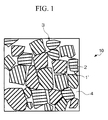
- FIG. 1 is a diagram showing a microstructure of a TiAl based alloy in the structure 1 of the present invention.
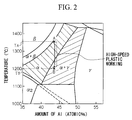
- FIG. 2 is a phase diagram for explaining a process of the formation of a lamellar structure of a TiAl based alloy of the present invention.
- FIGS. 3A to 3C are diagrams showing the change in the microstructure in each step.
- FIG. 4 is a phase diagram of a TiAl based alloy in a ternary compound system of the present invention.
- FIG. 5 is a photograph showing an electron microscopic structure of a TiAl based alloy in the structure 1 of the present invention.
- FIG. 6 is a photograph showing an electron microscopic structure of the TiAl based alloy in the structure 1 of the present invention, with the magnification being changed.
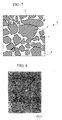
- FIG. 7 is a diagram showing a microstructure of a TiAl based alloy in the structure 2 of the present invention.
- FIG. 8 is a photograph showing an electron microscopic structure of a TiAl based alloy in the structure 2 of the present invention.
- FIGS. 9A to 9D are process diagrams showing one example of a method of producing the TiAl based alloy of the present invention.
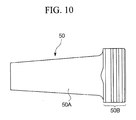
- FIG. 10 is a perspective view showing a blade of the present invention.
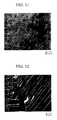
- FIG. 11 is a photograph showing an electron microscopic structure in a comparative example 2.
- FIG. 12 is a photograph showing an electron microscopic structure in the comparative example 2, with the magnification being changed.
- FIG. 1 is a diagram of a microstructure of the TiAl based alloy in the structure 1 described above.
- the TiAl based alloy 10 has a microstructure in which lamellar grains 3 having a mean grain diameter of from 1 to 50 ⁇ m are closely arranged, and a matrix 4 is formed between each lamellar grain 3.
- the lamellar grains 3 comprise a so-called lamellar structure in which ⁇ 2 phase (Ti 3 Al) 1' and ⁇ phase (TiAl) 2 are alternately laminated, and the lamination direction in each lamellar grain 3 is respectively different.
- the matrix 4 is composed mainly of the ⁇ phase. It is considered that since cracks occurring in the material become zigzag due to the lamellar structure having different lamination directions, the cracks hardly progress, thereby improving the toughness and strength of the material.
- a feature in the microstructure is that the lamellar grains having a mean grain diameter of from 1 to 50 ⁇ m are closely arranged. More preferably, if the lamellar grains having a mean grain diameter of from 1 to 30 ⁇ m are closely arranged, the microstructure becomes finer, thereby improving ductility (impact property) at low temperatures. Moreover, if lamellar grains having a grain diameter of 20 ⁇ m or less are contained in an amount of 40% or more among all lamellar grains, this is more preferable from the view of making the microstructure finer, and improving ductility (impact property).
- the "mean grain diameter" in the present invention is measured by a method specified in JIS-G0552.
- “Closely arranged” in the present invention refers to a state in which when each lamellar grain is uniformly arranged in the microstructure, each lamellar grain comes relatively close, and specifically, it is defined as a state where the area ratio of the lamellar grains occupying is 60% or more, as seen in section of the microstructure.
- the rims of lamellar grains adjacent to each other in the course of growth of each lamellar grain collide with each other or come close to each other, and the matrix 4 is forced into narrow regions between adjacent lamellar grains.
- the matrix 4 alone does not occupy a large area (for example, an area corresponding to a lamellar grain having a mean grain diameter of 5 ⁇ m).
- the mean grain diameter of the lamellar grains less than 1 ⁇ m, and if the mean grain diameter exceeds 50 ⁇ m, ductility at room temperature, and in particular, impact properties decrease.
- the lamellar grains having a mean grain diameter of from 1 to 50 ⁇ m, more preferably, lamellar grains having the mean grain diameter of from 1 to 30 ⁇ m are closely formed in the microstructure, the strength is improved by means of the lamellar grain itself. Furthermore, since lamellar grains having a small grain diameter come close to each other, the metal structure becomes fine, thereby improving toughness at room temperature, and in particular, impact properties.
- cooling is performed at a predetermined cooling speed, after hot forging, and this cooling speed is higher compared to a case, such as normal heat treatment, where cooling is gradually performed in a furnace.
- this cooling speed is higher compared to a case, such as normal heat treatment, where cooling is gradually performed in a furnace.
- the gap between the adjacent ⁇ 2 phase and ⁇ phase becomes narrower.
- an effect that the strength is improved can be also obtained.
- the impact property of the TiAl based alloy of the present invention is expressed by a Charpy impact value at room temperature, which is specified in JIS-Z2242, it is possible to make the value 3J or higher, or 5J or higher according to the conditions.
- FIG. 2 is for explaining each step corresponding to a phase diagram of a binary system of TiAl
- FIGS. 3A to 3C show the change in the microstructure in each step.
- the TiAl based alloy material having a predetermined composition, containing Al in an amount of from 43 to 48 atomic % is held at a temperature T A within a range of from 1230 to 1400°C, which is the equilibrium temperature range of the ⁇ phase (step A) .
- the material is subjected to high-speed plastic working, while being cooled from the holding temperature T A to the terminal temperature T B of the high-speed plastic working (step B).
- the production method of the present invention can be said to be a kind of thermomechanical treatment, in terms of cooling the material from the ⁇ region to cause a phase transformation to a lamellar structure, and at the same time, performing plastic working.
- the microstructure formed in each step A and B in this manner will be described based on FIGS. 3A to 3C.
- step A being held at a temperature T A within a range of from 1230 to 1400°C, which is the equilibrium temperature range of the ⁇ phase
- the microstructure consists of a single phase of ⁇ phase 1 being in the equilibrium state, and each ⁇ phase 1 is a relatively large grain (FIG. 3A).
- step B before reaching the ( ⁇ + ⁇ ) phase in the equilibrium state, that is, in the state of ⁇ single phase or microstructure that some ⁇ phase is precipitated from the ⁇ phase, high-speed plastic working is performed immediately, and at this time, lots of distortions t are introduced into the microstructure.
- step B being the final stage of plastic working, before each lamellar grain 3 is fully grown, grain growth is hindered at a point of time when the adjacent lamellar grains 3 compete. As a result, a fine structure in which lots of lamellar grains 3 having a small grain diameter cluster together can be obtained.
- the matrix between the lamellar grains is composed mainly of the ⁇ phase.
- the TiAl based alloy of a binary system With the TiAl based alloy of a binary system, mechanical properties become favorable at Al concentrations of from 45 to 48 atomic %. As shown in FIG. 2 however, the temperature in the ⁇ phase region of the TiAl based alloy having such a component exceeds 1300°C, and it may be industrially difficult to hold the material at this temperature due to limitations in the performance of the heating furnace. Therefore, in such a case, the composition of the TiAl based alloy is changed, and the equilibrium temperature range of the ⁇ phase is decreased, utilizing the change of the phase diagram.
- a TiAl based alloy of a multicomponent system comprising 43 to 48 atomic % of Al, 5 to 10 atomic % of one or more kinds selected from Cr and V, with the remainder being Ti and inevitable impurities is used.
- Cr atomic %
- V atomic %
- the lower limit of the ⁇ phase in the equilibrium temperature range drops.
- phase diagram of the ternary alloy with added Cr or V is shown in FIG. 4.
- the region represented by the broken line in the phase diagram of the figure shows the case for Ti-Al-Cr alloy (Cr : 10 atomic %), and the region represented by the solid line in the figure shows the case for Ti-Al-V alloy (V : 10 atomic %).
- the lowest temperature in the equilibrium region of the ⁇ phase of the Ti-Al-Cr alloy is about 1250°C, and the ⁇ phase exists as a stable phase above this temperature.
- the lowest temperature in the ⁇ phase region of the Ti-Al-V alloy is about 1150°C, and the ⁇ phase exists as a stable phase above this temperature. Therefore, if a multicomponent system TiAl based alloy containing the above described respective components is used, the holding temperature of the ⁇ phase in the equilibrium region can be made 1300°C or less. Hence this is industrially advantageous in that a general heating furnace can be used.
- ternary TiAl based alloys have a characteristic that the ⁇ phase is also stable in addition to the ⁇ phase, on the temperature lower than the limit of the ⁇ phase in the equilibrium temperature range.
- the ⁇ phase is first precipitated from the ⁇ phase, the finally formed microstructure is almost the lamellar structure, and the ⁇ phase slightly exists together with the ⁇ phase in part of the matrix. This ⁇ phase becomes an ordered B2 structure at low temperatures.
- FIG. 5 The microstructure of the TiAl based alloy of the present invention having such a composition is shown in FIG. 5 and FIG. 6.
- an electron microscopic structure of a TiAl based alloy containing 45 atomic % of Al, and 10 atomic % of V is such that lamellar grains having a small mean grain diameter are closely arranged, and a black or white matrix is formed between each lamellar grain.
- FIG. 6 shows an electron microscopic structure thereof with the magnification being further enlarged, and the black ⁇ phase and a few white shiny ⁇ phase can be recognized between the lamellar grains.
- an other one of the compositions of the TiAl based alloy 10 according to the present invention may use 4 to 10 atomic % of Mn instead of Cr or V. That is to say, the composition comprises 43 to 48 atomic % of Al, 4 to 10 atomic % of Mn, with the remainder being Ti and inevitable impurities.
- the hardness of the ⁇ phase and the ⁇ phase constituting the lamellar structure can be decreased, to thereby make plastic working easy. Moreover, the impact resistance and the machinability required for subsequent turbine blade machining are improved.
- the temperature environment of use is limited to the low temperature region, but it can be used well for applications such as turbine blades of steam turbines.
- FIG. 7 is a diagram showing a microstructure of a TiAl based alloy in the structure 2.
- the lamellar grains having a mean grain diameter of from 1 to 50 ⁇ m are the same as in the structure 1.
- the area ratio of the matrix 4 is from 10% or higher to less than 40%, and the structure is such that the ⁇ phase and the ⁇ phase are equiaxially complexed.
- the impact property and the strength due to fine lamellar grains are the same as for the above described structure 1.
- high temperature plastic workability is improved due to the effect of the ⁇ phase in the matrix.
- the composition of the TiAl based alloy may be changed to decrease the equilibrium region of the ( ⁇ + ⁇ ) phase.
- a multicomponent TiAl based alloy comprising 40 to 44 atomic % of Al, 5 to 10 atomic % of one or more kinds selected from Cr and V, with the remainder being Ti and inevitable impurities may be used.
- the equilibrium region of the ( ⁇ + ⁇ ) phase expands, and also the temperature drops.
- the phase diagram of the ternary alloy with Cr or V added is as shown in FIG. 4, and the ( ⁇ + ⁇ ) phase region exists on the left side of the ⁇ phase region.
- the electron microscopic structure of the TiAl based alloy containing 42 atomic % of Al and 10 atomic % of V is occupied by a fine structure comprising lamellar grains having a small mean grain diameter closely arranged therein, and the black ⁇ phase and the white ⁇ phase exist on the matrix between the lamellar grains.
- this microstructure of microstructure 2 of the TiAl based alloy according to the present invention may use 4 to 10 atomic % of Mn instead of Cr or V.
- the ( ⁇ + ⁇ ) phase expands slightly towards the left (to the side having low Al concentration) on the phase diagram shown in FIG. 4. That is to say, the composition comprises 38 to 44 atomic % of Al, 4 to 10 atomic % of Mn, with the remainder being Ti and inevitable impurities.
- the hardness of the ⁇ 2 phase and the ⁇ phase constituting the lamellar grains can be decreased together with the ⁇ phase, to thereby make the plastic working easy. Moreover, the impact resistance and the machinability required for subsequent blade machining are improved.
- both alloys in the structure 1 and structure 2 may contain, as other elements, 0.1 to 3 atomic % in total of one or more kinds selected from the group consisting of C, Si, Ni, W, Nb, B, Hf, Ta and Zr. These elements in small amounts appropriately improve the high temperature strength, creep strength and oxidation resistance. In this case, if the total content of each element is less than 0.1 atomic %, the above described effects are insufficient, and if the total content of each element exceeds 3 atomic %, the effects saturate, and decrease in the impact resistance occurs, which is not desirable.
- the plastic deformation ratio is made as high as 100% or more per second, to thereby give distortion which becomes the starting point for the lamellar structure. Since the material undergoes deformation under a high rate of strain, it is necessary to keep the material at as high a temperature as possible at the time of high-speed plastic working to thereby increase the deformation capacity. Accordingly, it is preferable to increase the terminal temperature T B of the plastic working to 1200°C or higher.
- the cooling speed from the ⁇ phase is too fast, massive transformation occurs, and the lamellar phase is not formed. If the cooling speed is too slow, the lamellar spacing expands to decrease the strength, which is not desirable. Therefore, it is preferable to set-the cooling speed to, for example, about 50 to 700°C/min., so that a lamellar structure having narrow lamellar spacing can be formed.
- the high-speed plastic working for example, forging or rolling may be used.
- forging or rolling may be used.
- a material to be processed is taken out from a furnace after being held in the furnace at a predetermined holding temperature, the material cools quickly. Therefore, it may be difficult to keep the temperature of the material at 1200°C or higher until completion of working, depending on the size of the material to be processed. Accordingly, in such a case, apparatus for normal working can be directly used by applying a production method shown in FIGS. 9A to 9D.
- a TiAl based alloy material 8 is first prepared (FIG. 9A).
- this TiAl based alloy material 8 any material may be used, such as cast material, wrought material (isothermal forging material, hot working material) or the like.
- the TiAl based alloy material 8 is covered with a thermal insulation material 20, and a cover 22 for supporting the thermal insulation material 20 is attached on the outside of the thermal insulation material 20.
- the material 8 is held in a furnace or the like, in which the temperature is kept at a holding temperature of the ⁇ phase region (step A' in FIG. 9B).
- the thermal insulation material 20 is for keeping the TiAl based alloy material 8 taken out from the furnace at a high temperature until completion of high-speed plastic working, and for keeping a predetermined cooling speed and preventing the material temperature from decreasing.
- the thermal insulation material 20 and the cover 22 are worked together with the TiAl based alloy material 8. Therefore, as the thermal insulation material 20, a soft material such as SiO 2 or the like into a plate form or a cotton form is used, and as the cover 22, a sheet material or the like made of a steel which is easily plastically deformed is used.
- the TiAl based alloy material 8 is taken out from the furnace together with the thermal insulation material 20 and the cover 22, and set up between an upper mold 30A and a lower mold 30B of a forging apparatus used for normal forging to be subjected for forging (step B' in FIG. 9C).
- the TiAl based alloy material 8 is kept at a temperature close to the in-furnace temperature.
- the occurrence of forging cracks or the like is prevented, and phase transformation is caused to occur at an adequate cooling speed, and hence the lamellar grains are stably formed.
- the final product (TiAl based alloy 10) having a microstructure shown in FIG. 3C is obtained (FIG. 9D).
- appropriate post-processing, heat treatment or the like may be applied to this final product.
- a normal forging apparatus can be applied, making the apparatus simple. Moreover, since it is not necessary to use a special heat resistant die (for example, Mo alloy such as TZM) as in isothermal forging which has heretofore been performed with respect to the TiAl based alloy, a normal die can be used and the size of the die can be freely set. As a result, a large sized TiAl based alloy product can be produced.
- forging has been described above as an example, but the present invention is not limited thereto, and for example, rolling may be performed. In this case, a sheet form TiAl based alloy can be produced.
- the second embodiment of the present invention is for holding the TiAl based alloy in the equilibrium temperature range of the ( ⁇ + ⁇ ) phase in the phase diagram of FIG. 4 described above, and using the ⁇ phase which is soft and easily workable to effect high-speed plastic working. Since the ⁇ phase remains in a relatively large amount even after the plastic working, the high temperature strength, and in particular, the creep strength decrease. However, it is well usable for a blade of a turbine for ships or the like, used at somewhat lower temperatures.
- the microscopic structure in the second embodiment of the present invention is as shown in FIG. 8 described above.
- the lowest temperature in the equilibrium region of the ( ⁇ + ⁇ ) phase of the Ti-Al-Cr type alloy is about 1220°C, and the ( ⁇ + ⁇ ) phase exists as a stable phase above this temperature.
- the lowest temperature in the ( ⁇ + ⁇ ) phase region of the Ti-Al-V type alloy is about 1120°C, and the ( ⁇ + ⁇ ) phase exists as a stable phase above this temperature. Therefore, if the ternary TiAl based alloy containing the above described respective components is used, the holding temperature of the ( ⁇ + ⁇ ) phase in the equilibrium region can be made to be not higher than 1300°C, from 1150 to 1300°C, and preferably from 1200°C to 1250°C.
- the terminal temperature of the high-speed plastic working can be dropped up to 1000°C by means of the effect of the ⁇ phase having excellent deformation capacity.
- thermal insulation is not particularly required, and the material can be fabricated by a forging method or rolling method of a normal metallic material, which is industrially advantageous.
- the ⁇ phase has the advantage of improving the machinability at the time of fabrication of a blade, which is the step after forging. It is suitable to make the area ratio of the ⁇ phase occupying the microstructure to be 10% to 40%.
- FIG. 10 illustrates the visual shape of the blade.
- the blade 50 comprises a profile 50A and a root 50B.
- the root 50B is driven into a slot on the outer periphery of a disc shaped disk (not shown) to constitute the whole turbine rotor.
- the disk itself may be produced by using the TiAl based alloy of the present invention.
- the blade of the present invention is lightweight and has excellent impact resistance, it can be used for blades of aircraft or ships, or blades of various industrial machines, such as gasturgines or steam turbines, thereby contributing to high performance and lightening of turbines, while maintaining reliability.
- the TiAl based alloy After a TiAl based alloy having a composition of 45 atomic % of Al, 10 atomic % of V, with the remainder being Ti and inevitable impurities was melted by a plasma skull method, the TiAl based alloy was cast to an ingot, and then appropriately cut out and subjected to surface finishing, to thereby obtain an ingot material in a columnar shape having a diameter of 95 mm and a length of 109 mm.
- This ingot material was covered with a thermal insulation sheet made of Isowool (mixture of alumina and silica) having a thickness of 3 mm, and further the outside of the thermal insulation sheet was covered with a cover made of Cr-Mo steel. The outer diameter including the cover was 115 mm.
- This heat insulation sheet had a thermal insulation performance such that the time for cooling an object held at 1250°C to 1200°C was 3 minutes.
- This ingot material with the cover was held in a furnace at 1250°C for 1 hour, and then taken out from the furnace and subjected to one pass extrusion (extruding speed: 30 mm/s). Extrusion was performed in 30 seconds after taking out from the furnace.
- the size of the extruded material itself was 40 mm diameter x 300 mm, and the outer size including the cover was 48 mm diameter x 320 mm.
- the thermal insulation sheet and cover which covered the extruded material were removed and the surface of the extruded material was smoothed. Then, the thermal insulation sheet and the cover were attached again to the extruded material in the same manner as described above, and was held at 1250°C for 1 hour, and then taken out and forged into a predetermined shape by a press of 2800 tons so that the thickness of the extruded material itself became 10 mm to make it flat. Forging was performed in 30 seconds after taking out from furnace, and the material was air-cooled and left after being forged, to thereby obtain a sample of lamellar grains having a mean grain diameter of 4 ⁇ m.
- Ti-47Al-2Cr-2Nb (atomic %) alloy was melted by a plasma skull melting, to obtain an ingot having the same size as above, and this ingot was subjected to isothermal forging at 1100°C, until it had a thickness of one fourth of the initial thickness. Thereafter, the ingot was heat treated at 1400°C for 10 minutes, to obtain a sample of lamellar grains having a mean grain diameter of 100 ⁇ m. This was designated as Comparative Example 1.
- one obtained by casting Ti-47Al-2Cr-2Nb (atomic %) alloy was designated as Comparative Example 2.
- one obtained by casting using Inconel 713C was designated as Comparative Example 3.
- the processing methods of these sample materials are shown in Table 1.
- Example 1 and Comparative Examples 1 to 3 Tensile strength of sample materials of Example 1 and Comparative Examples 1 to 3 was measured by an ordinary method at room temperature and at a high temperature (700°C). Moreover, these sample materials were subjected to the Charpy impact testing specified in JIS-Z2242 at room temperature. Respective results are shown in Table 2. Photographs showing the electron microscopic structure are shown in FIG. 5 and FIG. 6. Furthermore, photographs of the electron microscopic structure in Comparative Example 2 are shown in FIG. 11 and FIG. 12. Alloy composition (atomic %) Holding temperature (°C) (equilibrium phase) High-speed plastic working method Example 1 Ti-45Al-10V 1250 ( ⁇ ) Extrusion ⁇ Upsetting Comp. Ex.
- Example 2 Ti-40Al-10V 1250 ( ⁇ + ⁇ ) Cogging
- Example 3 Ti-45Al-5Mn 1250 ( ⁇ ) Upsetting
- Example 4 Ti-40Al-7Mn 1250 ( ⁇ + ⁇ ) Cogging
- Upsetting Example 6 Ti-45Al-10V-1Ni 1250 ( ⁇ ) Upsetting Mean grain diameter of lamellar grain ( ⁇ m) Tensile str.
- Example 1 As is obvious from Table 1 and Table 2, in Example 1, the tensile strength at room temperature and 700°C and the Charpy impact test value are both excellent.
- Comparative Example 1 and Comparative Example 2 where the mean grain diameter of lamellar grains are 100 ⁇ m and 150 ⁇ m respectively, both the tensile strength and the Charpy impact value at room temperature decrease considerably.
- Comparative Example 3 comprising inconel 713C, though this is excellent in the Charpy impact value at room temperature, the tensile strength is lower than in Example 1, and since the specific gravity is twice as large as the TiAl based alloy, the specific strength (strength/specific gravity) required as a rotating parts further decreases.
- the TiAl based alloy As shown in Table 1, after a TiAl based alloy having a composition of 40 atomic % of Al, 10 atomic % of V, with the remainder being Ti and inevitable impurities was melted by a plasma skull method, the TiAl based alloy was cast to an ingot having a diameter of 95 mm and a length of 120 mm. This ingot was inserted into a furnace without devising any special heat insulation means, and held at 1250°C, which is a stable temperature region of the ( ⁇ + ⁇ ) phase. Thereafter, the ingot taken out from the furnace was subjected to forging, using an ordinary forging apparatus.
- the forging were performed by pressing the sides of the ingot twice in succession by rotating the ingot through 90 degrees, after which the ingot was returned into the furnace and reheated. This operation was repeated, to thereby obtain a TiAl based alloy material having a size of 50 mm x 50 mm x 340 mm, without causing any defects such as cracks.
- the photograph of the electron microscopic structure of the TiAl based alloy material obtained in this manner is as shown in FIG. 8. It can be seen that black portions or white matrix fills the gaps between the lamellar grains. Comparing with the photograph of the electron microscopic structure of the TiAl based alloy in Example 1 shown in FIG. 5 and FIG. 6, it is seen that more white ⁇ phase exist.
- the TiAl based alloy As shown in Table 1, after a TiAl based alloy having a composition of 45 atomic % of Al, 5 atomic % of Mn, with the remainder being Ti and inevitable impurities was melted by a plasma skull method, the TiAl based alloy was cast into an ingot having a diameter of 95 mm and a length of 120 mm. This ingot was inserted into a furnace with heat insulation being applied as in Example 1, and held at 1250°C, which is a stable temperature region of the ⁇ phase. Thereafter, the ingot taken out from the furnace was subjected to upsetting, using an ordinary forging apparatus, with the heat insulation treatment. The upsetting was performed by compressing the upper and lower faces of the ingot once to make a disc having a diameter of 190 mm and a thickness of 30 mm, without causing any defects such as cracks.
- the electron microscopic structure of the disc-shaped TiAl based alloy material obtained in this manner exhibited a structure similar to that of Example 1.
- Example 2 As shown in Table 1, after a TiAl based alloy having a composition of 40 atomic % of Al, 7 atomic % of Mn, with the remainder being Ti and inevitable impurities was melted by a plasma skull method, the TiAl based alloy was cast into an ingot having a diameter of 95 mm and a length of 120 mm. This ingot was inserted into a furnace without devising any special heat insulation means as in Example 2, and held at 1250°C, which is a stable temperature region of the ( ⁇ + ⁇ ) phase. Thereafter, the ingot taken out from the furnace was subjected to forging, using an ordinary apparatus in the same manner as in Example 2.
- the forging were performed by pressing the sides of the ingot twice in succession by rotating the ingot through 90 degrees, after which the ingot was returned into the furnace and reheated. This operation was repeated, to thereby obtain a TiAl based alloy material having a size of 50 mm x 50 mm x 340 mm, without causing any defects such as cracks.
- the TiAl based alloy As shown in Table 1, after a TiAl based alloy having a composition of 45 atomic % of Al, 10 atomic % of V, 0.2 atomic % of C, with the remainder being Ti and inevitable impurities was melted by a plasma skull method, the TiAl based alloy was cast into an ingot having a diameter of 95 mm and a length of 120 mm. This ingot was inserted into a furnace with heat insulation being applied as in Example 1, and held at 1250°C, which is a stable temperature region of the ⁇ phase. Thereafter, the ingot taken out from the furnace was subjected to upsetting, using an ordinary forging apparatus, with the heat insulation treatment. The upsetting was performed by compressing the upper and lower faces of the ingot once to process into a disc having a diameter of 190 mm and a thickness of 30 mm, without causing any defects such as cracks.
- the electron microscopic structure of the disc-shaped TiAl based alloy material obtained in this manner exhibited a structure similar to that of Example 1.
- TiAl based alloy material obtained in this manner were measured in a similar manner to as described above. These results are also shown in Table 2.
- the TiAl based alloy in Example 5 greatly improves, in particular, the high temperature strength, in comparison with the alloy in Example 1, whose composition is the same as this alloy except for C, but on the contrary, the Charpy impact test value slightly decreases. That is, it is seen that C causes a slight decrease in the impact value with respect to the TiAl based alloy of the present invention, but is very effective in improvement of the high temperature strength. This effect can be similarly seen for Si, B and Ta.
- the TiAl based alloy As shown in Table 1, after a TiAl based alloy having a composition of 45 atomic % of Al, 10 atomic % of V, 1 atomic % of Ni, with the remainder being Ti and inevitable impurities was melted by a plasma skull method, the TiAl based alloy was cast into an ingot having a diameter of 95 mm and a length of 120 mm. This ingot was inserted into a furnace with heat insulation being applied as in Example 1, and held at 1250°C, which is a stable temperature region of the ⁇ phase. Thereafter, the ingot taken out from the furnace was subjected to upsetting, using an ordinary apparatus, with the heat insulation treatment. The upsetting was performed by compressing the upper and lower faces of the ingot once to process into a disc having a diameter of 190 mm and a thickness of 30 mm, without causing any defects such as cracks.
- the electron microscopic structure of the disc-shaped TiAl based alloy material obtained in this manner exhibited a structure similar to that of Example 1.
- the TiAl based alloy material obtained in this manner and the alloy in Example 1 were subjected to an atmospheric oxidation test at 800°C for 500 hours, and oxidation resistance thereof was compared from the oxidation weight gain.
- the results are also shown in Table 2.
- the weight gain greatly decreases compared to the alloy in Example 1 having the same composition as this alloy except for Ni. That is to say, it is seen that Ni is very effective for improving the oxidation resistance of the TiAl based alloy of the present invention. This effect is also exerted by W, Nb, Hf and Zr.
Landscapes
- Chemical & Material Sciences (AREA)
- Engineering & Computer Science (AREA)
- Mechanical Engineering (AREA)
- Materials Engineering (AREA)
- Metallurgy (AREA)
- Organic Chemistry (AREA)
- Physics & Mathematics (AREA)
- Thermal Sciences (AREA)
- Crystallography & Structural Chemistry (AREA)
- Turbine Rotor Nozzle Sealing (AREA)
- Forging (AREA)
- Supercharger (AREA)
- Structures Of Non-Positive Displacement Pumps (AREA)
Applications Claiming Priority (4)
| Application Number | Priority Date | Filing Date | Title |
|---|---|---|---|
| JP2000046540 | 2000-02-23 | ||
| JP2000046540 | 2000-02-23 | ||
| JP2000259831 | 2000-08-29 | ||
| JP2000259831A JP4287991B2 (ja) | 2000-02-23 | 2000-08-29 | TiAl基合金及びその製造方法並びにそれを用いた動翼 |
Publications (3)
| Publication Number | Publication Date |
|---|---|
| EP1127949A2 true EP1127949A2 (fr) | 2001-08-29 |
| EP1127949A3 EP1127949A3 (fr) | 2002-09-18 |
| EP1127949B1 EP1127949B1 (fr) | 2005-04-27 |
Family
ID=26585934
Family Applications (1)
| Application Number | Title | Priority Date | Filing Date |
|---|---|---|---|
| EP01104189A Expired - Lifetime EP1127949B1 (fr) | 2000-02-23 | 2001-02-21 | Alliage à base de TiAl, un procédé d'obtention et pale de rotor utilisant celui-ci |
Country Status (4)
| Country | Link |
|---|---|
| US (2) | US6669791B2 (fr) |
| EP (1) | EP1127949B1 (fr) |
| JP (1) | JP4287991B2 (fr) |
| DE (1) | DE60110294T2 (fr) |
Cited By (13)
| Publication number | Priority date | Publication date | Assignee | Title |
|---|---|---|---|---|
| EP1340832A1 (fr) * | 2002-03-01 | 2003-09-03 | Snecma Moteurs | Produits minces en alliages de titane bêta ou quasi bêta, fabrication par forgeage |
| DE102005022506A1 (de) * | 2005-05-11 | 2006-11-16 | Universität Stuttgart | Verfahren zum Schmieden eines Bauteils aus einer Titanlegierung |
| EP2251445A4 (fr) * | 2008-03-12 | 2011-12-14 | Mitsubishi Heavy Ind Ltd | Alliage à base de tial et son procédé de fabrication, et lame de rotor le comprenant |
| AT509768B1 (de) * | 2010-05-12 | 2012-04-15 | Boehler Schmiedetechnik Gmbh & Co Kg | Verfahren zur herstellung eines bauteiles und bauteile aus einer titan-aluminium-basislegierung |
| CN102864336A (zh) * | 2012-09-27 | 2013-01-09 | 苏州东海玻璃模具有限公司 | 原位合成TiC颗粒增强钛-铝-钒合金材料及其制备方法 |
| CN103122426A (zh) * | 2013-03-08 | 2013-05-29 | 山东金山汽配有限公司 | 一种钛基粉末冶金刹车盘材料及其制造方法 |
| CN103757578A (zh) * | 2014-01-24 | 2014-04-30 | 中国科学院金属研究所 | 一种γ-TiAl合金细小全片层组织制备方法 |
| CN104152745A (zh) * | 2014-08-25 | 2014-11-19 | 钢铁研究总院 | 铸造高铌钛铝基合金及其制备方法 |
| CN106607540A (zh) * | 2015-10-27 | 2017-05-03 | 陕西宏远航空锻造有限责任公司 | TC17钛合金叶片等温β锻的锻造方法 |
| EP3067435B1 (fr) | 2015-03-09 | 2017-07-26 | LEISTRITZ Turbinentechnik GmbH | Procede de production d'un composant tres resistant en alliage d'aluminure de titane alpha+gamma pour machines a piston et turbines a gaz, en particulier groupes motopropulseurs |
| CN118207433A (zh) * | 2023-10-20 | 2024-06-18 | 哈尔滨工业大学 | 一种纳米球状B2相超细晶TiAl合金的制备方法 |
| CN119553115A (zh) * | 2024-12-03 | 2025-03-04 | 哈尔滨工业大学 | 一种利用含孪晶网格γ相提高TiAl合金高温性能的方法 |
| CN119753469A (zh) * | 2024-12-18 | 2025-04-04 | 合肥工业大学 | 一种低氧高强度tzm合金材料及其制备方法 |
Families Citing this family (43)
| Publication number | Priority date | Publication date | Assignee | Title |
|---|---|---|---|---|
| US6974507B2 (en) * | 2003-03-03 | 2005-12-13 | United Technologies Corporation | Damage tolerant microstructure for lamellar alloys |
| KR100644880B1 (ko) * | 2004-11-30 | 2006-11-15 | 한국과학기술원 | 층상조직의 열적안정성 및 기계적 성질이 매우 우수한 일방향응고 TiAlNbSiC계 합금 |
| US7923127B2 (en) | 2005-11-09 | 2011-04-12 | United Technologies Corporation | Direct rolling of cast gamma titanium aluminide alloys |
| AT508323B1 (de) * | 2009-06-05 | 2012-04-15 | Boehler Schmiedetechnik Gmbh & Co Kg | Verfahren zur herstellung eines schmiedestückes aus einer gamma-titan-aluminium-basislegierung |
| DE102009050603B3 (de) * | 2009-10-24 | 2011-04-14 | Gfe Metalle Und Materialien Gmbh | Verfahren zur Herstellung einer β-γ-TiAl-Basislegierung |
| JP5374390B2 (ja) * | 2010-01-07 | 2013-12-25 | 株式会社神戸製鋼所 | 鍛造材の内部欠陥を改善する鍛造方法 |
| WO2012041276A2 (fr) | 2010-09-22 | 2012-04-05 | Mtu Aero Engines Gmbh | Alliage tial résistant à la chaleur |
| DE102011008809A1 (de) * | 2011-01-19 | 2012-07-19 | Mtu Aero Engines Gmbh | Generativ hergestellte Turbinenschaufel sowie Vorrichtung und Verfahren zu ihrer Herstellung |
| US20130084190A1 (en) * | 2011-09-30 | 2013-04-04 | General Electric Company | Titanium aluminide articles with improved surface finish and methods for their manufacture |
| US8858697B2 (en) | 2011-10-28 | 2014-10-14 | General Electric Company | Mold compositions |
| EP2620517A1 (fr) | 2012-01-25 | 2013-07-31 | MTU Aero Engines GmbH | Alliage TiAl thermostable |
| US9011205B2 (en) | 2012-02-15 | 2015-04-21 | General Electric Company | Titanium aluminide article with improved surface finish |
| US8932518B2 (en) | 2012-02-29 | 2015-01-13 | General Electric Company | Mold and facecoat compositions |
| US8906292B2 (en) | 2012-07-27 | 2014-12-09 | General Electric Company | Crucible and facecoat compositions |
| EP2695704B1 (fr) * | 2012-08-09 | 2015-02-25 | MTU Aero Engines GmbH | Procédé de fabrication d'un segment de couronne d'aubes en TiAl pour une turbine à gaz ainsi que segment de couronne d'aubes correspondant |
| US8708033B2 (en) | 2012-08-29 | 2014-04-29 | General Electric Company | Calcium titanate containing mold compositions and methods for casting titanium and titanium aluminide alloys |
| JP2014047389A (ja) * | 2012-08-31 | 2014-03-17 | Hitachi Ltd | 発電用ガスタービン用動翼と、熱処理方法 |
| CN102828067A (zh) * | 2012-09-28 | 2012-12-19 | 哈尔滨工业大学 | 一种beta-gamma TiAl合金及其制备方法 |
| US8992824B2 (en) | 2012-12-04 | 2015-03-31 | General Electric Company | Crucible and extrinsic facecoat compositions |
| US9592548B2 (en) | 2013-01-29 | 2017-03-14 | General Electric Company | Calcium hexaluminate-containing mold and facecoat compositions and methods for casting titanium and titanium aluminide alloys |
| EP3012337B1 (fr) | 2013-06-19 | 2018-04-25 | National Institute for Materials Science | Alliage à base de ti-al forgé à chaud et son procédé de production |
| JP6202556B2 (ja) * | 2013-06-19 | 2017-09-27 | 国立研究開発法人物質・材料研究機構 | 熱間鍛造型TiAl基合金 |
| CN103409711B (zh) * | 2013-08-26 | 2015-09-09 | 中南大学 | 一种具有细小全层片组织的TiAl基合金的制备方法 |
| US9511417B2 (en) | 2013-11-26 | 2016-12-06 | General Electric Company | Silicon carbide-containing mold and facecoat compositions and methods for casting titanium and titanium aluminide alloys |
| US9192983B2 (en) | 2013-11-26 | 2015-11-24 | General Electric Company | Silicon carbide-containing mold and facecoat compositions and methods for casting titanium and titanium aluminide alloys |
| JP6540075B2 (ja) | 2014-03-27 | 2019-07-10 | 大同特殊鋼株式会社 | TiAl系耐熱部材 |
| US10391547B2 (en) | 2014-06-04 | 2019-08-27 | General Electric Company | Casting mold of grading with silicon carbide |
| KR101614124B1 (ko) | 2014-11-24 | 2016-04-21 | 한국기계연구원 | 타이타늄-알루미늄계 합금 |
| JP6334384B2 (ja) * | 2014-12-17 | 2018-05-30 | 三菱日立パワーシステムズ株式会社 | 蒸気タービンロータ、該蒸気タービンロータを用いた蒸気タービン、および該蒸気タービンを用いた火力発電プラント |
| FR3036640B1 (fr) * | 2015-05-26 | 2017-05-12 | Snecma | Procede de fabrication d'une aube de turbomachine en tial |
| CN105624465A (zh) * | 2015-12-29 | 2016-06-01 | 青岛博泰美联化工技术有限公司 | 一种汽车发动机叶片 |
| CN105441715A (zh) * | 2015-12-29 | 2016-03-30 | 青岛博泰美联化工技术有限公司 | 一种汽车增压涡轮 |
| US11168385B2 (en) | 2016-11-01 | 2021-11-09 | Ohio State Innovation Foundation | High-entropy AlCrTiV alloys |
| JP7049149B2 (ja) * | 2018-03-28 | 2022-04-06 | 三菱重工航空エンジン株式会社 | 翼の製造方法 |
| JP7160305B2 (ja) * | 2018-05-21 | 2022-10-25 | 国立研究開発法人物質・材料研究機構 | TiAl鋳造合金およびその製造方法 |
| KR102095463B1 (ko) * | 2018-05-24 | 2020-03-31 | 안동대학교 산학협력단 | 우수한 고온 성형성을 가지는 TiAl계 합금 및 이를 이용한 TiAl계 합금 부재의 제조방법 |
| CN108913947B (zh) * | 2018-08-03 | 2020-04-17 | 燕山大学 | 一种高强耐腐蚀钛合金及其制备方法 |
| JP7093583B2 (ja) | 2018-12-21 | 2022-06-30 | 国立研究開発法人物質・材料研究機構 | TiAl基合金、タービン用動翼、発電用ガスタービン、航空機用ジェットエンジン、船舶用過給器若しくは各種産業機械用ガスタービン、蒸気タービン |
| CN109628867B (zh) * | 2019-01-28 | 2020-09-08 | 西北工业大学 | 获得过包晶铸造TiAl合金近片层组织的热处理方法 |
| JP7226535B2 (ja) * | 2019-05-23 | 2023-02-21 | 株式会社Ihi | TiAl合金及びその製造方法 |
| CN111761022A (zh) * | 2020-07-01 | 2020-10-13 | 陕西宏远航空锻造有限责任公司 | 一种TiB2/7050风扇小型转子叶片锻件的制造方法 |
| CN114850215B (zh) * | 2022-04-27 | 2023-01-10 | 燕山大学 | 一种TiAl合金板材轧制方法及装置 |
| CN117802433B (zh) * | 2023-12-29 | 2024-09-06 | 北京钢研高纳科技股份有限公司 | 一种TiAl基合金方坯棒材及其制备方法和应用 |
Family Cites Families (24)
| Publication number | Priority date | Publication date | Assignee | Title |
|---|---|---|---|---|
| JPS62215A (ja) | 1985-06-24 | 1987-01-06 | 井関農機株式会社 | 刈取脱穀機における補助タンクの位置表示装置 |
| JPS6442539A (en) | 1987-08-07 | 1989-02-14 | Kobe Steel Ltd | Ti-al metallic material having excellent hot workability |
| JP2569712B2 (ja) * | 1988-04-07 | 1997-01-08 | 三菱マテリアル株式会社 | 高温耐酸化性にすぐれたTi−A▲l▼系金属化合物型鋳造合金 |
| JP2679109B2 (ja) | 1988-05-27 | 1997-11-19 | 住友金属工業株式会社 | 金属間化合物TiA▲l▼基軽量耐熱合金 |
| JPH0466630A (ja) | 1990-07-05 | 1992-03-03 | Honda Motor Co Ltd | 熱間加工性の優れたTiAl系金属間化合物 |
| JPH04124236A (ja) * | 1990-09-14 | 1992-04-24 | Sumitomo Light Metal Ind Ltd | 耐酸化性に優れたTiAl系金属間化合物 |
| US5284620A (en) * | 1990-12-11 | 1994-02-08 | Howmet Corporation | Investment casting a titanium aluminide article having net or near-net shape |
| JP2546551B2 (ja) * | 1991-01-31 | 1996-10-23 | 新日本製鐵株式会社 | γ及びβ二相TiAl基金属間化合物合金及びその製造方法 |
| JP2734794B2 (ja) * | 1991-03-15 | 1998-04-02 | 住友金属工業株式会社 | Ti−Al系金属間化合物基合金の製造方法 |
| JPH0791609B2 (ja) | 1991-05-01 | 1995-10-04 | 科学技術庁金属材料技術研究所長 | 電解加工用Ti/Al基金属間化合物材料とその 製造法並びに加工法 |
| US5370839A (en) * | 1991-07-05 | 1994-12-06 | Nippon Steel Corporation | Tial-based intermetallic compound alloys having superplasticity |
| US5226985A (en) * | 1992-01-22 | 1993-07-13 | The United States Of America As Represented By The Secretary Of The Air Force | Method to produce gamma titanium aluminide articles having improved properties |
| JPH0649569A (ja) | 1992-07-30 | 1994-02-22 | Sumitomo Light Metal Ind Ltd | 高強度Ti−Al系金属間化合物 |
| JPH0649624A (ja) * | 1992-07-30 | 1994-02-22 | Sumitomo Light Metal Ind Ltd | Ti−Al系金属間化合物からなる内燃機関用弁体 |
| JPH0649565A (ja) | 1992-08-04 | 1994-02-22 | Honda Motor Co Ltd | 高強度高延性TiAl系金属間化合物 |
| DE4318424C2 (de) * | 1993-06-03 | 1997-04-24 | Max Planck Inst Eisenforschung | Verfahren zur Herstellung von Formkörpern aus Legierungen auf Titan-Aluminium-Basis |
| US5442847A (en) * | 1994-05-31 | 1995-08-22 | Rockwell International Corporation | Method for thermomechanical processing of ingot metallurgy near gamma titanium aluminides to refine grain size and optimize mechanical properties |
| JP3332615B2 (ja) * | 1994-10-25 | 2002-10-07 | 三菱重工業株式会社 | TiAl系金属間化合物基合金及びその製造方法 |
| US6051084A (en) * | 1994-10-25 | 2000-04-18 | Mitsubishi Jukogyo Kabushiki Kaisha | TiAl intermetallic compound-based alloys and methods for preparing same |
| US5558729A (en) * | 1995-01-27 | 1996-09-24 | The United States Of America As Represented By The Secretary Of The Air Force | Method to produce gamma titanium aluminide articles having improved properties |
| WO1996030551A1 (fr) * | 1995-03-28 | 1996-10-03 | Alliedsignal Inc. | Alliage gamma d'aluminure de titane coulable, contenant du niobium, du chrome et du silicium, et roues de turbocompresseurs constituees de cet alliage |
| JPH10156473A (ja) | 1996-11-25 | 1998-06-16 | Nippon Steel Corp | TiAl基金属間化合物の熱間加工法 |
| JPH1180866A (ja) | 1997-09-04 | 1999-03-26 | Japan Atom Energy Res Inst | 低温強度・靭性に富むTiAl系金属間化合物及びその製造方法 |
| JP2000199025A (ja) * | 1999-01-05 | 2000-07-18 | Mitsubishi Heavy Ind Ltd | TiAl系金属間化合物基合金およびその製造方法、タ―ビン部材およびその製造方法 |
-
2000
- 2000-08-29 JP JP2000259831A patent/JP4287991B2/ja not_active Expired - Lifetime
-
2001
- 2001-02-21 DE DE60110294T patent/DE60110294T2/de not_active Expired - Lifetime
- 2001-02-21 EP EP01104189A patent/EP1127949B1/fr not_active Expired - Lifetime
- 2001-02-22 US US09/789,540 patent/US6669791B2/en not_active Expired - Lifetime
-
2003
- 2003-09-23 US US10/667,651 patent/US7618504B2/en not_active Expired - Fee Related
Cited By (22)
| Publication number | Priority date | Publication date | Assignee | Title |
|---|---|---|---|---|
| FR2836640A1 (fr) * | 2002-03-01 | 2003-09-05 | Snecma Moteurs | Produits minces en alliages de titane beta ou quasi beta fabrication par forgeage |
| US7037389B2 (en) | 2002-03-01 | 2006-05-02 | Snecma Moteurs | Thin parts made of β or quasi-β titanium alloys; manufacture by forging |
| RU2303642C2 (ru) * | 2002-03-01 | 2007-07-27 | Снекма Моторс | ТОНКОЕ ИЗДЕЛИЕ ИЗ СПЛАВОВ β-ТИТАНА ИЛИ КВАЗИ-β-ТИТАНА И СПОСОБ ИЗГОТОВЛЕНИЯ ТАКОГО ИЗДЕЛИЯ МЕТОДОМ КОВКИ |
| US7422644B2 (en) | 2002-03-01 | 2008-09-09 | Snecma Moteurs | Thin parts made of β or quasi-β titanium alloys; manufacture by forging |
| EP1340832A1 (fr) * | 2002-03-01 | 2003-09-03 | Snecma Moteurs | Produits minces en alliages de titane bêta ou quasi bêta, fabrication par forgeage |
| DE102005022506A1 (de) * | 2005-05-11 | 2006-11-16 | Universität Stuttgart | Verfahren zum Schmieden eines Bauteils aus einer Titanlegierung |
| DE102005022506B4 (de) * | 2005-05-11 | 2007-04-12 | Universität Stuttgart | Verfahren zum Schmieden eines Bauteils aus einer Titanlegierung |
| EP2251445A4 (fr) * | 2008-03-12 | 2011-12-14 | Mitsubishi Heavy Ind Ltd | Alliage à base de tial et son procédé de fabrication, et lame de rotor le comprenant |
| US8864918B2 (en) | 2010-05-12 | 2014-10-21 | Boehler Schmiedetechnik Gmbh & Co. Kg | Method for producing a component and components of a titanium-aluminum base alloy |
| AT509768B1 (de) * | 2010-05-12 | 2012-04-15 | Boehler Schmiedetechnik Gmbh & Co Kg | Verfahren zur herstellung eines bauteiles und bauteile aus einer titan-aluminium-basislegierung |
| CN102864336A (zh) * | 2012-09-27 | 2013-01-09 | 苏州东海玻璃模具有限公司 | 原位合成TiC颗粒增强钛-铝-钒合金材料及其制备方法 |
| CN103122426A (zh) * | 2013-03-08 | 2013-05-29 | 山东金山汽配有限公司 | 一种钛基粉末冶金刹车盘材料及其制造方法 |
| CN103757578A (zh) * | 2014-01-24 | 2014-04-30 | 中国科学院金属研究所 | 一种γ-TiAl合金细小全片层组织制备方法 |
| CN103757578B (zh) * | 2014-01-24 | 2016-03-30 | 中国科学院金属研究所 | 一种γ-TiAl合金细小全片层组织制备方法 |
| CN104152745A (zh) * | 2014-08-25 | 2014-11-19 | 钢铁研究总院 | 铸造高铌钛铝基合金及其制备方法 |
| EP3067435B1 (fr) | 2015-03-09 | 2017-07-26 | LEISTRITZ Turbinentechnik GmbH | Procede de production d'un composant tres resistant en alliage d'aluminure de titane alpha+gamma pour machines a piston et turbines a gaz, en particulier groupes motopropulseurs |
| US10196725B2 (en) | 2015-03-09 | 2019-02-05 | LEISTRITZ Turbinentechnik GmbH | Method for the production of a highly stressable component from an α+γ-titanium aluminide alloy for reciprocating-piston engines and gas turbines, especially aircraft engines |
| EP3067435B2 (fr) † | 2015-03-09 | 2021-11-24 | LEISTRITZ Turbinentechnik GmbH | Procede de production d'un composant tres resistant en alliage d'aluminure de titane alpha+gamma pour machines a piston et turbines a gaz, en particulier groupes motopropulseurs |
| CN106607540A (zh) * | 2015-10-27 | 2017-05-03 | 陕西宏远航空锻造有限责任公司 | TC17钛合金叶片等温β锻的锻造方法 |
| CN118207433A (zh) * | 2023-10-20 | 2024-06-18 | 哈尔滨工业大学 | 一种纳米球状B2相超细晶TiAl合金的制备方法 |
| CN119553115A (zh) * | 2024-12-03 | 2025-03-04 | 哈尔滨工业大学 | 一种利用含孪晶网格γ相提高TiAl合金高温性能的方法 |
| CN119753469A (zh) * | 2024-12-18 | 2025-04-04 | 合肥工业大学 | 一种低氧高强度tzm合金材料及其制备方法 |
Also Published As
| Publication number | Publication date |
|---|---|
| US20010022946A1 (en) | 2001-09-20 |
| JP4287991B2 (ja) | 2009-07-01 |
| JP2001316743A (ja) | 2001-11-16 |
| EP1127949B1 (fr) | 2005-04-27 |
| US6669791B2 (en) | 2003-12-30 |
| DE60110294T2 (de) | 2006-03-09 |
| DE60110294D1 (de) | 2005-06-02 |
| US7618504B2 (en) | 2009-11-17 |
| EP1127949A3 (fr) | 2002-09-18 |
| US20040055676A1 (en) | 2004-03-25 |
Similar Documents
| Publication | Publication Date | Title |
|---|---|---|
| US7618504B2 (en) | TiA1 based alloy, production process therefor, and rotor blade using same | |
| JP4209092B2 (ja) | TiAl基合金及びその製造方法並びにそれを用いた動翼 | |
| CN1025358C (zh) | 制造涡轮叶片的方法 | |
| US5190603A (en) | Process for producing a workpiece from an alloy containing dopant and based on titanium aluminide | |
| CN107250416B (zh) | Ni基超耐热合金的制造方法 | |
| EP3587606A1 (fr) | Alliage super-résistant à la chaleur à base de ni et son procédé de fabrication | |
| RU2303642C2 (ru) | ТОНКОЕ ИЗДЕЛИЕ ИЗ СПЛАВОВ β-ТИТАНА ИЛИ КВАЗИ-β-ТИТАНА И СПОСОБ ИЗГОТОВЛЕНИЯ ТАКОГО ИЗДЕЛИЯ МЕТОДОМ КОВКИ | |
| EP3012337B1 (fr) | Alliage à base de ti-al forgé à chaud et son procédé de production | |
| JP7233659B2 (ja) | 熱間鍛造用のチタンアルミナイド合金材及びチタンアルミナイド合金材の鍛造方法並びに鍛造体 | |
| US12276015B2 (en) | Method of manufacturing TiAl alloy and TiAl alloy | |
| WO2020195049A1 (fr) | Procédé de production d'un alliage super résistant à la chaleur à base de ni et alliage super résistant à la chaleur à base de ni | |
| EP2287348A1 (fr) | Disque annulaire pour turbine à gaz | |
| JP6202556B2 (ja) | 熱間鍛造型TiAl基合金 | |
| JP4517095B2 (ja) | 高強度チタン合金製自動車用エンジンバルブ | |
| JP2000199025A (ja) | TiAl系金属間化合物基合金およびその製造方法、タ―ビン部材およびその製造方法 | |
| US12221683B2 (en) | Titanium aluminide alloy material for hot forging and forging method for titanium aluminide alloy material | |
| JP2015151612A (ja) | 熱間鍛造型TiAl基合金およびその製造方法 | |
| GB2467312A (en) | An alpha-titanium alloy comprising aluminium, oxygen and carbon | |
| JP2004538361A (ja) | TiAl合金からなる高負荷容量の部材を製造する方法 | |
| WO2017170433A1 (fr) | Procédé destiné à la production d'alliage à base de ni à très haute résistance à la chaleur | |
| JPH0689428B2 (ja) | 引張強度、延性および疲労強度にすぐれた耐熱性アルミニウム合金の製造方法 | |
| WO2020129840A1 (fr) | Alliage à base de tial forgé à chaud, procédé de production d'un tel alliage et utilisations d'un tel alliage | |
| JP7324254B2 (ja) | Co基合金材料、Co基合金製造物、および該製造物の製造方法 | |
| JPH08337832A (ja) | Ti−Al系金属間化合物基合金とその製造方法 | |
| JP3489173B2 (ja) | Ti−Al系金属間化合物基合金の製造方法 |
Legal Events
| Date | Code | Title | Description |
|---|---|---|---|
| PUAI | Public reference made under article 153(3) epc to a published international application that has entered the european phase |
Free format text: ORIGINAL CODE: 0009012 |
|
| 17P | Request for examination filed |
Effective date: 20010221 |
|
| AK | Designated contracting states |
Kind code of ref document: A2 Designated state(s): AT BE CH CY DE DK ES FI FR GB GR IE IT LI LU MC NL PT SE TR |
|
| AX | Request for extension of the european patent |
Free format text: AL;LT;LV;MK;RO;SI |
|
| PUAL | Search report despatched |
Free format text: ORIGINAL CODE: 0009013 |
|
| AK | Designated contracting states |
Kind code of ref document: A3 Designated state(s): AT BE CH CY DE DK ES FI FR GB GR IE IT LI LU MC NL PT SE TR |
|
| AX | Request for extension of the european patent |
Free format text: AL;LT;LV;MK;RO;SI |
|
| AKX | Designation fees paid |
Designated state(s): CH DE GB LI |
|
| 17Q | First examination report despatched |
Effective date: 20030813 |
|
| GRAP | Despatch of communication of intention to grant a patent |
Free format text: ORIGINAL CODE: EPIDOSNIGR1 |
|
| RTI1 | Title (correction) |
Free format text: TIAL BASED ALLOY, PRODUCTION PROCESS THEREFOR, AND ROTOR BLADE USING SAME |
|
| GRAS | Grant fee paid |
Free format text: ORIGINAL CODE: EPIDOSNIGR3 |
|
| GRAA | (expected) grant |
Free format text: ORIGINAL CODE: 0009210 |
|
| AK | Designated contracting states |
Kind code of ref document: B1 Designated state(s): CH DE GB LI |
|
| REG | Reference to a national code |
Ref country code: GB Ref legal event code: FG4D |
|
| REG | Reference to a national code |
Ref country code: CH Ref legal event code: EP |
|
| REG | Reference to a national code |
Ref country code: IE Ref legal event code: FG4D |
|
| REF | Corresponds to: |
Ref document number: 60110294 Country of ref document: DE Date of ref document: 20050602 Kind code of ref document: P |
|
| REG | Reference to a national code |
Ref country code: CH Ref legal event code: NV Representative=s name: E. BLUM & CO. PATENTANWAELTE |
|
| PLBE | No opposition filed within time limit |
Free format text: ORIGINAL CODE: 0009261 |
|
| STAA | Information on the status of an ep patent application or granted ep patent |
Free format text: STATUS: NO OPPOSITION FILED WITHIN TIME LIMIT |
|
| 26N | No opposition filed |
Effective date: 20060130 |
|
| REG | Reference to a national code |
Ref country code: CH Ref legal event code: PFA Owner name: MITSUBISHI HEAVY INDUSTRIES, LTD. Free format text: MITSUBISHI HEAVY INDUSTRIES, LTD.#5-1, MARUNOUCHI 2-CHOME, CHIYODA-KU#TOKYO (JP) -TRANSFER TO- MITSUBISHI HEAVY INDUSTRIES, LTD.#5-1, MARUNOUCHI 2-CHOME, CHIYODA-KU#TOKYO (JP) |
|
| PGFP | Annual fee paid to national office [announced via postgrant information from national office to epo] |
Ref country code: GB Payment date: 20200212 Year of fee payment: 20 Ref country code: DE Payment date: 20200211 Year of fee payment: 20 |
|
| PGFP | Annual fee paid to national office [announced via postgrant information from national office to epo] |
Ref country code: CH Payment date: 20200213 Year of fee payment: 20 |
|
| REG | Reference to a national code |
Ref country code: DE Ref legal event code: R071 Ref document number: 60110294 Country of ref document: DE |
|
| REG | Reference to a national code |
Ref country code: CH Ref legal event code: PL |
|
| REG | Reference to a national code |
Ref country code: GB Ref legal event code: PE20 Expiry date: 20210220 |
|
| PG25 | Lapsed in a contracting state [announced via postgrant information from national office to epo] |
Ref country code: GB Free format text: LAPSE BECAUSE OF EXPIRATION OF PROTECTION Effective date: 20210220 |