EP1128184A2 - Verfahren zum Messen des Chlorgehaltes einer wässrigen Lösung - Google Patents
Verfahren zum Messen des Chlorgehaltes einer wässrigen Lösung Download PDFInfo
- Publication number
- EP1128184A2 EP1128184A2 EP01301022A EP01301022A EP1128184A2 EP 1128184 A2 EP1128184 A2 EP 1128184A2 EP 01301022 A EP01301022 A EP 01301022A EP 01301022 A EP01301022 A EP 01301022A EP 1128184 A2 EP1128184 A2 EP 1128184A2
- Authority
- EP
- European Patent Office
- Prior art keywords
- chlorine
- sample
- water
- solution
- donating compound
- Prior art date
- Legal status (The legal status is an assumption and is not a legal conclusion. Google has not performed a legal analysis and makes no representation as to the accuracy of the status listed.)
- Withdrawn
Links
- 229910052801 chlorine Inorganic materials 0.000 title claims abstract description 272
- ZAMOUSCENKQFHK-UHFFFAOYSA-N Chlorine atom Chemical compound [Cl] ZAMOUSCENKQFHK-UHFFFAOYSA-N 0.000 title claims abstract description 271
- 239000000460 chlorine Substances 0.000 title claims abstract description 271
- 238000000034 method Methods 0.000 title claims abstract description 67
- 239000007864 aqueous solution Substances 0.000 title claims description 24
- 239000003153 chemical reaction reagent Substances 0.000 claims abstract description 153
- XLYOFNOQVPJJNP-UHFFFAOYSA-N water Substances O XLYOFNOQVPJJNP-UHFFFAOYSA-N 0.000 claims abstract description 136
- 229910001868 water Inorganic materials 0.000 claims abstract description 129
- 150000001875 compounds Chemical class 0.000 claims abstract description 75
- 235000010339 sodium tetraborate Nutrition 0.000 claims abstract description 22
- 239000002253 acid Substances 0.000 claims abstract description 20
- 239000007787 solid Substances 0.000 claims abstract description 20
- NLKNQRATVPKPDG-UHFFFAOYSA-M potassium iodide Chemical compound [K+].[I-] NLKNQRATVPKPDG-UHFFFAOYSA-M 0.000 claims abstract description 16
- 229910021538 borax Inorganic materials 0.000 claims abstract description 15
- 239000004328 sodium tetraborate Substances 0.000 claims abstract description 15
- 239000000203 mixture Substances 0.000 claims abstract description 7
- 239000000243 solution Substances 0.000 claims description 118
- UIIMBOGNXHQVGW-UHFFFAOYSA-M Sodium bicarbonate Chemical compound [Na+].OC([O-])=O UIIMBOGNXHQVGW-UHFFFAOYSA-M 0.000 claims description 51
- 229910000030 sodium bicarbonate Inorganic materials 0.000 claims description 26
- 235000017557 sodium bicarbonate Nutrition 0.000 claims description 24
- BVKZGUZCCUSVTD-UHFFFAOYSA-M Bicarbonate Chemical compound OC([O-])=O BVKZGUZCCUSVTD-UHFFFAOYSA-M 0.000 claims description 14
- HEMHJVSKTPXQMS-UHFFFAOYSA-M Sodium hydroxide Chemical group [OH-].[Na+] HEMHJVSKTPXQMS-UHFFFAOYSA-M 0.000 claims description 12
- XMBWDFGMSWQBCA-UHFFFAOYSA-N hydrogen iodide Chemical compound I XMBWDFGMSWQBCA-UHFFFAOYSA-N 0.000 claims description 12
- 238000004891 communication Methods 0.000 claims description 11
- 239000012530 fluid Substances 0.000 claims description 10
- 150000001642 boronic acid derivatives Chemical class 0.000 claims description 9
- 150000001412 amines Chemical class 0.000 claims description 8
- QGZKDVFQNNGYKY-UHFFFAOYSA-N Ammonia Chemical group N QGZKDVFQNNGYKY-UHFFFAOYSA-N 0.000 claims description 7
- BVKZGUZCCUSVTD-UHFFFAOYSA-N carbonic acid Chemical class OC(O)=O BVKZGUZCCUSVTD-UHFFFAOYSA-N 0.000 claims description 7
- XMBWDFGMSWQBCA-UHFFFAOYSA-M iodide Chemical compound [I-] XMBWDFGMSWQBCA-UHFFFAOYSA-M 0.000 claims description 7
- QDHHCQZDFGDHMP-UHFFFAOYSA-N Chloramine Chemical group ClN QDHHCQZDFGDHMP-UHFFFAOYSA-N 0.000 claims description 6
- CDMADVZSLOHIFP-UHFFFAOYSA-N disodium;3,7-dioxido-2,4,6,8,9-pentaoxa-1,3,5,7-tetraborabicyclo[3.3.1]nonane;decahydrate Chemical group O.O.O.O.O.O.O.O.O.O.[Na+].[Na+].O1B([O-])OB2OB([O-])OB1O2 CDMADVZSLOHIFP-UHFFFAOYSA-N 0.000 claims description 6
- 230000000050 nutritive effect Effects 0.000 claims description 6
- 150000003839 salts Chemical class 0.000 claims description 6
- FVAUCKIRQBBSSJ-UHFFFAOYSA-M sodium iodide Chemical compound [Na+].[I-] FVAUCKIRQBBSSJ-UHFFFAOYSA-M 0.000 claims description 6
- UQGFMSUEHSUPRD-UHFFFAOYSA-N disodium;3,7-dioxido-2,4,6,8,9-pentaoxa-1,3,5,7-tetraborabicyclo[3.3.1]nonane Chemical compound [Na+].[Na+].O1B([O-])OB2OB([O-])OB1O2 UQGFMSUEHSUPRD-UHFFFAOYSA-N 0.000 claims description 5
- ZCYVEMRRCGMTRW-UHFFFAOYSA-N 7553-56-2 Chemical compound [I] ZCYVEMRRCGMTRW-UHFFFAOYSA-N 0.000 claims description 3
- 229910021529 ammonia Inorganic materials 0.000 claims description 3
- 229910052740 iodine Inorganic materials 0.000 claims description 3
- 239000011630 iodine Substances 0.000 claims description 3
- HSZCZNFXUDYRKD-UHFFFAOYSA-M lithium iodide Chemical compound [Li+].[I-] HSZCZNFXUDYRKD-UHFFFAOYSA-M 0.000 claims description 3
- 229910020080 NCl3 Inorganic materials 0.000 claims description 2
- 238000006243 chemical reaction Methods 0.000 claims description 2
- 125000001309 chloro group Chemical group Cl* 0.000 claims description 2
- JSYGRUBHOCKMGQ-UHFFFAOYSA-N dichloramine Chemical compound ClNCl JSYGRUBHOCKMGQ-UHFFFAOYSA-N 0.000 claims description 2
- QEHKBHWEUPXBCW-UHFFFAOYSA-N nitrogen trichloride Chemical compound ClN(Cl)Cl QEHKBHWEUPXBCW-UHFFFAOYSA-N 0.000 claims description 2
- 235000009518 sodium iodide Nutrition 0.000 claims description 2
- 230000001105 regulatory effect Effects 0.000 claims 2
- UIIMBOGNXHQVGW-DEQYMQKBSA-M Sodium bicarbonate-14C Chemical compound [Na+].O[14C]([O-])=O UIIMBOGNXHQVGW-DEQYMQKBSA-M 0.000 abstract description 4
- 238000002848 electrochemical method Methods 0.000 abstract description 3
- 239000002585 base Substances 0.000 abstract 1
- 238000005259 measurement Methods 0.000 description 31
- BTBUEUYNUDRHOZ-UHFFFAOYSA-N Borate Chemical compound [O-]B([O-])[O-] BTBUEUYNUDRHOZ-UHFFFAOYSA-N 0.000 description 28
- QTBSBXVTEAMEQO-UHFFFAOYSA-M Acetate Chemical compound CC([O-])=O QTBSBXVTEAMEQO-UHFFFAOYSA-M 0.000 description 20
- 239000000872 buffer Substances 0.000 description 18
- 238000012360 testing method Methods 0.000 description 18
- 230000035945 sensitivity Effects 0.000 description 17
- 238000001514 detection method Methods 0.000 description 16
- 239000008351 acetate buffer Substances 0.000 description 15
- 229910019142 PO4 Inorganic materials 0.000 description 14
- 235000021317 phosphate Nutrition 0.000 description 14
- NBIIXXVUZAFLBC-UHFFFAOYSA-K phosphate Chemical compound [O-]P([O-])([O-])=O NBIIXXVUZAFLBC-UHFFFAOYSA-K 0.000 description 13
- 239000010452 phosphate Substances 0.000 description 13
- QTBSBXVTEAMEQO-UHFFFAOYSA-N Acetic acid Chemical compound CC(O)=O QTBSBXVTEAMEQO-UHFFFAOYSA-N 0.000 description 9
- VEXZGXHMUGYJMC-UHFFFAOYSA-N Hydrochloric acid Chemical compound Cl VEXZGXHMUGYJMC-UHFFFAOYSA-N 0.000 description 9
- 238000002484 cyclic voltammetry Methods 0.000 description 9
- VTYYLEPIZMXCLO-UHFFFAOYSA-L Calcium carbonate Chemical compound [Ca+2].[O-]C([O-])=O VTYYLEPIZMXCLO-UHFFFAOYSA-L 0.000 description 8
- 238000011088 calibration curve Methods 0.000 description 7
- 239000008367 deionised water Substances 0.000 description 7
- 229910021641 deionized water Inorganic materials 0.000 description 7
- 239000010931 gold Substances 0.000 description 7
- QWPPOHNGKGFGJK-UHFFFAOYSA-N hypochlorous acid Chemical compound ClO QWPPOHNGKGFGJK-UHFFFAOYSA-N 0.000 description 7
- 229910000028 potassium bicarbonate Inorganic materials 0.000 description 7
- 239000011736 potassium bicarbonate Substances 0.000 description 7
- 230000009467 reduction Effects 0.000 description 7
- 229920006395 saturated elastomer Polymers 0.000 description 7
- 241000894007 species Species 0.000 description 7
- 230000000694 effects Effects 0.000 description 6
- PCHJSUWPFVWCPO-UHFFFAOYSA-N gold Chemical compound [Au] PCHJSUWPFVWCPO-UHFFFAOYSA-N 0.000 description 6
- 229910052737 gold Inorganic materials 0.000 description 6
- -1 oxylate Chemical compound 0.000 description 6
- 235000015497 potassium bicarbonate Nutrition 0.000 description 6
- TYJJADVDDVDEDZ-UHFFFAOYSA-M potassium hydrogencarbonate Chemical compound [K+].OC([O-])=O TYJJADVDDVDEDZ-UHFFFAOYSA-M 0.000 description 6
- RYGMFSIKBFXOCR-UHFFFAOYSA-N Copper Chemical compound [Cu] RYGMFSIKBFXOCR-UHFFFAOYSA-N 0.000 description 5
- 229910052802 copper Inorganic materials 0.000 description 5
- 239000010949 copper Substances 0.000 description 5
- 235000015097 nutrients Nutrition 0.000 description 5
- OKTJSMMVPCPJKN-UHFFFAOYSA-N Carbon Chemical compound [C] OKTJSMMVPCPJKN-UHFFFAOYSA-N 0.000 description 4
- CURLTUGMZLYLDI-UHFFFAOYSA-N Carbon dioxide Chemical compound O=C=O CURLTUGMZLYLDI-UHFFFAOYSA-N 0.000 description 4
- KZBUYRJDOAKODT-UHFFFAOYSA-N Chlorine Chemical compound ClCl KZBUYRJDOAKODT-UHFFFAOYSA-N 0.000 description 4
- 229910004835 Na2B4O7 Inorganic materials 0.000 description 4
- 150000007513 acids Chemical class 0.000 description 4
- 229910000019 calcium carbonate Inorganic materials 0.000 description 4
- 229940125810 compound 20 Drugs 0.000 description 4
- 238000009472 formulation Methods 0.000 description 4
- JAXFJECJQZDFJS-XHEPKHHKSA-N gtpl8555 Chemical compound OC(=O)C[C@H](N)C(=O)N[C@@H](CCC(O)=O)C(=O)N[C@@H](C(C)C)C(=O)N[C@@H](C(C)C)C(=O)N1CCC[C@@H]1C(=O)N[C@H](B1O[C@@]2(C)[C@H]3C[C@H](C3(C)C)C[C@H]2O1)CCC1=CC=C(F)C=C1 JAXFJECJQZDFJS-XHEPKHHKSA-N 0.000 description 4
- 238000011534 incubation Methods 0.000 description 4
- 150000004694 iodide salts Chemical group 0.000 description 4
- 230000003647 oxidation Effects 0.000 description 4
- 238000007254 oxidation reaction Methods 0.000 description 4
- 239000000126 substance Substances 0.000 description 4
- WMFOQBRAJBCJND-UHFFFAOYSA-M Lithium hydroxide Chemical compound [Li+].[OH-] WMFOQBRAJBCJND-UHFFFAOYSA-M 0.000 description 3
- KWYUFKZDYYNOTN-UHFFFAOYSA-M Potassium hydroxide Chemical compound [OH-].[K+] KWYUFKZDYYNOTN-UHFFFAOYSA-M 0.000 description 3
- 229910021607 Silver chloride Inorganic materials 0.000 description 3
- VMHLLURERBWHNL-UHFFFAOYSA-M Sodium acetate Chemical compound [Na+].CC([O-])=O VMHLLURERBWHNL-UHFFFAOYSA-M 0.000 description 3
- 238000010586 diagram Methods 0.000 description 3
- 239000012895 dilution Substances 0.000 description 3
- 238000010790 dilution Methods 0.000 description 3
- 238000002474 experimental method Methods 0.000 description 3
- 239000008233 hard water Substances 0.000 description 3
- BASFCYQUMIYNBI-UHFFFAOYSA-N platinum Chemical compound [Pt] BASFCYQUMIYNBI-UHFFFAOYSA-N 0.000 description 3
- HKZLPVFGJNLROG-UHFFFAOYSA-M silver monochloride Chemical compound [Cl-].[Ag+] HKZLPVFGJNLROG-UHFFFAOYSA-M 0.000 description 3
- 239000001632 sodium acetate Substances 0.000 description 3
- 235000017281 sodium acetate Nutrition 0.000 description 3
- 239000008399 tap water Substances 0.000 description 3
- 235000020679 tap water Nutrition 0.000 description 3
- BVKZGUZCCUSVTD-UHFFFAOYSA-L Carbonate Chemical compound [O-]C([O-])=O BVKZGUZCCUSVTD-UHFFFAOYSA-L 0.000 description 2
- WHXSMMKQMYFTQS-UHFFFAOYSA-N Lithium Chemical compound [Li] WHXSMMKQMYFTQS-UHFFFAOYSA-N 0.000 description 2
- NBIIXXVUZAFLBC-UHFFFAOYSA-N Phosphoric acid Chemical compound OP(O)(O)=O NBIIXXVUZAFLBC-UHFFFAOYSA-N 0.000 description 2
- ZLMJMSJWJFRBEC-UHFFFAOYSA-N Potassium Chemical compound [K] ZLMJMSJWJFRBEC-UHFFFAOYSA-N 0.000 description 2
- BQCADISMDOOEFD-UHFFFAOYSA-N Silver Chemical compound [Ag] BQCADISMDOOEFD-UHFFFAOYSA-N 0.000 description 2
- QAOWNCQODCNURD-UHFFFAOYSA-N Sulfuric acid Chemical compound OS(O)(=O)=O QAOWNCQODCNURD-UHFFFAOYSA-N 0.000 description 2
- 238000003928 amperometric titration Methods 0.000 description 2
- 238000004458 analytical method Methods 0.000 description 2
- QVGXLLKOCUKJST-UHFFFAOYSA-N atomic oxygen Chemical compound [O] QVGXLLKOCUKJST-UHFFFAOYSA-N 0.000 description 2
- 239000007844 bleaching agent Substances 0.000 description 2
- 229910052799 carbon Inorganic materials 0.000 description 2
- 239000001569 carbon dioxide Substances 0.000 description 2
- 229910002092 carbon dioxide Inorganic materials 0.000 description 2
- 239000004020 conductor Substances 0.000 description 2
- 238000007796 conventional method Methods 0.000 description 2
- 239000001257 hydrogen Substances 0.000 description 2
- 229910052739 hydrogen Inorganic materials 0.000 description 2
- 230000007774 longterm Effects 0.000 description 2
- 238000012423 maintenance Methods 0.000 description 2
- 238000012986 modification Methods 0.000 description 2
- 230000004048 modification Effects 0.000 description 2
- 150000007524 organic acids Chemical class 0.000 description 2
- 235000005985 organic acids Nutrition 0.000 description 2
- 239000001301 oxygen Substances 0.000 description 2
- 229910052760 oxygen Inorganic materials 0.000 description 2
- 102000004169 proteins and genes Human genes 0.000 description 2
- 108090000623 proteins and genes Proteins 0.000 description 2
- 238000011160 research Methods 0.000 description 2
- 239000012266 salt solution Substances 0.000 description 2
- 229910052709 silver Inorganic materials 0.000 description 2
- 239000004332 silver Substances 0.000 description 2
- SUKJFIGYRHOWBL-UHFFFAOYSA-N sodium hypochlorite Chemical compound [Na+].Cl[O-] SUKJFIGYRHOWBL-UHFFFAOYSA-N 0.000 description 2
- XOAAWQZATWQOTB-UHFFFAOYSA-N taurine Chemical compound NCCS(O)(=O)=O XOAAWQZATWQOTB-UHFFFAOYSA-N 0.000 description 2
- 241001116389 Aloe Species 0.000 description 1
- KRKNYBCHXYNGOX-UHFFFAOYSA-K Citrate Chemical compound [O-]C(=O)CC(O)(CC([O-])=O)C([O-])=O KRKNYBCHXYNGOX-UHFFFAOYSA-K 0.000 description 1
- 241001331845 Equus asinus x caballus Species 0.000 description 1
- UFHFLCQGNIYNRP-UHFFFAOYSA-N Hydrogen Chemical compound [H][H] UFHFLCQGNIYNRP-UHFFFAOYSA-N 0.000 description 1
- DGAQECJNVWCQMB-PUAWFVPOSA-M Ilexoside XXIX Chemical compound C[C@@H]1CC[C@@]2(CC[C@@]3(C(=CC[C@H]4[C@]3(CC[C@@H]5[C@@]4(CC[C@@H](C5(C)C)OS(=O)(=O)[O-])C)C)[C@@H]2[C@]1(C)O)C)C(=O)O[C@H]6[C@@H]([C@H]([C@@H]([C@H](O6)CO)O)O)O.[Na+] DGAQECJNVWCQMB-PUAWFVPOSA-M 0.000 description 1
- SXKQTYJLWWQUKA-UHFFFAOYSA-N O.O.O.O.O.O.O.O.O.O.OB(O)O.OB(O)O.OB(O)O.OB(O)O Chemical compound O.O.O.O.O.O.O.O.O.O.OB(O)O.OB(O)O.OB(O)O.OB(O)O SXKQTYJLWWQUKA-UHFFFAOYSA-N 0.000 description 1
- 241000220317 Rosa Species 0.000 description 1
- 239000005708 Sodium hypochlorite Substances 0.000 description 1
- IPBVNPXQWQGGJP-UHFFFAOYSA-N acetic acid phenyl ester Natural products CC(=O)OC1=CC=CC=C1 IPBVNPXQWQGGJP-UHFFFAOYSA-N 0.000 description 1
- 230000002378 acidificating effect Effects 0.000 description 1
- 235000011399 aloe vera Nutrition 0.000 description 1
- 230000004075 alteration Effects 0.000 description 1
- 229910000147 aluminium phosphate Inorganic materials 0.000 description 1
- 239000011260 aqueous acid Substances 0.000 description 1
- 230000015572 biosynthetic process Effects 0.000 description 1
- 239000012490 blank solution Substances 0.000 description 1
- KGBXLFKZBHKPEV-UHFFFAOYSA-N boric acid Chemical compound OB(O)O KGBXLFKZBHKPEV-UHFFFAOYSA-N 0.000 description 1
- 239000004327 boric acid Substances 0.000 description 1
- 239000007853 buffer solution Substances 0.000 description 1
- 230000003139 buffering effect Effects 0.000 description 1
- 230000008859 change Effects 0.000 description 1
- 238000011109 contamination Methods 0.000 description 1
- 125000004122 cyclic group Chemical group 0.000 description 1
- BNIILDVGGAEEIG-UHFFFAOYSA-L disodium hydrogen phosphate Chemical compound [Na+].[Na+].OP([O-])([O-])=O BNIILDVGGAEEIG-UHFFFAOYSA-L 0.000 description 1
- 229910000397 disodium phosphate Inorganic materials 0.000 description 1
- 238000004090 dissolution Methods 0.000 description 1
- 230000005518 electrochemistry Effects 0.000 description 1
- 230000007515 enzymatic degradation Effects 0.000 description 1
- 230000002255 enzymatic effect Effects 0.000 description 1
- 229910021397 glassy carbon Inorganic materials 0.000 description 1
- 150000002333 glycines Chemical class 0.000 description 1
- 239000010439 graphite Substances 0.000 description 1
- 229910002804 graphite Inorganic materials 0.000 description 1
- 235000003642 hunger Nutrition 0.000 description 1
- 150000002431 hydrogen Chemical class 0.000 description 1
- GPRLSGONYQIRFK-UHFFFAOYSA-N hydron Chemical compound [H+] GPRLSGONYQIRFK-UHFFFAOYSA-N 0.000 description 1
- 150000002500 ions Chemical class 0.000 description 1
- 229910052808 lithium carbonate Inorganic materials 0.000 description 1
- 229940008015 lithium carbonate Drugs 0.000 description 1
- VTHJTEIRLNZDEV-UHFFFAOYSA-L magnesium dihydroxide Chemical compound [OH-].[OH-].[Mg+2] VTHJTEIRLNZDEV-UHFFFAOYSA-L 0.000 description 1
- 239000000347 magnesium hydroxide Substances 0.000 description 1
- 229910001862 magnesium hydroxide Inorganic materials 0.000 description 1
- 229910052751 metal Inorganic materials 0.000 description 1
- 239000002184 metal Substances 0.000 description 1
- 150000002739 metals Chemical class 0.000 description 1
- 229910000069 nitrogen hydride Inorganic materials 0.000 description 1
- 238000010943 off-gassing Methods 0.000 description 1
- VGTPKLINSHNZRD-UHFFFAOYSA-N oxoborinic acid Chemical compound OB=O VGTPKLINSHNZRD-UHFFFAOYSA-N 0.000 description 1
- 230000002572 peristaltic effect Effects 0.000 description 1
- 229940049953 phenylacetate Drugs 0.000 description 1
- WLJVXDMOQOGPHL-UHFFFAOYSA-N phenylacetic acid Chemical compound OC(=O)CC1=CC=CC=C1 WLJVXDMOQOGPHL-UHFFFAOYSA-N 0.000 description 1
- 239000008363 phosphate buffer Substances 0.000 description 1
- 150000003013 phosphoric acid derivatives Chemical class 0.000 description 1
- XNGIFLGASWRNHJ-UHFFFAOYSA-L phthalate(2-) Chemical compound [O-]C(=O)C1=CC=CC=C1C([O-])=O XNGIFLGASWRNHJ-UHFFFAOYSA-L 0.000 description 1
- 229910052697 platinum Inorganic materials 0.000 description 1
- 235000020004 porter Nutrition 0.000 description 1
- 239000011591 potassium Substances 0.000 description 1
- 238000001556 precipitation Methods 0.000 description 1
- 238000011084 recovery Methods 0.000 description 1
- 238000007430 reference method Methods 0.000 description 1
- YGSDEFSMJLZEOE-UHFFFAOYSA-M salicylate Chemical compound OC1=CC=CC=C1C([O-])=O YGSDEFSMJLZEOE-UHFFFAOYSA-M 0.000 description 1
- 229960001860 salicylate Drugs 0.000 description 1
- 239000012047 saturated solution Substances 0.000 description 1
- 229960001407 sodium bicarbonate Drugs 0.000 description 1
- 230000037351 starvation Effects 0.000 description 1
- KDYFGRWQOYBRFD-UHFFFAOYSA-L succinate(2-) Chemical compound [O-]C(=O)CCC([O-])=O KDYFGRWQOYBRFD-UHFFFAOYSA-L 0.000 description 1
- 229960003080 taurine Drugs 0.000 description 1
- 150000003512 tertiary amines Chemical class 0.000 description 1
- 231100000331 toxic Toxicity 0.000 description 1
- 230000002588 toxic effect Effects 0.000 description 1
- 231100000419 toxicity Toxicity 0.000 description 1
- 230000001988 toxicity Effects 0.000 description 1
- WRTMQOHKMFDUKX-UHFFFAOYSA-N triiodide Chemical compound I[I-]I WRTMQOHKMFDUKX-UHFFFAOYSA-N 0.000 description 1
- RYFMWSXOAZQYPI-UHFFFAOYSA-K trisodium phosphate Chemical compound [Na+].[Na+].[Na+].[O-]P([O-])([O-])=O RYFMWSXOAZQYPI-UHFFFAOYSA-K 0.000 description 1
- 238000012795 verification Methods 0.000 description 1
- 239000003643 water by type Substances 0.000 description 1
Images

Classifications
-
- G—PHYSICS
- G01—MEASURING; TESTING
- G01N—INVESTIGATING OR ANALYSING MATERIALS BY DETERMINING THEIR CHEMICAL OR PHYSICAL PROPERTIES
- G01N27/00—Investigating or analysing materials by the use of electric, electrochemical, or magnetic means
- G01N27/26—Investigating or analysing materials by the use of electric, electrochemical, or magnetic means by investigating electrochemical variables; by using electrolysis or electrophoresis
- G01N27/416—Systems
- G01N27/4166—Systems measuring a particular property of an electrolyte
- G01N27/4168—Oxidation-reduction potential, e.g. for chlorination of water
-
- Y—GENERAL TAGGING OF NEW TECHNOLOGICAL DEVELOPMENTS; GENERAL TAGGING OF CROSS-SECTIONAL TECHNOLOGIES SPANNING OVER SEVERAL SECTIONS OF THE IPC; TECHNICAL SUBJECTS COVERED BY FORMER USPC CROSS-REFERENCE ART COLLECTIONS [XRACs] AND DIGESTS
- Y10—TECHNICAL SUBJECTS COVERED BY FORMER USPC
- Y10T—TECHNICAL SUBJECTS COVERED BY FORMER US CLASSIFICATION
- Y10T436/00—Chemistry: analytical and immunological testing
- Y10T436/19—Halogen containing
- Y10T436/193333—In aqueous solution
Definitions
- the present invention relates generally to the field of chlorine detection, and specifically relates to a method for measuring chlorine content in automated analyzers.
- reagent systems studied are based on organic acids. Some of the most readily available aqueous acid systems require the addition of a weak acid salt to create a buffer in order to stabilize the reagents for shipping and storage. Some of the more commonly used systems include phthalate, succinate, acetate, phenylacetate, citrate, phosphate, oxylate, and salicylate. All of these are believed to be biological nutrients, and as such, may cause problems in the growth and contamination of feed lines and storage containers. Some of the less common systems include amine-based buffers derived from substituted glycines and taurines. Taurine based buffers are often substituted for borate buffers in biological systems. Although they are reported to be resistant to enzymatic and non-enzymatic degradation, the organic nature of the compound still makes these acids a probable biological nutrient.
- the invention provides a method of measuring chlorine content in a solution without lowering the pH of the solution to the acid range through the use of a protein donating compound in a solution containing chlorine and water.
- the method involves mixing a selected protein donating compound into the solution.
- the invention provides a method of measuring total chlorine content in an aqueous solution containing a mixture of chloramines without lowering the pH of the solution to the acid range.
- the method involves adding an iodide salt to an aqueous solution, where the chlorine is present in the aqueous solution as free and combined chlorine, and the steps as described above.
- the invention provides a stable aqueous reagent solution useful in automated chlorine analyzers containing sodium bicarbonate, a base that increases the pH to above about 9.0 without significantly affecting the ability of the sodium bicarbonate to donate protons when mixed with a chlorine solution, and water.
- a stable aqueous reagent solution containing sodium tetraborate decahydrate, water, and an acid to adjust the pH of the solution to about 6.8 can also be used.
- the invention provides an apparatus for detecting the level of chlorine in a water sample.
- the apparatus includes a cartridge having a solid proton donating compound, an inlet port connected to a water sample supply, and an outlet port in communication with an automated chlorine detector.
- the inlet and outlet ports of the cartridge are appropriately spaced so that the water sample which flows through the cartridge dissolves the solid proton donating compound. Thereafter, the water sample which contains the dissolved compound is supplied to the automated chlorine detector.
- the invention provides a method of detecting chlorine in an automated chlorine detector using the apparatus as described above.
- the invention provides a standpipe apparatus for use in detecting the level of chlorine in a water sample.
- the standpipe is connected to a supply of water sample and is capable of containing an amount of the sample such that a standpipe water level and a standpipe headspacc are defined.
- the standpipe has an outlet which is adjacent the water lever and which supplies a flow of water sample to a chamber of an automated chlorine detector.
- the standpipe has another outlet which is spaced below the water level and which feeds a flow of water sample to a cartridge which contains a solid proton dissociating compound and which has a larger volume than the standpipe.
- the water sample which flows through the cartridge dissolves the compound and is fed into a mixing charnber in the chlorine detector.
- the apparatus can include means for adding iodide to the sample water in the standpipe.
- the invention provides a method of detecting chlorine in an automated chlorine detector using the apparatus above.
- the inventors have found, that in contrast to that which is conventionally believed in the art, an aqueous solution containing chlorine does not have to be adjusted into the acid pH range to provide chlorine in the form of HOCl for measurement of the chlorine in an automated detector. Rather, the inventors have found that the only requirement is that there be an excess of protons, which allows chlorine to be measured regardless of its form.
- the invention avoids the problems associated with the addition of pH-lowering reagents into a chlorine detection system. Also avoided are the problems associated with stability. toxicity, storage, and shipping of such pH-lowering reagents.
- the present invention provides novel methods, stable reagent solutions, and devices for chlorine detection in aqueous solutions without lowering pH levels.
- the advantages of each of these embodiments of the invention are described in more detail below.
- the invention provides a method of measuring chlorine content in a solution without lowering the pH of the solution to the acid range through the measurement of chlorine concentration in a solution containing chlorine and water, and a sufficient amount of proton donating compound to permit accurate measurement of chlorine concentration.
- the solution is modified by adding an exogenous source of a proton donating compound and/or generating or adding a proton species in the aqueous chlorine solution electrochemically.
- chlorine solution is meant to describe any solution that contains chlorine.
- the solutions are typically aqueous, with water being the major component in the solution, and wherein small amounts of other compounds may be present.
- the chlorine solutions may contain minuscule amounts of chlorine ranging from, but not necessarily limited to, 0 to about 0.07 parts per million (ppm) of chlorine, and more preferably up to about 1 ppm, such as may be obtained from tap water systems available to the public.
- the method of the invention may be applied to water samples containing more concentrated amounts of chlorine, such as those obtained from water treatment facilities. Such concentrations of chlorine may be in the range of about 1 to about 300 ppm or higher.
- chlorine concentrations may be found in amounts from about 1 to about 2 ppm, about 5 to about 20 ppm, about 30 ppm to about 60 ppm, depending upon the source of the chlorine solution being tested.
- the present invention is not limited as to the source of the chlorine solution to be tested.
- Chlorine can react with many chemical compounds and includes, but is not limited to, amines.
- the amine(s) may include, but is not limited to, ammonia (NH 3 ), primary (NH 2 R), secondary (NHR 2 ), and tertiary amines (NR 3 ).
- NH 3 ammonia
- NH 2 R primary
- NHR 2 secondary
- NR 3 tertiary amines
- the most common amine present in aqueous chlorine solutions is ammonia.
- chloramine can be formed and include, but are not limited to, NH 2 Cl, NHCl 2 , or NCl 3 .
- Non-combined chlorine may include chlorine which is bound to another chlorine atom, hydrogen or oxygen and which convert to Cl - , HOCl, and OCl - when mixed with water.
- a "proton donating compound” is meant to describe any chemical compound that has the ability to release protons (H') upon demand.
- such proton donating compounds are added from an exogenous source to a sample of a chlorine solution to be measured for chlorine content.
- these proton donating compounds are referred to as reagents.
- a proton may be generated upon application of electrical current to water.
- the invention involves mixing a sample of a chlorine solution with a reagent of the invention and measuring chlorine content using conventional detection systems.
- the sample is mixed with a reagent which contains a chemical source of the proton donating compound.
- the compound has a relatively high solubility.
- the hydrogen ion requirement is directly proportional to the chlorine concentration in the sample, such that electroreduction of one ppm of Cl 2 requires 14 ⁇ M of H - . If the chlorine is in the OCl - form, another 14 ⁇ moles of H' are needed to covert it to HOCl. Though it is possible to add a less concentrated reagent at a high rate, a dilution of 1000:1 (sample:reagent) or higher is optimal. since in minimizes measurement errors due to dilution.
- the available proton concentration in any reagent should meet or exceed 50 mM for each ppm of chlorine measured.
- the invention and selection of the chemical proton donating reagent is not so limited. Most suitably, the proton donating reagent is environmentally inert, i.c., it is neither a nutrient nor has toxic effects on organisms. Additionally, a reagent having chemical stability is preferred.
- Non-nutritive proton donating compounds such as carbonate and borate salts.
- a variety of compounds that fulfill these requirements are available and include, but are not limited to, bicarbonate and borate salts, of which lithium, potassium or sodium bicarbonate and sodium tetraborate decahydrate (Borax) arc the most common.
- Sodium bicarbonate and tetraborate decahydrate are the most economical and are currently the preferred proton donating compounds for use in the invention.
- other suitable compounds may be readily selected from among other known proton donating compounds including, without limitation, weak acids, including those derived from acetate and phosphate, and their corresponding salts.
- reagents useful in the invention can be shipped as solids and are readily dissolved for use in measuring chlorine content.
- these reagents may be added in solution form, i.e., the reagents are pre-dissolved in water. Examples of preferred solutions are discussed in more detail below.
- the solid reagents may be mixed directly with a sample from the chlorine solution.
- One of skill in the art can readily determine the amount of reagent which is required for measurement of chlorine content in a given sample, taking into consideration the proton donating compound selected, the source of the water sample, and the like.
- the proton donating reagent utilized is sodium bicarbonate.
- the amount required to obtain accurate measurement of the chlorine content of a sample is in the amount of sodium bicarbonate contained in a solution containing from 0.07 to 0.8, or preferably, 0.02 to 0.5 molar.
- an excess of the solid e.g., solutions ranging from from 0.3 molar to 1 molar sodium bicarbonate, may be readily utilized.
- the concentrations for other suitable reagents may be readily determined, and where desired, used in excess of the concentration required for measurement.
- the pH of the solution may change.
- the pH rises to the basic range.
- the pH of the solution rises to about 8.8 when sodium bicarbonate is added and 8.7 when borax is used.
- additional compounds may added to the solution which may serve to adjust the pH or function as buffers.
- additional compounds may include, but are not limited to, acids, bases, and salts.
- an exogenous proton donating compound is not the only method of modifying an aqueous chlorine solution to contain protons.
- Proton species may be generated electrochemically using standard electrochemical instruments, reagents, and electrodes.
- the electrochemical generation of protons can be accomplished in an electrolytic cell via oxidation of water.
- Two or more electrodes may be utilized, but two electrodes are preferred and can be selected from any of a number of inert, conductive materials, including, but not limited to, gold (Au), platinum (Pt), silver (Ag), graphite, vitreous carbon, or oxide-coated "dimensionally stable" metals.
- Electrodes When two electrodes, one as a cathode and one as the anode, are utilized, they are typically placed in the water sample and a current passed between the electrodes. Upon doing so, the water is oxidized to produce free protons. These proton species may be generated directly in the aqueous chlorine solution, but are preferably generally separately in a water sample and thereafter added to the chlorine solution to be analyzed.
- the reagent may be added or mixed with the water sample prior to being delivered to the analyzer.
- the reagent and water sample may be separately delivered to the analyzer, thereafter proceed to a mixing chamber, and after such mixing the chlorine levels may be measured electrochemically.
- a proton donating compound may be unnecessary to add to the solution. More particularly, in situations in which the sample is obtained from a hard water source and low concentrations of chlorine are being measured, no additional proton donating compound is required.
- "low concentrations" of chlorine include those from about 0 ppm to about 7 ppm, and preferably about 0 to about 3 ppm.
- Suitable hard water sources include those which have a hardness of at least about 5 grains, which is equivalent to about 85 ppm CaCO 3 (at the pH of natural waters, and the pH of the sample water measured, virtually all of the dissolved hardness, reported as CaCO 3 is in the form of bicarbonate, HCO 3 -.
- the method involves determining the hardness of the water by conventional methods. If the water has a hardness of at least about 85 ppm CaCO 3 no additional proton donating compound need be added before measuring chlorine levels below about 7 ppm.
- Electrochemical measurements involve utilization of two or more, and most typically; two electrodes in which one has a negative potential (cathode) where reduction takes place and one has a positive potential (anode) where oxidation takes place.
- cathode negative potential
- anode positive potential
- a variety of electrodes can be utilized and are well known to those of skill in the art and include any number of inert, conductive materials, such as those identified above, and additionally, copper may be used as an anode.
- the electrode(s) arc typically placed in the sample to be measured and a small current is passed between the electrodes using standard instruments.
- Actual electrochemical measurements of the chlorine in the aqueous solution can be accomplished using a variety of electrochemical instruments well known to those skilled in the art. These instruments include, but arc not limited to, models available from Capital Controls Company (Colmar, PA), such as 1874, 1770, 1870E, CL1000, CL500, and models available from Wallace & Tiernan (e.g., Micro/2000), among others.
- the method of the invention may be readily performed by a simple step of mixing a proton donating compound with a sample (or alternatively, detecting the presence of sufficient amounts of natural proton donating compound in the sample) from a chlorine solution where the chlorine is not in combined form.
- the invention is readily adapted to detection of chlorine levels in samples of chlorine solutions containing combined chlorine.
- the combined chlorine is reacted in order to permit measurement of total chlorine content in a sample. This may be performed by adding an oxidizable reagent to the sample. Such an oxidizable reagent reacts with the bound chlorine and thereby disrupts such a combined chlorine.
- the combined chlorine complex is a chloramine and the oxidizable reagent is an iodide salt.
- the iodide salt can be selected from, but is not limited to potassium, lithium and sodium iodide. Currently, potassium iodide is preferred.
- Other suitable oxidizable reagents may be readily selected by one of skill in the art, taking into consideration the type of chlorine complex and the proton donating compound to be used.
- the method involves adding to a complexed chlorine-containing water sample an oxidizable reagent (e.g., an iodide salt) to react with the combined chlorine.
- an oxidizable reagent e.g., an iodide salt
- the oxidizable reagent may be added in solid form directly to the aqueous solution.
- the reagent is preferably added in solution form, due to the high cost of iodide and the relative simplicity of metering a fluid reagent.
- an aqueous iodide salt solution can be purchased from commercial sources or prepared using conventional techniques, e.g., by the addition of crystalline potassium iodide to water and mixing Mixing is achieved by sample flowing through the reagent or, where necessary or desired, by mechanical means.
- potassium iodide is added in an amount in the range of 5 ⁇ g to 15 ⁇ g per ppm Cl 2 per mL sample. From this range, one of skill in the art can readily calculate comparable amounts of other iodide salts useful in the method of the invention.
- the oxidizable reagent is incubated with the sample for a pre-selected period of time in order to permit the reagent to react with the combined chlorine.
- the oxidizable reagent is the iodide salt solution
- the oxidizable reagent is added to the aqueous chlorine solution and incubated for about 2 minutes.
- this incubation period may be adjusted by one of skill in the art to longer or shorter periods, taking into consideration such factors as the oxidizable reagent selected, whether the reagent is added to the sample in solid or solution form, and convenience.
- the flow of the sample into the analyzer may be interrupted to accommodate any incubation period for the iodide oxidation.
- the sample will be mixed with the oxidizable reagent and optionally subjected to the incubation period prior to addition or generation of proton donating compounds to the sample.
- this is not a limitation of the present invention and one may readily add the oxidizable reagent to the reagent containing the proton donating compounds. Thereafter, the total chlorine content may be measured as described above.
- combined chlorine in the sample can be measured indirectly. More particularly, free chlorine in a sample may be measured by the method of the invention described in part A above. Then, in a separate reaction, the oxidizable reagent may be added to the sample and the amount of previously combined chlorine may be determined indirectly through detection of oxidation of iodide (I - ) to iodine (I 2 ), or triiodide (I 3 - ). The electro-reduction of iodine gives a signal current proportional to the total chlorine (i.e., the previously combined and the free chlorine) in the sample. Thus, the combined chlorine in the sample may be measured by subtracting the amount of total chlorine from the amount of fee chlorine.
- any such interruption in flow of sample is interrupted simultaneously with interruption of reagent, to avoid the need for reequilibration.
- the flow of the oxidizable reagent (iodide) aloe may be interrupted.
- the invention provides solutions ready to use in the methods and apparatuses of the invention.
- the invention provides a stable aqueous reagent solution which contains a carbonate compound.
- a carbonate compound Particularly suitable arc potassium bicarbonate (KHCO 3 ), which has a concentration of saturation of about 3 M at room temperature and sodium bicarbonate (NaHCO 3 ), which has a concentration of saturation of about 1 M at room temperature.
- KHCO 3 potassium bicarbonate
- NaHCO 3 sodium bicarbonate
- the inventors have found that, in solution, bicarbonate reagents tend to generate carbon dioxide (outgas) slightly with time. This can result in outgassing of the solution, creating bubbles and an increased pressure in the reagent delivery system. The inventors have been able to overcome this complication by the addition of other reagents to bicarbonate solutions that prevent formation of carbon dioxide.
- a base is added to a solution containing bicarbonate which increases the pH to the range of about 8.8 to about 10.33.
- saturated bicarbonate solutions are at a pH of about 9.
- bases may include, but arc not limited to, sodium hydroxide, potassium hydroxide, lithium hydroxide, and magnesium hydroxide, of which sodium hydroxide is preferred.
- the bicarbonate solution may be present in any concentration, but saturated solutions at room temperature are preferable and have obtained excellent results.
- the stable aqueous reagent solution contains a borate-based reagent, which was optirnized to achieve the highest level of H - ion availability in the sample.
- concentration of the compound In order to maximize the dilution ratio, the concentration of the compound must be as high as possible.
- the salt used was sodium tetraborate decahydrate (Na 2 B 4 O 7 ⁇ 10H 2 O), which is readily available as "Borax”. This compound is also considered a "self-buffer” as it dissociates to form an equimolar concentration of metaboric acid (HBO 2 ) and metaborate ion (BO 2 ).
- a stable aqueous reagent solution which provided a more than fourfold increase in total borate concentration at ambient temperatures.
- This solution is produced by adding water and sufficient acid to adjust the pH of the solution to a point which complexes the borate, but prevents the precipitation of boric acid.
- the optimum pH has been determined to be about 6.8.
- a variety of acids may be utilized for this purpose and may include, but are not limited to hydrochloric acid and sulfuric acid, of which hydrochloric acid is preferred. Only minimal amounts of acid arc necessary in order for borax to dissolve and a pH of about 6.8 to be obtained.
- solutions are useful in a variety of conventional devices for detecting chlorine, as discussed below.
- Such solutions may be formulated as described above and bottled in a suitable container, such as are known in the an.
- reagent solutions are bottled in 2 liter containers, as are used for feeding conventional chlorine analyzers.
- the invention provides a unique reagent delivery system. This system is useful with pre-mixed reagent solutions, or for use when a premixed solution is not convenient, e.g., when the samples contain high levels of chlorine.
- the method of the invention permits the use of solid reagents which are stable, inexpensive, and readily dissolved in water.
- the invention can be performed using a cartridge which is packed with a solid proton donating compound, e.g., sodium bicarbonate, and through which a water sample can pass.
- the cartridge is an elongate receptacle, e.g., a tube or canister, which contains an inlet port and an outlet port located at opposing ends of the receptacle through which sample water passes and dissolves the solid proton donating compound.
- the sample passes through the cartridge at a rate which allows it to become at least nearly saturated, about 50% to 100%. and desirably at least about 80% saturated. However, lower saturation concentrations may be used, as desired.
- the sample water contains the dissolved compound therein.
- the outlet port of the cartridge delivers the water and dissolved compound to an automated chlorine detector.
- a water sample is delivered to the cartridge through the inlet port and the water is permitted to pass through the cartridge, thereby dissolving and becoming saturated with the proton donating compound.
- the saturated water sample is delivered to the automated chlorine detector for measurement.
- the elongated cartridge may be horizontally disposed, or more preferably, vertically disposed.
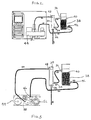
- the elongated cartridge 10 has an inlet port 12 which is connected to a supply of the chlorine water sample via a feed tube 14 and an outlet port 16 which is connected to an automated chlorine detector 18.
- the inlet port 12 is located adjacent a lower end of the cartridge 10, and the outlet port 16 is located adjacent an upper end of the cartridge 10.
- the automated chlorine detector 18 is also directly supplied with water sample via feed tube 14.
- the cartridge 10 contains a proton donating compound 20 which can be selected from, but is not limited to bicarbonate or borate salts.
- a proton donating compound 20 which can be selected from, but is not limited to bicarbonate or borate salts.
- the water flowing through the length of the cartridge 10 dissolves and becomes saturated with the compound 20.
- the automated chlorine detector 18 is supplied via the cartridge 10 with a water sample having the proton donating compound 20 dissolved therein.
- the water sample with the dissolved proton donating compound 20 may be subjected to mixing prior to measurement in the automated detector 18.
- a solenoid valve 22 is utilized to control the flow of the saturated sample water from the cartridge 10 to the detector 18.
- This solenoid valve 22 also functions to limit flow through the cartridge.
- the solenoid valve 22 is connected directly in the path of flow of the water sample between the outlet port 16 of the cartridge 10 and the detector 18.
- the solenoid valve 22, and therefore the flow of reagent into the detector 18, is controlled by the detector 18.
- the water sample may be supplied to the cartridge via a pump (not shown).
- Another embodiment of this invention provides an apparatus including an automated chlorine detector, a standpipe, and a cartridge containing a solid proton donating compound.
- an automated chlorine detector for purposes of illustration, reference may be made to Figs. 2 and 3. However, the invention is not so limited.
- the standpipe is a receptacle containing an inlet port through which sample water is received and at least two outlet ports.
- One of the standpipe outlet ports is connected to the cartridge and one of the standpipe outlet ports delivers sample water directly to the analyzer.
- the standpipe has a first outlet port located well below the water sample level in the standpipe and a second outlet port which is located at, or near, the water sample level.
- the second outlet port is in fluid communication with the sample inlet chamber of the automated chlorine detector, while the first outlet port supplies sample water to the cartridge.
- the cartridge contains a solid proton donating compound (as defined above) and has an inlet port which is in fluid communication with the first outlet port of the standpipe.
- the cartridge also has an outlet port which is spaced from the inlet port and which is in fluid communication with the mixing chamber of the automated chlorine detector.
- the inlet and outlet ports of the cartridge are located at opposite ends of the elongate cartridge, and the cartridge has a greater volume than the standpipe.
- the inlet port of the standpipe is connected to a supply of water sample which fills the standpipe to a predetermined level, thus defining a head space in the standpipe.
- the sample flow into the standpipe is controlled by a valve which controls flow at a rate sufficient for the analyzer. For example, in the case of analyzers manufactured by Capital Controls, the valve is opened until there is enough flow that water flows over the built-in weir. When water flows out of the weir, there is established a water head which, given the internal resistance to flow with the analyzer, assures the proper sample flow through the analyzer. The operator adjusts the sample flow valve just as if the sample were flowing directly to the analyzer and not first through the standpipe.
- the height of the standpipe controls the delivery of the proton donating compound to the analyzer.
- the standpipe and the cartridge may be elevated, as compared to the fluid level in the mixing chamber of the analyzer, when it is desirable to increase the flow of sample to the analyzer.
- the elevation of the cartridge and the standpipe may be adjusted downwardly relevant to the analyzer to decrease the flow of reagent to the analyzer.
- a suitable flow rate of reagent to the analyzer is achieved when the level of the head space in the cartridge is equal to, or slightly below, the level of the head space in the standpipe.
- the device can include a tube (not shown) which feeds into the inlet port of the standpipe and permits the addition of an oxidizable reagent (e.g. iodide) to the sample water entering the standpipe.
- an oxidizable reagent e.g. iodide
- the size (i.e., width or diameter) of the standpipe may be adjusted as desired so that the sample which is introduced into the inlet port of the standpipe does not exit the standpipe through the exit port to the analyzer within the amount of time required to incubate the oxidizable reagent with the sample.
- the size of the standpipe is modified such that an entering sample does not reach the exit port for a period of at least about 2 minutes. It is well within the skill of one in the art to determine the size of the standpipe required to ensure the appropriate incubation time.
- the water sample flows into a standpipe 30 via an inlet port 32 located in the base of the elongate standpipe 30.
- a first outlet port 34 is provided adjacent the base of the standpipe 30 and provides a path of flow of sample water from adjacent the base of the standpipe 30 to an inlet port 36 located adjacent the upper end of a cartridge 38. The pressure of the water located in the standpipe 30 forces the flow of water into the cartridge 38.
- the water sample entering the cartridge 38 bows downwardly through a solid proton donating reagent 40 located in the cartridge 38 and becomes saturated therewith prior to exiting the cartridge 38 through an exit port 42 which is located at the lower end of the cartridge 38 and which is in fluid communication with a mixing chamber 46 of the analyzer 44.
- the remaining sample water entering through the inlet port 32 of the standpipe 30 increases the water level in the standpipe until the water level reaches an outlet port 48 located adjacent the upper end of the standpipe 30.
- the standpipe outlet port 48 is in direct fluid communication with an inlet chamber 50 in the analyzer 44 to supply the analyzer 44 with sample water.
- sample water exiting the standpipe 30 and the reagent solution exiting the cartridge 38 are delivered to separate chambers within the analyzer 44, are mixed, and are then delivered to an analyzer cell 52.
- sample water exiting the standpipe 30 and the reagent solution exiting the cartridge 38 can be delivered directly to an analyzer cell 52 of the automated chlorine analyzer 44.
- the devices of the invention are useful for performing the novel methods of the invention.
- these devices arc readily adapted for use with a variety of other detection methods known in the art, as will be apparent to one of skill in the art.
- Example 1 demonstrates the dependence of chlorine detection via amperimetric current on the availability of protons, as opposed to pH. Specifically, this example illustrates that electrochemical chlorine measurements can be made at pH values over 5.5.
- the versatility of borax at low and high pH values is further illustrated.
- Chlorine detection was accomplished via electrochemical cyclic voltammetry using a Model 273A Polarographic Analyzer with Model 270 Research Software Version 4.23 (Princeton Applied Research, Inc.).
- the CL500 analyzers employ a conventional gold cathode and copper anode with a zero potential between them in a two-electrode cell.
- the CL1000 analyzers employ a silver/silver chloride reference electrode along with the gold cathode and copper anode in a three-electrode configuration.
- Chlorine concentrations were measured with a Hach DR 20000 spectrophotometer and DPD Permachem free chlorine reagent (#14070-99).
- DPD (n,n-diphenylene diamine) measurements in the solutions were made to determine the true concentration of both free and combined forms of chlorine in the aqueous solutions and were compared to the results obtained from the CL500 and CL1000 analyzer readings to make sure that the CL1000/CL500 measurements were correct. It should be noted that only a single DPD measurement was made for each chlorine concentration of interest. Errors of at least several percent are to be expected.
- Cyclic voltammograms were obtained with chlorine present.
- the scans were carried out at varying slow scan rates, which was essential to simulate the steady state cell operation typical of amperometric analyzers.
- the default setting for buffer addition was 1 pulse every about 11.5 seconds, resulting in an about 80 ⁇ L/min flow.
- the sample flow through the instrument was typically about 125 ml/min.
- Calibration curves for the analyzers were obtained to determine the presence of background current and the sensitivity of each analyzer. Typically. these curves are the measured output of the analyzer (current, typically in microamps) plotted versus the DPD measured value.
- the scatter relates to precision, the stability of the offset (if any) at zero limits the low level of measurement which can be obtained, and the linearity is verified (the instruments presume that the current increases linearly).
- the sample pH was titrated upward with 1 N sodium hydroxide, slowly, drop wise and down with 5 N hydrochloric acid over the pH range 4.5 to 9.0.
- results indicate that the amperimetric signal for the phosphate and borate buffered water samples remained at a high and near constant value as the pH was raised to about 9. As the pH was further increased above 9.0, the amperimetric currents for the phosphate and acetate solutions rapidly decayed, while the current for the borate solutions remained the same.
- the amperometric signal for the unbuffered water sample however began to fall at about a pH of 6.0. As the pH was raised over 9.2, most of the signal was lost.
- the amount of chlorine present in the HOCl form rapidly rises as the pH is increased from about 0 to about 3, is maintained at a pH of about 3 to about 5.5, and decays along with the signal to about 0 for the unbuffered solution over pH values of about 5.5 to about 9.5.
- the signal for the phosphate and borate solutions remained approximately steady up to about a pH of 9.0, where the phosphate and acetate solution signals began to fail. Above the pH value of about 9.0, the signal for the borate solution continued to remain steady while the HOCI form had decayed to 0.
- Chlorine detection of the samples buffered using phosphate and borate systems clearly does not depend on the pH of the solution being below 5.0, as is generally understood by those skilled in the art. Instead, it appears that in order for chlorine measurements to be made, sufficient amounts of protons must be present to convert the OCl to the electroreducible HOCl species. This was accomplished in Example I by adding phosphate or borate buffers, which all weakly donate protons to the chlorine sample. These results showed, as indicated above, that all of these buffers were successful in aiding chlorine detection up to about 9.0, but in these test conditions only the borate reagent was successful at pH values over 9.0. In addition, because the borate reagent has no nutritive properties, biological growth in the analyzer would not occur.
- Example 2 describes the measurement of free chlorine in an aqueous solution using the acetate buffer at a pH value of about 4.5.
- Example 3 describes the measurement of free chlorine in an aqueous solution using a borate reagent at a pH value of about 6.8. This example specifically illustrates that chlorine detection can be accomplished at higher pH values rather than acidic pH values used in current methods of chlorine detection.
- the pH of the effluent from each analyzer was measured approximately daily; the sample pH after the borate reagent addition was consistently approximately 8.7.
- the calibration curves for the two analyzers using borate reagent showed linear dependence of the measured signal current to the chlorine concentration (verified by DPD tests) in both analyzers.
- the sensitivities of the two analyzers were similar, but less than the 35 ⁇ amps/ppm of chlorine typical of analyzers using acetate buffer.
- Unit #4 had a sensitivity of 26 ⁇ amps/ppm of chlorine and the sensitivity of Unit #5 was 24 ⁇ amps/ppm.
- Example 4 describes the measurement of free chlorine in an aqueous solution using the sodium bicarbonate reagent at a pH value of 8.8. This example also illustrates that chlorine detection can be accomplished at higher pH values rather than the acid pH values used in current methods of chlorine detection. However, the importance of using sodium bicarbonate over borax is the fact that sodium bicarbonate is more innocuous and inexpensive than the above described borax reagent.
- the calibration curves for the two analyzers using the bicarbonate reagent indicate linear dependence of the measured signal current on increasing chlorine concentration as verified by DPD measurement.
- the sensitivities of the analyzers were very similar, but somewhat less than the 35 ⁇ amps/ppm of chlorine typical of analyzers using acetate buffer.
- Unit #3 had a sensitivity of 30 ⁇ amps/ppm of chlorine and the sensitivity of Unit #7 was 29 ⁇ amps/ppm.
- Each analyzer had a large background current when operated at a -100 mV bias.
- the background current of Unit #3 was approximately 49 ⁇ amps, equivalent to 1.4 ppm of chlorine.
- Unit #7 exhibited a background current of approximately 66 ⁇ amps, equivalent to 1.9 ppm of chlorine. As discussed above, this was found to be a result of an error in the software of the manufactured product.
- the sample source water public tap water
- the water was passed through a carbon filter that reduced the chlorine content to below 20 ppb.
- the water was then brought to the desired chlorine level by the addition of bleach.
- Chlorine concentrations were regularly verified through spectrophotometric DPD (n,n-diphenylene diaminc) tests and amperometric titrations. Even though the chlorine concentration was increased to >100 ppm several times during the test period, the majority of the work was done at chlorine concentrations in the 0-5 ppm range.
- Example 1C The study used acetate, borate and sodium and potassium bicarbonate reagents, prepared as described in Example 1C. In all, seven residual chlorine analyzers were run continuously for three months, with virtually no loss in sensitivity. regardless of reagent.
- This example describes the effect on measuring chlorine levels in solutions where the acetate reagent was added less often to the chlorine solution.
- This example illustrates the advantages, including lower costs and less biological build-up in the analyzer, of using less reagent over a long period of time.
- This example specifically addresses the use of acetate reagents to measure chlorine concentration at lower pH levels.
- One of skill in the art would be able to use a carbonate or borate salt in the following example in the place of the acetate reagent.
- CL500 and CL1000 residual chlorine analyzers were utilized.
- the acetate reagent as described in Example 1 was added to a chlorine water sample.
- the acetate reagent was prepared by adding a 7.89 M acetic acid solution to a 2.95 M sodium acetate solution to provide a solution with a pH of 4.5.
- the chlorine water sample was prepared as described in Example 1, where 0.3 ppm of chlorine were present in the sample and was passed through the analyzer continuously with acetate buffer (injected every 6 seconds) until a stable reading was obtained. Then both the sample water flow and the reagent addition were interrupted for a short period to determine the effect.
- This example describes the effect on measuring chlorine levels in solutions where no acetate reagent was added to the chlorine solution.
- This example illustrates the advantages, including lower costs and less biological build-up in the analyzer, of the method of the invention in measuring chlorine levels in solutions containing low concentrations of chlorine.
- Example 1 Five units were operated as three-electrode CL1000 residual chlorine analyzers.
- the acetate reagent as described in Example 1 was added to a chlorine water sample.
- the chlorine water sample was prepared as described in Example 1, where 0.3 ppm of chlorine were present in the sample and was passed through the analyzer continuously with acetate buffer (injected every 6 seconds) until a stable reading was obtained. Then both the sample water flow and the reagent addition were interrupted for a short period to determine the effect.
Landscapes
- Chemical & Material Sciences (AREA)
- Life Sciences & Earth Sciences (AREA)
- Health & Medical Sciences (AREA)
- Physics & Mathematics (AREA)
- Chemical Kinetics & Catalysis (AREA)
- Electrochemistry (AREA)
- Molecular Biology (AREA)
- Analytical Chemistry (AREA)
- Biochemistry (AREA)
- General Health & Medical Sciences (AREA)
- General Physics & Mathematics (AREA)
- Immunology (AREA)
- Pathology (AREA)
- Investigating Or Analyzing Non-Biological Materials By The Use Of Chemical Means (AREA)
Applications Claiming Priority (2)
| Application Number | Priority Date | Filing Date | Title |
|---|---|---|---|
| US502608 | 1990-03-30 | ||
| US09/502,608 US6627450B1 (en) | 2000-02-11 | 2000-02-11 | Method of measuring chlorine content in aqueous solution |
Publications (2)
| Publication Number | Publication Date |
|---|---|
| EP1128184A2 true EP1128184A2 (de) | 2001-08-29 |
| EP1128184A3 EP1128184A3 (de) | 2002-09-11 |
Family
ID=23998580
Family Applications (1)
| Application Number | Title | Priority Date | Filing Date |
|---|---|---|---|
| EP01301022A Withdrawn EP1128184A3 (de) | 2000-02-11 | 2001-02-06 | Verfahren zum Messen des Chlorgehaltes einer wässrigen Lösung |
Country Status (2)
| Country | Link |
|---|---|
| US (2) | US6627450B1 (de) |
| EP (1) | EP1128184A3 (de) |
Cited By (1)
| Publication number | Priority date | Publication date | Assignee | Title |
|---|---|---|---|---|
| EP2853888A3 (de) * | 2013-09-06 | 2015-07-01 | Watkins Manufacturing Corporation | Chlor und pH-Messverfahren |
Families Citing this family (11)
| Publication number | Priority date | Publication date | Assignee | Title |
|---|---|---|---|---|
| US8907384B2 (en) * | 2006-01-26 | 2014-12-09 | Nanoselect, Inc. | CNT-based sensors: devices, processes and uses thereof |
| US20090278556A1 (en) * | 2006-01-26 | 2009-11-12 | Nanoselect, Inc. | Carbon Nanostructure Electrode Based Sensors: Devices, Processes and Uses Thereof |
| ES2555029T3 (es) * | 2006-11-24 | 2015-12-28 | Aqualysis Pty. Ltd. | Analizador químico |
| US7858379B2 (en) * | 2007-06-05 | 2010-12-28 | Lynntech, Inc. | Apparatus and method for determining the concentration of iodine-containing organic compounds in an aqueous solution |
| WO2009055093A1 (en) * | 2007-10-24 | 2009-04-30 | Ge Analytical Instruments, Inc. | Electrochemical methods for selective detection of free chlorine, monochloramine and dichloramine |
| FR2946146B1 (fr) * | 2009-05-28 | 2011-05-13 | Pacific Ind | Reactif chimique pour la mesure du taux d'agents halogenes notamment dans des eaux de piscine ainsi qu'un procede de mesure associe |
| US8523425B2 (en) | 2010-07-01 | 2013-09-03 | Mark Malmquist | Reservoir tank water mixing system |
| US8343771B2 (en) | 2011-01-12 | 2013-01-01 | General Electric Company | Methods of using cyanine dyes for the detection of analytes |
| US8574413B2 (en) | 2011-03-18 | 2013-11-05 | Digital Concepts Of Missouri, Inc. | Electrodes, sensors and methods for measuring components in water |
| CN108490032A (zh) * | 2018-06-01 | 2018-09-04 | 苏州明柏仪器有限公司 | 一种余氯在线检测系统 |
| US12044669B2 (en) * | 2020-12-16 | 2024-07-23 | Mcmaster University | System and method for detecting analytes in water |
Family Cites Families (12)
| Publication number | Priority date | Publication date | Assignee | Title |
|---|---|---|---|---|
| US3966413A (en) * | 1975-09-05 | 1976-06-29 | The United States Of America As Represented By The Secretary Of Commerce | Electrochemical chlorine flux monitor |
| US4253847A (en) * | 1980-01-03 | 1981-03-03 | Environmental Sciences Associates, Inc. | Preparing sample for electrochemical testing system |
| US4322215A (en) * | 1980-10-23 | 1982-03-30 | Electric Power Research Institute, Inc. | Method for determining particular species of chlorine in a water sample |
| US4487262A (en) | 1982-12-22 | 1984-12-11 | Mobil Oil Corporation | Drive for heavy oil recovery |
| JPS6024381A (ja) | 1983-07-19 | 1985-02-07 | Nippon Steel Corp | 化成処理性の優れた片面めつき鋼板及びその製造法 |
| IT1214691B (it) | 1986-07-14 | 1990-01-18 | Centro Speriment Metallurg | Lamierino d'acciaio perfezionato per imballaggio di alimentari e procedimento per la sua produzione |
| JPS6327745A (ja) | 1986-07-21 | 1988-02-05 | Denki Kagaku Keiki Co Ltd | 残留塩素測定装置 |
| DE3701727A1 (de) | 1987-01-22 | 1988-08-04 | Conducta Mess & Regeltech | Verfahren und vorrichtung zur coulometrischen bestimmung von freiem chlor u. dgl. in fluessigkeiten oder gasen |
| JPH08211042A (ja) | 1995-02-03 | 1996-08-20 | Isomura:Kk | 残留塩素測定方法 |
| ES2112763B1 (es) * | 1995-07-27 | 1999-05-16 | Univ Valencia Estudi General | Kit para la determinacion de cloro libre y combinado en aguas. |
| US6022480A (en) * | 1996-02-28 | 2000-02-08 | The John Girvan Company, Inc. | Methods and devices for treating water |
| US6180412B1 (en) * | 1999-03-26 | 2001-01-30 | Hach Company | Test for chlorine in water |
-
2000
- 2000-02-11 US US09/502,608 patent/US6627450B1/en not_active Expired - Fee Related
-
2001
- 2001-02-06 EP EP01301022A patent/EP1128184A3/de not_active Withdrawn
-
2003
- 2003-07-23 US US10/625,416 patent/US20040219683A1/en not_active Abandoned
Cited By (1)
| Publication number | Priority date | Publication date | Assignee | Title |
|---|---|---|---|---|
| EP2853888A3 (de) * | 2013-09-06 | 2015-07-01 | Watkins Manufacturing Corporation | Chlor und pH-Messverfahren |
Also Published As
| Publication number | Publication date |
|---|---|
| EP1128184A3 (de) | 2002-09-11 |
| US6627450B1 (en) | 2003-09-30 |
| US20040219683A1 (en) | 2004-11-04 |
Similar Documents
| Publication | Publication Date | Title |
|---|---|---|
| US6627450B1 (en) | Method of measuring chlorine content in aqueous solution | |
| Claes et al. | Solubility and Solvation of Carbon Dioxide in the Molten Li2CO3/Na2CO3/K2CO3 (43.5: 31.5: 25.0 mol‐%) Eutectic Mixture at 973 K I. Experimental Part | |
| Davison | The polarographic measurement of O2, Fe2+, Mn2+, and S2− in hypolimnetic water | |
| Zheng et al. | Flow-injection chemiluminescence determination of isoniazid using on-line electrogenerated BrO–as an oxidant | |
| US20020081231A1 (en) | Fluid analyte measurement system | |
| Gordon et al. | Methods of measuring disinfectant residuals | |
| Gord et al. | Selective chlorine determination by gas-diffusion flow injection analysis with chemiluminescent detection | |
| WO2009055093A1 (en) | Electrochemical methods for selective detection of free chlorine, monochloramine and dichloramine | |
| Brunt | Rapid determination of sulfide in waste waters by continuous flow analysis and gas diffusion and a potentiometric detector | |
| Matuszewski et al. | Selective flow-injection determination of residual chlorine at low levels by amperometric detection with two polarized platinum electrodes | |
| Goodwin et al. | Determination of trace sulfides in turbid waters by gas dialysis/ion chromatography | |
| US6472223B1 (en) | Method and system for continuously monitoring and controlling a process stream | |
| Halvatzis et al. | Kinetic study of N-bromosuccinimide reactions and kinetic determination of pyridoxine using a bromide-selective electrode | |
| Ge et al. | Determination of trace amounts of chloramines by liquid chromatographic separation and amperometric detection | |
| Mancy et al. | Analysis of dissolved oxygen in natural and waste waters | |
| US4322215A (en) | Method for determining particular species of chlorine in a water sample | |
| US5869342A (en) | Method and system for continuously monitoring and controlling a process stream for dechlorination residual | |
| US4278507A (en) | Method for amperometric measurement of the free-chlorine content in a solution | |
| LT4886B (lt) | Azodažo vandeninis tirpalas, jo pagaminimo būdas ir panaudojimas | |
| Taylor et al. | Alternate Reagents for the Amperometric Analysis of Residual Chlorine II. Laboratory Results and Discussion | |
| JP7231814B2 (ja) | 残留塩素測定装置の校正方法 | |
| Taylor et al. | Alternate Reagents for the Amperometric Analysis of Residual Chlorine I. Background and Theory | |
| Gordon et al. | Chlorine and Oxychlorine Species | |
| Beran et al. | Pneumatoamperometric determination of various oxidants and total dissolved chlorine | |
| Irons et al. | Detection of chlorine species in water by chemiluminescence with electrochemical analyte modification |
Legal Events
| Date | Code | Title | Description |
|---|---|---|---|
| PUAI | Public reference made under article 153(3) epc to a published international application that has entered the european phase |
Free format text: ORIGINAL CODE: 0009012 |
|
| AK | Designated contracting states |
Kind code of ref document: A2 Designated state(s): AT BE CH CY DE DK ES FI FR GB GR IE IT LI LU MC NL PT SE TR |
|
| AX | Request for extension of the european patent |
Free format text: AL;LT;LV;MK;RO;SI |
|
| PUAL | Search report despatched |
Free format text: ORIGINAL CODE: 0009013 |
|
| AK | Designated contracting states |
Kind code of ref document: A3 Designated state(s): AT BE CH CY DE DK ES FI FR GB GR IE IT LI LU MC NL PT SE TR |
|
| AX | Request for extension of the european patent |
Free format text: AL;LT;LV;MK;RO;SI |
|
| RIC1 | Information provided on ipc code assigned before grant |
Free format text: 7G 01N 33/18 A, 7G 01N 27/49 B |
|
| 17P | Request for examination filed |
Effective date: 20030103 |
|
| RAP1 | Party data changed (applicant data changed or rights of an application transferred) |
Owner name: SEVERN TRENT WATER PURIFICATION, INC., |
|
| AKX | Designation fees paid |
Designated state(s): AT BE CH CY DE DK ES FI FR GB GR IE IT LI LU MC NL PT SE TR |
|
| STAA | Information on the status of an ep patent application or granted ep patent |
Free format text: STATUS: THE APPLICATION HAS BEEN WITHDRAWN |
|
| 18W | Application withdrawn |
Effective date: 20050414 |