EP1129089B1 - Spiro-indolines en tant qu'antagonistes du recepteur y5 - Google Patents
Spiro-indolines en tant qu'antagonistes du recepteur y5 Download PDFInfo
- Publication number
- EP1129089B1 EP1129089B1 EP99971808A EP99971808A EP1129089B1 EP 1129089 B1 EP1129089 B1 EP 1129089B1 EP 99971808 A EP99971808 A EP 99971808A EP 99971808 A EP99971808 A EP 99971808A EP 1129089 B1 EP1129089 B1 EP 1129089B1
- Authority
- EP
- European Patent Office
- Prior art keywords
- compound
- indoline
- piperidine
- carboxamide
- phenyl
- Prior art date
- Legal status (The legal status is an assumption and is not a legal conclusion. Google has not performed a legal analysis and makes no representation as to the accuracy of the status listed.)
- Expired - Lifetime
Links
- 0 CCCC1(C(CCC(C)C(OC(C)(C)C)=O)C*(C)C)C2C(C)C=CC(C)C2C(*)C1 Chemical compound CCCC1(C(CCC(C)C(OC(C)(C)C)=O)C*(C)C)C2C(C)C=CC(C)C2C(*)C1 0.000 description 6
- JQDUYDRMSSWISY-UHFFFAOYSA-N CC(C)(C)OC(N(CC1)CCC1(CC1O)c2c1cccc2)=O Chemical compound CC(C)(C)OC(N(CC1)CCC1(CC1O)c2c1cccc2)=O JQDUYDRMSSWISY-UHFFFAOYSA-N 0.000 description 2
- LQKZZJVLKSEXNI-UHFFFAOYSA-N CC(C)(C)OC(N(CC1)CCC1(CC1S(C)(=O)=O)c2c1cccc2)=O Chemical compound CC(C)(C)OC(N(CC1)CCC1(CC1S(C)(=O)=O)c2c1cccc2)=O LQKZZJVLKSEXNI-UHFFFAOYSA-N 0.000 description 1
- HRTHPQOIDCOMHE-UHFFFAOYSA-N CC(C)(C)OC(N(CC1)CCC11c2ccccc2C=C1)=O Chemical compound CC(C)(C)OC(N(CC1)CCC11c2ccccc2C=C1)=O HRTHPQOIDCOMHE-UHFFFAOYSA-N 0.000 description 1
- COXRQEGLBMFFQD-UHFFFAOYSA-N CC1C=CC=C(C(C2)S)C1C2(CC1)CCN1C(NC1(C)C=CC(C2=CC=CCC2)=CC1)=O Chemical compound CC1C=CC=C(C(C2)S)C1C2(CC1)CCN1C(NC1(C)C=CC(C2=CC=CCC2)=CC1)=O COXRQEGLBMFFQD-UHFFFAOYSA-N 0.000 description 1
- HLHZQIBCOFSEFX-UHFFFAOYSA-N CCOC(c(cc1)ccc1NC(N(CC1)CCC1(C1)c2ccccc2N1[S](C)(C)(=O)=O)=O)=O Chemical compound CCOC(c(cc1)ccc1NC(N(CC1)CCC1(C1)c2ccccc2N1[S](C)(C)(=O)=O)=O)=O HLHZQIBCOFSEFX-UHFFFAOYSA-N 0.000 description 1
- NSKHPGAAEQYORX-UHFFFAOYSA-N CS(C(CC1(CC2)CCN2C(Nc(cc2)ccc2-c2ccccc2)=O)c2c1cccc2)O Chemical compound CS(C(CC1(CC2)CCN2C(Nc(cc2)ccc2-c2ccccc2)=O)c2c1cccc2)O NSKHPGAAEQYORX-UHFFFAOYSA-N 0.000 description 1
- RGFHWZFIDUQEEI-UHFFFAOYSA-N CS(C(CC1(CC2)CCN2C(Nc(nc2)cnc2-c2ccccc2)=O)c2c1cccc2)(=O)=O Chemical compound CS(C(CC1(CC2)CCN2C(Nc(nc2)cnc2-c2ccccc2)=O)c2c1cccc2)(=O)=O RGFHWZFIDUQEEI-UHFFFAOYSA-N 0.000 description 1
- NSECJXCOETXUHS-UHFFFAOYSA-N CS(N(C1)c2ccccc2C11CCNCC1)(=O)=O Chemical compound CS(N(C1)c2ccccc2C11CCNCC1)(=O)=O NSECJXCOETXUHS-UHFFFAOYSA-N 0.000 description 1
- SEHWJNRGGIARRN-UHFFFAOYSA-N CSC(C1)c2ccccc2C1(CC1)CCN1C(Nc(cc1)ccc1-c1ccccc1)=O Chemical compound CSC(C1)c2ccccc2C1(CC1)CCN1C(Nc(cc1)ccc1-c1ccccc1)=O SEHWJNRGGIARRN-UHFFFAOYSA-N 0.000 description 1
- UEOSSIMPKPNOEJ-UHFFFAOYSA-N Cc1cc(-c(cc2)ccc2Cl)n[nH]1 Chemical compound Cc1cc(-c(cc2)ccc2Cl)n[nH]1 UEOSSIMPKPNOEJ-UHFFFAOYSA-N 0.000 description 1
- CUSBYOCOULLZEV-UHFFFAOYSA-N Cc1ncc(-c2ccccc2)[s]1 Chemical compound Cc1ncc(-c2ccccc2)[s]1 CUSBYOCOULLZEV-UHFFFAOYSA-N 0.000 description 1
- GEVBBQNWDQJVTA-UHFFFAOYSA-N Cc1nnc(-c2ccccc2)[s]1 Chemical compound Cc1nnc(-c2ccccc2)[s]1 GEVBBQNWDQJVTA-UHFFFAOYSA-N 0.000 description 1
- MDLHJEIJWFSLBL-UHFFFAOYSA-N O=C(NC(CC1)=CC=C1c1ccccc1)OC1C#CC=CC=C1 Chemical compound O=C(NC(CC1)=CC=C1c1ccccc1)OC1C#CC=CC=C1 MDLHJEIJWFSLBL-UHFFFAOYSA-N 0.000 description 1
- REKAGYBALLGJMY-UHFFFAOYSA-N O=C(Nc1ncc(-c2ccccc2)nc1)Oc1ccccc1 Chemical compound O=C(Nc1ncc(-c2ccccc2)nc1)Oc1ccccc1 REKAGYBALLGJMY-UHFFFAOYSA-N 0.000 description 1
Classifications
-
- C—CHEMISTRY; METALLURGY
- C07—ORGANIC CHEMISTRY
- C07D—HETEROCYCLIC COMPOUNDS
- C07D221/00—Heterocyclic compounds containing six-membered rings having one nitrogen atom as the only ring hetero atom, not provided for by groups C07D211/00 - C07D219/00
- C07D221/02—Heterocyclic compounds containing six-membered rings having one nitrogen atom as the only ring hetero atom, not provided for by groups C07D211/00 - C07D219/00 condensed with carbocyclic rings or ring systems
- C07D221/20—Spiro-condensed ring systems
-
- A—HUMAN NECESSITIES
- A61—MEDICAL OR VETERINARY SCIENCE; HYGIENE
- A61P—SPECIFIC THERAPEUTIC ACTIVITY OF CHEMICAL COMPOUNDS OR MEDICINAL PREPARATIONS
- A61P13/00—Drugs for disorders of the urinary system
- A61P13/02—Drugs for disorders of the urinary system of urine or of the urinary tract, e.g. urine acidifiers
-
- A—HUMAN NECESSITIES
- A61—MEDICAL OR VETERINARY SCIENCE; HYGIENE
- A61P—SPECIFIC THERAPEUTIC ACTIVITY OF CHEMICAL COMPOUNDS OR MEDICINAL PREPARATIONS
- A61P15/00—Drugs for genital or sexual disorders; Contraceptives
-
- A—HUMAN NECESSITIES
- A61—MEDICAL OR VETERINARY SCIENCE; HYGIENE
- A61P—SPECIFIC THERAPEUTIC ACTIVITY OF CHEMICAL COMPOUNDS OR MEDICINAL PREPARATIONS
- A61P19/00—Drugs for skeletal disorders
- A61P19/02—Drugs for skeletal disorders for joint disorders, e.g. arthritis, arthrosis
-
- A—HUMAN NECESSITIES
- A61—MEDICAL OR VETERINARY SCIENCE; HYGIENE
- A61P—SPECIFIC THERAPEUTIC ACTIVITY OF CHEMICAL COMPOUNDS OR MEDICINAL PREPARATIONS
- A61P25/00—Drugs for disorders of the nervous system
- A61P25/04—Centrally acting analgesics, e.g. opioids
-
- A—HUMAN NECESSITIES
- A61—MEDICAL OR VETERINARY SCIENCE; HYGIENE
- A61P—SPECIFIC THERAPEUTIC ACTIVITY OF CHEMICAL COMPOUNDS OR MEDICINAL PREPARATIONS
- A61P25/00—Drugs for disorders of the nervous system
- A61P25/06—Antimigraine agents
-
- A—HUMAN NECESSITIES
- A61—MEDICAL OR VETERINARY SCIENCE; HYGIENE
- A61P—SPECIFIC THERAPEUTIC ACTIVITY OF CHEMICAL COMPOUNDS OR MEDICINAL PREPARATIONS
- A61P25/00—Drugs for disorders of the nervous system
- A61P25/08—Antiepileptics; Anticonvulsants
-
- A—HUMAN NECESSITIES
- A61—MEDICAL OR VETERINARY SCIENCE; HYGIENE
- A61P—SPECIFIC THERAPEUTIC ACTIVITY OF CHEMICAL COMPOUNDS OR MEDICINAL PREPARATIONS
- A61P25/00—Drugs for disorders of the nervous system
- A61P25/20—Hypnotics; Sedatives
-
- A—HUMAN NECESSITIES
- A61—MEDICAL OR VETERINARY SCIENCE; HYGIENE
- A61P—SPECIFIC THERAPEUTIC ACTIVITY OF CHEMICAL COMPOUNDS OR MEDICINAL PREPARATIONS
- A61P25/00—Drugs for disorders of the nervous system
- A61P25/22—Anxiolytics
-
- A—HUMAN NECESSITIES
- A61—MEDICAL OR VETERINARY SCIENCE; HYGIENE
- A61P—SPECIFIC THERAPEUTIC ACTIVITY OF CHEMICAL COMPOUNDS OR MEDICINAL PREPARATIONS
- A61P25/00—Drugs for disorders of the nervous system
- A61P25/24—Antidepressants
-
- A—HUMAN NECESSITIES
- A61—MEDICAL OR VETERINARY SCIENCE; HYGIENE
- A61P—SPECIFIC THERAPEUTIC ACTIVITY OF CHEMICAL COMPOUNDS OR MEDICINAL PREPARATIONS
- A61P25/00—Drugs for disorders of the nervous system
- A61P25/28—Drugs for disorders of the nervous system for treating neurodegenerative disorders of the central nervous system, e.g. nootropic agents, cognition enhancers, drugs for treating Alzheimer's disease or other forms of dementia
-
- A—HUMAN NECESSITIES
- A61—MEDICAL OR VETERINARY SCIENCE; HYGIENE
- A61P—SPECIFIC THERAPEUTIC ACTIVITY OF CHEMICAL COMPOUNDS OR MEDICINAL PREPARATIONS
- A61P3/00—Drugs for disorders of the metabolism
- A61P3/04—Anorexiants; Antiobesity agents
-
- A—HUMAN NECESSITIES
- A61—MEDICAL OR VETERINARY SCIENCE; HYGIENE
- A61P—SPECIFIC THERAPEUTIC ACTIVITY OF CHEMICAL COMPOUNDS OR MEDICINAL PREPARATIONS
- A61P3/00—Drugs for disorders of the metabolism
- A61P3/06—Antihyperlipidemics
-
- A—HUMAN NECESSITIES
- A61—MEDICAL OR VETERINARY SCIENCE; HYGIENE
- A61P—SPECIFIC THERAPEUTIC ACTIVITY OF CHEMICAL COMPOUNDS OR MEDICINAL PREPARATIONS
- A61P3/00—Drugs for disorders of the metabolism
- A61P3/08—Drugs for disorders of the metabolism for glucose homeostasis
- A61P3/10—Drugs for disorders of the metabolism for glucose homeostasis for hyperglycaemia, e.g. antidiabetics
-
- A—HUMAN NECESSITIES
- A61—MEDICAL OR VETERINARY SCIENCE; HYGIENE
- A61P—SPECIFIC THERAPEUTIC ACTIVITY OF CHEMICAL COMPOUNDS OR MEDICINAL PREPARATIONS
- A61P37/00—Drugs for immunological or allergic disorders
- A61P37/02—Immunomodulators
-
- A—HUMAN NECESSITIES
- A61—MEDICAL OR VETERINARY SCIENCE; HYGIENE
- A61P—SPECIFIC THERAPEUTIC ACTIVITY OF CHEMICAL COMPOUNDS OR MEDICINAL PREPARATIONS
- A61P7/00—Drugs for disorders of the blood or the extracellular fluid
- A61P7/04—Antihaemorrhagics; Procoagulants; Haemostatic agents; Antifibrinolytic agents
-
- A—HUMAN NECESSITIES
- A61—MEDICAL OR VETERINARY SCIENCE; HYGIENE
- A61P—SPECIFIC THERAPEUTIC ACTIVITY OF CHEMICAL COMPOUNDS OR MEDICINAL PREPARATIONS
- A61P9/00—Drugs for disorders of the cardiovascular system
- A61P9/04—Inotropic agents, i.e. stimulants of cardiac contraction; Drugs for heart failure
-
- C—CHEMISTRY; METALLURGY
- C07—ORGANIC CHEMISTRY
- C07D—HETEROCYCLIC COMPOUNDS
- C07D471/00—Heterocyclic compounds containing nitrogen atoms as the only ring hetero atoms in the condensed system, at least one ring being a six-membered ring with one nitrogen atom, not provided for by groups C07D451/00 - C07D463/00
- C07D471/02—Heterocyclic compounds containing nitrogen atoms as the only ring hetero atoms in the condensed system, at least one ring being a six-membered ring with one nitrogen atom, not provided for by groups C07D451/00 - C07D463/00 in which the condensed system contains two hetero rings
- C07D471/10—Spiro-condensed systems
Definitions
- This invention is concerned with compounds which are spiro-indolines of general structure:
- the invention is also concerned with the use of these novel compounds to selectively antagonize the Y5 receptors and thereby inhibit obsessive food intake and the resulting obesity and complications associated therewith.
- the invention is also concerned with pharmaceutical formulations comprising one of the compounds as active ingredient.
- the invention is further concerned with processes for preparing the compounds of this invention.
- Neuropeptide Y is a member of the pancreatic polypeptide family with widespread distribution throughout the mammalian nervous system. NPY and its relatives elicit a broad range of physiological effects through activation of at least six G protein-coupled receptor subtypes known as Y1, Y2, Y3, Y4, Y5 and Y6. The Y5 subtype was isolated, characterized and reported recently in US Patent 5,602,024 (WO 96/16542).
- WO96/16542 also reports the discovery of chemical compounds which bind selectively to the Y5 receptor and which act as antagonists of the Y5 receptor, several of which were shown to inhibit food intake in rats.
- spiro-indolines which are useful in the treatment, control or prevention of diseases, disorders or conditions mediated by activation of the Y5 receptor. These compounds are, thus, useful in the treatment of obesity in man or animals and in conditions caused by or exacerbated by obesity.
- the compounds of this invention are represented by the compound of structural formula I: or a pharmaceutically acceptable salt thereof, wherein; V, W,X and Z are independently selected from CH and N; R 1 is H, C 1-3 alkyl, C 1-3 alkoxy, F, or Cl; R2 is S(O) n R 6 , COR 6 or CHO, wherein n is 0, 1 or 2; and R 6 is N(R 3 ) 2 or C 1-3 alkyl; R 3 is independently H or C 1-3 alkyl; Ar is aryl or heteroaryl; R 4 and R 5 are independently selected from:
- alkyl means linear and branched structures and combinations thereof, containing the indicated number of carbon atoms.
- alkyl groups include methyl, ethyl, propyl, isopropyl, butyl, s- and t-butyl, pentyl, hexyl and the like.
- Cycloalkyl means a hydrocarbon having the indicated number of carbon atoms, containing one or more rings. Examples of cycloalkyl groups are cyclopropyl, cyclobutyl, cyclopentyl, cyclohexyl and the like.
- Halogen or "halo” includes F, Cl, Br, and I unless otherwise specified.
- heteroaryl examples include thienyl, furyl, pyrrolyl, imidazolyl, pyrazolyl, thiazolyl, isothiazolyl, oxazolyl, isoxazolyl, pyridyl, benzothienyl, benzofuranyl, indolyl, pyrimidinyl, pyrazinyl, pyridazinyl, thiadiazolyl, benzoxazolyl, benzothiazolyl, benzopyrazolyl, benzimidazolyl, pyridothiazolyl, quinolyl, isoquinolyl or triazolyl.
- Alkoxy means linear and branched structures and combinations thereof, containing the indictaed number of carbon atoms. Examples of alkoxy groups include methoxy, ethoxy, propoxy, isopropoxy, butoxy, s- and t-butoxy, pentoxy, and the like.
- alkanoyl means linear and branched structures and combinations thereof, containing the indicated number of carbon atoms.
- alkanoyl groups include, acetyl, propionyl, butyryl, isobutyryl, valeryl, isovaleryl, pivaloyl and the like.
- One embodiment of the novel compounds of this invention is that wherein Ar is phenyl of structural formula I(a) or a pharmaceutically acceptable salt thereof.
- a sub-class is that wherein R 2 is -SO 2 (C 1-3 alkyl) or -SO 2 NH 2 .
- a sub-sub-class of the compounds of this embodiment is that wherein R 4 and R 5 are independently selected from: phenyl, pyridyl, benzoyl, halophenyl, phenoxy, C 1-5 alkylpyridyl, benzhydryl, phenyl-C 1-3 alkoxy, NO 2 , C 2-4 alkanoyl, halo, C 1-5 alkoxy, C 1-3 alkoxycarbonyl, C 1-5 alkylthio, triazolyl, carboxy, hydrogen, C 1-5 alkyl, pyridylcarbonyl, and C 1-3 alkoxyphenyl.
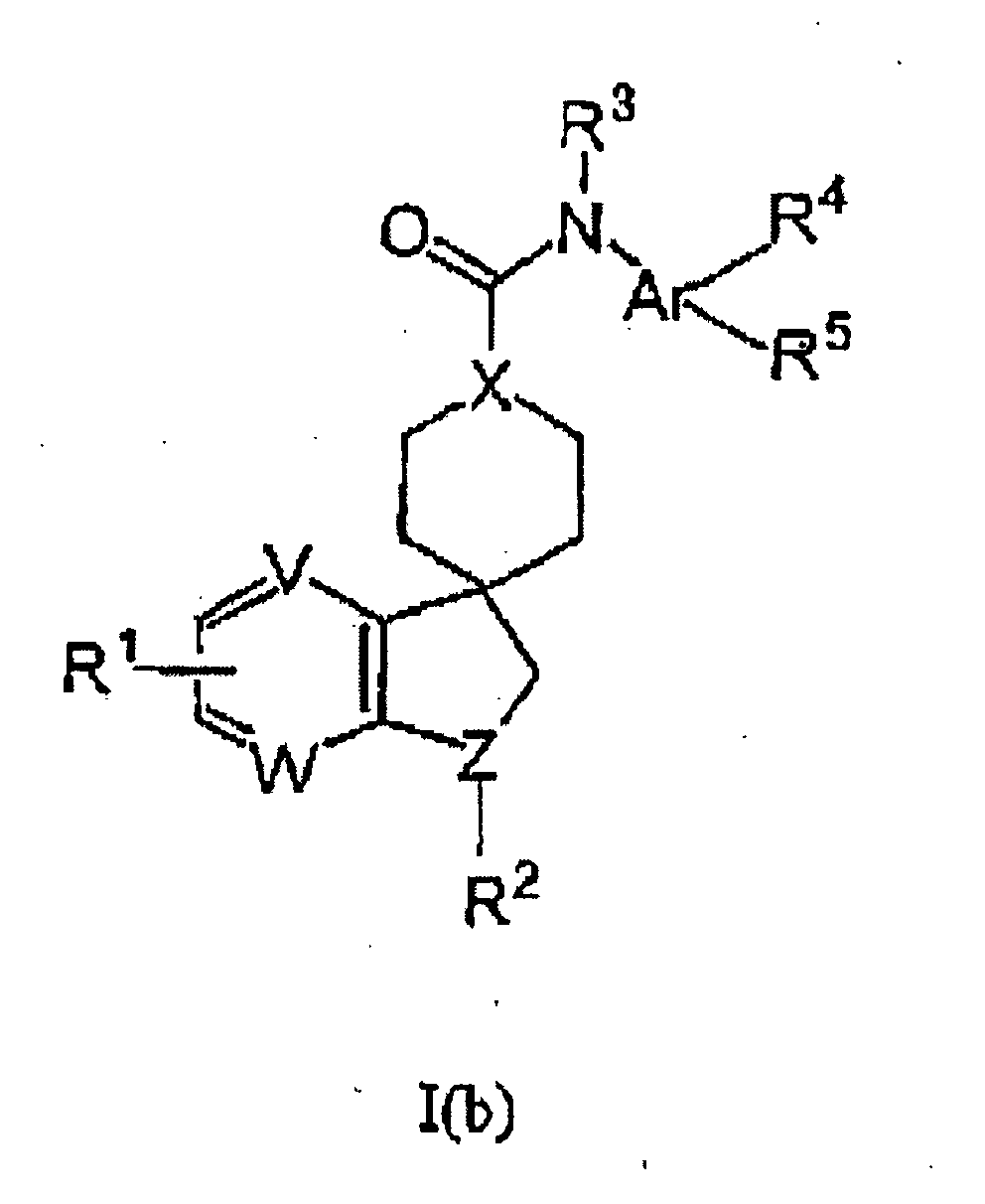
- a second embodiment of the compounds of this invention is that wherein Ar is a 5- or 6-membered heteroaryl having, besides carbon atoms, 1 to 3 hetero atoms selected from N, O and S as atoms constituting the ring, or benzo- or pyrido- fused versions thereof, of structural formula I(b); or a pharmaceutically acceptable salt thereof.
- a sub-class is that wherein R 2 is -SO 2 (C 1-3 alkyl) or -SO 2 N(C 1-3 alkyl) 2 .
- a sub-sub-class of compounds within this embodiment is that wherein the heteroaryl group, Ar, is selected from: thiazolyl, thiadiazolyl, pyrazolyl, pyridyl, benzothiazolyl, oxazolyl, pyridothiazolyl, benzoxazolyl, quinolyl, pyrazinyl, thienyl, isoxazolyl, pyrimidinyl, benzimidazolyl, oxadiazolyl and imidazolyl.
- the heteroaryl group, Ar is selected from: thiazolyl, thiadiazolyl, pyrazolyl, pyridyl, benzothiazolyl, oxazolyl, pyridothiazolyl, benzoxazolyl, quinolyl, pyrazinyl, thienyl, isoxazolyl, pyrimidinyl, benzimidazolyl, oxadiazoly
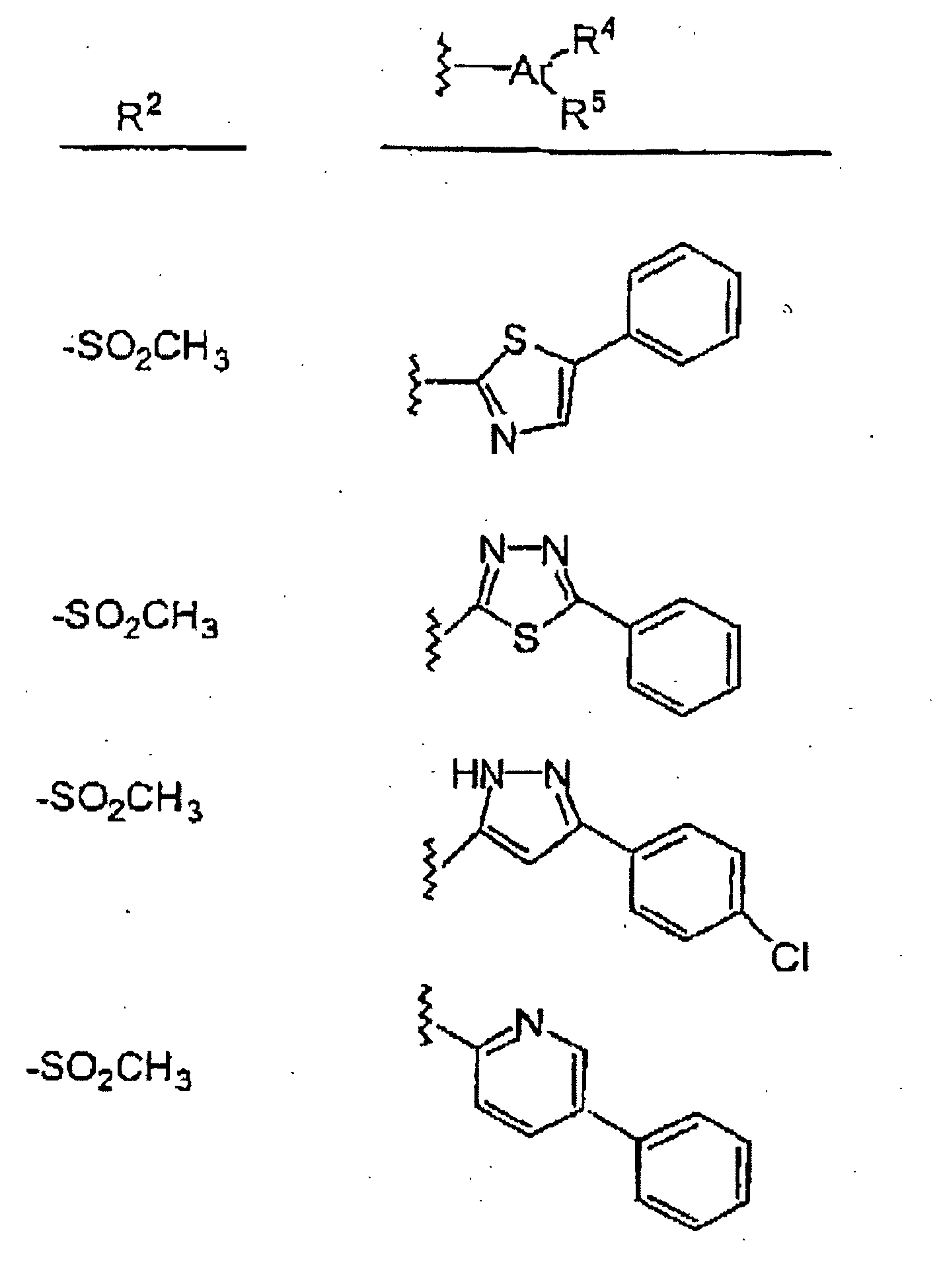
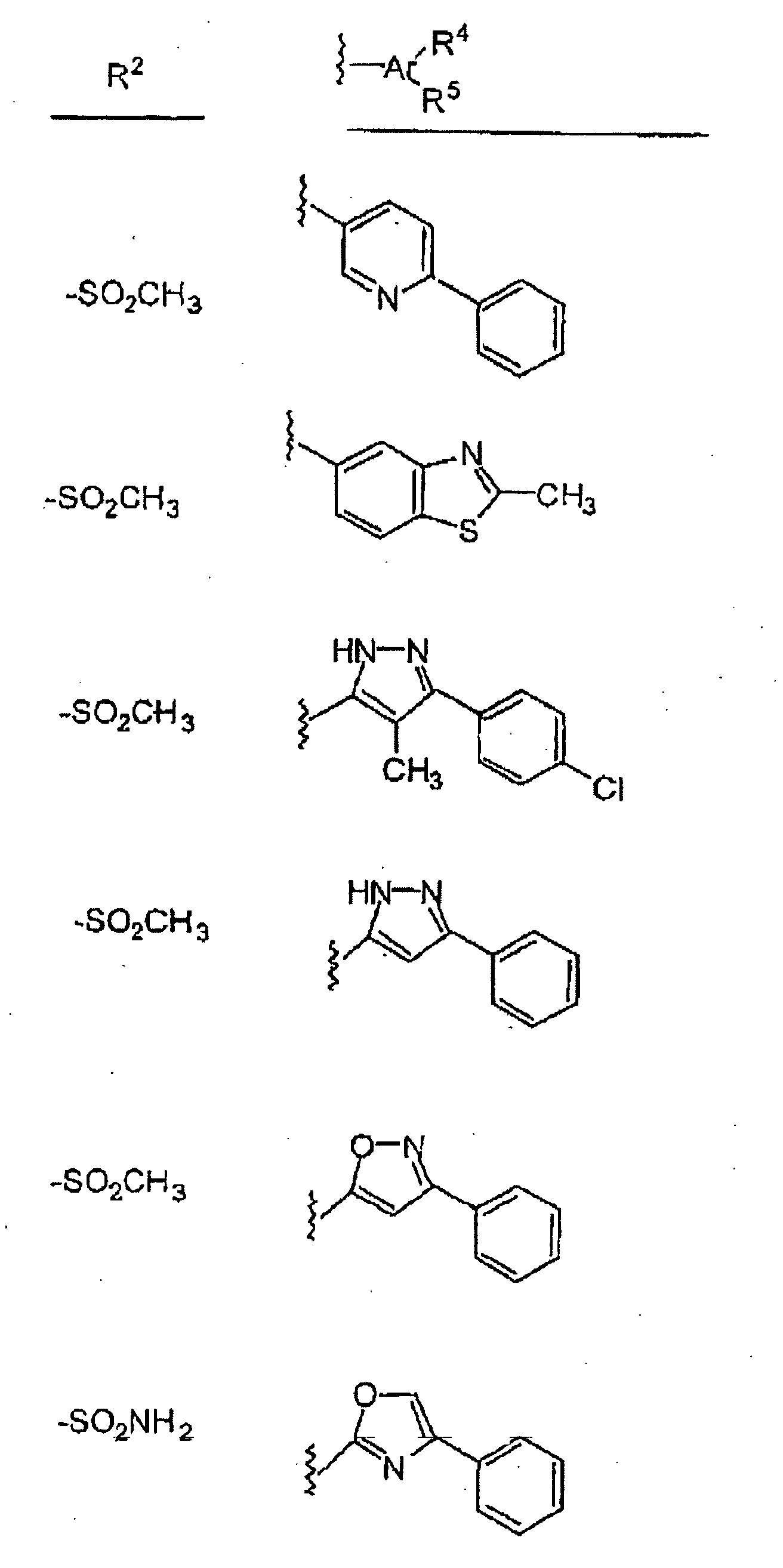
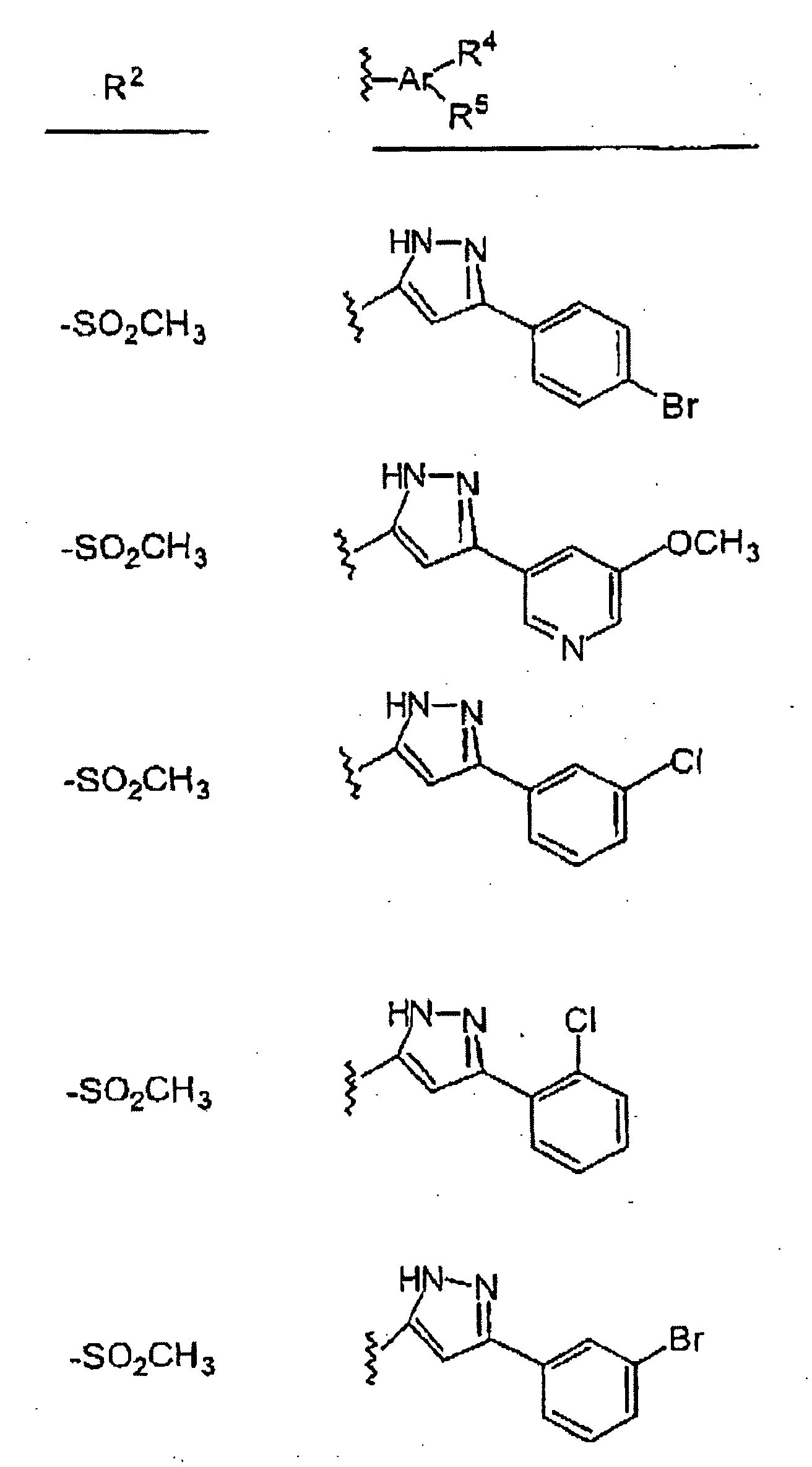
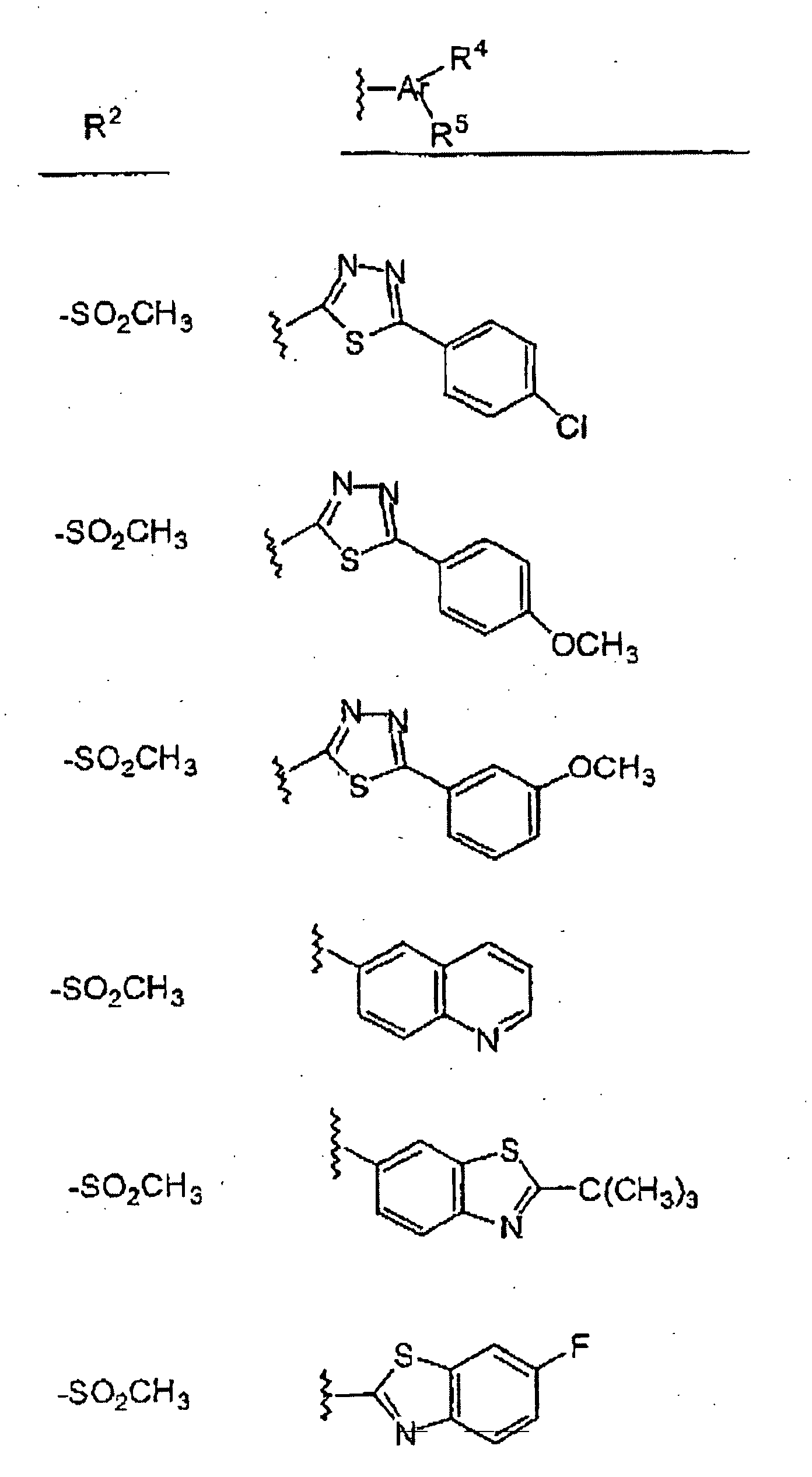
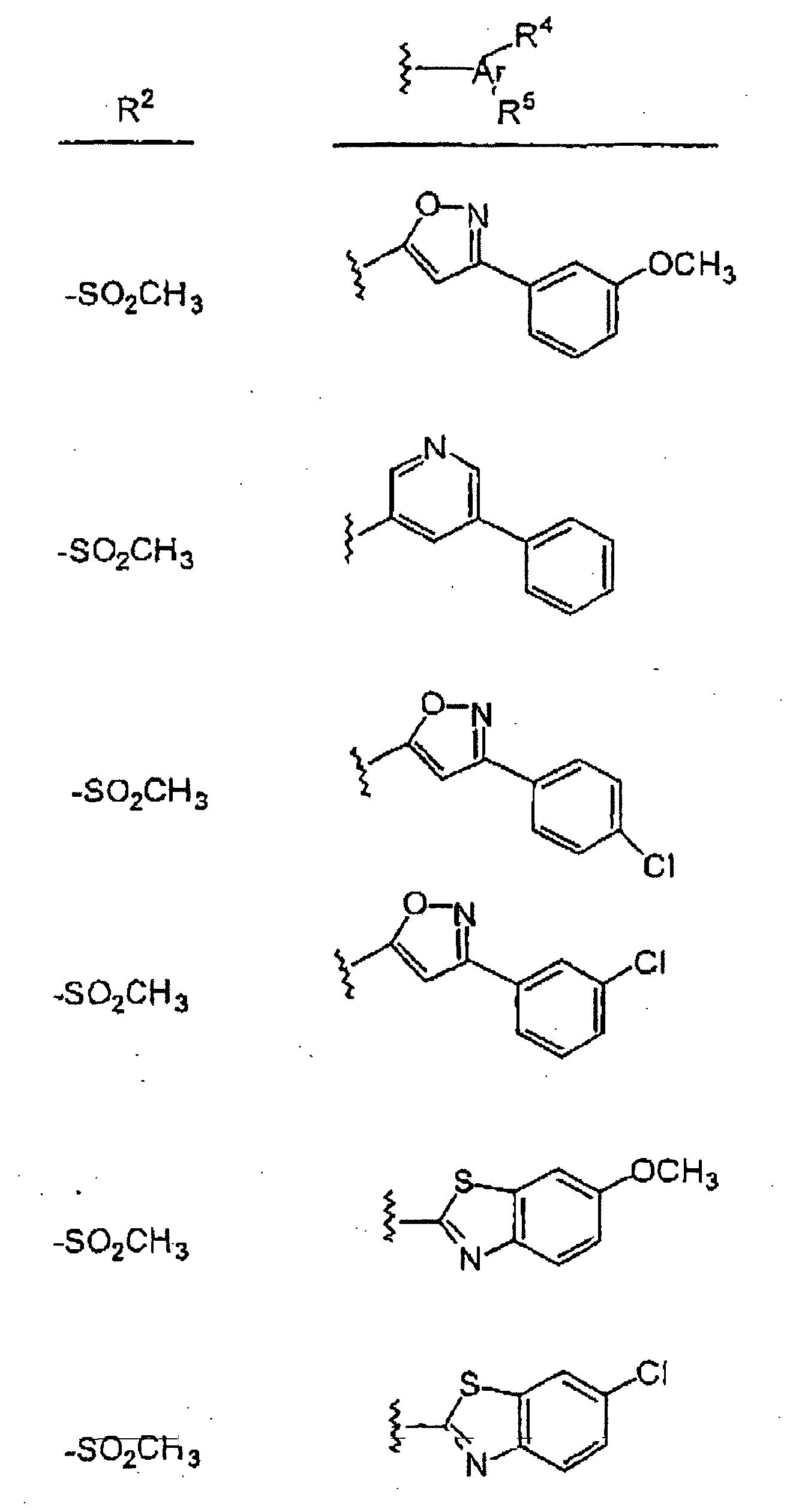
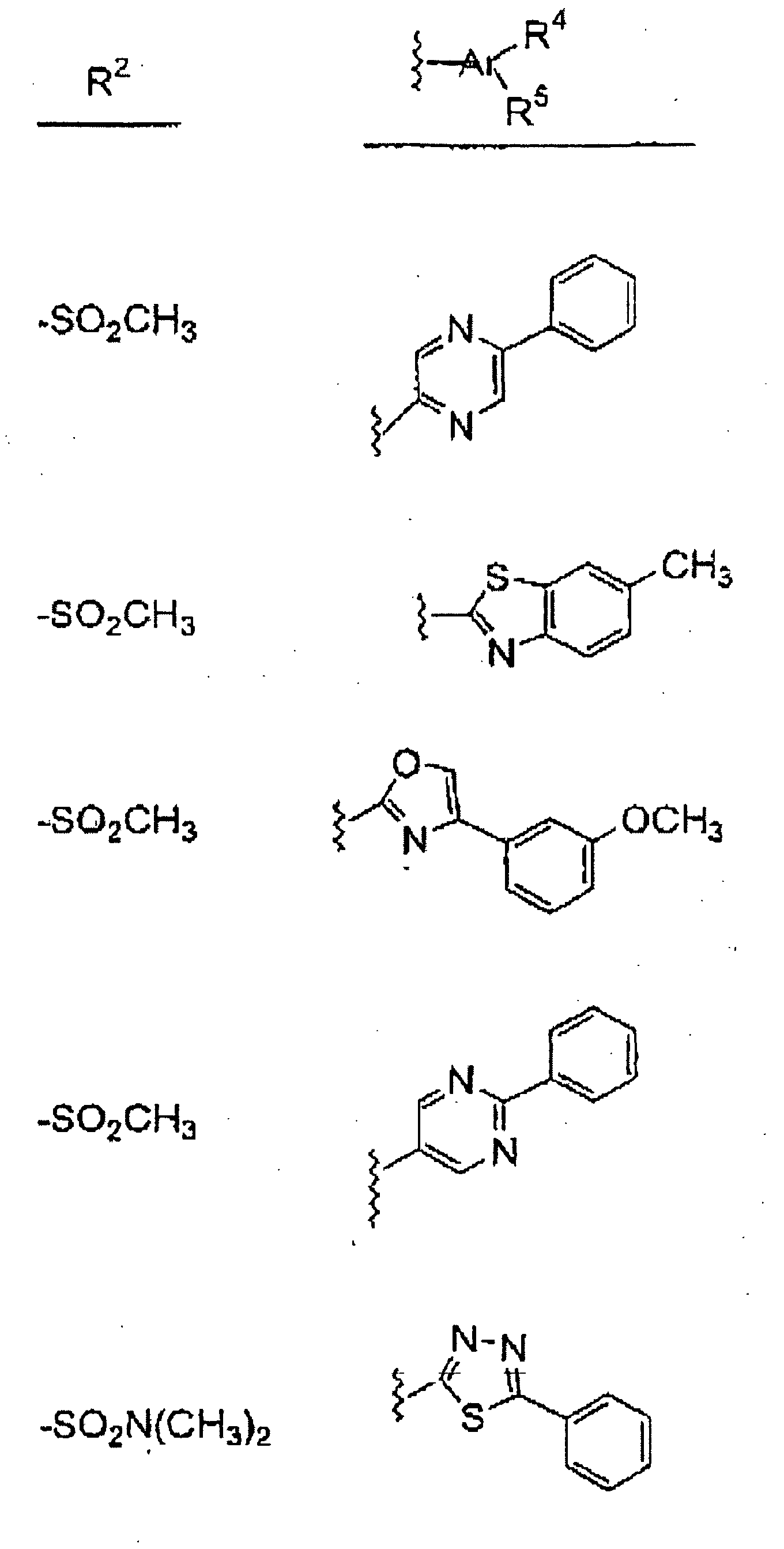
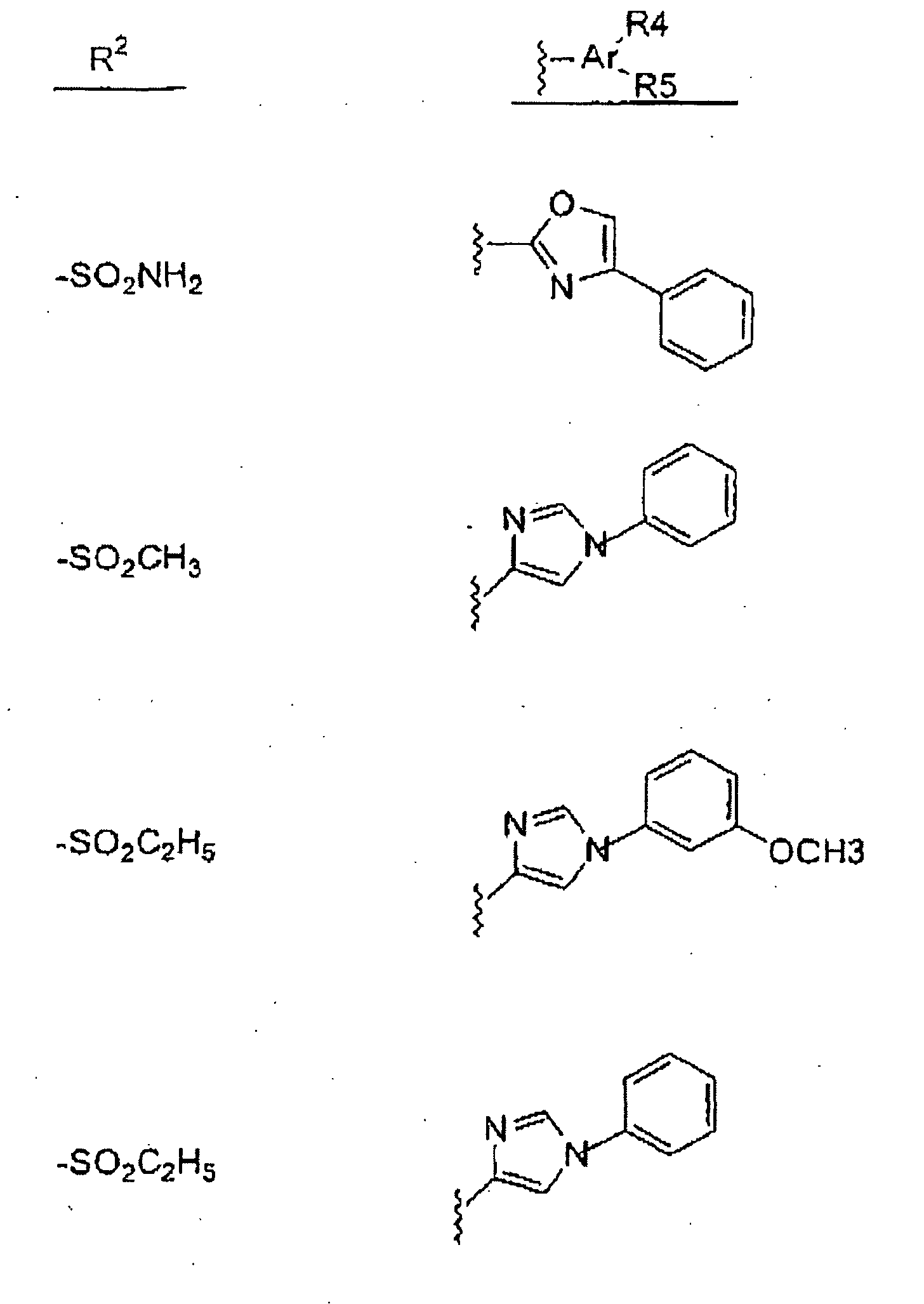
- Typical of the compounds of this sub-sub-class are those wherein R 2 and Ar(R 4 )(R 5 ) are as shown in TABLE II.
- a fourth embodiment of the compounds of this invention is that wherein R 2 is -COR 6 of structural formula I(d): or a pharmaceutically acceptable salt thereof.
- a class of compounds within this embodiment is that wherein R 1 and R 3 are H and X and Z are both nitrogen.
- a sub-class of compounds within this class is that wherein R 2 is-SO 2 CH 3 .
- Some of the compounds described herein contain one or more asymmetric centers and may thus give rise to diastereomers and optical isomers.
- the present invention is meant to include such possible diastereomers as well as their racemic and resolved, enantiomerically pure forms and pharmaceutically acceptable salts thereof.
- pharmaceutically acceptable salts refers to salts prepared from pharmaceutically acceptable non-toxic acids or bases including inorganic and organic acids and bases.
- salts may be prepared from inorganic bases such as aluminum, ammonium, calcium, copper, iron, lithium, magnesium, manganese, potassium, sodium, zinc, and the like. Particularly preferred are the ammonium, calcium, magnesium, potassium, and sodium salts.
- Salts derived from pharmaceutically acceptable organic non-toxic bases include salts of primary, secondary, and tertiary amines, substituted amines including naturally occurring substituted amines, cyclic amines, and basic ion exchange resins, such as arginine, betaine, caffeine, choline, N,N-dibenzylethylenediamine, diethylamine, 2-diethylaminoethanol, 2-dimethylaminoethanol, ethanolamine, ethylenediamine, N-ethylmorpholine, N-ethylpiperidine, N-methylglucamine, glucamine, glucosamine, histidine, hydrabamine, N-(2-hydroxyethyl)piperidine, N-(2-hydroxyethyl)pyrrolidine, isopropylamine, lysine, methylglucamine, morpholine, piperazine, piperidine, polyamine resins, procaine, purines, theobromine, triethyl
- salts may be prepared from pharmaceutically acceptable non-toxic acids, including inorganic and organic acids.
- acids include acetic, adipic, aspartic, 1,5-naphthalenedisulfonic, benzenesulfonic, benzoic, camphorsulfonic, citric, 1,2-ethanedisulfonic, ethanesulfonic, ethylenediaminetetraacetic, fumaric, glucoheptonic, gluconic, glutamic, hydriodic, hydrobromic, hydrochloric, isethionic, lactic, maleic, malic, mandelic, methanesulfonic, mucic, 2-naphthalenesulfonic, nitric, oxalic, pamoic, pantothenic, phosphoric, pivalic, propionic, salicylic, stearic, succinic, sulfuric, tartaric, p-toluenesulfonic acid, unde
- Another aspect of this invention are the processes used to prepare the novel compounds.
- the Cbz spiroindoline 3 is prepared according to the method described in Tetrahedron 53 , 10983-10992 (1997).
- a reagent R 2 Cl wherein R 2 is as defined above, in the presence of a base such as a tertiary amine, including triethylamine (Et 3 N), diisopropylethylamine (DIEA), or pyridine, followed by removal of the carbobenzyloxy (Cbz) protecting group by hydrogenolysis with hydrogen over a noble metal catalyst at room temperature and pressure in a lower alcohol such as methanol or ethanol, or an etherial solvent such as diethyl ether of tetrahydrofuran (THF) or mixtures thereof to give 4 following the methods described in Tetrahedron 53, 10983-10992, (1997) wherein the preparation of 4 is described wherein R 2 is -SO 2 CH 3 .
- a base such as a tertiary amine, including trieth
- the phenyl carbamates are prepared by reaction of the corresponding amines of structure NH 2 -Ar(R 4 )(R 5 ) which are commercially available or readily synthesized, with phenyl chloroformate in pyridine at room temperature as described in Example I below.
- Compound I is prepared by treatment of 4 with an isocyanate of structure OCN-Ar(R 4 )(R 5 ) in a chlorinated alkane at reflux temperature until the reaction is complete in about 4 to about 12 hours.
- Compound I can also be prepared by conducting the above procedures in the reverse order.
- the indoline nitrogen of 3 is protected with Boc by treatment with di- tert- butyl dicarbonate in the presence of a base, such as, NaOH or triethyl amine, in an inert solvent such as aqueous dioxane or methanol and the Cbz group is hydrogenolyzed with hydrogen and a noble metal catalyst to give 5 .
- a base such as, NaOH or triethyl amine
- Compounds of this invention are antagonists of the Y5 receptor and as such are useful for the prevention and treatment of disorders or diseases associated with the Y5 receptor sub-type, preferably for the treatment of feeding disorders such as obesity, anorexia nervosa and bullimia nervosa, and other abnormal conditions, such as diabetes, hypertension, hyperlipemia, hypercholesterolemia, congestive heart failure, renal dysfunction, sexual/reproductive disorders, depression, anxiety, shock, epileptic seizure, memory loss, sleep disturbance, pain, migraine, cerebral hemorrhage, nasal congestion, gastrointestinal disorders, arthritis and immunodeficiency syndrome, wherein the said treatment comprises administering to a patient in need of such treatment a non-toxic therapeutically effective amount of a compound of this invention that selectively antagonizes the Y5 receptor in preference to the other NPY receptors.
- feeding disorders such as obesity, anorexia nervosa and bullimia nervosa
- other abnormal conditions such as diabetes, hypertension, hyperlipemia, hyper
- Dosage levels of the order of from 0.01 mg to 140 mg/kg of body weight per day are useful in the treatment of the above-indicated conditions, or alternatively 0.5 mg to 7 g per patient per day.
- obesity may be effectively prevented or treated by the administration of from 0.01 to 50 mg of the compound per kilogram of body weight per day, or alternatively 0.5 mg to 3.5 g per patient per day.
- the Y5 antagonists of this invention may also be used in combination with other anti-obesity agents for increased efficacy in the prevention and treatment of obesity
- agents would include, but not be limited to: sibutramine; dexenfluramine; leptin; growth hormone secretagogues such as those disclosed and specifically described in US Patent 5,536,716; melanocortin agonists such as Melanotan II; Beta-3 agonists such as those disclosed and specifically described in patent publications WO94/18161, WO95/29159, WO97/46556, WO98/04526 and WO98/32753; 5HT-2 agonists; orexin antagonists; melanin concentrating hormone antagonists; galanin antagonists; CCK agonists; GLP-1 agonists; corticotropin-releasing hormone agonists; and Y1 antagonists.
- compounds of the invention may be administered orally, topically, parenterally, by inhalation spray or rectally in dosage unit formulations containing conventional non-toxic pharmaceutically acceptable carriers, adjuvants and vehicles.
- parenteral as used herein includes subcutaneous injections, intravenous, intramuscular, intrasternal injection or infusion techniques.
- compositions of this invention containing the active ingredient may be in a form suitable for oral use, for example, as tablets, troches, lozenges, aqueous or oily suspensions, dispersible powders or granules, emulsions, hard or soft capsules, or syrups or elixirs.
- Compositions intended for oral use may be prepared according to any method known to the art for the manufacture of pharmaceutical compositions and such compositions may contain one or more agents selected from the group consisting of sweetening agents, flavoring agents, coloring agents and preserving agents in order to provide pharmaceutically elegant and palatable preparations. Tablets contain the active ingredient in admixture with non-toxic pharmaceutically acceptable excipients which are suitable for the manufacture of tablets.
- excipients may be for example, inert diluents, such as calcium carbonate, sodium carbonate, lactose, calcium phosphate or sodium phosphate; granulating and disintegrating agents, for example, corn starch, or alginic acid; binding agents, for example starch, gelatin or acacia, and lubricating agents, for example, magnesium stearate, stearic acid or talc.
- the tablets may be uncoated or they may be coated by known techniques to delay disintegration and absorption in the gastrointestinal tract and thereby provide a sustained action over a longer period.
- a time delay material such as glyceryl monostearate or glyceryl distearate may be employed. They may also be coated by the technique described in the U.S. Patent 4,256,108; 4,166,452; and 4,265,874 to form osmotic therapeutic tablets for controlled release.
- Formulations for oral use may also be presented as hard gelatin capsules wherein the active ingredient is mixed with an inert solid diluent, for example, calcium carbonate, calcium phosphate or kaolin, or as soft gelatin capsules wherein the active ingredients is mixed with water or miscible solvents such as propylene glycol, PEGs and ethanol, or an oil medium, for example peanut oil, liquid paraffin, or olive oil.
- an inert solid diluent for example, calcium carbonate, calcium phosphate or kaolin
- water or miscible solvents such as propylene glycol, PEGs and ethanol
- an oil medium for example peanut oil, liquid paraffin, or olive oil.
- Aqueous suspensions contain the active material in admixture with excipients suitable for the manufacture of aqueous suspensions.
- excipients are suspending agents, for example sodium carboxymethylcellulose methylcellulose, hydroxy-propylmethycellulose, sodium alginate, polyvinyl-pyrrolidone, gum tragacanth and gum acacia; dispersing or wetting agents may be a naturally-occurring phosphatide, for example lecithin, or condensation products of an alkylene oxide with fatty acids, for example polyoxyethylene stearate, or condensation products of ethylene oxide with long chain aliphatic alcohols, for example heptadecaethyleneoxycetanol, or condensation products of ethylene oxide with partial esters derived from fatty acids and a hexitol such as polyoxyethylene sorbitol monooleate, or condensation products of ethylene oxide with partial esters derived from fatty acids and hexitol anhydrides, for example polyethylene sorbitan mono
- the aqueous suspensions may also contain one or more preservatives, for example ethyl, or n-propyl, p-hydroxybenzoate, one or more colouring agents, one or more flavouring agents, and one or more sweetening agents, such as sucrose, saccharin or aspartame.
- preservatives for example ethyl, or n-propyl, p-hydroxybenzoate
- colouring agents for example ethyl, or n-propyl, p-hydroxybenzoate
- flavouring agents such as sucrose, saccharin or aspartame.
- sweetening agents such as sucrose, saccharin or aspartame.
- Oily suspensions may be formulated by suspending the active ingredient in a vegetable oil, for example arachis oil, olive oil, sesame oil or coconut oil, or in mineral oil such as liquid paraffin.
- the oily suspensions may contain a thickening agent, for example beeswax, hard paraffin or cetyl alcohol. Sweetening agents such as those set forth above, and flavouring agents may be added to provide a palatable oral preparation. These compositions may be preserved by the addition of an anti-oxidant such as ascorbic acid.
- Dispersible powders and granules suitable for preparation of an aqueous suspension by the addition of water provide the active ingredient in admixture with a dispersing or wetting agent, suspending agent and one or more preservatives.
- a dispersing or wetting agent e.g., kaolin, kaolin, kaolin, kaolin, kaolin, kaolin, kaolin, kaolin, kaolin, kaolin, kaolin, kaolin, kaolin, kaolin, kaolin, kaolin, sorbitol, sorbitol, sorbitol, sorbitol, sorbitol, sorbitol, sorbitol, sorbitol, sorbitol, mannitol, mannitol, mannitol, mannitol, mannitol, mannitol, mannitol, mannitol, mannitol, mannitol,
- the pharmaceutical compositions of the invention may also be in the form of an oil-in-water emulsions.
- the oily phase may be a vegetable oil, for example olive oil or arachis oil, or a mineral oil, for example liquid paraffin or mixtures of these.
- Suitable emulsifying agents may be naturally-occurring phosphatides, for example soy bean, lecithin, and esters or partial esters derived from fatty acids and hexitol anhydrides, for example sorbitan monooleate, and condensation products of the said partial esters with ethylene oxide, for example polyoxyethylene sorbitan monooleate.
- the emulsions may also contain sweetening and flavouring agents.
- Syrups and elixirs may be formulated with sweetening agents, for example glycerol, propylene glycol, sorbitol or sucrose. Such formulations may also contain a demulcent, a preservative and flavouring and colouring agents.
- the pharmaceutical compositions may be in the form of a sterile injectable aqueous or oleagenous suspension. This suspension may be formulated according to the known art using those suitable dispersing or wetting agents and suspending agents which have been mentioned above.
- the sterile injectable preparation may also be a sterile injectable solution or suspension in a non-toxic parenterally-acceptable diluent or solvent, for example as a solution in 1,3-butane diol.
- acceptable vehicles and solvents that may be employed are water, Ringer's solution and isotonic sodium chloride solution. Cosolvents such as ethanol, propylene glycol or polyethylene glycols may also be used.
- sterile, fixed oils are conventionally employed as a solvent or suspending medium. For this purpose any bland fixed oil may be employed including synthetic mono- or diglycerides.
- fatty acids such as oleic acid find use in the preparation of injectables.
- compositions of the invention may also be administered in the form of a suppository for rectal administration of the drug.
- These compositions can be prepared by mixing the drug with a suitable non-irritating excipient which is solid at ordinary temperatures but liquid at the rectal temperature and will therefore melt in the rectum to release the drug.
- suitable non-irritating excipient which is solid at ordinary temperatures but liquid at the rectal temperature and will therefore melt in the rectum to release the drug.
- suitable non-irritating excipient which is solid at ordinary temperatures but liquid at the rectal temperature and will therefore melt in the rectum to release the drug.
- Such materials are cocoa butter and polyethylene glycols.
- Topical formulations may generally be comprised of a pharmaceutical carrier, cosolvent, emulsifier, penetration enhancer, preservative system, and emollient.
- the amount of active ingredient that may be combined with the carrier materials to produce a single dosage form will vary depending upon the host treated and the particular mode of administration.
- a formulation intended for the oral administration of humans may contain from 0.5 mg to 5 g of active agent compounded with an appropriate and convenient amount of carrier material which may vary from 5 to 95 percent of the total composition.
- Dosage unit forms will generally contain between from 1 mg to 500 mg of an active ingredient, typically 25 mg, 50 mg, 100 mg, 200 mg, 300 mg, 400 mg, 500 mg, 600 mg, 800 mg, or 1000 mg.
- Phenyl chloroformate (0.64 mL, 5.1 mmol) was added to a vigorously stirred solution of 2-amino-5-phenylpyrazine 1-1 (794 mg, 4.64 mmol) in pyridine (10 mL) at room temperature. After being stirred at room temperature overnight, the mixture was diluted with EtOAc to give a suspension, in which the desired compound precipitated out. The suspension was successively washed with 1 N KHSO 4 , brine and dist. water. The precipitate was collected by filtration and dried to give phenyl N-(5-phenyl-2-pyrazinyl)carbamate 1-2 (847 mg, 63%). The filtrate was concentrated under reduced pressure to produce precipitate, which was collected and dried to give the second crop (340 mg, 25%).
- Compound #139 was prepared from 6-fluoro-1-methylsulfonylspiro[indoline-3,4'-piperidine] hydrochloride [prepared in analogy to the method described in US 5,536,716] and phenyl N-(5-phenyl-2-pyrazinyl)carbamate according to the procedure described in Example 1.
- N-(4-benzoylphenyl)-1-ethylsulfonylspiro[indoline-3,4'-piperidine]-1'-carboxamide pale yellow amorphous solid.
- Compound #145 was prepared from 1-ethylsulfonyl-5-fluorospiro[indoline-3,4'-piperidine] hydrochloride [prepared in analogy to the method described in US 5,536,716] and phenyl N-(1-phenylimidazol-4-yl)carbamate according to the procedure described in Example 1.
- Compound #154 was prepared from 1-ethylsulfonyl-6-fluorospiro[indoline-3,4'-piperidine] hydrochloride [prepared in analogy to the method described in US 5,536,716] and phenyl N-[5-(1,3,4-thiadiazol-2-yl)-2-pyrazinyl]carbamate according to the procedure described in Example 1.
- Compound #201 was prepared from 1-methylsulfonylspiro[indoline-3,4'-piperidine] hydrochloride [prepared by the method described in US 5,536,716] and phenyl N-(3-biphenylyl)carbamate according to the procedure described in Example 2.
- Compound #202 was prepared from 5-fluoro-1-methylsulfonylspiro[indoline-3,4'-piperidine] hydrochloride [prepared in analogy to the method described in US 5,536,716] and phenyl N-(5-phenyl-2-pyrazinyl)carbamate according to the procedure described in Example 2.
- Compound #203 and #204 were prepared from 1-ethylsulfonylspiro[indoline-3,4'-piperidine] hydrochloride [prepared in analogy to the method described in US 5,536,716] and phenyl N-[1-(3-fluorophenyl)-4-imidazolyl]carbamate or phenyl N-[1-(2-fluorophenyl)-4-imidazolyl]carbamate, respectively, according to the procedure described in Example 2.
- 1-sulfamoylspiro[indoline-3,4'-piperidine] hydrochloride 3-1 was prepared by the procedure described in WO 9602530.
- Chlorosulfonyl isocyanate (2.70 mL, 31.1 mmol) was added to a stirred solution of tert -butyl alchol (2.96 mL, 31.1 mmol) in EtOAc (400 mL) at -40°C, and the resulting mixture was stirred at -20 °C for 20 min. The mixture was cooled to -78°C, and a solution of 4-1 (5.00 g, 15.5 mmol) in EtOAc (40 mL) was added to the reaction mixture. The mixture was allowed to warm to room temperature and stirred for 14 h.
- reaction mixture was washed with sat.NaHCO 3 , H 2 O and brine, dried (Na 2 SO 4 ), and concentrated.
- the residual oil was purified by silica gel column chromatography (80 g, hexane-EtOAc 4:13:12:1) to give 4-2 (2.13 g, 27%).
- Et 3 N (0.285 mL, 1.46 mmol) was added to a stirred mixture of 4-3 (250 mg, 0.681 mmol) and phenyl 5-phenyl-1,3,4-thiadiazol-2-ylcarbamate (202 mg, 0.681 mmol) in CHCl 3 (3 mL), and the mixture was heated to reflux for 3 h. After being cooled to room temperature, the mixture was concentrated under reduced pressure. The residual oil was purified by silica gel column chromatography (10 g, hexane-EtOAc-MeOH 1:1:0 ⁇ 8:8:1) to give 4-4 (208 mg, 54%).
- Step 3 Preparation of 1-methylsulfamoyl-N-(5-phenyl-1,3,4-thiadiazol-2-yl)spiro[indoline-3,4'-piperidine]-1'-carboxamide 500
- the residual oil was purified by silica gel column chromatography (100g, hexane-EtOAc 3:1 ⁇ 2:1 ⁇ 4:3) to give 577 mg of 9-5 (14%) and 1.42 g of the mixture of 9-5 and 9-6 (33%).
- Step 1 Preparation of Compounds 10-2 and 10-3
- Indene 10-1 was synthesized by the method described in US Patent 5,536,716
- Amine HCl salt 11-3 (201 mg, 0.614 mmol) and phenoxy compound 11-4 (176 mg; 0.608 mmol)were suspended in CHCl 3 (6.0mL) and triethylamine (0.200 mL), and the suspension was refluxed for 3 h. The resulting mixture was cooled to room temperature. After diluting with ethyl acetate, the organic layer was washed with aqueous NH 4 Cl, saturated aqueous NaHCO 3 and brine. The organic layer was dried over Na 2 SO 4 and concentrated in vacuo. The residue was suspended with ethanol and collected to give urea 11-5 (235 mg; 84%) as a solid.
- thiol 11-6 (79.5mg) in anhydrous methanol (3.0mL) was added sodium methoxide(31.1mg) and methyl iodide(0.036 mL). After being stirred for 12 h at room temperature, the resulting mixture was diluted with ethyl acetate and washed with water and brine. The organic layer was dried (Na 2 SO 4 ) and concentrated in vacuo. The residue was triturated with IPE to give methylthio compound 1100 (72.6 mg; 88%)as a white solid.
- Compound #1401 and #1402 were prepared from 7-aza-1-methylsulfonylspiro[indoline-3,4'-piperidine] and phenyl N-(4-benzoylphenyl)carbamate or phenyl N-(3-phenyl-5-isoxazolyl)carbamate, respectively, according to the procedure described in Example 14.
- LMtk- cells expressing human Y5 receptors were washed with 50 mM HEPES buffer (pH 7.4) containing 20% sucrose, homogenized and centrifuged at 1,000 x g for 15 min. The supernatant was centrifuged at 100,000 x g for 45 min. The pellets were resuspended in 5 mM HEPES buffer (pH 7.4) and centrifuged again. The membrane fraction was resuspended by a homogenizer in the same buffer and used for this study.
- Binding of [ 125 I]PYY to the membrane was performed in 0.2 ml of 25 mM Tris buffer (pH 7.4) containing 10 mM MgCl 2 , 1 mM PMSF, 0.1% bacitracinand 0.5% BSA.
- the membranes (100 - 300 ⁇ g/ml) were incubated at 25°Cfor 120 min with [ 125 I]PYY (25 pM).
- Bound and free peptides were separated by filtration using a GF/C glass filter (Whatman, England) presoaked with 0.3% polyethylenimine. The remaining radioactivity on the filter was quantitated using a CobraTM (Packard, Japan). Specific binding of [ 125 I]PYY was defined as the difference between total binding and nonspecific binding in the presence of 1 ⁇ M PYY.
- Example 18 Employing the procedure described in Example 18, a representative number of the compounds of this invention were found to have IC50 values less than 1 mM.
- Rats were anesthetized with sodium pentobarbital (50 mg/kg, i.p., Dainabot, Japan).
- a permanent stainless steel guide cannula for intracerebroventricular (ICV) injection (21 gauge, 10 mm long) was stereotaxically implanted into the right lateral ventricle.
- the stereotaxic coordinates used were as follows : 0.9 mm posterior and 1.2 mm lateral to the bregma and 1.5 mm ventral to the brain surface.
- Test compounds were suspended in 0.5 % methylcellulose and orally administered by gavage. Administration of test compounds usually began at 10:00. Dosing volume was 5 ml/kg.
- bovine pancreatic polypeptide PP, 5 g/10 l/1 min
- PP bovine pancreatic polypeptide
- the injector extended 2 mm beyond the end of the guide cannula.
- Bovine PP was dissolved in 10 mM PBS containing 0.05 % BSA. Two hour post-injection food intake was measured for each rat.
- Compound 100 was orally administered 1 hour prior to the ICV-injection ofbPP in satiated male Sprague-Dawley rats.
- Compound 100 (1, 3, 10 and 30 mg/kg) suppressed bPP-induced food intake in a dose-dependent manner, and the minimum effective dose is estimated to be 3 mg/kg.
- this compound at 100 mg/kg, p.o. did not cause any abnormal behavior in rats and mice during 24 hour after dosing.
- Compound 100 has a potent in vivo Y5 antagonistic activity without causing any abnormal behavior.
- Tablets containing 1-25mg of compound Amount mg Compound of formula I 1.0 2.0 25.0 Microcrystalline cellulose 20.0 20.0 20.0 Modified food corn starch 20.0 20.0 20.0 Lactose 58.5 57.5 34.5 Magnesium stearate 0.5 0.5 0.5 0.5
- Tablets containing 26-100 mg of compound Amount mg Compound of formula (I) 26.0 50.0 100.0 Microcrystalline cellulose 80.0 80.0 80.0 Modified food corn starch 80.0 80.0 80.0 Lactose 213.5 189.5 139.5 Magnesium stearate 0.5 0.5 0.5 0.5
Landscapes
- Health & Medical Sciences (AREA)
- Chemical & Material Sciences (AREA)
- Organic Chemistry (AREA)
- Engineering & Computer Science (AREA)
- Bioinformatics & Cheminformatics (AREA)
- General Health & Medical Sciences (AREA)
- Animal Behavior & Ethology (AREA)
- Chemical Kinetics & Catalysis (AREA)
- General Chemical & Material Sciences (AREA)
- Medicinal Chemistry (AREA)
- Nuclear Medicine, Radiotherapy & Molecular Imaging (AREA)
- Veterinary Medicine (AREA)
- Pharmacology & Pharmacy (AREA)
- Life Sciences & Earth Sciences (AREA)
- Public Health (AREA)
- Neurosurgery (AREA)
- Neurology (AREA)
- Biomedical Technology (AREA)
- Diabetes (AREA)
- Pain & Pain Management (AREA)
- Hematology (AREA)
- Obesity (AREA)
- Immunology (AREA)
- Hospice & Palliative Care (AREA)
- Cardiology (AREA)
- Endocrinology (AREA)
- Psychiatry (AREA)
- Reproductive Health (AREA)
- Rheumatology (AREA)
- Anesthesiology (AREA)
- Emergency Medicine (AREA)
- Urology & Nephrology (AREA)
- Child & Adolescent Psychology (AREA)
- Orthopedic Medicine & Surgery (AREA)
- Heart & Thoracic Surgery (AREA)
- Physical Education & Sports Medicine (AREA)
- Pharmaceuticals Containing Other Organic And Inorganic Compounds (AREA)
- Nitrogen Condensed Heterocyclic Rings (AREA)
- Other In-Based Heterocyclic Compounds (AREA)
- Plural Heterocyclic Compounds (AREA)
Claims (25)
- Composé de formule structurelle I :ou un sel pharmaceutiquement acceptable de celui-ci, dans lequel ;

V, W, X et Z sont choisis indépendamment à partir de CH et N ;
R1 est H, un alkyle en C1-3, un alkoxy en C1-3, F ou Cl ;
R2 est SO(n)R6, COR6 ou CHO dans lesquels
N est 0, 1 ou 2 ; et
R6 est (N(R3)2 ou un alkyle en C1-3 ;
R3 est indépendamment H ou un alkyle en C1-3 ;
Ar est un aryle ou un hétéroaryle ;
R4 et R5 sont indépendamment choisis à partir :dans lequel « hétéroaryle » est un hétérocycle aromatique à 5 ou 6 éléments ou une version benzo ou pyrido fusionnée de celui-ci, tous ayant, en plus des atomes de carbone, de 1 à 3 hétéroatomes choisis à partir de N, O et S en tant qu'atome(s) constituant le cycle, et « aryle » est un phényle ou un naphtyle.(1) d'un hydrogène,(2) d'un aryle, soit non substitué, soit substitué par(a) un halogène,(b) un alkoxy en C1-3,(c) -N(alkyle en C1-3)2,(d) un alkanoyle en C2-4, ou(e) un aryle ;(3) un nitro,(4) un alkyle en C1-5,(5) un alkoxy en C1-5,(6) un hydroxy alkyle en C1-3,(7) un carboxy,(8) un halogène,(9) un alkylthio en C1-5,(10) un alkoxycarbonyle en C1-5,(11) un pyridylcarbonyle,(12) un benzoyle,(13) un phényle alkoxy en C1-3,(14) un pyridyle, soit non substitué, soit substitué par un alkyle en C1-3 ou un alkoxy en C1-3,(15) un cycloalkyle en C3-6,(16) un oxazolyle,(17) un thiazolyle,(18) un triazolyle,(19) un phénoxy ou(20) un alkanoyle en C2-6 ; - Composé selon la Revendication 1, dans lequel Ar est un phényle de formule structurelle I(a)ou un sel pharmaceutiquement acceptable de celui-ci.

- Composé selon la Revendication 2, dans lequel X et Z sont tous les deux de l'azote et V et W sont tous les deux -CH=.
- Composé selon la Revendication 3, dans lequel R2 est -SO2(alkyle en C1-3) ou SO2NH2.
- Composé selon la Revendication 4, dans lequel R4 et R5 sont indépendamment choisis à partir : d'un phényle, d'un pyridyle, d'un benzoyle, d'un halophényle, d'un phénoxy, d'un alkylpyridyle en C1-5, d'un benzhydryle, d'un phényle alkoxy en C1-3, de NO2, d'un alkanoyle en C2-4, d'un halogène, d'un alkoxy en C1-5, d'un alkoxycarbonyle en C1-3, d'un alkylthio en C1-5, d'un triazolyle, d'un carboxy, d'un hydrogène, d'un alkyle en C1-5, d'un pyridylcarbonyle, et d'un alkoxyphényle en C1-3.
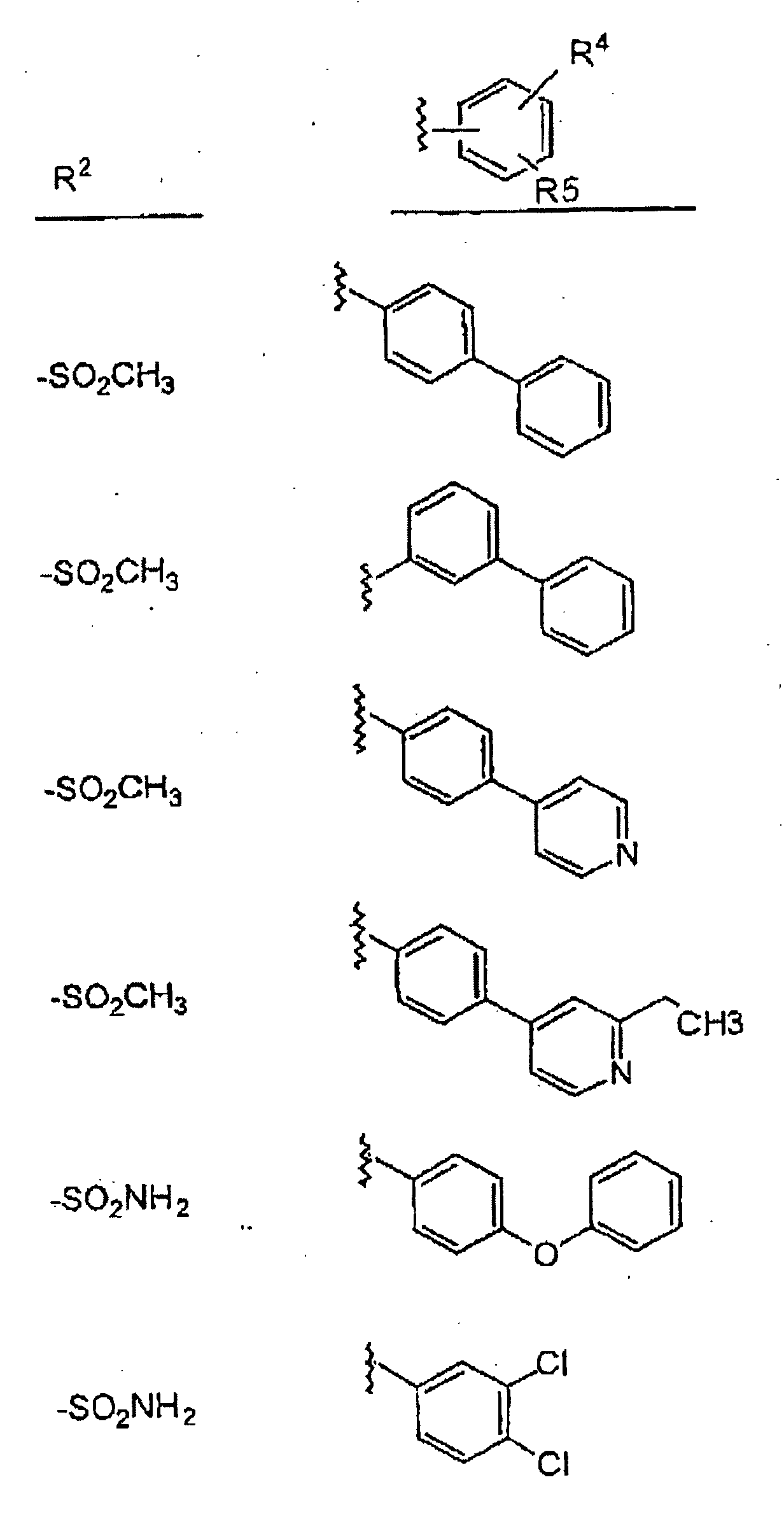
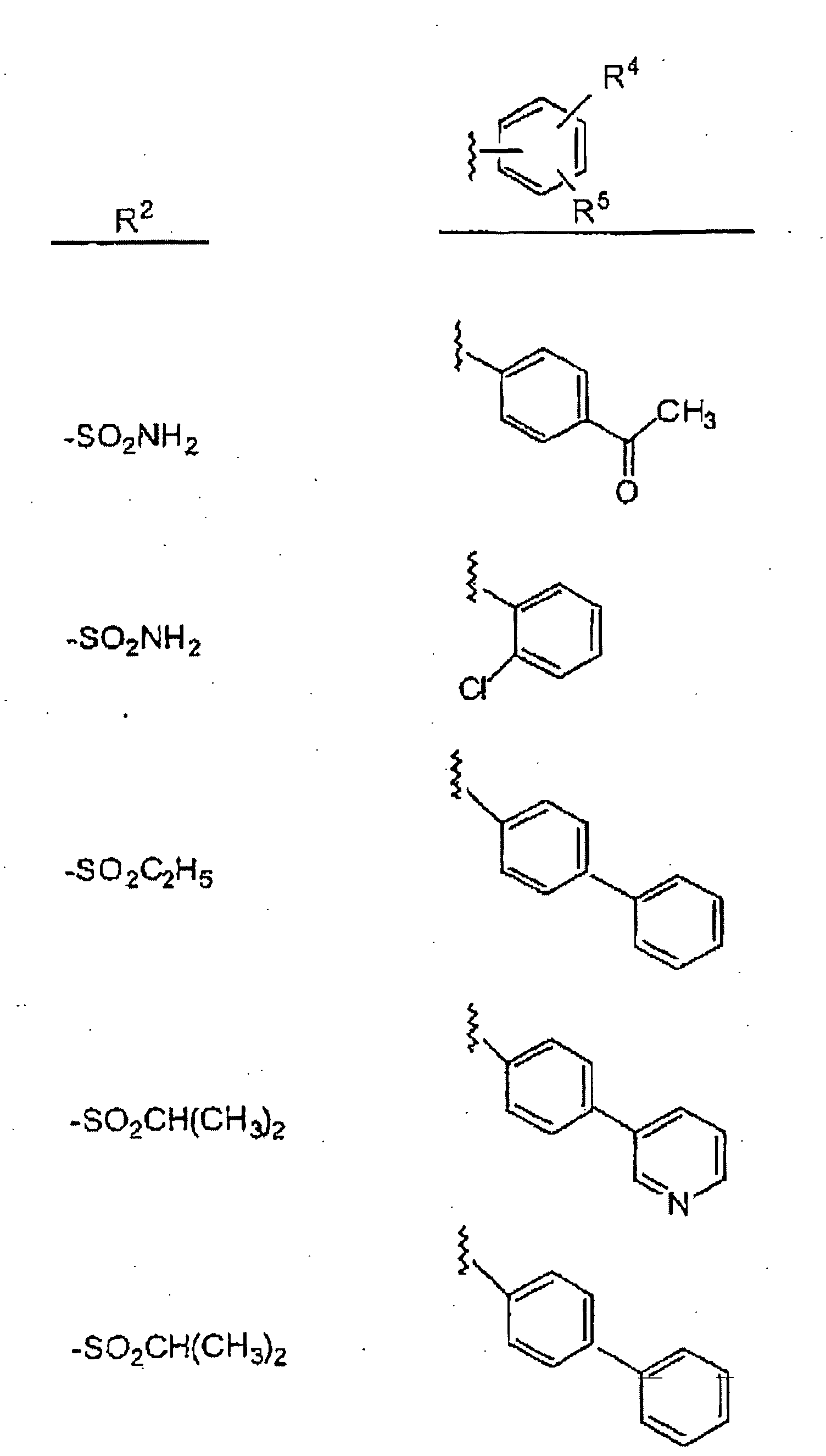
- Composé selon la Revendication 5, ou un sel pharmaceutiquement acceptable de celui-ci choisi à partir de ceux décrits dans le tableau suivant :


- Composé selon la Revendication 1, dans lequel Ar est un hétéroaryle à 5 ou 6 éléments ayant, en plus des atomes de carbone, de 1 à 3 hétéroatomes choisis à partir de N, O et S en tant qu'atomes constituant le cycle, ou des versions benzo ou pyrido fusionnées de celui-ci de formule structurelle I(b) ;ou un sel pharmaceutiquement acceptable de celui-ci.
- Composé selon la Revendication 7, dans lequel X et Z sont tous les deux de l'azote et V et W sont tous les deux -CH=.
- Composé selon la Revendication 8, dans lequel R2 est -SO2(alkyle en C1-3) ou -SO2N(alkyle en C1-3)2.
- Composé selon la Revendication 9, dans lequel le groupe hétéroaryle Ar est choisi à partir : d'un thiazolyle, d'un thiadiazolyle, d'un pyrazolyle, d'un pyridyle, d'un benzothiazolyle, d'un oxazolyle, d'un pyridothiazolyle, d'un benzoxazolyle, d'un quinolyle, d'un pyrazinyle, d'un thiényle, d'un isoxazolyle, d'un pyrimidinyle, d'un benzimidazolyle, d'un oxadiazolyle et d'un imidazolyle.
- Composé selon la Revendication 10, ou un sel pharmaceutiquement acceptable de celui-ci, choisi à partir de ceux décrits dans le Tableau suivant :



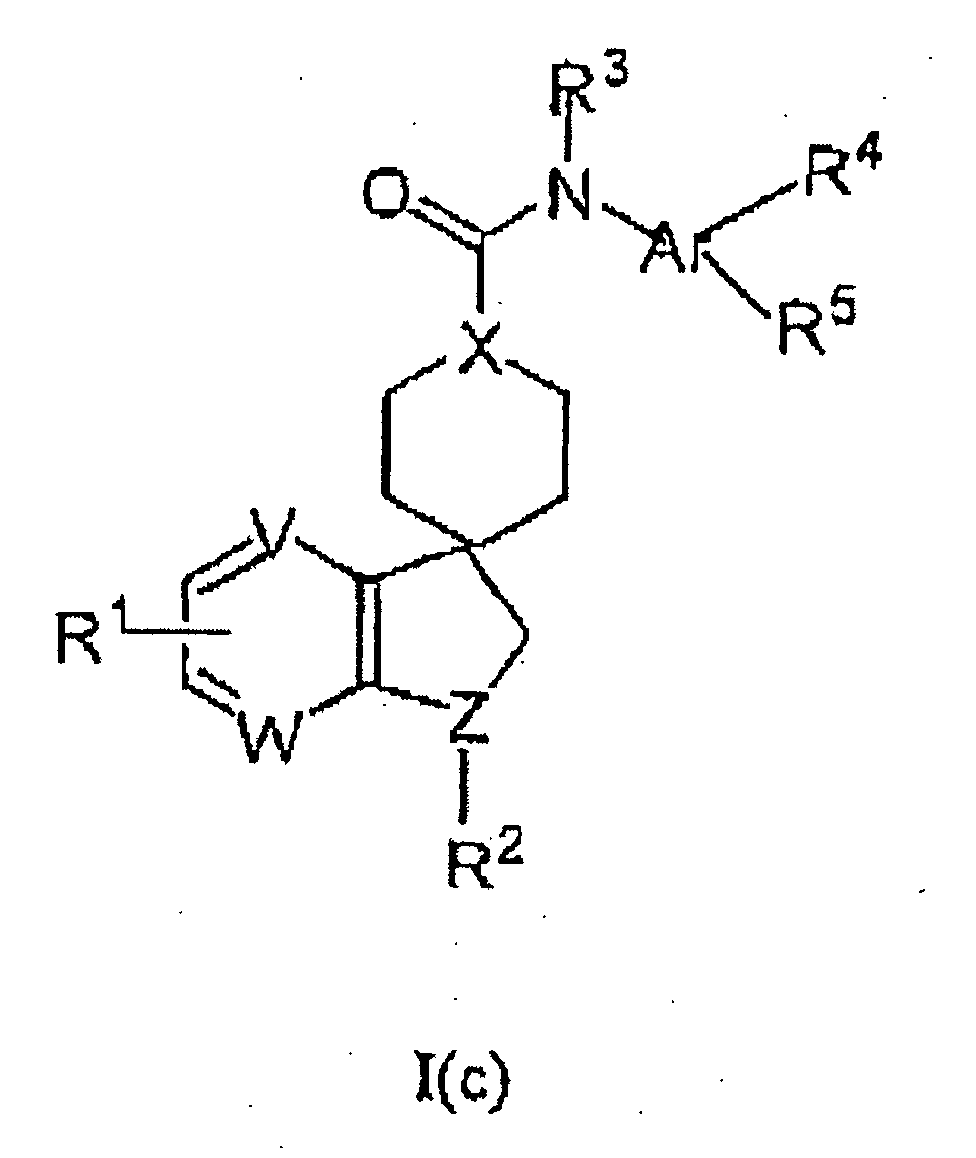
- Composé selon la Revendication 1, dans lequel un parmi X et Z est N et l'autre est -CH= de formule structurelle I(c) :ou un sel pharmaceutiquement acceptable de celui-ci.
- Composé selon la Revendication 12, dans lequel X est N, Z est -CH= et V et W sont tous les deux -CH=.
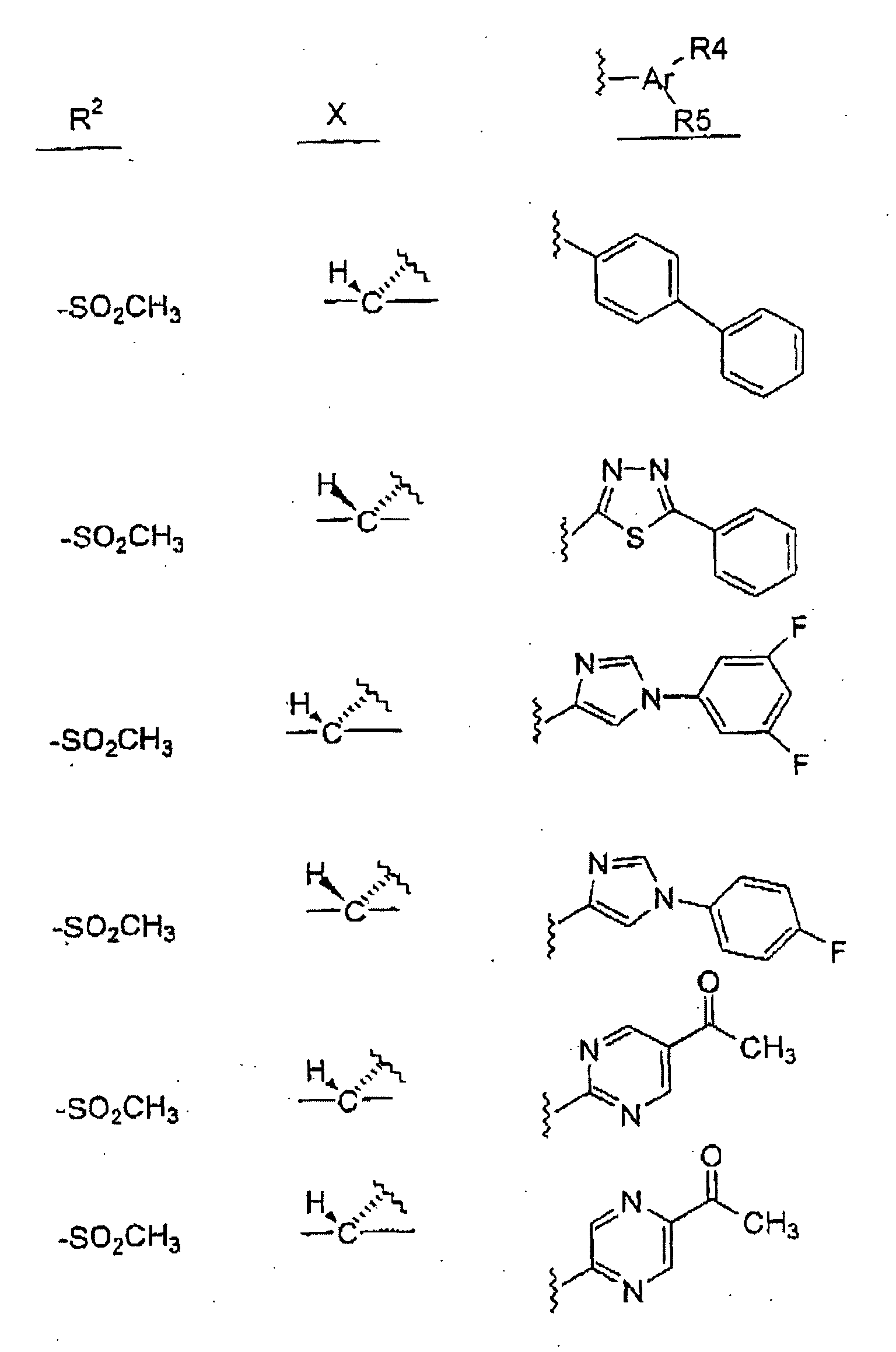
- Composé selon la Revendication 13, ou un sel pharmaceutiquement acceptable de celui-ci, choisi à partir de ceux décrits dans le Tableau suivant :


- Composé selon la Revendication 12, dans lequel X est -CH=, Z est N et V et W sont tous les deux -CH=.
- Composé selon la Revendication 15, ou un sel pharmaceutiquement acceptable de celui-ci, choisi à partir de ceux décrits dans le Tableau suivant :


- Composé selon la Revendication 1, dans lequel R2 est -COR6 de formule structurale I(d)ou un sel pharmaceutiquement acceptable de celui-ci.

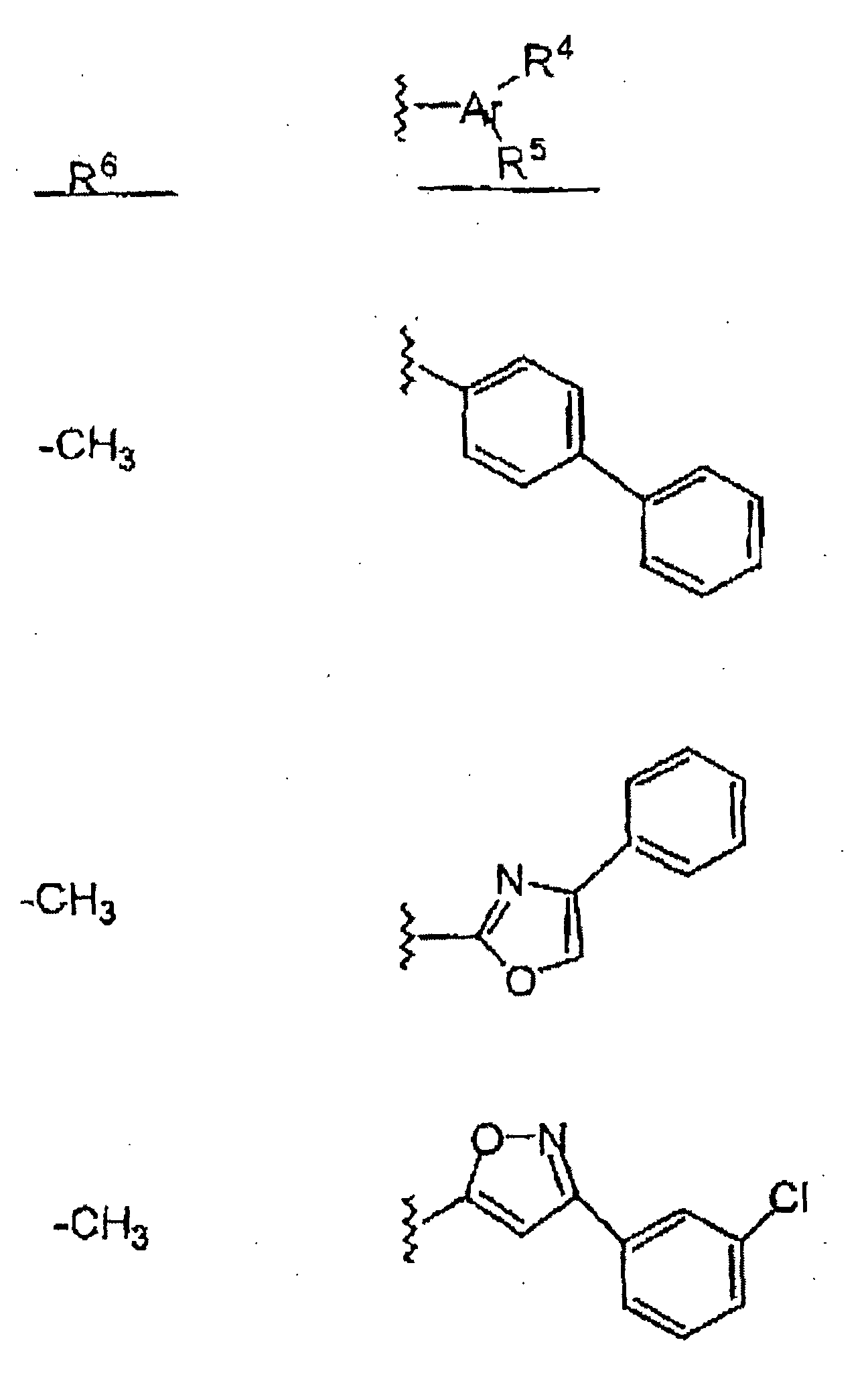
- Composé selon la Revendication 17, ou un sel pharmaceutiquement acceptable de celui-ci, choisi à partir de ceux décrits dans le Tableau suivant :
- Composé selon la Revendication 1, de formule structurelle I(e), dans lequel un des V ou W est un azote et l'autre est -CH=.
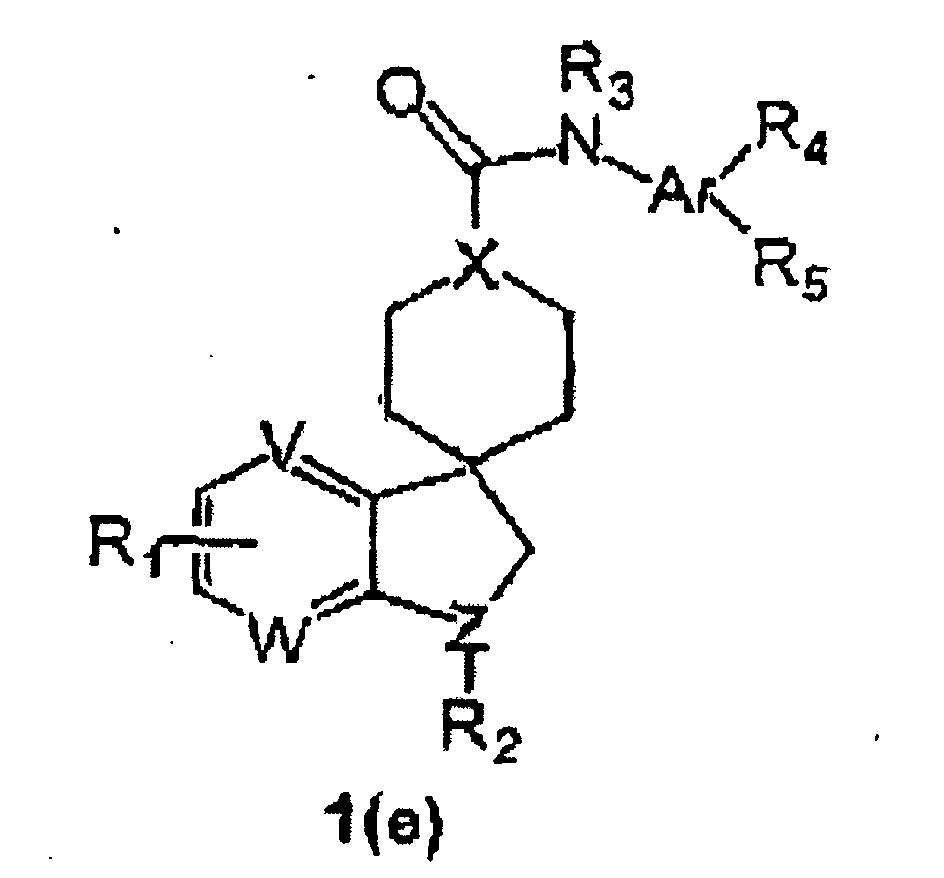
- Composé selon la revendication 19, dans lequel R1 et R3 sont tous les deux un hydrogène.
- Composé selon la Revendication 20, dans lequel R2 est -SO2CH3 ou -SO2NH2.
- Composé selon la Revendication 21, choisi à partir des composés décrits dans le Tableau Suivant :

- Composition pharmaceutique qui comprend un vecteur acceptable pharmaceutiquement et une quantité efficace du composé comme défini selon l'une quelconque des Revendications 1 à 22 ou un sel acceptable pharmaceutiquement de celui-ci.
- Composé comme défini selon l'une quelconque des Revendications 1 à 22 ou un sel acceptable pharmaceutiquement de celui-ci pour une utilisation dans un procédé de traitement par thérapie.
- Composé comme défini selon l'une quelconque des Revendications 1 à 22 ou un sel acceptable pharmaceutiquement de celui-ci pour la fabrication d'un médicament pour le traitement de l'obésité.
Applications Claiming Priority (3)
| Application Number | Priority Date | Filing Date | Title |
|---|---|---|---|
| US10783598P | 1998-11-10 | 1998-11-10 | |
| US107835P | 1998-11-10 | ||
| PCT/US1999/026447 WO2000027845A1 (fr) | 1998-11-10 | 1999-11-08 | Spiro-indolines en tant qu'antagonistes du recepteur y5 |
Publications (3)
| Publication Number | Publication Date |
|---|---|
| EP1129089A1 EP1129089A1 (fr) | 2001-09-05 |
| EP1129089A4 EP1129089A4 (fr) | 2003-01-22 |
| EP1129089B1 true EP1129089B1 (fr) | 2005-12-28 |
Family
ID=22318729
Family Applications (1)
| Application Number | Title | Priority Date | Filing Date |
|---|---|---|---|
| EP99971808A Expired - Lifetime EP1129089B1 (fr) | 1998-11-10 | 1999-11-08 | Spiro-indolines en tant qu'antagonistes du recepteur y5 |
Country Status (9)
| Country | Link |
|---|---|
| US (5) | US6191160B1 (fr) |
| EP (1) | EP1129089B1 (fr) |
| JP (1) | JP2002529464A (fr) |
| AT (1) | ATE314371T1 (fr) |
| AU (1) | AU756797B2 (fr) |
| CA (1) | CA2350714A1 (fr) |
| DE (1) | DE69929235T2 (fr) |
| ES (1) | ES2255330T3 (fr) |
| WO (1) | WO2000027845A1 (fr) |
Families Citing this family (87)
| Publication number | Priority date | Publication date | Assignee | Title |
|---|---|---|---|---|
| JP2002536425A (ja) * | 1999-02-12 | 2002-10-29 | スミスクライン・ビーチャム・パブリック・リミテッド・カンパニー | オレキシン受容体アンタゴニストの新規用途 |
| US6462053B1 (en) | 1999-08-20 | 2002-10-08 | Banyu Pharmaceutical Co., Ltd. | Spiro compounds |
| TWI279402B (en) | 1999-08-20 | 2007-04-21 | Banyu Pharma Co Ltd | Spiro compounds having NPY antagonistic activities and agents containing the same |
| US6803372B2 (en) | 1999-08-20 | 2004-10-12 | Banyu Pharmaceutical Co., Ltd. | Spiro compounds |
| ATE381343T1 (de) * | 1999-11-03 | 2008-01-15 | Novo Nordisk As | Verwendung eines wachstumshormons oder eines wachstumshormon-sekretion fördernden mittels zur appetit-unterdrückung bzw. sättigungsinduktion |
| EP1695977A3 (fr) * | 2000-12-12 | 2006-09-20 | Neurogen Corporation | Spiro[isobenzofuran-1,4'-piperidine]-3-one et 3H-spiroisobenzofuran-1,4'-Piperidine |
| JP2004520299A (ja) | 2000-12-12 | 2004-07-08 | ニューロジェン・コーポレーション | スピロ[イソベンゾフラン−1,4’−ピペリジン]−3−オン類及び3h−スピロイソベンゾフラン−1,4’−ピペリジン類 |
| SG138463A1 (en) | 2000-12-21 | 2008-01-28 | Schering Corp | Heteroaryl urea neuropeptide y y5 receptor antagonists |
| US6946476B2 (en) | 2000-12-21 | 2005-09-20 | Schering Corporation | Heteroaryl urea neuropeptide Y Y5 receptor antagonists |
| US6924291B2 (en) * | 2001-01-23 | 2005-08-02 | Merck & Co., Inc. | Process for making spiro isobenzofuranone compounds |
| AU2002247367B2 (en) | 2001-03-21 | 2005-10-27 | Pharmacopeia Drug Discovery, Inc. | Aryl and biaryl compounds having MCH modulatory activity |
| CA2443672C (fr) | 2001-04-12 | 2011-03-29 | Pharmacopeia, Inc. | Aryl et biaryl piperidines utilisees en tant qu'antagonistes de la mch |
| WO2002094825A1 (fr) * | 2001-05-22 | 2002-11-28 | Banyu Pharmaceutical Co., Ltd. | Nouveau derive de spiropiperidine |
| AU2002355286B2 (en) | 2001-07-26 | 2005-10-13 | Schering Corporation | Substituted urea neuropeptide Y Y5 receptor antagonists |
| ATE427935T1 (de) * | 2001-08-07 | 2009-04-15 | Banyu Pharma Co Ltd | Spiro isobenzofurane als neuropeptid y rezeptor antagonisten |
| CA2403307A1 (fr) | 2001-10-23 | 2003-04-23 | Neurogen Corporation | Derives de l'imidazole 2-cyclohexyl-4-phenyl-1h substitue |
| WO2003051397A1 (fr) * | 2001-12-17 | 2003-06-26 | Merck & Co., Inc. | Antagonistes des recepteurs y5 des neuropeptides pour traiter la depression, l'anxiete et la demence |
| US20050107411A1 (en) * | 2001-12-17 | 2005-05-19 | Macneil Douglas J. | Method for treating circadian rhythm disruptions |
| JP4496722B2 (ja) * | 2002-06-28 | 2010-07-07 | 萬有製薬株式会社 | 新規ベンズイミダゾール誘導体 |
| US7105526B2 (en) | 2002-06-28 | 2006-09-12 | Banyu Pharmaceuticals Co., Ltd. | Benzimidazole derivatives |
| EP1601666A2 (fr) | 2002-07-02 | 2005-12-07 | Schering Corporation | Antagonistes de recepteur de neuropeptide y y5 |
| WO2004050652A1 (fr) | 2002-11-29 | 2004-06-17 | Banyu Pharmaceutical Co., Ltd. | Derives azoles |
| US7772188B2 (en) | 2003-01-28 | 2010-08-10 | Ironwood Pharmaceuticals, Inc. | Methods and compositions for the treatment of gastrointestinal disorders |
| WO2005028438A1 (fr) | 2003-09-22 | 2005-03-31 | Banyu Pharmaceutical Co., Ltd. | Nouveau derive de piperidine |
| GB0328905D0 (en) * | 2003-12-12 | 2004-01-14 | Syngenta Participations Ag | Chemical compounds |
| US20080125403A1 (en) | 2004-04-02 | 2008-05-29 | Merck & Co., Inc. | Method of Treating Men with Metabolic and Anthropometric Disorders |
| GEP20094723B (en) | 2004-05-25 | 2009-07-10 | Pfizer Prod Inc | Tetraazabenzo [e] azulene derivatives and analogs thereof |
| CA2579204A1 (fr) * | 2004-09-07 | 2006-03-16 | Banyu Pharmaceutical Co., Ltd. | Compose spiro substitue par un groupement carbamoyle |
| AU2005305036B2 (en) * | 2004-11-01 | 2011-03-10 | Amylin Pharmaceuticals, Llc | Treatment of obesity and related disorders |
| US8394765B2 (en) * | 2004-11-01 | 2013-03-12 | Amylin Pharmaceuticals Llc | Methods of treating obesity with two different anti-obesity agents |
| DK1814590T4 (da) | 2004-11-01 | 2014-02-24 | Amylin Pharmaceuticals Llc | Behandling af obesitet og beslægtede sygdomme. |
| US7737155B2 (en) | 2005-05-17 | 2010-06-15 | Schering Corporation | Nitrogen-containing heterocyclic compounds and methods of use thereof |
| EP1892241B1 (fr) | 2005-05-30 | 2016-03-30 | Msd K.K. | Nouveau derive de piperidine |
| EP1916239A4 (fr) | 2005-08-10 | 2009-10-21 | Banyu Pharma Co Ltd | Composé de pyridone |
| EP2330125A3 (fr) | 2005-08-11 | 2012-12-12 | Amylin Pharmaceuticals, Inc. | Polypeptides hybrides ayant des propriétés sélectionnables |
| EP1922336B1 (fr) | 2005-08-11 | 2012-11-21 | Amylin Pharmaceuticals, LLC | Polypeptides hybrides presentant des proprietes selectionnables |
| US7875633B2 (en) | 2005-08-24 | 2011-01-25 | Banyu Pharmaceutical Co., Ltd. | Phenylpyridone derivative |
| WO2007029847A1 (fr) | 2005-09-07 | 2007-03-15 | Banyu Pharmaceutical Co., Ltd. | Dérivé de pyridone substitué aromatique bicylique |
| KR20080048502A (ko) * | 2005-09-29 | 2008-06-02 | 머크 앤드 캄파니 인코포레이티드 | 멜라노코르틴-4 수용체 조절제로서의 아실화스피로피페리딘 유도체 |
| RU2008119687A (ru) | 2005-10-21 | 2009-11-27 | Новартис АГ (CH) | Комбинации органических соединений |
| AU2006307046A1 (en) | 2005-10-27 | 2007-05-03 | Msd K.K. | Novel benzoxathiin derivative |
| RU2428423C2 (ru) | 2005-11-10 | 2011-09-10 | Баниу Фармасьютикал Ко., Лтд. | Азазамещенные спиропроизводные |
| AU2006316645A1 (en) | 2005-11-18 | 2007-05-31 | Merck Sharp & Dohme Corp. | Bicyclic spirohydantoin CGRP receptor antagonists |
| EP1954268B1 (fr) * | 2005-11-18 | 2012-09-26 | Merck Sharp & Dohme Corp. | Antagonistes du récepteur cgrp spirolactame bicycliques |
| US20090118336A1 (en) * | 2006-05-03 | 2009-05-07 | Laurent David | Pyrazole derivatives and their use as pi3k inhibitors |
| AU2007300627B2 (en) | 2006-09-22 | 2012-02-16 | Merck Sharp & Dohme Corp. | Method of treatment using fatty acid synthesis inhibitors |
| EP2072519A4 (fr) | 2006-09-28 | 2009-10-21 | Banyu Pharma Co Ltd | Dérivé de diarylcétimine |
| GB0707934D0 (en) * | 2007-04-24 | 2007-05-30 | Glaxo Group Ltd | Chemical compounds |
| US8969514B2 (en) | 2007-06-04 | 2015-03-03 | Synergy Pharmaceuticals, Inc. | Agonists of guanylate cyclase useful for the treatment of hypercholesterolemia, atherosclerosis, coronary heart disease, gallstone, obesity and other cardiovascular diseases |
| WO2008151257A2 (fr) | 2007-06-04 | 2008-12-11 | Synergy Pharmaceuticals Inc. | Agonistes de guanylase cyclase utiles pour le traitement de troubles gastro-intestinaux, d'inflammation, de cancer et d'autres troubles |
| EP2219664A1 (fr) * | 2007-11-14 | 2010-08-25 | Amylin Pharmaceuticals, Inc. | Procédés de traitement de l'obésité et de maladies et de troubles associés à l'obésité |
| JP2011506445A (ja) * | 2007-12-13 | 2011-03-03 | アムジエン・インコーポレーテツド | γ−セクレターゼ調節剤 |
| AU2009220605A1 (en) | 2008-03-06 | 2009-09-11 | Msd K.K. | Alkylaminopyridine derivative |
| CA2717384A1 (fr) | 2008-03-28 | 2009-10-01 | Banyu Pharmaceutical Co., Ltd. | Derive de diarylmethylamide a activite antagoniste sur un recepteur d'hormone concentrant la melanine |
| ES2627848T3 (es) | 2008-06-04 | 2017-07-31 | Synergy Pharmaceuticals Inc. | Agonistas de la guanilato ciclasa útiles para el tratamiento de trastornos gastrointestinales, inflamación, cáncer y otros trastornos |
| AU2009261248A1 (en) | 2008-06-19 | 2009-12-23 | Banyu Pharmaceutical Co., Ltd. | Spirodiamine-diarylketoxime derivative |
| ES2624828T3 (es) | 2008-07-16 | 2017-07-17 | Synergy Pharmaceuticals Inc. | Agonistas de la guanilato ciclasa útiles para el tratamiento de trastornos gastrointestinales, inflamación, cáncer y otros |
| US20110124674A1 (en) | 2008-07-30 | 2011-05-26 | Hiroyuki Kishino | 5/5-or 5/6-membered condensed ring cycloalkylamine derivative |
| US8410284B2 (en) | 2008-10-22 | 2013-04-02 | Merck Sharp & Dohme Corp | Cyclic benzimidazole derivatives useful as anti-diabetic agents |
| MX2011004551A (es) | 2008-10-30 | 2011-05-25 | Merck Sharp & Dohme | Antagonistas del receptor de orexina de isonicotinamida. |
| WO2010051206A1 (fr) | 2008-10-31 | 2010-05-06 | Merck Sharp & Dohme Corp. | Nouveaux agents antidiabétiques utiles avec des dérivés de benzimidazole cycliques |
| US20110245209A1 (en) | 2008-12-16 | 2011-10-06 | Schering Corporation | Pyridopyrimidine derivatives and methods of use thereof |
| US20110243940A1 (en) | 2008-12-16 | 2011-10-06 | Schering Corporation | Bicyclic pyranone derivatives and methods of use thereof |
| TW201111383A (en) | 2009-05-29 | 2011-04-01 | Wyeth Llc | Substituted imidazo[1,5-a]quinoxalines as inhibitors of phosphodiesterase 10 |
| JP2013520502A (ja) | 2010-02-25 | 2013-06-06 | メルク・シャープ・エンド・ドーム・コーポレイション | 有用な抗糖尿病薬である新規な環状ベンズイミダゾール誘導体 |
| WO2011145022A1 (fr) | 2010-05-21 | 2011-11-24 | Pfizer Inc. | 2-phénylbenzoylamides |
| US9616097B2 (en) | 2010-09-15 | 2017-04-11 | Synergy Pharmaceuticals, Inc. | Formulations of guanylate cyclase C agonists and methods of use |
| CA2826649C (fr) | 2011-02-25 | 2016-07-26 | Merck Sharp & Dohme Corp. | Nouveaux derives d'azabenzimidazole cyclique utiles en tant qu'agents antidiabetiques |
| US20130345392A1 (en) | 2011-03-04 | 2013-12-26 | Pfizer Inc | Edn3-like peptides and uses thereof |
| AR088352A1 (es) | 2011-10-19 | 2014-05-28 | Merck Sharp & Dohme | Antagonistas del receptor de 2-piridiloxi-4-nitrilo orexina |
| US20140045746A1 (en) | 2012-08-02 | 2014-02-13 | Merck Sharp & Dohme Corp. | Antidiabetic tricyclic compounds |
| JP2016516004A (ja) | 2013-02-22 | 2016-06-02 | メルク・シャープ・アンド・ドーム・コーポレーションMerck Sharp & Dohme Corp. | 抗糖尿病二環式化合物 |
| WO2014139388A1 (fr) | 2013-03-14 | 2014-09-18 | Merck Sharp & Dohme Corp. | Nouveaux dérivés d'indole utiles en tant qu'agents antidiabétiques |
| US9708367B2 (en) | 2013-03-15 | 2017-07-18 | Synergy Pharmaceuticals, Inc. | Agonists of guanylate cyclase and their uses |
| EP2968439A2 (fr) | 2013-03-15 | 2016-01-20 | Synergy Pharmaceuticals Inc. | Compositions utiles pour le traitement de troubles gastro-intestinaux |
| PL3004138T3 (pl) | 2013-06-05 | 2024-07-29 | Bausch Health Ireland Limited | Ultra-oczyszczeni agoniści peptydowi cyklazy guanylanowej C, sposób ich uzyskiwania i ich zastosowanie |
| WO2015051496A1 (fr) | 2013-10-08 | 2015-04-16 | Merck Sharp & Dohme Corp. | Composés tricycliques antidiabétiques |
| BR112017003745A2 (pt) | 2014-08-29 | 2017-12-05 | Tes Pharma S R L | inibidores de semialdeído descarboxilase de ácido alfa-amino-beta-carboximucônico |
| AU2017342083A1 (en) | 2016-10-14 | 2019-04-11 | Tes Pharma S.R.L. | Inhibitors of alpha-amino-beta-carboxymuconic acid semialdehyde decarboxylase |
| WO2018106518A1 (fr) | 2016-12-06 | 2018-06-14 | Merck Sharp & Dohme Corp. | Composés hétérocycliques antidiabétiques |
| WO2018118670A1 (fr) | 2016-12-20 | 2018-06-28 | Merck Sharp & Dohme Corp. | Composés de spirochromane antidiabétiques |
| EP3883930A1 (fr) | 2018-11-20 | 2021-09-29 | Tes Pharma S.r.l. | Inhibiteurs de la semialdéhyde décarboxylase de l'acide alpha-amino-bêta-carboxymuconique |
| US11098029B2 (en) | 2019-02-13 | 2021-08-24 | Merck Sharp & Dohme Corp. | 5-alkyl pyrrolidine orexin receptor agonists |
| WO2020167701A1 (fr) | 2019-02-13 | 2020-08-20 | Merck Sharp & Dohme Corp. | Agonistes du récepteur de l'orexine de type pyrrolidine |
| EP4010314B1 (fr) | 2019-08-08 | 2024-02-28 | Merck Sharp & Dohme LLC | Agonistes du récepteur de l'orexine de type pyrrolidine et pipéridine hétéroaryle |
| US20230365533A1 (en) | 2020-08-18 | 2023-11-16 | Merck Sharp & Dohme Llc | Bicycloheptane pyrrolidine orexin receptor agonists |
| CN114591327B (zh) * | 2022-03-25 | 2023-02-07 | 河南大学 | 吲哚啉哌啶脲类trpv1拮抗和mor激动双靶点药物及制备方法和应用 |
Family Cites Families (23)
| Publication number | Priority date | Publication date | Assignee | Title |
|---|---|---|---|---|
| US5545549A (en) | 1994-02-03 | 1996-08-13 | Synaptic Pharmaceutical Corporation | DNA encoding a human neuropeptide Y/peptide YY (Y2) receptor and uses thereof |
| US5602024A (en) | 1994-12-02 | 1997-02-11 | Synaptic Pharmaceutical Corporation | DNA encoding a hypothalamic atypical neuropeptide Y/peptide YY receptor (Y5) and uses thereof |
| US5989920A (en) | 1994-12-02 | 1999-11-23 | Synaptic Pharmaceutical Corporation | Methods of modifying feeding behavior compounds useful in such methods and DNA encoding a hypothalmic atypical neuropeptide Y/peptide YY receptor Y5 |
| GB2299331B (en) | 1995-03-27 | 1998-11-18 | Nalco Chemical Co | Enhanced corrosion protection by use of friction reducers in conjunction with corrosion inhibitors |
| AU1328197A (en) * | 1995-12-01 | 1997-06-19 | Synaptic Pharmaceutical Corporation | Aryl sulfonamide and sulfamide derivatives and uses thereof |
| AU7692996A (en) | 1995-12-01 | 1997-06-27 | Ciba-Geigy Ag | Receptor antagonists |
| WO1997020822A1 (fr) | 1995-12-01 | 1997-06-12 | Novartis Ag | Quinazolin-2,4-diazirines en tant qu'antagoniste du recepteur du neuropeptide y |
| AU7626496A (en) | 1995-12-01 | 1997-06-27 | Ciba-Geigy Ag | Heteroaryl compounds |
| US5965392A (en) | 1996-04-08 | 1999-10-12 | Bayer Corporation | Neuropeptide Y receptor Y5 and nucleic acid sequences |
| US5919901A (en) | 1996-04-08 | 1999-07-06 | Bayer Corporation | Neuropeptide Y receptor Y5 and nucleic acid sequences |
| WO1997046250A1 (fr) | 1996-06-04 | 1997-12-11 | Synaptic Pharmaceutical Corporation | Procedes de modification du comportement alimentaire, composes utiles dans lesdits procedes, et adn codant un recepteur y5 atypique hypothalamique de neuropeptide y/peptide yy |
| US6043246A (en) | 1996-12-03 | 2000-03-28 | Banyu Pharmaceutical Co., Ltd. | Urea derivatives |
| DE69719544T2 (de) | 1996-12-12 | 2003-11-06 | Banyu Pharmaceutical Co., Ltd. | Pyrazolderivate |
| CA2274593A1 (fr) | 1996-12-13 | 1998-06-18 | Banyu Pharmaceutical Co., Ltd. | Derives d'aminopyrazole |
| DE69729315T2 (de) | 1996-12-16 | 2005-06-23 | Banyu Pharmaceutical Co., Ltd. | Aminopyrazolderivate |
| JP4228398B2 (ja) | 1997-04-23 | 2009-02-25 | 萬有製薬株式会社 | 神経ペプチドy受容体拮抗剤 |
| WO1998052890A1 (fr) | 1997-05-21 | 1998-11-26 | Eli Lilly And Company | Antagonistes du recepteur des 3-arylpropylamino neuropeptides y |
| CO5011105A1 (es) | 1997-12-22 | 2001-02-28 | Novartis Ag | Compuestos organicos para tratar la obesidad y desordenes relacionados, composiciones farmaceuticas que los comprenden y procesos para su preparacion |
| US6187777B1 (en) | 1998-02-06 | 2001-02-13 | Amgen Inc. | Compounds and methods which modulate feeding behavior and related diseases |
| US6054590A (en) | 1998-03-25 | 2000-04-25 | Bristol-Myers Squibb Company | Imidazolone anorectic agents: II. phenyl derivatives |
| TR200100137T2 (tr) | 1998-04-29 | 2001-05-21 | Ortho-Mcneil Pharmaceutical, Inc. | Obesitenin ve başka bozuklukların tedavisinde yararlı nöropeptit Y Y5 reseptörü için ligandlar olarak N-ikameli aminotetralinler. |
| DE19824175A1 (de) | 1998-05-29 | 1999-12-02 | Novartis Ag | Amino-azol-Verbindungen |
| JP2004520299A (ja) | 2000-12-12 | 2004-07-08 | ニューロジェン・コーポレーション | スピロ[イソベンゾフラン−1,4’−ピペリジン]−3−オン類及び3h−スピロイソベンゾフラン−1,4’−ピペリジン類 |
-
1999
- 1999-11-08 EP EP99971808A patent/EP1129089B1/fr not_active Expired - Lifetime
- 1999-11-08 US US09/436,120 patent/US6191160B1/en not_active Expired - Fee Related
- 1999-11-08 JP JP2000581023A patent/JP2002529464A/ja not_active Withdrawn
- 1999-11-08 AT AT99971808T patent/ATE314371T1/de not_active IP Right Cessation
- 1999-11-08 DE DE69929235T patent/DE69929235T2/de not_active Expired - Fee Related
- 1999-11-08 AU AU14732/00A patent/AU756797B2/en not_active Ceased
- 1999-11-08 CA CA002350714A patent/CA2350714A1/fr not_active Abandoned
- 1999-11-08 ES ES99971808T patent/ES2255330T3/es not_active Expired - Lifetime
- 1999-11-08 WO PCT/US1999/026447 patent/WO2000027845A1/fr not_active Ceased
-
2000
- 2000-09-07 US US09/656,698 patent/US6313298B1/en not_active Expired - Fee Related
-
2001
- 2001-06-29 US US09/896,940 patent/US6495559B2/en not_active Expired - Fee Related
-
2002
- 2002-08-26 US US10/228,250 patent/US6638942B1/en not_active Expired - Fee Related
-
2003
- 2003-07-21 US US10/624,414 patent/US20040063942A1/en not_active Abandoned
Also Published As
| Publication number | Publication date |
|---|---|
| DE69929235T2 (de) | 2006-08-24 |
| AU1473200A (en) | 2000-05-29 |
| US20040063942A1 (en) | 2004-04-01 |
| US20020058813A1 (en) | 2002-05-16 |
| AU756797B2 (en) | 2003-01-23 |
| EP1129089A4 (fr) | 2003-01-22 |
| WO2000027845A1 (fr) | 2000-05-18 |
| US6191160B1 (en) | 2001-02-20 |
| JP2002529464A (ja) | 2002-09-10 |
| CA2350714A1 (fr) | 2000-05-18 |
| ES2255330T3 (es) | 2006-06-16 |
| ATE314371T1 (de) | 2006-01-15 |
| US6313298B1 (en) | 2001-11-06 |
| US6638942B1 (en) | 2003-10-28 |
| DE69929235D1 (de) | 2006-02-02 |
| US6495559B2 (en) | 2002-12-17 |
| EP1129089A1 (fr) | 2001-09-05 |
Similar Documents
| Publication | Publication Date | Title |
|---|---|---|
| US6638942B1 (en) | Spiro-indolines as Y5 receptor antagonists | |
| CN102656159B (zh) | Cgrp受体拮抗剂 | |
| EP1499596B1 (fr) | Antagonistes muscariniques | |
| EP1343761B1 (fr) | Antagonistes piperidiniques de mch et leur utilisation dans le traitement de l'obesite | |
| US6187782B1 (en) | Morphinane derivatives and medicinal use thereof | |
| WO2011134925A1 (fr) | Spiro[indolinone-pyrrolidines] | |
| WO1995028389A1 (fr) | Compose spiro et composition medicinale issue de ce compose | |
| JPH0751564B2 (ja) | ピペリジニルカンホスルホニルオキシトシン拮抗剤 | |
| EP0925299B1 (fr) | Compose de pyrazolopyridine et son utilisation pharmaceutique | |
| JP2004513944A (ja) | 神経系障害の治療に有用な新規なアミドアルキル−ピペリジンおよびアミドアルキル−ピペラジン誘導体 | |
| EP1351941B1 (fr) | Derives de bisaryle possedant une activite de modulation du recepteur de fsh | |
| CA2163274C (fr) | Produits intermediaires pour la preparation de perhydro-1h-pyrido¬1,2-a|pyrazines | |
| EA008060B1 (ru) | Антагонисты хемокинного рецептора и способы их применения | |
| CA2222687A1 (fr) | Nouveaux derives de naphtyridine | |
| WO1990001025A1 (fr) | Composes quaternaires d'enamine, procedes de fabrication et leur emploi comme decontracturants musculaires | |
| US20040152703A1 (en) | Bisaryl derivatives having FSH modulatory activity | |
| JP2002047287A (ja) | 芳香族誘導体 | |
| US20020161241A1 (en) | Process for preparing hydroxypyrrolidinyl ethylamine compounds useful as kappa agonists | |
| AU733034B2 (en) | Pyrazolopyridine compound and pharmaceutical use thereof | |
| EA052303B1 (ru) | Средне- или макроциклические производные бензилзамещенного гетероцикла и связанные с ними применения | |
| HK1068136B (en) | Muscarinic antagonists | |
| JPWO1996005166A1 (ja) | 置換アミン誘導体及びその医薬組成物 |
Legal Events
| Date | Code | Title | Description |
|---|---|---|---|
| PUAI | Public reference made under article 153(3) epc to a published international application that has entered the european phase |
Free format text: ORIGINAL CODE: 0009012 |
|
| 17P | Request for examination filed |
Effective date: 20010611 |
|
| AK | Designated contracting states |
Kind code of ref document: A1 Designated state(s): AT BE CH CY DE DK ES FI FR GB GR IE IT LI LU MC NL PT SE |
|
| AX | Request for extension of the european patent |
Free format text: AL PAYMENT 20010611;LT PAYMENT 20010611;LV PAYMENT 20010611;MK PAYMENT 20010611;RO PAYMENT 20010611;SI PAYMENT 20010611 |
|
| A4 | Supplementary search report drawn up and despatched |
Effective date: 20021211 |
|
| AK | Designated contracting states |
Kind code of ref document: A4 Designated state(s): AT BE CH CY DE DK ES FI FR GB GR IE IT LI LU MC NL PT SE |
|
| 17Q | First examination report despatched |
Effective date: 20040616 |
|
| GRAP | Despatch of communication of intention to grant a patent |
Free format text: ORIGINAL CODE: EPIDOSNIGR1 |
|
| GRAS | Grant fee paid |
Free format text: ORIGINAL CODE: EPIDOSNIGR3 |
|
| GRAA | (expected) grant |
Free format text: ORIGINAL CODE: 0009210 |
|
| AK | Designated contracting states |
Kind code of ref document: B1 Designated state(s): AT BE CH CY DE DK ES FI FR GB GR IE IT LI LU MC NL PT SE |
|
| AX | Request for extension of the european patent |
Extension state: AL LT LV MK RO SI |
|
| PG25 | Lapsed in a contracting state [announced via postgrant information from national office to epo] |
Ref country code: NL Free format text: LAPSE BECAUSE OF FAILURE TO SUBMIT A TRANSLATION OF THE DESCRIPTION OR TO PAY THE FEE WITHIN THE PRESCRIBED TIME-LIMIT Effective date: 20051228 Ref country code: IT Free format text: LAPSE BECAUSE OF FAILURE TO SUBMIT A TRANSLATION OF THE DESCRIPTION OR TO PAY THE FEE WITHIN THE PRESCRIBED TIME-LIMIT;WARNING: LAPSES OF ITALIAN PATENTS WITH EFFECTIVE DATE BEFORE 2007 MAY HAVE OCCURRED AT ANY TIME BEFORE 2007. THE CORRECT EFFECTIVE DATE MAY BE DIFFERENT FROM THE ONE RECORDED. Effective date: 20051228 Ref country code: FI Free format text: LAPSE BECAUSE OF FAILURE TO SUBMIT A TRANSLATION OF THE DESCRIPTION OR TO PAY THE FEE WITHIN THE PRESCRIBED TIME-LIMIT Effective date: 20051228 Ref country code: BE Free format text: LAPSE BECAUSE OF FAILURE TO SUBMIT A TRANSLATION OF THE DESCRIPTION OR TO PAY THE FEE WITHIN THE PRESCRIBED TIME-LIMIT Effective date: 20051228 Ref country code: AT Free format text: LAPSE BECAUSE OF FAILURE TO SUBMIT A TRANSLATION OF THE DESCRIPTION OR TO PAY THE FEE WITHIN THE PRESCRIBED TIME-LIMIT Effective date: 20051228 |
|
| REG | Reference to a national code |
Ref country code: GB Ref legal event code: FG4D |
|
| REG | Reference to a national code |
Ref country code: CH Ref legal event code: EP |
|
| REG | Reference to a national code |
Ref country code: IE Ref legal event code: FG4D |
|
| REF | Corresponds to: |
Ref document number: 69929235 Country of ref document: DE Date of ref document: 20060202 Kind code of ref document: P |
|
| PG25 | Lapsed in a contracting state [announced via postgrant information from national office to epo] |
Ref country code: SE Free format text: LAPSE BECAUSE OF FAILURE TO SUBMIT A TRANSLATION OF THE DESCRIPTION OR TO PAY THE FEE WITHIN THE PRESCRIBED TIME-LIMIT Effective date: 20060328 Ref country code: GR Free format text: LAPSE BECAUSE OF FAILURE TO SUBMIT A TRANSLATION OF THE DESCRIPTION OR TO PAY THE FEE WITHIN THE PRESCRIBED TIME-LIMIT Effective date: 20060328 Ref country code: DK Free format text: LAPSE BECAUSE OF FAILURE TO SUBMIT A TRANSLATION OF THE DESCRIPTION OR TO PAY THE FEE WITHIN THE PRESCRIBED TIME-LIMIT Effective date: 20060328 |
|
| PG25 | Lapsed in a contracting state [announced via postgrant information from national office to epo] |
Ref country code: PT Free format text: LAPSE BECAUSE OF FAILURE TO SUBMIT A TRANSLATION OF THE DESCRIPTION OR TO PAY THE FEE WITHIN THE PRESCRIBED TIME-LIMIT Effective date: 20060529 |
|
| NLV1 | Nl: lapsed or annulled due to failure to fulfill the requirements of art. 29p and 29m of the patents act | ||
| REG | Reference to a national code |
Ref country code: ES Ref legal event code: FG2A Ref document number: 2255330 Country of ref document: ES Kind code of ref document: T3 |
|
| LTIE | Lt: invalidation of european patent or patent extension |
Effective date: 20051228 |
|
| ET | Fr: translation filed | ||
| PGFP | Annual fee paid to national office [announced via postgrant information from national office to epo] |
Ref country code: GB Payment date: 20061004 Year of fee payment: 8 |
|
| PGFP | Annual fee paid to national office [announced via postgrant information from national office to epo] |
Ref country code: CH Payment date: 20061026 Year of fee payment: 8 |
|
| PGFP | Annual fee paid to national office [announced via postgrant information from national office to epo] |
Ref country code: FR Payment date: 20061103 Year of fee payment: 8 |
|
| PLBE | No opposition filed within time limit |
Free format text: ORIGINAL CODE: 0009261 |
|
| STAA | Information on the status of an ep patent application or granted ep patent |
Free format text: STATUS: NO OPPOSITION FILED WITHIN TIME LIMIT |
|
| PG25 | Lapsed in a contracting state [announced via postgrant information from national office to epo] |
Ref country code: IE Free format text: LAPSE BECAUSE OF NON-PAYMENT OF DUE FEES Effective date: 20061108 |
|
| PGFP | Annual fee paid to national office [announced via postgrant information from national office to epo] |
Ref country code: ES Payment date: 20061116 Year of fee payment: 8 |
|
| PG25 | Lapsed in a contracting state [announced via postgrant information from national office to epo] |
Ref country code: MC Free format text: LAPSE BECAUSE OF NON-PAYMENT OF DUE FEES Effective date: 20061130 |
|
| PGFP | Annual fee paid to national office [announced via postgrant information from national office to epo] |
Ref country code: IT Payment date: 20061130 Year of fee payment: 8 Ref country code: DE Payment date: 20061130 Year of fee payment: 8 |
|
| 26N | No opposition filed |
Effective date: 20060929 |
|
| REG | Reference to a national code |
Ref country code: IE Ref legal event code: MM4A |
|
| REG | Reference to a national code |
Ref country code: CH Ref legal event code: PFA Owner name: MERCK & CO., INC. Free format text: MERCK & CO., INC.#126 EAST LINCOLN AVENUE#RAHWAY, NEW JERSEY 07065-0907 (US) $ BANYU PHARMACEUTICAL CO., LTD.#2-3, NIHOMBASHI HONCHO 2-CHOME#CHUO-KU, TOKYO 103-8416 (JP) -TRANSFER TO- MERCK & CO., INC.#126 EAST LINCOLN AVENUE#RAHWAY, NEW JERSEY 07065-0907 (US) $ BANYU PHARMACEUTICAL CO., LTD.#2-3, NIHOMBASHI HONCHO 2-CHOME#CHUO-KU, TOKYO 103-8416 (JP) |
|
| GBPC | Gb: european patent ceased through non-payment of renewal fee |
Effective date: 20071108 |
|
| PG25 | Lapsed in a contracting state [announced via postgrant information from national office to epo] |
Ref country code: LU Free format text: LAPSE BECAUSE OF NON-PAYMENT OF DUE FEES Effective date: 20061108 Ref country code: LI Free format text: LAPSE BECAUSE OF NON-PAYMENT OF DUE FEES Effective date: 20071130 Ref country code: CH Free format text: LAPSE BECAUSE OF NON-PAYMENT OF DUE FEES Effective date: 20071130 |
|
| REG | Reference to a national code |
Ref country code: CH Ref legal event code: PL |
|
| PG25 | Lapsed in a contracting state [announced via postgrant information from national office to epo] |
Ref country code: DE Free format text: LAPSE BECAUSE OF NON-PAYMENT OF DUE FEES Effective date: 20080603 |
|
| REG | Reference to a national code |
Ref country code: FR Ref legal event code: ST Effective date: 20080930 |
|
| PG25 | Lapsed in a contracting state [announced via postgrant information from national office to epo] |
Ref country code: CY Free format text: LAPSE BECAUSE OF FAILURE TO SUBMIT A TRANSLATION OF THE DESCRIPTION OR TO PAY THE FEE WITHIN THE PRESCRIBED TIME-LIMIT Effective date: 20051228 |
|
| PG25 | Lapsed in a contracting state [announced via postgrant information from national office to epo] |
Ref country code: GB Free format text: LAPSE BECAUSE OF NON-PAYMENT OF DUE FEES Effective date: 20071108 |
|
| REG | Reference to a national code |
Ref country code: ES Ref legal event code: FD2A Effective date: 20071110 |
|
| PG25 | Lapsed in a contracting state [announced via postgrant information from national office to epo] |
Ref country code: FR Free format text: LAPSE BECAUSE OF NON-PAYMENT OF DUE FEES Effective date: 20071130 Ref country code: ES Free format text: LAPSE BECAUSE OF NON-PAYMENT OF DUE FEES Effective date: 20071110 |
|
| PG25 | Lapsed in a contracting state [announced via postgrant information from national office to epo] |
Ref country code: IT Free format text: LAPSE BECAUSE OF NON-PAYMENT OF DUE FEES Effective date: 20071108 |