EP1132242B1 - Verzierung für Kraftfahrzeuge und Herstellungsverfahren - Google Patents
Verzierung für Kraftfahrzeuge und Herstellungsverfahren Download PDFInfo
- Publication number
- EP1132242B1 EP1132242B1 EP20010105557 EP01105557A EP1132242B1 EP 1132242 B1 EP1132242 B1 EP 1132242B1 EP 20010105557 EP20010105557 EP 20010105557 EP 01105557 A EP01105557 A EP 01105557A EP 1132242 B1 EP1132242 B1 EP 1132242B1
- Authority
- EP
- European Patent Office
- Prior art keywords
- layer
- rubber
- olefin
- decorating
- trim
- Prior art date
- Legal status (The legal status is an assumption and is not a legal conclusion. Google has not performed a legal analysis and makes no representation as to the accuracy of the status listed.)
- Expired - Lifetime
Links
- 238000000034 method Methods 0.000 title claims description 21
- 238000004519 manufacturing process Methods 0.000 title claims description 14
- 229920001971 elastomer Polymers 0.000 claims description 96
- 229920002725 thermoplastic elastomer Polymers 0.000 claims description 44
- 239000000203 mixture Substances 0.000 claims description 41
- 238000001125 extrusion Methods 0.000 claims description 31
- 229920001577 copolymer Polymers 0.000 claims description 27
- 239000000463 material Substances 0.000 claims description 23
- JRZJOMJEPLMPRA-UHFFFAOYSA-N olefin Natural products CCCCCCCC=C JRZJOMJEPLMPRA-UHFFFAOYSA-N 0.000 claims description 18
- 239000007787 solid Substances 0.000 claims description 18
- 229920000181 Ethylene propylene rubber Polymers 0.000 claims description 17
- 229920005992 thermoplastic resin Polymers 0.000 claims description 17
- 239000006260 foam Substances 0.000 claims description 16
- 150000001336 alkenes Chemical class 0.000 claims description 15
- -1 polypropylene Polymers 0.000 claims description 14
- 239000011342 resin composition Substances 0.000 claims description 9
- 229920001684 low density polyethylene Polymers 0.000 claims description 8
- 239000004702 low-density polyethylene Substances 0.000 claims description 8
- 239000004743 Polypropylene Substances 0.000 claims description 7
- 229920005601 base polymer Polymers 0.000 claims description 7
- 229920001155 polypropylene Polymers 0.000 claims description 7
- 238000005187 foaming Methods 0.000 claims description 5
- 229920000092 linear low density polyethylene Polymers 0.000 claims description 5
- 239000004707 linear low-density polyethylene Substances 0.000 claims description 5
- 239000000806 elastomer Substances 0.000 claims description 4
- 238000003825 pressing Methods 0.000 claims description 4
- 238000010030 laminating Methods 0.000 claims description 3
- 239000003086 colorant Substances 0.000 claims description 2
- 239000010410 layer Substances 0.000 description 247
- 239000003795 chemical substances by application Substances 0.000 description 21
- 206010016322 Feeling abnormal Diseases 0.000 description 11
- 239000002994 raw material Substances 0.000 description 11
- 239000004698 Polyethylene Substances 0.000 description 10
- PPBRXRYQALVLMV-UHFFFAOYSA-N Styrene Chemical compound C=CC1=CC=CC=C1 PPBRXRYQALVLMV-UHFFFAOYSA-N 0.000 description 10
- 229920000573 polyethylene Polymers 0.000 description 10
- 239000004711 α-olefin Substances 0.000 description 8
- NINIDFKCEFEMDL-UHFFFAOYSA-N Sulfur Chemical compound [S] NINIDFKCEFEMDL-UHFFFAOYSA-N 0.000 description 6
- 239000000155 melt Substances 0.000 description 6
- 229920005672 polyolefin resin Polymers 0.000 description 6
- 239000011593 sulfur Substances 0.000 description 6
- 229910052717 sulfur Inorganic materials 0.000 description 6
- 239000004636 vulcanized rubber Substances 0.000 description 6
- 238000004383 yellowing Methods 0.000 description 6
- 229920000089 Cyclic olefin copolymer Polymers 0.000 description 5
- 238000005452 bending Methods 0.000 description 5
- 239000004744 fabric Substances 0.000 description 5
- 238000003475 lamination Methods 0.000 description 5
- 238000002844 melting Methods 0.000 description 5
- 230000008018 melting Effects 0.000 description 5
- 238000012545 processing Methods 0.000 description 5
- 238000004073 vulcanization Methods 0.000 description 5
- VXNZUUAINFGPBY-UHFFFAOYSA-N 1-Butene Chemical compound CCC=C VXNZUUAINFGPBY-UHFFFAOYSA-N 0.000 description 4
- AFFLGGQVNFXPEV-UHFFFAOYSA-N 1-decene Chemical compound CCCCCCCCC=C AFFLGGQVNFXPEV-UHFFFAOYSA-N 0.000 description 4
- LIKMAJRDDDTEIG-UHFFFAOYSA-N 1-hexene Chemical compound CCCCC=C LIKMAJRDDDTEIG-UHFFFAOYSA-N 0.000 description 4
- KWKAKUADMBZCLK-UHFFFAOYSA-N 1-octene Chemical compound CCCCCCC=C KWKAKUADMBZCLK-UHFFFAOYSA-N 0.000 description 4
- WSSSPWUEQFSQQG-UHFFFAOYSA-N 4-methyl-1-pentene Chemical compound CC(C)CC=C WSSSPWUEQFSQQG-UHFFFAOYSA-N 0.000 description 4
- KAKZBPTYRLMSJV-UHFFFAOYSA-N Butadiene Chemical compound C=CC=C KAKZBPTYRLMSJV-UHFFFAOYSA-N 0.000 description 4
- RRHGJUQNOFWUDK-UHFFFAOYSA-N Isoprene Chemical compound CC(=C)C=C RRHGJUQNOFWUDK-UHFFFAOYSA-N 0.000 description 4
- 230000000052 comparative effect Effects 0.000 description 4
- GDVKFRBCXAPAQJ-UHFFFAOYSA-A dialuminum;hexamagnesium;carbonate;hexadecahydroxide Chemical compound [OH-].[OH-].[OH-].[OH-].[OH-].[OH-].[OH-].[OH-].[OH-].[OH-].[OH-].[OH-].[OH-].[OH-].[OH-].[OH-].[Mg+2].[Mg+2].[Mg+2].[Mg+2].[Mg+2].[Mg+2].[Al+3].[Al+3].[O-]C([O-])=O GDVKFRBCXAPAQJ-UHFFFAOYSA-A 0.000 description 4
- 239000004088 foaming agent Substances 0.000 description 4
- 229910001701 hydrotalcite Inorganic materials 0.000 description 4
- 229960001545 hydrotalcite Drugs 0.000 description 4
- 239000000314 lubricant Substances 0.000 description 4
- 238000013508 migration Methods 0.000 description 4
- 230000005012 migration Effects 0.000 description 4
- YWAKXRMUMFPDSH-UHFFFAOYSA-N pentene Chemical compound CCCC=C YWAKXRMUMFPDSH-UHFFFAOYSA-N 0.000 description 4
- 150000002978 peroxides Chemical class 0.000 description 4
- 229920005989 resin Polymers 0.000 description 4
- 239000011347 resin Substances 0.000 description 4
- 229920001400 block copolymer Polymers 0.000 description 3
- 239000007767 bonding agent Substances 0.000 description 3
- 239000006229 carbon black Substances 0.000 description 3
- 238000004040 coloring Methods 0.000 description 3
- 239000011256 inorganic filler Substances 0.000 description 3
- 229910003475 inorganic filler Inorganic materials 0.000 description 3
- 239000004014 plasticizer Substances 0.000 description 3
- 239000010734 process oil Substances 0.000 description 3
- QQONPFPTGQHPMA-UHFFFAOYSA-N propylene Natural products CC=C QQONPFPTGQHPMA-UHFFFAOYSA-N 0.000 description 3
- 125000004805 propylene group Chemical group [H]C([H])([H])C([H])([*:1])C([H])([H])[*:2] 0.000 description 3
- 229920002554 vinyl polymer Polymers 0.000 description 3
- SDJHPPZKZZWAKF-UHFFFAOYSA-N 2,3-dimethylbuta-1,3-diene Chemical compound CC(=C)C(C)=C SDJHPPZKZZWAKF-UHFFFAOYSA-N 0.000 description 2
- VTYYLEPIZMXCLO-UHFFFAOYSA-L Calcium carbonate Chemical compound [Ca+2].[O-]C([O-])=O VTYYLEPIZMXCLO-UHFFFAOYSA-L 0.000 description 2
- OKTJSMMVPCPJKN-UHFFFAOYSA-N Carbon Chemical compound [C] OKTJSMMVPCPJKN-UHFFFAOYSA-N 0.000 description 2
- VGGSQFUCUMXWEO-UHFFFAOYSA-N Ethene Chemical compound C=C VGGSQFUCUMXWEO-UHFFFAOYSA-N 0.000 description 2
- 239000005977 Ethylene Substances 0.000 description 2
- GWEVSGVZZGPLCZ-UHFFFAOYSA-N Titan oxide Chemical compound O=[Ti]=O GWEVSGVZZGPLCZ-UHFFFAOYSA-N 0.000 description 2
- XLOMVQKBTHCTTD-UHFFFAOYSA-N Zinc monoxide Chemical compound [Zn]=O XLOMVQKBTHCTTD-UHFFFAOYSA-N 0.000 description 2
- 239000000654 additive Substances 0.000 description 2
- 230000001070 adhesive effect Effects 0.000 description 2
- 239000012790 adhesive layer Substances 0.000 description 2
- 230000000903 blocking effect Effects 0.000 description 2
- 229910052799 carbon Inorganic materials 0.000 description 2
- 238000007796 conventional method Methods 0.000 description 2
- 238000013461 design Methods 0.000 description 2
- 238000011161 development Methods 0.000 description 2
- 230000018109 developmental process Effects 0.000 description 2
- 150000001993 dienes Chemical class 0.000 description 2
- 239000000975 dye Substances 0.000 description 2
- 238000004049 embossing Methods 0.000 description 2
- 239000002480 mineral oil Substances 0.000 description 2
- 235000010446 mineral oil Nutrition 0.000 description 2
- 239000012778 molding material Substances 0.000 description 2
- TVMXDCGIABBOFY-UHFFFAOYSA-N n-Octanol Natural products CCCCCCCC TVMXDCGIABBOFY-UHFFFAOYSA-N 0.000 description 2
- 239000000049 pigment Substances 0.000 description 2
- 229920000728 polyester Polymers 0.000 description 2
- 238000006116 polymerization reaction Methods 0.000 description 2
- 239000011241 protective layer Substances 0.000 description 2
- 230000002787 reinforcement Effects 0.000 description 2
- 238000007789 sealing Methods 0.000 description 2
- 239000002904 solvent Substances 0.000 description 2
- UMGDCJDMYOKAJW-UHFFFAOYSA-N thiourea Chemical compound NC(N)=S UMGDCJDMYOKAJW-UHFFFAOYSA-N 0.000 description 2
- OJOWICOBYCXEKR-APPZFPTMSA-N (1S,4R)-5-ethylidenebicyclo[2.2.1]hept-2-ene Chemical compound CC=C1C[C@@H]2C[C@@H]1C=C2 OJOWICOBYCXEKR-APPZFPTMSA-N 0.000 description 1
- PRBHEGAFLDMLAL-GQCTYLIASA-N (4e)-hexa-1,4-diene Chemical compound C\C=C\CC=C PRBHEGAFLDMLAL-GQCTYLIASA-N 0.000 description 1
- PMJHHCWVYXUKFD-SNAWJCMRSA-N (E)-1,3-pentadiene Chemical compound C\C=C\C=C PMJHHCWVYXUKFD-SNAWJCMRSA-N 0.000 description 1
- HECLRDQVFMWTQS-RGOKHQFPSA-N 1755-01-7 Chemical compound C1[C@H]2[C@@H]3CC=C[C@@H]3[C@@H]1C=C2 HECLRDQVFMWTQS-RGOKHQFPSA-N 0.000 description 1
- YHQXBTXEYZIYOV-UHFFFAOYSA-N 3-methylbut-1-ene Chemical compound CC(C)C=C YHQXBTXEYZIYOV-UHFFFAOYSA-N 0.000 description 1
- LDTAOIUHUHHCMU-UHFFFAOYSA-N 3-methylpent-1-ene Chemical compound CCC(C)C=C LDTAOIUHUHHCMU-UHFFFAOYSA-N 0.000 description 1
- HLBZWYXLQJQBKU-UHFFFAOYSA-N 4-(morpholin-4-yldisulfanyl)morpholine Chemical compound C1COCCN1SSN1CCOCC1 HLBZWYXLQJQBKU-UHFFFAOYSA-N 0.000 description 1
- JLBJTVDPSNHSKJ-UHFFFAOYSA-N 4-Methylstyrene Chemical compound CC1=CC=C(C=C)C=C1 JLBJTVDPSNHSKJ-UHFFFAOYSA-N 0.000 description 1
- ZCYVEMRRCGMTRW-UHFFFAOYSA-N 7553-56-2 Chemical compound [I] ZCYVEMRRCGMTRW-UHFFFAOYSA-N 0.000 description 1
- 239000004215 Carbon black (E152) Substances 0.000 description 1
- 229920002943 EPDM rubber Polymers 0.000 description 1
- 229920010126 Linear Low Density Polyethylene (LLDPE) Polymers 0.000 description 1
- CBENFWSGALASAD-UHFFFAOYSA-N Ozone Chemical compound [O-][O+]=O CBENFWSGALASAD-UHFFFAOYSA-N 0.000 description 1
- 229920002367 Polyisobutene Polymers 0.000 description 1
- 239000004820 Pressure-sensitive adhesive Substances 0.000 description 1
- 235000021355 Stearic acid Nutrition 0.000 description 1
- 229910000831 Steel Inorganic materials 0.000 description 1
- XSQUKJJJFZCRTK-UHFFFAOYSA-N Urea Natural products NC(N)=O XSQUKJJJFZCRTK-UHFFFAOYSA-N 0.000 description 1
- 238000005299 abrasion Methods 0.000 description 1
- 230000000996 additive effect Effects 0.000 description 1
- XYLMUPLGERFSHI-UHFFFAOYSA-N alpha-Methylstyrene Chemical compound CC(=C)C1=CC=CC=C1 XYLMUPLGERFSHI-UHFFFAOYSA-N 0.000 description 1
- 230000000740 bleeding effect Effects 0.000 description 1
- 229910000019 calcium carbonate Inorganic materials 0.000 description 1
- 230000001413 cellular effect Effects 0.000 description 1
- 238000013329 compounding Methods 0.000 description 1
- 238000010924 continuous production Methods 0.000 description 1
- 238000001816 cooling Methods 0.000 description 1
- 238000005520 cutting process Methods 0.000 description 1
- 238000005034 decoration Methods 0.000 description 1
- 230000001419 dependent effect Effects 0.000 description 1
- 238000002845 discoloration Methods 0.000 description 1
- 238000006073 displacement reaction Methods 0.000 description 1
- 230000000694 effects Effects 0.000 description 1
- 229920005648 ethylene methacrylic acid copolymer Polymers 0.000 description 1
- 235000012438 extruded product Nutrition 0.000 description 1
- 239000000835 fiber Substances 0.000 description 1
- 239000003063 flame retardant Substances 0.000 description 1
- 235000021189 garnishes Nutrition 0.000 description 1
- 239000011521 glass Substances 0.000 description 1
- 230000005484 gravity Effects 0.000 description 1
- 229920001903 high density polyethylene Polymers 0.000 description 1
- 239000004700 high-density polyethylene Substances 0.000 description 1
- 229930195733 hydrocarbon Natural products 0.000 description 1
- 150000002430 hydrocarbons Chemical class 0.000 description 1
- 239000011630 iodine Substances 0.000 description 1
- 229910052740 iodine Inorganic materials 0.000 description 1
- 238000004898 kneading Methods 0.000 description 1
- 229920001179 medium density polyethylene Polymers 0.000 description 1
- 239000004701 medium-density polyethylene Substances 0.000 description 1
- 229910052751 metal Inorganic materials 0.000 description 1
- 239000002184 metal Substances 0.000 description 1
- QIQXTHQIDYTFRH-UHFFFAOYSA-N octadecanoic acid Chemical compound CCCCCCCCCCCCCCCCCC(O)=O QIQXTHQIDYTFRH-UHFFFAOYSA-N 0.000 description 1
- OQCDKBAXFALNLD-UHFFFAOYSA-N octadecanoic acid Natural products CCCCCCCC(C)CCCCCCCCC(O)=O OQCDKBAXFALNLD-UHFFFAOYSA-N 0.000 description 1
- 239000003921 oil Substances 0.000 description 1
- PMJHHCWVYXUKFD-UHFFFAOYSA-N piperylene Natural products CC=CC=C PMJHHCWVYXUKFD-UHFFFAOYSA-N 0.000 description 1
- 229920000768 polyamine Polymers 0.000 description 1
- 229920000642 polymer Polymers 0.000 description 1
- 239000011148 porous material Substances 0.000 description 1
- HJWLCRVIBGQPNF-UHFFFAOYSA-N prop-2-enylbenzene Chemical compound C=CCC1=CC=CC=C1 HJWLCRVIBGQPNF-UHFFFAOYSA-N 0.000 description 1
- 239000002356 single layer Substances 0.000 description 1
- 239000003381 stabilizer Substances 0.000 description 1
- 229910001220 stainless steel Inorganic materials 0.000 description 1
- 239000010935 stainless steel Substances 0.000 description 1
- 239000008117 stearic acid Substances 0.000 description 1
- 239000010959 steel Substances 0.000 description 1
- 239000000126 substance Substances 0.000 description 1
- 239000000454 talc Substances 0.000 description 1
- 229910052623 talc Inorganic materials 0.000 description 1
- 238000012360 testing method Methods 0.000 description 1
- KUAZQDVKQLNFPE-UHFFFAOYSA-N thiram Chemical compound CN(C)C(=S)SSC(=S)N(C)C KUAZQDVKQLNFPE-UHFFFAOYSA-N 0.000 description 1
- 229960002447 thiram Drugs 0.000 description 1
- 238000003466 welding Methods 0.000 description 1
- 239000012463 white pigment Substances 0.000 description 1
- 239000011787 zinc oxide Substances 0.000 description 1
Images




Classifications
-
- B—PERFORMING OPERATIONS; TRANSPORTING
- B32—LAYERED PRODUCTS
- B32B—LAYERED PRODUCTS, i.e. PRODUCTS BUILT-UP OF STRATA OF FLAT OR NON-FLAT, e.g. CELLULAR OR HONEYCOMB, FORM
- B32B25/00—Layered products comprising a layer of natural or synthetic rubber
- B32B25/04—Layered products comprising a layer of natural or synthetic rubber comprising rubber as the main or only constituent of a layer, which is next to another layer of the same or of a different material
- B32B25/08—Layered products comprising a layer of natural or synthetic rubber comprising rubber as the main or only constituent of a layer, which is next to another layer of the same or of a different material of synthetic resin
-
- B—PERFORMING OPERATIONS; TRANSPORTING
- B32—LAYERED PRODUCTS
- B32B—LAYERED PRODUCTS, i.e. PRODUCTS BUILT-UP OF STRATA OF FLAT OR NON-FLAT, e.g. CELLULAR OR HONEYCOMB, FORM
- B32B25/00—Layered products comprising a layer of natural or synthetic rubber
- B32B25/04—Layered products comprising a layer of natural or synthetic rubber comprising rubber as the main or only constituent of a layer, which is next to another layer of the same or of a different material
- B32B25/045—Layered products comprising a layer of natural or synthetic rubber comprising rubber as the main or only constituent of a layer, which is next to another layer of the same or of a different material of foam
-
- B—PERFORMING OPERATIONS; TRANSPORTING
- B32—LAYERED PRODUCTS
- B32B—LAYERED PRODUCTS, i.e. PRODUCTS BUILT-UP OF STRATA OF FLAT OR NON-FLAT, e.g. CELLULAR OR HONEYCOMB, FORM
- B32B25/00—Layered products comprising a layer of natural or synthetic rubber
- B32B25/14—Layered products comprising a layer of natural or synthetic rubber comprising synthetic rubber copolymers
-
- B—PERFORMING OPERATIONS; TRANSPORTING
- B32—LAYERED PRODUCTS
- B32B—LAYERED PRODUCTS, i.e. PRODUCTS BUILT-UP OF STRATA OF FLAT OR NON-FLAT, e.g. CELLULAR OR HONEYCOMB, FORM
- B32B25/00—Layered products comprising a layer of natural or synthetic rubber
- B32B25/16—Layered products comprising a layer of natural or synthetic rubber comprising polydienes homopolymers or poly-halodienes homopolymers
-
- B—PERFORMING OPERATIONS; TRANSPORTING
- B32—LAYERED PRODUCTS
- B32B—LAYERED PRODUCTS, i.e. PRODUCTS BUILT-UP OF STRATA OF FLAT OR NON-FLAT, e.g. CELLULAR OR HONEYCOMB, FORM
- B32B37/00—Methods or apparatus for laminating, e.g. by curing or by ultrasonic bonding
- B32B37/14—Methods or apparatus for laminating, e.g. by curing or by ultrasonic bonding characterised by the properties of the layers
- B32B37/15—Methods or apparatus for laminating, e.g. by curing or by ultrasonic bonding characterised by the properties of the layers with at least one layer being manufactured and immediately laminated before reaching its stable state, e.g. in which a layer is extruded and laminated while in semi-molten state
- B32B37/153—Methods or apparatus for laminating, e.g. by curing or by ultrasonic bonding characterised by the properties of the layers with at least one layer being manufactured and immediately laminated before reaching its stable state, e.g. in which a layer is extruded and laminated while in semi-molten state at least one layer is extruded and immediately laminated while in semi-molten state
-
- B—PERFORMING OPERATIONS; TRANSPORTING
- B60—VEHICLES IN GENERAL
- B60J—WINDOWS, WINDSCREENS, NON-FIXED ROOFS, DOORS, OR SIMILAR DEVICES FOR VEHICLES; REMOVABLE EXTERNAL PROTECTIVE COVERINGS SPECIALLY ADAPTED FOR VEHICLES
- B60J10/00—Sealing arrangements
- B60J10/20—Sealing arrangements characterised by the shape
- B60J10/26—Sealing arrangements characterised by the shape characterised by the surface shape
- B60J10/265—Sealing arrangements characterised by the shape characterised by the surface shape the surface being primarily decorative
-
- B—PERFORMING OPERATIONS; TRANSPORTING
- B32—LAYERED PRODUCTS
- B32B—LAYERED PRODUCTS, i.e. PRODUCTS BUILT-UP OF STRATA OF FLAT OR NON-FLAT, e.g. CELLULAR OR HONEYCOMB, FORM
- B32B38/00—Ancillary operations in connection with laminating processes
- B32B2038/0052—Other operations not otherwise provided for
- B32B2038/0076—Curing, vulcanising, cross-linking
-
- B—PERFORMING OPERATIONS; TRANSPORTING
- B32—LAYERED PRODUCTS
- B32B—LAYERED PRODUCTS, i.e. PRODUCTS BUILT-UP OF STRATA OF FLAT OR NON-FLAT, e.g. CELLULAR OR HONEYCOMB, FORM
- B32B2274/00—Thermoplastic elastomer material
-
- B—PERFORMING OPERATIONS; TRANSPORTING
- B32—LAYERED PRODUCTS
- B32B—LAYERED PRODUCTS, i.e. PRODUCTS BUILT-UP OF STRATA OF FLAT OR NON-FLAT, e.g. CELLULAR OR HONEYCOMB, FORM
- B32B2307/00—Properties of the layers or laminate
- B32B2307/70—Other properties
- B32B2307/71—Resistive to light or to UV
-
- B—PERFORMING OPERATIONS; TRANSPORTING
- B32—LAYERED PRODUCTS
- B32B—LAYERED PRODUCTS, i.e. PRODUCTS BUILT-UP OF STRATA OF FLAT OR NON-FLAT, e.g. CELLULAR OR HONEYCOMB, FORM
- B32B2307/00—Properties of the layers or laminate
- B32B2307/70—Other properties
- B32B2307/712—Weather resistant
-
- B—PERFORMING OPERATIONS; TRANSPORTING
- B32—LAYERED PRODUCTS
- B32B—LAYERED PRODUCTS, i.e. PRODUCTS BUILT-UP OF STRATA OF FLAT OR NON-FLAT, e.g. CELLULAR OR HONEYCOMB, FORM
- B32B2605/00—Vehicles
- B32B2605/08—Cars
-
- Y—GENERAL TAGGING OF NEW TECHNOLOGICAL DEVELOPMENTS; GENERAL TAGGING OF CROSS-SECTIONAL TECHNOLOGIES SPANNING OVER SEVERAL SECTIONS OF THE IPC; TECHNICAL SUBJECTS COVERED BY FORMER USPC CROSS-REFERENCE ART COLLECTIONS [XRACs] AND DIGESTS
- Y10—TECHNICAL SUBJECTS COVERED BY FORMER USPC
- Y10T—TECHNICAL SUBJECTS COVERED BY FORMER US CLASSIFICATION
- Y10T428/00—Stock material or miscellaneous articles
- Y10T428/249921—Web or sheet containing structurally defined element or component
- Y10T428/249953—Composite having voids in a component [e.g., porous, cellular, etc.]
-
- Y—GENERAL TAGGING OF NEW TECHNOLOGICAL DEVELOPMENTS; GENERAL TAGGING OF CROSS-SECTIONAL TECHNOLOGIES SPANNING OVER SEVERAL SECTIONS OF THE IPC; TECHNICAL SUBJECTS COVERED BY FORMER USPC CROSS-REFERENCE ART COLLECTIONS [XRACs] AND DIGESTS
- Y10—TECHNICAL SUBJECTS COVERED BY FORMER USPC
- Y10T—TECHNICAL SUBJECTS COVERED BY FORMER US CLASSIFICATION
- Y10T428/00—Stock material or miscellaneous articles
- Y10T428/249921—Web or sheet containing structurally defined element or component
- Y10T428/249953—Composite having voids in a component [e.g., porous, cellular, etc.]
- Y10T428/249976—Voids specified as closed
-
- Y—GENERAL TAGGING OF NEW TECHNOLOGICAL DEVELOPMENTS; GENERAL TAGGING OF CROSS-SECTIONAL TECHNOLOGIES SPANNING OVER SEVERAL SECTIONS OF THE IPC; TECHNICAL SUBJECTS COVERED BY FORMER USPC CROSS-REFERENCE ART COLLECTIONS [XRACs] AND DIGESTS
- Y10—TECHNICAL SUBJECTS COVERED BY FORMER USPC
- Y10T—TECHNICAL SUBJECTS COVERED BY FORMER US CLASSIFICATION
- Y10T428/00—Stock material or miscellaneous articles
- Y10T428/249921—Web or sheet containing structurally defined element or component
- Y10T428/249953—Composite having voids in a component [e.g., porous, cellular, etc.]
- Y10T428/249982—With component specified as adhesive or bonding agent
-
- Y—GENERAL TAGGING OF NEW TECHNOLOGICAL DEVELOPMENTS; GENERAL TAGGING OF CROSS-SECTIONAL TECHNOLOGIES SPANNING OVER SEVERAL SECTIONS OF THE IPC; TECHNICAL SUBJECTS COVERED BY FORMER USPC CROSS-REFERENCE ART COLLECTIONS [XRACs] AND DIGESTS
- Y10—TECHNICAL SUBJECTS COVERED BY FORMER USPC
- Y10T—TECHNICAL SUBJECTS COVERED BY FORMER US CLASSIFICATION
- Y10T428/00—Stock material or miscellaneous articles
- Y10T428/249921—Web or sheet containing structurally defined element or component
- Y10T428/249953—Composite having voids in a component [e.g., porous, cellular, etc.]
- Y10T428/249982—With component specified as adhesive or bonding agent
- Y10T428/249985—Composition of adhesive or bonding component specified
-
- Y—GENERAL TAGGING OF NEW TECHNOLOGICAL DEVELOPMENTS; GENERAL TAGGING OF CROSS-SECTIONAL TECHNOLOGIES SPANNING OVER SEVERAL SECTIONS OF THE IPC; TECHNICAL SUBJECTS COVERED BY FORMER USPC CROSS-REFERENCE ART COLLECTIONS [XRACs] AND DIGESTS
- Y10—TECHNICAL SUBJECTS COVERED BY FORMER USPC
- Y10T—TECHNICAL SUBJECTS COVERED BY FORMER US CLASSIFICATION
- Y10T428/00—Stock material or miscellaneous articles
- Y10T428/249921—Web or sheet containing structurally defined element or component
- Y10T428/249953—Composite having voids in a component [e.g., porous, cellular, etc.]
- Y10T428/249987—With nonvoid component of specified composition
- Y10T428/249991—Synthetic resin or natural rubbers
-
- Y—GENERAL TAGGING OF NEW TECHNOLOGICAL DEVELOPMENTS; GENERAL TAGGING OF CROSS-SECTIONAL TECHNOLOGIES SPANNING OVER SEVERAL SECTIONS OF THE IPC; TECHNICAL SUBJECTS COVERED BY FORMER USPC CROSS-REFERENCE ART COLLECTIONS [XRACs] AND DIGESTS
- Y10—TECHNICAL SUBJECTS COVERED BY FORMER USPC
- Y10T—TECHNICAL SUBJECTS COVERED BY FORMER US CLASSIFICATION
- Y10T428/00—Stock material or miscellaneous articles
- Y10T428/249921—Web or sheet containing structurally defined element or component
- Y10T428/249953—Composite having voids in a component [e.g., porous, cellular, etc.]
- Y10T428/249987—With nonvoid component of specified composition
- Y10T428/249991—Synthetic resin or natural rubbers
- Y10T428/249992—Linear or thermoplastic
-
- Y—GENERAL TAGGING OF NEW TECHNOLOGICAL DEVELOPMENTS; GENERAL TAGGING OF CROSS-SECTIONAL TECHNOLOGIES SPANNING OVER SEVERAL SECTIONS OF THE IPC; TECHNICAL SUBJECTS COVERED BY FORMER USPC CROSS-REFERENCE ART COLLECTIONS [XRACs] AND DIGESTS
- Y10—TECHNICAL SUBJECTS COVERED BY FORMER USPC
- Y10T—TECHNICAL SUBJECTS COVERED BY FORMER US CLASSIFICATION
- Y10T428/00—Stock material or miscellaneous articles
- Y10T428/26—Web or sheet containing structurally defined element or component, the element or component having a specified physical dimension
- Y10T428/269—Web or sheet containing structurally defined element or component, the element or component having a specified physical dimension including synthetic resin or polymer layer or component
-
- Y—GENERAL TAGGING OF NEW TECHNOLOGICAL DEVELOPMENTS; GENERAL TAGGING OF CROSS-SECTIONAL TECHNOLOGIES SPANNING OVER SEVERAL SECTIONS OF THE IPC; TECHNICAL SUBJECTS COVERED BY FORMER USPC CROSS-REFERENCE ART COLLECTIONS [XRACs] AND DIGESTS
- Y10—TECHNICAL SUBJECTS COVERED BY FORMER USPC
- Y10T—TECHNICAL SUBJECTS COVERED BY FORMER US CLASSIFICATION
- Y10T428/00—Stock material or miscellaneous articles
- Y10T428/28—Web or sheet containing structurally defined element or component and having an adhesive outermost layer
- Y10T428/2813—Heat or solvent activated or sealable
- Y10T428/2817—Heat sealable
-
- Y—GENERAL TAGGING OF NEW TECHNOLOGICAL DEVELOPMENTS; GENERAL TAGGING OF CROSS-SECTIONAL TECHNOLOGIES SPANNING OVER SEVERAL SECTIONS OF THE IPC; TECHNICAL SUBJECTS COVERED BY FORMER USPC CROSS-REFERENCE ART COLLECTIONS [XRACs] AND DIGESTS
- Y10—TECHNICAL SUBJECTS COVERED BY FORMER USPC
- Y10T—TECHNICAL SUBJECTS COVERED BY FORMER US CLASSIFICATION
- Y10T428/00—Stock material or miscellaneous articles
- Y10T428/31504—Composite [nonstructural laminate]
- Y10T428/31855—Of addition polymer from unsaturated monomers
- Y10T428/31931—Polyene monomer-containing
-
- Y—GENERAL TAGGING OF NEW TECHNOLOGICAL DEVELOPMENTS; GENERAL TAGGING OF CROSS-SECTIONAL TECHNOLOGIES SPANNING OVER SEVERAL SECTIONS OF THE IPC; TECHNICAL SUBJECTS COVERED BY FORMER USPC CROSS-REFERENCE ART COLLECTIONS [XRACs] AND DIGESTS
- Y10—TECHNICAL SUBJECTS COVERED BY FORMER USPC
- Y10T—TECHNICAL SUBJECTS COVERED BY FORMER US CLASSIFICATION
- Y10T428/00—Stock material or miscellaneous articles
- Y10T428/31504—Composite [nonstructural laminate]
- Y10T428/31855—Of addition polymer from unsaturated monomers
- Y10T428/31938—Polymer of monoethylenically unsaturated hydrocarbon
Definitions
- the present invention relates to an automobile trim in which a decorating layer is formed of a TPE (thermoplastic elastomer) composition and integrated with a design surface of a trim body which is formed of a rubber composition.
- TPE thermoplastic elastomer
- a weather strip (automobile trim) having a trim portion and a seal portion
- the present invention is applicable also to a weather strip of another type, such as a glass run having a trim portion, or the like. Further, the present invention is applicable also to an automobile trim having only a trim portion without having any seal portion.
- a trim portion and a seal portion of a weather strip are usually manufactured using EPDM (ethylene-propylene-diene copolymer)compositions of a solid recipe and a foam recipe, respectively, by two-layer extrusion (co-extrusion by using a two-layer extruder.
- EPDM ethylene-propylene-diene copolymer
- a sulfuric vulcanizer which is a general-purpose vulcanizer is usually used for vulcanizing the EPDM compositions. That is because hot-air vulcanization used for continuous vulcanizing extruded products is applicable to the sulfuric vulcanizer differently from other general-purpose vulcanizers of peroxides.
- the influence of the ground color and the yellowing degree in the decorating layer becomes more conspicuous if the coloring of the decorating layer is bright or pale. That is, in the above-mentioned weather strip (trim) configured so that the decorating layer has been thermally bonded with the trim body, it is difficult to meet a request of making the decorating layer bright or pale.
- GB 2 309 197 A (corresponding to the above-mentioned JP 09-193299 A ) discloses a weather strip of the type including a decorative layer of a thermoplastic elastomer directly extruded onto a body of sulphur-vulcanised rubber, which includes hydrotalcite as a discolouration-preventing agent for the decorative layer in an amount of 0.1 to 20 % of the thermoplastic elastomer.
- DE 199 02 840 A1 discloses an automobile trim comprising a trim body made of polypropylene resin in a hard olefin resin.
- a protective layer is attached to the trim body and is composed of an olefin or styrene resin or of an ethylene-methacrylic acid copolymer.
- a soft inner adhesive layer which is provided between the protective layer and the trim body is composed of a soft thermoplastic elastomer olefin or styrene resin.
- an object of the present invention to provide an automobile trim which can reduce the influence of the ground color (black) of a trim body on a decorating layer, and which can further reduce the influence of a discoloring agent migrating from the trim body to the decorating layer.
- the present inventors made diligent efforts toward development in order to solve the foregoing problems. As a result, the present inventors found that when a decorating layer was thermally bonded with a trim body through a thermal bonding layer having a predetermined thickness, the influence of the ground color and the yellowing degree as described above could be reduced practically even if the thermal bonding layer was thin enough not to block the bending flexibility when the trim was attached to a vehicle body.
- the base polymers of the TPE composition, the rubber composition and the thermoplastic resin composition are an olefin TPE (TPO), an ethylene- ⁇ -olefin-nonconjugate-diene copolymer rubber (EPDM), and a low density polyethylene, respectively.
- TPO olefin TPE
- EPDM ethylene- ⁇ -olefin-nonconjugate-diene copolymer rubber
- a low density polyethylene respectively.
- the base polymer of the thermoplastic resin composition is linear low-density polyethylene .
- the thickness of the thermal bonding layer in this configuration is usually in a range of from 40 ⁇ m to 300 ⁇ m, preferably in a range of from 80 ⁇ m to 150 ⁇ m.
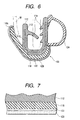
- a weather strip 12 (12A) has a trim portion 14 (14A) and a hollow seal portion 16 (16A) as shown in Figs. 1 and 2 .
- the trim portion 14 (14A) has a basically U-shape in section which will be a flange holding portion in the illustrated embodiment.
- the present invention is applicable to a trim portion having another shape.
- Examples of ⁇ -olefin in the EPDM include propylene, 1-butene, 1-pentene, 1- hexene, 4-methyl-1-pentene, 1-octene, 1-decene, etc. Of them, propylene is preferable.
- examples of nonconjugate diene include 1,4-hexadiene, dicyclopentadiene, 5-ethylidene-2-norbornene, etc.
- a sulfuric vulcanizer which is a general-purpose vulcanizer is usually used as mentioned above.
- a sulfuric vulcanizing agent and a vulcanizing accelerator thereof are included in such a sulfuric vulcanizer.
- sulfuric vulcanizing agents include active sulfur releasing organic vulcanizing agents as well as sulfur.
- active sulfur releasing organic vulcanizing agents include morpholine disulfide, alkyl phenol disulfide, organic polysulfide copolymer, and further sulfur containing vulcanizing accelerators such as thiuram one, thiourea one, or the like.
- a peroxide vulcanizing agent, a polyamine vulcanizing agent, etc. can be used together suitably in accordance with necessity.
- carbon black, process oil, lubricant, inorganic filler, age resistor, and other sub-materials are suitably mixed into the rubber composition so as to form an extrusion-molding rubber material for the base layer 20 by kneading or the like.
- the vulcanizer for the rubber composition is not limited to the sulfuric vulcanizer, but it may be another vulcanizer such as a peroxide vulcanizer or the like.
- the base polymer of the TPE composition for forming the decorating layer 18 according to the present invention wherein the base layer (trim body) 20 is formed of the non-polar rubber composition EPDM, non-polar TPE such as olefin TPE (TPO), styrene TPE (TPS), or the like, is used in the same manner as that in conventional one.
- TPO olefin TPE
- TPS styrene TPE
- the base layer is formed of EPDM, detailed description will be made about A. TPO and B. TPS which are preferable TPEs to be combined with EPDM.
- the same as that in the above-mentioned TPO can be used.
- the structure of the copolymer is of a linear block copolymer expressed by the general formula (A-B) n , A-(B-A) n or B-(A-B) n (where A designates a copolymer block mainly composed of aromatic vinyl compound, and B designates a copolymer block mainly composed of conjugate diene compound, but the border between the blocks A and B is not always necessary to be distinguished clearly; and where n is an integer of 1 or more), or a branched (radial) block copolymer expressed by the general formula [(A-3) n ] m -X, [A-(B-A) n ] m -X or [B-(A-8) n ] m -X (where A and B designates copolymer blocks in the same manner as mentioned above, and X designates a brancher residue; and where n is an integer of 1 or more, and m is an integer of 3 or more).
- the number-average molecular weight (M n ) of the copolymer is usually in a range of from 5,000 to 500,000, preferably in a range of from 10,000 to 300,000. If the number-average molecular weight is not larger than 5,000, the mechanical strength of TPE becomes low. On the contrary, if the number-average molecular weight is not smaller than 500,000, the viscosity of a polymerization solution becomes high. Thus, polymerization needs to be performed at a low concentration so that the productivity is lowered. It is preferable that the content of aromatic vinyl compound in the copolymer is in a range of from 10 wt% to 50 wt%.
- the copolymer is used as it is, the copolymer is preferably hydrogenated (reduced in double bond) from the point of view of light resistance, weather resistance, thermal stability, or the like.
- EPR may be used together.
- the copolymer or the hydrogenated copolymer is used as it is kept unbridged or put into a bridged state such as a full bridged state, a partial bridged state, or the like. If the copolymer is bridged, the solvent resistance or the like of TPS is improved in the same manner as that in the above-mentioned case of TPO. In addition, the mechanical strength is also increased:
- a coloring agent (pigment, dye stuff) for decorating is essentially mixed into the above-mentioned TPE composition.
- Additives such as an inorganic filler such as talc, calcium carbonate, or the like, a fire retardant, a lubricant, an antistat, an age resistor (heat-resistance/light-resistance stabilizer), etc. are suitably added to the TPE composition. After being extruded and kneaded, the TPE composition is granulated (pelletized) to form an extrusion-molding material.
- a peroxide unbridged hydrocarbon rubber-like substance represented by polyisobutene, butyle rubber, or the like, and/or a mineral oil softener may be mixed into the TPE composition in accordance with necessity. Then, the loading of the mineral oil softener is usually set to be in a range of from 5 phr to 200 phr.
- low-density polyethylene As the base polymer of the thermoplastic resin composition for forming the thermal bonding layer 22, low-density polyethylene (LDPE) is used because it has a low melting point and it is rich in flexibility. Particularly, linear low-density polyethylene (LLDPE) is preferable because it is superior in heat resistance and mechanical strength.
- the melt temperatures of high-pressure-processed polyethylene (low-density polyethylene), medium-pressure-processed polyethylene (medium-density polyethylene), and low-pressure-processed polyethylene are 98°C, 120°C and 124°C, respectively.
- the thermoplastic resin composition may be composed of thermoplastic resin alone. However, in order to ensure flowability and tackiness at the time of melting, a softener (plasticizer, process oil, lubricant, etc.), a tackifier, and further an additive such as an age resistor, or the like, are added and mixed suitably. Then, in the same manner as in the case of the TPE composition, those agents are added to thermoplastic resin, extruded and kneaded, and thereafter granulated (pelletized) so as to form an extrusion-molding material.
- the thermal bonding layer 22 in the present invention is set to have a thickness with which the bending flexibility of the weather strip (trim) is not blocked when it is attached to the vehicle body.
- the thickness of the thermal bonding layer 22 is determined by the balance with the ability to hide the ground color of the base layer 20, and further the ability to block the migration of a discoloring agent including a sulfuric agent from the base layer 20 to the decorating layer 18.
- the controlled temperatures of the first and second pressure rollers are usually set to be in a range of from 40°C to 50°C.
- the thermoplastic resin is extruded at a higher temperature than the melt temperature thereof so as to form the laminated film 23 together with the decorating layer 18.
- the thermal bonding layer 22 is pressed and bonded onto the base layer 20 in the condition that the thermal bonding layer 22 can be thermally bonded.
- the temperature of the weather strip body 13 (base layer 20) is also kept in a range of from 60°C to 120°C. This is because the thermal bonding layer 22 composed of a thermoplastic resin composition is to be supplied surely between the first and second pressure rollers 52 and 54 and the vulcanized rubber extruded body at a temperature beyond the melt temperature thereof.
- a foamed elastomer is used as the decorating layer 18.
- a fine foamed elastomer the expansion ratio of which is in a range of not higher than 1.5, preferably in a range of from 1.05 to 1.45, may be used.
- the surface of the decorating layer 18 may be made leathery.
- the surface of the foam may be buffed to fluff the surface of the decorating layer 18.
- the first pressure roller 52 may be provided as an embossing roller so that the decorating layer 18 is subjected to embossing processing.
- the decorating layer 18 is composed of foamed elastomer
- cells of the foam may be collapsed by the pressure by the pressure rollers in a conventional structure where there is no thermal bonding layer.
- the bonding force is improved by the interposition of the thermal bonding layer so that the pressing force of the pressure rollers can be reduced in comparison with the conventional structure in which there is provided no thermal bonding layer.
- the thermal bonding layer is formed of thermoplastic resin which is not flexible compared with TPE, the thermal bonding layer is thin enough not to block the bending flexibility of the automobile trim (weather strip) or the like when it is attached to a vehicle body. Accordingly, the workability of attaching the automobile trim to the vehicle body is the same as that in conventional one.
- the decorating layer in the weather strip in Example exhibited clear white, while the decorating layer in the weather strip in Comparative was grayish.
- the cushion layer 118 has an outside lip 118a projecting to come into pressure contact with an interior member W inside the cabin of the vehicle.
- the cushion layer 118 is disposed substantially all over the region from the tip end portion of the outside lip 118a to the base portion of the hollow seal portion 124, that is, the prospective decoration area of the rubber base 113 which is exposed in the cabin of the vehicle.
- the cushion layer 118 is formed of low-density foamed sponge rubber of EPDM at a thickness in a range of from 1 to 8 mm.
- the cushion layer 118 is formed to sink following external force through the skin layer 120 and restore its original shape in response to the release of the external force.
- the rubber base 113 and the cushion layer 118 are extruded integrally with each other by simultaneous extrusion molding, and vulcanized simultaneously to be bonded with each other.
- the hollow seal portion 124 is formed of sponge rubber so as to project in a hollow state from one side surface (car-exterior side) of the rubber base 113.
- the hollow seal portion 124 carries out the operation of sealing in cooperation with a door-side member.
- the rubber base 113 and so on are extrusion.
- a cross-head type extruder 130 is used for extrusion-molding. That is, the extruder 130 has a solid rubber extruder 132, sponge rubber extruders 134 and 136, and an insert core feeder 140.
- the solid rubber extruder 132 has a cylinder and a screw. The cylinder of the extruder 132 is filled with an unvulcanized EPDM solid rubber raw material.
- each of the sponge rubber extruders 134 and 136 has a cylinder and a screw.
- the cylinder of each of the extruders 134 and 136 is filled with an unvulcanized EPDM sponge rubber raw material.
- the insert core feeder 140 provides an insert core member 116A which will be provided as the insert core 116.
- the extruder 130 carries out so-called co-extrusion. That is, the solid rubber raw material, the sponge rubber raw materials, and the insert core member 116A are supplied simultaneously to one extrusion head and extruded therefrom simultaneously so as to form an extrusion body 112A.
- a vulcanization step is carried out.
- the extrusion body 112A of unvulcanized rubber is passed through a microwave heater (UHF) 144 and a hot-air vulcanizer (HAV) 146 so that the rubber is vulcanized.
- UHF microwave heater
- HAV hot-air vulcanizer
- This step is carried out at a temperature in a range of from 180°C to 240°C suitable for vulcanizing EPDM.
- the vulcanization time (the time to pass through the heater and the vulcanizer) is about in a range of from 3 min to 10 min.
- the vulcanized extrusion body 112A is passed through a cooling unit 148 so as to be cooled down to about 100°C.
- the foaming agent in the EPDM sponge rubber expands so that predetermined sponge rubber can be obtained.
- the above process is substantially same as the process for preparing the weather strip body 113 as aforementioned.
- a step for laminating the skin layer 120 is carried out. That is, in this step, a material in which a foaming agent has been added to thermoplastic elastomer is extruded from an extruder 150 so as to form a skin sheet 120A. At the same time, a bonding sheet 122A composed of PE is extruded from one extrusion head toward the back surface side of the skin sheet 120A so as to form a lamination.
- a composition of 80 parts by weight of EPDM and 20 parts by weight of polypropylene (PP) maybe used.
- all of the attachment base portion 112, the cushion layer 118, the bonding layer 122, and the skin layer 120 are formed of materials of olefin series, so that they are thermally bonded with one another firmly, and there is no fear that they peel off.
- the bonding layer 122 is formed of PE the melting point of which is low. Thus, even if the temperature of the bonding layer 122 is lowered to temperature with which cells of foam of the skin layer 120 are not collapsed when the skin layer 120 is pressed by the rollers, the PE can be thermally bonded with the cushion layer 118 firmly. Further, because all are formed of materials of olefin series, it is not necessary to use a special two-layer bonding film described in the background art. Thus, the manufacturing cost can be reduced.
- the skin layer 120 was bonded with the extrusion body 112A by the pressure rollers 152 in the process of manufacturing the weather strip 100.
- the present invention is not limited to such a process .
- the skin layer 120 may be bonded by a bonding agent or the like in another process.
Landscapes
- Engineering & Computer Science (AREA)
- Mechanical Engineering (AREA)
- Seal Device For Vehicle (AREA)
- Laminated Bodies (AREA)
Claims (12)
- Kraftfahrzeug-Zierstreifen, umfassend:einen Zierstreifenkörper (20; 20A), der aus einer Kautschukzusammensetzung ausgebildet ist, undeine Dekorschicht (18; 18A), die aus einer thermoplastischen Elastomerzusammensetzung ausgebildet ist und integriert mit dem Zierstreifen (20; 20A) thermisch gebunden ist,dadurch gekennzeichnet, dasseine thermische Bindungsschicht (22; 22A) aus einer thermoplastischen Harzzusammensetzung ausgebildet ist und zwischen der Dekorschicht (18; 18A) und dem Zierstreifenkörper (20; 20A) zum thermischen Binden der Dekorschicht integriert mit dem Zierstreifenkörper (20; 20A) angeordnet ist, wobei die Dekorschicht aus einem geschäumten Elastomer ausgebildet ist, undBasispolymere der thermoplastischen Elastomerzusammensetzung, der Kautschukzusammensetzung und der thermoplastischen Harzzusammensetzung ein thermoplastisches Olefinelastomer, ein Ethylen-α-Olefin-nichtkonjugiertes Dien-Copolymerkautschuk bzw. ein Polyethylen niedriger Dichte sind.
- Kraftfahrzeug-Zierstreifen nach Anspruch 1, bei dem der Dekorschicht (18; 18A) ein Farbmittel zur Dekoration zugesetzt ist.
- Kraftfahrzeug-Zierstreifen nach Anspruch 1 oder 2, bei dem die Dicke der thermischen Bindungsschicht (22; 22A) in einem Bereich von 40 µm bis 300 µm liegt, so dass die thermische Bindungsschicht (22; 22A) eine Grundfarbe des Zierstreifenkörpers (20; 20A) verdeckt.
- Kraftfahrzeug-Zierstreifen nach Anspruch 1 oder 2, bei dem das Basispolymer der thermoplastischen Harzzusammensetzung ein lineares Polyethylen niedriger Dichte ist.
- Kraftfahrzeug-Zierstreifen nach Anspruch 1 oder 2, bei dem die Dicke der thermischen Bindungsschicht (22; 22A) in einem Bereich von 80 µm bis 150 µm liegt.
- Kraftfahrzeug-Zierstreifen nach Anspruch 1 in der Form eines Kraftfahrzeug-Dichtungsstreifens (100), umfassend:den Zierstreifenkörper in der Form eines Anbringungsbasisabschnitts (112), der an einem Seitenelement einer Fahrzeugkarosserie anbringbar ist und aus einem festen Kautschuk eines Ethylen-Propylen-Kautschuks zusammengesetzt ist,eine Dämpfungsschicht (118), die auf den Anbringungsbasisabschnitt (112) laminiert ist und aus einem Schwammkautschuk eines Ethylen-Propylen-Kautschuks ausgebildet ist,die Dekorschicht in der Form einer Hautschicht (120), die auf die Dämpfungsschicht (118) laminiert ist und durch Schäumen eines thermoplastischen Olefinelastomers gebildet worden ist, unddie thermische Bindungsschicht in der Form einer Olefinbindungsschicht (122), die aus einem Polyethylen niedriger Dichte ausgebildet ist, zum Verbinden der Dämpfungsschicht (118) und der Hautschicht (120).
- Kraftfahrzeug-Zierstreifen nach Anspruch 6, bei dem der Ethylen-Propylen-Kautschuk des Anbringungsbasisabschnitts (112) und der Dämpfungsschicht (118) ein Ethylen-α-Olefinnichtkonjugiertes Dien-Copolymerkautschuk ist.
- Kraftfahrzeug-Zierstreifen nach Anspruch 6, bei dem das thermoplastische Olefinelastomer der Hautschicht (120) eine Zusammensetzung aus einem Ethylen-α-Olefinnichtkonjugiertes Dien-Copolymerkautschuk und einem Polypropylen ist.
- Kraftfahrzeug-Zierstreifen nach Anspruch 6, bei dem die Olefinbindungsschicht (122) aus einem linearen Polyethylen niedriger Dichte ausgebildet ist.
- Verfahren zur Herstellung eines Kraftfahrzeug-Dichtungsstreifens (100) nach Anspruch 6, umfassend den Schritt des
Extrudierens eines Ethylen-Propylen-Kautschuks zum Bilden eines Extrusionskörpers als einen Anbringungsbasisabschnitt (112) und eine Dämpfungsschicht (118) und
gekennzeichnet durch die weiteren Schritte des
Vulkanisierens des Extrusionskörpers,
Extrudierens eines Hautflächenkörpers aus einem schäumbaren thermoplastischen Olefinelastomer zum Bilden einer Hautschicht (120),
Extrudierens eines Bindungsflächenkörpers aus einem Olefinmaterial zum Bilden einer Bindungsschicht (112) zum Anordnen zwischen der Hautschicht (120) und der Dämpfungsschicht (118),
Laminierens des Hautflächenkörpers, des Bindungsflächenkörpers und des Extrusionskörpers jeweils bei vorgegebenen Temperaturen, so dass Schaumzellen des Hautflächenkörpers bewahrt werden, und
Laminierens und Pressens des Hautflächenkörpers, des Bindungsflächenkörpers und des Extrusionskörpers, um dadurch den Hautflächenkörper mittels des Bindungsflächenkörpers thermisch an die Dämpfungsschicht (118) zu binden. - Verfahren nach Anspruch 10, bei dem
der Ethylen-Propylen-Kautschuk ein Ethylen-α-Olefin-nichtkonjugiertes Dien-Copolymerkautschuk ist,
das thermoplastische Olefinelastomer eine Zusammensetzung aus einem Ethylen-α-Olefin-nichtkonjugiertes Dien-Copolymerkautschuk und einem Polypropylen ist, und
der Bindungsflächenkörper aus einem Polyethylen niedriger Dichte ausgebildet ist. - Verfahren nach Anspruch 10 oder 11, bei dem der Bindungsflächenkörper mit einer Dicke in einem Bereich von 40 µm bis 300 µm extrudiert wird.
Applications Claiming Priority (4)
| Application Number | Priority Date | Filing Date | Title |
|---|---|---|---|
| JP2000060000A JP3713546B2 (ja) | 2000-03-06 | 2000-03-06 | 自動車用トリム |
| JP2000060000 | 2000-03-06 | ||
| JP2000278062A JP3867487B2 (ja) | 2000-09-13 | 2000-09-13 | 自動車用ウエザストリップおよびその製造方法 |
| JP2000278062 | 2000-09-13 |
Publications (3)
| Publication Number | Publication Date |
|---|---|
| EP1132242A2 EP1132242A2 (de) | 2001-09-12 |
| EP1132242A3 EP1132242A3 (de) | 2002-07-10 |
| EP1132242B1 true EP1132242B1 (de) | 2010-09-22 |
Family
ID=26586811
Family Applications (1)
| Application Number | Title | Priority Date | Filing Date |
|---|---|---|---|
| EP20010105557 Expired - Lifetime EP1132242B1 (de) | 2000-03-06 | 2001-03-06 | Verzierung für Kraftfahrzeuge und Herstellungsverfahren |
Country Status (3)
| Country | Link |
|---|---|
| US (2) | US6896954B2 (de) |
| EP (1) | EP1132242B1 (de) |
| DE (1) | DE60143103D1 (de) |
Cited By (1)
| Publication number | Priority date | Publication date | Assignee | Title |
|---|---|---|---|---|
| TWI914227B (zh) | 2025-04-10 | 2026-02-01 | 國立高雄科技大學 | 複合式減振墊之設計及其製造方法 |
Families Citing this family (30)
| Publication number | Priority date | Publication date | Assignee | Title |
|---|---|---|---|---|
| DE60202108T2 (de) * | 2001-09-14 | 2005-12-01 | Toyoda Gosei Co., Ltd. | Dichtung für ein Fahrzeug |
| EP1523522B1 (de) | 2002-07-19 | 2010-04-21 | Shell Internationale Researchmaatschappij B.V. | Zusammensetzung enthaltend epdm und paraffin ol |
| US20050184415A1 (en) * | 2004-02-06 | 2005-08-25 | Masaki Ohashi | Method for producing extruded products |
| JP4379715B2 (ja) * | 2004-02-19 | 2009-12-09 | 豊田合成株式会社 | 長尺成形品 |
| DE102005013507B3 (de) * | 2005-03-23 | 2006-03-30 | Metzeler Automotive Profile Systems Gmbh | Dichtungsanordnung, insbesondere zum Abdichten einer Fensterscheibe eines Kraftfahrzeugs |
| EP1922163A4 (de) * | 2005-08-18 | 2010-03-03 | Cooper Standard Automotive Inc | Dichtungsleiste mit quetschsensor, neue quetschsensoren und entsprechende verfahren |
| US8051607B2 (en) | 2005-11-09 | 2011-11-08 | Toyoda Gosei Co., Ltd. | Weather strip and manufacturing method thereof |
| JP4752674B2 (ja) * | 2006-08-21 | 2011-08-17 | 豊田合成株式会社 | ウエザストリップの製造方法 |
| JP2008055687A (ja) * | 2006-08-30 | 2008-03-13 | Toyoda Gosei Co Ltd | 長尺成形品 |
| DE102007040077B4 (de) * | 2006-08-30 | 2010-01-14 | Toyoda Gosei Co., Ltd. | Dichtungsstreifen und Verfahren zur Herstellung des Dichtungsstreifens |
| JP4973152B2 (ja) | 2006-11-28 | 2012-07-11 | 豊田合成株式会社 | オープニングトリムウエザストリップ |
| DE102007002946B4 (de) * | 2007-01-19 | 2009-07-16 | Metzeler Automotive Profile Systems Gmbh | Verfahren zur Herstellung einer Dichtung, insbesondere für ein Kraftfahrzeug |
| US20100263292A1 (en) * | 2007-02-21 | 2010-10-21 | Paul Harland | Multi-material layered extrusion |
| EP2042363A2 (de) * | 2007-09-28 | 2009-04-01 | Toyoda Gosei Co., Ltd. | Türdichtgummi |
| DE102008001347A1 (de) * | 2008-04-23 | 2009-10-29 | Robert Bosch Gmbh | Verfahren zur Herstellung von Strangextrudaten |
| KR20090126540A (ko) * | 2008-06-04 | 2009-12-09 | 현대자동차주식회사 | 초임계 압출시스템과 초고분자량 폴리에틸렌을 이용한웨더스트립 제조방법 |
| JP2011526738A (ja) * | 2008-07-02 | 2011-10-13 | サンゴバン・パフォーマンス・プラスティックス・シェンヌー | 枠付き装置、封止材およびその製造方法 |
| US20110146793A1 (en) * | 2008-07-02 | 2011-06-23 | Saint-Gobain Performance Plastics Chaineux | Framed device, seal, and method for manufacturing same |
| JP2010149838A (ja) * | 2008-09-30 | 2010-07-08 | Toyoda Gosei Co Ltd | 自動車用オープニングトリムウェザストリップ |
| US7837271B2 (en) * | 2009-01-21 | 2010-11-23 | Lear Corporation | Vehicle seat assembly having layered seating system |
| US8215714B2 (en) | 2010-05-17 | 2012-07-10 | Lear Corporation | Vehicle seat assembly with interlocking layered seating system |
| US8752332B2 (en) * | 2011-04-21 | 2014-06-17 | Honda Motor Co., Ltd. | Vehicle slide door pinch sensor assembly |
| US8701352B2 (en) * | 2011-09-15 | 2014-04-22 | Ford Global Technologies, Llc | Two-shot secondary seal with clip |
| US9003628B2 (en) | 2012-01-18 | 2015-04-14 | Toyota Motor Engineering & Manufacturing North America, Inc. | Roof trim ditch molding fitting tool |
| US9027284B2 (en) * | 2012-05-15 | 2015-05-12 | Henniges Automotive Sealing Systems North America, Inc. | Sealing member |
| EP2883728B1 (de) * | 2013-12-16 | 2017-08-09 | Knorr-Bremse Gesellschaft mit beschränkter Haftung | Schienenfahrzeug und Türmodul für ein Schienenfahrzeug mit bunter Türdichtung |
| US10315349B2 (en) | 2014-02-07 | 2019-06-11 | Henniges Automotive Sealing Systems North America, Inc. | Sealing assembly for a vehicle and method of manufacturing a sealing assembly |
| US9969339B2 (en) * | 2015-03-24 | 2018-05-15 | GM Global Technology Operations LLC | Device, trim element for the device, and method of forming the trim element |
| US10576910B1 (en) * | 2017-05-10 | 2020-03-03 | Adell Group, Inc. | Self-retaining door edge guard |
| DE102017126995A1 (de) * | 2017-11-16 | 2019-05-16 | Cqlt Saargummi Technologies S.À.R.L. | Dichtungsstrang mit Thermoplast-Kernteil |
Family Cites Families (24)
| Publication number | Priority date | Publication date | Assignee | Title |
|---|---|---|---|---|
| US3903350A (en) * | 1974-01-25 | 1975-09-02 | Du Pont | Composite structure |
| IN157880B (de) | 1982-10-27 | 1986-07-12 | Dunlop Ltd | |
| JPS59178237A (ja) * | 1983-03-28 | 1984-10-09 | Mitsuboshi Belting Ltd | 加硫ゴムシ−トの接合方法 |
| DE3429523A1 (de) * | 1984-08-10 | 1986-02-20 | Alkor GmbH Kunststoffe, 8000 München | Schaumlaminatfolie oder -bahn |
| US4643926A (en) * | 1985-04-29 | 1987-02-17 | W. R. Grace & Co., Cryovac Div. | Flexible medical solution pouches |
| JPS62227837A (ja) * | 1986-03-31 | 1987-10-06 | Toyoda Gosei Co Ltd | 自動車用ウエザストリツプ |
| US4898760A (en) * | 1987-11-17 | 1990-02-06 | Amesbury Industries, Inc. | Process and apparatus for extruding a low density elastomeric thermoplastic foam |
| GB8827180D0 (en) | 1988-11-21 | 1988-12-29 | Schlegel Uk Holdings | Composite extrusion |
| JPH082744B2 (ja) * | 1989-03-29 | 1996-01-17 | 鬼怒川ゴム工業株式会社 | 自動車用装飾体 |
| CA2035709C (en) * | 1990-02-19 | 1995-04-18 | Tadanobu Iwasa | Rubber shaped articles having a finishing layer and a process for production thereof |
| CA2037953C (en) | 1990-03-24 | 1995-05-16 | Tadanobu Iwasa | Production method for glass runs |
| JPH0459352A (ja) | 1990-06-29 | 1992-02-26 | Toyoda Gosei Co Ltd | ゴム押出品の製造方法 |
| US5489461A (en) | 1990-11-22 | 1996-02-06 | Toyoda Gosei Co., Ltd. | Rubber layered structure and manufacturing process therefor |
| GB2256615B (en) * | 1991-06-12 | 1995-03-01 | Yokohama Rubber Co Ltd | Process for the production of a rubber/rubber bonded composite sheet structure |
| JPH0616094A (ja) * | 1992-06-30 | 1994-01-25 | Toyoda Gosei Co Ltd | ウエザストリップ |
| US5353154A (en) * | 1992-11-02 | 1994-10-04 | The Dow Chemical Company | Polymeric reflective materials utilizing a back light source |
| CA2112863A1 (en) * | 1993-01-05 | 1994-07-06 | Louis J. Ii Lamarca | Resiliently padded laminate construction and injection molded thermoplastic articles faced therewith |
| JP3019757B2 (ja) | 1994-12-27 | 2000-03-13 | 豊田合成株式会社 | 加飾フィルム層を備えたゴム押出物の製造方法 |
| US5753063A (en) | 1994-12-27 | 1998-05-19 | Toyoda Gosei Co., Ltd. | Method of decorating rubber extruded product |
| JP3261562B2 (ja) * | 1996-01-19 | 2002-03-04 | 豊田合成株式会社 | 自動車用ウェザストリップ |
| EP0917950A1 (de) * | 1997-11-21 | 1999-05-26 | Dsm N.V. | Mehrschichtiger Gegenstand aus vulkanisertem Gummi verbunden mit hartem TPE an ein weicheres TPE |
| US6273983B1 (en) * | 1998-01-29 | 2001-08-14 | Tokiwa Chemical Industries Co., Ltd. | Molding for vehicle and its manufacturing method |
| JP3996999B2 (ja) * | 1998-03-30 | 2007-10-24 | 三ツ星ベルト株式会社 | 遮水シートの接合部構造および遮水シート接合部の検査方法 |
| WO2001096135A2 (en) | 2000-06-16 | 2001-12-20 | Schlegel Corporation | Expanded thermoplastic surface layer for composite strips |
-
2001
- 2001-03-06 DE DE60143103T patent/DE60143103D1/de not_active Expired - Lifetime
- 2001-03-06 EP EP20010105557 patent/EP1132242B1/de not_active Expired - Lifetime
- 2001-03-06 US US09/798,890 patent/US6896954B2/en not_active Expired - Fee Related
-
2004
- 2004-12-16 US US11/012,193 patent/US7368074B2/en not_active Expired - Fee Related
Cited By (1)
| Publication number | Priority date | Publication date | Assignee | Title |
|---|---|---|---|---|
| TWI914227B (zh) | 2025-04-10 | 2026-02-01 | 國立高雄科技大學 | 複合式減振墊之設計及其製造方法 |
Also Published As
| Publication number | Publication date |
|---|---|
| US6896954B2 (en) | 2005-05-24 |
| US20050112301A1 (en) | 2005-05-26 |
| US20010033927A1 (en) | 2001-10-25 |
| EP1132242A3 (de) | 2002-07-10 |
| EP1132242A2 (de) | 2001-09-12 |
| US7368074B2 (en) | 2008-05-06 |
| DE60143103D1 (de) | 2010-11-04 |
Similar Documents
| Publication | Publication Date | Title |
|---|---|---|
| US6896954B2 (en) | Automobile trim | |
| JP3261562B2 (ja) | 自動車用ウェザストリップ | |
| US7744988B2 (en) | Composites containing crosslinkable thermoplastic and TPV show layer | |
| US6024906A (en) | Method for forming a composite extrusion | |
| US6828011B2 (en) | Moisture crosslinkable thermoplastics in the manufacture of vehicle weather strips | |
| US5562961A (en) | Co-vulcanized compound profile of thermoplastic material and elastomeric material | |
| US5143772A (en) | Rubber shaped articles having a finishing layer and a process for production thereof | |
| JP2007520368A (ja) | トリムシールストリップ用複合押出し品とその成形方法 | |
| KR101231004B1 (ko) | 자동차 웨더스트립용 발포 열가소성 탄성체 조성물 | |
| JP3713546B2 (ja) | 自動車用トリム | |
| JPH0616094A (ja) | ウエザストリップ | |
| JP3867487B2 (ja) | 自動車用ウエザストリップおよびその製造方法 | |
| JP3654120B2 (ja) | ゴム/熱可塑性エラストマー複合体 | |
| JP2007296669A (ja) | 自動車用シール部材の製造方法 | |
| CN120840371A (zh) | 密封条 | |
| JP5691482B2 (ja) | 複合部材 | |
| JPH03240514A (ja) | ゴム・樹脂複合押出品の製造方法 | |
| JP2007296896A (ja) | 自動車用シール部材 | |
| JPH06134838A (ja) | 着色梨地状表面を有する自動車用ウェザストリップの製造方法 | |
| JPH04189134A (ja) | ガラスラン及びその製造方法 | |
| JPH03243349A (ja) | 樹脂塗膜層付きゴム押出品の製造方法 | |
| JPH08175292A (ja) | 自動車用ウェザストリップ |
Legal Events
| Date | Code | Title | Description |
|---|---|---|---|
| PUAI | Public reference made under article 153(3) epc to a published international application that has entered the european phase |
Free format text: ORIGINAL CODE: 0009012 |
|
| 17P | Request for examination filed |
Effective date: 20010306 |
|
| AK | Designated contracting states |
Kind code of ref document: A2 Designated state(s): AT BE CH CY DE DK ES FI FR GB GR IE IT LI LU MC NL PT SE TR |
|
| AX | Request for extension of the european patent |
Free format text: AL;LT;LV;MK;RO;SI |
|
| PUAL | Search report despatched |
Free format text: ORIGINAL CODE: 0009013 |
|
| AK | Designated contracting states |
Kind code of ref document: A3 Designated state(s): AT BE CH CY DE DK ES FI FR GB GR IE IT LI LU MC NL PT SE TR |
|
| AX | Request for extension of the european patent |
Free format text: AL;LT;LV;MK;RO;SI |
|
| AKX | Designation fees paid |
Designated state(s): DE FR GB |
|
| 17Q | First examination report despatched |
Effective date: 20050405 |
|
| GRAP | Despatch of communication of intention to grant a patent |
Free format text: ORIGINAL CODE: EPIDOSNIGR1 |
|
| RIN1 | Information on inventor provided before grant (corrected) |
Inventor name: ARITAKE, MSANORI,C/O TOYODA GOSEI CO., LTD. Inventor name: OMORI, HITOSHI,C/O TOYODA GOSEI CO., LTD. |
|
| GRAS | Grant fee paid |
Free format text: ORIGINAL CODE: EPIDOSNIGR3 |
|
| GRAA | (expected) grant |
Free format text: ORIGINAL CODE: 0009210 |
|
| AK | Designated contracting states |
Kind code of ref document: B1 Designated state(s): DE FR GB |
|
| REG | Reference to a national code |
Ref country code: GB Ref legal event code: FG4D |
|
| REF | Corresponds to: |
Ref document number: 60143103 Country of ref document: DE Date of ref document: 20101104 Kind code of ref document: P |
|
| PLBE | No opposition filed within time limit |
Free format text: ORIGINAL CODE: 0009261 |
|
| STAA | Information on the status of an ep patent application or granted ep patent |
Free format text: STATUS: NO OPPOSITION FILED WITHIN TIME LIMIT |
|
| 26N | No opposition filed |
Effective date: 20110623 |
|
| REG | Reference to a national code |
Ref country code: DE Ref legal event code: R097 Ref document number: 60143103 Country of ref document: DE Effective date: 20110623 |
|
| REG | Reference to a national code |
Ref country code: GB Ref legal event code: 746 Effective date: 20130204 |
|
| REG | Reference to a national code |
Ref country code: DE Ref legal event code: R084 Ref document number: 60143103 Country of ref document: DE Effective date: 20130122 |
|
| PGFP | Annual fee paid to national office [announced via postgrant information from national office to epo] |
Ref country code: FR Payment date: 20140311 Year of fee payment: 14 |
|
| PGFP | Annual fee paid to national office [announced via postgrant information from national office to epo] |
Ref country code: GB Payment date: 20140305 Year of fee payment: 14 |
|
| PGFP | Annual fee paid to national office [announced via postgrant information from national office to epo] |
Ref country code: DE Payment date: 20140417 Year of fee payment: 14 |
|
| REG | Reference to a national code |
Ref country code: DE Ref legal event code: R119 Ref document number: 60143103 Country of ref document: DE |
|
| GBPC | Gb: european patent ceased through non-payment of renewal fee |
Effective date: 20150306 |
|
| REG | Reference to a national code |
Ref country code: FR Ref legal event code: ST Effective date: 20151130 |
|
| PG25 | Lapsed in a contracting state [announced via postgrant information from national office to epo] |
Ref country code: GB Free format text: LAPSE BECAUSE OF NON-PAYMENT OF DUE FEES Effective date: 20150306 Ref country code: DE Free format text: LAPSE BECAUSE OF NON-PAYMENT OF DUE FEES Effective date: 20151001 |
|
| PG25 | Lapsed in a contracting state [announced via postgrant information from national office to epo] |
Ref country code: FR Free format text: LAPSE BECAUSE OF NON-PAYMENT OF DUE FEES Effective date: 20150331 |