EP1136477B1 - Benzofuranderivate, verfahren zu ihrer herstellung und deren verwendungen - Google Patents
Benzofuranderivate, verfahren zu ihrer herstellung und deren verwendungen Download PDFInfo
- Publication number
- EP1136477B1 EP1136477B1 EP99973289A EP99973289A EP1136477B1 EP 1136477 B1 EP1136477 B1 EP 1136477B1 EP 99973289 A EP99973289 A EP 99973289A EP 99973289 A EP99973289 A EP 99973289A EP 1136477 B1 EP1136477 B1 EP 1136477B1
- Authority
- EP
- European Patent Office
- Prior art keywords
- alkyl
- atom
- group
- carbonyl
- aryl
- Prior art date
- Legal status (The legal status is an assumption and is not a legal conclusion. Google has not performed a legal analysis and makes no representation as to the accuracy of the status listed.)
- Expired - Lifetime
Links
- 238000000034 method Methods 0.000 title claims description 36
- 230000008569 process Effects 0.000 title claims description 23
- 150000001907 coumarones Chemical class 0.000 title description 2
- 150000001875 compounds Chemical class 0.000 claims abstract description 327
- 125000004169 (C1-C6) alkyl group Chemical group 0.000 claims abstract description 175
- 229910052799 carbon Inorganic materials 0.000 claims abstract description 148
- 125000005915 C6-C14 aryl group Chemical group 0.000 claims abstract description 88
- 150000003839 salts Chemical class 0.000 claims abstract description 80
- 125000004435 hydrogen atom Chemical group [H]* 0.000 claims abstract description 79
- 125000004432 carbon atom Chemical group C* 0.000 claims abstract description 67
- 125000002252 acyl group Chemical group 0.000 claims abstract description 63
- 125000000623 heterocyclic group Chemical group 0.000 claims abstract description 63
- 125000003118 aryl group Chemical group 0.000 claims abstract description 52
- 230000004770 neurodegeneration Effects 0.000 claims abstract description 21
- 125000001931 aliphatic group Chemical group 0.000 claims abstract description 19
- 208000015122 neurodegenerative disease Diseases 0.000 claims abstract description 12
- 229940002612 prodrug Drugs 0.000 claims abstract description 11
- 239000000651 prodrug Substances 0.000 claims abstract description 11
- 125000001183 hydrocarbyl group Chemical group 0.000 claims abstract 4
- -1 thiocarbamoyl Chemical group 0.000 claims description 397
- 125000001424 substituent group Chemical group 0.000 claims description 178
- 229910052757 nitrogen Inorganic materials 0.000 claims description 124
- 229910052717 sulfur Inorganic materials 0.000 claims description 121
- 125000004433 nitrogen atom Chemical group N* 0.000 claims description 120
- 125000004430 oxygen atom Chemical group O* 0.000 claims description 120
- 125000005842 heteroatom Chemical group 0.000 claims description 119
- 125000004434 sulfur atom Chemical group 0.000 claims description 119
- 229910052736 halogen Inorganic materials 0.000 claims description 102
- 125000001997 phenyl group Chemical group [H]C1=C([H])C([H])=C(*)C([H])=C1[H] 0.000 claims description 102
- 150000002367 halogens Chemical class 0.000 claims description 96
- 125000000217 alkyl group Chemical group 0.000 claims description 77
- 125000004191 (C1-C6) alkoxy group Chemical group 0.000 claims description 76
- 125000002496 methyl group Chemical group [H]C([H])([H])* 0.000 claims description 70
- 125000005115 alkyl carbamoyl group Chemical group 0.000 claims description 58
- 125000005530 alkylenedioxy group Chemical group 0.000 claims description 56
- 125000001769 aryl amino group Chemical group 0.000 claims description 56
- 125000002373 5 membered heterocyclic group Chemical group 0.000 claims description 53
- 229910052731 fluorine Inorganic materials 0.000 claims description 49
- 125000006618 5- to 10-membered aromatic heterocyclic group Chemical group 0.000 claims description 48
- 239000011737 fluorine Substances 0.000 claims description 47
- 125000000449 nitro group Chemical group [O-][N+](*)=O 0.000 claims description 44
- 125000004916 (C1-C6) alkylcarbonyl group Chemical group 0.000 claims description 43
- 125000005913 (C3-C6) cycloalkyl group Chemical group 0.000 claims description 41
- 125000000882 C2-C6 alkenyl group Chemical group 0.000 claims description 41
- 125000003601 C2-C6 alkynyl group Chemical group 0.000 claims description 41
- PXGOKWXKJXAPGV-UHFFFAOYSA-N Fluorine Chemical compound FF PXGOKWXKJXAPGV-UHFFFAOYSA-N 0.000 claims description 38
- 125000002887 hydroxy group Chemical group [H]O* 0.000 claims description 38
- 125000005099 aryl alkyl carbonyl group Chemical group 0.000 claims description 35
- 125000002485 formyl group Chemical group [H]C(*)=O 0.000 claims description 35
- 125000005843 halogen group Chemical group 0.000 claims description 35
- 125000005974 C6-C14 arylcarbonyl group Chemical group 0.000 claims description 34
- 125000005098 aryl alkoxy carbonyl group Chemical group 0.000 claims description 34
- 125000004391 aryl sulfonyl group Chemical group 0.000 claims description 34
- 125000003178 carboxy group Chemical group [H]OC(*)=O 0.000 claims description 34
- 125000004454 (C1-C6) alkoxycarbonyl group Chemical group 0.000 claims description 32
- 125000004442 acylamino group Chemical group 0.000 claims description 32
- 125000004093 cyano group Chemical group *C#N 0.000 claims description 32
- 125000002924 primary amino group Chemical group [H]N([H])* 0.000 claims description 32
- 125000003917 carbamoyl group Chemical group [H]N([H])C(*)=O 0.000 claims description 31
- 125000004739 (C1-C6) alkylsulfonyl group Chemical group 0.000 claims description 30
- 125000005116 aryl carbamoyl group Chemical group 0.000 claims description 30
- 125000005135 aryl sulfinyl group Chemical group 0.000 claims description 30
- 125000005161 aryl oxy carbonyl group Chemical group 0.000 claims description 29
- 125000006254 cycloalkyl carbonyl group Chemical group 0.000 claims description 29
- 125000004738 (C1-C6) alkyl sulfinyl group Chemical group 0.000 claims description 28
- 125000000020 sulfo group Chemical group O=S(=O)([*])O[H] 0.000 claims description 28
- 125000006273 (C1-C3) alkyl group Chemical group 0.000 claims description 27
- 125000006700 (C1-C6) alkylthio group Chemical group 0.000 claims description 27
- 125000001449 isopropyl group Chemical group [H]C([H])([H])C([H])(*)C([H])([H])[H] 0.000 claims description 26
- 125000004657 aryl sulfonyl amino group Chemical group 0.000 claims description 25
- QJGQUHMNIGDVPM-UHFFFAOYSA-N nitrogen group Chemical group [N] QJGQUHMNIGDVPM-UHFFFAOYSA-N 0.000 claims description 25
- 125000004845 (C1-C6) alkylsulfonylamino group Chemical group 0.000 claims description 24
- 125000004423 acyloxy group Chemical group 0.000 claims description 24
- 239000003795 chemical substances by application Substances 0.000 claims description 24
- 125000005914 C6-C14 aryloxy group Chemical group 0.000 claims description 23
- 125000005194 alkoxycarbonyloxy group Chemical group 0.000 claims description 23
- 125000005196 alkyl carbonyloxy group Chemical group 0.000 claims description 23
- 125000005199 aryl carbonyloxy group Chemical group 0.000 claims description 23
- 125000003396 thiol group Chemical class [H]S* 0.000 claims description 23
- 125000006615 aromatic heterocyclic group Chemical group 0.000 claims description 21
- 102000013455 Amyloid beta-Peptides Human genes 0.000 claims description 19
- 108010090849 Amyloid beta-Peptides Proteins 0.000 claims description 19
- 230000002401 inhibitory effect Effects 0.000 claims description 19
- 208000024827 Alzheimer disease Diseases 0.000 claims description 16
- 125000000956 methoxy group Chemical group [H]C([H])([H])O* 0.000 claims description 16
- 125000006624 (C1-C6) alkoxycarbonylamino group Chemical group 0.000 claims description 15
- 125000004658 aryl carbonyl amino group Chemical group 0.000 claims description 15
- 230000000694 effects Effects 0.000 claims description 15
- 238000004519 manufacturing process Methods 0.000 claims description 15
- 125000003806 alkyl carbonyl amino group Chemical group 0.000 claims description 14
- 239000003814 drug Substances 0.000 claims description 14
- HBEDSQVIWPRPAY-UHFFFAOYSA-N 2,3-dihydrobenzofuran Chemical group C1=CC=C2OCCC2=C1 HBEDSQVIWPRPAY-UHFFFAOYSA-N 0.000 claims description 13
- 208000018737 Parkinson disease Diseases 0.000 claims description 12
- 230000000508 neurotrophic effect Effects 0.000 claims description 12
- 125000005330 8 membered heterocyclic group Chemical group 0.000 claims description 11
- 229940079593 drug Drugs 0.000 claims description 11
- 239000000203 mixture Substances 0.000 claims description 11
- 125000005596 alkyl carboxamido group Chemical group 0.000 claims description 10
- 125000005533 aryl carboxamido group Chemical group 0.000 claims description 10
- 125000001797 benzyl group Chemical group [H]C1=C([H])C([H])=C(C([H])=C1[H])C([H])([H])* 0.000 claims description 10
- 239000003112 inhibitor Substances 0.000 claims description 10
- IANQTJSKSUMEQM-UHFFFAOYSA-N 1-benzofuran Chemical group C1=CC=C2OC=CC2=C1 IANQTJSKSUMEQM-UHFFFAOYSA-N 0.000 claims description 9
- 125000001153 fluoro group Chemical group F* 0.000 claims description 9
- YEGLBVMYDDOCKS-UHFFFAOYSA-N 5,6-dimethoxy-2-[2,2,4,6,7-pentamethyl-3-(4-methylphenyl)-3h-1-benzofuran-5-yl]-1,3-dihydroisoindole Chemical compound C1C=2C=C(OC)C(OC)=CC=2CN1C(C(=C(C)C=1OC2(C)C)C)=C(C)C=1C2C1=CC=C(C)C=C1 YEGLBVMYDDOCKS-UHFFFAOYSA-N 0.000 claims description 8
- 125000003710 aryl alkyl group Chemical group 0.000 claims description 8
- 231100000135 cytotoxicity Toxicity 0.000 claims description 8
- 230000003013 cytotoxicity Effects 0.000 claims description 8
- JDRGXWQSWBEKGG-UHFFFAOYSA-N n-[(4-fluorophenyl)methyl]-2,2,4,6,7-pentamethyl-3-(4-propan-2-ylphenyl)-3h-1-benzofuran-5-amine Chemical compound C1=CC(C(C)C)=CC=C1C1C(C)(C)OC2=C1C(C)=C(NCC=1C=CC(F)=CC=1)C(C)=C2C JDRGXWQSWBEKGG-UHFFFAOYSA-N 0.000 claims description 7
- 125000000094 2-phenylethyl group Chemical group [H]C1=C([H])C([H])=C(C([H])=C1[H])C([H])([H])C([H])([H])* 0.000 claims description 6
- 125000004414 alkyl thio group Chemical group 0.000 claims description 5
- DXTOPGJKORGLNN-UHFFFAOYSA-N n-[(4-fluorophenyl)methyl]-2,2,4,6,7-pentamethyl-3-(4-propan-2-ylphenyl)-3h-1-benzofuran-5-amine;hydrochloride Chemical compound Cl.C1=CC(C(C)C)=CC=C1C1C(C)(C)OC2=C1C(C)=C(NCC=1C=CC(F)=CC=1)C(C)=C2C DXTOPGJKORGLNN-UHFFFAOYSA-N 0.000 claims description 5
- 125000004076 pyridyl group Chemical group 0.000 claims description 5
- 238000006467 substitution reaction Methods 0.000 claims description 5
- 125000001544 thienyl group Chemical group 0.000 claims description 5
- GHNGBJQPDDWCJJ-UHFFFAOYSA-N 2-[2,2,4,6,7-pentamethyl-3-(4-methylphenyl)-3h-1-benzofuran-5-yl]-1,3-dihydroisoindole Chemical compound C1=CC(C)=CC=C1C1C(C)(C)OC2=C1C(C)=C(N1CC3=CC=CC=C3C1)C(C)=C2C GHNGBJQPDDWCJJ-UHFFFAOYSA-N 0.000 claims description 4
- YSRYTZWFCFHKBL-UHFFFAOYSA-N 3-(4-fluorophenyl)-n-[(4-fluorophenyl)methyl]-2,2,4,6,7-pentamethyl-3h-1-benzofuran-5-amine Chemical compound CC=1C(C)=C2OC(C)(C)C(C=3C=CC(F)=CC=3)C2=C(C)C=1NCC1=CC=C(F)C=C1 YSRYTZWFCFHKBL-UHFFFAOYSA-N 0.000 claims description 4
- WZTGNRSYKVAYHL-UHFFFAOYSA-N 3-(4-fluorophenyl)-n-[(4-fluorophenyl)methyl]-2,4,6,7-tetramethyl-1-benzofuran-5-amine Chemical compound CC1=C2C(C=3C=CC(F)=CC=3)=C(C)OC2=C(C)C(C)=C1NCC1=CC=C(F)C=C1 WZTGNRSYKVAYHL-UHFFFAOYSA-N 0.000 claims description 4
- HCXOMWUQGVRYFM-UHFFFAOYSA-N 5,6-dimethoxy-2-[2,2,4,6,7-pentamethyl-3-(4-methylphenyl)-3h-1-benzofuran-5-yl]-1,3-dihydroisoindole;hydrochloride Chemical compound Cl.C1C=2C=C(OC)C(OC)=CC=2CN1C(C(=C(C)C=1OC2(C)C)C)=C(C)C=1C2C1=CC=C(C)C=C1 HCXOMWUQGVRYFM-UHFFFAOYSA-N 0.000 claims description 4
- KYKSMISRQZMWEV-UHFFFAOYSA-N 5,6-dimethoxy-2-[2,2,4,6,7-pentamethyl-3-(4-propan-2-ylphenyl)-3h-1-benzofuran-5-yl]-1,3-dihydroisoindole Chemical compound C1C=2C=C(OC)C(OC)=CC=2CN1C(C(=C(C)C=1OC2(C)C)C)=C(C)C=1C2C1=CC=C(C(C)C)C=C1 KYKSMISRQZMWEV-UHFFFAOYSA-N 0.000 claims description 4
- WJVJALSWVXATEU-UHFFFAOYSA-N 6-[2,2,4,6,7-pentamethyl-3-(4-methylphenyl)-3h-1-benzofuran-5-yl]-[1,3]dioxolo[4,5-f]isoindole Chemical compound C1=CC(C)=CC=C1C1C(C)(C)OC2=C1C(C)=C(N1C=C3C=C4OCOC4=CC3=C1)C(C)=C2C WJVJALSWVXATEU-UHFFFAOYSA-N 0.000 claims description 4
- 125000004429 atom Chemical group 0.000 claims description 4
- 230000001747 exhibiting effect Effects 0.000 claims description 4
- ZQDCQIKKFJGQOV-UHFFFAOYSA-N n-(1,3-benzodioxol-5-ylmethyl)-2,2,4,6,7-pentamethyl-3-(4-propan-2-ylphenyl)-3h-1-benzofuran-5-amine Chemical compound C1=CC(C(C)C)=CC=C1C1C(C)(C)OC2=C1C(C)=C(NCC=1C=C3OCOC3=CC=1)C(C)=C2C ZQDCQIKKFJGQOV-UHFFFAOYSA-N 0.000 claims description 4
- QRPMTUCSLLZBEO-UHFFFAOYSA-N n-[(4-fluorophenyl)methyl]-2,2,4,6,7-pentamethyl-3-phenyl-3h-1-benzofuran-5-amine Chemical compound CC=1C(C)=C2OC(C)(C)C(C=3C=CC=CC=3)C2=C(C)C=1NCC1=CC=C(F)C=C1 QRPMTUCSLLZBEO-UHFFFAOYSA-N 0.000 claims description 4
- CWDUYYQIUJZGHI-UHFFFAOYSA-N n-[(4-fluorophenyl)methyl]-2,4,6,7-tetramethyl-3-(4-propan-2-ylphenyl)-1-benzofuran-5-amine Chemical compound C1=CC(C(C)C)=CC=C1C(C1=C2C)=C(C)OC1=C(C)C(C)=C2NCC1=CC=C(F)C=C1 CWDUYYQIUJZGHI-UHFFFAOYSA-N 0.000 claims description 4
- GKKXTCWMEZBSLS-UHFFFAOYSA-N n-[(4-methoxyphenyl)methyl]-2,4,6,7-tetramethyl-3-(4-propan-2-ylphenyl)-1-benzofuran-5-amine Chemical compound C1=CC(OC)=CC=C1CNC1=C(C)C(C)=C(OC(C)=C2C=3C=CC(=CC=3)C(C)C)C2=C1C GKKXTCWMEZBSLS-UHFFFAOYSA-N 0.000 claims description 4
- MQTZSARRNGCQED-UHFFFAOYSA-N n-[(4-methoxyphenyl)methyl]-n,2,2,4,6,7-hexamethyl-3-(4-propan-2-ylphenyl)-3h-1-benzofuran-5-amine Chemical compound C1=CC(OC)=CC=C1CN(C)C(C(=C1C)C)=C(C)C2=C1OC(C)(C)C2C1=CC=C(C(C)C)C=C1 MQTZSARRNGCQED-UHFFFAOYSA-N 0.000 claims description 4
- MILIHQVVRURAHF-UHFFFAOYSA-N n-benzyl-2,2,4,6,7-pentamethyl-3-(4-propan-2-ylphenyl)-3h-1-benzofuran-5-amine Chemical compound C1=CC(C(C)C)=CC=C1C1C(C)(C)OC2=C1C(C)=C(NCC=1C=CC=CC=1)C(C)=C2C MILIHQVVRURAHF-UHFFFAOYSA-N 0.000 claims description 4
- 125000003386 piperidinyl group Chemical group 0.000 claims description 4
- AUPAKLFOUBETAS-UHFFFAOYSA-N 6-(2,2,4,6,7-pentamethyl-3-phenyl-3h-1-benzofuran-5-yl)-5,7-dihydro-[1,3]dioxolo[4,5-f]isoindole Chemical compound C12=C(C)C(N3CC4=CC=5OCOC=5C=C4C3)=C(C)C(C)=C2OC(C)(C)C1C1=CC=CC=C1 AUPAKLFOUBETAS-UHFFFAOYSA-N 0.000 claims description 3
- 150000001924 cycloalkanes Chemical class 0.000 claims description 3
- XNFLWANOSNSAKJ-UHFFFAOYSA-N n-[2-(4-methoxyphenyl)ethyl]-2,2,4,6,7-pentamethyl-3-(4-propan-2-ylphenyl)-3h-1-benzofuran-5-amine Chemical compound C1=CC(OC)=CC=C1CCNC(C(=C1C)C)=C(C)C2=C1OC(C)(C)C2C1=CC=C(C(C)C)C=C1 XNFLWANOSNSAKJ-UHFFFAOYSA-N 0.000 claims description 3
- 239000008194 pharmaceutical composition Substances 0.000 claims description 3
- NRCAXGIYEBRCRO-UHFFFAOYSA-N n-[(4-methoxyphenyl)methyl]-2,2,4,6,7-pentamethyl-3-(4-methylphenyl)-3h-1-benzofuran-5-amine Chemical compound C1=CC(OC)=CC=C1CNC(C(=C1C)C)=C(C)C2=C1OC(C)(C)C2C1=CC=C(C)C=C1 NRCAXGIYEBRCRO-UHFFFAOYSA-N 0.000 claims description 2
- 125000005129 aryl carbonyl group Chemical group 0.000 claims 1
- MQUPWTBHHPUUMC-UHFFFAOYSA-N isoindole Chemical compound C1=CC=C[C]2C=NC=C21 MQUPWTBHHPUUMC-UHFFFAOYSA-N 0.000 claims 1
- 210000004556 brain Anatomy 0.000 abstract description 7
- 230000001988 toxicity Effects 0.000 abstract description 6
- 231100000419 toxicity Toxicity 0.000 abstract description 6
- 210000005036 nerve Anatomy 0.000 abstract description 3
- 229940043274 prophylactic drug Drugs 0.000 abstract description 3
- 230000000069 prophylactic effect Effects 0.000 abstract description 3
- 229940126585 therapeutic drug Drugs 0.000 abstract description 3
- 238000006243 chemical reaction Methods 0.000 description 164
- RTZKZFJDLAIYFH-UHFFFAOYSA-N Diethyl ether Chemical compound CCOCC RTZKZFJDLAIYFH-UHFFFAOYSA-N 0.000 description 103
- UHOVQNZJYSORNB-UHFFFAOYSA-N Benzene Chemical compound C1=CC=CC=C1 UHOVQNZJYSORNB-UHFFFAOYSA-N 0.000 description 81
- YXFVVABEGXRONW-UHFFFAOYSA-N Toluene Chemical compound CC1=CC=CC=C1 YXFVVABEGXRONW-UHFFFAOYSA-N 0.000 description 81
- VLKZOEOYAKHREP-UHFFFAOYSA-N n-Hexane Chemical compound CCCCCC VLKZOEOYAKHREP-UHFFFAOYSA-N 0.000 description 81
- LFQSCWFLJHTTHZ-UHFFFAOYSA-N Ethanol Chemical compound CCO LFQSCWFLJHTTHZ-UHFFFAOYSA-N 0.000 description 78
- 150000001721 carbon Chemical group 0.000 description 77
- YMWUJEATGCHHMB-UHFFFAOYSA-N Dichloromethane Chemical compound ClCCl YMWUJEATGCHHMB-UHFFFAOYSA-N 0.000 description 72
- 239000002904 solvent Substances 0.000 description 70
- 150000002430 hydrocarbons Chemical group 0.000 description 69
- OKKJLVBELUTLKV-UHFFFAOYSA-N Methanol Chemical compound OC OKKJLVBELUTLKV-UHFFFAOYSA-N 0.000 description 66
- ZMXDDKWLCZADIW-UHFFFAOYSA-N N,N-Dimethylformamide Chemical compound CN(C)C=O ZMXDDKWLCZADIW-UHFFFAOYSA-N 0.000 description 63
- XTHFKEDIFFGKHM-UHFFFAOYSA-N Dimethoxyethane Chemical compound COCCOC XTHFKEDIFFGKHM-UHFFFAOYSA-N 0.000 description 50
- WYURNTSHIVDZCO-UHFFFAOYSA-N Tetrahydrofuran Chemical compound C1CCOC1 WYURNTSHIVDZCO-UHFFFAOYSA-N 0.000 description 50
- HEDRZPFGACZZDS-UHFFFAOYSA-N Chloroform Chemical compound ClC(Cl)Cl HEDRZPFGACZZDS-UHFFFAOYSA-N 0.000 description 48
- VZGDMQKNWNREIO-UHFFFAOYSA-N tetrachloromethane Chemical compound ClC(Cl)(Cl)Cl VZGDMQKNWNREIO-UHFFFAOYSA-N 0.000 description 48
- 239000002585 base Substances 0.000 description 45
- 239000011541 reaction mixture Substances 0.000 description 39
- IAZDPXIOMUYVGZ-UHFFFAOYSA-N Dimethylsulphoxide Chemical compound CS(C)=O IAZDPXIOMUYVGZ-UHFFFAOYSA-N 0.000 description 38
- 239000000047 product Substances 0.000 description 38
- JUJWROOIHBZHMG-UHFFFAOYSA-N Pyridine Chemical compound C1=CC=NC=C1 JUJWROOIHBZHMG-UHFFFAOYSA-N 0.000 description 36
- YLQBMQCUIZJEEH-UHFFFAOYSA-N Furan Chemical group C=1C=COC=1 YLQBMQCUIZJEEH-UHFFFAOYSA-N 0.000 description 34
- ZMANZCXQSJIPKH-UHFFFAOYSA-N Triethylamine Chemical compound CCN(CC)CC ZMANZCXQSJIPKH-UHFFFAOYSA-N 0.000 description 33
- 239000000460 chlorine Substances 0.000 description 33
- 229910052801 chlorine Inorganic materials 0.000 description 33
- ZAMOUSCENKQFHK-UHFFFAOYSA-N Chlorine atom Chemical compound [Cl] ZAMOUSCENKQFHK-UHFFFAOYSA-N 0.000 description 31
- 229910052794 bromium Inorganic materials 0.000 description 30
- WKBOTKDWSSQWDR-UHFFFAOYSA-N Bromine atom Chemical compound [Br] WKBOTKDWSSQWDR-UHFFFAOYSA-N 0.000 description 29
- 150000001408 amides Chemical class 0.000 description 29
- GDTBXPJZTBHREO-UHFFFAOYSA-N bromine Substances BrBr GDTBXPJZTBHREO-UHFFFAOYSA-N 0.000 description 29
- XDTMQSROBMDMFD-UHFFFAOYSA-N Cyclohexane Chemical compound C1CCCCC1 XDTMQSROBMDMFD-UHFFFAOYSA-N 0.000 description 28
- QTBSBXVTEAMEQO-UHFFFAOYSA-N Acetic acid Chemical compound CC(O)=O QTBSBXVTEAMEQO-UHFFFAOYSA-N 0.000 description 27
- WEVYAHXRMPXWCK-UHFFFAOYSA-N Acetonitrile Chemical compound CC#N WEVYAHXRMPXWCK-UHFFFAOYSA-N 0.000 description 27
- 239000003377 acid catalyst Substances 0.000 description 27
- PNDPGZBMCMUPRI-UHFFFAOYSA-N iodine Chemical compound II PNDPGZBMCMUPRI-UHFFFAOYSA-N 0.000 description 27
- 239000012046 mixed solvent Substances 0.000 description 27
- 230000035484 reaction time Effects 0.000 description 27
- OISVCGZHLKNMSJ-UHFFFAOYSA-N 2,6-dimethylpyridine Chemical compound CC1=CC=CC(C)=N1 OISVCGZHLKNMSJ-UHFFFAOYSA-N 0.000 description 26
- 229930195733 hydrocarbon Natural products 0.000 description 26
- RYHBNJHYFVUHQT-UHFFFAOYSA-N 1,4-Dioxane Chemical compound C1COCCO1 RYHBNJHYFVUHQT-UHFFFAOYSA-N 0.000 description 25
- WSLDOOZREJYCGB-UHFFFAOYSA-N 1,2-Dichloroethane Chemical compound ClCCCl WSLDOOZREJYCGB-UHFFFAOYSA-N 0.000 description 24
- SJRJJKPEHAURKC-UHFFFAOYSA-N N-Methylmorpholine Chemical compound CN1CCOCC1 SJRJJKPEHAURKC-UHFFFAOYSA-N 0.000 description 24
- CDBYLPFSWZWCQE-UHFFFAOYSA-L Sodium Carbonate Chemical compound [Na+].[Na+].[O-]C([O-])=O CDBYLPFSWZWCQE-UHFFFAOYSA-L 0.000 description 24
- VSCWAEJMTAWNJL-UHFFFAOYSA-K aluminium trichloride Chemical compound Cl[Al](Cl)Cl VSCWAEJMTAWNJL-UHFFFAOYSA-K 0.000 description 24
- 125000001495 ethyl group Chemical group [H]C([H])([H])C([H])([H])* 0.000 description 24
- 150000008282 halocarbons Chemical class 0.000 description 24
- BWHMMNNQKKPAPP-UHFFFAOYSA-L potassium carbonate Chemical compound [K+].[K+].[O-]C([O-])=O BWHMMNNQKKPAPP-UHFFFAOYSA-L 0.000 description 24
- JLTDJTHDQAWBAV-UHFFFAOYSA-N N,N-dimethylaniline Chemical compound CN(C)C1=CC=CC=C1 JLTDJTHDQAWBAV-UHFFFAOYSA-N 0.000 description 22
- 238000004587 chromatography analysis Methods 0.000 description 22
- BDERNNFJNOPAEC-UHFFFAOYSA-N propan-1-ol Chemical compound CCCO BDERNNFJNOPAEC-UHFFFAOYSA-N 0.000 description 22
- 238000001953 recrystallisation Methods 0.000 description 22
- 238000000926 separation method Methods 0.000 description 22
- FXHOOIRPVKKKFG-UHFFFAOYSA-N N,N-Dimethylacetamide Chemical compound CN(C)C(C)=O FXHOOIRPVKKKFG-UHFFFAOYSA-N 0.000 description 21
- 238000004821 distillation Methods 0.000 description 21
- 238000007796 conventional method Methods 0.000 description 20
- 239000002841 Lewis acid Substances 0.000 description 19
- 150000007517 lewis acids Chemical class 0.000 description 19
- 150000003462 sulfoxides Chemical class 0.000 description 19
- WTEOIRVLGSZEPR-UHFFFAOYSA-N boron trifluoride Chemical compound FB(F)F WTEOIRVLGSZEPR-UHFFFAOYSA-N 0.000 description 18
- 239000012043 crude product Substances 0.000 description 18
- 229910052739 hydrogen Inorganic materials 0.000 description 18
- UMJSCPRVCHMLSP-UHFFFAOYSA-N pyridine Natural products COC1=CC=CN=C1 UMJSCPRVCHMLSP-UHFFFAOYSA-N 0.000 description 18
- VEXZGXHMUGYJMC-UHFFFAOYSA-N Hydrochloric acid Chemical compound Cl VEXZGXHMUGYJMC-UHFFFAOYSA-N 0.000 description 17
- 239000001257 hydrogen Substances 0.000 description 17
- 229910052751 metal Inorganic materials 0.000 description 17
- 239000002184 metal Substances 0.000 description 17
- 125000000999 tert-butyl group Chemical group [H]C([H])([H])C(*)(C([H])([H])[H])C([H])([H])[H] 0.000 description 17
- PAMIQIKDUOTOBW-UHFFFAOYSA-N 1-methylpiperidine Chemical compound CN1CCCCC1 PAMIQIKDUOTOBW-UHFFFAOYSA-N 0.000 description 16
- VHYFNPMBLIVWCW-UHFFFAOYSA-N 4-Dimethylaminopyridine Chemical compound CN(C)C1=CC=NC=C1 VHYFNPMBLIVWCW-UHFFFAOYSA-N 0.000 description 16
- UIIMBOGNXHQVGW-UHFFFAOYSA-M Sodium bicarbonate Chemical compound [Na+].OC([O-])=O UIIMBOGNXHQVGW-UHFFFAOYSA-M 0.000 description 16
- WQDUMFSSJAZKTM-UHFFFAOYSA-N Sodium methoxide Chemical compound [Na+].[O-]C WQDUMFSSJAZKTM-UHFFFAOYSA-N 0.000 description 16
- 239000003153 chemical reaction reagent Substances 0.000 description 16
- ZCSHNCUQKCANBX-UHFFFAOYSA-N lithium diisopropylamide Chemical compound [Li+].CC(C)[N-]C(C)C ZCSHNCUQKCANBX-UHFFFAOYSA-N 0.000 description 16
- 239000004215 Carbon black (E152) Substances 0.000 description 15
- 239000002253 acid Substances 0.000 description 15
- 125000005279 aryl sulfonyloxy group Chemical group 0.000 description 15
- 125000000484 butyl group Chemical group [H]C([*])([H])C([H])([H])C([H])([H])C([H])([H])[H] 0.000 description 15
- 125000001436 propyl group Chemical group [H]C([*])([H])C([H])([H])C([H])([H])[H] 0.000 description 15
- JOXIMZWYDAKGHI-UHFFFAOYSA-N toluene-4-sulfonic acid Chemical compound CC1=CC=C(S(O)(=O)=O)C=C1 JOXIMZWYDAKGHI-UHFFFAOYSA-N 0.000 description 15
- SMWDFEZZVXVKRB-UHFFFAOYSA-N Quinoline Chemical compound N1=CC=CC2=CC=CC=C21 SMWDFEZZVXVKRB-UHFFFAOYSA-N 0.000 description 14
- 150000001447 alkali salts Chemical class 0.000 description 14
- 210000002569 neuron Anatomy 0.000 description 14
- ZAFNJMIOTHYJRJ-UHFFFAOYSA-N Diisopropyl ether Chemical compound CC(C)OC(C)C ZAFNJMIOTHYJRJ-UHFFFAOYSA-N 0.000 description 13
- CTQNGGLPUBDAKN-UHFFFAOYSA-N O-Xylene Chemical compound CC1=CC=CC=C1C CTQNGGLPUBDAKN-UHFFFAOYSA-N 0.000 description 13
- 150000004982 aromatic amines Chemical class 0.000 description 13
- HPYNZHMRTTWQTB-UHFFFAOYSA-N dimethylpyridine Natural products CC1=CC=CN=C1C HPYNZHMRTTWQTB-UHFFFAOYSA-N 0.000 description 13
- 125000004051 hexyl group Chemical group [H]C([H])([H])C([H])([H])C([H])([H])C([H])([H])C([H])([H])C([H])([H])* 0.000 description 13
- 229910052500 inorganic mineral Inorganic materials 0.000 description 13
- 125000000959 isobutyl group Chemical group [H]C([H])([H])C([H])(C([H])([H])[H])C([H])([H])* 0.000 description 13
- 125000001147 pentyl group Chemical group C(CCCC)* 0.000 description 13
- 125000002914 sec-butyl group Chemical group [H]C([H])([H])C([H])([H])C([H])(*)C([H])([H])[H] 0.000 description 13
- 239000008096 xylene Substances 0.000 description 13
- WFDIJRYMOXRFFG-UHFFFAOYSA-N Acetic anhydride Chemical compound CC(=O)OC(C)=O WFDIJRYMOXRFFG-UHFFFAOYSA-N 0.000 description 12
- XEEYBQQBJWHFJM-UHFFFAOYSA-N Iron Chemical compound [Fe] XEEYBQQBJWHFJM-UHFFFAOYSA-N 0.000 description 12
- KWYUFKZDYYNOTN-UHFFFAOYSA-M Potassium hydroxide Chemical compound [OH-].[K+] KWYUFKZDYYNOTN-UHFFFAOYSA-M 0.000 description 12
- HEMHJVSKTPXQMS-UHFFFAOYSA-M Sodium hydroxide Chemical compound [OH-].[Na+] HEMHJVSKTPXQMS-UHFFFAOYSA-M 0.000 description 12
- QAOWNCQODCNURD-UHFFFAOYSA-N Sulfuric acid Chemical compound OS(O)(=O)=O QAOWNCQODCNURD-UHFFFAOYSA-N 0.000 description 12
- 239000003638 chemical reducing agent Substances 0.000 description 12
- 235000010755 mineral Nutrition 0.000 description 12
- 239000011707 mineral Substances 0.000 description 12
- SCVFZCLFOSHCOH-UHFFFAOYSA-M potassium acetate Chemical compound [K+].CC([O-])=O SCVFZCLFOSHCOH-UHFFFAOYSA-M 0.000 description 12
- 229910000027 potassium carbonate Inorganic materials 0.000 description 12
- 235000011181 potassium carbonates Nutrition 0.000 description 12
- 229910000029 sodium carbonate Inorganic materials 0.000 description 12
- 235000017550 sodium carbonate Nutrition 0.000 description 12
- XLYOFNOQVPJJNP-UHFFFAOYSA-N water Substances O XLYOFNOQVPJJNP-UHFFFAOYSA-N 0.000 description 12
- 125000002777 acetyl group Chemical group [H]C([H])([H])C(*)=O 0.000 description 11
- 150000002170 ethers Chemical class 0.000 description 11
- KAESVJOAVNADME-UHFFFAOYSA-N Pyrrole Chemical compound C=1C=CNC=1 KAESVJOAVNADME-UHFFFAOYSA-N 0.000 description 10
- VMHLLURERBWHNL-UHFFFAOYSA-M Sodium acetate Chemical compound [Na+].CC([O-])=O VMHLLURERBWHNL-UHFFFAOYSA-M 0.000 description 10
- 150000001298 alcohols Chemical class 0.000 description 10
- XBDQKXXYIPTUBI-UHFFFAOYSA-N dimethylselenoniopropionate Natural products CCC(O)=O XBDQKXXYIPTUBI-UHFFFAOYSA-N 0.000 description 10
- GNOIPBMMFNIUFM-UHFFFAOYSA-N hexamethylphosphoric triamide Chemical compound CN(C)P(=O)(N(C)C)N(C)C GNOIPBMMFNIUFM-UHFFFAOYSA-N 0.000 description 10
- BDAGIHXWWSANSR-UHFFFAOYSA-N methanoic acid Natural products OC=O BDAGIHXWWSANSR-UHFFFAOYSA-N 0.000 description 10
- 150000007524 organic acids Chemical class 0.000 description 10
- 125000006239 protecting group Chemical group 0.000 description 10
- 239000001632 sodium acetate Substances 0.000 description 10
- 235000017281 sodium acetate Nutrition 0.000 description 10
- 229910015900 BF3 Inorganic materials 0.000 description 9
- LSNNMFCWUKXFEE-UHFFFAOYSA-M Bisulfite Chemical compound OS([O-])=O LSNNMFCWUKXFEE-UHFFFAOYSA-M 0.000 description 9
- 125000003342 alkenyl group Chemical group 0.000 description 9
- 150000002825 nitriles Chemical class 0.000 description 9
- FVSKHRXBFJPNKK-UHFFFAOYSA-N propionitrile Chemical compound CCC#N FVSKHRXBFJPNKK-UHFFFAOYSA-N 0.000 description 9
- 125000001501 propionyl group Chemical group O=C([*])C([H])([H])C([H])([H])[H] 0.000 description 9
- 125000006274 (C1-C3)alkoxy group Chemical group 0.000 description 8
- AVFZOVWCLRSYKC-UHFFFAOYSA-N 1-methylpyrrolidine Chemical compound CN1CCCC1 AVFZOVWCLRSYKC-UHFFFAOYSA-N 0.000 description 8
- SVYKKECYCPFKGB-UHFFFAOYSA-N N,N-dimethylcyclohexylamine Chemical compound CN(C)C1CCCCC1 SVYKKECYCPFKGB-UHFFFAOYSA-N 0.000 description 8
- PCLIMKBDDGJMGD-UHFFFAOYSA-N N-bromosuccinimide Chemical compound BrN1C(=O)CCC1=O PCLIMKBDDGJMGD-UHFFFAOYSA-N 0.000 description 8
- AHVYPIQETPWLSZ-UHFFFAOYSA-N N-methyl-pyrrolidine Natural products CN1CC=CC1 AHVYPIQETPWLSZ-UHFFFAOYSA-N 0.000 description 8
- 108010025020 Nerve Growth Factor Proteins 0.000 description 8
- KEAYESYHFKHZAL-UHFFFAOYSA-N Sodium Chemical compound [Na] KEAYESYHFKHZAL-UHFFFAOYSA-N 0.000 description 8
- 229910000102 alkali metal hydride Inorganic materials 0.000 description 8
- 150000008046 alkali metal hydrides Chemical class 0.000 description 8
- 125000003236 benzoyl group Chemical group [H]C1=C([H])C([H])=C(C([H])=C1[H])C(*)=O 0.000 description 8
- FJDQFPXHSGXQBY-UHFFFAOYSA-L caesium carbonate Chemical compound [Cs+].[Cs+].[O-]C([O-])=O FJDQFPXHSGXQBY-UHFFFAOYSA-L 0.000 description 8
- 229910000024 caesium carbonate Inorganic materials 0.000 description 8
- 230000030833 cell death Effects 0.000 description 8
- YNESATAKKCNGOF-UHFFFAOYSA-N lithium bis(trimethylsilyl)amide Chemical compound [Li+].C[Si](C)(C)[N-][Si](C)(C)C YNESATAKKCNGOF-UHFFFAOYSA-N 0.000 description 8
- 125000000325 methylidene group Chemical group [H]C([H])=* 0.000 description 8
- NTTOTNSKUYCDAV-UHFFFAOYSA-N potassium hydride Chemical compound [KH] NTTOTNSKUYCDAV-UHFFFAOYSA-N 0.000 description 8
- 229910000105 potassium hydride Inorganic materials 0.000 description 8
- LPNYRYFBWFDTMA-UHFFFAOYSA-N potassium tert-butoxide Chemical compound [K+].CC(C)(C)[O-] LPNYRYFBWFDTMA-UHFFFAOYSA-N 0.000 description 8
- 150000003254 radicals Chemical class 0.000 description 8
- ODZPKZBBUMBTMG-UHFFFAOYSA-N sodium amide Chemical compound [NH2-].[Na+] ODZPKZBBUMBTMG-UHFFFAOYSA-N 0.000 description 8
- 229910000030 sodium bicarbonate Inorganic materials 0.000 description 8
- 235000017557 sodium bicarbonate Nutrition 0.000 description 8
- QDRKDTQENPPHOJ-UHFFFAOYSA-N sodium ethoxide Chemical compound [Na+].CC[O-] QDRKDTQENPPHOJ-UHFFFAOYSA-N 0.000 description 8
- 239000012312 sodium hydride Substances 0.000 description 8
- 229910000104 sodium hydride Inorganic materials 0.000 description 8
- 150000003512 tertiary amines Chemical class 0.000 description 8
- IMFACGCPASFAPR-UHFFFAOYSA-N tributylamine Chemical compound CCCCN(CCCC)CCCC IMFACGCPASFAPR-UHFFFAOYSA-N 0.000 description 8
- YFTHZRPMJXBUME-UHFFFAOYSA-N tripropylamine Chemical compound CCCN(CCC)CCC YFTHZRPMJXBUME-UHFFFAOYSA-N 0.000 description 8
- 125000001637 1-naphthyl group Chemical group [H]C1=C([H])C([H])=C2C(*)=C([H])C([H])=C([H])C2=C1[H] 0.000 description 7
- 125000001622 2-naphthyl group Chemical group [H]C1=C([H])C([H])=C2C([H])=C(*)C([H])=C([H])C2=C1[H] 0.000 description 7
- 125000004105 2-pyridyl group Chemical group N1=C([*])C([H])=C([H])C([H])=C1[H] 0.000 description 7
- 125000000175 2-thienyl group Chemical group S1C([*])=C([H])C([H])=C1[H] 0.000 description 7
- 125000003349 3-pyridyl group Chemical group N1=C([H])C([*])=C([H])C([H])=C1[H] 0.000 description 7
- 125000001541 3-thienyl group Chemical group S1C([H])=C([*])C([H])=C1[H] 0.000 description 7
- 125000000339 4-pyridyl group Chemical group N1=C([H])C([H])=C([*])C([H])=C1[H] 0.000 description 7
- AFVFQIVMOAPDHO-UHFFFAOYSA-N Methanesulfonic acid Chemical compound CS(O)(=O)=O AFVFQIVMOAPDHO-UHFFFAOYSA-N 0.000 description 7
- 125000003545 alkoxy group Chemical group 0.000 description 7
- 125000001584 benzyloxycarbonyl group Chemical group C(=O)(OCC1=CC=CC=C1)* 0.000 description 7
- UYWQUFXKFGHYNT-UHFFFAOYSA-N phenylmethyl ester of formic acid Natural products O=COCC1=CC=CC=C1 UYWQUFXKFGHYNT-UHFFFAOYSA-N 0.000 description 7
- 239000000126 substance Substances 0.000 description 7
- BMYNFMYTOJXKLE-UHFFFAOYSA-N 3-azaniumyl-2-hydroxypropanoate Chemical compound NCC(O)C(O)=O BMYNFMYTOJXKLE-UHFFFAOYSA-N 0.000 description 6
- OKTJSMMVPCPJKN-UHFFFAOYSA-N Carbon Chemical compound [C] OKTJSMMVPCPJKN-UHFFFAOYSA-N 0.000 description 6
- QOSSAOTZNIDXMA-UHFFFAOYSA-N Dicylcohexylcarbodiimide Chemical compound C1CCCCC1N=C=NC1CCCCC1 QOSSAOTZNIDXMA-UHFFFAOYSA-N 0.000 description 6
- 102000007072 Nerve Growth Factors Human genes 0.000 description 6
- RWRDLPDLKQPQOW-UHFFFAOYSA-N Pyrrolidine Chemical compound C1CCNC1 RWRDLPDLKQPQOW-UHFFFAOYSA-N 0.000 description 6
- 150000004703 alkoxides Chemical class 0.000 description 6
- 125000000304 alkynyl group Chemical group 0.000 description 6
- XSCHRSMBECNVNS-UHFFFAOYSA-N benzopyrazine Natural products N1=CC=NC2=CC=CC=C21 XSCHRSMBECNVNS-UHFFFAOYSA-N 0.000 description 6
- UORVGPXVDQYIDP-UHFFFAOYSA-N borane Chemical compound B UORVGPXVDQYIDP-UHFFFAOYSA-N 0.000 description 6
- 239000011575 calcium Substances 0.000 description 6
- PFKFTWBEEFSNDU-UHFFFAOYSA-N carbonyldiimidazole Chemical compound C1=CN=CN1C(=O)N1C=CN=C1 PFKFTWBEEFSNDU-UHFFFAOYSA-N 0.000 description 6
- 239000003054 catalyst Substances 0.000 description 6
- 125000000753 cycloalkyl group Chemical group 0.000 description 6
- GGSUCNLOZRCGPQ-UHFFFAOYSA-N diethylaniline Chemical compound CCN(CC)C1=CC=CC=C1 GGSUCNLOZRCGPQ-UHFFFAOYSA-N 0.000 description 6
- VYFYYTLLBUKUHU-UHFFFAOYSA-N dopamine Chemical compound NCCC1=CC=C(O)C(O)=C1 VYFYYTLLBUKUHU-UHFFFAOYSA-N 0.000 description 6
- 230000002140 halogenating effect Effects 0.000 description 6
- RAXXELZNTBOGNW-UHFFFAOYSA-N imidazole Natural products C1=CNC=N1 RAXXELZNTBOGNW-UHFFFAOYSA-N 0.000 description 6
- 239000003999 initiator Substances 0.000 description 6
- 229910052742 iron Inorganic materials 0.000 description 6
- 239000003900 neurotrophic factor Substances 0.000 description 6
- XHXFXVLFKHQFAL-UHFFFAOYSA-N phosphoryl trichloride Chemical compound ClP(Cl)(Cl)=O XHXFXVLFKHQFAL-UHFFFAOYSA-N 0.000 description 6
- 235000011056 potassium acetate Nutrition 0.000 description 6
- MIOPJNTWMNEORI-GMSGAONNSA-N (S)-camphorsulfonic acid Chemical compound C1C[C@@]2(CS(O)(=O)=O)C(=O)C[C@@H]1C2(C)C MIOPJNTWMNEORI-GMSGAONNSA-N 0.000 description 5
- OSWFIVFLDKOXQC-UHFFFAOYSA-N 4-(3-methoxyphenyl)aniline Chemical compound COC1=CC=CC(C=2C=CC(N)=CC=2)=C1 OSWFIVFLDKOXQC-UHFFFAOYSA-N 0.000 description 5
- OIPILFWXSMYKGL-UHFFFAOYSA-N acetylcholine Chemical compound CC(=O)OCC[N+](C)(C)C OIPILFWXSMYKGL-UHFFFAOYSA-N 0.000 description 5
- 229960004373 acetylcholine Drugs 0.000 description 5
- 229910052783 alkali metal Inorganic materials 0.000 description 5
- 125000003277 amino group Chemical group 0.000 description 5
- 235000019253 formic acid Nutrition 0.000 description 5
- 235000019260 propionic acid Nutrition 0.000 description 5
- IUVKMZGDUIUOCP-BTNSXGMBSA-N quinbolone Chemical compound O([C@H]1CC[C@H]2[C@H]3[C@@H]([C@]4(C=CC(=O)C=C4CC3)C)CC[C@@]21C)C1=CCCC1 IUVKMZGDUIUOCP-BTNSXGMBSA-N 0.000 description 5
- 238000006722 reduction reaction Methods 0.000 description 5
- 238000007363 ring formation reaction Methods 0.000 description 5
- 108010061506 tau-protein kinase Proteins 0.000 description 5
- 125000002023 trifluoromethyl group Chemical group FC(F)(F)* 0.000 description 5
- ASOKPJOREAFHNY-UHFFFAOYSA-N 1-Hydroxybenzotriazole Chemical compound C1=CC=C2N(O)N=NC2=C1 ASOKPJOREAFHNY-UHFFFAOYSA-N 0.000 description 4
- FCEHBMOGCRZNNI-UHFFFAOYSA-N 1-benzothiophene Chemical compound C1=CC=C2SC=CC2=C1 FCEHBMOGCRZNNI-UHFFFAOYSA-N 0.000 description 4
- OZAIFHULBGXAKX-UHFFFAOYSA-N 2-(2-cyanopropan-2-yldiazenyl)-2-methylpropanenitrile Chemical compound N#CC(C)(C)N=NC(C)(C)C#N OZAIFHULBGXAKX-UHFFFAOYSA-N 0.000 description 4
- 125000003903 2-propenyl group Chemical group [H]C([*])([H])C([H])=C([H])[H] 0.000 description 4
- 125000001494 2-propynyl group Chemical group [H]C#CC([H])([H])* 0.000 description 4
- KDCGOANMDULRCW-UHFFFAOYSA-N 7H-purine Chemical compound N1=CNC2=NC=NC2=C1 KDCGOANMDULRCW-UHFFFAOYSA-N 0.000 description 4
- UJOBWOGCFQCDNV-UHFFFAOYSA-N 9H-carbazole Chemical compound C1=CC=C2C3=CC=CC=C3NC2=C1 UJOBWOGCFQCDNV-UHFFFAOYSA-N 0.000 description 4
- SIKJAQJRHWYJAI-UHFFFAOYSA-N Indole Chemical compound C1=CC=C2NC=CC2=C1 SIKJAQJRHWYJAI-UHFFFAOYSA-N 0.000 description 4
- WTDRDQBEARUVNC-LURJTMIESA-N L-DOPA Chemical compound OC(=O)[C@@H](N)CC1=CC=C(O)C(O)=C1 WTDRDQBEARUVNC-LURJTMIESA-N 0.000 description 4
- WTDRDQBEARUVNC-UHFFFAOYSA-N L-Dopa Natural products OC(=O)C(N)CC1=CC=C(O)C(O)=C1 WTDRDQBEARUVNC-UHFFFAOYSA-N 0.000 description 4
- MZRVEZGGRBJDDB-UHFFFAOYSA-N N-Butyllithium Chemical compound [Li]CCCC MZRVEZGGRBJDDB-UHFFFAOYSA-N 0.000 description 4
- PCNDJXKNXGMECE-UHFFFAOYSA-N Phenazine Natural products C1=CC=CC2=NC3=CC=CC=C3N=C21 PCNDJXKNXGMECE-UHFFFAOYSA-N 0.000 description 4
- XYFCBTPGUUZFHI-UHFFFAOYSA-N Phosphine Chemical compound P XYFCBTPGUUZFHI-UHFFFAOYSA-N 0.000 description 4
- NQRYJNQNLNOLGT-UHFFFAOYSA-N Piperidine Chemical compound C1CCNCC1 NQRYJNQNLNOLGT-UHFFFAOYSA-N 0.000 description 4
- KYQCOXFCLRTKLS-UHFFFAOYSA-N Pyrazine Chemical compound C1=CN=CC=N1 KYQCOXFCLRTKLS-UHFFFAOYSA-N 0.000 description 4
- YTPLMLYBLZKORZ-UHFFFAOYSA-N Thiophene Chemical compound C=1C=CSC=1 YTPLMLYBLZKORZ-UHFFFAOYSA-N 0.000 description 4
- DTQVDTLACAAQTR-UHFFFAOYSA-N Trifluoroacetic acid Chemical compound OC(=O)C(F)(F)F DTQVDTLACAAQTR-UHFFFAOYSA-N 0.000 description 4
- 230000002378 acidificating effect Effects 0.000 description 4
- DZBUGLKDJFMEHC-UHFFFAOYSA-N acridine Chemical compound C1=CC=CC2=CC3=CC=CC=C3N=C21 DZBUGLKDJFMEHC-UHFFFAOYSA-N 0.000 description 4
- 235000001014 amino acid Nutrition 0.000 description 4
- 150000001413 amino acids Chemical class 0.000 description 4
- 125000000748 anthracen-2-yl group Chemical group [H]C1=C([H])C([H])=C2C([H])=C3C([H])=C([*])C([H])=C([H])C3=C([H])C2=C1[H] 0.000 description 4
- IOJUPLGTWVMSFF-UHFFFAOYSA-N benzothiazole Chemical compound C1=CC=C2SC=NC2=C1 IOJUPLGTWVMSFF-UHFFFAOYSA-N 0.000 description 4
- KTLFENNEPHBKJD-UHFFFAOYSA-K benzyl(trimethyl)azanium;tribromide Chemical compound [Br-].[Br-].[Br-].C[N+](C)(C)CC1=CC=CC=C1.C[N+](C)(C)CC1=CC=CC=C1.C[N+](C)(C)CC1=CC=CC=C1 KTLFENNEPHBKJD-UHFFFAOYSA-K 0.000 description 4
- 125000004369 butenyl group Chemical group C(=CCC)* 0.000 description 4
- 229910002092 carbon dioxide Inorganic materials 0.000 description 4
- 125000001995 cyclobutyl group Chemical group [H]C1([H])C([H])([H])C([H])(*)C1([H])[H] 0.000 description 4
- 125000000113 cyclohexyl group Chemical group [H]C1([H])C([H])([H])C([H])([H])C([H])(*)C([H])([H])C1([H])[H] 0.000 description 4
- 125000001511 cyclopentyl group Chemical group [H]C1([H])C([H])([H])C([H])([H])C([H])(*)C1([H])[H] 0.000 description 4
- 125000001559 cyclopropyl group Chemical group [H]C1([H])C([H])([H])C1([H])* 0.000 description 4
- 125000004852 dihydrofuranyl group Chemical group O1C(CC=C1)* 0.000 description 4
- 201000010099 disease Diseases 0.000 description 4
- 208000037265 diseases, disorders, signs and symptoms Diseases 0.000 description 4
- 125000003754 ethoxycarbonyl group Chemical group C(=O)(OCC)* 0.000 description 4
- 125000002534 ethynyl group Chemical group [H]C#C* 0.000 description 4
- 229940093915 gynecological organic acid Drugs 0.000 description 4
- 150000003949 imides Chemical class 0.000 description 4
- 125000000555 isopropenyl group Chemical group [H]\C([H])=C(\*)C([H])([H])[H] 0.000 description 4
- AWJUIBRHMBBTKR-UHFFFAOYSA-N isoquinoline Chemical compound C1=NC=CC2=CC=CC=C21 AWJUIBRHMBBTKR-UHFFFAOYSA-N 0.000 description 4
- 125000001160 methoxycarbonyl group Chemical group [H]C([H])([H])OC(*)=O 0.000 description 4
- 125000004971 nitroalkyl group Chemical group 0.000 description 4
- LYGJENNIWJXYER-UHFFFAOYSA-N nitromethane Chemical compound C[N+]([O-])=O LYGJENNIWJXYER-UHFFFAOYSA-N 0.000 description 4
- 235000005985 organic acids Nutrition 0.000 description 4
- RDOWQLZANAYVLL-UHFFFAOYSA-N phenanthridine Chemical compound C1=CC=C2C3=CC=CC=C3C=NC2=C1 RDOWQLZANAYVLL-UHFFFAOYSA-N 0.000 description 4
- 125000003170 phenylsulfonyl group Chemical group C1(=CC=CC=C1)S(=O)(=O)* 0.000 description 4
- 239000011736 potassium bicarbonate Substances 0.000 description 4
- 235000015497 potassium bicarbonate Nutrition 0.000 description 4
- 229910000028 potassium bicarbonate Inorganic materials 0.000 description 4
- TYJJADVDDVDEDZ-UHFFFAOYSA-M potassium hydrogencarbonate Chemical compound [K+].OC([O-])=O TYJJADVDDVDEDZ-UHFFFAOYSA-M 0.000 description 4
- 229940086066 potassium hydrogencarbonate Drugs 0.000 description 4
- 208000024891 symptom Diseases 0.000 description 4
- VZCYOOQTPOCHFL-UHFFFAOYSA-N trans-butenedioic acid Natural products OC(=O)C=CC(O)=O VZCYOOQTPOCHFL-UHFFFAOYSA-N 0.000 description 4
- 125000000391 vinyl group Chemical group [H]C([*])=C([H])[H] 0.000 description 4
- 229920002554 vinyl polymer Polymers 0.000 description 4
- JIAARYAFYJHUJI-UHFFFAOYSA-L zinc dichloride Chemical compound [Cl-].[Cl-].[Zn+2] JIAARYAFYJHUJI-UHFFFAOYSA-L 0.000 description 4
- AIFRHYZBTHREPW-UHFFFAOYSA-N β-carboline Chemical compound N1=CC=C2C3=CC=CC=C3NC2=C1 AIFRHYZBTHREPW-UHFFFAOYSA-N 0.000 description 4
- DJBJXHWOEQQZAZ-UHFFFAOYSA-M 1-(chloromethyl)-2-fluoropyridin-1-ium;iodide Chemical compound [I-].FC1=CC=CC=[N+]1CCl DJBJXHWOEQQZAZ-UHFFFAOYSA-M 0.000 description 3
- LMDZBCPBFSXMTL-UHFFFAOYSA-N 1-ethyl-3-(3-dimethylaminopropyl)carbodiimide Chemical compound CCN=C=NCCCN(C)C LMDZBCPBFSXMTL-UHFFFAOYSA-N 0.000 description 3
- UYGLXGHUDBKZKX-UHFFFAOYSA-N 2-(chloromethyl)pyridin-1-ium;iodide Chemical compound [I-].ClCC1=CC=CC=[NH+]1 UYGLXGHUDBKZKX-UHFFFAOYSA-N 0.000 description 3
- FDOGEKGFFDGVRV-UHFFFAOYSA-N 6-[2,2,4,6,7-pentamethyl-3-(4-propan-2-ylphenyl)-3h-1-benzofuran-5-yl]-5,7-dihydro-[1,3]dioxolo[4,5-f]isoindole Chemical compound C1=CC(C(C)C)=CC=C1C1C(C)(C)OC2=C1C(C)=C(N1CC3=CC=4OCOC=4C=C3C1)C(C)=C2C FDOGEKGFFDGVRV-UHFFFAOYSA-N 0.000 description 3
- 125000005947 C1-C6 alkylsulfonyloxy group Chemical group 0.000 description 3
- GKQLYSROISKDLL-UHFFFAOYSA-N EEDQ Chemical compound C1=CC=C2N(C(=O)OCC)C(OCC)C=CC2=C1 GKQLYSROISKDLL-UHFFFAOYSA-N 0.000 description 3
- VZCYOOQTPOCHFL-OWOJBTEDSA-N Fumaric acid Chemical compound OC(=O)\C=C\C(O)=O VZCYOOQTPOCHFL-OWOJBTEDSA-N 0.000 description 3
- MUBZPKHOEPUJKR-UHFFFAOYSA-N Oxalic acid Chemical compound OC(=O)C(O)=O MUBZPKHOEPUJKR-UHFFFAOYSA-N 0.000 description 3
- 108090000430 Phosphatidylinositol 3-kinases Proteins 0.000 description 3
- 102000003993 Phosphatidylinositol 3-kinases Human genes 0.000 description 3
- 230000032683 aging Effects 0.000 description 3
- 229910052784 alkaline earth metal Inorganic materials 0.000 description 3
- 125000002947 alkylene group Chemical group 0.000 description 3
- HSFWRNGVRCDJHI-UHFFFAOYSA-N alpha-acetylene Natural products C#C HSFWRNGVRCDJHI-UHFFFAOYSA-N 0.000 description 3
- 150000004945 aromatic hydrocarbons Chemical class 0.000 description 3
- RFRXIWQYSOIBDI-UHFFFAOYSA-N benzarone Chemical compound CCC=1OC2=CC=CC=C2C=1C(=O)C1=CC=C(O)C=C1 RFRXIWQYSOIBDI-UHFFFAOYSA-N 0.000 description 3
- 230000015572 biosynthetic process Effects 0.000 description 3
- 229910000085 borane Inorganic materials 0.000 description 3
- UWTDFICHZKXYAC-UHFFFAOYSA-N boron;oxolane Chemical compound [B].C1CCOC1 UWTDFICHZKXYAC-UHFFFAOYSA-N 0.000 description 3
- 125000000480 butynyl group Chemical group [*]C#CC([H])([H])C([H])([H])[H] 0.000 description 3
- KRKNYBCHXYNGOX-UHFFFAOYSA-N citric acid Chemical compound OC(=O)CC(O)(C(O)=O)CC(O)=O KRKNYBCHXYNGOX-UHFFFAOYSA-N 0.000 description 3
- 239000012024 dehydrating agents Substances 0.000 description 3
- 238000010511 deprotection reaction Methods 0.000 description 3
- 229960003638 dopamine Drugs 0.000 description 3
- 230000002708 enhancing effect Effects 0.000 description 3
- 125000000524 functional group Chemical group 0.000 description 3
- 230000005764 inhibitory process Effects 0.000 description 3
- 239000012280 lithium aluminium hydride Substances 0.000 description 3
- AUHZEENZYGFFBQ-UHFFFAOYSA-N mesitylene Substances CC1=CC(C)=CC(C)=C1 AUHZEENZYGFFBQ-UHFFFAOYSA-N 0.000 description 3
- 125000001827 mesitylenyl group Chemical group [H]C1=C(C(*)=C(C([H])=C1C([H])([H])[H])C([H])([H])[H])C([H])([H])[H] 0.000 description 3
- 229910052987 metal hydride Inorganic materials 0.000 description 3
- 150000004681 metal hydrides Chemical class 0.000 description 3
- 229940098779 methanesulfonic acid Drugs 0.000 description 3
- 125000002950 monocyclic group Chemical group 0.000 description 3
- DQYFYDKUVRZWFR-UHFFFAOYSA-N n-[(4-fluorophenyl)methyl]-2,2,4,6,7-pentamethyl-3-(4-methylphenyl)-3h-1-benzofuran-5-amine Chemical compound C1=CC(C)=CC=C1C1C(C)(C)OC2=C1C(C)=C(NCC=1C=CC(F)=CC=1)C(C)=C2C DQYFYDKUVRZWFR-UHFFFAOYSA-N 0.000 description 3
- 239000003960 organic solvent Substances 0.000 description 3
- 230000000144 pharmacologic effect Effects 0.000 description 3
- 125000006678 phenoxycarbonyl group Chemical group 0.000 description 3
- 125000000612 phthaloyl group Chemical group C(C=1C(C(=O)*)=CC=CC1)(=O)* 0.000 description 3
- 108090000765 processed proteins & peptides Proteins 0.000 description 3
- 150000003242 quaternary ammonium salts Chemical class 0.000 description 3
- 230000009467 reduction Effects 0.000 description 3
- 229920006395 saturated elastomer Polymers 0.000 description 3
- 229930195734 saturated hydrocarbon Natural products 0.000 description 3
- 239000012279 sodium borohydride Substances 0.000 description 3
- 229910000033 sodium borohydride Inorganic materials 0.000 description 3
- 125000005931 tert-butyloxycarbonyl group Chemical group [H]C([H])([H])C(OC(*)=O)(C([H])([H])[H])C([H])([H])[H] 0.000 description 3
- 125000003718 tetrahydrofuranyl group Chemical group 0.000 description 3
- 125000001412 tetrahydropyranyl group Chemical group 0.000 description 3
- 125000002221 trityl group Chemical group [H]C1=C([H])C([H])=C([H])C([H])=C1C([*])(C1=C(C(=C(C(=C1[H])[H])[H])[H])[H])C1=C([H])C([H])=C([H])C([H])=C1[H] 0.000 description 3
- 125000003774 valeryl group Chemical group O=C([*])C([H])([H])C([H])([H])C([H])([H])C([H])([H])[H] 0.000 description 3
- 125000004178 (C1-C4) alkyl group Chemical group 0.000 description 2
- 125000004765 (C1-C4) haloalkyl group Chemical group 0.000 description 2
- CSNIZNHTOVFARY-UHFFFAOYSA-N 1,2-benzothiazole Chemical compound C1=CC=C2C=NSC2=C1 CSNIZNHTOVFARY-UHFFFAOYSA-N 0.000 description 2
- MMWRGWQTAMNAFC-UHFFFAOYSA-N 1,2-dihydropyridine Chemical compound C1NC=CC=C1 MMWRGWQTAMNAFC-UHFFFAOYSA-N 0.000 description 2
- BCMCBBGGLRIHSE-UHFFFAOYSA-N 1,3-benzoxazole Chemical compound C1=CC=C2OC=NC2=C1 BCMCBBGGLRIHSE-UHFFFAOYSA-N 0.000 description 2
- FLBAYUMRQUHISI-UHFFFAOYSA-N 1,8-naphthyridine Chemical compound N1=CC=CC2=CC=CN=C21 FLBAYUMRQUHISI-UHFFFAOYSA-N 0.000 description 2
- 125000001088 1-naphthoyl group Chemical group C1(=CC=CC2=CC=CC=C12)C(=O)* 0.000 description 2
- WJFKNYWRSNBZNX-UHFFFAOYSA-N 10H-phenothiazine Chemical compound C1=CC=C2NC3=CC=CC=C3SC2=C1 WJFKNYWRSNBZNX-UHFFFAOYSA-N 0.000 description 2
- TZMSYXZUNZXBOL-UHFFFAOYSA-N 10H-phenoxazine Chemical compound C1=CC=C2NC3=CC=CC=C3OC2=C1 TZMSYXZUNZXBOL-UHFFFAOYSA-N 0.000 description 2
- HYZJCKYKOHLVJF-UHFFFAOYSA-N 1H-benzimidazole Chemical compound C1=CC=C2NC=NC2=C1 HYZJCKYKOHLVJF-UHFFFAOYSA-N 0.000 description 2
- BAXOFTOLAUCFNW-UHFFFAOYSA-N 1H-indazole Chemical compound C1=CC=C2C=NNC2=C1 BAXOFTOLAUCFNW-UHFFFAOYSA-N 0.000 description 2
- 125000004206 2,2,2-trifluoroethyl group Chemical group [H]C([H])(*)C(F)(F)F 0.000 description 2
- GQHTUMJGOHRCHB-UHFFFAOYSA-N 2,3,4,6,7,8,9,10-octahydropyrimido[1,2-a]azepine Chemical compound C1CCCCN2CCCN=C21 GQHTUMJGOHRCHB-UHFFFAOYSA-N 0.000 description 2
- BEWVAZNECYSPMT-UHFFFAOYSA-N 2,3-dihydro-1h-azepine Chemical compound C1CC=CC=CN1 BEWVAZNECYSPMT-UHFFFAOYSA-N 0.000 description 2
- VEPOHXYIFQMVHW-XOZOLZJESA-N 2,3-dihydroxybutanedioic acid (2S,3S)-3,4-dimethyl-2-phenylmorpholine Chemical compound OC(C(O)C(O)=O)C(O)=O.C[C@H]1[C@@H](OCCN1C)c1ccccc1 VEPOHXYIFQMVHW-XOZOLZJESA-N 0.000 description 2
- HZAXFHJVJLSVMW-UHFFFAOYSA-N 2-Aminoethan-1-ol Chemical compound NCCO HZAXFHJVJLSVMW-UHFFFAOYSA-N 0.000 description 2
- 125000005999 2-bromoethyl group Chemical group 0.000 description 2
- 125000001216 2-naphthoyl group Chemical group C1=C(C=CC2=CC=CC=C12)C(=O)* 0.000 description 2
- VHMICKWLTGFITH-UHFFFAOYSA-N 2H-isoindole Chemical compound C1=CC=CC2=CNC=C21 VHMICKWLTGFITH-UHFFFAOYSA-N 0.000 description 2
- PDBMVYIMAMQDCW-UHFFFAOYSA-N 3,5-dihydroxyheptanoic acid Chemical class CCC(O)CC(O)CC(O)=O PDBMVYIMAMQDCW-UHFFFAOYSA-N 0.000 description 2
- PZASAAIJIFDWSB-CKPDSHCKSA-N 8-[(1S)-1-[8-(trifluoromethyl)-7-[4-(trifluoromethyl)cyclohexyl]oxynaphthalen-2-yl]ethyl]-8-azabicyclo[3.2.1]octane-3-carboxylic acid Chemical compound FC(F)(F)C=1C2=CC([C@@H](N3C4CCC3CC(C4)C(O)=O)C)=CC=C2C=CC=1OC1CCC(C(F)(F)F)CC1 PZASAAIJIFDWSB-CKPDSHCKSA-N 0.000 description 2
- PAYRUJLWNCNPSJ-UHFFFAOYSA-N Aniline Chemical compound NC1=CC=CC=C1 PAYRUJLWNCNPSJ-UHFFFAOYSA-N 0.000 description 2
- IJGRMHOSHXDMSA-UHFFFAOYSA-N Atomic nitrogen Chemical compound N#N IJGRMHOSHXDMSA-UHFFFAOYSA-N 0.000 description 2
- 239000004342 Benzoyl peroxide Substances 0.000 description 2
- OMPJBNCRMGITSC-UHFFFAOYSA-N Benzoylperoxide Chemical compound C=1C=CC=CC=1C(=O)OOC(=O)C1=CC=CC=C1 OMPJBNCRMGITSC-UHFFFAOYSA-N 0.000 description 2
- 208000006386 Bone Resorption Diseases 0.000 description 2
- ZYUZLEUJKZZXNN-UHFFFAOYSA-N C1=CC(CC(N)C(O)=O)=CC=C1OS(=O)(=O)C1=CC=C(C=CC=C2)C2=C1 Chemical group C1=CC(CC(N)C(O)=O)=CC=C1OS(=O)(=O)C1=CC=C(C=CC=C2)C2=C1 ZYUZLEUJKZZXNN-UHFFFAOYSA-N 0.000 description 2
- 125000000041 C6-C10 aryl group Chemical group 0.000 description 2
- 238000005821 Claisen rearrangement reaction Methods 0.000 description 2
- RGSFGYAAUTVSQA-UHFFFAOYSA-N Cyclopentane Chemical compound C1CCCC1 RGSFGYAAUTVSQA-UHFFFAOYSA-N 0.000 description 2
- FEWJPZIEWOKRBE-JCYAYHJZSA-N Dextrotartaric acid Chemical compound OC(=O)[C@H](O)[C@@H](O)C(O)=O FEWJPZIEWOKRBE-JCYAYHJZSA-N 0.000 description 2
- OAKJQQAXSVQMHS-UHFFFAOYSA-N Hydrazine Chemical compound NN OAKJQQAXSVQMHS-UHFFFAOYSA-N 0.000 description 2
- 108090000723 Insulin-Like Growth Factor I Proteins 0.000 description 2
- 229910021578 Iron(III) chloride Inorganic materials 0.000 description 2
- YNAVUWVOSKDBBP-UHFFFAOYSA-N Morpholine Chemical compound C1COCCN1 YNAVUWVOSKDBBP-UHFFFAOYSA-N 0.000 description 2
- 102000015336 Nerve Growth Factor Human genes 0.000 description 2
- PXHVJJICTQNCMI-UHFFFAOYSA-N Nickel Chemical compound [Ni] PXHVJJICTQNCMI-UHFFFAOYSA-N 0.000 description 2
- ZCQWOFVYLHDMMC-UHFFFAOYSA-N Oxazole Chemical compound C1=COC=N1 ZCQWOFVYLHDMMC-UHFFFAOYSA-N 0.000 description 2
- KDLHZDBZIXYQEI-UHFFFAOYSA-N Palladium Chemical compound [Pd] KDLHZDBZIXYQEI-UHFFFAOYSA-N 0.000 description 2
- NBIIXXVUZAFLBC-UHFFFAOYSA-N Phosphoric acid Chemical compound OP(O)(O)=O NBIIXXVUZAFLBC-UHFFFAOYSA-N 0.000 description 2
- GLUUGHFHXGJENI-UHFFFAOYSA-N Piperazine Chemical compound C1CNCCN1 GLUUGHFHXGJENI-UHFFFAOYSA-N 0.000 description 2
- WTKZEGDFNFYCGP-UHFFFAOYSA-N Pyrazole Chemical compound C=1C=NNC=1 WTKZEGDFNFYCGP-UHFFFAOYSA-N 0.000 description 2
- CZPWVGJYEJSRLH-UHFFFAOYSA-N Pyrimidine Chemical compound C1=CN=CN=C1 CZPWVGJYEJSRLH-UHFFFAOYSA-N 0.000 description 2
- 102000013275 Somatomedins Human genes 0.000 description 2
- FZWLAAWBMGSTSO-UHFFFAOYSA-N Thiazole Chemical compound C1=CSC=N1 FZWLAAWBMGSTSO-UHFFFAOYSA-N 0.000 description 2
- DOOBUINRVSNRMC-UHFFFAOYSA-L [Cl-].[I-].C[N+](C)(C)Cc1ccccc1.C[N+](C)(C)Cc1ccccc1 Chemical compound [Cl-].[I-].C[N+](C)(C)Cc1ccccc1.C[N+](C)(C)Cc1ccccc1 DOOBUINRVSNRMC-UHFFFAOYSA-L 0.000 description 2
- 150000008065 acid anhydrides Chemical class 0.000 description 2
- 230000004913 activation Effects 0.000 description 2
- 238000007259 addition reaction Methods 0.000 description 2
- 150000008044 alkali metal hydroxides Chemical class 0.000 description 2
- 125000004450 alkenylene group Chemical group 0.000 description 2
- 125000004448 alkyl carbonyl group Chemical group 0.000 description 2
- 125000005278 alkyl sulfonyloxy group Chemical group 0.000 description 2
- 150000001412 amines Chemical class 0.000 description 2
- 150000003863 ammonium salts Chemical class 0.000 description 2
- 206010002026 amyotrophic lateral sclerosis Diseases 0.000 description 2
- 150000001448 anilines Chemical class 0.000 description 2
- 125000005428 anthryl group Chemical group [H]C1=C([H])C([H])=C2C([H])=C3C(*)=C([H])C([H])=C([H])C3=C([H])C2=C1[H] 0.000 description 2
- 230000006907 apoptotic process Effects 0.000 description 2
- 125000002029 aromatic hydrocarbon group Chemical group 0.000 description 2
- 125000003435 aroyl group Chemical group 0.000 description 2
- XYOVOXDWRFGKEX-UHFFFAOYSA-N azepine Chemical compound N1C=CC=CC=C1 XYOVOXDWRFGKEX-UHFFFAOYSA-N 0.000 description 2
- 125000005604 azodicarboxylate group Chemical group 0.000 description 2
- 159000000009 barium salts Chemical class 0.000 description 2
- CYKIHIBNSFRKQP-UHFFFAOYSA-N benzo[f][1]benzothiole Chemical compound C1=CC=C2C=C(SC=C3)C3=CC2=C1 CYKIHIBNSFRKQP-UHFFFAOYSA-N 0.000 description 2
- 235000019400 benzoyl peroxide Nutrition 0.000 description 2
- 230000024279 bone resorption Effects 0.000 description 2
- 159000000007 calcium salts Chemical class 0.000 description 2
- 125000004218 chloromethyl group Chemical group [H]C([H])(Cl)* 0.000 description 2
- WCZVZNOTHYJIEI-UHFFFAOYSA-N cinnoline Chemical compound N1=NC=CC2=CC=CC=C21 WCZVZNOTHYJIEI-UHFFFAOYSA-N 0.000 description 2
- 238000009833 condensation Methods 0.000 description 2
- 230000005494 condensation Effects 0.000 description 2
- 230000007812 deficiency Effects 0.000 description 2
- 230000007850 degeneration Effects 0.000 description 2
- 125000001028 difluoromethyl group Chemical group [H]C(F)(F)* 0.000 description 2
- 230000006870 function Effects 0.000 description 2
- 150000002244 furazanes Chemical class 0.000 description 2
- 150000004677 hydrates Chemical class 0.000 description 2
- PZOUSPYUWWUPPK-UHFFFAOYSA-N indole Natural products CC1=CC=CC2=C1C=CN2 PZOUSPYUWWUPPK-UHFFFAOYSA-N 0.000 description 2
- RKJUIXBNRJVNHR-UHFFFAOYSA-N indolenine Natural products C1=CC=C2CC=NC2=C1 RKJUIXBNRJVNHR-UHFFFAOYSA-N 0.000 description 2
- 150000007529 inorganic bases Chemical class 0.000 description 2
- 229910017053 inorganic salt Inorganic materials 0.000 description 2
- RBTARNINKXHZNM-UHFFFAOYSA-K iron trichloride Chemical compound Cl[Fe](Cl)Cl RBTARNINKXHZNM-UHFFFAOYSA-K 0.000 description 2
- 238000002955 isolation Methods 0.000 description 2
- 238000006317 isomerization reaction Methods 0.000 description 2
- 125000001972 isopentyl group Chemical group [H]C([H])([H])C([H])(C([H])([H])[H])C([H])([H])C([H])([H])* 0.000 description 2
- ZLTPDFXIESTBQG-UHFFFAOYSA-N isothiazole Chemical compound C=1C=NSC=1 ZLTPDFXIESTBQG-UHFFFAOYSA-N 0.000 description 2
- CTAPFRYPJLPFDF-UHFFFAOYSA-N isoxazole Chemical compound C=1C=NOC=1 CTAPFRYPJLPFDF-UHFFFAOYSA-N 0.000 description 2
- 150000002576 ketones Chemical class 0.000 description 2
- 238000006138 lithiation reaction Methods 0.000 description 2
- 229910052744 lithium Inorganic materials 0.000 description 2
- 231100000053 low toxicity Toxicity 0.000 description 2
- 159000000003 magnesium salts Chemical class 0.000 description 2
- VZCYOOQTPOCHFL-UPHRSURJSA-N maleic acid Chemical compound OC(=O)\C=C/C(O)=O VZCYOOQTPOCHFL-UPHRSURJSA-N 0.000 description 2
- 230000007246 mechanism Effects 0.000 description 2
- 229910000000 metal hydroxide Inorganic materials 0.000 description 2
- 150000004692 metal hydroxides Chemical class 0.000 description 2
- 150000007522 mineralic acids Chemical class 0.000 description 2
- 150000004682 monohydrates Chemical class 0.000 description 2
- 125000006518 morpholino carbonyl group Chemical group [H]C1([H])OC([H])([H])C([H])([H])N(C(*)=O)C1([H])[H] 0.000 description 2
- 125000001624 naphthyl group Chemical group 0.000 description 2
- 125000001971 neopentyl group Chemical group [H]C([*])([H])C(C([H])([H])[H])(C([H])([H])[H])C([H])([H])[H] 0.000 description 2
- 229940053128 nerve growth factor Drugs 0.000 description 2
- 239000002858 neurotransmitter agent Substances 0.000 description 2
- 150000007530 organic bases Chemical class 0.000 description 2
- 125000001181 organosilyl group Chemical group [SiH3]* 0.000 description 2
- 229910052760 oxygen Inorganic materials 0.000 description 2
- 230000036961 partial effect Effects 0.000 description 2
- 125000006340 pentafluoro ethyl group Chemical group FC(F)(F)C(F)(F)* 0.000 description 2
- 229940031826 phenolate Drugs 0.000 description 2
- 229950000688 phenothiazine Drugs 0.000 description 2
- 229910000073 phosphorus hydride Inorganic materials 0.000 description 2
- LFSXCDWNBUNEEM-UHFFFAOYSA-N phthalazine Chemical compound C1=NN=CC2=CC=CC=C21 LFSXCDWNBUNEEM-UHFFFAOYSA-N 0.000 description 2
- BASFCYQUMIYNBI-UHFFFAOYSA-N platinum Chemical compound [Pt] BASFCYQUMIYNBI-UHFFFAOYSA-N 0.000 description 2
- XAEFZNCEHLXOMS-UHFFFAOYSA-M potassium benzoate Chemical compound [K+].[O-]C(=O)C1=CC=CC=C1 XAEFZNCEHLXOMS-UHFFFAOYSA-M 0.000 description 2
- 230000002633 protecting effect Effects 0.000 description 2
- PBMFSQRYOILNGV-UHFFFAOYSA-N pyridazine Chemical compound C1=CC=NN=C1 PBMFSQRYOILNGV-UHFFFAOYSA-N 0.000 description 2
- JWVCLYRUEFBMGU-UHFFFAOYSA-N quinazoline Chemical compound N1=CN=CC2=CC=CC=C21 JWVCLYRUEFBMGU-UHFFFAOYSA-N 0.000 description 2
- 159000000000 sodium salts Chemical class 0.000 description 2
- FPGGTKZVZWFYPV-UHFFFAOYSA-M tetrabutylammonium fluoride Chemical compound [F-].CCCC[N+](CCCC)(CCCC)CCCC FPGGTKZVZWFYPV-UHFFFAOYSA-M 0.000 description 2
- 229930192474 thiophene Natural products 0.000 description 2
- 125000005950 trichloromethanesulfonyloxy group Chemical group 0.000 description 2
- 125000003866 trichloromethyl group Chemical group ClC(Cl)(Cl)* 0.000 description 2
- AQRLNPVMDITEJU-UHFFFAOYSA-N triethylsilane Chemical compound CC[SiH](CC)CC AQRLNPVMDITEJU-UHFFFAOYSA-N 0.000 description 2
- GETQZCLCWQTVFV-UHFFFAOYSA-N trimethylamine Chemical compound CN(C)C GETQZCLCWQTVFV-UHFFFAOYSA-N 0.000 description 2
- RIOQSEWOXXDEQQ-UHFFFAOYSA-N triphenylphosphine Chemical compound C1=CC=CC=C1P(C=1C=CC=CC=1)C1=CC=CC=C1 RIOQSEWOXXDEQQ-UHFFFAOYSA-N 0.000 description 2
- 239000011592 zinc chloride Substances 0.000 description 2
- 235000005074 zinc chloride Nutrition 0.000 description 2
- 125000006376 (C3-C10) cycloalkyl group Chemical group 0.000 description 1
- BJEPYKJPYRNKOW-REOHCLBHSA-N (S)-malic acid Chemical compound OC(=O)[C@@H](O)CC(O)=O BJEPYKJPYRNKOW-REOHCLBHSA-N 0.000 description 1
- DKYBVKMIZODYKL-UHFFFAOYSA-N 1,3-diazinane Chemical compound C1CNCNC1 DKYBVKMIZODYKL-UHFFFAOYSA-N 0.000 description 1
- YNGDWRXWKFWCJY-UHFFFAOYSA-N 1,4-Dihydropyridine Chemical compound C1C=CNC=C1 YNGDWRXWKFWCJY-UHFFFAOYSA-N 0.000 description 1
- AZUYLZMQTIKGSC-UHFFFAOYSA-N 1-[6-[4-(5-chloro-6-methyl-1H-indazol-4-yl)-5-methyl-3-(1-methylindazol-5-yl)pyrazol-1-yl]-2-azaspiro[3.3]heptan-2-yl]prop-2-en-1-one Chemical compound ClC=1C(=C2C=NNC2=CC=1C)C=1C(=NN(C=1C)C1CC2(CN(C2)C(C=C)=O)C1)C=1C=C2C=NN(C2=CC=1)C AZUYLZMQTIKGSC-UHFFFAOYSA-N 0.000 description 1
- AWNXKZVIZARMME-UHFFFAOYSA-N 1-[[5-[2-[(2-chloropyridin-4-yl)amino]pyrimidin-4-yl]-4-(cyclopropylmethyl)pyrimidin-2-yl]amino]-2-methylpropan-2-ol Chemical compound N=1C(NCC(C)(O)C)=NC=C(C=2N=C(NC=3C=C(Cl)N=CC=3)N=CC=2)C=1CC1CC1 AWNXKZVIZARMME-UHFFFAOYSA-N 0.000 description 1
- SCEIUGQQBYRBPP-UHFFFAOYSA-N 2,3,4,5-tetrahydro-1h-azepine Chemical compound C1CCC=CNC1 SCEIUGQQBYRBPP-UHFFFAOYSA-N 0.000 description 1
- YHCUZRJTNSWYCY-UHFFFAOYSA-N 2,3,4,7-tetrahydro-1h-azepine Chemical compound C1CNCC=CC1 YHCUZRJTNSWYCY-UHFFFAOYSA-N 0.000 description 1
- SMOHMDMTVAYPAI-UHFFFAOYSA-N 2,3,6,7-tetrahydro-1h-azepine Chemical compound C1CC=CCCN1 SMOHMDMTVAYPAI-UHFFFAOYSA-N 0.000 description 1
- OXAFMBPHIFGPST-UHFFFAOYSA-N 2,5-dihydro-1h-azepine Chemical compound C1NC=CCC=C1 OXAFMBPHIFGPST-UHFFFAOYSA-N 0.000 description 1
- VQCYLCUZWFDTQE-UHFFFAOYSA-N 2,7-dihydro-1h-azepine Chemical compound C1NCC=CC=C1 VQCYLCUZWFDTQE-UHFFFAOYSA-N 0.000 description 1
- 125000000954 2-hydroxyethyl group Chemical group [H]C([*])([H])C([H])([H])O[H] 0.000 description 1
- BSKHPKMHTQYZBB-UHFFFAOYSA-N 2-methylpyridine Chemical compound CC1=CC=CC=N1 BSKHPKMHTQYZBB-UHFFFAOYSA-N 0.000 description 1
- VSWICNJIUPRZIK-UHFFFAOYSA-N 2-piperideine Chemical compound C1CNC=CC1 VSWICNJIUPRZIK-UHFFFAOYSA-N 0.000 description 1
- RSEBUVRVKCANEP-UHFFFAOYSA-N 2-pyrroline Chemical compound C1CC=CN1 RSEBUVRVKCANEP-UHFFFAOYSA-N 0.000 description 1
- JVQIKJMSUIMUDI-UHFFFAOYSA-N 3-pyrroline Chemical compound C1NCC=C1 JVQIKJMSUIMUDI-UHFFFAOYSA-N 0.000 description 1
- WMHRYMDGHQIARA-UHFFFAOYSA-N 4-hydroxyoxan-2-one Chemical compound OC1CCOC(=O)C1 WMHRYMDGHQIARA-UHFFFAOYSA-N 0.000 description 1
- 125000003341 7 membered heterocyclic group Chemical group 0.000 description 1
- QTBSBXVTEAMEQO-UHFFFAOYSA-M Acetate Chemical compound CC([O-])=O QTBSBXVTEAMEQO-UHFFFAOYSA-M 0.000 description 1
- 208000037259 Amyloid Plaque Diseases 0.000 description 1
- 239000004475 Arginine Substances 0.000 description 1
- NOWKCMXCCJGMRR-UHFFFAOYSA-N Aziridine Chemical compound C1CN1 NOWKCMXCCJGMRR-UHFFFAOYSA-N 0.000 description 1
- 230000006974 Aβ toxicity Effects 0.000 description 1
- KZMGYPLQYOPHEL-UHFFFAOYSA-N Boron trifluoride etherate Chemical compound FB(F)F.CCOCC KZMGYPLQYOPHEL-UHFFFAOYSA-N 0.000 description 1
- 125000006374 C2-C10 alkenyl group Chemical group 0.000 description 1
- BHPQYMZQTOCNFJ-UHFFFAOYSA-N Calcium cation Chemical compound [Ca+2] BHPQYMZQTOCNFJ-UHFFFAOYSA-N 0.000 description 1
- CURLTUGMZLYLDI-UHFFFAOYSA-N Carbon dioxide Chemical compound O=C=O CURLTUGMZLYLDI-UHFFFAOYSA-N 0.000 description 1
- KRKNYBCHXYNGOX-UHFFFAOYSA-K Citrate Chemical compound [O-]C(=O)CC(O)(CC([O-])=O)C([O-])=O KRKNYBCHXYNGOX-UHFFFAOYSA-K 0.000 description 1
- PMPVIKIVABFJJI-UHFFFAOYSA-N Cyclobutane Chemical compound C1CCC1 PMPVIKIVABFJJI-UHFFFAOYSA-N 0.000 description 1
- LVZWSLJZHVFIQJ-UHFFFAOYSA-N Cyclopropane Chemical compound C1CC1 LVZWSLJZHVFIQJ-UHFFFAOYSA-N 0.000 description 1
- 101710088194 Dehydrogenase Proteins 0.000 description 1
- 208000032131 Diabetic Neuropathies Diseases 0.000 description 1
- XBPCUCUWBYBCDP-UHFFFAOYSA-N Dicyclohexylamine Chemical compound C1CCCCC1NC1CCCCC1 XBPCUCUWBYBCDP-UHFFFAOYSA-N 0.000 description 1
- WQZGKKKJIJFFOK-GASJEMHNSA-N Glucose Natural products OC[C@H]1OC(O)[C@H](O)[C@@H](O)[C@@H]1O WQZGKKKJIJFFOK-GASJEMHNSA-N 0.000 description 1
- WHUUTDBJXJRKMK-UHFFFAOYSA-N Glutamic acid Natural products OC(=O)C(N)CCC(O)=O WHUUTDBJXJRKMK-UHFFFAOYSA-N 0.000 description 1
- 108010001483 Glycogen Synthase Proteins 0.000 description 1
- UFHFLCQGNIYNRP-UHFFFAOYSA-N Hydrogen Chemical compound [H][H] UFHFLCQGNIYNRP-UHFFFAOYSA-N 0.000 description 1
- CPELXLSAUQHCOX-UHFFFAOYSA-N Hydrogen bromide Chemical compound Br CPELXLSAUQHCOX-UHFFFAOYSA-N 0.000 description 1
- 108090000862 Ion Channels Proteins 0.000 description 1
- 102000004310 Ion Channels Human genes 0.000 description 1
- AHLPHDHHMVZTML-BYPYZUCNSA-N L-Ornithine Chemical compound NCCC[C@H](N)C(O)=O AHLPHDHHMVZTML-BYPYZUCNSA-N 0.000 description 1
- ODKSFYDXXFIFQN-BYPYZUCNSA-P L-argininium(2+) Chemical compound NC(=[NH2+])NCCC[C@H]([NH3+])C(O)=O ODKSFYDXXFIFQN-BYPYZUCNSA-P 0.000 description 1
- CKLJMWTZIZZHCS-REOHCLBHSA-N L-aspartic acid Chemical compound OC(=O)[C@@H](N)CC(O)=O CKLJMWTZIZZHCS-REOHCLBHSA-N 0.000 description 1
- WHUUTDBJXJRKMK-VKHMYHEASA-N L-glutamic acid Chemical compound OC(=O)[C@@H](N)CCC(O)=O WHUUTDBJXJRKMK-VKHMYHEASA-N 0.000 description 1
- KDXKERNSBIXSRK-YFKPBYRVSA-N L-lysine Chemical compound NCCCC[C@H](N)C(O)=O KDXKERNSBIXSRK-YFKPBYRVSA-N 0.000 description 1
- KDXKERNSBIXSRK-UHFFFAOYSA-N Lysine Natural products NCCCCC(N)C(O)=O KDXKERNSBIXSRK-UHFFFAOYSA-N 0.000 description 1
- 239000004472 Lysine Substances 0.000 description 1
- 238000006751 Mitsunobu reaction Methods 0.000 description 1
- 101710138657 Neurotoxin Proteins 0.000 description 1
- GRYLNZFGIOXLOG-UHFFFAOYSA-N Nitric acid Chemical compound O[N+]([O-])=O GRYLNZFGIOXLOG-UHFFFAOYSA-N 0.000 description 1
- AHLPHDHHMVZTML-UHFFFAOYSA-N Orn-delta-NH2 Natural products NCCCC(N)C(O)=O AHLPHDHHMVZTML-UHFFFAOYSA-N 0.000 description 1
- UTJLXEIPEHZYQJ-UHFFFAOYSA-N Ornithine Natural products OC(=O)C(C)CCCN UTJLXEIPEHZYQJ-UHFFFAOYSA-N 0.000 description 1
- 229910019142 PO4 Inorganic materials 0.000 description 1
- 108091000080 Phosphotransferase Proteins 0.000 description 1
- OFOBLEOULBTSOW-UHFFFAOYSA-N Propanedioic acid Natural products OC(=O)CC(O)=O OFOBLEOULBTSOW-UHFFFAOYSA-N 0.000 description 1
- LCTONWCANYUPML-UHFFFAOYSA-M Pyruvate Chemical compound CC(=O)C([O-])=O LCTONWCANYUPML-UHFFFAOYSA-M 0.000 description 1
- KJTLSVCANCCWHF-UHFFFAOYSA-N Ruthenium Chemical compound [Ru] KJTLSVCANCCWHF-UHFFFAOYSA-N 0.000 description 1
- 229910007161 Si(CH3)3 Inorganic materials 0.000 description 1
- 108010052164 Sodium Channels Proteins 0.000 description 1
- 102000018674 Sodium Channels Human genes 0.000 description 1
- KDYFGRWQOYBRFD-UHFFFAOYSA-N Succinic acid Natural products OC(=O)CCC(O)=O KDYFGRWQOYBRFD-UHFFFAOYSA-N 0.000 description 1
- QAOWNCQODCNURD-UHFFFAOYSA-L Sulfate Chemical compound [O-]S([O-])(=O)=O QAOWNCQODCNURD-UHFFFAOYSA-L 0.000 description 1
- NINIDFKCEFEMDL-UHFFFAOYSA-N Sulfur Chemical group [S] NINIDFKCEFEMDL-UHFFFAOYSA-N 0.000 description 1
- FEWJPZIEWOKRBE-UHFFFAOYSA-N Tartaric acid Natural products [H+].[H+].[O-]C(=O)C(O)C(O)C([O-])=O FEWJPZIEWOKRBE-UHFFFAOYSA-N 0.000 description 1
- GSEJCLTVZPLZKY-UHFFFAOYSA-N Triethanolamine Chemical compound OCCN(CCO)CCO GSEJCLTVZPLZKY-UHFFFAOYSA-N 0.000 description 1
- 208000027418 Wounds and injury Diseases 0.000 description 1
- 125000000738 acetamido group Chemical group [H]C([H])([H])C(=O)N([H])[*] 0.000 description 1
- 238000005917 acylation reaction Methods 0.000 description 1
- 150000001340 alkali metals Chemical class 0.000 description 1
- 150000001342 alkaline earth metals Chemical class 0.000 description 1
- 125000004453 alkoxycarbonyl group Chemical group 0.000 description 1
- 125000005078 alkoxycarbonylalkyl group Chemical group 0.000 description 1
- 125000003282 alkyl amino group Chemical group 0.000 description 1
- 125000005037 alkyl phenyl group Chemical group 0.000 description 1
- 238000005804 alkylation reaction Methods 0.000 description 1
- BJEPYKJPYRNKOW-UHFFFAOYSA-N alpha-hydroxysuccinic acid Natural products OC(=O)C(O)CC(O)=O BJEPYKJPYRNKOW-UHFFFAOYSA-N 0.000 description 1
- AZDRQVAHHNSJOQ-UHFFFAOYSA-N alumane Chemical class [AlH3] AZDRQVAHHNSJOQ-UHFFFAOYSA-N 0.000 description 1
- 229910000147 aluminium phosphate Inorganic materials 0.000 description 1
- 230000000844 anti-bacterial effect Effects 0.000 description 1
- ODKSFYDXXFIFQN-UHFFFAOYSA-N arginine Natural products OC(=O)C(N)CCCNC(N)=N ODKSFYDXXFIFQN-UHFFFAOYSA-N 0.000 description 1
- 235000003704 aspartic acid Nutrition 0.000 description 1
- 239000012298 atmosphere Substances 0.000 description 1
- ZSIQJIWKELUFRJ-UHFFFAOYSA-N azepane Chemical compound C1CCCNCC1 ZSIQJIWKELUFRJ-UHFFFAOYSA-N 0.000 description 1
- HONIICLYMWZJFZ-UHFFFAOYSA-N azetidine Chemical compound C1CNC1 HONIICLYMWZJFZ-UHFFFAOYSA-N 0.000 description 1
- 125000002393 azetidinyl group Chemical group 0.000 description 1
- QXNDZONIWRINJR-UHFFFAOYSA-N azocane Chemical compound C1CCCNCCC1 QXNDZONIWRINJR-UHFFFAOYSA-N 0.000 description 1
- 229910052788 barium Inorganic materials 0.000 description 1
- JUHORIMYRDESRB-UHFFFAOYSA-N benzathine Chemical compound C=1C=CC=CC=1CNCCNCC1=CC=CC=C1 JUHORIMYRDESRB-UHFFFAOYSA-N 0.000 description 1
- SRSXLGNVWSONIS-UHFFFAOYSA-N benzenesulfonic acid Chemical compound OS(=O)(=O)C1=CC=CC=C1 SRSXLGNVWSONIS-UHFFFAOYSA-N 0.000 description 1
- 229940092714 benzenesulfonic acid Drugs 0.000 description 1
- OQFSQFPPLPISGP-UHFFFAOYSA-N beta-carboxyaspartic acid Natural products OC(=O)C(N)C(C(O)=O)C(O)=O OQFSQFPPLPISGP-UHFFFAOYSA-N 0.000 description 1
- 230000004097 bone metabolism Effects 0.000 description 1
- KDYFGRWQOYBRFD-NUQCWPJISA-N butanedioic acid Chemical compound O[14C](=O)CC[14C](O)=O KDYFGRWQOYBRFD-NUQCWPJISA-N 0.000 description 1
- 229910001424 calcium ion Inorganic materials 0.000 description 1
- 238000009903 catalytic hydrogenation reaction Methods 0.000 description 1
- 208000015114 central nervous system disease Diseases 0.000 description 1
- 239000000544 cholinesterase inhibitor Substances 0.000 description 1
- 238000005345 coagulation Methods 0.000 description 1
- 230000015271 coagulation Effects 0.000 description 1
- 229910017052 cobalt Inorganic materials 0.000 description 1
- 239000010941 cobalt Substances 0.000 description 1
- GUTLYIVDDKVIGB-UHFFFAOYSA-N cobalt atom Chemical compound [Co] GUTLYIVDDKVIGB-UHFFFAOYSA-N 0.000 description 1
- 238000002425 crystallisation Methods 0.000 description 1
- 230000008025 crystallization Effects 0.000 description 1
- 125000006639 cyclohexyl carbonyl group Chemical group 0.000 description 1
- 125000006638 cyclopentyl carbonyl group Chemical group 0.000 description 1
- 125000006255 cyclopropyl carbonyl group Chemical group [H]C1([H])C([H])([H])C1([H])C(*)=O 0.000 description 1
- 230000006378 damage Effects 0.000 description 1
- 230000001066 destructive effect Effects 0.000 description 1
- 238000011161 development Methods 0.000 description 1
- 230000018109 developmental process Effects 0.000 description 1
- ZBCBWPMODOFKDW-UHFFFAOYSA-N diethanolamine Chemical compound OCCNCCO ZBCBWPMODOFKDW-UHFFFAOYSA-N 0.000 description 1
- FAMRKDQNMBBFBR-BQYQJAHWSA-N diethyl azodicarboxylate Substances CCOC(=O)\N=N\C(=O)OCC FAMRKDQNMBBFBR-BQYQJAHWSA-N 0.000 description 1
- 125000005678 ethenylene group Chemical group [H]C([*:1])=C([H])[*:2] 0.000 description 1
- FAMRKDQNMBBFBR-UHFFFAOYSA-N ethyl n-ethoxycarbonyliminocarbamate Chemical compound CCOC(=O)N=NC(=O)OCC FAMRKDQNMBBFBR-UHFFFAOYSA-N 0.000 description 1
- 125000006125 ethylsulfonyl group Chemical group 0.000 description 1
- 238000000605 extraction Methods 0.000 description 1
- 238000004508 fractional distillation Methods 0.000 description 1
- 239000001530 fumaric acid Substances 0.000 description 1
- 235000011087 fumaric acid Nutrition 0.000 description 1
- 239000008103 glucose Substances 0.000 description 1
- 239000004220 glutamic acid Substances 0.000 description 1
- 235000013922 glutamic acid Nutrition 0.000 description 1
- 125000000262 haloalkenyl group Chemical group 0.000 description 1
- 238000010438 heat treatment Methods 0.000 description 1
- DMEGYFMYUHOHGS-UHFFFAOYSA-N heptamethylene Natural products C1CCCCCC1 DMEGYFMYUHOHGS-UHFFFAOYSA-N 0.000 description 1
- 239000004009 herbicide Substances 0.000 description 1
- 210000001320 hippocampus Anatomy 0.000 description 1
- 238000005984 hydrogenation reaction Methods 0.000 description 1
- 208000014674 injury Diseases 0.000 description 1
- 150000002596 lactones Chemical class 0.000 description 1
- 239000011976 maleic acid Substances 0.000 description 1
- 239000001630 malic acid Substances 0.000 description 1
- 235000011090 malic acid Nutrition 0.000 description 1
- AFCCDDWKHLHPDF-UHFFFAOYSA-M metam-sodium Chemical compound [Na+].CNC([S-])=S AFCCDDWKHLHPDF-UHFFFAOYSA-M 0.000 description 1
- 125000006216 methylsulfinyl group Chemical group [H]C([H])([H])S(*)=O 0.000 description 1
- 125000004170 methylsulfonyl group Chemical group [H]C([H])([H])S(*)(=O)=O 0.000 description 1
- 210000000274 microglia Anatomy 0.000 description 1
- 125000002757 morpholinyl group Chemical group 0.000 description 1
- 230000002981 neuropathic effect Effects 0.000 description 1
- 239000002581 neurotoxin Substances 0.000 description 1
- 231100000618 neurotoxin Toxicity 0.000 description 1
- 229910052759 nickel Inorganic materials 0.000 description 1
- 229910017604 nitric acid Inorganic materials 0.000 description 1
- 230000003287 optical effect Effects 0.000 description 1
- 229960003104 ornithine Drugs 0.000 description 1
- XSXHWVKGUXMUQE-UHFFFAOYSA-N osmium dioxide Inorganic materials O=[Os]=O XSXHWVKGUXMUQE-UHFFFAOYSA-N 0.000 description 1
- 235000006408 oxalic acid Nutrition 0.000 description 1
- 125000003566 oxetanyl group Chemical group 0.000 description 1
- 238000007254 oxidation reaction Methods 0.000 description 1
- 125000000466 oxiranyl group Chemical group 0.000 description 1
- 125000004043 oxo group Chemical group O=* 0.000 description 1
- MUMZUERVLWJKNR-UHFFFAOYSA-N oxoplatinum Chemical compound [Pt]=O MUMZUERVLWJKNR-UHFFFAOYSA-N 0.000 description 1
- 229910052763 palladium Inorganic materials 0.000 description 1
- YJVFFLUZDVXJQI-UHFFFAOYSA-L palladium(ii) acetate Chemical compound [Pd+2].CC([O-])=O.CC([O-])=O YJVFFLUZDVXJQI-UHFFFAOYSA-L 0.000 description 1
- 208000027232 peripheral nervous system disease Diseases 0.000 description 1
- 208000033808 peripheral neuropathy Diseases 0.000 description 1
- 230000035699 permeability Effects 0.000 description 1
- HKOOXMFOFWEVGF-UHFFFAOYSA-N phenylhydrazine Chemical compound NNC1=CC=CC=C1 HKOOXMFOFWEVGF-UHFFFAOYSA-N 0.000 description 1
- 229940067157 phenylhydrazine Drugs 0.000 description 1
- NBIIXXVUZAFLBC-UHFFFAOYSA-K phosphate Chemical compound [O-]P([O-])([O-])=O NBIIXXVUZAFLBC-UHFFFAOYSA-K 0.000 description 1
- 239000010452 phosphate Substances 0.000 description 1
- 230000026731 phosphorylation Effects 0.000 description 1
- 238000006366 phosphorylation reaction Methods 0.000 description 1
- 102000020233 phosphotransferase Human genes 0.000 description 1
- 125000004193 piperazinyl group Chemical group 0.000 description 1
- 125000005936 piperidyl group Chemical group 0.000 description 1
- 229910052697 platinum Inorganic materials 0.000 description 1
- 229910003446 platinum oxide Inorganic materials 0.000 description 1
- 125000003367 polycyclic group Chemical group 0.000 description 1
- 239000002243 precursor Substances 0.000 description 1
- 230000002265 prevention Effects 0.000 description 1
- 208000037821 progressive disease Diseases 0.000 description 1
- 125000004742 propyloxycarbonyl group Chemical group 0.000 description 1
- 235000018102 proteins Nutrition 0.000 description 1
- 102000004169 proteins and genes Human genes 0.000 description 1
- 108090000623 proteins and genes Proteins 0.000 description 1
- 238000000746 purification Methods 0.000 description 1
- 125000000719 pyrrolidinyl group Chemical group 0.000 description 1
- 125000005493 quinolyl group Chemical group 0.000 description 1
- 238000006268 reductive amination reaction Methods 0.000 description 1
- 230000001105 regulatory effect Effects 0.000 description 1
- 229910052703 rhodium Inorganic materials 0.000 description 1
- 239000010948 rhodium Substances 0.000 description 1
- MHOVAHRLVXNVSD-UHFFFAOYSA-N rhodium atom Chemical compound [Rh] MHOVAHRLVXNVSD-UHFFFAOYSA-N 0.000 description 1
- 229910052707 ruthenium Inorganic materials 0.000 description 1
- 150000003384 small molecules Chemical class 0.000 description 1
- BEOOHQFXGBMRKU-UHFFFAOYSA-N sodium cyanoborohydride Chemical compound [Na+].[B-]C#N BEOOHQFXGBMRKU-UHFFFAOYSA-N 0.000 description 1
- 238000005063 solubilization Methods 0.000 description 1
- 238000000638 solvent extraction Methods 0.000 description 1
- 239000007858 starting material Substances 0.000 description 1
- KDYFGRWQOYBRFD-UHFFFAOYSA-L succinate(2-) Chemical compound [O-]C(=O)CCC([O-])=O KDYFGRWQOYBRFD-UHFFFAOYSA-L 0.000 description 1
- 238000003786 synthesis reaction Methods 0.000 description 1
- 239000011975 tartaric acid Substances 0.000 description 1
- 235000002906 tartaric acid Nutrition 0.000 description 1
- 102000013498 tau Proteins Human genes 0.000 description 1
- 108010026424 tau Proteins Proteins 0.000 description 1
- DPKBAXPHAYBPRL-UHFFFAOYSA-M tetrabutylazanium;iodide Chemical compound [I-].CCCC[N+](CCCC)(CCCC)CCCC DPKBAXPHAYBPRL-UHFFFAOYSA-M 0.000 description 1
- 238000002560 therapeutic procedure Methods 0.000 description 1
- 125000002053 thietanyl group Chemical group 0.000 description 1
- 125000001166 thiolanyl group Chemical group 0.000 description 1
- BRNULMACUQOKMR-UHFFFAOYSA-N thiomorpholine Chemical compound C1CSCCN1 BRNULMACUQOKMR-UHFFFAOYSA-N 0.000 description 1
- 125000004568 thiomorpholinyl group Chemical group 0.000 description 1
- 229910052723 transition metal Inorganic materials 0.000 description 1
- 150000003624 transition metals Chemical class 0.000 description 1
- TUQOTMZNTHZOKS-UHFFFAOYSA-N tributylphosphine Chemical compound CCCCP(CCCC)CCCC TUQOTMZNTHZOKS-UHFFFAOYSA-N 0.000 description 1
- 125000000876 trifluoromethoxy group Chemical group FC(F)(F)O* 0.000 description 1
- 229910052727 yttrium Inorganic materials 0.000 description 1
Classifications
-
- C—CHEMISTRY; METALLURGY
- C07—ORGANIC CHEMISTRY
- C07D—HETEROCYCLIC COMPOUNDS
- C07D307/00—Heterocyclic compounds containing five-membered rings having one oxygen atom as the only ring hetero atom
- C07D307/77—Heterocyclic compounds containing five-membered rings having one oxygen atom as the only ring hetero atom ortho- or peri-condensed with carbocyclic rings or ring systems
- C07D307/78—Benzo [b] furans; Hydrogenated benzo [b] furans
- C07D307/79—Benzo [b] furans; Hydrogenated benzo [b] furans with only hydrogen atoms, hydrocarbon or substituted hydrocarbon radicals, directly attached to carbon atoms of the hetero ring
-
- A—HUMAN NECESSITIES
- A61—MEDICAL OR VETERINARY SCIENCE; HYGIENE
- A61P—SPECIFIC THERAPEUTIC ACTIVITY OF CHEMICAL COMPOUNDS OR MEDICINAL PREPARATIONS
- A61P25/00—Drugs for disorders of the nervous system
-
- A—HUMAN NECESSITIES
- A61—MEDICAL OR VETERINARY SCIENCE; HYGIENE
- A61P—SPECIFIC THERAPEUTIC ACTIVITY OF CHEMICAL COMPOUNDS OR MEDICINAL PREPARATIONS
- A61P25/00—Drugs for disorders of the nervous system
- A61P25/14—Drugs for disorders of the nervous system for treating abnormal movements, e.g. chorea, dyskinesia
- A61P25/16—Anti-Parkinson drugs
-
- A—HUMAN NECESSITIES
- A61—MEDICAL OR VETERINARY SCIENCE; HYGIENE
- A61P—SPECIFIC THERAPEUTIC ACTIVITY OF CHEMICAL COMPOUNDS OR MEDICINAL PREPARATIONS
- A61P25/00—Drugs for disorders of the nervous system
- A61P25/28—Drugs for disorders of the nervous system for treating neurodegenerative disorders of the central nervous system, e.g. nootropic agents, cognition enhancers, drugs for treating Alzheimer's disease or other forms of dementia
-
- A—HUMAN NECESSITIES
- A61—MEDICAL OR VETERINARY SCIENCE; HYGIENE
- A61P—SPECIFIC THERAPEUTIC ACTIVITY OF CHEMICAL COMPOUNDS OR MEDICINAL PREPARATIONS
- A61P9/00—Drugs for disorders of the cardiovascular system
- A61P9/10—Drugs for disorders of the cardiovascular system for treating ischaemic or atherosclerotic diseases, e.g. antianginal drugs, coronary vasodilators, drugs for myocardial infarction, retinopathy, cerebrovascula insufficiency, renal arteriosclerosis
-
- C—CHEMISTRY; METALLURGY
- C07—ORGANIC CHEMISTRY
- C07D—HETEROCYCLIC COMPOUNDS
- C07D209/00—Heterocyclic compounds containing five-membered rings, condensed with other rings, with one nitrogen atom as the only ring hetero atom
- C07D209/02—Heterocyclic compounds containing five-membered rings, condensed with other rings, with one nitrogen atom as the only ring hetero atom condensed with one carbocyclic ring
- C07D209/44—Iso-indoles; Hydrogenated iso-indoles
-
- C—CHEMISTRY; METALLURGY
- C07—ORGANIC CHEMISTRY
- C07D—HETEROCYCLIC COMPOUNDS
- C07D405/00—Heterocyclic compounds containing both one or more hetero rings having oxygen atoms as the only ring hetero atoms, and one or more rings having nitrogen as the only ring hetero atom
- C07D405/02—Heterocyclic compounds containing both one or more hetero rings having oxygen atoms as the only ring hetero atoms, and one or more rings having nitrogen as the only ring hetero atom containing two hetero rings
- C07D405/04—Heterocyclic compounds containing both one or more hetero rings having oxygen atoms as the only ring hetero atoms, and one or more rings having nitrogen as the only ring hetero atom containing two hetero rings directly linked by a ring-member-to-ring-member bond
-
- C—CHEMISTRY; METALLURGY
- C07—ORGANIC CHEMISTRY
- C07D—HETEROCYCLIC COMPOUNDS
- C07D407/00—Heterocyclic compounds containing two or more hetero rings, at least one ring having oxygen atoms as the only ring hetero atoms, not provided for by group C07D405/00
- C07D407/02—Heterocyclic compounds containing two or more hetero rings, at least one ring having oxygen atoms as the only ring hetero atoms, not provided for by group C07D405/00 containing two hetero rings
- C07D407/06—Heterocyclic compounds containing two or more hetero rings, at least one ring having oxygen atoms as the only ring hetero atoms, not provided for by group C07D405/00 containing two hetero rings linked by a carbon chain containing only aliphatic carbon atoms
-
- C—CHEMISTRY; METALLURGY
- C07—ORGANIC CHEMISTRY
- C07D—HETEROCYCLIC COMPOUNDS
- C07D407/00—Heterocyclic compounds containing two or more hetero rings, at least one ring having oxygen atoms as the only ring hetero atoms, not provided for by group C07D405/00
- C07D407/02—Heterocyclic compounds containing two or more hetero rings, at least one ring having oxygen atoms as the only ring hetero atoms, not provided for by group C07D405/00 containing two hetero rings
- C07D407/12—Heterocyclic compounds containing two or more hetero rings, at least one ring having oxygen atoms as the only ring hetero atoms, not provided for by group C07D405/00 containing two hetero rings linked by a chain containing hetero atoms as chain links
-
- C—CHEMISTRY; METALLURGY
- C07—ORGANIC CHEMISTRY
- C07D—HETEROCYCLIC COMPOUNDS
- C07D409/00—Heterocyclic compounds containing two or more hetero rings, at least one ring having sulfur atoms as the only ring hetero atoms
- C07D409/02—Heterocyclic compounds containing two or more hetero rings, at least one ring having sulfur atoms as the only ring hetero atoms containing two hetero rings
- C07D409/06—Heterocyclic compounds containing two or more hetero rings, at least one ring having sulfur atoms as the only ring hetero atoms containing two hetero rings linked by a carbon chain containing only aliphatic carbon atoms
-
- C—CHEMISTRY; METALLURGY
- C07—ORGANIC CHEMISTRY
- C07D—HETEROCYCLIC COMPOUNDS
- C07D409/00—Heterocyclic compounds containing two or more hetero rings, at least one ring having sulfur atoms as the only ring hetero atoms
- C07D409/02—Heterocyclic compounds containing two or more hetero rings, at least one ring having sulfur atoms as the only ring hetero atoms containing two hetero rings
- C07D409/12—Heterocyclic compounds containing two or more hetero rings, at least one ring having sulfur atoms as the only ring hetero atoms containing two hetero rings linked by a chain containing hetero atoms as chain links
-
- C—CHEMISTRY; METALLURGY
- C07—ORGANIC CHEMISTRY
- C07D—HETEROCYCLIC COMPOUNDS
- C07D491/00—Heterocyclic compounds containing in the condensed ring system both one or more rings having oxygen atoms as the only ring hetero atoms and one or more rings having nitrogen atoms as the only ring hetero atoms, not provided for by groups C07D451/00 - C07D459/00, C07D463/00, C07D477/00 or C07D489/00
- C07D491/02—Heterocyclic compounds containing in the condensed ring system both one or more rings having oxygen atoms as the only ring hetero atoms and one or more rings having nitrogen atoms as the only ring hetero atoms, not provided for by groups C07D451/00 - C07D459/00, C07D463/00, C07D477/00 or C07D489/00 in which the condensed system contains two hetero rings
- C07D491/04—Ortho-condensed systems
- C07D491/056—Ortho-condensed systems with two or more oxygen atoms as ring hetero atoms in the oxygen-containing ring
-
- C—CHEMISTRY; METALLURGY
- C07—ORGANIC CHEMISTRY
- C07D—HETEROCYCLIC COMPOUNDS
- C07D491/00—Heterocyclic compounds containing in the condensed ring system both one or more rings having oxygen atoms as the only ring hetero atoms and one or more rings having nitrogen atoms as the only ring hetero atoms, not provided for by groups C07D451/00 - C07D459/00, C07D463/00, C07D477/00 or C07D489/00
- C07D491/02—Heterocyclic compounds containing in the condensed ring system both one or more rings having oxygen atoms as the only ring hetero atoms and one or more rings having nitrogen atoms as the only ring hetero atoms, not provided for by groups C07D451/00 - C07D459/00, C07D463/00, C07D477/00 or C07D489/00 in which the condensed system contains two hetero rings
- C07D491/10—Spiro-condensed systems
- C07D491/107—Spiro-condensed systems with only one oxygen atom as ring hetero atom in the oxygen-containing ring
Definitions
- the present invention relates to novel benzofuran derivatives, their production, and pharmaceutical compositions containing them. More specifically, it relates to compounds having excellent pharmacological activities such as a neurotrophic factor-like activity, a neurotrophic factor activity-enhancing activity, a neurodegeneration inhibitory activity, a ⁇ -amyloid toxicity inhibitory activity and the like, and are effective as prophylactic and therapeutic drugs for neurodegenerative diseases and the like.
- Neurodegenerative diseases are progressive diseases to cause destructive injuries such as the nerve cell death.
- central nervous diseases such as Alzheimer's disease, Parkinson's disease, amyotrophic lateral sclerosis (ALS), Hantington's disease, and the like and peripheral neuropathies such as typically diabetic neuropathy.
- ALS amyotrophic lateral sclerosis
- peripheral neuropathies such as typically diabetic neuropathy.
- Many of them relate to aging and, in fact, the onset increases with aging, whereas there is a case in which the onset begins even at a middle age and further at a younger age.
- Alzheimer's disease is a disease that is caused by the degeneration and deficiency of a variety of nerve cells such as acetylcholine-based nerve cells, monoamine-based nerve cells, and the like and, as for the drugs therefor, cholinesterase inhibitors have been marketed or under development. Nevertheless, like L-dopa for Parkinson's disease, they are still within the region of symptomatic therapy to improve the nerve symptoms temporarily.
- the cell death in neurodegenerative diseases is caused by the toxicity of the factors that are intrinsic to the respective diseases and, for example, in Alzheimer's disease, the endogenous ⁇ -amyloid is considered to be a factor to cause the cell death.
- ⁇ -Amyloid is a protein constituting the senile plaque, which is a neuropathological characteristic to be seen in brain of a patient suffering from Alzheimer's disease, and is composed of 40 to 43 amino acids. It has been elucidated that the addition of this ⁇ -amyloid to a primary culture of hippocampus nerve cell causes nerve cell death [Science, Vol. 245, pp.
- ⁇ -amyloid For toxicity expression mechanism of ⁇ -amyloid, there have been conceived that 1) ⁇ -amyloid forms an ion channel to allow an inflow of calcium ions, 2) ⁇ -amyloid accelerates generation of free radicals, 3) ⁇ -amyloid activates tau protein kinase I (TPK-I) to promote the phosphorylation of tau, 4) ⁇ -amyloid activates the microglia, from which the neurotoxin is secreted, and the like.
- TPK-I tau protein kinase I
- neurotrophic factors such as IGF-1 (insulin-like growth factor), NGF (nerve growth factor), and the like inhibit the apoptosis of nerve cells by ⁇ -amyloid and the like, and that, as the mechanism thereof, inhibition of TPK-I/GSK-3 ⁇ (glycogen synthetase kinase 3) by activation of PI-3 kinase is concerned in the apoptosis inhibition
- IGF-1 insulin-like growth factor
- NGF nerve growth factor
- PI-3 kinase When PI-3 kinase is inhibited by ⁇ -amyloid and TPK-I/GSK-3 ⁇ is activated, pyruvate dehydrogenase (PDH) is inhibited, thereby affecting the synthetic reaction system of acetylcholine to lower the content of acetylcholine.
- PDH pyruvate dehydrogenase
- TPK-I/GSK-3 ⁇ increases the intracerebral glucose utilization, which is lowered in Alzheimer's disease [The Journal of Biological Chemistry (J. Biol. Chem.), Vol. 269, 3568-3573 (1994) and Endocrinology, Vol. 125, pp. 314-320 (1989)].
- Low-molecular weight compounds which are excellent in intracerebral permeability and have a neurotrophic factor-like activity and a neurotrophic factor-enhancing activity, are considered to be capable of inhibiting nerve cell death in neurodegenerative diseases such as Alzheimer's disease and the like as well as of improving the symptoms. Then, it has been desired to develop compounds which have a neurotrophic factor-like activity and/or a neurotrophic factor-enhancing activity and, furthermore have excellent pharmacological activities such as a protecting activity of nerve cells by inhibiting cytotoxicity of ⁇ -amyloid, or a protecting activity of nerve cells from toxicity of a factor causing nerve cell death, and the like, thereby being useful for pharmaceuticals such as prophylactic and therapeutic drugs of neurodegenerative diseases, and the like.
- R 1 and R 2 are the same or different and each is hydrogen atom, a hydrocarbon group that may be substituted or a heterocyclic group that may be substituted, or R 1 and R 2 may form, together with the adjacent carbon atom, a 3-to 8-membered homocyclic or heterocyclic ring that may be substituted;
- R 3a is hydrogen atom, a hydrocarbon group that may be substituted or a heterocyclic group that may be substituted;
- - - - is a single bond or a double bond;
- ring A is benzene ring that may be substituted;
- ring B is a 5- to 7-membered nitrogen-containing heterocyclic ring which may be substituted with halogen or a hydrocarbon group that may be substituted,
- ring C 1 is benzene ring which may be substituted with halogen, lower alkyl that may be halogenated, lower alkoxy that may
- the present inventors have found that the compounds (Ia) have, on the basis of the specific chemical structure thereof, excellent pharmacological activities such as a neurotrophic factor-like activity, a neurotrophic factor enhancing activity, an inhibitory activity of cytotoxicity of ⁇ -amyloid, etc.
- R 1 and R 2 are the same or different and each is hydrogen atom, a hydrocarbon group that may be substituted or a heterocyclic group that may be substituted, or R 1 and R 2 may form, together with the adjacent carbon atom, a 3-to 8-membered homocyclic or heterocyclic ring that may be substituted;
- R 3a is hydrogen atom, a hydrocarbon group that may be substituted or a heterocyclic group that may be substituted;
- - - - is a single bond or a double bond;
- ring A is benzene ring that may be substituted;
- ring B a indicates a 5- to 7-membered heterocyclic ring that may be substituted;
- ring C a is benzene ring that may be substituted in addition to the group represented by the formula: (wherein each symbol is as defined above), or salts thereof [hereinafter, sometimes, abbreviated as compounds (Ia')] have
- R 1 and R 2 are the same or different and each is hydrogen atom, a hydrocarbon group that may be substituted or a heterocyclic group that may be substituted, or R 1 and R 2 may form, together with the adjacent carbon atom, a 3-to 8-membered homocyclic or heterocyclic ring that may be substituted;
- R 3b is C 6-14 aryl that may be substituted;
- R 4 is (1) an aliphatic hydrocarbon group which may be substituted with an aromatic group that may be substituted and, further, may be substituted, or (2) acyl containing an aromatic group that may be substituted;
- R 5 is C 1-6 alkyl or acyl; - - - indicates a single bond or a double bond;
- ring C 2 is benzene ring that may be substituted in addition to a group represented by formula -NR 4 (R 5 ) (wherein each symbol is as defined above), or salts thereof [hereinafter
- These compounds have a chemical structural characteristic in that the benzene ring condensed with the furan or dihydrofuran ring is substituted with the group represented by formula - NR 4 (R 5 ) (wherein R 4 is a group containing aromatic ring) and, further, the benzofuran or dihydrofuran ring is substituted with an aryl group at the 3-position thereof.
- the present inventors have further found that the thus-obtained compounds (Ib) have, on the basis of the specific chemical structure thereof, excellent pharmaceutical activities such as a neurotrophic factor-like activity, a neurotrophic factor enhancing activity, an inhibitory activity of cytotoxicity of ⁇ -amyloid, etc. and, further that these compounds have extremely low toxicity, are excellent in the brain penetrability and have an inhibitory activity of neurodegeneration, etc., thereby being fully satisfactory as pharmaceuticals.
- the present invention provides:
- R 1 and R 2 are the same or different and each is hydrogen atom, a hydrocarbon group that may be substituted or a heterocyclic group that may be substituted, or R 1 and R 2 may form, together with the adjacent carbon, a 3- to 8-membered, homocyclic or heterocyclic ring that may be substituted.
- Examples of “a hydrocarbon group” of "a hydrocarbon group that may be substituted” indicated by R 1 or R 2 include a chain or cyclic hydrocarbon group (e.g., alkyl, alkenyl, alkynyl, cycloalkyl, aryl, etc.) or the like. Among them, a chain or cyclic hydrocarbon group having 1 to 16 carbon atoms is preferred.
- alkyl examples include preferably C 1-6 alkyl (e.g., methyl, ethyl, propyl, isopropyl, butyl, isobutyl, sec-butyl, tert-butyl, pentyl, hexyl, etc.), etc.
- alkenyl examples include preferably C 2-6 alkenyl (e.g., vinyl, allyl, isopropenyl, butenyl, isobutenyl, sec-butenyl, etc.), etc.
- alkynyl examples include preferably C 2-6 alkynyl (e.g., ethynyl, propargyl, butynyl, 1-hexynyl, etc.), etc.
- cycloalkyl examples include preferably C 3-6 cycloalkyl (e.g., cyclopropyl, cyclobutyl, cyclopentyl, cyclohexyl, etc.), etc.
- aryl examples include preferably C 6-14 aryl (e.g., phenyl, 1-naphthyl, 2-naphthyl, biphenylyl, 2-anthryl, etc.), etc.
- substituted(s) of "a hydrocarbon group that may be substituted” indicated by R 1 or R 2 include (1) halogen atom (e.g., fluorine, chlorine, bromine, iodine, etc.), (2) C 1-3 alkylenedioxy (e.g., methylenedioxy, ethylenedioxy, etc.), (3) nitro, (4) cyano, (5) C 1-6 alkyl that may be halogenated, (6) C 2-6 alkenyl that may be halogenated, (7) C 2-6 alkynyl that may be halogenated, (8) C 3-6 cycloalkyl that may be halogenated, (9) a C 6-14 aryl (e.g., phenyl, 1-naphthyl, 2-naphthyl, biphenylyl, 2-anthryl, etc.), (10) C 1-6 alkoxy that may be halogenated, (11) C 1-6 alkylthio that may be
- Said "hydrocarbon group” may have 1 to 5, preferably 1 to 3 substituents, for example, those as mentioned above, at any substitutable positions. When 2 or more substituents are present, each of them may be the same or different.
- C 1-6 alkyl that may be halogenated examples include C 1-6 alkyl (e.g., methyl, ethyl, propyl, isopropyl, butyl, isobutyl, sec-butyl, tert-butyl, pentyl, hexyl, etc.) that may have 1 to 5, preferably 1 to 3 halogen atoms (e.g., fluorine, chlorine, bromine, iodine, etc.) or the like.
- C 1-6 alkyl e.g., methyl, ethyl, propyl, isopropyl, butyl, isobutyl, sec-butyl, tert-butyl, pentyl, hexyl, etc.
- halogen atoms e.g., fluorine, chlorine, bromine, iodine, etc.
- Specific examples include methyl, chloromethyl, difluoromethyl, trichloromethyl, trifluoromethyl, ethyl, 2-bromoethyl, 2,2,2-trifluoroethyl, pentafluoroethyl, propyl, 3,3,3-trifluoropropyl, isopropyl, butyl, 4,4,4-trifluorobutyl, isobutyl, sec-butyl, tert-butyl, pentyl, isopentyl, neopentyl, 5,5,5-trifluoropentyl, hexyl, 6,6,6-trifluorohexyl, or the like.
- C 2-6 alkenyl that may be halogenated examples include C 2-6 alkenyl (e.g., vinyl, allyl, isopropenyl, butenyl, isobutenyl, sec-butenyl, etc.) that may have 1 to 5, preferably 1 to 3 halogen atoms (e.g., fluorine, chlorine, bromine, iodine, etc.), or the like.
- C 2-6 alkenyl e.g., vinyl, allyl, isopropenyl, butenyl, isobutenyl, sec-butenyl, 3,3,3-trifluoropropenyl, 4,4,4-trifluorobutenyl, or the like.
- C 2-6 alkynyl that may be halogenated examples include C 2-6 alkynyl (e.g., ethynyl, propargyl, butynyl, 1-hexynyl, etc.) that may have 1 to 5, preferably 1 to 3, halogen atoms (for example, fluorine, chlorine, bromine, iodine, and the like) or the like.
- halogen atoms for example, fluorine, chlorine, bromine, iodine, and the like
- Specific examples include ethinyl, propargyl, butinyl, 1-hexinyl, 3,3,3-trifluoro-1-propinyl, 4,4,4-trifluoro-1-butinyl, or the like.
- C 3-6 cycloalkyl that may be halogenated examples include C 3-6 cycloalkyl (e.g., cyclopropyl, cyclobutyl, cyclopentyl, cyclohexyl, etc.) that may have 1 to 5, preferably 1 to 3 halogen atoms (e.g., fluorine, chlorine, bromine, iodine, etc.), or the like.
- C 3-6 cycloalkyl e.g., cyclopropyl, cyclobutyl, cyclopentyl, cyclohexyl, etc.
- halogen atoms e.g., fluorine, chlorine, bromine, iodine, etc.
- cyclopropyl cyclobutyl, cyclopentyl, cyclohexyl, 4,4-dichlorocyclohexyl, 2,2,3,3,-tetraflourocyclopentyl, 4-chlorocyclohexyl, or the like.
- C 1-6 alkoxy that may be halogenated examples include C 1-6 alkoxy (e.g., methoxy, ethoxy, propoxy, isopropoxy, butoxy, isobutoxy, sec-butoxy, pentyloxy, hexyloxy, etc.) that may have 1 to 5, preferably 1 to 3 halogen atoms (e.g., fluorine, chlorine, bromine, iodine, etc.) or the like.
- C 1-6 alkoxy e.g., methoxy, ethoxy, propoxy, isopropoxy, butoxy, isobutoxy, sec-butoxy, pentyloxy, hexyloxy, etc.
- halogen atoms e.g., fluorine, chlorine, bromine, iodine, etc.
- Specific examples include methoxy, difluoromethoxy, trifluoromethoxy, ethoxy, 2,2,2-trifluoroethoxy, propoxy, isopropoxy, butoxy, 4,4,4-trifluorobutoxy, isobutoxy, sec-butoxy, pentyloxy, hexyloxy, or the like.
- C 1-6 alkylthio that may be halogenated examples include C 1-6 alkylthio (e.g., methylthio, ethylthio, propylthio, isopropylthio, butylthio, sec-butylthio, tert-butylthio, etc.) that may have 1 to 5, preferably 1 to 3 halogen atoms (e.g., fluorine, chlorine, bromine, iodine, etc.) or the like.
- C 1-6 alkylthio e.g., methylthio, ethylthio, propylthio, isopropylthio, butylthio, sec-butylthio, tert-butylthio, etc.
- halogen atoms e.g., fluorine, chlorine, bromine, iodine, etc.
- Specific examples include methylthio, difluoromethylthio, trifluoromethylthio, ethylthio, propylthio, isopropylthio, butylthio, 4,4,4-trifluorobutylthio, pentylthio, hexylthio, or the like.
- acyl examples include formyl, carboxyl, carbamoyl, C 1-6 alkylcarbonyl (e.g., acetyl, propionyl, etc.), C 3-6 cycloalkylcarbonyl (e.g., cyclopropylcarbonyl, cyclopentylcarbonyl, cyclohexylcarbonyl, etc.), C 1-6 alkoxycarbonyl (e.g., methoxycarbonyl, ethoxycarbonyl, propoxycarbonyl, tert-butoxycarbonyl, etc.), C 6-14 arylcarbonyl (e.g., benzoyl, 1-naphthoyl, 2-naphthoyl, etc.), C 7-16 aralkylcarbonyl (e.g., phenylacetyl, phenylpropionyl, etc.), C 6-14 aryloxycarbonyl (e.g.,
- acylamino examples include formylamino, C 1-6 alkylcarbonylamino (e.g., acetylamino, etc.), C 6-14 arylcarbonylamino (e.g., phenylcarbonylamino, naphthylcarbonylamino, etc.), C 1-6 alkoxycarbonylamino (e.g., methoxycarbonylamino, ethoxycarbonylamino, propoxycarbonylamino, butoxycarbonylamino, etc.), C 1-6 alkylsulfonylamino (e.g., methylsulfonylamino, ethylsulfonylamino, etc.), and C 6-14 arylsulfonylamino (e.g., phenylsulfonylamino, 2-naphthylsulfonylamino, 1-naphthylsul
- acyloxy examples include C 1-6 alkylcarbonyloxy (e.g., acetoxy, propionyloxy, etc.), C 6-14 arylcarbonyloxy (e.g., benzoyloxy, naphthylcarbonyloxy, etc.), C 1-6 alkoxycarbonyloxy (e.g., methoxycarbonyloxy, ethoxycarbonyloxy, propoxycarbonyloxy, butoxycarbonyloxy, etc.), mono-C 1-6 alkylcarbamoyloxy (e.g., methylcarbamoyloxy, ethylcarbamoyloxy, etc.), di-C 1-6 alkylcarbamoyloxy (e.g., dimethylcarbamoyloxy, diethylcarbamoyloxy, etc.), C 6-14 arylcarbamoyloxy (e.g., phenylcarbamoyloxy, nap
- Examples of "5- to 7-membered saturated cyclic amino" of the above-mentioned “5- to 7-membered saturated cyclic amino that may be substituted” include morpholino, thiomorpholino, piperazin-1-yl, piperidino, pyrrolidin-1-yl, or the like.
- Examples of the "substituent(s)" of said "5-to 7-membered saturated cyclic amino that may be substituted” include 1 to 3 substituents selected from C 1-6 alkyl (e.g., methyl, ethyl, propyl, isopropyl, butyl, isobutyl, sec-butyl, tert-butyl, pentyl, hexyl; etc.), C 6-14 aryl (e.g., phenyl, 1-naphthyl, 2-naphthyl, biphenylyl, 2-anthryl, etc.), a 5- to 10-membered aromatic, heterocyclic group (e.g., 2- or 3-thienyl, 2-, 3-, or 4-pyridyl, 2-, 3-, 4-, 5-, or 8-quinolyl, 1-, 3-, 4-, or 5-isoquinolyl, 1-, 2-, or 3-indolyl, 2-benzothiazolyl, 2-benzo
- Examples of “a heterocyclic group” of "a heterocyclic group that may be substituted” indicated by R 1 or R 2 include a 5- to 14-membered, heterocyclic group that contains, in addition to carbon atom, 1 to 4 hetero atoms selected from nitrogen atom, sulfur atom and oxygen atom (an aromatic heterocyclic group, or a saturated or unsaturated non-aromatic heterocyclic group) or the like.
- aromatic heterocyclic group examples include a 5- to 14-membered, preferably 5- to 10-membered aromatic heterocyclic group that contains, in addition to carbon atom, 1 or more (for example, 1 to 4) hetero atoms selected from nitrogen atom, sulfur atom and oxygen atom, or the like.
- Specific examples include a monovalent group formed by removing an optional hydrogen atom from an aromatic heterocyclic ring such as thiophene, benzothiophene, benzofuran, benzimidazole, benzoxazole, benzothiazole, benzisothiazole, naphtho[2,3-b]thiophene, furan, isoindolizine, xantholene, phenoxatine, pyrrole, imidazole, pyrazole, pyridine, pyrazine, pyrimidine, pyridazine, indole, isoindole, 1H-indazole, purine, 4H-quinolidine, isoquinoline, quinoline, phthalazine, naphthyridine, quinoxaline, quinazoline, cinnoline, carbazole, ⁇ -carboline, phenanthridine, acridine, phenazine, thiazole, is
- an aromatic heterocyclic group examples include preferably a 5- to 10-membered aromatic heterocyclic group that may be condensed with a benzene ring.
- Specific examples include 2-, 3-, or 4-pyridyl, 2-, 3-, 4-, 5-, or 8-quinolyl, 1-, 3-, 4-, or 5-isoquinolyl, 1-, 2-, or 3-indolyl, 2-benzothiazolyl, 2-benzo[b]thienyl, benzo[b]furanyl, 2- or 3-thienyl, or the like. More preferred examples include 2- or 3-thienyl, 2-, 3-, or 4-pyridyl, 2- or 3-quinolyl, 1-isoquinolyl, 1- or 2-indolyl, 2-benzothiazolyl, and the like.
- a non-aromatic heterocyclic group examples include a 3- to 8-membered (preferably, 5- or 6-membered), saturated or unsaturated (preferably, saturated), non-aromatic heterocyclic group (an aliphatic heterocyclic group) such as oxiranyl, azetidinyl, oxetanyl, thietanyl, pyrrolidinyl, tetrahydrofuryl, thiolanyl, piperidyl, tetrahydropyranyl, morpholinyl, thiomorpholinyl, piperazinyl, or the like.
- non-aromatic heterocyclic group examples include a 3- to 8-membered (preferably, 5- or 6-membered), saturated or unsaturated (preferably, saturated), non-aromatic heterocyclic group (an aliphatic heterocyclic group) such as oxiranyl, azetidinyl, oxetanyl, thietanyl, pyrrol
- substituted(s) of "a heterocyclic group that may be substituted” indicated by R 1 or R 2
- the same number and the “substituent(s)” as those of "a hydrocarbon group that may be substituted” indicated by R 1 or R 2 can be employed .
- Examples of "a 3- to 8-membered homocyclic ring" of "a 3- to 8-membered homocyclic ring that may be substituted” formed by R 1 and R 2 include C 3-6 cycloalkane such as cyclopropane, cyclobutane, cyclopentane, cyclohexane, or the like.
- Examples of "a 3- to 8-membered heterocyclic ring" of "a 3- to 8-membered heterocyclic ring that may be substituted” formed by R 1 and R 2 include a 3- to 8-membered heterocyclic group that contains, in addition to carbon atom, 1 to 4 hetero atoms selected from nitrogen atom, sulfur atom and oxygen atom, such as aziridine, azetidine, morpholine, thiomorpholine, piperazine, piperidine, pyrrolidine, hexamethyleneimine, heptamethyleneimine, hexahydropyrimidine, or the like.
- substituted(s) of "a 3- to 8-membered homocyclic or heterocyclic ring that may be substituted” formed by R 1 and R 2 , the same number and the same “substituents” as those of "a hydrocarbon group that may be substituted” indicated by R 1 or R 2 can be employed.
- R 3 is hydrogen atom, a hydrocarbon group that may be substituted or a heterocyclic group that may be substituted (hereinafter, sometimes, referred to as R 3a ).
- ring A indicates benzene ring that may be substituted.
- the "substituent(s)" of the "benzene ring that may be substituted” indicated by ring A may have 1 to 4 (preferably 1 or 2) groups, which are the same as the above-mentioned “substituent(s)” of "a hydrocarbon group that may be substituted” indicated by R 1 or R 2 , at substitutable positions. When the number of the substituents is 2 or more, the substituents may be the same or different.
- ring B indicates a 5-to 7-membered nitrogen-containing heterocyclic ring which may be substituted with a halogen or a hydrocarbon group that may be substituted.
- Examples of "a 5- to 7-membered, nitrogen-containing, heterocyclic ring" indicated by ring B include a 5- to 7-membered nitrogen-containing heterocyclic ring or the like such as pyrrole (e.g., 1H-pyrrole, etc.), dihydropyrrole (e.g., 2,5-dihydro-lH-pyrrole, etc.), dihydropyridine (e.g., 1,2-dihydropyridine, etc.), tetrahydropyridine (e.g., 1,2,3,4-tetrahyropyridine, etc.), azepine (e.g., 1H-azepine, etc.), dihydroazepine (e.g., 2,3-dihydro-1H-azepine, 2,5-dihydro-1H-azepine, 2,7-dihydro-lH-azepine, etc.), tetrahydroazepine (for example, 2,
- a halogen as "the substituent", which ring B may have, is exemplified by fluorine, chlorine, bromine, iodine, or the like.
- a hydrocarbon group that may be substituted which ring B may have, the same group as the above-mentioned "hydrocarbon group that may be substituted" indicated by R 1 or R 2 can be employed.
- Ring B may have 1 to 3 substituents as indicated above at substitutable positions. When the number of the substituents is 2 or more, the substituents may be the same or different.
- each symbol is as defined above
- Preferred are groups represented by wherein each symbol is as defined above, and the like, and, more preferred are groups represented by wherein each symbol is as defined above, and the like, among which, particularly preferably groups represented by wherein each symbol is as defined above, and the like.
- halogen or "a hydrocarbon group that may be substituted” indicated by R 6 and R 7
- the same groups as “halogen” or "a hydrocarbon group that may be substituted” as the "substituents" of the above-mentioned ring B can be employed.
- ring B a indicates a 5- to 7-membered nitrogen-containing heterocyclic ring that may be substituted.
- a 5- to 7-membered nitrogen-containing heterocyclic ring indicated by ring B a
- the same ring as the “5- to 7-membered nitrogen-containing heterocyclic ring” indicated in the above-mentioned ring B can be employed.
- substituted(s) of "a 5- to 7-membered nitrogen-containing, heterocyclic ring that may be substituted" indicated by ring B a in addition to “a halogen” and "a hydrocarbon group that may be substituted", which ring B may have, the same number and the same "substituent(s)" as those of the above-mentioned "hydrocarbon group that may be substituted” indicated by R 1 or R 2 can be employed. Also, oxo group and the like are employed as the substituent(s) of ring B a .
- ring C is benzene ring that may further be substituted with, in addition to the group represented by the formula: wherein each symbol is as defined above, a substituent selected from halogen, lower alkyl that may be halogenated, lower alkoxy that may be halogenated, and lower alkylthio that may be halogenated (hereinafter, sometimes, referred to as ring C 1 ).
- Ring C 1 may have 1 to 3 (preferably, 1) substituents as indicated by formula at substitutable positions. When the number of the substituents is 2 or more, the substituents may be the same or different.
- a halogen as “the substituent", which ring C 1 may further have, is exemplified by fluorine, chlorine, bromine, iodine, or the like.
- “Lower alkyl that may be halogenated” is exemplified by C 1-6 alkyl (e.g., methyl, ethyl, propyl, isopropyl, butyl, isobutyl, sec-butyl, tert-butyl, pentyl, hexyl, etc.) that may have 1 to 5, preferably 1 to 3, halogen atoms (e.g., fluorine, chlorine, bromine, iodine, etc.), etc.
- C 1-6 alkyl e.g., methyl, ethyl, propyl, isopropyl, butyl, isobutyl, sec-butyl, tert-butyl, pentyl, hexyl, etc.
- Specific examples include methyl, chloromethyl, difluoromethyl, trichloromethyl, trifluoromethyl, ethyl, 2-bromoethyl, 2,2,2-trifluoroethyl, pentafluoroethyl, propyl, 3,3,3-trifluoropropyl, isopropyl, butyl, 4,4,4-trifluorobutyl, isobutyl, sec-butyl, tert-butyl, pentyl, isopentyl, neopentyl, 5,5,5-trifluoropentyl, hexyl, 6,6,6-trifluorohexyl, or the like.
- “Lower alkoxy that may be halogenated” is exemplified by C 1-6 alkoxy (e.g., methoxy, ethoxy, propoxy, isopropoxy, butoxy, isobutoxy, sec-butoxy, pentyloxy, hexyloxy, or the like) that may have 1 to 5, preferably 1 to 3, halogen atoms (e.g., fluorine, chlorine, bromine, iodine, etc.), or the like.
- C 1-6 alkoxy e.g., methoxy, ethoxy, propoxy, isopropoxy, butoxy, isobutoxy, sec-butoxy, pentyloxy, hexyloxy, or the like
- halogen atoms e.g., fluorine, chlorine, bromine, iodine, etc.
- Specific examples include methoxy, difluoromethoxy, trifluoromethoxy, ethoxy, 2,2,2-trifluoroethoxy, propoxy, isopropoxy, butoxy, 4,4,4-trifluorobutoxy, isobutoxy, sec-butoxy, pentyloxy, hexyloxy, or the like.
- “Lower alkylthio that may be halogenated” is exemplified by C 1-6 alkylthio (e.g., methylthio, ethylthio, propylthio, isopropylthio, butylthio, sec-butylthio, tert-butylthio, etc.) that may have 1 to 5, preferably 1 to 3, halogen atoms (e.g., fluorine, chlorine, bromine, iodine, etc.), or the like.
- C 1-6 alkylthio e.g., methylthio, ethylthio, propylthio, isopropylthio, butylthio, sec-butylthio, tert-butylthio, etc.
- halogen atoms e.g., fluorine, chlorine, bromine, iodine, etc.
- Specific examples include methylthio, difluoromethylthio, trifluoromethylthio, ethylthio, propylthio, isopropylthio, butylthio, 4,4,4-trifluorobutylthio, pentylthio, hexylthio, or the like.
- Ring C 1 may have 1 to 3 (preferably, 3) substituents as indicated above at substitutable positions. When the number of the substituents is 2 or more, the substituents may be the same or different.
- ring C a is benzene ring that may further be substituted, in addition to a group represented by the formula: wherein each symbol is as defined above.
- Ring C a may have 1 to 3 (preferably, 1) groups as indicated by the formula: at substitutable positions. When the number of the substituents is 2 or more, the substituents may be the same or different.
- substituted(s) which ring C a may further have, the same “substituents” as those of the above-mentioned "hydrocarbon group that may be substituted” indicated by R 1 or R 2 are employed.
- C 1-6 alkyl as for “substituent(s)" of ring C a may be substituted with "a 4- to 8-membered lactone that may be substituted with hydroxyl or the like (e.g., 3-hydroxy- ⁇ -valerolactone, etc.)”.
- Ring C a may have 1 to 3 (preferably, 3) substituents as indicated above at substitutable positions. when the number of the substituents is 2 or more, the substituents may be the same or different.
- R 3 indicates a C 6-14 aryl group that may be substituted (hereinafter, sometimes, referred to as R 3b ).
- C 6-14 aryl of "a C 6-14 aryl group that may be substituted” indicated by R 3b is exemplified by C 6-14 aryl such as phenyl, 1-naphthyl, 2-naphthyl, biphenylyl, anthryl, or the like.
- R 4 indicates (1) an aliphatic hydrocarbon group, which may be substituted with an aromatic group that may be substituted and, may further be substituted, or (2) an acyl group containing an aromatic group that may be substituted.
- an aromatic group of "an aromatic group that may be substituted” as the substituent(s) of "an aliphatic hydrocarbon group, which may be substituted with an aromatic group that may be substituted and, may further be substituted" indicate by R 4 include an aromatic hydrocarbon group, an aromatic heterocyclic group, or the like.
- aromatic hydrocarbon group as defined above is exemplified by a monocyclic or condensed polycyclic (bi- or tricyclic), aromatic, hydrocarbon group having 6 to 14 carbon atoms.
- C 6-14 aryl such as phenyl, 1-naphthyl, 2-naphthyl, biphenylyl, anthryl, or the like or the like, preferably a C 6-10 such as phenyl, 1-naphthyl, 2-naphthyl, or the like.
- aromatic heterocyclic group is exemplified by a 5- to 14-membered, preferably 5- to 10-membered, aromatic heterocyclic group that contains, in addition to carbon atom, 1 or more (for example, 1 to 4) hetero atoms selected from nitrogen atom, sulfur atom and oxygen atom, or the like.
- a monovalent group which may be formed by removing an optional hydrogen atom from an aromatic heterocyclic ring such as thiophene, benzothiophene, benzofuran, benzimidazole, benzoxazole, benzothiazole, benzisothiazole, naphtho[2,3-b]thiophene, furan, isoindolizine, xantholene, phenoxatine, pyrrole, imidazole, pyrazole, pyridine, pyrazine, pyrimidine, pyridazine, indole, isoindole, 1H-indazole, purine, 4H-quinolidine, isoquinoline, quinoline, phthalazine, naphthyridine, quinoxaline, quinazoline, cinnoline, carbazole, ⁇ -carboline, phenanthridine, acridine, phenazine, thiazo
- Aroma aromatic heterocyclic group is exemplified preferably by a 5- to 10-membered aromatic heterocyclic group that may be condensed with benzene ring.
- Specific examples include 2-, 3-, or 4-pyridyl, 2-, 3-, 4-, 5-, or 8-quinolyl, 1-, 3-, 4-, or 5-isoquinolyl, 1-, 2-, or 3-indolyl, 2-benzothiazolyl, 2-benzo[b]thienyl, benzo[b]furanyl, 2- or 3-thienyl, or the like. More preferable examples include 2- or 3-thienyl, 2-, 3-, or 4-pyridyl, 2- or 3-quinolyl, 1-isoquinolyl, 1- or 2-indolyl, 2-benzothiazolyl, and the like.
- An aliphatic hydrocarbon group of "an aliphatic hydrocarbon group, which may be substituted with an aromatic group that may be substituted and, may further be substituted” indicate by R 4 is exemplified by alkyl, alkenyl, alkynyl, cycloalkyl, or the like. Among them, C 1-6 alkyl, C 2-10 alkenyl, C 2-10 alkynyl, C 3-10 cycloalkyl, and the like are preferred.
- alkyl examples include C 1-6 alkyl (e.g., methyl, ethyl, propyl, isopropyl, butyl, isobutyl, sec-butyl, tert-butyl, pentyl, hexyl, etc.) or the like.
- alkenyl examples include C 2-6 alkenyl (e.g., vinyl, allyl, isopropenyl, butenyl, isobutenyl, sec-butenyl, etc.) or the like.
- alkynyl examples include C 2-6 alkynyl (for example, ethynyl, propargyl, butynyl, 1-hexynyl, etc.) or the like.
- cycloalkyl examples include C 3-6 cycloalkyl (e.g., cyclopropyl, cyclobutyl, cyclopentyl, cyclohexyl, etc.) or the like.
- C 1-6 alkyl is preferred.
- Said "aliphatic hydrocarbon group” may have 1 to 3 "aromatic groups that may be substituted” at substitutable positions. When the number of the substituents is 2 or more, the substituents may be the same or different.
- substituted hydrocarbon group which said "aliphatic hydrocarbon group” may further have, the same number and the same "substituent(s)" as those of the above-mentioned "hydrocarbon group that may have substituents" indicated by R 1 or R 2 can be employed.
- an acyl group of "an acyl group containing an aromatic group that may be substituted” indicated by R 4 the same group as “an acyl group” as “substituents” of the above-mentioned "hydrocarbon group that may have substituents” indicated by R 1 or R 2 can be employed.
- an aromatic group that may be substituted of "an acyl group containing an aromatic group that may be substituted” indicated by R 4
- the same group as "an aromatic group that may be substituted” of the above-mentioned "an aliphatic hydrocarbon group, which may be substituted with an aromatic group that may be substituted and, may further be substituted" indicate by R 4 can be employed.
- an acyl group containing an aromatic group that may be substituted indicated by R 4 include a C 6-14 arylcarbonyl (e.g., benzoyl, 1-naphthoyl, 2-naphthoyl, etc.), C 7-16 aralkylcarbonyl (e.g., phenylacetyl, phenylpropionyl, etc.), C 6-14 aryloxycarbonyl (e.g., phenoxycarbonyl, etc.), C 7-16 aralkyloxycarbonyl (e.g., benzyloxycarbonyl, phenethyloxycarbonyl, etc.), 5-or 6-membered heterocyclic carbonyl (e.g., nicotinoyl, isonicotinoyl, 2-thenoyl, 3-thenoyl, 2-furoyl, 3-furoyl, morpholinocarbonyl, thiomorpholinocarbonyl
- R 5 is hydrogen atom, a C 1-6 alkyl group, or an acyl group
- C 1-6 alkyl indicated by R 5 include methyl, ethyl, propyl, isopropyl, butyl, isobutyl, sec-butyl, tert-butyl, pentyl, hexyl, or the like.
- an acyl group indicated by R 5
- the same group as “an acyl group” as “substituents” of the above-mentioned "hydrocarbon group that may be substituted” indicated by R 1 or R 2 can be employed.
- ring C is benzene ring that may be further substituted, in addition to the group represented by formula -NR 4 (R 5 ) (hereinafter, sometimes referred to as ring C 2 ).
- Ring C 2 may have 1 to 3 groups represented by formula -NR 4 (R 5 ) at substitutable positions. When the number of the substituents is 2 or more, the substituents may be the same or different.
- substituteduent(s) which ring C 2 may further have, in addition to the group represented by formula -NR 4 (R 5 ), include a halogen atom (for example, fluorine, chlorine, bromine, iodine, or the like), C 1-3 alkylenedioxy(for example, methylenedioxy, ethylenedioxy, or the like), nitro, cyano, C 1-6 alkyl that may be halogenated, C 2-6 alkenyl that may be halogenated, C 2-6 alkynyl that may be halogenated, C 3-6 cycloalkyl that may be halogenated, C 6-14 aryl (e.g., phenyl, 1-naphthyl, 2-naphthyl, biphenylyl, 2-anthryl, etc.), C 1-6 alkoxy that may be halogenated, hydroxyl, amino, mono-C 1-6 alkylamino(e.g., methyla
- C 1-6 alkyl that may be halogenated include, for example, the same groups as those described in detail as “substituents" of the above-mentioned "hydrocarbon group that may be substituted” indicated by R 1 or R 2 .
- Ring C 2 may have 1 to 3 of said groups at substitutable positions. When the number of the substituents is 2 or more, the substituents may be the same or different.
- compounds (I) of the present invention compounds (Ia) represented by the formula: wherein each symbol is as defined above and compounds (Ib) represented by the formula: wherein each symbol is as defined above.
- R 1 and R 2 are the same or different and, for example, each is preferably hydrogen atom or a C 1-6 alkyl group that may be substituted (particularly, a C 1-3 alkyl group such as methyl, etc.), or R 1 and R 2 form, together with the adjacent carbon atom, a 3- to 8-membered heterocyclic ring that may be substituted, or the like, among which each of R 1 and R 2 is a C 1-6 alkyl group, or the like is more preferred.
- R 2 is not present and, as for R 1 , a C 1-6 alkyl group that may be substituted is preferred and, particularly, a C 1-3 alkyl group such as methyl or the like is preferred.
- R 3a for example, a C 6-14 aryl group that may be substituted or the like is preferred.
- benzene ring which may be substituted with a substituent selected from halogen, C 1-6 alkyl, C 1-6 alkoxy, C 1-6 alkylenedioxy, etc. is preferred.
- ring B for example, a 5- to 7-membered nitrogen-containing heterocyclic ring, which may be substituted with a C 1-6 alkyl, or the like is preferred.
- benzene ring which may be further substituted with 1 to 3 C 1-6 alkyl groups or C 1-6 alkoxy groups, or the like is preferred.
- a group represented by the formula: wherein each symbol is as defined above a group represented by the formula: wherein each symbol is as defined above, or the like is preferred.
- R 6 and R 7 hydrogen atom is preferred and, as for ring A, benzene ring, which may be further substituted with 1 to 2 substituents selected from halogen, C 1-6 alkoxy group and C 1-6 alkylenedioxy, is preferred.
- substitution position on ring C 1 in a group represented by the formula: wherein each symbol is as defined in claim 1, is preferably 5-position on the benzofuran ring or the dihydrobenzofuran ring, or the like.
- compound (Ia') compounds (Ia) or the like is preferred.
- ring B a for example, a 5- to 7-membered nitrogen-containing heterocyclic ring, which may be substituted with C 1-6 alkyl, or the like is preferred and, as for ring C a , benzene ring, which may be further substituted with 1 to 3 C 1-6 alkyl groups or C 1-6 alkoxy groups, or the like is preferred.
- R 1 and R 2 are a C 1-6 alkyl group (particularly, a C 1-3 alkyl group such as methyl, etc.)
- R 3a is phenyl group that may have C 1-6 alkyl (particularly, C 1-3 alkyl such as methyl, ethyl, isopropyl, etc.) or a halogen atom (particularly, fluorine)
- ring A is benzene ring, which may have substituent(s) selected from halogen, C 1-6 alkyl (particularly, C 1-3 alkyl such as methyl, etc.), C 1-6 alkoxy (particularly, C 1-3 alkoxy such as methoxy, etc.), and C 1-6 alkylenedioxy (particularly, C 1-3 alkylenedioxy such as methylenedioxy, etc.)
- ring B is a 5- to 7-membered nitrogen-containing heterocyclic ring, which may be substituted with C 1-6 alkyl, and ring
- R 2 is not present and, as for R 1 , a C 1-6 alkyl group or the like that may be substituted is preferred and, particularly, a C 1-3 alkyl group such as methyl or the like is preferred.
- R 3a is phenyl group that may have C 1-6 alkyl (particularly, C 1-3 alkyl such as methyl, ethyl, isopropyl, etc.), ring A is benzene ring, ring B is a 5- to 7-membered nitrogen-containing heterocyclic ring, and ring C 1 is benzene ring, which may be further substituted with 1 to 3 C 1-6 alkyl groups (particularly, C 1-3 alkyl groups such as methyl, etc.), are preferred and, particularly, the compound wherein a group represented by the formula: wherein each symbol is as defined above, is a group represented by the formula: is preferred.
- R 1 and R 2 are the same or different and each is preferably exemplified by hydrogen atom or a C 1-6 alkyl group that may be substituted (particularly, a C 1-3 alkyl group such as methyl, etc.) or, R 1 and R 2 form, together with the adjacent carbon atom, a 3- to 8-membered heterocyclic ring that may be substituted (particularly, a 5- or 6-membered nitrogen-containing heterocyclic ring such as piperidine, etc.), or the like, and is more preferably exemplified by hydrogen atom or a C 1-6 alkyl group that may be substituted (particularly, a C 1-3 alkyl group such as methyl, etc.) or, R 1 and R 2 form, together with the adjacent carbon atom, a piperidine ring that is substituted with C 1-6 alkyl, or the like.
- each of R 1 and R 2 is a C 1-6 alkyl group,
- R 3b for example, phenyl group that may be substituted with halogen (particularly, fluorine) or C 1-6 alkyl (particularly, C 1-3 alkyl such as methyl, ethyl, isopropyl, etc.) or the like is preferred and phenyl group that may be substituted with fluorine, methyl, isopropyl or the like is more preferred.
- halogen particularly, fluorine
- C 1-6 alkyl particularly, C 1-3 alkyl such as methyl, ethyl, isopropyl, etc.
- a C 1-6 alkyl group that may be substituted with an aromatic group (particularly, a C 6-14 aryl group such as phenyl or a 5- or 6-membered heterocyclic carbonyl that contains, in addition to carbon atom, 1 to 3 hetero atoms selected from nitrogen atom, sulfur atom and oxygen atom, such as, thienyl, pyridyl, etc.), which may be substituted with halogen, C 1-6 alkoxy, or C 1-3 alkylenedioxy, or
- an acyl group that contains an aromatic group (particularly, a C 6-14 aryl group such as phenyl), which may be substituted with halogen, C 1-6 alkoxy, or C 1-3 alkylenedioxy, or the like is preferred.
- a C 1-6 alkyl group (particularly, a C 1-3 alkyl group such as methyl) that may be substituted with C 6-14 aryl (particularly, phenyl), thienyl, or pyridyl, which may be substituted with halogen (particularly, fluorine or chlorine), C 1-6 alkoxy (particularly, a C 1-3 alkoxy group such as methoxy), or a C 1-3 alkylenedioxy (particularly, methylenedioxy), or (2) a C 6-14 arylcarbonyl group (particularly, phenylcarbonyl group), a C 7-16 aralkylcarbonyl group (particularly, benzylcarbonyl group), a C 6-14 arylsulfonyl group (particularly, phenylsulfonyl group), nicotinoyl group, or thenoyl group, which may be substituted with halogen (particularly, fluorine or chlorine), C 1-6 alkoxy (particularly, a C 1-3 al
- R 5 for example, hydrogen atom, a C 1-6 alkyl group (particularly, a C 1-3 alkyl group such as methyl), or a C 1-6 alkylcarbonyl group (particularly, a C 1-3 alkylcarbonyl group such as acetyl), or the like is preferred, and hydrogen atom or methyl group, etc. is more preferred.
- benzene ring that may be further substituted with 1 to 3 C 1-6 alkyl groups (particularly, a C 1-3 alkyl group such as methyl) or the like is preferred and benzene ring, which may be further substituted with 3 methyl groups, or the like is particularly preferred.
- R 1 and R 2 is the same or different and each is hydrogen atom or a C 1-6 alkyl group (particularly, a C 1-3 alkyl group such as methyl, etc.), or R 1 and R 2 form, together with the adjacent carbon atom, a piperidine ring that is substituted with C 1-6 alkyl (particularly, a C 1-3 alkyl group such as methyl, etc.);
- R 3b is phenyl group that may be substituted with halogen (particularly, fluorine) or C 1-6 alkyl (particularly, C 1-3 alkyl such as methyl, ethyl, isopropyl, etc.);
- R 4 is (1) a C 1-6 alkyl group (particularly, a C 1-3 alkyl group such as methyl) that may be substituted with C 6-14 aryl (particularly phenyl), thienyl, or pyridyl, which may be substituted with halogen (particularly, fluorine or chlorine
- R 2 is not present and, as for R 1 , a C 1-6 alkyl group that may be substituted is preferred and, particularly, a C 1-3 alkyl group such as methyl or the like is preferred. As for other symbols, the same symbols as those described above are preferred.
- R 3b is phenyl group that may be substituted with halogen (particularly, fluorine) or C 1-6 alkyl (particularly, C 1-3 alkyl such as methyl, ethyl, isopropyl, etc.);
- R 4 is (1) a C 1-6 alkyl group (particularly, a C 1-3 alkyl group such as methyl) that may be substituted with C 6-14 aryl (particularly phenyl), which may be substituted with halogen (particularly, fluorine) or C 1-6 alkoxy (particularly, a C 1-3 alkoxy group such as methoxy), or (2) a C 6-14 arylcarbonyl group (particularly, phenylcarbonyl group) or a C 7-16 aralkylcarbonyl group (particularly, benzylcarbonyl group), which may be substituted with halogen (particularly, fluorine) or C 1-6 alkoxy (particularly, a C 1-3 alkoxy group such as methoxy);
- R 5 is
- the salts of the above-mentioned compounds may be exemplified by a metal salt, ammonium salt and a salt with an organic base in the case of having an acidic group such as -COOH or the like and by salts with an inorganic acid, an organic acid, a basic or acidic amino acid, and the like as well as inner salts in the case of having a bsic group such as -NH 2 or the like.
- a metal salt include alkali metal salts such as sodium salt, potassium salt, and the like; alkaline earth metal salts such as calcium salt, magnesium salt, barium salt, and the like; as well as aluminum salt, and so on.
- a salt with an organic base include salts with trimethylamine, triethylamine, pyridine, picoline, ethanolamine, diethanolamine, triethanolamine, dicyclohexylamine, N,N'-dibenzylethylenediamine, and the like.
- Preferable examples of a salt with an inorganic acid include salts with hydrochloric acid, hydrobromic acid, nitric acid, sulfuric acid, phosphoric acid, and the like.
- Preferred examples of a salt with an organic acid include salts with formic acid, acetic acid, trifluoroacetic acid, fumaric acid, oxalic acid, tartaric acid, maleic acid, citric acid, succinic acid, malic acid, methanesulfonic acid, benzenesulfonic acid, p-toluenesulfonic acid, and the like.
- Preferred examples of a salt with a basic amino acid include salts with arginine, lysine, ornithine, and the like and preferable examples of a salt with an acidic amino acid include salts with aspartic acid, glutamic acid, and the like.
- pharmaceutically acceptable salts are preferable.
- the examples thereof include inorganic salts such as alkali metal salts (sodium salt, potassium salt, and the like), alkaline earth metal salts (calcium salt, magnesium salt, barium salt, and the like) as well as ammonium salt, and so on in the case of having an acidic functional group in the compound and, also, include inorganic salts such as hydrochloride, sulfate, phosphate, hydrobromide, and the like or organic salts such as acetate, maleate, fumarate, succinate, methanesulfonate, p-toluenesulfonate, citrate, tartarate, and so on in the case of having a basic functional group in the compound.
- inorganic salts such as alkali metal salts (sodium salt, potassium salt, and the like), alkaline earth metal salts (calcium salt, magnesium salt, barium salt, and the like) as well as ammonium salt, and so on in the
- Compound (Ia') can be produced according to the processes for production of compound (Ia) as well as per se known processes such as the processes described in WO 95/29907, JP 5-194466 A, USP 4,881,967, USP 4,212,865, Tetrahedron Letters, Vol. 37, No. 51, pp. 9183-9186 (1996), and so on or modified processes thereof.
- Compound (Ia) can be produced according to the following processes or modified processes thereof.
- Compound (Ia) is produced by reacting compound (IIa) with compound (IIIa) represented by the formula: (wherein, each of L 1 and L 2 indicates a leaving group and ring A is defined above), if necessary, in the presence of a base.
- a leaving group indicated by L 1 and L 2 is exemplified by hydroxyl, a halogen atom (for example, fluorine, chlorine, bromine, iodine, etc.), C 1-5 alkylsulfonyloxy that may be halogenated (for example, methanesulfonyloxy, ethanesulfonyloxy, trichloromethanesulfonyloxy, etc.), C 6-10 arylsulfonyloxy that may be substitued, and the like.
- a halogen atom for example, fluorine, chlorine, bromine, iodine, etc.
- C 1-5 alkylsulfonyloxy that may be halogenated for example, methanesulfonyloxy, ethanesulfonyloxy, trichloromethanesulfonyloxy, etc.
- C 6-10 arylsulfonyloxy that may be substitued
- C 6-10 arylsulfonyloxy that may be substitueted is exemplified by C 6-10 arylsulfonyloxy (for example, phenylsulfonyloxy, naphthylsulfonyloxy, etc.) that may have 1 to 3 substituents, which are selected from C 1-6 alkyl (for example, methyl, ethyl, propyl, isopropyl, butyl, isobutyl, sec-butyl, tert-butyl, pentyl, hexyl, or the like), C 1-6 alkoxy (for example, methoxy, ethoxy, propoxy, isopropoxy, butoxy, isobutoxy, sec-butoxy, pentyloxy, hexyloxy, etc.), and nitro, and so on. Specific examples include benzenesulfonyloxy, m-nitrobenzenesulfonyloxy, p-tolu
- Compound (IIIa) is a compound that is capable of forming, together with the amino group substituted on ring C 1 of compound (IIa), a group represented by the formula: (wherein each symbol is as defined above), and, for example, there is used a compound represented by the formula: (wherein D 1 indicates a group represented by formula - (CH 2 )d 1 - (d 1 indicates an integer of 0 to 3), which may be substituted with a hydrocarbon group that may be have halogen or a substituent, E 1 indicates a group represented by formula -(CH 2 )e 1 - (e 1 indicates an integer of 0 to 3), which may be substituted with a hydrocarbon group that may have halogen or a substituent, the sum of d 1 and e 1 is an integer of 2 to 4, and each of L 1 and L 2 is as defined above) or the like.
- hydrocarbon group that may have halogen or a substituent there is used the same group as the hydrocarbon group that may have halogen or a substituent, which is mentioned above as the substituent of a 5- to 7-membered nitrogen-containing heterocyclic ring indicated by ring B.
- the amount of compound (IIIa) to be used is about 1.0 to about 5.0 moles, preferably about 1.0 to about 2.0 moles for 1 mole of compound (IIa).
- Said "base” is exemplified by a basic salt such as sodium carbonate, potassium carbonate, cesium carbonate, sodium hydrogen carbonate, or the like, an aromatic amine such as pyridine, lutidine, or the like, a tertiary amine such as triethylamine, tripropylamine, tributylamine, cyclohexyldimethylamine, 4-dimethylaminopyridine, N,N-dimethylaniline, N-methylpiperidine, N-methylpyrrolidine, N-methylmorpholine, or the like, an alkali metal hydride such as sodium hydride, potassium hydride, or the like, a metal amide such as sodium amide, lithium diisopropylamide, lithium hexamethyldisilazide, or the like, a metal alkoxide such as sodium methoxide, sodium ethoxide, potassium tert-butoxide, or the like, or the like.
- a basic salt such
- the amount of the base to be used is about 1.0 to about 5.0 moles, preferably about 1.0 to about 3.0 moles for 1 mole of compound (IIa). Also, if desired, the reaction can also be carried out in the presence of a quaternary ammonium salt together with the base.
- Said "quaternary ammonium salt” is exemplified by tetrabutylammonium iodide and the like.
- the amount of the quaternary ammonium salt to be used is about 0.1 to about 2.0 moles, preferably about 0.5 to about 1.0 moles, for 1 mole of compound (IIa).
- a solvent inert is preferably exemplified by alcohols such as methanol, ethanol, propanol, etc., ethers such as diethyl ether, tetrahydrofuran, dioxane, 1,2-dimethoxyethane, etc., a hydrocarbon such as benzene, toluene, cyclohexane, hexane, etc., amides such as N,N-dimethylformamide, N,N-dimethylacetamide, etc., halogenated hydrocarbons such as dichloromethane, chloroform, carbon tetrachloride, 1,2-dichloroethane, etc., nitriles such as acetonitrile, propionitrile, etc., sulfoxides such as dimethyl sulfoxide, etc., and a mixed solvent
- the reaction time is usually about 30 minutes to about 48 hours, preferably for about 1 to about 24 hours.
- the reaction temperature is usually about -20 to about 200°C, preferably about 0 to about 150°C.
- Said reaction is carried out by reacting compound (IIa) with compound (IIIa), wherein each of L 1 and L 2 is OH, in the presence of azodicarboxylate (e.g., diethyl azodicarboxylate, etc.) and phosphine (e.g., triphenylphosphine, tributylphosphine, etc.).
- azodicarboxylate e.g., diethyl azodicarboxylate, etc.
- phosphine e.g., triphenylphosphine, tributylphosphine, etc.
- the amount of the compound (IIIa) to be used, wherein each of L 1 and L 2 is OH, is about 1.0 to about 5.0 moles, preferably about 1.0 to about 2.0 moles, for 1 mole of compound (IIa).
- the amount of each of said "azodicarboxylate” and “phosphine” to be used is respectively about 1.0 to about 5.0 moles, preferably about 1.0 to about 2.0 moles, for 1 mole of compound (IIa).
- a solvent inert is preferably exemplified by ethers such as diethyl ether, tetrahydrofuran, dioxane, 1,2-dimethoxyethane, and the like, hydrocarbons such as benzene, toluene, cyclohexane, hexane, and the like, amides such as N,N-dimethylformamide, N,N-dimethylacetamide, and the like, halogenated hydrocarbons such as dichloromethane, chloroform, carbon tetrachloride, 1,2-dichloroethane, and the like, nitriles such as acetonitrile, propionitrile, and the like, sulfoxides such as dimethyl sulfoxide and the like, or a mixed solvent thereof or the like.
- ethers such as diethyl ether, tetrahydrofuran, dioxane, 1,2-dimethoxyethane, and the
- the reaction time is usually about 5 minutes to about 48 hours, preferably for about 30 minutes to about 24 hours.
- the reaction temperature is usually about -20 to about 200°C, preferably about 0 to about 100°C.
- Compound (IIa) can be produced according to per se known processes such as the processes described in JP 5-140142 A and so on or modified processes thereof.
- L' indicates a leaving group and R 8 indicates hydrogen atom or a group, in which a methylene is removed from R 1 .
- a leaving group indicated by L' is exemplified by hydroxyl, a halogen atom (e.g., fluorine, chlorine, bromine, iodine, etc.), C 1-6 alkylsulfonyloxy (e.g., methanesulfonyloxy, ethanesulfonyloxy, etc.), C 6-10 arylsulfonyloxy that may be substituted, or the like.
- a halogen atom e.g., fluorine, chlorine, bromine, iodine, etc.
- C 1-6 alkylsulfonyloxy e.g., methanesulfonyloxy, ethanesulfonyloxy, etc.
- C 6-10 arylsulfonyloxy that may be substituted, or the like.
- a C 6-10 arylsulfonyloxy that may be substituted is exemplified by C 6-10 arylsulfonyloxy (for example, phenylsulfonyloxy, naphthylsulfonyloxy, etc.) that may have 1 to 3 substituents, which are selected from C 1-6 alkyl (e.g., methyl, ethyl, propyl, isopropyl, butyl, isobutyl, sec-butyl, tert-butyl, pentyl, hexyl, etc.), C 1-6 alkoxy (e.g., methoxy, ethoxy, propoxy, isopropoxy, butoxy, isobutoxy, sec-butoxy, pentyloxy, hexyloxy, etc.), and nitro, and so on. Specific examples include benzenesulfonyloxy, m-nitrobenzenesulfonyloxy, p-
- Compound (IVa) and compound (Va) are easily commercially available or are produced according to per se known methods.
- the amount of compound (Va) to be used is about 1.0 to about 5.0 moles, preferably about 1.0 to about 2.0 moles, for 1 mole of compound (IVa).
- Said "base” is exemplified by an inorganic base such as an alkali metal hydroxide exemplified by sodium hydroxide, potassium hydroxide, or the like, an alkali metal alkoxide such as sodium methoxide, sodium ethoxide, potassium tert-butoxide, or the like, an alkali metal hydride such as sodium hydride, potassium hydride, or the like, a metal amide such as sodium amide, lithium diisopropylamide, lithium hexamethyldisilazide, or the like, a basic salt such as potassium hydrogen carbonate, sodium carbonate, potassium carbonate, sodium acetate, or the like, or the like.
- the amount of the base to be used is about 0.5 to about 5.0 moles, preferably about 1.0 to about 3.0 moles, for 1 mole of compound (IVa).
- Such a solvent is preferably exemplified by alcohols such as methanol, ethanol, propanol, or the like, hydrocarbons such as cyclohexane, hexane, benzene, toluene, xylene, and the like, ethers such as tetrahydrofuran, dioxane, 1,2-dimethoxyethane, diethyl ether, diisopropyl ether, and the like, amides such as N,N-dimethylformamide, N,N-dimethylacetamide, hexamethylphosphoric triamide, and the like, sulfoxides such as dimethyl sulfoxide and the like, halogenated hydrocarbons such as dichloromethane, chloroform, carbon tetrachloride, 1,2-dichloroethane and the like, water, and a mixed solvent thereof and the like.
- alcohols such as methanol, ethanol, propanol, or the like
- the reaction time is usually about 10 minutes to about 8 hours, preferably for about 30 minutes to about 3 hours.
- the reaction temperature is usually about 0 to about 120°C, preferably about 25 to about 100°C.
- the product can be isolated from the reaction mixture by using a known isolation means and can be easily purified according to a usual separation means (e.g., recrystallization, distillation, chromatography, etc.).
- a usual separation means e.g., recrystallization, distillation, chromatography, etc.
- Compound (VIIa) is produced by Claisen rearrangement of compound (VIa).
- Such a solvent to be used is exemplified by alcohols such as methanol, ethanol, propanol, and the like, hydrocarbons such as cyclohexane, hexane, benzene, toluene, xylene, mesitylene, and the like, organic acids such as formic acid, acetic acid, and the like, ethers such as tetrahydrofuran, dioxane, 1,2-dimethoxyethane, diethyl ether, diisopropyl ether, and the like, anilines such as N,N-dimethylaniline, N,N-diethylaniline, and the like, halogenated hydrocarbons such as dichloromethane, chloroform, carbon tetrachloride, 1,2-dichloroethane, and the like
- this reaction may be carried out by using an acid catalyst.
- an acid catalyst a Lewis acid such as aluminum chloride, boron trifluoride, or the like is used.
- the amount of the acid catalyst to be used is, for instance, in the case of a Lewis acid, usually about 0.1 to about 20 moles, preferably about 0.1 to about 5.0 moles, for 1 mole of compound (VIa).
- the reaction time is usually about 30 minutes to about 24 hours, preferably for about 1 hour to about 6 hours.
- the reaction temperature is usually about -70 to about 300°C, preferably about 150 to about 250°C.
- the product can be employed for the next reaction as the reaction mixture or a crude product, but the product can be isolated from the reaction mixture according to a conventional method and can be easily purified according to a usual separation means (e.g., recrystallization, distillation, chromatography, etc.).
- a usual separation means e.g., recrystallization, distillation, chromatography, etc.
- Compound (IIa) can be produced by cyclization of compound (VIIa) with an acid catalyst.
- the acid catalyst is exemplified by a mineral acid such as hydrochloric acid, hydrobromic acid, sulfuric acid, or the like, a sulfonic acid such as p-toluenesulfonic acid, camphorsulfonic acid, or the like, a Lewis acid such as aluminum chloride, boron trifluoride, or the like or the like.
- a mineral acid such as hydrochloric acid, hydrobromic acid, sulfuric acid, or the like
- a sulfonic acid such as p-toluenesulfonic acid, camphorsulfonic acid, or the like
- a Lewis acid such as aluminum chloride, boron trifluoride, or the like or the like.
- the amount of the acid catalyst to be used is, for example, in the case of a mineral acid, usually about 1 to about 100 moles, preferably about 10 to about 50 moles, for 1 mole of compound (VIIa) and, for instance, in the case of a sulfonic acid, usually about 0.1 to about 20 moles, preferably about 0.1 to about 5 moles, for 1 mole of compound (VIIa).
- the solvent is preferably exemplified by a mixed solvent of water and an organic solvent such as an alcohol such as methanol, ethanol, propanol, or the like, a saturated hydrocarbon such as cyclohexane, hexane, or the like, an aromatic hydrocarbon such as benzene, toluene, xylene, or the like, an ether such as tetrahydrofuran, dioxane, 1,2-dimethoxyethane, diethyl ether, diisopropyl ether, or the like, an amide such as N,N-dimethylformamide, N,N-dimethylacetamide, hexamethylphosphoric triamide, or the like, a sulfoxide such as dimethyl sulfoxide or
- the reaction time is usually about 30 minutes to about 24 hours, preferably for about 1 hour to about 6 hours.
- the reaction temperature is usually about -78 to about 200°C, preferably about -20 to about 150°C.
- the product can be employed for the next reaction as the reaction mixture or a crude product, but the product can be isolated from the reaction mixture according to a conventional method and can be easily purified according to a usual separation means (e.g., recrystallization, distillation, chromatography, etc.).
- a usual separation means e.g., recrystallization, distillation, chromatography, etc.
- hal indicates a halogen atom (for example, fluorine, chlorine, bromine, iodine, or the like).
- Compound (IXa) is produced by reacting compound (VIIIa), which is synthesized according to the same manner as that for compound (VIIa), with a halogenating reagent.
- a halogenating reagent examples include halogen atoms such as bromine, chlorine, iodine, or the like, imides such as N-bromosuccinimide or the like, halogen adducts such as benzyltrimethylammonium iodide chloride, benzyltrimethylammonium tribromide, or the like.
- the amount of the halogenating reagent to be used is about 1.0 to about 5.0 moles, preferably about 1.0 to about 2.0 moles, for 1 mole of compound (VIIIa).
- a solvent inert is preferably exemplified by alcohols such as methanol, ethanol, propanol, and the like, hydrocarbons such as benzene, toluene, cyclohexane, hexane, and the like, amides such as N,N-dimethylformamide, N,N-dimethylacetamide, and the like, halogenated hydrocarbons such as dichloromethane, chloroform, carbon tetrachloride, 1,2-dichloroethane, and the like, nitriles such as acetonitrile, propionitrile, and the like, sulfoxides such as dimethyl sulfoxide and the like, organic acids such as acetic acid, propionic acid, and the like, nitroalkanes such as nitromethane, and the like, aromatic amines such as
- this reaction is carried out in the presence of a base or a radical initiator or under irradiation with a light.
- Said "base” is exemplified by a basic salt such as sodium carbonate, potassium carbonate, cesium carbonate, sodium hydrogen carbonate, sodium acetate, potassium acetate, or the like, an aromatic amine such as pyridine, lutidine, or the like, a tertiary amine such as triethylamine, tripropylamine, tributylamine, cyclohexyldimethylamine, 4-dimethylaminopyridine, N,N-dimethylaniline, N-methylpiperidine, N-methylpyrrolidine, N-methylmorpholine, or the like, or the like.
- the amount of the base to be used is about 0.8 to about 10 moles for 1 mole of compound (VIIIa).
- a radical initiator is exemplified by benzoyl peroxide, azobisisobutyronitrile, or the like.
- the amount of the radical initiator to be used is about 0.01 to about 1.0 mole for 1 mole of compound (VIIIa).
- a halogen lamp or the like In the case of irradiation with a light, a halogen lamp or the like can be used.
- the reaction temperature is usually about -50 to about 150°C, preferably about 0 to about 100°C.
- the reaction time is usually about 5 minutes to about 24 hours, preferably for about 10 minutes to about 12 hours.
- the product can be employed for the next reaction as the reaction mixture or a crude product, but the product can be isolated from the reaction mixture according to a conventional method and can be easily purified according to the usual separation means (e.g., recrystallization, distillation, chromatography, etc.).
- separation means e.g., recrystallization, distillation, chromatography, etc.
- Compound (IIa) is produced by treating compound (IXa) with a base.
- Said "base” is exemplified by an inorganic salt such as a metal hydroxide such as sodium hydroxide, potassium hydroxide, or the like, an organic amine such as triethylamine, 1.8-diazabicyclo[5,4,0]-7-undecene, pyridine, or the like, a metal alkoxide such as sodium methoxide, sodium ethoxide, potassium tert-butoxide, or the like, an alkali metal hydride such as sodium hydride, potassium hydride, or the like, a metal amide such as sodium amide, lithium diisopropylamide, lithium hexamethyldisilazide, or the like, a basic salt such as potassium hydrogen carbonate, sodium carbonate, potassium carbonate, sodium acetate, or the like, or the like.
- an inorganic salt such as a metal hydroxide such as sodium hydroxide, potassium hydroxide, or the like, an organic amine such as triethyl
- the amount of the base to be used is about 0.5 to about 10 moles, preferably about 1.0 to about 5.0 moles, for 1 mole of compound (IXa).
- a solvent inert is preferably exemplified by alcohols such as methanol, ethanol, propanol, and the like, hydrocarbons such as cyclohexane, hexane, benzene, toluene, xylene, and the like, ethers such as tetrahydrofuran, dioxane, 1,2-dimethoxyethane, diethyl ether, diisopropyl ether, and the like, amides such as N,N-dimethylformamide, N,N-dimethylacetamide, hexamethylphosphoric triamide, and the like, sulfoxides such as dimethyl sulfoxide and the like, halogenated hydrocarbons such as dichloromethane, chloroform, carbon tetrachloride, 1,2-dichloroethane, and the like, water, and a mixed solvent thereof and the
- the reaction time is usually about 10 minutes to about 24 hours, preferably for about 30 minutes to about 12 hours.
- the reaction temperature is usually about 0 to about 120°C, preferably about 25 to about 100°C.
- the product can be employed for the next reaction as the reaction mixture or a crude product, but the product can be isolated from the reaction mixture according to a conventional method and can be easily purified according to a usual separation means (e.g., recrystallization, distillation, chromatography, etc.).
- a usual separation means e.g., recrystallization, distillation, chromatography, etc.
- Compound (IIIa) is easily commercially available or is produced according to the well-known methods.
- compound (Ia) is produced according to the process described in the following reaction Scheme 4.
- each of L 3 and L 4 indicates a leaving group.
- a leaving group indicated by L 3 and L 4 is exemplified by hydroxyl, a halogen atom (for example, fluorine, chlorine, bromine, iodine, or the like), C 1-6 alkylsulfonyloxy (for example, methanesulfonyloxy, ethanesulfonyloxy, or the like), C 6-10 arylsulfonyloxy that may have substituents, and the like.
- a halogen atom for example, fluorine, chlorine, bromine, iodine, or the like
- C 1-6 alkylsulfonyloxy for example, methanesulfonyloxy, ethanesulfonyloxy, or the like
- C 6-10 arylsulfonyloxy that may have substituents, and the like.
- a C 6-10 arylsulfonyloxy that may have substituents is exemplified by C 6-10 arylsulfonyloxy (for example, phenylsulfonyloxy, naphthylsulfonyloxy, or the like) that may have 1 to 3 substituents selected from C 1-6 alkyl (for example, methyl, ethyl, propyl, isopropyl, butyl, isobutyl, sec-butyl, tert-butyl, pentyl, hexyl, or the like), C 1-6 alkoxy (for example, methoxy, ethoxy, propoxy, isopropoxy, butoxy, isobutoxy, sec-butoxy, pentyloxy, hexyloxy, or the like), and nitro, and so on. Specific examples include benzenesulfonyloxy, m-nitrobenzenesulfonyloxy, p-tolu
- Compound (Xa) is a compound that is capable of forming, together with the amino group substituted on ring C 1 of compound (IIa), a group represented by the formula: wherein each symbol is as defined above, and, for example, there is used a compound represented by the formula: (wherein D 2 indicates a group represented by formula - (CH 2 )d 2 - (d 2 is an integer of 0 to 2), which may be substituted with a hydrocarbon group that may have halogen or a substituent, E 2 indicates a group represented by formula -(CH 2 )e 2 - (e 2 is an integer of 0 to 2), which may be substituted with a hydrocarbon group that may have halogen or substituent, the sum of d 2 and e 2 indicates an integer of 0 to 2, and each of L 3 and L 4 is as defined above), or the like.
- hydrocarbon group that may have halogen or a substituent there is used the same group as the hydrocarbon group that may have a halogen or a substituent, which is mentioned above as the substituent of a 5- to 7-membered nitrogen-containing heterocyclic ring indicated by ring B.
- Compound (Xa) and compound (XIa) are easily commercially available or are produced according to per se known methods.
- Compound (XIIa) is obtained by reaction of compound (Xa) and compound (IIa), if necessary, in the presence of a base.
- the amount of compound (Xa) to be used is about 1.0 to about 5.0 moles, preferably about 1.0 to about 2.0 moles, for 1 mole of compound (IIa).
- Said "base” is exemplified by a basic salt such as sodium carbonate, potassium carbonate, cesium carbonate, sodium hydrogen carbonate, or the like, an aromatic amine such as pyridine, lutidine, or the like, a tertiary amine such as triethylamine, tripropylamine, tributylamine, cyclohexyldimethylamine, 4-dimethylaminopyridine, N,N-dimethylaniline, N-methylpiperidine, N-methylpyrrolidine, N-methylmorpholine, or the like, an alkali metal hydride such as sodium hydride, potassium hydride, or the like, a metal amide such as sodium amide, lithium diisopropylamide, lithium hexamethyldisilazide, or the like, a metal alkoxide such as sodium methoxide, sodium ethoxide, potassium tert-butoxide, or the like, or the like.
- Such a solvent is preferably exemplified by alcohols such as methanol, ethanol, propanol, and the like, hydrocarbons such as cyclohexane, hexane, benzene, toluene, xylene, and the like, ethers such as tetrahydrofuran, dioxane, 1,2-dimethoxyethane, diethyl ether, diisopropyl ether, and the like, amides such as N,N-dimethylformamide, N,N-dimethylacetamide, hexamethylphosphoric triamide, and the like, sulfoxides such as dimethyl sulfoxide and the like, halogenated hydrocarbons such as dichloromethane, chloroform, carbon tetrachloride, 1,2-dichloroethane, and the like, and a mixed solvent thereof and the like.
- alcohols such as methanol, ethanol, propanol, and the like
- the reaction time is usually about 10 minutes to about 8 hours, preferably for about 30 minutes to about 3 hours.
- the reaction temperature is usually about 0 to about 120°C, preferably about 25 to about 100°C.
- the product can be employed for the next reaction as the reaction mixture or a crude product, but the product can be isolated from the reaction mixture according to a conventional method and can be easily purified according to a usual separation means (e.g., recrystallization, distillation, chromatography, etc.).
- a usual separation means e.g., recrystallization, distillation, chromatography, etc.
- compound (IIa) and compound (Xa) can be reacted in the presence of an appropriate condensing agent.
- the amount of compound (Xa) to be used is about 1.0 to about 5.0 moles, preferably about 1.0 to about 2.0 moles, for 1 mole of compound (IIa).
- an N,N'-dicarbodiimide such as N,N'-dicyclohexylcarbodiimide, 1-ethyl-3-(3-dimetylaminopropyl)carbodiimide (WSC) hydrochloride, or the like
- an azolite such as N,N'-carbonyldiimidazole or the like
- a dehydrating agent such as N-ethoxycarbonyl-2-ethoxy-1,2-dihydroquinoline, phosphorus oxychloride, acetic anhydride, or the like
- a 2-halopyridinium salt such as 2-chloromethylpyridinium iodide, 2-fluoro-1-chloromethylpyridinium iodide, or the like, or the like.
- the amount of the condensing agent to be used is about 1.0 to about 5.0 moles, preferably about 2.0 to about 3.0 moles, for 1 mole of compound (IIa).
- the reaction may be carried out in the presence of a base together with the condensing agent.
- a base is exemplified by a basic salt such as potassium acetate, sodium acetate, or the like, 1-hydroxy-1H-benzotriazole (HOBT) monohydrate, or the like.
- the amount of the base to be used is about 1.0 to about 5.0 moles, preferably about 2.0 to about 3.0 moles, for 1 mole of compound (IIa).
- Such a solvent is preferably exemplified by alcohols such as methanol, ethanol, propanol, and the like, hydrocarbons such as cyclohexane, hexane, benzene, toluene, xylene, and the like, ethers such as tetrahydrofuran, dioxane, 1,2-dimethoxyethane, diethyl ether, diisopropyl ether, and the like, amides such as N,N-dimethylformamide, N,N-dimethylacetamide, hexamethylphosphoric triamide, and the like, sulfoxides such as dimethyl sulfoxide and the like, halogenated hydrocarbons such as dichloromethane, chloroform, carbon tetrachloride, 1,2-dichloroethane, and the like, acid anhydrides such as acetic anhydr
- the reaction time is usually about 30 minutes to about 48 hours, preferably for about 30 minutes to about 24 hours.
- the reaction temperature is usually about 0 to about 120°C, preferably about 25 to about 100°C.
- the product can be employed for the next reaction as the reaction mixture or a crude product, but the product can be isolated from the reaction mixture according to a conventional method and can be easily purified according to the usual separation means (e.g., recrystallization, distillation, chromatography, etc.).
- separation means e.g., recrystallization, distillation, chromatography, etc.
- Compound (XIIa) is synthesized also by a process comprising reacting compound (XIa) with compound (IIa), followed by, if desired, cyclization in the presence of a base.
- the amount of compound (XIa) to be used is about 1.0 to about 5.0 moles, preferably about 1.0 to about 2.0 moles, for 1 mole of compound (IIa).
- an N,N'-dicarbodiimide such as N,N'-dicyclohexylcarbodiimide, 1-ethyl-3-(3-dimetylaminopropyl)carbodiimide (WSC) hydrochloride, or the like
- an azolite such as N,N'-carbonyldiimidazole or the like
- a dehydrating agent such as N-ethoxycarbonyl-2-ethoxy-1,2-dihydroquinoline, phosphorus oxychloride, acetic anhydride, or the like
- a 2-halopyridinium salt such as 2-chloromethylpyridinium iodide, 2-fluoro-1-chloromethylpyridinium iodide, or the like, or the like.
- the amount of the condensing agent to be used is respectively about 1.0 to about 5.0 moles, preferably about 1.0 to about 3.0 moles, for 1 mole of compound (IIa).
- the reaction may be carried out in the presence of a base together with the condensing agent.
- a base is exemplified by a basic salt such as potassium acetate, sodium acetate, or the like, 1-hydroxy-1H-benzotriazole (HOBT) monohydrate, or the like.
- the amount of the base to be used is about 1.0 to about 5.0 moles, preferably about 1.0 to about 3.0 moles, for 1 mole of compound (IIa).
- Such a solvent is preferably exemplified by alcohols such as methanol, ethanol, propanol, and the like, hydrocarbons such as cyclohexane, hexane, benzene, toluene, xylene, and the like, ethers such as tetrahydrofuran, dioxane, 1,2-dimethoxyethane, diethyl ether, diisopropyl ether, and the like, amides such as N,N-dimethylformamide, N,N-dimethylacetamide, hexamethylphosphoric triamide, and the like, sulfoxides such as dimethyl sulfoxide and the like, halogenated hydrocarbons such as dichloromethane, chloroform, carbon tetrachloride, 1,2-dichloroethane, and the like, acid anhydrides such as acetic anhydride,
- the reaction time is usually about 30 minutes to about 48 hours, preferably for about 30 minutes to about 24 hours.
- the reaction temperature is usually about 0 to about 120°C, preferably about 25 to about 100°C.
- the product can be employed for the next reaction as the reaction mixture or a crude product, but the product can be isolated from the reaction mixture according to a conventional method and can be easily purified according to the usual separation means (e.g., recrystallization, distillation, chromatography, etc.).
- separation means e.g., recrystallization, distillation, chromatography, etc.
- Compound (Ia) is produced by reduction of compound (XIIa) with a reducing agent.
- reducing agent for example, a metal hydride such as sodium borohydride, lithium aluminum hydride, or the like, a borane such as a borane-tetrahydrofuran complex, or the like.
- the amount of the reducing agent to be used is respectively about 0.5 to about 10 moles, preferably about 1.0 to about 5.0 moles, for 1 mole of compound (XIIa).
- an acid catalyst may be added together with the reducing agent.
- acid catalyst a Lewis acid such as boron trifluoride, aluminum chloride, or the like or the like is used.
- the amount of said “acid catalyst” to be used is respectively about 0.5 to about 10 moles, preferably about 1.0 to about 5.0 moles, for 1 mole of compound (XIIa).
- Such a solvent is preferably exemplified by alcohols such as methanol, ethanol, propanol, and the like, hydrocarbons such as cyclohexane, hexane, benzene, toluene, xylene, mesitylene, and the like, organic acids such as formic acid, acetic acid, and the like, ethers such as tetrahydrofuran, dioxane, 1,2-dimethoxyethane, diethyl ether, diisopropyl ether, and the like, anilines such as N,N-dimethylaniline, N,N-diethylaniline, and the like, halogenated hydrocarbons such as dichloromethane, chloroform, carbon tetrachloride, 1,2-dichloroethane, and the like, and a
- the reaction time is usually about 10 minutes to about 24 hours, preferably for about 30 minutes to about 12 hours.
- the reaction temperature is usually about 0 to about 120°C, preferably about 25 to about 100°C.
- the product can be employed for the next reaction as the reaction mixture or a crude product, but the product can be isolated from the reaction mixture according to a conventional method and can be easily purified according to a usual separation means (e.g., recrystallization, distillation, chromatography, and the like).
- a usual separation means e.g., recrystallization, distillation, chromatography, and the like.
- Compound (XIIIa) is produced by subjecting compound (IVa) to the addition reaction of a protective group that has been generally employed in the peptide chemistry, etc.
- the protective group (P) for amino group there is used, for example, formyl, or C 1-6 alkyl-carbonyl (for example, acetyl, propionyl, or the like), phenylcarbonyl, C 1-6 alkoxy-carbonyl (for example, methoxycarbonyl, ethoxycarbonyl, tert-butoxycarbonyl, or the like), phenyloxycarbonyl, C 7-10 aralkyloxy-carbonyl (for example, benzyloxycarbonyl or the like), trityl, phthaloyl, or the like, which respectively may be substituted.
- formyl or C 1-6 alkyl-carbonyl (for example, acetyl, propionyl, or the like)
- phenylcarbonyl, C 1-6 alkoxy-carbonyl for example, methoxycarbonyl, ethoxycarbonyl, tert-butoxycarbonyl, or the like
- halogen atom for example, fluorine, chlorine, bromine, iodine, or the like
- C 1-6 alkyl-carbonyl for example, acetyl, propionyl, valeryl, or the like
- nitro or the like
- the number of the substituents is 1 to 3.
- the protective group (P') for hydroxyl group there is used, for example, C 1-6 alkyl (for example, methyl, ethyl, propyl, isopropyl, butyl, tert-butyl, or the like), phenyl, C 7-11 aralkyl (for example, benzyl or the like), formyl, C 1-6 alkyl-carbonyl (for example, acetyl, propionyl, or the like), phenyloxycarbonyl, C 7-11 aralkyloxy-carbonyl (for example, benzyloxycarbonyl or the like), tetrahydropyranyl, tetrahydrofuranyl, silyl, or the like, which respectively may be substituted.
- C 1-6 alkyl for example, methyl, ethyl, propyl, isopropyl, butyl, tert-butyl, or the like
- a halogen atom for example, fluorine, chlorine, bromine, iodine, or the like
- C 1-6 alkyl for example, methyl, ethyl, tert-butyl, or the like
- C 7-11 aralkyl for example, benzyl or the like
- C 6-10 aryl for example, phenyl, naphthyl, or the like
- nitro or the like
- Compound (XIVa) is produced by reaction of compound (XIIIa) and a brominating reagent.
- a brominating reagent bromine, an imide such as N-bromosuccinimide or the like, a halogen adduct such as benzyltrimethylammonium tribromide, or the like or the like.
- the amount of the brominating reagent to be used is about 1.0 to about 5.0 moles, preferably about 1.0 to about 2.0 moles, for 1 mole of compound (XIIIa).
- a solvent inert is preferably exemplified by ethers such as diethyl ether, tetrahydrofuran, dioxane, 1,2-dimethoxyethane, and the like, alcohols such as methanol, ethanol, propanol, and the like, hydrocarbons such as benzene, toluene, cyclohexane, hexane, and the like, amides such as N,N-dimethylformamide, N,N-dimethylacetamide, and the like, halogenated hydrocarbons such as dichloromethane, chloroform, carbon tetrachloride, 1,2-dichloroethane, and the like, nitriles such as acetonitrile, propionitrile, and the like, sulfoxides such as dimethyl sulfoxide and the like, organic
- this reaction is carried out in the presence of a base or a Lewis acid or an iron.
- Said "base” is exemplified by a basic salt such as sodium carbonate, potassium carbonate, cesium carbonate, sodium hydrogen carbonate, sodium acetate, potassium acetate, or the like, an aromatic amine such as pyridine, lutidine, or the like, a tertiary amine such as triethylamine, tripropylamine, tributylamine, cyclohexyldimethylamine, 4-dimethylaminopyridine, N,N-dimethylaniline, N-methylpiperidine, N-methylpyrrolidine, N-methylmorpholine, or the like.
- the amount of the base to be used is about 0.8 to about 10 moles for 1 mole of compound (XIIIa).
- Lewis acid for example, ferric chloride, aluminum chloride, boron trifluoride, or the like is exemplified.
- the amount of the Lewis acid to be used is about 0.01 to about 1 mole for 1 mole of compound (XIIIa).
- an iron the amount of the iron to be used is about 0.01 to about 1 mole for 1 mole of compound (XIIIa).
- the reaction temperature is usually about -50 to about 150°C, preferably about 0 to about 100°C.
- the reaction time is usually about 5 minutes to about 24 hours, preferably for about 10 minutes to about 12 hours.
- the product can be employed for the next reaction as the reaction mixture or a crude product, but the product can be isolated from the reaction mixture according to a conventional method and can be easily purified according to the usual separation means (e.g., recrystallization, distillation, chromatography, etc.).
- separation means e.g., recrystallization, distillation, chromatography, etc.
- Compound (XVIa) is produced by lithiation of compound (XIVa), followed by reaction with a ketone (XVa).
- a lithiating reagent an alkyl lithium such as n-butyllithium is used.
- the amount of the lithiating reagent to be used is about 1.0 to about 5.0 moles, preferably about 1.0 to about 3.0 moles, for 1 mole of compound (XIVa).
- a solvent inert is preferably exemplified by ethers such as diethyl ether, tetrahydrofuran, dioxane, 1,2-dimethoxyethane, and the like, hydrocarbons such as benzene, toluene, cyclohexane, hexane, and the like, halogenated hydrocarbons such as dichloromethane, chloroform, carbon tetrachloride, 1,2-dichloroethane, and the like, and a mixed solvent thereof and the like.
- ethers such as diethyl ether, tetrahydrofuran, dioxane, 1,2-dimethoxyethane, and the like
- hydrocarbons such as benzene, toluene, cyclohexane, hexane, and the like
- halogenated hydrocarbons such as dichloromethane, chloroform, carbon tetrachloride, 1,2-dichlor
- the reaction temperature is usually about -78 to about 100°C, preferably about -78 to about 50°C.
- the reaction time is usually about 5 minutes to about 24 hours, preferably for about 10 minutes to about 3 hours.
- the product can be employed for the next reaction as the reaction mixture or a crude product, but the product can be isolated from the reaction mixture according to a conventional method and can be easily purified according to the usual separation means (e.g., recrystallization, distillation, chromatography, etc.).
- separation means e.g., recrystallization, distillation, chromatography, etc.
- Compound (IIa) is produced by deprotection and cyclization of compound (XVIa) with an acid catalyst.
- an acid catalyst there is used a mineral acid such as hydrochloric acid, hydrobromic acid, sulfuric acid, or the like, a sulfonic acid such as p-toluenesulfonic acid, camphorsulfonic acid, or the like, a Lewis acid such as aluminum chloride, boron trifluoride, or the like or the like.
- the amount of the acid catalyst to be used is, for instance, in the case of a mineral acid, usually about 1 to about 100 moles, preferably about 10 to about 50 moles, for 1 mole of compound (XVIa) and, for instance, in the case of a sulfonic acid, usually about 0.1 to about 20 moles, preferably about 0.1 to about 5 moles, for 1 mole of compound (XVIa).
- the solvent is preferably exemplified by a mixed solvent of water and an organic solvent such as an alcohol such as methanol, ethanol, propanol, or the like, a saturated hydrocarbon such as cyclohexane, hexane, or the like, an aromatic hydrocarbon such as benzene, toluene, xylene, or the like, an ether such as tetrahydrofuran, dioxane, 1,2-dimethoxyethane, diethyl ether, diisopropyl ether, or the like, an amide such as N,N-dimethylformamide, N,N-dimethylacetamide, hexamethylphosphoric triamide, or the like, a sulfoxide such as dimethyl sulfoxide or
- the reaction time is usually about 30 minutes to about 24 hours, preferably for about 30 minutes to about 6 hours.
- the reaction temperature is usually about -78 to about 200°C, preferably about -20 to about 150°C.
- the product can be employed for the next reaction as the reaction mixture or a crude product, but the product can be isolated from the reaction mixture according to a conventional method and can be easily purified according to the usual separation means (e.g., recrystallization, distillation, chromatography, etc.).
- separation means e.g., recrystallization, distillation, chromatography, etc.
- the starting compound for the above-mentioned compound (Ia) may form a salt, which, though not being particularly limited as far as the reaction is achieved, is exemplified by the same salt as that of the above-mentioned compound (Ia) may form, or the like.
- the configurational isomers (E and Z forms) of compound (Ia) can be isolated and purified, at the moment when the isomerization occurs, according to a conventional separation means such as extraction, recrystallization, distillation, chromatography, and the like, thereby being able to isolate and purify the compound.
- the isomerization of the double bond is allowed to proceed by the use of heating, an acid catalyst, a transition-metal complex, a metal catalyst, a radical-species catalyst, irradiation with a light, a strong basic catalyst, or the like, thereby being able to obtain the corresponding pure isomers.
- Compound (Ia) forms stereoisomers depending on a particular kind of a substituent. Both isomers, which present alone or as a mixture thereof, are included in the present invention.
- Compound (Ia) and compound (Ia') may be in the form of hydrates or non-hydrates.
- compound (Ia) can be synthesized, as desired further, by deprotection reaction, acylation reaction, alkylation reaction, hydrogenation reaction, oxidation reaction, reduction reaction, carbon-chain elongation reaction, and substituent-replacement reaction, each of which is carried out alone or in a combination of two or more of them.
- the compound may be converted into a salt according to a conventional method, or in the case where the compound is obtained as a salt, it can be converted into a free form or another salt according to a conventional method.
- the thus-obtained compound (Ia) can be isolated from the reaction mixture and purified according to a known means such as trans-solubilization, concentration, solvent extraction, fractional distillation, crystallization, recrystallization, chromatography, or the like.
- compound (Ia) exists as configurational isomers, diastereomers, conformers, or the like, each of them can be isolated, as desired, by the above-mentioned separation and purification means. Also, in the case where compound (Ia) is in racemic forms, they can be separated into the d form and the 1 form by a conventional optical resolution means.
- the reaction may be carried out after introduction of a protective group that is generally employed in the peptide chemistry or the like and the title compound can be obtained by removing the protective group, as needed, after the reaction.
- the protective group there is used, for example, formyl or a C 1-6 alkylcarbonyl (for example, acetyl, propionyl, or the like), phenylcarbonyl, a C 1-6 alkoxycarbonyl (for example, methoxycarbonyl, ethoxycarbonyl, or the like), phenoxycarbonyl, a C 7-10 aralkyloxycarbonyl (for example, benzyloxycarbonyl or the like), trityl, phthaloyl, or the like, which respectively may have substituents.
- formyl or a C 1-6 alkylcarbonyl for example, acetyl, propionyl, or the like
- phenylcarbonyl a C 1-6 alkoxycarbonyl (for example, methoxycarbonyl, ethoxycarbonyl, or the like)
- phenoxycarbonyl a C 7-10 aralkyloxycarbonyl (for example, benzyl
- halogen atom for example, fluorine, chlorine, bromine, iodine, or the like
- C 1-6 alkylcarbonyl for example, acetyl, propionyl, valeryl, or the like
- nitro or the like
- the number of the substituents is approximately 1 to 3.
- the method for removing the protective group per se known methods or modified methods thereof are employed. For example, there is employed treatment with an acid, a base, a ultraviolet light, hydrazine, phenylhydrazine, sodium N-methyldithiocarbamate, tetrabutylammonium fluoride, palladium acetate or the like, or a reduction reaction.
- Compounds (Ib) can be produced according to the following processes or modified processes thereof.
- Compound (Ib) is produced by reaction of compound (IIb) and compound (IIIb) represented by formula R 4 -L, wherein L indicates a leaving group and R 4 is as defined above.
- a leaving group indicated by L is exemplified by hydroxyl, a halogen atom (for example, fluorine, chlorine, bromine, iodine, or the like), C 1-5 alkylsulfonyloxy that may be halogenated (for example, methanesulfonyloxy, ethanesulfonyloxy, trichloromethanesulfonyloxy, or the like), C 6-10 arylsulfonyloxy that may be substituted, or the like.
- a halogen atom for example, fluorine, chlorine, bromine, iodine, or the like
- C 1-5 alkylsulfonyloxy that may be halogenated for example, methanesulfonyloxy, ethanesulfonyloxy, trichloromethanesulfonyloxy, or the like
- C 6-10 arylsulfonyloxy that may be substituted, or
- a C 6-10 arylsulfonyloxy that may be substituted is exemplified by C 6-10 arylsulfonyloxy (for example, phenylsulfonyloxy, naphthylsulfonyloxy, or the like) that may have 1 to 3 substituents selected from C 1-6 alkyl (for example, methyl, ethyl, propyl, isopropyl, butyl, isobutyl, sec-butyl, tert-butyl, pentyl, hexyl, or the like), C 1-6 alkoxy (for example, methoxy, ethoxy, propoxy, isopropoxy, butoxy, isobutoxy, sec-butoxy, pentyloxy, hexyloxy, or the like), and nitro, and so on. Specific examples include benzenesulfonyloxy, m-nitrobenzenesulfonyloxy, p-toluen
- reaction of compound (IIb) and compound (IIIb) is carried out, if desired, in the presence of a base or an acid.
- the amount of compound (IIIb) to be used is about 1.0 to about 5.0 moles, preferably about 1.0 to about 2.0 moles, for 1 mole of compound (IIb).
- Said "base” is exemplified by a basic salt such as sodium carbonate, potassium carbonate, cesium carbonate, sodium hydrogen carbonate, or the like, an aromatic amine such as pyridine, lutidine, or the like, a tertiary amine such as triethylamine, tripropylamine, tributylamine, cyclohexyldimethylamine, 4-dimethylaminopyridine, N,N-dimethylaniline, N-methylpiperidine, N-methylpyrrolidine, N-methylmorpholine, or the like, an alkali metal hydride such as sodium hydride, potassium hydride, or the like, a metal amide such as sodium amide, lithium diisopropylamide, lithium hexamethyldisilazide, or the like, a metal alkoxide such as sodium methoxide, sodium ethoxide, potassium tert-butoxide, or the like, or the like.
- a basic salt such
- Said “acid” is exemplified by a sulfonic acid such as methanesulfonic acid, p-toluenesulfonic acid, camphorsulfonic acid, or the like, a Lewis acid such as zinc chloride, aluminum chloride, or the like, or the like.
- a sulfonic acid such as methanesulfonic acid, p-toluenesulfonic acid, camphorsulfonic acid, or the like
- a Lewis acid such as zinc chloride, aluminum chloride, or the like, or the like.
- the amount of said "base” to be used is about 0.1 to about 10 moles, preferably about 0.8 to about 2 moles, for 1 mole of compound (IIb).
- the amount of said "acid” to be used is about 0.1 to about 10 moles, preferably about 0.8 to about 3 moles, for 1 mole of compound (IIb).
- Such a solvent is preferably exemplified by a solvent such as an ether such as diethyl ether, tetrahydrofuran, dioxane, 1,2-dimethoxyethane, or the like, a hydrocarbon such as benzene, toluene, cyclohexane, hexane, or the like, an amide such as N,N-dimethylformamide, N,N-dimethylacetamide, or the like, a halogenated hydrocarbon such as dichloromethane, chloroform, carbon tetrachloride, 1,2-dichloroethane, or the like, a nitrile such as acetonitrile, propionitrile, or the like, a sulfoxide such as dimethyl sulfoxide or the like, a nitrogen-containing,
- a solvent such as an ether such as diethyl ether, tetrahydrofuran, dioxane, 1,2-d
- compound (IIb) and compound (IIIb) can be reacted in the presence of an appropriate condensing agent.
- the amount of compound (IIIb) to be used is about 1.0 to about 5.0 moles, preferably about 1.0 to about 2.0 moles, for 1 mole of compound (IIb).
- an N,N'-dicarbodiimide such as N,N'-dicyclohexylcarbodiimide, 1-ethyl-3-(3-dimetylaminopropyl)carbodiimide (WSC) hydrochloride, or the like
- an azolite such as N,N'-carbonyldiimidazole or the like
- a dehydrating agent such as N-ethoxycarbonyl-2-ethoxy-1,2-dihydroquinoline, phosphorus oxychloride, or the like
- a 2-halopyridinium salt such as 2-chloromethylpyridinium iodide, 2-fluoro-1-chloromethylpyridinium iodide, or the like, or the like.
- the amount of the condensing agent to be used is about 1.0 to about 5.0 moles, preferably about 1.0 to about 2.0 moles, for 1 mole of compound (IIb).
- a solvent inert is preferably exemplified by a solvent such as an ether such as diethyl ether, tetrahydrofuran, dioxane, 1,2-dimethoxyethane, or the like, a hydrocarbon such as benzene, toluene, cyclohexane, hexane, or the like, an amide such as N,N-dimethylformamide, N,N-dimethylacetamide, or the like, a halogenated hydrocarbon such as dichloromethane, chloroform, carbon tetrachloride, 1,2-dichloroethane, or the like, a nitrile such as acetonitrile, propionitrile, or the like, a sulfoxide such as dimethyl sulfoxide or the like, or a mixed solvent thereof or the like.
- a solvent such as an ether such as diethyl ether, tetrahydrofuran, diox
- the reaction time is usually about 5 minutes to about 48 hours, preferably for about 30 minutes to about 24 hours.
- the reaction temperature is usually about -20 to about 200°C, preferably about 0 to about 100°C.
- reaction of compound (IIb) and compound (IIIb) represented by R 4 -L is carried out, if desired, in the presence of a base.
- the amount of compound (IIIb) to be used is about 1.0 to about 5.0 moles, preferably about 1.0 to about 2.0 moles, for 1 mole of compound (IIb).
- Said "base” is exemplified by a basic salt such as sodium carbonate, potassium carbonate, cesium carbonate, sodium hydrogen carbonate, or the like, an aromatic amine such as pyridine, lutidine, or the like, a tertiary amine such as triethylamine, tripropylamine, tributylamine, cyclohexyldimethylamine, 4-dimethylaminopyridine, N,N-dimethylaniline, N-methylpiperidine, N-methylpyrrolidine, N-methylmorpholine, or the like, an alkali metal hydride such as sodium hydride, potassium hydride, or the like, a metal amide such as sodium amide, lithium diisopropylamide, lithium hexamethyldisilazide, or the like, a metal alkoxide such as sodium methoxide, sodium ethoxide, potassium tert-butoxide, or the like, or the like.
- a basic salt such
- the amount of the base to be used is about 1.0 to about 5.0 moles, preferably about 1.0 to about 2.0 moles, for 1 mole of compound (IIb).
- a solvent inert is preferably exemplified by a solvent such as an alcohol such as methanol, ethanol, propanol, or the like, an ether such as diethyl ether, tetrahydrofuran, dioxane, 1,2-dimethoxyethane, or the like, a hydrocarbon such as benzene, toluene, cyclohexane, hexane, or the like, an amide such as N,N-dimethylformamide, N,N-dimethylacetamide, or the like, a halogenated hydrocarbon such as dichloromethane, chloroform, carbon tetrachloride, 1,2-dichloroethane, or the like, a nitrile such as acetonitrile, propionitrile, or the like, a sulfoxide such as
- the reaction time is usually about 30 minutes to about 48 hours, preferably for about 1 hour to about 24 hours.
- the reaction temperature is usually about -20 to about 200°C, preferably about 0 to about 150°C.
- compound (Ib) can also be synthesized by reductive amination.
- Compound (Ib) is produced by condensation of compound (IIb) and compound (IVb) represented by formula R 9 -CHO (R 9 indicates a group where a methylene is removed from R 4 .), followed by reduction with a reducing agent.
- the amount of compound (IVb) to be used is about 1.0 to about 5.0 moles, preferably about 1.0 to about 2.0 moles, for 1 mole of compound (IIb).
- a metal hydride such as sodium borohydride, sodium cyanoborohydride, lithium aluminum hydride, or'the like, a borane such as a borane-tetrahydrofuran complex or the like, a hydrosilane such as triethylsilane or the like, formic acid, or the like is used.
- an acid catalyst may be added together with the reducing agent.
- the acid catalyst is exemplified by a mineral acid such as hydrochloric acid, hydrobromic acid, sulfuric acid, or the like, a sulfonic acid such as methanesulfonic acid, p-toluenesulfonic acid, or the like, an organic acid such as acetic acid, propionic acid, trifluoroacetic acid, or the like, a Lewis acid such as zinc chloride, aluminum chloride, or the like, or the like.
- a mineral acid such as hydrochloric acid, hydrobromic acid, sulfuric acid, or the like
- a sulfonic acid such as methanesulfonic acid, p-toluenesulfonic acid, or the like
- an organic acid such as acetic acid, propionic acid, trifluoroacetic acid, or the like
- a Lewis acid such as zinc chloride, aluminum chloride, or the like, or the like.
- the amount of said "reducing agent" to be used is about 0.25 to about 5.0 moles, preferably about 0.5 to about 2.0 moles, for 1 mole of compound (IIb).
- the amount of the acid catalyst to be used is, for instance, in the case of a mineral acid, usually about 1 to about 100 moles, preferably about 1 to about 20 moles, for 1 mole of compound (IIb).
- a solvent inert is preferably exemplified by a solvent such as an alcohol such as methanol, ethanol, propanol, or the like, an ether such as diethyl ether, tetrahydrofuran, dioxane, 1,2-dimethoxyethane, or the like, a hydrocarbon such as benzene, toluene, cyclohexane, hexane, or the like, an amide such as N,N-dimethylformamide, N,N-dimethylacetamide, or the like, or a mixed solvent thereof or the like.
- a solvent such as an alcohol such as methanol, ethanol, propanol, or the like, an ether such as diethyl ether, tetrahydrofuran, dioxane, 1,2-dimethoxyethane, or the like, a hydrocarbon such as benzene, toluene, cyclohexane, hexane
- the reaction time is usually about 5 minutes to about 48 hours, preferably for about 30 minutes to about 24 hours.
- the reaction temperature is usually about -20 to about 200°C, preferably about 0 to about 100°C.
- the reduction with a reducing agent is replaced by catalytic hydrogenation reaction in the presence of a variety of a catalyst under hydrogen atmosphere to carry out the production.
- the catalyst to be employed is exemplified by platinum oxide, platinum on activated carbon, palladium on activated carbon, nickel, copper-chrome oxide, rhodium, cobalt, ruthenium, or the like.
- the usage amount of the catalyst is about 5 to about 1000% by weight, preferably about 5 to about 1000% by weight, for compound (IIb).
- a solvent inert is preferably exemplified by a solvent such as an alcohol such as methanol, ethanol, propanol, or the like, an ether such as diethyl ether, tetrahydrofuran, dioxane, 1,2-dimethoxyethane, or the like, a hydrocarbon such as benzene, toluene, cyclohexane, hexane, or the like, an amide such as N,N-dimethylformamide, N,N-dimethylacetamide, or the like, water, or the like, or a mixed solvent thereof or the like.
- a solvent such as an alcohol such as methanol, ethanol, propanol, or the like, an ether such as diethyl ether, tetrahydrofuran, dioxane, 1,2-dimethoxyethane, or the like, a hydrocarbon such as benzene, toluene, cyclohexane
- the reaction time is usually about 30 minutes to about 48 hours, preferably for about 30 minutes to about 24 hours.
- the reaction temperature is usually about 0 to about 120°C, preferably about 20 to about 80°C.
- a metal hydride such as sodium borohydride, lithium aluminum hydride, or the like
- a borane such as a borane-tetrahydrofuran complex or the like, or the like is used.
- an acid catalyst may be added together with the reducing agent.
- the acid catalyst to be used is exemplified by a Lewis acid such as a trifluoroborane-diethyl ether complex, aluminum chloride, or the like, or the like.
- the amount of said reducing agent to be used is respectively about 0.25 to about 10 moles, preferably about 0.5 to about 5 moles, for 1 mole of the acylamide derivative.
- the amount of said Lewis acid to be used is respectively about 0.25 to about 10 moles, preferably about 0.5 to about 5 moles, for 1 mole of the acylamide derivative.
- a solvent inert is preferably exemplified by a solvent such as an alcohol such as methanol, ethanol, propanol, or the like, an ether such as diethyl ether, tetrahydrofuran, dioxane, 1,2-dimethoxyethane, or the like, a hydrocarbon such as benzene, toluene, cyclohexane, hexane, or the like, water or the like, or a mixed solvent thereof or the like.
- a solvent such as an alcohol such as methanol, ethanol, propanol, or the like, an ether such as diethyl ether, tetrahydrofuran, dioxane, 1,2-dimethoxyethane, or the like, a hydrocarbon such as benzene, toluene, cyclohexane, hexane, or the like, water or the like, or a mixed solvent thereof or the like.
- the reaction time is usually about 30 minutes to about 24 hours, preferably for about 1 hour to about 16 hours.
- the reaction temperature is usually about 0 to about 150°C, preferably about 20 to about 100°C.
- the product (1b) obtained as shown above can be isolated from the reaction mixture according to the known isolation means and can be easily purified according to the separation means such as recrystallization, distillation, chromatography, and the like.
- Compound (IIb) can be produced, for example, according to the process described in JP 5-140142 A or a modified process thereof.
- L' indicates a leaving group and R 9 indicates the hydrogen atom or a group, in which a methylene is removed from R 1 .
- a leaving group indicated by L' is exemplified by hydroxyl, a halogen atom (for example, fluorine, chlorine, bromine, iodine, or the like), a C 1-6 alkylsulfonyloxy (for example, methylsulfonyloxy, ethylsulfonyloxy, or the like), a C 6-10 arylsulfonyloxy that may be substituted, or the like.
- a halogen atom for example, fluorine, chlorine, bromine, iodine, or the like
- C 1-6 alkylsulfonyloxy for example, methylsulfonyloxy, ethylsulfonyloxy, or the like
- C 6-10 arylsulfonyloxy that may be substituted, or the like.
- a C 6-10 arylsulfonyloxy that may be substituted is exemplified by a C 6-10 arylsulfonyloxy (for example, phenylsulfonyloxy, naphthylsulfonyloxy, or the like) that may have 1 to 3 substituents, which are selected from a C 1-6 alkyl (for example, methyl, ethyl, propyl, isopropyl, butyl, isobutyl, sec-butyl, tert-butyl, pentyl, hexyl, or the like), a C 1-6 alkoxy (for example, methoxy, ethoxy, propoxy, isopropoxy, butoxy, isobutoxy, sec-butoxy, pentyloxy, hexyloxy, or the like), and nitro, and so on, where specific examples include benzenesulfonyloxy, m-nitrobenzenesulfonyl
- the amount of compound (VIb) to be used is about 1.0 to about 5.0 moles, preferably about 1.0 to about 2.0 moles, for 1 mole of compound (Vb).
- a base is exemplified by an inorganic base such as an alkali metal hydroxide exemplified by sodium hydroxide, potassium hydroxide, or the like, an alkali metal alkoxide such as sodium methoxide, sodium ethoxide, potassium tert-butoxide, or the like, an alkali metal hydride such as sodium hydride, potassium hydride, or the like, a metal amide such as sodium amide, lithium diisopropylamide, lithium hexamethyldisilazide, or the like, a basic salt such as potassium hydrogen carbonate, sodium carbonate, potassium carbonate, sodium acetate, or the like, or the like.
- the usage amount of the base is about 0.5 to about 5.0 moles, preferably about 1.0 to about 3.0 moles, for 1 mole of compound (Vb).
- Such a solvent is preferably exemplified by an alcohol such as methanol, ethanol, propanol, or the like, a hydrocarbon such as cyclohexane, hexane, benzene, toluene, xylene, or the like, an ether such as tetrahydrofuran, dioxane, 1,2-dimethoxyethane, diethyl ether, diisopropyl ether, or the like, an amide such as N,N-dimethylformamide, N,N-dimethylacetamide, hexamethylphosphoric triamide, or the like, a sulfoxide such as dimethyl sulfoxide or the like, a halogenated hydrocarbon such as dichloromethane, chloroform, carbon tetrachloride, 1,2-dichloroethane, or the like, water, or a mixed solvent thereof or
- the reaction time is usually about 10 minutes to about 8 hours, preferably for about 30 minutes to about 3 hours.
- the reaction temperature is usually about 0 to about 120°C, preferably about 25 to about 100°C.
- the product can be employed for the next reaction as the reaction mixture or a crude product, but the product can be isolated from the reaction mixture according to a conventional method and can be easily purified according to the usual separation means (e.g., recrystallization, distillation, chromatography, etc.).
- separation means e.g., recrystallization, distillation, chromatography, etc.
- Compound (VIIIb) is produced by the Claisen rearrangement reaction of compound (VIIb).
- Such a solvent to be used is exemplified by an alcohol such as methanol, ethanol, propanol, or the like, a hydrocarbon such as cyclohexane, hexane, benzene, toluene, xylene, mesitylene, or the like, an organic acid such as formic acid, acetic acid, or the like, an ether such as tetrahydrofuran, dioxane, 1,2-dimethoxyethane, diethyl ether, diisopropyl ether, or the like, an aniline such as N,N-dimethylaniline, N,N-diethylaniline, or the like, a halogenated hydrocarbon such as dichloromethane, chloroform, carbon tetrachloride, 1,2-dichloroethane,
- this reaction may be carried out by using an acid catalyst.
- an acid catalyst for example, a Lewis acid such as aluminum chloride, boron trifluoride, or the like or the like is used.
- the usage amount of the acid catalyst is, for instance, in the case of a Lewis acid, usually about 0.1 to about 20 moles, preferably about 0.1 to about 5.0 moles, for 1 mole of compound (VIIb).
- the reaction time is usually about 30 minutes to about 24 hours, preferably for about 1 hour to about 6 hours.
- the reaction temperature is usually about - 70 to about 300°C, preferably about 150 to about 250°C.
- the product can be employed for the next reaction as the reaction mixture or a crude product, but the product can be isolated from the reaction mixture according to a conventional method and can be easily purified according to the usual separation means (e.g., recrystallization, distillation, chromatography, etc.).
- separation means e.g., recrystallization, distillation, chromatography, etc.
- Compound (IIb') is produced by cyclization of compound (VIIIb) with an acid catalyst.
- the acid catalyst is exemplified by a mineral acid such as hydrochloric acid, hydrobromic acid, sulfuric acid, or the like, a sulfonic acid such as p-toluenesulfonic acid, camphorsulfonic acid, or the like, a Lewis acid such as aluminum chloride, boron trifluoride, or the like or the like.
- the amount of the acid catalyst to be used is, for instance, in the case of a mineral acid, usually about 1 to about 100 moles, preferably about 10 to about 50 moles, for 1 mole of compound (VIIIb) and, for instance, in the case of a sulfonic acid, usually about 0.1 to about 20 moles, preferably about 0.1 to about 5 moles, for 1 mole of compound (VIIIb).
- the solvent is preferably exemplified by a mixed solvent of water and an organic solvent such as an alcohol such as methanol, ethanol, propanol, or the like, a saturated hydrocarbon such as cyclohexane, hexane, or the like, an aromatic hydrocarbon such as benzene, toluene, xylene, or the like, an ether such as tetrahydrofuran, dioxane, 1,2-dimethoxyethane, diethyl ether, diisopropyl ether, or the like, an amide such as N,N-dimethylformamide, N,N-dimethylacetamide, hexamethylphosphoric triamide, or the like, a sulfoxide such as dimethyl sulfoxide or
- the reaction time is usually about 30 minutes to about 24 hours, preferably for about 30 minutes to about 6 hours.
- the reaction temperature is usually about -78 to about 200°C, preferably about -20 to about 150°C.
- the product can be employed for the next reaction as the reaction mixture or a crude product, but the product can be isolated from the reaction mixture according to a conventional method and can be easily purified according to the usual separation means (e.g., recrystallization, distillation, chromatography, etc.).
- separation means e.g., recrystallization, distillation, chromatography, etc.
- hal indicates a halogen atom (for example, fluorine, chlorine, bromine, iodine, or the like).
- Compound (Xb) is produced by reaction of compound (IXb), which is synthesized in a manner similar to the case for compound (VIIIb), and a halogenating reagent.
- a halogenating reagent for example, a halogen such as bromine, chlorine, iodine, or the like, an imide such as N-bromosuccinimide or the like, a halogen adduct such as benzyltrimethylammonium iodide chloride, benzyltrimethylammonium tribromide, or the like or the like.
- the usage amount of the halogenating reagent is about 1.0 to about 5.0 moles, preferably about 1.0 to about 2.0 moles, for 1 mole of compound (IXb).
- a solvent inert is preferably exemplified by an alcohol such as methanol, ethanol, propanol, or the like, a hydrocarbon such as benzene, toluene, cyclohexane, hexane, or the like, an amide such as N,N-dimethylformamide, N,N-dimethylacetamide, or the like, a halogenated hydrocarbon such as dichloromethane, chloroform, carbon tetrachloride, 1,2-dichloroethane, or the like, a nitrile such as acetonitrile, propionitrile, or the like, a sulfoxide such as dimethyl sulfoxide or the like, an organic acid such as acetic acid, propionic acid, or the like, a nitroalkane such as nitromethane, or
- this reaction is carried out in the presence of a base or a radical initiator or under irradiation with a light.
- a base is exemplified by a basic salt such as sodium carbonate, potassium carbonate, cesium carbonate, sodium hydrogen carbonate, sodium acetate, potassium acetate, or the like, an aromatic amine such as pyridine, lutidine, or the like, a tertiary amine such as triethylamine, tripropylamine, tributylamine, cyclohexyldimethylamine, 4-dimethylaminopyridine, N,N-dimethylaniline, N-methylpiperidine, N-methylpyrrolidine, N-methylmorpholine, or the like, or the like.
- the usage amount of the base is about 0.8 to about 10 moles for 1 mole of compound (IXb).
- a radical initiator is exemplified by benzoyl peroxide, azobisisobutyronitrile, or the like.
- the usage amount of the radical initiator is about 0.01 to about 1.0 mole for 1 mole of compound (IXb).
- a halogen lamp or the like In the case of irradiation with a light, a halogen lamp or the like can be used.
- the reaction temperature is usually about -50 to about 150°C, preferably about 0 to about 100°C.
- the reaction time is usually about 5 minutes to about 24 hours, preferably for about 10 minutes to about 12 hours.
- the product can be employed for the next reaction as the reaction mixture or a crude product, but the product can be isolated from the reaction mixture according to a conventional method and can be easily purified according to the usual separation means' (e.g., recrystallization, distillation, chromatography, etc.).
- separation means' e.g., recrystallization, distillation, chromatography, etc.
- Compound (IIb'') is produced by treatment of compound (Xb) with a base.
- a base is exemplified by an inorganic salt such as a metal hydroxide such as sodium hydroxide, potassium hydroxide, or the like, an organic amine such as triethylamine, 1.8-diazabicyclo[5,4,0]-7-undecene, pyridine, or the like, a metal alkoxide such as sodium methoxide, sodium ethoxide, potassium tert-butoxide, or the like, an alkali metal hydride such as sodium hydride, potassium hydride, or the like, a metal amide such as sodium amide, lithium diisopropylamide, lithium hexamethyldisilazide, or the like, a basic salt such as potassium hydrogen carbonate, sodium carbonate, potassium carbonate, sodium acetate, or the like, or the like.
- an inorganic salt such as a metal hydroxide such as sodium hydroxide, potassium hydroxide, or the like, an organic amine such as triethylamine,
- the amount of the base to be used is about 0.5 to about 10 moles, preferably about 1.0 to about 5.0 moles, for 1 mole of compound (Xb).
- Such a solvent is preferably exemplified by an alcohol such as methanol, ethanol, propanol, or the like, a hydrocarbon such as cyclohexane, hexane, benzene, toluene, xylene, or the like, an ether such as tetrahydrofuran, dioxane, 1,2-dimethoxyethane, diethyl ether, diisopropyl ether, or the like, an amide such as N,N-dimethylformamide, N,N-dimethylacetamide, hexamethylphosphoric triamide, or the like, a sulfoxide such as dimethyl sulfoxide or the like, a halogenated hydrocarbon such as dichloromethane, chloroform, carbon tetrachloride, 1,2-dichloroethane, or the like, water, or a mixed solvent thereof or
- the reaction time is usually about 10 minutes to about 24 hours, preferably for about 30 minutes to about 12 hours.
- the reaction temperature is usually about 0 to about 120°C, preferably about 25 to about 100°C.
- the product can be employed for the next reaction as the reaction mixture or a crude product, but the product can be isolated from the reaction mixture according to a conventional method and can be easily purified according to the usual separation means (e.g., recrystallization, distillation, chromatography, etc.).
- separation means e.g., recrystallization, distillation, chromatography, etc.
- compound (IIb) is a dihydrobenzofuran (compound (IIb')
- the production is carried out according to the method described in the following reaction Scheme.
- Compound (XIb) is produced by subjecting compound (Vb) to the addition reaction of a protective group that has been generally employed in the peptide chemistry.
- the protective group (P) for amino group there is used, for example, formyl or a C 1-6 alkyl-carbonyl (for example, acetyl, propionyl, or the like), phenylcarbonyl, a C 1-6 alkoxy-carbonyl (for example, methoxycarbonyl, ethoxycarbonyl, tert-butoxycarbonyl, or the like), phenyloxycarbonyl, a C 7-10 aralkyloxy-carbonyl (for example, benzyloxycarbonyl or the like), trityl, phthaloyl, or the like, which respectively may have substituents.
- formyl or a C 1-6 alkyl-carbonyl for example, acetyl, propionyl, or the like
- phenylcarbonyl a C 1-6 alkoxy-carbonyl (for example, methoxycarbonyl, ethoxycarbonyl, tert-butoxycarbonyl, or
- a halogen atom for example, fluorine, chlorine, bromine, iodine, or the like
- a C 1-6 alkyl-carbonyl for example, acetyl, propionyl, valeryl, or the like
- nitro or the like
- the protective group (P') for hydroxyl group there is used, for example, a C 1-6 alkyl (for example, methyl, ethyl, propyl, isopropyl, butyl, tert-butyl, or the like), phenyl, a C 7-11 aralkyl (for example, benzyl or the like), formyl, a C 1-6 alkyl-carbonyl (for example, acetyl, propionyl, or the like), phenyloxycarbonyl, a C 7-11 aralkyloxy-carbonyl (for example, benzyloxycarbonyl or the like), tetrahydropyranyl, tetrahydrofuranyl, silyl, or the like, which respectively may have substituents.
- a C 1-6 alkyl for example, methyl, ethyl, propyl, isopropyl, butyl, tert-butyl, or the like
- a halogen atom for example, fluorine, chlorine, bromine, iodine, or the like
- a C 1-6 alkyl for example, methyl, ethyl, tert-butyl, or the like
- a C 7-11 aralkyl for example, benzyl or the like
- a C 6-10 aryl for example, phenyl, naphthyl, or the like
- nitro, or the like is used, where the number of the substituents is 1 to 4.
- Compound (XIIb) is produced by reaction of compound (XIb) and a brominating reagent.
- a brominating reagent bromine, an imide such as N-bromosuccinimide or the like, a halogen adduct such as benzyltrimethylammonium tribromide, or the like or the like.
- the usage amount of the brominating reagent is about 1.0 to about 5.0 moles, preferably about 1.0 to about 2.0 moles, for 1 mole of compound (XIb).
- a solvent inert is preferably exemplified by an ether such as diethyl ether, tetrahydrofuran, dioxane, 1,2-dimethoxyethane, or the like, an alcohol such as methanol, ethanol, propanol, or the like, a hydrocarbon such as benzene, toluene, cyclohexane, hexane, or the like, an amide such as N,N-dimethylformamide, N,N-dimethylacetamide, or the like, a halogenated hydrocarbon such as dichloromethane, chloroform, carbon tetrachloride, 1,2-dichloroethane, or the like, a nitrile such as acetonitrile, propionitrile, or the like, a sulfoxide such as dimethyl sul
- an ether such as diethyl ether, tetrahydrofuran, dioxane, 1,2-d
- this reaction is carried out in the presence of a base or a Lewis acid or an iron.
- a base is exemplified by a basic salt such as sodium carbonate, potassium carbonate, cesium carbonate, sodium hydrogen carbonate, sodium acetate, potassium acetate, or the like, an aromatic amine such as pyridine, lutidine, or the like, a tertiary amine such as triethylamine, tripropylamine, tributylamine, cyclohexyldimethylamine, 4-dimethylaminopyridine, N,N-dimethylaniline, N-methylpiperidine, N-methylpyrrolidine, N-methylmorpholine, or the like, or the like.
- the usage amount of the base is about 0.8 to about 10 moles for 1 mole of compound (XIb).
- a Lewis acid for example, ferric chloride, aluminum chloride, boron trifluoride, or the like is exemplified.
- the usage amount of the Lewis acid is about 0.01 to about 1 mole for 1 mole of compound (XIb).
- an iron the usage amount of the iron is about 0.01 to about 1 mole for 1 mole of compound (XIb).
- the reaction temperature is usually about -50 to about 150°C, preferably about 0 to about 100°C.
- the reaction time is usually about 5 minutes to about 24 hours, preferably for about 10 minutes to about 12 hours.
- the product can be employed for the next reaction as the reaction mixture or a crude product, but the product can be isolated from the reaction mixture according to a conventional method and can be easily purified according to the usual separation means (e.g., recrystallization, distillation, chromatography, etc.).
- separation means e.g., recrystallization, distillation, chromatography, etc.
- Compound (XIVb) is produced by lithiation of compound (XIIb), followed by reaction with a ketone (XIIIb).
- a lithiating reagent an alkyl lithium such as n-butyllithium is used.
- the usage amount of the lithiating reagent is about 1.0 to about 5.0 moles, preferably about 1.0 to about 3.0 moles, for 1 mole of compound (XIIb).
- a solvent inert is preferably exemplified by an ether such as diethyl ether, tetrahydrofuran, dioxane, 1,2-dimethoxyethane, or the like, a hydrocarbon such as benzene, toluene, cyclohexane, hexane, or the like, a halogenated hydrocarbon such as dichloromethane, chloroform, carbon tetrachloride, 1,2-dichloroethane, or the like, or a mixed solvent thereof or the like.
- an ether such as diethyl ether, tetrahydrofuran, dioxane, 1,2-dimethoxyethane, or the like
- a hydrocarbon such as benzene, toluene, cyclohexane, hexane, or the like
- a halogenated hydrocarbon such as dichloromethane, chloroform, carbon tetrachloride, 1,
- the reaction temperature is usually about -78 to about 100°C, preferably about -78 to about 50°C.
- the reaction time is usually about 5 minutes to about 24 hours, preferably for about 10 minutes to about 3 hours.
- the product can be employed for the next reaction as the reaction mixture or a crude product, but the product can be isolated from the reaction mixture according to a conventional method and can be easily purified according to the usual separation means (e.g., recrystallization, distillation, chromatography, etc.).
- separation means e.g., recrystallization, distillation, chromatography, etc.
- Compound (IIb') is produced by deprotection and cyclization of compound (XIVb) with an acid catalyst.
- an acid catalyst there is used a mineral cid such as hydrochloric acid, hydrobromic acid, sulfuric acid, or the like, a sulfonic acid such as p-toluenesulfonic acid, camphorsulfonic acid, or the like, a Lewis acid such as aluminum chloride, boron trifluoride, or the like or the like.
- the amount of the acid catalyst to be used is, for instance, in the case of a mineral acid, usually about 1 to about 100 moles, preferably about 10 to about 50 moles, for 1 mole of compound (XIVb) and, for instance, in the case of a sulfonic acid, usually about 0.1 to about 20 moles, preferably about 0.1 to about 5 moles, for 1 mole of compound (XIVb).
- the solvent is preferably exemplified by a mixed solvent of water and an organic solvent such as an alcohol such as methanol, ethanol, propanol, or the like, a saturated hydrocarbon such as cyclohexane, hexane, or the like, an aromatic hydrocarbon such as benzene, toluene, xylene, or the like, an ether such as tetrahydrofuran, dioxane, 1,2-dimethoxyethane, diethyl ether, diisopropyl ether, or the like, an amide such as N,N-dimethylformamide, N,N-dimethylacetamide, hexamethylphosphoric triamide, or the like, a sulfoxide such as dimethyl sulfoxide or
- the reaction time is usually about 30 minutes to about 24 hours, preferably for about 30 minutes to about 6 hours.
- the reaction temperature is usually about -78 to about 200°C, preferably about -20 to about 150°C.
- the product can be employed for the next reaction as the reaction mixture or a crude product, but the product can be isolated from the reaction mixture according to a conventional method and can be easily purified according to the usual separation means (e.g., recrystallization, distillation, chromatography, etc.).
- separation means e.g., recrystallization, distillation, chromatography, etc.
- the reaction may be carried out after introduction of a protective group that is generally employed in the peptide chemistry or the like and the title compound can be obtained by removing the protective group, as needed, after the reaction.
- the protective group there is used, for example, formyl or a C 1-6 alkyl-carbonyl (for example, acetyl, propionyl, or the like), phenylcarbonyl, a C 1-6 alkoxy-carbonyl (for example, methoxycarbonyl, ethoxycarbonyl, tert-butoxycarbonyl, or the like), phenoxycarbonyl, a C 7-10 aralkyloxy-carbonyl (for example, benzyloxycarbonyl or the like), trityl, phthaloyl, or the like, which respectively may have substituents.
- formyl or a C 1-6 alkyl-carbonyl for example, acetyl, propionyl, or the like
- phenylcarbonyl a C 1-6 alkoxy-carbonyl (for example, methoxycarbonyl, ethoxycarbonyl, tert-butoxycarbonyl, or the like)
- halogen atom for example, fluorine, chlorine, bromine, iodine, or the like
- C 1-6 alkyl-carbonyl for example, acetyl, propionyl, valeryl, or the like
- nitro or the like
- the well-known methods or modified methods thereof are employed, where there is employed, for example, a method to treat with an acid, a base, a ultraviolet light, hydrazine, phenylhydrazine, sodium N-methyldithiocarbamate, tetrabutylammonium fluoride, palladium acetate, or the like or the reduction reaction.
- the starting compound for the above-mentioned compound (Ib) may form a salt, which, though not being particularly limited as far as the reaction is achieved, is exemplified by a salt similar to the salt that the above-mentioned compound (Ib) may form, or the like.
- the configurational isomers (E and Z forms) of compound (Ib) can be isolated and purified, at the moment when the isomerization occurs, according to the usual separation means such as extraction, recrystallization, distillation, chromatography, and the like, thereby being able to produce pure compounds.
- the isomerization of the double bond is allowed to proceed by the use of heating, an acid catalyst, a transition-metal complex, a metal catalyst, a radical-species catalyst, irradiation with a light, a strong basic catalyst, or the like, thereby being able to obtain the corresponding pure isomers.
- Compound (Ib) forms stereoisomers depending on a particular kind of the substituent, but the isomers, which present as a single form or as a mixture, are included in the present prevention.
- Compound (Ib) may be in the form of hydrates or non-hydrates.
- compound (Ib) can be synthesized, as desired further, by deprotection reaction, acylation reaction, alkylation reaction, hydrogenation reaction, oxidation reaction, reduction reaction, carbon-chain elongation reaction, and substituent-replacement reaction, each of which is carried out singly or in a combination of two or more of them.
- the compound may be converted into a salt according to a conventional method, or in the case where the compound is obtained as a salt, it can be converted into a free form or another salt according to a conventional method.
- the thus-obtained compound (Ib) can be isolated from the reaction solution and purified according to the well-known means such as trans-solubilization, concentration, solvent extraction, fractional distillation, crystallization, recrystallization, chromatography, and the like.
- each of them can be isolated, as desired, by the above-mentioned separation and purification means. Also, in the case where compound (Ib) is in racemic forms, they can be separated into the d form and the 1 form by usual optical resolution means.
- a prodrug of compound (Ia), (Ia'), or (Ib) of the present invention may be a compound that is converted into compound (Ia) or the like by a reaction with an enzyme, gastric acid, or the like under a physiological condition in the living body, namely, a compound that is converted into compound (Ia) or the like by an enzymatic oxidation, reduction, hydrolysis, or the like or a compound that is converted into compound (Ia) or its salt by hydrolysis with gastric acid or the like.
- Examples of the prodrug of compound (Ia) or the like include a compound, where the amino group in compound (I) or the like is acylated, alkylated, or phosphorylated (for example, a compound or the like, where the amino group in compound (I) or the like is converted into eicosanoylamino, alanylamino, benzylaminocarbonylamino, (5-methyl-2-ox0-1,3-dioxolan-4-yl)methoxycarbonylamino, tetrahydrofuranylamino, pyrrolidylmethylamino, pivaloyloxymethylamino, or tert-butylamino); a compound, where the hydroxyl group in compound (Ia) or the like is acylated, alkylated, phosphorylated, or converted into the borate (for example, a compound or the like, where the hydroxyl group in compound (Ia) or the like is converted into acety
- the prodrug of compound (Ia) or the like may be a compound that is converted into compound (Ia) or the like under a physiological condition as described in "Iyakuhin No Kaihatu (Development of Drugs)", Volume 7, Molecular Design, Hirokawa Shoten, published in 1990; page 163 to page 198.
- Compound (Ia), (Ia'), or (Ib) or a salt thereof or a prodrug thereof (hereinafter, abbreviated as the compound of the present invention) possesses excellent pharmaceutical actions such as a neurotrophic factor-like action, an action to enhance the neurotrophic factor activity, an action to inhibit the nerve degeneration, an action to promote the neuroregeneration, an antioxidant action, an action to inhibit the nerve cell death by ⁇ -amyloid and the like and also possesses excellent properties such as a low toxicity, a small side effect, and the like, thereby being useful as pharmaceuticals.
- a neurotrophic factor-like action an action to enhance the neurotrophic factor activity
- an action to inhibit the nerve degeneration an action to promote the neuroregeneration
- an antioxidant action an action to inhibit the nerve cell death by ⁇ -amyloid and the like
- excellent properties such as a low toxicity, a small side effect, and the like, thereby being useful as pharmaceuticals.
- the compound of the present invention acts as a neurotrophic factor-like substance, a substance to enhance the neurotrophic factor activity, a substance to inhibit the neurodegeneration or a substance to inhibit the ⁇ -amyloid toxicity for mammalian animals (for example, mouse, rat, hamster, rabbit, cat, dog, cattle, sheep, monkey, human, and the like), thereby inhibiting the nerve cell death and promoting the neuroregeneration.
- mammalian animals for example, mouse, rat, hamster, rabbit, cat, dog, cattle, sheep, monkey, human, and the like
- the compound of the present invention possesses an action to activate the choline system (for examples, an action to enhance the activity of choline acetyltransferase and the like), thereby resulting in an increase of the content of acetylcholine, an activation of the neurological function, and the like.
- the compound of the present invention is effective for the nerve degenerative diseases (for example, Alzheimer's disease, Parkinson's disease, amyotrophic lateral sclerosis (ALS), Hantington's disease, spinocerebellar degeneration and the like), psychoneurotic diseases (for example, schizophrenia and the like), the head injury, the spinal cord injury, the cerebrovascular accident, the cerebrovascular dementia, the peripheral neuropathies (for examples, diabetic neuropathy and the like), and the like), thereby being employed as prophylactic/therapeutic drugs for these diseases.
- nerve degenerative diseases for example, Alzheimer's disease, Parkinson's disease, amyotrophic lateral sclerosis (ALS), Hantington's disease, spinocerebellar degeneration and the like
- psychoneurotic diseases for example, schizophrenia and the like
- the head injury for example, the spinal cord injury, the cerebrovascular accident, the cerebrovascular dementia, the peripheral neuropathies (for examples, diabetic neuropathy and the like), and the like
- peripheral neuropathies for examples, diabetic neuropathy
- the compound of the present invention has a low toxicity and is capable of being safely administered orally or parenterally (for examples, topical, rectal, or intravenous administration, and the like) as it is or as a pharmaceutical composition, which is produced by compounding with a pharmaceutically permissible carrier according to the well-known means, such as a tablet (includes a sugar-coated tablet, a film-coated tablet, an intraoral disintegrating tablet, or the like), a powder, a granule, a capsule (includes a soft capsule), a liquid & solution, an injection, a suppository, a sustained-release formulation, a plaster, or the like.
- a pharmaceutically permissible carrier such as a tablet (includes a sugar-coated tablet, a film-coated tablet, an intraoral disintegrating tablet, or the like), a powder, a granule, a capsule (includes a soft capsule), a liquid & solution, an injection, a suppository
- the content of the compound of the present invention in the preparation of the present invention is about 0.01 to about 100% by weight of the total weight of the preparation.
- Said dosage differs depending on the administration object, the administration route, the disease, and the like, whereas, for instance, in the case where an oral preparation is administered to an adult as a therapeutic drug for the Alzheimer's disease, the dosage as the active ingredient of the compound of the present invention is about 0.1 to about 20 mg/kg of body weight, preferably about 0.2 to about 10 mg/kg of body weight, more preferably about 0.5 to about 10 mg/kg of body weight, where the dosage can be administered with being divided in 1-3 times daily.
- a choline esterase inhibitor for example, Aricept (donepezil) or the like
- a cerebral function activator for example, idebenone, Vinpocetine, or the like
- a therapeutic drug for the Parkinson's disease for example, L-dopa, deprenyl, or the like
- a therapeutic drug for the amyotrophic lateral sclerosis for example, riluzole or the like
- a neurotrophic factor for example, a neurotrophic factor, or the like.
- said another active ingredient and the compound of the present invention or a salt thereof may be compounded according to the well-known method and then formulated into one pharmaceutical composition (for example, a tablet, a powder, a granule, a capsule (includes a soft capsule), a liquid & solution, an injection, a suppository, a sustained-release formulation, or the like) or each of them may be subjected to a separate formulation, followed by a simultaneous or time-lapse administration to the same object.
- one pharmaceutical composition for example, a tablet, a powder, a granule, a capsule (includes a soft capsule), a liquid & solution, an injection, a suppository, a sustained-release formulation, or the like
- the pharmaceutically acceptable carrier which may be used for the production of the preparation of the present invention, is exemplified by a variety of organic or inorganic carrier substances, which have been conventionally employed as formulation materials, such as, for example, a bulking agent, a lubricant, a binding agent, and a disintegrator in solid formulations; a vehicle, a solubilizing agent, a suspending agent, an isotonicity agent, a buffering agent, and an analgesic in liquid formulations; and the like. Also, as needed, usual excipients such as a preservative, an antioxidant, a coloring agent, a sweetening agent, an absorbing agent, a wetting agent, and the like can be used.
- the bulking agent is exemplified by lactose, white soft sugar, D-mannitol, starch, corn starch, crystalline cellulose, light anhydrous silicic acid, or the like.
- the lubricant is exemplified by magnesium stearate, potassium stearate, talc, colloidal silica, or the like.
- the binding agent is exemplified by crystalline cellulose, white soft sugar, D-mannitol, dextrin, hydroxypropyl cellulose, hydroxypropylmethyl cellulose, polyvinyl pyrrolidone, starch, sucrose, gelatin, methyl cellulose, sodium carboxymethyl cellulose, or the like.
- the disintegrator is exemplified by starch, carboxymethyl cellulose, calcium carboxymethyl cellulose, croscarmellose sodium, sodium carboxymethyl starch, L-hydroxypropyl cellulose, or the like.
- the vehicle is exemplified by water for injection, alcohol, propylene glycol, macrogol, sesame oil, corn oil, olive oil, and the like.
- the solubilizing agent is exemplified by polyethylene glycol, propylene glycol, D-mannitol, benzyl benzoate, ethanol, trisamiomethane, cholesterol, triethanolamine, sodium carbonate, sodium citrate, or the like.
- the suspending agent is exemplified by a surface active agent such as stearyltriethanolamine, sodium lauryl sulfate, laurylaminopropionic acid, lecithin, benzalkonium chloride, benzethonium chloride, glycerin monostearate, or the like; a hydrophilic, high molecular substance such as polyvinyl alcohol, polyvinyl pyrrolidone, sodium carboxymethyl cellulose, methyl cellulose, hydroxymethyl cellulose, hydroxyethyl cellulose, hydroxypropyl cellulose, or the like; etc.
- a surface active agent such as stearyltriethanolamine, sodium lauryl sulfate, laurylaminopropionic acid, lecithin, benzalkonium chloride, benzethonium chloride, glycerin monostearate, or the like
- a hydrophilic, high molecular substance such as polyvinyl alcohol, polyvinyl pyr
- the isotonicity agent is exemplified by glucose, D-sorbitol, sodium chloride, glycerin, D-mannitol, or the like.
- the buffering agent is exemplified by a buffer solution of a phosphate, an acetate, a carbonate, a citrate, or the like.
- the analgesic is exemplified by benzyl alcohol or the like.
- the preservative is exemplified by a paraoxybenzoic acid ester, chlorobutanol, benzyl alcohol, phenethyl alcohol, dehydroacetic acid, sorbic acid, or the like.
- the antioxidant is exemplified by a sulfite, ascorbic acid, ⁇ -tocopherol, or the like.
- Root temperature in the following Reference Examples and Examples usually indicates about 10 to about 35°C. Unless otherwise stated, % indicates the percent by weight.
- N-(4-hydroxy-2,3,6-trimethylphenyl)formamide (3.00 g, 16.7 mmol) in N,N-dimethylformamide (30 ml) was added at 0°C under a nitrogen atmosphere sodium hydride (a 60% dispersion in liquid paraffin, 0.74 g, 18.4 mmol) and the resulting mixture was stirred at the same temperature for 10 minutes.
- sodium hydride a 60% dispersion in liquid paraffin, 0.74 g, 18.4 mmol
- 1-(3-bromo-2-methyl-1-propenyl)-4-isopropylbenzene (4.66 g, 18.4 mmol) and the resulting mixture was stirred at room temperature for 30 minutes. Water was added into the reaction solution and the product was extracted twice with ethyl acetate.
- N-(4-hydroxy-2,3,6-trimethylphenyl)formamide 9.31 g, 52.0 mmol
- N,N-dimethylformamide 120 ml
- sodium hydride a 60% dispersion in liquid paraffin, 2.11 g, 52.8 mmol
- To the reaction solution was added a solution of 1-(3-bromo-2-methyl-1-propenyl)-4-methylbenzene (12.48 g, 55.44 mmol) in N,N-dimethylformamide (20 ml) and the resulting mixture was stirred at room temperature for 30 minutes.
- N-(4-Hydroxy-2,3,6-trimethylphenyl)formamide (30.0 g, 167 mmol) was dissolved into a mixed solvent of a 4 N aqueous solution of potassium hydroxide (100 ml) and methanol (300 ml) and dimethyl sulfate (42.0 g, 334 mmol) was added to the resulting solution at room temperature. The resulting mixture was refluxed with heating for 14 hours. After the reaction solution was cooled down, the crystals precipitated were collected by filtration to obtain N-(4-methoxy-2,3,6-trimethylphenyl)formamide as a crude product.
- the reaction mixture was cooled down to room temperature and water was added into the mixture.
- the product was extracted twice with ethyl acetate.
- the combined extracts were washed with an aqueous saturated solution of sodium hydrogen carbonate, dried on magnesium sulfate, filtered, and then concentrated under reduced pressure.
- the residue was crystallized from ethyl acetate-hexane to obtain 153 mg (18% yield) of the title compound. Melting point: 194-196°C.
- (+)-2,2,4,6,7-pentamethyl-3-(4-methylphenyl)-2,3-dihydro-1-benzofuran-5-amine (6.00 g, 20.3 mmol) in tetrahydrofuran (50 ml) was added under an argon atmosphere 4,5-dimethoxyphthalic anhydride (4.43 g, 21.3 mmol) and the mixture was refluxed with heating for 3 hours.
- (+)-5,6-Dimethoxy-2-[2,2,4,6,7-pentamethyl-3-(4-methylphenyl)-2,3-dihydro-1-benzofuran-5-yl]isoindoline (296 mg, 0.65 mmol) was dissolved in ethyl acetate (5.0 ml) and then a 4 N solution of hydrogen chloride in ethyl acetate (0.38 ml) was added into this mixture. The solvent was removed under reduced pressure and the residue was crystallized from a mixed solution of ethyl acetate and diethyl ether (1 : 5).
- Formulation Example 1a (1) The compound obtained in Example 14a 50 mg (2) Lactose 34 mg (3) Corn starch 10.6 mg (4) Corn starch (paste) 5 mg (5) Magnesium Stearate 0.4 mg (6) Calcium carboxymethyl cellulose 20 mg Total 120 mg
- tablets were prepared by mixing the above-described substances, (1) to (6), and then subjecting the resulting mixture to a tablet compression process By using a tablet compression machine.
- Human neuroblastoma SK-N-SH cells were purchased from American Type Cell Culture (ATCC).
- DMEM/F-12 culture medium and potassium/magnesium-free phosphate buffer saline (PBS(-)) were purchased from Nikken Biomedical Co., Ltd., N2 additives and EDTA solution from GIBCO BRL Company, fetal bovine serum (FCS) and a mixed solution of penicillin (5000U/ml) and streptomycin (5 mg/ml) from BioWhittaker Inc., AlamarblueTM reagent from Wako Pure Chemical Industries Ltd., culture flasks from Falcon Company, collagen-coated 96-well multi-plates from Iwaki Glass Co., Ltd., and LY-294002 from Alexis Biochemicals, respectively.
- other reagents commercially available guaranteed reagents were used.
- SK-N-SH cells were subcultured in a carbon dioxide incubator under a mixed gas atmosphere consisting of 10% carbon dioxide and 90% air. After being cultivated to a sub-confluent stage, the cells were detached by a PBS(-) solution containing 2.5 mM EDTA and seeded onto collagen-coated 96-well multi-plates in the proportion of 1.0 ⁇ 10 4 cells/100 ⁇ l/well. After cultivation for 24 hours, the cells thus prepared were used for the cytoprotection assay.
- each test compound was used after adjusting the concentration to be 10 mM with dimethyl sulfoxide and LY-294002 was used after adjusting the concentration to be 100 mM with dimethyl sulfoxide, each of which was diluted prior to its use in the test.
- N-(4-hydroxy-2,3,6-trimethylphenyl)formamide (3.00 g, 16.7 mmol) in N,N-dimethylformamide (30 ml) was added at 0°C under a nitrogen atmosphere sodium hydride (a 60% dispersion in liquid paraffin, 0.74 g, 18.4 mmol) and the resulting mixture was stirred at the same temperature for 10 minutes.
- sodium hydride a 60% dispersion in liquid paraffin, 0.74 g, 18.4 mmol
- 1-(3-bromo-2-methyl-1-propenyl)-4-isopropylbenzene (4.66 g, 18.4 mmol) and the resulting mixture was stirred at room temperature for 30 minutes. Water was added into the reaction solution and the product was extracted twice with ethyl acetate.
- N-(4-hydroxy-2,3,6-trimethylphenyl)formamide 5.20 g, 29.0 mmol
- N,N-dimethylformamide 30 ml
- sodium hydride a 60% dispersion in liquid paraffin, 1.39 g, 34.8 mmol
- To the reaction solution was added 1-[(E)-3-bromo-1-propenyl]-4-isopropylbenzene (9.00 g, 37.7 mmol) and the resulting mixture was stirred at room temperature for 30 minutes. Water was added into the reaction solution and the product was extracted twice with ethyl acetate.
- N-(4-Hydroxy-2,3,6-trimethylphenyl)formamide (30.0 g, 167 mmol) was dissolved into a mixed solvent comprising of a 4 N aqueous solution of potassium hydroxide (100 ml) and methanol (300 ml) and then dimethyl sulfate (42.0 g, 334 mmol) was added into the resulting solution. The mixture was refluxed with heating for 14 hours. The reaction mixture was cooled down and the crystals precipitated were collected by filtration to obtain N-(4-methoxy-2,3,6-trimethylphenyl)formamide as a crude product.
- the product was extracted twice with ethyl acetate. The combined organic layers were washed with water, dried on magnesium sulfate, filtered, and then concentrated under reduced pressure to obtain 0.52 g of an oily free base.
- the free base (0.52g, 1.26 mmol) was dissolved into a solution of hydrochloric acid in methanol and then solvent was concentrated under reduced pressure. The resulting residue was crystallized from methanol to obtain 0.47 g (59% yield) of the title compound. Melting point: 186-188°C.
Landscapes
- Chemical & Material Sciences (AREA)
- Organic Chemistry (AREA)
- Health & Medical Sciences (AREA)
- Engineering & Computer Science (AREA)
- Bioinformatics & Cheminformatics (AREA)
- Neurosurgery (AREA)
- Neurology (AREA)
- Biomedical Technology (AREA)
- Veterinary Medicine (AREA)
- Chemical Kinetics & Catalysis (AREA)
- General Chemical & Material Sciences (AREA)
- Medicinal Chemistry (AREA)
- Nuclear Medicine, Radiotherapy & Molecular Imaging (AREA)
- Pharmacology & Pharmacy (AREA)
- Life Sciences & Earth Sciences (AREA)
- Animal Behavior & Ethology (AREA)
- General Health & Medical Sciences (AREA)
- Public Health (AREA)
- Vascular Medicine (AREA)
- Heart & Thoracic Surgery (AREA)
- Cardiology (AREA)
- Urology & Nephrology (AREA)
- Psychology (AREA)
- Hospice & Palliative Care (AREA)
- Psychiatry (AREA)
- Pharmaceuticals Containing Other Organic And Inorganic Compounds (AREA)
- Furan Compounds (AREA)
- Nitrogen Condensed Heterocyclic Rings (AREA)
- Plural Heterocyclic Compounds (AREA)
- Seasonings (AREA)
Claims (49)
- Verbindung dargestellt durch die Formelworin R1 und R2 gleich oder verschieden sind und jeweils
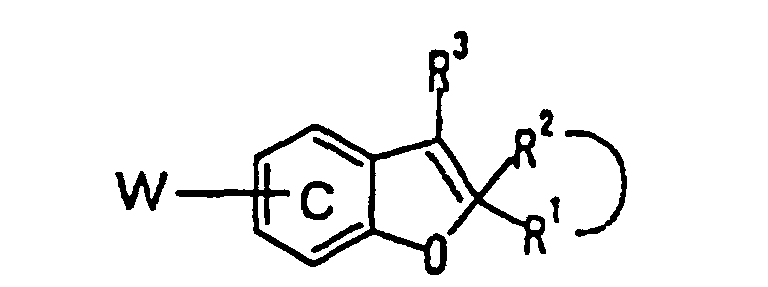 - - - eine Einfachbindung oder eine Doppelbindung ist;(i) ein Wasserstoffatom,(ii) eine C1-6-Alkylgruppe, eine C2-6-Alkenylgruppe, eine C2-6-Alkinylgruppe, eine C3-6-Cycloalkylgruppe oder eine C6-14-Arylgruppe, die jeweils 1 bis 5 Substituenten aufweisen kann, die aus (1) Halogen, (2) C1-3-Alkylendioxy, (3) Nitro, (4) Cyan, (5) C1-6-Alkyl, das halogeniert sein kann, (6) C2-6-Alkenyl, das halogeniert sein kann, (7) C2-6-Alkinyl, das halogeniert sein kann, (8) C3-6-Cycloalkyl, das halogeniert sein kann, (9) C6-14-Aryl, (10) C1-6-Alkoxy, das halogeniert sein kann, (11) C1-6-Alkylthio, das halogeniert sein kann, oder Mercapto, (12) Hydroxy, (13) Amino, (14) Mono-C1-6-alkylamino, (15) Mono-C6-14-arylamino, (16) Di-C1-6-alkylamino, (17) Di-C6-14-arylamino, (18) Acyl, das aus Formyl, Carboxy, Carbamoyl, C1-6-Alkylcarbonyl, C3-6-Cycloalkylcarbonyl, C1-6-Alkoxycarbonyl, C6-14-Arylcarbonyl, C7-16-Aralkylcarbonyl, C6-14-Aryloxycarbonyl, C7-16-Aralkyloxycarbonyl, 5- oder 6gliedrigem heterocyclischem Carbonyl, das außer einem Kohlenstoffatom 1 bis 4 aus einem Stickstoffatom, Schwefelatom und Sauerstoffatom ausgewählte Heteroatome enthält, Mono-C1-6-alkylcarbamoyl, Di-C1-6-alkylcarbamoyl, C6-14-Arylcarbamoyl, Thiocarbamoyl, 5- oder 6gliedrigem heterocyclischem Carbamoyl, das außer einem Kohlenstoffatom (Kohlenstoffatomen) 1 bis 4 aus einem Stickstoffatom, Schwefelatom und Sauerstoffatom ausgewählte Heteroatome enthält, C1-6-Alkylsulfonyl, C6-14-Arylsulfonyl, C1-6-Alkylsulfinyl und C6-14-Arylsulfinyl ausgewählt ist, (19) Acylamino, das aus Formylamino, C1-6-Alkylcarboxamido, C6-14-Arylcarboxamido, C1-6-Alkoxycarboxamido, C1-6-Alkylsulfonylamino und C6-14-Arylsulfonylamino ausgewählt ist, (20) Acyloxy, das aus C1-6-Alkylcarbonyloxy, C6-14-Arylcarbonyloxy, C1-6-Alkoxycarbonyloxy, Mono-C1-6-alkylcarbamoyloxy, Di-C1-6-alkylcarbamoyloxy, C6-14-Arylcarbamoyloxy und Nicotinoyloxy ausgewählt ist, (21) 5- bis 7gliedrigem, gesättigtem, cyclischem Amino, das 1 bis 3 aus C1-6-Alkyl, C6-14-Aryl und einer 5- bis 10gliedrigen, aromatischen, heterocyclischen Gruppe, die außer einem Kohlenstoffatom (Kohlenstoffatomen) 1 bis 4 aus einem Stickstoffatom, Schwefelatom und Sauerstoffatom ausgewählte Heteroatome enthält, ausgewählte Substituenten aufweisen kann, (22) einer 5- bis 10gliedrigen, aromatischen, heterocyclischen Gruppe, die außer einem Kohlenstoffatom (Kohlenstoffatomen) 1 bis 4 aus einem Stickstoffatom, Schwefelatom und Sauerstoffatom ausgewählte Heteroatome enthält, (23) Sulfo und (24) C6-14-Aryloxy ausgewählt sind, oder(iii) eine 5- bis 14gliedrige heterocyclische Gruppe sind, die außer einem Kohlenstoffatom 1 bis 4 aus einem Stickstoffatom, Schwefelatom und Sauerstoffatom ausgewählte Heteroatome enthält, die jeweils 1 bis 5 Substituenten aufweisen können, die aus (1) Halogen, (2) C1-3-Alkylendioxy, (3) Nitro, (4) Cyan, (5) C1-6-Alkyl, das halogeniert sein kann, (6) C2-6-Alkenyl, das halogeniert sein kann, (7) C2-6-Alkinyl, das halogeniert sein kann, (8) C3-6-Cycloalkyl, das halogeniert sein kann, (9) C6-14-Aryl, (10) C1-6-Alkoxy, das halogeniert sein kann, (11) C1-6-Alkylthio, das halogeniert sein kann, oder Mercapto, (12) Hydroxy, (13) Amino, (14) Mono-C1-6-alkylamino, (15) Mono-C6-14-arylamino, (16) Di-C1-6-alkylamino, (17) Di-C6-14-arylamino, (18) Acyl, das aus Formyl, Carboxy, Carbamoyl, C1-6-Alkylcarbonyl, C3-6-Cycloalkylcarbonyl, C1-6-Alkoxycarbonyl, C6-14-Arylcarbonyl, C7-16-Aralkylcarbonyl, C6-14-Aryloxycarbonyl, C7-16-Aralkyloxycarbonyl, 5- oder 6gliedrigem heterocyclischem Carbonyl, das außer einem Kohlenstoffatom (Kohlenstoffatomen) 1 bis 4 aus einem Stickstoffatom, Schwefelatom und Sauerstoffatom ausgewählte Heteroatome enthält, Mono-C1-6-alkylcarbamoyl, Di-C1-6-alkylcarbamoyl, C6-14-Arylcarbamoyl, Thiocarbamoyl, 5- oder 6gliedrigem heterocyclischem Carbamoyl, das außer einem Kohlenstoffatom (Kohlenstoffatomen) 1 bis 4 aus einem Stickstoffatom, Schwefelatom und Sauerstoffatom ausgewählte Heteroatome enthält, C1-6-Alkylsulfonyl, C6-14-Arylsulfonyl, C1-6-Alkylsulfinyl und C6-14-Arylsulfinyl ausgewählt ist, (19) Acylamino, das aus Formylamino, C1-6-Alkylcarbonylamino, C6-14-Arylcarbonylamino, C1-6-Alkoxycarbonylamino, C1-6-Alkylsulfonylamino und C6-14-Arylsulfonylamino ausgewählt ist, (20) Acyloxy, das aus C1-6-Alkylcarbonyloxy, C6-14-Arylcarbonyloxy, C1-6-Alkoxycarbonyloxy, Mono-C1-6alkylcarbamoyloxy, Di-C1-6-alkylcarbamoyloxy, C6-14-Arylcarbamoyloxy und Nicotinoyloxy ausgewählt ist, (21) 5- bis 7gliedrigem, gesättigtem, cyclischem Amino, das 1 bis 3 aus C1-6-Alkyl, C6-14-Aryl und einer 5- bis 10gliedrigen, aromatischen, heterocyclischen Gruppe, die außer einem Kohlenstoffatom (Kohlenstoffatomen) 1 bis 4 aus einem Stickstoffatom, Schwefelatom und Sauerstoffatom ausgewählte Heteroatome enthält, ausgewählte Substituenten aufweisen kann, (22) einer 5-bis 10gliedrigen, aromatischen, heterocyclischen Gruppe, die außer einem Kohlenstoffatom (Kohlenstoffatomen) 1 bis 4 aus einem Stickstoffatom, Schwefelatom und Sauerstoffatom ausgewählte Heteroatome enthält, (23) Sulfo und (24) C6-14-Aryloxy ausgewählt sind, oder(iv) R1 und R2 zusammen mit dem benachbarten Kohlenstoffatom ein C3-8-Cycloalkan oder einen 3- bis 8gliedrigen heterocyclischen Ring bilden, der außer einem Kohlenstoffatom (Kohlenstoffatomen) 1 bis 4 aus einem Stickstoffatom, Schwefelatom und Sauerstoffatom ausgewählte Heteroatome enthält, die jeweils 1 bis 5 Substituenten aufweisen können, die aus (1) Halogen, (2) C1-3-Alkylendioxy, (3) Nitro, (4) Cyan, (5) C1-6-Alkyl, das halogeniert sein kann, (6) C2-6-Alkenyl, das halogeniert sein kann, (7) C2-6-Alkinyl, das halogeniert sein kann, (8) C3-6-Cycloalkyl, das halogeniert sein kann, (9) C6-14-Aryl, (10) C1-6-Alkoxy, das halogeniert sein kann, (11) C1-6-Alkylthio, das halogeniert sein kann, oder Mercapto, (12) Hydroxy, (13) Amino, (14) Mono-C1-6-alkylamino, (15) Mono-C6-14arylamino, (16) Di-C1-6-alkylamino, (17) Di-C6-14-arylamino, (18) Acyl, das aus Formyl, Carboxy, Carbamoyl, C1-6-Alkylcarbonyl, C3-6-Cycloalkylcarbonyl, C1-5-Alkoxycarbonyl, C6-14-Arylcarbonyl, C7-16-Aralkylcarbonyl, C6-14-Aryloxycarbonyl, C7-16-Aralkyloxycarbonyl, 5- oder 6gliedrigem heterocyclischem Carbonyl, das außer einem Kohlenstoffatom 1 bis 4 aus einem Stickstoffatom, Schwefelatom und Sauerstoffatom ausgewählte Heteroatome enthält, Mono-C1-6-alkylcarbamoyl, Di-C1-6-alkylcarbamoyl, Thiocarbamoyl, C6-14-Arylcarbamoyl, 5- oder 6gliedrigem heterocyclischem Carbamoyl, das außer einem Kohlenstoffatom 1 bis 4 aus einem Stickstoffatom, Schwefelatom und Sauerstoffatom ausgewählte Heteroatome enthält, C1-6-Alkylsulfonyl, C6-14-Arylsulfonyl, C1-6-Alkylsulfinyl und C6-14-Arylsulfinyl ausgewählt ist, (19) Acylamino, das aus Formylamino, C1-6-Alkylcarbonylamino, C6-14-Arylcarbonylamino, C1-6-Alkoxycarbonylamino, C1-6-Alkylsulfonylamino und C6-14-Arylsulfonylamino ausgewählt ist, (20) Acyloxy, das aus C1-6-Alkylcarbonyloxy, C6-14-Arylcarbonyloxy, C1-6-Alkoxycarbonyloxy, Mono-C1-6-alkylcarbamoyloxy, Di-C1-6-alkylcarbamoyloxy, C6-14-Arylcarbamoyloxy und Nicotinoyloxy ausgewählt ist, (21) 5- bis 7gliedrigem, gesättigtem, cyclischem Amino, das 1 bis 3 aus C1-6-Alkyl, C6-14-Aryl und einer 5- bis 10gliedrigen, aromatischen, heterocyclischen Gruppe, die außer einem Kohlenstoffatom 1 bis 4 aus einem Stickstoffatom, Schwefelatom und Sauerstoffatom ausgewählte Heteroatome enthält, ausgewählte Substituenten aufweisen kann, (22) einer 5- bis 10gliedrigen, aromatischen, heterocyclischen Gruppe, die außer einem Kohlenstoffatom 1 bis 4 aus einem Stickstoffatom, Schwefelatom und Sauerstoffatom ausgewählte Heteroatome enthält, (23) Sulfo und (24) C6-14-Aryloxy ausgewählt sind;
W(i) eine durch die Formel:dargestellte Gruppe, worin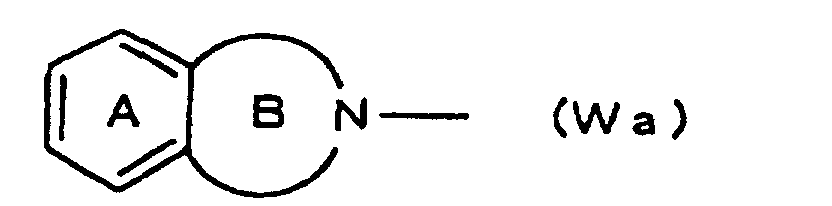
Ring A ein Benzolring ist, der jeweils 1 bis 5 Substituenten aufweisen kann, die aus (1) Halogen, (2) C1-3-Alkylendioxy, (3) Nitro, (4) Cyan, (5) C1-6-Alkyl, das halogeniert sein kann, (6) C2-6-Alkenyl, das halogeniert sein kann, (7) C2-6-Alkinyl, das halogeniert sein kann, (8) C3-6-Cycloalkyl, das halogeniert sein kann, (9) C6-14-Aryl, (10) C1-6-Alkoxy, das halogeniert sein kann, (11) C1-6-Alkylthio, das halogeniert sein kann, oder Mercapto, (12) Hydroxy, (13) Amino, (14) Mono-C1-6alkylamino, (15) Mono-C6-14-arylamino, (16) Di-C1-6-alkylamino, (17) Di-C6-14arylamino, (18) Acyl, das aus Formyl, Carboxy, Carbamoyl, C1-6-Alkylcarbonyl, C3-6-Cycloalkylcarbonyl, C1-6-Alkoxycarbonyl, C6-14-Arylcarbonyl, C7-16-Aralkylcarbonyl, C6-14-Aryloxycarbonyl, C7-16-Aralkyloxycarbonyl, 5- oder 6gliedrigem heterocyclischem Carbonyl, das außer einem Kohlenstoffatom 1 bis 4 aus einem Stickstoffatom, Schwefelatom und Sauerstoffatom ausgewählte Heteroatome enthält, Mono-C1-6-alkylcarbamoyl, Di-C1-6-alkylcarbamoyl, C6-14-Arylcarbamoyl, Thiocarbamoyl, 5- oder 6gliedrigem heterocyclischem Carbamoyl, das außer einem Kohlenstoffatom 1 bis 4 aus einem Stickstoffatom, Schwefelatom und Sauerstoffatom ausgewählte Heteroatome enthält, C1-6-Alkylsulfonyl, C6-14-Arylsulfonyl, C1-6-Alkylsulfinyl und C6-14-Arylsulfinyl ausgewählt ist, (19) Acylamino, das aus Formylamino, C1-6-Alkylcarboxamido, C6-14-Arylcarboxamido, C1-6-Alkoxycarboxamido, C1-6-Alkylsulfonylamino und C6-14-Arylsulfonylamino ausgewählt ist, (20) Acyloxy, das aus C1-6-Alkylcarbonyloxy, C6-14-Arylcarbonyloxy, C1-6-Alkoxycarbonyloxy, Mono-C1-6-alkylcarbamoyloxy, Di-C1-6-alkylcarbamoyloxy, C6-14-Arylcarbamoyloxy und Nicotinoyloxy ausgewählt ist, (21) 5- bis 7gliedrigem, gesättigtem, cyclischem Amino, das 1 bis 3 aus C1-6-Alkyl, C6-14-Aryl und einer 5- bis 10gliedrigen, aromatischen, heterocyclischen Gruppe, die außer einem Kohlenstoffatom 1 bis 4 aus einem Stickstoffatom, Schwefelatom und Sauerstoffatom ausgewählte Heteroatome enthält, ausgewählte Substituenten aufweisen kann, (22) einer 5- bis 10gliedrigen, aromatischen, heterocyclischen Gruppe, die außer einem Kohlenstoffatom 1 bis 4 aus einem Stickstoffatom, Schwefelatom und Sauerstoffatom ausgewählte Heteroatome enthält, (23) Sulfo und (24) C6-14-Aryloxy ausgewählt sind;
Ring B ein 5- bis 7gliedriger, stickstoffhaltiger, heterocyclischer Ring ist, der mit (i) Halogen oder (ii) einer C1-6-Alkylgruppe, einer C2-6-Alkenylgruppe, einer C2-6-Alkinylgruppe, einer C3-6-Cycloalkylgruppe oder einer C6-14-Arylgruppe substituiert sein kann, die jeweils 1 bis 5 Substituenten aufweisen können, die aus (1) Halogen, (2) C1-3-Alkylendioxy, (3) Nitro, (4) Cyan, (5) C1-6-Alkyl, das halogeniert sein kann, (6) C2-6-Alkenyl, das halogeniert sein kann, (7) C2-6-Alkinyl, das halogeniert sein kann, (8) C3-6-Cycloalkyl, das halogeniert sein kann, (9) C6-14-Aryl, (10) C1-6-Alkoxy, das halogeniert sein kann, (11) C1-6-Alkylthio, das halogeniert sein kann, oder Mercapto, (12) Hydroxy, (13) Amino, (14) Mono-C1-6-alkylamino, (15) Mono-C6-14-arylamino, (16) Di-C1-6-alkylamino, (17) Di-C6-14-arylamino, (18) Acyl, das aus Formyl, Carboxy, Carbamoyl, C1-6-Alkylcarbonyl, C3-6-Cycloalkylcarbonyl, C1-6-Alkoxycarbonyl, C6-14-Arylcarbonyl, C7-16-Aralkylcarbonyl, C6-14-Aryloxycarbonyl, C7-16-Aralkyloxycarbonyl, 5- oder 6gliedrigem heterocyclischem Carbonyl, das außer einem Kohlenstoffatom 1 bis 4 aus einem Stickstoffatom, Schwefelatom und Sauerstoffatom ausgewählte Heteroatome enthält, Mono-C1-6-alkylcarbamoyl, Di-C1-6-alkylcarbamoyl, C6-14-Arylcarbamoyl, Thiocarbamoyl, 5- oder 6gliedrigem heterocyclischem Carbamoyl, das außer einem Kohlenstoffatom 1 bis 4 aus einem Stickstoffatom, Schwefelatom und Sauerstoffatom ausgewählte Heteroatome enthält, C1-6-Alkylsulfonyl, C6-14-Arylsulfonyl, C1-6-Alkylsulfinyl und C6-14-Arylsulfinyl ausgewählt ist, (19) Acylamino, das aus Formylamino, C1-6-Alkylcarboxamido, C6-14-Arylcarboxamido, C1-6-Alkoxycarboxamido, C1-6-Alkylsulfonylamino und C6-14-Arylsulfonylamino ausgewählt ist, (20) Acyloxy, das aus C1-6-Alkylcarbonyloxy, C6-14-Arylcarbonyloxy, C1-6-Alkoxycarbonyloxy, Mono-C1-6-alkylcarbamoyloxy, Di-C1-6-alkylcarbamoyloxy, C6-14-Arylcarbamoyloxy und Nicotinoyloxy ausgewählt ist, (21) 5- bis 7gliedrigem, gesättigtem, cyclischem Amino, das 1 bis 3 aus C1-6-Alkyl, C6-14-Aryl und einer 5- bis 10gliedrigen, aromatischen, heterocyclischen Gruppe, die außer einem Kohlenstoffatom 1 bis 4 aus einem Stickstoffatom, Schwefelatom und Sauerstoffatom ausgewählte Heteroatome enthält, ausgewählte Substituenten aufweisen kann, (22) einer 5- bis 10gliedrigen, aromatischen, heterocyclischen Gruppe, die außer einem Kohlenstoffatom 1 bis 4 aus einem Stickstoffatom, Schwefelatom und Sauerstoffatom ausgewählte Heteroatome enthält, (23) Sulfo und (24) C6-14-Aryloxy ausgewählt sind, oder(ii) eine durch die Formeldargestellte Gruppe ist, worin R4
(1) eine C1-6-Alkylgruppe, eine C2-6-Alkenylgruppe, eine C2-6-Alkinylgruppe oder eine C3-6-Cycloalkylgruppe, die 1 bis 3 Gruppen aus einer C6-14-Arylgruppe und einer 5- bis 14gliedrigen, aromatischen, heterocyclischen Gruppe aufweist, die außer einem Kohlenstoffatom 1 bis 4 aus einem Stickstoffatom, Schwefelatom und Sauerstoffatom ausgewählte Heteroatome enthält, die jeweils 1 bis 5 Substituenten aufweisen können, die aus (1) Halogen, (2) C1-3-Alkylendioxy, (3) Nitro, (4) Cyan, (5) C1-6-Alkyl, das halogeniert sein kann, (6) C2-6-Alkenyl, das halogeniert sein kann, (7) C2-6-Alkinyl, das halogeniert sein kann, (8) C3-6-Cycloalkyl, das halogeniert sein kann, (9) C6-14-Aryl, (10) C1-6-Alkoxy, das halogeniert sein kann, (11) C1-6-Alkylthio, das halogeniert sein kann, oder Mercapto, (12) Hydroxy, (13) Amino, (14) Mono-C1-6-alkylamino, (15) Mono-C6-14-arylamino, (16) Di-C1-6-alkylamino, (17) Di-C6-14-arylamino, (18) Acyl, das aus Formyl, Carboxy, Carbamoyl, C1-6-Alkylcarbonyl, C3-6-Cycloalkylcarbonyl, C1-6-Alkoxycarbonyl, C6-14-Arylcarbonyl, C7-16-Aralkylcarbonyl, C6-14-Aryloxycarbonyl, C7-16-Aralkyloxycarbonyl, 5- oder 6gliedrigem heterocyclischem Carbonyl, das außer einem Kohlenstoffatom 1 bis 4 aus einem Stickstoffatom, Schwefelatom und Sauerstoffatom ausgewählte Heteroatome enthält, Mono-C1-6-alkylcarbamoyl, Di-C1-6-alkylcarbamoyl, C6-14-Arylcarbamoyl, Thiocarbamoyl, 5- oder 6gliedrigem heterocyclischem Carbamoyl, das außer einem Kohlenstoffatom 1 bis 4 aus einem Stickstoffatom, Schwefelatom und Sauerstoffatom ausgewählte Heteroatome enthält, C1-6-Alkylsulfonyl, C6-14-Arylsulfonyl, C1-6-Alkylsulfinyl und C6-14-Arylsulfinyl ausgewählt ist, (19) Acylamino, das aus Formylamino, C1-6-Alkylcarbonylamino, C6-14-Arylcarbonylamino, C1-6-Alkoxycarbonylamino, C1-6-Alkylsulfonylamino und C6-14-Arylsulfonylamino ausgewählt ist, (20) Acyloxy, das aus C1-6-Alkylcarbonyloxy, C6-14-Arylcarbonyloxy, C1-6-Alkoxycarbonyloxy, Mono-C1-6-alkylcarbamoyloxy, Di-C1-6-alkylcarbamoyloxy, C6-14-Arylcarbamoyloxy und Nicotinoyloxy ausgewählt ist, (21) 5- bis 7gliedrigem, gesättigtem, cyclischem Amino, das 1 bis 3 aus C1-6-Alkyl, C6-14-Aryl und einer 5- bis 10gliedrigen, aromatischen, heterocyclischen Gruppe, die außer einem Kohlenstoffatom 1 bis 4 aus einem Stickstoffatom, Schwefelatom und Sauerstoffatom ausgewählte Heteroatome enthält, ausgewählte Substituenten aufweisen kann, (22) einer 5- bis 10gliedrigen, aromatischen, heterocyclischen Gruppe, die außer einem Kohlenstoffatom 1 bis 4 aus einem Stickstoffatom, Schwefelatom und Sauerstoffatom ausgewählte Heteroatome enthält, (23) Sulfo und (24) C6-14-Aryloxy ausgewählt sind, und weiter 1 bis 5 Substituenten aufweisen können, die aus (1) Halogen, (2) C1-3-Alkylendioxy, (3) Nitro, (4) Cyan, (5) C1-6-Alkyl, das halogeniert sein kann, (6) C2-6-Alkenyl, das halogeniert sein kann, (7) C2-6-Alkinyl, das halogeniert sein kann, (8) C3-6-Cycloalkyl, das halogeniert sein kann, (9) C6-14-Aryl, (10) C1-6-Alkoxy, das halogeniert sein kann, (11) C1-6-Alkylthio, das halogeniert sein kann, oder Mercapto, (12) Hydroxy, (13) Amino, (14) Mono-C1-6-alkylamino, (15) Mono-C6-14arylamino, (16) Di-C1-6-alkylamino, (17) Di-C6-14-arylamino, (18) Acyl, das aus Formyl, Carboxy, Carbamoyl, C1-6-Alkylcarbonyl, C3-6-Cycloalkylcarbonyl, C1-6-Alkoxycarbonyl, C6-14-Arylcarbonyl, C7-16-Aralkylcarbonyl, C6-14-Aryloxycarbonyl, C7-16-Aralkyloxycarbonyl, 5- oder 6gliedrigem heterocyclischem Carbonyl, das außer einem Kohlenstoffatom 1 bis 4 aus einem Stickstoffatom, Schwefelatom und Sauerstoffatom ausgewählte Heteroatome enthält, Mono-C1-6-alkylcarbamoyl, Di-C1-6-alkylcarbamoyl, C6-14-Arylcarbamoyl, Thiocarbamoyl, 5- oder 6gliedrigem heterocyclischem Carbamoyl, das außer einem Kohlenstoffatom 1 bis 4 aus einem Stickstoffatom, Schwefelatom und Sauerstoffatom ausgewählte Heteroatome enthält, C1-6-Alkylsulfonyl, C6-14-Arylsulfonyl, C1-6-Alkylsulfinyl und C6-14-Arylsulfinyl ausgewählt ist, (19) Acylamino, das aus Formylamino, C1-6-Alkylcarbonylamino, C6-14-Arylcarbonylamino, C1-6-Alkoxycarbonylamino, C1-6-Alkylsulfonylamino und C6-14-Arylsulfonylamino ausgewählt ist, (20) Acyloxy, das aus C1-6-Alkylcarbonyloxy, C6-14-Arylcarbonyloxy, C1-6-Alkoxycarbonyloxy, Mono-C1-6-alkylcarbamoyloxy, Di-C1-6-alkylcarbamoyloxy, C6-14-Arylcarbamoyloxy und Nicotinoyloxy ausgewählt ist, (21) 5- bis 7gliedrigem, gesättigtem, cyclischem Amino, das 1 bis 3 aus C1-6-Alkyl, C6-14-Aryl und einer 5- bis 10gliedrigen, aromatischen, heterocyclischen Gruppe, die außer einem Kohlenstoffatom 1 bis 4 aus einem Stickstoffatom, Schwefelatom und Sauerstoffatom ausgewählte Heteroatome enthält, ausgewählte Substituenten aufweisen kann, (22) einer 5- bis 10gliedrigen, aromatischen, heterocyclischen Gruppe, die außer einem Kohlenstoffatom 1 bis 4 aus einem Stickstoffatom, Schwefelatom und Sauerstoffatom ausgewählte Heteroatome enthält, (23) Sulfo und (24) C6-14-Aryloxy ausgewählt sind, oder
(ii) eine Acylgruppe, die aus Formyl, Carboxy, Carbamoyl, C1-6-Alkylcarbonyl, C3-6-Cycloalkylcarbonyl, C1-6-Alkoxycarbonyl, C6-14-Arylcarbonyl, C7-16-Aralkylcarbonyl, C6-14-Aryloxycarbonyl, C7-16-Aralkyloxycarbonyl, 5- oder 6gliedrigem heterocyclischem Carbonyl, das außer einem Kohlenstoffatom 1 bis 4 aus einem Stickstoffatom, Schwefelatom und Sauerstoffatom ausgewählte Heteroatome enthält, Mono-C1-6-alkylcarbamoyl, Di-C1-6-alkylcarbamoyl, C6-14-Arylcarbamoyl, Thiocarbamoyl, 5- oder 6gliedrigem heterocyclischem Carbamoyl, das außer einem Kohlenstoffatom 1 bis 4 aus einem Stickstoffatom, Schwefelatom und Sauerstoffatom ausgewählte Heteroatome enthält, C1-6-Alkylsulfonyl, C6-14-Arylsulfonyl, C1-6-Alkylsulfinyl und C6-14-Arylsulfinyl ausgewählt ist,
die 1 bis 3 Gruppen aus einer C6-14-Arylgruppe und einer 5- bis 14gliedrigen, aromatischen, heterocyclischen Gruppe aufweist, die außer dem Kohlenstoffatom 1 bis 4 aus einem Stickstoffatom, Schwefelatom und Sauerstoffatom ausgewählte Heteroatome enthält, die jeweils 1 bis 5 Substituenten aufweisen können, die aus (1) Halogen, (2) C1-3-Alkylendioxy, (3) Nitro, (4) Cyan, (5) C1-6-Alkyl, das halogeniert sein kann, (6) C2-6-Alkenyl, das halogeniert sein kann, (7) C2-6-Alkinyl, das halogeniert sein kann, (8) C3-6-Cycloalkyl, das halogeniert sein kann, (9) C6-14-Aryl, (10) C1-6-Alkoxy, das halogeniert sein kann, (11) C1-6-Alkylthio, das halogeniert sein kann, oder Mercapto, (12) Hydroxy, (13) Amino, (14) Mono-C1-6-alkylamino, (15) Mono-C6-14-arylamino, (16) Di-C1-6-alkylamino, (17) Di-C6-14-arylamino, (18) Acyl, das aus Formyl, Carboxy, Carbamoyl, C1-6-Alkylcarbonyl, C3-6-Cycloalkylcarbonyl, C1-6-Alkoxycarbonyl, C6-14-Arylcarbonyl, C7-16-Aralkylcarbonyl, C6-14-Aryloxycarbonyl, C7-16-Aralkyloxycarbonyl, 5- oder 6gliedrigem heterocyclischem Carbonyl, das außer einem Kohlenstoffatom 1 bis 4 aus einem Stickstoffatom, Schwefelatom und Sauerstoffatom ausgewählte Heteroatome enthält, Mono-C1-6-alkylcarbamoyl, Di-C1-6-alkylcarbamoyl, C6-14-Arylcarbamoyl, Thiocarbamoyl, 5- oder 6gliedrigem heterocyclischem Carbamoyl, das außer einem Kohlenstoffatom 1 bis 4 aus einem Stickstoffatom, Schwefelatom und Sauerstoffatom ausgewählte Heteroatome enthält, C1-6-Alkylsulfonyl, C6-14-Arylsulfonyl, C1-6-Alkylsulfinyl und C6-14-Arylsulfinyl ausgewählt ist, (19) Acylamino, das aus Formylamino, C1-6-Alkylcarbonylamino, C6-14-Arylcarbonylamino, C1-6-Alkoxycarbonylamino, C1-6-Alkylsulfonylamino und C6-14-Arylsulfonylamino ausgewählt ist, (20) Acyloxy, das aus C1-6-Alkylcarbonyloxy, C6-14-Arylcarbonyloxy, C1-6-Alkoxycarbonyloxy, Mono-C1-6-alkylcarbamoyloxy, Di-C1-6-alkylcarbamoyloxy, C6-14-Arylcarbamoyloxy und Nicotinoyloxy ausgewählt ist, (21) 5- bis 7gliedrigem, gesättigtem, cyclischem Amino, das 1 bis 3 aus C1-6-Alkyl, C6-14-Aryl und einer 5- bis 10gliedrigen, aromatischen, heterocyclischen Gruppe, die außer einem Kohlenstoffatom 1 bis 4 aus einem Stickstoffatom, Schwefelatom und Sauerstoffatom ausgewählte Heteroatome enthält, ausgewählte Substituenten aufweisen kann, (22) einer 5-bis 10gliedrigen, aromatischen, heterocyclischen Gruppe, die außer einem Kohlenstoffatom 1 bis 4 aus einem Stickstoffatom, Schwefelatom und Sauerstoffatom ausgewählte Heteroatome enthält, (23) Sulfo und (24) C6-14-Aryloxy ausgewählt sind;
R5 (i) eine C1-6-Alkylgruppe oder (ii) Acyl ist, das aus Formyl, Carboxy, Carbamoyl, C1-6-Alkylcarbonyl, C3-6-Cycloalkylcarbonyl, C1-6-Alkoxycarbonyl, C6-14-Arylcarbonyl, C7-16-Aralkylcarbonyl, C6-14-Aryloxycarbonyl, C7-16-Aralkyloxycarbonyl, 5- oder 6gliedrigem heterocyclischem Carbonyl, das außer einem Kohlenstoffatom 1 bis 4 aus einem Stickstoffatom, Schwefelatom und Sauerstoffatom ausgewählte Heteroatome enthält, Mono-C1-6-alkylcarbamoyl, Di-C1-6-alkylcarbamoyl, C6-14-Arylcarbamoyl, Thiocarbamoyl, 5- oder 6gliedrigem heterocyclischem Carbamoyl, das außer einem Kohlenstoffatom 1 bis 4 aus einem Stickstoffatom, Schwefelatom und Sauerstoffatom ausgewählte Heteroatome enthält, C1-6-Alkylsulfonyl, C6-14-Arylsulfonyl, C1-6-Alkylsulfinyl und C6-14-Arylsulfinyl ausgewählt ist; und(i) wenn W Wa ist,
R3(i) ein Wasserstoffatom,(ii) eine C1-6-Alkylgruppe, eine C2-6-Alkenylgruppe, eine C2-6-Alkinylgruppe, eine C3-6-Cycloalkylgruppe oder eine C6-14-Arylgruppe ist, die jeweils 1 bis 5 Substituenten aufweisen kann, die aus (1) Halogen, (2) C1-3-Alkylendioxy, (3) Nitro, (4) Cyan, (5) C1-6-Alkyl, das halogeniert sein kann, (6) C2-6-Alkenyl, das halogeniert sein kann, (7) C2-6-Alkinyl, das halogeniert sein kann, (8) C3-6-Cycloalkyl, das halogeniert sein kann, (9) C6-14-Aryl, (10) C1-6-Alkoxy, das halogeniert sein kann, (11) C1-6-Alkylthio, das halogeniert sein kann, oder Mercapto, (12) Hydroxy, (13) Amino, (14) Mono-C1-6-alkylamino, (15) Mono-C6-14-arylamino, (16) Di-C1-6-alkylamino, (17) Di-C6-14-arylamino, (18) Acyl, das aus Formyl, Carboxy, Carbamoyl, C1-6-Alkylcarbonyl, C3-6-Cycloalkylcarbonyl, C1-6-Alkoxycarbonyl, C6-14-Arylcarbonyl, C7-16-Aralkylcarbonyl, C6-14-Aryloxycarbonyl, C7-16-Aralkyloxycarbonyl, 5- oder 6gliedrigem heterocyclischem Carbonyl, das außer einem Kohlenstoffatom 1 bis 4 aus einem Stickstoffatom, Schwefelatom und Sauerstoffatom ausgewählte Heteroatome enthält, Mono-C1-6-alkylcarbamoyl, Di-C1-6-alkylcarbamoyl, C6-14-Arylcarbamoyl, Thiocarbamoyl, 5- oder 6gliedrigem heterocyclischem Carbamoyl, das außer einem Kohlenstoffatom 1 bis 4 aus einem Stickstoffatom, Schwefelatom und Sauerstoffatom ausgewählte Heteroatome enthält, C1-6-Alkylsulfonyl, C6-14-Arylsulfonyl, C1-6-Alkylsulfinyl und C6-14-Arylsulfinyl ausgewählt ist, (19) Acylamino, das aus Formylamino, C1-6-Alkylcarboxamido, C6-14-Arylcarboxamido, C1-6-Alkoxycarboxamido, C1-6-Alkylsulfonylamino und C6-14-Arylsulfonylamino ausgewählt ist, (20) Acyloxy, das aus C1-6-Alkylcarbonyloxy, C6-14-Arylcarbonyloxy, C1-6-Alkoxycarbonyloxy, Mono-C1-6-alkylcarbamoyloxy, Di-C1-6-alkylcarbamoyloxy, C6-14-Arylcarbamoyloxy und Nicotinoyloxy ausgewählt ist, (21) 5- bis 7gliedrigem, gesättigtem, cyclischem Amino, das 1 bis 3 aus C1-6-Alkyl, C6-14-Aryl und einer 5-bis 10gliedrigen, aromatischen, heterocyclischen Gruppe, die außer einem Kohlenstoffatom 1 bis 4 aus einem Stickstoffatom, Schwefelatom und Sauerstoffatom ausgewählte Heteroatome enthält, ausgewählte Substituenten aufweisen kann, (22) einer 5- bis 10gliedrigen, aromatischen, heterocyclischen Gruppe, die außer einem Kohlenstoffatom 1 bis 4 aus einem Stickstoffatom, Schwefelatom und Sauerstoffatom ausgewählte Heteroatome enthält, (23) Sulfo und (24) C6-14-Aryloxy ausgewählt sind, oder(iii) eine 5- bis 14gliedrige, heterocyclische Gruppe ist, die außer einem Kohlenstoffatom 1 bis 4 aus einem Stickstoffatom, Schwefelatom und Sauerstoffatom ausgewählte Heteroatome enthält, die 1 bis 5 Substituenten aufweisen kann, die aus (1) Halogen, (2) C1-3-Alkylendioxy, (3) Nitro, (4) Cyan, (5) C1-6-Alkyl, das halogeniert sein kann, (6) C2-6-Alkenyl, das halogeniert sein kann, (7) C2-6-Alkinyl, das halogeniert sein kann, (8) C3-6-Cycloalkyl, das halogeniert sein kann, (9) C6-14-Aryl, (10) C1-6-Alkoxy, das halogeniert sein kann, (11) C1-6-Alkylthio, das halogeniert sein kann, oder Mercapto, (12) Hydroxy, (13) Amino, (14) Mono-C1-6alkylamino, (15) Mono-C6-14-arylamino, (16) Di-C1-6-alkylamino, (17) Di-C6-14arylamino, (18) Acyl, das aus Formyl, Carboxy, Carbamoyl, C1-6-Alkylcarbonyl, C3-6-Cycloalkylcarbonyl, C1-6-Alkoxycarbonyl, C6-14-Arylcarbonyl, C7-16-Aralkylcarbonyl, C6-14-Aryloxycarbonyl, C7-16-Aralkyloxycarbonyl, 5- oder 6gliedrigem heterocyclischem Carbonyl, das außer einem Kohlenstoffatom 1 bis 4 aus einem Stickstoffatom, Schwefelatom und Sauerstoffatom ausgewählte Heteroatome enthält, Mono-C1-6-alkylcarbamoyl, Di-C1-6-alkylcarbamoyl, C6-14-Arylcarbamoyl, Thiocarbamoyl, 5- oder 6gliedrigem heterocyclischem Carbamoyl, das außer einem Kohlenstoffatom 1 bis 4 aus einem Stickstoffatom, Schwefelatom und Sauerstoffatom ausgewählte Heteroatome enthält, C1-6-Alkylsulfonyl, C6-14-Arylsulfonyl, C1-6-Alkylsulfinyl und C6-14-Arylsulfinyl ausgewählt ist, (19) Acylamino, das aus Formylamino, C1-6-Alkylcarbonylamino, C6-14-Arylcarbonylamino, C1-6-Alkoxycarbonylamino, C1-6-Alkylsulfonylamino und C6-14-Arylsulfonylamino ausgewählt ist, (20) Acyloxy, das aus C1-6-Alkylcarbonyloxy, C6-14-Arylcarbonyloxy, C1-6-Alkoxycarbonyloxy, Mono-C1-6-alkylcarbamoyloxy, Di-C1-6-alkylcarbamoyloxy, C6-14-Arylcarbamoyloxy und Nicotinoyloxy ausgewählt ist, (21) 5- bis 7gliedrigem, gesättigtem, cyclischem Amino, das 1 bis 3 aus C1-6-Alkyl, C6-14-Aryl und einer 5-bis 10gliedrigen, aromatischen, heterocyclischen Gruppe, die außer einem Kohlenstoffatom 1 bis 4 aus einem Stickstoffatom, Schwefelatom und Sauerstoffatom ausgewählte Heteroatome enthält, ausgewählte Substituenten aufweisen kann, (22) einer 5- bis 10gliedrigen, aromatischen, heterocyclischen Gruppe, die außer einem Kohlenstoffatom 1 bis 4 aus einem Stickstoffatom, Schwefelatom und Sauerstoffatom ausgewählte Heteroatome enthält, (23) Sulfo und (24) C6-14-Aryloxy ausgewählt sind, und
Ring C ein Benzolring ist, der außer der durch Wa dargestellten Gruppe mit einem aus Halogen, C1-6-Alkyl, das halogeniert sein kann, C1-6-Alkoxy, das halogeniert sein kann und C1-6-Alkylthio, das halogeniert sein kann, ausgewählten Substituenten substituiert sein kann, und(ii) wenn W Wb ist,
R3 C6-14-Aryl ist, das jeweils 1 bis 5 Substituenten aufweisen kann, die aus (1) Halogen, (2) C1-3-Alkylendioxy, (3) Nitro, (4) Cyan, (5) C1-6-Alkyl, das halogeniert sein kann, (6) C2-6-Alkenyl, das halogeniert sein kann, (7) C2-6-Alkinyl, das halogeniert sein kann, (8) C3-6-Cycloalkyl, das halogeniert sein kann, (9) C6-14-Aryl, (10) C1-6-Alkoxy, das halogeniert sein kann, (11) C1-6-Alkylthio, das halogeniert sein kann, oder Mercapto, (12) Hydroxy, (13) Amino, (14) Mono-C1-6-alkylamino, (15) Mono-C6-14-arylamino, (16) Di-C1-6-alkylamino, (17) Di-C6-14-arylamino, (18) Acyl, das aus Formyl, Carboxy, Carbamoyl, C1-6-Alkylcarbonyl, C3-6-Cycloalkylcarbonyl, C1-6-Alkoxycarbonyl, C6-14-Arylcarbonyl, C7-16-Aralkylcarbonyl, C6-14-Aryloxycarbonyl, C7-16-Aralkyloxycarbonyl, 5- oder 6gliedrigem heterocyclischem Carbonyl, das außer einem Kohlenstoffatom 1 bis 4 aus einem Stickstoffatom, Schwefelatom und Sauerstoffatom ausgewählte Heteroatome enthält, Mono-C1-6alkylcarbamoyl, Di-C1-6-alkylcarbamoyl, C6-14-Arylcarbamoyl, Thiocarbamoyl, 5-oder 6gliedrigem heterocyclischem Carbamoyl, das außer einem Kohlenstoffatom 1 bis 4 aus einem Stickstoffatom, Schwefelatom und Sauerstoffatom ausgewählte Heteroatome enthält, C1-6-Alkylsulfonyl, C6-14-Arylsulfonyl, C1-6-Alkylsulfinyl und C6-14-Arylsulfinyl ausgewählt ist, (19) Acylamino, das aus Formylamino, C1-6-Alkylcarbonylamino, C6-14-Arylcarbonylamino, C1-6-Alkoxycarbonylamino, C1-6-Alkylsulfonylamino und C6-14-Arylsulfonylamino ausgewählt ist, (20) Acyloxy, das aus C1-6-Alkylcarbonyloxy, C6-14-Arylcarbonyloxy, C1-6-Alkoxycarbonyloxy, Mono-C1-6-alkylcarbamoyloxy, Di-C1-6-alkylcarbamoyloxy, C6-14-Arylcarbamoyloxy und Nicotinoyloxy ausgewählt ist, (21) 5- bis 7gliedrigem, gesättigtem, cyclischem Amino, das 1 bis 3 aus C1-6-Alkyl, C6-14-Aryl und einer 5- bis 10gliedrigen, aromatischen, heterocyclischen Gruppe, die außer einem Kohlenstoffatom 1 bis 4 aus einem Stickstoffatom, Schwefelatom und Sauerstoffatom ausgewählte Heteroatome enthält, ausgewählte Substituenten aufweisen kann, (22) einer 5- bis 10gliedrigen, aromatischen, heterocyclischen Gruppe, die außer einem Kohlenstoffatom 1 bis 4 aus einem Stickstoffatom, Schwefelatom und Sauerstoffatom ausgewählte Heteroatome enthält, (23) Sulfo und (24) C6-14-Aryloxy ausgewählt sind, und
Ring C ein Benzolring ist, der außer der durch Wb dargestellten Gruppe 1 bis 3 Substituenten aufweisen kann, die aus (1) Halogen, (2) C1-3-Alkylendioxy, (3) Nitro, (4) Cyan, (5) C1-6-Alkyl, das halogeniert sein kann, (6) C2-6-Alkenyl, das halogeniert sein kann, (7) C2-6-Alkinyl, das halogeniert sein kann, (8) C3-6-Cycloalkyl, das halogeniert sein kann, (9) C6-14-Aryl, (10) C1-6-Alkoxy, das halogeniert sein kann, (11) Hydroxy, (12) Amino, (13) Mono-C1-6-alkylamino, (14) Mono-C6-14-arylamino, (15) Di-C1-6-alkylamino, (16) Di-C6-14-arylamino, (17) Acyl, das aus Formyl, Carboxy, Carbamoyl, C1-6-Alkylcarbonyl, C3-6-Cycloalkylcarbonyl, C1-6-Alkoxycarbonyl, C6-14-Arylcarbonyl, C7-16-Aralkylcarbonyl, C6-14-Aryloxycarbonyl, C7-16-Aralkyloxycarbonyl, 5- oder 6gliedrigem heterocyclischem Carbonyl, das außer einem Kohlenstoffatom 1 bis 4 aus einem Stickstoffatom, Schwefelatom und Sauerstoffatom ausgewählte Heteroatome enthält, Mono-C1-6-alkylcarbamoyl, Di-C1-6-alkylcarbamoyl, C6-14-Arylcarbamoyl, Thiocarbamoyl, 5- oder 6gliedrigem heterocyclischem Carbamoyl, das außer einem Kohlenstoffatom 1 bis 4 aus einem Stickstoffatom, Schwefelatom und Sauerstoffatom ausgewählte Heteroatome enthält, C1-6-Alkylsulfonyl, C6-14-Arylsulfonyl, C1-6-Alkylsulfinyl und C6-14-Arylsulfinyl ausgewählt ist, (18) Acylamino, das aus Formylamino, C1-6-Alkylcarboxamido, C6-14-Arylcarboxamido, C1-6-Alkoxycarboxamido, C1-6-Alkylsulfonylamino und C6-14-Arylsulfonylamino ausgewählt ist, (19) 5- bis 7gliedrigem, gesättigtem, cyclischem Amino, das 1 bis 3 aus C1-6-Alkyl, C6-14-Aryl und einer 5- bis logliedrigen, aromatischen, heterocyclischen Gruppe, die außer einem Kohlenstoffatom 1 bis 4 aus einem Stickstoffatom, Schwefelatom und Sauerstoffatom ausgewählte Heteroatome enthält, ausgewählte Substituenten aufweisen kann, (20) einer 5-bis 10gliedrigen, aromatischen, heterocyclischen Gruppe, die außer einem Kohlenstoffatom 1 bis 4 aus einem Stickstoffatom, Schwefelatom und Sauerstoffatom ausgewählte Heteroatome enthält, und (21) Sulfo ausgewählt sind, oder ein Salz davon. - Verbindung gemäß Anspruch 1, die durch die Formeldargestellt wird, worin R1 und R2 gleich oder verschieden sind und wie in Anspruch 1 definiert sind, oder R1 und R2 zusammen mit dem benachbarten Kohlenstoffatom einen 3- bis 8gliedrigen, homocyclischen oder heterocyclischen Ring bilden können, der wie in Anspruch 1 definiert substituiert sein kann;
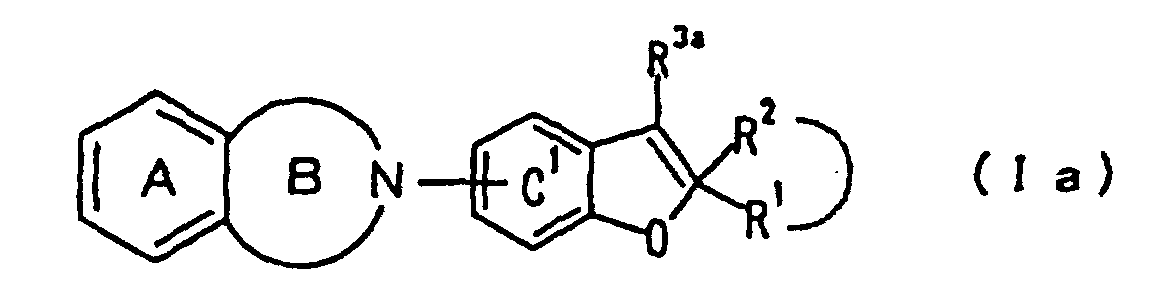
R3a wie in Anspruch 1 für R3 definiert ist;
- - - eine Einfachbindung oder eine Doppelbindung ist;
Ring A wie in Anspruch 1 definiert ist;
Ring B wie in Anspruch 1 definiert ist;
Ring C1 ein Benzolring ist, der außer der durch die Formel(worin jedes Symbol wie vorstehend definiert ist) dargestellten Gruppe wie in Anspruch 1 für Ring C definiert weiter substituiert sein kann,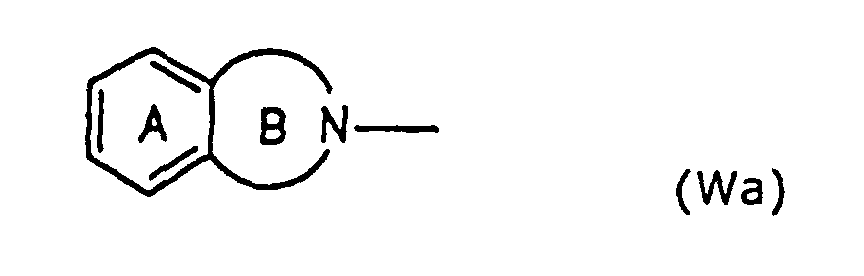
oder ein Salz davon. - Verbindung gemäß Anspruch 1, die durch die Formeldargestellt wird, worin R1 und R2 gleich oder verschieden sind und wie in Anspruch 1 definiert sind, oder R1 und R2 zusammen mit dem benachbarten Kohlenstoffatom einen 3- bis 8gliedrigen, homocyclischen oder heterocyclischen Ring bilden können, der wie in Anspruch 1 definiert substituiert sein kann;
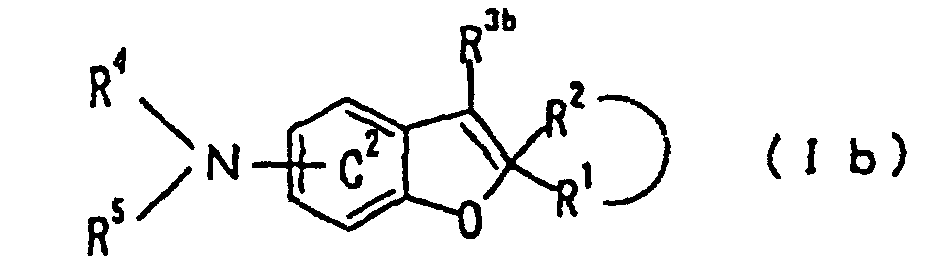
R3a eine C6-14-Arylgruppe ist, die wie für R3 in Anspruch 1 definiert substituiert sein kann;
R4 (1) eine wie in Anspruch 1 definierte aliphatische Kohlenwasserstoffgruppe, die mit einer aromatischen Gruppe substituiert ist, die wie in Anspruch 1 definiert substituiert sein kann und weiter substituiert sein kann, oder (2) eine Acylgruppe ist, die eine aromatische Gruppe enthält, die wie in Anspruch 1 definiert substituiert sein kann;
R5 wie in Anspruch 1 definiert ist;
- - - eine Einfachbindung oder eine Doppelbindung ist;
Ring C2 ein Benzolring ist, der außer der durch -NR4(R5) (jedes Symbol ist wie vorstehend definiert) dargestellten Gruppe wie in Anspruch 1 für Ring C definiert weiter substituiert sein kann,
oder ein Salz davon. - Verbindung gemäß Anspruch 2, wobei R1 und R2 gleich oder verschieden sind und jeweils ein Wasserstoffatom oder eine C1-6-Alkylgruppe sind, die wie in Anspruch 1 definierte Substituenten aufweisen kann, oder R1 und R2 zusammen mit dem benachbarten Kohlenstoffatom einen 3- bis 8gliedrigen, heterocyclischen Ring bilden können, der substituiert sein kann.
- Verbindung gemäß Anspruch 2, wobei R1 und R2 jeweils eine C1-6-Alkylgruppe sind.
- Verbindung gemäß Anspruch 2, wobei R3a eine C6-14-Arylgruppe ist, die wie in Anspruch 1 für R3 definiert substituiert sein kann.
- Verbindung gemäß Anspruch 2, wobei R3a eine Phenylgruppe ist, die C1-6-Alkyl oder Halogen aufweisen kann.
- Verbindung gemäß Anspruch 2, wobei Ring A ein Benzolring ist, der mit aus Halogen, C1-6-Alkyl, C1-6-Alkoxy und C1-6-Alkylendioxy ausgewähltem substituiert sein kann.
- Verbindung gemäß Anspruch 2, wobei Ring B ein wie in Anspruch 1 definierter, 5- bis 7gliedriger, stickstoffhaltiger, heterocyclischer Ring ist, der mit C1-6-Alkyl substituiert sein kann.
- Verbindung gemäß Anspruch 2, wobei Ring C1 ein Benzolring ist, der mit C1-6-Alkyl oder C1-6-Alkoxy weiter substituiert sein kann.
- Verbindung gemäß Anspruch 2, wobei eine durch die Formeldargestellte Gruppe (worin jedes Symbol wie in Anspruch 2 definiert ist) eine durch die Formel
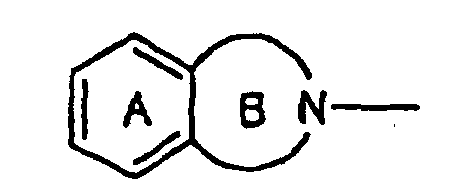 dargestellte Gruppe ist, worin R6 und R7 gleich oder verschieden sind und jeweils ein Wasserstoffatom, Halogen oder eine Kohlenwasserstoffgruppe sind, die wie in Anspruch 1 definiert substituiert sein kann, und Ring A wie in Anspruch 2 definiert ist.
- Verbindung gemäß Anspruch 2, wobei eine durch die Formeldargestellte Gruppe (worin jedes Symbol wie in Anspruch 2 definiert ist) eine durch die Formel
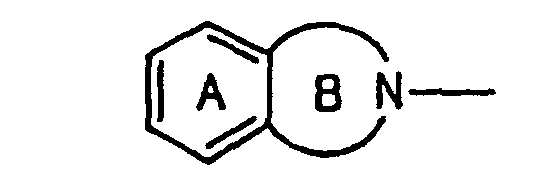 dargestellte Gruppe ist, worin R6 und R7 gleich oder verschieden sind und jeweils ein Wasserstoffatom, Halogen oder eine Kohlenwasserstoffgruppe sind, die wie in Anspruch 1 definiert substituiert sein kann, und Ring A wie in Anspruch 2 definiert ist.
- Verbindung gemäß Anspruch 11 oder 12, wobei R6 und R7 Wasserstoffatome sind und Ring A ein Benzolring ist, der 1 bis 2 Substituenten aufweisen kann, die aus Halogen, C1-6-Alkoxy und C1-6-Alkylendioxy ausgewählt sind.
- Verbindung gemäß Anspruch 2, wobei die Substitutionsposition an Ring C1 einer durch die Formeldargestellten Gruppe (worin jedes Symbol wie in Anspruch 2 definiert ist) die 5-Stellung an dem Benzofuranring oder dem Dihydrobenzofuranring ist.

- Verbindung gemäß Anspruch 2, wobei R1 und R2 jeweils eine C1-6-Alkylgruppe sind, R3a eine Phenylgruppe ist, die C1-6-Alkyl oder Halogen aufweisen kann, Ring A ein Benzolring ist, der durch aus Halogen, C1-6-Alkyl, C1-6-Alkoxy und C1-6-Alkylendioxy ausgewähltes substituiert sein kann, Ring B ein 5- bis 7gliedriger, stickstoffhaltiger, heterocyclischer Ring ist, der mit C1-6-Alkyl substituiert sein kann, und Ring C1 ein Benzolring ist, der mit C1-6-Alkyl oder C1-6-Alkoxy weiter substituiert sein kann und eine durch die Formel(worin jedes Symbol wie in Anspruch 2 definiert ist) dargestellte Gruppe eine Gruppe ist, die durch die Formel
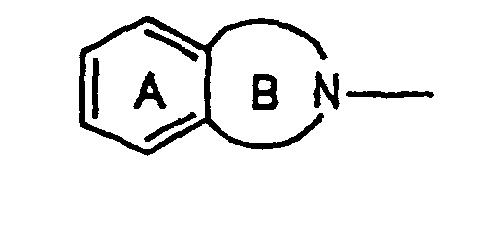 dargestellt wird (worin Ring A1 ein Benzolring ist, der 1 oder 2 aus Halogen, C1-6-Alkoxy und C1-6-Alkylendioxy ausgewählte Substituenten aufweisen kann).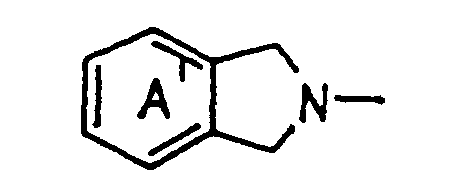
- [1] 2-[2,2,4,6,7-Pentamethyl-3-(4-methylphenyl)-2,3-dihydro-1-benzofuran-5-yl]isoindolin, [2] 5,6-Dimethoxy-2-[2,2,4,6,7-pentamethyl-3-(4-methylphenyl)-2,3-dihydro-1-benzofuran-5-yl]isoindolin, [3] 5,6-Dimethoxy-2-[3-(4-isopropylphenyl)-2,2,4,6,7-pentamethyl-2,3-dihydro-1-benzofuran-5-yl]isoindolin, [4] 6-[3-(4-Isopropylphenyl)-2,2,4,6,7-pentamethyl-2,3-dihydro-1-benzofuran-5-yl]-6,7-dihydro-5H-[1,3]dioxolo[4,5-f]isoindol, [5] 6-[2,2,4,6,7-Pentamethyl-3-(4-methylphenyl)-2,3-dihydro-1-benzofuran-5-yl]-6H-[1,3]dioxolo[4,5-f]-isoindol, [6] 6-[2,2,4,6,7-Pentamethyl-3-phenyl-2,3-dihydro-1-benzofuran-5-yl]-6,7-dihydro-5H-[1,3]dioxolo[4,5-f]isoindol, [7] (+)-5,6-Dimethoxy-2-[2,2,4,6,7-pentamethyt-3-(4-methylphenyl)-2,3-dihydro-1-benzofuran-5-yl]isoindolin oder [8] (+)-5,6-Dimethoxy-2-[2,2,4,6,7-pentamethyl-3-(4-methylphenyl)-2,3-dihydro-1-benzofuran-5-yl]isoindolin-hydrochlorid.
- Verbindung gemäß Anspruch 3, wobei Ring A ein Benzolring ist, der 1 bis 3 aus Halogen, C1-3-Alkylendioxy, Nitro, Cyan, C1-6-Alkyl, das halogeniert sein, C2-6-Alkenyl, das halogeniert sein kann, C2-6-Alkinyl, das halogeniert sein kann, C3-6-Cycloalkyl, das halogeniert sein kann, C6-14-Aryl, C1-6-Alkoxy, das halogeniert sein kann, Hydroxy, Amino, Mono-C1-6-alkylamino, Mono-C6-14-arylamino, Di-C1-6alkylamino, Di-C6-14-Arylamino, Acyl, Acylamino, 5- bis 7 gliedrigem, gesättigtem, cyclischen Amino, das substituiert sein kann, einer 5- bis 10gliedrigen, aromatischen, heterocyclischen Gruppe und Sulfo ausgewählt ist.
- Verbindung gemäß Anspruch 1, wobei R1 und R2 gleich oder verschieden sind und jeweils ein Wasserstoffatom oder eine C1-6-Alkylgruppe sind, die wie in Anspruch 1 definiert substituiert sein kann, oder R1 und R2 zusammen mit dem benachbarten Kohlenstoffatom einen 3- bis 8gliedrigen, heterocyclischen Ring bilden, der wie in Anspruch 1 definiert substituiert sein kann.
- Verbindung gemäß Anspruch 1, wobei R1 und R2 jeweils ein Wasserstoffatom oder eine C1-6-Alkylgruppe sind.
- Verbindung gemäß Anspruch 1, wobei R1 und R2 jeweils ein Wasserstoffatom oder eine Methylgruppe sind.
- Verbindung gemäß Anspruch 1, wobei R1 und R2 zusammen mit dem benachbarten Kohlenstoffatom einen Ring bilden, der durchdargestellt wird (worin Z ein Wasserstoffatom oder eine C1-6-Alkylgruppe ist).
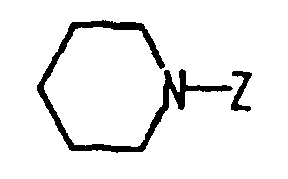
- Verbindung gemäß Anspruch 1, wobei R3 eine Phenylgruppe ist, die mit Halogen oder C1-6-Alkyl substituiert sein kann.
- Verbindung gemäß Anspruch 1, wobei R3 eine Phenylgruppe ist, die mit Fluor, Methyl oder Isopropyl substituiert sein kann.
- Verbindung gemäß Anspruch 1, wobei die Substitutionsposition an Ring A einer durch die Formel -NR4(R5) dargestellten Gruppe die 5-Stellung an dem Benzofuranring oder dem Dihydrobenzofuranring ist.
- Verbindung gemäß Anspruch 1, wobei R4 (1) eine C1-6-Alkylgruppe, die mit einer wie in Anspruch 1 definierten aromatischen Gruppe substituiert ist, die mit Halogen, C1-6-Alkoxy oder C1-3-Alkylendioxy substituiert sein kann, oder (2) eine Acylgruppe ist, die eine wie in Anspruch 1 definierte aromatische Gruppe enthält, die mit Halogen, C1-6-Alkoxy oder C1-3-Alkylendioxy substituiert sein kann.
- Verbindung gemäß Anspruch 1, wobei R4 eine Benzylgruppe oder Phenethylgruppe ist, die mit Fluor, Methoxy oder Methylendioxy substituiert sein kann.
- Verbindung gemäß Anspruch 1, wobei R5 ein Wasserstoffatom, eine C1-6-Alkylgruppe oder eine C1-6-Alkylcarbonylgruppe ist.
- Verbindung gemäß Anspruch 1, wobei R5 ein Wasserstoffatom oder eine Methylgruppe ist.
- Verbindung gemäß Anspruch 1, wobei Ring A ein Benzolring ist, der mit 1 bis 3 C1-6-Alkylgruppen weiter substituiert sein kann.
- Verbindung gemäß Anspruch 1, wobei Ring A ein Benzolring ist, der mit 3 Methylgruppen weiter substituiert ist.
- Verbindung gemäß Anspruch 1, wobei R1 und R2 gleich oder verschieden sind und jeweils ein Wasserstoffatom oder eine C1-6-Alkylgruppe sind oder R1 und R2 zusammen mit dem benachbarten Kohlenstoffatom einen Piperidinring bilden, der mit C1-6-Alkyl substituiert ist;
R3 eine Phenylgruppe ist, die mit Halogen oder C1-6-Alkyl substituiert ist;
R4 (1) eine C1-6-Alkylgruppe, die mit C6-14-Aryl, Thienyl oder Pyridyl substituiert ist, das mit Halogen, C1-6-Alkoxy oder C1-3-Alkylendioxy substituiert sein kann, oder (2) eine C6-14-Arylcarbonylgruppe, eine C7-16-Aralkylcarbonylgruppe, eine C6-14-Arylsulfonylgruppe, Nicotinoylgruppe oder Thenoylgruppe ist, die mit Halogen, C1-6-Alkoxy oder C1-3-Alkylendioxy substituiert sein kann;
R5 ein Wasserstoffatom, eine C1-6-Alkylgruppe oder eine C1-6-Alkylcarbonylgruppe ist und
Ring A ein Benzolring ist, der mit 1 bis 3 C1-6-Alkylgruppen weiter substituiert ist. - Verbindung gemäß Anspruch 1, wobei R1 und R2 jeweils ein Wasserstoffatom oder eine C1-3-Alkylgruppe sind;
R3 eine C6-14-Arylgruppe ist, die mit einem Halogenatom oder C1-6-Alkyl substituiert sein kann;
R4 eine C7-15-Aralkylgruppe ist, die mit einem Halogenatom, C1-6-Alkoxy oder C1-3-Alkylendioxy substituiert sein kann;
R5 ein Wasserstoffatom oder eine C1-6-Alkylgruppe ist;
- - - eine Einfachbindung ist und
Ring A ein Benzolring ist, der mit 3 C1-6-Alkylgruppen weiter substituiert ist. - Verbindung gemäß Anspruch 1, wobei R1 und R2 jeweils eine Methylgruppe sind;
R3 eine Phenylgruppe ist, die mit Fluor, Methyl oder Isopropyl substituiert sein kann;
R4 eine Benzylgruppe oder Phenethylgruppe ist, die mit Fluor, Methoxy oder Methylendioxy substituiert sein kann;
R5 ein Wasserstoffatom oder eine Methylgruppe ist;
- - - eine Einfachbindung ist und
Ring A ein Benzolring ist, der mit 3 Methylgruppen weiter substituiert ist. - [1] N-(4-Fluorbenzyl)-2,2,4,6,7-pentamethyl-3-phenyl-2,3-dihydro-1-benzofuran-5-amin, [2] N-Benzyl-3-(4-isopropylphenyl)-2,2,4,6,7-pentamethyl-2,3-dihydro-1-benzofuran-5-amin, [3] 3-(4-Isopropylphenyl)-N-(4-methoxybenzyl)-N,2,2,4,6,7-hexamethyl-2,3-dihydro-1-benzofuran-5-amin, [4] 3-(4-Isopropylphenyl)-N-[2-(4-methoxyphenyl)ethyl]-2,2,4,6,7-pentamethyl-2,3-dihydro-1-benzofuran-5-amin, [5] N-(4-Fluorbenzyl)-3-(4-isopropylphenyl)-2,2,4,6,7-pentamethyl-2,3-dihydro-1-benzofuran-5-amin, [6] N-(1,3-Benzodioxol-5-ylmethyl)-3-(4-isopropylphenyl)-2,2,4,6,7-pentamethyl-2,3-dihydro-1-benzofuran-5-amin, [7] N-(4-Fluorbenzyl)-3-(4-fluorphenyl)-2,2,4,6,7-pentamethyl-2,3-dihydro-1-benzofuran-5-amin, [8] N-(4-Methoxybenzyl)-2,2,4,6,7-pentamethyl-3-(4-methylphenyl)-2,3-dihydro-1-benzofuran-5-amin, [9] N-(4-Fluorbenzyl)-2,2,4,6,7-pentamethyl-3-(4-methylphenyl)-2,3-dihydro-1-benzofuran-5-amin, [10] 3-(4-Isopropylphenyl)-N-(4-methoxybenzyl)-2,4,6,7-tetramethyl-1-benzofuran-5-amin, [11] N-(4-Fluorbenzyl)-3-(4-isopropylphenyl)-2,4,6,7-tetramethyl-1-benzofuran-5-amin, [12] N-(4-Fluorbenzyl)-3-(4-fluorphenyl)-2,4,6,7-tetramethyl-1-benzofuran-5-amin, [13] N-(4-Fluorbenzyl)-3-(4-isopropylphenyl)-1',4,6,7-tetramethylspiro[benzofuran-2(3H),4'-piperidin]-5-amin oder [14] (+)-N-(4-Fluorbenzyl)-3-(4-isopropylphenyl)-2,2,4,6,7-pentamethyl-2,3-dihydro-1-benzofuran-5-amin-hydrochlorid.
- Prodrug der Verbindung gemäß Anspruch 1.
- Verfahren zum Herstellen der Verbindung gemäß Anspruch 1, das das Umsetzen einer durch die Formeldargestellten Verbindung, worin jedes Symbol wie in Anspruch 2 oder Anspruch 1 definiert ist, oder eines Salzes davon mit einer durch die Formel
 dargestellten Verbindung, worin L1 und L2 jeweils eine Abgangsgruppe sind und Ring A wie in Anspruch 2 definiert ist, oder einem Salz davon oder Umsetzen einer durch die Formel
 dargestellten Verbindung, worin jedes Symbol wie in Anspruch 3 definiert ist, oder eines Salzes davon mit einer durch die Formel R4-L (worin L eine Abgangsgruppe ist und R4 wie in Anspruch 3 definiert ist) dargestellten Verbindung umfaßt.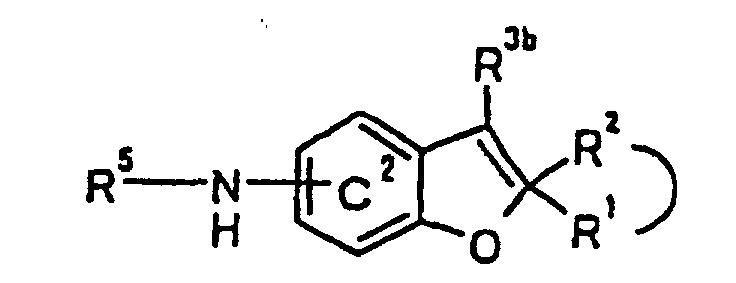
- Pharmazeutische Zusammensetzung, die eine durch die Formeldargestellte Verbindung, worin jedes Symbol wie in Anspruch 1 definiert ist, oder ein Salz, oder ein Prodrug davon umfaßt.
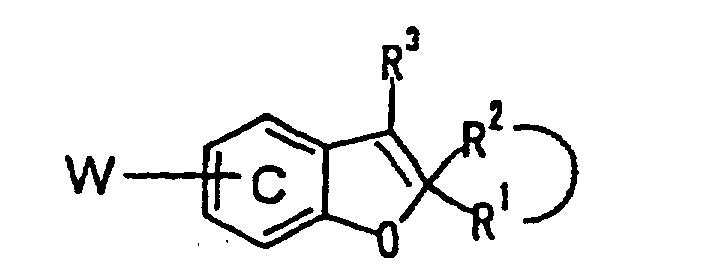
- Zusammensetzung gemäß Anspruch 37, die ein Mittel zum Hemmen der Neurodegeneration ist.
- Zusammensetzung gemäß Anspruch 37, die ein Mittel zum Hemmen der β-Amyloid-Zytotoxizität ist.
- Zusammensetzung gemäß Anspruch 37, die ein Mittel zum Aufweisen einer einem neurotrophen Faktor ähnlichen Aktivität ist.
- Zusammensetzung gemäß Anspruch 37, die ein Wirkstoff zur Prophylaxe oder Behandlung neurodegenerativer Erkrankungen ist.
- Zusammensetzung gemäß Anspruch 37, die ein Wirkstoff zur Prophylaxe oder Behandlung von Alzheimer-Krankheit oder Parkinson-Krankheit ist.
- Verwendung der Verbindung gemäß Anspruch 1 oder eines Prodrugs davon zum Herstellen eines Mittels zum Behandeln von Alzheimer-Krankheit oder Parkinson-Krankheit.
- Inhibitor der Neurodegeneration, der eine durch die Formeldargestellte Verbindung, worin die Symbole wie in Anspruch 1 oder 2 definiert sind, oder ein Salz davon oder ein Prodrug davon umfaßt.

- Inhibitor gemäß Anspruch 44, der ein Mittel zum Hemmen der β-Amyloid-Zytotoxizität ist.
- Inhibitor gemäß Anspruch 44, der ein Mittel zum Aufweisen einer einem neurotrophen Faktor ähnlichen Aktivität ist.
- Inhibitor gemäß Anspruch 44, der ein Wirkstoff zur Prophylaxe oder Behandlung neurodegenerativer Erkrankungen ist.
- Inhibitor gemäß Anspruch 44, der ein Wirkstoff zur Prophylaxe oder Behandlung von Alzheimer-Krankheit oder Parkinson-Krankheit ist.
- Verwendung der Verbindung gemäß Anspruch 44 oder eines Prodrugs davon zum Herstellen eines Mittels zum Behandeln von Alzheimer-Krankheit oder Parkinson-Krankheit.
Applications Claiming Priority (5)
| Application Number | Priority Date | Filing Date | Title |
|---|---|---|---|
| JP34535598 | 1998-12-04 | ||
| JP34535598 | 1998-12-04 | ||
| JP34536598 | 1998-12-04 | ||
| JP34536598 | 1998-12-04 | ||
| PCT/JP1999/006764 WO2000034262A1 (en) | 1998-12-04 | 1999-12-02 | Benzofuran derivatives, process for the preparation of the same and uses thereof |
Publications (3)
| Publication Number | Publication Date |
|---|---|
| EP1136477A1 EP1136477A1 (de) | 2001-09-26 |
| EP1136477A4 EP1136477A4 (de) | 2002-04-10 |
| EP1136477B1 true EP1136477B1 (de) | 2004-03-10 |
Family
ID=26578009
Family Applications (1)
| Application Number | Title | Priority Date | Filing Date |
|---|---|---|---|
| EP99973289A Expired - Lifetime EP1136477B1 (de) | 1998-12-04 | 1999-12-02 | Benzofuranderivate, verfahren zu ihrer herstellung und deren verwendungen |
Country Status (14)
| Country | Link |
|---|---|
| US (3) | US6479536B1 (de) |
| EP (1) | EP1136477B1 (de) |
| JP (1) | JP4778570B2 (de) |
| KR (1) | KR100660788B1 (de) |
| CN (1) | CN1297550C (de) |
| AT (1) | ATE261435T1 (de) |
| AU (1) | AU1414600A (de) |
| CA (1) | CA2352786C (de) |
| DE (1) | DE69915508T2 (de) |
| ES (1) | ES2213407T3 (de) |
| HU (1) | HU226652B1 (de) |
| NO (1) | NO327924B1 (de) |
| PT (1) | PT1136477E (de) |
| WO (1) | WO2000034262A1 (de) |
Families Citing this family (34)
| Publication number | Priority date | Publication date | Assignee | Title |
|---|---|---|---|---|
| WO2000034262A1 (en) * | 1998-12-04 | 2000-06-15 | Takeda Chemical Industries, Ltd. | Benzofuran derivatives, process for the preparation of the same and uses thereof |
| WO2002028850A1 (en) * | 2000-10-05 | 2002-04-11 | Takeda Chemical Industries, Ltd. | Promoters for the proliferation and differentiation of stem cells and/or neuron precursor cells |
| ATE414070T1 (de) | 2000-12-28 | 2008-11-15 | Takeda Pharmaceutical | Verfahren zur herstellung von optisch aktiven 2,4-dihydrobenzofuranverbindungen |
| WO2003004485A1 (fr) * | 2001-07-05 | 2003-01-16 | Takeda Chemical Industries, Ltd. | Composes heterocycles a 5 chainons condenses avec un benzo, leur procede de preparation et leur utilisation |
| DE60228577D1 (de) | 2001-07-13 | 2008-10-09 | Takeda Pharmaceutical | Verfahren zur herstellung von benzofuranderivaten |
| AU2002366313A1 (en) * | 2001-12-19 | 2003-06-30 | Takeda Chemical Industries, Ltd. | Solid compositions containng compounds unstable to oxygen and method for stabilization thereof |
| US6653346B1 (en) * | 2002-02-07 | 2003-11-25 | Galileo Pharmaceuticals, Inc. | Cytoprotective benzofuran derivatives |
| US7078541B2 (en) * | 2002-02-07 | 2006-07-18 | Galileo Pharmaceuticals, Inc. | Benzofuran derivatives |
| PL371366A1 (en) | 2002-03-01 | 2005-06-13 | Takeda Pharmaceutical Company Limited | Antidepressant |
| JP4537011B2 (ja) * | 2002-03-01 | 2010-09-01 | 武田薬品工業株式会社 | 抗うつ剤 |
| US7465815B2 (en) * | 2003-06-26 | 2008-12-16 | Takeda Pharmaceutical Company Limited | Cannabinoid receptor modulator |
| US7119214B2 (en) * | 2004-04-13 | 2006-10-10 | Cephalon France | Thio-substituted tricyclic and bicyclic aromatic methanesulfinyl derivatives |
| EP1589016A1 (de) * | 2004-04-13 | 2005-10-26 | Cephalon France | Thiosubstituierte tricyclische und bicyclische aromatische Methansulfinylderivate |
| MXPA06012621A (es) * | 2004-05-05 | 2006-12-15 | Hoffmann La Roche | Arilsulfonil benzodioxanos utiles para la modulacion del receptor 5-ht6, el receptor 5-ht2a o ambos. |
| EP1783121A4 (de) * | 2004-08-27 | 2009-08-05 | Takeda Pharmaceutical | Azoverbindungen und verfahren zu deren herstellung |
| US20060125084A1 (en) * | 2004-12-15 | 2006-06-15 | Fazzio Ronald S | Integration of micro-electro mechanical systems and active circuitry |
| PT1831159E (pt) * | 2004-12-21 | 2010-03-03 | Hoffmann La Roche | Derivados de tetralina e de indano e as suas utilizações |
| CA2591800A1 (en) * | 2004-12-21 | 2006-06-29 | F.Hoffmann-La Roche Ag | Tetralin and indane derivatives and uses thereof as 5-ht antagonists |
| ES2306275T3 (es) * | 2004-12-21 | 2008-11-01 | F. Hoffmann-La Roche Ag | Derivados de cromano y sus usos como ligandos dde receptores 5-ht. |
| BRPI0515835A (pt) * | 2004-12-21 | 2008-08-12 | Hoffmann La Roche | derivados de tetralina e de indano e seus usos |
| JP4738418B2 (ja) | 2004-12-21 | 2011-08-03 | エフ.ホフマン−ラ ロシュ アーゲー | クロマン誘導体及びcns障害の処置におけるその使用 |
| PE20070077A1 (es) * | 2005-06-10 | 2007-02-07 | Takeda Pharmaceutical | Comprimido con recubierta con azucar |
| WO2007051735A1 (en) * | 2005-11-03 | 2007-05-10 | F. Hoffmann-La Roche Ag | Arylsulfonylchromans as 5-ht6 inhibitors indolylmaleimide derivatives as protein kinase inhibitors |
| US8067204B2 (en) | 2005-12-15 | 2011-11-29 | Seikagaku Corporation | Long-chain chondroitin sugar chain and method for producing the same and method for promoting synthesis of chondroitin |
| JP2009541248A (ja) * | 2006-06-20 | 2009-11-26 | エフ.ホフマン−ラ ロシュ アーゲー | アリールスルホンアミジルテトラリン誘導体及びそれらの使用 |
| WO2007147763A1 (en) * | 2006-06-20 | 2007-12-27 | F. Hoffmann-La Roche Ag | Arylsulfonyl naphthalene derivatives and uses thereof |
| KR101066306B1 (ko) * | 2006-06-20 | 2011-09-20 | 에프. 호프만-라 로슈 아게 | 테트랄린 및 인데인 유도체 및 이들의 용도 |
| JP2010509188A (ja) * | 2006-11-09 | 2010-03-25 | 武田薬品工業株式会社 | 医薬組成物 |
| WO2010104194A1 (en) | 2009-03-10 | 2010-09-16 | Takeda Pharmaceutical Company Limited | Benzofuran derivatives |
| WO2011062194A1 (ja) | 2009-11-18 | 2011-05-26 | 武田薬品工業株式会社 | アミノピリジン誘導体 |
| CN102712853B (zh) | 2009-12-24 | 2014-12-24 | Scg化学有限公司 | 用于减小烃的溴指数的方法 |
| CN105294662B (zh) * | 2015-09-11 | 2018-04-20 | 中山大学 | 苯并呋喃喹啉衍生物及其在制备治疗阿尔茨海默病症的药品中的应用 |
| WO2020163689A1 (en) | 2019-02-08 | 2020-08-13 | University Of Pittsburgh - Of The Commonwealth System Of Higher Education | 20-hete formation inhibitors |
| CN115260136B (zh) * | 2022-08-09 | 2023-08-15 | 嘉兴学院 | 一种苯酞类化合物及其制备方法 |
Family Cites Families (13)
| Publication number | Priority date | Publication date | Assignee | Title |
|---|---|---|---|---|
| HU163046B (de) | 1970-08-25 | 1973-05-28 | ||
| US4212865A (en) | 1978-12-26 | 1980-07-15 | Riker Laboratories, Inc. | Amine derivatives of 2-nitro-3-phenylbenzofuran |
| US4881967A (en) | 1986-12-10 | 1989-11-21 | E. I. Du Pont De Nemours And Company | Heterocyclic 2,3-dihydrobenzofuran herbicides |
| IE68675B1 (en) | 1990-11-01 | 1996-07-10 | Takeda Chemical Industries Ltd | Aminocoumaran derivatives their production and use |
| WO1992012144A1 (en) * | 1990-12-28 | 1992-07-23 | Teijin Limited | Condensed benzoxa ring compound, production thereof, and pharmaceutical composition containing the same |
| EP0539709A1 (de) * | 1991-09-18 | 1993-05-05 | FUJIREBIO Inc. | 3,5-Dihydroxyheptansäurederivate und deren Lactone als HMG-CoA-Reduktase-Inhibitoren |
| JP3168728B2 (ja) * | 1991-09-18 | 2001-05-21 | 富士レビオ株式会社 | 3,5−ジヒドロキシヘプタン酸誘導体 |
| GB9408577D0 (en) * | 1994-04-29 | 1994-06-22 | Fujisawa Pharmaceutical Co | New compound |
| DK0685475T3 (da) | 1994-05-31 | 1999-08-30 | Bayer Ag | Amino-benzofuryl- og thienylderivater |
| GB9522007D0 (en) * | 1995-10-27 | 1996-01-03 | Fujisawa Pharmaceutical Co | New compound |
| AU4031697A (en) | 1996-08-29 | 1998-03-19 | Takeda Chemical Industries Ltd. | Cyclic ether compounds as sodium channel modulators |
| EP0988289A2 (de) | 1997-06-05 | 2000-03-29 | Takeda Pharmaceutical Company Limited | Benzofurane und benzothiophene als unterdrücker der neurodegeneration |
| WO2000034262A1 (en) * | 1998-12-04 | 2000-06-15 | Takeda Chemical Industries, Ltd. | Benzofuran derivatives, process for the preparation of the same and uses thereof |
-
1999
- 1999-12-02 WO PCT/JP1999/006764 patent/WO2000034262A1/ja not_active Ceased
- 1999-12-02 CN CNB998156825A patent/CN1297550C/zh not_active Expired - Fee Related
- 1999-12-02 KR KR1020017006999A patent/KR100660788B1/ko not_active Expired - Fee Related
- 1999-12-02 EP EP99973289A patent/EP1136477B1/de not_active Expired - Lifetime
- 1999-12-02 PT PT99973289T patent/PT1136477E/pt unknown
- 1999-12-02 US US09/857,293 patent/US6479536B1/en not_active Expired - Lifetime
- 1999-12-02 ES ES99973289T patent/ES2213407T3/es not_active Expired - Lifetime
- 1999-12-02 CA CA002352786A patent/CA2352786C/en not_active Expired - Fee Related
- 1999-12-02 HU HU0105480A patent/HU226652B1/hu not_active IP Right Cessation
- 1999-12-02 DE DE69915508T patent/DE69915508T2/de not_active Expired - Lifetime
- 1999-12-02 AU AU14146/00A patent/AU1414600A/en not_active Abandoned
- 1999-12-02 AT AT99973289T patent/ATE261435T1/de active
-
2001
- 2001-06-01 NO NO20012726A patent/NO327924B1/no not_active IP Right Cessation
-
2002
- 2002-04-11 US US10/120,102 patent/US7101867B2/en not_active Expired - Fee Related
-
2005
- 2005-03-17 US US11/081,615 patent/US7456162B2/en not_active Expired - Fee Related
-
2009
- 2009-04-08 JP JP2009094172A patent/JP4778570B2/ja not_active Expired - Fee Related
Also Published As
| Publication number | Publication date |
|---|---|
| EP1136477A1 (de) | 2001-09-26 |
| US7456162B2 (en) | 2008-11-25 |
| US20020160996A1 (en) | 2002-10-31 |
| HUP0105480A3 (en) | 2003-07-28 |
| WO2000034262A1 (en) | 2000-06-15 |
| HUP0105480A2 (hu) | 2002-11-28 |
| US7101867B2 (en) | 2006-09-05 |
| CN1297550C (zh) | 2007-01-31 |
| CN1333764A (zh) | 2002-01-30 |
| HU226652B1 (en) | 2009-05-28 |
| PT1136477E (pt) | 2004-08-31 |
| KR100660788B1 (ko) | 2007-02-28 |
| JP2009185049A (ja) | 2009-08-20 |
| DE69915508D1 (de) | 2004-04-15 |
| US6479536B1 (en) | 2002-11-12 |
| NO20012726L (no) | 2001-07-31 |
| NO327924B1 (no) | 2009-10-19 |
| KR20010081113A (ko) | 2001-08-27 |
| NO20012726D0 (no) | 2001-06-01 |
| ES2213407T3 (es) | 2004-08-16 |
| DE69915508T2 (de) | 2005-01-27 |
| CA2352786A1 (en) | 2000-06-15 |
| AU1414600A (en) | 2000-06-26 |
| EP1136477A4 (de) | 2002-04-10 |
| CA2352786C (en) | 2009-02-03 |
| ATE261435T1 (de) | 2004-03-15 |
| JP4778570B2 (ja) | 2011-09-21 |
| US20050187238A1 (en) | 2005-08-25 |
Similar Documents
| Publication | Publication Date | Title |
|---|---|---|
| US6479536B1 (en) | Benzofuran derivatives, process for the preparation of the same and uses thereof | |
| US20090012081A1 (en) | Agents for promoting the proliferation or differentiation of stem cells or neural progenitor cells | |
| US20070149558A1 (en) | Benzo-fused 5-membered heterocyclic compounds, their production and use | |
| JP5746631B2 (ja) | ベンゾフラン誘導体 | |
| KR101138673B1 (ko) | 칸나비노이드 수용체 조절제 | |
| CA2291026A1 (en) | Heterocyclic compounds, their production and use | |
| KR101011657B1 (ko) | 항우울제 | |
| JP4357802B2 (ja) | ベンゼン環縮合5員複素環式化合物、その製造法および用途 | |
| JP3553442B2 (ja) | ベンゾフラン誘導体、その製造法および用途 | |
| JP4364467B2 (ja) | ベンゾフラン誘導体、その製造法および用途 | |
| JPH1149765A (ja) | 複素環化合物、その製造法および剤 | |
| JP2002348239A (ja) | 幹細胞・神経前駆細胞の増殖・分化促進剤 | |
| JP4786147B2 (ja) | カンナビノイド受容体調節剤 | |
| JPWO2000034262A1 (ja) | ベンゾフラン誘導体、その製造法および用途 | |
| JP2004083556A (ja) | 抗うつ剤 |
Legal Events
| Date | Code | Title | Description |
|---|---|---|---|
| PUAI | Public reference made under article 153(3) epc to a published international application that has entered the european phase |
Free format text: ORIGINAL CODE: 0009012 |
|
| 17P | Request for examination filed |
Effective date: 20010530 |
|
| AK | Designated contracting states |
Kind code of ref document: A1 Designated state(s): AT BE CH CY DE DK ES FI FR GB GR IE IT LI LU MC NL PT SE |
|
| AX | Request for extension of the european patent |
Free format text: AL;LT;LV;MK;RO;SI |
|
| A4 | Supplementary search report drawn up and despatched |
Effective date: 20020222 |
|
| AK | Designated contracting states |
Kind code of ref document: A4 Designated state(s): AT BE CH CY DE DK ES FI FR GB GR IE IT LI LU MC NL PT SE |
|
| 17Q | First examination report despatched |
Effective date: 20020830 |
|
| REG | Reference to a national code |
Ref country code: GB Ref legal event code: FG4D |
|
| GRAH | Despatch of communication of intention to grant a patent |
Free format text: ORIGINAL CODE: EPIDOS IGRA |
|
| GRAS | Grant fee paid |
Free format text: ORIGINAL CODE: EPIDOSNIGR3 |
|
| GRAA | (expected) grant |
Free format text: ORIGINAL CODE: 0009210 |
|
| AK | Designated contracting states |
Kind code of ref document: B1 Designated state(s): AT BE CH CY DE DK ES FI FR GB GR IE IT LI LU MC NL PT SE |
|
| REG | Reference to a national code |
Ref country code: CH Ref legal event code: NV Representative=s name: A. BRAUN, BRAUN, HERITIER, ESCHMANN AG PATENTANWAE Ref country code: CH Ref legal event code: EP |
|
| REG | Reference to a national code |
Ref country code: SE Ref legal event code: TRGR |
|
| REG | Reference to a national code |
Ref country code: IE Ref legal event code: FG4D |
|
| REF | Corresponds to: |
Ref document number: 69915508 Country of ref document: DE Date of ref document: 20040415 Kind code of ref document: P |
|
| REG | Reference to a national code |
Ref country code: GR Ref legal event code: EP Ref document number: 20040400887 Country of ref document: GR |
|
| REG | Reference to a national code |
Ref country code: DK Ref legal event code: T3 |
|
| REG | Reference to a national code |
Ref country code: ES Ref legal event code: FG2A Ref document number: 2213407 Country of ref document: ES Kind code of ref document: T3 |
|
| LTIE | Lt: invalidation of european patent or patent extension |
Effective date: 20040310 |
|
| REG | Reference to a national code |
Ref country code: PT Ref legal event code: SC4A Free format text: AVAILABILITY OF NATIONAL TRANSLATION Effective date: 20040608 |
|
| ET | Fr: translation filed | ||
| ET1 | Fr: translation filed ** revision of the translation of the patent or the claims | ||
| PLBE | No opposition filed within time limit |
Free format text: ORIGINAL CODE: 0009261 |
|
| STAA | Information on the status of an ep patent application or granted ep patent |
Free format text: STATUS: NO OPPOSITION FILED WITHIN TIME LIMIT |
|
| 26N | No opposition filed |
Effective date: 20041213 |
|
| REG | Reference to a national code |
Ref country code: CH Ref legal event code: PFA Owner name: TAKEDA PHARMACEUTICAL COMPANY LIMITED Free format text: TAKEDA CHEMICAL INDUSTRIES, LTD.#1-1 DOSHOMACHI 4-CHOME, CHUO-KU#OSAKA-SHI, OSAKA 541-0045 (JP) -TRANSFER TO- TAKEDA PHARMACEUTICAL COMPANY LIMITED#1-1, DOSHOMACHI 4-CHOME CHUO-KU#OSAKA (JP) |
|
| NLT1 | Nl: modifications of names registered in virtue of documents presented to the patent office pursuant to art. 16 a, paragraph 1 |
Owner name: TAKEDA PHARMACEUTICAL COMPANY LIMITED |
|
| REG | Reference to a national code |
Ref country code: FR Ref legal event code: CD |
|
| REG | Reference to a national code |
Ref country code: CH Ref legal event code: PFA Owner name: TAKEDA PHARMACEUTICAL COMPANY LIMITED Free format text: TAKEDA PHARMACEUTICAL COMPANY LIMITED#1-1, DOSHOMACHI 4-CHOME CHUO-KU#OSAKA (JP) -TRANSFER TO- TAKEDA PHARMACEUTICAL COMPANY LIMITED#1-1, DOSHOMACHI 4-CHOME CHUO-KU#OSAKA (JP) |
|
| PGFP | Annual fee paid to national office [announced via postgrant information from national office to epo] |
Ref country code: MC Payment date: 20101220 Year of fee payment: 12 Ref country code: IE Payment date: 20101217 Year of fee payment: 12 Ref country code: DK Payment date: 20101210 Year of fee payment: 12 Ref country code: AT Payment date: 20101129 Year of fee payment: 12 |
|
| PGFP | Annual fee paid to national office [announced via postgrant information from national office to epo] |
Ref country code: PT Payment date: 20101122 Year of fee payment: 12 Ref country code: LU Payment date: 20110118 Year of fee payment: 12 Ref country code: FI Payment date: 20101214 Year of fee payment: 12 |
|
| PGFP | Annual fee paid to national office [announced via postgrant information from national office to epo] |
Ref country code: BE Payment date: 20101117 Year of fee payment: 12 Ref country code: SE Payment date: 20101213 Year of fee payment: 12 Ref country code: IT Payment date: 20101218 Year of fee payment: 12 Ref country code: NL Payment date: 20101220 Year of fee payment: 12 Ref country code: GR Payment date: 20101123 Year of fee payment: 12 |
|
| PGFP | Annual fee paid to national office [announced via postgrant information from national office to epo] |
Ref country code: CY Payment date: 20101130 Year of fee payment: 12 |
|
| PGFP | Annual fee paid to national office [announced via postgrant information from national office to epo] |
Ref country code: ES Payment date: 20110112 Year of fee payment: 12 |
|
| REG | Reference to a national code |
Ref country code: PT Ref legal event code: MM4A Free format text: LAPSE DUE TO NON-PAYMENT OF FEES Effective date: 20120604 |
|
| BERE | Be: lapsed |
Owner name: *TAKEDA CHEMICAL INDUSTRIES LTD Effective date: 20111231 |
|
| REG | Reference to a national code |
Ref country code: NL Ref legal event code: V1 Effective date: 20120701 |
|
| REG | Reference to a national code |
Ref country code: DK Ref legal event code: EBP |
|
| PG25 | Lapsed in a contracting state [announced via postgrant information from national office to epo] |
Ref country code: MC Free format text: LAPSE BECAUSE OF NON-PAYMENT OF DUE FEES Effective date: 20111231 |
|
| REG | Reference to a national code |
Ref country code: SE Ref legal event code: EUG |
|
| PG25 | Lapsed in a contracting state [announced via postgrant information from national office to epo] |
Ref country code: PT Free format text: LAPSE BECAUSE OF NON-PAYMENT OF DUE FEES Effective date: 20120604 Ref country code: FI Free format text: LAPSE BECAUSE OF NON-PAYMENT OF DUE FEES Effective date: 20111202 |
|
| REG | Reference to a national code |
Ref country code: GR Ref legal event code: ML Ref document number: 20040400887 Country of ref document: GR Effective date: 20120704 |
|
| REG | Reference to a national code |
Ref country code: IE Ref legal event code: MM4A |
|
| PG25 | Lapsed in a contracting state [announced via postgrant information from national office to epo] |
Ref country code: CY Free format text: LAPSE BECAUSE OF FAILURE TO SUBMIT A TRANSLATION OF THE DESCRIPTION OR TO PAY THE FEE WITHIN THE PRESCRIBED TIME-LIMIT Effective date: 20111202 |
|
| PG25 | Lapsed in a contracting state [announced via postgrant information from national office to epo] |
Ref country code: SE Free format text: LAPSE BECAUSE OF NON-PAYMENT OF DUE FEES Effective date: 20111203 Ref country code: IE Free format text: LAPSE BECAUSE OF NON-PAYMENT OF DUE FEES Effective date: 20111202 Ref country code: BE Free format text: LAPSE BECAUSE OF NON-PAYMENT OF DUE FEES Effective date: 20111231 |
|
| PG25 | Lapsed in a contracting state [announced via postgrant information from national office to epo] |
Ref country code: IT Free format text: LAPSE BECAUSE OF NON-PAYMENT OF DUE FEES Effective date: 20111202 Ref country code: GR Free format text: LAPSE BECAUSE OF NON-PAYMENT OF DUE FEES Effective date: 20120704 |
|
| REG | Reference to a national code |
Ref country code: AT Ref legal event code: MM01 Ref document number: 261435 Country of ref document: AT Kind code of ref document: T Effective date: 20111202 |
|
| PG25 | Lapsed in a contracting state [announced via postgrant information from national office to epo] |
Ref country code: AT Free format text: LAPSE BECAUSE OF NON-PAYMENT OF DUE FEES Effective date: 20111202 Ref country code: DK Free format text: LAPSE BECAUSE OF NON-PAYMENT OF DUE FEES Effective date: 20120102 Ref country code: NL Free format text: LAPSE BECAUSE OF NON-PAYMENT OF DUE FEES Effective date: 20120701 |
|
| PGFP | Annual fee paid to national office [announced via postgrant information from national office to epo] |
Ref country code: CH Payment date: 20121213 Year of fee payment: 14 Ref country code: DE Payment date: 20121128 Year of fee payment: 14 |
|
| PGFP | Annual fee paid to national office [announced via postgrant information from national office to epo] |
Ref country code: GB Payment date: 20121128 Year of fee payment: 14 |
|
| PGFP | Annual fee paid to national office [announced via postgrant information from national office to epo] |
Ref country code: FR Payment date: 20130107 Year of fee payment: 14 |
|
| PG25 | Lapsed in a contracting state [announced via postgrant information from national office to epo] |
Ref country code: LU Free format text: LAPSE BECAUSE OF NON-PAYMENT OF DUE FEES Effective date: 20111202 |
|
| REG | Reference to a national code |
Ref country code: ES Ref legal event code: FD2A Effective date: 20130703 |
|
| PG25 | Lapsed in a contracting state [announced via postgrant information from national office to epo] |
Ref country code: ES Free format text: LAPSE BECAUSE OF NON-PAYMENT OF DUE FEES Effective date: 20111203 |
|
| REG | Reference to a national code |
Ref country code: DE Ref legal event code: R119 Ref document number: 69915508 Country of ref document: DE |
|
| REG | Reference to a national code |
Ref country code: CH Ref legal event code: PL |
|
| GBPC | Gb: european patent ceased through non-payment of renewal fee |
Effective date: 20131202 |
|
| REG | Reference to a national code |
Ref country code: FR Ref legal event code: ST Effective date: 20140829 |
|
| REG | Reference to a national code |
Ref country code: DE Ref legal event code: R119 Ref document number: 69915508 Country of ref document: DE Effective date: 20140701 |
|
| PG25 | Lapsed in a contracting state [announced via postgrant information from national office to epo] |
Ref country code: CH Free format text: LAPSE BECAUSE OF NON-PAYMENT OF DUE FEES Effective date: 20131231 Ref country code: DE Free format text: LAPSE BECAUSE OF NON-PAYMENT OF DUE FEES Effective date: 20140701 Ref country code: LI Free format text: LAPSE BECAUSE OF NON-PAYMENT OF DUE FEES Effective date: 20131231 |
|
| PG25 | Lapsed in a contracting state [announced via postgrant information from national office to epo] |
Ref country code: FR Free format text: LAPSE BECAUSE OF NON-PAYMENT OF DUE FEES Effective date: 20131231 Ref country code: GB Free format text: LAPSE BECAUSE OF NON-PAYMENT OF DUE FEES Effective date: 20131202 |