EP1137941B2 - Proteingerüste für antikörper-nachahmer und andere bindende proteine - Google Patents
Proteingerüste für antikörper-nachahmer und andere bindende proteine Download PDFInfo
- Publication number
- EP1137941B2 EP1137941B2 EP99967261.1A EP99967261A EP1137941B2 EP 1137941 B2 EP1137941 B2 EP 1137941B2 EP 99967261 A EP99967261 A EP 99967261A EP 1137941 B2 EP1137941 B2 EP 1137941B2
- Authority
- EP
- European Patent Office
- Prior art keywords
- protein
- loop
- amino acid
- sequence
- naturally occurring
- Prior art date
- Legal status (The legal status is an assumption and is not a legal conclusion. Google has not performed a legal analysis and makes no representation as to the accuracy of the status listed.)
- Expired - Lifetime
Links
- 108090000623 proteins and genes Proteins 0.000 title claims abstract description 165
- 102000004169 proteins and genes Human genes 0.000 title claims abstract description 159
- 102000014914 Carrier Proteins Human genes 0.000 title description 8
- 108091008324 binding proteins Proteins 0.000 title description 8
- 102000002090 Fibronectin type III Human genes 0.000 claims abstract description 61
- 108050009401 Fibronectin type III Proteins 0.000 claims abstract description 60
- 230000027455 binding Effects 0.000 claims abstract description 52
- 238000000034 method Methods 0.000 claims abstract description 42
- 150000001875 compounds Chemical class 0.000 claims abstract description 29
- 108020004707 nucleic acids Proteins 0.000 claims abstract description 19
- 102000039446 nucleic acids Human genes 0.000 claims abstract description 19
- 150000007523 nucleic acids Chemical class 0.000 claims abstract description 19
- 241000282414 Homo sapiens Species 0.000 claims description 74
- 239000000427 antigen Substances 0.000 claims description 50
- 108091007433 antigens Proteins 0.000 claims description 50
- 102000036639 antigens Human genes 0.000 claims description 50
- 150000001413 amino acids Chemical class 0.000 claims description 40
- 125000000539 amino acid group Chemical group 0.000 claims description 27
- 230000004075 alteration Effects 0.000 claims description 20
- 102000006495 integrins Human genes 0.000 claims description 17
- 108010044426 integrins Proteins 0.000 claims description 17
- 108020001507 fusion proteins Proteins 0.000 claims description 12
- 102000037865 fusion proteins Human genes 0.000 claims description 12
- 230000009918 complex formation Effects 0.000 claims description 10
- 108060003951 Immunoglobulin Proteins 0.000 claims description 8
- 102000018358 immunoglobulin Human genes 0.000 claims description 8
- 239000007787 solid Substances 0.000 claims description 8
- 239000000539 dimer Substances 0.000 claims description 7
- 108010088751 Albumins Proteins 0.000 claims description 6
- 102000000989 Complement System Proteins Human genes 0.000 claims description 6
- 108010069112 Complement System Proteins Proteins 0.000 claims description 6
- 108700012359 toxins Proteins 0.000 claims description 6
- 230000001404 mediated effect Effects 0.000 claims description 3
- 239000000203 mixture Substances 0.000 claims description 3
- 125000003275 alpha amino acid group Chemical group 0.000 claims 16
- 102000009027 Albumins Human genes 0.000 claims 2
- 238000003745 diagnosis Methods 0.000 claims 1
- 238000002560 therapeutic procedure Methods 0.000 claims 1
- 239000003446 ligand Substances 0.000 abstract description 4
- 235000018102 proteins Nutrition 0.000 description 104
- 108020004414 DNA Proteins 0.000 description 33
- 108010067306 Fibronectins Proteins 0.000 description 25
- 102000016359 Fibronectins Human genes 0.000 description 25
- 239000012634 fragment Substances 0.000 description 21
- 230000004927 fusion Effects 0.000 description 19
- 229940024606 amino acid Drugs 0.000 description 17
- 235000001014 amino acid Nutrition 0.000 description 17
- 108091034117 Oligonucleotide Proteins 0.000 description 11
- 108091032973 (ribonucleotides)n+m Proteins 0.000 description 9
- 210000004027 cell Anatomy 0.000 description 9
- 239000011230 binding agent Substances 0.000 description 8
- 239000000178 monomer Substances 0.000 description 8
- MZOFCQQQCNRIBI-VMXHOPILSA-N (3s)-4-[[(2s)-1-[[(2s)-1-[[(1s)-1-carboxy-2-hydroxyethyl]amino]-4-methyl-1-oxopentan-2-yl]amino]-5-(diaminomethylideneamino)-1-oxopentan-2-yl]amino]-3-[[2-[[(2s)-2,6-diaminohexanoyl]amino]acetyl]amino]-4-oxobutanoic acid Chemical compound OC[C@@H](C(O)=O)NC(=O)[C@H](CC(C)C)NC(=O)[C@H](CCCN=C(N)N)NC(=O)[C@H](CC(O)=O)NC(=O)CNC(=O)[C@@H](N)CCCCN MZOFCQQQCNRIBI-VMXHOPILSA-N 0.000 description 7
- 229920000936 Agarose Polymers 0.000 description 7
- IYMAXBFPHPZYIK-BQBZGAKWSA-N Arg-Gly-Asp Chemical compound NC(N)=NCCC[C@H](N)C(=O)NCC(=O)N[C@@H](CC(O)=O)C(O)=O IYMAXBFPHPZYIK-BQBZGAKWSA-N 0.000 description 7
- 241000699660 Mus musculus Species 0.000 description 7
- 229920002684 Sepharose Polymers 0.000 description 7
- 108060008682 Tumor Necrosis Factor Proteins 0.000 description 7
- 102000000852 Tumor Necrosis Factor-alpha Human genes 0.000 description 7
- 238000013459 approach Methods 0.000 description 7
- 239000000872 buffer Substances 0.000 description 7
- PEDCQBHIVMGVHV-UHFFFAOYSA-N Glycerine Chemical compound OCC(O)CO PEDCQBHIVMGVHV-UHFFFAOYSA-N 0.000 description 6
- 241001465754 Metazoa Species 0.000 description 6
- JLCPHMBAVCMARE-UHFFFAOYSA-N [3-[[3-[[3-[[3-[[3-[[3-[[3-[[3-[[3-[[3-[[3-[[5-(2-amino-6-oxo-1H-purin-9-yl)-3-[[3-[[3-[[3-[[3-[[3-[[5-(2-amino-6-oxo-1H-purin-9-yl)-3-[[5-(2-amino-6-oxo-1H-purin-9-yl)-3-hydroxyoxolan-2-yl]methoxy-hydroxyphosphoryl]oxyoxolan-2-yl]methoxy-hydroxyphosphoryl]oxy-5-(5-methyl-2,4-dioxopyrimidin-1-yl)oxolan-2-yl]methoxy-hydroxyphosphoryl]oxy-5-(6-aminopurin-9-yl)oxolan-2-yl]methoxy-hydroxyphosphoryl]oxy-5-(6-aminopurin-9-yl)oxolan-2-yl]methoxy-hydroxyphosphoryl]oxy-5-(6-aminopurin-9-yl)oxolan-2-yl]methoxy-hydroxyphosphoryl]oxy-5-(6-aminopurin-9-yl)oxolan-2-yl]methoxy-hydroxyphosphoryl]oxyoxolan-2-yl]methoxy-hydroxyphosphoryl]oxy-5-(5-methyl-2,4-dioxopyrimidin-1-yl)oxolan-2-yl]methoxy-hydroxyphosphoryl]oxy-5-(4-amino-2-oxopyrimidin-1-yl)oxolan-2-yl]methoxy-hydroxyphosphoryl]oxy-5-(5-methyl-2,4-dioxopyrimidin-1-yl)oxolan-2-yl]methoxy-hydroxyphosphoryl]oxy-5-(5-methyl-2,4-dioxopyrimidin-1-yl)oxolan-2-yl]methoxy-hydroxyphosphoryl]oxy-5-(6-aminopurin-9-yl)oxolan-2-yl]methoxy-hydroxyphosphoryl]oxy-5-(6-aminopurin-9-yl)oxolan-2-yl]methoxy-hydroxyphosphoryl]oxy-5-(4-amino-2-oxopyrimidin-1-yl)oxolan-2-yl]methoxy-hydroxyphosphoryl]oxy-5-(4-amino-2-oxopyrimidin-1-yl)oxolan-2-yl]methoxy-hydroxyphosphoryl]oxy-5-(4-amino-2-oxopyrimidin-1-yl)oxolan-2-yl]methoxy-hydroxyphosphoryl]oxy-5-(6-aminopurin-9-yl)oxolan-2-yl]methoxy-hydroxyphosphoryl]oxy-5-(4-amino-2-oxopyrimidin-1-yl)oxolan-2-yl]methyl [5-(6-aminopurin-9-yl)-2-(hydroxymethyl)oxolan-3-yl] hydrogen phosphate Polymers Cc1cn(C2CC(OP(O)(=O)OCC3OC(CC3OP(O)(=O)OCC3OC(CC3O)n3cnc4c3nc(N)[nH]c4=O)n3cnc4c3nc(N)[nH]c4=O)C(COP(O)(=O)OC3CC(OC3COP(O)(=O)OC3CC(OC3COP(O)(=O)OC3CC(OC3COP(O)(=O)OC3CC(OC3COP(O)(=O)OC3CC(OC3COP(O)(=O)OC3CC(OC3COP(O)(=O)OC3CC(OC3COP(O)(=O)OC3CC(OC3COP(O)(=O)OC3CC(OC3COP(O)(=O)OC3CC(OC3COP(O)(=O)OC3CC(OC3COP(O)(=O)OC3CC(OC3COP(O)(=O)OC3CC(OC3COP(O)(=O)OC3CC(OC3COP(O)(=O)OC3CC(OC3COP(O)(=O)OC3CC(OC3COP(O)(=O)OC3CC(OC3CO)n3cnc4c(N)ncnc34)n3ccc(N)nc3=O)n3cnc4c(N)ncnc34)n3ccc(N)nc3=O)n3ccc(N)nc3=O)n3ccc(N)nc3=O)n3cnc4c(N)ncnc34)n3cnc4c(N)ncnc34)n3cc(C)c(=O)[nH]c3=O)n3cc(C)c(=O)[nH]c3=O)n3ccc(N)nc3=O)n3cc(C)c(=O)[nH]c3=O)n3cnc4c3nc(N)[nH]c4=O)n3cnc4c(N)ncnc34)n3cnc4c(N)ncnc34)n3cnc4c(N)ncnc34)n3cnc4c(N)ncnc34)O2)c(=O)[nH]c1=O JLCPHMBAVCMARE-UHFFFAOYSA-N 0.000 description 6
- 230000008901 benefit Effects 0.000 description 6
- 238000000338 in vitro Methods 0.000 description 6
- 108090000765 processed proteins & peptides Proteins 0.000 description 6
- 239000000047 product Substances 0.000 description 6
- 244000303258 Annona diversifolia Species 0.000 description 5
- 235000002198 Annona diversifolia Nutrition 0.000 description 5
- 241000282836 Camelus dromedarius Species 0.000 description 5
- 108010021625 Immunoglobulin Fragments Proteins 0.000 description 5
- 102000008394 Immunoglobulin Fragments Human genes 0.000 description 5
- 238000001727 in vivo Methods 0.000 description 5
- 108020001580 protein domains Proteins 0.000 description 5
- 229950010131 puromycin Drugs 0.000 description 5
- 230000001225 therapeutic effect Effects 0.000 description 5
- 102100027211 Albumin Human genes 0.000 description 4
- 230000009824 affinity maturation Effects 0.000 description 4
- 239000006166 lysate Substances 0.000 description 4
- 239000012139 lysis buffer Substances 0.000 description 4
- 230000035772 mutation Effects 0.000 description 4
- 125000002924 primary amino group Chemical group [H]N([H])* 0.000 description 4
- 230000008569 process Effects 0.000 description 4
- 238000012216 screening Methods 0.000 description 4
- 108010047041 Complementarity Determining Regions Proteins 0.000 description 3
- 102000012410 DNA Ligases Human genes 0.000 description 3
- 108010061982 DNA Ligases Proteins 0.000 description 3
- 241000699666 Mus <mouse, genus> Species 0.000 description 3
- HEMHJVSKTPXQMS-UHFFFAOYSA-M Sodium hydroxide Chemical compound [OH-].[Na+] HEMHJVSKTPXQMS-UHFFFAOYSA-M 0.000 description 3
- 239000007983 Tris buffer Substances 0.000 description 3
- 210000004899 c-terminal region Anatomy 0.000 description 3
- 239000002299 complementary DNA Substances 0.000 description 3
- 238000013461 design Methods 0.000 description 3
- RAXXELZNTBOGNW-UHFFFAOYSA-N imidazole Natural products C1=CNC=N1 RAXXELZNTBOGNW-UHFFFAOYSA-N 0.000 description 3
- 230000028993 immune response Effects 0.000 description 3
- 238000002703 mutagenesis Methods 0.000 description 3
- 231100000350 mutagenesis Toxicity 0.000 description 3
- RXWNCPJZOCPEPQ-NVWDDTSBSA-N puromycin Chemical compound C1=CC(OC)=CC=C1C[C@H](N)C(=O)N[C@H]1[C@@H](O)[C@H](N2C3=NC=NC(=C3N=C2)N(C)C)O[C@@H]1CO RXWNCPJZOCPEPQ-NVWDDTSBSA-N 0.000 description 3
- 239000002904 solvent Substances 0.000 description 3
- 241000894007 species Species 0.000 description 3
- LENZDBCJOHFCAS-UHFFFAOYSA-N tris Chemical compound OCC(N)(CO)CO LENZDBCJOHFCAS-UHFFFAOYSA-N 0.000 description 3
- 241000894006 Bacteria Species 0.000 description 2
- 108010017384 Blood Proteins Proteins 0.000 description 2
- 108020004705 Codon Proteins 0.000 description 2
- 102000053602 DNA Human genes 0.000 description 2
- 102000004190 Enzymes Human genes 0.000 description 2
- 108090000790 Enzymes Proteins 0.000 description 2
- 241000588724 Escherichia coli Species 0.000 description 2
- 102000010834 Extracellular Matrix Proteins Human genes 0.000 description 2
- 108010037362 Extracellular Matrix Proteins Proteins 0.000 description 2
- 102000008946 Fibrinogen Human genes 0.000 description 2
- 108010049003 Fibrinogen Proteins 0.000 description 2
- 101710162849 Fibronectin type III domain-containing protein Proteins 0.000 description 2
- DHMQDGOQFOQNFH-UHFFFAOYSA-N Glycine Natural products NCC(O)=O DHMQDGOQFOQNFH-UHFFFAOYSA-N 0.000 description 2
- 239000004471 Glycine Substances 0.000 description 2
- 101001027128 Homo sapiens Fibronectin Proteins 0.000 description 2
- TWRXJAOTZQYOKJ-UHFFFAOYSA-L Magnesium chloride Chemical compound [Mg+2].[Cl-].[Cl-] TWRXJAOTZQYOKJ-UHFFFAOYSA-L 0.000 description 2
- 241000124008 Mammalia Species 0.000 description 2
- 241001529936 Murinae Species 0.000 description 2
- 241000283973 Oryctolagus cuniculus Species 0.000 description 2
- 230000002411 adverse Effects 0.000 description 2
- 238000004458 analytical method Methods 0.000 description 2
- 108010072041 arginyl-glycyl-aspartic acid Proteins 0.000 description 2
- 239000011324 bead Substances 0.000 description 2
- 230000015572 biosynthetic process Effects 0.000 description 2
- 210000001124 body fluid Anatomy 0.000 description 2
- 239000010839 body fluid Substances 0.000 description 2
- 238000006243 chemical reaction Methods 0.000 description 2
- 239000003153 chemical reaction reagent Substances 0.000 description 2
- 238000010367 cloning Methods 0.000 description 2
- 239000003814 drug Substances 0.000 description 2
- 229940079593 drug Drugs 0.000 description 2
- 230000000694 effects Effects 0.000 description 2
- 239000002158 endotoxin Substances 0.000 description 2
- 230000007717 exclusion Effects 0.000 description 2
- 210000002744 extracellular matrix Anatomy 0.000 description 2
- 229940012952 fibrinogen Drugs 0.000 description 2
- 238000011049 filling Methods 0.000 description 2
- 238000004519 manufacturing process Methods 0.000 description 2
- 239000012528 membrane Substances 0.000 description 2
- 108020004999 messenger RNA Proteins 0.000 description 2
- 230000009871 nonspecific binding Effects 0.000 description 2
- 125000003729 nucleotide group Chemical group 0.000 description 2
- 238000002823 phage display Methods 0.000 description 2
- YBYRMVIVWMBXKQ-UHFFFAOYSA-N phenylmethanesulfonyl fluoride Chemical compound FS(=O)(=O)CC1=CC=CC=C1 YBYRMVIVWMBXKQ-UHFFFAOYSA-N 0.000 description 2
- 229920001223 polyethylene glycol Polymers 0.000 description 2
- 238000000746 purification Methods 0.000 description 2
- 102000005962 receptors Human genes 0.000 description 2
- 108020003175 receptors Proteins 0.000 description 2
- 238000011160 research Methods 0.000 description 2
- 239000011347 resin Substances 0.000 description 2
- 229920005989 resin Polymers 0.000 description 2
- 108091008146 restriction endonucleases Proteins 0.000 description 2
- 210000001995 reticulocyte Anatomy 0.000 description 2
- 238000010187 selection method Methods 0.000 description 2
- 210000000952 spleen Anatomy 0.000 description 2
- 239000000758 substrate Substances 0.000 description 2
- 238000013519 translation Methods 0.000 description 2
- 238000002424 x-ray crystallography Methods 0.000 description 2
- 102000040650 (ribonucleotides)n+m Human genes 0.000 description 1
- JKMHFZQWWAIEOD-UHFFFAOYSA-N 2-[4-(2-hydroxyethyl)piperazin-1-yl]ethanesulfonic acid Chemical compound OCC[NH+]1CCN(CCS([O-])(=O)=O)CC1 JKMHFZQWWAIEOD-UHFFFAOYSA-N 0.000 description 1
- SQDAZGGFXASXDW-UHFFFAOYSA-N 5-bromo-2-(trifluoromethoxy)pyridine Chemical compound FC(F)(F)OC1=CC=C(Br)C=N1 SQDAZGGFXASXDW-UHFFFAOYSA-N 0.000 description 1
- 101001007348 Arachis hypogaea Galactose-binding lectin Proteins 0.000 description 1
- 239000004475 Arginine Substances 0.000 description 1
- 241000972773 Aulopiformes Species 0.000 description 1
- 102000004506 Blood Proteins Human genes 0.000 description 1
- 102000000844 Cell Surface Receptors Human genes 0.000 description 1
- 108010001857 Cell Surface Receptors Proteins 0.000 description 1
- 229920001287 Chondroitin sulfate Polymers 0.000 description 1
- 108010035532 Collagen Proteins 0.000 description 1
- 102000008186 Collagen Human genes 0.000 description 1
- 102100024203 Collagen alpha-1(XIV) chain Human genes 0.000 description 1
- 101710106877 Collagen alpha-1(XIV) chain Proteins 0.000 description 1
- 108020004635 Complementary DNA Proteins 0.000 description 1
- 102000010831 Cytoskeletal Proteins Human genes 0.000 description 1
- 108010037414 Cytoskeletal Proteins Proteins 0.000 description 1
- 238000001712 DNA sequencing Methods 0.000 description 1
- 102000052510 DNA-Binding Proteins Human genes 0.000 description 1
- 230000004568 DNA-binding Effects 0.000 description 1
- 101710096438 DNA-binding protein Proteins 0.000 description 1
- 102100031780 Endonuclease Human genes 0.000 description 1
- 108010020195 FLAG peptide Proteins 0.000 description 1
- XZWYTXMRWQJBGX-VXBMVYAYSA-N FLAG peptide Chemical group NCCCC[C@@H](C(O)=O)NC(=O)[C@H](CC(O)=O)NC(=O)[C@H](CC(O)=O)NC(=O)[C@H](CC(O)=O)NC(=O)[C@H](CC(O)=O)NC(=O)[C@H](CCCCN)NC(=O)[C@@H](NC(=O)[C@@H](N)CC(O)=O)CC1=CC=C(O)C=C1 XZWYTXMRWQJBGX-VXBMVYAYSA-N 0.000 description 1
- 102000003886 Glycoproteins Human genes 0.000 description 1
- 108090000288 Glycoproteins Proteins 0.000 description 1
- 239000007995 HEPES buffer Substances 0.000 description 1
- 229920002971 Heparan sulfate Polymers 0.000 description 1
- HTTJABKRGRZYRN-UHFFFAOYSA-N Heparin Chemical compound OC1C(NC(=O)C)C(O)OC(COS(O)(=O)=O)C1OC1C(OS(O)(=O)=O)C(O)C(OC2C(C(OS(O)(=O)=O)C(OC3C(C(O)C(O)C(O3)C(O)=O)OS(O)(=O)=O)C(CO)O2)NS(O)(=O)=O)C(C(O)=O)O1 HTTJABKRGRZYRN-UHFFFAOYSA-N 0.000 description 1
- 108010002352 Interleukin-1 Proteins 0.000 description 1
- ROHFNLRQFUQHCH-YFKPBYRVSA-N L-leucine Chemical compound CC(C)C[C@H](N)C(O)=O ROHFNLRQFUQHCH-YFKPBYRVSA-N 0.000 description 1
- 108090001090 Lectins Proteins 0.000 description 1
- 102000004856 Lectins Human genes 0.000 description 1
- ROHFNLRQFUQHCH-UHFFFAOYSA-N Leucine Natural products CC(C)CC(N)C(O)=O ROHFNLRQFUQHCH-UHFFFAOYSA-N 0.000 description 1
- 239000006137 Luria-Bertani broth Substances 0.000 description 1
- 241000699670 Mus sp. Species 0.000 description 1
- 108091028043 Nucleic acid sequence Proteins 0.000 description 1
- 108091000080 Phosphotransferase Proteins 0.000 description 1
- 241001495084 Phylo Species 0.000 description 1
- 241000276498 Pollachius virens Species 0.000 description 1
- 108010076039 Polyproteins Proteins 0.000 description 1
- 108010001267 Protein Subunits Proteins 0.000 description 1
- 102000002067 Protein Subunits Human genes 0.000 description 1
- 108010092799 RNA-directed DNA polymerase Proteins 0.000 description 1
- 102100030852 Run domain Beclin-1-interacting and cysteine-rich domain-containing protein Human genes 0.000 description 1
- 240000004808 Saccharomyces cerevisiae Species 0.000 description 1
- 239000012506 Sephacryl® Substances 0.000 description 1
- MTCFGRXMJLQNBG-UHFFFAOYSA-N Serine Natural products OCC(N)C(O)=O MTCFGRXMJLQNBG-UHFFFAOYSA-N 0.000 description 1
- 101710172711 Structural protein Proteins 0.000 description 1
- 241000723873 Tobacco mosaic virus Species 0.000 description 1
- 229920004890 Triton X-100 Polymers 0.000 description 1
- 239000013504 Triton X-100 Substances 0.000 description 1
- 108010031318 Vitronectin Proteins 0.000 description 1
- 102100035140 Vitronectin Human genes 0.000 description 1
- 230000001070 adhesive effect Effects 0.000 description 1
- 230000002776 aggregation Effects 0.000 description 1
- 238000004220 aggregation Methods 0.000 description 1
- ODKSFYDXXFIFQN-UHFFFAOYSA-N arginine Natural products OC(=O)C(N)CCCNC(N)=N ODKSFYDXXFIFQN-UHFFFAOYSA-N 0.000 description 1
- 229940009098 aspartate Drugs 0.000 description 1
- 238000003556 assay Methods 0.000 description 1
- 210000004369 blood Anatomy 0.000 description 1
- 239000008280 blood Substances 0.000 description 1
- 238000006664 bond formation reaction Methods 0.000 description 1
- 238000010804 cDNA synthesis Methods 0.000 description 1
- 150000001720 carbohydrates Chemical class 0.000 description 1
- 239000000969 carrier Substances 0.000 description 1
- 230000015556 catabolic process Effects 0.000 description 1
- 230000021164 cell adhesion Effects 0.000 description 1
- 238000004113 cell culture Methods 0.000 description 1
- 239000001913 cellulose Substances 0.000 description 1
- 229920002678 cellulose Polymers 0.000 description 1
- 238000005119 centrifugation Methods 0.000 description 1
- 230000008859 change Effects 0.000 description 1
- 239000013522 chelant Substances 0.000 description 1
- 229940059329 chondroitin sulfate Drugs 0.000 description 1
- 229910017052 cobalt Inorganic materials 0.000 description 1
- 239000010941 cobalt Substances 0.000 description 1
- GUTLYIVDDKVIGB-UHFFFAOYSA-N cobalt atom Chemical compound [Co] GUTLYIVDDKVIGB-UHFFFAOYSA-N 0.000 description 1
- 229920001436 collagen Polymers 0.000 description 1
- 230000000295 complement effect Effects 0.000 description 1
- 238000010276 construction Methods 0.000 description 1
- 238000001816 cooling Methods 0.000 description 1
- 125000000151 cysteine group Chemical group N[C@@H](CS)C(=O)* 0.000 description 1
- 125000002637 deoxyribonucleotide group Chemical group 0.000 description 1
- 238000001514 detection method Methods 0.000 description 1
- 230000001627 detrimental effect Effects 0.000 description 1
- 238000000502 dialysis Methods 0.000 description 1
- 230000000447 dimerizing effect Effects 0.000 description 1
- 229940042399 direct acting antivirals protease inhibitors Drugs 0.000 description 1
- 150000002019 disulfides Chemical class 0.000 description 1
- 238000005516 engineering process Methods 0.000 description 1
- 239000013604 expression vector Substances 0.000 description 1
- 230000002349 favourable effect Effects 0.000 description 1
- 238000001914 filtration Methods 0.000 description 1
- 238000009472 formulation Methods 0.000 description 1
- 239000011521 glass Substances 0.000 description 1
- 229930195712 glutamate Natural products 0.000 description 1
- PCHJSUWPFVWCPO-UHFFFAOYSA-N gold Chemical compound [Au] PCHJSUWPFVWCPO-UHFFFAOYSA-N 0.000 description 1
- 239000010931 gold Substances 0.000 description 1
- 229910052737 gold Inorganic materials 0.000 description 1
- 229960002897 heparin Drugs 0.000 description 1
- 108091008039 hormone receptors Proteins 0.000 description 1
- 210000004408 hybridoma Anatomy 0.000 description 1
- 230000002209 hydrophobic effect Effects 0.000 description 1
- 125000001165 hydrophobic group Chemical group 0.000 description 1
- 210000000987 immune system Anatomy 0.000 description 1
- 230000002163 immunogen Effects 0.000 description 1
- 238000011534 incubation Methods 0.000 description 1
- 230000028709 inflammatory response Effects 0.000 description 1
- 239000003112 inhibitor Substances 0.000 description 1
- 230000003993 interaction Effects 0.000 description 1
- 239000000543 intermediate Substances 0.000 description 1
- 230000003834 intracellular effect Effects 0.000 description 1
- 238000002955 isolation Methods 0.000 description 1
- BPHPUYQFMNQIOC-NXRLNHOXSA-N isopropyl beta-D-thiogalactopyranoside Chemical compound CC(C)S[C@@H]1O[C@H](CO)[C@H](O)[C@H](O)[C@H]1O BPHPUYQFMNQIOC-NXRLNHOXSA-N 0.000 description 1
- 229930027917 kanamycin Natural products 0.000 description 1
- SBUJHOSQTJFQJX-NOAMYHISSA-N kanamycin Chemical compound O[C@@H]1[C@@H](O)[C@H](O)[C@@H](CN)O[C@@H]1O[C@H]1[C@H](O)[C@@H](O[C@@H]2[C@@H]([C@@H](N)[C@H](O)[C@@H](CO)O2)O)[C@H](N)C[C@@H]1N SBUJHOSQTJFQJX-NOAMYHISSA-N 0.000 description 1
- 229960000318 kanamycin Drugs 0.000 description 1
- 229930182823 kanamycin A Natural products 0.000 description 1
- 239000002523 lectin Substances 0.000 description 1
- 239000002502 liposome Substances 0.000 description 1
- 210000004185 liver Anatomy 0.000 description 1
- 238000000464 low-speed centrifugation Methods 0.000 description 1
- 229910001629 magnesium chloride Inorganic materials 0.000 description 1
- 239000000463 material Substances 0.000 description 1
- 238000002844 melting Methods 0.000 description 1
- 230000008018 melting Effects 0.000 description 1
- 239000002184 metal Substances 0.000 description 1
- 229910052751 metal Inorganic materials 0.000 description 1
- 230000003278 mimic effect Effects 0.000 description 1
- 238000002156 mixing Methods 0.000 description 1
- 230000004048 modification Effects 0.000 description 1
- 238000012986 modification Methods 0.000 description 1
- 238000012900 molecular simulation Methods 0.000 description 1
- 230000007935 neutral effect Effects 0.000 description 1
- 239000002773 nucleotide Substances 0.000 description 1
- 238000005457 optimization Methods 0.000 description 1
- 239000002245 particle Substances 0.000 description 1
- 239000008188 pellet Substances 0.000 description 1
- 230000035515 penetration Effects 0.000 description 1
- 239000000813 peptide hormone Substances 0.000 description 1
- 239000000137 peptide hydrolase inhibitor Substances 0.000 description 1
- 102000020233 phosphotransferase Human genes 0.000 description 1
- 239000002504 physiological saline solution Substances 0.000 description 1
- 229920000642 polymer Polymers 0.000 description 1
- 230000004481 post-translational protein modification Effects 0.000 description 1
- 238000002818 protein evolution Methods 0.000 description 1
- 125000002652 ribonucleotide group Chemical group 0.000 description 1
- 235000019515 salmon Nutrition 0.000 description 1
- 150000003839 salts Chemical class 0.000 description 1
- 238000002864 sequence alignment Methods 0.000 description 1
- 229910052710 silicon Inorganic materials 0.000 description 1
- 239000010703 silicon Substances 0.000 description 1
- 238000000638 solvent extraction Methods 0.000 description 1
- 238000010561 standard procedure Methods 0.000 description 1
- 239000006228 supernatant Substances 0.000 description 1
- -1 tenascins Proteins 0.000 description 1
- 229950001790 tendamistat Drugs 0.000 description 1
- 108010037401 tendamistate Proteins 0.000 description 1
- 238000012360 testing method Methods 0.000 description 1
- 238000011287 therapeutic dose Methods 0.000 description 1
- RYYWUUFWQRZTIU-UHFFFAOYSA-K thiophosphate Chemical group [O-]P([O-])([O-])=S RYYWUUFWQRZTIU-UHFFFAOYSA-K 0.000 description 1
- 210000001519 tissue Anatomy 0.000 description 1
- 231100000041 toxicology testing Toxicity 0.000 description 1
- 239000003053 toxin Substances 0.000 description 1
- 231100000765 toxin Toxicity 0.000 description 1
- 238000013518 transcription Methods 0.000 description 1
- 230000035897 transcription Effects 0.000 description 1
- GPRLSGONYQIRFK-MNYXATJNSA-N triton Chemical compound [3H+] GPRLSGONYQIRFK-MNYXATJNSA-N 0.000 description 1
- 239000013598 vector Substances 0.000 description 1
Images




Classifications
-
- C—CHEMISTRY; METALLURGY
- C40—COMBINATORIAL TECHNOLOGY
- C40B—COMBINATORIAL CHEMISTRY; LIBRARIES, e.g. CHEMICAL LIBRARIES
- C40B40/00—Libraries per se, e.g. arrays, mixtures
- C40B40/02—Libraries contained in or displayed by microorganisms, e.g. bacteria or animal cells; Libraries contained in or displayed by vectors, e.g. plasmids; Libraries containing only microorganisms or vectors
-
- C—CHEMISTRY; METALLURGY
- C07—ORGANIC CHEMISTRY
- C07K—PEPTIDES
- C07K14/00—Peptides having more than 20 amino acids; Gastrins; Somatostatins; Melanotropins; Derivatives thereof
- C07K14/435—Peptides having more than 20 amino acids; Gastrins; Somatostatins; Melanotropins; Derivatives thereof from animals; from humans
- C07K14/78—Connective tissue peptides, e.g. collagen, elastin, laminin, fibronectin, vitronectin or cold insoluble globulin [CIG]
-
- C—CHEMISTRY; METALLURGY
- C12—BIOCHEMISTRY; BEER; SPIRITS; WINE; VINEGAR; MICROBIOLOGY; ENZYMOLOGY; MUTATION OR GENETIC ENGINEERING
- C12N—MICROORGANISMS OR ENZYMES; COMPOSITIONS THEREOF; PROPAGATING, PRESERVING, OR MAINTAINING MICROORGANISMS; MUTATION OR GENETIC ENGINEERING; CULTURE MEDIA
- C12N15/00—Mutation or genetic engineering; DNA or RNA concerning genetic engineering, vectors, e.g. plasmids, or their isolation, preparation or purification; Use of hosts therefor
- C12N15/09—Recombinant DNA-technology
- C12N15/10—Processes for the isolation, preparation or purification of DNA or RNA
- C12N15/1034—Isolating an individual clone by screening libraries
- C12N15/1037—Screening libraries presented on the surface of microorganisms, e.g. phage display, E. coli display
Definitions
- This invention relates to protein scaffolds useful, for example, for the generation of products having novel binding characteristics.
- Proteins having relatively defined three-dimensional structures may be used as reagents for the design of engineered products. These scaffolds typically contain one or more regions which are amenable to specific or random sequence variation, and such sequence randomization is often carried out to produce libraries of proteins from which desired products may be selected.
- One particular area in which such scaffolds are useful is the field of antibody design.
- a "minibody” scaffold which is related to the immunoglobulin fold, has been designed by deleting three beta strands from a heavy chain variable domain of a monoclonal antibody ( Tramontano et al., J. Mol. Recognit. 7:9, 1994 ).
- This protein includes 61 residues and can be used to present two hypervariable loops. These two loops have been randomized and products selected for antigen binding, but thus far the framework appears to have somewhat limited utility due to solubility problems.
- the present invention provides a new family of proteins capable of evolving to bind any compound of interest.
- These proteins which make use of a fibronectin or fibronectin-like scaffold, function in a manner characteristic of natural or engineered antibodies (that is, polyclonal, monoclonal, or single-chain antibodies) and, in addition, possess structural advantages.
- the structure of these antibody mimics has been designed for optimal folding, stability, and solubility, even under conditions which normally lead to the loss of structure and function in antibodies.
- the fibronectin-based molecules described herein may be used as scaffolds which are subjected to directed evolution designed to randomize one or more of the three fibronectin loops which are analogous to the complementarity-determining regions (CDRs) of an antibody variable region.
- CDRs complementarity-determining regions
- Such a directed evolution approach results in the production of antibody-like molecules with high affinities for antigens of interest.
- the scaffolds described herein may be used to display defined exposed loops (for example, loops previously randomized and selected on the basis of antigen binding) in order to direct the evolution of molecules that bind to such introduced loops. A selection of this type may be carried out to identify recognition molecules for any individual CDR-like loop or, alternatively, for the recognition of two or all three CDR-like loops combined into a non-linear epitope.
- the present invention relates to an antibody-like protein comprising a tenth fibronectin type III domain ( 10 Fn3) wherein the amino acid sequence of at least one loop selected from the group consisting of the BC loop, the DE loop and the FG loop comprises one or more amino acid alterations relative to the sequence of a naturally occurring human tenth fibronectin type III domain, said protein being characterized by its ability to bind to an antigen.
- a tenth fibronectin type III domain 10 Fn3
- the amino acid sequence of at least one loop selected from the group consisting of the BC loop, the DE loop and the FG loop comprises one or more amino acid alterations relative to the sequence of a naturally occurring human tenth fibronectin type III domain, said protein being characterized by its ability to bind to an antigen.
- present invention relates to an antibody-like protein comprising a tenth fibronectin type III domain ( 10 Fn3) wherein the amino acid sequence of each of the BC loop, the DE loop and the FG loop comprises one or more amino acid alterations relative to the sequence of a naturally occurring human tenth fibronectin type III domain, said protein being characterized by its ability to bind to an antigen.
- a tenth fibronectin type III domain 10 Fn3
- the amino acid sequence of each of the BC loop, the DE loop and the FG loop comprises one or more amino acid alterations relative to the sequence of a naturally occurring human tenth fibronectin type III domain, said protein being characterized by its ability to bind to an antigen.
- the proteins of the invention are characterized by their ability to bind to a compound that is not bound by the corresponding naturally-occurring fibronectin.
- compound binding is preferably mediated by either one, two, or three 10 Fn3 loops.
- the second loop of 10 Fn3 may be extended in length relative to the naturally-occurring module.
- the present invention also relates to an antibody-like protein comprising a tenth fibronectin type III domain ( 10 Fn3) wherein the amino acid sequence of at least one loop selected from the group consisting of the BC loop, the DE loop and the FG loop comprises one or more amino acid alterations relative to the sequence of a naturally occurring human tenth fibronectin type III domain and wherein the DE loop of said 10 Fn3 is extended in length relative to the naturally occurring human 10 Fn3, said protein being characterized by its ability to bind to an antigen.
- a tenth fibronectin type III domain 10 Fn3
- the amino acid sequence of at least one loop selected from the group consisting of the BC loop, the DE loop and the FG loop comprises one or more amino acid alterations relative to the sequence of a naturally occurring human tenth fibronectin type III domain and wherein the DE loop of said 10 Fn3 is extended in length relative to the naturally occurring human 10 Fn3, said protein being characterized by its ability to bind to an antigen.
- the 10 Fn3 may lack an integrin-binding motif.
- the integrin-binding motif may be replaced by an amino acid sequence in which a basic amino acid-neutral amino acid-acidic amino acid sequence (in the N-terminal to C-terminal direction) replaces the integrin-binding motif; one preferred sequence is serine-glycine-glutamate.
- the proteins of the invention may be formulated in a physiologically-acceptable carrier. In another preferred embodiment, the proteins of the invention lack disulfide bonds.
- any of the proteins described herein may be formulated as part of a fusion protein (for example, a fusion protein which further includes an immunoglobulin Fc domain, a complement protein, a toxin protein, or an albumin protein).
- a fusion protein which further includes an immunoglobulin Fc domain, a complement protein, a toxin protein, or an albumin protein.
- the present invention also relates to a fusion protein comprising an immunoglobulin Fc domain, a complement protein, a toxin protein or an albumin protein, and an antibody-like protein comprising a tenth fibronectin type III domain ( 10 Fn3) wherein the amino acid sequence of at least one loop selected from the group consisting of the BC loop, the DE loop and the FG loop comprises one or more amino acid alterations relative to the sequence of a naturally occurring human tenth fibronectin type III domain, said protein being characterized by its ability to bind to an antigen.
- any of the proteins of the invention may be covalently bound to a nucleic acid (for example, an RNA), and the nucleic acid may encode the protein.
- a nucleic acid for example, an RNA
- the present invention also relates to a fusion protein comprising a nucleic acid covalently bound to an antibody-like protein comprising a tenth fibronectin type III domain ( 10 Fn3) wherein the amino acid sequence of at least one loop selected from the group consisting of the BC loop, the DE loop and the FG loop comprises one or more amino acid alterations relative to the sequence of a naturally occurring human tenth fibronectin type III domain, said protein being characterized by its ability to bind to an antigen.
- a fusion protein comprising a nucleic acid covalently bound to an antibody-like protein comprising a tenth fibronectin type III domain ( 10 Fn3) wherein the amino acid sequence of at least one loop selected from the group consisting of the BC loop, the DE loop and the FG loop comprises one or more amino acid alterations relative to the sequence of a naturally occurring human tenth fibronectin type III domain, said protein being characterized by its ability to bind to an antigen.
- the protein may be a dimer or multimer.
- the present invention also relates to a dimer or multimer of an antibody-like protein, wherein the antibody-like protein comprises a tenth fibronectin type III domains ( 10 Fn3) wherein the amino acid sequence of at least one loop selected from the group consisting of the BC loop, the DE loop and the FG loop comprises one or more amino acid alterations relative to the sequence of a naturally occurring human tenth fibronectin type III domain, said protein being characterized by its ability to bind to an antigen.
- the antibody-like protein comprises a tenth fibronectin type III domains ( 10 Fn3) wherein the amino acid sequence of at least one loop selected from the group consisting of the BC loop, the DE loop and the FG loop comprises one or more amino acid alterations relative to the sequence of a naturally occurring human tenth fibronectin type III domain, said protein being characterized by its ability to bind to an antigen.
- the present invention also features proteins that include a fibronectin type III domain having at least one mutation in a ⁇ -sheet sequence which changes the scaffold structure. Again, these proteins are characterized by their ability to bind to compound that are not bound by the corresponding naturally-occurring fibronectin.
- the invention further features nucleic acids encoding any of the proteins of the invention.
- the nucleic acid is DNA or RNA.
- the invention also features a method for generating a protein of the invention which is pharmaceutically acceptable to a mammal, involving removing the integrin-binding domain of said fibronectin type III domain.
- This method may be applied to any of the proteins described above and is particularly useful for generating proteins for human therapeutic applications.
- the invention also features such proteins which lack integrin-binding domains.
- the invention features screening methods which may be used to obtain or evolve randomized fibronectin type III proteins capable of binding to compounds of interest, or to obtain or evolve compounds (for example, proteins) capable of binding to a particular protein containing a randomized fibronectin type III motif.
- the invention features screening procedures which combine these two methods, in any order, to obtain either compounds or proteins of interest.
- the first screening method useful for the isolation or identification of randomized proteins of interest, involves: (a) contacting the compound with a candidate protein, the candidate protein including a fibronectin type III domain having at least one randomized loop, the contacting being carried out under conditions that allow compound-protein complex formation; and (b) obtaining, from the complex, the protein which binds to the compound.
- the present invention also relates to a method for obtaining an antibody-like protein as defined above, said method comprising:
- the present invention also relates to a method for obtaining an antibody-like protein as defined above, said method comprising:
- said method comprises:
- the present invention relates to method for obtaining an antibody-like protein which binds to an antigen, said method comprising:
- the second screening method for isolating or identifying a compound which binds to a protein of the invention, involves: (a) contacting the protein with a candidate compound, the contacting being carried out under conditions that allow compound-protein complex formation; and (b) obtaining, from the complex, the compound which binds to the protein.
- the methods further involve either randomizing at least one loop of the fibronectin type III domain of the protein obtained in step (b) and repeating steps (a) and (b) using the further randomized protein, or modifying the compound obtained in step (b) and repeating steps (a) and (b) using the further modified compound.
- the compound is preferably a protein.
- type III domain ( 10 Fn3), and binding is mediated by one, two or three 10 Fn3 loops.
- the second loop of 10 Fn3 may be extended in length relative to the naturally-occurring module, or 10 Fn3 may lack an integrin-binding motif.
- the integrin-binding motif may be replaced by an amino acid sequence in which a basic amino acid-neutral amino acid-acidic amino acid sequence (in the N-terminal to C-terminal direction) replaces the integrin-binding motif; one preferred sequence is serine-glycine-glutamate.
- the selection methods described herein may be carried out using any fibronectin type III domain-containing protein.
- the fibronectin type III domain-containing protein may lack disulfide bonds, or may be formulated as part of a fusion protein (for example, a fusion protein which further includes an immunoglobulin F c domain, a complement protein, a toxin protein, or an albumin protein).
- selections may be carried out using the fibronectin type III domain proteins covalently bound to nucleic acids (for example, RNAs or any nucleic acid which encodes the protein).
- the selections may be carried out using fibronectin domain-containing protein multimers.
- the selections involve the immobilization of the binding target on a solid support.
- solid supports include columns (for example, affinity columns, such as agarose columns) or microchips.
- fibronectin type III domain is meant a domain having 7 or 8 beta strands which are distributed between two beta sheets, which themselves pack against each other to form the core of the protein, and further containing loops which connect the beta strands to each other and are solvent exposed. There are at least three such loops at each edge of the beta sheet sandwich, where the edge is the boundary of the protein perpendicular to the direction of the beta strands.
- Naturally occurring fibronectin is meant any fibronectin protein that is encoded by a living organism.
- randomized is meant including one or more amino acid alterations relative to a template sequence.
- Protein By a “protein” is meant any sequence of two or more amino acids, regardless of length, post-translation modification, or function. "Protein” and “peptide” are used interchangeably herein.
- RNA is meant a sequence of two or more covalently bonded, naturally occurring or modified ribonucleotides.
- a modified RNA included within this term is phosphorothioate RNA.
- DNA is meant a sequence of two or more covalently bonded, naturally occurring or modified deoxyribonucleotides.
- nucleic acid any two or more covalently bonded nucleotides or nucleotide analogs or derivatives. As used herein, this term includes, without limitation, DNA, RNA, and PNA.
- pharmaceutically acceptable is meant a compound or protein that may be administered to an animal (for example, a mammal) without significant adverse medical consequences.
- physiologically acceptable carrier a carrier which does not have a significant detrimental impact on the treated host and which retains the therapeutic properties of the compound with which it is administered.
- physiologically acceptable carrier is physiological saline.
- Other physiologically acceptable carriers and their formulations are known to one skilled in the art and are described, for example, in Remington's Pharmaceutical Sciences, (18th edition), ed. A. Gennaro, 1990, Mack Publishing Company, Easton, PA .
- a “selecting” step provides at least a 2-fold, preferably, a 30-fold, more preferably, a 100-fold, and, most preferably, a 1000-fold enrichment of a desired molecule relative to undesired molecules in a population following the selection step.
- a selection step may be repeated any number of times, and different types of selection steps may be combined in a given approach.
- binding partner any molecule which has a specific, covalent or non-covalent affinity for a portion of a desired compound (for example, protein) of interest.
- binding partners include, without limitation, members of antigen/antibody pairs, protein/inhibitor pairs, receptor/ligand pairs (for example cell surface receptor/ligand pairs, such as hormone receptor/peptide hormone pairs), enzyme/substrate pairs (for example, kinase/substrate pairs), lectin/carbohydrate pairs, oligomeric or heterooligomeric protein aggregates, DNA binding protein/DNA binding site pairs, RNA/protein pairs, and nucleic acid duplexes, heteroduplexes, or ligated strands, as well as any molecule which is capable of forming one or more covalent or non-covalent bonds (for example, disulfide bonds) with any portion of another molecule (for example, a compound or protein).
- solid support is meant, without limitation, any column (or column material), bead, test tube, microtiter dish, solid particle (for example, agarose or sepharose), microchip (for example, silicon, silicon-glass, or gold chip), or membrane (for example, the membrane of a liposome or vesicle) to which an affinity complex may be bound, either directly or indirectly (for example, through other binding partner intermediates such as other antibodies or Protein A), or in which an affinity complex may be embedded (for example, through a receptor or channel).
- solid particle for example, agarose or sepharose
- microchip for example, silicon, silicon-glass, or gold chip
- membrane for example, the membrane of a liposome or vesicle
- the present antibody mimics exhibit improved biophysical properties, such as stability under reducing conditions and solubility at high concentrations.
- these molecules may be readily expressed and folded in prokaryotic systems, such as E. coli , in eukaryotic systems, such as yeast, and in in vitro translation systems, such as the rabbit reticulocyte lysate system.
- prokaryotic systems such as E. coli
- eukaryotic systems such as yeast
- in vitro translation systems such as the rabbit reticulocyte lysate system.
- these molecules are extremely amenable to affinity maturation techniques involving multiple cycles of selection, including in vitro selection using RNA-protein fusion technology ( Roberts and Szostak, Proc. Natl. Acad. Sci USA 94:12297, 1997 ; Szostak et al., U.S.S.N.
- novel antibody mimics described herein have been designed to be superior both to antibody-derived fragments and to non-antibody frameworks, for example, those frameworks described above.
- the antibody mimics described herein have no disulfide bonds, which have been reported to retard or prevent proper folding of antibody fragments under certain conditions. Since the present scaffolds do not rely on disulfides for native fold stability, they are stable under reducing conditions, unlike antibodies and their fragments which unravel upon disulfide bond breakdown.
- these fibronectin-based scaffolds provide the functional advantages of antibody molecules.
- the 10 Fn3 module is not an immunoglobulin
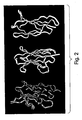
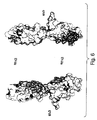
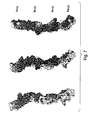
- its overall fold is close to that of the variable region of the IgG heavy chain ( Figure 2 ), making it possible to display the three fibronectin loops analogous to CDRs in relative orientations similar to those of native antibodies.
- the present antibody mimics possess antigen binding properties that are similar in nature and affinity to those of antibodies, and a loop randomization and shuffling strategy may be employed in vitro that is similar to the process of affinity maturation of antibodies in vivo .
- a fibronectin module of type III (Fn3), is a common domain found in mammalian blood and structural proteins. This domain occurs more than 400 times in the protein sequence database and has been estimated to occur in 2% of the proteins sequenced to date, including fibronectins, tenscin, intracellular cytoskeletal proteins, and prokaryotic enzymes ( Bork and Doolittle, Proc. Natl. Acad. Sci. USA 89:8990, 1992 ; Bork et al., Nature Biotech. 15:553, 1997 ; Meinke et al., J. Bacteriol. 175:1910, 1993 ; Watanabe et al., J. Biol. Chem. 265:15659, 1990 ).
- the tenth module of human Fn3 ( 10 Fn3), comprises 94 amino acid residues.
- the overall fold of this domain is closely related to that of the smallest functional antibody fragment, the variable region of the heavy chain, which comprises the entire antigen recognition unit in camel and Ilama IgG ( Figure 1 , 2 ).
- the major differences between camel and Ilama domains and the 10 Fn3 domain are that (i) 10 Fn3 has fewer beta strands (seven vs. nine) and (ii) the two beta sheets packed against each other are connected by a disulfide bridge in the camel and Ilama domains, but not in 10 Fn3.
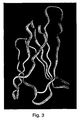
- the three loops of 10 Fn3 corresponding to the antigen-binding loops of the IgG heavy chain run between amino acid residues 21-31, 51-56, and 76-88 ( Figure 3 ).
- the length of the first and the third loop, 11 and 12 residues, respectively, fall within the range of the corresponding antigen-recognition loops found in antibody heavy chains, that is, 10-12 and 3-25 residues, respectively. Accordingly, once randomized and selected for high antigen affinity, these two loops make contacts with antigens equivalent to the contacts of the corresponding loops in antibodies.
- the second loop of 10 Fn3 is only 6 residues long, whereas the corresponding loop in antibody heavy chains ranges from 16-19 residues.
- the second loop of 10 Fn3 is preferably extended by 10-13 residues (in addition to being randomized) to obtain the greatest possible flexibility and affinity in antigen binding.
- the lengths as well as the sequences of the CDR-like loops of the antibody mimics may be randomized during in vitro or in vivo affinity maturation (as described in more detail below).
- the tenth human fibronectin type III domain, 10 Fn3, refolds rapidly even at low temperature; its backbone conformation has been recovered within 1 second at 5°C.
- Fn3 Fn3 fibronectin, a glycoprotein that exists in a soluble form in body fluids and in an insoluble form in the extracellular matrix ( Dickinson et al., J. Mol. Biol. 236:1079, 1994 ).
- a fibronectin monomer of 220-250 kD contains 12 type I modules, two type II modules, and 17 fibronectin type III modules ( Potts and Campbell, Curr. Opin.Cell Biol. 6:648, 1994 ).
- Different type III modules are involved in the binding of fibronectin to integrins, heparin, and chondroitin sulfate.
- 10 Fn3 was found to mediate cell adhesion through an integrin-binding Arg-Gly-Asp (RGD) motif on one of its exposed loops. Similar RGD motifs have been shown to be involved in integrin binding by other proteins, such as fibrinogen, von Wellebrand factor, and vitronectin ( Hynes et al., Cell 69:11, 1992 ). No other matrix- or cell-binding roles have been described for 10 Fn3.
- RGD integrin-binding Arg-Gly-Asp
- the 10 Fn3 framework possesses exposed loop sequences tolerant of randomization, facilitating the generation of diverse pools of antibody mimics. This determination was made by examining the flexibility of the 10 Fn3 sequence.
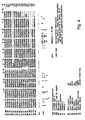
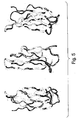
- the human 10 Fn3 sequence was aligned with the sequences of fibronectins from other sources as well as sequences of related proteins ( Figure 4 ), and the results of this alignment were mapped onto the three-dimensional structure of the human 10 Fn3 domain ( Figure 5 ).
- mutations change the scaffold and thereby indirectly alter loop structure(s). If this approach is taken, mutations should not saturate the sequence, but rather few mutations should be introduced. Preferably, no more than 10 amino acid changes, and, more preferably, no more than 3 amino acid changes should be introduced to the ( ⁇ -sheet sequences by this approach.
- the antibody mimics described herein may be fused to other protein domains.
- these mimics may be integrated with the human immune response by fusing the constant region of an IgG (F c ) with a 10 Fn3 module, preferably through the C-terminus of 10 Fn3.
- the F c in such a 10 Fn3-F c fusion molecule activates the complement component of the immune response and increases the therapeutic value of the antibody mimic.
- a fusion between 10 Fn3 and a complement protein, such as C1q may be used to target cells, and a fusion between 10 Fn3 and a toxin may be used to specifically destroy cells that carry a particular antigen.
- 10 Fn3 in any form may be fused with albumin to increase its half-life in the bloodstream and its tissue penetration.
- Any of these fusions may be generated by standard techniques, for example, by expression of the fusion protein from a recombinant fusion gene constructed using publically available gene sequences.
- any of the fibronectin constructs described herein may be generated as dimers or multimers of 10 Fn3-based antibody mimics as a means to increase the valency and thus the avidity of antigen binding.
- Such multimers may be generated through covalent binding between individual 10 Fn3 modules, for example, by imitating the natural 8 Fn3- 9 Fn3- 10 Fn3 C-to-N-terminus binding or by imitating antibody dimers that are held together through their constant regions.
- a 10 Fn3-Fc construct may be exploited to design dimers of the general scheme of 10 Fn3-Fc::Fc- 10 Fn3.
- the bonds engineered into the Fc::Fc interface may be covalent or non-covalent.
- dimerizing or multimerizing partners other than Fc can be used in 10 Fn3 hybrids to create such higher order structures.
- covalently bonded multimers may be generated by constructing fusion genes that encode the multimer or, alternatively, by engineering codons for cysteine residues into monomer sequences and allowing disulfide bond formation to occur between the expression products.
- Non-covalently bonded multimers may also be generated by a variety of techniques. These include the introduction, into monomer sequences, of codons corresponding to positively and/or negatively charged residues and allowing interactions between these residues in the expression products (and therefore between the monomers) to occur. This approach may be simplified by taking advantage of charged residues naturally present in a monomer subunit, for example, the negatively charged residues of fibronectin.
- Another means for generating non-covalently bonded antibody mimics is to introduce, into the monomer gene (for example, at the amino- or carboxy-termini), the coding sequences for proteins or protein domains known to interact.
- proteins or protein domains include coil-coil motifs, leucine zipper motifs, and any of the numerous protein subunits (or fragments thereof) known to direct formation of dimers or higher order multimers.
- 10 Fn3 represents the scaffold for the generation of antibody mimics of the invention.
- Other molecules which are not encompassed by the claimed subject matter include, without limitation, human fibronectin modules 1 Fn3- 9 Fn3 and 11 Fn3- 17 Fn3 as well as related Fn3 modules from non-human animals and prokaryotes.
- the antibody mimics described herein may be used in any technique for evolving new or improved binding proteins.
- the target of binding is immobilized on a solid support, such as a column resin or microtiter plate well, and the target contacted with a library of candidate scaffold-based binding proteins.
- a library may consist of 10 Fn3 clones constructed from the wild type 10 Fn3 scaffold through randomization of the sequence and/or the length of the 10 Fn3 CDR-like loops.
- this library may be an RNA-protein fusion library generated, for example, by the techniques described in Szostak et al., U.S.S.N.
- 09/007,005 and 09/247,190 Szostak et al., WO98/31700 ; and Roberts & Szostak, Proc. Natl. Acad. Sci. USA (1997) vol. 94, p. 12297-12302 .
- it may be a DNA-protein library (for example, as described in Lohse, DNA-Protein Fusions and Uses Thereof, U.S.S.N. 60/110,549, filed December 2, 1998 and filed December 2, 1999).
- the fusion library is incubated with the immobilized target, the support is washed to remove non-specific binders, and the tightest binders are eluted under very stringent conditions and subjected to PCR to recover the sequence information or to create a new library of binders which may be used to repeat the selection process, with or without further mutagenesis of the sequence. A number of rounds of selection may be performed until binders of sufficient affinity for the antigen are obtained.
- the 10 Fn3 scaffold may be used as the selection target.
- a protein is required that binds a specific peptide sequence presented in a ten residue loop
- a single 10 Fn3 clone is constructed in which one of its loops has been set to the length of ten and to the desired sequence.
- the new clone is expressed in vivo and purified, and then immobilized on a solid support.
- An RNA-protein fusion library based on an appropriate scaffold is then allowed to interact with the support, which is then washed, and desired molecules eluted and re-selected as described above.
- the 10 Fn3 scaffold may be used to find natural proteins that interact with the peptide sequence displayed in a 10 Fn3 loop.
- the 10 Fn3 protein is immobilized as described above, and an RNA-protein fusion library is screened for binders to the displayed loop.
- the binders are enriched through multiple rounds of selection and identified by DNA sequencing.
- RNA-protein libraries represent exemplary libraries for directed evolution
- any type of scaffold-based library may be used in the selection methods of the invention.
- the antibody mimics described herein may be evolved to bind any antigen of interest. These proteins have thermodynamic properties superior to those of natural antibodies and can be evolved rapidly in vitro. Accordingly, these antibody mimics may be employed in place of antibodies in all areas in which antibodies are used, including in the research, therapeutic, and diagnostic fields. In addition, because these scaffolds possess solubility and stability properties superior to antibodies, the antibody mimics described herein may also be used under conditions which would destroy or inactivate antibody molecules. Finally, because the scaffolds of the present invention may be evolved to bind virtually any compound, these molecules provide completely novel binding proteins which also find use in the research, diagnostic, and therapeutic areas.
- Exemplary scaffold molecules described above were generated and tested, for example, in selection protocols, as follows.
- a complex library was constructed from three fragments, each of which contained one randomized area corresponding to a CDR-like loop.
- the fragments were named BC, DE, and FG, based on the names of the CDR-H-like loops contained within them; in addition to 10 Fn3 and a randomized sequence, each of the fragments contained stretches encoding an N-terminal His 6 domain or a C-terminal FLAG peptide tag.
- each DNA fragment contained recognition sequences for the Earl Type IIS restriction endonuclease. This restriction enzyme allowed the splicing together of adjacent fragments while removing all foreign, non- 10 Fn3, sequences. It also allows for a recombination-like mixing of the three 10 Fn3 fragments between cycles of mutagenesis and selection.
- Each fragment was assembled from two overlapping oligonucleotides, which were first annealed, then extended to form the double-stranded DNA form of the fragment.
- the oligonucleotides that were used to construct and process the three fragments are listed below; the "Top” and “Bottom” species for each fragment are the oligonucleotides that contained the entire 10 Fn3 encoding sequence. In these oligonucleotides designations, "N” indicates A, T, C, or G; and “S” indicates C or G.
- the pairs of oligonucleotides (500 pmol of each) were annealed in 100 ⁇ L of 10 mM Tris 7.5, 50 mM NaCI for 10 minutes at 85°C, followed by a slow (0.5-1 hour) cooling to room temperature.
- the annealed fragments with single-stranded overhangs were then extended using 100 U Klenow (New England Biolabs, Beverly, MA) for each 100 ⁇ L aliquot of annealed oligos, and the buffer made of 838.5 ⁇ l H 2 O, 9 ⁇ l 1 M Tris 7.5, 5 ⁇ l 1M MgCl 2 , 20 ⁇ l 10 mM dNTPs, and 7.5 ul 1M DTT.
- the extension reactions proceeded for 1 hour at 25°C.
- each of the double-stranded fragments was transformed into a RNA-protein fusion (PROfusion TM ) using the technique developed by Szostak et al., U.S.S.N. 09/007,005 and U.S.S.N. 09/247,190 ; Szostak et al., WO98/31700 ; and Roberts & Szostak, Proc. Natl. Acad. Sci. USA (1997) vol. 94, p. 12297-12302 .
- the fragments were transcribed using an Ambion in vitro transcription kit, MEGAshortscript (Ambion, Austin, TX), and the resulting mRNA was gel-purified and ligated to a DNA-puromycin linker using DNA ligase.
- the mRNA-DNA-puromycin molecule was then translated using the Ambion rabbit reticulocyte lysate-based translation kit.
- the resulting mRNA-DNA-puromycin-protein PROfusion TM was purified using Oligo(dT) cellulose, and a complementary DNA strand was synthesized using reverse transcriptase and the RT primers described above (Unisplint-S or flagASA), following the manufacturer's instructions.
- the PROfusion TM obtained for each fragment was next purified on the resin appropriate to its peptide purification tag, i.e., on Ni-NTA agarose for the His 6 -tag and M2 agarose for the FLAG-tag, following the procedure recommended by the manufacturer.
- the DNA component of the tag-binding PROfusions TM was amplified by PCR using Pharmacia Ready-to-Go PCR Beads, 10 pmol of 5' and 3' PCR primers, and the following PCR program (Pharmacia, Piscataway, NJ): Step 1: 95°C for 3 minutes; Step 2: 95°C for 30 seconds, 58/62°C for 30 seconds, 72°C for 1 minute, 20/25/30 cycles, as required; Step 3: 72°C for 5 minutes; Step 4: 4°C until end.
- the resulting DNA was cleaved by 5 U Earl (New England Biolabs) per1 ug DNA; the reaction took place in T4 DNA Ligase Buffer (New England Biolabs) at 37°C, for 1 hour, and was followed by an incubation at 70°C for15 minutes to inactivate Ear I. Equal amounts of the BC, DE, and FG fragments were combined and ligated to form a full-length 10 Fn3 gene with randomized loops. The ligation required 10 U of fresh Earl (New England Biolabs) and 20 U of T4 DNA Ligase (Promega, Madison, WI), and took 1 hour at 37°C.
- Three different libraries were made in the manner described above. Each contained the form of the FG loop with 10 randomized residues.
- the BC and the DE loops of the first library bore the wild type 10 Fn3 sequence; a BC loop with 7 randomized residues and a wild type DE loop made up the second library; and a BC loop with 7 randomized residues and a DE loop with 4 randomized residues made up the third library.
- the complexity of the FG loop in each of these three libraries was 10 13 ; the further two randomized loops provided the potential for a complexity too large to be sampled in a laboratory.
- PROfusions TM were obtained from the master library following the general procedure described in Szostak et al., U.S.S.N. 09/007,005 and 09/247,190 ; Szostak et al., WO98/31700 ; and Roberts & Szostak, Proc. Natl. Acad. Sci. USA (1997) vol. 94, p. 12297-12302 ( Figure 8 ).
- the master library in the PROfusion TM form was subjected to selection for binding to TNF- ⁇ .
- Two protocols were employed: one in which the target was immobilized on an agarose column and one in which the target was immobilized on a BIACORE chip.
- an extensive optimization of conditions to minimize background binders to the agarose column yielded the favorable buffer conditions of 50 mM HEPES pH 7.4, 0.02% Triton, 100 ⁇ g/ml Sheared Salmon Sperm DNA.
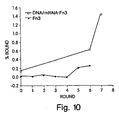
- the non-specific binding of the 10 Fn3 RNA fusion to TNF- ⁇ Sepharose was 0.3%.
- the non-specific binding background of the 10 Fn3 RNA-DNA to TNF- ⁇ Sepharose was found to be 0.1%.
- the Profusion TM library was first preincubated for an hour with underivatized Sepharose to remove any remaining non-specific binders; the flow-through from this pre-clearing was incubated for another hour with TNF- ⁇ Sepharose. The TNF- ⁇ Sepharose was washed for 3-30 minutes.
- Wild-type 10 Fn3 contains an integrin-binding tripepetide motif, Arginine 78 - Glycine 79 - Aspartate 80 (the "RGD motif) at the tip of the FG loop.
- Arginine 78 - Glycine 79 - Aspartate 80 the "RGD motif
- a mutant form of 10 Fn3 was generated that contained an inert sequence, Serine 78 - Glycine 79 - Glutamate 80 (the "SGE mutant”), a sequence which is found in the closely related, wild-type "Fn3 domain.
- This SGE mutant was expressed as an N-terminally His 6 -tagged, free protein in E. coli , and purified to homogeneity on a metal chelate column followed by a size exclusion column.
- the DNA sequence encoding His 6 - 10 Fn3(SGE) was cloned into the pET9a expression vector and transformed into BL21 DE3 pLysS cells.
- the induced culture was further incubated, under the same conditions, overnight (14-18 hours); the bacteria were recovered by standard, low speed centrifugation.
- the cell pellet was resuspended in 1/50 of the original culture volume of lysis buffer (50 mM Tris 8.0, 0.5 M NaCI, 5% glycerol, 0.05% Triton X-100, and 1 mM PMSF), and the cells were lysed by passing the resulting paste through a Microfluidics Corporation Microfluidizer M110-EH, three times.
- the lysate was clarified by centrifugation, and the supernatant was filtered through a 0.45 ⁇ m filter followed by filtration through a 0.2 ⁇ m filter.
- the column was run at 0.8 mL/min, in buffer 1; all fractions that contained a protein of the expected MW were pooled, concentrated 10X as described above, then dialyzed into PBS. Toxikon (MA) was engaged to perform endotoxin screens and animal studies on the resulting sample.
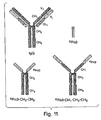
- This 10 Fn3-F c molecule contains the -CH 1 -CH 2 -CH 3 ( Figure 11 ) or -CH 2 -CH 3 domains of the IgG constant region of the host; in these constructs, the 10 Fn3 domain is grafted onto the N-terminus in place of the IgG V H domain ( Figures 11 and 12 ).
- Such antibody-like constructs are expected to improve the pharmacokinetics of the protein as well as its ability to harness the natural immune response.
- the -CH 1 -CH 2 -CH 3 region was first amplified from a mouse liver spleen cDNA library (Clontech), then ligated into the pET25b vector.
- the primers used in the cloning were 5' Fc Nest and 3' 5 Fc Nest, and the primers used to graft the appropriate restriction sites onto the ends of the recovered insert were 5' Fc HIII and 3' Fc Nhe:
- PCR is used to remove the CH 1 region from this clone and create the Fc part of the shorter, 10 Fn3-CH 2 -CH 3 clone.
- the sequence encoding 10 Fn3 is spliced onto the 5' end of each clone; either the wild type 10 Fn3 cloned from the same mouse spleen cDNA library or a modified 10 Fn3 obtained by mutagenesis or randomization of the molecules can be used.
- the oligonucleotides used in the cloning of murine wild-type 10 Fn3 were:
- the human equivalents of the clones are constructed using the same strategy with human oligonucleotide sequences.
Landscapes
- Chemical & Material Sciences (AREA)
- Life Sciences & Earth Sciences (AREA)
- Health & Medical Sciences (AREA)
- Organic Chemistry (AREA)
- Genetics & Genomics (AREA)
- Engineering & Computer Science (AREA)
- Biochemistry (AREA)
- Zoology (AREA)
- Molecular Biology (AREA)
- General Health & Medical Sciences (AREA)
- Bioinformatics & Cheminformatics (AREA)
- Medicinal Chemistry (AREA)
- Wood Science & Technology (AREA)
- Biophysics (AREA)
- General Engineering & Computer Science (AREA)
- Biotechnology (AREA)
- Biomedical Technology (AREA)
- Microbiology (AREA)
- Crystallography & Structural Chemistry (AREA)
- Physics & Mathematics (AREA)
- Virology (AREA)
- Proteomics, Peptides & Aminoacids (AREA)
- Chemical Kinetics & Catalysis (AREA)
- General Chemical & Material Sciences (AREA)
- Plant Pathology (AREA)
- Toxicology (AREA)
- Gastroenterology & Hepatology (AREA)
- Peptides Or Proteins (AREA)
- Medicines Containing Antibodies Or Antigens For Use As Internal Diagnostic Agents (AREA)
- Preparation Of Compounds By Using Micro-Organisms (AREA)
Claims (28)
- Antikörper-ähnliches Protein, umfassend eine zehnte Fibronectin-Typ-III-Domäne (10Fn3), wobei die Aminosäuresequenz von jeder von der BC-Schleife, der DE-Schleife und der FG-Schleife eine oder mehrere Aminosäureveränderungen relativ zu der Sequenz einer natürlich vorkommenden humanen zehnten Fibronectin-Typ-III-Domäne umfasst, wobei die Aminosäuresequenz der natürlich vorkommenden humanen 10Fn3 in Figur 4 angegeben ist, die BC-Schleife der natürlich vorkommenden humanen 10Fn3 zwischen den Aminosäureresten 21-31 der Sequenz, wie angegeben in Figur 4, verläuft, die DE-Schleife der natürlich vorkommenden humanen 10Fn3 zwischen den Aminosäureresten 51-56 der Sequenz, wie angegeben in Figur 4, verläuft, und die FG-Schleife der natürlich vorkommenden humanen 10Fn3 zwischen den Aminosäureresten 76-88 der Sequenz, wie angegeben in Figur 4, verläuft, wobei das Protein durch seine Fähigkeit gekennzeichnet ist, sich an ein Antigen zu binden.
- Antikörper-ähnliches Protein, umfassend eine zehnte Fibronectin-Typ-III-Domäne (10Fn3), wobei die Aminosäuresequenz von mindestens einer Schleife, ausgewählt aus der Gruppe, bestehend aus der BC-Schleife, der DE-Schleife und der FG-Schleife, eine oder mehrere Aminosäureveränderungen relativ zu der Sequenz einer natürlich vorkommenden humanen zehnten Fibronectin-Typ-III-Domäne umfasst, wobei die Aminosäuresequenz der natürlich vorkommenden humanen 10Fn3 in Figur 4 angegeben ist, die BC-Schleife der natürlich vorkommenden humanen 10Fn3 zwischen den Aminosäureresten 21-31 der Sequenz, wie angegeben in Figur 4, verläuft, die DE-Schleife der natürlich vorkommenden humanen 10Fn3 zwischen den Aminosäureresten 51-56 der Sequenz, wie angegeben in Figur 4, verläuft, und die FG-Schleife der natürlich vorkommenden humanen 10Fn3 zwischen den Aminosäureresten 76-88 der Sequenz, wie angegeben in Figur 4, verläuft, und wobei die DE-Schleife der 10Fn3 in der Länge relativ zu der natürlich vorkommenden humanen 10Fn3 erweitert ist, wobei das Protein durch seine Fähigkeit gekennzeichnet ist, sich an ein Antigen zu binden.
- Protein nach Anspruch 1, wobei die DE-Schleife der 10Fn3 in der Länge relativ zu der natürlich vorkommenden humanen 10Fn3 erweitert ist.
- Protein nach Anspruch 1 oder 2, wobei die Antigen-Bindung durch drei 10Fn3-Schleifen vermittelt wird.
- Protein nach Anspruch 1 oder 2, wobei der 10Fn3 ein Integrin-bindendes Motiv fehlt.
- Protein nach Anspruch 1 oder 2, wobei dem Protein Disulfidbindungen fehlen.
- Protein nach Anspruch 1 oder 2, wobei das Protein kovalent an eine Nucleinsäure gebunden ist.
- Protein nach Anspruch 7, wobei die Nucleinsäure das Protein codiert.
- Protein nach Anspruch 8, wobei die Nucleinsäure RNA ist.
- Fusionsprotein, umfassend eine Nucleinsäure, kovalent gebunden an ein Antikörper-ähnliches Protein, umfassend eine zehnte Fibronectin-Typ-III-Domäne (10Fn3), wobei die Aminosäuresequenz von mindestens einer Schleife, ausgewählt aus der Gruppe, bestehend aus der BC-Schleife, der DE-Schleife und der FG-Schleife, eine oder mehrere Aminosäureveränderungen relativ zu der Sequenz einer natürlich vorkommenden humanen zehnten Fibronectin-Typ-III-Domäne umfasst, wobei die Aminosäuresequenz der natürlich vorkommenden humanen 10Fn3 in Figur 4 angegeben ist, die BC-Schleife der natürlich vorkommenden humanen 10Fn3 zwischen den Aminosäureresten 21-31 der Sequenz, wie angegeben in Figur 4, verläuft, die DE-Schleife der natürlich vorkommenden humanen 10Fn3 zwischen den Aminosäureresten 51-56 der Sequenz, wie angegeben in Figur 4, verläuft, und die FG-Schleife der natürlich vorkommenden humanen 10Fn3 zwischen den Aminosäureresten 76-88 der Sequenz, wie angegeben in Figur 4, verläuft, wobei das Protein durch seine Fähigkeit gekennzeichnet ist, sich an ein Antigen zu binden.
- Fusionsprotein, umfassend das Protein nach Anspruch 1 oder 2.
- Fusionsprotein nach Anspruch 11, wobei das Fusionsprotein weiterhin eine Immunoglobulin-Fc-Domäne, ein Komplement-Protein, ein Toxin-Protein oder ein Albumin-Protein umfasst.
- Fusionsprotein, umfassend eine Immunoglobulin-Fc-Domäne, ein Komplement-Protein, ein Toxin-Protein oder ein Albumin-Protein und ein Antikörper-ähnliches Protein, umfassend eine zehnte Fibronectin-Typ-III-Domäne (10Fn3), wobei die Aminosäuresequenz von mindestens einer Schleife, ausgewählt aus der Gruppe, bestehend aus der BC-Schleife, der DE-Schleife und der FG-Schleife, eine oder mehrere Aminosäureveränderungen relativ zu der Sequenz einer natürlich vorkommenden humanen zehnten Fibronectin-Typ-III-Domäne umfasst, wobei die Aminosäuresequenz der natürlich vorkommenden humanen 10Fn3 in Figur 4 angegeben ist, die BC-Schleife der natürlich vorkommenden humanen 10Fn3 zwischen den Aminosäureresten 21-31 der Sequenz, wie angegeben in Figur 4, verläuft, die DE-Schleife der natürlich vorkommenden humanen 10Fn3 zwischen den Aminosäureresten 51-56 der Sequenz, wie angegeben in Figur 4, verläuft, und die FG-Schleife der natürlich vorkommenden humanen 10Fn3 zwischen den Aminosäureresten 76-88 der Sequenz, wie angegeben in Figur 4, verläuft, wobei das Protein durch seine Fähigkeit gekennzeichnet ist, sich an ein Antigen zu binden.
- Dimer oder Multimer eines Antikörper-ähnlichen Proteins, wobei das Antikörperähnliche Protein eine zehnte Fibronectin-Typ-III-Domäne (10Fn3) umfasst, wobei die Aminosäuresequenz von mindestens einer Schleife, ausgewählt aus der Gruppe, bestehend aus der BC-Schleife, der DE-Schleife und der FG-Schleife, eine oder mehrere Aminosäureveränderungen relativ zu der Sequenz einer natürlich vorkommenden humanen zehnten Fibronectin-Typ-III-Domäne umfasst, wobei die Aminosäuresequenz der natürlich vorkommenden humanen 10Fn3 in Figur 4 angegeben ist, die BC-Schleife der natürlich vorkommenden humanen 10Fn3 zwischen den Aminosäureresten 21-31 der Sequenz, wie angegeben in Figur 4, verläuft, die DE-Schleife der natürlich vorkommenden humanen 10Fn3 zwischen den Aminosäureresten 51-56 der Sequenz, wie angegeben in Figur 4, verläuft, und die FG-Schleife der natürlich vorkommenden humanen 10Fn3 zwischen den Aminosäureresten 76-88 der Sequenz, wie angegeben in Figur 4, verläuft, wobei das Protein durch seine Fähigkeit gekennzeichnet ist, sich an ein Antigen zu binden.
- Protein nach Anspruch 14, wobei zwei oder mehr als zwei 10Fn3 kovalent aneinander gebunden sind.
- Protein nach Anspruch 1 oder 2, wobei das Antigen ein Protein ist.
- Zusammensetzung, umfassend das Protein nach Anspruch 1 oder 2 und einen physiologisch verträglichen Träger.
- Protein nach Anspruch 1 oder 2 zur Verwendung in der Therapie oder Diagnose.
- Nucleinsäure, codierend das Protein nach Anspruch 1 oder 2.
- Nucleinsäure nach Anspruch 19, wobei die Nucleinsäure DNA oder RNA ist.
- Verfahren zum Gewinnen eines Antikörper-ähnlichen Proteins nach Anspruch 1, wobei das Verfahren umfasst:(a) Randomisieren der BC-Schleife, der DE-Schleife und der FG-Schleife einer zehnten Fibronectin-Typ-III-Domäne (10Fn3), dadurch Erzeugen einer Bibliothek von Proteinen, umfassend eine zehnte Fibronectin-Typ-III-Domäne, wobei die Aminosäuresequenz von jeder der Schleifen eine oder mehrere Aminosäureveränderungen relativ zu der Sequenz einer natürlich vorkommenden humanen zehnten Fibronectin-Typ-III-Domäne umfasst, wobei die Aminosäuresequenz der natürlich vorkommenden humanen 10Fn3 in Figur 4 angegeben ist, die BC-Schleife der natürlich vorkommenden humanen 10Fn3 zwischen den Aminosäureresten 21-31 der Sequenz, wie angegeben in Figur 4, verläuft, die DE-Schleife der natürlich vorkommenden humanen 10Fn3 zwischen den Aminosäureresten 51-56 der Sequenz, wie angegeben in Figur 4, verläuft, und die FG-Schleife der natürlich vorkommenden humanen 10Fn3 zwischen den Aminosäureresten 76-88 der Sequenz, wie angegeben in Figur 4, verläuft;(b) Inkontaktbringen eines Antigens mit den Proteinen, wobei das Inkontaktbringen unter Bedingungen ausgeführt wird, die Antigen-Protein-Komplexbildung erlauben;(c) Auswählen eines Antigen-Protein-Komplexes; und(d) Gewinnen, aus dem Komplex, des Proteins, welches sich an das Antigen bindet.
- Verfahren zum Gewinnen eines Antikörper-ähnlichen Proteins nach Anspruch 2, wobei das Verfahren umfasst:(a) Randomisieren von mindestens einer Schleife, ausgewählt aus der Gruppe, bestehend aus der BC-Schleife, der DE-Schleife und der FG-Schleife, und Erweitern der DE-Schleife in der Länge einer zehnten Fibronectin-Typ-III-Domäne (10Fn3), dadurch Erzeugen einer Bibliothek von Proteinen, umfassend eine zehnte Fibronectin-Typ-III-Domäne, wobei die Aminosäuresequenz der Schleife eine oder mehrere Aminosäureveränderungen relativ zu der Sequenz einer natürlich vorkommenden humanen zehnten Fibronectin-Typ-III-Domäne umfasst, wobei die Aminosäuresequenz der natürlich vorkommenden humanen 10Fn3 in Figur 4 angegeben ist, die BC-Schleife der natürlich vorkommenden humanen 10Fn3 zwischen den Aminosäureresten 21-31 der Sequenz, wie angegeben in Figur 4, verläuft, die DE-Schleife der natürlich vorkommenden humanen 10Fn3 zwischen den Aminosäureresten 51-56 der Sequenz, wie angegeben in Figur 4, verläuft, und die FG-Schleife der natürlich vorkommenden humanen 10Fn3 zwischen den Aminosäureresten 76-88 der Sequenz, wie angegeben in Figur 4, verläuft und wobei die DE-Schleife der 10Fn3 in der Länge relativ zu der natürlich vorkommenden10Fn3 erweitert ist;(b) Inkontaktbringen eines Antigens mit den Proteinen, wobei das Inkontaktbringen unter Bedingungen ausgeführt wird, die Antigen-Protein-Komplexbildung erlauben;(c) Auswählen eines Antigen-Protein-Komplexes; und(d) Gewinnen, aus dem Komplex, des Proteins, welches sich an das Antigen bindet.
- Verfahren zum Gewinnen eines Antikörper-ähnlichen Proteins, welches sich an ein Antigen bindet, wobei das Verfahren umfasst:(a) Randomisieren von mindestens einer Schleife, ausgewählt aus der Gruppe, bestehend aus der BC-Schleife, der DE-Schleife und der FG-Schleife einer zehnten Fibronectin-Typ-III-Domäne (10Fn3), dadurch Erzeugen einer Bibliothek von Proteinen, umfassend eine zehnte Fibronectin-Typ-III-Domäne, wobei die Aminosäuresequenz der Schleife eine oder mehrere Aminosäureveränderungen relativ zu der Sequenz einer natürlich vorkommenden humanen zehnten Fibronectin-Typ-III-Domäne umfasst, wobei die Aminosäuresequenz der natürlich vorkommenden humanen 10Fn3 in Figur 4 angegeben ist, die BC-Schleife der natürlich vorkommenden humanen 10Fn3 zwischen den Aminosäureresten 21-31 der Sequenz, wie angegeben in Figur 4, verläuft, die DE-Schleife der natürlich vorkommenden humanen 10Fn3 zwischen den Aminosäureresten 51-56 der Sequenz, wie angegeben in Figur 4, verläuft, und die FG-Schleife der natürlich vorkommenden humanen 10Fn3 zwischen den Aminosäureresten 76-88 der Sequenz, wie angegeben in Figur 4, verläuft, wobei jedes Protein kovalent an eine Nucleinsäure gebunden ist, welche das Protein codiert;(b) Inkontaktbringen des Antigens mit den Proteinen, wobei das Inkontaktbringen unter Bedingungen ausgeführt wird, die Antigen-Protein-Komplexbildung erlauben;(c) Auswählen eines Antigen-Protein-Komplexes; und(d) Gewinnen, aus dem Komplex, des Proteins, welches sich an das Antigen bindet.
- Verfahren nach Anspruch 21, 22 oder 23, wobei das Verfahren weiterhin Randomisieren von mindestens einer Schleife des Proteins, gewonnen in Schritt (d), und Wiederholen der Schritte (b), (c) und (d) unter Verwendung des weiter randomisierten Proteins umfasst.
- Verfahren zum Gewinnen einer Verbindung, welche sich an ein Protein nach Anspruch 1 oder 2 bindet, wobei das Verfahren umfasst:(a) Inkontaktbringen des Proteins mit einer Kandidatenverbindung, wobei das Inkontaktbringen unter Bedingungen ausgeführt wird, die Verbindung-Protein-Komplexbildung erlauben; und(b) Gewinnen, aus dem Komplex, der Verbindung, welche sich an das Protein bindet.
- Verfahren nach Anspruch 25, wobei das Verfahren weiterhin Modifizieren der Verbindung, gewonnen in Schritt (b), und Wiederholen der Schritte (a) und (b) unter Verwendung der weiter modifizierten Verbindung umfasst.
- Verfahren nach Anspruch 21, 22, 23, oder 24, wobei das Antigen oder die Verbindung ein Protein ist.
- Verfahren nach Anspruch 21, 22 oder 23, wobei das Antigen auf einem festen Träger immobilisiert ist.
Priority Applications (2)
| Application Number | Priority Date | Filing Date | Title |
|---|---|---|---|
| EP09167667A EP2154535A1 (de) | 1998-12-10 | 1999-12-09 | Proteingerüste für Antikörpermimetika und andere Bindungsproteine |
| CY20091101172T CY1110549T1 (el) | 1998-12-10 | 2009-11-11 | Ικριωματα πρωτεϊνων για μιμητικα αντισωματων και αλλες πρωτεϊνες συνδεσης |
Applications Claiming Priority (3)
| Application Number | Priority Date | Filing Date | Title |
|---|---|---|---|
| US11173798P | 1998-12-10 | 1998-12-10 | |
| US111737P | 1998-12-10 | ||
| PCT/US1999/029317 WO2000034784A1 (en) | 1998-12-10 | 1999-12-09 | Protein scaffolds for antibody mimics and other binding proteins |
Related Child Applications (1)
| Application Number | Title | Priority Date | Filing Date |
|---|---|---|---|
| EP09167667.6 Division-Into | 2009-08-11 |
Publications (4)
| Publication Number | Publication Date |
|---|---|
| EP1137941A1 EP1137941A1 (de) | 2001-10-04 |
| EP1137941A4 EP1137941A4 (de) | 2002-04-17 |
| EP1137941B1 EP1137941B1 (de) | 2009-08-12 |
| EP1137941B2 true EP1137941B2 (de) | 2013-09-11 |
Family
ID=22340181
Family Applications (2)
| Application Number | Title | Priority Date | Filing Date |
|---|---|---|---|
| EP09167667A Withdrawn EP2154535A1 (de) | 1998-12-10 | 1999-12-09 | Proteingerüste für Antikörpermimetika und andere Bindungsproteine |
| EP99967261.1A Expired - Lifetime EP1137941B2 (de) | 1998-12-10 | 1999-12-09 | Proteingerüste für antikörper-nachahmer und andere bindende proteine |
Family Applications Before (1)
| Application Number | Title | Priority Date | Filing Date |
|---|---|---|---|
| EP09167667A Withdrawn EP2154535A1 (de) | 1998-12-10 | 1999-12-09 | Proteingerüste für Antikörpermimetika und andere Bindungsproteine |
Country Status (11)
| Country | Link |
|---|---|
| EP (2) | EP2154535A1 (de) |
| JP (1) | JP4562286B2 (de) |
| AT (1) | ATE439592T1 (de) |
| AU (2) | AU775076B2 (de) |
| CA (1) | CA2351346C (de) |
| CY (1) | CY1110549T1 (de) |
| DE (1) | DE69941267D1 (de) |
| DK (1) | DK1137941T4 (de) |
| ES (1) | ES2329959T5 (de) |
| PT (1) | PT1137941E (de) |
| WO (1) | WO2000034784A1 (de) |
Families Citing this family (132)
| Publication number | Priority date | Publication date | Assignee | Title |
|---|---|---|---|---|
| JP3614866B2 (ja) | 1997-06-12 | 2005-01-26 | リサーチ コーポレイション テクノロジーズ,インコーポレイティド | 人工抗体ポリペプチド |
| US7115396B2 (en) | 1998-12-10 | 2006-10-03 | Compound Therapeutics, Inc. | Protein scaffolds for antibody mimics and other binding proteins |
| US6818418B1 (en) | 1998-12-10 | 2004-11-16 | Compound Therapeutics, Inc. | Protein scaffolds for antibody mimics and other binding proteins |
| US7022479B2 (en) | 2000-01-24 | 2006-04-04 | Compound Therapeutics, Inc. | Sensitive, multiplexed diagnostic assays for protein analysis |
| EP1250463B1 (de) | 2000-01-24 | 2006-04-05 | Compound Therapeutics, Inc. | Sensible und multiplexe diagnostische tests zur proteinanalyse |
| CA2416219C (en) * | 2000-07-11 | 2016-10-11 | Research Corporation Technologies, Inc. | Artificial antibody polypeptides |
| EP1332209B1 (de) | 2000-09-08 | 2009-11-11 | Universität Zürich | Sammlung von proteinen mit sich wiederholenden sequenzen (repeat proteins), die repetitive sequenzmodule enthalten |
| CA2418835A1 (en) * | 2000-10-16 | 2002-04-25 | Phylos, Inc. | Protein scaffolds for antibody mimics and other binding proteins |
| SI1724284T1 (sl) * | 2000-12-07 | 2009-12-31 | Lilly Co Eli | Glp-1 fuzijski proteini |
| US7556925B2 (en) | 2001-04-04 | 2009-07-07 | University Of Rochester | ανβ3 integrin-binding polypeptide monobodies and their use |
| EP1456410A2 (de) * | 2001-12-11 | 2004-09-15 | AlgoNomics N.V. | Vefahren für die ausstellung von loops aus immunogloblin-domänen |
| BR122019027966B8 (pt) | 2002-05-02 | 2021-07-27 | Wyeth Corp | conjugado monomérico de derivado de caliqueamicina/anti-corpo anti-cd22 e uso dos mesmos |
| WO2003104418A2 (en) | 2002-06-06 | 2003-12-18 | Research Corporation Technologies, Inc. | Reconstituted polypeptides |
| US7083948B1 (en) | 2002-12-24 | 2006-08-01 | Immunex Corporation | Polypeptide purification reagents and methods for their use |
| PT2829283T (pt) | 2003-04-30 | 2017-09-08 | Univ Zuerich | Método para tratamento do cancro utilizando uma imunotoxina |
| GB0407315D0 (en) | 2003-07-15 | 2004-05-05 | Cambridge Antibody Tech | Human antibody molecules |
| BRPI0417302A (pt) | 2003-12-05 | 2007-03-06 | Compound Therapeutics Inc | inibidores de receptores de fator de crescimento endotelial vascular do tipo 2 |
| CA2597098C (en) | 2005-02-08 | 2016-08-02 | Steven R. Ledbetter | Antibodies to tgfbeta |
| KR101481844B1 (ko) | 2006-03-27 | 2015-01-13 | 메디뮨 리미티드 | Gm-csf 수용체에 대한 결합 성분 |
| CL2007002225A1 (es) | 2006-08-03 | 2008-04-18 | Astrazeneca Ab | Agente de union especifico para un receptor del factor de crecimiento derivado de plaquetas (pdgfr-alfa); molecula de acido nucleico que lo codifica; vector y celula huesped que la comprenden; conjugado que comprende al agente; y uso del agente de un |
| KR20090058512A (ko) | 2006-08-04 | 2009-06-09 | 아스트라제네카 아베 | Erbb2에 대한 인간 항체 |
| ES2501947T3 (es) | 2006-10-19 | 2014-10-02 | Csl Limited | Antagonistas de anticuerpos de alta afinidad del receptor alfa 1 de interleucina |
| AU2007325838B2 (en) | 2006-11-22 | 2013-09-19 | Bristol-Myers Squibb Company | Targeted therapeutics based on engineered proteins for tyrosine kinases receptors, including IGF-IR |
| TW200831528A (en) | 2006-11-30 | 2008-08-01 | Astrazeneca Ab | Compounds |
| EP2111228B1 (de) | 2007-02-02 | 2011-07-20 | Bristol-Myers Squibb Company | 10Fn3 Domain zur Behandlung von Krankheiten begleitet von unerwünschter Angiogenese |
| AR065368A1 (es) | 2007-02-15 | 2009-06-03 | Astrazeneca Ab | Anticuerpos para moleculas de ige |
| CA2682851C (en) | 2007-04-02 | 2017-01-17 | Philogen S.P.A. | A novel antigen associated with the neovasculature of tumour metastases |
| CA2683559C (en) | 2007-04-13 | 2019-09-24 | Dana Farber Cancer Institute, Inc. | Methods for treating cancer resistant to erbb therapeutics |
| EP2145021A2 (de) | 2007-05-17 | 2010-01-20 | Bristol-Myers Squibb Company | Biomarker und verfahren zur bestimmung der sensitivität gegenüber insulinwachstumsfaktor-1-rezeptormodulatoren |
| EA017995B1 (ru) | 2007-07-25 | 2013-04-30 | Филоджен С.П.А. | Антиген, связанный с вариантами рака легкого и лимфомами |
| EP2209805B1 (de) | 2007-10-30 | 2017-09-06 | Philogen S.p.A. | Mit rheumatoider arthritis assoziiertes antigen |
| EP2215246B1 (de) | 2007-10-31 | 2015-01-07 | MedImmune, LLC | Proteingerüste |
| MX2010006735A (es) | 2007-12-21 | 2010-09-30 | Medimmune Ltd | Miembros de union para receptor alfa de interleucina-4 (il-4ra) - 173. |
| US8092804B2 (en) | 2007-12-21 | 2012-01-10 | Medimmune Limited | Binding members for interleukin-4 receptor alpha (IL-4Rα)-173 |
| AU2008345424A1 (en) * | 2007-12-27 | 2009-07-09 | Novartis Ag | Improved fibronectin-based binding molecules and their use |
| EP2247615B1 (de) | 2008-02-14 | 2014-07-30 | Bristol-Myers Squibb Company | Zielgerichtete therapeutika auf der basis von egfr gentechnisch hergestellten proteinen |
| CN102076713B (zh) * | 2008-05-02 | 2015-03-25 | 诺华股份有限公司 | 改进的基于纤连蛋白的结合分子及其用途 |
| AR071874A1 (es) | 2008-05-22 | 2010-07-21 | Bristol Myers Squibb Co | Proteinas de dominio de armazon basadas en fibronectina multivalentes |
| CN102264763B (zh) | 2008-09-19 | 2016-04-27 | 米迪缪尼有限公司 | 定向于dll4的抗体及其用途 |
| MX2011004550A (es) | 2008-10-31 | 2011-07-20 | Centocor Ortho Biotech Inc | Composiciones de de supercóntigos a base de dominios de fibronectina tipo iii, métodos y usos. |
| TWI496582B (zh) | 2008-11-24 | 2015-08-21 | 必治妥美雅史谷比公司 | 雙重專一性之egfr/igfir結合分子 |
| CN102245771B (zh) | 2008-12-16 | 2013-04-10 | 诺瓦提斯公司 | 酵母展示系统 |
| EP2379595A2 (de) | 2008-12-23 | 2011-10-26 | AstraZeneca AB | Gegen a5b1 gerichtete gezielt bindende mittel und anwendungen davon |
| EP2379116B1 (de) | 2009-01-07 | 2015-08-26 | Philogen S.p.A. | Mit endometriose assoziierte antigene |
| US8067201B2 (en) | 2009-04-17 | 2011-11-29 | Bristol-Myers Squibb Company | Methods for protein refolding |
| US8679488B2 (en) | 2009-08-05 | 2014-03-25 | Philogen S.P.A. | Targeting of bone marrow neovasculature |
| WO2011020033A2 (en) * | 2009-08-13 | 2011-02-17 | Massachusetts Institute Of Technology | Engineered proteins including mutant fibronectin domains |
| US9139825B2 (en) | 2009-10-30 | 2015-09-22 | Novartis Ag | Universal fibronectin type III bottom-side binding domain libraries |
| US20120220594A1 (en) | 2009-10-30 | 2012-08-30 | Bristol-Meyers Squibb Company | Methods for treating cancer in patients having igf-1r inhibitor resistance |
| EP3279215B1 (de) | 2009-11-24 | 2020-02-12 | MedImmune Limited | Gezielte bindemittel gegen b7-h1 |
| AU2010334809C1 (en) | 2009-12-23 | 2015-02-26 | Agenus Inc. | Binding members for human cytomegalovirus |
| WO2011127418A1 (en) | 2010-04-09 | 2011-10-13 | Amgen Inc. | Btnl9 proteins, nucleic acids, and antibodies and uses thereof |
| KR20130056870A (ko) | 2010-04-13 | 2013-05-30 | 메디뮨 엘엘씨 | 피브로넥틴 ⅲ형 도메인에 기초한 다량체 스캐폴드 |
| HUE029622T2 (en) | 2010-04-30 | 2017-03-28 | Janssen Biotech Inc | Stabilized fibronectin domain compositions, methods and uses |
| TW201138808A (en) | 2010-05-03 | 2011-11-16 | Bristol Myers Squibb Co | Serum albumin binding molecules |
| EP3091028A1 (de) | 2010-05-26 | 2016-11-09 | Bristol-Myers Squibb Company | Auf fibronectin basierende gerüstproteine mit erhöhter stabilität |
| CA2809568C (en) | 2010-09-01 | 2019-06-11 | Genzyme Corporation | Treatment of myocardial infarction using tgf - beta antagonists |
| BR112013015508B1 (pt) | 2010-12-20 | 2022-04-05 | Medimmune Limited | Molécula de anticorpo para il-18 humana, domínio vh isolado e domínio vl isolado, composição, uso de uma molécula de anticorpo ou do domínio vh isolado e do domínio vl isolado, molécula de ácido nucleico isolada, célula hospedeira procariótica recombinante, método para produzir um anticorpo, e método in vitro para medir il-18 em uma amostra de um indivíduo |
| WO2012110824A1 (en) | 2011-02-18 | 2012-08-23 | Astrazeneca Ab | Binding agents with specificity for a nucleic acid modification |
| EP3415528B1 (de) | 2011-04-13 | 2021-05-26 | Bristol-Myers Squibb Company | Fc-fusionsproteine mit neuartigen linkern oder anordnungen |
| US9347058B2 (en) | 2011-05-17 | 2016-05-24 | Bristol-Myers Squibb Company | Methods for the selection of binding proteins |
| US20140187488A1 (en) | 2011-05-17 | 2014-07-03 | Bristol-Myers Squibb Company | Methods for maintaining pegylation of polypeptides |
| EP2548891A1 (de) | 2011-07-18 | 2013-01-23 | Universiteit Maastricht | Humaner monoklonaler Antikörper gegen die Gamma-Untereinheit des Acetylcholin-Rezeptors zur Verwendung bei der Behandlung von Rhabdomyosarkom |
| MX358827B (es) | 2011-09-27 | 2018-09-05 | Janssen Biotech Inc | Supercóntigos de proteína basados en repeticiones de fibronectina tipo iii con superficies de unión alternativas. |
| CN103906767A (zh) | 2011-10-10 | 2014-07-02 | 米迪缪尼有限公司 | 对类风湿关节炎的治疗 |
| KR102434073B1 (ko) | 2011-10-11 | 2022-08-18 | 비엘라 바이오, 인크. | Cd40l 특이적 tn3 유래 스카폴드 및 이의 사용 방법 |
| US20140309229A1 (en) | 2011-10-13 | 2014-10-16 | Bristol-Myers Squibb Company | Methods for selecting and treating cancer in patients with igf-1r/ir inhibitors |
| US9522951B2 (en) | 2011-10-31 | 2016-12-20 | Bristol-Myers Squibb Company | Fibronectin binding domains with reduced immunogenicity |
| PT2846836T (pt) | 2012-05-07 | 2019-10-29 | Allergan Inc | Método de tratamento de dmi em doentes refratários à terapia anti-vegf |
| US20150166630A1 (en) | 2012-07-19 | 2015-06-18 | Amgen Inc. | Btnl3 proteins, nucleic acids, and antibodies and uses thereof |
| RS58801B1 (sr) | 2012-09-13 | 2019-07-31 | Bristol Myers Squibb Co | Skafold domenski proteini na bazi fibronektina koji se vezuju za miostatin |
| EP2903629B1 (de) | 2012-10-03 | 2019-07-10 | Philogen S.p.A. | Antikörperkonjugat zur verwendung bei der behandlung von entzündlichen darmerkrankungen |
| KR102149206B1 (ko) | 2012-11-08 | 2020-08-31 | 세센 바이오, 아이엔씨. | 인터루킨-6의 길항제 및 이의 용도 |
| US20150361159A1 (en) | 2013-02-01 | 2015-12-17 | Bristol-Myers Squibb Company | Fibronectin based scaffold proteins |
| WO2014124017A1 (en) | 2013-02-06 | 2014-08-14 | Bristol-Myers Squibb Company | Fibronectin type iii domain proteins with enhanced solubility |
| US10065987B2 (en) | 2013-02-12 | 2018-09-04 | Bristol-Myers Squibb Company | High pH protein refolding methods |
| US20160152686A1 (en) | 2013-03-13 | 2016-06-02 | Bristol-Myers Squibb Company | Fibronectin based scaffold domains linked to serum albumin or moiety binding thereto |
| CA2902789A1 (en) | 2013-03-14 | 2014-09-18 | The Governing Council Of The University Of Toronto | Scaffolded peptidic libraries and methods of making and screening the same |
| GB201307501D0 (en) | 2013-04-25 | 2013-06-12 | Univ Aberdeen | Anti-fungal antibody molecules and uses thereof |
| SG11201607818WA (en) | 2014-03-20 | 2016-10-28 | Bristol Myers Squibb Co | Stabilized fibronectin based scaffold molecules |
| AU2015231170B2 (en) | 2014-03-20 | 2019-10-03 | Bristol-Myers Squibb Company | Serum albumin-binding fibronectin type III domains |
| GB201407852D0 (en) | 2014-05-02 | 2014-06-18 | Iontas Ltd | Preparation of libraries od protein variants expressed in eukaryotic cells and use for selecting binding molecules |
| SI3215530T1 (sl) | 2014-11-07 | 2020-02-28 | Sesen Bio, Inc. | Izboljšana protitelesa IL-6 |
| WO2016073894A1 (en) | 2014-11-07 | 2016-05-12 | Eleven Biotherapeutics, Inc. | Therapeutic agents with increased ocular retention |
| KR20170093182A (ko) | 2014-12-11 | 2017-08-14 | 인바이오모션 에스.엘. | 인간 c-maf에 대한 결합 구성원 |
| DK3447075T3 (da) | 2015-05-15 | 2023-11-13 | Massachusetts Gen Hospital | Antagonistiske antistoffer af antitumornekrosefaktorreceptor-superfamilien |
| US10766946B2 (en) | 2015-09-23 | 2020-09-08 | Bristol-Myers Squibb Company | Fast-off rate serum albumin binding fibronectin type III domains |
| EP3353198B1 (de) | 2015-09-23 | 2020-06-17 | Bristol-Myers Squibb Company | Glypican-3-bindende fibronektin-basierte gerüstmoleküle |
| BR112018017031A2 (pt) | 2016-02-23 | 2019-01-22 | Sesen Bio Inc | formulações de antagonista de il-6 e usos das mesmas |
| US11291721B2 (en) | 2016-03-21 | 2022-04-05 | Marengo Therapeutics, Inc. | Multispecific and multifunctional molecules and uses thereof |
| ES3056995T3 (en) | 2016-04-13 | 2026-02-25 | Vivia Biotech Sl | Ex vivo bite-activated t cells |
| CA3036564A1 (en) | 2016-09-23 | 2018-03-29 | Elstar Therapeutics, Inc. | Multispecific antibody molecules comprising lambda and kappa light chains |
| KR102568559B1 (ko) | 2016-12-14 | 2023-08-18 | 얀센 바이오테크 인코포레이티드 | Cd8a-결합 섬유결합소 iii형 도메인 |
| WO2018111978A1 (en) | 2016-12-14 | 2018-06-21 | Janssen Biotech, Inc. | Cd137 binding fibronectin type iii domains |
| WO2018111976A1 (en) | 2016-12-14 | 2018-06-21 | Janssen Biotech, Inc. | Pd-l1 binding fibronectin type iii domains |
| WO2018151820A1 (en) | 2017-02-16 | 2018-08-23 | Elstar Therapeutics, Inc. | Multifunctional molecules comprising a trimeric ligand and uses thereof |
| EP3612563A1 (de) | 2017-04-19 | 2020-02-26 | Elstar Therapeutics, Inc. | Multispezifische moleküle und verwendungen davon |
| EP4328241A3 (de) | 2017-04-28 | 2024-06-05 | Marengo Therapeutics, Inc. | Multispezifische moleküle mit einer nichtimmunglobulin-heterodimerisierungsdomäne und verwendungen davon |
| EP3630836A1 (de) | 2017-05-31 | 2020-04-08 | Elstar Therapeutics, Inc. | Multispezifische moleküle, die an myeloproliferatives leukämie (mlp)-protein binden, und deren verwendungen |
| WO2019035938A1 (en) | 2017-08-16 | 2019-02-21 | Elstar Therapeutics, Inc. | MULTISPECIFIC MOLECULES BINDING TO BCMA AND USES THEREOF |
| JP7348899B2 (ja) | 2017-12-08 | 2023-09-21 | マレンゴ・セラピューティクス,インコーポレーテッド | 多重特異性分子及びその使用 |
| EP3502139A1 (de) | 2017-12-19 | 2019-06-26 | Philogen S.p.A. | Antikörper gegen tumorantigene |
| US12247060B2 (en) | 2018-01-09 | 2025-03-11 | Marengo Therapeutics, Inc. | Calreticulin binding constructs and engineered T cells for the treatment of diseases |
| EP3765517A1 (de) | 2018-03-14 | 2021-01-20 | Elstar Therapeutics, Inc. | An calreticulin bindende multifunktionsmoleküle und ihre verwendungen |
| EP3765516A2 (de) | 2018-03-14 | 2021-01-20 | Elstar Therapeutics, Inc. | Multifunktionale moleküle und verwendungen davon |
| WO2020010250A2 (en) | 2018-07-03 | 2020-01-09 | Elstar Therapeutics, Inc. | Anti-tcr antibody molecules and uses thereof |
| JP7465272B2 (ja) | 2018-09-27 | 2024-04-10 | マレンゴ・セラピューティクス,インコーポレーテッド | Csf1r/ccr2多特異性抗体 |
| WO2020172598A1 (en) | 2019-02-21 | 2020-08-27 | Elstar Therapeutics, Inc. | Multifunctional molecules that bind to t cells and uses thereof to treat autoimmune disorders |
| AU2020226893B2 (en) | 2019-02-21 | 2025-02-27 | Marengo Therapeutics, Inc. | Multifunctional molecules that bind to T cell related cancer cells and uses thereof |
| SG11202109122SA (en) | 2019-02-21 | 2021-09-29 | Marengo Therapeutics Inc | Anti-tcr antibody molecules and uses thereof |
| SG11202109056TA (en) | 2019-02-21 | 2021-09-29 | Marengo Therapeutics Inc | Multifunctional molecules that bind to calreticulin and uses thereof |
| JP7579795B2 (ja) | 2019-02-21 | 2024-11-08 | マレンゴ・セラピューティクス,インコーポレーテッド | NKp30に結合する抗体分子およびその使用 |
| WO2021076543A1 (en) | 2019-10-14 | 2021-04-22 | Aro Biotherapeutics Company | Epcam binding fibronectin type iii domains |
| CN114786682B (zh) | 2019-10-14 | 2024-07-16 | Aro生物疗法公司 | 结合cd71的纤维粘连蛋白iii型结构域 |
| US11781138B2 (en) | 2019-10-14 | 2023-10-10 | Aro Biotherapeutics Company | FN3 domain-siRNA conjugates and uses thereof |
| EP4084821A4 (de) | 2020-01-03 | 2024-04-24 | Marengo Therapeutics, Inc. | An cd33 bindende multifunktionsmoleküle und ihre verwendungen |
| WO2021138474A2 (en) | 2020-01-03 | 2021-07-08 | Marengo Therapeutics, Inc. | Anti-tcr antibody molecules and uses thereof |
| AU2021261420A1 (en) | 2020-04-24 | 2022-12-01 | Marengo Therapeutics, Inc. | Multifunctional molecules that bind to T cell related cancer cells and uses thereof |
| CA3190573A1 (en) | 2020-08-26 | 2022-03-03 | Andreas Loew | Methods of detecting trbc1 or trbc2 |
| AU2021331075A1 (en) | 2020-08-26 | 2023-04-06 | Marengo Therapeutics, Inc. | Multifunctional molecules that bind to calreticulin and uses thereof |
| JP2023539645A (ja) | 2020-08-26 | 2023-09-15 | マレンゴ・セラピューティクス,インコーポレーテッド | Nkp30に結合する抗体分子およびその使用 |
| CA3214757A1 (en) | 2021-04-08 | 2022-10-13 | Andreas Loew | Multifuntional molecules binding to tcr and uses thereof |
| KR20240031947A (ko) | 2021-04-14 | 2024-03-08 | 에이알오 바이오테라퓨틱스 컴패니 | Fn3 도메인-시르나 접합체 및 이의 용도 |
| JP2024517610A (ja) | 2021-04-14 | 2024-04-23 | アロ・バイオセラピューティクス・カンパニー | Cd71に結合するフィブロネクチンiii型ドメイン |
| JP2024531431A (ja) | 2021-08-25 | 2024-08-29 | イオンタス リミテッド | 真核細胞で発現するタンパク質変異体のライブラリーの調製 |
| EP4490187A4 (de) | 2022-03-08 | 2026-02-25 | Immunedge Inc | Epo-rezeptor-agonisten und -antagonisten |
| WO2023215498A2 (en) | 2022-05-05 | 2023-11-09 | Modernatx, Inc. | Compositions and methods for cd28 antagonism |
| KR20250093319A (ko) | 2022-10-24 | 2025-06-24 | 에프. 호프만-라 로슈 아게 | Il-6 길항제에 대한 반응 예측 |
| US20260191905A1 (en) | 2022-12-01 | 2026-07-09 | Modernatx, Inc. | Gpc3-specific antibodies, binding domains, and related proteins and uses thereof |
| WO2024251820A1 (en) | 2023-06-06 | 2024-12-12 | Iontas Limited | Preparation of libraries of bispecific binders expressed in eukaryotic cells |
| WO2026011013A1 (en) | 2024-07-02 | 2026-01-08 | Epibiologics, Inc. | Binding agents and uses thereof |
| WO2026050572A2 (en) | 2024-08-29 | 2026-03-05 | Marengo Therapeutics, Inc. | Multifunctional molecules binding to tcr and uses thereof |
Family Cites Families (3)
| Publication number | Priority date | Publication date | Assignee | Title |
|---|---|---|---|---|
| IL131016A (en) * | 1997-01-21 | 2004-12-15 | Gen Hospital Corp | Selection of proteins using RNA-protein blends |
| JP3614866B2 (ja) * | 1997-06-12 | 2005-01-26 | リサーチ コーポレイション テクノロジーズ,インコーポレイティド | 人工抗体ポリペプチド |
| US11054998B1 (en) | 2019-12-12 | 2021-07-06 | Facebook, Inc. | High bandwidth memory system with distributed request broadcasting masters |
-
1999
- 1999-12-09 DE DE69941267T patent/DE69941267D1/de not_active Expired - Lifetime
- 1999-12-09 EP EP09167667A patent/EP2154535A1/de not_active Withdrawn
- 1999-12-09 ES ES99967261T patent/ES2329959T5/es not_active Expired - Lifetime
- 1999-12-09 JP JP2000587187A patent/JP4562286B2/ja not_active Expired - Fee Related
- 1999-12-09 WO PCT/US1999/029317 patent/WO2000034784A1/en not_active Ceased
- 1999-12-09 CA CA2351346A patent/CA2351346C/en not_active Expired - Fee Related
- 1999-12-09 AU AU23572/00A patent/AU775076B2/en not_active Ceased
- 1999-12-09 DK DK99967261.1T patent/DK1137941T4/da active
- 1999-12-09 AT AT99967261T patent/ATE439592T1/de active
- 1999-12-09 EP EP99967261.1A patent/EP1137941B2/de not_active Expired - Lifetime
- 1999-12-09 PT PT99967261T patent/PT1137941E/pt unknown
-
2004
- 2004-10-08 AU AU2004218675A patent/AU2004218675B2/en not_active Ceased
-
2009
- 2009-11-11 CY CY20091101172T patent/CY1110549T1/el unknown
Non-Patent Citations (1)
| Title |
|---|
| DASA LIPOVSEK: "Protein scaffolds for antibody mimics and other binding proteins", VERIFIED STATEMENT (DECLARATION) CLAIMING SMALL ENTITY STATUS, 9 December 1999 (1999-12-09) † |
Also Published As
| Publication number | Publication date |
|---|---|
| ES2329959T3 (es) | 2009-12-02 |
| AU2004218675B2 (en) | 2008-02-28 |
| ES2329959T5 (es) | 2013-12-18 |
| JP2002532072A (ja) | 2002-10-02 |
| DK1137941T4 (da) | 2014-01-06 |
| CA2351346C (en) | 2015-09-01 |
| AU2357200A (en) | 2000-06-26 |
| WO2000034784A9 (en) | 2000-11-16 |
| DK1137941T3 (da) | 2009-12-14 |
| DE69941267D1 (de) | 2009-09-24 |
| CA2351346A1 (en) | 2000-06-15 |
| EP1137941B1 (de) | 2009-08-12 |
| JP4562286B2 (ja) | 2010-10-13 |
| WO2000034784A1 (en) | 2000-06-15 |
| PT1137941E (pt) | 2009-10-15 |
| EP1137941A1 (de) | 2001-10-04 |
| EP2154535A1 (de) | 2010-02-17 |
| CY1110549T1 (el) | 2015-04-29 |
| AU775076B2 (en) | 2004-07-15 |
| EP1137941A4 (de) | 2002-04-17 |
| AU2004218675A1 (en) | 2004-11-04 |
| ATE439592T1 (de) | 2009-08-15 |
Similar Documents
| Publication | Publication Date | Title |
|---|---|---|
| EP1137941B1 (de) | Proteingerüste für antikörper-nachahmer und andere bindende proteine | |
| EP1266025B1 (de) | Proteingerüste für antikörper-mimetika und andere bindungsproteine | |
| AU2002213251B2 (en) | Protein scaffolds for antibody mimics and other binding proteins | |
| US9605039B2 (en) | Protein scaffolds for antibody mimics and other binding proteins | |
| AU2001241850A1 (en) | Protein scaffolds for antibody mimics and other binding proteins | |
| CA2378871C (en) | Design of beta-sheet proteins with specific binding properties | |
| AU2002213251A1 (en) | Protein scaffolds for antibody mimics and other binding proteins | |
| US7196187B2 (en) | Method for producing antibody fragments |
Legal Events
| Date | Code | Title | Description |
|---|---|---|---|
| PUAI | Public reference made under article 153(3) epc to a published international application that has entered the european phase |
Free format text: ORIGINAL CODE: 0009012 |
|
| 17P | Request for examination filed |
Effective date: 20010705 |
|
| AK | Designated contracting states |
Kind code of ref document: A1 Designated state(s): AT BE CH CY DE DK ES FI FR GB GR IE IT LI LU MC NL PT SE |
|
| AX | Request for extension of the european patent |
Free format text: AL;LT;LV;MK;RO;SI |
|
| A4 | Supplementary search report drawn up and despatched |
Effective date: 20020306 |
|
| AK | Designated contracting states |
Kind code of ref document: A4 Designated state(s): AT BE CH CY DE DK ES FI FR GB GR IE IT LI LU MC NL PT SE |
|
| RIC1 | Information provided on ipc code assigned before grant |
Free format text: 7G 01N 33/536 A, 7C 07K 14/00 B, 7C 12N 15/00 B, 7C 12N 15/10 B |
|
| RAP1 | Party data changed (applicant data changed or rights of an application transferred) |
Owner name: COMPOUND THERAPEUTICS, INC. |
|
| 17Q | First examination report despatched |
Effective date: 20050427 |
|
| 17Q | First examination report despatched |
Effective date: 20050427 |
|
| RAP1 | Party data changed (applicant data changed or rights of an application transferred) |
Owner name: ADNEXUS THERAPEUTICS, INC. |
|
| RAP1 | Party data changed (applicant data changed or rights of an application transferred) |
Owner name: BRISTOL-MYERS SQUIBB COMPANY |
|
| GRAP | Despatch of communication of intention to grant a patent |
Free format text: ORIGINAL CODE: EPIDOSNIGR1 |
|
| GRAS | Grant fee paid |
Free format text: ORIGINAL CODE: EPIDOSNIGR3 |
|
| GRAA | (expected) grant |
Free format text: ORIGINAL CODE: 0009210 |
|
| AK | Designated contracting states |
Kind code of ref document: B1 Designated state(s): AT BE CH CY DE DK ES FI FR GB GR IE IT LI LU MC NL PT SE |
|
| REG | Reference to a national code |
Ref country code: GB Ref legal event code: FG4D |
|
| REG | Reference to a national code |
Ref country code: CH Ref legal event code: EP |
|
| REG | Reference to a national code |
Ref country code: CH Ref legal event code: NV Representative=s name: RITSCHER & PARTNER AG |
|
| REG | Reference to a national code |
Ref country code: IE Ref legal event code: FG4D |
|
| REF | Corresponds to: |
Ref document number: 69941267 Country of ref document: DE Date of ref document: 20090924 Kind code of ref document: P |
|
| REG | Reference to a national code |
Ref country code: SE Ref legal event code: TRGR |
|
| REG | Reference to a national code |
Ref country code: PT Ref legal event code: SC4A Free format text: AVAILABILITY OF NATIONAL TRANSLATION Effective date: 20091008 |
|
| REG | Reference to a national code |
Ref country code: GR Ref legal event code: EP Ref document number: 20090402479 Country of ref document: GR |
|
| REG | Reference to a national code |
Ref country code: ES Ref legal event code: FG2A Ref document number: 2329959 Country of ref document: ES Kind code of ref document: T3 |
|
| REG | Reference to a national code |
Ref country code: DK Ref legal event code: T3 |
|
| PLBI | Opposition filed |
Free format text: ORIGINAL CODE: 0009260 |
|
| PLAX | Notice of opposition and request to file observation + time limit sent |
Free format text: ORIGINAL CODE: EPIDOSNOBS2 |
|
| 26 | Opposition filed |
Opponent name: GOODFELLOW, HUGH ROBIN Effective date: 20100512 |
|
| PLAF | Information modified related to communication of a notice of opposition and request to file observations + time limit |
Free format text: ORIGINAL CODE: EPIDOSCOBS2 |
|
| PLBB | Reply of patent proprietor to notice(s) of opposition received |
Free format text: ORIGINAL CODE: EPIDOSNOBS3 |
|
| PUAH | Patent maintained in amended form |
Free format text: ORIGINAL CODE: 0009272 |
|
| STAA | Information on the status of an ep patent application or granted ep patent |
Free format text: STATUS: PATENT MAINTAINED AS AMENDED |
|
| 27A | Patent maintained in amended form |
Effective date: 20130911 |
|
| AK | Designated contracting states |
Kind code of ref document: B2 Designated state(s): AT BE CH CY DE DK ES FI FR GB GR IE IT LI LU MC NL PT SE |
|
| REG | Reference to a national code |
Ref country code: CH Ref legal event code: AELC |
|
| REG | Reference to a national code |
Ref country code: DE Ref legal event code: R102 Ref document number: 69941267 Country of ref document: DE Effective date: 20130911 |
|
| REG | Reference to a national code |
Ref country code: CH Ref legal event code: PFA Owner name: BRISTOL-MYERS SQUIBB COMPANY, US Free format text: FORMER OWNER: BRISTOL-MYERS SQUIBB COMPANY, US |
|
| REG | Reference to a national code |
Ref country code: ES Ref legal event code: DC2A Ref document number: 2329959 Country of ref document: ES Kind code of ref document: T5 Effective date: 20131218 |
|
| REG | Reference to a national code |
Ref country code: NL Ref legal event code: T3 |
|
| REG | Reference to a national code |
Ref country code: DK Ref legal event code: T4 Effective date: 20131216 |
|
| REG | Reference to a national code |
Ref country code: SE Ref legal event code: RPEO |
|
| REG | Reference to a national code |
Ref country code: GR Ref legal event code: EP Ref document number: 20130402627 Country of ref document: GR Effective date: 20140124 |
|
| REG | Reference to a national code |
Ref country code: FR Ref legal event code: PLFP Year of fee payment: 17 |
|
| REG | Reference to a national code |
Ref country code: FR Ref legal event code: PLFP Year of fee payment: 18 |
|
| PGFP | Annual fee paid to national office [announced via postgrant information from national office to epo] |
Ref country code: FR Payment date: 20161111 Year of fee payment: 18 Ref country code: CY Payment date: 20161114 Year of fee payment: 18 Ref country code: DE Payment date: 20161206 Year of fee payment: 18 Ref country code: NL Payment date: 20161212 Year of fee payment: 18 Ref country code: FI Payment date: 20161212 Year of fee payment: 18 Ref country code: IE Payment date: 20161209 Year of fee payment: 18 Ref country code: DK Payment date: 20161212 Year of fee payment: 18 Ref country code: MC Payment date: 20161109 Year of fee payment: 18 Ref country code: CH Payment date: 20161213 Year of fee payment: 18 Ref country code: LU Payment date: 20161201 Year of fee payment: 18 Ref country code: GB Payment date: 20161207 Year of fee payment: 18 |
|
| PGFP | Annual fee paid to national office [announced via postgrant information from national office to epo] |
Ref country code: GR Payment date: 20161118 Year of fee payment: 18 Ref country code: AT Payment date: 20161125 Year of fee payment: 18 Ref country code: ES Payment date: 20161111 Year of fee payment: 18 Ref country code: BE Payment date: 20161114 Year of fee payment: 18 Ref country code: IT Payment date: 20161221 Year of fee payment: 18 Ref country code: SE Payment date: 20161213 Year of fee payment: 18 Ref country code: PT Payment date: 20161207 Year of fee payment: 18 |
|
| REG | Reference to a national code |
Ref country code: DE Ref legal event code: R119 Ref document number: 69941267 Country of ref document: DE |
|
| REG | Reference to a national code |
Ref country code: DK Ref legal event code: EBP Effective date: 20171231 |
|
| PG25 | Lapsed in a contracting state [announced via postgrant information from national office to epo] |
Ref country code: FI Free format text: LAPSE BECAUSE OF NON-PAYMENT OF DUE FEES Effective date: 20171209 Ref country code: CY Free format text: LAPSE BECAUSE OF NON-PAYMENT OF DUE FEES Effective date: 20171209 Ref country code: PT Free format text: LAPSE BECAUSE OF NON-PAYMENT OF DUE FEES Effective date: 20180611 |
|
| REG | Reference to a national code |
Ref country code: CH Ref legal event code: PL |
|
| REG | Reference to a national code |
Ref country code: NL Ref legal event code: MM Effective date: 20180101 |
|
| REG | Reference to a national code |
Ref country code: AT Ref legal event code: MM01 Ref document number: 439592 Country of ref document: AT Kind code of ref document: T Effective date: 20171209 |
|
| GBPC | Gb: european patent ceased through non-payment of renewal fee |
Effective date: 20171209 |
|
| PG25 | Lapsed in a contracting state [announced via postgrant information from national office to epo] |
Ref country code: SE Free format text: LAPSE BECAUSE OF NON-PAYMENT OF DUE FEES Effective date: 20171210 |
|
| REG | Reference to a national code |
Ref country code: IE Ref legal event code: MM4A |
|
| PG25 | Lapsed in a contracting state [announced via postgrant information from national office to epo] |
Ref country code: LU Free format text: LAPSE BECAUSE OF NON-PAYMENT OF DUE FEES Effective date: 20171209 Ref country code: NL Free format text: LAPSE BECAUSE OF NON-PAYMENT OF DUE FEES Effective date: 20180101 |
|
| REG | Reference to a national code |
Ref country code: FR Ref legal event code: ST Effective date: 20180831 |
|
| REG | Reference to a national code |
Ref country code: BE Ref legal event code: MM Effective date: 20171231 |
|
| PG25 | Lapsed in a contracting state [announced via postgrant information from national office to epo] |
Ref country code: IE Free format text: LAPSE BECAUSE OF NON-PAYMENT OF DUE FEES Effective date: 20171209 Ref country code: IT Free format text: LAPSE BECAUSE OF NON-PAYMENT OF DUE FEES Effective date: 20171209 Ref country code: DE Free format text: LAPSE BECAUSE OF NON-PAYMENT OF DUE FEES Effective date: 20180703 Ref country code: FR Free format text: LAPSE BECAUSE OF NON-PAYMENT OF DUE FEES Effective date: 20180102 |
|
| PG25 | Lapsed in a contracting state [announced via postgrant information from national office to epo] |
Ref country code: CH Free format text: LAPSE BECAUSE OF NON-PAYMENT OF DUE FEES Effective date: 20171231 Ref country code: LI Free format text: LAPSE BECAUSE OF NON-PAYMENT OF DUE FEES Effective date: 20171231 Ref country code: BE Free format text: LAPSE BECAUSE OF NON-PAYMENT OF DUE FEES Effective date: 20171231 Ref country code: AT Free format text: LAPSE BECAUSE OF NON-PAYMENT OF DUE FEES Effective date: 20171209 Ref country code: GR Free format text: LAPSE BECAUSE OF NON-PAYMENT OF DUE FEES Effective date: 20180705 Ref country code: GB Free format text: LAPSE BECAUSE OF NON-PAYMENT OF DUE FEES Effective date: 20171209 |
|
| PG25 | Lapsed in a contracting state [announced via postgrant information from national office to epo] |
Ref country code: DK Free format text: LAPSE BECAUSE OF NON-PAYMENT OF DUE FEES Effective date: 20171231 |
|
| PG25 | Lapsed in a contracting state [announced via postgrant information from national office to epo] |
Ref country code: MC Free format text: LAPSE BECAUSE OF NON-PAYMENT OF DUE FEES Effective date: 20180102 |
|
| REG | Reference to a national code |
Ref country code: ES Ref legal event code: FD2A Effective date: 20190702 |
|
| PG25 | Lapsed in a contracting state [announced via postgrant information from national office to epo] |
Ref country code: ES Free format text: LAPSE BECAUSE OF NON-PAYMENT OF DUE FEES Effective date: 20171210 |