EP1149944A1 - Fibre hydrophile de polyester, matériau non tissé hydrophile obtenu à partir de celle-ci, et procédé pour leur fabrication - Google Patents
Fibre hydrophile de polyester, matériau non tissé hydrophile obtenu à partir de celle-ci, et procédé pour leur fabrication Download PDFInfo
- Publication number
- EP1149944A1 EP1149944A1 EP20010110066 EP01110066A EP1149944A1 EP 1149944 A1 EP1149944 A1 EP 1149944A1 EP 20010110066 EP20010110066 EP 20010110066 EP 01110066 A EP01110066 A EP 01110066A EP 1149944 A1 EP1149944 A1 EP 1149944A1
- Authority
- EP
- European Patent Office
- Prior art keywords
- polyester
- hydrophilic
- nonwoven fabric
- fiber
- block copolymer
- Prior art date
- Legal status (The legal status is an assumption and is not a legal conclusion. Google has not performed a legal analysis and makes no representation as to the accuracy of the status listed.)
- Withdrawn
Links
- 239000000835 fiber Substances 0.000 title claims abstract description 156
- 229920000728 polyester Polymers 0.000 title claims abstract description 124
- 239000004745 nonwoven fabric Substances 0.000 title claims description 112
- 238000004519 manufacturing process Methods 0.000 title claims description 27
- 239000006185 dispersion Substances 0.000 claims abstract description 79
- 239000004721 Polyphenylene oxide Substances 0.000 claims abstract description 70
- 229920000570 polyether Polymers 0.000 claims abstract description 70
- 229920001400 block copolymer Polymers 0.000 claims abstract description 58
- 239000002244 precipitate Substances 0.000 claims abstract 5
- 238000000034 method Methods 0.000 claims description 89
- XLYOFNOQVPJJNP-UHFFFAOYSA-N water Substances O XLYOFNOQVPJJNP-UHFFFAOYSA-N 0.000 claims description 73
- LYCAIKOWRPUZTN-UHFFFAOYSA-N Ethylene glycol Chemical compound OCCO LYCAIKOWRPUZTN-UHFFFAOYSA-N 0.000 claims description 51
- 238000010521 absorption reaction Methods 0.000 claims description 30
- WGCNASOHLSPBMP-UHFFFAOYSA-N hydroxyacetaldehyde Natural products OCC=O WGCNASOHLSPBMP-UHFFFAOYSA-N 0.000 claims description 22
- OFOBLEOULBTSOW-UHFFFAOYSA-N Malonic acid Chemical compound OC(=O)CC(O)=O OFOBLEOULBTSOW-UHFFFAOYSA-N 0.000 claims description 20
- 239000002253 acid Substances 0.000 claims description 19
- 150000002148 esters Chemical class 0.000 claims description 14
- 125000001931 aliphatic group Chemical group 0.000 claims description 13
- 239000003945 anionic surfactant Substances 0.000 claims description 13
- 239000003093 cationic surfactant Substances 0.000 claims description 13
- 239000002280 amphoteric surfactant Substances 0.000 claims description 11
- 238000010438 heat treatment Methods 0.000 claims description 11
- 238000005259 measurement Methods 0.000 claims description 11
- 239000002736 nonionic surfactant Substances 0.000 claims description 11
- 125000003118 aryl group Chemical group 0.000 claims description 10
- 238000004080 punching Methods 0.000 claims description 10
- MMINFSMURORWKH-UHFFFAOYSA-N 3,6-dioxabicyclo[6.2.2]dodeca-1(10),8,11-triene-2,7-dione Chemical group O=C1OCCOC(=O)C2=CC=C1C=C2 MMINFSMURORWKH-UHFFFAOYSA-N 0.000 claims description 3
- 238000002844 melting Methods 0.000 claims description 3
- 230000008018 melting Effects 0.000 claims description 3
- 230000004927 fusion Effects 0.000 claims description 2
- 229920000642 polymer Polymers 0.000 claims description 2
- -1 phosphorus compound Chemical class 0.000 description 42
- 230000000052 comparative effect Effects 0.000 description 30
- 239000000306 component Substances 0.000 description 29
- RTZKZFJDLAIYFH-UHFFFAOYSA-N ether Substances CCOCC RTZKZFJDLAIYFH-UHFFFAOYSA-N 0.000 description 13
- 239000004094 surface-active agent Substances 0.000 description 12
- 229920003171 Poly (ethylene oxide) Polymers 0.000 description 9
- MTHSVFCYNBDYFN-UHFFFAOYSA-N diethylene glycol Chemical compound OCCOCCO MTHSVFCYNBDYFN-UHFFFAOYSA-N 0.000 description 9
- 229920000139 polyethylene terephthalate Polymers 0.000 description 9
- 239000005020 polyethylene terephthalate Substances 0.000 description 9
- 229920001577 copolymer Polymers 0.000 description 8
- QQVIHTHCMHWDBS-UHFFFAOYSA-N isophthalic acid Chemical compound OC(=O)C1=CC=CC(C(O)=O)=C1 QQVIHTHCMHWDBS-UHFFFAOYSA-N 0.000 description 8
- 150000002500 ions Chemical class 0.000 description 7
- 239000004743 Polypropylene Substances 0.000 description 6
- KKEYFWRCBNTPAC-UHFFFAOYSA-N Terephthalic acid Chemical compound OC(=O)C1=CC=C(C(O)=O)C=C1 KKEYFWRCBNTPAC-UHFFFAOYSA-N 0.000 description 6
- 238000007334 copolymerization reaction Methods 0.000 description 6
- 238000001035 drying Methods 0.000 description 6
- 238000001914 filtration Methods 0.000 description 6
- 239000000463 material Substances 0.000 description 6
- 229920001155 polypropylene Polymers 0.000 description 6
- DGAQECJNVWCQMB-PUAWFVPOSA-M Ilexoside XXIX Chemical compound C[C@@H]1CC[C@@]2(CC[C@@]3(C(=CC[C@H]4[C@]3(CC[C@@H]5[C@@]4(CC[C@@H](C5(C)C)OS(=O)(=O)[O-])C)C)[C@@H]2[C@]1(C)O)C)C(=O)O[C@H]6[C@@H]([C@H]([C@@H]([C@H](O6)CO)O)O)O.[Na+] DGAQECJNVWCQMB-PUAWFVPOSA-M 0.000 description 5
- 239000007864 aqueous solution Substances 0.000 description 5
- 238000009960 carding Methods 0.000 description 5
- 239000004744 fabric Substances 0.000 description 5
- 238000002156 mixing Methods 0.000 description 5
- 239000011347 resin Substances 0.000 description 5
- 229920005989 resin Polymers 0.000 description 5
- 239000011734 sodium Substances 0.000 description 5
- 229910052708 sodium Inorganic materials 0.000 description 5
- 239000000126 substance Substances 0.000 description 5
- 229920000297 Rayon Polymers 0.000 description 4
- 239000003795 chemical substances by application Substances 0.000 description 4
- KZTYYGOKRVBIMI-UHFFFAOYSA-N diphenyl sulfone Chemical compound C=1C=CC=CC=1S(=O)(=O)C1=CC=CC=C1 KZTYYGOKRVBIMI-UHFFFAOYSA-N 0.000 description 4
- 150000002334 glycols Chemical class 0.000 description 4
- 239000007788 liquid Substances 0.000 description 4
- 239000000203 mixture Substances 0.000 description 4
- QTBSBXVTEAMEQO-UHFFFAOYSA-N Acetic acid Chemical compound CC(O)=O QTBSBXVTEAMEQO-UHFFFAOYSA-N 0.000 description 3
- 229920000742 Cotton Polymers 0.000 description 3
- 235000009161 Espostoa lanata Nutrition 0.000 description 3
- 240000001624 Espostoa lanata Species 0.000 description 3
- MUBZPKHOEPUJKR-UHFFFAOYSA-N Oxalic acid Chemical compound OC(=O)C(O)=O MUBZPKHOEPUJKR-UHFFFAOYSA-N 0.000 description 3
- 239000000853 adhesive Substances 0.000 description 3
- 238000011156 evaluation Methods 0.000 description 3
- 239000011521 glass Substances 0.000 description 3
- 238000007654 immersion Methods 0.000 description 3
- 150000003839 salts Chemical class 0.000 description 3
- 238000009987 spinning Methods 0.000 description 3
- 229920002994 synthetic fiber Polymers 0.000 description 3
- 239000012209 synthetic fiber Substances 0.000 description 3
- 229920002972 Acrylic fiber Polymers 0.000 description 2
- IAYPIBMASNFSPL-UHFFFAOYSA-N Ethylene oxide Chemical compound C1CO1 IAYPIBMASNFSPL-UHFFFAOYSA-N 0.000 description 2
- QIGBRXMKCJKVMJ-UHFFFAOYSA-N Hydroquinone Chemical compound OC1=CC=C(O)C=C1 QIGBRXMKCJKVMJ-UHFFFAOYSA-N 0.000 description 2
- 239000004677 Nylon Substances 0.000 description 2
- GWEVSGVZZGPLCZ-UHFFFAOYSA-N Titan oxide Chemical compound O=[Ti]=O GWEVSGVZZGPLCZ-UHFFFAOYSA-N 0.000 description 2
- WNLRTRBMVRJNCN-UHFFFAOYSA-N adipic acid Chemical compound OC(=O)CCCCC(O)=O WNLRTRBMVRJNCN-UHFFFAOYSA-N 0.000 description 2
- 150000005215 alkyl ethers Chemical class 0.000 description 2
- 239000003242 anti bacterial agent Substances 0.000 description 2
- CDQSJQSWAWPGKG-UHFFFAOYSA-N butane-1,1-diol Chemical compound CCCC(O)O CDQSJQSWAWPGKG-UHFFFAOYSA-N 0.000 description 2
- 239000002131 composite material Substances 0.000 description 2
- 238000007796 conventional method Methods 0.000 description 2
- 230000006866 deterioration Effects 0.000 description 2
- 230000002542 deteriorative effect Effects 0.000 description 2
- KWIUHFFTVRNATP-UHFFFAOYSA-N glycine betaine Chemical compound C[N+](C)(C)CC([O-])=O KWIUHFFTVRNATP-UHFFFAOYSA-N 0.000 description 2
- 230000002209 hydrophobic effect Effects 0.000 description 2
- 230000001788 irregular Effects 0.000 description 2
- 238000010030 laminating Methods 0.000 description 2
- KYTZHLUVELPASH-UHFFFAOYSA-N naphthalene-1,2-dicarboxylic acid Chemical compound C1=CC=CC2=C(C(O)=O)C(C(=O)O)=CC=C21 KYTZHLUVELPASH-UHFFFAOYSA-N 0.000 description 2
- SLCVBVWXLSEKPL-UHFFFAOYSA-N neopentyl glycol Chemical compound OCC(C)(C)CO SLCVBVWXLSEKPL-UHFFFAOYSA-N 0.000 description 2
- BDJRBEYXGGNYIS-UHFFFAOYSA-N nonanedioic acid Chemical compound OC(=O)CCCCCCCC(O)=O BDJRBEYXGGNYIS-UHFFFAOYSA-N 0.000 description 2
- 229920001778 nylon Polymers 0.000 description 2
- 239000011148 porous material Substances 0.000 description 2
- 150000003242 quaternary ammonium salts Chemical class 0.000 description 2
- 239000002964 rayon Substances 0.000 description 2
- CXMXRPHRNRROMY-UHFFFAOYSA-N sebacic acid Chemical compound OC(=O)CCCCCCCCC(O)=O CXMXRPHRNRROMY-UHFFFAOYSA-N 0.000 description 2
- 238000005507 spraying Methods 0.000 description 2
- 150000005846 sugar alcohols Polymers 0.000 description 2
- QAOWNCQODCNURD-UHFFFAOYSA-N sulfuric acid Substances OS(O)(=O)=O QAOWNCQODCNURD-UHFFFAOYSA-N 0.000 description 2
- 238000001356 surgical procedure Methods 0.000 description 2
- AVYHZYUNYVSIEB-KVVVOXFISA-N (z)-octadec-9-enamide;sodium Chemical compound [Na].CCCCCCCC\C=C/CCCCCCCC(N)=O AVYHZYUNYVSIEB-KVVVOXFISA-N 0.000 description 1
- PXGZQGDTEZPERC-UHFFFAOYSA-N 1,4-cyclohexanedicarboxylic acid Chemical compound OC(=O)C1CCC(C(O)=O)CC1 PXGZQGDTEZPERC-UHFFFAOYSA-N 0.000 description 1
- DBGSRZSKGVSXRK-UHFFFAOYSA-N 1-[2-[5-[2-(2,3-dihydro-1H-inden-2-ylamino)pyrimidin-5-yl]-1,3,4-oxadiazol-2-yl]acetyl]-3,6-dihydro-2H-pyridine-4-carboxylic acid Chemical compound C1C(CC2=CC=CC=C12)NC1=NC=C(C=N1)C1=NN=C(O1)CC(=O)N1CCC(=CC1)C(=O)O DBGSRZSKGVSXRK-UHFFFAOYSA-N 0.000 description 1
- LLLVZDVNHNWSDS-UHFFFAOYSA-N 4-methylidene-3,5-dioxabicyclo[5.2.2]undeca-1(9),7,10-triene-2,6-dione Chemical compound C1(C2=CC=C(C(=O)OC(=C)O1)C=C2)=O LLLVZDVNHNWSDS-UHFFFAOYSA-N 0.000 description 1
- 229910001369 Brass Inorganic materials 0.000 description 1
- KXDHJXZQYSOELW-UHFFFAOYSA-N Carbamic acid Chemical class NC(O)=O KXDHJXZQYSOELW-UHFFFAOYSA-N 0.000 description 1
- 229920003043 Cellulose fiber Polymers 0.000 description 1
- 241001391944 Commicarpus scandens Species 0.000 description 1
- 229920001407 Modal (textile) Polymers 0.000 description 1
- 239000004698 Polyethylene Substances 0.000 description 1
- 239000002202 Polyethylene glycol Substances 0.000 description 1
- GOOHAUXETOMSMM-UHFFFAOYSA-N Propylene oxide Chemical compound CC1CO1 GOOHAUXETOMSMM-UHFFFAOYSA-N 0.000 description 1
- 229930006000 Sucrose Natural products 0.000 description 1
- ORLQHILJRHBSAY-UHFFFAOYSA-N [1-(hydroxymethyl)cyclohexyl]methanol Chemical compound OCC1(CO)CCCCC1 ORLQHILJRHBSAY-UHFFFAOYSA-N 0.000 description 1
- 150000007513 acids Chemical class 0.000 description 1
- 238000012644 addition polymerization Methods 0.000 description 1
- 230000001070 adhesive effect Effects 0.000 description 1
- 239000001361 adipic acid Substances 0.000 description 1
- 235000011037 adipic acid Nutrition 0.000 description 1
- 239000002216 antistatic agent Substances 0.000 description 1
- 229960003237 betaine Drugs 0.000 description 1
- 239000011230 binding agent Substances 0.000 description 1
- 238000007664 blowing Methods 0.000 description 1
- 239000010951 brass Substances 0.000 description 1
- 210000001217 buttock Anatomy 0.000 description 1
- 238000003490 calendering Methods 0.000 description 1
- 125000005588 carbonic acid salt group Chemical group 0.000 description 1
- 230000015271 coagulation Effects 0.000 description 1
- 238000005345 coagulation Methods 0.000 description 1
- 239000008358 core component Substances 0.000 description 1
- VEIOBOXBGYWJIT-UHFFFAOYSA-N cyclohexane;methanol Chemical compound OC.OC.C1CCCCC1 VEIOBOXBGYWJIT-UHFFFAOYSA-N 0.000 description 1
- 230000002950 deficient Effects 0.000 description 1
- ZBCBWPMODOFKDW-UHFFFAOYSA-N diethanolamine Chemical class OCCNCCO ZBCBWPMODOFKDW-UHFFFAOYSA-N 0.000 description 1
- 125000004177 diethyl group Chemical group [H]C([H])([H])C([H])([H])* 0.000 description 1
- 125000000118 dimethyl group Chemical group [H]C([H])([H])* 0.000 description 1
- SIYLLGKDQZGJHK-UHFFFAOYSA-N dimethyl-(phenylmethyl)-[2-[2-[4-(2,4,4-trimethylpentan-2-yl)phenoxy]ethoxy]ethyl]ammonium Chemical class C1=CC(C(C)(C)CC(C)(C)C)=CC=C1OCCOCC[N+](C)(C)CC1=CC=CC=C1 SIYLLGKDQZGJHK-UHFFFAOYSA-N 0.000 description 1
- 235000019329 dioctyl sodium sulphosuccinate Nutrition 0.000 description 1
- GWTCIAGIKURVBJ-UHFFFAOYSA-L dipotassium;dodecyl phosphate Chemical compound [K+].[K+].CCCCCCCCCCCCOP([O-])([O-])=O GWTCIAGIKURVBJ-UHFFFAOYSA-L 0.000 description 1
- 238000007599 discharging Methods 0.000 description 1
- YHAIUSTWZPMYGG-UHFFFAOYSA-L disodium;2,2-dioctyl-3-sulfobutanedioate Chemical compound [Na+].[Na+].CCCCCCCCC(C([O-])=O)(C(C([O-])=O)S(O)(=O)=O)CCCCCCCC YHAIUSTWZPMYGG-UHFFFAOYSA-L 0.000 description 1
- 230000000694 effects Effects 0.000 description 1
- 238000004049 embossing Methods 0.000 description 1
- 238000004945 emulsification Methods 0.000 description 1
- 239000012530 fluid Substances 0.000 description 1
- 235000013305 food Nutrition 0.000 description 1
- 238000010559 graft polymerization reaction Methods 0.000 description 1
- ACCCMOQWYVYDOT-UHFFFAOYSA-N hexane-1,1-diol Chemical compound CCCCCC(O)O ACCCMOQWYVYDOT-UHFFFAOYSA-N 0.000 description 1
- 125000002887 hydroxy group Chemical group [H]O* 0.000 description 1
- 150000002462 imidazolines Chemical class 0.000 description 1
- 239000000314 lubricant Substances 0.000 description 1
- 239000004750 melt-blown nonwoven Substances 0.000 description 1
- 239000000178 monomer Substances 0.000 description 1
- QJGQUHMNIGDVPM-UHFFFAOYSA-N nitrogen group Chemical group [N] QJGQUHMNIGDVPM-UHFFFAOYSA-N 0.000 description 1
- 235000006408 oxalic acid Nutrition 0.000 description 1
- 230000003647 oxidation Effects 0.000 description 1
- 238000007254 oxidation reaction Methods 0.000 description 1
- 230000035515 penetration Effects 0.000 description 1
- UWJJYHHHVWZFEP-UHFFFAOYSA-N pentane-1,1-diol Chemical compound CCCCC(O)O UWJJYHHHVWZFEP-UHFFFAOYSA-N 0.000 description 1
- 229940083254 peripheral vasodilators imidazoline derivative Drugs 0.000 description 1
- 229910052698 phosphorus Inorganic materials 0.000 description 1
- 239000011574 phosphorus Substances 0.000 description 1
- 239000000049 pigment Substances 0.000 description 1
- 239000011295 pitch Substances 0.000 description 1
- 229920000573 polyethylene Polymers 0.000 description 1
- 229920001223 polyethylene glycol Polymers 0.000 description 1
- 238000006116 polymerization reaction Methods 0.000 description 1
- 229920002503 polyoxyethylene-polyoxypropylene Polymers 0.000 description 1
- 229920001451 polypropylene glycol Polymers 0.000 description 1
- 229940033623 potassium lauryl phosphate Drugs 0.000 description 1
- 230000001376 precipitating effect Effects 0.000 description 1
- 238000003825 pressing Methods 0.000 description 1
- 125000001453 quaternary ammonium group Chemical group 0.000 description 1
- 229920005604 random copolymer Polymers 0.000 description 1
- 239000002994 raw material Substances 0.000 description 1
- 239000004627 regenerated cellulose Substances 0.000 description 1
- 239000002481 rotproofing Substances 0.000 description 1
- 238000010008 shearing Methods 0.000 description 1
- 239000000344 soap Substances 0.000 description 1
- 239000007921 spray Substances 0.000 description 1
- 229910001220 stainless steel Inorganic materials 0.000 description 1
- 239000010935 stainless steel Substances 0.000 description 1
- 239000005720 sucrose Substances 0.000 description 1
- BDHFUVZGWQCTTF-UHFFFAOYSA-M sulfonate Chemical compound [O-]S(=O)=O BDHFUVZGWQCTTF-UHFFFAOYSA-M 0.000 description 1
- 150000003460 sulfonic acids Chemical class 0.000 description 1
- 238000012360 testing method Methods 0.000 description 1
- 239000004753 textile Substances 0.000 description 1
- 239000004408 titanium dioxide Substances 0.000 description 1
- 239000002759 woven fabric Substances 0.000 description 1
Images
Classifications
-
- B—PERFORMING OPERATIONS; TRANSPORTING
- B01—PHYSICAL OR CHEMICAL PROCESSES OR APPARATUS IN GENERAL
- B01D—SEPARATION
- B01D39/00—Filtering material for liquid or gaseous fluids
- B01D39/14—Other self-supporting filtering material ; Other filtering material
- B01D39/16—Other self-supporting filtering material ; Other filtering material of organic material, e.g. synthetic fibres
- B01D39/1607—Other self-supporting filtering material ; Other filtering material of organic material, e.g. synthetic fibres the material being fibrous
- B01D39/1623—Other self-supporting filtering material ; Other filtering material of organic material, e.g. synthetic fibres the material being fibrous of synthetic origin
-
- D—TEXTILES; PAPER
- D04—BRAIDING; LACE-MAKING; KNITTING; TRIMMINGS; NON-WOVEN FABRICS
- D04H—MAKING TEXTILE FABRICS, e.g. FROM FIBRES OR FILAMENTARY MATERIAL; FABRICS MADE BY SUCH PROCESSES OR APPARATUS, e.g. FELTS, NON-WOVEN FABRICS; COTTON-WOOL; WADDING ; NON-WOVEN FABRICS FROM STAPLE FIBRES, FILAMENTS OR YARNS, BONDED WITH AT LEAST ONE WEB-LIKE MATERIAL DURING THEIR CONSOLIDATION
- D04H1/00—Non-woven fabrics formed wholly or mainly of staple fibres or like relatively short fibres
- D04H1/40—Non-woven fabrics formed wholly or mainly of staple fibres or like relatively short fibres from fleeces or layers composed of fibres without existing or potential cohesive properties
- D04H1/42—Non-woven fabrics formed wholly or mainly of staple fibres or like relatively short fibres from fleeces or layers composed of fibres without existing or potential cohesive properties characterised by the use of certain kinds of fibres insofar as this use has no preponderant influence on the consolidation of the fleece
- D04H1/4326—Condensation or reaction polymers
- D04H1/435—Polyesters
-
- D—TEXTILES; PAPER
- D04—BRAIDING; LACE-MAKING; KNITTING; TRIMMINGS; NON-WOVEN FABRICS
- D04H—MAKING TEXTILE FABRICS, e.g. FROM FIBRES OR FILAMENTARY MATERIAL; FABRICS MADE BY SUCH PROCESSES OR APPARATUS, e.g. FELTS, NON-WOVEN FABRICS; COTTON-WOOL; WADDING ; NON-WOVEN FABRICS FROM STAPLE FIBRES, FILAMENTS OR YARNS, BONDED WITH AT LEAST ONE WEB-LIKE MATERIAL DURING THEIR CONSOLIDATION
- D04H1/00—Non-woven fabrics formed wholly or mainly of staple fibres or like relatively short fibres
- D04H1/40—Non-woven fabrics formed wholly or mainly of staple fibres or like relatively short fibres from fleeces or layers composed of fibres without existing or potential cohesive properties
- D04H1/42—Non-woven fabrics formed wholly or mainly of staple fibres or like relatively short fibres from fleeces or layers composed of fibres without existing or potential cohesive properties characterised by the use of certain kinds of fibres insofar as this use has no preponderant influence on the consolidation of the fleece
- D04H1/4382—Stretched reticular film fibres; Composite fibres; Mixed fibres; Ultrafine fibres; Fibres for artificial leather
- D04H1/43825—Composite fibres
- D04H1/43828—Composite fibres sheath-core
-
- D—TEXTILES; PAPER
- D04—BRAIDING; LACE-MAKING; KNITTING; TRIMMINGS; NON-WOVEN FABRICS
- D04H—MAKING TEXTILE FABRICS, e.g. FROM FIBRES OR FILAMENTARY MATERIAL; FABRICS MADE BY SUCH PROCESSES OR APPARATUS, e.g. FELTS, NON-WOVEN FABRICS; COTTON-WOOL; WADDING ; NON-WOVEN FABRICS FROM STAPLE FIBRES, FILAMENTS OR YARNS, BONDED WITH AT LEAST ONE WEB-LIKE MATERIAL DURING THEIR CONSOLIDATION
- D04H1/00—Non-woven fabrics formed wholly or mainly of staple fibres or like relatively short fibres
- D04H1/40—Non-woven fabrics formed wholly or mainly of staple fibres or like relatively short fibres from fleeces or layers composed of fibres without existing or potential cohesive properties
- D04H1/42—Non-woven fabrics formed wholly or mainly of staple fibres or like relatively short fibres from fleeces or layers composed of fibres without existing or potential cohesive properties characterised by the use of certain kinds of fibres insofar as this use has no preponderant influence on the consolidation of the fleece
- D04H1/4382—Stretched reticular film fibres; Composite fibres; Mixed fibres; Ultrafine fibres; Fibres for artificial leather
- D04H1/43825—Composite fibres
- D04H1/43832—Composite fibres side-by-side
-
- D—TEXTILES; PAPER
- D04—BRAIDING; LACE-MAKING; KNITTING; TRIMMINGS; NON-WOVEN FABRICS
- D04H—MAKING TEXTILE FABRICS, e.g. FROM FIBRES OR FILAMENTARY MATERIAL; FABRICS MADE BY SUCH PROCESSES OR APPARATUS, e.g. FELTS, NON-WOVEN FABRICS; COTTON-WOOL; WADDING ; NON-WOVEN FABRICS FROM STAPLE FIBRES, FILAMENTS OR YARNS, BONDED WITH AT LEAST ONE WEB-LIKE MATERIAL DURING THEIR CONSOLIDATION
- D04H1/00—Non-woven fabrics formed wholly or mainly of staple fibres or like relatively short fibres
- D04H1/40—Non-woven fabrics formed wholly or mainly of staple fibres or like relatively short fibres from fleeces or layers composed of fibres without existing or potential cohesive properties
- D04H1/42—Non-woven fabrics formed wholly or mainly of staple fibres or like relatively short fibres from fleeces or layers composed of fibres without existing or potential cohesive properties characterised by the use of certain kinds of fibres insofar as this use has no preponderant influence on the consolidation of the fleece
- D04H1/4382—Stretched reticular film fibres; Composite fibres; Mixed fibres; Ultrafine fibres; Fibres for artificial leather
- D04H1/43835—Mixed fibres, e.g. at least two chemically different fibres or fibre blends
-
- D—TEXTILES; PAPER
- D06—TREATMENT OF TEXTILES OR THE LIKE; LAUNDERING; FLEXIBLE MATERIALS NOT OTHERWISE PROVIDED FOR
- D06M—TREATMENT, NOT PROVIDED FOR ELSEWHERE IN CLASS D06, OF FIBRES, THREADS, YARNS, FABRICS, FEATHERS OR FIBROUS GOODS MADE FROM SUCH MATERIALS
- D06M15/00—Treating fibres, threads, yarns, fabrics, or fibrous goods made from such materials, with macromolecular compounds; Such treatment combined with mechanical treatment
- D06M15/19—Treating fibres, threads, yarns, fabrics, or fibrous goods made from such materials, with macromolecular compounds; Such treatment combined with mechanical treatment with synthetic macromolecular compounds
- D06M15/37—Macromolecular compounds obtained otherwise than by reactions only involving carbon-to-carbon unsaturated bonds
- D06M15/507—Polyesters
-
- D—TEXTILES; PAPER
- D06—TREATMENT OF TEXTILES OR THE LIKE; LAUNDERING; FLEXIBLE MATERIALS NOT OTHERWISE PROVIDED FOR
- D06M—TREATMENT, NOT PROVIDED FOR ELSEWHERE IN CLASS D06, OF FIBRES, THREADS, YARNS, FABRICS, FEATHERS OR FIBROUS GOODS MADE FROM SUCH MATERIALS
- D06M15/00—Treating fibres, threads, yarns, fabrics, or fibrous goods made from such materials, with macromolecular compounds; Such treatment combined with mechanical treatment
- D06M15/19—Treating fibres, threads, yarns, fabrics, or fibrous goods made from such materials, with macromolecular compounds; Such treatment combined with mechanical treatment with synthetic macromolecular compounds
- D06M15/37—Macromolecular compounds obtained otherwise than by reactions only involving carbon-to-carbon unsaturated bonds
- D06M15/53—Polyethers
-
- C—CHEMISTRY; METALLURGY
- C08—ORGANIC MACROMOLECULAR COMPOUNDS; THEIR PREPARATION OR CHEMICAL WORKING-UP; COMPOSITIONS BASED THEREON
- C08G—MACROMOLECULAR COMPOUNDS OBTAINED OTHERWISE THAN BY REACTIONS ONLY INVOLVING UNSATURATED CARBON-TO-CARBON BONDS
- C08G63/00—Macromolecular compounds obtained by reactions forming a carboxylic ester link in the main chain of the macromolecule
- C08G63/66—Polyesters containing oxygen in the form of ether groups
- C08G63/668—Polyesters containing oxygen in the form of ether groups derived from polycarboxylic acids and polyhydroxy compounds
- C08G63/672—Dicarboxylic acids and dihydroxy compounds
-
- D—TEXTILES; PAPER
- D06—TREATMENT OF TEXTILES OR THE LIKE; LAUNDERING; FLEXIBLE MATERIALS NOT OTHERWISE PROVIDED FOR
- D06M—TREATMENT, NOT PROVIDED FOR ELSEWHERE IN CLASS D06, OF FIBRES, THREADS, YARNS, FABRICS, FEATHERS OR FIBROUS GOODS MADE FROM SUCH MATERIALS
- D06M2101/00—Chemical constitution of the fibres, threads, yarns, fabrics or fibrous goods made from such materials, to be treated
- D06M2101/16—Synthetic fibres, other than mineral fibres
- D06M2101/30—Synthetic polymers consisting of macromolecular compounds obtained otherwise than by reactions only involving carbon-to-carbon unsaturated bonds
- D06M2101/32—Polyesters
-
- D—TEXTILES; PAPER
- D06—TREATMENT OF TEXTILES OR THE LIKE; LAUNDERING; FLEXIBLE MATERIALS NOT OTHERWISE PROVIDED FOR
- D06M—TREATMENT, NOT PROVIDED FOR ELSEWHERE IN CLASS D06, OF FIBRES, THREADS, YARNS, FABRICS, FEATHERS OR FIBROUS GOODS MADE FROM SUCH MATERIALS
- D06M2200/00—Functionality of the treatment composition and/or properties imparted to the textile material
-
- Y—GENERAL TAGGING OF NEW TECHNOLOGICAL DEVELOPMENTS; GENERAL TAGGING OF CROSS-SECTIONAL TECHNOLOGIES SPANNING OVER SEVERAL SECTIONS OF THE IPC; TECHNICAL SUBJECTS COVERED BY FORMER USPC CROSS-REFERENCE ART COLLECTIONS [XRACs] AND DIGESTS
- Y10—TECHNICAL SUBJECTS COVERED BY FORMER USPC
- Y10T—TECHNICAL SUBJECTS COVERED BY FORMER US CLASSIFICATION
- Y10T428/00—Stock material or miscellaneous articles
- Y10T428/29—Coated or structually defined flake, particle, cell, strand, strand portion, rod, filament, macroscopic fiber or mass thereof
-
- Y—GENERAL TAGGING OF NEW TECHNOLOGICAL DEVELOPMENTS; GENERAL TAGGING OF CROSS-SECTIONAL TECHNOLOGIES SPANNING OVER SEVERAL SECTIONS OF THE IPC; TECHNICAL SUBJECTS COVERED BY FORMER USPC CROSS-REFERENCE ART COLLECTIONS [XRACs] AND DIGESTS
- Y10—TECHNICAL SUBJECTS COVERED BY FORMER USPC
- Y10T—TECHNICAL SUBJECTS COVERED BY FORMER US CLASSIFICATION
- Y10T428/00—Stock material or miscellaneous articles
- Y10T428/29—Coated or structually defined flake, particle, cell, strand, strand portion, rod, filament, macroscopic fiber or mass thereof
- Y10T428/2913—Rod, strand, filament or fiber
-
- Y—GENERAL TAGGING OF NEW TECHNOLOGICAL DEVELOPMENTS; GENERAL TAGGING OF CROSS-SECTIONAL TECHNOLOGIES SPANNING OVER SEVERAL SECTIONS OF THE IPC; TECHNICAL SUBJECTS COVERED BY FORMER USPC CROSS-REFERENCE ART COLLECTIONS [XRACs] AND DIGESTS
- Y10—TECHNICAL SUBJECTS COVERED BY FORMER USPC
- Y10T—TECHNICAL SUBJECTS COVERED BY FORMER US CLASSIFICATION
- Y10T428/00—Stock material or miscellaneous articles
- Y10T428/29—Coated or structually defined flake, particle, cell, strand, strand portion, rod, filament, macroscopic fiber or mass thereof
- Y10T428/2913—Rod, strand, filament or fiber
- Y10T428/2915—Rod, strand, filament or fiber including textile, cloth or fabric
-
- Y—GENERAL TAGGING OF NEW TECHNOLOGICAL DEVELOPMENTS; GENERAL TAGGING OF CROSS-SECTIONAL TECHNOLOGIES SPANNING OVER SEVERAL SECTIONS OF THE IPC; TECHNICAL SUBJECTS COVERED BY FORMER USPC CROSS-REFERENCE ART COLLECTIONS [XRACs] AND DIGESTS
- Y10—TECHNICAL SUBJECTS COVERED BY FORMER USPC
- Y10T—TECHNICAL SUBJECTS COVERED BY FORMER US CLASSIFICATION
- Y10T428/00—Stock material or miscellaneous articles
- Y10T428/29—Coated or structually defined flake, particle, cell, strand, strand portion, rod, filament, macroscopic fiber or mass thereof
- Y10T428/2913—Rod, strand, filament or fiber
- Y10T428/2929—Bicomponent, conjugate, composite or collateral fibers or filaments [i.e., coextruded sheath-core or side-by-side type]
-
- Y—GENERAL TAGGING OF NEW TECHNOLOGICAL DEVELOPMENTS; GENERAL TAGGING OF CROSS-SECTIONAL TECHNOLOGIES SPANNING OVER SEVERAL SECTIONS OF THE IPC; TECHNICAL SUBJECTS COVERED BY FORMER USPC CROSS-REFERENCE ART COLLECTIONS [XRACs] AND DIGESTS
- Y10—TECHNICAL SUBJECTS COVERED BY FORMER USPC
- Y10T—TECHNICAL SUBJECTS COVERED BY FORMER US CLASSIFICATION
- Y10T428/00—Stock material or miscellaneous articles
- Y10T428/29—Coated or structually defined flake, particle, cell, strand, strand portion, rod, filament, macroscopic fiber or mass thereof
- Y10T428/2913—Rod, strand, filament or fiber
- Y10T428/2929—Bicomponent, conjugate, composite or collateral fibers or filaments [i.e., coextruded sheath-core or side-by-side type]
- Y10T428/2931—Fibers or filaments nonconcentric [e.g., side-by-side or eccentric, etc.]
-
- Y—GENERAL TAGGING OF NEW TECHNOLOGICAL DEVELOPMENTS; GENERAL TAGGING OF CROSS-SECTIONAL TECHNOLOGIES SPANNING OVER SEVERAL SECTIONS OF THE IPC; TECHNICAL SUBJECTS COVERED BY FORMER USPC CROSS-REFERENCE ART COLLECTIONS [XRACs] AND DIGESTS
- Y10—TECHNICAL SUBJECTS COVERED BY FORMER USPC
- Y10T—TECHNICAL SUBJECTS COVERED BY FORMER US CLASSIFICATION
- Y10T442/00—Fabric [woven, knitted, or nonwoven textile or cloth, etc.]
- Y10T442/20—Coated or impregnated woven, knit, or nonwoven fabric which is not [a] associated with another preformed layer or fiber layer or, [b] with respect to woven and knit, characterized, respectively, by a particular or differential weave or knit, wherein the coating or impregnation is neither a foamed material nor a free metal or alloy layer
- Y10T442/2484—Coating or impregnation is water absorbency-increasing or hydrophilicity-increasing or hydrophilicity-imparting
-
- Y—GENERAL TAGGING OF NEW TECHNOLOGICAL DEVELOPMENTS; GENERAL TAGGING OF CROSS-SECTIONAL TECHNOLOGIES SPANNING OVER SEVERAL SECTIONS OF THE IPC; TECHNICAL SUBJECTS COVERED BY FORMER USPC CROSS-REFERENCE ART COLLECTIONS [XRACs] AND DIGESTS
- Y10—TECHNICAL SUBJECTS COVERED BY FORMER USPC
- Y10T—TECHNICAL SUBJECTS COVERED BY FORMER US CLASSIFICATION
- Y10T442/00—Fabric [woven, knitted, or nonwoven textile or cloth, etc.]
- Y10T442/60—Nonwoven fabric [i.e., nonwoven strand or fiber material]
- Y10T442/608—Including strand or fiber material which is of specific structural definition
- Y10T442/614—Strand or fiber material specified as having microdimensions [i.e., microfiber]
-
- Y—GENERAL TAGGING OF NEW TECHNOLOGICAL DEVELOPMENTS; GENERAL TAGGING OF CROSS-SECTIONAL TECHNOLOGIES SPANNING OVER SEVERAL SECTIONS OF THE IPC; TECHNICAL SUBJECTS COVERED BY FORMER USPC CROSS-REFERENCE ART COLLECTIONS [XRACs] AND DIGESTS
- Y10—TECHNICAL SUBJECTS COVERED BY FORMER USPC
- Y10T—TECHNICAL SUBJECTS COVERED BY FORMER US CLASSIFICATION
- Y10T442/00—Fabric [woven, knitted, or nonwoven textile or cloth, etc.]
- Y10T442/60—Nonwoven fabric [i.e., nonwoven strand or fiber material]
- Y10T442/682—Needled nonwoven fabric
-
- Y—GENERAL TAGGING OF NEW TECHNOLOGICAL DEVELOPMENTS; GENERAL TAGGING OF CROSS-SECTIONAL TECHNOLOGIES SPANNING OVER SEVERAL SECTIONS OF THE IPC; TECHNICAL SUBJECTS COVERED BY FORMER USPC CROSS-REFERENCE ART COLLECTIONS [XRACs] AND DIGESTS
- Y10—TECHNICAL SUBJECTS COVERED BY FORMER USPC
- Y10T—TECHNICAL SUBJECTS COVERED BY FORMER US CLASSIFICATION
- Y10T442/00—Fabric [woven, knitted, or nonwoven textile or cloth, etc.]
- Y10T442/60—Nonwoven fabric [i.e., nonwoven strand or fiber material]
- Y10T442/689—Hydroentangled nonwoven fabric
-
- Y—GENERAL TAGGING OF NEW TECHNOLOGICAL DEVELOPMENTS; GENERAL TAGGING OF CROSS-SECTIONAL TECHNOLOGIES SPANNING OVER SEVERAL SECTIONS OF THE IPC; TECHNICAL SUBJECTS COVERED BY FORMER USPC CROSS-REFERENCE ART COLLECTIONS [XRACs] AND DIGESTS
- Y10—TECHNICAL SUBJECTS COVERED BY FORMER USPC
- Y10T—TECHNICAL SUBJECTS COVERED BY FORMER US CLASSIFICATION
- Y10T442/00—Fabric [woven, knitted, or nonwoven textile or cloth, etc.]
- Y10T442/60—Nonwoven fabric [i.e., nonwoven strand or fiber material]
- Y10T442/69—Autogenously bonded nonwoven fabric
Definitions
- the present invention relates to a hydrophilic polyester fiber, a hydrophilic nonwoven fabric of the polyester fiber, and their production and more particularly relates to a polyester type fiber having durable hydrophilicity which fiber is capable of keeping the hydrophilicity even if being formed into a nonwoven fabric by entangling the fiber by, for example, a water jet entangling method, a hydrophilic nonwoven fabric of the polyester fiber, and their production method.
- the polyester represented with poly has been used in a wide range of fields for materials for clothes and domestic and industrial various materials as well.
- the polyester has widely been used as a raw material for woven fabrics and nonwoven fabrics.
- the polyester type fiber is a hydrophobic fiber and has disadvantages that the fiber is easy to be electrically charged and that the fiber is not provided with hydrophilicity.
- a variety of methods have been proposed. That is, a method (disclosed in
- JP-A-59-711676(1984) by adding a hydrophilic substance at the time of spinning, a method (disclosed in JP-A-57-386(1982)) by graft-polymerizing a hydrophilic substance with the surface of a fiber, a method (disclosed in
- the methods by adding hydrophilic substances or graft polymerization have defective points, for example, that the properties of a polyester fiber are sometimes deteriorated and that the productivity is sometimes worsened.
- the method by sticking an aqueous dispersion of a polyester ether copolymer containing a hydrophilic group to the surface of a fiber the durability of the hydrophilicity is insufficient. Therefore, the polyester ether copolymer on the fiber surface is parted from the surface and cannot keep the hydrophilicity by the entangling treatment with high pressure water jet or being immersed just like a hand towel in water or an aqueous solution for a long duration.
- An object of the present invention is to provide a hydrophilic polyester type fiber having highly durable hydrophilicity as compared with a fiber produced by a conventional method which fiber is capable of keeping the hydrophilicity even in case of entangling treatment with high pressure water jet and in case of being immersed in water or an aqueous solution for a long duration, to provide a nonwoven fabric using the fiber, and to provide economical methods for producing these fiber and fabric.
- the characteristic constitution of the hydrophilic polyester fiber relevant to the present invention is that the fiber is made hydrophilic by supplying an aqueous mixed dispersion to the surface and then heating the resultant fiber to 35°C or higher: and the aqueous mixed dispersion contains a polyester-polyether block copolymer which is a copolymer of a polyester component and a polyether component and is stable at a temperature lower than 35°C but if the dispersion is heated to 35°C or higher, its dispersion state is broken to precipitate the polyester-polyether block copolymer.
- polyester-polyether block copolymer is preferably produced by copolymerization of an aromatic dicarboxylic acid, an aliphatic dicarboxylic acid, or an ester derivative of them as an acid component and polyoxyalkylene glycol or its derivative with 500 or higher number average molecular weight as a polyether component in 5 to 150 wt.% ratio to the polyester.
- polyester-polyether block copolymer is preferably added in 0.05 to 2.0 parts by weight to 100 parts by weight of the fiber.
- the aqueous mixed dispersion contains an anionic surfactant and a cationic surfactant other than the polyester-polyether block copolymer and also a nonionic surfactant and/or an amphoteric surfactant, and is preferable to produce ion complexes when being heated and to break the dispersion state.
- polyester fiber is preferably a polyester containing mainly ethylene terephthalate units.
- the foregoing polyester fiber is preferably a fiber composed of two kinds of polyesters having melting points or softening points different from each other by at least 20°C and forming a core-sheathed type or side by side type conjugate.
- the characteristics of the hydrophilic nonwoven fabric relevant to the present invention are that a fiber web containing 20 wt.% or more of a hydrophilic polyester fiber is entangled by at least one of the following entangling methods; a needle punching method, a stitch bonding method, a thermal bonding method, and a water jet entangling method; that the foregoing hydrophilic polyester fiber is made hydrophilic by applying an aqueous mixed dispersion to the surface and then heating the resultant fiber at 35°C or higher; and that the foregoing aqueous mixed dispersion contains a polyester-polyether block copolymer which is a copolymer of a polyester component and a polyether component and is stable at a temperature lower than 35°C but if being heated to 35°C or higher, its dispersion state is broken to precipitate the polyester-polyether block copolymer.
- the foregoing hydrophilic nonwoven fabric preferably has basis weight of 20 to 2000 g/m 2 and the water absorption 3 minutes after measurement by Larose method of 30 wt.% on the basis of the nonwoven fabric weight.
- the foregoing polyester-polyether block copolymer is deposited on the surface of a long fiber having a fiber diameter of 0.5 to 40 ⁇ m and of which 80 wt. % or more is the foregoing polyester component.
- the foregoing polyester-polyether block copolymer is preferably composed of an aromatic dicarboxylic acid and/or an aliphatic dicarboxylic acid as an acid component and polyoxyalkylene glycol or its derivative with 500 or higher number average molecular weight as a polyoxyalkylene glycol component and the copolymerization ratio of the foregoing polyoxyalkylene glycol component is in 5 to 150 wt.% ratio to the total polymer weight.
- the foregoing polyester-polyether block copolymer is preferably added in 0.05 parts by weight or higher to 100 parts by weight of the nonwoven fabric.
- the foregoing mixed dispersion is preferable to further contain an anionic surfactant and a cationic surfactant and also a nonionic surfactant and/or an amphoteric surfactant and is preferable to produce ion complexes when being heated and to break the dispersion state.
- the foregoing hydrophilic nonwoven fabric preferably has basis weight of 100 to 2000 g/m 2 and is made of a long fiber made durably hydrophilic for civil engineering by a needle punching process.
- hydrophilic nonwoven fabric preferably has basis weight of 30 to 300 g/m 2 and is made of a long fiber made durably hydrophilic for a filter by being integrated by thermal fusion.
- the method for producing a hydrophilic polyester fiber relevant to the present invention has the following characteristic: the method is for providing hydrophilicity by supplying an aqueous mixed dispersion to the surface and heating at 35°C or higher and the aqueous mixed dispersion contains a polyester-polyether block copolymer, which is a copolymer of a polyester component and a polyether component, is stable at a temperature lower than 35°C but if being heated to 35°C or higher, its dispersion state is broken to precipitate the polyester-polyether block copolymer.
- a polyester-polyether block copolymer which is a copolymer of a polyester component and a polyether component
- the foregoing polyester-polyether block copolymer is preferably produced by copolymerization of an aromatic dicarboxylic acid, an aliphatic dicarboxylic acid, or an ester derivative of them as an acid component and polyoxyalkylene glycol or its derivative with 500 or higher number average molecular weight as apolyether component in 5 to 150 wt.% ratio to the polyester.
- the method for producing a hydrophilic polyester type nonwoven fabric relevant to the present invention has the following characteristic: the method comprises steps of supplying an aqueous mixed dispersion, which is stable at a temperature lower than 35°C but if being heated to 35°C or higher, its dispersion state is broken to precipitate the polyester-polyether block copolymer, to a nonwoven fabric containing at least 80 wt.% of a polyester fiber and heating at 35°C or higher.
- the polyester-polyether block copolymer is preferably produced by copolymerization of an aromatic dicarboxylic acid, an aliphatic dicarboxylic acid, or an ester derivative of them as an acid component and polyoxyalkylene glycol or its derivative with 500 or higher average molecular weight as a polyether component in 5 to 150 wt.% ratio to the polyester.
- 0.05 parts by weight or more of the polyester-polyether block copolymer is preferably added to 100 parts by weight of the nonwoven fabric.
- the foregoing aqueous mixed dispersion contains an anionic surfactant and a cationic surfactant other than the polyester-polyether block copolymer and also a nonionic surfactant and/or an amphoteric surfactant, and is preferable to produce ion complexes when being heated and to break the dispersion state.
- the foregoing nonwoven fabric containing at least 80 wt.% of the polyester fiber is produced by entangling a fiber by a water jet entangling method.
- the foregoing nonwoven fabric containing at least 80 wt.% of the polyester fiber is produced by spunbonding.
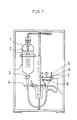
- FIG. 1 is a schematic figure of an apparatus for measuring the water absorption by the Larose method employed for evaluation in the present invention.
- a polyester fiber to be employed for the present invention is preferably a polyester containing mainly an ethylene terephthalate monomer unit and more preferably a polyethylene terephthalate.
- the polyester preferable are copolymers produced by copolymerization of 50 wt.% of more of terephthalic acid as an acid component and other than that, e.g. one or more of isophthalic acid, diphenylsulfone dicarboxylic acid, sodium 3,5-dicarboxydibenzenesulfonate and naphthalene dicarboxylic acid.
- polyester preferable glycol components composing the polyester by copolymerization are 70 wt.% or more of ethylene glycol and other than that, e.g. one or more of diethylene glycol, butanediol, cyclohexanedimethanol and neopentyl glycol.
- these polyester may be formed in a fiber solely or in a core-sheathed type or a side by side type conjugate of polyesters having at least 20°C difference in melting points or softening points. If necessary, the polyester fibers may contain e.g. a delustant, a pigment, an anti-bacterial agent and an aromatic agent.
- polyester fibers may have any cross-section shape, e.g. round, hollow and round, irregular, hollow and irregular shapes without any restriction.
- a nonwoven fabric of the present invention is composed of one or more types of the foregoing polyester fibers in 80 to 100 wt.% and fibers other than the polyesters in 0 to 20 wt.%.
- the fibers other than polyester examples are synthetic fibers such as polyethylene, polypropylene, nylon and acrylic fibers, and conjugate fibers such as polyethylene-polypropylene and polypropylene/polypropylene, and these fibers may be used solely or in combination of two or more of them.
- a polyester-polyether block copolymer component to be used for the present invention is firmly stuck especially to the polyester fibers and if the ratio of the polyester component is less than 80 wt.%, the primary hydrophilicity is high but the durability is deteriorated.
- a nonwoven fabric to be used in the present invention is produced by a conventionally well known spunbonding method or melt blowing method.
- the nonwoven fabric may be used while being made to be a composite by laminating a nonwoven fabric obtained using e.g. a carded web, an air-laid web, or wet spun web by a needle punching method, a stitch bonding method, a thermal bonding method, a resin bonding method or a water jet entangling method.
- terephthalic acid is mainly used, and other than that, an aromatic dicarboxylic acid, an aliphatic dicarboxylic acid, or an ester derivative of them may be used solely or as a mixture of 2 or more of them.
- aromatic dicarboxylic acids such as isophthalic acid, naphthalene dicarboxylic acid, diphenyldicarboxylic acid, diphenylsulfone dicarboxylic acid and sodium 3,5-dicarboxydibenzenesulfonate
- aliphatic dicarboxylic acids such as oxalic acid, adipic acid, sebacic acid, azelaic acid and hexahydroterephthalic acid
- dialkyl esters such as dimethyl esters and diethyl esters of these acids.
- glycol component of the polyester-polyether block copolymer usable ones are e.g. ethylene glycol, butane diol, pentane diol, hexane diol, cyclohexane dimethanol, neopentyl glycol, diethylene glycol and hydroquinone and they may be used solely or as a mixture of 2 or more of them.
- polyoxyalkylene glycols such as random or block copolymers of polyethylene glycol, polypropylene glycol, ethylene oxide and propylene oxide
- polyoxyalkylene glycols terminated with hydroxy groups in both end groups such as block copolymers obtained by addition polymerization of ethylene oxide to polytetramethylene glycol
- polyoxyalkylene glycol derivatives such as methoxypolyethylene glycol, phenoxypolyethylene glycol, sodium sulfophenoxypolyethylene glycol whose one terminals are terminated by ether bonding.
- These polyoxyalkylene glycol compounds may be used solely or as a mixture of 2 or more of them.
- the number average molecular weight of the foregoing polyoxyalkylene glycol compound is 500 or higher and preferably within a range from 800 to 5000. If the average molecular weight is less than 500, sufficient hydrophilicity cannot be obtained.
- the polyoxyalkylene glycol compound is copolymerized in 5 to 150 wt.%, preferably 40 to 130 wt.% ratio. If the ratio is less than 5 wt.%, the dispersibility in water is insufficient and consequently emulsification and dispersion is made difficult and no sufficient hydrophilicity is obtained. If the ratio is 150 wt.% or higher, the compatibility with the polyester fibers is lowered and hydrophilicity becomes too high to result in deterioration of the durability of the hydrophilicity.
- polyester-polyether block copolymer in 0.05 to 2.0 parts by weight, more preferably 0.1 to 1.0 parts by weight to 100 parts by weight of the fiber. If the ratio of the polyester-polyether block copolymer is less than 0.05 parts by weight, sufficient hydrophilicity and its durability cannot be obtained sufficiently and on the other hand, if the ratio is 2.0 parts by weight or more, the fiber surface becomes sticky and the processablity at the duration of nonwoven fabric production is worsened.
- the aqueous mixed dispersion to be supplied to the polyester fiber of the present invention contains an anionic surfactant and a cationic surfactant other than the polyester-polyether block copolymer and also a nonionic surfactant and/or an amphoteric surfactant.
- an anionic surfactant and a cationic surfactant are mixed, ion complexes are easily formed and precipitated.
- a prescribed amount of a nonionic surfactant and/or an amphoteric surfactant is added to at least one of the anionic surfactant and the cationic surfactant, both surfactants are stable in a low temperature region and do not form ion complexes.
- the polyester-polyether block copolymer When the polyester-polyether block copolymer is added to the foregoing aqueous mixed dispersion kept at 35°C or lower and supplied to a polyester fiber and then the polyester fiber is heated to 35°C or higher, the anionic surfactant and the cationic surfactant form ion complexes. Then, dispersion break (coagulation) takes place and simultaneously the polyester-polyether block copolymer is precipitated to be firmly fixed in the surface of the polyester fiber and a hydrophilic polyester fiber is thus obtained. Further, since the produced ion complexes are firmly fixed in both of the polyester fiber and the polyester-polyether block copolymer, the durability of the obtained hydrophilicity is extremely enhanced.
- Well-known surfactants can be used as the anionic surfactant, the cationic surfactant, the nonionic surfactant, and the amphoteric surfactant and one or more types of these surfactants may be used while being mixed.
- anionic surfactant examples are of carbonic acid salts, sulfonic acid salts, sulfuric acid ester salts and phosphoric acid ester salts. More particularly, they are higher aliphatic acid soaps, polyoxyethylene alkyl ether carboxylic acid salts, sodium alkylbenzenesulfonate, sodium oleic acid amide sulfonate, sodium dialkylsulfosuccinate, higher alcohol sulfuric acid ester salts, polyoxyethylene alkyl ether sulfuric acid salts, alkyl phosphoric acid salt and polyoxyethylene alkyl ether phosphoric acid salts,
- examples are aliphatic amine salts and quaternary ammonium salts, aromatic quaternary ammonium salts and heteroring quaternary ammonium salts and more particularly, they are aliphatic amines, aliphatic quaternary ammonium salts, alkylpyridinium salts , alkylisoquinolinium salts and benzethonium salts,
- nonionic surfactant examples are of ether type, ester type, ether ester type, and nitrogen-containing type. More particularly, they are polyoxyethylene alkyl ether, polyoxyethylene polyoxypropylene block copolymer, polyoxyethylene aliphatic acid ester, polyoxyethylene alkylphenyl ether, polyalcohol aliphatic acid ester, polyoxyethylene polyalcohol aliphatic acid ester and sucrose aliphatic acid ester.
- amphoteric surfactant examples are betaine type, aminocarboxylic acid salts and imidazoline derivatives.
- alkyldimethylbetaine alkyldiethylenetriamine acetic acid and alkylmethylaminocarboxylic acid salts
- the amounts of these surfactants to be used are properly set and in general, 5 to 200 wt.%, preferably 10 to 100 wt.%, respectively to the polyester-polyether block copolymer.
- a polyester-polyether block copolymer is mixed with at least one of aqueous dispersions containing an anionic surfactant and a cationic surfactant, respectively, to produce aqueous dispersions containing the polyester-polyether block copolymer. Further, a nonionic surfactant and/or an amphoteric surfactant is added to at least one of the aqueous dispersions and these 2 kinds of aqueous dispersions are mixed and stirred at 35°C or lower, preferably at 25°C or lower.
- an anti-bacterial agent may be added to the produced aqueous mixed dispersion.
- the produced aqueous mixed dispersion is supplied to the surface of the polyester fiber in the foregoing ratio.
- a variety of methods such as an immersion method, a spray method, a roller method, and the like may be employed for the application method.
- another surfactant may be supplied before the aqueous mixed dispersion is supplied.
- the polyester fiber bearing the aqueous mixed dispersion is then heated at 35°C or higher, more preferably 50°C or higher, and then dried to obtain the hydrophilic polyester fiber of the present invention.
- a fiber web containing 20 wt.% or higher, preferably 30 wt.% or higher, of the hydrophilic polyester fiber of the present invention is produced and fibers are entangled by a variety of method to obtain the hydrophilic nonwoven fabric. Further, the foregoing fiber web and a hydrophobic synthetic fiber web are laminated and fibers are entangled in the same manner to obtain a nonwoven fabric having hydrophilicity only in one side. If the content of the hydrophilic polyester fiber of the present invention is 20 wt.% or lower, sufficient hydrophilicity cannot be obtained and thus it is not preferable.
- a variety of fibers may be used as the fibers to be mixed with the hydrophilic polyester fiber. That is, natural fibers such as cotton, bleached cotton and silk regenerated cellulose fibers such as rayon and polynosic; and synthetic fibers such as polyester, polypropylene, nylon and acrylic fiber and one or more of these fibers are added in 0 to 80 wt.%. Generally, the natural fibers and the regenerated fibers have excellent hydrophilicity. By mixing the hydrophilic polyester fiber of the present invention with these fibers, properties, e.g. bulkiness, strength, evenly mixed property, processability can be improved without deteriorating the hydrophilicity.
- a variety of methods e.g. a needle punching method, a thermal bonding method, a water jet entangling method, a resin bonding method or a stitch bonding method are applicable for the entangling method of the foregoing fiber web.
- the water jet entangling method is most preferable from the viewpoint of the properties of the hydrophilic polyester fiber of the present invention and other than that, the needle punching method, the thermal bonding method, the stitch bonding method are preferable.
- the resin bonding method is less preferable since the resin to be used for entangling the fibers adheres to the surface of the fibers to result in deterioration of the hydrophilicity.
- the hydrophilic polyester type nonwoven fabric of the present invention can be obtained by applying the aqueous mixed dispersion kept at 35°C or lower, produced in the above described manner to a previously produced polyester type nonwoven fabric in the above described ratio.
- Application methods applicable are e.g. an immersion method, a suction method or a spraying method.
- Another surfactant may be supplied before the application of the aqueous mixed dispersion.
- the hydrophilic polyester type nonwoven fabric can be obtained by successively heating and drying the polyester type nonwoven fabric bearing the aqueous mixed dispersion at 35°C or higher, preferably at 50°C or higher.
- a nonwoven fabric of the present invention is suitable to be used for civil engineering use and for filters.
- a relatively bulky needle-punched nonwoven fabric with basis weight of 100 to 2000 g/m 2 is especially suitable. Owing to the above described hydrophilicity, the water discharging function and water-absorbing function are significantly improved, so that the nonwoven fabric is significantly desirable.
- the aqueous mixed dispersion to be employed for the present invention and in which the polyester-polyether block copolymer is to be precipitated works as a lubricant for the needle punching and lowers the friction between the fibers and needles, so that the break of the needles during the needle punching can be suppressed. Consequently, the nonwoven fabric of the present invention is especially suitable for the nonwoven fabric for civil engineering, for which needle punched fabrics easy to break the needles owing their high basis weight have widely been used.
- the fabric provides a low flow resistance of a fluid when being used as a liquid filter and enables filtration operation at a low energy and thus the nonwoven fabric is preferable.
- a liquid filter it is required for the fibers to be firmly stuck to one another since the fibers receive a rather high shearing force at the time when a liquid flows through the nonwoven fabric.
- an embossing process or a calendering treatment is carried out at 35°C or higher in order to stabilize the form by adhesion and especially for this use purpose, such process and treatment are practically essential.
- the nonwoven fabric of the present invention enables the thermal bonding process and the above described process and treatment to be simultaneously carried out without requiring another process for precipitating the polyester-polyether block copolymer from the aqueous mixed dispersion, energy for producing the nonwoven fabric is saved and the nonwoven fabric is thus desirable.
- the nonwoven fabric to be subjected to thermally bonding for filters is preferable to have basis weight in a range from 30 to 300 g/m 2 . If the basis weight is less than 30 g/m 2 , the filtration performance cannot be improved sufficiently even if the fiber diameter is made thin.
- the nonwoven fabric As filters, if the fiber diameter is made thinner than about 6 ⁇ m, it becomes generally hard for water to penetrate the small holes formed among fibers and therefore the filtration precision tends to be deteriorated owing to the narrowed effective filtration surface area.
- the hydrophilic nonwoven fabric of the present invention causes no such a problem since it has high hydrophilicity and is possible to provide a high filtration precision. In the case where a melt blown nonwoven fabric of fibers with a small fiber diameter is used as a liquid filter, such an effect is especially significant and thus the present invention is significantly effective.
- the hydrophilic polyester fiber and the hydrophilic nonwoven fabric of the present invention have excellent hydrophilicity and durability of the hydrophilicity without deteriorating the intrinsic and excellent characteristics of polyesters.
- the hydrophilic nonwoven fabric using such a hydrophilic polyester fiber are useful for remarkably various use purposes, e.g. a variety of sanitary materials such as paper diapers, top sheets and/or second sheets of sanitary napkins , wet wipes for wiping the buttocks, wet wipers for articles , wet tissues, kitchen paper, counter cloths, tray mats, drapes for surgery, clothes for surgery, a variety of filters such as coffee filter and the like, domestic products, food wrapping materials and drain materials civil engineering.
- An emulsified dispersion was previously produced by mixing (a) a polyester-polyether block copolymer produced by copolymerizing 100 parts by weight of an ester component composed of 80 wt.% of terephthalic acid and 20 wt.% of isophthalic acid as acid components and ethylene glycol as a glycol component and 70 parts by weight of an ether component of polyoxyethylene laurylphenyl ether (the number average molecular weight 1100); (b) potassium laurylphosphate; (c) sodium dioctylsulfosuccinate; and (d) polyoxyethylene alkyl ether.
- a polyester-polyether block copolymer produced by copolymerizing 100 parts by weight of an ester component composed of 80 wt.% of terephthalic acid and 20 wt.% of isophthalic acid as acid components and ethylene glycol as a glycol component and 70 parts by weight of an ether component of polyoxyethylene laurylphenyl
- an emulsified dispersion was produced by mixing (e) of a quaternary ammonium of a higher aliphatic acid amide and (f) of a polyoxyethylene alkylphenyl ether.
- Those two types of emulsified dispersions were cooled to 25°C or lower and then mixed to obtain an aqueous mixed dispersion.
- concentration of (a) was controlled to be 10 wt.% and the ratios of (b) to (f) to 100 parts by weight of (a) were (b) 20 parts by weight, (c) 20 parts by weight, (d) 20 parts by weight, (e) 30 parts by weight, and (f) 20 parts by weight.
- the aqueous mixed dispersion was kept at 25°C or lower until it was supplied to a polyester fiber.
- a cotton ball of about 8 to 9 cm diameter was produced from 1 g of a staple fiber fabrillated by a roller carding machine. Pure water was poured in a beaker of 500 ml and the cotton ball was put still on the surface of pure water and the time by seconds taken for the cotton ball to completely subside into water was measured. The primary hydrophilicity was measured by the staple fiber itself and the second hydrophilicity was measured by lightly squeezing and drying the staple fiber after the primary hydrophilicity measurement and then measuring the hydrophilicity again.
- hydrophilicity durability was measured using a staple fiber prepared by putting 2g of the staple fiber fabrillated by a roller carding machine and 200 ml of pure water together in a wide-opened bottle of 200 ml, shaking the bottle at 2 Hz for 30 minutes by a shaking apparatus, rinsing the fiber further with 200 ml of pure water, and then drying the fiber.
- a roughly fabrillated staple fiber was evaluated based on the following standards at the time of producing a web from the fiber by a roller carding machine (produced by Yamato Machinery Co., Ltd.) of 20 cm width.
- ⁇ There were 5 neps/g or less. Not less than 95% of the loaded amount of the fiber was formed into a web. Further, approximately even web was produced.
- ⁇ There were 5 to 20 neps/g. About 85 to 95% of the loaded amount of the fiber was formed into a web. Further, although uneven, a web could be produced.
- ⁇ There were 20 neps/g or more. Not more than 85% of the loaded amount of the fiber was formed into a web or no web could be produced since the fiber could not continuously be fed.
- Water absorption measurement was carried out using an apparatus for measuring the water absorption by the Larose method as illustrated in FIG. 1 (produced by Toyobo engineering Co., Ltd.). That is, the cock 3 positioned in the lower part of the water supply container 1 of the apparatus was opened to fill the water absorption measurement tube 4 up to the tip with pure water 2 at 20°C and at the same time to immerse the glass filter 8, which was positioned in the water supply testing part 5, up to the upper face with water and then the cock 3 was closed. Further, excess water was taken out by bringing filter paper into contact with the upper face of the glass filter 8 and at the same time the gauge indication of the water absorption measurement tube 4 was adjusted to be zero.
- a nonwoven fabric to be subjected to measurement was put on filter paper and water droplets of each 0.2 ml at 20°C were titrated from 1 cm height. Droplets were titrated one by one to 50 points and the ratio of the water droplets absorbed on the nonwoven fabric was measured.
- the thickness was measured by applying load of 3 g/cm 2 using a measurement plate with the diameter of 2 cm.
- Poly(ethylene terephthalate) containing 0.5 wt.% of titanium dioxide as a delustant agent and having an intrinsic viscosity of 0.610 (dl/g) was spun and elongated by an ordinary method to obtain a tow with single yarn denier of 1.7 dtex.
- the tow was curled and immersed in the foregoing aqueous mixed dispersion to apply the dispersion to the tow as to control the ratios as shown in Table 1 and then the resultant tow was heated for 5 minutes by a drier set at 130°C and finally cut to obtain hydrophilic polyester staples of 51 mm.
- Polyester staples were obtained in the same manner as Example 1 except that the aqueous mixed dispersion used was an emulsified dispersion containing only the surfactants of (b), (c), and (d).
- Polyester staples were obtained in the same manner as Example 1 except that the aqueous mixed dispersion used was an emulsified dispersion containing only the surfactants of (a) , (b), (c), and (d).
- the poly (ethylene terephthalate) used in Example 1 was used as a core component and a modified polyester produced by copolymerizing an ethylene terephthalate unit with isophthalic acid and diethylene glycol and having a softening point of 105°C was used as a sheathing component and a conjugate tow with single yarn denier of 2.2 dtex was obtained by spinning and elongating the conjugate by an ordinary spinning method.
- the tow was curled and coated with the foregoing aqueous mixed dispersion by a spraying method to apply the dispersion as to control the ratios as shown in Table 1.
- the resultant tow was then heated for 10 minutes by a drier set at 50°C. Finally, the tow was cut to obtain hydrophilic and thermally adhesive polyester staples of 51 mm.
- a web was produced from a mixture of 50% of the fiber used for Example 2 and 50% of viscose rayon of 1.7 dtex and a nonwoven fabric having characteristics as shown in Table 3 was produced by the water jet entangling method in the same manner as Example 1.
- a nonwoven fabric having characteristics as shown in Table 3 was produced by the water jet entangling method in the same manner as Example 9 except that the fiber used for Example 2 was replaced with the fiber of Comparative Example 3.
- a nonwoven fabric having characteristics as shown in Table 3 was produced by the water jet entangling method in the same manner as Example 9 except that 100% of viscose rayon of 1.7 dtex was used.
- the hydrophilic polyester fibers of the respective examples were found remarkably excellent in the durability of the hydrophilicity and card machine processability as compared with those of the comparative examples.
- Spunbonded nonwoven fabrics with basis weight of 130 g/m 2 produced from poly(ethylene terephthalate) filaments with single yarn denier of 3.5 dtex by entangling by a needle punching method were treated with the foregoing aqueous mixed dispersion by an immersion method. Roller pressing was carried out for the resultant nonwoven fabrics to squeeze the excess aqueous mixed dispersion as to control the adhesion ratios of the polyester-polyether block copolymer as shown in Table 4 and then the nonwoven fabrics were dried at 130°C to obtain the polyester nonwoven fabrics.
- a polyester nonwoven fabric having characteristics shown in Table 4 was obtained in the same manner as Example 1 except that the aqueous mixed dispersion used was an emulsified dispersion containing only the surfactants of (b) , (c), (d), (e), and (f). The ratios of the respective surfactants were controlled to be same as the foregoing aqueous mixed dispersion and the adhesion ratio to the nonwoven fabric was controlled to be 0.55 wt.%.
- a polyester nonwoven fabric having characteristics shown in Table 4 was obtained in the same manner as Example 1 except that the aqueous mixed dispersion used was an emulsified dispersion containing only the surfactants of (a) , (b), (c), and (d).
- a polyester nonwoven fabric having characteristics shown in Table 4 was produced by the same process as that of Example 1 from a spunbonded nonwoven fabric with basis weight of 50 g/m 2 , and embossed poly (ethylene terephthalate) with single yarn of the denier of 2.0 dtex.
- a polyester nonwoven fabric having characteristics shown in Table 4 was produced by the same process as that of Example 1 (except that drying was carried out by natural drying at a room temperature) from a nonwoven fabric with basis weight of 50 g/m 2 , which was produced by entangling carded webs composed of 85 wt.% of poly(ethylene terephthalate) fiber of 1.7 dtex and 44 mm and 15 wt.% of a core-sheath type polyester-based thermo-adhesive fiber of 2.2 dtex and 51 mm by a water jet entangling method.
- the nonwoven fabric used for Example 13 was subjected to the measurement as it was without being subjected to the process of the present invention.
- a polyester nonwoven fabric having characteristics shown in Table 4 was produced by the same process as that of Example 13 from a nonwoven fabric with basis weight of 50 g/m 2 , which was produced by entangling carded webs composed of 70 wt.% of poly (ethylene terephthalate) fiber of 1.7 dtex and 44 mm and 30 wt.% of a core-sheath type polyethylene-polypropylene thermo-adhesive fiber of 2.2 dtex and 51 mm by a water jet entangling method.
- a hydrophilic filament nonwoven fabric having characteristics shown in Table 4 was produced by the same process as that of Example 10 from a spunbonded nonwoven fabric of poly (ethylene terephthalate) with basis weight of 50 g/m 2 , which was embossed with fiber diameter of 14 ⁇ m.
Landscapes
- Engineering & Computer Science (AREA)
- Textile Engineering (AREA)
- Chemical & Material Sciences (AREA)
- Chemical Kinetics & Catalysis (AREA)
- Nonwoven Fabrics (AREA)
- Treatments For Attaching Organic Compounds To Fibrous Goods (AREA)
Applications Claiming Priority (4)
| Application Number | Priority Date | Filing Date | Title |
|---|---|---|---|
| JP2000130888 | 2000-04-28 | ||
| JP2000130887A JP2001303449A (ja) | 2000-04-28 | 2000-04-28 | 親水性ポリエステル系不織布の製造方法 |
| JP2000130888A JP3487424B2 (ja) | 2000-04-28 | 2000-04-28 | 親水性ポリエステル繊維、親水性不織布およびその製造方法 |
| JP2000130887 | 2000-04-28 |
Publications (1)
| Publication Number | Publication Date |
|---|---|
| EP1149944A1 true EP1149944A1 (fr) | 2001-10-31 |
Family
ID=26591241
Family Applications (1)
| Application Number | Title | Priority Date | Filing Date |
|---|---|---|---|
| EP20010110066 Withdrawn EP1149944A1 (fr) | 2000-04-28 | 2001-04-27 | Fibre hydrophile de polyester, matériau non tissé hydrophile obtenu à partir de celle-ci, et procédé pour leur fabrication |
Country Status (2)
| Country | Link |
|---|---|
| US (1) | US6720070B2 (fr) |
| EP (1) | EP1149944A1 (fr) |
Cited By (3)
| Publication number | Priority date | Publication date | Assignee | Title |
|---|---|---|---|---|
| EP1631710A4 (fr) * | 2003-05-20 | 2008-06-25 | Milliken & Co | Appret lubrifiant facilitant le lavage, pour fils textures, procedes utilisant cet appret et tissus produits a l'aide de ces procedes |
| EP3050613A4 (fr) * | 2013-09-25 | 2017-05-03 | Sumitomo Electric Industries, Ltd. | Membrane filtrante, unité de filtre, système de filtre et procédé de filtration |
| FR3102345A1 (fr) * | 2018-12-19 | 2021-04-30 | D.S.B. | Piece protectrice apte a absorber la transpiration, a reduire les odeurs de sueur et a limiter l’apparition d’aureoles |
Families Citing this family (30)
| Publication number | Priority date | Publication date | Assignee | Title |
|---|---|---|---|---|
| US20030157856A1 (en) * | 2002-01-14 | 2003-08-21 | Schroeder Gary L. | Moist wipe and method of making same |
| US8314285B2 (en) * | 2004-03-01 | 2012-11-20 | The Procter And Gamble Company | Pantiliner |
| JP3931203B2 (ja) * | 2004-04-07 | 2007-06-13 | 松本油脂製薬株式会社 | 繊維処理剤、これを用いたポリエステル短繊維及び不織布 |
| JP2006082428A (ja) * | 2004-09-16 | 2006-03-30 | Fuji Xerox Co Ltd | 液体吸収部材及びインクジェット記録装置 |
| WO2007108206A1 (fr) * | 2006-03-17 | 2007-09-27 | Matsumoto Yushi-Seiyaku Co., Ltd. | Agent destine au traitement de fibres et son application |
| US8758739B2 (en) * | 2006-05-03 | 2014-06-24 | L'oreal | Cosmetic compositions containing block copolymers, tackifiers and gelling agents |
| US8557230B2 (en) * | 2006-05-03 | 2013-10-15 | L'oreal | Cosmetic compositions containing block copolymers, tackifiers and shine enhancing agents |
| US8673283B2 (en) * | 2006-05-03 | 2014-03-18 | L'oreal | Cosmetic compositions containing block copolymers, tackifiers and a solvent mixture |
| US8673284B2 (en) * | 2006-05-03 | 2014-03-18 | L'oreal | Cosmetic compositions containing block copolymers, tackifiers and a selective solvent for hard blocks |
| US8673282B2 (en) * | 2006-05-03 | 2014-03-18 | L'oreal | Cosmetic compositions containing block copolymers, tackifiers and a selective solvent for soft blocks |
| US8778323B2 (en) * | 2006-05-03 | 2014-07-15 | L'oréal | Cosmetic compositions containing block copolymers, tackifiers and modified silicones |
| US20070270071A1 (en) * | 2006-05-18 | 2007-11-22 | Greer J Travis | Nonwoven fabric towel |
| CN101535408B (zh) | 2006-11-09 | 2012-06-20 | 巴斯夫欧洲公司 | 多元醇分散体的制备方法 |
| US8658141B2 (en) * | 2007-01-12 | 2014-02-25 | L'oreal | Cosmetic composition containing a block copolymer, a tackifier, a silsesquioxane wax and/or resin |
| US8603444B2 (en) * | 2007-01-12 | 2013-12-10 | L'oréal | Cosmetic compositions containing a block copolymer, a tackifier and a high viscosity ester |
| US20080171008A1 (en) * | 2007-01-17 | 2008-07-17 | L'oreal S.A. | Composition containing a polyorganosiloxane polymer, a tackifier, a wax and a block copolymer |
| US20080206517A1 (en) * | 2007-02-26 | 2008-08-28 | Bright Technologies Corp. Inc. | Fabric articles and methods of making such articles |
| US7976944B2 (en) * | 2009-01-02 | 2011-07-12 | The Hong Kong Polytechnic University | Temperature-regulating fiber and a method of making the same |
| US20110033622A1 (en) * | 2009-08-06 | 2011-02-10 | Honeywell International Inc. | Nonwoven preforms made with increased areal weight fabric segments for aircraft friction materials |
| US20110111123A1 (en) * | 2009-11-12 | 2011-05-12 | Honeywell International Inc. | Increased area weight segments with pitch densification to produce lower cost and higher density aircraft friction materials |
| US20110197338A1 (en) * | 2010-02-16 | 2011-08-18 | Patricia Coyne | Glove for drying hair (EHO 09204) |
| US20120219516A1 (en) | 2011-02-25 | 2012-08-30 | L'oreal S.A. | Cosmetic compositions having long lasting shine |
| CA2788283C (fr) | 2011-09-01 | 2019-11-26 | 2266170 Ontario Inc. | Capsule de contenant de boisson |
| CA2833096C (fr) | 2012-11-12 | 2016-05-31 | 2266170 Ontario Inc. | Capsule pour boisson et procede et systeme pour sa fabrication |
| CA2905217C (fr) | 2013-04-03 | 2016-11-08 | 2266170 Ontario Inc. | Machine a dosettes et composants |
| WO2014186897A1 (fr) | 2013-05-23 | 2014-11-27 | 2266170 Ontario Inc. | Logement de capsule |
| US10611507B2 (en) | 2013-08-20 | 2020-04-07 | 2266170 Ontario Inc. | Capsule with control member |
| US10314319B2 (en) * | 2013-11-20 | 2019-06-11 | 2266170 Ontario Inc. | Method and apparatus for accelerated or controlled degassing of roasted coffee |
| WO2015139140A1 (fr) | 2014-03-21 | 2015-09-24 | 2266170 Ontario Inc. | Capsule avec chambre de trempage |
| TW201802179A (zh) * | 2016-03-15 | 2018-01-16 | 東亞合成股份有限公司 | 聚酯系樹脂組成物 |
Citations (5)
| Publication number | Priority date | Publication date | Assignee | Title |
|---|---|---|---|---|
| GB1088984A (en) * | 1963-06-05 | 1967-10-25 | Ici Ltd | Modifying treatment of shaped articles derived from polyesters |
| JPS61108768A (ja) * | 1984-10-26 | 1986-05-27 | 竹本油脂株式会社 | ポリエステル系合成繊維用処理剤 |
| EP0209775A1 (fr) * | 1985-07-19 | 1987-01-28 | Kao Corporation | Article absorbant |
| JPS63227874A (ja) * | 1987-03-12 | 1988-09-22 | 日本エステル株式会社 | ポリエステル繊維の処理方法 |
| JPH073637A (ja) * | 1993-06-11 | 1995-01-06 | Nippon Petrochem Co Ltd | 繊維または繊維製品の加工方法 |
Family Cites Families (7)
| Publication number | Priority date | Publication date | Assignee | Title |
|---|---|---|---|---|
| JPS5346960B2 (fr) * | 1974-08-21 | 1978-12-18 | ||
| JPS57386A (en) | 1980-06-03 | 1982-01-05 | Jiyuken Kogyo:Kk | Super-low frequency noise preventer |
| JPS5947476A (ja) | 1982-09-08 | 1984-03-17 | ユニチカ株式会社 | ポリエステル系繊維の改質方法 |
| JPS59211676A (ja) | 1983-05-09 | 1984-11-30 | 東洋紡績株式会社 | 制電性繊維 |
| JPS6312897A (ja) | 1986-06-30 | 1988-01-20 | Anretsuto:Kk | 真空用ル−ツブロワ−のオイルレス軸封機構 |
| US5262460A (en) * | 1988-08-04 | 1993-11-16 | Teijin Limited | Aromatic polyester resin composition and fiber |
| JP3746128B2 (ja) * | 1997-01-14 | 2006-02-15 | 竹本油脂株式会社 | 合成繊維用潤滑剤及び合成繊維の潤滑方法 |
-
2001
- 2001-04-27 EP EP20010110066 patent/EP1149944A1/fr not_active Withdrawn
- 2001-04-27 US US09/844,660 patent/US6720070B2/en not_active Expired - Lifetime
Patent Citations (5)
| Publication number | Priority date | Publication date | Assignee | Title |
|---|---|---|---|---|
| GB1088984A (en) * | 1963-06-05 | 1967-10-25 | Ici Ltd | Modifying treatment of shaped articles derived from polyesters |
| JPS61108768A (ja) * | 1984-10-26 | 1986-05-27 | 竹本油脂株式会社 | ポリエステル系合成繊維用処理剤 |
| EP0209775A1 (fr) * | 1985-07-19 | 1987-01-28 | Kao Corporation | Article absorbant |
| JPS63227874A (ja) * | 1987-03-12 | 1988-09-22 | 日本エステル株式会社 | ポリエステル繊維の処理方法 |
| JPH073637A (ja) * | 1993-06-11 | 1995-01-06 | Nippon Petrochem Co Ltd | 繊維または繊維製品の加工方法 |
Non-Patent Citations (3)
| Title |
|---|
| DATABASE WPI Section Ch Week 198628, Derwent World Patents Index; Class A23, AN 1986-178240, XP002173706 * |
| DATABASE WPI Section Ch Week 198844, Derwent World Patents Index; Class A23, AN 1988-310952, XP002173705 * |
| DATABASE WPI Section Ch Week 199511, Derwent World Patents Index; Class E17, AN 1995-078553, XP002159109 * |
Cited By (3)
| Publication number | Priority date | Publication date | Assignee | Title |
|---|---|---|---|---|
| EP1631710A4 (fr) * | 2003-05-20 | 2008-06-25 | Milliken & Co | Appret lubrifiant facilitant le lavage, pour fils textures, procedes utilisant cet appret et tissus produits a l'aide de ces procedes |
| EP3050613A4 (fr) * | 2013-09-25 | 2017-05-03 | Sumitomo Electric Industries, Ltd. | Membrane filtrante, unité de filtre, système de filtre et procédé de filtration |
| FR3102345A1 (fr) * | 2018-12-19 | 2021-04-30 | D.S.B. | Piece protectrice apte a absorber la transpiration, a reduire les odeurs de sueur et a limiter l’apparition d’aureoles |
Also Published As
| Publication number | Publication date |
|---|---|
| US20020031968A1 (en) | 2002-03-14 |
| US6720070B2 (en) | 2004-04-13 |
Similar Documents
| Publication | Publication Date | Title |
|---|---|---|
| US6720070B2 (en) | Hydrophilic polyester fiber and hydrophilic nonwoven fabric using the same and their production | |
| EP0933459B1 (fr) | Tissu non-tissé à base de fibres discontinues et procédé de fabrication | |
| JP4614606B2 (ja) | 熔融紡糸ポリエステル不織布シート | |
| US5573719A (en) | Process of making highly absorbent nonwoven fabric | |
| EP2761070B1 (fr) | Tissu non tissé touffeté de polyester et son procédé de fabrication | |
| JP2001159078A (ja) | 親水性繊維及び不織布、それらを用いた不織布加工品 | |
| EP0864006A2 (fr) | Voile en non-tisse a microfibres extra-fines | |
| JP2001519856A (ja) | 微細デニール繊維及び該繊維から製造された布 | |
| JP2911068B2 (ja) | 複合繊維および不織布 | |
| JP2909164B2 (ja) | 吸水性能の優れた複合繊維および不織布 | |
| JP3487424B2 (ja) | 親水性ポリエステル繊維、親水性不織布およびその製造方法 | |
| JPH01260051A (ja) | 繊維ウェブ | |
| US6214463B1 (en) | Hydrophilic fibers and cloth-like articles and filters made by using the same | |
| JP2813445B2 (ja) | 吸水性能の優れた不織布 | |
| JP2002235285A (ja) | 耐久親水化された長繊維不織布 | |
| JPH108380A (ja) | 親水性繊維及び布状物 | |
| JP3172582B2 (ja) | 吸水性能の優れた不織布 | |
| JPH07109659A (ja) | 生分解性積層不織構造体 | |
| JP2001303449A (ja) | 親水性ポリエステル系不織布の製造方法 | |
| JP2000248452A (ja) | 抗菌性不織布 | |
| JPH05321108A (ja) | 吸水性能の優れた不織布 | |
| JPH11247059A (ja) | 不織布およびその製造方法 | |
| JPH06245952A (ja) | 体液吸収用物品 | |
| JP2000073267A (ja) | 複合不織布およびその製造方法 | |
| JPH07119010A (ja) | 生分解性積層不織構造体 |
Legal Events
| Date | Code | Title | Description |
|---|---|---|---|
| PUAI | Public reference made under article 153(3) epc to a published international application that has entered the european phase |
Free format text: ORIGINAL CODE: 0009012 |
|
| AK | Designated contracting states |
Kind code of ref document: A1 Designated state(s): DE FR GB Kind code of ref document: A1 Designated state(s): AT BE CH CY DE DK ES FI FR GB GR IE IT LI LU MC NL PT SE TR |
|
| AX | Request for extension of the european patent |
Free format text: AL;LT;LV;MK;RO;SI |
|
| 17P | Request for examination filed |
Effective date: 20020312 |
|
| AKX | Designation fees paid |
Free format text: DE FR GB |
|
| 17Q | First examination report despatched |
Effective date: 20060609 |
|
| GRAP | Despatch of communication of intention to grant a patent |
Free format text: ORIGINAL CODE: EPIDOSNIGR1 |
|
| STAA | Information on the status of an ep patent application or granted ep patent |
Free format text: STATUS: THE APPLICATION IS DEEMED TO BE WITHDRAWN |
|
| 18D | Application deemed to be withdrawn |
Effective date: 20080722 |