EP1176003A1 - Etikett für in-der-Form-Dekorierung und in der Form dekorierte Kunststoffgegenstände - Google Patents
Etikett für in-der-Form-Dekorierung und in der Form dekorierte Kunststoffgegenstände Download PDFInfo
- Publication number
- EP1176003A1 EP1176003A1 EP20010117646 EP01117646A EP1176003A1 EP 1176003 A1 EP1176003 A1 EP 1176003A1 EP 20010117646 EP20010117646 EP 20010117646 EP 01117646 A EP01117646 A EP 01117646A EP 1176003 A1 EP1176003 A1 EP 1176003A1
- Authority
- EP
- European Patent Office
- Prior art keywords
- label
- label according
- resin
- iii
- weight
- Prior art date
- Legal status (The legal status is an assumption and is not a legal conclusion. Google has not performed a legal analysis and makes no representation as to the accuracy of the status listed.)
- Granted
Links
Images
Classifications
-
- G—PHYSICS
- G09—EDUCATION; CRYPTOGRAPHY; DISPLAY; ADVERTISING; SEALS
- G09F—DISPLAYING; ADVERTISING; SIGNS; LABELS OR NAME-PLATES; SEALS
- G09F3/00—Labels, tag tickets, or similar identification or indication means; Seals; Postage or like stamps
- G09F3/02—Forms or constructions
-
- B—PERFORMING OPERATIONS; TRANSPORTING
- B32—LAYERED PRODUCTS
- B32B—LAYERED PRODUCTS, i.e. PRODUCTS BUILT-UP OF STRATA OF FLAT OR NON-FLAT, e.g. CELLULAR OR HONEYCOMB, FORM
- B32B27/00—Layered products comprising a layer of synthetic resin
- B32B27/32—Layered products comprising a layer of synthetic resin comprising polyolefins
-
- B—PERFORMING OPERATIONS; TRANSPORTING
- B32—LAYERED PRODUCTS
- B32B—LAYERED PRODUCTS, i.e. PRODUCTS BUILT-UP OF STRATA OF FLAT OR NON-FLAT, e.g. CELLULAR OR HONEYCOMB, FORM
- B32B27/00—Layered products comprising a layer of synthetic resin
- B32B27/18—Layered products comprising a layer of synthetic resin characterised by the use of special additives
-
- G—PHYSICS
- G09—EDUCATION; CRYPTOGRAPHY; DISPLAY; ADVERTISING; SEALS
- G09F—DISPLAYING; ADVERTISING; SIGNS; LABELS OR NAME-PLATES; SEALS
- G09F3/00—Labels, tag tickets, or similar identification or indication means; Seals; Postage or like stamps
- G09F3/04—Labels, tag tickets, or similar identification or indication means; Seals; Postage or like stamps to be fastened or secured by the material of the label itself, e.g. by thermo-adhesion
-
- Y—GENERAL TAGGING OF NEW TECHNOLOGICAL DEVELOPMENTS; GENERAL TAGGING OF CROSS-SECTIONAL TECHNOLOGIES SPANNING OVER SEVERAL SECTIONS OF THE IPC; TECHNICAL SUBJECTS COVERED BY FORMER USPC CROSS-REFERENCE ART COLLECTIONS [XRACs] AND DIGESTS
- Y10—TECHNICAL SUBJECTS COVERED BY FORMER USPC
- Y10S—TECHNICAL SUBJECTS COVERED BY FORMER USPC CROSS-REFERENCE ART COLLECTIONS [XRACs] AND DIGESTS
- Y10S428/00—Stock material or miscellaneous articles
- Y10S428/922—Static electricity metal bleed-off metallic stock
-
- Y—GENERAL TAGGING OF NEW TECHNOLOGICAL DEVELOPMENTS; GENERAL TAGGING OF CROSS-SECTIONAL TECHNOLOGIES SPANNING OVER SEVERAL SECTIONS OF THE IPC; TECHNICAL SUBJECTS COVERED BY FORMER USPC CROSS-REFERENCE ART COLLECTIONS [XRACs] AND DIGESTS
- Y10—TECHNICAL SUBJECTS COVERED BY FORMER USPC
- Y10T—TECHNICAL SUBJECTS COVERED BY FORMER US CLASSIFICATION
- Y10T428/00—Stock material or miscellaneous articles
- Y10T428/14—Layer or component removable to expose adhesive
- Y10T428/1462—Polymer derived from material having at least one acrylic or alkacrylic group or the nitrile or amide derivative thereof [e.g., acrylamide, acrylate ester, etc.]
-
- Y—GENERAL TAGGING OF NEW TECHNOLOGICAL DEVELOPMENTS; GENERAL TAGGING OF CROSS-SECTIONAL TECHNOLOGIES SPANNING OVER SEVERAL SECTIONS OF THE IPC; TECHNICAL SUBJECTS COVERED BY FORMER USPC CROSS-REFERENCE ART COLLECTIONS [XRACs] AND DIGESTS
- Y10—TECHNICAL SUBJECTS COVERED BY FORMER USPC
- Y10T—TECHNICAL SUBJECTS COVERED BY FORMER US CLASSIFICATION
- Y10T428/00—Stock material or miscellaneous articles
- Y10T428/28—Web or sheet containing structurally defined element or component and having an adhesive outermost layer
- Y10T428/2813—Heat or solvent activated or sealable
- Y10T428/2817—Heat sealable
- Y10T428/2826—Synthetic resin or polymer
-
- Y—GENERAL TAGGING OF NEW TECHNOLOGICAL DEVELOPMENTS; GENERAL TAGGING OF CROSS-SECTIONAL TECHNOLOGIES SPANNING OVER SEVERAL SECTIONS OF THE IPC; TECHNICAL SUBJECTS COVERED BY FORMER USPC CROSS-REFERENCE ART COLLECTIONS [XRACs] AND DIGESTS
- Y10—TECHNICAL SUBJECTS COVERED BY FORMER USPC
- Y10T—TECHNICAL SUBJECTS COVERED BY FORMER US CLASSIFICATION
- Y10T428/00—Stock material or miscellaneous articles
- Y10T428/28—Web or sheet containing structurally defined element or component and having an adhesive outermost layer
- Y10T428/2848—Three or more layers
-
- Y—GENERAL TAGGING OF NEW TECHNOLOGICAL DEVELOPMENTS; GENERAL TAGGING OF CROSS-SECTIONAL TECHNOLOGIES SPANNING OVER SEVERAL SECTIONS OF THE IPC; TECHNICAL SUBJECTS COVERED BY FORMER USPC CROSS-REFERENCE ART COLLECTIONS [XRACs] AND DIGESTS
- Y10—TECHNICAL SUBJECTS COVERED BY FORMER USPC
- Y10T—TECHNICAL SUBJECTS COVERED BY FORMER US CLASSIFICATION
- Y10T428/00—Stock material or miscellaneous articles
- Y10T428/31504—Composite [nonstructural laminate]
- Y10T428/31855—Of addition polymer from unsaturated monomers
- Y10T428/31909—Next to second addition polymer from unsaturated monomers
-
- Y—GENERAL TAGGING OF NEW TECHNOLOGICAL DEVELOPMENTS; GENERAL TAGGING OF CROSS-SECTIONAL TECHNOLOGIES SPANNING OVER SEVERAL SECTIONS OF THE IPC; TECHNICAL SUBJECTS COVERED BY FORMER USPC CROSS-REFERENCE ART COLLECTIONS [XRACs] AND DIGESTS
- Y10—TECHNICAL SUBJECTS COVERED BY FORMER USPC
- Y10T—TECHNICAL SUBJECTS COVERED BY FORMER US CLASSIFICATION
- Y10T428/00—Stock material or miscellaneous articles
- Y10T428/31504—Composite [nonstructural laminate]
- Y10T428/31855—Of addition polymer from unsaturated monomers
- Y10T428/31909—Next to second addition polymer from unsaturated monomers
- Y10T428/31913—Monoolefin polymer
- Y10T428/31917—Next to polyene polymer
Definitions
- This invention relates to a label for in-mold decorating, which is inserted into a mold in contact with the cavity wall to manufacture labeled containers.
- Preferable molding methods for in-mold decorating include blow molding of a thermoplastic resin hot parison, injection molding of a molten thermoplastic resin, and vacuum forming or pressure forming of a heat-softened thermoplastic resin sheet.
- the present invention also relates to a labeled resin molded article.
- In-mold decorating for producing a labeled container is carried out by inserting a label into a mold and molding a resin in the mold and forming into a container by injection molding, blow molding, differential pressure forming, foaming, and the like (see, e.g., JP-A-58-69015 and EP 254923).
- Known labels for use in in-mold decorating include gravure-printed resin films, multicolor offset-printed synthetic paper (see, e.g., JP-B-2-7814 and JP-A-2-84319), and aluminum labels composed of aluminum foil laminated with a high pressure processed low density polyethylene or an ethylene-vinyl acetate copolymer and having the aluminum foil gravure-printed.
- Labels having insufficient antistatic properties are also accompanied by feeding difficulties in printing, particularly offset printing, which requires frequently suspending and resuming of the printing machine.
- labels for in-mold decorating having a migrating low-molecular antistatic agent, such as sorbitan monooleate or glycerol monostearate, incorporated into the heat-sealable resin layer thereof typically comprising a polyethylene resin; and (2) labels for in-mold decorating having on the heat-sealable polyethylene resin layer thereof an antistatic coat of a low-molecular antistatic agent, such as a polyoxyethylene derivative, applied and dried.
- a migrating low-molecular antistatic agent such as sorbitan monooleate or glycerol monostearate
- the antistatic properties of both the proposed labels (1) and (2) have only a short duration, however.
- the labels (1) have the disadvantage that the antistatic agent in the heat-sealable resin layer migrates to the surface and thus considerably impairs the fusion bonding properties, resulting in generation of rejects, such as non-labeled containers and labeled containers of which the label has blisters.
- one object of the present invention is to provide a label for in-mold decorating, which does not produce the above-mentioned resin-like stain.
- Another object of the present invention is to provide a label for in-mold decorating which, does not contaminate the rolls in a label production line.
- Another object of the present invention is to provide a label for in-mold decorating, which is free from inconveniences caused by insufficient antistatic properties in printing, cutting, blanking, and inserting into a mold irrespective of the working environment.
- Another object of the present invention is to provide a label for in-mold decorating, which exhibits high adhesive strength.
- Another object of the present invention is to provide a label for in-mold decorating, which exhibits high adhesive strength to containers.
- the first embodiment of which provides a label for in-mold decorating, which includes:
- Another embodiment of the invention provides a labeled, resin molded article, which includes the above-mentioned label integrally adhered thereto by thermal fusion bonding.
- Another embodiment of the invention provides a labeled, resin molded article, which includes the above-mentioned label.
- Another embodiment of the invention provides a method for labeling, which includes placing the above-mentioned label into a mold, placing a moldable resin in the mold in contact with the label, and molding or forming the moldable resin into an article that includes the label.
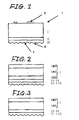
- Fig. 1 is a cross-section of a label for in-mold decorating according to an embodiment of the present invention.
- Fig. 2 is a cross-section of a label for in-mold decorating according to another embodiment of the present invention.
- Fig. 3 is a cross-section of a label for in-mold decorating according to still another embodiment of the present invention.
- Fig. 1 is a cross-section of a label 1 for in-mold decoration according to an embodiment of the present invention.
- the label 1 shown is composed of a thermoplastic resin film base layer (I) having a printed layer 2, an interlayer (II), and a heat-sealable resin layer (III), the heat-sealable resin layer (III) having been embossed to prevent the label from blistering.
- the embossed pattern has a top portion 6 and a bottom portion 7.
- Fig. 2 is a cross-section of a label for in-mold decoration according to another embodiment of the present invention.
- the thermoplastic resin film base layer (I) is composed of (B) a surface layer, (A) a core layer, and (C) a back layer, and the heat-sealable resin layer (III) has been embossed.
- the label further includes an interlayer (II) between the back layer (C) and the heat-sealable resin layer (III).
- Fig. 3 is a schematic cross-section of a label for in-mold decoration according to still another embodiment of the present invention.
- the thermoplastic resin film base layer (I) is composed of (B) a surface layer and (A) a core layer, and the heat-sealable resin layer (III) has been embossed.
- the label further includes an interlayer (II) between the core layer (A) and the heat-sealable resin layer (III).
- the label of the present invention is a multilayer film including: (I) a thermoplastic resin film base layer; (II) an interlayer, and (III) a heat-sealable resin layer; wherein the interlayer (II) contains (a) thermoplastic resin composition and (b) an antistatic agent.
- the heat-sealable resin layer (III) preferably has its surface embossed.
- the antistatic agent present in the interlayer (II) preferably comprises, as a main component, a polyamide copolymer, particularly a polyether ester amide.
- thermoplastic resin composition of the interlayer (II) preferably contains (a) 50 to 95% by weight of a thermoplastic resin, (b) 5 to 35% by weight of a polyether ester amide, and (c) 0 to 10% by weight of a polyamide resin, in which component (a) is preferably a polyolefin resin.
- thermoplastic resin expressly includes 55, 60, 65, 70, 75, 80 and 85% by weight.
- polyether ester amide expressly includes 10, 15, 20, 25 and 30% by weight.
- polyamide resin expressly includes 1, 2, 3, 4, 5, 6, 7, 8, and 9% by weight.
- thermoplastic resin composition prefferably further include (d) 0.01 to 5% by weight of a metal salt and/or (e) 0.5 to 10% by weight of an ionomer and/or (f) 1 to 20% by weight of modified low-molecular polyethylene.
- the above range for the metal salt expressly includes 0.05, 0.1, 0.5, 1.0, 1.1, 1.5, 2, 3, 4 and 4.5%.
- the above range for the ionomer expressly includes 0.75, 1.0, 1.5, 2, 3, 4, 5, 6, 7, 8 and 9% by weight.
- the above range for the modified low-molecular polyethylene expressly includes 1.1, 2, 5, 7, 10, 12, 15, 16, 17, 18 and 19% by weight.
- the heat-sealable resin layer (III) preferably includes a polyethylene resin having a crystallinity of 10 to 60%, a number average molecular weight of 10,000 to 40,000, and a melting point of 50 to 130°C.
- the above range for the polyethylene resin crystallinity expressly includes 12, 15, 20, 25, 30, 35, 40, 45, 50, and 55% by weight.
- the above range for the number average molecular weight expressly includes 12,000, 15,000, 17,000, 20,000, 25,000, 30,000 and 35,000.
- the above range for the melting point expressly includes 55, 60, 65, 75, 85, 95, 100, 105, 110, 115, 120 and 125°C.
- the interlayer (II) and the heat-sealable resin layer (III) each preferably have a thickness of 0.5 to 20 ⁇ m. This range expressly includes 0.75, 1.0, 1.1, 2, 5, 7, 10, 12, 15, 17 and 19 ⁇ m.
- the label preferably has a surface resistivity of 1 x 10 9 to 1 x 10 14 ⁇ /square on its heat-sealable resin layer (III) side. This range expressly includes 1 x 10 10 , 1 x 10 11 , 1 x 10 12, and 1 x 10 13 .
- the label (multilayer film) preferably contains at least one of an inorganic fine powder and an organic filler. Mixtures are possible.
- the base layer (I) is a stretched porous resin film containing at least one of an inorganic fine powder and an organic filler. Mixtures are possible.
- the invention also includes a labeled resin molded article having the above-described label integrally adhered thereto by thermal fusion bonding.
- the thermoplastic resin making the base layer (I) includes polyolefin resins, such as propylene resins, high density polyethylene, medium density polyethylene, poly(4-methylpentene-1), and an ethylene-cyclic olefin copolymer; polyamide resins, such as nylon-6, nylon-6,6, nylon-6,10, and nylon-6,12; polyethylene terephthalate resins, polyvinyl chloride resins, ABS resins, and ionomer resins.
- Preferred of these thermoplastic resins are those having a melting point of 130 to 280°C. This range expressly includes 140, 150, 180, 200, 220, 240 and 260°C. These resins can be used either individually or as a mixture of two or more thereof.
- the main resin In using a mixed resin, it is preferred for the main resin to have a melting point higher than the heat-sealable resin making the heat-sealable resin layer (III) by 15°C or more. This range expressly includes 20, 25, 30, 35, 40, 45 and 50°C or more.
- Propylene resins are particularly preferred for their chemical resistance and inexpensiveness.
- Specific examples of useful propylene resins are propylene homopolymers having isotactic or syndiotactic stereospecificity and copolymers including propylene as a main component and, as a secondary component, an ⁇ -olefin, e.g., ethylene, butene-1, hexene-1, heptene-1 or 4-methylpentene-1.
- the propylene copolymers may be either random copolymers or block copolymers.
- Films made of a composition including the thermoplastic resin and at least one of an inorganic fine powder and an organic filler, uniaxially or biaxially stretched films made of the composition, films of the thermoplastic resin which are coated with a latex containing an inorganic filler, and films of the thermoplastic resin having an aluminum layer deposited thereon or bonded thereto are suitably used as a base layer (I).
- the inorganic fine powder and the organic filler which can be added to the thermoplastic resin film base layer (I) are not particularly limited.
- useful inorganic fine powder include fine powder of heavy calcium carbonate, light precipitated calcium carbonate, calcined clay, talc, barium sulfate, diatomaceous earth, magnesium oxide, zinc oxide, titanium oxide, and silicon oxide. Mixtures are possible. Preferred of them are heavy calcium carbonate, calcined clay and talc for inexpensiveness and satisfactory moldability.
- organic fillers examples include polyethylene terephthalate, polybutylene terephthalate, polyamide, polycarbonate, polyethylene naphthalate, polystyrene, melamine resins, polyethylene sulfite, polyimide, polyethyl ether ketone, polyphenylene sulfite, poly(4-methylpentene-1), polymethyl methacrylate, a cyclic olefin homopolymer, and a cyclic olefin-ethylene copolymer. Mixtures are possible.
- These organic fillers preferably have a melting point of 120 to 300°C or a glass transition point of 120 to 280°C. The range for the melting point expressly includes 130, 150, 175, 200, 225, 250 and 275°C; and the range for the glass transition point expressly includes 140, 150, 170, 200, 220, 240, 260 and 270°C.
- the thermoplastic resin film base layer (I) has a single layer structure, a double layer structure composed of (A) a core layer and (B) a surface layer, a three-layer structure composed of (A) a core layer, (B) a surface layer and (C) a back layer, or a multilayer structure having an additional resin film layer between the surface layer (B) and the core layer (A) and/or between the core layer (A) and the back layer (C).
- the base layer (I) may be either a non-stretched film or a uniaxially or biaxially stretched film.
- the stretching directionality of each layer constituting a stretched three-layered film may be uniaxial/uniaxial/uniaxial, uniaxial/uniaxial/biaxial, uniaxial/biaxial/uniaxial, biaxial/uniaxial/uniaxial, uniaxial/biaxial/biaxial, biaxial/biaxial/uniaxial or biaxial/biaxial/biaxial.
- a stretched multilayer film composed of four or more layers can have arbitrarily combined stretching directions.
- the base layer (I) preferably includes (i) a three-layer laminate film composed of (A) a biaxially stretched film core layer of a resin composition including 5 to 30% by weight of inorganic fine powder, 0 to 20% by weight of high density polyethylene, and 50 to 95% by weight of a propylene resin, (B) a uniaxially stretched film surface layer of a resin composition including 15 to 65% by weight of inorganic fine powder, 0 to 10% by weight of high density polyethylene, and 25 to 85% by weight of a propylene resin, which is provided on one side of the core layer (A), and (C) a uniaxially stretched film back layer of a resin composition including 15 to 65% by weight of inorganic fine powder, 0 to 10% by weight of high density polyethylene and 25 to 85% by weight of a propylene resin, which is provided on the other side of the core layer (A) (see Fig.
- a double layer laminate film composed of (A) a uniaxially stretched film core layer of a resin composition including 5 to 45% by weight of inorganic fine powder, 0 to 20% by weight of high density polyethylene and 35 to 95% by weight of a propylene resin and (B) a uniaxially stretched film surface layer of a resin composition including 15 to 65% by weight of inorganic fine powder, 0 to 10% by weight of high density polyethylene and 25 to 85% by weight of a propylene resin, which is provided on one side of the core layer (A) (see Fig. 3).
- the base layer (I) preferably includes (iii) a laminate film composed of (A) a biaxially stretched film core layer of a resin composition including 0 to 5% by weight of inorganic fine powder, 0 to 20% by weight of a high density polyethylene and 75 to 100% by weight of a propylene resin, (B) a uniaxially stretched film surface layer of a resin composition including 0 to 30% by weight of inorganic fine powder, 0 to 10% by weight of high density polyethylene and 60 to 100% by weight of a propylene resin, which is provided on one side of the core layer (A) and (C) a uniaxially stretched film back layer of a resin composition including 0 to 30% by weight of inorganic fine powder, 0 to 10% by weight of high density polyethylene and 60 to 100% by weight of a propylene resin, which is provided on the other side ofthe core layer (A) (see Fig.
- a laminate film composed of (A) a uniaxially stretched film core layer of a resin composition including 0 to 5% by weight of inorganic fine powder, 0 to 20% by weight of a high density polyethylene and 75 to 100% by weight of a propylene resin and (B) a uniaxially stretched film surface layer of a resin composition including 0 to 30% by weight of inorganic fine powder, 0 to 10% by weight of high density polyethylene and 60 to 100% by weight of a propylene resin, which is provided on one side of the core layer (A) (see Fig. 3).
- the printed layer can be provided on the surface or the back of the surface layer (B), the surface or the back of the core layer (A) or the surface or the back of the back layer (C).
- the interlayer (II) and the heat-sealable layer (III) are provided on the back layer (C) side in the case of Fig. 2 or on the core layer (A) side in the case of Fig. 3.
- the base layer (I) preferably has a density of 0.65 to 1.10 g/cm 3 , particularly 0.70 to 1.00g/cm 3 , especially 0.74 to 0.96 g/cm 3 , and a thickness of 20 to 250 ⁇ m, particularly 40 to 200 ⁇ m.
- a label of which the base layer (I) is thinner than 20 ⁇ m tends to be difficult to set at a right position in a mold with a label feeder or tends to wrinkle.
- a label of which the base layer (I) is thicker than 250 ⁇ m tends to have reduced adhesive strength to a container, and the resulting labeled container may have poor impact strength in a drop test.
- the core layer (A) preferably has a thickness of 19 to 170 ⁇ m, particularly 38 to 130 ⁇ m
- the surface layer (B) preferably has a thickness of 1 to 40 ⁇ m, particularly 2 to 35 ⁇ m
- the back layer (C) preferably has a thickness of up to 40 ⁇ m, particularly up to 35 ⁇ m.
- the interlayer (II) includes at least (a) a thermoplastic resin and (b) an antistatic agent.
- the thermoplastic resin (a) which constitutes the interlayer (II) preferably includes polyethylene resins having a melting point of 50 to 130°C, such as high density polyethylene having a density of 0.940 to 0.970 g/cm 3 , high pressure processed low to medium density polyethylene having a density of 0.900 to 0.935 g/cm 3 , linear polyethylene having a density of 0.880 to 0.940 g/cm 3 , an ethylene-vinyl acetate copolymer, an ethylene-acrylic acid copolymer, an ethylene-alkyl acrylate copolymer, an ethylene-alkyl methacrylate (having 1 to 8 carbon atoms in the alkyl moiety) copolymer, an ethylene-methacrylic acid copolymer metal salt (e.g., a salt with Zn, Al, Li, K or Na).
- polyethylene resins having a melting point of 50 to 130°C such as high density polyethylene having a density of
- high pressure processed polyethylene or linear polyethylene having a crystallinity of 10 to 60% (as measured by an X-ray method) and a number average molecular weight of 10,000 to 40,000.
- linear polyethylene obtained by copolymerizing 40 to 98% by weight of ethylene and 2 to 60% by weight of an ⁇ -olefin having 3 to 30 carbon atoms in the presence of a metallocene catalyst, especially a metallocene-aluminoxane catalyst or a catalyst system including a metallocene compound and a compound capable of reacting with the metallocene compound to form a stable anion (such a catalyst system is disclosed in WO92/01723, the entire contents of which are hereby incorporated by reference).
- These polyethylene resins can be used either individually or as a mixture of two or more thereof.
- the content of the thermoplastic resin (a) in the interlayer (II) ranges usually from 45 to 95% by weight, preferably from 55 to 92% by weight. These ranges expressly include 50, 60, 65, 70, 75, 80, 85, 90 and 91% by weight.
- the antistatic agent (b) which can be used in the interlayer (II) is believed to act through a mechanism different from that of migrating low-molecular antistatic agents customarily employed. That is, the conventional antistatic agents bleed out on the surface of a thermoplastic resin layer to make its hydrophilic groups adsorb moisture in air to conduct ions thereby developing antistatic properties, while the antistatic agent used in the invention is an ion-conducting high-molecular weight compound which is believed to form a network in a thermoplastic resin to exhibit antistatic properties.
- Such high-molecular antistatic agents preferably include those mainly including a polyamide copolymer, particularly those mainly including a polyether ester amide. Processes of preparing antistatic agents of non-migrating type are disclosed in JP-A-58-118838, JP-A-1-163234, and JP-A-6-313079, the entire contents of each of which being hereby incorporated by reference.
- One of the components preferably constituting the polyether ester amide is (i) an aminocarboxylic acid or lactam having 6 or more carbon atoms or a salt of a diamine having 6 or more carbon atoms and a dicarboxylic acid.
- the aminocarboxylic acid preferably includes ⁇ -aminocaproic acid, ⁇ -aminoenanthic acid, ⁇ -aminocaprylic acid, ⁇ -aminopelargonic acid, ⁇ -aminocapric acid, 11-aminoundecanoic acid and 12-aminododecanoic acid.
- the lactam preferably includes caprolactam, ethantholactam, caprylolactam and laurolactam.
- the diamine-dicarboxylic acid salt preferably includes hexamethylenediamine adipate, hexamethylenediamine sebacate, and hexamethylenediamine isophthalate.
- caprolactam, 12-aminododecanoic acid, and hexamethylenediamine adipate are preferred as component (i).
- poly(alkylene oxide) glycol such as polyethylene glycol, poly(1,2-propylene oxide) glycol, poly(1,3-propylene oxide) glycol, poly(tetramethylene oxide) glycol, poly(hexamethylene oxide) glycol, an ethylene oxide-propylene oxide block or random copolymer, and an ethylene oxide-tetrahydrofuran block or random copolymer.
- a poly(alkylene oxide) glycol such as polyethylene glycol, poly(1,2-propylene oxide) glycol, poly(1,3-propylene oxide) glycol, poly(tetramethylene oxide) glycol, poly(hexamethylene oxide) glycol, an ethylene oxide-propylene oxide block or random copolymer, and an ethylene oxide-tetrahydrofuran block or random copolymer.
- Component (ii) preferably has a number average molecular weight of 200 to 6,000, particularly 250 to 4,000.
- a polyether ester amide obtained by using component (ii) whose number average molecular weight is less than 200 has poor mechanical properties. If the number average molecular weight of component (ii) exceeds 6,000, the resulting polyether ester amide has insufficient antistatic performance.
- Still another component of the polyether ester amide is (iii) a dicarboxylic acid having 4 to 20 carbon atoms. This range expressly includes 5, 6, 8, 10, 12, 15, 16, 18 and 19 carbon atoms.
- Component (iii) preferably includes aromatic dicarboxylic acids such as terephthalic acid, isophthalic acid, phthalic acid, naphthalene-2,6-dicarboxylic acid, naphthalene-2,7-dicarboxylic acid, diphenyl-4,4'-dicarboxylic acid, diphenoxyethanedicarboxylic acid, and sodium 3-sulfoisophthalate; alicyclic dicarboxylic acids such as 1,4-cyclohexanedicarboxylic acid, 1,2-cyclohexanedicarboxylic acid, and dicyclohexyl-4,4'-dicarboxylic acid; and aliphatic dicarboxylic acids such as succinic acid, oxalic
- the ratio ofthese components to be charged is varied according to the kind of the dicarboxylic acid.
- Components (ii) and (iii) making up a polyether ester are used in a total amount of 10 to 90% by weight based on the polyether ester amide. It their total amount is more than 90% by weight, the polyether ester amide has poor mechanical properties. If it is less than 10% by weight, the resulting polymer has insufficient antistatic properties. This range expressly includes 15, 20, 25, 30, 40, 45, 50, 60, 70 and 80% by weight.
- the manner of polymerization to prepare the polyether ester amide is not particularly restricted.
- the catalyst for polymerization is not limited, either.
- suitable catalysts are antimony catalysts such as antimony trioxide, tin catalysts such as monobutyltin oxide, titanium catalysts such as titanium tetrabutoxide, and zirconium catalysts such as zirconium tetrabutoxide. These catalysts can be used either individually or as a combination of two or more thereof.
- the content of the polyether ester amide (b) in the interlayer (II) is in a range usually of from 5 to 35% by weight, preferably 6 to 30% by weight. If the content of component (b) is less than 5%, the antistatic properties are insufficient. If it is more than 35%, the label has low adhesion to containers. These ranges expressly include 10, 15, 20 and 25% by weight.
- the resin composition for making the interlayer (II) may further include (c) a polyamide resin, such as a ring-opening polymer of a lactam having 6 to 12 or even more carbon atoms, a polycondensate of an aminocarboxylic acid having 6 to 12 or even more carbon atoms, or a polycondensate of a dicarboxylic acid having 4 to 20 carbon atoms and a diamine having 6 to 12 or even more carbon atoms.
- suitable polyamide resin (c) are nylon 66, nylon 69, nylon 610, nylon 612, nylon 6, nylon 11, nylon 12, and nylon 46.
- Copolyamides such as nylon 6/66, nylon 6/10, nylon 6/12, and nylon 6/66/12, are useful as well.
- aromatic group-containing polyamides obtained from an aromatic dicarboxylic acid (e.g., terephthalic acid or isophthalic acid) and m-xylenediamine or an aliphatic diamine. Particularly preferred of them are nylon 66, nylon 6, and nylon 12.
- the content of the polyamide resin (c) in the interlayer (II) is usually 0 to 10% by weight, preferably 0 to 8% by weight. If added in amounts exceeding 10%, the polyamide resin (c) tends to impair the label adhesion to containers. These ranges expressly include 1, 2, 3, 4, 5, 6, 7, and 9% by weight.
- the resin composition forming the interlayer (II) may further include (d) a metal salt.
- the metal of the metal salt (d) includes Li, Na, K, Rb, Cs, Be, Mg, Ca, Sr, Ba, Ti, Zr, Mn, Fe, Co, Ni, Cu, Zn, and Al, with Na, Ca, Mg, Zn, Zr, and Al being preferred. Mixtures of metals and salts are possible.
- the metal salt includes nitrates, sulfates, acetates, chlorates, perchlorates, carbonates, oxalates, silicates, phosphates, borates, halides, thiocyanates, hydroxides, and oxides. Perchlorates, hydroxides, phosphates, acetates, oxides, carbonates and silicates are preferred.
- suitable metal salts are sodium chlorate, sodium perchlorate, calcium hydroxide, magnesium hydroxide, aluminum hydroxide, zinc hydroxide, zirconium hydroxide, sodium phosphate, calcium oxide, magnesium oxide, aluminum oxide, zinc oxide, calcium carbonate, basic calcium carbonate, magnesium carbonate, basic magnesium carbonate, aluminum carbonate, zinc carbonate, potassium silicate, sodium silicate, calcium silicate, and magnesium silicate.
- Preferred are sodium chlorate, sodium perchlorate, calcium hydroxide, magnesium hydroxide, zirconium hydroxide, calcium oxide, magnesium oxide, and sodium phosphate.
- the content of the metal salt (d) in the interlayer (II) is usually 0.01 to 5% by weight, preferably 0.1 to 3% by weight. Addition of more than 5% of the metal salt (d) will reduce the label adhesion to a container. These ranges expressly include 0.05, 1, 2, and 4% by weight.
- the resin composition for making the interlayer (II) may further include (e) an ionomer resin.
- the ionomer resin (e) which can be used here is an ionic polymer including an ethylene- ⁇ , ⁇ -unsaturated carboxylic acid (or a derivative thereof) copolymer having introduced therein ionic bonds of a mono- to trivalent metal.
- the ⁇ , ⁇ -unsaturated carboxylic acid and a derivative thereof include acrylic acid, methacrylic acid, itaconic acid, maleic acid, ethyl acrylate, isobutyl acrylate, methyl methacrylate, and methylmaleic acid.
- the mono- to trivalent metal ions include Na + , K + , Mg ++ , Zn ++ and Al +++ .
- Various commercial grades of ionomer resins available under trade names of Surlyn and Himilan can be made use of.
- Ethylene-based ionomer resins containing Zn ions are preferred because they markedly improve affinity between the polyether ester amide and a polyolefin resin to ensure the mechanical characteristics ofthe resin composition.
- Ethylene-based ionomer resins containing Na ions are preferred, for they improve the antistatic properties of the resin composition.
- Ethylene-based ionomer resins containing Na ions and at least one other kind of metal ions, such as Zn ions and mixtures of an ethylene-based ionomer resin containing Na ions and an ethylene-based ionomer resin containing a different kind of metal ions, such as Zn ions, are particularly preferred for securing both excellent mechanical characteristics and the antistatic performance of the resin composition.
- the content of the ionomer (e) in the interlayer (II) is usually 0.5 to 20% by weight, preferably 1 to 15% by weight. Addition of more than 20% of component (e) reduces the label adhesion to a container. These ranges expressly include 1.5, 2, 3, 5, 7, 9, 11, 13, 16 and 18% by weight.
- the resin composition for the interlayer (II) can further include (f) modified low-molecular polyethylene.
- the modified low-molecular polyethylene (f) serves as a compatibilizer between the thermoplastic resin (a) and the antistatic agent (b).
- Component (f) includes low-molecular polyethylene containing at least one group selected from a hydroxyl group, a carboxyl group, a carboxylic acid anhydride group, an oxyalkylene group, an epoxy group, and an amino group per molecule.
- Component (f) is preferably (f1) modified low-molecular polyethylene having a number average molecular weight of 800 to 25,000, preferably 1,000 to 20,000, and an acid value of 5 to 150, preferably 10 to 100, (f2) modified low-molecular polyethylene having a number average molecular weight of 850 to 28,000, preferably 1,000 to 20,000, which is prepared by further modifying the modified low-molecular polyethylene (f1) by displacing a part or the whole of the carboxylic acid (or anhydride) unit with an alkanolamine and/or a hydroxyl- or amino-containing polyoxyalkylene compound, or a mixture of (f1) and (f2).
- the modified low-molecular polyethylene (f1) is obtained by allowing low-molecular polyethylene having a number average molecular weight of 700 to 20,000, which is prepared by polymerization of ethylene or thermal degradation of high-molecular polyethylene, to react with an ⁇ , ⁇ -unsaturated carboxylic acid and/or an anhydride thereof in the presence or absence of an organic peroxide by a solution method or a melting method.
- low-molecular polyethylene obtained by thermal degradation is preferably used as starting polyethylene.
- Thermal degradation of high-molecular polyethylene is described, e.g., in JP-A-3-62804, the entire contents of which are hereby incorporated by reference.
- the ⁇ , ⁇ -unsaturated carboxylic acid and the anhydride thereof which can be used for modification include (meth)acrylic acid, maleic acid (and its anhydride), fumaric acid, itaconic acid (and its anhydride), and citraconic anhydride, with maleic anhydride being particularly preferred.
- the ⁇ , ⁇ -unsaturated carboxylic acid or the anhydride thereof is used in an amount of 1 to 25% by weight, preferably 3 to 20% by weight, based on the weight of the starting low-molecular polyethylene. These ranges expressly include 2, 5, 8, 10, 15, 18, 22 and 24% by weight.
- the resulting label has poor suitability to label feed and discharge. If it is more than 20,000, the compatibilizing effect is lessened. This range expressly includes 900, 1,000, 5,000, 8,000, 10,000, 15,000 and 18,000.
- the acid value of the modified low-molecular polyethylene (f1) is less than 5, the compatibilizing effect is insufficient. If it is more than 150, the polymer has a deteriorated hue, which can cause coloration of the interlayer layer (II).
- This range expressly includes 10, 25, 50, 75, 100 and 125.
- the modified low-molecular polyethylene (f2) is prepared by further modification (imidation or esterification) of the modified low-molecular polyethylene (f1) by displacing a part or the whole of the carboxylic acid (or anhydride) unit with an alkanolamine and/or a hydroxyl- or amino-containing polyoxyalkylene compound.
- the alkanolamine includes monoethanolamine, monoisopropanolamine, diethanolamine and diisopropanolamine, with monoethanolamine being preferred.
- the hydroxyl- or amino-containing polyoxyalkylene compound includes compounds having a hydroxyl group at both ends thereof, such as polyethylene glycol and polypropylene glycol; these hydroxyl-containing compounds with their hydroxyl end groups displaced with amino groups or epoxy groups; and polyalkylene compounds basically having a hydroxyl group at one end thereof which are alkylene oxide-adducts of compounds having active hydrogen, such as alcohols (e.g., methanol, ethanol, butanol, octanollauryl alcohol, and 2-ethylhexyl alcohol) and phenols (e.g., phenol, alkylphenols, naphthol, phenylphenol and benzylphenol).
- the polyoxyalkylene compound usually has a molecular weight of 300 to 5,000.
- the degree of the modification with the alkanolamine or the polyoxyalkylene compound is preferably such that 10 to 100 mol% of the carboxylic acid (or anhydride) unit of the polyethylene (f1) is imidated or esterified. If the number average molecular weight of (f2) is less than 850, the label feed and discharge suitability is reduced. If it is more than 28,000, the compatibilizing effect is reduced.
- modified low-molecular polyethylenes (f1) and (f2) can be used either individually or as a combination thereof. Modified low-molecular polyethylene having all of a carboxyl group, a hydroxyl group and a polyoxyalkylene group in the molecule is effective as well.
- the content of component (f) in the interlayer (II) is usually 1 to 20% by weight, preferably 3 to 15% by weight. Out ofthis range, the label is less fusion-bondable. These ranges expressly include 2, 5, 8, 12, 14, 16 and 18% by weight.
- the resin composition for forming the interlayer (II) can contain known additives as arbitrarily as is consistent with antistatic properties.
- Useful additives include dyes, nucleating agents, plasticizers, releasing agents, antioxidants, flame retardants, and ultraviolet absorbers. Mixtures are possible.
- the interlayer (II) has a thickness of 0.5 to 20 ⁇ m, preferably 1 to 5 ⁇ m.
- a thickness of at least 1 ⁇ m is desirable for stable manifestation of the antistatic properties.
- a thickness exceeding 5 ⁇ m not only involves useless consumption of the antistatic agent but tends to cause the label to curl, which makes offset printing on the label and fixing the label in a mold difficult.
- These ranges expressly include 1.5, 2, 3, 6, 8, 10, 15 and 18 ⁇ m.
- the heat-sealable resin which constitutes the heat-sealable resin layer (III) preferably includes polyethylene resins having a melting point of 50 to 130°C, such as high pressure processed low to medium density polyethylene having a density of 0.900 to 0.935 g/cm 3 , linear polyethylene having a density of 0.880 to 0.940 g/cm 3 , an ethylene-vinyl acetate copolymer, an ethylene-acrylic acid copolymer, an ethylene-alkyl acrylate copolymer, an ethylene-alkyl methacrylate (having 1 to 8 carbon atoms in the alkyl moiety) copolymer, an ethylene-methacrylic acid copolymer metal salt (e.g., a salt with Zn, Al, Li, K or Na).
- polyethylene resins having a melting point of 50 to 130°C such as high pressure processed low to medium density polyethylene having a density of 0.900 to 0.935 g/cm 3 ,
- Still preferred for adhesion to containers is linear polyethylene obtained by copolymerizing 40 to 98% by weight of ethylene and 2 to 60% by weight of an ⁇ -olefin having 3 to 30 carbon atoms in the presence of a metallocene catalyst, especially a metallocene-aluminoxane catalyst or a catalyst system including a metallocene compound and a compound capable of reacting with the metallocene compound to form a stable anion (such a catalyst system is disclosed in WO92/01723, the entire contents of which are hereby incorporated by reference).
- These polyethylene resins can be used either individually or as a mixture of two or more thereof.
- the heat-sealable resin can contain known additives arbitrarily as long as heat sealability is not impaired.
- Useful additives include dyes, nucleating agents, plasticizers, releasing agents, antioxidants, flame retardants, and ultraviolet absorbers. Mixtures are possible.
- the heat-sealable resin layer (III) has a thickness of 0.5 to 20 ⁇ m, preferably 1 to 5 ⁇ m.
- a thickness of at least 1 ⁇ m is desirable for preventing accumulation of resin-like stain on the T-die or roll contamination in label production and for securing fusion bonding to a container by the heat of a hot parison or a molten molding resin (e.g., polyethylene or polypropylene) in in-mold decorating.
- a thickness exceeding 5 ⁇ m tends to cause the label to curl, which makes offset printing on the label and fixing the label in a mold difficult.
- These ranges expressly include 1.5, 2, 3, 4, 6, 8, 10, 15 and 18 ⁇ m.
- the surface resistivity of the heat-sealable resin layer (III) ranges from 1 x 10 9 to 1 x 10 14 ⁇ /square preferably from 1 x 10 9 to 1 x 10 13 ⁇ /square. With a surface resistivity exceeding 1 x 10 14 ⁇ /square, the label has insufficient antistatic properties and poor suitability to label feeding in offset printing or insertion into a mold.
- the heat-sealable resin layer (III) is preferably subjected to embossing as taught in JP-A-2-84319 and JP-A-3-260689, the entire contents of each of which being hereby incorporated by reference.
- the embossed pattern preferably includes, for example, 5 to 200 lines per inch (2.54 cm). Inverted gravure patterns are preferred.
- the printability of the base layer (I) of the label is improved by a corona discharge treatment or a like surface treatment.
- Various pieces of information such as a bar code, the names of a manufacture and a seller, a character, the name of a product, directions for use, etc. are printed on the label by gravure printing, offset printing, flexographic printing, screen printing and the like.
- the printed label is blanked into desired shape and size.
- the label for in-mold decorating can be provided on a part of a container, for example, the front side and/or the rear side of a blown bottle or, usually, on the whole circumference of a cup container.
- In-mold decorating by use of the label of the invention by differential pressure forming is carried out as follows.
- the label is set at a prescribed position in a lower cavity with its printed side in contact with the inner wall of the cavity and held by suction.
- a softened resin sheet is placed on the cavity and formed into a container by making use of a pressure difference to produce a labeled container.
- Differential pressure forming includes vacuum forming and pressure forming. In general, a combination of vacuum forming and pressure forming with plug assist is adopted.
- the label of the invention is also suited to in-mold decorating by blow molding, in which a hot parison is blown onto the inner wall of a mold. Since the label is fixed to a mold before a resin is molded or formed in the mold into a container, the label undergoes no deformation and exhibits high adhesive strength to the container to provide a labeled container having a satisfactory appearance with no blisters.
- a resin composition (A) consisting of 67% of propylene homopolymer Novatec PP MA-8, available from Japan Polychem Corporation (melting point: 164°C), 10% of high density polyethylene Novatec HD HJ580, available from Japan Polychem Corporation (melting point: 134°C; density: 0.960 g/cm 3 ) and 23% of calcium carbonate powder having a particle size of 1.5 ⁇ m was melt-kneaded in an extruder and extruded from a T die at 250°C into a sheet. The extruded sheet was chilled to about 50°C.
- the sheet was heated to about 153°C and longitudinally stretched four times by means of rolls having different peripheral speeds to obtain a uniaxially stretched film (A).
- a resin composition (B) consisting of 51.5% of propylene homopolymer Novatec PP MA-3, available from Japan Polychem Corporation (melting point: 165°C), 3.5% of high density polyethylene HJ580 (density: 0.950 g/cm 3 ), 42% of calcium carbonate powder having a particle size of 1.5 ⁇ m, and 3% of titanium oxide powder having a particle size of 0.8 ⁇ m as melt-kneaded in an extruder at 240°C and extruded from a T die into a sheet on the uniaxially stretched film (A) to obtain a surface layer (B)/core layer (A) laminate.
- a metallocene catalyst 1-hexene content: 22%
- MFR 18 g/10 min
- a resin composition (C) consisting of 51.5% of a propylene homopolymer MA-3, 3.5% of high density polyethylene HJ580, 42% of calcium carbonate powder having a particle size of 1.5 ⁇ m and 3% of titanium oxide powder having a particle size of 0.8 ⁇ m, the pellets for interlayer (II) prepared in (3) above, and the pellets for heat-sealable resin layer (III) prepared in (4) above were melt-kneaded at 230°C in the respective extruders, fed to a co-extrusion die, superposed in the die at 230°C, and co-extruded on the core layer (A) side of the surface layer (B)/core layer (A) laminate with the heat-sealable resin layer (III) as a top layer.
- the laminate film was passed through an embossing metal roll and a back-up rubber roll to give an embossed pattern (150 lines/inch at 0.17 mm interval; inverted gravure type) to the heat-se
- the surface layer (B) of the laminate film was offset printed in an atmosphere of 25°C and 40% RH. Since static build-up in the stack of films was suppressed, the films were smoothly fed and discharged, causing no suspension of the printing operation.
- the printed film was cut and blanked to prepare 70 mm wide and 90 mm long labels (1) for in-mold decorating.
- the surface resistivity on the heat-sealable resin layer (III) side of the label was measured. The results obtained are shown in Table 1.
- the label (1) was fixed by suction on a half of a blow molding split mold with its printed side in contact with the mold by means of an automatic label feeder.
- a parison of high density polyethylene (melting point: 134°C) was extruded at 200°C into the cavity, the mold was closed, and compressed air was fed into the hot parison at 4.2 kg/cm 2 to inflate the parison and bring it into intimate contact with the mold to produce a blown container with the label fused thereto.
- the mold was cooled and opened to remove the labeled container.
- Table 1 The suitability of the label to insertion into the mold, occurrence of blistering, and the adhesive strength of the label are shown in Table 1.
- the label on the labeled container was free from print fading, shrinkage or blisters.
- the adhesive strength between the label and the container was 540 g/15 mm.
- Labels for in-mold decorating were obtained in the same manner as in Example 1, except that the throughputs of the extruders for the interlayer (II) and the heat-sealable resin layer (III) were changed to change the thicknesses of these layers as shown in Table 1. The results of evaluation of the resulting labels are shown in Table 1.
- the laminate film was heated to 120°C and passed through an embossing metal roll and a back-up rubber roll to give an embossed pattern (200 lines/inch at 0.13 mm interval; inverted gravure type) to the heat-sealable resin layer (III).
- the embossed film was longitudinally stretched 6 times at 120°C between rolls, cooled to 50°C and trimmed.
- the surface layer (B) of the laminate film was subjected to a corona discharge treatment at 50 W/m 2 /min.
- the average surface roughness (Ra) on the heat-sealable resin layer (III) side was 2.4 ⁇ m.
- Table 1 The results of evaluation are shown in Table 1.
- a resin composition (A) consisting of 88% of propylene homopolymer Novatec PP MA-8, available from Japan Polychem Corporation (melting point: 164°C), 10% of high density polyethylene Novatec HD HJ580, available from Japan Polychem Corporation (melting point: 134°C; density: 0.960 g/cm 3 ) and 2% of calcium carbonate powder having a particle size of 1.5 ⁇ m was melt-kneaded in an extruder and extruded from a die at 250°C into a sheet. The extruded sheet was chilled to about 50°C. The sheet was heated to about 153°C and longitudinally stretched four times by means of rolls having different peripheral speeds to obtain a uniaxially stretched film (A).
- a resin composition (B) consisting of 85% of propylene homopolymer Novatec PP MA-3, available from Japan Polychem Corporation (melting point: 165°C), 5% of high density polyethylene HJ580 (density: 0.950 g/cm 3 ) and 10% of calcium carbonate powder having a particle size of 1.5 ⁇ m was melt-kneaded in an extruder at 240°C and extruded from a die into a sheet on the uniaxially stretched film (A) to obtain a surface layer (B)/core layer (A) laminate.
- a resin composition (C) consisting of 88% of a propylene homopolymer MA-3, 10% of high density polyethylene HJ580, and 2% of calcium carbonate powder having a particle size of 1.5 ⁇ m, the pellets for interlayer (II) prepared in Example 1, and the pellets for heat-sealable resin layer (III) prepared in Example 1 were melt-kneaded at 230°C in the respective extruders, fed to a co-extrusion die, superposed in the die at 230°C, and co-extruded on the core layer (A) side of the surface layer (B)/core layer (A) laminate with the heat-sealable resin layer (III) as a top layer.
- the laminate film was embossed in the same manner as in Example 1.
- the resulting 5-layered laminate film (B/A/C/II/III) was re-heated to 160°C and laterally stretched 7 times in a tenter oven, followed by heat setting at 164°C, chilled to 55°C, and trimmed.
- the surface layer (B) was subjected to a corona discharge treatment at 70 W/m 2 /min.
- the average surface roughness (Ra) on the heat-sealable resin layer (III) side was 2.4 ⁇ m.
- the laminate film had an opacity of 14% as measured in accordance with JIS P8138. The results of evaluation are shown in Table 1.
- the average surface roughness (Ra) of the heat-sealable resin layer (III) side was 2.3 ⁇ m.
- the laminate film had an opacity of 10% as measured in accordance with JIS P8138. The results of evaluation are shown in Table 1.
- the average surface roughness (Ra) of the heat-sealable resin layer (III) side was 2.3 ⁇ m.
- the laminate film had an opacity of 9% as measured in accordance with JIS P8138, The results of evaluation are shown in Table 1.
- the present invention provides a label for in-mold decorating which can be manufactured without causing development of resin-like stain or contamination of rolls, which are free from inconveniences due to insufficient antistatic properties in printing, cutting, blanking, and inserting into a mold irrespective of the working environment, and which exhibits high adhesive strength to a molded container.
Landscapes
- Physics & Mathematics (AREA)
- General Physics & Mathematics (AREA)
- Engineering & Computer Science (AREA)
- Theoretical Computer Science (AREA)
- Laminated Bodies (AREA)
- Blow-Moulding Or Thermoforming Of Plastics Or The Like (AREA)
- Injection Moulding Of Plastics Or The Like (AREA)
Applications Claiming Priority (4)
| Application Number | Priority Date | Filing Date | Title |
|---|---|---|---|
| JP2000221735 | 2000-07-24 | ||
| JP2000221735 | 2000-07-24 | ||
| JP2001026954 | 2001-02-02 | ||
| JP2001026954 | 2001-02-02 |
Publications (2)
| Publication Number | Publication Date |
|---|---|
| EP1176003A1 true EP1176003A1 (de) | 2002-01-30 |
| EP1176003B1 EP1176003B1 (de) | 2009-06-17 |
Family
ID=26596502
Family Applications (1)
| Application Number | Title | Priority Date | Filing Date |
|---|---|---|---|
| EP20010117646 Expired - Lifetime EP1176003B1 (de) | 2000-07-24 | 2001-07-24 | Etikett für das Folienhinterspritzen und etikettiertes Harzformteil |
Country Status (7)
| Country | Link |
|---|---|
| US (1) | US6764760B2 (de) |
| EP (1) | EP1176003B1 (de) |
| KR (1) | KR20020008800A (de) |
| AT (1) | ATE433855T1 (de) |
| AU (1) | AU5592301A (de) |
| DE (1) | DE60138985D1 (de) |
| TW (1) | TWI279318B (de) |
Cited By (8)
| Publication number | Priority date | Publication date | Assignee | Title |
|---|---|---|---|---|
| US6716501B2 (en) | 2002-07-18 | 2004-04-06 | Avery Dennison Corporation | Multilayered film |
| US6919113B2 (en) | 2001-07-18 | 2005-07-19 | Avery Dennison Corporation | Multilayered film |
| EP1424194A4 (de) * | 2001-08-16 | 2006-12-27 | Yupo Corp | Thermoplastharzfolie |
| US7156308B2 (en) | 2001-12-17 | 2007-01-02 | International Barcode Corporation | Double-sided bar code doubling as a single bar code |
| US7182259B2 (en) | 2001-10-26 | 2007-02-27 | International Barcode Corporation | Method and apparatus for applying bar code information to products during production |
| EP2392443A4 (de) * | 2009-01-30 | 2012-11-28 | Yupo Corp | Etikett zum giessen in gussformen |
| CN102971144A (zh) * | 2010-06-30 | 2013-03-13 | 优泊公司 | 易剥离性薄膜、模内成型用标签、带标签的树脂成型品、壁纸、不干胶标签以及带标签的容器 |
| JP2016155368A (ja) * | 2015-02-25 | 2016-09-01 | 三洋化成工業株式会社 | 積層ポリエチレンフィルム |
Families Citing this family (29)
| Publication number | Priority date | Publication date | Assignee | Title |
|---|---|---|---|---|
| US6758000B2 (en) | 2001-01-10 | 2004-07-06 | Avery Dennison Corporation | Livestock security tag assembly |
| US6773653B2 (en) * | 2001-10-05 | 2004-08-10 | Avery Dennison Corporation | In-mold labeling method |
| AU2003208103A1 (en) * | 2002-02-04 | 2003-09-02 | Yupo Corporation | Label for in-mold molding |
| ATE396472T1 (de) | 2002-06-26 | 2008-06-15 | Avery Dennison Corp | Längsorientierte polymere filme |
| AU2003284630A1 (en) * | 2002-11-22 | 2004-06-18 | Yupo Corporation | In-mold label having removable part |
| US7514131B2 (en) * | 2002-11-22 | 2009-04-07 | Yupo Corporation | In-mold label with separable part |
| CA2524170A1 (en) * | 2003-05-01 | 2004-11-18 | Avery Dennison Corporation | Multilayered film |
| US20050147794A1 (en) * | 2004-01-05 | 2005-07-07 | Sheng-Chang Huang | Fake-preventing label formed integral with a product in a mold and a method for manufacturing a product with the fake-preventing label |
| RU2461074C2 (ru) * | 2004-11-10 | 2012-09-10 | Эвери Деннисон Копэрейшн | Пленка для изготовления вплавляемой этикетки, способ повышения ее технологичности, способ этикетирования изделий и этикетированное изделие (варианты) |
| US7281360B1 (en) * | 2005-02-11 | 2007-10-16 | Bryce Corporation | Thermal laminates and laminating method of food packaging films |
| CN1827362B (zh) * | 2005-03-03 | 2012-01-25 | 优泊公司 | 模内成型用标签以及使用该标签的成型品 |
| US20070054091A1 (en) * | 2005-09-02 | 2007-03-08 | Yupo Corporation | Label for in-mold molding and resin container decorated with the same |
| BRPI0711963B1 (pt) | 2006-06-14 | 2019-09-17 | Avery Dennison Corporation | Etiquetas e rótulos conformáveis e destacáveis de orientação direcionada por máquina, e processos para preparação |
| US9636895B2 (en) * | 2006-06-20 | 2017-05-02 | Avery Dennison Corporation | Multilayered polymeric film for hot melt adhesive labeling and label stock and label thereof |
| US7807243B2 (en) * | 2006-09-07 | 2010-10-05 | Yupo Corporation | Label for in-mold forming having excellent delabeling property, and container with the label |
| US8920890B2 (en) | 2007-01-31 | 2014-12-30 | Yupo Corporation | Label for in-mold forming and resin container with the label |
| US7771099B2 (en) * | 2007-04-30 | 2010-08-10 | Hewlett-Packard Development Company, L.P. | Electronic device with backlit display |
| PL2170605T3 (pl) * | 2007-07-18 | 2011-12-30 | Treofan Germany Gmbh & Co Kg | Folia na etykiety do formowania głębokotłocznego |
| US7654718B2 (en) * | 2008-01-30 | 2010-02-02 | Hewlett-Packard Development Company, L.P. | Electronic device with diffused backlit display |
| WO2009137401A1 (en) * | 2008-05-05 | 2009-11-12 | A Schulman. Inc. | Multilayer clear over color polyolefin sheets and layered backing structure |
| US20100129734A1 (en) * | 2008-11-24 | 2010-05-27 | Fina Technology, Inc. | Polypropylene Providing Improved Surface Properties |
| DE102009005137A1 (de) | 2009-01-15 | 2010-07-22 | Treofan Germany Gmbh & Co. Kg | Etikettenfolie für Tiefziehverfahren |
| JP6103343B2 (ja) * | 2012-04-27 | 2017-03-29 | 株式会社吉野工業所 | インモールド成形用ラベル及びラベル付き容器 |
| US9676532B2 (en) | 2012-08-15 | 2017-06-13 | Avery Dennison Corporation | Packaging reclosure label for high alcohol content products |
| KR101284525B1 (ko) * | 2012-11-08 | 2013-07-16 | 정동영 | 라벨지가 일체로 부착된 사출성형품 제조방법 및 사출성형품 라벨지 |
| CN104077956B (zh) * | 2013-03-28 | 2017-05-17 | 优泊公司 | 模内成型用标签及使用其的带标签的塑料容器 |
| US11459488B2 (en) | 2014-06-02 | 2022-10-04 | Avery Dennison Corporation | Films with enhanced scuff resistance, clarity, and conformability |
| EP3040364B1 (de) * | 2014-12-30 | 2017-06-14 | Abu Dhabi Polymers Company Limited (Borouge) L.L.C. | Polypropylenzusammensetzung mit verbesserten optischen Eigenschaften und Gelniveau |
| KR102724377B1 (ko) * | 2018-12-27 | 2024-11-01 | 현대오토에버 주식회사 | 고정 위험물 정보 제공 장치 및 방법 |
Citations (6)
| Publication number | Priority date | Publication date | Assignee | Title |
|---|---|---|---|---|
| GB2112789A (en) * | 1981-12-29 | 1983-07-27 | Ato Chimie | New polyolefins based compositions |
| US5026592A (en) * | 1987-12-23 | 1991-06-25 | Hoechst Aktiengesellschaft | Opaque multilayered film having an inherent resistance to delamination |
| EP0613919A1 (de) * | 1993-03-03 | 1994-09-07 | Sanyo Chemical Industries, Ltd. | Polyetheresteramid und dieses enthaltende antistatische Harzzusammensetzung |
| DE4432777C1 (de) * | 1994-09-15 | 1996-02-29 | Schulman A Plastics | Polyolefin mit permanenten antistatischen und nicht-taubildenden Eigenschaften, Verfahren zu seiner Her stellung und seine Verwendung |
| EP0813955A2 (de) * | 1996-06-20 | 1997-12-29 | Oji-Yuka Synthetic Paper Co., Ltd. | Mehrschichtfolie mit ausgezeichneter Druckfähigkeit |
| EP0949599A2 (de) * | 1998-04-06 | 1999-10-13 | Oji-Yuka Synthetic Paper Co., Ltd. | In eine Form einzulegendes Etikett |
Family Cites Families (15)
| Publication number | Priority date | Publication date | Assignee | Title |
|---|---|---|---|---|
| JPS5869015A (ja) | 1981-10-22 | 1983-04-25 | Oji Yuka Gouseishi Kk | ラベルの貼着方法 |
| GB2150881A (en) * | 1983-11-23 | 1985-07-10 | Bcl Ltd | Decorative packaging films |
| ATE82544T1 (de) | 1986-07-14 | 1992-12-15 | Dow Chemical Co | Coextrudierbares plastikfilmetikett fuer einschmelz-etikettierung. |
| JPH0757832B2 (ja) | 1987-12-18 | 1995-06-21 | 東レ株式会社 | 熱可塑性樹脂組成物 |
| JP2608918B2 (ja) | 1988-06-14 | 1997-05-14 | 三菱電機株式会社 | 三相一括形ガス絶縁開閉装置用計器用変流器 |
| JP2542427B2 (ja) | 1988-09-21 | 1996-10-09 | 王子油化合成紙株式会社 | ラベル用合成紙の製造方法 |
| JPH0670094B2 (ja) | 1989-07-28 | 1994-09-07 | 三洋化成工業株式会社 | 低分子ポリオレフィンの製造法 |
| JP2798471B2 (ja) | 1990-03-12 | 1998-09-17 | 王子油化合成紙株式会社 | インモールド用ラベル |
| DE69130320T2 (de) | 1990-07-24 | 1999-04-08 | Mitsui Chemicals Inc | Katalysator für alpha-olefinpolymerisation und herstellung von poly(alpha)olefinen damit |
| JP2711988B2 (ja) | 1993-03-03 | 1998-02-10 | 三洋化成工業株式会社 | 樹脂組成物 |
| JP3920373B2 (ja) * | 1996-02-02 | 2007-05-30 | 株式会社ユポ・コーポレーション | インモールド成形用ラベル |
| US6150013A (en) * | 1996-02-23 | 2000-11-21 | Avery Dennison Corporation | Low thermal conductivity in-mold label films |
| JP4386494B2 (ja) | 1998-04-06 | 2009-12-16 | 株式会社ユポ・コーポレーション | インモールド成形用ラベル |
| JP3260689B2 (ja) | 1998-04-17 | 2002-02-25 | 松下冷機株式会社 | 冷蔵庫 |
| TW491766B (en) * | 1998-10-15 | 2002-06-21 | Oji Yuka Synt Paper Co Ltd | Label for in-mold decorating |
-
2001
- 2001-07-23 AU AU55923/01A patent/AU5592301A/en not_active Abandoned
- 2001-07-24 DE DE60138985T patent/DE60138985D1/de not_active Expired - Lifetime
- 2001-07-24 KR KR1020010044482A patent/KR20020008800A/ko not_active Withdrawn
- 2001-07-24 US US09/910,846 patent/US6764760B2/en not_active Expired - Lifetime
- 2001-07-24 EP EP20010117646 patent/EP1176003B1/de not_active Expired - Lifetime
- 2001-07-24 TW TW90118045A patent/TWI279318B/zh not_active IP Right Cessation
- 2001-07-24 AT AT01117646T patent/ATE433855T1/de not_active IP Right Cessation
Patent Citations (6)
| Publication number | Priority date | Publication date | Assignee | Title |
|---|---|---|---|---|
| GB2112789A (en) * | 1981-12-29 | 1983-07-27 | Ato Chimie | New polyolefins based compositions |
| US5026592A (en) * | 1987-12-23 | 1991-06-25 | Hoechst Aktiengesellschaft | Opaque multilayered film having an inherent resistance to delamination |
| EP0613919A1 (de) * | 1993-03-03 | 1994-09-07 | Sanyo Chemical Industries, Ltd. | Polyetheresteramid und dieses enthaltende antistatische Harzzusammensetzung |
| DE4432777C1 (de) * | 1994-09-15 | 1996-02-29 | Schulman A Plastics | Polyolefin mit permanenten antistatischen und nicht-taubildenden Eigenschaften, Verfahren zu seiner Her stellung und seine Verwendung |
| EP0813955A2 (de) * | 1996-06-20 | 1997-12-29 | Oji-Yuka Synthetic Paper Co., Ltd. | Mehrschichtfolie mit ausgezeichneter Druckfähigkeit |
| EP0949599A2 (de) * | 1998-04-06 | 1999-10-13 | Oji-Yuka Synthetic Paper Co., Ltd. | In eine Form einzulegendes Etikett |
Cited By (9)
| Publication number | Priority date | Publication date | Assignee | Title |
|---|---|---|---|---|
| US6919113B2 (en) | 2001-07-18 | 2005-07-19 | Avery Dennison Corporation | Multilayered film |
| EP1424194A4 (de) * | 2001-08-16 | 2006-12-27 | Yupo Corp | Thermoplastharzfolie |
| US7182259B2 (en) | 2001-10-26 | 2007-02-27 | International Barcode Corporation | Method and apparatus for applying bar code information to products during production |
| US7156308B2 (en) | 2001-12-17 | 2007-01-02 | International Barcode Corporation | Double-sided bar code doubling as a single bar code |
| US6716501B2 (en) | 2002-07-18 | 2004-04-06 | Avery Dennison Corporation | Multilayered film |
| EP2392443A4 (de) * | 2009-01-30 | 2012-11-28 | Yupo Corp | Etikett zum giessen in gussformen |
| CN102971144A (zh) * | 2010-06-30 | 2013-03-13 | 优泊公司 | 易剥离性薄膜、模内成型用标签、带标签的树脂成型品、壁纸、不干胶标签以及带标签的容器 |
| CN102971144B (zh) * | 2010-06-30 | 2015-04-08 | 优泊公司 | 易剥离性薄膜、模内成型用标签、带标签的树脂成型品、壁纸、不干胶标签以及带标签的容器 |
| JP2016155368A (ja) * | 2015-02-25 | 2016-09-01 | 三洋化成工業株式会社 | 積層ポリエチレンフィルム |
Also Published As
| Publication number | Publication date |
|---|---|
| US20020050319A1 (en) | 2002-05-02 |
| EP1176003B1 (de) | 2009-06-17 |
| ATE433855T1 (de) | 2009-07-15 |
| US6764760B2 (en) | 2004-07-20 |
| KR20020008800A (ko) | 2002-01-31 |
| TWI279318B (en) | 2007-04-21 |
| AU5592301A (en) | 2002-01-31 |
| DE60138985D1 (de) | 2009-07-30 |
Similar Documents
| Publication | Publication Date | Title |
|---|---|---|
| EP1176003B1 (de) | Etikett für das Folienhinterspritzen und etikettiertes Harzformteil | |
| JP3727598B2 (ja) | インモールド成形用ラベル | |
| KR100544043B1 (ko) | 인몰드 라벨 | |
| JP5043177B2 (ja) | インモールド成形用ラベル | |
| US5332542A (en) | Process for producing labeled hollow container | |
| EP1055715B1 (de) | Etikett | |
| JPWO2000036040A1 (ja) | ラベル | |
| US6287684B1 (en) | Transparent label | |
| JPWO2000017839A1 (ja) | 透明ラベル | |
| JP4152145B2 (ja) | 熱可塑性樹脂フィルム | |
| JP4737875B2 (ja) | インモールド成形用ラベル | |
| JP3768447B2 (ja) | インモールド成形用ラベル | |
| JP4386494B2 (ja) | インモールド成形用ラベル | |
| US8097338B2 (en) | In-mold label, and labeled resin-labeled article | |
| JP3816855B2 (ja) | カールしない非対称構造多層未延伸フィルムの製造方法 | |
| JP4822589B2 (ja) | インモールド成形用ラベル | |
| JP4887000B2 (ja) | インモールド成形用ラベルおよびラベル付き樹脂成形品 | |
| JPH0994919A (ja) | カールしない非対称構造多層未延伸フィルム | |
| JPH08300584A (ja) | 熱可塑性樹脂多層シートおよび容器 | |
| JP2001310992A (ja) | ポリエステル系樹脂シート及びその成形品 |
Legal Events
| Date | Code | Title | Description |
|---|---|---|---|
| PUAI | Public reference made under article 153(3) epc to a published international application that has entered the european phase |
Free format text: ORIGINAL CODE: 0009012 |
|
| AK | Designated contracting states |
Kind code of ref document: A1 Designated state(s): AT BE CH CY DE DK ES FI FR GB GR IE IT LI LU MC NL PT SE TR |
|
| AX | Request for extension of the european patent |
Free format text: AL;LT;LV;MK;RO;SI |
|
| 17P | Request for examination filed |
Effective date: 20020321 |
|
| AKX | Designation fees paid |
Free format text: AT BE CH CY DE DK ES FI FR GB GR IE IT LI LU MC NL PT SE TR |
|
| 17Q | First examination report despatched |
Effective date: 20040128 |
|
| 17Q | First examination report despatched |
Effective date: 20040128 |
|
| GRAP | Despatch of communication of intention to grant a patent |
Free format text: ORIGINAL CODE: EPIDOSNIGR1 |
|
| GRAS | Grant fee paid |
Free format text: ORIGINAL CODE: EPIDOSNIGR3 |
|
| GRAA | (expected) grant |
Free format text: ORIGINAL CODE: 0009210 |
|
| AK | Designated contracting states |
Kind code of ref document: B1 Designated state(s): AT BE CH CY DE DK ES FI FR GB GR IE IT LI LU MC NL PT SE TR |
|
| REG | Reference to a national code |
Ref country code: GB Ref legal event code: FG4D |
|
| REG | Reference to a national code |
Ref country code: CH Ref legal event code: EP |
|
| REG | Reference to a national code |
Ref country code: IE Ref legal event code: FG4D |
|
| REF | Corresponds to: |
Ref document number: 60138985 Country of ref document: DE Date of ref document: 20090730 Kind code of ref document: P |
|
| PG25 | Lapsed in a contracting state [announced via postgrant information from national office to epo] |
Ref country code: AT Free format text: LAPSE BECAUSE OF FAILURE TO SUBMIT A TRANSLATION OF THE DESCRIPTION OR TO PAY THE FEE WITHIN THE PRESCRIBED TIME-LIMIT Effective date: 20090617 Ref country code: FI Free format text: LAPSE BECAUSE OF FAILURE TO SUBMIT A TRANSLATION OF THE DESCRIPTION OR TO PAY THE FEE WITHIN THE PRESCRIBED TIME-LIMIT Effective date: 20090617 |
|
| PG25 | Lapsed in a contracting state [announced via postgrant information from national office to epo] |
Ref country code: SE Free format text: LAPSE BECAUSE OF FAILURE TO SUBMIT A TRANSLATION OF THE DESCRIPTION OR TO PAY THE FEE WITHIN THE PRESCRIBED TIME-LIMIT Effective date: 20090917 |
|
| NLV1 | Nl: lapsed or annulled due to failure to fulfill the requirements of art. 29p and 29m of the patents act | ||
| PG25 | Lapsed in a contracting state [announced via postgrant information from national office to epo] |
Ref country code: ES Free format text: LAPSE BECAUSE OF FAILURE TO SUBMIT A TRANSLATION OF THE DESCRIPTION OR TO PAY THE FEE WITHIN THE PRESCRIBED TIME-LIMIT Effective date: 20090928 |
|
| PG25 | Lapsed in a contracting state [announced via postgrant information from national office to epo] |
Ref country code: NL Free format text: LAPSE BECAUSE OF FAILURE TO SUBMIT A TRANSLATION OF THE DESCRIPTION OR TO PAY THE FEE WITHIN THE PRESCRIBED TIME-LIMIT Effective date: 20090617 Ref country code: BE Free format text: LAPSE BECAUSE OF FAILURE TO SUBMIT A TRANSLATION OF THE DESCRIPTION OR TO PAY THE FEE WITHIN THE PRESCRIBED TIME-LIMIT Effective date: 20090617 Ref country code: MC Free format text: LAPSE BECAUSE OF NON-PAYMENT OF DUE FEES Effective date: 20090731 |
|
| REG | Reference to a national code |
Ref country code: CH Ref legal event code: PL |
|
| PG25 | Lapsed in a contracting state [announced via postgrant information from national office to epo] |
Ref country code: PT Free format text: LAPSE BECAUSE OF FAILURE TO SUBMIT A TRANSLATION OF THE DESCRIPTION OR TO PAY THE FEE WITHIN THE PRESCRIBED TIME-LIMIT Effective date: 20091017 |
|
| PLBE | No opposition filed within time limit |
Free format text: ORIGINAL CODE: 0009261 |
|
| REG | Reference to a national code |
Ref country code: FR Ref legal event code: ST Effective date: 20100331 |
|
| STAA | Information on the status of an ep patent application or granted ep patent |
Free format text: STATUS: NO OPPOSITION FILED WITHIN TIME LIMIT |
|
| PG25 | Lapsed in a contracting state [announced via postgrant information from national office to epo] |
Ref country code: DK Free format text: LAPSE BECAUSE OF FAILURE TO SUBMIT A TRANSLATION OF THE DESCRIPTION OR TO PAY THE FEE WITHIN THE PRESCRIBED TIME-LIMIT Effective date: 20090617 Ref country code: CH Free format text: LAPSE BECAUSE OF NON-PAYMENT OF DUE FEES Effective date: 20090731 Ref country code: FR Free format text: LAPSE BECAUSE OF NON-PAYMENT OF DUE FEES Effective date: 20090817 Ref country code: LI Free format text: LAPSE BECAUSE OF NON-PAYMENT OF DUE FEES Effective date: 20090731 |
|
| 26N | No opposition filed |
Effective date: 20100318 |
|
| GBPC | Gb: european patent ceased through non-payment of renewal fee |
Effective date: 20090917 |
|
| PG25 | Lapsed in a contracting state [announced via postgrant information from national office to epo] |
Ref country code: IE Free format text: LAPSE BECAUSE OF NON-PAYMENT OF DUE FEES Effective date: 20090724 |
|
| PG25 | Lapsed in a contracting state [announced via postgrant information from national office to epo] |
Ref country code: GR Free format text: LAPSE BECAUSE OF FAILURE TO SUBMIT A TRANSLATION OF THE DESCRIPTION OR TO PAY THE FEE WITHIN THE PRESCRIBED TIME-LIMIT Effective date: 20090918 |
|
| PG25 | Lapsed in a contracting state [announced via postgrant information from national office to epo] |
Ref country code: GB Free format text: LAPSE BECAUSE OF NON-PAYMENT OF DUE FEES Effective date: 20090917 |
|
| PG25 | Lapsed in a contracting state [announced via postgrant information from national office to epo] |
Ref country code: IT Free format text: LAPSE BECAUSE OF FAILURE TO SUBMIT A TRANSLATION OF THE DESCRIPTION OR TO PAY THE FEE WITHIN THE PRESCRIBED TIME-LIMIT Effective date: 20090617 |
|
| PG25 | Lapsed in a contracting state [announced via postgrant information from national office to epo] |
Ref country code: LU Free format text: LAPSE BECAUSE OF NON-PAYMENT OF DUE FEES Effective date: 20090724 |
|
| PG25 | Lapsed in a contracting state [announced via postgrant information from national office to epo] |
Ref country code: TR Free format text: LAPSE BECAUSE OF FAILURE TO SUBMIT A TRANSLATION OF THE DESCRIPTION OR TO PAY THE FEE WITHIN THE PRESCRIBED TIME-LIMIT Effective date: 20090617 |
|
| PG25 | Lapsed in a contracting state [announced via postgrant information from national office to epo] |
Ref country code: CY Free format text: LAPSE BECAUSE OF FAILURE TO SUBMIT A TRANSLATION OF THE DESCRIPTION OR TO PAY THE FEE WITHIN THE PRESCRIBED TIME-LIMIT Effective date: 20090617 |
|
| PGFP | Annual fee paid to national office [announced via postgrant information from national office to epo] |
Ref country code: DE Payment date: 20140716 Year of fee payment: 14 |
|
| REG | Reference to a national code |
Ref country code: DE Ref legal event code: R119 Ref document number: 60138985 Country of ref document: DE |
|
| PG25 | Lapsed in a contracting state [announced via postgrant information from national office to epo] |
Ref country code: DE Free format text: LAPSE BECAUSE OF NON-PAYMENT OF DUE FEES Effective date: 20160202 |