EP1212440B1 - Pflanzen mit verringerter aktivität in zwei oder mehr stärke-modifizierenden enzymen - Google Patents
Pflanzen mit verringerter aktivität in zwei oder mehr stärke-modifizierenden enzymen Download PDFInfo
- Publication number
- EP1212440B1 EP1212440B1 EP00958901A EP00958901A EP1212440B1 EP 1212440 B1 EP1212440 B1 EP 1212440B1 EP 00958901 A EP00958901 A EP 00958901A EP 00958901 A EP00958901 A EP 00958901A EP 1212440 B1 EP1212440 B1 EP 1212440B1
- Authority
- EP
- European Patent Office
- Prior art keywords
- starch
- potato plant
- freeze
- gives rise
- plant according
- Prior art date
- Legal status (The legal status is an assumption and is not a legal conclusion. Google has not performed a legal analysis and makes no representation as to the accuracy of the status listed.)
- Expired - Lifetime
Links
- 102000004190 Enzymes Human genes 0.000 title claims description 27
- 108090000790 Enzymes Proteins 0.000 title claims description 27
- 230000000694 effects Effects 0.000 title description 26
- 229920002472 Starch Polymers 0.000 claims abstract description 370
- 235000019698 starch Nutrition 0.000 claims abstract description 370
- 239000008107 starch Substances 0.000 claims abstract description 294
- 244000061456 Solanum tuberosum Species 0.000 claims abstract description 130
- 241000196324 Embryophyta Species 0.000 claims abstract description 123
- 229920000856 Amylose Polymers 0.000 claims abstract description 46
- 238000000034 method Methods 0.000 claims abstract description 44
- 238000002835 absorbance Methods 0.000 claims abstract description 34
- 238000007710 freezing Methods 0.000 claims abstract description 29
- 230000008014 freezing Effects 0.000 claims abstract description 29
- 238000010257 thawing Methods 0.000 claims abstract description 28
- 239000007900 aqueous suspension Substances 0.000 claims abstract description 15
- 108010004047 granule-bound starch synthase I Proteins 0.000 claims description 57
- 108010039811 Starch synthase Proteins 0.000 claims description 53
- 238000004458 analytical method Methods 0.000 claims description 41
- 239000008187 granular material Substances 0.000 claims description 39
- 230000000692 anti-sense effect Effects 0.000 claims description 27
- 235000002595 Solanum tuberosum Nutrition 0.000 claims description 25
- 230000015572 biosynthetic process Effects 0.000 claims description 19
- 150000007523 nucleic acids Chemical group 0.000 claims description 17
- 238000000113 differential scanning calorimetry Methods 0.000 claims description 16
- 238000003786 synthesis reaction Methods 0.000 claims description 15
- 238000009987 spinning Methods 0.000 claims description 13
- 239000000203 mixture Substances 0.000 claims description 12
- 229920001503 Glucan Polymers 0.000 claims description 9
- 235000013339 cereals Nutrition 0.000 claims description 9
- 238000000338 in vitro Methods 0.000 claims description 9
- 238000010438 heat treatment Methods 0.000 claims description 5
- 238000004519 manufacturing process Methods 0.000 claims description 3
- 108010023236 starch synthase II Proteins 0.000 claims description 3
- 238000003756 stirring Methods 0.000 claims description 3
- 230000002255 enzymatic effect Effects 0.000 claims description 2
- 238000013518 transcription Methods 0.000 claims description 2
- 230000035897 transcription Effects 0.000 claims description 2
- 101100043635 Solanum tuberosum SS2 gene Proteins 0.000 claims 3
- 101100043638 Solanum tuberosum SS3 gene Proteins 0.000 claims 3
- 238000012993 chemical processing Methods 0.000 claims 1
- 229920001592 potato starch Polymers 0.000 abstract description 14
- 230000008961 swelling Effects 0.000 abstract description 3
- 101001135788 Pinus taeda (+)-alpha-pinene synthase, chloroplastic Proteins 0.000 description 66
- 210000004027 cell Anatomy 0.000 description 28
- 108090000623 proteins and genes Proteins 0.000 description 28
- 229920000945 Amylopectin Polymers 0.000 description 24
- XLYOFNOQVPJJNP-UHFFFAOYSA-N water Substances O XLYOFNOQVPJJNP-UHFFFAOYSA-N 0.000 description 24
- 239000002609 medium Substances 0.000 description 23
- 230000009466 transformation Effects 0.000 description 21
- 239000000499 gel Substances 0.000 description 19
- 108010029485 Protein Isoforms Proteins 0.000 description 17
- 102000001708 Protein Isoforms Human genes 0.000 description 17
- 239000012634 fragment Substances 0.000 description 16
- 238000005227 gel permeation chromatography Methods 0.000 description 16
- 238000009826 distribution Methods 0.000 description 15
- 239000013598 vector Substances 0.000 description 15
- 239000000523 sample Substances 0.000 description 14
- 239000000463 material Substances 0.000 description 13
- 239000013612 plasmid Substances 0.000 description 13
- IAZDPXIOMUYVGZ-UHFFFAOYSA-N Dimethylsulphoxide Chemical compound CS(C)=O IAZDPXIOMUYVGZ-UHFFFAOYSA-N 0.000 description 12
- YQYJSBFKSSDGFO-UHFFFAOYSA-N Epihygromycin Natural products OC1C(O)C(C(=O)C)OC1OC(C(=C1)O)=CC=C1C=C(C)C(=O)NC1C(O)C(O)C2OCOC2C1O YQYJSBFKSSDGFO-UHFFFAOYSA-N 0.000 description 12
- HEMHJVSKTPXQMS-UHFFFAOYSA-M Sodium hydroxide Chemical compound [OH-].[Na+] HEMHJVSKTPXQMS-UHFFFAOYSA-M 0.000 description 12
- 229930006000 Sucrose Natural products 0.000 description 12
- CZMRCDWAGMRECN-UGDNZRGBSA-N Sucrose Chemical compound O[C@H]1[C@H](O)[C@@H](CO)O[C@@]1(CO)O[C@@H]1[C@H](O)[C@@H](O)[C@H](O)[C@@H](CO)O1 CZMRCDWAGMRECN-UGDNZRGBSA-N 0.000 description 12
- 239000002299 complementary DNA Substances 0.000 description 12
- 239000005720 sucrose Substances 0.000 description 12
- 238000012546 transfer Methods 0.000 description 12
- 230000005764 inhibitory process Effects 0.000 description 11
- 239000000123 paper Substances 0.000 description 11
- 230000009467 reduction Effects 0.000 description 11
- 229930027917 kanamycin Natural products 0.000 description 10
- SBUJHOSQTJFQJX-NOAMYHISSA-N kanamycin Chemical compound O[C@@H]1[C@@H](O)[C@H](O)[C@@H](CN)O[C@@H]1O[C@H]1[C@H](O)[C@@H](O[C@@H]2[C@@H]([C@@H](N)[C@H](O)[C@@H](CO)O2)O)[C@H](N)C[C@@H]1N SBUJHOSQTJFQJX-NOAMYHISSA-N 0.000 description 10
- 229960000318 kanamycin Drugs 0.000 description 10
- 229930182823 kanamycin A Natural products 0.000 description 10
- ZCYVEMRRCGMTRW-UHFFFAOYSA-N 7553-56-2 Chemical compound [I] ZCYVEMRRCGMTRW-UHFFFAOYSA-N 0.000 description 9
- 229920001817 Agar Polymers 0.000 description 9
- PEDCQBHIVMGVHV-UHFFFAOYSA-N Glycerine Chemical compound OCC(O)CO PEDCQBHIVMGVHV-UHFFFAOYSA-N 0.000 description 9
- 239000008272 agar Substances 0.000 description 9
- 229910052740 iodine Inorganic materials 0.000 description 9
- 239000011630 iodine Substances 0.000 description 9
- 239000007788 liquid Substances 0.000 description 9
- 239000006870 ms-medium Substances 0.000 description 9
- 210000001519 tissue Anatomy 0.000 description 9
- 241000589158 Agrobacterium Species 0.000 description 8
- 230000004048 modification Effects 0.000 description 8
- 238000012986 modification Methods 0.000 description 8
- 240000008042 Zea mays Species 0.000 description 7
- 239000002361 compost Substances 0.000 description 7
- 239000000284 extract Substances 0.000 description 7
- 102000004169 proteins and genes Human genes 0.000 description 7
- 239000000243 solution Substances 0.000 description 7
- 238000003860 storage Methods 0.000 description 7
- 239000006228 supernatant Substances 0.000 description 7
- HNSDLXPSAYFUHK-UHFFFAOYSA-N 1,4-bis(2-ethylhexyl) sulfosuccinate Chemical compound CCCCC(CC)COC(=O)CC(S(O)(=O)=O)C(=O)OCC(CC)CCCC HNSDLXPSAYFUHK-UHFFFAOYSA-N 0.000 description 6
- CSCPPACGZOOCGX-UHFFFAOYSA-N Acetone Chemical compound CC(C)=O CSCPPACGZOOCGX-UHFFFAOYSA-N 0.000 description 6
- WQZGKKKJIJFFOK-GASJEMHNSA-N Glucose Natural products OC[C@H]1OC(O)[C@H](O)[C@@H](O)[C@@H]1O WQZGKKKJIJFFOK-GASJEMHNSA-N 0.000 description 6
- 108010028688 Isoamylase Proteins 0.000 description 6
- OKKJLVBELUTLKV-UHFFFAOYSA-N Methanol Chemical compound OC OKKJLVBELUTLKV-UHFFFAOYSA-N 0.000 description 6
- 235000016383 Zea mays subsp huehuetenangensis Nutrition 0.000 description 6
- 235000002017 Zea mays subsp mays Nutrition 0.000 description 6
- 238000007792 addition Methods 0.000 description 6
- 238000003556 assay Methods 0.000 description 6
- 229960004261 cefotaxime Drugs 0.000 description 6
- AZZMGZXNTDTSME-JUZDKLSSSA-M cefotaxime sodium Chemical compound [Na+].N([C@@H]1C(N2C(=C(COC(C)=O)CS[C@@H]21)C([O-])=O)=O)C(=O)\C(=N/OC)C1=CSC(N)=N1 AZZMGZXNTDTSME-JUZDKLSSSA-M 0.000 description 6
- 239000008103 glucose Substances 0.000 description 6
- 238000005286 illumination Methods 0.000 description 6
- 235000009973 maize Nutrition 0.000 description 6
- 238000009835 boiling Methods 0.000 description 5
- 230000007423 decrease Effects 0.000 description 5
- 239000003480 eluent Substances 0.000 description 5
- 238000000605 extraction Methods 0.000 description 5
- 238000002360 preparation method Methods 0.000 description 5
- 230000004044 response Effects 0.000 description 5
- 239000007787 solid Substances 0.000 description 5
- 239000000126 substance Substances 0.000 description 5
- 108090000344 1,4-alpha-Glucan Branching Enzyme Proteins 0.000 description 4
- 102000003925 1,4-alpha-Glucan Branching Enzyme Human genes 0.000 description 4
- WFPZSXYXPSUOPY-ROYWQJLOSA-N ADP alpha-D-glucoside Chemical compound C([C@H]1O[C@H]([C@@H]([C@@H]1O)O)N1C=2N=CN=C(C=2N=C1)N)OP(O)(=O)OP(O)(=O)O[C@H]1O[C@H](CO)[C@@H](O)[C@H](O)[C@H]1O WFPZSXYXPSUOPY-ROYWQJLOSA-N 0.000 description 4
- WFPZSXYXPSUOPY-UHFFFAOYSA-N ADP-mannose Natural products C1=NC=2C(N)=NC=NC=2N1C(C(C1O)O)OC1COP(O)(=O)OP(O)(=O)OC1OC(CO)C(O)C(O)C1O WFPZSXYXPSUOPY-UHFFFAOYSA-N 0.000 description 4
- 241000701489 Cauliflower mosaic virus Species 0.000 description 4
- ROOXNKNUYICQNP-UHFFFAOYSA-N ammonium persulfate Chemical compound [NH4+].[NH4+].[O-]S(=O)(=O)OOS([O-])(=O)=O ROOXNKNUYICQNP-UHFFFAOYSA-N 0.000 description 4
- 238000005516 engineering process Methods 0.000 description 4
- 238000011534 incubation Methods 0.000 description 4
- SEOVTRFCIGRIMH-UHFFFAOYSA-N indole-3-acetic acid Chemical compound C1=CC=C2C(CC(=O)O)=CNC2=C1 SEOVTRFCIGRIMH-UHFFFAOYSA-N 0.000 description 4
- 239000007937 lozenge Substances 0.000 description 4
- 230000008488 polyadenylation Effects 0.000 description 4
- 229920000642 polymer Polymers 0.000 description 4
- 239000000047 product Substances 0.000 description 4
- GOSWTRUMMSCNCW-HNNGNKQASA-N 9-ribosyl-trans-zeatin Chemical compound C1=NC=2C(NC\C=C(CO)/C)=NC=NC=2N1[C@@H]1O[C@H](CO)[C@@H](O)[C@H]1O GOSWTRUMMSCNCW-HNNGNKQASA-N 0.000 description 3
- KCXVZYZYPLLWCC-UHFFFAOYSA-N EDTA Chemical compound OC(=O)CN(CC(O)=O)CCN(CC(O)=O)CC(O)=O KCXVZYZYPLLWCC-UHFFFAOYSA-N 0.000 description 3
- 244000061176 Nicotiana tabacum Species 0.000 description 3
- 235000002637 Nicotiana tabacum Nutrition 0.000 description 3
- 230000006696 biosynthetic metabolic pathway Effects 0.000 description 3
- 239000000872 buffer Substances 0.000 description 3
- 238000010367 cloning Methods 0.000 description 3
- 238000001816 cooling Methods 0.000 description 3
- 239000012153 distilled water Substances 0.000 description 3
- 238000001962 electrophoresis Methods 0.000 description 3
- 239000011536 extraction buffer Substances 0.000 description 3
- 235000011389 fruit/vegetable juice Nutrition 0.000 description 3
- 230000010354 integration Effects 0.000 description 3
- 210000000056 organ Anatomy 0.000 description 3
- 239000008188 pellet Substances 0.000 description 3
- 230000008569 process Effects 0.000 description 3
- 150000003839 salts Chemical class 0.000 description 3
- 239000004576 sand Substances 0.000 description 3
- 239000002002 slurry Substances 0.000 description 3
- GOSWTRUMMSCNCW-UHFFFAOYSA-N trans-zeatin riboside Natural products C1=NC=2C(NCC=C(CO)C)=NC=NC=2N1C1OC(CO)C(O)C1O GOSWTRUMMSCNCW-UHFFFAOYSA-N 0.000 description 3
- 239000011782 vitamin Substances 0.000 description 3
- 229940088594 vitamin Drugs 0.000 description 3
- 229930003231 vitamin Natural products 0.000 description 3
- 235000013343 vitamin Nutrition 0.000 description 3
- MYRTYDVEIRVNKP-UHFFFAOYSA-N 1,2-Divinylbenzene Chemical compound C=CC1=CC=CC=C1C=C MYRTYDVEIRVNKP-UHFFFAOYSA-N 0.000 description 2
- PRPINYUDVPFIRX-UHFFFAOYSA-N 1-naphthaleneacetic acid Chemical compound C1=CC=C2C(CC(=O)O)=CC=CC2=C1 PRPINYUDVPFIRX-UHFFFAOYSA-N 0.000 description 2
- QKNYBSVHEMOAJP-UHFFFAOYSA-N 2-amino-2-(hydroxymethyl)propane-1,3-diol;hydron;chloride Chemical compound Cl.OCC(N)(CO)CO QKNYBSVHEMOAJP-UHFFFAOYSA-N 0.000 description 2
- HRPVXLWXLXDGHG-UHFFFAOYSA-N Acrylamide Chemical compound NC(=O)C=C HRPVXLWXLXDGHG-UHFFFAOYSA-N 0.000 description 2
- 241000589155 Agrobacterium tumefaciens Species 0.000 description 2
- IJGRMHOSHXDMSA-UHFFFAOYSA-N Atomic nitrogen Chemical compound N#N IJGRMHOSHXDMSA-UHFFFAOYSA-N 0.000 description 2
- 241000894006 Bacteria Species 0.000 description 2
- CURLTUGMZLYLDI-UHFFFAOYSA-N Carbon dioxide Chemical compound O=C=O CURLTUGMZLYLDI-UHFFFAOYSA-N 0.000 description 2
- 108020004414 DNA Proteins 0.000 description 2
- 241000084490 Esenbeckia delta Species 0.000 description 2
- 230000005526 G1 to G0 transition Effects 0.000 description 2
- DHMQDGOQFOQNFH-UHFFFAOYSA-N Glycine Chemical compound NCC(O)=O DHMQDGOQFOQNFH-UHFFFAOYSA-N 0.000 description 2
- DGAQECJNVWCQMB-PUAWFVPOSA-M Ilexoside XXIX Chemical compound C[C@@H]1CC[C@@]2(CC[C@@]3(C(=CC[C@H]4[C@]3(CC[C@@H]5[C@@]4(CC[C@@H](C5(C)C)OS(=O)(=O)[O-])C)C)[C@@H]2[C@]1(C)O)C)C(=O)O[C@H]6[C@@H]([C@H]([C@@H]([C@H](O6)CO)O)O)O.[Na+] DGAQECJNVWCQMB-PUAWFVPOSA-M 0.000 description 2
- KWYHDKDOAIKMQN-UHFFFAOYSA-N N,N,N',N'-tetramethylethylenediamine Chemical compound CN(C)CCN(C)C KWYHDKDOAIKMQN-UHFFFAOYSA-N 0.000 description 2
- FSVCELGFZIQNCK-UHFFFAOYSA-N N,N-bis(2-hydroxyethyl)glycine Chemical compound OCCN(CCO)CC(O)=O FSVCELGFZIQNCK-UHFFFAOYSA-N 0.000 description 2
- 108091034057 RNA (poly(A)) Proteins 0.000 description 2
- 108020004511 Recombinant DNA Proteins 0.000 description 2
- 239000007983 Tris buffer Substances 0.000 description 2
- 229920002486 Waxy potato starch Polymers 0.000 description 2
- WQZGKKKJIJFFOK-DVKNGEFBSA-N alpha-D-glucose Chemical group OC[C@H]1O[C@H](O)[C@H](O)[C@@H](O)[C@@H]1O WQZGKKKJIJFFOK-DVKNGEFBSA-N 0.000 description 2
- 229910001870 ammonium persulfate Inorganic materials 0.000 description 2
- 238000005571 anion exchange chromatography Methods 0.000 description 2
- 230000008901 benefit Effects 0.000 description 2
- 239000007998 bicine buffer Substances 0.000 description 2
- UDSAIICHUKSCKT-UHFFFAOYSA-N bromophenol blue Chemical compound C1=C(Br)C(O)=C(Br)C=C1C1(C=2C=C(Br)C(O)=C(Br)C=2)C2=CC=CC=C2S(=O)(=O)O1 UDSAIICHUKSCKT-UHFFFAOYSA-N 0.000 description 2
- 235000011089 carbon dioxide Nutrition 0.000 description 2
- 238000005119 centrifugation Methods 0.000 description 2
- 230000008859 change Effects 0.000 description 2
- 238000012512 characterization method Methods 0.000 description 2
- 238000007385 chemical modification Methods 0.000 description 2
- 239000003795 chemical substances by application Substances 0.000 description 2
- 238000010276 construction Methods 0.000 description 2
- 239000000287 crude extract Substances 0.000 description 2
- 230000003247 decreasing effect Effects 0.000 description 2
- 238000001514 detection method Methods 0.000 description 2
- 238000011161 development Methods 0.000 description 2
- 230000018109 developmental process Effects 0.000 description 2
- 238000002474 experimental method Methods 0.000 description 2
- 239000006260 foam Substances 0.000 description 2
- 239000003517 fume Substances 0.000 description 2
- 239000011521 glass Substances 0.000 description 2
- XMBWDFGMSWQBCA-UHFFFAOYSA-N hydrogen iodide Chemical compound I XMBWDFGMSWQBCA-UHFFFAOYSA-N 0.000 description 2
- 230000006872 improvement Effects 0.000 description 2
- 239000003617 indole-3-acetic acid Substances 0.000 description 2
- 229910052751 metal Inorganic materials 0.000 description 2
- 239000002184 metal Substances 0.000 description 2
- 238000001000 micrograph Methods 0.000 description 2
- 230000035772 mutation Effects 0.000 description 2
- 108010058731 nopaline synthase Proteins 0.000 description 2
- 108020004707 nucleic acids Proteins 0.000 description 2
- 102000039446 nucleic acids Human genes 0.000 description 2
- 230000005305 organ development Effects 0.000 description 2
- 239000003415 peat Substances 0.000 description 2
- 230000000704 physical effect Effects 0.000 description 2
- 238000006116 polymerization reaction Methods 0.000 description 2
- SCVFZCLFOSHCOH-UHFFFAOYSA-M potassium acetate Chemical compound [K+].CC([O-])=O SCVFZCLFOSHCOH-UHFFFAOYSA-M 0.000 description 2
- 238000004382 potting Methods 0.000 description 2
- 230000000717 retained effect Effects 0.000 description 2
- 238000000926 separation method Methods 0.000 description 2
- 230000011869 shoot development Effects 0.000 description 2
- 229910052708 sodium Inorganic materials 0.000 description 2
- 239000011734 sodium Substances 0.000 description 2
- 238000002415 sodium dodecyl sulfate polyacrylamide gel electrophoresis Methods 0.000 description 2
- VWDWKYIASSYTQR-UHFFFAOYSA-N sodium nitrate Chemical compound [Na+].[O-][N+]([O-])=O VWDWKYIASSYTQR-UHFFFAOYSA-N 0.000 description 2
- 241000894007 species Species 0.000 description 2
- 238000010186 staining Methods 0.000 description 2
- 239000000725 suspension Substances 0.000 description 2
- 238000004114 suspension culture Methods 0.000 description 2
- 230000002195 synergetic effect Effects 0.000 description 2
- 239000008399 tap water Substances 0.000 description 2
- 235000020679 tap water Nutrition 0.000 description 2
- UZKQTCBAMSWPJD-UQCOIBPSSA-N trans-Zeatin Natural products OCC(/C)=C\CNC1=NC=NC2=C1N=CN2 UZKQTCBAMSWPJD-UQCOIBPSSA-N 0.000 description 2
- UZKQTCBAMSWPJD-FARCUNLSSA-N trans-zeatin Chemical compound OCC(/C)=C/CNC1=NC=NC2=C1N=CN2 UZKQTCBAMSWPJD-FARCUNLSSA-N 0.000 description 2
- 230000009261 transgenic effect Effects 0.000 description 2
- LENZDBCJOHFCAS-UHFFFAOYSA-N tris Chemical compound OCC(N)(CO)CO LENZDBCJOHFCAS-UHFFFAOYSA-N 0.000 description 2
- 229940023877 zeatin Drugs 0.000 description 2
- QOPBEBWGSGFROG-UHFFFAOYSA-N 2-(1h-indol-2-yl)acetic acid Chemical compound C1=CC=C2NC(CC(=O)O)=CC2=C1 QOPBEBWGSGFROG-UHFFFAOYSA-N 0.000 description 1
- 108020005544 Antisense RNA Proteins 0.000 description 1
- 208000002109 Argyria Diseases 0.000 description 1
- 240000008100 Brassica rapa Species 0.000 description 1
- OKTJSMMVPCPJKN-UHFFFAOYSA-N Carbon Chemical compound [C] OKTJSMMVPCPJKN-UHFFFAOYSA-N 0.000 description 1
- KRKNYBCHXYNGOX-UHFFFAOYSA-K Citrate Chemical compound [O-]C(=O)CC(O)(CC([O-])=O)C([O-])=O KRKNYBCHXYNGOX-UHFFFAOYSA-K 0.000 description 1
- 108091035707 Consensus sequence Proteins 0.000 description 1
- 102000016928 DNA-directed DNA polymerase Human genes 0.000 description 1
- 108010014303 DNA-directed DNA polymerase Proteins 0.000 description 1
- 229920002307 Dextran Polymers 0.000 description 1
- 102100037114 Elongin-C Human genes 0.000 description 1
- 108700039691 Genetic Promoter Regions Proteins 0.000 description 1
- 239000005980 Gibberellic acid Substances 0.000 description 1
- 239000004471 Glycine Substances 0.000 description 1
- 101001011859 Homo sapiens Elongin-A Proteins 0.000 description 1
- 101001011846 Homo sapiens Elongin-B Proteins 0.000 description 1
- 101000881731 Homo sapiens Elongin-C Proteins 0.000 description 1
- 101000836005 Homo sapiens S-phase kinase-associated protein 1 Proteins 0.000 description 1
- DKNPRRRKHAEUMW-UHFFFAOYSA-N Iodine aqueous Chemical compound [K+].I[I-]I DKNPRRRKHAEUMW-UHFFFAOYSA-N 0.000 description 1
- 239000012741 Laemmli sample buffer Substances 0.000 description 1
- 239000006137 Luria-Bertani broth Substances 0.000 description 1
- 240000003183 Manihot esculenta Species 0.000 description 1
- 235000016735 Manihot esculenta subsp esculenta Nutrition 0.000 description 1
- 229920000881 Modified starch Polymers 0.000 description 1
- NWBJYWHLCVSVIJ-UHFFFAOYSA-N N-benzyladenine Chemical compound N=1C=NC=2NC=NC=2C=1NCC1=CC=CC=C1 NWBJYWHLCVSVIJ-UHFFFAOYSA-N 0.000 description 1
- 108091028043 Nucleic acid sequence Proteins 0.000 description 1
- 108700026244 Open Reading Frames Proteins 0.000 description 1
- 101710091688 Patatin Proteins 0.000 description 1
- 108700001094 Plant Genes Proteins 0.000 description 1
- VMHLLURERBWHNL-UHFFFAOYSA-M Sodium acetate Chemical compound [Na+].CC([O-])=O VMHLLURERBWHNL-UHFFFAOYSA-M 0.000 description 1
- 101710177361 Soluble starch synthase 1, chloroplastic/amyloplastic Proteins 0.000 description 1
- 241000209140 Triticum Species 0.000 description 1
- 235000021307 Triticum Nutrition 0.000 description 1
- 238000011481 absorbance measurement Methods 0.000 description 1
- 239000002250 absorbent Substances 0.000 description 1
- 230000002745 absorbent Effects 0.000 description 1
- 239000002253 acid Substances 0.000 description 1
- 150000007513 acids Chemical class 0.000 description 1
- 230000009471 action Effects 0.000 description 1
- 239000000853 adhesive Substances 0.000 description 1
- 230000001070 adhesive effect Effects 0.000 description 1
- 238000013019 agitation Methods 0.000 description 1
- 108090000637 alpha-Amylases Proteins 0.000 description 1
- 230000004075 alteration Effects 0.000 description 1
- 239000004411 aluminium Substances 0.000 description 1
- 229910052782 aluminium Inorganic materials 0.000 description 1
- XAGFODPZIPBFFR-UHFFFAOYSA-N aluminium Chemical compound [Al] XAGFODPZIPBFFR-UHFFFAOYSA-N 0.000 description 1
- 150000001413 amino acids Chemical group 0.000 description 1
- 238000005349 anion exchange Methods 0.000 description 1
- 238000013459 approach Methods 0.000 description 1
- PXXJHWLDUBFPOL-UHFFFAOYSA-N benzamidine Chemical compound NC(=N)C1=CC=CC=C1 PXXJHWLDUBFPOL-UHFFFAOYSA-N 0.000 description 1
- 229910052799 carbon Inorganic materials 0.000 description 1
- 238000006243 chemical reaction Methods 0.000 description 1
- 239000011248 coating agent Substances 0.000 description 1
- 238000000576 coating method Methods 0.000 description 1
- 238000004737 colorimetric analysis Methods 0.000 description 1
- 239000003184 complementary RNA Substances 0.000 description 1
- 239000000356 contaminant Substances 0.000 description 1
- 239000002537 cosmetic Substances 0.000 description 1
- 238000004132 cross linking Methods 0.000 description 1
- 238000005520 cutting process Methods 0.000 description 1
- 230000001351 cycling effect Effects 0.000 description 1
- 238000000354 decomposition reaction Methods 0.000 description 1
- 239000008367 deionised water Substances 0.000 description 1
- 238000003936 denaturing gel electrophoresis Methods 0.000 description 1
- 238000010586 diagram Methods 0.000 description 1
- 238000010790 dilution Methods 0.000 description 1
- 239000012895 dilution Substances 0.000 description 1
- 210000002257 embryonic structure Anatomy 0.000 description 1
- 238000001952 enzyme assay Methods 0.000 description 1
- 239000013604 expression vector Substances 0.000 description 1
- 238000011049 filling Methods 0.000 description 1
- 235000013305 food Nutrition 0.000 description 1
- 239000012737 fresh medium Substances 0.000 description 1
- 230000006870 function Effects 0.000 description 1
- 230000004927 fusion Effects 0.000 description 1
- 238000012239 gene modification Methods 0.000 description 1
- 230000005017 genetic modification Effects 0.000 description 1
- 235000013617 genetically modified food Nutrition 0.000 description 1
- IXORZMNAPKEEDV-UHFFFAOYSA-N gibberellic acid GA3 Natural products OC(=O)C1C2(C3)CC(=C)C3(O)CCC2C2(C=CC3O)C1C3(C)C(=O)O2 IXORZMNAPKEEDV-UHFFFAOYSA-N 0.000 description 1
- IXORZMNAPKEEDV-OBDJNFEBSA-N gibberellin A3 Chemical compound C([C@@]1(O)C(=C)C[C@@]2(C1)[C@H]1C(O)=O)C[C@H]2[C@]2(C=C[C@@H]3O)[C@H]1[C@]3(C)C(=O)O2 IXORZMNAPKEEDV-OBDJNFEBSA-N 0.000 description 1
- 239000001963 growth medium Substances 0.000 description 1
- 101150054900 gus gene Proteins 0.000 description 1
- 238000003306 harvesting Methods 0.000 description 1
- 238000009396 hybridization Methods 0.000 description 1
- 238000010348 incorporation Methods 0.000 description 1
- 230000000977 initiatory effect Effects 0.000 description 1
- 238000002347 injection Methods 0.000 description 1
- 239000007924 injection Substances 0.000 description 1
- 238000011081 inoculation Methods 0.000 description 1
- 239000002054 inoculum Substances 0.000 description 1
- 239000002198 insoluble material Substances 0.000 description 1
- 230000003993 interaction Effects 0.000 description 1
- PNDPGZBMCMUPRI-UHFFFAOYSA-N iodine Chemical compound II PNDPGZBMCMUPRI-UHFFFAOYSA-N 0.000 description 1
- 238000002372 labelling Methods 0.000 description 1
- 239000003550 marker Substances 0.000 description 1
- 238000005259 measurement Methods 0.000 description 1
- 230000001404 mediated effect Effects 0.000 description 1
- 238000002156 mixing Methods 0.000 description 1
- 238000010369 molecular cloning Methods 0.000 description 1
- 229910052757 nitrogen Inorganic materials 0.000 description 1
- 239000002773 nucleotide Substances 0.000 description 1
- 125000003729 nucleotide group Chemical group 0.000 description 1
- 238000005191 phase separation Methods 0.000 description 1
- 239000000419 plant extract Substances 0.000 description 1
- 210000002706 plastid Anatomy 0.000 description 1
- 229920002401 polyacrylamide Polymers 0.000 description 1
- 235000011056 potassium acetate Nutrition 0.000 description 1
- 238000004313 potentiometry Methods 0.000 description 1
- 239000002244 precipitate Substances 0.000 description 1
- 230000002035 prolonged effect Effects 0.000 description 1
- 210000001938 protoplast Anatomy 0.000 description 1
- 230000002285 radioactive effect Effects 0.000 description 1
- 239000011541 reaction mixture Substances 0.000 description 1
- 230000006798 recombination Effects 0.000 description 1
- 238000005215 recombination Methods 0.000 description 1
- 230000008929 regeneration Effects 0.000 description 1
- 238000011069 regeneration method Methods 0.000 description 1
- 238000011160 research Methods 0.000 description 1
- 108091008146 restriction endonucleases Proteins 0.000 description 1
- 238000012552 review Methods 0.000 description 1
- JQXXHWHPUNPDRT-WLSIYKJHSA-N rifampicin Chemical compound O([C@](C1=O)(C)O/C=C/[C@@H]([C@H]([C@@H](OC(C)=O)[C@H](C)[C@H](O)[C@H](C)[C@@H](O)[C@@H](C)\C=C\C=C(C)/C(=O)NC=2C(O)=C3C([O-])=C4C)C)OC)C4=C1C3=C(O)C=2\C=N\N1CC[NH+](C)CC1 JQXXHWHPUNPDRT-WLSIYKJHSA-N 0.000 description 1
- 229960001225 rifampicin Drugs 0.000 description 1
- 238000010079 rubber tapping Methods 0.000 description 1
- 238000012216 screening Methods 0.000 description 1
- 238000004513 sizing Methods 0.000 description 1
- 239000001632 sodium acetate Substances 0.000 description 1
- 235000017281 sodium acetate Nutrition 0.000 description 1
- HRZFUMHJMZEROT-UHFFFAOYSA-L sodium disulfite Chemical compound [Na+].[Na+].[O-]S(=O)S([O-])(=O)=O HRZFUMHJMZEROT-UHFFFAOYSA-L 0.000 description 1
- 239000004296 sodium metabisulphite Substances 0.000 description 1
- 235000010262 sodium metabisulphite Nutrition 0.000 description 1
- 239000004317 sodium nitrate Substances 0.000 description 1
- 235000010344 sodium nitrate Nutrition 0.000 description 1
- 239000002689 soil Substances 0.000 description 1
- 238000010561 standard procedure Methods 0.000 description 1
- 239000000758 substrate Substances 0.000 description 1
- 230000001629 suppression Effects 0.000 description 1
- 230000002522 swelling effect Effects 0.000 description 1
- 239000004753 textile Substances 0.000 description 1
- 239000002562 thickening agent Substances 0.000 description 1
- 238000005406 washing Methods 0.000 description 1
- 238000005303 weighing Methods 0.000 description 1
Images










Classifications
-
- C—CHEMISTRY; METALLURGY
- C12—BIOCHEMISTRY; BEER; SPIRITS; WINE; VINEGAR; MICROBIOLOGY; ENZYMOLOGY; MUTATION OR GENETIC ENGINEERING
- C12N—MICROORGANISMS OR ENZYMES; COMPOSITIONS THEREOF; PROPAGATING, PRESERVING, OR MAINTAINING MICROORGANISMS; MUTATION OR GENETIC ENGINEERING; CULTURE MEDIA
- C12N9/00—Enzymes; Proenzymes; Compositions thereof; Processes for preparing, activating, inhibiting, separating or purifying enzymes
- C12N9/10—Transferases (2.)
- C12N9/1048—Glycosyltransferases (2.4)
- C12N9/1051—Hexosyltransferases (2.4.1)
-
- C—CHEMISTRY; METALLURGY
- C08—ORGANIC MACROMOLECULAR COMPOUNDS; THEIR PREPARATION OR CHEMICAL WORKING-UP; COMPOSITIONS BASED THEREON
- C08B—POLYSACCHARIDES; DERIVATIVES THEREOF
- C08B30/00—Preparation of starch, degraded or non-chemically modified starch, amylose, or amylopectin
-
- C—CHEMISTRY; METALLURGY
- C12—BIOCHEMISTRY; BEER; SPIRITS; WINE; VINEGAR; MICROBIOLOGY; ENZYMOLOGY; MUTATION OR GENETIC ENGINEERING
- C12N—MICROORGANISMS OR ENZYMES; COMPOSITIONS THEREOF; PROPAGATING, PRESERVING, OR MAINTAINING MICROORGANISMS; MUTATION OR GENETIC ENGINEERING; CULTURE MEDIA
- C12N15/00—Mutation or genetic engineering; DNA or RNA concerning genetic engineering, vectors, e.g. plasmids, or their isolation, preparation or purification; Use of hosts therefor
- C12N15/09—Recombinant DNA-technology
- C12N15/63—Introduction of foreign genetic material using vectors; Vectors; Use of hosts therefor; Regulation of expression
- C12N15/79—Vectors or expression systems specially adapted for eukaryotic hosts
- C12N15/82—Vectors or expression systems specially adapted for eukaryotic hosts for plant cells, e.g. plant artificial chromosomes (PACs)
- C12N15/8241—Phenotypically and genetically modified plants via recombinant DNA technology
- C12N15/8242—Phenotypically and genetically modified plants via recombinant DNA technology with non-agronomic quality (output) traits, e.g. for industrial processing; Value added, non-agronomic traits
- C12N15/8243—Phenotypically and genetically modified plants via recombinant DNA technology with non-agronomic quality (output) traits, e.g. for industrial processing; Value added, non-agronomic traits involving biosynthetic or metabolic pathways, i.e. metabolic engineering, e.g. nicotine, caffeine
- C12N15/8245—Phenotypically and genetically modified plants via recombinant DNA technology with non-agronomic quality (output) traits, e.g. for industrial processing; Value added, non-agronomic traits involving biosynthetic or metabolic pathways, i.e. metabolic engineering, e.g. nicotine, caffeine involving modified carbohydrate or sugar alcohol metabolism, e.g. starch biosynthesis
Definitions
- the present invention relates to plant modification, especially modification by manipulating the activity of a combination of plant enzymes having starch synthase activity to alter the nature of starch obtainable from the plant.
- it relates to manipulation of activity of the plant enzymes granule bound starch synthase I (GBSSI) and one, or both, of starch synthase II (SSII) and starch synthase III (SSIII); and modified plants obtained thereby.
- GBSSI granule bound starch synthase I
- SSII starch synthase II
- SSIII starch synthase III
- Starch is the primary form of carbon reserve in plants, constituting 50% or more of the dry weight in many storage organs, e.g. tubers, seeds.
- Starch consists of two major components: amylose, an essentially linear polymer of (1 ⁇ 4) ⁇ -D-glucopyranose units; and amylopectin, a branched polymer of shorter chains of (1 ⁇ 4) ⁇ -D-glucopyranose units with (1 ⁇ 6) ⁇ branches.
- Starch is of importance in a variety of applications, such as in the paper, textiles and adhesives industries.
- native starches obtained from storage organs of plants such as cereal endosperms, potato tubers and pea embryos are further modified, generally by either chemical or physical means, to produce starches having improved properties better suited to the particular intended application.
- Commercial interest has been directed, for example, to methods for modifying or manipulating the freeze-thaw stability of starches.
- native starches in products which undergo freezing and thawing is severely limited due to the undesirable textural changes which occur in most starch-thickened systems following such freeze-thaw treatment. These changes have been ascribed to a phase separation as a result of retrogradation ( Albrecht et al 1960 Food Technology 14, 57-63 ).
- Retrogradation can be prevented by chemical modification (e.g. hydroxypropylation) which interferes with the association between molecules or portions of the same molecule (see, for example, EP-A-0796868 ).
- these modifications can improve the freeze-thaw stability of starches ( Kim & Eliasson J. Textural Studies (1993) 24, 199-213 ).
- the "freeze-thaw stability" of a starch relates to the resistance of the starch (when formed into a paste) to changes (particularly decreases) in viscosity following exposure to one or more cycles of freeze/thawing.
- Retrogradation of starches is closely related to the formation of inter-chain double helices and occurs over different time scales for the amylose and amylopectin components, amylose retrogradation being more rapid than amylopectin.
- "waxy" starches i.e. starches which are amylose-free, or substantially so
- waxy double mutant plants i.e. plants with the waxy phenotype but also containing one or more additional genetic mutations
- give rise to starch showing improved freeze-thaw stability e.g. waxy-sugary2 and waxy-shrunken1 phenotypes ( US 4,428,972 and US 4,767,849 ).
- WO 06/34968 discloses a nucleotide sequence encoding an effective portion of a Class A starch branching enzyme (SBE) obtainable from potato plants, which sequence can be introduced, conveniently linked in an antisense orientation to a suitable promoter and preferably together with an effective portion of a sequence encoding a Class B starch branching enzyme, into a plant to alter the characteristics of the plant.
- SBE Class A starch branching enzyme
- starch-branching enzymes can be identified as Class A or Class B, depending on their amino acid sequence; for a review, see Burton et al, 1995 The Plant Journal 7, 3-15 ). It is disclosed that starch extracted from a plant so transformed has an increased amylose content compared to starch extracted from a similar but unaltered plant.
- starch synthases are classified into two groups depending on whether they are found associated with the starch granule (so called granule bound starch synthases, GBSS) or whether they are predominantly found in the stroma of the plastid soluble starch synthases, SS).
- GBSSI is known to be required for the formation of amylose since mutants lacking this activity produce starch having substantially no amylose (so called "waxy starch").
- Examples of GBSSI mutants include the low amylose locus ( lam ) of pea and the waxy locus in maize, ( Denyer et al, Plant Cell Environ. 18, 1019-1026, 1995 ; Shure et al, Cell 35, 225-233, 1983 ). Plants where expression of this gene has been eliminated by antisense technology also have reduced amylose contents (e.g. potato, Visser et al Mol. Gen. Genet. 225, 289-296, 1991 ).
- EP 0788735 relates to the genetic modification of potato plants, and describes the theoretical inhibition of GBSSI expression in such plants.
- starch synthase III a largely soluble isoform having a molecular mass as judged by SDS-PAGE in the range of 100-140 kDa
- SSIII starch synthase II
- GBSSII formerly known as GBSSII
- Potato plants either lacking these other isoforms or having reduced isoform activity have been generated and the effects on the properties of the starch obtained therefrom have been studied.
- the present inventors have used recombinant DNA technology to produce plants in which the levels of expression of two or more different enzymes, each involved in starch synthesis in the plant, have been specifically inhibited.
- the invention provides a potato plant cell comprising introduced nucleic acid sequences, which sequences specifically inhibit the expression of granule bound starch synthase I (GBSSI) and at least one further starch synthase enzyme involved in starch synthesis in the potato plant cell.
- GBSSI granule bound starch synthase I
- the invention also provides, in second and third aspects an equivalent potato plant, or the progeny thereof, respectively.
- References to a "plant” should be construed as including, where the context permits, reference to a part of a plant (especially a part of the plant rich in starch, such as a seed, tuber, etc).
- the said at least one further starch synthase enzyme which is specifically inhibited is starch synthase III (SSIII).
- SSIII starch synthase III
- the invention involves the specific inhibition of at least two further starch synthase enzymes, SSIII and SSII.
- the method involves the specific inhibition of expression of three or more different enzymes, each involved in starch synthesis in the cell.
- the invention is exemplified below by inhibition of SSIII and GBSSI, with or without inhibition of SSII, in potato plants.
- sequences corresponding to substantial parts of the potato SSIII and GBSSI genes, (and optionally the SSII gene) were introduced (into potato plants) operably linked in the antisense orientation to a promoter active in the plant, so as to cause transcription of the introduced sequences, resulting in specific inhibition of expression of the respective endogenous genes.
- Promoters suitable for this purpose in potato or other plants are well known to those skilled in the art and include, for example, the CaMV 355 promoter (especially when arranged in tandem), patatin promoter, GBSSI promoter, Nos promoter and the like.
- the choice of promoter may be determined, at least in part, by the plant and/or tissue in which the enzyme expression is to be inhibited.
- antisense inhibition As an alternative to such methods, which may be generally referred to as “antisense inhibition”, it should prove possible to reduce levels of expression of enzymes by "sense suppression” in which nucleic acid sequences, corresponding to incomplete portions of the genes to be inhibited, are introduced into the plant operably linked in the sense orientation to a promoter active in the plant. This phenomenon is well-known to those skilled in the art and is reviewed for example, by Grant (1999 Cell 96, 303-306 ); and Jorgenson (1999 Trends in Genetics 15, 11-12 ).
- the enzymes whose expression is to be inhibited comprise SSII, SSIII and GBSSI.
- inhibition of other enzymes, in addition to GBSSI and a further starch synthase enzyme, may also be considered.
- Other such enzymes which it may be desired to inhibit will normally, but not necessarily, be involved in starch synthesis. Examples include isoamylases, pullulanases, and starch branching enzymes (see, e.g. W 99/12950; WO 96/34968 ).
- homologues of the potato SSII, SSIII and GBSS I genes are known for several plants.
- homologues of the potato SSII gene have been desribed for pea ( Dry et al, 1992 Plant J. 2, 193-202 ); cassava ( Munyikwa et al, 1997 Euphytica 96, 65-75 ) and maize ( Harn et al, 1998 Plant Mol. Biol.
- sequences which are functionally equivalent to the endogenous genes will typically display a high degree of sequence identity with the endogenous gene to be inhibited (e. g. at least 70%, preferably at least 80%, and more preferably at least 90% identity). Accordingly, such functionally equivalent sequences will normally be able to hybridise under stringent hybridisation conditions (e.g. as described by Sambrook et al, 1989 Molecular Cloning. A Laboratory Manual, CSH, i.e. washing with 0.1xSSC, 0.5% SDS at 68°C) with (depending on orientation) either the -ve, or the +ve, strand of the naturally occurring endogenous plant gene whose expression is to be inhibited.
- stringent hybridisation conditions e.g. as described by Sambrook et al, 1989 Molecular Cloning. A Laboratory Manual, CSH, i.e. washing with 0.1xSSC, 0.5% SDS at 68°C
- the invention further provides, in fourth aspect, a method of altering a potato plant or potato plant cell, the method comprising the steps of providing nucleic acid sequences; and introducing said sequences into the plant or cell, wherein the introduced sequences specifically inhibit the expression of GBSSI and at least one further starch synthase enzyme, each enzyme being involved in starch synthesis in the plant or cell.
- the method will typically be performed so as to produce a potato plant cell in accordance with the first aspect, or a potato plant in accordance with the second aspect of the invention defined previously.
- nucleic acid into plant cells or plants are well-known to those skilled in the art and do not require detailed elaboration. Any such suitable method (e.g. Agrobacterium-mediated transformation, protoplast fusion, "biolistic” transformation) may be employed.
- the further starch synthase enzyme whose expression is inhibited by the method will comprise the SSIII and/or SSII genes (preferably both SSIII and SSII) of potato.
- the expression of other enzymes involved in starch synthesis may be inhibited instead of, or in addition to, inhibition of GBSSI, SSIII and/or SSII.
- Performance of the method of the fourth aspect of the invention will generally lead to a change in the starch composition of the potato plant or plant cell.
- Starch preparations may be produced from potato plants by means of a simple process: potato tubers are ground or milled or otherwise broken up, and the resulting starchy mass washed with water to remove cell debris and other contaminants, and the slurry then dried to significantly reduce the water content, leaving an easily-handled dried starch preparation.
- the invention provides a potato plant which gives rise to potato starch which, when in native form extracted from the plant, exhibits freeze-thaw stability such that a 1 %w/v aqueous suspension of the starch has an absorbance at 700nm wavelength of 1ss than 1.2 units (preferably less than 1.0 units) following 4 cycles of freezing overnight at -70°C and thawing for at least 2 hours at room temperature (i.e. at a temperature in the range 20-25°C).
- the invention also provides a potato plant which gives rise to potato starch which, when in native form extracted from the plant, exhibits freeze-thaw stability such that a 1 %w/v aqueous suspension of the starch has an absorbance at 700nm wavelength of less than 0.9 units (preferably less than 0.7 units) following 3 cycles of freezing at -70°C and thawing at room temperature as defined above.
- the invention further provides a potato plant which gives rise to potato starch which when in native form extracted from the plant, exhibits freeze-thaw stability such that a 1 %w/v aqueous suspension of the starch has an absorbance at 700nm wavelength of less than 0.7 units (preferably less than 0.5 units) following 2 cycles of freezing at -70°C and thawing at room temperature as defined above.
- the invention also provides a potato plant which gives rise to potato starch which, when in native form extracted from the plant, exhibits freeze/thaw stability such that a 1% w/v aqueous suspension of the starch has an absorbance at 700nm wavelength of less than 0.5 units, preferably less than 0.3 units, following 1 freeze/thaw cycle of freezing at -70°C overnight and thawing at room temperature for at least two hours.
- the starch obtained from the potato plant of the invention will meet all of the separate absorbance criteria defined above after the requisite number of freeze-thaw cycles (e.g. have an absorbance of less than 0.5 units after 1 cycle, less than 0.7 units following 2 cycles; less than 0.9 following 3 cycles; and less than 1.2 units following 4 cycles).
- starch obtained from the potato plant in accordance with the invention may display freeze-thaw stability (as judged by this method) well beyond four such freeze-thaw cycles, and that this number is selected purely for the purposes of illustrating the invention.
- Absorbance values are one measure of the freeze-thaw stability of a starch.
- the inventors have also characterised the starch obtained from the potato plant of the invention by analysis of syneresis values following exposure to cycles of freezing and thawing, which are a measure of the strength of the gel formed by the starch.
- the invention provides a potato plant in accordance with the second aspect which gives rise to potato starch which, when in native form extracted from the plant, exhibits freeze-thaw stability, such that a 5% w/v aqueous paste of the starch exibits less than 40 % syneresis (preferably less than 30%, more preferably less than 20%, and most preferably less than 10% syneresis) following 4 cycles of freezing at -70°C overnight and thawing at 22°C for 60 minutes, and then spinning at 8,000g for 10 minutes at 18°C.
- the invention provides a potato plant which gives rise to potato starch which, when in native form extracted from the plant, exhibits freeze-thaw stability, such that a 5% w/v aqueous paste of the starch exhibits less than 30% syneresis (preferably less than 20%, and more preferably less than 10 % syneresis) following 3 cycles of freezing at -70°C overnight and thawing at 22°C for 60 minutes, and then spinning at 8,000g for 10 minutes at 18°C.
- syneresis preferably less than 20%, and more preferably less than 10 % syneresis
- the invention provides a potato plant which gives rise to potato starch which, when in native form extracted from the plant, exhibits freeze-thaw stability, such that a 5% w/v aqueous paste of the starch exhibits less than 30% syneresis (preferably less than 20%, and more preferably less than 10% syneresis) following 2 cycles of freezing at -70°C overnight and thawing at 22°C for 60 minutes, and then spinning at 8,000g for 10 minutes at 18°C.
- the starch will meet all of the foregoing separate syneresis criteria after the requisite number of freeze-thaw cycles (e.g. less than 10% syneresis after 1 cycle; less than 20% after 2, less than 30 % after 3 and less than 40% after 4 cycles).
- the inventors also tested the freeze-thaw stability of starches using a shorter experimental protocol.
- the invention provides a potato plant in accordance with the second aspect which gives rise to potato starch which, when in native form extracted from the plant, exhibits freeze-thaw stability, such that a 5% w/v aqueous paste of the starch exhibits less than 40% syneresis (preferably less than 30%, more preferably less than 20% syneresis) following 4 cycles of freezing at -70°C for 1 hour and thawing at 22°C for 10 minutes, and then spinning at 8,000g for 10 minutes at 18°C.
- syneresis preferably less than 30%, more preferably less than 20% syneresis
- the invention provides a potato plant which gives rise to potato starch which, when in native form extracted from the plant, exhibits freeze-thaw stability, such that a 5% w/v aqueous paste of the starch exhibits less than 40% syneresis (preferably less than 30%, more preferably less than 20%, and most preferably less than 10% syneresis) following 3 cycles of freezing at -70°C for 1 hour and thawing at 22°C for 10 minutes, and then spinning at 8,000g for 10 minutes at 18°C.
- syneresis preferably less than 30%, more preferably less than 20%, and most preferably less than 10% syneresis
- the invention may also provide a potato plant which gives rise to potato starch which, when in native form extracted from the plant, exhibits freeze-thaw stability, such that a 5% w/v aqueous paste of the starch exhibits less than 30% syneresis (preferably less than 20%, more preferably less than 10% syneresis), following 2 cycles of freezing at -70°C for 1 hour and thawing at 22°C for 10 minutes, and then spinning at 8,000g for 10 minutes at 18°C.
- the starch will meet all the foregoing syneresis criteria after the requisite number of freeze-thaw cycles (e.g. less than 20% syneresis after 2 cycles; less than 30% after 3; less than 40% after 4 cycles).
- freeze-thaw stable starch Starch having any of the above properties, which is hereinafter generally referred to as "freeze-thaw stable starch", is extremely desirable for use in circumstances where compositions comprising starch are subjected to conditions in which at least one freeze-thaw cycle is likely to occur. In addition to conditions where freezing occurs, such starch may be useful in situations where compositions comprising starch are subjected to prolonged storage at low temperatures but where the temperature is insufficient to cause freezing of the composition.
- starch as described above is useful in substances which are frozen, intentionally or otherwise, during production, distribution, storage or retail, and where thawing, intentionally or otherwise, may occur subsequent to freezing, or where the substances are exposed for long periods to storage at low (but not freezing) temperatures.
- Specific envisaged examples include use of starch compositions (comprising starch in accordance with the invention) as thickeners e.g. in foodstuffs or in industrial applications (e.g. paper-making; sizing or coating of surfaces) or in personal care products (e.g. cosmetics or other substances for treatment of the skin and/or hair).
- Freeze-thaw stable starch exhibits freeze-thaw stability whilst in its native form (i.e. without having undergone physical, enzymatic or chemical modification in vitro ), and thus avoids the need for expensive and inefficient in vitro modification in order to render the starch freeze-thaw stable. Nevertheless, the starch may be subjected to in vitro modification if desired, in order to enhance the freeze-thaw stability and/or modify other characteristics of the starch. Methods and processes for in vitro modification of starch are well known and include those, for example, disclosed in EP-A-0796868 .
- the invention also provides a potato plant giving rise to native starch having other useful properties, which are typically, but not necessarily, associated with freeze-thaw stability.
- the invention provides a potato plant which gives rise to starch which, when in native form extracted from the plant, has an apparent amylose content of less than 8% (preferably less than 6%, more preferably less than 4%, most preferably less than 3%), as determined by the method of Morrison & Laignelet (1983 Cereal Science 1, 9-20 ), and a viscosity onset temperature of less than 67°C, (preferably less than 65°C, more preferably less than 55°C, and most preferably less than 51°C) as determined by viscometric analysis of a 7.4% (w/v) aqueous suspension of the starch using a Rapid Visco Amylograph (RVA), Newport Scientific Series 4 instrument operating on the standard 1 heating and stirring protocol.
- RVA Rapid Visco Amylograph
- Such starch will be freeze-thaw stable and possess one or more of the attributes described above.
- the method of Morrison & Laignelet is only one of a number of methods available for determination of the amylose content of a particular starch.
- Other methods include the potentiometric method of Shi et al, (1998 J. Cereal Sci. 27, 289-299 ) or determination of the amount of linear chains by gel permeation chromatography, as described below.
- the invention provides a potato plant which gives rise to potato starch which, when in native form extracted from the plant, has an apparent amylose content of less than 8% (preferably less than 6%, more preferably less than 4%, most preferably less than 3%) as determined by the method of Morrison & Laignelet (1983 Cereal Science 1, 9-20 ) and a ratio of fraction I to fraction II (explained below) short chain glucans of at least 60%, preferably at least 65%, more preferably 70% or more. Desirably such starch will also have one or more of the attributes described above.
- the invention provides a potato plant which gives rise to potato starch which, when in native form extracted from the plant, has an apparent amylose content of less than 8% (preferably less than 6%, more preferably less than 4%, most preferably less than 3%) as determined by the method of Morrison & Laignelet (1983) and, when analysed by differential scanning calorimetry using a Perkin Elmer DSC 7 instrument, a 10mg starch sample in aqueous mix of less than 25% starch w/v exhibits a gelatinization onset temperature of less than 67°C, more preferably less than 66°C, and most preferably less than 51°C. Conveniently such starch will also have one or more of the attributes discussed above.
- Potato tubers Solanum tuberosum L. ) of cultivar Desiree were used. The tubers were grown in pots of soil based compost (25cm diameter) in a greenhouse with minimum temperature of 12°C and supplementary lighting in winter.
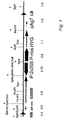
- a full length 2465 bp cDNA for GBSS I (5' and 3' terminal sequences AGACCACAC... ...GTAAGGTAG equivalent to EMBL accession number X58453) was isolated from a potato tuber (cv. Desiree) cDNA library using the pea GBSSI cDNA as probe using standard techniques (Sambrook et al 1989). Following addition of linker sequences, the full length cDNA was cloned as a Bam HI fragment between the GBSS promoter and NOS poly(A) site in the plant transformation vector pGPTV-HYG ( Becker et al 1992 Plant Mol. Biol. 20, 1195-1197 ). A map of the construct (pSJ152) is shown in Figure 1 .
- Transformed potato plants cv. Desiree were produced by co-cultivation of explants with Agrobacterium tumefaciens LBA 4404 containing plant transformation vector plasmids. Two explant types were used, microtubers and leaf fragments, both produced from stock cultures, requiring different methods in culture.
- Stocks of plantlets were maintained of wild type untransformed Desiree or selected lines previously transformed with antisense genes coding for enzymes of the starch biosynthetic pathway by regular transfer of single node explants using Murashige and Skoog (MS) media ( Murashige and Skoog. Physiol. Plant 15, 473-479 1962 ) solidified with 0.8 % agar with the sucrose concentration reduced from 3 % to 1%.
- Microtuber explants were produced by transferring nodes to the same medium with the sucrose concentration increased to 8% plus the addition of 2.5mg/l benzylaminopurine. All cultures were grown at 22°C with illumination from fluorescent tubes at 40 ⁇ E m 2 for 16 hours except those to produce microtubers which were kept in darkness.
- the protocol for leaf explants is a modification of that published by Rocha-Sosa et al (1989 EMBO J. 8, 23-29 ).
- Explants were initially precultured on the appropriate multiplication medium for two days before co-cultivation. Co-cultivation was for 10 minutes in an overnight culture of the Agrobacterium before explants were blotted on filter paper to remove excess bacteria. After blotting explants were transferred to filter paper on feeder layers and incubated in darkness at 22°C for two days.
- the feeder layers consisted of a 9 cm petri dish containing the appropriate multiplication media covered by 2 ml of stationary phase tobacco suspension culture cells which were in turn covered by two layers of filter paper.
- the explants were removed and washed in MS medium without sucrose or agar containing 500 ⁇ g/ml cefotaxime, blotted on filter paper and transferred to multiplication medium containing 500 ⁇ g/ml cefotaxime. After a further five days the explants were further transferred to the same medium containing the selection agent. Selection was effected by the use of the NPTII gene in the construct and addition of kanamycin in the tissue culture process or the HPTII gene with additions of hygromycin.
- Tissue culture and selection using microtuber explants was performed as follows. Microtubers were taken from stock when they were sufficiently large and mature to use. This occurred after 6-8 weeks from transfer of nodes to the high sucrose medium when they weighed more than 30 mg and had started to change colour from white to pink. Stocks were used for several months after tuber initiation provided they remained dormant and no new shoots or stolons had emerged from the bud end. Each tuber was cut in half longitudinally through the terminal bud and the cut end put in contact with the medium.
- the multiplication medium (Z5) used contained the salts and vitamins of MS medium plus 3% sucrose, 0.2mg/l indole acetic acid, 5 mg/l zeatin and 0.8% agar.
- Kanamycin was added at 100mg/l when NPTII was used and hygromycin at 15mg/l when HPTII was used.
- the explants were transferred to fresh medium every two weeks. Explants had two transfers on medium Z5, followed by one transfer on the same medium except indole acetic acid and zeatin were replaced by 10mg/l gibberellic acid (medium MSG). At each transfer all shoots were removed and discarded. The final transfer was to hormone-free MS medium with the sucrose concentration reduced from 3 % to 1 %. Shoots were allowed to develop at this stage.
- Tissue culture and selection using leaf explants was performed as follows. Expanded leaves were taken from stock cultures and cut into fragments comprising a half or a third of the leaf.
- the multiplication medium used contained the salts and vitamins of MS medium plus 1.6% glucose, 0.02 mg/l naphthyl acetic acid, 2mg/l zeatin riboside and 0.8% agar. Kanamycin was added at 100mg/l when NPTII was used and hygromycin at 5mg/l when HPTII was used. Cultures were transferred every two weeks to the same medium. After four transfers the cultures which were vitrified or showed poor shoot development were transferred to liquid MS medium containing 1.6% sucrose only.
- Transformation was confirmed as follows. Shoots which developed from either tuber or leaf explants after the multiplication/organogenesis phase were transferred individually to hormone-free MS medium containing 1% sucrose and 100 mg/l kanamycin or 15mg/l hygromycin depending on the selection which was used. Only one shoot was taken from each explant unless the origin of separate shoots were well separated on the explant. Shoots which rooted on selection within two weeks were transfer to the same medium without selection and given an identifying number. When growth allowed sufficient tissue to be sampled, DNA was extracted from a few mgs of leaf and stem tissue of the culture using the method published by Edwards et al (1991 Nucleic Acids Research 19, (6) 1349 ) and transformation was confirmed by PCR using gene specific primers. Material was left in culture to allow individual shoots to be micropropagated. Positive shoots were micropropagated to be stored in vitro and also to provide planting material.
- Starch was extracted from washed potato tubers by dicing and passage through a Braun MP 75 centrifugal juicer. The juice was diluted with tap water to a volume of approximately 3L in a 5L conical flask. After 30 minutes the supernatant liquid was discarded and the remaining solids washed again with a further 3L of water. After a further 30 minutes the liquid was decanted and discarded. The slurry of solids was poured through a 500 ⁇ m metal mesh filter which retained the bulk of the cell debris. The crude starch which passed through the filter was washed in the same manner until no protein foam remained and only white starch settled on the base of the flask below a clear supernatant liquid. The starch was harvested on filter paper using a Buchner funnel and washed on the funnel with two 500ml volumes of distilled water. Finally the starch was washed with 500ml of acetone and dried in a fume hood for approximately 30 minutes.
- GBSS I (waxy) protein bound to the starch granule was performed as follows. Proteins were extracted from starch granules by boiling for 5 min in 2xSDS Laemmli sample buffer (600 ⁇ l/20 mg starch) followed by one or two freeze thaw cycles (freeze on dry ice, thaw in water). Insoluble material was removed by spinning for 5 min at 15000g and 20-30 ⁇ l of supernatant was analysed on a 7.5% SDS-PAGE gel and proteins were detected by silver staining.
- Peak onset and pasting values were automatically determined using the manufacturer's software. Differential scanning calorimetry was performed essentially as described in WO 95/26407 except that larger samples (approx 10 mg of starch) and larger sized aluminium pans were used. Duplicate samples were measured where appropriate and standard errors calculated. Microscopic examination of starch granules was performed by mixing a small amount of starch with Lugol's iodine solution (1% I 2 /KI), diluted 1:1 (v/v) with water. Amylose content was performed by the iodine colorimetric method of Morrison and Laignelet (1983 Cereal Sci. 1, 9-20 ).
- HPAEC High Performance Anion Exchange Chromatography
- the eluent B was 150 mM sodium hydroxide solution containing 500 mM sodium acetate.
- the gradient programme starts with 85% eluent A and 15% eluent B and ends with 100% eluent B as detailed below, followed by a ten minute flush with the starting gradient to prepare the column for re-use.
- DMSO dimethyl sulfoxide
- a Water Associates (Milford, MA) GPC-150 model with refractive index (RI) detector was used to determine molecular weight distribution.
- Freeze-thaw stability of starches was assessed after heating a 1% w/v starch suspension in water (10 ml in a tightly capped 15 ml tube) in a boiling water bath for 15 minutes with frequent agitation and cooling to room temperature (20-25°C).
- the absorbance at 700 nm (1cm path length, water as blank) of the resultant pastes was determined before and after repeated freeze thaw cycles.
- Starch pastes were frozen by placing in a -70°C freezer for a minimum of 16 hours (overnight) and up to a maximum of 58 hours (over a weekend). Thawing was allowed to occur at room temperature for 2-3 hours and then the absorbance at 700 nm was determined and the sample then placed back in the freezer.
- Transformed plants were selected on hygromycin and additionally screened by PCR for the presence of the waxy antisense T-DNA. Plants were identified by a unique number; 1801-1805 were regrowths of line 17.21, plants 1806-1809 were regrowths of line 17.29, and 1810 onwards were doubly transformed plants. Twenty-four plants of line 17.21 and nineteen of line 17.29 were generated and grown with controls to maturity in the greenhouse, starch was extracted and analysed. Analysis of proteins bound to the starch granule showed that seven of the 17.21 derived lines (1810,1812,1813,1833,1834,1842 and 1843) and two of the 17.29 derived lines (1829 and 1830) had complete or almost complete loss of GBSSI. These lines were studied further.
- SSII/III plant Transgenic plants in which the expression of SSII and SSIII was inhibited are referred to as "SSII/III plant", and lines established from such plants are correspondingly referred to "SSII/III lines". Similarly, plants and lines in which GBSSI, SSII and SSIII were all inhibited are referred to as “GBSSI/SSII/III” plants and lines respectively. Starches from these plants may be referred to as SSII/III starch and GBSSI/SSII/III starch respectively. Plants in a particular line are genetically identical products of a particular transformation or recombination event.
- the apparent amylose content of the starches was determined colourimetrically by iodine staining.
- Starch from the SSII/III lines had amylose contents of 32-33% i.e. similar to wild type levels (data not shown), whereas the starch from the lines that, in addition, had reduced levels of GBSSI had much lower apparent amylose levels, in most lines about 9-11 % amylose (Table 1).
- two lines (1829 and 1833, derived from 17.29 and 17.21 respectively) showed much lower apparent amylose contents (less than 3%).
- the waxy i.e.
- the profile employed here is the manufacturer's standard quick assay (Standard 1) (14 min) and analysis of these starches using a longer, slower profile (90 min) showed that these starches actually swell at much lower temperatures (Edwards et al 1999).
- the enthalpy of gelatinisation of 17.21 starch was also higher suggesting that starch from line 17.29 had a reduced granule organisation compared to that from line 17.21.
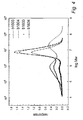
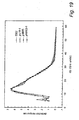
- Figure 4 is a graph of detector response (arbitary units) against log Mw, and shows the results of GPC analysis of starch from lines 1603 (control, wild type, square symbols), 1804 (SSII/III, circle symbols), 1833, and 1834 (GBSSI/SSII/III, upward and downward pointing triangles respectively).
- Figure 5 is a graph similar to Figure 4 and shows the results of GPC analysis for starch from lines 1603 (wild type control, square symbols), 1807 (SSII/III, circle symbols), and 1829, 1830 (GBSSI/SSII/III, upward and downward pointing triangles respectively).
- the major component eluted as a sharp symmetrical peak with a dextran-equivalent molecular size of about 10 7 .
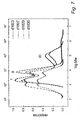
- This peak contained the amylopectin fraction as it completely disappeared following debranching of the starch with isoamylase (see Figures 6 and 7 ).
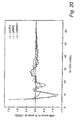
- FIG. 6 and 7 are graphs of response (arbitary units) against log Mw, showing the results of GPC analysis of starch following debranching.
- Figure 6 shows results for starch from lines 1603 (control, square symbols), 1804 (round symbols), 1833 and 1834 (upward and downward pointing triangles respectively).
- Figure 7 shows results for starch from lines 1603 (control, square symbols), 1807 (round symbols), 1829 and 1830 (upward and downward pointing triangles respectively).
- fraction I After debranching with isoamylase, wild type starch (1603) separates into three fractions designated as fraction I, II, and III in order of increasing size.
- the short glucan chains in fractions I and II are derived mainly from amylopectin whereas the long glucan chains in fraction III are mainly derived from amylose. Integration of the area under these peaks was used to calculate the proportion of material in each fraction. Boundaries of the fractions were identified as the minimum of the curves at approximate Mw of 5,000 and 20-30,000.
- fractions I, II and III represent 41 %, 35 % and 24% respectively of the total starch present.
- glucan chains in fraction I made up about 54% of the short chains ie I/(I+II) and this was consistently found in several control starches (from greenhouse grown material) in addition to 1603 (Table 2).
- the proportion of fraction I had increased compared to the control (see Table 2 below).
- line 1804 fraction I had increased to 61 % of the total short chains compared to 54% in the control, and line 1807 appeared to be more modified as fraction I had further increased to over 71 % of the total of short chains.
- fraction I in the SSII/III starches was also different from the control as a shoulder was evident in 1804 and this was resolved into a second distinct peak in line 1807.
- Starch from the 17.29 derived line (1807) again appeared to be more modified than that from 17.21 derived line (1804) in that there were also more glucan chains of less than molecular size 10 3 in fraction 1.
- the proportion of amylose (fraction III) in the SSII/III starches had also increased to 29% and 33% (line 1804 and 1807 respectively) compared to 23% in the control.
- Figure 8 shows results for starch from lines 1603 (control, square symbols), 1804 (circle symbols), 1833 and 1834 (upward and downward pointing triangles, respectively).
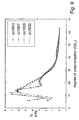
- Figure 9 shows results for starch from lines 1603 (control. square symbols), 1807 (circle symbols), 1829 and 1830 (upward and downward pointing triangles, respectively).
- the SSII/III starches (1804 and 1807) showed an increase in proportion of short chains with a peak at dp 11-12 and a decrease in the proportion of longer chains with a dp of 16-26.
- starch derived from line 17.29 (1807) had a more severe phenotype than 17.21 (1804) since the former starch showed a greater increase in short chains (especially of dp 6-8) and a greater decrease in the longer chains (dp 16-26) than the latter.
- the GBSSI/SSII/III starches there was also a clear difference between the lowest amylose lines (1829,1833) and the others (1830,1834).
- the former starches had a chain length distribution very similar to the most modified SSII/III starch (1807) i.e. a large increase in very short chains (dp 6-8) and a large decrease in longer chains (dp 16-26), whereas the starch from 1830 and 1834 had a chain length distribution similar to wild type.
- Figure 10 is a graph of difference in % area (calculated as % area line X - % area line 1603) against degree of polymerization (number of glucose residues), and shows the results for starch from lines 1804, 1807, 1829, 1830, 1833, 1834 and an additional control line (labelled as 450). (1804 - square symbols; 1807 - round symbols; 1829 - upward pointing triangles; 1830 - downward pointing triangles; 1833 - lozenge symbols; 1834 - vertical cross symbols; 450 - diagonal cross symbols). As stated before, the reproducibility of the data is very good as can be seen from the difference profile of another control starch (line 450) which is very close to the origin across the entire distribution.
- the freeze-thaw stability of the starches was assessed by following the increase in absorbance at 700 nm of starch pastes after freeze-thaw cycling.
- the absorbance measurements were used as a simple index of the consequences of the underlying molecular changes which take place during retrogradation. Higher values indicate more association between molecules whereas low values indicate little association or less retrogradation.
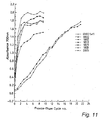
- Figure 11 shows the results from a typical experiment.
- Figure 11 is a graph of Absorbance at 700nm against Number of freeze-thaw cycles, and shows the results for analysis of freeze-thaw stability for starch 0302 (wild type control, diagonal cross symbols) and starch from lines 1802 (upward-pointing triangle symbols), 1807 (lozenge symbols), 1813 (asterisk symbols), 1829 (inverted, downward-pointing triangle symbols), 1833 (circle symbols) and 0805 (waxy starch, cross symbols).
- the 17.29 derived starch (1807) showed a more severe phenotype than the 17.21 derived starch (1802) in that the rate and the overall increase in absorbance was less, indicating that the freeze-thaw stability of this starch was greater.
- Starch from plants of line 1813 did not show any significant improvement in freeze-thaw stability compared to the SSII/III (1802) control.
- this starch was one of the GBSSI/SSII/III starches that had an apparent amylose content of about between 9-11% and a chain length distribution as assayed by dionex which was very similar to 1834 (data not shown).
- starch from the two GBSSI/SSII/III lines 1829 and 1833 which showed more extreme chain length distributions and had an amylose content of less than 3%, showed very high freeze thaw stability.
- the initial increase in absorbance after one freeze-thaw cycle was very small and subsequently increased in a linear fashion reaching a similar final absorbance as the control starches only after 21 cycles.
- the freeze-thaw stability of starches was further evaluated by measuring the amount of syneresis from starch pastes after centrifugation following a number of freezing and thawing cycles. Briefly, a 5% starch paste was made by weighing 0.75 g starch into a screw top MacConkey bottle and adding 15 ml of distilled water. The starch was dissolved by heating in a boiling water bath for 20 minutes with frequent shaking during the first 5 mins to ensure a uniform gel. After cooling to room temperature, aliquots of approximately 0.5 ml were distributed into preweighed 1.5 ml Eppendorf centrifuge rubes and the exact weight of starch paste in each tube (value x) was determined by reweighing the tubes.
- Syneresis is defined as the mass of starch sample decanted, expressed as a percentage of the original mass of starch paste (w/w). For example, a 0.5 gm sample showing 60% syneresis would decant a mass of 0.3 gms. The remaining tubes were placed back at -70°C for further freeze-thaw cycles and measurement.
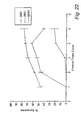
- Figure 12 is a graph of % syneresis against number of freeze/thaw cycles.
- the legend to the figure is as follows: 0302 (wild type) - square symbols; 0805 - downward pointing triangles; 1829 - line only, no symbols; 1807 - upward pointing triangles; 1830 - lozenge symbols; 1834 - cross symbols.
- the wild type control starch was not freeze-thaw stable as after only one cycle approximately 35% syneresis was observed and this increased to 60% after two or more cycles.
- the SSII/III starch from line 1807 showed only slightly improved freeze-thaw stability since only 17% syneresis was observed after one cycle and this increased linearly with further cycles reaching the same level as the control after 4 cycles.
- All the waxy starches (0805, 1829,1830 and 1834) were freeze-thaw stable after one cycle as no syneresis was observed.
- the waxy starch 0805 was only freeze-thaw stable for one cycle as after two cycles this starch showed as much syneresis as the wild type control.
- the GBSSI/SSII/III lines 1830 and 1834 showed better freeze-thaw stability than the 0805 starch as only slight syneresis was observed after two cycles but this increased to control levels after four cycles.
- the GBSSI/SSII/III line 1829 showed complete freeze-thaw stability as no syneresis was observed during the four freeze-thaw cycles of the experiment.
- a full length 2465 bp cDNA for GBSS I was obtained as described at Example 1b above. Following addition of linker sequences, the full length cDNA was cloned as a Bam HI fragment in an antisense orientation between the cauliflower mosaic virus double 35S promoter and cauliflower mosaic virus terminator in pJIT60 ( Guerineau and Mullineaux, 1993 Plant transformation and expression vectors. In Plant Molecular Biology Labfax (Croy, R.R.D., ed) Oxford, UK: Bios Scientific Publishers pp. 121-148 ) producing plasmid pPOT2.
- a fragment of the potato SSIII gene was isolated as a 1.14kb Pst I/ Eco RV fragment from a partial cDNA clone for SSIII ( Marshall et al, 1996 Plant Cell 8, 1121-1135 ; Accession number X95759).
- the SSIII fragment was sub-cloned in an antisense orientation between the cauliflower mosaic virus double 35S promoter and cauliflower mosaic virus terminator ( Pst I/ Sma I sites) in pJIT60 (Guerineau and Mullineaux, 1993) producing plasmid pRAT3.
- a further vector (pSJ119) was constructed by cloning the 1.1 kb Eco RI fragment of pRAT3 containing the SSIII cDNA into the Eco RI site of pBSKSIIP (Stratagene) to create construct pSJ110 and then by inserting the 1.1 kb SSIII cDNA from pSJ110 (as an Xba I -Sal I fragment) in an antisense orientation under the control of the granule bound starch synthase (GBSS) promoter into the plant transformation vector pSJ39 which had been cut with the same enzymes.
- GBSS granule bound starch synthase
- pSJ39 is a modified GPTV-HYG vector (Becker et al 1992 cited above) containing a 0.8 kb GBSS promoter and was constructed as follows: first the Bam HI site between the hygromycin selectable marker and the gene 7 polyadenylation signal in pGPTV-HYG was destroyed by cutting and filling in with klenow polymerase to create pSJ35. The Hin dIII -Eco RI fragment of this vector (containing the GUS gene & nos polyadenylation signal) was replaced with the Hin dIII -Eco RI fragment (containing the GBSS promoter-GUS-nos poly(A) cassette) from plasmid pGB121 (a gift from R.
- Plasmid pGB121 was constructed by inserting the 0.8 kb GBSS promoter from genomic clone LGBSSwt-6 ( Visser et al 1989 Plant Science 64, 185-192 ) as an Hin dIII- Nsi I (klenow filled in) fragment into the Hin dIII- Pst I (T4 DNA polymerase blunted) sites of plasmid pBI121 (Jefferson et al 1987 EMBO J. 6 , 3901-3907).
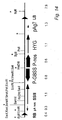
- the plasmid pSJ 119 is illustrated schematically in Figure 14 . Labelling follows the scheme adopted in Figure 1 . Comparison of Figures 1 and 14 shows the similarity between plasmids pSJ152 and pSJ119.
- Binary plasmid pPOT3 was introduced into Agrobacterium tumefasciens LBA4404 by the freeze-thaw method of An et al (1988 Binary vectors. In Plant Molecular Biology Manual A3, Gelvin SB. Schilperoot RA, eds (Dordrecht, The Netherlands, Kluwer Academic Publishers) pp 1-19 ). Preparation of inoculum of Agrobacterium cells carrying pPOT3, inoculation of tuber discs of Solanum tuberosum cv Desiree, regeneration of shoots and rooting of shoots were as described in Edwards et al (1995 Plant J. 8, 283-294 ).
- Agrobacterium cells were grown in Luria broth containing rifampicin (50mg 1 -1 ).
- the growth medium for the tuber discs was Murashige and Skoog (MS) solution (Murashige and Skoog, 1962 cited above) containing 8g 1 -1 agar, zeatin riboside (5mg 1 -1 ) and indolacetic acid (0.1mg 1 -1 ), referred to as MS medium.
- MS medium Murashige and Skoog
- the discs were co-cultivated for 2 days on tobacco feeder cell layers then transferred to MS medium containing cefotaxime (50g 1 -1 ) to select against Agrobacterium. After 5 days the discs were transferred to plates of MS medium containing cefotaxime (50g 1 -1 ) and kanamycin (100mg 1 -1 ) to select for growth of transformed plant cells.
- Rooted shoots were sub-cultured twice before being transferred to a propagator and then to a greenhouse. When growth allowed sufficient tissue to be sampled, DNA was extracted from a few mgs of leaf and stem tissue of the culture using the method published by Edwards et al (1991 cited previously) and transformation was confirmed by PCR using gene specific primers. Material was left in culture to allow individual shoots to be micropropagated. Positive shoots were micropropagated to be stored in vitro and also to provide planting material. One line designated 4.3 was selected for further use as described below.
- Transformed potato plants cv Desiree were produced by co-cultivation of leaf fragments, produced from stock cultures with Agrobacterium tumefaciens LBA 4404 containing plant transformation vector plasmids.
- Stocks of plantlets were maintained by regular transfer of single node explants using Murashige and Skoog media (1962 Physiol. Plant 15. 473 ) solidified with 0.8% agar with the sucrose concentration reduced from 3% to 1%. All cultures were grown at 22°C with illumination from fluorescent tubes at 40 ⁇ E/sq.m. for 16 hours except those to produce microtubers which were kept in darkness.
- the protocol for leaf explants was modified from that published by Rocha-Sosa et al (1989, EMBO J. 8. 23 ).
- Explants were initially precultured on the appropriate multiplication medium for two days before co-cultivation. Co-cultivation was for 10 minutes in an overnight culture of the Agrobacterium before explants were blotted on filter paper to remove excess bacteria. After blotting explants were transferred to filter paper on feeder layers and incubated in darkness at 22°C for two days.
- the feeder layers consisted of a 9cm petri dish containing the appropriate multiplication media covered by 2ml of stationary phase tobacco suspension culture cells which were in turn covered by two layers filter paper.
- Tissue culture and selection using leaf explants was performed as follows. Expanded leaves were taken from stock cultures and cut into fragments comprising a half or a third of the leaf.
- the multiplication medium used contained the salts and vitamins of Murashige and Skoog medium plus 1.6% glucose, 0.02 mg/l naphthyl acetic acid, 2mg/l zeatin riboside and 0.8% agar. Kanamycin was added at 100mg/l when NPTII was used and hygromycin at 5mg/l when HPTII was used. Cultures were transferred every two weeks to the same medium. After four transfers the cultures which were vitrified or showed poor shoot development were transferred to liquid Murashige and Skoog medium containing 1.6% sucrose only.
- Transformation was confirmed as follows. Shoots which developed after the multiplication/organogenesis phase were transferred individually to hormone-free Murashige and Skoog medium containing 1% sucrose and 100 mg/l kanamycin or 15mg/l hygromycin depending on the selection which was used. Only one shoot was taken from each explant unless the origin of separate shoots were well separated on the explant. Shoots which rooted on selection within two weeks were transfered to the same medium without selection and given an identifying number. Shoots were screened by PCR as described above. One SSIII antisense line designated 419-1 was selected for further study as were several GBSSI/SSIII antisense lines as described below.
- Washed tubers were diced and homogenised to a juice by passage through a Braun MP 75 centrifugal juicer.
- the juice was diluted with tap water to a volume of approximately 31 in a 51 conical flask. After 30 minutes the unsedimented supernatant liquid was discarded and the remaining solids washed again with a further 31 of water. After a further 30 minutes the liquid was decanted and discarded.
- the slurry of solids was poured through a 500 ⁇ m metal mesh filter which retained the bulk of the cell debris.
- the crude starch which passed through the filter was washed in the same manner until no protein foam remained and only white starch settled on the base of the flask below a clear supernatant liquid.
- the starch was harvested on filter paper using a Buchner funnel and washed on the funnel with two 500ml volumes of distilled water. Finally the starch was washed with 500ml of acetone and dried in a fume hood for approximately 30 minutes.
- RVA analysis was performed as described in Example 1.5 above.
- Differential scanning calorimetry with.a Perkin Elmer DSC 7 instrument was essentially as described in WO 95/26407 , except that larger samples (10mgs) and larger pans were used, as explained in example 1.5 above.
- Tuber material was harvested from mature plants. After harvest the plant material was immediately frozen in liquid nitrogen and stored at - 70°C. Tubers were ground up in a coffee grinder which was precooled with dry ice. Extracts were made using four ml of extraction buffer per gram fresh weight tuber.
- the extraction buffer contained 100 mM Tris pH 7.5, 5% (v/v) glycerol, 2.5% (w/v) polyvinylpolypyrollidone (PVPP), 0.1 %(w/v) sodium metabisulphite, 2,5 mM DTT, 5 mM EDTA, 2mM Perfabloc, and 1mM benzamidine.
- the samples were homogenised using a polytron (TM) homogenizer and clarified by centrifugation (15,000 rpm, 10 min, 4°C). The supernatant was used for assaying the soluble fraction of starch synthase activity as below.
- TM polytron
- the assay was based on the principle of 14 C-labelled ADP-glucose incorporation into a growing glucan chain by the action of starch synthase.
- Zymograms were used to determine the presence of different isoforms of starch synthases. This was done by separating the enzymes (crude extract) by a non-denaturing gel electrophoresis followed by an incubation in enzyme substrates (primer, ADP-glucose. Enzyme activity was visualised by staining the gel with an iodine/iodide solution (see below), starch synthases being identified by the formation of blue bands. Native enzyme extracts are separated on a native polyacrylamide gel (Laemmli gel without SDS) using a BioRad Mini Protean (TM) II gel chamber.
- TM BioRad Mini Protean
- the gel consists of a 7.5% separation gel (7.5% acrylamide, 0.375M Tris-HCl pH 8.8, 10% (w/v) glycerol; 0.1% ammonium persulfate, 0.05% TEMED) and a 4% stacking gel (4% acrylamide, 0.125 M Tris-HCl pH 6.8, 10% (w/v) glycerol; 0.05% ammonium persulfate, 0.1% TEMED).
- Crude extracts (see above) are spiked with some bromophenol blue and about 50-80 ⁇ g (40 ⁇ l) is loaded onto the gel.
- the electrophoresis is carried out at 4°C at a constant voltage of 100 V using a 1x electrophoresis buffer without SDS (0.3028% (w/v) Tris, 1.44 %(w/v) glycine). Electrophoresis is stopped when the bromophenol blue reaches the bottom of the gel (about 3.5h). The gel is then incubated over night at room temperature in 30 ml of incubation buffer (50 mM Bicine pH 8.5, 0.5 M Na-citrate, 25 mM K-acetate, 2 mM DTT, 2 mM EDTA, 0.1 % amylopectin, 1 mM ADP-glucose) on a slowly moving shaker. After incubation the gel is rinsed in water and stained with iodine/iodide solution (0.1% KI, 0.01 % I 2 ).
- GBSSI lines were developed and one line, designated as line 4.3, was selected for further use since it had very low GBSS activity, approximately 10% that of wildtype, had a severe reduction in the waxy granule bound 60 kDa protein, and the starch from this line stained red with iodine indicating low levels of amylose.
- This line was retransformed with the SSIII antisense construct pSJ119. Plants were identified with a four digit number; 0801-0809 were regrowths of the original GBSSI line 4.3 whereas 0810 onwards were doubly transformed lines (GBSSI/SSIII antisense).
- One SSIII antisense line designated 419-1 which had very low levels of SSIII was also selected as a control. These plants, along with wild type control lines designated 1603 and 0302, were grown to maturity in the greenhouse, tubers harvested and starch was extracted and analysed. Sixty-one doubly transformed waxy (4.3) plants were selected, based on their resistance to hygromycin selection and PCR screening for the presence of the SSIII antisense T-DNA. Zymogram analysis of the soluble fraction of tuber extracts showed that ten of these lines had very low levels of SSIII (data omitted for brevity).
- Figures 15A and B are micrographs (taken at the same level of magnification of iodine-stained starch granules from the GBSSI antisense line 0805 ( Fig. 15A ) and the GBSSI/SSIII line 08103 ( Fig. 15B ).
- FIG. 16 is a graph showing the results of viscometric analysis of starch from three different plants.
- the Figure takes the form of a graph of viscosity in cP (left hand axis) or temperature in °C (right hand axis) against time (in minutes).
- the temperature profile is shown by the dotted line, and the viscoamylographs for starch from plants 0805, 08103 and 1603 are represented by a thin solid line, a thick solid line and a dashed line respectively.
- the viscosity onset temperature of starch from line 08103 was at least 7°C lower than the waxy starch although the sharp peak characteristic of waxy type starch was still evident, but the peak viscosity was lower, as was the final viscosity.
- Figures 17 and 18 are graphs of detector response (arbitary units) against molecular weight, and show the results of GPC analysis of starch from plants 0302 (widely spaced dotted line); 0805 (closely-spaced dotted line); and 08103 (solid line).
- Starch from the waxy/SSIII lines 08103, 08104, 08131, 08133 and 08146 was analysed and all showed very similar profiles so only the results from line 08103 are shown for clarity.
- Wild type starch (0302) was fractionated into an amylopectin fraction with a peak at around mol. wt. of 10 7 and an amylose containing fraction with a peak at around 10 6 .
- Starch from 08103 appeared very similar to the waxy control (0805) as both showed a large amylopectin peak and a much smaller fraction at around 10 5 -10 6 ( Figure 17 ).
- Figure 21 is a graph of absorbance (at 700nm) against number of freeze-thaw cycles.
- Figure 22 is a graph of % syneresis against number of freeze-thaw cycles.
- the plots for starch from 0302 is shown in both Figures by square symbols, and those for 0805 by circles.
- data for 08103 is shown by triangles, whilst cross symbols are used in Figure 22 .
- the control starches show very similar freeze-thaw properties using this quick freeze-thaw cycle as compared to the long freeze-thaw cycle (compare Figs. 11 & 12 with Figs. 21 & 22 ).
- the GBSSI/SIII starch from line 08103 shows some freeze thaw stability in Figure 21 as there is very little increase in absorbance after one freeze-thaw cycle but after this the absorbance increases significantly and after five cycles the absorbance of this starch is approximately the same as the controls. However, as measured by syneresis ( Figure 22 ), the GBSSI/SSIII starch 08103 is completely freeze-thaw stable for at least two cycles.
Landscapes
- Health & Medical Sciences (AREA)
- Life Sciences & Earth Sciences (AREA)
- Chemical & Material Sciences (AREA)
- Genetics & Genomics (AREA)
- Engineering & Computer Science (AREA)
- Organic Chemistry (AREA)
- Wood Science & Technology (AREA)
- Bioinformatics & Cheminformatics (AREA)
- Zoology (AREA)
- Molecular Biology (AREA)
- Biotechnology (AREA)
- Biomedical Technology (AREA)
- General Engineering & Computer Science (AREA)
- Biochemistry (AREA)
- Microbiology (AREA)
- Nutrition Science (AREA)
- General Health & Medical Sciences (AREA)
- Medicinal Chemistry (AREA)
- Materials Engineering (AREA)
- Plant Pathology (AREA)
- Polymers & Plastics (AREA)
- Biophysics (AREA)
- Chemical Kinetics & Catalysis (AREA)
- Physics & Mathematics (AREA)
- Cell Biology (AREA)
- Polysaccharides And Polysaccharide Derivatives (AREA)
- Breeding Of Plants And Reproduction By Means Of Culturing (AREA)
- Preparation Of Fruits And Vegetables (AREA)
- Immobilizing And Processing Of Enzymes And Microorganisms (AREA)
- Jellies, Jams, And Syrups (AREA)
- Micro-Organisms Or Cultivation Processes Thereof (AREA)
Claims (56)
- Kartoffelpflanzenzelle umfassend eingeführte Nukleinsäuresequenzen, die spezifisch die Expression der stärkekorngebundenen Stärkesynthase I (GBSSI) sowie mindestens eines weiteren Stärkesynthaseenzyms, das an der Stärkesynthese in der Kartoffelpflanzenzelle beteiligt ist, hemmen.
- Kartoffelpflanzenzelle nach Anspruch 1, wobei das mindestens eine weitere Stärkesynthaseenzym spezifisch durch die eingeführten Nukleinsäuresequenzen umfassend die Stärkesynthase II und/oder Stärkesynthase III gehemmt wird.
- Kartoffelpflanzenzelle nach Anspruch 1, umfassend eingeführte Nukleinsäuresequenzen, die spezifisch die Expression von drei oder mehr Enzymen, die an der Stärkesynthese in der Zelle beteiligt sind, hemmen.
- Kartoffelpflanze umfassend eingeführte Nukleinsäuresequenzen, wobei die eingeführten Nukleinsäuresequenzen spezifisch die Expression der GBSSI und mindestens eines weiteren Stärkesynthaseenzyms, das an der Stärkesynthese in der Kartoffelpflanze beteiligt ist, hemmen.
- Kartoffelpflanze nach Anspruch 4, in der die eingeführten Nukleinsäuresequenzen spezifisch die GBSSI sowie die SSII und/oder SSIII hemmen.
- Nachkommenschaft einer Kartoffelpflanze umfassend eingeführte Nukleinsäuresequenzen, die die eingeführten Sequenzen beibehält, wobei die eingeführten Nukleinsäuresequenzen spezifisch die Expression der GBSSI und mindestens eines weiteren Stärkesynthaseenzyms, das an der Stärkesynthese in der Kartoffelpflanze beteiligt ist, hemmen.
- Nachkommenschaft einer Kartoffelpflanze nach Anspruch 6, in der die eingeführten Nukleinsäuresequenzen spezifisch die GBSSI sowie die SSII und/oder SSIII hemmen.
- Kartoffelpflanze nach Anspruch 5, die aus einer Kartoffelpflanzenzelle nach einem der Ansprüche 1-3 erzeugt wurde.
- Kartoffelpflanze nach Anspruch 8, die zu einer Stärke mit einem scheinbaren Amylosegehalt von weniger als 8% gemäß dem Verfahren von Morrison & Laignelet (1983 Cereal Science 1, 9-20) und einer Viskositäts-Onset-Temperatur von weniger als 67°C gemäß viskometrischer Analyse einer 7,4%igen (w/v) wäßrigen Suspension der Stärke mit dem Rapid Visco Amylographen, Newport Scientific Series 4, der mit dem Standard 1 Aufheiz- und Rührprotokoll betrieben wird, führt.
- Kartoffelpflanze nach Anspruch 8, die zu einer Stärke gemäß Anspruch 9 führt und die bei Extraktion eine derartige Gefrier-Tau-Stabilität aufweist, daß eine 1%ige w/v wäßrige Suspension der Stärke nach 4 Gefrier-Tau-Zyklen von Gefrieren über Nacht bei -70°C und Auftauen bei Raumtemperatur über mindestens 2 Stunden eine Extinktion von weniger als 1,2 Einheiten bei einer Wellenlänge von 700 nm aufweist.
- Kartoffelpflanze nach Anspruch 8, die zu einer Stärke gemäß Anspruch 9 führt und in der eine 1%ige w/v wäßrige Suspension der Stärke nach 4 Gefrier-Tau-Zyklen eine Extinktion von weniger als 1,0 Einheiten bei einer Wellenlänge von 700 nm aufweist.
- Kartoffelpflanze nach Anspruch 8, die zu einer Stärke gemäß Anspruch 9 führt und die bei Extraktion eine derartige Gefrier-Tau-Stabilität aufweist, daß eine 1%ige w/v wäßrige Suspension der Stärke nach 3 Gefrier-Tau-Zyklen von Gefrieren über Nacht bei -70°C und Auftauen bei Raumtemperatur über mindestens zwei Stunden eine Extinktion von weniger als 0,9 Einheiten bei einer Wellenlänge von 700 nm aufweist.
- Kartoffelpflanze nach Anspruch 8, die zu einer Stärke gemäß Anspruch 12 führt und in der eine 1%ige w/v wäßrige Suspension der Stärke nach 3 Gefrier-Tau-Zyklen eine Extinktion von weniger als 0,7 Einheiten bei einer Wellenlänge von 700 nm aufweist.
- Kartoffelpflanze nach Anspruch 8, die zu einer Stärke gemäß Anspruch 9 führt und die bei Extraktion eine derartige Gefrier-Tau-Stabilität aufweist, daß eine 1%ige w/v wäßrige Suspension der Stärke nach 2 Gefrier-Tau-Zyklen von Gefrieren über Nacht bei -70°C und Auftauen bei Raumtemperatur über mindestens zwei Stunden eine Extinktion von weniger als 0,7 Einheiten bei einer Wellenlänge von 700 nm aufweist.
- Kartoffelpflanze nach Anspruch 8, die zu einer Stärke gemäß Anspruch 14 führt und in der eine 1%ige w/v wäßrige Suspension der Stärke nach 2 Gefrier-Tau-Zyklen eine Extinktion von weniger als 0,5 Einheiten bei einer Wellenlänge von 700 nm aufweist.
- Kartoffelpflanze nach Anspruch 8, die zu einer Stärke gemäß Anspruch 9 führt und die bei Extraktion eine derartige Gefrier-Tau-Stabilität aufweist, daß eine 1%ige w/v wäßrige Suspension der Stärke nach 1 Gefrier-Tau-Zyklus von Gefrieren über Nacht bei -70°C und Auftauen bei Raumtemperatur über mindestens zwei Stunden eine Extinktion von weniger als 0,5 Einheiten bei einer Wellenlänge von 700 nm aufweist.
- Kartoffelpflanze nach Anspruch 8, die zu einer Stärke gemäß Anspruch 16 führt und in der eine 1%ige w/v wäßrige Suspension der Stärke nach 1 Gefrier-Tau-Zyklus eine Extinktion von weniger als 0,3 Einheiten bei einer Wellenlänge von 700 nm aufweist.
- Kartoffelpflanze nach Anspruch 8, die zu einer Stärke gemäß Anspruch 9 führt und die bei Extraktion eine derartige Gefrier-Tau-Stabilität aufweist, daß eine 5%ige w/v wäßrige Paste der Stärke nach 4 Gefrier-Tau-Zyklen von Gefrieren über Nacht bei -70°C und Auftauen über 60 Minuten bei 22°C und anschließendem 10minütigem Zentrifugieren bei 8000 g bei 18°C eine Synärese von weniger als 40% aufweist.
- Kartoffelpflanze nach Anspruch 8, die zu einer Stärke nach Anspruch 18 führt, die nach 4 Gefrier-Tau-Zyklen eine Synärese von weniger als 30% aufweist.
- Kartoffelpflanze nach Anspruch 8, die zu einer Stärke nach Anspruch 18 führt, die nach 4 Gefrier-Tau-Zyklen eine Synärese von weniger als 20% aufweist.
- Kartoffelpflanze nach Anspruch 8, die zu einer Stärke nach Anspruch 18 führt, die nach 4 Gefrier-Tau-Zyklen eine Synärese von weniger als 10% aufweist.
- Kartoffelpflanze nach Anspruch 8, die zu einer Stärke gemäß Anspruch 9 führt und die bei Extraktion eine derartige Gefrier-Tau-Stabilität aufweist, daß eine 5%ige w/v wäßrige Paste der Stärke nach 3 Gefrier-Tau-Zyklen von Gefrieren über Nacht bei -70°C und Auftauen über 60 Minuten bei 22°C und anschließendem 10minütigem Zentrifugieren bei 8000 g bei 18°C eine Synärese von weniger als 30% aufweist.
- Kartoffelpflanze nach Anspruch 8, die zu einer Stärke nach Anspruch 22 führt, die nach 3 Gefrier-Tau-Zyklen eine Synärese von weniger als 20% aufweist.
- Kartoffelpflanze nach Anspruch 8, die zu einer Stärke nach Anspruch 22 führt, die nach 3 Gefrier-Tau-Zyklen eine Synärese von weniger als 10% aufweist.
- Kartoffelpflanze nach Anspruch 8, die zu einer Stärke gemäß Anspruch 9 führt und die bei Extraktion eine derartige Gefrier-Tau-Stabilität aufweist, daß eine 5%ige w/v wäßrige Paste der Stärke nach 2 Gefrier-Tau-Zyklen von Gefrieren über Nacht bei -70°C und Auftauen über 60 Minuten bei 22°C und anschließendem 10minütigem Zentrifugieren bei 8000 g bei 18°C eine Synärese von weniger als 30% aufweist.
- Kartoffelpflanze nach Anspruch 8, die zu einer Stärke nach Anspruch 25 führt, die nach 2 Gefrier-Tau-Zyklen eine Synärese von weniger als 20% aufweist.
- Kartoffelpflanze nach Anspruch 8, die zu einer Stärke nach Anspruch 25 führt, die nach 2 Gefrier-Tau-Zyklen eine Synärese von weniger als 10% aufweist.
- Kartoffelpflanze nach Anspruch 8, die zu einer Stärke gemäß Anspruch 9 führt und die bei Extraktion eine derartige Gefrier-Tau-Stabilität aufweist, daß eine 5%ige w/v wäßrige Paste der Stärke nach 4 Gefrier-Tau-Zyklen von Gefrieren über 1 Stunde bei -70°C und Auftauen über 10 Minuten bei 22°C und anschließendem 10minütigem Zentrifugieren bei 8000 g bei 18°C eine Synärese von weniger als 40% aufweist.
- Kartoffelpflanze nach Anspruch 8, die zu einer Stärke nach Anspruch 28 führt, die nach 4 Gefrier-Tau-Zyklen eine Synärese von weniger als 30% aufweist.
- Kartoffelpflanze nach Anspruch 8, die zu einer Stärke nach Anspruch 28 führt, die nach 4 Gefrier-Tau-Zyklen eine Synärese von weniger als 20% aufweist.
- Kartoffelpflanze nach Anspruch 8, die zu einer Stärke gemäß Anspruch 9 führt und die bei Extraktion eine derartige Gefrier-Tau-Stabilität aufweist, daß eine 5%ige w/v wäßrige Paste der Stärke nach 3 Gefrier-Tau-Zyklen von Gefrieren über 1 Stunde bei -70°C und Auftauen über 10 Minuten bei 22°C und anschließendem 10minütigem Zentrifugieren bei 8000 g bei 18°C eine Synärese von weniger als 40% aufweist.
- Kartoffelpflanze nach Anspruch 8, die zu einer Stärke nach Anspruch 31 führt, die nach 3 Gefrier-Tau-Zyklen eine Synärese von weniger als 30% aufweist.
- Kartoffelpflanze nach Anspruch 8, die zu einer Stärke nach Anspruch 31 führt, die nach 3 Gefrier-Tau-Zyklen eine Synärese von weniger als 20% aufweist.
- Kartoffelpflanze nach Anspruch 8, die zu einer Stärke nach Anspruch 31 führt, die nach 3 Gefrier-Tau-Zyklen eine Synärese von weniger als 10% aufweist.
- Kartoffelpflanze nach Anspruch 8, die zu einer Stärke gemäß Anspruch 9 führt und die bei Extraktion eine derartige Gefrier-Tau-Stabilität aufweist, daß eine 5%ige w/v wäßrige Paste der Stärke nach 2 Gefrier-Tau-Zyklen von Gefrieren über 1 Stunde bei -70°C und Auftauen über 10 Minuten bei 22°C und anschließendem 10minütigem Zentrifugieren bei 8000 g bei 18°C eine Synärese von weniger als 30% aufweist.
- Kartoffelpflanze nach Anspruch 8, die zu einer Stärke nach Anspruch 29 führt, die nach 2 Gefrier-Tau-Zyklen eine Synärese von weniger als 20% aufweist.
- Kartoffelpflanze nach Anspruch 8, die zu einer Stärke nach Anspruch 35 führt, die nach 2 Gefrier-Tau-Zyklen eine Synärese von weniger als 10% aufweist.
- Kartoffelpflanze nach Anspruch 8, die zu einer Stärke nach Anspruch 9 führt, die bei Extraktion ein Verhältnis von kurzkettigen Fraktion-1-Glukanen zu kurzkettigen Fraktion-II-Glukanen von mindestens 60% aufweist.
- Kartoffelpflanze nach Anspruch 8, die zu einer Stärke nach Anspruch 38 führt, bei der das Verhältnis von Fraktion-I zu Fraktion-II mindestens 65% beträgt.
- Kartoffelpflanze nach Anspruch 8, die zu einer Stärke nach Anspruch 38 führt, bei der das Verhältnis von Fraktion-I zu Fraktion-II mindestens 70% beträgt.
- Kartoffelpflanze nach Anspruch 8, die zu einer Stärke nach Anspruch 9 führt, bei der die Viskositäts-Onset-Temperatur weniger als 65°C beträgt.
- Kartoffelpflanze nach Anspruch 8, die zu einer Stärke nach Anspruch 9 führt, bei der die Viskositäts-Onset-Temperatur weniger als 55°C beträgt.
- Kartoffelpflanze nach Anspruch 8, die zu einer Stärke nach Anspruch 9 führt, bei der die Viskositäts-Onset-Temperatur weniger als 51°C beträgt.
- Kartoffelpflanze nach Anspruch 8, die zu einer Stärke nach Anspruch 9 führt, bei der bei der Analyse mittels Differential Scanning Calorimetry mit einem Perkin Elmer DSC7-Gerät eine Stärkeprobe von 10 mg in einer wäßrigen Mischung von weniger als 25% Stärke w/v eine Verkleisterungs-Onset-Temperatur von weniger als 67°C aufweist.
- Kartoffelpflanze nach Anspruch 8, die zu einer Stärke nach Anspruch 44 führt, die eine Verkleisterungs-Onset-Temperatur von weniger als 66°C aufweist.
- Kartoffelpflanze nach Anspruch 8, die zu einer Stärke nach Anspruch 44 führt, die eine Verkleisterungs-Onset-Temperatur von weniger als 51°C aufweist.
- Kartoffelpflanze nach Anspruch 8, die zu einer Stärke nach Anspruch 44 führt, die eine Verkleisterungs-Onset-Temperatur von weniger als 50°C aufweist.
- Kartoffelpflanze nach Anspruch 8, die zu einer Stärke nach einem der Ansprüche 8-47 führt, wobei die Stärkekörner frei von Sprüngen sind.
- Verfahren zur Änderung des Stärkegehalts einer Kartoffelpflanze, das die folgenden Schritte umfaßt: Bereitstellen von Nukleinsäuresequenzen; sowie Einführen dieser Sequenzen in die Kartoffelpflanze, wobei die Sequenzen spezifisch die Expression der GBSSI sowie mindestens eines weiteren Enzyms, das an der Stärkesynthese in der Kartoffelpflanze beteiligt ist, hemmen.
- Verfahren nach Anspruch 49, wobei die Sequenzen in eine Kartoffelpflanzenzelle eingeführt werden und die Pflanzenzelle zu einem Kartoffelpflänzchen und anschließend zu einer Kartoffelpflanze herangezogen wird.
- Verfahren nach Anspruch 49 oder 50, wobei die eingeführten Sequenzen spezifisch die Expression der GBSSI sowie der SSII und/oder SSIII hemmen.
- Verfahren nach einem der Ansprüche 49-51, wobei die eingeführten Nukleinsäuresequenzen operativ in antisense-Richtung bezüglich eines in der Kartoffelpflanze aktiven Promoters verknüpft sind, um so die Transkription der Sequenzen zu bewirken.
- Verfahren zur Herstellung von Stärke, das die folgenden Schritte umfaßt: Verändern des Stärkegehalts einer Kartoffelpflanze nach dem Verfahren von einem der Ansprüche 49-51; sowie Extrahieren des veränderten Stärkegehalts aus der Kartoffelpflanze.
- Verfahren nach Anspruch 53, das weiterhin den Schritt umfaßt, daß man die extrahierte Stärke mittels physikalischem und/oder enzymatischem und/oder chemischem Bearbeiten in vitro modifiziert.
- Kartoffelknolle, die von einer Kartoffelpflanzennachkommenschaft nach Anspruch 6 oder 7 erzeugt wird und eine Kartoffelpflanzenzelle nach den Ansprüche 1-3 umfaßt.
- Kartoffelknolle, die von einer Kartoffelpflanze nach einem der Ansprüche 9-48 erzeugt wird und eine Kartoffelpflanzenzelle nach den Ansprüche 1-3 umfaßt.
Applications Claiming Priority (3)
| Application Number | Priority Date | Filing Date | Title |
|---|---|---|---|
| GBGB9921830.7A GB9921830D0 (en) | 1999-09-15 | 1999-09-15 | Plants having reduced activity in two or more starch-modifying enzymes |
| GB9921830 | 1999-09-15 | ||
| PCT/GB2000/003522 WO2001019975A2 (en) | 1999-09-15 | 2000-09-13 | Plants having reduced activity in two or more starch-modifying enzymes |
Publications (2)
| Publication Number | Publication Date |
|---|---|
| EP1212440A2 EP1212440A2 (de) | 2002-06-12 |
| EP1212440B1 true EP1212440B1 (de) | 2008-04-02 |
Family
ID=10860979
Family Applications (1)
| Application Number | Title | Priority Date | Filing Date |
|---|---|---|---|
| EP00958901A Expired - Lifetime EP1212440B1 (de) | 1999-09-15 | 2000-09-13 | Pflanzen mit verringerter aktivität in zwei oder mehr stärke-modifizierenden enzymen |
Country Status (9)
| Country | Link |
|---|---|
| EP (1) | EP1212440B1 (de) |
| JP (1) | JP2003509047A (de) |
| AT (1) | ATE391184T1 (de) |
| AU (1) | AU7031000A (de) |
| CA (1) | CA2388364A1 (de) |
| DE (1) | DE60038496T2 (de) |
| DK (1) | DK1212440T3 (de) |
| GB (1) | GB9921830D0 (de) |
| WO (1) | WO2001019975A2 (de) |
Families Citing this family (180)
| Publication number | Priority date | Publication date | Assignee | Title |
|---|---|---|---|---|
| US7244839B2 (en) | 2002-03-27 | 2007-07-17 | E. I. Du Pont De Nemours And Company | Maize starch containing elevated amounts of actual amylose |
| DE102004029763A1 (de) | 2004-06-21 | 2006-01-05 | Bayer Cropscience Gmbh | Pflanzen, die Amylopektin-Stärke mit neuen Eigenschaften herstellen |
| EP1707632A1 (de) * | 2005-04-01 | 2006-10-04 | Bayer CropScience GmbH | Phosphorylierte waxy-Kartoffelstärke |
| CL2007003744A1 (es) | 2006-12-22 | 2008-07-11 | Bayer Cropscience Ag | Composicion que comprende un derivado 2-piridilmetilbenzamida y un compuesto insecticida; y metodo para controlar de forma curativa o preventiva hongos fitopatogenos de cultivos e insectos. |
| CL2007003743A1 (es) | 2006-12-22 | 2008-07-11 | Bayer Cropscience Ag | Composicion que comprende fenamidona y un compuesto insecticida; y metodo para controlar de forma curativa o preventiva hongos fitopatogenos de cultivos e insectos. |
| BRPI0808846A2 (pt) | 2007-03-12 | 2019-09-24 | Bayer Cropscience Ag | fenoxifenilamidinas 3-substituídas e seu uso como fungicidas |
| WO2008110281A2 (de) | 2007-03-12 | 2008-09-18 | Bayer Cropscience Ag | 3,4-disubstituierte phenoxyphenylamidine und deren verwendung als fungizide |
| EP1969929A1 (de) | 2007-03-12 | 2008-09-17 | Bayer CropScience AG | Substituierte Phenylamidine und deren Verwendung als Fungizide |
| WO2008110279A1 (de) | 2007-03-12 | 2008-09-18 | Bayer Cropscience Ag | Dihalogenphenoxyphenylamidine und deren verwendung als fungizide |
| EP1969934A1 (de) | 2007-03-12 | 2008-09-17 | Bayer CropScience AG | 4-Cycloalkyl-oder 4-arylsubstituierte Phenoxyphenylamidine und deren Verwendung als Fungizide |
| BRPI0810654B1 (pt) | 2007-04-19 | 2016-10-04 | Bayer Cropscience Ag | tiadiazoliloxifenilamidinas, seu uso e seu método de preparação, composição e método para combate de micro-organismos indesejados, semente resistente a micro-organismo indesejado, bem como método para proteger a dita semente contra micro-organismos |
| DE102007045920B4 (de) | 2007-09-26 | 2018-07-05 | Bayer Intellectual Property Gmbh | Synergistische Wirkstoffkombinationen |
| DE102007045922A1 (de) | 2007-09-26 | 2009-04-02 | Bayer Cropscience Ag | Wirkstoffkombinationen mit insektiziden und akariziden Eigenschaften |
| DE102007045953B4 (de) | 2007-09-26 | 2018-07-05 | Bayer Intellectual Property Gmbh | Wirkstoffkombinationen mit insektiziden und akariziden Eigenschaften |
| DE102007045956A1 (de) | 2007-09-26 | 2009-04-09 | Bayer Cropscience Ag | Wirkstoffkombination mit insektiziden und akariziden Eigenschaften |
| DE102007045919B4 (de) | 2007-09-26 | 2018-07-05 | Bayer Intellectual Property Gmbh | Wirkstoffkombinationen mit insektiziden und akariziden Eigenschaften |
| EP2090168A1 (de) | 2008-02-12 | 2009-08-19 | Bayer CropScience AG | Methode zur Verbesserung des Pflanzenwachstums |
| EP2072506A1 (de) | 2007-12-21 | 2009-06-24 | Bayer CropScience AG | Thiazolyloxyphenylamidine oder Thiadiazolyloxyphenylamidine und deren Verwendung als Fungizide |
| EP2168434A1 (de) | 2008-08-02 | 2010-03-31 | Bayer CropScience AG | Verwendung von Azolen zur Steigerung der Resistenz von Pflanzen oder Pflanzenteilen gegenüber abiotischem Stress |
| AU2009281457A1 (en) | 2008-08-14 | 2010-02-18 | Bayer Cropscience Ag | Insecticidal 4-phenyl-1H-pyrazoles |
| DE102008041695A1 (de) | 2008-08-29 | 2010-03-04 | Bayer Cropscience Ag | Methoden zur Verbesserung des Pflanzenwachstums |
| EP2201838A1 (de) | 2008-12-05 | 2010-06-30 | Bayer CropScience AG | Wirkstoff-Nützlings-Kombinationen mit insektiziden und akariziden Eigenschaften |
| EP2198709A1 (de) | 2008-12-19 | 2010-06-23 | Bayer CropScience AG | Verfahren zur Bekämpfung resistenter tierischer Schädlinge |
| US9763451B2 (en) | 2008-12-29 | 2017-09-19 | Bayer Intellectual Property Gmbh | Method for improved use of the production potential of genetically modified plants |
| EP2204094A1 (de) | 2008-12-29 | 2010-07-07 | Bayer CropScience AG | Verfahren zur verbesserten Verwendung des Herstellungspotentials von transgenen Pflanzen |
| EP2039770A2 (de) | 2009-01-06 | 2009-03-25 | Bayer CropScience AG | Verfahren zur verbesserten Nutzung des Produktionspotentials transgener Pflanzen |
| EP2039771A2 (de) | 2009-01-06 | 2009-03-25 | Bayer CropScience AG | Verfahren zur verbesserten Nutzung des Produktionspotentials transgener Pflanzen |
| EP2039772A2 (de) | 2009-01-06 | 2009-03-25 | Bayer CropScience AG | Verfahren zur verbesserten Nutzung des Produktionspotentials transgener Pflanzen |
| WO2010081689A2 (en) | 2009-01-19 | 2010-07-22 | Bayer Cropscience Ag | Cyclic diones and their use as insecticides, acaricides and/or fungicides |
| EP2227951A1 (de) | 2009-01-23 | 2010-09-15 | Bayer CropScience AG | Verwendung von Enaminocarbonylverbindungen zur Bekämpfung von durch Insekten übertragenen Viren |
| ES2406131T3 (es) | 2009-01-28 | 2013-06-05 | Bayer Intellectual Property Gmbh | Derivados fungicidas de N-cicloalquil-N-biciclometileno-carboxamina |
| AR075126A1 (es) | 2009-01-29 | 2011-03-09 | Bayer Cropscience Ag | Metodo para el mejor uso del potencial de produccion de plantas transgenicas |
| EP2218717A1 (de) | 2009-02-17 | 2010-08-18 | Bayer CropScience AG | Fungizide N-((HET)Arylethyl)Thiocarboxamid-Derivative |
| JP5728735B2 (ja) | 2009-02-17 | 2015-06-03 | バイエル・インテレクチュアル・プロパティ・ゲゼルシャフト・ミット・ベシュレンクテル・ハフツングBayer Intellectual Property GmbH | 殺菌性n−(フェニルシクロアルキル)カルボキサミド、n−(ベンジルシクロアルキル)カルボキサミド及びチオカルボキサミド誘導体 |
| TW201031331A (en) | 2009-02-19 | 2010-09-01 | Bayer Cropscience Ag | Pesticide composition comprising a tetrazolyloxime derivative and a fungicide or an insecticide active substance |
| US8828906B2 (en) | 2009-03-25 | 2014-09-09 | Bayer Cropscience Ag | Active compound combinations having insecticidal and acaricidal properties |
| CN102448305B (zh) | 2009-03-25 | 2015-04-01 | 拜尔农作物科学股份公司 | 具有杀昆虫和杀螨虫特性的活性成分结合物 |
| MX2011009732A (es) | 2009-03-25 | 2011-09-29 | Bayer Cropscience Ag | Combinaciones de principios activos sinergicas. |
| MA33140B1 (fr) | 2009-03-25 | 2012-03-01 | Bayer Cropscience Ag | Combinaisons d'agents actifs ayant des proprietes insecticides et acaricides |
| EP2232995A1 (de) | 2009-03-25 | 2010-09-29 | Bayer CropScience AG | Verfahren zur verbesserten Nutzung des Produktionspotentials transgener Pflanzen |
| CN102395271A (zh) | 2009-03-25 | 2012-03-28 | 拜尔农作物科学股份公司 | 具有杀虫和杀螨特性的活性化合物结合物 |
| EP2239331A1 (de) | 2009-04-07 | 2010-10-13 | Bayer CropScience AG | Verfahren zur verbesserten Verwendung des Herstellungspotentials von transgenen Pflanzen |
| US8835657B2 (en) | 2009-05-06 | 2014-09-16 | Bayer Cropscience Ag | Cyclopentanedione compounds and their use as insecticides, acaricides and/or fungicides |
| AR076839A1 (es) | 2009-05-15 | 2011-07-13 | Bayer Cropscience Ag | Derivados fungicidas de pirazol carboxamidas |
| EP2251331A1 (de) | 2009-05-15 | 2010-11-17 | Bayer CropScience AG | Fungizide Pyrazolcarboxamid-Derivate |
| EP2255626A1 (de) | 2009-05-27 | 2010-12-01 | Bayer CropScience AG | Verwendung von Succinat Dehydrogenase Inhibitoren zur Steigerung der Resistenz von Pflanzen oder Pflanzenteilen gegenüber abiotischem Stress |
| CN102595889A (zh) | 2009-06-02 | 2012-07-18 | 拜耳作物科学公司 | 琥珀酸脱氢酶抑制剂在控制核盘菌属真菌中的应用 |
| KR20120051015A (ko) | 2009-07-16 | 2012-05-21 | 바이엘 크롭사이언스 아게 | 페닐 트리아졸을 함유하는 상승적 활성 물질 배합물 |
| WO2011015524A2 (en) | 2009-08-03 | 2011-02-10 | Bayer Cropscience Ag | Fungicide heterocycles derivatives |
| EP2292094A1 (de) | 2009-09-02 | 2011-03-09 | Bayer CropScience AG | Wirkstoffkombinationen |
| EP2343280A1 (de) | 2009-12-10 | 2011-07-13 | Bayer CropScience AG | Fungizid-Chinolinderivate |
| CN102725282B (zh) | 2009-12-28 | 2015-12-16 | 拜尔农科股份公司 | 杀真菌剂肟基-四唑衍生物 |
| EP2519103B1 (de) | 2009-12-28 | 2014-08-13 | Bayer Intellectual Property GmbH | Fungizide Hydroximoyl-Tetrazol-Derivate |
| KR20120102142A (ko) | 2009-12-28 | 2012-09-17 | 바이엘 크롭사이언스 아게 | 살진균제 히드록시모일-헤테로사이클 유도체 |
| EA022553B1 (ru) | 2010-01-22 | 2016-01-29 | Байер Интеллектуэль Проперти Гмбх | Применение комбинации биологически активных веществ, набор и средство, содержащие комбинацию биологически активных веществ, для борьбы с вредителями животного происхождения и способ улучшения использования продукционного потенциала трансгенного растения |
| ES2523503T3 (es) | 2010-03-04 | 2014-11-26 | Bayer Intellectual Property Gmbh | 2-Amidobencimidazoles sustituidos con fluoroalquilo y su uso para el aumento de la tolerancia al estrés en plantas |
| JP2013523795A (ja) | 2010-04-06 | 2013-06-17 | バイエル・インテレクチユアル・プロパテイー・ゲー・エム・ベー・ハー | 植物のストレス耐性を増強させるための4−フェニル酪酸及び/又はその塩の使用 |
| BR112012025848A2 (pt) | 2010-04-09 | 2015-09-08 | Bayer Ip Gmbh | uso de derivados do ácido (1-cianociclopropil) fenilfosfínico, os ésteres do mesmo e/ou os sais do mesmo para aumentar a tolerância de plantas a estresse abiótico. |
| WO2011134911A2 (en) | 2010-04-28 | 2011-11-03 | Bayer Cropscience Ag | Fungicide hydroximoyl-tetrazole derivatives |
| BR112012027558A2 (pt) | 2010-04-28 | 2015-09-15 | Bayer Cropscience Ag | ''composto da fórmula (i), composição fungicida e método para o controle de fungos fitogênicos de colheitas'' |
| US20130116287A1 (en) | 2010-04-28 | 2013-05-09 | Christian Beier | Fungicide hydroximoyl-heterocycles derivatives |
| UA110703C2 (uk) | 2010-06-03 | 2016-02-10 | Байєр Кропсайнс Аг | Фунгіцидні похідні n-[(тризаміщений силіл)метил]-карбоксаміду |
| WO2011151370A1 (en) | 2010-06-03 | 2011-12-08 | Bayer Cropscience Ag | N-[(het)arylalkyl)] pyrazole (thio)carboxamides and their heterosubstituted analogues |
| AU2011260332B2 (en) | 2010-06-03 | 2014-10-02 | Bayer Cropscience Ag | N-[(het)arylethyl)] pyrazole(thio)carboxamides and their heterosubstituted analogues |
| US9593317B2 (en) | 2010-06-09 | 2017-03-14 | Bayer Cropscience Nv | Methods and means to modify a plant genome at a nucleotide sequence commonly used in plant genome engineering |
| CN109504700A (zh) | 2010-06-09 | 2019-03-22 | 拜尔作物科学公司 | 植物基因组改造中常用的在核苷酸序列上修饰植物基因组的方法和工具 |
| CN103003246B (zh) | 2010-07-20 | 2015-11-25 | 拜尔农科股份公司 | 作为抗真菌剂的苯并环烯烃 |
| WO2012028578A1 (de) | 2010-09-03 | 2012-03-08 | Bayer Cropscience Ag | Substituierte anellierte pyrimidinone und dihydropyrimidinone |
| BR112013006611B1 (pt) | 2010-09-22 | 2021-01-19 | Bayer Intellectual Property Gmbh | método para o controle do nematoide de cisto de soja (heterodera glycines) infestando uma planta de soja resistente a nematoide compreendendo a aplicação de n- {2- [3-cloro-5- (trifluorometil)-2-piridinil]etil}-2-(trifluorometil) benzamida (fluorpiram |
| EP2460406A1 (de) | 2010-12-01 | 2012-06-06 | Bayer CropScience AG | Verwendung von Fluopyram zum Steuern von Nematoden in nematodresistentem Pflanzen |
| US9408391B2 (en) | 2010-10-07 | 2016-08-09 | Bayer Intellectual Property Gmbh | Fungicide composition comprising a tetrazolyloxime derivative and a thiazolylpiperidine derivative |
| BR112013009580B1 (pt) | 2010-10-21 | 2018-06-19 | Bayer Intellectual Property Gmbh | Composto de fómrula (i), composição fungicida e método para controlar fungos fitopatogênicos |
| EP2630135B1 (de) | 2010-10-21 | 2020-03-04 | Bayer Intellectual Property GmbH | 1-(heterocyclische carbonyl)-piperidine |
| CA2815117A1 (en) | 2010-11-02 | 2012-05-10 | Bayer Intellectual Property Gmbh | N-hetarylmethyl pyrazolylcarboxamides |
| CN103391925B (zh) | 2010-11-15 | 2017-06-06 | 拜耳知识产权有限责任公司 | 5‑卤代吡唑甲酰胺 |
| AR083875A1 (es) | 2010-11-15 | 2013-03-27 | Bayer Cropscience Ag | N-aril pirazol(tio)carboxamidas |
| US20130231303A1 (en) | 2010-11-15 | 2013-09-05 | Bayer Intellectual Property Gmbh | 5-halogenopyrazole(thio)carboxamides |
| KR20180096815A (ko) | 2010-12-01 | 2018-08-29 | 바이엘 인텔렉쳐 프로퍼티 게엠베하 | 작물에서 선충류를 구제하고 수확량을 증가시키기 위한 플루오피람의 용도 |
| EP2460407A1 (de) | 2010-12-01 | 2012-06-06 | Bayer CropScience AG | Wirkstoffkombinationen umfassend Pyridylethylbenzamide und weitere Wirkstoffe |
| EP2474542A1 (de) | 2010-12-29 | 2012-07-11 | Bayer CropScience AG | Fungizide Hydroximoyl-Tetrazol-Derivate |
| US20130289077A1 (en) | 2010-12-29 | 2013-10-31 | Juergen Benting | Fungicide hydroximoyl-tetrazole derivatives |
| EP2471363A1 (de) | 2010-12-30 | 2012-07-04 | Bayer CropScience AG | Verwendung von Aryl-, Heteroaryl- und Benzylsulfonamidocarbonsäuren, -carbonsäureestern, -carbonsäureamiden und -carbonitrilen oder deren Salze zur Steigerung der Stresstoleranz in Pflanzen |
| EP2494867A1 (de) | 2011-03-01 | 2012-09-05 | Bayer CropScience AG | Halogen-substituierte Verbindungen in Kombination mit Fungiziden |
| BR112013022998A2 (pt) | 2011-03-10 | 2018-07-03 | Bayer Ip Gmbh | método para aprimorar a germinação das sementes. |
| CN103502238A (zh) | 2011-03-14 | 2014-01-08 | 拜耳知识产权有限责任公司 | 杀真菌剂肟基-四唑衍生物 |
| CN103517900A (zh) | 2011-04-08 | 2014-01-15 | 拜耳知识产权有限责任公司 | 杀真菌剂肟基-四唑衍生物 |
| AR090010A1 (es) | 2011-04-15 | 2014-10-15 | Bayer Cropscience Ag | 5-(ciclohex-2-en-1-il)-penta-2,4-dienos y 5-(ciclohex-2-en-1-il)-pent-2-en-4-inos sustituidos como principios activos contra el estres abiotico de las plantas, usos y metodos de tratamiento |
| AR085585A1 (es) | 2011-04-15 | 2013-10-09 | Bayer Cropscience Ag | Vinil- y alquinilciclohexanoles sustituidos como principios activos contra estres abiotico de plantas |
| AR085568A1 (es) | 2011-04-15 | 2013-10-09 | Bayer Cropscience Ag | 5-(biciclo[4.1.0]hept-3-en-2-il)-penta-2,4-dienos y 5-(biciclo[4.1.0]hept-3-en-2-il)-pent-2-en-4-inos sustituidos como principios activos contra el estres abiotico de las plantas |
| EP2511255A1 (de) | 2011-04-15 | 2012-10-17 | Bayer CropScience AG | Substituierte Prop-2-in-1-ol- und Prop-2-en-1-ol-Derivate |
| WO2012143127A1 (en) | 2011-04-22 | 2012-10-26 | Bayer Cropsciences Ag | Active compound combinations comprising a (thio)carboxamide derivative and a fungicidal compound |
| US20140173770A1 (en) | 2011-06-06 | 2014-06-19 | Bayer Cropscience Nv | Methods and means to modify a plant genome at a preselected site |
| JP2014520776A (ja) | 2011-07-04 | 2014-08-25 | バイエル・インテレクチユアル・プロパテイー・ゲー・エム・ベー・ハー | 植物における非生物的ストレスに対する活性薬剤としての置換されているイソキノリノン類、イソキノリンジオン類、イソキノリントリオン類およびジヒドロイソキノリノン類または各場合でのそれらの塩の使用 |
| IN2014DN00156A (de) | 2011-08-10 | 2015-05-22 | Bayer Ip Gmbh | |
| WO2013026836A1 (en) | 2011-08-22 | 2013-02-28 | Bayer Intellectual Property Gmbh | Fungicide hydroximoyl-tetrazole derivatives |
| BR112014003919A2 (pt) | 2011-08-22 | 2017-03-14 | Bayer Cropscience Ag | métodos e meios para modificar um genoma de planta |
| EP2561759A1 (de) | 2011-08-26 | 2013-02-27 | Bayer Cropscience AG | Fluoralkyl-substituierte 2-amidobenzimidazole und ihre Wirkung auf das Pflanzenwachstum |
| RU2014113760A (ru) | 2011-09-09 | 2015-10-20 | Байер Интеллекчуал Проперти Гмбх | Ацил-гомосериновые лактоновые производные для повышения урожая растений |
| CN103874681B (zh) | 2011-09-12 | 2017-01-18 | 拜耳知识产权有限责任公司 | 杀真菌性4‑取代的‑3‑{苯基[(杂环基甲氧基)亚氨基]甲基}‑1,2,4‑噁二唑‑5(4h)‑酮衍生物 |
| AR087873A1 (es) | 2011-09-16 | 2014-04-23 | Bayer Ip Gmbh | Uso de fenilpirazolin-3-carboxilatos para mejorar el rendimiento de las plantas |
| UA115971C2 (uk) | 2011-09-16 | 2018-01-25 | Байєр Інтеллектуал Проперті Гмбх | Застосування ацилсульфонамідів для покращення врожайності рослин |
| EP2755484A1 (de) | 2011-09-16 | 2014-07-23 | Bayer Intellectual Property GmbH | Verwendung von 5-phenyl- oder 5-benzyl-2-isoxazolin-3-carboxylaten für erhöhten pflanzenertrag |
| BR112014006940A2 (pt) | 2011-09-23 | 2017-04-04 | Bayer Ip Gmbh | uso de derivados de ácido 1-fenilpirazol-3-carboxílico 4-substituído como agentes contra estresse abiótico em plantas |
| ES2628436T3 (es) | 2011-10-04 | 2017-08-02 | Bayer Intellectual Property Gmbh | ARNi para el control de hongos y oomicetos por la inhibición del gen de sacaropina deshidrogenasa |
| WO2013050324A1 (de) | 2011-10-06 | 2013-04-11 | Bayer Intellectual Property Gmbh | Abiotischen pflanzenstress-reduzierende kombination enthaltend 4- phenylbuttersäure (4-pba) oder eines ihrer salze (komponente (a)) und eine oder mehrere ausgewählte weitere agronomisch wirksame verbindungen (komponente(n) (b) |
| WO2013075817A1 (en) | 2011-11-21 | 2013-05-30 | Bayer Intellectual Property Gmbh | Fungicide n-[(trisubstitutedsilyl)methyl]-carboxamide derivatives |
| US9725414B2 (en) | 2011-11-30 | 2017-08-08 | Bayer Intellectual Property Gmbh | Fungicidal N-bicycloalkyl and N-tricycloalkyl pyrazole-4-(thio)carboxamide derivatives |
| WO2013092519A1 (en) | 2011-12-19 | 2013-06-27 | Bayer Cropscience Ag | Use of anthranilic acid diamide derivatives for pest control in transgenic crops |
| CN104039769B (zh) | 2011-12-29 | 2016-10-19 | 拜耳知识产权有限责任公司 | 杀真菌的3-[(1,3-噻唑-4-基甲氧基亚氨基)(苯基)甲基]-2-取代的-1,2,4-噁二唑-5(2h)-酮衍生物 |
| WO2013098147A1 (en) | 2011-12-29 | 2013-07-04 | Bayer Intellectual Property Gmbh | Fungicidal 3-[(pyridin-2-ylmethoxyimino)(phenyl)methyl]-2-substituted-1,2,4-oxadiazol-5(2h)-one derivatives |
| US9408386B2 (en) | 2012-02-22 | 2016-08-09 | Bayer Intellectual Property Gmbh | Use of succinate dehydrogenase inhibitors (SDHIs) for controlling wood diseases in grape |
| PE20190345A1 (es) | 2012-02-27 | 2019-03-07 | Bayer Ip Gmbh | Combinaciones de compuestos activos |
| WO2013139949A1 (en) | 2012-03-23 | 2013-09-26 | Bayer Intellectual Property Gmbh | Compositions comprising a strigolactame compound for enhanced plant growth and yield |
| JP2015517996A (ja) | 2012-04-12 | 2015-06-25 | バイエル・クロップサイエンス・アーゲーBayer Cropscience Ag | 殺真菌剤として有用なn−アシル−2−(シクロ)アルキルピロリジンおよびピペリジン |
| AU2013251109B2 (en) | 2012-04-20 | 2017-08-24 | Bayer Cropscience Ag | N-cycloalkyl-N-[(heterocyclylphenyl)methylene]-(thio)carboxamide derivatives |
| EP2838363A1 (de) | 2012-04-20 | 2015-02-25 | Bayer Cropscience AG | N-cycloalkyl-n-[(trisubstituiertes silylphenyl)methylen]-(thio)carboxamidderivate |
| CN104245940A (zh) | 2012-04-23 | 2014-12-24 | 拜尔作物科学公司 | 植物中的靶向基因组工程 |
| EP2662362A1 (de) | 2012-05-09 | 2013-11-13 | Bayer CropScience AG | Pyrazol-Indanyl-Carboxamide |
| EP2662370A1 (de) | 2012-05-09 | 2013-11-13 | Bayer CropScience AG | 5-Halogenpyrazol-Benzofuranyl-Carboxamide |
| EP2662361A1 (de) | 2012-05-09 | 2013-11-13 | Bayer CropScience AG | Pyrazol-Indanyl-Carboxamide |
| EP2662360A1 (de) | 2012-05-09 | 2013-11-13 | Bayer CropScience AG | 5-Halogenpyrazol-Indanyl-Carboxamide |
| EP2662363A1 (de) | 2012-05-09 | 2013-11-13 | Bayer CropScience AG | 5-Halogenpyrazol-Biphenyl-Carboxamide |
| EP2662364A1 (de) | 2012-05-09 | 2013-11-13 | Bayer CropScience AG | Pyrazol-Tetrahydronaphthyl-Carboxamide |
| BR112014027644A2 (pt) | 2012-05-09 | 2017-06-27 | Bayer Cropscience Ag | 5-halogenopirazol-indanil-carboxamidas |
| CN104768934B (zh) | 2012-05-09 | 2017-11-28 | 拜耳农作物科学股份公司 | 吡唑茚满基甲酰胺 |
| AR091104A1 (es) | 2012-05-22 | 2015-01-14 | Bayer Cropscience Ag | Combinaciones de compuestos activos que comprenden un derivado lipo-quitooligosacarido y un compuesto nematicida, insecticida o fungicida |
| AU2013289301A1 (en) | 2012-07-11 | 2015-01-22 | Bayer Cropscience Ag | Use of fungicidal combinations for increasing the tolerance of a plant towards abiotic stress |
| US20150216168A1 (en) | 2012-09-05 | 2015-08-06 | Bayer Cropscience Ag | Use of substituted 2-amidobenzimidazoles, 2-amidobenzoxazoles and 2-amidobenzothiazoles or salts thereof as active substances against abiotic plant stress |
| ES2665320T3 (es) | 2012-10-19 | 2018-04-25 | Bayer Cropscience Ag | Procedimiento de tratamiento de plantas contra hongos resistentes a fungicidas usando derivados de carboxamida o de tiocarboxamida |
| PL2908640T3 (pl) | 2012-10-19 | 2020-06-29 | Bayer Cropscience Ag | Sposób stymulowania wzrostu roślin przy pomocy pochodnych karboksamidu |
| CA2888559C (en) | 2012-10-19 | 2021-03-02 | Bayer Cropscience Ag | Method for enhancing tolerance to abiotic stress in plants using carboxamide or thiocarboxamide derivatives |
| CN105357968A (zh) | 2012-10-19 | 2016-02-24 | 拜尔农科股份公司 | 包含羧酰胺衍生物的活性化合物复配物 |
| WO2014079957A1 (de) | 2012-11-23 | 2014-05-30 | Bayer Cropscience Ag | Selektive inhibition der ethylensignaltransduktion |
| EP2735231A1 (de) | 2012-11-23 | 2014-05-28 | Bayer CropScience AG | Wirkstoffkombinationen |
| BR112015012473A2 (pt) | 2012-11-30 | 2017-07-11 | Bayer Cropscience Ag | misturas binárias pesticidas e fungicidas |
| WO2014083088A2 (en) | 2012-11-30 | 2014-06-05 | Bayer Cropscience Ag | Binary fungicidal mixtures |
| EP2925134B1 (de) | 2012-11-30 | 2019-12-25 | Bayer CropScience AG | Ternäre fungizidmischungen |
| EP2925138A1 (de) | 2012-11-30 | 2015-10-07 | Bayer CropScience AG | Ternäre fungizid- und pestizidmischungen |
| WO2014083033A1 (en) | 2012-11-30 | 2014-06-05 | Bayer Cropsience Ag | Binary fungicidal or pesticidal mixture |
| EP2740356A1 (de) | 2012-12-05 | 2014-06-11 | Bayer CropScience AG | Substituierte (2Z)-5(1-Hydroxycyclohexyl)pent-2-en-4-insäure-Derivate |
| EP2740720A1 (de) | 2012-12-05 | 2014-06-11 | Bayer CropScience AG | Substituierte bicyclische- und tricyclische Pent-2-en-4-insäure -Derivate und ihre Verwendung zur Steigerung der Stresstoleranz in Pflanzen |
| WO2014086751A1 (de) | 2012-12-05 | 2014-06-12 | Bayer Cropscience Ag | Verwendung substituierter 1-(arylethinyl)-, 1-(heteroarylethinyl)-, 1-(heterocyclylethinyl)- und 1-(cyloalkenylethinyl)-cyclohexanole als wirkstoffe gegen abiotischen pflanzenstress |
| AR093909A1 (es) | 2012-12-12 | 2015-06-24 | Bayer Cropscience Ag | Uso de ingredientes activos para controlar nematodos en cultivos resistentes a nematodos |
| AR093996A1 (es) | 2012-12-18 | 2015-07-01 | Bayer Cropscience Ag | Combinaciones bactericidas y fungicidas binarias |
| BR112015014307A2 (pt) | 2012-12-19 | 2017-07-11 | Bayer Cropscience Ag | difluorometil-nicotínico- tetrahidronaftil carboxamidas |
| JP2016515100A (ja) | 2013-03-07 | 2016-05-26 | バイエル・クロップサイエンス・アクチェンゲゼルシャフト | 殺菌性3−{フェニル[(ヘテロシクリルメトキシ)イミノ]メチル}−ヘテロ環誘導体 |
| CA2908403A1 (en) | 2013-04-02 | 2014-10-09 | Bayer Cropscience Nv | Targeted genome engineering in eukaryotes |
| CA2909213A1 (en) | 2013-04-12 | 2014-10-16 | Bayer Cropscience Aktiengesellschaft | Novel triazole derivatives |
| EP2984080B1 (de) | 2013-04-12 | 2017-08-30 | Bayer CropScience Aktiengesellschaft | Neuartige triazolderivate |
| US9554573B2 (en) | 2013-04-19 | 2017-01-31 | Bayer Cropscience Aktiengesellschaft | Binary insecticidal or pesticidal mixture |
| BR112015026235A2 (pt) | 2013-04-19 | 2017-10-10 | Bayer Cropscience Ag | método para melhorar a utilização do potencial de produção de plantas transgênicas envolvendo a aplicação de um derivado de ftaldiamida |
| TW201507722A (zh) | 2013-04-30 | 2015-03-01 | Bayer Cropscience Ag | 做為殺線蟲劑及殺體內寄生蟲劑的n-(2-鹵素-2-苯乙基)-羧醯胺類 |
| WO2014177514A1 (en) | 2013-04-30 | 2014-11-06 | Bayer Cropscience Ag | Nematicidal n-substituted phenethylcarboxamides |
| US9770022B2 (en) | 2013-06-26 | 2017-09-26 | Bayer Cropscience Ag | N-cycloalkyl-N-[(bicyclylphenyl)methylene]-(thio)carboxamide derivatives |
| WO2015004040A1 (de) | 2013-07-09 | 2015-01-15 | Bayer Cropscience Ag | Verwendung ausgewählter pyridoncarboxamide oder deren salzen als wirkstoffe gegen abiotischen pflanzenstress |
| US10071967B2 (en) | 2013-12-05 | 2018-09-11 | Bayer Cropscience Aktiengesellschaft | N-cycloalkyl-N-{[2-(1-substitutedcycloalkyl)phenyl]methylene}-(thio)carboxamide derivatives |
| CN105793243A (zh) | 2013-12-05 | 2016-07-20 | 拜耳作物科学股份公司 | N-环烷基-n-{[2-(1-取代的环烷基)苯基]亚甲基}-(硫代)甲酰胺衍生物 |
| AR101214A1 (es) | 2014-07-22 | 2016-11-30 | Bayer Cropscience Ag | Ciano-cicloalquilpenta-2,4-dienos, ciano-cicloalquilpent-2-en-4-inas, ciano-heterociclilpenta-2,4-dienos y ciano-heterociclilpent-2-en-4-inas sustituidos como principios activos contra el estrés abiótico de plantas |
| AR103024A1 (es) | 2014-12-18 | 2017-04-12 | Bayer Cropscience Ag | Piridoncarboxamidas seleccionadas o sus sales como sustancias activas contra estrés abiótico de las plantas |
| EP3283476B1 (de) | 2015-04-13 | 2019-08-14 | Bayer Cropscience AG | N-cycloalkyl-n-[(biheterocyclylmethylen)-(thio)carboxamid-fungizide |
| WO2016205749A1 (en) | 2015-06-18 | 2016-12-22 | The Broad Institute Inc. | Novel crispr enzymes and systems |
| SE1650598A1 (en) | 2016-05-03 | 2017-11-04 | Lyckeby Starch Ab | Amylopectin potato starch with improved stability against retrogradation and improved freeze and thaw stability |
| BR112019001764A2 (pt) | 2016-07-29 | 2019-05-07 | Bayer Cropscience Ag | combinações de compostos ativos e métodos para proteção de material de propagação de plantas |
| CN109715621A (zh) | 2016-09-22 | 2019-05-03 | 拜耳作物科学股份公司 | 新的三唑衍生物 |
| US20190281828A1 (en) | 2016-09-22 | 2019-09-19 | Bayer Cropscience Aktiengesellschaft | Novel triazole derivatives |
| US20190225974A1 (en) | 2016-09-23 | 2019-07-25 | BASF Agricultural Solutions Seed US LLC | Targeted genome optimization in plants |
| US12499971B2 (en) | 2016-09-28 | 2025-12-16 | The Broad Institute, Inc. | Systematic screening and mapping of regulatory elements in non-coding genomic regions, methods, compositions, and applications thereof |
| WO2018077711A2 (en) | 2016-10-26 | 2018-05-03 | Bayer Cropscience Aktiengesellschaft | Use of pyraziflumid for controlling sclerotinia spp in seed treatment applications |
| RU2755433C2 (ru) | 2016-12-08 | 2021-09-16 | Байер Кропсайенс Акциенгезельшафт | Применение инсектицидов для борьбы с проволочниками |
| EP3332645A1 (de) | 2016-12-12 | 2018-06-13 | Bayer Cropscience AG | Verwendung substituierter pyrimidindione oder jeweils deren salze als wirkstoffe gegen abiotischen pflanzenstress |
| WO2018108627A1 (de) | 2016-12-12 | 2018-06-21 | Bayer Cropscience Aktiengesellschaft | Verwendung substituierter indolinylmethylsulfonamide oder deren salze zur steigerung der stresstoleranz in pflanzen |
| US11591601B2 (en) | 2017-05-05 | 2023-02-28 | The Broad Institute, Inc. | Methods for identification and modification of lncRNA associated with target genotypes and phenotypes |
| WO2018213726A1 (en) | 2017-05-18 | 2018-11-22 | The Broad Institute, Inc. | Systems, methods, and compositions for targeted nucleic acid editing |
| WO2019025153A1 (de) | 2017-07-31 | 2019-02-07 | Bayer Cropscience Aktiengesellschaft | Verwendung von substituierten n-sulfonyl-n'-aryldiaminoalkanen und n-sulfonyl-n'-heteroaryldiaminoalkanen oder deren salzen zur steigerung der stresstoleranz in pflanzen |
| AU2018338318B2 (en) | 2017-09-21 | 2022-12-22 | Massachusetts Institute Of Technology | Systems, methods, and compositions for targeted nucleic acid editing |
| WO2019126709A1 (en) | 2017-12-22 | 2019-06-27 | The Broad Institute, Inc. | Cas12b systems, methods, and compositions for targeted dna base editing |
| WO2019145544A1 (en) | 2018-01-26 | 2019-08-01 | Böhm-Nordkartoffel Agrarproduktion Gmbh & Co. Ohg | Altered starch producing plants |
| US10968257B2 (en) | 2018-04-03 | 2021-04-06 | The Broad Institute, Inc. | Target recognition motifs and uses thereof |
| EP3802521A1 (de) | 2018-06-04 | 2021-04-14 | Bayer Aktiengesellschaft | Herbizid wirksame bizyklische benzoylpyrazole |
| CN113544266A (zh) | 2018-12-17 | 2021-10-22 | 博德研究所 | Crispr相关转座酶系统和其使用方法 |
Family Cites Families (9)
| Publication number | Priority date | Publication date | Assignee | Title |
|---|---|---|---|---|
| US4428972A (en) * | 1981-10-23 | 1984-01-31 | National Starch And Chemical Corporation | Starch thickener characterized by improved low-temperature stability |
| SE467358B (sv) * | 1990-12-21 | 1992-07-06 | Amylogene Hb | Genteknisk foeraendring av potatis foer bildning av staerkelse av amylopektintyp |
| DK0664835T3 (da) * | 1992-10-14 | 2004-09-27 | Syngenta Ltd | Nye planter og fremgangsmåde til opnåelse af dem |
| DE4441408A1 (de) * | 1994-11-10 | 1996-05-15 | Inst Genbiologische Forschung | DNA-Sequenzen aus Solanum tuberosum kodierend Enzyme, die an der Stärkesynthese beteiligt sind, Plasmide, Bakterien, Pflanzenzellen und transgene Pflanzen enhaltend diese Sequenzen |
| SE513209C2 (sv) * | 1995-11-29 | 2000-07-31 | Lars Rask | Förfarande för produktion av transgena potatisar med ökad eller minskad grad av förgrening av amylopektinstärkelse |
| US5954883A (en) * | 1996-10-08 | 1999-09-21 | National Starch And Chemical Investment Holding Corporation | Waxy maize starch derived from grain of a plant which is heterozygous for the sugary-2 allele |
| CA2283719A1 (en) * | 1997-04-04 | 1998-10-15 | Exseed Genetics, Llc | Plant like starches and the method of making them in hosts |
| DE19836098A1 (de) * | 1998-07-31 | 2000-02-03 | Hoechst Schering Agrevo Gmbh | Pflanzen, die eine modifizierte Stärke synthetisieren, Verfahren zur Herstellung der Pflanzen, ihre Verwendung sowie die modifizierte Stärke |
| FR2791686A1 (fr) * | 1999-03-30 | 2000-10-06 | Ulice | Produits issus d'un ble a tres haute teneur en amylopectine et ses applications. |
-
1999
- 1999-09-15 GB GBGB9921830.7A patent/GB9921830D0/en not_active Ceased
-
2000
- 2000-09-13 AT AT00958901T patent/ATE391184T1/de not_active IP Right Cessation
- 2000-09-13 AU AU70310/00A patent/AU7031000A/en not_active Abandoned
- 2000-09-13 JP JP2001523747A patent/JP2003509047A/ja active Pending
- 2000-09-13 EP EP00958901A patent/EP1212440B1/de not_active Expired - Lifetime
- 2000-09-13 DE DE60038496T patent/DE60038496T2/de not_active Expired - Lifetime
- 2000-09-13 DK DK00958901T patent/DK1212440T3/da active
- 2000-09-13 WO PCT/GB2000/003522 patent/WO2001019975A2/en not_active Ceased
- 2000-09-13 CA CA002388364A patent/CA2388364A1/en not_active Abandoned
Also Published As
| Publication number | Publication date |
|---|---|
| AU7031000A (en) | 2001-04-17 |
| DE60038496D1 (de) | 2008-05-15 |
| DK1212440T3 (da) | 2008-07-28 |
| WO2001019975A2 (en) | 2001-03-22 |
| DE60038496T2 (de) | 2008-12-24 |
| CA2388364A1 (en) | 2001-03-22 |
| GB9921830D0 (en) | 1999-11-17 |
| ATE391184T1 (de) | 2008-04-15 |
| JP2003509047A (ja) | 2003-03-11 |
| WO2001019975A3 (en) | 2001-09-27 |
| EP1212440A2 (de) | 2002-06-12 |
Similar Documents
| Publication | Publication Date | Title |
|---|---|---|
| EP1212440B1 (de) | Pflanzen mit verringerter aktivität in zwei oder mehr stärke-modifizierenden enzymen | |
| AU758890B2 (en) | Improvements in or relating to plants and plant products | |
| CA2603919C (en) | High-phosphate starch | |
| CN1726282B (zh) | 合成终粘度增加的淀粉的植物细胞及植物 | |
| EP0950107B1 (de) | Neue nukleinsäuremoleküle aus mais und deren verwendung zur herstellung modifizierter stärke | |
| US6103893A (en) | High amylose starch from transgenic potato plants | |
| US7385104B2 (en) | Plants synthesizing a modified starch, a process for the generation of the plants, their use, and the modified starch | |
| US7569744B2 (en) | Plants which synthesize a modified starch, process for the production thereof and modified starch | |
| WO1999012950A9 (en) | Improvements in or relating to stability of plant starches | |
| JP2003507020A (ja) | デンプン合成に関与する酵素をコードする植物由来の核酸分子 | |
| de Pater et al. | Manipulation of starch granule size distribution in potato tubers by modulation of plastid division | |
| AU725197B2 (en) | Nucleic acid molecules encoding soluble starch synthases from maize |
Legal Events
| Date | Code | Title | Description |
|---|---|---|---|
| PUAI | Public reference made under article 153(3) epc to a published international application that has entered the european phase |
Free format text: ORIGINAL CODE: 0009012 |
|
| 17P | Request for examination filed |
Effective date: 20020211 |
|
| AK | Designated contracting states |
Kind code of ref document: A2 Designated state(s): AT BE CH CY DE DK ES FI FR GB GR IE IT LI LU MC NL PT SE |
|
| AX | Request for extension of the european patent |
Free format text: AL;LT;LV;MK;RO;SI |
|
| 17Q | First examination report despatched |
Effective date: 20050728 |
|
| GRAP | Despatch of communication of intention to grant a patent |
Free format text: ORIGINAL CODE: EPIDOSNIGR1 |
|
| GRAS | Grant fee paid |
Free format text: ORIGINAL CODE: EPIDOSNIGR3 |
|
| GRAA | (expected) grant |
Free format text: ORIGINAL CODE: 0009210 |
|
| AK | Designated contracting states |
Kind code of ref document: B1 Designated state(s): AT BE CH CY DE DK ES FI FR GB GR IE IT LI LU MC NL PT SE |
|
| REG | Reference to a national code |
Ref country code: GB Ref legal event code: FG4D |
|
| REG | Reference to a national code |
Ref country code: CH Ref legal event code: EP Ref country code: IE Ref legal event code: FG4D |
|
| REF | Corresponds to: |
Ref document number: 60038496 Country of ref document: DE Date of ref document: 20080515 Kind code of ref document: P |
|
| RAP2 | Party data changed (patent owner data changed or rights of a patent transferred) |
Owner name: NATIONAL STARCH AND CHEMICAL INVESTMENT HOLDING CO |
|
| REG | Reference to a national code |
Ref country code: SE Ref legal event code: TRGR |
|
| REG | Reference to a national code |
Ref country code: DK Ref legal event code: T3 |
|
| NLT2 | Nl: modifications (of names), taken from the european patent patent bulletin |
Owner name: NATIONAL STARCH AND CHEMICAL Effective date: 20080604 |
|
| PG25 | Lapsed in a contracting state [announced via postgrant information from national office to epo] |
Ref country code: PT Free format text: LAPSE BECAUSE OF FAILURE TO SUBMIT A TRANSLATION OF THE DESCRIPTION OR TO PAY THE FEE WITHIN THE PRESCRIBED TIME-LIMIT Effective date: 20080902 Ref country code: ES Free format text: LAPSE BECAUSE OF FAILURE TO SUBMIT A TRANSLATION OF THE DESCRIPTION OR TO PAY THE FEE WITHIN THE PRESCRIBED TIME-LIMIT Effective date: 20080713 |
|
| PGFP | Annual fee paid to national office [announced via postgrant information from national office to epo] |
Ref country code: FI Payment date: 20080813 Year of fee payment: 9 |
|
| ET | Fr: translation filed | ||
| REG | Reference to a national code |
Ref country code: FR Ref legal event code: CA |
|
| REG | Reference to a national code |
Ref country code: GB Ref legal event code: 732E |
|
| PLBE | No opposition filed within time limit |
Free format text: ORIGINAL CODE: 0009261 |
|
| STAA | Information on the status of an ep patent application or granted ep patent |
Free format text: STATUS: NO OPPOSITION FILED WITHIN TIME LIMIT |
|
| 26N | No opposition filed |
Effective date: 20090106 |
|
| PG25 | Lapsed in a contracting state [announced via postgrant information from national office to epo] |
Ref country code: MC Free format text: LAPSE BECAUSE OF NON-PAYMENT OF DUE FEES Effective date: 20080930 |
|
| REG | Reference to a national code |
Ref country code: CH Ref legal event code: PL |
|
| REG | Reference to a national code |
Ref country code: FR Ref legal event code: TP Ref country code: FR Ref legal event code: AU |
|
| PG25 | Lapsed in a contracting state [announced via postgrant information from national office to epo] |
Ref country code: IE Free format text: LAPSE BECAUSE OF NON-PAYMENT OF DUE FEES Effective date: 20080915 |
|
| REG | Reference to a national code |
Ref country code: FR Ref legal event code: CL Ref country code: FR Ref legal event code: AU |
|
| PG25 | Lapsed in a contracting state [announced via postgrant information from national office to epo] |
Ref country code: IT Free format text: LAPSE BECAUSE OF FAILURE TO SUBMIT A TRANSLATION OF THE DESCRIPTION OR TO PAY THE FEE WITHIN THE PRESCRIBED TIME-LIMIT Effective date: 20080402 |
|
| PG25 | Lapsed in a contracting state [announced via postgrant information from national office to epo] |
Ref country code: CY Free format text: LAPSE BECAUSE OF FAILURE TO SUBMIT A TRANSLATION OF THE DESCRIPTION OR TO PAY THE FEE WITHIN THE PRESCRIBED TIME-LIMIT Effective date: 20080402 |
|
| PG25 | Lapsed in a contracting state [announced via postgrant information from national office to epo] |
Ref country code: CH Free format text: LAPSE BECAUSE OF NON-PAYMENT OF DUE FEES Effective date: 20080930 Ref country code: LI Free format text: LAPSE BECAUSE OF NON-PAYMENT OF DUE FEES Effective date: 20080930 |
|
| PGFP | Annual fee paid to national office [announced via postgrant information from national office to epo] |
Ref country code: AT Payment date: 20090807 Year of fee payment: 10 |
|
| PG25 | Lapsed in a contracting state [announced via postgrant information from national office to epo] |
Ref country code: FI Free format text: LAPSE BECAUSE OF NON-PAYMENT OF DUE FEES Effective date: 20090913 |
|
| PG25 | Lapsed in a contracting state [announced via postgrant information from national office to epo] |
Ref country code: LU Free format text: LAPSE BECAUSE OF NON-PAYMENT OF DUE FEES Effective date: 20080913 |
|
| PG25 | Lapsed in a contracting state [announced via postgrant information from national office to epo] |
Ref country code: GR Free format text: LAPSE BECAUSE OF FAILURE TO SUBMIT A TRANSLATION OF THE DESCRIPTION OR TO PAY THE FEE WITHIN THE PRESCRIBED TIME-LIMIT Effective date: 20080703 |
|
| PG25 | Lapsed in a contracting state [announced via postgrant information from national office to epo] |
Ref country code: AT Free format text: LAPSE BECAUSE OF NON-PAYMENT OF DUE FEES Effective date: 20100913 |
|
| REG | Reference to a national code |
Ref country code: DE Ref legal event code: R082 Ref document number: 60038496 Country of ref document: DE Representative=s name: MEISSNER, BOLTE & PARTNER GBR, DE |
|
| REG | Reference to a national code |
Ref country code: DE Ref legal event code: R081 Ref document number: 60038496 Country of ref document: DE Owner name: CORN PRODUCTS DEVELOPMENT INC., WESTCHESTER, US Free format text: FORMER OWNER: BRUNOB II B.V., ARNHEM, NL Effective date: 20120702 Ref country code: DE Ref legal event code: R082 Ref document number: 60038496 Country of ref document: DE Representative=s name: MEISSNER, BOLTE & PARTNER GBR, DE Effective date: 20120702 Ref country code: DE Ref legal event code: R081 Ref document number: 60038496 Country of ref document: DE Owner name: CORN PRODUCTS DEVELOPMENT INC., 60154 WESTCHES, US Free format text: FORMER OWNER: BRUNOB II B.V., ARNHEM, NL Effective date: 20120702 |
|
| REG | Reference to a national code |
Ref country code: GB Ref legal event code: 732E Free format text: REGISTERED BETWEEN 20130829 AND 20130904 |
|
| PGFP | Annual fee paid to national office [announced via postgrant information from national office to epo] |
Ref country code: DK Payment date: 20130826 Year of fee payment: 14 Ref country code: NL Payment date: 20130912 Year of fee payment: 14 Ref country code: SE Payment date: 20130909 Year of fee payment: 14 |
|
| PGFP | Annual fee paid to national office [announced via postgrant information from national office to epo] |
Ref country code: GB Payment date: 20130827 Year of fee payment: 14 Ref country code: FR Payment date: 20130826 Year of fee payment: 14 |
|
| PGFP | Annual fee paid to national office [announced via postgrant information from national office to epo] |
Ref country code: DE Payment date: 20130930 Year of fee payment: 14 Ref country code: BE Payment date: 20131002 Year of fee payment: 14 |
|
| REG | Reference to a national code |
Ref country code: FR Ref legal event code: TP Owner name: CORN PRODUCTS DEVELOPMENT, INC., BR Effective date: 20140923 |
|
| REG | Reference to a national code |
Ref country code: DE Ref legal event code: R119 Ref document number: 60038496 Country of ref document: DE |
|
| REG | Reference to a national code |
Ref country code: DK Ref legal event code: EBP Effective date: 20140930 |
|
| REG | Reference to a national code |
Ref country code: SE Ref legal event code: EUG |
|
| GBPC | Gb: european patent ceased through non-payment of renewal fee |
Effective date: 20140913 |
|
| PG25 | Lapsed in a contracting state [announced via postgrant information from national office to epo] |
Ref country code: SE Free format text: LAPSE BECAUSE OF NON-PAYMENT OF DUE FEES Effective date: 20140914 |
|
| REG | Reference to a national code |
Ref country code: FR Ref legal event code: ST Effective date: 20150529 |
|
| PG25 | Lapsed in a contracting state [announced via postgrant information from national office to epo] |
Ref country code: NL Free format text: LAPSE BECAUSE OF NON-PAYMENT OF DUE FEES Effective date: 20150401 Ref country code: BE Free format text: LAPSE BECAUSE OF NON-PAYMENT OF DUE FEES Effective date: 20140930 |
|
| PG25 | Lapsed in a contracting state [announced via postgrant information from national office to epo] |
Ref country code: GB Free format text: LAPSE BECAUSE OF NON-PAYMENT OF DUE FEES Effective date: 20140913 Ref country code: DE Free format text: LAPSE BECAUSE OF NON-PAYMENT OF DUE FEES Effective date: 20150401 |
|
| PG25 | Lapsed in a contracting state [announced via postgrant information from national office to epo] |
Ref country code: FR Free format text: LAPSE BECAUSE OF NON-PAYMENT OF DUE FEES Effective date: 20140930 |
|
| PG25 | Lapsed in a contracting state [announced via postgrant information from national office to epo] |
Ref country code: DK Free format text: LAPSE BECAUSE OF NON-PAYMENT OF DUE FEES Effective date: 20140930 |