EP1214146B1 - Hydrocarbylphosphinimin/cyclopentadienyl-komplexe von metallen der gruppe 4 und deren verwendung zur olefinpolymerisation - Google Patents
Hydrocarbylphosphinimin/cyclopentadienyl-komplexe von metallen der gruppe 4 und deren verwendung zur olefinpolymerisation Download PDFInfo
- Publication number
- EP1214146B1 EP1214146B1 EP00954231A EP00954231A EP1214146B1 EP 1214146 B1 EP1214146 B1 EP 1214146B1 EP 00954231 A EP00954231 A EP 00954231A EP 00954231 A EP00954231 A EP 00954231A EP 1214146 B1 EP1214146 B1 EP 1214146B1
- Authority
- EP
- European Patent Office
- Prior art keywords
- indenyl
- cyclopentadienyl
- reactor
- nmr
- data
- Prior art date
- Legal status (The legal status is an assumption and is not a legal conclusion. Google has not performed a legal analysis and makes no representation as to the accuracy of the status listed.)
- Expired - Lifetime
Links
- 238000006116 polymerization reaction Methods 0.000 title claims description 38
- 229910052751 metal Inorganic materials 0.000 title claims description 17
- 239000002184 metal Substances 0.000 title claims description 14
- 150000001336 alkenes Chemical class 0.000 title claims description 8
- JRZJOMJEPLMPRA-UHFFFAOYSA-N olefin Natural products CCCCCCCC=C JRZJOMJEPLMPRA-UHFFFAOYSA-N 0.000 title claims description 5
- -1 Hydrocarbyl phosphinimine/cyclopentadienyl complexes Chemical class 0.000 title description 29
- 150000002739 metals Chemical class 0.000 title description 5
- 239000003446 ligand Substances 0.000 claims abstract description 64
- 125000000058 cyclopentadienyl group Chemical group C1(=CC=CC1)* 0.000 claims abstract description 29
- ZSWFCLXCOIISFI-UHFFFAOYSA-N endo-cyclopentadiene Natural products C1C=CC=C1 ZSWFCLXCOIISFI-UHFFFAOYSA-N 0.000 claims abstract description 29
- 238000000034 method Methods 0.000 claims abstract description 25
- 125000002524 organometallic group Chemical group 0.000 claims abstract description 19
- YBYIRNPNPLQARY-UHFFFAOYSA-N 1H-indene Natural products C1=CC=C2CC=CC2=C1 YBYIRNPNPLQARY-UHFFFAOYSA-N 0.000 claims description 60
- 125000003454 indenyl group Chemical group C1(C=CC2=CC=CC=C12)* 0.000 claims description 57
- VGGSQFUCUMXWEO-UHFFFAOYSA-N Ethene Chemical compound C=C VGGSQFUCUMXWEO-UHFFFAOYSA-N 0.000 claims description 31
- 239000005977 Ethylene Substances 0.000 claims description 31
- 239000003054 catalyst Substances 0.000 claims description 25
- 230000008569 process Effects 0.000 claims description 9
- 239000002904 solvent Substances 0.000 claims description 9
- 239000012190 activator Substances 0.000 claims description 5
- 125000000217 alkyl group Chemical group 0.000 claims description 5
- 125000003983 fluorenyl group Chemical group C1(=CC=CC=2C3=CC=CC=C3CC12)* 0.000 claims description 5
- 125000001183 hydrocarbyl group Chemical group 0.000 claims description 4
- 125000000484 butyl group Chemical group [H]C([*])([H])C([H])([H])C([H])([H])C([H])([H])[H] 0.000 claims description 3
- 239000004711 α-olefin Substances 0.000 claims description 3
- VXNZUUAINFGPBY-UHFFFAOYSA-N 1-Butene Chemical compound CCC=C VXNZUUAINFGPBY-UHFFFAOYSA-N 0.000 claims description 2
- OAICVXFJPJFONN-UHFFFAOYSA-N Phosphorus Chemical group [P] OAICVXFJPJFONN-UHFFFAOYSA-N 0.000 claims description 2
- JXBAVRIYDKLCOE-UHFFFAOYSA-N [C].[P] Chemical compound [C].[P] JXBAVRIYDKLCOE-UHFFFAOYSA-N 0.000 claims description 2
- IAQRGUVFOMOMEM-UHFFFAOYSA-N butene Natural products CC=CC IAQRGUVFOMOMEM-UHFFFAOYSA-N 0.000 claims description 2
- 125000004432 carbon atom Chemical group C* 0.000 claims description 2
- 230000003647 oxidation Effects 0.000 claims description 2
- 238000007254 oxidation reaction Methods 0.000 claims description 2
- 229910052698 phosphorus Inorganic materials 0.000 claims description 2
- 239000011574 phosphorus Substances 0.000 claims description 2
- 239000004215 Carbon black (E152) Substances 0.000 claims 2
- OFHCOWSQAMBJIW-AVJTYSNKSA-N alfacalcidol Chemical compound C1(/[C@@H]2CC[C@@H]([C@]2(CCC1)C)[C@H](C)CCCC(C)C)=C\C=C1\C[C@@H](O)C[C@H](O)C1=C OFHCOWSQAMBJIW-AVJTYSNKSA-N 0.000 claims 2
- 238000007334 copolymerization reaction Methods 0.000 claims 2
- 229930195733 hydrocarbon Natural products 0.000 claims 2
- 150000002430 hydrocarbons Chemical class 0.000 claims 2
- LIKMAJRDDDTEIG-UHFFFAOYSA-N 1-hexene Chemical compound CCCCC=C LIKMAJRDDDTEIG-UHFFFAOYSA-N 0.000 claims 1
- 239000003085 diluting agent Substances 0.000 claims 1
- YWAKXRMUMFPDSH-UHFFFAOYSA-N pentene Chemical compound CCCC=C YWAKXRMUMFPDSH-UHFFFAOYSA-N 0.000 claims 1
- 239000013078 crystal Substances 0.000 abstract description 29
- 238000005481 NMR spectroscopy Methods 0.000 abstract description 9
- QLNAVQRIWDRPHA-UHFFFAOYSA-N iminophosphane Chemical compound P=N QLNAVQRIWDRPHA-UHFFFAOYSA-N 0.000 abstract description 9
- 238000002424 x-ray crystallography Methods 0.000 abstract description 5
- 239000002685 polymerization catalyst Substances 0.000 abstract description 2
- 239000010936 titanium Substances 0.000 description 712
- 238000006243 chemical reaction Methods 0.000 description 40
- 238000006073 displacement reaction Methods 0.000 description 21
- 238000005160 1H NMR spectroscopy Methods 0.000 description 20
- 239000000243 solution Substances 0.000 description 20
- 238000003786 synthesis reaction Methods 0.000 description 19
- 230000015572 biosynthetic process Effects 0.000 description 18
- 125000001309 chloro group Chemical group Cl* 0.000 description 14
- 239000007787 solid Substances 0.000 description 13
- 238000004009 13C{1H}-NMR spectroscopy Methods 0.000 description 12
- 229910011208 Ti—N Inorganic materials 0.000 description 12
- 125000004435 hydrogen atom Chemical group [H]* 0.000 description 11
- 239000000047 product Substances 0.000 description 10
- 238000010521 absorption reaction Methods 0.000 description 9
- 238000013480 data collection Methods 0.000 description 9
- 238000002474 experimental method Methods 0.000 description 8
- 239000001257 hydrogen Substances 0.000 description 8
- 229910052739 hydrogen Inorganic materials 0.000 description 8
- 239000011159 matrix material Substances 0.000 description 8
- 229920000642 polymer Polymers 0.000 description 8
- UFHFLCQGNIYNRP-UHFFFAOYSA-N Hydrogen Chemical compound [H][H] UFHFLCQGNIYNRP-UHFFFAOYSA-N 0.000 description 7
- 238000002447 crystallographic data Methods 0.000 description 7
- VYPSYNLAJGMNEJ-UHFFFAOYSA-N Silicium dioxide Chemical compound O=[Si]=O VYPSYNLAJGMNEJ-UHFFFAOYSA-N 0.000 description 6
- YXFVVABEGXRONW-UHFFFAOYSA-N Toluene Chemical compound CC1=CC=CC=C1 YXFVVABEGXRONW-UHFFFAOYSA-N 0.000 description 6
- 150000001875 compounds Chemical class 0.000 description 6
- 238000012866 crystallographic experiment Methods 0.000 description 6
- VLKZOEOYAKHREP-UHFFFAOYSA-N n-Hexane Chemical compound CCCCCC VLKZOEOYAKHREP-UHFFFAOYSA-N 0.000 description 6
- 238000000425 proton nuclear magnetic resonance spectrum Methods 0.000 description 6
- 238000000607 proton-decoupled 31P nuclear magnetic resonance spectroscopy Methods 0.000 description 6
- 229910052799 carbon Inorganic materials 0.000 description 5
- MKNXBRLZBFVUPV-UHFFFAOYSA-L cyclopenta-1,3-diene;dichlorotitanium Chemical compound Cl[Ti]Cl.C=1C=C[CH-]C=1.C=1C=C[CH-]C=1 MKNXBRLZBFVUPV-UHFFFAOYSA-L 0.000 description 5
- 125000001424 substituent group Chemical group 0.000 description 5
- OBAJXDYVZBHCGT-UHFFFAOYSA-N tris(pentafluorophenyl)borane Chemical compound FC1=C(F)C(F)=C(F)C(F)=C1B(C=1C(=C(F)C(F)=C(F)C=1F)F)C1=C(F)C(F)=C(F)C(F)=C1F OBAJXDYVZBHCGT-UHFFFAOYSA-N 0.000 description 5
- BWHDROKFUHTORW-UHFFFAOYSA-N tritert-butylphosphane Chemical compound CC(C)(C)P(C(C)(C)C)C(C)(C)C BWHDROKFUHTORW-UHFFFAOYSA-N 0.000 description 5
- LCGLNKUTAGEVQW-UHFFFAOYSA-N Dimethyl ether Chemical compound COC LCGLNKUTAGEVQW-UHFFFAOYSA-N 0.000 description 4
- FAPWRFPIFSIZLT-UHFFFAOYSA-M Sodium chloride Chemical compound [Na+].[Cl-] FAPWRFPIFSIZLT-UHFFFAOYSA-M 0.000 description 4
- 238000002441 X-ray diffraction Methods 0.000 description 4
- 230000004888 barrier function Effects 0.000 description 4
- 238000004581 coalescence Methods 0.000 description 4
- 230000000052 comparative effect Effects 0.000 description 4
- 238000001816 cooling Methods 0.000 description 4
- 238000010438 heat treatment Methods 0.000 description 4
- 125000002496 methyl group Chemical group [H]C([H])([H])* 0.000 description 4
- 229910052760 oxygen Inorganic materials 0.000 description 4
- 238000002360 preparation method Methods 0.000 description 4
- UHOVQNZJYSORNB-UHFFFAOYSA-N Benzene Chemical compound C1=CC=CC=C1 UHOVQNZJYSORNB-UHFFFAOYSA-N 0.000 description 3
- RTZKZFJDLAIYFH-UHFFFAOYSA-N Diethyl ether Chemical compound CCOCC RTZKZFJDLAIYFH-UHFFFAOYSA-N 0.000 description 3
- 229910010062 TiCl3 Inorganic materials 0.000 description 3
- RTAQQCXQSZGOHL-UHFFFAOYSA-N Titanium Chemical compound [Ti] RTAQQCXQSZGOHL-UHFFFAOYSA-N 0.000 description 3
- 238000004458 analytical method Methods 0.000 description 3
- 239000012298 atmosphere Substances 0.000 description 3
- 230000008859 change Effects 0.000 description 3
- 238000001914 filtration Methods 0.000 description 3
- 238000010528 free radical solution polymerization reaction Methods 0.000 description 3
- 239000007789 gas Substances 0.000 description 3
- 150000004820 halides Chemical class 0.000 description 3
- 239000012535 impurity Substances 0.000 description 3
- 239000000203 mixture Substances 0.000 description 3
- 239000000178 monomer Substances 0.000 description 3
- 229910052757 nitrogen Inorganic materials 0.000 description 3
- 125000004437 phosphorous atom Chemical group 0.000 description 3
- 239000000377 silicon dioxide Substances 0.000 description 3
- 238000001228 spectrum Methods 0.000 description 3
- 125000000999 tert-butyl group Chemical group [H]C([H])([H])C(*)(C([H])([H])[H])C([H])([H])[H] 0.000 description 3
- YONPGGFAJWQGJC-UHFFFAOYSA-K titanium(iii) chloride Chemical compound Cl[Ti](Cl)Cl YONPGGFAJWQGJC-UHFFFAOYSA-K 0.000 description 3
- 239000008096 xylene Substances 0.000 description 3
- GHYOCDFICYLMRF-UTIIJYGPSA-N (2S,3R)-N-[(2S)-3-(cyclopenten-1-yl)-1-[(2R)-2-methyloxiran-2-yl]-1-oxopropan-2-yl]-3-hydroxy-3-(4-methoxyphenyl)-2-[[(2S)-2-[(2-morpholin-4-ylacetyl)amino]propanoyl]amino]propanamide Chemical compound C1(=CCCC1)C[C@@H](C(=O)[C@@]1(OC1)C)NC([C@H]([C@@H](C1=CC=C(C=C1)OC)O)NC([C@H](C)NC(CN1CCOCC1)=O)=O)=O GHYOCDFICYLMRF-UTIIJYGPSA-N 0.000 description 2
- KWKAKUADMBZCLK-UHFFFAOYSA-N 1-octene Chemical compound CCCCCCC=C KWKAKUADMBZCLK-UHFFFAOYSA-N 0.000 description 2
- IJGRMHOSHXDMSA-UHFFFAOYSA-N Atomic nitrogen Chemical compound N#N IJGRMHOSHXDMSA-UHFFFAOYSA-N 0.000 description 2
- 0 C*NC(C12)*=C1C(C)C(C)C2*1CCC(C)CC1 Chemical compound C*NC(C12)*=C1C(C)C(C)C2*1CCC(C)CC1 0.000 description 2
- OKTJSMMVPCPJKN-UHFFFAOYSA-N Carbon Chemical compound [C] OKTJSMMVPCPJKN-UHFFFAOYSA-N 0.000 description 2
- XDTMQSROBMDMFD-UHFFFAOYSA-N Cyclohexane Chemical compound C1CCCCC1 XDTMQSROBMDMFD-UHFFFAOYSA-N 0.000 description 2
- IMNFDUFMRHMDMM-UHFFFAOYSA-N N-Heptane Chemical compound CCCCCCC IMNFDUFMRHMDMM-UHFFFAOYSA-N 0.000 description 2
- ATUOYWHBWRKTHZ-UHFFFAOYSA-N Propane Chemical compound CCC ATUOYWHBWRKTHZ-UHFFFAOYSA-N 0.000 description 2
- PPBRXRYQALVLMV-UHFFFAOYSA-N Styrene Chemical compound C=CC1=CC=CC=C1 PPBRXRYQALVLMV-UHFFFAOYSA-N 0.000 description 2
- PNEYBMLMFCGWSK-UHFFFAOYSA-N aluminium oxide Inorganic materials [O-2].[O-2].[O-2].[Al+3].[Al+3] PNEYBMLMFCGWSK-UHFFFAOYSA-N 0.000 description 2
- QVGXLLKOCUKJST-UHFFFAOYSA-N atomic oxygen Chemical compound [O] QVGXLLKOCUKJST-UHFFFAOYSA-N 0.000 description 2
- 125000001246 bromo group Chemical group Br* 0.000 description 2
- 238000004364 calculation method Methods 0.000 description 2
- 239000003153 chemical reaction reagent Substances 0.000 description 2
- 229940125797 compound 12 Drugs 0.000 description 2
- 229940125898 compound 5 Drugs 0.000 description 2
- 238000007796 conventional method Methods 0.000 description 2
- 230000001419 dependent effect Effects 0.000 description 2
- 230000000694 effects Effects 0.000 description 2
- 125000001153 fluoro group Chemical group F* 0.000 description 2
- 238000012685 gas phase polymerization Methods 0.000 description 2
- 238000011065 in-situ storage Methods 0.000 description 2
- 125000002346 iodo group Chemical group I* 0.000 description 2
- 239000000463 material Substances 0.000 description 2
- 230000003278 mimic effect Effects 0.000 description 2
- 125000004433 nitrogen atom Chemical group N* 0.000 description 2
- 238000010534 nucleophilic substitution reaction Methods 0.000 description 2
- 239000001301 oxygen Substances 0.000 description 2
- 125000004430 oxygen atom Chemical group O* 0.000 description 2
- 239000011780 sodium chloride Substances 0.000 description 2
- 230000003595 spectral effect Effects 0.000 description 2
- 239000000126 substance Substances 0.000 description 2
- 229910052717 sulfur Inorganic materials 0.000 description 2
- 125000004434 sulfur atom Chemical group 0.000 description 2
- 229910052719 titanium Inorganic materials 0.000 description 2
- 150000003738 xylenes Chemical class 0.000 description 2
- 229910052726 zirconium Inorganic materials 0.000 description 2
- IFTRQJLVEBNKJK-UHFFFAOYSA-N CCC1CCCC1 Chemical compound CCC1CCCC1 IFTRQJLVEBNKJK-UHFFFAOYSA-N 0.000 description 1
- QPLDLSVMHZLSFG-UHFFFAOYSA-N Copper oxide Chemical compound [Cu]=O QPLDLSVMHZLSFG-UHFFFAOYSA-N 0.000 description 1
- 239000005751 Copper oxide Substances 0.000 description 1
- 239000002841 Lewis acid Substances 0.000 description 1
- 229910014332 N(SO2CF3)2 Inorganic materials 0.000 description 1
- PXLOCFUGZZKVCN-UHFFFAOYSA-N N1=[PH2]N=[PH2]N=[PH2]1 Chemical compound N1=[PH2]N=[PH2]N=[PH2]1 PXLOCFUGZZKVCN-UHFFFAOYSA-N 0.000 description 1
- CTQNGGLPUBDAKN-UHFFFAOYSA-N O-Xylene Chemical compound CC1=CC=CC=C1C CTQNGGLPUBDAKN-UHFFFAOYSA-N 0.000 description 1
- NBIIXXVUZAFLBC-UHFFFAOYSA-N Phosphoric acid Chemical compound OP(O)(O)=O NBIIXXVUZAFLBC-UHFFFAOYSA-N 0.000 description 1
- 239000004698 Polyethylene Substances 0.000 description 1
- 229910003074 TiCl4 Inorganic materials 0.000 description 1
- QCWXUUIWCKQGHC-UHFFFAOYSA-N Zirconium Chemical compound [Zr] QCWXUUIWCKQGHC-UHFFFAOYSA-N 0.000 description 1
- 229910007928 ZrCl2 Inorganic materials 0.000 description 1
- 229910052782 aluminium Inorganic materials 0.000 description 1
- XAGFODPZIPBFFR-UHFFFAOYSA-N aluminium Chemical compound [Al] XAGFODPZIPBFFR-UHFFFAOYSA-N 0.000 description 1
- 150000001408 amides Chemical class 0.000 description 1
- 125000004429 atom Chemical group 0.000 description 1
- 230000008033 biological extinction Effects 0.000 description 1
- 150000001721 carbon Chemical group 0.000 description 1
- 238000012512 characterization method Methods 0.000 description 1
- 239000007810 chemical reaction solvent Substances 0.000 description 1
- 229940125782 compound 2 Drugs 0.000 description 1
- 229910000431 copper oxide Inorganic materials 0.000 description 1
- 238000012937 correction Methods 0.000 description 1
- 125000004122 cyclic group Chemical group 0.000 description 1
- KOMDZQSPRDYARS-UHFFFAOYSA-N cyclopenta-1,3-diene titanium Chemical compound [Ti].C1C=CC=C1.C1C=CC=C1 KOMDZQSPRDYARS-UHFFFAOYSA-N 0.000 description 1
- NUUNDIOOYFEMQN-UHFFFAOYSA-N cyclopenta-1,3-diene;sodium Chemical compound [Na].C1C=CC=C1 NUUNDIOOYFEMQN-UHFFFAOYSA-N 0.000 description 1
- 230000008021 deposition Effects 0.000 description 1
- 229960004132 diethyl ether Drugs 0.000 description 1
- 239000002270 dispersing agent Substances 0.000 description 1
- 238000001704 evaporation Methods 0.000 description 1
- 230000008020 evaporation Effects 0.000 description 1
- 239000000706 filtrate Substances 0.000 description 1
- 229910052735 hafnium Inorganic materials 0.000 description 1
- VBJZVLUMGGDVMO-UHFFFAOYSA-N hafnium atom Chemical compound [Hf] VBJZVLUMGGDVMO-UHFFFAOYSA-N 0.000 description 1
- 150000007517 lewis acids Chemical class 0.000 description 1
- NXPHGHWWQRMDIA-UHFFFAOYSA-M magnesium;carbanide;bromide Chemical compound [CH3-].[Mg+2].[Br-] NXPHGHWWQRMDIA-UHFFFAOYSA-M 0.000 description 1
- 238000004519 manufacturing process Methods 0.000 description 1
- 238000005259 measurement Methods 0.000 description 1
- 125000000956 methoxy group Chemical group [H]C([H])([H])O* 0.000 description 1
- 239000002991 molded plastic Substances 0.000 description 1
- 239000002808 molecular sieve Substances 0.000 description 1
- TVMXDCGIABBOFY-UHFFFAOYSA-N n-Octanol Natural products CCCCCCCC TVMXDCGIABBOFY-UHFFFAOYSA-N 0.000 description 1
- 238000003947 neutron activation analysis Methods 0.000 description 1
- 230000037361 pathway Effects 0.000 description 1
- 229910000064 phosphane Inorganic materials 0.000 description 1
- 150000003002 phosphanes Chemical class 0.000 description 1
- 238000001394 phosphorus-31 nuclear magnetic resonance spectrum Methods 0.000 description 1
- 229920000573 polyethylene Polymers 0.000 description 1
- 239000000843 powder Substances 0.000 description 1
- 239000002243 precursor Substances 0.000 description 1
- 238000012545 processing Methods 0.000 description 1
- 239000001294 propane Substances 0.000 description 1
- 238000000746 purification Methods 0.000 description 1
- 239000012495 reaction gas Substances 0.000 description 1
- 230000009257 reactivity Effects 0.000 description 1
- 230000009467 reduction Effects 0.000 description 1
- 239000002002 slurry Substances 0.000 description 1
- URGAHOPLAPQHLN-UHFFFAOYSA-N sodium aluminosilicate Chemical compound [Na+].[Al+3].[O-][Si]([O-])=O.[O-][Si]([O-])=O URGAHOPLAPQHLN-UHFFFAOYSA-N 0.000 description 1
- 238000003756 stirring Methods 0.000 description 1
- 238000012360 testing method Methods 0.000 description 1
- CZDYPVPMEAXLPK-UHFFFAOYSA-N tetramethylsilane Chemical compound C[Si](C)(C)C CZDYPVPMEAXLPK-UHFFFAOYSA-N 0.000 description 1
- XJDNKRIXUMDJCW-UHFFFAOYSA-J titanium tetrachloride Chemical compound Cl[Ti](Cl)(Cl)Cl XJDNKRIXUMDJCW-UHFFFAOYSA-J 0.000 description 1
- 229910052723 transition metal Inorganic materials 0.000 description 1
- 150000003624 transition metals Chemical class 0.000 description 1
- 125000003652 trifluoroethoxy group Chemical group FC(CO*)(F)F 0.000 description 1
- XLYOFNOQVPJJNP-UHFFFAOYSA-N water Substances O XLYOFNOQVPJJNP-UHFFFAOYSA-N 0.000 description 1
Images


Classifications
-
- C—CHEMISTRY; METALLURGY
- C08—ORGANIC MACROMOLECULAR COMPOUNDS; THEIR PREPARATION OR CHEMICAL WORKING-UP; COMPOSITIONS BASED THEREON
- C08F—MACROMOLECULAR COMPOUNDS OBTAINED BY REACTIONS ONLY INVOLVING CARBON-TO-CARBON UNSATURATED BONDS
- C08F4/00—Polymerisation catalysts
- C08F4/42—Metals; Metal hydrides; Metallo-organic compounds; Use thereof as catalyst precursors
- C08F4/44—Metals; Metal hydrides; Metallo-organic compounds; Use thereof as catalyst precursors selected from light metals, zinc, cadmium, mercury, copper, silver, gold, boron, gallium, indium, thallium, rare earths or actinides
- C08F4/60—Metals; Metal hydrides; Metallo-organic compounds; Use thereof as catalyst precursors selected from light metals, zinc, cadmium, mercury, copper, silver, gold, boron, gallium, indium, thallium, rare earths or actinides together with refractory metals, iron group metals, platinum group metals, manganese, rhenium technetium or compounds thereof
- C08F4/62—Refractory metals or compounds thereof
- C08F4/64—Titanium, zirconium, hafnium or compounds thereof
-
- B—PERFORMING OPERATIONS; TRANSPORTING
- B01—PHYSICAL OR CHEMICAL PROCESSES OR APPARATUS IN GENERAL
- B01J—CHEMICAL OR PHYSICAL PROCESSES, e.g. CATALYSIS OR COLLOID CHEMISTRY; THEIR RELEVANT APPARATUS
- B01J31/00—Catalysts comprising hydrides, coordination complexes or organic compounds
- B01J31/16—Catalysts comprising hydrides, coordination complexes or organic compounds containing coordination complexes
- B01J31/18—Catalysts comprising hydrides, coordination complexes or organic compounds containing coordination complexes containing nitrogen, phosphorus, arsenic or antimony as complexing atoms, e.g. in pyridine ligands, or in resonance therewith, e.g. in isocyanide ligands C=N-R or as complexed central atoms
- B01J31/1845—Catalysts comprising hydrides, coordination complexes or organic compounds containing coordination complexes containing nitrogen, phosphorus, arsenic or antimony as complexing atoms, e.g. in pyridine ligands, or in resonance therewith, e.g. in isocyanide ligands C=N-R or as complexed central atoms the ligands containing phosphorus
- B01J31/1875—Phosphinites (R2P(OR), their isomeric phosphine oxides (R3P=O) and RO-substitution derivatives thereof)
- B01J31/188—Amide derivatives thereof
-
- B—PERFORMING OPERATIONS; TRANSPORTING
- B01—PHYSICAL OR CHEMICAL PROCESSES OR APPARATUS IN GENERAL
- B01J—CHEMICAL OR PHYSICAL PROCESSES, e.g. CATALYSIS OR COLLOID CHEMISTRY; THEIR RELEVANT APPARATUS
- B01J31/00—Catalysts comprising hydrides, coordination complexes or organic compounds
- B01J31/16—Catalysts comprising hydrides, coordination complexes or organic compounds containing coordination complexes
- B01J31/22—Organic complexes
- B01J31/2282—Unsaturated compounds used as ligands
- B01J31/2295—Cyclic compounds, e.g. cyclopentadienyls
-
- C—CHEMISTRY; METALLURGY
- C07—ORGANIC CHEMISTRY
- C07F—ACYCLIC, CARBOCYCLIC OR HETEROCYCLIC COMPOUNDS CONTAINING ELEMENTS OTHER THAN CARBON, HYDROGEN, HALOGEN, OXYGEN, NITROGEN, SULFUR, SELENIUM OR TELLURIUM
- C07F17/00—Metallocenes
-
- C—CHEMISTRY; METALLURGY
- C08—ORGANIC MACROMOLECULAR COMPOUNDS; THEIR PREPARATION OR CHEMICAL WORKING-UP; COMPOSITIONS BASED THEREON
- C08F—MACROMOLECULAR COMPOUNDS OBTAINED BY REACTIONS ONLY INVOLVING CARBON-TO-CARBON UNSATURATED BONDS
- C08F10/00—Homopolymers and copolymers of unsaturated aliphatic hydrocarbons having only one carbon-to-carbon double bond
-
- B—PERFORMING OPERATIONS; TRANSPORTING
- B01—PHYSICAL OR CHEMICAL PROCESSES OR APPARATUS IN GENERAL
- B01J—CHEMICAL OR PHYSICAL PROCESSES, e.g. CATALYSIS OR COLLOID CHEMISTRY; THEIR RELEVANT APPARATUS
- B01J2531/00—Additional information regarding catalytic systems classified in B01J31/00
- B01J2531/40—Complexes comprising metals of Group IV (IVA or IVB) as the central metal
- B01J2531/46—Titanium
-
- B—PERFORMING OPERATIONS; TRANSPORTING
- B01—PHYSICAL OR CHEMICAL PROCESSES OR APPARATUS IN GENERAL
- B01J—CHEMICAL OR PHYSICAL PROCESSES, e.g. CATALYSIS OR COLLOID CHEMISTRY; THEIR RELEVANT APPARATUS
- B01J31/00—Catalysts comprising hydrides, coordination complexes or organic compounds
- B01J31/26—Catalysts comprising hydrides, coordination complexes or organic compounds containing in addition, inorganic metal compounds not provided for in groups B01J31/02 - B01J31/24
- B01J31/38—Catalysts comprising hydrides, coordination complexes or organic compounds containing in addition, inorganic metal compounds not provided for in groups B01J31/02 - B01J31/24 of titanium, zirconium or hafnium
-
- C—CHEMISTRY; METALLURGY
- C08—ORGANIC MACROMOLECULAR COMPOUNDS; THEIR PREPARATION OR CHEMICAL WORKING-UP; COMPOSITIONS BASED THEREON
- C08F—MACROMOLECULAR COMPOUNDS OBTAINED BY REACTIONS ONLY INVOLVING CARBON-TO-CARBON UNSATURATED BONDS
- C08F210/00—Copolymers of unsaturated aliphatic hydrocarbons having only one carbon-to-carbon double bond
- C08F210/16—Copolymers of ethene with alpha-alkenes, e.g. EP rubbers
-
- C—CHEMISTRY; METALLURGY
- C08—ORGANIC MACROMOLECULAR COMPOUNDS; THEIR PREPARATION OR CHEMICAL WORKING-UP; COMPOSITIONS BASED THEREON
- C08F—MACROMOLECULAR COMPOUNDS OBTAINED BY REACTIONS ONLY INVOLVING CARBON-TO-CARBON UNSATURATED BONDS
- C08F4/00—Polymerisation catalysts
- C08F4/42—Metals; Metal hydrides; Metallo-organic compounds; Use thereof as catalyst precursors
- C08F4/44—Metals; Metal hydrides; Metallo-organic compounds; Use thereof as catalyst precursors selected from light metals, zinc, cadmium, mercury, copper, silver, gold, boron, gallium, indium, thallium, rare earths or actinides
- C08F4/60—Metals; Metal hydrides; Metallo-organic compounds; Use thereof as catalyst precursors selected from light metals, zinc, cadmium, mercury, copper, silver, gold, boron, gallium, indium, thallium, rare earths or actinides together with refractory metals, iron group metals, platinum group metals, manganese, rhenium technetium or compounds thereof
- C08F4/62—Refractory metals or compounds thereof
- C08F4/64—Titanium, zirconium, hafnium or compounds thereof
- C08F4/659—Component covered by group C08F4/64 containing a transition metal-carbon bond
- C08F4/65908—Component covered by group C08F4/64 containing a transition metal-carbon bond in combination with an ionising compound other than alumoxane, e.g. (C6F5)4B-X+
-
- C—CHEMISTRY; METALLURGY
- C08—ORGANIC MACROMOLECULAR COMPOUNDS; THEIR PREPARATION OR CHEMICAL WORKING-UP; COMPOSITIONS BASED THEREON
- C08F—MACROMOLECULAR COMPOUNDS OBTAINED BY REACTIONS ONLY INVOLVING CARBON-TO-CARBON UNSATURATED BONDS
- C08F4/00—Polymerisation catalysts
- C08F4/42—Metals; Metal hydrides; Metallo-organic compounds; Use thereof as catalyst precursors
- C08F4/44—Metals; Metal hydrides; Metallo-organic compounds; Use thereof as catalyst precursors selected from light metals, zinc, cadmium, mercury, copper, silver, gold, boron, gallium, indium, thallium, rare earths or actinides
- C08F4/60—Metals; Metal hydrides; Metallo-organic compounds; Use thereof as catalyst precursors selected from light metals, zinc, cadmium, mercury, copper, silver, gold, boron, gallium, indium, thallium, rare earths or actinides together with refractory metals, iron group metals, platinum group metals, manganese, rhenium technetium or compounds thereof
- C08F4/62—Refractory metals or compounds thereof
- C08F4/64—Titanium, zirconium, hafnium or compounds thereof
- C08F4/659—Component covered by group C08F4/64 containing a transition metal-carbon bond
- C08F4/65912—Component covered by group C08F4/64 containing a transition metal-carbon bond in combination with an organoaluminium compound
-
- Y—GENERAL TAGGING OF NEW TECHNOLOGICAL DEVELOPMENTS; GENERAL TAGGING OF CROSS-SECTIONAL TECHNOLOGIES SPANNING OVER SEVERAL SECTIONS OF THE IPC; TECHNICAL SUBJECTS COVERED BY FORMER USPC CROSS-REFERENCE ART COLLECTIONS [XRACs] AND DIGESTS
- Y10—TECHNICAL SUBJECTS COVERED BY FORMER USPC
- Y10S—TECHNICAL SUBJECTS COVERED BY FORMER USPC CROSS-REFERENCE ART COLLECTIONS [XRACs] AND DIGESTS
- Y10S526/00—Synthetic resins or natural rubbers -- part of the class 520 series
- Y10S526/943—Polymerization with metallocene catalysts
Definitions
- This invention relates to novel organometallic complexes. Additionally, the complexes have been discovered to be surprisingly active catalysts for the polymerization of olefins.
- organometallic complexes of this invention might be regarded as metallocenes because they contain two or more cyclopentadienyl ligands. It is known that metallocenes of group 4 metals are active catalysts for the polymerization of ethylene. However, we have discovered that certain organometallic complexes of this invention are substantially more active for ethylene polymerization than their simple metallocene analogs.
- the document WO-A-99 40124 discloses organometallic complexes for the (syndiotactic) polymerization of a C 8 - ⁇ -olefin (styrene).
- the complexes are constituted by 1 to 3 Cp ligands (indenyl or (pentamethyl substituted) cyclopentadienyl) and 1 or 2 imido ligands (-N(SO 2 CF 3 ) 2 ); if present, non-Cp ligands may be 1 or 2 monoanionic ligands selected from -Me, -OMe, -OH, 2,4,6-Me 3 -PhO-, trifluoro- ethoxy, (CF 3 ) 2 CHO-,-Cl.
- Preferred complexes appear to comprise both 1 and 2 Cp ligands and 2 imido ligands, the Cp 2 complex being specifically exemplified for polymerization.
- Preferred metals are titanium, zirconium and hafnium, particularly titanium.
- the novel complexes of this invention must contain either 2 or 3 cyclopentadienyl ligands. As such, they may be regarded as metallocenes.
- cyclopentadienyl ligand as used herein is meant to convey its broad but conventional meaning and to be inclusive of both substituted and unsubstituted cyclopentadienyl, indenyl and fluorenyl ligands.
- suitable substituents include alkyl groups; halide substituents (i.e. substituents which contain Br, Cl, I or F atoms) or heteroatom substituents (i.e. substituents which contain N, S, O or P atoms).
- halide substituents i.e. substituents which contain Br, Cl, I or F atoms
- heteroatom substituents i.e. substituents which contain N, S, O or P atoms.
- the hydrocarbyl groups are preferably alkyl group having from 1 to 10 carbon atoms. Tertiary butyl groups are particularly preferred.
- the hydrocarbyl groups may also contain substituents, especially halide substituents (i.e. containing Br, Cl, I or F atoms) or heteroatom substituents (i.e. substituents which contain N, S, O or P atoms).
- the invention also provides an olefin polymerization process as set out in claim 6 and the thereupon dependent claims 7 and 8.
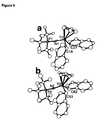
- Compound 5 was also characterized by x-ray crystallography ( Figure 1). These data reveal Ti-methyl carbon distances average 2.128(4) ⁇ with a C-Ti-C angle of 99.50(13) °.
- the phosphinimide ligand geometry is typical of that seen in CpTi-phosphinimide complexes.
- the Ti-N and P-N distances in 5 are 1.782(2) ⁇ and 1.585(2) ⁇ respectively with a P-N-Ti angle approaching linearity (178.38(11)°).
- reaction of 6 with Li(lndenyl) yields the complex (lndenyl) 2 Ti(NP- t -Bu 3 )Cl 8 in 86% isolated yield.
- the 1 H NMR data infer the presence of both an ⁇ 5 and an ⁇ 1 bound indenyl ligand as the overlapping resonances accounting for 14 protons give rise to six signals.
- These NMR features of 8 are invariant with temperature even on heating solutions of 8 to 80°C.
- Crystallographic study of 8 ( Figure 2) confirmed the interpretation of the NMR data and the presence of ⁇ 5 and ⁇ 1 bound indenyl ligands.
- the Ti-N and Ti-Cl distances in 8 are 1.775(2) ⁇ and 2.2947(10) ⁇ respectively.
- the Ti-C distance for the ⁇ 1 -indenyl ligand is 2.229(3) ⁇ . This distance is slightly longer than the ⁇ -Ti-C found in 5 , consistent with the greater steric demands of the indenyl ligands.
- the analogous species (lndenyl) 3 Ti(NP- t -Bu 3 ) 11 is obtained from the reaction of 4 with excess Li(lndenyl). This results in the dark red crystalline product 11 in 95% yield.
- the 1 H NMR data show four resonances at 25°C, which sharpen on heating, again inferring an ⁇ 5 - ⁇ 1 -site exchange process. On cooling to -80°C eighteen resonances are observed, inferring the presence of inequivalent ⁇ 5 - and ⁇ 1 -indenyl rings.
- the precise assessment of the exchange barrier is a complicated issue as the exchange process appears to involve three sites for each of seven protons.
- coalescence of resonances can not be unambiguously observed, although it appears that coalescence of the resonances in the 1 H NMR spectra of 11 occurs at approximately -25°C. This infers an approximate barrier to ⁇ 5 - and ⁇ 1 -indenyl site exchange of 8-9 Kcal/mol.
- the mixed cyclopentadienyl-indenyl species Cp(lndenyl) 2 Ti(NP-t-Bu 3 ) 12 is also accessible from the reaction of 1 and excess Li(lndenyl).
- the 1 H NMR data show four resonances inferring the presence of an ⁇ 5 -cyclopentadienyl and two ⁇ 1 -indenyl ligands. This interpretation was confirmed crystallographically ( Figure 6).
- the metric parameters are unexceptional as they mimic those observed for 5 , 8 , 9 and 11 .
- compound 12 appears to be a rigid molecule in which there is no interchange of ⁇ 5 -cyclopentadienyl and the two ⁇ 1 -indenyl ligands.
- steric crowding is a factor determining the binding modes of the cyclopentadienyl and/or indenyl ligands in the series of compounds described herein.
- the steric demands of the larger indenyl ligand and its extended ⁇ -system likely facilitate ring slippage and thus favor ⁇ 1 -binding.
- the geometries of the phosphinimide ligands are relatively constant, with only minor changes in the P-N bond distance and Ti-N-P bond angle, there is a clear effect of the electronic environment at the metal center on the Ti-N bond distance.
- the Ti-N bond was observed to about 1.844(2) ⁇ .
- the electron count is formally 16 and the Ti-N is strengthened and shortens to an observed length of about 1.77 ⁇ .
- Group 4 metal complexes with only two cyclopentadienyl rings or two indenyl rings classically have both rings ⁇ 5 -bonded to the metal center.
- These systems have been termed "whiz" compounds as the sigma bound and n bound cyclopentadienes generally rapidly interchange.
- the phosphinimine compounds described herein have at least two cyclopentadienyl ligands which may be substituted cyclopentadienyl ligands and a phosphinimine ligands.
- the compounds described are unique in structure.
- the x-ray crystallographic data and NMR spectroscopy data demonstrate that the cyclopentadienyl ligands or indenyl ligands can be ⁇ 1 or ⁇ 5 bonded to the metal depending on the number and type of cyclopentadienyl ligands or indenyl ligands present.
- the NMR spectroscopy data also shows that, for some of the novel compounds, ring whizzing can occur in solution. This ⁇ 1 - ⁇ 5 site exchange can be slowed by lowering the temperature. Of course, the ⁇ 1 - ⁇ 5 site exchange is not observed when the complexes are frozen into crystals for x-ray analysis.
- This light yellow crystalline product exhibits methyl resonances in 1 H NMR spectrum at 0.16 ppm.
- Compound 5 was also characterized by x-ray crystallography ( Figure 1). These data reveal Ti-methyl carbon distances average 2.128(4) ⁇ with a C-Ti-C angle of 99.50(13) °.
- the phosphinimide ligand geometry is similar to that seen in simple CpTi-phosphinimide complexes.
- the Ti-N and P-N distances in 5 are 1.782(2) ⁇ and 1.585(2) ⁇ respectively with a P-N-Ti angle approaching linearity (178.38(11) °).
- complex 8 is similar to that of 7 .
- Complex 4 (0.300 g; 0.666 mmol) and Li(lndenyl) (0.081 g; 0.663 mmol) afford dark red crystalline 8 (0.302 g; 0.570 mmol; 86%).
- the Ti-N and Ti-Cl distances in 8 are 1.775(2) ⁇ and 2.2947(10) ⁇ respectively.
- the Ti-C distance for the ⁇ 1 -indenyl ligand is 2.229(3) ⁇ . This distance is slightly longer than the ⁇ -Ti-C found in 5 , consistent with the greater steric demands of the indenyl ligands.
- complex 9 is similar to that of 7 .
- Complex 4 (0.500 g; 1.11 mmol) and NaCp ⁇ DME (0.160 g; 1.09 mmol) afford dark red crystalline 9 (0.465 g; 0.973 mmol; 88%).
- complex 9 can be synthesized from 1 and one equivalent of Li(lndenyl).
- complex 11 is similar to that of 7 .
- Complex 4 (0.500 g; 1.11 mmol) and excess Li(lndenyl) (0.300 g; 2.46 mmol) afford dark red crystalline 11 (0.640 g; 1.05 mmol; 95%).
- complex 11 can be synthesized from 6 and three equivalents of Li(lndenyl).
- coalescence of resonances can not be unambiguously observed, although it appears that coalescence of the resonances in the 1 H NMR spectra of 11 occurs at approximately -25°C. This infers an approximate barrier to ⁇ 5 - and ⁇ 1 - indenyl site exchange of 8-9 Kcal/mol.
- An x-ray crystallographic study of 11 confirmed that this species in the solid state contains a single ⁇ 5 - and two ⁇ 1 -indenyl ligands.
- the average Ti-N (1.780(6) ⁇ ) in 11 are similar to those seen in 5 , 8 and 9 , while the average Ti-C are slightly longer (Ti-C avg 2.215(7) ⁇ ) although not as long as those seen in 10 . Whilst not wishing to be bound by theory, it is presumably the greater steric demands of the indenyl ligands that preclude the binding of two of such ligands in ⁇ 5 -manner.
- X-ray quality crystals of 5 , 8 - 12 were obtained directly from the preparation as described above.
- the crystals were manipulated and mounted in capillaries in a glove box, thus maintaining a dry, O 2 -free environment for each crystal.
- Diffraction experiments were performed on a diffractometer (Siemens SMART System CCD) collecting a hemisphere of data in 1329 frames with 10 second exposure times. Crystal data are summarized in Table 1. The observed extinctions were consistent with the space groups in each case.
- the data sets were collected (4.5° ⁇ 2 ⁇ ⁇ 45-50.0°).
- a measure of decay was obtained by re-collecting the first 50 frames of each data set. The intensities of reflections within these frames showed essentially no statistically significant change over the duration of the data collections.
- the data were processed using a conventional data processing package in particular, using software known as SAINT and XPREP. An empirical absorption correction based on redundant data was applied to each data set. Additional solution and refinement was performed using conventional techniques (i.e. TEXSAN software solution package operating on a mainframe computer ("SGI Challenge” computers) with remote X-terminals or a personal computer employing X-emulation). The reflections with F o 2 >3 ⁇ F o 2 were used in the refinements.
- Non-hydrogen atomic scattering factors were taken from the literature tabulations. The heavy atom positions were determined using direct methods (with software known as SHELX-TL). The remaining non-hydrogen atoms were located from successive difference Fourier map calculations. The refinements were carried out by using full-matrix least squares techniques on F, minimizing the function ⁇ (
- Carbon bound hydrogen atom positions were calculated and allowed to ride on the carbon to which they are bonded assuming a C-H bond length of 0.95 ⁇ .
- Hydrogen atom temperature factors were fixed at 1.10 times the isotropic temperature factor of the carbon atom to which they are bonded.
- the hydrogen atom contributions were calculated, but not refined.
- the locations of the largest peaks in the final difference Fourier map calculation as well as the magnitude of the residual electron densities in each case were of no chemical significance.
- Standard Schlenk and drybox techniques were used in the preparation of supported catalyst systems using the organometallic complexes from Part A. Solvents were purchased as anhydrous materials and further treated to remove oxygen and polar impurities by contact with a combination of activated alumina, molecular sieves and copper oxide on silica/alumina. Where appropriate, elemental compositions of the supported catalysts were measured by Neutron Activation analysis and a reported accuracy of ⁇ 1% (weight basis).
- the supported catalysts were prepared by initially supporting a commercially available MAO on a silica support (12 weight % aluminum, based on the weight of the silica support), followed by deposition of the organometallic complex.
- the aiming point for the Al/Ti mole ratio was 120/1.
- the internal reactor temperature was set at 90°C and monitored by a thermocouple in the polymerization medium and controlled to +/- 1.0°C.
- the duration of the polymerization experiment was one hour. Following the completion of the polymerization experiment, the polymer was separated from the sodium chloride and the yield determined.
- Table B1 illustrates data concerning the Al/transition metal ratios of the supported catalyst and polymer yield.
- Table B2 provides data which describe polymer properties.
- Experiments 1-3 are inventive.
- Experiment 4 using titanocene dichloride (Cp 2 TiCl 2 ) is comparative. Titanocene dichloride is substantially less active than the inventive complexes. This is an unusual and surprising result. Whilst not wishing to be bound by theory, the experimental results suggests that the MAO (which is a Lewis acid) does not preferentially/completely abstract the phosphinimide ligand of the inventive complexes. Instead, the results strongly suggest that the MAO preferentially abstracts a Cp-type ligand from the inventive complexes. The resulting catalysts according to this invention are substantially more active than the comparative titanocene as shown in Table B1.
- the catalyst solutions were pumped to the reactor independently and in some cases were mixed before entering the polymerization reactor (as indicated in the examples). Because of the low solubility of the catalysts, activators and MAO in cyclohexane, solutions were prepared in purified xylene.
- the catalyst was activated in-situ (in the polymerization reactor) at the reaction temperature in the presence of the monomers.
- the polymerizations were carried out in cyclohexane at a pressure of 10.342 MPa (1500 psi).
- Ethylene was supplied to the reactor by a calibrated thermal mass flow meter and was dissolved in the reaction solvent prior to the polymerization reactor. If comonomer (for example 1-octene) was used it was also premixed with the ethylene before entering the polymerization reactor. Under these conditions the ethylene conversion is a dependent variable controlled by the catalyst concentration, reaction temperature and catalyst activity, etc.
- the internal reactor temperature is monitored by a thermocouple in the polymerization medium and can be controlled at the required set point to +/- 0.5°C. Down stream of the reactor the pressure was reduced from the reaction pressure (1500 psi) to atmospheric. The solid polymer was then recovered as a slurry in the condensed solvent and was dried by evaporation before analysis.
- the ethylene conversion was determined by a dedicated on line gas chromatograph by reference to propane which was used as an internal standard.
- the average polymerization rate constant was calculated based on the reactor hold-up time, the catalyst concentration in the reactor and the ethylene conversion and is expressed in l/(mmol*min).
- Average polymerization rate (kp) (Q/(100-Q)) x (1/[TM]) x (1/HUT) where:
- Melt index (Ml) measurements were conducted according to ASTM method D-1238-82.
- Polymer densities were measured on pressed plaques (ASTM D-1928-90) with a densitometer.
- the two components were mixed in the polymerization reactor.
- the reaction temperature was 160°C and 2.1 gram/min of ethylene was continuously added to the reactor. An ethylene conversion of 98.7% was observed.
- the two components were mixed before the polymerization reactor.
- the reaction temperature was 160°C and 2.1 gram/min of ethylene was continuously added to the reactor. An ethylene conversion of 45.6% was observed.
- the three components were mixed in the polymerization reactor.
- the reaction temperature was 160°C and 2.1 gram/min of ethylene was continuously added to the reactor. An ethylene conversion of 89.4% was observed.
- the two components were mixed in the polymerization reactor.
- the reaction temperature was 160°C and 2.1 gram/min of ethylene was continuously added to the reactor. An ethylene conversion of 87.1% was observed.
- the two components were mixed in the polymerization reactor.
- the reaction temperature was 160°C and 2.1 gram/min of ethylene was continuously added to the reactor. An ethylene conversion of 85.7% was observed.
- the three components were mixed in the polymerization reactor.
- the reaction temperature was 160°C and 2.1 gram/min of ethylene was continuously added to the reactor. An ethylene conversion of 85.2% was observed.
- inventive complexes are well suited for use as a component in a catalyst system for the polymerization of olefins, especially ethylene.
- Polyethylene produced with the inventive complexes is useful, for example, in the production of film, extruded parts and profiles and molded plastic goods.
Landscapes
- Chemical & Material Sciences (AREA)
- Organic Chemistry (AREA)
- Chemical Kinetics & Catalysis (AREA)
- Engineering & Computer Science (AREA)
- Materials Engineering (AREA)
- Inorganic Chemistry (AREA)
- Health & Medical Sciences (AREA)
- Medicinal Chemistry (AREA)
- Polymers & Plastics (AREA)
- Transition And Organic Metals Composition Catalysts For Addition Polymerization (AREA)
Claims (8)
- Organometallkomplex der Formel:worin M ein Gruppe 4-Metall mit Oxidationsstufe 4 ist;
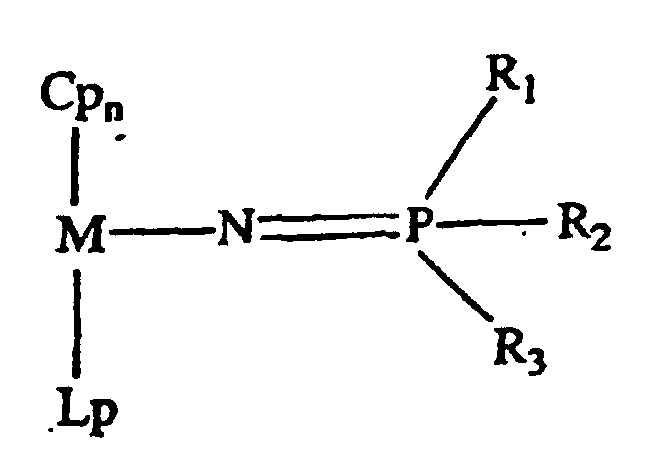
die Cp jeweils aus der aus unsubstituiertem Cyclopentadienyl, substituiertem Cyclopentadienyl, unsubstituiertem Indenyl, substituiertem Indenyl, unsubstituiertem Fluorenyl und substituiertem Fluorenyl bestehenden Gruppe ausgewählt sind;
R1, R2 und R3 jeweils eine über eine Kohlenstoff-Phosphor-Einfachbindung an Phosphor gebundene Hydrocarbylgruppe sind;
n = 2 oder 3 ist und n+p = 3 ist; und
wenn p = 1, L ein monoanionischer Ligand ist, der nicht -N=PR1R2R3 ist; und worin zumindest eines der Cp entweder unsubstituiertes Indenyl oder substituiertes Indenyl ist. - Organometallkomplex nach Anspruch 1, worin M Ti ist.
- Organometallkomplex nach Anspruch 1 oder 2, worin n = 3 ist und die Cp jeweils aus unsubstituiertem Cyclopentadienyl und unsubstituiertem Indenyl ausgewählt sind.
- Organometallkomplex nach einem der Ansprüche 1 bis 3, worin R jeweils eine Alkylgruppe ist.
- Organometallkomplex nach Anspruch 4, worin R jeweils t-Butyl ist.
- Olefinpolymerisationsverfahren, worin zumindest ein α-Olefin mit 2 bis 10 Kohlenstoffatomen in Gegenwart eines Katalysatorsystems polymerisiert wird, das Folgendes umfasst:a) einen Organometallkomplex nach einem der Ansprüche 1 bis 5; undb) einen Aktivator.
- Verfahren nach Anspruch 6, worin:worin die Gasphasen-Copolymerisation bei einem Druck von 0,1 bis 2,0 MPa (1 bis 20 atm) und einer Temperatur von 60 bis 130 °C durchgeführt wird.1) der Organometallkomplex und der Aktivator auf einem bestimmten Träger getragen werden; und2) das Polymerisationsverfahren eine Gasphasen-Copolymerisation von Ethylen mit zumindest einem α-Olefin, ausgewählt aus Buten, Penten und Hexen, ist,
- Verfahren nach Anspruch 6, worin die Olefinpolymerisation in Gegenwart eines Kohlenwasserstoffverdünners oder Kohlenwasserstofflösungsmittels durchgeführt wird.
Applications Claiming Priority (3)
| Application Number | Priority Date | Filing Date | Title |
|---|---|---|---|
| CA2282070 | 1999-09-10 | ||
| CA002282070A CA2282070C (en) | 1999-09-10 | 1999-09-10 | Hydrocarbyl phosphinimine/cyclopentadienyl complexes of group iv metals and preparation thereof |
| PCT/CA2000/000978 WO2001019512A1 (en) | 1999-09-10 | 2000-08-24 | Hydrocarbyl phosphinimine/cyclopentadienyl complexes of group 4 and their use in olefin polymerization |
Publications (2)
| Publication Number | Publication Date |
|---|---|
| EP1214146A1 EP1214146A1 (de) | 2002-06-19 |
| EP1214146B1 true EP1214146B1 (de) | 2003-10-15 |
Family
ID=4164113
Family Applications (1)
| Application Number | Title | Priority Date | Filing Date |
|---|---|---|---|
| EP00954231A Expired - Lifetime EP1214146B1 (de) | 1999-09-10 | 2000-08-24 | Hydrocarbylphosphinimin/cyclopentadienyl-komplexe von metallen der gruppe 4 und deren verwendung zur olefinpolymerisation |
Country Status (11)
| Country | Link |
|---|---|
| US (1) | US6440890B1 (de) |
| EP (1) | EP1214146B1 (de) |
| JP (1) | JP4619599B2 (de) |
| KR (1) | KR100670424B1 (de) |
| AT (1) | ATE251945T1 (de) |
| AU (1) | AU6678300A (de) |
| BR (1) | BR0013870B1 (de) |
| CA (1) | CA2282070C (de) |
| DE (1) | DE60005982T2 (de) |
| ES (1) | ES2208398T3 (de) |
| WO (1) | WO2001019512A1 (de) |
Families Citing this family (17)
| Publication number | Priority date | Publication date | Assignee | Title |
|---|---|---|---|---|
| CA2347410C (en) * | 2001-05-11 | 2009-09-08 | Nova Chemicals Corporation | Solution polymerization process catalyzed by a phosphinimine catalyst |
| US7309741B2 (en) * | 2004-06-01 | 2007-12-18 | Nova Chemicals (International) S.A. | Polyolefin blends and pipe |
| EP1801113A1 (de) * | 2005-12-22 | 2007-06-27 | DSM IP Assets B.V. | Zwitterionischer Phosphinimin-Katalysator |
| DE102007057854A1 (de) * | 2007-11-28 | 2009-06-04 | Philipps-Universität Marburg | Cyclopentadienylphosphazen-Komplexe (CpPN-Komplexe) von Metallen der 3. und 4. Gruppe und der Lanthanoide |
| US9120984B2 (en) | 2012-12-21 | 2015-09-01 | Governors Of The University Of Alberta | Transition metal catalysts for hydrodesulfurization |
| US9051229B2 (en) | 2012-12-21 | 2015-06-09 | Governors Of The University Of Alberta | Transition metal catalysts for C—O hydrogenolysis and hydrodeoxygenation |
| US9120741B2 (en) | 2012-12-21 | 2015-09-01 | Governors Of The University Of Alberta | Transition metal catalysts for hydrogenation and hydrosilylation |
| US8901334B2 (en) | 2012-12-21 | 2014-12-02 | Governors Of The University Of Alberta | Transition metal-phosphoranimide catalysts |
| US9458395B2 (en) | 2013-05-21 | 2016-10-04 | Governors Of The University Of Alberta | Catalysts for hydrodesulfurization |
| US9000198B2 (en) | 2013-05-21 | 2015-04-07 | Governors Of The University Of Alberta | Mixed-valent transition metal-phosphoranimide catalysts |
| US9441063B2 (en) | 2014-10-09 | 2016-09-13 | Chevron Phillips Chemical Company Lp | Titanium phosphinimide and titanium iminoimidazolidide catalyst systems with activator-supports |
| KR101919435B1 (ko) * | 2015-10-21 | 2018-11-16 | 주식회사 엘지화학 | 전이금속 화합물, 이를 포함하는 촉매 조성물 및 이를 이용한 폴리올레핀의 제조 방법 |
| US10005865B1 (en) | 2017-04-07 | 2018-06-26 | Chevron Phillips Chemical Company Lp | Methods for controlling molecular weight and molecular weight distribution |
| US10428091B2 (en) | 2017-04-07 | 2019-10-01 | Chevron Phillips Chemical Company Lp | Catalyst systems containing low valent titanium-aluminum complexes and polymers produced therefrom |
| US10000595B1 (en) | 2017-04-07 | 2018-06-19 | Chevron Phillips Chemical Company Lp | Catalyst systems containing low valent titanium compounds and polymers produced therefrom |
| JP7767014B2 (ja) * | 2020-01-22 | 2025-11-11 | 三井化学株式会社 | 遷移金属化合物、オレフィン重合用触媒、およびオレフィン重合体の製造方法 |
| JP7839869B2 (ja) * | 2022-03-31 | 2026-04-02 | ポリプラスチックス株式会社 | 触媒組成物の保管方法 |
Family Cites Families (4)
| Publication number | Priority date | Publication date | Assignee | Title |
|---|---|---|---|---|
| JP3566819B2 (ja) * | 1996-10-04 | 2004-09-15 | 関東化学株式会社 | 新規な有機遷移金属化合物 |
| CA2206944C (en) * | 1997-05-30 | 2006-08-29 | Douglas W. Stephan | High temperature solution polymerization process |
| CA2210131C (en) * | 1997-07-09 | 2005-08-02 | Douglas W. Stephan | Supported phosphinimine-cp catalysts |
| US5986120A (en) * | 1998-02-10 | 1999-11-16 | The Research Foundation Of The State University Of New York | Metal triflimide complexes |
-
1999
- 1999-09-10 CA CA002282070A patent/CA2282070C/en not_active Expired - Lifetime
-
2000
- 2000-08-24 WO PCT/CA2000/000978 patent/WO2001019512A1/en not_active Ceased
- 2000-08-24 AT AT00954231T patent/ATE251945T1/de not_active IP Right Cessation
- 2000-08-24 KR KR1020027003129A patent/KR100670424B1/ko not_active Expired - Lifetime
- 2000-08-24 JP JP2001523129A patent/JP4619599B2/ja not_active Expired - Lifetime
- 2000-08-24 AU AU66783/00A patent/AU6678300A/en not_active Abandoned
- 2000-08-24 EP EP00954231A patent/EP1214146B1/de not_active Expired - Lifetime
- 2000-08-24 ES ES00954231T patent/ES2208398T3/es not_active Expired - Lifetime
- 2000-08-24 BR BRPI0013870-3A patent/BR0013870B1/pt not_active IP Right Cessation
- 2000-08-24 DE DE60005982T patent/DE60005982T2/de not_active Expired - Lifetime
- 2000-09-06 US US09/656,126 patent/US6440890B1/en not_active Expired - Lifetime
Also Published As
| Publication number | Publication date |
|---|---|
| JP4619599B2 (ja) | 2011-01-26 |
| ES2208398T3 (es) | 2004-06-16 |
| KR20020034186A (ko) | 2002-05-08 |
| EP1214146A1 (de) | 2002-06-19 |
| WO2001019512A1 (en) | 2001-03-22 |
| DE60005982D1 (de) | 2003-11-20 |
| JP2003509388A (ja) | 2003-03-11 |
| ATE251945T1 (de) | 2003-11-15 |
| US6440890B1 (en) | 2002-08-27 |
| BR0013870B1 (pt) | 2011-07-12 |
| KR100670424B1 (ko) | 2007-01-18 |
| BR0013870A (pt) | 2002-07-23 |
| CA2282070C (en) | 2008-12-09 |
| DE60005982T2 (de) | 2004-09-09 |
| AU6678300A (en) | 2001-04-17 |
| CA2282070A1 (en) | 2001-03-10 |
Similar Documents
| Publication | Publication Date | Title |
|---|---|---|
| US6440890B1 (en) | Hydrocarbyl phosphinimine/cyclopentadienyl complexes of group IV metals and preparation thereof | |
| Shreve et al. | Sterically hindered aryloxide-substituted alkylaluminum compounds | |
| EP2824107B1 (de) | Ansa-metallocen-verbindung und verfahren zur herstellung eines geträgerten katalysators damit | |
| US6596827B2 (en) | Method for catalytic polymerization of alpha-olefin monomers using an ultra-high activity non-metallocene pre-catalyst | |
| JP3686081B2 (ja) | 触媒組成物 | |
| Saßmannshausen et al. | Half-sandwich complexes of titanium and zirconium with pendant phenyl substituents. The influence of ansa-aryl coordination on the polymerisation activity of half-sandwich catalysts | |
| JP2001527459A (ja) | (ペルフルオロアリール)フルオロ―アルミ酸塩の合成及び使用 | |
| CN101356006A (zh) | 含杂原子多齿配位体的金属配合物、催化剂以及制备和使用其的方法 | |
| JPS60260602A (ja) | ポリオレフィンの製造方法 | |
| Richter et al. | Metallocene analogues containing bulky heteroallylic ligands and their use as new olefin polymerization catalysts | |
| JP2004533487A (ja) | 非メタロセン類、それらの製造方法およびそれらのオレフィン類の重合のための使用 | |
| Mansel et al. | ansa-Metallocene derivatives XXXII. Zirconocene complexes with a spirosilane bridge: syntheses, crystal structures and properties as olefin polymerization catalysts | |
| JP3850048B2 (ja) | 有機遷移金属化合物およびそれを用いたポリオレフィンの製造方法 | |
| EP1997834A1 (de) | Katalysatoren | |
| JPH0713075B2 (ja) | 橋架け構造のビス置換シクロペンタジエニル配位子を有するジルコニウム化合物 | |
| Paolucci et al. | Scandium and yttrium complexes of a heteroscorpionate [N, N, O]-donor-set ligand: Synthesis, characterization and catalytic activity in ethylene polymerization | |
| US6057467A (en) | Metallocene adduct, its preparation and its application in olefin polymerization | |
| Straus et al. | Synthesis and characterization of [TiF2 (NMe2) 2] 4 and its use for olefin polymerizations | |
| Koch et al. | PH-functionalised phosphanylalkyl (silyl) cyclopentadienyl ligands:: Synthesis and catalytic properties of [{(η5-C5H4) CMe2PHtBu} MCl3](M= Ti, Zr) and [{(η5-C5H4) SiMe2PHR} ZrCl3](R= Ph, Cy) | |
| JP2000502678A (ja) | 遷移金属化合物、その調製法及び触媒成分としてのその使用法 | |
| JPH03193797A (ja) | 新規遷移金属化合物及びその製造方法 | |
| Kobyłka et al. | Ligand Migration in the Reaction of Titanium Complexes with AlMe 3 | |
| JP3213774B2 (ja) | 非対称な配位子を有するハフニウム化合物及び触媒成分 | |
| KR20100027232A (ko) | 풀벤 착물 기재의 촉매 성분 | |
| KR100425633B1 (ko) | 메탈로센 부가물, 이의 제조 방법 및 올레핀중합반응에서의 이의 용도 |
Legal Events
| Date | Code | Title | Description |
|---|---|---|---|
| PUAI | Public reference made under article 153(3) epc to a published international application that has entered the european phase |
Free format text: ORIGINAL CODE: 0009012 |
|
| 17P | Request for examination filed |
Effective date: 20020403 |
|
| AK | Designated contracting states |
Kind code of ref document: A1 Designated state(s): AT BE CH CY DE DK ES FI FR GB GR IE IT LI LU MC NL PT SE |
|
| AX | Request for extension of the european patent |
Free format text: AL;LT;LV;MK;RO;SI |
|
| 17Q | First examination report despatched |
Effective date: 20020916 |
|
| GRAH | Despatch of communication of intention to grant a patent |
Free format text: ORIGINAL CODE: EPIDOS IGRA |
|
| GRAS | Grant fee paid |
Free format text: ORIGINAL CODE: EPIDOSNIGR3 |
|
| GRAA | (expected) grant |
Free format text: ORIGINAL CODE: 0009210 |
|
| AK | Designated contracting states |
Kind code of ref document: B1 Designated state(s): AT BE CH CY DE DK ES FI FR GB GR IE IT LI LU MC NL PT SE |
|
| PG25 | Lapsed in a contracting state [announced via postgrant information from national office to epo] |
Ref country code: CH Free format text: LAPSE BECAUSE OF FAILURE TO SUBMIT A TRANSLATION OF THE DESCRIPTION OR TO PAY THE FEE WITHIN THE PRESCRIBED TIME-LIMIT Effective date: 20031015 Ref country code: CY Free format text: LAPSE BECAUSE OF FAILURE TO SUBMIT A TRANSLATION OF THE DESCRIPTION OR TO PAY THE FEE WITHIN THE PRESCRIBED TIME-LIMIT Effective date: 20031015 Ref country code: LI Free format text: LAPSE BECAUSE OF FAILURE TO SUBMIT A TRANSLATION OF THE DESCRIPTION OR TO PAY THE FEE WITHIN THE PRESCRIBED TIME-LIMIT Effective date: 20031015 Ref country code: FI Free format text: LAPSE BECAUSE OF FAILURE TO SUBMIT A TRANSLATION OF THE DESCRIPTION OR TO PAY THE FEE WITHIN THE PRESCRIBED TIME-LIMIT Effective date: 20031015 Ref country code: AT Free format text: LAPSE BECAUSE OF FAILURE TO SUBMIT A TRANSLATION OF THE DESCRIPTION OR TO PAY THE FEE WITHIN THE PRESCRIBED TIME-LIMIT Effective date: 20031015 |
|
| REG | Reference to a national code |
Ref country code: GB Ref legal event code: FG4D Ref country code: CH Ref legal event code: EP |
|
| REG | Reference to a national code |
Ref country code: IE Ref legal event code: FG4D |
|
| REF | Corresponds to: |
Ref document number: 60005982 Country of ref document: DE Date of ref document: 20031120 Kind code of ref document: P |
|
| PG25 | Lapsed in a contracting state [announced via postgrant information from national office to epo] |
Ref country code: GR Free format text: LAPSE BECAUSE OF FAILURE TO SUBMIT A TRANSLATION OF THE DESCRIPTION OR TO PAY THE FEE WITHIN THE PRESCRIBED TIME-LIMIT Effective date: 20040115 Ref country code: SE Free format text: LAPSE BECAUSE OF FAILURE TO SUBMIT A TRANSLATION OF THE DESCRIPTION OR TO PAY THE FEE WITHIN THE PRESCRIBED TIME-LIMIT Effective date: 20040115 Ref country code: DK Free format text: LAPSE BECAUSE OF FAILURE TO SUBMIT A TRANSLATION OF THE DESCRIPTION OR TO PAY THE FEE WITHIN THE PRESCRIBED TIME-LIMIT Effective date: 20040115 |
|
| LTIE | Lt: invalidation of european patent or patent extension |
Effective date: 20031015 |
|
| REG | Reference to a national code |
Ref country code: CH Ref legal event code: PL |
|
| REG | Reference to a national code |
Ref country code: ES Ref legal event code: FG2A Ref document number: 2208398 Country of ref document: ES Kind code of ref document: T3 |
|
| ET | Fr: translation filed | ||
| PLBE | No opposition filed within time limit |
Free format text: ORIGINAL CODE: 0009261 |
|
| STAA | Information on the status of an ep patent application or granted ep patent |
Free format text: STATUS: NO OPPOSITION FILED WITHIN TIME LIMIT |
|
| PG25 | Lapsed in a contracting state [announced via postgrant information from national office to epo] |
Ref country code: LU Free format text: LAPSE BECAUSE OF NON-PAYMENT OF DUE FEES Effective date: 20040824 Ref country code: IE Free format text: LAPSE BECAUSE OF NON-PAYMENT OF DUE FEES Effective date: 20040824 |
|
| PG25 | Lapsed in a contracting state [announced via postgrant information from national office to epo] |
Ref country code: MC Free format text: LAPSE BECAUSE OF NON-PAYMENT OF DUE FEES Effective date: 20040831 |
|
| 26N | No opposition filed |
Effective date: 20040716 |
|
| REG | Reference to a national code |
Ref country code: IE Ref legal event code: MM4A |
|
| PG25 | Lapsed in a contracting state [announced via postgrant information from national office to epo] |
Ref country code: PT Free format text: LAPSE BECAUSE OF NON-PAYMENT OF DUE FEES Effective date: 20040315 |
|
| REG | Reference to a national code |
Ref country code: FR Ref legal event code: PLFP Year of fee payment: 17 |
|
| REG | Reference to a national code |
Ref country code: FR Ref legal event code: PLFP Year of fee payment: 18 |
|
| REG | Reference to a national code |
Ref country code: FR Ref legal event code: PLFP Year of fee payment: 19 |
|
| PGFP | Annual fee paid to national office [announced via postgrant information from national office to epo] |
Ref country code: NL Payment date: 20190726 Year of fee payment: 20 |
|
| PGFP | Annual fee paid to national office [announced via postgrant information from national office to epo] |
Ref country code: IT Payment date: 20190722 Year of fee payment: 20 Ref country code: DE Payment date: 20190722 Year of fee payment: 20 Ref country code: FR Payment date: 20190722 Year of fee payment: 20 Ref country code: ES Payment date: 20190902 Year of fee payment: 20 |
|
| PGFP | Annual fee paid to national office [announced via postgrant information from national office to epo] |
Ref country code: BE Payment date: 20190725 Year of fee payment: 20 |
|
| PGFP | Annual fee paid to national office [announced via postgrant information from national office to epo] |
Ref country code: GB Payment date: 20190722 Year of fee payment: 20 |
|
| REG | Reference to a national code |
Ref country code: DE Ref legal event code: R071 Ref document number: 60005982 Country of ref document: DE |
|
| REG | Reference to a national code |
Ref country code: NL Ref legal event code: MK Effective date: 20200823 |
|
| REG | Reference to a national code |
Ref country code: GB Ref legal event code: PE20 Expiry date: 20200823 |
|
| REG | Reference to a national code |
Ref country code: BE Ref legal event code: MK Effective date: 20200824 |
|
| PG25 | Lapsed in a contracting state [announced via postgrant information from national office to epo] |
Ref country code: GB Free format text: LAPSE BECAUSE OF EXPIRATION OF PROTECTION Effective date: 20200823 |
|
| REG | Reference to a national code |
Ref country code: ES Ref legal event code: FD2A Effective date: 20201201 |
|
| PG25 | Lapsed in a contracting state [announced via postgrant information from national office to epo] |
Ref country code: ES Free format text: LAPSE BECAUSE OF EXPIRATION OF PROTECTION Effective date: 20200825 |