EP1222159B1 - Intermediaires de fabrication d'un derive de type benzofurane ou benzothiophene nitre en position 5 et leurs utilisations - Google Patents
Intermediaires de fabrication d'un derive de type benzofurane ou benzothiophene nitre en position 5 et leurs utilisations Download PDFInfo
- Publication number
- EP1222159B1 EP1222159B1 EP00971474A EP00971474A EP1222159B1 EP 1222159 B1 EP1222159 B1 EP 1222159B1 EP 00971474 A EP00971474 A EP 00971474A EP 00971474 A EP00971474 A EP 00971474A EP 1222159 B1 EP1222159 B1 EP 1222159B1
- Authority
- EP
- European Patent Office
- Prior art keywords
- formula
- carbon atoms
- compound
- process according
- group
- Prior art date
- Legal status (The legal status is an assumption and is not a legal conclusion. Google has not performed a legal analysis and makes no representation as to the accuracy of the status listed.)
- Expired - Lifetime
Links
- 0 C**1(CC1)C(C)(C=CC=C1NO)C=C1NC(*)C(*)=O Chemical compound C**1(CC1)C(C)(C=CC=C1NO)C=C1NC(*)C(*)=O 0.000 description 6
Classifications
-
- C—CHEMISTRY; METALLURGY
- C07—ORGANIC CHEMISTRY
- C07D—HETEROCYCLIC COMPOUNDS
- C07D307/00—Heterocyclic compounds containing five-membered rings having one oxygen atom as the only ring hetero atom
- C07D307/77—Heterocyclic compounds containing five-membered rings having one oxygen atom as the only ring hetero atom ortho- or peri-condensed with carbocyclic rings or ring systems
- C07D307/78—Benzo [b] furans; Hydrogenated benzo [b] furans
- C07D307/79—Benzo [b] furans; Hydrogenated benzo [b] furans with only hydrogen atoms, hydrocarbon or substituted hydrocarbon radicals, directly attached to carbon atoms of the hetero ring
-
- C—CHEMISTRY; METALLURGY
- C07—ORGANIC CHEMISTRY
- C07C—ACYCLIC OR CARBOCYCLIC COMPOUNDS
- C07C201/00—Preparation of esters of nitric or nitrous acid or of compounds containing nitro or nitroso groups bound to a carbon skeleton
- C07C201/06—Preparation of nitro compounds
- C07C201/12—Preparation of nitro compounds by reactions not involving the formation of nitro groups
-
- C—CHEMISTRY; METALLURGY
- C07—ORGANIC CHEMISTRY
- C07C—ACYCLIC OR CARBOCYCLIC COMPOUNDS
- C07C205/00—Compounds containing nitro groups bound to a carbon skeleton
- C07C205/27—Compounds containing nitro groups bound to a carbon skeleton the carbon skeleton being further substituted by etherified hydroxy groups
- C07C205/35—Compounds containing nitro groups bound to a carbon skeleton the carbon skeleton being further substituted by etherified hydroxy groups having nitro groups and etherified hydroxy groups bound to carbon atoms of six-membered aromatic rings of the carbon skeleton
- C07C205/36—Compounds containing nitro groups bound to a carbon skeleton the carbon skeleton being further substituted by etherified hydroxy groups having nitro groups and etherified hydroxy groups bound to carbon atoms of six-membered aromatic rings of the carbon skeleton to carbon atoms of the same non-condensed six-membered aromatic ring or to carbon atoms of six-membered aromatic rings being part of the same condensed ring system
- C07C205/37—Compounds containing nitro groups bound to a carbon skeleton the carbon skeleton being further substituted by etherified hydroxy groups having nitro groups and etherified hydroxy groups bound to carbon atoms of six-membered aromatic rings of the carbon skeleton to carbon atoms of the same non-condensed six-membered aromatic ring or to carbon atoms of six-membered aromatic rings being part of the same condensed ring system the oxygen atom of at least one of the etherified hydroxy groups being further bound to an acyclic carbon atom
-
- C—CHEMISTRY; METALLURGY
- C07—ORGANIC CHEMISTRY
- C07C—ACYCLIC OR CARBOCYCLIC COMPOUNDS
- C07C67/00—Preparation of carboxylic acid esters
- C07C67/30—Preparation of carboxylic acid esters by modifying the acid moiety of the ester, such modification not being an introduction of an ester group
- C07C67/31—Preparation of carboxylic acid esters by modifying the acid moiety of the ester, such modification not being an introduction of an ester group by introduction of functional groups containing oxygen only in singly bound form
-
- C—CHEMISTRY; METALLURGY
- C07—ORGANIC CHEMISTRY
- C07D—HETEROCYCLIC COMPOUNDS
- C07D333/00—Heterocyclic compounds containing five-membered rings having one sulfur atom as the only ring hetero atom
- C07D333/50—Heterocyclic compounds containing five-membered rings having one sulfur atom as the only ring hetero atom condensed with carbocyclic rings or ring systems
- C07D333/52—Benzo[b]thiophenes; Hydrogenated benzo[b]thiophenes
- C07D333/54—Benzo[b]thiophenes; Hydrogenated benzo[b]thiophenes with only hydrogen atoms, hydrocarbon or substituted hydrocarbon radicals, directly attached to carbon atoms of the hetero ring
Definitions
- the subject of the present invention is new compounds nitroaromatics and their method of preparation.
- the invention also relates to the use of these compounds for preparation of heterocyclic derivatives of benzofuran or benzothiophene. nitrated in position 5.
- the invention is aimed in particular at the preparation of 2-alkyl-5-nitrobenzofuran.
- EP-A-0 471 609 discloses a process for the preparation of n-butyl-2-nitro-5-benzofuran which comprises reacting 2-hydroxy-5-nitro-benzyltriphenylphosphonium bromide with pentanoyl chloride in the presence of pyridine: 2-hydroxy-5-nitro-benzyltriphenylphosphonium bromide being obtained from 2-hydroxy-5-nitrobenzyl bromide and triphenylphosphine
- Jacobs et al JACS 39 , 8, p 2212
- Jacobs et al JACS 39 , 8, p 2212
- the benzene ring may carry a substituent.
- the invention does not exclude the presence on the benzene ring of any type of substitute insofar as it does not react under the conditions of the invention.
- R represents a hydrogen atom, a methyl or ethyl group, a methoxy or ethoxy group.
- two groups R and the two successive atoms of benzene ring can form a saturated, unsaturated or having from 5 to 7 carbon atoms, preferably 6 carbon atoms, carbon.
- two R groups advantageously form a benzene ring.
- the group R 1 is advantageously an alkyl group having 1 to 4 carbon atoms.
- R 2 represents another group such as cycloalkyl, phenyl or arylalkyl but the R 2 group being eliminated, it is interesting from an economic point of view that it is as simple as possible by for example, a lower alkyl group, that is to say having 1 to 4 carbon atoms.
- R 2 may also represent a hydrogen atom which corresponds to the presence of a carboxylic group.
- Z preferably represents an oxygen atom.
- the invention also relates to the nitration of a compound of formula (II) in acid form or in ester form, that is to say a compound of formula (II) in which R 2 is both a hydrogen atom than a hydrocarbon group.
- Y is a leaving group, it is interesting from an economic point of view that of a simple nature, and more particularly represents a linear or branched alkyl group having from 1 to 4 carbon atoms, preferably a methyl or ethyl group, but it can also represent, for example, a phenyl or tolyl group or a trifluoromethyl group; .
- the preferred group is a triflate group which corresponds to a group representing a trifluoromethyl group.
- the atoms are preferably chosen halogen, bromine, chlorine or iodine and preferably a bromine or chlorine.
- the invention also relates to the use of the compound of formula (I) for the preparation of a heterocyclic compound corresponding to general formula (V): in the formula (V), R, R 1 , Z and n have the meaning given above, by a saponification optionally when R 2 is an ester function, followed by a cyclization.
- R 1 is a linear or branched alkyl group having from 1 to 12 carbon atoms, a phenyl group optionally substituted by a group alkyl having 1 to 4 carbon atoms or a halophenyl group.
- R 1 represents a linear or branched alkyl group having from 1 to 12 carbon atoms; a phenyl group optionally substituted with an alkyl group having 1 to 4 carbon atoms or a halophenyl group
- the compounds of formula (I) can be obtained by nitration of a compound of formula (II) O- or S-alkylated, by reaction of the latter with a source of NO 2 + , preferably in the presence or absence of an organic solvent.
- said compound is reacted with a source of NO 2 + .
- nitrogen dioxide NO 2 nitrogen dioxide N 2 O 3 , nitrogen peroxide N 2 O 4 , nitrogen oxide NO associated with an oxidizing agent such as, for example for example, nitric acid, nitrogen dioxide or oxygen.
- an oxidizing agent such as, for example for example, nitric acid, nitrogen dioxide or oxygen.
- nitrous acid a nitrosyl sulphate or nitrose or a nitrous salt, preferably an alkali metal salt, and even more preferentially, the sodium associated with an oxidizing agent, preferably the acid nitric.
- alkyl nitrites associated with an oxidizing agent and more particularly those corresponding to formula (VI): R a - ONO in said formula (VI), R a represents a linear or branched alkyl group having 1 to 12 carbon atoms, preferably 1 to 4 carbon atoms.
- the amount of NO 2 + source is at least equal to the stoichiometric amount of the O- or S-alkylated aromatic compound.
- the ratio between the number of moles of NO 2 + source and the number of moles of O- or S-alkylated aromatic compound is advantageously between 1.0 and 1.2.
- a solution of concentrated nitric acid is preferentially used having a preferential concentration of between 70 and 99%.
- the source of NO 2 + is associated with sulfuric acid.
- a variant of the process of the invention consists in using a mixture sulphonitrile (a mixture of nitric acid and sulfuric acid comprising from 50 to 98% by weight of nitric acid).
- the amount of nitric acid expressed by the compound molar ratio aromatic O- or S-alkylated / nitric acid usually ranges from 0.9 to 1.1, from preferably between 0.95 and 1.05.
- the amount of sulfuric acid expressed by the compound molar ratio aromatic O- or S-alkylated / sulfuric acid generally ranges from 0.9 to 1.1, preferably between 0.95 and 1.05.
- the concentration of sulfuric acid is advantageously between 50% and 98%.
- nitric acid or a precursor of the acid nitric such as for example nitrogen peroxide.
- the nitration reaction can be optionally carried out in a solvent organic which is inert under the reaction conditions.
- organic solvents mention may be made of aliphatic halogenated hydrocarbons and more particularly, perchlorinated hydrocarbons such as in particular tetrachloromethane, hexachloroethane; partially chlorinated hydrocarbons such as dichloromethane, or 1,2-dichloroethane.
- perchlorinated hydrocarbons such as in particular tetrachloromethane, hexachloroethane
- partially chlorinated hydrocarbons such as dichloromethane, or 1,2-dichloroethane.
- Dichloromethane is the preferred solvent.
- the concentration of the O- and S-alkylated aromatic compound, in the reaction medium it is preferably between 0.2 and 3 mol / l and preferably between 0.3 and 1.5 mol / l.
- the reaction is advantageously carried out at a temperature of between -10 ° C and 20 ° C, preferably between -5 ° C and 10 ° C, and inert gas atmosphere.
- the process of the invention is generally carried out under pressure atmospheric.
- the step nitration under controlled atmosphere of inert gases.
- inert gases we can establish a atmosphere of rare gases, preferably argon but it is more economical to use nitrogen.
- a first variant is to first load the acid solution sulfuric acid and then add in parallel the aromatic compound O- or S-alkylated and nitric acid.
- the sulfuric acid solution is introduced and nitric acid and then add the aromatic compound O- or S-alkylated, preferably in portions or continuously by casting.
- Another variant lies in the fact of introducing in parallel, on one foot vat, the aromatic compound O- or S-alkylated on one side and sulfuric acid and nitric acid on the other.
- the reaction advantageously lasts between 3 and 10 hours.
- the product is recovered according to the conventional techniques used in the technical area.
- a solid is obtained which is separated according to the conventional techniques of solid / liquid separation, preferably by filtration.
- a first embodiment consists in reacting a compound aromatic compound of formula (III) with a carboxylic acid or derivative of formula (IV): the reaction being conducted in the presence of a base, preferably in a organic solvent.
- Another variant of the process of the invention consists in conducting the reaction O- or S-alkylation, in aqueous medium, in the presence of a base and a phase transfer catalyst.
- carboxylic acid or derivative of formula (IV) an preferentially to esters of ⁇ -halocarboxylic acids and more preferentially to methyl or ethyl 2-bromohexanoate.
- the molar ratio between the compound of formula (III) and the formula (IV) is advantageously chosen between 1 and 1.2.
- the compound of type 2-hydroxy- or 2-thiobenzaldehyde of formula (III) in salified form and the acid carboxylic acid or derivative of formula (IV), in an organic solvent are salified form and the acid carboxylic acid or derivative of formula (IV), in an organic solvent.
- a salt form of a 2-hydroxy-type compound can be used. or 2-thiobenzaldehyde prepared extemporaneously but it is also possible to prepare it in situ by reacting the 2-hydroxy-type compound or 2-thiobenzaldehyde and base.
- a base which can be mineral or organic.
- mineral bases such as alkali metal salts or alkaline earth metal, preferably an alkali or alkaline earth metal hydroxide which can be sodium hydroxide, potassium hydroxide or calcium hydroxide; a carbonate or hydrogencarbonate of an alkali metal, preferably the sodium carbonate.
- hydroxides of tetralkylammonium or of trialkylbenzylammonium having identical or different alkyl groups represent a linear or branched alkyl chain having 1 to 12 carbon atoms carbon, preferably from 1 to 6 carbon atoms.
- Tetramethylammonium hydroxide is preferably chosen, tetraethylammonium hydroxide or tetrabutylammonium hydroxide.
- hydroxides trialkylbenzylammonium and in particular to the hydroxide of trimethylbenzylammonium.
- amines examples include amines tertiary.
- amines examples include triethylamine, tri- n -propylamine, tri- n -butylamine, the procedurethyldibutylamine, methyldicyclohexylamine, ethyldiisopropylamine, N, N-diethylcyclohexylamine, 4-dimethylaminopyridine pyridine, N-methylpiperidine, N-ethylpiperidine, N- n- butylpiperidine, 1,2-dimethylpiperidine, N-methylpyrrolidine, 1,2-dimethylpyrrolidine.
- the concentration of the basic starting solution is not critical.
- the metal hydroxide solution used at a concentration generally between 10 and 50% by weight.
- the amount of base introduced into the reaction medium takes into account the amount necessary to salify the hydroxyl or thiol function of the type 2-hydroxy- or 2-thiobenzaldehyde.
- the amount of base expressed in relation to the type 2-hydroxy- or 2-thiobenzaldehyde varies between 90 and 120% of the amount stoichiometric.
- the reaction of O- or S-alkylation is conducted advantageously in the liquid phase comprising the compound of formula (III) and the compound of formula (IV), in the presence of a base.
- One of the starting reagents can serve as a reaction solvent but it is It is also possible to use an organic solvent.
- An organic solvent is chosen which is less activated than the starting substrate and which preferably solubilises it.
- suitable solvents for the present invention it is possible to mention in particular aromatic hydrocarbons, halogenated or not, ether-oxides aliphatic, cycloaliphatic or aromatic.
- aromatic hydrocarbons examples include aromatic hydrocarbons and more particularly hydrocarbons aromatics such as benzene, toluene, xylenes, cumene, the petroleum fractions consisting of a mixture of alkylbenzenes, especially the Solvesso type cuts.
- aliphatic halogenated hydrocarbons or aromatic compounds there may be mentioned more particularly, dichloromethane, 1,2-dichloroethane, mono- or dichlorobenzene.
- Etheroxides can also be used as organic solvents aliphatic, cycloaliphatic or aromatic compounds and, more particularly, the oxide dipropyl ether, diisopropyl ether, dibutyl ether, methyl tert-butyl ether, ethylene glycol dimethyl ether (or glyme), dimethyl ether diethylene glycol (or diglyme); phenyl ether; dioxane, tetrahydrofuran (THF).
- aprotic organic solvents can also be used in the process of the invention, it is possible to mention more particularly the alpha or aromatic nitriles as acetonitrile, propionitrile, benzonitrile; linear carboxamides or such as N, N-dimethylacetamide (DMAC), dimethylformamide (DMF), diethylformamide or 1-methyl-2-pyrrolidinone (NMP).
- DMAC N, N-dimethylacetamide
- DMF dimethylformamide
- NMP 1-methyl-2-pyrrolidinone
- Preferred solvents are DMAC or DMF.
- the concentration of the 2-hydroxy- or 2-thiobenzaldehyde compound in the reaction medium it is preferably included between 2% and 50% by weight.
- a variant of the process of the invention consists in adding iodide ions to speed up the reaction.
- iodides in particular alkali metals, preferably potassium iodide or iodides of tetralkylammonium, preferably tetrabutylammonium iodide.
- the amount of iodide involved expressed as the ratio of the number moles of iodized salt and the number of moles of compound of formula (III) vary between 0.05 and 0.2.
- reaction temperature of the aromatic compound of formula (III) with a carboxylic acid or derivative of formula (IV) is advantageously included between 0 ° C and 100 ° C, preferably between 25 ° C and 50 ° C.
- the reaction is generally carried out under atmospheric pressure.
- the process of the invention under a controlled atmosphere of inert gases.
- inert gases we can establish an atmosphere of rare gases, preferably argon but it is more. to use nitrogen.
- One embodiment of the invention consists in charging all the reagents, the base, the organic solvent or the iodide ions.
- the medium is brought to the reaction temperature chosen.
- salification can be carried out in a preliminary step and introducing the compound of formula (III) the base and the solvent organic, bring the medium to the chosen temperature then add the compound of formula (IV) and optionally iodide ions and then heated.
- the product obtained is recovered in a conventional manner.
- the salts formed during the reaction can be removed by adding water and extracting said product in organic phase, in a solvent suitable for example isopropyl ether.
- the organic solvent can be removed in a conventional manner by evaporation.
- the compound of 2-hydroxy- or 2-thiobenzaldehyde type of formula (III) with an acid carboxylic acid or derivative of formula (IV), in an aqueous medium, in the presence of a base and a phase transfer catalyst in an aqueous medium, in the presence of a base and a phase transfer catalyst.
- phase transfer catalyst a catalyst capable of passing the anion from the aqueous phase to the phase organic.
- a first class of phase transfer catalysts suitable for the invention are those of the tris (ether-amine) type which are described in the literature and in particular FR-A-2,455,570.
- R b represents an alkyl group comprising from 1 to 24 carbon atoms, a cyclohexyl group, a phenyl group, an alkylphenyl group whose alkyl part comprises from 1 to 12 carbon atoms, A and B, which are identical or different.
- R b represents an alkyl group comprising from 1 to 24 carbon atoms, a cyclohexyl group, a phenyl group, an alkylphenyl group whose alkyl part comprises from 1 to 12 carbon atoms, A and B, which are identical or different.
- Tris (3,3-dioxaheptyl) amine TDA-1 may be particularly mentioned.
- the catalysts preferentially used in the process of the invention are onium salts and, more particularly, ammonium salts quaternary and / or phosphonium.
- the salts of omnium likely to be used in the process of the invention are those whose onium ions are derived, in particular from nitrogen, phosphorus, arsenic, sulfur, selenium, oxygen, carbon or iodine and coordinated with hydrocarbon residues.
- Onium ions derived from nitrogen, phosphorus or arsenic will be quadricoordinated, the onium ions derived from sulfur, selenium, oxygen or carbon will be tricoordinated while onium ions derived from iodine will be dicordinated.
- hydrocarbon radicals coordinated with these different elements are optionally substituted alkyl, alkenyl, aryl, cycloalkyl, aralkyl groups, two coordinated hydrocarbon residues that can together form a group unique divalent.
- hard or “intermediate” basis is meant any anion meeting the conventional definition given by R. PEARSON in Journal of Chem. Ed. 45 , pages 581-587 (1968), the terms “hard” and “intermediate” respectively having the meaning of the terms “hard” and “borderline” used in this reference.
- said anions may be chosen from PO 4 3- , HPO 4 2- , H 3 PO 4 - , CH 3 SO 3 - , Ph-SO 3 - , NO 3 - , SO 4 2- , PF 6 - , Cl - , Br - , I - , Ph having the above meaning.
- the anions Br - and Cl - are advantageously chosen.
- the quaternary ammonium ions the ions quaternary phosphonium.
- Ammonium ions including all four, are particularly suitable groups are alkyl groups having 1 to 5 carbon atoms or a benzyl group.
- Catalysts very well suited to the present invention are the chloride or tributylbenzylammonium bromide or phosphonium, chloride or tetramethylammonium bromide or phosphonium bromide, chloride or tetraethylammonium bromide or phosphonium bromide, chloride or bromide tetrabutylammonium or phosphonium.
- Benzyttributlylammonium chloride or bromide is particularly preferred, the chlorinated derivative being more particularly preferred.
- the onium salt may be introduced during the process of the invention, solid state or as a solution in one of its solvents, the most often water.
- the process according to the invention is advantageously carried out in the absence of solvent.
- the process according to the invention is carried out in the presence of a base soluble in water.
- Potassium or sodium carbonate is advantageously used, or ammonia.
- carbonate of potassium According to a preferred embodiment, carbonate of potassium.
- the basic quantity implemented expressed by the ratio between number of moles of the compound of formula (III) and the number of moles of base is preferably chosen between 1 and 5 and more preferably around 1.5.
- reaction of O- or S-alkylation of the compound of formula (III) is carried out in the presence of a catalyst of phase transfer, the different reagents being generally used in the proportions defined below.
- the molar ratio between the number of moles of compound of formula (III) and the number of moles of compound of formula (IV) preferably varies between 1 and 1.2.
- the amount of catalyst used this varies advantageously so that the molar ratio between said catalyst and the compound of formula (III) varies between 0.01 and 0.50, preferably between 0.05 and 0.2.
- the upper bound is not critical and can be largely exceeded without disadvantage because the catalyst can be optionally recycled at the end of reaction.
- reaction is conducted in the middle aqueous, advantageously in the absence of any organic solvent.
- the amount of water present in the reaction medium represents generally from 30 to 100% of the total weight of the reagents involved.
- reaction is advantageously carried out according to the "one pot" principle, the order of introduction of the reagents and reactants is not critical.
- the temperature at which the process of the invention is carried out is usually between room temperature and 80 ° C. In a way preferably, the temperature is chosen between 50 ° C and 65 ° C.
- the reaction pressure is not critical and is usually the pressure atmospheric.
- the duration of the reaction depends on the reaction temperature and the rate of desired transformation. When the temperature is chosen in the zone preferentially, the duration of the reaction may vary within wide limits, for example example, from 6 to 10 hours.
- the aromatic O- or S-alkylated compound of formula (II) is contained in or constitutes the organic phase that can be separated from the aqueous phase, in particular by decantation.
- the compound obtained can be isolated from the organic phase, according to classically used techniques such as, for example, distillation or extraction with a suitable solvent.
- the compound of formula (I) is a product intermediate for the manufacture of the compound of formula (V).
- the compound of formula (I) is reacted with a base in hydro-organic medium.
- soda or potash which are implemented in the form of flakes or solutions concentrated, for example to 40% for soda.
- the basic quantity implemented expressed by the ratio between number of moles of the compound of formula (I) and the number of moles of base is preferably chosen between 1 and 5 and more preferably between 1 and 2.
- the base is solubilized in an aqueous medium or hydre-organic.
- organic solvents suitable for the present invention examples include aliphatic alcohols such as ethanol, propanol, butanol, pentanol, ethylene glycol; the alcohols cycloaliphatic agents, in particular cyclohexanol and arylaliphatic alcohols, more particularly benzyl alcohol.
- aliphatic alcohols such as ethanol, propanol, butanol, pentanol, ethylene glycol
- the alcohols cycloaliphatic agents in particular cyclohexanol and arylaliphatic alcohols, more particularly benzyl alcohol.
- monomethyl, monoethyl, monopropylic, monobutyl, ethylene glycol sold under the trade name Cellosolves®.
- the concentration of the compound of formula (I) in the reaction medium advantageously varies between 5 and 50%, preferably between 5 and 20% by weight.
- the volume ratio between the organic solvent and the water can vary, by for example, between 0.1 and 0.9, and is preferably about 0.1 and 0.2.
- the saponification reaction is carried out at a temperature between the ambient temperature and the reflux temperature of the reaction mixture, preferably at a temperature in the region of 50 ° C.
- ambient temperature we generally mean a temperature between 15 ° C and 25 ° C.
- the compound of formula (I) in the aqueous or hydro-organic medium and then add the base and then bring the reaction medium to the chosen temperature.
- the excess of base is neutralized by a acid solution, preferably a solution of mineral acid or mineral salt, such as, for example, hydrochloric acid or ammonium chloride.
- a acid solution preferably a solution of mineral acid or mineral salt, such as, for example, hydrochloric acid or ammonium chloride.
- the product obtained precipitates and is then separated according to the techniques conventional solid / liquid separation, preferably by filtration.
- Cyclization of the product obtained according to the teachings of the state of the art can be carried out for example in acetic anhydride and in the presence of sodium acetate (Brady, WT, Gu, Y.-QJ Heterocycl.Chem., 1988 , 25 , 969-971).
- the temperature of the cyclization reaction it is advantageously chosen between the ambient temperature and the temperature of reflux of the reaction solvent.
- R, R 1 , Z and n have the meaning given above, by possible saponification of the compound of formula (I) when R 2 is an ester function and then cyclization.
- Another embodiment of the cyclization of the compound of formula (I) is to perform the cyclization in a medium comprising an anhydride carboxylic acid and in the presence of a base which is selected from metal or ammonium carbonates and / or hydrogen carbonates.
- alkali metal carbonates As bases that can be used, we can mention all especially alkali metal carbonates and hydrogen carbonates or alkaline earth. Cesium carbonate can be used, but sodium carbonate or potassium carbonate is preferred.
- the cyclization of the aromatic compound preferably having the formula (I) in a carboxylic acid anhydride preferably having the formula (I) in a carboxylic acid anhydride.
- the groups R a and R b are preferably chosen such that the anhydride is liquid under the reaction conditions.
- the anhydride used may be cyclic or not.
- a cyclic anhydride having from 5 to 10 atoms in the ring not including or comprising a double bond, one atoms that can be replaced by an oxygen atom.
- the cyclic anhydrides used preferentially are saturated or comprise a double bond and have 5 or 6 atoms in the ring.
- the cycle may include one or more substituents.
- substituents include alkyl groups, linear or branched, having from 1 to 12 carbon atoms, preferably from 1 to 4 carbon atoms, such as methyl, ethyl, propyl, isopropyl, butyl, isobutyl, sec-butyl, tert-butyl or halogen atoms or a group trihalomethyl.
- acetic anhydride is preferred.
- the invention does not exclude the carboxylic anhydride being generated in the medium, from a carboxylic acid.
- a first characteristic of the organic solvent is that it is stable in the reaction medium.
- a second characteristic is that the solvent has a point high boiling, preferably greater than or equal to 50 ° C.
- suitable solvents for the present invention it is possible to mention in particular aromatic hydrocarbons, halogenated or not, ether-oxides aliphatic, cycloaliphatic or aromatic. Examples of such solvents are given previously.
- aprotic organic solvents can also be used in the process of the invention, it is possible to mention more particularly linear or cyclic carboxamides such as N, N-dimethylacetamide (DMAC), N, N-diethylacetamide, dimethylformamide (DMF), diethylformamide or 1-methyl-2-pyrrolidinone (NMP); the dimethylsulfoxide (DMSO); hexamethylphosphotriamide (HMPT); the tetramethylurea; nitro compounds such as nitromethane, nitroethane, 1-nitropropane, 2-nitropropane or mixtures thereof, nitrobenzene; nitriles alpha or aromatic compounds such as acetonitrile, propionitrile, butanenitrile, isobutanenitrile, benzonitrile, benzyl cyanide; tetramethylene sulfone (sulfolane).
- DMAC dimethylacetamide
- DMF dimethylformamide
- NMP diethy
- the cyclization of the starting substrate is conducted in the presence of a base and a carboxylic acid anhydride.
- the basic quantity expressed by the ratio between number of moles of base and the number of moles of starting substrate preferentially corresponding to formula (I) varies between 0.05 and 1.0 and is preferably between 0.1 and 0.2.
- the amount of carboxylic acid anhydride used is such that the carboxylic acid anhydride / compound of formula (I) molar ratio varies preferably between 2 and 10.
- the amount of carboxylic acid anhydride implementation is such that the molar ratio of acid anhydride carboxylic acid / compound of formula (I) preferably varies between 1 and 3 and more more preferably between 1 and 2.
- the quantity of organic solvent to be used it is determined according to the nature of the chosen organic solvent.
- the concentration of the substrate in the organic solvent is preferably between 1 and 10 mol / liter and more preferably between 2 and 3 mol / liter.
- the cyclization reaction of the starting substrate takes place at a temperature which is advantageously between 50 ° C and 160 ° C, preferably between 100 ° C and 140 ° C.
- the cyclization reaction is generally carried out under pressure atmospheric but preferably under a controlled atmosphere of inert gases.
- An atmosphere of rare gases can be established, preferably argon, but it is more economical to use nitrogen.
- reactants are not critical. Variant It is preferred to charge the organic solvent if present, the substrate, the carboxylic anhydride and then the base and heated to the temperature desired.
- the invention relates more particularly to the preparation of 2-n-butyl-5-nitrobenzofuran.
- reaction medium After stirring for 15 minutes at a temperature in the region of 25.degree. The reaction medium is heated for 2 hours at about 50 ° C.
- the limpid medium obtained in red color is partially evaporated (50 ml) under reduced pressure (20 mm Hg) to remove the methanol formed then rediluted with 50 ml of water.
- the pH of the reaction medium is brought to around 1.8 by addition 10.8 g of concentrated hydrochloric acid while keeping the temperature at neighborhood of 45 ° C with stirring.
- the temperature of the medium is raised to neighborhood of 55 ° C for 20 minutes then the medium is left at temperature ambient for 12 hours.
- the solid product is separated by filtration on sintered glass No. 3 and washed by 2 50 ml of water and then dried in an oven for 12 hours at a close to 55 ° C.
- reaction medium After stirring for 15 minutes at a temperature in the region of 25.degree. The reaction medium is heated for 2 hours at about 50 ° C.
- the clear medium obtained is partially evaporated (50 ml) under pressure reduced (20 mm Hg) to eliminate the methanol formed then rediluted by 50 ml of water.
- the pH of the reaction medium is brought to around 1.8 by addition 10.8 g of concentrated hydrochloric acid while keeping the temperature at neighborhood of 45 ° C with stirring.
- the temperature of the medium is raised to neighborhood of 55 ° C for 20 minutes then the medium is left at temperature ambient for 12 hours.
- the solid product is separated by filtration on sintered glass No. 3 and washed by 2 50 ml of water and then dried in an oven for 12 hours at a close to 55 ° C.
- Methyl 2- (2-formyl-4-nitro-phenoxy) -hexanoate can be prepared from the following way:
- reaction medium is cooled to a temperature in the region of 5 ° C. and then add at this same temperature 30 g (0.12 mol) of 2- (2-formyl-phenoxy) -hexanoate of methyl.
- reaction mixture is filtered on sintered glass No. 3 after 10 minutes. stirring.
- the crude product obtained is dissolved in 100 ml of dichloromethane, and washed with 2 times 50 ml of water.
- the decanted organic phase is concentrated on a rotary evaporator of 20 to 70 ° C under 20 mm of mercury (duration: 2 hours).
- reaction medium is cooled to a temperature in the region of 5 ° C. and then 28.4 g (0.12 mole) of 2- (2-formyl-phenoxy) -hexanoic acid are added at this same temperature.
- the reaction mixture is filtered on sintered glass No. 3.
- the solid obtained is dissolved in 100 ml of dichloromethane and washed with 2 times 50 ml of water.
- the decanted organic phase is concentrated on a rotary evaporator of 20 to 70 ° C under 20 mm of mercury (duration: 2 hours).
- Methyl 2- (2-formyl-phenoxy) -hexanoate can be prepared from following way:
- reaction mixture After returning to a temperature in the region of 25 ° C., the reaction mixture is filtered on sintered glass No. 3 and washed with 50 g of dimethylformamide.
- the filtrate is concentrated by evaporation under reduced pressure (25-40 mbar) then diluted with 100 ml of water and extracted, successively, with 1 time 100 ml of dichloromethane and 50 ml of dichloromethane.
- Methyl 2- (2-formyl-phenoxy) -hexanoate can be prepared from following way:
- reaction mixture After returning to a temperature in the region of 25 ° C., the reaction mixture is filtered on sintered glass No. 3 and washed with 75 g of dimethylformamide.
- the filtrate is concentrated by evaporation under reduced pressure (25-40 mbar) then diluted with 150 ml of water and extracted, successively, with 1 time 150 ml of dichloromethane and 75 ml of dichloromethane.
Landscapes
- Chemical & Material Sciences (AREA)
- Organic Chemistry (AREA)
- Chemical Kinetics & Catalysis (AREA)
- Organic Low-Molecular-Weight Compounds And Preparation Thereof (AREA)
- Furan Compounds (AREA)
- Plural Heterocyclic Compounds (AREA)
- Pharmaceuticals Containing Other Organic And Inorganic Compounds (AREA)
- Low-Molecular Organic Synthesis Reactions Using Catalysts (AREA)
- Heterocyclic Carbon Compounds Containing A Hetero Ring Having Oxygen Or Sulfur (AREA)
- Catalysts (AREA)
Description

- R1 représente un groupe alkyle linéaire ou ramifié ayant de 1 à 12 atomes de carbone, un groupe phényle éventuellement substitué par un groupe alkyle ayant de 1 à 4 atomes de carbone ou un groupe halogénophényle,
- R2 représente un atome d'hydrogène, un groupe hydrocarboné ayant de 1 à 12 atomes de carbone qui peut être un groupe alkyle linéaire ou ramifié, un groupe cycloalkyle, un groupe phényle ou un groupe phénylalkyle.
- Z représente un atome d'oxygène ou de soufre,
- R représente un atome d'hydrogène ou un substituant,
- n est un nombre égal à 0,1, 2, ou 3, de préférence, égal à 0,
- lorsque n est supérieur à 1, deux groupes R et les 2 atomes successifs du cycle benzénique peuvent former entre eux un cycle saturé, insaturé ou aromatique ayant de 5 à 7 atomes de carbone.
- un groupe hydroxyle,
- un groupe alkyle linéaire ou ramifié, ayant de 1 à 6 atomes de carbone, de préférence de 1 à 4 atomes de carbone, tel que méthyle, éthyle, propyle, isopropyle, butyle, isobutyle, sec-butyle, tert-butyle,
- un groupe alkoxy ayant de 1 à 6 atomes de carbone, de préférence de 1 à 4 atomes de carbone,
- un groupe ester ayant de 1 à 10 atomes de carbone, de préférence de 1 à 4 atomes de carbone,
- un groupe alkylamide ayant de 1 à 6 atomes de carbone, de préférence 1 à 4 atomes de carbone,
- un groupe carboxamide,
- un atome d'halogène,
- un groupe trifluorométhyle.

- R1 représente un groupe alkyle linéaire ou ramifié ayant de 1 à 12 atomes de carbone, un groupe phényle éventuellement substitué par un groupe alkyle ayant de 1 à 4 atomes de carbone ou un groupe halogénophényle,
- R2 représente un atome d'hydrogène, un groupe hydrocarboné ayant de 1 à 12 atomes de carbone qui peut être un groupe alkyle linéaire ou ramifié, un groupe cycloalkyle, un groupe phényle ou un groupe phénylalkyle.
- Z représente un atome d'oxygène ou de soufre,
- R représente un atome d'hydrogène ou un substituant,
- n est un nombre égal à 0,1, 2, ou 3, de préférence, égal à 0,
- lorsque n est supérieur à 1, deux groupes R et les 2 atomes successifs du cycle benzénique peuvent former entre eux un cycle saturé, insaturé ou aromatique ayant de 5 à 7 atomes de carbone,
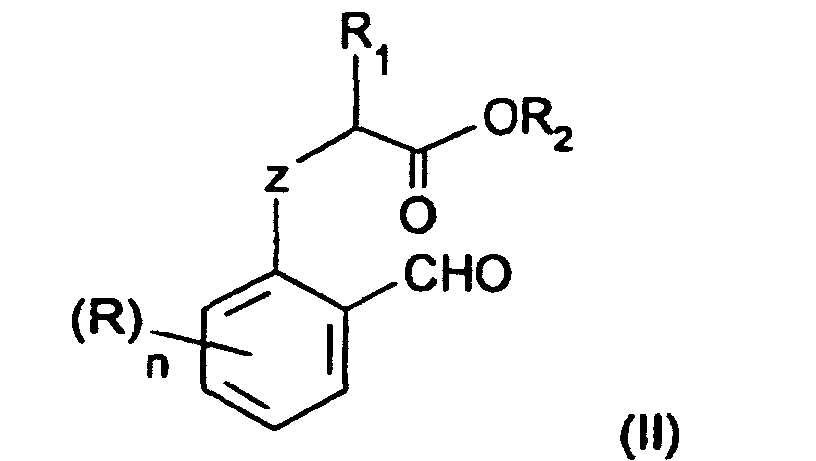
- un composé de type 2-hydroxy- ou 2-thiobenzaldéhyde de formule (III) :
dans ladite formule (III), R, Z et n ont la signification donnée précédemment,

- et un un acide carboxylique ou dérivé de formule (IV) comprenant un groupe
partant:
dans ladite formule (IV) :

- Y représente un groupe partant, de préférence, un atome d'halogène ou
un groupe ester suffonique de formule - OSO2 - dans lequel

- R1 , R2 ont la signification donnée précédemment.
- Y représente un groupe partant, de préférence, un atome d'halogène ou
un groupe ester suffonique de formule - OSO2 -


- les groupes R3, identiques ou différents, représentent des restes hydrocarbonés ayant de 1 à 20 atomes de carbone, tels que des groupes alkyle, cycloalkyle, aryle ou hétérocyclique ;
- 2 groupes R3 forment ensemble et avec l'atome d'azote un hétérocycle ayant 4 à 6 atomes.
- les symboles R3 représentent un groupe alkyle ayant 1 à 10 atomes de carbone et de préférence 1 à 4 atomes de carbone ou un groupe cyclopentyle ou cyclohexyle ou un groupe pyridinyle ;
- 2 groupes R3 forment ensemble et avec l'atome d'azote un cycle pipéridine ou pyrrolidine.


- Z représente N, P ou As ;
- Y représente S, O, Se ou C ;
- X1, X2, X3 et X4, identiques ou différents représentent :
- un groupe alkyle, linéaire ou ramifié, ayant 1 à 16 atomes de carbone et éventuellement substitué par un ou plusieurs groupements ou atomes phényle, hydroxyle, halogène, nitro, alkoxy ou alkoxycarbonyle, les groupements alkoxy ayant 1 à 4 atomes de carbone ;
- un groupe alcényle, linéaire ou ramifié, ayant 2 à 12 atomes de carbone ;
- un groupe aryle ayant 6 à 10 atomes de carbone, éventuellement substitué par un ou plusieurs groupements ou atomes alkyle ayant 1 à 4 atomes de carbone, alkoxy, alkoxycarbonyle, le groupe alkoxy ayant 1 à 4 atomes de carbone, ou halogène,
- deux desdits groupes X1 à X4 pouvant former ensemble un groupe alkylène, alcénylène ou alcadiènylène, linéaire ou ramifié ayant de 3 à 6 atomes de carbone.
- tributylrnéthylammonium,
- tétraéthylammonium,
- tétrabutylammonium,
- dodécyltriméthylammonium,
- méthyltrioctylammonium,
- heptyltributylammonium,
- tétrahexylammonium,
- tétraheptylammonium,
- tétraoctylammonium,
- benzyltriméthylammonium,
- benzyldiméthylpropylammonium,
- benzyldiméthyloctylammonium,
- benzyltributylammonium,
- benzyltriéthylammonium,
- phényltriméthylammonium,
- benzyldiméthyltétradécylammonium,
- benzyldiméthylhexadécylammonium,
- tétrabutylphosphonium,
- triméthylpentylphosphonium,
- triméthylphénylphosphonium,
- diéthyldiméthylphosphonium,
- dicyclohexyldiméthylphosphonium,
- diméthyldiphénylphosphonium,
- cyclohexyltriméthylphosphonium,
- méthyftribenzylphosphonium,
- méthyitri(méthyl-4 phényl) phosphonium,
- éthyltri(n-propyl)phosphonium,
- triéthylpentylphosphonium,
- hexadécyltributylphosphonium,
- éthyltriphénylphosphonium,
- n-butyltri(n-propyl)phosphonium,
- tétraphénylphosphonium,
- triphényl(méthyl-4 phényl)phosphonium,
- tétrakis(hydroxyméthyl)phosphonium,
- tétraphénylarsonium.
- triéthylsulfonium,
- triphénylsulfonium,

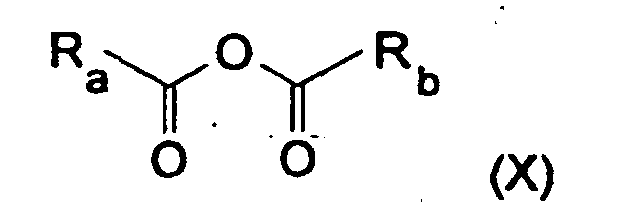
- Ra et Rb, identiques ou différents, représentent un groupe hydrocarboné monovalent, substitué ou non qui peut être un groupe aliphatique acyclique, saturé ou insaturé, linéaire ou ramifié ; un groupe carbocyclique saturé, insaturé ou aromatique, monocyclique,
- Ra et Rb pouvant former ensemble un groupe divalent aliphatique saturé
- un groupe aliphatique acyclique linéaire ou ramifié ayant de préférence de 1 à 24, de préférence, de 1 à 12 atomes de carbone, saturé ou comprenant une à plusieurs insaturations sur la chaíne, généralement, 1 à 3 insaturations qui peuvent être des doubles liaisons simples : la chaíne hydrocarbonée pouvant être interrompue par l'un des groupes suivants : -O-; -CO- ; et/ou porteuse d'un ou plusieurs substituants notamment : -X ; -CX3.
- un groupe carbocyclique, saturé, insaturé ou aromatique, ayant de 3 à 8 atomes de carbone, de préférence, 6 atomes de carbone, éventuellement porteur d'un ou plusieurs atomes d'halogène, de préférence, chlore ou brome.
- un groupe alkyle, linéaire ou ramifié comprenant de 1 à 12 atomes de carbone, éventuellement porteur d'un ou plusieurs atomes d'halogène,
- un groupe cyclohexyle ou phényle, éventuellement porteur d'un ou plusieurs atomes d'halogène, un groupe trihalogénométhyle.
- l'anhydride acétique,
- l'anhydride propanoïque,
- l'anhydride isobutyrique,
- l'anhydride trichloroacétique,
- l'anhydride trifluoroacétique,
- l'anhydride benzoïque.
- l'anhydride de monochloroacétyle,
- l'anhydride de dichloroacétyle,
- l'anhydride pivalique.
RMN 1H (DMSO-d6) : δ 0,91 (t, 3H, CH3) ; 1,38 (m, 2H, CH 2-CH3) ; 1,51 (m, 2H, CH 2-CH2-CH3) ; 2,02 (m, 2H, CH 2-CH) ; 5,24 (t, 1H, CH) ; 7,34 (d, J= 9 Hz, 1H, ArH) ; 8,44 (d, J= 2 Hz, 1H, ArH) ; 8,47 (dd, J= 9 Hz, J= 2 Hz, 1H, ArH) ; 10,42 (s, 1 H, CHO) ; 13,45 (pic large, 1H, COOH).
RMN 1H (DMSO-d6) : δ 0,91 (t, 3H, CH3) ; 1,38 (m, 2H, CH 2-CH3) ; 1,51 (m, 2H, CH 2-CH2-CH3) ; 2,02 (m, 2H, CH 2-CH) ; 5,24 (t, 1H, CH) ; 7,34 (d, J= 9 Hz, 1H, ArH) ; 8,44 (d, J= 2 Hz, 1H, ArH) ; 8,47 (dd, J= 9 Hz, J= 2 Hz, 1H, ArH) ; 10,42 (s, 1H, CHO) ; 13,45 (pic large, 1H, COOH).
RMN 1H (DMSO-d6) : δ 0,91 (t, 3H, CH3) ; 1,38 (m, 2H, CH 2-CH3) ; 1,51 (m, 2H, CH 2-CH2-CH3) ; 2,02 (m, 2H, CH 2-CH) ; 5,24 (t, 1H, CH) ; 7,34 (d, J= 9 Hz, 1H, ArH) ; 8,44 (d, J= 2 Hz, 1H, ArH) ; 8,47 (dd, J= 9 Hz, J= 2 Hz, 1H, ArH) ; 10,42 (s, 1H, CHO) ; 13,45 (pic large, 1H, COOH).
Claims (43)
- Procédé de préparation des composés nitroaromatiques de formule (I) :dans laquelle :
 caractérisé par le fait qu'il consiste à effectuer la nitration sélective en position 4 à l'aide d'une source de NO2 + et en présence d'acide sulfurique, d'un composé aromatique répondant à la formule (II) :R1 représente un groupe alkyle linéaire ou ramifié ayant de 1 à 12 atomes de carbone, un groupe phényle éventuellement substitué par un groupe alkyle ayant de 1 à 4 atomes de carbone ou un groupe halogénophényle,R2 représente un atome d'hydrogène, un groupe hydrocarboné ayant de 1 à 12 atomes de carbone qui peut être un groupe alkyle linéaire ou ramifié, un groupe cycloalkyle, un groupe phényle ou un groupe phénylalkyle.Z représente un atome d'oxygène ou de soufre,R représente un atome d'hydrogène ou un substituant,n est un nombre égal à 0,1, 2, ou 3, de préférence, égal à 0,lorsque n est supérieur à 1, deux groupes R et les 2 atomes successifs du cycle benzénique peuvent former entre eux un cycle saturé, insaturé ou aromatique ayant de 5 à 7 atomes de carbone,dans ladite formule (II), R, R1, R2, Z et n ont la signification donnée précédemment.
- Procédé selon la revendication 1 caractérisé par le fait que le substrat de départ répond à la formule (II) dans laquelle R représente un atome d'hydrogène ou l'un des groupes suivants :un groupe hydroxyle,un groupe alkyle linéaire ou ramifié, ayant de 1 à 6 atomes de carbone, de préférence de 1 à 4 atomes de carbone, tel que méthyle, éthyle, propyle, isopropyle, butyle, isobutyle, sec-butyle, tert-butyle,un groupe alkoxy ayant de 1 à 6 atomes de carbone, de préférence de 1 à 4 atomes de carbone,un groupe ester ayant de 1 à 10 atomes de carbone, de préférence de 1 à 4 atomes de carbone,un groupe alkylamide ayant de 1 à 6 atomes de carbone, de préférence 1 à 4 atomes de carbone,un groupe carboxamide,un atome d'halogène,un groupe trifluorométhyle.
- Procédé selon la revendication 1 caractérisé par le fait que le substrat de départ répond à la formule (II) dans laquelle R représente un atome d'hydrogène, un groupe méthyle ou éthyle, un groupe méthoxy ou éthoxy.
- Procédé selon la revendication 1 caractérisé par le fait que le substrat de départ répond à la formule (II) dans laquelle R1 représente un groupe alkyle ayant de 1 à 4 atomes de carbone.
- Procédé selon la revendication 1 caractérisé par le fait que le substrat de départ répond à la formule (II) dans laquelle R2 représente un groupe alkyle ayant de 1 à 4 atomes de carbone.
- Procédé selon la revendication 1 caractérisé par le fait que le substrat de départ répond à la formule (II) dans laquelle Z est un atome d'oxygène.
- Procédé selon la revendication 1 caractérisé par le fait que l'on effectue la nitration du composé de formule (II) par réaction de ce dernier avec une source de NO2 +, en l'absence ou en présence d'un solvant organique, de préférence, un hydrocarbure halogéné aliphatique et plus préférentiellement le dichlorométhane.
- Procédé selon la revendication 7 caractérisé par le fait que le réactif de nitration est toute source de NO2 +, de préférence, du dioxyde d'azote NO2, de l'anhydride azoteux N2O3, du peroxyde d'azote N2O4, de l'oxyde d'azote NO associé à un agent oxydant tel que, par exemple, l'acide nitrique, le dioxyde d'azote ou l'oxygène ; l'acide nitreux ; le sulfate de nitrosyle ou un sel nitreux, de préférence un sel de métal alcalin, de préférence, le sodium ; un nitrite d'alkyle.
- Procédé selon la revendication 7 caractérisé par le fait que la quantité de réactif de nitration mise en oeuvre est un mélange sulfonitrique.
- Procédé selon la revendication 7 caractérisé par le fait que la quantité d'acide nitrique exprimée par le rapport molaire composé aromatique O- ou S-alkylé/acide nitrique varie entre 0,9 et 1,1, de préférence, entre 0,95 et 1,05.
- Procédé selon la revendication 7 caractérisé par le fait que la quantité d'acide sulfurique exprimée par le rapport molaire composé aromatique O- ou S-alkylé/acide sulfurique varie entre 0,9 et 1,1, de préférence, entre 0,95 et 1,05.
- Procédé selon la revendication 7 caractérisé par le fait que la température de la réaction de nitration est comprise entre -10°C et 20°C, de préférence entre -5°C et 10°C.
- Procédé selon l'une des revendications 1 à 12 caractérisé par le fait que le composé de formule (II) est obtenu en faisant réagir :un composé de type 2-hydroxy- ou 2-thiobenzaldéhyde de formule (III):dans ladite formule (III), R, Z et n ont la signification donnée précédemment dans l'une des revendications 1 à 3,
 et un acide carboxylique ou dérivé de formule (IV) :dans ladite formule (IV) :
 Y représente un groupe partant, de préférence, un atome d'halogène ou un groupe ester sulfonique de formule - OSO2 -dans lequel
- Procédé selon la revendication 13 caractérisé par le fait que le composé de formule (III) est l'aldéhyde salicylique et l'acide carboxylique ou dérivé de formule (IV) est le 2-bromohexanoate de méthyle ou d'éthyle.
- Procédé selon la revendication 13 caractérisé par le fait que le rapport molaire entre le composé de formule (III) et le composé de formule (IV) est choisi entre 1 et 1,2.
- Procédé selon la revendication 13 caractérisé par le fait que l'on fait réagir un composé aromatique de formule (III) avec un acide carboxylique ou dérivé de formule (IV) : la réaction étant conduite en présence d'une base, de préférence dans un solvant organique.
- Procédé selon la revendication 16 caractérisé par le fait que la base peut être une base minérale, de préférence, un sel de métal alcalin ou alcalino-terreux, de préférence, un hydroxyde de métal alcalin ou alcalino-terreux qui peut être l'hydroxyde de sodium, de potassium ou de calcium; un carbonate ou hydrogénocarbonate d'un métal alcalin, de préférence, le carbonate de sodium ou une base organique, de préférence, un hydroxyde d'ammonium quaternaire ou à une amine tertiaire.
- Procédé selon la revendication 17 caractérisé par le fait que la base mise en oeuvre est le carbonate de sodium ou de potassium.
- Procédé selon la revendication 16 caractérisé par le fait que la réaction du composé de formule (III) sous forme salifié et du composé de formule (IV) est conduite dans un solvant organique, choisi préférentiellement parmi les hydrocarbures aromatiques, halogénés ou non, les éther-oxydes aliphatiques, cycloaliphatiques ou aromatiques, les nitriles alphatiques ou aromatiques ; les carboxamides linéaires ou cycliques, de préférence, le N,N-diméthylacétamide ou le diméthylformamide.
- Procédé selon la revendication 18 caractérisé par le fait que l'on ajoute des ions iodure, de préférence, des iodures de métaux alcalins, et préférentiellement l'iodure de potassium.
- Procédé selon l'une des revendications 13 à 20 caractérisé par le fait que la réaction entre le composé de formule (III) et le composé de formule (IV) est conduite à une température comprise entre 0°C et 100°C, de préférence, entre 25°C et 50°C.
- Procédé selon la revendication 13 caractérisé par le fait que l'on fait réagir un composé aromatique de formule (III) et un acide carboxylique ou dérivé, en milieu aqueux, en présence d'une base et d'un catalyseur de transfert de phase.
- Procédé selon la revendication 22 caractérisé par le fait que le catalyseur de transfert de phase est une tris(éther-amine), de préférence la tris(3,3-dioxaheptyl)amine.
- Procédé selon la revendication 22 caractérisé par le fait que le catalyseur de transfert de phase est un sel d'onium dont l'onium répond à l'une des formules suivantes :
 dans lesdites formules:
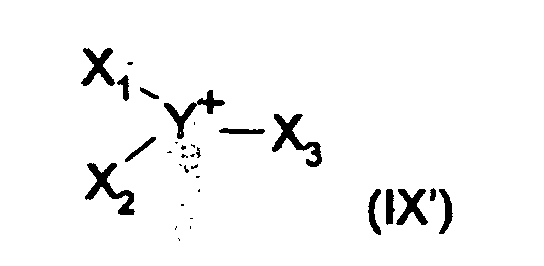 Z représente N, P ou As ;Y représente S, O, Se ou C ;X1, X2, X3 et X4, identiques ou différents représentent :un groupe alkyle, linéaire ou ramifié, ayant 1 à 16 atomes de carbone et éventuellement substitué par un ou plusieurs groupements ou atomes phényle, hydroxyle, halogène, nitro, alkoxy ou alkoxycarbonyle, les groupements alkoxy ayant 1 à 4 atomes de carbone ;un groupe alcényle, linéaire ou ramifié, ayant 2 à 12 atomes de carbone ;un groupe aryle ayant 6 à 10 atomes de carbone, éventuellement substitué par un ou plusieurs groupements ou atomes alkyle ayant 1 à 4 atomes de carbone, alkoxy, alkoxycarbonyle, le groupe alkoxy ayant 1 à 4 atomes de carbone, ou halogène,deux desdits groupes X1 à X4 pouvant former ensemble un groupe alkylène, alcénylène ou alcadiènylène, linéaire ou ramifié ayant de 3 à 6 atomes de carbone.
 - Procédé selon la revendication 24 caractérisé par le fait que l'anion desdits sels d'onium est choisi parmi les ions : F-, ClO4 -, PF6 -, BF4 -, SnCl6 -, SbCl6 -, B(Ph)4 -, PO4 3-, HPO4 2-, H2PO4 -, CH3SO3 -, Ph-SO3 -, HSO4 -, NO3 -, SO4 2-, Cl-, Br-, I-, OH-, Ph représentant un groupe phényle ; l'anion desdits sels d'onium étant choisi de préférence parmi les ions Br-, Cl- et OH-.
- Procédé selon la revendication 22 caractérisé par le fait que le catalyseur de transfert de phase est choisi parmi : le chlorure ou le bromure de tributylbenzylammonium ou phosphonium, le chlorure ou le bromure de tétraméthylammonium ou phosphonium, le chlorure ou le bromure de tétraéthylammonium ou phosphonium, le chlorure ou le bromure de tétrabutylammonium ou phosphonium et représente de préférence le chlorure ou le bromure de tributylbenzylammonium.
- Procédé selon la revendication 22 caractérisé par le fait que la base est choisie parmi le carbonate de potassium, le carbonate de sodium et l'ammoniaque et est de préférence le carbonate de potassium.
- Procédé selon la revendication 22 caractérisé par le fait le rapport molaire entre ledit catalyseur et le composé de formule (III) varie entre 0,01 et 0,50, de préférence, entre 0,05 et 0,2.
- Procédé selon la revendication 22 caractérisé par le fait que la réaction est conduite en milieu aqueux.
- Procédé selon la revendication 22 caractérisé par le fait que la température réactionnelle varie entre la température ambiante et 80°C, de préférence entre 50°C et 65°C.
- Procédé de préparation d'un composé hétérocyclique répondant à la formule générale (V) :dans la formule (V), R, R1, Z et n ont la signification donnée précédemment dans l'une des revendications 1 à 4, 6,

caractérisé par le fait que l'on effectue une cyclisation du composé de formule (I) décrit dans l'une des revendications 1 à 6 précédée d'une éventuelle saponification du composé de formule (I) quand R2 est différent de H. - Procédé selon la revendication 31 caractérisé par le fait que l'on effectue la cyclisation du composé de formule (I) en présence d'acétate de sodium et en milieu anhydride acétique.
- Procédé selon la revendication 31 caractérisé par le fait que l'on effectue la cyclisation du composé de formule (I) en présence de carbonate de sodium ou de potassium et en milieu anhydride acétique.
- Procédé selon la revendication 31 caractérisé par le fait qu'il est obtenu :en préparant le composé de formule (II) par réaction du composé de formule (III) et de l'acide carboxylique ou dérivé de formule (IV), en présence d'une base et éventuellement d'un catalyseur de transfert de phase,en effectuant la nitration sélective du composé de formule (II) en position 4 selon le procédé décrit dans l'une des revendications 1 à 12,en soumettant le composé obtenu de formule (I) à une saponification si nécessaire dans le cas où R2 est différent de H,en effectuant la cyclisation du produit otenu.
- Procédé selon la revendication 31 caractérisé par le fait qu'il est obtenu :en préparant le composé de formule (II) par réaction du composé de formule (III) et de l'acide carboxylique ou dérivé de formule (IV), en présence d'une base et éventuellement d'un catalyseur de transfert de phase,en soumettant le composé obtenu de formule (II) à une saponification si nécessaire dans le cas où R2 est différent de H,en effectuant la nitration sélective du composé de formule (II) dans laquelle R2 est un atome d'hydrogène, selon le procédé décrit dans l'une des revendications 1 à 12,en conduisant la cyclisation du produit obtenu.
- Procédé selon l'une des revendications 35 et 36 caractérisé par le fait que la cyclisation est conduite selon le procédé décrit dans l'une des revendications 32 et 33.
- Procédé selon l'une des revendications 31 à 36 caractérisé par le fait que le composé de formule (V) est le 2-n-butyl-5-nitrobenzofurane.
- Nouveaux composés nitroaromatiques répondant à la formule générale :dans laquelle:
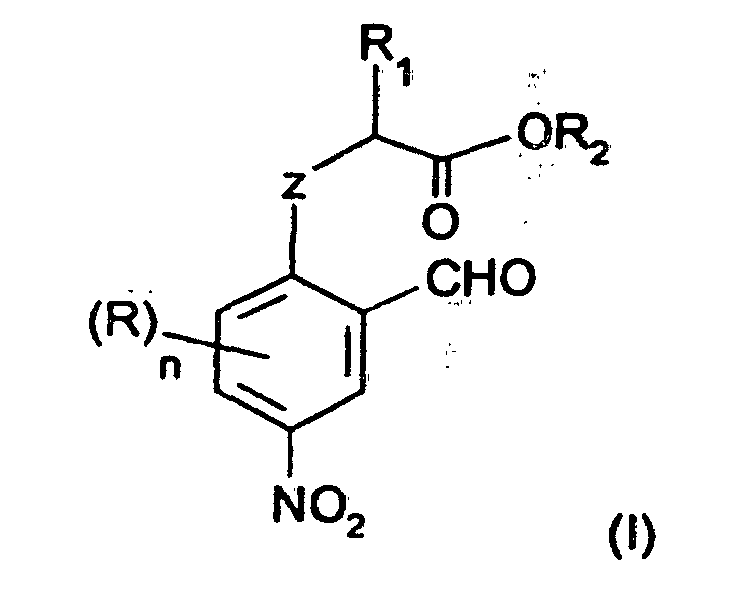 R1 représente un groupe alkyle linéaire ou ramifié ayant de 1 à 12 atomes de carbone, un groupe phényle éventuellement substitué par un groupe alkyle ayant de 1 à 4 atomes de carbone ou un groupe halogénophényle,R2 représente un atome d'hydrogène, un groupe hydrocarboné ayant de 1 à 12 atomes de carbone qui peut être un groupe alkyle linéaire ou ramifié, un groupe cycloalkyle, un groupe phényle ou un groupe phénylalkyle.Z représente un atome d'oxygène ou de soufre,R représente un atome d'hydrogène ou un substituant,n est un nombre égal à 0,1, 2, ou 3, de préférence, égal à 0,lorsque n est supérieur à 1, deux groupes R et les 2 atomes successifs du cycle benzénique peuvent former entre eux un cycle saturé, insaturé ou aromatique ayant de 5 à 7 atomes de carbone.
 - Nouveaux composés nitroaromatiques selon la revendication 38 caractérisés par le fait que R représente un atome d'hydrogène ou l'un des groupes suivants :un groupe hydroxyle,un groupe alkyle linéaire ou ramifié, ayant de 1 à 6 atomes de carbone, de préférence de 1 à 4 atomes de carbone, tel que méthyle, éthyle, propyle, isopropyle, butyle, isobutyle, sec-butyle, tert-butyle,un groupe alkoxy ayant de 1 à 6 atomes de carbone, de préférence de 1 à 4 atomes de carbone,un groupe ester ayant de 1 à 10 atomes de carbone, de préférence de 1 à 4 atomes de carbone,un groupe alkylamide ayant de 1 à 6 atomes de carbone, de préférence 1 à 4 atomes de carbone,un groupe carboxamide,un atome d'halogène,un groupe trifluorométhyle.
- Nouveaux composés nitroaromatiques selon la revendication 38 caractérisés par le fait que R représente un atome d'hydrogène, un groupe méthyle ou éthyle, un groupe méthoxy ou éthoxy.
- Nouveaux composés nitroaromatiques selon la revendication 38 caractérisés par le fait que R1 représente un groupe alkyle ayant de 1 à 4 atomes de carbone.
- Nouveaux composés nitroaromatiques selon la revendication 38 caractérisés par le fait que R2 représente un groupe alkyle ayant de 1 à 4 atomes de carbone.
- acide 2-(2-formyl-4-nitro-phénoxy)-hexanoïque 2-(2-formyl-4-nitro-phénoxy)-hexanoate de méthyle ou d'éthyle.
Applications Claiming Priority (3)
| Application Number | Priority Date | Filing Date | Title |
|---|---|---|---|
| FR9913250 | 1999-10-21 | ||
| FR9913250A FR2800067B1 (fr) | 1999-10-21 | 1999-10-21 | Intermediaires de fabrication d'un derive de type benzofurane ou benzothiophene nitre en position 5 et leurs utilisations |
| PCT/FR2000/002937 WO2001028974A2 (fr) | 1999-10-21 | 2000-10-23 | Intermediaires de fabrication d'un derive de type benzofurane ou benzothiophene nitre en position 5 et leurs utilisations |
Publications (2)
| Publication Number | Publication Date |
|---|---|
| EP1222159A2 EP1222159A2 (fr) | 2002-07-17 |
| EP1222159B1 true EP1222159B1 (fr) | 2005-06-01 |
Family
ID=9551278
Family Applications (1)
| Application Number | Title | Priority Date | Filing Date |
|---|---|---|---|
| EP00971474A Expired - Lifetime EP1222159B1 (fr) | 1999-10-21 | 2000-10-23 | Intermediaires de fabrication d'un derive de type benzofurane ou benzothiophene nitre en position 5 et leurs utilisations |
Country Status (15)
| Country | Link |
|---|---|
| US (2) | US6855842B1 (fr) |
| EP (1) | EP1222159B1 (fr) |
| JP (1) | JP2003512347A (fr) |
| CN (1) | CN1268601C (fr) |
| AT (1) | ATE296795T1 (fr) |
| AU (1) | AU1032401A (fr) |
| BR (1) | BR0014808A (fr) |
| CA (1) | CA2387713A1 (fr) |
| DE (1) | DE60020587T2 (fr) |
| DK (1) | DK1222159T3 (fr) |
| ES (1) | ES2239623T3 (fr) |
| FR (1) | FR2800067B1 (fr) |
| HU (1) | HUP0203188A3 (fr) |
| PT (1) | PT1222159E (fr) |
| WO (1) | WO2001028974A2 (fr) |
Families Citing this family (19)
| Publication number | Priority date | Publication date | Assignee | Title |
|---|---|---|---|---|
| CN1200935C (zh) * | 1999-10-21 | 2005-05-11 | 罗狄亚化学公司 | 制备苯并呋喃或苯并噻吩类型化合物的方法 |
| IL146389A0 (en) | 2001-11-08 | 2002-07-25 | Isp Finetech Ltd | Process for the preparation of dronedarone |
| DE10237819A1 (de) | 2002-08-19 | 2004-03-04 | Bayer Ag | 5-Nitrobenzofurane |
| TW201107303A (en) | 2009-05-27 | 2011-03-01 | Sanofi Aventis | Process for the production of benzofurans |
| UY32657A (es) | 2009-05-27 | 2010-12-31 | Sanofi Aventis | Procedimiento para la fabricación de productos intermedios de dronedarona |
| FR2958290B1 (fr) | 2010-03-30 | 2012-10-19 | Sanofi Aventis | Procede de preparation de derives de sulfonamido-benzofurane |
| HUP1000330A2 (en) | 2010-06-18 | 2011-12-28 | Sanofi Sa | Process for the preparation of dronedarone and the novel intermediates |
| WO2012032545A1 (fr) | 2010-09-08 | 2012-03-15 | Cadila Healthcare Limited | Procédé pour préparer un dérivé de benzofurane et des produits intermédiaires de celui-ci |
| CN101948455B (zh) * | 2010-10-18 | 2012-11-14 | 山东邹平大展新材料有限公司 | 一种2-正丁基-3-(4-羟基苯甲酰基)-5-硝基苯并呋喃的制备方法 |
| WO2012120544A2 (fr) | 2011-03-10 | 2012-09-13 | Sun Pharmaceutical Industries Ltd. | Procédé de préparation d'hydrochlorure de n-[2-n-butyl-3-[4-[3-(di-n-butylamino) propoxy]enzoyl]benzofuran-5-yl]méthanesulfonamide |
| HUP1100167A2 (en) | 2011-03-29 | 2012-11-28 | Sanofi Sa | Process for preparation of dronedarone by mesylation |
| HUP1100165A2 (en) | 2011-03-29 | 2012-12-28 | Sanofi Sa | Process for preparation of dronedarone by n-butylation |
| FR2983198B1 (fr) | 2011-11-29 | 2013-11-15 | Sanofi Sa | Procede de preparation de derives de 5-amino-benzoyl-benzofurane |
| EP2617718A1 (fr) | 2012-01-20 | 2013-07-24 | Sanofi | Procédé de préparation de dronédarone à l'aide d'un réactif dibutylaminopropanol |
| WO2013121235A2 (fr) | 2012-02-13 | 2013-08-22 | Sanofi | Procédé de préparation de la dronédarone par retrait du groupe hydroxyle |
| US9249119B2 (en) | 2012-02-14 | 2016-02-02 | Sanofi | Process for the preparation of dronedarone by oxidation of a sulphenyl group |
| WO2013124745A1 (fr) | 2012-02-22 | 2013-08-29 | Sanofi | Procédé pour la préparation de dronédarone par l'oxydation d'un groupe hydroxyle |
| US9238636B2 (en) | 2012-05-31 | 2016-01-19 | Sanofi | Process for preparation of dronedarone by Grignard reaction |
| CN115847629B (zh) * | 2022-11-30 | 2023-09-29 | 江苏富乐徳石英科技有限公司 | 一种高效节能环保的石英环制备工艺 |
Family Cites Families (6)
| Publication number | Priority date | Publication date | Assignee | Title |
|---|---|---|---|---|
| JPS5659718A (en) * | 1979-10-19 | 1981-05-23 | Ihara Chem Ind Co Ltd | Preparation of substituted phenoxycarboxylic acid derivative |
| DE3031738A1 (de) * | 1980-08-22 | 1982-04-01 | Troponwerke GmbH & Co KG, 5000 Köln | Verfahren zur herstellung von benzo (b) thiophen-derivaten und ihre verwendung als zwischenprodukte |
| US4537984A (en) * | 1983-05-19 | 1985-08-27 | Nissan Chemical Industries Ltd. | Process for producing 2-(4-hydroxyphenoxy) propionate derivatives |
| PL152990B1 (pl) * | 1987-06-20 | 1991-02-28 | Sposób wytwarzania kwasu 2-(o-formylofenoksy) heksanowego | |
| FR2665444B1 (fr) * | 1990-08-06 | 1992-11-27 | Sanofi Sa | Derives d'amino-benzofuranne, benzothiophene ou indole, leur procede de preparation ainsi que les compositions les contenant. |
| WO1997024122A1 (fr) * | 1995-12-29 | 1997-07-10 | Smithkline Beecham Corporation | Antagonistes du recepteur de vitronectine |
-
1999
- 1999-10-21 FR FR9913250A patent/FR2800067B1/fr not_active Expired - Fee Related
-
2000
- 2000-10-23 HU HU0203188A patent/HUP0203188A3/hu unknown
- 2000-10-23 DK DK00971474T patent/DK1222159T3/da active
- 2000-10-23 DE DE60020587T patent/DE60020587T2/de not_active Expired - Lifetime
- 2000-10-23 EP EP00971474A patent/EP1222159B1/fr not_active Expired - Lifetime
- 2000-10-23 WO PCT/FR2000/002937 patent/WO2001028974A2/fr not_active Ceased
- 2000-10-23 CA CA002387713A patent/CA2387713A1/fr not_active Abandoned
- 2000-10-23 CN CNB008144761A patent/CN1268601C/zh not_active Expired - Fee Related
- 2000-10-23 BR BR0014808-3A patent/BR0014808A/pt not_active Application Discontinuation
- 2000-10-23 ES ES00971474T patent/ES2239623T3/es not_active Expired - Lifetime
- 2000-10-23 AT AT00971474T patent/ATE296795T1/de not_active IP Right Cessation
- 2000-10-23 PT PT00971474T patent/PT1222159E/pt unknown
- 2000-10-23 US US10/110,441 patent/US6855842B1/en not_active Expired - Fee Related
- 2000-10-23 AU AU10324/01A patent/AU1032401A/en not_active Abandoned
- 2000-10-23 JP JP2001531779A patent/JP2003512347A/ja active Pending
-
2004
- 2004-10-25 US US10/972,575 patent/US20050113596A1/en not_active Abandoned
Also Published As
| Publication number | Publication date |
|---|---|
| ES2239623T3 (es) | 2005-10-01 |
| AU1032401A (en) | 2001-04-30 |
| CN1268601C (zh) | 2006-08-09 |
| HUP0203188A2 (hu) | 2003-03-28 |
| CA2387713A1 (fr) | 2001-04-26 |
| ATE296795T1 (de) | 2005-06-15 |
| DE60020587T2 (de) | 2005-11-10 |
| DK1222159T3 (da) | 2005-08-08 |
| PT1222159E (pt) | 2005-08-31 |
| HUP0203188A3 (en) | 2003-04-28 |
| FR2800067B1 (fr) | 2004-12-17 |
| FR2800067A1 (fr) | 2001-04-27 |
| DE60020587D1 (de) | 2005-07-07 |
| EP1222159A2 (fr) | 2002-07-17 |
| US20050113596A1 (en) | 2005-05-26 |
| JP2003512347A (ja) | 2003-04-02 |
| BR0014808A (pt) | 2002-06-11 |
| CN1379754A (zh) | 2002-11-13 |
| WO2001028974A2 (fr) | 2001-04-26 |
| US6855842B1 (en) | 2005-02-15 |
| WO2001028974A3 (fr) | 2001-12-06 |
Similar Documents
| Publication | Publication Date | Title |
|---|---|---|
| EP1222159B1 (fr) | Intermediaires de fabrication d'un derive de type benzofurane ou benzothiophene nitre en position 5 et leurs utilisations | |
| EP1222181B1 (fr) | Procede de preparation d'un compose de type benzofurane ou benzothiophene | |
| WO2012010802A1 (fr) | Procede de preparation de derives de benzofurane substitues en position 5 | |
| EP0055951B1 (fr) | Procédé pour la préparation de l'anthraquinone et de ses dérivés substitués | |
| KR101100064B1 (ko) | 나프록센의 니트로옥시유도체 제조방법 | |
| FR2833262A1 (fr) | Procede de monosulfonylation d'un compose de type aminobenzofuranne ou aminobenzothiophene | |
| EP0086678A1 (fr) | Procédé pour la préparation d'acyl-2 hexahydro-1,3,4,6,7,11b-2H-pyrazino (2,1-a)isoquinoléinones-4 et intermédiaires | |
| EP0130875B1 (fr) | Procédé d'halogénation-nitration-fluoration de dérivés aromatiques | |
| EP1218366B1 (fr) | Procede de preparation d'inhibiteurs cox-2 | |
| EP0258160A2 (fr) | Dérivés de 2,3 dihydrofuranne leur procédé de préparation, leur utilisation comme intermédiaire pour la préparation de tétrahydrofuranne | |
| JP3047059B2 (ja) | ジアゾメタン誘導体の製造方法 | |
| EP0242289A1 (fr) | Procédé de préparation de dérivés d'oxazinobenzothiazine 6,6-dioxyde | |
| FR2809397A1 (fr) | Procede de preparation d'un compose de type benzofuranne ou benzothiophene | |
| FR2800064A1 (fr) | Procede de preparation d'un compose de type benzofurane ou benzothiophene | |
| WO2003010156A1 (fr) | Procede de preparation de alpha-halogenoalkylarylcetones et de leurs produits intermediaires halogenes de type cetal cyclique | |
| CA2585714A1 (fr) | Procede d'acylation d'un compose aromatique. | |
| EP0398774B1 (fr) | Procédé de préparation de dérivés bromés notamment à partir d'alcools | |
| US20220324790A1 (en) | Process for the preparation of a-methyl-[4-(nitro)-2-(trifluoromethyl) -benzyl nitrate | |
| EP0098783A1 (fr) | Procédé de préparation de halogéno anilines | |
| BE893917A (fr) | Derives n-imidazolyliques du 1,2,3,4-tetrahydro-naphtalene, de l'indane et du 1-chromane substitue en position 2 et procede pour les preparer | |
| FR2564834A1 (fr) | Procede de preparation de 3-chlorosulfonylthiophene-2-carboxylate d'alcoyle | |
| FR2522652A1 (fr) | Procede pour la fabrication d'ortho- ou de para-nitrophenetole pratiquement pur | |
| WO2000064905A2 (fr) | Procede d'alpha-metallation d'un derive heterocyclique, monocyclique ou polycyclique et possedant au moins un heterocycle a 5 atomes, insature ou aromatique | |
| EP2229355B1 (fr) | Procede de preparation de derives d ' azetidine | |
| FR2799460A1 (fr) | Procede de preparation de compose hydroximique |
Legal Events
| Date | Code | Title | Description |
|---|---|---|---|
| PUAI | Public reference made under article 153(3) epc to a published international application that has entered the european phase |
Free format text: ORIGINAL CODE: 0009012 |
|
| 17P | Request for examination filed |
Effective date: 20020325 |
|
| AK | Designated contracting states |
Kind code of ref document: A2 Designated state(s): AT BE CH CY DE DK ES FI FR GB GR IE IT LI LU MC NL PT SE |
|
| AX | Request for extension of the european patent |
Free format text: AL;LT;LV;MK;RO;SI |
|
| 17Q | First examination report despatched |
Effective date: 20031028 |
|
| GRAP | Despatch of communication of intention to grant a patent |
Free format text: ORIGINAL CODE: EPIDOSNIGR1 |
|
| GRAS | Grant fee paid |
Free format text: ORIGINAL CODE: EPIDOSNIGR3 |
|
| GRAA | (expected) grant |
Free format text: ORIGINAL CODE: 0009210 |
|
| AK | Designated contracting states |
Kind code of ref document: B1 Designated state(s): AT BE CH CY DE DK ES FI FR GB GR IE IT LI LU MC NL PT SE |
|
| PG25 | Lapsed in a contracting state [announced via postgrant information from national office to epo] |
Ref country code: FI Free format text: LAPSE BECAUSE OF FAILURE TO SUBMIT A TRANSLATION OF THE DESCRIPTION OR TO PAY THE FEE WITHIN THE PRESCRIBED TIME-LIMIT Effective date: 20050601 |
|
| REG | Reference to a national code |
Ref country code: GB Ref legal event code: FG4D Free format text: NOT ENGLISH |
|
| REG | Reference to a national code |
Ref country code: CH Ref legal event code: EP Ref country code: CH Ref legal event code: NV Representative=s name: KIRKER & CIE SA |
|
| REF | Corresponds to: |
Ref document number: 60020587 Country of ref document: DE Date of ref document: 20050707 Kind code of ref document: P |
|
| REG | Reference to a national code |
Ref country code: IE Ref legal event code: FG4D Free format text: LANGUAGE OF EP DOCUMENT: FRENCH |
|
| REG | Reference to a national code |
Ref country code: DK Ref legal event code: T3 |
|
| GBT | Gb: translation of ep patent filed (gb section 77(6)(a)/1977) |
Effective date: 20050718 |
|
| REG | Reference to a national code |
Ref country code: PT Ref legal event code: SC4A Effective date: 20050607 Ref country code: SE Ref legal event code: TRGR |
|
| PG25 | Lapsed in a contracting state [announced via postgrant information from national office to epo] |
Ref country code: GR Free format text: LAPSE BECAUSE OF FAILURE TO SUBMIT A TRANSLATION OF THE DESCRIPTION OR TO PAY THE FEE WITHIN THE PRESCRIBED TIME-LIMIT Effective date: 20050901 |
|
| REG | Reference to a national code |
Ref country code: ES Ref legal event code: FG2A Ref document number: 2239623 Country of ref document: ES Kind code of ref document: T3 |
|
| PG25 | Lapsed in a contracting state [announced via postgrant information from national office to epo] |
Ref country code: CY Free format text: LAPSE BECAUSE OF FAILURE TO SUBMIT A TRANSLATION OF THE DESCRIPTION OR TO PAY THE FEE WITHIN THE PRESCRIBED TIME-LIMIT Effective date: 20051023 |
|
| PG25 | Lapsed in a contracting state [announced via postgrant information from national office to epo] |
Ref country code: LU Free format text: LAPSE BECAUSE OF NON-PAYMENT OF DUE FEES Effective date: 20051031 Ref country code: MC Free format text: LAPSE BECAUSE OF NON-PAYMENT OF DUE FEES Effective date: 20051031 |
|
| PLBE | No opposition filed within time limit |
Free format text: ORIGINAL CODE: 0009261 |
|
| STAA | Information on the status of an ep patent application or granted ep patent |
Free format text: STATUS: NO OPPOSITION FILED WITHIN TIME LIMIT |
|
| 26N | No opposition filed |
Effective date: 20060302 |
|
| PGFP | Annual fee paid to national office [announced via postgrant information from national office to epo] |
Ref country code: AT Payment date: 20061011 Year of fee payment: 7 |
|
| PG25 | Lapsed in a contracting state [announced via postgrant information from national office to epo] |
Ref country code: AT Free format text: LAPSE BECAUSE OF NON-PAYMENT OF DUE FEES Effective date: 20071023 |
|
| PGFP | Annual fee paid to national office [announced via postgrant information from national office to epo] |
Ref country code: PT Payment date: 20080926 Year of fee payment: 9 |
|
| PGFP | Annual fee paid to national office [announced via postgrant information from national office to epo] |
Ref country code: NL Payment date: 20081005 Year of fee payment: 9 |
|
| PGFP | Annual fee paid to national office [announced via postgrant information from national office to epo] |
Ref country code: DK Payment date: 20081013 Year of fee payment: 9 |
|
| PGFP | Annual fee paid to national office [announced via postgrant information from national office to epo] |
Ref country code: SE Payment date: 20081022 Year of fee payment: 9 |
|
| REG | Reference to a national code |
Ref country code: PT Ref legal event code: MM4A Free format text: LAPSE DUE TO NON-PAYMENT OF FEES Effective date: 20100423 |
|
| REG | Reference to a national code |
Ref country code: NL Ref legal event code: V1 Effective date: 20100501 |
|
| EUG | Se: european patent has lapsed | ||
| REG | Reference to a national code |
Ref country code: DK Ref legal event code: EBP |
|
| PG25 | Lapsed in a contracting state [announced via postgrant information from national office to epo] |
Ref country code: NL Free format text: LAPSE BECAUSE OF NON-PAYMENT OF DUE FEES Effective date: 20100501 Ref country code: PT Free format text: LAPSE BECAUSE OF NON-PAYMENT OF DUE FEES Effective date: 20100423 |
|
| PG25 | Lapsed in a contracting state [announced via postgrant information from national office to epo] |
Ref country code: DK Free format text: LAPSE BECAUSE OF NON-PAYMENT OF DUE FEES Effective date: 20091031 |
|
| PGFP | Annual fee paid to national office [announced via postgrant information from national office to epo] |
Ref country code: FR Payment date: 20101115 Year of fee payment: 11 Ref country code: IE Payment date: 20101026 Year of fee payment: 11 |
|
| PGFP | Annual fee paid to national office [announced via postgrant information from national office to epo] |
Ref country code: CH Payment date: 20101026 Year of fee payment: 11 Ref country code: DE Payment date: 20101020 Year of fee payment: 11 |
|
| PGFP | Annual fee paid to national office [announced via postgrant information from national office to epo] |
Ref country code: BE Payment date: 20101026 Year of fee payment: 11 Ref country code: IT Payment date: 20101026 Year of fee payment: 11 Ref country code: GB Payment date: 20101020 Year of fee payment: 11 |
|
| PG25 | Lapsed in a contracting state [announced via postgrant information from national office to epo] |
Ref country code: SE Free format text: LAPSE BECAUSE OF NON-PAYMENT OF DUE FEES Effective date: 20091024 |
|
| PGFP | Annual fee paid to national office [announced via postgrant information from national office to epo] |
Ref country code: ES Payment date: 20101022 Year of fee payment: 11 |
|
| BERE | Be: lapsed |
Owner name: RHODIA CHIMIE Effective date: 20111031 |
|
| REG | Reference to a national code |
Ref country code: CH Ref legal event code: PL |
|
| GBPC | Gb: european patent ceased through non-payment of renewal fee |
Effective date: 20111023 |
|
| REG | Reference to a national code |
Ref country code: FR Ref legal event code: ST Effective date: 20120629 |
|
| PG25 | Lapsed in a contracting state [announced via postgrant information from national office to epo] |
Ref country code: BE Free format text: LAPSE BECAUSE OF NON-PAYMENT OF DUE FEES Effective date: 20111031 Ref country code: DE Free format text: LAPSE BECAUSE OF NON-PAYMENT OF DUE FEES Effective date: 20120501 Ref country code: LI Free format text: LAPSE BECAUSE OF NON-PAYMENT OF DUE FEES Effective date: 20111031 Ref country code: CH Free format text: LAPSE BECAUSE OF NON-PAYMENT OF DUE FEES Effective date: 20111031 |
|
| REG | Reference to a national code |
Ref country code: IE Ref legal event code: MM4A |
|
| REG | Reference to a national code |
Ref country code: DE Ref legal event code: R119 Ref document number: 60020587 Country of ref document: DE Effective date: 20120501 |
|
| PG25 | Lapsed in a contracting state [announced via postgrant information from national office to epo] |
Ref country code: GB Free format text: LAPSE BECAUSE OF NON-PAYMENT OF DUE FEES Effective date: 20111023 Ref country code: IT Free format text: LAPSE BECAUSE OF NON-PAYMENT OF DUE FEES Effective date: 20111023 Ref country code: FR Free format text: LAPSE BECAUSE OF NON-PAYMENT OF DUE FEES Effective date: 20111102 |
|
| PG25 | Lapsed in a contracting state [announced via postgrant information from national office to epo] |
Ref country code: IE Free format text: LAPSE BECAUSE OF NON-PAYMENT OF DUE FEES Effective date: 20111023 |
|
| REG | Reference to a national code |
Ref country code: ES Ref legal event code: FD2A Effective date: 20130822 |
|
| PG25 | Lapsed in a contracting state [announced via postgrant information from national office to epo] |
Ref country code: ES Free format text: LAPSE BECAUSE OF NON-PAYMENT OF DUE FEES Effective date: 20111024 |