EP1231902B1 - Verfahren zur beschichtung von tabletten - Google Patents
Verfahren zur beschichtung von tabletten Download PDFInfo
- Publication number
- EP1231902B1 EP1231902B1 EP00979704A EP00979704A EP1231902B1 EP 1231902 B1 EP1231902 B1 EP 1231902B1 EP 00979704 A EP00979704 A EP 00979704A EP 00979704 A EP00979704 A EP 00979704A EP 1231902 B1 EP1231902 B1 EP 1231902B1
- Authority
- EP
- European Patent Office
- Prior art keywords
- film
- drum
- tablets
- coating
- fluid
- Prior art date
- Legal status (The legal status is an assumption and is not a legal conclusion. Google has not performed a legal analysis and makes no representation as to the accuracy of the status listed.)
- Expired - Lifetime
Links
- 238000009501 film coating Methods 0.000 title claims abstract description 57
- 239000007888 film coating Substances 0.000 title claims abstract description 57
- 238000000034 method Methods 0.000 title claims abstract description 57
- 239000012530 fluid Substances 0.000 claims abstract description 53
- 239000003795 chemical substances by application Substances 0.000 claims abstract description 49
- 238000005507 spraying Methods 0.000 claims abstract description 17
- 238000011144 upstream manufacturing Methods 0.000 claims abstract description 5
- 239000002904 solvent Substances 0.000 claims description 45
- 239000000725 suspension Substances 0.000 claims description 45
- LFQSCWFLJHTTHZ-UHFFFAOYSA-N Ethanol Chemical group CCO LFQSCWFLJHTTHZ-UHFFFAOYSA-N 0.000 claims description 35
- CURLTUGMZLYLDI-UHFFFAOYSA-N Carbon dioxide Chemical group O=C=O CURLTUGMZLYLDI-UHFFFAOYSA-N 0.000 claims description 34
- 239000001569 carbon dioxide Substances 0.000 claims description 17
- 229910002092 carbon dioxide Inorganic materials 0.000 claims description 17
- 239000006184 cosolvent Substances 0.000 claims description 10
- 239000001913 cellulose Substances 0.000 claims description 8
- 229920002678 cellulose Polymers 0.000 claims description 8
- 235000010980 cellulose Nutrition 0.000 claims description 7
- 239000002202 Polyethylene glycol Substances 0.000 claims description 5
- GWEVSGVZZGPLCZ-UHFFFAOYSA-N Titan oxide Chemical compound O=[Ti]=O GWEVSGVZZGPLCZ-UHFFFAOYSA-N 0.000 claims description 5
- 150000001298 alcohols Chemical class 0.000 claims description 5
- 150000002148 esters Chemical class 0.000 claims description 5
- 229920001223 polyethylene glycol Polymers 0.000 claims description 5
- 229920000058 polyacrylate Polymers 0.000 claims description 4
- -1 polyethylene Polymers 0.000 claims description 4
- 229920002689 polyvinyl acetate Polymers 0.000 claims description 4
- 239000011118 polyvinyl acetate Substances 0.000 claims description 4
- OGIDPMRJRNCKJF-UHFFFAOYSA-N titanium oxide Inorganic materials [Ti]=O OGIDPMRJRNCKJF-UHFFFAOYSA-N 0.000 claims description 3
- 239000004698 Polyethylene Substances 0.000 claims description 2
- 239000004743 Polypropylene Substances 0.000 claims description 2
- 239000004793 Polystyrene Substances 0.000 claims description 2
- 239000004372 Polyvinyl alcohol Substances 0.000 claims description 2
- BFMKFCLXZSUVPI-UHFFFAOYSA-N ethyl but-3-enoate Chemical compound CCOC(=O)CC=C BFMKFCLXZSUVPI-UHFFFAOYSA-N 0.000 claims description 2
- XNGIFLGASWRNHJ-UHFFFAOYSA-L phthalate(2-) Chemical compound [O-]C(=O)C1=CC=CC=C1C([O-])=O XNGIFLGASWRNHJ-UHFFFAOYSA-L 0.000 claims description 2
- 229920002401 polyacrylamide Polymers 0.000 claims description 2
- 229920000573 polyethylene Polymers 0.000 claims description 2
- 229920001155 polypropylene Polymers 0.000 claims description 2
- 229920002223 polystyrene Polymers 0.000 claims description 2
- 229920002451 polyvinyl alcohol Polymers 0.000 claims description 2
- 229920000036 polyvinylpyrrolidone Polymers 0.000 claims description 2
- 239000001267 polyvinylpyrrolidone Substances 0.000 claims description 2
- 235000013855 polyvinylpyrrolidone Nutrition 0.000 claims description 2
- 229920000168 Microcrystalline cellulose Polymers 0.000 claims 1
- 235000019813 microcrystalline cellulose Nutrition 0.000 claims 1
- 239000008108 microcrystalline cellulose Substances 0.000 claims 1
- 229940016286 microcrystalline cellulose Drugs 0.000 claims 1
- 239000003826 tablet Substances 0.000 description 58
- 238000010030 laminating Methods 0.000 description 21
- 238000009434 installation Methods 0.000 description 20
- 239000000203 mixture Substances 0.000 description 14
- 239000007788 liquid Substances 0.000 description 12
- 239000003960 organic solvent Substances 0.000 description 11
- 229910052799 carbon Inorganic materials 0.000 description 7
- 239000011248 coating agent Substances 0.000 description 7
- OKTJSMMVPCPJKN-UHFFFAOYSA-N Carbon Chemical compound [C] OKTJSMMVPCPJKN-UHFFFAOYSA-N 0.000 description 6
- 238000000576 coating method Methods 0.000 description 6
- 238000003475 lamination Methods 0.000 description 6
- 229920000642 polymer Polymers 0.000 description 6
- 238000011084 recovery Methods 0.000 description 6
- 239000007921 spray Substances 0.000 description 6
- 150000001875 compounds Chemical class 0.000 description 5
- NIJJYAXOARWZEE-UHFFFAOYSA-N di-n-propyl-acetic acid Natural products CCCC(C(O)=O)CCC NIJJYAXOARWZEE-UHFFFAOYSA-N 0.000 description 5
- 159000000000 sodium salts Chemical class 0.000 description 5
- 239000007787 solid Substances 0.000 description 5
- MSRILKIQRXUYCT-UHFFFAOYSA-M valproate semisodium Chemical compound [Na+].CCCC(C(O)=O)CCC.CCCC(C([O-])=O)CCC MSRILKIQRXUYCT-UHFFFAOYSA-M 0.000 description 5
- 229960000604 valproic acid Drugs 0.000 description 5
- XLYOFNOQVPJJNP-UHFFFAOYSA-N water Substances O XLYOFNOQVPJJNP-UHFFFAOYSA-N 0.000 description 5
- 241001417494 Sciaenidae Species 0.000 description 4
- 239000004480 active ingredient Substances 0.000 description 4
- 230000000694 effects Effects 0.000 description 4
- 238000004064 recycling Methods 0.000 description 4
- 238000003756 stirring Methods 0.000 description 4
- YMWUJEATGCHHMB-UHFFFAOYSA-N Dichloromethane Chemical compound ClCCl YMWUJEATGCHHMB-UHFFFAOYSA-N 0.000 description 3
- XEKOWRVHYACXOJ-UHFFFAOYSA-N Ethyl acetate Chemical compound CCOC(C)=O XEKOWRVHYACXOJ-UHFFFAOYSA-N 0.000 description 3
- LYCAIKOWRPUZTN-UHFFFAOYSA-N Ethylene glycol Chemical compound OCCO LYCAIKOWRPUZTN-UHFFFAOYSA-N 0.000 description 3
- 239000007900 aqueous suspension Substances 0.000 description 3
- 239000012298 atmosphere Substances 0.000 description 3
- 230000006837 decompression Effects 0.000 description 3
- 239000007941 film coated tablet Substances 0.000 description 3
- 238000000926 separation method Methods 0.000 description 3
- 239000000126 substance Substances 0.000 description 3
- 239000005552 B01AC04 - Clopidogrel Substances 0.000 description 2
- KFZMGEQAYNKOFK-UHFFFAOYSA-N Isopropanol Chemical compound CC(C)O KFZMGEQAYNKOFK-UHFFFAOYSA-N 0.000 description 2
- VYPSYNLAJGMNEJ-UHFFFAOYSA-N Silicium dioxide Chemical compound O=[Si]=O VYPSYNLAJGMNEJ-UHFFFAOYSA-N 0.000 description 2
- 238000013019 agitation Methods 0.000 description 2
- GKTWGGQPFAXNFI-HNNXBMFYSA-N clopidogrel Chemical compound C1([C@H](N2CC=3C=CSC=3CC2)C(=O)OC)=CC=CC=C1Cl GKTWGGQPFAXNFI-HNNXBMFYSA-N 0.000 description 2
- 229960003009 clopidogrel Drugs 0.000 description 2
- 229920001577 copolymer Polymers 0.000 description 2
- 238000006073 displacement reaction Methods 0.000 description 2
- 238000001035 drying Methods 0.000 description 2
- 239000000284 extract Substances 0.000 description 2
- 238000000605 extraction Methods 0.000 description 2
- 238000005194 fractionation Methods 0.000 description 2
- 239000007791 liquid phase Substances 0.000 description 2
- 239000003973 paint Substances 0.000 description 2
- 239000000546 pharmaceutical excipient Substances 0.000 description 2
- 239000012071 phase Substances 0.000 description 2
- 239000000843 powder Substances 0.000 description 2
- 230000001105 regulatory effect Effects 0.000 description 2
- 239000000523 sample Substances 0.000 description 2
- 239000000454 talc Substances 0.000 description 2
- 229910052623 talc Inorganic materials 0.000 description 2
- 230000001225 therapeutic effect Effects 0.000 description 2
- 230000002588 toxic effect Effects 0.000 description 2
- 231100000419 toxicity Toxicity 0.000 description 2
- 230000001988 toxicity Effects 0.000 description 2
- 238000011282 treatment Methods 0.000 description 2
- 239000012855 volatile organic compound Substances 0.000 description 2
- SMZOUWXMTYCWNB-UHFFFAOYSA-N 2-(2-methoxy-5-methylphenyl)ethanamine Chemical compound COC1=CC=C(C)C=C1CCN SMZOUWXMTYCWNB-UHFFFAOYSA-N 0.000 description 1
- GUBGYTABKSRVRQ-UHFFFAOYSA-N 2-(hydroxymethyl)-6-[4,5,6-trihydroxy-2-(hydroxymethyl)oxan-3-yl]oxyoxane-3,4,5-triol Chemical compound OCC1OC(OC2C(O)C(O)C(O)OC2CO)C(O)C(O)C1O GUBGYTABKSRVRQ-UHFFFAOYSA-N 0.000 description 1
- NIXOWILDQLNWCW-UHFFFAOYSA-N 2-Propenoic acid Natural products OC(=O)C=C NIXOWILDQLNWCW-UHFFFAOYSA-N 0.000 description 1
- QTBSBXVTEAMEQO-UHFFFAOYSA-M Acetate Chemical compound CC([O-])=O QTBSBXVTEAMEQO-UHFFFAOYSA-M 0.000 description 1
- 239000001856 Ethyl cellulose Substances 0.000 description 1
- ZZSNKZQZMQGXPY-UHFFFAOYSA-N Ethyl cellulose Chemical compound CCOCC1OC(OC)C(OCC)C(OCC)C1OC1C(O)C(O)C(OC)C(CO)O1 ZZSNKZQZMQGXPY-UHFFFAOYSA-N 0.000 description 1
- 229920000663 Hydroxyethyl cellulose Polymers 0.000 description 1
- 239000004354 Hydroxyethyl cellulose Substances 0.000 description 1
- 229920002153 Hydroxypropyl cellulose Polymers 0.000 description 1
- CERQOIWHTDAKMF-UHFFFAOYSA-N Methacrylic acid Chemical compound CC(=C)C(O)=O CERQOIWHTDAKMF-UHFFFAOYSA-N 0.000 description 1
- 238000010521 absorption reaction Methods 0.000 description 1
- 239000002253 acid Substances 0.000 description 1
- 229920006243 acrylic copolymer Polymers 0.000 description 1
- 239000013543 active substance Substances 0.000 description 1
- 239000000853 adhesive Substances 0.000 description 1
- 230000001070 adhesive effect Effects 0.000 description 1
- 238000012435 analytical chromatography Methods 0.000 description 1
- 239000011324 bead Substances 0.000 description 1
- 230000015572 biosynthetic process Effects 0.000 description 1
- 239000000919 ceramic Substances 0.000 description 1
- 238000003889 chemical engineering Methods 0.000 description 1
- 238000006243 chemical reaction Methods 0.000 description 1
- 238000011109 contamination Methods 0.000 description 1
- 238000010924 continuous production Methods 0.000 description 1
- 238000007796 conventional method Methods 0.000 description 1
- 230000003247 decreasing effect Effects 0.000 description 1
- 230000003111 delayed effect Effects 0.000 description 1
- 230000006866 deterioration Effects 0.000 description 1
- 238000010586 diagram Methods 0.000 description 1
- 238000009826 distribution Methods 0.000 description 1
- 239000003814 drug Substances 0.000 description 1
- 229940079593 drug Drugs 0.000 description 1
- 239000000975 dye Substances 0.000 description 1
- 230000008030 elimination Effects 0.000 description 1
- 238000003379 elimination reaction Methods 0.000 description 1
- 238000009505 enteric coating Methods 0.000 description 1
- 239000002702 enteric coating Substances 0.000 description 1
- 229920001249 ethyl cellulose Polymers 0.000 description 1
- 235000019325 ethyl cellulose Nutrition 0.000 description 1
- 230000002349 favourable effect Effects 0.000 description 1
- 239000006260 foam Substances 0.000 description 1
- 239000011521 glass Substances 0.000 description 1
- 230000009477 glass transition Effects 0.000 description 1
- 238000001033 granulometry Methods 0.000 description 1
- 125000002887 hydroxy group Chemical group [H]O* 0.000 description 1
- 235000019447 hydroxyethyl cellulose Nutrition 0.000 description 1
- 229920003063 hydroxymethyl cellulose Polymers 0.000 description 1
- 229940031574 hydroxymethyl cellulose Drugs 0.000 description 1
- 239000001863 hydroxypropyl cellulose Substances 0.000 description 1
- 235000010977 hydroxypropyl cellulose Nutrition 0.000 description 1
- 239000001866 hydroxypropyl methyl cellulose Substances 0.000 description 1
- 229920003088 hydroxypropyl methyl cellulose Polymers 0.000 description 1
- 235000010979 hydroxypropyl methyl cellulose Nutrition 0.000 description 1
- UFVKGYZPFZQRLF-UHFFFAOYSA-N hydroxypropyl methyl cellulose Chemical compound OC1C(O)C(OC)OC(CO)C1OC1C(O)C(O)C(OC2C(C(O)C(OC3C(C(O)C(O)C(CO)O3)O)C(CO)O2)O)C(CO)O1 UFVKGYZPFZQRLF-UHFFFAOYSA-N 0.000 description 1
- 238000005470 impregnation Methods 0.000 description 1
- 229910052500 inorganic mineral Inorganic materials 0.000 description 1
- 238000011068 loading method Methods 0.000 description 1
- 238000012423 maintenance Methods 0.000 description 1
- 238000004519 manufacturing process Methods 0.000 description 1
- 239000000463 material Substances 0.000 description 1
- 238000010907 mechanical stirring Methods 0.000 description 1
- 125000005395 methacrylic acid group Chemical group 0.000 description 1
- 229920000609 methyl cellulose Polymers 0.000 description 1
- 239000001923 methylcellulose Substances 0.000 description 1
- 239000011707 mineral Substances 0.000 description 1
- 239000003595 mist Substances 0.000 description 1
- 239000012454 non-polar solvent Substances 0.000 description 1
- 239000005416 organic matter Substances 0.000 description 1
- 239000002245 particle Substances 0.000 description 1
- 230000000704 physical effect Effects 0.000 description 1
- 238000001556 precipitation Methods 0.000 description 1
- 238000002360 preparation method Methods 0.000 description 1
- 238000004237 preparative chromatography Methods 0.000 description 1
- 230000002035 prolonged effect Effects 0.000 description 1
- 239000003223 protective agent Substances 0.000 description 1
- 238000001953 recrystallisation Methods 0.000 description 1
- CVHZOJJKTDOEJC-UHFFFAOYSA-N saccharin Chemical compound C1=CC=C2C(=O)NS(=O)(=O)C2=C1 CVHZOJJKTDOEJC-UHFFFAOYSA-N 0.000 description 1
- 229940081974 saccharin Drugs 0.000 description 1
- 235000019204 saccharin Nutrition 0.000 description 1
- 239000000901 saccharin and its Na,K and Ca salt Substances 0.000 description 1
- 239000000377 silicon dioxide Substances 0.000 description 1
- SNOOUWRIMMFWNE-UHFFFAOYSA-M sodium;6-[(3,4,5-trimethoxybenzoyl)amino]hexanoate Chemical compound [Na+].COC1=CC(C(=O)NCCCCCC([O-])=O)=CC(OC)=C1OC SNOOUWRIMMFWNE-UHFFFAOYSA-M 0.000 description 1
- 239000011877 solvent mixture Substances 0.000 description 1
- 238000004544 sputter deposition Methods 0.000 description 1
- 238000000194 supercritical-fluid extraction Methods 0.000 description 1
- 239000000375 suspending agent Substances 0.000 description 1
- 238000010408 sweeping Methods 0.000 description 1
- 230000008961 swelling Effects 0.000 description 1
- 238000009492 tablet coating Methods 0.000 description 1
- 239000002700 tablet coating Substances 0.000 description 1
- 229920001169 thermoplastic Polymers 0.000 description 1
- 239000004408 titanium dioxide Substances 0.000 description 1
- 231100000331 toxic Toxicity 0.000 description 1
- 231100000167 toxic agent Toxicity 0.000 description 1
- 238000009834 vaporization Methods 0.000 description 1
- 230000008016 vaporization Effects 0.000 description 1
- 229920002554 vinyl polymer Polymers 0.000 description 1
- 238000005303 weighing Methods 0.000 description 1
Images



Classifications
-
- A—HUMAN NECESSITIES
- A61—MEDICAL OR VETERINARY SCIENCE; HYGIENE
- A61K—PREPARATIONS FOR MEDICAL, DENTAL OR TOILETRY PURPOSES
- A61K9/00—Medicinal preparations characterised by special physical form
- A61K9/20—Pills, tablets, discs, rods
- A61K9/28—Dragees; Coated pills or tablets, e.g. with film or compression coating
- A61K9/2893—Tablet coating processes
Definitions
- the present invention relates, in general, to a method for film lamination.
- the invention relates to a method for laminating tablets using a solvent brought to supercritical pressure, that is to say a fluid in state supercritical, or with the help of a subcritical liquid, in order to obtain tablets that are easy to store and use, especially for therapeutic purposes.
- These filming agents are put suspended in a liquid that is either water when there is no incompatibility with the components of the tablets, and in particular with the principle (s) active substance (s) contained therein, an organic solvent such as dichloromethane.
- This lamination operation is generally carried out in cylinders rotating horizontal axis in which the tablets are constantly stirred and subjected to very fine spraying of the suspension or solution of the mixture of film-coating agents in the chosen solvent.
- the film-coating processes using a solution or of an aqueous suspension require a drying phase that can last more 10 hours in some cases.
- a fluid in supercritical state that is to say in a state characterized either by a pressure and a temperature respectively greater than the pressure and at the critical temperature in the case of a pure body, either by a point representative (pressure, temperature) beyond the point envelope critics represented on a diagram (pressure, temperature) in the case of a mixture, present, for very many substances, a high solvent power uncommon with that observed in the same fluid in the gas state compressed.
- the dioxide of carbon maintained at supercritical pressure and at a temperature close to its critical temperature, can dissolve in thermoplastic polymers currents at the rate of 10 to 30% by mass according to the nature of the polymer, resulting in besides a significant swelling of the polymer and a profound change of its physical properties, with significant deterioration of its properties mechanical and a lowering of its glass transition temperature reach 40 ° C in some cases.
- Nonpolar solvent, dioxide of carbon carried at supercritical pressure is sometimes also added with a co-solvent consisting of an organic solvent capable of modifying the solvent power of this dioxide in a notable way especially vis-à-vis molecules with a certain polarity.
- the invention relates to a method for the film coating of tablets, a process according to which the tablets in question are sprayed with suspending the film-forming agent in a supercritical pressure fluid.
- the method of the invention is characterized by the use of the properties particular supercritical pressure fluids with respect to polymers and liquids in which it dissolves significantly, which according to the invention will allow the easy realization of a very homogeneous suspension of the lamination agent in the fluid, and the use of these fluids supercritical as a spray agent through a nozzle, or any other device to create a very high loss of load, and thus ensure the spraying the suspension in which they are dissolved.
- the method of the invention can be implemented by first mechanical stirring, a very homogeneous suspension of a film-coating agent at within a supercritical pressure fluid, usually carbon dioxide, and then by spraying this suspension into a fine mist of droplets from where the fluid immediately evacuated when the operation is carried out under conditions of adequate temperature and pressure, that is to say at a temperature between ambient temperature and 60 ° C and at a pressure between atmospheric and 200 bars.
- a supercritical pressure fluid usually carbon dioxide
- spraying this suspension into a fine mist of droplets from where the fluid immediately evacuated when the operation is carried out under conditions of adequate temperature and pressure, that is to say at a temperature between ambient temperature and 60 ° C and at a pressure between atmospheric and 200 bars.
- the process of the invention is implemented under pressure, it is generally carried out between 30 and 200 bar, preferably at a temperature of pressure between 100 and 200 bar and generally at a temperature between 30 and 60 ° C.
- the filming operation is carried out under normal conditions of temperature and pressure that is to say at room temperature and
- This film will be all the better distributed on the tablets than the latter will be subjected to continuous agitation as already realized according to conventional filming techniques in drums revolving around their horizontal axis.
- “Film-coating agent” means any compound generally used for this purpose effect, that is to say a compound capable, by coating the tablet, of forming a film or coating, or a mixture of such compounds.
- This film may in particular have the effect of providing mechanical protection of the tablet against crumbling or crushing or to form an enteric coating or a coating capable of causing, after administration of the tablet, a prolonged release of the active ingredient containing it.
- this film-forming agent is selected from cellulose derivatives such as methylcellulose, ethylcellulose, propylcellulose; cellulose derivatives hydroxyl compounds such as hydroxymethylcellulose, hydroxyethylcellulose, hydroxypropylcellulose, hydroxypropyl methylcellulose; a cellulose microcrystalline; a polyacrylate such as an acrylate copolymer, an acid ester acrylic acid and methacrylic acid, a methylmethacrylic ester, a polyhydroxyethylimethacrylate; a polyvinyl alcohol; polyethylene; a polypropylene; a polyethylene glycol; polystyrene; a polyacrylamide; a ethylvinyl acetate polyvinyl acetate copolymer; a polyvinyl phthalate copolymer acetate; polyvinylpyrrolidone; titanium oxide; a wax.
- cellulose derivatives such as methylcellulose, ethylcellulose, propylcellulose
- the coating agent in question may be introduced as such into the supercritical fluid or preferably in the form of a suspension in one or more suitable solvents generally of low molecular weight chosen for example from C 1 -C 4 alcohols such as ethanol or isopropanol and C 3 -C 6 esters such as ethyl acetate. Ethanol is, however, a particularly preferred solvent.
- the proportions of the solvent (s) and film-coating agent (s) within the suspension will be suitably chosen so as to avoid as much as possible possible clogging effects of the device for the implementation of the method of the invention in particular the nozzles for atomizing the suspension of agent of film coating within the supercritical pressure fluid.
- the quantity film-coating agent in suspension in the solvent in question may vary from 5% to 30% by weight of the total suspension, in particular from 10% to 20%.
- the suspension of the agent of film coating within the supercritical pressure fluid can be facilitated by adding to this fluid one or more suitable liquid co-solvents.
- This co-solvent also of low molecular weight can be selected from solvents mentioned above for the constitution of a suspension of the agent of filming in a suitable solvent.
- the film-coating agent can be introduced as such into the supercritical pressure fluid containing one or more co-solvents or in the form of a suspension in one or more solvents as described above.
- the amount of film-forming agent in the pressure medium supercritical will not exceed 30% of the mass of it.
- a co-solvent identical to the one serves to carry out the suspension of the film-forming agent, in particular ethanol.
- the method of the invention thus described includes the advantage of avoiding the use of an aqueous suspension of film-coating agent, which eliminates the contact of water with tablets and subsequent drying. Similarly, we can thus avoid using a suspension of film-coating agent in a solvent organic, eliminating the manipulation of potentially organic solvents toxics, the significant release of volatile organic compounds and the risk of contamination of tablets with traces of these solvents. According to Particularly favorable and preferred works of the process In the invention, certain amounts of ethanol are used to modify the behavior of the supercritical pressure fluid or to initially disperse the coating agent to make it easier to handle.
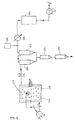
- the chosen solvent fluid (1) by example carbon dioxide
- the pump (3) type the flow rate of which can be adjusted
- a co-solvent (4) consisting of a solvent organic liquid, preferably ethanol may be added, if necessary, to this solvent fluid.
- the mixture thus compressed at the desired supercritical pressure is then warmed to the chosen temperature, usually a temperature close to the critical temperature of the solvent fluid and this, in a heat exchanger (5) consisting of a double tube, the outer tubular part of which is swept by hot water at adequate temperature.
- This mixture is then introduced into a reactor (6) equipped with a stirrer (7) by an electric motor (8) via a magnetic drive system (9).
- the suspension of film-coating agent (10) with stirring is also introduced in the reactor (6) via a pump (11) of the same type as the preceding.
- This suspension is generally composed of an organic solvent within from which the various components of the film-forming agent are dispersed, this solvent being favorably the same as that which is used as co-solvent within the solvent fluid at supercritical pressure.
- the rapid rotation of the stirrer (7) then makes it possible to perform a homogeneous suspension of the film-forming agent in the solvent mixture brought to supercritical pressure.
- This suspension is then sent to the laminating drum (13) within from which it is decompressed via an atomizing nozzle (12), the feed pipe of the suspension between the reactor (6) and the nozzle (12) being heated by a bead electric (14) to prevent precipitation of the film-lamination agent and clogging of this conduct.
- the sudden drop in pressure leads to the formation of very fine droplets of a liquid consisting of dissolved or dispersed film-coating agent in the organic solvent.
- These droplets when they collide with tablets, cover them with a film all the more homogeneous as these tablets are constantly agitated by rotating the filming drum (13).
- This drum installed within a container (18) consists of a cylinder with axis horizontal wall whose walls are perforated with holes (15) so as to let a air flow (16) brought to a temperature of 50 to 60 ° C.
- the organic solvent is rapidly entrained by the solvent fluid reduced to atmospheric pressure and by the flow of hot air (16) which makes it possible to bring the enthalpy required for the total vaporization of the organic solvent, the gas formed being evacuated by the pipe (17) connected to a vent.
- the film-coating film is then formed uniformly and rapidly in because of the complete elimination of the organic solvent and the solvent and on the other hand the continual agitation of the tablets generally maintained at atmospheric pressure or at a similar pressure, and at ambient temperature, temperature, ensuring, in this way, a good distribution of this agent on the whole surface of these tablets.
- a variant of the previous implementation by discontinuous route can use an installation as shown in Fig 1 but modified according to the FIG. 2, that is to say an installation in which the laminating drum (13) is installed at within a container (18) designed to withstand a pressure of at least 200 bar.
- the operation of preparing the agent suspension in the supercritical pressure solvent fluid is conducted in the same equipment as before as well as spraying this suspension within the filming drum containing the tablets held under pressure generally at a pressure of between 30 and 200 bar example a pressure of the order 150 bar and at an appropriate temperature generally between 30 and 60 ° C for example between 45 and 55 ° C.
- the outgoing flow laminating drum consisting of a mixture of solvent fluid, the co-solvent and the solvent used to prepare the film-coating agent solution, is then decompressed, at a pressure of the order of 45 bars, via a valve (19) of discharge type.
- This decompression entails the demixing of the mixture which is admitted into a set of separators (20) (21) constituted, according to the system described in patent FR 2592488 cited above, cyclone chambers allowing the total separation of the liquid phase and the gas phase with heat input via the walls of the separators.
- the double-envelope of these separators is traversed by hot water, which makes it possible to bring the enthalpy required to vaporize the solvent fluid.
- the liquid phase is then withdrawn at atmospheric pressure via a system of airlock (22) (23) operating according to the system described in the patent FR 2592488 already cited.
- the solvent fluid thus largely freed of solvents and co-solvent used can be recycled.
- it is liquefied in a condenser double-tube (24) whose outer tubular part is traversed by a mixture cooled to 0 ° C such as a water / ethylene glycol mixture.
- the solvent fluid is then stored in the liquid state at 5 ° C in a tank (25) whose level is stably maintained by solvent fluid booster from an outer tank (26), before being recycled by the pump (2).
- another object of the invention relates to a method of film-coating as described above in which the spraying is carried out continuously in a laminating drum whose axis is inclined with respect to the horizontal, for example inclined by 5 °, allowing a continuous circulation of tablets introduced into the upper drum and recovered after film coating in the lower part of this drum.
- a installation as shown in Fig 1 but modified according to Fig 3 that is to say an installation in which the laminating drum (13) is slightly inclined by horizontal ratio to allow not only the rotation of the tablets but also their slow longitudinal displacement in the drum.
- the length and the obliquity of the rotating assembly (13) are furthermore calculated so as to maintain a residence time suitable for a complete and fast filming.
- a hopper (27) and a container (28) are connected to one at the entrance located upstream and at the top of the drum (13) to allow the introduction of the tablets semi-continuously, the other downstream and at its lower part to recover the film-coated tablets.
- a ramp (29) of several nozzles (12) arranged in parallel allows performing a continuous spray on the moving tablets in the rotating drum.
- Its axis like that of the pressure vessel (18) which contains it, is slightly inclined to the horizontal to allow not only the rotation of the tablets but also their slow longitudinal displacement in the drum.
- the length and the obliquity of the rotary assembly are furthermore calculated in order to maintain a residence time suitable for a complete and fast filming.
- two locks (30) and (31) are connected one to the entrance to the part upper drum (13), the other at its lower part. They can be put under pressure by a stream of solvent fluid derived from that which ensures the sweep of the drum (13).
- a film is laminated in a batch.
- scored tablets with an average unit mass of 730 mg containing a pharmaceutical active ingredient consisting of valproic acid and its sodium salt as well as an excipient consisting of cellulose derivatives, silica and saccharin with a film-forming agent consisting of a mixture containing equal to a polyacrylate, a polyethylene glycol, a type of cellulose derivative methylhydroxypropyl-cellulose, talc and titanium oxide, this film coating leading to delayed assimilation of the drug.
- the suspension With stirring for 12 hours, the suspension is first made. of the film-forming agent in absolute ethanol at the rate of 250 g of this agent for 750g of ethanol. Two liters of this suspension are then introduced into the reactor (6) and is brought into contact with pure carbon dioxide maintained at 150 bar and 45 ° C. This mixture is maintained with stirring using a stirrer marine anchor type rotating at the speed of 600 rpm.
- the suspension thus obtained is sent to the film-coating drum (13) consisting of a cylinder with a horizontal axis with a diameter of 0.48 m and a length of 0.32 m in which introduced 5 kg of tablets.
- This suspension is suddenly slackened to atmospheric pressure through a nozzle (12) whose orifice has a diameter of 350 ⁇ m.
- the filming drum is rotated at a speed of 4 rpm and is scanned by a flow of 100 m 3 / h of air heated to 50 ° C.
- a film is laminated in a batch of tablets identical to those used in Example 1 with a identical filming.
- Example 2 Firstly, in a manner similar to that used in Example 1, the preparing the initial suspension of film-forming agent in ethanol and then the preparation of the suspension in the reactor (6) in the presence of supercritical pressure carbon with however the maintenance of the pressure within from this reactor to 190 bars.
- Example 1 When the equilibrium of the conditions is well reached, one begins the spraying of the suspension made in the reactor (6) in the spray drum (13) for 5 minutes via a nozzle identical to that used in Example 1. Also as in this previous example, the scanning is maintained by the carbon dioxide and rotation of the drum (13) for five minutes after stopping the spraying, then emptying the contained fluid and opening the container (18) and the drum (13) to recover the tablets. Weighing and observation of these tablets give very similar results to those obtained during Example 1 or those obtained by using a conventional method, with a unit average mass of 751 mg. However, unlike Example 1, the emission of ethanol to the atmosphere has been divided by at least 10, the largest part of the ethanol is recovered in the separators (20-21) and withdrawn since Airlock (22-23) at atmospheric pressure.
- Example 2 For this purpose, it is prepared, as described in Example 1, the initial suspension of this agent in ethanol, and then the suspension within the reactor (6) in the presence of supercritical pressure carbon dioxide. Similarly, we use for the implementation this laminating operation, equipment similar to that used for Example 1
- the laminating drum (13) with a diameter of 0.48m and a length of 1.50m is inclined at 5 ° to the horizontal.
- the equipment provides the possibility to introduce semi-continuous 2 to 3kg of tablets by means of a hopper (27) connected to the drum (13) by a vertical piping of a diameter of 0.05m connected to the highest part of the drum (13) and of collect in the container (28), approximately every two minutes, a quantity similar by vertical piping of the same diameter as the previous one, connected in the lowest drum part (13).
- the filming process can be carried out almost continuously on reactor (6) being fed on the one hand by a flow rate of suspension agent laminating 10kg / h by the pump (5) regulated by a level probe arranged at in the reactor (6) and on the other hand in supercritical pressure carbon dioxide pump (2) at the rate required to maintain a pressure of 150 bar in the reactor in question.
- the spray is operated continuously through a ramp (29) of four nozzles (12) in parallel, similar to those used in the previous examples, these nozzles being arranged along the axis of the drum (13).
- the filming operation is carried out in a manner analogous to that described in Example 1: the film-coating drum is rotated at a speed of 4 revolutions / minute and is scanned by a flow of 100 m 3 / h of air (16) heated to 50 ° C. During a period of 6 hours, it was thus possible to film the batch of 365 kg of tablets very satisfactorily, the average mass of the tablets after treatment being 752 mg.
- Example 1 For this purpose, as described in Example 1, the initial suspension of this agent in ethanol and then the suspension in the reactor (6) in the presence of supercritical pressure carbon dioxide.
- two locks of 10 liters (30) and (31) are connected to the inlet and the outlet of the drum (13). These airlock can be pressurized by a stream of carbon dioxide derived from that which ensures the sweeping of the drum (13) and allows to introduce semi-continuous 2-3 kg of tablets and extract a similar amount, both about minutes.
- the film coating process can be carried out almost continuously, the reactor (6) being fed on the one hand by a suspension flow rate of the agent of lamination of 10 kg / h by the pump (5) regulated by a level probe arranged within the reactor (6) and on the other hand with supercritical carbon dioxide by the pump (2) at the flow rate required to maintain a pressure of 190 bars in the reactor in question.
- Spraying is carried out continuously through a ramp (29) of 4 nozzles (12) in parallel, similar to those used in the preceding examples, these nozzles being arranged along the axis of the film-coating drum,
- Example 2 Using the same method as described in Example 2, a batch of 6 kg of tablets with an average unit mass of 240 mg including the clopidogrel as active ingredient with a film-forming agent consisting of a mixture containing a phthalate polyvinyl acetate copolymer, starting from a suspension of 400 g of this film-forming agent in 1600 g of ethanol. This suspension is brought into contact with pure carbon dioxide maintained in the state supercritical in conditions of temperature and pressure of 50 ° C and 150 bars and the filming operation is carried out for 20 minutes.
- a film-forming agent consisting of a mixture containing a phthalate polyvinyl acetate copolymer
Landscapes
- Health & Medical Sciences (AREA)
- Epidemiology (AREA)
- Animal Behavior & Ethology (AREA)
- Chemical & Material Sciences (AREA)
- Medicinal Chemistry (AREA)
- Pharmacology & Pharmacy (AREA)
- Engineering & Computer Science (AREA)
- Life Sciences & Earth Sciences (AREA)
- Bioinformatics & Cheminformatics (AREA)
- General Health & Medical Sciences (AREA)
- Public Health (AREA)
- Veterinary Medicine (AREA)
- Medicinal Preparation (AREA)
- Medical Preparation Storing Or Oral Administration Devices (AREA)
- Steroid Compounds (AREA)
Claims (12)
- Verfahren zur Beschichtung von Tabletten, dadurch gekennzeichnet, daß man die Tabletten mit einer Suspension eines Beschichtungsmittels in einem Fluid bei überkritischem Druck besprüht.
- Verfahren nach Anspruch 1, dadurch gekennzeichnet, daß man das Besprühen kontinuierlich in einer Beschichtungstrommel durchführt, deren Achse, bezogen auf die Horizontale, geneigt ist und eine kontinuierliche Zirkulation der Tabletten ermöglicht, die stromaufwärts und im oberen Bereich dieser Trommel eingeführt und nach dem Beschichten stromabwärts und im unteren Bereich der Trommel abgezogen werden.
- Verfahren nach Anspruch 1 oder 2, dadurch gekennzeichnet, daß das Besprühen in kontinuierlicher Weise in einer Beschichtungstrommel bewirkt wird, deren Achse, bezogen auf die Horizontale, geneigt ist und eine kontinuierliche Zirkulation der Tabletten ermöglicht, die bei einer geeigneten Temperatur und unter Druck in der Trommel gehalten werden, wobei diese Tabletten mit Hilfe eines Schleusensystems, welches stromaufwärts und im oberen Bereich dieser Trommel angeordnet ist, in die Trommel eingeführt werden und nach dem Beschichten stromabwärts mit Hilfe eines Schleusensystems, welches im unteren Bereich der Trommel angeordnet ist, aus dem System abgezogen werden, wobei diese Schleusensysteme semikontinuierlich betrieben werden, um einen Druck in der Trommel aufrechtzuerhalten.
- Verfahren nach einem der Ansprüche 1 bis 3, dadurch gekennzeichnet, daß das Besprühen auf die kontinuierlich bewegten Tabletten erfolgt.
- Verfahren nach einem der Ansprüche 1 bis 4, dadurch gekennzeichnet, daß die Suspension des Beschichtungsmittels in dem Fluid bei überkritischem Druck gebildet wird, ausgehend von:entweder einem Beschichtungsmittel, welches so, wie es ist, in das Fluid mit überkritischem Druck eingeführt wird, welches gegebenenfalls ein oder mehrere Co-Lösungsmittel ausgewählt aus C1-C4-Alkoholen und C3-C6-Estern enthält,oder einer Suspension eines Beschichtungsmittels in einem oder mehreren Lösungsmitteln ausgewählt aus C1-C4-Alkoholen und C3-C6-Estern, die in das Fluid mit überkritischem Druck eingeführt wird, welches gegebenenfalls ein oder mehrere Co-Lösungsmittel ausgewählt aus C1-C4-Alkoholen und C3-C6-Estern enthält.
- Verfahren nach Anspruch 5, dadurch gekennzeichnet, daß die Suspension des Beschichtungsmittels in dem oder den Lösungsmittel(n) von 5 bis 30 Gew.-% der gesamten Suspension variiert.
- Verfahren nach Anspruch 5 oder 6, dadurch gekennzeichnet, daß das Lösungsmittel oder Co-Lösungsmittel Ethanol ist.
- Verfahren nach einem der Ansprüche 1 bis 7, dadurch gekennzeichnet, daß die Menge des Beschichtungsmittels in dem Fluid mit überkritischem Druck 30 Gew.-% der Masse des Fluids nicht übersteigt.
- Verfahren nach einem der Ansprüche 3 bis 8, dadurch gekennzeichnet, daß der Druck zwischen 30 und 200 bar liegt.
- Verfahren nach einem der Ansprüche 3 bis 9, dadurch gekennzeichnet, daß die Temperatur zwischen 30 und 60°C liegt.
- Verfahren nach einem der Ansprüche 1 bis 9, dadurch gekennzeichnet, daß das Beschichtungsmittel ausgewählt ist aus Derivaten von Cellulose, Derivaten von Hydroxycellulose, mikrokristalliner Cellulose, einem Polyacrylat, einem Polyvinylalkohol, einem Polyethylen, einem Polypropylen, einem Polyethylenglykol, einem Polystyrol, einem Polyacrylamid, einem Ethylvinylacetat-Polyvinylacetat-Copolymer, einem Phthalat-Polyvinylacetat-Copolymer. einem Polyvinylpyrrolidon, einem Titanoxid und einem Wachs.
- Verfahren nach einem der Ansprüche 1 bis 11, dadurch gekennzeichnet, daß das Fluid mit überkritischem Druck Kohlendioxid bei überkritischem Druck ist.
Applications Claiming Priority (3)
| Application Number | Priority Date | Filing Date | Title |
|---|---|---|---|
| FR9914104 | 1999-11-10 | ||
| FR9914104A FR2800613B1 (fr) | 1999-11-10 | 1999-11-10 | Procede pour le pelliculage de comprimes |
| PCT/FR2000/003127 WO2001034122A1 (fr) | 1999-11-10 | 2000-11-09 | Procede pour le pelliculage de comprimes |
Publications (2)
| Publication Number | Publication Date |
|---|---|
| EP1231902A1 EP1231902A1 (de) | 2002-08-21 |
| EP1231902B1 true EP1231902B1 (de) | 2005-03-09 |
Family
ID=9551942
Family Applications (1)
| Application Number | Title | Priority Date | Filing Date |
|---|---|---|---|
| EP00979704A Expired - Lifetime EP1231902B1 (de) | 1999-11-10 | 2000-11-09 | Verfahren zur beschichtung von tabletten |
Country Status (11)
| Country | Link |
|---|---|
| EP (1) | EP1231902B1 (de) |
| JP (1) | JP2003513907A (de) |
| AT (1) | ATE290371T1 (de) |
| AU (1) | AU1710401A (de) |
| CA (1) | CA2390132A1 (de) |
| DE (1) | DE60018596T2 (de) |
| ES (1) | ES2239626T3 (de) |
| FR (1) | FR2800613B1 (de) |
| HU (1) | HU228846B1 (de) |
| MX (1) | MXPA02004681A (de) |
| WO (1) | WO2001034122A1 (de) |
Families Citing this family (2)
| Publication number | Priority date | Publication date | Assignee | Title |
|---|---|---|---|---|
| BE1026889B1 (fr) * | 2018-12-19 | 2020-07-22 | Laboratoires Pharmaceutiques Trenker Pharmaceutische Laboratoria Trenker | Procédé de fabrication de comprimés de compléments alimentaires de grande taille et comprimés ainsi obtenus |
| JP7633786B2 (ja) * | 2020-09-18 | 2025-02-20 | 日本化薬株式会社 | スニチニブリンゴ酸塩を有効成分とする医薬錠剤 |
Family Cites Families (3)
| Publication number | Priority date | Publication date | Assignee | Title |
|---|---|---|---|---|
| WO1992011310A2 (en) * | 1990-12-21 | 1992-07-09 | Union Carbide Chemicals And Plastics Company Inc. | Subcritical compressed fluids as viscosity reducing diluents for transportable compositions |
| US5178325A (en) * | 1991-06-25 | 1993-01-12 | Union Carbide Chemicals & Plastics Technology Corporation | Apparatus and methods for application of coatings with compressible fluids as diluent by spraying from an orifice |
| EP0706821A1 (de) * | 1994-10-06 | 1996-04-17 | Centre De Microencapsulation | Verfahren zum Beschichten von Partikeln |
-
1999
- 1999-11-10 FR FR9914104A patent/FR2800613B1/fr not_active Expired - Fee Related
-
2000
- 2000-11-09 AU AU17104/01A patent/AU1710401A/en not_active Abandoned
- 2000-11-09 AT AT00979704T patent/ATE290371T1/de active
- 2000-11-09 WO PCT/FR2000/003127 patent/WO2001034122A1/fr not_active Ceased
- 2000-11-09 JP JP2001536122A patent/JP2003513907A/ja not_active Withdrawn
- 2000-11-09 CA CA002390132A patent/CA2390132A1/en not_active Abandoned
- 2000-11-09 EP EP00979704A patent/EP1231902B1/de not_active Expired - Lifetime
- 2000-11-09 ES ES00979704T patent/ES2239626T3/es not_active Expired - Lifetime
- 2000-11-09 DE DE60018596T patent/DE60018596T2/de not_active Expired - Lifetime
- 2000-11-09 HU HU0301597A patent/HU228846B1/hu not_active IP Right Cessation
- 2000-11-09 MX MXPA02004681A patent/MXPA02004681A/es not_active Application Discontinuation
Also Published As
| Publication number | Publication date |
|---|---|
| HU228846B1 (en) | 2013-06-28 |
| HUP0301597A3 (en) | 2006-07-28 |
| FR2800613A1 (fr) | 2001-05-11 |
| DE60018596D1 (de) | 2005-04-14 |
| ES2239626T3 (es) | 2005-10-01 |
| MXPA02004681A (es) | 2002-11-29 |
| DE60018596T2 (de) | 2006-04-13 |
| WO2001034122A1 (fr) | 2001-05-17 |
| HUP0301597A2 (hu) | 2003-09-29 |
| ATE290371T1 (de) | 2005-03-15 |
| CA2390132A1 (en) | 2001-05-17 |
| JP2003513907A (ja) | 2003-04-15 |
| EP1231902A1 (de) | 2002-08-21 |
| AU1710401A (en) | 2001-06-06 |
| FR2800613B1 (fr) | 2001-12-28 |
Similar Documents
| Publication | Publication Date | Title |
|---|---|---|
| EP1330266B1 (de) | Verfahren zur herstellung von sehr feinen teilchen bestehend aus einem wirtsmolekül mit inseriertem wirkstoff | |
| JPH04500925A (ja) | 反溶剤への沈澱を介する微細分化固体結晶性粉末 | |
| EP0784506A1 (de) | Verfahren zum umhullen von teilchen | |
| EP2812104B1 (de) | Verfahren und vorrichtung zur herstellung von nanoteilchen durch blitzverdampfung | |
| CA2763541C (fr) | Procede de preparation de particules creuses et leurs applications | |
| EP3164201B1 (de) | Verfahren zur herstellung von co-kristallen mittels entspannungsverdampfung | |
| EP1638609B1 (de) | Verfahren zur herstellung von molekularkomplexen | |
| FR2830760A1 (fr) | Procede de preparation d'un compose d'interaction de substances actives avec un support poreux par fluide supercritique | |
| EP1231902A1 (de) | Verfahren zur beschichtung von tabletten | |
| CN1418090A (zh) | 应用压缩流体制备加速释放的制剂的方法 | |
| EP1409102B1 (de) | Verfahren und vorrichtung zur adsorption von aktiven verbindungen aus einem produkt auf einem porösem träger | |
| JP2007505084A (ja) | 小板として形成される粒子 | |
| EP1239938B1 (de) | Verfahren und vorrichtung zur entfernung von feinteiligen partikeln durch perkolation im schüttgut | |
| JP4115658B2 (ja) | セルロース系ポリマーの製造方法 | |
| EP2419088B1 (de) | Verfahren zur herstellung von pharmazeutischen zusammensetzungen mit feinen wirkstoffteilchen | |
| WO2002089851A1 (fr) | Procede de fabrication de complexes hote-client | |
| FR2633517A1 (fr) | Procede pour l'enduction pelliculaire de compositions pharmaceutiques avec des dispersions de polymeres | |
| FR2830761A1 (fr) | Procede de preparation d'un compose d'interaction d'un derive anilide avec un support poreux par fluide supercritique | |
| EP1610891A2 (de) | Verfahren und vorrichtung zum einkapseln einer komponente innerhalb eines trägers | |
| BE830570A (fr) | Procede de revetement de certaines formes de presentation de doses de produits | |
| EP2473535B1 (de) | Waschverfahren für ein material auf der basis eines oxidierten polysaccharids | |
| WO2003086610A2 (fr) | Procede d'obtention d'une suspension stable de particules dans un liquide | |
| Lodhi | Application of supercritical carbon dioxide and a co-solvent in the production of polymeric film for coating of tablets | |
| FR2838654A1 (fr) | Procede d'obtention de particules solides amorphes | |
| FR3087351A1 (fr) | Synthese hors equilibre haute et basse temperature par synthese spray flash |
Legal Events
| Date | Code | Title | Description |
|---|---|---|---|
| PUAI | Public reference made under article 153(3) epc to a published international application that has entered the european phase |
Free format text: ORIGINAL CODE: 0009012 |
|
| 17P | Request for examination filed |
Effective date: 20020610 |
|
| AK | Designated contracting states |
Kind code of ref document: A1 Designated state(s): AT BE CH CY DE DK ES FI FR GB GR IE IT LI LU MC NL PT SE TR |
|
| AX | Request for extension of the european patent |
Free format text: AL PAYMENT 20020610;LT PAYMENT 20020610;LV PAYMENT 20020610;MK PAYMENT 20020610;RO PAYMENT 20020610;SI PAYMENT 20020610 |
|
| GRAP | Despatch of communication of intention to grant a patent |
Free format text: ORIGINAL CODE: EPIDOSNIGR1 |
|
| RAP1 | Party data changed (applicant data changed or rights of an application transferred) |
Owner name: SANOFI-AVENTIS |
|
| GRAS | Grant fee paid |
Free format text: ORIGINAL CODE: EPIDOSNIGR3 |
|
| GRAA | (expected) grant |
Free format text: ORIGINAL CODE: 0009210 |
|
| AK | Designated contracting states |
Kind code of ref document: B1 Designated state(s): AT BE CH CY DE DK ES FI FR GB GR IE IT LI LU MC NL PT SE TR |
|
| AX | Request for extension of the european patent |
Extension state: AL LT LV MK RO SI |
|
| PG25 | Lapsed in a contracting state [announced via postgrant information from national office to epo] |
Ref country code: NL Free format text: LAPSE BECAUSE OF FAILURE TO SUBMIT A TRANSLATION OF THE DESCRIPTION OR TO PAY THE FEE WITHIN THE PRESCRIBED TIME-LIMIT Effective date: 20050309 Ref country code: TR Free format text: LAPSE BECAUSE OF FAILURE TO SUBMIT A TRANSLATION OF THE DESCRIPTION OR TO PAY THE FEE WITHIN THE PRESCRIBED TIME-LIMIT Effective date: 20050309 Ref country code: FI Free format text: LAPSE BECAUSE OF FAILURE TO SUBMIT A TRANSLATION OF THE DESCRIPTION OR TO PAY THE FEE WITHIN THE PRESCRIBED TIME-LIMIT Effective date: 20050309 |
|
| REG | Reference to a national code |
Ref country code: GB Ref legal event code: FG4D Free format text: NOT ENGLISH |
|
| REG | Reference to a national code |
Ref country code: CH Ref legal event code: EP |
|
| REG | Reference to a national code |
Ref country code: IE Ref legal event code: FG4D Free format text: FRENCH |
|
| REF | Corresponds to: |
Ref document number: 60018596 Country of ref document: DE Date of ref document: 20050414 Kind code of ref document: P |
|
| PG25 | Lapsed in a contracting state [announced via postgrant information from national office to epo] |
Ref country code: DK Free format text: LAPSE BECAUSE OF FAILURE TO SUBMIT A TRANSLATION OF THE DESCRIPTION OR TO PAY THE FEE WITHIN THE PRESCRIBED TIME-LIMIT Effective date: 20050609 Ref country code: GR Free format text: LAPSE BECAUSE OF FAILURE TO SUBMIT A TRANSLATION OF THE DESCRIPTION OR TO PAY THE FEE WITHIN THE PRESCRIBED TIME-LIMIT Effective date: 20050609 |
|
| GBT | Gb: translation of ep patent filed (gb section 77(6)(a)/1977) |
Effective date: 20050711 |
|
| LTIE | Lt: invalidation of european patent or patent extension |
Effective date: 20050309 |
|
| NLV1 | Nl: lapsed or annulled due to failure to fulfill the requirements of art. 29p and 29m of the patents act | ||
| PG25 | Lapsed in a contracting state [announced via postgrant information from national office to epo] |
Ref country code: PT Free format text: LAPSE BECAUSE OF FAILURE TO SUBMIT A TRANSLATION OF THE DESCRIPTION OR TO PAY THE FEE WITHIN THE PRESCRIBED TIME-LIMIT Effective date: 20050907 |
|
| REG | Reference to a national code |
Ref country code: ES Ref legal event code: FG2A Ref document number: 2239626 Country of ref document: ES Kind code of ref document: T3 |
|
| PG25 | Lapsed in a contracting state [announced via postgrant information from national office to epo] |
Ref country code: CY Free format text: LAPSE BECAUSE OF FAILURE TO SUBMIT A TRANSLATION OF THE DESCRIPTION OR TO PAY THE FEE WITHIN THE PRESCRIBED TIME-LIMIT Effective date: 20051109 |
|
| PG25 | Lapsed in a contracting state [announced via postgrant information from national office to epo] |
Ref country code: MC Free format text: LAPSE BECAUSE OF NON-PAYMENT OF DUE FEES Effective date: 20051130 |
|
| PLBE | No opposition filed within time limit |
Free format text: ORIGINAL CODE: 0009261 |
|
| STAA | Information on the status of an ep patent application or granted ep patent |
Free format text: STATUS: NO OPPOSITION FILED WITHIN TIME LIMIT |
|
| 26N | No opposition filed |
Effective date: 20051212 |
|
| PG25 | Lapsed in a contracting state [announced via postgrant information from national office to epo] |
Ref country code: SE Free format text: LAPSE BECAUSE OF FAILURE TO SUBMIT A TRANSLATION OF THE DESCRIPTION OR TO PAY THE FEE WITHIN THE PRESCRIBED TIME-LIMIT Effective date: 20050609 |
|
| REG | Reference to a national code |
Ref country code: DE Ref legal event code: R082 Ref document number: 60018596 Country of ref document: DE Representative=s name: MAIWALD PATENTANWALTSGESELLSCHAFT MBH, DE |
|
| REG | Reference to a national code |
Ref country code: DE Ref legal event code: R082 Ref document number: 60018596 Country of ref document: DE Representative=s name: MAIWALD PATENTANWALTSGESELLSCHAFT MBH, DE Effective date: 20130205 Ref country code: DE Ref legal event code: R081 Ref document number: 60018596 Country of ref document: DE Owner name: SANOFI, FR Free format text: FORMER OWNER: SANOFI-AVENTIS, PARIS, FR Effective date: 20130205 Ref country code: DE Ref legal event code: R081 Ref document number: 60018596 Country of ref document: DE Owner name: SANOFI-AVENTIS, FR Free format text: FORMER OWNER: SANOFI-AVENTIS, PARIS, FR Effective date: 20130205 Ref country code: DE Ref legal event code: R082 Ref document number: 60018596 Country of ref document: DE Representative=s name: MAIWALD PATENTANWALTS- UND RECHTSANWALTSGESELL, DE Effective date: 20130205 |
|
| PGFP | Annual fee paid to national office [announced via postgrant information from national office to epo] |
Ref country code: LU Payment date: 20131114 Year of fee payment: 14 |
|
| PGFP | Annual fee paid to national office [announced via postgrant information from national office to epo] |
Ref country code: IE Payment date: 20131112 Year of fee payment: 14 Ref country code: AT Payment date: 20131028 Year of fee payment: 14 Ref country code: CH Payment date: 20131112 Year of fee payment: 14 |
|
| PGFP | Annual fee paid to national office [announced via postgrant information from national office to epo] |
Ref country code: BE Payment date: 20131113 Year of fee payment: 14 |
|
| PG25 | Lapsed in a contracting state [announced via postgrant information from national office to epo] |
Ref country code: BE Free format text: LAPSE BECAUSE OF NON-PAYMENT OF DUE FEES Effective date: 20141130 Ref country code: LU Free format text: LAPSE BECAUSE OF NON-PAYMENT OF DUE FEES Effective date: 20141109 |
|
| REG | Reference to a national code |
Ref country code: CH Ref legal event code: PL |
|
| REG | Reference to a national code |
Ref country code: AT Ref legal event code: MM01 Ref document number: 290371 Country of ref document: AT Kind code of ref document: T Effective date: 20141109 |
|
| PG25 | Lapsed in a contracting state [announced via postgrant information from national office to epo] |
Ref country code: CH Free format text: LAPSE BECAUSE OF NON-PAYMENT OF DUE FEES Effective date: 20141130 Ref country code: LI Free format text: LAPSE BECAUSE OF NON-PAYMENT OF DUE FEES Effective date: 20141130 |
|
| REG | Reference to a national code |
Ref country code: IE Ref legal event code: MM4A |
|
| PG25 | Lapsed in a contracting state [announced via postgrant information from national office to epo] |
Ref country code: AT Free format text: LAPSE BECAUSE OF NON-PAYMENT OF DUE FEES Effective date: 20141109 |
|
| PG25 | Lapsed in a contracting state [announced via postgrant information from national office to epo] |
Ref country code: IE Free format text: LAPSE BECAUSE OF NON-PAYMENT OF DUE FEES Effective date: 20141109 |
|
| REG | Reference to a national code |
Ref country code: FR Ref legal event code: PLFP Year of fee payment: 16 |
|
| REG | Reference to a national code |
Ref country code: FR Ref legal event code: PLFP Year of fee payment: 17 |
|
| PGFP | Annual fee paid to national office [announced via postgrant information from national office to epo] |
Ref country code: DE Payment date: 20161101 Year of fee payment: 17 Ref country code: FR Payment date: 20161014 Year of fee payment: 17 Ref country code: GB Payment date: 20161109 Year of fee payment: 17 |
|
| PGFP | Annual fee paid to national office [announced via postgrant information from national office to epo] |
Ref country code: IT Payment date: 20161122 Year of fee payment: 17 Ref country code: ES Payment date: 20161011 Year of fee payment: 17 |
|
| REG | Reference to a national code |
Ref country code: DE Ref legal event code: R119 Ref document number: 60018596 Country of ref document: DE |
|
| GBPC | Gb: european patent ceased through non-payment of renewal fee |
Effective date: 20171109 |
|
| REG | Reference to a national code |
Ref country code: FR Ref legal event code: ST Effective date: 20180731 |
|
| PG25 | Lapsed in a contracting state [announced via postgrant information from national office to epo] |
Ref country code: DE Free format text: LAPSE BECAUSE OF NON-PAYMENT OF DUE FEES Effective date: 20180602 Ref country code: IT Free format text: LAPSE BECAUSE OF NON-PAYMENT OF DUE FEES Effective date: 20171109 Ref country code: FR Free format text: LAPSE BECAUSE OF NON-PAYMENT OF DUE FEES Effective date: 20171130 |
|
| PG25 | Lapsed in a contracting state [announced via postgrant information from national office to epo] |
Ref country code: GB Free format text: LAPSE BECAUSE OF NON-PAYMENT OF DUE FEES Effective date: 20171109 |
|
| REG | Reference to a national code |
Ref country code: ES Ref legal event code: FD2A Effective date: 20181226 |
|
| PG25 | Lapsed in a contracting state [announced via postgrant information from national office to epo] |
Ref country code: ES Free format text: LAPSE BECAUSE OF NON-PAYMENT OF DUE FEES Effective date: 20171110 |