EP1246845B1 - Procede de production de precurseurs d'insuline et d'analogues de precurseurs d'insuline - Google Patents
Procede de production de precurseurs d'insuline et d'analogues de precurseurs d'insuline Download PDFInfo
- Publication number
- EP1246845B1 EP1246845B1 EP00981169A EP00981169A EP1246845B1 EP 1246845 B1 EP1246845 B1 EP 1246845B1 EP 00981169 A EP00981169 A EP 00981169A EP 00981169 A EP00981169 A EP 00981169A EP 1246845 B1 EP1246845 B1 EP 1246845B1
- Authority
- EP
- European Patent Office
- Prior art keywords
- atom
- insulin
- lys
- trp
- leu
- Prior art date
- Legal status (The legal status is an assumption and is not a legal conclusion. Google has not performed a legal analysis and makes no representation as to the accuracy of the status listed.)
- Expired - Lifetime
Links
- NOESYZHRGYRDHS-UHFFFAOYSA-N insulin Chemical compound N1C(=O)C(NC(=O)C(CCC(N)=O)NC(=O)C(CCC(O)=O)NC(=O)C(C(C)C)NC(=O)C(NC(=O)CN)C(C)CC)CSSCC(C(NC(CO)C(=O)NC(CC(C)C)C(=O)NC(CC=2C=CC(O)=CC=2)C(=O)NC(CCC(N)=O)C(=O)NC(CC(C)C)C(=O)NC(CCC(O)=O)C(=O)NC(CC(N)=O)C(=O)NC(CC=2C=CC(O)=CC=2)C(=O)NC(CSSCC(NC(=O)C(C(C)C)NC(=O)C(CC(C)C)NC(=O)C(CC=2C=CC(O)=CC=2)NC(=O)C(CC(C)C)NC(=O)C(C)NC(=O)C(CCC(O)=O)NC(=O)C(C(C)C)NC(=O)C(CC(C)C)NC(=O)C(CC=2NC=NC=2)NC(=O)C(CO)NC(=O)CNC2=O)C(=O)NCC(=O)NC(CCC(O)=O)C(=O)NC(CCCNC(N)=N)C(=O)NCC(=O)NC(CC=3C=CC=CC=3)C(=O)NC(CC=3C=CC=CC=3)C(=O)NC(CC=3C=CC(O)=CC=3)C(=O)NC(C(C)O)C(=O)N3C(CCC3)C(=O)NC(CCCCN)C(=O)NC(C)C(O)=O)C(=O)NC(CC(N)=O)C(O)=O)=O)NC(=O)C(C(C)CC)NC(=O)C(CO)NC(=O)C(C(C)O)NC(=O)C1CSSCC2NC(=O)C(CC(C)C)NC(=O)C(NC(=O)C(CCC(N)=O)NC(=O)C(CC(N)=O)NC(=O)C(NC(=O)C(N)CC=1C=CC=CC=1)C(C)C)CC1=CN=CN1 NOESYZHRGYRDHS-UHFFFAOYSA-N 0.000 title claims abstract description 274
- 102000004877 Insulin Human genes 0.000 title claims abstract description 135
- 108090001061 Insulin Proteins 0.000 title claims abstract description 135
- 239000002243 precursor Substances 0.000 title claims abstract description 131
- 229940125396 insulin Drugs 0.000 title claims abstract description 128
- 238000000034 method Methods 0.000 title claims description 40
- 240000004808 Saccharomyces cerevisiae Species 0.000 claims abstract description 41
- 125000000539 amino acid group Chemical group 0.000 claims abstract description 37
- 239000013598 vector Substances 0.000 claims abstract description 25
- 108091033319 polynucleotide Proteins 0.000 claims abstract description 20
- 102000040430 polynucleotide Human genes 0.000 claims abstract description 20
- 239000002157 polynucleotide Substances 0.000 claims abstract description 20
- 108090000765 processed proteins & peptides Proteins 0.000 claims description 34
- YDKYJRZWRJTILC-WDSOQIARSA-N Met-Trp-Lys Chemical compound C1=CC=C2C(C[C@H](NC(=O)[C@@H](N)CCSC)C(=O)N[C@@H](CCCCN)C(O)=O)=CNC2=C1 YDKYJRZWRJTILC-WDSOQIARSA-N 0.000 claims description 29
- 101000976075 Homo sapiens Insulin Proteins 0.000 claims description 16
- YOTHMZZSJKKEHZ-SZMVWBNQSA-N Glu-Trp-Lys Chemical compound C1=CC=C2C(C[C@@H](C(=O)N[C@@H](CCCCN)C(O)=O)NC(=O)[C@@H](N)CCC(O)=O)=CNC2=C1 YOTHMZZSJKKEHZ-SZMVWBNQSA-N 0.000 claims description 15
- PBGKTOXHQIOBKM-FHFVDXKLSA-N insulin (human) Chemical compound C([C@@H](C(=O)N[C@@H](CC(C)C)C(=O)N[C@H]1CSSC[C@H]2C(=O)N[C@H](C(=O)N[C@@H](CO)C(=O)N[C@H](C(=O)N[C@H](C(N[C@@H](CO)C(=O)N[C@@H](CC(C)C)C(=O)N[C@@H](CC=3C=CC(O)=CC=3)C(=O)N[C@@H](CCC(N)=O)C(=O)N[C@@H](CC(C)C)C(=O)N[C@@H](CCC(O)=O)C(=O)N[C@@H](CC(N)=O)C(=O)N[C@@H](CC=3C=CC(O)=CC=3)C(=O)N[C@@H](CSSC[C@H](NC(=O)[C@H](C(C)C)NC(=O)[C@H](CC(C)C)NC(=O)[C@H](CC=3C=CC(O)=CC=3)NC(=O)[C@H](CC(C)C)NC(=O)[C@H](C)NC(=O)[C@H](CCC(O)=O)NC(=O)[C@H](C(C)C)NC(=O)[C@H](CC(C)C)NC(=O)[C@H](CC=3NC=NC=3)NC(=O)[C@H](CO)NC(=O)CNC1=O)C(=O)NCC(=O)N[C@@H](CCC(O)=O)C(=O)N[C@@H](CCCNC(N)=N)C(=O)NCC(=O)N[C@@H](CC=1C=CC=CC=1)C(=O)N[C@@H](CC=1C=CC=CC=1)C(=O)N[C@@H](CC=1C=CC(O)=CC=1)C(=O)N[C@@H]([C@@H](C)O)C(=O)N1[C@@H](CCC1)C(=O)N[C@@H](CCCCN)C(=O)N[C@@H]([C@@H](C)O)C(O)=O)C(=O)N[C@@H](CC(N)=O)C(O)=O)=O)CSSC[C@@H](C(N2)=O)NC(=O)[C@H](CCC(N)=O)NC(=O)[C@H](CCC(O)=O)NC(=O)[C@H](C(C)C)NC(=O)[C@@H](NC(=O)CN)[C@@H](C)CC)[C@@H](C)CC)[C@@H](C)O)NC(=O)[C@H](CCC(N)=O)NC(=O)[C@H](CC(N)=O)NC(=O)[C@@H](NC(=O)[C@@H](N)CC=1C=CC=CC=1)C(C)C)C1=CN=CN1 PBGKTOXHQIOBKM-FHFVDXKLSA-N 0.000 claims description 15
- 239000004026 insulin derivative Substances 0.000 claims description 13
- 230000008569 process Effects 0.000 claims description 10
- 230000014509 gene expression Effects 0.000 claims description 9
- 230000002255 enzymatic effect Effects 0.000 claims description 7
- 239000013604 expression vector Substances 0.000 claims description 7
- 239000000126 substance Substances 0.000 claims description 6
- 238000006243 chemical reaction Methods 0.000 claims description 5
- 238000012258 culturing Methods 0.000 claims description 5
- 239000001963 growth medium Substances 0.000 claims description 5
- 238000000338 in vitro Methods 0.000 claims description 5
- ZIYGTCDTJJCDDP-JYJNAYRXSA-N Glu-Phe-Lys Chemical compound C1=CC=C(C=C1)C[C@@H](C(=O)N[C@@H](CCCCN)C(=O)O)NC(=O)[C@H](CCC(=O)O)N ZIYGTCDTJJCDDP-JYJNAYRXSA-N 0.000 claims description 4
- PHQXWZGXKAFWAZ-ZLIFDBKOSA-N Ala-Trp-Lys Chemical compound C1=CC=C2C(C[C@H](NC(=O)[C@@H](N)C)C(=O)N[C@@H](CCCCN)C(O)=O)=CNC2=C1 PHQXWZGXKAFWAZ-ZLIFDBKOSA-N 0.000 claims description 3
- JBQORRNSZGTLCV-WDSOQIARSA-N Arg-Trp-Lys Chemical compound C1=CC=C2C(C[C@@H](C(=O)N[C@@H](CCCCN)C(O)=O)NC(=O)[C@@H](N)CCCN=C(N)N)=CNC2=C1 JBQORRNSZGTLCV-WDSOQIARSA-N 0.000 claims description 3
- FIRWLDUOFOULCA-XIRDDKMYSA-N Asp-Trp-Lys Chemical compound C1=CC=C2C(=C1)C(=CN2)C[C@@H](C(=O)N[C@@H](CCCCN)C(=O)O)NC(=O)[C@H](CC(=O)O)N FIRWLDUOFOULCA-XIRDDKMYSA-N 0.000 claims description 3
- VBGCPJBKUXRYDA-DSYPUSFNSA-N Ile-Trp-Lys Chemical compound CC[C@H](C)[C@@H](C(=O)N[C@@H](CC1=CNC2=CC=CC=C21)C(=O)N[C@@H](CCCCN)C(=O)O)N VBGCPJBKUXRYDA-DSYPUSFNSA-N 0.000 claims description 3
- ZGGVHTQAPHVMKM-IHPCNDPISA-N Leu-Trp-Lys Chemical compound CC(C)C[C@@H](C(=O)N[C@@H](CC1=CNC2=CC=CC=C21)C(=O)N[C@@H](CCCCN)C(=O)O)N ZGGVHTQAPHVMKM-IHPCNDPISA-N 0.000 claims description 3
- GVUVRRPYYDHHGK-VQVTYTSYSA-N Pro-Thr Chemical group C[C@@H](O)[C@@H](C(O)=O)NC(=O)[C@@H]1CCCN1 GVUVRRPYYDHHGK-VQVTYTSYSA-N 0.000 claims description 3
- XPVIVVLLLOFBRH-XIRDDKMYSA-N Ser-Trp-Lys Chemical compound NCCCC[C@H](NC(=O)[C@H](Cc1c[nH]c2ccccc12)NC(=O)[C@@H](N)CO)C(O)=O XPVIVVLLLOFBRH-XIRDDKMYSA-N 0.000 claims description 3
- MYNYCUXMIIWUNW-IEGACIPQSA-N Thr-Trp-Lys Chemical compound C[C@H]([C@@H](C(=O)N[C@@H](CC1=CNC2=CC=CC=C21)C(=O)N[C@@H](CCCCN)C(=O)O)N)O MYNYCUXMIIWUNW-IEGACIPQSA-N 0.000 claims description 3
- QTXGUIMEHKCPBH-FHWLQOOXSA-N Val-Trp-Lys Chemical compound C1=CC=C2C(C[C@H](NC(=O)[C@@H](N)C(C)C)C(=O)N[C@@H](CCCCN)C(O)=O)=CNC2=C1 QTXGUIMEHKCPBH-FHWLQOOXSA-N 0.000 claims description 3
- KDXKERNSBIXSRK-YFKPBYRVSA-N L-lysine Chemical group NCCCC[C@H](N)C(O)=O KDXKERNSBIXSRK-YFKPBYRVSA-N 0.000 claims description 2
- 125000000174 L-prolyl group Chemical group [H]N1C([H])([H])C([H])([H])C([H])([H])[C@@]1([H])C(*)=O 0.000 claims description 2
- 125000002924 primary amino group Chemical group [H]N([H])* 0.000 claims 1
- 108010075254 C-Peptide Proteins 0.000 abstract description 74
- VOUAQYXWVJDEQY-QENPJCQMSA-N 33017-11-7 Chemical compound OC(=O)CC[C@H](N)C(=O)N[C@@H](C)C(=O)N[C@@H](CCC(O)=O)C(=O)N[C@@H](CC(O)=O)C(=O)N[C@@H](CC(C)C)C(=O)N[C@@H](CCC(N)=O)C(=O)N[C@@H](C(C)C)C(=O)NCC(=O)N[C@@H](CCC(N)=O)C(=O)N[C@@H](C(C)C)C(=O)N[C@@H](CCC(O)=O)C(=O)N[C@@H](CC(C)C)C(=O)NCC(=O)NCC(=O)NCC(=O)N1CCC[C@H]1C(=O)NCC(=O)N[C@@H](C)C(=O)NCC(=O)N[C@@H](CO)C(=O)N[C@@H](CC(C)C)C(=O)N[C@@H](CCC(N)=O)C(=O)N1[C@H](C(=O)N[C@@H](CC(C)C)C(=O)N[C@@H](C)C(=O)N[C@@H](CC(C)C)C(=O)N[C@@H](CCC(O)=O)C(=O)NCC(=O)N[C@@H](CO)C(=O)N[C@@H](CC(C)C)C(=O)N[C@@H](CCC(N)=O)C(O)=O)CCC1 VOUAQYXWVJDEQY-QENPJCQMSA-N 0.000 abstract description 37
- 210000004027 cell Anatomy 0.000 description 47
- 108090000623 proteins and genes Proteins 0.000 description 36
- 235000014680 Saccharomyces cerevisiae Nutrition 0.000 description 35
- 108020004414 DNA Proteins 0.000 description 31
- PJJJBBJSCAKJQF-UHFFFAOYSA-N guanidinium chloride Chemical compound [Cl-].NC(N)=[NH2+] PJJJBBJSCAKJQF-UHFFFAOYSA-N 0.000 description 25
- 102000004169 proteins and genes Human genes 0.000 description 22
- 229940024606 amino acid Drugs 0.000 description 21
- 235000001014 amino acid Nutrition 0.000 description 21
- 108020001507 fusion proteins Proteins 0.000 description 21
- 102000037865 fusion proteins Human genes 0.000 description 21
- 239000013612 plasmid Substances 0.000 description 21
- 235000018102 proteins Nutrition 0.000 description 21
- 101100205180 Neurospora crassa (strain ATCC 24698 / 74-OR23-1A / CBS 708.71 / DSM 1257 / FGSC 987) leu-6 gene Proteins 0.000 description 20
- 238000002983 circular dichroism Methods 0.000 description 19
- 238000005481 NMR spectroscopy Methods 0.000 description 18
- 238000003752 polymerase chain reaction Methods 0.000 description 18
- 150000001413 amino acids Chemical class 0.000 description 16
- 238000003776 cleavage reaction Methods 0.000 description 16
- 230000007017 scission Effects 0.000 description 16
- 239000012634 fragment Substances 0.000 description 15
- 108010076504 Protein Sorting Signals Proteins 0.000 description 13
- 102000004196 processed proteins & peptides Human genes 0.000 description 12
- 238000001228 spectrum Methods 0.000 description 12
- 125000003275 alpha amino acid group Chemical group 0.000 description 11
- 241000588724 Escherichia coli Species 0.000 description 10
- IXKSXJFAGXLQOQ-XISFHERQSA-N WHWLQLKPGQPMY Chemical compound C([C@@H](C(=O)N[C@@H](CC=1C2=CC=CC=C2NC=1)C(=O)N[C@@H](CC(C)C)C(=O)N[C@@H](CCC(N)=O)C(=O)N[C@@H](CC(C)C)C(=O)N1CCC[C@H]1C(=O)NCC(=O)N[C@@H](CCC(N)=O)C(=O)N[C@@H](CC(O)=O)C(=O)N1CCC[C@H]1C(=O)N[C@@H](CCSC)C(=O)N[C@@H](CC=1C=CC(O)=CC=1)C(O)=O)NC(=O)[C@@H](N)CC=1C2=CC=CC=C2NC=1)C1=CNC=N1 IXKSXJFAGXLQOQ-XISFHERQSA-N 0.000 description 10
- XLYOFNOQVPJJNP-UHFFFAOYSA-N water Chemical compound O XLYOFNOQVPJJNP-UHFFFAOYSA-N 0.000 description 10
- 101000880770 Homo sapiens Protein SSX2 Proteins 0.000 description 9
- 102100037686 Protein SSX2 Human genes 0.000 description 9
- -1 aromatic amino acid Chemical class 0.000 description 9
- 239000003398 denaturant Substances 0.000 description 9
- 239000002609 medium Substances 0.000 description 9
- 229920001184 polypeptide Polymers 0.000 description 9
- 230000010076 replication Effects 0.000 description 9
- 101100335894 Caenorhabditis elegans gly-8 gene Proteins 0.000 description 8
- FBPFZTCFMRRESA-FSIIMWSLSA-N D-Glucitol Natural products OC[C@H](O)[C@H](O)[C@@H](O)[C@H](O)CO FBPFZTCFMRRESA-FSIIMWSLSA-N 0.000 description 8
- 102100039385 Histone deacetylase 11 Human genes 0.000 description 8
- 108700038332 Histone deacetylase 11 Proteins 0.000 description 8
- 108091028043 Nucleic acid sequence Proteins 0.000 description 8
- 108091034117 Oligonucleotide Proteins 0.000 description 8
- JLCPHMBAVCMARE-UHFFFAOYSA-N [3-[[3-[[3-[[3-[[3-[[3-[[3-[[3-[[3-[[3-[[3-[[5-(2-amino-6-oxo-1H-purin-9-yl)-3-[[3-[[3-[[3-[[3-[[3-[[5-(2-amino-6-oxo-1H-purin-9-yl)-3-[[5-(2-amino-6-oxo-1H-purin-9-yl)-3-hydroxyoxolan-2-yl]methoxy-hydroxyphosphoryl]oxyoxolan-2-yl]methoxy-hydroxyphosphoryl]oxy-5-(5-methyl-2,4-dioxopyrimidin-1-yl)oxolan-2-yl]methoxy-hydroxyphosphoryl]oxy-5-(6-aminopurin-9-yl)oxolan-2-yl]methoxy-hydroxyphosphoryl]oxy-5-(6-aminopurin-9-yl)oxolan-2-yl]methoxy-hydroxyphosphoryl]oxy-5-(6-aminopurin-9-yl)oxolan-2-yl]methoxy-hydroxyphosphoryl]oxy-5-(6-aminopurin-9-yl)oxolan-2-yl]methoxy-hydroxyphosphoryl]oxyoxolan-2-yl]methoxy-hydroxyphosphoryl]oxy-5-(5-methyl-2,4-dioxopyrimidin-1-yl)oxolan-2-yl]methoxy-hydroxyphosphoryl]oxy-5-(4-amino-2-oxopyrimidin-1-yl)oxolan-2-yl]methoxy-hydroxyphosphoryl]oxy-5-(5-methyl-2,4-dioxopyrimidin-1-yl)oxolan-2-yl]methoxy-hydroxyphosphoryl]oxy-5-(5-methyl-2,4-dioxopyrimidin-1-yl)oxolan-2-yl]methoxy-hydroxyphosphoryl]oxy-5-(6-aminopurin-9-yl)oxolan-2-yl]methoxy-hydroxyphosphoryl]oxy-5-(6-aminopurin-9-yl)oxolan-2-yl]methoxy-hydroxyphosphoryl]oxy-5-(4-amino-2-oxopyrimidin-1-yl)oxolan-2-yl]methoxy-hydroxyphosphoryl]oxy-5-(4-amino-2-oxopyrimidin-1-yl)oxolan-2-yl]methoxy-hydroxyphosphoryl]oxy-5-(4-amino-2-oxopyrimidin-1-yl)oxolan-2-yl]methoxy-hydroxyphosphoryl]oxy-5-(6-aminopurin-9-yl)oxolan-2-yl]methoxy-hydroxyphosphoryl]oxy-5-(4-amino-2-oxopyrimidin-1-yl)oxolan-2-yl]methyl [5-(6-aminopurin-9-yl)-2-(hydroxymethyl)oxolan-3-yl] hydrogen phosphate Polymers Cc1cn(C2CC(OP(O)(=O)OCC3OC(CC3OP(O)(=O)OCC3OC(CC3O)n3cnc4c3nc(N)[nH]c4=O)n3cnc4c3nc(N)[nH]c4=O)C(COP(O)(=O)OC3CC(OC3COP(O)(=O)OC3CC(OC3COP(O)(=O)OC3CC(OC3COP(O)(=O)OC3CC(OC3COP(O)(=O)OC3CC(OC3COP(O)(=O)OC3CC(OC3COP(O)(=O)OC3CC(OC3COP(O)(=O)OC3CC(OC3COP(O)(=O)OC3CC(OC3COP(O)(=O)OC3CC(OC3COP(O)(=O)OC3CC(OC3COP(O)(=O)OC3CC(OC3COP(O)(=O)OC3CC(OC3COP(O)(=O)OC3CC(OC3COP(O)(=O)OC3CC(OC3COP(O)(=O)OC3CC(OC3COP(O)(=O)OC3CC(OC3CO)n3cnc4c(N)ncnc34)n3ccc(N)nc3=O)n3cnc4c(N)ncnc34)n3ccc(N)nc3=O)n3ccc(N)nc3=O)n3ccc(N)nc3=O)n3cnc4c(N)ncnc34)n3cnc4c(N)ncnc34)n3cc(C)c(=O)[nH]c3=O)n3cc(C)c(=O)[nH]c3=O)n3ccc(N)nc3=O)n3cc(C)c(=O)[nH]c3=O)n3cnc4c3nc(N)[nH]c4=O)n3cnc4c(N)ncnc34)n3cnc4c(N)ncnc34)n3cnc4c(N)ncnc34)n3cnc4c(N)ncnc34)O2)c(=O)[nH]c1=O JLCPHMBAVCMARE-UHFFFAOYSA-N 0.000 description 8
- 238000004925 denaturation Methods 0.000 description 8
- 230000036425 denaturation Effects 0.000 description 8
- 239000013615 primer Substances 0.000 description 8
- 239000000600 sorbitol Substances 0.000 description 8
- 238000010561 standard procedure Methods 0.000 description 8
- 101150033985 TPI gene Proteins 0.000 description 7
- 239000013613 expression plasmid Substances 0.000 description 7
- 102100040623 60S ribosomal protein L41 Human genes 0.000 description 6
- 101000674326 Homo sapiens 60S ribosomal protein L41 Proteins 0.000 description 6
- 102000035195 Peptidases Human genes 0.000 description 6
- 108091005804 Peptidases Proteins 0.000 description 6
- 108010076181 Proinsulin Proteins 0.000 description 6
- 102100033598 Triosephosphate isomerase Human genes 0.000 description 6
- 230000003595 spectral effect Effects 0.000 description 6
- 230000009466 transformation Effects 0.000 description 6
- NPBGTPKLVJEOBE-IUCAKERBSA-N Lys-Arg Chemical compound NCCCC[C@H](N)C(=O)N[C@H](C(O)=O)CCCNC(N)=N NPBGTPKLVJEOBE-IUCAKERBSA-N 0.000 description 5
- UGGWCAFQPKANMW-FXQIFTODSA-N Ser-Met-Ala Chemical compound [H]N[C@@H](CO)C(=O)N[C@@H](CCSC)C(=O)N[C@@H](C)C(O)=O UGGWCAFQPKANMW-FXQIFTODSA-N 0.000 description 5
- 108700015934 Triose-phosphate isomerases Proteins 0.000 description 5
- 239000002299 complementary DNA Substances 0.000 description 5
- 239000012228 culture supernatant Substances 0.000 description 5
- 238000000855 fermentation Methods 0.000 description 5
- 230000004151 fermentation Effects 0.000 description 5
- 238000004519 manufacturing process Methods 0.000 description 5
- 244000005700 microbiome Species 0.000 description 5
- 239000000203 mixture Substances 0.000 description 5
- 238000012545 processing Methods 0.000 description 5
- 239000000047 product Substances 0.000 description 5
- 239000000243 solution Substances 0.000 description 5
- 230000007704 transition Effects 0.000 description 5
- UXVMQQNJUSDDNG-UHFFFAOYSA-L Calcium chloride Chemical compound [Cl-].[Cl-].[Ca+2] UXVMQQNJUSDDNG-UHFFFAOYSA-L 0.000 description 4
- 239000004365 Protease Substances 0.000 description 4
- 239000007983 Tris buffer Substances 0.000 description 4
- 238000004458 analytical method Methods 0.000 description 4
- 210000004899 c-terminal region Anatomy 0.000 description 4
- 239000001110 calcium chloride Substances 0.000 description 4
- 229910001628 calcium chloride Inorganic materials 0.000 description 4
- 230000008859 change Effects 0.000 description 4
- 210000002472 endoplasmic reticulum Anatomy 0.000 description 4
- 108091008146 restriction endonucleases Proteins 0.000 description 4
- 238000004007 reversed phase HPLC Methods 0.000 description 4
- 230000028327 secretion Effects 0.000 description 4
- 239000000725 suspension Substances 0.000 description 4
- LENZDBCJOHFCAS-UHFFFAOYSA-N tris Chemical compound OCC(N)(CO)CO LENZDBCJOHFCAS-UHFFFAOYSA-N 0.000 description 4
- 210000005253 yeast cell Anatomy 0.000 description 4
- FJVAQLJNTSUQPY-CIUDSAMLSA-N Ala-Ala-Lys Chemical compound C[C@H](N)C(=O)N[C@@H](C)C(=O)N[C@H](C(O)=O)CCCCN FJVAQLJNTSUQPY-CIUDSAMLSA-N 0.000 description 3
- AYFVYJQAPQTCCC-GBXIJSLDSA-N L-threonine Chemical compound C[C@@H](O)[C@H](N)C(O)=O AYFVYJQAPQTCCC-GBXIJSLDSA-N 0.000 description 3
- 101900104102 Schizosaccharomyces pombe Triosephosphate isomerase Proteins 0.000 description 3
- NLOAIFSWUUFQFR-CIUDSAMLSA-N Ser-Leu-Asp Chemical compound [H]N[C@@H](CO)C(=O)N[C@@H](CC(C)C)C(=O)N[C@@H](CC(O)=O)C(O)=O NLOAIFSWUUFQFR-CIUDSAMLSA-N 0.000 description 3
- 102000004142 Trypsin Human genes 0.000 description 3
- 108090000631 Trypsin Proteins 0.000 description 3
- 229960000723 ampicillin Drugs 0.000 description 3
- AVKUERGKIZMTKX-NJBDSQKTSA-N ampicillin Chemical compound C1([C@@H](N)C(=O)N[C@H]2[C@H]3SC([C@@H](N3C2=O)C(O)=O)(C)C)=CC=CC=C1 AVKUERGKIZMTKX-NJBDSQKTSA-N 0.000 description 3
- 230000001580 bacterial effect Effects 0.000 description 3
- 238000004364 calculation method Methods 0.000 description 3
- 238000005119 centrifugation Methods 0.000 description 3
- 229910001914 chlorine tetroxide Inorganic materials 0.000 description 3
- 230000002538 fungal effect Effects 0.000 description 3
- 150000007523 nucleic acids Chemical class 0.000 description 3
- 238000005457 optimization Methods 0.000 description 3
- VLTRZXGMWDSKGL-UHFFFAOYSA-M perchlorate Chemical compound [O-]Cl(=O)(=O)=O VLTRZXGMWDSKGL-UHFFFAOYSA-M 0.000 description 3
- 239000008363 phosphate buffer Substances 0.000 description 3
- 235000019419 proteases Nutrition 0.000 description 3
- 230000003362 replicative effect Effects 0.000 description 3
- 230000003248 secreting effect Effects 0.000 description 3
- 239000011550 stock solution Substances 0.000 description 3
- 230000005945 translocation Effects 0.000 description 3
- 239000012588 trypsin Substances 0.000 description 3
- 238000002424 x-ray crystallography Methods 0.000 description 3
- 125000000980 1H-indol-3-ylmethyl group Chemical group [H]C1=C([H])C([H])=C2N([H])C([H])=C(C([H])([H])[*])C2=C1[H] 0.000 description 2
- QKNYBSVHEMOAJP-UHFFFAOYSA-N 2-amino-2-(hydroxymethyl)propane-1,3-diol;hydron;chloride Chemical compound Cl.OCC(N)(CO)CO QKNYBSVHEMOAJP-UHFFFAOYSA-N 0.000 description 2
- 238000005084 2D-nuclear magnetic resonance Methods 0.000 description 2
- 241000590035 Achromobacter lyticus Species 0.000 description 2
- 229920001817 Agar Polymers 0.000 description 2
- 241000228245 Aspergillus niger Species 0.000 description 2
- 241000894006 Bacteria Species 0.000 description 2
- 108020004705 Codon Proteins 0.000 description 2
- ZGTMUACCHSMWAC-UHFFFAOYSA-L EDTA disodium salt (anhydrous) Chemical compound [Na+].[Na+].OC(=O)CN(CC([O-])=O)CCN(CC(O)=O)CC([O-])=O ZGTMUACCHSMWAC-UHFFFAOYSA-L 0.000 description 2
- 102000004190 Enzymes Human genes 0.000 description 2
- 108090000790 Enzymes Proteins 0.000 description 2
- 241000206602 Eukaryota Species 0.000 description 2
- 101150069554 HIS4 gene Proteins 0.000 description 2
- SIKJAQJRHWYJAI-UHFFFAOYSA-N Indole Chemical compound C1=CC=C2NC=CC2=C1 SIKJAQJRHWYJAI-UHFFFAOYSA-N 0.000 description 2
- 101710118538 Protease Proteins 0.000 description 2
- 101800001707 Spacer peptide Proteins 0.000 description 2
- 239000004473 Threonine Substances 0.000 description 2
- 108010048241 acetamidase Proteins 0.000 description 2
- 238000007792 addition Methods 0.000 description 2
- 239000008272 agar Substances 0.000 description 2
- 239000011543 agarose gel Substances 0.000 description 2
- 108090000637 alpha-Amylases Proteins 0.000 description 2
- 102000004139 alpha-Amylases Human genes 0.000 description 2
- 229940024171 alpha-amylase Drugs 0.000 description 2
- 108010068380 arginylarginine Proteins 0.000 description 2
- 125000003118 aryl group Chemical group 0.000 description 2
- 235000003704 aspartic acid Nutrition 0.000 description 2
- CKLJMWTZIZZHCS-REOHCLBHSA-N aspartic acid group Chemical group N[C@@H](CC(=O)O)C(=O)O CKLJMWTZIZZHCS-REOHCLBHSA-N 0.000 description 2
- OQFSQFPPLPISGP-UHFFFAOYSA-N beta-carboxyaspartic acid Natural products OC(=O)C(N)C(C(O)=O)C(O)=O OQFSQFPPLPISGP-UHFFFAOYSA-N 0.000 description 2
- 230000003115 biocidal effect Effects 0.000 description 2
- 239000000872 buffer Substances 0.000 description 2
- 230000002759 chromosomal effect Effects 0.000 description 2
- 238000012937 correction Methods 0.000 description 2
- 238000012581 double quantum filtered COSY Methods 0.000 description 2
- 238000001962 electrophoresis Methods 0.000 description 2
- 229940088598 enzyme Drugs 0.000 description 2
- 238000011156 evaluation Methods 0.000 description 2
- 230000005284 excitation Effects 0.000 description 2
- 210000002288 golgi apparatus Anatomy 0.000 description 2
- 230000010354 integration Effects 0.000 description 2
- 239000003550 marker Substances 0.000 description 2
- 239000011159 matrix material Substances 0.000 description 2
- 239000012528 membrane Substances 0.000 description 2
- 125000002496 methyl group Chemical group [H]C([H])([H])* 0.000 description 2
- 238000002156 mixing Methods 0.000 description 2
- 238000010369 molecular cloning Methods 0.000 description 2
- 230000035772 mutation Effects 0.000 description 2
- 238000001208 nuclear magnetic resonance pulse sequence Methods 0.000 description 2
- 102000039446 nucleic acids Human genes 0.000 description 2
- 108020004707 nucleic acids Proteins 0.000 description 2
- 239000008188 pellet Substances 0.000 description 2
- 210000001322 periplasm Anatomy 0.000 description 2
- 229940018489 pronto Drugs 0.000 description 2
- 230000002797 proteolythic effect Effects 0.000 description 2
- 238000000425 proton nuclear magnetic resonance spectrum Methods 0.000 description 2
- 238000000746 purification Methods 0.000 description 2
- 238000001303 quality assessment method Methods 0.000 description 2
- 238000011160 research Methods 0.000 description 2
- 230000006641 stabilisation Effects 0.000 description 2
- 238000011105 stabilization Methods 0.000 description 2
- 229960002898 threonine Drugs 0.000 description 2
- 238000001551 total correlation spectroscopy Methods 0.000 description 2
- 238000013518 transcription Methods 0.000 description 2
- 230000035897 transcription Effects 0.000 description 2
- AOFUBOWZWQFQJU-SNOJBQEQSA-N (2r,3s,4s,5r)-2,5-bis(hydroxymethyl)oxolane-2,3,4-triol;(2s,3r,4s,5s,6r)-6-(hydroxymethyl)oxane-2,3,4,5-tetrol Chemical compound OC[C@H]1O[C@](O)(CO)[C@@H](O)[C@@H]1O.OC[C@H]1O[C@H](O)[C@H](O)[C@@H](O)[C@@H]1O AOFUBOWZWQFQJU-SNOJBQEQSA-N 0.000 description 1
- VHJLVAABSRFDPM-UHFFFAOYSA-N 1,4-dithiothreitol Chemical compound SCC(O)C(O)CS VHJLVAABSRFDPM-UHFFFAOYSA-N 0.000 description 1
- NKDFYOWSKOHCCO-YPVLXUMRSA-N 20-hydroxyecdysone Chemical compound C1[C@@H](O)[C@@H](O)C[C@]2(C)[C@@H](CC[C@@]3([C@@H]([C@@](C)(O)[C@H](O)CCC(C)(O)C)CC[C@]33O)C)C3=CC(=O)[C@@H]21 NKDFYOWSKOHCCO-YPVLXUMRSA-N 0.000 description 1
- 101710163881 5,6-dihydroxyindole-2-carboxylic acid oxidase Proteins 0.000 description 1
- RZVAJINKPMORJF-UHFFFAOYSA-N Acetaminophen Chemical compound CC(=O)NC1=CC=C(O)C=C1 RZVAJINKPMORJF-UHFFFAOYSA-N 0.000 description 1
- 229920000936 Agarose Polymers 0.000 description 1
- 239000004382 Amylase Substances 0.000 description 1
- 108010065511 Amylases Proteins 0.000 description 1
- 102000013142 Amylases Human genes 0.000 description 1
- 241000534414 Anotopterus nikparini Species 0.000 description 1
- 108010037870 Anthranilate Synthase Proteins 0.000 description 1
- OMLWNBVRVJYMBQ-YUMQZZPRSA-N Arg-Arg Chemical compound NC(N)=NCCC[C@H](N)C(=O)N[C@@H](CCCN=C(N)N)C(O)=O OMLWNBVRVJYMBQ-YUMQZZPRSA-N 0.000 description 1
- 102000004580 Aspartic Acid Proteases Human genes 0.000 description 1
- 108010017640 Aspartic Acid Proteases Proteins 0.000 description 1
- 101710082738 Aspartic protease 3 Proteins 0.000 description 1
- 240000006439 Aspergillus oryzae Species 0.000 description 1
- 235000002247 Aspergillus oryzae Nutrition 0.000 description 1
- 241000193830 Bacillus <bacterium> Species 0.000 description 1
- 101000775727 Bacillus amyloliquefaciens Alpha-amylase Proteins 0.000 description 1
- 241000194108 Bacillus licheniformis Species 0.000 description 1
- 101000695691 Bacillus licheniformis Beta-lactamase Proteins 0.000 description 1
- 108010029675 Bacillus licheniformis alpha-amylase Proteins 0.000 description 1
- 244000063299 Bacillus subtilis Species 0.000 description 1
- 235000014469 Bacillus subtilis Nutrition 0.000 description 1
- 101900040182 Bacillus subtilis Levansucrase Proteins 0.000 description 1
- 108010023063 Bacto-peptone Proteins 0.000 description 1
- 102100030981 Beta-alanine-activating enzyme Human genes 0.000 description 1
- 241000222120 Candida <Saccharomycetales> Species 0.000 description 1
- 102000005367 Carboxypeptidases Human genes 0.000 description 1
- 108010006303 Carboxypeptidases Proteins 0.000 description 1
- 241000235646 Cyberlindnera jadinii Species 0.000 description 1
- 102000012410 DNA Ligases Human genes 0.000 description 1
- 108010061982 DNA Ligases Proteins 0.000 description 1
- 239000003155 DNA primer Substances 0.000 description 1
- 238000001712 DNA sequencing Methods 0.000 description 1
- 101100342470 Dictyostelium discoideum pkbA gene Proteins 0.000 description 1
- 108090000204 Dipeptidase 1 Proteins 0.000 description 1
- 241000196324 Embryophyta Species 0.000 description 1
- 108010042407 Endonucleases Proteins 0.000 description 1
- 102000004533 Endonucleases Human genes 0.000 description 1
- 102000005593 Endopeptidases Human genes 0.000 description 1
- 108010059378 Endopeptidases Proteins 0.000 description 1
- 101100385973 Escherichia coli (strain K12) cycA gene Proteins 0.000 description 1
- 241000192125 Firmicutes Species 0.000 description 1
- 241000193385 Geobacillus stearothermophilus Species 0.000 description 1
- 101100001650 Geobacillus stearothermophilus amyM gene Proteins 0.000 description 1
- 241000178290 Geotrichum fermentans Species 0.000 description 1
- 241000603729 Geotrichum sp. Species 0.000 description 1
- MFYLRRCYBBJYPI-JYJNAYRXSA-N Glu-Tyr-Lys Chemical compound C1=CC(=CC=C1C[C@@H](C(=O)N[C@@H](CCCCN)C(=O)O)NC(=O)[C@H](CCC(=O)O)N)O MFYLRRCYBBJYPI-JYJNAYRXSA-N 0.000 description 1
- 101150009006 HIS3 gene Proteins 0.000 description 1
- 101100295959 Halobacterium salinarum (strain ATCC 700922 / JCM 11081 / NRC-1) arcB gene Proteins 0.000 description 1
- 101100246753 Halobacterium salinarum (strain ATCC 700922 / JCM 11081 / NRC-1) pyrF gene Proteins 0.000 description 1
- 241000238631 Hexapoda Species 0.000 description 1
- 101000773364 Homo sapiens Beta-alanine-activating enzyme Proteins 0.000 description 1
- 102100027612 Kallikrein-11 Human genes 0.000 description 1
- 241001138401 Kluyveromyces lactis Species 0.000 description 1
- 241000235058 Komagataella pastoris Species 0.000 description 1
- FFEARJCKVFRZRR-BYPYZUCNSA-N L-methionine Chemical compound CSCC[C@H](N)C(O)=O FFEARJCKVFRZRR-BYPYZUCNSA-N 0.000 description 1
- 241000235087 Lachancea kluyveri Species 0.000 description 1
- JVTAAEKCZFNVCJ-UHFFFAOYSA-M Lactate Chemical compound CC(O)C([O-])=O JVTAAEKCZFNVCJ-UHFFFAOYSA-M 0.000 description 1
- YUTZYVTZDVZBJJ-IHPCNDPISA-N Lys-Trp-Lys Chemical compound C1=CC=C2C(C[C@H](NC(=O)[C@@H](N)CCCCN)C(=O)N[C@@H](CCCCN)C(O)=O)=CNC2=C1 YUTZYVTZDVZBJJ-IHPCNDPISA-N 0.000 description 1
- 101150068888 MET3 gene Proteins 0.000 description 1
- 241000235042 Millerozyma farinosa Species 0.000 description 1
- 125000000729 N-terminal amino-acid group Chemical group 0.000 description 1
- 101100022915 Neurospora crassa (strain ATCC 24698 / 74-OR23-1A / CBS 708.71 / DSM 1257 / FGSC 987) cys-11 gene Proteins 0.000 description 1
- 241000320412 Ogataea angusta Species 0.000 description 1
- 241001452677 Ogataea methanolica Species 0.000 description 1
- 102000007981 Ornithine carbamoyltransferase Human genes 0.000 description 1
- 101710113020 Ornithine transcarbamylase, mitochondrial Proteins 0.000 description 1
- 102100037214 Orotidine 5'-phosphate decarboxylase Human genes 0.000 description 1
- 108010055012 Orotidine-5'-phosphate decarboxylase Proteins 0.000 description 1
- 206010034133 Pathogen resistance Diseases 0.000 description 1
- 102000015731 Peptide Hormones Human genes 0.000 description 1
- 108010038988 Peptide Hormones Proteins 0.000 description 1
- 241001489192 Pichia kluyveri Species 0.000 description 1
- 241000589774 Pseudomonas sp. Species 0.000 description 1
- 241000235403 Rhizomucor miehei Species 0.000 description 1
- 101100394989 Rhodopseudomonas palustris (strain ATCC BAA-98 / CGA009) hisI gene Proteins 0.000 description 1
- 241000235070 Saccharomyces Species 0.000 description 1
- 241000235346 Schizosaccharomyces Species 0.000 description 1
- 241000235347 Schizosaccharomyces pombe Species 0.000 description 1
- 101100022918 Schizosaccharomyces pombe (strain 972 / ATCC 24843) sua1 gene Proteins 0.000 description 1
- HEMHJVSKTPXQMS-DYCDLGHISA-M Sodium hydroxide-d Chemical compound [Na+].[2H][O-] HEMHJVSKTPXQMS-DYCDLGHISA-M 0.000 description 1
- 101100309436 Streptococcus mutans serotype c (strain ATCC 700610 / UA159) ftf gene Proteins 0.000 description 1
- 241000187747 Streptomyces Species 0.000 description 1
- 241000187432 Streptomyces coelicolor Species 0.000 description 1
- 101100370749 Streptomyces coelicolor (strain ATCC BAA-471 / A3(2) / M145) trpC1 gene Proteins 0.000 description 1
- 241000282887 Suidae Species 0.000 description 1
- 108700005078 Synthetic Genes Proteins 0.000 description 1
- 239000004098 Tetracycline Substances 0.000 description 1
- AYFVYJQAPQTCCC-UHFFFAOYSA-N Threonine Natural products CC(O)C(N)C(O)=O AYFVYJQAPQTCCC-UHFFFAOYSA-N 0.000 description 1
- 102000005924 Triose-Phosphate Isomerase Human genes 0.000 description 1
- 101710152431 Trypsin-like protease Proteins 0.000 description 1
- 101150050575 URA3 gene Proteins 0.000 description 1
- 241000235015 Yarrowia lipolytica Species 0.000 description 1
- 238000010521 absorption reaction Methods 0.000 description 1
- 239000002253 acid Substances 0.000 description 1
- 238000005903 acid hydrolysis reaction Methods 0.000 description 1
- 238000001042 affinity chromatography Methods 0.000 description 1
- 108010045649 agarase Proteins 0.000 description 1
- 150000001408 amides Chemical class 0.000 description 1
- 125000003277 amino group Chemical group 0.000 description 1
- BFNBIHQBYMNNAN-UHFFFAOYSA-N ammonium sulfate Chemical compound N.N.OS(O)(=O)=O BFNBIHQBYMNNAN-UHFFFAOYSA-N 0.000 description 1
- 229910052921 ammonium sulfate Inorganic materials 0.000 description 1
- 239000001166 ammonium sulphate Substances 0.000 description 1
- 235000011130 ammonium sulphate Nutrition 0.000 description 1
- 235000019418 amylase Nutrition 0.000 description 1
- 239000007864 aqueous solution Substances 0.000 description 1
- 101150008194 argB gene Proteins 0.000 description 1
- 210000004507 artificial chromosome Anatomy 0.000 description 1
- 238000003556 assay Methods 0.000 description 1
- 230000002238 attenuated effect Effects 0.000 description 1
- 210000000227 basophil cell of anterior lobe of hypophysis Anatomy 0.000 description 1
- 230000027455 binding Effects 0.000 description 1
- 239000003139 biocide Substances 0.000 description 1
- 230000031018 biological processes and functions Effects 0.000 description 1
- 230000015572 biosynthetic process Effects 0.000 description 1
- MIOPJNTWMNEORI-UHFFFAOYSA-N camphorsulfonic acid Chemical compound C1CC2(CS(O)(=O)=O)C(=O)CC1C2(C)C MIOPJNTWMNEORI-UHFFFAOYSA-N 0.000 description 1
- 229940041514 candida albicans extract Drugs 0.000 description 1
- 210000000170 cell membrane Anatomy 0.000 description 1
- 210000002421 cell wall Anatomy 0.000 description 1
- 230000001413 cellular effect Effects 0.000 description 1
- 238000012993 chemical processing Methods 0.000 description 1
- 229960005091 chloramphenicol Drugs 0.000 description 1
- WIIZWVCIJKGZOK-RKDXNWHRSA-N chloramphenicol Chemical compound ClC(Cl)C(=O)N[C@H](CO)[C@H](O)C1=CC=C([N+]([O-])=O)C=C1 WIIZWVCIJKGZOK-RKDXNWHRSA-N 0.000 description 1
- 210000000349 chromosome Anatomy 0.000 description 1
- 238000001142 circular dichroism spectrum Methods 0.000 description 1
- 238000010276 construction Methods 0.000 description 1
- ATDGTVJJHBUTRL-UHFFFAOYSA-N cyanogen bromide Chemical compound BrC#N ATDGTVJJHBUTRL-UHFFFAOYSA-N 0.000 description 1
- 210000000805 cytoplasm Anatomy 0.000 description 1
- 101150005799 dagA gene Proteins 0.000 description 1
- 238000007405 data analysis Methods 0.000 description 1
- 238000012217 deletion Methods 0.000 description 1
- 230000037430 deletion Effects 0.000 description 1
- 238000011161 development Methods 0.000 description 1
- 239000000539 dimer Substances 0.000 description 1
- 239000012153 distilled water Substances 0.000 description 1
- 238000009826 distribution Methods 0.000 description 1
- 230000000694 effects Effects 0.000 description 1
- 238000005516 engineering process Methods 0.000 description 1
- 230000007071 enzymatic hydrolysis Effects 0.000 description 1
- 238000006047 enzymatic hydrolysis reaction Methods 0.000 description 1
- 238000002474 experimental method Methods 0.000 description 1
- 238000013213 extrapolation Methods 0.000 description 1
- 238000011049 filling Methods 0.000 description 1
- 239000000706 filtrate Substances 0.000 description 1
- 238000001914 filtration Methods 0.000 description 1
- 230000004927 fusion Effects 0.000 description 1
- 229930182830 galactose Natural products 0.000 description 1
- 230000002068 genetic effect Effects 0.000 description 1
- 108010061330 glucan 1,4-alpha-maltohydrolase Proteins 0.000 description 1
- 229960000789 guanidine hydrochloride Drugs 0.000 description 1
- 229910001385 heavy metal Inorganic materials 0.000 description 1
- 230000006801 homologous recombination Effects 0.000 description 1
- 238000002744 homologous recombination Methods 0.000 description 1
- 229940088597 hormone Drugs 0.000 description 1
- 239000005556 hormone Substances 0.000 description 1
- 230000002209 hydrophobic effect Effects 0.000 description 1
- PZOUSPYUWWUPPK-UHFFFAOYSA-N indole Natural products CC1=CC=CC2=C1C=CN2 PZOUSPYUWWUPPK-UHFFFAOYSA-N 0.000 description 1
- RKJUIXBNRJVNHR-UHFFFAOYSA-N indolenine Natural products C1=CC=C2CC=NC2=C1 RKJUIXBNRJVNHR-UHFFFAOYSA-N 0.000 description 1
- 229940030980 inova Drugs 0.000 description 1
- 230000003834 intracellular effect Effects 0.000 description 1
- 238000005342 ion exchange Methods 0.000 description 1
- 238000004255 ion exchange chromatography Methods 0.000 description 1
- 230000005445 isotope effect Effects 0.000 description 1
- 229960000318 kanamycin Drugs 0.000 description 1
- 229930027917 kanamycin Natural products 0.000 description 1
- SBUJHOSQTJFQJX-NOAMYHISSA-N kanamycin Chemical compound O[C@@H]1[C@@H](O)[C@H](O)[C@@H](CN)O[C@@H]1O[C@H]1[C@H](O)[C@@H](O[C@@H]2[C@@H]([C@@H](N)[C@H](O)[C@@H](CO)O2)O)[C@H](N)C[C@@H]1N SBUJHOSQTJFQJX-NOAMYHISSA-N 0.000 description 1
- 229930182823 kanamycin A Natural products 0.000 description 1
- 238000009630 liquid culture Methods 0.000 description 1
- 101150039489 lysZ gene Proteins 0.000 description 1
- 108010043322 lysyl-tryptophyl-alpha-lysine Proteins 0.000 description 1
- 230000001404 mediated effect Effects 0.000 description 1
- 229930182817 methionine Natural products 0.000 description 1
- 239000000178 monomer Substances 0.000 description 1
- KIALCSMRIHRFPL-UHFFFAOYSA-N n-(2,5-diphenylpyrazol-3-yl)-4-nitrobenzamide Chemical compound C1=CC([N+](=O)[O-])=CC=C1C(=O)NC1=CC(C=2C=CC=CC=2)=NN1C1=CC=CC=C1 KIALCSMRIHRFPL-UHFFFAOYSA-N 0.000 description 1
- 230000007935 neutral effect Effects 0.000 description 1
- 238000000655 nuclear magnetic resonance spectrum Methods 0.000 description 1
- 239000002773 nucleotide Substances 0.000 description 1
- 125000003729 nucleotide group Chemical group 0.000 description 1
- 238000012856 packing Methods 0.000 description 1
- 210000000496 pancreas Anatomy 0.000 description 1
- 230000037361 pathway Effects 0.000 description 1
- 101150019841 penP gene Proteins 0.000 description 1
- 239000000813 peptide hormone Substances 0.000 description 1
- 229940057838 polyethylene glycol 4000 Drugs 0.000 description 1
- 239000000843 powder Substances 0.000 description 1
- 230000001376 precipitating effect Effects 0.000 description 1
- 108010066381 preproinsulin Proteins 0.000 description 1
- 125000006239 protecting group Chemical group 0.000 description 1
- 230000006432 protein unfolding Effects 0.000 description 1
- 229940024999 proteolytic enzymes for treatment of wounds and ulcers Drugs 0.000 description 1
- 210000001938 protoplast Anatomy 0.000 description 1
- 101150054232 pyrG gene Proteins 0.000 description 1
- 108020003175 receptors Proteins 0.000 description 1
- 102000005962 receptors Human genes 0.000 description 1
- 238000003259 recombinant expression Methods 0.000 description 1
- 238000011084 recovery Methods 0.000 description 1
- 230000004044 response Effects 0.000 description 1
- 101150025220 sacB gene Proteins 0.000 description 1
- 150000003839 salts Chemical class 0.000 description 1
- 239000000523 sample Substances 0.000 description 1
- 239000007261 sc medium Substances 0.000 description 1
- 210000004739 secretory vesicle Anatomy 0.000 description 1
- 238000002922 simulated annealing Methods 0.000 description 1
- 239000001509 sodium citrate Substances 0.000 description 1
- NLJMYIDDQXHKNR-UHFFFAOYSA-K sodium citrate Chemical compound O.O.[Na+].[Na+].[Na+].[O-]C(=O)CC(O)(CC([O-])=O)C([O-])=O NLJMYIDDQXHKNR-UHFFFAOYSA-K 0.000 description 1
- 239000002904 solvent Substances 0.000 description 1
- 125000006850 spacer group Chemical group 0.000 description 1
- 230000000707 stereoselective effect Effects 0.000 description 1
- 238000006467 substitution reaction Methods 0.000 description 1
- 239000006228 supernatant Substances 0.000 description 1
- 229960002180 tetracycline Drugs 0.000 description 1
- 229930101283 tetracycline Natural products 0.000 description 1
- 235000019364 tetracycline Nutrition 0.000 description 1
- 150000003522 tetracyclines Chemical class 0.000 description 1
- 230000005026 transcription initiation Effects 0.000 description 1
- 230000005030 transcription termination Effects 0.000 description 1
- 230000002103 transcriptional effect Effects 0.000 description 1
- 101150016309 trpC gene Proteins 0.000 description 1
- 210000003934 vacuole Anatomy 0.000 description 1
- 238000001363 water suppression through gradient tailored excitation Methods 0.000 description 1
- 239000012138 yeast extract Substances 0.000 description 1
Images



Classifications
-
- C—CHEMISTRY; METALLURGY
- C07—ORGANIC CHEMISTRY
- C07K—PEPTIDES
- C07K14/00—Peptides having more than 20 amino acids; Gastrins; Somatostatins; Melanotropins; Derivatives thereof
- C07K14/435—Peptides having more than 20 amino acids; Gastrins; Somatostatins; Melanotropins; Derivatives thereof from animals; from humans
- C07K14/575—Hormones
- C07K14/62—Insulins
Definitions
- Yeast organisms produce a number of proteins that have a function outside the cell. Such proteins are referred to as secreted proteins. These secreted proteins are expressed initially inside the cell in a precursor or a pre-form containing a pre-peptide sequence ensuring effective direction (translocation) of the expressed product across the membrane of the endoplasmic reticulum (ER).
- the pre-peptide normally named a signal peptide, is generally cleaved off from the desired product during translocation. Once entered in the secretory pathway, the protein is transported to the Golgi apparatus.
- the protein can follow different routes that lead to compartments such as the cell vacuole or the cell membrane, or it can be routed out of the cell to be secreted to the external medium ( Pfeffer et al. (1987) Ann. Rev. Biochem. 56:829-852 ).
- Insulin is a polypeptide hormone secreted by ⁇ -cells of the pancreas and consists of two polypeptide chains, A and B, which are linked by two inter-chain disulphide bridges. Furthermore, the A-chain features one intra-chain disulphide bridge.
- the hormone is synthesized as a single-chain precursor proinsulin (preproinsulin) consisting of a prepeptide of 24 amino acid followed by proinsulin containing 86 amino acids in the configuration: prepeptide - B - Arg Arg - C - Lys Arg -A, in which C is a connecting peptide of 31 amino acids.
- Arg-Arg and Lys-Arg are cleavage sites for cleavage of the connecting peptide from the A and B chains.
- US 5,962,267 discloses a method for preparing human insulin by expressing a human proinsulin derivative with the formula B-chain-Z-A-chain where Z may comprise an aromatic amino acid residue.
- the proinsulin may be converted into insulin by enzymatic hydrolysis.
- Seung-Gu Chang et al, Biochem J. (1998) 329, 631-635 discloses receptor binding activity of one of the proinsulin molecules disclosed in US 5,962,267 with the sequence B-chain-RRYPGDVKR-A-chain.
- Circular Dichroism is used to determine protein stability and relative stabilities of molecules. CD observed below 240 nm is due to the peptide amide chromophore and may be used to estimate protein secondary structure ( Johnson (1988) Ann. Rev. Biophys.Chem. 17:145-166 ). The spectrum of insulin is characterized by minima at 220 and 209 nm, a negative to positive crossover near 203 nm, and a maximum at 195 nm. Upon denaturation, the negative CD in the 240-218-nm range gradually diminishes, consistent with the loss of ordered secondary structure that accompanies protein unfolding.
- the folding stability of an insulin precursor may be quantitated by measuring the loss of secondary structure as a function of added denaturant, e.g., guanidinium hydrochloride (GuHCl) (see e.g., Pace (1975) CRC Crit. Rev. Biochem. 3:1-43 ).
- guanidinium hydrochloride e.g., Pace (1975) CRC Crit. Rev. Biochem. 3:1-43 .
- the present invention features novel connecting peptides (C-peptides) which confer an increased production yield and/or increased stability in insulin precursor molecules and insulin precursor analog molecules when expressed in a transformed microorganism, in particular yeast. Such insulin precursors or insulin precursor analogs can then be converted into insulin or an insulin analog by one or more suitable, well known conversion steps.
- C-peptides novel connecting peptides
- the present invention is related to an insulin precursor or insulin precursor analogue comprising the formula: B(1-27) - X 2 - X 3 - X 1 Y - A(1-21) wherein
- the connecting peptides of the present invention contain at least one aromatic amino acid residue Phe, Trp, or Tyr and will be shorter than the natural human C peptide which, including the flanking dibasic cleavage sites, consists of 35 amino acids.
- the novel connecting peptides will in general not be of more than 15 amino acid residues in length and preferably not more than 9 amino acid residues.
- the novel connecting peptides will be of up to 7 or up to 5 amino acid residues and preferably not more than 4 amino acid residues.
- the connecting peptide will contain a cleavage site at its C and N termini enabling in vitro cleavage of the connecting peptide from the A and B chains.
- cleavage sites may be any convenient cleavage sites known in the art, e.g. a Met cleavable by cyanogen bromide; a single basic amino acid residue or a pair of basic amino acid residues (Lys or Arg) cleavable by trypsin or trypsin like proteases; Acromobactor lyticus protease or by a carboxypeptidase protease.
- the cleavage site enabling cleavage of the connecting peptide from the A-chain will be a single basic amino acid residue Lys or Arg, preferably Lys.
- cleavage of the connecting peptide from the B chain may be enabled by cleavage at the natural Lys B29 amino acid residue in the B chain giving rise to a desB30 insulin precursor or desB30 insulin precursor analog.
- the desired B30 amino acid residue may then be added by well known in vitro, enzymatic procedures.
- the connecting peptide will not contain two adjacent basic amino acid residues (Lys,Arg).
- cleavage from the A-chain may be accomplished at a single Lys or Arg located at the N-terminal end of the A-chain and the natural Lys in position B29 in the B-chain.
- the connecting peptide may comprise more than one aromatic amino acid residue but preferably not more than 5.
- the aromatic amino acid residues may be the same or different.
- the connecting peptide will preferably not comprise more than 3 aromatic amino acid residues and most preferred it will only comprise a single aromatic amino acid residue.
- one of the aromatic amino acid residues in the connecting peptide is immediately N-terminal to the cleavage site adjacent to the A chain. Furthermore, one of the aromatic amino acid residues will preferably be positioned less than 5 ⁇ away from at least one of the residues in positions B11, B12 or B26 in the B chain. In one embodiment, the aromatic amino acid immediately N-terminal to the cleavage site adjacent to the A chain is less than 5 ⁇ away from at least one of the residues in positions B11, B12 or B26 in the B chain.
- the insulin precursors or insulin precursor analogs are characterized by having a high folding stability in solution.
- the precursors according to the present invention will have an increased Cmid stability compared to insulin or insulin analogs, which do not comprise an aromatic amino acid residue in the connecting peptide.
- the Cmid stability is thus higher than about 5.5 M GuHCl, typically higher than about 6.0 M GuHCl and more typically higher than about 6.5 M GuHCl.
- the present invention relates to insulin precursors or insulin precursor analogs comprising a connecting peptide (C-peptide) being cleavable from the A and B chains and consisting of up to 9 amino acid residues of which at least one is an aromatic amino acid residue.
- C-peptide connecting peptide
- the present invention relates to an insulin precursor or an insulin precursor analog comprising a connecting peptide (C-peptide) being cleavable from the A and B chains, wherein the connecting peptide contains one aromatic amino acid residue which is less than 5 ⁇ away from at least one of the residues in positions B11, B12 or B26 in the B chain.
- C-peptide connecting peptide
- the present invention is related to insulin precursors or insulin precursor analogs comprising a connecting peptide (C-peptide) comprising at least one aromatic amino acid residue and being cleavable from the A and B chains Said insulin precursors or insulin precursor analogs having an increased Cmid stability relative to insulin precursor or insulin precursor analogs which do not comprise an aromatic amino acid residue a the connecting peptide.
- C-peptide connecting peptide
- increased activity is determined by a variety of methods known to one of skill in the art, and described below.
- increased stability is measured by CD determination of the concentration of guanidine hydrochloride (GuHCl) needed to achieve half-maximum unfolding of an insulin precursor molecule (Cmid).
- GuHCl guanidine hydrochloride
- the total number of amino acid residues in X 1 will be from 1 - 10, 1-9, 1-8, 1-7, 1-6, 1-5 or 1-4 amino acid residues in length.
- X 1 is 1-3 amino acid residues and preferably 1-2 amino acid residues.
- the amino acid residues in X 1 can be any codable amino acid residue and may be the same or different with the only proviso that one is an aromatic amino acid residue immediately N-terminal to Y.
- X 1 may comprise up to 5 aromatic amino acid residues which may be the same or different. In a specific embodiment, X 1 comprises up to 3 aromatic amino acid residues which may be the same or different and X 1 will preferably contain only one aromatic amino acid residue.
- the aromatic amino acid residues are Trp, Phe or Tyr, preferably Phe or Trp.
- X 2 is Asp and X 3 is Lys.
- This embodiment encompasses the insulin precursor analogs containing an Asp in position B28 of the B chain (termed hereinafter "Asp B28 IP").
- X 2 is Lys and X 3 is Pro.
- sequence X 1 - Y is selected from the group of: (a) Met-Trp-Lys; (b) Ala-Trp-Lys; (c) Val-Trp-Lys; (d) Ile-Trp-Lys; (e) Leu-Trp-Lys; (f) Glu-Glu-Phe-Lys (SEQ ID NO:15); (g) Glu-Phe-Lys; (h) Glu-Trp-Lys; (i) Ser-Trp-Lys; (j) Thr-Trp-Lys; (k) Arg-Trp-Lys; (I) Glu-Met-Trp-Lys (SEQ ID NO:1); (m) Gln-Met-Trp-Lys (SEQ ID NO:2); and (n) Asp-Trp-Lys.
- X 2 is Pro
- X 3 is Lys
- X 1 is 1-2 amino acid residues of which one is Trp or Phe.
- X 2 is Lys
- X 3 is Pro-Thr
- X 1 consists of up to 15 amino acid residues of which one is Trp, Tyr or Phe.
- X 1 will contain a cleavage site at the C-terminal end, e.g a mono basic or dibasic (Lys, Arg) cleavage site.
- the present invention is also related to polynucleotide sequences which code for the claimed insulin precursors or insulin precursor analogs.
- the present invention is related to vectors containing such polynucleotide sequences and host cell containing such polynucleotide sequences or vectors.
- the invention in another aspect, relates to a process for producing the insulin precursors or insulin precursor analogs in a host cell, said method comprising (i) culturing a host cell comprising a polynucleotide sequence encoding the insulin precursors or insulin precursor analogs of the invention under suitable conditions for expression of said precursor or precursor analog; and (ii) isolating the precursor or precursor analog from the culture medium.
- the invention relates to a process for producing insulin or insulin analogs in a host cell said method comprising (i) culturing a host cell comprising a polynucleotide sequence encoding an insulin precursor or insulin precursor analogs of the invention; (ii) isolating the precursor or precursor analog from the culture medium and (iii) converting the precursor or precursor analog into insulin or an insulin analog by in vitro enzymatic conversion.
- the host cell is a yeast host cell and in a further embodiment the yeast host cell is selected from the genus Saccharomyces. In a further embodiment the yeast host cell is selected from the species Saccharomyces cerevisiae.
- connecting peptide or " C-peptide” is meant the connection moiety " C " of the B-C-A polypeptide sequence of a single chain preproinsulin-like molecule. Specifically, in the natural insulin chain, the C-peptide connects position 30 of the B chain and position 1 of the A chain.
- a "mini C-peptide” or “connecting peptide” such as those described herein, connect B29 or B30 to A1, and differ in sequence and length from that of the natural C-peptide.
- IP is meant a single-chain insulin precursor in which a desB30 chain is linked to the A chain of insulin via a connecting peptide.
- the single-chain insulin precursor will contain correctly positioned disulphide bridges (three) as in human insulin.
- desB30 or “B(1-29) is meant a natural insulin B chain lacking the B30 amino acid residue
- A(1-21) means the natural insulin A chain
- B(1-27) means the natural B chain lacking the B28, B29, and B30 amino acid residues
- Asp B28 IP means a single-chain insulin precursor with aspartic acid at position 28 of the B-chain and no C-peptide (B29 is linked to A1).
- Asp B28 IP(MetTrpLys) means a single-chain insulin precursor with aspartic acid at position 28 of the B-chain and a mini C-peptide with the sequence Met-Trp-Lys connecting B29 to A1.
- insulin precursor is meant a single-chain polypeptide which by one or more subsequent chemical and/or enzymatic processes can be converted into human insulin.
- insulin precursor analog is meant an insulin precursor molecule having one or more mutations, substitutions, deletions and or additions of the A and/or B amino acid chains relative to the human insulin molecule.
- the insulin analogs are preferably such wherein one or more of the naturally occurring amino acid residues, preferably one, two, or three of them, have been substituted by another codable amino acid residue.
- the instant invention comprises analog molecules having position 28 of the B chain altered relative to the natural human insulin molecule.
- position 28 is modified from the natural Pro residue to one of Asp, Lys, or Ile.
- the natural Pro residue at position B28 is modified to an Asp residue.
- Lys at position B29 is modified to Pro;
- Asn at position A21 may be modified to Ala, Gln, Glu, Gly, His, Ile, Leu, Met, Ser, Thr, Trp, Tyr or Val, in particular to Gly, Ala, Ser, or Thr and preferably to Gly.
- Asn at position B3 may be modified to Lys.
- Further examples of insulin precursor analogs are des(B30) human insulin, insulin analogs wherein Phe B1 has been deleted; insulin analogs wherein the A-chain and/or the B-chain have an N-terminal extension and insulin analogs wherein the A-chain and/or the B-chain have a C-terminal extension.
- one or two Arg may be added to position B1.
- immediate N-terminal to is meant to illustrate the situation where an amino acid residue or a peptide sequence is directly linked at its C-terminal end to the N-terminal end of another amino acid residue or amino acid sequence by means of a peptide bond.
- the term "functional analog of insulin” and the like is meant to indicate a polypeptide with a similar biological action as the native human insulin protein.
- a distance shorter than 5 ⁇ between two amino acid residues is meant the shortest inter-atomic distance less than 5 ⁇ between any atom in the first amino acid and any atom in the second amino acid.
- Atomic distances are measured from three-dimensional structures of the molecule determined either by NMR ( Wüthrich, K., 1986, NMR of Proteins and Nucleic Acids, Wiley, New York ) or by X-ray crystallography ( Drenth, J., 1994, Principles of Protein X-ray crystallography, Springer Verlag Berl in).
- a distance from one amino acid to another is measured as the shortest inter-atomic distance between any atom in the first amino acid and any atom in the second amino acid if not stated differently.
- the present invention features novel mini C-peptides connecting position 29 of the insulin B chain and position 1 of the insulin A chain which significantly increased production yields in a yeast host cell.
- significantly increased production By the term “significantly increased production, " “ increased fermentation yield,” and the like, is meant an increase in secreted amount of the insulin precursor molecule or insulin precursor analog molecule present in the culture supernatant compared to the yield of an insulin precursor or insulin precursor analog with no aromatic amino acid residue in the mini C peptide.
- An “increased” fermentation yield is an absolute number larger than the control; preferably, the increase is 50% or more larger than the control (AspB 28 IP) level; even more preferably, the increase is 100% or more larger than control levels.
- increase in stability is meant, for example, an increased value of Cmid in solution relative to that obtained for an insulin analog precursor (e.g., Asp B28 IP) without an aromatic amino acid residue in the mini C-peptide.
- Cmid is meant the concentration of GuHCl necessary to unfold one-half of the protein population in an assay measuring the far-UV circular dichroism of the insulin molecule as a function of increasing concentrations of denaturant.
- POT is the Schizosaccharomyces pombe triose phosphate isomerase gene
- TPI1 is the S . cerevisiae triose phosphate isomerase gene
- leader an amino acid sequence consisting of a pre-peptide (the signal peptide) and a pro-peptide.
- signal peptide is understood to mean a pre-peptide which is present as an N-terminal sequence on the precursor form of a protein.
- the function of the signal peptide is to allow the heterologous protein to facilitate translocation into the endoplasmic reticulum.
- the signal peptide is normally cleaved off in the course of this process.
- the signal peptide may be heterologous or homologous to the yeast organism producing the protein.
- a number of signal peptides which may be used with the DNA construct of the invention including yeast aspartic protease 3 (YAP3) signal peptide or any functional analog ( Egel-Mitani et al.
- pro-peptide means a polypeptide sequence whose function is to allow the expressed polypeptide to be directed from the endoplasmic reticulum to the Golgi apparatus and further to a secretory vesicle for secretion into the culture medium (i.e. exportation of the polypeptide across the cell wall or at least through the cellular membrane into the periplasmic space of the yeast cell).
- the pro-peptide may be the yeast ⁇ -factor pro-peptide, vide US 4,546,082 and 4,870,008 .
- the pro-peptide may be a synthetic pro-peptide, which is to say a pro-peptide not found in nature.
- Suitable synthetic pro-peptides are those disclosed in US 5,395,922 ; 5,795,746 ; 5,162,498 and WO 98/32867 .
- the pro- peptide will preferably contain an endopeptidase processing site at the C-terminal end, such as a Lys-Arg sequence or any functional analog thereof.
- the polynucleotide sequence of the invention may be prepared synthetically by established standard methods, e.g. the phosphoamidite method described by Beaucage et al. (1981) Tetrahedron Letters 22:1859-1869 , or the method described by Matthes et al. (1984) EMBO Journal 3:801-805 .
- oligonucleotides are synthesized, for example, in an automatic DNA synthesizer, purified, duplexed and ligated to form the synthetic DNA construct.
- a currently preferred way of preparing the DNA construct is by polymerase chain reaction (PCR).
- the polynucleotide sequence of the invention may also be of mixed genomic, cDNA, and synthetic origin.
- a genomic or cDNA sequence encoding a leader peptide may be joined to a genomic or cDNA sequence encoding the A and B chains, after which the DNA sequence may be modified at a site by inserting synthetic oligonucleotides encoding the desired amino acid sequence for homologous recombination in accordance with well-known procedures or preferably generating the desired sequence by PCR using suitable oligonucleotides.
- the invention encompasses a vector which is capable of replicating in the selected microorganism or host cell and which carries a polynucleotide sequence encoding the insulin precursors or insulin precursor analogs of the invention.
- the recombinant vector may be an autonomously replicating vector, i.e ., a vector which exists as an extra-chromosomal entity, the replication of which is independent of chromosomal replication, e.g ., a plasmid, an extra-chromosomal element, a mini-chromosome, or an artificial chromosome.
- the vector may contain any means for assuring self-replication.
- the vector may be one which, when introduced into the host cell, is integrated into the genome and replicated together with the chromosome(s) into which it has been integrated.
- a single vector or plasmid or two or more vectors or plasmids which together contain the total DNA to be introduced into the genome of the host cell, or a transposon may be used.
- the vector may be linear or closed circular plasmids and will preferably contain an element(s) that permits stable integration of the vector into the host cell's genome or autonomous replication of the vector in the cell independent of the genome.
- the recombinant expression vector is capable of replicating in yeast
- yeast plasmid 2 ⁇ m replication genes REP 1-3 and origin of replication are the yeast plasmid 2 ⁇ m replication genes REP 1-3 and origin of replication.
- the vectors of the present invention preferably contain one or more selectable markers which permit easy selection of transformed cells.
- a selectable marker is a gene the product of which provides for biocide or viral resistance, resistance to heavy metals, prototrophy to auxotrophs, and the like.
- Examples of bacterial selectable markers are the dal genes from Bacillus subtilis or Bacillus licheniformis, or markers which confer antibiotic resistance such as ampicillin, kanamycin, chloramphenicol or tetracycline resistance.
- Selectable markers for use in a filamentous fungal host cell include amdS (acetamidase), argB (ornithine carbamoyl-transferase), pyrG (orotidine-5'-phosphate decarboxylase) and trpC (anthranilate synthase.
- Suitable markers for yeast host cells are ADE2, HIS3, LEU2, LYS2, MET3, TRP1, and URA3.
- a preferred selectable marker for yeast is the Schizosaccharomyces pompe TPI gene ( Russell (1985) Gene 40:125-130 ).
- the polynucleotide sequence is operably connected to a suitable promoter sequence.
- the promoter may be any nucleic acid sequence which shows transcriptional activity in the host cell of choice including mutant, truncated, and hybrid promoters, and may be obtained from genes encoding extra-cellular or intra-cellular polypeptides either homologous or heterologous to the host cell.
- suitable promoters for directing the transcription in a bacterial host cell are the promoters obtained from the E. coli lac operon, Streptomyces coelicolor agarase gene ( dagA ), Bacillus subtilis levansucrase gene (sacB), Bacillus licheniformis alpha-amylase gene (amyL), Bacillus stearothermophilus maltogenic amylase gene ( amyM ), Bacillus amyloliquefaciens alpha-amylase gene ( amyQ ), and Bacillus licheniformis penicillinase gene (penP).
- dagA Streptomyces coelicolor agarase gene
- sacB Bacillus subtilis levansucrase gene
- amyM Bacillus stearothermophilus maltogenic amylase gene
- amyQ Bacillus amyloliquefaciens alpha-amylase gene
- penP Bacillus licheniform
- promoters for directing the transcription in a filamentous fungal host cell are promoters obtained from the genes for Aspergillus oryzae TAKA amylase, Rhizomucor miehei aspartic proteinase, Aspergillus niger neutral alpha-amylase, and Aspergillus niger acid stable alpha-amylase.
- useful promoters are the Saccharomyces cerevisiae Ma1, TPI, ADH or PGK promoters.
- the polynucleotide construct of the invention will also typically be operably connected to a suitable terminator.
- a suitable terminator is the TPI terminator ( Alber et al. (1982) J. Mol. Appl. Genet. 1:419-434 ).
- the vector may be constructed either by first preparing a DNA construct containing the entire DNA sequence encoding the insulin precursors or insulin precursor analogs of the invention, and subsequently inserting this fragment into a suitable expression vector, or by sequentially inserting DNA fragments containing genetic information for the individual elements (such as the signal, pro-peptide, mini C-peptide, A and B chains) followed by ligation.
- the present invention also relates to recombinant host cells, comprising a polynucleotide sequence encoding the insulin precursors or the insulin precursor analogs of the invention.
- a vector comprising such polynucleotide sequence is introduced into the host cell so that the vector is maintained as a chromosomal integrant or as a self-replicating extra-chromosomal vector as described earlier.
- the term "host cell” encompasses any progeny of a parent cell that is not identical to the parent cell due to mutations that occur during replication. The choice of a host cell will to a large extent depend upon the gene encoding the polypeptide and its source.
- the host cell may be a unicellular microorganism, e.g ., a prokaryote, or a non-unicellular microorganism, e . g ., a eukaryote.
- Useful unicellular cells are bacterial cells such as gram positive bacteria including, but not limited to, a Bacillus cell, Streptomyces cell, or gram negative bacteria such as E. coli and Pseudomonas sp.
- Eukaryote cells may be mammalian, insect, plant, or fungal cells.
- the host cell is a yeast cell.
- the yeast organism used in the process of the invention may be any suitable yeast organism which, on cultivation, produces large amounts of the insulin precursor and insulin precursor analogs of the invention.
- suitable yeast organisms are strains selected from the yeast species Saccharomyces cerevisiae, Saccharomyces kluyveri, Schizosaccharomyces pombe, Sacchoromyces uvarum, Kluyveromyces lactis, Hansenula polymorpha, Pichia pastoris, Pichia methanolica, Pichia kluyveri, Yarrowia lipolytica, Candida sp., Candida utilis, Candida cacaoi, Geotrichum sp., and Geotrichum fermentans.
- the transformation of the yeast cells may for instance be effected by protoplast formation followed by transformation in a manner known per se.
- the medium used to cultivate the cells may be any conventional medium suitable for growing yeast organisms.
- the secreted insulin precursor or insulin precursor analogs of the invention may be recovered from the medium by conventional procedures including separating the yeast cells from the medium by centrifugation, filtration or catching the insulin precursor or insulin precursor analog by an ion exchange matrix or by a reverse phase absorption matrix, precipitating the proteinaceous components of the supernatant or filtrate by means of a salt, e.g. ammonium sulphate, followed by purification by a variety of chromatographic procedures, e.g. ion exchange chromatography, affinity chromatography, or the like.
- a salt e.g. ammonium sulphate
- the insulin precursors and insulin precursor analogs of the invention may be expressed with an N-terminal amino acid residue extension, as described in U.S. Patent No. 5,395,922 , and European Patent No. 765,395A , both of which patents are herein specifically incorporated by reference.
- the extension is found to be stably attached to the insulin precursor or insulin precursor analogs of the invention during fermentation, protecting the N-terminal end of the insulin precursor or insulin precursor analog against the proteolytic activity of yeast proteases such as DPAP.
- the presence of an N-terminal extension on the insulin precursor or insulin precursor analog may also serve as a protection of the N-terminal amino group during chemical processing of the protein, i.e.
- the N-terminal extension may be removed from the recovered insulin precursor or insulin precursor analog by means of a proteolytic enzyme which is specific for a basic amino acid (e.g., Lys) so that the terminal extension is cleaved off at the Lys residue.
- proteolytic enzymes are trypsin or Achromobacter lyticus protease.
- the insulin precursor or insulin precursor analogs of the invention will be subjected to various in vitro procedures to remove the possible N-terminal extension sequence and the mini C-peptide to give insulin or the desired insulin analog.
- Such methods include enzymatic conversion by means of trypsin or an Achromobacter lyticus protease in the presence of an L-threonine ester followed by conversion of the threonine ester of the insulin or insulin analog into insulin or the insulin analog by basic or acid hydrolysis as described in US patent specification No. 4,343,898 or 4,916,212 or Research Disclosure, September 1994/487 the disclosures of which are incorporated by reference hereinto.
- insulin precursors or insulin precursor analogs with synthetic C-peptides were constructed featuring at least one aromatic amino acid (Example 1).
- Saccharomyces cerevisiae expression plasmids containing a polynucleotide sequence encoding the claimed insulin precursors or insulin precursor analogs were constructed by PCR and used to transform a S. cerevisiae host cell.
- the amount of expressed product, e.g. an insulin analog was measured as a percentage of the relevant control level, e.g. amount of expressed Asp B28 IP lacking mini C-peptide (Table 1) and Asp B28 IP(AlaAlaLys) with a mini C-peptide without an aromatic amino acid residue (Table 2).
- the novel C-peptides of the invention gave increased yields by up to 7-fold levels.
- plasmids are of the C-POT type, similar to those described in EP 171, 142 , which are characterized by containing the Schizosaccharomyces pombe triose phosphate isomerase gene (POT) for the purpose of plasmid selection and stabilization in S. cerevisiae.
- POT Schizosaccharomyces pombe triose phosphate isomerase gene
- the plasmids also contain the S. cerevisiae triose phosphate isomerase promoter and terminator. These sequences are similar to the corresponding sequences in plasmid pKFN1003 (described in WO 90/100075 ) as are all sequences except the sequence of the Eco RI- Xba I fragment encoding the fusion protein of the leader and the insulin precursor product.
- Eco RI- Xba I fragment of pKFN1003 is simply replaced by an Eco RI- Xba I fragment encoding the leader-insulin precursor-fusion of interest.
- Eco RI- Xba I fragments may be synthesized using synthetic oligonucleotides and PCR according to standard techniques.
- Yeast transformants were prepared by transformation of the host strain S . cerevisiae strain MT663 ( MATa / MAT ⁇ pep4-3 / pep4-3 HIS4 / his4 tpi::LEU2 / tpi::LEU2 Cir + ).
- the yeast strain MT663 was deposited in the Deutsche Sammlung von Mikroorganismen und Zellkulturen in connection with filing WO 92/11378 and was given the deposit number DSM 6278.
- YPGaL 1% Bacto yeast extract, 2% Bacto peptone, 2% galactose, 1% lactate
- the suspension was incubated at 30°C for 15 minutes, centrifuged and the cells resuspended in 10 ml of a solution containing 1.2 M sorbitol, 10 mM Na 2 EDTA, 0.1 M sodium citrate, pH 0 5.8, and 2 mg Novozym®234.
- the suspension was then centrifuged and the pellet resuspended in 0.5 ml of 1.2 M sorbitol. Then, 6 ml of top agar (the SC medium of Sherman et al. (1982) Methods in Yeast Genetics, Cold Spring Harbor Laboratory ) containing 1.2 M sorbitol plus 2.5% agar) at 52°C was added and the suspension poured on top of plates containing the same agar-solidified, sorbitol containing medium.
- S. cerevisiae strain MT663 transformed with expression plasmids was grown in YPD for 72 h at 30°C. Quantitation of the insulin-precursor yield in the culture supernatants was performed by reverse-phase HPLC analysis with human insulin as an external standard ( Snel & Damgaard (1988) Proinsulin heterogenity in pigs. Horm. Metabol. Res. 20:476-488 ).
- Synthetic genes encoding fusion proteins consisting of Asp B28 IP associated with a leader sequence consisting of a pre-peptide (signal peptide) and a pro-peptide, were constructed using PCR under standard conditions ( Sambrook et al. (1989) Molecular Cloning, Cold Spring Harbor Laboratory Press ) and E.H.F. polymerase (Boehringer Mannheim GmbH, Sandhoefer Strasse 116, Mannheim, Germany). The resulting DNA fragments were isolated and digested with endonucleases and purified using the Gene Clean kit (Bio101 Inc., La Jolla, CA, USA). Standard methods were used for DNA ligation and transformation of E. coli cells were performed by the CaCl 2 method (Sambrook et al.
- Plasmids were purified from transformed E. coli cells using QIAGEN columns (QIAGEN, Hilden, Germany). Nucleotide sequences were determined using the ALF Pharmacia Biotech DNA sequencing system with purified double-stranded plasmid DNA as template. Oligonucleotide primers for PCR were obtained from DNA technology (Arhus, Denmark).
- yeast expression vector contains the Schizosaccharomyces pombe triose phosphate isomerase gene ( POT ) for plasmid selection and stabilization in S. cerevisiae . Furthermore, the S.
- TPI1 triose phosphate isomerase gene
- the pAK721 S. cerevisiae expression plasmid expressing the LA19 leader-EEAEAEPK(SEQ ID NO:3)-IP fusion protein was constructed based on the S. cerevisiae-E. coli shuttle POT plasmid ( U.S. patent 5,871,957 ).
- L-IP indicates the fusion protein expression cassette encoding the leader-IP fusion protein
- TPI-PROMOTER is the S. cerevisiae TPI1 promoter
- TPI-TERMINATOR is the S . cerevisiae TPI1 terminator
- TPI-POMBE indicates the S. pombe POT gene used for selection in S.
- ORIGIN indicates a S. cerevisiae origin of replication derived from the 2 ⁇ m plasmid
- AMP-R indicates the ⁇ -lactamase gene conferring resistance toward ampicillin, facilitating selection in E. coli
- ORIGIN-PBR322 indicates an E. coli origin of replication.
- DNA encoding a number of fusions proteins of leader sequences and Asp B28 IP with different mini C-peptides was generated by PCR using appropriate oligonucleotides as primers, as described below. Standard methods were used to subclone DNA fragments encoding the leader-Asp B28 IP fusion proteins into the CPOT expression vector in the following configuration: leader-Lys-Arg-spacer-Asp B28 IP, where Lys-Arg is a potential dibasic endoprotease processing site and spacer is an N-terminal extension.
- EEAEAEAPK (SEQ ID NO:4), was inserted between the DNA encoding the leader and the Asp B28 IP ( Kjeldsen et al. (1996) Gene 170, 107-112 .). However, the present of the spacer peptide is not mandatory.
- the mature Asp B28 IP was secreted as a single-chain N-terminally extended insulin precursor with a mini C-peptide, connecting Lys B29 and Gly A1 . After purification of the Asp B28 IP and proteolytic removal of the N-terminal extension and the mini C-peptide, the amino acid Thr B30 can be added to Lys B29 by enzyme-mediated transpeptidation, to generate Asp B28 human insulin ( Markussen, et al. (1987) in "Peptides 1986" (Theodoropoulos, D., Ed.), pp. 189-194, Walter de Gruyter & Co., Berl in.).
- oligonucleotides pair used for PCR generation of leader-Asp B28 IP with randomized synthetic mini C-peptides used to generated synthetic mini C-peptides with the general formula: Xaa-Trp-Lys (XWK) are as follows:
- PCR Polymerase chain reaction. PCR was typically performed as indicated below: 5 ⁇ l Primer A (20 pmol), 5 ⁇ l Primer B (20 pmol), 10 ⁇ l 10X PCR buffer, 8 ⁇ l dNTP mix, 0.75 ⁇ l E.H.F. enzyme, 1 ⁇ l pAK1150 plasmid as template (approximately 0.2 ⁇ g DNA) and 70.25 ⁇ l distilled water.
- one cycle typically was 94° C for 45 sec.; 55° C for 1 min; 72° C for 1.5 min.
- the PCR mixture was subsequently loaded onto a 2 % agarose gel and electrophoresis was performed using standard techniques. The resulting DNA fragment was cut out of the agarose gel and isolated by the Gene Clean kit.
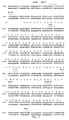
- Fig. 2 shows the sequence of pAK1150 DNA used as template for PCR and inferred amino acids of the encoded fusion protein ( ⁇ -factor-leader-(EEAEAEAPK)(SEQ ID NO:4)-Asp B28 IP of pAK1150 (SEQ ID NO:5 and 6).
- the pAK1150 plasmid is similar to pAK721 shown in Fig. 1 .
- the ⁇ -factor-leader's C-terminus was modified to introduced a Nco I restriction endonuclease site, which changes the inferred amino acid sequences from SerLeuAsp to SerMetAla.
- the encoded Asp B28 IP does not feature a mini C-peptide but Lys B29 is directly connected to Gly A1 .
- the purified PCR DNA fragment was dissolved in water and restriction endonucleases buffer and digested with suitable restriction endonucleases (e.g. BgI II and Xba I) according to standard techniques.
- suitable restriction endonucleases e.g. BgI II and Xba I
- BgIII-XbaI DNA fragments were subjected to agarose electrophoresis and purified using The Gene Clean Kit.
- the expression plasmid pAK1150 or a similar plasmid of the CPOT type was digested with the restriction endonucleases Bgl II and Xba I and the vector fragment of 10765 nucleotide basepairs isolated using The Gene Clean Kit.
- the two digested and isolated DNA fragments were ligated together using T4 DNA ligase and standard conditions.
- the ligation mix was subsequently transformed into a competent E. coli strain (R-, M+) followed by selection with ampicillin resistance. Plasmids from the resulting E. coli's were isolated using QIAGEN columns.
- the plasmids were subsequently used for transformation of a suitable S . cerevisiae host strain, e.g., MT663 ( MATa / MAT ⁇ pep4-3 / pep4-3 HIS4 / his4 tpi::LEU2 / tpi::LEU2 Cir + ).
- MT663 MATa / MAT ⁇ pep4-3 / pep4-3 HIS4 / his4 tpi::LEU2 / tpi::LEU2 Cir + .
- Individual transformed S. cerevisiae clones were grown in liquid culture, and the quantity of Asp B28 IP secreted to the culture supernatants were determined by RP-HPLC.
- the DNA sequence encoding the synthetic mini C-peptide of the expression plasmids from S . cerevisiae clones secreting increased quantity of the Asp B28 IP were then determined. Subsequently, the identified synthetic mini C-peptide
- Fig. 3 An example on a DNA sequence encoding a leader-Asp B28 IP(GluTrpLys) fusion protein featuring a synthetic mini C-peptide (GluTrpLys) resulting from the randomized optimization process described is shown in Fig. 3 (SEQ ID NO:7 and 8).
- Table 1 and 2 show the insulin precursors analogs generated by the above method and production yield expressed as a percent of control. Fermentation was conducted at 30°C for 72 h in 5 ml YPD. Yield of the insulin precursor was determined by RP-HPLC of the culture supernatant, and is expressed relative to the yield of a control strain expressing either a leader-Asp B28 IP fusion protein in which the B29 residue is linked to the A1 residue by a peptide bond; or leader-Asp B28 IP fusion protein in which the B29 residue is linked to the A1 residue by a mini C-peptide, respectively.
- ⁇ * indicates an ⁇ -factor leader in which the C-terminus up to the LysArg has been modified from "SLD (SerLeuAsp)” to "SMA (SerMet Ala)” and "ex4" is an N-terminal extension with the amino acid sequence EEAEAEAPK(SEQ ID NO:4).
- YAP3 is the YAP3 signal sequence TA39 is a synthetic pro-sequence QPIDDTESNTTSVNLMADDTESRFATNTTLAGGLDVVNLISMAKR (SEQ ID NO:16).
- the sequence EEGEPK (SEQ ID NO:17) is an N-terminal extension to the B-chain of the insulin analogue.
- TA57 is a synthetic pro-sequence QPIDDTESQTTSVNLMADDTESAFATQTNSGGLDVVGLISMAKR (SEQ ID NO:18).
- TABLE 1 Leader-N-terminal extension Precursor mini C-peptide Yield* SEQ ID NO: ⁇ *-ex4 Asp B28 IP (control) None 100 ⁇ *-ex4 Asp B28 IP MetTrpLys 378 ⁇ *-ex4 Asp B28 IP AlaTrpLys 270 ⁇ *-ex4 Asp B28 IP ValTrpLys 284 ⁇ *-ex4 Asp B28 IP IleTrpLys 330 ⁇ *-ex4 Asp B28 IP LeuTrpLys 336 ⁇ *-ex4 Asp B28 IP LysTrpLys 288 ⁇ *-ex4 Asp B28 IP GluGluPheLys 272 SEQ ID NO:15 ⁇ *-ex4 Asp B28 IP GluPhe
- Samples for NMR were prepared by dissolving the lyophilized protein powder in 10/90 D 2 O/H 2 O with a 10 mM phosphate buffer and adjusting the pH as desired by addition of small volumes of 1 M DCI or NaOD. All pH meter readings are without correction for isotope effects.
- Samples of Asp B28 IP(MetTrpLys) for NMR were prepared at concentrations ranging from 25 ⁇ M to 1mM at pH 8.0.
- Two-dimensional 1 H- 1 H NMR spectra of 1mM samples, DQF-COSY Piantini et al. (1982) J. Am. Chem. Soc. 104:6800-6801 , Rance et al.
- the processing of the two-dimensional NMR spectra was performed using the software package Xwinnmr (version 2.5, NMR processing software from Bruker Analytician Messtechnik GmbH, D-76275 Ettlingen, Germany). Each dimension was processed with shifted sine-bell apodization and zero-filling performed once in each dimension. Baseline corrections were applied if necessary using Xwinnmr standard procedures.
- Asp B28 lP(MetTrpLys) is structurally similar to the native insulin structure for regions comprising residues B1-B10, B14-B23, A4-A21. The differences are mostly pronounced for regions in the vicinity of the connecting peptide in positions B26-B29, C1-C3, A1-A3 and less pronounced for residues B11-B13.
- the structure of Asp B28 IP(MetTrpLys) near the C-peptide is strikingly different from the native like structure (Ludvigsen (1994) supra).
- the methionine and tryptophan side-chains in Asp B28 IP(MetTrpLys) opens the traditional insulin core structure by moving on one side the side-chains of particular Tyr B26 and Phe B25 away and leaving the otherwise usual neighboring hydrophobic patch comprised by the side-chains of Leu B11 , Val B12 , Ile A2 and Tyr A19 intact.
- This pocket created by moving Phe B25 , Tyr B26 and the peptide chain comprised by residues B25 to B29 is apparently well suited to accommodate the packing of the side-chains Met C1 and Trp C2 from the C-peptide.
- Trp C1 has an even more extensive NOE network, but due to fast exchange of the indole amid proton only four resonances belonging to the aromatic ring system of Trp C2 can be assigned.
- denaturation samples were prepared by combining different ratios of insulin precursor analog and GuHCl stock solutions with 10 mM TriS/ClO 4 - , pH 8.0. Protein stock solutions were typically 0.06 mM in 10 mM Tris/ClO 4 - , pH 8.0. GuHCl stock solutions were 8.25 M in 10 mM Tris/ClO 4 - , pH 8.0. CD spectra were recorded with a Jasco J-715 Spectropolarimeter calibrated with (+)-10-camphorsulfonic acid. All spectra were recorded at 20 °C. The denaturation samples were scanned from 250 to 218 nm.
- Typical cell path length and protein concentration were 0.5 cm and 3 ⁇ M, respectively. All spectra were smoothed before subtraction of appropriate solvent blanks. The circular dichroism is expressed as, ⁇ , based on the molar concentration of peptide bond. For presentation purpose each curve is normalized to a 0-1 scale by dividing the observed change at each point by the total change observed in the experiment.
- GuHCl denaturation curves were analyzed by assuming that the folding/unfolding transition is two-state as described by Santoro & Bolen (1988) Biochemistry 27:8063-8068 and Kaarsholm et al. (1993) Biochemistry 32:10773-10778 , both of which publications are specifically incorporated herein by reference for teaching methods of calculating stability by GuHCl denaturation.
- This analysis yields a number of parameters including the GuHCl concentration at the midpoint of the denaturation curve, Cmid reflecting the concentration of denaturant necessary to unfold one-half of the protein population. An increase in folding stability is thus manifest by an increased value of Cmid.
- ⁇ N ⁇ 0 N + m N [GuHCl]
- ⁇ U ⁇ 0 U + m U [GuHCl]
- ⁇ 0 N and ⁇ 0 U intercepts
- m N and m U are slopes of the pre- and post-transition baselines, respectively.
- ⁇ G ⁇ G H 2 O - m [GuHCl]
- ⁇ G H 2 O is the value of ⁇ G in the absence of denaturant
- m is a measure of the dependence of ⁇ G on denaturant concentration.
- ⁇ G values derived from K in the transition zone may be extrapolated back to 0 M denaturant to give ⁇ G H 2 O .
- (1) is subject to nonlinear least squares analysis using the NLIN procedure of PC SAS (SAS Inc. Cary, North Carolina). Six parameters then describe the denaturation curve: ⁇ 0 N , ⁇ 0 U , m N , m U , m, and ⁇ G H 2 O . In addition, the GuHCI concentration at the midpoint of the denaturation curve, Cmid, is given by ⁇ G H 2 O / m .
- the insulin analogue precursor Asp B28 IP(EWK) was produced culturing yeast strain MT663 transformed with an expression plasmid expressing a YAP3-TA39-EEGEPK(SEQ ID NO:17)-Asp B28 IP(EWK) fusion protein or a YAP3-TA57-EEGEPK(SEQ ID NO:17)-Asp B28 IP(EWK) fusion protein.
- cDNA encoding the leader sequences YAP3-TA39 and YAP3-TA57 and cDNA encoding the Asp B28 IP(EWK) and the N-terminal extension were cloned into an expression vector of the C-POT type using standard techniques ( Sambrook J, Fritsch EF and Maniatis T, Molecular cloning, Cold spring Harbour laboratory press, 1989 ). The DNA and inferred amino acids sequences are shown in Fig 8 and 9 .
- Table 6 shows the yields. Fermentation was conducted at 30°C for 72 h in 5 ml YPD. IP yield was determined by RP-HPLC of the culture supernatant and is expressed relative to the IP yield of a control strain.
- ⁇ * indicates an ⁇ -factor leader in which the C-terminus up to the LysArg has been modified from "SLD (SerLeuAsp)” to "SMA (SerMet Ala)” and "ex4" is an N-terminal extension with the amino acid sequence EEAEAEAPK(SEQ ID NO:4).
- YAP3 is the YAP3 signal sequence.
- TA39 is a synthetic pro-sequence QPIDDTESNTTSVNLMADDTESRFATNTTLAGGLDVVNLISMAKR (SEQ ID NO:16).
- the sequence EEGEPK(SEQ ID NO:17) is an N-terminal extension to the B-chain of the insulin analogue.
- TA57 is a synthetic pro-sequence QPIDDTESQTTSVNLMADDTESAFATQTNSGGLDVVGLISMAKR (SEQ ID NO:18). TABLE 6 Leader Precursor N-terminal extension C-peptide Yield* ⁇ *-ex4 Asp B28 IP GluGluAlaGluAlaGluAlaProLys (SEQ ID NO:4) None 100 YAP3-TA39 Asp B28 IP GluGluGlyGluProLys (SEQ ID NO:17) GluTrpLys 531% YAP3-TA57 Asp B28 IP GluGluGlyGluProLys (SEQ ID NO:17) GluTrpLys 500%
Landscapes
- Health & Medical Sciences (AREA)
- Chemical & Material Sciences (AREA)
- Organic Chemistry (AREA)
- Life Sciences & Earth Sciences (AREA)
- Zoology (AREA)
- Genetics & Genomics (AREA)
- Gastroenterology & Hepatology (AREA)
- Endocrinology (AREA)
- Biochemistry (AREA)
- Biophysics (AREA)
- General Health & Medical Sciences (AREA)
- Toxicology (AREA)
- Medicinal Chemistry (AREA)
- Molecular Biology (AREA)
- Proteomics, Peptides & Aminoacids (AREA)
- Diabetes (AREA)
- Peptides Or Proteins (AREA)
- Preparation Of Compounds By Using Micro-Organisms (AREA)
- Micro-Organisms Or Cultivation Processes Thereof (AREA)
- Medicines That Contain Protein Lipid Enzymes And Other Medicines (AREA)
Claims (12)
- Un précurseur de l'insuline ou un analogue d'un précurseur de l'insuline, comprenant la formule :
B(1-27) - X2 - X3 - X1 Y - A(1-21),
X1 étant une séquence peptidique de 1-15 résidus d'acides aminés dont l'un est un résidu d'acide aminé aromatique immédiatement N-terminal à Y,X2 étant Pro, Asp, Lys ou Ile en position 28 de la chaîne B de l'insuline humaine,X3 est Pro, Lys, Ala, Arg ou Pro-Thr en position 29 de la chaîne B de l'insuline humaine,Y est Lys ou Arg,A(1-21) est la chaîne A de l'insuline naturelle, etB(1-27) est la chaîne B de l'insuline naturelle où manquent les résidus d'acides aminés B28, B29 et B30. - Un précurseur de l'insuline ou un analogue d'un précurseur de l'insuline selon la revendication 1, où X1 est de 1-9, de préférence de 1-5 résidus d'acides aminés.
- Un précurseur de l'insuline ou un analogue d'un précurseur de l'insuline selon la revendication 1, où X1 est de 1-3 résidus d'acides aminés dont l'un est Trp ou Phe.
- Un précurseur de l'insuline ou un analogue d'un précurseur de l'insuline selon la revendication 1, où X1 - Y est choisi dans le groupe constitué par : (a) Met-Trp-Lys, (b) Ala-Trp-Lys, (c) Val-Trp-Lys, (d) Ile-Trp-Lys, (e) Leu-Trp-Lys, (f) Glu-Glu-Phe-Lys (SEQ ID NO:15), (g) Glu-Phe-Lys, (h) Glu-Trp-Lys, (i) Ser-Trp-Lys, (j) Thr-Trp-Lys, (k) Arg-Trp-Lys, (l) Glu-Met-Trp-Lys (SEQ ID NO:1), (m) Gln-Met-Trp-Lys (SEQ ID NO:2) et (n) Asp-Trp-Lys.
- Un précurseur de l'insuline ou un analogue d'un précurseur de l'insuline selon la revendication 1, où X2 est Asp, X3 est Lys et X1 est de 1-3 résidus d'acides aminés dont l'un est Trp ou Phe.
- Une séquence de polynucléotides codant pour un précurseur de l'insuline ou pour un analogue d'un précurseur de l'insuline selon la revendication 1-5.
- Un vecteur d'expression comprenant une séquence de polynucléotides selon la revendication 6.
- Un cellule hôte transformée par un vecteur selon la revendication 7.
- Un procédé d'obtention d'un précurseur de l'insuline ou d'un analogue d'un précurseur de l'insuline selon la revendication 1-5, ledit procédé comprenant (i) la mise en culture d'un cellule hôte comprenant une séquence de polynucléotides codant pour un précurseur de l'insuline ou pour un analogue d'un précurseur de l'insuline selon l'une des revendication 1-5 dans des conditions de culture appropriées à l'expression dudit analogue de précurseur ; et (ii) l'isolement de l'analogue de précurseur exprimé.
- Un procédé selon la revendication 9, où la cellule hôte est une cellule hôte de levure.
- Un procédé d'obtention d'un précurseur de l'insuline ou d'un analogue d'un précurseur de l'insuline selon la revendication 1-5, ledit procédé comprenant (i) la mise en culture d'un cellule hôte comprenant une séquence de polynucléotides codant pour un précurseur de l'insuline ou pour un analogue d'un précurseur de l'insuline selon l'une des revendication 1-5 dans des conditions de culture appropriées à l'expression dudit analogue de précurseur ; (ii) l'isolement de l'analogue de précurseur à partir du milieu de culture ; et (iii) la conversion de l'analogue de précurseur en insuline ou en un précurseur de l'insuline par conversion enzymatique ou chimique in vitro.
- Un procédé selon la revendication 11, où la cellule hôte est une cellule hôte de levure.
Applications Claiming Priority (5)
| Application Number | Priority Date | Filing Date | Title |
|---|---|---|---|
| DK186899 | 1999-12-29 | ||
| DKPA199901868 | 1999-12-29 | ||
| DK200000440 | 2000-03-17 | ||
| DKPA200000440 | 2000-03-17 | ||
| PCT/DK2000/000665 WO2001049742A1 (fr) | 1999-12-29 | 2000-12-04 | Procede de production de precurseurs d'insuline et d'analogues de precurseurs d'insuline |
Publications (2)
| Publication Number | Publication Date |
|---|---|
| EP1246845A1 EP1246845A1 (fr) | 2002-10-09 |
| EP1246845B1 true EP1246845B1 (fr) | 2008-05-28 |
Family
ID=26066172
Family Applications (1)
| Application Number | Title | Priority Date | Filing Date |
|---|---|---|---|
| EP00981169A Expired - Lifetime EP1246845B1 (fr) | 1999-12-29 | 2000-12-04 | Procede de production de precurseurs d'insuline et d'analogues de precurseurs d'insuline |
Country Status (13)
| Country | Link |
|---|---|
| EP (1) | EP1246845B1 (fr) |
| JP (1) | JP4773023B2 (fr) |
| KR (1) | KR20030004317A (fr) |
| CN (1) | CN100432104C (fr) |
| AT (1) | ATE397017T1 (fr) |
| AU (1) | AU1850601A (fr) |
| BR (1) | BR0016867A (fr) |
| CA (1) | CA2392840C (fr) |
| DE (1) | DE60039074D1 (fr) |
| ES (1) | ES2307544T3 (fr) |
| HU (1) | HUP0203475A3 (fr) |
| RU (1) | RU2283846C2 (fr) |
| WO (1) | WO2001049742A1 (fr) |
Families Citing this family (28)
| Publication number | Priority date | Publication date | Assignee | Title |
|---|---|---|---|---|
| US7105314B2 (en) | 2001-04-02 | 2006-09-12 | Novo Nordisk A/S | Method for making human insulin precursors |
| EP1377608B1 (fr) * | 2001-04-02 | 2009-09-16 | Novo Nordisk A/S | Precurseurs de l'insuline et procede de preparation |
| CA2464616C (fr) | 2001-11-19 | 2012-07-24 | Are Bogsnes | Elaboration de composes insuliniques |
| WO2004085472A1 (fr) * | 2003-03-27 | 2004-10-07 | Novo Nordisk A/S | Procede de fabrication de precurseurs de l'insuline humaine et insuline humaine |
| ES2369895T3 (es) * | 2003-12-03 | 2011-12-07 | Novo Nordisk A/S | Insulina monocatenaria. |
| CN100460508C (zh) * | 2004-11-03 | 2009-02-11 | 马延高 | 人胰岛素基因在甲醇酵母中的分泌表达方法 |
| US8575096B2 (en) | 2007-08-13 | 2013-11-05 | Novo Nordisk A/S | Rapid acting insulin analogues |
| AU2008288413B2 (en) | 2007-08-15 | 2013-09-26 | Novo Nordisk A/S | Insulin analogues with an acyl and aklylene glycol moiety |
| WO2009022006A1 (fr) | 2007-08-15 | 2009-02-19 | Novo Nordisk A/S | Insulines avec une fraction acyle comprenant des unités répétitives d'alkylène glycol contenant des acides aminés |
| EP2262539B1 (fr) | 2008-04-01 | 2015-07-15 | Novo Nordisk A/S | Conjugués insuline-albumine |
| EP2585484A1 (fr) | 2010-06-23 | 2013-05-01 | Novo Nordisk A/S | Analogues de l'insuline contenant des liaisons disulfures supplémentaires |
| EP2585483A1 (fr) | 2010-06-23 | 2013-05-01 | Novo Nordisk A/S | Insuline humaine contenant des liaisons disulfures supplémentaires |
| CA2802510A1 (fr) | 2010-06-23 | 2011-12-29 | Novo Nordisk A/S | Derives d'insuline contenant des liaisons disulfure supplementaires |
| EP2720711A1 (fr) | 2011-06-15 | 2014-04-23 | Novo Nordisk A/S | Insulines à substitutions multiples |
| CN104788556A (zh) * | 2011-12-15 | 2015-07-22 | 上海恒瑞医药有限公司 | 人胰岛素类似物及其酰化衍生物 |
| US20160115216A1 (en) * | 2013-06-07 | 2016-04-28 | Novo Nordisk A/S | Method for Making Mature Insulin Polypeptides |
| CN105087724B (zh) * | 2014-05-04 | 2019-12-03 | 重庆派金生物科技有限公司 | 酵母重组表达门冬胰岛素的制备方法 |
| CN107417787B (zh) * | 2016-05-23 | 2020-11-17 | 江苏恒瑞医药股份有限公司 | 一种人松弛素2类似物的制备方法 |
| CN107446039B (zh) * | 2016-05-31 | 2021-11-12 | 江苏恒瑞医药股份有限公司 | 一种人胰岛素类似物前体及其制备方法 |
| CN106699872B (zh) * | 2016-12-27 | 2019-12-24 | 江南大学 | 一种提高胰岛素前体产量的方法 |
| CA3071686A1 (fr) | 2017-08-17 | 2019-02-21 | Novo Nordisk A/S | Nouveaux analogues d'insuline acyles et leurs utilisations |
| CN108148114B (zh) * | 2017-12-08 | 2020-05-15 | 珠海冀百康生物科技有限公司 | 一种提高重组小分子蛋白表达量的串联前导肽及方法 |
| CN108929370B (zh) * | 2018-07-15 | 2021-06-25 | 渤海大学 | 三种具有ace抑制活性的鸡蛋源活性肽 |
| EP3852873A1 (fr) | 2018-09-19 | 2021-07-28 | Ziylo Ltd | Insulines sensibles au glucose et leurs utilisations |
| CN113773392B (zh) * | 2020-06-09 | 2023-04-07 | 宁波鲲鹏生物科技有限公司 | 一种甘精胰岛素的制备方法 |
| WO2022090448A1 (fr) | 2020-10-30 | 2022-05-05 | Novo Nordisk A/S | Nouveaux réactifs d'acylation |
| WO2023144240A1 (fr) | 2022-01-26 | 2023-08-03 | Novo Nordisk Research Centre Oxford Limited | Dérivés d'insuline sensibles au glucose et leurs utilisations |
| WO2025099208A1 (fr) | 2023-11-10 | 2025-05-15 | Intervet International B.V. | Précurseur d'insuline recombinant |
Family Cites Families (3)
| Publication number | Priority date | Publication date | Assignee | Title |
|---|---|---|---|---|
| DK58285D0 (da) * | 1984-05-30 | 1985-02-08 | Novo Industri As | Peptider samt fremstilling og anvendelse deraf |
| WO1995016708A1 (fr) * | 1993-12-17 | 1995-06-22 | Novo Nordisk A/S | Composes du type pro-insuline |
| KR0150565B1 (ko) * | 1995-02-15 | 1998-08-17 | 김정재 | 유전자 조환에 의한 사람 인슐린 전구체의 제조 및 이를 이용한 인슐린의 제조방법 |
-
2000
- 2000-12-04 RU RU2002120512/13A patent/RU2283846C2/ru not_active IP Right Cessation
- 2000-12-04 JP JP2001550282A patent/JP4773023B2/ja not_active Expired - Fee Related
- 2000-12-04 HU HU0203475A patent/HUP0203475A3/hu unknown
- 2000-12-04 AU AU18506/01A patent/AU1850601A/en not_active Abandoned
- 2000-12-04 CN CNB008179603A patent/CN100432104C/zh not_active Expired - Lifetime
- 2000-12-04 WO PCT/DK2000/000665 patent/WO2001049742A1/fr not_active Ceased
- 2000-12-04 BR BR0016867-0A patent/BR0016867A/pt not_active Application Discontinuation
- 2000-12-04 KR KR1020027008588A patent/KR20030004317A/ko not_active Withdrawn
- 2000-12-04 CA CA2392840A patent/CA2392840C/fr not_active Expired - Fee Related
- 2000-12-04 ES ES00981169T patent/ES2307544T3/es not_active Expired - Lifetime
- 2000-12-04 DE DE60039074T patent/DE60039074D1/de not_active Expired - Lifetime
- 2000-12-04 AT AT00981169T patent/ATE397017T1/de not_active IP Right Cessation
- 2000-12-04 EP EP00981169A patent/EP1246845B1/fr not_active Expired - Lifetime
Also Published As
| Publication number | Publication date |
|---|---|
| JP2003518945A (ja) | 2003-06-17 |
| CA2392840A1 (fr) | 2001-07-12 |
| CN1414974A (zh) | 2003-04-30 |
| EP1246845A1 (fr) | 2002-10-09 |
| HUP0203475A3 (en) | 2005-11-28 |
| HUP0203475A2 (hu) | 2003-02-28 |
| DE60039074D1 (de) | 2008-07-10 |
| JP4773023B2 (ja) | 2011-09-14 |
| RU2002120512A (ru) | 2004-01-27 |
| WO2001049742A1 (fr) | 2001-07-12 |
| RU2283846C2 (ru) | 2006-09-20 |
| PL355871A1 (en) | 2004-05-31 |
| KR20030004317A (ko) | 2003-01-14 |
| AU1850601A (en) | 2001-07-16 |
| CA2392840C (fr) | 2012-07-17 |
| ES2307544T3 (es) | 2008-12-01 |
| ATE397017T1 (de) | 2008-06-15 |
| BR0016867A (pt) | 2002-10-08 |
| CN100432104C (zh) | 2008-11-12 |
Similar Documents
| Publication | Publication Date | Title |
|---|---|---|
| US6777207B2 (en) | Method for making insulin precursors and insulin precursor analogues having improved fermentation yield in yeast | |
| RU2283846C2 (ru) | Предшественник инсулина, способ его получения и применение | |
| US7087408B2 (en) | Method for making insulin precursors and insulin precursor analogs | |
| EP0489780B1 (fr) | Preparation de proteines de fusion | |
| EP1377608B1 (fr) | Precurseurs de l'insuline et procede de preparation | |
| EP1246933B1 (fr) | Procede de fabrication de precurseurs d'insuline et analogues des precurseurs d'insuline presentant un meilleur rendement de fermentation dans la levure | |
| IE65504B1 (en) | Insulin analogues | |
| NO172646B (no) | Dna-sekvens, repliserbart ekspresjonsplasmid, samt fremstilling av insulin og human-insulin-forloepere | |
| US7105314B2 (en) | Method for making human insulin precursors | |
| EP3004156A1 (fr) | Procédé de fabrication de polypeptides d'insuline mature | |
| US20030040601A1 (en) | Method for making insulin precursors and insulin analog precursors | |
| US8129146B2 (en) | Method for making insulin precursors and insulin precursor analogues having improved fermentation yield in yeast | |
| US6337194B1 (en) | Method for the preparation of insulin by cleavage of a fusion protein and fusion proteins containing insulin A and B chains | |
| US20010041787A1 (en) | Method for making insulin precursors and insulin precursor analogues having improved fermentation yield in yeast | |
| JP2840441B2 (ja) | 真正fgfの酵母における発現およびプロセシング | |
| WO2002079251A2 (fr) | Methode de fabrication de precurseurs d'insuline humaine | |
| PL203546B1 (pl) | Analog prekursora insuliny, sposób wytwarzania analogu prekursora insuliny i sposób wytwarzania analogu insuliny | |
| WO2004085472A1 (fr) | Procede de fabrication de precurseurs de l'insuline humaine et insuline humaine | |
| WO2002100887A2 (fr) | Methode de production de precurseurs de l'insuline et d'analogues des precurseurs de l'insuline |
Legal Events
| Date | Code | Title | Description |
|---|---|---|---|
| PUAI | Public reference made under article 153(3) epc to a published international application that has entered the european phase |
Free format text: ORIGINAL CODE: 0009012 |
|
| 17P | Request for examination filed |
Effective date: 20020729 |
|
| AK | Designated contracting states |
Kind code of ref document: A1 Designated state(s): AT BE CH CY DE DK ES FI FR GB GR IE IT LI LU MC NL PT SE TR |
|
| AX | Request for extension of the european patent |
Free format text: AL;LT PAYMENT 20020729;LV;MK;RO PAYMENT 20020729;SI PAYMENT 20020729 |
|
| 17Q | First examination report despatched |
Effective date: 20040917 |
|
| 17Q | First examination report despatched |
Effective date: 20040917 |
|
| GRAP | Despatch of communication of intention to grant a patent |
Free format text: ORIGINAL CODE: EPIDOSNIGR1 |
|
| GRAS | Grant fee paid |
Free format text: ORIGINAL CODE: EPIDOSNIGR3 |
|
| GRAA | (expected) grant |
Free format text: ORIGINAL CODE: 0009210 |
|
| AK | Designated contracting states |
Kind code of ref document: B1 Designated state(s): AT BE CH CY DE DK ES FI FR GB GR IE IT LI LU MC NL PT SE TR |
|
| AX | Request for extension of the european patent |
Extension state: LT RO SI |
|
| REG | Reference to a national code |
Ref country code: GB Ref legal event code: FG4D |
|
| REG | Reference to a national code |
Ref country code: CH Ref legal event code: EP |
|
| REF | Corresponds to: |
Ref document number: 60039074 Country of ref document: DE Date of ref document: 20080710 Kind code of ref document: P |
|
| REG | Reference to a national code |
Ref country code: IE Ref legal event code: FG4D |
|
| REG | Reference to a national code |
Ref country code: CH Ref legal event code: NV Representative=s name: R. A. EGLI & CO. PATENTANWAELTE |
|
| REG | Reference to a national code |
Ref country code: SE Ref legal event code: TRGR |
|
| PG25 | Lapsed in a contracting state [announced via postgrant information from national office to epo] |
Ref country code: FI Free format text: LAPSE BECAUSE OF FAILURE TO SUBMIT A TRANSLATION OF THE DESCRIPTION OR TO PAY THE FEE WITHIN THE PRESCRIBED TIME-LIMIT Effective date: 20080528 |
|
| PG25 | Lapsed in a contracting state [announced via postgrant information from national office to epo] |
Ref country code: AT Free format text: LAPSE BECAUSE OF FAILURE TO SUBMIT A TRANSLATION OF THE DESCRIPTION OR TO PAY THE FEE WITHIN THE PRESCRIBED TIME-LIMIT Effective date: 20080528 |
|
| REG | Reference to a national code |
Ref country code: ES Ref legal event code: FG2A Ref document number: 2307544 Country of ref document: ES Kind code of ref document: T3 |
|
| PG25 | Lapsed in a contracting state [announced via postgrant information from national office to epo] |
Ref country code: PT Free format text: LAPSE BECAUSE OF FAILURE TO SUBMIT A TRANSLATION OF THE DESCRIPTION OR TO PAY THE FEE WITHIN THE PRESCRIBED TIME-LIMIT Effective date: 20081028 Ref country code: DK Free format text: LAPSE BECAUSE OF FAILURE TO SUBMIT A TRANSLATION OF THE DESCRIPTION OR TO PAY THE FEE WITHIN THE PRESCRIBED TIME-LIMIT Effective date: 20080528 |
|
| PG25 | Lapsed in a contracting state [announced via postgrant information from national office to epo] |
Ref country code: BE Free format text: LAPSE BECAUSE OF FAILURE TO SUBMIT A TRANSLATION OF THE DESCRIPTION OR TO PAY THE FEE WITHIN THE PRESCRIBED TIME-LIMIT Effective date: 20080528 |
|
| PLBE | No opposition filed within time limit |
Free format text: ORIGINAL CODE: 0009261 |
|
| STAA | Information on the status of an ep patent application or granted ep patent |
Free format text: STATUS: NO OPPOSITION FILED WITHIN TIME LIMIT |
|
| 26N | No opposition filed |
Effective date: 20090303 |
|
| PG25 | Lapsed in a contracting state [announced via postgrant information from national office to epo] |
Ref country code: MC Free format text: LAPSE BECAUSE OF NON-PAYMENT OF DUE FEES Effective date: 20081231 |
|
| REG | Reference to a national code |
Ref country code: IE Ref legal event code: MM4A |
|
| PG25 | Lapsed in a contracting state [announced via postgrant information from national office to epo] |
Ref country code: IE Free format text: LAPSE BECAUSE OF NON-PAYMENT OF DUE FEES Effective date: 20081204 |
|
| PG25 | Lapsed in a contracting state [announced via postgrant information from national office to epo] |
Ref country code: LU Free format text: LAPSE BECAUSE OF NON-PAYMENT OF DUE FEES Effective date: 20081204 Ref country code: CY Free format text: LAPSE BECAUSE OF FAILURE TO SUBMIT A TRANSLATION OF THE DESCRIPTION OR TO PAY THE FEE WITHIN THE PRESCRIBED TIME-LIMIT Effective date: 20080528 |
|
| PG25 | Lapsed in a contracting state [announced via postgrant information from national office to epo] |
Ref country code: GR Free format text: LAPSE BECAUSE OF FAILURE TO SUBMIT A TRANSLATION OF THE DESCRIPTION OR TO PAY THE FEE WITHIN THE PRESCRIBED TIME-LIMIT Effective date: 20080829 |
|
| REG | Reference to a national code |
Ref country code: FR Ref legal event code: PLFP Year of fee payment: 16 |
|
| REG | Reference to a national code |
Ref country code: FR Ref legal event code: PLFP Year of fee payment: 17 |
|
| REG | Reference to a national code |
Ref country code: FR Ref legal event code: PLFP Year of fee payment: 18 |
|
| PGFP | Annual fee paid to national office [announced via postgrant information from national office to epo] |
Ref country code: DE Payment date: 20171120 Year of fee payment: 18 Ref country code: TR Payment date: 20171123 Year of fee payment: 18 Ref country code: FR Payment date: 20171121 Year of fee payment: 18 |
|
| PGFP | Annual fee paid to national office [announced via postgrant information from national office to epo] |
Ref country code: ES Payment date: 20180103 Year of fee payment: 18 |
|
| PGFP | Annual fee paid to national office [announced via postgrant information from national office to epo] |
Ref country code: NL Payment date: 20181123 Year of fee payment: 19 |
|
| PGFP | Annual fee paid to national office [announced via postgrant information from national office to epo] |
Ref country code: SE Payment date: 20181126 Year of fee payment: 19 |
|
| PGFP | Annual fee paid to national office [announced via postgrant information from national office to epo] |
Ref country code: CH Payment date: 20181126 Year of fee payment: 19 Ref country code: IT Payment date: 20181122 Year of fee payment: 19 Ref country code: GB Payment date: 20181127 Year of fee payment: 19 |
|
| REG | Reference to a national code |
Ref country code: DE Ref legal event code: R119 Ref document number: 60039074 Country of ref document: DE |
|
| PG25 | Lapsed in a contracting state [announced via postgrant information from national office to epo] |
Ref country code: DE Free format text: LAPSE BECAUSE OF NON-PAYMENT OF DUE FEES Effective date: 20190702 Ref country code: FR Free format text: LAPSE BECAUSE OF NON-PAYMENT OF DUE FEES Effective date: 20181231 |
|
| REG | Reference to a national code |
Ref country code: ES Ref legal event code: FD2A Effective date: 20200131 |
|
| PG25 | Lapsed in a contracting state [announced via postgrant information from national office to epo] |
Ref country code: ES Free format text: LAPSE BECAUSE OF NON-PAYMENT OF DUE FEES Effective date: 20181205 |
|
| REG | Reference to a national code |
Ref country code: SE Ref legal event code: EUG |
|
| REG | Reference to a national code |
Ref country code: CH Ref legal event code: PL |
|
| REG | Reference to a national code |
Ref country code: NL Ref legal event code: MM Effective date: 20200101 |
|
| GBPC | Gb: european patent ceased through non-payment of renewal fee |
Effective date: 20191204 |
|
| PG25 | Lapsed in a contracting state [announced via postgrant information from national office to epo] |
Ref country code: NL Free format text: LAPSE BECAUSE OF NON-PAYMENT OF DUE FEES Effective date: 20200101 |
|
| PG25 | Lapsed in a contracting state [announced via postgrant information from national office to epo] |
Ref country code: GB Free format text: LAPSE BECAUSE OF NON-PAYMENT OF DUE FEES Effective date: 20191204 Ref country code: SE Free format text: LAPSE BECAUSE OF NON-PAYMENT OF DUE FEES Effective date: 20191205 Ref country code: IT Free format text: LAPSE BECAUSE OF NON-PAYMENT OF DUE FEES Effective date: 20191204 |
|
| PG25 | Lapsed in a contracting state [announced via postgrant information from national office to epo] |
Ref country code: LI Free format text: LAPSE BECAUSE OF NON-PAYMENT OF DUE FEES Effective date: 20191231 Ref country code: CH Free format text: LAPSE BECAUSE OF NON-PAYMENT OF DUE FEES Effective date: 20191231 |
|
| PG25 | Lapsed in a contracting state [announced via postgrant information from national office to epo] |
Ref country code: TR Free format text: LAPSE BECAUSE OF NON-PAYMENT OF DUE FEES Effective date: 20181204 |