EP1266607A2 - Dispositif de mesure et méthode d'échantillonnage percutane des constituants de fluide biologique - Google Patents
Dispositif de mesure et méthode d'échantillonnage percutane des constituants de fluide biologique Download PDFInfo
- Publication number
- EP1266607A2 EP1266607A2 EP02254049A EP02254049A EP1266607A2 EP 1266607 A2 EP1266607 A2 EP 1266607A2 EP 02254049 A EP02254049 A EP 02254049A EP 02254049 A EP02254049 A EP 02254049A EP 1266607 A2 EP1266607 A2 EP 1266607A2
- Authority
- EP
- European Patent Office
- Prior art keywords
- micro
- biological fluid
- needle
- constituent
- electrochemical cell
- Prior art date
- Legal status (The legal status is an assumption and is not a legal conclusion. Google has not performed a legal analysis and makes no representation as to the accuracy of the status listed.)
- Withdrawn
Links
Images
Classifications
-
- A—HUMAN NECESSITIES
- A61—MEDICAL OR VETERINARY SCIENCE; HYGIENE
- A61B—DIAGNOSIS; SURGERY; IDENTIFICATION
- A61B5/00—Measuring for diagnostic purposes; Identification of persons
- A61B5/145—Measuring characteristics of blood in vivo, e.g. gas concentration or pH-value ; Measuring characteristics of body fluids or tissues, e.g. interstitial fluid or cerebral tissue
- A61B5/1468—Measuring characteristics of blood in vivo, e.g. gas concentration or pH-value ; Measuring characteristics of body fluids or tissues, e.g. interstitial fluid or cerebral tissue using chemical or electrochemical methods, e.g. by polarographic means
- A61B5/1486—Measuring characteristics of blood in vivo, e.g. gas concentration or pH-value ; Measuring characteristics of body fluids or tissues, e.g. interstitial fluid or cerebral tissue using chemical or electrochemical methods, e.g. by polarographic means using enzyme electrodes, e.g. with immobilised oxidase
- A61B5/14865—Measuring characteristics of blood in vivo, e.g. gas concentration or pH-value ; Measuring characteristics of body fluids or tissues, e.g. interstitial fluid or cerebral tissue using chemical or electrochemical methods, e.g. by polarographic means using enzyme electrodes, e.g. with immobilised oxidase invasive, e.g. introduced into the body by a catheter or needle or using implanted sensors
-
- G—PHYSICS
- G01—MEASURING; TESTING
- G01N—INVESTIGATING OR ANALYSING MATERIALS BY DETERMINING THEIR CHEMICAL OR PHYSICAL PROPERTIES
- G01N33/00—Investigating or analysing materials by specific methods not covered by groups G01N1/00 - G01N31/00
- G01N33/48—Biological material, e.g. blood, urine; Haemocytometers
- G01N33/483—Physical analysis of biological material
- G01N33/487—Physical analysis of biological material of liquid biological material
-
- A—HUMAN NECESSITIES
- A61—MEDICAL OR VETERINARY SCIENCE; HYGIENE
- A61B—DIAGNOSIS; SURGERY; IDENTIFICATION
- A61B5/00—Measuring for diagnostic purposes; Identification of persons
- A61B5/145—Measuring characteristics of blood in vivo, e.g. gas concentration or pH-value ; Measuring characteristics of body fluids or tissues, e.g. interstitial fluid or cerebral tissue
- A61B5/14507—Measuring characteristics of blood in vivo, e.g. gas concentration or pH-value ; Measuring characteristics of body fluids or tissues, e.g. interstitial fluid or cerebral tissue specially adapted for measuring characteristics of body fluids other than blood
- A61B5/1451—Measuring characteristics of blood in vivo, e.g. gas concentration or pH-value ; Measuring characteristics of body fluids or tissues, e.g. interstitial fluid or cerebral tissue specially adapted for measuring characteristics of body fluids other than blood for interstitial fluid
- A61B5/14514—Measuring characteristics of blood in vivo, e.g. gas concentration or pH-value ; Measuring characteristics of body fluids or tissues, e.g. interstitial fluid or cerebral tissue specially adapted for measuring characteristics of body fluids other than blood for interstitial fluid using means for aiding extraction of interstitial fluid, e.g. microneedles or suction
-
- A—HUMAN NECESSITIES
- A61—MEDICAL OR VETERINARY SCIENCE; HYGIENE
- A61B—DIAGNOSIS; SURGERY; IDENTIFICATION
- A61B5/00—Measuring for diagnostic purposes; Identification of persons
- A61B5/15—Devices for taking samples of blood
- A61B5/150007—Details
- A61B5/150015—Source of blood
- A61B5/150022—Source of blood for capillary blood or interstitial fluid
-
- A—HUMAN NECESSITIES
- A61—MEDICAL OR VETERINARY SCIENCE; HYGIENE
- A61B—DIAGNOSIS; SURGERY; IDENTIFICATION
- A61B5/00—Measuring for diagnostic purposes; Identification of persons
- A61B5/15—Devices for taking samples of blood
- A61B5/150007—Details
- A61B5/150206—Construction or design features not otherwise provided for; manufacturing or production; packages; sterilisation of piercing element, piercing device or sampling device
- A61B5/150274—Manufacture or production processes or steps for blood sampling devices
- A61B5/150282—Manufacture or production processes or steps for blood sampling devices for piercing elements, e.g. blade, lancet, canula, needle
-
- A—HUMAN NECESSITIES
- A61—MEDICAL OR VETERINARY SCIENCE; HYGIENE
- A61B—DIAGNOSIS; SURGERY; IDENTIFICATION
- A61B5/00—Measuring for diagnostic purposes; Identification of persons
- A61B5/15—Devices for taking samples of blood
- A61B5/150007—Details
- A61B5/150358—Strips for collecting blood, e.g. absorbent
-
- A—HUMAN NECESSITIES
- A61—MEDICAL OR VETERINARY SCIENCE; HYGIENE
- A61B—DIAGNOSIS; SURGERY; IDENTIFICATION
- A61B5/00—Measuring for diagnostic purposes; Identification of persons
- A61B5/15—Devices for taking samples of blood
- A61B5/150007—Details
- A61B5/150374—Details of piercing elements or protective means for preventing accidental injuries by such piercing elements
- A61B5/150381—Design of piercing elements
- A61B5/150389—Hollow piercing elements, e.g. canulas, needles, for piercing the skin
-
- A—HUMAN NECESSITIES
- A61—MEDICAL OR VETERINARY SCIENCE; HYGIENE
- A61B—DIAGNOSIS; SURGERY; IDENTIFICATION
- A61B5/00—Measuring for diagnostic purposes; Identification of persons
- A61B5/15—Devices for taking samples of blood
- A61B5/150007—Details
- A61B5/150374—Details of piercing elements or protective means for preventing accidental injuries by such piercing elements
- A61B5/150381—Design of piercing elements
- A61B5/150503—Single-ended needles
-
- A—HUMAN NECESSITIES
- A61—MEDICAL OR VETERINARY SCIENCE; HYGIENE
- A61B—DIAGNOSIS; SURGERY; IDENTIFICATION
- A61B5/00—Measuring for diagnostic purposes; Identification of persons
- A61B5/15—Devices for taking samples of blood
- A61B5/150007—Details
- A61B5/150755—Blood sample preparation for further analysis, e.g. by separating blood components or by mixing
-
- A—HUMAN NECESSITIES
- A61—MEDICAL OR VETERINARY SCIENCE; HYGIENE
- A61B—DIAGNOSIS; SURGERY; IDENTIFICATION
- A61B5/00—Measuring for diagnostic purposes; Identification of persons
- A61B5/15—Devices for taking samples of blood
- A61B5/150977—Arrays of piercing elements for simultaneous piercing
- A61B5/150984—Microneedles or microblades
-
- A—HUMAN NECESSITIES
- A61—MEDICAL OR VETERINARY SCIENCE; HYGIENE
- A61B—DIAGNOSIS; SURGERY; IDENTIFICATION
- A61B5/00—Measuring for diagnostic purposes; Identification of persons
- A61B5/15—Devices for taking samples of blood
- A61B5/151—Devices specially adapted for taking samples of capillary blood, e.g. by lancets, needles or blades
- A61B5/15186—Devices loaded with a single lancet, i.e. a single lancet with or without a casing is loaded into a reusable drive device and then discarded after use; drive devices reloadable for multiple use
-
- A—HUMAN NECESSITIES
- A61—MEDICAL OR VETERINARY SCIENCE; HYGIENE
- A61B—DIAGNOSIS; SURGERY; IDENTIFICATION
- A61B5/00—Measuring for diagnostic purposes; Identification of persons
- A61B5/15—Devices for taking samples of blood
- A61B5/157—Devices characterised by integrated means for measuring characteristics of blood
-
- A—HUMAN NECESSITIES
- A61—MEDICAL OR VETERINARY SCIENCE; HYGIENE
- A61B—DIAGNOSIS; SURGERY; IDENTIFICATION
- A61B5/00—Measuring for diagnostic purposes; Identification of persons
- A61B5/68—Arrangements of detecting, measuring or recording means, e.g. sensors, in relation to patient
- A61B5/6846—Arrangements of detecting, measuring or recording means, e.g. sensors, in relation to patient specially adapted to be brought in contact with an internal body part, i.e. invasive
- A61B5/6847—Arrangements of detecting, measuring or recording means, e.g. sensors, in relation to patient specially adapted to be brought in contact with an internal body part, i.e. invasive mounted on an invasive device
- A61B5/685—Microneedles
Definitions
- This invention is related to percutaneous biological fluid sampling and analyte measurement, and more particularly to constituent transfer mediums to facilitate sampling of biological fluid.
- Analyte detection assays find use in a variety of applications, including clinical laboratory testing, home testing, etc., where the results of such testing play a prominent role in the diagnosis and management of a variety of disease conditions.
- Common analytes of interest include glucose, e.g. , for diabetes management, cholesterol, and the like.
- a common technique for collecting a sample of blood for analyte determination is to pierce the skin at least into the subcutaneous layer to access the underlining blood vessels in order to produce localized bleeding on the body surface.
- the accessed blood is then collected into a small tube for delivery and analyzed by testing equipment, often in the form of a hand-held instrument having a reagent test strip onto which the blood sample is placed.
- the fingertip is the most frequently used site for this method of blood collection due to the large number of small blood vessels located therein. This method has the significant disadvantage of being very painful because subcutaneous tissue of the fingertip has a large concentration of nerve endings. It is not uncommon for patients who require frequent monitoring of an analyte to avoid having their blood sampled.
- micro-needles or analogous structures to access the interstitial fluid within the skin.
- the micro-needles are penetrated into the skin to a depth less than the subcutaneous layer so as to minimize the pain felt by the patient.
- the interstitial fluid is then sampled and tested to determine the concentration of the target constituent.
- the concentration of a constituent within the interstitial fluid is representative of the concentration of that constituent in other bodily fluids, such as blood.
- micro-needle sampling systems have a drawback in that, because the interstitial fluid inside the human body is at a negative pressure of about 6 mm/Hg, some kind of mechanical or vacuum means is often used in conjunction with the micro-piercing members.
- International Patent Application WO 99/27852 discloses the use of vacuum pressure and/or heat to increase the availability of interstitial fluid at the area of skin in which the vacuum or heat is applied.
- the vacuum pressure causes the portion of skin in the vicinity of the vacuum to become stretched and engorged with interstitial fluid, facilitating the extraction of fluid upon entry into the skin.
- Another method is disclosed wherein a localized heating element is positioned above the skin, causing interstitial fluid to flow more rapidly at that location, thereby allowing more interstitial fluid to be collected per given unit to time.
- U.S. Patents of interest include: 5,582,184, 5,746,217, 5,820,570, 5,942,102, 6,091,975 and 6,162,611.
- Other patent documents and publications of interest include: WO 97/00441, WO 97/42888, WO 98/00193 WO 98/34541, WO 99/13336, WO 99/27852, WO 99/64580, WO 00/35530, WO 00/57177 and WO 00/74765A1.
- a feature of the subject devices is the presence of a constituent transfer medium that samples and transfers at least the target constituent(s) of biological fluid accessed within the skin to an electrochemical cell for measurement of the targeted constituent(s) within the fluid sample.
- the present invention finds use in accessing biological fluids such as blood and interstitial fluid, and in the detection and measurement of various analytes, e.g. , glucose, cholesterol, electrolytes, pharmaceuticals, or illicit drugs, and the like, which are present in the accessed biological fluid.
- the present invention is especially well-suited for the sampling and measurement of interstitial fluid constituents such as glucose.
- the subject sampling and measurement devices include an elongated skin-piercing or skin-penetrating means to provide access to the biological fluid, at least one sampling means in the form of a constituent transfer medium, and a measuring means in the form of an electrochemical measurement cell in fluid communication with the constituent transfer medium.
- the skin-penetrating means includes at least one micro-needle defining a substantially annular bore or channel through at least a portion of the interior of the micro-needle structure and having an access opening at a distal end through which one or more biological fluid constituents enter into the device.
- the skin-piercing means comprises an array of such micro-needles.
- the electrochemical measurement cell comprises spaced-apart working and reference electrodes positioned within and/or further defining the micro-needle structure.
- the area between the electrodes is defined as the reaction zone in which the actual measurement of analyte concentration takes place.
- the electrode pair are co-axially positioned and concentrically-spaced from each other, wherein at least the outer electrode has a hollow, cylindrical configuration and, at least in part, defines the micro-needle structure.
- the inner electrode is positioned within the cylindrical wall of the outer electrode and may also have a cylindrical configuration, either as hollow cylinder filled with a center core material or as a solid cylinder.
- the electrochemical cell defines the proximal end of the micro-needle structure in the form of two parallel-spaced planes positioned substantially transverse to the longitudinal axis of the micro-needle.
- one of the electrodes of the electrochemical cell is used as the reference electrode by which an input reference signal is provided to the sensor from a signal generating means.
- the other electrode operates as a working electrode that provides an output signal from the sensor to a signal receiving means.
- the reference electrode is located at the bottom and the working electrode is located at the top of the device. This output signal represents the concentration of the target analyte in accessed biological fluid.
- a redox reagent system or material may be used within the electrochemical cell to facilitate targeting the analyte(s) of interest.
- the particular redox reagent material used is selected based on the analyte targeted for measurement.
- the constituent transfer medium of the sampling means occupies the area between the two electrodes, referred to as the reaction zone, and at least a portion of each micro-needle channel.
- the constituent transfer medium is made of a hydrogel or gel material or matrix that is hydrophilic and has an affinity for ionic and anionic particles within biological fluid.
- the gel matrix may be configured to transfer only particles having a molecular weight less than a specified weight.
- the gel acts to transfer at least the targeted biological fluid constituent(s) present at the access opening of a micro-needle into the reaction zone. In other words, the targeted constituent(s) migrates through the gel matrix until equilibrium is reached between the concentration of the constituent(s)within the tissue and the concentration of the constituent(s) within the gel matrix.
- the subject constituent transfer medium may be configured ( i . e ., presented in a fully saturated state) to eliminate the transfer of water and other fluids contained within the accessed biological fluid, while transferring only constituents of the biological fluid. It is the configuration of the electrochemical cell that selects the targeted constituent(s) from the remaining constituents for testing.
- the gel matrix of the present invention is characterized by a concentration gradient that changes in accordance with a first order system. This allows calculation of ionic and non-ionic element concentrations by means of the exponential characteristics of the first order system.
- the subject sensor devices may function as a part of an analyte sensing system that includes a means for controlling the sensor device.
- a control unit is provided in which the control means is electrically coupled with the sensor device and functions to generate and send input signals to the electrochemical cell and to receive output signals from the cell.
- An exemplary method of the subject invention involves using at least one subject sensor device comprising one or more hollow micro-needles having an open distal end defining a constituent transfer pathway to an integrally-coupled electrochemical cell.
- a hydrophilic gel material fills the interior of the micro-needle and the electrochemical cell.
- the micro-needle is inserted into the skin to a selected depth, preferably to a depth that avoids contacting nerve endings and blood vessels.
- the at least the targeted constituent(s) of the biological fluid present at the open distal end of the micro-needle is wicked into the gel material and transferred into the reaction zone of the electrochemical cell.
- An electrochemical measurement is then made between the working and reference electrodes that provides an electrical signal that is representative of the concentration the constituent in the sample.
- concentration of the constituent in the patient's blood is then derived from the obtained electrical signal.
- a numerical value representing this concentration may then be displayed on a display unit.
- a software algorithm that is part of the device, e.g. , programmed into a control unit present in the device, may be employed to determine the signal levels transmitted by the control unit to the cell and for deriving the concentration level of the target analyte.
- the subject devices, systems and methods find use in analyte concentration measurement of a variety of analytes and are particularly suited for use in the measurement of glucose concentration in interstitial fluid.
- Percutaneous biological fluid e . g ., interstitial fluid
- sampling and analyte measurement sensor devices and systems as well as methods for using the same, are provided.
- the present invention finds use in the sampling of constituents found in biological fluids such as blood and interstitial fluid, and in the detection and measurement of a variety of different analytes, e . g ., glucose, cholesterol, electrolytes, pharmaceuticals, illicit drugs, and the like.
- the subject devices include a skin-piercing means, a biological fluid constituent sampling means in the form of a constituent transfer medium, and a constituent concentration measuring means in the form of an electrochemical cell in fluid communication with the constituent transfer medium.
- a skin-piercing means for piercing a biological fluid constituent sampling means in the form of a constituent transfer medium
- a constituent concentration measuring means in the form of an electrochemical cell in fluid communication with the constituent transfer medium.
- these components are integrated into a single structure.
- test strip includes a plurality of such test strips
- processor includes reference to one or more processors and equivalents thereof known to those skilled in the art, and so forth.
- the skin-penetration means comprises at least one micro-piercing member, preferably in the form of a micro-needle, used to penetrate the skin to a depth where pain and bleeding are minimized, and preferably non-existent.
- the micro-needle penetrates above the level where nerves are present.
- target skin layers into which the subject piercing members may extend include the dermis, epidermis and the stratum corneum ( i . e ., the outermost layer of the epidermis).
- the micro-needle defines a substantially annular bore or channel through the interior of a narrow, elongated structure having a distal access opening through which biological fluid constituents may enter into the micro-needle.
- the skin-piercing means comprises an array of such micro-needles.
- the subject micro-needles are configured to be mechanically stable and strong enough to penetrate the stratum corneum without breaking or flexing. Preferably, they are made of a biocompatible material so as not to cause irritation to the skin or an undesirable tissue response.
- the sensor devices may be disposable, for reusable embodiments, it is preferable that the material of the micro-needles and/or micro-needle arrays is able to withstand sterilization cycles.
- the micro-needles and/or the array of micro-needles may be formed of or coated with an insulating material, such as a ceramic, glass, silica, polymer, plastics and the like.
- an insulating material such as a ceramic, glass, silica, polymer, plastics and the like.
- polymers are polyacrylates, epoxies, polyesters polyetheretherketone, liquid crystalline polyesters, or their composites.
- ceramics are aluminum oxide, silicon carbide and zirconium oxide. Suitable metallic materials include stainless steel, titanium, precious metals or alloys thereof and the like.
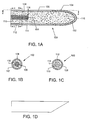
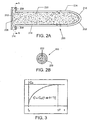
- Figs. 1A and 2A illustrate micro-needles 100 and 200, respectively, having a configuration that is substantially straight along the longitudinal axis and has a substantially circular cross-section.
- any suitable cross-sectional configuration may be employed including, but not limited to other annular shapes such as elliptical or oblong, or polygonal configurations, such as square and rectangular.
- the outer diameter of a micro-needle at its thickest point is between about 200 ⁇ m to 300 ⁇ m, and typically does not exceed about 350 ⁇ m. In certain embodiments the outer diameter is typically about 250 ⁇ m.
- An important aspect of the present invention is to eliminate or at least greatly minimize the pain and bleeding suffered by a patient during the sampling process. Accordingly, the penetration lengths and diameters of the micro-needles must be within certain ranges to accomplish this goal. Of course, those values will vary depending on the type of biological fluid (e . g ., interstitial fluid, blood or both) desired for sampling and the thickness of the skin layers of the particular patient being tested.
- biological fluid e . g ., interstitial fluid, blood or both
- the skin includes three distinct layers, a top layer called the epidermis, a middle layer called the dermis and a bottom layer called the subcutaneous layer.
- the epidermis is about 60 to 120 ⁇ m (microns) thick and comprises four distinct layers: a 10 to 20 ⁇ m outer layer, called the stratum corneum, followed by the stratum granulosum, stratum malpighii and stratum germinativum.
- the stratum corneum contains cells filled with bundles of cross-linked keratin and keratohyalin surrounded by an extracellular matrix of lipids.
- the inner three layers are collectively referred to as the viable epidermis and have a total thickness in the range of about 50 to 100 ⁇ m.
- the viable epidermis is responsible for diffusing metabolites to and from the dermis.
- the epidermis contains no blood cells or nerve endings.
- the dermis is much thicker than the epidermis, having a thickness in the range from about 2,000 to 3,000 ⁇ m.
- the dermal layer generally consists of a dense bed of connective tissue, including collagen fibers, and interstitial fluid dispersed throughout these fibers. Below the dermal layer is the subcutaneous tissue that contains the blood capillaries and the majority of nerve endings within the skin.
- the micro-needles of the present invention preferably have penetration lengths that extend no deeper than the dermis layer when fully penetrated into the skin in order to minimize pain, however, they may be longer if necessary for the particular sampling application at hand.
- the length-to-diameter aspect ratio of the micro-needle is another factor to consider in determining an optimal length for the subject micro-needles.
- the length of the micro-needle is generally at least about 5 times greater than the diameter of the micro-needle, but may be more or less.
- the minimum micro-needle diameter is dependent upon the necessary spacing between the electrodes and the diameters of the other components of the electrochemical cell.
- the subject micro-needles generally have a length in the range from about 500 to 4,000 ⁇ m, typically between about 600 to 3,000 ⁇ m, and more typically between about 1,000 to 2,000 ⁇ m; however, these lengths will vary from patient to patient depending on the thickness of the skin layers of the particular patient being tested. While the micro-needles may have lengths that are longer than the depth of the target skin layer, the micro-needle may be penetrated into the skin at depth (referred to as the penetration length) that is less than the length of the micro-needle structure. Thus, in order to minimize pain to the patient, the micro-needles preferably have a penetration length in the range from about 50 to 4,000 ⁇ m, and more typically from about 100 to 3,000 ⁇ m.
- the penetration length of the micro-needle is typically between about 50 to 120 ⁇ m.
- the penetration length of the micro-needle is typically from about 2,000 to 3,000 ⁇ m.
- Micro-needles 100 and 200 terminate at distal ends 104 and 204, respectively, in preferably sharp tips 102 and 202, respectively, having a beveled or sliced configuration, as shown in Fig. 1D, to more easily penetrate the skin.
- tips 102 and 202 may have other suitable configurations such as one that is not tapered and defines an edge that lies in a plane perpendicular to the longitudinal axis of the micro-needle (not shown).
- micro-needles in the form of an array, may be employed by the present invention.
- the number of micro-needles employed will depend upon various factors including the agent being detected, the body surface location into which the micro-needles are inserted, the sample site, the fluid volume and the like.
- the micro-needle array may comprise micro-needles having varying shapes, lengths, widths and tip configurations.
- the electrochemical cell of the present invention comprises an electrode arrangement of a working electrode and a reference electrode that provides an input reference signal to the sampled biological fluid constituent(s) and an output signal representing the concentration of the target constituent(s) or analyte(s) in the sampled fluid.
- the two electrodes are in a spaced-apart relationship such that a surface of one electrode faces a surface of the other electrode.
- the space between the two electrodes defines a reaction zone into which sampled constituent is transferred and is tested for the concentration of a targeted analyte.
- electrochemical systems and methods commonly known in the art of analyte detection and measurement may be employed by the present invention, including systems that are amperometric (i . e ., measure current), coulometric (i . e ., measure electrical charge) or potentiometric ( i . e ., measure voltage).
- amperometric i . e ., measure current
- coulometric i . e ., measure electrical charge
- potentiometric i . e ., measure voltage
- Figs. 1 and 2 illustrate two exemplary embodiments of the electrochemical cell of the present invention.
- Figs. 1A-C show an electrochemical cell embodiment having two co-axially aligned, concentrically-spaced electrodes fully housed within the micro-needle.
- Figs. 2A and B show an electrochemical cell embodiment having two substantially planar electrodes parallely-spaced at a proximal end of the micro-needle.
- micro-needle 100 includes an electrochemical cell that provides an electrical signal or signals representative of the concentration of the analyte being measured in a sampled biological fluid constituent.
- the electrochemical cell comprises various components or layers arranged concentrically with respect to each other. More specifically, this concentric arrangement may also be described as circumferential or co-axial.
- micro-needle 100 includes, a solid wire core 106 and an outer plating 114.
- the solid wire core 106 provides rigidity to the micro-needle structure and may be part of the adjacent electrode.
- the outer plating 114 may be made of stainless steel or the like.
- the subject electrochemical cell which includes a first or inner electrode 108, a second or outer electrode 112 and a reaction zone 110 therebetween. Second electrode 112 and outer plating 114 extend to define edge 116 and tip 102 of micro-needle 100.
- first or inner electrode 108 is shown covering the proximal end of solid wire core 106; however, the proximal end may be exposed.
- First electrode 108 and solid wire core 106 extend evenly to a point 118 (proximal to distal end 104) wherein these two layers have distal edges that are flush with each other. These flush edges define the closed proximal end of a lumen portion 120 having a lumenal wall, defined by second electrode 112 and outer plating 114, which extends to a distal opening at distal edge 116, as viewed in Fig. 1A.
- micro-needle 100 defined by lumen 120 and reaction zone 110 is filled with a constituent transfer medium, here a hydrophilic gel material, as discussed above.
- a constituent transfer medium here a hydrophilic gel material, as discussed above.
- the gel acts to absorb and transfer constituents of biological fluid present at tip 102 into lumen 120 and then into reaction zone 110.
- the length of outer electrode 112 may be substantially same as the penetration depth of the micro-needle, and thus is generally not greater than about 4,000 ⁇ m or less depending on the desired length of penetration. More typically, the length of the outer electrode is between about 1,000 ⁇ m to 3,000 ⁇ m, and preferably about 2,000 ⁇ m.
- the inner electrode may have the same length as the outer electrode but is preferably shorter. The length of the inner electrode is generally about 20% shorter than the outer electrode and is generally not greater than about 3,200 ⁇ m or less, and is typically between about 800 to 2,400 ⁇ m, and is more typically about 1,600 ⁇ m.
- Solid wire core 106 has a diameter in the general range from about 80 to 100 ⁇ m, and typically does not exceed about 120 ⁇ m. In certain embodiments the diameter is typically about 90 ⁇ m.
- First electrode 108 has a cylindrical configuration (although other configurations are possible) having a thickness in the general range from about 70 to 200 Angstroms, and typically does not exceed about 300 Angstroms. Thus, as first electrode is formed around core 106, it has an outside diameter that is slightly greater than that of core 106.
- Second electrode 112 also has a cylindrical configuration (although other configurations are possible) having a thickness in the general range from about 70 to 200 Angstroms, and typically does not exceed about 300 Angstroms.
- the reaction zone or spacing between the two electrodes also has a cylindrical configuration (although other configurations are possible) having a thickness in the general range from about 50 to 80 ⁇ m, and typically does not exceed about 200 ⁇ m.
- the thin outer tube 114 upon which the second electrode 112 is electroplated has a thickness in the general range from about 12 to 20 ⁇ m, and typically does not exceed 25 ⁇ m. Therefore, the total outside diameter of micro-needle 100 is generally no less than about 200 ⁇ m, and typically in the range from about 250 to 300 ⁇ m, and typically does not exceed about 350 ⁇ m.
- Lumen 120 has a volume generally in the range from about 20 to 140 nL, and typically does not exceed about 250 nL.
- micro-needle 200 having a tubular configuration defined by outer plating 214 and lumen 220.
- Lumen 220 has a volume generally in the range from about 25 to_280 nL, and more typically in the range from about 25 to 160 nL.
- the entirety of its length is hollow.
- Micro-needle 200 may have the same or similar length and diameter dimensions as discussed above, but may instead have smaller dimensions as the electrochemical cell is located outside micro-needle lumen 220 rather than housed within it.
- Electrode 208 defines a surface which circumferentially extends from proximal end 205 of micro-needle 200.
- electrode 208 is in the form of an annular ring, as shown in Fig. 2B but may have any suitable shape, such as square or rectangular.
- Electrode 212 is spaced proximally from electrode 208, defining a spacing there between which functions as the reaction zone 210 of the electrochemical cell.
- Electrode 212 preferably has a shape and size that correspond to the shape and size of electrode 208.
- electrode 212 preferably has a circular disk shape and a diameter the same as the outer diameter of electrode 208. This diameter dimension is generally in the range from about 600 to 800 ⁇ m, and typically does not exceed 1mm.
- the inner diameter of electrode 108 preferably matches the diameter of outer plating 214, and thus has values mentioned above.
- At least the surfaces of the electrodes of Figs. 1 and 2 that face the reaction zones 110 and 210 within micro-needles 100 and 200, respectively, are comprised of highly conductive metal, such as palladium, gold, platinum, silver, iridium, carbon, doped indium tin oxide, stainless steel and the like, or a combination of such materials. Most typically the metal is gold, platinum or palladium.
- each electrode can be made up of an inert support or backing substrate on the surface of which is a thin layer of the metal component ( e . g ., an electroplated metal layer) of the electrode.
- the constituent transfer medium of the sampling means of the present invention may occupy the entire volume of the reaction zones 110 and 210, respectively, and at least a portion of each micro-needle needle lumen 120 and 220, respectively, but may completely fill the lumen.
- the constituent transfer medium is preferably made of a water-based gel material or matrix having a high affinity for water, i . e ., is highly water-absorbent.
- the hydrophilic gel helps to precondition the electrodes and reconstitute the reagent material in preparation for the electrochemical measurement of target analytes.
- the transfer medium's ability to absorb fluids, particularly water, is dependent upon the extent to which the transfer medium is saturated prior to being exposed to fluid.
- the constituent transfer medium is preferably provided in a fully saturated state prior to insertion of the micro-needle into the skin.
- interstitial fluid for example, is about 98% water, the reduction in diffusion time through the gel may be significant in certain applications.
- the speed at which they reach the reaction zone will vary depending on the size of the molecules of the constituents. Generally, the smaller the molecule the faster the diffusion rate through the gel. As many commonly targeted analytes, such as glucose, electrolytes, ascorbic acid, uric acid, etc., have small molecules, these analytes will diffuse through the gel matrix faster than other components of the interstitial fluid comprised of larger molecules.
- the concentration kinetics of the selected hydrogel is that of a first order system. As such, the constituent transfer rate and the analyte concentration level of the biological fluid are more predictable.
- the value of the time constant depends on several factors: (1) the area of the interface between the hydrogel and the interstitial fluid ( i . e ., the surface area of the opening defined by edge 116 and 216 of micro-needles 100 and 200, respectively, (2) the volume of the hydrogel, and (3) the transport characteristics of the target analyte through the particular hydrogel material used.
- the graph of Fig. 3 depicts the first order system described in the above equation.
- the dependent axis represents time (t) where t o is the point in time at which a micro-needle is inserted into the skin.
- t o is the point in time at which a micro-needle is inserted into the skin.
- the time it takes for the constituent concentration in the hydrogel to reach equilibrium with that of the biological fluid present at the distal opening of the micro-needle is generally no more than about 5 times the time constant of the system. If the time to achieve equilibrium is impractical for a given application, the micro-needle may be removed from the skin prior to reaching equilibrium and then the analyte concentration level within the patient (C o ) can be calculated based on the first order characteristics of the system. Alternately, the time duration of contact between the micro-needle and the interstitial fluid may be controlled ( i.e., fixed) and C o can be derived based on the first order equation above.
- Gel materials suitable for use as the constituent transfer medium of the present invention include natural gels made up of naturally occurring polymers, such as agarose, gelatin, mucopolysaccharide, starch and the like, and synthetic gels made up, at least in part, of synthetic polymers, such as anyone of the neutral water-soluble polymers or polyelectrolytes ( i . e ., synthetic or natural polymers which form ionic charges when dissolved in water), such as polyvinyl pyrrolidone, polyethylene glycol, polyacrylic acid, polyvinyl alcohol, polyacrylamide, and copolymers thereof.
- synthetic polymers such as anyone of the neutral water-soluble polymers or polyelectrolytes ( i . e ., synthetic or natural polymers which form ionic charges when dissolved in water), such as polyvinyl pyrrolidone, polyethylene glycol, polyacrylic acid, polyvinyl alcohol, polyacrylamide, and copolymers thereof.
- a redox reagent is typically employed within the reaction zone within the electrochemical cell.
- the redox reagent material is typically deposited on at least one of the facing surfaces of the two electrodes whereby biological fluid present in the reaction zone chemically reacts with the reagent material.
- the reagent is preferably coated or deposited on the surface(s) by means of dip coating.
- the reagent being used is selected based on the analyte targeted for detection.
- the interaction of the reagent system and the corresponding constituent or analyte is employed in the electrochemical measurement protocol to determine the concentration of the target analyte or constituent in the cell.
- the reagent system present in the reaction area typically includes at least an enzyme(s) and a mediator.
- the enzyme member(s) of the reagent system is an enzyme or a plurality of enzymes that work in concert to oxidize the analyte of interest.
- the enzyme component of the reagent system is made up of a single analyte oxidizing enzyme or a collection of two or more enzymes that work in concert to oxidize the analyte of interest.
- Enzymes of interest include oxidases, dehydrogenases, lipases, kinases, diaphorases, quinoproteins and the like.
- the specific enzyme present in the reaction area depends on the particular analyte for which the electrochemical test strip is designed to detect, where representative enzymes include: glucose oxidase, glucose dehydrogenase, cholesterol esterase, cholesterol oxidase, lipoprotein lipase, glycerol kinase, glycerol-3-phosphate oxidase, lactate oxidase, lactate dehydrogenase, pyruvate oxidase, alcohol oxidase, bilirubin oxidase, uricase, and the like.
- the enzyme component of the reagent system is a glucose-oxidizing enzyme (e.g., a glucose oxidase or glucose dehydrogenase).
- the second component of the reagent system is a mediator component, which is made up of one or more mediator agents.
- mediator agents include: ferricyanide, phenazine ethosulphate, phenazine methosulfate, pheylenediamine, 1-methoxy-phenazine methosulfate, 2,6-dimethyl-1,4-benzoquinone, 2,5-dichloro-1,4-benzoquinone, ferrocene derivatives, osmium bipyridyl complexes, ruthenium complexes and the like.
- the mediator of particular interest is ferricyanide.
- buffering agents e . g ., citraconate, citrate, phosphate
- Good buffers and the like.
- the reagent is generally present in dry form.
- the amounts of the various components may vary wherein the amount of enzyme component typically ranges from about 0.1 to 10% by weight.
- the reference and working electrodes of the electrochemical cell are in electrical communication with a control means that sets the input reference signal transmitted to the electrochemical cell, receives the output signal from the electrochemical cell and then derives the concentration level of the analyte within the sample from the output signal.
- the control means provides a means for applying an electrical current between the two electrodes, measuring a change in the current over time and relating the observed change in current to the concentration of analyte present in the electrochemical cell.
- the concentration of the analyte in the patient's blood is then derived, the numerical value of which is preferably provided as an output signal to a display means.
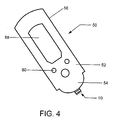
- control and display means are integrally housed within a hand-held control unit such as that illustrated in Fig. 4.
- the control unit preferably also provides a means of securing or holding one or more micro-needles or an array of micro-needles in a position and arrangement suitable for the particular sampling and measuring application at hand.
- Sensor system 50 comprises a hand-held control unit 52 and a sensor device 10 operatively mounted to distal end 54 of control unit 52.
- Sensor device 10 includes array of the micro-needles of the present invention, such as micro-needle 100 of Figs. 1 and 2.
- Control unit 52 has a housing 56, preferably made of a medical grade plastic material, having a low-profile configuration which houses a means (not shown) for controlling the measurement means of sensor device 10, i.e., generating and transmitting input reference signals to the electrochemical cell of micro-needle 100 and receiving output measurement signals from the cell.
- a software algorithm programmed within control unit 52 automatically calculates and determines the concentration of the target analyte in the biological sample upon receipt of the output signal.
- the concentration level (among other desired information) is then transmitted to an external display means or screen 58 that displays information to the user.
- Control interface buttons 60 are provided to allow the user to input information, such as the type of analyte targeted for measurement, to the control means.
- Sensor device 10 is electrically and physically coupled to control unit 52. Electrical communication between the two is established by means of conductive contacts (not shown) on device 10 and corresponding electrical traces (not shown) within control unit 52. Preferably, device 10 and control unit 52 are physically coupled by a quick lock-and-release mechanism (many of which are commonly known) such that a used sensor device can be easily removed and replaced. Control unit 52 is preferably reusable and usable with any number of sensor devices of the subject invention. These features facilitate the taking of multiple samples and measurements in an efficient and rapid manner.
- Also provided by the subject invention are methods for using the subject devices and sensor systems to determine the concentration of an analyte in a physiological sample.
- a variety of different analytes may be detected using the subject sensor systems, where representative analytes include glucose, cholesterol, lactate, alcohol, and the like.
- the first step is to provide a sensor device 10 having one or more micro-needles 100 of the present invention.
- sensor device 10 is particularly configured ( i . e ., containing the appropriate reagent) for targeting the analyte(s) of interest.
- the sensor device 10 is operatively engaged and interfaced with a control unit 52 that can be manually held and controlled by the user.
- Control unit 52 is programmed for testing the targeted analyte(s).
- the user positions sensor device 10 over a selected area of the patient's skin, and, with slight pressure, the array of micro-needles 100 of sensor device 10 are caused to penetrate into the skin.
- the depth to which the micro-needles 100 are inserted will depend on the length of the respective micro-needles or by some other means associated with the sensor unit 10 for limiting the insertion depth.
- an amount i . e ., a sample
- constituents of the biological fluid present at the open tips 102 of micro-needles 100 is absorbed by the gel-based, constituent transfer medium into lumens 120 of the respective micro-needles by means of osmosis.
- the targeted analyte(s) chemically reacts with the selected reagent(s) to form electroactive products.
- the electroactive products are then either oxidized or reduced by the optional mediator or directly by the working electrode 108.
- the resulting output signal level is then conducted to the control unit by electrode 108.
- a software algorithm programmed within control unit 52 then automatically determines the differential between the output and reference signals, derives the concentration of analyte in the sample from this differential value, and then derives the corresponding concentration level of the selected analyte(s) in the patient's blood. Any or all of these values may be displayed by display means or screen 58.
- a device such as control unit 52 which automatically calculates and determines the concentration of a selected analyte in a biological sample and/or in the patient's system, such that a user need only insert a micro-needle of the subject invention into the patient's skin and then read the final analyte concentration result from a display of the device, is further described in U.S. Patent No. 6,193,873 entitled “Sample Detection to Initiate Timing of an Electrochemical Assay," the disclosure of which is herein incorporated by reference.
- kits for use in practicing the subject methods include at least one subject sensor device having one or more micro-needles.
- the kits may also include a reusable or disposable control unit that may be used with reusable or disposable sensor devices of the kit or from other kits of the subject invention.
- These kits may include sensors having an array of micro-needles having the same or different lengths.
- Certain kits may include various sensors each containing the same or different reagents.
- kits preferably include instructions for using the subject sensors in the determination of an analyte concentration in a physiological sample. These instructions may be present on one or more of the packaging, a label insert, or containers present in the kits, and the like.
- the subject inventions are easy to use and can provide for analyte testing without the need to cut or lance the skin and without minimal or no pain and blood. As such, the subject invention represents a significant contribution to the field.
Landscapes
- Health & Medical Sciences (AREA)
- Life Sciences & Earth Sciences (AREA)
- Engineering & Computer Science (AREA)
- Physics & Mathematics (AREA)
- Biomedical Technology (AREA)
- General Health & Medical Sciences (AREA)
- Pathology (AREA)
- Molecular Biology (AREA)
- Biophysics (AREA)
- Veterinary Medicine (AREA)
- Public Health (AREA)
- Animal Behavior & Ethology (AREA)
- Surgery (AREA)
- Medical Informatics (AREA)
- Heart & Thoracic Surgery (AREA)
- Hematology (AREA)
- Optics & Photonics (AREA)
- Chemical & Material Sciences (AREA)
- Manufacturing & Machinery (AREA)
- General Chemical & Material Sciences (AREA)
- Chemical Kinetics & Catalysis (AREA)
- Analytical Chemistry (AREA)
- Medicinal Chemistry (AREA)
- Food Science & Technology (AREA)
- Biochemistry (AREA)
- Urology & Nephrology (AREA)
- Immunology (AREA)
- General Physics & Mathematics (AREA)
- Measurement Of The Respiration, Hearing Ability, Form, And Blood Characteristics Of Living Organisms (AREA)
- Investigating Or Analysing Biological Materials (AREA)
Applications Claiming Priority (2)
| Application Number | Priority Date | Filing Date | Title |
|---|---|---|---|
| US878742 | 2001-06-12 | ||
| US09/878,742 US6793632B2 (en) | 2001-06-12 | 2001-06-12 | Percutaneous biological fluid constituent sampling and measurement devices and methods |
Publications (2)
| Publication Number | Publication Date |
|---|---|
| EP1266607A2 true EP1266607A2 (fr) | 2002-12-18 |
| EP1266607A3 EP1266607A3 (fr) | 2004-07-21 |
Family
ID=25372738
Family Applications (1)
| Application Number | Title | Priority Date | Filing Date |
|---|---|---|---|
| EP02254049A Withdrawn EP1266607A3 (fr) | 2001-06-12 | 2002-06-11 | Dispositif de mesure et méthode d'échantillonnage percutane des constituants de fluide biologique |
Country Status (16)
| Country | Link |
|---|---|
| US (2) | US6793632B2 (fr) |
| EP (1) | EP1266607A3 (fr) |
| JP (1) | JP2003038465A (fr) |
| KR (1) | KR20020094896A (fr) |
| CN (2) | CN1817297A (fr) |
| AR (1) | AR034378A1 (fr) |
| AU (1) | AU784882B2 (fr) |
| CA (1) | CA2390330A1 (fr) |
| CZ (1) | CZ20022023A3 (fr) |
| HK (1) | HK1049595A1 (fr) |
| IL (2) | IL150098A (fr) |
| MX (1) | MXPA02005618A (fr) |
| PL (1) | PL354420A1 (fr) |
| RU (1) | RU2002115721A (fr) |
| SG (1) | SG115479A1 (fr) |
| TW (1) | TWI236364B (fr) |
Cited By (45)
| Publication number | Priority date | Publication date | Assignee | Title |
|---|---|---|---|---|
| EP1613370A4 (fr) * | 2003-03-31 | 2007-05-02 | Rosedale Medical Inc | Constructions et techniques d'echantillonnage de liquides corporels |
| WO2007145897A3 (fr) * | 2006-06-05 | 2008-03-20 | Mit Llp | Appareil de biodetection À microaiguilles iontosonic et procÉdÉs |
| WO2008042625A3 (fr) * | 2006-10-04 | 2008-08-21 | Dexcom Inc | Capteur d'analyte |
| US8287453B2 (en) | 2003-12-05 | 2012-10-16 | Dexcom, Inc. | Analyte sensor |
| US8311749B2 (en) | 2003-08-01 | 2012-11-13 | Dexcom, Inc. | Transcutaneous analyte sensor |
| US8360994B2 (en) | 2005-09-30 | 2013-01-29 | Intuity Medical, Inc. | Arrangement for body fluid sample extraction |
| US8801631B2 (en) | 2005-09-30 | 2014-08-12 | Intuity Medical, Inc. | Devices and methods for facilitating fluid transport |
| US8886273B2 (en) | 2003-08-01 | 2014-11-11 | Dexcom, Inc. | Analyte sensor |
| US8919605B2 (en) | 2009-11-30 | 2014-12-30 | Intuity Medical, Inc. | Calibration material delivery devices and methods |
| US8969097B2 (en) | 2005-06-13 | 2015-03-03 | Intuity Medical, Inc. | Analyte detection devices and methods with hematocrit-volume correction and feedback control |
| WO2015056176A1 (fr) * | 2013-10-15 | 2015-04-23 | Ecole Polytechnique Federale De Lausanne (Epfl) | Pointe de détection dotée d'un capteur d'impédance électrique |
| US9050413B2 (en) | 2004-02-26 | 2015-06-09 | Dexcom, Inc. | Integrated delivery device for continuous glucose sensor |
| US9095292B2 (en) | 2003-03-24 | 2015-08-04 | Intuity Medical, Inc. | Analyte concentration detection devices and methods |
| US9636051B2 (en) | 2008-06-06 | 2017-05-02 | Intuity Medical, Inc. | Detection meter and mode of operation |
| US9741139B2 (en) | 2007-06-08 | 2017-08-22 | Dexcom, Inc. | Integrated medicament delivery device for use with continuous analyte sensor |
| US9763609B2 (en) | 2003-07-25 | 2017-09-19 | Dexcom, Inc. | Analyte sensors having a signal-to-noise ratio substantially unaffected by non-constant noise |
| US9782114B2 (en) | 2011-08-03 | 2017-10-10 | Intuity Medical, Inc. | Devices and methods for body fluid sampling and analysis |
| US9833183B2 (en) | 2008-05-30 | 2017-12-05 | Intuity Medical, Inc. | Body fluid sampling device—sampling site interface |
| US10052055B2 (en) | 2003-08-01 | 2018-08-21 | Dexcom, Inc. | Analyte sensor |
| US10052051B2 (en) | 2002-05-22 | 2018-08-21 | Dexcom, Inc. | Silicone based membranes for use in implantable glucose sensors |
| US10278580B2 (en) | 2004-02-26 | 2019-05-07 | Dexcom, Inc. | Integrated medicament delivery device for use with continuous analyte sensor |
| US10330667B2 (en) | 2010-06-25 | 2019-06-25 | Intuity Medical, Inc. | Analyte monitoring methods and systems |
| US10349873B2 (en) | 2006-10-04 | 2019-07-16 | Dexcom, Inc. | Analyte sensor |
| US10376143B2 (en) | 2003-07-25 | 2019-08-13 | Dexcom, Inc. | Analyte sensors having a signal-to-noise ratio substantially unaffected by non-constant noise |
| US10383556B2 (en) | 2008-06-06 | 2019-08-20 | Intuity Medical, Inc. | Medical diagnostic devices and methods |
| US10524703B2 (en) | 2004-07-13 | 2020-01-07 | Dexcom, Inc. | Transcutaneous analyte sensor |
| US10602968B2 (en) | 2008-03-25 | 2020-03-31 | Dexcom, Inc. | Analyte sensor |
| US10610137B2 (en) | 2005-03-10 | 2020-04-07 | Dexcom, Inc. | System and methods for processing analyte sensor data for sensor calibration |
| US10653835B2 (en) | 2007-10-09 | 2020-05-19 | Dexcom, Inc. | Integrated insulin delivery system with continuous glucose sensor |
| US10667733B2 (en) | 2009-09-30 | 2020-06-02 | Dexcom, Inc. | Transcutaneous analyte sensor |
| US10729386B2 (en) | 2013-06-21 | 2020-08-04 | Intuity Medical, Inc. | Analyte monitoring system with audible feedback |
| US10772550B2 (en) | 2002-02-08 | 2020-09-15 | Intuity Medical, Inc. | Autonomous, ambulatory analyte monitor or drug delivery device |
| US10791928B2 (en) | 2007-05-18 | 2020-10-06 | Dexcom, Inc. | Analyte sensors having a signal-to-noise ratio substantially unaffected by non-constant noise |
| US10813577B2 (en) | 2005-06-21 | 2020-10-27 | Dexcom, Inc. | Analyte sensor |
| US10898113B2 (en) | 2003-12-09 | 2021-01-26 | Dexcom, Inc. | Signal processing for continuous analyte sensor |
| US10980461B2 (en) | 2008-11-07 | 2021-04-20 | Dexcom, Inc. | Advanced analyte sensor calibration and error detection |
| US11000215B1 (en) | 2003-12-05 | 2021-05-11 | Dexcom, Inc. | Analyte sensor |
| US11102306B2 (en) | 2008-02-21 | 2021-08-24 | Dexcom, Inc. | Systems and methods for processing, transmitting and displaying sensor data |
| US11331022B2 (en) | 2017-10-24 | 2022-05-17 | Dexcom, Inc. | Pre-connected analyte sensors |
| US11350862B2 (en) | 2017-10-24 | 2022-06-07 | Dexcom, Inc. | Pre-connected analyte sensors |
| US11399745B2 (en) | 2006-10-04 | 2022-08-02 | Dexcom, Inc. | Dual electrode system for a continuous analyte sensor |
| WO2022195236A1 (fr) * | 2021-03-19 | 2022-09-22 | Pkvitality | Capteur pour dispositif de surveillance corporelle limitant les irritations |
| US11564602B2 (en) | 2003-11-19 | 2023-01-31 | Dexcom, Inc. | Integrated receiver for continuous analyte sensor |
| US11633133B2 (en) | 2003-12-05 | 2023-04-25 | Dexcom, Inc. | Dual electrode system for a continuous analyte sensor |
| US12409515B2 (en) | 2009-07-02 | 2025-09-09 | Dexcom, Inc. | Continuous analyte sensors and methods of making same |
Families Citing this family (173)
| Publication number | Priority date | Publication date | Assignee | Title |
|---|---|---|---|---|
| SE9700384D0 (sv) * | 1997-02-04 | 1997-02-04 | Biacore Ab | Analytical method and apparatus |
| US6001067A (en) | 1997-03-04 | 1999-12-14 | Shults; Mark C. | Device and method for determining analyte levels |
| US7657297B2 (en) | 2004-05-03 | 2010-02-02 | Dexcom, Inc. | Implantable analyte sensor |
| US8527026B2 (en) | 1997-03-04 | 2013-09-03 | Dexcom, Inc. | Device and method for determining analyte levels |
| US6862465B2 (en) | 1997-03-04 | 2005-03-01 | Dexcom, Inc. | Device and method for determining analyte levels |
| US7192450B2 (en) | 2003-05-21 | 2007-03-20 | Dexcom, Inc. | Porous membranes for use with implantable devices |
| US6036924A (en) | 1997-12-04 | 2000-03-14 | Hewlett-Packard Company | Cassette of lancet cartridges for sampling blood |
| US6391005B1 (en) | 1998-03-30 | 2002-05-21 | Agilent Technologies, Inc. | Apparatus and method for penetration with shaft having a sensor for sensing penetration depth |
| US8641644B2 (en) | 2000-11-21 | 2014-02-04 | Sanofi-Aventis Deutschland Gmbh | Blood testing apparatus having a rotatable cartridge with multiple lancing elements and testing means |
| JP2002228668A (ja) * | 2001-01-31 | 2002-08-14 | Shimadzu Corp | オートサンプラ |
| CA2448681C (fr) | 2001-06-12 | 2014-09-09 | Pelikan Technologies, Inc. | Systeme integre de prelevement et d'analyse d'echantillons sanguins avec module de prelevement a utilisation multiple |
| US9427532B2 (en) | 2001-06-12 | 2016-08-30 | Sanofi-Aventis Deutschland Gmbh | Tissue penetration device |
| AU2002348683A1 (en) | 2001-06-12 | 2002-12-23 | Pelikan Technologies, Inc. | Method and apparatus for lancet launching device integrated onto a blood-sampling cartridge |
| US6837988B2 (en) * | 2001-06-12 | 2005-01-04 | Lifescan, Inc. | Biological fluid sampling and analyte measurement devices and methods |
| ES2336081T3 (es) | 2001-06-12 | 2010-04-08 | Pelikan Technologies Inc. | Dispositivo de puncion de auto-optimizacion con medios de adaptacion a variaciones temporales en las propiedades cutaneas. |
| US9226699B2 (en) | 2002-04-19 | 2016-01-05 | Sanofi-Aventis Deutschland Gmbh | Body fluid sampling module with a continuous compression tissue interface surface |
| US9795747B2 (en) | 2010-06-02 | 2017-10-24 | Sanofi-Aventis Deutschland Gmbh | Methods and apparatus for lancet actuation |
| US6793632B2 (en) * | 2001-06-12 | 2004-09-21 | Lifescan, Inc. | Percutaneous biological fluid constituent sampling and measurement devices and methods |
| US7041068B2 (en) | 2001-06-12 | 2006-05-09 | Pelikan Technologies, Inc. | Sampling module device and method |
| US8337419B2 (en) | 2002-04-19 | 2012-12-25 | Sanofi-Aventis Deutschland Gmbh | Tissue penetration device |
| ATE485766T1 (de) | 2001-06-12 | 2010-11-15 | Pelikan Technologies Inc | Elektrisches betätigungselement für eine lanzette |
| US6721586B2 (en) * | 2001-06-12 | 2004-04-13 | Lifescan, Inc. | Percutaneous biological fluid sampling and analyte measurement devices and methods |
| US7981056B2 (en) | 2002-04-19 | 2011-07-19 | Pelikan Technologies, Inc. | Methods and apparatus for lancet actuation |
| AU2002312521A1 (en) | 2001-06-12 | 2002-12-23 | Pelikan Technologies, Inc. | Blood sampling apparatus and method |
| ATE497731T1 (de) | 2001-06-12 | 2011-02-15 | Pelikan Technologies Inc | Gerät zur erhöhung der erfolgsrate im hinblick auf die durch einen fingerstich erhaltene blutausbeute |
| US6702857B2 (en) | 2001-07-27 | 2004-03-09 | Dexcom, Inc. | Membrane for use with implantable devices |
| US7344894B2 (en) | 2001-10-16 | 2008-03-18 | Agilent Technologies, Inc. | Thermal regulation of fluidic samples within a diagnostic cartridge |
| US20050049632A1 (en) * | 2002-01-22 | 2005-03-03 | Yukio Inokuti | Ceramic-coated instruments for medical use, ceramic-coated instruments for studying living organisms and process for producing the same |
| JP2004121064A (ja) * | 2002-10-01 | 2004-04-22 | Jfe Steel Kk | 遺伝子制御用のセラミック被覆針 |
| WO2003061490A1 (fr) * | 2002-01-22 | 2003-07-31 | Kawasaki Steel Corporation | Instruments a usage medical revetus de ceramique, instruments revetus de ceramique pour l'etude d'organismes vivants et procede de production |
| US7485128B2 (en) | 2002-04-19 | 2009-02-03 | Pelikan Technologies, Inc. | Method and apparatus for penetrating tissue |
| US9795334B2 (en) | 2002-04-19 | 2017-10-24 | Sanofi-Aventis Deutschland Gmbh | Method and apparatus for penetrating tissue |
| US8372016B2 (en) | 2002-04-19 | 2013-02-12 | Sanofi-Aventis Deutschland Gmbh | Method and apparatus for body fluid sampling and analyte sensing |
| US7901362B2 (en) | 2002-04-19 | 2011-03-08 | Pelikan Technologies, Inc. | Method and apparatus for penetrating tissue |
| US7892183B2 (en) | 2002-04-19 | 2011-02-22 | Pelikan Technologies, Inc. | Method and apparatus for body fluid sampling and analyte sensing |
| US7244265B2 (en) | 2002-04-19 | 2007-07-17 | Pelikan Technologies, Inc. | Method and apparatus for penetrating tissue |
| EP1501402A4 (fr) | 2002-04-19 | 2008-07-02 | Pelikan Technologies Inc | Dispositif et procede pour utiliser une lancette a vitesse variable |
| US9314194B2 (en) | 2002-04-19 | 2016-04-19 | Sanofi-Aventis Deutschland Gmbh | Tissue penetration device |
| US7674232B2 (en) | 2002-04-19 | 2010-03-09 | Pelikan Technologies, Inc. | Method and apparatus for penetrating tissue |
| US8784335B2 (en) | 2002-04-19 | 2014-07-22 | Sanofi-Aventis Deutschland Gmbh | Body fluid sampling device with a capacitive sensor |
| US7976476B2 (en) | 2002-04-19 | 2011-07-12 | Pelikan Technologies, Inc. | Device and method for variable speed lancet |
| US7175642B2 (en) | 2002-04-19 | 2007-02-13 | Pelikan Technologies, Inc. | Methods and apparatus for lancet actuation |
| US7374544B2 (en) | 2002-04-19 | 2008-05-20 | Pelikan Technologies, Inc. | Method and apparatus for penetrating tissue |
| US8579831B2 (en) | 2002-04-19 | 2013-11-12 | Sanofi-Aventis Deutschland Gmbh | Method and apparatus for penetrating tissue |
| US8221334B2 (en) | 2002-04-19 | 2012-07-17 | Sanofi-Aventis Deutschland Gmbh | Method and apparatus for penetrating tissue |
| US7563232B2 (en) | 2002-04-19 | 2009-07-21 | Pelikan Technologies, Inc. | Method and apparatus for penetrating tissue |
| US7717863B2 (en) | 2002-04-19 | 2010-05-18 | Pelikan Technologies, Inc. | Method and apparatus for penetrating tissue |
| US8702624B2 (en) | 2006-09-29 | 2014-04-22 | Sanofi-Aventis Deutschland Gmbh | Analyte measurement device with a single shot actuator |
| US8360992B2 (en) | 2002-04-19 | 2013-01-29 | Sanofi-Aventis Deutschland Gmbh | Method and apparatus for penetrating tissue |
| US7226461B2 (en) | 2002-04-19 | 2007-06-05 | Pelikan Technologies, Inc. | Method and apparatus for a multi-use body fluid sampling device with sterility barrier release |
| US7229458B2 (en) | 2002-04-19 | 2007-06-12 | Pelikan Technologies, Inc. | Method and apparatus for penetrating tissue |
| US7524293B2 (en) | 2002-04-19 | 2009-04-28 | Pelikan Technologies, Inc. | Method and apparatus for penetrating tissue |
| US7410468B2 (en) | 2002-04-19 | 2008-08-12 | Pelikan Technologies, Inc. | Method and apparatus for penetrating tissue |
| US7371247B2 (en) | 2002-04-19 | 2008-05-13 | Pelikan Technologies, Inc | Method and apparatus for penetrating tissue |
| US7491178B2 (en) | 2002-04-19 | 2009-02-17 | Pelikan Technologies, Inc. | Method and apparatus for penetrating tissue |
| US7291117B2 (en) | 2002-04-19 | 2007-11-06 | Pelikan Technologies, Inc. | Method and apparatus for penetrating tissue |
| US8267870B2 (en) | 2002-04-19 | 2012-09-18 | Sanofi-Aventis Deutschland Gmbh | Method and apparatus for body fluid sampling with hybrid actuation |
| US7909778B2 (en) | 2002-04-19 | 2011-03-22 | Pelikan Technologies, Inc. | Method and apparatus for penetrating tissue |
| US7141058B2 (en) | 2002-04-19 | 2006-11-28 | Pelikan Technologies, Inc. | Method and apparatus for a body fluid sampling device using illumination |
| US7547287B2 (en) | 2002-04-19 | 2009-06-16 | Pelikan Technologies, Inc. | Method and apparatus for penetrating tissue |
| US7648468B2 (en) | 2002-04-19 | 2010-01-19 | Pelikon Technologies, Inc. | Method and apparatus for penetrating tissue |
| US7232451B2 (en) | 2002-04-19 | 2007-06-19 | Pelikan Technologies, Inc. | Method and apparatus for penetrating tissue |
| US7331931B2 (en) | 2002-04-19 | 2008-02-19 | Pelikan Technologies, Inc. | Method and apparatus for penetrating tissue |
| US9248267B2 (en) | 2002-04-19 | 2016-02-02 | Sanofi-Aventis Deustchland Gmbh | Tissue penetration device |
| US7297122B2 (en) | 2002-04-19 | 2007-11-20 | Pelikan Technologies, Inc. | Method and apparatus for penetrating tissue |
| US8574895B2 (en) | 2002-12-30 | 2013-11-05 | Sanofi-Aventis Deutschland Gmbh | Method and apparatus using optical techniques to measure analyte levels |
| US7228162B2 (en) * | 2003-01-13 | 2007-06-05 | Isense Corporation | Analyte sensor |
| US7120483B2 (en) * | 2003-01-13 | 2006-10-10 | Isense Corporation | Methods for analyte sensing and measurement |
| US7134999B2 (en) | 2003-04-04 | 2006-11-14 | Dexcom, Inc. | Optimized sensor geometry for an implantable glucose sensor |
| US7875293B2 (en) * | 2003-05-21 | 2011-01-25 | Dexcom, Inc. | Biointerface membranes incorporating bioactive agents |
| EP1628567B1 (fr) | 2003-05-30 | 2010-08-04 | Pelikan Technologies Inc. | Procede et appareil pour injection de fluide |
| EP1633235B1 (fr) | 2003-06-06 | 2014-05-21 | Sanofi-Aventis Deutschland GmbH | Appareil d'echantillonnage de fluides anatomiques et d'examen de l'analysat |
| US8460243B2 (en) | 2003-06-10 | 2013-06-11 | Abbott Diabetes Care Inc. | Glucose measuring module and insulin pump combination |
| WO2006001797A1 (fr) | 2004-06-14 | 2006-01-05 | Pelikan Technologies, Inc. | Element penetrant peu douloureux |
| US7604592B2 (en) | 2003-06-13 | 2009-10-20 | Pelikan Technologies, Inc. | Method and apparatus for a point of care device |
| US7146202B2 (en) * | 2003-06-16 | 2006-12-05 | Isense Corporation | Compound material analyte sensor |
| US7722536B2 (en) | 2003-07-15 | 2010-05-25 | Abbott Diabetes Care Inc. | Glucose measuring device integrated into a holster for a personal area network device |
| US20050015019A1 (en) * | 2003-07-18 | 2005-01-20 | Yamatake Corporation | Sampling syringe unit, sampling device and sampling method for sampling blood or body fluid |
| US7366556B2 (en) | 2003-12-05 | 2008-04-29 | Dexcom, Inc. | Dual electrode system for a continuous analyte sensor |
| US7467003B2 (en) | 2003-12-05 | 2008-12-16 | Dexcom, Inc. | Dual electrode system for a continuous analyte sensor |
| US7424318B2 (en) | 2003-12-05 | 2008-09-09 | Dexcom, Inc. | Dual electrode system for a continuous analyte sensor |
| US7761130B2 (en) | 2003-07-25 | 2010-07-20 | Dexcom, Inc. | Dual electrode system for a continuous analyte sensor |
| US7460898B2 (en) * | 2003-12-05 | 2008-12-02 | Dexcom, Inc. | Dual electrode system for a continuous analyte sensor |
| EP1671096A4 (fr) | 2003-09-29 | 2009-09-16 | Pelikan Technologies Inc | Procede et appareil permettant d'obtenir un dispositif de capture d'echantillons ameliore |
| US9351680B2 (en) | 2003-10-14 | 2016-05-31 | Sanofi-Aventis Deutschland Gmbh | Method and apparatus for a variable user interface |
| US8425416B2 (en) | 2006-10-04 | 2013-04-23 | Dexcom, Inc. | Analyte sensor |
| US8425417B2 (en) | 2003-12-05 | 2013-04-23 | Dexcom, Inc. | Integrated device for continuous in vivo analyte detection and simultaneous control of an infusion device |
| US8364230B2 (en) | 2006-10-04 | 2013-01-29 | Dexcom, Inc. | Analyte sensor |
| WO2005057168A2 (fr) | 2003-12-05 | 2005-06-23 | Dexcom, Inc. | Techniques d'etalonnage pour un capteur de substances a analyser en continu |
| US7822454B1 (en) | 2005-01-03 | 2010-10-26 | Pelikan Technologies, Inc. | Fluid sampling device with improved analyte detecting member configuration |
| EP1706026B1 (fr) | 2003-12-31 | 2017-03-01 | Sanofi-Aventis Deutschland GmbH | Procédé et appareil permettant d'améliorer le flux fluidique et le prélèvement d'échantillons |
| US7819822B2 (en) * | 2004-03-06 | 2010-10-26 | Roche Diagnostics Operations, Inc. | Body fluid sampling device |
| EP1722670B1 (fr) | 2004-03-06 | 2013-09-25 | F.Hoffmann-La Roche Ag | Dispositif d'echantillonnage de liquide corporel |
| US8792955B2 (en) | 2004-05-03 | 2014-07-29 | Dexcom, Inc. | Transcutaneous analyte sensor |
| WO2006011062A2 (fr) | 2004-05-20 | 2006-02-02 | Albatros Technologies Gmbh & Co. Kg | Hydrogel imprimable pour biocapteurs |
| WO2005120365A1 (fr) | 2004-06-03 | 2005-12-22 | Pelikan Technologies, Inc. | Procede et appareil pour la fabrication d'un dispositif d'echantillonnage de liquides |
| US9775553B2 (en) | 2004-06-03 | 2017-10-03 | Sanofi-Aventis Deutschland Gmbh | Method and apparatus for a fluid sampling device |
| WO2005119524A2 (fr) | 2004-06-04 | 2005-12-15 | Therasense, Inc. | Architecture hote-client de soins pour le diabete et systemes de gestion de donnees |
| JP4681606B2 (ja) * | 2004-06-16 | 2011-05-11 | アイセンス コーポレーション | 複合金属アナライトセンサ |
| US8886272B2 (en) | 2004-07-13 | 2014-11-11 | Dexcom, Inc. | Analyte sensor |
| US7783333B2 (en) | 2004-07-13 | 2010-08-24 | Dexcom, Inc. | Transcutaneous medical device with variable stiffness |
| US20070045902A1 (en) | 2004-07-13 | 2007-03-01 | Brauker James H | Analyte sensor |
| CN101087822B (zh) * | 2004-10-28 | 2012-05-30 | 拜尔健康护理有限责任公司 | 水凝胶组合物 |
| US8652831B2 (en) | 2004-12-30 | 2014-02-18 | Sanofi-Aventis Deutschland Gmbh | Method and apparatus for analyte measurement test time |
| US8133178B2 (en) | 2006-02-22 | 2012-03-13 | Dexcom, Inc. | Analyte sensor |
| EP1869414A4 (fr) | 2005-03-29 | 2010-07-28 | Arkal Medical Inc | Dispositifs, systemes, procedes et outils pour la surveillance continue du glucose |
| US8060174B2 (en) | 2005-04-15 | 2011-11-15 | Dexcom, Inc. | Analyte sensing biointerface |
| WO2006113618A1 (fr) * | 2005-04-15 | 2006-10-26 | Dexcom, Inc. | Biointerface de detection d'analytes |
| WO2007059455A2 (fr) * | 2005-11-10 | 2007-05-24 | Virginia Commonwealth University | Électrode redox universelle ne créant pas d’encrassement biologique et système de mesure |
| US20080058726A1 (en) * | 2006-08-30 | 2008-03-06 | Arvind Jina | Methods and Apparatus Incorporating a Surface Penetration Device |
| US8298142B2 (en) | 2006-10-04 | 2012-10-30 | Dexcom, Inc. | Analyte sensor |
| US8447376B2 (en) | 2006-10-04 | 2013-05-21 | Dexcom, Inc. | Analyte sensor |
| US8449464B2 (en) | 2006-10-04 | 2013-05-28 | Dexcom, Inc. | Analyte sensor |
| US8478377B2 (en) | 2006-10-04 | 2013-07-02 | Dexcom, Inc. | Analyte sensor |
| US7831287B2 (en) | 2006-10-04 | 2010-11-09 | Dexcom, Inc. | Dual electrode system for a continuous analyte sensor |
| US8275438B2 (en) | 2006-10-04 | 2012-09-25 | Dexcom, Inc. | Analyte sensor |
| US8562528B2 (en) | 2006-10-04 | 2013-10-22 | Dexcom, Inc. | Analyte sensor |
| CA2684144C (fr) * | 2007-05-18 | 2018-03-27 | Institute For Molecular Medicine, Inc. | Mesure et utilisations de l'etat d'oxydation |
| US8709709B2 (en) | 2007-05-18 | 2014-04-29 | Luoxis Diagnostics, Inc. | Measurement and uses of oxidative status |
| WO2009100082A1 (fr) | 2008-02-04 | 2009-08-13 | Bayer Healthcare Llc | Capteurs d'analyte à base de semi-conducteur et procédés |
| GB0802447D0 (en) | 2008-02-09 | 2008-03-19 | Univ Manchester | Fluid extraction device, associated materials and methods |
| WO2009126900A1 (fr) | 2008-04-11 | 2009-10-15 | Pelikan Technologies, Inc. | Procédé et appareil pour dispositif de détection d’analyte |
| WO2010033748A1 (fr) | 2008-09-19 | 2010-03-25 | Bayer Healthcare Llc | Dispositifs électriques présentant une activité électrochimique améliorée et leurs procédés de fabrication |
| EP2341828A4 (fr) * | 2008-09-19 | 2012-11-21 | Bayer Healthcare Llc | Détecteurs d'analytes à lancette et leurs procédés de fabrication |
| CN102171823B (zh) * | 2008-09-19 | 2014-04-16 | 拜尔健康护理有限责任公司 | 分析物传感器、测试设备和制造方法 |
| WO2010033741A1 (fr) | 2008-09-19 | 2010-03-25 | Bayer Healthcare Llc | Détecteurs d'analytes, systèmes, appareil d'analyse et procédés de fabrication |
| US9375169B2 (en) | 2009-01-30 | 2016-06-28 | Sanofi-Aventis Deutschland Gmbh | Cam drive for managing disposable penetrating member actions with a single motor and motor and control system |
| US9033898B2 (en) * | 2010-06-23 | 2015-05-19 | Seventh Sense Biosystems, Inc. | Sampling devices and methods involving relatively little pain |
| US9295417B2 (en) | 2011-04-29 | 2016-03-29 | Seventh Sense Biosystems, Inc. | Systems and methods for collecting fluid from a subject |
| US9041541B2 (en) | 2010-01-28 | 2015-05-26 | Seventh Sense Biosystems, Inc. | Monitoring or feedback systems and methods |
| WO2010101626A1 (fr) | 2009-03-02 | 2010-09-10 | Seventh Sense Biosystems, Inc. | Techniques et dispositifs associés au prélèvement de sang |
| US8965476B2 (en) | 2010-04-16 | 2015-02-24 | Sanofi-Aventis Deutschland Gmbh | Tissue penetration device |
| WO2011156095A2 (fr) | 2010-06-10 | 2011-12-15 | The Regents Of The University Of California | Électrodes imprimables à base de textile pour détection électrochimique |
| US20120016308A1 (en) | 2010-07-16 | 2012-01-19 | Seventh Sense Biosystems, Inc. | Low-pressure packaging for fluid devices |
| US20130158482A1 (en) | 2010-07-26 | 2013-06-20 | Seventh Sense Biosystems, Inc. | Rapid delivery and/or receiving of fluids |
| US20120039809A1 (en) | 2010-08-13 | 2012-02-16 | Seventh Sense Biosystems, Inc. | Systems and techniques for monitoring subjects |
| WO2012064802A1 (fr) | 2010-11-09 | 2012-05-18 | Seventh Sense Biosystems, Inc. | Systèmes et interfaces pour prélèvement sanguin |
| GB2486677A (en) * | 2010-12-22 | 2012-06-27 | Agilent Technologies Inc | Ceramic injection needle for analysis system |
| US10136845B2 (en) | 2011-02-28 | 2018-11-27 | Abbott Diabetes Care Inc. | Devices, systems, and methods associated with analyte monitoring devices and devices incorporating the same |
| BR112013010538A2 (pt) | 2011-02-28 | 2016-08-02 | Luoxis Diagnostics Inc | método e aparelho para medir potencial de oxidação-redução |
| US20130158468A1 (en) | 2011-12-19 | 2013-06-20 | Seventh Sense Biosystems, Inc. | Delivering and/or receiving material with respect to a subject surface |
| JP6121400B2 (ja) | 2011-04-29 | 2017-04-26 | セブンス センス バイオシステムズ,インコーポレーテッド | 流体の送達および/または受け取り |
| EP3236259A1 (fr) | 2011-04-29 | 2017-10-25 | Seventh Sense Biosystems, Inc. | Production de plasma ou de sérum et élimination de fluides sous pression réduite |
| JP2014533523A (ja) | 2011-09-02 | 2014-12-15 | ザ レジェンツ オブ ザ ユニヴァーシティー オブ カリフォルニア | バイオセンシングおよび薬剤供給のためのマイクロ針アレイ |
| KR101651809B1 (ko) * | 2011-09-23 | 2016-08-29 | 에프. 호프만-라 로슈 아게 | 관통 요소의 마스크-에칭을 위한 방법 |
| KR20150013146A (ko) | 2012-04-19 | 2015-02-04 | 로익스 다이어그노스틱스, 아이엔씨. | 다층겔 |
| WO2013166581A1 (fr) * | 2012-05-09 | 2013-11-14 | The Governors Of The University Of Alberta | Procédé d'amplification sur gel solide et appareil destiné à des diagnostics moléculaires sur plateforme |
| AU2013334616A1 (en) | 2012-10-23 | 2014-06-26 | Aytu Bioscience, Inc. | Methods and systems for measuring and using the oxidation-reduction potential of a biological sample |
| WO2014152717A2 (fr) | 2013-03-14 | 2014-09-25 | Sano Intelligence, Inc. | Microcapteur porté sur le corps destiné à une biosurveillance |
| US10820860B2 (en) | 2013-03-14 | 2020-11-03 | One Drop Biosensor Technologies, Llc | On-body microsensor for biomonitoring |
| CN104090094A (zh) * | 2013-05-28 | 2014-10-08 | 长兴化学工业股份有限公司 | 生物医学装置 |
| US20150257685A1 (en) | 2014-03-13 | 2015-09-17 | Sano Intelligence, Inc. | System for monitoring body chemistry |
| US10595754B2 (en) | 2014-03-13 | 2020-03-24 | Sano Intelligence, Inc. | System for monitoring body chemistry |
| US10987039B2 (en) | 2014-12-03 | 2021-04-27 | Stmicroelectronics S.R.L. | Microneedle array device and method of making |
| LU92920B1 (en) * | 2015-12-21 | 2017-07-13 | Luxembourg Inst Science & Tech List | Electrochemical reactor to control the pH in miniaturized dimensions |
| US12109032B1 (en) | 2017-03-11 | 2024-10-08 | Biolinq Incorporated | Methods for achieving an isolated electrical interface between an anterior surface of a microneedle structure and a posterior surface of a support structure |
| WO2018173467A1 (fr) * | 2017-03-21 | 2018-09-27 | テルモ株式会社 | Capteur, dispositif de mesure, et procédé de fabrication de capteur |
| US11045142B1 (en) | 2017-04-29 | 2021-06-29 | Biolinq, Inc. | Heterogeneous integration of silicon-fabricated solid microneedle sensors and CMOS circuitry |
| WO2018234896A1 (fr) * | 2017-06-20 | 2018-12-27 | Abdolahad Mohammad | Analyseur en temps réel et sans marqueur pour la détection in vitro et in vivo des régions suspectes dans le cancer |
| US12599337B1 (en) | 2017-08-08 | 2026-04-14 | Biolinq Incorporated | Method and system for confirmation of microneedle-based analyte-selective sensor insertion into viable tissue via electrical interrogation |
| EP3603508A1 (fr) * | 2018-08-03 | 2020-02-05 | PKvitality | Capsule multi-position |
| AU2019352634C1 (en) | 2018-10-02 | 2020-12-24 | WearOptimo Pty Ltd | A system for determining fluid level in a biological subject |
| US20250025078A1 (en) | 2018-10-02 | 2025-01-23 | WearOptimo Pty Ltd | Electrode arrangement |
| US12569679B2 (en) | 2018-10-02 | 2026-03-10 | WearOptimo Pty Ltd | Treatment delivery system |
| CA3114762A1 (fr) * | 2018-10-02 | 2020-04-09 | Vitaltrace Pty Ltd | Dispositif, systeme et methode de surveillance d'une concentration en analyte dans un ftus |
| AU2019352635B2 (en) | 2018-10-02 | 2024-12-19 | WearOptimo Pty Ltd | Actuator system |
| CA3169036A1 (fr) * | 2020-01-17 | 2021-07-22 | Qulab Medical Ltd. | Systeme de detection comprenant une microsonde en couches |
| GB2631618B (en) | 2020-07-29 | 2025-05-14 | Biolinq Incorporated | Continuous analyte monitoring system with microneedle array |
| USD988882S1 (en) | 2021-04-21 | 2023-06-13 | Informed Data Systems Inc. | Sensor assembly |
| USD1086030S1 (en) | 2021-04-21 | 2025-07-29 | One Health Biosensing Inc. | Charging station |
| USD1076079S1 (en) | 2021-04-21 | 2025-05-20 | One Health Biosensing Inc. | Applicator assembly |
| SE545874C2 (en) | 2021-05-08 | 2024-02-27 | Biolinq Incorporated | Fault detection for microneedle array based continuous analyte monitoring device |
| CN120857905A (zh) | 2023-02-02 | 2025-10-28 | 比奥林公司 | 用于改善基于微针的连续分析物监测系统的传感器灵敏度的方法 |
Family Cites Families (45)
| Publication number | Priority date | Publication date | Assignee | Title |
|---|---|---|---|---|
| EP0078636B2 (fr) * | 1981-10-23 | 1997-04-02 | MediSense, Inc. | Senseur pour composants d'un mélange liquide |
| CA1226036A (fr) * | 1983-05-05 | 1987-08-25 | Irving J. Higgins | Materiel d'analyse et ses electrodes-sondes |
| US4671288A (en) * | 1985-06-13 | 1987-06-09 | The Regents Of The University Of California | Electrochemical cell sensor for continuous short-term use in tissues and blood |
| DE3700119A1 (de) * | 1987-01-03 | 1988-07-14 | Inst Diabetestechnologie Gemei | Implantierbarer elektrochemischer sensor |
| DK61488D0 (da) * | 1988-02-05 | 1988-02-05 | Novo Industri As | Fremgangsmaade |
| US5431160A (en) * | 1989-07-19 | 1995-07-11 | University Of New Mexico | Miniature implantable refillable glucose sensor and material therefor |
| US5161532A (en) | 1990-04-19 | 1992-11-10 | Teknekron Sensor Development Corporation | Integral interstitial fluid sensor |
| US5165407A (en) * | 1990-04-19 | 1992-11-24 | The University Of Kansas | Implantable glucose sensor |
| US5593852A (en) | 1993-12-02 | 1997-01-14 | Heller; Adam | Subcutaneous glucose electrode |
| JP2773524B2 (ja) * | 1992-02-29 | 1998-07-09 | 日本電気株式会社 | ディジタル移動無線受信機 |
| DK148592D0 (da) * | 1992-12-10 | 1992-12-10 | Novo Nordisk As | Apparat |
| US5582184A (en) | 1993-10-13 | 1996-12-10 | Integ Incorporated | Interstitial fluid collection and constituent measurement |
| IE72524B1 (en) * | 1994-11-04 | 1997-04-23 | Elan Med Tech | Analyte-controlled liquid delivery device and analyte monitor |
| AUPN363995A0 (en) | 1995-06-19 | 1995-07-13 | Memtec Limited | Electrochemical cell |
| AUPN487495A0 (en) * | 1995-08-18 | 1995-09-14 | Cardiac Crc Nominees Pty Limited | A multipolar transmural probe |
| US5879367A (en) | 1995-09-08 | 1999-03-09 | Integ, Inc. | Enhanced interstitial fluid collection |
| US5879310A (en) | 1995-09-08 | 1999-03-09 | Integ, Inc. | Body fluid sampler |
| AUPN661995A0 (en) | 1995-11-16 | 1995-12-07 | Memtec America Corporation | Electrochemical cell 2 |
| DE69637553D1 (de) * | 1995-12-19 | 2008-07-10 | Abbott Lab | Vorrichtung zum Detektieren eines Analyten und zur Verabreichung einer therapeutischen Substanz |
| DE19758959B8 (de) | 1996-05-17 | 2013-08-01 | Roche Diagnostics Operations Inc. (N.D.Ges.D.Staates Delaware) | Vorrichtung zum Ausdrücken von Körperflüssigkeiten aus einem Einstich |
| ATE241405T1 (de) | 1996-07-03 | 2003-06-15 | Altea Therapeutics Corp | Mehrfache mechanische mikroperforierung von haut oder schleimhäuten |
| US5913833A (en) | 1997-02-07 | 1999-06-22 | Abbott Laboratories | Method and apparatus for obtaining biological fluids |
| US6503198B1 (en) | 1997-09-11 | 2003-01-07 | Jack L. Aronowtiz | Noninvasive transdermal systems for detecting an analyte obtained from or underneath skin and methods |
| US6155992A (en) | 1997-12-02 | 2000-12-05 | Abbott Laboratories | Method and apparatus for obtaining interstitial fluid for diagnostic tests |
| CA2313698C (fr) | 1997-12-11 | 2008-04-15 | Alza Corporation | Dispositif renforcant le flux d'agents transdermiques |
| US6091975A (en) | 1998-04-01 | 2000-07-18 | Alza Corporation | Minimally invasive detecting device |
| ATE220936T1 (de) * | 1998-05-13 | 2002-08-15 | Cygnus Therapeutic Systems | Sammelvorrichtungen für transdermale probennahmesysteme |
| EP1086214B1 (fr) | 1998-06-10 | 2009-11-25 | Georgia Tech Research Corporation | Dispositifs a microaiguilles et procedes de leur fabrication |
| JP3398598B2 (ja) * | 1998-06-10 | 2003-04-21 | 松下電器産業株式会社 | 基質の定量法ならびにそれに用いる分析素子および測定器 |
| JP3433789B2 (ja) * | 1998-06-11 | 2003-08-04 | 松下電器産業株式会社 | 電極プローブおよびそれを具備した体液検査装置 |
| US6248067B1 (en) * | 1999-02-05 | 2001-06-19 | Minimed Inc. | Analyte sensor and holter-type monitor system and method of using the same |
| JP2002524120A (ja) * | 1998-09-04 | 2002-08-06 | パウダージェクト リサーチ リミテッド | 粒子送達法を使用するモニタリング方法 |
| JP2002532165A (ja) | 1998-12-18 | 2002-10-02 | メドトロニック ミニメド インコーポレイテッド | 医療装置と共に使われる、微小突刺し部材を備える挿入セット及びそのような挿入セットの使用方法 |
| ATE290821T1 (de) | 1999-02-04 | 2005-04-15 | Integ Inc | Nadel für körperflüssigkeitstestsatz |
| US7577469B1 (en) | 1999-03-11 | 2009-08-18 | Jack L. Aronowitz | Noninvasive transdermal systems for detecting an analyte in a biological fluid and methods |
| CA2376128C (fr) | 1999-06-04 | 2009-01-06 | Georgia Tech Research Corporation | Dispositifs et procedes permettant d'ameliorer la penetration d'une microaiguille a travers des barrieres tissulaires |
| US6256533B1 (en) | 1999-06-09 | 2001-07-03 | The Procter & Gamble Company | Apparatus and method for using an intracutaneous microneedle array |
| JP3985022B2 (ja) * | 1999-11-08 | 2007-10-03 | アークレイ株式会社 | 体液測定装置、およびこの体液測定装置に挿着して使用する挿着体 |
| US6663820B2 (en) * | 2001-03-14 | 2003-12-16 | The Procter & Gamble Company | Method of manufacturing microneedle structures using soft lithography and photolithography |
| US6721586B2 (en) * | 2001-06-12 | 2004-04-13 | Lifescan, Inc. | Percutaneous biological fluid sampling and analyte measurement devices and methods |
| US6501976B1 (en) * | 2001-06-12 | 2002-12-31 | Lifescan, Inc. | Percutaneous biological fluid sampling and analyte measurement devices and methods |
| US6793632B2 (en) * | 2001-06-12 | 2004-09-21 | Lifescan, Inc. | Percutaneous biological fluid constituent sampling and measurement devices and methods |
| US6875613B2 (en) * | 2001-06-12 | 2005-04-05 | Lifescan, Inc. | Biological fluid constituent sampling and measurement devices and methods |
| US6837988B2 (en) * | 2001-06-12 | 2005-01-04 | Lifescan, Inc. | Biological fluid sampling and analyte measurement devices and methods |
| US20030143113A2 (en) * | 2002-05-09 | 2003-07-31 | Lifescan, Inc. | Physiological sample collection devices and methods of using the same |
-
2001
- 2001-06-12 US US09/878,742 patent/US6793632B2/en not_active Expired - Lifetime
-
2002
- 2002-05-29 AU AU44452/02A patent/AU784882B2/en not_active Ceased
- 2002-06-06 IL IL150098A patent/IL150098A/en not_active IP Right Cessation
- 2002-06-06 AR ARP020102118A patent/AR034378A1/es unknown
- 2002-06-06 MX MXPA02005618A patent/MXPA02005618A/es active IP Right Grant
- 2002-06-07 SG SG200203370A patent/SG115479A1/en unknown
- 2002-06-10 TW TW091112465A patent/TWI236364B/zh not_active IP Right Cessation
- 2002-06-10 CZ CZ20022023A patent/CZ20022023A3/cs unknown
- 2002-06-11 CN CNA2006100037641A patent/CN1817297A/zh active Pending
- 2002-06-11 JP JP2002170477A patent/JP2003038465A/ja active Pending
- 2002-06-11 PL PL02354420A patent/PL354420A1/xx not_active Application Discontinuation
- 2002-06-11 RU RU2002115721/14A patent/RU2002115721A/ru not_active Application Discontinuation
- 2002-06-11 CA CA002390330A patent/CA2390330A1/fr not_active Abandoned
- 2002-06-11 KR KR1020020032581A patent/KR20020094896A/ko not_active Withdrawn
- 2002-06-11 EP EP02254049A patent/EP1266607A3/fr not_active Withdrawn
- 2002-06-11 CN CN02124319A patent/CN1391102A/zh active Pending
-
2003
- 2003-03-12 HK HK03101793.4A patent/HK1049595A1/en unknown
- 2003-09-23 US US10/669,397 patent/US20050261606A1/en not_active Abandoned
-
2006
- 2006-03-09 IL IL174204A patent/IL174204A0/en unknown
Cited By (132)
| Publication number | Priority date | Publication date | Assignee | Title |
|---|---|---|---|---|
| US10772550B2 (en) | 2002-02-08 | 2020-09-15 | Intuity Medical, Inc. | Autonomous, ambulatory analyte monitor or drug delivery device |
| US10052051B2 (en) | 2002-05-22 | 2018-08-21 | Dexcom, Inc. | Silicone based membranes for use in implantable glucose sensors |
| US11020026B2 (en) | 2002-05-22 | 2021-06-01 | Dexcom, Inc. | Silicone based membranes for use in implantable glucose sensors |
| US9095292B2 (en) | 2003-03-24 | 2015-08-04 | Intuity Medical, Inc. | Analyte concentration detection devices and methods |
| EP1613370A4 (fr) * | 2003-03-31 | 2007-05-02 | Rosedale Medical Inc | Constructions et techniques d'echantillonnage de liquides corporels |
| US10376143B2 (en) | 2003-07-25 | 2019-08-13 | Dexcom, Inc. | Analyte sensors having a signal-to-noise ratio substantially unaffected by non-constant noise |
| US9763609B2 (en) | 2003-07-25 | 2017-09-19 | Dexcom, Inc. | Analyte sensors having a signal-to-noise ratio substantially unaffected by non-constant noise |
| US8311749B2 (en) | 2003-08-01 | 2012-11-13 | Dexcom, Inc. | Transcutaneous analyte sensor |
| US10052055B2 (en) | 2003-08-01 | 2018-08-21 | Dexcom, Inc. | Analyte sensor |
| US8886273B2 (en) | 2003-08-01 | 2014-11-11 | Dexcom, Inc. | Analyte sensor |
| US11564602B2 (en) | 2003-11-19 | 2023-01-31 | Dexcom, Inc. | Integrated receiver for continuous analyte sensor |
| US8287453B2 (en) | 2003-12-05 | 2012-10-16 | Dexcom, Inc. | Analyte sensor |
| US11020031B1 (en) | 2003-12-05 | 2021-06-01 | Dexcom, Inc. | Analyte sensor |
| US11000215B1 (en) | 2003-12-05 | 2021-05-11 | Dexcom, Inc. | Analyte sensor |
| US11633133B2 (en) | 2003-12-05 | 2023-04-25 | Dexcom, Inc. | Dual electrode system for a continuous analyte sensor |
| US11638541B2 (en) | 2003-12-09 | 2023-05-02 | Dexconi, Inc. | Signal processing for continuous analyte sensor |
| US10898113B2 (en) | 2003-12-09 | 2021-01-26 | Dexcom, Inc. | Signal processing for continuous analyte sensor |
| US12102410B2 (en) | 2004-02-26 | 2024-10-01 | Dexcom, Inc | Integrated medicament delivery device for use with continuous analyte sensor |
| US10835672B2 (en) | 2004-02-26 | 2020-11-17 | Dexcom, Inc. | Integrated insulin delivery system with continuous glucose sensor |
| US9050413B2 (en) | 2004-02-26 | 2015-06-09 | Dexcom, Inc. | Integrated delivery device for continuous glucose sensor |
| US10966609B2 (en) | 2004-02-26 | 2021-04-06 | Dexcom, Inc. | Integrated medicament delivery device for use with continuous analyte sensor |
| US11246990B2 (en) | 2004-02-26 | 2022-02-15 | Dexcom, Inc. | Integrated delivery device for continuous glucose sensor |
| US12226617B2 (en) | 2004-02-26 | 2025-02-18 | Dexcom, Inc. | Integrated delivery device for continuous glucose sensor |
| US10278580B2 (en) | 2004-02-26 | 2019-05-07 | Dexcom, Inc. | Integrated medicament delivery device for use with continuous analyte sensor |
| US12115357B2 (en) | 2004-02-26 | 2024-10-15 | Dexcom, Inc. | Integrated delivery device for continuous glucose sensor |
| US9937293B2 (en) | 2004-02-26 | 2018-04-10 | Dexcom, Inc. | Integrated delivery device for continuous glucose sensor |
| US10799159B2 (en) | 2004-07-13 | 2020-10-13 | Dexcom, Inc. | Analyte sensor |
| US10709362B2 (en) | 2004-07-13 | 2020-07-14 | Dexcom, Inc. | Analyte sensor |
| US11883164B2 (en) | 2004-07-13 | 2024-01-30 | Dexcom, Inc. | System and methods for processing analyte sensor data for sensor calibration |
| US11064917B2 (en) | 2004-07-13 | 2021-07-20 | Dexcom, Inc. | Analyte sensor |
| US11045120B2 (en) | 2004-07-13 | 2021-06-29 | Dexcom, Inc. | Analyte sensor |
| US11026605B1 (en) | 2004-07-13 | 2021-06-08 | Dexcom, Inc. | Analyte sensor |
| US10993642B2 (en) | 2004-07-13 | 2021-05-04 | Dexcom, Inc. | Analyte sensor |
| US10993641B2 (en) | 2004-07-13 | 2021-05-04 | Dexcom, Inc. | Analyte sensor |
| US10980452B2 (en) | 2004-07-13 | 2021-04-20 | Dexcom, Inc. | Analyte sensor |
| US10932700B2 (en) | 2004-07-13 | 2021-03-02 | Dexcom, Inc. | Analyte sensor |
| US10918314B2 (en) | 2004-07-13 | 2021-02-16 | Dexcom, Inc. | Analyte sensor |
| US10918315B2 (en) | 2004-07-13 | 2021-02-16 | Dexcom, Inc. | Analyte sensor |
| US10918313B2 (en) | 2004-07-13 | 2021-02-16 | Dexcom, Inc. | Analyte sensor |
| US10827956B2 (en) | 2004-07-13 | 2020-11-10 | Dexcom, Inc. | Analyte sensor |
| US10524703B2 (en) | 2004-07-13 | 2020-01-07 | Dexcom, Inc. | Transcutaneous analyte sensor |
| US10813576B2 (en) | 2004-07-13 | 2020-10-27 | Dexcom, Inc. | Analyte sensor |
| US10799158B2 (en) | 2004-07-13 | 2020-10-13 | Dexcom, Inc. | Analyte sensor |
| US10722152B2 (en) | 2004-07-13 | 2020-07-28 | Dexcom, Inc. | Analyte sensor |
| US10709363B2 (en) | 2004-07-13 | 2020-07-14 | Dexcom, Inc. | Analyte sensor |
| US10918318B2 (en) | 2005-03-10 | 2021-02-16 | Dexcom, Inc. | System and methods for processing analyte sensor data for sensor calibration |
| US11000213B2 (en) | 2005-03-10 | 2021-05-11 | Dexcom, Inc. | System and methods for processing analyte sensor data for sensor calibration |
| US11051726B2 (en) | 2005-03-10 | 2021-07-06 | Dexcom, Inc. | System and methods for processing analyte sensor data for sensor calibration |
| US10709364B2 (en) | 2005-03-10 | 2020-07-14 | Dexcom, Inc. | System and methods for processing analyte sensor data for sensor calibration |
| US10617336B2 (en) | 2005-03-10 | 2020-04-14 | Dexcom, Inc. | System and methods for processing analyte sensor data for sensor calibration |
| US10610136B2 (en) | 2005-03-10 | 2020-04-07 | Dexcom, Inc. | System and methods for processing analyte sensor data for sensor calibration |
| US10716498B2 (en) | 2005-03-10 | 2020-07-21 | Dexcom, Inc. | System and methods for processing analyte sensor data for sensor calibration |
| US10610135B2 (en) | 2005-03-10 | 2020-04-07 | Dexcom, Inc. | System and methods for processing analyte sensor data for sensor calibration |
| US10925524B2 (en) | 2005-03-10 | 2021-02-23 | Dexcom, Inc. | System and methods for processing analyte sensor data for sensor calibration |
| US10743801B2 (en) | 2005-03-10 | 2020-08-18 | Dexcom, Inc. | System and methods for processing analyte sensor data for sensor calibration |
| US10918317B2 (en) | 2005-03-10 | 2021-02-16 | Dexcom, Inc. | System and methods for processing analyte sensor data for sensor calibration |
| US10918316B2 (en) | 2005-03-10 | 2021-02-16 | Dexcom, Inc. | System and methods for processing analyte sensor data for sensor calibration |
| US10610137B2 (en) | 2005-03-10 | 2020-04-07 | Dexcom, Inc. | System and methods for processing analyte sensor data for sensor calibration |
| US10898114B2 (en) | 2005-03-10 | 2021-01-26 | Dexcom, Inc. | System and methods for processing analyte sensor data for sensor calibration |
| US10856787B2 (en) | 2005-03-10 | 2020-12-08 | Dexcom, Inc. | System and methods for processing analyte sensor data for sensor calibration |
| US9366636B2 (en) | 2005-06-13 | 2016-06-14 | Intuity Medical, Inc. | Analyte detection devices and methods with hematocrit/volume correction and feedback control |
| US8969097B2 (en) | 2005-06-13 | 2015-03-03 | Intuity Medical, Inc. | Analyte detection devices and methods with hematocrit-volume correction and feedback control |
| US10226208B2 (en) | 2005-06-13 | 2019-03-12 | Intuity Medical, Inc. | Analyte detection devices and methods with hematocrit/volume correction and feedback control |
| US11419532B2 (en) | 2005-06-13 | 2022-08-23 | Intuity Medical, Inc. | Analyte detection devices and methods with hematocrit/volume correction and feedback control |
| US10813577B2 (en) | 2005-06-21 | 2020-10-27 | Dexcom, Inc. | Analyte sensor |
| US10433780B2 (en) | 2005-09-30 | 2019-10-08 | Intuity Medical, Inc. | Devices and methods for facilitating fluid transport |
| US9060723B2 (en) | 2005-09-30 | 2015-06-23 | Intuity Medical, Inc. | Body fluid sampling arrangements |
| US8360994B2 (en) | 2005-09-30 | 2013-01-29 | Intuity Medical, Inc. | Arrangement for body fluid sample extraction |
| US10441205B2 (en) | 2005-09-30 | 2019-10-15 | Intuity Medical, Inc. | Multi-site body fluid sampling and analysis cartridge |
| US10842427B2 (en) | 2005-09-30 | 2020-11-24 | Intuity Medical, Inc. | Body fluid sampling arrangements |
| US9380974B2 (en) | 2005-09-30 | 2016-07-05 | Intuity Medical, Inc. | Multi-site body fluid sampling and analysis cartridge |
| US8795201B2 (en) | 2005-09-30 | 2014-08-05 | Intuity Medical, Inc. | Catalysts for body fluid sample extraction |
| US8801631B2 (en) | 2005-09-30 | 2014-08-12 | Intuity Medical, Inc. | Devices and methods for facilitating fluid transport |
| US11986298B2 (en) | 2005-09-30 | 2024-05-21 | Intuity Medical, Inc. | Devices and methods for facilitating fluid transport |
| US9839384B2 (en) | 2005-09-30 | 2017-12-12 | Intuity Medical, Inc. | Body fluid sampling arrangements |
| US8382681B2 (en) | 2005-09-30 | 2013-02-26 | Intuity Medical, Inc. | Fully integrated wearable or handheld monitor |
| US8360993B2 (en) | 2005-09-30 | 2013-01-29 | Intuity Medical, Inc. | Method for body fluid sample extraction |
| WO2007145897A3 (fr) * | 2006-06-05 | 2008-03-20 | Mit Llp | Appareil de biodetection À microaiguilles iontosonic et procÉdÉs |
| US10349873B2 (en) | 2006-10-04 | 2019-07-16 | Dexcom, Inc. | Analyte sensor |
| EP2796090A1 (fr) * | 2006-10-04 | 2014-10-29 | DexCom, Inc. | Capteur d'analytes |
| WO2008042625A3 (fr) * | 2006-10-04 | 2008-08-21 | Dexcom Inc | Capteur d'analyte |
| US11399745B2 (en) | 2006-10-04 | 2022-08-02 | Dexcom, Inc. | Dual electrode system for a continuous analyte sensor |
| US11382539B2 (en) | 2006-10-04 | 2022-07-12 | Dexcom, Inc. | Analyte sensor |
| US10791928B2 (en) | 2007-05-18 | 2020-10-06 | Dexcom, Inc. | Analyte sensors having a signal-to-noise ratio substantially unaffected by non-constant noise |
| US12433485B2 (en) | 2007-05-18 | 2025-10-07 | Dexcom, Inc. | Analyte sensors having a signal-to-noise ratio substantially unaffected by non-constant noise |
| US11373347B2 (en) | 2007-06-08 | 2022-06-28 | Dexcom, Inc. | Integrated medicament delivery device for use with continuous analyte sensor |
| US12456239B2 (en) | 2007-06-08 | 2025-10-28 | Dexcom, Inc. | Integrated medicament delivery device for use with continuous analyte sensor |
| US9741139B2 (en) | 2007-06-08 | 2017-08-22 | Dexcom, Inc. | Integrated medicament delivery device for use with continuous analyte sensor |
| US12536716B2 (en) | 2007-06-08 | 2026-01-27 | Dexcom, Inc. | Integrated medicament delivery device for use with continuous analyte sensor |
| US10403012B2 (en) | 2007-06-08 | 2019-09-03 | Dexcom, Inc. | Integrated medicament delivery device for use with continuous analyte sensor |
| US12394120B2 (en) | 2007-06-08 | 2025-08-19 | Dexcom, Inc. | Integrated medicament delivery device for use with continuous analyte sensor |
| US11160926B1 (en) | 2007-10-09 | 2021-11-02 | Dexcom, Inc. | Pre-connected analyte sensors |
| US10653835B2 (en) | 2007-10-09 | 2020-05-19 | Dexcom, Inc. | Integrated insulin delivery system with continuous glucose sensor |
| US11744943B2 (en) | 2007-10-09 | 2023-09-05 | Dexcom, Inc. | Integrated insulin delivery system with continuous glucose sensor |
| US12397110B2 (en) | 2007-10-09 | 2025-08-26 | Dexcom, Inc. | Integrated insulin delivery system with continuous glucose sensor |
| US12397113B2 (en) | 2007-10-09 | 2025-08-26 | Dexcom, Inc. | Integrated insulin delivery system with continuous glucose sensor |
| US12246166B2 (en) | 2007-10-09 | 2025-03-11 | Dexcom, Inc. | Integrated insulin delivery system with continuous glucose sensor |
| US11102306B2 (en) | 2008-02-21 | 2021-08-24 | Dexcom, Inc. | Systems and methods for processing, transmitting and displaying sensor data |
| US11896374B2 (en) | 2008-03-25 | 2024-02-13 | Dexcom, Inc. | Analyte sensor |
| US10602968B2 (en) | 2008-03-25 | 2020-03-31 | Dexcom, Inc. | Analyte sensor |
| US9833183B2 (en) | 2008-05-30 | 2017-12-05 | Intuity Medical, Inc. | Body fluid sampling device—sampling site interface |
| US11045125B2 (en) | 2008-05-30 | 2021-06-29 | Intuity Medical, Inc. | Body fluid sampling device-sampling site interface |
| US9636051B2 (en) | 2008-06-06 | 2017-05-02 | Intuity Medical, Inc. | Detection meter and mode of operation |
| US10383556B2 (en) | 2008-06-06 | 2019-08-20 | Intuity Medical, Inc. | Medical diagnostic devices and methods |
| US11399744B2 (en) | 2008-06-06 | 2022-08-02 | Intuity Medical, Inc. | Detection meter and mode of operation |
| US11553860B2 (en) | 2008-06-06 | 2023-01-17 | Intuity Medical, Inc. | Medical diagnostic devices and methods |
| US11986293B2 (en) | 2008-06-06 | 2024-05-21 | Intuity Medical, Inc. | Medical diagnostic devices and methods |
| US10980461B2 (en) | 2008-11-07 | 2021-04-20 | Dexcom, Inc. | Advanced analyte sensor calibration and error detection |
| US12409515B2 (en) | 2009-07-02 | 2025-09-09 | Dexcom, Inc. | Continuous analyte sensors and methods of making same |
| US10835161B2 (en) | 2009-09-30 | 2020-11-17 | Dexcom, Inc. | Transcutaneous analyte sensor |
| US11937927B2 (en) | 2009-09-30 | 2024-03-26 | Dexcom, Inc. | Transcutaneous analyte sensor |
| US10667733B2 (en) | 2009-09-30 | 2020-06-02 | Dexcom, Inc. | Transcutaneous analyte sensor |
| US9897610B2 (en) | 2009-11-30 | 2018-02-20 | Intuity Medical, Inc. | Calibration material delivery devices and methods |
| US11002743B2 (en) | 2009-11-30 | 2021-05-11 | Intuity Medical, Inc. | Calibration material delivery devices and methods |
| US8919605B2 (en) | 2009-11-30 | 2014-12-30 | Intuity Medical, Inc. | Calibration material delivery devices and methods |
| US11933789B2 (en) | 2009-11-30 | 2024-03-19 | Intuity Medical, Inc. | Calibration material delivery devices and methods |
| US10330667B2 (en) | 2010-06-25 | 2019-06-25 | Intuity Medical, Inc. | Analyte monitoring methods and systems |
| US11382544B2 (en) | 2011-08-03 | 2022-07-12 | Intuity Medical, Inc. | Devices and methods for body fluid sampling and analysis |
| US11672452B2 (en) | 2011-08-03 | 2023-06-13 | Intuity Medical, Inc. | Devices and methods for body fluid sampling and analysis |
| US9782114B2 (en) | 2011-08-03 | 2017-10-10 | Intuity Medical, Inc. | Devices and methods for body fluid sampling and analysis |
| US11051734B2 (en) | 2011-08-03 | 2021-07-06 | Intuity Medical, Inc. | Devices and methods for body fluid sampling and analysis |
| US10729386B2 (en) | 2013-06-21 | 2020-08-04 | Intuity Medical, Inc. | Analyte monitoring system with audible feedback |
| WO2015056176A1 (fr) * | 2013-10-15 | 2015-04-23 | Ecole Polytechnique Federale De Lausanne (Epfl) | Pointe de détection dotée d'un capteur d'impédance électrique |
| US10352954B2 (en) | 2013-10-15 | 2019-07-16 | Ecole Polytechnique Federale De Lausanne (Epfl) | Sensing tip with electrical impedance sensor |
| US11331022B2 (en) | 2017-10-24 | 2022-05-17 | Dexcom, Inc. | Pre-connected analyte sensors |
| US11350862B2 (en) | 2017-10-24 | 2022-06-07 | Dexcom, Inc. | Pre-connected analyte sensors |
| US11943876B2 (en) | 2017-10-24 | 2024-03-26 | Dexcom, Inc. | Pre-connected analyte sensors |
| US11382540B2 (en) | 2017-10-24 | 2022-07-12 | Dexcom, Inc. | Pre-connected analyte sensors |
| US12150250B2 (en) | 2017-10-24 | 2024-11-19 | Dexcom, Inc. | Pre-connected analyte sensors |
| US11706876B2 (en) | 2017-10-24 | 2023-07-18 | Dexcom, Inc. | Pre-connected analyte sensors |
| WO2022195236A1 (fr) * | 2021-03-19 | 2022-09-22 | Pkvitality | Capteur pour dispositif de surveillance corporelle limitant les irritations |
| FR3120779A1 (fr) * | 2021-03-19 | 2022-09-23 | Pkvitality | Capteur pour dispositif de surveillance corporelle limitant les irritations |
Also Published As
| Publication number | Publication date |
|---|---|
| IL174204A0 (en) | 2006-08-01 |
| TWI236364B (en) | 2005-07-21 |
| CN1391102A (zh) | 2003-01-15 |
| AU784882B2 (en) | 2006-07-20 |
| US20050261606A1 (en) | 2005-11-24 |
| CN1817297A (zh) | 2006-08-16 |
| CA2390330A1 (fr) | 2002-12-12 |
| US20020188221A1 (en) | 2002-12-12 |
| US6793632B2 (en) | 2004-09-21 |
| HK1049595A1 (en) | 2003-05-23 |
| MXPA02005618A (es) | 2004-09-10 |
| IL150098A (en) | 2006-08-20 |
| CZ20022023A3 (cs) | 2003-02-12 |
| AR034378A1 (es) | 2004-02-18 |
| JP2003038465A (ja) | 2003-02-12 |
| AU4445202A (en) | 2002-12-19 |
| EP1266607A3 (fr) | 2004-07-21 |
| RU2002115721A (ru) | 2004-01-20 |
| PL354420A1 (en) | 2002-12-16 |
| KR20020094896A (ko) | 2002-12-18 |
| SG115479A1 (en) | 2005-10-28 |
| IL150098A0 (en) | 2002-12-01 |
Similar Documents
| Publication | Publication Date | Title |
|---|---|---|
| US6793632B2 (en) | Percutaneous biological fluid constituent sampling and measurement devices and methods | |
| AU784699B2 (en) | Percutaneous biological fluid sampling and analyte measurement devices and methods | |
| EP2286720B1 (fr) | Dipositif d'enchantillonage et de mesure pour constituants biologiques d'un liquide | |
| US6501976B1 (en) | Percutaneous biological fluid sampling and analyte measurement devices and methods | |
| AU2006202256A1 (en) | Percutaneous biological fluid constituent sampling and measurement devices and methods | |
| HK1154192B (en) | Biological fluid constituent sampling and measurement devices and methods | |
| HK1050128B (en) | Biological fluid constituent sampling and measurement devices and methods | |
| HK1153372B (en) | Biological fluid constituent sampling and measurement devices and methods | |
| AU2006202678A1 (en) | Percutaneous biological fluid sampling and analyte measurement devices and methods |
Legal Events
| Date | Code | Title | Description |
|---|---|---|---|
| PUAI | Public reference made under article 153(3) epc to a published international application that has entered the european phase |
Free format text: ORIGINAL CODE: 0009012 |
|
| AK | Designated contracting states |
Kind code of ref document: A2 Designated state(s): AT BE CH CY DE DK ES FI FR GB GR IE IT LI LU MC NL PT SE TR |
|
| AX | Request for extension of the european patent |
Free format text: AL;LT;LV;MK;RO;SI |
|
| RIC1 | Information provided on ipc code assigned before grant |
Ipc: 7A 61B 5/15 A |
|
| PUAL | Search report despatched |
Free format text: ORIGINAL CODE: 0009013 |
|
| AK | Designated contracting states |
Kind code of ref document: A3 Designated state(s): AT BE CH CY DE DK ES FI FR GB GR IE IT LI LU MC NL PT SE TR |
|
| AX | Request for extension of the european patent |
Extension state: AL LT LV MK RO SI |
|
| 17P | Request for examination filed |
Effective date: 20050107 |
|
| AKX | Designation fees paid |
Designated state(s): AT BE CH CY DE DK ES FI FR GB GR IE IT LI LU MC NL PT SE TR |
|
| 17Q | First examination report despatched |
Effective date: 20050503 |
|
| GRAP | Despatch of communication of intention to grant a patent |
Free format text: ORIGINAL CODE: EPIDOSNIGR1 |
|
| RTI1 | Title (correction) |
Free format text: PERCUTANEOUS BIOLOGICAL FLUID CONSTITUENT SAMPLING AND MEASUREMENT DEVICE |
|
| STAA | Information on the status of an ep patent application or granted ep patent |
Free format text: STATUS: THE APPLICATION IS DEEMED TO BE WITHDRAWN |
|
| 18D | Application deemed to be withdrawn |
Effective date: 20070814 |
|
| REG | Reference to a national code |
Ref country code: HK Ref legal event code: WD Ref document number: 1049595 Country of ref document: HK |