EP1267437A2 - Lithium Sekundärbatterie - Google Patents
Lithium Sekundärbatterie Download PDFInfo
- Publication number
- EP1267437A2 EP1267437A2 EP02021115A EP02021115A EP1267437A2 EP 1267437 A2 EP1267437 A2 EP 1267437A2 EP 02021115 A EP02021115 A EP 02021115A EP 02021115 A EP02021115 A EP 02021115A EP 1267437 A2 EP1267437 A2 EP 1267437A2
- Authority
- EP
- European Patent Office
- Prior art keywords
- battery
- battery case
- lithium secondary
- secondary battery
- aluminum
- Prior art date
- Legal status (The legal status is an assumption and is not a legal conclusion. Google has not performed a legal analysis and makes no representation as to the accuracy of the status listed.)
- Withdrawn
Links
Images
Classifications
-
- H—ELECTRICITY
- H01—ELECTRIC ELEMENTS
- H01M—PROCESSES OR MEANS, e.g. BATTERIES, FOR THE DIRECT CONVERSION OF CHEMICAL ENERGY INTO ELECTRICAL ENERGY
- H01M10/00—Secondary cells; Manufacture thereof
- H01M10/05—Accumulators with non-aqueous electrolyte
- H01M10/052—Li-accumulators
- H01M10/0525—Rocking-chair batteries, i.e. batteries with lithium insertion or intercalation in both electrodes; Lithium-ion batteries
-
- H—ELECTRICITY
- H01—ELECTRIC ELEMENTS
- H01M—PROCESSES OR MEANS, e.g. BATTERIES, FOR THE DIRECT CONVERSION OF CHEMICAL ENERGY INTO ELECTRICAL ENERGY
- H01M10/00—Secondary cells; Manufacture thereof
- H01M10/05—Accumulators with non-aqueous electrolyte
- H01M10/052—Li-accumulators
-
- H—ELECTRICITY
- H01—ELECTRIC ELEMENTS
- H01M—PROCESSES OR MEANS, e.g. BATTERIES, FOR THE DIRECT CONVERSION OF CHEMICAL ENERGY INTO ELECTRICAL ENERGY
- H01M10/00—Secondary cells; Manufacture thereof
- H01M10/05—Accumulators with non-aqueous electrolyte
- H01M10/058—Construction or manufacture
- H01M10/0587—Construction or manufacture of accumulators having only wound construction elements, i.e. wound positive electrodes, wound negative electrodes and wound separators
-
- H—ELECTRICITY
- H01—ELECTRIC ELEMENTS
- H01M—PROCESSES OR MEANS, e.g. BATTERIES, FOR THE DIRECT CONVERSION OF CHEMICAL ENERGY INTO ELECTRICAL ENERGY
- H01M4/00—Electrodes
- H01M4/02—Electrodes composed of, or comprising, active material
- H01M4/36—Selection of substances as active materials, active masses, active liquids
- H01M4/48—Selection of substances as active materials, active masses, active liquids of inorganic oxides or hydroxides
- H01M4/50—Selection of substances as active materials, active masses, active liquids of inorganic oxides or hydroxides of manganese
- H01M4/505—Selection of substances as active materials, active masses, active liquids of inorganic oxides or hydroxides of manganese of mixed oxides or hydroxides containing manganese for inserting or intercalating light metals, e.g. LiMn2O4 or LiMn2OxFy
-
- H—ELECTRICITY
- H01—ELECTRIC ELEMENTS
- H01M—PROCESSES OR MEANS, e.g. BATTERIES, FOR THE DIRECT CONVERSION OF CHEMICAL ENERGY INTO ELECTRICAL ENERGY
- H01M50/00—Constructional details or processes of manufacture of the non-active parts of electrochemical cells other than fuel cells, e.g. hybrid cells
- H01M50/10—Primary casings; Jackets or wrappings
- H01M50/102—Primary casings; Jackets or wrappings characterised by their shape or physical structure
- H01M50/107—Primary casings; Jackets or wrappings characterised by their shape or physical structure having curved cross-section, e.g. round or elliptic
-
- H—ELECTRICITY
- H01—ELECTRIC ELEMENTS
- H01M—PROCESSES OR MEANS, e.g. BATTERIES, FOR THE DIRECT CONVERSION OF CHEMICAL ENERGY INTO ELECTRICAL ENERGY
- H01M50/00—Constructional details or processes of manufacture of the non-active parts of electrochemical cells other than fuel cells, e.g. hybrid cells
- H01M50/10—Primary casings; Jackets or wrappings
- H01M50/116—Primary casings; Jackets or wrappings characterised by the material
- H01M50/117—Inorganic material
- H01M50/119—Metals
-
- H—ELECTRICITY
- H01—ELECTRIC ELEMENTS
- H01M—PROCESSES OR MEANS, e.g. BATTERIES, FOR THE DIRECT CONVERSION OF CHEMICAL ENERGY INTO ELECTRICAL ENERGY
- H01M50/00—Constructional details or processes of manufacture of the non-active parts of electrochemical cells other than fuel cells, e.g. hybrid cells
- H01M50/10—Primary casings; Jackets or wrappings
- H01M50/131—Primary casings; Jackets or wrappings characterised by physical properties, e.g. gas permeability, size or heat resistance
- H01M50/133—Thickness
-
- H—ELECTRICITY
- H01—ELECTRIC ELEMENTS
- H01M—PROCESSES OR MEANS, e.g. BATTERIES, FOR THE DIRECT CONVERSION OF CHEMICAL ENERGY INTO ELECTRICAL ENERGY
- H01M50/00—Constructional details or processes of manufacture of the non-active parts of electrochemical cells other than fuel cells, e.g. hybrid cells
- H01M50/40—Separators; Membranes; Diaphragms; Spacing elements inside cells
- H01M50/409—Separators, membranes or diaphragms characterised by the material
- H01M50/449—Separators, membranes or diaphragms characterised by the material having a layered structure
- H01M50/457—Separators, membranes or diaphragms characterised by the material having a layered structure comprising three or more layers
-
- H—ELECTRICITY
- H01—ELECTRIC ELEMENTS
- H01M—PROCESSES OR MEANS, e.g. BATTERIES, FOR THE DIRECT CONVERSION OF CHEMICAL ENERGY INTO ELECTRICAL ENERGY
- H01M50/00—Constructional details or processes of manufacture of the non-active parts of electrochemical cells other than fuel cells, e.g. hybrid cells
- H01M50/50—Current conducting connections for cells or batteries
- H01M50/543—Terminals
- H01M50/545—Terminals formed by the casing of the cells
-
- H—ELECTRICITY
- H01—ELECTRIC ELEMENTS
- H01M—PROCESSES OR MEANS, e.g. BATTERIES, FOR THE DIRECT CONVERSION OF CHEMICAL ENERGY INTO ELECTRICAL ENERGY
- H01M50/00—Constructional details or processes of manufacture of the non-active parts of electrochemical cells other than fuel cells, e.g. hybrid cells
- H01M50/50—Current conducting connections for cells or batteries
- H01M50/543—Terminals
- H01M50/552—Terminals characterised by their shape
- H01M50/559—Terminals adapted for cells having curved cross-section, e.g. round, elliptic or button cells
- H01M50/56—Cup shaped terminals
-
- H—ELECTRICITY
- H01—ELECTRIC ELEMENTS
- H01M—PROCESSES OR MEANS, e.g. BATTERIES, FOR THE DIRECT CONVERSION OF CHEMICAL ENERGY INTO ELECTRICAL ENERGY
- H01M10/00—Secondary cells; Manufacture thereof
- H01M10/05—Accumulators with non-aqueous electrolyte
- H01M10/058—Construction or manufacture
-
- H—ELECTRICITY
- H01—ELECTRIC ELEMENTS
- H01M—PROCESSES OR MEANS, e.g. BATTERIES, FOR THE DIRECT CONVERSION OF CHEMICAL ENERGY INTO ELECTRICAL ENERGY
- H01M10/00—Secondary cells; Manufacture thereof
- H01M10/05—Accumulators with non-aqueous electrolyte
- H01M10/058—Construction or manufacture
- H01M10/0585—Construction or manufacture of accumulators having only flat construction elements, i.e. flat positive electrodes, flat negative electrodes and flat separators
-
- H—ELECTRICITY
- H01—ELECTRIC ELEMENTS
- H01M—PROCESSES OR MEANS, e.g. BATTERIES, FOR THE DIRECT CONVERSION OF CHEMICAL ENERGY INTO ELECTRICAL ENERGY
- H01M10/00—Secondary cells; Manufacture thereof
- H01M10/42—Methods or arrangements for servicing or maintenance of secondary cells or secondary half-cells
- H01M2010/4292—Aspects relating to capacity ratio of electrodes/electrolyte or anode/cathode
-
- H—ELECTRICITY
- H01—ELECTRIC ELEMENTS
- H01M—PROCESSES OR MEANS, e.g. BATTERIES, FOR THE DIRECT CONVERSION OF CHEMICAL ENERGY INTO ELECTRICAL ENERGY
- H01M2300/00—Electrolytes
- H01M2300/0017—Non-aqueous electrolytes
- H01M2300/0025—Organic electrolyte
-
- H—ELECTRICITY
- H01—ELECTRIC ELEMENTS
- H01M—PROCESSES OR MEANS, e.g. BATTERIES, FOR THE DIRECT CONVERSION OF CHEMICAL ENERGY INTO ELECTRICAL ENERGY
- H01M4/00—Electrodes
- H01M4/02—Electrodes composed of, or comprising, active material
- H01M4/13—Electrodes for accumulators with non-aqueous electrolyte, e.g. for lithium-accumulators; Processes of manufacture thereof
- H01M4/131—Electrodes based on mixed oxides or hydroxides, or on mixtures of oxides or hydroxides, e.g. LiCoOx
-
- H—ELECTRICITY
- H01—ELECTRIC ELEMENTS
- H01M—PROCESSES OR MEANS, e.g. BATTERIES, FOR THE DIRECT CONVERSION OF CHEMICAL ENERGY INTO ELECTRICAL ENERGY
- H01M50/00—Constructional details or processes of manufacture of the non-active parts of electrochemical cells other than fuel cells, e.g. hybrid cells
- H01M50/10—Primary casings; Jackets or wrappings
- H01M50/102—Primary casings; Jackets or wrappings characterised by their shape or physical structure
- H01M50/103—Primary casings; Jackets or wrappings characterised by their shape or physical structure prismatic or rectangular
-
- H—ELECTRICITY
- H01—ELECTRIC ELEMENTS
- H01M—PROCESSES OR MEANS, e.g. BATTERIES, FOR THE DIRECT CONVERSION OF CHEMICAL ENERGY INTO ELECTRICAL ENERGY
- H01M6/00—Primary cells; Manufacture thereof
- H01M6/04—Cells with aqueous electrolyte
- H01M6/06—Dry cells, i.e. cells wherein the electrolyte is rendered non-fluid
- H01M6/10—Dry cells, i.e. cells wherein the electrolyte is rendered non-fluid with wound or folded electrodes
-
- Y—GENERAL TAGGING OF NEW TECHNOLOGICAL DEVELOPMENTS; GENERAL TAGGING OF CROSS-SECTIONAL TECHNOLOGIES SPANNING OVER SEVERAL SECTIONS OF THE IPC; TECHNICAL SUBJECTS COVERED BY FORMER USPC CROSS-REFERENCE ART COLLECTIONS [XRACs] AND DIGESTS
- Y02—TECHNOLOGIES OR APPLICATIONS FOR MITIGATION OR ADAPTATION AGAINST CLIMATE CHANGE
- Y02E—REDUCTION OF GREENHOUSE GAS [GHG] EMISSIONS, RELATED TO ENERGY GENERATION, TRANSMISSION OR DISTRIBUTION
- Y02E60/00—Enabling technologies; Technologies with a potential or indirect contribution to GHG emissions mitigation
- Y02E60/10—Energy storage using batteries
-
- Y—GENERAL TAGGING OF NEW TECHNOLOGICAL DEVELOPMENTS; GENERAL TAGGING OF CROSS-SECTIONAL TECHNOLOGIES SPANNING OVER SEVERAL SECTIONS OF THE IPC; TECHNICAL SUBJECTS COVERED BY FORMER USPC CROSS-REFERENCE ART COLLECTIONS [XRACs] AND DIGESTS
- Y02—TECHNOLOGIES OR APPLICATIONS FOR MITIGATION OR ADAPTATION AGAINST CLIMATE CHANGE
- Y02P—CLIMATE CHANGE MITIGATION TECHNOLOGIES IN THE PRODUCTION OR PROCESSING OF GOODS
- Y02P70/00—Climate change mitigation technologies in the production process for final industrial or consumer products
- Y02P70/50—Manufacturing or production processes characterised by the final manufactured product
-
- Y—GENERAL TAGGING OF NEW TECHNOLOGICAL DEVELOPMENTS; GENERAL TAGGING OF CROSS-SECTIONAL TECHNOLOGIES SPANNING OVER SEVERAL SECTIONS OF THE IPC; TECHNICAL SUBJECTS COVERED BY FORMER USPC CROSS-REFERENCE ART COLLECTIONS [XRACs] AND DIGESTS
- Y02—TECHNOLOGIES OR APPLICATIONS FOR MITIGATION OR ADAPTATION AGAINST CLIMATE CHANGE
- Y02T—CLIMATE CHANGE MITIGATION TECHNOLOGIES RELATED TO TRANSPORTATION
- Y02T10/00—Road transport of goods or passengers
- Y02T10/60—Other road transportation technologies with climate change mitigation effect
- Y02T10/70—Energy storage systems for electromobility, e.g. batteries
Definitions
- the present invention relates to a lithium secondary battery which is superior in safety, and has high weight energy density (energy stored per unit weight, hereinafter called "energy density”), and which is suitably used for, particularly, an electric vehicle.
- energy density energy stored per unit weight
- the lithium secondary battery is being rapidly and widely used to realize a small power source for portable electronic equipment.
- effort of development is being also made to realize practical use of the lithium secondary battery as a motor driving battery for an electric vehicle which replaces a gasoline-powered vehicle, and as a battery for storing electric power in the night.
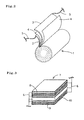
- the structure of lithium secondary battery is roughly divided into a wound type shown in Fig. 2 and a laminated type shown in Fig. 3.
- An internal electrode body 1 of the wound type is constituted by winding a positive electrode 2 and a negative electrode 3 through a separator 4, in which the positive electrode 2 with a large area or the like can be contained in a tubular container.
- this wound type since it is sufficient that there is at least one lead 5 from each electrode 2, 3, and, even if it is desired to lower current collection resistance of each electrode 2, 3, it is sufficient to increase the number of leads, there is an advantage that the internal structure of battery does not become complicated to make easy assembly of the battery.
- an internal electrode body 7 of the laminated type is constructed by alternately laminating positive electrodes 8 and negative electrodes 9 in multiple layers through separators 10, in which area per one positive electrode 8 or the like is no large, but the electrode area of the entire battery can be increased by laminating them in multiple layers.
- the internal electrode body 7 being produced can be designed into any desired shape including a rectangular parallelepiped, cylindrical or tubular shape depending on the shape of each electrode 8, 9 and the number of laminations.
- a lead 6 is necessary for each electrode 8, 9, there is a disadvantage that the internal structure of battery becomes complicated, and it is inferior to the wound type in view of assembly workability of battery.
- the internal electrode body is housed in a metal battery case so that each electrode and lead do not contact each other.
- stainless steel is most widely used for this battery case, and sometimes nickel, titanium or the like may be used.
- a lithium secondary battery for an electric vehicle (EV) or hybrid electric vehicle (HEV) is required to have a cell capacity of at least 50 Wh, to have light weight not to increase weight of the vehicle itself, and to have high safety.
- EV electric vehicle
- HEV hybrid electric vehicle
- stainless steel with high melting point and high strength has been conventionally used by particularly taking safety into consideration.
- EV and HEV require a high current in acceleration, and, when the battery case is used as the current path, magnitude of electric resistance of the battery case cannot be ignored, and there remains a problem on workability of battery case the size of which is increased.
- nickel or titanium such problems are also difficult to be solved because of physical characteristics of these materials.
- the inventors have studied the possibility to use aluminum as the battery case which has light weight, is excellent in electron conductivity, and of good workability.
- aluminum is used as a battery case for a large battery of 50 Wh or more. This may be because the melting point of aluminum is as relatively low as 660°C, a temperature significantly lower than those of the above materials, and, when the battery case is softened or melted due to erroneous use or the like, electrolyte is feared to be evaporated or burned, or exploded in the worst case.
- SBA Guideline the "Guideline for Safety Evaluation on Secondary Lithium Cells” (commonly called “SBA Guideline”), it regulates that even if entire energy fully charged is instantaneously discharged by external short-circuit or internal short-circuiting caused by a nail piercing test or the like, and then the lithium secondary battery generates heat, the battery does not burst or fire.
- a lithium secondary battery comprising:
- the lithium secondary battery of the present invention it is preferable in view of assuring safety of the battery that a relationship of C/(w ⁇ c) ⁇ 0.03 is established where current capacity is C (Ah), battery weight is w (kg), and specific heat of the battery is c ( J/kg ⁇ °C). It is also preferable in view of attaining both high energy density and safety that a relationship of 0.004 ⁇ t/d ⁇ 0.04 is established where the battery case is cylindrical, its outer diameter is d (mm ), and its wall thickness is t (mm). Moreover, such conditions are preferably applied to a lithium secondary battery with battery capacity of 50 Wh or more.
- the lithium secondary battery satisfying such conditions is suitably used as a battery for an electric vehicle or a hybrid electric vehicle.
- the lithium secondary battery of the present invention preferably uses lithium-manganese oxide (LiMn 2 O 4 ) as positive active material.
- the lithium secondary battery of the present invention reduces weight of the battery case while assuring high safety, so that it has a high energy density.
- an internal electrode body is composed by winding or laminating positive and negative electrodes through separator films of porous polymer such that the positive electrodes do not directly contact the negative electrodes.
- an internal electrode body includes structures shown in Figs. 2 and 3, that is, internal electrode bodies 1 and 7.
- the positive electrode used is an aluminum foil applied with mixture of positive active material and carbon powder to improve conductivity.
- the positive active material there can be used, for example, lithium-cobalt oxide (LiCoO 2 ), lithium-nickel oxide (LiNiO 2 ), or lithium-manganese oxide (LiMn 2 O 4 ).
- the present invention preferably uses LiMn 2 O 4 .
- the carbon powder there can be used, for example, acetylene black, graphite powder or the like. It is preferable to use high a purity material for the aluminum foil constituting the positive electrode to prevent the battery performance from lowering due to corrosion by an electrochemical reaction of the battery.
- the negative electrode it is preferable to use a copper foil coated with an amorphous carbon material such as soft carbon or hard carbon, or carbon powder such as natural graphite as negative active material.
- an amorphous carbon material such as soft carbon or hard carbon, or carbon powder such as natural graphite
- a high purity material for the copper foil used as the negative electrode to withstand the corrosion due to an electrochemical reaction.
- the separator film As a material of the separator film, it is preferable to use a three-layer structural material in which a polyethylene film having lithium ion permeability and including micropores is sandwiched between porous polypropylene films having lithium ion permeability. This serves also as a safety mechanism in which when the temperature of the internal electrode body is raised, the polyethylene film is softened at about 130°C so that the micropores are collapsed to suppress the movement of lithium ions, that is, the battery reaction. When the polyethylene film is sandwiched between the polypropylene films having a softening temperature higher than the polyethylene film, it is possible to prevent the contact between the positive and negative electrodes even after softening of polyethylene.
- the internal electrode body produced using such material is housed in the battery case.
- the present invention uses a battery case composed of pure aluminum or aluminum alloy in which one or more components selected from manganese, magnesium, silicon and copper is added in aluminum.
- pure aluminum does not refer to aluminum with 100% purity, but may contain impurities which are unavoidably mixed during an ordinary refining or manufacturing process, and, more specifically, the purity is preferably 99% or more.
- the aluminum alloy it does not mean that impurities unavoidably mixed during an ordinary manufacturing process are not similarly excluded from aluminum which is the main component.
- Specific examples of aluminum alloy include alloy No. 3203 (aluminum-manganese alloy) prescribed in JIS.
- the aluminum battery case means that a main portion of the battery case, that is, a container into which the internal wound body is inserted for storage is made of aluminum, and a sealing member for sealing an opening of the battery case is not necessarily made of aluminum.
- a sealing member for sealing an opening of the battery case is not necessarily made of aluminum.
- the internal electrode body is a cylindrical wound body shown in Fig. 2, it is sufficient that at least a cylindrical container opened at both ends, or a bottomed cylindrical container opened at only one end is made of aluminum.
- the internal electrode body is a rectangular parallelepiped laminated body shown in Fig. 3, as long as at least a tubular container with a rectangular section or a rectangular parallelepiped box-like container opened only at one side is made of aluminum, it is preferably used for the present invention.
- the sealing member for sealing the opening of the battery case is sometimes preferably constituted by an insulating material such as heat resistance resin or ceramics for the purpose of installing an external terminal for taking out electric energy from the internal electrode body or isolating an electric path of the positive and negative electrodes within the battery.
- an insulating material such as heat resistance resin or ceramics
- the above example of battery case does not exclude a battery case which can be entirely composed of aluminum for the outer shell of battery by disposing insulating materials at appropriate locations to assure electric paths for the positive and negative electrodes, and using an aluminum part for the sealing member.
- the battery is produced by the internal electrode body, the battery case and other necessary members such as electrode terminals.
- the structure for the battery being produced it may be possible to adopt a structure which is a structure of a known small battery enlarged as it is.
- the inventors have proposed in Japanese Patent Application No. 9-202963 a structure of lithium secondary battery in which various pressure releasing mechanisms are disposed at appropriate locations, and such structure may be preferably employed.
- the battery thus produced preferably has at least one pressure release valve which releases the battery internal pressure to the ambient air pressure when the battery internal pressure rises and reaches a predetermined pressure due to erroneous use of the battery or the like, thereby preventing explosion due to rise of internal pressure of the battery.
- the battery is preferably designed such that a relationship of C/(w ⁇ c) ⁇ 0.03 is established.
- the specific heat c of battery is defined to be power (W) necessary for raising temperature of a battery of 1 kg by 1°C. Therefore, even if the same battery case is used in producing the battery, the battery has different specific heat if components other than the battery case differ, while, even if the volume of battery is the same, the battery has different specific heat depending on the material and wall thickness of the battery case, the size of internal electrode body or the like.
- the battery is arranged such that the relationship of C/(w ⁇ c) ⁇ 0.03 is established, it is possible to obtain a battery in which temperature rise due to generated heat does not cause softening or melting of the battery case, and which can clear the safety criteria of the SBA Guideline even if the energy charged in the battery is instantaneously discharged as external short-circuiting is caused or as internal short-circuiting is caused by the nail piercing test.
- the relationship of 0.004 ⁇ t/d ⁇ 0.04 is established where the battery case is cylindrical, the outer diameter of the battery case is d (mm ), and the wall thickness is t (mm).
- the battery case has a thin wall thickness t when the outer diameter d of the battery case is constant, that is, the value of t/d is small, the energy density of the battery increases since the weight of battery case is reduced as the battery capacity is increased, and there arises a problem in safety since the strength of battery case is lowered.
- the battery case has a thick wall thickness t, that is the value of t/d is large, it is desirable from the viewpoint of safety since the strength of battery case is heightened, but there arises a problem that the energy density is reduced as a whole since the weight of battery case is increased, and the battery capacity is also reduced,
- the battery when the battery is arranged to have a ratio of the outer dimension of battery case to the wall thickness in a specific range, it becomes possible to assure safety while maintaining the energy density of battery at a proper high value.
- the above relationship can be analogously applied by assuming that the outer diameter of a circle having the same area as the section perpendicular in the longitudinal direction is the outer diameter d of the battery case.
- the present invention is attained as the result of study mainly on the possibility of use of an aluminum battery case for a battery with large capacity which has not been produced, and the technical features of the present invention are suitably employed in a lithium secondary battery having battery capacity of 50 Wh or more.
- a lithium secondary battery having battery capacity of 50 Wh or more.
- the battery with large capacity per unit cell produced by using a battery case composed of aluminum has excellent advantages that the battery has lighter weight, and that it has higher energy density.
- contact resistance due to battery connection can be reduced as the number of series/parallel connections is reduced in the battery, and mounting space for the battery can be saved. Therefore, the lithium secondary battery of the present invention is suitable in applications such as the power supply for an electric or hybrid electric vehicle or as power supply for various mobile equipment.
- the positive electrode was formed of an aluminum foil coated with a mixture in which carbon powder (acetylene black) for improving the conductivity was added to lithium-manganese oxide (LiMn 2 O 4 ) as a positive active material.
- the negative electrode was formed of a copper foil coated with graphite powder.
- a separator for separating the positive electrode from the negative electrode a microporous separator made of polypropylene was used.
- the electrolyte was prepared by dissolving an LiPF 6 electrolyte in a mixed solution of ethylene carbonate (EC) and diethyl carbonate (DEC).
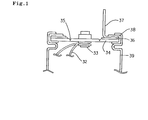
- the battery was a cylindrical type which was formed by inserting a cylindrical internal electrode body, in which the positive and negative electrodes were wound through the separator, into a cylindrical battery case, both ends of the case being sealed with a structure shown in Fig. 1.
- a lead 32 for electricity collection connected to either one of the positive or negative electrode was connected to a metal rivet 33 as an internal terminal mounted on a disk 34 for sealing a battery case 39.
- the disk 34 was provided with a pressure release valve 35 which was burst when the internal pressure of the battery reached a predetermined pressure, and crimped onto the battery case 39 through ethylene propylene rubber 38 so that an external terminal 37 was electrically connected to the disk 34 through a metal ring 36, and that the disk 34, the metal ring 36 and the external terminal 37 were electrically insulated from the battery case.
- a battery of cylindrical type with both terminals in which the external terminal for either one of the positive or negative electrode was disposed on one end of the battery case 39.
- batteries in the battery size of outer diameter 50 mm ⁇ and length 245 mm and having the above-mentioned structure were formed by using battery cases with outer diameter 50 mm and wall thickness 1 mm composed of various materials listed in Table 1, and energy density of each battery was measured.
- aluminum alloy was aluminum added with manganese, while SUS-304 was used as stainless steel.
- the disk 34 for sealing the end of battery case 39 was made of the same material as the battery case 39, and area of the electrode was made equal so that capacity of all batteries became 100 Wh.
- Battery case material Energy density (Wh/kg) Example 1 Aluminum 116
- the energy densities of the produced batteries are also listed in Table 1. It is significant that a battery case material with higher density tends to provide lower resultant energy density. That is, in the case of comparative example 2 where nickel with the highest density was used as the battery case material, the energy density was the lowest of 89 Wh/kg, and the energy density became higher as the density of battery case material decreased in the order of stainless steel (comparative example 1), titanium (comparative example 3), and aluminum (examples 1 and 2). Examples 1 and 2 using aluminum according to the present invention provided energy density of about 115 Wh/kg.
- the characteristic of energy density was improved by about 20% by using aluminum or aluminum alloy for the battery case.
- Examples 1 and 2 were believed to have similar energy density because there was no significant difference in density between aluminum and aluminum alloy.
- impact on the energy density due to difference of conductivity of the battery case materials (disk for sealing the battery case) used can be ignored.
- the outer diameter of battery case is fixed, since the inner diameter of battery case is reduced as the wall thickness of battery case is thickened, the size of internal electrode body which can be housed in the battery case is reduced, that is, the area of electrodes is made small, so that the absolute value of battery capacity is decreased.
- the wall thickness of battery case is thickened, ratio of the battery case to the weight of entire battery is increased. This increases the value of t/d as listed in Table 2. That is, as the wall thickness of battery case is thickened, the energy density significantly tends to decrease.
- comparative example 4 since comparative example 4 has as small t/d as 0.002, it had a light battery case, and very high energy density of about 140 Wh/kg. However, it has large bulging of outer diameter of battery case after the charging/discharging test of 100 cycles, and is found to have a problem in safety. On the other hand, comparative example 5 had as large t/d as 0.06, so that no deformation of battery case was observed after the charging/discharging test of 100 cycles, but it could not provide desired energy density of 100 Wh/kg or more due to increase of weight of the battery case and decrease of volume of the internal electrode body which could be housed in the battery case.
- Batteries having various C/(w ⁇ c) values as shown in Table 3 were produced using an aluminum battery case by noticing the parameter of C/(w ⁇ c) consisting of the battery capacity C (Ah), the battery weight w (kg), and the specific heat c of battery ( J/kg ⁇ °C) calculated with the above method based on the result of the test for measuring specific heat of battery, and subjected to the nail piercing test (internal short-circuiting test) according to the SBA Guideline. Table 3 also lists the test results.
- a lithium secondary battery includes: a battery case, and an internal electrode body 1 contained in the battery case and including a positive electrode 2, a negative electrode 3, and a separator 4 made of porous polymer.
- the positive electrode and the negative electrode are wound and laminated through the separator so that the positive electrode and the negative electrode are not brought into direct contact with each other.
- the battery case is composed of pure aluminum or aluminum alloy in which one or more components selected from manganese, magnesium, silicon and copper is added in aluminum.
- the lithium secondary battery has high weight energy density, is superior in safety, and is used for, particularly, an electric vehicle.
Landscapes
- Chemical & Material Sciences (AREA)
- Chemical Kinetics & Catalysis (AREA)
- Electrochemistry (AREA)
- General Chemical & Material Sciences (AREA)
- Engineering & Computer Science (AREA)
- Manufacturing & Machinery (AREA)
- Inorganic Chemistry (AREA)
- Materials Engineering (AREA)
- Secondary Cells (AREA)
- Battery Electrode And Active Subsutance (AREA)
- Sealing Battery Cases Or Jackets (AREA)
Applications Claiming Priority (3)
| Application Number | Priority Date | Filing Date | Title |
|---|---|---|---|
| JP28081097 | 1997-10-14 | ||
| JP28081097A JP3260675B2 (ja) | 1997-10-14 | 1997-10-14 | リチウム二次電池 |
| EP98119302A EP0910129B1 (de) | 1997-10-14 | 1998-10-13 | Verwendung einer Lithium Sekundärbatterie in einem elektrischen oder Hybrid-Fahrzeug |
Related Parent Applications (1)
| Application Number | Title | Priority Date | Filing Date |
|---|---|---|---|
| EP98119302A Division EP0910129B1 (de) | 1997-10-14 | 1998-10-13 | Verwendung einer Lithium Sekundärbatterie in einem elektrischen oder Hybrid-Fahrzeug |
Publications (2)
| Publication Number | Publication Date |
|---|---|
| EP1267437A2 true EP1267437A2 (de) | 2002-12-18 |
| EP1267437A3 EP1267437A3 (de) | 2009-05-20 |
Family
ID=17630302
Family Applications (2)
| Application Number | Title | Priority Date | Filing Date |
|---|---|---|---|
| EP98119302A Expired - Lifetime EP0910129B1 (de) | 1997-10-14 | 1998-10-13 | Verwendung einer Lithium Sekundärbatterie in einem elektrischen oder Hybrid-Fahrzeug |
| EP02021115A Withdrawn EP1267437A3 (de) | 1997-10-14 | 1998-10-13 | Lithium Sekundärbatterie |
Family Applications Before (1)
| Application Number | Title | Priority Date | Filing Date |
|---|---|---|---|
| EP98119302A Expired - Lifetime EP0910129B1 (de) | 1997-10-14 | 1998-10-13 | Verwendung einer Lithium Sekundärbatterie in einem elektrischen oder Hybrid-Fahrzeug |
Country Status (5)
| Country | Link |
|---|---|
| US (2) | US6352793B2 (de) |
| EP (2) | EP0910129B1 (de) |
| JP (1) | JP3260675B2 (de) |
| CA (1) | CA2249915C (de) |
| DE (1) | DE69829818T2 (de) |
Cited By (1)
| Publication number | Priority date | Publication date | Assignee | Title |
|---|---|---|---|---|
| CN112542641A (zh) * | 2020-12-09 | 2021-03-23 | 合肥国轩高科动力能源有限公司 | 一种圆柱电池及其制造方法 |
Families Citing this family (38)
| Publication number | Priority date | Publication date | Assignee | Title |
|---|---|---|---|---|
| DE69913570T2 (de) * | 1998-09-02 | 2004-09-30 | Sanyo Electric Co., Ltd., Moriguchi | Lithiumsekundärzelle |
| JP3759564B2 (ja) | 1998-09-02 | 2006-03-29 | 三洋電機株式会社 | リチウム二次電池 |
| US7353194B1 (en) * | 1999-03-02 | 2008-04-01 | Alticor Investments, Inc. | System and method for managing recurring orders in a computer network |
| JP4572019B2 (ja) * | 1999-10-08 | 2010-10-27 | パナソニック株式会社 | 組電池 |
| JP3511489B2 (ja) * | 1999-10-14 | 2004-03-29 | 日本碍子株式会社 | リチウム二次電池用捲回型電極体の作製方法 |
| JP3368877B2 (ja) | 1999-11-17 | 2003-01-20 | 新神戸電機株式会社 | 円筒形リチウムイオン電池 |
| CA2327597A1 (en) | 1999-12-07 | 2001-06-07 | Ngk Insulators, Ltd. | Lithium secondary battery and transportation method thereof |
| JP4623812B2 (ja) * | 2000-10-06 | 2011-02-02 | Necエナジーデバイス株式会社 | LiMn二次電池、電池製造方法、電動移動車両 |
| JP4124972B2 (ja) * | 2001-02-23 | 2008-07-23 | Necトーキン株式会社 | 積層型リチウムイオン電池 |
| DE60217086T2 (de) * | 2001-04-05 | 2007-04-12 | Electrovaya Inc., Mississauga | Energieträger für variierende lasten |
| CA2343489C (en) * | 2001-04-05 | 2007-05-22 | Electrofuel, Inc. | Energy storage device for loads having variable power rates |
| US20040201365A1 (en) * | 2001-04-05 | 2004-10-14 | Electrovaya Inc. | Energy storage device for loads having variable power rates |
| US20030113622A1 (en) * | 2001-12-14 | 2003-06-19 | Blasi Jane A. | Electrolyte additive for non-aqueous electrochemical cells |
| US20030162099A1 (en) | 2002-02-28 | 2003-08-28 | Bowden William L. | Non-aqueous electrochemical cell |
| JP3511517B2 (ja) * | 2002-09-05 | 2004-03-29 | 日本碍子株式会社 | リチウム二次電池 |
| US20040185332A1 (en) * | 2003-03-21 | 2004-09-23 | Moltech Corporation | Tabs for electrochemical cells |
| US7285356B2 (en) * | 2004-07-23 | 2007-10-23 | The Gillette Company | Non-aqueous electrochemical cells |
| US7479348B2 (en) * | 2005-04-08 | 2009-01-20 | The Gillette Company | Non-aqueous electrochemical cells |
| TW200810200A (en) * | 2006-06-27 | 2008-02-16 | Boston Power Inc | Integrated current-interrupt device for lithium-ion cells |
| JP5201847B2 (ja) * | 2007-02-20 | 2013-06-05 | パナソニック株式会社 | 非水電解質二次電池 |
| CN201032638Y (zh) * | 2007-03-01 | 2008-03-05 | 东莞新能源电子科技有限公司 | 安全锂离子电池 |
| JP5415413B2 (ja) * | 2007-06-22 | 2014-02-12 | ボストン−パワー,インコーポレイテッド | Liイオン電池用cid保持器 |
| KR101192090B1 (ko) * | 2008-06-09 | 2013-11-27 | 삼성에스디아이 주식회사 | 리튬 이차전지 |
| US8125344B2 (en) | 2008-10-13 | 2012-02-28 | Apple Inc. | Portable computer battery indicator |
| US8642195B2 (en) * | 2008-12-19 | 2014-02-04 | Boston-Power, Inc. | Modular CID assembly for a lithium ion battery |
| JP2012226826A (ja) * | 2009-09-02 | 2012-11-15 | Panasonic Corp | 二次電池及び携帯電子機器 |
| JP2012256584A (ja) * | 2011-02-18 | 2012-12-27 | Sumitomo Electric Ind Ltd | 電気化学素子 |
| KR101240718B1 (ko) * | 2011-04-05 | 2013-03-11 | 삼성에스디아이 주식회사 | 이차 전지용 케이스 및 이를 구비한 이차 전지 |
| US20130004807A1 (en) * | 2011-06-08 | 2013-01-03 | Johnson Controls Technology Llc | Electrochemical cell having releasable suppressant |
| US9583798B2 (en) | 2013-10-17 | 2017-02-28 | Ford Global Technologies, Llc | Electric vehicle battery thermocouple |
| KR102235281B1 (ko) * | 2014-09-12 | 2021-04-02 | 삼성에스디아이 주식회사 | 이차 전지 |
| KR102249892B1 (ko) | 2014-10-08 | 2021-05-10 | 삼성에스디아이 주식회사 | 이차 전지 |
| CN109786589A (zh) * | 2019-01-04 | 2019-05-21 | 上海德朗能动力电池有限公司 | 一种棱柱形锂离子电池及制备方法,以及其组成的电池模组 |
| FR3093960B1 (fr) | 2019-03-19 | 2021-03-19 | Constellium Neuf Brisach | Partie basse de caisson de batteries pour véhicules électriques |
| US12132227B2 (en) | 2021-01-19 | 2024-10-29 | Lg Energy Solution, Ltd. | Battery, and battery pack and vehicle comprising the same |
| CA3202317A1 (en) | 2021-01-19 | 2022-07-28 | Lg Energy Solution, Ltd. | Battery and current collector applied thereto, and battery pack and vehicle including the same |
| US12407028B2 (en) | 2021-02-19 | 2025-09-02 | Lg Energy Solution, Ltd. | Electrode assembly, battery, and battery pack and vehicle including the same |
| CN117895155B (zh) * | 2023-12-22 | 2025-05-13 | 无锡市宝来电池有限公司 | 一种具有防护密封结构的碱性电池 |
Family Cites Families (24)
| Publication number | Priority date | Publication date | Assignee | Title |
|---|---|---|---|---|
| JPS5476929A (en) | 1977-11-30 | 1979-06-20 | Sanyo Electric Co | Nonnwater electrolyte cell |
| JPH0567457A (ja) * | 1991-09-06 | 1993-03-19 | Asahi Chem Ind Co Ltd | 非水系高容量二次電池 |
| JP3059842B2 (ja) | 1992-11-16 | 2000-07-04 | 三洋電機株式会社 | 非水電解液電池 |
| US5571632A (en) * | 1994-06-22 | 1996-11-05 | Sony Corporation | Nonaqueous electrolyte solution secondary cell and method for producing the same |
| JPH08250084A (ja) | 1994-06-22 | 1996-09-27 | Sony Corp | 非水電解液二次電池及びその製造方法 |
| JP3067554B2 (ja) | 1994-11-10 | 2000-07-17 | 松下電器産業株式会社 | 電池およびその製造法 |
| JP3419119B2 (ja) * | 1994-11-15 | 2003-06-23 | 日本電池株式会社 | 非水電解質二次電池 |
| TW297171B (de) * | 1994-12-20 | 1997-02-01 | Hoechst Celanese Corp | |
| JP3096615B2 (ja) * | 1995-06-02 | 2000-10-10 | 三洋電機株式会社 | アルミニウム外装缶の二次電池 |
| JPH0973885A (ja) | 1995-09-05 | 1997-03-18 | Sony Corp | 非水電解液二次電池 |
| JPH09147814A (ja) | 1995-11-22 | 1997-06-06 | Shin Kobe Electric Mach Co Ltd | 有機電解質電池 |
| JPH09306443A (ja) | 1996-05-20 | 1997-11-28 | Haibaru:Kk | 非水電解液電池 |
| JPH09312161A (ja) * | 1996-05-23 | 1997-12-02 | Ngk Insulators Ltd | 電気化学素子の集電体および電気化学素子 |
| US5772934A (en) * | 1996-05-24 | 1998-06-30 | W. R. Grace & Co.-Conn. | Process to produce lithium-polymer batteries |
| JPH09316580A (ja) | 1996-05-27 | 1997-12-09 | Mitsubishi Alum Co Ltd | アルミニウム合金、それを用いたリチウムイオン2次電池用ケースおよびその製造方法 |
| JP3118690B2 (ja) | 1996-05-29 | 2000-12-18 | 教弘 大西 | リチウム二次電池用外装缶 |
| JPH1021889A (ja) | 1996-06-27 | 1998-01-23 | Toyota Central Res & Dev Lab Inc | リチウムイオン二次電池の容器および電極集電体 |
| JP3508411B2 (ja) | 1996-08-20 | 2004-03-22 | 新神戸電機株式会社 | リチウムイオン二次電池 |
| EP0843369A1 (de) | 1996-11-14 | 1998-05-20 | Asahi Glass Company Ltd. | Zylindrische Zelle mit nichtwässrigem Elektrolyten |
| JPH10199493A (ja) | 1997-01-10 | 1998-07-31 | Japan Storage Battery Co Ltd | 二次電池 |
| JPH10228888A (ja) | 1997-02-12 | 1998-08-25 | Japan Storage Battery Co Ltd | 非水電解質二次電池 |
| JP3030263B2 (ja) | 1997-05-09 | 2000-04-10 | 三洋電機株式会社 | 非水電解液二次電池 |
| JP3418551B2 (ja) | 1998-06-12 | 2003-06-23 | 日本碍子株式会社 | リチウム二次電池 |
| USD457131S1 (en) | 1999-04-01 | 2002-05-14 | Ngk Insulators, Ltd. | Lithium secondary battery |
-
1997
- 1997-10-14 JP JP28081097A patent/JP3260675B2/ja not_active Expired - Lifetime
-
1998
- 1998-10-09 US US09/169,563 patent/US6352793B2/en not_active Expired - Lifetime
- 1998-10-09 CA CA002249915A patent/CA2249915C/en not_active Expired - Fee Related
- 1998-10-13 DE DE69829818T patent/DE69829818T2/de not_active Expired - Lifetime
- 1998-10-13 EP EP98119302A patent/EP0910129B1/de not_active Expired - Lifetime
- 1998-10-13 EP EP02021115A patent/EP1267437A3/de not_active Withdrawn
-
2001
- 2001-10-15 US US09/977,435 patent/US6841297B2/en not_active Expired - Lifetime
Cited By (2)
| Publication number | Priority date | Publication date | Assignee | Title |
|---|---|---|---|---|
| CN112542641A (zh) * | 2020-12-09 | 2021-03-23 | 合肥国轩高科动力能源有限公司 | 一种圆柱电池及其制造方法 |
| CN112542641B (zh) * | 2020-12-09 | 2022-03-11 | 合肥国轩高科动力能源有限公司 | 一种圆柱电池及其制造方法 |
Also Published As
| Publication number | Publication date |
|---|---|
| US6841297B2 (en) | 2005-01-11 |
| CA2249915C (en) | 2004-01-27 |
| JPH11120964A (ja) | 1999-04-30 |
| US20020051905A1 (en) | 2002-05-02 |
| CA2249915A1 (en) | 1999-04-14 |
| US20010053477A1 (en) | 2001-12-20 |
| DE69829818T2 (de) | 2006-03-02 |
| DE69829818D1 (de) | 2005-05-25 |
| EP0910129B1 (de) | 2005-04-20 |
| JP3260675B2 (ja) | 2002-02-25 |
| EP0910129A1 (de) | 1999-04-21 |
| EP1267437A3 (de) | 2009-05-20 |
| US6352793B2 (en) | 2002-03-05 |
Similar Documents
| Publication | Publication Date | Title |
|---|---|---|
| EP0910129B1 (de) | Verwendung einer Lithium Sekundärbatterie in einem elektrischen oder Hybrid-Fahrzeug | |
| KR100876726B1 (ko) | 비수성 전해질 리튬 이온 배터리를 위한 양극 재료 그리고이것을 사용하는 배터리 | |
| JP3368877B2 (ja) | 円筒形リチウムイオン電池 | |
| EP1876664A1 (de) | Positiv-elektrodenmaterial für eine lithiumionenbatterie mit wasserfreiem elektrolyt und batterie damit | |
| US20090291330A1 (en) | Battery with enhanced safety | |
| JP4563264B2 (ja) | リチウム二次電池 | |
| US8758917B2 (en) | Secondary battery | |
| US20090297937A1 (en) | Lithium-ion secondary battery | |
| EP1659648B1 (de) | Electrochemische Zellenstruktur | |
| JP2008103302A (ja) | 電池モジュール | |
| JP2007257885A (ja) | 非水電解質リチウムイオン電池用正極材料およびこれを用いた電池 | |
| US20150263334A1 (en) | Non-aqueous electrolyte secondary battery | |
| US20070054191A1 (en) | Non- aqueous electrolyte secondary battery | |
| US20260045607A1 (en) | Battery cell, battery, and electric device | |
| JP2000090895A (ja) | 電気自動車用リチウム二次電池 | |
| EP4583259A1 (de) | Batteriezelle, batterie und elektrische vorrichtung | |
| JP2000182573A (ja) | 二次電池 | |
| JP2003346768A (ja) | 非水電解質二次電池 | |
| CN101501882A (zh) | 具有正热系数外层的锂电池 | |
| JP2000357536A (ja) | 非水電解質電池 | |
| JP2003282143A (ja) | 非水電解液二次電池 | |
| KR101841307B1 (ko) | 안전성 향상을 위한 코팅층이 형성된 이종 분리막을 포함하는 전극조립체 및 이를 포함하는 리튬 이차전지 | |
| JP2001068167A (ja) | 非水電解質電池 | |
| JP2007073212A (ja) | リチウムイオン二次電池 | |
| JPH04249072A (ja) | 組電池 |
Legal Events
| Date | Code | Title | Description |
|---|---|---|---|
| PUAI | Public reference made under article 153(3) epc to a published international application that has entered the european phase |
Free format text: ORIGINAL CODE: 0009012 |
|
| AC | Divisional application: reference to earlier application |
Ref document number: 910129 Country of ref document: EP |
|
| AK | Designated contracting states |
Kind code of ref document: A2 Designated state(s): BE CH DE FR GB IT LI |
|
| RIN1 | Information on inventor provided before grant (corrected) |
Inventor name: NEMOTO, HIROSHI Inventor name: KITOH, KENSHIN,C/O NGK INSULATORS , LTD. |
|
| PUAL | Search report despatched |
Free format text: ORIGINAL CODE: 0009013 |
|
| AK | Designated contracting states |
Kind code of ref document: A3 Designated state(s): BE CH DE FR GB IT LI |
|
| RIC1 | Information provided on ipc code assigned before grant |
Ipc: H01M 10/04 20060101ALI20090416BHEP Ipc: H01M 10/40 20060101ALI20090416BHEP Ipc: H01M 2/02 20060101AFI20090416BHEP |
|
| 17P | Request for examination filed |
Effective date: 20090820 |
|
| 17Q | First examination report despatched |
Effective date: 20090916 |
|
| AKX | Designation fees paid |
Designated state(s): BE CH DE FR GB IT LI |
|
| STAA | Information on the status of an ep patent application or granted ep patent |
Free format text: STATUS: THE APPLICATION IS DEEMED TO BE WITHDRAWN |
|
| 18D | Application deemed to be withdrawn |
Effective date: 20100127 |