EP1268429B1 - Composes bicycliques antagonistes des recepteurs de la vitronectine, leur procede de preparation et les compositions qui les contiennent - Google Patents
Composes bicycliques antagonistes des recepteurs de la vitronectine, leur procede de preparation et les compositions qui les contiennent Download PDFInfo
- Publication number
- EP1268429B1 EP1268429B1 EP01969041A EP01969041A EP1268429B1 EP 1268429 B1 EP1268429 B1 EP 1268429B1 EP 01969041 A EP01969041 A EP 01969041A EP 01969041 A EP01969041 A EP 01969041A EP 1268429 B1 EP1268429 B1 EP 1268429B1
- Authority
- EP
- European Patent Office
- Prior art keywords
- formula
- group
- compound
- compounds
- amino
- Prior art date
- Legal status (The legal status is an assumption and is not a legal conclusion. Google has not performed a legal analysis and makes no representation as to the accuracy of the status listed.)
- Expired - Lifetime
Links
- 0 CC*NC(*[U]C)*(*N)N Chemical compound CC*NC(*[U]C)*(*N)N 0.000 description 5
- BMVXCPBXGZKUPN-UHFFFAOYSA-N CCCCCCN Chemical compound CCCCCCN BMVXCPBXGZKUPN-UHFFFAOYSA-N 0.000 description 1
Classifications
-
- C—CHEMISTRY; METALLURGY
- C07—ORGANIC CHEMISTRY
- C07D—HETEROCYCLIC COMPOUNDS
- C07D213/00—Heterocyclic compounds containing six-membered rings, not condensed with other rings, with one nitrogen atom as the only ring hetero atom and three or more double bonds between ring members or between ring members and non-ring members
- C07D213/02—Heterocyclic compounds containing six-membered rings, not condensed with other rings, with one nitrogen atom as the only ring hetero atom and three or more double bonds between ring members or between ring members and non-ring members having three double bonds between ring members or between ring members and non-ring members
- C07D213/04—Heterocyclic compounds containing six-membered rings, not condensed with other rings, with one nitrogen atom as the only ring hetero atom and three or more double bonds between ring members or between ring members and non-ring members having three double bonds between ring members or between ring members and non-ring members having no bond between the ring nitrogen atom and a non-ring member or having only hydrogen or carbon atoms directly attached to the ring nitrogen atom
- C07D213/60—Heterocyclic compounds containing six-membered rings, not condensed with other rings, with one nitrogen atom as the only ring hetero atom and three or more double bonds between ring members or between ring members and non-ring members having three double bonds between ring members or between ring members and non-ring members having no bond between the ring nitrogen atom and a non-ring member or having only hydrogen or carbon atoms directly attached to the ring nitrogen atom with hetero atoms or with carbon atoms having three bonds to hetero atoms with at the most one bond to halogen, e.g. ester or nitrile radicals, directly attached to ring carbon atoms
- C07D213/72—Nitrogen atoms
- C07D213/74—Amino or imino radicals substituted by hydrocarbon or substituted hydrocarbon radicals
-
- A—HUMAN NECESSITIES
- A61—MEDICAL OR VETERINARY SCIENCE; HYGIENE
- A61P—SPECIFIC THERAPEUTIC ACTIVITY OF CHEMICAL COMPOUNDS OR MEDICINAL PREPARATIONS
- A61P17/00—Drugs for dermatological disorders
-
- A—HUMAN NECESSITIES
- A61—MEDICAL OR VETERINARY SCIENCE; HYGIENE
- A61P—SPECIFIC THERAPEUTIC ACTIVITY OF CHEMICAL COMPOUNDS OR MEDICINAL PREPARATIONS
- A61P17/00—Drugs for dermatological disorders
- A61P17/06—Antipsoriatics
-
- A—HUMAN NECESSITIES
- A61—MEDICAL OR VETERINARY SCIENCE; HYGIENE
- A61P—SPECIFIC THERAPEUTIC ACTIVITY OF CHEMICAL COMPOUNDS OR MEDICINAL PREPARATIONS
- A61P19/00—Drugs for skeletal disorders
-
- A—HUMAN NECESSITIES
- A61—MEDICAL OR VETERINARY SCIENCE; HYGIENE
- A61P—SPECIFIC THERAPEUTIC ACTIVITY OF CHEMICAL COMPOUNDS OR MEDICINAL PREPARATIONS
- A61P19/00—Drugs for skeletal disorders
- A61P19/02—Drugs for skeletal disorders for joint disorders, e.g. arthritis, arthrosis
-
- A—HUMAN NECESSITIES
- A61—MEDICAL OR VETERINARY SCIENCE; HYGIENE
- A61P—SPECIFIC THERAPEUTIC ACTIVITY OF CHEMICAL COMPOUNDS OR MEDICINAL PREPARATIONS
- A61P19/00—Drugs for skeletal disorders
- A61P19/08—Drugs for skeletal disorders for bone diseases, e.g. rachitism, Paget's disease
- A61P19/10—Drugs for skeletal disorders for bone diseases, e.g. rachitism, Paget's disease for osteoporosis
-
- A—HUMAN NECESSITIES
- A61—MEDICAL OR VETERINARY SCIENCE; HYGIENE
- A61P—SPECIFIC THERAPEUTIC ACTIVITY OF CHEMICAL COMPOUNDS OR MEDICINAL PREPARATIONS
- A61P27/00—Drugs for disorders of the senses
- A61P27/02—Ophthalmic agents
-
- A—HUMAN NECESSITIES
- A61—MEDICAL OR VETERINARY SCIENCE; HYGIENE
- A61P—SPECIFIC THERAPEUTIC ACTIVITY OF CHEMICAL COMPOUNDS OR MEDICINAL PREPARATIONS
- A61P29/00—Non-central analgesic, antipyretic or antiinflammatory agents, e.g. antirheumatic agents; Non-steroidal antiinflammatory drugs [NSAID]
-
- A—HUMAN NECESSITIES
- A61—MEDICAL OR VETERINARY SCIENCE; HYGIENE
- A61P—SPECIFIC THERAPEUTIC ACTIVITY OF CHEMICAL COMPOUNDS OR MEDICINAL PREPARATIONS
- A61P31/00—Antiinfectives, i.e. antibiotics, antiseptics, chemotherapeutics
-
- A—HUMAN NECESSITIES
- A61—MEDICAL OR VETERINARY SCIENCE; HYGIENE
- A61P—SPECIFIC THERAPEUTIC ACTIVITY OF CHEMICAL COMPOUNDS OR MEDICINAL PREPARATIONS
- A61P33/00—Antiparasitic agents
- A61P33/14—Ectoparasiticides, e.g. scabicides
-
- A—HUMAN NECESSITIES
- A61—MEDICAL OR VETERINARY SCIENCE; HYGIENE
- A61P—SPECIFIC THERAPEUTIC ACTIVITY OF CHEMICAL COMPOUNDS OR MEDICINAL PREPARATIONS
- A61P35/00—Antineoplastic agents
-
- A—HUMAN NECESSITIES
- A61—MEDICAL OR VETERINARY SCIENCE; HYGIENE
- A61P—SPECIFIC THERAPEUTIC ACTIVITY OF CHEMICAL COMPOUNDS OR MEDICINAL PREPARATIONS
- A61P43/00—Drugs for specific purposes, not provided for in groups A61P1/00-A61P41/00
-
- A—HUMAN NECESSITIES
- A61—MEDICAL OR VETERINARY SCIENCE; HYGIENE
- A61P—SPECIFIC THERAPEUTIC ACTIVITY OF CHEMICAL COMPOUNDS OR MEDICINAL PREPARATIONS
- A61P9/00—Drugs for disorders of the cardiovascular system
-
- C—CHEMISTRY; METALLURGY
- C07—ORGANIC CHEMISTRY
- C07D—HETEROCYCLIC COMPOUNDS
- C07D223/00—Heterocyclic compounds containing seven-membered rings having one nitrogen atom as the only ring hetero atom
- C07D223/02—Heterocyclic compounds containing seven-membered rings having one nitrogen atom as the only ring hetero atom not condensed with other rings
- C07D223/06—Heterocyclic compounds containing seven-membered rings having one nitrogen atom as the only ring hetero atom not condensed with other rings with hetero atoms or with carbon atoms having three bonds to hetero atoms with at the most one bond to halogen, e.g. ester or nitrile radicals, directly attached to ring carbon atoms
- C07D223/12—Nitrogen atoms not forming part of a nitro radical
-
- C—CHEMISTRY; METALLURGY
- C07—ORGANIC CHEMISTRY
- C07D—HETEROCYCLIC COMPOUNDS
- C07D233/00—Heterocyclic compounds containing 1,3-diazole or hydrogenated 1,3-diazole rings, not condensed with other rings
- C07D233/54—Heterocyclic compounds containing 1,3-diazole or hydrogenated 1,3-diazole rings, not condensed with other rings having two double bonds between ring members or between ring members and non-ring members
- C07D233/64—Heterocyclic compounds containing 1,3-diazole or hydrogenated 1,3-diazole rings, not condensed with other rings having two double bonds between ring members or between ring members and non-ring members with substituted hydrocarbon radicals attached to ring carbon atoms, e.g. histidine
-
- C—CHEMISTRY; METALLURGY
- C07—ORGANIC CHEMISTRY
- C07D—HETEROCYCLIC COMPOUNDS
- C07D235/00—Heterocyclic compounds containing 1,3-diazole or hydrogenated 1,3-diazole rings, condensed with other rings
- C07D235/02—Heterocyclic compounds containing 1,3-diazole or hydrogenated 1,3-diazole rings, condensed with other rings condensed with carbocyclic rings or ring systems
- C07D235/04—Benzimidazoles; Hydrogenated benzimidazoles
- C07D235/06—Benzimidazoles; Hydrogenated benzimidazoles with only hydrogen atoms, hydrocarbon or substituted hydrocarbon radicals, directly attached in position 2
- C07D235/14—Radicals substituted by nitrogen atoms
Definitions
- the present invention relates to novel bicyclic compounds antagonists of vitronectin receptors, process for their preparation and compositions pharmaceuticals that contain them.
- Integrins constitute a family of transmembrane glycoproteins initially identified in the dynamic phenomena of cell adhesion and migration and ensuring a mechanical link between the extracellular matrix and other surface adhesive molecules and the cytoskeleton. Later their ability to transmit an intracellular signal directly was described. These two properties of coupling agent and receptor are used by cells during embryonic development and during numerous physiological processes (Cell., 1992, 69 , 11-25; Endocrine Reviews, 1996, 17 , 207-220; Cell, Mol. Life Sci., 1998, 54 , 514-526).
- An integrin is made up of two distinct alpha and beta chains linked together in a non-covalent manner. At least sixteen alpha chains and eight beta chains have been identified, their combination making it possible to create a vast repertoire of possibilities. Among these, only about twenty integrins have been described. The type of combination of subunits also dictates the repertoire of recognized extracellular ligands.
- the Arg-Gly-Asp (RGD) peptide sequence is often recognized by integrins and present within many ligands (fribronectin, vitronectin, fibrinogen, collagen, ...), but other recognition sites have been described.
- An integrin may exist in a form incapable of binding its ligands and will therefore require activation by convergence of various intracellular signals to become functional (Cell., Cited ref; J. Clin. Invest., 1997, 99 , 2302-2306).
- integrins can be used as a pathway for viral, bacterial or parasitic cell infections, deregulation of their expression or activation is associated with many pathologies including for example cardiovascular diseases, inflammatory diseases, cancer, osteoporosis, rheumatoid arthritis, psoriasis, retinopathies. Integrins participate in the development of these pathologies by acting on cell adhesion and migration, on the regulation of cell differentiation, survival and proliferation, and on the transduction of various intracellular signals (Ann. Rep. In Med Chem., 1996, 31 , 191-200).
- Integrin ⁇ v ⁇ 3 one of the vitronectin receptors, but which also binds fibronectin, fibrinogen and thrombospondin, has been more particularly involved in three pathological events: the migration of smooth muscle cells into the neointima, during atherosclerosis and restenosis after angioplasty, on the surface of osteoclasts during bone resorption, and during the angiogenesis phases on endothelial cells (Cardiovasc. Res., 1994, 28 , 1815-1820; J. Clin Invest., 1997, 99, 2059; Science, 1994, 264 , 569-571; Cell., 1994, 79 , 1157-1164; Proc. Natl. Acad. Sci.
- Tumor cells also use this integrin during their invasive phase, in particular for melanomas, and to ensure their survival in contact with the extracellular matrix (Proc. Natl. Acad. Sci. USA, 1992, 89 , 1557-1561 and 1994 , 91 , 8856-8860).
- Integrin ⁇ v ⁇ 5 another vitronectin receptor, is also associated with angiogenesis in addition to integrin ⁇ v ⁇ 3 , the two integrins participating in two distinct pathways of induction of angiogenesis (Science , 1995, 270 , 1500-1502).
- integrin ⁇ IIb ⁇ 3 or GPIIb / IIIa is a fibrinogen receptor, and is responsible for the aggregation of platelets.
- Blocking the interaction of the integrins ⁇ v ⁇ 3 and ⁇ v ⁇ 5 with their ligands is therefore capable of inhibiting the adhesion, migration and survival of various cell types, effects contributing to block angiogenesis, l , bone resorption, restenosis, metastasis and tumor growth.
- the compounds of the invention have an original structure which confers on them an antagonist character of the ⁇ v ⁇ 3 and ⁇ v ⁇ 5 receptors of vitronectin, and a selectivity with respect to the ⁇ IIb ⁇ 3 integrins. They may therefore be useful in the treatment of pathologies characterized by the deregulation of the expression or activation of the integrins ⁇ v ⁇ 3 and / or ⁇ v ⁇ 5 , while avoiding the side effects at the level of the aggregation of platelets. In particular, they may be useful in the treatment of cardiovascular diseases, inflammation, cancer, osteoporosis, rheumatoid arthritis, psoriasis and retinopathies.
- the compounds of the invention will be useful as inhibitors of tumor growth and metastasis, in the treatment of cancer.
- R 5 of the invention is the group -CH 2 -COOR 6 , R 6 preferably being an alkyl group or a hydrogen atom.
- X will advantageously be chosen from -CO-NR 6 -X 1 , -NR 6 -CO-X 1 and -OX 1 , R 6 being more particularly a hydrogen atom, and X 1 preferably representing a methylene group.
- Y represents a group Y 1 or Y 1 -Y 2 -Y 1 in which Y 1 is more particularly an alkylene group, and Y 2 advantageously represents an arylene group. More preferably, Y represents a group - (CH 2 ) 3 -.
- the preferred compounds of the invention are the compounds of formula (I) for which Z represents a heteroaryl, heterocycloalkyl, fused arylheteroaryl, fused heterocycloalkylheteroaryl group or -Z 10 -NR 6 , R 6 being more particularly a hydrogen atom, and Z 10 being advantageously chosen from heteroaryl, heterocycloalkyl, fused arylheteroaryl and fused heterocycloalkylheteroaryl groups.
- the cyclic groups thus preferred for Z advantageously comprise one or two nitrogen atoms, such as for example the pyridine, aminopyridine, (dihydro) pyrrolopyridine, (dihydro) imidazole, 5,6,7,8-tetrahydro groups [1,8] naphthyridine or (tetrahydro) pyrimidine.
- nitrogen atoms such as for example the pyridine, aminopyridine, (dihydro) pyrrolopyridine, (dihydro) imidazole, 5,6,7,8-tetrahydro groups [1,8] naphthyridine or (tetrahydro) pyrimidine.
- X is chosen from the groups -CO-NR 6 -X 1 -, -NR 6 -CO-X 1 -, and -OX 1 -, X 1 being a methylene group
- Y represents a group -Y 1 - or -Y 1 -Y 2 -Y 1 in which Y 1 is an alkylene group and Y 2 represents an arylene group
- Z represents a heteroaryl, heterocycloalkyl, fused arylheteroaryl, heterocycloalkylheteroaryl group or Z 10 -NR 6 in which Z 10 represents a group chosen from the heteroaryl, heterocycloalkyl, fused arylheteroaryl and fused heterocycloalkylheteroaryl groups
- R 6 representing a hydrogen atom.
- the preferred aryl group of the invention is the phenyl group.
- hydrochloric acids hydrobromic, sulfuric, phosphonic, acetic, trifluoroacetic, lactic, pyruvic, malonic, succinic, glutaric, fumaric, tartaric, maleic, citric, ascorbic, methanesulfonic, camphoric, etc ...
- the present invention also relates to the process for preparing the compounds of formula (I).
- the starting materials used are either known or prepared according to procedures known.
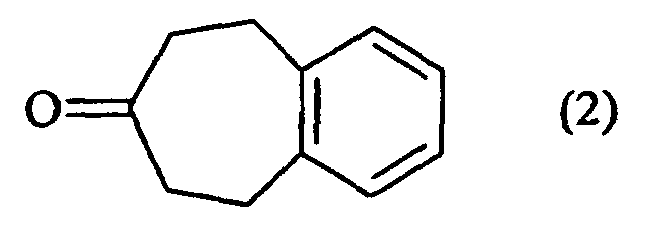
- the compounds of formula (II / a) for which G, G 1 and G 2 together form a phenyl group can be prepared in the following manner, starting from 5,6,8,9-tetrahydro-7 H -benzocyclohepten-7-one (2):
- the ketone (2) as defined above can also be treated with trimethylsilyl chloride in a strong basic medium, to lead, after oxidation, to the unsaturated compound (9): which is condensed in basic medium on a derivative of formula Hal- (CH 2 ) m -COOR 6 in which m and R 6 are as defined in formula (I) and Hal represents a halogen atom, to lead to the compound (10): in which R 5 is as defined in formula (I), compound (10) which is subjected to the action of carbon monoxide in the presence of base in a THF / water medium to yield the compound (11-II / a): special case of the compounds of formula (II / a) for which R 5 is as defined in formula ( I ).
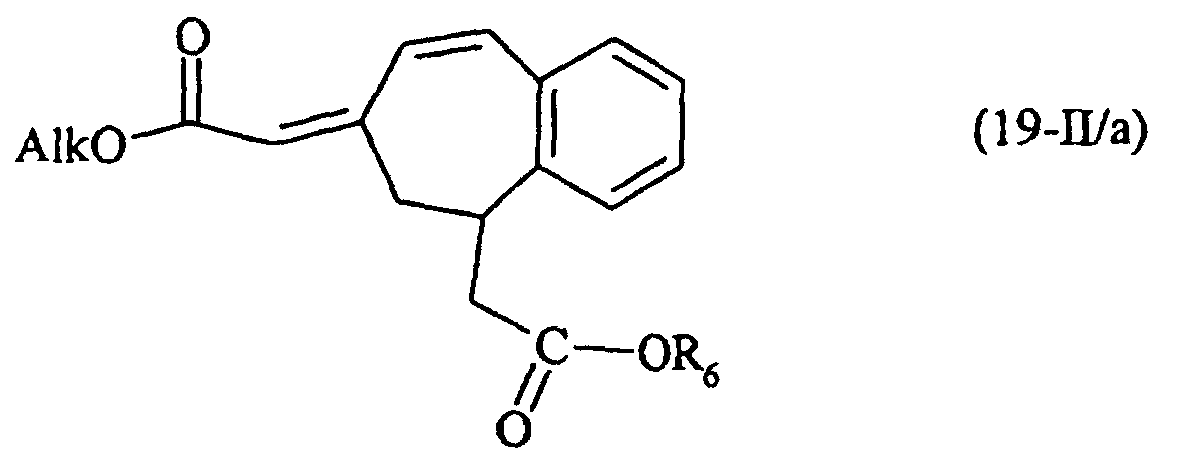
- the compound (5) as defined above can be subjected to a Wittig type reaction using an alkoxymethylene-triphenylphosphorane to yield a compound of formula (19-II / a): special case of the compounds of formula (II) for which R 6 is as defined in formula (I) and Alk represents an alkyl group.
- the present invention also relates to pharmaceutical compositions containing as active principle at least one compound of formula (I), alone or in combination with one or more inert non-toxic excipients or vehicles, pharmaceutically acceptable.
- compositions according to the invention there may be mentioned more particularly those suitable for oral, parenteral, nasal administration, transdermal, single or coated tablets, sublingual tablets, capsules, tablets, suppositories, creams, ointments, dermal gels, etc.
- the useful dosage varies according to the age and weight of the patient, the nature and severity of the condition and the route of administration. This can be oral, nasal, rectal or parenteral. Generally, the unit dosage ranges from 0.05 to 500 mg for a treatment in 1 to 3 taken per 24 hours.
- the compound obtained in the previous stage (166.8 mmol) is dissolved in 1 liter of dimethylformamide.
- the lithium bromide (86.93 g; 1 mol) and the carbonate are then added.
- of lithium (73.96 g; 1 mol) in the reaction medium and the mixture is brought to reflux overnight.
- concentration the residue is taken up in dichloromethane and washed with water.
- the phases organics are combined, dried over magnesium sulfate and concentrated.
- the residue obtained is purified by chromatography on silica gel (eluent toluene / ethyl acetate 95/5) to lead to the expected product.
- stage c of preparation 1 The compound described in stage c of preparation 1 (8.45 g; 31 mmol) is heated to reflux in tetrahydrofuran in the presence of carbethoxymethylene triphenylphosphorane (21.7 g; 62 mmol), under an inert atmosphere for 10 days.
- the reaction medium is concentrated and the residue obtained is taken up in the minimum amount of dichloromethane, then there add pentane.
- the precipitate formed is filtered and the filtrate is concentrated, then purified by chromatography on silica gel (eluent dichloromethane / petroleum ether 1/1) to lead to the expected compound in the form of a mixture of cis and trans isomers.
- the lithium diisopropylamide is conventionally generated (20 minutes at 0 ° C.) from diisopropylamine (18.6 mmol; 2.6 ml) and n-butyllithium (1.6 M in hexane) (18.6 mmol; 11.6 ml) in 30 ml of tetrahydrofuran and the reaction medium is cooled then at -78 ° C.
- the compound described in the preceding stage, diluted in 30 ml of tetrahydrofuran is added dropwise. The anion is formed in 15 minutes at -20 ° C, then the reaction medium is again cooled to -78 ° C.
- the compound obtained in the preceding stage (23.7 g; 90.25 mmol) is dissolved in a mixture dioxane / water (250/4) at room temperature. Then add the selenium dioxide (28.4 g; 256 mmol) and the reaction medium is brought to reflux for 1 hour. After cooling and filtration on celite, the filtrate is concentrated and purified by chromatography on silica gel (eluent: petroleum ether / dichloromethane 50/50) to yield title product.
- stage b The compound obtained in stage b (3.34 g; 76 mmol) is diluted in 5.5 ml of a 1/1 dioxane / water mixture. Lithium hydroxide (0.319 g; 7.6 mmol) is added, and the reaction is stirred at room temperature for a few hours. The reaction medium is then extracted once with diethyl ether. The aqueous phase is then acidified with HCl (0.1 N) and extracted with dichloromethane. The organic phase is concentrated and the residue obtained is diluted in 10 ml of toluene and treated with SOCl 2 (0.97 g; 8.16 mol, 0.595 ml). The reaction medium is stirred at 70 ° C for 2 hours then concentrated to dryness and evaporated 3 times with cyclohexane. The residue obtained, corresponding to the title product, is used as it is subsequently.
- reaction medium is then stirred for 15 hours at room temperature, then brought to reflux for 6 hours.
- the reaction medium after cooling, is washed with HCl (10% aq), (2 x 80 ml) then H 2 O (2 x 80 ml), NaOH (10% aq) (2 x 80 ml) and finally NaCl ( 2 x 80 ml).
- HCl 50% aq
- 2 x 80 ml H 2 O
- NaOH % aq
- NaCl 2 x 80 ml
- nBu 4 NBH 4 (0.602 g; 2.34 mmol) is added at room temperature.
- the reaction medium is then heated at 45 ° C for 8 hours.
- 10 ml of HCl (10%) are then added and the mixture is heated for 1 hour at 50 ° C.
- concentration the residue is chromatographed on silica (CH 2 Cl 2 / EtOH / NH 4 OH) to yield the title compound.
- the compound obtained in the previous stage (9.4 g; 53.9 mmol) is taken up in 52 ml of alcohol tertamyl and stirred in the presence of sodium hydrogencarbonate (22.64 g; 269.5 mmol).
- the 2-chloropyridine-N-oxide (10.75 g; 64.72 mmol) is then added slowly to the medium reaction and the mixture is brought to reflux for 48 hours.
- the reaction medium is diluted in 100 ml of dichloromethane and then filtered.
- the filtrate is concentrated and purified by chromatography on silica gel (eluent dichloromethane / ethanol / ammonia, 90/10/1) to yield the expected product.
- the expected product is obtained according to the process described in Preparation A by replacing 1,3-propanediamine by 1,4-butanediamine.
- the expected product is obtained according to the process described in Preparation A by replacing 1,3-propanediamine by 1,2-ethylenediamine.
- the expected product is obtained according to the process described in Preparation A by replacing 1,3-propanediamine by metaxylenediamine.
- the compound described in the preceding stage (2.1 g; 11.53 mmol) is diluted in a mixture dioxane (40 ml) and water (10 ml) and stirred in the presence of cyclohexene (17.25 g; 210 mmol; 14 ml) and 10% palladium on charcoal (2 g).
- the reaction medium is brought to reflux during 3 hours. After cooling, the mixture is filtered, and the filtrate is concentrated to lead to the expected product.
- the compound described in the preceding stage (3.9 g; 23.32 mmol) is diluted in 400 ml of methanol and acetyl chloride (3.66 g; 46.6 mmol; 3.3 ml) is added dropwise. The mixture is heated at reflux for 2 hours. The reaction medium is concentrated and the residue is taken up in a saturated ammoniacal methanol solution in a Parr, which is heated to 130 ° C for 72 hours. The mixture is cooled and concentrated to lead to the expected product.
- the expected product is obtained according to the process described in Preparation E by replacing the ⁇ -alanine hydrochloride with 4-aminobutyric acid.
- the expected product is obtained according to the process described in Preparation E by replacing the ⁇ -alanine hydrochloride with 5-aminovaleric acid.
- the compound obtained in the preceding stage (2 g; 9.56 mmol) is diluted in 6.6 ml of water.
- the reaction medium is stirred for 7 days at room temperature, then concentrated.
- the residue is taken up in ethyl acetate and washed with a saturated aqueous solution in sodium hydrogencarbonate.
- the organic phases are dried over magnesium and concentrated to yield the expected product.
- the expected product is obtained according to the process described in in stage e of preparation E in using as starting material the compound described in the previous stage.
- the expected product is obtained according to the process described in stages b and c of preparation A using 5-amino-1-pentanol as the starting material.
- the expected product is obtained according to the process described in stages b and c of preparation A using 4-amino-1-butanol as the starting material.
- the expected product is obtained according to the process described in stages b and c of preparation A using 3-amino-1-propanol as the starting material.
- the expected product is obtained according to the process described in stage d of preparation A from of the compound described in the previous stage.
- the expected product is obtained according to the process described in stage d, of preparation A, at starting from the compound described in the previous stage.
- the expected product is obtained according to the process described in stage a, of preparation A, in using metaxylenediamine as the starting material.
- the expected product is obtained according to the process described in stage a, of preparation N, in using as starting material the compound described in the previous stage.
- the expected product is obtained according to the process described in stage d of Preparation A, in using as starting material the compound described in the previous stage.
- the expected product is obtained according to the process described in stage a, of preparation M, in replacing N-tert-butoxycarbonyl-1,3-propanediamine with ⁇ -aminobutyric acid.
- Stage b 2 - [(4-Amino-4-oxobutyl) (tert-butoxycarbonyl) amino] -1H-benzimidazole-1-tert-butyl carboxylate
- the expected product is obtained according to the process described in preparation E, stage e, from of the compound described in the previous stage.
- the expected product is obtained according to the process described in preparation N by replacing N-tert-butoxycarbonyl-1,3-propanediamine by tert-butyl 4-aminobutanoate, followed hydrolysis according to the process described in stage d of preparation A.
- the expected product is obtained according to the process described in stage a of the preparation M by replacing N-tert-butoxycarbonyl-1,3-propanediamine with acid 5-aminopentanoic.
- the expected product is obtained according to the process described in preparation Q, by replacing in stage b ⁇ -hydroxybutyramide by ⁇ -hydroxypentanamide.
- the expected product is obtained according to the process described in preparation N by replacing N-tert-butoxycarbonyl-1,3-propanediamine by tert-butyl 5-aminopentanoate, followed by hydrolysis according to the method described in stage d of preparation A.
- the procedure is as in preparation W, replacing the 2-methylthio-2-tetrahydropyrimidine iodidrate with 2-methylthio-2-imidazoline iodidrate.
- reaction medium is concentrated and the residue is purified by chromatography on silica gel (eluent: CH 2 Cl 2 / EtOH / NH 4 OH 80/20/2) to yield the title product in the form of a yellow oil.
- stage a The compound obtained in stage a (0.57 g; 2.33 mmol) is dissolved in 15 ml of AcOEt and subjected, with stirring, to a hydrogen atmosphere, in the presence of 57 mg of Pd / C (10%) for 18 hours.
- the reaction medium is then filtered through celite and dry concentrated to yield the title product in the form of a yellow oil.
- the ester obtained in stage b (0.36 g; 1.45 mmol) is dissolved in 10 ml of 6N HCl.
- the reaction medium is heated at 55 ° C for 4 hours.
- the reaction medium is then concentrated, and the residue is taken up in AcOEt.
- the precipitate formed corresponding to the title product is spun on a frit, and isolated as a pale yellow solid.
- the compound 2-aminopyridine (5 g; 53.02 mmol) is dissolved in 80 ml of THF and heated for 15 hours at 80 ° C in the presence of succinic anhydride (5.3 g; 53.08 mmol) and an amount catalytic of Et 3 N (0.7 ml). A white solid is observed which precipitates in the reaction medium, which is wrung out, corresponding to the title product.
- Example 1 The compound described in Example 1 (315 mg; 0.65 mmol) is diluted in 8 ml of dichloromethane, and stirred at room temperature. 16 ml of a hydrochloric ether solution (4N) are then added. The reaction medium is stirred until complete disappearance of the starting product, verified by thin layer chromatography (eluent dichloromethane / ethanol 95/5). At the end of the reaction, 50 ml of petroleum ether are added to the reaction medium, and the mixture is stirred for several hours. The supernatant is removed, and the washing of the gum with pentane is repeated 3 times. The gum is then taken up in water and washed with dichloromethane.
- the expected product is obtained according to the process described in Example 1 by replacing, at stage c, the product described in preparation I by the product described in preparation J.
- the expected product is obtained according to the process described in Example 2, using the compound described in Example 3 as the starting product. Elemental microanalysis: C 23 H 28 N 2 O 3 , HCl (0.8 mol) VS H NOT % Calculated 67.43 7.09 6.84 % Find 67.53 6.92 6.88
- the expected product is obtained according to the process described in Example 1 by replacing, at stage c, the product described in preparation I by the product described in preparation K.
- the expected product is obtained according to the process described in Example 2, using the compound described in Example 5 as the starting product. Elemental microanalysis: C 22 H 26 N 2 O 3 , HCl (1.3 mol) VS H NOT % Calculated 63.84 6.65 6.77 % Find 63.81 6.66 6.78
- the expected product is obtained according to the process described in Example 8 by replacing, in stage b, the compound of preparation A with the compound described in preparation C.
- the expected product is obtained according to the process described in Example 8 by replacing, in stage b, the compound of preparation A with the compound described in preparation D.
- the expected product is obtained according to the process described in Example 8 by replacing, at stage b, the compound of preparation A by the compound described in preparation M.
- the expected product is obtained according to the process described in Example 8 by replacing, at stage b, the compound of preparation A by the compound described in preparation N.
- the expected product is obtained according to the process described in Example 8 by replacing, at stage b, the compound of preparation A by the compound described in preparation O.
- the expected product is obtained according to the process described in Example 1, in stage a, in replacing the compound described in preparation 1 with the product described in preparation 4.
- the compound described in the preceding stage (5.72 g; 13.8 mmol) is diluted in 60 ml of dichloromethane. Hydrazine monohydrate (2.07 g; 41.3 mmol) in solution in 60 ml methanol is then added. The reaction medium is stirred for 24 hours at ambient temperature. The reaction is filtered, and the filtrate concentrated. The residue is taken up in ether and washed with a 5% aqueous sodium carbonate solution. The sentence organic is dried over magnesium sulfate, concentrated and purified by chromatography on silica gel (eluent: dichloromethane / ethanol / ammonia, 95/5 / 0.5) to yield expected product.
- the expected product is obtained according to the process described in Example 15, by replacing, with stage d, the product of preparation F by the product of preparation G.
- the expected product is obtained according to the process described in stage b of Example 8, using as starting material, the compound described in stage c of Example 15 and replacing the product of preparation A by the compound described in preparation P, followed by a deprotection according to stage c of Example 8.
- the expected product is obtained according to the process described in stage b of Example 8, using as starting material, the compound described in stage c of Example 15 and replacing the product of preparation A by the compound described in preparation T, followed by a deprotection according to stage c of Example 8.
- the expected product is obtained according to the process described in stage b of Example 8, using as starting material, the compound described in stage c of Example 15 and replacing the product of preparation A by the compound described in preparation R, followed by a deprotection according to stage c of Example 8.
- the expected product is obtained according to the process described in stage b of Example 8, using as starting material, the compound described in stage c of Example 15 and replacing the product of Preparation A by the compound described in Preparation V, followed by a deprotection according to stage c of Example 8.
- the expected product is obtained according to the process described in Example 15, by replacing, with stage d, the product of preparation F by the product of preparation U.
- the compound described in the preceding stage (1.45 g; 3.47 mmol) is diluted, under atmosphere argon, in 35 ml of dichloromethane.
- the monohydrate is added dropwise hydrazine (520 mg; 10.41 mmol; 510 ⁇ l) dissolved in 35 ml of methanol.
- the middle The reaction mixture is stirred for 24 hours at room temperature.
- the precipitate formed is filtered, and the filtrate concentrated.
- the residue obtained is taken up in ether and washed with a 5% aqueous sodium carbonate solution.
- the organic phase is dried over sulfate of magnesium concentrated and purified by chromatography on silica gel (eluent: dichloromethane / ethanol / ammonia 95/5 / 0.5) to yield the expected product.
- the expected product is obtained according to the process described in Example 23 by replacing, in stage c, the compound described in preparation E with the compound of preparation F, and in stage d, by replacing trifluoroacetic acid with a solution hydrochloric ether.
- a resolution on chiral HPLC (eluent: n-heptane / EtOH / Et 3 N 750/250/1) on chiral phase Whelk 01 makes it possible to obtain the 2 enantiomers.
- the expected product is obtained according to the process described in Example 23 by replacing, in stage c, the compound described in preparation E by the compound of preparation G, and in stage d, by replacing trifluoroacetic acid with a solution hydrochloric ether
- EXAMPLE 26 ⁇ 7 - [( ⁇ 3 - [(2-Pyridinylamino) methyl) benzoyl ⁇ amino) methyl] -6,9-dihydro-5 H -benzo [a] cyclohepten-5-yl ⁇ tert-butyl acetate .
- the expected product is obtained according to the process described in Example 23, stages a, b and c, in replacing, in stage c, the compound described in preparation E with the compound of preparation H.
- the expected product is obtained according to the process described in Example 23 by replacing, in stage c, the compound described in preparation E with the compound of preparation Q, and in stage d, by replacing trifluoroacetic acid with a solution hydrochloric ether.
- the expected product is obtained according to the process described in stage b of Example 8, in replacing the compound described in preparation A with the compound of preparation P, and by replacing the compound of stage a with the compound of stage b of Example 23.
- the expected product is obtained according to the process described in Example 8, stage c, using as starting material the compound described in Example 29, and replacing the acid trifluoroacetic with a hydrochloric ether solution.
- the expected product is obtained according to the process described in Example 8, stage b in replacing, the compound described in preparation A by the compound of preparation S.
- the expected product is obtained according to the process described in Example 8, stage c, using as starting material, the compound described in Example 33.
- the expected product is obtained according to the process described in Example 8, using, at stage a has as starting material the compound described in preparation 3.
- the expected product is obtained according to the process described in Example 8, stage c, using as starting material, the compound described in Example 35.
- the expected product is obtained according to the process described in Example 8, using, at stage a has as starting material the compound described in preparation 3, and by replacing, in stage b the product of preparation A by the product described in preparation B.
- the expected product is obtained according to the process described in Example 8, stage c, using as starting material, the compound described in Example 37.
- the expected product is obtained according to the process described in Example 8, using, at stage a has as starting material the compound described in preparation 3, and by replacing, in stage b the product of preparation A by the product described in preparation C.
- the expected product is obtained according to the process described in Example 8, stage c, using as starting material, the compound described in Example 39.
- the expected product is obtained according to the process described in Example 8, using, at stage a has as starting material the compound described in preparation 3, and by replacing, in stage b the product of preparation A by the product described in preparation D.
- the expected product is obtained according to the process described in Example 8, stage c, using as starting material, the compound described in Example 41.
- the expected product is obtained according to the process described in Example 8, using, at stage a has as starting material the compound described in preparation 3, and by replacing, in stage b, the product of preparation A by the product described in preparation M.
- the expected product is obtained according to the process described in Example 8, stage c, using as starting material the compound described in Example 43.
- the expected product is obtained according to the process described in Example 8, using, at stage a has as starting material the compound described in preparation 3, and by replacing, in stage b, the product of preparation A by the product described in preparation N.
- the expected product is obtained according to the process described in Example 8, stage c, using as starting material, the compound described in Example 45.
- EXAMPLE 47 ⁇ 2-Oxo-3- [2-oxo-2 - ( ⁇ 3 - [(4,5-dihydro-1 H -imidazol-2-ylamino) methyl] benzyl ⁇ amino) ethyl] -2.3 , 4,5-tetrahydro-1 H -3-benzazepin-1-yl ⁇ tert-butyl acetate
- the expected product is obtained according to the process described in Example 8, using, at stage a has as starting material the compound described in preparation 3, and by replacing, in stage b, the product of preparation A by the product described in preparation O.
- the expected product is obtained according to the process described in Example 8, stage c, using as starting material the compound described in Example 47.
- stage b of example 8 The procedure is carried out as in stage b of example 8 starting from the compound obtained in stage b of example 23 and the compound obtained in preparation A 2 .
- Example 57 The compound obtained in Example 57 is dissolved in a CH 2 Cl 2 / hydrochloric ether mixture and stirred at room temperature for 72 hours. The precipitate obtained is drained to yield the title product. Elemental microanalysis: C 26 H 31 N 3 O 3 , 1.2 HCl VS H NOT Cl % Calculated 65.42 6.81 8.81 8.91 % Find 64.93 6.40 8.76 7.83
- the title product is obtained according to the process described in stages c and d of Example 23, by replacing the compound described in preparation E with the compound of preparation F and replacing the compound of stage b with the compound obtained in preparation 6, then by proceeding to the hydrolysis of NBoc in hydrochloric ether medium, instead of acid trifluoroacetic stage d.
- Example 63 The compound obtained in Example 63 is subjected to the hydrolysis conditions LiOH / dioxane / H 2 O then HCl (1 N), described in stage a of Example 8.
- the expected product is obtained according to the process described in stages c and d of Example 23 by replacing the compound described in preparation E with the compound of preparation Q and the starting compound of stage d with the compound obtained in preparation 6, and performing the hydrolysis of NBoc in hydrochloric ether medium, instead of acid trifluoroacetic stage d.
- Example 65 The title product is obtained by subjecting the compound of Example 65 to the hydrolysis conditions LiOH / dioxane / H 2 O then HCl (1 N), described in stage a of Example 8.
- Example A Measurement of the affinity in vitro at ⁇ v ⁇ receivers 3 and ⁇ v ⁇ 5 vitronectin receptor and IIb ⁇ ⁇ 3 fibrogenic
- Integrins purified by affinity chromatography from human placenta are diluted to a concentration of 500 ng / ml in Tris buffer containing 2 mM CaCl 2 and 1 mM MgCl 2 and MnCl 2 , pH 7.5 (binding buffer), then transferred to allow their adsorption at the rate of 100 ⁇ l per well in Costar 96-well plates for one hour at room temperature.
- the adsorbed integrins are incubated, in the binding buffer containing 0.1% of albumin, with vitronectin (50 ng per well) or fibrinogen (1 ⁇ g per well) labeled with biotin in the presence or absence of the test compounds.
- vitronectin 50 ng per well
- fibrinogen 1 ⁇ g per well
- the amount of vitronectin linked to the integrin ⁇ v ⁇ 3 or ⁇ v ⁇ 5 or the amount of fibrinogen linked to the integrin ⁇ IIb ⁇ 3 is evaluated indirectly by recognition with an antibody directed against biotin and coupled with alkaline phosphatase which allows revelation by colorimetric reaction at 405 nm with para-nitrophenyl phosphate.
- concentration of compound leading to 50% inhibition of the binding of the biotinylated ligand to integrin is then calculated (IC 50 ).
- Endothelial cells derived from the umbilical vein of the human placenta are used to study the adhesion dependent on integrin ⁇ v ⁇ 3 . These cells are used in primary culture or in an established line after immortalization by transfection with the SV40 T antigen (Biol. Cell, 1991, 73, 7-14, J. Cell Physiol. 1993, 157, 41-51).
- the ovarian human carcinoma line IGROV1 is used for the integrin-dependent adhesion ⁇ v ⁇ 5 .
- Human vitronectin is diluted in a phosphate buffer to a final concentration of 5 ⁇ g / ml and transferred to allow its adsorption at the rate of 10 ⁇ l per well in a 60 well Terasaki plate for 90 minutes at 37 ° C. After washing and blocking the non-specific adhesion sites with bovine serum albumin, the wells receive the cells in the form of a suspension. These were previously recovered by trypsinization in RPMI culture medium without serum containing 0.5% bovine serum albumin and preincubated for 30 minutes on ice with the compounds tested. After adhesion at 37 ° C.
- the compounds of the invention exhibit activities (IC 50 ) of the order of a few tens of nM and a few hundred nM for the adhesion depending on the integrins ⁇ v ⁇ 5 and ⁇ v ⁇ 3 , respectively.
- Venous blood from human donors who have not taken aspirin for the previous fifteen days is taken from 3.8% sodium citrate (one volume for nine blood volumes).
- the blood samples are centrifuged for 15 minutes at 160 g.
- the PRP platelet rich plasma
- the PPP platelet-poor plasma
- the samples are tested on a 4-channel aggregator, the PPP being used as white (100% transmission).
- 250 ⁇ l of PRP (0% transmission) are introduced into each microtube. Aggregation is induced by ADP (2.5 ⁇ l per tube) to 10 ⁇ M and the aggregation curve is then obtained (% transmission over time).
- the products to be tested (2.5 ⁇ l) are added to the PRP at different concentrations three minutes before the addition of the aggregating agent. Results are expressed as a percentage inhibition of platelet aggregation.
- the endothelial cells of the umbilical vein of human placenta are used in primary culture and seeded in 96-well culture plates. After 24 hours of preculture in complete medium containing fetal calf serum, the cells are compared with the compounds for 96 hours in the same medium. The cell count is then carried out by an indirect colorimetric method. The concentration of compound leading to 50% inhibition of proliferation is then calculated (IC 50 ).
Landscapes
- Organic Chemistry (AREA)
- Chemical & Material Sciences (AREA)
- Health & Medical Sciences (AREA)
- Veterinary Medicine (AREA)
- Chemical Kinetics & Catalysis (AREA)
- General Chemical & Material Sciences (AREA)
- Medicinal Chemistry (AREA)
- Nuclear Medicine, Radiotherapy & Molecular Imaging (AREA)
- Pharmacology & Pharmacy (AREA)
- Life Sciences & Earth Sciences (AREA)
- Animal Behavior & Ethology (AREA)
- General Health & Medical Sciences (AREA)
- Public Health (AREA)
- Bioinformatics & Cheminformatics (AREA)
- Engineering & Computer Science (AREA)
- Physical Education & Sports Medicine (AREA)
- Rheumatology (AREA)
- Orthopedic Medicine & Surgery (AREA)
- Dermatology (AREA)
- Immunology (AREA)
- Oncology (AREA)
- Communicable Diseases (AREA)
- Tropical Medicine & Parasitology (AREA)
- Ophthalmology & Optometry (AREA)
- Heart & Thoracic Surgery (AREA)
- Pain & Pain Management (AREA)
- Cardiology (AREA)
- Pharmaceuticals Containing Other Organic And Inorganic Compounds (AREA)
- Nitrogen Condensed Heterocyclic Rings (AREA)
- Thiazole And Isothizaole Compounds (AREA)
- Other In-Based Heterocyclic Compounds (AREA)
- Pyridine Compounds (AREA)
- Plural Heterocyclic Compounds (AREA)
- Medicines That Contain Protein Lipid Enzymes And Other Medicines (AREA)
- Organic Low-Molecular-Weight Compounds And Preparation Thereof (AREA)
Abstract
Description


- le terme alkyle désigne un groupement linéaire ou ramifié, contenant de 1 à 6 atomes de carbone,
- le terme hétéroalkyle désigne un groupement alkyle dont un atome de carbone a été remplacé par un hétéroatome choisi parmi azote, oxygène et soufre,
- le terme alkylène désigne un groupement bivalent linéaire ou ramifié, contenant de 1 à 6 atomes de carbone,
- le terme alkénylène désigne un groupement bivalent linéaire ou ramifié, contenant de 2 à 6 atomes de carbone et de 1 à 3 doubles liaisons,
- le terme alkynylène désigne un groupement bivalent linéaire ou ramifié, contenant de 2 à 6 atomes de carbone et de 1 à 3 triples liaisons,
- le terme cycloalkyle désigne un groupement cyclique saturé contenant de 3 à 8 atomes de carbone,
- le terme cycloalkylène désigne un groupement bivalent cyclique saturé contenant de 3 à 8 atomes de carbone,
- le terme hétérocycloalkyle désigne un groupement cyclique saturé de 5 à 7 chaínons contenant de 1 à 3 hétéroatomes choisis parmi azote, oxygène et soufre,
- le terme aryle désigne un groupement phényle ou naphtyle,
- le terme hétéroaryle désigne un groupement mono ou bicyclique, insaturé ou partiellement insaturé, de 5 à 11 chaínons, contenant de 1 à 5 hétéroatomes choisis parmi azote, oxygène et soufre,
- le terme arylhétéroaryle fusionné représente un groupement polycyclique constitué d'un groupement aryle et d'un groupement hétéroaryle tels que définis précédemment et accolés par l'une quelconque de leur liaison,
- le terme arylhétérocycloalkyle fusionné représente un groupement bi- ou tricyclique constitué d'un groupement aryle et d'un groupement hétérocycloalkyle tels que définis précédemment et accolés par l'une quelconque de leur liaison,
- le terme hétéroarylhétérocycloalkyle fusionné représente un groupement bi- ou tricyclique constitué d'un groupement hétéroaryle et d'un groupement hétérocycloalkyle tels que définis précédemment et accolés par l'une quelconque de leur liaison,
- le terme hétérocycloalkylhétéroaryle fusionné représente un groupement bi- ou tricyclique constitué d'un groupement hétéroaryle et d'un groupement hétérocycloalkyle tels que définis précédemment et accolés par l'une quelconque de leur liaison,
- le terme hétéroarylhétéroaryle fusionné représente un groupement polycyclique constitué de deux groupements hétéroaryles tels que définis précédemment et accolés par l'une quelconque de leur liaison,
- le terme cycloalkylhétérocycloalkyle fusionné représente un groupement bicyclique constitué d'un groupement cycloalkyle et du groupement hétérocycloalkyle tels que définis précédemment et accolés par l'une quelconque de leur liaison,
- la terminaison "-ène" signifie que le groupement concerné est un radical bivalent possédant la même définition que le radical de base,
- l'expression "éventuellement substitué" associée aux groupements hétérocycloalkyle, aryle, arylalkyle, hétéroaryle, arylhétéroaryle fusionné, hétéroarylhétérocycloalkyle fusionné, hétéroarylhétéroaryle fusionné, et arylhétérocycloalkyle fusionné, signifie que ces groupements sont non substitués ou substitués par un ou plusieurs atomes d'halogène ou groupements alkyle, alkoxy, hydroxy, mercapto, cyano, amino (éventuellement substitué par un ou deux groupements alkyle), nitro, carboxy, alkoxycarbonyle, aminocarbonyle (éventuellement substitué par un ou deux groupements alkyle), étant entendu que les groupements hétéroaryle et hétérocycloalkyle peuvent en plus être substitués par un groupement oxo,
- l'acide [7-({[4-(2-pyridinylamino)butanoyl]amino}méthyl)-6,9-dihydm-5H-benzo[a] cycloheptèn-5-yl]acétique, chlorhydrate
- l'acide [7-({[5-(2-pyridinylamino)pentanoyl]amino}méthyl)-6,9-dihydro-5H-benzo [a]cycloheptèn-5-yl]acétique, chlorhydrate
- l'acide [7-({[4-(4,5-dihydro-1H-imidazol-2-ylamino)butanoyl]amino}méthyl)-6,9-dihydro-5H-benzo[a]cycloheptèn-5-yl]acétique, chlorhydrate
- l'acide [7-({[4-(1,4,5,6-tétrahydro-2-pyrimidinylamino)butanoyl]amino}méthyl)-6,9-dihydro-5H-benzo[a]cycloheptèn-5-yl]acétique, chlorhydrate
- l'acide [7-({[4-(5,6,7,8-tétrahydro[1,8]naphtyridin-2-yl)butanoyl]amino}méthyl)-6,9-dihydro-5H-benzo[a]cycloheptèn-5-yl]acétique, chlorhydrate
- l'acide [7-(2-oxo-2-{3-(2-pyridinylamino)propyl]amino}éthyl)-5H-benzo[a] cycloheptèn-5-yl]acétique
- l'acide [7-({[4-(2-pyridinylamino)butanoyl]amino}méthyl)-5H-benzo[a]cycloheptèn-5-yl]acétique
- l'acide [7-({[4-(1H-benzimidazol-2-ylamino)butanoyl]amino}méthyl)-5H-benzo[a] cycloheptèn-5-yl]acétique
- l'acide [7-({[4-(1H-benzimidazol-2-ylamino)butanoyl]amino}méthyl)-6,9-dihydro-5H-benzo[a]cycloheptèn-5-yl]acétique
- en ce que l'on utilise comme produit de départ un composé de formule (II/a) :
dans laquelle G, G1, G2, T1, T2 et R5 ont la même signification que dans la formule (I), W et A sont tels que définis précédemment, et R représente un groupement CHO, CN ou AlkOOC-CH=,


composé (III/a) qui, avec les composés de formule (III/b) :

forment l'ensemble des composés de formule (III) :

composé (III) dont le groupement Ra est soit réduit en alcool, ou déprotégé lorsqu'il représente un groupement hydroxy masqué, pour conduire au composé de formule (IV) :
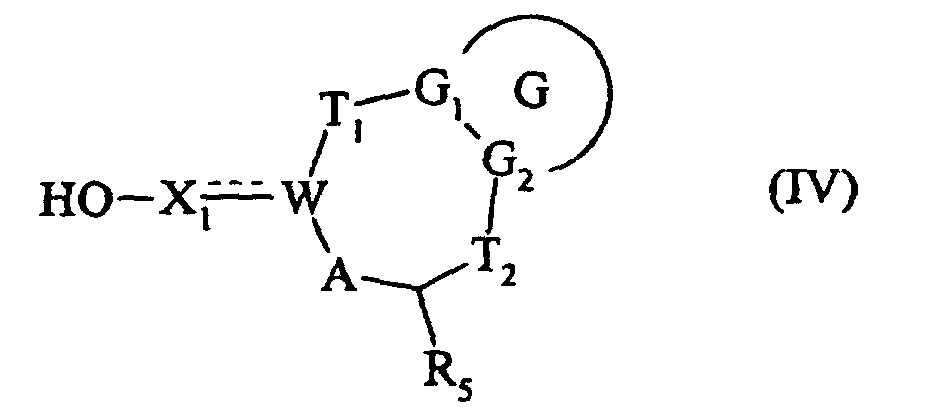
qui est soumis à une réaction d'halogénation, pour conduire au composé de formule (V) :

qui est traité, en milieu basique, par un composé de formule Z-Y-OH dans laquelle Z et Y ont la même signification que dans la formule (I), pour conduire au composé de formule (I/a) :

ou bien qui est traité, en milieu basique, par un composé de formule Z-Y-SH, dans laquelle Z et Y ont la même signification que dans la formule (I), pour conduire au composé de formule (I/b) :

dont l'atome de soufre peut être oxydé pour conduire un composé de formule (I/c) :
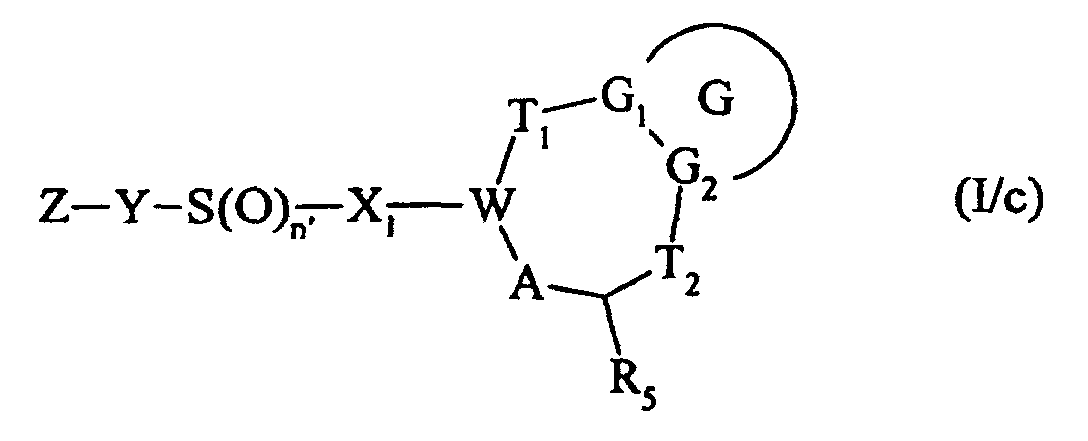
ou bien,
composé de formule (V), qui soumis à l'action d'une imide cyclique en milieu basique, suivi d'un traitement par l'hydrazine en milieu alcoolique, conduit à l'amine de formule (VI) :

composé de formule (VI) pouvant par ailleurs être obtenu directement lorsque X1 représente un groupement CH2, par réduction du composé de formule (II/a) dans laquelle R représente un groupemnet CN,
composé de formule (VI) qui est traité par un composé de formule (VII) :

pour conduire au composé de formule (I/d) :
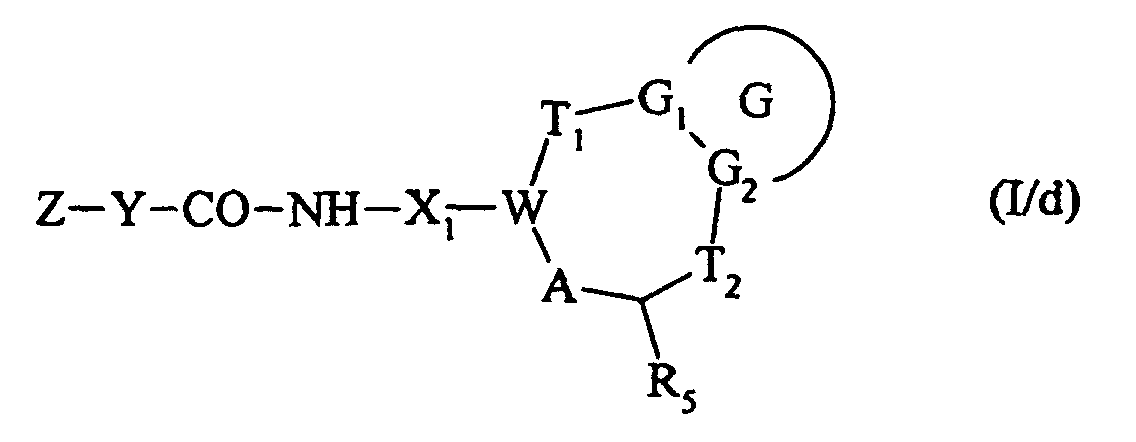
ou bien qui est traité par un chlorure de sulfonyle de formule Z-Y-SO2-Cl, dans laquelle Z et Y sont tels que définis dans la formule (I), pour conduire à un composé de formule (I/e) :

ou bien, composé de formule (III), dont le groupement Ra est transformé en acide correspondant pour conduire au composé de formule (VIII) :

qui est soit soumis à l'action d'une amine de formule Z-Y-NH2 ou du sel correspondant, pour conduire à un composé de formule (I/f) :

soit à l'action d'une amine de formule :

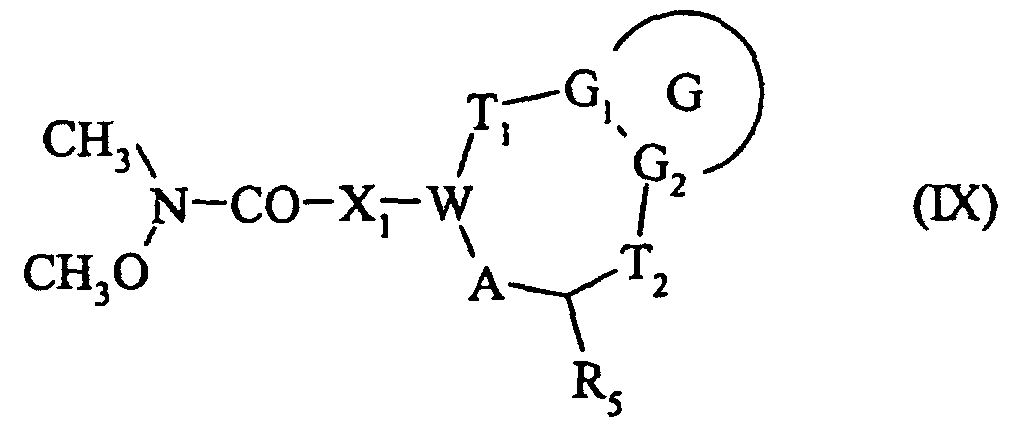
qui est ensuite soumis à l'action d'un dérivé lithié de formule Z-Y-Li dans laquelle Y et Z sont tels que définis dans la formule (I), pour conduire au composé de formule (I/g) :

composés (I/a) à (I/g) formant la totalité des composés de formule (I),
- qui peuvent être, le cas échéant, purifiés selon une technique classique de purification,
- dont on sépare, le cas échéant, les stéréoisomères selon une technique classique de séparation,
- que l'on transforme, si on le souhaite, en leurs sels d'addition à un acide ou à une base pharmaceutiquement acceptable.

que l'on condense, en milieu basique ou en présence d'un catalyseur, sur un composé de formule (XI) :


pour conduire au composé de formule (I/i), cas particulier des composés de formule (I) :

- qui peut être, le cas échéant, purifié selon une technique classique de purification,
- dont on sépare, le cas échéant, les stéréoisomères selon une technique classique de séparation,
- que l'on transforme, si on le souhaite, en ses sels d'addition à un acide ou à une base pharmaceutiquement acceptable.


pour conduire à un composé de formule (5) :

qui est traité :
- soit par le chlorométhyltriméthylsilane en milieu basique, pour conduire après un
réarrangement en présence de silice à un composé de formule (6-II/a) :
cas particulier des composés de formule (II/a) pour lequel R6 est tel que défini dans formule (I),

- soit par le méthyllithium, pour conduire après déshydratation au composé (7) :
dans laquelle R6 est tel que défini précédemment,


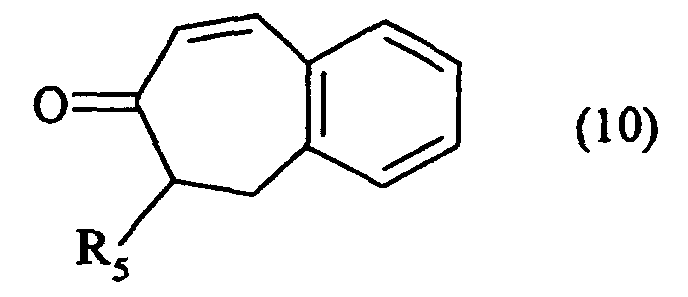
composé (10) qui est soumis à l'action du monoxyde de carbone en présence de base dans un milieu THF/eau pour conduire au composé (11-II/a) :


composé (12) qui peut subir une réaction de dihalogénation, pour conduire après élimination au composé de formule (13) :

qui est traité :
- soit par un cétène acétal de formule (4) telle que définie précédemment, en présence de
sels de mercure, pour conduire à un composé de formule (14) :
dans laquelle R6 est tel que défini dans la formule (I) et Hal représente un atome d'halogène,


- soit par un malonate de dialkyle, en milieu basique, pour conduire après chauffage au
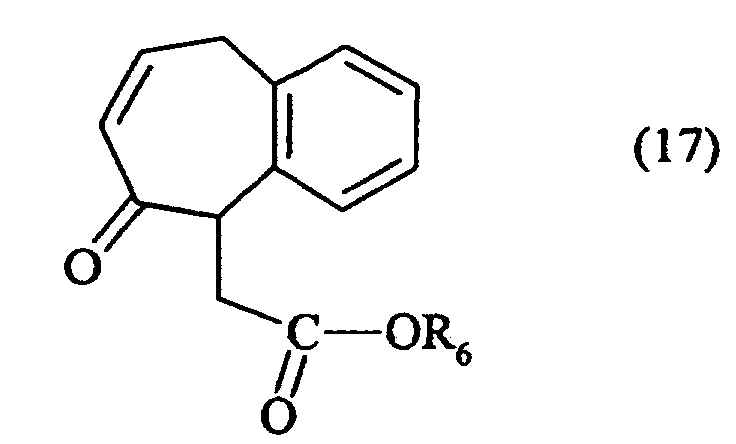
composé de formule (17) :
dans laquelle R6 représente un groupement alkyle,

Le milieu réactionnel est alors lavé avec une solution d'H2SO4 (0,1 N), puis H2O. Après séchage et concentration sous pression réduite, le composé obtenu est remis en solution dans un mélange CH2Cl2 (15,5 ml)/Et2O (21,5 ml), puis on ajoute PBr3 (9 g ; 3,36 mol) à 0°C. Le milieu réactionnel est ensuite agité quelques minutes à température ambiante puis à reflux pendant 30 minutes puis versé sur un mélange Et2O/glace. La phase Et2O est extraite et lavée avec une solution aqueuse saturée en NaCl. Après concentration et séchage ; on obtient un résidu que l'on chromatographie sur gel de silice, (éluant : heptane/Et2O) pour obtenir le produit du titre.
| Microanalyse élémentaire : C24H30N2O9, HCl | |||
| C | H | N | |
| % Calculé | 66,88 | 7,25 | 6,50 |
| % Trouvé | 66,77 | 7,22 | 7,15 |
| Microanalyse élémentaire : C23H28N2O3, HCl (0,8 mol) | |||
| C | H | N | |
| % Calculé | 67,43 | 7,09 | 6,84 |
| % Trouvé | 67,53 | 6,92 | 6,88 |
| Microanalyse élémentaire : C22H26N2O3, HCl (1,3 mol) | |||
| C | H | N | |
| % Calculé | 63,84 | 6,65 | 6,77 |
| % Trouvé | 63,81 | 6,66 | 6,78 |
| Microanalyse élémentaire : C27H28N2O3, HCl (1,2 mol) | ||||
| C | H | N | Cl | |
| % Calculé | 68,66 | 6,23 | 5,93 | 9,0 |
| % Trouvé | 68,51 | 6,04 | 6,11 | 7,73 |
| Microanalyse élémentaire : C23H25N3O3, C2HF3O2 (1,3 mol) | |||
| C | H | N | |
| % Calculé | 56,97 | 4,91 | 7,79 |
| % Trouvé | 56,82 | 4,87 | 7,60 |
| Microanalyse élémentaire : C24H27N3O3, C2HF3O2 (1,3 mol) | |||
| C | H | N | |
| % Calculé | 57,7 | 5,15 | 7,59 |
| % Trouvé | 57,36 | 4,99 | 7,57 |
| Microanalyse élémentaire : C22H23N3O3, C2HF3O2 (1,1mol) | |||
| C | H | N | |
| % Calculé | 57,80 | 4,84 | 8,36 |
| % Trouvé | 57,41 | 4,89 | 8,25 |
| Microanalyse élémentaire : C28H27N3O3, C2HF3O2 | |||
| C | H | N | |
| % Calculé | 59,61 | 4,61 | 6,73 |
| % Trouvé | 59,75 | 5,12 | 6,29 |
| Microanalyse élémentaire : C23H25N3O3, HCl | ||||
| C | H | N | Cl | |
| % Calculé | 64,01 | 6,10 | 9,74 | 9,04 |
| % Trouvé | 63,67 | 6,02 | 9,43 | 8,42 |
| Microanalyse élémentaire : C25H26N4O3, HCl | ||||
| C | H | N | Cl | |
| % Calculé | 64,30 | 5,83 | 12,00 | 7,59 |
| % Trouvé | 64,34 | 5,81 | 11,90 | 7,38 |
| Microanalyse élémentaire : C22H25N3O3, C2HF3O2 | |||
| C | H | N | |
| % Calculé | 58,41 | 5,31 | 8,51 |
| % Trouvé | 58,45 | 5,31 | 8,24 |
| 24a) (+) Microanalyse élémentaire: C23H27N3O3, 1,5 HCl | ||||
| C | H | N | Cl | |
| % Calculé | 61,63 | 6,42 | 9,38 | 11,86 |
| % Trouvé | 61,60 | 6,33 | 9,23 | 11,04 |
| 24b) (-) Microanalyse élémentaire : C23H27N3O3, HCl | ||||
| C | H | N | Cl | |
| % Calculé | 64,25 | 6,56 | 9,77 | 8,25 |
| % Trouvé | 64,14 | 6,17 | 9,55 | 9,18 |
| Microanalyse élémentaire : C24H29N3O3, 2 HCl | ||||
| C | H | N | Cl | |
| % Calculé | 60,00 | 6,50 | 8,75 | 14,76 |
| % Trouvé | 59,68 | 6,51 | 8,61 | 14,15 |
| Microanalyse élémentaire : C27H27N3O3, C2HF3O2 (1,3 mol) | |||
| C | H | N | |
| % Calculé | 60,28 | 4,85 | 7,13 |
| % Trouvé | 61,53 | 5,07 | 7,15 |
| Microanalyse élémentaire : C25H28N4O3, HCl | ||||
| C | H | N | Cl | |
| % Calculé | 64,03 | 6,23 | 11,95 | 7,56 |
| % Trouvé | 63,66 | 6,29 | 11,82 | 7,72 |
| Microanalyse élémentaire : C21H28N4O3, 1,25HCl | ||||
| C | H | N | Cl | |
| % Calculé | 54,75 | 7,40 | 12,17 | 9,69 |
| % Trouvé | 55,80 | 6,87 | 12,04 | 9,27 |
| Microanalyse élémentaire : C22H30N4O3, HCl | ||||
| C | H | N | Cl | |
| % Calculé | 60,75 | 7,18 | 12,88 | 8,15 |
| % Trouvé | 61,02 | 7,07 | 12,65 | 8,38 |
| Microanalyse élémentaire : C26H30N4O4, HCl | ||||
| C | H | N | Cl | |
| % Calculé | 62,58 | 6,29 | 11,23 | 7,10 |
| % Trouvé | 61,96 | 6,09 | 11,03 | 7,69 |
| Microanalyse élémentaire : C25H28N4O3, 2HCl | ||||
| C | H | N | Cl | |
| % Calculé | 59,41 | 5,98 | 11,08 | 14,03 |
| % Trouvé | 59,64 | 5,93 | 10,95 | 14,27 |
| Microanalyse élémentaire : C26H31N3O3, 1,2 HCl | ||||
| C | H | N | Cl | |
| % Calculé | 65,42 | 6,81 | 8,81 | 8,91 |
| % Trouvé | 64,93 | 6,40 | 8,76 | 7,83 |
| Microanalyse élémentaire : C21H25N3O3S, HCl | |||||
| C | H | N | S | Cl | |
| % Calculé | 56,90 | 5,97 | 9,48 | 7,23 | 9,60 |
| % Trouvé | 56,85 | 5,90 | 9,26 | 7,13 | 9,19 |
| Formule de préparation pour 1000 comprimés dosés à 10 mg | |
| Composé de l'exemple 24 | 10 g |
| Hydroxypropylcellulose | 2 g |
| Amidon de blé | 10 g |
| Lactose | 100 g |
| Stéarate de magnésium | 3 g |
| Talc | 3 g |
Claims (22)
- Composés de formule (I) :dans laquelle :
 étant entendu que :G représente un groupement phényle,

- Composés de formule (I) selon la revendication 1 pour lesquels R5 représente un groupement -CH2-COOR6, leurs énantiomères, diastéréoisomères ainsi que leurs sels d'addition à un acide ou à une base pharmaceutiquement acceptable.
- Composés de formule (I) selon la revendication 1 pour lesquels X est choisi parmi -CO-NR6-X1, -NR6-CO-X1 et -O-X1, leurs énantiomères, diastéréoisomères ainsi que leurs sels d'addition à un acide ou à une base pharmaceutiquement acceptable.
- Composés de formule (I) selon la revendication 1 pour lesquels Y représente un groupement Y1 ou Y1-Y2-Y1, leurs énantiomères, diastéréoisomères ainsi que leurs sels d'addition à un acide ou à une base pharmaceutiquement acceptable.
- Composés de formule (I) selon la revendication 1 pour lesquels Z représente un groupement hétéroaryle, hétérocycloalkyle, arylhétéroaryle fusionné ou hétérocycloalkylhétéroaryle fusionné, leurs énantiomères, diastéréoisomères ainsi que leurs sels d'addition à un acide ou à une base pharmaceutiquement acceptable.
- Composés de formule (I) selon la revendication 1 pour lesquels Z représente un groupement Z10-NR6, leurs énantiomères, diastéréoisomères ainsi que leurs sels d'addition à un acide ou à une base pharmaceutiquement acceptable.
- Composés de formule (I) selon la revendication 1 pour lesquels G représente un groupement phényle, G1 et G2 étant chacun un atome de carbone, R5 représente un groupement -CH2-COOR6, R6 étant choisi parmi un atome d'hydrogène et un groupement alkyle, T2 représente une liaison, T1 représente un groupement choisi parmi -CH=CH-, et =CH-CH2-, A représente un groupement -CH2-, ou =CH- et W représente un groupement -CH- ou -C=, leurs énantiomères, diastéréoisomères ainsi que leurs sels d'addition à un acide ou à une base pharmaceutiquement acceptable.
- Composés de formule (I) selon la revendication 7 pour lesquels X est choisi parmi les groupements -CO-NR6-X1-, -NR6-CO-X1-, et -O-X1-, X1 étant un groupement méthylène, Y représente un groupement -Y1- ou -Y1-Y2-Y1 dans lesquels Y1 est un groupement alkylène et Y2 représente un groupement arylène, et Z représente un groupement hétéroaryle, hétérocycloalkyle, arylhétéroaryle fusionné, hétérocycloalkylhétéroaryle fusionné ou Z10-NR6 dans lequel Z10 représente un groupement choisi parmi les groupements hétéroaryle, hétérocycloalkyle, arylhétéroaryle fusionné et hétérocycloalkylhétéroaryle fusionné, R6 étant un atome d'hydrogène, leurs énantiomères, diastéréoisomères ainsi que leurs sels d'addition à un acide ou à une base pharmaceutiquement acceptable.
- Composé de formule (I) qui est l'acide [7-({[4-(2-pyridinylamino)butanoyl]amino} méthyl)-6,9-dihydro-5H-benzo[a]cycloheptèn-5-yl]acétique.
- Composé de formule (I) qui est l'acide [7-({[5-(2-pyridinylamino)pentanoyl]amino} méthyl)-6,9-dihydro-5H-benzo[a]cycloheptèn-5-yl]acétique, chlorhydrate.
- Composé de formule (I) qui est l'acide [7-(2-oxo-2-{[3-(2-pyridinylamino)propyl] amino}éthyl)-5H-benzo[a]cycloheptèn-5-yl]acétique.
- Composé de formule (I) qui est l'acide [7-({[4-(4,5-dihydro-1H-imidazol-2-ylamino) butanoyl]amino}méthyl)-6,9-dihydro-5H-benzo[a]cycloheptèn-5-yl]acétique, chlorhydrate.
- Composé de formule (I) qui est l'acide [7-({[4-(2-pyridinylamino)butanoyl]amino} méthyl)-5H-benzo[a]cycloheptèn-5-yl]acétique.
- Composé de formule (I) qui est l'acide [7-({[4-(1H-benzimidazol-2-ylamino)butanoyl] amino}méthyl)-5H-benzo[a]cycloheptèn-5-yl]acétique.
- Composé de formule (I) qui est l'acide [7-({[4-(1H-benzimidazol-2-ylamino)butanoyl] amino}méthyl)-6,9-dihydro-5H-benzo[a]cycloheptèn-5-yl]acétique.
- Composé de formule (I) qui est l'acide [7-({[4-(1,4,5,6-tétrahydro-2-pyrimidinylamino) butanoyl]amino}méthyl)-6,9-dihydro-5H-benzo[a]cycloheptèn-5-yl]acétique, chlorhydrate.
- Composé de formule (I) qui est l'acide [7-({[4-(5,6,7,8-tétrahydro[1,8]naphtyridin-2-yl) butanoyl]amino}méthyl)-6,9-dihydro-5H-benzo[a]cycloheptén-5-yl]acétique, chlorhydrate.
- Procédé de préparation des composés de formule (I) selon la revendication 1 caractérisé en ce que l'on utilise comme produit de départ un composé de formule (II/a):dans laquelle G, G1, G2, T1, T2 et R5 ont la même signification que dans la formule (I), W et A sont tels que définis précédemment, et R représente un groupement CHO, CN ou AlkOOC-CH=,

qui lorsque R représente un groupement formyle, est soumis à une réaction de Wittig ou d'Homer Emons de façon à homologuer la chaíne portant la fonction aldéhyde, en utilisant le réactif approprié, pour conduire au composé de formule (III/a) :dans laquelle G, G1, G2, T1, T2, R5, A et W sont tels que définis précédemment, X'1 représente un groupement alkylène ou alkénylène de deux à six atomes de carbone et Ra représente un groupement cyano, formyle, ou alkoxycarbonyle en fonction du réactif choisi,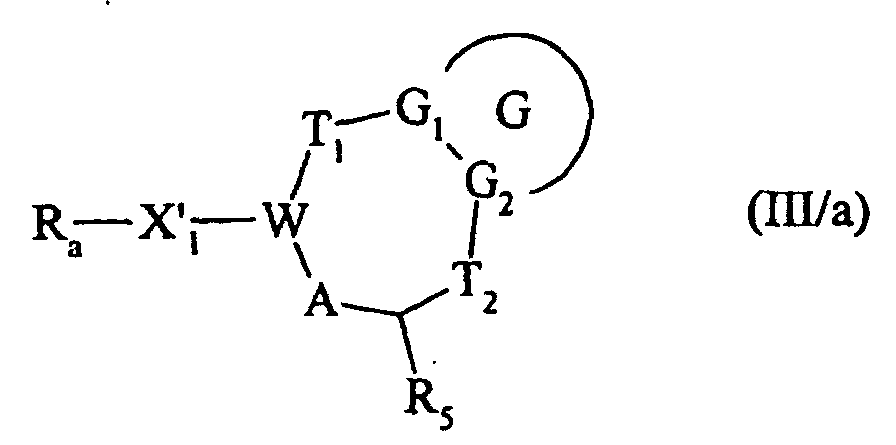
composé (III/a) qui, avec les composés de formule (III/b) :cas particulier des composés de formule (II/a) pour lequel G, G1, G2, T1, T2, R5, W et A sont tels que définis précédemment, et Alk représente un groupement alkyle, les pointillés indiquant la présence éventuelle d'une double liaison,
forment l'ensemble des composés de formule (III) :dans laquelle G, G1, G2, T1, T2, W, A et Ra sont tels que définis précédemment, et X1 a la même signification que dans la formule (I),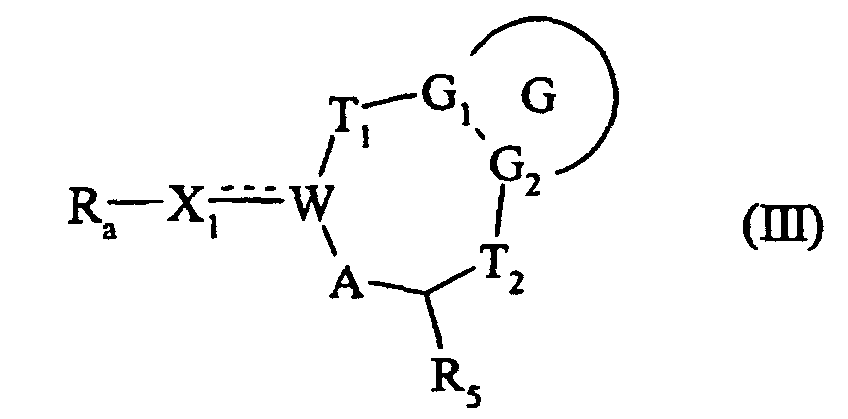
composé (III) dont le groupement Ra est soit réduit en alcool, ou déprotégé lorsqu'il représente un groupement hydroxy masqué, pour conduire au composé de formule (IV) :dans laquelle G, G1, G2, T1, T2, R5, W, A et X1 sont tels que définis dans la formule (I),
qui est soumis à une réaction d'halogénation, pour conduire au composé de formule (V) :dans laquelle G, G1, G2, T1, T2, R5, A, W et X1 sont tels que définis précédemment, et Hal représente un atome d'halogène,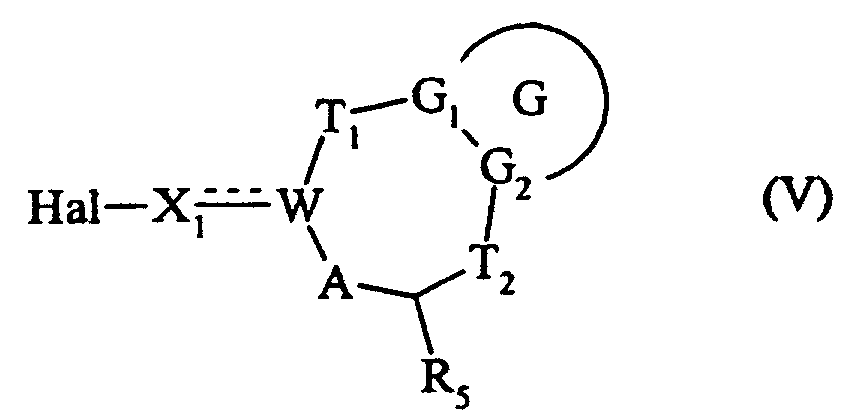
qui est traité, en milieu basique, par un composé de formule Z-Y-OH dans laquelle Z et Y ont la même signification que dans la formule (I), pour conduire au composé de formule (I/a) :cas particulier des composés de formule (I) pour lequel G, G1, G2, T1, T2, R5, X1, W, A, Y et Z sont tels que définis dans la formule (I),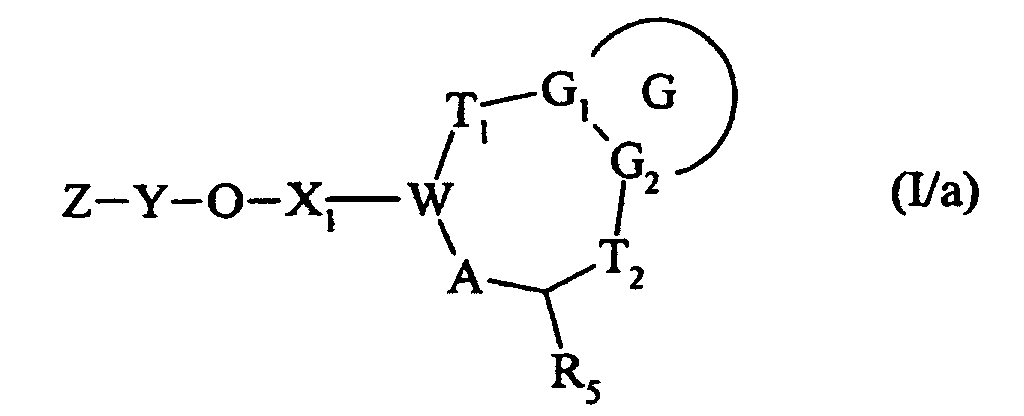
ou bien qui est traité, en milieu basique, par un composé de formule Z-Y-SH, dans laquelle Z et Y ont la même signification que dans la formule (I), pour conduire au composé de formule (I/b) :cas particulier des composés de formule (I) pour lequel G, G1, G2, T1, T2, R5, X1, W, A, Y et Z sont tels que définis dans la formule (I),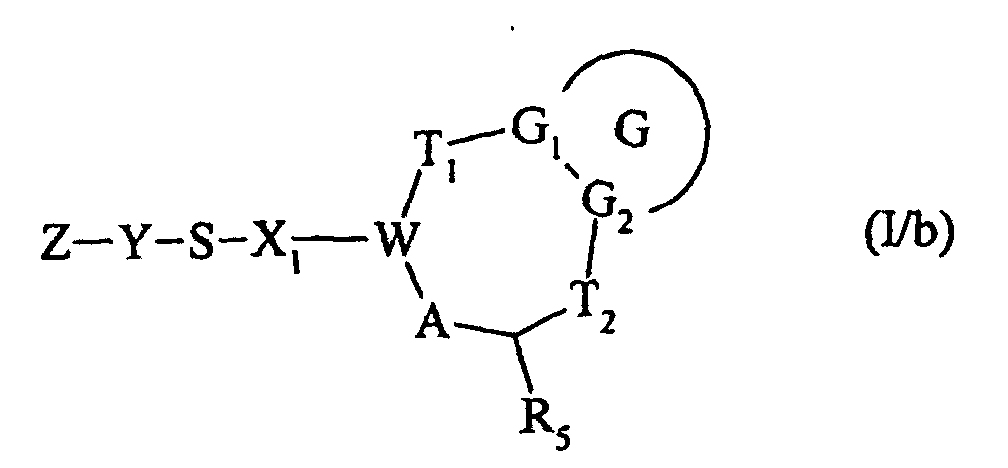
dont l'atome de soufre peut être oxydé pour conduire un composé de formule (I/c) :cas particulier des composés de formule (I) pour lequel G, G1, G2, T1, T2, R5, X1, W, A, Y et Z sont tels que définis dans la formule (I), et n' représente un entier égal à 1 ou 2,
ou bien,
composé de formule (V), qui soumis à l'action d'une imide cyclique en milieu basique, suivi d'un traitement par l'hydrazine en milieu alcoolique, conduit à l'amine de formule (VI) :dans laquelle G, G1, G2, T1, T2, R5, X1, A et W sont tels que définis précédemment,
composé de formule (VI) pouvant par ailleurs être obtenu directement lorsque X1 représente un groupement CH2, par réduction du composé de formule (II/a) dans laquelle R représente un groupemnet CN,
composé de formule (VI) qui est traité par un composé de formule (VII) :dans laquelle Z et Y sont tels que définis dans la formule (I),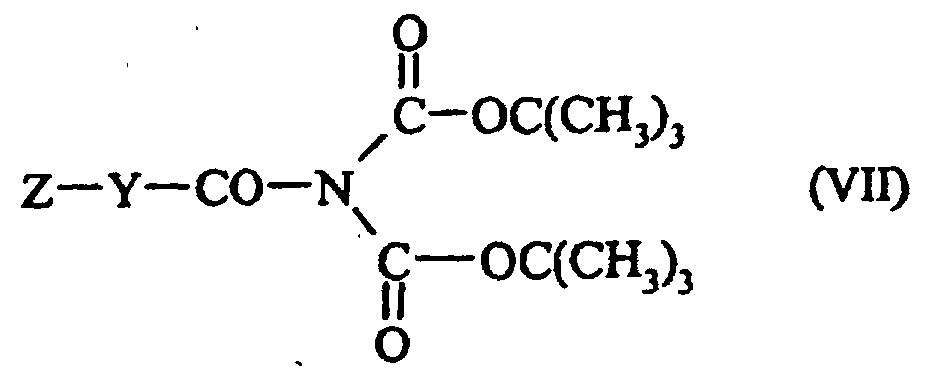
pour conduire au composé de formula (I/d) :cas particulier des composés de formule (I) pour lequel G, G1, G2, T1, T2, R5, X1, A, W, Z et Y sont tels que définis dans la formule (I),
ou bien qui est traité par un chlorure de sulfonyle de formule Z-Y-SO2-Cl, dans laquelle Z et Y sont tels que définis dans la formule (I), pour conduire à un composé de formule (I/e) :cas particulier des composés de formule (I) pour lequel G, G1, G2, T1, T2, R5, X1, A, W, Z et Y sont tels que définis précédemment dans la formule (I), qui est soit soumis à l'action d'une amine de formule Z-Y-NH2 ou du sel correspondant, pour conduire à un composé de formule (I/f) :ou bien, composé de formule (III), dont le groupement Ra est transformé en acide correspondant pour conduire au composé de formule (VIII) :dans laquelle G, G1, G2, T1, T2, R5, W, A et X1 sont tels que définis dans la formule (I),
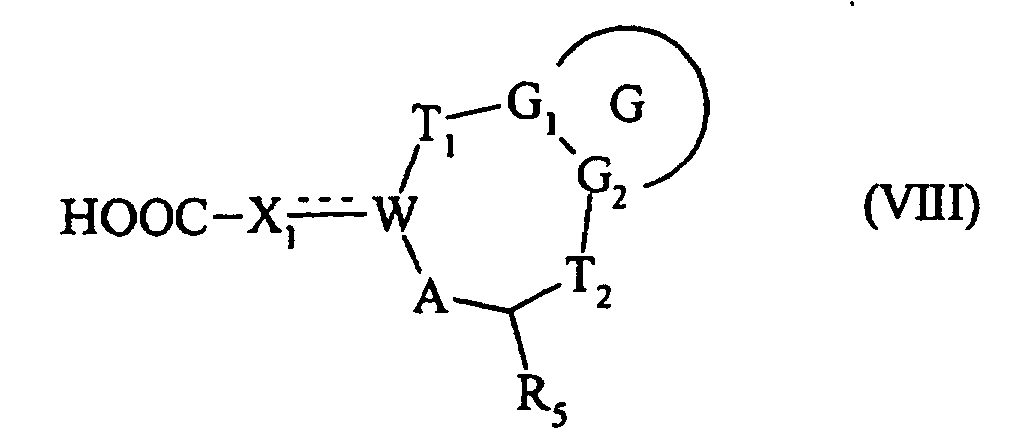 cas particulier des composés de formule (I) pour lequel G, G1, G2, T1, T2, R5, A, W, X1, Z et Y sont tels que définis dans la formule (I),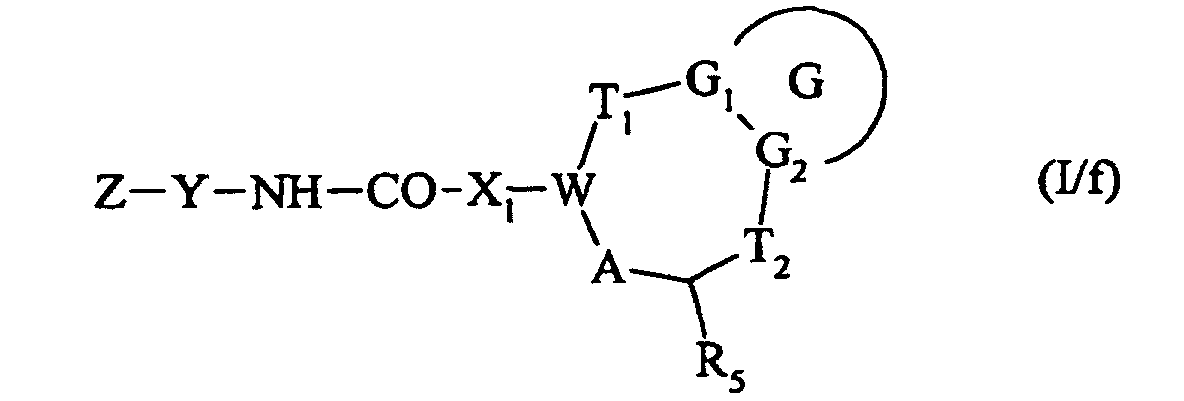
soit à l'action d'une amine de formule :pour conduire au composé de formule (IX) :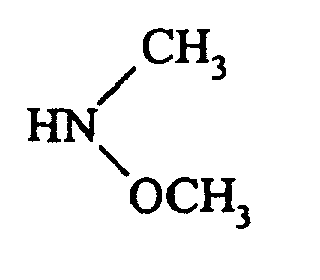 dans laquelle G, G1, G2, T1, T2, R5, A, W et X1 sont tels que définis précédemment,
qui est ensuite soumis à l'action d'un dérivé lithié de formule Z-Y-Li dans laquelle Y et Z sont tels que définis dans la formule (I), pour conduire au composé de formule (I/g) :cas particulier des composés de formule (I) pour lequel G, G1, G2, T1, T2, X1, W, A, Z et Y sont tels que définis dans la formule (I),
composés (I/a) à (I/g) formant la totalité des composés de formule (I),qui peuvent être, le cas échéant, purifiés selon une technique classique de purification,dont on sépare, le cas échéant, les stéréoisomères selon une technique classique de séparation,que l'on transforme, si on le souhaite, en leurs sels d'addition à un acide ou à une base pharmaceutiquement acceptable. - Procédé de préparation des composés de formule (I) selon la revendication 1 pour lesquels Z représente un groupement Z10NR6, caractérisé en ce que l'on utilise comme produit de départ un composé de formule (X) :dans laquelle Y, X, W, T1, G, G1, G2, T2, A, R5 et R6 sont tels que définis dans la formule (I),

que l'on condense, en milieu basique ou en présence d'un catalyseur, sur un composé de formule (XI) :dans laquelle Z10 est tel que défini dans la formule (I) et représente un groupe partant (par exemple un atome d'halogène, un groupement tosyle ou un groupement méthylthio ou thioxo),
pour conduire au composé de formule (I/i), cas particulier des composés de formule (I) :dans laquelle Z10, R6 Y, X, W, A, T1, T2, G1, G2, R5 et G sont tels que définis précédemment, qui peut être, le cas échéant, purifié selon une technique classique de purification,dont on sépare, le cas échéant, les stéréoisomères selon une technique classique de séparation,que l'on transforme, si on le souhaite, en ses sels d'addition à un acide ou à une base pharmaceutiquement acceptable.
 - Compositions pharmaceutiques contenant comme principe actif au moins un composé selon l'une quelconque des revendications 1 à 17 seul ou en combinaison avec un ou plusieurs excipients ou véhicules inertes, non toxiques, pharmaceutiquement acceptables.
- Compositions pharmaceutiques selon la revendication 20 contenant au moins un principe actif selon l'une quelconque des revendications 1 à 17 utiles dans la préparation de médicaments utiles comme antagonistes des récepteurs de la vitronectine, dans le traitement des maladies cardiovasculaires, des maladies inflammatoires, du cancer, de l'ostéoporose, de l'arthrite rhumatoïde, du psoriasis et des rétinopathies.
- Compositions pharmaceutiques selon la revendication 20 contenant au moins un principe actif selon l'une quelconque des revendications 1 à 17 utiles dans la préparation de médicaments utiles comme inhibiteurs de croissance tumorale et des formations de métastases dans le traitement du cancer.
Priority Applications (1)
| Application Number | Priority Date | Filing Date | Title |
|---|---|---|---|
| SI200130167T SI1268429T1 (en) | 2000-03-07 | 2001-03-06 | Vitronectin receptor antagonist bicyclic compounds, preparation method and compositions containing same |
Applications Claiming Priority (3)
| Application Number | Priority Date | Filing Date | Title |
|---|---|---|---|
| FR0002902A FR2806082B1 (fr) | 2000-03-07 | 2000-03-07 | Nouveaux composes bicycliques antagonistes des recepteurs de la vitronectine, leur procede de preparation et les compositions pharmaceutiques qui les contiennent |
| FR0002902 | 2000-03-07 | ||
| PCT/FR2001/000650 WO2001079172A1 (fr) | 2000-03-07 | 2001-03-06 | Composes bicycliques antagonistes des recepteurs de la vitronectine, leur procede de preparation et les compositions qui les contiennent |
Publications (2)
| Publication Number | Publication Date |
|---|---|
| EP1268429A1 EP1268429A1 (fr) | 2003-01-02 |
| EP1268429B1 true EP1268429B1 (fr) | 2004-08-18 |
Family
ID=8847803
Family Applications (1)
| Application Number | Title | Priority Date | Filing Date |
|---|---|---|---|
| EP01969041A Expired - Lifetime EP1268429B1 (fr) | 2000-03-07 | 2001-03-06 | Composes bicycliques antagonistes des recepteurs de la vitronectine, leur procede de preparation et les compositions qui les contiennent |
Country Status (27)
| Country | Link |
|---|---|
| US (1) | US6846833B2 (fr) |
| EP (1) | EP1268429B1 (fr) |
| JP (1) | JP3974780B2 (fr) |
| KR (1) | KR100530523B1 (fr) |
| CN (1) | CN1216866C (fr) |
| AR (1) | AR029485A1 (fr) |
| AT (1) | ATE273957T1 (fr) |
| AU (2) | AU2001293374B2 (fr) |
| BR (1) | BR0108998A (fr) |
| CA (1) | CA2402686C (fr) |
| CZ (1) | CZ301808B6 (fr) |
| DE (1) | DE60105001T2 (fr) |
| DK (1) | DK1268429T3 (fr) |
| EA (1) | EA005155B1 (fr) |
| ES (1) | ES2227265T3 (fr) |
| FR (1) | FR2806082B1 (fr) |
| HK (1) | HK1052345B (fr) |
| HU (1) | HU229343B1 (fr) |
| MX (1) | MXPA02008633A (fr) |
| NO (1) | NO324052B1 (fr) |
| NZ (1) | NZ520805A (fr) |
| PL (1) | PL356886A1 (fr) |
| PT (1) | PT1268429E (fr) |
| SI (1) | SI1268429T1 (fr) |
| SK (1) | SK286882B6 (fr) |
| WO (1) | WO2001079172A1 (fr) |
| ZA (1) | ZA200206354B (fr) |
Families Citing this family (4)
| Publication number | Priority date | Publication date | Assignee | Title |
|---|---|---|---|---|
| FR2806082B1 (fr) * | 2000-03-07 | 2002-05-17 | Adir | Nouveaux composes bicycliques antagonistes des recepteurs de la vitronectine, leur procede de preparation et les compositions pharmaceutiques qui les contiennent |
| PL2303264T3 (pl) * | 2008-06-09 | 2018-08-31 | Allergan, Inc. | Sposoby leczenia stanów pośredniczonych alfa-adrenergicznie z użyciem pochodnych imidazoliny |
| US9034910B2 (en) | 2008-06-09 | 2015-05-19 | Allergan, Inc. | Methods of treating alpha adrenergic mediated conditions |
| KR102281647B1 (ko) | 2020-12-09 | 2021-07-30 | 메디케어제약 주식회사 | 피페라진-퀴놀린 유도체의 제조방법 |
Family Cites Families (15)
| Publication number | Priority date | Publication date | Assignee | Title |
|---|---|---|---|---|
| US6403578B1 (en) * | 1993-12-21 | 2002-06-11 | Smithkline Beecham Corporation | Bicyclic fibrinogen antagonists |
| EP0767792A4 (fr) * | 1994-06-29 | 2002-11-20 | Smithkline Beecham Corp | Antagonistes du recepteur de la vitronectine |
| JPH10504825A (ja) * | 1994-08-22 | 1998-05-12 | スミスクライン・ビーチャム・コーポレイション | 二環式化合物 |
| EP0796855B1 (fr) * | 1996-03-20 | 2002-02-06 | Hoechst Aktiengesellschaft | Inhibiteurs de la résorption osseuse et antagonistes du récepteur de la vitronectine |
| UA60311C2 (uk) * | 1996-10-02 | 2003-10-15 | Смітклайн Бічам Корпорейшн | Антагоністи рецептора вітронектину, спосіб одержання цих сполук та фармацевтична композиція |
| CO4920232A1 (es) * | 1997-01-08 | 2000-05-29 | Smithkline Beecham Corp | Acidos aceticos dibenzo [a,d] cicloheptano con actividad antagonista del receptor de vitronectin |
| US6559144B2 (en) * | 1997-02-13 | 2003-05-06 | Merck Patent Gesellschaft Mit | Bicyclic amino acids |
| JP2002510328A (ja) * | 1997-07-25 | 2002-04-02 | スミスクライン・ビーチャム・コーポレイション | ビトロネクチン受容体アンタゴニスト |
| DZ2609A1 (fr) * | 1997-09-19 | 2003-03-01 | Smithkline Beecham Corp | Composés nouveaux antagonistes des récepteurs de vitronectine et compositions pharmaceutiques les contenant. |
| US6524553B2 (en) * | 1998-03-31 | 2003-02-25 | Bristol-Myers Squibb Pharma Company | Quinolone vitronectin receptor antagonist pharmaceuticals |
| EP0960882A1 (fr) * | 1998-05-19 | 1999-12-01 | Hoechst Marion Roussel Deutschland GmbH | Acylguanidines de thienyl et leur utilisation comme inhibiteurs de la résorptionosseuse et comme antagonistes du récepteur de la vitronectine |
| FR2786182B1 (fr) * | 1998-11-24 | 2001-01-12 | Hoechst Marion Roussel Inc | Nouveaux derives d'acylguanidines, leur procede de preparation, leur application comme medicaments et les compositions pharmaceutiques les renfermant |
| DE19916837A1 (de) * | 1999-04-14 | 2000-10-19 | Merck Patent Gmbh | Dibenzoazulenderivate |
| US6514964B1 (en) * | 1999-09-27 | 2003-02-04 | Amgen Inc. | Fused cycloheptane and fused azacycloheptane compounds and their methods of use |
| FR2806082B1 (fr) * | 2000-03-07 | 2002-05-17 | Adir | Nouveaux composes bicycliques antagonistes des recepteurs de la vitronectine, leur procede de preparation et les compositions pharmaceutiques qui les contiennent |
-
2000
- 2000-03-07 FR FR0002902A patent/FR2806082B1/fr not_active Expired - Fee Related
-
2001
- 2001-03-06 DE DE60105001T patent/DE60105001T2/de not_active Expired - Lifetime
- 2001-03-06 JP JP2001576773A patent/JP3974780B2/ja not_active Expired - Fee Related
- 2001-03-06 HU HU0300181A patent/HU229343B1/hu not_active IP Right Cessation
- 2001-03-06 SK SK1270-2002A patent/SK286882B6/sk not_active IP Right Cessation
- 2001-03-06 PT PT01969041T patent/PT1268429E/pt unknown
- 2001-03-06 KR KR10-2002-7011689A patent/KR100530523B1/ko not_active Expired - Fee Related
- 2001-03-06 AU AU2001293374A patent/AU2001293374B2/en not_active Ceased
- 2001-03-06 DK DK01969041T patent/DK1268429T3/da active
- 2001-03-06 CZ CZ20022992A patent/CZ301808B6/cs not_active IP Right Cessation
- 2001-03-06 AU AU9337401A patent/AU9337401A/xx active Pending
- 2001-03-06 EA EA200200878A patent/EA005155B1/ru not_active IP Right Cessation
- 2001-03-06 ES ES01969041T patent/ES2227265T3/es not_active Expired - Lifetime
- 2001-03-06 SI SI200130167T patent/SI1268429T1/xx unknown
- 2001-03-06 HK HK03104528.0A patent/HK1052345B/zh not_active IP Right Cessation
- 2001-03-06 AT AT01969041T patent/ATE273957T1/de active
- 2001-03-06 NZ NZ520805A patent/NZ520805A/xx not_active IP Right Cessation
- 2001-03-06 BR BR0108998-6A patent/BR0108998A/pt not_active IP Right Cessation
- 2001-03-06 WO PCT/FR2001/000650 patent/WO2001079172A1/fr not_active Ceased
- 2001-03-06 MX MXPA02008633A patent/MXPA02008633A/es active IP Right Grant
- 2001-03-06 CA CA002402686A patent/CA2402686C/fr not_active Expired - Fee Related
- 2001-03-06 EP EP01969041A patent/EP1268429B1/fr not_active Expired - Lifetime
- 2001-03-06 CN CN018060986A patent/CN1216866C/zh not_active Expired - Fee Related
- 2001-03-06 PL PL01356886A patent/PL356886A1/xx not_active Application Discontinuation
- 2001-03-06 US US10/220,755 patent/US6846833B2/en not_active Expired - Fee Related
- 2001-03-07 AR ARP010101058A patent/AR029485A1/es not_active Application Discontinuation
-
2002
- 2002-08-08 ZA ZA200206354A patent/ZA200206354B/en unknown
- 2002-09-06 NO NO20024275A patent/NO324052B1/no not_active IP Right Cessation
Also Published As
Similar Documents
| Publication | Publication Date | Title |
|---|---|---|
| JP4589529B2 (ja) | Xa因子阻害剤としてのインドール誘導体 | |
| JP2608341B2 (ja) | 縮合イミダゾール系化合物 | |
| EP0565396B1 (fr) | Dérivés de 1-[2-(arylsulfonylamino)-1-oxoéthyl]pipéridine, leur préparation et leur application en thérapeutique | |
| EP0803505A1 (fr) | Nouveaux inhibiteurs de métalloprotéases, leur procédé de préparation et les compositions pharmaceutiques qui les contiennent | |
| JP4991711B2 (ja) | 不飽和または環状リンカー基を含有するヘテロアリール置換アミドおよび医薬としてのその使用 | |
| JP2004502635A (ja) | 縮合シクロヘプタンおよび縮合アザシクロヘプタン化合物ならびにそれらの使用方法 | |
| OA12189A (en) | Vitronectin receptor antagonists. | |
| JP2001526266A (ja) | アゼピン又はそれ以上の中員環誘導体と医薬としてのそれらの使用 | |
| EP2368891A1 (fr) | Dérivés de pyrimidines en tant qu' antagonistes du récepteur de la vitronectine | |
| US20170217926A1 (en) | Ethynyl derivatives | |
| JP6089104B2 (ja) | アリールエチニル誘導体 | |
| EP1268429B1 (fr) | Composes bicycliques antagonistes des recepteurs de la vitronectine, leur procede de preparation et les compositions qui les contiennent | |
| EP0549407B1 (fr) | Nouveaux dérivés de pyrrolidine, leur procédé de préparation et les compositions pharmaceutiques qui les contiennent | |
| FR2758329A1 (fr) | Derives d'imidazole-4-butane boronique, leur preparation et leur utilisation en therapeutique | |
| EP1050534B1 (fr) | Nouveaux dérivés de 2,3-methano-aminoacides, leur procédé de préparation et les compositions pharmaceutiques qui les contiennent | |
| EP2917204B1 (fr) | Derives de 1h-indole-3-carboxamide et leurs utilisation comme antagonistes du p2y12 | |
| EP0916671B1 (fr) | Nouveaux inhibiteurs de métalloprotéases leur procédé de préparation et les compositions pharmaceutiques qui les contiennent | |
| WO1998022443A1 (fr) | Derives de n-(imidazolylbutyle) benzenesulfonamide ayant une activite antithrombotique | |
| JPWO2000059913A1 (ja) | 新規チアゾロベンゾイミダゾール誘導体 | |
| JPH03275664A (ja) | スルホニルアルキルカルボン酸誘導体 | |
| MXPA00008847A (en) | Vitronectin receptor antagonists |
Legal Events
| Date | Code | Title | Description |
|---|---|---|---|
| PUAI | Public reference made under article 153(3) epc to a published international application that has entered the european phase |
Free format text: ORIGINAL CODE: 0009012 |
|
| 17P | Request for examination filed |
Effective date: 20020809 |
|
| AK | Designated contracting states |
Kind code of ref document: A1 Designated state(s): AT BE CH CY DE DK ES FI FR GB GR IE IT LI LU MC NL PT SE TR |
|
| AX | Request for extension of the european patent |
Free format text: AL PAYMENT 20020809;LT PAYMENT 20020809;LV PAYMENT 20020809;MK PAYMENT 20020809;RO PAYMENT 20020809;SI PAYMENT 20020809 |
|
| 17Q | First examination report despatched |
Effective date: 20030314 |
|
| GRAP | Despatch of communication of intention to grant a patent |
Free format text: ORIGINAL CODE: EPIDOSNIGR1 |
|
| GRAS | Grant fee paid |
Free format text: ORIGINAL CODE: EPIDOSNIGR3 |
|
| GRAA | (expected) grant |
Free format text: ORIGINAL CODE: 0009210 |
|
| AK | Designated contracting states |
Kind code of ref document: B1 Designated state(s): AT BE CH CY DE DK ES FI FR GB GR IE IT LI LU MC NL PT SE TR |
|
| AX | Request for extension of the european patent |
Extension state: AL LT LV MK RO SI |
|
| REG | Reference to a national code |
Ref country code: GB Ref legal event code: FG4D Free format text: NOT ENGLISH |
|
| REG | Reference to a national code |
Ref country code: CH Ref legal event code: EP |
|
| REG | Reference to a national code |
Ref country code: IE Ref legal event code: FG4D Free format text: FRENCH |
|
| REF | Corresponds to: |
Ref document number: 60105001 Country of ref document: DE Date of ref document: 20040923 Kind code of ref document: P |
|
| REG | Reference to a national code |
Ref country code: CH Ref legal event code: NV Representative=s name: A. BRAUN, BRAUN, HERITIER, ESCHMANN AG PATENTANWAE |
|
| REG | Reference to a national code |
Ref country code: SE Ref legal event code: TRGR |
|
| REG | Reference to a national code |
Ref country code: PT Ref legal event code: SC4A Free format text: AVAILABILITY OF NATIONAL TRANSLATION Effective date: 20040831 |
|
| REG | Reference to a national code |
Ref country code: GR Ref legal event code: EP Ref document number: 20040403657 Country of ref document: GR |
|
| GBT | Gb: translation of ep patent filed (gb section 77(6)(a)/1977) |
Effective date: 20041209 |
|
| REG | Reference to a national code |
Ref country code: SI Ref legal event code: IF |
|
| REG | Reference to a national code |
Ref country code: ES Ref legal event code: FG2A Ref document number: 2227265 Country of ref document: ES Kind code of ref document: T3 |
|
| PLBE | No opposition filed within time limit |
Free format text: ORIGINAL CODE: 0009261 |
|
| STAA | Information on the status of an ep patent application or granted ep patent |
Free format text: STATUS: NO OPPOSITION FILED WITHIN TIME LIMIT |
|
| 26N | No opposition filed |
Effective date: 20050519 |
|
| REG | Reference to a national code |
Ref country code: CH Ref legal event code: PFA Owner name: LES LABORATOIRES SERVIER Free format text: LES LABORATOIRES SERVIER#1, RUE CARLE HEBERT#92415 COURBEVOIE CEDEX (FR) -TRANSFER TO- LES LABORATOIRES SERVIER#1, RUE CARLE HEBERT#92415 COURBEVOIE CEDEX (FR) |
|
| PGFP | Annual fee paid to national office [announced via postgrant information from national office to epo] |
Ref country code: TR Payment date: 20120131 Year of fee payment: 12 |
|
| PGFP | Annual fee paid to national office [announced via postgrant information from national office to epo] |
Ref country code: IT Payment date: 20120327 Year of fee payment: 12 |
|
| PGFP | Annual fee paid to national office [announced via postgrant information from national office to epo] |
Ref country code: ES Payment date: 20120426 Year of fee payment: 12 |
|
| PGFP | Annual fee paid to national office [announced via postgrant information from national office to epo] |
Ref country code: LU Payment date: 20130221 Year of fee payment: 13 |
|
| PGFP | Annual fee paid to national office [announced via postgrant information from national office to epo] |
Ref country code: DE Payment date: 20130331 Year of fee payment: 13 Ref country code: CH Payment date: 20130327 Year of fee payment: 13 Ref country code: DK Payment date: 20130325 Year of fee payment: 13 Ref country code: SE Payment date: 20130322 Year of fee payment: 13 Ref country code: FI Payment date: 20130325 Year of fee payment: 13 Ref country code: IE Payment date: 20130326 Year of fee payment: 13 |
|
| PGFP | Annual fee paid to national office [announced via postgrant information from national office to epo] |
Ref country code: GR Payment date: 20130328 Year of fee payment: 13 |
|
| PGFP | Annual fee paid to national office [announced via postgrant information from national office to epo] |
Ref country code: AT Payment date: 20130215 Year of fee payment: 13 |
|
| PGFP | Annual fee paid to national office [announced via postgrant information from national office to epo] |
Ref country code: BE Payment date: 20130301 Year of fee payment: 13 |
|
| PGFP | Annual fee paid to national office [announced via postgrant information from national office to epo] |
Ref country code: NL Payment date: 20130326 Year of fee payment: 13 |
|
| PGFP | Annual fee paid to national office [announced via postgrant information from national office to epo] |
Ref country code: CY Payment date: 20130304 Year of fee payment: 13 |
|
| PGFP | Annual fee paid to national office [announced via postgrant information from national office to epo] |
Ref country code: PT Payment date: 20131203 Year of fee payment: 14 Ref country code: MC Payment date: 20131231 Year of fee payment: 14 |
|
| REG | Reference to a national code |
Ref country code: SI Ref legal event code: SP73 Owner name: LES LABORATOIRES SERVIER; FR Effective date: 20131212 |
|
| PGFP | Annual fee paid to national office [announced via postgrant information from national office to epo] |
Ref country code: GB Payment date: 20140305 Year of fee payment: 14 |
|
| REG | Reference to a national code |
Ref country code: CH Ref legal event code: PCAR Free format text: NEW ADDRESS: HOLBEINSTRASSE 36-38, 4051 BASEL (CH) |
|
| PGFP | Annual fee paid to national office [announced via postgrant information from national office to epo] |
Ref country code: FR Payment date: 20140325 Year of fee payment: 14 |
|
| REG | Reference to a national code |
Ref country code: DE Ref legal event code: R119 Ref document number: 60105001 Country of ref document: DE |
|
| REG | Reference to a national code |
Ref country code: DK Ref legal event code: EBP Effective date: 20140331 |
|
| REG | Reference to a national code |
Ref country code: NL Ref legal event code: V1 Effective date: 20141001 |
|
| REG | Reference to a national code |
Ref country code: LT Ref legal event code: MM9D Effective date: 20140306 |
|
| PG25 | Lapsed in a contracting state [announced via postgrant information from national office to epo] |
Ref country code: LU Free format text: LAPSE BECAUSE OF NON-PAYMENT OF DUE FEES Effective date: 20140306 Ref country code: CY Free format text: LAPSE BECAUSE OF NON-PAYMENT OF DUE FEES Effective date: 20140306 Ref country code: FI Free format text: LAPSE BECAUSE OF NON-PAYMENT OF DUE FEES Effective date: 20140306 |
|
| REG | Reference to a national code |
Ref country code: CH Ref legal event code: PL |
|
| REG | Reference to a national code |
Ref country code: SE Ref legal event code: EUG |
|
| REG | Reference to a national code |
Ref country code: AT Ref legal event code: MM01 Ref document number: 273957 Country of ref document: AT Kind code of ref document: T Effective date: 20140306 |
|
| REG | Reference to a national code |
Ref country code: GR Ref legal event code: ML Ref document number: 20040403657 Country of ref document: GR Effective date: 20141002 |
|
| PG25 | Lapsed in a contracting state [announced via postgrant information from national office to epo] |
Ref country code: SE Free format text: LAPSE BECAUSE OF NON-PAYMENT OF DUE FEES Effective date: 20140307 |
|
| REG | Reference to a national code |
Ref country code: IE Ref legal event code: MM4A Ref country code: SI Ref legal event code: KO00 Effective date: 20141104 Ref country code: DE Ref legal event code: R119 Ref document number: 60105001 Country of ref document: DE Effective date: 20141001 |
|
| PG25 | Lapsed in a contracting state [announced via postgrant information from national office to epo] |
Ref country code: IE Free format text: LAPSE BECAUSE OF NON-PAYMENT OF DUE FEES Effective date: 20140306 Ref country code: CH Free format text: LAPSE BECAUSE OF NON-PAYMENT OF DUE FEES Effective date: 20140331 Ref country code: GR Free format text: LAPSE BECAUSE OF NON-PAYMENT OF DUE FEES Effective date: 20141002 Ref country code: LI Free format text: LAPSE BECAUSE OF NON-PAYMENT OF DUE FEES Effective date: 20140331 Ref country code: DE Free format text: LAPSE BECAUSE OF NON-PAYMENT OF DUE FEES Effective date: 20141001 |
|
| PG25 | Lapsed in a contracting state [announced via postgrant information from national office to epo] |
Ref country code: NL Free format text: LAPSE BECAUSE OF NON-PAYMENT OF DUE FEES Effective date: 20141001 Ref country code: AT Free format text: LAPSE BECAUSE OF NON-PAYMENT OF DUE FEES Effective date: 20140306 |
|
| PG25 | Lapsed in a contracting state [announced via postgrant information from national office to epo] |
Ref country code: IT Free format text: LAPSE BECAUSE OF NON-PAYMENT OF DUE FEES Effective date: 20140306 |
|
| REG | Reference to a national code |
Ref country code: ES Ref legal event code: FD2A Effective date: 20150427 |
|
| PG25 | Lapsed in a contracting state [announced via postgrant information from national office to epo] |
Ref country code: DK Free format text: LAPSE BECAUSE OF NON-PAYMENT OF DUE FEES Effective date: 20140331 |
|
| PG25 | Lapsed in a contracting state [announced via postgrant information from national office to epo] |
Ref country code: ES Free format text: LAPSE BECAUSE OF NON-PAYMENT OF DUE FEES Effective date: 20140307 |
|
| REG | Reference to a national code |
Ref country code: PT Ref legal event code: MM4A Free format text: LAPSE DUE TO NON-PAYMENT OF FEES Effective date: 20150907 |
|
| PG25 | Lapsed in a contracting state [announced via postgrant information from national office to epo] |
Ref country code: PT Free format text: LAPSE BECAUSE OF NON-PAYMENT OF DUE FEES Effective date: 20150907 Ref country code: MC Free format text: LAPSE BECAUSE OF NON-PAYMENT OF DUE FEES Effective date: 20150331 |
|
| GBPC | Gb: european patent ceased through non-payment of renewal fee |
Effective date: 20150306 |
|
| REG | Reference to a national code |
Ref country code: FR Ref legal event code: ST Effective date: 20151130 |
|
| PG25 | Lapsed in a contracting state [announced via postgrant information from national office to epo] |
Ref country code: GB Free format text: LAPSE BECAUSE OF NON-PAYMENT OF DUE FEES Effective date: 20150306 |
|
| PG25 | Lapsed in a contracting state [announced via postgrant information from national office to epo] |
Ref country code: FR Free format text: LAPSE BECAUSE OF NON-PAYMENT OF DUE FEES Effective date: 20150331 |
|
| PG25 | Lapsed in a contracting state [announced via postgrant information from national office to epo] |
Ref country code: BE Free format text: LAPSE BECAUSE OF NON-PAYMENT OF DUE FEES Effective date: 20140331 |
|
| PG25 | Lapsed in a contracting state [announced via postgrant information from national office to epo] |
Ref country code: TR Free format text: LAPSE BECAUSE OF NON-PAYMENT OF DUE FEES Effective date: 20140306 |