EP1275314A1 - Dekoratives haarteil - Google Patents
Dekoratives haarteil Download PDFInfo
- Publication number
- EP1275314A1 EP1275314A1 EP00985910A EP00985910A EP1275314A1 EP 1275314 A1 EP1275314 A1 EP 1275314A1 EP 00985910 A EP00985910 A EP 00985910A EP 00985910 A EP00985910 A EP 00985910A EP 1275314 A1 EP1275314 A1 EP 1275314A1
- Authority
- EP
- European Patent Office
- Prior art keywords
- hair
- wig
- color
- imitation
- imitation hair
- Prior art date
- Legal status (The legal status is an assumption and is not a legal conclusion. Google has not performed a legal analysis and makes no representation as to the accuracy of the status listed.)
- Withdrawn
Links
Images



Classifications
-
- A—HUMAN NECESSITIES
- A41—WEARING APPAREL
- A41G—ARTIFICIAL FLOWERS; WIGS; MASKS; FEATHERS
- A41G3/00—Wigs
- A41G3/0083—Wigs characterised by their hair filaments
-
- A—HUMAN NECESSITIES
- A41—WEARING APPAREL
- A41G—ARTIFICIAL FLOWERS; WIGS; MASKS; FEATHERS
- A41G3/00—Wigs
Definitions
- the present invention relates to an ornamental wig such as a toupee or a hairpiece that can change a color thereof principally in response to the existence of a light irradiation such as an ultraviolet ray.
- both the natural and imitation hair pieces require troublesome treatment such as decolorization and dyeing for changing their color, and the color change can not be easily performed. Accordingly, hair that can change its color instantaneously has not been known up to the present.
- the present invention was made with the foregoing problems in mind.
- the object of the present invention is to provide an ornamental wig such as a toupee or a hairpiece, which does not require a special treatment in a specialty store such as a hair parlor and can easily change its color in response to light irradiation such ultraviolet ray radiation and or upon a change in temperature.
- an ornamental wig according to the present invention comprises reversible photosensitive discoloring imitation hair containing a photochromic compound at least in a portion thereof, in which the wig is of a size to be attachable to a human head, and an attaching means is fitted to a portion of the wig.
- an hair ornamental wig is preferably constituted of a polyolefin fiber that contains an organic photochromic compound having a molecular weight of 300 or more, and further, according to needs, contains a pigment and wax series dispersant.
- the imitation hair may be constituted by combining reversible photosensitive discoloring imitation hair and reversible thermosensitive discoloring imitation hair.
- the imitation hair may change its color entirely or partially.
- the attaching means preferably has an ornament portion, a hairpin portion and an imitation hair fitting portion.
- the ornament portion has an engaging portion with the hairpin portion freely detachable, and the attaching means and the imitation hair may be freely detachable from each other.
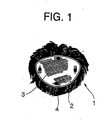
- a reference numeral 1 generally denotes an ornamental wig.
- the wig 1 is constituted such that attaching devices 4 are attached to a net-shaped base member 3 having hair 2 implanted therein.
- the hair 2 is imitation hair made of a synthetic resin (fiber) or a regenerated resin (fiber).
- the wig 1 has a size set so as to be attachable to a person's hair.
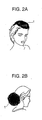
- the wig 1 is not limited to a wig that covers all of a person's hair. As shown in Figs. 2A and 2B, the wig 1 may be such as to only partially cover a person's. These partial wigs 1 also have the imitation hair 2 implanted on the base members 3 (not shown in Figs. 2A and 2B).
- wigs 1 As such types of wigs, other than the ones exemplified as described above, there are various types of the wigs 1 such as a braid type, a long-hair type, a chignon type, a screw type, a twist type and a zigzag type.
- the imitation hair 2 may be fitted to the base member 3 in any manner, and the fitting manner is not limited to implanting.
- the base member itself is not limited to a planar member.
- the base member may be a belt-shaped member, or each of a member combined with the attaching device or devices such as the base member of each of Figs.3A and 3B.
- the attaching device or devices 4 do not have any limitation, in particular, and may be freely selected from a hairpin, an America pin, a comb, a barrette, a rubber member (ring-shaped or string-shaped), a string, a wire, a net and the like can be freely selected.
- the imitation hair 2 used in the wig 1 is a reversible photosensitive discoloring hair that changes its color with a light irradiation of an ultraviolet ray and the like as described later, and changes a certain color thereof to another color by irradiating a light thereon.
- the imitation hair 2 may be uniformly changed in color over its entirety, or only partially changed in (i.e., with only a portion thereof changed in color).
- the color of the entire imitation hair 2 that is initially shown may be changed to another color.
- the color of a portion that is initially shown differently from another portion may be changed to the other color of the entire imitation hair 2 together with the other portion.
- groups of the imitation hair 2 that change their colors respectively may be made to exist in such a manner that small numbers of the hair groups are mixed with each other so that the entire imitation hair 2 can look like the hair having a single color by changing the respective colors.
- red hair and white hair are mixed so that the mixed hair can look pink.
- the portion of the white color is left so as not to change its color, but the red color of the other portion may be obtained by changing the other color.
- groups of the imitation hair 2 having different colors from each other may change their colors while each group is collected to some extent.
- the groups of the imitation hair 2 may change their colors only partially with the light irradiation of the ultraviolet rays and the like though they have a single color initially.
- the groups of the imitation hair 2 that have different colors initially may change their colors to another uniform color.
- the imitation hair 2 may change its color for each portion.
- a striped pattern may be formed with the light irradiation of the ultraviolet ray or the like.
- the imitation hair 2 having entirely a striped pattern may be obtained by changing the color of a predetermined portion thereof having initially the same color as other portions by irradiating the light.
- the imitation hair 2 having a striped pattern initially may be changed to one that has another striped pattern having a different color from the original color with the light irradiation of the ultraviolet ray or the like.
- the photochromic compound is a substance that has a function of changing a color reversibly with a light having a specified wavelength such as the ultraviolet ray.
- any compound can be used as long as it has been conventionally known as a photochromic compound.
- the photochromic compound is not subjected to particular limitations.
- the photochromic compound As examples of the photochromic compound, the following can be listed: an azobenzene series compound, a thioindigo series compound, a dihydrobromide series compound, a spiropyran series compound, a naphthopyran series compound, a benzopyran series compound, a spirooxazine series compound, a silver series compond and the like.
- the imitation hair 2 of the present invention has a reversible photosensitive discoloring function of changing the color of the imitation hair 2 by irradiating the light such as the ultraviolet ray and returning the changed color to the original color by.stopping the irradiation.
- a polyolefin fiber that contains an organic photochromic compound having a molecular weight of 300 or more can be listed.
- This polyolefin fiber has a good processing property, a low toxicity to a human body, the low toxicity being essential for such an application, and a low possibility of generating a toxic substance such as a dioxin due to burning after being discarded.
- the polyolefin fiber has various advantages.
- the polyolefin fiber itself does not typically have a polarity, when it is made to contain a substance having a polarity such as the photochromic compound, a blooming phenomenon occurs. For this reason, the present invention was made in an attempt to solve such a problem as the blooming phenomenon by selectively using an organic photochromic compound having a molecular weight of 300 or more.
- the organic photochromic compound implies an organic compound among the foregoing photochromic compounds. As long as the organic photochromic compound has a molecular weight of 300 or more, the type thereof does not matter. However, it is particularly preferable to use at least a type of the compound selected from among a spiropyran series compound, a naphthopiran series compound, a benzopyran series compound and a spirooxazine series compound, which have high coloring density during the light irradiation and are rich in color types.
- the polyolefin fiber any conventionally known polyolefin fiber can be used, and the polyolefin fiber is not subjected to any limitation.
- a wide range of fibers for example, the polyolefin fiber, a polypropylene fiber, an ethylene-propylene copolymer fiber and the like can be employed. Note that these fibers may be partially bridged fibers.
- the fibers may be fibers in which acrylonitrile, (meta-) acrylic acid, (meta-) ester acrylate, vinyl acetate, styrene, vinyl chloride, vinylidene chloride and the like are copolymerized or singly compounded.
- the above-described organic photochromic compound typically exhibits discoloring between a solid color and a chromatic color in many cases
- various types of pigments may be compounded in the concerned polyolefin fiber for the purpose of further enriching color variation thereof and so on.
- the pigments include organic pigment, inorganic pigment, fluorescent pigment, luminous pigment, pearl pigment, metallic pigment, gold powder, silver powder, glass powder, thermochromic capsule pigment, a microcapsule containing perfume and the like.
- the pigments are not limited to the above examples.
- wax type dispersants a polyethylene wax, a polypropylene wax, a paraffin wax, an amide wax, a wax, a carnauba wax, a microcrystalline wax and the like can be listed.
- the wax type dispersants are not limited to the above examples.
- any conventionally known method may be employed, and the manufacturing method is not subjected to any limitation.
- the above-described respective components are previously classified in a color palette, or directly mixed with a polyolefin resin as a fiber forming polymer, and then fusing and spinning are performed by use of a fusing/spinning apparatus.
- the reversible photosensitive polyolefin fiber can be obtained.
- the reversible photosensitive polyolefin fiber having various cross-sectional shapes (for example, circular shape, oval shape, star shape, triangular shape and gear shape) and various sizes (for example, 0.1 to 500 ⁇ m) can be obtained.
- imitation hair of the present invention can contain various conventionally known additives other than the above-described components according to desires.
- the additives include ultraviolet ray absorbent; optical stabilizer; filler; dye; fluorescent dye; electrochromic agent; liquid crystal; ultraviolet ray emitting type coloring matter; perfume; flame retardant; flame proofing agent; deodorizer; antimicrobial agent; antiseptic; fungicide; repellent; and light catalyst.
- the additives are not limited to the above-described examples.
- a method of attaching the wig of the present invention will be described below.
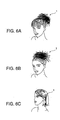
- a hair portion 7 be bundled in a dumpling shape at a side portion of the head as shown in Fig. 5A or a high position of the head as shown in Fig. 5B or be shaped in a pony-tail.
- the imitation hair 2 is attached to the person's natural hair by the attaching device 4 on devices.
- the wig 1 of Fig. 3A is attached to the natural hair of Fig. 5A
- the result shown in Fig. 6A appears.
- the wig 1 of Fig. 3A is attached to the hair of Fig.
- the wig may be attached so as to be identified purposely, the base of the wig 1 may be preferably hidden with the hair, a bandanna, a turban or the like. Naturally, two or more types of the wig may be combined and attached to the natural hair.
- the attaching device shown in Fig. 3C has an ornament portion, a hairpin portion and an imitation hair fitting part.
- the imitation hair is fitted between the ornament portion and the hairpin portion in a winding manner, as shown in Fig. 3D, and is fixed by simple . engaging member such as a rubber band.
- the imitation hair may be fixed by the engaging member as shown in Fig. 3E, or naturally may be fixed with adhesive or the like.
- the hairpins as shown in Figs. 3F and 3G have been conventionally available.
- the engaging member 9 with the hairpin portion may be provided in the ornament portion as shown in Fig. 3F so as to make the imitation hair freely detachable.
- the imitation hair may be wound around the hairpin portion to be engaged with the rubber band or the like similar to that described above.
- the imitation hair 2 When light having a specified wavelength such as the ultraviolet ray is irradiated to the wig 1 after the wig 1 manufactured with the imitation hair 2 constituted as described above is attached to the head of a wearer, the imitation hair 2 changes its color to blue, red, yellow, green, etc. And when the light irradiation stops, the color is returned to the original color.
- the color of the imitation hair 2 is changed only by irradiating the light such as the ultraviolet ray, the color of the imitation hair 2 of the wig 1 is changed between the cases, for example, where the wearer goes outside from the inside of a building and the imitation hair 2 receives sunlight, and where the wearer comes inside the building from the outside. Because of this color change, the impression of the wearer given to others is changed, thus the wearer can change his/her image during a day.
- the imitation hair is low in cost and is convenient.
- a child by use of the wig 1 by a child, he or she can obtain a sense of unity with his/her mother or a doll 8 changing its hair color. Specifically, if the color of his/her mother's hair is green, the child may use the wig 1, the original color or the changed color of which is green. Alternatively, if the color of the doll's hair is changed from pink to green, the child may attach the wig 1 changing his or her color similarly. In such a manner, the child can feel a sense of unity with his/her mother or the doll.
- the imitation hair 2 can change its color reversibly from a certain color to another color upon a change in temperature.
- the imitation hair 2 may be a combination of the reversible photosensitive discoloring imitation hair that changes its color depending on the existence of the light irradiation such as the ultraviolet ray and the reversible thermosensitive discoloring imitation hair that changes its color depending on the temperature change.
- thermosensitive discoloring substance for example, as disclosed in USP 3,560,229, a composite having a combination of an electron impartable colorable compound (leuco coloring matter) and an electron receivable developer (phenol group and the like) as a base and a three-component series composite obtained by adding organic solvent to the above-described two components can be listed. Moreover, in Japanese Patent Publication No. Sho 62-28990, a thermosensitive discoloring substance having these composites encapsulated in so-called microcapsules is disclosed. Such a thermosensitive discoloring substance can also be preferably used.
- thermosensitive discoloring substances are uniformly mixed with the polyolefin resin, the polypropylene, polyamide and the like, and the mixture is subjected to extrusion forming a filament-shaped body.
- the reversible thermosensitive discoloring imitation hair can be manufactured (see Japanese Patent No. 2519484, Japanese Patent Publication No. Sho 51-37180 and so on).
- a portion that is the reversible thermosensitive discoloring imitation hair changes its color to blue, green, yellow, red and so on when the temperature of the imitation hair rises to a predetermined temperature by heating it with a device such as a hair dryer.
- the discolored state is held for a while after stopping the heating. Thereafter, when the temperature of the imitation hair is lowered to below a predetermined temperature, the color returns to the original color again.
- a thermosensitive discoloring substance that changes its color at about body temperature is used, the discolored state can be maintained while the wig 1 is attached to the wearer's head.
- the foregoing pigments can be added to the reversible thermosensitive discoloring imitation hair depending on the purpose of enriching the color variation and so on.
- the reversible photosensitive discoloring imitation hair By combining the reversible photosensitive discoloring imitation hair and the reversible thermosensitive discoloring imitation hair, a certain portion of the imitation hair changes its color depending on the existence of the light irradiation such as the ultraviolet ray, and another portion thereof changes its color depending on the temperature change. Accordingly, a complicated color change can be enjoyed.
- the color can be easily changed at a low cost, and since the natural hair of the wearer is not directly subjected to the discoloring treatment, the hair cannot be damaged. As such, an effect similar to the case of the reversible photosensitive discoloring imitation hair can be obtained.
- the color of the imitation hair is changed. And when the light irradiation stops, the color returns to its original color. In such a manner, the color of the hair is changed only by irradiating with the ultraviolet ray. Accordingly, the color of the wig hair is changed between the case where the wearer goes outside from the inside of a building such that the wig receives sunlight, and the case where the wearer comes inside the building from the outside. Because of this color change, the impression of the wearer given to others is changed, and thus he or she can change his/her image during a day. And, since the color is changed by irradiating the light, no special tool or apparatus is required, and the color of the ornamental wig is automatically changed without any special care or treatment. Accordingly, handling thereof is very easy.
- the imitation hair is low in cost and is convenient.
- the imitation hair can have a good processing property, low toxicity to the human body and a low possibility of generating a toxic substance. Moreover, there is no fear that the organic photochromic compound will bloom in the concerned imitation hair.
- the imitation hair can be rich in the color variation.
- a complicated color change can be enjoyed.
- the changed color is conspicuous and the impression of the entire hair can be greatly changed.
- the wig since the wig has the attaching device or devices, the ornament portion, the hairpin portion and the imitation hair fitting portion, the wig can be easily attached to the head, and does not become as exaggerated as a conventional toupee, and the cost thereof is low. Moreover, since the imitation hair is attached by one or more small engaging members such as a rubber band, the engaging member(s) is inconspicuously hidden in the imitation hair.
- the ornament portion and the imitation hair are set freely detachable, the ornament portion and the imitation hair can be easily fitted to the conventional hairpin. Accordingly, a novel hair ornamental wig can be provided.
Landscapes
- Engineering & Computer Science (AREA)
- Textile Engineering (AREA)
- Artificial Filaments (AREA)
- Toys (AREA)
- Coloring (AREA)
Applications Claiming Priority (3)
| Application Number | Priority Date | Filing Date | Title |
|---|---|---|---|
| JP2000001127 | 2000-02-29 | ||
| JP2000001127U JP3071403U (ja) | 2000-02-29 | 2000-02-29 | 頭髪飾り用ウイッグ |
| PCT/JP2000/009270 WO2001064065A1 (en) | 2000-02-29 | 2000-12-26 | Wig for decorating hair |
Publications (1)
| Publication Number | Publication Date |
|---|---|
| EP1275314A1 true EP1275314A1 (de) | 2003-01-15 |
Family
ID=18530384
Family Applications (1)
| Application Number | Title | Priority Date | Filing Date |
|---|---|---|---|
| EP00985910A Withdrawn EP1275314A1 (de) | 2000-02-29 | 2000-12-26 | Dekoratives haarteil |
Country Status (6)
| Country | Link |
|---|---|
| US (1) | US20030140934A1 (de) |
| EP (1) | EP1275314A1 (de) |
| JP (1) | JP3071403U (de) |
| CN (1) | CN1450867A (de) |
| TW (1) | TW491695B (de) |
| WO (1) | WO2001064065A1 (de) |
Cited By (3)
| Publication number | Priority date | Publication date | Assignee | Title |
|---|---|---|---|---|
| EP2090635A1 (de) * | 2008-01-07 | 2009-08-19 | Teijin Monofilament Germany GmbH | Photochrome Zusammensetzung und deren Verwendung |
| US7735495B2 (en) | 2007-02-01 | 2010-06-15 | Celebrity Signatures International, Inc. | Partial cap hair accessory |
| US7743774B2 (en) | 2004-06-04 | 2010-06-29 | Celebrity Signatures International, Inc. | Hair accessory |
Families Citing this family (29)
| Publication number | Priority date | Publication date | Assignee | Title |
|---|---|---|---|---|
| KR20020072519A (ko) * | 2002-08-30 | 2002-09-16 | 최명식 | 헤어 젤용 변색용제 및 이를 갖춘 헤어 젤 |
| US20050252518A1 (en) | 2004-05-17 | 2005-11-17 | Hortencia Salinas | Hair extension |
| US20050252517A1 (en) * | 2004-05-17 | 2005-11-17 | Hortencia Salinas | Hair extension and method of use |
| US7131449B2 (en) * | 2005-01-27 | 2006-11-07 | Aderans Co., Ltd. | Wig |
| USD534319S1 (en) | 2005-10-11 | 2006-12-26 | Palumbo Albert J | Die cut hair bonding strip |
| US20070131236A1 (en) * | 2005-12-09 | 2007-06-14 | Rene Of Paris | Hairpiece |
| CA117251S (en) * | 2006-02-27 | 2008-05-05 | Aderans Kk | Clip for a wig |
| PL1839495T3 (pl) * | 2006-03-27 | 2011-07-29 | Nestec Sa | Mrożone desery wzbogacone w białko |
| US20080110472A1 (en) * | 2006-11-09 | 2008-05-15 | Jonathan Kaweblum | Head covering with non-visible, built-in wig/toupee clip |
| EP2194804A1 (de) * | 2007-09-06 | 2010-06-16 | Gael Betts Concepts INC. | Haarergänzungs- und frisierhaarteil |
| US8567413B2 (en) * | 2009-06-10 | 2013-10-29 | Celebrity Signature International, Inc. | Hair addition for providing bump up effect |
| EP2484237B1 (de) * | 2009-09-30 | 2017-02-22 | Aderans Co., Ltd. | Element zur anbringung eines kopfschmucks und kopfschmuck |
| USD636120S1 (en) * | 2010-02-25 | 2011-04-12 | Toyo Polymer Co., Ltd. | Cosmetic powder-puff |
| US20110209719A1 (en) * | 2010-03-01 | 2011-09-01 | Anzivino Robert A | Hairpiece |
| GR1007498B (el) * | 2010-09-21 | 2012-01-10 | Νικολαος Περικλη Δημητριου | Τρεσα με κουμπια |
| US20130042881A1 (en) * | 2011-08-15 | 2013-02-21 | Elizabeth Ann Mutchler | Snap clip hair supplements and method of manufacture |
| US20150096586A1 (en) * | 2011-08-17 | 2015-04-09 | Ljl, Inc. | Apparatus for holding, securing and styling hair |
| US8881742B2 (en) * | 2012-05-16 | 2014-11-11 | Jose A. Zephyr | Hair augmenter attachment device including hair clip pockets |
| CN102732994A (zh) * | 2012-06-21 | 2012-10-17 | 精源(南通)化纤制品有限公司 | 一种可恢复式光致变色人造发丝及其制备方法 |
| US20150013708A1 (en) * | 2013-07-12 | 2015-01-15 | Carmen Chamberlain | Lace wig |
| US20150090289A1 (en) * | 2013-10-01 | 2015-04-02 | Sharon Kaplan | Hair ornamentation system and methods of use |
| US8991406B1 (en) * | 2013-11-14 | 2015-03-31 | Shelah D. Salter | Combination wig and carrying pouch |
| US9977267B2 (en) * | 2014-12-18 | 2018-05-22 | Disney Enterprises, Inc. | Selectively activated color changing hairpiece |
| US10797206B2 (en) | 2015-07-23 | 2020-10-06 | Lumileds Llc | Controlling off-state appearance of a light emitting device |
| CN107805852A (zh) * | 2017-10-24 | 2018-03-16 | 许昌鸿洋生化实业发展有限公司 | 一种假发用人造感光变色纤维及其制备方法 |
| CN107881582A (zh) * | 2017-10-24 | 2018-04-06 | 许昌鸿洋生化实业发展有限公司 | 一种用于制造假发的感光变色纤维及其制备方法 |
| WO2018131019A2 (en) * | 2018-04-17 | 2018-07-19 | Universidad Tecnológica De Panamá | Simulator for changing hair color |
| GB2581782A (en) * | 2019-02-21 | 2020-09-02 | Theunseen Ltd | Polymer fibre |
| CN113512778B (zh) * | 2021-05-31 | 2023-03-24 | 南通大学 | 一种光致变色假发纤维及其制备方法 |
Family Cites Families (15)
| Publication number | Priority date | Publication date | Assignee | Title |
|---|---|---|---|---|
| US2651310A (en) * | 1952-09-05 | 1953-09-08 | Elenor V Selson | Head conforming mounting for adjustably positionable hair pieces |
| US4781647A (en) * | 1987-05-04 | 1988-11-01 | Hasbro, Inc. | Toy doll construction with phosphorescent hair fibers |
| JPH0714335Y2 (ja) * | 1989-05-01 | 1995-04-05 | ヨシ子 清水 | かつら取付け具 |
| JPH0816215B2 (ja) * | 1990-06-18 | 1996-02-21 | 株式会社松井色素化学工業所 | フォトクロミック材料 |
| JP3177720B2 (ja) * | 1992-08-26 | 2001-06-18 | パイロットインキ株式会社 | 玩具用感温変色性撥水性人工頭髪及びその製造方法 |
| JPH06280112A (ja) * | 1993-03-26 | 1994-10-04 | Asahi Chem Ind Co Ltd | 塩化ビニリデン系合成樹脂繊維 |
| JPH06313210A (ja) * | 1993-04-28 | 1994-11-08 | Matsui Shikiso Kagaku Kogyosho:Kk | 光可逆変色性アクリル繊維とその製造方法 |
| JPH1088439A (ja) * | 1996-09-12 | 1998-04-07 | Kanegafuchi Chem Ind Co Ltd | 加撚マルチフィラメント繊維及びそれを用いたマルチフィラメント繊維束、並びにマルチフィラメント繊維束の製造方法 |
| JP3518231B2 (ja) * | 1997-03-11 | 2004-04-12 | 鐘淵化学工業株式会社 | 繊維用塩化ビニル系樹脂組成物及び該樹脂組成物を用いてなる塩化ビニル系繊維 |
| JPH10295942A (ja) * | 1997-04-23 | 1998-11-10 | Pilot Ink Co Ltd | 人形用部分染色毛髪及びその染色方法 |
| DE19805977A1 (de) * | 1998-02-13 | 1999-08-19 | Inst Neue Mat Gemein Gmbh | Photochrome Beschichtungszusammensetzung und damit beschichtete Substrate |
| US6019107A (en) * | 1998-11-19 | 2000-02-01 | Overmyer; Tatiana L | Detachable hairpiece |
| US20020122780A1 (en) * | 2000-04-14 | 2002-09-05 | Mcmanus Marjorie | Photochromic hair coloring composition |
| US7022331B2 (en) * | 2001-04-26 | 2006-04-04 | Lyle Theisen | Thermochromic/photochromic cosmetic compositions |
| US6531118B1 (en) * | 2001-12-11 | 2003-03-11 | Avon Products, Inc. | Topical compositions with a reversible photochromic ingredient |
-
2000
- 2000-02-29 JP JP2000001127U patent/JP3071403U/ja not_active Expired - Fee Related
- 2000-12-26 WO PCT/JP2000/009270 patent/WO2001064065A1/ja not_active Ceased
- 2000-12-26 US US10/220,038 patent/US20030140934A1/en not_active Abandoned
- 2000-12-26 EP EP00985910A patent/EP1275314A1/de not_active Withdrawn
- 2000-12-26 CN CN00819372A patent/CN1450867A/zh active Pending
-
2001
- 2001-02-09 TW TW090102954A patent/TW491695B/zh not_active IP Right Cessation
Non-Patent Citations (1)
| Title |
|---|
| See references of WO0164065A1 * |
Cited By (3)
| Publication number | Priority date | Publication date | Assignee | Title |
|---|---|---|---|---|
| US7743774B2 (en) | 2004-06-04 | 2010-06-29 | Celebrity Signatures International, Inc. | Hair accessory |
| US7735495B2 (en) | 2007-02-01 | 2010-06-15 | Celebrity Signatures International, Inc. | Partial cap hair accessory |
| EP2090635A1 (de) * | 2008-01-07 | 2009-08-19 | Teijin Monofilament Germany GmbH | Photochrome Zusammensetzung und deren Verwendung |
Also Published As
| Publication number | Publication date |
|---|---|
| TW491695B (en) | 2002-06-21 |
| WO2001064065A1 (en) | 2001-09-07 |
| WO2001064065A8 (fr) | 2003-02-13 |
| CN1450867A (zh) | 2003-10-22 |
| US20030140934A1 (en) | 2003-07-31 |
| JP3071403U (ja) | 2000-09-08 |
Similar Documents
| Publication | Publication Date | Title |
|---|---|---|
| EP1275314A1 (de) | Dekoratives haarteil | |
| DE60300611T2 (de) | Verfahren zur Farbveränderung eines Spielzeuges und farbveränderliches Spielzeug | |
| CA2242987C (en) | Colored hair manufacturing process and colored hair thus manufactured | |
| DE60207583T2 (de) | Verfahren zur wärmebehandlung von kopfhaar und einer kappe, die ein signal auf die behandlung beziehend gibt | |
| US5224964A (en) | Method for lightening and permanently coloring hair | |
| CN1798883A (zh) | 人造毛发用纤维 | |
| US20150177423A1 (en) | Opto textile | |
| JP2022521309A (ja) | 繊維 | |
| JPH0519289Y2 (de) | ||
| WO2009022786A1 (en) | Method for producing thermochromic and photochromic color flower | |
| JP2004137614A (ja) | 多色感温変色性繊維 | |
| ES2069000T3 (es) | Metodo para seleccionar colores compatibles para una persona. | |
| CA2066978A1 (en) | Fabric, molded, or coated articles exhibiting color change when exposed to ultraviolet light | |
| KR20020095467A (ko) | 두발장식용 위그 | |
| HK1058611A (en) | Wig for decorating hair | |
| JP2022521310A (ja) | ポリマー繊維 | |
| KR100844140B1 (ko) | 가르마 부위를 구비하고 볼륨감을 높인 앞머리용 가발 | |
| JP2597264B2 (ja) | かつら及びかつらの製造方法 | |
| RU2308861C1 (ru) | Способ окрашивания волос | |
| KR100912935B1 (ko) | 베이스부와 식모라인 만으로 제공되는 부분가발 | |
| KR200191740Y1 (ko) | 가발 | |
| JPS6316481B2 (de) | ||
| US20190328102A1 (en) | Ponytail securing device | |
| US20230255290A1 (en) | Invisinet _Nocap Wig Foundation | |
| KR200338041Y1 (ko) | 가모 결합 부재 |
Legal Events
| Date | Code | Title | Description |
|---|---|---|---|
| PUAI | Public reference made under article 153(3) epc to a published international application that has entered the european phase |
Free format text: ORIGINAL CODE: 0009012 |
|
| 17P | Request for examination filed |
Effective date: 20020911 |
|
| AK | Designated contracting states |
Kind code of ref document: A1 Designated state(s): AT BE CH CY DE DK ES FI FR GB GR IE IT LI LU MC NL PT SE TR |
|
| STAA | Information on the status of an ep patent application or granted ep patent |
Free format text: STATUS: THE APPLICATION IS DEEMED TO BE WITHDRAWN |
|
| 18D | Application deemed to be withdrawn |
Effective date: 20050701 |