EP1288190A2 - Verfahren zur Herstellung von Polyisocyanaten der Diphenylmethanreihe mit vermindertem Farbwert - Google Patents
Verfahren zur Herstellung von Polyisocyanaten der Diphenylmethanreihe mit vermindertem Farbwert Download PDFInfo
- Publication number
- EP1288190A2 EP1288190A2 EP02017778A EP02017778A EP1288190A2 EP 1288190 A2 EP1288190 A2 EP 1288190A2 EP 02017778 A EP02017778 A EP 02017778A EP 02017778 A EP02017778 A EP 02017778A EP 1288190 A2 EP1288190 A2 EP 1288190A2
- Authority
- EP
- European Patent Office
- Prior art keywords
- base
- reaction mixture
- temperature
- polyisocyanates
- polyamines
- Prior art date
- Legal status (The legal status is an assumption and is not a legal conclusion. Google has not performed a legal analysis and makes no representation as to the accuracy of the status listed.)
- Granted
Links
Classifications
-
- C—CHEMISTRY; METALLURGY
- C08—ORGANIC MACROMOLECULAR COMPOUNDS; THEIR PREPARATION OR CHEMICAL WORKING-UP; COMPOSITIONS BASED THEREON
- C08G—MACROMOLECULAR COMPOUNDS OBTAINED OTHERWISE THAN BY REACTIONS ONLY INVOLVING UNSATURATED CARBON-TO-CARBON BONDS
- C08G73/00—Macromolecular compounds obtained by reactions forming a linkage containing nitrogen with or without oxygen or carbon in the main chain of the macromolecule, not provided for in groups C08G12/00 - C08G71/00
- C08G73/02—Polyamines
-
- C—CHEMISTRY; METALLURGY
- C08—ORGANIC MACROMOLECULAR COMPOUNDS; THEIR PREPARATION OR CHEMICAL WORKING-UP; COMPOSITIONS BASED THEREON
- C08G—MACROMOLECULAR COMPOUNDS OBTAINED OTHERWISE THAN BY REACTIONS ONLY INVOLVING UNSATURATED CARBON-TO-CARBON BONDS
- C08G18/00—Polymeric products of isocyanates or isothiocyanates
- C08G18/06—Polymeric products of isocyanates or isothiocyanates with compounds having active hydrogen
- C08G18/70—Polymeric products of isocyanates or isothiocyanates with compounds having active hydrogen characterised by the isocyanates or isothiocyanates used
- C08G18/72—Polyisocyanates or polyisothiocyanates
- C08G18/74—Polyisocyanates or polyisothiocyanates cyclic
- C08G18/76—Polyisocyanates or polyisothiocyanates cyclic aromatic
- C08G18/7657—Polyisocyanates or polyisothiocyanates cyclic aromatic containing two or more aromatic rings
- C08G18/7664—Polyisocyanates or polyisothiocyanates cyclic aromatic containing two or more aromatic rings containing alkylene polyphenyl groups
-
- C—CHEMISTRY; METALLURGY
- C07—ORGANIC CHEMISTRY
- C07C—ACYCLIC OR CARBOCYCLIC COMPOUNDS
- C07C209/00—Preparation of compounds containing amino groups bound to a carbon skeleton
- C07C209/68—Preparation of compounds containing amino groups bound to a carbon skeleton from amines, by reactions not involving amino groups, e.g. reduction of unsaturated amines, aromatisation, or substitution of the carbon skeleton
- C07C209/78—Preparation of compounds containing amino groups bound to a carbon skeleton from amines, by reactions not involving amino groups, e.g. reduction of unsaturated amines, aromatisation, or substitution of the carbon skeleton from carbonyl compounds, e.g. from formaldehyde, and amines having amino groups bound to carbon atoms of six-membered aromatic rings, with formation of methylene-diarylamines
-
- C—CHEMISTRY; METALLURGY
- C07—ORGANIC CHEMISTRY
- C07C—ACYCLIC OR CARBOCYCLIC COMPOUNDS
- C07C263/00—Preparation of derivatives of isocyanic acid
- C07C263/10—Preparation of derivatives of isocyanic acid by reaction of amines with carbonyl halides, e.g. with phosgene
Definitions
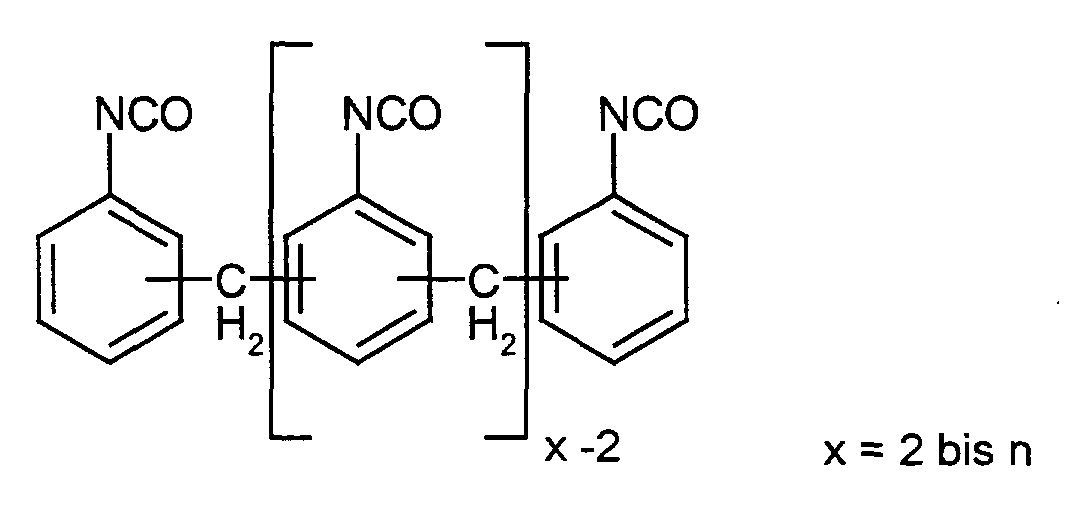
- Polyisocyanates of the diphenylmethane series are understood to mean isocyanates and isocyanate mixtures of the following types:
- polyamines of the diphenylmethane series are understood to mean compounds and compound mixtures of the following type:
- this method also contains undesirable dyes or coloring components are formed, which are also used in further processing obtained to polyurethane foams or other polyurethane plastics stay.
- undesirable dyes or coloring components are formed, which are also used in further processing obtained to polyurethane foams or other polyurethane plastics stay.
- the inherent color of the polyisocyanate polyaddition products mechanical properties are not negatively influenced by the consumer essential colorless products.
- As a measure of the discoloration of the polyisocyanate serves the absorbance at different wavelengths.
- DE-A1-4208359 describes the treatment of such isocyanates with hydrogen in the presence of supported catalysts.
- DE-A1-4232769 describes the addition of amines, ureas and Antioxidants to isocyanate.
- DE-A1-19815055 describes the color improvement of polyisocyanates of the diphenylmethane series by irradiation with light a longer period.
- DE-A1-19804915 describes the lightening of polyisocyanates the diphenylmethane series due to a complicated time and temperature step Formaldehyde addition at the polyamine stage, which is then carried out by phosgenation is converted into the desired isocyanate.
- the process according to the invention can be carried out either continuously or batchwise be performed.
- the measured absorbance is a color value Solution of polyisocyanate in monochlorobenzene, containing 2% by weight of polyisocyanate, at a layer thickness of 10 mm and room temperature against monochlorobenzene understood defined wavelengths.
- Suitable polyamine mixtures of the diphenylmethane series are usually obtained through condensation of aniline and formaldehyde in the molar ratio 20 to 1.6, preferably 10 to 1.8 and a molar ratio of aniline and acidic catalyst from 20 to 1, preferably 10 to 2.
- formaldehyde is usually used as an aqueous solution.
- other compounds providing methylene groups such as, for example, polyoxymethylene glycol, para- formaldehyde or trioxane, can also be used.
- Suitable acids are, for example, hydrochloric acid, sulfuric acid, Phosphoric acid, and methanesulfonic acid. Hydrochloric acid is preferably used.
- aniline and acid catalyst first united.
- This mixture is, if necessary after removal of heat, in a further step with formaldehyde at temperatures between 20 ° C and 100 ° C, preferably at 30 ° C to 70 ° C mixed in a suitable manner and then to undergo a preliminary reaction in a suitable residence apparatus.
- the pre-reaction takes place at temperatures between 20 ° C to 100 ° C, preferably in the temperature range 30 ° C to 80 ° C.
- the temperature of the reaction mixture in stages or continuously and possibly below Overpressure to a temperature of 100 ° C to 250 ° C, preferably to 100 ° C to 180 ° C, particularly preferably brought to a temperature of 100 ° C to 160 ° C.
- Aniline and formaldehyde first in the absence of the acidic catalyst Temperature range from 5 ° C to 130 ° C, preferably from 40 ° C to 100 ° C, particularly preferred from 60 ° C to 85 ° C, to mix and bring to reaction.
- condensation products form from aniline and formaldehyde (so-called aminal).
- water present in the reaction mixture by phase separation or other suitable process steps, for example by distillation.
- the condensation product is then in one another process step mixed with the acid catalyst in a suitable manner and in a residence apparatus at 20 ° C to 100 ° C, preferably 30 ° C to 80 ° C one Subjected to pre-reaction.
- the temperature of the reaction mixture in stages or continuously and possibly under pressure to a temperature of 100 ° C to 250 ° C, preferably to 100 ° C to 180 ° C, particularly preferably to one Temperature brought from 100 ° C to 160 ° C.
- the reaction mixture is mixed with neutralized a base.
- Neutralization takes place according to the state of the art usually at temperatures of e.g. 90 - 100 ° C (H.J. Twitchett, Chem. Soc. Rev. 3 (2), 223 (1974)).
- Suitable bases are, for example, the Hydroxides of the alkali and alkaline earth elements.
- Aqueous NaOH is preferred to use.
- the neutralization of the acidic reaction mixture at temperatures above 110 ° C preferably in the range 111 ° C to 300 ° C, particularly preferably at 115 ° C to 200 ° C, very particularly preferably 120 ° C up to 180 ° C, particularly preferably 130 to 160 ° C, carried out.
- the neutralization is carried out at temperatures below 110 ° C and then the neutralized reaction mixture to a temperature of above 110 ° C, preferably 111 ° C to 300 ° C, particularly preferably 115 ° C to 200 ° C, very particularly preferably 120 ° C. to 180 ° C., particularly very particularly preferably 130 to 160 ° C, heated.
- the neutralization takes place, for example, in such a way that the acidic reaction mixture the aniline / formaldehyde condensation mixed with the base and one Dwell apparatus (e.g. stirred tank, stirred tank cascade, flow tube, Pump reactor) is supplied.
- suitable dwell devices e.g. stirred kettles
- stirred kettles can also mix the acidic condensation mixture and base take place directly in the dwell apparatus.
- the neutralized reaction mixture is preferably for a residence time of ⁇ 0.1 min, preferably 0.1 to 180 min, particularly preferably 2 to 120 min, very particularly preferably 10 to 60 min, kept at a temperature above 110 ° C.
- the organic of the aqueous phase by suitable processes (e.g. phase separation in a vaginal bottle) Cut.
- This separation of the organic and aqueous phases can in the the same temperature at which the neutralization of the acidic rearrangement mixture took place.
- the product-containing remaining after separation of the aqueous phase organic phase is usually further processing steps subjected (e.g. laundry) and then of excess aniline and others substances present in the mixture (e.g. other solvents) by suitable physical separation processes such as Distillation, extraction or crystallization freed.
- monochlorobenzene, dichlorobenzene or mixtures of these chlorobenzenes are used as inert organic solvents.
- the amount of solvent is preferably such that the reaction mixture has an isocyanate content of 2 to 40% by weight, preferably between 5 and 20% by weight, based on the total weight of the reaction mixture.
- the raw MDI produced by the process according to the invention clearly has a reduced coloring. However, there are still other analytical differences in the MDI produced (such as an increased content of isocyanate groups).
Landscapes
- Chemical & Material Sciences (AREA)
- Organic Chemistry (AREA)
- Chemical Kinetics & Catalysis (AREA)
- Health & Medical Sciences (AREA)
- Medicinal Chemistry (AREA)
- Polymers & Plastics (AREA)
- Organic Low-Molecular-Weight Compounds And Preparation Thereof (AREA)
- Polyurethanes Or Polyureas (AREA)
- Phenolic Resins Or Amino Resins (AREA)
Abstract
Description

Claims (6)
- Verfahren zur Herstellung von Polyaminen der Diphenylmethanreihe, bei dem mana) Anilin und Formaldehyd in Gegenwart eines sauren Katalysators zu Polyaminen umsetzt und danachb) das Reaktionsgemisch mit einer Base bei einer Temperatur von oberhalb 110°C neutralisiert oder das Reaktionsgemisch nach der Neutralisation mit einer Base auf eine Temperatur von oberhalb 110°C aufheizt.
- Verfahren nach Anspruch 1, bei dem man die Neutralisation bei einer Temperatur von 120 bis 180°C durchführt.
- Verfahren nach Anspruch 1 oder 2, bei dem man als Base wässrige NaOH einsetzt.
- Verfahren zur Herstellung von Polyisocyanaten der Diphenylmethanreihe, bei dem mana) Anilin und Formaldehyd in Gegenwart eines sauren Katalysators zu Polyaminen umsetzt und danachb) das Reaktionsgemisch mit einer Base bei einer Temperatur von oberhalb 110°C neutralisiert oder das Reaktionsgemisch nach der Neutralisation mit einer Base auf eine Temperatur von oberhalb 110°C aufheizt und danachc) die Polyamine durch Phosgenierung zu den entsprechenden Polyisocyanaten umsetzt.
- Verfahren nach Anspruch 4, bei dem man die Neutralisation bei einer Temperatur von 120 bis 180°C durchführt.
- Verfahren nach Anspruch 4 oder 5, bei dem man als Base wässrige NaOH einsetzt.
Applications Claiming Priority (2)
| Application Number | Priority Date | Filing Date | Title |
|---|---|---|---|
| DE10141620A DE10141620A1 (de) | 2001-08-24 | 2001-08-24 | Verfahren zur Herstellung von Polyisocyanaten der Diphenylmethanreihe mit vermindertem Farbwert |
| DE10141620 | 2001-08-24 |
Publications (3)
| Publication Number | Publication Date |
|---|---|
| EP1288190A2 true EP1288190A2 (de) | 2003-03-05 |
| EP1288190A3 EP1288190A3 (de) | 2003-06-04 |
| EP1288190B1 EP1288190B1 (de) | 2007-01-10 |
Family
ID=7696548
Family Applications (1)
| Application Number | Title | Priority Date | Filing Date |
|---|---|---|---|
| EP02017778A Expired - Lifetime EP1288190B1 (de) | 2001-08-24 | 2002-08-12 | Verfahren zur Herstellung von Polyisocyanaten der Diphenylmethanreihe mit vermindertem Farbwert |
Country Status (16)
| Country | Link |
|---|---|
| US (1) | US6720455B2 (de) |
| EP (1) | EP1288190B1 (de) |
| JP (1) | JP2003119235A (de) |
| KR (1) | KR100860910B1 (de) |
| CN (1) | CN1232499C (de) |
| BR (1) | BR0203370A (de) |
| CA (1) | CA2399483A1 (de) |
| DE (2) | DE10141620A1 (de) |
| ES (1) | ES2280459T3 (de) |
| HK (1) | HK1053105A1 (de) |
| HU (1) | HUP0202841A3 (de) |
| MX (1) | MXPA02008245A (de) |
| PL (1) | PL355618A1 (de) |
| PT (1) | PT1288190E (de) |
| SG (1) | SG99409A1 (de) |
| TW (1) | TW575594B (de) |
Cited By (4)
| Publication number | Priority date | Publication date | Assignee | Title |
|---|---|---|---|---|
| EP1652835A1 (de) * | 2004-10-28 | 2006-05-03 | Bayer MaterialScience AG | Verfahren zur Herstellung von Di-und Polyaminen der Diphenylmethanreihe |
| EP2000459A1 (de) * | 2007-06-04 | 2008-12-10 | Huntsman International Llc | Verfahren zur Herstellung von Di- und Polyaminen der Diphenylmethanreihe |
| WO2010121997A1 (de) | 2009-04-24 | 2010-10-28 | Basf Se | Verfahren zur herstellung von farbstabilem mda und mdi |
| WO2011080059A1 (de) | 2009-12-18 | 2011-07-07 | Basf Se | Zweistufiges verfahren zur kostengünstigen abscheidung von homogenen katalysatoren bei der mda-synthese |
Families Citing this family (14)
| Publication number | Priority date | Publication date | Assignee | Title |
|---|---|---|---|---|
| DE10211021A1 (de) * | 2002-03-13 | 2003-09-25 | Bayer Ag | Verfahren zur Herstellung von Polyisocyanaten der Diphenylmethanreihe mit vermindertem Farbwert |
| DE10228734A1 (de) * | 2002-06-27 | 2004-01-22 | Bayer Ag | Verfahren zur Herstellung von Polyisocyanaten der Diphenylmethanreihe mit vermindertem Farbwert |
| DE102004032416A1 (de) * | 2004-07-05 | 2006-02-02 | Bayer Materialscience Ag | Verfahren zur Herstellung von Polyaminen der Diphenylmethanreihe bei niedriger Protonierung |
| CA2630801C (en) * | 2005-12-08 | 2013-04-02 | Huntsman International Llc | Process for preparing diaminodiphenylmethanes |
| DE102006004047A1 (de) * | 2006-01-28 | 2007-08-02 | Bayer Materialscience Ag | Verfahren zur Herstellung von Di- und Polyaminen der Diphenylmethanreihe |
| CN101279923B (zh) * | 2007-04-06 | 2010-08-25 | 宁波万华聚氨酯有限公司 | 一种制备多亚甲基多苯基多胺的方法 |
| WO2008122148A1 (zh) | 2007-04-06 | 2008-10-16 | Ningbo Wanhua Polyurethanes Co., Ltd. | 一种制备多亚甲基多苯基多胺的方法 |
| EP2062869A1 (de) * | 2007-09-19 | 2009-05-27 | Huntsman International Llc | Verfahren zur Herstellung von Di- und Polyaminen der Diphenylmethanreihe |
| EP2039676A1 (de) | 2007-09-19 | 2009-03-25 | Huntsman International Llc | Verfahren zur Herstellung von Di- und Polyaminen der Diphenylmethanreihe |
| CN107827756B (zh) * | 2017-11-17 | 2020-09-08 | 万华化学集团股份有限公司 | 一种低n-甲基杂质含量的二苯基甲烷系列二胺和多胺的制备方法及装置和催化剂 |
| CN111646927A (zh) * | 2020-06-12 | 2020-09-11 | 万华节能科技集团股份有限公司 | 阻燃二苯基甲烷二异氰酸酯的衍生物及其合成方法 |
| WO2025073928A1 (en) | 2023-10-06 | 2025-04-10 | Basf Se | Process for preparing mda |
| CN119100935A (zh) * | 2024-09-04 | 2024-12-10 | 万华化学集团股份有限公司 | 一种二苯基甲烷系列的二胺和多胺的制备方法及应用 |
| WO2026068450A1 (en) | 2024-09-24 | 2026-04-02 | Basf Se | Process for preparing a polyisocyanate mixture comprising methylene diphenyl diisocyanate (mdi) |
Family Cites Families (7)
| Publication number | Priority date | Publication date | Assignee | Title |
|---|---|---|---|---|
| JPS60199861A (ja) * | 1984-03-23 | 1985-10-09 | Mitsui Toatsu Chem Inc | 芳香族ジアミン類の精製方法 |
| DE4208359A1 (de) | 1992-03-16 | 1993-09-23 | Bayer Ag | Verfahren zur herstellung von isocyanaten oder isocyanatgemischen und deren verwendung zur herstellung von polyurethanschaumstoffen |
| US5310769A (en) | 1992-05-01 | 1994-05-10 | Bayer Aktiengesellschaft | Process for the production of polyamine mixtures of the polyamino-polyaryl-polymethylene series |
| DE4232769A1 (de) | 1992-09-30 | 1994-03-31 | Basf Ag | Verfahren zur Herstellung von Mischungen aus Diphenylmethandiisocyanaten und Polyphenyl-polymethylen-polyisocyanaten mit einer verminderten Iodfarbzahl |
| US6031136A (en) * | 1993-07-21 | 2000-02-29 | Bayer Corporation | Process for preparing methylene diphenylamines by partial neutralization of acidic methylene diphenylamines |
| DE19804915A1 (de) | 1998-02-07 | 1999-08-12 | Basf Ag | Verfahren zur Herstellung von Methylendi(phenylamin) und Methylendi(phenylisocyanat) |
| DE19815055A1 (de) | 1998-04-03 | 1999-10-07 | Bayer Ag | Verfahren zur Farbaufhellung von polymeren Diphenylmethandiisocyanat sowie die Verwendung von aufgehellten Diphenylmethandiisocyanat bei der Herstellung von Polyurethankunststoffen |
-
2001
- 2001-08-24 DE DE10141620A patent/DE10141620A1/de not_active Withdrawn
-
2002
- 2002-08-08 SG SG200204842A patent/SG99409A1/en unknown
- 2002-08-12 EP EP02017778A patent/EP1288190B1/de not_active Expired - Lifetime
- 2002-08-12 PT PT02017778T patent/PT1288190E/pt unknown
- 2002-08-12 DE DE50209217T patent/DE50209217D1/de not_active Expired - Lifetime
- 2002-08-12 ES ES02017778T patent/ES2280459T3/es not_active Expired - Lifetime
- 2002-08-20 US US10/224,003 patent/US6720455B2/en not_active Expired - Fee Related
- 2002-08-22 TW TW91118950A patent/TW575594B/zh not_active IP Right Cessation
- 2002-08-22 CA CA002399483A patent/CA2399483A1/en not_active Abandoned
- 2002-08-22 PL PL02355618A patent/PL355618A1/xx not_active Application Discontinuation
- 2002-08-22 JP JP2002241861A patent/JP2003119235A/ja active Pending
- 2002-08-23 KR KR1020020049991A patent/KR100860910B1/ko not_active Expired - Fee Related
- 2002-08-23 MX MXPA02008245A patent/MXPA02008245A/es unknown
- 2002-08-23 HU HU0202841A patent/HUP0202841A3/hu unknown
- 2002-08-23 BR BR0203370-4A patent/BR0203370A/pt not_active IP Right Cessation
- 2002-08-23 CN CNB021420475A patent/CN1232499C/zh not_active Expired - Fee Related
-
2003
- 2003-07-24 HK HK03105349.4A patent/HK1053105A1/zh unknown
Cited By (9)
| Publication number | Priority date | Publication date | Assignee | Title |
|---|---|---|---|---|
| EP1652835A1 (de) * | 2004-10-28 | 2006-05-03 | Bayer MaterialScience AG | Verfahren zur Herstellung von Di-und Polyaminen der Diphenylmethanreihe |
| EP2000459A1 (de) * | 2007-06-04 | 2008-12-10 | Huntsman International Llc | Verfahren zur Herstellung von Di- und Polyaminen der Diphenylmethanreihe |
| WO2008148631A1 (en) * | 2007-06-04 | 2008-12-11 | Huntsman International Llc | Process for the preparation of di- and polyamines of the diphenylmethane series |
| US8399701B2 (en) | 2007-06-04 | 2013-03-19 | Huntsman International Llc | Process for the preparation of di- and polyamines of the diphenylmethane series |
| CN106916070A (zh) * | 2007-06-04 | 2017-07-04 | 亨茨曼国际有限公司 | 制备二苯基甲烷系列的二胺和多胺的方法 |
| WO2010121997A1 (de) | 2009-04-24 | 2010-10-28 | Basf Se | Verfahren zur herstellung von farbstabilem mda und mdi |
| US8614352B2 (en) | 2009-04-24 | 2013-12-24 | Basf Se | Method for producing color-stable MDA and MDI |
| WO2011080059A1 (de) | 2009-12-18 | 2011-07-07 | Basf Se | Zweistufiges verfahren zur kostengünstigen abscheidung von homogenen katalysatoren bei der mda-synthese |
| US8759585B2 (en) | 2009-12-18 | 2014-06-24 | Basf Se | Two-stage process for cost-effective deposition of homogeneous catalysts in MDA synthesis |
Also Published As
| Publication number | Publication date |
|---|---|
| EP1288190A3 (de) | 2003-06-04 |
| PL355618A1 (en) | 2003-03-10 |
| CN1406925A (zh) | 2003-04-02 |
| ES2280459T3 (es) | 2007-09-16 |
| CN1232499C (zh) | 2005-12-21 |
| US20030045745A1 (en) | 2003-03-06 |
| TW575594B (en) | 2004-02-11 |
| DE50209217D1 (de) | 2007-02-22 |
| HK1053105A1 (zh) | 2003-10-10 |
| EP1288190B1 (de) | 2007-01-10 |
| US6720455B2 (en) | 2004-04-13 |
| MXPA02008245A (es) | 2005-09-08 |
| PT1288190E (pt) | 2007-04-30 |
| CA2399483A1 (en) | 2003-02-24 |
| KR100860910B1 (ko) | 2008-09-29 |
| SG99409A1 (en) | 2003-10-27 |
| HU0202841D0 (de) | 2002-11-28 |
| HUP0202841A3 (en) | 2004-03-01 |
| KR20030017415A (ko) | 2003-03-03 |
| HUP0202841A2 (hu) | 2003-03-28 |
| DE10141620A1 (de) | 2003-03-06 |
| BR0203370A (pt) | 2003-05-27 |
| JP2003119235A (ja) | 2003-04-23 |
Similar Documents
| Publication | Publication Date | Title |
|---|---|---|
| EP1344766B1 (de) | Verfahren zur Herstellung von Polyisocyanaten der Diphenylmethanreihe mit vermindertem Farbwert | |
| EP1288190B1 (de) | Verfahren zur Herstellung von Polyisocyanaten der Diphenylmethanreihe mit vermindertem Farbwert | |
| EP1616890B1 (de) | Verfahren zur Herstellung von Polyaminen der Diphenylmethanreihe bei niedriger Protonierung | |
| EP1813598B1 (de) | Verfahren zur Herstellung von Di- und Polyaminen der Diphenylmethanreihe | |
| EP1652835B1 (de) | Verfahren zur Herstellung von Di-und Polyaminen der Diphenylmethanreihe | |
| EP1403242B1 (de) | Verfahren zur Herstellung von Polyisocyanaten der Diphenylmethanreihe durch Phosgenierung von nicht-neutralisiertem Polyamin der Diphenylmethanreihe | |
| EP2103595B1 (de) | Verfahren zur Herstellung von Di- und Polyaminen der Diphenylmethanreihe | |
| EP2989078B1 (de) | Verfahren zur herstellung von di- und polyaminen der diphenylmethanreihe | |
| DE19804915A1 (de) | Verfahren zur Herstellung von Methylendi(phenylamin) und Methylendi(phenylisocyanat) | |
| EP1379569B1 (de) | Verfahren zur herstellung von mdi, insbesondere von 2,4'-mdi | |
| EP0014927B1 (de) | Verfahren zur Herstellung von Gemischen von Polyaminen der Polyamino-polyaryl-polymethylenreihe | |
| EP2768800B1 (de) | Verfahren zur herstellung farbheller polyisocyanate | |
| EP0716079A1 (de) | Kontinuierliches Verfahren zur Herstellung von organischen Isocyanaten | |
| DE10228734A1 (de) | Verfahren zur Herstellung von Polyisocyanaten der Diphenylmethanreihe mit vermindertem Farbwert | |
| DE69213678T2 (de) | Verfahren zur Herstellung von Polyaminen für helleren auf Polyisocyanat basierenden Schaum | |
| DD295628A5 (de) | Verfahren zur diskontinuierlichen herstellung von methylendianilin/polyamingemischen | |
| EP1707557A1 (de) | Verfahren zur Herstellung von Di- und Polyaminen der Diphenylmethanreihe | |
| DE2005309B2 (de) | Verfahren zur Herstellung von 1,3-Cyclohexylendiisocyanaten | |
| DE1123662B (de) | Verfahren zur Herstellung von Alkylbenzoldiisocyanaten | |
| DE10145787A1 (de) | Verfahren zur Herstellung von Methylendi(phenylisocyanat) | |
| DE1643249C3 (de) | Verfahren zur kontinuierlichen Herstellung von Diamino-di-tolymethanen | |
| DD227698B1 (de) | Verfahren zur herstellung von isocyanaten der diisocyanatodiphenylmethanreihe | |
| DE1932526B2 (de) | Verfahren zur gleichzeitigen herstellung von 4,4'-diphenylmethandiisocyanat und einem gemisch von polymethylenpolyphenylisocyanaten | |
| DE1009180B (de) | Verfahren zur kontinuierlichen Herstellung aromatischer Isocyanate | |
| DE3007940A1 (de) | Verfahren zur herstellung von diaminodiphenylmethan und seinen hoeheren homologen |
Legal Events
| Date | Code | Title | Description |
|---|---|---|---|
| PUAI | Public reference made under article 153(3) epc to a published international application that has entered the european phase |
Free format text: ORIGINAL CODE: 0009012 |
|
| AK | Designated contracting states |
Kind code of ref document: A2 Designated state(s): AT BE BG CH CY CZ DE DK EE ES FI FR GB GR IE IT LI LU MC NL PT SE SK TR |
|
| AX | Request for extension of the european patent |
Extension state: AL LT LV MK RO SI |
|
| PUAL | Search report despatched |
Free format text: ORIGINAL CODE: 0009013 |
|
| AK | Designated contracting states |
Designated state(s): AT BE BG CH CY CZ DE DK EE ES FI FR GB GR IE IT LI LU MC NL PT SE SK TR |
|
| AX | Request for extension of the european patent |
Extension state: AL LT LV MK RO SI |
|
| 17P | Request for examination filed |
Effective date: 20031204 |
|
| AKX | Designation fees paid |
Designated state(s): AT BE BG CH CY CZ DE DK EE ES FI FR GB GR IE IT LI LU MC NL PT SE SK TR |
|
| RAP1 | Party data changed (applicant data changed or rights of an application transferred) |
Owner name: BAYER MATERIALSCIENCE AG |
|
| 17Q | First examination report despatched |
Effective date: 20050411 |
|
| GRAP | Despatch of communication of intention to grant a patent |
Free format text: ORIGINAL CODE: EPIDOSNIGR1 |
|
| GRAS | Grant fee paid |
Free format text: ORIGINAL CODE: EPIDOSNIGR3 |
|
| GRAA | (expected) grant |
Free format text: ORIGINAL CODE: 0009210 |
|
| AK | Designated contracting states |
Kind code of ref document: B1 Designated state(s): AT BE BG CH CY CZ DE DK EE ES FI FR GB GR IE IT LI LU MC NL PT SE SK TR |
|
| PG25 | Lapsed in a contracting state [announced via postgrant information from national office to epo] |
Ref country code: FI Free format text: LAPSE BECAUSE OF FAILURE TO SUBMIT A TRANSLATION OF THE DESCRIPTION OR TO PAY THE FEE WITHIN THE PRESCRIBED TIME-LIMIT Effective date: 20070110 Ref country code: IE Free format text: LAPSE BECAUSE OF FAILURE TO SUBMIT A TRANSLATION OF THE DESCRIPTION OR TO PAY THE FEE WITHIN THE PRESCRIBED TIME-LIMIT Effective date: 20070110 Ref country code: DK Free format text: LAPSE BECAUSE OF FAILURE TO SUBMIT A TRANSLATION OF THE DESCRIPTION OR TO PAY THE FEE WITHIN THE PRESCRIBED TIME-LIMIT Effective date: 20070110 |
|
| REG | Reference to a national code |
Ref country code: GB Ref legal event code: FG4D Free format text: NOT ENGLISH |
|
| REG | Reference to a national code |
Ref country code: IE Ref legal event code: FG4D Free format text: LANGUAGE OF EP DOCUMENT: GERMAN |
|
| REF | Corresponds to: |
Ref document number: 50209217 Country of ref document: DE Date of ref document: 20070222 Kind code of ref document: P |
|
| GBT | Gb: translation of ep patent filed (gb section 77(6)(a)/1977) |
Effective date: 20070314 |
|
| PG25 | Lapsed in a contracting state [announced via postgrant information from national office to epo] |
Ref country code: SE Free format text: LAPSE BECAUSE OF FAILURE TO SUBMIT A TRANSLATION OF THE DESCRIPTION OR TO PAY THE FEE WITHIN THE PRESCRIBED TIME-LIMIT Effective date: 20070410 |
|
| PG25 | Lapsed in a contracting state [announced via postgrant information from national office to epo] |
Ref country code: BG Free format text: LAPSE BECAUSE OF THE APPLICANT RENOUNCES Effective date: 20070411 |
|
| REG | Reference to a national code |
Ref country code: PT Ref legal event code: SC4A Free format text: AVAILABILITY OF NATIONAL TRANSLATION Effective date: 20070329 |
|
| ET | Fr: translation filed | ||
| REG | Reference to a national code |
Ref country code: IE Ref legal event code: FD4D |
|
| REG | Reference to a national code |
Ref country code: ES Ref legal event code: FG2A Ref document number: 2280459 Country of ref document: ES Kind code of ref document: T3 |
|
| PLBE | No opposition filed within time limit |
Free format text: ORIGINAL CODE: 0009261 |
|
| STAA | Information on the status of an ep patent application or granted ep patent |
Free format text: STATUS: NO OPPOSITION FILED WITHIN TIME LIMIT |
|
| PG25 | Lapsed in a contracting state [announced via postgrant information from national office to epo] |
Ref country code: SK Free format text: LAPSE BECAUSE OF FAILURE TO SUBMIT A TRANSLATION OF THE DESCRIPTION OR TO PAY THE FEE WITHIN THE PRESCRIBED TIME-LIMIT Effective date: 20070110 |
|
| 26N | No opposition filed |
Effective date: 20071011 |
|
| PG25 | Lapsed in a contracting state [announced via postgrant information from national office to epo] |
Ref country code: CZ Free format text: LAPSE BECAUSE OF FAILURE TO SUBMIT A TRANSLATION OF THE DESCRIPTION OR TO PAY THE FEE WITHIN THE PRESCRIBED TIME-LIMIT Effective date: 20070110 |
|
| PGFP | Annual fee paid to national office [announced via postgrant information from national office to epo] |
Ref country code: GB Payment date: 20070809 Year of fee payment: 6 |
|
| PGFP | Annual fee paid to national office [announced via postgrant information from national office to epo] |
Ref country code: IT Payment date: 20070829 Year of fee payment: 6 |
|
| REG | Reference to a national code |
Ref country code: CH Ref legal event code: PL |
|
| PG25 | Lapsed in a contracting state [announced via postgrant information from national office to epo] |
Ref country code: CH Free format text: LAPSE BECAUSE OF NON-PAYMENT OF DUE FEES Effective date: 20070831 Ref country code: MC Free format text: LAPSE BECAUSE OF NON-PAYMENT OF DUE FEES Effective date: 20070831 Ref country code: LI Free format text: LAPSE BECAUSE OF NON-PAYMENT OF DUE FEES Effective date: 20070831 Ref country code: GR Free format text: LAPSE BECAUSE OF FAILURE TO SUBMIT A TRANSLATION OF THE DESCRIPTION OR TO PAY THE FEE WITHIN THE PRESCRIBED TIME-LIMIT Effective date: 20070411 |
|
| PGFP | Annual fee paid to national office [announced via postgrant information from national office to epo] |
Ref country code: FR Payment date: 20070808 Year of fee payment: 6 |
|
| PG25 | Lapsed in a contracting state [announced via postgrant information from national office to epo] |
Ref country code: AT Free format text: LAPSE BECAUSE OF NON-PAYMENT OF DUE FEES Effective date: 20070812 |
|
| PG25 | Lapsed in a contracting state [announced via postgrant information from national office to epo] |
Ref country code: EE Free format text: LAPSE BECAUSE OF FAILURE TO SUBMIT A TRANSLATION OF THE DESCRIPTION OR TO PAY THE FEE WITHIN THE PRESCRIBED TIME-LIMIT Effective date: 20070110 |
|
| GBPC | Gb: european patent ceased through non-payment of renewal fee |
Effective date: 20080812 |
|
| REG | Reference to a national code |
Ref country code: FR Ref legal event code: ST Effective date: 20090430 |
|
| PG25 | Lapsed in a contracting state [announced via postgrant information from national office to epo] |
Ref country code: CY Free format text: LAPSE BECAUSE OF FAILURE TO SUBMIT A TRANSLATION OF THE DESCRIPTION OR TO PAY THE FEE WITHIN THE PRESCRIBED TIME-LIMIT Effective date: 20070110 |
|
| PG25 | Lapsed in a contracting state [announced via postgrant information from national office to epo] |
Ref country code: IT Free format text: LAPSE BECAUSE OF NON-PAYMENT OF DUE FEES Effective date: 20080812 Ref country code: LU Free format text: LAPSE BECAUSE OF NON-PAYMENT OF DUE FEES Effective date: 20070812 Ref country code: FR Free format text: LAPSE BECAUSE OF NON-PAYMENT OF DUE FEES Effective date: 20080901 |
|
| PG25 | Lapsed in a contracting state [announced via postgrant information from national office to epo] |
Ref country code: TR Free format text: LAPSE BECAUSE OF FAILURE TO SUBMIT A TRANSLATION OF THE DESCRIPTION OR TO PAY THE FEE WITHIN THE PRESCRIBED TIME-LIMIT Effective date: 20070110 |
|
| PGFP | Annual fee paid to national office [announced via postgrant information from national office to epo] |
Ref country code: ES Payment date: 20090902 Year of fee payment: 8 |
|
| PG25 | Lapsed in a contracting state [announced via postgrant information from national office to epo] |
Ref country code: GB Free format text: LAPSE BECAUSE OF NON-PAYMENT OF DUE FEES Effective date: 20080812 |
|
| PGFP | Annual fee paid to national office [announced via postgrant information from national office to epo] |
Ref country code: DE Payment date: 20090723 Year of fee payment: 8 Ref country code: NL Payment date: 20090803 Year of fee payment: 8 Ref country code: PT Payment date: 20090810 Year of fee payment: 8 |
|
| PGFP | Annual fee paid to national office [announced via postgrant information from national office to epo] |
Ref country code: BE Payment date: 20090825 Year of fee payment: 8 |
|
| BERE | Be: lapsed |
Owner name: BAYER MATERIALSCIENCE A.G. Effective date: 20100831 |
|
| REG | Reference to a national code |
Ref country code: NL Ref legal event code: V1 Effective date: 20110301 |
|
| PG25 | Lapsed in a contracting state [announced via postgrant information from national office to epo] |
Ref country code: NL Free format text: LAPSE BECAUSE OF NON-PAYMENT OF DUE FEES Effective date: 20110301 Ref country code: PT Free format text: LAPSE BECAUSE OF NON-PAYMENT OF DUE FEES Effective date: 20110214 |
|
| REG | Reference to a national code |
Ref country code: DE Ref legal event code: R119 Ref document number: 50209217 Country of ref document: DE Effective date: 20110301 |
|
| PG25 | Lapsed in a contracting state [announced via postgrant information from national office to epo] |
Ref country code: BE Free format text: LAPSE BECAUSE OF NON-PAYMENT OF DUE FEES Effective date: 20100831 Ref country code: DE Free format text: LAPSE BECAUSE OF NON-PAYMENT OF DUE FEES Effective date: 20110301 |
|
| REG | Reference to a national code |
Ref country code: ES Ref legal event code: FD2A Effective date: 20111019 |
|
| PG25 | Lapsed in a contracting state [announced via postgrant information from national office to epo] |
Ref country code: ES Free format text: LAPSE BECAUSE OF NON-PAYMENT OF DUE FEES Effective date: 20100813 |