EP1288190B1 - Verfahren zur Herstellung von Polyisocyanaten der Diphenylmethanreihe mit vermindertem Farbwert - Google Patents
Verfahren zur Herstellung von Polyisocyanaten der Diphenylmethanreihe mit vermindertem Farbwert Download PDFInfo
- Publication number
- EP1288190B1 EP1288190B1 EP02017778A EP02017778A EP1288190B1 EP 1288190 B1 EP1288190 B1 EP 1288190B1 EP 02017778 A EP02017778 A EP 02017778A EP 02017778 A EP02017778 A EP 02017778A EP 1288190 B1 EP1288190 B1 EP 1288190B1
- Authority
- EP
- European Patent Office
- Prior art keywords
- temperature
- base
- diphenylmethane series
- polyisocyanates
- reaction mixture
- Prior art date
- Legal status (The legal status is an assumption and is not a legal conclusion. Google has not performed a legal analysis and makes no representation as to the accuracy of the status listed.)
- Expired - Lifetime
Links
Classifications
-
- C—CHEMISTRY; METALLURGY
- C08—ORGANIC MACROMOLECULAR COMPOUNDS; THEIR PREPARATION OR CHEMICAL WORKING-UP; COMPOSITIONS BASED THEREON
- C08G—MACROMOLECULAR COMPOUNDS OBTAINED OTHERWISE THAN BY REACTIONS ONLY INVOLVING UNSATURATED CARBON-TO-CARBON BONDS
- C08G73/00—Macromolecular compounds obtained by reactions forming a linkage containing nitrogen with or without oxygen or carbon in the main chain of the macromolecule, not provided for in groups C08G12/00 - C08G71/00
- C08G73/02—Polyamines
-
- C—CHEMISTRY; METALLURGY
- C08—ORGANIC MACROMOLECULAR COMPOUNDS; THEIR PREPARATION OR CHEMICAL WORKING-UP; COMPOSITIONS BASED THEREON
- C08G—MACROMOLECULAR COMPOUNDS OBTAINED OTHERWISE THAN BY REACTIONS ONLY INVOLVING UNSATURATED CARBON-TO-CARBON BONDS
- C08G18/00—Polymeric products of isocyanates or isothiocyanates
- C08G18/06—Polymeric products of isocyanates or isothiocyanates with compounds having active hydrogen
- C08G18/70—Polymeric products of isocyanates or isothiocyanates with compounds having active hydrogen characterised by the isocyanates or isothiocyanates used
- C08G18/72—Polyisocyanates or polyisothiocyanates
- C08G18/74—Polyisocyanates or polyisothiocyanates cyclic
- C08G18/76—Polyisocyanates or polyisothiocyanates cyclic aromatic
- C08G18/7657—Polyisocyanates or polyisothiocyanates cyclic aromatic containing two or more aromatic rings
- C08G18/7664—Polyisocyanates or polyisothiocyanates cyclic aromatic containing two or more aromatic rings containing alkylene polyphenyl groups
-
- C—CHEMISTRY; METALLURGY
- C07—ORGANIC CHEMISTRY
- C07C—ACYCLIC OR CARBOCYCLIC COMPOUNDS
- C07C209/00—Preparation of compounds containing amino groups bound to a carbon skeleton
- C07C209/68—Preparation of compounds containing amino groups bound to a carbon skeleton from amines, by reactions not involving amino groups, e.g. reduction of unsaturated amines, aromatisation, or substitution of the carbon skeleton
- C07C209/78—Preparation of compounds containing amino groups bound to a carbon skeleton from amines, by reactions not involving amino groups, e.g. reduction of unsaturated amines, aromatisation, or substitution of the carbon skeleton from carbonyl compounds, e.g. from formaldehyde, and amines having amino groups bound to carbon atoms of six-membered aromatic rings, with formation of methylene-diarylamines
-
- C—CHEMISTRY; METALLURGY
- C07—ORGANIC CHEMISTRY
- C07C—ACYCLIC OR CARBOCYCLIC COMPOUNDS
- C07C263/00—Preparation of derivatives of isocyanic acid
- C07C263/10—Preparation of derivatives of isocyanic acid by reaction of amines with carbonyl halides, e.g. with phosgene
Definitions
- the invention relates to a process for the preparation of polyamines of the diphenylmethane series and to a process for the preparation of polyisocyanates of the diphenylmethane series having a reduced color value, which are obtained by reacting the corresponding polyamines of the diphenylmethane series with phosgene.
- Polyisocyanates of the diphenylmethane series are understood as meaning isocyanates and isocyanate mixtures of the following type:
- polyamines of the diphenylmethane series are understood as meaning compounds and mixtures of the following types:
- DE-A1-4208359 describes the treatment of such isocyanates with hydrogen in the presence of supported catalysts.
- DE-A1-4232769 describes the addition of amines, ureas and antioxidants to the isocyanate.
- DE-A1-19815055 describes the color improvement of polyisocyanates of the diphenylmethane series by irradiation with light over a prolonged period.
- DE-A1-19804915 describes the lightening of polyisocyanates of the diphenylmethane series by a complicated time and temperature graded addition of formaldehyde on the polyamine stage, which is then converted by phosgenation in the desired isocyanate.
- EP-A-567 881 discloses a process for the preparation of di- and polyamines of the diphenylmethane series in which, after the reaction of aniline and formaldehyde, the reaction mixture is neutralized and then worked up by distillation. However, EP-A-567 881 does not disclose that the base is used in excess in the neutralization in order to subsequently obtain pale diisocyanates and polyisocyanates after the phosgenation.
- the object of the present invention was therefore to provide a technically simple and safe process, with the polyisocyanates of the diphenylmethane series can be made with low color values. It was also an object of the present invention to provide a simple process for the preparation of polyamines of the diphenylmethane series, from which polyisocyanates of the diphenylmethane series can be prepared with low color values by phosgenation.
- the process according to the invention can be carried out both continuously and discontinuously.
- Polyisocyanates with low color values can be prepared by the process according to the invention.
- the color value here is the measured absorbance of a solution of polyisocyanate in monochlorobenzene containing 2% by weight of polyisocyanate at a layer thickness of 10 mm and room temperature with respect to monochlorobenzene at defined wavelengths.
- the polyamine or polyamine mixture of the diphenylmethane series used in the process according to the invention is obtained by condensation of aniline and formaldehyde in the presence of an acidic catalyst (HJ Twitchett, Chem. Soc. Rev. 3 (2), 209 (1974), WM Moore in: Kirk. Othmer encycl. Chem. Technol., 3rd. Ed., New York, 2, 338-348 (1978)).
- an acidic catalyst HJ Twitchett, Chem. Soc. Rev. 3 (2), 209 (1974), WM Moore in: Kirk. Othmer encycl. Chem. Technol., 3rd. Ed., New York, 2, 338-348 (1978)
- Suitable polyamine mixtures of the diphenylmethane series are usually obtained by condensation of aniline and formaldehyde in a molar ratio of 20 to 1.6, preferably 10 to 1.8 and a molar ratio of aniline and acid catalyst of 20 to 1, preferably 10 to 2.
- Formaldehyde is technically usually used as an aqueous solution.
- other methylene group-providing compounds e.g. Polyoxymethylene glycol, para-formaldehyde or trioxane can be used.
- Acid catalysts have proven to be strong organic and preferably inorganic acids. Suitable acids are, for example, hydrochloric acid, sulfuric acid, phosphoric acid, and methanesulfonic acid. Preference is given to using hydrochloric acid.
- aniline and acidic catalyst are first combined.
- This mixture is, optionally after removal of heat, mixed in a further step with formaldehyde at temperatures between 20 ° C and 100 ° C, preferably at 30 ° C to 70 ° C in a suitable manner and then in a suitable residence time to a pre-reaction subjected.
- the pre-reaction takes place at temperatures between 20 ° C to 100 ° C, preferably in the temperature range 30 ° C to 80 ° C.
- the temperature of the reaction mixture in stages or continuously and optionally under overpressure to a temperature of 100 ° C to 250 ° C, preferably to 100 ° C to 180 ° C, particularly preferably to a temperature of 100 ° C brought to 160 ° C.
- aniline and formaldehyde first in the absence of the acidic catalyst in the temperature range from 5 ° C to 130 ° C, preferably from 40 ° C to 100 ° C, particularly preferably from 60 ° C to 85 ° C, to mix and react.
- water present in the reaction mixture can be removed by phase separation or other suitable process steps, for example by distillation.
- the condensation product is then mixed in a further process step with the acid catalyst in a suitable manner and subjected to a residence time at 20 ° C to 100 ° C, preferably 30 ° C to 80 ° C a pre-reaction.
- the temperature of the reaction mixture in stages or continuously and optionally under overpressure to a temperature of 100 ° C to 250 ° C, preferably to 100 ° C to 180 ° C, more preferably to a temperature of 100 ° C to 160 ° C. brought.
- reaction of aniline and formaldehyde in the presence of an acid catalyst to give polyamines of the diphenylmethane series can be carried out in the presence of further substances (for example solvents, salts, organic and inorganic acids).
- the reaction mixture is neutralized with a base.
- the neutralization usually takes place at temperatures of, for example, 90-100 ° C. (H.J. Twitchett, Chem. Soc. Rev. 3 (2), 223 (1974)).
- Suitable bases are, for example, the hydroxides of the alkali and alkaline earth elements.
- aqueous NaOH is used.
- the neutralization of the acidic reaction mixture is carried out at temperatures above 110.degree. C., preferably in the range from 111.degree. C. to 300.degree. C., more preferably from 115.degree. C. to 200.degree. C., most preferably from 120.degree. C. to 180.degree. in particular very particularly preferably 130 to 160 ° C, carried out.
- the neutralization is carried out at temperatures below 110 ° C and then the neutralized reaction mixture to a temperature above 110 ° C, preferably 111 ° C to 300 ° C, more preferably 115 ° C to 200 ° C, most preferably 120 ° C. up to 180.degree. C., in particular most preferably 130.degree. To 160.degree. C., heated.
- the neutralization is carried out, for example, in such a way that the acid reaction mixture of the aniline / formaldehyde condensation is mixed with the base and fed to a residence time apparatus (for example, stirred tank, stirred tank cascade, flow tube, pumped circulation reactor).
- a residence time apparatus for example, stirred tank, stirred tank cascade, flow tube, pumped circulation reactor.
- suitable residence time equipment e.g., stirred tank
- the mixing of acid condensation mixture and base can also be done directly in the residence time apparatus.
- the neutralized reaction mixture is preferably maintained at a temperature above 110 ° C. for a residence time of .gtoreq.0.1 minutes, preferably 0.1 to 180 minutes, more preferably 2 to 120 minutes, most preferably 10 to 60 minutes.
- supply or removal of heat may be necessary. This depends in particular on the desired temperature, at which the neutralization of the inventive Should be carried out method, but also after the liberated heat of neutralization, the temperature of the acidic condensation mixture and the temperature of the base or base solution used. To prevent boiling below the desired neutralization temperature, the process may need to be carried out at elevated pressure.
- the base used for the neutralization is used in amounts of greater than 100%, preferably 101 to 140%, preferably 105 to 120% of the stoichiometrically required amount for the neutralization of the acid catalyst used.
- the effect of neutralization at elevated temperature on the color of the polyisocyanates of the diphenylmethane series is enhanced when sufficient care is taken in the neutralization residence time vessel to mix the organic and aqueous phases. This can be done by applying the methods known in the art, for example, by static or dynamic mixers or by generating turbulence.
- the organic is usually separated from the aqueous phase by suitable methods (e.g., phase separation in a separating flask).
- phase separation in a separating flask This separation of organic and aqueous phase can be carried out at the same temperature at which the neutralization of the acid rearrangement mixture was carried out.
- the product-containing organic phase remaining after separation of the aqueous phase is usually subjected to further work-up steps (e.g., scrubbing) and then treated of excess aniline and other substances present in the mixture (e.g., other solvents) by suitable physical separation techniques such as washing. Distillation, extraction or crystallization freed.
- the resulting polyamine of the diphenylmethane series (crude MDA) is reacted by the known methods with phosgene in an inert organic solvent to give the corresponding isocyanates.
- the molar ratio of crude MDA to phosgene is suitably such that per mole of NH 2 group 1 to 10 Mol, preferably 1.3 to 4 moles of phosgene in the reaction mixture.
- Suitable inert solvents are chlorinated, aromatic hydrocarbons such as monochlorobenzene, dichlorobenzenes, trichlorobenzenes, the corresponding toluenes and xylenes and chloroethylbenzene have proven.
- inert organic solvents monochlorobenzene, dichlorobenzene or mixtures of these chlorobenzenes.
- the amount of solvent is preferably such that the reaction mixture has an isocyanate content of from 2 to 40% by weight, preferably between 5 and 20% by weight, based on the total weight of the reaction mixture.
- the crude MDI prepared by the process according to the invention has a markedly reduced color. However, further analytical differences in the produced MDI can be detected (such as an increased content of isocyanate groups).
Landscapes
- Chemical & Material Sciences (AREA)
- Organic Chemistry (AREA)
- Chemical Kinetics & Catalysis (AREA)
- Health & Medical Sciences (AREA)
- Medicinal Chemistry (AREA)
- Polymers & Plastics (AREA)
- Organic Low-Molecular-Weight Compounds And Preparation Thereof (AREA)
- Polyurethanes Or Polyureas (AREA)
- Phenolic Resins Or Amino Resins (AREA)
Description
- Die Erfindung betrifft ein Verfahren zur Herstellung von Polyaminen der Diphenylmethanreihe sowie ein Verfahren zur Herstellung von Polyisocyanaten der Diphenylmethanreihe mit einem vermindertem Farbwert, welche durch Umsetzung der entsprechenden Polyamine der Diphenylmethanreihe mit Phosgen gewonnen werden.
- Unter Polyisocyanaten der Diphenylmethanreihe werden Isocyanate und Isocyanatgemische folgenden Typs verstanden:

- Analog werden unter Polyaminen der Diphenylmethanreihe Verbindungen und Verbindungsgemische folgenden Typs verstanden:
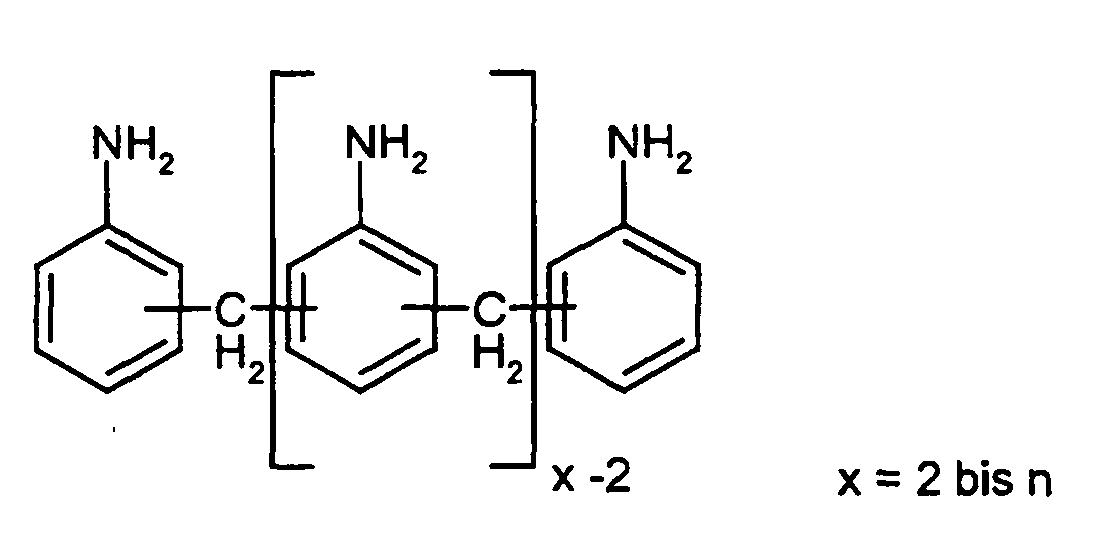
- Die großtechnische Herstellung von Isocyanaten durch Umsetzung von Aminen mit Phosgen in Lösungsmitteln ist bekannt und in der Literatur ausführlich beschrieben (Ullmanns Enzyklopädie der technischen Chemie, 4. Auflage, Band 13, Seite 347-357, Verlag Chemie GmbH, Weinheim, 1977). Auf Basis dieses Verfahrens wird das Polyisocyanatgemisch hergestellt, das als Polyisoyanatkomponente bei der Herstellung von Polyurethanschäumen und anderen nach dem Polyadditionsverfahren hergestellten Polyurethankunststoffen dient.
- Es ist allgemein bekannt, dass bei diesem Verfahren auch unerwünschte Farbstoffe oder farbgebende Komponenten gebildet werden, die auch bei der Weiterverarbeitung zu Polyurethanschäumen oder anderen Polyurethankunststoffen erhalten bleiben. Obwohl die Eigenfarbe der Polyisocyanat-Polyadditionsprodukte deren mechanische Eigenschaften nicht negativ beeinflusst, werden vom Verbraucher im wesentlichen farblose Produkte gewünscht. Als Maß für die Verfärbung des Polyisocyanates dient die Extinktion bei verschiedenen Wellenlängen.
- Daher ist seit längerer Zeit die Reduzierung der Farbwerte von Polyisocyanaten der Diphenylmethanreihe das Ziel zahlreicher Versuche und Arbeiten, die in der Literatur beschrieben sind. So beschreibt beispielsweise DE-A1-4208359 die Behandlung von solchen Isocyanaten mit Wasserstoff in Gegenwart von Trägerkatalysatoren. DE-A1-4232769 beschreibt die Zugabe von Aminen, Harnstoffen und Antioxidantien zum Isocyanat. DE-A1-19815055 beschreibt die Farbverbesserung von Polyisocyanaten der Diphenylmethanreihe durch Bestrahlung mit Licht über einen längeren Zeitraum. DE-A1-19804915 beschreibt die Aufhellung von Polyisocyanaten der Diphenylmethanreihe durch eine komplizierte zeit- und temperaturgestufte Formaldehydzugabe auf der Polyaminstufe, die dann durch Phosgenierung in das gewünschte Isocyanat überführt wird.
- EP-A-567 881 offenbart ein Verfahren zur Herstellung von Di- und Polyaminen der Diphenylmethanreihe, bei dem nach der Umsetzung von Anilin und Formaldehyd das Reaktionsgemisch neutralisiert und anschließend destillativ aufgearbeitet wird. EP-A-567 881 offenbart aber nicht, bei der Neutralisation die Base im Überschuss einzusetzen, um anschließend nach der Phosgenierung helle Di- und Polyisocyanate zu erhalten.
- Nachteilig an allen diesen Vorgehensweisen ist, dass sie technisch aufwendig sind und/oder die Verwendung isocyanatfremder Hilfsstoffe erfordern oder wenig effizient sind.
- Aufgabe der vorliegenden Erfindung war es daher, ein technisch einfaches und sicheres Verfahren bereit zu stellen, mit dem Polyisocyanate der Diphenylmethanreihe mit niedrigen Farbwerten hergestellt werden können. Es war ebenfalls Aufgabe der vorliegenden Erfindung, ein einfaches Verfahren zur Herstellung von Polyaminen der Diphenylmethanreihe bereit zu stellen, aus denen Polyisocyanate der Diphenylmethanreihe mit niedrigen Farbwerten durch Phosgenierung hergestellt werden können.
- Die Aufgabe wird erfindungsgemäß gelöst durch ein Verfahren zur Herstellung von Polyaminen der Diphenylmethanreihe, bei dem man
- a) Anilin und Formaldehyd in Gegenwart eines sauren Katalysators zu Polyaminen umsetzt und danach
- b) das Reaktionsgemisch mit einer Base bei einer Temperatur von oberhalb 110°C neutralisiert oder das Reaktionsgemisch nach der Neutralisation mit einer Base auf eine Temperatur von oberhalb 110°C aufheizt, wobei man die Base in Mengen von ≥ 101% des für die Neutralisation des eingesetzten sauren katalysators stöchiometrisch benötigten Menge einsetzt.
- Die Aufgabe wird ebenfalls erfmdungsgemäß gelöst durch ein Verfahren zur Herstellung von Polyisocyanaten der Diphenylmethanreihe, bei dem man
- a) Anilin und Formaldehyd in Gegenwart eines sauren Katalysators zu Polyaminen umsetzt und danach
- b) das Reaktionsgemisch mit einer Base bei einer Temperatur von oberhalb 110°C neutralisiert oder das Reaktionsgemisch nach der Neutralisation mit einer Base auf eine Temperatur von oberhalb 110°C aufheizt, wobei man die Base in Mengen von ≥ 101% des für die Neutralisation des eingesetzten sauren kalalysators stöchiometrisch benötigten Menge einsetzt, und danach.
- c) die Polyamine durch Phosgenierung zu den entsprechenden Polyisocyanaten umsetzt.
- Das erfindungsgemäße Verfahren kann sowohl kontinuierlich als auch diskontinuierlich durchgeführt werden.
- Mit dem erfindungsgemäßen Verfahren können Polyisocyanate mit niedrigen Farbwerten hergestellt werden. Als Farbwert wird hierbei die gemessene Extinktion einer Lösung von Polyisocyanat in Monochlorbenzol, enthaltend 2 Gew.-% Polyisocyanat, bei einer Schichtdicke von 10 mm und Raumtemperatur gegen Monochlorbenzol bei definierten Wellenlängen verstanden.
- Das im erfindungsgemäßen Verfahren eingesetzte Polyamin bzw. Polyamingemisch der Diphenylmethanreihe wird durch Kondensation von Anilin und Formaldehyd in Gegenwart eines sauren Katalysators erhalten (H.J. Twitchett, Chem. Soc. Rev. 3(2), 209 (1974), W. M. Moore in: Kirk-Othmer Encycl. Chem. Technol., 3rd. Ed., New York, 2, 338-348 (1978)). Für das erfindungsgemäße Verfahren ist es dabei unerheblich, ob Anilin und Formaldehyd zunächst in Abwesenheit des sauren Katalysators vermischt werden und der saure Katalysator anschließend zugesetzt wird oder ob ein Gemisch aus Anilin und saurem Katalysator mit Formaldehyd zu Reaktion gebracht wird.
- Geeignete Polyamingemische der Diphenylmethanreihe werden üblicherweise erhalten durch Kondensation von Anilin und Formaldehyd im Stoffmengenverhältnis 20 bis 1,6, bevorzugt 10 bis 1,8 sowie einem Stoffmengenverhältnis von Anilin und saurem Katalysator von 20 bis 1, bevorzugt 10 bis 2.
- Formaldehyd wird technisch üblicherweise als wässrige Lösung eingesetzt. Es können jedoch auch andere methylengruppenliefernde Verbindungen wie z.B. Polyoxymethylenglykol, para-Formaldehyd oder Trioxan eingesetzt werden.
- Als saure Katalysatoren haben sich starke organische und vorzugsweise anorganische Säuren bewährt. Geeignete Säuren sind beispielsweise Salzsäure, Schwefelsäure, Phosphorsäure, und Methansulfonsäure. Bevorzugt wird Salzsäure eingesetzt.
- In einer bevorzugten Ausführungsform des Verfahrens wird Anilin und saurer Katalysator zunächst vereinigt. Dieses Gemisch wird, ggf. nach Abfuhr von Wärme, in einem weiteren Schritt mit Formaldehyd bei Temperaturen zwischen 20°C und 100°C, bevorzugt bei 30°C bis 70°C in geeigneter Weise vermischt und anschließend in einem geeigneten Verweilzeitapparat einer Vorreaktion zu unterzogen. Die Vorreaktion erfolgt bei Temperaturen zwischen 20°C bis 100°C, vorzugsweise im Temperaturbereich 30°C bis 80°C. Im Anschluss an Vermischung und Vorreaktion wird die Temperatur des Reaktionsgemisches in Stufen oder kontinuierlich und ggf. unter Überdruck auf eine Temperatur von 100°C bis 250°C, bevorzugt auf 100°C bis 180°C, besonders bevorzugt auf eine Temperatur von 100°C bis 160°C gebracht.
- Es ist jedoch ebenfalls möglich in einer anderen Ausführungsform des Verfahrens Anilin und Formaldehyd zunächst in Abwesenheit des sauren Katalysators im Temperaturbereich von 5°C bis 130°C, bevorzugt von 40°C bis 100°C, besonders bevorzugt von 60°C bis 85°C, zu vermischen und so zur Reaktion zu bringen. Hierbei bilden sich Kondensationsprodukte aus Anilin und Formaldehyd (sog. Aminal). Im Anschluss an die Aminalbildung kann im Reaktionsgemisch vorhandenes Wasser durch Phasentrennung oder andere geeignete Verfahrensschritte, beispielsweise durch Destillation, entfernt werden. Das Kondensationsprodukt wird dann in einem weiteren Verfahrensschritt mit dem sauren Katalysator in geeigneter Weise vermischt und in einem Verweilzeitapparat bei 20°C bis 100°C, bevorzugt 30°C bis 80°C einer Vorreaktion unterzogen. Anschließend wird die Temperatur des Reaktionsgemisches in Stufen oder kontinuierlich und ggf. unter Überdruck auf eine Temperatur von 100°C bis 250°C, bevorzugt auf 100°C bis 180°C, besonders bevorzugt auf eine Temperatur von 100°C bis 160°C gebracht.
- Die Umsetzung von Anilin und Formaldehyd in Gegenwart eines sauren Katalysators zu Polyaminen der Diphenylmethanreihe kann in Anwesenheit weiterer Stoffe (z.B. Lösungsmittel, Salze, organische und anorganische Säuren) geschehen.
- Zur Aufarbeitung des sauren Reaktionsgemisches wird das Reaktionsgemisch mit einer Base neutralisiert. Nach dem Stand der Technik erfolgt die Neutralisation üblicherweise bei Temperaturen von beispielsweise 90 - 100°C (H.J. Twitchett, Chem. Soc. Rev. 3(2), 223 (1974)). Als Basen sind beispielsweise geeignet die Hydroxide der Alkali- und Erdalkalielemente. Vorzugsweise kommt wässrige NaOH zur Anwendung.
- Im erfindungsgemäßen Verfahren wird die Neutralisation des sauren Reaktionsgemisches bei Temperaturen von oberhalb 110°C, bevorzugt im Bereich 111°C bis 300°C, besonders bevorzugt bei 115°C bis 200°C, ganz besonders bevorzugt 120°C bis 180°C, insbesondere ganz besonders bevorzugt 130 bis 160°C, durchgeführt. Alternativ wird die Neutralisation bei Temperaturen von unterhalb 110°C durchgeführt und das neutralisierte Reaktionsgemisch anschließend auf eine Temperatur von oberhalb 110°C, bevorzugt 111°C bis 300°C, besonders bevorzugt 115°C bis 200°C, ganz besonders bevorzugt 120°C bis 180°C, insbesondere ganz besonders bevorzugt 130 bis 160°C, aufgeheizt.
- Die Neutralisation erfolgt beispielsweise in der Weise, dass das saure Reaktionsgemisch der Anilin/Formaldehydkondensation mit der Base vermischt und einem Verweilzeitapparat (beispielsweise Rührkessel, Rührkesselkaskade, Strömungsrohr, Umpumpreaktor) zugeführt wird. Bei geeigneten Verweilzeitapparaten (z.B. Rührkessel) kann die Vermischung von saurem Kondensationsgemisch und Base auch direkt im Verweilzeitapparat erfolgen.
- Das neutralisierte Reaktionsgemisch wird vorzugsweise für eine Verweilzeit von ≥0,1 min, bevorzugt 0,1 bis 180 min, besonders bevorzugt 2 bis 120 min, ganz besonders bevorzugt 10 bis 60 min, auf einer Temperatur oberhalb von 110°C gehalten.
- Zur Einstellung einer Temperatur gemäß der vorliegenden Erfindung kann Zufuhr oder Abfuhr von Wärme notwendig sein. Dies richtet sich insbesondere nach der gewünschten Temperatur, bei welcher die Neutralisation des erfindungsgemäßen Verfahrens erfolgen soll, aber auch nach der freiwerdenden Neutralisationswärme, der Temperatur der sauren Kondensationsmischung und der Temperatur der eingesetzten Base bzw. Basenlösung. Um das Sieden unterhalb der gewünschten Neutralisationstemperatur zu verhindern, muss das Verfahren gegebenenfalls bei erhöhtem Druck durchgeführt werden.
- Die zur Neutralisation eingesetzte Base wird in Mengen von größer 100%, bevorzugt 101 bis 140%, vorzugsweise 105 bis 120% der für die Neutralisation des eingesetzten sauren Katalysators stöchiometrisch benötigten Menge eingesetzt. Der Effekt der Neutralisation unter erhöhter Temperatur auf die Farbe der Polyisocyanate der Diphenylmethanreihe wird verstärkt, wenn in dem Neutralisationsverweilzeitbehälter für eine ausreichende Durchmischung der organischen und wässrigen Phase gesorgt wird. Dies kann durch Anwendung der in der Technik bekannten Methoden beispielsweise durch statische oder dynamische Mischer oder Erzeugung von Turbulenz erfolgen.
- Im Anschluss an die Neutralisation wird üblicherweise die organische von der wässrigen Phase durch geeignete Verfahren (z.B. Phasentrennung in einer Scheideflasche) getrennt. Diese Trennung von organischer und wässriger Phase kann bei der selben Temperatur erfolgen, bei der die Neutralisation des sauren Umlagerungsgemisches erfolgte. Die nach Abtrennung der wässrigen Phase verbleibende produktenthaltende organische Phase wird üblicherweise weiteren Aufarbeitungsschritten unterzogen (z.B. Wäsche) und anschließend von überschüssigem Anilin und anderen im Gemisch vorhandenen Stoffen (z.B. weiteren Lösungsmitteln) durch geeignete physikalische Trennverfahren wie z.B. Destillation, Extraktion oder Kristallisation befreit.
- Das so erhaltene Polyamin der Diphenylmethanreihe (Roh-MDA) wird nach den bekannten Methoden mit Phosgen in einem inerten organischen Lösungsmittel zu den entsprechenden Isocyanaten umgesetzt. Das Molverhältnis von Roh-MDA zu Phosgen wird zweckmäßigerweise so bemessen, dass pro Mol NH2-Gruppe 1 bis 10 Mol, vorzugsweise 1,3 bis 4 Mol Phosgen in der Reaktionsmischung vorliegen. Als inerte Lösungsmittel haben sich chlorierte, aromatische Kohlenwasserstoffe wie z.B. Monochlorbenzol, Dichlorbenzole, Trichlorbenzole, die entsprechenden Toluole und Xylole sowie Chlorethylbenzol bewährt. Insbesondere Anwendung finden als inerte organische Lösungsmittel Monochlorbenzol, Dichlorbenzol oder Mischungen dieser Chlorbenzole. Die Menge an Lösungsmittel wird vorzugsweise so bemessen, dass die Reaktionsmischung einen Isocyanatgehalt von 2 bis 40 Gew.-%, vorzugsweise zwischen 5 und 20 Gew.-%, bezogen auf das Gesamtgewicht der Reaktionsmischung, aufweist. Nach beendeter Phosgenierung werden aus der Reaktionsmischung das überschüssige Phosgen, das inerte organische Lösungsmittel, die gebildete HCl oder Mischungen davon durch Destillation abgetrennt.
- Das nach dem erfindungsgemäßen Verfahren hergestellte Roh-MDI besitzt eine deutlich reduzierte Färbung. Es lassen sich jedoch noch weitere analytische Unterschiede im hergestellten MDI nachweisen (wie z.B. ein erhöhter Gehalt an Isocyanatgruppen).
- Zu 410 g Anilin wurden bei 80°C innerhalb von 20 min zugleich 707,6 g Anilin und 563,6 g einer 32,0%igen wässrigen Formaldehydlösung getropft. Nach der Zugabe wurde noch 10 min gerührt und anschließend eine Phasentrennung bei 70-80°C vorgenommen. Von der organischen Phase wurde eine Menge von 284,5 g auf 35°C temperiert und anschließend bei dieser Temperatur innerhalb von 29 min mit der restlichen organischen Phase und 341,9 g einer 32,0%igen wässrigen Salzsäure versetzt. Nach beendeter Zugabe und einer 30 minütigen Nachrührzeit bei dieser Temperatur wurde während 10 min auf 60°C aufgeheizt und 30 min bei dieser Temperatur gehalten. Anschließend wurde innerhalb von 30 min auf Rückflusstemperatur aufgeheizt und 10 h unter Rückfluss gerührt. Zu 815 g des so erhaltenen sauren Umlagerungsgemisches wurden 154,3 g einer 49,6%igen wässrigen Natronlauge und 213 ml siedendes Wasser gegeben. Nach 15 min Rühren unter Rückfluss wurde bei 80-90°C eine Phasentrennung vorgenommen und die organische Phase weitere 2x mit je 638 ml siedendem Wasser gewaschen. Die organische Phase wurde anschließend unter vermindertem Druck vom überschüssigen Anilin befreit. Von dem so erhaltenen Polyamin wurden 50 g in 255 ml Chlorbenzol gelöst, auf 55°C erwärmt und innerhalb von 10 s unter intensivem Rühren zu einer auf 0°C temperierten Lösung von 105 g Phosgen in 310 ml Chlorbenzol gegeben. Die Suspension wurde unter Durchleiten von Phosgen innerhalb von 45 min auf 100°C und anschließend während 10 min auf Rückflusstemperatur aufgeheizt. Nach weiteren 10 min bei dieser Temperatur wurde das Lösungsmittel unter vermindertem Druck bis zu einer Sumpftempratur von 100°C abdestilliert. Das rohe Isocyanat wurde anschließend in einer Destillationsapparatur bei einem Druck von 4-6 mbar durch ein auf 260°C erwärmtes Heizbad bis zum ersten Produktübergang erhitzt und daraufhin innerhalb von 5 min auf Raumtemperatur abgekühlt. Von dem so erhaltenen Isocyanat wurde 1,0 g in Chlorbenzol gelöst und mit Chlorbenzol zu 50 ml verdünnt. Die so erhaltene Lösung besaß bei einer Wellenlänge von 430 nm, einer Schichtdicke von 10 mm und Raumtemperatur eine Extinktion von 0,193 gegen Chlorbenzol.
- 699 g des obigen sauren Umlagerungsgemisches wurden mit 132,4 g 49,6%iger wässriger Natronlauge unter Zusatz von 60,8 g Wasser neutralisiert. Die Reaktionsmischung wurde in einen Druckbehälter überführt und 3 h bei 160°C und Eigendruck gerührt. Anschließend wurden die Phasen getrennt und die organische Phase analog Beispiel 1 gereinigt. Das resultierende Polyamin wurde analog Beispiel 1 mit Phosgen in das entsprechende Isocyanat überführt. Die Extinktion bei 430 nm gemäß der in Beispiel 1 beschriebenen Methode betrug 0,163.
- 403 g eines sauren Umlagerungsgemisches, dessen Herstellung analog Beispiel 1 erfolgte, wurden mit 76 g 50%iger wässriger Natronlauge unter Zusatz von 105 g Wasser neutralisiert. Die Reaktionsmischung wurde in einen Druckbehälter überführt und 15 min bei 160°C und Eigendruck gerührt. Anschließend wurden die Phasen getrennt und die organische Phase analog Beispiel 1 gereinigt. Das resultierende Polyamin wurde analog Beispiel 1 mit Phosgen in das entsprechende Isocyanat überführt. Die Extinktion bei 430 nm gemäß der in Beispiel 1 beschriebenen Methode betrug 0,164.
Claims (6)
- Verfahren zur Herstellung von Polyaminen der Diphenylmethanreihe, bei dem mana) Anilin und Formaldehyd in Gegenwart eines sauren Katalysators zu Polyaminen umsetzt und danachb) Das Reaktionsgemisch mit einer Base bei einer Temperatur von oberhalb 110°C neutralisiert oder das Reaktionsgemisch nach der Neutralisation mit einer Base auf eine Temperatur von oberhalb 110°C aufheizt, wobei man die Base in Mengen von ≧ 101 % der für die Neutralisation des eingesetzten sauren Katalysators stöchiometrisch benötigten Menge eingesetzt.
- Verfahren nach Anspruch 1, bei dem man die Neutralisation mit einer Base auf eine Temperatur von 120°C bis 180°C durchführt.
- Verfahren nach Anspruch 1 oder 2, bei dem man als Base wässrige NaOH einsetzt.
- Verfahren zur Herstellung Polyisocyanaten der Diphenylmethanreihe, bei dem man die Polyamine der Diphenylmethanreihe nach dem Verfahren nach Anspruch 1 herstellt, und die Polyamine durch Phosgenierung zu den entsprechenden Polyisocyanaten umsetzt.
- Verfahren nach Anspruch 4, bei dem man die Neutralisation bei einer Temperatur von 120° C bis 180°C durchführt.
- Verfahren nach Anspruch 4 oder 5, bei dem man als Base wässrige NaOH einsetzt.
Applications Claiming Priority (2)
| Application Number | Priority Date | Filing Date | Title |
|---|---|---|---|
| DE10141620A DE10141620A1 (de) | 2001-08-24 | 2001-08-24 | Verfahren zur Herstellung von Polyisocyanaten der Diphenylmethanreihe mit vermindertem Farbwert |
| DE10141620 | 2001-08-24 |
Publications (3)
| Publication Number | Publication Date |
|---|---|
| EP1288190A2 EP1288190A2 (de) | 2003-03-05 |
| EP1288190A3 EP1288190A3 (de) | 2003-06-04 |
| EP1288190B1 true EP1288190B1 (de) | 2007-01-10 |
Family
ID=7696548
Family Applications (1)
| Application Number | Title | Priority Date | Filing Date |
|---|---|---|---|
| EP02017778A Expired - Lifetime EP1288190B1 (de) | 2001-08-24 | 2002-08-12 | Verfahren zur Herstellung von Polyisocyanaten der Diphenylmethanreihe mit vermindertem Farbwert |
Country Status (16)
| Country | Link |
|---|---|
| US (1) | US6720455B2 (de) |
| EP (1) | EP1288190B1 (de) |
| JP (1) | JP2003119235A (de) |
| KR (1) | KR100860910B1 (de) |
| CN (1) | CN1232499C (de) |
| BR (1) | BR0203370A (de) |
| CA (1) | CA2399483A1 (de) |
| DE (2) | DE10141620A1 (de) |
| ES (1) | ES2280459T3 (de) |
| HK (1) | HK1053105A1 (de) |
| HU (1) | HUP0202841A3 (de) |
| MX (1) | MXPA02008245A (de) |
| PL (1) | PL355618A1 (de) |
| PT (1) | PT1288190E (de) |
| SG (1) | SG99409A1 (de) |
| TW (1) | TW575594B (de) |
Families Citing this family (18)
| Publication number | Priority date | Publication date | Assignee | Title |
|---|---|---|---|---|
| DE10211021A1 (de) * | 2002-03-13 | 2003-09-25 | Bayer Ag | Verfahren zur Herstellung von Polyisocyanaten der Diphenylmethanreihe mit vermindertem Farbwert |
| DE10228734A1 (de) * | 2002-06-27 | 2004-01-22 | Bayer Ag | Verfahren zur Herstellung von Polyisocyanaten der Diphenylmethanreihe mit vermindertem Farbwert |
| DE102004032416A1 (de) * | 2004-07-05 | 2006-02-02 | Bayer Materialscience Ag | Verfahren zur Herstellung von Polyaminen der Diphenylmethanreihe bei niedriger Protonierung |
| DE102004052370A1 (de) * | 2004-10-28 | 2006-05-04 | Bayer Materialscience Ag | Verfahren zur Herstellung von Di- und Polyaminen der Diphenylmethanreihe |
| US7943724B2 (en) * | 2005-12-08 | 2011-05-17 | Huntsman International Llc | Process for preparing diaminodiphenylmethanes |
| DE102006004047A1 (de) * | 2006-01-28 | 2007-08-02 | Bayer Materialscience Ag | Verfahren zur Herstellung von Di- und Polyaminen der Diphenylmethanreihe |
| CN101279923B (zh) * | 2007-04-06 | 2010-08-25 | 宁波万华聚氨酯有限公司 | 一种制备多亚甲基多苯基多胺的方法 |
| ATE517860T1 (de) * | 2007-04-06 | 2011-08-15 | Ningbo Wanhua Polyurethanes Co | Verfahren zur herstellung von polymethylenpolyphenylpolyamin |
| EP2000459A1 (de) * | 2007-06-04 | 2008-12-10 | Huntsman International Llc | Verfahren zur Herstellung von Di- und Polyaminen der Diphenylmethanreihe |
| EP2062869A1 (de) * | 2007-09-19 | 2009-05-27 | Huntsman International Llc | Verfahren zur Herstellung von Di- und Polyaminen der Diphenylmethanreihe |
| EP2039676A1 (de) | 2007-09-19 | 2009-03-25 | Huntsman International Llc | Verfahren zur Herstellung von Di- und Polyaminen der Diphenylmethanreihe |
| EP2421818B1 (de) | 2009-04-24 | 2014-08-27 | Basf Se | Verfahren zur herstellung von farbstabilem mda und mdi |
| JP5810095B2 (ja) | 2009-12-18 | 2015-11-11 | ビーエーエスエフ ソシエタス・ヨーロピアBasf Se | Mda合成における均一系触媒のコスト効率的な析出のための2段階製法 |
| CN107827756B (zh) * | 2017-11-17 | 2020-09-08 | 万华化学集团股份有限公司 | 一种低n-甲基杂质含量的二苯基甲烷系列二胺和多胺的制备方法及装置和催化剂 |
| CN111646927A (zh) * | 2020-06-12 | 2020-09-11 | 万华节能科技集团股份有限公司 | 阻燃二苯基甲烷二异氰酸酯的衍生物及其合成方法 |
| WO2025073928A1 (en) | 2023-10-06 | 2025-04-10 | Basf Se | Process for preparing mda |
| CN119100935A (zh) * | 2024-09-04 | 2024-12-10 | 万华化学集团股份有限公司 | 一种二苯基甲烷系列的二胺和多胺的制备方法及应用 |
| WO2026068450A1 (en) | 2024-09-24 | 2026-04-02 | Basf Se | Process for preparing a polyisocyanate mixture comprising methylene diphenyl diisocyanate (mdi) |
Family Cites Families (7)
| Publication number | Priority date | Publication date | Assignee | Title |
|---|---|---|---|---|
| JPS60199861A (ja) * | 1984-03-23 | 1985-10-09 | Mitsui Toatsu Chem Inc | 芳香族ジアミン類の精製方法 |
| DE4208359A1 (de) | 1992-03-16 | 1993-09-23 | Bayer Ag | Verfahren zur herstellung von isocyanaten oder isocyanatgemischen und deren verwendung zur herstellung von polyurethanschaumstoffen |
| US5310769A (en) | 1992-05-01 | 1994-05-10 | Bayer Aktiengesellschaft | Process for the production of polyamine mixtures of the polyamino-polyaryl-polymethylene series |
| DE4232769A1 (de) | 1992-09-30 | 1994-03-31 | Basf Ag | Verfahren zur Herstellung von Mischungen aus Diphenylmethandiisocyanaten und Polyphenyl-polymethylen-polyisocyanaten mit einer verminderten Iodfarbzahl |
| US6031136A (en) * | 1993-07-21 | 2000-02-29 | Bayer Corporation | Process for preparing methylene diphenylamines by partial neutralization of acidic methylene diphenylamines |
| DE19804915A1 (de) | 1998-02-07 | 1999-08-12 | Basf Ag | Verfahren zur Herstellung von Methylendi(phenylamin) und Methylendi(phenylisocyanat) |
| DE19815055A1 (de) | 1998-04-03 | 1999-10-07 | Bayer Ag | Verfahren zur Farbaufhellung von polymeren Diphenylmethandiisocyanat sowie die Verwendung von aufgehellten Diphenylmethandiisocyanat bei der Herstellung von Polyurethankunststoffen |
-
2001
- 2001-08-24 DE DE10141620A patent/DE10141620A1/de not_active Withdrawn
-
2002
- 2002-08-08 SG SG200204842A patent/SG99409A1/en unknown
- 2002-08-12 DE DE50209217T patent/DE50209217D1/de not_active Expired - Lifetime
- 2002-08-12 ES ES02017778T patent/ES2280459T3/es not_active Expired - Lifetime
- 2002-08-12 PT PT02017778T patent/PT1288190E/pt unknown
- 2002-08-12 EP EP02017778A patent/EP1288190B1/de not_active Expired - Lifetime
- 2002-08-20 US US10/224,003 patent/US6720455B2/en not_active Expired - Fee Related
- 2002-08-22 JP JP2002241861A patent/JP2003119235A/ja active Pending
- 2002-08-22 PL PL02355618A patent/PL355618A1/xx not_active Application Discontinuation
- 2002-08-22 TW TW91118950A patent/TW575594B/zh not_active IP Right Cessation
- 2002-08-22 CA CA002399483A patent/CA2399483A1/en not_active Abandoned
- 2002-08-23 MX MXPA02008245A patent/MXPA02008245A/es unknown
- 2002-08-23 KR KR1020020049991A patent/KR100860910B1/ko not_active Expired - Fee Related
- 2002-08-23 HU HU0202841A patent/HUP0202841A3/hu unknown
- 2002-08-23 BR BR0203370-4A patent/BR0203370A/pt not_active IP Right Cessation
- 2002-08-23 CN CNB021420475A patent/CN1232499C/zh not_active Expired - Fee Related
-
2003
- 2003-07-24 HK HK03105349.4A patent/HK1053105A1/zh unknown
Also Published As
| Publication number | Publication date |
|---|---|
| HK1053105A1 (zh) | 2003-10-10 |
| DE10141620A1 (de) | 2003-03-06 |
| US6720455B2 (en) | 2004-04-13 |
| HUP0202841A3 (en) | 2004-03-01 |
| CN1232499C (zh) | 2005-12-21 |
| PT1288190E (pt) | 2007-04-30 |
| TW575594B (en) | 2004-02-11 |
| US20030045745A1 (en) | 2003-03-06 |
| JP2003119235A (ja) | 2003-04-23 |
| KR20030017415A (ko) | 2003-03-03 |
| MXPA02008245A (es) | 2005-09-08 |
| EP1288190A2 (de) | 2003-03-05 |
| SG99409A1 (en) | 2003-10-27 |
| HUP0202841A2 (hu) | 2003-03-28 |
| KR100860910B1 (ko) | 2008-09-29 |
| HU0202841D0 (de) | 2002-11-28 |
| EP1288190A3 (de) | 2003-06-04 |
| ES2280459T3 (es) | 2007-09-16 |
| BR0203370A (pt) | 2003-05-27 |
| CN1406925A (zh) | 2003-04-02 |
| CA2399483A1 (en) | 2003-02-24 |
| DE50209217D1 (de) | 2007-02-22 |
| PL355618A1 (en) | 2003-03-10 |
Similar Documents
| Publication | Publication Date | Title |
|---|---|---|
| EP1288190B1 (de) | Verfahren zur Herstellung von Polyisocyanaten der Diphenylmethanreihe mit vermindertem Farbwert | |
| EP1344766B1 (de) | Verfahren zur Herstellung von Polyisocyanaten der Diphenylmethanreihe mit vermindertem Farbwert | |
| EP1616890B1 (de) | Verfahren zur Herstellung von Polyaminen der Diphenylmethanreihe bei niedriger Protonierung | |
| EP1403242B1 (de) | Verfahren zur Herstellung von Polyisocyanaten der Diphenylmethanreihe durch Phosgenierung von nicht-neutralisiertem Polyamin der Diphenylmethanreihe | |
| EP1813598B1 (de) | Verfahren zur Herstellung von Di- und Polyaminen der Diphenylmethanreihe | |
| EP2103595B1 (de) | Verfahren zur Herstellung von Di- und Polyaminen der Diphenylmethanreihe | |
| EP1652835B1 (de) | Verfahren zur Herstellung von Di-und Polyaminen der Diphenylmethanreihe | |
| EP2989078B1 (de) | Verfahren zur herstellung von di- und polyaminen der diphenylmethanreihe | |
| EP1379569B1 (de) | Verfahren zur herstellung von mdi, insbesondere von 2,4'-mdi | |
| EP0716079B1 (de) | Kontinuierliches Verfahren zur Herstellung von organischen Isocyanaten | |
| EP0014927B1 (de) | Verfahren zur Herstellung von Gemischen von Polyaminen der Polyamino-polyaryl-polymethylenreihe | |
| EP2768800B1 (de) | Verfahren zur herstellung farbheller polyisocyanate | |
| DE69107212T2 (de) | Verfahren zur Herstellung von polymerischen Methylen-dyphenylen-diisocyanaten mit verminderter Farbe und Chloridgehalt. | |
| DE69213678T2 (de) | Verfahren zur Herstellung von Polyaminen für helleren auf Polyisocyanat basierenden Schaum | |
| DE10228734A1 (de) | Verfahren zur Herstellung von Polyisocyanaten der Diphenylmethanreihe mit vermindertem Farbwert | |
| DE102005014244A1 (de) | Verfahren zur Herstellung von Di- und Polyaminen der Diphenylmethanreihe | |
| DE2005309B2 (de) | Verfahren zur Herstellung von 1,3-Cyclohexylendiisocyanaten | |
| DE1243675B (de) | Verfahren zur Herstellung von Polyarylalkylenpolyisocyanaten | |
| WO2018050441A1 (de) | Verfahren zur hydrierung eines gemisches in gegenwart eines farblosen amins | |
| DE10145787A1 (de) | Verfahren zur Herstellung von Methylendi(phenylisocyanat) | |
| DE3608354A1 (de) | 1,4-diisocyanato-4-methylpentan, ein verfahren zu seiner herstellung und seine verwendung als isocyanatkomponente bei der herstellung von polyurethankunststoffen | |
| DD227698B1 (de) | Verfahren zur herstellung von isocyanaten der diisocyanatodiphenylmethanreihe | |
| DE1932526B2 (de) | Verfahren zur gleichzeitigen herstellung von 4,4'-diphenylmethandiisocyanat und einem gemisch von polymethylenpolyphenylisocyanaten | |
| DE2838272A1 (de) | Verfahren zur herstellung von polyarylaminen | |
| DE2709490A1 (de) | Verfahren zur herstellung von polyarylaminen |
Legal Events
| Date | Code | Title | Description |
|---|---|---|---|
| PUAI | Public reference made under article 153(3) epc to a published international application that has entered the european phase |
Free format text: ORIGINAL CODE: 0009012 |
|
| AK | Designated contracting states |
Kind code of ref document: A2 Designated state(s): AT BE BG CH CY CZ DE DK EE ES FI FR GB GR IE IT LI LU MC NL PT SE SK TR |
|
| AX | Request for extension of the european patent |
Extension state: AL LT LV MK RO SI |
|
| PUAL | Search report despatched |
Free format text: ORIGINAL CODE: 0009013 |
|
| AK | Designated contracting states |
Designated state(s): AT BE BG CH CY CZ DE DK EE ES FI FR GB GR IE IT LI LU MC NL PT SE SK TR |
|
| AX | Request for extension of the european patent |
Extension state: AL LT LV MK RO SI |
|
| 17P | Request for examination filed |
Effective date: 20031204 |
|
| AKX | Designation fees paid |
Designated state(s): AT BE BG CH CY CZ DE DK EE ES FI FR GB GR IE IT LI LU MC NL PT SE SK TR |
|
| RAP1 | Party data changed (applicant data changed or rights of an application transferred) |
Owner name: BAYER MATERIALSCIENCE AG |
|
| 17Q | First examination report despatched |
Effective date: 20050411 |
|
| GRAP | Despatch of communication of intention to grant a patent |
Free format text: ORIGINAL CODE: EPIDOSNIGR1 |
|
| GRAS | Grant fee paid |
Free format text: ORIGINAL CODE: EPIDOSNIGR3 |
|
| GRAA | (expected) grant |
Free format text: ORIGINAL CODE: 0009210 |
|
| AK | Designated contracting states |
Kind code of ref document: B1 Designated state(s): AT BE BG CH CY CZ DE DK EE ES FI FR GB GR IE IT LI LU MC NL PT SE SK TR |
|
| PG25 | Lapsed in a contracting state [announced via postgrant information from national office to epo] |
Ref country code: FI Free format text: LAPSE BECAUSE OF FAILURE TO SUBMIT A TRANSLATION OF THE DESCRIPTION OR TO PAY THE FEE WITHIN THE PRESCRIBED TIME-LIMIT Effective date: 20070110 Ref country code: IE Free format text: LAPSE BECAUSE OF FAILURE TO SUBMIT A TRANSLATION OF THE DESCRIPTION OR TO PAY THE FEE WITHIN THE PRESCRIBED TIME-LIMIT Effective date: 20070110 Ref country code: DK Free format text: LAPSE BECAUSE OF FAILURE TO SUBMIT A TRANSLATION OF THE DESCRIPTION OR TO PAY THE FEE WITHIN THE PRESCRIBED TIME-LIMIT Effective date: 20070110 |
|
| REG | Reference to a national code |
Ref country code: GB Ref legal event code: FG4D Free format text: NOT ENGLISH |
|
| REG | Reference to a national code |
Ref country code: IE Ref legal event code: FG4D Free format text: LANGUAGE OF EP DOCUMENT: GERMAN |
|
| REF | Corresponds to: |
Ref document number: 50209217 Country of ref document: DE Date of ref document: 20070222 Kind code of ref document: P |
|
| GBT | Gb: translation of ep patent filed (gb section 77(6)(a)/1977) |
Effective date: 20070314 |
|
| PG25 | Lapsed in a contracting state [announced via postgrant information from national office to epo] |
Ref country code: SE Free format text: LAPSE BECAUSE OF FAILURE TO SUBMIT A TRANSLATION OF THE DESCRIPTION OR TO PAY THE FEE WITHIN THE PRESCRIBED TIME-LIMIT Effective date: 20070410 |
|
| PG25 | Lapsed in a contracting state [announced via postgrant information from national office to epo] |
Ref country code: BG Free format text: LAPSE BECAUSE OF THE APPLICANT RENOUNCES Effective date: 20070411 |
|
| REG | Reference to a national code |
Ref country code: PT Ref legal event code: SC4A Free format text: AVAILABILITY OF NATIONAL TRANSLATION Effective date: 20070329 |
|
| ET | Fr: translation filed | ||
| REG | Reference to a national code |
Ref country code: IE Ref legal event code: FD4D |
|
| REG | Reference to a national code |
Ref country code: ES Ref legal event code: FG2A Ref document number: 2280459 Country of ref document: ES Kind code of ref document: T3 |
|
| PLBE | No opposition filed within time limit |
Free format text: ORIGINAL CODE: 0009261 |
|
| STAA | Information on the status of an ep patent application or granted ep patent |
Free format text: STATUS: NO OPPOSITION FILED WITHIN TIME LIMIT |
|
| PG25 | Lapsed in a contracting state [announced via postgrant information from national office to epo] |
Ref country code: SK Free format text: LAPSE BECAUSE OF FAILURE TO SUBMIT A TRANSLATION OF THE DESCRIPTION OR TO PAY THE FEE WITHIN THE PRESCRIBED TIME-LIMIT Effective date: 20070110 |
|
| 26N | No opposition filed |
Effective date: 20071011 |
|
| PG25 | Lapsed in a contracting state [announced via postgrant information from national office to epo] |
Ref country code: CZ Free format text: LAPSE BECAUSE OF FAILURE TO SUBMIT A TRANSLATION OF THE DESCRIPTION OR TO PAY THE FEE WITHIN THE PRESCRIBED TIME-LIMIT Effective date: 20070110 |
|
| PGFP | Annual fee paid to national office [announced via postgrant information from national office to epo] |
Ref country code: GB Payment date: 20070809 Year of fee payment: 6 |
|
| PGFP | Annual fee paid to national office [announced via postgrant information from national office to epo] |
Ref country code: IT Payment date: 20070829 Year of fee payment: 6 |
|
| REG | Reference to a national code |
Ref country code: CH Ref legal event code: PL |
|
| PG25 | Lapsed in a contracting state [announced via postgrant information from national office to epo] |
Ref country code: CH Free format text: LAPSE BECAUSE OF NON-PAYMENT OF DUE FEES Effective date: 20070831 Ref country code: MC Free format text: LAPSE BECAUSE OF NON-PAYMENT OF DUE FEES Effective date: 20070831 Ref country code: LI Free format text: LAPSE BECAUSE OF NON-PAYMENT OF DUE FEES Effective date: 20070831 Ref country code: GR Free format text: LAPSE BECAUSE OF FAILURE TO SUBMIT A TRANSLATION OF THE DESCRIPTION OR TO PAY THE FEE WITHIN THE PRESCRIBED TIME-LIMIT Effective date: 20070411 |
|
| PGFP | Annual fee paid to national office [announced via postgrant information from national office to epo] |
Ref country code: FR Payment date: 20070808 Year of fee payment: 6 |
|
| PG25 | Lapsed in a contracting state [announced via postgrant information from national office to epo] |
Ref country code: AT Free format text: LAPSE BECAUSE OF NON-PAYMENT OF DUE FEES Effective date: 20070812 |
|
| PG25 | Lapsed in a contracting state [announced via postgrant information from national office to epo] |
Ref country code: EE Free format text: LAPSE BECAUSE OF FAILURE TO SUBMIT A TRANSLATION OF THE DESCRIPTION OR TO PAY THE FEE WITHIN THE PRESCRIBED TIME-LIMIT Effective date: 20070110 |
|
| GBPC | Gb: european patent ceased through non-payment of renewal fee |
Effective date: 20080812 |
|
| REG | Reference to a national code |
Ref country code: FR Ref legal event code: ST Effective date: 20090430 |
|
| PG25 | Lapsed in a contracting state [announced via postgrant information from national office to epo] |
Ref country code: CY Free format text: LAPSE BECAUSE OF FAILURE TO SUBMIT A TRANSLATION OF THE DESCRIPTION OR TO PAY THE FEE WITHIN THE PRESCRIBED TIME-LIMIT Effective date: 20070110 |
|
| PG25 | Lapsed in a contracting state [announced via postgrant information from national office to epo] |
Ref country code: IT Free format text: LAPSE BECAUSE OF NON-PAYMENT OF DUE FEES Effective date: 20080812 Ref country code: LU Free format text: LAPSE BECAUSE OF NON-PAYMENT OF DUE FEES Effective date: 20070812 Ref country code: FR Free format text: LAPSE BECAUSE OF NON-PAYMENT OF DUE FEES Effective date: 20080901 |
|
| PG25 | Lapsed in a contracting state [announced via postgrant information from national office to epo] |
Ref country code: TR Free format text: LAPSE BECAUSE OF FAILURE TO SUBMIT A TRANSLATION OF THE DESCRIPTION OR TO PAY THE FEE WITHIN THE PRESCRIBED TIME-LIMIT Effective date: 20070110 |
|
| PGFP | Annual fee paid to national office [announced via postgrant information from national office to epo] |
Ref country code: ES Payment date: 20090902 Year of fee payment: 8 |
|
| PG25 | Lapsed in a contracting state [announced via postgrant information from national office to epo] |
Ref country code: GB Free format text: LAPSE BECAUSE OF NON-PAYMENT OF DUE FEES Effective date: 20080812 |
|
| PGFP | Annual fee paid to national office [announced via postgrant information from national office to epo] |
Ref country code: DE Payment date: 20090723 Year of fee payment: 8 Ref country code: NL Payment date: 20090803 Year of fee payment: 8 Ref country code: PT Payment date: 20090810 Year of fee payment: 8 |
|
| PGFP | Annual fee paid to national office [announced via postgrant information from national office to epo] |
Ref country code: BE Payment date: 20090825 Year of fee payment: 8 |
|
| BERE | Be: lapsed |
Owner name: BAYER MATERIALSCIENCE A.G. Effective date: 20100831 |
|
| REG | Reference to a national code |
Ref country code: NL Ref legal event code: V1 Effective date: 20110301 |
|
| PG25 | Lapsed in a contracting state [announced via postgrant information from national office to epo] |
Ref country code: NL Free format text: LAPSE BECAUSE OF NON-PAYMENT OF DUE FEES Effective date: 20110301 Ref country code: PT Free format text: LAPSE BECAUSE OF NON-PAYMENT OF DUE FEES Effective date: 20110214 |
|
| REG | Reference to a national code |
Ref country code: DE Ref legal event code: R119 Ref document number: 50209217 Country of ref document: DE Effective date: 20110301 |
|
| PG25 | Lapsed in a contracting state [announced via postgrant information from national office to epo] |
Ref country code: BE Free format text: LAPSE BECAUSE OF NON-PAYMENT OF DUE FEES Effective date: 20100831 Ref country code: DE Free format text: LAPSE BECAUSE OF NON-PAYMENT OF DUE FEES Effective date: 20110301 |
|
| REG | Reference to a national code |
Ref country code: ES Ref legal event code: FD2A Effective date: 20111019 |
|
| PG25 | Lapsed in a contracting state [announced via postgrant information from national office to epo] |
Ref country code: ES Free format text: LAPSE BECAUSE OF NON-PAYMENT OF DUE FEES Effective date: 20100813 |