EP1293129A2 - Procédé et installation de traitement des poissons depuis leur prise en compte jusqu'à leur éviscération - Google Patents
Procédé et installation de traitement des poissons depuis leur prise en compte jusqu'à leur éviscération Download PDFInfo
- Publication number
- EP1293129A2 EP1293129A2 EP02006899A EP02006899A EP1293129A2 EP 1293129 A2 EP1293129 A2 EP 1293129A2 EP 02006899 A EP02006899 A EP 02006899A EP 02006899 A EP02006899 A EP 02006899A EP 1293129 A2 EP1293129 A2 EP 1293129A2
- Authority
- EP
- European Patent Office
- Prior art keywords
- fish
- water
- tank
- optionally
- bleeding
- Prior art date
- Legal status (The legal status is an assumption and is not a legal conclusion. Google has not performed a legal analysis and makes no representation as to the accuracy of the status listed.)
- Granted
Links
- 241000251468 Actinopterygii Species 0.000 title claims abstract description 187
- 238000000034 method Methods 0.000 title claims abstract description 40
- 230000008569 process Effects 0.000 title claims abstract description 25
- XLYOFNOQVPJJNP-UHFFFAOYSA-N water Substances O XLYOFNOQVPJJNP-UHFFFAOYSA-N 0.000 claims abstract description 63
- 230000000740 bleeding effect Effects 0.000 claims abstract description 34
- 239000012528 membrane Substances 0.000 claims abstract description 10
- 230000003444 anaesthetic effect Effects 0.000 claims abstract description 9
- 244000045947 parasite Species 0.000 claims abstract description 8
- 241000894006 Bacteria Species 0.000 claims abstract description 7
- QVGXLLKOCUKJST-UHFFFAOYSA-N atomic oxygen Chemical compound [O] QVGXLLKOCUKJST-UHFFFAOYSA-N 0.000 claims abstract description 7
- 239000000498 cooling water Substances 0.000 claims abstract description 7
- 239000001301 oxygen Substances 0.000 claims abstract description 7
- 229910052760 oxygen Inorganic materials 0.000 claims abstract description 7
- 230000000844 anti-bacterial effect Effects 0.000 claims abstract description 5
- 239000003899 bactericide agent Substances 0.000 claims abstract description 5
- 230000000590 parasiticidal effect Effects 0.000 claims abstract description 5
- 239000002297 parasiticide Substances 0.000 claims abstract description 5
- 239000000654 additive Substances 0.000 claims abstract description 4
- 230000000694 effects Effects 0.000 claims abstract description 4
- 150000001720 carbohydrates Chemical class 0.000 claims abstract description 3
- 235000014633 carbohydrates Nutrition 0.000 claims abstract description 3
- 239000005454 flavour additive Substances 0.000 claims abstract description 3
- 235000013355 food flavoring agent Nutrition 0.000 claims abstract description 3
- 241000894007 species Species 0.000 claims abstract description 3
- MHAJPDPJQMAIIY-UHFFFAOYSA-N Hydrogen peroxide Chemical compound OO MHAJPDPJQMAIIY-UHFFFAOYSA-N 0.000 claims description 16
- 238000003307 slaughter Methods 0.000 claims description 9
- 238000001816 cooling Methods 0.000 claims description 5
- 239000007789 gas Substances 0.000 claims description 5
- 210000003205 muscle Anatomy 0.000 claims description 5
- 229920002527 Glycogen Polymers 0.000 claims description 3
- 239000000796 flavoring agent Substances 0.000 claims description 3
- 235000019634 flavors Nutrition 0.000 claims description 3
- 229940096919 glycogen Drugs 0.000 claims description 3
- 238000012986 modification Methods 0.000 claims description 2
- 230000004048 modification Effects 0.000 claims description 2
- 230000021542 voluntary musculoskeletal movement Effects 0.000 claims 1
- 238000012432 intermediate storage Methods 0.000 abstract description 4
- 238000001914 filtration Methods 0.000 abstract description 3
- 235000019688 fish Nutrition 0.000 description 156
- 208000032843 Hemorrhage Diseases 0.000 description 28
- 208000034158 bleeding Diseases 0.000 description 28
- 241000972773 Aulopiformes Species 0.000 description 11
- 208000032107 Rigor Mortis Diseases 0.000 description 11
- 238000012856 packing Methods 0.000 description 11
- 235000019515 salmon Nutrition 0.000 description 11
- 230000009467 reduction Effects 0.000 description 8
- 239000000047 product Substances 0.000 description 6
- 230000006378 damage Effects 0.000 description 5
- 238000012545 processing Methods 0.000 description 5
- 239000013535 sea water Substances 0.000 description 5
- 208000027418 Wounds and injury Diseases 0.000 description 4
- 239000008280 blood Substances 0.000 description 4
- 210000004369 blood Anatomy 0.000 description 4
- 239000007795 chemical reaction product Substances 0.000 description 4
- 238000012360 testing method Methods 0.000 description 4
- 239000000969 carrier Substances 0.000 description 3
- 238000000354 decomposition reaction Methods 0.000 description 3
- 238000007599 discharging Methods 0.000 description 3
- 238000002474 experimental method Methods 0.000 description 3
- 208000014674 injury Diseases 0.000 description 3
- 235000013372 meat Nutrition 0.000 description 3
- 241001674048 Phthiraptera Species 0.000 description 2
- 230000002358 autolytic effect Effects 0.000 description 2
- 230000008901 benefit Effects 0.000 description 2
- 239000012267 brine Substances 0.000 description 2
- 238000011109 contamination Methods 0.000 description 2
- 230000001934 delay Effects 0.000 description 2
- 230000006872 improvement Effects 0.000 description 2
- 208000015181 infectious disease Diseases 0.000 description 2
- 238000005259 measurement Methods 0.000 description 2
- HPALAKNZSZLMCH-UHFFFAOYSA-M sodium;chloride;hydrate Chemical compound O.[Na+].[Cl-] HPALAKNZSZLMCH-UHFFFAOYSA-M 0.000 description 2
- 238000003860 storage Methods 0.000 description 2
- 238000012546 transfer Methods 0.000 description 2
- 102000004190 Enzymes Human genes 0.000 description 1
- 108090000790 Enzymes Proteins 0.000 description 1
- 206010052428 Wound Diseases 0.000 description 1
- 230000000996 additive effect Effects 0.000 description 1
- 230000003190 augmentative effect Effects 0.000 description 1
- 230000001580 bacterial effect Effects 0.000 description 1
- 230000015556 catabolic process Effects 0.000 description 1
- 239000003054 catalyst Substances 0.000 description 1
- 230000008859 change Effects 0.000 description 1
- 239000013043 chemical agent Substances 0.000 description 1
- 239000003086 colorant Substances 0.000 description 1
- 230000000875 corresponding effect Effects 0.000 description 1
- 230000003111 delayed effect Effects 0.000 description 1
- 230000001419 dependent effect Effects 0.000 description 1
- 230000006866 deterioration Effects 0.000 description 1
- 230000002542 deteriorative effect Effects 0.000 description 1
- 238000011161 development Methods 0.000 description 1
- 238000005265 energy consumption Methods 0.000 description 1
- 230000007613 environmental effect Effects 0.000 description 1
- 238000009313 farming Methods 0.000 description 1
- 210000003736 gastrointestinal content Anatomy 0.000 description 1
- 210000000936 intestine Anatomy 0.000 description 1
- 238000012417 linear regression Methods 0.000 description 1
- 239000007788 liquid Substances 0.000 description 1
- 238000004806 packaging method and process Methods 0.000 description 1
- 239000000049 pigment Substances 0.000 description 1
- 244000062645 predators Species 0.000 description 1
- 239000003755 preservative agent Substances 0.000 description 1
- 230000002335 preservative effect Effects 0.000 description 1
- 230000001105 regulatory effect Effects 0.000 description 1
- 230000000717 retained effect Effects 0.000 description 1
- 239000000523 sample Substances 0.000 description 1
- 230000035939 shock Effects 0.000 description 1
- 239000000243 solution Substances 0.000 description 1
- 239000000126 substance Substances 0.000 description 1
- 230000009182 swimming Effects 0.000 description 1
- 230000002936 tranquilizing effect Effects 0.000 description 1
- 238000010792 warming Methods 0.000 description 1
- 238000005406 washing Methods 0.000 description 1
Images
Classifications
-
- A—HUMAN NECESSITIES
- A22—BUTCHERING; MEAT TREATMENT; PROCESSING POULTRY OR FISH
- A22B—SLAUGHTERING
- A22B3/00—Slaughtering or stunning
- A22B3/08—Slaughtering or stunning for poultry or fish, e.g. slaughtering pliers, slaughtering shears
- A22B3/083—Stunning devices specially adapted for fish
-
- A—HUMAN NECESSITIES
- A01—AGRICULTURE; FORESTRY; ANIMAL HUSBANDRY; HUNTING; TRAPPING; FISHING
- A01K—ANIMAL HUSBANDRY; AVICULTURE; APICULTURE; PISCICULTURE; FISHING; REARING OR BREEDING ANIMALS, NOT OTHERWISE PROVIDED FOR; NEW BREEDS OF ANIMALS
- A01K63/00—Receptacles for live fish, e.g. aquaria; Terraria
- A01K63/02—Receptacles specially adapted for transporting live fish
-
- A—HUMAN NECESSITIES
- A22—BUTCHERING; MEAT TREATMENT; PROCESSING POULTRY OR FISH
- A22B—SLAUGHTERING
- A22B3/00—Slaughtering or stunning
- A22B3/005—Slaughtering or stunning by means of gas
-
- A—HUMAN NECESSITIES
- A22—BUTCHERING; MEAT TREATMENT; PROCESSING POULTRY OR FISH
- A22C—PROCESSING MEAT, POULTRY, OR FISH
- A22C25/00—Processing fish ; Curing of fish; Stunning of fish by electric current; Investigating fish by optical means
Definitions
- the present invention relates to a process and a plant for handling fish, particularly farmed fish, from its delivery to the gutting thereof, whereby the fish is chilled while in the water and is led or stimulated to move in the desired direction by utilizing its natural instincts, thereby to reduce stress.
- processing time is shortened, keeping quality is extended and the quality of the end product is improved, compared with fish that are handled by hitherto known processes.
- a fish undergoes a series of transporting stages and individual processes on its way from a free-swimming existence to a consumer product. In all of these steps, its durability or keeping quality and the quality of the end product are affected. Quality deterioration is aggravated by factors such as temperature, physical strain, injury, infections, parasites and stress, among others. Such factors will contribute toward augmenting the rate of the biological decomposition processes and, in addition, will weaken other important criteria for quality such as consistency, appearance and flavour.
- Live fish are generally brought in with fishing nets or seines from the sea or from farming enclosures/seacages, from wellboats or, less frequently, from land-based pools or ponds. In the various steps toward the finished product, the fish are subjected to a series of internal transport stages and processes, each of which individually and collectively influences the product's quality, keeping properties and price.
- Transport and intermediate storage are generally carried out with fish densities of 100 kg/m 3 or greater.
- the movement of the fish into intermediate storage and then to anaesthetisation tanks in processing plants is usually done by using nets or fish pumps. This assumes a fish density greater than 500 kg/m 3 , which results in considerable stress and mechanical injuries for the fish. Stress leads to a reduction of the glycogen reserves in the fish muscle and hastens the autolytic decomposition of the fish. Consequently, stress will have a directly deteriorating effect on the quality of the end product.
- the fish Prior to throat cutting, the fish is usually transferred by net or pumped into a smaller basin of CO 2 -enriched cold water for anaesthetisation. After a brief period in the anaesthetisation tank, the fish is cut at the throat before being transferred to a basin of water for bleeding.
- the temperature of the water in the bleeding tank is usually the same as the relevant sea water temperature, as this has been seen as a necessary condition for adequate bleeding. Satisfactory bleeding is an important quality requirement, but may be difficult to achieve at high temperatures where the blood of the fish coagulates more easily.
- the fish After a period of time spent in the bleeding tank, the fish is usually moved into a tank of refrigerated water for chilling prior to gutting/filleting, or sent directly to gutting/filleting with subsequent chilling. Chilling of fish in dead state results in poor distribution of the fish in the basin, which leads to inferior heat transfer and thus less effective chilling. After gutting/filleting, the fish is sent for packing, followed by cold transport or storage in a refrigerator
- the process water used for the bleeding and washing of fish for slaughter is a potential source of contamination and infection and, in Norway, for example, is subject to regulations regarding special collection and destruction measures. Consequently, to reduce the costs associated with such processing, it is an objective to reduce the quantity of process water used per kilo of slaughtered fish.
- the standard ratio in Norwegian salmon packing plants is 5 -10 l/kg fish.
- rigor mortis will occur in the fish some time after the fish has been killed. Handling of the fish after rigor mortis has set in is damaging to the fish meat and must be avoided. The time ensuing after the fish is cut for bleeding until it is packed must be kept short enough that rigor mortis does not occur. In current methods, where the fish is primarily chilled after bleeding, it is often difficult, as mentioned above, to avoid advanced rigor mortis at the time of packing.
- Parasites such as salmon lice, for example, often appear in large quantities on the surface membranes of the fish. These are generally removed manually, which process may increase by up to 30% the time used by packing houses to handle batches of fish for slaughter which contain many parasites. If not removed, the presence of parasites will result in a substantial downgrading of the product's quality. Fish meat is free of bacteria in live state. Bacteria appear in the stomach contents, in the intestines and on surface membranes. When the bacteria count is high, the keeping properties of the fish will be curtailed.
- seacages or other forms of enclosures containing fish for slaughter are conducted into chilled water which has been mixed with an anaesthetic or partially anaesthetic gas or liquid.
- the fish is then moved, if necessary, into another basin where the water temperature lies at about -1C° and where the free air in the water is replaced to a substantial degree with CO 2 or another anaesthetic or tranquilizing gas.
- the fish is then brought up and cut for bleeding, and the cut but still live fish is released into a basin or tank of oxygen-enriched water having a temperature of more than +3°C, where the fish can swim off the blood. From this basin the fish is taken up and chilled to about -1°C in brine and is packed in thermally insulated packaging, which preferably has been prechilled.
- NO B 162443 shows the transfer of fish where the volume is reduced by means of a rotatable device.
- DE 2 000 073 describes a water container having a slanted bottom that slopes toward the outlet. The bottom may be displaced vertically by means of motor power, whereby the volume of the container is reduced.
- the present invention provides a process for handling fish, particularly farmed fish, from its delivery to the gutting thereof, whereby the fish is chilled while in the water and is led or stimulated to move in the desired direction by utilizing its natural instincts, thereby to reduce stress, which is characterized in that the fish within a closed system is induced to move through the following handling stages:
- the fish is transported, according to the present invention, primarily by means of its own swimming power, in that the transporting devices offer the fish a lower density in the chambers receiving it than in the chambers discharging it. This is achieved by gradual reduction of the available volume in the discharging chamber at the same rate as the emigration of the fish therefrom.
- the fish densities during movement of the fish are held at a considerably lower level in the present invention than in traditional methods.
- the fish is also led in the desired direction with the aid of a slanted bottom sloping toward the outlet, by differences in light and colour between the discharging tanks and the receiving tanks, and by the use of currents in the water that encourage the fish to move against the stream.
- flavour additives are supplied to the water or to dissolved gases in the water, as further additive substances, to influence the flavour of the fish.
- carbohydrates are added to increase the glycogen content in the muscle of the fish on slaughtering.
- hydrogen peroxide is employed as the bactericide or parasiticide.
- hydrogen peroxide will emit oxygen to the water, as mentioned above, which means that the amount of oxygen to be added may be reduced or omitted.
- the fish may beneficially remain in water to which hydrogen peroxide has been added until it is cut for bleeding. In the bleeding stage, however, this component should not be present, as blood would be a catalyst for the processes that transpire, and it would therefore not be possible to control the breakdown of hydrogen peroxide as effectively.
- the tanks and chambers holding the fish are provided with specific colours and light conditions.
- Fish are able to change their surface colour rapidly in conformity with their surroundings in order to protect themselves from predators. If such colour changes occur immediately prior to slaughtering, they will also be retained after slaughtering, and the fish can be influenced to take on colour nuances that are preferable in the market.
- Experiments with this type of active colour modification of salmon indicate that holding live fish in a tank with light and a white tank colour for 60 minutes yields salmon having a lighter surface colour than they had at the starting point, with a corresponding effect for other colour and lighting alternatives. In this connection, it should be stated that such influencing of colour may also be achieved by the addition of a pigment/colourant to the water.
- the temperature in the various chambers may also be regulated automatically, and the water in the tanks is filtered and recirculated, thereby considerably reducing water consumption and the strains on the environment.
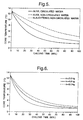
- the fish weight and the core temperature were measured after the chilling period. Each fish had a defined chilling period. From the results of the tests, formulae were developed to estimate the required time for chilling, based on the temperature of the sea water, the temperature of the cooling water and the required core temperature in the fish after chilling.
- T F (T S + T DA - T K - T DB L)e - (a + b + c)m - 0.55t + T K + T DB L
- T F is the core temperature in the fish (°C)
- T K is the cooling water temperature (°C)
- T S is the water temperature difference prior to chilling (°C)
- T DA is the temperature difference in the fishing water prior to chilling (°C)
- the early chilling of the live fish produces an improvement in quality by contributing further to the reduction of the stress effect on the fish and by ensuring a uniform temperature, below 4°C at the core of the fish, in good time prior to packing, and thereby also reduces the total time required for the processing of the fish.
- Chilling in ice according to the known art has very little effectivity compared with chilling in water.
- the chilling that takes place after the fish has been packed in a box with ice is therefore relatively ineffective.
- the chilling rate is very low.
- a further advantage of the invention is that the dwelling time for the fish in the chilling tanks is infinitely adjustable, thereby ensuring the attainment of a pretermined core temperature when the fish weight and the temperature of the sea, surroundings and chilling tanks are known. It has proven advantageous for the process that the chilling be completed as early as possible, thus making it unnecessary to undertake chilling after bleeding.
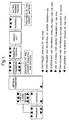
- Figure 1 is a flow chart illustrating an embodiment of the present invention.
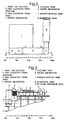
- Figure 2 is an example of a layout for a treatment plant for fish.
- Figure 3 is a cross-sectional view of the layout from Figure 2.
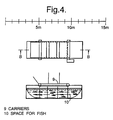
- Figure 4 is a elevational and cross-sectional view of an example of a chilling tank and a bleeding tank.
- Figure 5 is a graphical representation showing the core temperature as a function of chilling time for various chilling methods.
- Figure 6 is a graphical representation showing the core temperature as a function of chilling time for fish of various sizes.
- the present embodiment example refers to a plant designed in accordance with Figures 2 to 4. Uniform chilling of large and small fish was achieved by prechilling the fish down to a temperature of 8-10°C in a receiving tank (1) for fish.
- the fish is transported to the receiving tank by means of a fish elevator (2), either from a wellboat or from a seacage outside the quay.
- the water temperature may vary from 4° to 20°C when the fish is brought to a plant on the coast of Northern Europe; in warmer climates it may be as high as 30°C (does not apply to salmon).
- the water in the receiving tank may either be deep water that is pumped up, refrigerated water or a combination of these two water supplies.
- the fish is conducted via a fish conveyor/elevator (3), in portions, over a water separator (4) and into a tank (5), where the water temperature is as low as 0°C.
- a fish conveyor/elevator (3) In this tank are situated gates or carriers (9) which are secured to an endless belt, as shown in Figure 4.
- the carriers (9) are attached to the belt a certain distance apart, thus forming separate compartments (10). Further, the carriers (9) at the end of the tank will lift the fish as does a fish conveyor or elevator.
- the belt is moved at a speed which has been preadjusted so as to ensure the fish a specific dwelling time in the tank in relation to the size and temperature of the fish in the chilling tank.
- the customary dwelling time in Northern Europe may be about 1 hour.
- the fish is moved over a new water separator (6) and into an anaesthetisation tank (7), where the fish is anaesthetised by entering water infused with an anaesthetic gas, such as CO 2 , for a period of from 1 to 5 minutes.
- an anaesthetic gas such as CO 2
- the water temperature is low; water at a temperature as low as -5°C (brine) may be used.
- This bleeding tank is designed in the same way as the chilling tank (5). It ensures the fish a requisite dwelling time in the tank, of between 40 and 60 minutes, allowing it to bleed sufficiently.
- the bleeding time is dependent on the type and the size of the fish.
- the temperature in the bleeding tank should be 0.5 to 1°C higher than the temperature of the water in the chilling tank.
- This method ensures that both large and small fish are chilled more uniformly, and the time ensuing from when the fish emerges from the bleeding tank to when it is packed in boxes is reduced significantly. The fact that the fish is cold when packed also reduces the need for ice in the boxes.
Landscapes
- Life Sciences & Earth Sciences (AREA)
- Engineering & Computer Science (AREA)
- Food Science & Technology (AREA)
- Environmental Sciences (AREA)
- Animal Husbandry (AREA)
- Marine Sciences & Fisheries (AREA)
- Zoology (AREA)
- Biodiversity & Conservation Biology (AREA)
- Wood Science & Technology (AREA)
- Farming Of Fish And Shellfish (AREA)
- Meat, Egg Or Seafood Products (AREA)
- Processing Of Meat And Fish (AREA)
- Ultra Sonic Daignosis Equipment (AREA)
- Medicines Containing Material From Animals Or Micro-Organisms (AREA)
- Agricultural Chemicals And Associated Chemicals (AREA)
Applications Claiming Priority (5)
| Application Number | Priority Date | Filing Date | Title |
|---|---|---|---|
| NO952641A NO952641D0 (no) | 1995-07-03 | 1995-07-03 | Stressdempende metode for bedring av produktkvalitet og ökning av produktivitet ved foredling av fisk |
| NO952641 | 1995-07-03 | ||
| NO19962578A NO315632B1 (no) | 1995-07-03 | 1996-06-18 | Fremgangsmåte for håndtering av fisk fra levering til slöying |
| NO962578 | 1996-06-18 | ||
| EP96924209A EP0847236B8 (fr) | 1995-07-03 | 1996-06-25 | Procede de traitement des poissons depuis leur prise en compte jusqu'a leur evisceration |
Related Parent Applications (2)
| Application Number | Title | Priority Date | Filing Date |
|---|---|---|---|
| EP96924209A Division EP0847236B8 (fr) | 1995-07-03 | 1996-06-25 | Procede de traitement des poissons depuis leur prise en compte jusqu'a leur evisceration |
| EP96924209.8 Division | 1997-01-23 |
Publications (3)
| Publication Number | Publication Date |
|---|---|
| EP1293129A2 true EP1293129A2 (fr) | 2003-03-19 |
| EP1293129A3 EP1293129A3 (fr) | 2003-05-14 |
| EP1293129B1 EP1293129B1 (fr) | 2007-02-28 |
Family
ID=26648587
Family Applications (2)
| Application Number | Title | Priority Date | Filing Date |
|---|---|---|---|
| EP96924209A Expired - Lifetime EP0847236B8 (fr) | 1995-07-03 | 1996-06-25 | Procede de traitement des poissons depuis leur prise en compte jusqu'a leur evisceration |
| EP02006899A Expired - Lifetime EP1293129B1 (fr) | 1995-07-03 | 1996-06-25 | Procédé de traitement des poissons depuis leur prise en compte jusqu'à leur éviscération |
Family Applications Before (1)
| Application Number | Title | Priority Date | Filing Date |
|---|---|---|---|
| EP96924209A Expired - Lifetime EP0847236B8 (fr) | 1995-07-03 | 1996-06-25 | Procede de traitement des poissons depuis leur prise en compte jusqu'a leur evisceration |
Country Status (8)
| Country | Link |
|---|---|
| EP (2) | EP0847236B8 (fr) |
| AT (2) | ATE354961T1 (fr) |
| AU (1) | AU6472696A (fr) |
| DE (2) | DE69636942D1 (fr) |
| DK (1) | DK0847236T3 (fr) |
| ES (1) | ES2176472T3 (fr) |
| NO (1) | NO315632B1 (fr) |
| WO (1) | WO1997001958A1 (fr) |
Cited By (1)
| Publication number | Priority date | Publication date | Assignee | Title |
|---|---|---|---|---|
| NO347049B1 (en) * | 2022-01-21 | 2023-05-02 | Cflow Fish Handling As | A treatment system and a method for treatment of slaughtered fish |
Families Citing this family (5)
| Publication number | Priority date | Publication date | Assignee | Title |
|---|---|---|---|---|
| US7048961B2 (en) * | 2003-06-20 | 2006-05-23 | Alaska Ocean Products Corporation | Method for freezing edible marine animals |
| NO339968B1 (no) | 2015-10-29 | 2017-02-20 | Seaside As | Fremgangsmåte og system for bevegelse av avlivet fisk i et rør eller en rørgate |
| WO2018094541A1 (fr) * | 2016-11-23 | 2018-05-31 | Seebach Iturra Carolina Andrea | Procédé et système de récolte de poissons vivants à faible stress, garantissant la sécurité biologique et sans souffrance à l'encontre des animaux, améliorant la texture et la qualité de la chair |
| NO346652B1 (en) * | 2021-05-04 | 2022-11-14 | Mmc First Process As | An arrangement and a method for propagating bleed-out of fish |
| NO347922B1 (en) | 2022-11-01 | 2024-05-13 | Mmc First Process As | Tank arrangement and method for handling biomass |
Citations (4)
| Publication number | Priority date | Publication date | Assignee | Title |
|---|---|---|---|---|
| DE2000073A1 (de) | 1969-01-02 | 1970-07-23 | Ts Osrodek K Badawczy Przemysl | Behaelter fuer Fische auf Fischereischiffen |
| NO155371B (no) | 1984-12-13 | 1986-12-15 | Norsk Inst Vannforskning | Fremgangsmaate og anlegg for oppdrett av akvakulturorganismer. |
| NO863849L (no) | 1985-10-30 | 1987-05-04 | Arve Wessel | Fremgangsmaate til konserverende behandling av oppdrettsfisk foer pakking, transport og lagring. |
| NO162443B (no) | 1985-04-12 | 1989-09-25 | Musholm As Lax | Fremgangsmaate til aa toemme en lekter for fisk, og lekter til bruk ved utfoerelse av fremgangsmaaten. |
Family Cites Families (2)
| Publication number | Priority date | Publication date | Assignee | Title |
|---|---|---|---|---|
| NO160756C (no) * | 1986-03-13 | 1990-02-21 | Sotra Rustfri Ind A S | Bloeggeanlegg. |
| NO944275D0 (no) * | 1994-11-09 | 1994-11-09 | Melbu Verft As | Anordning ved blögging av fisk |
-
1996
- 1996-06-18 NO NO19962578A patent/NO315632B1/no not_active IP Right Cessation
- 1996-06-25 EP EP96924209A patent/EP0847236B8/fr not_active Expired - Lifetime
- 1996-06-25 DE DE69636942T patent/DE69636942D1/de not_active Expired - Lifetime
- 1996-06-25 DE DE69620197T patent/DE69620197T2/de not_active Expired - Lifetime
- 1996-06-25 AT AT02006899T patent/ATE354961T1/de not_active IP Right Cessation
- 1996-06-25 WO PCT/NO1996/000157 patent/WO1997001958A1/fr not_active Ceased
- 1996-06-25 ES ES96924209T patent/ES2176472T3/es not_active Expired - Lifetime
- 1996-06-25 AT AT96924209T patent/ATE214873T1/de active
- 1996-06-25 EP EP02006899A patent/EP1293129B1/fr not_active Expired - Lifetime
- 1996-06-25 AU AU64726/96A patent/AU6472696A/en not_active Abandoned
- 1996-06-25 DK DK96924209T patent/DK0847236T3/da active
Patent Citations (4)
| Publication number | Priority date | Publication date | Assignee | Title |
|---|---|---|---|---|
| DE2000073A1 (de) | 1969-01-02 | 1970-07-23 | Ts Osrodek K Badawczy Przemysl | Behaelter fuer Fische auf Fischereischiffen |
| NO155371B (no) | 1984-12-13 | 1986-12-15 | Norsk Inst Vannforskning | Fremgangsmaate og anlegg for oppdrett av akvakulturorganismer. |
| NO162443B (no) | 1985-04-12 | 1989-09-25 | Musholm As Lax | Fremgangsmaate til aa toemme en lekter for fisk, og lekter til bruk ved utfoerelse av fremgangsmaaten. |
| NO863849L (no) | 1985-10-30 | 1987-05-04 | Arve Wessel | Fremgangsmaate til konserverende behandling av oppdrettsfisk foer pakking, transport og lagring. |
Cited By (1)
| Publication number | Priority date | Publication date | Assignee | Title |
|---|---|---|---|---|
| NO347049B1 (en) * | 2022-01-21 | 2023-05-02 | Cflow Fish Handling As | A treatment system and a method for treatment of slaughtered fish |
Also Published As
| Publication number | Publication date |
|---|---|
| ES2176472T3 (es) | 2002-12-01 |
| EP0847236A1 (fr) | 1998-06-17 |
| DE69620197D1 (de) | 2002-05-02 |
| ATE214873T1 (de) | 2002-04-15 |
| NO315632B1 (no) | 2003-10-06 |
| ATE354961T1 (de) | 2006-03-15 |
| EP0847236B8 (fr) | 2003-03-05 |
| DE69620197T2 (de) | 2002-11-21 |
| DE69636942D1 (de) | 2007-04-12 |
| NO962578D0 (no) | 1996-06-18 |
| WO1997001958A1 (fr) | 1997-01-23 |
| EP0847236B1 (fr) | 2002-03-27 |
| AU6472696A (en) | 1997-02-05 |
| EP1293129B1 (fr) | 2007-02-28 |
| DK0847236T3 (da) | 2002-07-22 |
| NO962578L (no) | 1997-01-06 |
| EP1293129A3 (fr) | 2003-05-14 |
Similar Documents
| Publication | Publication Date | Title |
|---|---|---|
| Borderías et al. | First processing steps and the quality of wild and farmed fish | |
| Robb | Welfare of fish at harvest | |
| Shi et al. | Effect of pre-chilling time on the physicochemical properties of channel catfish during frozen storage | |
| Roth et al. | Pre mortem capturing stress of Atlantic herring (Clupea harengus) in purse seine and subsequent effect on welfare and flesh quality | |
| EP0847236B1 (fr) | Procede de traitement des poissons depuis leur prise en compte jusqu'a leur evisceration | |
| CA2806622C (fr) | Procede de refroidissement de saumons de culture permettant leur etourdissement rapide pendant la recolte | |
| CN110896904A (zh) | 一种提高虾苗运输存活率的方法 | |
| Zuanazzi et al. | Effects of freezing and thawing cycles on the quality of Nile tilapia fillets | |
| World Health Organization | Code of Practice for fish and fishery products | |
| US4309449A (en) | Method for preserving live hard-shell crabs by freezing | |
| CN102960784A (zh) | 一种冻墨鱼的加工方法 | |
| EA013526B1 (ru) | Способ получения деликатесного пищевого продукта из овулированной, но не оплодотворенной икры водных животных и деликатесный пищевой продукт, полученный этим способом | |
| Paterson et al. | Controlling the quality of aquacultured food products | |
| US20110014327A1 (en) | Methods and compositions for ready to use aquatic animal food kept in frozen storage | |
| Sałek | The influence of genetic factors and pre-slaughter handling on the quality of poultry meat® | |
| Genc et al. | The effects of different stunning techniques on meat quality of brown trout (Salmo trutta fario) | |
| ES2606171T3 (es) | Método de procesamiento de marisco a alta presión | |
| WO2008049014A2 (fr) | Procédés de réduction de contamination dans le traitement de poissons et fruits de mer | |
| Mishra et al. | Fresh fish: Handling, transportation and Preservation | |
| US20110189365A1 (en) | Product and process for cryopreservation of marine aquarium foodstuffs | |
| Banks et al. | Freezing of shellfish | |
| Kramer et al. | Care of halibut aboard the fishing vessel | |
| Bennison | Guidelines on aquatic animal welfare for the aquaculture industry in Western Australia | |
| CN108432666A (zh) | 莱氏拟乌贼受精卵长途运输方法 | |
| Коренєва et al. | SAFETY AND QUALITY OF MARINE FISH DEPEND FROM THE METHOD OF CONSERVATION |
Legal Events
| Date | Code | Title | Description |
|---|---|---|---|
| PUAI | Public reference made under article 153(3) epc to a published international application that has entered the european phase |
Free format text: ORIGINAL CODE: 0009012 |
|
| 17P | Request for examination filed |
Effective date: 20020326 |
|
| AC | Divisional application: reference to earlier application |
Ref document number: 0847236 Country of ref document: EP Kind code of ref document: P |
|
| AK | Designated contracting states |
Kind code of ref document: A2 Designated state(s): AT BE CH DE DK ES FI FR GB GR IE IT LI LU MC NL PT SE |
|
| PUAL | Search report despatched |
Free format text: ORIGINAL CODE: 0009013 |
|
| AK | Designated contracting states |
Designated state(s): AT BE CH DE DK ES FI FR GB GR IE IT LI LU MC NL PT SE |
|
| RIC1 | Information provided on ipc code assigned before grant |
Ipc: 7A 22C 25/00 B Ipc: 7A 22B 3/08 B Ipc: 7A 01K 63/02 B Ipc: 7A 22C 25/08 A |
|
| AKX | Designation fees paid |
Designated state(s): AT BE CH DE DK ES FI FR GB GR IE IT LI LU MC NL PT SE |
|
| GRAP | Despatch of communication of intention to grant a patent |
Free format text: ORIGINAL CODE: EPIDOSNIGR1 |
|
| RTI1 | Title (correction) |
Free format text: PROCESS FOR HANDLING FISH FROM ITS DELIVERY TO GUTTING THEREOF |
|
| GRAS | Grant fee paid |
Free format text: ORIGINAL CODE: EPIDOSNIGR3 |
|
| 17Q | First examination report despatched |
Effective date: 20041202 |
|
| GRAC | Information related to communication of intention to grant a patent modified |
Free format text: ORIGINAL CODE: EPIDOSCIGR1 |
|
| GRAL | Information related to payment of fee for publishing/printing deleted |
Free format text: ORIGINAL CODE: EPIDOSDIGR3 |
|
| GRAS | Grant fee paid |
Free format text: ORIGINAL CODE: EPIDOSNIGR3 |
|
| GRAA | (expected) grant |
Free format text: ORIGINAL CODE: 0009210 |
|
| AC | Divisional application: reference to earlier application |
Ref document number: 0847236 Country of ref document: EP Kind code of ref document: P |
|
| AK | Designated contracting states |
Kind code of ref document: B1 Designated state(s): AT BE CH DE DK ES FI FR GB GR IE IT LI LU MC NL PT SE |
|
| PG25 | Lapsed in a contracting state [announced via postgrant information from national office to epo] |
Ref country code: DK Free format text: LAPSE BECAUSE OF FAILURE TO SUBMIT A TRANSLATION OF THE DESCRIPTION OR TO PAY THE FEE WITHIN THE PRESCRIBED TIME-LIMIT Effective date: 20070228 Ref country code: LI Free format text: LAPSE BECAUSE OF FAILURE TO SUBMIT A TRANSLATION OF THE DESCRIPTION OR TO PAY THE FEE WITHIN THE PRESCRIBED TIME-LIMIT Effective date: 20070228 Ref country code: NL Free format text: LAPSE BECAUSE OF FAILURE TO SUBMIT A TRANSLATION OF THE DESCRIPTION OR TO PAY THE FEE WITHIN THE PRESCRIBED TIME-LIMIT Effective date: 20070228 Ref country code: FI Free format text: LAPSE BECAUSE OF FAILURE TO SUBMIT A TRANSLATION OF THE DESCRIPTION OR TO PAY THE FEE WITHIN THE PRESCRIBED TIME-LIMIT Effective date: 20070228 Ref country code: BE Free format text: LAPSE BECAUSE OF FAILURE TO SUBMIT A TRANSLATION OF THE DESCRIPTION OR TO PAY THE FEE WITHIN THE PRESCRIBED TIME-LIMIT Effective date: 20070228 Ref country code: CH Free format text: LAPSE BECAUSE OF FAILURE TO SUBMIT A TRANSLATION OF THE DESCRIPTION OR TO PAY THE FEE WITHIN THE PRESCRIBED TIME-LIMIT Effective date: 20070228 Ref country code: AT Free format text: LAPSE BECAUSE OF FAILURE TO SUBMIT A TRANSLATION OF THE DESCRIPTION OR TO PAY THE FEE WITHIN THE PRESCRIBED TIME-LIMIT Effective date: 20070228 |
|
| REG | Reference to a national code |
Ref country code: GB Ref legal event code: FG4D |
|
| REG | Reference to a national code |
Ref country code: CH Ref legal event code: EP |
|
| REF | Corresponds to: |
Ref document number: 69636942 Country of ref document: DE Date of ref document: 20070412 Kind code of ref document: P |
|
| REG | Reference to a national code |
Ref country code: IE Ref legal event code: FG4D |
|
| PG25 | Lapsed in a contracting state [announced via postgrant information from national office to epo] |
Ref country code: SE Free format text: LAPSE BECAUSE OF FAILURE TO SUBMIT A TRANSLATION OF THE DESCRIPTION OR TO PAY THE FEE WITHIN THE PRESCRIBED TIME-LIMIT Effective date: 20070531 |
|
| PG25 | Lapsed in a contracting state [announced via postgrant information from national office to epo] |
Ref country code: ES Free format text: LAPSE BECAUSE OF FAILURE TO SUBMIT A TRANSLATION OF THE DESCRIPTION OR TO PAY THE FEE WITHIN THE PRESCRIBED TIME-LIMIT Effective date: 20070608 |
|
| RAP2 | Party data changed (patent owner data changed or rights of a patent transferred) |
Owner name: KALD FISK AS |
|
| PG25 | Lapsed in a contracting state [announced via postgrant information from national office to epo] |
Ref country code: PT Free format text: LAPSE BECAUSE OF FAILURE TO SUBMIT A TRANSLATION OF THE DESCRIPTION OR TO PAY THE FEE WITHIN THE PRESCRIBED TIME-LIMIT Effective date: 20070730 |
|
| NLV1 | Nl: lapsed or annulled due to failure to fulfill the requirements of art. 29p and 29m of the patents act | ||
| REG | Reference to a national code |
Ref country code: CH Ref legal event code: PL |
|
| EN | Fr: translation not filed | ||
| PLBI | Opposition filed |
Free format text: ORIGINAL CODE: 0009260 |
|
| 26 | Opposition filed |
Opponent name: MARINE HARVEST HOLDING AS Effective date: 20071128 |
|
| PLAX | Notice of opposition and request to file observation + time limit sent |
Free format text: ORIGINAL CODE: EPIDOSNOBS2 |
|
| PG25 | Lapsed in a contracting state [announced via postgrant information from national office to epo] |
Ref country code: DE Free format text: LAPSE BECAUSE OF FAILURE TO SUBMIT A TRANSLATION OF THE DESCRIPTION OR TO PAY THE FEE WITHIN THE PRESCRIBED TIME-LIMIT Effective date: 20070530 Ref country code: MC Free format text: LAPSE BECAUSE OF NON-PAYMENT OF DUE FEES Effective date: 20070630 |
|
| PLAB | Opposition data, opponent's data or that of the opponent's representative modified |
Free format text: ORIGINAL CODE: 0009299OPPO |
|
| R26 | Opposition filed (corrected) |
Opponent name: MARINE HARVEST HOLDING AS Effective date: 20071128 |
|
| PG25 | Lapsed in a contracting state [announced via postgrant information from national office to epo] |
Ref country code: FR Free format text: LAPSE BECAUSE OF FAILURE TO SUBMIT A TRANSLATION OF THE DESCRIPTION OR TO PAY THE FEE WITHIN THE PRESCRIBED TIME-LIMIT Effective date: 20071019 Ref country code: IT Free format text: LAPSE BECAUSE OF FAILURE TO SUBMIT A TRANSLATION OF THE DESCRIPTION OR TO PAY THE FEE WITHIN THE PRESCRIBED TIME-LIMIT Effective date: 20070228 Ref country code: GR Free format text: LAPSE BECAUSE OF FAILURE TO SUBMIT A TRANSLATION OF THE DESCRIPTION OR TO PAY THE FEE WITHIN THE PRESCRIBED TIME-LIMIT Effective date: 20070529 |
|
| PLBB | Reply of patent proprietor to notice(s) of opposition received |
Free format text: ORIGINAL CODE: EPIDOSNOBS3 |
|
| PG25 | Lapsed in a contracting state [announced via postgrant information from national office to epo] |
Ref country code: FR Free format text: LAPSE BECAUSE OF FAILURE TO SUBMIT A TRANSLATION OF THE DESCRIPTION OR TO PAY THE FEE WITHIN THE PRESCRIBED TIME-LIMIT Effective date: 20070228 |
|
| PG25 | Lapsed in a contracting state [announced via postgrant information from national office to epo] |
Ref country code: LU Free format text: LAPSE BECAUSE OF NON-PAYMENT OF DUE FEES Effective date: 20070625 |
|
| PLCK | Communication despatched that opposition was rejected |
Free format text: ORIGINAL CODE: EPIDOSNREJ1 |
|
| PLAB | Opposition data, opponent's data or that of the opponent's representative modified |
Free format text: ORIGINAL CODE: 0009299OPPO |
|
| PLBN | Opposition rejected |
Free format text: ORIGINAL CODE: 0009273 |
|
| STAA | Information on the status of an ep patent application or granted ep patent |
Free format text: STATUS: OPPOSITION REJECTED |
|
| 27O | Opposition rejected |
Effective date: 20091115 |
|
| PGFP | Annual fee paid to national office [announced via postgrant information from national office to epo] |
Ref country code: IE Payment date: 20140625 Year of fee payment: 19 Ref country code: GB Payment date: 20140618 Year of fee payment: 19 |
|
| GBPC | Gb: european patent ceased through non-payment of renewal fee |
Effective date: 20150625 |
|
| REG | Reference to a national code |
Ref country code: IE Ref legal event code: MM4A |
|
| PG25 | Lapsed in a contracting state [announced via postgrant information from national office to epo] |
Ref country code: GB Free format text: LAPSE BECAUSE OF NON-PAYMENT OF DUE FEES Effective date: 20150625 Ref country code: IE Free format text: LAPSE BECAUSE OF NON-PAYMENT OF DUE FEES Effective date: 20150625 |