EP1297931A2 - Rotationsstanzwerkzeug - Google Patents
Rotationsstanzwerkzeug Download PDFInfo
- Publication number
- EP1297931A2 EP1297931A2 EP02028763A EP02028763A EP1297931A2 EP 1297931 A2 EP1297931 A2 EP 1297931A2 EP 02028763 A EP02028763 A EP 02028763A EP 02028763 A EP02028763 A EP 02028763A EP 1297931 A2 EP1297931 A2 EP 1297931A2
- Authority
- EP
- European Patent Office
- Prior art keywords
- cutting blades
- roll
- projecting pressure
- die
- pressure cutting
- Prior art date
- Legal status (The legal status is an assumption and is not a legal conclusion. Google has not performed a legal analysis and makes no representation as to the accuracy of the status listed.)
- Ceased
Links
- 238000005520 cutting process Methods 0.000 claims abstract description 148
- 230000003746 surface roughness Effects 0.000 claims description 9
- 238000000034 method Methods 0.000 claims description 2
- 238000005299 abrasion Methods 0.000 description 17
- 230000007423 decrease Effects 0.000 description 8
- 229910045601 alloy Inorganic materials 0.000 description 7
- 239000000956 alloy Substances 0.000 description 7
- 239000000463 material Substances 0.000 description 5
- 238000003825 pressing Methods 0.000 description 5
- 230000000694 effects Effects 0.000 description 4
- 229910009043 WC-Co Inorganic materials 0.000 description 2
- MCMNRKCIXSYSNV-UHFFFAOYSA-N Zirconium dioxide Chemical compound O=[Zr]=O MCMNRKCIXSYSNV-UHFFFAOYSA-N 0.000 description 2
- 230000015572 biosynthetic process Effects 0.000 description 2
- 230000003247 decreasing effect Effects 0.000 description 2
- 229910000997 High-speed steel Inorganic materials 0.000 description 1
- 239000004698 Polyethylene Substances 0.000 description 1
- 229910052581 Si3N4 Inorganic materials 0.000 description 1
- 230000002159 abnormal effect Effects 0.000 description 1
- PNEYBMLMFCGWSK-UHFFFAOYSA-N aluminium oxide Inorganic materials [O-2].[O-2].[O-2].[Al+3].[Al+3] PNEYBMLMFCGWSK-UHFFFAOYSA-N 0.000 description 1
- 229910010293 ceramic material Inorganic materials 0.000 description 1
- 239000011195 cermet Substances 0.000 description 1
- 238000013329 compounding Methods 0.000 description 1
- 229910052593 corundum Inorganic materials 0.000 description 1
- 230000006866 deterioration Effects 0.000 description 1
- 230000002045 lasting effect Effects 0.000 description 1
- 210000003205 muscle Anatomy 0.000 description 1
- 230000002093 peripheral effect Effects 0.000 description 1
- -1 polyethylene Polymers 0.000 description 1
- 229920000573 polyethylene Polymers 0.000 description 1
- 230000002265 prevention Effects 0.000 description 1
- 230000002035 prolonged effect Effects 0.000 description 1
- 239000002699 waste material Substances 0.000 description 1
- 229910001845 yogo sapphire Inorganic materials 0.000 description 1
Images



Classifications
-
- B—PERFORMING OPERATIONS; TRANSPORTING
- B26—HAND CUTTING TOOLS; CUTTING; SEVERING
- B26D—CUTTING; DETAILS COMMON TO MACHINES FOR PERFORATING, PUNCHING, CUTTING-OUT, STAMPING-OUT OR SEVERING
- B26D1/00—Cutting through work characterised by the nature or movement of the cutting member or particular materials not otherwise provided for; Apparatus or machines therefor; Cutting members therefor
- B26D1/0006—Cutting members therefor
-
- B—PERFORMING OPERATIONS; TRANSPORTING
- B26—HAND CUTTING TOOLS; CUTTING; SEVERING
- B26F—PERFORATING; PUNCHING; CUTTING-OUT; STAMPING-OUT; SEVERING BY MEANS OTHER THAN CUTTING
- B26F1/00—Perforating; Punching; Cutting-out; Stamping-out; Apparatus therefor
- B26F1/0015—Perforating; Punching; Cutting-out; Stamping-out; Apparatus therefor specially adapted for perforating tubes
-
- B—PERFORMING OPERATIONS; TRANSPORTING
- B26—HAND CUTTING TOOLS; CUTTING; SEVERING
- B26F—PERFORATING; PUNCHING; CUTTING-OUT; STAMPING-OUT; SEVERING BY MEANS OTHER THAN CUTTING
- B26F1/00—Perforating; Punching; Cutting-out; Stamping-out; Apparatus therefor
- B26F1/38—Cutting-out; Stamping-out
- B26F1/384—Cutting-out; Stamping-out using rotating drums
-
- B—PERFORMING OPERATIONS; TRANSPORTING
- B26—HAND CUTTING TOOLS; CUTTING; SEVERING
- B26F—PERFORATING; PUNCHING; CUTTING-OUT; STAMPING-OUT; SEVERING BY MEANS OTHER THAN CUTTING
- B26F1/00—Perforating; Punching; Cutting-out; Stamping-out; Apparatus therefor
- B26F1/38—Cutting-out; Stamping-out
- B26F1/44—Cutters therefor; Dies therefor
-
- B—PERFORMING OPERATIONS; TRANSPORTING
- B26—HAND CUTTING TOOLS; CUTTING; SEVERING
- B26D—CUTTING; DETAILS COMMON TO MACHINES FOR PERFORATING, PUNCHING, CUTTING-OUT, STAMPING-OUT OR SEVERING
- B26D1/00—Cutting through work characterised by the nature or movement of the cutting member or particular materials not otherwise provided for; Apparatus or machines therefor; Cutting members therefor
- B26D1/0006—Cutting members therefor
- B26D2001/0053—Cutting members therefor having a special cutting edge section or blade section
-
- B—PERFORMING OPERATIONS; TRANSPORTING
- B26—HAND CUTTING TOOLS; CUTTING; SEVERING
- B26F—PERFORATING; PUNCHING; CUTTING-OUT; STAMPING-OUT; SEVERING BY MEANS OTHER THAN CUTTING
- B26F1/00—Perforating; Punching; Cutting-out; Stamping-out; Apparatus therefor
- B26F1/38—Cutting-out; Stamping-out
- B26F1/44—Cutters therefor; Dies therefor
- B26F2001/4409—Cutters therefor; Dies therefor having die balancing or compensating means
-
- B—PERFORMING OPERATIONS; TRANSPORTING
- B26—HAND CUTTING TOOLS; CUTTING; SEVERING
- B26F—PERFORATING; PUNCHING; CUTTING-OUT; STAMPING-OUT; SEVERING BY MEANS OTHER THAN CUTTING
- B26F1/00—Perforating; Punching; Cutting-out; Stamping-out; Apparatus therefor
- B26F1/38—Cutting-out; Stamping-out
- B26F1/44—Cutters therefor; Dies therefor
- B26F2001/4436—Materials or surface treatments therefore
-
- B—PERFORMING OPERATIONS; TRANSPORTING
- B26—HAND CUTTING TOOLS; CUTTING; SEVERING
- B26F—PERFORATING; PUNCHING; CUTTING-OUT; STAMPING-OUT; SEVERING BY MEANS OTHER THAN CUTTING
- B26F1/00—Perforating; Punching; Cutting-out; Stamping-out; Apparatus therefor
- B26F1/38—Cutting-out; Stamping-out
- B26F1/44—Cutters therefor; Dies therefor
- B26F2001/4472—Cutting edge section features
-
- Y—GENERAL TAGGING OF NEW TECHNOLOGICAL DEVELOPMENTS; GENERAL TAGGING OF CROSS-SECTIONAL TECHNOLOGIES SPANNING OVER SEVERAL SECTIONS OF THE IPC; TECHNICAL SUBJECTS COVERED BY FORMER USPC CROSS-REFERENCE ART COLLECTIONS [XRACs] AND DIGESTS
- Y10—TECHNICAL SUBJECTS COVERED BY FORMER USPC
- Y10T—TECHNICAL SUBJECTS COVERED BY FORMER US CLASSIFICATION
- Y10T83/00—Cutting
- Y10T83/465—Cutting motion of tool has component in direction of moving work
- Y10T83/4766—Orbital motion of cutting blade
- Y10T83/4795—Rotary tool
- Y10T83/483—With cooperating rotary cutter or backup
- Y10T83/4838—With anvil backup
-
- Y—GENERAL TAGGING OF NEW TECHNOLOGICAL DEVELOPMENTS; GENERAL TAGGING OF CROSS-SECTIONAL TECHNOLOGIES SPANNING OVER SEVERAL SECTIONS OF THE IPC; TECHNICAL SUBJECTS COVERED BY FORMER USPC CROSS-REFERENCE ART COLLECTIONS [XRACs] AND DIGESTS
- Y10—TECHNICAL SUBJECTS COVERED BY FORMER USPC
- Y10T—TECHNICAL SUBJECTS COVERED BY FORMER US CLASSIFICATION
- Y10T83/00—Cutting
- Y10T83/929—Tool or tool with support
- Y10T83/9372—Rotatable type
Definitions
- This invention relates to a die cut roll used to cut sheet type products, such as paper diapers and sanitary napkins.
- This die cut roll comprises a combination of a die cutter formed by providing projecting pressure cutting blades, which are formed in accordance with the shape of a sheet type product to be cut, on a surface of a rotary driving roll, and an anvil roll.
- a sheet type work to be cut is made to run between the two rolls, and the die cutter is rotated in an anvil roll-pressing manner so as to cut the sheet type work to a predetermined shape with the projecting pressure cutting blades.
- Japanese Patent Registration No. 2593570 discloses that the relation between the hardness of pressing ends of cutting blades and that of a surface of an anvil roll has influence upon the lifetime of the cutting blades, and that, when a hardness difference HrA therebetween is set to more than 0.1, the lifetime of the cutting blades increases more than ten times.
- Japanese Patent Laid-Open No. 227798/1995 discloses the selection of specific materials for creating a proper hardness difference.
- Japanese Patent Laid-Open No. 71999/1996 discloses the prolonging of the lifetime of cutting blades with respect to the shape thereof, i.e., it discloses the possibility of increasing the lifetime of cutting blades by setting the cutting blade width of an axial portion thereof smaller than that of a circumferential portion thereof.
- Japanese Patent Laid-Open No. 72000/1996 discloses crowned die cutters provided in both a die cut roll of a two-shaft driving system in which an anvil roll is driven by two synchronously rotated shafts, and a die cut roll of a single-shaft driving system in which a die cutter alone is driven with an anvil roll driven thereby.
- Japanese Patent Laid-Open No. 267299/1997 discloses the techniques for improving the cutting quality of cutting blades without spoiling the strength thereof, by setting the angles ⁇ , ⁇ (apex angle becomes ⁇ + ⁇ ) of two inclined surfaces of each edge of the cutting blades with respect to a radius vector to ⁇ ⁇ , 0 ⁇ ⁇ ⁇ 60°, 25 ⁇ 80° and 5 ⁇ - ⁇ ⁇ 80°.
- die cut rolls of different driving systems have greatly different modes of abrasion of a die cutter and an anvil roll, i.e., in a certain driving system, occurs ununiform abrasion of the rolls, or a decrease in the lifetime of the edge of the cutting blades ascribed to the chipping thereof.
- An object of the present invention is to provide a die cut roll having an improved cutting performance of the edges of projecting pressure cutting blades and a prolonged lifetime.
- Another object of the present invention is to provide a die cut roll capable of resisting the stress occurring when an edge of a projecting pressure cutting blade and an anvil roll are brought into contact with each other adjacently to a top smooth portion of the edge.
- Still another object of the present invention is to provide a die cut roll which has attained a long lifetime thereof with respect to greatly different modes of abrasion of a die cutter and an anvil roll occurring due to different die cut roll driving systems in use.
- a further object of the present invention is to provide a die cut roll which has attained the reduction of stress concentration on projecting pressure cutting blades used for cutting a work to a final shape.
- a first invention of this application is directed to a die cut roll having inclined finishing surfaces of less than 0.1 ⁇ m in a surface roughness Ra on ridge surfaces adjacent to a top smooth portion of each projecting pressure cutting blade, or inclined finish surfaces having grinding muscles extending at 50°-90° and preferably 80°-90° with respect to ridge lines defining the top smooth portion, a surface roughness Ra being set to preferably less than 0.3 ⁇ m when the grinding muscle-carrying inclined finishing surfaces are formed.
- Another invention is directed to a die cut roll, wherein both or either one of a width and an apex angle of each projecting pressure cutting blade formed so as to extend in the axial direction of a die cutter is set smaller than those of each projecting pressure cutting blade formed so as to extend in the circumferential direction of the die cutter, preferably a width da and an apex angle ⁇ a of an edge of the axially formed projecting pressure cutting blade, and a width dc and an apex angle ⁇ c of an edge of the circumferentially formed one being set to 5 ⁇ da ⁇ 10 ⁇ m, 60 ⁇ ⁇ a ⁇ 120°, 10 ⁇ dc ⁇ 30 ⁇ m, 80 ⁇ ⁇ c ⁇ 140°, and ⁇ a ⁇ ⁇ c.
- two types of driving system For driving the die cut roll consisting of a die cutter and an anvil roll, two types of driving system can be adopted.
- One is the two-shaft driving type in which the driving force of a motor is transmitted to both shafts of the die cutter and the anvil roll by means of a gear to rotate the die cutter and the anvil roller synchronously.
- the other is the single-shaft driving type in which the driving force is transmitted to the shaft of the die cutter and the anvil roller which is in contact with the die cutter and is aligned in parallel with the axis of the shaft of the die cutter and is rotated by the friction with the die cutter.
- a further invention of this application is directed to a die cut roll provided with projecting pressure cutting blades not directly working to cut a product, i.e. so-called supporting blades in addition to proper projecting pressure cutting blades, which are formed in accordance with the shape of products to be cut, so as to compensate for at least circumferentially non-continuous portions or axially cutting length-decreasing portions of the proper projecting pressure cutting blades.
- the projecting pressure cutting blades for products of a die cutter may be provided so that the blades extend continuously in the circumferential direction of the die cutter, or so that end portions of the blades overlap in the circumferential direction thereof.
- the materials out of which the die cutter and anvil roll can be formed include hard materials, such as a sintered hard alloy inclusive of a WC based alloy, a cermet inclusive of a Ti based alloy, high speed steel, and a ceramic material of Al 2 O 3 ⁇ ZrO 2 ⁇ SiC ⁇ Si 3 N 4 , out of which hard materials of carbide bond, such as the WC based alloy and Ti based alloy in particular are preferably used.
- hard materials such as a sintered hard alloy inclusive of a WC based alloy, a cermet inclusive of a Ti based alloy, high speed steel, and a ceramic material of Al 2 O 3 ⁇ ZrO 2 ⁇ SiC ⁇ Si 3 N 4 , out of which hard materials of carbide bond, such as the WC based alloy and Ti based alloy in particular are preferably used.
- a die cut roll shown in Fig. 1 has a die cutter 2 formed by providing a surface of a rotary driving roll with a projecting pressure cutting blade 1 formed in accordance with the shape of products to be cut, and an anvil roll 3 disposed under the die cutter and adapted to receive an edge of the projecting pressure cutting blade, and a sheet type work P to be cut is made to run between the two rolls and cut to a predetermined shape with the projecting pressure cutting blade 1 by rotating under pressure the die cutter 2 against the anvil roll 3.
- the projecting pressure cutting blade 1 shown in Fig. 1 is provided as shown in Fig. 2 with a top smooth portion 4, and inclined finishing surfaces 7 ground at right angles to the longitudinal direction of the top smooth portion 4.
- Each inclined finishing surface 7 is formed so that an angle ⁇ thereof with respect to a relative ridgeline forming the top smooth portion 4 is in the range of 50°-90°, preferably 80°-90°, and it has grinding flaws 8.
- the inclined finishing surfaces 7 are finished to a surface roughness Ra of less than 0.3 ⁇ m.
- An apex angle ⁇ made by the top smooth portion 4 having an edge width d at an edge of the projecting pressure cutting blade 1, and inclined finishing surfaces 7 which are symmetrical about the top smooth portion 4 is set so as to satisfy the following specific conditions.
- the edge width d of the top smooth portion 4 and the apex angle ⁇ made by the symmetrical, inclined finishing surfaces 7 in the axial direction of the die cutter 2 and those in the circumferential direction thereof which is perpendicular to the axial direction are preferably set to different values.
- the axial blade width d in the axial direction of the die cutter has to be set small so as to obtain a required contact surface pressure.
- this axial blade width is smaller than 5 ⁇ m, the chipping of the projecting pressure cutting blade occurs, so that it is preferably in the above-mentioned range. Since the contact surface pressure is high in the circumferential direction of die cutter, there is a possibility of occurrence of the chipping of the projecting pressure cutting blade. Therefore, the circumferential blade width d has to be set large.
- the axial edge apex angle ⁇ is set to 120° or a lower level so that the edge width does not greatly increase due to the abrasion of the edge. However, when this apex angle is not more than 60°, the chipping of the edge becomes liable to occur. Since the contact surface pressure in the circumferential direction of the die cutter is high, there is a possibility of occurrence of the chipping of the edge, so that the circumferential edge apex angle ⁇ has to be set large.
- An about 1 mm thick polyethylene film as a work for obtaining sanitary napkins was cut by using the die cut roll according to the present invention.
- the edge widths d in the axial direction and in the circumferential direction perpendicular thereto were set to 10 ⁇ m and 20 ⁇ m respectively, and the axial and circumferential apex angles, ⁇ 100° and 110° respectively.
- a similar film was cut to a predetermined shape by using a conventional edge having the same axial and circumferential edge widths d of 20 ⁇ m and apex angles ⁇ of 90°.
- the anvil roll pressing cycle in the present invention was lengthened as compared with that in the conventional die cut roll, and a long lifetime, which was about 1.5 times as large as that of the conventional die cut roll, could be attained.
- This effect was, for one thing, ascribed to the inclined finishing surfaces 7 of a surface roughness Ra of less than 0.3 ⁇ m formed between the top smooth portion 4 and inclined grinding surfaces 5 of the edge of the projecting pressure cutting blade 1 of the die cutter so that the inclined finishing surfaces 7 were ground to form grinding flaws extending at 50°-90°, and preferably 80°-90° with respect to the top smooth surface portion 4.
- This effect was also ascribed to the compounded specific conditions for the width and apex angle of the edge. It was also ascertained that, even when the respective conditions were utilized independently, different effects were obtained, though the levels thereof were various.
- die cutters 2 and anvil rolls 3 all of which were formed out of a WC-Co sintered hard alloy were used, in which compounding ratios of WC were varied to set the hardness of at least the top side portions of projecting pressure cutting blades 1 on the die cutter rolls 2 and that of at least the roll surfaces of the anvil rolls 3 to different levels, whereby die cutters and anvil rolls which had different hardness differences were provided for different driving systems employed.
- a driving shaft of a motor 9 directly drives a die cutter 2
- a die cutter gear 2a drives an anvil roll gear 3a
- a driving shaft connected to the anvil roll gear 3a driving an anvil roll 3 synchronously whereby a sheet type work P passing between the die cutter 2 and anvil roll 3 is cut to a shape in accordance with that of a projecting pressure cutting blade 1.
- the die cutter 2 and anvil roll 3 were formed so that the relational expression 0 ⁇ H 2 -H 1 ⁇ 5 wherein 82 ⁇ (H 1 , H 2 ) ⁇ 96(H R A) is established, wherein H 1 represents the hardness (H R A) of at least the top side portion of the projecting pressure cutting blade 1, and H 2 the hardness (H R A) of at least the surface of the anvil roll.
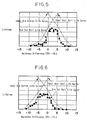
- the relation between a difference (H 2 -H 1 ) between the hardness (H R A)H 1 of the top side portion of the edge of the die cutter 2 in the two-shaft driving system of Fig. 3 and that (H R A)H 2 of the anvil roll 3, and the lifetime of the test machines manufactured with the hardness differences (H R A) set to various levels is shown in the form of a lifetime curve of die cut rolls in Fig. 5.
- the ideal die cutter lifetime curve and ideal anvil roll lifetime curve are lifetime curves obtained when the die cut rolls are operated without encountering the abrasion of the anvil rolls and die cutters.
- the reason for attaining the relational expression 0 ⁇ H 2 -H 1 resides in the following.
- the projecting pressure cutting blade 1 of the die cutter 2 is harder than the anvil roll 3
- the pressing force is concentrated on the surface of the anvil roll 3 to wear the same.
- abrasion occurs in a concentrated manner on the portions of the surface of the anvil roll 3 which the cutting blade 1 of the die cutter 2 contacts, so that the lifetime of the die cut roll decreases to such a level that gives rise to practical problems.
- the tenacity of the edge of the die cutter 2 relatively decreases as compared with that of the anvil roll 3, and this causes the chipping of the edge of the die cutter 2 to occur.
- H 2 -H 1 The reason why the difference H 2 -H 1 was set to H 2 -H 1 ⁇ 5 resides in the following.
- H 2 -H 1 is set larger than 5, the hardness of the die cutter 2 becomes too low as compared with that of the anvil roll 3, and the abrasion of the edge of the die cutter 2 becomes liable to occur with the lifetime thereof decreasing to such a level that gives rise to practical problems.
- a die cutter and an anvil roll were formed so that the relational expression -5 ⁇ H 2 -H 1 ⁇ 1 wherein 82 ⁇ (H 1 , H 2 ) ⁇ 96(H R A) is established, wherein H 1 represents the hardness (H R A) of at least a top side portion of a projecting pressure cutting blade 1 of the die cutter, and H 2 the hardness (H R A) of at least the surface of the anvil roll.
- the lifetime of the die cut rolls of a single-shaft driving system generally decreases.
- the lifetime of the anvil rolls 3 generally increases since the abrasion spreads over the whole surface of each thereof to cause an abrasion rate to decrease.
- the hardness difference is set in the range of -5 ⁇ H 2 -H 1 , the lifetime of the die cut roll reaches a maximum level.
- the reason why the hardness difference was set to -5 ⁇ H 2 -H 1 resides in the following.
- the hardness difference H 2 -H 1 is set smaller than -5, the abrasion rate of the anvil roll 3 becomes markedly high as compared with that of the die cutter 2 to cause the lifetime thereof to decrease, and the tenacity of the projecting pressure cutting blade 1 of the die cutter 2 decreases as compared with that of the anvil roll 3 to cause the edge of the projecting pressure cutting blade 1 to be chipped.
- the hardness difference was set to H 2 -H 1 ⁇ 1 because, when H 2 -H 1 is set larger than 1, the hardness of the die cutter 2 becomes excessively low as compared with that of the anvil roll 3, and the wear on the edge of the cutting blade of the die cutter 2 becomes liable to occur.
- This embodiment was provided with supporting blades, which did not directly serve to cut products, in addition to the projecting pressure cutting blades provided on the above embodiments.
- the provision of the supporting blades enables the concentration of excessively large repeated stress on the edge of the projecting pressure cutting blades to be lessened.
- a die cutter 2 having guide flanges 11 on circumferential portions of both ends thereof is provided with projecting pressure cutting blades 1 formed in accordance with the shape of paper products to define product cutting regions A on the inner sides thereof.
- 10 denotes projecting pressure cutting blades not directly working to cut products of the present invention, i.e. so-called supporting blades provided besides the product-obtaining projecting pressure cutting blades 1.
- the supporting blades 10 are provided so as to compensate for a circumferentially discontinuous portion shown by X of the rotary driving roll body so as to extend in the circumferential direction thereof.
- the supporting blades 10 are formed of the same material as the projecting pressure cutting blades 1 so that the shape and height of the edges become the same as those thereof since stable cutting characteristics can be obtained by setting the abrasion rate of the waste blades substantially equal to that of the projecting pressure cutting blades 1.
- a distance between the supporting blades is within the range of levels lower than that of the width of work paper P with the length of the former within the range of levels higher than that of the circumferential size of the discontinuous portion X of the die cutter 2, the excessively large repeated stress can be lessened, and the abrasion rates of the projecting pressure cutting blades 1 and supporting blades 10 can be set substantially equal, so that this die cut roll is advantageous in cutting performance and economical efficiency.
- the supporting blades 10 may be provided in more than two axial rows or formed to an arcuate shape.
- Fig. 8 shows a modified example of the supporting blades 10 of Fig. 7, which are provided on a die cutter 2, to which the present invention is applied, having two projecting pressure cutting blades 1 crossing each other to form continuous blades.
- the supporting blades 10 are formed so as to compensate for an axially concentrated portion shown by Y of the projecting pressure, cutting blades 1. The provision of these supporting blades 10 enables stress occurring due to a difference between the peripheral speed of the die cutter and that of the anvil roll and the feeding of a work to be lessened.
- Fig. 9 shows an example provided with a continuous portion 12 formed on a die cutter 2 having two projecting pressure cutting blades 1 crossing each other, instead of providing such an independent supporting blades 10 as shown in Fig. 8, so as not to form a stress concentrated portion.
- This continuous portion 12 comprises not a one-point cross of the projecting pressure cutting blades 1 having product cutting regions A but a linear continuous cross thereof elongated in the axial direction of the cutter roll.
- This continuous portion 12 extending in the axial direction of the die cutter 2 may also be formed so as to include circumferentially extending sections, or so as to extend in the circumferential direction, for the purpose of preventing the formation of a stress concentrated portion. This enables the concentrtation of an excessively large repeated stress on the two projecting pressure cutting blades 1 to be lessened.
- Fig. 10 shows another example which is not provided with supporting blades either just as Embodiment 5, and which is provided with projecting pressure cutting blades 1 so as to extend in the direction of the whole circumference of the die cutter for the purpose of preventing the formation of a stress concentrated portion.
- plural projecting pressure cutting blades 1 formed in accordance with the shape of products to be cut are arranged side by side in the circumferential direction of a die cutter. These projecting pressure cutting blades 1 are disposed side by side circumferentially in a range Z including at least their respective circumferential end portions, so that stress concentration on the circumferential end portions of the cutting blades can be avoided.
- a die cut roll of a long lifetime can be provided which is capable of preventing the occurrence of minute chippings of the edges of the axially extending projecting pressure cutting blades, and maintaining a cutting performance even when the width of the edges increases due to the abrasion of the top smooth portions.
- a die cut roll of a long lifetime which has a long pressing cycle, especially, in an initial operating period can be provided.
- a die cut roll having a lasting cutting quality without encountering abnormal abrasion of the edges of the cutting blades, can be provided.
- the prevention of the chipping of edges of the cutting blades and the prolongation of the lifetime of a die cut roll, which are necessary to maintain a required shape of edges on contact surfaces of the cutting blades, can be attained by reducing the width of the edges of the projecting pressure cutting blades extending in the axial direction of a cutter.
Landscapes
- Life Sciences & Earth Sciences (AREA)
- Forests & Forestry (AREA)
- Engineering & Computer Science (AREA)
- Mechanical Engineering (AREA)
- Perforating, Stamping-Out Or Severing By Means Other Than Cutting (AREA)
Applications Claiming Priority (7)
| Application Number | Priority Date | Filing Date | Title |
|---|---|---|---|
| JP35923597A JP4245088B2 (ja) | 1997-12-26 | 1997-12-26 | ダイカットロール |
| JP35921797A JP4245087B2 (ja) | 1997-12-26 | 1997-12-26 | ダイカットロール |
| JP35923597 | 1997-12-26 | ||
| JP35921797 | 1997-12-26 | ||
| JP35921597 | 1997-12-26 | ||
| JP35921597A JP4132163B2 (ja) | 1997-12-26 | 1997-12-26 | ダイカットロール |
| EP19980961575 EP0963821B1 (de) | 1997-12-26 | 1998-12-24 | Rotationsstanzwerkzeug |
Related Parent Applications (1)
| Application Number | Title | Priority Date | Filing Date |
|---|---|---|---|
| EP19980961575 Division EP0963821B1 (de) | 1997-12-26 | 1998-12-24 | Rotationsstanzwerkzeug |
Publications (2)
| Publication Number | Publication Date |
|---|---|
| EP1297931A2 true EP1297931A2 (de) | 2003-04-02 |
| EP1297931A3 EP1297931A3 (de) | 2003-06-04 |
Family
ID=27341604
Family Applications (2)
| Application Number | Title | Priority Date | Filing Date |
|---|---|---|---|
| EP20020028763 Ceased EP1297931A3 (de) | 1997-12-26 | 1998-12-24 | Rotationsstanzwerkzeug |
| EP19980961575 Expired - Lifetime EP0963821B1 (de) | 1997-12-26 | 1998-12-24 | Rotationsstanzwerkzeug |
Family Applications After (1)
| Application Number | Title | Priority Date | Filing Date |
|---|---|---|---|
| EP19980961575 Expired - Lifetime EP0963821B1 (de) | 1997-12-26 | 1998-12-24 | Rotationsstanzwerkzeug |
Country Status (6)
| Country | Link |
|---|---|
| US (1) | US6279443B1 (de) |
| EP (2) | EP1297931A3 (de) |
| DE (1) | DE69819476T2 (de) |
| ES (1) | ES2210849T3 (de) |
| PL (1) | PL188020B1 (de) |
| WO (1) | WO1999033621A1 (de) |
Families Citing this family (20)
| Publication number | Priority date | Publication date | Assignee | Title |
|---|---|---|---|---|
| US20040074352A1 (en) * | 2002-10-21 | 2004-04-22 | Kimberly-Clark Worldwide, Inc. | Adjustable anvil for a flat bearer ring die |
| US7350387B1 (en) | 2004-01-23 | 2008-04-01 | Lisk Rodger A | Tooling assembly |
| US20050206038A1 (en) * | 2004-03-22 | 2005-09-22 | Henri Brisebois | Apparatus and method for knurling material |
| WO2006073428A2 (en) * | 2004-04-19 | 2006-07-13 | Dynamet Technology, Inc. | Titanium tungsten alloys produced by additions of tungsten nanopowder |
| US20050274247A1 (en) * | 2004-06-14 | 2005-12-15 | Sean Talkington | Stripper apparatus and methods for rotary dies |
| SE528041C2 (sv) * | 2004-07-02 | 2006-08-15 | Sandvik Intellectual Property | Rotationskniv och rotationsknivenhet med en dylik rotationskniv |
| SE527838C2 (sv) * | 2004-07-02 | 2006-06-20 | Sandvik Intellectual Property | En rotationskniv och en rotationsknivanordning försedd med en dylik rotationskniv |
| US20080029186A1 (en) * | 2006-02-14 | 2008-02-07 | Stanley Abkowitz | Homogeneous titanium tungsten alloys produced by powder metal technology |
| SE530194C2 (sv) * | 2006-07-10 | 2008-03-25 | Sandvik Intellectual Property | En egg hos ett knivorgan för en knivvals |
| EP2397284B1 (de) * | 2010-06-21 | 2013-08-14 | Tolerans AB | Zylinder, System und Verfahren zum Stanzen von Löchern in ein Papierband und Anbringen von Heften |
| JP5542554B2 (ja) * | 2010-07-12 | 2014-07-09 | ユニ・チャーム株式会社 | 吸収性物品のワークのカッター装置 |
| US11584035B2 (en) | 2015-12-09 | 2023-02-21 | Phoenix Partners, Llc | Apparatus and system for die press and cutting |
| US10864650B2 (en) * | 2015-12-09 | 2020-12-15 | Phoenix Partners, Llc | Apparatus and method for die cutting |
| CN107914320B (zh) * | 2017-12-08 | 2024-08-20 | 厦门三德信科技股份有限公司 | 一种用于闭合多边形模切件的分步加工模具组件 |
| CN108098863A (zh) * | 2018-01-30 | 2018-06-01 | 常州市若特精密模具有限公司 | 一种模切刀组件、模切系统及工作方法 |
| MX391348B (es) | 2018-06-27 | 2025-03-21 | Gen Mills Inc | Tortilla endurecida para taco y metodo y aparato para producir tortilla endurecida para taco |
| US20200130220A1 (en) * | 2018-10-31 | 2020-04-30 | Stolle Machinery Company, Llc | Score die, score die forming system, and associated method |
| CN109664369B (zh) * | 2019-01-16 | 2021-05-18 | 江苏麒浩精密机械股份有限公司 | 一种新型成人尿裤模切总成装置 |
| DE102023112437A1 (de) * | 2023-05-11 | 2024-11-14 | Focke & Co. (Gmbh & Co. Kg) | Vorrichtung zur Herstellung von Zuschnitten für Kragen von Packungen für Produkte der Zigarettenindustrie |
| CN120023881B (zh) * | 2025-04-24 | 2025-07-11 | 中加百康(福建)医疗器械有限责任公司 | 高速辊刀式切片机多层材料同步切割方法 |
Family Cites Families (38)
| Publication number | Priority date | Publication date | Assignee | Title |
|---|---|---|---|---|
| US1044931A (en) * | 1911-10-20 | 1912-11-19 | Paul Raymond Simmons | Dish-cutting machine. |
| US1352208A (en) | 1919-04-24 | 1920-09-07 | Benjamin F Lovelace | Method of producing oxid or oxids of manganese |
| US2361288A (en) * | 1944-04-17 | 1944-10-24 | Simonds Saw & Steel Co | Cutting rule |
| US2525987A (en) * | 1947-09-29 | 1950-10-17 | Williamson Sophus Adolph | Rotary doughnut cutter |
| US3147656A (en) * | 1961-08-30 | 1964-09-08 | Paper Converting Machine Co | Apparatus for making cutouts from a traveling web |
| US3508458A (en) * | 1967-12-08 | 1970-04-28 | Illinois Tool Works | Rotary cutter with hold down means |
| US3618654A (en) | 1969-08-28 | 1971-11-09 | Bandag Inc | High-speed cutting blade |
| US3681846A (en) | 1970-02-09 | 1972-08-08 | Gerber Garment Technology Inc | Knife blade construction |
| US3677111A (en) * | 1970-12-03 | 1972-07-18 | Corrugated Finishing Products | Method for producing cutting rules |
| US3832926A (en) * | 1973-10-29 | 1974-09-03 | Koppers Co Inc | Apparatus for accurate die-cutting |
| DE2743258A1 (de) * | 1977-09-26 | 1979-03-29 | Aiguisage Service S A | Klinge fuer papierschneidemaschinen und verfahren zu deren schleifen |
| US4269093A (en) * | 1979-03-29 | 1981-05-26 | Cincinnnati Rotary Press Company | Rotary die cutting machine |
| US4289055A (en) * | 1980-01-07 | 1981-09-15 | Von Schriltz Don F | Rotary die anvil |
| DE3229948A1 (de) | 1982-08-12 | 1984-02-16 | Schober GmbH, 7147 Eberdingen | Schneidwalze |
| US4608895A (en) * | 1984-03-14 | 1986-09-02 | Bernal Rotary Systems, Inc. | Rotary die cutting |
| US4653373A (en) * | 1986-01-08 | 1987-03-31 | Gerber Scientific Inc. | Knife blade and method for making same |
| US4914995A (en) | 1987-04-14 | 1990-04-10 | Mobil Oil Corporation | Rotary cutting apparatus |
| US4949615A (en) | 1987-05-21 | 1990-08-21 | Sandvik Hard Materials, Ltd. | Indexable insert cutters |
| US4759247A (en) * | 1987-10-22 | 1988-07-26 | Bernal Rotary Systems, Inc. | Rotary dies with adjustable cutter force |
| DE3906290C2 (de) * | 1989-02-28 | 1995-05-18 | Joergen Gerhardt | Vorrichtung zum Stanzen von blattförmigem Material, insbesondere Etikettenmaterial |
| DE3927106A1 (de) * | 1989-08-17 | 1991-02-21 | Schober Werkzeug & Maschbau | Schneidwalze oder stanzzylinder und verfahren zum herstellen von solchen |
| JP2593570B2 (ja) | 1990-01-08 | 1997-03-26 | 日本タングステン株式会社 | ダイカットブレード |
| JPH03246000A (ja) * | 1990-02-21 | 1991-11-01 | Nippon Tungsten Co Ltd | ダイカットブレード |
| JPH0788050B2 (ja) * | 1990-04-20 | 1995-09-27 | 東亜機工株式会社 | ダイカッターおよびその製造方法 |
| JPH085038Y2 (ja) * | 1990-08-17 | 1996-02-14 | 三菱重工業株式会社 | ロータリダイカッタ |
| GB2252743B (en) * | 1991-02-14 | 1994-06-29 | Lanfor Limited | A method of producing a rotary cutting die |
| US5417132A (en) * | 1993-01-19 | 1995-05-23 | Alan R. Pfaff | Rotary cutting dies |
| DK0608152T3 (da) * | 1993-01-22 | 1998-03-16 | Magnaflex Systems Limited | Roterende skæreindretninger |
| JP3236905B2 (ja) * | 1993-12-22 | 2001-12-10 | 三菱マテリアル株式会社 | ロータリーカッター |
| JP3147671B2 (ja) * | 1994-09-05 | 2001-03-19 | 三菱マテリアル株式会社 | ロータリーダイカッター |
| JPH0872000A (ja) | 1994-09-05 | 1996-03-19 | Mitsubishi Materials Corp | ロータリーダイカッター |
| JP3409462B2 (ja) | 1994-10-05 | 2003-05-26 | 三菱マテリアル株式会社 | ロータリーダイカッター |
| FR2726501B1 (fr) * | 1994-11-09 | 1997-01-31 | Socar | Dispositif de compensation des efforts de coupe sur une presse a platine pour la decoupe de plaques de carton |
| JP3283414B2 (ja) * | 1995-12-22 | 2002-05-20 | 松下電器産業株式会社 | 型抜き装置 |
| US5826475A (en) * | 1996-01-26 | 1998-10-27 | Kimberly-Clark Worldwide, Inc. | Knife shaft assembly |
| JP3230143B2 (ja) | 1996-04-01 | 2001-11-19 | 三菱マテリアル株式会社 | ロータリーダイカッター |
| JPH09300298A (ja) * | 1996-05-14 | 1997-11-25 | Tamura Koki:Kk | ロータリーダイカッターにおける回転式ダイ |
| US5967009A (en) * | 1996-05-30 | 1999-10-19 | Kimberly-Clark Worldwide, Inc. | Rotary knife apparatus and cutting method |
-
1998
- 1998-12-24 PL PL33533398A patent/PL188020B1/pl unknown
- 1998-12-24 EP EP20020028763 patent/EP1297931A3/de not_active Ceased
- 1998-12-24 ES ES98961575T patent/ES2210849T3/es not_active Expired - Lifetime
- 1998-12-24 DE DE1998619476 patent/DE69819476T2/de not_active Expired - Lifetime
- 1998-12-24 EP EP19980961575 patent/EP0963821B1/de not_active Expired - Lifetime
- 1998-12-24 US US09/367,575 patent/US6279443B1/en not_active Expired - Lifetime
- 1998-12-24 WO PCT/JP1998/005931 patent/WO1999033621A1/ja not_active Ceased
Also Published As
| Publication number | Publication date |
|---|---|
| PL188020B1 (pl) | 2004-11-30 |
| PL335333A1 (en) | 2000-04-25 |
| US6279443B1 (en) | 2001-08-28 |
| WO1999033621A1 (en) | 1999-07-08 |
| EP0963821B1 (de) | 2003-11-05 |
| EP0963821A1 (de) | 1999-12-15 |
| ES2210849T3 (es) | 2004-07-01 |
| EP1297931A3 (de) | 2003-06-04 |
| DE69819476D1 (de) | 2003-12-11 |
| EP0963821A4 (de) | 2002-05-15 |
| DE69819476T2 (de) | 2004-05-13 |
Similar Documents
| Publication | Publication Date | Title |
|---|---|---|
| EP0963821B1 (de) | Rotationsstanzwerkzeug | |
| US6427572B2 (en) | Circular tool for cutting rolls of paper and similar | |
| EP2125275B1 (de) | Fingerfräser | |
| CA1283601C (en) | Knife blade and method for making same | |
| EP0532802B1 (de) | Schneidwerkzeug | |
| EP0188113B1 (de) | Verfahren zur Regelung des Profilquerschnitts von gewalzten Walzblechen und Walzwerk | |
| AU2005282745B2 (en) | Helical flute end mill with multi-section cutting surface | |
| RU2412024C2 (ru) | Способ механической обработки коленчатых валов и устройство для реализации способа | |
| JPH0771769B2 (ja) | エンドミル | |
| JP4132163B2 (ja) | ダイカットロール | |
| JPH09192915A (ja) | ボールエンドミル | |
| JP2001121340A (ja) | ラフィングエンドミル | |
| HUP0000727A2 (hu) | Szabászhenger | |
| JP4245087B2 (ja) | ダイカットロール | |
| JPH0833904A (ja) | マッシャロール装置およびその運転方法 | |
| JPH04289012A (ja) | エンドミル | |
| EP4699724A1 (de) | Schaftfräser | |
| JP3361578B2 (ja) | 逃げ面を再研削して用いるエンドミル | |
| JP3113317B2 (ja) | ボールエンドミル及びその製造方法 | |
| JP2001129715A (ja) | エンドミル | |
| US20250319565A1 (en) | Broach Cutter Grinding with Rake Angle Control | |
| JPH1159862A (ja) | 木工機の送りローラ | |
| KR940011213B1 (ko) | 트위스트 드릴 | |
| US6615632B1 (en) | Parting tool | |
| KR940011216B1 (ko) | 트위스트 드릴 |
Legal Events
| Date | Code | Title | Description |
|---|---|---|---|
| PUAI | Public reference made under article 153(3) epc to a published international application that has entered the european phase |
Free format text: ORIGINAL CODE: 0009012 |
|
| 17P | Request for examination filed |
Effective date: 20021223 |
|
| AC | Divisional application: reference to earlier application |
Ref document number: 0963821 Country of ref document: EP Kind code of ref document: P |
|
| AK | Designated contracting states |
Designated state(s): DE ES GB IT SE Kind code of ref document: A2 Designated state(s): DE ES GB IT SE |
|
| PUAL | Search report despatched |
Free format text: ORIGINAL CODE: 0009013 |
|
| AK | Designated contracting states |
Designated state(s): DE ES GB IT SE |
|
| 17Q | First examination report despatched |
Effective date: 20031104 |
|
| AKX | Designation fees paid |
Designated state(s): DE ES GB IT SE |
|
| STAA | Information on the status of an ep patent application or granted ep patent |
Free format text: STATUS: THE APPLICATION HAS BEEN REFUSED |
|
| 18R | Application refused |
Effective date: 20050508 |