EP1300363A2 - Procede de preparation de fullerene - Google Patents
Procede de preparation de fullerene Download PDFInfo
- Publication number
- EP1300363A2 EP1300363A2 EP02022103A EP02022103A EP1300363A2 EP 1300363 A2 EP1300363 A2 EP 1300363A2 EP 02022103 A EP02022103 A EP 02022103A EP 02022103 A EP02022103 A EP 02022103A EP 1300363 A2 EP1300363 A2 EP 1300363A2
- Authority
- EP
- European Patent Office
- Prior art keywords
- transition metal
- fullerenes
- reaction product
- starting material
- solvent
- Prior art date
- Legal status (The legal status is an assumption and is not a legal conclusion. Google has not performed a legal analysis and makes no representation as to the accuracy of the status listed.)
- Granted
Links
Images

Classifications
-
- B—PERFORMING OPERATIONS; TRANSPORTING
- B82—NANOTECHNOLOGY
- B82Y—SPECIFIC USES OR APPLICATIONS OF NANOSTRUCTURES; MEASUREMENT OR ANALYSIS OF NANOSTRUCTURES; MANUFACTURE OR TREATMENT OF NANOSTRUCTURES
- B82Y30/00—Nanotechnology for materials or surface science, e.g. nanocomposites
-
- C—CHEMISTRY; METALLURGY
- C01—INORGANIC CHEMISTRY
- C01B—NON-METALLIC ELEMENTS; COMPOUNDS THEREOF; METALLOIDS OR COMPOUNDS THEREOF NOT COVERED BY SUBCLASS C01C
- C01B32/00—Carbon; Compounds thereof
- C01B32/05—Preparation or purification of carbon not covered by groups C01B32/15, C01B32/20, C01B32/25, C01B32/30
-
- B—PERFORMING OPERATIONS; TRANSPORTING
- B01—PHYSICAL OR CHEMICAL PROCESSES OR APPARATUS IN GENERAL
- B01J—CHEMICAL OR PHYSICAL PROCESSES, e.g. CATALYSIS OR COLLOID CHEMISTRY; THEIR RELEVANT APPARATUS
- B01J3/00—Processes of utilising sub-atmospheric or super-atmospheric pressure to effect chemical or physical change of matter; Apparatus therefor
- B01J3/008—Processes carried out under supercritical conditions
-
- B—PERFORMING OPERATIONS; TRANSPORTING
- B82—NANOTECHNOLOGY
- B82Y—SPECIFIC USES OR APPLICATIONS OF NANOSTRUCTURES; MEASUREMENT OR ANALYSIS OF NANOSTRUCTURES; MANUFACTURE OR TREATMENT OF NANOSTRUCTURES
- B82Y40/00—Manufacture or treatment of nanostructures
-
- C—CHEMISTRY; METALLURGY
- C01—INORGANIC CHEMISTRY
- C01B—NON-METALLIC ELEMENTS; COMPOUNDS THEREOF; METALLOIDS OR COMPOUNDS THEREOF NOT COVERED BY SUBCLASS C01C
- C01B32/00—Carbon; Compounds thereof
- C01B32/15—Nano-sized carbon materials
-
- C—CHEMISTRY; METALLURGY
- C01—INORGANIC CHEMISTRY
- C01B—NON-METALLIC ELEMENTS; COMPOUNDS THEREOF; METALLOIDS OR COMPOUNDS THEREOF NOT COVERED BY SUBCLASS C01C
- C01B32/00—Carbon; Compounds thereof
- C01B32/15—Nano-sized carbon materials
- C01B32/152—Fullerenes
- C01B32/154—Preparation
-
- B—PERFORMING OPERATIONS; TRANSPORTING
- B01—PHYSICAL OR CHEMICAL PROCESSES OR APPARATUS IN GENERAL
- B01J—CHEMICAL OR PHYSICAL PROCESSES, e.g. CATALYSIS OR COLLOID CHEMISTRY; THEIR RELEVANT APPARATUS
- B01J2219/00—Chemical, physical or physico-chemical processes in general; Their relevant apparatus
- B01J2219/00049—Controlling or regulating processes
- B01J2219/00051—Controlling the temperature
- B01J2219/00054—Controlling or regulating the heat exchange system
- B01J2219/00056—Controlling or regulating the heat exchange system involving measured parameters
- B01J2219/00065—Pressure measurement
-
- B—PERFORMING OPERATIONS; TRANSPORTING
- B01—PHYSICAL OR CHEMICAL PROCESSES OR APPARATUS IN GENERAL
- B01J—CHEMICAL OR PHYSICAL PROCESSES, e.g. CATALYSIS OR COLLOID CHEMISTRY; THEIR RELEVANT APPARATUS
- B01J2219/00—Chemical, physical or physico-chemical processes in general; Their relevant apparatus
- B01J2219/00049—Controlling or regulating processes
- B01J2219/00051—Controlling the temperature
- B01J2219/00074—Controlling the temperature by indirect heating or cooling employing heat exchange fluids
- B01J2219/00087—Controlling the temperature by indirect heating or cooling employing heat exchange fluids with heat exchange elements outside the reactor
-
- B—PERFORMING OPERATIONS; TRANSPORTING
- B01—PHYSICAL OR CHEMICAL PROCESSES OR APPARATUS IN GENERAL
- B01J—CHEMICAL OR PHYSICAL PROCESSES, e.g. CATALYSIS OR COLLOID CHEMISTRY; THEIR RELEVANT APPARATUS
- B01J2219/00—Chemical, physical or physico-chemical processes in general; Their relevant apparatus
- B01J2219/00049—Controlling or regulating processes
- B01J2219/00245—Avoiding undesirable reactions or side-effects
- B01J2219/0027—Pressure relief
-
- B—PERFORMING OPERATIONS; TRANSPORTING
- B01—PHYSICAL OR CHEMICAL PROCESSES OR APPARATUS IN GENERAL
- B01J—CHEMICAL OR PHYSICAL PROCESSES, e.g. CATALYSIS OR COLLOID CHEMISTRY; THEIR RELEVANT APPARATUS
- B01J2219/00—Chemical, physical or physico-chemical processes in general; Their relevant apparatus
- B01J2219/02—Apparatus characterised by their chemically-resistant properties
- B01J2219/025—Apparatus characterised by their chemically-resistant properties characterised by the construction materials of the reactor vessel proper
- B01J2219/0277—Metal based
-
- B—PERFORMING OPERATIONS; TRANSPORTING
- B01—PHYSICAL OR CHEMICAL PROCESSES OR APPARATUS IN GENERAL
- B01J—CHEMICAL OR PHYSICAL PROCESSES, e.g. CATALYSIS OR COLLOID CHEMISTRY; THEIR RELEVANT APPARATUS
- B01J2219/00—Chemical, physical or physico-chemical processes in general; Their relevant apparatus
- B01J2219/02—Apparatus characterised by their chemically-resistant properties
- B01J2219/025—Apparatus characterised by their chemically-resistant properties characterised by the construction materials of the reactor vessel proper
- B01J2219/0277—Metal based
- B01J2219/0286—Steel
-
- Y—GENERAL TAGGING OF NEW TECHNOLOGICAL DEVELOPMENTS; GENERAL TAGGING OF CROSS-SECTIONAL TECHNOLOGIES SPANNING OVER SEVERAL SECTIONS OF THE IPC; TECHNICAL SUBJECTS COVERED BY FORMER USPC CROSS-REFERENCE ART COLLECTIONS [XRACs] AND DIGESTS
- Y02—TECHNOLOGIES OR APPLICATIONS FOR MITIGATION OR ADAPTATION AGAINST CLIMATE CHANGE
- Y02P—CLIMATE CHANGE MITIGATION TECHNOLOGIES IN THE PRODUCTION OR PROCESSING OF GOODS
- Y02P20/00—Technologies relating to chemical industry
- Y02P20/50—Improvements relating to the production of bulk chemicals
- Y02P20/54—Improvements relating to the production of bulk chemicals using solvents, e.g. supercritical solvents or ionic liquids
-
- Y—GENERAL TAGGING OF NEW TECHNOLOGICAL DEVELOPMENTS; GENERAL TAGGING OF CROSS-SECTIONAL TECHNOLOGIES SPANNING OVER SEVERAL SECTIONS OF THE IPC; TECHNICAL SUBJECTS COVERED BY FORMER USPC CROSS-REFERENCE ART COLLECTIONS [XRACs] AND DIGESTS
- Y10—TECHNICAL SUBJECTS COVERED BY FORMER USPC
- Y10S—TECHNICAL SUBJECTS COVERED BY FORMER USPC CROSS-REFERENCE ART COLLECTIONS [XRACs] AND DIGESTS
- Y10S977/00—Nanotechnology
- Y10S977/84—Manufacture, treatment, or detection of nanostructure
- Y10S977/842—Manufacture, treatment, or detection of nanostructure for carbon nanotubes or fullerenes
Definitions
- the present invention relates to a method for producing fullerenes. More particularly, the present invention relates to a method which enables one to mass-produce fullerenes from relatively inexpensive raw material.
- fullerene C 60 having a soccer ball-like polyhedral molecular structure comprising 60 carbon atoms has been successively discovered.
- fullerenes containing metal elements therein have been also discovered.
- fullerenes As the method of producing such fullerenes, there have been developed various methods such as a laser evaporation in heated flow gas method wherein fullerenes are extracted from a soot-like material produced by radiating a laser to a graphite in an argon or helium gas stream heated to high temperature of about 1200 °C ; a resistive heating method wherein fullerenes are extracted from a soot-like material produced by energizing a graphite rod to heat the graphite rod in a helium gas atmosphere; an arc-discharge method wherein fullerenes are extracted from a carbon medium produced by generating arc-discharge between two graphite electrodes; a high frequency induction heating method wherein fullerenes are extracted from extracted from a soot-like material produced by heating and evaporating a graphite by flowing overcurrent therein by way of high frequency induction; and a burning method wherein fullerenes are extracted
- Japanese Laid-open Patent Publication No. 5(1993)-186865 discloses a method for producing carbon clusters by subjecting a pair of electrodes comprising a carbon rod and a metal rod arranged in a vessel filled with inert gas to arc-discharging or resistive heating.
- Japanese Laid-open Patent Publication No. 6(1994)-56414 and Japanese Laid-open Patent Publication No.6(1994)-32606 disclose a method for producing fullerenes by isolating them from a solid material produced by supplying an aromatic compound in a heat plasma generated.
- any of the above-mentioned methods for producing fullerenes has disadvantages such that the starting material and the apparatus used for practicing the method are costly, the yield is low, and it is difficult to quantitatively produce fullerenes at a reasonable production cost.
- the present invention has been accomplished in view of the circumstances in the prior art for the production of fullerenes.
- the present invention makes it an object to provide a method which enables one to quantitatively produce fullerenes, which are capable of being applied in various functional devices and medicaments, from relatively inexpensive raw material by a simple manner using a relatively inexpensive apparatus.
- the fullerenes produced in the present invention include various fullerenes whose number of carbon atoms being different one from the other, including fullerenes whose carbon atoms are partly modified by other chemical bonds with metal atoms to contain fullerene derivative metal atoms, and fullerenes whose carbon atoms are partly substituted with nitrogen atoms, boron atoms or silicon atoms.
- the method for producing fullerenes of the present invention is characterized in that said method includes a step of contacting an aromatic compound-containing starting material with a supercritical fluid or a subcritical fluid.
- the starting material is contacted with the supercritical fluid or the subcritical fluid at a temperature preferably in a range of from 31 °C to 500 °C or more preferably in a range of from 250 °C to 500 °C.
- it is preferred that the contact of the starting material with the supercritical fluid or the subcritical fluid is conducted under pressure condition of 3.8 MPa to 60 MPa.
- the supercritical fluid means a fluid having liquid properties and gaseous properties and which is in a state with a temperature and a pressure respectively exceeding the critical point (the critical temperature and the critical pressure) where gas and liquid can together exist.
- the subcritical fluid means a fluid following the supercritical fluid. Specifically, when the above critical temperature is made to be T 0 (absolute temperature) and the above critical pressure is made to be P 0 (MPa), the subcritical fluid means a fluid which is in a state with an absolute temperature T and a pressure P which satisfy the following equations. T ⁇ 0.8T 0 P ⁇ 0.8P 0
- the supercritical fluid or the subcritical fluid is formed from one or more materials selected from the group consisting of an aromatic compound as the starting material, a solvent for said aromatic compound, water, dinitrogen monoxide, and ammonia.
- Said solvent is preferred to comprise a solvent which can dissolve more than 2 mole% of a solute (that is, said aromatic compound) at a temperature of 20 °C under pressure of 0.1013 MPa.
- a solute that is, said aromatic compound
- the aromatic compound-containing starting material can include benzene, toluene, xylene, pitch, pitch coke, petroleum coke, coal tar, fluoranthene, pyrene, chrysene, phenanthrene, anthracene, naphthalene, methylnaphthalene, fluorene, biphenyl, and acenaphthene. These materials may be used either singly or in combination of two or more of them.
- the method of the present invention when the starting material is contacted with the supercritical fluid or the subcritical fluid, there is afforded a reaction product containing fullerenes.
- the method of the present invention further includes a step of subjecting the reaction product to a heat treatment at a temperature in a range of from 300 to 600 °C, in order to remove impurities contained in the reaction product.
- the heat treatment is preferred to be conducted in a gas atmosphere composed of one or more gases selected from the group consisting of argon gas, helium gas and nitrogen gas.
- the heat-treated reaction product contains fullerenes.
- the method of the present invention still further includes a step of extracting a solvent-dissoluble component containing fullerenes from the heat-treated reaction product by dissolving the dissoluble component contained in the heat-treated reaction product in a solvent capable of dissolving fullerenes.
- the transition metal element constituting the transition metal or the transition metal compound can include Ti, V, Cr, Mn, Fe, Co, Ni, Cu, Y, Zr, Nb, Mo, Ru, Pd, Ag, Ta, W, Pt, and Au.
- the transition metal compound can include transition metal halides, transition metal sulfides, transition metal carbides, organo transition metal compounds, transition metal nitrides, and transition metal oxides. These transition metal compounds may be used either singly or in combination of two or more of them.
- the fullerene-producing method of the present invention is preferred to include a purification step in that the fullerenes-containing product obtained is purified.
- a purification step in that the fullerenes-containing product obtained is purified.
- the magnetic metal element-containing fullerenes are collected by means of a magnet, whereby it is possible to obtain a purified fullerenes-containing product.
- the present invention provides a method which enables one to quantitatively produce fullerenes, characterized in that said method includes a step of contacting an aromatic compound-containing starting material with a supercritical fluid or a subcritical fluid.
- said supercritical fluid or said subcritical fluid is formed from a prescribed raw material.
- said starting material comprises an aromatic compound-containing material which can be converted into a supercritical fluid or a subcritical fluid at a prescribed temperature and at a prescribed reaction pressure which are adopted in the method of the present invention.
- the fullerenes produced in the present invention include various fullerenes whose number of carbon atoms being different one from the other, including fullerenes whose carbon atoms are partly modified by other chemical bonds with metal atoms to contain fullerene derivative metal atoms, and fullerenes whose carbon atoms are partly substituted with nitrogen atoms, boron atoms or silicon atoms.
- aromatic compound-containing starting material used in the present invention any aromatic compound-containing materials capable of producing fullerenes and which can be acquired at a reasonable cost can be selectively used.
- aromatic compound-containing material there can be illustrated benzene, toluene, xylene, pitch, pitch coke, petroleum coke, coal tar, fluoranthene, pyrene, chrysene, phenanthrene, anthracene, naphthalene, methylnaphthalene, fluorene, biphenyl, and acenaphthene.
- benzene toluene
- xylene pitch
- pitch coke petroleum coke
- coal tar coal tar
- fluoranthene pyrene
- chrysene phenanthrene
- anthracene naphthalene
- naphthalene methylnaphthalene
- fluorene biphenyl
- acenaphthene acenaphthene
- pitch Of the above-mentioned materials, pitch, pitch coke, petroleum coke, and coal tar are preferred because they can be easily acquired at a relatively inexpensive cost.
- the supercritical fluid used in the present invention means a fluid having liquid properties and gaseous properties and which is in a state with a temperature and a pressure respectively exceeding the critical point (the critical temperature and the critical pressure) where gas and liquid can together exist.
- the subcritical fluid used in the present invention means a fluid following the supercritical fluid. Specifically, when the above critical temperature is made to be T 0 (absolute temperature) and the above critical pressure is made to be P 0 (MPa), the subcritical fluid means a fluid which is in a state with an absolute temperature T and a pressure P which satisfy the following equations. T ⁇ 0.8T 0 P ⁇ 0.8P 0
- the aromatic compound-containing starting material and a raw material for forming the supercritical fluid or the subcritical fluid are introduced into a substantially enclosed reaction vessel, and the starting material and the raw material are together heated at a prescribed temperature while being compressed at a prescribed pressure in the reaction vessel, where the raw material in a mixed state with the starting material is converted into a supercritical fluid or a subcritical fluid and the starting material is contacted and reacted with the resulting supercritical fluid or the resulting subcritical fluid to afford a reaction product containing fullerenes.
- the heating temperature and the compressing pressure in this case are different depending upon the kind of the raw material used for forming the supercritical fluid or the subcritical fluid.
- the heating temperature is preferably in a range of from 31 °C to 500 °C or more preferably in a range of from 250 °C to 500 °C and the compressing pressure is in a range of from 3.8 MPa to 60 MPa, from the viewpoint of the condition under which fullerenes are produced and also from the viewpoints of diminishing the cost of the apparatus used and saving the operation energy.
- the supercritical fluid or the subcritical fluid functions as a reaction medium to form fullerenes from the aromatic compound-containing starting material.
- the supercritical fluid has an excellent solvent function and promotes the formation of fullerenes from the aromatic compound-containing starting material. Therefore, it is preferred that the aromatic compound-containing starting material is contacted with the supercritical fluid, wherein it is preferred that the foregoing heating temperature and the foregoing compressing pressure respectively exceed the critical temperature and the critical pressure of the supercritical fluid.
- reaction medium-forming material comprises a material capable of being converted into a supercritical fluid or a subcritical fluid at a temperature preferably in a range of from 31 °C to 500 °C or more preferably in a range of from 250 °C to 500 °C and at a pressure in a range of from 3.8 MPa to 60 MPa.
- Such material as the reaction medium-forming material can include an aromatic compound as the starting material, a solvent for said aromatic compound, water, dinitrogen monoxide, and ammonia. These materials may be used either singly or in combination of two or more of them as a mixture.
- Said solvent for said aromatic compound is preferred to comprises a solvent which can dissolve more than 2 mole% of a solute (that is, said aromatic compound) at a temperature of 20 °C under pressure of 0.1013 MPa.
- solvent there can be illustrated carbon dioxide, alcohols, hydrocarbons and ethers. These solvents may be used either singly or in combination of two or more of them.
- alcohol there can be illustrated methanol, ethanol, and propyl alcohol.
- hydrocarbon there can be illustrated methane, ethane, ethylene, propane, propylene, butane, butene, pentane, and hexane.
- reaction medium-forming material carbon dioxide and water are preferable.
- the critical temperature and the critical pressure at which carbon dioxide is converted into a supercritical fluid are respectively 31 °C and 7.38 MPa.
- the critical temperature and the critical pressure at which water is converted into a supercritical fluid are respectively 374 °C and 22.0 MPa.
- the critical temperature and the critical pressure at which toluene is converted into a supercritical fluid are respectively 319 °C and 4.11 MPa.
- the critical temperature and the critical pressure at which naphthalene is converted into a supercritical fluid are respectively 475 °C and 4.11 MPa.
- the fullerene-producing method of the present invention is preferred to include a heat-treating step.
- the reaction product obtained when the aromatic compound-containing starting material is contacted with the supercritical fluid or the subcritical fluid is subjected to a heat treatment to remove impurities including unreacted material contained in the reaction product.
- This heat-treating step serves to improve the purity of fullerenes.
- the above heat treatment is conducted at a temperature less than the temperature at which fullerenes are disappeared. Such temperature is preferably in a range of from 300 °C to 600 °C or more preferably in a range of from 300 °C to 400 °C. Further, the above heat treatment is preferred to be conducted in a gas atmosphere composed of inert gas.
- the inert gas can include argon gas, helium gas and nitrogen gas. These gases may be used either singly or in combination of two or more of them as a mixed gas.
- the heat treatment may be conducted in a step-wise manner. To be more specific, it is possible that the heat treatment is repeated several times by changing the heat-treating temperature.
- the fullerene-producing method of the present invention is preferred to further include a solvent-treating step in that the resultant heat-treated reaction product obtained in the above heat-treating step is dispersed in a solvent for fullerenes therein to dissolve the dissoluble component contained in the heat-treated reaction product in the solvent, where the dissoluble component dissolved in the solvent contains fullerenes, and the solvent is subjected to an extraction treatment to extract said component in the form of a solid component.
- nonpolar solvent there can be illustrated toluene, xylene, benzene, chlorobenzene, dichlorobenzene, 1,2,4-trichlorobenzene, 1-methylnaphthalene, 1-chloronaphthalene, tetralin, anisole, 1,1,2,2-tetrachloroethane, decalin, 2-methylthiophene, carbon disulfide, and cyclohexene.
- nonpolar solvents may be used either singly or in combination two or more of them as a mixed solvent.
- the reaction product obtained when the aromatic compound-containing starting material is contacted with the supercritical fluid or the subcritical fluid is subjected to the above solvent-treating step without being heat-treated by the heat-treating step.
- the reaction product is dispersed in the above solvent to dissolve the dissoluble component contained in the reaction product in the solvent, where the dissoluble component dissolved in the solvent contains fullerenes, and the solvent is subjected to an extraction treatment to extract said component in the form of a solid component.
- the isolation of the solid component resulted in the solvent-treating step may be conducted by subjecting the solvent containing the solid component to filtration or centrifugation.
- To remove the residual solvent in the isolated solid component may be conducted by subjecting the isolated solid component to a heat treatment or by subjecting the isolated solid component to an evaporation treatment under reduced pressure. It is possible to use high performance liquid chromatography in this isolation and purification.
- to contact the aromatic compound-containing starting material with the supercritical fluid or the subcritical fluid may be performed in the presence of a transition metal or/and a transition metal compound, because this will occasionally improve the yield of fullerenes.
- the intervention of the transition metal or/and the transition metal compound serves to promote the formation of fullerenes depending on the kind of the aromatic compound-containing starting material used or/and the kind of the reaction medium-forming material used. In this case, it is presumed that the transition metal or the transition metal compound behaves like a catalyst.
- the transition metal or the transition metal compound is introduced into the reaction vessel together with the aromatic compound-containing starting material and the raw material for forming the supercritical fluid or the subcritical fluid. And when the raw material is converted into the supercritical fluid or the subcritical fluid as previously described, the transition metal or the transition metal compound is present in contact with the starting material and the supercritical fluid or the subcritical fluid.
- transition metal or the transition metal compound it is preferred to use one which functions as an effective catalyst in dehydrogenation reaction.
- the transition metal or the transition metal compound is not always necessary to be externally added.
- the transition metal or the transition metal compound may be one originally contained in the starting material or one resulted when the starting material is contacted with the supercritical fluid or the subcritical fluid.
- the transition metal element constituting the transition metal or the transition metal compound can include Ti, V, Cr, Mn, Fe, Co, Ni, Cu, Y, Zr, Nb, Mo, Ru, Pd, Ag, Ta, W, Pt, and Au.
- Ni, Co, Fe, Cu, Cr, W, Mo, Ti, V, and Mn are more preferred, and Ni, Co, Fe, Cu, Cr, W, Mo, and Ti are most preferred.
- the transition metal compound can include transition metal halides, transition metal sulfides, transition metal carbides, organo transition metal compounds, transition metal nitrides, and transition metal oxides.
- transition metal compounds may be used either singly or in combination of two or more of them.
- transition metal carbide there can be illustrated tungsten carbide, molybdenum carbide, and titanium carbide.
- organo transition metal compound there can be illustrated ferrocene, nickelocene, nickel phthalocyanine, cobalt phthalocyanine, copper phthalocyanine, nickel acetylacetonato, cobalt acetylacetonato, iron acetylacetonato, copper acetylacetonato, nickel carbonyl, cobalt carbonyl, iron carbonyl, bis(triphenylphosphine)dicarbonylnickel, dibromobis(triphenylphosphine)nickel, and chlorotris(triphenylphosphine)rodium.
- the magnetic metal element-containing fullerenes are collected by means of a magnet (a permanent magnet or an electromagnet), whereby it is possible to obtain a purified fullerenes-containing product.
- said reaction product is dispersed in a dispersion medium such as alcohol or water while irradiating ultrasonic wave, and thereafter, the magnetic metal element-containing fullerenes are collected by means of a permanent magnet or an electromagnet, whereby it is possible to obtain a purified fullerenes-containing product.
- This purification treatment may be conducted at the stage before or after the heat-treating step or after the solvent-treating step.
- FIG. 1 shows a flow chart illustrating an example of the above-described fullerene-producing method of the present invention.
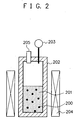
- FIG. 2 is a schematic cross-sectional view illustrating an example of a reaction apparatus used for practicing the fullerenes-producing method of the present invention.
- Step 1 an aromatic compound-containing starting material and a reaction medium-forming material, and if necessary, a transition metal or/and a transition metal compound are introduced into a substantially enclosed reaction vessel of a reaction apparatus.
- Step 2 the materials introduced in the reaction vessel are together heated while being compressed, where preferably, the reaction medium-forming material is converted into a supercritical fluid and the starting material is contacted with the supercritical fluid to obtain a reaction product containing fullerenes.
- Step 3 if required, the reaction product is subjected to a heat treatment at a temperature of 300 to 600 °C preferably in an inert gas atmosphere in order to remove impurities contained in the reaction product.
- Step 4 the heat-treated reaction product is subjected to an extraction treatment using a solvent capable of dissolving fullerenes to extract a dissoluble component containing fullerenes and the solvent contained in the extracted dissoluble component is removed.
- the reaction apparatus shown in FIG. 2 comprises a substantially enclosed pressure reaction vessel 202 provided with a pressure gauge 203, a heater 204, and a safety vent 205. At least the inner wall of the reaction vessel 202 is made of preferably a stainless steel or more preferably a Ni-Mo alloy so as to have sufficient corrosion resistance.
- Reference numeral 201 indicates a reaction medium-forming material contained in the reaction vessel 202
- reference numeral 200 indicates an aromatic compound-containing starting material mixed in the reaction medium-forming material 201 in the reaction vessel.
- the reaction apparatus is provided with an agitation mechanism in order to uniformly promote the reaction in the reaction vessel.
- the reaction apparatus is preferred to have a circulating flow reaction system in that from the reaction product containing the unreacted starting material outputted from the reaction vessel, a fullerenes-containing reaction product is isolated and the unreacted starting material is returned into the reaction vessel, in order to improve the yield from the starting material.
- a fullerene comprising carbon atoms only has a three-dimensional closed spherical molecular structure comprising a plurality of five-member rings of carbon atoms and a plurality of six-member rings of carbon atoms.
- V the number of the vertices of the polyhedron comprising carbon atoms
- E the number of the edges of the polyhedron
- F the number of the faces of the polyhedron
- the fullerenes produced in the present invention have such three-dimensional closed spherical molecular structure. Specifically, they include fullerene C 60 with 60 carbon atoms, fullerene C 70 with 70 carbon atoms, fullerene C 76 with 76 carbon atoms, fullerene C 78 with 78 carbon atoms, fullerene C 82 with 82 carbon atoms, fullerene C 84 with 84 carbon atoms, fullerene C 86 with 86 carbon atoms, fullerene C 88 with 88 carbon atoms, fullerene C 90 with 90 carbon atoms, fullerene C 94 with 94 carbon atoms, and fullerene C 96 with 96 carbon atoms.
- the fullerene can be determined by laser-vaporization cluster beam mass spectrum, infrared absorption spectrum analysis, Raman scattering spectrum analysis, 13 C-NMR spectrum analysis, electron diffraction analysis, X-ray diffraction analysis, or neutron diffraction analysis.
- reaction vessel 202 made of a Ni-Mo alloy of the reaction apparatus shown in FIG. 2, 2 g of naphthalene (the critical temperature: 475 °C; the critical pressure: 4.11 MPa) as the starting material 200, 0.2 g of ferric chloride (FeCl 3 ) as a catalyst, 2 g of ethanol (the critical temperature: 243 °C; the critical pressure: 6.38 MPa) as a solvent for said ferric chloride, and 80 g of a dryice CO 2 (the critical temperature: 31 °C; the critical pressure: 7.38 MPa) as the reaction medium-forming material 201 were introduced, and they were subjected to reaction at 300 °C under pressure condition of 12 MPa for 6 hours to obtain a reaction product. The resultant reaction product was subjected to an extraction treatment with toluene to obtain an extracted reaction product.
- ferric chloride FeCl 3
- ethanol the critical temperature: 243 °C; the critical pressure: 6.38 MPa
- a sample of the extracted reaction product was diluted with toluene to 200 times to obtain a toluene solution.
- a peak corresponding to unreacted naphthalene and a peak at a position in agreement with the retention time previously measured by a fullerene C 60 toluene solution.
- Another sample of the extracted reaction product was subjected to isolation and purification by a high performance liquid chromatography using a ODS (octadecyksilicas) column to obtain a purified product.
- the purified product was subjected to analysis by a laser desorption time-of-flight mass spectrum analyzer. There was observed a spectrum corresponding to more than C 60 (60 carbon atoms).
- the purified product was subjected to analysis by an infrared spectroscopy. As a result, there was observed an absorption peak at 1180 cm -1 which is peculiar to fullerene.
- Example 2 The procedures of Example 1 were repeated, except that 0.2 g of ferrocene was added in addition to the ferric chloride as the catalyst, to obtain a reaction product.
- the reaction product was subjected to an extraction treatment with toluene to obtain an extracted reaction product.
- Example 2 a sample of the extracted reaction product was subjected to analysis by the high performance liquid chromatography. As a result, there were observed a peak corresponding to unreacted naphthalene and a peak at a position in agreement with the retention time previously measured by a fullerene C 60 toluene solution.
- Example 1 The procedures of Example 1 were repeated, except that the ferric chloride was not used and the reaction temperature was changed to 400 °C, to obtain a reaction product.
- the reaction product was subjected to an extraction treatment with toluene to obtain an extracted reaction product.
- Example 2 a sample of the extracted reaction product was subjected to analysis by the high performance liquid chromatography. As a result, there were observed a peak corresponding to unreacted naphthalene and a peak at a position in agreement with the retention time previously measured by a fullerene C 60 toluene solution.
- Example 2 The procedures of Example 1 were repeated, except that the ferric chloride was not added, 22 g of ion-exchanged water was added instead of the dryice, the reaction temperature was changed to 400 °C, and the pressure was changed to 28 MPa, to obtain a reaction product. The reaction product was subjected to an extraction treatment with toluene to obtain an extracted reaction product.
- Example 2 a sample of the extracted reaction product was subjected to analysis by the high performance liquid chromatography. As a result, there were observed a peak corresponding to unreacted naphthalene and a peak at a position in agreement with the retention time previously measured by a fullerene C 60 toluene solution.
- Example 1 The procedures of Example 1 were repeated, except that toluene was used instead of the naphthalene as the starting material, the ferric chloride was not used, and the reaction temperature was changed to 400 °C, to obtain a reaction product.
- the reaction product was subjected to an extraction treatment with toluene to obtain an extracted reaction product.
- Example 2 a sample of the extracted reaction product was subjected to analysis by the high performance liquid chromatography. As a result, there were observed a peak corresponding to unreacted naphthalene and a peak at a position in agreement with the retention time previously measured by a fullerene C 60 toluene solution.
- Example 2 The procedures of Example 1 were repeated, except that 2.5 g of pitch was used instead of the naphthalene as the starting material, the ferric chloride was not used and the reaction temperature was changed to 400 °C, to obtain a reaction product.
- the reaction product was subjected to a heat treatment in an argon atmosphere at 400 °Cfor 3 hours.
- the heat-treated reaction product was subjected to an extraction treatment with toluene to obtain an extracted reaction product.
- Example 2 a sample of the extracted reaction product was subjected to analysis by the high performance liquid chromatography. As a result, there were observed a peak corresponding to unreacted pitch and a peak at a position in agreement with the retention time previously measured by a fullerene C 60 toluene solution.
- Example 2 The procedures of Example 1 were repeated, except that 2 g of 5,8-dihydroxy-1,4-naphthoquinone was used instead of the naphthalene as the starting material, sulfuric acid was used instead of the ferric chloride as the catalyst, and the reaction temperature was changed to 400 °C, to obtain a reaction product.
- the reaction product was subjected to an extraction treatment with toluene to obtain an extracted reaction product.
- Example 2 a sample of the extracted reaction product was subjected to analysis by the high performance liquid chromatography. As a result, there were observed a peak corresponding to unreacted 5,8-dihydroxy-1,4-naphthoquinone and a peak at a position in agreement with the retention time previously measured by a fullerene C 60 toluene solution.
- Example 1 The procedures of Example 1 were repeated, except that the naphthalene as the starting material was omitted, to obtain a reaction product.
- the reaction product was subjected to an extraction treatment with toluene to obtain an extracted reaction product.
- Example 2 a sample of the extracted reaction product was subjected to analysis by the high performance liquid chromatography. As a result, there was not observed a peak at a position in agreement with the retention time previously measured by a fullerene C 60 toluene solution.
- Example 1 The procedures of Example 1 were repeated, except that the reaction temperature was changed to 600 °C, to obtain a reaction product.
- the reaction product was subjected to an extraction treatment with toluene to obtain an extracted reaction product.
- Example 2 a sample of the extracted reaction product was subjected to analysis by the high performance liquid chromatography. As a result, there was not observed a peak at a position in agreement with the retention time previously measured by a fullerene C 60 toluene solution.
- Example 1 The procedures of Example 1 were repeated, except that the reaction temperature was changed to 30 °C, to obtain a reaction product.
- the reaction product was subjected to an extraction treatment with toluene to obtain an extracted reaction product.
- Example 2 a sample of the extracted reaction product was subjected to analysis by the high performance liquid chromatography. As a result, there was not observed a peak at a position in agreement with the retention time previously measured by a fullerene C 60 toluene solution.
- the fullerene-producing method of the present invention can be practiced in a large-scaled reaction apparatus so as to mass-produce fullerenes.
Landscapes
- Chemical & Material Sciences (AREA)
- Engineering & Computer Science (AREA)
- Nanotechnology (AREA)
- Organic Chemistry (AREA)
- Materials Engineering (AREA)
- Inorganic Chemistry (AREA)
- Physics & Mathematics (AREA)
- Condensed Matter Physics & Semiconductors (AREA)
- General Physics & Mathematics (AREA)
- Crystallography & Structural Chemistry (AREA)
- Manufacturing & Machinery (AREA)
- Chemical Kinetics & Catalysis (AREA)
- Composite Materials (AREA)
- Carbon And Carbon Compounds (AREA)
- Organic Low-Molecular-Weight Compounds And Preparation Thereof (AREA)
Applications Claiming Priority (4)
| Application Number | Priority Date | Filing Date | Title |
|---|---|---|---|
| JP2001309272 | 2001-10-04 | ||
| JP2001309272 | 2001-10-04 | ||
| JP2002282299 | 2002-09-27 | ||
| JP2002282299A JP2003176114A (ja) | 2001-10-04 | 2002-09-27 | フラーレンの製造方法 |
Publications (3)
| Publication Number | Publication Date |
|---|---|
| EP1300363A2 true EP1300363A2 (fr) | 2003-04-09 |
| EP1300363A3 EP1300363A3 (fr) | 2005-01-12 |
| EP1300363B1 EP1300363B1 (fr) | 2008-07-16 |
Family
ID=26623729
Family Applications (1)
| Application Number | Title | Priority Date | Filing Date |
|---|---|---|---|
| EP02022103A Expired - Lifetime EP1300363B1 (fr) | 2001-10-04 | 2002-10-02 | Procédé de préparation de fullerene |
Country Status (7)
| Country | Link |
|---|---|
| US (1) | US6953564B2 (fr) |
| EP (1) | EP1300363B1 (fr) |
| JP (1) | JP2003176114A (fr) |
| KR (1) | KR100491702B1 (fr) |
| CN (1) | CN1246217C (fr) |
| AT (1) | ATE401286T1 (fr) |
| DE (1) | DE60227630D1 (fr) |
Cited By (6)
| Publication number | Priority date | Publication date | Assignee | Title |
|---|---|---|---|---|
| EP1300364A2 (fr) | 2001-10-04 | 2003-04-09 | Canon Kabushiki Kaisha | Procédé de préparation de nanomatériaux au carbon |
| WO2004089820A1 (fr) * | 2003-04-04 | 2004-10-21 | Canon Kabushiki Kaisha | Particule carbonee en paillette et procede de fabrication |
| EP1440932A3 (fr) * | 2003-01-23 | 2005-06-15 | Canon Kabushiki Kaisha | Procédé de préparation de nanomatériaux en carbone |
| EP1462415A3 (fr) * | 2003-03-26 | 2006-10-18 | Canon Kabushiki Kaisha | Procédé de production de matériau en carbone de taille nanométrique |
| RU2484011C2 (ru) * | 2011-05-13 | 2013-06-10 | Александр Алексеевич Козеев | Низкотемпературный химический метод получения фуллерена |
| CN112018400A (zh) * | 2020-08-28 | 2020-12-01 | 华中科技大学 | 富勒烯基Fe、N掺杂富孔碳材料及其制备方法和应用 |
Families Citing this family (11)
| Publication number | Priority date | Publication date | Assignee | Title |
|---|---|---|---|---|
| JP4577488B2 (ja) * | 2003-09-17 | 2010-11-10 | ブリヂストンスポーツ株式会社 | ゴルフボールの製造方法 |
| JP4612392B2 (ja) * | 2004-10-20 | 2011-01-12 | 帝人株式会社 | ポリエステル系樹脂組成物およびその製造法 |
| JP2006315970A (ja) * | 2005-05-11 | 2006-11-24 | Sony Corp | イオン解離性機能分子の製造方法及びその原料分子の製造方法 |
| JP4585956B2 (ja) * | 2005-11-08 | 2010-11-24 | Sriスポーツ株式会社 | ゴルフクラブシャフト |
| WO2009089153A2 (fr) * | 2008-01-04 | 2009-07-16 | University Of Florida Research Foundation, Inc. | Libération optique d'hydrogène à partir de fullerènes fonctionnalisés utilisés comme matières de stockage |
| EP2455337B1 (fr) * | 2010-11-22 | 2015-01-07 | University of Limerick | Procédé permettant la fabrication et la modification de surface de sphères de carbone colloïdal dans un milieu supercritique |
| CN102060290B (zh) * | 2010-12-02 | 2012-09-26 | 中国科学院理化技术研究所 | 一种利用生物质燃烧法生产富勒烯的方法 |
| CN102231925B (zh) * | 2011-05-20 | 2013-05-01 | 中国科学院化学研究所 | 一种提高电弧放电法制备c60/c70富勒烯的产率的方法 |
| CN102942169A (zh) * | 2012-10-01 | 2013-02-27 | 青岛科技大学 | 超临界流体技术制备负载金属富勒烯纳微米材料的方法 |
| CN112662447B (zh) * | 2020-12-14 | 2022-05-06 | 山东益万城节能环保科技有限公司 | 纳米煤炭添加剂及其制备方法 |
| JP7692573B2 (ja) * | 2021-05-26 | 2025-06-16 | 川上 総一郎 | ナノカーボン材料の製造方法 |
Family Cites Families (20)
| Publication number | Priority date | Publication date | Assignee | Title |
|---|---|---|---|---|
| JPH05186865A (ja) | 1991-12-27 | 1993-07-27 | Hitachi Ltd | 炭素クラスター製造方法 |
| CA2091665C (fr) * | 1992-04-07 | 2003-01-07 | Peter George Tsantrizos | Procede de synthese de fullerenes |
| JPH0632606A (ja) | 1992-07-15 | 1994-02-08 | Mitsui Eng & Shipbuild Co Ltd | フラーレン類の製造方法 |
| JPH0656414A (ja) | 1992-08-03 | 1994-03-01 | Mitsui Eng & Shipbuild Co Ltd | フラーレン類の製造方法 |
| US5876684A (en) * | 1992-08-14 | 1999-03-02 | Materials And Electrochemical Research (Mer) Corporation | Methods and apparati for producing fullerenes |
| US5292813A (en) * | 1992-10-02 | 1994-03-08 | Exxon Research & Engineering Co. | Fullerene-grafted polymers and processes of making |
| JPH06183712A (ja) * | 1992-10-23 | 1994-07-05 | Showa Denko Kk | フラーレン類の製造方法 |
| JP2541434B2 (ja) | 1992-11-20 | 1996-10-09 | 日本電気株式会社 | カ―ボンナノチュ―ブの製造方法 |
| GB9317342D0 (en) | 1993-08-20 | 1993-10-06 | Univ Sussex | Process for the preparation of fullerenes |
| JPH07215710A (ja) | 1994-02-02 | 1995-08-15 | Shozo Watabe | 石油系ピッチの組成成分のb.成分を原料として 高圧高温下にて加熱処理してフラーレン▲c60▼を製 造する方法。 |
| JP2737736B2 (ja) | 1996-01-12 | 1998-04-08 | 日本電気株式会社 | カーボン単層ナノチューブの製造方法 |
| EP0951440A4 (fr) * | 1997-01-13 | 2000-03-15 | Daimlerchrysler Aerospace Ag | Procede et appareil permettant de produire des molecules de carbone complexes |
| JP3986711B2 (ja) | 1998-07-21 | 2007-10-03 | 昭和電工株式会社 | 単層カーボンナノチューブの製造方法 |
| US6455021B1 (en) * | 1998-07-21 | 2002-09-24 | Showa Denko K.K. | Method for producing carbon nanotubes |
| JP3007983B1 (ja) | 1998-09-05 | 2000-02-14 | 工業技術院長 | 超微細カーボンチューブの製造方法 |
| KR100329279B1 (ko) * | 2000-01-07 | 2002-03-18 | 김효근 | 수용성 거대고리-플러렌 주쇄 중합체 및 이의 제조방법 |
| US6913789B2 (en) * | 2001-01-31 | 2005-07-05 | William Marsh Rice University | Process utilizing pre-formed cluster catalysts for making single-wall carbon nanotubes |
| US7052668B2 (en) * | 2001-01-31 | 2006-05-30 | William Marsh Rice University | Process utilizing seeds for making single-wall carbon nanotubes |
| US20020102193A1 (en) * | 2001-01-31 | 2002-08-01 | William Marsh Rice University | Process utilizing two zones for making single-wall carbon nanotubes |
| JP4109952B2 (ja) * | 2001-10-04 | 2008-07-02 | キヤノン株式会社 | ナノカーボン材料の製造方法 |
-
2002
- 2002-09-27 JP JP2002282299A patent/JP2003176114A/ja not_active Withdrawn
- 2002-10-01 KR KR10-2002-0059762A patent/KR100491702B1/ko not_active Expired - Fee Related
- 2002-10-01 US US10/260,556 patent/US6953564B2/en not_active Expired - Fee Related
- 2002-10-02 DE DE60227630T patent/DE60227630D1/de not_active Expired - Lifetime
- 2002-10-02 EP EP02022103A patent/EP1300363B1/fr not_active Expired - Lifetime
- 2002-10-02 AT AT02022103T patent/ATE401286T1/de not_active IP Right Cessation
- 2002-10-08 CN CNB02158446XA patent/CN1246217C/zh not_active Expired - Fee Related
Cited By (9)
| Publication number | Priority date | Publication date | Assignee | Title |
|---|---|---|---|---|
| EP1300364A2 (fr) | 2001-10-04 | 2003-04-09 | Canon Kabushiki Kaisha | Procédé de préparation de nanomatériaux au carbon |
| EP1440932A3 (fr) * | 2003-01-23 | 2005-06-15 | Canon Kabushiki Kaisha | Procédé de préparation de nanomatériaux en carbone |
| US7270795B2 (en) | 2003-01-23 | 2007-09-18 | Canon Kabushiki Kaisha | Method for producing nano-carbon materials |
| EP1462415A3 (fr) * | 2003-03-26 | 2006-10-18 | Canon Kabushiki Kaisha | Procédé de production de matériau en carbone de taille nanométrique |
| WO2004089820A1 (fr) * | 2003-04-04 | 2004-10-21 | Canon Kabushiki Kaisha | Particule carbonee en paillette et procede de fabrication |
| US7442358B2 (en) | 2003-04-04 | 2008-10-28 | Canon Kabushiki Kaisha | Flaky carbonaceous particle and production method thereof |
| RU2484011C2 (ru) * | 2011-05-13 | 2013-06-10 | Александр Алексеевич Козеев | Низкотемпературный химический метод получения фуллерена |
| CN112018400A (zh) * | 2020-08-28 | 2020-12-01 | 华中科技大学 | 富勒烯基Fe、N掺杂富孔碳材料及其制备方法和应用 |
| CN112018400B (zh) * | 2020-08-28 | 2022-05-31 | 华中科技大学 | 富勒烯基Fe、N掺杂富孔碳材料及其制备方法和应用 |
Also Published As
| Publication number | Publication date |
|---|---|
| KR20030029019A (ko) | 2003-04-11 |
| CN1440926A (zh) | 2003-09-10 |
| JP2003176114A (ja) | 2003-06-24 |
| KR100491702B1 (ko) | 2005-05-27 |
| ATE401286T1 (de) | 2008-08-15 |
| CN1246217C (zh) | 2006-03-22 |
| US6953564B2 (en) | 2005-10-11 |
| EP1300363A3 (fr) | 2005-01-12 |
| EP1300363B1 (fr) | 2008-07-16 |
| US20030072706A1 (en) | 2003-04-17 |
| DE60227630D1 (de) | 2008-08-28 |
Similar Documents
| Publication | Publication Date | Title |
|---|---|---|
| US6953564B2 (en) | Method for producing fullerenes | |
| Cheung et al. | Synthetic strategies of carbon nanobelts and related belt‐shaped polycyclic aromatic hydrocarbons | |
| Thakur et al. | Chemical functionalization of carbon nanomaterials | |
| CN100473601C (zh) | 制造纳米碳材料的方法 | |
| US5985232A (en) | Production of fullerenic nanostructures in flames | |
| Takeuchi et al. | Mechanism of methanol formation | |
| KR100661008B1 (ko) | 나노 카본재료의 제조방법 | |
| Nakanishi et al. | Template synthesis of linear‐chain nanodiamonds inside carbon nanotubes from bridgehead‐halogenated diamantane precursors | |
| Ni et al. | Microwave-assisted green synthesis of uniform Ru nanoparticles supported on non-functional carbon nanotubes for cinnamaldehyde hydrogenation | |
| CA2091665C (fr) | Procede de synthese de fullerenes | |
| US20060251568A1 (en) | Low temperature synthesis of carbon nanotubes | |
| WO2005054120A2 (fr) | Nanoparticules metalliques a support de polymere et leur procede de fabrication et d'utilisation | |
| US20030059364A1 (en) | Method for poduction of nanostructures | |
| Niesz et al. | Mechanical and chemical breaking of multiwalled carbon nanotubes | |
| Tashiro et al. | Iridium‐Catalyzed Reductive Carbon–Carbon Bond Cleavage Reaction on a Curved Pyridylcorannulene Skeleton | |
| Rana et al. | Synthesis of carbon nanotubes from in situ generated cobalt nanoparticles and carbon monoxide | |
| Khatun et al. | Bottom‐Up Porous Graphene Synthesis and its Applications | |
| KR20040085982A (ko) | 액상법에 의한 탄소나노튜브의 제조방법 | |
| Fromme et al. | Chemical Reaction Pathways during Laser Fragmentation of Metallic Microparticles in Organic Solvents | |
| Mountrichas et al. | Grafting living polymers onto carbon nanohorns | |
| Ma et al. | Shape‐Controlled Growth of Carbon Nanostructures: Yield and Mechanism | |
| Maksimova et al. | Study of thermocatalytic decomposition of polyethylene and polyvinyl alcohol in the presence of an unsteady-state Fe-containing catalyst | |
| CN1131408A (zh) | 制备富勒烯的方法 | |
| Ma et al. | Low-temperature growth of carbon nanofiber using a vapor–facet–solid process | |
| WO2008097333A2 (fr) | Procédé et dispositif de fabrication à basse température de carbone graphitique, de graphène et de nanotubes de carbone |
Legal Events
| Date | Code | Title | Description |
|---|---|---|---|
| PUAI | Public reference made under article 153(3) epc to a published international application that has entered the european phase |
Free format text: ORIGINAL CODE: 0009012 |
|
| 17P | Request for examination filed |
Effective date: 20021002 |
|
| AK | Designated contracting states |
Kind code of ref document: A2 Designated state(s): AT BE BG CH CY CZ DE DK EE ES FI FR GB GR IE IT LI LU MC NL PT SE SK TR |
|
| AX | Request for extension of the european patent |
Extension state: AL LT LV MK RO SI |
|
| PUAL | Search report despatched |
Free format text: ORIGINAL CODE: 0009013 |
|
| AK | Designated contracting states |
Kind code of ref document: A3 Designated state(s): AT BE BG CH CY CZ DE DK EE ES FI FR GB GR IE IT LI LU MC NL PT SE SK TR |
|
| AX | Request for extension of the european patent |
Extension state: AL LT LV MK RO SI |
|
| AKX | Designation fees paid |
Designated state(s): AT BE BG CH CY CZ DE DK EE ES FI FR GB GR IE IT LI LU MC NL PT SE SK TR |
|
| GRAP | Despatch of communication of intention to grant a patent |
Free format text: ORIGINAL CODE: EPIDOSNIGR1 |
|
| GRAS | Grant fee paid |
Free format text: ORIGINAL CODE: EPIDOSNIGR3 |
|
| GRAA | (expected) grant |
Free format text: ORIGINAL CODE: 0009210 |
|
| AK | Designated contracting states |
Kind code of ref document: B1 Designated state(s): AT BE BG CH CY CZ DE DK EE ES FI FR GB GR IE IT LI LU MC NL PT SE SK TR |
|
| REG | Reference to a national code |
Ref country code: GB Ref legal event code: FG4D |
|
| REG | Reference to a national code |
Ref country code: CH Ref legal event code: EP |
|
| REF | Corresponds to: |
Ref document number: 60227630 Country of ref document: DE Date of ref document: 20080828 Kind code of ref document: P |
|
| REG | Reference to a national code |
Ref country code: IE Ref legal event code: FG4D |
|
| NLV1 | Nl: lapsed or annulled due to failure to fulfill the requirements of art. 29p and 29m of the patents act | ||
| PG25 | Lapsed in a contracting state [announced via postgrant information from national office to epo] |
Ref country code: PT Free format text: LAPSE BECAUSE OF FAILURE TO SUBMIT A TRANSLATION OF THE DESCRIPTION OR TO PAY THE FEE WITHIN THE PRESCRIBED TIME-LIMIT Effective date: 20081216 Ref country code: NL Free format text: LAPSE BECAUSE OF FAILURE TO SUBMIT A TRANSLATION OF THE DESCRIPTION OR TO PAY THE FEE WITHIN THE PRESCRIBED TIME-LIMIT Effective date: 20080716 Ref country code: ES Free format text: LAPSE BECAUSE OF FAILURE TO SUBMIT A TRANSLATION OF THE DESCRIPTION OR TO PAY THE FEE WITHIN THE PRESCRIBED TIME-LIMIT Effective date: 20081027 |
|
| PG25 | Lapsed in a contracting state [announced via postgrant information from national office to epo] |
Ref country code: BG Free format text: LAPSE BECAUSE OF FAILURE TO SUBMIT A TRANSLATION OF THE DESCRIPTION OR TO PAY THE FEE WITHIN THE PRESCRIBED TIME-LIMIT Effective date: 20081016 Ref country code: FI Free format text: LAPSE BECAUSE OF FAILURE TO SUBMIT A TRANSLATION OF THE DESCRIPTION OR TO PAY THE FEE WITHIN THE PRESCRIBED TIME-LIMIT Effective date: 20080716 Ref country code: AT Free format text: LAPSE BECAUSE OF FAILURE TO SUBMIT A TRANSLATION OF THE DESCRIPTION OR TO PAY THE FEE WITHIN THE PRESCRIBED TIME-LIMIT Effective date: 20080716 |
|
| PG25 | Lapsed in a contracting state [announced via postgrant information from national office to epo] |
Ref country code: BE Free format text: LAPSE BECAUSE OF FAILURE TO SUBMIT A TRANSLATION OF THE DESCRIPTION OR TO PAY THE FEE WITHIN THE PRESCRIBED TIME-LIMIT Effective date: 20080716 |
|
| PG25 | Lapsed in a contracting state [announced via postgrant information from national office to epo] |
Ref country code: EE Free format text: LAPSE BECAUSE OF FAILURE TO SUBMIT A TRANSLATION OF THE DESCRIPTION OR TO PAY THE FEE WITHIN THE PRESCRIBED TIME-LIMIT Effective date: 20080716 Ref country code: DK Free format text: LAPSE BECAUSE OF FAILURE TO SUBMIT A TRANSLATION OF THE DESCRIPTION OR TO PAY THE FEE WITHIN THE PRESCRIBED TIME-LIMIT Effective date: 20080716 |
|
| PLBE | No opposition filed within time limit |
Free format text: ORIGINAL CODE: 0009261 |
|
| STAA | Information on the status of an ep patent application or granted ep patent |
Free format text: STATUS: NO OPPOSITION FILED WITHIN TIME LIMIT |
|
| PG25 | Lapsed in a contracting state [announced via postgrant information from national office to epo] |
Ref country code: MC Free format text: LAPSE BECAUSE OF NON-PAYMENT OF DUE FEES Effective date: 20081031 Ref country code: CZ Free format text: LAPSE BECAUSE OF FAILURE TO SUBMIT A TRANSLATION OF THE DESCRIPTION OR TO PAY THE FEE WITHIN THE PRESCRIBED TIME-LIMIT Effective date: 20080716 Ref country code: SK Free format text: LAPSE BECAUSE OF FAILURE TO SUBMIT A TRANSLATION OF THE DESCRIPTION OR TO PAY THE FEE WITHIN THE PRESCRIBED TIME-LIMIT Effective date: 20080716 |
|
| REG | Reference to a national code |
Ref country code: CH Ref legal event code: PL |
|
| 26N | No opposition filed |
Effective date: 20090417 |
|
| GBPC | Gb: european patent ceased through non-payment of renewal fee |
Effective date: 20081016 |
|
| REG | Reference to a national code |
Ref country code: IE Ref legal event code: MM4A |
|
| REG | Reference to a national code |
Ref country code: FR Ref legal event code: ST Effective date: 20090630 |
|
| PG25 | Lapsed in a contracting state [announced via postgrant information from national office to epo] |
Ref country code: IT Free format text: LAPSE BECAUSE OF FAILURE TO SUBMIT A TRANSLATION OF THE DESCRIPTION OR TO PAY THE FEE WITHIN THE PRESCRIBED TIME-LIMIT Effective date: 20080716 |
|
| PG25 | Lapsed in a contracting state [announced via postgrant information from national office to epo] |
Ref country code: CH Free format text: LAPSE BECAUSE OF NON-PAYMENT OF DUE FEES Effective date: 20081031 Ref country code: IE Free format text: LAPSE BECAUSE OF NON-PAYMENT OF DUE FEES Effective date: 20081002 Ref country code: LI Free format text: LAPSE BECAUSE OF NON-PAYMENT OF DUE FEES Effective date: 20081031 Ref country code: FR Free format text: LAPSE BECAUSE OF NON-PAYMENT OF DUE FEES Effective date: 20081031 |
|
| PG25 | Lapsed in a contracting state [announced via postgrant information from national office to epo] |
Ref country code: GB Free format text: LAPSE BECAUSE OF NON-PAYMENT OF DUE FEES Effective date: 20081016 |
|
| PG25 | Lapsed in a contracting state [announced via postgrant information from national office to epo] |
Ref country code: SE Free format text: LAPSE BECAUSE OF FAILURE TO SUBMIT A TRANSLATION OF THE DESCRIPTION OR TO PAY THE FEE WITHIN THE PRESCRIBED TIME-LIMIT Effective date: 20081016 |
|
| PG25 | Lapsed in a contracting state [announced via postgrant information from national office to epo] |
Ref country code: CY Free format text: LAPSE BECAUSE OF FAILURE TO SUBMIT A TRANSLATION OF THE DESCRIPTION OR TO PAY THE FEE WITHIN THE PRESCRIBED TIME-LIMIT Effective date: 20080716 Ref country code: LU Free format text: LAPSE BECAUSE OF NON-PAYMENT OF DUE FEES Effective date: 20081002 |
|
| PG25 | Lapsed in a contracting state [announced via postgrant information from national office to epo] |
Ref country code: TR Free format text: LAPSE BECAUSE OF FAILURE TO SUBMIT A TRANSLATION OF THE DESCRIPTION OR TO PAY THE FEE WITHIN THE PRESCRIBED TIME-LIMIT Effective date: 20080716 |
|
| PG25 | Lapsed in a contracting state [announced via postgrant information from national office to epo] |
Ref country code: GR Free format text: LAPSE BECAUSE OF FAILURE TO SUBMIT A TRANSLATION OF THE DESCRIPTION OR TO PAY THE FEE WITHIN THE PRESCRIBED TIME-LIMIT Effective date: 20081017 |
|
| PGFP | Annual fee paid to national office [announced via postgrant information from national office to epo] |
Ref country code: DE Payment date: 20141031 Year of fee payment: 13 |
|
| REG | Reference to a national code |
Ref country code: DE Ref legal event code: R119 Ref document number: 60227630 Country of ref document: DE |
|
| PG25 | Lapsed in a contracting state [announced via postgrant information from national office to epo] |
Ref country code: DE Free format text: LAPSE BECAUSE OF NON-PAYMENT OF DUE FEES Effective date: 20160503 |