EP1351324A2 - Organische elektrolumineszente Vorrichtung die Metallcarboxylat enthalten - Google Patents
Organische elektrolumineszente Vorrichtung die Metallcarboxylat enthalten Download PDFInfo
- Publication number
- EP1351324A2 EP1351324A2 EP20030252092 EP03252092A EP1351324A2 EP 1351324 A2 EP1351324 A2 EP 1351324A2 EP 20030252092 EP20030252092 EP 20030252092 EP 03252092 A EP03252092 A EP 03252092A EP 1351324 A2 EP1351324 A2 EP 1351324A2
- Authority
- EP
- European Patent Office
- Prior art keywords
- cathode
- organic
- thickness
- transport layer
- approximately
- Prior art date
- Legal status (The legal status is an assumption and is not a legal conclusion. Google has not performed a legal analysis and makes no representation as to the accuracy of the status listed.)
- Granted
Links
Images



Classifications
-
- H—ELECTRICITY
- H10—SEMICONDUCTOR DEVICES; ELECTRIC SOLID-STATE DEVICES NOT OTHERWISE PROVIDED FOR
- H10K—ORGANIC ELECTRIC SOLID-STATE DEVICES
- H10K50/00—Organic light-emitting devices
- H10K50/10—OLEDs or polymer light-emitting diodes [PLED]
- H10K50/17—Carrier injection layers
- H10K50/171—Electron injection layers
-
- C—CHEMISTRY; METALLURGY
- C09—DYES; PAINTS; POLISHES; NATURAL RESINS; ADHESIVES; COMPOSITIONS NOT OTHERWISE PROVIDED FOR; APPLICATIONS OF MATERIALS NOT OTHERWISE PROVIDED FOR
- C09K—MATERIALS FOR MISCELLANEOUS APPLICATIONS, NOT PROVIDED FOR ELSEWHERE
- C09K11/00—Luminescent materials, e.g. electroluminescent or chemiluminescent
- C09K11/06—Luminescent materials, e.g. electroluminescent or chemiluminescent containing organic luminescent materials
-
- H—ELECTRICITY
- H10—SEMICONDUCTOR DEVICES; ELECTRIC SOLID-STATE DEVICES NOT OTHERWISE PROVIDED FOR
- H10K—ORGANIC ELECTRIC SOLID-STATE DEVICES
- H10K50/00—Organic light-emitting devices
- H10K50/80—Constructional details
- H10K50/805—Electrodes
- H10K50/82—Cathodes
-
- H—ELECTRICITY
- H10—SEMICONDUCTOR DEVICES; ELECTRIC SOLID-STATE DEVICES NOT OTHERWISE PROVIDED FOR
- H10K—ORGANIC ELECTRIC SOLID-STATE DEVICES
- H10K50/00—Organic light-emitting devices
- H10K50/80—Constructional details
- H10K50/805—Electrodes
- H10K50/82—Cathodes
- H10K50/826—Multilayers, e.g. opaque multilayers
-
- H—ELECTRICITY
- H10—SEMICONDUCTOR DEVICES; ELECTRIC SOLID-STATE DEVICES NOT OTHERWISE PROVIDED FOR
- H10K—ORGANIC ELECTRIC SOLID-STATE DEVICES
- H10K2102/00—Constructional details relating to the organic devices covered by this subclass
- H10K2102/301—Details of OLEDs
- H10K2102/351—Thickness
-
- H—ELECTRICITY
- H10—SEMICONDUCTOR DEVICES; ELECTRIC SOLID-STATE DEVICES NOT OTHERWISE PROVIDED FOR
- H10K—ORGANIC ELECTRIC SOLID-STATE DEVICES
- H10K85/00—Organic materials used in the body or electrodes of devices covered by this subclass
- H10K85/30—Coordination compounds
- H10K85/321—Metal complexes comprising a group IIIA element, e.g. Tris (8-hydroxyquinoline) gallium [Gaq3]
- H10K85/324—Metal complexes comprising a group IIIA element, e.g. Tris (8-hydroxyquinoline) gallium [Gaq3] comprising aluminium, e.g. Alq3
-
- H—ELECTRICITY
- H10—SEMICONDUCTOR DEVICES; ELECTRIC SOLID-STATE DEVICES NOT OTHERWISE PROVIDED FOR
- H10K—ORGANIC ELECTRIC SOLID-STATE DEVICES
- H10K85/00—Organic materials used in the body or electrodes of devices covered by this subclass
- H10K85/60—Organic compounds having low molecular weight
- H10K85/631—Amine compounds having at least two aryl rest on at least one amine-nitrogen atom, e.g. triphenylamine
-
- Y—GENERAL TAGGING OF NEW TECHNOLOGICAL DEVELOPMENTS; GENERAL TAGGING OF CROSS-SECTIONAL TECHNOLOGIES SPANNING OVER SEVERAL SECTIONS OF THE IPC; TECHNICAL SUBJECTS COVERED BY FORMER USPC CROSS-REFERENCE ART COLLECTIONS [XRACs] AND DIGESTS
- Y10—TECHNICAL SUBJECTS COVERED BY FORMER USPC
- Y10S—TECHNICAL SUBJECTS COVERED BY FORMER USPC CROSS-REFERENCE ART COLLECTIONS [XRACs] AND DIGESTS
- Y10S428/00—Stock material or miscellaneous articles
- Y10S428/917—Electroluminescent
-
- Y—GENERAL TAGGING OF NEW TECHNOLOGICAL DEVELOPMENTS; GENERAL TAGGING OF CROSS-SECTIONAL TECHNOLOGIES SPANNING OVER SEVERAL SECTIONS OF THE IPC; TECHNICAL SUBJECTS COVERED BY FORMER USPC CROSS-REFERENCE ART COLLECTIONS [XRACs] AND DIGESTS
- Y10—TECHNICAL SUBJECTS COVERED BY FORMER USPC
- Y10T—TECHNICAL SUBJECTS COVERED BY FORMER US CLASSIFICATION
- Y10T428/00—Stock material or miscellaneous articles
- Y10T428/24—Structurally defined web or sheet [e.g., overall dimension, etc.]
- Y10T428/24942—Structurally defined web or sheet [e.g., overall dimension, etc.] including components having same physical characteristic in differing degree
- Y10T428/2495—Thickness [relative or absolute]
- Y10T428/24967—Absolute thicknesses specified
-
- Y—GENERAL TAGGING OF NEW TECHNOLOGICAL DEVELOPMENTS; GENERAL TAGGING OF CROSS-SECTIONAL TECHNOLOGIES SPANNING OVER SEVERAL SECTIONS OF THE IPC; TECHNICAL SUBJECTS COVERED BY FORMER USPC CROSS-REFERENCE ART COLLECTIONS [XRACs] AND DIGESTS
- Y10—TECHNICAL SUBJECTS COVERED BY FORMER USPC
- Y10T—TECHNICAL SUBJECTS COVERED BY FORMER US CLASSIFICATION
- Y10T428/00—Stock material or miscellaneous articles
- Y10T428/31504—Composite [nonstructural laminate]
- Y10T428/31678—Of metal
Definitions
- the present invention relates to an organic electroluminescent (EL) device, and more particularly, to an organic electroluminescent device having an improved efficiency of injecting electrons from a cathode to an organic layer.
- EL organic electroluminescent
- organic electroluminescent devices using organic materials as raw materials for light emitting layers have advantageous characteristics, including a high luminance, a low driving voltage, a fast response rate, ability of producing a wide range of colors, compared to inorganic electroluminescent devices using inorganic materials as raw materials for light emitting layers.
- An organic electroluminescent (EL) device is basically configured such that an anode is formed on a substrate, and a hole transport layer, an emitter layer, an electron transport layer, and a cathode are sequentially stacked on the anode.
- the hole transport layer, the emitter layer and the electron transport layer are organic layers made of organic materials.
- the organic EL device having the above-described configuration, if a voltage is applied to the anode and the cathode, holes injected from the anode migrate to the emitter layer via the hole transport layer, and electrons from the cathode are injected into the emitter layer via the electron transport layer.
- the electrons and holes are recombined at the interface between the hole transport layer and the emitter layer (or the electron transport layer) to generate excitons.
- the generated excitons de-excite from an excited state to a ground state causing fluorescent molecules of the emitter layer to emit light, thus forming an image.
- the conventional methods have several problems. That is, since the metal that has a low work function is very unstable and highly reactive, use of the metal is disadvantageous in view of the processibility and the stability of EL device. In the case of codeposition, it is substantially difficult to control the mixture ratio of materials for forming an alloy. Also, use of alkali metals deteriorates reproducibility.
- an alkali metal acetate e.g., CH3COOLi or C6H5COOLi
- This method also has a problem in that it is difficult to form a thin film having a uniform thickness of 5 to 40 ⁇ , which is not suitable for large-area deposition.
- the present invention provides an organic EL device with a reduced driving voltage, enhanced luminance and improved color coordinate characteristics by increasing an efficiency of injecting electrons from a cathode into an organic layer.
- an organic EL device includes a cathode, an anode, and organic layers formed between the cathode and the anode.
- the cathode includes a first cathode containing aluminum, and a second cathode disposed under the first cathode, formed in the vicinity of an organic layer and containing a metal having a work function of 3.5 to 5.0 eV, and metallic carboxylate represented by: RCOOM wherein M is an alkali metal or alkaline-earth metal, and R is a C 1 -C 10 alkyl or C 6 -C 20 aryl.
- a cathode of the present invention has a bi-layer structure including a first cathode made of Al, and a second cathode containing a cathode forming metal having a work function of 3.5 to 5.0 eV and metallic carboxylate represented by Formula 1.
- the second cathode is disposed under the first cathode and formed in the vicinity of an organic layer.
- the metal having a work function of 3.5 to 5.0 eV include indium (In) (work function: 3.8-4.2 eV), chrome (Cr) (work function: 4.3 eV), aluminum (Al)(work function: 4.3 eV), silver (Ag) (4.6 eV), and Al is most preferred in view of processibility.
- the metal is unstable, resulting in poor processibility. If the work function of the cathode forming metal is greater than 5.0 eV, electron injection characteristics undesirably deteriorate.
- the metallic carboxylate represented by Formula 1 is an organic material in which a metal (M) functions as the opposite ion to a carboxylate functional group, and examples of the metal M include alkali or alkaline-earth metals having a work function of 4.0 eV or less, specifically 1 to 4.0 eV.
- the metal is preferably an alkali metal such as lithium (Li), sodium (Na), potassium (K), rubidium (Rb) or cesium (Cs).
- RCOOM - wherein M is an alkali or alkaline-earth metal, and R is a C 1 -C 10 alkyl or C 6 -C 20 aryl.
- the C 1 -C 10 alkyl is preferably a methyl or ethyl group
- the C 6 -C 20 aryl is preferably a phenyl group.
- the metallic carboxylate of the present invention is preferably lithium acetate (CH 3 COOLi), lithium benzoate (C 6 H 5 COOLi), potassium acetate (CH 3 COOK), potassium benzoate (C 6 H 5 COOK), cesium benzoate (C 6 H 5 COOCs), cesium acetate (CH 3 COOCs), sodium benzoate (C 6 H 5 COONa), sodium acetate (CH 3 COONa), rubidium benzoate (C 6 H 5 COORb) or rubidium acetate (CH 3 COORb).
- the mixture ratio of the cathode forming metal to the metallic carboxylate is preferably 1:1 to 10: 0.1, more preferably 5:1 to 15:1, and most preferably 10:1.
- FIGS. 2A and 2B in which IDE 406 (manufactured by IDEMITSU KOSAN, LTD.) is used for forming a hole injection layer, NPB is used for forming a hole transport layer, Alq 3 is used for forming an electron transport layer, and the second cathode disposed in the vicinity of the electron transport layer is made of Al and cesium acetate.
- IDE 406 manufactured by IDEMITSU KOSAN, LTD.
- NPB is used for forming a hole transport layer
- Alq 3 is used for forming an electron transport layer
- the second cathode disposed in the vicinity of the electron transport layer is made of Al and cesium acetate.
- the organic EL device shown in FIG. 2A including the electron injection layer (LiF) adjacent to the electron transport layer (Alq 3 ) and the cathode (Al) has an improved electron injection efficiency in an organic layer by a reduced energy barrier height or electron tunneling at the interface between an organic layer and LiF, due to a band bending phenomenon in which the LUMO level of Alq 3 is lowered from the interface.
- the LUMO level of Alq 3 i.e., 3.0 eV
- the work function level of a cathode i.e., 4.3 eV
- the second cathode adjacent to the electron transport layer (Alq 3 ) includes Al and cesium acetate, and there is little energy difference between the LUMO of Alq 3 , i.e., 3.0 eV, and the work function of the cathode, i.e., approximately 3.0 eV, electron injection into an organic layer from the cathode is enhanced even with a low voltage applied.
- a method of manufacturing the organic EL device according to the present invention is described below.
- an anode is formed on a substrate and then a hole injection layer is selectively formed on the anode.
- the hole injection layer decreases contact resistance between the anode and a hole transport layer and increases the hole transporting capability of the anode with respect to an emitter layer (or electron transport layer), thus improving overall characteristics of the device.
- Usable materials to form the hole injection layer include starburst amine series compounds.
- the thickness of the hole injection layer is 30 to 100 nm. If the thickness of the hole injection layer is out of the above range, hole injection characteristics are undesirably poor.
- Hole transporting materials to form the hole transport layer include N,N'-di(naphthalene-1-yl)-N,N'-diphenyl-benzidine: ⁇ -NPB, -4,4'-diamine] N,N'-bis(3-methylphenyl)-N,N'-diphenyl-(1,1'-biphenyl)-4,4'-diamine (TPD) and the like .
- the thickness of the hole transport layer is 10 to 50 nm. If the thickness of the hole transport layer is out of the above range, hole injection characteristics are undesirably poor.
- the hole transport layer may further include a dopant capable of emitting light at electron-hole combination.
- the dopant include 4-(dicyanomethylene)-2-t-butyl-6-(1,1,7,7-tetramethyljulolidyl-9-enyl)-4H-pyran: DCJTB, Coumarin 6, Rubrene, DCM, DCJTB, perylene, quinacridone or the like.
- the amount of the dopant is 0.1 to 5% by weight based on the weight of the hole transport layer forming material. Use of such a dopant in forming the hole transport layer allows the emitting color to be adjusted according to the kind and content of dopant added, and increases thermal stability of the hole transporting layer, thus improving the life of the device.
- an emitter layer and/or an electron transport layer are formed on the hole transport layer.
- the emitter layer is not separately formed, but only the electron transport layer serving as an emitter layer is formed.
- tris(8-quinolinolate)-aluminum (Alq 3 ) and Almq 3 having the following formulas can be used, and a dopant capable of emitting light with respect to electron-hole combination, like the hole transport layer, may be further added.
- the kind and content of dopant added are substantially the same as those for the hole transport layer.
- the thickness of the electron transport layer is preferably 30 to 100 nm. If the thickness of the electron transport layer is out of the above range, the efficiency is lowered and a driving voltage increases, which are undesired.
- codeposition between a cathode forming metal having a work function of 3.5 to 5.0 eV and metallic carboxylate is performed on the emitter layer and/or electron transport layer, thus forming a second cathode.
- the codeposition method is not specifically limited, but thermal deposition is employed in the present invention.
- the cathode forming material and the metallic carboxylate having the Formula 1 in the second cathode are mixed in the weight ratio of 1:1 to 10:0.1, more preferably 5:1 to 10:1. If the amount ratio of the metallic carboxylate to the cathode forming material is greater than the above range, the driving voltage increase. If the amount ratio of the metallic carboxylate to the cathode forming material is less than the above range, the electron injection efficiency is undesirably reduced.
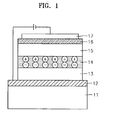
- Al is then deposited on the second cathode to form a first cathode, followed by hermetically sealing, thus completing the organic EL device according to the present invention shown in FIG. 1.
- an anode 12 is formed on a substrate 11, and a hole transport layer 13, an emitter layer 14, an electron transport layer 15, and a second cathode 16 and a first cathode 17 disposed in a predetermined pattern in a direction orthogonal to the anode 12, are sequentially stacked on the anode 12.
- the thickness of the second cathode 16 is 5 to 100 nm, and the thickness of the first cathode 17 is 10 to 150 nm.
- the second cathode 16 exhibits little difference in characteristic depending on thickness. However, if the thickness of the second cathode 16 is less than 5 nm, the electron injection efficiency deteriorates. If the thickness of the second cathode 16 is greater than 100 nm, drive deterioration occurs. If the thickness of the first cathode 17 is less than 10 nm, sheet resistance increases, resulting in drive deterioration. If the thickness of the first cathode 17 is greater than 150 nm, thin film formation is difficult to achieve.
- An organic EL device can be manufactured in the above-described order, that is, anode/hole transport layer/emitter layer/electron transport layer/cathode, and may be manufactured in the reverse order, that is, cathode/electron transport layer/ emitter layer/ hole transport layer/anode.
- the substrate is not necessarily a transparent material, and the aperture ratio becomes advantageously high.
- a substrate that can be used for a conventional organic EL device preferably a glass substrate or transparent plastic substrate having good transparency, surface smoothness, manageability and being waterproof, is used.
- anode forming materials indium tin oxide (ITO), tin oxide (SnO 2 ) or zinc oxide (ZnO), which is transparent and has good conductivity, is used.
- the thickness of the anode is 100 to 200 nm. If the thickness of the anode is greater than the above range, drive deterioration occurs due to sheet resistance and optical properties of the anode undesirably change.
- ITO (indium-tin-oxide) electrode layer was formed on a glass substrate to a thickness of 15 nm, and IDE 406 (manufactured by IDEMITSU KASAN LTD.) was vacuum-deposited thereon, to form a hole injection layer having a thickness of 50 nm. Subsequently, NPB was vacuum-deposited on the hole injection layer, to form a hole transport layer having a thickness of 15 nm.
- Alq 3 was vacuum-deposited on the hole transport layer to form an electron transport layer having a thickness of 70 nm.
- Al and Cs acetate mixed in a weight ratio of 10:1 were thermally deposited on the electron transport layer to form a second cathode to a thickness of 30 nm.
- Al was vacuum-deposited on the second cathode to form a first cathode having a thickness of 70 nm.
- the resultant product was hermetically sealed, thus completing an organic EL device.
- Example 2 The same procedure as Example 1 was performed except that Al and Cs acetate were mixed in a weight ratio of 5:1, thus completing an organic EL device.
- Example 2 The same procedure as Example 1 was performed except that In and Cs acetate were used for the manufacture of the second cathode, instead of Al and Cs acetate, thus completing an organic EL device.
- Example 2 The same procedure as Example 1 was performed except that Cr and Cs acetate were used for the manufacture of the second cathode, instead of Al and Cs acetate, thus completing an organic EL device.
- Example 2 The same procedure as Example 1 was performed except that Ag and Cs acetate were used for the manufacture of the second cathode, instead of Al and Cs acetate, thus completing an organic EL device.
- Example 2 The same procedure as Example 1 was performed except that Al and Cs benzoate were used for the manufacture of the second cathode, instead of Al and Cs acetate, thus completing an organic EL device.
- ITO electrode was formed on a glass substrate to a thickness of 15 nm, and IDE 406 (manufactured by IDEMITSU KOSAN) was vacuum-deposited thereon, to form a hole injection layer having a thickness of 15 nm. Subsequently, NPB was vacuum-deposited on the hole injection layer, to form a hole transport layer having a thickness of 15 nm.
- IDE 120 manufactured by IDEMITSU KOSAN, LTD.
- IDE 105 manufactured by IDEMITSU KOSAN, LTD.
- Alq 3 was vacuum-deposited on the electron injection layer to form an electron transport layer having a thickness of 30 nm.
- Al and Cs acetate mixed in a weight ratio of 94:6 were thermally deposited on the electron transport layer to form a second cathode to a thickness of 30 nm.
- Al was vacuum-deposited on the second cathode to form a first cathode having a thickness of 70 nm.
- the resultant product was hermetically sealed, thus completing an organic EL device.
- Example 7 The same procedure as Example 7 was performed except that Al and Cs acetate were mixed in a weight ratio of 92:8, thus completing an organic EL device.
- ITO layer was formed on a glass substrate to a thickness of 150 nm, and IDE 406 (manufactured by IDEMITSU KOSAN, LTD.) was vacuum-deposited thereon, to form a hole injection layer having a thickness of 50 nm. Subsequently, NPB was vacuum-deposited on the hole injection layer, to form a hole transport layer having a thickness of 15 nm.
- Alq 3 was vacuum-deposited on the hole transport layer to form an electron transport layer having a thickness of 70 nm.
- LiF was vacuum-deposited on the electron transport layer to form an LiF electron injection layer having a thickness of 1 nm, and Al was then vacuum-deposited on the LiF electron injection layer to form an Al electrode having a thickness of 150 nm.
- the resultant product was hermetically sealed, thus completing an organic EL device.
- ITO layer was formed on a glass substrate to a thickness of 15 nm, and IDE 406 (manufactured by IDEMITSU KOSAN, LTD) was vacuum-deposited thereon, to form a hole injection layer having a thickness of 15 nm. Subsequently, NPB was vacuum-deposited on the hole injection layer, to form a hole transport layer having a thickness of 15 nm.
- IDE 120 manufactured by IDEMITSU KOSAN, LTD.
- IDE 105 manufactured by IDEMITSU KOSAN, LTD.
- Alq 3 was vacuum-deposited on the electron injection layer to form an electron transport layer having a thickness of 30 nm.
- LiF was vacuum-deposited on the electron transport layer to form an LiF electron injection layer having a thickness of 1 nm
- Al was then vacuum-deposited on the LiF electron injection layer to form an Al electrode having a thickness of 150 nm.
- the resultant product was hermetically sealed, thus completing an organic EL device.
- ITO layer was formed on a glass substrate to a thickness of 15 nm, and IDE 406 (manufactured by IDEMITSU KOSAN, LTD.) was vacuum-deposited thereon, to form a hole injection layer having a thickness of 15 nm. Subsequently, NPB was vacuum-deposited on the hole injection layer, to form a hole transport layer having a thickness of 15 nm.
- Alq 3 was vacuum-deposited on the hole transport layer to form an electron transport layer having a thickness of 30 nm.
- Li acetate was thermally deposited on the electron transport layer to form an electron injection layer, and Al was then vacuum-deposited on the electron injection layer to form an Al electrode having a thickness of 150 nm.
- the resultant product was hermetically sealed, thus completing an organic EL device.
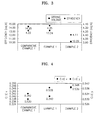
- the organic EL devices manufactured in Examples 1 and 2 exhibited a reduced driving voltage, and substantially the same levels of maximum luminance, electroluminescence efficiency and color coordinate characteristics as those of the organic EL device manufactured in Comparative Example 1.
- the organic EL devices manufactured in Examples 3 through 6 exhibited substantially the same levels of driving voltage, maximum luminance, electroluminescence efficiency and color coordinate characteristics as those of the organic EL device manufactured in Example 1.
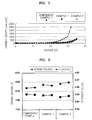
- the organic EL devices manufactured in Examples 1 and 2 had larger current densities than the current density of the organic EL device manufactured in Comparative Example 1, confirming enhanced electron injection.
- the organic EL devices manufactured in Examples 7 and 8 exhibited a reduced driving voltage, and substantially the same levels of maximum luminance, emitting efficiency, power efficiency and color coordinate characteristics as those of the organic EL device manufactured in Comparative Example 2.
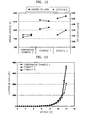
- the organic EL devices manufactured in Examples 7 and 8 had larger current densities than the current density of the organic EL device manufactured in Comparative Example 2, confirming enhanced electron injection.
- the organic EL devices manufactured in Examples 7 and 8 had higher luminance than the organic EL device manufactured in Comparative Example 2.
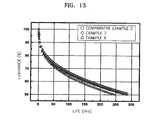
- the life characteristics of the compared organic EL devices are substantially the same.
- the luminance characteristics of the organic EL devices manufactured in Examples 7 and 8 are superior to those of the organic EL device manufactured in Comparative Example 2, it can be confirmed that the lifetimes of the organic EL devices manufactured in Examples 7 and 8 were longer than the lifetime of the organic EL device manufactured in Comparative Example 2, under the same luminance level.
- the organic EL devices manufactured in Examples 1 and 2 exhibited substantially the same levels of driving voltage and color coordinate characteristics, but were superior to the organic EL device manufactured in Comparative Example 3 in view of maximum luminance and electroluminescence efficiency.
- the organic EL devices manufactured in Examples 1 and 2 had larger current densities than the current density of the organic EL device manufactured in Comparative Example 3, confirming enhanced electron injection.
- the lifetimes of the organic EL devices manufactured in Examples 1 and 2 are longer than that of the organic EL device manufactured in Comparative Examples 3.
- the organic EL device In the organic EL device according to the present invention, an energy barrier difference between an electron transport layer and a cathode is reduced, thus enhancing an electron injection efficiency. Therefore, the organic EL device has a reduced driving voltage, while exhibiting good emitting efficiency, color coordinate and luminance characteristics.
Landscapes
- Physics & Mathematics (AREA)
- Optics & Photonics (AREA)
- Chemical & Material Sciences (AREA)
- Engineering & Computer Science (AREA)
- Materials Engineering (AREA)
- Organic Chemistry (AREA)
- Electroluminescent Light Sources (AREA)
Applications Claiming Priority (2)
| Application Number | Priority Date | Filing Date | Title |
|---|---|---|---|
| KR10-2002-0018500A KR100473283B1 (ko) | 2002-04-04 | 2002-04-04 | 유기 전자발광소자 |
| KR2002018500 | 2002-04-04 |
Publications (3)
| Publication Number | Publication Date |
|---|---|
| EP1351324A2 true EP1351324A2 (de) | 2003-10-08 |
| EP1351324A3 EP1351324A3 (de) | 2004-12-22 |
| EP1351324B1 EP1351324B1 (de) | 2012-12-12 |
Family
ID=28036196
Family Applications (1)
| Application Number | Title | Priority Date | Filing Date |
|---|---|---|---|
| EP20030252092 Expired - Lifetime EP1351324B1 (de) | 2002-04-04 | 2003-04-02 | Organische elektrolumineszierende Vorrichtung, die Metallcarboxylate enthält |
Country Status (5)
| Country | Link |
|---|---|
| US (1) | US6803128B2 (de) |
| EP (1) | EP1351324B1 (de) |
| JP (1) | JP2003303691A (de) |
| KR (1) | KR100473283B1 (de) |
| CN (1) | CN1449227A (de) |
Cited By (1)
| Publication number | Priority date | Publication date | Assignee | Title |
|---|---|---|---|---|
| US10886497B2 (en) | 2003-12-26 | 2021-01-05 | Semiconductor Energy Laboratory Co., Ltd. | Light-emitting element |
Families Citing this family (15)
| Publication number | Priority date | Publication date | Assignee | Title |
|---|---|---|---|---|
| US7270894B2 (en) * | 2004-06-22 | 2007-09-18 | General Electric Company | Metal compound-metal multilayer electrodes for organic electronic devices |
| US8026510B2 (en) | 2004-10-20 | 2011-09-27 | Dai Nippon Printing Co., Ltd. | Organic electronic device and method for producing the same |
| US20070108900A1 (en) * | 2005-11-15 | 2007-05-17 | Boek Heather D | Method and apparatus for the elimination of interference fringes in an OLED device |
| US20070236140A1 (en) * | 2006-04-05 | 2007-10-11 | Hsiang-Lun Hsu | System for displaying images including electroluminescent device and method for fabricating the same |
| US20080024059A1 (en) * | 2006-07-27 | 2008-01-31 | Tpo Displays Corp. | System for displaying images incluidng electroluminescent device and method for fabricating the same |
| JP4629715B2 (ja) * | 2006-12-06 | 2011-02-09 | 韓國電子通信研究院 | Oled素子 |
| US20090176010A1 (en) * | 2008-01-04 | 2009-07-09 | M Zwick Lucy | Method of manufacturing organic light emitting display |
| JP2009205985A (ja) * | 2008-02-28 | 2009-09-10 | Sumitomo Chemical Co Ltd | 有機エレクトロルミネッセンス素子及びその製造方法 |
| JP5594291B2 (ja) * | 2009-08-26 | 2014-09-24 | コニカミノルタ株式会社 | 有機エレクトロルミネッセンス素子及びその製造方法 |
| CN102005537A (zh) * | 2010-09-17 | 2011-04-06 | 天津理工大学 | 一种以苯甲酸锂为阴极修饰层的有机光伏电池及其制备方法 |
| KR101846410B1 (ko) | 2011-07-29 | 2018-04-09 | 삼성디스플레이 주식회사 | 유기 발광 표시 장치 |
| KR20130032675A (ko) * | 2011-09-23 | 2013-04-02 | 삼성디스플레이 주식회사 | 듀얼 모드 유기발광소자 및 이를 포함하는 화소 회로 |
| CN103187540B (zh) * | 2011-12-31 | 2019-07-09 | 昆山维信诺显示技术有限公司 | 一种有机电致发光器件及其制备方法 |
| KR101986434B1 (ko) * | 2017-12-08 | 2019-06-05 | 재단법인대구경북과학기술원 | 투명 발광체, 무기발광소자 및 유기발광소자 |
| KR20230061287A (ko) | 2021-10-28 | 2023-05-08 | 삼성전자주식회사 | 전계발광소자 및 그 제조방법과 이를 포함하는 표시 장치 |
Citations (4)
| Publication number | Priority date | Publication date | Assignee | Title |
|---|---|---|---|---|
| EP0822603A2 (de) | 1996-07-29 | 1998-02-04 | Eastman Kodak Company | Für eine elektrolumineszierende Diode verwendete Doppelschicht-Elektroneninjektionselektrode |
| US5739635A (en) | 1995-04-27 | 1998-04-14 | Pioneer Electric Corporation | Organic electroluminescent device |
| US5776623A (en) | 1996-07-29 | 1998-07-07 | Eastman Kodak Company | Transparent electron-injecting electrode for use in an electroluminescent device |
| US5937272A (en) | 1997-06-06 | 1999-08-10 | Eastman Kodak Company | Patterned organic layers in a full-color organic electroluminescent display array on a thin film transistor array substrate |
Family Cites Families (12)
| Publication number | Priority date | Publication date | Assignee | Title |
|---|---|---|---|---|
| US4885211A (en) | 1987-02-11 | 1989-12-05 | Eastman Kodak Company | Electroluminescent device with improved cathode |
| US5059862A (en) * | 1990-07-26 | 1991-10-22 | Eastman Kodak Company | Electroluminescent device with improved cathode |
| US5059861A (en) * | 1990-07-26 | 1991-10-22 | Eastman Kodak Company | Organic electroluminescent device with stabilizing cathode capping layer |
| US5429884A (en) | 1992-01-17 | 1995-07-04 | Pioneer Electronic Corporation | Organic electroluminescent element |
| JPH07122177A (ja) * | 1993-10-25 | 1995-05-12 | Noritake Co Ltd | 酸化物陰極 |
| US5677572A (en) * | 1996-07-29 | 1997-10-14 | Eastman Kodak Company | Bilayer electrode on a n-type semiconductor |
| US6140763A (en) * | 1998-07-28 | 2000-10-31 | Eastman Kodak Company | Interfacial electron-injecting layer formed from a doped cathode for organic light-emitting structure |
| US6545359B1 (en) * | 1998-12-18 | 2003-04-08 | Semiconductor Energy Laboratory Co., Ltd. | Wiring line and manufacture process thereof, and semiconductor device and manufacturing process thereof |
| US6924594B2 (en) * | 2000-10-03 | 2005-08-02 | Semiconductor Energy Laboratory Co., Ltd. | Light emitting device |
| KR100579172B1 (ko) * | 2000-10-11 | 2006-05-11 | 삼성에스디아이 주식회사 | 유기 전자 발광 소자 |
| EP1837930A1 (de) * | 2001-09-04 | 2007-09-26 | Sony Deutschland GmbH | Solarzelle und Herstellungsmethode |
| US6794061B2 (en) * | 2002-01-31 | 2004-09-21 | Eastman Kodak Company | Organic electroluminescent device having an adhesion-promoting layer for use with a magnesium cathode |
-
2002
- 2002-04-04 KR KR10-2002-0018500A patent/KR100473283B1/ko not_active Expired - Fee Related
-
2003
- 2003-03-24 US US10/394,066 patent/US6803128B2/en not_active Expired - Fee Related
- 2003-04-02 EP EP20030252092 patent/EP1351324B1/de not_active Expired - Lifetime
- 2003-04-04 JP JP2003102009A patent/JP2003303691A/ja active Pending
- 2003-04-04 CN CN03110203A patent/CN1449227A/zh active Pending
Patent Citations (5)
| Publication number | Priority date | Publication date | Assignee | Title |
|---|---|---|---|---|
| US5739635A (en) | 1995-04-27 | 1998-04-14 | Pioneer Electric Corporation | Organic electroluminescent device |
| EP0822603A2 (de) | 1996-07-29 | 1998-02-04 | Eastman Kodak Company | Für eine elektrolumineszierende Diode verwendete Doppelschicht-Elektroneninjektionselektrode |
| US5776623A (en) | 1996-07-29 | 1998-07-07 | Eastman Kodak Company | Transparent electron-injecting electrode for use in an electroluminescent device |
| US5776622A (en) | 1996-07-29 | 1998-07-07 | Eastman Kodak Company | Bilayer eletron-injeting electrode for use in an electroluminescent device |
| US5937272A (en) | 1997-06-06 | 1999-08-10 | Eastman Kodak Company | Patterned organic layers in a full-color organic electroluminescent display array on a thin film transistor array substrate |
Non-Patent Citations (3)
| Title |
|---|
| APPL. PHYLETT., vol. 73, 1998, pages 1185 |
| J. KRUEGER, ADV. MAT., no. 12, 2000, pages 447 - 451 |
| L.S. HUNG ET AL., APPL. PHYS. LETT., vol. 70, no. 2, 1997, pages 152 - 154 |
Cited By (1)
| Publication number | Priority date | Publication date | Assignee | Title |
|---|---|---|---|---|
| US10886497B2 (en) | 2003-12-26 | 2021-01-05 | Semiconductor Energy Laboratory Co., Ltd. | Light-emitting element |
Also Published As
| Publication number | Publication date |
|---|---|
| KR20030079457A (ko) | 2003-10-10 |
| EP1351324B1 (de) | 2012-12-12 |
| US20030190494A1 (en) | 2003-10-09 |
| EP1351324A3 (de) | 2004-12-22 |
| JP2003303691A (ja) | 2003-10-24 |
| KR100473283B1 (ko) | 2005-03-08 |
| CN1449227A (zh) | 2003-10-15 |
| US6803128B2 (en) | 2004-10-12 |
Similar Documents
| Publication | Publication Date | Title |
|---|---|---|
| US7002293B2 (en) | Organic light emitting diode with improved light emission through the cathode | |
| US7157156B2 (en) | Organic light emitting device having improved stability | |
| KR101221124B1 (ko) | 양극 캡핑층을 포함하는 무기 물질을 갖는 유기발광소자 | |
| US6392339B1 (en) | Organic light emitting devices including mixed region | |
| KR100893056B1 (ko) | 유기-금속 혼합 층을 포함하는 디스플레이 소자 | |
| US7049741B2 (en) | Organic light emitting diode with improved light emission through substrate | |
| KR101657222B1 (ko) | 유기 발광 소자 | |
| US6803128B2 (en) | Organic electroluminescent device | |
| KR101221141B1 (ko) | 개선된 휘도 안정성을 갖는 유기발광소자 | |
| US6902834B2 (en) | Organic electroluminescence device | |
| JP2005026121A (ja) | 有機el素子及びその製造方法並びに有機elディスプレイ | |
| CN1866536A (zh) | 层叠有机发光器件结构 | |
| US8274212B2 (en) | Organic light emitting device including first hole injection layer and second hole injection layer | |
| US6114055A (en) | Organic electroluminescent device with continuous organic medium containing rubrene | |
| JP2009088525A (ja) | 有機発光素子 | |
| JPH11329731A (ja) | 有機電界発光素子 | |
| JP2000091073A (ja) | 有機電界発光素子 | |
| JP2000133458A (ja) | 有機エレクトロルミネッセンス素子 | |
| JPH11251068A (ja) | 有機エレクトロルミネッセンス素子 | |
| US20090224656A1 (en) | Organic light-emitting device | |
| JPH11329730A (ja) | 有機電界発光素子 | |
| JPH1095971A (ja) | 有機電界発光素子 | |
| JP2000106277A (ja) | 有機エレクトロルミネセンス素子 | |
| JPH1126164A (ja) | 有機エレクトロルミネッセンス素子 | |
| KR100622229B1 (ko) | 플러렌계 탄소화합물을 이용한 발광 표시장치 및 그의 제조방법 |
Legal Events
| Date | Code | Title | Description |
|---|---|---|---|
| PUAI | Public reference made under article 153(3) epc to a published international application that has entered the european phase |
Free format text: ORIGINAL CODE: 0009012 |
|
| AK | Designated contracting states |
Kind code of ref document: A2 Designated state(s): AT BE BG CH CY CZ DE DK EE ES FI FR GB GR HU IE IT LI LU MC NL PT RO SE SI SK TR |
|
| AX | Request for extension of the european patent |
Extension state: AL LT LV MK |
|
| PUAL | Search report despatched |
Free format text: ORIGINAL CODE: 0009013 |
|
| AK | Designated contracting states |
Kind code of ref document: A3 Designated state(s): AT BE BG CH CY CZ DE DK EE ES FI FR GB GR HU IE IT LI LU MC NL PT RO SE SI SK TR |
|
| AX | Request for extension of the european patent |
Extension state: AL LT LV MK |
|
| RAP1 | Party data changed (applicant data changed or rights of an application transferred) |
Owner name: SAMSUNG SDI CO., LTD. |
|
| 17P | Request for examination filed |
Effective date: 20050615 |
|
| AKX | Designation fees paid |
Designated state(s): DE FR GB |
|
| 17Q | First examination report despatched |
Effective date: 20080714 |
|
| RAP1 | Party data changed (applicant data changed or rights of an application transferred) |
Owner name: SAMSUNG MOBILE DISPLAY CO., LTD. |
|
| REG | Reference to a national code |
Ref country code: DE Ref legal event code: R079 Ref document number: 60342825 Country of ref document: DE Free format text: PREVIOUS MAIN CLASS: H01L0051200000 Ipc: H01L0051500000 |
|
| RIC1 | Information provided on ipc code assigned before grant |
Ipc: H01L 51/50 20060101AFI20120606BHEP Ipc: H01L 51/52 20060101ALI20120606BHEP |
|
| GRAP | Despatch of communication of intention to grant a patent |
Free format text: ORIGINAL CODE: EPIDOSNIGR1 |
|
| RAP1 | Party data changed (applicant data changed or rights of an application transferred) |
Owner name: SAMSUNG DISPLAY CO., LTD. |
|
| GRAS | Grant fee paid |
Free format text: ORIGINAL CODE: EPIDOSNIGR3 |
|
| GRAA | (expected) grant |
Free format text: ORIGINAL CODE: 0009210 |
|
| AK | Designated contracting states |
Kind code of ref document: B1 Designated state(s): DE FR GB |
|
| REG | Reference to a national code |
Ref country code: GB Ref legal event code: FG4D |
|
| REG | Reference to a national code |
Ref country code: DE Ref legal event code: R096 Ref document number: 60342825 Country of ref document: DE Effective date: 20130207 |
|
| PLBE | No opposition filed within time limit |
Free format text: ORIGINAL CODE: 0009261 |
|
| STAA | Information on the status of an ep patent application or granted ep patent |
Free format text: STATUS: NO OPPOSITION FILED WITHIN TIME LIMIT |
|
| 26N | No opposition filed |
Effective date: 20130913 |
|
| REG | Reference to a national code |
Ref country code: DE Ref legal event code: R097 Ref document number: 60342825 Country of ref document: DE Effective date: 20130913 |
|
| REG | Reference to a national code |
Ref country code: FR Ref legal event code: PLFP Year of fee payment: 13 |
|
| PGFP | Annual fee paid to national office [announced via postgrant information from national office to epo] |
Ref country code: GB Payment date: 20150410 Year of fee payment: 13 Ref country code: DE Payment date: 20150409 Year of fee payment: 13 |
|
| PGFP | Annual fee paid to national office [announced via postgrant information from national office to epo] |
Ref country code: FR Payment date: 20150413 Year of fee payment: 13 |
|
| REG | Reference to a national code |
Ref country code: DE Ref legal event code: R119 Ref document number: 60342825 Country of ref document: DE |
|
| GBPC | Gb: european patent ceased through non-payment of renewal fee |
Effective date: 20160402 |
|
| REG | Reference to a national code |
Ref country code: FR Ref legal event code: ST Effective date: 20161230 |
|
| PG25 | Lapsed in a contracting state [announced via postgrant information from national office to epo] |
Ref country code: FR Free format text: LAPSE BECAUSE OF NON-PAYMENT OF DUE FEES Effective date: 20160502 Ref country code: DE Free format text: LAPSE BECAUSE OF NON-PAYMENT OF DUE FEES Effective date: 20161101 Ref country code: GB Free format text: LAPSE BECAUSE OF NON-PAYMENT OF DUE FEES Effective date: 20160402 |