EP1354965A2 - Procédé et installation de fabrication de sucre raffiné à partir de jus sucré - Google Patents
Procédé et installation de fabrication de sucre raffiné à partir de jus sucré Download PDFInfo
- Publication number
- EP1354965A2 EP1354965A2 EP03290923A EP03290923A EP1354965A2 EP 1354965 A2 EP1354965 A2 EP 1354965A2 EP 03290923 A EP03290923 A EP 03290923A EP 03290923 A EP03290923 A EP 03290923A EP 1354965 A2 EP1354965 A2 EP 1354965A2
- Authority
- EP
- European Patent Office
- Prior art keywords
- extract
- sugar
- filtrate
- juice
- syrup
- Prior art date
- Legal status (The legal status is an assumption and is not a legal conclusion. Google has not performed a legal analysis and makes no representation as to the accuracy of the status listed.)
- Withdrawn
Links
Images
Classifications
-
- C—CHEMISTRY; METALLURGY
- C13—SUGAR INDUSTRY
- C13B—PRODUCTION OF SUCROSE; APPARATUS SPECIALLY ADAPTED THEREFOR
- C13B20/00—Purification of sugar juices
- C13B20/12—Purification of sugar juices using adsorption agents, e.g. active carbon
-
- C—CHEMISTRY; METALLURGY
- C13—SUGAR INDUSTRY
- C13B—PRODUCTION OF SUCROSE; APPARATUS SPECIALLY ADAPTED THEREFOR
- C13B20/00—Purification of sugar juices
- C13B20/14—Purification of sugar juices using ion-exchange materials
-
- C—CHEMISTRY; METALLURGY
- C13—SUGAR INDUSTRY
- C13B—PRODUCTION OF SUCROSE; APPARATUS SPECIALLY ADAPTED THEREFOR
- C13B20/00—Purification of sugar juices
- C13B20/16—Purification of sugar juices by physical means, e.g. osmosis or filtration
- C13B20/165—Purification of sugar juices by physical means, e.g. osmosis or filtration using membranes, e.g. osmosis, ultrafiltration
Definitions
- the present invention relates to a manufacturing process refined sugar from sweet juice, such as raw juice sugar cane or sugar beet; it also has for object an installation for the implementation of process.
- the production of refined sugar (or white sugar) at from sugar cane includes a number of treatments carried out in sugar factories followed by a certain number of additional treatments carried out in a refinery.
- the main processing steps in sweets are the extraction of sugar by grinding - pressing the cane or by diffusion which leads to a raw sweet juice, the clarification of this juice by adding lime, neutralizing the latter by carbon dioxide (in the case of beet) and decanting the juice thus treated, the concentration of the juice resulting and finally the crystallization and turbination of the sugar usually in three stages, which leads to obtaining brown sugar and molasses.
- the operations to which sugar is subjected roux are essentially a refining (washing of the crystals by a saturated aqueous solution of sugar then spinning) to remove the impurities located on the surface of the crystals, a re-solution of the resulting sugar, a clarification, a discoloration, crystallization and turbination.
- Kwock et al have proposed, in the US patent No. 5,554,227, a process leading to the production of a sugar red with low coloring called SVLC "Super Very Low color” by sequence of membrane filtration operations, softening and crystallization.
- This process allows simplification of the refining of brown sugar and in particular the elimination of refining and purification operations. It allows also the implementation of a chromatography step for recover sugar from molasses and thus improve yield sugar extraction.
- This chromatography leads generally to the production of two fractions, namely one extract rich in sugar and a raffinate containing the impurities of sugar.
- the method according to the invention comprises in in addition to a clarification of the sweet juice before pouring it submit to the tangential filtration operation; this clarification removes undissolved material.
- tangential filtration operation will be preference chosen from tangential ultrafiltration, tangential microfiltration and nanofiltration tangential; these filtration techniques, which put in suitable membranes, are well known in the art. prior art.
- the softening operation preferably comprises an ion exchange operation using an ion exchange resin (cations), for example in Na + form.
- the method according to the invention can also comprise a bleaching operation for the extract, preferably the concentrated extract, before subjecting it to the operation of crystallization; this discoloration can be constituted by treating the extract with an absorbent resin.
- the above installation may further include means of bleaching the concentrated extract from the output of concentrated extract from the means of concentration.
- the softening means include advantageously an ion exchange resin, means bringing the raffinate to the top of the softening means then being provided for the regeneration of said resin.
- the starting material used in this process is raw cane juice, for example obtained by grinding - cane pressing, which leads to a fibrous residue (bagasse) and a raw juice; alternatively, we can appeal to the diffusion technique of exhausting by hot water from the canes cut into pieces, which leads to a residue and a raw juice.
- the juice raw starter could also be raw juice of sugar beet.
- the abovementioned raw juice, which contains sugars and non-sugars is possibly subject to clarification.
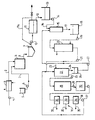
- the raw juice is supplied by the circulation pump 1 and the conduit 2 at the top of a flocculation tank 3, after having been reheated preferably to 70-105 ° C, by example using an indirect heat exchanger 4.
- this tank 3 it is mixed with vigorous stirring with a slaked lime suspension stored in tank 5 and brought from the latter to the upper part of the reservoir 3 by a circulation pump 6 and a conduit 7.
- the dose of lime will be 0.5 to 4 g / l of juice and the amount of agent flocculant will be from 1 to 10 mg / kg of dry matter from the juice to treat.
- the limed juice added with the flocculating agent is then brought by a conduit 8 into a settling tank 9.
- the bottom of the tank 9 can be provided with a duct and an extraction pump bringing the solid deposit collected in the conical part of the tank 9 into a filtration unit (for example rotary filter), the filtrate then being brought back into the tank 9.
- a filtration unit for example rotary filter
- the supernatant liquid (clarified juice) in the tray 9 is extracted from the latter by a circulation pump 10 discharging into a unit 11 of tangential microfiltration, tangential ultrafiltration or tangential nanofiltration.
- the supernatant thus withdrawn from the tank 9 can be reheated so that the operation in this unit 11 takes place at a temperature of the order of 70 to 99 ° C and preferably from 95 to 99 ° C.
- the membrane used in unit 11 may be of the organic type or of the mineral type (for example of TiO 2 or ZrO 2 ) and have a cut-off threshold corresponding to a molecular weight of at least 1000, good results being obtained with a membrane ultrafiltration having a cutoff threshold corresponding to a molecular weight of 300,000, as well as with a microfiltration membrane having a pore diameter of 0.1 ⁇ m.
- the tangential circulation speed of the clarified juice is adapted to the geometry of the micro-, ultra- or nanofiltration module used and may be of the order of 2 to 9 m / s, preferably 6 m / s.
- This circulation speed is regulated by the pump 10, it being specified that part of the filtered juice is brought back by a return line 11 a at the suction of said pump 10.
- the filtrate (permeate) from unit 11 is then routed through a conduit 12 into a storage tank 13 from which it is drawn off by a pump 14 to be brought to the head of a softening column 15 filled with a cation exchange resin, in particular a strong cationic resin, in the Na + and / or K + form , for example a resin from Rhom and Haas.
- a cation exchange resin in particular a strong cationic resin, in the Na + and / or K + form , for example a resin from Rhom and Haas.
- This column is provided, at its upper part, with a filtrate inlet 16 connected to the discharge of the pump 14 and, at its lower part, with a conduit 17 for softened filtrate outlet (content of Ca 2+ ions and / or Mg 2+ of the order of 10 to 50 ppm), the Ca 2+ and / or Mg 2+ ions present in the filtrate supplied at the head of the column (content of Ca 2+ and / or Mg 2+ ions of l (order of 300 to 3000 ppm) being retained by the resin during the progression of the filtrate through the column by displacing the Na + and / or K + ions of this resin.
- the softened filtrate discharged through line 17 then arrives in a tank 18 from which it is drawn off by a pump 19 to be brought into a concentration unit 20 which can be, for example, an evaporator such as a falling-stream evaporator.
- concentration unit 20 which can be, for example, an evaporator such as a falling-stream evaporator.
- the syrup obtained at the outlet of this unit 20 is then brought by a pump 21 into a chromatography unit 22.
- This unit can be of the column type comprising a fixed support constituted by a strong cationic resin, in the Na + and / or K form + , for example the DOWEX® C356 resin from the company DOW, the elution liquid being water brought into the upper part of the column by a conduit 23.
- This same column 22 is provided at its lower part with a conduit 24 for evacuation of a first liquid effluent (raffinate) depleted in sugars, enriched with Na and / or K salts and eluted first and from a conduit 25 for evacuation of a second liquid effluent (extract) enriched in sugars, depleted in Na and / or K salts and eluted second.
- raffinate from line 24 is received in a storage tank 26. Due to its high content of Na + and / or K + ions, said raffinate can advantageously be used as regeneration liquid for the softening column 15.
- the raffinate received in the storage tank 26 is brought via a pump 27 to the head of the softening column 15.
- the circuit 26-27 will be put into service when it is desired to regenerate the resin filling the column 15, said raffinate serving as regeneration liquid due to its high content of Na + and / or K + .
- it will suffice to stop the pump 14, start the pump 27 and divert the effluent escaping from the conduit 17 to a reservoir other than the reservoir 18.
- the extract from line 25 it is brought into a concentration unit 28 which can for example be of the same type as the aforementioned concentration unit 20.
- the chromatography unit 22 can variant be of the sequential simulated moving bed type.
- the concentrated extract obtained at the outlet from unit 28 is then brought by a pump 29 into a bleaching unit 30 which may include a column filled with an absorbent material such as animal black, activated carbon or a bleaching resin for example a strong anionic resin in the form of chloride, such as IRA 900® resin from Rohm and Haas.
- a bleaching unit 30 which may include a column filled with an absorbent material such as animal black, activated carbon or a bleaching resin for example a strong anionic resin in the form of chloride, such as IRA 900® resin from Rohm and Haas.
- the discoloration is preferably carried out hot, for example at 80 ° C.
- the nature and amount of absorbent material will be chosen to obtain a white granulated sugar.
- the extract thus discolored is then brought into a crystallization unit 31 with several jets, three jets in the installation shown.
- this unit 31 comprises three stages crystallization 32, 33, 34 corresponding respectively to the three aforementioned jets. On each of these floors is formed the granulated sugar which is separated from the sewer by turbination. The granulated sugar is evacuated by means of evacuation appropriate globally referenced 35.
- the third jet sewer evacuated from the stage 34 by the conduit 36 is brought via a pump circulation 37 at a point between pump 21 and the chromatography unit 22, so as to be mixed with syrup from concentration unit 20; a tray of sewer storage (not shown) is possibly present on the circuit bringing the sewer in question from floor 34 to the chromatography unit 22.
- the purity of sucrose (expressed by the percentage of sucrose relative to the dry matter) and the degree of coloration (expressed in ICUMSA units) of different effluents formed during the process used in the installation. described above, are as follows:
- the method according to the invention allows a sugar extraction yield calculated at the input of the crystallization workshop which goes from 88% to more than 96%.
Landscapes
- Chemical & Material Sciences (AREA)
- Life Sciences & Earth Sciences (AREA)
- Biochemistry (AREA)
- Organic Chemistry (AREA)
- Engineering & Computer Science (AREA)
- Water Supply & Treatment (AREA)
- Treatment Of Liquids With Adsorbents In General (AREA)
- Non-Alcoholic Beverages (AREA)
- Seasonings (AREA)
- Saccharide Compounds (AREA)
Abstract
- de filtration tangentielle du jus sucré pour obtenir un rétentat et un filtrat,
- d'adoucissement du filtrat pour obtenir un filtrat adouci,
- de concentration du filtrat adouci pour obtenir un sirop adouci,
- de chromatographie du sirop adouci pour obtenir un extrait enrichi en sucres et un raffinat enrichi en impuretés,
- de cristallisation à deux ou plus de deux jets, de l'extrait pour obtenir du sucre raffiné et un égout, et
- de combinaison de l'égout avec le sirop adouci afin qu'ils soient tous deux soumis à l'opération de chromatographie.
Description
- de filtration tangentielle du jus sucré pour obtenir un rétentat et un filtrat,
- d'adoucissement du filtrat pour obtenir un filtrat adouci,
- de concentration du filtrat adouci pour obtenir un sirop adouci,
- de chromatographie du sirop adouci pour obtenir un extrait enrichi en sucres et un raffinat enrichi en impuretés,
- de cristallisation à deux ou plus de deux jets, de l'extrait pour obtenir du sucre raffiné et un égout, et
- de combinaison de l'égout avec le sirop adouci afin qu'ils soient tous deux soumis à l'opération de chromatographie.
- une source de jus sucré,
- des moyens de filtration tangentielle du jus sucré provenant de cette source, ces moyens comprenant une sortie de filtrat,
- des moyens d'adoucissement du filtrat comprenant une sortie de filtrat adouci,
- des moyens de concentration du filtrat adouci, comprenant une sortie de sirop,
- des moyens de chromatographie dudit sirop, comprenant une sortie de raffinat et une sortie d'extrait,
- des moyens de concentration de l'extrait, comprenant une sortie d'extrait concentré,
- des moyens de cristallisation, à deux ou plus de deux jets, de l'extrait concentré, comprenant des moyens de récupération de sucre cristallisé et des moyens de récupération de l'égout du dernier jet de cristallisation, et
- des moyens d'amenée de cet égout en tête des moyens de chromatographie.

Claims (12)
- Procédé de fabrication de sucre raffiné à partir de jus sucré tel que du jus brut de canne à sucre ou de betterave à sucre, contenant des sucres et des impuretés, qui comprend les opérations :caractérisé en ce qu'il comprend en outre l'opération :de filtration tangentielle du jus sucré pour obtenir un rétentat et un filtrat,d'adoucissement du filtrat pour obtenir un filtrat adouci,de concentration du filtrat adouci pour obtenir un sirop adouci,de chromatographie du sirop adouci pour obtenir un extrait enrichi en sucres et un raffinat enrichi en impuretés, etde cristallisation à deux ou plus de deux jets, de l'extrait pour obtenir du sucre raffiné et un égout,de combinaison de l'égout avec le sirop adouci afin qu'ils soient tous deux soumis à l'opération de chromatographie.
- Procédé selon la revendication 1, caractérisé en ce qu'il comprend en outre une opération de clarification du jus sucré avant de le soumettre à l'opération de filtration tangentielle.
- Procédé selon la revendication 1 ou 2, caractérisé en ce que l'opération de filtration tangentielle est choisie parmi une ultrafiltration tangentielle, une microfiltration tangentielle et une nanofiltration tangentielle.
- Procédé selon la revendication 1, 2 ou 3, caractérisé en ce que l'opération d'adoucissement comprend une opération d'échange d'ions faisant appel à une résine échangeuse d'ions.
- Procédé selon l'une des revendications précédentes, caractérisé en ce qu'il comprend en outre une opération de concentration de l'extrait avant de le soumettre à l'opération de cristallisation, pour obtenir un extrait concentré.
- Procédé selon l'une des revendications précédentes, caractérisé en ce qu'il comprend en outre une opération de décoloration de l'extrait avant de le soumettre à l'opération de cristallisation.
- Procédé selon la revendication 6, caractérisé en ce que l'opération de décoloration comprend le traitement dudit extrait par une résine absorbante.
- Procédé selon la revendication 6 ou 7, caractérisé en ce que l'opération de décoloration est effectuée sur l'extrait concentré.
- Procédé selon l'une des revendications 4 à 8, caractérisé en ce qu'il comprend de plus une opération de régénération de la résine échangeuse d'ions mise en oeuvre dans l'opération d'adoucissement, au moyen du raffinat produit lors de l'opération de chromatographie.
- Installation pour la mise en oeuvre du procédé selon l'un quelconque des revendications précédentes, caractérisée en ce qu'elle comprend :une source de jus sucré,des moyens de filtration tangentielle du jus provenant de cette source, ces moyens comprenant une sortie de filtrat,des moyens d'adoucissement du filtrat comprenant une sortie de filtrat adouci,des moyens de concentration du filtrat adouci, comprenant une sortie de sirop,des moyens de chromatographie du sirop, comprenant une sortie de raffinat et une sortie d'extrait,des moyens de concentration de l'extrait, comprenant une sortie d'extrait concentré,des moyens de cristallisation, à deux ou plus de deux jets, de l'extrait concentré, comprenant des moyens de récupération de sucre cristallisé et des moyens de récupération de l'égout du dernier jet de cristallisation, etdes moyens d'amenée de cet égout en tête des moyens de chromatographie.
- Installation selon la revendication 10, caractérisé en ce qu'elle comprend en outre des moyens de décoloration de l'extrait concentré issu de la sortie d'extrait concentré des moyens de concentration.
- Installation selon la revendication 10 ou 11, caractérisé en ce que les moyens d'adoucissement comprennent une résine échangeuse d'ions et en ce qu'elle comprend en outre des moyens d'amenée du raffinat en tête des moyens d'adoucissement en vue de la régénération de ladite résine.
Applications Claiming Priority (2)
| Application Number | Priority Date | Filing Date | Title |
|---|---|---|---|
| FR0204794 | 2002-04-17 | ||
| FR0204794A FR2838751B1 (fr) | 2002-04-17 | 2002-04-17 | Procede et installation de fabrication de sucre raffine a partir de jus sucre |
Publications (2)
| Publication Number | Publication Date |
|---|---|
| EP1354965A2 true EP1354965A2 (fr) | 2003-10-22 |
| EP1354965A3 EP1354965A3 (fr) | 2004-02-11 |
Family
ID=28459904
Family Applications (1)
| Application Number | Title | Priority Date | Filing Date |
|---|---|---|---|
| EP03290923A Withdrawn EP1354965A3 (fr) | 2002-04-17 | 2003-04-14 | Procédé et installation de fabrication de sucre raffiné à partir de jus sucré |
Country Status (12)
| Country | Link |
|---|---|
| US (2) | US7067013B2 (fr) |
| EP (1) | EP1354965A3 (fr) |
| CN (1) | CN1451766A (fr) |
| AR (1) | AR039307A1 (fr) |
| AU (1) | AU2003203748A1 (fr) |
| BR (1) | BR0302355A (fr) |
| CO (1) | CO5380040A1 (fr) |
| FR (1) | FR2838751B1 (fr) |
| MX (1) | MXPA03003196A (fr) |
| PL (1) | PL359739A1 (fr) |
| RU (1) | RU2003110972A (fr) |
| ZA (1) | ZA200303042B (fr) |
Cited By (1)
| Publication number | Priority date | Publication date | Assignee | Title |
|---|---|---|---|---|
| EP1578213A1 (fr) * | 2002-11-06 | 2005-09-28 | Danisco Sugar Oy | Exhausteur de gout comestible, procede de production et d'utilisation |
Families Citing this family (8)
| Publication number | Priority date | Publication date | Assignee | Title |
|---|---|---|---|---|
| FR2844209B1 (fr) * | 2002-09-06 | 2007-10-19 | Applexion Ste Nouvelle De Rech | Procede de purification par nanofiltration d'une solution aqueuse sucree contenant des anions et cations monovalents et polyvalents |
| FR2907687B1 (fr) * | 2006-10-30 | 2008-12-26 | Applexion | Procede de purification de sialyllactose par chromatographie |
| FR2925349A1 (fr) * | 2007-12-20 | 2009-06-26 | Applexion | Procede de separation sequence multicolonnes d'un derive metallique ionique |
| CN103468832B (zh) * | 2013-10-12 | 2016-05-25 | 云南省轻工业科学研究院 | 一种生产高安全性白砂糖的工艺 |
| CN103710470B (zh) * | 2013-12-26 | 2016-03-23 | 江苏久吾高科技股份有限公司 | 一种二步法制糖的工艺及装置 |
| CN104824760B (zh) * | 2015-05-25 | 2017-09-05 | 广西叶茂机电自动化有限责任公司 | 一种甘蔗活性饮用水及纯甘蔗原汁饮料的生产工艺 |
| FR3094724B1 (fr) | 2019-04-05 | 2021-04-23 | Novasep Process | Procédé de traitement de sucre |
| CN117384223A (zh) * | 2023-10-10 | 2024-01-12 | 国药集团化学试剂有限公司 | 一种高纯药用糖类试剂的制备方法 |
Family Cites Families (9)
| Publication number | Priority date | Publication date | Assignee | Title |
|---|---|---|---|---|
| FR2707997B1 (fr) * | 1993-07-19 | 1995-09-29 | Applexion Ste Nle Rech Applic | Procédé de raffinage d'un sucre brut, notamment de sucre roux provenant de l'industrie sucrière de la canne à sucre. |
| US5554227A (en) * | 1993-11-12 | 1996-09-10 | Societe Nouvelle De Recherches Et D'applications Industrielles D'echangeurs D'ions Applexion | Process of manufacturing crystal sugar from an aqueous sugar juice such as cane juice or sugar beet juice |
| US5466294A (en) * | 1993-12-14 | 1995-11-14 | The Amalgamated Sugar Company | Sugar beet juice purification process |
| CZ2002570A3 (cs) * | 1999-08-19 | 2002-11-13 | Tate & Lyle Sugar Holdings, Inc. | Způsob membránové filtrace cukrové řepy |
| US6440222B1 (en) * | 2000-07-18 | 2002-08-27 | Tate & Lyle Industries, Limited | Sugar beet membrane filtration process |
| WO2001014595A2 (fr) * | 1999-08-19 | 2001-03-01 | Tate & Lyle, Inc. | Procede pour filtrer sur membrane de la canne a sucre |
| JP2001157600A (ja) * | 1999-12-02 | 2001-06-12 | Tsukishima Kikai Co Ltd | 限外ろ過処理およびクロマト分離を含む甘蔗からの直接精糖法 |
| JP4513075B2 (ja) * | 1999-12-02 | 2010-07-28 | 月島機械株式会社 | 炭酸ソーダの添加による軟化処理を含む限外ろ過処理による甘蔗からの精製糖製造プロセス |
| US6485574B1 (en) * | 2000-06-23 | 2002-11-26 | Chung-Chi Chou | Process for pretreating colored aqueous sugar solutions to produce a low colored crystallized sugar |
-
2002
- 2002-04-17 FR FR0204794A patent/FR2838751B1/fr not_active Expired - Lifetime
-
2003
- 2003-04-11 MX MXPA03003196A patent/MXPA03003196A/es not_active Application Discontinuation
- 2003-04-14 EP EP03290923A patent/EP1354965A3/fr not_active Withdrawn
- 2003-04-14 CO CO03031731A patent/CO5380040A1/es not_active Application Discontinuation
- 2003-04-14 AR ARP030101301A patent/AR039307A1/es unknown
- 2003-04-14 US US10/413,617 patent/US7067013B2/en not_active Expired - Lifetime
- 2003-04-16 RU RU2003110972/13A patent/RU2003110972A/ru not_active Application Discontinuation
- 2003-04-16 AU AU2003203748A patent/AU2003203748A1/en not_active Abandoned
- 2003-04-16 PL PL03359739A patent/PL359739A1/xx not_active Application Discontinuation
- 2003-04-17 ZA ZA200303042A patent/ZA200303042B/xx unknown
- 2003-04-17 CN CN03128656.9A patent/CN1451766A/zh active Pending
- 2003-04-17 BR BR0302355-9A patent/BR0302355A/pt not_active IP Right Cessation
- 2003-04-22 US US10/420,975 patent/US20030230302A1/en not_active Abandoned
Cited By (1)
| Publication number | Priority date | Publication date | Assignee | Title |
|---|---|---|---|---|
| EP1578213A1 (fr) * | 2002-11-06 | 2005-09-28 | Danisco Sugar Oy | Exhausteur de gout comestible, procede de production et d'utilisation |
Also Published As
| Publication number | Publication date |
|---|---|
| AU2003203748A1 (en) | 2003-11-06 |
| FR2838751B1 (fr) | 2007-03-09 |
| FR2838751A1 (fr) | 2003-10-24 |
| US20030230301A1 (en) | 2003-12-18 |
| RU2003110972A (ru) | 2004-12-20 |
| US7067013B2 (en) | 2006-06-27 |
| PL359739A1 (en) | 2003-10-20 |
| BR0302355A (pt) | 2004-08-17 |
| CN1451766A (zh) | 2003-10-29 |
| CO5380040A1 (es) | 2004-03-31 |
| US20030230302A1 (en) | 2003-12-18 |
| MXPA03003196A (es) | 2004-10-29 |
| AR039307A1 (es) | 2005-02-16 |
| EP1354965A3 (fr) | 2004-02-11 |
| ZA200303042B (en) | 2003-10-16 |
Similar Documents
| Publication | Publication Date | Title |
|---|---|---|
| EP0655507B1 (fr) | Procédé de fabrication de sucre cristallisé, à partir de jus sucré aqueux tel qu'un jus de canne à sucre ou de betterave sucrière | |
| CN1324148C (zh) | 木糖的回收 | |
| EP1540019B1 (fr) | Procede de purification par nanofiltration d une solution aqueuse sucree contenant des anions et cations monovalents et polyvalents | |
| EP0629707B1 (fr) | Procédé d'adoucissement d'un jus sucré tel qu'une mélasse de sucrerie et son utilisation dans un procédé de récupération des sucres contenus dans ce jus sucré | |
| EP0635578A1 (fr) | Procédé de raffinage d'un sucre brut, notamment de sucre roux provenant de l'industrie sucrière de la canne à sucre | |
| FR2838751A1 (fr) | Procede et installation de fabrication de sucre raffine a partir de jus sucre | |
| US7226511B2 (en) | Direct production of white sugar from sugarcane juice or sugar beet juice | |
| WO2020201411A1 (fr) | Procédé de traitement de sucre | |
| FR2848877A1 (fr) | Procede de purification par nanofiltration d'une solution aqueuse sucree contenant des anions et cations monovalents et polyvalents | |
| EP0832986B1 (fr) | Procédé de régénération de résines échangeuses d'ions dans le processus de décalcification des jus de sucrerie | |
| FR2791700A1 (fr) | Procede de fabrication d'un hydrolysat d'amidon a haute teneur en dextrose | |
| FR2762616A1 (fr) | Procede de fabrication d'un hydrolysat d'amidon a haute teneur en dextrose | |
| FR2587723A1 (fr) | Procede d'extraction par diffusion du sucre de betteraves | |
| FR3093517A1 (fr) | Procédé de décoloration de sucre avec recyclage des effluents | |
| RU2175016C1 (ru) | Способ очистки тростникового сахара-сырца | |
| EP0987337B1 (fr) | Procédé de fabrication de sucre commercialisable | |
| BE461643A (fr) | ||
| CZ34497A3 (cs) | Technologický postup čištění cukerních šťáv s oddělením a regenerací předčeřené sraženiny | |
| BE496112A (fr) | ||
| EP0566514A1 (fr) | Procédé de nettoyage d'une installation de séparation des composés de silicium contenus dans un bain de décapage chlorhydrique de produits en acier et dispositif pour sa mise en oeuvre | |
| BE351391A (fr) | ||
| BE473736A (fr) | ||
| FR2503185A1 (fr) | Procede de traitement de produits de sucrerie, pour diminuer les fractions de sucre perdues dans les melasses, par substitution d'ions magnesium a des ions potassium dans le produit | |
| BE561094A (fr) |
Legal Events
| Date | Code | Title | Description |
|---|---|---|---|
| PUAI | Public reference made under article 153(3) epc to a published international application that has entered the european phase |
Free format text: ORIGINAL CODE: 0009012 |
|
| AK | Designated contracting states |
Kind code of ref document: A2 Designated state(s): AT BE BG CH CY CZ DE DK EE ES FI FR GB GR HU IE IT LI LU MC NL PT RO SE SI SK TR |
|
| AX | Request for extension of the european patent |
Extension state: AL LT LV MK |
|
| PUAL | Search report despatched |
Free format text: ORIGINAL CODE: 0009013 |
|
| AK | Designated contracting states |
Kind code of ref document: A3 Designated state(s): AT BE BG CH CY CZ DE DK EE ES FI FR GB GR HU IE IT LI LU MC NL PT RO SE SI SK TR |
|
| AX | Request for extension of the european patent |
Extension state: AL LT LV MK |
|
| 17P | Request for examination filed |
Effective date: 20040727 |
|
| AKX | Designation fees paid |
Designated state(s): DE ES FR GB IT |
|
| 17Q | First examination report despatched |
Effective date: 20050523 |
|
| STAA | Information on the status of an ep patent application or granted ep patent |
Free format text: STATUS: THE APPLICATION IS DEEMED TO BE WITHDRAWN |
|
| 18D | Application deemed to be withdrawn |
Effective date: 20051206 |